ENNIO MORRICONE-MORRICONE HIGH-THE TRIPPIER SIDE OF MORRICONE.
ENNIO MORRICONE-MORRICONE HIGH-THE TRIPPIER SIDE OF MORRICONE.
Although Ennio Morricone’s name is synonymous with film soundtracks, there’s much more to his career than that. This includes over 100 classical pieces that Ennio wrote between 1946 and the late-fifties. After that, Ennio worked at RCA as an arranger. He arranged over 500 songs, and worked with everyone from Chet Baker to Paul Anka. Then as the sixties dawned, Ennio Morricone changed direction. He started penning the first of over 500 film soundtracks. This it seemed, was what Ennio was born to do.
That’s why the eight-five year old composer is remembered as without doubt, the most prolific, highest profile and best respected film composers of the twentieth century. Ennio Morricone has written over 500 soundtracks. These soundtracks cover every possible genre of film. This includes Spaghetti Westerns.
The quartet of Sergio Leone’s Spaghetti Westerns Spaghetti Westerns are what many people associate Ennio Morricone with. This began in 1964 with 1964s A Fistful of Dollars, then 1965s For A Few Dollars More, 1966s The Good, the Bad and the Ugly and 1968s Once Upon A Time In the West. They made Ennio Morricone a household name. However, there’s much, much more to Ennio Morricone’s career than just four Spaghetti Westerns. Much more. The story begins in 1959.
It was 1959s The Death of A Friend that was Ennio Morricone soundtrack debut. His career would span a further six decades. Never one to shirk a challenge, The Maestro wrote scores to everything from big-budget blockbusters right through to art-house films. His soundtracks have sold over fifty-million copies and he’s won awards worldwide. The music on these soundtracks is best described as eclectic. This includes psychedelia. Ennio Morricone’s psychedelic side is celebrated on Morricone High. However, with Morricone High it’s a case of caveat emptor.
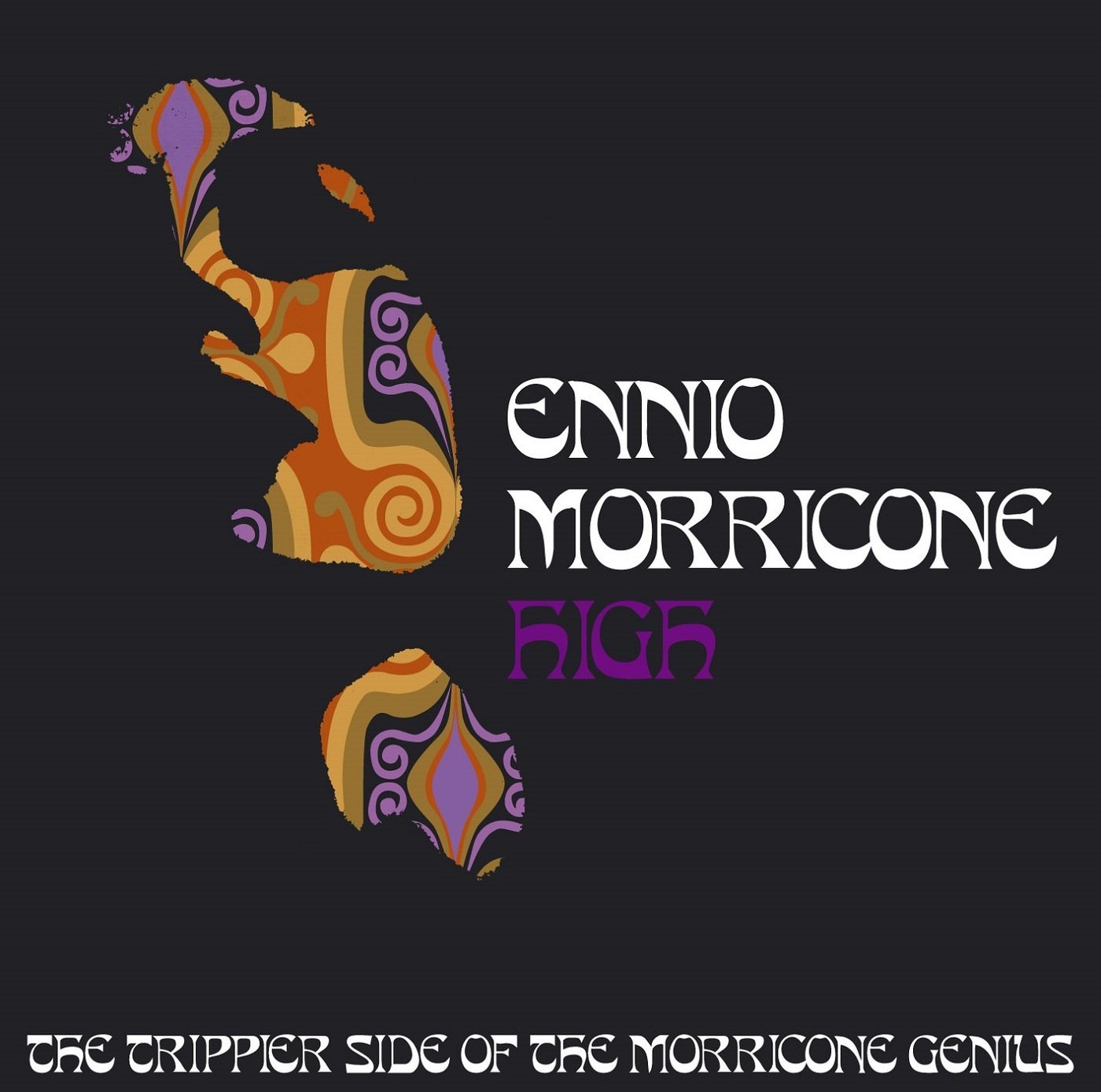
When I first received the copy of Morricone High, I vaguely remembered the cover. It was the cover that caught my attention. It’s hardly a masterpiece in modern design. You don’t forget a cover like that. Far from it. It’s more like a pastiche of psychedelia. So I started digging, and discovered that Morricone High was first released back in 2005, by the same label, El Records. There’s nothing new on this version. Hence my warning of caveat emptor.
There’s nothing whatsoever different this version of Morricone High. Sadly, that means there’s still no sleeve-notes worth mentioning. The highlight of the sleeve-notes is a brief introduction by The Maestro. Apart from that, there’s some supposedly sixties psychedelic photos. Their raison d’etre seems to be to pad out the flimsy eight-page booklet. Sadly, they don’t add to the product. Looking through the booklet, it hardly comes across as a quality product. Quite the opposite. Hopefully, the music on Morricone High will more than make up for lack of sleeve-notes and pseudo psychedelic album cover.
Morricone High comprises a sixteen tracks and lasts just forty-nine minutes. The tracks featured on the soundtracks of six films. These films were released between 1968 and 1971. Each of these films were produced by European directors. Some of the films are hardly blockbusters. Indeed, many of them have been long forgotten. Often, for good reason. For many people, the highlight of the film was Ennio Morricone’s soundtracks which I’ll tell you about.
The first five tracks on Morricone High are taken from Scusi Faciamo L’amore? Excuse Me, Let’s Make Love is an Italian film, released in September 1968. It tells the story of a young man heading to Milan to his father’s funeral. Once in Milan, he decides to make a living as a gigolo. Hence the titles Excuse Me, Let’s Make Love, Between The Sheets, Take Me Now, To The Altar and Back and A Lidia. As for the five tracks, they’ve a cinematic quality. They’re a fusion of sixties pop, psychedelia, easy listening, jazz, lounge and even briefly, avant garde. The music veers between sultry, needy, melancholy, melodic, haunting, dramatic and ethereal. These tracks demonstrate what The Maestro in his prime was capable of.
Le Foto Proibite Di Una Signora Per Bene was released in 1970. It’s hardly the finest film Ennio Morricone has been asked to provide the score to. Directed by Luciano Ercoll, Forbidden Photos Of A Lady Above Suspicion is a tale of friendship, love, sex, and possibly, murder. Four tracks from the soundtrack feature on Morricone High. The first is Allegretto Per Signora, where sixties psychedelia and funk collide head on. Amore Come Dolore is much more subdued and mellow, growing in power and drama. Orchestral strings are deployed effectively. Le Foto Proibite Di Una Signora Per Bene features a tender, needy vocal delivered a melancholy backdrop. The shuffling, organ driven Secondo Intermezzino Pop is a much more upbeat slice of memorable pop, that like the other tracks, shows The Maestro’s talent and versatility.
Veruschka: Poetry of a Woman was a documentary about the Vera Gräfin von Lehndorff-Steinort. During her career, she’s been an actress, artist and model. Indeed, she’s seen as the original supermodel. That’s why in 1971, a documentary was made about her life. Ennio wrote the score. It featured the ethereal beauty of La Banola. Astratto 1 is very different. It’s a cinematic fusion of avant garde, experimental and free jazz. However, sometimes, it heads towards discordant. Then there’s the bass driven Le Fotographie. It seems to pick up where Astratto 1 left off. Having sailed close to the wind, Ennio creates a track that’s ambitious, bold and innovative.
Paolo Spinola directed La Donna Invisible, which was released in Italy in December 1969. Sadly, it proved not to be his finest hour. Critics weren’t won over by The Invisible Woman. The soundtrack was another matter. Scored by Ennio Morricone, two tracks from The Invisible Woman feature on Morricone High. Ritratto D’Autore veers between dramatic to beautiful, courtesy of the swathes of lush strings. La Moda has a late-sixties poppy sound. That’s before horns and strings sweep in. There’s also a strong psychedelic influence. This shows that The Maestro constantly strove to reinvent himself and his music.
Broody, moody, dramatic and haunting describes the minimalist Notte Bambole. Its cinematic sound has you on the edge of your seat. This is a track the soundtrack to La Corta Notte Delle Bambole De Vetro. The Short Night Of The Glass Dolls tells the story of an American journalist searching for his girlfriend, who suddenly, has disappeared. Released in October 1971 and directed by Aldo Lado, eerie, atmospheric and haunting describes this track.
1970 closes Morricone High. It’s a track from the soundtrack to Il Gatto A Nove Code. The Cat o’ Nine Tails was directed by Dario Argento, and released in May 1971. It’s a truly captivating track. It veers between haunting, ethereal and dramatic. Jazz, psychedelia, avant garde and experimental combine to create a captivating cinematic track.
Thankfully, the music on Morricone High makes up for the shortcomings of the sleeve-notes and album cover. The sixteen tracks features The Maestro in his prime. His music paints pictures. You can imagine the scenes unfolding before your very eyes. To do that, he combines musical genres. Everything from avant garde, easy listening, experimental, free jazz, jazz, lounge, pop, psychedelia and rock. All these influences shine through on Morricone High. This results in music that’s variously atmospheric, broody, moody, dramatic, sultry, ethereal, haunting, melancholy, melodic and psychedelic. That’s why when European film directors were looking for someone to write the soundtrack to their film, the man they called was The Maestro.
The six soundtracks that the sixteen tracks were taken from, are just six of 500 films Ennio Morricone has written the score to. These films range from art-house films to blockbusters. Another thing that differs is their quality. None of the films that the sixteen tracks were taken from, won any Oscars. Far from it. They’re low budget movies, which in some cases, have been long forgotten. That’s apart from the soundtrack. Their quality surpassed the quality of the movie. Now over forty years later, these soundtrack are highly sought after. That’s why fans of Ennio Morricone’s soundtracks welcome compilations of his music.
That’s the case here. There’s a but though. The sound quality of some of the tracks isn’t what I’d expect. Especially on the first five tracks. They were a bit crackly. That was somewhat disappointing. Maybe this was a problem with the master tapes, or that the tracks from recorded from a vinyl copy of the soundtracks? Then there’s the lack of sleeve-notes and the disappointing album cover. My final gripe is that Morricone High isn’t a new compilation. It was released back in 2005 and was dusted down again recently. There aren’t even any bonus tracks. Many people perceived this as nothing but a cynical marketing plot. However, is Morricone High an album to add to your record collection?
The answer to that is yes and no. Given the quality of music, I’d say yes. Morricone High features The Maestro in his prime. However, it’s not exactly the most psychedelic music I’ve ever heard. Trippy only describes some of the tracks. The rest are an eclectic selection. They all have a cinematic quality. What lets Morricone High down is the lack of sleeve-notes, disappointing album cover and sometimes, disappointing sound quality. Sadly, the sleeve-notes, album cover and sound quality don’t do justice to The Maestro’s music on Morricone High. At least the music reinforces why Ennio Morricone is called The Masestro.
ENNIO MORRICONE-MORRICONE HIGH-THE TRIPPIER SIDE OF MORRICONE.
- Posted in: Free Jazz ♦ Jazz ♦ Pop ♦ Psychedelia ♦ Rock
- Tagged: Ennio Morricone, Excuse Me, Let's Make Love?, Morricone High, Morricone High The Tripper Side Of Morricone, The Invisible Woman
 dereksmusicblog
 dereksmusicblog