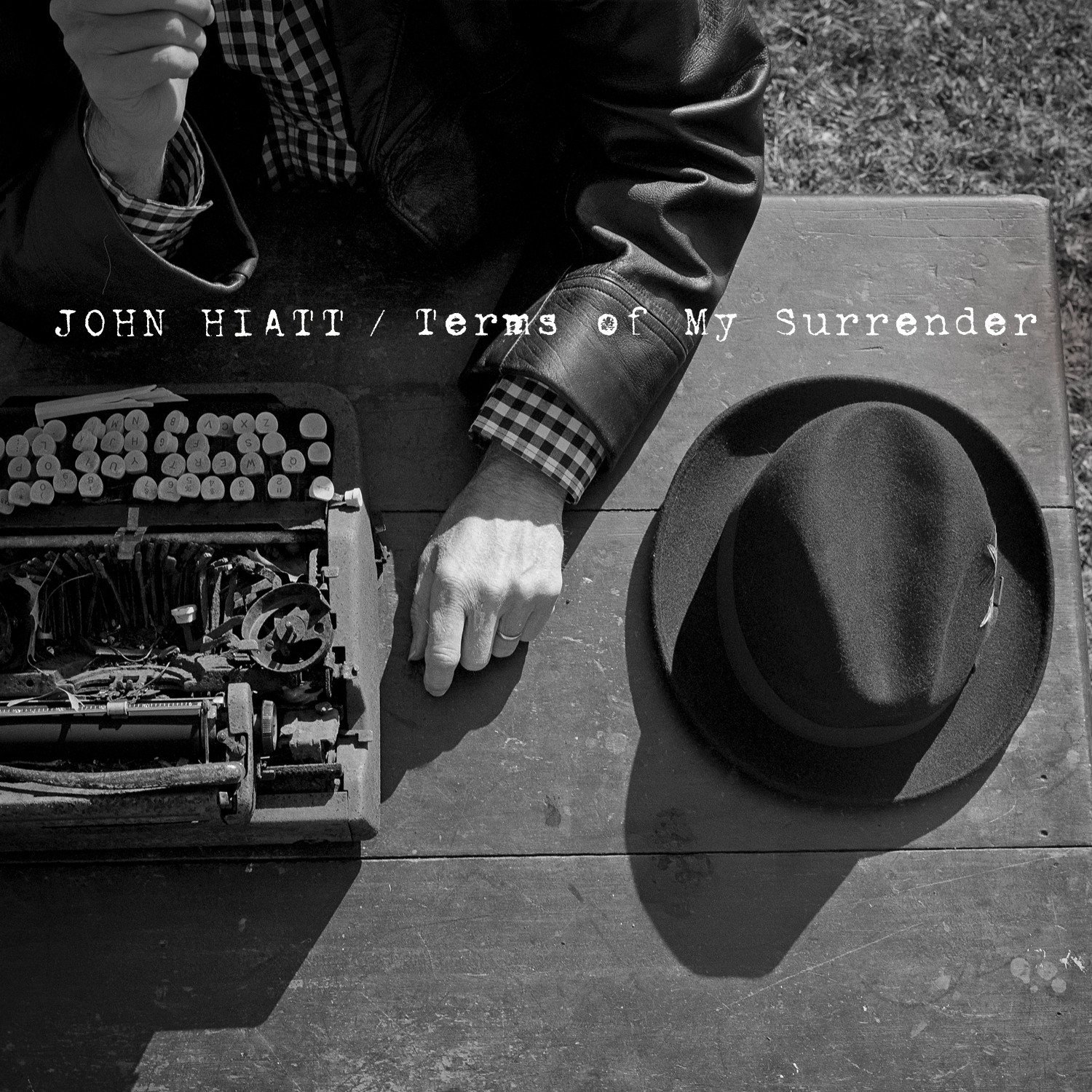
JOHN HIATT-TERMS OF MY SURRENDER.
JOHN HIATT-TERMS OF MY SURRENDER.
Recently, some of music’s elder statesmen have made a welcome return. During the last couple of weeks, Eric Clapton, Richard Thompson, Loudon Wainwright III and Tom Petty and The Heartbreakers. That’s not all. Another musical veteran on the comeback trail is John Hiatt.
John’s new album Terms Of My Surrender, is his twenty-third studio album. It’s a double album, which was released on New West Records, on 21st July 2014. That’s forty years after John released his debut album Hangin’ Around The Observatory in 1974. Since then, John Hiatt has established a reputation as one of America’s finest singer-songwriters. That’s apparent on Terms Of My Surrender.
When John Hiatt began recording Terms Of My Surrender, he was sixty-one. He was born in Indianapolis, on 20th August 1970. John, who is one of seven children. Tragedy touched his life early on. His older brother committed suicide and his father died two years later, after a lengthy illness. To escape the tragedy that had touched his life, John spent his time listening to the blues, Bob Dylan and Elvis Presley. Along with Indy Car racing, this was how John to spent his early years. Then John picked up a guitar for the first place.
He was only eleven when he first picked up a guitar. Before long, John was playing in bands around Indianapolis. This included some of the city’s clubs. Little did John, or anyone who saw him in clubs like the Hummingbird, know that John would make a living as a musician.
Aged eighteen, John left Indianapolis and headed to Nashville. His first job w as a songwriter for the Tree-Music Publishing Company. John was paid just twenty-five dollars a week. Despite being unable to read music, John penned 250 songs. At the same time, John joined White Duck.
Unlike most groups, White Duck had three singer-songwriters within the group. John featured on their 1972 sophomore album In Season. He wrote and sang two tracks on In Season. This proved to be start of his career.
It was around this time that John made his solo debut. He was splitting his time between White Duck and his solo career. Then in 1973, John met Don Ellis of Epic Records and signed his first solo deal. His debut single was We Make Spirit. The followup was Sure As I’m Sitting Here, which would later give Three Dog Night a hit single. A year later, John Hiatt released his debut album.
John released Hangin’ Around the Observatory in 1974, on Epic Records. It failed to chart. Neither did his 1975 sophomore album Overcoats. This resulted in John being dropped by Epic Records.
Next stop was MCA. Sadly, John’s fortunes didn’t improve. Neither 1979s Slug Line nor Two Bit Monsters entered the US Billboard 200. So, John changed label again.
Stll success failed to come John’s way. He released a trio of albums on Geffen. These albums, 1983s All Of A Sudden and 1985s Riding With The King and Warming Up To The Ice Age failed to chart. After Warming Up To The Ice Age John left Geffen. However, success came his way when he signed to A&M.
One of the most successful periods of John’s career began in 1987. That’s when John released his A&M debut Bring The Family in 1987. It transformed his fortunes, reaching number 107 in the US Billboard 200 charts. Things got better when 1988s Slow Turning reached number ninety-eight in the US Billboard 200 charts. Then in 1990, John released the tenth album of his US Billboard 200 charts. This was the most successful album of John’s career. He surpassed this with 1993s Perfectly Good Guitar, which reached number forty-seven in the US Billboard 200 charts. Perfectly Good Guitar was John’s last album before he headed to Capitol.
At Capitol, John’s fortunes were mixed. 1998s Walking On reached number forty-eight in the US Billboard 200 charts. However, 1997s Little Head wasn’t a commercial success, stalling at number 111 in the US Billboard 200. For John this must have proved hugely disappointing. Just when he looked like becoming one of the most successful singer songwriters, his career took a wrong turn. Getting back to where he’d been was a long, hard road.
Following the commercial failure of Little Head, John left Capitol. He signed for Vanguard and released two albums. 2000s Crossing Muddy Waters stalled at 110 in the US Billboard 200 charts. Things improved slightly when 2001s The Tiki Bar Is Open reached number eighty-nine in the US Billboard 200 charts. The Tiki Bar Is Open proved to be the final album John released for Vanguard. After that, he signed to New West Records, the label he’s still signed to.
Beneath This Gruff Exterior was John’s seventeenth album and his first release for New West Records. Released in 2003, it marked an upturn in John’s fortunes, reaching number seventy-three in the US Billboard 200 charts. Two years later, in 2005, John released Master Of Disaster, which featured The North Mississippi Allstars. It stalled at a disappointing number 126 in the US Billboard 200 charts. There was a gap of three years until John released his next album, Same Old Man. This marked the start of an Indian Summer in John’s long career
The Indian summer began with 2008s Same Old Man, which reached number seventy-eight in the US Billboard 200 charts. 2010 saw release of The Open Road, which reached number seventy-two in the US Billboard 200 charts. Then in 2011, John released his most successful album in seventeen. This was Dirty Jeans and Mudslide Hymns, which number fifty-nine in the US Billboard 200 charts. However, John surpassed its success with his previous album Mystic Pinball, which reached number thirty-nine in the US Billboard 200 charts. Incredibly, Mystic Pinball was the most successful album of John’s five decade career. Would Terms Of My Surrender surpass the success of Mystic Pinball.
For Terms Of My Surrender, John penned eleven new tracks. He headed to the studio with a tight, talented band and producer Doug Lancio. John played guitar, harmonica and sang lead vocals. The rhythm sectio included bassist Nathan Gehri, drummer and percussionist Kenneth Blevins and Doug Lancio on guitar, banjo and mandolin. Jon Coleman played keyboards and Brandon Young sang backing vocals. When Terms Of My Surrender was recorded, it was released on 21st July 2014.
On the release of Terms Of My Surrender, critics welcomed the more organic sound of the album. They remarked that John’s voice had aged well. Its smokey, lived-in sound suits the fusion of blues, roots and rock. Mostly, John plays acoustic guitar, saving his electric guitar for special occasions, which hopefully, there will be many on Terms Of My Surrender. Will that be the case? That’s what I’ll tell you.
Opening Terms Of My Surrender is Long Time Comin.’ It’s a slow, heartfelt ballad. When it begins to unfold, the arrangement is understated. John plays an acoustic guitar. It combines with slow, thoughtful drums and percussion. They leave space for John’s worldweary vocal. Hurt and pain fill his vocal, on this song about love lost. Midway through the track, a soaring glistening guitar joins washes of Hammond organ and drums. They’re the perfect backdrop for John’s vocal. After that, the track returns to its acoustic roots and heads to its wistful ending.
Confidently, John strums his guitar on Face Of God. Along with the rest of his band, he creates a bluesy backdrop. This includes short, sharp bursts of harmonica and Hammond organ. Even John’s weary, lived-in vocal has a bluesy hue. Especially when he asks “how much more suffering, before you see the face of God.” Frustration, anger and despair fill his voice on a track that’s the perfect showcase for John Hiatt singer-songwriter.
Marlene sees a change of sound. It’s a much more upbeat sounding track. That’s down to John’s tender, lovestruck vocal. Especially when he sings the lines “Marlene, Marlene, like a summer rain, like the honey dew, drippin’ all in my brain, Marlene, Marlene, I’m in love with you.” Meanwhile, the band provide an understated backdrop. Elements of country, folk and blues are combined with poppy hooks.
On Wind Don’t Have To Hurry, a banjo accompanies John’s husky vocal. He’s accompanied by percussion and scatted harmonies. They deliver the constant chorus of “Na Na Na Na.” This lets the song down. Especially given the quality of the rest of the lyrics, which are full of social comment. Midway through the track the arrangement fills out. Drums, harmonies and handclaps unite. After that, it’s a return to the understated, banjo drive arrangement. By the end of the track, it’s apparent this track doesn’t work, and shouldn’t have made the cut.
Nobody Knew His Name sees a continuation of the understated arrangement. John strums his trusty guitar while the rhythm section provide the heartbeat. A slide guitar is sprayed across the arrangement. John’s live-in, country-tinged vocal is perfect for this track. Sometimes, he’s accompanied by a female vocals. She’s yin to John’s yang. Together, they bring the mystery in the lyrics to life. You’re left wondering who is this mysterious man who Nobody Knew His Name? Whoever he was, he provided the inspiration for one of Terms Of My Surrender’s highlights.
Baby’s Gonna Kick sees a return to earlier the bluesy sound. It’s a slow, moody, bluesy sounding track. While the rhythm section lock into a groove, a bluesy harmonica accompanies John’s vocal. So, do harmonies, keyboards and guitar. Seamlessly, everything fits into place. This includes the lyrics, John delivery of them. Not only does John deliver one of his best vocals, but delivers a masterclass in how to play blues harmonica. Aided and abetted by his tight, talented band they deliver a slow, sultry, moody bluesy track that’s truly glorious.
Nothin’ I Love marks a return to the understated arrangement. Not for long though. At the start, John’s accompanied by just the guitar. That’s until washes of Hammond organ sweep in. Then your patience is rewarded. Another bluesy track unfolds. High kicking guitars signal the changing of the guard. From there, the guitars prove the perfect foil for John’s heartbroken, desperate vocal.
Terms Of My Surrender sees John drop the tempo and deliver a jazz-tinged vocal. His vocals are tinged with humour and some of the best on Terms Of My Surrender. One of the funniest and most disturbing is “sometimes love can be so wrong, like a fat man in a thong.” Not a pleasant thought. Accompanying John are just a guitar, drums and cooing harmonies. Add all is together and the result is an understated, jazz-tinged paean.
Following up Terms Of My Surrender wasn’t going to be easy. It was, one of the best tracks on Terms Of My Surrender. So, John John changes tack on Here To Stay. He’s got the blues again. Washes of guitar, handclaps and harmonies accompany John’s soul-baring vocal.
Old People sees a return of John’s legendary wit. He doesn’t much care whether the lyrics are P.C. From the get-go, we’re privy to the wit and wisdom of John Hiatt. Especially when he sings: “old people are pushy, they don’t have much time, they’ll shove you at the coffee shop, cut ahead in the buffet line.” John and his band turn this track into a bluesy sing-along. Full of slick hooks and infectiously catchy, you’ll not forget this song in a hurry.
Closing Terms Of My Surrender is Come Back Home , a guitar driven track. That guitar accompanies John’s needy vocal. He’s missing the woman who left him alone. Despair and loneliness fill his vocal, as the piano enters. His hurt shines through as the arrangement opens up, fusing country, blues and rock. The finishing touches are washes of Hammond organ, harmonies and stabs orb blistering guitar. Along with John’s needy, hurt-filled vocal, they ensure Terms Of My Surrender ends on a high.
Just like you’d expect from a musical veteran, John Hiatt knows to always leave the audience wanting more. That’s the case with Terms Of My Surrender. It features eleven tracks. He doesn’t make the mistake so many young musicians make, and release sprawling albums. Instead, Terms Of My Surrender is a reminder of the age of the vinyl album.
Back then, an album featured only an artist’s best work. That’s almost the case here. The only time John makes a wrong turning is the banjo driven Wind Don’t Have To Hurry. It just doesn’t work. Why neither John nor Doug Lancio realised this seems strange. Without Wind Don’t Have To Hurry, Terms Of My Surrender would be a return to the golden age of the album. Despite that, Terms Of My Surrender sees John Hiatt’s Indian Summer continue.
John Hiatt seems to have found his musical home at New West Records, who recently released Terms Of My Surrender. His last few albums have seen a return to the commercial success and critical acclaim John Hiatt enjoyed earlier in his career. Just like a fine win John’s matured as a singer and songwriter. He’ll be sixty-two next month and is putting his age and experience to good use.
That’s apparent on Terms Of My Surrender. Songs of love and love lost, sit side-by-side side with songs full of social comment and John’s trademark humour. The result is a welcome return to form on Terms Of My Surrender, which seesJohn Hiatt’s comeback continue apace.
JOHN HIATT-TERMS OF MY SURRENDER.
 dereksmusicblog
 dereksmusicblog