ORNETTE COLEMAN-FRIENDS AND NEIGHBORS: LIVE AT PRINCESS STREET.
Ornette Coleman-Friends and Neighbors: Live At Princess Street.
Label: BGP.
Format: LP.
Nowadays, saxophonist, trumpeter, violinist and composer Ornette Coleman is recognised as one of the founding fathers of the free jazz movement. He released his debut album Something Else in 1958 on the Contemporary label. The flowing year, 1959, he released Tomorrow Is the Question! After this, the pioneering musician signed to Atlantic and later that year, released an album that was akin to a statement of intent.
This was She Shape Of Jazz To Come, a unique and innovative album that combined elements of avant-garde and free jazz. Although this groundbreaking album wasn’t a commercial success, nowadays, it’s regarded as a landmark album and a genre classic.
At Atlantic, Ornette Coleman was recording and releasing the most ambitious album of his career. This included 1960s Change Of The Century and 1961s This Is Our Music. However, his fourth album for Atlantic surpassed everything that he head previously released.
On ‘21st’ December 1960, Ornette Coleman entered the studio with a double quartet. They played simultaneously on the album, with the bandleader’s own quartet featured on the left hand channel, while the second quartet featured on the right hand channel. The music the quartets produced was ambitious, innovative, way ahead of its time and far removed from the jazz music that had gone before. On the two lengthy movements the rhythm sections providing a multilayered rhythmic backdrop, while added what a series of freeform commentaries with some pre-composed passages. Incredibly, this album of continuous free improvisation was recorded in one take with no overdubbing or editing. When it was released nine months later and was a gamechanger
In September1961, Ornette Coleman’s sixth album Free Jazz: A Collective Improvisation was released. Some critics realised and recognised the importance of what was a groundbreaking Magnus Opus. It was also an album that lent its name to a nascent musical movement, and free jazz was born.
The album also inspired future generations of jazz musicians. Some even copied Ornette Coleman’s use of a double quarter. This include John Coltrane on his 1965 classic album Ascension.
After the release of this landmark album, Ornette Coleman was hailed as one of the pioneers of new free jazz movement. The followup to Free Jazz: A Collective Improvisation was Ornette! It was the first of two albums he released during 1962. The second was Ornette on Tenor, which was also his swansong for Atlantic.
Following his departure from Atlantic, Ornette Coleman’s music evolved and he continued to innovate. His sound became more angular as he moved towards the avant-garde. It was also around this time that his quartet disbanded and he formed a trio with drummer Charles Moffett and bassist David Izenzon. Sometimes, the trio were augmented by string players. It was a new and exciting chapter in the career of a pioneering musician.
Meanwhile, Ornette Coleman started to teach himself to play trumpet and violin, which he played left-handed. Without the same conventional musical technique his contemporaries had, he used the instruments in a very different way. Instead, he used them to make big, hold and uninhibited musical gestures. He used these to punctuate the musical soundscapes he was making.
Influencing Ornette Coleman’s music at this time was his friend, the avant-garde saxophonist, anger and composer Albert Ayler. Another influenced was bassist Charlie Haden who joined the trio and transformed it into a two bass quartet. The bassist would later, become an important member of a new quartet.
In 1965, the live album Town Hall was released. Ornette Coleman had recorded the album in 1962, so it wasn’t truly representative of the music he was making.
This included the album Chappaqua Suite which he recorded in 1965. It was commissioned by director Conrad Rooks for the soundtrack to his film Chappaqua. However, when he heard the music he decided not to use it in the film in case its inherent beauty and emotion would detract from what was a powerful, moving and sometimes disturbing movie. This hugely underrated and oft-overlooked album was released by Columbia in 1966. By then, Ornette Coleman had signed to Blue Note Records.
Ornette Coleman recorded what became the avant-garde live album At the Golden Circle Stockholm, on the December the ‘3rd’ and ‘4th’ 1965, at the Gyllene Cirkeln jazz club. It was the first album where the saxophonist also played trumpet and violin. He had spent the three years since leaving Atlantic teaching himself how to play the instruments, then showcased his newfound skills on his Blue Note debut which was released in 1966.
So was the studio album The Empty Foxhole. Joining Ornette Coleman was his ten year old son Denardo who played drums and bassist Charlie Haden. However, this free jazz album by the trio was released to mixed reviews. Later, some critics reevaluated the album which nowadays, is regarded by some as a hidden gem.
In 1967 The Music Of Ornette Coleman-Forms and Sound was released by RCA Victor. It was another live album that had been recorded in 1967. The Philadelphia Woodwind Quintet feature on Forms and Sounds, while the Chamber Symphony of Philadelphia String Quartet play on Saints and Soldiers and Space Flight. Meanwhile, Ornette Coleman contributed bluesy trumpet interludes on an ambitious, complex and innovative album of cerebral free jazz. It was hailed as one of the most important albums of his career.
During 1968, Ornette Coleman released two albums. This included the live album Ornette At 12, which was produced by Bob Thiele. When It was released by Impulse! it received mixed reviews. However, like The Empty Foxhole two years earlier, it’s an underrated album.
In November 1969, Ornette Coleman released New York Is Now! It had been recorded on April ’29th’ and May ‘7th’ 1968, and featured two former members of John Coltrane’s band, drummer Elvin Jones and bassist Jimmy Garrison. They were joined by tenor saxophonist Dewey Redman and vocalist Mel Fuhrman. This colossus of a ruth section powers the arrangements along and add swing. Add to this the stunning interplay between the two saxophonists. The result was an album that was quite different to what Ornette Coleman had previously released. He would only release one more album for Blue Note, Love Call in 1971.
Friends and Neighbors: Live At Princess Street.
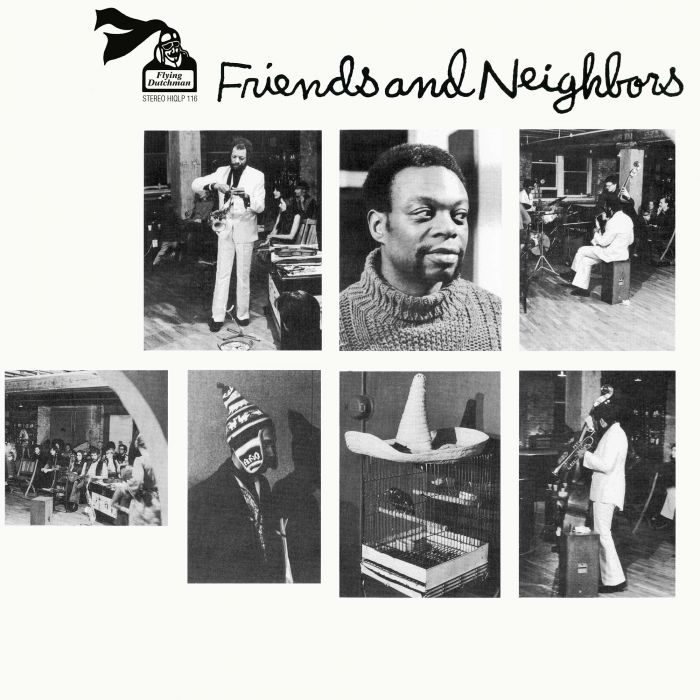
As the new decade dawned, Ornette Coleman was reunited with Bob Thiele, who had founded the Flying Dutchman label. His new label was about to record and release a live album. This became Friends and Neighbors: Live At Princess Street. It was quite unlike most live albums.
At the time, Ornette Coleman was living in the Big Apple. There were many clubs he could’ve recorded a live album. However, he decided to record the album at his large loft space in downtown New York.
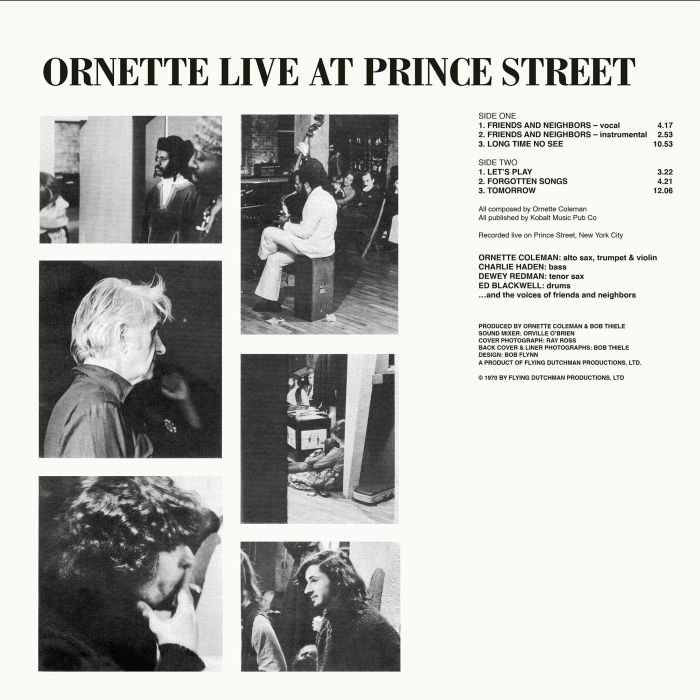
The tapes were scheduled to roll on February ’14th’ 1970. That night at the Prince Street apartment, friends and neighbors gathered and watched a truly talented quartet. The rhythm section featured drummer Ed Blackwell and bassist Charlie Haden. Dewey Redman played tenor saxophone and clarinet while Ornette Coleman played alto saxophone, trumpet and violin. They romped through six of the bandleader’s compositions. They were the vocal and instrumental version of Friends and Neighbors, Long Time No See, Let’s Play, Forgotten Songs and Tomorrow. The set was akin to a jam session where the all-star band kick loose and showcase their considerable skills.
On home turf, thirty-nine year old bandleader Ornette Coleman is relaxed and at his innovative best, as he pushes musical boundaries to their limits and combines disparate genres. As usual, the music was ambitious, adventurous, cerebral, and sometimes challenging, futuristic and otherworldly. Other times it’s urgent, celebratory and joyous.
Side One.
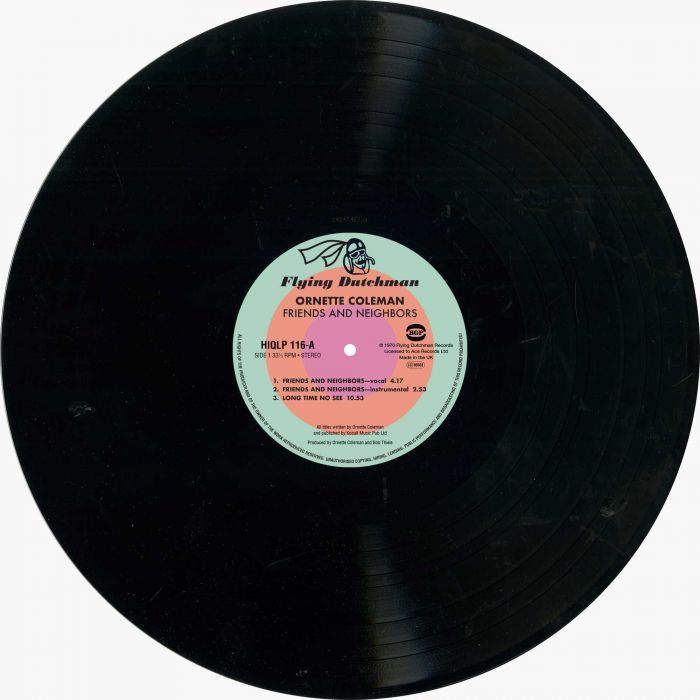
That was the case on the vocal version of Friends and Neighbors which opens the album. Then on the shorter instrumental version the tempo increases and so does the urgency. Ornette Coleman’s scratchy violin keeps pace with the saxophone adding a bluesy hue as one of the founding fathers of free jazz continues to push musical boundaries fusing free jazz with avant-garde. Long Time No See is an ambitious eleven minute epic that’s powered along by the rhythm section. However, it’s the saxophones that steal the show.
Side Two.
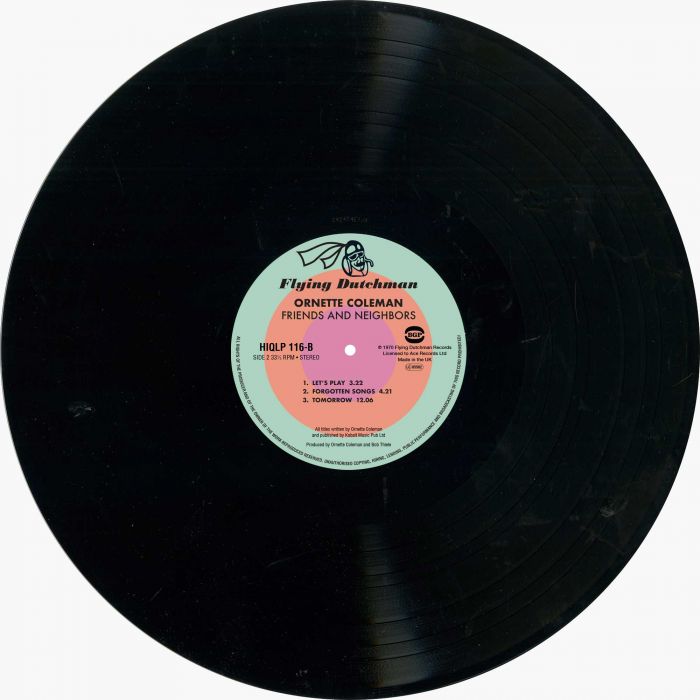
That’s also the case on Let’s Play, where the saxophones wail and squeal but their beauty is their for all hear and admire. The quartet then kick loose on Forgotten Songs, with the tried-and-tested rhythm section powering and driving the arrangement along. Meanwhile the saxophones soar melodically above on what’s without doubt one of the highlights of the set. It closes with Tomorrow, a twelve minute blistering workout from one of the legends of free jazz at the peak of his powers.
Despite recording Friends and Neighbors: Live At Princess Street in 1970, the album wasn’t released until 1972 by Flying Dutchman. Although the alum was well received by critics, it wasn’t a commercial success and has remained an oft-overlooked hidden gem in Ornette Coleman’s back-catalogue.
However, hopefully, BGP’s reissues of Friends and Neighbors: Live At Princess Street will introduce a new audience to the album, and also all act as introduction to Ornette Coleman, one of the founding fathers of free jazz and a groundbreaking musician whose raison d’être was to push musical boundaries to their limits and beyond. This he does on Friends and Neighbors: Live At Princess Street, and during a recording career that spanned fifty-one years.
Ornette Coleman-Friends and Neighbors: Live At Princess Street.


 dereksmusicblog
 dereksmusicblog
That’s a great piece on Coleman. As you shared a great innovator and multi instrumentalist. Here’s motivation for me to go back and give him more of a listen. As much as I appreciate the talent I take this time type of Jazz in small doses. Small but mighty I’ll give it a go!