ROMARK RECORDS-KENT HARRIS’ SOUL SIDES.
ROMARK RECORDS-KENT HARRIS’ SOUL SIDES.
From the fifties right through the sixties and seventies, all over America, small independent record labels sprung up. From Chicago, Detroit, Memphis, Philly and Los Angeles, small labels were founded. They released everything from blues, doo wop, pop, garage and soul music to varying degrees of success. Sadly, much of the music many of these labels released, never found a wider audience. Due to distribution problems, many releases were just regional hits. For many labels, this was deemed a success. Other labels weren’t even that successful. No wonder. Back then, the music business was very different. It was a cutthroat business. Many people running independent labels weren’t cut out for the Machavellian machinations of the music business. As a result, many labels folded after just a few short years. Romark Records lasted longer than many labels.
Having released its first single in 1963, Romark Records closed its doors a decade later. In 1973, founder Kent Harris decided he’d had enough of the music business. Now forty years later, fittingly, Kent Soul have released a compilation of Romark Records’ releases. Romark Records-Kent Harris Soul Sides, which was compiled by Peter Gibbon and Ady Croasdell, was released on Kent Soul on 27th May 2013. It features twenty-two tracks from Romark Records’ back-catalogue. Of the twenty-five tracks on Romark Records-Kent Harris Soul Sides, four have never been released before. This is a tantalizing prospect. So is that at long last, Romark Records’ music will be heard by a much wider audience. Before I tell you about Romark Records-Kent Harris Soul Sides, I’ll tell you about Romark Records.
Kent Harris was a successful R&B singer, songwriter and producer when he decided to found his own label, Romark Records. He’d released two singles as Boogaloo and His Gallant Crew on the Crest label in 1956. Cops and Robbers reached number nine in the US R&B Charts. This proved to be the end of Kent’s recording career. Instead, Kent decided to concentrate on A&R, songwriting and production.
Among Kent’s discoveries, were Brenda Holloway, James Shaw and The Duals. Having discovered an artist, Kent wrote and produced their single, which he then placed with a variety of labels, including several Los Angeles based labels. This included singles by The Lon-Genes and The Phillips Sisters, plus veteran blues’ players Cry Baby Curtis and Ray Agee. Towards the end of 1963, Kent decided rather than place his recordings with other labels, he’d found his own label, Romark Records.
Romark Records was founded by Kent Harris towards the end of 1963. Kent named his new label after his son. His nascent label managed to release two singles in 1963. The first was The Phillips Sisters’ After Night. It was followed by I’ll Come Back To You by The Mighty Hannible. Complete with spelling mistake The Mighty Hannible marked the start of what would be a ten year musical journey for Kent Harris.
Over the next ten years Kent Harris would continue to look for new artists for Romark. Among the artists he signed were Donoman, Eddie Bridges & His Lowriders, Faye Ross, The Francettes, Larry Atkins, Marcene Harris, Marshall McQueen, O’Malley Jones, Obie Jessie Seeds Of Freedom and Ty Karim. They were joined by The Lon-Genes and Ray Agee, plus Romark’s house-band, Romark’s Wrecking Crew. Kent wrote and produced songs for these artists, which were released between 1964 and 1973, when Romark Records closed its doors. Each of these artists feature on Romark Records-Kent Harris Soul Sides. So does Jimmy “Preacher” Ellis. Tough Competition may show another side to Jimmy, but demonstrates why they called him the “preacher.” While Tough Competition is one of the highlights of Romark Records-Kent Harris Soul Sides, there’s many more soulful delights awaiting discovery on this compilation. I’ll now tell you about them.
The track that opens Romark Records-Kent Harris Soul Sides is Ty Karim’s All At Once. It sets the standard for Romark Records-Kent Harris Soul Sides. All At Once was the B-side to her 1965 single You Really Made It which was recorded in Ray Charles’ studio. Written by Kent with Larry Jackson, it was arranged by Jerry Long. This is a mid-tempo ballad, which has a dramatic, Northern Soul sound. Key to this are the blazing horns and sweeping, urgent harmonies that accompany Ty’s heartbroken vocal. By the time this soul-baring track closes, you realize why Ty Karim would soon be regarded as Romark’s biggest star.
When Ray Agee recorded It’s Hard To Explain in 1972, he was something of a musical veteran. Originally, he’d been a blues singer, but had with Kent’s guidance, became a soul singer. Here, blues, soul and gospel are combined. A wailing, atmospheric Hammond organ adds a gospel sound, while a blues guitar and lush soul strings add to the emotion, sadness and frustration in Ray’s vocal. Reminiscent of B.B. King and Ray Charles, this isn’t just a minor classic, but a reminder of one of the most underrated, but talented singers of his generation.
Given that The Phillips Sisters released Romark Records’ first single, it’s fitting that one of their singles feature on Romark Records-Kent Harris Soul Sides. 1964s Where Did You Stay Last Night sees The Phillips Sisters at their best. Their vocals are feisty, frustrated and angry, while growling horns, handclaps and driving rhythm section accompany them. Although the sound is raw and gritty, it’s certainly not lacking in emotion and energy. Indeed, it’s what you’d get if you combined of Ike and Tina Turner with The Supremes.
Larry Atkins has three tracks on Romark Records-Kent Harris Soul Sides. Good as they all are, one stands out for me, Ain’t That Love Enough. Released in 1967, this is another track that will appeal to Northern Soul fans. With a stomping beat and sweeping, cooing harmonies, Larry’s worried vocal is filled with emotion. He feeds off the backing vocals, mixing power and passion, he pleas and questions on this hidden soulful gem.
Another of Kent’s pre-Romark discoveries was The Lon-Genes. Kent realizing they were a talented group, signed them to Romark. That was a good decision. Proof of this is the mid-tempo ballad, Dream Girl. From its sound, you could guess that it was released in 1964. Driven along by piano and percussion, the lead vocal is filled with loneliness and longing. Harmonies sweep in, as is trying mend a broken heart. Nothing could do this, apart from a “Dream Girl.” Wistful, melancholy and beautiful, this song is all this and more.
Deborah Foster released Bye Bye Baby (I’m Leaving You) in 1984, despite Romark closing its doors in 1973. By then, music had changed. You can hear that here. Synths are used extensively. This was the norm though, when electronica and soul met head on. Even that doesn’t spoil this soulful farewell. As Deborah bids farewell to the man she loved, her vocal soars high above an arrangement, which features piano, synths and rhythm section. It’s as if she’s been freed and her life is about to start all over. Backing vocalists sweep in, as Deborah, mixing gospel and soul, says goodbye and soulfully, heads to destination unknown.
Earlier I said that Jimmy “Preacher” Ellis’ Tough Competition was one of the best tracks on Romark Records-Kent Harris Soul Sides. I haven’t changed my mind. Released in 1972, Jimmy was a well travelled singer. Previously, he’d been a member of The Centuries, but when they split-up, became a blues singer. On Tough Competition, Jimmy fuses blues, gospel and soul, pleading, preaching, questioning and unleashing power, passion and emotion.
My final track from Romark Records-Kent Harris Soul Sides is Marshall McQueen’s If I Can’t Stop You. Marshall penned the track with Jesse Roberts. It’s one of two songs Marshall has on the compilation. Sadly, neither were ever released. This is the first time this track has ever been released. That it’s not been released before seems almost unjust. His whispery vamp quickly becomes a soaring soulful falsetto. As Marshall pleads and begs, his vocal is filled emotion, hurt and heartache. Describing this track as soulful and heartbreaking, doesn’t even come close.
That Romark Records outlasted many other labels is no surprise. If you listen to Romark Records-Kent Harris Soul Sides you realize why. Quite simply, Romark Records released better music, music that changed as musical fashions changed. Owner and founder Kent Harris realized that this was crucial. Music was constantly evolving, so labels had to evolve. Another reason for Romark Records success, was they were always looking for new artists.
With Kent Harris in charge of A&R, Romark Records were constantly discovering talent. These new artists were transformed. Their talent was then honed. After all, there was no point an artist releasing a single before they were ready. Then, when they were ready to release a single, Kent would often write it. He would take charge of production. Sadly, many of Romark Records’ releases weren’t huge commercial successes. This wasn’t a reflection on the music. Instead, it was about Romark Records’ size.
Other “independent” labels, including Stax, Hi, Motown and Philadelphia International Records’ music were backed by majors. Romark Records weren’t. This put them at a huge advantage. As a result, many of their releases weren’t the commercial successes their quality deserved. So, by 1973, and after ten years in business, Kent Harris decided that Romark Records would close its doors. Soul lost another label. Now just a handful of labels, with their trademark sounds, dominated soul. Soul, it seemed, had lost some of its soul.
Thankfully, Kent Soul decided to rectify this. They decided to delve into the vaults of Romark Records. The result was Romark Records-Kent Harris Soul Sides, which was released on 27th May 2013. Romark Records-Kent Harris Soul Sides included twenty-five soulful reminders of back when soul was a whole lot more soulful. Standout Tracks: Ty Karim All At Once, Ray Agee It’s Hard To Explain, The Lon-Genes Dream Girls and Jimmy “Preacher” Ellis Tough Competition.
ROMARK RECORDS-KENT HARRIS’ SOUL SIDES.

THE NUTOPIANS-LENNON RE-IMAGINED.
THE NUTOPIANS-LENNON RE-IMAGINED.
With so many artists and bands being inspired by John Lennon’s music, it’s no surprise his music is so widely covered. For many artists, it’s their way of paying homage to one of the most articulate, perceptive and intelligent songwriters in the history of modern music. Sadly, the results however, have varied greatly. Some have been far from memorable. They haven’t come close to producing a fitting tribute to one of the most important, innovative and influential singer, songwriter and musicians ever. Other artists however, have produced fitting, poignant and beautiful homages to John Lennon and his music. The latest band to do this, are The Nutopians.
The Nutopiains’ sophomore album Lennon Re-Imagined, like 2010s Imagined, celebrates the undisputed genius of John Lennon. Lennon Re-Imagined will be released on 1st July 2013, with a percentage of the profits being donated to WhyHunger, the Artist Against Hunger and Poverty Program. Similarly, The Nutopians donate a percentage of the ticket sales from each show to WhyHunger. This is especially fitting, and is The Nutopians’ way of honouring John Lennon’s “social and political activism.” Even more fitting are the thirteen tracks on Lennon Re-Imagined. Ranging from poignant and powerful, to beautiful and emotive, Lennon Re-Imagined is one of the best homages to John Lennon you’ll ever hear. Before I tell you why, I’ll tell you about The Nutopians.
For anyone yet to discover the music of The Nutpoians, they’re an eight-piece band that comprise some of the most accomplished folk-rock musicians of their generation. Indeed, the pedigree of The Nutopians’ founding members is unrivaled. Rex Fowler is a member of Aztec Two-Step, while Tom Dean is a member of Devonsquare. Both bands were part of the seventies folk-rock movement.
Aztec Two-Step’s recording career started back in 1972, when they were signed to Elektra Records. For any folk-rock group, Electra was the record label to sign to. Sadly, Aztec Two-Step was their only release on Elektra. Next stop was RCA, where they released three albums between1975 and 1978. Two’s Company, released in 1978, was the last album Aztec Two-Step released on a major label. Their career was far from over.
After that, Aztec Two-Step continued to tour and record. While they might not be signed to a major label, they’d build up a large and loyal fan-base over the years. As bands that once were their contemporaries split-up, Aztec Two-Step went from strength to strength. Anniversaries came and went. Twenty-five years became thirty, and then in 2011 Aztec Two-Step celebrated their fortieth anniversary. A year later, came the release of Aztec Two-Step’s eleventh studio album Cause and Effect. Not many bands could match the longevity Aztec Two-Step enjoyed. Four decades later and they’re still touring and regularly. Devonsquare come close, but not quite close enough.
Devonsquare were formed by Tom Dean, Alana MacDonald and Herb Ludwig in 1976. This was the start of a musical journey that would last thirty-five years and see Devonsquare released five albums. Their debut album was Devon 2, which was released in 1984. A year later, Devonsquare released their sophomore album Night Sail. Like their debut album, it was independently released. Soon, the three members of Devonsquare’s lives would be transformed.
Ammet Ertegun founder and chairman of Atlantic Records happened to hear Devonsquare’s song Walking On Ice. Realizing Devonsquare were a group with potential, they were signed to Atlantic Records. This was the musical equivalent of The Nutopians hitting a series home runs.Their first album for Atlantic was Walking On Ice, which was released in 1988. Four years later, Devonsquare released their second album on Atlantic. Bye Bye Route 66 was released in 1992. While it wasn’t a huge commercial success, it featured several critically acclaimed singles, including If They Could See Me Now. Following Bye Bye Route 66, Devonsquare left Atlantic. Like Aztec Two-Step, their career was far from over.
Having left Atlantic, Devonsquare continued to tour and released one more album. Their trademark three-part harmonies had attracted a loyal fan-base. Devonsquare toured extensively, usually to packed concert halls. Then in 1996, Devonsquare released their fifth album Industrial Twilight. Developing themes from Bye Bye Route 66, including the influence of the beat poets on modern sensibility and language, Industrial Twilight was hailed a minor classic.
Although Devonsquare didn’t release any further albums, Tom Dean released two solo albums. His debut album was 1999s Your Own Backyard. Then after a gap of five years, Tom released Pennies. Sadly, a year later, tragedy struck for Devonsquare.
2005 saw founding member of Devonsquare Herb Ludwig died. He’d been undergoing heart surgery, but died from complications. This hit other members hard. Eventually, a decision was made to make bassist Ted Gledon and guitarist Robby Coffin members of Devonsquare, who continued to tour. However, from 2009, the members of Devonsquare were dividing their time between Devonsquare and The Nutopians.
When Rex Fowler of Aztec Two-Step and Tom Dean of Devonsquare met, they discovered they both shared a love of the music of John Lennon. That wasn’t the other thing they shared. They came from similar musical backgrounds. So, in 2009, they decided to form a band to celebrate the genius of John Lennon. Their idea was, to record an album of John Lennon’s music. This was their way of paying tribute to, and celebrating a true musical visionary. Another way to do this, was to give a percentage the profits from the album and their live shows to WhyHunger, the Artist Against Hunger and Poverty Program, which was founded by Harry Chapin. Considering John’s record of “social and political activism,” this is particularly poignant. When Yoko Ono heard about this project’s involvement with WhyHunger, she gave it her blessing and christened the band The Nutopians. For non-students of John Lennon, Nutopia was the fictitious country John founded in the early seventies, when he was promoting world peace. Now the newly christened Nutopians would enter the studio to record ten John Lennon songs.
Comprising members of Aztec Two-Step and Devonsquare, The Nutopians headed into the studio. The result was The Nutopians‘ debut album Imagined, which contained a combination of Beatles and John Lennon songs. Released to critical acclaim, Imagined was hailed as poignant, homage to John Lennon’s creativity and genius. Imagined then won the Independent Music Awards Vox Pop 2010 Tribute Album of the Year Award. Meanwhile, The Nutopians were touring the world, and in the process, were sharing the stage with Bruce Springsteen, Jackson Browne and Bonnie Riatt. By now, word had spread of The Nutopians’ live show. They were perceived as one of the best bands of the time. Considering the collective experience of its members this is no surprise. Soon, it was time for The Nutopians to record their sophomore album.
For recording of Lennon Re-Imagined, Rex Fowler of Aztec Two-Step was joined by Tom Dean, Alana MacDonald, Teg Glendonof and Robby Coffin of Devonsquare. Joining them were Robby’s daughter Maggie, Gary Schreiner and Jordan Jancz. The eight Nutopians covered thirteen John Lennon songs. Again, this was a mixture of Beatles’ songs and songs from John’s solo career. These songs were given an innovative and inventive twist by The Nutopians. To do this, they combine an eclectic selection of instruments. This includes a cello, violin, accordion, percussion, mandola and twelve-string guitars. The result is Lennon Re-Imagined is a truly captivating and enthralling album, which will is a fitting, poignant, powerful and beautiful homage to John Lennon, which I’ll tell you about.
Opening Lennon Re-Imagined is a melancholy, but beautiful interpretation of You’re Gonna Lose That Girl. Key to that is Tom Dean’s heartfelt lead vocal. Filled with emotion and even a hint of sadness, Tom tells his friend: “You’re Gonna Lose That Girl.” As he sings that lyric, it’s almost with a hint of resignation. That adds to the sense of melancholia. So too does Gary Schreider’s contribution. He adds a chromatic harmonica and accordion, before urgent, soulful harmonies sweep in, playing their part in the best covers of this song I’ve heard.
A really subtle, understated version of No Reply is the perfect way to follow You’re Gonna Lose That Girl. Rex Fowler takes charge of lead vocal, delivering his vocal with passion and feeling, while the arrangement combines elements of folk-rock and alt-country. This is a potent combination, that results in heartachingly beautiful interpretation of a Beatles’ classic.
Beautiful Boy is the first of the songs from John Lennon’s solo career. Again, the arrangement is understated, allowing Alana MacDonald’s vocal to take centre-stage. Gradually, the arrangement decides to reveal its secrets. Layers of music unfold. Strings, guitars, percussion and bass. With each listen, something new is revealed. However, what makes the song, is Alana MacDonald’s emotive vocal.
On, Dear Prudence, an oft-covered Beatles song, The Nutopians reinvent the song. While other covers of Dear Prudence have much fuller, electric arrangements, this arrangement is a much more spartan, acoustic arrangement. It still stays trues to the song’s sixties roots. Slow, spacious and sometimes, spacey, the song has a sixties sound. The rest of the band set the scene for Maggie Coffin, whose just seventeen years old. Delivered against strings, Maggie’s vocal, has a sixties sound and influence. This a fitting way to pay homage to not just John Lennon, but one of the finest songs on The White Album.
A medley of Cry Baby Cry and Bungalow Bill sees Rex Fowler sound not unlike John Lennon. The similarity is uncanny. This is the first time I’ve noticed this. Accompanied by urgent harmonies, strident guitars and percussion, the tracks take on a real sixties sound.
Although credited to Lennon and McCartney, it’s thought that I’ll Be Back was written by John Lennon. This is one of the best tracks from A Hard Day’s Night. Here, Tom Dean’s impassioned, heartbroken vocal is filled will emotion and regret. Just acoustic guitars, accordion and backing vocal accompany Tom. They stay firmly in the background, allowing Tom to deliver what is one of the best and most beautiful vocal on Lennon Re-Imagined.
One thing you learn about The Nutopians, is don’t try to second guess them. Proof of this is And Your Bird Can Sing. It bursts into life. Energy and emotion fill Alana MacDonald’s lead vocal, which has a country sound. Rex adds backing vocals. Again, he sounds not unlike John Lennon. As for the arrangement, it’s a majestic mass of guitars, accordion and bass, which has a real country sound and feel.
When it comes to protest songs, Revolution is one of the best. It’s an articulate plea for change. While The Beatles version was a mass of energy, passion, frustration and anger, The Nutopians version is very different. Slow, understated and hesitant, the song is transformed. One thing the song doesn’t lack, is passion, thanks to Maggie Coffin’s vocal.
If I Fell has a real wistful, melancholy sound. That’s in part down to Alana MacDonald’s tender, pensive vocal, but mostly down to Gary Schreiner’s chromatic harmonica and the harmonies.
The second medley on Lennon Re-Imagined features Please Please Me/It Won’t Be Long. Featuring Rex on lead vocal, the similarities with John are uncanny. He adds backing vocals, answering his own call. With the addition of harmonies and acoustic guitars, you wonder whether you’ve stumbled across a lost Beatles or John Lennon song. That’s how close to the original these tracks are.
From the opening bars of Love/Oh My Love I was spellbound. I was totally enthralled by Rex’s tender, impassioned vocal. His delivery was perfect, breathing life and meaning into the lyrics from a song that features on John Imagine album. Accompanied by piano and harmonies, Rex delivers what is his best vocal on Lennon Re-Imagined.
if I had to pick any Beatles or John Lennon song to close Lennon Re-Imagined, i’d pick the same song as The Nutopians, All You Need Is Love. An uplifting, joyous, inspirational song about unity is given a makeover, and totally transformed by The Nutopians. Opening with samples of John Lennon set against strings, guitars and harmonica, when John says: “the message is love,” the song unfolds. Rex delivers the vocal with power and passion. Accompanied by harmonies, harmonica and guitars a truly anthemic track proves a poignant way to close this homage to the genius of John Lennon.
Lennon Re-Imagined, The Nutopians’ sophomore album, is an album that anyone belongs in the record collection of anyone with even a passing interest in the music of John Lennon. It surpasses their debut album Imagined. That’s no surprise, given the combined experience and talent of The Nutopians. Their experience is put to good use on Lennon Re-Imagined. Thirteen songs are given a musical makeover, totally transformed. In the hands of The Nutopians, they become variously understated, subtle, emotive, beautiful, poignant, powerful, inspiring and joyous. Combining elements of folk-rock, pop and country music, John Lennon’s music is a remarkable reinvention of familiar, much loved music. Nothing is lost in the process. Still John’s music is innovative, influential and inspirational.
Maybe, Lennon Re-Imagined which will be released on 1st July 2013, will introduce a new generation of music lovers to the music of a true musical genius. I hope it does. After all, music has become bland and anodyne. What it lacks is someone of the stature of John Lennon, someone who wrote music that was innovative, influential and inspired a generation. Lennon Re-Imagined is a poignant reminder of John Lennon’s music. It’ll certainly find its way into the collections of all fans of John Lennon’s music. When it does, a percentage of the profits from Lennon Re-Imagined and ticket sales are donated to WhyHunger, the Artist Against Hunger and Poverty Program, founded by Harry Chapin. John Lennon would’ve approved of this, and would’ve approved of The Nutopians’ homage to his music Lennon Re-Imagined. Standout Tracks: You’re Gonna Lose That Girl, No Reply, If I Fell and Love/Oh My Love.
THE NUTOPIANS-LENNON RE-IMAGINED.

PHILLY RE-GROOVED 3-TOM MOULTON REMIXES.
PHILLY RE-GROOVED 3-TOM MOULTON REMIXES.
Whether it’s music or life, there aren’t many people who can be described as both an innovator and visionary. That however, is fitting description of Tom Moulton, whose one of the most important figures in the history of dance music. During his career, Tom Moulton invented remix and the twelve-inch single. That’s quite a feat. Tom’s career as the world’s greatest remixer is now into its fifth decade. His remixing career started way back in the seventies. Five decades and 5,000 remixes later, Tom Moulton is one of the most celebrated and highly respected figures in dance music. Despite five decades crafting the finest remixes, Tom Moulton isn’t for slowing down. Not at all. On 24th June 2013, the long-awaited Philly Re-Grooved 3-Tom Moulton Remixes, will be released by Harmless Records.
Philly Re-Grooved 3-Tom Moulton Remixes, features nineteen brand new remixes from Tom, plus sleeve-notes from myself. Long awaited, but well worth the wait, Philly Re-Grooved 3-Tom Moulton Remixes is a surefire bet to be one of the best compilations of 2013. After all, a Tom Moulton remix is still quite rightly perceived as a sign of quality. Still, Tom Mouton is the go-to-guy for anyone wanting a a top class remix. The nineteen tracks on Philly Re-Grooved 3-Tom Moulton Remixes are proof of this. These remixes see at his best, Tom casting his net even wider than in the first two volumes of Philly Re-Grooved.
On Philly Re-Grooved 3: The Tom Moulton Remixes Tom delves into the back-catalogues of Atlantic Records, Atco, Buddah Records, Chelsea, Columbia and Roxbury. They prove to be a veritable treasure trove for Tom. He was absolutely spoiled for choice. Eventually, he settled on nineteen tracks. This included tracks by The Spinners, The Trammps, Blue Magic, Bettye Swann, Melba Moore and Philly Devotions. Tom takes these tracks and totally transforms them. Using his five decades of experience, the Godfather or the remix somehow, does the impossible, and improves stonewall Philly Soul classics. That might sound like an exaggeration, but it’s not. Proof of this are The Spinners’ Could It Be I’m Falling In Love, which is transformed into a seven-minute masterpiece, while Bettye Swann When The Game Is Played On You becomes an eleven-minute epic. Then there’s The Trammps’ hook-laden Hold Back The Night, which magically and seamlessly, takes on new meaning. There’s much more to Philly Re-Grooved 3: The Tom Moulton Remixes than a trio tracks though. Much more.
DISC ONE.
For the nine tracks on Disc One of Philly Re-Grooved 3: The Tom Moulton Remixes, Tom Moulton has dug deep into the vaults of Atlantic, Atco, Buddah, Chelsea, Columbia and Roxbury. The nine tracks he chose, include a combination of familiar tracks and hidden gems. Among the familiar faces are The Spinners, Blue Magic and Philly Devotions. They’re among the biggest names in Philly Soul. However, it’s not just the giants of Philly Soul that feature on Disc One of Philly Re-Grooved 3: The Tom Moulton Remixes.
The Sons Of Robin Stone, The Modulations and New York City were neither the biggest nor most successful names in Philly Soul. Despite this, they were responsible for some memorable musical moments. Much of their music is vastly underrated and is well worth discovering. Proof of this Disc One of Philly Re-Grooved 3: The Tom Moulton Remixes, which features New York City’s classic I’m Doing Fine. Another classic comes courtesy of Melba Moore.
Melba Moore names doesn’t immediately spring to mind when you mention Philly Soul. Nor does Bettye Swann’s. However, both enjoyed Philly Soul makeovers. Tony Bell and Phil Hurtt gave Bettye a Philly Soul makeover on When The Game Is Played On You. It’s transformed into an absolute epic by Tom Moulton. On Standing Right Here, Melba Moore into a strutting disco diva by McFadden and Whitehead. These two tracks are just a tantalizing taster of Disc One of Philly Re-Grooved 3: The Tom Moulton Remixes. So, let’s pick the highlights of Disc One.
What better way is there to open Disc One of Philly Re-Grooved 3: Tom Moulton Remixes, than with a million-selling single, that’s also a Philly Soul classic. The Spinners’ Could It Be I’m Falling In Love, which was written by Melvin and Mervin Steals under the pseudonym Mystro and Lyric. This was a track from The Spinners’ third album Spinners, released in 1974, on Atlantic Records. Spinners marked a change in fortune for The Spinners. Produced by Thom Bell, and featuring Philadelphia International Records’ house-band M.F.S.B. Spinners reached number fourteen in the US Billboard 200 and number one in the US R&B Charts in 1973. Could It Be I’m Falling In Love then reached number four in the US Billboard 100 and number one in the US R&B Charts. Here, Tom extends in the introduction and allows M.F.S.B. to take charge. Having set the scene, Bobby Smith delivers the lead vocal, with Phillip Wynne acting as closer. Adding the finishing touch, are The Sweethearts of Sigma heartfelt harmonies. Tom Mouton’s remix does what’s seemingly impossible, and improves a stonewall Philly Soul classic.
Probably New York City’s best known song is I’m Doing Fine. It was the title-track to their 1973 album, which was released on Chelsea Records. It was produced by Thom Bell, who produced their 1974 album Soulful Road. Written by Sherman Marshall and Thom Bell, I’m Doin’ Fine gave New York City the biggest hit of their short career. Since its release in 1973, I’m Doin’ Fine has remained something of a hidden soulful gem, so Tom Moulton’s remix gives everyone the opportunity to rediscover and revel in this track’s soulful delights all over again.
When Blue Magic released their eponymous debut album Blue Magic in 1974,it was the start of a journey that saw them release nine albums in twenty-three years. Blue Magic, which was produced by Norman Harris and featured the classic lineup of M.F.S.B.On its release in 1974, Blue Magic reached number forty-five in the US Billboard 200 and number four in the US R&B Charts. Helping sales of Blue Magic was their milion-selling single Sideshow. Another single was Look Me Up, written by Alan Felder and Norman Harris, it reached number thirty-six in the US R&B Charts. This was a classic Norman Harris production, incorporating elements of Philly Soul, funk, jazz and disco. Given Blue Magic featured tracks of the quality of Sideshow and Look Me Up, it’s no surprise that Blue Magic proved to the most successful album of their career.
Between 1975 and 1977, Melba Moore released four albums for Buddah. Starting with 1975s Peach Melba, through 1976s This Is It and Melba, Melba’s career at Buddah ended with 1977s A Portrait Of Melba, which included the single Standing Right There. Of the four albums, A Portrait Of Melba was her least successful album, failing to chart. Despite this, Standing Right There reached number sixty-two in the US R&B Charts. It was written and produced by McFadden and Whitehead with Victor Castarphen. Now thirty-six years after its release, Standing Right There has been given a disco makeover by Tom Moulton, which totally transforms the track. Not only is the track transformed, but so is Melba. She becomes a feisty, sassy, strutting disco diva, against a backdrop that say’s “made in Philly.”
Just like Melba Moore, Bettye Swann’s name isn’t exactly synonymous with Philly Soul. Blessed with an abundance of talent, Bettye neither enjoyed the critical acclaim nor commercial success her talent deserved. By 1972, she’d been signed to several record labels. Her next stop was Atlantic Records, where she worked with Tony Bell and Phil Hurtt of The Young Professionals. They cowrote and produced When The Game Is Played On You. It benefits from one of the finest arrangements on the compilation. Key to this, are swathes of elegant, lush harpsichord which envelop Bettye. Tom makes this a feature of his remix, highlighting their beauty, which compliments Bettye’s vocal. The result is a Cinderella like transformation, one that’s beautiful, elegant, sometimes dramatic, always soulful and thanks to the Godfather of the remix, dance-floor friendly.
Disc One of Philly Re-Grooved 3: Tom Moulton Remixes certainly delivers. Indeed, there’s more than the five tracks I’ve mentioned. There’s much to come on Disc One. There are contributions from The Modulations, Son’s Of Robin Stone, Philly Devotions and Ron Hall and The Motherfunkaz featuring Marc Evans. As you see, Disc One is crammed full of quality Philly Soul. Having dug deep into the vaults of Atlantic, Atco, Buddah, Chelsea, Columbia and Roxbury, Tom chosen wisely.
Choosing a combination of Philly Soul classics and hidden gems, Tom Moulton, Master of Mixology and Doctor of Disco, reinvents the nine tracks. In some cases, he improves the original. This includes Bettye Swann’s When The Game Is Played On You. Tom breathes new life, meaning and energy into it, as only he can. The result is that, Disc One is Philly Re-Grooved 3: Tom Moulton Remixes is all killer and no filler. Will that be the case on Disc Two?
DISC TWO.
On Disc Two of Philly Re-Grooved 3: Tom Moulton Remixes, three artists who feature on Disc One, make another appearance, and a welcome one at that. The Spinners, Bettye Swann and New York City. They’re joined by luminaries that include William DeVaughn, The Ebonys,The Trammps and Double Exposure. That’s not forgetting Loose Change, David Morris Jr and Vicki Sue Robinson. As you can see, the Godfather of the remix has dug deep. His crate-digging has been productive. Tom’s come up with long forgotten gems and combined them with a sprinkling of stonewall Philly Soul classics. Taking these tracks, the master works his musical magic. The fruits of his labor are the ten tracks on Disc Two of Philly Re-Grooved 3: Tom Moulton Remixes, which I’ll pick the highlights of.
One of the most recognizable songs on Philly Re-Grooved 3: Tom Moulton Remixes, is William DeVaughn’s Be Thankful For What You’ve Got. Instantly, you recognize it. It’s that unmistakable introduction that grabs your attention. Tom takes the introduction and lengthens it. Again, Tom improves on a delicious Philly Soul classic and transforms it, a song which totally transformed William DeVaughn’s life in 1974. He went from being a drafting technician to writing and recording a two-million selling single. He’d written a song called A Cadillac Don’t Come Easy, which was then rewritten to become Be Thankful For What You’ve Got. The song was then given a smoother arrangement by Allan Felder. Once completed, William and members of M.F.S.B. entered Joe Tarsia’s Sigma Sound Studios in Philly. On its release it reached number four in the US Billboard 100 and number one in the US R&B Charts, selling over two-million copies. This resulted in the single being certified platinum. In the hands of Tom Moulton, the original is totally transformed, surpassing even what is one of the most recognisable tracks on Philly Re-Grooved 3-Tom Moulton Remixes
Following The Ebonys departure from Philadelphia International Records, they signed to Neil Bogarty’s Buddah Records. Making Love Ain’t No Fun (Without The One You Love), was their first single for Buddah. It was written by Allan Felder and Norman Harris. Norman arranged and produced the track, while Tom Moulton remixed the single. However, when The Ebonys’ 1976 sophomore album Sing About Life was released on Buddah Records, Making Love Ain’t No Fun (Without The One You Love) didn’t feature on the album. Now for Philly Re-Grooved Volume 3 Tom Moulton Remixes, Tom has reinvented the track, transforming it into an eight-minute masterpiece. This to me, is one of the most welcome inclusions on Philly Re-Grooved Volume 3 Tom Moulton Remixes, and for that, Tom Mouton deserves our thanks for this epic remix.
When Tom Moulton’s brother Jerry discovered the members of Loose Change, they were performing under a different name. Tom felt the group’s name didn’t suit the songs he had in mind for them. So Becky Anderson, Donna Beene and Leah Gwin became Loose Change for their 1979 album Loose Change, which was released on Casablanca Records. Recording of their eponymous album took place at Philly’s Sigma Sound Studios.The album opener, Babe was written by Tom and Thor Baldursson, who Tom worked with at Salsoul cowrote Babe. It features members of M.F.S.B. who accompany Loose Change. The result was a track that’s Euro Disco, albeit with a twist. On the release of Loose Change in 1979, it failed to chart. However, Loose Change is seen as one of the finest albums of its type and Babe a tantalizing reminder of the talents of Loose Change.
For more years that I care to remember, I’ve championed Bettye Swann’s career. Kiss My Love Goodbye is another of the singles she released on Atlantic in 1974. It was written by Phil Hurtt and Tony Bell who arranged the track. Under the guise of The Young Professionals, Phil and Tony Kiss My Love Goodbye with LeBaron Taylor. Like When The Game Is Played On You, it demonstrates that Bettye Swann, one of soul music’s best kept secrets, should’ve enjoyed a much more successful career. Maybe, Tom Moulton’s masterful remix of Kiss My Love Goodbye will rekindle interest in Bettye’s music, and finally, her talents will recognized, albeit somewhat belatedly.
My final choice from Disc Two of Philly Re-Grooved 3: Tom Moulton Remixes, I’ve chosen The Trammps’ Hold Back The Night. For many people, The Trammps are disco’s most soulful group. Mind you, with the legendary Jimmy Ellis as their lead singer, that’s so surprise. Hold Back The Night features Jimmy at his very best. Written by Ron Baker, Norman Harris and Earl Young with Allan Felder. It was arranged by Norman Harris and produced by Baker, Harris Young. On its release in 1975 on Buddah, it gave The Trammps the biggest hit of their career, reaching number thirty-five in the US Billboard 100 and number ten in the US R&B Charts. Over in the UK, Hold Back The Night reached number five and is one of Jimmy Ellis’ finest moments as lead singer of The Trammps. No wonder. Hook-laden and dance-floor friendly, here Philly Soul and disco meet head-on. The result is fitting reminder of Jimmy Ellis who sadly, died in March 2012, aged seventy-four and is the perfect track to close Philly Re-Grooved Volume 3 Tom Moulton Remixes.
The remixes on Philly Re-Grooved 3-Tom Moulton Remixes,are the result of five decades experience and work. It takes time, experience, dedication and a huge amount of skill to create remixes as good as those on Philly Re-Grooved Volume 3-Tom Moulton Remixes. From the opening bars of The Spinners’ Could It Be I’m Falling In Love on Disc One, right through to the final notes of Double Exposure’s Soul Recession which closes Disc Two, Tom Moulton never once lets his standards drop. Always, the remixes are of the highest quality. Compare these tracks to the other remixers and there’s no comparison.
Other remixers are just pretenders to Tom’s throne. Tom’s remixes are some of the most innovative and influential in the history of music. Similarly, Tom’s one of the most innovative and influential people in the history of music. Without Tom Moulton, music, especially dance music wouldn’t be the same. There would be no remixes, no twelve inch singles and maybe, no superstar DJs. So anyone who either makes their living from music or loves music, owes Tom Moulton a real debt of gratitude. He truly is one of the heroes of music, worthy of being referred to as an innovator and visionary.
I would also refer to Tom Moulton one of the architects of Philly Soul. He deserves to be mentioned in the same breath as producers like Gamble and Huff, Thom Bell, Norman Harris and Vince Montana Jr. Tom gave their music a new lease of life. He totally transformed Philly Soul and is introducing what is the greatest soul music to another generation of music lovers. That ensures that Philly Soul, the music that I love, will continue to be one of the most popular and memorable musical genres of the past sixty years. For keeping Philly Soul alive, Tom Moulton deserves great credit and our thanks. He also deserves our thanks for creating the nineteen stunning new remixes which feature on Philly Re-Grooved 3-Tom Moulton Remixes. The nineteen remixes on Philly Re-Grooved 3-Tom Moulton Remixes, are among the finest remixes of Tom Moulton’s long and illustrious career and are proof, if any is needed, that Tom Moulton is a true musical visionary, who quite rightly, deserves to be called The Master. Standout Tracks: The Spinners Could It Be I’m Falling In Love, Bettye Swann When The Game Is Played On You, William DeVaughn Be Thankful For What You’ve Got and The Trammps Hold Back The Night.
PHILLY RE-GROOVED 3-TOM MOULTON REMIXES.

DAN GREER BEALE STREET SOUL MAN.
DAN GREER BEALE STREET SOUL MAN.
When someone finally writes the definitive history of Memphis Soul, Dan Greer’s name should loom large. Dan was a singer, songwriter, producer and head of A&R at the Sounds of Memphis label. It’s no exaggeration to say Dan Greer was one Memphis’ most talented songwriters and producers. He worked with some of the giants of soul music. James Carr, Wilson Pickett and Candi Staton, not forgetting The Ovations and then, later, Chaka Khan during his long and illustrious career. However, while most conisseurs of Southern Soul are familiar with Dan’s career as a songwriter and producer, they may not be aware of his recording career.
During his time at Sounds Of Memphis, Dan Greer was a prolific recording artist. Sadly, Dan’s music was never released. Instead, it lay unheard and unappreciated in Sounds Of Memphis’ vaults. Then when Kent Soul started rereleasing Sounds Of Memphis’ back-catalogue, two Dan Greer tracks featured on the Sounds Of Memphis’ compilation. Suddenly, people realized there was much more to Dan Greer that his work as a songwriter and producer. So did the good people at Kent Soul. Compiler Dean Rudland compiled a collection of twenty-two of Dan Greer’s recordings. Released as Dan Greer Beale Street Soul Man, on 27th May 2013, on Kent Soul, at long last, Southern Soul fans were able to discover one of Memphis’ best-kept secrets. Before I tell you about some of the highlights of Dan Greer Beale Street Soul Man, I’ll tell you about Dan Greer’s career at Sounds Of Memphis.
While Dan Greer wasn’t born in Memphis, Holy Springs in Mississippi wasn’t far away. Born into a farming family in 1942, two things were central to life in the Greer family…the church and music. A variety of musical instruments lay around the family home. Dan’s father played blues and gospel and soon, Dan was soon able to play the piano. Then when his parent’s marriage broke-up, Dan moved to Memphis. For someone who loved music, Memphis was the place to be,
Having settled in Memphis, Dan and his mother joined the local church. Soon, they were singing in the local church. Meanwhile, Memphis was vibrant. It had a thriving musical scene. This was when Beale Street was thriving. Providing the soundtrack were B.B. King, Bobby “Blue” Bland and Junior Parker. Memphis was alive and Dan Greer was absorbing this melting pot of musical styles. However, it was at school that Dan met what be some of the next generation of great Memphis musicians.
When Dan attended Leath Elementary School, he met Louis Williams, the future lead-singer of The Ovations. They forged a lifelong friendship. Then at Booker T. Washington High School, Dan met what reads like a who’s who of Memphis music. William Bell, Maurice White, David Porter and Homer Banks. That’s not forgetting The Mad Lads and the Wiggins’ brothers Percy and Spencer. Thankfully, the pupils indisputable musical talent was encouraged. By the time they left school, the next generation of Memphis’ musicians were about to play their part in one of the most successful eras in the city’s musical history.
Although other nascent musicians embarked upon musical careers, Dan studied art in Holy Springs. He didn’t give up music though. Instead, his music career was part-time, running parallel with his studies. Then once his studies were finished, Dan returned to Memphis. First stop was Stax, where he spent some time. While he didn’t record any music, he was using the experience to learn about music and the music business. After leaving Stax, next stop for Dan was the Fleetwood Studio, where he recorded his first song.
Owned by Slim Wallace, Fleetwood Studios had been built on the proceeds of Thomas Wayne and The DeLons million-selling single Tragedy. At Fleetwood, Dan met Scotty Moore. The pair recorded a single Old Beale Street, which although it wasn’t a commercial success, started Dan’s recording career. Not long after that, Dan met George Jackson at Fleetwood. This would be someone that would play an important part in Dan’s career. Especially at Sounds Of Memphis. Before that, Dan’s career would take a few twists an turns.
By now, Dan was embarking on a career as a singer and songwriter. Working with producer Dorothy Hester he recorded two singles. He also released a further two singles for Nashville label Dot. During this period, Dan was working as a songwriter for Goldwax Records. His songwriting partner was George Jackson. They penned tracks for James Carr, Spencer Wiggins and The Ovations. While Dan and George forged a potent songwriting partnership, it was one that didn’t last.
In 1966, Dan Penn decided to leave FAME Records. He decided to join Chips Moman at American Studios. For Rick Hall, owner of FAME, suddenly, he found himself looking for a new songwriter. Hearing good things about George Jackson, Rick Hall signed him to FAME. Now Dan Greer was sans a songwriting partner. This prompted a change in career for Dan.
Rather than look for a new songwriting partner, Dan decided to concentrate on his sign-writing business, DSigns. He still wrote songs and released the occasional single. Another venture was production. Dan produced Marjorie Ingram’s singe A Good Man Is Hard To Find. It was released on Burnett Records, a New York label, owned by Eugene Bennett. He was an admirer of Dan’s work, so pointed him in the direction of Ode Records, who released Dan’s single Curiosity Killed The Cat. Sadly, the single wasn’t commercially successful. Despite this, Ode Records decided to release an album by Dan. So rather than record it in New York, Dan recorded it at Sounds Of Memphis’ studios, which was owned by Gene Lucchesi and Mike Curb, who just so happened to be president of MGM.
Gene Lucchesi’s family were originally in the liquor trade. Their’s was the biggest company in the mid-west. Profitable though liquor was, Gene realized there was money to be made in music. So Gene founded several labels and publishing companies. One of the labels was XL Records. In 1965, it released a novelty single by Sam The Sham and The Pharaohs, Wooly Bully, which worldwide, sold several millions copies. Sam The Sham and The Pharaohs released several more hits, which were distributed via MGM. With the profits, Gene invested them into a cutting-edge recording studio. Even though Gene had the latest equipment, he neither had an A&R man, nor a songwriter. That is, until Dan Greer arrived on the scene. Dan filled a huge void. Not only was he a songwriter, but he was producer. Then when he’d time, he was a recording artist. Sadly, none of the songs Dan Greer recorded at Sounds Of Memphis has ever been recorded, that is until Kent Soul released Dan Greer Beale Street Soul Man, which I’ll pick the highlights of.
Shell Of A Man, which has never been released before, is my first choice from Dan Greer Beale Street Soul Man. From the opening bars, when the song explodes into life. George’s vocal is equal parts hurt and heartbreak. It’s filled with emotion and delivered with power and passion. Matching George all the way, are the rhythm section and Hammond organ. They provide a dramatic and emotive backdrop for George’s heartbroken Magnus Opus of a vocal.
Take A Look At Yourself is a very different song. It shows a different side to Dan Greer. His versatility as a songwriter shines through. Similarly, it demonstrates how he can breath life and meaning into a song. This is a song whose roots are in the church, with its almost judgmental lyrics. Here, almost Dan takes on the role of preacher and moral arbiter, albeit a soulful one at that.
I Love You But You Don’t Love Me has a much more understated and pensive arrangement. This suits the lyrics, which if you listen carefully, are written from a woman’s point of view. That’s the way Dan sings it. Just a piano, percussion and subtle rhythm section, Dan’s vocal takes centre-stage. George defensively delivers the lyrics, protesting at the accusations made against his cheating woman. Protective, anger, frustration and emotion fill his vocal, but deep down, he knows he’s only kidding himself. Of all the songs on the compilation this is one of the best and most moving, by far.
Washes of Hammond organ and rhythm section open Bless You, while George combines power, passion and sincerity. With the Hammond and piano key to the arrangement’s sound and success, it’s a potent partnership. The third member of this triumvirate is Dan. As memories come flooding back, his dramatic vocal is laden with passion and sincerity. As Dan sings: “Bless You.”George’s vocal is heartfelt, and sometimes, takes on a spiritual quality.
Listening to Dan Greer Beale Street Soul Man, Dan’s at his best on the slower songs. This is the case with How Does It Feel. Again, the arrangement is understated, with keyboards and rhythm section accompanying Dan. Having set the scene, Dan unleashes one of his best vocals, one that’s bristling with emotion, hurt and disbelief.
What Good Is A Man is another of the slow songs. Just chiming guitars, piano and rhythm section accompany Dan’s half-spoken vocal. It’s world-weary, as if he’s lived the lyrics. Then when he unleashes his vocal, pathos and irony are ever-present, as if: “What Good Is A Man,” was the last thing his girlfriend said, as she headed for the door. You get the sense that having learned from experience, and the hard way, Dan won’t this mistake again.
Mistaken Identity has a jaunty, upbeat arrangement.Piano, rhythm section, complete with guitars which answer Dan’s call, provide the backdrop for his powerful vocal. Dan kicks loose, while protesting his innocence. Using the familiar defense of: “Mistaken Identity.” As Dan pleads not guilty, his vocal mixes power, passion and pain, while, like Dan, his tight, talented band demonstrate their versatility.
My final choice from Dan Greer Beale Street Soul Man is When Will It All End. This is a track with a real Southern Soul sound. Washes of Hammond organ and rhythm section accompany George’s impassioned, powerful vocal. Backing vocalists sweep in, adding to the drama and Southern Soul sound. Then Dan plays the role of a son questioning his father. When Dan replies, his lyrics are full of social comment. He rails against the Vietnam War and pollution. His frustration at his inability to change things leads to anger and a sense of hopelessness. All this wells up, and spurred on, Dan delivers one of his most impassioned and effective vocals.
That most of the songs on Dan Greer Beale Street Soul Man have lain unloved and unreleased in the dusty vaults of Sounds Of Memphis is almost unjust. These songs deserved to be heard long ago. Indeed, when they were recorded, these songs should’ve been released. Dan Greer deserved better. Maybe, if they’d been released, and Dan’s career had taken off, then he’d have given up his job as songwriter, producer and A&R man at Sounds Of Memphis and XL Records? Or maybe Dan was happiest working with other artists. Maybe Dan Greer was a reluctant soul singer. That’s not unheard of. Whatever the reason, the important thing is that, at long last, Dan Greer’s music is available for the first time. The people responsible for this are Kent Soul and compiler of Dan Greer Beale Street Soul Man Dean Rudland. They deserve every credit for doing so. Now when people mention Dan Greer, they won’t just refer to him as a songwriter and producer. No. Now they’ll refer to Dan Greer as a multitalented singer, songwriter and producer, thanks to the release of Dan Greer Beale Street Soul Man. Standout Tracks: Shell Of A Man, Take A Look At Yourself, How Does It Feel and What Good Is A Man.
DAN GREER BEALE STREET SOUL MAN.

BLUESIN’ BY THE BAYOU.
BLUESIN’ BY THE BAYOU.
Bluesin’ By The Bayou, which was released by Ace Records in 27th May 2013, is described as: “low down, dirty and greasy blues from Louisiana.” As if that wasn’t enough reason to discover the delights of Bluesin’ By The Bayou, compiler Ian Saddler had added some zydeco for good measure. I was hooked. After all, blues and zydeco are a potent combination. That’s not even taking into account fourteen previously unreleased tracks. That was it. I had to grab a copy of Bluesin’ By The Bayou and see what all the fuss was about. Was Bluesin’ The Bayou the real deal? Would Bluesin’ By The Bayou live up to the hype, or was this just over enthusiastic marketing? That’s what I’ll tell you, when I pick the highlights of Bluesin’ By The Bayou.
The twenty-eight tracks that feature on Bluesin’ The Bayou were recorded by J.D. Miller and Eddie Shuler at their studios in Louisiana. Both men were talent spotters, who spent time finding and developing up and coming musicians. However, both J.D. Miller and Eddie Shuler took different approaches to recording their artists.
When Eddie Shuler’s career started, he had no studio. So he had to take his artists to radio stations to record them. Eventually, when he became a successful producer and label owner, he had his own studios in Lake Charles. That was where Eddie recorded countless singles. Eddie continually studied his artists, watching their technique and was constantly, looking for ways they could improve them as artists. Once Eddie had his own studio, this was easier, because he wasn’t constantly having to think of the budget. This allowed him to take longer, and produce better music. In many ways, Eddie and J.D. were similar.
J.D. Miller is best described as a perfectionist. He set his standards high, and was known to constantly rerecord a track over and over, in his constant quest for perfection. While J.D. would rerecord tracks, he was known to constantly rebuild his studios. Many times, J.D. stripped his Crowley studio and rebuilt it. All this was in his quest for perfection. However, both J.D. and Eddie shared one trait..they were blessed with good ears, as many producers are. Listening to the twenty-eight tracks on Bluesin’ The Bayou, which I’ll pick the highlights of, you’ll realise this.
Many time, I’ve mentioned the importance of the first track on an album. It has to grab your attention. That’s the case with Bluesin’ By The Bayou. Silas Hogan’s Just Give Me A Chance, literally explodes into life. It’s as if Silas was making up for lost time. No wonder. He was fifty when he first met J.D. and entered a recording studio. By then, his unique brand of electric blues had a harder sound. This is apparent from the get-go. Silas grabs your attention. He doesn’t let go. You’re captivated. Driven along by his searing guitar licks, Silas’ powerful, pleading vocal is answered by bursts of harmonica. Describing this track as: “low down, dirty and greasy,” doesn’t even come close. Let’s just say mesmeric and majestic.
Lazy Lester’s Late In The Evening has a sound you associate with juke joints. You can imagine Lazy Lester providing the soundtrack to a smoke-filled club, late at night, as bourbon and beer goes down easy. That’s the sort of music this song paints. Born Leslie Johnson, the future Lazy Lester learnt to play harmonica listening to Little Walter and Sonny Boy Williamson, he became part of Lightnin’ Slim’s band. Despite being overshadowed by his boss, Lazy recorded enjoyed a long and productive career. His languid vocal style, coupled with his impassioned harmonica playing was a potent partnership, as Late In The Evening and the emotive I’m Gonna Leave You Baby prove.
While some artists feature more than once on Bluesin’ By The Bayou, only Lightnin’ Slim features three times. Discovered by J.D. Miller, Slim, like many of J.D’s artists, signed to Excello, where he spent much of his career. Big Fat Woman is his first contribution. Driven along by Lazy Lester’s harmonica, the rhythm section provide the heartbeat. Meanwhile, Slim and Lazy are at the heart of the action. Lazy answers Lightnin’s call, each driving the other to greater heights. Slim’s other contributions, Stranger In Your Town and especially, I Ain’t Got No Money demonstrate just how good a blues guitarist and bandleader he was.
Although Joe Rich only cut a handful of tracks with J.D. Miller, they were some of the best of his career. Dreaming, Dreaming features a needy, desperate Joe pleading his way through the track. Accompanying him, are a chiming guitar and haunting harmonica. This proves a potent partnership, which also feature on Lonesome Lover Blues. It’s a slow, moody, but moving and impassioned paean to the woman he loves. His emotive, impassioned vocal, is delivered against a glorious blues-drenched backdrop.
Boogie Jake’s Early Morning Blues is a truly irresistible track. So why it has never been released before, doesn’t make sense. Thankfully, Ian Saddler, who compiled Bluesin’ By The Bayou, discovered this hidden gem. It was recorded in 1958, in J.D. Miller’s Crowley studio, but never released. That is, until now. Driven along by pounding, boogie woogie piano and guitar, Boogie Jake’s vocal is a mixture of heartache, hope and frustration. When the vocal and driving arrangement become one, the result is, one of the highlights Bluesin’ By The Bayou.
Talton Miller had the pleasure of working with both J.D. Miller and Eddie Schuler. He even recorded Long Journey (Life’s Journey) for both men. This is the version he cut with J.D. The version he recorded with Eddie was released as Life’s Journey, while Talton become Taj Miller. Long Journey (Life’s Journey) which has never been released before, features some stunning bluesy guitar licks. Indeed, I’d go as far as saying, this track features some of the best guitar playing on Bluesin’ By The Bayou.
Lonesome Sundown, who was born in Baton Rouge, Louisiana. He was self-taught musician, who could play guitar and piano. Having travelled to Texas, where he became a laborer, suddenly Lonesome became a musician, when he joined Clinton Chernier’s band. Playing rhythm guitar, he travelled all over America. Then in 1955, having discovered he was a talented singer, left the band. A year later, he recorded I’m A Samplin’ Man which demonstrates Lonesome’s twin talents as guitarist and singer.
While Leroy Washington was blessed with an abundance of talent, his life was cut tragically short. He died in 1966, aged just thirty-four, after a concert in Oakdale. So, we’ll never know the heights Leroy might have reached. This makes listening to Lost Love Letter Blues, which has never been released before, a poignant experience. Recorded at J.D’s Miller’s studio, from the opening bars, Leroy’s guitar playing is reminiscent of Jimi Hendrix. With the tempo slow, the piano and drums provide a moody, atmospheric backdrop. Having set the scene, Leroy as he delivers a vocal that’s filled with hurt and heartache. The result is a stunning track that leaves you wondering what if?
My final choice from Bluesin’ By The Bayou is Sylvester Buckley’s I Can Be On My Way. For many a long year, Sylvester Buckley played harmonica in Silas Hogan’s band. Now, his talents as a harmonica player are widely recognised and indisputable. However, few realized how good a vocalist he was. That’s because this track has never been released before. Now blues’ fans can hear the hidden talents of Sylvester Buckley, harmonica player and now, vocalist, thanks to compiler Ian Saddler uncovering this glittering hidden gem.
Described as: “low down, dirty and greasy blues from Louisiana,” Bluesin’ By The Bayou is all these things and more. From the opening bars of Silas Hogan’s Just Give Me A Chance, you embark on a mesmeric musical journey. That’s thanks to Ian Saddler’s crate-digging skills. He’s dug deep to come up with twenty-eight tracks this good. He combines blues and zydeco, including fourteen tracks that never before, have seen the light of day. That’s almost the musical equivalent to a Greek tragedy. Music this good, doesn’t belong in the vaults of a record company. Instead, it should be where people can enjoy. That’s the case here. Indeed, just as you think you’ve heard a track that can’t possibly be bettered, it is. That’s no mean feat. All killer, filler describes Bluesin’ By The Bayou perfectly. Just authentic dirty, greasy blues that conjurs up images of Louisiana.
The moment you start listening to Bluesin’ By The Bayou, if you close your eyes, it’s like sitting in a juke joint down in Louisiana. All that’s missing, are the Marlboro, bourbon and beer. That, I’m sure can be rectified. Along with Bluesin’ By The Bayou, which was released by Ace Records on 27th May 2013, a good night is guaranteed for all. No wonder, Bluesin’ By The Bayou, with its combination of blues and zydeco, is one of the best blues compilations of 2013. Standout Tracks: Silas Hogan Just Give Me A Chance, Lazy Lester Late In The Evening, Boogie Jake Early Morning Blues and Leroy Washington Lost Love Letter Blues.
BLUESIN’ BY THE BAYOU.

NUTRITIOUS-FLASH IT.
NUTRITIOUS-FLASH IT.
Nutritious’ latest single Flash It, which will be released on 25th June 2o13, on SpinSpinNYC is undoubtably his most ambitious project. Why is this? Well DJ, remixer and producer Nutritious, decided to create a track that pays homage to his hometown, New York. That my friends, is no easy task. Anyone whose been to New York will realize that. New York means different things to every one of its twelve-million residents. So trying to create a track that pays homage to New York, is a bit like trying to climb Everest in a tutu, wearing just ballet shoes. Devilishly tricky. However, if anyone can, Nutritious can. After all, Nutritious isn’t just any producer. Indeed, there’s more to Nutritious’ career than production.
Over the last few years, Nutritious has forged a reputation as one of the best producers in New York. Considering the fierce competition, that’s quite an achievement. Anyone who heard Nutritious Presents Duke Williams and The Extremes, will know that Nutritious is a producer with a big future. That’s why Nutritious’ reputation and fan-base is quickly growing. Not only that, but he’s received the backing of Soul Clap and Boddhi Satva. Not only has Nutritious won the respect of his peers, but his music is critically acclaimed. Nutritious it seems, is well on his way to becoming one of the best deep house producers. Maybe Nutritious is what house music needs just now? After all, he’s innovative, bold and is certainly not lacking in talent. Not at all. Multitalented. That best describes Nutritious, a man with several strings to his musical bow.
Apart from production, Nutritious is one of New York’s top DJs. He throws some of the best parties in his hometown. Then there’s SpinSpinNYC, Nutritious’ record label. Based in Brooklyn, SpinSpin NYC has gained a reputation as a record company who release innovative music. This includes Nutritious Presents Duke Williams and The Extremes, Internal Device’s Life In Stereo and Cubez’s Skams. To that that trio of innovative releases, we can now add Nutritious’ Flash It, where he pays homage to his hometown of New York.
As Flash It unfolds, it’s like New York awakening. You picture a city collectively awakening, stretching and gradually coming to life. Just slow, deliberate stabs of wistful keyboards paint this picture. Soon, the day is underway. Drums, hissing hi-hats and meandering synths set the scene as New Yorkers go about their business. Still the arrangement is understated. That’s okay though. it’s early. The city’s night owls are just shaking the sleep from its eyes. Meanwhile, Nutritious combines the lushest of strings and melancholy synths. Watching the accompanying video proves effective. A sea of faces, each one seemingly alone, wander the streets of NYC. Nobody looks near another soul. Every man or woman is an island. By the time dark falls, the city is transformed. Trains depart from stations, destinations unknown. Then it’s time for the city to show another side to its metamorphic character.
Coming in from the boroughs, are New York’s party people. They’re ready to head out to play. Shrouded in mystery, with a whisper of promise, the city beckons. Providing an alluring backdrop for the hedonism and adventure the city promises, is Nutritious, with his unique brand of deep house. Now the nights unfolding, it becomes a seething, heaving mass of humanity, united in the pursuit of nirvana like hedonism. By now Nutritious’ soundtrack tales on harder, edgier sound, thanks to thunderous bass-lines and his trusty filters. As the city sleeps, the glitteratti party. Then as dawn breaks the party’s over. Home-time, time to comedown for the party people. Meanwhile, the New York awakes and the fun begins again.
Somehow, Nutritious managed to achieve what seemed like the impossible. He managed to pay homage to his hometown in a seven-minute single Flash It. Nutritious is one seven-minute track, tells the story of a day in the life of New York. That’s quite a feat. Many producers wouldn’t have been up to the challenge. Nutritious was. However, he’s one of New York’s best producers. He’s also an innovator, whose not afraid to take risks. Proving this, is Flash It, Nutritious’ latest single, which will be released on 25th June 2013, on SpinSpinNYC. With Nutritious providing the soundtrack to a city at work, play and partying, you become an onlooker, watching the scenes unfold. You’re enthralled. What will happen next. The video that accompanies Flash It, brings the music to life. It brings meaning to Nutritious’ music. As the music unfolds, the video is in synch with the music. It’s seamless. This marriage of music and video increasing the power of both mediums. However, even without the video, this is an inventive and innovative slice of deep house.
Without the video, Flash It still works. It would be easy to argue it works just as well. After all, your imagination is left to paint the pictures that the video supplies. You’re left to visualize New York, during a twenty-four hours period. That’s easy. Flash It is an evocative, powerful and innovative piece of music. Describing Flash It isn’t easy. It ranges from cerebral, pensive, wistful and melancholic, to uplifting, mesmeric, seductive and sensual. Nutritious’ new single Flash It, is all that and more, while Nutritious is much more than a producer.
Referring to Nutritious as a DJ is an understatement. That’s like saying Picasso wasn’t bad with a pot of paint. Let’s get this straight, Nutritious is no ordinary producer. He’s one of the best producers in New York. Flash It, his latest single proves this. Flash It is the latest adventure in the life and times of Nutritious, DJ, remixer and producer of deep house for the discerning party-goer and connoisseur of quality music.
NUTRITIOUS-FLASH IT.


THE LONDON AMERICAN LABEL YEAR BY YEAR 1964.
THE LONDON AMERICAN LABEL YEAR BY YEAR 1964.
1964 proved to be an important year in the history of music. In January 1964, America finally “got” The Beatles. Coast to coast, Beatlemania swept the states. This kick-started the British invasion. Suddenly, American artists no longer monopolized the American charts. Instead, British artists stole the limelight from their American counterparts. Considering America invented rock ‘n’ roll, this was somewhat ironic. Despite the impending British invasion, American artists were releasing an eclectic selection of music. This music was still popular in Britain.
Over the Atlantic, many British music fans still preferred American music. That was the case when it came to soul, R&B and rock ‘n’ roll. They’d been introduced to American music by labels like London American Recordings. Through London American, British music lovers heard the music being released by Chess, Atlantic, Sun, Dot, Imperial and Speciality. 1964, was a particularly good year for London American.
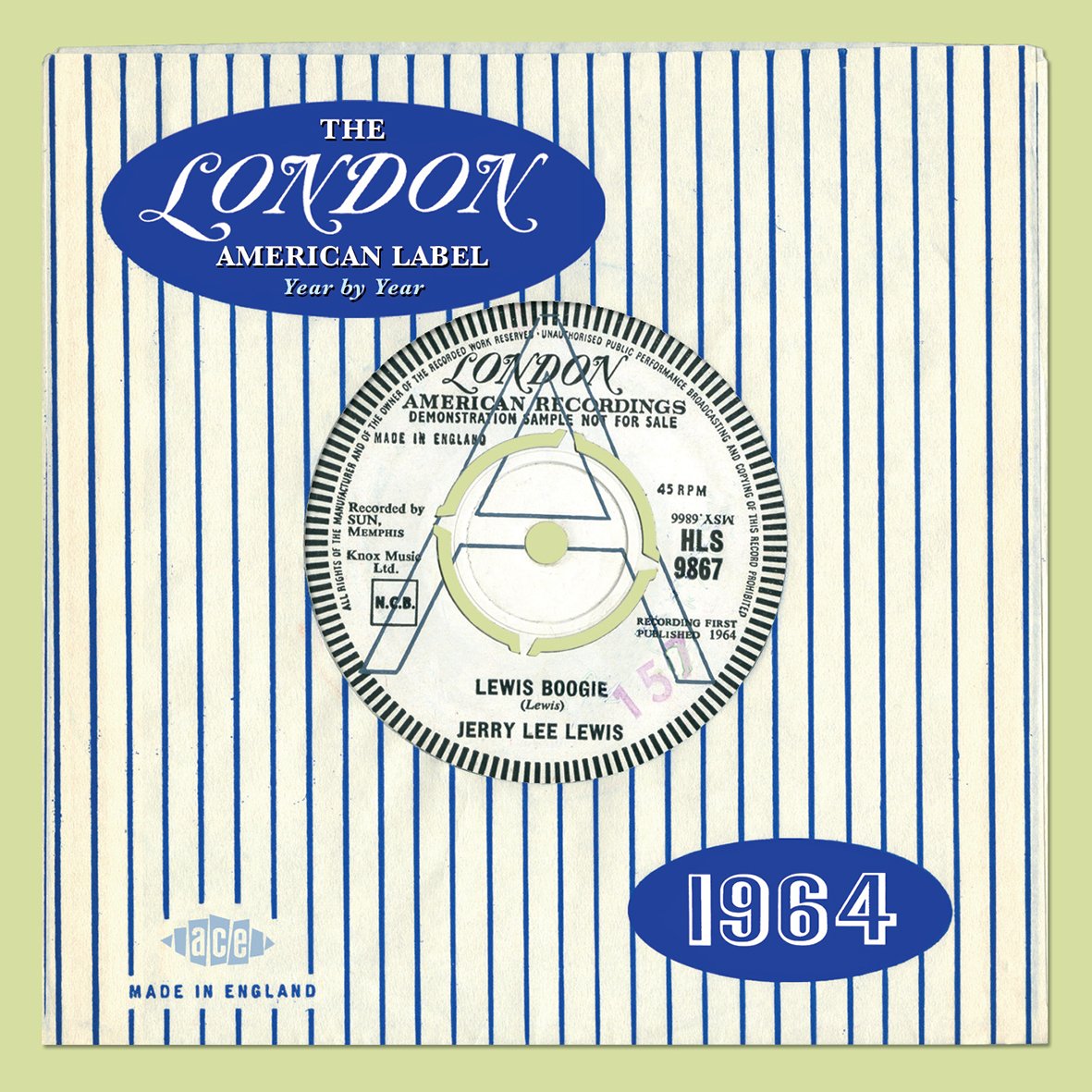
London American released singles by Jerry Lee Lewis, The Drifters, Solomon Bourke, Ben E. King, Del Shannon, Rufus Thomas, The Ronettes and Otis Redding. All these artists feature on the latest installment of The London American Label Year By Year 1964, which was released by Ace Records on 27th May 2013. In total, twenty-eight singles from 1964 feature on The London American Label Year By Year 1964, which I’ll pick the highlights of.
Getting The London American Label Year By Year 1964 off to an explosive start is Jerry Lee Lewis’ Lewis Boogie. This sees The Killer at his very best, with a track that was originally released in America in 1958. Since then, a lot had happened to Jerry. Due to this controversy, Jerry hadn’t toured the UK. By 1964, it was time for Jerry to make a comeback in the UK. He released an album entitled Breathless, with Lewis Boogie the single that accompanied it. Despite its undoubtable quality, Lewis Boogie failed to chart, but remains a reminder of Jerry Lee Lewis at his very best.
Formed in 1953, The Drifters celebrate their sixtieth anniversary this year. 1964 was a good year for The Drifters. In the US, they released two stonewall classics, Under The Boardwalk and Saturday Night At The Movies. Before that, they released One Way Love. It reached number thirty-six in the UK. This was one of the first tracks that featured Johnny Moore’s lead vocal. He’d returned after the death of Rudy Lewis. Despite a seven year absence from The Drifters lineup, it was as if Johnny had never been away. His vocal was just as soulful, impassioned and needy, as another chapter in The Drifters’ story unfolded.
Philly-born Solomon Bourke is just one of many great soul singers born in the city of brotherly love. He’s widely regarded as the greatest practitioner of deep soul, including by none other than Dave Godin. After just a few bars of Goodbye Baby (Baby Goodbye), penned by Bert Berns and Wes Farlell, you realize just how talented Solomon is. Accompanied by The Sweet Inspirations, Goodbye Baby (Baby Goodbye) features a heartbroken, soul-baring vocal from Solomon.
Ever since Del Shannon released his debut single Runaway, he’d been huge star on both sides of the Atlantic. He was also an astute businessman. Not content with writing his own songs, including 1964s That’s The Way Love Is in 1964, Del had decided to form his own record label, Berlee. That’s The Way Love Is was the second single he’d released on Berlee. It was the last single he’d release in the UK on London American. Penned by Del, his vocal is needy and rueful, tinged with regret and pathos, on this fitting farewell to London American.
Jimmie Rodgers had signed to Dot in 1962, and since then, had released three singles and the 1963 album Honeycomb and Kisses Sweeter Than Wine. However, in 1964, Dot’s ten-year deal with London American was about to expire. One of Dot’s final releases was meant to be Jimmy’s 1964 single The World I Used To Know. Sadly, the deal had expired before the single was released. What music lovers missed was an understated, wistful and poignant song, that’s a reminder of what music once sounded like.
After leaving The Drifters, Ben E. King embarked on a solo career. Having released the seminal Stand By Me in 1961, that set the bar high for future singles. Although Ben never surpassed Stand By Me, he was a consistent artist. In 1964, Ben released That’s When It Hurts in the US, it stalled at number sixty-three. However, it was the B-side, Around The Corner many people preferred. So, London American decided to release Around The Corner as a single. Despite Around The Corner being a better track, it failed to chart and was a disappointing way for Ben to end his career at London American.
Having started their carer as The Darling Sisters and then Ronnie and The Relatives, it was case of third case lucky when they change their name to The Ronettes. Teaming up with Phil Spector, hits like Baby I Love You and Be My Baby followed in 1963. 1964 would see The Ronnettes release two further singles for London American. The first was Do I Love You, which at stalled number thirty-five in the UK. Arranged by Jack Nitzsche, it showcased producer Phil Spector’s inimitable and innovative sound, where elements of pop, soul and doo wop are seamlessly fused.
When Otis Redding released Come To Me, which he cowrote with Phil Walden, he was just twenty-three and a relative unknown in the UK. You wouldn’t realize this from his performance on Come To Me. He delivers a needy vocal, one that’s heartfelt and laden with emotive. Sadly, Come To Me stalled at number sixty-nine in the UK. A year later, Otis became a household name, when he released I’ve Been Loving You To Long and Respect. Then in 1967, Otis Redding life was tragically cut short, when the plane he was traveling in crashed. That’s what makes Otis performance on Come To Me so moving and poignant.
My final choice from The London American Label Year By Year 1964 is Louis Armstrong and His Friends’ Hello Dolly. This was the title-track from Louis’ 1964 album. It’s a real anomaly, sounding as if it belongs in another era. Despite that, it has a real feel-good sound. This resulted in the track reaching number one in the US and number four in the UK.
The London American Label Year By Year 1964 is a fascinating musical document. It demonstrates the sheer variety of music being released in 1964. Featuring everything from soul, R&B, jazz, country, rock ‘n’ roll and pop, eclectic is the best way to describe The London American Label Year By Year 1964. Compiled by Peter Gibbon and Tony Rounce, they should be congratulated for the way they’ve approached this compilation. Rather than choose the most successful singles released by London American during 1964, they’ve chosen an eclectic selection of tracks, both hits and misses.
While sixteen of the tracks on The London American Label Year By Year 1964 charted, that doesn’t mean that the other twelve that didn’t are bad tracks. Far from it. Jerry Lee Lewis’ Lewis Boogie, Ben E. King’s Around The Corner and Jerry Wallace’s Even The Bad Times Are Good are a trio of glittering gems unearthed by Peter and Tony. Often, these hidden gems surpass their more successful musical cousins. That’s what makes compilations like The London American Label Year By Year 1964 such an enthralling and magical musical journey. Like Forest Gump’s box of chocolates: “you never know what you’re gonna get.” That’s half the fun. All of a sudden, you come across a track that you’ve never heard before. Suddenly, you’re day’s gotten a lot better. Maybe you’ll find a hidden gem that makes your day a whole let better, on The London American Label Year By Year 1964? Standout Tracks: The Drifters One Way Love, Del Shannon That’s The Way Love Is, The Ronnettes Do I Love You and Otis Redding Come To Me.
THE LONDON AMERICAN LABEL YEAR BY YEAR 1964.
SWEET DREAMS: WHERE COUNTRY MEETS SOUL VOLUME 2.
SWEET DREAMS: WHERE COUNTRY MEETS SOUL VOLUME 2.
Ever since the fifties, country music has influenced soul music. That’s no surprise. After all, many soul singers grew up in the southern states, listening to the country music coming out of Nashville, Memphis and Muscle Shoals. Back then, country music was King. There was no alternative to the country music being played on radio states in the South. All there was, was country music. Ruling the airwaves were Hank Williams, George Jones, Webb Pierce, Patsy Cline and Merle Haggard. They provided the soundtrack to the lives of those living in the southern states. This just so happened to include a generation of soul singers. Their voices, delivery and style were influenced by country music. As such, country and soul music became inextricably linked. Proof of this is the latest compilation of country soul from Kent Soul, Sweet Dreams: Where Country Music Meets Soul Volume 2, which was released on 27th May 2013.
Just like Behind Closed Doors: When Country Meets Soul, which was released in June 2012, the songs that feature on Sweet Dreams: Where Country Music Meets Soul Volume 2 were originally recorded by country singers. For many aspiring soul singers living in southern states, they must have heard several of the tracks that feature on Sweet Dreams: Where Country Music Meets Soul Volume 2 when they were growing up. Whose to say that a young Otis Redding didn’t hear the Cowboy Copas version of the Tennessee Waltz? Maybe Isaac Hayes heard Hank Williams heartbreaking delivery of I Can’t Help It If I’m Still In Love With You? For all we know they could have influenced their musical careers? Whether that’s the case or not, many years later, these artists were now covering the songs they’d heard growing up.
Apart from Otis and Isaac, Sweet Dreams: Where Country Music Meets Soul Volume 2 is crammed full of contributions from soul music royalty. This includes Queens of Country Soul Etta James, Bettye Swann and Esther Phillips and The Sweet Inspirations. Among the rivals for the title of King of Country Soul are James Carr, Bobby “Blue” Bland, Joe Simon, ex-Temptation David Ruffin and Johnny Taylor. There’s also contributions from Hank Ballard, Eddie James and Millie Jackson. Most of the music on Sweet Dreams: Where Country Music Meets Soul Volume 2 was released between 1962 and 1976. The exception are James Carr’s Tell Me My Lying Eyes Are Wrong and Orquestra Was Featuring Sweet Pea Atkinson’s Forever’s A Long Time. They’d weren’t released until 1995 and 1996. Both are hidden gems, worthy of their place on Sweet Dreams: Where Country Music Meets Soul Volume 2, which I’ll pick the highlights of.
There’s no better way to open Sweet Dreams: Where Country Music Meets Soul Volume 2 than with The Sweet Inspirations’ But You Know I Love You. Rousing, uplifting and joyous describes this fusion of country soul and gospel harmonies. It’s the best version of But You Know I Love You. Not only does it surpass Kenny Rodgers and The First Edition’s 1968 version, but Bill Anderson’s 1969 version, which reached number two. No wonder. After all, look at the personnel involved in The Sweet Inspirations’ 1969 album Sweets For My Sweet, which this track is from. It was produced by Tom Dowd, and features the legendary Muscle Shoals rhythm section. Although they provide the perfect accompaniment to The Sweet Inspirations they steal the show and in the process, set the standard of music on Sweet Dreams: Where Country Music Meets Soul Volume 2.
If anyone asked me what country soul sounds like, I’d play them Hank Ballard’s Sunday Morning Coming Down. It epitomizes and defines what country soul sounds like. Released in 1970, it was written by Kris Kristofferson, who was enjoying the hottest spell of his career. It gave Ray Stevens the first hit of his career in 1969. Then Johnny Cash took the song to number one on the country charts later that year. Of the three versions, Hank’s is the most moving. Produced by Lelan Rogers, a pedal steel, punchy bass, Hammond organ and cooing, sweeping harmonies accompany Hank’s heartbroken vocal. This emotive backdrop is perfect for Hank’s vocal. His vocal is filled with hurt, emotion and loneliness as he lays bare his soul, for all to hear.
Further proof of the hot streak Kris Kristofferson was enjoying as a songwriter between 1968 and 1979 is Help Me Make It Through The Night. Originally recorded Bill Nash in 1969, Joe Simon covered the track in 1971. It featured on The Sounds Of Simon, his first album for Spring Records. Produced by John Richbourg, the tempo is slightly quicker than other versions. That doesn’t matter. Veering between sultry and seductive, to pleading and needy, Joe breathes new life and meaning into a familiar song.
Another artist who produced the best music of her career at Spring Records was Millie Jackson. Sweet Music Man, which was written by Kenny Rodgers, who released the original version in 1977. Kenny and Brad Shapiro produced Sweet Music Man, a track from her 1978 album Get It Out’cha System. Against a dramatic backdrop, a feisty Millie unleashes a tirade of emotion, anger and frustration. Mixing power and passion, Millie makes the song her own, surpassing the faux country of the original.
When it comes to country soul, one of the giants of the genre was James Carr. Proof of this is the music he recorded for Goldwax Records. Blessed with talent, only poor health stopped him from becoming one of soul music’s most successful artists. So, for a producer looking to cover a song made famous by the late, great George Jones, James Carr was the go-to-guy. Here was a singer that was George’s equal. The song was Tell Me My Lying Eyes Are Wrong, which gave George the sixty-eighth hit of his career. James’ version recorded not long after this, but Goldwax became insolvent and the song lay unreleased. Sadly, nobody heard the song until 1995. Righting that wrong were Kent, who released this hidden gem. It’s worth the twenty year wait.A crestfallen James delivers a captivating vocal, which demonstrates why, when it came to country soul, James Carr was a giant.
One of the most underrated, but hugely talented soul singers is Bettye Swann. That’s why I’ve been championing her music for many years. So, I’m pleased to see Don’t You Ever Get Tired Of Hurting Me on Sweet Dreams: Where Country Music Meets Soul Volume 2. It was released on Capitol Records in 1969, four years after Ray Price recorded the original version. Sadly, Bettye’s cover version didn’t replicate the success of Ray’s version. That’s a huge shame, as Bettye version is a enthralling mixture of emotion, sadness, hurt and desperation.
From the get-go, Bobby “Blue” Bland’s I Hate You is laden with emotion and drama. That’s even before Bobby’s hurt-filled vocal enters, accompanied by cooing harmonies. Released in 1975, on Bobby’s Get On Down album. This was two years after Ronnie Milsap’s original version was released. However, it was fitting Bobby covered this track. He was a a hero of Dan Penn, who penned the track with Leroy Daniels. While Ronnie’s version gave him the first hit of his career, I prefer Bobby’s version. It’s a bristling with emotion and tension, caused by a relationship gone awry.
David Ruffin’s Statute Of A Fool, is a cover of a track originally recorded by Jack Green in 1969. It featured on David’s 1975 album Who I Am. The track has a quite different sound to most of the tracks on Sweet Dreams: Where Country Music Meets Soul Volume 2. Instead, it has a much fuller, orchestral arrangement, courtesy of producer Van McCoy. He builds the drama to an elegant crescendo, above which sweeps David’s heartfelt, rueful vocal. Filled with regret at love lost, a rueful David ponders what might have been.
My final choice from Sweet Dreams: Where Country Music Meets Soul Volume 2 is Dorothy Moore’s Funny How Time Slips Away. Written by Willie Nelson, and originally recorded by Billy Walker, Dorothy’s 1976 version sees the song given a makeover. It too, has a much fuller, orchestral sound. That was the fashion in the mid-seventies. This was a track from her debut album Misty Blue, whose title-track gave Dorothy the biggest hit single of her career. Much as I like Misty Blue, I much prefer this track. Here, Dorothy’s captivating, dramatic and powerful vocal veers between bravado and sadness at she remembers the love she lost all those years ago.
Although I’ve only mentioned nine of the tracks on Sweet Dreams: Where Country Music Meets Soul Volume 2, I could just as easily have mentioned any number of other tracks. This includes contributions from Otis Redding, William Bell, Johnny Taylor, Pat Lundy and Clarence Carter. Then there’s contributions from Queens of country soul Esther Phillips and Etta James. Compiler Tony Rounce has concentrated on quality. Not once was I forced to reach for my trusty remote control. That’s unusual. Usually, I’ve got to resort to that several times in a twenty-three track compilation. So congratulations go to compiler Tony Rounce. Tony also deserves credit for his lengthy and informative sleeve-notes. They’re akin to a minor work of art. Not only do they tell the story behind each track, but chart the changes in country soul.
The music on Sweet Dreams: Where Country Music Meets Soul Volume 2, covers the period between 1962-1976. This allows you to hear how country soul evolves. By 1976, the traditional country soul sound, has been replaced by a much more fuller, orchestral arrangement. With lush strings key to the sound, this is reminiscent of Philly Soul. This works. Mind you, David Ruffin and Dorothy Moore’s voices are perfectly suited to this sound. Not every artist, would suit this sound. Mostly though, the music on Sweet Dreams: Where Country Music Meets Soul Volume 2 has that unmistakable country soul sound. This is a delicious fusion of musical genres. Occasionally there’s the welcome addition of gospel harmonies. This includes on The Sweet Inspirations’ But You Know I Love You, which is one of the real highlights of Sweet Dreams: Where Country Music Meets Soul Volume 2. That was the perfect way to open Sweet Dreams: Where Country Music Meets Soul Volume 2. After that the quality kept on coming. Indeed, the quality continued for another twenty-two tracks. Quite simply, there’s neither faux pas nor filler on Sweet Dreams: Where Country Music Meets Soul Volume 2, just quality country soul all the way. Standout Tracks: The Sweet Inspirations But You Know I Love You, Hank Ballard Sunday Morning Coming Down, Millie Jackson Sweet Music Man and Bobby “Blue” Bland I Hate You.
SWEET DREAMS: WHERE COUNTRY MEETS SOUL VOLUME 2.

JUMP THE CHANNEL-VOLUME ONE.
JUMP THE CHANNEL-VOLUME ONE.
Ever since the birth of modern music, far too many record companies have been content to churn out numerous generic releases. Often, that’s been their downfall. Whether they released soul, disco, funk, house or hip hop, labels, including innovative labels, have gradually, or even quickly, become stuck in a musical rut. Often, this wasn’t their intention, when they embarked upon their musical adventure.
In the beginning, they were innovators, who were responsible for creating a genre or scene. Having developed a successful sound, rather than move on, they stuck with what they knew. After all, they were making money with their trademark “house” sound. Others jumped onto the bandwagon, enjoying the easy money. Then, suddenly, the easy money dried up.
People had tired of the generic music. Now, they were moving onto new musical trends. Suddenly, the label owners wished they hadn’t put all their eggs in the one musical basket. They find themselves wishing they’d kept ahead of the musical curve. If only we’d released a much more eclectic selection of music they weep. This scenario has unfolded several times, including after disco found itself in intensive care. Why label owners don’t learn from musical history seems unfathomable? However, one label that have never bet the house on one musical genre is BBE Music.
Rather than release just one genre of music, BBE Music have consistently released an eclectic selection of music. They’re released everything from jazz, Latin, soul, hip hop, house, strum and bass and R&B. Now, for BBE Music’s latest musical adventure, we’re heading back to the thirties and the age of swing. Jump The Channel-Volume One which was compiled by two of Europe’s top swing DJs, features twenty-six slices of swing. For hep cats everywhere, then Jump The Channel-Volume One, which is available as a digital download from BBE Music, is essential listening.
To compile Jump The Channel-Volume One, BBE Music brought together two of Europe’s best swing DJs. Joining JC of Paris, was London’s Jeff “Two Tone” Boogie. They’d been friends for a while, originally having met when they DJ-ed together at the Hep Cats Holiday Weekender. From the friendship, came the idea to compile a compilation of English and French swing, Jump The Channel-Volume One.
To compile a compilation, you need an expert. In the case of Jump The Channel-Volume One, BBE Music had two experts in JC and Jeff. What these two guys don’t know about swing, isn’t worth knowing. In more innocent times, these guys would be referred to as two of Europe’s top swingers. Sadly, not now. That would result in JC and Jeff making the front page of Britain’s tabloids. Instead, we’ll call them two of Europe’s swing Kings, who were on a mission to compile BBE Music’s first swing compilation.
Delving into their extensive record collections, JC and Jeff dug deep. They had to find tracks that would appeal to the ever growing Swing Dance scene. However, Jump The Channel-Volume One wasn’t just for dancers. It was to appeal to dancers and listeners alike. That wasn’t going to be easy. It took Jeff and JC countless hours, days and weeks of research. Choosing just thirteen tracks that fitted the remit wasn’t easy. To appeal to both dancers and listeners, that meant sacrificing some classic dance tracks. Eventually, JC and came up with thirteen tracks each. These twenty-six tracks were recorded between the late-thirties and the late-fifties. So whether it’s thirties, forties or fifties swing that’s your guilty pleasure, then there’s plenty for fans of British and French swing to enjoy on Jump The Channel-Volume One.
One potential problem for any compiler is programming a compilation. Here, BBE music have come up with a novel, and simple way to program Jump The Channel-Volume One. What’s they’ve done is put the tracks in alphabetical order. Jump The Channel-Volume One bursts into life with the vintage delights of The Emile Carrara Swing Quartet’s 720 In The Books. This works well. Rather than carefully programmed album of tracks, it’s like the musical equivalent of Forest Gump’s chocolate box. Truly: “you never know what you’re gonna get.” Veering between English and French swing, JC and Jeff combine familiar tracks with hidden treasures.
During the musical journey that is Jump The Channel-Volume One, we hear Pierre Allier Et Son Orchestre’s sultry take on Begin The Beguin, before the tempo increases with Big Top Boogie, played by Leslie ‘Jiver’ Hutchenson and His Orchestra. As for Phillipe Brun Et Son Orchestre, they’ve taken Harlem Swing almost literally. Even better is Nat Gonella and His Georgians’ delivery of Hep Hep The Jumpin’ Jive. It’s so good, that even someone cursed with two left feet will strive to jive, and join the hep cats and cool kittens.
Flying the flag for English swing, is Jack Jackson and His Orchestra’s My Heart Jumped Over The Moon. It’s an irresistible slice of vintage swing, that’s reminiscent of another era. Somehow, it’s surpassed by Jack Harris and His Orchestra’s I Wanna Make Rhythm.Along with Harry Parry and His Orchestra’s version of Potomac Swing, they’re among the highlights of Jump The Channel-Volume One.
Some of the tracks on Jump The Channel-Volume One epitomize an era. They’re a reminder of how very different life was. Tracks like Lew Stone and His Orchestra’s My Wubber Dolly are like snapshots of long-forgotten era. So too is Watch The Birdie, which closes Jump The Channel-Volume One. Played by Hatchett’s Swingtette it’s a nostalgic reminder of much more innocent times were, when swing epitomised and defined an era.
While much has changed since the music on Jump The Channel-Volume One was recorded, the music has aged well. Indeed, much of the music on Jump The Channel-Volume One can be described as timeless. That’s because JC and Jeff have chosen well. They’ve delved in the furthest corners of their extensive record collection and come up with some swing classics. Whilst other swing compilations focused on dance tracks, Jeff and JC haven’t neglected the listeners. That narrowed their appeal. Jump The Channel-Volume One doesn’t make that mistake. Not at all.
Instead, Jump The Channel-Volume One is a swing compilation for dancers and listeners alike. This broadens the appeal of Jump The Channel-Volume One, which was released as a digital download by BBE Music. Further broadening the appeal of Jump The Channel-Volume One, is the addition of French swing. That’ll be a welcome addition for veteran swingers weaned on English and American swing. Featuring twenty-six slices of vintage swing, Jump The Channel-Volume One is a welcome addition to BBE Music’s always eclectic back-catalogue. Thankfully, Jump The Channel-Volume One won’t be the last swing compilation BBE Music will be releasing.
Indeed, Jump The Channel-Volume One is the first of several compilations of French and English swing BBE Music will be releasing. That is a tantalizing prospect, especially given the quality of Jump The Channel-Volume One. For anyone interested in swing, whether veterans or newcomers, dancers or listeners, then Jump The Channel-Volume One is essential listening for hep cats and cool kittens everywhere. Standout Tracks: Phillipe Brun Et Son Orchestre Harlem Swing, Jack Harris and His Orchestra I Wanna Make Rhythm, Jack Jackson and His Orchestra My Heart Jumped Over The Moon and Harry Parry and His Orchestra Potomac Swing.
JUMP THE CHANNEL-VOLUME ONE.

INNER LIFE-INNER LIFE II.
INNER LIFE-INNER LIFE II.
By 1982, when Inner Life released their their second album for Salsoul Records, Inner Life 2 not only was the changing of the guard complete, but Salsoul as a record label had been transformed. Nearly all of Salsoul’s founding father’s were gone and the legendary Salsoul Orchestra was a shadow of its former self. Gone were the Baker, Harris, Young rhythm section, gone was The Salsoul Orchesra’s founder and former leader Vince Montana Jr and gone were many of its most talented personnel, including Bobby “Electronic” Eli, T.J. Tindall, Larry Washington and Don Renaldo. Similarly, many of artists that had transformed Salsoul into disco’s premier label had moved on. No longer were groups like First Choice, Double Exposure and Instant Funk. Many producers, arrangers and songwriters had left Salsoul for a variety of reasons. One group of people who hadn’t left the building, were the Cayres beloved DJs who would remix singles and sometimes, whole albums. These DJs needed music to remix, and it with so many changed at Salsoul, it was up to a new wave of artists to provide this music, including Inner Life, whose third album Inner Life 2 was rereleased by Salsoul/Octave Lab Japan on 7th May 2013.
With most the old guard who’d established Salsoul as disco’s greatest label having moved on, it was up the new breed of musicians, songwriters and producers to secure Salsoul’s future. Inner Life were one of the new groups tasked with securing Salsoul’s future in the post-disco musical landscape. Their career at Salsoul had got off to a promising start, when they released their debut album Inner Life I. On Inner Life I, two songs gave Inner Life hit singles. These were Ain’t No Mountain High Enough and Make It Last Forever. Both singles would go on to become timeless Salsoul classics, from the post-disco period. Key to the success of Inner Life I’s success, were two musical visionaries and a disco diva.
Patrick Adams and Greg Carmichael had formed Inner Life as a studio project and before signing to Salsoul, had released one album for another of disco’s biggest label’s Prelude Records. This was I’m Caught Up (In A One Night Love Affair), whose title-track gave Inner Life their first hit single. I’m Caught Up (In A One Night Love Affair) featured the vocal talents of Jocelyn Brown, who’d go onto become a disco diva. After leaving Prelude, Inner Life signed to Salsoul and were joined by another musical innovator Leroy Burgess. For Inner Life II, Patrick Adams, Greg Carmichael and Jocelyn Brown would be joined by Leroy Burgess and a cast of creative and innovative musicians, arrangers and producers in whose hands, Salsoul’s future lay.
For Inner Life II Stan Lucas wrote, arranged and produced two tracks and co-produced another three tracks with Greg Carmichael. The two tracks Stan Lucas produced were I Picked A Winner and I Like It Like That. With Greg Carmichael, Stan produced Feel What I’m Feeling, If You’re Gonna Love Me and Find Somebody. The other track was Moment of My Life which James Calloway, Sonny T. Davenport and Leroy Burgess cowrote. It was arranged and produced by Leroy Burgess and Greg Carmichael. As was the fashion at Salsoul, several of the tracks on Inner Life II were remixed by DJs, to give them a dance-floor friendly sound. Shep Pettibone mixed Moment of My Life, Tom Moulton mixed I Like It Like That and John Morales mixed If You’re Gonna Love Me and Find Somebody. Recording of Inner Life II tok place at Blank Tape Recording Studios, New York.
At Blank Tape Recording Studios, Inner Life were accompanied by a rhythm section of bassist James Calloway, drummer James Cooksey and guitarist Stan Lucas. Leroy Burgess played keyboards, while Connie Harvey, Dennis Collins, LaRita Gaskin, Margo Williams and Wendell Morrison added backing vocals. So did Jocelyn Brown, who is one of the lead vocalists on Inner Life II. Once Inner Life II was recorded, it was released in 1982.
Two singles were released from Inner Life II. It was something of a no-brainer that Moment of My Life was chosen as the lead single, reaching number fifteen in the US Dance Music/Club Play Charts. I Like It Like That then reached number forty in the US Dance Music/Club Play Charts and number ninety-three in the US R&B Charts in 1983. Like many other disco or dance music albums, the singles fared better than the album. Inner Life II failed to chart on its release in October 1982. However, like Inner Life I, Inner Life II featured a Salsoul classic..Moment of My Life. However, there’s more to Inner Life II than one track, as you’ll realize when I tell you about the music on Inner Life II.
Opening Inner Life II is the Stan Lucas penned and produced I Picked A Winner, which features Jocelyn Brown’s vocal. A pounding rhythm section complete with slapped bass from James Calloway joins Leroy Burgess keyboards. They create the backdrop for a powerful, feisty vocal from Jocelyn, complete with dramatic backing vocals. While the rhythm section and Leroy’s keyboards create the track’s hypnotic backdrop, Jocelyn picks up where she left off on Inner Life I. She doesn’t disappoint, delivering a divaesque performance, combining controlled power, sass and passion to get Inner Life II of to an irresistible opening.
Of the six tracks on Inner Life II, Moment Of My Life quite simply is the highlight. Nothing else comes close and no other track even comes close. Jocelyn’s vocal soars powerfully and dramatically above the arrangement. She delivers a punchy, powerful and soulful vocal against a backdrop of the rhythm section, percussion and Leroy’s keyboards. Equally punchy backing vocalists accompany her, as she delivers one of the best vocals of her time with Inner Life. The sprinkling of percussion adds to the effectiveness of an arrangement where boogie, funk and soulfulness unite. With the combined talents of Leroy Burgess, Greg Carmichael and Jocelyn Brown at the top of their game, it’s no wonder that thirty years later, this track is regarded as a Salsoul classic.
I Like It Like That is a track that you can almost date to 1982. It’s the combination of instruments that are deployed to accompany Jocelyn’s vocal. The synths have an unmistakable early eighties sound, as do the drums. They’re joined by Jocelyn’s joyous vamp, while the rhythm section and eighties keyboards drive the track along. Having said that, the track still has an infectiously catchy eighties sound, made all the better by Jocelyn Brown at the height of her powers. While this track doesn’t match the quality of Ain’t No Mountain High Enough, Make It Last Forever or Moment Of My Life, it’s still infectiously catchy and benefits from a joyous vocal from Jocelyn.
Following three dance tracks, when you flip over Inner Life II, Feel What I’m Feeling sees a welcome drop in tempo. It allows you to catch your breath and hear another side to Inner Life. A piano combines with thoughtful drums and a jazzy guitar. Then with a flourish of piano, Jocelyn’s vocal displays a tender, soulful side. Her vocal grows in power, with tender, understated backing vocals accompanying her. Jocelyn’s vocal veers between tender and heartfelt, to a more powerful, impassioned style. Throughout the song, her vocal is deeply soulful. Only one thing lets the track down slightly, and that’s the dated sound of the keyboards midway through the track. Later, the pounding bass that accompanies Jocelyn’s vocal matches reinforces the impact of her vocal. In doing so, it almost makes up for the dated keyboards. Apart from that, this is a quite beautiful, deeply soulful song, where you hear a very different side to Inner Life, proving that there was more to their music than boogie.
Percussion, crashing drums and a pounding bass combines before Jocelyn delivers the familiar lyrics to If You’re Gonna Love Me. Straight away, you’re hooked. It’s impossible not to succumb to the track’s charms. Jocelyn’s vocal is a mixture of sass and power. It’s as if this song was written with her in mind. For company, she has that unmistakable combination of the rhythm section, keyboards and percussion accompanying her. As Jocelyn’s vocal drops out, the guitar takes charge. It almost tees up Jocelyn’s vocal when it returns. She takes charge, delivering what is, a Magnus Opus of a vocal.
Closing Inner Life II is Find Somebody, which has a very different sound to previous tracks. It’s a track ahead of its time. Thunderous, pounding drums combine with synths that reverberate. They’re joined by bongos and the rhythm section. Gradually the track is revealing its secrets. Funk is supplied by the rhythm section and percussion, while the synths provide a dated sound that almost grates. Thankfully, when Jocelyn’s vocal enters, it takes your mind of the recurring synth sound. Her vocal is delivered with power and passion, accompanied by equally dramatic backing vocals. The rest of the arrangement has a joyous, catchy sound, except of course that synth sound. It’s a akin a giant wart on a supermodel’s face, spoiling an otherwise irresistibly catchy sound. It’s a case of so near, but so far.
Inner Life II was the final album from Inner Life. Their career had only lasted just three albums, but left behind a quartet of classics. Starting with I’m Caught Up (In A One Night Love Affair), Ain’t No Mountain High Enough, Make It Last Forever and from Inner Life II, Moment Of My Life. Good as some of the other tracks on Inner Life were, Moment Of My Life was the absolute standout track. If You’re Gonna Love Me comes close, but not close enough. So too does Feel What I’m Feeling, which is a delicious slice of sheer soulfulness, that shows another side to Inner Life’s music. Indeed, most of the six tracks on Inner Life II have stood the test of time, apart from a couple of times the music sounds dated.
On a couple of tracks, you hear a real eighties sound shine through. Thirty years haven’t helped this sound to mature. Quite the opposite. I Like It Like That has an eighties sound, but this isn’t as prevalent as on Find Somebody. Its eighties sound has aged like an aging film star after one too many facelift. Having said that, other people might enjoy revisiting this eighties sound. Not me. For much of the eighties, this was the decade music lost its way and its taste buds. Not on Inner Life II though.
Indeed, most of the music on Inner Life II, which was rereleased by Salsoul/Octave Lab Japan on 7th May, has stood the test of time and aged gracefully. After Inner Life II, Inner Life didn’t release any further albums for Salsoul. Given Inner Life were part of the new wave of artists at Salsoul, it seemed that things were in a constant state of flux. Artists were coming and going and Salsoul wasn’t able to recapture its glory years between 1975 and 1978. Two years after Inner Life II was released, Salsoul closed its doors. Disco’s premier label was no more. All that was left was the memories and the music, which includes Inner Life II, which proved to be Inner Life’s Salsoul swan-song. At least Inner Life left Salsoul on a high, with Inner Life II, which was one of the highlights of post-disco Salsoul. Standout Tracks: I Picked A Winner, Moment of My Life, Feel What I’m Feeling and If You’re Gonna Love Me.
INNER LIFE-INNER LIFE II.

DONNY HATHAWAY-DONNY HATHAWAY
DONNY HATHAWAY-DONNY HATHAWAY
While many artists enjoy long careers, Donny Hathaway’s career was tragically short. He only released three studio albums and one soundtrack album during his lifetime. However, during his short career, Donny Hathaway recorded some of the most beautiful, powerful and moving music you’ll ever hear. Donny’s debut album was Everything Is Everything, which was released in July 1970. It reached number seventy-three in the US Billboard 200 and number thirty-three in the US R&B Charts. Since its release, Everything Is Everything is widely regarded as the finest album of Donny’s career. Nine months later, in April 1971, Donny Hathaway released his sophomore album Donny Hathaway, which was rereleased by WEA Japan on 26th March 2013. Could and would Donny Hathaway build on the critically acclaimed Everything Is Everything?
Having released such a well received album as Everything Is Everything the pressure was on Donny to record his second album. For someone who suffered from mental health problems, this couldn’t have helped Donny. For his sophomore album Donny Hathaway, Donny only cowrote Take A Love Song with Nadine McKinnor, whereas he’d wrote one track and cowrote four others for Everything Is Everything. Among the other eight tracks were Van McCoy’s Giving Up, Leon Russell’s A Song For You, Billy Preston’s Little Girl and Dorsey Burnette’s Magnicficent Sanctuary Band. They were joined by Mac Davis’ I Believe In Music, George Clinton’s She Is My Lady and Gene MacLellan Put Your Hand In The Hand. Completing Donny Hathaway was Bob Russell and Bobby Scott’s He Ain’t Heavy He’s My Brother. Recording of Donny Hathaway would take place in New York, at Atlantic Recording Studios.
The nine tracks that became Donny Hathaway were recorded at the Atlantic Recording Studios in New York, during 1970 and 1971. With Jerry Wexler, Arif Mardin and Donny producing Donny Hathaway, which comprises cover versions of soul, gospel and pop songs, which Donny gave his own unique twist. Accompanying Donny was an all-star band. This included a rhythm section of bassist Chuck Rainey, drummer Al Jackson Jr and guitarists Phil Upchurch and Cornell Dupree. Joining them, were percussionists Jack Jennings while the unique sound of tenor saxophonist King Curtis was pare of the horn section. Adding backing vocalists were two of The Sweet Inspirations Cissy Houston and Myrna Smith, who joined Myna Summers and a number of other backing vocalists. With Donny Hathaway recorded, it was scheduled for release in April 1971.
Released in April 1971, Donny Hathaway was well received by critics. It reached number eighty-nine in the US Billboard 200 and number six in the US R&B Charts. Sales of Donny Hathaway surpassed Everything Is Everything, which considered to be Donny’s finest album. However, is Everything Is Everything a better album than Donny Hathaway? That’s what I’ll now tell you.
Donny Hathaway opens with Giving Up, by Van McCoy, the singer, songwriter, arranger and producer. Giving Up had originally been sung by Gladys Knight and The Pips, but Donny transforms Van’s song, with a gospel tinged rendition of the lyrics. Not only is this a beautiful song, but one that’s hugely powerful. Against a dramatic arrangement, where a piano, rasping horns and rhythm section accompany Donny’s vocal. Quickly, the arrangement returns to a more understated, but still dramatic sound, as Donny’s voice soars emotively. Still, there’s a gospel influence present in his vocal and the arrangement. Gradually, the beauty and emotion of the arrangement, reveals itself. Flourishes of piano, powerful drums, lush, shimmering, quivering strings and King Curtis’ saxophone drench the arrangement with its sad yet, gorgeous sound. The song continues for nearly six and a half magnificent and majestic minutes, during Donny and his band deliver the definitive version of this deeply moving and powerful song.
A Song For You was penned Leon Russell penned track. Donny’s fingers cascade up and down the piano, before giving way to his gentle, thoughtful vocl. As he sings the lyric: “we’re all alone and I’m singing this song for you,” that’s what it feels like. There’s a sense of intimacy, with just the combination of Donny and piano. You’re enthralled, before the lush strings, bass and woodwind enter. They combine beautifully with Donny and the piano. So compelling and subtle is the arrangement, you’re captivated, scared you miss anything. There’s a beauty to the lyrics when Donny sings tenderly about love, his relationship and feelings. Then then when sings “when my life is over,” there’s a sense of poignancy. Behind him, there’s mostly, a classical sound to the arrangement, but sometimes, a bluesy sound and feel. One thing that’s constant however, is the inherent beauty of both Donny’s emotive and heartfelt, understated and thoughtful arrangement.
Little Girl was written by Billy Preston, one of a few people who worked with both The Beatles and Rolling Stones. This is a slow track, where a combination of piano, Hammond organ and harmonies combine before Donny’s emotive vocal enters. As the rhythm section play slowly and carefully, there’s some heartbreaking interplay between Donny and his backing vocalists. A heartbroken Donny asks why his “little girl” had to leave him, asking “where did you go.” By now, the slow arrangement builds, the emotion and sadness tangible. Donny’s delivery of the lyrics is heartfelt, with the emotion rising as he sings “you don’t know how it’s been without the baby.” Adding to the sense of emotion and loneliness are blazing horns, which punctuate the track. This is just the finishing touch to a song that Donny brings to life, thoughtfully and emotively.
Just a piano, chiming guitars and rhythm section subtly accompanying Donny as he delivers He Ain’t Heavy, He’s My Brother’s lyrics. He tenderly delivers the lyrics about brotherhood, with bells subtly used to augment the arrangement. They combine perfectly with the piano and later, the drama laden strings. Donny breathes meaning into what’s usually an overblown, middle of the road standard. Instead, it’s transformed into something quite beautiful, and almost spiritual. Key to this a mostly understated arrangement and Donny’s tender vocal.
Booker T and The MGs drummer Al Jackson Jr provides the heartbeat to Magnificent Sanctuary Band, as Donny almost raps about the thrill and excitement of seeing a good marching band live, not on television. With handclaps, rhythm section and backing vocalists barking out 1-2-3-4, Donny remembers the excitement of seeing the marching band for the first time. Horns rasp behind him, while flourishes of piano and supremely, soulful harmonies accompany Donny’s vocal. Although very different from the other tracks on the album, it’s an uplifting and joyous and catchy track, especially when Donny and the backing vocalists unite. They transform the song into an almost swinging, spiritual track with a gospel flavor.
When you hear the stunningly, beautiful She Is My Lady, you wouldn’t imagine that this was written by George Clinton. It’s the diametric opposite of what George wrote for Funkadelic and Parliament. Instead, it’s a beautiful, slow ballad with gospel-tinged harmonies accompanying Donny. From the opening bars, you realize something beautiful is unfolding. A piano gently plays, before Donny slowly and thoughtfully sings of his love for the woman who makes his life worthwhile and meaningful. Gradually, the arrangement builds, with strings sweeping in, before the rhythm section and piano add a sense of drama. They give way to the gospel-tinged harmonies who add to the sense that this song’s roots are an in the church. They help the song to grow, as do rasping horns and lush strings. They combine perfectly with the piano, adding a sense of drama. As the song unfolds, the emotion and beauty grows, reaching a dramatic and gospel-drenched crescendo.
I Believe In Music was written by Mac Davis, who also wrote In the Ghetto on Everything Is Everything. Again, the song features some gospel inspired harmonies. With the rhythm section, piano and harmonies accompanying Donny, he sings about how music can stop conflict and inspire people. Quivering, shivering strings join Donny’s soaring vocal, while harmonies combine gospel and soul. Later, a flute floats briefly above the arrangement, to be replaced by tambourine and flourishes of piano, while Donny and his backing vocalists joyously deliver the lyrics.
A combination of piano and rhythm section opens Take A Love Song, which was written by Donny and Nadine McKinnor. The lyrics are beautiful, Donny’s delivery thoughtful and filled hope and emotion. Behind him, the arrangement grows to include shimmering strings, rasping horns and harmonies that unite and soar impressively. With Donny playing piano with a flourish, his emotive and powerful vocal combines seamlessly as the arrangement builds and builds, with strings and horns at the heart of this dramatic arrangement.
Donny Hathaway closes with the spiritual Put Your Hand In the Hand. It features an understated arrangement with just Donny and the piano combining. The only time the arrangement grows is when the backing vocalists sweep in, with their gospel-tinged harmonies combining peerlessly with Donny. This understated and sympathetic arrangement seems totally in keeping with the religious lyrics. It’s a joyful and uplifting way to end Donny Hathaway, one of the best soul albums of 1971, which was great year for soul music.
To me, Donny Hathaway’s eponymous second album, Donny Hathaway is one of these rare albums, that doesn’t have a bad song on it. This is unusual, as usually, there’s a song that lets an album down. Not here. There are neither any bad songs, nor any filler, just nine great tracks. These tracks demonstrate how hugely talented a singer and musician Donny Hathaway was. Although he only released three studio albums as a solo artist, there’s more quality in these three albums than there is in twenty albums by other artists. From the opening bars of Donny Hathaway until the final notes, you’re enthralled, taken on a stunning and magical musical journey that encompasses soul and gospel music, with Donny as your guide. You find yourself transfixed, awaiting the next song with anticipation, listening to every subtlety and nuance. When Donny Hathaway ends, you can’t help but listen again, just in case you missed anything the last time. What happens is that each time you listen to the album, the more you grow to love it. Donny Hathaway quickly becomes like a trusted friend, and you’re drawn to it time and time again. Thats what happened to me. Over the years I’ve grown to cherish Donny Hathaway, and his two other albums Everything Is Everything and Extensions of A Man. Of these three albums, Everything Is Everything just surpasses Donny Hathaway when it comes to quality. It’s a close run thing, and there isn’t much between both albums. What I will say, is that this trio of albums features some of the best, most healing and uplifting music that you’ll ever be privileged to hear. If you’ve never heard Donny Hathaway which was rereleased by WEA Japan on 26th March 2013, or any of Donny’s other albums, then now is the time to let his stunning music enter your life. Once you’ve done so, you’ll never regret it, and like me, cherish the music of the late, great Donny Hathaway, a true legend of soul music. Standout Tracks: Giving Up, A Song For You, She Is My Lady and I Believe In Music.
DONNY HATHAWAY-DONNY HATHAWAY.

ALMUNIA-PULSAR.
ALMUNIA-PULSAR.
Often when I’m looking for new music, it’s an album cover that grabs my attention. That was the case with Almunia’s new album Pulsar. It was released on Paul Murphy’s Claremont 56 label, on 27th May 2013. Released without publicity or fanfare, Almunia’s sophomore album Pulsar was a low key release to say the least. There weren’t reviews in the music press. Nothing at all to let music lovers that Pulsar had been released. Indeed, if it hadn’t been for Pulsar’s cosmic, surreal and psychedelic album cover, the album might have passed my by. Thankfully, Mark Warrington’s artwork drew my attention to Pulsar. That would’ve resulted in me missing out on the eclectic, genre-sprawling delights of Pulsar, which I’ll tell you about, once I’ve briefly, told you about Almunia.
Formed in Cecicna in Livorno, Italy, Almunia are a duo consisting of Leonardo Ceccanti and Gianluca Salvador. Leonardo is a multi-instrumentalist, who can play bass, keyboards, acoustic and electric guitar. He is also the vocalist, and with turntablist Gianluca, produced Pulsar. Since forming, Almunia have released just two albums. Their debut album was New Moon, released in 2011. Then in 2012, Almunia released a twelve inch single Pulsar. This was a tantalizing taste of their sophomore album Pulsar. Before that, Almunia released a digital E.P. Cassandra’s Dream. Then a month later, came the release of Almunia’s eight-track sophomore album Pulsar, which I’ll now tell you about.
Opening Almunia’s sophomore album Pulsar is The Awakening. With just a lone acoustic guitar taking centre-stage, there’s a real Balearic sound to the track. Reverb is added, giving the track an understated, spacey and dubby sound. Then the arrangement fills out. Later, keyboards, searing guitar and percussion combine with the guitar. Almunia lock into a mesmeric groove, that’s laid-back, smokey and ideal for chilling during the long, lazy summer days ahead.
Just like The Awakening, Wrapped In Your Hair sees an acoustic guitar open the track. It’s urgent, strident sound is joined by pounding drums and Leonardo’s vocal. Briefly, it’s drenched in echo, before becoming distant and mysterious. Accompanied by just guitars and drums, this is highly effective and compelling, as Almunia fuse elements of ambient, Balearic, folk and psychedelia.
Ode To Mom has a harder, funkier and bluesier sound. That’s thanks to the bass and harmonica. After that, washes of synths add a broody, moody and dramatic sound. Reverb is added, providing a dubby influence, before washes of synths head into the distance. They’re not unlike waves crashing on an Ibizan beach. This track would provide the perfect Ibizan soundtrack. Especially since the drama and mystery has increased, as elements of electronica, funk, ambient and psychedelia combine. Then when ethereal, celestial harmonies are added, they provide a contrast, to the drama, power and mystery of this driving, genre-sprawling track.
From the get-go Views From A Blue Train has a mysterious, enigmatic sound. It’s as of Almunia are providing the soundtrack to a 21st Century spy thriller. To do this, they rely upon guitars and washes of crystalline synths. Then the track decides to reveal its secrets. A tough, funky bass and hypnotic drums take charge. They drive the arrangement along, and are helped by a wah-wah guitar. By now, Almunia are in the tightest of grooves, fusing funk, house, Balearic Beat and electronica. Add to that rock, as Leonardo finds his inner rock star, unleashing a searing guitar solo. Combine all this, and the result is a hypnotic, dance-floor friendly fusion, where musical genres unite, becoming one.
Driven along by a lone acoustic guitar, the introduction to Follow What You Are is similar to the first two tracks. Like these tracks, is another melting pot of musical genres and influences. However, the sound is very different. No wonder. Relying upon banks of keyboards, thunderous drums, rock-tinged guitars drenched in reverb and washes of jagged synths, a complex, multilayered fusion unfolds. Everything from house, dub, rock, psychedelia, Balearic Beat and ambient music is thrown into the mix, and combined seamlessly and peerlessly by Almunia.
After an understated introduction to The Magician, Almunia are soon waving their magic wand and working their magic. Best described as dreamy, trippy and ambient, it’s a truly captivating track. Washes of meandering synths and chiming guitars create a slow, spacious backdrop. It’s drenched in backdrop and joined by almost pedestrian drums. The arrangement meanders and wanders along. This is no bad thing. It allows you to experience its ambient, Balearic delights, which for seven majestic minutes wash over you, ensuring you enter an almost dreamlike, blissful state.
Secret Marriage is the perfect way to follow The Magician. The tempo is slow, the arrangement understated as it meanders, almost aimlessly along. Just the lone acoustic guitar wanders along, on a musical voyage of discover. Eventually, an electric guitar, laden with reverb, hypnotic drums and a pulsating bass join forces keyboards. Then Almunia kick loose and lock into the tightest of rocky grooves. Quite simply, it’s a joy to behold. Exploring every subtlety and nuance, they mix rock, psychedelia, jazz, Balearic and ambient music. It’s a glorious and captivating combination of diverse musical genres, that in the hands of Almunia makes perfect sense.
Closing Pulsar is the title-track Pulsar. As Leonardo’s finger urgently and nimbly fly up and and down the fretboard, he creates a dramatic jazz-tinged sound. Reverb is used sparingly, before washes of synths glide in. This signals the arrival of thunderous drums and electric guitars, drenched in reverb. While Almunia have used this combination of instruments several times before, they’ve always changed things about. This they do again. Hard and funky thanks to the bass-line, the drums are straight from a house track. As for the guitars, they fuse rock and psychedelia. Eclectic and mesmeric, is the perfect way to describe this track, which brings the musical journey that is Pulsar to an end.
Of all the new albums I’ve heard during 2013, Almunia’s Pulsar is one of the best. There’s a number of reasons for this. The first of them is, Pulsar is an old-school album. Just eight tracks and fifty-one minutes long, it’s all killer and no filler. A shorter album where it’s quality all the way are how it used to be. Rather than fifteen tracks, plus bonus tracks, Almunia deliver eight captivating tracks. These eight tracks are played by the hugely-talented Almunia, with a little help from their friends. During the eight tracks, Almunia fuse numerous musical genres and influences. Ambient, Balearic, blues, dub, folk, house, jazz, psychedelia, prog-rock and rock all influence Almunia on Pulsar. Eclectic Pulsar certainly is. Indeed, that’s almost an understatement. Instead, Pulsar is more of a genre-sprawling, Magnus Opus.
From the opening bars of The Awakening, right through to the closing notes of Pulsar, Almunia take you on the bewitching musical journey that is Pulsar. Irresistible and unforgettable, the music on Pulsar ranges from dreamy and dramatic, to broody and bold, to subtle and understated. I’d also describe Pulsar as ambient, blissful, cosmic, dreamlike, smokey and trippy. Pulsar is all these things and more. That includes imaginative, innovative and influential. Indeed, for anyone who loves, appreciates and cherishes quality and innovative music, then they must hear Almunia’s sophomore album Pulsar. So good is Pulsar, that I’d suggest that if you’re only going to buy one album this week, make sure it’s Almunia’s Pulsar. You certainly won’t regret it, and Pulsar will soon become one of you most treasured albums. Standout Tracks: The Awakening, Wrapped In Your Hair, Views From A Blue Train and The Magician.
ALMUNIA-PULSAR.

PSYCHEMAGIK PRESENTS MAGIK SUNRISE.
PSYCHEMAGIK PRESENTS MAGIK SUNRISE.
By far, one of the best compilations of 2012 was Leng Records’ Psychemagik Presents Magic Circles. Released in October 2012, it’s best described as a compelling and captivating collection of music. Not only that, but it brought new meaning to the word eclectic. Fusing cosmic disco, Balearica, psychedelic funk, ambient, soul, electronica and Middle Eastern beats, it was a breathtaking and mind-blowing musical journey. Subtleties and nuances unfolded during the twelve tracks. Complex and multilayered, musical influences and genres merged on Psychemagik Presents Magic Circles. The men behind this critically acclaimed compilation were the prolific production team Psychemagik. Now seven months, and numerous crate-digging expeditions later, Psychemagik return with Psychemagik Presents Magik Sunrise. It was released on Leng Records on 27th May 2013. For anyone who fell for the whimsical charms of Psychemagik Presents Magic Circles, then Psychemagik Presents Magik Sunrise is essential listening. However, will Psychemagik Presents Magik Sunrise match the critical acclaim and eclecticism of Psychemagik Presents Magik Circles?
Just like Psychemagik Presents Magik Circles, Psychemagik Presents Magik Sunrise is a double album. Disc One is unmixed, while Disc Two is smoothlu seamlessly mixed by Psychemagik. Although I’m not a huge fan of DJ mixes, this is one of the best I’ve heard recently. On Disc One of Psychemagik Presents Magik Sunrise, there are fifteen tracks. They range from cosmic disco, Balearica, psychedelic, funk, ambient and reggae. Featuring contributions from artists like Iaso, Daniel Mathieu, Cherubin, Yves Simon, Rob Mehl, Rioland and Goldfeder, David Astri and Max Adioa. Among them, there’s numerous hidden gems awaiting discovery on Psychemagik Presents Magik Sunrise. This is testament to Psychemagik’s crate-digging skills. Whether it’s dusty warehouses, thrift stores, backstreet record shops or junk shops, no pile of vinyl is left undisturbed. Not when Psychemagik are about. They’re always on the look out for that elusive hidden gem. Their persistence and determination often pays off. Proof of this can be found on Disc One of Psychemagik Presents Magik Sunrise, which I’ll tell you about.
Opening Psychemagik Presents Magik Circles, Psychemagik Presents Magik Sunrise is Iasos’ Formentera Sunset Clouds. Named after a Greek island, this was a track from Iasos’ 1975 album Wave Number 1: Inter-Dimensional Music. It’s a laid-back slice of ambient music that gradually unfolds. As waves crash on a sandy beach, banks of meandering keyboards provide a spacey, ambient backdrop. Gothic, dreamy and trippy, it’s music to lose yourself in, as the music washes over you.
Similarly eclectic is Daniel Mathieu’s C’etait Un Beau Dimanche. Here, folk, ambient and electronica combine. The tempo remains slow, with an understated arrangement accompanying Daniel’s wistful vocal. Just an acoustic guitar and subtle drums accompany Daniel’s vocal, as folk and ambient music combine. Later, washes of keyboards add a dramatic, almost psychedelic sound. The result melancholy fusion of musical genres.
Although Fox released The Juggler as a single in 1975, it has a timeless sound. It was from Fox’s sophomore album Fox. Again, it has a real dreamy, Balearic and slightly psychedelic sound. Quite simply, it’s impossible not to be mesmerized by The Juggler’s musical magic.
Walter Hawkins’ Metropolis is another genre-sprawling track. There’s everything from blues, folk, seventies singer-songwriter and ambient music. Featuring a heartfelt vocal, Walter delivers some thoughtful, articulate lyrics. Meanwhile, the arrangement meanders behind the vocal allowing Walter’s impassioned, sincere vocal to take centre-stage, where it rightly belongs.
Continuing the downtempo vibe is Steve and Teresa’s Catching A Wave. This was the title-track from their 1983 album Catching A Wave. It benefits from an understated, jazz-tinged, acoustic arrangement. This is the perfect accompaniment Steve and Teresa’s tender vocal and results in a slice of musical sunshine, that brings to mind long summer days.
Demonstrating the sheer versatility of music on Psychemagik Presents Magik Sunrise is the psychedelic sound of Cherubin’s Sunrise. This was the B-side to their 1974 single The Letter, which was released on United Artists. Why it was only a B-side is baffling? It’s a compelling and captivating combination of elements of folk, psychedelia and prog rock.
Yves Simon’s Raconte-Toi was the title-track to his 1975 album. It’s another track that’s emotive, moody and dramatic. The emotion comes courtesy of Yves needy, heartfelt vocal. It’s accompanied by an understated, minimalist acoustic arrangement. Later, the brief addition of an accordion, clarinet and stabs of electric guitar grab your attention and add a sense of drama.
Susana Estrada’s Gozame Ya sees an increase in tempo. This was a track from her 1981 album Amor Y Libertad. It has a mid-tempo, electronic arrangement. After synths reverberate into the distance, they give way to Susana’s vocal. Soulful and heartfelt, it delivered against an arrangement that’s a fusion of post-disco, funk, electronica and Euro Pop.
Joey Newman’s The One You Love is a track from his 1980 album Into His Favor. Released on Azure Records, Joey’s vocal is earnest, soulful and dramatic, while the arrangement is funky and sensual. The longer the track progresses, the better and more dramatic it gets. By the end of the track, you realize that this is something of a hidden gem.
The soulfulness continues with Rob Mehl’s House On The Rock. It’s from another album released in 1980. Taste and See was released on Ministry Resource Center. This is another mid-tempo track. Hook-laden yet understated, jazz, funk and soul become one, playing their part in a song you’ll never tire of hearing.
As George Oban’s Basshoven gradually decides to reveal its secrets, you wonder what lies ahead? A pounding, pulsating drum is joined by a reverberating synths and a plucked bass. Along with a myriad of percussion, floaty flute, chiming guitars and Fender Rhodes, a slice of the deepest jazz-funk unfolds. Spacey, slightly psychedelic, trippy and totally leftfield, this is one of the highlights of Psychemagik Presents Magik Sunrise.
Rioland and Goldfeder’s only collaboration was their 1984 album Gold. It featured Tension, a laid-back jazz-funk track. As it meanders along, it veers between floaty and spacious, melodic and occasionally, moody.
Jeff Liberman’s Transformation, a track from his 1978 album Synergy, sees another change of style. It’s the type of music the word eclectic was designed for. Encompassing everything from prog rock, rock, jazz and free jazz, it’s compelling and full of subtleties, surprises and secrets.
David Astri’s Safe And Sound was the B-side to his 1983 single Dancing Digits. Taken from his album Do It Right, Safe and Sound features Karen Goldberg’s tender, ethereal vocal. Combining jazz, electronica and downtempo music, it’s a quite beautiful song, that’s stood the test of time.
Closing Psychemagik Presents Magik Sunrise is Max Adioa’s instrumental version of Toubab Bile. It was released as a single in 1987.This bookends this eclectic compilation perfectly. Max takes you on a journey where musical genres collide. Elements of reggae, dub and downtempo are seamlessly combined, ensuring the eclecticism and quality of Psychemagik Presents Magik Sunrise continues.
While Psychemagik Presents Magik Circles was a truly eclectic compilation of hidden gems, rarities and forgotten music nuggets, the same can be said of Psychemagik Presents Magik Sunrise. The Psychemagik guys surpassed their previous efforts, combining numerous musical genres and influences. Everything from ambient, Balearic, blues, folk, funk, jazz, jazz-funk, prog-rock, psychedelia and rock is thrown into Psychemagik’s musical melting pot. What comes out is a mesmeric fusion that captivates and compels. You’re taken on a musical journey, one that veers between dramatic, dreamy, surreal and trippy, to beautiful, understated and melancholy. Other times the music is dramatic, moody and broody. One thing the music never is, is boring. Not at all. Certainly not when Psychemagik are in charge of the music. Subtleties and surprises are sprung, while Psychemagik aren’t afraid of changing direction. Using the musical equivalent of a handbrake turn, they perform a volte face. That’s what makes Psychemagik Presents Magik Sunrise such a captivating and refreshing compilation.
The reason I refer to Psychemagik Presents Magik Sunrise as a refreshing compilation, is that Psychemagik and Leng Records eschew the safe and sterile music that pollutes other compilations. Psychemagik take a different direction. They’re brave and bold, and seem determined to give the compilation world a shakeup. To do this, they put their crate-digging skills to good use. They know to lay their hands on tracks others can only dream of. That’s why they’re the go-to-guys for anyone looking for that elusive hidden gem. Thankfully, they’ve kept a plentiful supply of hidden gems to themselves. Several of these feature on Psychemagik Presents Magik Sunrise, which is not just crammed full of quality music, but surpasses the quality of their previous compilation Psychemagik Presents Magik Circles. Laid-back, chilled-out, soulful, funky and jazz-tinged, the music on Psychemagik Presents Magik Sunrise is perfect late night listening and is a must-have for everyone who enjoyed the eclectic delights of Psychemagik Presents Magik Circles. Standout Tracks: Iasos Formentera Sunset Clouds, Fox The Juggler, Cherubin Sunrise and George Oban’s Basshoven.
PSYCHEMAGIK PRESENTS MAGIK SUNRISE.

COUNTRY SOUL SISTERS VOLUME 2: WOMEN IN COUNTRY MUSIC 1956-1979.
COUNTRY SOUL SISTERS VOLUME 2: WOMEN IN COUNTRY MUSIC 1956-1979.
Last October, when I reviewed the Soul Jazz Records compilation Country Soul Sisters: Women In Country Music 1952-1974, I wondered whether it would convert me into a fan of country music? Sadly, that wasn’t the case. Its persuasive powers and that of the Country Soul Sisters came up short, to say the least. This was no Damascan conversion. I wasn’t suddenly about to forsake my beloved Philly Soul for country music. No sirree. It was no stetson and cowboy boots for me. Much as I wanted to fall for the charms of the Country Soul Sisters it didn’t happen. However, when I saw the followup to Country Soul Sisters was due out, I decided to give country music a second chance. So, when Country Soul Sisters Volume 2: Women In Country Music 1956-1979, was released on 27th May 2013, I picked up a copy, and wondered whether the Country Soul Sisters would transform me into a fan of country music?
Country Soul Sisters Volume 2: Women In Country Music 1956-1979 features twenty-four tracks from some of the biggest names in country music. Tammy Wynette, Patsy Cline, Kitty Wells, Lynn Anderson, Bobbte Gentry, Linda Ronstadt and Jeannie C. Riley. There’s also contributions from the Queen of Rockabilly Wanda Jackson and ahem Cher. Just like Country Soul Sisters, some artists feature more than once. No wonder. They’re some of the most successful female artists in the history of country music. Among the twenty-four songs on Country Soul Sisters Volume 2: Women In Country Music 1956-1979 are a fusion of familiar tracks and hidden gems. Even if you’ve only a passing interest in country music, you’ll be familiar with a number of the songs. You’ll certainly be familiar with many of the Country Soul Sisters that feature on Country Soul Sisters Volume 2: Women In Country Music 1956-1979, which I’ll pick the highlights of.
Jeannie C. Riley’s Little Town Square opens Country Soul Sisters Volume 2: Women In Country Music 1956-1979. This is a track from her 1968 debut album Harper Valley P.T.A., which was released on Plantation Records. Her other contribution is The Rib, a track from her 1969 album Things Go Better With Love. It was also released on Plantation Records. They’re very different tracks. The Rib has an understated arrangement, which allows you to focus on Jeannie’s heartfelt vocal. Little Town Square has a fuller, much more uptempo arrangement. Steel guitars accompany Jeannie’s emotive vocal. Combining pride, power and anger, she reminisces at how hard her mother had to work to feed and clothe her family. Her vocal grows in power, as her anger is directed at the people who shunned her mother.
Linda Martell’s recording career may have only lasted less than a decade, but she played an important part in the history of country music. She was the first African-American woman to appear at the Grand Ole Opry in 1969. This lead to her signing to Plantation Records. Her 1970, single, Color Me Father, a track from her album Color Me Country, reached the top thirty in the US Billboard 100. No wonder. Quite simply, it’s a gloriously soulful slice of country music. So good is this track, that it might make a believer out of me.
Probably, the best known female country singer is Dolly Parton. Despite her popularity, she divides opinion within country music circles. One thing you can’t deny is the longevity and popularity she’s enjoyed. Dolly has two tracks on Country Soul Sisters Volume 2: Women In Country Music 1956-1979. The Bargain Store, which was the title-track to her 1975 album, is her first contribution. Jolene which was released as a single in 1974, is the best of the two. Not only was Jolene the title-track to her 1974 album, released on RCA Victor, but is a stonewall country classic.
Tammy Wynette is another country music’s best known singers. Her contribution to Country Soul Sisters Volume 2: Women In Country Music 1956-1979 is Baby, Come Home, a track from her 1971 album We Sure Can Love Each Other. Quite simply, this is one of the best tracks on the compilation. Cooing harmonies and steel guitars accompany Tammy’s needy, heartbroken and deeply soulful vocal. Her delivery is peerless. The way she pauses, before delivering the lyric: “come on home,” gets across her heartache and loneliness.
Jody Miller’s recording spans two decades. During this time, she released six albums, three of them for Epic. Her Epic “debut” was 1971s He’s So Fine, which feature’s Don’t Throw Your Love To The Wind. Three years later, in 1974, she released House Of The Rising Sun. It featured a cover of Natural Woman. Her delivery is impassioned, heartfelt and sincere. With steel guitars and harmonies, Jody delivers a joyous emotive vocal, which is one of the finest cover version of Natural Woman you’ll hear.
While most people remember Bobbie Gentry for Ode To Billie Jo, there’s much more to her career than one track. Proof of this is Okolona River Bottom Band, a track from her hugely underrated 1968 album The Delta Sweete. With an arrangement that fuses jazz, blue, funk and country music, Bobbie delivers a sassy, sultry vocal. So good is this track that not only does it stop you in your tracks, but will have you hunting down a copy of The Delta Sweete.
Back in 1969, Linda Ronstadt covered Bob Dylan’s You’ve Been On My Mind for her Hand Sown…Home Grown album. The song is transformed. Linda’s vocal is melancholy and wistful, while a piano adds to the drama and a Thom Bell style horn reinforces the regret and melancholia in her vocal.
Barbara Mandrell is another artist who has two tracks on Country Soul Sisters Volume 2: Women In Country Music 1956-1979. Her first contribution is I Never Said I Love You, from her 1976 album Midnight Angel, which features a vocal where emotion, sincerity and passion become one. The other track is (If Loving You Is Wrong), I Don’t Want To Be Right goes badly wrong. It was released as a single in 1978, and featured on her album Moods. Sadly, this the worst cover version of this track I’ve heard. It’s a real musical car crash. Much of this is down to the increase in tempo and Barbara’s jaunty delivery. This is one track that compilation could’ve done without.
Come On In featured on Patsy Cline’s 1967 album Patsy Cline. Personally, I don’t think I’d accept the invitation to Come On In to where Patsy was in 1967. After all, she’d been dead for four years. So was she releasing albums from the “other side?” Obviously not. Often in the sixties, an artist had recorded more material than they’d released. So, if they died unexpectedly, there was plenty material for numerous albums. Sometimes, the quality is somewhat suspect. Not here. As Patsy delivers the song with a swing, it’s a poignant reminder of one of country music’s greats.
My final choice from Country Soul Sisters Volume 2: Women In Country Music 1956-1979 is a track from Lynn Anderson. Two of her tracks feature on the compilation. The first is Stay There ‘Til I Get There, the title-track from her 1970 album. It’s a decent song, but not great. Much better is Lynn’s heartfelt delivery of If I Can’t Be Your Woman, which features on her 1972 album Listen To A Country Song. That seems to be a fitting way to close Country Soul Sisters Volume 2: Women In Country Music 1956-1979.
So, the big question is, did Country Soul Sisters Volume 2: Women In Country Music 1956-1979 convert me to country music? Not quite. I’d still describe myself as an agnostic when it comes to country music. That’s despite the efforts of some of the biggest names in country music. These singers were pioneers and innovators. They weren’t afraid to sing songs about subjects that previously, had been deemed off-limits for female singers. Not any more. Society had changed, and so had attitudes. Now nothing was off-limits. This means Country Soul Sisters Volume 2: Women In Country Music 1956-1979 features some songs filled with social comment. Other songs tell the story of relationships and everyday life. Veering between joyous and celebratory, to tales of woe and heartbreak, they paint the picture of American life during three decades. This is what makes much of the music on Country Soul Sisters Volume 2: Women In Country Music 1956-1979 so captivating and enthralling. It’s music about ordinary people and the lives they lead.
Not only was the music on Country Soul Sisters Volume 2: Women In Country Music 1956-1979 captivating and enthralling, but it was always emotive. While I’ve not been converted to country music, I did enjoy much of the music on Country Soul Sisters Volume 2: Women In Country Music 1956-1979. Indeed, I’d go as far as saying that Country Soul Sisters Volume 2: Women In Country Music 1956-1979 is a much better compilation than its predecessor Country Soul Sisters. Here, quality country music outnumbers the faux pax and the filler. Having said that, there are a couple tracks I wouldn’t have included. That’s putting it kindly. I mean, why oh why were Cher’s Chastity Song and Barbara Mandrell’s (If Loving You Is Wrong) I Don’t Want To Be Right included? Conversely, there were a few surprises on Country Soul Sisters Volume 2: Women In Country Music 1956-1979. Among them are hidden gems like Linda Martell’s Color Me Father, Bobbie Gentry’s Okolona River Bottom Band and Jody Miller’s Natural Woman. They’re among the highlights of Country Soul Sisters Volume 2: Women In Country Music 1956-1979.
The final thing about Country Soul Sisters Volume 2: Women In Country Music 1956-1979 I must mention is the sleeve-notes. In-depth, informative and lovingly compiled, this is what I’ve come to expect from Soul Jazz Records. If only the sleeve-notes on all compilations were as good as Country Soul Sisters Volume 2: Women In Country Music 1956-1979? Thankfully, the music is of Country Soul Sisters Volume 2: Women In Country Music 1956-1979 is nearly of a similar quality. Apart from a couple of faux pax, Country Soul Sisters Volume 2: Women In Country Music 1956-1979 is a compelling compilation of country music, which may just rejuvenate interest in country music. Standout Tracks: Jeannie C. Riley Little Town Square, Linda Martell Color Me Father, Jody Miller Natural Woman and Bobbie Gentry Okolona River Bottom Band.
COUNTRY SOUL SISTERS VOLUME 2: WOMEN IN COUNTRY MUSIC 1956-1979.

ORCHESTRE POLY-RYTHMO DE COTONOU-VOLUME 3 THE SKELETAL ESSENCES OF AFRO FUNK 1969-1980.
ORCHESTRE POLY-RYTHMO DE COTONOU-VOLUME 3 THE SKELETAL ESSENCES OF AFRO FUNK 1969-1980.
During the past few years, German label Analog Africa have established a reputation for releasing critically acclaimed, lovingly compiled and lavish compilations of African music. Analog Africa pride themselves in digging deeper than other labels, eschewing the predictable, in their quest to bring African music to a wider audience. During this period, they’ve discovered a treasure trove of music, from countries that include Angola, Burkina Fasso,Togo and Benin. However, Benin in particular, has provided some of the richest musical pickings for Analog Africa. Why is that? Well, Benin is where The Orchestre Poly-Rythmo De Cotonou hail from.
The Orchestre Poly-Rythmo De Cotonou are among Analog Africa’s favorite sons. Indeed, Samy Ben Radjeb’s Analog Africa label have previously, dedicated two compilations to the funk-laden music of the Orchestre Poly-Rythmo De Cotonou. This started with 2008s The Vodoun Effect and 2009s Echoes Hypnotiques-Volume 2 From The Vaults of Albarika Store 1969-1979. Then in 2011, Analog Africa rereleased the Orchestre Poly-Rythmo De Cotonou’s 1973 debut album, entitled The 1st Album. Now, Analog Africa have returned to the Orchestre Poly-Rythmo De Cotonou’s back-catalogue for fourteen further tracks, which comprise The Orchestre Poly-Rythmo De Cotonou-Volume 3 The Skeletal Essences Of Afro Funk 1969-1980. This includes some of the funkiest music the Orchestre Poly-Rythmo De Cotonou ever recorded during their career.
When Analog Africa founder Samy Ben Radjeb was compiling The Orchestre Poly-Rythmo De Cotonou-Volume 3 The Skeletal Essences Of Afro Funk 1969-1980, first stop was his vast collection of African music. His collection is crammed full of records he’d collected during his previous career, which was working for a German airline. This allowed Samy to seek out and discover, countless hidden gems of African music during his monthly trips to Africa. Finding their way into Samy’s enviable record collection, are the 500 songs that The Orchestre Poly-Rythmo De Cotonou recorded between 1969 and 1983.
Now during the period between 1969 and 1983, The Orchestre Poly-Rythmo De Cotonou were at the peak of their musical powers. Marrying an unmistakable and inimitable fusion of funk and Afro-beat. Indeed, so good was the music they recorded, narrowing down 500 tracks to just the fourteen that feature on The Orchestre Poly-Rythmo De Cotonou-Volume 3 The Skeletal Essences Of Afro Funk 1969-1980 couldn’t have been easy. Somehow, Samy managed to do this, and in the process, introduces the listener to a variety of rhythms. These rhythms range from voudoun, jerk fon, sato, pop fon and pachange. These are just a few of the ten rhythms that you’ll hear on The Orchestre Poly-Rythmo De Cotonou-Volume 3 The Skeletal Essences Of Afro Funk 1969-1980, which I’ll pick the highlights of.
For anyone unfamiliar with either Afro-beat of The Orchestre Poly-Rythmo De Cotonou, then not only will The Orchestre Poly-Rythmo De Cotonou-Volume 3 The Skeletal Essences Of Afro Funk 1969-1980 demonstrate just how talented a group they were, but their versatility. During the fourteen tracks The Orchestre Poly-Rythmo De Cotonou veer between ten different rhythmic styles. For most musicians, this would be almost impossible. For The Orchestre Poly-Rythmo De Cotonou it’s just another day at the office. Relishing the challenge, The Orchestre Poly-Rythmo De Cotonou seamlessly, effortlessly and with aplomb, switch between various rhythms.
Opening The Orchestre Poly-Rythmo De Cotonou-Volume 3 The Skeletal Essences Of Afro Funk 1969-1980 is Ne Rien Voir, Dire, Entendre. Hypnotic and mesmeric, this is an example of vodoun rhythms. Straight away, The Orchestre Poly-Rythmo De Cotonou get into a groove, mixing funk, Afro-beat and jazz. From that groove, they don’t emerge for the next five minutes. It’s driven along by searing guitars, a wailing organ and a myriad of percussion, while the vocal is sung in a call and response style. Like a preacher, the vocalist whips the backing vocalists into a frenzy. They add joyous, chanted harmonies, complete with whoops, providing the perfect accompaniment to this hypnotic vodoun rhythm.
Jerk fon is the most common rhythm The Orchestre Poly-Rythmo De Cotonou play. It’s also when they’re at their funkiest. Proof of this are Houzou Houzou Wa, Akoue We Gni Gan, Honton Kan Do Go Me and Akue We Non Houme. Of these four tracks, the best is Houzou Houzou Wa. Here, the rhythm and brass section become one. They literally feed off each other, encouraging and driving each other to greater heights. The brass section fill in the gaps left by the vocal, while the rhythm section lock into the funkiest of grooves, as funk, Afro-beat, jazz and drama become one.
Quite unlike other types are Afro-beat are the cavacha fon and sato rhythms. Instead, they’ve a Latin rumba influence. The thought of The Orchestre Poly-Rythmo De Cotonou playing music with a Latin rumba influence is a mouthwatering prospect. You’re certainly not disappointed. Adjro Mi, which features a cavacha fon rhythm is best described as an irresistible call to dance. You can’t help but submit to its irresistible charms. Karateka and N’Goua feature a sato rhythm. They literally explode into life, sweeping you in their wake. Of the two tracks, N’Goua is the best. It’s a hard driving, complex track. With the rhythm section and percussion providing a Latin backdrop, the vocal and horn feed off each other. In a call and response style, they mix power and drama that proves infectiously catchy.
A O O Ida, which features a pop fon rhythm, is easily, the best track on the compilation. It’s a real melting pot of musical styles. Afro-beat, jazz, blues, funk, rock and even Latin music are fused by The Orchestre Poly-Rythmo De Cotonou. If you think Jimi Hendrix combined with seventies funk, complete with a driving, funky rhythm section and wah-wah guitars. Then add a bluesy harmonica, free jazz, The Who and Santana and you’re half way there. The Orchestre Poly-Rythmo De Cotonou don’t just play this track, they live it, mixing power and passion.
As if spent and exhausted, The Orchestre Poly-Rythmo De Cotonou drop the tempo on the understated Vi E Lo. There’s another change of rhythm, this time to pachanga. Originating from Cuba, it’s a fusion of son montuno and merengue. This results in a song that’s melodic, joyous and catchy.
Having veered between rhythms and fused countless musical genres, Pourquoi Pas sees this continue. It combines jazz, funk, Afro-beat and a vocal that wouldn’t sound out of place on a seventies rock album. Somehow, this eclectic combination of influences works. While the rhythm section and percussion drive the arrangement along, stabs of grizzled horns match the vocal for passion. Later, members of The Orchestre Poly-Rythmo De Cotonou get the chance to showcase their individual skills, before joining forces on this genre-sprawling track.
Ai Gabani is a glorious slice of Afro-beat. It’s a bit of a slow-burner, but is well worth the wait. When the track decides to reveal its secrets, sixties rock, funk, Afro-beat and jazz are combined. With frenzied stabs of Hammond organ, searing guitars and a funk-laden rhythm section, an Afro-beat unfolds. Key to the track’s success is organist Bernard Zoundegnon, whose like the Jimi Hendrix of the Hammond organ. Without his energy and enthusiasm, this wouldn’t be half the track.
Ecoute Ma Mélodie, which features a bossa afro rhythm is a marriage of the music of two continents. Here, the elements of Latin and African are fuses. This results in a compelling combination. Veering between subtle and understated to bold and brash, the track is at its best when its pared down to a tight, shuffling, funky groove. Augmented by bursts of blazing, growling horns and a heartfelt vocal, an innovative and irresistible track reveals its secrets
Closing The Orchestre Poly-Rythmo De Cotonou-Volume 3 The Skeletal Essences Of Afro Funk 1969-1980 is Min We Tun So, which is an eleven-minute epic. With just a lone guitar and drum accompanying a vocal that’s filled with emotion, sadness and melancholia, you’d think this was going to be a Magnus Opus of a ballad. That proves to be the case, up to a point. As this heartbreaking and beautiful ballad finishes after five minutes, there’s still six minutes to go. Then after a gap of two minutes, dialogue gives way to a fusion of blues, soul, funk and Afro-beat. It’s a delicious and glorious example of The Orchestre Poly-Rythmo De Cotonou in full flight, doing what they do so well, fusing musical genres to create their own unique and inimitable style of music.
While there’s just fourteen tracks on The Orchestre Poly-Rythmo De Cotonou-Volume 3 The Skeletal Essences Of Afro Funk 1969-1980, you hear many sides to The Orchestre Poly-Rythmo De Cotonou’s music. Seamlessly, they veer between musical genres and rhythms. Everything from funk, soul, jazz, rock, Latin, Cuban and Afro-beat is combined over the fourteen tracks. It’s impossible to categorize The Orchestre Poly-Rythmo De Cotonou. Granted, you could refer to it as Afro-beat, but there’s much more to it than that.
Ostensibly, Afro-beat is a loose description of the music on The Orchestre Poly-Rythmo De Cotonou-Volume 3 The Skeletal Essences Of Afro Funk 1969-1980. However, the fourteen tracks could be broken down into ten sub-genres. These are the various rhythmic styles. They range from voudoun, jerk fon, sato, pop fon and pachange. For many groups, changing rhythmic styles would present a challenge. Not for The Orchestre Poly-Rythmo De Cotonou. They relish the challenge, enjoying the opportunity to showcase their considerable musical prowess. Seamlessly, one rhythm style gives way to another. All the time, they’re drawing inspiration from Western, Cuban and Latin music. Quite simply, The Orchestre Poly-Rythmo De Cotonou were hugely talented musicians, musicians who were innovative and versatile. Not only that, but The Orchestre Poly-Rythmo De Cotonou enjoyed longevity and were prolific, releasing over 500 songs.
Despite their prolificacy, The Orchestre Poly-Rythmo De Cotonou remain something of a musical secret, outside of Benin. Thankfully, independent record labels, including Analog Africa, run by Samy Ben Radjeb is rectifying this. He has released two compilations of The Orchestre Poly-Rythmo De Cotonou’s music. This started with 2008s The Vodoun Effect and 2009s Echoes Hypnotiques-Volume 2 From The Vaults of Albarika Store 1969-1979. Then in 2011, Analog Africa rereleased the Orchestre Poly-Rythmo De Cotonou’s 1973 debut album, entitled The 1st Album. Recently, Analog Africa released The Orchestre Poly-Rythmo De Cotonou-Volume 3 The Skeletal Essences Of Afro Funk 1969-1980, the third compilation of The Orchestre Poly-Rythmo De Cotonou’s music. Of the three compilations, The Orchestre Poly-Rythmo De Cotonou-Volume 3 The Skeletal Essences Of Afro Funk 1969-1980 finds The Orchestre Poly-Rythmo De Cotonou not just at their funkiest, but seamlessly switching between musical genres and rhythms. For anyone whose still unfamiliar with African music’s best kept secret, then The Orchestre Poly-Rythmo De Cotonou-Volume 3 The Skeletal Essences Of Afro Funk 1969-1980 is the place to start. Standout Tracks: Houzou Houzou Wa, Vi E Lo, Ai Gabani and Min We Tun So.
ORCHESTRE POLY-RYTHMO DE COTONOU-VOLUME 3 THE SKELETAL ESSENCES OF AFRO FUNK 1969-1980.

ERRORS-HAVE SOME FAITH IN MAGIC.
ERRORS-HAVE SOME FAITH IN MAGIC.
Since their 2006 debut album, How Clean Is Your Acid House, Errors have come a long way. Having started their career gigging around Glasgow and the west of Scotland, seven years and three albums later, rather than playing Paisley, Kilmarnock and Hamilton, Errors are venturing much further afield. This includes Barcelona, Philly, Toronto and Los Angeles. However, for anyone whose followed Errors’ career closely, the success and critical acclaim that’s come their way is no surprise. Errors always were a band that were destined for great things. By their fourth album, Have Some Faith In Magic, which was released on Rock Action Records in January 2012, critics were haling a truly innovative and groundbreaking album. Genre-sprawling and innovative, it’s no surprise that Errors fourth album is in the long-list for 2012s Scottish Album Of The Year Award. Indie rock, dance and electronica became one on Have Some Faith In Magic, which saw Errors crowned one of Scotland’s most successful and critically acclaimed bands.
It was back in 2006 that three Glaswegians, Stephen Livingstone, Simon Ward and Greg Paterson, plus Paisley-born drummer James Hamilton, released their debut album as Errors. Entitled How Clean Is Your Acid House, this was the cumulation of several years touring Glasgow and the surrounding area. On its release, How Clean Is Your Acid House was well received by critics and established Errors’ reputation as a band with a big future, who released genre-sprawling music. This was reinforced by their sophomore album.
Between the release of Errors’ debut album How Clean Is Your Acid House in 2006, and their sophomore album It’s Not Something But It Is Like Whatever in 2008, other bands faltered and splintered. Not Errors. They persevered, continuing to hone their sound. Having spent two years further honing their sound, Errors sophomore album, 2008s the surreally titled It’s Not Something But It Is Like Whatever, was a unique and inimitable fusion of indie rock, chiptune and electronica. Taking inspiration from everything from Krautrock legends Neu, Aphex Twin’s fusion of electronica and ambient, indie rock and Explosions In The Sky’s post rock sound, It’s Not Something But It Is Like Whatever was almost impossible to pigeonhole. Quite simply, it was a unique album, thanks to Errors’ refusal to stand still musically.
Another two years passed, before Come Down With Me was released in 2010. Among the influences that shawn through were indie rock, dance, electronica and synth pop. Errors’ music seemed to be in a constant state of flux. Evolution rather than revolution seemed to Errors way. Again, critics hailed Errors’ ambition and bravery. Their refusal to stand still musically resulted in captivating and intriguing music. Then, in October 2010, Errors Come Down With Me was given a makeover, when Errors released their first remix album, Celebrity Come Down With Me. Just over a year later, when Errors released their fourth album, Have Some Faith In Magic they were now a three-piece band.
When Have Some Faith In Magic was released in January 2012, Errors were just a trio, composed of Stephen Livingstone, Simon Ward and James Hamilton. Greg Paterson had left Errors. Ironically, he’d left Errors just before Have Some Faith In Magic was hailed as a truly innovative and groundbreaking album. Fusing numerous musical genres and influences critics and fans bought into Errors’ unique and inimitable sound. Seen as a coming of age from Errors, it was as if everything that had preceded Have Some Faith In Magic, was leading up to it. So, it’s no wonder it found its way onto the long-list for 2012s Scottish Album Of The Year Award. After all, Errors were now one of Scotland’s biggest and most successful bands. You’ll realize why, when I tell you about Have Some Faith In Magic.
Opening Have Some Faith In Magic is Tusk, which has nothing whatsoever to do with Fleetwood Mac. Not at all. This track has a pulse. Meandering, almost prog rock keyboards are joined by screaming, searing guitars, played by Simon Ward and Stephen Livingston. Errors kick loose, unleashing a rocky sound. This isn’t indie rock. No. It’s grown up rock, rock whose plums have dropped. Adding to this rocky backdrop is James Hamilton’s thunderous, pounding drums. He’s almost punishing the drums. Providing a contrast are synths, reminiscent of early eighties OMD. Soon, the synths take on a buzzing sound, reminding me of Acid House. Musical genres and influences merge into one, producing a bold, grand and melodic soundscape, which unfolds in dramatic waves of sound.
Dark synths and pounding drums open Magna Encarta, producing a hypnotic sound. Swathes of raging guitars, drenched in reverb, fill the spaces left by James drums. A dubby vocal is panned behind the arrangement. If you strain, you can almost make it out, behind the glorious sound of Errors rhythm section in action. Banks of synths duel with the rhythm section for control of the arrangement. Like two gunslingers, it’s rock versus electronica, albeit with a twist of jazz, thanks to the almost freeform nature of parts of the track. In the end, it’s a dead-heat. Neither rock nor electronica are wounded. Both wander of into the sunset, having played their part in a storming fusion of musical genres.
Washes of glacial, ethereal synths glide into the distances as Blank Media unfolds. Partnered by darker synths and spacious drums, a melancholy sound develops. The track takes on a delicious dreamy, spacey sound. It’s as if you’re floating, surrounding by ethereal, dubby harmonies and washes of elegant, understated synths. This is reminiscent of another of Scotland’s great bands, the Cocteau Twins. With synths, chiming guitars, dreamlike harmonies, Errors produce their own unique and eclectic 21st Century symphony.
Errors’ Pleasure Palaces proves to be a compelling place. It’s not the sort of place you come across often. Not when its soundtrack comes courtesy a combination of a grandiose organ, space-age synths the reverberate into the distance and pounding drums that sound as if they should belong on a house music track. You think Errors have gone down the wrong road. Not at all. The track soon starts to make sense. Floaty harmonies sweep in while the 4/4 beat is accompanied by banks of synths and hissing hi-hats. Full of subtleties, surprises and nuances, the result is a track that’s a hypnotic and anthemic mantra guaranteed to fill any dance-floor.
Surreal, dreamlike and mysterious describes The Knock as it meanders into the distance, drenched in reverb. Squelchy Kraftwerk influenced synths join slow spacey drums. Reverb and echo are added, and in slow-motion, the experimental arrangement reveals a sound that’s broody, dramatic and space-age. It’s like the soundtrack to a film that’s yet to be made. Celestial harmonies float in, providing a captivating contrast to the rest of this mysterious, innovative soundscape.
Canon picks up where The Knock left off. The understated, broody arrangement sees synths picking their way across the arrangement. It’s as if they’re trying to avoid traps that could prove to be their downfall. Sound effects add to the eeriness of the spacious, cinematic arrangement.
Earthscore sees washes of synths, a moody bass and rolls of dramatic drums combine before chanted, almost robotic vocals enter. They sit above the pulsating arrangement. Soon, the tempo increases and the arrangement grows. Again, there are Kraftwerk and Krautrock influences to the track. Here, however, Errors combine electronic and traditional instruments. Key to the song’s futuristic, anthemic sound are the chanted vocals, synths and James Hamilton’s drums which provide the track’s heartbeat.
Driving, chiming guitars open Cloud Chamber before synths enter. Veering between dark and crystalline, they’re joined by hypnotic drums and a futuristic vocal. It’s as if it’s bringing a mysterious, message from another galaxy, which is awaiting deciphered. Adding to the sci-fi sound are the synths and their old-school sound. Later, the arrangement becomes a flowing soundscape, as a chorus of futuristic voices unite with the synths and chiming guitars reaching an elegant crescendo.
Briefly, Barton Spring sounds like a song from another era. That’s before buzzing synths, pounding drums and searing guitars combine. They drive the arrangement along, while flourishes of crystalline keyboards provide a contrast. As for the vocal, it’s powerful and delivered in a slow, deliberate and dramatic style. This works well with the experimental, industrial and mechanical arrangement. Reminiscent of Jesus and The Mary Chain and Neu, walls of dark music unfold, reminding the listener of the industrial landscape that once dominated the landscape of Glasgow and Paisley, where the Errors come from.
Closing Have Some Faith In Magic is Holus-Bolus, where synths replicate the sound of sirens. Then it’s all change. The arrangement explodes into life. Banks of synths join the powerhouse that is Errors’ rhythm section. With James Hamilton’s thunderous drums at the heart of the actions, they’re a force to be reckoned with. Ethereal harmonies float in, providing an elegant contrast to the raw power of Error in full flight. Midway through the track, a curveball is thrown. The arrangement is pared back, to reveal just harmonies. After that, Error get into the tightest of grooves. Fusing indie rock, electronica and dance, the track reaches an explosive ending, drenched in feedback, as if paying homage to Jimi Hendrix.
Describing Errors fourth album Have Some Faith In Magic as comprising ten tracks, is almost an understatement. Have Some Faith In Magic is more like ten captivating, multilayered soundscapes. During these soundscapes, musical genres and influences unite and create something new, innovative and totally unique. Everything from indie rock, dub, jazz, electronica, prog rock, Acid House, dance and Krautrock is thrown into Errors’ musical mixing pot. Having given it a healthy stir, what comes out is a delicious musical stew. This musical stew is not just totally unique, but impossible to replicate. Captivating, enthralling, dramatic, moody, anthemic and emotive, Have Some Faith In Magic is all these things and much, much more. It’s not unlike a musical roller coaster that’s transformed into a voyage of discovery by Errors. This musical voyage of discovery introduces you to Errors’ unique brand of music. Quite simply, Errors’ have a monopoly on this particular genre of music. However, the music on Have Some Faith In Magic has essentially, taken six years to create.
Every single, E.P. and album Errors have recorded has been building up to Have Some Faith In Magic. This is the album that sees Errors become not just one of Scotland’s biggest bands, but a band with a worldwide following. That’s no surprise. During this six year period since the release of their debut album How Clean Is Your Acid House, their music has been constantly evolving. For Errors, standing still isn’t an option. If they do that, they risk becoming irrelevant. So, Errors are at the forefront of innovative music, constantly looking to move their music forward. That’s the difference between bands who are successful or not. The only exception are the Rolling Stones, whose sound has never changed in forty years. However, Errors will never become musical dinosaurs. Not at all. They’ll constantly be looking to release innovative, genre-sprawling music, music that influences and inspires a new generation of musicians.
Recently, Have Some Faith In Magic which was released on Rock Action Records, has been recognized as one of the most important Scottish albums of 2012, when it found its way onto the long-list for 2012s Scottish Album Of The Year Award. Given how innovative, influential, eclectic and emotive Have Some Faith In Magic is, then Errors will be on the shortlist for 2012s Scottish Album Of The Year Award when it’s announced later today. Who knows? Maybe the judges will realize just how groundbreaking and unique Have Some Faith In Magic is and Errors will win the Scottish Album Of The Year Award? Standout Tracks: Tusk, The Knock, Canon and Earthscore.
ERRORS-HAVE SOME FAITH IN MAGIC.

LAU-RACE THE LOSER.
LAU-RACE THE LOSER.
Usually, when I read about any group being referred to as the: “most innovative band” of their chosen genre, I take this with the proverbial pinch of salt. Often, that’s far from the truth. Mostly, its the result of marketing hype gone into overdrive, wihful thinking, desperation or a manager who thinks they’re Malcolm McClaren. This isn’t doing the band any favors. It’s setting them up for a fall, if their album bombs or the band implodes. However, sometimes this isn’t hype. Very occasionally, a band can walk the walk. Not only are the band just as innovative as promised, but much more. That’s the case with Lau, whose fourth album Race The Loser, which was released on Reveal Records, made the long-list for 2012s Scottish Album Of The Year Award. With the short-list going to be announced on Thursday 30th May 2013, Scottish music awaits the announcement of the contenders of Scotland’s premier music award? Will, and should, Lau be on it? That’s what I’ll tell you, once I’ve told you about Lau, and then, Race The Loser.
Described variously as “adventurous,” and “modern folk’s most innovative band” since the release of their debut album, 2007s Lightweights and Gentlemen, Kris Drever, Martin Green and Aidan O’Rourke have been winning awards, praise and plaudits ever since. This includes winning four BBC Folk Award for best group four times in six years. That’s no wonder. Lau spent a year honing their songs and sound before releasing their debut album, Lightweights and Gentlemen. Ever the perfectionists, Lau freely admit to spending up to three weeks on a song.
Over the next six years, Lau have released three further albums, while the three members have worked on other projects. Despite these other projects, they’ve always returned to Lau, which the three members fondly describe as “the mothership.” Still, Lau found time to establish a reputation as one of Scotland’s best live bands. Whether it was festivals or small intimate venues, Lau lifted the roof with their unique brand of folk music. Proof of this came on their second album Live. Combining electronic and traditional instruments Lau soon garnered a large, loyal following, who waiting Lau’s next studio album with baited breath.
Two years after their debut album Lightweights and Gentlemen, Lau released their sophomore studio album Arc Light in 2009. Released to critical acclaim, critics hailed Arc Light as further proof that Lau were the future of folk music. Soon, other artist were wanting to collaborate with Lau.
First to collaborate with Lau was Karine Polwart. Five new songs were recorded. When Lau Vs. Karine Polwart released Evergreen, this reinforced and enhanced both Lau and Karine’s reputation as two of modern folk’s most best artists. Then in 2010, acoustic and electronic artist and producer Adem collaborated with Lau. Together, they recorded seven new tracks, which were released as Lau Vs. Adem’s Ghosts. The second in the Vs. Lau series proved just as successful as the first. As if this wasn’t encouraging enough, Lau’s reputation as a live band was still growing at home and abroad. All that was needed was another studio album from Lau.
Back in Castlesound Studios, Pencaitland, Lau recorded the nine tracks that became Race The Loser in May 2012. Lead vocalist Kres Drever played guitars and harmonica, Martin Green played accordion, Wurlitzer organ and electronics, while Aidan O’Rourke played the fiddle. Producing Race The Loser was Grammy Award nominated producer Tucker Martine. With a C.V. that included working with Sufjan Stevens, Camera Obscura, R.E.M. and Laura Veirs, having Tucker produce Race The Loser was quite a coup. This coup d’etat worked when Race The Loser was released in 2012. Praise, plaudits and critical acclaim came Lau’s way. This you’ll realize, was fully deserved, when I tell you about Lau’s Race The Loser.
Opening Race The Loser is Saint Monday, whose stop, start introduction grabs your attention. Having set the scene, fiddles produce a wistful backdrop. It brings to mind all sort of thoughts and scenarios. With its particularly Scottish sound, it brings to mind the Scottish landscape. Then a meandering guitars and an accordion combine before Kris’ emotive vocal enters. The lyrics he deliver, paint pictures that are a reminder of what Scotland was. This once industrial giant has been humbled, and is a shadow of its former self. Kris’ vocal gives a voice to the men and women whose lives were forever changed.
Far From Portland has a mysterious, but dramatic sound. Just the keyboards, driving guitars, fiddles and then accordion build the drama. Layers of sound unfold, with traditional and contemporary influences becoming one. This is Lau’s unique sound. Mysterious, becomes moody, maudlin and then melancholy and melodic. One thing the music always is, is captivating and inherently beautiful.
Handclaps reverberate while an understated acoustic guitar provides a contrast. Gradually, The Bird That Winds The Spring decides to reveal is subtleties. Kris weary, but all-knowing vocal is accompanied by fiddles, guitars and handclaps. Then when his vocal drops out, fiddles take centre-stage, before Kris returns. Scatting, he’s accompanied by keyboards and handclaps. Veering between pensive and uplifting, its always emotive.
Missing Pieces is just a short amuse bouche of a track, which demonstrates why Lau are perceived as such an innovative band. With its electronic influence, it asks questions, leaving you to provide the answer.
Save The Bees with its combination of guitars, fiddles and accordion fuses elements of traditional folk with a much more contemporary, forward thinking sound. Soon, you realize, Lau are the future of folk music. Not only that, but the result is a quite beautiful, picturesque soundscape. Soon, the tempo increases. You’re swept away, amidst fiddles and guitars which are played with equal measure of emotion, passion and talent. Haring towards a reel, Lau kick loose, show-casing their considerable talents and demonstrating just why, they’re currently one of the best live bands.
Torsa is one of the most evocative and heartbreakingly beautiful tracks on Race The Loser. For an exiled Scot, hearing this track, would have them heading homewards to the land of their birth. This is thanks to the unmistakable sound of the fiddles and accordion. They’re joined by guitar, washes of an atmospheric electronic sound. Later, keyboards are added, as a the tempo increases with fiddles, flutes and acoustic guitar producing an irresistible call homewards to exiled Scots everywhere.
Throwing Pennies, a song about homelessness, is one of the best songs Lau have written. Filled with articulate social comment, it’s a song designed to make you think. As Kris sings of “breaking the ties with home” and “the tarmac is your blanket,” he’s telling the story of far too many people. Kris’ trusty acoustic accompanies his vocal, and with sadness, resignation and a weariness, he delivers the lyrics. Later, the addition of harmonies and accordion are the finishing touches to an emotive, deeply moving and heartbreaking song.
Noltland Castle has a real Celtic sound. Just an accordion and meandering acoustic guitar combine before the fiddles sweep in. Soon, the tempo increases and Aidan O’Rourke’s fiddles take centre-stage, where they rightly belong.
Closing Race The Loser is Beer Engineer, a truly eclectic track. Quite simply, you never know what direction the track is heading. It has an understated introduction as an acoustic guitar sets the scene. Fiddles and a broody bass enter, as the arrangement veers between folk and jazz. Producing a challenging, almost dramatic sound, it reaches a crescendo before being transformed to something more sedate. Something much more sedate then becomes much more rocky and, dare I say it, nearly psychedelic. The result was a tantalizing taste of Lau versatility and eclecticism.
Listening to the nine tracks that comprise Race The Loser, the time just flies past. It’s an album you can lose yourself in, especially the instrumentals. You close your eyes, and pictures unfold. These pictures are reminiscent of the Celtic landscape, especially Scotland. They’re painted by the three members of Lau. Using their vibrant musical palette, these pictures are variously evocative, emotive, subtle, dramatic and beautiful, just like Scotland’s spectacular landscape. Then, when you’ve heard Race The Loser, you reach over, press play and experience its subtleties and nuances again. Reveling in its subtleties and charms, with each listen, further subtleties and beauty reveals itself. Regardless of how often you hear Race The Loser, you never tire of an album that which is essentially a folk album, is much more than.
While it would be easy to describe Race The Loser as folk album, it’s much more than that. Granted folk is the most predominant influence, but there’s elements of jazz, rock, electronica and soul. The soul comes in the shape of Kris’ world-weary, all-knowing vocal. So, Lau’s fourth album Race The Loser is essentially a folk album, albeit with disparate influences running through the nine tracks, it’s folk for the 21st Century. Lau and artists like Karine Polwart are the future of folk, not just Scottish folk, but British folk music.
Previously perceived as the pastime and preserve of single men with beards, drinking warm beer and wearing hand-knitted woolen jumpers, folk music has changed, and changed for the better. Realizing that it couldn’t stand still, folk music had to evolve. That’s what it did, attracting a new generation of fans. It attracted a much more dynamic and diverse audience. As a result, folk music is thriving. It’s attracting a younger, wider and growing audience. Folk music is also moving into the mainstream, with Lau’s fourth album Race The Loser making the long-list for 2012s Scottish Album Of The Year Award. Race The Loser should be on the short-list when it’s announced on Thursday 30th May 2013. Whether Lau, one of folk music’s most successful bands, will win the Scottish Album Of The Year Award with Race The Loser, and add it to their other awards, we’ll need to see. Standout Tracks: Saint Monday, The Bird That Winds, Torsa dn Throwing Pennies.
LAU-RACE THE LOSER.

INNER LIFE-INNER LIFE.
INNER LIFE-INNER LIFE.
By 1978, things were changing at Salsoul. The Salsoul Orchestra played a huge part in Salsoul’s success. They were much more than musicians, with many of its members songwriters, arrangers and producers. This included the Baker, Harris, Young rhythm section, Ron “Have Mercy” Kersey and Vince Montana Jr. So when Vince Montana Jr. left Salsoul in 1978 after a dispute with the Cayre’s over royalties, Salsoul lost one of its most creative members. When Baker, Harris, Young weren’t playing as big roles at Salsoul: “the times they were a-changing.” Some of their replacements weren’t musicians, including remixer Tom Mouton, while producers like Thor Baldursson recorded tracks in Munich Germany. As the personnel started to change, so did The Salsoul Orchestra. By 1978, Ron Baker and Earl Young were no longer regular features in The Salsoul Orchestra and Vince Montana Jr. had now signed to Atlantic Records.
Then in July 1979, the musical landscape changed even more, after the Disco Sucks movement tried to destroy disco. Suddenly, disco sucked and record companies weren’t interested in disco. Disco artists and disco albums were now deeply unpopular. For a disco label like Salsoul, this was disastrous. However, Salsoul managed to survive the disco backlash, doing so by adapting and signing new artists and new producers. One of these new signings was Inner Life, a studio based project formed by Patrick Adams and Greg Carmichael, that featured Jocelyn Brown’s vocals. Inner Life had enjoyed a huge hit in 1979 with I’m Caught Up (In A One Night Love Affair), which they followed up with I Want To Give You Me. After that release, Greg Carmichael took Inner Life to Salsoul and they agreed a two-year deal. In July 1981, Inner Life released their first Salsoul album Inner Life I. How would Inner Life I differ from the earlier Salsoul sound? That’s what I’ll tell you after I’ve told you about the background to Inner Life, which was rereleased by Salsoul/Octave Lab Japan on 7th May.
When disco producer Patrick Adams and singer Jocelyn Brown met by chance, it was a fortuitous meeting. Patrick was looking for a vocalist for a project he was working on, Musique. Jocelyn sang the lead vocal on Musique’s two tracks The Bush and Keep On Jumpin.’ When The Bush and Keep On Jumpin’ were released as a double-A-side on Prelude, it reached number one in the US Dance Charts in 1978. The two tracks were then released as singles, and gave Musique two hits in the US R&B Charts. After the success of Musique, Patrick Adams hooked up with Greg Carmichael to form a new studio-based group Inner Life.
After the success of Musique, Inner Life were signed by Prelude. Inner Life featured Jocelyn Brown’s vocals and their first single I’m Caught Up (In A One Night Love Affair) reached number twenty-two in the US R&B Charts in 1979. This was followed up with I Want To Give You Me, and then Inner Life’s debut album I’m Caught Up (In A One Night Love Affair). This proved to be Inner Life’s only album released on Prelude. Greg Carmichael decided to take Inner Life to disco’s greatest label Salsoul. Salsoul and Greg Carmichael agreed a two-year deal. So now signed to Salsoul, Inner Life would set about recording their new album Inner Life I, which showed how times were changing at Salsoul.
For Inner Life’s second album six tracks were chosen, with Jocelyn Brown contributing It’s You and Pay Girl, while Stan Lucas a friend of Greg and Patrick wrote (Knock Out) Let’s Go Another Round and Live It Up. Greg Carmichael wrote what would become an Inner Life classic, Make It Last Forever. Good as Make It Last Forever was, Inner Life’s version of Ashford and Simpson’s Ain’t No Mountain High Enough would go on to become a post-disco Salsoul classic. Unlike so many Salsoul albums, recording didn’t take place at Sigma Sound Studios, with Inner Life preferring familiar surroundings.
Inner Life was recorded at three studios, Blank Tape Studios, Right Track Recording and Nola Recording Studios. Jocelyn Brown sang lead vocals, while Carol Sylvan, Dennis Collins, La Rita Gaskins and Jocelyn added backing vocals. Production was shared between Patrick Adams, Greg Carmichael, Stan Lucas and Jocelyn Brown. Greg and Jocelyn arranged and produced It’s You and Pay Girl. Patrick and Greg arranged and produced the two best known tracks Ain’t No Mountain High Enough and Make It Last Forever, while Greg and Stan Lucas arranged and produced the other two tracks. Showing how the musical landscape was changing, each of the six tracks were remixed. Tee Scott remixed three tracks, Larry Levan two tracks and John Morales one track. With Inner Life I recorded, the album was released in July 1981.
When Inner Life was released in July 1981, it failed to chart. However, two of the singles proved successful. Ain’t No Mountain High Enough reached number twenty in the US Dance Charts. (Knock Out) Let’s Go Another Round was the second single released from Inner Life, but failed to chart. Then when Make It Last Forever was released as a single in 1982, it reached number fifteen in the US Dance Charts. Although Inner Life I wasn’t a huge commercial success, it contained two Inner Life classics, as you’ll realize when I tell you about the music on Inner Life I.
Opening Inner Life is It’s You, written by Jocelyn Brown and produced by Greg Carmichael and Jocelyn. It’s just Jocelyn’s impassioned vocal accompanied by a piano as the track opens. She displays a wide vocal range and controls her voice perfectly. After ninety-seconds, a thoughtful rhythm section joins the piano as the track reveals its secrets and beauty. The understated arrangement grows in power and drama, matching the emotion, power and passion in Jocelyn’s vocal. When soulful backing vocalists join Jocelyn, a moving, powerful and quite beautiful song takes shape. It allows you to hear a very different side to Jocelyn Brown, one I’d like to hear much more of.
Like many of the tracks released by Salsoul Ain’t No Mountain High Enough has a real timeless sound. It’s hard to believe that it was originally released back in August 1981. This sees a timeless sounding arrangement and a stunning vocal from Jocelyn Brown combined. Her vocal is diva-esque, as she delivers Ashford and Simpson’s lyrics. Produced by Patrick Adams and Greg Carmichael, it’s a track that after a subtle, hesitant start, where drums, percussion and then Jocelyn’s vocal combine. Then. the track literally bursts into life. Drums pound, strings swirl, percussion, keyboards and chiming guitars combine before Jocelyn’s powerful, emotive vocal enters. After that, the track just gets so much better. Handclaps and bursts of backing vocalists join the arrangement, combining power and drama. The result is without doubt, one the highlights of Inner Life I, given its uplifting, joyous and energetic sound.
Pay Girl written by Jocelyn Brown has a really funky sound from the get-go. Just a pounding, slap bass, piano, drums and handclaps accompany Jocelyn’s sassy, feisty vocal. Tight, soaring harmonies accompany Jocelyn’s vocal, as the arrangement swings along. It doesn’t take long to realize just how talented a vocalist Jocelyn really is. She’s another of the long line of Salsoul’s divas, following Loleatta Holloway, Rochellle Fleming and Carol Williams. Later, when Jocelyn’s vocals drops out, a prolonged break sees percussion, piano, handclaps and the pounding rhythm section take charge. Sadly, when a synth makes an unwelcome appearance, things go slightly awry. Why that was included I’ve no idea, but it detracts from the track. Things get back on track when the backing vocals and Jocelyn return, but that synth makes another unwelcome appearance. Apart from that, this a good track, that could’ve been a great track.
(Knock Out) Let’s Go Another Round was written by Stan Lucas and arranged and produced by Stan and Greg Carmichael. It’s a boogie track, with Greg Carmichael’s influence all over it. The introduction sounds like a cousin of Ain’t No Mountain High Enough. That similarity is only brief, and quickly, the track takes on its own identity. Percussion, a funky rhythm section, swathes of synths and handclaps combine to create a catchy backdrop, even before Jocelyn’s powerful vocal enters. Her vocal struts in, sassy and full of confidence, with the banks of keyboards and synths accompanying the rhythm section that provide the track’s funky heartbeat. After two minutes, Inner Life tease you relentlessly when the vocal drops out. Synths and keyboards take centre-stage, before Jocelyn’s vocal returns. This pattern continues, so you sit back and enjoy the ride. Over seven minutes, an irresistible track unfolds, which Jocelyn Brown key to the track’s sound and success.
From the opening bars of Live It Up you’re hooked. Instantly, the track grabs your attention. Inner Life’s rhythm section, keyboards and of course Jocelyn’s joyous, sassy vocal combine to take you on a four minute whistle-stop musical roller coaster. During that time, Jocelyn unleashes a powerful vocal accompanied by tight, equally joyous, soaring harmonies. Meanwhile the banks of keyboards and synths, pounding rhythm section, percussion and sizzling guitars provide the perfect accompaniment to another peerless vocal from Jocelyn Brown. Truly, I defy anyone not to succumb to charms and delights of this hook-laden track, which proves that into eighties Salsoul were still releasing groundbreaking dance music.
Patrick Adams and Greg Carmichael cowrote Make It Last Forever which closes Inner Life. Since then, the track became not just an Inner life classic, but a Salsoul classic. This is a seven-minute Magnus Opus, with swathes of cascading strings, joined by the rhythm section and percussion. Then Jocelyn’s vocal heartfelt, impassioned enters, with tight, soulful harmonies accompanying her. Her vocal and the way the strings are used are key to the track. They’re the perfect accompaniment to Jocelyn’s vocal, and are augmented by the rhythm section, keyboards and percussion. As Jocelyn sings “Make It Last Forever,” so good is the tracks, that you wish it would last forever. Of the post-disco era, this is a Salsoul classic.
While the Disco Sucks movement tried to destroy disco in July 1979, they didn’t destroy disco’s greatest label Salsoul. Instead, Salsoul evolved and the music it released changed. Greg Carmichael and Patrick Adams went on to play important roles in the Salsoul’s future. Inner Life was their way into Salsoul, and in Inner Life, they proved just how talented they were as songwriters, arrangers, producers and musicians. Although they couldn’t replace legends like Vince Montana Jr. or the Baker, Harris, Young rhythm section, four men who played huge parts in Salsoul’s success story, they brought new ideas and much needed talent to the label. For their Salsoul debut, Inner Life, the album featured two stonewall Salsoul classics and Ain’t No Mountain High Enough and Make It Last Forever. The album also introduced Jocelyn Brown’s vocal prowess to a much wider audience. Jocelyn’s part in Inner Life’s success can’t be underestimated. She made each of the songs her own, bringing life and meaning into them. Sometimes, she took the song by the scruff of the neck and made it work. With the combined talents of Patrick Adams, Greg Carmichael and Stan Lucas collaborating on Inner Life, it’s neither a surprise nor a happy accident that the album was a success. With John Morales, Tee Scott and Larry Levan mixing the tracks on Inner Life, this meant that the tracks were dance-floor friendly. Many of these tracks have has stood the test of time, especially Ain’t No Mountain High Enough, (Knock Out) Let’s Go Another Round, Live It Up Make It Last Forever. It’s You, written by Jocelyn Brown was the perfect track to open the album, and is a real slow burner, that takes its time to reveal its charms and delights. Apart from Pay Girl, which could’ve been a great track, but ends up just a good track, due to the unwelcome intrusion of a rogue synth. Despite this, Inner Life I, which was rereleased by Salsoul/Octave Lab Japan on 7th May 2013, is one of the best post-disco albums from Salsoul. While Inner Life I, may not have been Salsoul’s most successful album, it certainly has stood the test time and features Jocelyn Brown and Inner Life at their very best. Standout Tracks: It’s You, Ain’t No Mountain High Enough, Live It Up and Make It Last Forever.
INNER LIFE-INNER LIFE I.

PAUL BUCHANAN-MID AIR-DELUXE EDITION.
PAUL BUCHANAN-MID AIR-DELUXE EDITION.
2012 was a great year for anyone who loves the music of the Blue Nile. Not only have we enjoyed deluxe reissues of the Blue Nile’s first two albums, 1984s A Walk Across the Rooftops and 1989s Hats, but Paul Buchanan released his long awaited debut album Mid Air in May 2012. Then five months later, in October 2012 a deluxe edition Mid Air was released. This deluxe edition of Mid Air is a double-album, with Disc One featuring Mid Air and Disc Two featuring bonus tracks. This includes instrumentals, remixes and live tracks. Before I tell you about the music on Mid Air and the disc of bonus tracks, I’ll tell you about Paul Buchanan’s musical career up to the release of Mid Air, which quite rightly, has been nominated for 2012s Scottish Album Of The Year Award.
Blue Nile were formed back in 1981, when three former Glasgow University graduates decided to form a band. Although Robert Bell, PJ Moore and Paul Buchanan formed Blue Nile in 1981, it wasn’t until 1984 that they released their debut album A Walk Across the Rooftops, on Linn Records. While A Walk Across the Rooftops was well received, it wasn’t a huge commercial success. Since then, A Walk Across the Rooftops has been recognized as a minor classic. Having released their debut album in 1984, it would be five long years before the Blue Nile released their sophomore album Hats.
After a long five-year wait, during which the Blue Nile’s reputation as an elusive, mysterious group grew and grew. During that time, the Blue Nile recorded an album, didn’t like it and then, like a ritual cleansing of their mistakes burnt the master tapes. Then in 1989, the Blue Nile’s sophomore album Hats was released. Hats was released to critical acclaim and commercial success. It was after the release of Hats, that the Blue Nile decided to embark on one of their rare tours.
Given the Blue Nile are somewhat reluctant stars, who shied away from interviews, publicity it’s no surprise that live appearances were something of a rarity. I was fortunate to see the Blue Nile tour during that tour. That night, they played material from their first two albums, 1983s A Walk Across the Rooftops and 1989s critically acclaimed Hats. Lead singer Paul Buchanan said little between songs, and seemed almost awkward, embarrassed even, by the acclaim and applause the band were receiving after each song. Once the concert was over, people left looking forward to the next Blue Nile album. Little did they realize, it would be seven years after the release of Hats.
Seven years later, in 1996, Peace At Last was released, featuring a very different sounding Blue Nile, driven by Paul Buchanan’ acoustic guitar and featuring a gospel choir. Critics were divided about the Blue Nile’s new directions. Indeed, Peace At Last is something of a misunderstood album. Fans, however, loved Peace At Last. To them it was well worth the seven year wait. They hoped the next album wouldn’t take seven years to make. It didn’t, it took eight years.
The followup to Peace At Last, High, took even longer to make, eight years, but reached number ten in the UK album chart. Given the success of High critics and fans wondered whether at last, The Blue Nile had made their breakthrough. In typical Blue Nile fashion, no further albums were released by the band. Last year, the band’s thirtieth anniversary, rumors were rife about a new album, but nothing happened. Then earlier this year, Blue Nile lead singer Paul Buchanan announced he was releasing his debut solo album. If there was to be no further Blue Nile albums, then this was the next best thing. Mid Air was released on 21st May 2012 on Newsroom Records. However, how does Mid Air differ from The Blue Nile’s four albums?
Eight years after the release of 2004s High, it’s not just a very different sound that greets the listener on Mid Air, but a much older and wiser Paul Buchanan. He’s now fifty-six, and from the music on Mid Air, has spent much of his time reflecting on life and everything it has thrown him. Whether love or loss or pain and death, it has affected Paul and the music on Mid Air. While the death of one of Paul’s closest friends has caused him pain and hurt, making him reflect on mortality, the breakup of The Blue Nile caused him pain and hurt. The Blue Nile were more than just a band, they were three close friends for over thirty years. So, the breakup of the band that Paul thought would last forever was another loss to Paul. This plus everything that’s happened to him in the past eight years has shaped the music on Mid Air.
Mid Air features fourteen songs that Paul wrote in his flat in Glasgow’s west end. With just a piano in his kitchen for company, Paul spent the early hours of many a night writing the songs on the album. Rather than write the songs on his trusty guitar, he preferred the immediacy of the piano. He could just sit down whenever he wanted, working on an idea for a song. Eventually, Paul had fourteen songs written, the recording took place mostly in his Glasgow flat, but also at a studio in Glasgow. Recording of Mid Air took place over two years, with Cameron Malcolm, son of Calum Malcolm The Blue Nile’s former producer. Helping Paul complete the album was Robert Bell, The Blue Nile’s bassist. Eventually, after two years, Mid Air was released on 21st May 2012. How would the album fare compared to The Blue Nile’s four albums?
On the release of Mid Air, the album reached number fourteen in the UK. This meant that Mid Air had almost matched the success of The Blue Nile’s most successful album High, which had reached number ten in the UK. In his native Scotland, Mid Air reached number one, while it reached number four in Ireland. It seems that fans loved the older, wiser and more pensive Paul Buchanan that features on Mid Air. However, why has Mid Air proved so popular? That’s what I’ll tell you after I’ve told you about some of the highlights of Mid Air.
Opening Mid Air is the title-track Mid Air, the first of fourteen short tracks. It seems Paul has heeded Brian Eno’s maxim that a shorter song is a more effective one. It’s just two and a half minutes long, with Paul playing the piano that accompanies him. Straight away, when that familiar voice washes over you, it’s apparent that Paul’s emotive vocal has the same quality that we last heard on High. Neither has he lost any of his talent as a songwriter. Instead, he’s matured as songwriter, with his lyrics pensive, thoughtful and melancholy. His vocal is tinged with sadness and regret at the memories he recalls. Later, wistful strings sweep in, adding to the emotion and sadness of the track. The sparse, pared down arrangement works beautifully, complimenting Paul’s vocal and leaving you wanting more, much more of Mid Air.
For anyone whose spent anytime as a night-owl, sitting, thinking and wondering, then Half The World could’ve been written for them. Opening with the lyrics “half the word has gone to street, half the world is on its knees,” to me, the lyrics paint a picture as Paul sitting in his Glasgow flat, observing the city as it sleeps. He thinks, thinks about the wider world, turning ideas over in his head and in doing so, his stream of consciousness becomes a song, a very good song. In fact, it’s one of the highlights of Mid Air. Just Paul playing the piano and singing some contemplative, intelligent lyrics, before briefly, subtle, melancholy strings make a fleeting appearance. That’s all it takes to make this haunting, heartfelt song one of the highlights of Mid Air.
Newsroom is another late-night song, full of heartbreak, loneliness and hurt. Paul sets the scene with the lyrics “last out the newsroom turn out the lights,” before delivering a triumvirate of moving, hugely emotive lines. “There’s no-one left alive, there’s no-one to make love to, no-one to blame.” The contrasts between the banality of turning out the lights, and the sense of desolation, desperation and loneliness felt by the life of song’s central character is huge. Here, with just the piano accompanying Paul the tortured troubadour, he gets across the sense of bleakness that the reality that their life has become. With Paul’s almost emotionless delivery and the lo-fi arrangement, this works beautifully, but leaves you thankful it isn’t you Paul is singing about.
When you hear I Remember You, there’s a real Blue Nile sound and influence, especially their debut album A Walk Across the Rooftops. It’s the use of synths and gentle horns that accompany Paul and his piano. He’s reflecting, in a contemplative mood, with the arrangement meandering into the spaces left by his vocal. His vocal is laden with emotion and memories. Later, when Paul briefly hesitates, and has to restart the line, this adds to the effectiveness and poignancy of this powerful track.
Wedding Party is a track that demonstrates Paul Buchanan’s talent as a songwriter. Not only does he paint pictures that unfold before your eyes, but he sounds as if he’s lived the lyrics he sings. His Wedding Party is like a tragi-comedy, complete with “tears in the car park” as a former lover marries someone else. Much as she tries, she can’t let it go, the hurt and regret haunting her every waking hour. The addition of the haunting piano and almost broody, menacing strings add to the effectiveness and sadness of a track that many people will be able to relate to, with its sense of love lost, but not forgotten.
Two Children is like a two minute short story set to music by Paul. He paints the picture of a couple with what seems a perfect life. They’ve “Two Children…flowers in every window…and…apples on every tree.” Their relationship is just a facade, with the couple really just two children, playing at grownups. Paul’s delivery has a tenderness, but is tinged with sadness that the reality of the situation can no longer be ignored. With just the piano and melancholy strings accompanying him, this reflects the sadness and pathos of situation perfectly ad subtly.
Tuesday is a relationship, with Paul singing of the “early morning phone call,” and its plea for forgiveness and a return to “how things used to be.” You get the sense that he’s fallen for this before, but lived to regret it. Things you see, can never be same. There’s always the doubts and blame. Paul’s voice reflects this, with piano strings and standup bass providing a complimentary backdrop to this tale of love lost and heartbreak. Older and wiser, Paul knows that things are never the same again, time and experience prove this.
Closing Mid Air is After Dark, the longest track on the album, just under four minutes long. Given how slowly The Blue Nile and Paul Buchanan produce albums, I find myself willing Paul to close Mid Air on a real high. True to form, Paul doesn’t disappoint. He’s kept one of the most melancholy and beautiful tracks until lost. It’s a paean to love, but not in the traditional sense. It’s a love song, but one he sings to Glasgow and its nocturnal side, After Dark. As someone who knows and loves Glasgow, I can only concur with Paul’s sentiments. Paul just playing piano as he gives one of his most impassioned, heartfelt vocals, opening up his heart and singing about the one thing and one place that’s been ever-present during his life, his hometown of Glasgow.
Where the Deluxe Edition of Mid Air differs from the original release in May 2012, is the addition of a second disc of bonus tracks. These offer a revealing insight into Paul Buchanan and his music. There are ten tracks on Disc Two, with three tracks from Mid Air, After Dark, Tuesday and A Movie Magazine transformed into instrumentals. They’re captivating tracks, which show another side to Paul’s music. My True Country is also given a makeover, while Buy A Motor Car is remixed by Robert Bell, Paul’s old Blue Nile bandmate.
There are four tracks on Disc Two that aren’t on Mid Air. The first is Have You Ever Been Lonely, a track that isn’t on Mid Air is one of the most, emotive, heartfelt tracks Paul has recorded. Two other new tracks are Lost, Duty and Lost, which are both welcome additions, providing an insight into Paul’s music. God Is Laughing closes Disc Two, and it’s as if Paul is laying bare his soul, seeking answers and meaning to life and its foibles. For me, this is the classic Paul Buchanan and the perfect way to close Disc Two of Mid Air.
Having been captivated by the subtleties, nuances and charms of Mid Air, I can’t recommend this album highly enough. It’s a really mature, grown-up album from Paul Buchanan, which must be one of the favourites for 2o12s Scottish Album Of The Year Award. Mid Air is on the long-list, and I’m sure will be on the short-list. For Paul Buchanan, one of the grand old men of Scottish music, not only is Mid Air a deserving recipient of the Scottish Album Of The Year Award, but would be recognition of everything he’s done for Scottish music. He’s now fifty-six and his world-weary voice has matured with age, as is his talents as a songwriter. In many ways, Paul has become Scotland’s answer to Tom Waits and Leonard Cohen. Not only has age resulted wisdom, but has resulted in fourteen tales of life, love and loss. To put this into perspective, it took The Blue Nile eight years and two albums to produce fourteen tracks, whereas Mid Air took but two years from start to finish.
Maybe before Paul turns sixty, we’ll have the followup to Mid Air. I sincerely hope that this is the case, because the Paul Buchanan that can he heard on Mid Air is compelling, emotive music. Paul explores a variety of subjects, including life, love and loss, with hurt, regret and sadness constant companions to hope and love. The music is moody, broody and sometimes hopeful, perfect for The Blue Nile’s now grownup audience, who like Paul are eight years older than they were when The Blue Nile released High in 2004. For many of The Blue Nile’s loyal fans, then Mid Air will strike a chord. They too will have experienced, travelled and witnessed the same roads as Paul Buchanan has. Not only that, but they too will concur with his outlook on love, life and loss and will enjoy the fourteen tracks on Mid Air knowing he’s travelled the same roads that they have.
The addition of the second disc of bonus tracks offers further insight into Paul Buchanan and his music. While there have been similarly reluctant stars like Paul Buchanan, there’s rarely been one so complex, articulate and intelligent. Paul Buchanan is able to give voice to the feelings and lives of many people. He provides the voice to his legion of fans, who hope that there’s much more music like Mid Air still to come for Paul Buchanan.
Now that The Blue Nile are sadly, no more, then Paul Buchanan carries the mantle they’ve left behind. Thankfully, Paul produced a similar style of music on Mid Air, introspective, poignant and wistful music that’s best enjoyed late at night, After Dark, When Half the World Is Asleep. Standout Tracks: Mid Air, Newsroom, Wedding Party and After Dark.
PAUL BUCHANAN-MID AIR.

 dereksmusicblog
 dereksmusicblog