WIM MERTENS-MAXIMIZING THE AUDIENCE.
WIM MERTENS-MAXIMIZING THE AUDIENCE.
Anyone interested in avant garde and experimental music will know the name Wim Mertens. He’s a composer, pianist, guitarist, vocalist and producer. Wim is also a musicologist, who studied music theory and piano at the prestigious Ghent Conservatory in Belgian. Music, however, wasn’t what Wim originally studied. No. Originally, Wim studied studied social and political science at the University Leuven. After graduating in 1975, Wim enrolled at Ghent Conservatory. Since then, his life has revolved around music.
Wim’s career began in 1978, when he got a job as a producer at Belgian Radio and Television. He was soon producing concerts by some of most innovative avant garde musicians, including Phillip Glass, Terry Riley, Stephen Reich, Urban Sax and Merdith Riley. After that, Wim presented a program called Funky Town with Gust De Meyer. Wim and Gus also collaborated on the album that launched Wim’s solo career in 1980, For Amusement Only. Little did Wim know that this was his step towards becoming one of the most innovative composers and musicians of his generation.
Two years later, in 1982, Wim founded Soft Verdict, They released two groundbreaking albums during 1982, At Home-Not At Home and Vergessen. Critics realised that here was a composer and producer with something different to say. Wim’s music was unique, cerebral and captivating. This would be the case throughout Wim’s career.
During 1983, Soft Verdict, released two more albums, Close Cover and Struggle for Pleasure, which was a landmark album. Released to widespread critical acclaim, it was Wim’s first classic album. Considering it was only a couple of years since Wim’s debut solo album, critical acclaim, commercial success and plaudits came to Wim early on in his career, Struggle For Pleasure saw Wim’s style gradually unfolding. His music was variously ambient, avant garde, experimental and minimalist. Critics and music connoisseurs realised that Wim was on his way to becoming one of the great modern European composers.
Struggle For Pleasure had set the standard for future Wim Mertens’ albums. Critics weren’t disappointed when Wim returned with Visiting Card in 1984. Critics hailed Visiting Card a fitting followup to Struggle For Pleasure. They realised that Wim wasn’t going to stand still. No. He was going to challenge musical norms and push musical boundaries to their limits, sometimes even beyond. Throughout his fifty album career, it’s been a case of expect the unexpected from Wim Mertens.
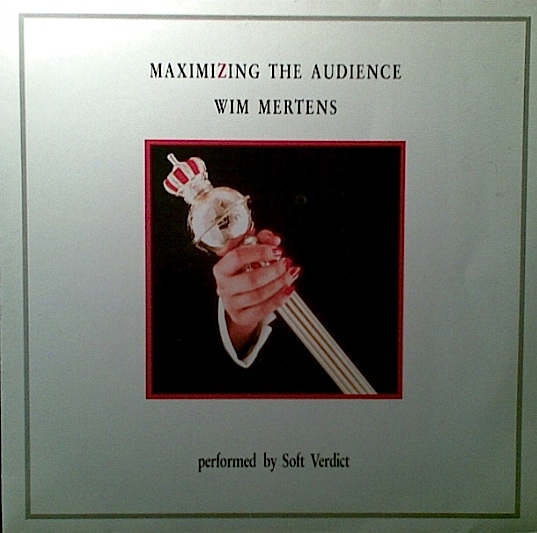
That was the case in 1985. Wim released another two albums. This included Usura, the last Soft Verdict, album. Usura was well received by critics. However, the other album Wim released during 1985, Maximizing The Audience which was recently rereleased by Rhino. It became Wim’s second classic album and essentially, Wim’s debut solo album. Soft Verdict were now Wim’s backing band.
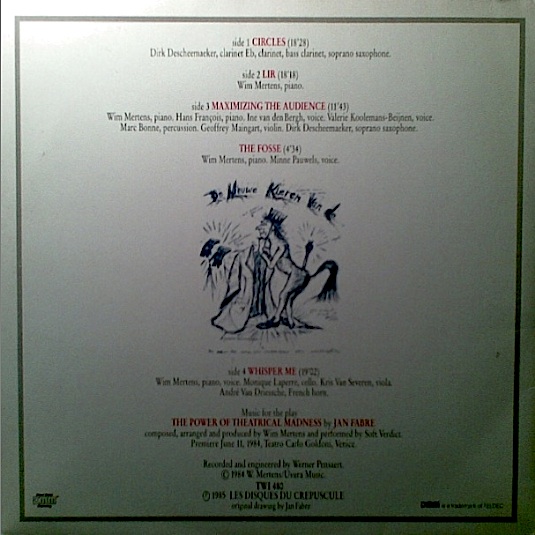
Maximizing The Audience features five tracks written by Wim. He also arranged and produced Maximizing The Audience. Accompanying Wim were some of the best musicians around. This included percussionist Marc Bonne, pianist Hans François and violinist Geoffrey Maingart. Kris Van Severen played viola, Monique Laperre cello and André Van Driessche French horn. Dirk Descheemaeker played clarinet and soprano saxophone, while Ine Van Den Bergh, Minne Pauwels and Valerie Koolemans-Beijnen added vocals. Wim played piano and sang.
On the release of Maximizing The Audience as a double-album in 1985, critics hailed called the album one of the best albums Wim had released. They said it compared favourably with Struggle For Pleasure, in terms of quality. The best known track was Maximizing The Audience. It had been written for Jan Fabre’s play play The Power of Theatrical Madness. The play was premiered in 1984 in Venice, Italy. However, there’s much more to Maximizing The Audience than one track. You’ll realise that, when I tell you about Maximizing The Audience.
Opening Maximizing The Audience is Circles. Dirk Descheemaeker plays all the instruments .That includes the thoughtful, probing clarinet. It opens the track, and scurries in and out of the arrangement, relating the same notes. After a while, it becomes hypnotic. This continues for over two minutes of this eighteen minute epic. It’s then joined by a bass clarinet and they carry on a minimalist, avant garde conversation. Gradually, instruments flit in and out of the arrangement, including a cascading soprano saxophone. It provides a contrast to the hypnotic backdrop. Gradually, the arrangement reveals its subtleties and surprises. By then, it sounds like a journey on a musical merry-go-round. That’s until the ethereal harmonies. enter. They’re akin to an angel’s confessional and are the yin to the arrangement’s yang.
A soul-searching, wistful piano solo opens Lir. It sweeps you away, tugging at your heartstrings and painting pictures in your mind’s eye. Soon, a second piano enters. They compliment each other beautifully, as they arrangement meanders along. Sometimes, grandiose flourishes add a flamboyance to the arrangement. Other times, it’s minimalist, pensive and thoughtful. Essentially, it’s an emotion roller coaster where beauty, grace and elegance is omnipresent.
Deliberate stabs of the piano open Maximizing The Audience. This is akin to a cathartic outpouring of anger, frustration, hurt and pain. Deliberately, Wim pounds the piano, playing with power, passion and precision. Marc Bonne adds percussion while Hans François’ piano plays a supporting role. It’s played tenderly and gently. It matches the power and passion of Wim’s piano, soaring gracefully above the arrangement. Ine Van Den Bergh and Valerie Koolemans-Beijnen share the vocal. When the vocal drops out, strings sweep feverishly. They’re then joined by a second vocal, which is equally impressive. Controlled power, emotion and passion combine, as it soars above the arrangement. Later, the two vocals join forces and are swept along on swathes of strings, while a pounding piano provides the heartbeat to this beautiful, dramatic and ethereal Magnus Opus.
Just a lone piano opens The Fosse. It ambles along, its wistful sound setting the scene for Minne Pauwels’ vocal. It’s slow, emotive and full melancholia and sadness. So, is the operatic vocal that soars above Minnie’s vocal. It quivers, shimmers, and cascades above the arrangement. Then when the vocal drops out, mournful strings and the piano prove a fitting replacement. Having set scene for Minne Pauwels’ vocal, she digs deep and delivers a vocal that’s an outpouring of emotion, sadness and grief.
Closing Maximizing The Audience is Whisper Me. Thoughtful, wistful strings sweep. A French horn escapes from the string-laden arrangement. So does Wim’s vocal. It’s haunting, cascading above the hypnotic arrangement. The arrangement is a fusion of classical, avant garde and experimental. Hypnotic, mesmeric and haunting describes the music. Then, after fourteen minutes, the drama builds and builds, Eventually, it reaches a dark, moody crescendo. This is very different from earlier in the track. However, still, the music is haunting, hypnotic and mesmeric.
For Wim Mertens, Maximizing The Audience was the next chapter in his career. Soft Verdict, the band he founded were now his backing band. Wim decided to become a solo artist. Maximizing The Audience was the album that started Wim’s solo career.
Maximizing The Audience marked a departure in style from Wim Mertens. Not only was it his first solo album, but it was his first album to feature lengthy compositions. The shortest track was The Fosse, which was just under five minutes long. Other tracks lasted as long as eighteen minutes. This was Wim Mertens Magnus Opus. He came of age musically on Maximizing The Audience, which featured some of the most groundbreaking music of his career.
Maybe freed from being part of a band allowed Wim to open the doors of perception. He was able to innovate and push musical boundaries, sometimes to their breaking point. The result was Maximizing The Audience, which contained some of the best music of Wim’s career. This was obvious from the opening track, Circles.
Circles saw Wim draw inspiration from Steve Reich, as the clarinets intertwine, while the soprano saxophone cascades above the hypnotic arrangement. The piece de la resistance are the ethereal harmonies. All this, sets the tone for the rest of Maximizing The Audience. This proves a captivating combination. Then at the heart of Maximizing The Audience, is the title-track. It’s the album’s centrepiece and is best described as a beautiful, dramatic and ethereal Magnus Opus. Equally beautiful and poignant is The Fosse. Closing Maximizing The Audience is the haunting, hypnotic and mesmeric Whisper Me. It’s similar to Circles, as sometimes, the music heads in the direction of chamber music. These five tracks were part of a classic album Maximizing The Audience, which launched Wim Mertens’ solo career.
No twenty-nine years later, Maximizing The Audience has been released. It’s a very welcome rerelease of a classic album, where ambient, avant garde, classical, experimental and minimalist music are combined seamlessly by Wim Mertens. The result is Maximizing The Audience, a multilayered album that’s beautiful, captivating, complex, emotive, ethereal, groundbreaking, haunting, hypnotic, melancholy, mesmeric and wistful. That’s why Maximizing The Audience is a timeless classic from one of the most innovative musicians of his generation, Wim Mertens.
WIM MERTENS-MAXIMIZING THE AUDIENCE.


- Posted in: Ambient ♦ Classical ♦ Experimental
- Tagged: At Home-Not At Home, Close Cover, Maximizing The Audience, Soft Verdict, Struggle for Pleasure, Usura, Vergessen, Wim Mertens
 dereksmusicblog
 dereksmusicblog