LARAAJI-AMBIENT 3 (DAY OF RADIANCE)-VINYL EDITION.
LARAAJI-AMBIENT 3 (DAY OF RADIANCE)-VINYL EDITION.
Despite being one of the most innovative musicians of his generations, Laraaji still remains one of music’s best kept secrets. That’s despite releasing nearly thirty albums. Many of these albums showcase Laraaji’s unique ambient sound. Best known for playing the zither, Laraaji’s music is best described as a fusion of ambient, experimental and psychedelia. Hypnotic, mesmeric and meditative also describes Laraaji’s music. That includes the album that launched Laraaji’s career, Ambient 3 (Day Of Radiance) which was recently reissued on vinyl by Glitterbeat.
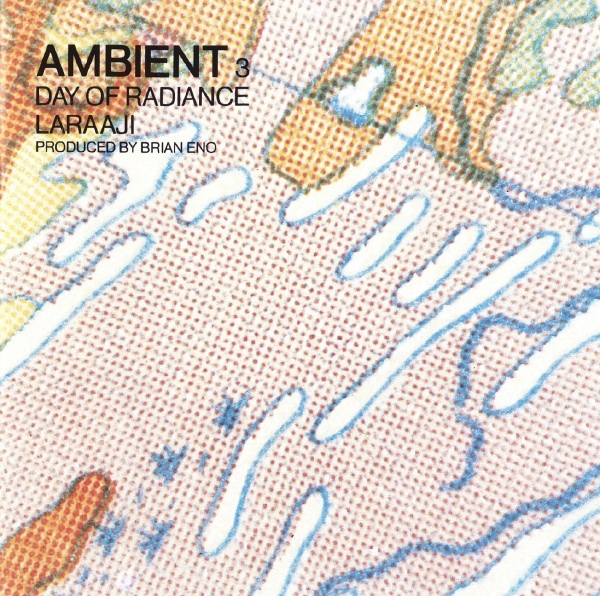
Ambient 3 (Day Of Radiance) was produced by Brian Eno and released in 1980. It was Laraaji’s third album, but the first released by a record label. This was a coming of age for Laraaji, who over the next four decades, released nearly thirty ambient albums. However, growing up, the music that inspired Laraaji was very different to the groundbreaking music he went on to create,
The Laraaji story began in Philadelphia in 1943. That was where he was born Edward Larry Gordon. At an early age, Edward and his family moved to New Jersey.
That was where he studied violin, piano, trombone and singing. At high school, Larry played in the school band and orchestra. Music was part of Larry’s life. He was exposed to an eclectic range of music. His family attended the local Baptist church, so Larry heard choral and gospel music, as well as negro spirituals. At home though, Larry heard very different music.
He sat and absorbed everything from jazz, R&B and rock ’n’ roll. The great piano players inspired Larry. This included Oscar Peterson, Fats Domino and Ahmad Jamal. So it was no surprise that having graduated from high school, Larry decided to study music.
Having won a scholarship to study piano and composition, Larry headed to one of the most prestigious universities in America, Howard University, in Washington D.C. He spent the next few years immersed in music. It seemed that Larry was destined to pursue a career in music. That wasn’t the case.
After graduating from Howard University, Edward decided not to pursue a career in music. Instead, Larry decided to pursue a career as a standup comic. His love of comedy began in college. Then when he left University, Larry and his comedy partner decided to head to New York to audition at the Bitter End, who regularly held talent shows. This was where Bill Cosby’s comedy career began. For an aspiring comedian, this seemed the perfect place to launch their new career. However, the night Larry and his comedy partner were meant to make their debut, his partner never turned up. Having been left in the lurch, he had to make his debut as a solo artist. He was well received. That was the start of Larry’s comedy career. Soon he became a regular on the New York comedy circuit. Comedy wasn’t the only career Larry had.
Through his exploits as a comedian, Larry came to the attention of Ernestine McClendon, who was a respected theatrical agent. She took Larry under her wing and guided his nascent career. Larry was sent to auditions, and soon, was appearing on television commercials, in theatre and even in films. One of these films Putney Swope. Much of the film was improvised. When it came out, it inspired Larry to look at the role of the mass media. Looking for answers, Larry read books and learnt to meditate.
To help him, he turned to teachers who taught Larry how to mediate. He soon was practising meditation and calisthenics. Larry was also using piano exercises as an outlet. This is how he discovered spontaneous music. Everything was improvised, off-the-cuff and experimental. Straight away, Larry realised the possibilities were endless. However, meditation was key to this. He could do with music and art now he’d discovered meditation. Discovering meditation was akin to a spiritual awakening. Before long, the next part of Larry’s Meditation spiritual awakening took place.
Around 1974 or 1975, Larry living near JFK airport. One night he had been out walking, and on his return home, he started hearing what he describes as “the music of the spheres.” This was akin to a cosmic symphony. The music was joyous and celebratory. Larry became part of the music. He was at one with the music. The whole experience had a lasting effect. It was a spiritual and cosmic awakening. Suddenly, he understood things that had puzzled him. Things made sense after what Larry refers to as “a trigger for a cosmic memory.” It was as if Larry had been enlightened. However, he wanted to know more about what had happened. So, he embarked on a course of study.
To further understand what had happened to him, Larry embarked upon a study of Vedic teachings. Part of the Vedic teachings is that the yogis hear music in layers. This is what Larry had experienced, and why he was able to describe the music so vividly. His teachers told him he’d reached such a high level of consciousness that he was able to see things differently from most people. It seemed his spiritual and cosmic awakening was almost complete. Now he wanted to recreate the music he’d heard.
At last, Larry was able to put his musical education to good use. He’d always played music, even when he was working as a comedian and actor. Latterly, he’d been playing the Fender Rhodes. However, Larry was fed up having to transport such a heavy instrument. One night as he was preparing to go onstage, he told his “cosmic ear” he would “like a lighter instrument to share his musical consciousness with the world.” A few days later, he found himself in a pawn shop, ready to pan his guitar, when out of nowhere, a voice told Larry to swap his guitar for a stringed instrument in the shop window. This was an autoharp. Now all Larry had to do was master this new instrument.
When Larry took the instrument home, he tuned it to his favourite piano chords and open guitar tunings. The effect this had, was to return it to what was essentially a zither, whose roots can be traced back the the ancient, traditional instrument the kithara. Gradually, through a process of experimentation, Larry discovered what the autoharp was capable of. Then when he added an electric pickup, this was a game-changer. The possibilities were endless. He was able to begin creating the music he’d heard that fateful night, albeit with a little help from a friend.
Not long after Larry begin playing the autoharp, he was strumming and plucking it like a guitar. That seemed the way to play the autoharp. That’s until he met Dorothy Carter. She was hammered dulcimer artist and encouraged Larry to play his autoharp with hammers. The other thing Dorothy did, was invite Larry to the Boston Globe Music Fest. That’s where Larry met another innovator.
At the Boston Globe Music Fest, Larry met Steven Halpern. It’s no exaggeration to say, that he is a pioneer of new age music. Meeting Steven exposed him to music that he never new existed. It changed Larry’s way of thinking. He realised that music didn’t need to follow the structures that he’d been taught. Music didn’t need to have a beginning, end or even a melody. Instead, it could be a freeform stream of consciousness. There was room for experimentation and improvisation within music. For Larry this changed his approach to music. Inspired and confident in his ability to play the autoharp, Larry was ready to make his debut.
They say all the world is a stage, well that proved to be the case for Larry. He made his debut as a busker on the streets of New York in 1978. A year later, Larry was still busking. However, he was playing in a different location. This proved fortuitous. Some would say it was fate.
Larry was now busking in Washington Square Park. He sat on top of a blanket, cross-legged and with his eyes closed, played his zither using the open tunings he favoured. So he never saw Brian Eno standing watching him. The Godfather of ambient music was transfixed. He’d been walking through the park with Bill Laswell and came across a fellow innovator. Recognising the potential that Larry had, Brian Eno wrote a message to Larry on a piece of paper.
This message asked whether Larry would be interested in working with him on a recording project. For Larry this was kismet. A few weeks previously, people watching Larry play suggested Larry might like Brian Eno and Robert Fripp’s music. Here, lying at his feet when he opened his eyes after playing, was a message from Robert Eno. This Larry felt was an example of cosmic synchronicity. So he contacted Brian Eno.
The next day they met and spoke about ambient music and electronics. Straight away, they got on. Three weeks later, Larry now calling himself Laraaji, headed to Apple Studios, in Green Street, New York. That was where Ambient 3 (Day Of Radiance) was recorded.
When Laraaji arrived at Apple Studios, he brought with him his zither and dulcimer. He also brought the five songs he had composed. Along with producer Brian Eno, they recorded the five tracks.
As the session got underway, Laraaji’s 36-stringed open-tuned zither was treated and amplified. Then when played his dulcimer, he used a series of hammers. Brian Eno added a variety of instruments and effects, which added the all important layers to the five tracks. Once the five tracks were recorded, they became Ambient 3 (Day Of Radiance). It was released later in 1980 and was the latest instalment in a groundbreaking series.
The story started in 1978, when Brian Eno had released his ambient classic, Ambient 1 (Music For Airports). This was one of Brian Eno’s finest albums of the seventies. However, it was another two years before he returned with the next instalment in the series.
Ambient 2 (The Plateaux Of Mirror) was released earlier in 1980, Brian Eno had collaborated with Harold Budd. It was a tantalising prospect, two of ambient music’s pioneers collaborating on an album. On Ambient 2 (The Plateaux Of Mirror)’s release, it didn’t disappoint. With the two colossi of ambient music pooling their resources, it was a fitting followup to Ambient 1 (Music For Airports). This must have left Brian Eno with a dilemma, how do followup Ambient 2 (The Plateaux Of Mirror)? Then fate intervened, and he encountered Laraaji busking in Washington Square Park.
He was the perfect person to record the next instalment in the Ambient series. So Brian left a note asking Laraaji to call him, and the rest was history. They had recorded an album together, and later in 1980, Ambient 3 (Day Of Radiance) was just about to be released. Before that, the critics had to have their say.
For many artists this is a worrying time. Especially, with a left field project. There’s always the possibility that critics won’t understand the music. In the post punk days, the snarling angry young gunslingers in the music press weren’t exactly accommodating to music that didn’t fit their particular agenda. However, some critics gave Ambient 3 (Day Of Radiance) a chance, and realised that this was a groundbreaking album. Elements of ambient, electronica, folk and world music combined on Ambient 3 (Day Of Radiance). Thirty-seven year old Laraaji’s debut album was on its way to becoming an ambient cult classic. No wonder.
Opening Ambient 3 (Day Of Radiance) The Dance #1. Spacey, flourishes of Laraaji’s hammered dulcimer add a dreamy, meditative sound. Then it’s all change. Laraaji plays with a degree of urgency. It’s as if he’s determined to get his ideas down on tape. His playing is impassioned and relentless. Soon, the music takes on a rhythmic, mesmeric quality as it washes over the listener. They bathe in its glistening beauty as the arrangement literally dances, and captivates. Subtle, distant, washes of synths, and later a zither is added. They’re the perfect foil for the relentless energy. Together, they’re responsible for what’s akin to a cathartic outpouring of ideas and energy from Laraaji. It’s is been waiting years to take listeners on his magical, mesmeric, rhythmic and meditative musical journey.
Again, washes of dulcimer ring out in The Dance #2, giving the track a spiritual sound. It’s like some cosmic call to worship, in a 21st century temple. In the background, there’s a almost industrial sound. It has a mesmeric, machinelike sound, as if saying: “chop that wood and carry water.” Later, a wash of celestial sound arise from the arrangement. They wash over the listener, soothing their weary soul. By then, the industrial sound is much more prominent. Despite that, it’s still melodic, celestial and like The Dance #1, has a mesmeric and rhythmic sound.
Stabs of shimmering, glistening dulcimer open The Dance #3. Soon, the music grows in power, and begins to jar. It threatens to become discordant. That’s because Brian Eno has slowed the tape down. This has the effect of the sound vibrating and become deep and distorted. It’s worth it though, when an ethereal and celestial sound shines through. From darkness, there’s light and ethereal beauty, on this three minute soundscape where contrasts are omnipresent.
Meditation #1 is a nineteen minute. Understated, dreamy and spacey, gentle washes of zither ripple slowly. They wash over the listener, and have a meditative quality. It’s a case of less is more. Space is left between the notes. A chiming cheeping sound resonates, before there’s near silence. Many artists fear silence. For them, it’s the elephant in the room. It allows the listener to reflect, before the arrangement glistens and shimmers. There’s a hypnotic quality. Mostly, though, the music’s serene, ethereal beauty washes over the the listener, allowing them to bathe and cleanse their weary soul.
Closing Ambient 3 (Day Of Radiance), is Meditation #2. Slowly and thoughtfully, the zither reverberates into the distance. This is the result of Brian Eno treating Laraaji’s zither electronically. His treatment and the zither’s long decay-rate creates what can only be described as an ethereal sound. Washes of synths and dulcimers are added, creating a shimmering soundscape. One minute there’s an element on drama, the next there’s near silence. From there, the arrangement meanders along, glistening and shimmering. The music is ethereal and elegiac. Sometimes, it hypnotic, and always is captivating. Briefly, Laraaji springs a surprise when dramatic flourishes of his zither add a contrast. Later, the arrangement returns to its understated, spacious and elegiac sound. By then, Laraaji’s music is reminiscent of Brian Eno’s classic seventies ambient music. It seems the pupil has learnt from the master, as Ambient 3 (Day Of Radiance) is an ambient classic.
That’s why Glitterbeat’s recent reissue of Ambient 3 (Day Of Radiance) is to be welcomed. It’s an ambient classic, that for far too long, has been overlooked. Especially, when compared to other albums in the Ambient series.
Brian Eno’s Ambient series started with Ambient 1 (Music For Airports). It’s an ambient classic. However, it was another two years before he returned with the next instalment in the series.
Ambient 2 (The Plateaux Of Mirror) was released earlier in 1980, Brian Eno had collaborated with Harold Budd. This was a tantalising prospect. Here were two of ambient music’s pioneers collaborating on an album. They didn’t disappoint. Not only did the two colossi of ambient music produce a fitting followup to Ambient 1 (Music For Airports), they whetted record buyer’s appetites for the next instalment in the series.
Rather than bring onboard one of the big names in ambient music, Brian Eno brought onboard an unknown. It was Rocky-esque.
Laraaji had been in training for this opportunity for years. This included years spent busking on the Big Apple’s streets. Then fate brought Brian Eno and Laraaji together. The result was Ambient 3 (Day Of Radiance), the album that introduced Laraaji to a wider audience.
When they dropped the needle on Ambient 3 (Day Of Radiance), they heard music that was variously beautiful, dreamy, elegiac, ethereal, melancholy, mesmeric and rhythmic. Other times it’s challenging, meditative, otherworldly and spiritual. Always, the music on Ambient 3 (Day Of Radiance) was innovative. It was a fusion of ambient, Arabic, avant-garde, electronic, experimental, neo-industrial and world music. However, just like so many musical innovators, many people didn’t understand Laraaji’s music.
It wasn’t just Laraaji’s music people didn’t understand. They didn’t understand ambient music per se. Ambient music was very different to most commercial music. Throughout the seventies, it had been overlooked by most people. Instead, Philly Soul, disco and punk proving the soundtrack to the seventies. This was formulaic, disposable music at its worst. However, this music for social dopes was filling the charts and polluting the airwaves. Sadly, ambient, Komische and progressive rock were all being overlooked. That was music for the mind, rather than the feet. However, thankfully, times have changed.
Over the last few years, a new generation of record buyers have rediscovered Laraaji’s music. Somewhat belatedly, Laraaji’s music has found the audience it so richly deserves. This includes Ambient 3 (Day Of Radiance), Laraaji’s collaboration with Brian Eno.
With Brian Eno’s guidance, Laraaji blossomed on Ambient 3 (Day Of Radiance). Soon, he came to be regarded as one of music’s pioneers. Since Ambient 3 (Day Of Radiance), Laraaji has released nearly thirty albums. It’s innovative, cinematic and ethereal music. It toys with the listener’s emotions, and takes them on a journey, all the time, painting pictures in their mind’s eye. Sometimes, Laraaji throws a curveball, taking the listener somewhere they never expected to go. However, it’s a case of trust in Laraaji. This musical visionary takes the listener by the hand on Ambient 3 (Day Of Radiance), and takes them on an ethereal, mesmeric and captivating journey.
LARAAJI-AMBIENT 3 (DAY OF RADIANCE)-VINYL EDITION.
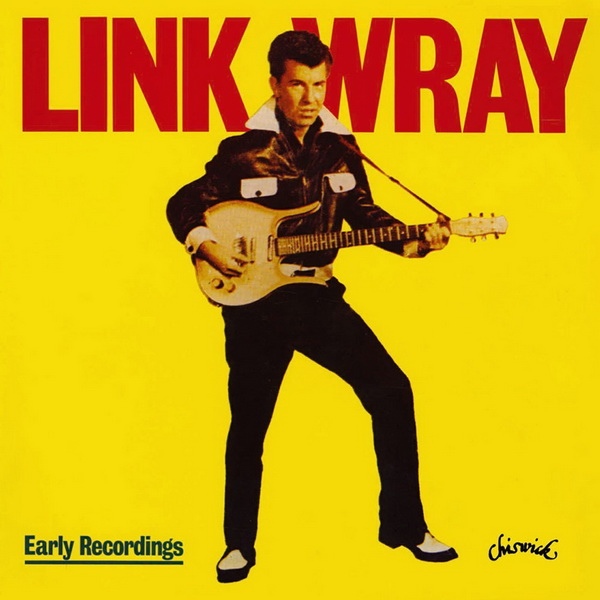
LINK WRAY-EARLY RECORDINGS AND GOOD ROCKING TONIGHT.
LINK WRAY-EARLY RECORDINGS AND GOOD ROCKING TONIGHT.
Nowadays, Link Wray is regarded as one of greatest guitarists in musical history. Link Wray influenced everyone from Jimmy Page and Neil Young to Iggy Pop. He also popularised the power chord in his 1958 instrumental hit Ray Gun. For that alone, several generations of guitarists owe Link Wray a debt of gratitude. Sadly, neither in life nor death, Link Wray never deserved the recognition he so richly deserved. Then nearly eight years after his death, it looked like Link Wray was going to be inducted into the Rock ’N’ Roll Hall Of Fame.
That however, that was a shameful fiasco. On October 16th 2013, it was announced that Link Wray had been nominated to be inducted into the Rock ’N’ Roll Hall Of Fame. Sadly, this never came to pass.
When the great and good gathered at a glittering and ostentatious ceremony in 2014, Link Wray wasn’t inducted into the Rock ’N’ Roll Hall Of Fame. Once again, a musical pioneer had been treated shabbily by the Rock ’N’ Roll Hall Of Fame.
Since then, British reissue label Ace Records, have been doing their best to introduce Link Wray’s music to another musical generation. Earlier, this year, Ace Records reissued 3-Track Shack, which features the three albums that Link Wray recorded at his brother’s home studio, Link Wray, Mordicai Jones and Beans and Fatback. These three albums were released between 1971 and 1973. However, Link Wray had been realising music since 1956. There was certainly life before the 3-Track Shack trilogy.
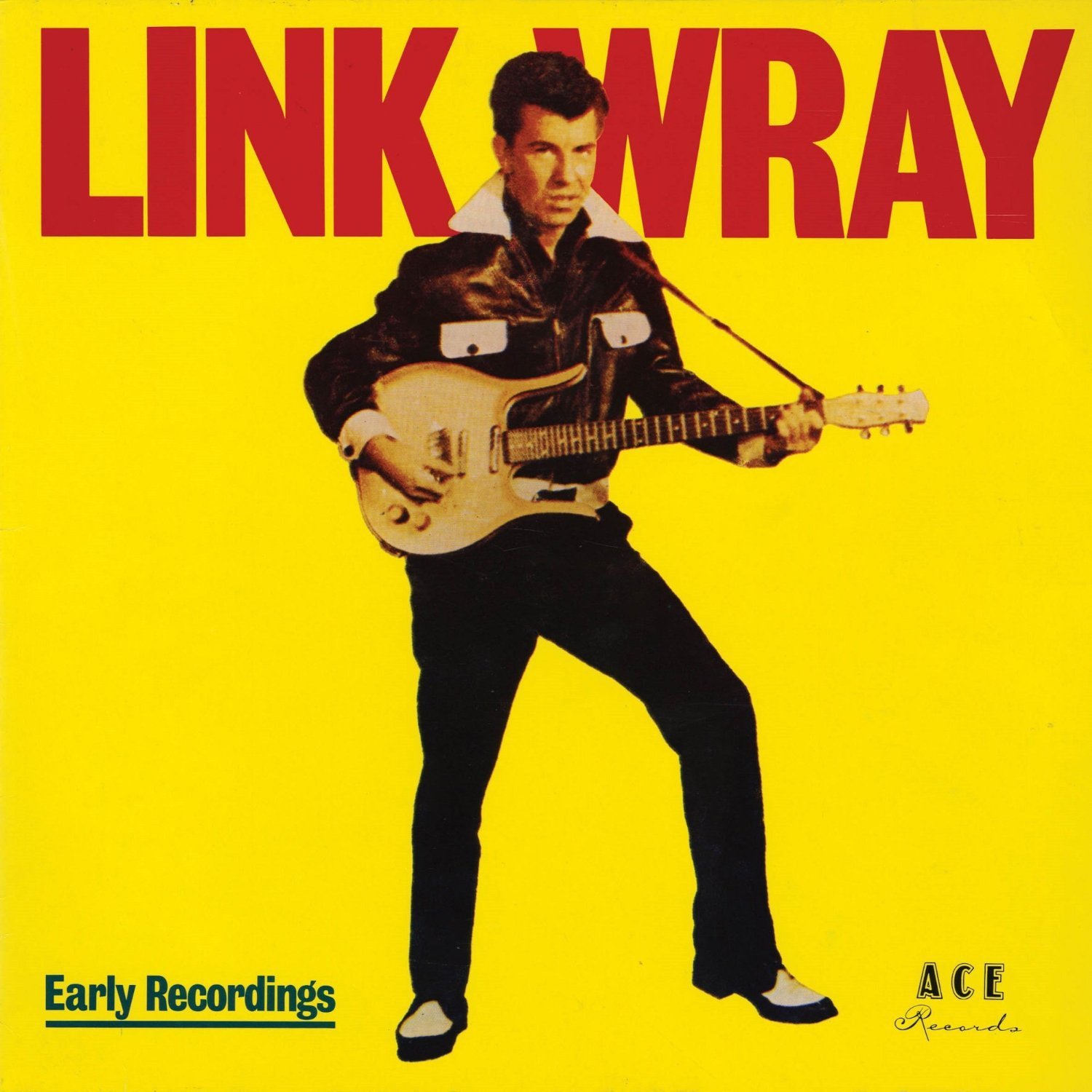
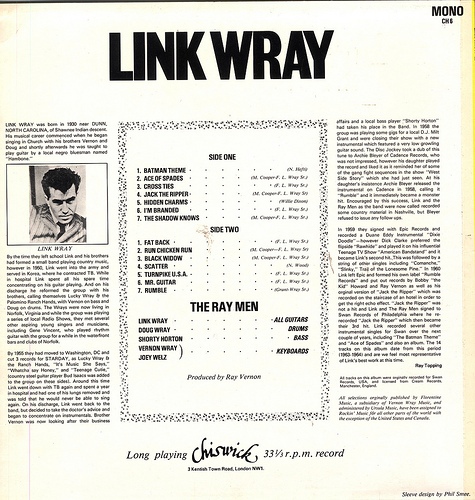
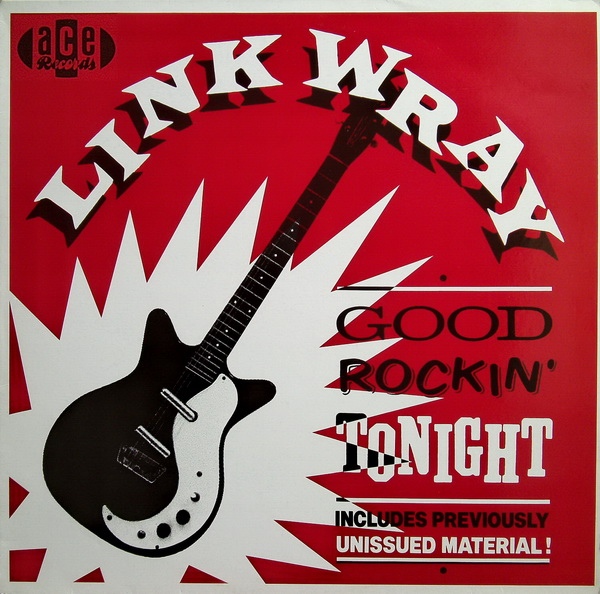
Proof of this, can be found on Ace Records recent Link Wray release. It features two albums Ace Records Early Recordings, compiled and released. The first was 1978s Early Recordings, with Good Rocking Tonight following in 1982. These two albums feature on one disc, which is simply entitled Early Recordings and Good Rocking Tonight. It’s a reminder of a musical innovator as he set about making musical history. Link Wray’s story began on May 2nd 1929.
That’s when Link Wray was born in Dunn, North Carolina, to Fred Lincoln Wray, Sr. and his wife, Lillian M. Wray. Link Wray’s mother was a Shawnee Indian, and later, Link Wray was proud of his heritage. However, this caused problems growing up.
North Carolina in the thirties was Klu Klux Klan country. Life was tough for the Wray family. At nights, the Klan came calling, wearing their white capes and carrying burning crosses. In the local community, African Americans and Link Wray’s mother feared for their life. They had no option but to hide under their bed, until the Klan left. It was a tough upbringing for Link Wray. To make matters worse, the family were poor.
Link Wray’s father had been pensioned out the US Army. His disability cheque allowed the family to survive the depresson…just. The house had dirt floors, and didn’t even have electricity. However, somehow, Link’s mother and father found the money to buy his elder brother Vernon an acoustic guitar.
When Vernon showed little interest in his guitar, fourteen year old Link Wray picked up the guitar. Link tried to teach himself, and used to sit in the porch strumming and picking his guitar. Then one day, a member of a passing circus saw Link playing his guitar. Realised the young man was struggling, the stranger, who called himself Hambone, showed him how to tune and then play the blues guitar. He showed Link open chords, and how to play the guitar with his fingers and even a knife. It was a masterclass from Hambone, who was just as comfortable playing drums and horns. Having showed Link how it was meant to be played, Hambone left Link playing his guitar, However, every time the circus passed through town, Hambone stopped by, to see how his pupil was progressing.
By the time Link Wray was sixteen, he was more than proficient guitarist. He spent a lot of his spare time listening to the blues. Some of the Wray’s neighbours enjoyed the blues. When they threw open their windows, the music spilled out. As Link sat there, he listened and learnt. For Link, it was part of his musical education, which was going pretty well. He had mastered the guitar.This was just as well. Link was about to leave school.
After a teacher threatened to whip Link, there was a fracas. The outcome was, that Link had to leave school. Initially, he got a job delivering groceries and picking cotton and tobacco. This brought some much needed money into the household. Then in 1947, when Link was eighteen, the Wray family were on the move.
Their destination was Portsmouth, Virginia, where Link’s father and elder brother Vernon got job as pipe fitters at a dockyard. Things were looking up for the Wray family. Not long after this, Link got a job as a messenger at the same dockyard.
After two years working at the dockyard, and scrimping and saving, Link had enough money to buy his first electric guitar in 1949. He chose a Vega electric guitar, which he purchased from a Sears and Roebuck catalogue. From the moment he bought the guitar, Link practised non stop. He was determined to improve his technique and playing. However, in 1950, things were looking up for his family.
Vernon Wray, Link’s elder brother founded his own taxi firm in 1950. He employed his two brothers, Link and Fred as drivers. Not long after he started work as a taxi driver, Link began playing bass in country bands. This made him some extra income until in 1951, he was called up by Uncle Sam.
In 1951, Link Wray was called up to serve in the US Army during the Korean War. This almost wrecked Link Wray’s career. Whilst serving in the US Army, Link Wray contracted T.B. Somehow, nobody realised this. It didn’t become apparent until well after Link Wray left the US Army.
On leaving the US Army in 1953, Link Wray’s thoughts turned to music. He was even more determined to make a career out of music. So on his return home, he bought a new Les Paul guitar and amplifier. It was then his brother Vernon, suggested they form their own band, The Lazy Pine Wranglers.
The nascent group featured Vernon on vocals and rhythm guitar, Link on lead guitar, steel guitarist Dixie Neal and Brantley “Shorty” Horton on stand-up bass. Soon, what was Link Wray’s first group, were a popular draw in the nearby city of Norfolk.
While The Lazy Pine Wranglers were the Wray brothers first group, it wasn’t their last.
Link’s brother Doug got a job playing drums and guitar for the Phelps Brothers. They had been really successful on the country circuit, and featured in westerns alongside Roy Rogers. The Phelps Brothers also owned the nearby Palomino Dude Ranch. Somehow, Doug managed to swing a regular gig for the Wray brothers there. As Link Wray and The Palomino Ranch Gang, they provided a country tinged soundtrack at the Phelp Brothers’ ranch. This gave the Wrays career a boost.
Soon, they were backing Tex Ritter, Lash La Rue, Sunset Carson and Wild Bill Elliot. Link Wray and The Palomino Ranch Gang even found their way onto WCMS’ radio’s Hillbilly Concert Hall. This lead to a spot on WMAL-TV’s late night country program Town and Country. With WMAL-TV based in Washington, the Wray brothers moved their permanently, hoping this would further their career.
It did. In 1956, Link Wray released his debut single. He was billed as Lucky Wray, and released It’s Music She Says on the Texan independent label Saturday. The followup was Whatcha Say Honey. Both singles showcased a talented singer. Just as it looked liked Link Wray’s star seemed to be in the ascendancy, tragedy struck.
Link Wray became ill. Initially, the doctors diagnosed pneumonia. He spent a year in hospital. During this period, Link Wray had to have a lung removed. The doctors that treated him thought that Link Wray would never sing again.He proved them wrong.
Early on in 1957, Lucky Wray released another single, Teenage Cutie. This was the last single Link released as lucky. His next release marked the debut of Link Wray.
This came on an E.P. featuring Bob Dean and Cindy With The Kountry Kings. Both acts featured two tracks. Link Wray supplied two of the four tracks on an E.P., I Sez Baby and Johnny Bom Bonny. They saw Link combine country and rockabilly. There’s more than a nod to early Elvis Pressley recordings on the songs that lauched Link Wray’s solo career.
By then, two the Wray brothers were trying to forge a career as singers. Vernon was signed to Cameo, which ultimately resulted in a couple of unsuccessful singles. During one of Vernon’s recording sessions, Link was watching proceedings. When the session finished early, Bernie Lowe allowed Link to record two tracks he had written, Oddball and Swag. When Link heard the playback of Oddball, he knew in his heart, that the song was special. He smiled inwardly, knowing that the session at Broad and Locust, in Philly, cost just $75. For that, Bernie Lowe worked as tape-op.
Little did anyone know how much of a bargain it had been. However, Link struggled to get anyone interested in the song. He played it on Milt Jackson’s show. Wanting to help his friend, Milt even took a copy to Archie Blayer at the Cadence label.
Archie Blayer didn’t like the raucous sounding track, so gave his copy to his teenage step-daughter Jackie Ertel. She however, loved Oddball, and encouraged her father to release the track. The only thing that Jackie didn’t like, was the name. She suggested that Oddball be renamed as Rumble. History was about to be made.
In April 1958, Link Wray and His Ray Men released what would become Link Wray’s most successful single, the classic instrumental Rumble. It saw Link Wray deploy distortion and feedback. This was a first, in more ways than one. Link Wray also became one of the first guitarists to use the power chord on Rumble. He wouldn’t be the last, and since then, it’s been part and parcel of a guitarists arsenal. When the Rumble was released, it was immediately banned.
This made Rumble one of the first instrumentals to be banned. The problem was the title. Rumble was the slang term for a gang fight. The authorities feared that the single would lead to disorder. Ironically, banning Rumble made the song even more popular.
Some nights, Link Wray and His Ray Men played several encores of Rumble. Rumble was popular on both sides of the Atlantic. It reached number sixteen in the US Billboard 100 charts. Across the Atlantic, future members of The Kinks and The Who heard this classic instrumental. Other musicians were won over by it. From Bob Dylan to Phil Everly, Rumble was a favourite of musicians everywhere. After the success of Rumble, many thought that Link Wray would become one of the biggest stars of the late-fifties and sixties.
That proved not to be the case. Things looked good at first. Archie Blayer sent Link Wray and His Ray Men to record the followup. He suggested a track called Dixie Doodle, which was Duane Eddy-esque. However, Link preferred the other track they cut Raw Hide.
Link Wray released Raw-Hide as a single in January 1959. It reached number twenty-four in the US Billboard 100 charts. After that, Comanche a song Link Wray named after his North American Indian roots’ failed to chart. So did Slinky and Vendetta. The rest of 1959 was a right-off. So was 1960.
Neither Trail of the Lonesome Pine nor the Jimmy Reed penned Ain’t That Lovin’ You, Baby charted. 1960 when Link Wray released his debut album, Link Wray and The Wraymen wasn’t going to plan. However, Vernon Wray realised the importance of looking after his brother’s finances.
Having secured tuning from Milt Jackson, the Wray brothers setup a two room studio opposite WTTG, where Milt’s show was broadcast. From that studio, Vernon looked after Milt’s publishing and composing rights. The company that took care of the publishing, was Vernon’s Florentine Music. This proved a shrewd move. When the hits dried up for Link Wray, he had a nest egg to fall back on. However, things improved for Link.
Over the next few years, Link Wray continued to release singles and a few albums. Link Wray released his sophomore album Great Guitar Hits by Link Wray, in 1962. By then, Link Wray’s star was in the ascendancy, and he was releasing some of the best music of his career. This includes the music that found its way onto Ace Records 1978 album Early Recordings.
Early Recordings.
One of the earliest Link Wray songs on Early Recordings is Jack The Ripper. It was released on Swann in July 1961, reaching number sixty-four in the US Billboard 100 charts. While it was a long way from the success Rumble enjoyed in 1958, Jack The Ripper featured Link Wray’s unmistakable, signature guitar sound. Sadly, after Jack The Ripper, the hits dried up for Link Wray.
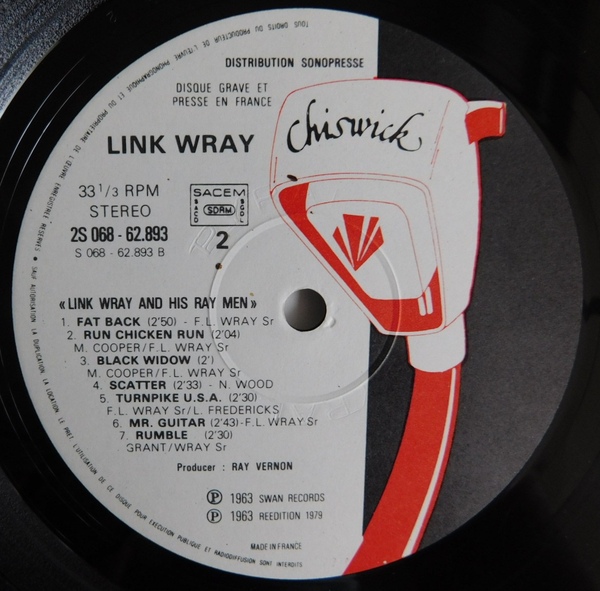
Ironically, 1963 found Link Wray releasing some of the best music of his seven year career. It finds its way onto Early Recordings. This includes 1963 single Black Widow, which was released on Swan in April 1963. Just like his last few singles, Black Widow failed to chart. Neither did Run Chicken Run, which was released as a single in September 1963. This run of unsuccessful singles continued with Weekend, which featured Turnpike U.S.A. on the flip side. It’s a like a joyous homage to The Beach Boys from Link Wray. Why it languished on a B-Side seemed strange? Turnpike U.S.A didn’t even make it onto Link Wray’s album Jack The Ripper.
Released on Swan in 1963, Jack The Ripper features songs like Cross Ties, Fat Back, Run Chicken Run, Mr. Guitar and even a rerecording of Rumble. These songs feature Link Wray at his best. He unleashes a series masterclasses on his trusty guitar. However, although it sold better than his singles, Link Wray was no longer as popular as he had once been.
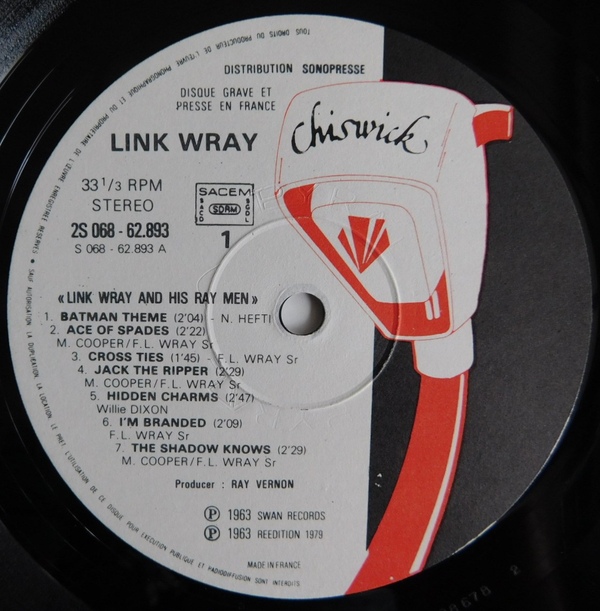
The man who should’ve been hailed one of the greatest guitarists of his generation, was a stranger to the charts over the next few years. When the mood sounding The Shadow Knows was released on Swan in March 1964, it failed commercially. It makes a welcome return on Early Recordings. So does the 1965 single I’m Branded and Ace Of Spades and The Batman Theme, which were both released as single in 1966. On the B-Side of The Batman Theme was Hidden Charms, a stomper of a hidden gem, with blistering guitars. It features a surly sounding vocal from Link Wray, and is an unmissable track for Link Wray fans. Garage meets proto-punk describes the track. It’s the last of the sixties tracks on Early Recordings.
Scatter was recorded in 1978, and completed this fourteen track compilation. It featured mostly Link Wray’s sixties recordings, with Scatter a nod to the seventies. Good Rocking Tonight, which was released in 1982, was also a mixture of the past and present.
Good Rocking Tonight.
When Good Rocking Tonight was released in 1982, the album was mixture of newly recorded songs, a Link Wray classic and a couple of hidden gems. The earliest recording, was Link Wray’s theme tune,..Rumble.
April 1958 saw the release of Rumble on the Cadence label. Quickly, the single became popular on both sides of the Atlantic. It reached number sixteen in the US Billboard 100 charts. Across the Atlantic, future members of The Kinks and The Who would be influenced by this classic instrumental. On the flip-side was Swag, which is also included on Good Rocking Tonight. These two tracks started the Link Wray story.
By 1963, hits were a think of the past for Link Wray. This shows how fleeting chart success can be. The Sweeper which was the B-Side of Run Chicken Run, which was released as single in November 1963, is a welcome inclusion on Good Rocking Tonight. It’s a spellbinding wall of sound, where Link Wray’s finger flit up and down the fretboard. Run Boy Run, a hidden gem from 1964, features an equally impressive performance. However, Link Wray has something special up his sleeve, Deuces Wild, his single from July 1964. A year later, and Link Wray recorded a demo for Stateside.
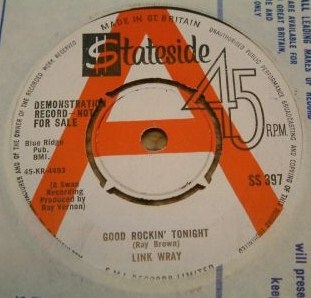
For his Stateside demo, Link Wray recorded a cover of Good Rockin’ Tonight. It features an Elvis inspired vocal from Link Wray, whose aided and abetted by The Ray Men. They add harmonies and handclaps. However, Link Wray’s dalliance with Stateside was short-lived and he returned to Swan, which was his home as the second half of the sixties began. However, Link Wray fortunes didn’t improve.
By 1982, it had been a long time since Link Wray had enjoyed a hit single. Link Wray now lived in Copenhagen, Denmark, with his new wife Diane Poulsen. Money was tight for Link Wray, and he existed on an US Army pension, and the money he made playing live. However, in 1982, Link Wray wasn’t play live very often. So the opportunity to release the Good Rockin’ Tonight album in Ace Records was a godsend for Link Wray.
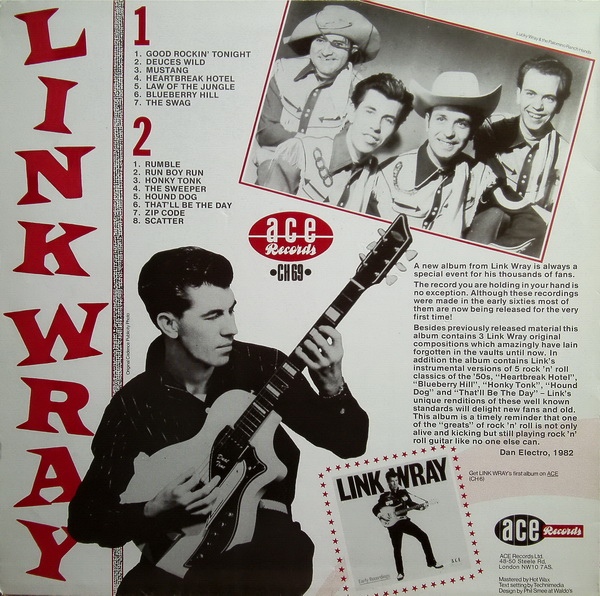
Good Rockin’ Tonight saw Link Wray combine covers with new material. Cover versions included a moody, almost surly take on Heartbreak Hotel. Then on Blueberry Hill, Link Wray takes centre-stage showcasing his considerable skills. Soon, he’s rolling back the years. That’s the case on Lieber and Stoller’s Hound Dog and That’ll Be The Day. Honky Tonk sees Link Wray going toe-to-toe with a blazing saxophone. The other three tracks come from the pen of Link Wray.
Mustang sounds like Link Wray in his prime. It’s a track he wrote. So is Law Of The Jungle, which shows that Link Wray still has the x-factor. Closing Good Rockin’ Tonight, was Zip Code, a track that sounded as if it had been recorded circa 1961, and was a long lost hidden gem. It’s not, and instead showed that despite his ailing health, Link Wray was still one of the most talented musicians of his generation. Sadly, he never received the credit he deserved.
Often, musicians like Link Wray are described as a “musician’s musician.” That was the case with Link Wray. Only musicians were able to appreciate how he had changed music, and his music. Link Wray had also inspired many of musicians. From Jimmy Page and Neil Young to Iggy Pop, countless musicians have said that that Link Wray inspired them. Similarly, anyone whose utilised the power chord, has Link Wray to thank.
He popularised the power chord in his 1958 instrumental hit Ray Gun. For that alone, several generations of guitarists owe Link Wray a debt of gratitude. Sadly, Link Wray never deserved the recognition he so richly deserved. However, one record company has always recognised this musical pioneer.
Ace Records have been flying the flag for Link Wray’s music since 1978. Since then, they’ve released several releases. This includes 3-Track Shack, which features the three albums that Link Wray recorded at his brother’s home studio, Link Wray, Mordicai Jones and Beans and Fatback. Since 3-Track Shack has been released, Ace Records have been readying themselves to release Early Recordings and Good Rocking Tonight, which were recently released on one CD.
Early Recordings was released in 1978, with Good Rocking Tonight following in 1982. These two albums are a reminder of a musical innovator Link Wray, who sadly, died in Copenhagen, Denmark, on November 5th 2005. The recent release of Early Recordings and Good Rocking Tonight celebrates the music of Link Wray, on the tenth anniversary of his death.
Now, somewhat belatedly, Link Wray is starting to receive the recognition his music so richly deserves. That’s thanks to Ace Records, who for five decades have championed the music of Link Wray. Ace Records’ release of 3-Track Shack earlier in 2015, plus their recent release of Early Recordings and Good Rocking Tonight, will hopefully, introduce the music of that musical pioneer, Link Wray, to a much wider audience.
LINK WRAY-EARLY RECORDINGS AND GOOD ROCKING.
LONNIE LISTON SMITH AND THE COSMIC ECHOES-REFLECTIONS OF A GOLDEN DREAM.
LONNIE LISTON SMITH AND THE COSMIC ECHOES-REFLECTIONS OF A GOLDEN DREAM.
Of all the artists Bob Thiele signed to Flying Dutchman Productions, Lonnie Liston Smith and The Cosmic Echoes proved to be one the most successful. However, success didn’t come overnight for Lonnie Liston Smith and The Cosmic Echoes.
Neither Lonnie Liston Smith and The Cosmic Echoes’ 1973 debut album Astral Travelling, nor 1974s Cosmic Funk charted. However, when Lonnie Liston Smith and The Cosmic Echoes released their third album Expansions, in 1975, it reached number eighty-five in the US Billboard 200, and number twenty-seven in the US R&B charts and number two in the US Jazz charts. Not only did this please Lonnie Liston Smith, but Bob Thiele’s paymasters at RCA.
By the time Expansions was released, Bob Thiele had realised that he was fighting a losing battle. He needed a major label to take over Flying Dutchman Productions. RCA stepped in in 1974, taking charge of funding and distribution. This allowed Bob Thiele to do what he did best, A&R and production. The only downside was, that RCA weren’t a benevolent benefactor.
RCA wanted Flying Dutchman Productions to release albums that were commercially successful. Bob Thiele must have agreed to this with a heavy heart. Some of the albums he had previously released were innovative and artistic merit, but were never going to sell in vast quantities. Now he would’ve have to think twice about releasing that type of album. It was a case of playing things safe, and thinking about what would sell. Luckily, by late 1975, one of Flying Dutchman Productions’ biggest seller was Lonnie Liston Smith and The Cosmic Echoes.
In the summer of 1975, Lonnie Liston Smith and The Cosmic Echoes had released Visions Of A New World. It reached number seventy-four in the US Billboard 200, fourteen in the US R&B charts and number four in the US Jazz charts. Visions Of A New World was Lonnie Liston and The Cosmic Echoes’ most successful album. Lonnie Liston Smith and The Cosmic Echoes were on a roll, and were one of Flying Dutchman Productions’ biggest assets. That’s not surprising, as Lonnie Liston Smith was almost destined to embark upon a musical career.
It was almost written in the stars that Lonnie Liston Smith would become a musician. Lonnie Liston Smith was born in 1940, into a musical family. His father was a member of Richmond Gospel music group the Harmonising Four. Growing up, members of gospel groups The Soul Stirrers and Swan Silvertones were regular visitors to the Smith household. With all this music surrounding him, Lonnie learned piano, tuba and trumpet in High School and college. After college, he headed to Morgan State University.
Inspired by John Coltrane, Charlie Parker and Miles Davis, Lonnie Liston Smith embarked upon a degree in musical education. Throughout his time at University, Lonnie Liston Smith continued playing the pianist in local clubs and singing backing vocals. He played with alto saxophonist Gary Bartz and trombonist Graham Moncur. This was all part of Lonnie’s musical eduction. Having completed his BSc in musical education at Morgan State University, Lonnie Liston Smith walked straight into a job.
Having left Morgan State University, Lonnie Liston Smith got a job with the Royal Theatre’s house band. For a young musician, this was would help turn them into a musical all-rounder. After all, they had to be able to accompany a wide range of artists. For Lonnie Liston Smith, this was the next stage in his musical education. The next part of his musical education took place in New York.
Now living in New York, Lonnie Liston Smith was lucky enough to get a gig playing piano in Betty Carter’s band. This helped Lonnie Liston Smith get his name known in the Big Apple. Then in early 1965, Lonnie Liston Smith caught a break. He joined Roland Kirk’s band.
Lonnie Liston Smith made his recording debut on March 14th 1965, when Roland Kirk recorded Here Comes The Whistleman. It was recorded live in New York, with Lonnie Liston Smith only playing on the title-track, Making Love After Hours, Yesterdays and Step Right Up. Having made his recording debut, Lonnie Liston Smith featured on Roland Kirk and Al Hibbler’s 1965 live album, A Meeting Of The Times. However, that was Lonnie Liston Smith’s swan-song with Roland Smith’s band. After this, Lonnie Liston Smith joined one of jazz’s top bands, The Jazz Messengers.
Over the last few years, The Jazz Messengers had established a reputation for young musicians looking to make a name for themselves. Lonnie Liston Smith joined in 1965. He shared the role with Mick Nock and Keith Jarrett. However, with The Jazz Messengers ever evolving lineup, Lonnie Liston Smith only played three in concerts. These three concerts just so happened to be at the legendary Village Vanguard. Despite the prestigious venue, this must have been a disappointing time for Lonnie Liston Smith. Luckily, he was rehired by Roland Kirk.
Now back with Roland Kirk’s band, Lonnie Liston Smith was just in time to play on his 1968 album Now Please Don’t You Cry, Beautiful Edith. This established Lonnie’s reputation as the go-to-guy for a pianist.
It was the start of period where Lonnie worked with some of the most innovative and inventive jazz players. Musical boundaries were about to be pushed to their limits as Lonnie joined Pharaoh Saunders’ legendary free jazz band.
Pharaoh Saunders had worked closely with John Coltrane right up to his death in 1967. The following year, Pharaoh formed a new band. Their music is best described as free jazz. Musical boundaries were pushed to their limits and beyond. Recognising a fellow believer in free jazz, Pharaoh Sanders asked Lonnie to join his band. Lonnie Liston Smith went on to play on three of Pharaoh Sander’s best albums. The first of this trio was 1969s Karma. It was followed in 1970 with Jewels of Thought and 1971s Thembi. The other Pharaoh Saunders album Lonnie played on was 1970s Summun Bookman Umyun. which was released on Impulse. Just like the three albums Pharaoh Sanders recorded for Flying Dutchman, it was a groundbreaking album.
During this period, Pharaoh Sanders and his band were constantly pushing boundaries and rewriting the musical rulebook. Their music was truly groundbreaking. Even Lonnie Liston Smith was challenged. On Thembi, Pharaoh Sanders asked Lonnie Liston Smith to play the Fender Rhodes. This was the first time that he came across an electric piano. However, Lonnie Liston Smith rose to challenge and wrote Thembi’s opening track Astral Travelling. Later, Astral Travelling would become synonymous with Lonnie Liston Smith and The Echoes. Before that, Lonnie would play with some of jazz’s mavericks.
One of these mavericks was Gato Barbieri. He’d just signed to Bob Thiele’s nascent label Flying Dutchman Productions. It was establishing a reputation for providing musicians with an environment where innovative and creative musicians could thrive.
Bob Thiele believed musical mavericks didn’t thrive within such an orthodox environment. Their creativity is restricted, meaning they’re unable to experiment and innovate like they’d like. So, Bob Thiele signed Gato Barbieri to Flying Dutchman Productions. Lonnie Liston Smith played on his 1969 debut album The Third World. Bob Thiele’s next signing was Leon Thomas and played on his debut album Spirits Known and Unknown. Soon, Lonnie Liston Smith was a regular at Flying Dutchman Productions’ sessions.
When the time came for Gato Barbieri to record his 1971 sophomore album Fenix, Lonnie Liston Smith was called upon. He played on Fenix and joined Gato Barbieri’s band. Lonnie Liston Smith played on Gato Barbieri’s 1972 album El Pampero. He also toured throughout Europe with Gato Barbieri. Then came the opportunity of a lifetime. After El Pampero, Lonnie Liston Smith got the chance to work with another jazz legend.
Lonnie Liston Smith was a member of Gato Barbieri’s band when Miles Davis got in touch. He wanted Lonnie Liston Smith to join his band. At this time, Miles Davis’ music was changing direction. The direction it was heading in was funk. Electronic instruments were the flavour of the month for Miles Davis, who was exploring their possibilities. However, Miles Davis was doing this outside the studio environment. That’s why there are very few recordings of Lonnie Liston Smith playing alongside Miles Davis at that time. That came later, when Lonnie Liston Smith would later work with Miles Davis. Meanwhile, Lonnie Liston Smith decided to move on, and embark upon a solo career.
There was a sense of inevitability that Lonnie Liston Smith would sign Flying Dutchman Productions. He had played on numerous albums the label released. Lonnie Liston Smith’s musical style suited Flying Dutchman Productions. It all made sense. So in 1973, Lonnie Liston Smith signed to Flying Dutchman Productions, and began work on his debut album Astral Travelling.
Astral Travelling.
When recording of Astral Travelling began, Lonnie Liston Smith had put together some of the most talented and innovative musicians. The Cosmic Echoes’ rhythm section included bassist Cecil McBee, drummer David Lee and guitarist Joe Beck. Sonrily Morgan and James Mtume played percussion and conga, Gee Vashi tamboura and Badal Roy tabla. George Barron played tenor and soprano saxophone. Lonnie Liston Smith played piano and electric piano on Astral Travelling which was produced by Bob Thiele. Astral Travelling was released in 1973.
On its release in 1973, Astral Travelling was released to critical acclaim. This was no surprise. Lonnie Liston Smith had worked with some of the biggest names of jazz. It was akin to a musical apprenticeship. Astral Travelling saw Lonnie Liston Smith move from sideman to bandleader. Accompanied by some of the best and most innovative musicians, he had created an ambitious and groundbreaking album. Although Astral Travelling failed to chart, it sold reasonably well upon its release. This bode well for the future.
Cosmic Funk.
The followup to Astral Travelling, Cosmic Funk was released in 1974. Lonnie Liston Smith and The Cosmic Echoes’ genre-hopping sophomore album was released to widespread critical acclaim, and sold reasonably well. However, Cosmic Funk wasn’t going to make Lonnie Liston Smith rich. At least word was spreading about this musical visionary. Soon, Lonnie Liston Smith and The Cosmic Echoes would be enjoying both commercial success and critical acclaim.
Expansions.
By the time Lonnie Liston Smith and The Cosmic Echoes released Expansions in early 1975, Bob Thiele had take Flying Dutchman Productions’ releases to RCA. While this safeguarded Flying Dutchman Productions’ future, RCA weren’t a charity. They wanted sales. Sales was what they got. Expansions reached eight-five in the US Billboard 200, twenty-seven in the US R&B charts and number two in the US Jazz charts. This made Expansions one of Flying Dutchman Productions’ most successful albums.
Meanwhile, club and radio DJs were spinning tracks from Expansions. Belatedly, Lonnie Liston Smith and The Cosmic Echoes were the flavour of the month among DJs, dancers and discerning record buyers. So, it’s no surprise that Bob Thiele sent Lonnie Liston Smith and The Cosmic Echoes into the studio again, where they recorded Visions Of A New World.
Visions Of A New World.
For Lonnie Liston Smith and The Cosmic Echoes’ fourth album, Visions Of A New World, Lonnie penned seven tracks, including Lonnie’s hopeful anthem, A Chance For Peace. The other track, Devika (Goddess) was written by Dave Hubbard and Sarina Grant. These eight tracks were recorded at Electric Ladyland Studios, New York, and Visions Of A New World was released in the summer of 1975,.
Just like previous albums, critics hailed Visions Of A New World as a groundbreaking album. Lonnie Liston Smith was seen as a musical pioneer, capable of creating innovative and influential music. That music was way ahead of the musical curve. Record buyers concurred.
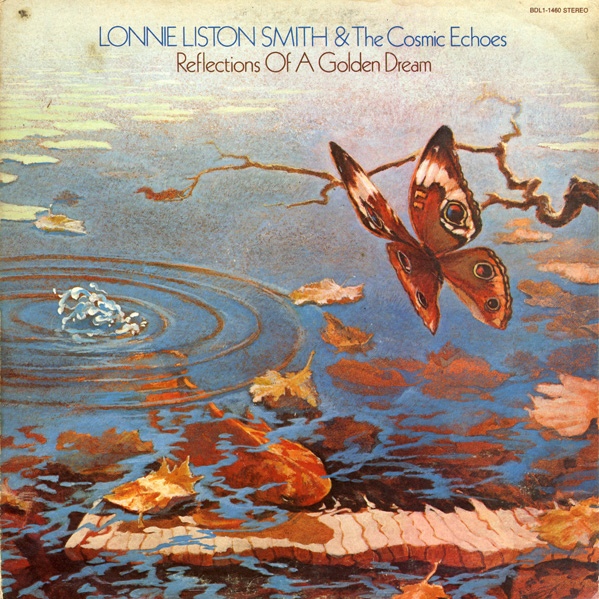
When Visions Of A New World was released in the summer of 1975, it reached number seventy-four in the US Billboard 200, fourteen in the US R&B charts and number four in the US Jazz charts. Visions Of A New World was Lonnie Liston and The Cosmic Echoes’ most successful album. However, could Lonnie Liston Smith make it three successful albums in a row, when he released Reflections Of A Golden Dream, which was recently released by BGP, an imprint of Ace Records.
Reflections Of A Golden Dream.
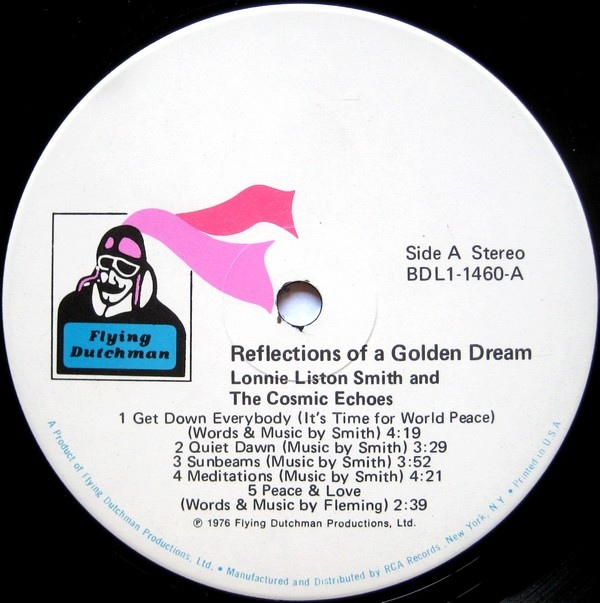
For his fifth solo album, Reflections Of A Golden Dream, Lonnie Liston Smith penned nine tracks, and cowrote Peace and Love with Leopoldo Fleming. The ten tracks were recorded by Lonnie Liston Smith and The Cosmic Echoes, which featured some top musicians.
Just like with previous albums, the lineup of The Cosmic Echoes seemed in a constant state of flux. The Cosmic Echoes’ rhythm section featured bassist Al Anderson and drummer Art Gore and Wilby Fletcher. Percussionists included Guilherme Franco and Leopoldo Fleming who also added congas and guaitar. Flautist Donald Smith also added vocals on three tracks; while Dave Hubert switched between flute and soprano saxophonist. The horn section also included tenor saxophonist George Opalisky; plus Joe Shepley and Jon Faddis who played trumpet and flugelhorn. Backing vocalists included Maeretha Stewart, Patti Austin and Vivian Cherry. They augmented this latest version of The Cosmic Echoes on Visions Of A New World Astral Travelling.
Lonnie Liston Smith, played keyboards, piano and added vocals. He also co-produced Reflections Of A Golden Dream with Bob Thiele. However, it later became apparent that Lonnie Liston Smith more or less took charge of production on Reflections Of A Golden Dream. Bob Thiele’s role, was more of an executive producer. That didn’t seem to affect the reviews of Reflections Of A Golden Dream.
Critics when they received their advance copies of Reflections Of A Golden Dream, found Lonnie Liston Smith and The Cosmic Echoes combining dance-floor friendly music with social comment on Get Down Everybody (It’s Time For World Peace) and Peace and Love. Meditations featured a much more pensive, spiritual sound; while Journey Into Space saw Lonnie Liston Smith became a musical voyager. Just like previous albums, Reflections Of A Golden Dream received plaudits and critical acclaim. That was all very well. However, would Reflections Of A Golden Dream ensure that Lonnie Liston Smith and The Cosmic Echoes run of commercial success continued?
When Reflections Of A Golden Dream was released in 1976, the album sold well, but didn’t match the commercial success of Visions Of A New World. It remained the most successful album of Lonnie Liston Smith and The Cosmic Echoes’ time at Flying Dutchman Productions. Reflections Of A Golden Dream closed the door on that chapter of Lonnie Liston Smith and The Cosmic Echoes career. Was it a fitting swan-song?
Reflections Of A Golden Dream opens with Get Down Everybody (It’s Time For World Peace). A pulsating beat joins myriad of percussion and effects. Harmonies the soar soulfully above the arrangement, as Lonnie Liston Smith encourages: “Get Down Everybody (It’s Time For World Peace)”. Toughening up the dance-floor friendly are keyboards and stabs of blazing horns. Soon, though, the arrangement is focusing solely on the dance-floor. This isn’t surprising, as 1976 was the peak of the disco boom. Lonnie’s vocal veers towards a vamp, as his soulful triumvirate of backing singers play an important part in the song’s success. So the horns and the rhythm section, who propel the arrangement along, as seamlessly, elements of disco, funk, jazz and soul unite.
Quiet Dawn has a much more laid-back, dreamy sound. Swathes and swells of strings float above the keyboards, while percussion is at the heart of the arrangement. The bass augments the percussion, as Lonnie Liston Smith’s piano plays slowly and thoughtfully. As the arrangement flows elegiacally along, a breathy flute flutters. One can’t help but wallow in its beauty of Quiet Dawn, which is omnipresent.
Layer upon layer of percussion is at the heart of the arrangement to Sunbeams. Meanwhile, the rhythm section of bassist Al Anderson and drummer Wilby Fletcher are playing leading roles. Al Anderson’s bass line has a vibrancy and energy. Wilby Fletcher picks up on this. So does Dave Hubbard’s flowing soprano saxophone. It augments Lonnie Liston Smith’s keyboards.
They’re driving the arrangement along, as he plays with freedom and flamboyance. Later, David Smith, Lonnie Liston Smith’s brother adds flute. Lonnie Liston Smith’s piano looks like stealing the show. However, is performance can’t exist in isolation, and Sunbeams’ sound and success is down to Lonnie Liston Smith and The Cosmic Echoes.
Unsurprisingly, Meditations has ruminative quality. Washes of Lonnie Liston Smith’s Fender Rhodes are like waves breaking on a deserted beach. Accompanying Lonnie Liston Smith is a myriad of percussion. That’s all that’s needed as a quite beautiful, melodic track washes over you, reminding you of warm summer days on a sun kissed beach.
An Iberian acoustic guitar is panned right on Peace and Love. It’s all that the listener hears. Soon, the trio of backing vocalists return, demanding: “we need peace, we need love.” A clavinet is panned left, and adds a tough funk sound, and Donald Smith takes charge of the lead vocal. By then, jazz and funk are combining with the soulful backing vocals. There’s even a nod towards fusion, as Peace and Love looks like taking on an anthemic sound. It’s reminiscent of Lonnie Liston Smith’s previous anthem, Give Peace A Chance and features a similar mixture of hope and social comment.
Beautiful Woman finds Lonnie Liston Smith and The Cosmic Echoes playing as one. The rhythm section provide a funky backdrop. Bassist Al Anderson plays a leading role, anchoring the arrangement, and providing its heartbeat. Lonnie Liston Smith plays a variety of keyboards, including a clavinet. It adds tough, funky sound. Other keyboards add layers. So do the percussion. Atop the arrangement, Donald Smith adds a tender, heartfelt vocal. Later, it grows in power, soaring above the arrangement. By then, Lonnie Liston Smith and The Cosmic Echoes have found their A-Game, and are their funky best, on what’s one of Reflections Of A Golden Dream’s highlights.
The tempo drops on Goddess Of Love. Still, though, the song has a funky sound, which flows and meanders along. Not for the first time, echo is deployed, meaning was of Fender Rhodes run into each other. Meanwhile, the rhythm section create a mid- tempo, funky beat and strings sweep creating an elegiac, wistful track.
Inner Beauty is described as a “mood piece.” Lonnie Liston Smith adds flamboyant flourishes of piano and David Hubbard delivers a masterclass on soprano saxophone. A myriad of percussion and congas provide the backdrop for David Smith’s scatted vocal on what’s a thoughtful, ruminative sounding track whose Inner Beauty is there for everyone to hear.
Golden Dreams almost shuffles into being, a piano playing before a Fender Rhodes shimmers. Then the rhythm section join percussion and a flute. Together, they provide the backdrop for Lonnie Liston Smith’s tender, hopeful vocal. Above his vocal, the arrangement shuffles and meanders along, showcasing not just Lonnie Liston Smith’s skills a pianist, but as a vocalist.
Journey Into Space, which closes Reflections Of A Golden Dream, is another short mood piece. It’s just two-and-a-half minutes long. The introduction is almost otherworldly, and has an experimental, avant garde sound. A flute replicates the sound of an exotic bird or animal, while the rest of The Cosmic Beings add percussion or produce a variety of left-field, experimental sounds. The result, is an ambitious piece of music, which is reminiscent of the more experimental music Flying Dutchman Productions released in the early days. This track could easily have been recorded in the early seventies, when Leon Thomas was producing some of his most groundbreaking work.
By 1976, when Lonnie Liston Smith and The Cosmic Echoes released Reflections Of A Golden Dream, Flying Dutchman Productions was a very different company. It was owned by RCA, who didn’t take kindly to experimental albums which were only purchased by discerning musical connoisseurs. Instead, RCA wanted albums that sold in vast quantities. Luckily, Bob Thiele had signed Lonnie Liston Smith and The Cosmic Echoes in 1973.
Lonnie Liston Smith and The Cosmic Echoes first two albums weren’t a commercial success. Neither 1973s Astral Travelling, nor 1974s Cosmic Funk charted. That’s despite featuring some of the best music Lonnie Liston Smith and The Cosmic Echoes released during his time at Flying Dutchman Productions. Things improved with Expansions in 1975.
Expansions, Lonnie Liston Smith and The Cosmic Echoes’ third album became one of Flying Dutchman Productions’ most successful albums. However, this record didn’t last long. When Lonnie Liston Smith and The Cosmic Echoes released Visions Of A New World in the summer of 1975, it surpassed the commercial success of Expansions. Lonnie Liston Smith and The Cosmic Echoes, who were Flying Dutchman Productions’ most successful signing, were on an enviable hot streak.
This hot streak continued with Reflections Of A Golden Dream, when it was released in 1975, and has recently been reissued by BGP, an imprint of Ace Records. Although it neither reached the heady heights of Expansions nor Visions Of A New World, Reflections Of A Golden Dream was one of Flying Dutchman Productions’ most successful albums of 1976. However, Reflections Of A Golden Dream was also Lonnie Liston Smith and The Cosmic Echoes’ final album for Flying Dutchman Productions.
Between 1973 and 1976, Lonnie Liston Smith and The Cosmic Echoes released a quintet of albums for Flying Dutchman Productions. Three were commercially successful. Ironically, Astral Travelling, Lonnie Liston Smith and The Cosmic Echoes’ debut album, which failed commercially, is now regarded as a minor classic. However, all the albums Lonnie Liston Smith and The Cosmic Echoes released at Flying Dutchman Productions are held in the highest regard.
This includes Lonnie Liston Smith and The Cosmic Echoes’ Flying Dutchman Productions’ 1976 swan-song, Reflections Of A Golden Dream. It’s a mixture of disco, funk, jazz and soul on Reflections Of A Golden Dream, where Lonnie Liston Smith and The Cosmic Echoes flit between musical genres and moods. Joyous gives way to pensive, before beatific becomes beautiful, and elegiacal becomes ethereal. Later, anthemic becomes otherworldly and ambitious, as Lonnie Liston Smith and The Cosmic Echoes take their bow on the genre-melting Reflections Of A Golden Dream, which was their Flying Dutchman Productions swan-song.
LONNIE LISTON SMITH AND THE COSMIC ECHOES-REFLECTIONS OF A GOLDEN DREAM.



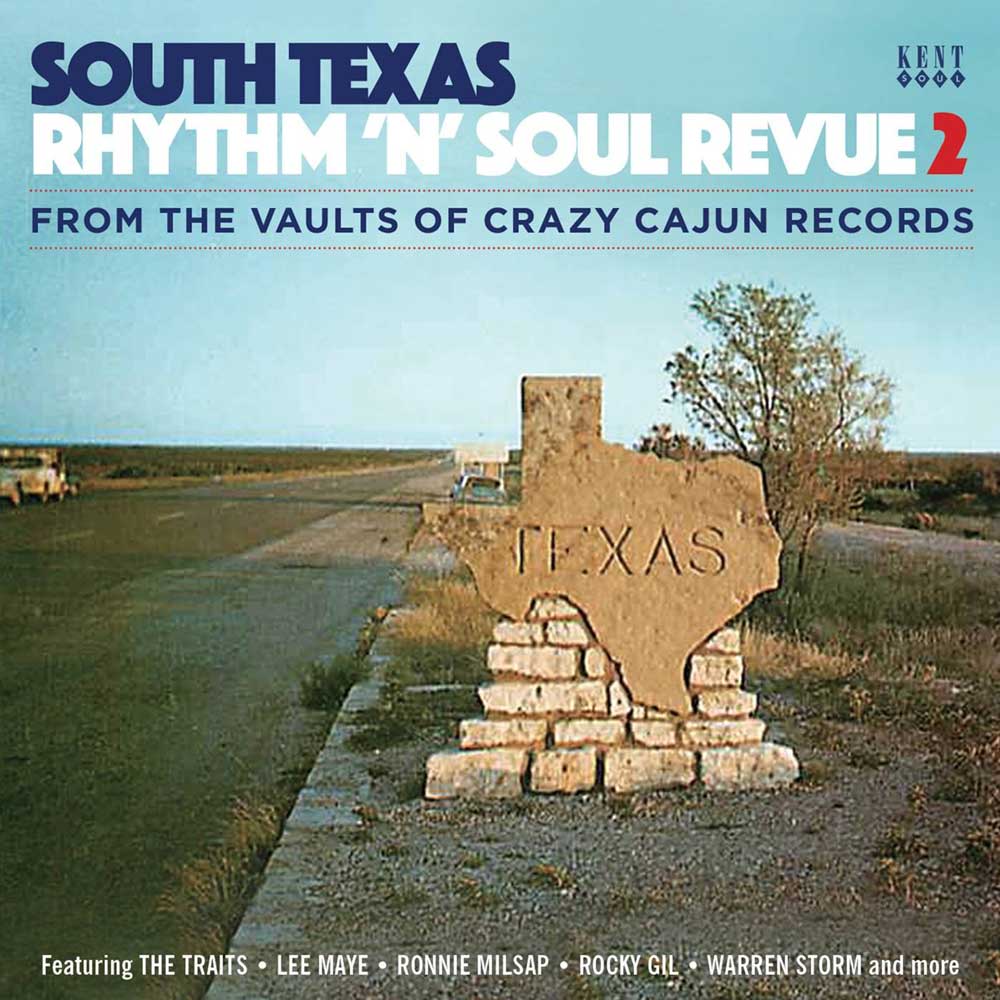
SOUTH TEXAS RHYTHM ’N’ SOUL REVUEW 2-FROM THE VAULTS OF CRAZY CAJUN RECORDS.
SOUTH TEXAS RHYTHM ’N’ SOUL REVUEW 2-FROM THE VAULTS OF CRAZY CAJUN RECORDS.
Back in February 2013, Kent Soul released South Texas Rhythm ‘N’ Soul Revue, a compilation of some of the finest soul and R&B to emerge from the Lone Star State. It was recorded at Huey Meaux’s studio, and featured many of the artists the legendary producer discovered.
Huey Meaux was a prestigious talent-spotter. He discovered some of the stars of the South Texan music scene, including Johnny Adams, Johnny Copeland, Barbara Lynn, Jackie Paine and Jean Knight. They all featured on South Texas Rhythm ‘N’ Soul Revue. So did Warren Storm, Margo White, Tee Bee Fisher and Maxine Davis. This was a tantalising taste of the musical delights to be found within Huey Meaux’s vaults. It was a perfect mixture of familiar faces and new names. However, one compilation was never going to be enough to do justice to the music Huey Meaux had recorded during the sixties, back in the Lone Star State. There was a sense of inevitability that there would be a South Texas Rhythm ‘N’ Soul Revue.
Recently, South Texas Rhythm ‘N’ Soul Revue 2-From The Vaults Of Crazy Cajun Records was released by Kent Soul, an imprint of Ace Records. It’s a twenty-four track compilation, featuring some old friends. Among them, are Johnny Adams, Jackie Paine, Jean Knight, Warren Storm and Margo White. They’re joined by Chet McDowell, Eugene Gamble, Ronnie Milsap, Henry Moore and Joe Hughes. These are just a few of the artists that feature on South Texas Rhythm ‘N’ Soul Revue 2-From The Vaults Of Crazy Cajun Records, the much anticipated followup to South Texas Rhythm ‘N’ Soul Revue. Has South Texas Rhythm ‘N’ Soul Revue 2-From The Vaults Of Crazy Cajun Records been worth the two-and-a-half year wait?
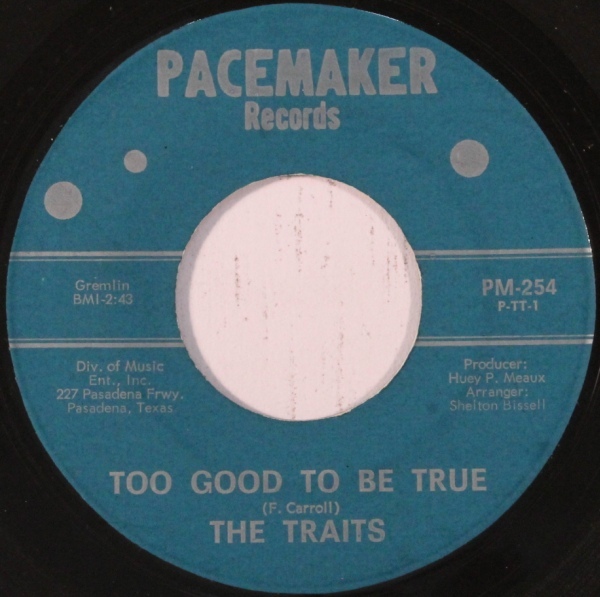
There can only be one answer…yes. That’s no surprise though. The Traits’ soulful stomper Too Good To Be True opens South Texas Rhythm ‘N’ Soul Revue 2-From The Vaults Of Crazy Cajun Records. It was penned by Fred Carroll, and produced by Huey Meaux. However, lead singer Roy Head was absent for the sessions, and Dean Scott took his place.
Dean Scott relishes his moment in the sun, and plays a huge part in the song’s sound and success. Initially, Too Good To Be True was released on Huey Meaux’s Pacemaker Records in 1966. Later, that year, the single was licensed to Garrison. Great things were forecast for Too Good To Be True. Sadly, commercial success eluded this timeless hidden gem, that even today, will fill a dance-floor.
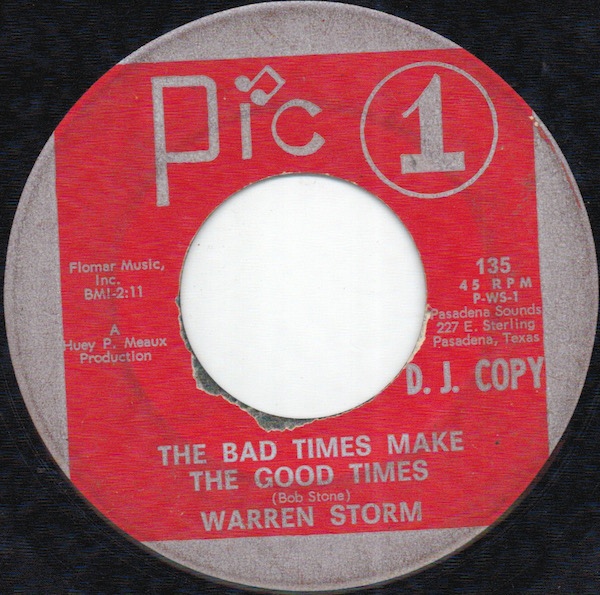
Warren Storm is without doubt, one of the biggest names on South Texas Rhythm ‘N’ Soul Revue 2-From The Vaults Of Crazy Cajun Records. He’s a legend of the Louisiana music scene, whose constantly reinvented himself. From swamp pop to country and R&B to soul, Warren Storm has tried it. In 1966, Warren Storm had decided to reinvent himself as a soul singer on The Bad Times Make The Good Times. This Robert Stone composition was released on the Pic 1 label, and features Warren Storm delivering a tender, heartfelt vocal on this paean.
When David “King” Thomas’ released You Better Investigate on Jet Stream in 1971, he never realised that the song would become a favourite on the British Northern Soul scene. That’s still the case. It’s tailor made for the Northern Soul scene. However, there’s an element of mystery surrounding David “King” Thomas’.
It’s thought that David “King” Thomas is really Jay D. Martin. He recorded You Better Investigate with Huey Meaux anytime between 1965 and 1967. This version later resurfaced as David “King” Thomas in 1971. Four years later, the single was reissued by Jet Stream, further muddying the waters. Despite the mystery surrounding You Better Investigate, it’s still a favourite of on the Northern Soul scene.
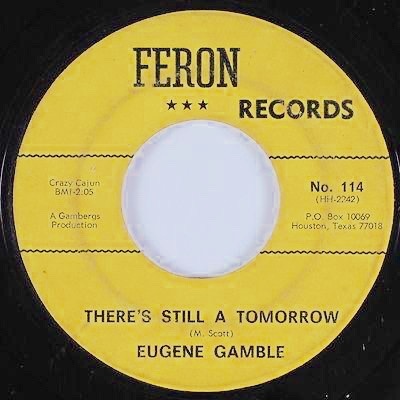
Eugene Gamble’s contribution to South Texas Rhythm ‘N’ Soul Revue 2-From The Vaults Of Crazy Cajun Records is the beautiful, heart wrenching ballad Strange Love. This version has never been released before. However, Strange Love was released as a single in the late-sixties, on the Houston based Feron Records. Copies of Strange Love are incredibly rare, and if they do come up for sale, will fetch over $100.
Melancholy. That describes the horns that open Jackie Paine’s At Your Wedding. They usher in a vocal full of hurt and heartache. With cooing harmonies and hypnotic drums for company, a cathartic outpouring of pain unfolds. It was released as the B-Side to No Puppy Love, on Jet Stream, in 1967. Later in 1967, Jackie Paine released Skid Row Blues. Desperation features in Jackie Paine on this bluesy tale of hard luck.
Ronnie Milsap’s has enjoyed a long and successful career. He released his debut single, Total Disaster in 1963. The Huey Meaux penned and produced Wish You Were Here released as a single on Pacemaker, in 1965. Twelve years later, Your Tears Leave Me Cold was released on the Festival label in 1977. Tucked away on the B-Side was Wish You Were Here. It showed why, in 1977 the Country Music Association crowned Ronnie Milsap Entertainer Of The Year and Male Vocalist Of The Year.
Two years after Ronnie Milsap released Total Disaster as his debut single, Lee Maye covered the song in 1965. It was released on the Pic 1 label, and is regarded as Lee Maye’s finest hour. No wonder. He delivers what can only be described as a soul-baring vocal.
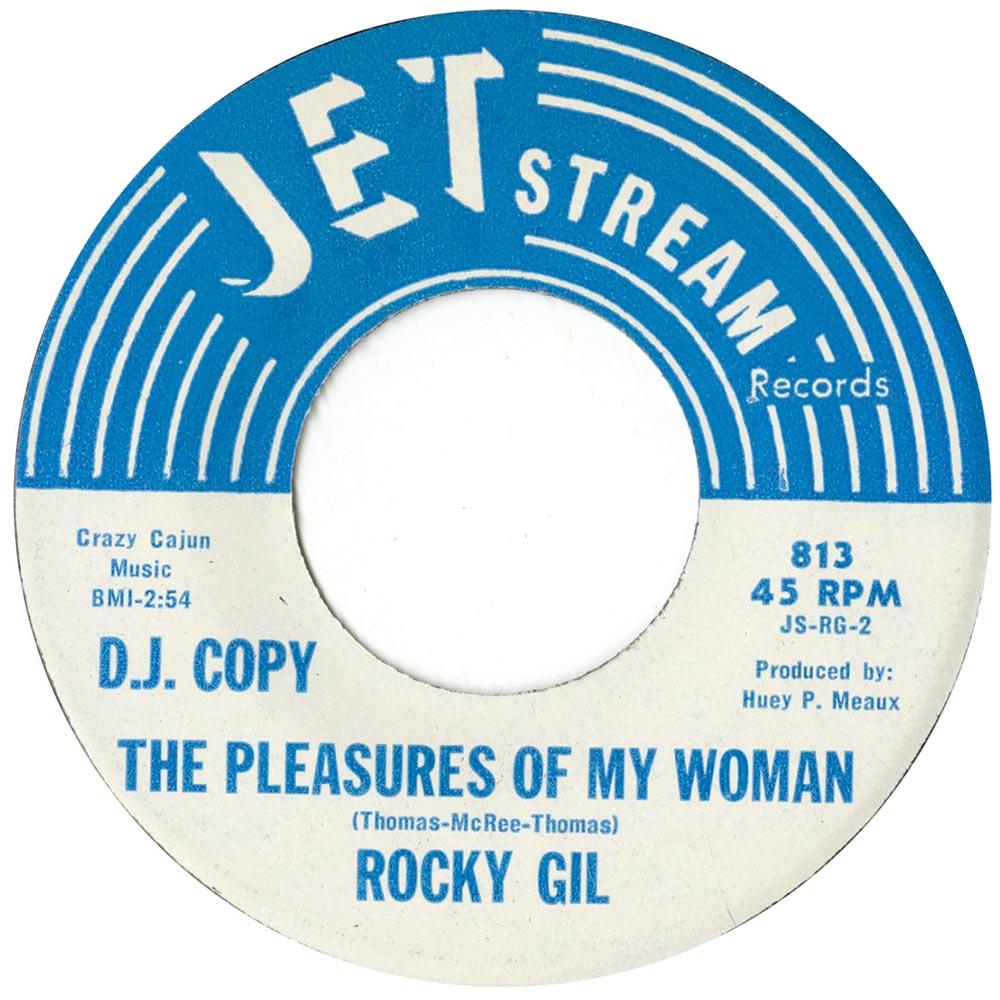
Rocky Gil And The Bishops spent nearly twenty years gigging around the Houston area. Their career began in the mid-sixties, and they worked extensively with Huey Meaux. He had Rocky Gil add a vocal to The Pleasures Of My Woman, which became the flip side to Built Like A Brickhouse. It wasn’t until 1975, that the single was released on Jet Stream. Ironically, the Southern Soul of The Pleasures Of My Woman was a much better than song than Built Like A Brickhouse, which sunk without trace. Since then, The Pleasures Of My Woman has been a soulful hidden gem, known only by a few connoisseurs of the music of the Lone Star State.
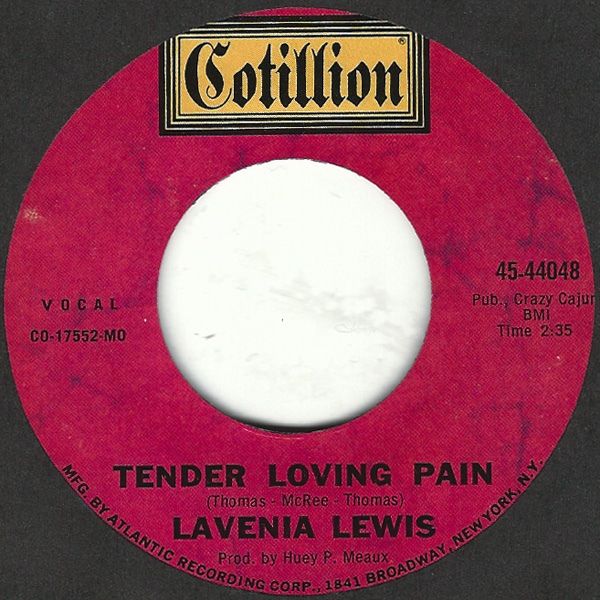
Luvenia Lewis career began in fifties, but by 1969, couldn’t be described as a prolific artist. Ten years elapsed between Luvenia Lewis’ recording debut single and the followup. Her debut came in 1954, when as Lovey Lewis she recorded with Johnny Otis Orchestra. Ten years later, Luvenia Lewis signed to Charlie Booth’s label. That was when Luvenia Lewis first met Huey Meaux. Six years later, in 1970, Huey Meaux took to the Grits and Gravy studio in Jackson, Mississippi. That’s where she cut Tender Loving Pain. It was licensed to Atlantic imprint, Cotillion. Despite its undoubted quality, and Luvenia Lewis’ impassioned delivery, Tender Loving Pain wasn’t a hit nationwide. Instead, it sold well locally. This obviously wasn’t enough for Luvenia Lewis, who retired not long after the release of Tender Loving Pain.
Joe “Guitar” Hughes recorded The Rains Came around 1967. It wasn’t until 1975, that The Rains Came was released on Jet Stream. Sadly, The Rains came had been relegated to the B-Side. This meant that only the curious heard this outpouring of hurt, betrayal and emotion. Soulful and bluesy, it’s an introduction to one of the most underrated bluesmen of his generation.
Johnny Adams closes South Texas Rhythm ‘N’ Soul Revue 2-From The Vaults Of Crazy Cajun Records with Spunky Onions. It was released as a single on Pacemaker Records in 1965. Funky and soulful, Spunky Onions marked a stylistic change for Johnny Adams, who would enjoy a long and successful career.
Following up South Texas Rhythm ‘N’ Soul Revue wasn’t going to be easy. However, Kent Soul, an imprint of Ace Records had a secret weapon,..compiler Tony Rounce. He’s a veteran of countless compilations, and was the perfect person to cherry pick Hugh Meaux’s vaults for the followup to South Texas Rhythm ‘N’ Soul Revue.
Tony Rounce dug deep, and came up with the twenty-four tracks that made their way onto South Texas Rhythm ‘N’ Soul Revue 2-From The Vaults Of Crazy Cajun Records. Everyone from Johnny Adams and Jackie Paine rub shoulders with Jean Knight, Warren Storm and Margo White. They’re joined by Chet McDowell, Eugene Gamble, Ronnie Milsap, Henry Moore and Joe Hughes. The result is not just a fitting follow to South Texas Rhythm ‘N’ Soul Revue, but a compilation that surpasses the quality of its predecessor. That’s South Texas Rhythm ‘N’ Soul Revue 2-From The Vaults Of Crazy Cajun Records, the much anticipated followup to South Texas Rhythm ‘N’ Soul Revue.
It’s no exaggeration to describe South Texas Rhythm ‘N’ Soul Revue 2-From The Vaults Of Crazy Cajun Records as all killer, no filler. There’s everything from blues and Northern Soul, through to R&B and Southern Soul. Similarly, dancers and ballads feature on South Texas Rhythm ‘N’ Soul Revue 2-From The Vaults Of Crazy Cajun Records, which anyone who likes their music soulful, will enjoy and cherish.
SOUTH TEXAS RHYTHM ’N’ SOUL REVUEW 2-FROM THE VAULTS OF CRAZY CAJUN RECORDS.

GOLDEN STATE PSYCHEDELIA.
GOLDEN STATE PSYCHEDELIA.
Eventful. That described Leo De Gar Kulka’s career. He was an intelligence officer, recording engineer, producer and owned a recording studio and record company. That’s why eventful best describes Leo De Gar Kulka’s career
He was born in Czechoslovakia in 1921, but moved to Los Angeles in 1938. By the time the Second World War broke out, Leo De Gar Kulka was recruited by the counter intelligence corps. That was where Leo De Gar Kulka stayed until after the Korean War ended in 1953. By then, Leo De Gar Kulka had become interested in music and recording.
Now back on divvy street, Leo De Gar Kulka got a job at Radio Recorders in Los Angeles. This was where he served his musical apprenticeship. Latterly, Leo De Gar Kulka had own recording studio, International Recorders. Among the artists Leo De Gar Kulka recorded at International Recorders were Herb Alpert, Nat King Cole, Sam Cooke, Little Richard and Frank Sinatra. However, in 1964, Leo De Gar Kulka left L.A. behind, and made his way to San Francisco.
Once he had settled in San Francisco, Leo De Gar Kulka setup a new studio, Golden State Recorders in 1965. It was a state-of-the-art studio, which rivalled anything that L.A. could offer. Golden State Recorders featured the latest equipment, including a solid state board. This made Golden State Recorders an attractive proposition for everything from an orchestra, to up-and-coming bands, which San Francisco had plenty of.
The San Francisco music scene was thriving by the time Leo De Gar Kulka arrived in the city. The Bay area’s experimental rock scene was blossoming, and many of city’s most promising bands were making their way to Golden State Recorders, to record a single. Some with deeper pockets, recorded an album.
Producing these bands was Leo De Gar Kulka. who had the inside track on the San Francisco music scene. That’s why A&R men were beating a path to Leo De Gar Kulka’s door.
They wanted to hear who Leo De Gar Kulka thought were the Bay Area’s next big thing, so they could sign them to their label. As the A&R men spoke to Leo De Gar Kulka, they realised he was a talented and pioneering producer. His patience was legendary, as he teased a performance out of bands. He cajoled and encouraged, and eventually, got the best performance possible out of the bands he produced. It may have taken slightly longer than other producers, but Leo De Gar Kulka was never one to settle for second best. The A&R men that spoke to Leo De Gar Kulka realised that he was producing some of the most ambitious, innovative and experimental psychedelic music in the Bay Area. This made him the perfect producer for the bands signed to some of the major labels.
Capitol Records, Apple, Liberty/UA and CBS all came to meet Leo De Gar Kulka. Before long, he was producing Quicksilver Messenger Service, Sons Of Chmplin, Mad River and The Mystic Moods. However, many of the bands Leo De Gar Kulka producedwere unsigned.
Some looked as if they had a big future. So Leo De Gar Kulka decided to found his own record label, Golden State Records in 1965. The only problem was, that Leo De Gar Kulka had a studio to run. So he brought onboard a triumvirate of South California music industry insiders.
The first was San Diego DJ, Jim Marino. He was the first member of team Golden State Records. Hank Levine, who was a veteran of many L.A. studios, was the next recruit. Larry Golberg was the final addition. He started life as a P.R. man, but then went to work for Hanna-Barbera, working on soundtracks to cartoons, including The Flintstones. The theory was, that this triumvirate of music industry insiders would transform Golden State Records into one of the Bay Area’s major independents. Things didn’t pan out this way.
Golden State Records didn’t prove to a profitable venture for Leo De Gar Kulka. Eventually, he had $80,000 is unrecoverable bad debts. That’s despite being able to regularly sell masters to various major labels. However, the deals that Larry Golberg negotiated, were always for fast money. He sold the masters, taking upfront money, rather than negotiate a more profitable, longterm deal. Theoretically, if the label that Larry Golberg sold the master to enjoyed a million selling single, Golden State Records didn’t get any more than the initial $3,000. It was no wonder that eventually, Leo De Gar Kulka called time on Golden State Records. By then, Golden State Records had recorded a hundreds of recordings.
Many of these recordings have never been released before. This includes sixteen of the tracks on Golden State Psychedelia, which was recently released by Big Beat Records, an imprint of Ace Records. This includes The Goody Box, The Immediate Family, Just Slightly Richer, Celestial Hysteria, The Bristol Boxkite, The Carnival and The Gants. The tracks on Golden State Psychedelia are the perfect introduction to one of top producers of the Bay Area’s psychedelic scene, Leo De Gar Chukka.
The Goody Box were one of many local bands Leo De Gar Kulka produced. They were from Pacifica, to the south of San Francisco. When they arrived at Golden State Records, Jerry Goldberg had a plan for The Goody Box. He wanted them to accompany singer Virginia Garcia. They would be billed as Ginger and The Goody Box. This new band’s debut single would be a cover of Lo Mucho Que Te Quiero. On the flip side, was Blow Up which opens Golden State Psychedelia. However, the single was never released. Since then, Blow Up, which is an explosive fusion of proto punk and psychedelia has lain unreleased in Golden State Records’ vaults. So has Ah Gee, The Goody Box’s other contribution. It has a much more traditional psychedelic sound. Rocky and lysergic, it’s a reminder of the Bay Area sound circa 1968.
The Carnival weren’t a Bay Area band. They were an L.A. based band, and recorded in L.A. at Danny Hardesty’s Living Sound Recorders. Then the recordings were sent to Golden State Recorders, so Leo De Gar Kulka could work his magic. He does that on Meditorium, Infinitation and Years Have Passed Away. On this trio of tracks, The Carnival plough their own furrow. One of the lead instruments is a clavinet, which is used effectively to toughen up the trippy sound. Sometimes, The Carnival’s vocals reference The Beatles, on the what’s an irresistible and innovative musical helter skelter.
Just like The Carnival, The Bristol Boxkite were a group who should’ve enjoyed commercial success. Sadly, that wasn’t to be. It wasn’t through lack of effort.They recorded several singles and an album. That’s not forgetting the four unreleased tracks on Golden State Psychedelia. These tracks showcase The Bristol Boxkite’s own brand of melodic, folk-tinged psychedelia. Their finest hour is the hauntingly, beautiful Sunless Night. Chasing Rainbows with its dreamy, hopeful sound, comes a close second. Who Are We is another track that showcases The Bristol Boxkite’s tight harmonies. Mad Rush World was recorded in May 1968, and is a reinvention of an old vaudeville standard. Sadly, Who Are We proved to be The Bristol Boxkite’s swan song. They never returned to the studio, and the band split-up in late 1968. It was a case of what might have been?
The Short Yellow roots were in jazz and classical music. This made them an unlikely signing for Golden State Recordings. However, The Short Yellow recorded a demo in September 1967. It featured three tracks, Highway Highway, Hand Full and Start Seeing. Highway Highway is reminiscent of Frank Zappa, with free jazz and psychedelia combining with pop. Hand Full is something of a slow burner, that explodes into life, with pop, rock and psychedelia melting into one. Start Seeing is best described as poppy psychedelia, and shows another side of The Short Yellow. They’re an inventive and innovative band, who sadly, were never signed to Golden State Records. This unlimitedly, lead to the group’s demise not long after the Golden State Records’ sessions.
In March 1967, The Ticket Agents made their way to Golden State Records, where they had booked a session. Leo Kulka liked what he heard, and decided to try and further The Ticket Agents’ career. He recommended them to some contacts in L.A. Then in September 1967, The Ticket Agents returned to Golden State Recordings and recorded Black Diamonds. It’s a fusion of hook-laden power pop and psychedelia. However, Black Diamonds was never released, and some forty-eight years later, makes its debut.
Originally, Celestial Hysteria were from Daly City, where they were founded in 1967. By May 1969, when Celestial Hysteria signed to Golden State Records Mary Hazelwood was the lead vocalist and John Allan the guitarist. Both play leading roles in the success of Speed and New Song Aka Going Home. Especially John’s blistering guitar runs, as Celestial Hysteria combine rock, psychedelia and nervous energy. The result is two hidden gems that somewhat belatedly, can be heard by a wider audience.
The same can be said of The Tow-Away Zone’s Daddy’s Zoo. It’s one of the most lysergic tracks you’ll ever hear. Daddy’s Zoo epitomises the Bay Area psychedelic sound, and for many, will be a trip back in time.
Just Slightly Richer recorded My Kind Of People and Solitude at Golden State Recordings in August 1968. This wasn’t their first visit. They had covered some Young Rascals songs in March 1968. Since then, Just Slightly Richer had auditioned for a nationwide televised talent show, Happening ’68. It was a case of close, but no cigar. However, when Just Slightly Richer returned to Golden State Recordings in August 1968, they had penned two new songs, My Kind Of People and Solitude. Both are foot to the floor affairs, with the rhythm section driving the energetic arrangements along. Sadly, neither track was released, and Just Slightly Richer didn’t even get a little richer.
Even the title to The Gants’ Sunday At The Lotus Parlor sounds psychedelic. So does the arrangement, dramatic vocal and waves of harmonies. Despite undoubted quality of this 1966 recording, it was never released as a single. Whether this hastened the demise of The Gants is unknown. All that’s known is that they split-up not long after recording of Sunday At The Lotus Parlor, which closes Golden State Psychedelia.
For anyone with even a passing interest in psychedelia, then Golden State Psychedelia will be a must have. It features twenty-five tracks, including sixteen previously unreleased tracks. This includes numerous hidden gems. They’re the type of tracks that used to feature on the Nuggets compilation. These glistening musical nuggets, are a tantalising taste of the music recorded at Golden State Recording by Leo De Gar Kulka.
He was a pioneer of the Bay Area psychedelic sound, and helped many bands on their way. This includes the various bands on Golden State Psychedelia, which was recently released by Big Beat Records, an imprint of Ace Records. Sadly, many of these bands never enjoyed the commercial success their talent warranted. Indeed, listening to some of the tracks on Golden State Psychedelia, one can’t help but wonder why they weren’t released as singles? Similarly, one can’t help but wonder why some of the bands on Golden State Psychedelia never went on to enjoy commercial success and critical acclaim? That wasn’t to be.
Many of the bands proved to be short-lived, and split-up not long after they enjoyed their moment in the sun, at Golden State Recordings. These groups had hoped they would become part of the Bay Area’s rich and lysergic musical history. Sadly, that didn’t happen, and many of these bands are long forgotten. Not anymore. They make a welcome return on Golden State Psychedelia, which is a reminder of the Bay Area’s psychedelic heyday. Back then, happenings were commonplace, and the Merry Pranksters conducted Acid Tests against a backdrop of Golden State Psychedelia.
GOLDEN STATE PSYCHEDELIA.

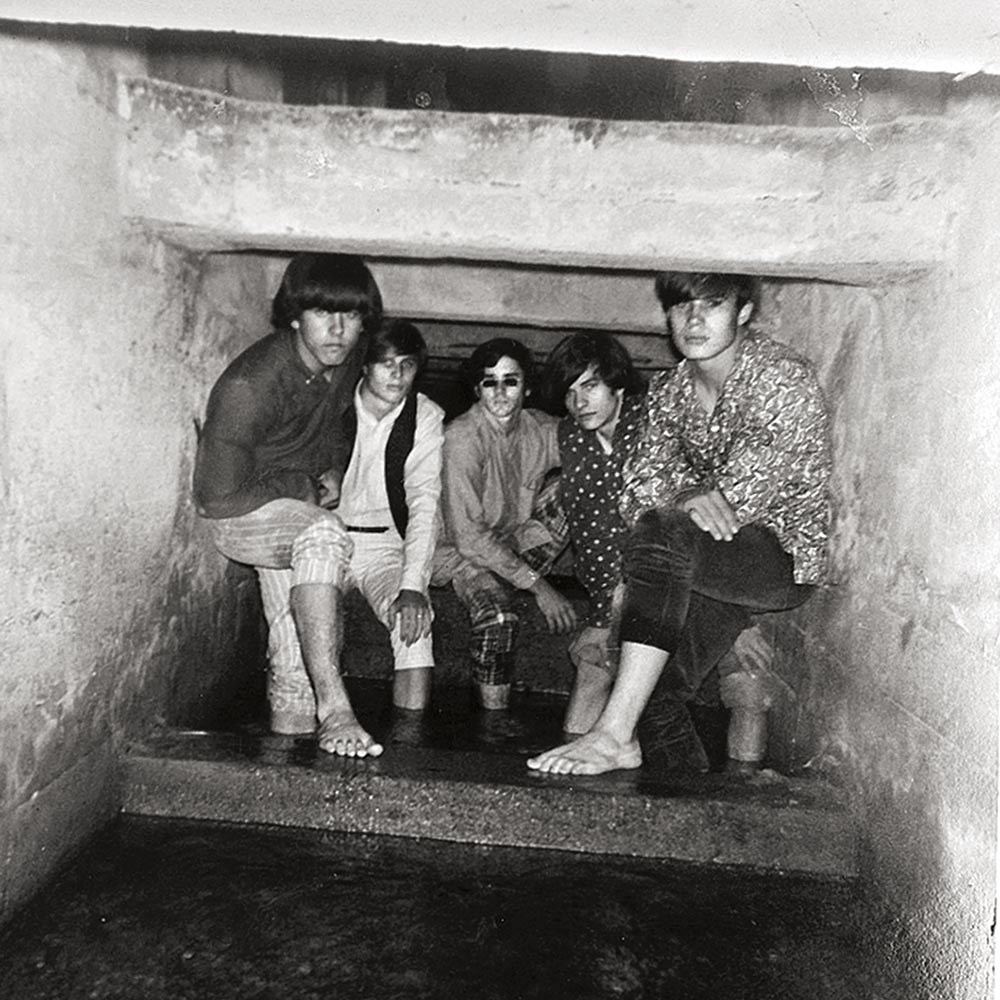
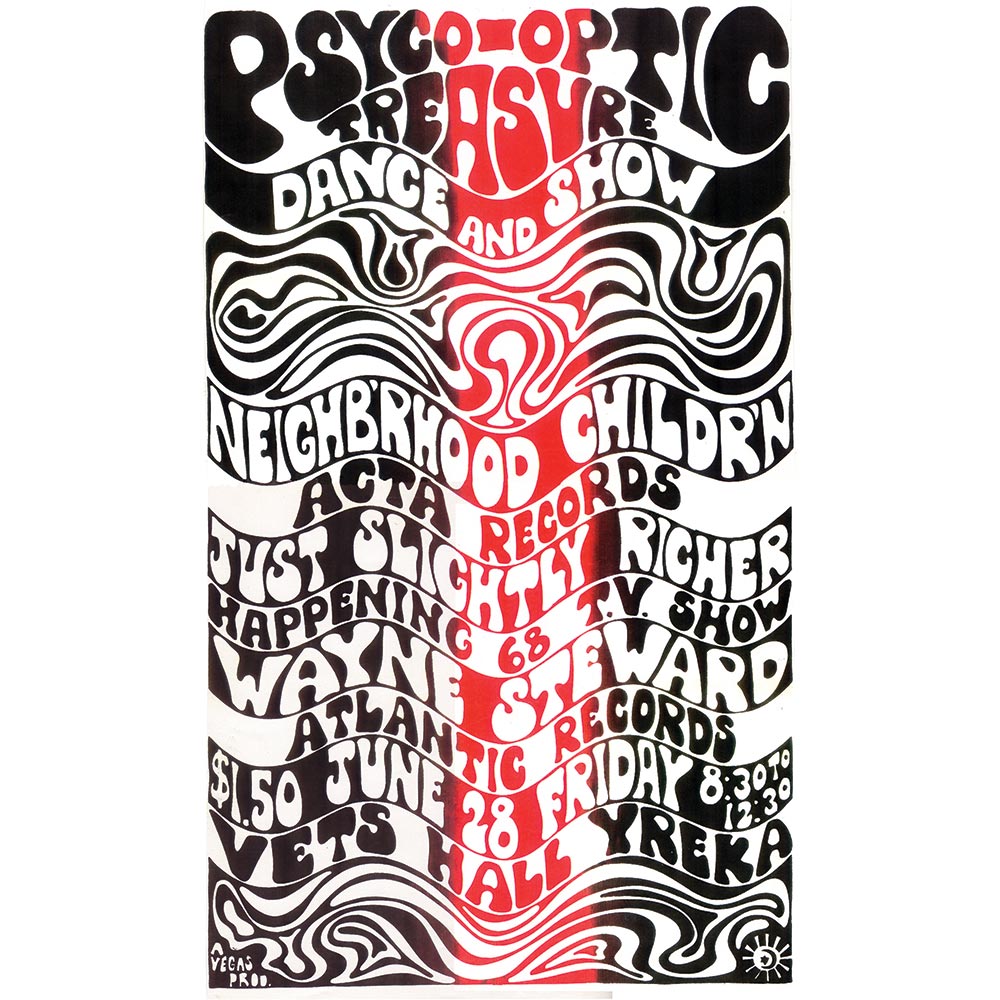
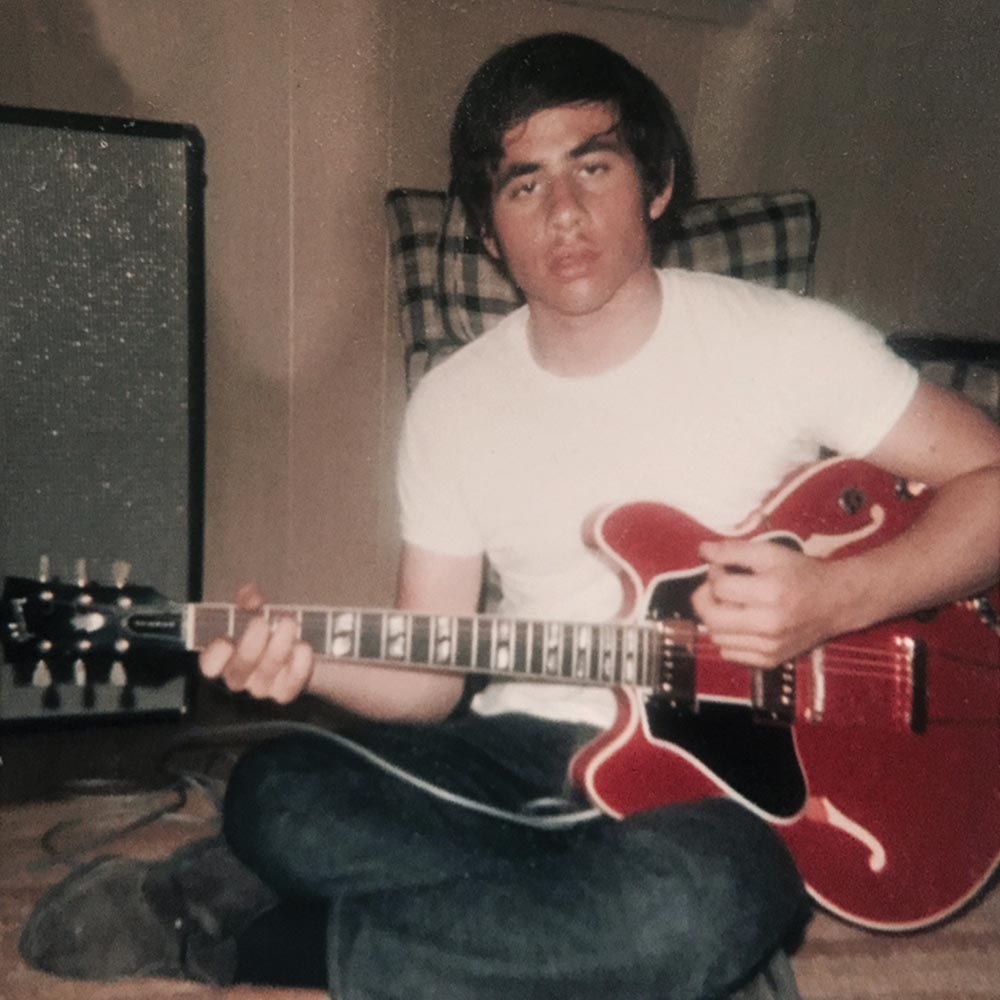
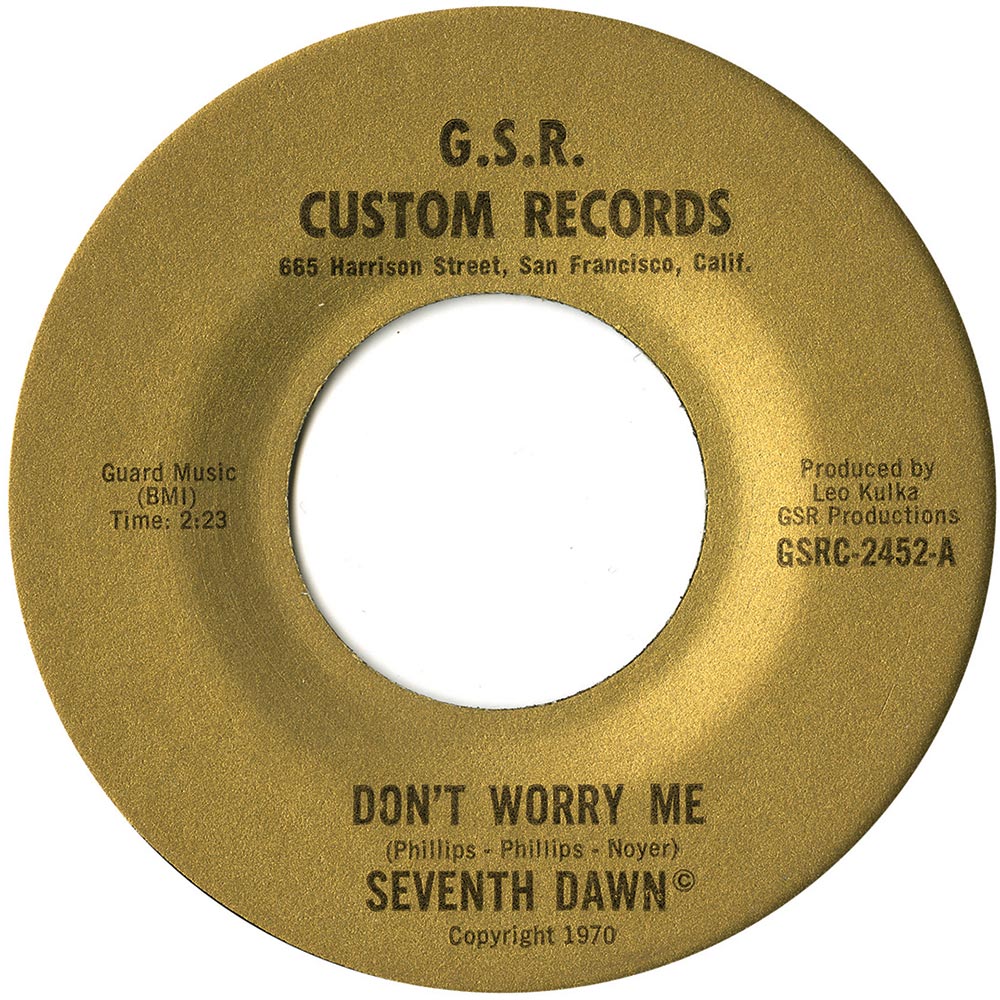
DAVE HAMILTON’S DETROIT SOUL VOLUME 2
DAVE HAMILTON’S DETROIT SOUL VOLUME 2
Sadly, Dave Hamilton is one of the forgotten men in the Motown story. That’s despite being one of the original members of Motown’s house band The Funk Brothers. They were formed in 1959, and right through to 1962, Dave Hamilton played guitar and vibes on early Motown recordings. Then in 1962, Dave Hamilton left The Funk Brothers and embarked on a solo career.
By then, Dave Hamilton had already released a single with Dave Hamilton and His Peppers. This was Donna’s Cha Cha, which was released on the Hi-Q label. On its release, Donna’s Cha Cha disappeared without trace. So Dave returned to The Funk Brothers. Then in 1962, Dave Hamilton left The Funk Brothers for good.
A year later, in 1963, Dave Hamilton released his debut album Blue Vibrations on the Motown jazz imprint, Workshop Jazz. Late Freight was released as the lead single from Blue Vibrations. However, neither Blue Vibrations, nor Late Freight was a commercial success. Nor was the sophomore single from Dave Hamilton and His Peppers.
Three years after the release of their debut single, Dave Hamilton and His Peppers released their sophomore single Beatle Walk. It was released on Fortune Records in 1964. Just like Donna’s Cha Cha, Beatle Walk wasn’t a commercial success. Just two years into his new career, and it looked like Dave Hamilton’s career wasn’t going anywhere. Dave Hamilton must have realised this, and decided to embark on a career as a producer.
This proved to be the best decision of Dave Hamilton’s musical career. It was as a producer, that Dave Hamilton excelled, and made his name.
Nowadays, Dave Hamilton is remembered as a talented, successful and highly respected producer. He was also a prolific producer whose career Ace Records have been documenting since 1998.
That’s when Ace Records secured the rights to Dave Hamilton’s productions. Since then, a series of lovingly curated and compiled compilations have been released by Kent Soul. The latest, is Dave Hamilton’s Detroit Soul Volume 2. This twenty-four track compilation features contributions from Chico and Buddy, Little Ann, The Tokays, Rita DuShay, The Del-Phis, Carolyn Franklin, Little Stevie and The Sensational Reynolds Singers and Jimmy Scott. There’s also three tracks from Dave Hamilton, who despite enjoying a successful career as a producer, still released the occasional single. None of these tracks have been released before. They’re among fifteen unreleased tracks on Dave Hamilton’s Detroit Soul Volume 2, which I’ll pick the highlights of.
Opening Dave Hamilton’s Detroit Soul Volume 2 is Buddy and Chico’s Party Time. It was penned by Earnest and Gene Cooper with Dave Hamilton. He co-produced Party Time with Earnest Cooper at Highland Studios. The result was a slice of funky, soulful and joyous. good time music. When Party Time was released on TCB in 1970, Dave Hamilton’s Cracklin’ Bread was on the B-Side.
The version of Cracklin’ Bread on Dave Hamilton’s Detroit Soul Volume 2 is an alternate take. The major difference is that it which features both male and ‘female vocals.’ It’s thought that the theatrical, tongue-in-cheek, female vocal was actually delivered by a man. At the heart of song’s success, is a guitar masterclass. This stunning solo from Dave Hamilton veers between rocky and funky, and shows why for three years, he was a member of the Funk Brothers.
In 1972, Simon Barbee, a friend of Dave Hamilton’s released a single. This wasn’t unusual. However, what was unusual, was that Simon Barbee was a minister, who usually, sung gospel. However, had released a single before. That was back in 1960, when The Barbees released their one and only single, The Wind. By the late sixties, Simon Barbee was ready to make a comeback. He penned The Showdown Part 1, which he recorded as Simon Barbee and The Barbabes. The single lay unreleased until 1972, when it was released on the Barbee label. Despite having been recorded a few years earlier, this feisty tale of betrayal had a contemporary sound upon its release in 1972.
The Tokays were a familiar face at Dave Hamilton’s TCB Studio. They were often drafted in to add backing vocals to a song. Among The Tokays’ number, were Chico and Buddy, who feature on (Marriage Is Only) A State Of Mind. This Dave Hamilton penned song was recorded but never released until 2013. It eventually made its debut on the B-Side of a limited edition single released by Kent Records. Belatedly, this laid-back, soulful and jazz-tinged track made its debut. Two years later, and The Tokays’ (Marriage Is Only) A State Of Mind returns for a very welcome encore.
By 1977, Dave Hamilton’s career was still going strong. He had written The Dreamer, which he recorded in 1977. Later, Felecia Johnson recut The Dreamer. By then, Felecia Johnson had worked with Dave Hamilton on a trio of singles for Top’s Records. Sadly, Felecia Johnson’s version of The Dreamer was never released. That’s a great shame, as it’s the definitive version of this track. One listen to this beautiful, but heart wrenching song and you’ll realise why.
Alabama born Tobi Lark got her break singing backing vocals for B.B. King. However, it was Cannonball Adderley that spotted Tobi Lark’s potential. He accompanied Tobi Lark on her 1963 debut single Deed I Do. By 1966, Tobi Lark was working with Dave Hamilton. She covered the the Dave Hamilton penned Challenge My Love. It was released on the Topper label in 1966, and this timeless track would become a favourite on the Northern Soul scene.
An air of mystery surrounds Presberry’s Somebody Is Wrong. Nobody knows the identity of the elusive Presberry. It’s a real mystery. What’s not in doubt, is that from the opening bars of Somebody Is Wrong, something special is unfolding. Soon, a heart wrenching, bluesy ballad is taking shape. At the heart of the song’s success is Presberry’s hurt-filled vocal. The way he delivers the lyrics, it’s as if he’s experienced the pain and hurt he’s singing about.
Despite enjoying a career that spanned three decades, Carolyn Franklin always lived in the shadow of her sister, Aretha. That’s despite releasing five albums between 1969 and 1976. These albums showcased a truly talented, and vastly underrated singer. Sadly, by the early eighties, Carolyn Franklin had to put her career on hold.
Her father, the Reverend C.L. Franklin was shot in a robbery, and spent five years in a coma. During that period, Carolyn Franklin hardly left his side. One of the times she did, was when she made her way to Dave Hamilton’s studio. It was across the street from her father’s church. Quickly, and with an understated arrangement, Carolyn Franklin covered Barbara Heston’s Guess I’ll Go Packin’. It’s an impassioned, wistful reinvention of a familiar track, that showcases the hugely talented Carolyn Franklin. Sadly, tragedy struck in 1988, when Carolyn Franklin died of cancer, aged just forty-four. Guess I’ll Go Packin’ is a poignant reminder of what music lost that day.
It was around 1973, that The Morning After recorded the Dave Hamilton composition Mr. Fireman. Very little is known about the band; except that Gip Roberts was a member of The Morning After. He had recorded a single Hunchin, which was produced by Dave Hamilton and Earnest Cooper. The next time Dave Hamilton met Gip Roberts, he was a member of The Morning After. They cut Mr. Fireman, a slice of pop soul. However, it was never unreleased and makes its debut on Dave Hamilton’s Detroit Soul Volume 2.
By 1970, Dave Hamilton had turned his attention to gospel music. He went on to record over twenty gospel groups. Many released singles on Dave’s Sacred Sounds’ label. Not Little Stevie and The Sensational Reynolds Singers. Their single Moving On was released on the Demo Ristic label in 1970. It’s an inspired fusion of funk, soul and gospel, where an impassioned lead vocal and testifying harmonies unite seamlessly.
When Glemie (Blue Boy) Derrell and The Detroit Dynamite Blues Boys arrived at Dave Hamilton’s studio to record Four O’Clock Blues, he had come to the right place. Dave Hamilton had played on John Lee Hooker’s Boom Boom. So he was no stranger to the blues. This Glemie (Blue Boy) Derrell penned track, was released as a single in 1969, on the TCB label. It was one of only a few blues singles TCB released. However, as Four O’Clock shows, it’s quality, rather than quantity that counts.
Closing Dave Hamilton’s Detroit Soul Volume 2 is Jimmy Scott’s Remember Me. Jimmy Scott was a Detroit based soul man, whose career began in the sixties, and lasted through to the mid-eighties. In 1972, Jimmy Scott and The Band released Remember Me, on the Detroit Gold Record Co. This was a ballad Jimmy Scott had written with Al Smith. However, for Dave Hamilton’s Detroit Soul Volume 2, Rob Keyloch, remixed Remember Me. It’s a slow, sensual ballad, which features, a needy, hopeful and heartfelt vocal from Jimmy Scott. Compiler Ady Croasdell has kept one of the highlights of Dave Hamilton’s Detroit Soul Volume 2 until last.
Dave Hamilton’s Detroit Soul Volume 2 certainly isn’t lacking highlights. No wonder. It’s been compiled by Ady Croasdell, whose a veteran of countless compilations. His name on a compilation is a sign of quality. That’s the case with Dave Hamilton’s Detroit Soul Volume 2.
From Chico and Buddy’s Party Time, right through to Jimmy Scott’s Remember Me, Dave Hamilton’s Detroit Soul Volume 2 is a mixture of familiar faces, minor classics and hidden gems. They’ve all one thing in common, quality.
That’s the case whether the tracks on Dave Hamilton’s Detroit Soul Volume 2 are soulful, funky, bluesy or jazz-tinged. On occasions, pop soul and gospel can also be heard on Dave Hamilton’s Detroit Soul Volume 2. It’s a truly eclectic compilation, was recently released by Kent Soul, an imprint Ace Records. This is compilation of Detroit based Dave Hamilton’s productions. There’s even three songs from Dave Hamilton himself. However, it was as a producer that Dave Hamilton wrote himself into Detroit musical history.
The former Funk Brother guitarist and vibes player became one of the most talented, respected and prolific producers in Detroit’s musical history. That’s why it’s taken several series of compilations to release just a fraction of the music Dave Hamilton produced. Dave Hamilton’s Detroit Soul Volume 2 is just latest instalment in Kent Soul’s long running, and much anticipated compilation series, that documents and celebrates the career of Funk Brother, songwriter and producer, Dave Hamilton.
DAVE HAMILTON’S DETROIT SOUL VOLUME 2.
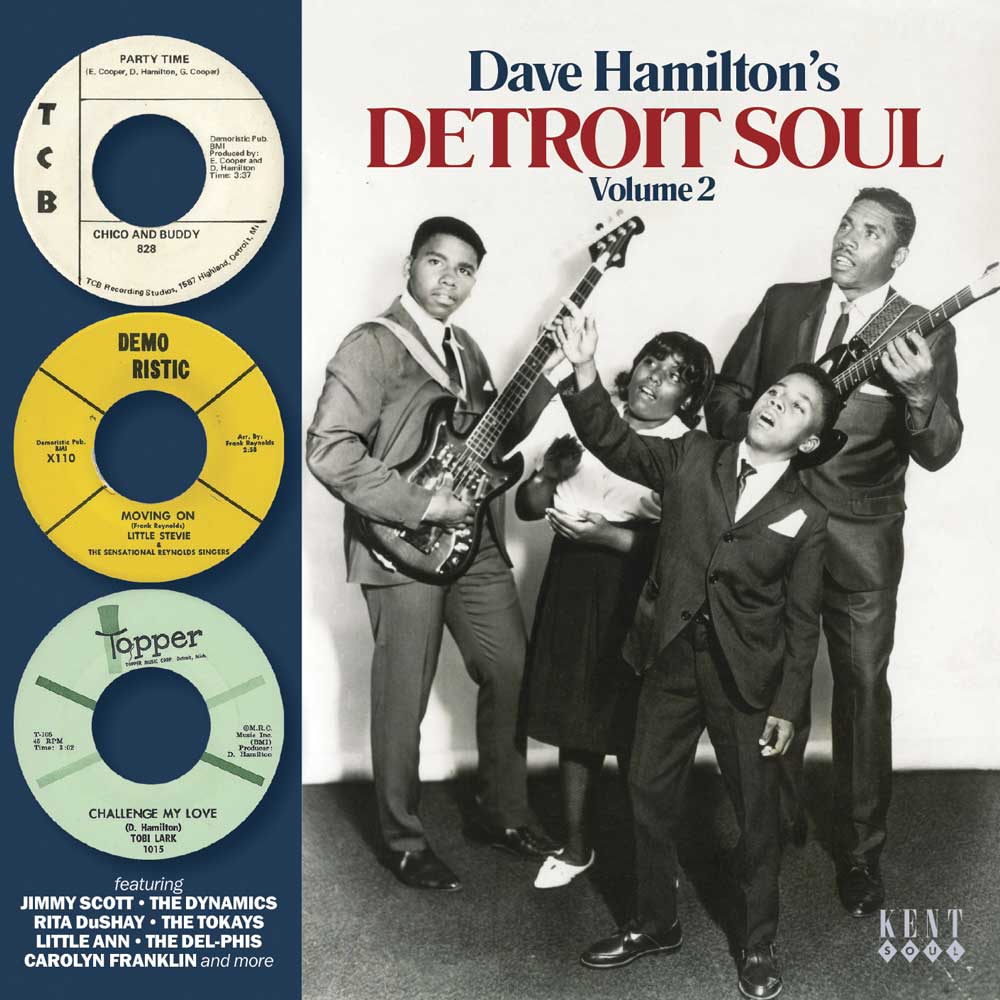

BOBBY GILLESPIE PRESENTS SUNDAY MORNIN’ COMIN’ DOWN.
BOBBY GILLESPIE PRESENTS SUNDAY MORNIN’ COMIN’ DOWN.
Bobby Gillespie’s life has always revolved around music. That’s been the case since he was growing up in Mount Florida, in the south side of Glasgow. Back then, Bobby Gillespie hungrily devoured music. It was akin to an education.
This education didn’t take place at the at Glasgow University or Strathclyde University. Not unless there was a band playing. Mostly, Bobby Gillespie’s eduction took place in Glasgow’s record shops and concert halls. This was a road well travelled.
Not just locals like Bobby. Pilgrims from Paisley, Irvine, Motherwell and Hamilton made their way into Glasgow. That’s where they came to find the music they had heard on Radio Clyde and Radio One. Clutching long lists of records, they made their way to Listen, Echo, A1 Sounds, Klondyke Records and Tam Russell’s. Then there was Virgin in Union Street, where there was always an air if menace in the post punk years. That’s despite the sometimes sweet smell in the air. Despite that unmistakable aroma, it always threatened to “kick off.” This was all part of a musical eduction during the late-seventies and early-eighties.
Some graduated with honours, becoming musical connoisseurs blessed with discerning and impeccable taste. They knew the difference between The Doors and dross. Others failed miserably, having failed to distinguish between The Beach Boys and a beach buggy. For them, there was no hope, and they were sent not to Coventry, but the musical wastelands of Fife. As the unlucky one made their oneway journey, some of the graduates of a Glasgow musical education began to make their presence felt.
This included Bobby Gillespie. He started life as a roadie for Altered Images. However, life as a roadie was never going to satisfy Bobby Gillespie, and he began playing with The Wake. For Bobby, this was the start of a long and illustrious musical career. This included a year as The Jesus and Mary Chain drummer, and thirty-three years as the Primal Scream’s frontman. During that period, commercial success and commercial success have come Bobby Gillespie’s way. No wonder.
Primal Scream are regarded as one of the most important, influential and innovative bands of the past thirty years. They’ve released ten studio albums, including their 1991 classic Screamadelica, where Acid House, psychedelia and rock were combined by Primal Scream. After Screamadelica, Primal Scream have continued to reinvent themselves.
On albums like 1997s Vanishing Point, 2000s XTRMNTR and 2002s Evil Heat, Primal Scream were inspired by ambient, dub, industrial and Krautrock. Primal Scream, forever the musical chameleons, continue to reinvent themselves. However, other times, Primal Scream are at their best when they’re an old fashioned rock band.
That was the case on 1994s Give Out But Don’t Give Up which was the followup to Screamadelica. It found Primal Scream combining blues and rock. This was a return to the hard rocking sound of their 1989 eponymous sophomore album. On Give Out But Don’t Give Up, Primal Scream sounded more like The Rolling Stones, than Jagger and Co. Then on 2006s Riot City Blues and 2008s Beautiful Future, Bobby Gillespie rediscovered his inner rocker. The G-Man was back at his hard rocking best, and drawing inspirations from the artists he had heard growing up in Glasgow.
This includes some of the artists on Bobby Gillespie Present Sunday Mornin’ Comin’ Down, which was recently released by Ace Records. It features twenty-five tracks especially picked by Bobby Gillespie. There’s tracks from the 13th Floor Elevators, The Beach Boys, The Byrds, Tim Buckley, Alexander “Skip” Spence, Gram Parsons, Little Feat and Jerry Lee Lewis. Bobby Gillespie Present Sunday Mornin’ Comin’ Down is an eclectic soundtrack that one once have heard in the Gillespie household, on a Sunday morning after “a night on it.” Not any more.
Bobby’s a changed man. His wild days are long gone. However, still, playing in the background in chez Gillespie on the sabbath, will be the music on Bobby Gillespie’s Presents Sunday Mornin’ Comin’ Down. It’s a late contender for compilation of the year. Here’s ten reasons why.
One band Bobby Gillespie has championed throughout his career, are the 13th Floor Elevators. Their 1968 single May The Circle Remain Unbroken, opens Bobby Gillespie Present Sunday Mornin’ Comin’ Down. May The Circle Remain Unbroken was written by Rory Erickson, and also featured on the 13th Floor Elevators third studio album, Bull Of The Woods. It was released in 1969, on International Artists. One of the highlights was May The Circle Remain Unbroken, with its mystical, lysergic and hopeful sound.
The Beach Boys have influenced many musicians, including Bobby Gillespie. As the compiler, he indulges himself, putting a trio of tracks from The Beach Boys on Bobby Gillespie Present Sunday Mornin’ Comin’ Down. This includes You’re Welcome, which featured on the B-Side of the 1967 single Heroes and Villains. Penned by Brian Wilson, there’s an almost celestial, spiritual sound to You’re Welcome.
Primal Scream’s 1987 debut album Sonic Flower Groove was heavily influenced by The Byrds. So, there’s no surprise that o The Byrds’ feature on Bobby Gillespie Present Sunday Mornin’ Comin’ Down. The only question was, which song would Bobby choose? As a proud Scot, he’s chosen Wild Mountain Thyme, which is a traditional Scottish folk song. It featured on The Byrds’ third album Fifth Dimension, which was released in 1966. In The Byrds’ hands, Wild Mountain Thyme becomes a beautiful, joyous and uplifting ballad.
In 1970, Dennis Hopper was finishing editing The Last Movie. Meanwhile, Kit Carter was filming a documentary about Dennis Hopper. It was a surreal sight, one filmmaker filming a film about another filmmaker. When Dennis Hopper’s thoughts turned to the soundtrack, he decided to ask Gene Clark to write a song. He had just rejoined The Byrds, but wrote American Dreamer, which featured on the 1971 soundtrack Dennis Hopper In The American Dreamer. American Dreamer is a truly beautiful song, which features some of the best lyrics Gene Clark ever wrote.
Kris Kristofferson Sunday Mornin’ Comin’ Down lent its title to Bobby Gillespie’s compilation. This is a track from Kris Kristofferson’s 1970 debut album Kristofferson. With its cinematic lyrics, Sunday Mornin’ Comin’ Down showcases Kris Kristofferson skills as a storyteller. As he delivers the lyrics, sadness, hurt and hopelessness shine through. It’s as if Kris Kristofferson has lived the lyrics he’s singing, and somehow, has survived to tell the tale.
Gram Parsons is, without doubt, one of music’s best kept secrets. He only recorded two albums GP which was released in 1973, and Grievous Angel which was released in January 1974, four month after Gram Parsons died aged twenty-seven. Grievous Angel reached just 195 in the US Billboard 200. Since its release in 1974, Grievous Angel has become a cult classic. One of Grievous Angel highlights is Love Hurts, where Gram duets with Emmylou Harris. They sound as if they’ve experienced the hurt and heartbreak they’re singing about, on this poignant paean.
Just like Gram Parsons, Tim Buckley is another of music’s best kept secrets. The singer-songwriter constantly reinvented himself over his nine album career. This resulted in Tim’s music veering between folk to sex funk. However, when Tim released his sophomore album Goodbye and Hello in August 1967, it was a mixture of folk rock and psychedelia. So was the hauntingly beautiful Phantasmagoria In Two, which was released as the third and final single from Goodbye and Hello. Sadly, Tim Buckley’s career was cut tragically short, and he died aged twenty-eight. However, Tim’s legacy is eight wonderful albums of eclectic music.
Little Feat were one of the finest purveyors of Southern Rock. Lead by the inimitable Lowell George. They released their eponymous debut album in 1970. It was one of their finest albums, featured Willin’, a song about the perils of life on the road. Like most musicians,Bobby Gillespie will be able to relate to the lyrics. Especially the way Lowell George delivers them. He sounds as if he’s been there, and sampled what was on offer.
Ronnie Wood is best known for being Keith Richards’ partner-in-crime in the Rolling Stones. However, he’s also enjoyed a successful solo career. In 1975, Ronnie Wood released his sophomore album Now Look. It features Breathe On Me, which sounds as if the band have been partying all night. That’s part of the track’s laid back charm. Ronnie takes charge of lead guitar, and Keith Richards plays bass. They’re not a well oiled machine, and instead, are merely human on the lived-in sounding Breath On Me.
Closing Bobby Gillespie Present Sunday Mornin’ Comin’ Down is Jerry Lee Lewis’ cover of Over The Rainbow. It’s a favourite of the man they call The Killer. However, this melancholy, wistful cover is taken from Killer Country which was released in 1980, and shows a much more thoughtful side to Jerry Lee Lewis.
Bobby Gillespie Present Sunday Mornin’ Comin’ Down, which was recently released by Ace Records, is best described as a lovingly compiled and curated compilation. It’s obvious that a great deal of thought has gone into choosing the twenty tracks on Bobby Gillespie Present Sunday Mornin’ Comin’ Down. He’s dug deep into his record collection.
For Bobby Gillespie’s Sunday Mornin’ Comin’ Down, the familiar and obvious have been eschewed. Instead, Bobby introduces some of music’s best kept secrets. This including the 13th Floor Elevators, Tim Buckley, Alexander “Skip” Spence and Gram Parsons. They’re still some of music’s bed kept secrets. Even when Bobby decides to choose a track by a familiar face, he reaches for a B-Side, album track or alternate mix. This results in a captivating compilation full of musical treasure.
There’s everything from folk, pop and psychedelia to country, rock and Southern Rock. Bobby even chooses John Barry’s Midnight Cowboy. It’s a beautiful addition to the wonderfully eclectic Bobby Gillespie Present Sunday Mornin’ Comin’ Down. It showcases Bobby Gillespie’s impeccable musical taste, and shows that his formative years in Glasgow garnering a musical education in the city’s record shops and concert halls, was time well spent. The musical treasure chest that’s Bobby Gillespie Present Sunday Mornin’ Comin’ Down, is proof of this, and is awaiting discovery at your local record shop.
BOBBY GILLESPIE PRESENTS SUNDAY MORNIN’ COMIN’ DOWN.




FLORIAN FRICKE/POPOL VUH-KAILASH VINYL EDITION.
FLORIAN FRICKE/POPOL VUH-KAILASH VINYL EDITION.
In music, the most overused word is legend. It’s a word thrown around like confetti at a Las Vegas wedding. Nowadays, every two-bit hip hopper, EDM star or Nu Soul singer is being referred to as a legend. That’s far removed from the truth. However, it’s nothing new.
The overuse of the word legend has been used since the birth of rock ’n’ roll. For seven decades artists have been over hyped, and wrongly hailed a ‘legend.’ Partly, the confusion over legendary status comes from what makes someone a legend.
Everyone has their own definition of what makes a musical legend. Is it that the music they release is innovative, influential and inspirational? That could be part of the definition. Is their music got to be outstanding and timeless?
That’s debatable. Many artists who are regarded as legends didn’t produce outstanding music. The Sex Pistols are an example of that. They struggled to play their instruments, but are regarded by many people, as musical legends. Similarly, the music produced by many supposed Motown legends is far from timeless. It’s formulaic and hasn’t aged well. Yet many regard the Motown soul factory as being a production line for legends of soul. It seems who is worthy of attaining legendary status is arbitrary.
One artist who is definitely worthy of being called a musical legend, is Florian Fricke. He was a musical innovator, who as a member of Popol Vuh, created music that was innovative and influential. It also inspired future generations of musicians. The music Popol Vuh produced is now regarded as timeless and outstanding. That’s not surprising.
Popul Vuh were one of the greatest German bands of their generation. Quite rightly, Popol Vuh are held in the same regard as Can, Cluster, Harmonia, Kraftwerk, Neu and Tangerine Dream, who Florian Fricke later joined. Just like each of these bands, Popol Vuh’s music has played an important part in German musical history. Part of Popol Vuh’s success, was keyboardist Florian Fricke.
Recently, Soul Jazz Records released a new collection of music that’s celebrates the life and music of a true musical innovator and legend, Florian Fricke. It’s no ordinary release. There’s two LPs in the Florian Fricke/Popol Vuh box set Kailash. This lovingly compiled box set is the work of both Florian Fricke and Popol Vuh. The Florian Fricke story began in 1944.
Florian Fricke was born in Lindau am Bodensee, Germany on 23rd February 1944. Growing up, Florian Fricke learnt to play the piano. Quickly, he mastered the instrument, and on leaving high school, studied piano, composition and directing at the Conservatories in Freiburg and Munich. By then, Florian had two new passions.
The first was music. Florian loved music, especially new music. This included free jazz, which Florian embraced. He through himself into this new musical genre, and quickly, realised its potential and possibilities. However, there was more to Florian’s life than making music.
Florian was making short films. Although it was just a hobby, he would later become a film critic for the Swiss newspaper Neue Zürcher Zeitung. By then, he had experience as a critic. As a student, Florian became the music critic for Der Spiegel, a German magazine. Music and art seemed to dominate Florian’s life.
That was the case when Florian graduated. In 1967, Florian met film director Werner Herzog. The two became friends, and a year later in 1968, Florian landed a part in Werner Herzog’s film, Lebenszeichen. This was just the start of their relationship. They would reunite in 1972, but before that, Florian Fricke formed Popul Vuh in 1970.
Joining Florian in Popol Vuh, were percussionist Holger Truelzsch and fellow synth player Frank Fiedler. All the nascent group took its name from an ancient, sacred, Mayan manuscript. With a name in place, Popol Vuh began work on Affenstunde, the first of nineteen albums they released.
From the earliest days of Popol Vuh, Florian established himself as the group’s leader. He had been one of the first musicians to own a Moog II synth. This wasn’t an easy instrument to “tame.” Florian, a talented keyboardist soon got to grips with what was cutting edge technology. The Moog II would be used extensively on Popol Vuh’s debut album Affenstunde.
Recording of Affenstunde took place at Bavaria Music Studio, in Munich. Popol Vuh were joined by Bettina Fricke. She produced Affenstunde with Gerhard Augustin. The producers guided the nascent group through their debut album. It featured just four tracks. However, they were four innovative and influential tracks. Especially Affenstunde, a near nineteen minute epic, which took up all of side two.
When Affenstunde was released later in 1970, the album was described variously as space rock and cosmic music. It was very different to much of the music being released. However, there were other like-minded groups releasing similarly innovative and influential music. However, very few would enjoy the longevity of Popol Vuh.
Just a year later, Popol Vuh returned with In den Gärten Pharaos. It was a precursor of ambient music. Popul Vuh deploy Florian’s Moog II and add a myriad of experimental electronic sounds. At the time, In den Gärten Pharaos was perceived variously groundbreaking, experimental and thanks to the African percussion, exotic. Vuh, which took up side two of In den Gärten Pharaos was perceived as kosmische musik at its most spiritual. In den Gärten Pharaos was the first classic album of Popol Vuh’s long and illustrious career.
Popol Vuh’s third album, Hosianna Mantra was one that passed many critics and record buyers by. The group’s lineup changed for the first, but far from the last time. Florian was the only remaining original member of the band left. From there, the lineup is best described as fluid.
That didn’t seem to matter. Hosianna Mantra featured music that was timeless, spiritual and innovative. Sadly, it went almost unheard of outside Germany. It was only later, that Hosianna Mantra found an audience. However, Hosianna Mantra wasn’t the only album Popol Vuh released during 1972. That year, Florian renew his friendship with Werner Herzog.
By 1972, Werner Herzog was producing the conquistador movie Aguirre, The Wrath of God. He needed someone to provide the soundtrack. That’s where Popol Vuh came in. Not only did Popol Vuh provide the soundtrack to He needed someone to provide the soundtrack to Aguirre, the Wrath of God, but Heart Of Glass in 1976 and 1979s Nosferatu the Vampyre. The combination of Popol Vuh and Werner Herzog proved a successful one. Popol Vuh were already experienced and accomplished when it came to composing soundtracks. This would stand Florian and Popol Vun in good stead. Especially when Florian and Frank Fielder later, embarked on what was the journey of a lifetime.
Before that, the German music scene was thriving during the seventies. Popol Vuh released an album every year of the seventies. Very rarely, did they disappoint. The nearest they came was with 1973s Seligpreisung. It received mixed reviews from critics. Popol Vuh more than made up for this with 1974s Einsjäger und Siebenjäger. It’s now recognised as one of Popol Vuh’s best albums of the seventies. The followup Das Hohelied Salomos was released in 1975, and featured Popol Vuh showcasing New Age music. Constantly, it seemed Popol Vuh reinvented their music. However, later in 1975, Popul Vuh returned to the world of soundtracks and penned the soundtrack to Werner Herzog’s latest film, Aguirre, The Wrath of God. The soundtrack, Aguirre became Popol Vuh’s seventh album since 1970.
In 1976, Popol Vuh returned with their eighth album, Letzte Tage–Letzte Nächte. It was released to critical acclaim, and ensured that Popol Vuh were seen as purveyors of ambitious, exciting and groundbreaking music. Partly, that was down to Popol Vuh’s determination to push musical boundaries to their limits. Popol Vuh’s reputation was further enhanced when they recorded the soundtrack to Werner Herzog’s movie Herz aus Glas in 1978. Later in 1978, Popol Vuh released Brüder des Schatten–Söhne des Lichts which they had recorded in August of 1978. When it was released on Brian Records, critics embraced the Gerhard Augustin produced album. Despite the critical acclaim lavished on their albums, still many people were unaware of Popol Vuh. So penning the soundtrack to another film directed by Werner Herzog exposed their music to a wider audience. Nosferatu was one of their finest soundtrack albums, and Popol Vuh’s penultimate album of the seventies. Die Nacht der Seele, which was subtitled tantric songs, was released to critical acclaim in 1979, and was a fitting way for Popol Vuh to close the seventies. Incredibly, Die Nacht der Seele was Popol Vuh’s twelfth album since they formed in 1970.
During the eighties, Popol Vuh were no longer as prolific. They only released four albums. The first was Sei still, wisse ich bin. It was released in 1981, two years after Die Nacht der Seele. However, it was well worth the wait. Die Nacht der Seele saw Popol Vuh reinvent themselves once again, resulting in an album that was released to widespread critical acclaim. However, it was another two years before Popol Vuh returned.
When they did, it was with Agape-Agape. The album was released on the Norwegian label Uniton. Agape-Agape featured Popol Vuh creating music that was variously, beautiful, captivating, dramatic and as one would expect from Popol Vuh, groundbreaking. It won the approval of critics, but didn’t find a wide audience. Neither did Florian’s debut solo album.
After thirteen years as a professional musician, somewhat belatedly, Florian released his debut album Die Erde und ich sind Eins in 1983. Despite his status as one of the most innovative German musicians of his generation, Florian Fricke found himself releasing Die Erde und ich sind Eins as a private pressing. Just like Popol Vuh, he wasn’t getting the credit he deserved. Meanwhile, Can, Kraftwerk and Neu! were receiving all the plaudits. However, Popol Vuh and Florian Fricke continued to make music.
1985 saw Popol Vuh release the fifteenth album of their career, Spirit Of Peace. It was released on the French label, Spalax. Popol Vuh were having to flit between labels. Despite its quality, and how highly regarded their music was by some critics, Popol Vuh albums weren’t selling in vast quantities. So when Warner Herzog used We Know About The Need The as part of the soundtrack to Dark Glow Of The Mountains, this was welcomed by Popol Vuh. Two years later, and Popol Vuh Walter Herzog were reunited.
Walter Herzog was directing Cobra Verde. He needed someone to compose and record the soundtrack to Cobra Verde. By then, Popol Vuh were had plenty of experienced writing and recording soundtracks. They had also worked extensively with Walter Herzog. So it made sense that they provide the soundtrack. However, the Cobra Verde soundtrack was released to mixed reviews. This was disappointing for Popol Vuh. They didn’t release another album during the eighties.
It wasn’t until 1991 that Popol Vuh released another album. Again, it was a soundtrack album. This time, the soundtrack was for the film For You and Me. Popol Vuh had recorded the soundtrack at the African Studio, Munich and Sound Fabrik, Munich. Between January and April 1991 they recorded eleven tracks. The soundtrack was described as: “a celebration of world music.” For You and Me showcased Popol Vuh’s versatility and ability to switch between genres. However, some critics didn’t seem to “get” the music, and again, reviews were mixed. It would another four years before Popol Vuh returned.
Before that, Florian Fricke released another solo album. This time, it was an album of classical music. Florian Fricke Plays Mozart was released in 1992, and showcased another side to the Popol Vuh leader. Unknown to some people, Florian was a keen student of classical music. He had studied music at the Conservatories in Freiburg and Munich, and just as comfortable playing classical music than working with Popol Vuh. So in his down time from Popol Vuh, Florian often composed piano pieces, like those on Kailash. However, in 1995 Popol Vuh returned with their eighteenth album.
City Raga had been recorded at the New African Studios, in Munich. Florian Fricke, Guido Hieronymus, and Maya Rose composed the seven tracks. This latest lineup of Popol Vuh were joined by Daniel Fichelscher and the Kathmandu Children’s Choir. The result was a captivating album from Popol Vuh. However, little did anyone realise that it was Popol Vuh’s penultimate album.
Another two years passed before Popol Vuh returned with their nineteenth and final album, Shepherd’s Symphony-Hirtensymphonie. Again, Popol Vuh’s lineup had changed. They were still a trio featuring Florian, Guido Hieronymus and Frank Fielder, who would later collaborate with Florian after their journey of a lifetime. Before that, the latest lineup of Popol Vuh headed off into the studio.
The three members of Popol Vuh made their way to Afro Sounds Studio, in Munich. Between September 1995 and March 1996 they recorded the seven tracks that became Shepherd’s Symphony-Hirtensymphonie. It was only released in 1997, but would prove a fitting finale to a career that spanned three decades and nineteen album. Popol Vuh took their bow with album that wowed critics.
Following Shepherd’s Symphony-Hirtensymphonie, Popol Vuh never released another album. Tragedy struck in 2001, when Florian Fricke suffered a strokem and died aged just fifty-seven. One of the true legends of music, had died way too early. He was the one constant in Popol Vuh. Accompanying for much of the Popol Vuh adventure was guitarist and drummer. He didn’t try to revive Popul Vuh. Without Florian Fricke as its driving force, there was no Popol Vuh. While Florian and Daniel Fichelscher enjoyed a long-lasting musical adventure, Florian and Frank Fielder also enjoyed a series of adventures.
Together, Florian and Frank Fielder travelled to Afghanistan Israel, Lebanon, Mesopotamia, Morocco, the Sinai desert, Nepal and Tibet. These journeys were captured on film by Florian and Frank. Both were keen filmmakers. One of their journeys is captured on a box set recently released by Soul Jazz Records.
The Florian Fricke/Popol Kailash Vuh box set features a new collection of music that’s celebrates the life and music of a true Florian Fricke. It’s no ordinary release. There’s two CDs and a DVD in the Florian Fricke/Popol Vuh Kailash box set. This lovingly compiled box set is the work of both Florian Fricke and Popol Vuh.
On disc one, Piano Recordings; there’s eight of Florian’s favourite recordings and compositions. They’re a mixture of released and previously unreleased tracks. It’s just Florian and his piano. This is a truly potent combination. On each of the eight tracks, patterns appear, only to disappear and recur. Then Florian heads off in an unexpected direction. He’s improvising and experimenting. However, it all makes sense. Florian’s love of classical and improvisational music shines through, resulting in music that’s beautiful, bewitching, captivating, dramatic, ethereal spellbinding and has an inherent spiritual quality. That however, is only half the story. On disc two,there’s an unreleased soundtrack.
The soundtrack to Kailash: Pilgrimage To The Throne Of The Gods features on disc two, while the film can be found on the accompanying DVD. Both are captivating. Especially what’s essentially an album featuring ten ethereal soundscapes. That describes Kailash: Pilgrimage To The Throne Of The Gods perfectly.
Kailash: Pilgrimage To The Throne Of The Gods comprises ten tracks, where Florian takes the listener on a journey to the holiest mountain in Asia. Tucked away in a forgotten corner of West Tibet, far from the rest of the world is Kailash. For pilgrims from four disparate religions, this is a sacred place. At 6675 metres high, Kailash is referred to as the “throne of Gods.” That’s why for countless centuries, pilgrims have risked life and limb to take this journey. It’s a journey that Florian and filmmaker Frank Fielder made.
The two founding members of Popol Vuh made their own journey to Kailash. Their journey was documented on film. It was no ordinary journey. Instead, it’s a epic journey that tests the limits of pilgrims. That was the cue with Florian and Frank. On their return, Florian and Popol Vuh decided to document this journey musically.
Over ten tracks what was a truly spiritual journey was documented. The music is cinermatic, ethereal, dramatic and spiritual. It’s a captivating listen, where the listener accompanies Frank and Florian on their journey round the “path of initiation.” Florian’s music conjures up pictures of a challenging, rugged and spectacular landscape. By the end of Kailash: Pilgrimage To The Throne Of The Gods, Florian achieves what he set out to do. This is described perfectly by film director Werner Herzog: Florian set out to create music I feel helps our audiences visualise something hidden in the images on the screen, and in our soul too.”
That’s a fitting homage to music that Florian Fricke made during a recording career that lasted three decades. This includes the nineteen albums Florian recorded with Popol Vuh and his two solo albums. Then there’s Florian’s guest appearance on Tangerine Dream’s 1972 double album Zeit. It was Tangerine Dream’s third album, but marked a stylistic departure for the band. Guiding them through this move towards a slower, much more ambient and atmospheric sound was Florian Fricke. Already he had won the respect of his contemporaries. Soon, others would want to collaborate with Florian.
Between 1973 and 1974, Florian and Popol Vuh’s drummer and guitarist Daniel Fichelscher were invited to join a new group, Gila. It had been founded in 1971, by Connie Veit, who previously was Popol Vuh’s guitarist. He left to form Gila. Along with Florian and Daniel, Renate Knaup of Amon Düül II was recruited. They all played on Bury My Heart At Wounded Knee. It was released in 1973, and was the last album the band released until they reunited in 1999. However, this short-lived band featured four of German music’s most innovative musicians. Especially Florian Fricke.
Throughout his career, Florian Fricke released music that was innovative and influential. Constantly, he strove to push musical boundaries, and constantly reinvent Popol Vuh’s music. Their music constantly changed, and the Popol Vuh back catalogue is best described as eclectic. Maybe, that’s because Popol Vuh’s lineup constantly evolved.
With a lineup that can only be described as fluid, Popol Vuh release some of the most groundbreaking music of the seventies and eighties. That period, was what many regard as the golden era of German music. One of its pioneers was Florian Fricke.
Sadly, Florian Fricke and Popol Vuh often don’t get the credit they deserve. Instead, Ash Ra, Can, Cluster, Kraftwerk and Harmonia received the plaudits. To some extent, Popol Vuh, who were much more prolific than most of their contemporaries, are the forgotten group of the golden era of German music. Maybe, Hopefully, the release of the Florian Fricke/PopolVuh Kailash box set will go some way to rectify this, Hopefully, the Florian Fricke/PopolVuh Kailash box set will introduce a new and wider audience to one of the greatest groups in German musical history, Popol Vuh and a true musical legend Florian Frick.
FLORIAN FRICKE/POPOL VUH-KAILASH VINYL EDITION.
CHANGE-REACH FOR THE SKY AN ANTHOLOGY.
CHANGE-REACH FOR THE SKY AN ANTHOLOGY.
Part of the soundtrack to the disco era was recorded by studio bands. They featured mostly anonymous session musicians and unknown vocalists. Many of these musicians and vocalists were just at the start of their careers, including Luther Vandross.
The twenty-eight year old backing vocalist had worked with everyone from Judy Collins, David Bowie and Diana Ross, to Chaka Khan, Barbara Streisand and Donna Summer. However, Luther Vandross wanted to embark upon a solo career. With every year that passed, that began to look more and more like a pipe dream. So when Luther Vandross got the chance to join studio band Change as their lead singer in 1980, he grasped the opportunity with both hands.
That proved to be a smart move for Luther Vandross. He played an important part in the success of Change’s 1981 debut album The Glow of Love. It was certified gold, and had provided the perfect showcase for Luther Vandross’ vocal prowess. He left Change in 1981, and embarked on a solo career where everything Luther Vandross touched, turned gold or platinum. His departure didn’t mark the end of the road for Change.
Far from it. Change released another four albums between 1981 and 1985. This included two number one singles in the US Dance charts. They’re just two of a string of successful singles released by Change over a five year period. These singles featured on Reach For The Sky-Anthology, which will be released on 4th December 2015 by Glasgow based label, Groove Line Records. They’ve put together a two disc, twenty-eight track extravaganza, Reach For The Sky-Anthology, the definitive Change compilation. It documents the life and times of Change, whose roots can be traced back to the late seventies.
Change was formed in 1980 by Guadeloupe-born businessman and executive producer Jacques Fred Petrus, and producer Mauro Malavsi. The pair had their own production company Goody Goody Productions. That’s how they met self-taught bassist David Romani in 1977. Since then, the three men had formed a successful partnership.
Over the last few years, Goody Goody Productions was on a roll. Hits rolled off their production line. This included Mahco’s I’m A Man, The Peter Jacques Band’s Fire Night Band and Revanche’s Music Man. This three man musical team complimented one another perfectly, and were about to mastermind Change’s rise and rise.
Jacques Fred Petrus was already a successful businessman before he founded Goody Goody Productions. Mauro Malavsi was only twenty-three in 1980, but already, was a talented songwriter, keyboardist, arranger and producer. Self-taught bassist David Romani was also a songwriter, arranger and producer. He would form a successful partnership with Mauro Malavsi, which was central to the success of Change. The final piece of the jigsaw was Jacques Fred Petrus’ business acumen. This combination of talents would result in five successful years for Change. It began in 1981 with The Glow of Love.
The Glow of Love.
Change were formed in 1979 and work began on their debut album straight away. Two members of Goody Goody Productions would play an important part in the album, Mauro Malavsi and David Romani.
Their first job was to write the material that would feature on what became The Glow Of Love. David Romani cowrote five of the album’s six songs. He worked with various songwriting partners, including Paolo Gianolo, Wayne Garfield and Mauro Malavsi. However, it was a song that David Romani, Wayne Garfield and Mauro Malavsi cowrote that stood out when recording began, The Glow Of Love.
The recording process was a two part process. Just like all studio bands, Change didn’t have a fixed lineup. Instead, different musicians and vocalists played their part in Change’s Italo-American sound. This included the session musicians that recorded the backing tracks at Fontopront Studios in Bologna
during 1979 and 1980. Once the backing tracks were finished, they were delivered to Goody Music Productions’ New York offices.
Then, vocalists including Luther Vandross, Jocelyn Brown, Robin Clark, Dennis Collins and Krystal Davis recorded their vocals at New York’s Media Sound studios. Luther Vandross was then an unknown backing singer. Jocelyn Brown however, had enjoyed a degree of success. Her vocals featured on Musique’s two number one dance singles, and Inner Life’s hit single I’m Caught Up (In a One Night Love Affair. This was nothing compared to the success that Change were about to enjoy.
Before the release of The Glow Of Love, most of the reviews were positive. Critics were won over by the post disco sound of Change. They seemed ready to pickup the baton from Chic, and become the leading purveyor of dance music. Especially with songs of the quality of A Lover’s Holiday, The Glow Of Love, Angel In My Pocket and Searching, which feature on Reach For The Sky-Anthology. However, unsurprisingly, Robert Christgau, the self-proclaimed “Dean of American Rock Critics” disagreed with the majority of critics. How wrong he was.
The Jacques Fred Petrus produced Glow Of Love was released on Warner Bros. on April 16th 1980. It reached number twenty-nine in the US Billboard 200 and number ten in the US R&B Charts. This resulted in a gold disc for Change. That wasn’t the end of the commercial success.
Not by a long chalk. Three singles were released from Glow of Love. The lead single was A Lover’s Holiday, which reached number forty in the US Billboard 100, number five in the US R&B Charts and number one in the US Dance Music/Club Play Charts. Eventually, A Lover’s Holiday sold a million copies, and was certified gold. Searching then reached twenty-three in the US R&B Charts, and number one in the US Dance Music/Club Play Charts. Then The Glow of Love reached forty-nine in the US R&B Charts, and and number one in the US Dance Music/Club Play Charts. Never before, had a studio band enjoyed three consecutive number one singles in the US Dance Music/Club Play Charts. Change were making history.The Goody Goody production team were riding the crest of a post disco wave. However, could they repeat this success?
Miracles.
After the commercial success of The Glow of Love, the three men behind Goody Goody Productions started thinking about recording Change’s sophomore album. Now everyone at Goody Goody Productions had to repeating the whole process.
Just like with The Glow Of Love, Mauro Malavasi and David Romani played an important part in the songwriting process. They played a part in each of the seven songs on Miracles, working with various song writing partners. This included Tanyayette Willoughby, who cowrote five songs. The backing tracks to the songs would be recorded by the session musicians in Bologna.
At Fonoprint Studios, Bologna, many of the same session musicians who played on The Glow Of Love were reunited. They were joined by some new names. Gradually, the rhythm track, horns and strings were recorded. Now Change’s vocalists could add their parts in New York. This included a mixture of old friends and new names
The new names included Chic vocalist Fonzi Thornton, Gordon Grody, Benny Diggs, Diva Gray, James “Crabbe” Robinson and Ullanda McCullough. They joined Jocelyn Brown, Luther Vandross, Dennis Collins and Krystal Davis. This new lineup of Change would provide the vocals on Miracles at Media Sound Studios, New York. Diva Gray unleashed two vocal masterclasses on Paradise and Hold Together. Not to be outdone, James Robinson comes close to stealing the show on Stop For Love. These three tracks which feature on Reach For The Sky-Anthology, would feature on Miracles, Change’s sophomore album, which was scheduled for release in March 1981
Before that, critics had their say on Miracles. The reviews of this fusion of funk, R&B, post disco and soul were mixed. Change had been here before with The Glow of Love. Again, Change’s fiercest critic was Robert Christgau. Last time, he proved to be their good luck charm. Would lightning strike twice?
On Miracles’ release, it reached number forty-six in the US Billboard 200 and number nine in the US R&B Charts. Miracles didn’t sell in the same quantities as The Glow Of Love. Maybe the singles would prove more popular?
Change released five singles from Miracles. Paradise reached number eighty in the US Billboard 100, number seven in the US R&B Charts and number one in the US Dance Music/Club Play Charts. Hold Tight then reached number eighty-nine in the US Billboard 100, number forty in the US R&B Charts and number one in the US Dance Music/Club Play Charts. Then when Heaven Of My Life was released in 1981, it reached number one in the US Dance Music/Club Play Charts. This meant Change had enjoyed six consecutive number one singles in the US Dance Music/Club Play Charts. Surely things couldn’t get any better?
It didn’t. Neither Stop for Love, nor Miracles charted. It seemed the good ship Change had run aground. Worse was to come.
After the release of Miracles, Luther Vandross announced he was leaving Change, to pursue a solo career. This had seemed inevitable, given his stellar performances on Change’s first two albums. Luckily, one of Changes’ new recruits was shaping up to be an able replacement for Luther Vandross. It was a case of step forward James “Crabbe” Robinson, Changes needs you.
Sharing Your Love.
Following the departure of Luther Vandross, many critics thought the end was neigh for Change. Replacing such a talented vocalist was going to be almost impossible. However, the three men who masterminded Goody Goody Productions were confident that the Change story was far from over.
This time around, Goody Goody Productions deviated from their successful formula. The first change was in the songwriting process.
While Mauro Malavasi and Davide Romani still played a part in the songwriting process, their role was reduced. They only penned five of the ten tracks. Fonzi Thornton and James “Crabbe” Robinson cowrote songs. So did the songwriting team of Leroy Burgess, Sonny Davenport and James Calloway. The next change came that Change’s third album Sharing Your Love, was recorded and mixed in New York.
Rather than rely on the Bologna based session players, it was decided to record Sharing Your Love in New York. Nearly fifty musicians, including a string section featured on Sharing Your Love. That’s not forgetting fifteen backing vocalists, including Chic’s Norma Jean Wright and Fonzi Thornton, Robin Clark, Debbie Cole, Jocelyn Brown, Gordon Grody, Michelle Cobbs and Leroy Burgess. They all made their way to Media Sound Studios, New York. So did vocalists James “Crabbe” Robinson, Roz Ryan and Deborah Cooper, This huge cast of musicians and vocalists, were responsible for Change’s third album Sharing Your Love. It was released in April 1982.
Before that, critics reviewed Sharing Your Love. Just like Change’s first two albums, Sharing Your Love received mixed reviews. Critics who were won over by Sharing Your Love, picked The Very Best In You, Hard Times (It’s Gonna Be Alright), Keep On It, Sharing Your Love and Promise Your Love as the album’s highlights. These tracks feature on Reach For The Sky-Anthology, including a previously unreleased versions of Keep On It. However, other critics weren’t as enamoured by Change.
Part of the problem was, that critics thought studio bands were manufactured, and lacked the authenticity and credibility of rock bands. However, Change’s fusion of R&&, soul, funk and post disco was popular among some record buyers.
Sharing Your Love reached number sixty-six in the US Billboard 200, and number fourteen in the US R&B charts. While Sharing Your Love wasn’t as popular as Change’s first two albums, Goody Goody Productions hoped that the singles would fare better.
The Very Best in You was chosen as the lead single, and reached eight-four in the US Billboard 100, sixteen in the US R&B and thirty in the US Dance Music/Club Play Charts. Hard Times (It’s Gonna Be Alright) stalled at a lowly seventy-one on the US R&B charts. Then in 1982, Sharing Your Love, Oh What A Night and Keep On It all failed to chart. This was hugely disappointing for Change, and especially the three men who masterminded Goody Goody Productions. Maybe Change’s fortunes would change with their fourth album This Is Your Time?
This Is Your Time.
Although Change’s third album Sharing Your Love can’t be classified as a failure, it didn’t sell in the same quantities as the first two albums. Sales of the singles were disappointing. It seemed a long time ago when Change enjoyed six consecutive number one singles in the US Dance Music/Club Play Charts. So something had to change.
A decision was made to return to the way Change had recorded their first albums. This meant that the backing tracks were recorded in Italy, and the vocals added in New York. However, when work began on This Is Your Time, one man was missing, David Romani.
He had played an important part in the success of Change, writing many of their best songs. However, he played no part in This Is Your Time. Even Mauro Malavasi only cowrote four tracks. The other tracks were written by various songwriting partnerships. Jacques Fred Petrus even cowrote Stay N Fit, as work began on This Is Your Time.
With eight songs written, the backing tracks were recorded not in Bologna, but in Umbi Studios in Modena. Then the vocalists added their parts in New York.
This included a new name, Rick Brennan. The Philly born singer had replaced James “Crabbe” Robinson. When James “Crabbe” Robinson had decided to leave Change, he introduced Rick Brennan to Goody Goody Productions. The next thing anyone knew, he was making his Change debut, adding lead vocals and backing vocals with Deborah Cooper and Robin Clark. For Rick Brennan, it was a case of This Is Your Time.
It was a baptism of fire for Rick Brennan. When reviews of This Is Your Time were published, they ranged from poor to mixed. This Is Your Time was regarded as Change’s least cohesive album. However, there were some highlights, including This Is Your Time, Don’t Wait Another Night, You’ll Never Realise and Musical Night. Got To Get Up also drew praise from some critics. So it’s no surprise that these five tracks feature on Reach For The Sky-Anthology. However, back in March 1983, they featured on This Is Your Time, which could make or break Change.
When This Is Your Time was released in March 1983, it became the least successful album Change had released. It stalled at 161 in the US Billboard 200, and number thirty-four in the US R&B charts. Things didn’t improve with the singles released from This Is Your Time.
The lead single was This Is Your Time, which reached thirty-three on the US R&B charts, and number thirty-nine US Dance Music/Club Play Charts. Magical Night then failed to chart, before Don’t Wait Another Night reached a lowly eighty-nine in the US R&B charts. When Got To Get Up was released as a single, it also failed to chart. For Change, 1983 had been their least successful year. Would 1984 see their fortunes improve?
Change Of Heart.
After the least successful album of Change’s four album career, Mauro Malavasi decided to part company with Goody Goody Productions. This presented a huge problem Jacques Fred Petrus. He needed someone to produce Change’s fifth album Change Of Heart.
Having asked the opinion of some of his closest lieutenants, Jacques Fred Petrus decided to bring onboard Minneapolis based Jimmy Jam and Terry Lewis. Their Flyte Time Productions was responsible for the success of Cherryl Lynn and the S.O.S. Band. Jacques Fred Petrus thought that they could rejuvenate Change’s fortunes. So they were chosen to produce Change Of Heart.
Jimmy Jam and Terry Lewis headed back to Minneapolis, where the pair began work on Change Of Heart. They cowrote four tracks, while Timmy Allen wrote the other four tracks. These eight tracks became Change Of Heart.
Recording was split between Umbi Recording Studio, Modena and New York. Just like three of the previous four albums, the backing tracks were recorded in Italy. Again, Umbi Recording Studio was chosen. Then when the latest lead vocals were recorded, Rick Brennan, Deborah Cooper, Robin Clark and Vincent Henry headed to Media Sound in New York. Other sessions took place at Creation Audio in New York. Then mastering took place at Atlantic Studios. Only then, was the Jimmy Jam and Terry Lewis’ produced Change Of Heart complete. Now Change were ready to make a comeback.
Most of the reviews of Change Of Heart were positive. Critics pointed towards Change Of Heart, It Burns Me Up, You Are My Melody, Warm and Say You Love Me Again as the highlights of Change’s fifth album. Unsurprisingly, these tracks feature on Reach For The Sky-Anthology. However, some critics, who were in the minority, weren’t won over by Change Of Heart. They felt Jimmy Jam and Terry Lewis’ sound was formulaic. However, their formula had proved successful so far.
When Change Of Heart was released on April 23rd 1984, it reached 102 in the US Billboard 200, and fifteen in the US R&B charts. This was an improvement on This Is Your Time. Change Of Heart reached thirty-four in Britain, and twenty-four in Holland. Change’s fortunes looked as if they were improving.
Especially when Change of Heart reached number seven on the US R&B charts, and number seventeen on the US Dance Music/Club Play Charts. It looked like Change were back. Then It Burns Me Up stalled at sixty-one on the US R&B charts. Things got worse for Change when neither You Are My Melody, nor Say You Love Me Again charted in America. Change’s comeback had been brief.
Turn On Your Radio.
For Change, change was on the cards, yet again. Jimmy Jam and Terry Lewis didn’t return for Change’s sixth album. Timmy Allen who wrote four tracks for Change Of Heart, and co-produced three tracks, returned. He was co-producer, with Jacques Fred Petrus producing what became Turn On Your Radio.
Timmy Allen played a major part on Turn On Your Radio. He wrote five of the eight tracks, and cowrote Oh What A Feeling. Jacques Fred Petrus cowrote the other two tracks. Then the backing tracks to these songs were recorded in Milan.
Morning Studios, Milan was where the session musicians that made up Change, laid down the eight backing tracks. Once they were complete, the vocals were recorded in New York.
Again, Atlantic Recording Studios, New York was where Rick Brennan, Robin Clark, Deborah Cooper and Vincent Henry recorded their vocals. Then Turn On Your Radio was scheduled for release in April 1985. Before that, critics had their say on Turn On Your Radio.
Critics were far from impressed by Turn On Your Radio. Many savaged the album, calling Change’s weakest offering. A few critics, found some positives, picking Let’s Go Together, Mutual Attraction and Oh What A Feeling as the album’s highlights. This trio of tracks makes its way onto Reach For The Sky-Anthology, and are the highlights of Turn On Your Radio, which proved to be Change’s swan-song.
Before the release of Turn On Your Radio, Let’s Go Together was released as a single, but stalled at fifty-six in the US R&B charts, and thirty-three on the US Dance Music/Club Play Charts. This didn’t bode well for the release of Turn On Your Radio.
When Turn On Your Radio was released in April 1985, it didn’t even make it into the US Billboard 200. This was a huge disappointment. So was reaching just sixty-four in the US R&B charts. A small crumb of comfort was Turn On Your Radio reaching thirty-nine in the British charts. After that, it was all downhill from there.
Change released three further singles Oh What A Feeling, Mutual Attraction and Examination. None of them troubled the American charts. This marked the end of the road for Change.
Just over a year after the commercial and critical failure of Turn On Your Radio, Jacques Fred Petrus died. That looked like it was the end of the road for Change. They had released six albums between 1981 and 1985, and enjoyed a degree of commercial success.
Change’s most successful album was their debut album, The Glow Of Love, which was certified gold. So was Their million selling single A Lover’s Holiday. Then there’s six consecutive number one singles in the US Dance Music/Club Play Charts. From The Glow Of Love to it had been a roller coaster ride. Change’s third album Sharing Your Love. However, nothing lasts forever.
From 1983s This Is Your Time, to 1985s Turn On Your Radio, Change didn’t enjoy the same commercial success. Despite trying different vocalists, producers and songwriters, commercial success was sporadic. Similarly, the quality of music on Change’s last three album ranged from great and good, to the bad and indifferent. That’s why the best way to discover Change’s music is via a compilation.
Reach For The Sky-Anthology, which was released on 4th December 2015 by Glasgow based label, Groove Line Records. They’ve compiled Reach For The Sky-Anthology, the definitive Change compilation. It features singles, 12” mixes and even a trio of unreleased tracks. This includes Hold Tight featuring the vocal prowess of Diva Gray, plus Keep On It and It’s A Girl’s Affair, which feature vocal masterclasses from Jocelyn Brown. These tracks are three more reasons to buy Reach For The Sky-Anthology.
This lovingly compiled compilation, is a fitting reminder of Change, one of the most successful studio bands of the post disco era. Their music was soulful, funky and dance-floor friendly. Much of it, is also timeless, and sounds as good in 2015, as it did back in the early eighties. That becomes apparent as you enjoy the two disc, twenty-eight track extravaganza that is Reach For The Sky-Anthology, the definitive Change compilation.
CHANGE-REACH FOR THE SKY AN ANTHOLOGY.

BRIAN ENO-AMBIENT 1/MUSIC FOR AIRPORTS-VINYL EDITION.
BRIAN ENO-AMBIENT 1/MUSIC FOR AIRPORTS-VINYL EDITION.
After leaving Roxy Music in 1973, Brian Eno’s career changed direction. Instead, his attention turned to ambient and electronic music. This was a controversial decision, given Roxy Music were one of the most successful British bands of the early seventies. Brian Eno’s creativity was being stifled. He felt he’d much more to offer music. So, he made the decision to leave Roxy music and change direction musically.
Whilst he didn’t enjoy the commercial success he enjoyed with Roxy Music, Brian Eno released a string of critically acclaimed albums. Some of his most critically acclaimed music was released between 1974 and 1983. During that period, Brian Eno could do no wrong. One of the finest albums he produced during this period, was Ambient 1/Music For Airports which was recently reissued on vinyl by Glitterbeat. It was released in 1978 and is an ambient classic. However, Ambient 1/Music For Airports wasn’t Brian Eno’s debut album.
As Brian Eno’s solo career began, it was apparent he hadn’t turned his back on glam rock entirely. His 1974 debut album, Here Come The Warm Jets was a fusion of art rock, avant garde, experimental and glam rock. Here Come The Warm Jets was recorded in just twelve days in September 1973, with the help of some of rock music’s luminaries. This included Robert Fripp of King Crimson and Phil Manzqnera of Roxy Music. On its release in January 1974, Here Come The Warm Jets was well received, reaching number twenty-six in the UK and number 151 in the US Billboard 200. After Here Come The Warm Jets, Brian Eno’s music changed direction again.
Just ten months after the release of his debut album, Brian Eno returned with his sophomore album, Taking Tiger Mountain (By Strategy). It was a concept album, where Brian had been inspired by a series of postcards of a Chinese revolutionary opera, entitled Taking Tiger Mountain (By Strategy). That’s why the subject matters included revolution in China and espionage. This was what Brian Eno did so well, create cerebral, experimental music.
Accompanied by a band that featured Robert Wyatt and Phil Manzqnera, with Andy McKay of Roxy Music one of the guest artists, recording took place in September 1974. The result was an album of contrasts. Somehow, the music manages to be upbeat and dark. Essentially, Taking Tiger Mountain (By Strategy) was a concept album. Released in November 1974, Taking Tiger Mountain (By Strategy) failed to chart. Critics, however, hailed the album. They approved this progressive concept album. For Brian Eno, the lack of commercial success was surely just a minor blip. Things would improve with his third album? Surely?
Another Green World which was released in September 1975, saw a change in direction from Brian Eno. He moved further towards the ambient sound he became known for. There were less songs with lyrics. Most of the songs were ambient instrumentals. When there were songs with lyrics, they were lush, lysergic and dreamy. They were more like sonic experiments. With a band featuring John Cale and Robert Fripp, Brian Eno recorded what was undoubtably his best solo album of his career so far.
Critics realised this and hailed Another Green World a minor classic. Despite being critically acclaimed, Another Green World failed to chart. It seemed Brian Eno was enjoying the most creative period of his career, but apart from critics, nobody realised this. Maybe his next album Discreet Music, would mark a change in fortune for Brian Eno?
Discreet Music saw Brian Eno release what many critics describe as his first ambient albums. Previous albums were hybrids, while Discreet Music was purely an ambient album. Brian drew inspiration from Erik Satie and recorded an album of what was described as “furniture music.”
This meant the music was designed to blend into the ambient atmosphere of room. You didn’t need to concentrate or focus on it to the exclusion of everything else. Side one, which features the title-track, was a thirty-minute movement designed for Robert Fripp to play against in concerts. On the second side, were Three Variations on the Canon in D Minor, by Johann Pachelbel. Brian gave the Cockpit Ensemble parts of the score and asked them to repeat these parts several times. Brian also gave them the freedom to alter the tempo and improvise. This was truly groundbreaking.
Cultural commentators and critics realised this, and plaudits came Brian’s way. His ambient debut Discreet Music was released in 1975, but failed to chart. Following the disappointing sales of Discreet Music, Brian decided to change direction again.
Just over two years later, in December 1977, Brian Eno released his fifth album, Before and After Science. It saw Brian make a brief and final return to rock music. With an all-star cast, including members of Fairport Convention, King Crimson, Roxy Music, Free, Can and Cluster, ten songs were recorded in Berlin and London.
Having taken two years to make and with Bhrett Davies co-producing Before and After Science, great things were expected of the album. Especially when critics referred to the album as one of Brian’s finest albums. Sadly, that didn’t translate to album sales. Before and After Science failed to chart in the UK and reached just number 171 in the US Billboard 200. Brian’s return to rock music hadn’t worked. So his next album Ambient 1/Music For Airports was a return to ambient music.
Ambient 1/Music For Airports would prove to be the first in a quartet of the “Ambient” series. Brian came up with the Ambient term to differentiate his music from what many people referred to as “canned music.” Originally, Brian perceived the music on Ambient 1/Music For Airports as being played continually at airport to calm people down and defuse tension. This idea came to Brian when he was waiting for a plane at Bonn airport in the mid-seventies. Brian found the lack of a soundtrack uninspiring. Music like that on Ambient 1/Music For Airports was the answer. So, he recorded what he’d have liked to hear in Bonn airport.
For Ambient 1/Music For Airports four tracks were penned. Co-producer Rhett Davies, Robert Fripp and Brian wrote the opening track 1/1. Brian wrote 1/2, 2/1 and 2/2. These four tracks were recorded by a small band in London and Cologne. Robert Wyatt played acoustic piano and Brian played synths and electric piano. Vocalists included Christe Fast, Christine Gomez and Inge Zeininger. Engineers included Dave Hutchins, Conny Plank and Rhett Davies, who co-produced Ambient 1/Music For Airports with Brian Eno. Once Ambient 1/Music For Airports was completed, it was released in 1978.
When critics heard Ambient 1/Music For Airports they realised that Brian Eno had just recorded one of the best albums of his career. Some described Ambient 1/Music For Airports as a classic. They described it as innovative due to its use of tape loops and its ambient quality. Despite the reception Ambient 1/Music For Airports received, it wasn’t a commercial success. Indeed, it failed to chart. However, since then, Ambient 1/Music For Airports is seen as a classic album which deserves to be in any self-respecting record collection. I’ll tell you why, once I’ve told you about Ambient 1/Music For Airports.
Ambient 1/Music For Airports opens with 1/2. Just a slow, spacious and pensive piano are played deliberately. Synths drone in the background, as if posing a question. This piano melody is constantly repeated. as instruments fade in and out. Chimes, synths and acoustic piano played by Robert Wyatt. Ethereal, dreamy, becalming and thoughtful, the music washes over you. It’s like a balm that massages your very soul. There’s a hypnotic and mesmeric quality to the music. You’re drawn to the music, become part of it, focusing on its hidden secrets and subtleties. Sometimes, there’s a zen like quality to the music as ambient, avant garde and experimental music combine to create a soundtrack to calm any travellers weary soul.
A celestial choir opens 1/2, their voices cascading above the arrangement. Accompanying what sounds like a choir of angels are washes of synths. They too have an elegant, ethereal sound as the arrangement unfolds in waves. Again, it washes over. It’s akin to waves washing up on a deserted beach. Both have the same relaxing and becalming quality and are nine of the best minutes of minimalist music Brian Eno ever recorded. This track is also proof that sometimes, less is more.
Just a thoughtful, pensive piano opens 2/1. Soon, ethereal harmonies descend. They’re celestial and tender, drifting in and out of the arrangement. Accompanying them are a lone piano and occasional plucked bass. It’s played slowly, deliberately and as if every note has been considered with care. Space is left within the arrangement, as if mindful of Miles Davis’ comment about the space between two notes being as important as the notes them-self. The space only heightens the anticipation of the swathes of harmonies that swoop in. Tender, beautiful and otherworldly, they’re the perfect accompaniment to Brian’s piano. Ying and yang describes them as they play their part in this ethereal celestial symphony.
2/2 closes Ambient 1/Music For Airports. This ten minute track is quite different from the previous tracks. It has a cinematic sci-fi sound. A synth creates a droning, atmospheric sound. Squelchy, spacious, dubby synths prove an atmospheric, evocative and dramatic soundscape. It brings to mind a spacecraft sailing towards a distant galaxy, going where no man has gone before. Whilst the music is still minimalist, it lacks the ethereal quality. That’s no bad thing. It offers variety, and demonstrates Brian Eno’s versatility and ability to paint pictures with music.
It’s no exaggeration to say that Brian Eno’s Ambient 1/Music For Airports, his sixth solo album, is an ambient classic. I’d go further and say that Ambient 1/Music For Airports is a classic album. Minimalist, understated, spacious, ethereal, haunting and becalming, it was an ambient Magnus Opus. That’s quite fitting. Back in 1975, Brian drew inspiration from Erik Satie for his fourth album Another Green World. On Ambient 1/Music For Airports Brian took this concept further. Much further.
Rather than record what Erik described as “furniture music,” Brian Eno expanded this concept. He recorded an album that could and would provide the soundtrack to everyday life. He envisaged this providing the backdrop at airports, becalming the weary traveller and diffusing tension. In some ways, Brian music is utilitarian. Brian also envisaged the music as providing a constant backdrop to art installations. So, Ambient 1/Music For Airports could be all things to all people. Ambient 1/Music For Airports also marked the blossoming of Brian Eno’s creativity.
A lifelong musical pioneer, Ambient 1/Music For Airports was the start of the most creative period of Brian Eno’s long career. He released another three albums in the “Ambient” series. From 1978s Music For Films, which is another classic album, Brian embarked upon a string of innovative albums. This includes 1982s Ambient 4: On Land, 1983s Apollo: Atmospheres and Soundtracks and then 1983s More Music For Films. These albums, plus Another Green World, Discreet Music and of course, Ambient 1/Music For Airports feature the Godfather of ambient music at his creative zenith. Since then, Brian Eno has continued to release ambitious, challenging, groundbreaking and innovative music. However, one of the finest albums of Brian Eno’s solo career has to be Ambient 1/Music For Airports, a truly groundbreaking classic album which was recently released on vinyl by Glitterbeat.
BRIAN ENO-AMBIENT 1/MUSIC FOR AIRPORTS-VINYL EDITION.

CINNAMON GIRL: WOMEN ARTISTS COVER NEIL YOUNG FOR CHARITY.
CINNAMON GIRL: WOMEN ARTISTS COVER NEIL YOUNG FOR CHARITY.
At this time, of year, anyone looking for a compilation is spoiled for choice. Literally, there’s something for everyone. That’s the case whether it’s a lavish, lovingly compiled, budget busting, multi-disc box set, or something more modest, that you’re after. This week, over one hundred compilations will be released. This includes Cinnamon Girl: Women Artists Cover Neil Young for Charity, which will be rereleased by American Laundromat Records on 4th December 2015.
Cinnamon Girl: Women Artists Cover Neil Young for Charity is no ordinary compilation. It’s been a labor or love for the compilers, with the profits going to a very worthwhile cause, Casting For Recovery, which is a breast cancer charity. Its aim is to enhance the quality of life for women with breast cancer. However, this costs money, money which is hard to come by in the current financial climate.
To help raise some much needed funds for Casting For Recovery, the Cinnamon Girl: Women Artists Cover Neil Young for Charity has been reissued. It was first released back in 2008, and featured twenty-one tracks from an eclectic selection of artists. This included everyone from Tanya Donnelly, Kate York, Josie Cotton and Carmen Townsend, to Julie Peel, Elk City, Louise Post, Kirstin Hersch and Heidi Gluck. These artists cover songs that were released by Neil Young between 1968 and 1979. In many cases, these songs are transformed.
So much so, that even that many people who aren’t fans of Neil Young will be won over by the cover versions on Cinnamon Girl: Women Artists Cover Neil Young for Charity. Especially, the beautiful, acoustic ballads. There a plethora of ballads on Cinnamon Girl: Women Artists Cover Neil Young for Charity. However, neither machismo fuelled guitar heroes, nor proto-grunge. Instead, Cinnamon Girl: Women Artists Cover Neil Young for Charity reinvent Neil Young’s music. That’ll become apparent, as I pick my ten highlights.
Disc One.
Tanya Donnelly’s cover of Heart Of Gold opens disc one of Cinnamon Girl: Women Artists Cover Neil Young for Charity. Heart Of Gold is a Neil Young classic, and resulted in a number one single in America and Canada in 1971. After The Goldrush, the album Heart Of Gold was taken from, reached number seven in Britain and eight in America, and the album was certified platinum in both countries. Given the song’s history, Tanya Donnelly’s cover has a lot to live up to. While the arrangement stays true to the original, Tanya’s hopeful vocal breathes new life and meaning into the lyrics. By the end of the song, she has done what many would regard as impossible, and reinvented a classic.
With so many songs to choose from, Kate York decided to cover Comes A Time, the title-track to Neil Young’s 1978 album. It reached number seven in the US Billboard 200, and number forty-two in Britain. This resulted in the album being certified gold on both sides of the album. Kate York’s cover is a beautiful, understated interpretation. Her band don’t crowd the vocal, allowing it to take centre-stage, and shine.
Massachusetts based singer-songwriter covers Lori McKenna, whose a veteran of five albums, covers The Needle And The Damage Done. It’s a track from Neil Young’s 1972 album Harvest, which reached number one in Britain and America. This resulted in Harvest being certified triple-platinum in Britain, and quadruple-platinum in America. For Neil Young, this was his most successful album. That’s not surprising, given the quality of songwriting. The Needle And The Damage Done is one of Harvest’s highlights. With a weeping and strummed guitars for company, Lori McKenna brings to life the hurt, heartache and damage done by heroin addition. Her version is truly poignant, moving and heartbreaking.
Chicago based alt-rockers Veruca Salt, chose to cover Burned. It was originally recorded by Buffalo Springfield for their 1966 eponymous debut album. When Neil Young released his Decade retrospective in 1976, the song made a reappearance. Veruca Salt reinvent the song, combining shrieking guitars and a vocal full of attitude. Melodic alt rock heads the direction of proto-grunge, resulting in a fist-pumping anthem.
Canadian singer-songwriter Carmen Townsend closes disc one of Cinnamon Girl: Women Artists Cover Neil Young for Charity with
Everybody Knows This Is Nowhere. This was the title-track of Neil Young and Crazy Horse’s debut album. When it was released in 1969, it reached number thirty-four in the US Billboard 200, and was certified platinum. One of the greatest partnerships in music had been born. Carmen Townsend reinvents Everybody Knows This Is Nowhere. Her vocal veers between rueful wistful and sometimes, is tinged with despair. She’s far from home, and realises is not what she imagined. The result is an irresistible song with rocky hue, that many people will be able to relate to.
Disc Two.
Julia Peel’s cover of I Believe In You is my first choice from Cinnamon Girl: Women Artists Cover Neil Young for Charity. It’s another track from After The Gold Rush. This is the perfect song for Julia Peel, who released her debut album Near The Sun in 1969. Her vocal is tender, heartfelt and hopeful as she sings “I Believe In You.” It’s a truly beautiful paean, made all the better by the addition of the tight harmonies and searing guitar solo that closes the song.
Guitarist and vocalist Sheila Sobolewski founded Luff as a guitar and cello duo. Since then, the band’s lineup has constantly evolved. By the time they covered Tell Me Why, from After The Goldrush, Luff were a trio. Sheila Sobolewski was accompanied by drummer Aleks Gylys and bassist Mike Hurst. They play their part in maudlin, melancholy, grunge and shoegaze
inspired cover of Tell Me Why. It’s a mesmeric remake of a familiar track.
Dala are a Canadian pop folk duo. They released a trio of albums between 2005 and 2009. They cover Ohio, which Crosby, Stills, Nash and Young released as a single in 1970. Penned by Neil Young, it was full anger, frustration and social comment. This shines through on Dala’s poignant, and beautiful pop folk cover.
It’s hard to believe that it was in 1984, that Kristin Hersh released her debut album Hips and makes. Back then, Kristin was just eighteen. Fast forward thirty-one years, and she’s now forty-nine, and has released over twenty albums. Kristin has also added author to her impressive C.V. However, back in 2008, Kristin covered Like A Hurricane for Cinnamon Girl: Women Artists Cover Neil Young for Charity. Neil Young and Crazy Horse recorded Like A Hurricane for 1977s American Stars and Bars. It reached number twenty-one on the US Billboard 200, and sixteen in Britain. This resulted in the album being certified gold in America, and silver in Britain. Here, Kristin unleashes a pensive, melodic and then grungy cover of a Neil Young classic.
Heidi Gluck’s cover of Walk On closes disc two of Cinnamon Girl: Women Artists Cover Neil Young for Charity. It’s a track from On The Beach, which was released in 1974. Just like American Stars and Bars, On The Beach is a hugely underrated Neil Young album. It reached number sixteen on the US Billboard 200, and forty-two in Britain. This was enough for On The Beach to be certified gold in America, and silver in Britain. Here, Heidi Gluck transforms Walk On into a hook-laden, country-rock anthem. It’s one of many highlights on Cinnamon Girl: Women Artists Cover Neil Young for Charity.
Choosing just ten of the highlights of Cinnamon Girl: Women Artists Cover Neil Young for Charity wasn’t easy. Unlike many compilations, Cinnamon Girl: Women Artists Cover Neil Young for Charity is a case of all killer, no filler. That’s not surprising.
Unlike many similar compilations, a great deal of thought seems to have gone into finding the right song for each artist. Some stay true to the original, others give the song an interesting twist. Many of the songs seem much more suited to female singers. Especially the acoustic songs. However, some of the ladies like to kick out the jams, and are averse to rocking out. There’s everything from grunge, proto-grunge and rock, through Americana, country, folk and pop. Cinnamon Girl: Women Artists Cover Neil Young for Charity is an eclectic compilation; one that many people who aren’t fans of Neil Young will enjoy.
Anyone who has tried to convert Neil Young agnostics or atheists know how hard it can be. Some people find Neil Young is a difficult listen. It’s usually the timbre of his vocal that people struggle with. After a few tracks of a Neil Young classic, they apologetically say, “sorry it’s not for me,” have you any Fleetwood Mac? Sadly, these people are missing out in a back-catalogue full of incredible songs. Cinnamon Girl: Women Artists Cover Neil Young for Charity only covers the period between 1966 and 1979. This was one of the richest periods of Neil Young’s career. Even his underrated albums, including On The Beach and American Stars and Bars would be worthy additions to any record collection. So would Cinnamon Girl: Women Artists Cover Neil Young for Charity which will be rereleased by American Laundromat Records on 4th December 2015.
A copy of Cinnamon Girl: Women Artists Cover Neil Young for Charity would be one way of introducing non believers to the Neil Young songbook. Cinnamon Girl: Women Artists Cover Neil Young for Charity is also an introduction to many singer-songwriters and groups the majority of people haven’t come across…yet. Best of all, the profits to Cinnamon Girl: Women Artists Cover Neil Young for Charity are going to a very worthwhile cause, Casting For Recovery, which is a breast cancer charity. Its aim is to enhance the quality of life for women with breast cancer. So not only is buying a copy of Cinnamon Girl: Women Artists Cover Neil Young for Charity an opportunity to hear some wonderful music, but on opportunity to make a difference for women suffering from breast cancer.
CINNAMON GIRL: WOMEN ARTISTS COVER NEIL YOUNG FOR CHARITY.
JOHN COLTRANE-A LOVE SUPREME-THE COMPLETE MASTERS BOX SET.
JOHN COLTRANE-A LOVE SUPREME-THE COMPLETE MASTERS BOX SET.
On December 9th 1964, four musicians made their war to the Van Gelder Studio, on 445 Sylvan Avenue, Englewood Cliffs, New Jersey. They were scheduled to record an album with renowned jazz producer Rudy Van Gelder. He was a veteran of countless recordings, and had worked with some of the biggest names in jazz. This included John Coltrane, who was about scheduled to record a new album, which became A Love Supreme.
When John Cotrane arrived at Van Gelder Studio, he was accompanied by bassist Jimmy Garrison, drummer and percussionist Elvin Jones and pianist McCoy Tyner. For most musicians, they would’ve looked at this as just another recording session. Not John Coltrane.
While John Coltrane was still only thirty-eight, he was a veteran of over thirty albums, including many groundbreaking albums. John Coltrane was at the forefront of new musical movements. This included bebop, hard bop and post bop. However, his solo career was just part of the John Coltrane story. He had accompanied some of the legends of jazz, including Miles Davis and Thelonious Monk. Nothing fazed John Coltrane. In racing parlance, John Coltrane was a thoroughbred, who had gone course and distance countless times. It was the same with the band John Coltrane had assembled.
Jimmy Garrison was thirty-one, and had accompanied everyone from Ornette Coleman, Philly Joe Jones and Jackie McLean, to Lee Conitz, McCoy Tuner and John Coltrane. However, Jimmy Garrison had only released one album as bandleader, Illumination! which was released in 1964, and credited to Jimmy Garrison and Elvin Jones. By then, Jimmy Garrison and Elvin Jones had formed a successful partnership as the go-to rhythm section for top jazzers.
Just like Jimmy Garrison, thirty-seven year old Elvin Jones was an experienced musician. He had released a trio of solo albums, and played on around fifty albums. This included several jazz classics, including Miles Davis’ Sketches Of Spain, John Coltrane’s My Favourite Things and Freddie Hubbard’s Ready For Freddie. Anyone looking for a drummer, knew to call Elvin Jones. It was the same with McCoy Tyner.
Although McCoy Tyner was only twenty-six, and the youngest member of John Coltrane’s band, he was already released five albums for Impulse! McCoy Tyner had also played on albums by the great and good of jazz. This included Freddie Hubbard, Joe Henderson, Art Blakey, Wayne Shorter, Lee Morgan and Stanley Turrentine. Then in 1962, McCoy Tyner became an integral part of John Coltrane’s band.
Since then, John Coltrane’s quartet had spent time honing their sound. During this period, John Coltrane’s sound had evolved. John Coltrane was never one to stand still. That was for lesser musicians. He was determined to innovate, and push musical boundaries to their limits, and sometimes beyond. That’s what would happen at Van Gelder Studio, on 9th December 1964.
When John Coltrane entered Van Gelder Studio, he was ready to fuse the music of the past, present and future. Hard bop, free jazz, avant grade and modal jazz were melt into one on what’s now regarded as the finest album of his career, A Love Supreme. It’s been recently reissued by Decca, as a three disc box set, to celebrate the fiftieth anniversary of the release of a landmark album. A Love Supreme-The Complete Masters box set, is the definitive version of this classic album, which was recorded in just one day.
With John Coltrane’s quartet assembled in Van Gelder Studio, they began setting up for the session. John Coltrane had written a four part suite, which began with Part 1: Acknowledgement. It was followed by Part 2: Resolution. These two tracks would eventually fill side one of A Love Supreme. On side two, was the eighteen minute epic, Part 3: Pursuance/Part 4: Psalm. The final part, Psalm, is a devotional, or wordless poem, which John Coltrane planned to narrate using his saxophone. Some musicologists have suggested that John Coltrane’s inspiration were the sermons of African-American preachers. This could be the case, as the track ends with John Coltrane giving thanks, saying: “Elation. Elegance. Exaltation. All from God. Thank you God. Amen.” This more than hinted that A Love Supreme was a spiritual album.
By then, John Coltrane had fallen under the spell of Ahmadiyya Islam. Some critics and music historians see this as an influence. However, essentially, A Love Supreme was about John Coltrane’s own personal struggle for purity. He expresses his thanks and gratitude for talent bestowed upon him, and perceives the tenor saxophone he plays as being owned by a higher, spiritual power. A Love Supreme part confessional, part hymnal.
Having explained the concept behind A Love Supreme, the quartet received their parts. They were a guide, and left plenty of room for the quartet to express themselves on what was going to be a genre-defying album, A Love Supreme. It saw hard bop, free jazz, avant grade and modal jazz combined by John Coltrane’s quartet.
The quartet featured double bassist Jimmy Garrison, Elvin Jones on drums, timpani and gong and pianist McCoy Turner. John Coltrane was bandleader, vocalist and wielded his trusty tenor saxophone. By the end of the 9th December 1964, A Love Supreme was complete. However, the quartet returned the following day.
On the 10th December 1964, two alternate takes of Acknowledgement were recorded. Archie Shepp played tenor saxophone and Art Davis double bass. Neither take made its way onto A Love Supreme. Both tracks were included on A Love Supreme-The Complete Masters box set. They’re interesting inclusions, but it’s the versions recorded by the classic quartet that stand head and shoulders above the alternate takes. That’s why the tracks recorded on the 9th December 1964 that feature on A Love Supreme, which was released in February 1965.
Record companies didn’t need months to plan a P.R. campaign to accompany an album’s release. Instead, albums were recorded, then released a couple of months later. This was the case with A Love Supreme. Before that, critics and cultural commentators had their say.
Critics on hearing A Love Supreme, were spellbound. Quickly, critics realised that they were hearing John Coltrane remake jazz history on A Love Supreme. That was the case from Elvin Jones hits the gong, and washes of cymbals resonate. Then comes that familiar four note motif on Jimmy Garrison’s bass. Even by then, some perceptive critics realised that something special was unfolding. Soon, John Coltrane was playing his tenor saxophone as if his very soul depended on A Love Supreme’s success.
By then, John Coltrane was unleashing his legendary “sheets of sound;” his playing combining power and passion. However, not once does John Coltrane resort to showboating. He plays with a humility, but still, there’s a joyousness as he gives thanks.
From there, John Coltrane gives thanks on A Love Supreme. The album is essentially, a thirty-four minute hymnal, where John Coltrane bows down, and gives thanks for the talent bestowed upon him. By then, the classic Coltrane quartet sweep the listener along, as they flit between, and sometime, fuse elements of hard bop, free jazz, avant grade and modal jazz. It’s truly mesmeric, and it’s as if John Coltrane has been touched by genius. Sometimes, there’s a ferocity to John Coltrane’s playing. However, it’s just his way of show his gratitude and appreciation, at being one of the chosen few, one of a higher power’s jazz messengers.
By Psalm, which closes A Love Supreme, John Coltrane offers up a devotional, or wordless poem. Rather than using words, John Coltrane narrates using his saxophone. As he does, he offers his most precious possession, his tenor saxophone as a token of esteem for the talent that’s been bestowed upon him. By the end of Psalm, John Coltrane is almost exhausted and spent, but gives thanks, saying: “Elation. Elegance. Exaltation. All from God. Thank you God. Amen.” This brings to an end one of the most powerful albums any music lover will experience, enjoy and embrace, A Love Supreme.
Incredibly, despite critically acclaimed reviews, which referred to A Love Supreme as a groundbreaking album, and classic-in-waiting, this landmark album wasn’t a huge commercial success. Instead, around Impulse! sold around 30,000 copies of A Love Supreme. This was par for the course for the albums John Coltrane released on Impulse!
By 1970, 500,000 copies of A Love Supreme had been sold. This resulted in A Love Supreme being certified gold. Sadly, John Coltrane didn’t see this momentous event.
On July 17th 1967, John Coltrane died, aged just forty. He had recorded over fifty albums, including classics including 1958s Blue Train, which was the only albu, John Coltrane released on Blue Note Records. However, it was later certified gold. Then in 1959, John Coltrane released his first classic album for Atlantic Records, Giant Steps. Two years later, My Favourite Things followed in 1961. Then in 1965, came the album that came to define John Coltrane’s illustrious career, A Love Supreme.
Recently, A Love Supreme was reissued by Decca, as a three disc box set. This reissue is to celebrate the fiftieth anniversary of the release of what’s a classic, landmark album, A Love Supreme. It’s been expanded to a three disc set, A Love Supreme-The Complete Masters. Without doubt, this is the definitive version of A Love Supreme.
Disc one of A Love Supreme-The Complete Masters features the original album, plus original mono reference masters of Pursuance and Psalm. Then on disc two, there’s eleven bonus tracks. They’re a mixture of alternate takes, including a version of Acknowledgment with a false start, and versions of two other takes of Acknowledgment with vocal overdubs. Essentially, these tracks offer the listener to see how the track evolved, right through to what it ultimately became on disc one. However, for many John Coltrane completists, disc three is musical gold. It features the John Coltrane quartet playing A Love Supreme in its entirety, live in Juan-les-Pins, France. This performance has entered jazz folklore, and is a very welcome addition to A Love Supreme-The Complete Masters. Sadly, just two years after this legendary performance, John Coltrane died.
It’s forty-eight years since John Coltrane died. He was in the prime of his musical life, and could’ve and should’ve gone on to be at the forefront of jazz, as the genre continued to reinvent itself. John Coltrane at spent his career as a pioneer of jazz, ensuring the genre neither stood still, nor became irrelevant. There was no chance that jazz was going to go the way of the blues. Not with musical pioneers like John Coltrane, Miles Davis and Ornette Coleman producing groundbreaking music. Sadly, John Coltrane never got the opportunity to embrace the change in jazz that took place during the late-sixties and early seventies. However, Joh Coltrane left behind a rich musical legacy.
Considering he died when he was just forty, it was remarkable that John Coltrane had managed to record over fifty albums. That’s not forgetting the albums he played on as sideman. John Coltrane was part of Miles Davis and Thelonius Monk’s bands. It was a case of learning from the masters. However, when he stepped out their shadows, John Coltrane was capable of creating groundbreaking, innovative music, that changed the course of jazz history, including his Magnus Opus, A Love Supreme.
JOHN COLTRANE-A LOVE SUPREME-THE COMPLETE MASTERS BOX SET.
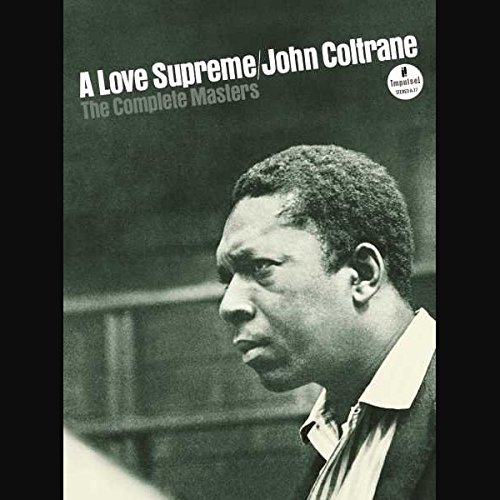
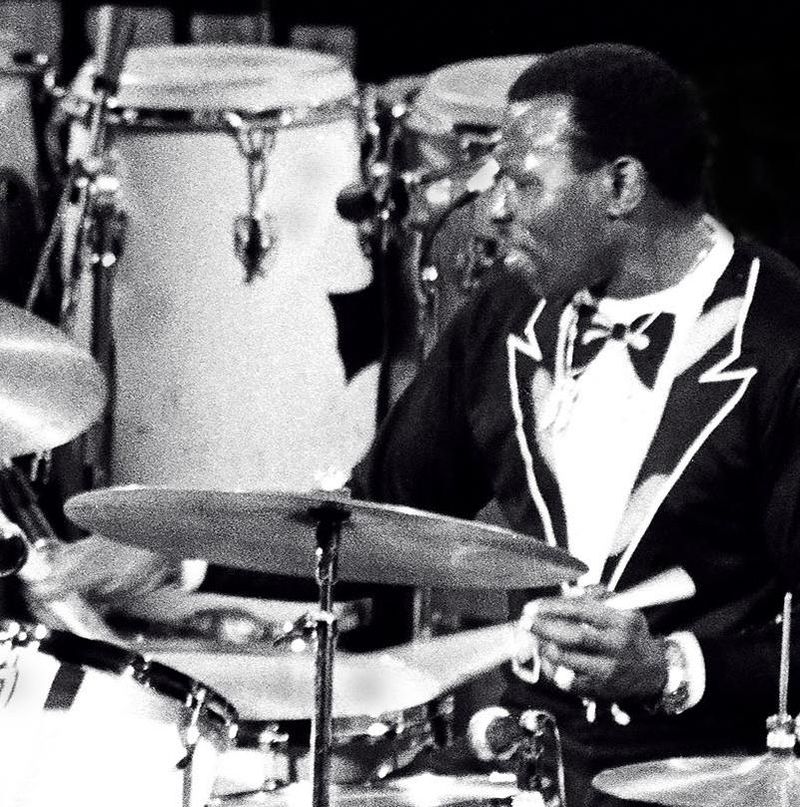
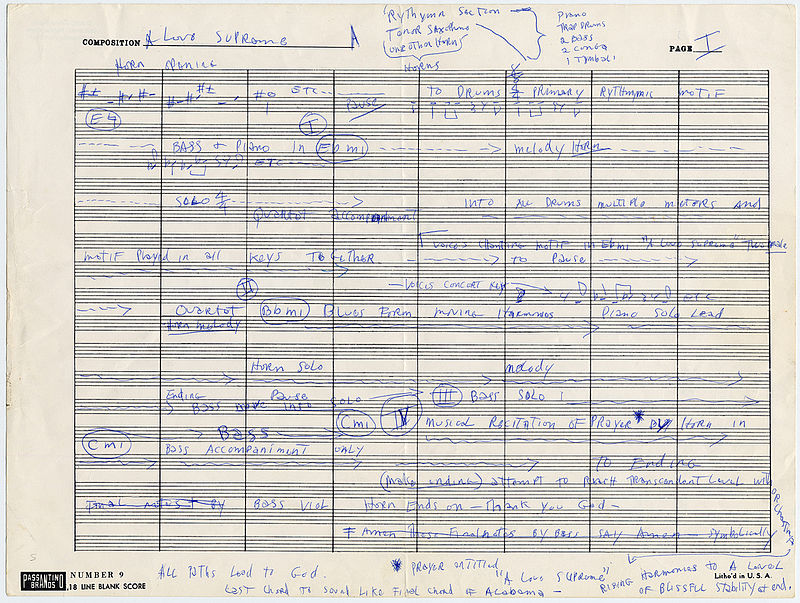
JETHRO TULL-TOO OLD TO ROCK ’N’ ROLL: TO YOUNG TO DIE! BOX SET
JETHRO TULL-TOO OLD TO ROCK ’N’ ROLL: TO YOUNG TO DIE! BOX SET
By December 1975, Ian Anderson was only twenty-eight, and was the lead singer of one of the most successful progressive rock bands in the world, Jethro Tull. British music magazine Melody Maker went further. They asked in February 1975; “Jethro Tull–Now The World’s Biggest Band?” No wonder. Jethro Tull had just sold out five nights at the 20,000 seater Los Angeles Forum. This was regarded as a remarkable achievement. However, it wasn’t surprising.
Jethro Tull’s first eight albums had sold over six million copies in America alone. This resulted in six gold discs; while 1971s Aqualung was certified triple-platinum. Back home in Britain, two of Jethro Tull’s albums had been certified silver. Jethro Tull were now regarded as progressive rock royalty. Despite that, bassist Jeffrey Hammond left Jethro Tull in 1975, after touring the Minstrels In The Gallery album.
The four years Jeffrey Hammond spent with Jethro Tull were some of their most successful. Glenn Cornick had left Jethro Tull in 1971. Into the breach stepped Jeffrey Hammond. He made his debut on Aqualung, which was released on 19th March 1971. This was the first of five albums Jeffrey Hammond played on. It was a glittering career, and by the time he left in 1975, gold and platinum discs adorned the walls of Jeffrey Hammond’s house. However, this came at a cost.
By the end of the Minstrels In The Gallery tour, Jeffrey Hammond was exhausted. Life with Jethro Tull seemed to be a schedule of record an album, then tour the album. It was non-stop. Jeffrey Hammond wanted to slow down. So, after the Minstrels In The Gallery tour, he announced he was leaving to become an artist. For Jethro Tull, this presented a problem. They were about to release their ninth album, Too Old To Rock ’N’ Roll: To Young To Die, which has recently been reissued by PTG as a four disc box set.
After the the Minstrels In The Gallery tour ended, Jethro Tull set about recording their ninth album, Too Old To Rock ’N’ Roll: To Young To Die. It was another concept album, where Jethro Tull told the story of an ageing rock star, who found fame when musical tastes changed. The ten tracks on Too Old To Rock ’N’ Roll: To Young To Die had been written by Ian Anderson. He was Jethro Tull’s songwriter-in-chief. These ten songs were recorded during December 1975.
The recording took place at Radio Monte Carlo, using the Maison Rouge Mobile Studio. This wasn’t the first time Jethro Tull had used the Maison Rouge Mobile Studio. It had been used to record Minstrels In The Gallery. For Too Old To Rock ’N’ Roll: To Young To Die, the Maison Rouge Mobile Studio was situated in the Principality of Monaco.
Radio Monte Carlo provided the soundtrack to the Principality of Monaco. It also housed a recording studio. This should’ve proved an attractive location for groups recording albums in the seventies. Monte Carlo was a tax haven, where many of the wealthiest British people were living. They weren’t will to pay 75% income tax and 83% on earned income. As a result, many groups, including the Rolling Stones became tax exiles.
This meant, they could only spend a limited amount of days in Britain. If they exceeded that amount of days, they became liable for taxation at the highest amount. So it wasn’t unusual for British groups to record albums in unusual locations. Often, their tax rates were much lower in Britain. Whether that’s why Jethro Tull chose to record in Monte Carlo in December 1975, is mere speculation?
When the recording of Too Old To Rock ’N’ Roll: To Young To Die began, there were a change in the lineup. Bassist John Glascock had replaced Jeffrey Hammond. John Glascock had been a member of flamenco rock band Carmen. They opened for Jethro Tull on their Minstrels In The Gallery tour. Now, John Glascock found himself slotting into Jethro Tull’s rhythm section alongside drummer and percussionist Barriemore Barlow and guitarist Martin Barre. John Evans who had been a member of Jethro Tull since 1970, played piano. Ian Anderson, Jethro Tull’s charismatic frontman played flute, acoustic guitar and sang lead vocals. He occasionally switched to eclectic guitar and added percussion. Augmenting Jethro Tull was the man many regarded as the band’s sixth man, David Palmer.
He had long been part of the Jethro Tull success story, orchestrating albums and concerts. However, from the Minstrels In The Gallery tour onwards, David Palmer officially joined the Jethro Tull’s stage show, playing keyboards and synths. However, on Too Old To Rock ’N’ Roll: To Young To Die, David Palmer played saxophone, piano and took charge of orchestrations and conducted the orchestral. Meanwhile, Jethro Tull drafted in another well known name for the recording of Too Old To Rock ’N’ Roll: To Young To Die, Maddy Prior.
The title-track, Too Old To Rock ’N’ Roll: To Young To Die required someone to add backing vocalists. Ian Anderson decided that the Steeleye Span vocalist fitted the bill. However, Angela Allen was chosen to add backing vocals on Crazed Institution and Big Dipper. Once the two backing vocalists laid down their parts, Too Old To Rock ’N’ Roll: To Young To Die, which Ian Anderson produced, was completed. It would another four months before Too Old To Rock ’N’ Roll: To Young To Die was released.
Before that, critics had their say on Too Old To Rock ’N’ Roll: To Young To Die. Before that, Ian Anderson tried to explain the album’s concept. Music Ian Anderson felt, was like fashion it cyclical. Progressive rock had been popular since the seventies dawned. There was nothing to say that progressive rock wouldn’t fall from favour. However, if Jethro Tull stuck with progressive rock, despite it falling out of favour, it may rise like a phoenix from the ashes. This proved prophetic.
The rise of punk, which was the antithesis to progressive rock, resulted in groups like Jethro Tull being labelled musical dinosaurs. They were perceived by the punks as remnants of the musical past. This resulted in a backlash against the musical establishment, including Jethro Tull. Their albums still sold well, but progressive rock was no longer as popular. However, in the eighties, there was a resurgence in progressive rock, with groups like Marillion enjoying commercial success and critical acclaim. Meanwhile, many of the embittered punks were now returned to the sink estates where they had come from. By April 1976, Too Old To Rock ’N’ Roll: To Young To Die was just about to be released, and the public introduced to Ray Lomas.
Too Old To Rock ’N’ Roll: To Young To Die told the story of Ray Lomas. He was ageing rock star, who had retired from music, when the music he played fell out of fashion. Still, Ray Lomas was a greaser. He wasn’t going to have a makeover. Not even when he went onto the “Quizz” show, where won the jackpot. Money however, didn’t bring Ray Lomas happiness.
After winning the money, Ray Lomas tries to commit suicide. Like the Sleeping Beauty, he falls into a deep sleep. When Ray Lomas wakes up, the greaser fashion is back in style, and he makes a comeback. Never did he loose faith that his style would come back into fashion. The story of Ray Lomas was told in a series of cartoons printed in Too Old To Rock ’N’ Roll: To Young To Die’s sleeves. This was meant to guide critics and listeners through Too Old To Rock ’N’ Roll: To Young To Die’s plot.
Or some Jethro Tull thought. Some critics couldn’t quite understand Too Old To Rock ’N’ Roll: To Young To Die. This resulted in mixed reviews of Too Old To Rock ’N’ Roll: To Young To Die. Unsurprisingly, the contrarian Rolling Stone magazine. slated Too Old To Rock ’N’ Roll: To Young To Die. They called the plot “muddled,” and telling Ian Anderson to “stick to music, because he most definitely is not a storyteller.” Other reviews were mixed.
Melody Maker magazine, who up until then, had been a Jethro Tull loyalist, gave Too Old To Rock ’N’ Roll: To Young To Die a mixed review. On the plus side, were Ian Anderson’s songwriting skills and Martin Barre’s stunning guitar solos. However, they felt the rhythm section were subdued, and longed for them to kick loose. What critics were forgetting, was that Too Old To Rock ’N’ Roll: To Young To Die was John Glascock’s debut. He had made the step up from flamenco rockers Carmen, to progressive rock royalty Jethro Tull, who usually, sold 500,000 albums in America.
Not this time around. Too Old To Rock ’N’ Roll: To Young To Die reached number fourteen in the US Billboard 200 and fifteen in Britain. Elsewhere, Jethro Tull’s ninth album reached number ten in Austria, and number twenty-seven in Sweden. This time there were no gold, silver or platinum discs. It was the first time a Jethro Tull album had failed to achieve silver, gold or platinum status. Since then, Too Old To Rock ’N’ Roll: To Young To Die is regarded as a hidden gem in Jethro Tull’s back-catolgue.
Too Old To Rock ’N’ Roll: To Young To Die, was Jethro Tull’s final concept album. It opened with Quizz Kid. Just a strummed guitar accompanies Ian Anderson’s wistful vocal, before strings sweep in and the rhythm section provide an understated heartbeat. Meanwhile, Ian paints a picture of yesterday’s man, the greaser Ray Lomas. Then when Ray wins the Quizz, the arrangement explodes into life. A searing guitar is unleashed, and Ian’s vocal grows in power. Soon, the tempo changes, and Ian briefly plays his flute. When his vocal returns, Jethro Tull the arrangement becomes rocky. The rhythm section are augmented by acoustic guitar, percussion and pizzicato strings. There’s constant changes in tempo and style. From progressive rock, folk rock and classic rock influences can be heard. Later, Ian vamps, while a freewheeling Jethro Tull provide the perfect backdrop, as the story of Ray Lomas begins to unfold.
An urgently strummed guitar and a subtle burst of flute usher in Ian’s vocal on Crazed Institution. Ian embraces the role of Ray Lomas. Winning the Quizz wasn’t the answer to his problems. All the money means, is he’s able to shop at the “Crazed Institution of the stars,” which he calls Horrids. Revulsion fills his voice as he delivers the lyrics. Meanwhile, the arrangement gradually builds. For a while the rhythm section are almost restrained. Eventually, they’re allowed to step out of the shadows. However, it’s flourishes of piano add an element flamboyance and drama. Backing vocals accompany Ian, as the arrangement sweeps along. That’s until the bass signals it’s all change. A braying saxophone, stabs of piano and acoustic guitar accompany Ian, his flute and percussion. By now, Ian’s delivery is impassioned, as Jethro Tull in full flight, on what later became a staple and favourite of Jethro Tull concerts.
Just a lone Spanish guitar plays on Salamander. It’s joined by another guitar. Both are played and picked with a degree of urgency. Eventually, Ian’s vocal enters after midway through the track. His vocal manages to be heartfelt and rueful as he becomes Ray. Suddenly, Ray remembers the first time he saw her: “on the sun kissed lane.” All the time, backing vocals accompany him, as the lyrics take on a cinematic quality. Later, Ian switches to flute on what’s an understated, beautiful hidden gem from the Jethro Tull back-catalogue.
As Ian calls “Taxi,” Taxi Grab begins. A blistering guitar and pounding drum combine with the bass. Ian is like Pied Piper, delivering a jaunty vocal. He observes how each night, London “evacuates” and the “Taxi Grab” begins. Meanwhile, machine gun guitars are panned left. They’re joined by the rest of the rhythm section, and later, a bluesy harmonica. Briefly, Martin Barre unleashes a searing guitar solo. Mostly, his playing is restrained, just like drummer Barriemore Barlow. Technically, it’s hard to fault Jethro Tull’s musicianship. Similarly, Ian’s lyrics and delivery can’t be criticised. However, what some listeners will wonder, is what has this to do with Ray Lomas? They’ll be left to assume this is Ray’s observations, as he watches on, as London evolves as night falls.
Slowly, and gently, an acoustic guitar plays on From a Dead Beat to an Old Greaser. It accompanies Ian’s vocal, which are accompanied by rueful harmonies and wistful strings, as he reminisces: “when bombs were bombed every Sunday, and The Shadows played F.B.I.” Later, Ian sings: “Jack Kerouac, Rene Magritte, to name a few of the heroes…who were too wise for their own good left the young brood to go on living without them.” When the vocal drops out, the sultriest of saxophone is dropped in. It’s an inspired choice, and knits the song together. By then, Jethro Tull sound like another member of progressive rock royalty, Pink Floyd, on what’s without doubt, one of Too Old To Rock ’N’ Roll: To Young To Die’s highlights.
Bad-Eyed and Loveless has a bluesy introduction. Just a guitar accompanies Ian’s gravelly vocal as he sings: “Yes an’ she’s bad-eyed and she’s loveless, a young man’s fancy and an old man’s dream.” His vocal veers between heartfelt and rueful, realising he’s being used. Without the money, she wouldn’t look twice at an old greaser like Ray Lomas.
An airy flute opens Big Dipper, which seems to have been inspired by the town where Ian grew up, Blackpool. The references to the Pleasure Beach and Tower Ballroom are clues. They add to the cinematic quality of the song, which tells of weekends away in Blackpool for the” “weekend happiness seekers.” Fun and frolics are the order of the day. Meanwhile, Ian’s flute and Barriemore Barlow drums and percussion play leading roles. So does Martin’s searing guitar. Although’s he still not let off the leash, the song wouldn’t be the same without it. Jethro Tull are roiling back the years, as Ray Lomas remembers pre-fame, hedonistic weekends where he sough escape from the drudgery of modern life.
A crystalline guitar run joins with the rhythm section and pizzicato strings on Too Old To Rock ‘n’ Roll: Too Young to Die. There’s sadness in Ian’s voice as he realises that Ray’s career is at a crossroads. He’s been cast out into the wilderness, and is: “Too Old To Rock ‘n’ Roll: Too Young to Die.” Behind him, the arrangement has grown, and is one of the best on the album. David Palmer’s strings sweep and swell, adding drama and a wistful quality. The rhythm section add to this drama. Later, Maddy Prior adds a melancholy backing vocal. Even bassist John Glascock stamps his authority on the song. So does a pounding piano, growling saxophone and Martin Barre’s piano. From there, the arrangement reaches a wistful, symphonic crescendo. It’s a fitting finale to this progressive rock epic.
Having reached a crossroads in his life on Pied Piper, Ray can see no way out, and tries to commit suicide. This becomes apparent as Ian sings: “now if you think Ray blew it, there was nothing to it, they patched him up as good as new.” All isn’t well with him though. “You can see him every day riding down the Queen’s highway, handing out his small cigars to the kids from school.” Accompanying Ian, are dark harmonies, sweeping, then pizzicato strings. By then, genres melt into one, becoming part of this musical tapestry. Progressive rock, folk, jazz classical have been combined by Jethro Tull. Similarly, the tempo changes, adding to the drama, as Ray seems to unravel. He’s referred to as the: “Pied Piper, the mad biker.”
The Chequered Flag (Dead or Alive) closes Too Old To Rock ‘n’ Roll: Too Young to Die, which was Jethro Tull’s final concept album. It’s a poignant song to close the album, and features some of Ian’s best lyrics. There’s triumph and sadness throughout the song. However, that’s still to come.
Just a Fender Rhodes join a chiming guitar. Then Ian sings:“the disc brakes drag, the chequered flag sweeps across the oil-slick track, he young man’s home; dry as a bone, his helmet off, he waves: the crowd waves back.” Swathes of strings sweep, and the rhythm section provide a slow, melancholy backdrop. This is fitting as Ian sings: “he hard road’s end, the white god’s sendis nearer everyday, in dying the old man says, isn’t it grand to be playing to the stand, dead or alive.” Ian Anderson seems to have kept his best vocal until last. With harmonies, and David Palmer’s beautiful orchestrated arrangement, it’s a beautiful, melancholy and poignant song, which features Jethro Tull at their best. It’s a fitting way to end an era.
Too Old To Rock ‘n’ Roll: Too Young to Die was the last concept album Jethro Tull released. By then, they were masters of the concept album. That’s why, in 1976, Jethro Tull were one of the biggest progressive rock bands in the world. However, Too Old To Rock ‘n’ Roll: Too Young to Die had failed to sell in the same quantities as their previous albums. That’s despite the undoubtable quality of music on Too Old To Rock ‘n’ Roll: Too Young to Die.
It’s one of the most underrated albums in Jethro Tull’s illustrious back-catalogue. However, Too Old To Rock ‘n’ Roll: Too Young to Die had the misfortune to be released just as punk was born. It came kicking and screaming into the world, kicking out at the musical establishment. Suddenly, progressive rock groups were seen as dinosaurs, and remnants of music’s past by the new breed of gunslinger critics.
Many of these new critics were blinkered. They believed music began in 1976. This was music’s year zero. These new critics slated albums by the musical establishment. Progressive rock groups never stood a chance. However, Too Old To Rock ‘n’ Roll: Too Young to Die is a much better album than many reviews would’ve record buyers believe.
Those that bought Too Old To Rock ‘n’ Roll: Too Young to Die, found a cohesive, cerebral concept album that told the story of ageing greaser, Ray Lomas. He was the retired rocker whose music had fallen out of fashion. However, he believed that one day, his music would become fashionable again. When it did, Ray Lomas would be back where he belonged. That was prophetic.
Following Too Old To Rock ‘n’ Roll: Too Young to Die, Jethro Tull’s fortunes improved. There was a reason for this. Jethro Tull reinvented themselves musically. They had always been musical pioneers, and weren’t content to stand still. Instead, they experimented musically, and pushed musical boundaries to their limit over the next few years. This just happened to coincide with an upturn in Jethro Tull’s fortunes.
Jethro Tull’s tenth album, Songs From The Wood was certified gold in America and Canada. Then 1978s Heavy Wood was certified gold in America and Canada, and silver in Britain. The seventies finished for Jethro Tull with 1979s Stormwatch being certified gold in America and Canada. This meant that Jethro Tull had sold over seven million albums in America alone. The only album of the seventies that wasn’t certified gold or silver, was Too Old To Rock ‘n’ Roll: Too Young to Die. It’s a hidden gem in Jethro Tull’s glorious back catalogue.
PLG have also realised that, and recently, released Too Old To Rock ‘n’ Roll: Too Young to Die as a four disc box set. It’s the definitive edition of Too Old To Rock ‘n’ Roll: Too Young to Die. Disc one features the the new Steven Wilson stereo mix. His mix brings out all Too Old To Rock ‘n’ Roll: Too Young to Die’s subtleties and nuances. The albums seems rejuvenated, and As A comes to life. Steven Wilson’s new mix highlights the changes in time signature and tempo shifts. Similarly, the eclectic palette of music instruments deployed by Jethro Tull can be heard much more clearly. They stand out in the mix and make buying the Too Old To Rock ‘n’ Roll: Too Young to Die worthwhile. As an added bonus, there’s also five bonus tracks. However, to misquote W.C. Fields; “you ain’t heard nothing yet.”
Discs two features nineteen bonus tracks. For Jethro Tull completists, it’s a musical feast. There’s an instrumental version of Salamander and the original master mix of One Brown Mouse. It’s work in progress, but is an instructing inclusion. So is the rough mix of the orchestrated version of A Small Cigar. It allows the listener to compare and contrast with the version on Too Old To Rock ‘n’ Roll: Too Young to Die. These are just a few courses of this veritable musical feast.
Then on discs three, there are flat transfers of the original album, plus a myriad of rare recordings. Many of these recordings have never been released before, and are a very welcome inclusion for fans of Jethro Tull. The DVD is also a pandora’s box. Included, are previously commercially unavailable original television footage with DTS, Dolby Digital Surround Sound and Dolby Digital Stereo sound. For audiophiles, the television audio is available in 96/24 stereo PCM alongside a host of other associated recordings in surround and 96/24. That however, isn’t the end of the story.
Accompanying the Too Old To Rock ‘n’ Roll: Too Young to Die box set, is an eighty page booklet. Calling them sleeve notes would be doing them a disservice. This is something altogether much more meaty. They’re penned by Martin Webb, who tells the story of the album, the London Weekend Television special and the stage musical that never was. It’s a fascinating insight to what is, without doubt, the hidden gem in Jethro Tull’s back-catalogue.
The Too Old To Rock ‘n’ Roll: Too Young to Die isn’t a budget busting box set. Copies can be found for £15, $23 or €30. That’s not a great deal considering the quality of the box set and the magnificent music on Too Old To Rock ‘n’ Roll: Too Young to Die. It marked the end of en era for Jethro Tull.
Following Too Old To Rock ‘n’ Roll: Too Young to Die, Jethro Tull’s music continued to evolve. Their music moved towards a folk rock sound. Too Old To Rock ‘n’ Roll: Too Young to Die had been their progressive rock swan-song. Sadly, Too Old To Rock ‘n’ Roll: Too Young to Die was Jethro Tull’s swan-song, when it came to concept albums.
That was great shame. Jethro Tull were one of the finest purveyors of progressive rock. Some of Jethro Tull’s finest albums had been concept albums, including their Magnus Opus Aqualung and Thick As A Brick. While, Too Old To Rock ‘n’ Roll: Too Young to Die may not match the quality of Jethro Tull’s classic, Aqualung, it’s a far superior album to A Passion Play, and even Thick As A Brick and would make a worthy inclusion into any self-respecting record collection.
JETHRO TULL-TOO OLD TO ROCK ’N’ ROLL: TO YOUNG TO DIE! BOX SET
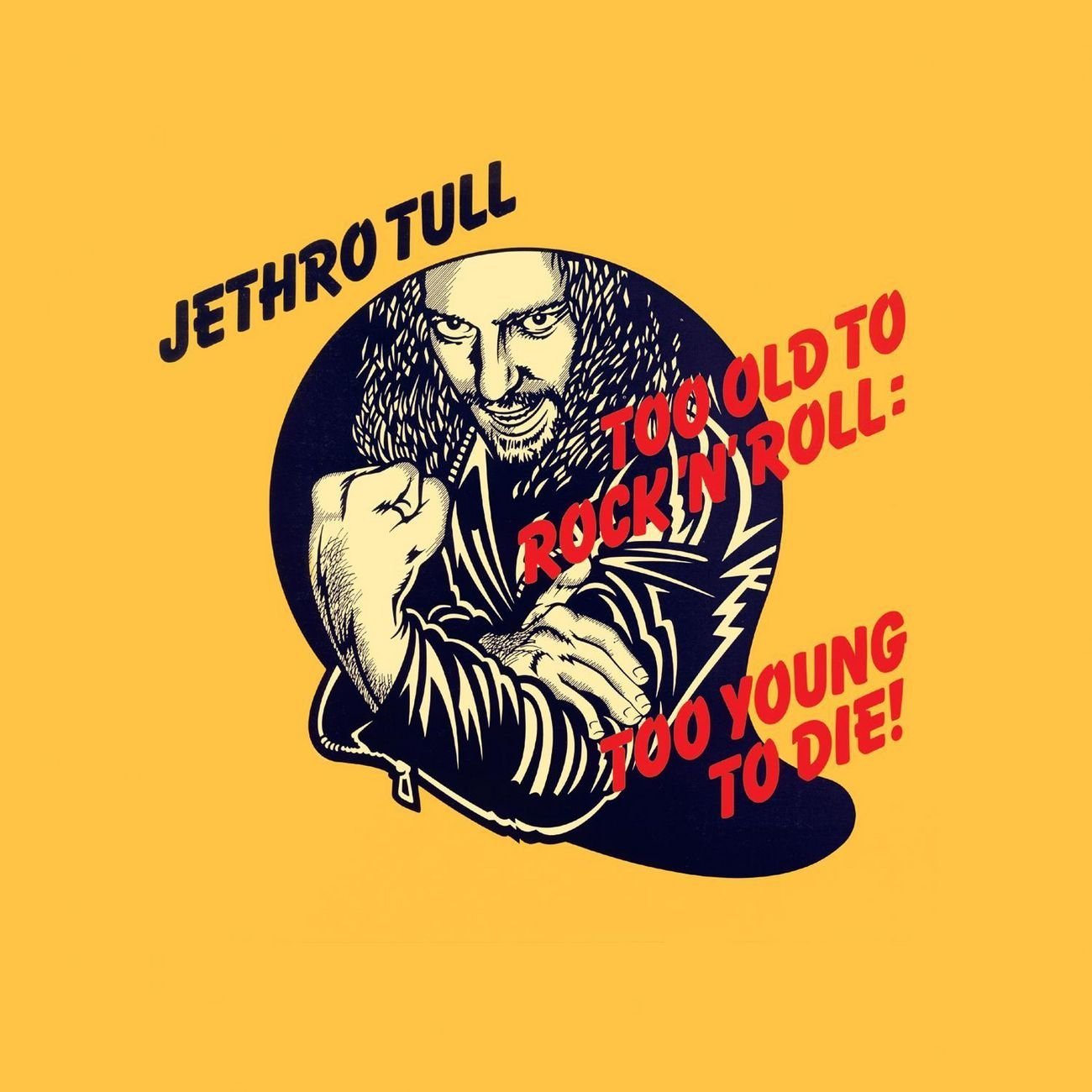


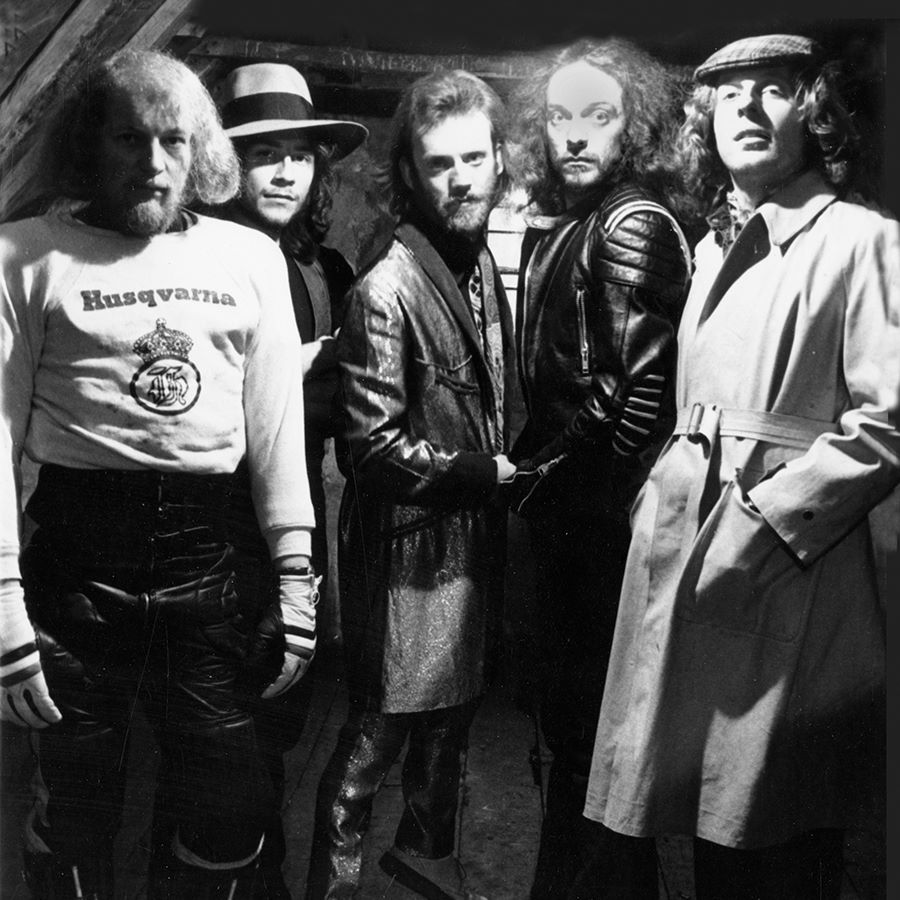
THE VELVET UNDERGROUND-THE MATRIX TAPES BOX SET.
THE VELVET UNDERGROUND-THE MATRIX TAPES BOX SET.
“It was the best of times, it was the worst of times.” The Velvet Underground would surely have agreed with Charles Dickens in 1969. They had just endured the most tumultuous year of their career.
The Velvet Underground released their eponymous third album in March 1969. It stalled at 197 in the US Billboard 200. So to promote The Velvet Underground, the band headed out on an exhaustive, gruelling tour. In the midst of the tour, The Velvet Underground were dropped by their record company MGM. This didn’t stop The Velvet Underground recording what a live album over two nights in November at The Matrix in San Francisco.
For a while, The Matrix had one of The Velvet Underground’s favourite venues on The West Coast. It seemed to bring out the best in The Velvet Underground. So there was no better place for The Velvet Underground to record a live album. These two nights at The Matrix featured The Velvet Underground at their very best. However, until very recently, only some of live at The Matrix album has been released.
Only five tracks from live at The Matrix featured on Bootleg Series Volume 1: The Quine Tapes when they were released on 2001. Despite this, many critics felt this was the finest live recording of The Velvet Underground. It was, they felt, a shame that The Matrix Tapes hadn’t been released in all their glory. Some of The Matrix Tapes made their way on one of the discs on the The Velvet Underground’s Loaded box 45th Anniversary Box Set. Again, it was a tantalising taste of this musical pandora’s box. Little did anyone know, that a couple of weeks later, that The Matrix Tapes would be released by UMC as a four disc box set. At last, this legendary recording is available for all to hear and enjoy. The Matrix Tape is a snapshot of The Velvet Underground during one of the most tumultuous periods of their career.
Things started to go awry for The Velvet Underground in 1968. The group’s two main creative forces clashed about the future direction of The Velvet Underground. John Cale left The Velvet Underground. This disagreement arose after the release of White Light/White Heat, which was the start of a new chapter in The Velvet Underground story.
White Light/White Heat.
When The Velvet Underground began recording their sophomore album White Light/White Heat in September 1967, it marked a new chapter in the band’s career. Nico, who had been the band after the release of The Velvet Underground and Nico. This wasn’t the only change
The Velvet Underground cut their ties with Andy Warhol. It was time to to go their own way. This marked an end in their relationship, which had been deteriorating since the release of The Velvet Underground and Nico. Now reduced to a quartet, The Velvet Underground began work on White Light/White Heat.
At Specter Studios, The Velvet Underground would record six tracks during September 1967. With Andy Warhol no longer part of the picture, Tom Scott was drafted in to produce White Light/White Heat. It was released on 30th January 1968.
Before that, critics heard White Light/White Heat. Their reviews were mixed. Many critics didn’t get White Light/White Heat. Nor did they know what to make of White Light/White Heat. They were left scratching their head. It was, after all, unlike anything else released during this period.
White Light/White Heat can be described as an avant garde cacophony of sound. This feedback driven album would prove hugely influential, and can be credited as one of the albums that gave birth to punk. However, just like The Velvet Underground and Nico, the lyrics on White Light/White Heat were controversial. Again, The Velvet Underground weren’t going to submit to establishment censorship. The Velvet Underground it seemed, were determined to do things their way. This would prove costly.
On the release of White Light/White Heat, it wasn’t a commercial success, stalling at just number 199 in the US Billboard 200 charts. Neither of the singles, White Light/White Heat, nor I Heard Her Call My Name would prove commercially successful. For The Velvet Underground, this was a huge disappointment.
Still, The Velvet Underground were awaiting their commercial breakthrough. The Velvet Underground were at a crossroads. Little did they realise that belatedly, White Light/White Heat would be regarded as a hugely influential and innovative album. That would come later. By then, The Velvet Underground would be reduced to a trio. For one member of The Velvet Underground, White Light/White Heat was their swan-song.
After two albums which had failed commercially, Lou Reed decided that The Velvet Underground had to change tack. They had to release music that was much more pop oriented and therefore, commercial. John Cale however, didn’t agree with how Lou Reed’s master-plan.
This had been a bone of contention between the pair for some time. John Cale wanted The Velvet Underground to continue to innovate, and create experimental music like White Light/White Heat, The Velvet Underground’s sophomore album. Lou Reed didn’t agree.
Lou Reed believed that The Velvet Underground’s music should become more pop oriented. This he felt, would broaden their appeal. No longer would they be an art rock group whose music appealed to discerning music lovers. Eventually, Lou Reed won over the rest of The Velvet Underground. For John Cale this was hugely disappointing. So, he decided the only option was to leave The Velvet Underground.
Following the departure of John Cale, The Velvet Underground began looking for a replacement. Eventually, Doug Yule was chosen as John Cale’s replacement. He made his Velvet Underground eponymous third album in November 1968, at TTG Studios, Hollywood.
The Velvet Underground.
With John Cale no longer part of The Velvet Underground, Lou Reed became its creative force. He set about implementing his master plan for commercial success and critical acclaim. This meant a much more pop oriented, commercial sound.
The new-look Velvet Underground made their way to TTG Studios, Hollywood in November 1968. That was where the new lineup of the band recorded ten tracks penned by Lou Reed. These tracks Lou Reed hoped, would result in a change in fortune for The Velvet Underground. All would become clear when The Velvet Underground was released in March 1969.
Before that, critics had their say on The Velvet Underground. The majority of the critics were won over by The Velvet Underground’s new sound. Some critics went as far as to say that the album was The Velvet Underground’s finest hour. They were impressed The Velvet Underground’s much more accessible sound. The Velvet Underground were congratulated on the quality of songwriting, and the delivery of the lyrics. However, there was a but.
Some critics felt that The Murder Mystery was an experiment that hadn’t worked. Others ant further, lamenting that The Murder Mystery fell short of the quality of White Light/White Heat. Other critics remarked that The Velvet Underground lacked the eclectic sound of its predecessors. Even the quality of recording was criticised. Mostly though, critics thought that The Velvet Underground were on the right road. However, as usual, record buyers had the casting vote.
When The Velvet Underground was released in March 1969, the album crept into the US Billboard 200, reaching just 197. This was a disaster for The Velvet Underground. Lou Reed’s decision to embrace a more commercial sound had backfired.
Following the release of The Velvet Underground, the band headed out on tour. They spent much of 1969 touring America and Canada. Night after night, they reworked tracks from their first three albums. The audience watched as a tight band fought for their very future. Some nights, The Velvet Underground debuted new songs.
New Age, Rock and Roll and Sweet Jane found their way onto the set list. This trio of songs found their way onto Loaded, which was released in 1970. That was a long way away, Much would happen before then.
The Velvet Underground’s seemingly never ending tour continued. Each night, they continued to hone their sound. They were a very different band to just a few years previously when they were Warholian disciples. That was the past. Now The Velvet Underground were willing to forsake what many thought was their true sound, for commercial success. That proved ironic.
After three albums that had failed commercially, MGM were starting to loose patience with The Velvet Underground. It didn’t help that MGM had been haemorrhaging money for a couple of years. They had too many loss making acts on their roster. Something had to give.
During the night of the long knives, executives at MGM decided to cancel the contracts of eighteen loss making acts. This included The Velvet Underground. They were invited to the headquarters of MGM, and told that their contract had been cancelled. However, was the decision to cut The Velvet Underground loose purely a business decision?
Since then, there has been speculation that The Velvet Underground were dropped just because they were losing MGM money. Maybe, it was more to do with The Velvet Underground’s image being at odds with MGM’s corporate image? That proved to be the case. In 1970, an executive of MGM said: “it wasn’t eighteen groups, Mike Curb was misquoted. The cuts were made partly to do with the drug scene—like maybe a third of them had to do with drug reasons. The others were dropped because they weren’t selling.” It seemed that MGM’s mattered more than selling records. MGM it seemed, only wanted artists whose lifestyle they approved of.
Many thought that being dropped by MGM must have been devastating for The Velvet Underground. It seems it was, and it wasn’t. When Lou Reed was interviewed in 1987, he admitted: “we wanted to get out of there.” That may just be bravado. After all, the music industry is a small village, and word would’ve spread like wildfire why The Velvet Underground had been dropped. Some critics however, thought the situation was ironic.
Back in 1968, The Velvet Underground had made what many regarded as the ultimate musical sacrifice. They had changed direction musically on their eponymous third album. No longer were they seen as an art rock band by championed by many critics and cultural commentators. Instead, the move towards a more populist sound was seen as the ultimate betrayal from The Velvet Underground. This resulted in John Cale’s departure from the band. Now that The Velvet Underground had been dropped by MGM, the loss of one of their main creative forces, had been for nothing. Given what had happened, it was the ultimate irony.
Now without a record contract, The Velvet Underground headed back out on tour. Touring was now their main source of income. So they spent much of 1969 on the road. Mostly, it was the tight version of The Velvet Underground that took to the stage. Other times, they revisited their past.
The Velvet Underground decided to reinvent songs, during lengthy improvisations. This mixture of art rock, avant garde and free jazz showed that the old Velvet Underground weren’t dead. Some critics believed it was merely being suppressed in the search for commercial success.
During their gruelling touring schedule, The Velvet Underground made occasional forays into the recording studio. Some of the songs The Velvet Underground recorded, were seen as having potential. However, they couldn’t be released, as The Velvet Underground were in dispute with MGM. With no recording contract, and locked in what could prove a biter, lengthy and expensive dispute with MGM, things looked bleak for The Velvet Underground.
By November 1969, The Velvet Underground arrived in San Francisco, and were due to play at The Matrix and The Family Dog. These shows were recorded, and were meant to be released as live albums. However, that didn’t happen until the next millennia, when Bootleg Series Volume 1: The Quine Tapes was released in 2001.
Even then, a mere five tracks from The Matrix concerts featured on Bootleg Series Volume 1: The Quine Tapes, when they were released on 2001. Despite this, many critics felt this was the finest live recording of The Velvet Underground. It was, they felt, a shame that The Matrix Tapes hadn’t been released in all their glory? That’s been rectified with the release of The Matrix Tapes box set.
The Matrix Tapes.
Anyone who bought the recently released the Loaded 45th Anniversary Box Set, will have enjoyed a sneak preview if The Matrix Tapes. However, this was just an amuse bouche. The Matrix Tapes box set is more like a musical banquet.
Within The Matrix Tapes box set, are four discs featuring forty-two tracks recorded at The Matrix, in San Francisco. For anyone who has longed to experience and relive these legendary concerts, now is the chance. However, there’s a but. Only nine of the tracks haven’t featured on other Velvet Underground reissues.
Anyone who owns Bootleg Series Volume 1: The Quine Tapes, The Velvet Underground and the Loaded 45th Anniversary Box Set, will own thirty-three of the forty-two tracks. They may resent paying another £30, $45 or €39. However, for those who worship at the altar of The Velvet Underground, The Matrix Tapes box set will be an essential purchase. Especially given the quality of sound. That’s not surprising, as The Matrix had its own in-house recording studio. This makes quality of music The Matrix Tapes much much superior than other Velvet Underground live albums.
There no shortage of Velvet Underground live albums, The Matrix Tapes box set features what many regard as The Velvet Underground at their very best. That’s the case from the moment The Velvet Underground take to the stage at The Matrix.
The Matrix Tapes.
Disc One.
Lou Reed isn’t just a bandleader, listening to his droll introduction to I’m Waiting For The Man, he’s part raconteur, part bon viveur. Soon, the audience are spellbound, as The Velvet Underground launch into one of their classic tracks. From there, What Goes On gives way to Some Kinda Love from The Velvet Underground. Then it’s time for The Velvet Underground to returned to their debut album, The Velvet Underground and Nico and unleash a trio or tracks from their classic album.
The Velvet Underground revisit Heroin, which was one of their debut album’s highlights. Venus In Furs gives way to the wistful Here She Goes. By then, The Velvet Underground have hit there stride. It’s the perfect time to drop We’re Gonna Have A Real Good Time Together. That’s certainly case.
Despite being a New York group, it’s as if The Velvet Underground are hometown heroes. San Francisco embraces The Velvet Underground. Especially as they reinvent and remake tracks. They take on new meaning. It’s a case of never try and second guess The Velvet Underground, who are at their most inventive, genre-melting best. Over You is followed by a new song, Sweet Jane, which would make its debut on The Velvet Underground’s fourth album Loaded, in 1970. From there, it’s a return to The Velvet Underground’s eponymous third album, and Pale Blue Eyes and After Hours. That’s the end of disc one, and The Velvet Underground take their leave. However, there’s plenty more to come.
Disc Two.
Disc two of The Matrix Tapes, features many of the same songs that were on disc one. Given the the Velvets had only released a trio of albums, that’s not surprising. Some songs, the audience expected to hear each night. That includes I’m Waiting For The Man, which opens their set. It’s followed by Venus In Furs, before Some Kinda Love gives way to Over You. While these songs all featured on disc one, The Velvet Underground remake some of these songs on disc two. Sometimes, songs head off into unchartered territory, with the Velvets treating the stage like a musical laboratory, as they, reinvent what were already some of their best known songs. Then it’s all change.
The Velvets unleash a despair ridden version of I Can’t Stand It. Then The Velvet Underground are back on familiar ground, with another Velvets classic, There She Goes Again. It’s followed by After Hours and a riotous take on We’re Gonna Have A Real Good Time Together. The Velvets have the audience in the palm of their hand. So they deliver a version of Sweet Bonnie Brown (It’s Just Too Much), Then it’s time for one of the Velvets most controversial classics.
Heroin was just one of the tracks that resulted in The Velvet Underground and Nico being banned in many places on its release in 1966. That wasn’t surprising, given the moral climate. Songs about drug abuse, prostitution, sadism and masochism and sexual deviancy weren’t what America’s moral guardians wanted the American youth to hear. However, three years later, there’s an air of defiance in Lou Reed’s vocal. That would’ve been the perfect way to take a bow, but The Velvet Underground unleash the title-track to White Light/White Heat, before closing their set with I’m Set Free from The Velvet Underground. Only then do The Velvet Underground take their leave. That’s not the end of the story though.
Disc Three.
Unlike the first two discs, disc three features just six songs. We’re Gonna Have A Real Good Time Together opens the set, before hot on its heels comes Some Kinda Love, There She Goes Again and Heroin. The songs are extended, as the Velvets reinvent the tracks. Musical genres melt into one, with elements of art rock, avant garde, psychedelia and rock ’n’ roll being combined by the Velvets.
The penultimate song on disc three is Ocean, an underrated track. Then Sister Ray, which closed White Light/White Heat, closes disc three. It’s a spellbinding performance that shows that live, The Velvet Underground could hold their own against other members of rock royalty.
Disc Four.
That continues to be the case on disc four of The Matrix Tapes box set. The Velvet Underground combine classics and hidden gems. It’s a case of giving the audience what they want, when I’m Waiting For The Man opens the set. It’s followed What Goes On, Some Kinda Love and what should’ve been their theme tune during their 1969 tour, We’re Gonna Have A Real Good Time Together. That’s the case on the rest of disc four.
Beginning To See The Light from The Velvet Underground, is followed by Lisa Says. Then the Velvet showcase two new songs, New Age and Rock and Roll, which would feature on Loaded. I Can See The Light then sets the scene for a trio of tracks where The Velvet Underground are at the peak of their power.
Somehow, The Velvet Underground up the ante on Heroin, White Light/White Heat and Sweet Jane, which closes The Matrix Tapes box set. It’s a fitting finale, and just like the rest of The Matrix Tapes box set, features a groundbreaking band at their most inventive and innovative.
Atlantic Records realised that The Velvet Underground were a pioneering band, and signed then in 1970. The Velvet Underground only ever released one album on Atlantic Records, Loaded. It didn’t even chart in the US Billboard 200. Instead, it was a case of close, but no cigar. Loaded reached 202. However, by then, Lou Reed had left The Velvet Underground.
On 23rd August 1970, Lou Reed left The Velvet Underground This left The Velvet Underground a rudderless ship, which was threatening to come-a-ground.
With The Velvet Underground having lost their leader and creative force, others took charge of final mix of Loaded. That was fatal. Lou Reed should’ve handed Atlantic Records the final mix, and then left.
When Lou Reed saw and heard a copy of Loaded, he was in for a shock. The claimed that Loaded had been re-sequenced. This hadn’t been authorised. That was bad enough. No longer would Loaded flow as it was meant to. Much worse, was that some of Lou Reed alleged that some of the songs on Loaded had been edited.
Lou Reed railed against the edited version of Mary Jane. So badly edited was the song, that it was bereft of its very melody. A heartbroken Lou Reed described the melody as: “heavenly wine and roses.” Sadly, it was gone. New Age was another song that had fallen victim to the razor blade in the editing suite. No longer was Loaded the album that Lou Reed had envisaged. It was a far cry from November 1969, when The Velvet Underground produced two barnstorming performances at The Matrix, in San Francisco.
These two nights at The Matrix, are documented on The Matrix Tapes box set. This four disc box set, features forty-two tracks. There’s Velvet Underground classics, and hidden gems like New Age on The Matrix Tapes. It’s regarded by many critics as as the definitive Velvet Underground live album. Especially now, that it’s available in it entirety.
That’s never been the case before. That’s despite The Matrix Tapes being recorded forty-six years ago. Since then, thirty-three of the tracks have found their way onto various Velvet Underground reissues. However, UMC recently released The Matrix Tapes for the first time. Somewhat belatedly, this legendary live album can be heard in its entirety, and features one of the most innovative and influential bands in the history of music, The Velvet Underground. They’re in full flight, reinventing classics and hidden gems on what’s considered The Velvet Underground’s legendary live album, The Matrix Tapes.
THE VELVET UNDERGROUND-THE MATRIX TAPES BOX SET.

MOGWAI-CENTRAL BELTERS -VINYL BOX SET.
MOGWAI-CENTRAL BELTERS -VINYL BOX SET.
2015 finds post rock pioneers Mogwai celebrating their twentieth anniversary. A lot has happened in that twenty year period. Mogwai have released eight studio albums and three soundtracks. These albums have been critically acclaimed and commercially successful not just in Britain, but in America. That’s why nowadays, Mogwai are regarded as Scottish music’s elder statesmen. So it’s fitting the Mogwai have recently released a six album retrospective vinyl box set, Central Belters, on Rock Action Records. Central Belters tells the story of twenty years of Mogwai. It’s a story which began in 1991.
That’s when Stuart Braithwaite and Dominic Aitchison first met in Glasgow. Four years later, they met drummer Martin Bulloch and formed Mogwai, which film buffs will remember, is a character from the movie Gremlins. Mogwai was always meant as a temporary name, but it stuck and was on the label of Tuner, their 1996 debut single.
Tuner t was released to critical acclaim and the NME awarded it their single of the week award. Two other singles were released during 1996 Angels v. Aliens and Summer, which features on Central Belters. By then Mogwai were a quartet.
Guitarist John Cummings joined the band in 1995. He’s also something of a maestro when it comes to all things technical and is described as playing “guitar and laptop.” He was part of one of the hottest bands of the late nineties, Mogwai who released two more singles in 1997.
The first of these was New Paths To Helicon Pt. 1 which features on Central Belters. It showed Mogwai growing and maturing as a band. NME agreed, and just like their debut single Tuner, New Paths To Helicon Pt. 1 was won NME’s single of the week award. Club Beatroot the followup to was also well received by critics. This was the perfect time for Mogwai to record their debut album, Mogwai Young Team.
Mogwai Young Team.
For Mogwai Young Team, Mogwai brought onboard Brendan O’Hare the Teenage Fanclub’s drummer. Another guest artist was Aidan Moffat of Falkirk based band Arab Strap. He added the vocal to R U Still In 2 It. The rest of Mogwai Young Team consisted of instrumentals. Mogwai Young Team was recorded at Chem 19 studios and produced by two of Scotland’s top producers, ex-Delgado Paul Savage and Andy Miller. Once Mogwai Young Team was completed, it was then released on Scotland’s biggest record label, Chemikal Underground.
Before its release, critics were one over by Mogwai Young Team. Mogwai were hailed Mogwai as a band with a big future. Mogwai Young Team was a hailed as a groundbreaking album of post-rock. An example of that was Mogwai Fear Satan, which features on Central Belters. It’s just one reason critics forecast a big future for Mogwai.
That proved to be a perceptive forecast. When Mogwai Young Team was released on 21st October 1997, sold over 30,000 copies and reached number seventy-five in the UK. The Mogwai Young Team were on their way. However, a few changes were about to take place.
Come On Die Young.
A year later, Mogwai were back in the studio recording their sophomore album Come On Die Young. Much had changed. A new member had joined the band. Barry Buns a flautist and sometimes pianist, had played a few gigs with the band. They then asked him to become the fifth member of Mogwai. Violinst Luke Sutherland joined Mogwai, but not on a full-time basis. This wasn’t the only change.
Recording was split between New York and Glasgow. This time, they’d forsaken Chem 19 in Blantyre and recorded parts of the album in Rarbox Road Studios, New York. Some sessions took place in Glasgow’s Cava Studios. Producing Come On Die Young was Dave Fridman. For some critics, his addition changed Mogwai’s sound.
Some critics felt his production style resulted in a much more orthodox sounding album. However, personally, I felt that Come On Die You was part of Mogwai discovering their “sound” and direction. Come On Die Young is a much more understated, but also ambient, experimental, multi-textured and melodic. There’s a fusion of ambient, grunge and post rock on Come On Die Young, which was released in 29th March 1999.
On its release, Come On Die Young reached number twenty-nine in the UK. Mogwai it seemed were now on their way to finding their sound and fulfilling the potential evident on their debut album. This was apparent with tracks of the quality of Two of its highlights, CODY, Hugh Dallas and Christmas Steps feature on Central Belters. However, like all innovative bands, Mogwai continued to reinvent their music.
This proved to the case on their eponymous E.P. Two of E.P.’s four tracks feature on Central Belters. This includes Stanley Kubrick, which was recorded in the exotic surroundings of Cowdenbeath in Fife. Burn Girl Prom Queen was recorded at Cava Studios, in Mogwai’s hometown of Glasgow. These two tracks were part of E.P., which further enhanced Mogwai’s reputation as post rock pioneers. So did their third album Rock Action.
Rock Action.
Mogwai’s music continued to evolve on their third album 2001s Rock Action. More use was made of electronics on Rock Action. This was part of a process that would continue over the next few albums. There were even more layers and textures on Rock Action. It was as if Mogwai had expanded their palette. Seven of the songs were instrumentals, while Dial Revenge featured Gruff Rhys of Super Furry Animals.
Again, Rock Action was produced by Dave Fridman, while recording took place in New York and at Glasgow’s Cava Studios. Once Rock Action was completed, it became Mogwai’s first album to be released on Play It Again Sam.
Rock Action was released in April 2001, and proved to be Mogwai’s most successful album. It reached number twenty-three in the UK. Critics remarked upon how Rock Action wasn’t as dark an album as its predecessors. That didn’t mean that Mogwai’s view of the world had changed. They were still worldweary. That would become a Mogwai trademark.
Six months after the release of Rock Action, Mogwai returned with another single, The My Father My King. It was released in October 2001, and was described “as the companion piece to Rock Action.” A sticker on the cover bore Mogwai’s description of the single as: “two parts serenity and one part death metal.” That was about to change. Soon, they’d be happy people writing happy songs and making a breakthrough into the American market.
Happy Songs For Happy People.
Happy Songs For Happy People was released in 2003. Mogwai’s evolution continued. Their music continued further down the electronic road. Yes, electric guitars and a drummer were used, but synths were playing a more important role in Mogwai’s music. So were the addition of strings and a piano. They played their part in what was a much more understated album. Part of this change in style was a change of producer.
Tony Doogan was brought onboard as producer. He replaced Dave Fridman. Gone were transatlantic recording sessions. Happy Songs For Happy People was recorded at Cava Sound Studios, Glasgow. On its release in June 2003, Happy Songs For Happy People was well received by critics. Critics drew attention to I Know You Are But What Am I? and Hunted By A Freak, which feature on the new Central Belters compilation. The critics welcomed Mogwai’s latest change in style. So did record buyers.
While Happy Songs For Happy People only reached number forty-seven in the UK, it spent a week in the American charts, reaching number 182 in the US Billboard 200. After four albums, Mogwai had broken into the American market. Happy Songs For Happy People it seemed, was a landmark album.
Having made inroads into the lucrative American market, Mogwai didn’t rush their fifth album. It was released three years after Happy Songs For Happy People. There’s a reason for this. They were working on tree separate projects.
The first was their fifth album Mr. Beast. Then there was the first soundtrack they’d written and recorded. This was for the 2006 movie Zidane: A 21st Century Soundtrack. Mogwai also collaborated with Clint Mansell on the soundtrack to The Fountain. Although soundtracks were a nice sideline for Mogwai, their fifth album Mr. Beast was of huge importance. Especially, if it was a commercial success in America.
Mr. Beast.
Recording of Mr. Beast took place at Mogwai’s new studio, Castle Of Doom Studios in Glasgow. Co-producing Mr.Beast with Mogwai, was Tony Doogan. Between April and October 2005, Mogwai honed their fifth album. Tony Doogan and Mogwai co-produced Mr. Beast. After six months, Mr. Beast was complete. It was Mogwai’s most important album.
Everyone realised the importance of Mr. Beast. Mogwai were on a verge of breaking into the American market. Happy Songs for Happy People had got Mogwai’s foot in the door. Now was the time for the Mogwai Young Team to kick it in, and make their presence felt. That’s what Mogwai intended to do with tracks like Travel Is Dangerous,Friend Of The Night and We’re No Here. They featured Mogwai at their best, and are on the new Central Belters compilation. This trio of tracks would please critics.
On its release, it was mostly, to critical acclaim. Critics were fascinated at how Mogwai’s music continued to evolve. For Mogwai, standing still was going backwards. Groundbreaking music was what record buyers expected from Mogwai.
When Mr. Beast was released on 5th March 2006, record buyers found an album of innovative music. It climbed thirty-one in the UK. Across the Atlantic, Mr. Beast reached number 128 in the US Billboard 200. Mogwai were now one of Scotland’s most successful musical exports. They were certainly Scotland’s most innovative band. This was a title they weren’t going to give up without a fight.
Zidane: A 21st Century Portrait.
Following the release of Mr. Beast, the other two projects that Mogwai had been working on, were released. The first was Zidane: A 21st Century Portrait. The project came about in late 2005, when artist Douglas Gordon asked Mogwai to write and record a soundtrack to a film he was making about Zinedine Zidane, Zidane: A 21st Century Portrait. Mogwai agreed, and this gave them their entry into the world of soundtracks.
Maogwai grasped this opportunity. They recorded Zidane: A 21st Century Portrait at Castle Of Doom Studios. At first hand, Mogwai had recorded ten tracks, which were produced by Tony Doogan. However, when the soundtrack was released, it came baring a secret.
Unlike the seven minutes of Half Time, which features on Central Belters, the hidden track Untitled, is a twenty-three minute epic, featuring Mogwai at their most inventive. That was the case throughout Zidane: A 21st Century Portrait. Most critics realised this. A few, however, didn’t seem to ‘get’ Zidane: A 21st Century Portrait. However, the critics that mattered, gave Mogwai the recognition they deserved when Zidane: A 21st Century Portrait was released on 30th October 2006. Then less than a month later, the soundtrack to The Fountain was released on 27th November 2006.
The Fountain.
The Fountain was a collaboration between contemporary classic composer Clint Mansell, string quartet the Kronos Quartet and Mogwai. To some onlookers, it looked like an unlikely collaboration. That wasn’t the case though.
Mogwai had spent December 2005 locked away in their Castle Of Doom Studios with producer Tony Doogan. Other parts of The Fountain project were recorded in New York and Los Angeles. Then once the project was complete, The Fountain was released on 27th November 2006.
When The Fountain soundtrack was released, the reviews were positive. Mogwai’s contribution to the soundtrack had proved vital, while the Kronos Quartet proved a perfect foil the Mogwai Young Team. Mogwai’s lasted soundtrack had enhanced their reputation as the go-to guys for a soundtrack. That would their sideline in the future. However, before they released another soundtrack, Mogwai would release another two albums.
The Hawk Is Howling.
The first of these was The Hawk Is Howling. To ensure they kept their title of Scotland’s most innovative bands, Mogwai returned to the studio where it all began, Chem 19 in Blantyre.
Andy Miller who’d co-produced Mogwai Young Team, Mogwai’s debut album was chosen to produce what became The Hawk Is Howling. This was Mogwai’s sixth album and marked a first. It was Mogwai’s first album to consist of just instrumentals. Among them were I’m Jim Morrison, I’m Dead, The Sun Smells Too Loud, Batcat and Scotland’s Shame which feature Central Belters. They feature the post rock pioneers pushing musical boundaries to their limits, and sometimes, beyond. Once The Hawk Is Howling was recorded, Garth Jones mixed the album at Castle Of Doom Studios in Glasgow. After that, The Hawk Is Howling was ready for release.
The Hawk Is Howling was released on 22nd September 2008. Critics were won over by The Hawk Is Howling. There were no dissenting voices. This was one of Mogwai’s best albums. So, it was no surprise it sold well in the UK and America.
On its release, The Hawk Is Howling reached number thirty-five in the UK and number ninety-seven in the US Billboard 200. It seemed with each album, Mogwai’s music evolved and matured. This resulted in even more success coming their way. Would this continue with Hardcore Will Never Die?
Hardcore Will Never Die.
For their seventh album, Mogwai returned to Chem 19 Studios in Blantyre, where they hooked up with ex-Delgado Paul Savage. Since he’d produced Mogwai’s debut album, Mogwai Young Team Paul had established a reputation as one of Scotland’s best producers.
By then, Paul Savage had worked with everyone from Franz Ferdinand to R.M. Hubbert. However, it was a very different Mogwai Paul encountered. They were very different to the band who recorded Mogwai Young Team Paul. Their music had evolved and was continuing to do so. They’d matured as musicians and embraced the new technology. Hardcore Will Never Die, But You Will was proof of this.
Here was an album of groundbreaking, genre-melting post-rock with attitude. Hardcore Will Never Die, But You Will was also an album not short on humour. Poppy soulster Lionel Ritchie provided the inspiration for You’re Lionel Ritchine. There was also a celebratory sound to Hardcore Will Never Die, But You Will
The death of Scotland’s nemesis, Margaret Thatcher sparked celebration on Glasgow’s George Square. Hardcore Will Never Die, But You Will celebrated that great night again with George Square Thatcher Death Party. Sadly, it’s not on the new Central Belters’ compilation. However, Mexican Grand Prix, Rano Pano and How To Be A Werewolf are. They’re a reminder of an album of pioneering, post rock music crammed full of hooks, humour and attitude. Hardcore Will Never Die, But You Will was an album that couldn’t fail.
Before the release of Hardcore Will Never Die, But You Will, Rano Pano was released as a single. On the flip side was Hasenheide, which didn’t feature on Hardcore Will Never Die. However, it makes a welcome appearance on Central Belters, and is a reminder that Mogwai’s B-Sides are better than most band’s singles. Things it seemed were looking good for Mogwai.
Yet again, Mogwai won over the majority of critics with Hardcore Will Never Die, But You Will. A couple of contrarian critics proved to be mere dissenting voices in the wilderness. Most critics realised that Hardcore Will Never Die, But You Will was one of Mogwai’s finest hours. Record buyers would agree.
Hardcore Will Never Die, But You Will reached number thirty-five in the UK and number ninety-seven in the US Billboard 200. For Mogwai, they were now into their third decade as band and had just enjoyed their biggest album to date. What next?
Les Revenants.
The answer to that was Les Revenants, a soundtrack to a French television series. Les Revenants or The Returned is essentially a television program about zombies. Unlike similar programs, when the “undead” return to the town they lived in, it’s as they were, not how most films portray zombies. Another difference was the way Mogwai were commissioned.
Usually, someone writing a soundtrack can see the film they’re writing music to. Not Mogwai. They were just shown a few scripts. Then they were given an overview of what the series was about. From there, Mogwai wrote thirteen of the fourteen tracks including Wizard Motor and Hungry Face which features on Central Belters. The other track they chose was What Are They Doing In Heaven Today, which was written by Charles Elbert Tilney. These fourteen tracks were recorded by Mogwai, who produced Les Revenants with Neil MacMenamin. Once Les Revenants was finished, it was released in February 2013.
Before Les Revenants was released an E.P. was released. It featured four tracks. That was a tantalising taster of what was to come. After all, Mogwai would approach a soundtrack like Les Revenants in a different manner. They wouldn’t do anything predictable. Les Revenants was a case of expect the unexpected. Critics loved Les Revenants and hailed the album as one of the best albums Mogwai had released. However, Mogwai had other ideas.
Rave Tapes.
Rave Tapes features ten tracks which were written by Mogwai. These tracks were recorded at Mogwai’s Castle Of Doom Studios, in Glasgow. Producing Rave Tapes was ex-Delgado Paul Savage. He’s produced previous Mogwai albums and knew how the band worked. This was important, given Mogwai were at last, enjoying the critical acclaim and commercial success their music deserved. Work began on Rave Tapes on the 28th August 2013.
This was like the first day back at school. Mogwai were ready to begin recording what was their eighth studio album. The lineup of Mogwai has been settled for a few years. This included a rhythm section of bassist and guitarist Dominic Aitchison, drummer Martin Bulloch and guitarists Stuart Braithwaite and John Cummings who also played piano. Barry Burns plays organ, piano and guitar. at Castle Of Doom Studios, Glasgow, Mogwai recorded the ten tracks that became Rave Tapes, which was released on 20th January 2014.
Rave Tapes was one of the most anticipated albums of 2014. The big question was, what direction Mogwai’s music would head? After all, Mogwai’s music never stands still. It’s in a constant state of evolution. That’s no bad thing. Standing still is akin to going backwards in Mogwai’s book. On Rave Tapes, Mogwai’s music continues to evolve. Musical genres and influences melt into one on Remurdered, The Lord Is Out Of Control and Tell Everyone I Love Them, which all feature on the Central Belters’ box set. However, one of the most prominent influences on Rave was Krautrock. Add to this ambient, avant-garde, electronica, experimental, indie rock and rock. We hear different sides to Mogwai on Rave Tapes. Whether it’s fuzzy soundscapes or kicking out the jams, Mogwai don’t disappoint on Rave Tapes, their most recent album.
Since then, Mogwai haven’t released the followup to Rave Tapes. However, Mogwai released Music Industry 3. Fitness Industry E.P. on 1st of December 2014. Opening this six track E.P. is one of its highlights, Teenage Exorcists. So fittingly, it finds its way onto Mogwai’s three disc retrospective box set, Central Belters.
For anyone yet to discover the delights of of post rock pioneers Mogwai, then the Central Belters’ six album vinyl box set is the perfect starting place. It was recently released on Rock Action Record. It’s Mogwai’s way of thanking their loyal fans who have supported them over the last twenty years. And what a roller coaster it’s been.
Since they formed in 1995, Mogwai have released eight albums and three soundtracks. Then there’s countless singles, E.P.s and two remix albums. Mogwai must be one of the hardest working bands in music. That’s not forgetting one of the most innovative.
For the last twenty years, Mogwai’s music has been ambitious, bold, challenging, influential and innovative music. It’s full of nuances, subtleties and surprises as Mogwai seamlessly combine musical genres. They fuse ambient, avant garde, classic rock, electronica, experimental, indie rock, psychedelia and Krautrock, to create their unique post rock sound. All the time, Mogwai continue to push musical boundaries to their limits and even sometimes, way beyond.
That’s why Mogwai’s music has continued to evolve. They’ve never been content to stand still. Mogwai never play it safe, and their music is never predictable. Leave that to lesser mortals, like Coldplay, Mumford and Sons and Ed Sheeran. While they churn out album after album of similar music, the Mogwai Young Team will be off on a new adventure.
Glasgow’s famous five are due a new musical adventure. It’s nearly two years since the release of Rave Tapes. Hopefully, Mogwai are hard at work on their next musical adventure in their Castle Of Doom studios. This isn’t the type of adventure Enid Blyton’s Famous Five once enjoyed. There’s no picnics, lemonade and bicycle trips. Instead, it’s a bit more edgy and gritty. That’s the case with Central Belters Mogwai’s career retrospective.
Central Belters celebrates twenty years of pioneering post rock from Glasgow’s one and only, Mogwai, who for the last two decades, have been producing music that’s innovative and influential. Long may that continue.
MOGWAI-CENTRAL BELTERS.
PSYCHEMAGIK PRESENTS MAGIK SUNSET-PART TWO.
PSYCHEMAGIK PRESENTS MAGIK SUNSET-PART TWO.
Over the last two years, crate-diggers extraordinaire Psychemagik, have released a quartet of compilations. That takes some doing, as compiling compilation are fraught with difficulties.
As a result, many compilers struggle for two years to get one compilation released. Especially, if it’s a compilation rarities. A multitude of problems await the unsuspecting compiler, and threaten to derail the compilation. That’s not been the case with Psychemagik. Their most recent compilation, Psychemagik Presents Magik Sunset-Part Two, which is a double album, was recently released on Leng Records, features another thirteen rarities and hidden gems. This is what a compilation should be like.
Sadly, compilations like Psychemagik Presents Magik Sunset-Part Two are in the minority. Too many compilations are the polar opposite of Psychemagik Presents Magik Sunset-Part Two. They’re hastily compiled cash-ins, featuring the same songs that have been on countless compilations. Then there’s the disco and soul compilations compiled by ageing DJs and remixers. They trot out the usual suspects from the Motown and Philadelphia International Records’ back-catalogue. Be warned, listening to one of these compilations, is an hour of your life that’s gone forever. Why not spend your time much more wisely discovering music you’ve never heard before?
That sounds a good idea in practise. However, many people live busy lives and don’t have the time to go crate-digging. Others may not have the money to go looking for musical rarities. The solution is to let someone else do the hard work, like the Psychemagik DJ and production duo. They headed out on another crate-digging for Psychemagik Presents Magik Sunset-Part Two.
Their ultimate aim is to end up with a list of tracks that may make their way onto Psychemagik Presents Magik Sunset-Part Two. Just to be in the safe side, Psychemagik will choose more tracks than they need. They could come across a problem with licensing, so have to have a plan B. Some compilers will have thirty or forty possibilities for a thirteen track compilation. The chances are, that many of their first picks won’t find their way onto the compilation. Unless they’re very lucky. So they always go crate-digging for more tracks than they need. It’s a belt and braces approach.
When Psychemagik begin planning a new compilation, no corner of their record collection will be left untouched. They’ll wade their way through thousands of records. If they still can’t find the hidden gems, rarities and killer tracks they’re looking for, they head out on crate-digging expedition.
Psychemagik make their way to record shops, thrift stores, dusty warehouses and garage sales. No source of vinyl is left undisturbed by the crate-digging ninjas. If it was, that would lead to sleepless nights. After all, that pile of vinyl might just contain that elusive hidden gem. Often, it does.
After numerous crate-digging expeditions, Psychemagik find themselves with rarities, hidden gems and killer tracks aplenty. They’re just about to congratulate themselves on a job well done. Then there’s a problem.
Some of the tracks Psychemagik have chosen, were private pressings. Often, they were released in limited numbers. Sometimes, only a few hundred copies were pressed. These tracks were often only released in America or parts of Europe. This really completed matters.
If a compiler wants to use a track on a compilation, they need to license it. This is fairly straightforward with major labels. One particular label has a website where they take the compiler through the licensing process, step-by-step. It’s simplicity itself. However, private pressings are another matter.
Tracking down the artist can be time consuming and often, ultimately fruitless. Especially, if the tracks was recorded thirty or forty years ago. For the compiler, they’re forced to become Dick Tracey, Private Investigator. However, quickly, the compiler can run into any manner of obstacles. The artist can have moved, changed their name or sadly, even died. For a compiler sitting on a killer track, this is hugely frustrating.
Some labels unable to get clearance for the killer track, will still take a chance, and release the compilation with the track included. That’s not advisable. If they do that, they should then hold royalties in an escrow account. Sadly, not all record companies do that. Thankfully, nowadays, most labels and compilers ensure they have clearance to use a track.
Psychemagik were lucky, and managed to track down all the artists whose tracks they wanted to use. They were delighted that tracks they had recorded twenty or thirty years ago, as a private pressing, were about to reach a new audience on Psychemagik Presents Magik Sunset-Part Two.
It’s a carefully crafted, and lovingly compiled compilation, that features thirteen tracks. This includes rarities, hidden gems and killer tracks from John Keating, Orchester Ambros Seelos, Glenn, Jack Adkins, Frédéric Castel, The Electric Connection, Tony Sinclair Orchestra and Trepidants. These are just some of the tracks on Psychemagik Presents Magik Sunset-Part Two. It begins with a track from John Keating.
Sadly, John Keating died on May 28th, 2015, aged just eighty-eight. He was an innovative composer, whose music featured on various films and television shows. He also enjoyed a successful solo career. One of the best albums for newcomers to John Keating’s music is Space Experience, released in 1972. That was the same year that John Keating recorded In Search Of Atlantis. Sadly, it was never released. However, that changed when it featured on Psychemagik Presents Magik Sunset-Part Two. With its space-age, experimental, progressive and cinematic sound, it’s a hidden gem that’s a perfect introduction to John Keating.
Orchester Ambros Seelos’ recording career began in 1966, when they released their debut album Your Favourites. After five albums, Orchester Ambros Seelos recording career was put on hold. They returned in 1981 with their sixth album, Musik Und Bewegung 1. It was released on the German label Agil Records in 1981, showcased a much funkier, dance-floor friendly sound. That’s apparent on the understated, bubbling funk of Mondgesicht.
Plaisirs Erotiques only ever released two albums. Their debut was Plaisirs Erotiques…Vol 1, which was released on the Frech label Vygson, an imprint of President. It’s quite a rare album, and copies change hands for upwards if £55. One of the highlights of Plaisirs Erotiques…Vol 1 is Special Ero, where jazz, funk, electronica and post fusion combine with rock.
Francis Lai started life playing the accordion, and eventually, graduated to writing film scores. In 1978, everyone was jumping onboard the disco bandwagon. Eventually, so did Francis Lai, when he released Young Freedom on the Editions label. It was different to many of the singles released during 1978. Elements of funk, disco and electronica are combined with a cinematic sound. This combination avoids many of the hackneyed cliches that feature on most disco tracks released during 1978.
By 1981, Glenn Robles released her debut album Glenn on Big Mouth Records. The following year, 1982, Glenn was back with Glenn(Zend), which featured the track Zeit. It’s a fusion of pop, rock and electronica, with a nod to Kraftwerk, courtesy of the vocoded vocal. Slow, dramatic and futuristic, the music of the past and present is combined to create the music of the future.
For some musicians, commercial success and critical acclaim eludes them. Sadly, that was the case with Jack Adkins. He only ever released one album, American Sunset. It was released in 1984, on Boink Records. Two of the album’s highlights are the title-track, and Sunset Beach, which features on Psychemagik Presents Magik Sunset-Part Two. It’s best described as Balearic in sound, and wouldn’t sound out of place playing in a beachside bar as the sun comes up.
Austrian guitarist, bassist and songwriter Heinz Cabas was the leaded of the Instrumental Group Cabas. They only every released two alums. This included Music For Listening, which was released on Alpana, an imprint of German label Stand Up Records. On Music For Listening, Instrumental Group Cabas flitted between pop, funk, soul and Latin. Cry in the Night sees Instrumental Group Cabas combine funk, Latin and electronica with elements of pop. The result is inoffensive, easy listening, elevator muzak.
Frédéric Castel only ever released one single, Open Up in 1985. It was released on the French label Voxigrave, and nowadays, is almost impossible to find. Copies change hands for £80-£90. No wonder, Open Up is a beautiful slice of Balearic pop.
The Electric Connection are another group who only released one single. This was Groovy, which was released on Casablanca Records in 1979. Tucked away on the B-Side was Cry Of The Lone Wolf. It’s funky, futuristic and dance-floor friendly
Fabio Fabor’s recording career began in 1970, and by 1980, he had released his ninth album Aquarium. It featured Idolo Moresco, which showcases how eclectic an album Aquarium is. Elements of ambient, electronica, jazz and lounge melt into one, creating a track that’s cinematic, beautiful and mesmeric.
Music history is littered with groups that only release one single. The Primates one and only single was King Kong. It was released in 1979, on Héloïse Disques, an imprint of Carrere. King Kong is best described as a genre-melting track. Funk, electronica, boogie and combined to create a futuristic, progressive and hypnotic sounding track.
It was in 1978, that the Tony Sinclair Orchestra released their debut album Summerfeelings. It was released on Coque-Records and featured Walkin’ Through the Night. This funky, soulful slice of disco opened side two of the album Summerfeelings. Rocky guitars are sprinkled throughout what many will regard as a hidden disco gem.
Closing Psychemagik Presents Magik Sunset-Part Two is Trepidant’s Far Away. It’s a track from Trepidant’s 1982 sophomore album Money In My Pocket. Seamlessly the Brazilian band combine tight soulful harmonies with funk, jazz and disco. This slice of musical sunshine proves the perfect way to close Psychemagik Presents Magik Sunset-Part Two, until the next volume.
That’s not quite the end of Psychemagik Presents Magik Sunset-Part Two however. There’s still the ‘mix’ CD to come. Whether its inclusion is worthwhile, I have my doubts? Very few people are buying the album to hear a DJs mixing skills. That may have been the case years ago. Not now.
Since the advent of synch and beat grids, many people believe the art has gone from DJ-ing. They’re very much mistaken. DJ-ing never was, and never will be an art form. The DJs role in society is overblown. They used to be seen as tastemakers. Not any more. Nowadays, the EDM producers play prerecorded sets of their ‘own’ music, which in many cases, was written and produced by a ghost producer. Other DJs can produce a perfect mix CD by dragging and dropping the songs into Ableton Live 9. Whether they could produce the same set using a set of Technics 1200s and a two channel mixer is debatable? That’s just another reason why the age of the ‘mix’ CD is dead.
Most people would rather have a second selection of rarities and hidden gems on disc two of Psychemagik Presents Magik Sunset-Part Two. They’ll most likely play the disc once, and realise that disc one is much better. It features the music as the thirteen artists intended, and is part of Psychemagik’s latest musical tapestry.
Psychemagik Presents Magik Sunset-Part Two is best described as Eclectic, compelling, captivating and eclectic. Everything from ambient and Balearic, rubs shoulders with everything from disco, electronica, folk, funk, fusion, and jazz, Latin to pop, rock and soul. There’s even a nod to progressive rock and Kraftwerk. The result is one of the most eclectic collections from Psychemagik Presents.
There’s come down tracks and dance-floor fillers on Psychemagik Presents Magik Sunset-Part Two. Some of the best music is the more laid back, Balearic tracks. They’re reminiscent of the downtempo albums that were popular in the late nineties, and early noughties. Other tracks showcase a cinematic sound. This includes a cinematic sounding track from John Keating who died earlier this year. Sadly, he’s still one of music’s best kept secrets. Maybe the inclusion of In Search Of Atlantis will introduce his music to a much wider audience? That’s the case with much of the music on Psychemagik Presents Magik Sunset-Part Two.
One of the most underrated artists on Psychemagik Presents Magik Sunset-Part Two is Jack Adkins. His one and only album, American Sunset featured the Balearic beauty of Sunset Beach. It’s without doubt one of the highlights of Psychemagik Presents Magik Sunset-Part Two, which is the most eclectic of the quartet of the compilations Psychemagik have released over the last two years.
PSYCHEMAGIK PRESENTS MAGIK SUNSET-PART TWO.





KING CRIMSON-THRAK.
KING CRIMSON-THRAK.
Throughout the history of King Crimson, the lineup has been in a constant state of flux. The lineup is best described as fluid, with members leaving, only to join and return at a later date. By 1995, King Crimson were onto their fifth lineup, when they recorded Thrak, which was recently released by DGM as a double album. Thrak was the first studio album King Crimson had released since 1984s Three Of A Perfect Pair.
It was the tenth album that King Crimson had released since In The Court Of The Crimson King in 1969. Since then, King Crimson had forged a reputation as one of the most pioneering progressive bands. Albums like 1970s In The Wake Of Poseidon and Lizard, 1971s Island and 1973s Larks’ Tongues In Aspic featured a groundbreaking group at the peak of their musical powers. They were creating some of the most ambitious and innovative progressive rock of the early seventies.
This continued with Starless and Bible Black in 1974, which was hailed a powerful and experimental album, where live recordings and studio recordings were edited together. King Crimson were proving one of the most inventive bands of the progressive rock era. However, this era was about to come to an end.
In 1975, King Crimson released their seventh studio album, Red. It wasn’t quite as refined an album. Instead, Red was brasher and louder than previous albums. Despite this, Red was released to the same critical acclaim. The only difference, was that Red wasn’t same commercial success. Red stalled at forty-five in Britain and sixty-six in the US Billboard 200. This was disappointed for King Crimson. What was even more disappointing, was that later in 1975, it looked as if King Crimson were about to join the annals of musical history.
After seven albums in six years, King Crimson split-up. Many critics thought this was the end of the King Crimson story. Critics had different views on this.
If King Crimson never reunited, they would leave behind an almost peerless musical legacy. They had never made a poor album, and would be remembered as one of the greatest purveyors of progressive rock. However, other critics felt that King Crimson had too much to offer music. If they failed to put their differences aside, music was being robbed of one of its most talented, inventive and innovative bands.
Discipline.
After a six year hiatus, King Crimson returned in 1981. Only guitarist Robert Fripp and drummer Bill Bruford returned to the King Crimson fold. Bassist John Wetton had joined Yes. His replacement Tony Levin, who played bass and Chapman Stick. Adrian Belew played guitar and added vocals on five tracks. It was a new beginning for King Crimson.
The new lineup of King Crimson released Discipline on September 22nd 1981. It was a fusion of progressive rock, math rock, experimental and new wave music. This was a stylistic departure from King Crimson. However, they realised that music had changed since 1975, and that they had to evolve musically. This worked. Discipline reached forty-one in Britain, and forty-five in the US Billboard 200. For King Crimson, Discipline was their most successful album in America since 1970s In the Wake of Poseidon. King Crimson were back, and looked as if they were about to enjoy their third decade as one of Britain’s most successful bands.
Beat.
It looked like King Crimson were making up for lost time. After six years away, they released two albums in nine months. Beat was released on June 18th 1982. Just like previous King Crimson album, it was a concept album of sorts.
Beat celebrated the twenty-fifth anniversary of the publication of Jack Kerouac’s classic road novel, On The Road. However, it wasn’t just Jack Kerouac that Beat referenced. Neal Cassady, Allen Ginsberg and Paul Bowles’ works are all referenced on Beat. The beat writers was the thread that ran through Beat, which many critics regarded as King Crimson’s most accessible album. They also regarded Beat as a cerebral, literate and ambitious album. It was released midway through 1982.
When Beat was released, it was to critical acclaim and commercial success. Beat reached thirty-nine in Britain, becoming King Crimson’s most successful album since Larks’ Tongues in Aspic in 1973. However, it was a case of swings and roundabouts. Beat only reached fifty-two in the US Billboard 200. This wasn’t as successful as Discipline. Maybe, however, King Crimson’s next album, Three Of A Perfect Pair would result in a change of fortune in America?
Three Of A Perfect Pair.
Nearly two years passed before King Crimson released the tenth album of their career, Three Of A Perfect Pair on March 27th 1984. Three Of A Perfect Pair found the middle ground between the experimental nature of Discipline, and the much more accessible sound of Beat. This however, didn’t find favour among critics. Reviews were mixed. For King Crimson, this was a first. Usually, their albums were released to critical acclaim. Despite the mixed reviews, Three Of A Perfect Pair reached number thirty in Britain, surpassing even, the commercial success of Beat. In America, Three Of A Perfect Pair reached just fifty-eight in the US Billboard 200. Again, it was a case of swings and roundabouts.
When King Crimson sold more albums in Britain, they seemed to sell less in America. That was ironic, as America was the most lucrative market in the world. Maybe that would change with King Crimson’s next album?
Following the release of Three Of A Perfect Pair, King Crimson toured the album. The final night of the Three Of A Perfect Pair tour took place in Montreal on 11th July 1984. That concert proved to be the last time King Crimson played together live for nearly ten years. After the Montreal concert, King Crimson were put on hold for the second time.
For nine years, the various members of King Crimson worked on their various projects. It wasn’t until Adrian Belew travelled to England to discuss with Robert Fripp, the possibility that King Crimson reform. So once Robert Fripp’s 1993 tour with David Sylvian was over, he began putting together a new lineup of King Crimson.
This lineup, was going to be the most ambitious lineup in the King Crimson’s four decade history. It was a double trio, featuring two drummers, two bassists and two guitarists. This wasn’t new. Miles Davis had pioneered this during his electric period. However, for King Crimson, this was a new development. Whose idea it was, is still being debated.
Both Robert Fripp and Bill Bruford have laid claim to the concept of the double trio. However, it was Robert Fripp that seemed to put the lineup together. Eventually, Robert Fripp had finalised the fifth lineup of King Crimson. They headed to Woodstock, to rehearse, and record the mini-album Vrooom.
Vrooom.
The fifth lineup of King Crimson, made their way to Woodstock, where the rehearsals began. Then they made their way to Applehead Studio, in Woodstock on 4th May. That’s where
drummers Bill Bruford and Pat Mastelotto joined guitarists Robert Fripp and Adrian Belew who added vocals. Tony Levin switched between bass and Chapman Stick; while Trey Gunn played Chapman Stick. This double trio set about recording the six tracks the members of King Crimson had written. They were finished by 7th May 1994, and marked King Crimson’s comeback.
Vrooom was released in Britain on October 31st 1994, and in America on 1st November 1995. After ten years away from the recording studio, critics found King Crimson bounded out of the starting blocks, showcasing six tracks of raw, rocky, impassioned and dynamic music. It might have been twenty-five years since King Crimson released their debut album, but they were still relevant, and capable of creating groundbreaking music. This bode well for the release of King Crimson’s eleventh studio album.
Thrak.
After the success of Vrooom, the members of King Crimson regrouped at Peter Gabriel’s Real World Studios, in Wiltshire. It was one of the best equipped and most advanced studios in Britain. At the heart of Real World Studios was the latest Solid State mixing desk, and plethora of outboard equipment available to King Crimson. This would prove perfect for King Crimson who were about to release one of the most ambitious albums of their career, Thrak.
Since King Crimson released their last studio album Three Of A Perfect Pair in 1984, the compact disc was almost commonplace. Back in 1984, the compact disc was in its infancy, and prohibitively expensive. By 1994, nearly every music lover owned a compact disc player. It had many benefits. The sound quality was regarded as superior. Another supposed benefit of the compact disc was that, no longer were bands restricted to albums of thirty-five to forty minutes at most. Instead, eighty minutes of music could fit onto a compact disc. This offered the opportunity for ambitious, sprawling albums. King Crimson would embrace this benefit of the compact disc.
For Thrak, the six members of King Crimson penned the music for another nine tracks. Again, Adrian Belew wrote the lyrics, except Coda: Marine 475 which Robert Fripp wrote. These nine tracks, and the six tracks that featured on Vrooom, this become the basis for Thrak, which was recorded at Real World Studios, between 24th October and 4th December 1994.
At Real World Studios, King Crimson regrouped, and the double trio began work on Thrak. It was co-produced by King Crimson and Canadian producer David Bottrill. This was the first time King Crimson had worked with an outside producer since Beat in 1982. However, much had changed since King Crimson recorded their last studio album in 1985. King Crimson however, were determined to record and produce another album of pioneering music.
So the same lineup that featured on Vrooom got work. Drummers Bill Bruford and Pat Mastelotto joined guitarists Robert Fripp and Adrian Belew who took charge of lead vocals on eight tracks. The other seven tracks were instrumentals. Meanwhile, Tony Levin switched between bass, upright bass and Chapman Stick. Trey Gunn flitted between Chapman Stick and Warr guitar. This double trio spent forty-one days recording Thrak, King Crimson’s highly anticipated eleventh album.
Once Thrak was completed, the release date was set for 3rd April 1995. There must have been a sense of trepidation as that date approached. Apart from the mini-album Vrooom, King Crimson hadn’t released a studio album in ten years. That was a long time for any band to be away. King Crimson hoped that critics would respond well to their comeback album, and that their fans wouldn’t have forgotten them.
Before the release of Thrak, the whirlwind of promotion began. King Crimson were reacquainting themselves with critics and media. They were hoping that Thrak would receive better than Three Of A Perfect Pair in 1985.
Unfortunately for King Crimson, lightning struck twice. The reviews of Thrak were mixed. It seemed the jury was out. Some critics felt that Thrak marked a return to form from the progressive rock veterans. Other reviews, including the one in Rolling Stone magazine, weren’t won over by Thrak. Things weren’t looking good for the comeback Kings.
When Thrak was released on April 25th 1995, the album stalled at fifty-eight in Britain. This made Thrak King Crimson’s least successful album in Britain. Things weren’t much better in America, where Thrak reached just eighty-three in the US Billboard 200. Thrak became King Crimson’s least successful album in America since 1970s Lizard. For King Crimson, Thrak hadn’t been the comeback they had imagined.
Since then, critics have reappraised Thrak, which recently, was reissued by DGM as a double album. The first disc features a new stereo mix of Thrak by Jakko Jakszyk and Robert Fripp. Then on the disc two, which is a DVD-A, there’s 5.1 Surround Sound and High-Resolution stereo mixes by Jakko Jakszyk and Robert Fripp. That’s not all. There’s a high resolution stereo version of the original album. This is perfect to reappraise what was King Crimson’s second comeback album, Thrak.
Twenty years have passed since Thrak was released. Since then, it’s been an album that’s divided the opinion of critics and even, King Crimson’s own fans. However, it was always going to be difficult managing expectations when Thrak was released.
King Crimson had enjoyed an almost unrivalled longevity. By 1995, their career spanned eleven albums and four decades. However, King Crimson had been on hold since 1985. When it was announced the King Crimson were on the comeback trail, the sense of expectation and anticipation was high. Especially, since it was their first album in a decade.
The double-trio had recorded fifteen tracks for Thrak, that lasted fifty-six minutes. They were utilising the extra space that the compact disc afforded them. It meant that King Crimson could experiment, and push musical boundaries.
They were determined that they weren’t going to remake the same music they had been making for the past three decades. Instead, they wanted to make progressive rock for the twenty-first century. Part of King Crimson’s musical master plan was the double-trio.
It could add depth to the music. Rather than just one set of drums, two sets of drums provided the heartbeat. They were augmented by Tony Levin’s bass and the two Chapman Sticks. Then there were the two guitars, and the Warr guitar. These instruments were layered, and added depth and density to the music. Some critics however, felt that the music on Thrak was cluttered, and too dense. That’s not the case though. On the recently reissued version of Thra, each instrument stands out in the mix. It sound as if a great deal of thought has gone into its placement, and the result is a carefully balanced mix. That’s the case from the hard rocking, opener, Vrooom.
The double trio get the opportunity to showcase their considerable skills. That’s before the tempo changes, and the guitars intertwine, creating a crystalline, progressive sound. These two sides of King Crimson whet the listener’s appetite for the rest of Thrak.
Literally, Thrak comes to alive on the newly remixed album. The clarity is astounding, when compared with an original vinyl copy.
Tracks like Dinosaur, a near seven minute epic, is vintage King Crimson. All the ingredients of classic progressive rock are present. There’s twists, turns and tempo changes, as Adrian Belew delivers an impassioned vocal. The arrangement veers between rocky and anthemic, partly because of delicious drum groove. The the arrangement heads in the direction of progressive rock and classical. By then, an almost wistful, thoughtful sound has descended, and one is tempted to press play again. However, much more awaits.
Walking On Air, with its understated, ethereal beauty, is easily one of Thrak’s highlights. It’s one of the best songs on the album, and a reminder of why King Crimson are considered Kings of progressive rock.
B’Boom sees the double trio come into their own, as they embark on what seems like a captivating musical duel. Each trio seems determined to outdo the other. By then, it becomes apparent why Robert Fripp put together this double trio. Having warmed up. they’re ready to rock on Thrak. Behind the blistering, searing, ascending, then descending guitar licks the rhythm section fill in the gaps. Then as one, they strut and swagger their way through the rest of the arrangement. It’s a tantalising example of King Crimson at their rocky best.
Moody, melancholy and tinged with drama describes Inner Garden Parts 1 and 2. Both are short tracks, but their cinematic sound paints pictures in the listener’s mind’s eye.
Radio is an instrumental in two parts. Part One has an experimental, cinematic sound, that sounds as if it belongs on the soundtrack to a horror movie. Just like Radio Part 2, it’s King Crimson at their most inventive.
Another track in two parts is Vrooom Vrooom. This six minute epic finds King Crimson find their inner rocker. Built around the drum groove, machine gun guitars and sci-fi sounds play an important roll on this fist pumping instrumental. Then all too soon, Thrak is almost over. Vrooom Vrooom Coda closes Thrak, which in 1995, marked the return of comeback Kings King Crimson.
Twenty-six years after they released their debut album, In The Court Of The Crimson King, King Crimson were back. It may have been a different lineup of the band, but they were still making innovative music that’s stood the test of time.
Unlike many albums released during 1995, Thrak sounds as good today, as it did today. That’s partly, because the album has been remixed. There’s a clarity to the music that wasn’t there before. Each of the instruments gets the opportunity to shine, as the double trio work their way through Thrak’s fifteen tracks. Just like they had on previous albums, Thrak featured innovative, influential and groundbreaking music. It was meant to be progressive rock for the twenty-first century. Sadly, reviews of Thrak were mixed, and since then, the album has been one of the rare, hidden gems in King Crimson’s. Not any more.
The recent reissue of Thrak by DGM will allow a new generation of music lovers to reappraise Thrak, which proved the end of era.
When King Crimson returned in 2000 with The ConstruKction Of Light two members of the band were missing. Founder member Bill Bruford, and Tony Levin, who had been a member of King Crimson since 1981, didn’t feature on The ConstruKction Of Light. Only Robert Fripp remained from the original band. He featured on The Power To Believe, which was released in 2003. It looks like being the King Crimson’s swan-song. Since then, King Crimson have never released another album.
Looking back at King Crimson through the years, the eight different lineups have enjoyed a longevity few progressive bands enjoyed. Their first seven albums, from 1969s In The Court Of The Crimson King to 1974s Red, featured the best music of King Crimson’s career. Although King Crimson released another six studio albums, none of these albums matched the quality of their first seven albums. However, Thrak, which is an underrated and timeless album, that deserves to reappraised as it finds the progressive rock Kings, King Crimson making music for the twenty-first century.
KING CRIMSON-THRAK
JOY OF LIVING-A TRIBUTE TO EWAN MCCOLL.
JOY OF LIVING-A TRIBUTE TO EWAN MCCOLL.
Many people won’t have heard of James Henry Miller. However, they will have heard of Ewan McColl. He was one of the greatest folk musicians of his generation. However, Ewan McColl was much more than a musician.
Ewan McColl was also an actor, playwright, poet, record producer and political activist. He was a card carrying Communist, and trade union activist. Politics played an important part in the Miller household.
James Henry Miller was born on 25th January 1915, in Broughton, Salford. However, James should’ve been born in Scotland.
The Miller family were proud Scots. William, James’ father was an iron moulder. He was also a militant trade unionist, a political firebrand. This didn’t go down well with those who ran the foundry. They sacked William Miller, who was then blacklisted from every foundry in Scotland. For William Miller, the only option was to take the road south.
Next stop for the Miller family was Salford, near Manchester. That was where the family settled, amongst many other Scots who had headed south in search of a new life. For the Millers, their new life was tinged with tragedy and heartache.
Of the four children born to the Millers, only Jimmy survived. He grew up in a fiercely political household, and lived through the Great Depression. By 1930, fifteen year old James Henry Miller left Grecian Street School, in Salford and joined the massed ranks of the unemployed.
With millions unemployed, it was almost impossible for a fifteen year old with a basic education to find work. Occasionally, James found work casual work. Other times, he made money as a street singer. However, when he was unemployed, James was determined to further his education.
Like many working class people before, and after him, James set about educating himself. He spent long periods at the Manchester Public Library, building on the basic education he had received. It was around this time, the James became politically active.
The young James Miller joined the Young Communist League, and the Clarion Players, who were a socialist amateur theatre troupe. Soon, James was writing for the Communist Party’s factory papers. He also became an activist amongst the unemployed workers campaign. Then in 1932, seventeen year old James Miller was part of the mass trespass of Kinder Scout.
Just like many working class people, James believed people had the right to roam. Why should they be denied access to the countryside on their doorstep? So James joined activist Benny Rothman, who lead the mass trespass of Kinder Scout. Little did he realise that people were taking note of his political activities.
MI5, the British secret service decided to open a file on James in 1932. He came to their attention, after the local police reported that James Henry Miller was: “a communist with very extreme views.” Despite being only seventeen, the police advised that James required “special attention.” This however, didn’t stop James from being politically active.
Quite the opposite. Throughout the thirties, James used theatre to deliver a political message. This began in 1931, when he formed the Red Megaphones, an agitprop theatre company. They changed their name to Theatre of Action in 1934. Not long after this, James met his first wife, actress Joan Littlewood.
She had moved from London to Manchester. That was where James met Joan Littlewood. They worked together in Manchester, and later were married. It was then that they moved to London, but returned to Manchester in 1936, where they founded the Theatre Union. This became a vehicle for the couple’s agitprop.
By 1940, controversy surround James and Joan Littlewood. They were performing The Last Edition, which they referred to as a living newspaper. It didn’t shy away from controversy. This resulted in a show being raided by police, and James and Joan Littlewood being arrested. They were were charged with breach of the peace, and bound over for two year. However, by the time two years had passed, James had had a less than enjoyable dalliance with the army.
In July 1940, James enlisted in the British Army. By 18th December, he had deserted, never to return. Since then, there has been debate whether James Miller deserted or was discharged? James later claimed to had been thrown out of the army for “anti-fascist activities.” His activities were certainly scrutinised during his brief spell with the army.
Following the end of World War II, the Theatre Union became the The Theatre Workshop. It was during this time, that James Miller became Ewan McColl. This was a period of change.
When The Theatre Union became the the Theatre Workshop, they were a much more professional troupe. Despite this they were always short of money. As the Theatre Workshop spent the next few years travelling the north of England life was hard for James and Joan Littlewood. However, gradually, they were forging a reputation as one of the best theatre groups in the north of England. It was around this time, that Ewan McColl’s love of folk music blossomed.
Alan Lomax, the American folklorist and ethnomusicologist visited Britain and Ireland in 1950. He had spent a lifetime collecting field recordings of various musical genres. The example set by Alan Lomax inspired Ewan McColl, who began to perform and collect traditional ballads.
Later in 1950, Ewan McColl released his debut single, The Asphalter’s Song on Topic Records. Little did anyone realise, that this was the start of a musical career that saw Ewan McColl perform and produce in excess of a hundred albums. By his death in 1989, Ewan McColl had influenced two generations of artists. Nowadays, a new generation of artists continue to cite Ewan McColl as an inspiration. Many of these artists feature on Joy Of Living-A Tribute To Ewan McColl, which was recently released by Cookin’ Vinyl.
Joy Of Living-A Tribute To Ewan McColl is a double album featuring twenty-one Ewan McColl compositions. They’re covered by the great and good of music. This includes The Blue Nile’s Paul Buchanan, Steve Earle and Irish troubadours Paul Brady and Christy Moore. Fittingly, there’s appearances from folk royalty, including Norma Waterson, Martin Simpson, Eliza Carthy and Martin Simpson. Scotland’s Karine Polwart and Kathryn Williams are welcome inclusions. So are Rufus and Martha Wainwright. It looks like a fitting tribute to a man who many forget, was much more that a musician.
Having released his debut single, there was no looking back for Ewan McColl. His career blossomed, and took off in 1956, a year that was a controversial one for Ewan McColl.
In 1956, Ewan McColl met twenty-one year old Peggy Seeger. She was accompanying Alan Lomax, and transcribing music for his book Folk Songs of North America. Ewan McColl was a forty-one year old married man, with two children.
No longer was Ewan McColl married to Joan Littlewood. He was still married to his second wife, dancer Jean Newlove. The couple had two children, Hamish who was six and Kirsty was just three. This just fuelled the controversy of the burgeoning relationship between Ewan McColl and Peggy Seeger.
Eventually, Peggy Seeger returned home. On her return home, she got a part in a play. There was a problem though. Peggy Seeger needed a song for the play. So, she asked Ewan McColl to write one. The result was his classic song, The First Time Ever I Saw Your Face. It became a favourite of folk singers, including Ewan McColl and Peggy Seeger. They sang the song in folk clubs across Britain. After that, The First Time Ever I Saw Your Face was covered by countless artists, including Roberta Flack. Her version won Ewan McColl a Grammy Award for Song of the Year in 1973. At last, Ewan McColl had received the recognition he had deserved.
Since writing The First Time Ever I Saw Your Face in 1956, much had happened to Ewan McColl. He was now a successful recording artist, and had released over forty albums. This included numerous collaborations with Peggy Seeger. Other Ewan McColl albums featured music that varied from deeply maudlin, romantic and sentimental, to deeply political. Ewan McColl seemed to be setting himself up as the nation’s conscience, providing a voice for the masses. However, recording and production was only part of Ewan McColl’s life.
Away from music, Ewan McColl was still an actor, writer and poetical activist. Despite enjoying a successful career as a singer, songwriter and musician, Ewan McColl wasn’t willing to forsake what had been his first love, acting. He was one of the founders of The Critics Group in 1965. This he had hoped would become a full-time touring company. When this didn’t happened, The Critics Group fell by the wayside. Like a phoenix from the ashes, rose the Combine Theatre, which lasted into the eighties. By then, Ewan McColl’s health was failing.
In 1979, Ewan McColl suffered what was the first of numerous heart attacks. This led to a deterioration of his health. However, this didn’t stop Ewan McColl becoming politically active during the miner’s strike between 1984 and 1985. Despite his perilous health, Ewan McColl was deeply supportive of the National Union Of Mineworkers. One of the song he wrote during the strike, was Daddy, What Did You Do In The Strike? which pilloried the scabs or strikebreakers. This was just one of many songs Ewan McColl wrote during the strike. It ended in 1985, and sadly, four years later, Ewan McColl was dead.
On 22nd October 1989, Ewan McColl died in Brompton Hospital, London, following heart surgery. After ten years where he suffered countless heart attacks, Ewan McColl died aged seventy-four. He wrote 300 songs during his career, and released over 100 albums. Many of these albums featured searing political and social commentary. Some of these songs feature on Joy Of Living-A Tribute To Ewan McColl.
Looking at the track listing to Joy Of Living-A Tribute To Ewan McColl, it’s obvious that Ewan McColl’s music is held in such high regard. Some of the biggest names in music have turned out to celebrate the 100th anniversary of Ewan McColl’s birth. This includes Paul Buchanan, Paul Brady, Christy Moore, Steve Earle, Eliza Carthy, Norma Waterson, Martin Simpson and Rufus and Martha Wainwright. They’re joined by Karine Polwart, Kathryn Williams, Martin Carthy, Seth Lakeman, Dick Gaughan, Jarvis Cocker, The Unthanks and Marry Waterson. Each of these artists reworks and reinvents some of Ewan McColl’s best known songs. These tracks were produced by Ewan McColl’s grandchildren, Calum and Neil. They ensure that each track takes on new life and meaning.
That’s not surprising. The artists who feature on Joy Of Living-A Tribute To Ewan McColl all come from very different musical backgrounds. There’s everything Britpop to Americana, country and folk to indie pop and rock. They all come with one thing in mind, to pay homage to Ewan McColl on Joy Of Living-A Tribute To Ewan McCoy.
Disc One.
Irish singer-songwriter Damien Dempsey opens Joy Of Living-A Tribute To Ewan McColl with a cover of Schooldays Over. There’s a mixture of trepidation and hope in Damien’s voice on this traditional folk song. It paints pictures of fifteen year old Ewan McColl, leaving the schoolyard behind, and heading for the pit.
Devon-based folk singer Seth Lakeman is a veteran of seven solo albums. His experience is put to good use on what’s an impassioned cover of The Shoals Of Herring. He and his band stay true to the song, combining traditional and acoustic instrumentals effectively, on this beautiful cover version.
Marry Waterson may be a new name to many people. However, she had a good musical pedigree, and part of the Waterson folk dynasty. Previously, Marry has collaborated on two albums with Oliver Knight. The most recent was Hidden, released in 2012. However, Marry steps out of the shadows on The Exile Song, a traditional folk ballad which seems tailor-made for her vocal.
Thirty-Foot Trailer is given a makeover by Eliza Carthy, the daughter of Martin Carthy and Norma Waterson. They both appear on Joy Of Living-A Tribute To Ewan McColl. However, Eliza Carthy more than deserves her place on the compilation. She is one of the most talented folk singers of the past twenty years. That becomes apparent on Thirty-Foot Trailer, which has a much more traditional folk sound. Just a dulcimer, mandolin and backing vocals accompany. Among the backing vocalists are Eliza’s mother. It’s as if the baton is passing from one generation to another on Thirty-Foot Trailer.
Dirty Old Town has been covered by a number of artists. One of the best known, was The Pogues version. Briefly, Steve Earle’s cover of Dirty Old Town seems to reference that version. Soon, Steve’s combining elements of folk, country and Americana. He makes the song his own, not so much delivering the lyrics, but living them.
has to be one of the highlights of disc one of Joy Of Living-A Tribute To Ewan McColl. Folk, country and Americana can be heard as Dirty Old Town unfolds.
Disc Two.
Many artists have covered The First Time I Ever Saw Your Face, but former Blue Nile frontman reinvents the song. The tormented troubadour serenades his way through the song, all the time, memories come flooding back. Accompanied by a minimalist arrangement, it’s a hauntingly beautiful reworking of a classic. It’s without doubt, one of the highlights of Joy Of Living-A Tribute To Ewan McColl.
Paul Brady’s cover of Freeborn Man is quite different to what many expect of the Irish troubadour. Gone is the folk-rock sound of his eighties heyday. Replacing it, is a much more traditional, understated folk-tinged, backdrop. This allows allowing listeners to concentrate on Paul’s impassioned vocal. He seems to embraces the role of the Freeborn Man. So much so, that the lyrics take on a cinematic quality.
For far too long, Karine Polwart has been one of folk music’s best kept secrets. That’s despite releasing six albums. However, Karine’s music is beginning to find a wider audience. She straddles the line between singer and storyteller, and makes the lyrics to The Terror Time take on new life and meaning.
Christy Moore might be seventy, but he’s lost none of his enthusiasm for music. That becomes apparent, as he delivers what can only be described as an impassioned and defiant version of The Companeros.
My final choice from Joy Of Living-A Tribute To Ewan McColl is Kathryn Williams’ cover of Alone. Kathryn has released nine solo albums, plus a collaboration with Neil MacColl. Her most recent album Hypoxia was released earlier in 2015. It’s one of her finest albums. On Alone, she delivers a wistful, melancholy vocal, with just guitar for company. That would’ve been the perfect way to close the compilation.
Sadly, that wasn’t case. Closing Joy Of Living-A Tribute To Ewan McColl was David Gray’s cover of The Joy Of Living. It’s one of the weakest tracks on Joy Of Living-A Tribute To Ewan McColl down. However, it’s not alone. Billy Bragg’s Kilroy Was Here is an utterly forgettable track that will have you reaching for the remote control. So will Jarvis Cocker’s version of The Battle Is Done With. The former Britpop star sounds like a third-rate Tom Waits’ impersonator. Mostly though, Joy Of Living-A Tribute To Ewan McColl is a fitting way to celebrate the 100th anniversary of Ewan McColl’s birth.
Especially with artists of the stature of The Blue Nile’s Paul Buchanan, Steve Earle, Paul Brady and Christy Moore, Norma Waterson, Martin Simpson Eliza Carthy and Martin Simpson. Along with Karine Polwart and Kathryn Williams, they play their part in what’s a fitting celebration of one of the most influential folk singers of the past sixty years. He penned over 300 songs, and recorded over 100 albums. That was just the tip of the iceberg.
Away from music, Ewan McColl was a writer, actor and political activist. He never shied away from controversy, and sometimes, that proved costly. At one time, BBC radio were loath to play Ewan McColl’s songs on radio. He was seen as an political extremist. However, in reality, Ewan McColl had principles, and possessed something many other musicians of his era didn’t have, a social and political conscience. That was clear in his music, much of which is still relevant in 2015. It’s reworked on Joy Of Living-A Tribute To Ewan McColl, which was recently released on Cookin’ Vinyl. Maybe, Joy Of Living-A Tribute To Ewan McColl will introduce a new generation of music lovers to the music of Ewan McColl, singer, songwriter, actor, writer and political activist.
JOY OF LIVING-A TRIBUTE TO EWAN MCCOLL.
THE ALAN PARSON’S PROJECT-THE TURN OF A FRIENDLY CARD 35TH ANNIVERSARY EDITION.
THE ALAN PARSON’S PROJECT-THE TURN OF A FRIENDLY CARD 35TH ANNIVERSARY EDITION.
Alan Parsons was just eighteen when he started work at Abbey Road Studios, in October 1967. Less that two years later, Alan Parsons received his first credit when he engineered The Beatles’ Abbey Road. It was released in September 1969, and was the first of many albums Alan Parsons worked on.
This included five albums by The Hollies, and Wings first two albums, 1971s Wildlife and 1973s Red Rose Speedway. However, it was another album released in 1973 that transformed Alan Parsons’ career, Dark Side Of The Moon.
Between June 1972 and January 1973, Alan Parsons worked alongside Pink Floyd as they recorded Dark Side Of The Moon. While Pink Floyd produced Dark Side Of The Moon, Alan Parsons ostensibly took charge of the engineering. However, by then, Alan Parsons had already gained a reputation as more than an engineer. He was a producer-in-waiting.
By the time, Alan Parsons was nominated for a Grammy Award in 1974, his work on Dark Side Of The Moon, his career as a producer had began. Alan Parsons had seamlessly made the switch from engineer to producers. Others had tried to make the switch, but failed. However, for Alan Parsons it had been seamless, and he had produced a string of hits.
Alan Parsons had started producing groups like Pilot and Cockney Rebel. Both were enjoying a degree of success. It seemed like Alan Parsons had the Midas touch. It was no wonder other artists wanted Alan Parsons to produce them. This presented Alan Parsons with a dilemma.
In 1975, Pink Floyd were about to begin work on Wish You Were Here. Pink Floyd wanted Alan Parsons to work on Wish You Were Here. Incredibly, he turned down this opportunity. It was a big risk, but ultimately, paid off.
After turning down the opportunity to work with Pink Floyd, Alan Parsons went back to producing Steve Harley and Cockney Rebel, Pilot and Dean Ford. Other artists were knocking on his door.
Now, singer-songwriter John Miles wanted Alan Parsons to produce him. So were progressive rock band Ambrosia.
Ambrosia-Ambrosia.
Los Angeles based Ambrosia were about to record their eponymous debut album. Producing Ambrosia, was Freddie Piro. However, Ambrosia wanted Alan Parsons to engineer their eponymous debut album.
So during 1974, Alan Parsons flew to Los Angeles, where Ambrosia were recording their eponymous debut album at Mama Jo’s Recording Studio, North Hollywood. With Freddie Piro producing, Alan Parson took charge of the engineering side of things. Many felt he played a bigger part in Ambrosia’s success than the producer.
When Ambrosia was released in February 1975, the album reached number twenty-two in the US Billboard 200. The lead single “Holdin’ On to Yesterday, reached number seventeen in the US Billboard 100. Then the followup, Nice Nice Very Nice reached number sixty-three in the US Billboard 100. For a new group this was a good start to their career.
Critics had lauded the album before its release. Now record buyers had embraced Ambrosia, who were a stalwart of AM and FM radio. Could things get any better? It did.
Alan Parsons was nominated for a Grammy Award for the Best Engineered Recording (other than Classical). This resulted in Alan Parsons being asked to produce Ambrosia’s sophomore album Somewhere I’ve Never Travelled.
Ambrosia-Somewhere I’ve Never Travelled.
Recording of Somewhere I’ve Never Travelled took place at at Mama Jo’s Recording Studio, North Hollywood, during 1975. This time, Alan Parsons was in charge of production. He worked his magic, as Ambrosia tried to repeat the success of their eponymous debut album.
When Somewhere I’ve Never Travelled was released in 1976, it was to critical acclaim and commercial success. The album reached number seventy-eight in the US Billboard 200. Then history repeated itself.
Producer Alan Parsons was nominated for a Grammy Award for his work on Somewhere I’ve Never Travelled. This was his third Grammy Award nomination. He had come a long way in nine years. Alan Parsons was a Grammy Award nominated producer, whose albums were enjoying commercial successful in America.
Al Stewart-Modern Times.
The highest profile artist that wanted Alan Parsons to produce them in 1975, was Al Stewart. His career began in 1967, with Bedsitter Images. Commercial success seemed to elude Al Stewart. Only his 1970 album Zero She Flies had charted in Britain. Even then, it only reached number forty. Across the Atlantic, the only Al Stewart album to chart, was his fifth album Past, Present and Future. Released in 1973, it stalled at 133 in the US Billboard 200. Al Stewart’s career was at a crossroads. Who better to revive Al Stewart’s flagging fortunes than Alan Parsons. He was the man with the Midas touch.
So in 1975, Alan Parsons produced the first of a trio of Al Stewart albums. Modern Times, which was released in 1975, was Al Stewart’s sixth album, and proved to be the album thattransformed his career. It reached number thirty in the US Billboard 200. However, the followup to Modern Times would be a game-changer for Al Stewart.
Year Of The Cat
Year Of The Cat was released in July 1976, and reached number five in the US Billboard 200 and number thirty-eight in Britain. This resulted in Year Of The Cat being certified platinum in America, and gold in Britain. When the title-track was released as a single, it reached number eight in the US Billboard 100. On The Border the sophomore single reached just forty-two in the US Billboard 100. However, Year Of The Cat has transformed Al Stewart’s career. He had gone from one of music’s best kept secrets, to a million-selling artist. Partly, this was down to Alan Parsons’ production skills. However, by then, Alan Parsons had made the jump from producer to artist.
The Alan Parsons Project.
To make this jump, the vehicle that Alan Parsons used was The Alan Parsons Project. The only two permanent members were Alan Parsons and songwriter Eric Woolfson, who was the brainchild of the project. Although The Alan Parsons Project was Eric Woolson’s Idea, it was Alan Parsons who lent his name to the project. Alan and Eric became the project’s driving force. Other members played an important role.
Other core members included the rhythm section of drummer Stuart Elliott; bassist and vocalist David Paton; and guitarist Ian Bairnson. They were joined by vocalist Lenny Zakatek. However, the rest of The Alan Parsons Project’s lineup is best described as fluid. Session musicians were brought in on an ad-hoc basis. This was a new concept for a group, and one that proved successful.
Tales of Mystery and Imagination.
For their debut album, The Alan Parson Project decided to put Edgar Allan Poe’s stories and poems to music. This was an ambitious project. Especially for a debut album. However, by then, Alan Parsons had been working as an engineer and producer for nine years. He was confident he could make this happen on Tales of Mystery and Imagination.
For Tales of Mystery and Imagination, Alan Parsons and Eric Woolfson wrote six of the seven songs. The exception was To One in Paradise, which Terry Sylvester penned. He would play his part in the recording of Tales of Mystery and Imagination.
Alan Parsons put together a cast of musicians talented musicians. This included Curved Air’s Francis Monkman, Arthur Brown and Terry Sylvester of The Hollies. They joined John Miles, Pilot’s David Paton and David Pack of Ambrosia, who Alan Parsons had worked with previously. Orson Welles narrated Tales of Mystery and Imagination, which was recorded between July 1975 and January 1976. It was a case of recording when it was possible, as Alan Parsons had a busy schedule. Once Tales of Mystery and Imagination was complete, the album was released in May 1976.
Before the release of Tales of Mystery and Imagination critics had their say. Reviews were mixed. Some critics felt the album didn’t bring the spine-tingling tension to the master storyteller’s work. Other critics were impressed by this marriage of music, poetry and short stories. Gothic drama and tension came to life in what was essentially a progressive rock concept album.
When Tales of Mystery and Imagination was released in America in May 1976, it reached number thirty-eight in the US Billboard 200. This resulted in Tales of Mystery and Imagination being certified gold. Then when Tales of Mystery and Imagination was released in Britain in June 1976, the album reached just fifty-six. However, in Germany Tales of Mystery and Imagination was certified gold. This looked like the start of something for The Alan Parsons Project? Were they about to become the latest British band to make in big in America and Europe?
I Robot.
After Tales of Mystery and Imagination was certified gold in Germany, The Alan Parsons Project didn’t return to the studio to December 1976. Just like their debut album, their sophomore album I Robot was going to be a concept album.
This time, The Alan Parsons Project were about to record an album inspired by Isaac Asimov’s Robot Trilogy. The I Robot album explored the subject of artificial intelligence. With Isaac Asimov onboard, and showing interest in the project, The Alan Parsons Project spent four months in Abbey Road Studios, London.
The recording sessions began in December 1976, and finished in March 1977. Alan Parsons and Eric Woolfson had written nine of the ten songs; while Andrew Powell contributed Total Eclipse. Some of the same musicians featured on I Robot, including David Paton, Stuart Tosh and Ian Bairnson. New names included pedal steel guitarist B.J. Cole, Steve Harley and Allan Clarke of The Hollies. Meanwhile, Alan Parsons produced I Robot. Once it was completed, the release date was June 1977.
In between finishing I Robot, and the release of the album, Alan Parsons could get back to his “other job” as a producer. He was still regarded as one of the top producers, and wasn’t willing to turn his back on production. That’s despite the success I Robot would enjoy.
Reviews of I Robot were much more positive than Tales of Mystery and Imagination. Featuring a modernist album cover, the album combined art rock and progressive rock. This captured many critic’s imagination. They saw I Robot as a cerebral album, that posed a series of questions on the subject of artificial intelligence. This was something there had been much speculation on. Critics had their say, when they wrote rapturous reviews of I Robot. It was released in June 1977.
When I Robot was released, the album made its way to number nine in the US Billboard 200, and number thirty in Britain. This resulted in I Robot being certified platinum in America, and gold in Germany. However, in Britain, success eluded The Alan Parsons Project.
Al Stewart-Time Passages.
That was ironic. However, many artists had enjoyed success stateside, but weren’t well known in Britain. That had been the case with Al Stewart…until Alan Parson began producing his albums.
Al Stewart’s career had been transformed, following the success of Modern Times and Year Of The Cat. Belatedly, Al Stewart was enjoying commercial success in Britain, and Year Of The Cat had been certified gold. Now it was a case of building on this.
So in June 1978, Al Stewart and Alan Parsons began work on Time Passages in Davlen Studios, Los Angeles. They recorded nine songs penned by Al Stewart. Meanwhile, Alan Parsons crafted the folk rock sound that changed Al Stewart’s fortunes. It reappeared on Time Passages, which was completed before June was out.
Modern Times saw Al Stewart seek inspiration from history. He references the Marie Celeste on Life in Dark Water. Then on A Man For All Seasons, Al Stewart sings of Sir Thomas More, King Henry VIII of England and Catholic martyrs. It’s another poignant, cinematic song. So is The Palace of Versailles Al Stewart sings of the French Revolution. Critics were won over by Al Stewart’s ability to seamlessly mix history and hooks, on this critically acclaimed album of folk rock. Many regarded the title-track and Song On The Radio as two of the album’s highlights. That proved perceptive.
September 1978, saw the the release of Time Passages in America, and reached number ten on the US Billboard 200. Then in November 1978, Time Passages reached just thirty-nine in Britain. It seemed Al Stewart was much more appreciated in America and Germany. Time Passages was certified platinum in America, and gold in Germany. That wasn’t the end of the commercial success.
Time Passages, which was nearly seven minutes long, was edited and released as a single in 1978. Not only did it reach number seven on the US Billboard 100, but number one in the Adult Contemporary charts. Then in 1979, the second single from Time Passages, Song on the Radio reached twenty-nine on the US Billboard 100. The Al Stewart and Alan Parsons partnership had proved a successful one. However, Time Passages was their swan-song. Sadly, Al Stewart would never reach the same heights. Alan Parson would.
Pyramid.
Just like The Alan Parsons Project’s two previous albums, Pyramid was another concept album. The focus of Alan Parsons and Eric Woolfson’s attention was pyramid power and Tutankhamun. This was particularly relevant, given The Treasures of Tutankhamun was on in London between 1972 and 1980. The exhibition lead to much speculation on how the pyramids were built. Alan Parsons would refer to it as one of the great “unsolved mysteries of the present.”
Having penned nine tracks, Alan Parsons and Eric Woolfson began work on Pyramids in September 1977. They drafted in various guest musicians, including vocalists Dean Ford, John Miles, Jack Harris and Lenny Zakatek. They were joined by Colin Blunstone. The usual rhythm section of bassist David Paton, drummer Stuart Elliott and guitarist Ian Bairnson featured on Pyramid. It was complete in February 1978.
When critics heard Pyramids, they realised that mostly, the album featured The Alan Parsons Project’s usual progressive rock sound. However, The Alan Parsons Project were toying with the new wave sound on Can’t Take it with You and especially on Pyramania. They welcomed this stylistic change in critically acclaimed reviews. There was a reason for this.
Ever since punk arrived kicking, spitting and screaming in 1976, progressive rock groups were seen as musical dinosaurs, and a remnant of music’s past. The new breed of gunslinger critics, who championed punk, then post punk and new wave, were progressive rock’s accusers. Groups like The Alan Parsons Project realised they had to evolve musically. This didn’t please everyone.
For many fans of rock music, they like progressive rock. They didn’t want groups like Yes, Jethro Tull and The Alan Parsons Project to change. They preferred the classic progressive rock sound. However, The Alan Parsons Project’s music had been changing since I Robot. Pyramids was just another stylistic change, as The Alan Parsons Project’s music evolved.
Not all the fans of The Alan Parsons Project were won over by Pyramids. When it was released in June 1978, it reached just twenty-six in the US Billboard 200, and number forty-eight in Britain. However, The Alan Parsons Project had sold enough copies of Pyramids for the album to be certified gold in America and Germany. The reality of the situation was, that The Alan Parsons Project had sold over one million copies of I Robot, whereas Pyramids sold in excess of 500,000 copies. For The Alan Parsons Project it was a pyrrhic victory. Maybe their fortunes would improve with their fourth album, Eve.
Eve.
Having released a trio of concept albums, The Alan Parsons Project made it a quartet in 1979. Originally, Eve was meant to be a historical overview of some of the greatest women in history. However, instead, Eve looked at the strengths and characteristics of women. The album also looked at the problems they encountered in a world which was still mostly dominated by men. To do that, Alan Parsons and Eric Woolfson wrote nine new songs.
The Alan Parsons and Eric Woolfson partnership was proving a potent, and successful one. Their previous albums had been ambitious projects. They tackled subjects that many groups would’ve shied away from. Some of these subjects, many musicians would shied away from, believing they were too abstract. Not The Alan Parsons Project.
I Robot had dealt with artificial intelligence; while The Alan Parsons looked at what is still one of the great mysteries of the world on Pyramids. Eve was an album many groups would’ve shied away from. Not The Alan Parsons Project.
They wanted to celebrate womanhood, and highlight some of the problems they faced daily. To help do this, they brought onboard two famous female singers.
Singer-songwriter Lesley Duncan was brought onboard to deliver the lead vocal on If I Could Change Your Mind. Clare Torry, who will forever be synonymous with her stunning vocal on The Great Gig In The Sky, from Pink Floyd’s Dark Side Of The Moon album. She added the vocal on Don’t Hold Back. These two talented singers joined by familiar faces from previous albums, plus some new names.
Vocalists Lenny Zakatek and David Paton were veterans of The Alan Parsons Project. Dave Townsend and Chris Rainbow were newcomers. They were joined by the usual rhythm section of bassist David Paton, drummer Stuart Elliott and guitarist Ian Bairnson. The Alan Parsons Project began work on Eve, at Super Bear Studios in December 1978, and by June 1979, their fourth album was complete. Two months later, it was ready for release.
Before that, Eve was reviewed by critics. Their reviews were mixed. Eve seemed to divide opinion. Rolling Stone magazine, who previously, had been supportive of The Alan Parsons Project, hated the album. Other critics disagreed. They were impressed by Eve, The Alan Parsons Project’s fourth consecutive concept album. There was also a slight change in sound on Eve, which was a journey through progressive rock towards a much more mainstream, populist sound. This was welcomed, and some critics felt it would result in The Alan Parsons Project’s music finding a wider audience.
When Eve was released on 27th August 1979, it reached number thirteen in the US Billboard 200, and was certified gold. In Britain, Eve reached a lowly seventy-four. Meanwhile, Eve reached number one in Germany, where the album was certified platinum. Just like Pyramids, Eve was most popular in America and Germany, where they were one of the most popular progressive rock bands. Would this continue into a new decade?
The Turn of a Friendly Card.
By late 1979, The Alan Parsons Project found themselves where they were at the start of the year, in the recording studio. This time, they decamped to Acousti Studio, Paris, where they began work on The Turn of a Friendly Card. which was recently released by Sony Music.
The Turn of a Friendly Card was another concept album. That meant that The Alan Parsons Project’s first five albums had been concept albums. On The Turn of a Friendly Card, The Alan Parsons Project dealt with the subject of gambling, and the hold it has on some people. While this was relevant when The Turn of a Friendly Card was released in 1980, it’s even more relevant in 2015, now that gambling seems to have got its claws into more people than ever.
Back in 1979, Alan Parsons and Eric Woolfson set about dealing with the subject of gambling, and how and why it affects certain people. They penned six tracks, including The Turn of a Friendly Card, which was a suite of five songs lasting just over sixteen minutes. These songs, plus the rest of The Turn of a Friendly Card would be recorded by The Alan Parsons Project in Paris.
It was a similar lineup to the one that featured on Eve that made its way to Paris, for the recording of The Turn of a Friendly Card. Vocalists Lenny Zakatek and Dave Townsend were joined by Dave Terry. He took charge of the lead vocal on May Be a Price to Pay. Eric Woolfson added the lead vocal on Time and Nothing Left to Lose. Meanwhile, the usual rhythm section of bassist David Paton, drummer Stuart Elliott and guitarist Ian Bairnson were joined by saxophonist Dennis Clarke. Eric Woolfson played piano and harpsichord; while Alan Parson played harpsichord, clavinet and added backing vocals on Time. Alan Parsons also whistles and snapped his fingers on The Gold Bug. Adding the final touch, were The Philharmonic Orchestra, who were conducted by Andrew Powell. After the best part of seven months, The Turn of a Friendly Card was completed. It had been one of The Alan Parsons Project’s most ambitious projects.
A lot was riding on The Turn of a Friendly Card. Ironically, it had been a gamble. Music was changing as the eighties began. Progressive rock’s popularity seemed to be waning, just as Alan Parsons had spent the best part of seven months recording in Paris. He had even hired a full orchestra. The Turn of a Friendly Card had to be a success.
Alan Parsons and Eric Woolfson must have held their breath as they read the reviews to The Turn of a Friendly Card. Mostly, the reviews were positive. That’s apart from Rolling Stone magazine’s review. Rolling Stone weren’t impressed by The Turn of a Friendly Card. That had been the case with Eve. However, since its inception, Rolling Stone had been a contrarian publication. They turned their nose up at some of the best music of the twentieth century, only to later, do the equivalent of a handbrake turn when proved wrong. That proved to be the case with The Turn of a Friendly Card.
The Alan Parsons Project’s fifth album, The Turn of a Friendly Card, was regarded by many critics as one of their finest albums. Especially the slow songs, where the handpicked vocalists brought to life the lyrics.
Each of the vocalists play their part in the success of The Turn Of a Friendly Card. That’s the case from Dave Terry’s rueful realisation on There May Be A Price To Pay. From there, the other vocalists don’t so much deliver vocals, but sound as if they’ve lived and experienced them.
Especially Lenny Zakatek on Games People Play and I Don’t Wanna Go Home. His vocal is almost ironic, as if he’s an onlooker, not a participant in his own life on Games People Play. Then on I Don’t Wanna Go Home, there’s despair and even shame in his vocal. Eric Woolfson then is responsible for one of The Turn of a Friendly Card finest moments, Time. It’s a beautiful ballad, one where he’s suddenly aware that Time is passing him by, and feels helpless. It’s a wakeup call for him.
After that, there’s a change in direction. The Gold Bug is an captivating, thoughtful instrumental, lasting just under five minutes. This allows the listener to reflect on The Turn Of a Friendly Card’s themes, centrepiece.
It’s the five part, sixteen minute suite, The Turn Of a Friendly Card. It features Chris Rainbow’s vocal, which like the other vocals, plays its part in making the album one of The Alan Parsons Project’s. This proves to be the case on The Turn of a Friendly Card (Part One) and Snake Eyes. Then Ace Of Swords is an instrumental. This is something The Alan Parsons Project excel at. They’ve been here many times before, and enjoy the opportunity to showcase their considerable skills. They play carefully, ensuring the track flows, and that they stay “on message.” Similarly, there’s no huge variations in tempo. Instead, The Alan Parsons Project stay true to the temp of the album, before Chris Rainbow returns on Nothing Left to Lose. Despair fills his voice, as if he’s gambled everything away, even his very self-respect. The Turn Of A Friendly Card’s swan-song is After that, The Turn of a Friendly Card (Part Two), which brought what critics regarded as one of The Alan Parsons Project’s finest albums to a close? Record buyers agreed.
The Turn Of A Friendly Card reached number thirteen on the US Billboard 200, and was certified platinum. In Britain, things improved for The Alan Parsons Project when The Turn Of A Friendly Card reached thirty-eight. Meanwhile, in Germany, The Turn Of A Friendly Card was certified gold. For The Alan Parsons Project, The Turn Of A Friendly Card had been their most successful album since I Robot in 1977.
Even when other progressive rock groups were no longer as popular as they had once been, The Alan Parsons Project were still one of the biggest selling bands in the world. They were most popular in America and Germany. However, at home, in Britain, only discerning musical connoisseurs had discovered The Alan Parsons Project, and knew what they were capable of.
This was making music that was innovative, cerebral, melodic and complex. It was also music that didn’t shy away from broaching abstract and controversial subjects. Gambling, and the hold it can have over some people was the subject The Alan Parsons Project tackled on The Turn Of A Friendly Card. Ironically, the problem is much worse in 2015, when The Turn Of A Friendly Card was reissued by Sony Music, to celebrate the thirty-fifth anniversary of the album’s release .This double album features two discs, including an album of unreleased material. It’s the perfect reminder of one of The Alan Parsons Project’s classic albums, which tackles head-on, the subject of gambling.
Nowadays, gambling is insidious. It’s everywhere. From the moment one turns on the radio, gambling firms peddle their wears. Billboards advertise special offers as people go ab out their business. When they sit on the train, they’re assailed by gambling companies trying to snare the unwary. Then once they have their claws into the unwary, they may as well hand the keys to their house. Sadly, nobody seems willing to try and stop the onslaught of gambling. Especially, governments. They run lotteries and profit from the taxation gambling companies are supposed to pay. Maybe, Alan Parsons should revisit the subject of gambling?
Alan Parson is only sixty-six, and recently, has been running a series of production masterclasses. Maybe, his next project should be putting together a new lineup of The Alan Parsons Project, and readdressing the issue of gambling? Sadly that would be without his old musical partner Eric Woolson, who died in 2009. However, given how high regard Alan Parsons is held, there would be no shortage of potential collaborators for a new lineup of The Alan Parsons Project. The Turn Of A Friendly Card II could prove a fascinating insight to where things went so badly wrong, and would proved the perfect followup to what was one of The Alan Parsons Project’s greatest and most successful albums, The Turn Of A Friendly Card.
While The Alan Parsons Project released another six studio albums, only the followup to The Turn Of A Friendly Card, Eye In The Sky enjoyed the same success. When Eye In The Sky was released in 1982, it was certified platinum in America, and gold in Germany. Then when Ammonia Avenue was released in 1983, it was certified gold in America and Germany. The last glittering prize The Alan Parsons Project received came in 1984, when Vulture Culture was released.
1985s Stereotomy never enjoyed a degree of commercial success and critical acclaim. However, neither album sold in the same quantities as The Alan Parsons Project’s first eight albums. Gaudi proved to be the last album that The Alan Parsons Project released for thirty-nine years.
It wasn’t until 2014, that The Alan Parsons Project made a welcome return with The Sicilian Defence. It wasn’t a new album. Instead, it had been recorded in 1981.The Sicilian Defence became the first The Alan Parsons Project that failed to chart in America. For The Alan Parsons Project, it was the end of era. However, The Alan Parsons Project left behind a rich, luxuriate and carefully crafted musical legacy, including The Turn Of A Friendly Card, which was one of the finest albums of an eleven album career.
THE ALAN PARSON’S PROJECT-THE TURN OF A FRIENDLY CARD 3TH ANNIVERSARY EDITION.
THE VELVET UNDERGROUND-LOADED BOX SET.
THE VELVET UNDERGROUND-LOADED BOX SET.
For The Velvet Underground, 1969 had been a turbulent year. They had released their third album The Velvet Underground in March 1969. It featured the debut of Doug Yule, who was brought in to replace John Cale. This was meant to the start of a bright new future for The Velvet Underground.
After two albums which had failed commercially, Lou Reed decided that The Velvet Underground had to change tack. They had to release music that was much more pop oriented and therefore, commercial. John Cale however, didn’t agree with how Lou Reed’s master-plan.
This had been a bone of contention between the pair for some time. John Cale wanted The Velvet Underground to continue to innovate, and create experimental music like White Light/White Heat, The Velvet Underground’s sophomore album. Lou Reed didn’t agree.
Lou Reed believed that The Velvet Underground’s music should become more pop oriented. This he felt, would broaden their appeal. No longer would they be an art rock group whose music appealed to discerning music lovers. Eventually, Lou Reed won over the rest of The Velvet Underground. For John Cale this was hugely disappointing. So, he decided the only option was to leave The Velvet Underground.
Following the departure of John Cale, The Velvet Underground began looking for a replacement. Eventually, Doug Yule was chosen as John Cale’s replacement. He made his Velvet Underground eponymous third album in November 1968, at TTG Studios, Hollywood. The Velvet Underground recorded ten songs penned by Lou Reed. By December 1968, The Velvet Underground was completed it was released in March 1969.
Before that, critics had their say on The Velvet Underground. The majority of the critics were won over by The Velvet Underground’s new sound. Some critics went as far as to say that the album was The Velvet Underground’s finest hour. They were impressed The Velvet Underground’s much more accessible sound. The Velvet Underground were congratulated on the quality of songwriting, and the delivery of the lyrics. However, there was a but.
Some critics felt that The Murder Mystery was an experiment that hadn’t worked. Others ant further, lamenting that The Murder Mystery fell short of the quality of White Light/White Heat. Other critics remarked that The Velvet Underground lacked the eclectic sound of its predecessors. Even the quality of recording was criticised. Mostly though, critics thought that The Velvet Underground were on the right road. However, as usual, record buyers had the casting vote.
When The Velvet Underground was released in March 1969, the album crept into the US Billboard 200, reaching just 197. This was a disaster for The Velvet Underground. Lou Reed’s decision to embrace a more commercial sound had backfired.
Following the release of The Velvet Underground, the band headed out on tour. They spent much of 1969 touring America and Canada. Night after night, they reworked tracks from their first three albums. The audience watched as a tight band fought for their very future. Some nights, The Velvet Underground debuted new songs.
New Age, Rock and Roll and Sweet Jane found their way onto the set list. This trio of songs found their way onto Loaded, which was released in 1970. Loaded has been reissued by Rhino, in various formats to mark the forty-fifth anniversary of Loaded’s release. This includes the six disc Loaded: 45th Anniversary Edition box set. It proved a landmark album in The Velvet Underground’s career.
As The Velvet Underground’s seemingly never ending tour continued, they continued to hone their sound. They were a very different band to just a few years previously when they were Warholian disciples. That was the past. Now The Velvet Underground were willing to forsake what many thought was their true sound, for commercial success. That proved ironic.
After three albums that had failed commercially, MGM were starting to loose patience with The Velvet Underground. It didn’t help that MGM had been haemorrhaging money for a couple of years. They had too many loss making acts on their roster. Something had to give.
During the night of the long knives, executives at MGM decided to cancel the contracts of eighteen loss making acts. This included The Velvet Underground. They were invited to the headquarters of MGM, and told that their contract had been cancelled. However, was the decision to cut The Velvet Underground loose purely a business decision?
Since then, there has been speculation that The Velvet Underground were dropped just because they were losing MGM money. Maybe, it was more to do with The Velvet Underground’s image being at odds with MGM’s corporate image? That proved to be the case. In 1970, an executive of MGM said: “it wasn’t eighteen groups, Mike Curb was misquoted. The cuts were made partly to do with the drug scene—like maybe a third of them had to do with drug reasons. The others were dropped because they weren’t selling.” It seemed that MGM’s mattered more than selling records. MGM it seemed, only wanted artists whose lifestyle they approved of.
Many thought that being dropped by MGM must have been devastating for The Velvet Underground. It seems it was, and it wasn’t. When Lou Reed was interviewed in 1987, he admitted: “we wanted to get out of there.” That may just be bravado. After all, the music industry is a small village, and word would’ve spread like wildfire why The Velvet Underground had been dropped. Some critics however, thought the situation was ironic.
Back in 1968, The Velvet Underground had made what many regarded as the ultimate musical sacrifice. They had changed direction musically on their eponymous third album. No longer were they seen as an art rock band by championed by many critics and cultural commentators. Instead, the move towards a more populist sound was seen as the ultimate betrayal from The Velvet Underground. This resulted in John Cale’s departure from the band. Now that The Velvet Underground had been dropped by MGM, the loss of one of their main creative forces, had been for nothing. Given what had happened, it was the ultimate irony.
Now without a record contract, The Velvet Underground headed back out on tour. Touring was now their main source of income. So they spent much of 1969 on the road. Mostly, it was the tight version of The Velvet Underground that took to the stage. Other times, they revisited their past.
The Velvet Underground decided to reinvent songs, during lengthy improvisations. This mixture of art rock, avant garde and free jazz showed that the old Velvet Underground weren’t dead. Some critics believed it was merely being suppressed in the search for commercial success.
During their gruelling touring schedule, The Velvet Underground made occasional forays into the recording studio. Some of the songs The Velvet Underground recorded, were seen as having potential. However, they couldn’t be released, as The Velvet Underground were in dispute with MGM. With no recording contract, and locked in what could prove a biter, lengthy and expensive dispute with MGM, things looked bleak for The Velvet Underground.
By November 1969, The Velvet Underground arrived in San Francisco, and were due to play at The Matrix and The Family Dog. These shows were recorded, and were meant to be released as live albums. However, that didn’t happen until the next millennia, when Bootleg Series Volume 1: The Quine Tapes was released in 2001. 1969 was fast proving to by The Velvet Underground’s Annus horriblis. Surely, things would improve as when the new decade dawned.
That proved to be the case. 1970 saw The Velvet Underground’s luck improve. They were signed by Atlantic Records, and told to record an album: “loaded with hits.” This would be a first.
Commercial success had eluded The Velvet Underground. Three albums into their career, and they hadn’t enjoyed a hit single. The nearest they came to commercial success was when their 1967 debut album, The Velvet Underground and Nico reached 129 in the US Billboard 200. It was all downhill from there. In 1968, White Light/White Heat struggled into the US Billboard 200 at 199. Then when The Velvet Underground was released in 1969, it stalled at 197 in the US Billboard 200. The Velvet Underground were faced with a mammoth task to produce an album: “loaded with hits.”
With these words ringing in his ears, Lou Reed went away and wrote the ten tracks that became Loaded. Then recording began at Atlantic Recording Studios, New York with Geoff Haslam, Shel Kagan and The Velvet Underground producing Loaded. However, one member of The Velvet Underground was missing.
Maureen Tucker missed the Loaded recording sessions. They took place between April and August 1970. Her only contribution was singing on the outtake I’m Sticking With You, and adding drums on a demo of I Found a Reason. Loaded was the first Velvet Underground album Maureen Tucker.was missing from.
Various musicians replaced Maureen Tucker on Loaded. Engineer Adrian Barber, who played on Who Loves the Sun and Sweet Jane. Tommy Castagnaro then played drums on Cool It Down” and Head Held High. Billy Yule, Doug Yule’s brother deputised on drums on Lonesome Cowboy Bill and Oh! Sweet Nuthin.’ Even bassist Doug Yule played drums.
Although hired as a bassist, Doug Yule played fuzz bass, piano, keyboards, lead guitar, percussion and added backing vocals. He added the lead vocals on Who Loves the Sun, New Age, Lonesome Cowboy Bill and Oh! Sweet Nuthin’. Sterling Morrison played lead and rhythm guitar. Lou Reed, who was now The Velvet Underground’s main creative and driving force, played lead and rhythm guitar, plus the piano. This depleted version of The Velvet Underground, plus a few friends eventually, finished recording of Loaded in August 1968. The release was scheduled for 15th November 1970. A lot would happen before then.
With Loaded completed, usually, The Velvet Underground would’ve been readying themselves for the usual round of promotion that takes place before an album is released. Not this time.
Lou Reed called time on his career with The Velvet Underground on 23rd August 1970. This left The Velvet Underground like a rudderless ship.
With The Velvet Underground having lost their leader and creative force, others took charge of final mix of the album. That was fatal. Lou Reed should’ve handed Atlantic Records the final mix, and then left.
When Lou Reed saw and heard a copy of Loaded, he was in for a shock. The claimed that Loaded had been re-sequenced. This hadn’t been authorised. That was bad enough. No longer would Loaded flow as it was meant to. Much worse, was that some of Lou Reed alleged that some of the songs on Loaded had been edited.
Lou Reed railed against the edited version of Mary Jane. So badly edited was the song, that it was bereft of its very melody. A heartbroken Lou Reed described the melody as: “heavenly wine and roses.” Sadly, it was gone. New Age was another song that had fallen victim to the razor blade in the editing suite. However, one of the remaining members of The Velvet Underground disputed Lou Reed’s claims.
It was newcomer Doug Yule who spoke out. Despite being a relative newcomer to the band, he disputed what Lou Reed said. Doug Yule claimed that it was Lou Reed who edited Mary Jane, before he left The Velvet Underground. This essence of his explanation was that Lou Reed edited the song so that it would be a hit. However, it was claim and counter-claim. If Lou Reed edited the song, why did he edit the “heavenly wine and roses” of the melody from the song? The editing was just one of several grievances Lou Reed had.
The ten songs on Loaded came from the pen of Lou Reed. However, when Lou Reed received his copy of Loaded, he discovered that the songs were credited to The Velvet Underground. What made this worse, was that Lou Reed was third in the credits. He felt he wasn’t receiving the credit he deserved. Rubbing salt into the wound was a large photograph of Doug Yule playing the piano. The Velvet Underground’s creative force was overshadowed by the newcomer. Was this a deliberate slight seen Lou Reed had left The Velvet Underground?
As Lou Reed studied Loaded album’s cover, he discovered that Maureen Tucker was credited as the drummer. She hadn’t played on Loaded, as she was pregnant. It was the only Velvet Underground she didn’t play on. Ironically, many critics felt Loaded was one The Velvet Underground’s finest albums. However, even another member of the band didn’t agree with this.
Sterling Morrison had been ever-present on the four albums The Velvet Underground had released. This made him well qualified to critique the album. He had mixed feelings on the absence of Maureen Tucker and Doug Yule’s increased influence on Loaded. Without Maureen Tucker: “it’s still called a Velvet Underground record. But what it really is is something else.” Then when asked about Doug Yule playing a bigger part on Loaded he said: ”the album came out okay, as far as production it’s the best, but it would have been better if it had real good Lou vocals on all the tracks.” It seems the newcomer hadn’t convinced The Velvet Underground guitarist. What did the critics think?
Most critics were won over by Loaded. It followed in the footsteps of The Velvet Underground, which showcased a much more populist, commercial sound. Among Loaded’s highlights were the hook-laden, Sweet Jane and Rock and Roll. Even without the “heavenly wine and roses” of the melody, Sweet Jane was a timeless classic. Along with Rock and Roll, they became favourites on American FM radio stations. Other tracks that were mentioned in dispatches by critics were the soulful infused I Found a Reason and New Age. However, not everyone was convinced by Loaded.
Rolling Stone magazine wasn’t impressed by Loaded. They were the highest profile critic of Loaded. Ironically, they’ve performed a volte face, and nowadays, Loaded is one Rolling Stone magazine’s 500 best albums of all time. However, Rolling Stone weren’t being contrarian, like some critics.
While Loaded is indeed, a minor classic, it could’ve and would’ve been a better album. Especially, if Lou Reed took charge of all the lead vocals. Sterling Morrison had a point. Lou Reed was The Velvet Underground’s best vocalist. Having written the lyrics, he was able to bring them to life. From Sweet Jane and Rock and Roll, to Cool It Down, Head Held High, I Found A Reason and Train Round The Bend, Lou Reed unleashes a series of vocal masterclasses. Sadly, he only sung six of the ten vocals. That proved to be a a mistake.
In another group, Doug Yule would’ve been a more than adequate replacement. However, he couldn’t quite live the lyrics like Lou Reed. That’s not to say his performance is disappointing on on Who Loves the Sun, New Age, Lonesome Cowboy Bill and “Oh! Sweet Nuthin’. Far from it. Instead, they’re just not as good as The Velvet Underground’s worldweary leader, Lou Reed. Those were big shoes to fill. Even Sterling Morrison agreed.
Similarly, Maureen Turner was missed. While her replacements are more than adequate, it could be argued that there’s no continuity. Each drummer has their own sound and style. Despite that, Loaded came to be regarded as a minor classic. Very few people thought that would be the case in 1970.
When Loaded was released on 15th November 1970, the album failed to chart. It stopped just short, reaching 202 in the US Billboard 200. So near, but yet so far. This was a familiar story for The Velvet Underground.
Their fourth album Loaded deserved to fare better. They had sacrificed and suppressed their true sound to deliver an “album loaded with hits.” Loaded had everything going for it. It benefited from a much more commercial sound, and plethora of hooks. This meant that Loaded was The Velvet Underground’s most accessible album. Surely this was what record buyers wanted The Velvet Underground reasoned?
Record buyers had shied away from The Velvet Underground and Nico and White Light/White Heat. Then on The Velvet Underground, which was released in 1969, Lou Reed and Co. moved towards a more populist, accessible sound. This came at the cost of John Cale. Still The Velvet Underground failed commercially, and MGM dropped the Velvets. This proved the ultimate irony.
Just under a year later, and Lou Reed was gone too. This left just Sterling Morrison and the returning Maureen Tucker. Sadly, The Velvet Underground were a shadow of the band they once were. Loaded proved to be what many regard as their swan-song.
Despite its flaws, Loaded is a minor classic from The Velvet Underground. Nowadays, it’s regarded as one of the best 500 albums by Rolling Stone magazine. Loaded also belongs in every self-respected record collection. For those who have yet to discover Loaded, now is the time to do so.
Recently, Loaded has been reissued by Rhino, in various formats to mark the forty-fifth anniversary of Loaded’s release. This includes the six disc Loaded: 45th Anniversary Edition box set. This is the definitive version of Loaded.
The Loaded: 45th Anniversary Edition box set features much more than Loaded. Disc one features the original versions of Loaded, plus bonus tracks. Then on disc two, there’s the Promotional Mono Version. Demoes, Early Versions and Alternate Versions is the title of disc three. It features twenty-one tracks, which show The Velvet Underground honing tracks, which are on a journey to completion. However, disc four is the first of two live discs.
Live at Max’s Kansas City, which was released by The Velvet Underground in 1972, features on disc four. With Lou Reed back onboard, The Velvet Underground revisit past glories. Then on disc five, The Velvet Underground Live at Second Fret, Philadelphia, on May 9th 1970. This is The Velvet Underground without Lou Reed. Of the two live discs, Live at Max’s Kansas City is by far, the best of the two. However, both discs are an important musical document in the history of The Velvet Underground Live.
Finally, disc six is an audio DVD. There’s an incredible thirty tracks. For audiophiles, the quality is stunning. Twenty tracks are recorded in 5.1 sound. The final ten tracks, feature a stereo version of Loaded. This is just one of six reasons why, Loaded: 45th Anniversary Edition box set is the definitive version of Loaded.
Sadly, Loaded marked the end of an era for The Velvet Underground. Never again would Lou Reed join with Maureen Tucker, Sterling Morrison and Doug Yale again as The Velvet Underground. Squeeze which was released in 1972, was a Velvet Underground in name only. Only Doug Yule, who was using The Velvet Underground name featured on Squeeze. It’s not worthy of bearing The Velvet Underground name. That why for many, Loaded marked the end of The Velvet Underground story.
Their recording career had started in 1967 with The Velvet Underground and Nico, 1968s White Light/White Heat, 1969s The Velvet Underground and Loaded in 1970. Nowadays, each and every one of these albums are regarded as a classic; and The Velvet Underground are remembered as one of the most important, influential and innovative bands in the history of music. However, one can’t help wonder what direction The Velvet Underground would’ve headed if they hadn’t changed direction musically?
The Velvet Underground and Loaded would be very different albums. However, maybe, The Velvet Underground had no option. MGM were losing money hand over fist. They needed bands to sell vast quantities of albums, not release albums that would find favour with discerning music lovers. Maybe, if The Velvet Underground had known they were going to be dropped, they would’ve stuck to their musical principles? That wasn’t to be.
Instead, The Velvet Underground sacrificed their musical soul at the altar of populist music. John Cale couldn’t bear to watch this sacrifice, and walked away with his principles intact. Lou Reed desperate for the band he formed find commercial success as well as critical acclaim, played the game. After two albums of The Velvet Underground suppressing what they stood for musically, Lou Reed walked away.
He left behind one of the richest legacies for any group who only recorded four studio albums. Each is a classic. From The Velvet Underground and Nico to Loaded, each album features shamanistic performances from those musical shape shifters and high priests of music, The Velvet Underground.
THE VELVET UNDERGROUND-LOADED BOX SET.
 dereksmusicblog
 dereksmusicblog