THE TEMPERANCE MOVEMENT-WHITE BEAR.
THE TEMPERANCE MOVEMENT-WHITE BEAR.
Hardly a month goes by without another band being touted as the future of rock ’n’ roll. These bands are hailed as the next Led Zeppelin or Rolling Stones. Often though, these bands have sunk like a musical Titanic. However, in September 2013, the future of rock ’n’ roll strutted into the spotlight, when The Temperance Movement released their critically acclaimed eponymous debut album.
The Temperance Movement showcased an old fashioned rock ’n’ roll band at their swaggering best. Seamlessly, The Temperance Movement fused blistering, old-school rock ‘n’ roll with blues and country. This was a heady and potent brew from a truly versatile group.
They were equally comfortable delivering ballads, as they were kicking loose on raucous rockers. When they did, The Temperance Movement exuded attitude and confidence on what was a flawless debut album. Critics went into overdrive, calling The Temperance Movement rock ’n’ roll’s rising stars. I went further and said: “the future of rock ‘n’ roll is The Temperance Movement. Many people agreed.
Soon, The Temperance Movement was climbing the UK charts. Eventually, it reached number twelve. For a debut album, especially one from a band that had only been formed two years earlier, this was regarded as a huge success. The months spent touring The Temperance Movement had been well spent. Now it was a case of doing it all again.
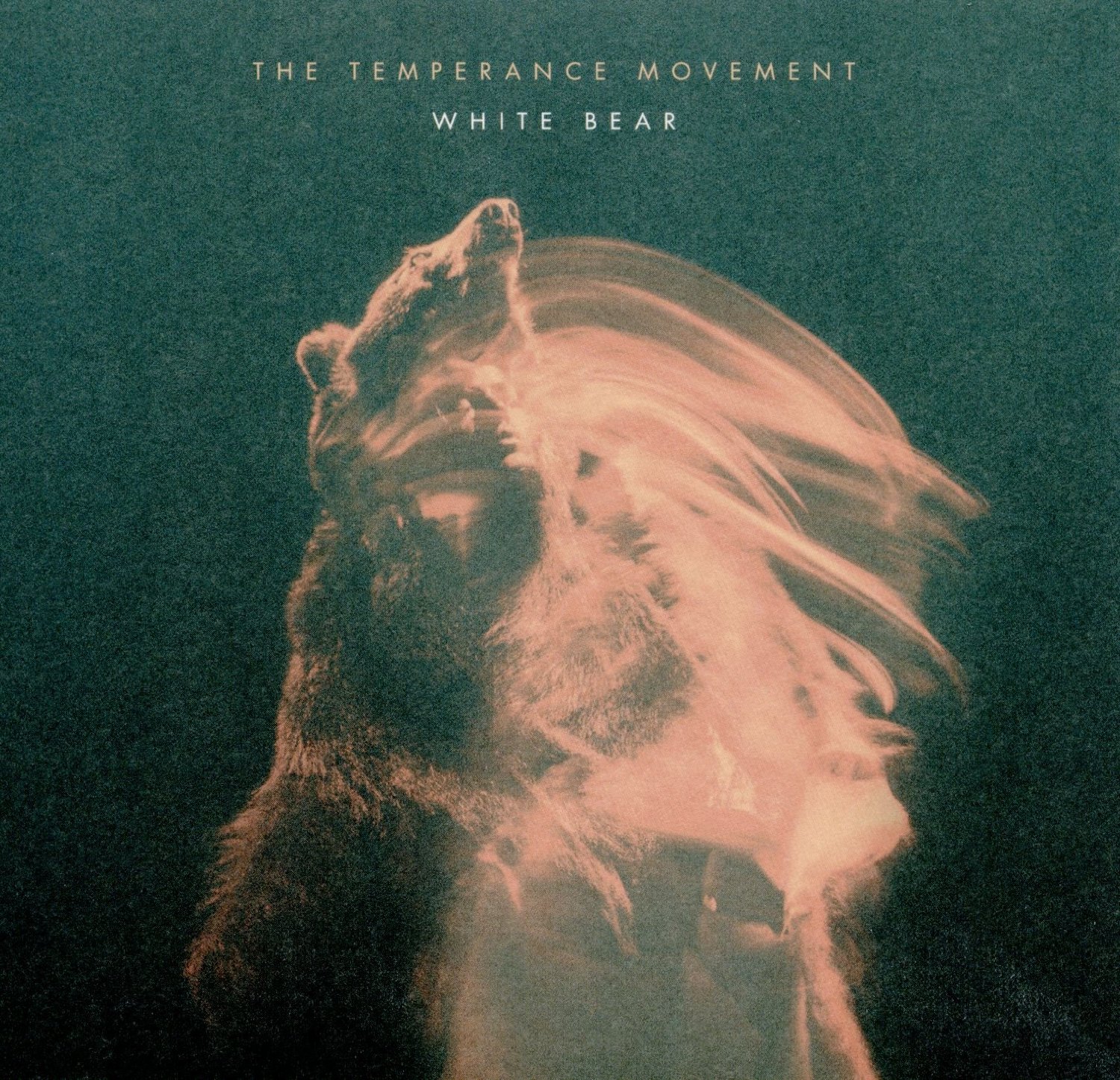
Just over two years later, and The Temperance Movement make a triumphant return with their sophomore album, White Bear. It was released on Earache Records on 15th January 2016. Soon, White Bear was racing up the UK rock charts, and nine days later, reached number one on 24th January 2016. No longer were The Temperance Movement just rising stars of the British music scene. Instead, they were one of the most exciting British bands of recent years. However, a lot of hard work had gone into getting The Temperance Movement to where they were.
It was 2011, that The Temperance Movement story began. That’s when five veterans of the music industry decided to form a band.
By then, Glasgow born lead vocalist Phil Campbell had already released a string of solo albums, including 2008s After The Garden, 2009s Daddy’s Table and 2010s Saviour’s Song. Bassist Nick Fyffe had been in Jamiroquai’s band; while Australian-born drummer Damon Wilson counted Feeder, The Waterboy’s and Ray Davies as former employers. This left just the two guitarists Paul Sayer and Luke Potashnick. Just like other members of The Temperance Movement, Luke was had played in several bands. Among them, were Rooster and Ben’s Brother. These five experienced and talented musicians joined forces to form The Temperance Movement.
Between 2011 and September 2012, The Temperance Movement concentrated on honing their sound. Quickly, they’d established a loyal following. Whether it was pubs, clubs, concert halls or festivals, the word was out. The Temperance Movement were seen as a group with a huge future. Already, some critics were referring to The Temperance Movement as the future of rock ‘n’ roll. Despite the rave reviews, The Temperance Movement weren’t signed to a record label
So when the time came to release their debut E.P, The Temperance Movement released it themselves. The Pride E.P. was released on 10th September 2012 and featured five tracks. Pride, No Lucky, Only Friend, Ain’t No Telling and Lovers and Fighters were an introduction to The Temperance Movement’s kick ass brand of blistering rock ‘n’ roll. Pride was released to critical acclaim, and lead to The Temperance Movement playing at The Sunflower Jam Super Jam at the Royal Albert Hall.
Every year, The Sunflower Jam Super Jam takes place at the Royal Albert Hall. This charity concert raises funds for The Sunflower Jam, a cancer charity. In September 2012, just a week after the release of the Pride E.P, The Temperance Movement were the opening act at the Super Jam. They played the first two tracks from the Pride E.P. The Temperance Movement were going places.
Two months later, in November 2012, The Temperance Movement were asked to play at Futurerock in the 100 Club, in Oxford Street, London. This was another prestigious venue, where the great and good of rock ’n’ roll had once played. Usually later in the career. The Temperance Movement it seemed were overachievers, playing such a prestigious venue early in their career. 2012 had been a good year for The Temperance Movement. However, 2013 would be even better.
During 2013, The Temperance Movement didn’t stop working. In April and May, they headed out on a gruelling British tour. Then during the summer, they became festival favourites. It was just as well that in between, tours and festivals, The Temperance Movement managed to find time to record their eponymous debut album.
The Temperance Movement was released to widespread critical acclaim on 16th September 2013. Soon, it began to climb the UK charts, and eventually reached number twelve. For a band that had only been formed two years previously, this was an incredible feat. Despite this, The Temperance Movement weren’t going to rest on their laurels.
They continued to tour during the first few months of 2014. Then on 10th June 2014, The Temperance Movement found themselves at the Waldbühne in Berlin. They were due to warm up for one of the biggest names in music, the Rolling Stones. This was almost ironic, as The Temperance Movement had the same swagger and attitude as the Rolling Stones once had. Maybe that’s why six days later The Temperance Movement were reunited with the Rolling Stones.
This time, it was in Vienna, at the Vienna Ernst Happel Stadion. On 16th June 2014 The Temperance Movement took to the stage. Soon their swaggering brand of good time rock ’n’ roll was winning over the audience. Wherever they went on what seemed like a never-ending tour, The Temperance Movement won new friends and influenced people. However, there were still people who hadn’t The Temperance Movement. They had a cunning plan.
So on 6th October 2014, The Temperance Movement was reissued as a double album. The second disc featured five live tracks from a concert in Portsmouth, England. They were chosen by the band, and allowed those that hadn’t yet heard the band live, to hear what they were missing. This should keep The Temperance Movement’s fans happy until they recorded their sophomore album. That was still to come.
2015 started well for The Temperance Movement. In January, came the announcement on Planet Rock Radio that The Temperance Movement were due to feature at the prestigious Planet Rockstock in Marrakech. This wasn’t until June.
By then, The Temperance Movement were continuing what was a gruelling live schedule. They seemed to live on the road. However, this would eventually take its toll on a band member.
In September 2015, The Temperance Movement made an announcement just prior to their appearance at the Ullapool Festival. Founding member and guitarist Luke Potashnick had left the band. “Luke has being playing and touring internationally for many years, but he has always preferred the studio to the stage. As long as TTM have been together, Luke has quietly enjoyed a writer/producer career of his own which he now wishes to fully dedicate himself to.” For many, this came as a shock.
Those that had followed The Temperance Movement’s career, were aware that Luke Potashnick wanted to forge a career as a songwriter and producer. This wasn’t possible when he was part of a band who spent large parts of the year touring. Something had to change. So Luke Potashnick left The Temperance Movement.
Replacing Luke Potashnick for The Temperance Movement’s gig at the Ullapool Festival was guitarist Jacob Hildebrand. At the time, it was unclear whether he was a just a temporary or permanent member of The Temperance Movement?
It turned out, that Jacob Hildebrand had only a walk-on part in The Temperance Movement story. Matt White was brought onboard and became The Temperance Movement’s new guitarist. He would feature on White Bear, The Temperance Movement’s sophomore album.
For White Bear producer Sam Miller was drafted in. He worked with The Temperance Movement in three studios in London, Northamptonshire and Monmouthshire. The Temperance Movement had written eleven songs. These songs marked the debut of The Temperance Movement’s latest lineup.
Joining Phil Campbell, the voice of The Temperance Movementm was the rhythm section of bassist Nick Fyffe, drummer and guitarists Paul Sayer. They were augmented by the band’s newest recruit Matt White. Quickly, the shops took shape, and by the end of 2015, The Temperance Movement were ready to unleash the White Bear.
On the 15th January 2016, The Temperance Movement’s sophomore album White Bear was released to overwhelming critical acclaim. Soon, it racing up the UK rock charts, and reached number one on 24th January 2016. The Temperance Movement “the future of rock ’n’ roll” were back.
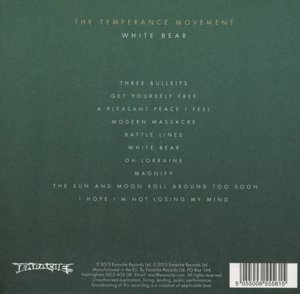
Three Bulleits opens White Bear. The song takes its title from a brand of bourbon, which apparently is a favourite of some members of The Temperance Movement. Guitars shriek, drums pound and the bass bounds. Together, they provide a backdrop for Phil’s lived-in, and bourbon honed vocal. Behind, him searing, machine gun guitars and a buzzing bass combine. By then, The Temperance Movement are heading into anthem territory. Crucial to this anthem are sing song harmonies, reminiscent of The Faces. They’re augmented by screaming and blistering blues guitars. There’s even nod to the Rolling Stones and Led Zeppelin on this anthemic, swaggering start to White Bear. Time for Three Bulleits I think?
From the opening bars, Get Yourself Free has good time rock ’n’ roll written all over. A chiming, chirping guitar guitar sits above the rhythm section. They lock into a tight groove, the bass buzzing, drums rumbling and guitar chiming. Phil’s vocal is soulful and impassioned, before The Temperance Movement kick loose at forty-five seconds. By then, Phil’s vocal is a mixture of raw power and passion, while the rest of the band draw inspiration from The Black Crowes, The Faces and Led Zeppelin. Meanwhile the twin guitar sear, scream and soar above the arrangement. It’s driven along by the powerhouse of a rhythm section. Adding the finishing touch are the harmonies. They’re the perfect foil to Phil’s pleas “Get Yourself Free” on what’s a fist-pumping rocky opus.
Just the bass and crystalline guitar combine on A Pleasant Peace I Feel. Soon, they’re joined drums and braying saxophone. They set the scene for Phil’s needy vocal, on what’s an underrated arrangement. At any moment, it could explode, and The Temperance Movement rock out. It takes to 1.43 and the scorching guitars join the powerhouse of a rhythm section. The drums pay homage to Keith Moon, while Phil’s vocal has a classic rock influence. Then when the chorus kicks in, euphoric and exhilarating describes this joyous, hook-laden rocky anthem. Soon, it’s heading towards a glorious rocky crescendo. By then, it’s obvious that A Pleasant Peace I Feel is sure to be a festival favourite during 2016.
Bursts of machine gun guitar and pounding drums combine on Modern Massacre, and create a backdrop for Phil’s gravelly vocal. He sounds as if he’s survived on the traditional rock ’n’ roll diet of whisky, beer and Marlboro. If he has, this has served him well. His vocal is tailor made for the song. The rest of band unleash one of their heaviest songs. Phil struts and swaggers his way through the lyrics. Meanwhile drums pound relentlessly, guitars scream as The Temperance Movement cut loose, before reaching a dramatic, rocky crescendo.
A lone guitar is panned right on Battle Lines, while Phil’s vocal is panned left. Dramatic drums and a hesitant buzzing bass take centre-stage. That’s until The Temperance Movement kick loose. When they do, they sound like an early seventies classic rock group. It seems real rock is alive and kicking. Especially with scorching, blistering guitars and the pounding rhythm section locking horns. Later, the sing song harmonies and guitars laden with effects are added to what’s a musical masterclass from The Temperance Movement.
Phil howls a warning, as The Temperance Movement unleash the White Bear. Its arrangement is a wall of sound. This comes courtesy of the searing guitars and stomping rhythm section. Then the arrangement becomes understated, allowing Phil to deliver a tender vocal. Soon, though, The Temperance Movement up the tempo and the wall of sound reappears. Phil’s vocal is a mixture of power and passion. Later, as the tempo drops, country-tinged guitars accompany Phil as the arrangement becomes melodic and wistful. That’s until the powerhouse of the arrangement returns. Guitars scream, threaten to feedback, while cooing harmonies and the thunderous rhythm section accompany Phil’s heartfelt, impassioned vocal. Emotion and power combine, before the arrangement dissipates, as if The Temperance Movement are spent. No wonder after four minutes of musical magic.
Oh Lorraine was released as the lead single from White Bear. It’s the perfect choice for a single. It’s a hook-laden anthem. Driven along by the twin guitars and rhythm section, harmonies accompany Phil’s rocky vocal. When his vocal drops out, the rest of the band take centre-stage, and showcase their considerable talents, combining rock and boogie on this irresistible, hook-laden single.
Stylistically, the introduction to Magnify is quite different from previous tracks. There’s a more experimental sound with crystalline guitars, a moody rumbling bass and futuristic effects combining. This is what frames Phil’s heartfelt, hopeful vocal as he sings: “you take your time and I’ll be there.” Soon, though, The Temperance Movement have kicked loose, and are showcasing their good time rock ’n’ roll sound. The Faces, Rolling Stones, Black Crowes and Primal Scream seem to have influenced The Temperance Movement as they strut their way through what’s become a delicious slice of good time rock ’n’ roll.
As The Sun And Moon Roll Around Too Soon begins to unfold, there’s more than a nod to Led Zeppelin. That’s the case from the stripped down introduction, where guitars accompany Phil’s vocal. Then when The Temperance Movement revisit their trademark hard rocking sound, they pay homage to Jimmy Page and Co. From there, The Temperance Movement strut their way through the arrangement where crunchy guitars and mesmeric rhythm section combine with harmonies. They play a part in this hook heavy track. It features The Temperance Movement at their very best, and is sure to be another crowd pleaser.
Closing White Bear, is the ballad I Hope I’m Not Losing My Mind. A guitar rings out, before drums play slowly and deliberately. They’re the perfect backdrop for Phil’s soul-baring vocal. It’s akin to to a confessional as he sings: “I Hope I’m Not Losing My Mind.” Accompanied by harmonies, a beautiful, poignant balls unfolds, where country, soul and rock combine seamlessly, and shows another side to Temperance Movement. It seems they’ve kept the best until last. That’s saying something, given the quality of music on White Bear.
From the opening bars of Three Bulleits, right through to the closing notes of I Hope I’m Not Losing My Mind, White Bear is a near flawless album. It seems that The Temperance Movement haven’t suffered from second album syndrome. Far from it.
White Bear oozes quality. With its rocky anthems and the soulful ballad I Hope I’m Not Losing My Mind, it’s the perfect followup to The Temperance Movement.
It was never going to be easy to followup an album as good The Temperance Movement, but Phil Campbell and Co. have managed to do so with apparent ease. The band wrote the ten tracks on White Bear, and recorded them in three takes or less. That’s no bad thing.
Nowadays, many albums are too polished. Rock albums should be a bit rough around the edges. Look at some of the greatest albums in the history of rock. They were recorded quickly, with a degree of spontaneity. That’s what The Temperance Movement set out to do, and achieved on White Bear, which was recently released by Earache Records.
It’s no exaggeration to say that White Bear features The Temperance Movement at the peak of their powers. They literally strut and swagger their way through White Bear, creating music that’s anthemic, hook-laden, melodic and nine times out of ten, always rocky and memorable. The Temperance Movement don’t ration hooks, as they follow in the footsteps of The Faces, Led Zeppelin, Rolling Stones and Black Crowes on what’s a career changing album, White Bear.
White Bear reached number one on the UK rock charts. It seems that The Temperance Movement are the real, deal and the future of rock ’n’ roll. The Temperance Movement’s sophomore album White Bear showcases an old fashioned rock ’n’ roll band at their swaggering best. Seamlessly, The Temperance Movement fused blistering, old-school rock ‘n’ roll with blues and country on White Bear. This is a heady and potent brew from a truly versatile group, The Temperance Movement.
THE TEMPERANCE MOVEMENT-WHITE BEAR.
THE VELVET UNDERGROUND-LIVE AT MAX’S KANSAS CITY-VINYL EDITION.
THE VELVET UNDERGROUND-LIVE AT MAX’S KANSAS CITY-VINYL EDITION.
1970 should’ve been the start of a new era for The Velvet Underground. They had just signed a two album deal with Atlantic Records in late 1969. This should’ve been the dawn of a new era for The Velvet Underground, where they belatedly made a commercial breakthrough.
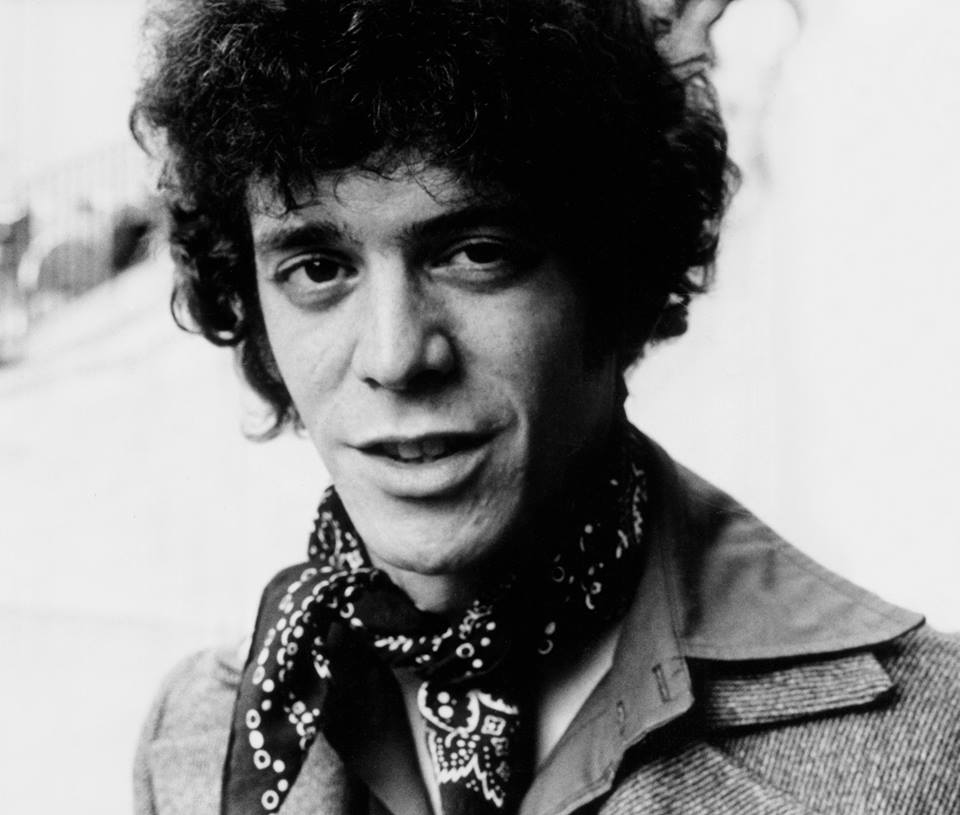
Instead, 1970 was The Velvet Underground’s annus horribilis. They released their fourth studio album Loaded, on 15th November 1970. By then, Lou Reed had left the group he had cofounded.
This presented a problem for The Velvet Underground. They were due to tour North America, promoting Loaded. So bassist Doug Yule switched to bass and took charge of lead vocals. To play bass, Walter Power was drafted in. This new lineup of The Velvet Underground spent part of 1971 touring North America. During the tour, the members of The Velvet Underground wrote some new songs for the album they owed Atlantic Records.
When The Velvet Underground returned home, they headed to Atlantic Records’ headquarters, where they showcased their new songs. These songs, they hoped, would feature on their fifth album. However, The Velvet Underground without Lou Reed was a totally different band to the one Atlantic Records had signed in 1969. They were like a rudderless ship heading perilously close to the rocks.
Executives at Atlantic Records realised this. They also realised that the new songs weren’t good enough, so rejected them out of hand. For the members of The Velvet Underground this was a crushing blow. To make matters worse, The Velvet Underground still owed Atlantic Records an album. Atlantic Records had a solution though.
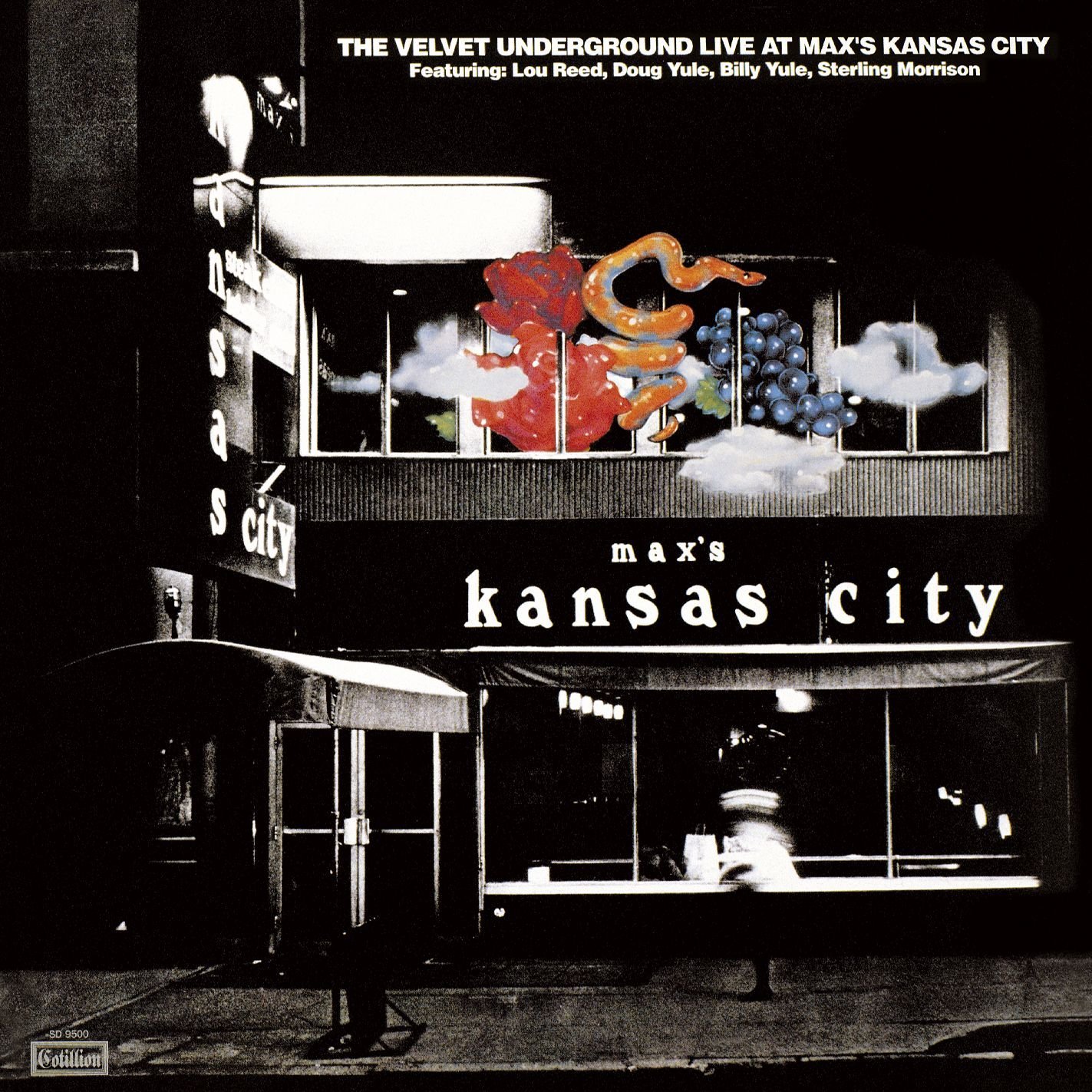
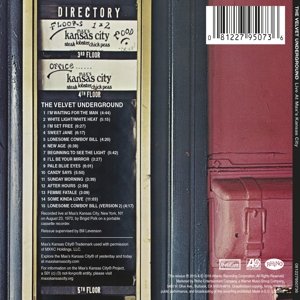
They looked through the Atlantic Records’ archives, and decided to release an album of live material. This became Live at Max’s Kansas City, which was released on May 30th 1972. It became The Velvet Underground’s first live album, which was reissued on vinyl by Rhino on 22nd January 2016. Live at Max’s Kansas City also fulfilled The Velvet Underground’s contractual obligations to Atlantic Records, and marked the end of an era. Things had been so different in 1969. It was the start of a bright new dawn.
For The Velvet Underground, 1969 had been a turbulent year. They had released their third album The Velvet Underground in March 1969. It featured the debut of Doug Yule, who was brought in to replace John Cale. This was meant to the start of a bright new future for The Velvet Underground.
After two albums which had failed commercially, Lou Reed decided that The Velvet Underground had to change tack. They had to release music that was much more pop oriented, and therefore, commercial. John Cale however, didn’t agree with how Lou Reed’s master-plan.
This had been a bone of contention between the pair for some time. John Cale wanted The Velvet Underground to continue to innovate, and create experimental music like White Light/White Heat, The Velvet Underground’s sophomore album. Lou Reed didn’t agree.
Lou Reed believed that The Velvet Underground’s music should become more pop oriented. This he felt, would broaden their appeal. No longer would they be an art rock group whose music appealed to discerning music lovers. Eventually, Lou Reed won over the rest of The Velvet Underground. For John Cale this was hugely disappointing. So, he decided the only option was to leave The Velvet Underground.
The Velvet Underground.
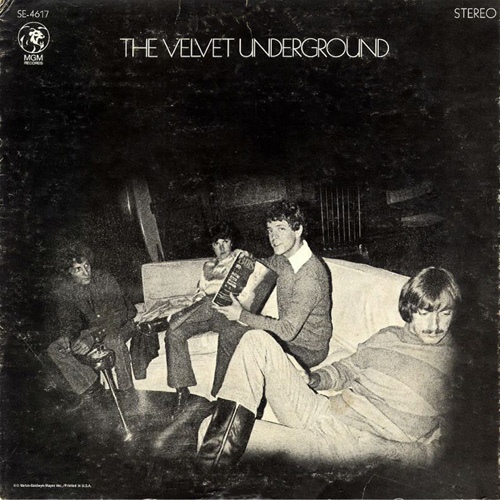
Following the departure of John Cale, The Velvet Underground began looking for a replacement. Eventually, Doug Yule was chosen as John Cale’s replacement. He made his Velvet Underground eponymous third album in November 1968, at TTG Studios, Hollywood. The Velvet Underground recorded ten songs penned by Lou Reed. By December 1968, The Velvet Underground was completed it was released in March 1969.
Before that, critics had their say on The Velvet Underground. The majority of the critics were won over by The Velvet Underground’s new sound. Some critics went as far as to say that the album was The Velvet Underground’s finest hour. They were impressed The Velvet Underground’s much more accessible sound. The Velvet Underground were congratulated on the quality of songwriting, and the delivery of the lyrics. However, there was a but.
Some critics felt that The Murder Mystery was an experiment that hadn’t worked. Others ant further, lamenting that The Murder Mystery fell short of the quality of White Light/White Heat. Other critics remarked that The Velvet Underground lacked the eclectic sound of its predecessors. Even the quality of recording was criticised. Mostly though, critics thought that The Velvet Underground were on the right road. However, as usual, record buyers had the casting vote.
When The Velvet Underground was released in March 1969, the album crept into the US Billboard 200, reaching just 197. This was a disaster for The Velvet Underground. Lou Reed’s decision to embrace a more commercial sound had backfired.
Following the release of The Velvet Underground, the band headed out on tour. They spent much of 1969 touring America and Canada. Night after night, they reworked tracks from their first three albums. The audience watched as a tight band fought for their very future. Some nights, The Velvet Underground debuted new songs.
New Age, Rock and Roll and Sweet Jane found their way onto the set list. This trio of songs found their way onto Loaded, which was released in 1970. Throughout the tour, The Velvet Underground showcased these new songs on what was a lengthy tour.
As The Velvet Underground’s seemingly never ending tour continued, they continued to hone their sound. They were a very different band to just a few years previously when they were Warholian disciples. That was the past. Now The Velvet Underground were willing to forsake what many thought was their true sound, for commercial success. That proved ironic.
After three albums that had failed commercially, MGM were starting to loose patience with The Velvet Underground. It didn’t help that MGM had been haemorrhaging money for a couple of years. They had too many loss making acts on their roster. Something had to give.
During the night of the long knives, executives at MGM decided to cancel the contracts of eighteen loss making acts. This included The Velvet Underground. They were invited to the headquarters of MGM, and told that their contract had been cancelled. However, was the decision to cut The Velvet Underground loose purely a business decision?
Since then, there has been speculation that The Velvet Underground were dropped just because they were losing MGM money. Maybe, it was more to do with The Velvet Underground’s image being at odds with MGM’s corporate image? That proved to be the case. In 1970, an executive of MGM said: “it wasn’t eighteen groups, Mike Curb was misquoted. The cuts were made partly to do with the drug scene—like maybe a third of them had to do with drug reasons. The others were dropped because they weren’t selling.” It seemed that MGM’s mattered more than selling records. MGM it seemed, only wanted artists whose lifestyle they approved of.
Many thought that being dropped by MGM must have been devastating for The Velvet Underground. It seems it was, and it wasn’t. When Lou Reed was interviewed in 1987, he admitted: “we wanted to get out of there.” That may just be bravado. After all, the music industry is a small village, and word would’ve spread like wildfire why The Velvet Underground had been dropped. Some critics however, thought the situation was ironic.
Back in 1968, The Velvet Underground had made what many regarded as the ultimate musical sacrifice. They had changed direction musically on their eponymous third album. No longer were they seen as an art rock band by championed by many critics and cultural commentators. Instead, the move towards a more populist sound was seen as the ultimate betrayal from The Velvet Underground. This resulted in John Cale’s departure from the band. Now that The Velvet Underground had been dropped by MGM, the loss of one of their main creative forces, had been for nothing. Given what had happened, it was the ultimate irony.
Now without a record contract, The Velvet Underground headed back out on tour. Touring was now their main source of income. So they spent much of 1969 on the road. Mostly, it was the tight version of The Velvet Underground that took to the stage. Other times, they revisited their past.
The Velvet Underground decided to reinvent songs, during lengthy improvisations. This mixture of art rock, avant garde and free jazz showed that the old Velvet Underground weren’t dead. Some critics believed it was merely being suppressed in the search for commercial success.
During their gruelling touring schedule, The Velvet Underground made occasional forays into the recording studio. Some of the songs The Velvet Underground recorded, were seen as having potential. However, they couldn’t be released, as The Velvet Underground were in dispute with MGM. With no recording contract, and locked in what could prove a biter, lengthy and expensive dispute with MGM, things looked bleak for The Velvet Underground.
By November 1969, The Velvet Underground arrived in San Francisco, and were due to play at The Matrix and The Family Dog. These shows were recorded, and were meant to be released as live albums. However, that didn’t happen until the next millennia.
The Bootleg Series Volume 1: The Quine Tapes were released in 2001, and The Complete Matrix Tapes box set was released in 2015. 1969 was fast proving to by The Velvet Underground’s Annus horriblis. Surely, things would improve as when the new decade dawned.
That proved to be the case. 1970 saw The Velvet Underground’s luck improve. They were signed by Atlantic Records, and told to record an album: “loaded with hits.” This would be a first.
Loaded.
Commercial success had eluded The Velvet Underground. Three albums into their career, and they hadn’t enjoyed a hit single. The nearest they came to commercial success was when their 1967 debut album, The Velvet Underground and Nico reached 129 in the US Billboard 200. It was all downhill from there. In 1968, White Light/White Heat struggled into the US Billboard 200 at 199. Then when The Velvet Underground was released in 1969, it stalled at 197 in the US Billboard 200. The Velvet Underground were faced with a mammoth task to produce an album: “loaded with hits.”
With these words ringing in his ears, Lou Reed went away and wrote the ten tracks that became Loaded. Then recording began at Atlantic Recording Studios, New York with Geoff Haslam, Shel Kagan and The Velvet Underground producing Loaded. However, one member of The Velvet Underground was missing.
Maureen Tucker missed the Loaded recording sessions. They took place between April and August 1970. Her only contribution was singing on the outtake I’m Sticking With You, and adding drums on a demo of I Found a Reason. Loaded was the first Velvet Underground album Maureen Tucker was missing from.
Various musicians replaced Maureen Tucker on Loaded. Engineer Adrian Barber, who played on Who Loves the Sun and Sweet Jane. Tommy Castagnaro then played drums on Cool It Down” and Head Held High. Billy Yule, Doug Yule’s brother deputised on drums on Lonesome Cowboy Bill and Oh! Sweet Nuthin.’ Even bassist Doug Yule played drums.
Although hired as a bassist, Doug Yule played fuzz bass, piano, keyboards, lead guitar, percussion and added backing vocals. He added the lead vocals on Who Loves the Sun, New Age, Lonesome Cowboy Bill and Oh! Sweet Nuthin’. Sterling Morrison played lead and rhythm guitar. Lou Reed, who was now The Velvet Underground’s main creative and driving force, played lead and rhythm guitar, plus the piano. This depleted version of The Velvet Underground, plus a few friends eventually, finished recording of Loaded in August 1968. The release was scheduled for 15th November 1970. A lot would happen before then.
With Loaded completed, usually, The Velvet Underground would’ve been readying themselves for the usual round of promotion that takes place before an album is released. Not this time.
Lou Reed called time on his career with The Velvet Underground on 23rd August 1970. This left The Velvet Underground like a rudderless ship.
With The Velvet Underground having lost their leader and creative force, others took charge of final mix of the album. That was fatal. Lou Reed should’ve handed Atlantic Records the final mix, and then left.
When Lou Reed saw and heard a copy of Loaded, he was in for a shock. The claimed that Loaded had been re-sequenced. This hadn’t been authorised. That was bad enough. No longer would Loaded flow as it was meant to. Much worse, was that some of Lou Reed alleged that some of the songs on Loaded had been edited.
Lou Reed railed against the edited version of Mary Jane. So badly edited was the song, that it was bereft of its very melody. A heartbroken Lou Reed described the melody as: “heavenly wine and roses.” Sadly, it was gone. New Age was another song that had fallen victim to the razor blade in the editing suite. However, one of the remaining members of The Velvet Underground disputed Lou Reed’s claims.
It was newcomer Doug Yule who spoke out. Despite being a relative newcomer to the band, he disputed what Lou Reed said. Doug Yule claimed that it was Lou Reed who edited Mary Jane, before he left The Velvet Underground. This essence of his explanation was that Lou Reed edited the song so that it would be a hit. However, it was claim and counter-claim. If Lou Reed edited the song, why did he edit the “heavenly wine and roses” of the melody from the song? The editing was just one of several grievances Lou Reed had.
The ten songs on Loaded came from the pen of Lou Reed. However, when Lou Reed received his copy of Loaded, he discovered that the songs were credited to The Velvet Underground. What made this worse, was that Lou Reed was third in the credits. He felt he wasn’t receiving the credit he deserved. Rubbing salt into the wound was a large photograph of Doug Yule playing the piano. The Velvet Underground’s creative force was overshadowed by the newcomer. Was this a deliberate slight seen Lou Reed had left The Velvet Underground?
As Lou Reed studied Loaded album’s cover, he discovered that Maureen Tucker was credited as the drummer. She hadn’t played on Loaded, as she was pregnant. It was the only Velvet Underground she didn’t play on. Ironically, many critics felt Loaded was one The Velvet Underground’s finest albums. However, even another member of the band didn’t agree with this.
Sterling Morrison had been ever-present on the four albums The Velvet Underground had released. This made him well qualified to critique the album. He had mixed feelings on the absence of Maureen Tucker and Doug Yule’s increased influence on Loaded. Without Maureen Tucker: “it’s still called a Velvet Underground record. But what it really is is something else.” Then when asked about Doug Yule playing a bigger part on Loaded he said: ”the album came out okay, as far as production it’s the best, but it would have been better if it had real good Lou vocals on all the tracks.” It seems the newcomer hadn’t convinced The Velvet Underground guitarist. What did the critics think?
Most critics were won over by Loaded. It followed in the footsteps of The Velvet Underground, which showcased a much more populist, commercial sound. Among Loaded’s highlights were the hook-laden, Sweet Jane and Rock and Roll. Even without the “heavenly wine and roses” of the melody, Sweet Jane was a timeless classic. Along with Rock and Roll, they became favourites on American FM radio stations. Other tracks that were mentioned in dispatches by critics were the soulful infused I Found a Reason and New Age. However, not everyone was convinced by Loaded.
Rolling Stone magazine wasn’t impressed by Loaded. They were the highest profile critic of Loaded. Ironically, they’ve performed a volte face, and nowadays, Loaded is one Rolling Stone magazine’s 500 best albums of all time. However, Rolling Stone weren’t being contrarian, like some critics.
While Loaded is indeed, a minor classic, it could’ve and would’ve been a better album. Especially, if Lou Reed took charge of all the lead vocals. Sterling Morrison had a point. Lou Reed was The Velvet Underground’s best vocalist. Having written the lyrics, he was able to bring them to life. From Sweet Jane and Rock and Roll, to Cool It Down, Head Held High, I Found A Reason and Train Round The Bend, Lou Reed unleashes a series of vocal masterclasses. Sadly, he only sung six of the ten vocals. That proved to be a a mistake.
In another group, Doug Yule would’ve been a more than adequate replacement. However, he couldn’t quite live the lyrics like Lou Reed. That’s not to say his performance is disappointing on on Who Loves the Sun, New Age, Lonesome Cowboy Bill and “Oh! Sweet Nuthin’. Far from it. Instead, they’re just not as good as The Velvet Underground’s worldweary leader, Lou Reed. Those were big shoes to fill. Even Sterling Morrison agreed.
Similarly, Maureen Turner was missed. While her replacements are more than adequate, it could be argued that there’s no continuity. Each drummer has their own sound and style. Despite that, Loaded came to be regarded as a minor classic. Very few people thought that would be the case in 1970.
When Loaded was released on 15th November 1970, the album failed to chart. It stopped just short, reaching 202 in the US Billboard 200. So near, but yet so far. This was a familiar story for The Velvet Underground.
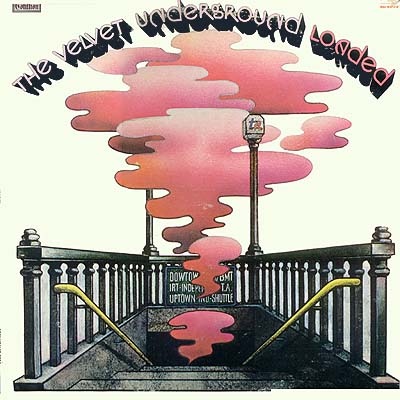
Their fourth album Loaded deserved to fare better. They had sacrificed and suppressed their true sound to deliver an “album loaded with hits.” Loaded had everything going for it. It benefited from a much more commercial sound, and plethora of hooks. This meant that Loaded was The Velvet Underground’s most accessible album. Surely this was what record buyers wanted The Velvet Underground reasoned?
Record buyers had shied away from The Velvet Underground and Nico and White Light/White Heat. Then on The Velvet Underground, which was released in 1969, Lou Reed and Co. moved towards a more populist, accessible sound. This came at the cost of John Cale. Still The Velvet Underground failed commercially, and MGM dropped the Velvets. This proved the ultimate irony.
Just under a year later, and Lou Reed was gone too. This left just Sterling Morrison and the returning Maureen Tucker. That presented a problem for The Velvet Underground. They were due to tour America and Canada promoting Loaded.
It was bassist Doug Yule who came up with a solution. He switched to bass and took charge of lead vocals. To play bass, Walter Power was drafted in. Drummer Maureen Tucker returned, and her place behind her drum kit. While this was a long way from the classic lineup of The Velvet Underground, it meant that the group would be to tour North America.
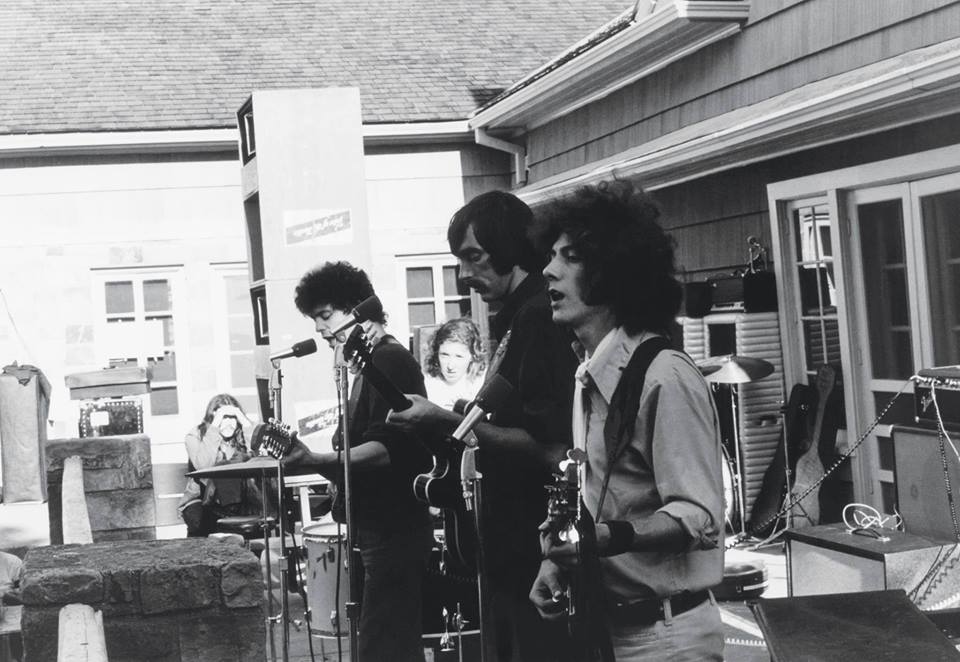
After rehearsing, and Walter Power learning The Velvet Underground’s songs, the band headed out on tour. It was with a degree of trepidation that they took to the stage for the first time. Never before had this lineup played live. Gradually, though, they found their feet, and for part of 1971, this new lineup of The Velvet Underground toured North America.
During the tour, the members of The Velvet Underground began working on their fifth studio album. They were some new songs for the album they owed Atlantic Records. Maybe, it would the album that saw The Velvet Underground make their long-awaited commercial breakthrough?
That wasn’t the case. The Velvet Underground didn’t even come close to getting the opportunity to record another album for Atlantic Records.
Once The Velvet Underground’s North American tour was over, the band returned home. Now they were ready to begin work on their fifth album. So, they made an appointment with executives at Atlantic Records, where The Velvet Underground played some of their new songs. These songs, they hoped, would feature on their fifth album. However, The Velvet Underground without Lou Reed was a totally different band to the one Atlantic Records had signed in 1969.
Executives at Atlantic Records realised this. They also realised that the new songs weren’t good enough, so rejected them out of hand. For the members of The Velvet Underground this was a crushing blow. To make matters worse, The Velvet Underground still owed Atlantic Records an album. Atlantic Records had a solution though.
They looked through the Atlantic Records’ archives, and decided to release an album of live material. This became Live at Max’s Kansas City, which was released by Atlantic Records on May 30th 1972.
Live At Max’s Kansas City.
It’s fitting that The Velvet Underground’s Atlantic Records’ swan-song had been recorded at Max’s Kansas City, in New York. It was one of The Velvet Underground’s favourite venues. So much so, that it was like a second home.
It was in 1965, that Max’s Kansas City first opened its doors. This just the year that The Velvet Underground were born. Since then, Max’s Kansas City had been a favourite hangout for The Velvet Underground. They weren’t alone.
Max’s Kansas City was a hangout for the actors, hipsters, models, scenesters and singers. It was where the beautiful, famous and contrarian came to play. Even Andy Warhol and his Warholian disciples were known to hang out at Max’s Kansas City. So was Rolling Stone Mick Jagger. Even the staff at Max’s Kansas City had designs of fame and fortune.
This included Debbie Harry in her pre-Blondie days. She waited tables, while awaiting her big break. Debbie Harry would witness the recording of The Velvet Underground’s first live album, Live At Max’s Kansas City.
The album may never have happened, if Brigid Polk, a close friend of The Velvet Underground hadn’t decided to tape the show. For some reason, that night, Brigid Polk brought along her tape recorder and pressed play.
She captured the essence of The Velvet Underground live on Live At Max’s Kansas City. It was remastered by Rhino for its recent release. This has improved the sound slightly. Despite that, its still slightly rough around the edges. That can’t be helped. Brigid Polk didn’t have access to top quality recording equipment. Her recording was probably only ever meant for her own, and band’s enjoyment. She didn’t know she was recording history being made, as Live At Max’s Kansas City features Lou Reed’s last performance with The Velvet Underground.
When Lou Reed takes to the stage, he’s part entertainer, part bon viveur. As the band tune their instruments and audience make small talk, Lou Reed takes to the stage. Drolly he says “you’re allowed to dance, in case you don’t know.” Then The Velvet Underground start with a stonewall classic.
That’s the only way to describe I’m Waiting For The Man, from The Velvet Underground and Nico. That grabs the audience’s attention, before The Velvet Underground showcase Sweet Jane and Lonesome Cowboy Bill from what would be Lou Reed’s swan-song Loaded. Then The Velvets go back in time.
Beginning To See The Light was from the 1969 album The Velvet Underground. This was the first Velvet Underground album since the departure of cofounder John Cale. After that, Lou delivers a heartfelt version of I’ll Be Your Mirror, one of the most beautiful songs in The Velvet Underground’s back-catalogue. It’s another song from The Velvet Underground and Nico, which is a classic album. That’s the case with the first four Velvet Underground albums.
That includes their 1969 eponymous album. It featured Pale Blue Eyes, which The Velvet Underground revisit on Live At Max’s Kansas City. It’s akin to a best of live, with Sunday Morning from The Velvet Underground and Nico being next on the setlist. Lou Reed seems to reserve one of his finest vocals. Then he brings things up to date with New Age, which would feature on Loaded. That was the straw that broke the camel’s back. Things had been so different three years earlier.
Back in 1966, when The Velvet Underground and Nico was released, the band’s whole career was stretching out in front of them. Anything was possible. That included releasing one of the greatest and most influential albums in musical history, The Velvet Underground and Nico. One of its highlights was the timeless Femme Fatale. As Lou Reed delivers the lyrics, was he remembering four years ago, when their career was in its infancy? Maybe that’s the case, as he prepares to deliver his final song as The Velvet Underground’s frontman.
The song he chose, was After Hours, from The Velvet Underground. This seems fitting, as its nearly the wee small hours of the morning. As The Velvet Underground prepare to take their leave, on what became Live At Max’s Kansas City, the audience treat The Velvet Underground like conquering heroes. However, it proved to be a pyrrhic victory.
The Velvet Underground had won over the crowd at Max’s Kansas City. However, Lou Reed lost the battle that was Loaded.
The album didn’t turn out as he had planned. Songs he alleged had been edited, and the running order changed. This didn’t please Lou Reed. He felt he had no option but to call time on his career with The Velvet Underground on 23rd August 1970. This left The Velvet Underground like a rudderless ship.
The Velvet Underground had not just lost its creative and driving force, but its de facto leader. Without Lou Reed, The Velvet Underground were but a shadow of their former self. It didn’t take Atlantic Records long to realise that. After hearing a few new songs, executives at Atlantic Records rejected the songs. They weren’t good enough, and The Velvet Underground never recorded another album for Atlantic Records.
This left a problem. The Velvet Underground owed Atlantic Records an album. They solved this by searching the Atlantic Records archives, where they found the tapes to Live at Max’s Kansas City, which was released on May 30th 1972. It became The Velvet Underground’s first live album, which was reissued on vinyl by Rhino on 22nd January 2016. While great care has been taken with the mastering, and the sound quality is as good as can be expected, many people will be loathe to spend the extra on a vinyl copy. After all, the master tapes weren’t the best quality. However, Live at Max’s Kansas City also fulfilled The Velvet Underground’s contractual obligations to Atlantic Records, and marked the end of an era.
Live at Max’s Kansas City was Lou Reed’s swan-song, and essentially, the end of one of the greatest bands in rock history. Without Lou Reed, The Velvet Underground were a pale shadow of the band they had once been.
When The Velvet Underground headed out on their North American tour, to promote Loaded, the end was neigh. Bassist turned guitarist and vocalist Doug Yale was never going to replace Lou Reed as The Velvet Underground’s frontman. It was the end of the road for The Velvet Underground.
While The Velvet Underground struggled on without Lou Reed, they were never the same again. Loaded was the last album The Velvet Underground released. Squeeze which was released in 1972, was a Velvet Underground in name only. The band had long ceased to exist.
Live at Max’s Kansas City was the last time Lou Reed played live with The Velvet Underground. His swan-song was captured by Brigid Polk, a friend of The Velvet Underground. It was lucky she brought along her tape recorder and pressed play.
If she hadn’t, there would be no document of Lou Reed’s Velvet Underground swan-song. It would’ve have passed into the mists of musical history, and most likely, have achieved near mythical status. However, Brigid Polk captured musical history being made on what became Live At Max’s Kansas City. While the sound quality is slightly rough around the edges, the recent remastering has improved the sound quality, and Live At Max’s Kansas City is a fitting celebration of Lou Reed’s Velvet Underground swan-song.
THE VELVET UNDERGROUND-LIVE AT MAX’S KANSAS CITY-VINYL EDITION.


 ]
]
MASTERPIECES OF MODERN SOUL-VINYL EDITION.
MASTERPIECES OF MODERN SOUL-VINYL EDITION.
Over the last few years, there’s been an upsurge in interest in vinyl. In 2014, reached a record high. For the first time in over twenty years, vinyl sales in America surpassed the nine million mark. Things got even better in the first quarter of 2015, with sales increasing by 53%. It seems vinyl is back, and is here to stay.
That’s ironic, as back in the late-eighties, early-nineties, the CD was seen as the future of music. People were selling vinyl collections they had built up over many years. With sellers outnumbering buyers, prices dropped like a stone. Sellers sold their collections at knockdown prices. Shrewd record buyers realised that this was an investment opportunity. Vinyl, they knew, would return.
And so it has. After nearly two decades in the doldrums, vinyl is back. So are turntables. Suddenly, vinyl and turntables are the must have of the hipster and the chattering classes. They talk of pre-amps, cartridges and counterweights. That’s not forgetting Record Store Day and heavyweight vinyl. Vinyl is very definitely back, and now, it’s possible to buy just about any release on vinyl.
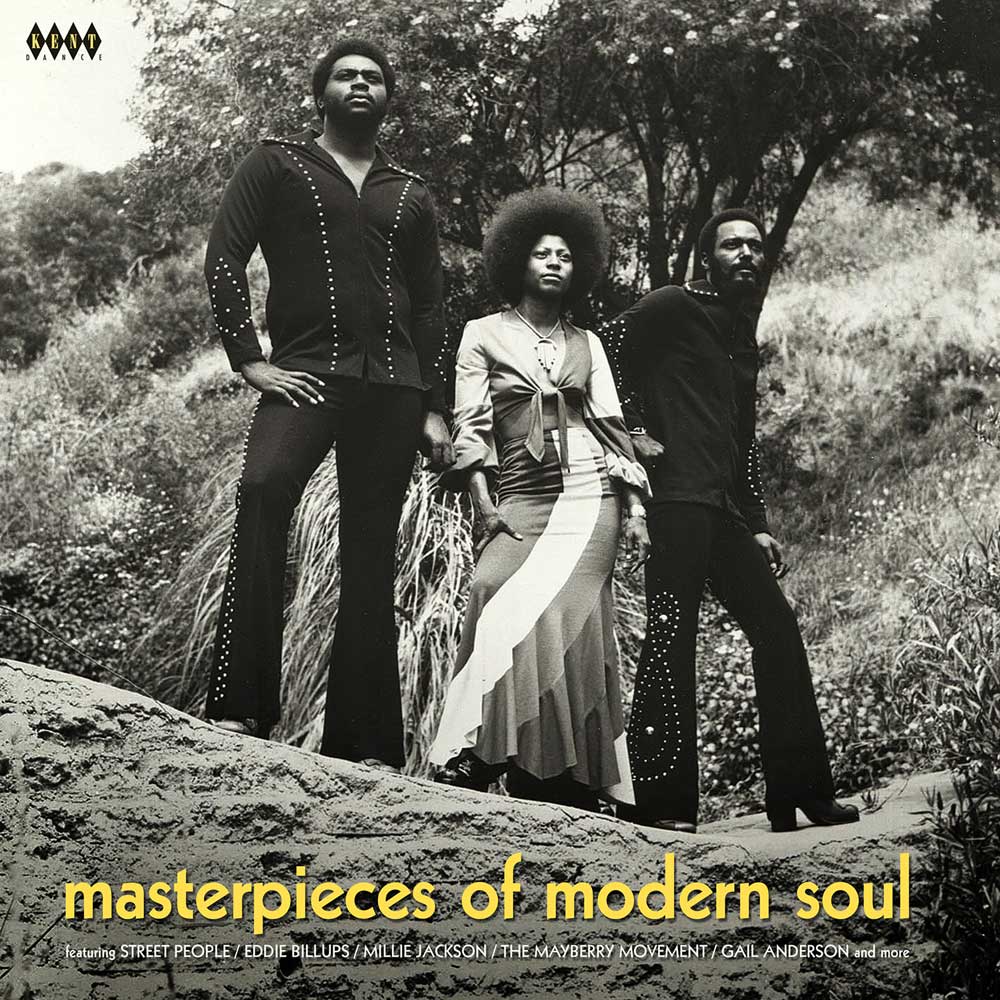
Whether it’s a the latest release, reissues or compilations, there’s most likely a vinyl version available. A recent convert to the vinyl revolution is Kent Soul’s hugely popular Masterpieces Of Modern Soul series.
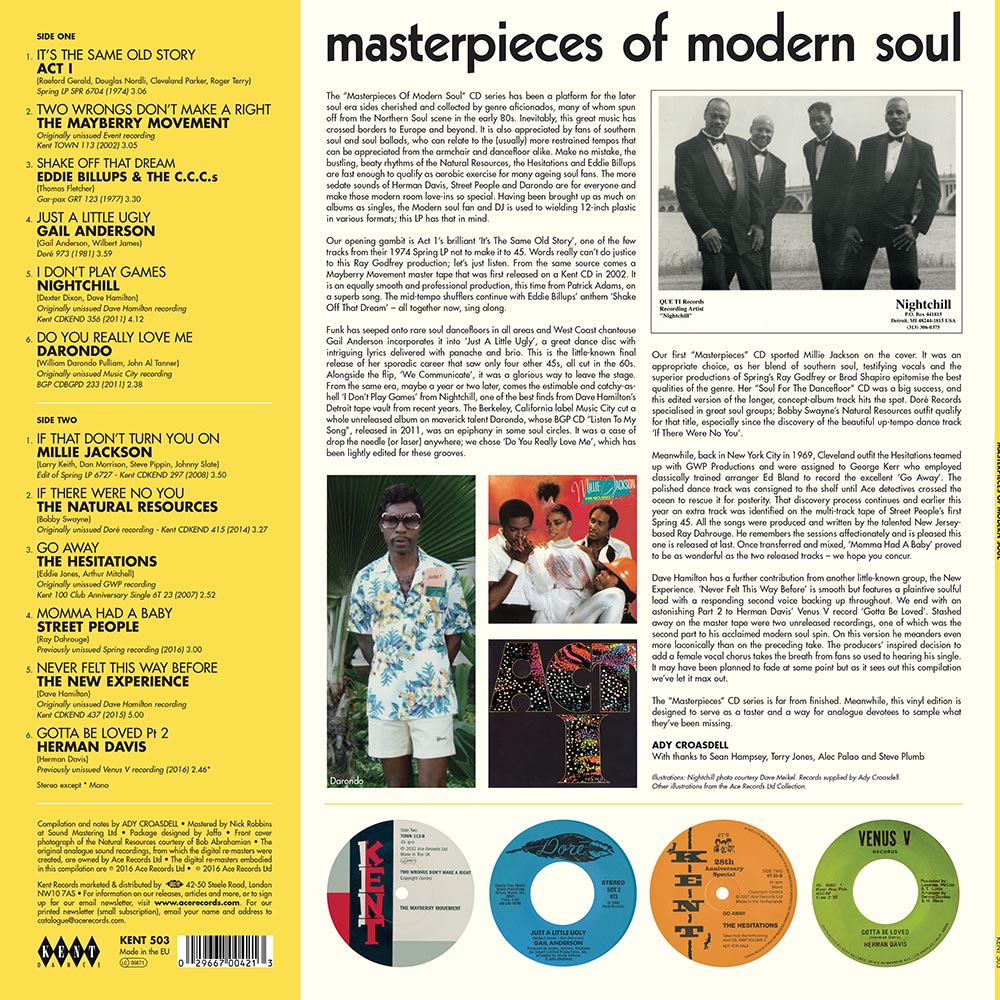
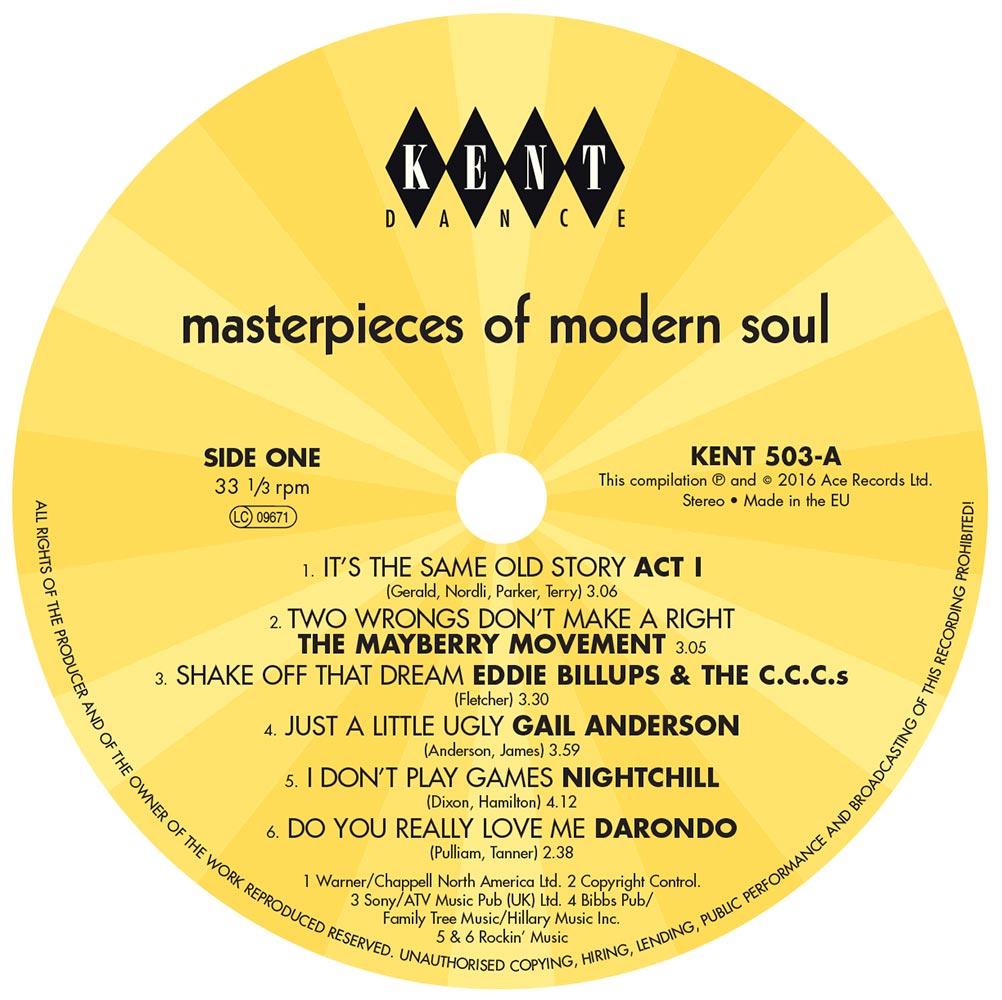
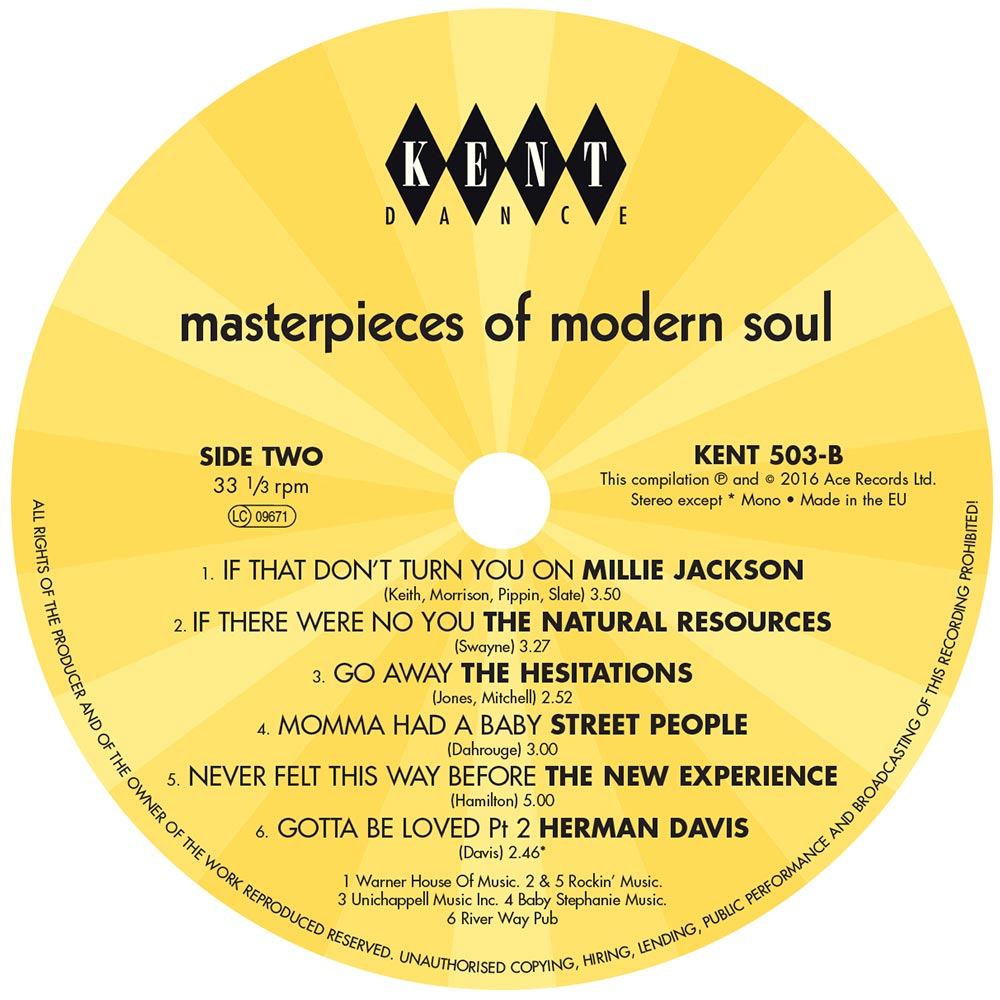
Recently, Kent Soul, an imprint of Ace Records, decided that now was the time, to start releasing Masterpieces Of Modern Soul series onto vinyl. The first instalment in this series is simply entitled Masterpieces Of Modern Soul, and features twelve tracks. This includes Act 1, The Mayberry Movement, Gail Anderson, Nightchill, The Hesitations, Street People and Herman Davis. This as you’ll realise, is a tantalising taste of what’s in-store for soul fans as the Masterpieces Of Modern Soul series converts from CD to vinyl.
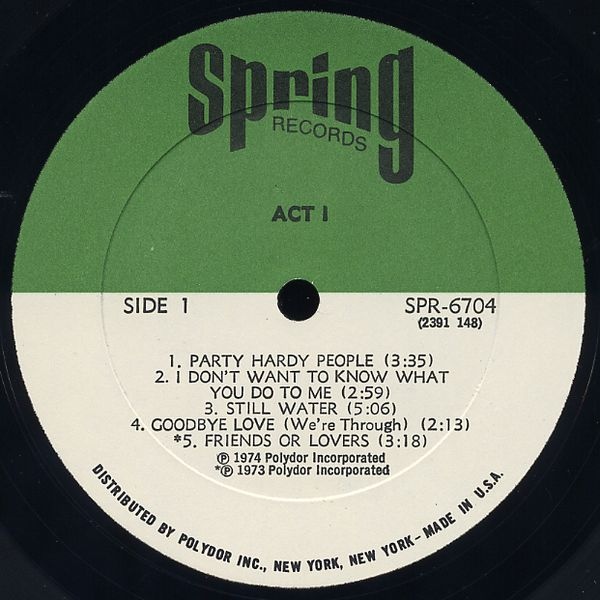
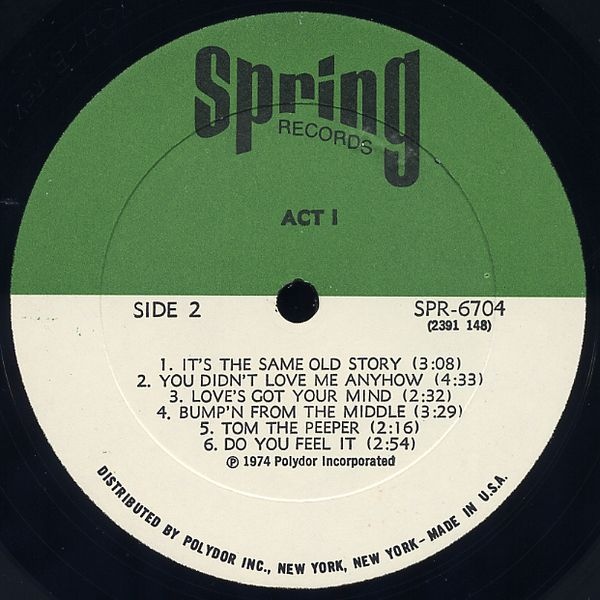
Opening Masterpieces Of Modern Soul is Act I’s It’s The Same Old Story. Act 1 were a Detroit based studio band. They were assembled by producer Raeford Gerald. He produced their two US R&B hit singles Friends Or Lovers and Takes Two Of Us. Then in 1974, Raeford Gerald produced Act 1’s eponymous debut album. It was released on Spring Records, It’s The Same Old Story. Just like the two singles, It’s The Same Old Story is melodic and soulful song from Act 1.
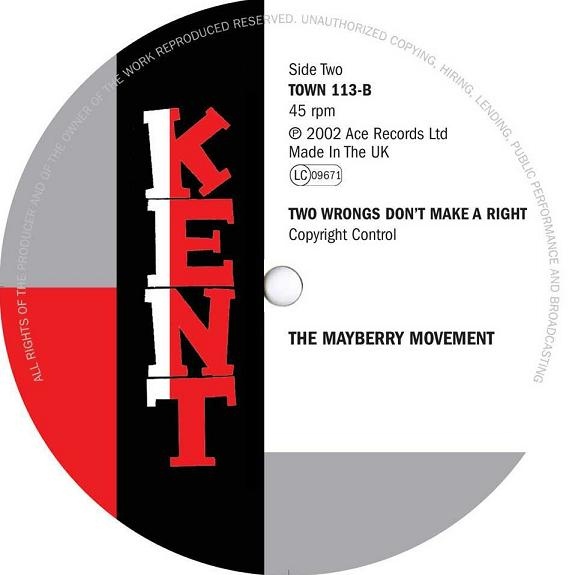
Originally, The Mayberry Movement were signed to the Event label, and released two singles in 1974. Then in 2002, a long forgotten song was discovered by Kent Soul. This was The Mayberry Movement’s Two Wrongs Don’t Make A Right. It found its way onto the B-Side of Millie Jackson’s Kent single Don’t Send Nobody Else. This was a limited edition release, so many people will be unfamiliar with Two Wrongs Don’t Make A Right. Not any more. This delicious, smooth, hook-laden dancer epitomises everything that’s good about Modern Soul.
The same can be said of Eddie Billups and The C.C.C.s Shake Off That Dream. It was released in 1973, on the Seventy 7 label, but failed commercially. That’s despite Shake Off That Dream being a joyous anthem that’s akin to a call to dance. Resistance is impossible. Instead, submit to the charms of Shake Off That Dream and dance like you’ve never danced before.
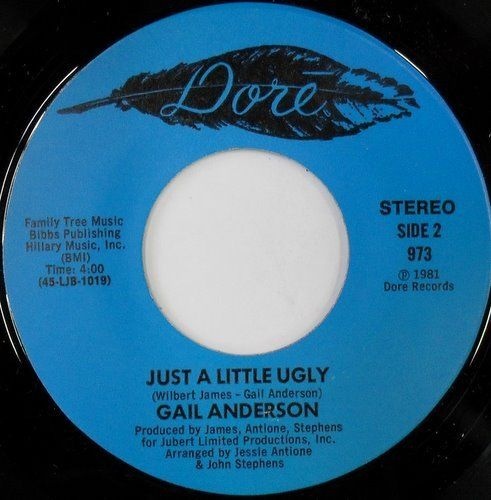
In 1981, Gail Anderson released We Communicate as a single on the Dore label. The single wasn’t a commercial success. However, hidden away on the B-Side was Just A Little Ugly. It was penned by Gail and Wilbert James. He then co-produced the song with Jesse Antoine and John Stephens. They provide a tough, funky backdrop for Gail’s soulful, sassy vocal on this hidden, modern soul gem.
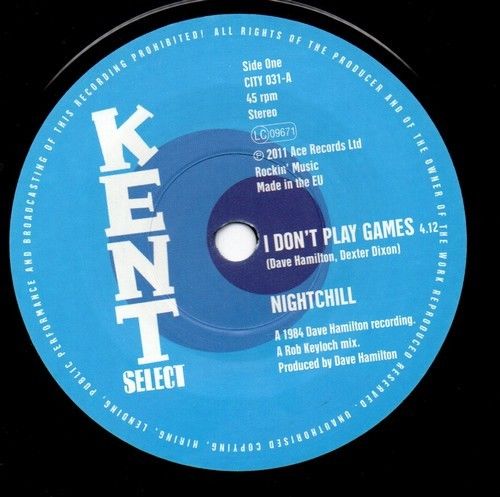
Nightchill’s I Don’t Play Games is a song that many people won’t be familiar with. At first glance, this Dexter Dixon composition sounds like a song from the sixties. It’s not though. There’s a modern soul sound to this Dave Hamilton recording from the eighties.
Darondo released his Listen To My Song: The Music City Sessions album in 2011. It was released by Omnivore Recordings, and then in 2013, by BGP Records in Britain. One of the highlights of the album was Do You Really Love Me, a needy, heartfelt ballad. This is the perfect way to close side one of Masterpieces Of Modern Soul.
A radio friendly edit of Millie Jackson’s If That Don’t Turn You On opens side two of Masterpieces Of Modern Soul. It’s a track from Millie’s 1980 album For Men Only. It was released on Spring Records, and finds Millie Jackson at her sassiest and feistiest. This radio edit of If That Don’t Turn You is a toned down taster of For Men Only.
The Natural Resources recorded If There Were No You in the seventies. It was a Bobby Swayne composition, produced by Lew Bedell. For some reason, this joyful, string drenched, soulful dancer was never released. That was until it found its way onto Kent Soul’s 2014 compilation Doré: L.A. Soul Sides. If There Were No You takes makes a welcome reappearance on Masterpieces Of Modern Soul.
The Hesitations were from Cleveland, Ohio. They first came to the notice of soul fans in 1966, when they released their debut single Soul Superman on Kapp Records. By 1969, The Hesitations were signed to the New York label GWP. That’s where The Hesitations recorded Go Away. However, Go Away wasn’t released until 2007, when it found its way onto the flip side of a Kent Records anniversary special single. At last, this slick, smooth and polished slice of soul found the audience it so richly deserved.
Street People were a soul quintet consisting of Roy Daniels and Milton Daniels, Thomas “Toot” Williams, Joe Gardner and Rick Johnson. They signed to Spring Records in 1974, and released I Wanna Get Over as their debut single. It was written and produced by Ray Dahrouge. Tucked away on the flip side was the irresistible Baby, You Got It All. It’s got everything. A hopeful lead vocal, tight, soulful harmonies and dancing strings. So good is Baby, You Got It All it could’ve been a single.
The New Experience’s Never Felt This Way Before is another Dave Hamilton production from the eighties. However, it was never released until 2011, when it found its way onto the Dave Hamilton’s Detroit Soul compilation. This anguished, impassioned confessional of a vocal makes a very welcome reappearance on Masterpieces Of Modern Soul.
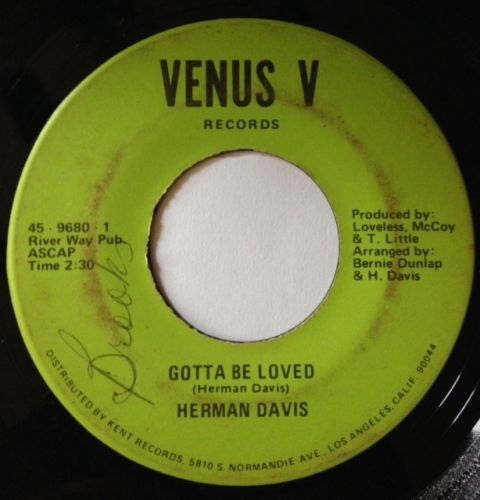
Closing side two of Masterpieces Of Modern Soul, and indeed the compilation, is Herman Davis’ Gotta Be Loved. It was released on the Venus V label in October 1971, and is a real rarity. That’s not surprising, given the quality of this single. Herman Davis delivers a needy, heartfelt and hopeful vocal on this beautiful ballad. It’s a perfect way to close Masterpieces Of Modern Soul, and whet’s the listener’s appetite for the next instalment in the series.
That’s still to come. In the meantime, the vinyl edition of Masterpieces Of Modern Soul will be of interest to anyone that’s joined the vinyl revolution. Whether veterans of vinyl releases or newcomers to the medium, Masterpieces Of Modern Soul is the perfect addition to a burgeoning record collection. It’s a release that oozes quality and sound great.
Featuring twelve tasty slices of modern soul, Masterpieces Of Modern Soul is a mouthwatering proposition for soul fans. It sees familiar faces, rub shoulders with minor classics and hidden gems. Similarly, some of the biggest names in soul sit side-by-side with one hit wonders and contenders. However, they all have one thing in common. They’ve all contributed one of the Masterpieces Of Modern Soul on this latest compilation from Kent Soul.
MASTERPIECES OF MODERN SOUL-VINYL EDITION.
DISCO LOVE VOLUME 4-MORE DISCO AND SOUL UNCOVERED.
DISCO LOVE VOLUME 4-MORE DISCO AND SOUL UNCOVERED.
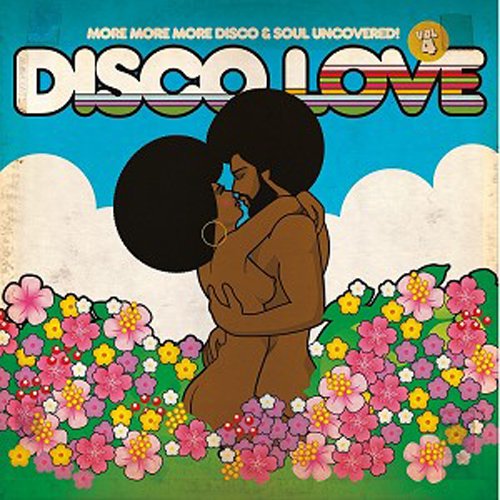
For nearly three years, Al Kent, disco’s international man of mystery has been missing in action. Nobody has heard from the Glasgow-based DJ and remixer. There’s not been as much as a postcard home. That’s not surprising. Al’s not had time. He’s been busy looking for the fifteen tracks that became Disco Love Volume 4-More Disco and Soul Uncovered. which was recently released by BBE Records. It’s the result of three years spent create-digging .
Al Kent is a veteran crate-digger and record collector. He’s been collecting records for longer than he cares to remember, and has takem crate-digging to a new level. Like a crate digging superhero, Al Kent digs where other DJs dare to dig..
His mission in life is to seek out rarities and hidden gems. He’s journeyed to small towns in search of backstreet record shops. Other times, he’s clambered down into dusty basements. Even though the owner passes a striking resemblance to Norman Bates. It could be worth it he keeps telling himself. There could be piles of long-forgotten, unloved music.
That’s what Al keeps telling when he’s searching through damp, dark warehouses crammed full of ageing vinyl. Maybe, just maybe, there will be long-forgotten private press that somehow, has escaped other crate-diggers’ attention. That however, is the life of a veteran record collector and crate-digger.
They’ve many a tale to tell. They can tell stories bagged bargains in thrift stores. Then they remember finding vinyl gold in second hand shops full of commodes and three-legged chairs. These are the crate-digger’s equivalent of war stories. Instead, of Basra and Kabul, they’ve survived trips to back-street record shops, thrift stores and dusty warehouses. During these trips, Al Kent employs his sixth sense for vinyl.
He knows if its in the vicinity, and is soon on the scent. he’s a bit like Scooby Doo with a series case of the munchies. Soon, Al’s off in search of thrift stores, flea markets and second hand shops. There’s always the possibility that some hidden gem may be lurking in the bargain bins? That could be how Al Kent found the fifteen slices of sou or disco that features on Disco Love Volume 4-More Disco and Soul Uncovered? It’s the latest, and as you’ll soon realise, a welcome addition to the Disco Love series.
Opening Disco Love Volume 4-More Disco and Soul Uncovered is an Al Kent edit of Clear featuring Lee Edwards’ single Equal Love Opportunity. This is a real rarity, that was released in 1980 on the Detroit based DT Records. Equal Love Opportunity was written and arranged by Robert Evans, who produced the single with Vera Jenkins. They’re responsible for soulful, sultry and jazz-tinged dance-floor friendly single.
Barbara Jean English wrote If It Feels This Good, which was the B-Side to her single House Of Strangers. It was released on Royal Flush Records in 1976. By then, Barbara’s career was well into its second decade. She had been releasing singles since she signed to Roulette in 1962. Fourteen years later, and Barbara was jumping onboard the disco bandwagon with If It Feels This Good. Arranged by Phil Medley and produced by Buddy Scott, Barbara Jean English is transformed to disco diva on this soulful hidden gem.
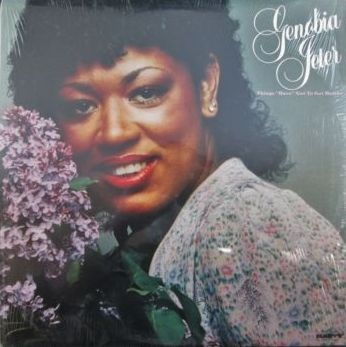
In 1981, Genobia Jeter released her sophomore album Things ‘Have’ Got To Get Better on Savoy Records. It was the second of a trio of gospel albums Genobia Jeter released. Accompanied by backing vocals from gospel group The Modulations, soulful slice of anthem gospel unfolds. It’s a real find from Al Kent, crate-digger extraordinaire.
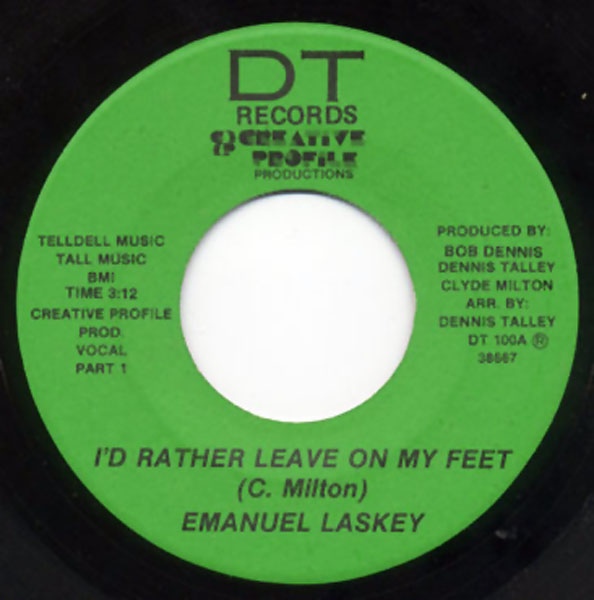
Another release on DT Records was Emanuel Laskey’s I’d Rather Leave On My Feet. It was released in 1980, just after the disco bubble burst. As a result, the soulful delights of I’d Rather Leave On My Feet passed many people by. It was penned by Chris Milton; who co-produced the single with Bob Dennis and Dennis Talley. The version chosen by Al Kent, is the six minute Full Length Disco Version. Soulful, jazz-tinged and dance-floor friendly, it’s also irresistible.
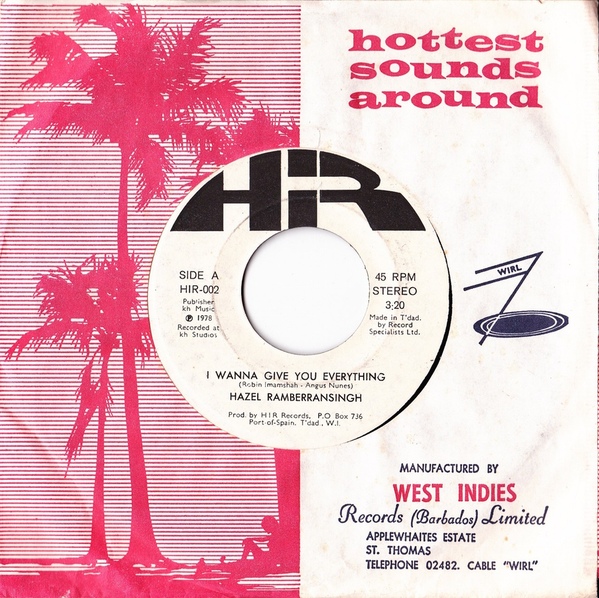
Hazel Rambaransingh will be a new name to even disco diehards and dedicated crate-diggers. She released her one and only single I Want To Give You Everything, in 1978 on the HIR label. It’s a slice of tropical disco which was edited by disco don, Al Kent for Disco Love Volume 4-More Disco and Soul Uncovered.
Always check on B-Side of a single. Every crate-digger knows this. Occasionally, they’ll find a track of the quality of Mary Mundy’s Love Is Gone, which was the flip-side to Mary’s 1983 single Those Were The Days. It was released on Laurie Records in 1983. It’s another track edited by Al Kent. In his hands, this piano driven disco track is extended to four minutes, and is a delicious fusion of disco, funk, gospel and soul.
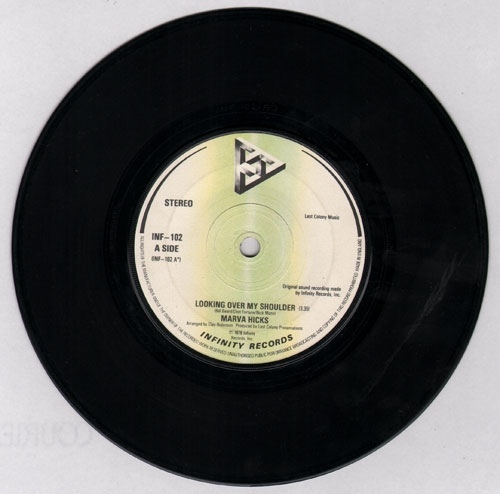
Marva Hicks’ Looking Over My Shoulder was released on Infinity Records in 1978. By then, disco was at the peak of its popularity. Former soul singers were reinventing themselves as disco divas. This included Marva on Looking Over My Shoulder. Her vocal is augmented by stabs of horns and swirling strings as the one-time soul singer is reborn as a disco diva.
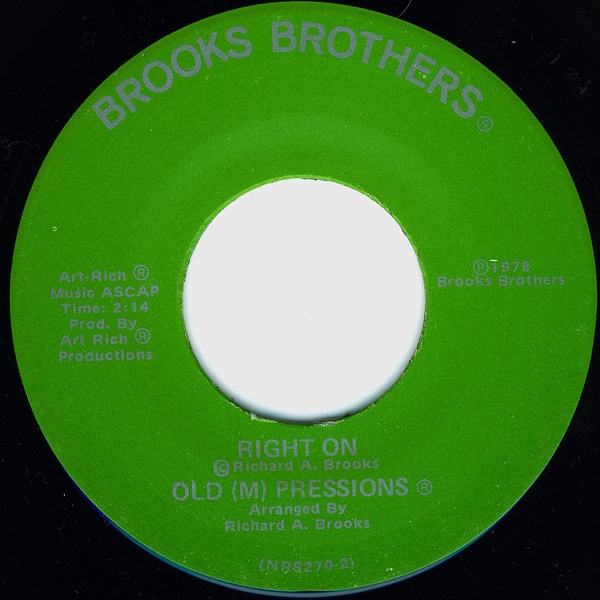
Old (M) Pressions only ever released the one single, Let Me Know. It was released on the Brooks Brothers’ label in 1978, but sunk without trace. Tucked away on the B-Side was Right On, a Richard A. Brookes composition. It was produced by Art-Rich Productions. Their arrangement fuses funk and soul with the merest hint of disco. The final addition to the mix is a raw, impassioned and uncompromising vocal.
When Lee Edwards’ came to record I Found Love, he didn’t head to a studio. Instead, his cousin’s kitchen became a makeshift studio. The pair pushed their aunt’s eclectic organ into the kitchen, and pressed play on the cassette recorder. By 1981, I Found Love was being released as a single on DT Records. Again, it’s written by Robert Evans, who produced the single with Vera Jenkins. Straight away, there’s a hint of boogie, before elements of disco, funk, jazz and soul melt seamlessly into this ghetto disco production.
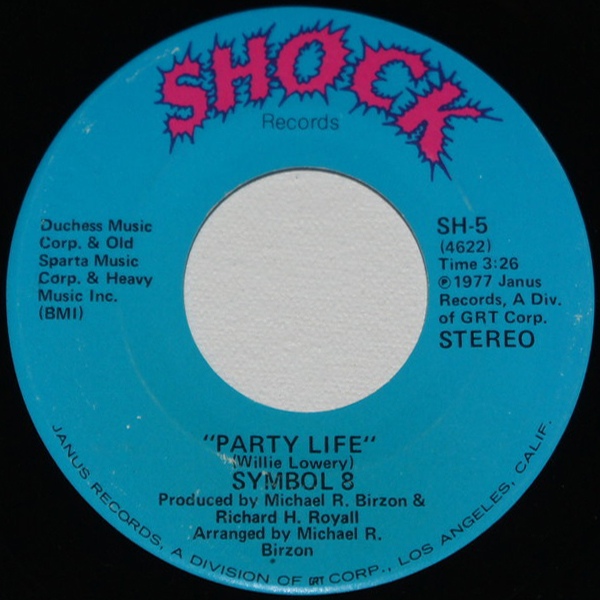
Symbol 8’s Call Me has a similar tough, street sound to the previous track.There’s almost a hint of P-Funk on what was the B-Side to Symbol 8’s single I Thought You Wanted To Dance. It was produced by Michael R. Birzon and Richard H. Royal and released on the Shock label. It’s another example of ghetto disco, and shows how broad a church disco was.
Joe Casey And Fresh Heir only ever released one single. That was I Found A Lady, which was released on GMI Records. Just like the rest of the singles on Disco Love Volume 4-More Disco and Soul Uncovered, it failed commercially. However, Al Kent’s edit of I Found A Lady revives this long lost single. String-drenched, with a hustle influence, it owes a owes a debt of gratitude to the theme to the Love Boat.
Perfect Touch only ever released three singles and an album. Their swan-song was Keep On Loving You, which Al Kent edited. It was written and arranged by Leonard McDonald, and produced by Odell Bailey. Together, they create a soulful slice of post disco.
Betty Everett is without doubt, the biggest names on Disco Love Volume 4-More Disco and Soul Uncovered. Even she jumped onto the disco bandwagon with the Lamont Dozier penned Prophecy. It was the B-Side to Secrets, which was produced by Archie Russell, and released on the Sound Stage 7 label in 1977. Nineteen years after releasing her debut single, Ain’t Gonna Cry in 1958, Betty Everett was still relevant, having reinvented herself as a disco diva.
Skip Mahoaney and The Casuals released Running Away From Love on the Abet label, in 1976. It’s a real find, which Al Kent edits and extends to five magical minutes of disco. They can only be described as joyous, soulful and anthemic. So much so, that Running Away From Love is one of the highlights of Disco Love Volume 4-More Disco and Soul Uncovered.
Closing Disco Love Volume 4-More Disco and Soul Uncovered is Fresh Fruit’s A Song For You. It was penned by Carl Smith, and produced by Martin and Berlunstien. They create a song that’s very different from the rest of those on the compilation. There’s neither strings nor horns. Instead, the bass is to the fore in what’s an almost minimalist, but soulful and funky arrangement. Although very different to the rest of Disco Love Volume 4-More Disco and Soul Uncovered, A Song For You shows that Al Kent digs deeper and digs where other DJs dare to dig.
Proof of this is Disco Love Volume 4-More Disco and Soul Uncovered, which was recently released by BBE Records. It’s the first instalment in the Disco Love series since 2013. Glasgow’s disco don seems to believe in quality, rather than quantity. That’s the way it should be.
While other compilers release a volume of their disco ‘delights’ annually, Al Kent rations his output. He’s determined only to release compilation containing the finest soulful and disco cuts. To do this, Al Kent has to head on crate-digging expeditions.
These crate digging expeditions have taken Al to dusty basements, warehouses and backstreet record shops have all been scoured. So too, has Al’s extensive record collection. He’s decided to share some of the soulful and funky disco delights, that, until now, have been tucked away in his arsenal of secret disco weapons. No wonder.
Many of the tracks onDisco Love Volume 4-More Disco and Soul Uncovered are almost too good to share. However, Al Kent is a generous guy, and is more than willing to share his music secrets on the latest instalment in the Disco Love series, Disco Love Volume 4-More Disco and Soul Uncovered.
DISCO LOVE VOLUME 4-MORE DISCO AND SOUL UNCOVERED.

BEATSPOKE-THE JOURNEY IS THE DESTINATION.
BEATSPOKE-THE JOURNEY IS THE DESTINATION.
It’s been twelve years since Josh Fontan and Sarah Gessler formed Beatspoke in 2004. Since then, singer Sarah Gessler and beat maker and producer have released two albums as Beatspoke. Their debut album No Rush was released to critical acclaim in 2009. It caught the imagination of critics, and was hailed as an innovative album. Spinner Magazine Spain went as far as to describe Beatspoke as the “best new act” of 2009. Then as 2009 drew to a close, and the annual awards were handed out, French radio Grenouille called No Rush the “best debut” album of 2009. For Beatspoke, and what they described as their unique brand of future vintage soul, the future looked bright.
Especially considering how No Rush had been received within the the Nu Beats and soul communities. Nu Rush was a fusion of the two genres. So two disparate communities sat in judgement on No Rush, Beatspoke’s manifesto for slow living. They were both impressed by music that wasn’t just moderne and innovative, but paid homage to the classic soul sound of yesteryear. Beatspoke’s contemporaries and peers realised that here No Rush was a groundbreaking album. So did promoters and festival bookers.
Soon, Beatspoke were rubbing shoulders with some of the biggest names in the Nu Beats and soul communities. This included Alice Russell, Bonobo, Dam Funk, Diplo, DJ Vadim, Simbad, Theo Parrish and Wax Tailor. Before long, Beatspoke’s music was being heard by a much wider audience. It seemed that Beatspoke’s star was in the ascendancy. Surely, this was the perfect time for Beatspoke to release their sophomore album?
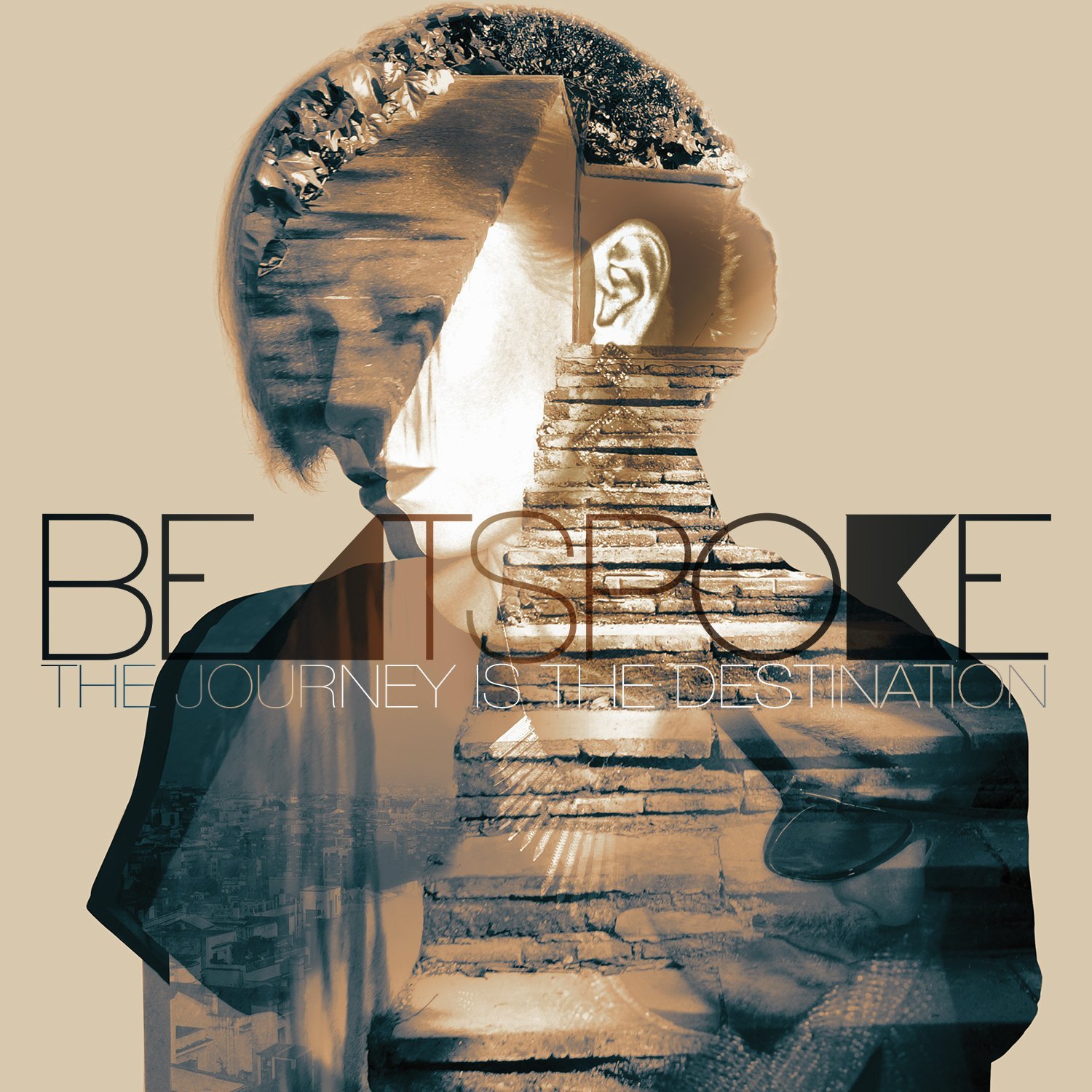
Beatspoke seemed to be in no rush to release their sophomore album. A year and then two years passed. Soon, three years became four, five and six. However, Beatspoke hadn’t split-up. No. They were still touring their impressive live show. During their downtime, Beatspoke were working on their sophomore album, The Journey Is The Destination, which is out now on BBE Records.
Many people didn’t realise this. Like many artists, Beatspoke had been working on their album in between live dates. To do this, beat maker and producer Josh Fontan and singer Sarah Gessler brought onboard a few of their musical friends. This included Joseph Derteano, Metropolis and Pumpkin, RQM and Sneaky. They feature on five of The Journey Is The Destination’s ten tracks. So do beats, analogue synths, live looping, harmonies, spoken word vocals, video game controllers, tambourines and Sarah Gessler’s soaring soulful vocal. When all this is combined, the result is The Journey Is The Destination, a musical roller coaster from Beatspoke.
Opening The Journey Is The Destination is Seed Of Doubt, which features trumpeter Joseph Derteano. Keyboards are joined by a sultry sounding trumpet and thunderous drums. Then comes Sarah’s soulful, soul-baring vocal. Meanwhile, synths bubble and buzz, fingers click and the trumpet sympathises at Sarah’s plight. Her vocal and Joseph’s trumpet, play crucial roles in bringing the lyrics to Seed Of Doubt to life.
The introduction to Untended sounds like listening to a really old, much loved vinyl album. That’s down to the clicks, crackles and pops. Soon, however, Sarah’s powerhouse of a vocal enters. Her vocal has been multi-tracked, so she sings harmonies. Behind her, synths buzz, bubble and meander, drums crack and percussion is added. Their raison d’être is to frame Sarah’s soulful powerhouse.
Washes of synths and crunchy drums open Beg and Plead. They’re joined by handclaps and Sarah at her most soulful. She combines power and sass, as her vocal soars above the arrangement. Harmonies accompany her. So do old school, Acid House synths. They’re an interesting addition, and prove a contrast as Sarah struts her way through a sassy slice of Nu Soul.
Mellow keyboards open Sink Or Swim, before Sarah delivers a vocal that veers between needy and hopeful. Handclaps, pounding drums and washes of keyboards accompany Sarah, who also adds harmonies. As Sarah delivers her vocal, it’s as if she’s been searching, searching for who she really is. Sometimes, her vocal is full of hope, other times it’s tinged with despair. She experiences a range of emotions, and in doing so, reminds me of Erykah Badu, Ledisi and Angie Stone.
On Solid Intervention Beatspoke are joined by hip hoppers Metropolis and Pumpkin. Washes of synths are panned right to left. Soon, beeps punctuate the arrangement, synths buzz and drums crack. Atop the arrangement sits Sarah’s soulful, emotive vocal. She’s joined by a swaggering rap, handclaps and buzzing synths. Later, a sultry spoken word vocal is added. This is just the latest contrasting layer, in track that’s variously edgy, urban, futuristic, soulful and sultry.
As Joy unfolds, keyboards play, the arrangement reverberates. Soon, drums crack as Joy features Sarah Gessler vocal that’s variously heartfelt, haunting and emotive. It’s without doubt Sarah’s best vocal on The Journey Is The Destination.
Futuristic, sci-fi synths and combine with thunderous drums that crack on Never Enough. This grabs your attention. So does Sarah’s vocal. As usual, it’s soulful, but this time, is subtle and almost understated. Soon, though, it’s growing in power and passion. From there, it veers between understated and powerful, to soulful, sassy and thoughtful, as later, she vamps and struts her way through Never Enough questioning: “where does this chain break?”
Fading Fast sees the return of Pumpkin, who earlier, featured on Solid Intervention. He plays his part in an arrangement that’s starts off, understated. Swathes slow rippling synths provide a backdrop for Sarah’s despairing vocal. It’s captivating. That’s what grabs your attention. Then percussion and drums join slow, deliberate keyboards. Later, buzzing synths are used to add an element of drama. They fill the spaces left by drums and vocal. Later, Sarah adds another of her spoken word vocals. Her vocal is almost a rap, as she adds vampish harmonies, on an innovative fusion of musical genres and influences.
Lately features another of the guest artists, RQM who collaborated with The Tape on Hip Hop Is Dead. Again, there’s an old school analog sound, before swathes of synths add an element of drama. They’re a scene setter for Sarah’s deliberate, dramatic vocal. She’s soon joined by RQM. He’s the perfect foil for Sarah, his vocal adding to the drama. Later, Sarah’s vocal grows in power, before she delivers a soliloquy. It’s full of frustration and anger, as she delivers lyrics full of social comment. Sarah’s impassioned delivery of the lyrics are at heart of track’s success.
Closing The Journey Is The Destination, is Fortress which features another guest artist, Sneaky. A prolonged stab of keyboard, scrabbling bass, a thunderous buzzing synth and crisp drums provide a backdrop for Sarah’s pensive vocal. Instruments flit in and out of the arrangement. It’s full of contrasts. One minute synths beep and buzz, the next wistful strings play. They reflect the sadness and despair in Sarah’s vocal, as one last time, she lays bare her soul for all to hear.
Six years after the release of their debut album No Rush, Beatspoke return with their sophomore album The Journey Is The Destination which is out now on BBE Music. It’s been a long time coming, but features Beatspoke doing what they did on No Rush, fusing disparate musical genres.
Just like they did on No Rush, Beatspoke fuse Nu Beats and Nu Soul with electronica and hip hop. They’re four of the musical mainstays that have influenced Beatspoke on The Journey Is The Destination. So has classic soul. Along with Nu Soul, it’s influenced Sarah Gessler as a vocalist .Listen carefully, however, and other musical genres shine through on The Journey Is The Destination.
Sometimes, Beatspoke’s squelch synths reference late eighties Acid House. Then there’s Beatspoke’s thunderous drums. They’re a feature of many recent Nu Soul albums. Other times, The Journey Is The Destination briefly takes on an experimental sound. That’s not surprising, as Beatspoke were hailed as innovators following the release of No Rush. They’ve decided to continue innovating on The Journey Is The Destination.
Beatspoke it seems, aren’t content to stand still. That’s been the case since they released their debut album No Rush, in 2009. It was released in 2009 to critical acclaim, and Beatspoke were hailed as innovators. Beatspoke’s star was firmly in the ascendancy.
Since then, they’ve worked with some of the biggest names in Nu Beats and Nu Soul, including Alice Russell, Bonobo, Dam Funk, Diplo, DJ Vadim, Simbad, Theo Parrish and Wax Tailor. However, Beatspoke haven’t released an album since 2009. So they had no alternative to innovate, again.
If Beatspoke released No Rush II, it would’ve been the wrong album, at the wrong time. Instead, Beatspoke had to innovate. So, they headed into the studios, where they recorded ten tracks. Joining them were some of Beatspoke’s musical friends. This included Joseph Derteano, Metropolis and Pumpkin, RQM and Sneaky. They played their part in what Beatspoke describe as their pursuit of “soulful high-fidelity.” Eventually, The Journey Is The Destination was complete and Beatspoke were belatedly back.
Nearly six years after the release of their debut album No Rush, Beatspoke were back with their sophomore album The Journey Is The Destination. Six years had passed since Beatspoke released No Rush. That’s not surprising. Josh Fontan and Sarah Gessler, wrote Beatspoke’s manifesto for slow living. They believe in a slower pace of life. This extends to making music. So, who knows when we’ll next hear from Beatspoke again? Until then, Beatspoke’s pursuit of “soulful high-fidelity,” The Journey Is The Destination, can provide the soundtrack to Beatspoke’s manifesto for slow living.
BEATSPOKE-THE JOURNEY IS THE DESTINATION.
THE BATHERS-KELVINGROVE BABY.
THE BATHERS-KELVINGROVE BABY.
January 2016 marked the comeback of a Scottish musical institution, The Bathers. They were formed in Glasgow, in 1985, by singer, songwriter and troubled troubadour Chris Thomson and released six albums between 1987 and 1999. The Bathers fifth album was Kelvingrove Baby, a minor classic, that’s one of the finest Scottish albums ever released. Sadly, Kelvingrove Baby and The Bathers is a story of what might have been.
With Chris Thomson at the helm, the Glasgow based quintet could’ve, and should’ve, been one the biggest Scottish bands ever. After all, The Bathers music is articulate, beautiful, dramatic, ethereal, elegiac, emotive, languid, literate and melancholy. This is music for those that have loved, lost and survived to tell the tale. Sadly, however, The Bathers never reached the heady heights their music deserved. As a result, the six albums The Bathers released between 1987s Unusual Places To Die and 1999s Pandemonia, never reached the audience it deserved. For Chris Thomson, history was repeating itself.
The Bathers were formed in Glasgow in 1985. They formed after Chris Thomson’s previous group Friends Again split up. Initially, The Bathers were a vehicle for singer-songwriter Chris Thomson. However, in 1987, The Bathers secured their first record deal with Go! Discs Records, and released their debut album Unusual Places To Die.
Unusual Places To Die.
For their debut album Unusual Places To Die, Chris Thomson penned ten tracks. These tracks were recorded by The Bathers’ original lineup. This included bassist Sam Loup, drummer James Locke and Chris on guitar and keyboards. Joining The Bathers, were Michael Peden of The Chimes, Douglas Macintyre and James Grant of Love and Money. They played walk on parts on Unusual Places To Die, which was released later in 1987.
When Unusual Places To Die was released in 1987, it was to widespread critical acclaim. Chris Thompson’s songs seemed to strike a nerve with critics. They described the music as variously engaging, emotive and dramatic. One critic went as far to wonder whether Unusual Places To Die was the work of a genius? Despite this critical acclaim Unusual Places To Die wasn’t a commercial success. This was nothing to do with the music though.
Instead, Unusual Places To Die fell victim to the internal politics within the record company. As a result, sales of Unusual Places To Die were poor. Given the critical response to Unusual Places To Die, this was disappointing. So, it wasn’t a surprise when The Bathers switched labels for their sophomore album, Sweet Deceit.
Sweet Deceit.
After the Go Discs! internal problems sabotaged the release of Unusual Places To Die, The Bathers moved to Island Records, where the recorded Sweet Deceit.
Sweet Deceit was an epic album, featuring fifteen tracks. Chris wrote thirteen of the tracks, and cowrote the other two. He co-produced Sweet Deceit with Keith Mitchell, and the album was released in 1990.
Three years had passed since Unusual Places To Die was released. The Bathers were back, and according to critics, better than ever. Sweet Deceit was described as impressionistic, beautiful and spellbinding. One critic, quite rightly referred to the album as a mini masterpiece. However, The Bathers had been here before with Unusual Places To Die.
On Sweet Deceit’s release, lightning struck twice for The Bathers. Sales of Sweet Deceit were disappointing. Despite the critically acclaimed reviews, Sweet Deceit seemed to pass record buyers by. For The Bathers, this was a huge disappointment.
Especially when Island Records didn’t renew The Bathers’ contract. There would be another gap of three years before we heard from The Bathers again. However, Chris was still making music.
Following Sweet Deceit, Chris Thomson joined with two former members of Lloyd Cole and the Commotions, Stephen Irvine and Neil Clark, to create a Scottish supergroup, Bloomsday. They released just one album, Fortuny, which is now regarded as a classic Scottish album. Just like The Bathers two previous albums, Bloomsday’s debut album, Fortuny, was released to critical acclaim. Unfortunately, commercial success eluded Fortuny. However, a more fruitful period was round the corner for The Bathers.
Lagoon Blues.
After signing a record contract with a German record label Marina, the group released three albums in a four year period. In 1993, they released Lagoon Blues, their Marina debut.
Just like Sweet Deceit, Lagoon Blues was another epic album penned by Chris Thompson. It featured sixteen songs, which were the perfect showcase for Chris’ octave defying vocal. Accompanied by what was essentially The Bathers and friends, sixteen tracks were recorded at Palladium Studios, Edinburgh and mixed at Palladium Studios and Cava Studios, Glasgow. Once Lagoon Blues was completed, it was released in 1993.
On its release in 1993, critics remarked that Lagoon Blues was a more eclectic album. There were diversions into jazz-skiffle on Pissor, while the album opener Lagoon Blues showcased a string quartet. The strings would play an important part on Lagoon Blues, which was hailed as poetic, elegant, sumptuous and intense. The same critical acclaim accompanied Lagoon Blues, however, this time The Bathers’ music found a wider audience. It seemed after three albums, The Bathers’ star was in the ascendancy.
Sunpowder.
For The Bathers’ fourth album, and followup to Lagoon Blues, they returned with Sunpowder. It marked the debut of a new lineup of The Bathers.
Sunpowder marked The Bathers’ debut of drummer and percussionist Hazel Morrison, keyboardist Carlo Scattini and string players Ian White and Mark Wilson. These new additions would change The Bathers’ sound greatly. Many people refer to this as the classic lineup of The Bathers. This classic lineup, plus guest artist ex-Cocteau Twin, Liz Fraser, who features on four tracks, made its debut on Sunpowder.
For Sunpowder, Chris Thomson had written eleven new songs. They were recorded a at Palladium Studios, Edinburgh. Chris and Keith Mitchell produced Sunpowder, which was released in 1995.
When Sunpowder was released, it received the same critical acclaim as The Bathers’ three previous albums. Sunpowder was called sumptuous, sensual, dramatic and ethereal. Liz Fraser, an honorary Bather was the perfect foil to Chris, forever the troubled, tortured troubadour. The result was, what was The Bathers most successful album, Sunpowder. That however, would change with Kelvingrove Baby.
Kelvingrove Baby.
Kelvingrove Baby would be The Bathers’ Marina swan-song. They were certainly eaving the German label on a high.
Chris Thomson had written thirteen new songs for Kelvingrove Baby, which was recorded in Glasgow and Edinburgh. It was at these locations that The Bathers’ expanded lineup reconvened.
Picking up where they left off, were The Bathers’ new lineup, plus a few friends. The Bathers’ rhythm section included bassists Sam Loup, Douglas MacIntyre and Ken McHugh, drummers Hazel Morrison and James Locke, who also played percussion. Joining them in the rhythm section were guitarist Colin McIlroy. They were joined by accordionist, pianist and and organist Carlo Scattini, string players Ian White and Mark Wilson. Fermina Haze plays organ, James Grant of Love and Money plays acoustic guitar and with with Hazel Morrison and Justin Currie of Del Amitri, adds backing vocals. Chris plays acoustic guitar, piano and adds his unmistakable vocals. He produced most of Kelvingrove Baby, apart from Thrive, which was produced by James Locke. Once Kelvingrove Baby was completed, it was released in 1997.
Just like each of The Bathers’ four previous albums, Kelvingrove Baby was released to overwhelming critical acclaim. Kelvingrove Baby was hailed The Bathers’ finest hour. It seemed everything had been leading up to Kelvingrove Baby.
Opening Kelvingrove Baby, is the James Locke produced Thrive. Just a strummed acoustic guitar takes centre-stage, while subtle washes of keyboards flit in and out. They provide the backdrop for Chris Thompson’s vocal. For the first time on Kelvingrove Baby, Chris dawns the role of troubled troubadour, playing it to perfection. It’s as if he’s experience, lived through, and survived someone leaving him. His vocal is full of emotion of swells of strings sweep in. They’re the perfect accompaniment as Chris delivers the lyrics “up on the west coast waiting, I wear the rain like tears.” In doing so, Chris’ hurt and loneliness is there for all to see and hear.
Girlfriend is akin to a devotional from the pen of Chris Thomson. A piano and bass probe, while a cymbal is caresses. This sets the stage for Chris’ tender, emotive vocal. There’s almost disbelief in his voice that he’s found someone to call his own. He’s fallen head over heels, hence lyrics like “I’m the kind of guy, whose dreams rise unashamed, who will love you ’til the end, cos you’re my girlfriend.” With just a subtle, meandering piano, understated drums, washes of ethereal harmonies and crystalline guitar, Chris delivers a heartfelt devotional.
If Love Could Last Forever is the perfect showcase for The Bathers’ unique brand of cerebral, literate and poetic pop. After all, who apart from The Bathers write: “they flutter down like fireflies, tugging at your sleeves, somehow rise to shame you, bring you to your knees?” It’s a beautiful, soul-searching song about love. That’s the case from the opening bars, when an acoustic guitar is strummed, a guitar chimes and drums mark the beat. Then, longingly and hopefully, Chris, accompanied by cooing harmonies, sings “ If Love Could Last Forever, forever and a day.” Effortlessly, Chris breathes life, meaning and emotion into what’s a timeless paean.
While East Of East Delier has an understated arrangement, it allows Chris to unleash his full and impressive vocal range. Drums are caressed and a piano meanders. Meanwhile, a bass adds an element of darkness. This is reflected in the hurt, loneliness and regret in Chris’ vocal. His vocal soars above the arrangement, with frustration omnipresent at the love he once had and lost.
Accompanied by firmly strummed acoustic guitar No Risk No Glory, unfolds. A guitar chimes as fingers flit up and down the fretboard. Meanwhile, Chris’ vocal is a mixture of power, emotion and hurt. The hurt is obvious from the moment he sings “I was born to love her,” it’s a case of infatuation and unrequited love. With harmonies, an accordion and guitars for company, Chris delivers a cathartic outpouring of hurt. He wouldn’t have it any other way, singing ruefully “no risk, no glory.”
Dramatic and moody describes the dark, but sparse piano lead introduction to Once Upon A Time On The Rapenburg. If a picture tells a thousand stories, so does a piano. It sets the scene for Chris, as once again, he dawns the role of troubled troubadour. With shimmering strings and a deliberate gothic piano for company, Chris remembers the love affair that almost was.
Kelvingrove Baby is the centre-piece of Kelvingrove Baby. It’s a seven minute epic about an unnamed femme fatale from Glasgow’s West End who toyed with Chris’ affections. From just a strummed guitar and subtle piano, the arrangement builds. The piano plays a more prominent role, adding an element of drama. After ninety seconds drums pound and ethereal harmonies sweep in. They give way to Chris’ worldweary, lived-in vocal. Meanwhile, Hazel Morrison adds ethereal, elegiac harmonies. This seems to spur Chris on. Using his wide vocal range, he unleashes a needy vocal tour de force. Hopefully, he sings “someday I know, that you’ll be back…I don’t know, maybe then you can be my Kelvingrove Baby.” Behind him, the epic, ethereal and dramatic arrangement is the perfect accompaniment for what’s without doubt, The Bathers’ finest hour on Kelvingrove Baby.
Memories come flooding back to Chris on Girl From The Polders. Instantly, he’s transported back to another time and place. That’s when they first met, and where “I first kissed you.” With the rhythm section and piano providing a backdrop, Chris delivers another hopeful, needy vocal. He hopes that when summer returns, and heads back to Poolewe, his “songbird, melodious and pure,” is there.
Against a backdrop of quivering strings, Chris delivers a vocal on Lost Certainties that’s equal parts power, passion, frustration and sadness. Below the vocal and strings, the rhythm section drives the arrangement along, adding to the drama and intensity of this soul-baring refrain about a bewitching woman.
After the intensity of Lost Certainties, Dial has a much looser, laid-back sound. Chris eschews the power of the previous track, as The Bathers deliver an understated, spacious, melodic track. Hazel Morrison, James Grant and Justin Currie add harmonies that are yin to Chris’ yang, as he almost croons his way through Dial.
Orchestral strings and a pounding rhythm section set the scene for Chris’ vocal on The Fragrance Remains Insane. There’s an intensity in Chris’ lovelorn vocal, on this tale of love gone wrong. He’s struggling to come to terms with the breakup of his relationship, despite his claims “that I’m not crazy about you.”
If Chris Thomson had been born twenty years earlier, he’d have been a crooner. That’s apparent on Hellespont In A Storm, where he literally croons his way through the track. Accompanied by washes of accordion, swathes of strings, a subtle rhythm section and acoustic guitar. As Chris croons, emotion and regret are omnipresent. Especially when he sings “spread your wings, above you, the time has come to fly away, where I can’t follow.” Given this is the ultimate sacrifice, the beauty and emotion is almost overwhelming.
The piano lead Twelve, closes Kelvingrove Baby. Chris lays bare his soul, accompanied by his trusty piano. Later, swathes of lush strings sweep in. They provide the accompaniment to a telephone conversation, on this story of everlasting love.
For The Bathers, Kelvingrove Baby was a musical coming of age. It’s as if everything they’d been working towards was leading to Kelvingrove Baby. The music was variously atmospheric, cerebral, dramatic, ethereal, heartfelt, hopeful, literate, needy and sensual. It’s also tinged with pathos, regret and sadness. No wonder, given the tales of love found and lost. They’re brought to life by The Bathers’ very own troubled troubadour Chris Thomson. Along with the rest of The Bathers, they’re responsible for Kelvingrove Baby, a truly enthralling album.
On Kelvingrove Baby, the music is captivating. So much so, that you’re drawn into Kelvingrove Baby’s lush, atmospheric sound. Having captured your attention, The Bathers don’t let go. Before long, the listener has fallen in love. They fall in love with music that’s hauntingly beautiful, emotive, dramatic and pensive. Much of this is thanks to Chris Thomson’s peerless vocal performances. He plays the role of the troubled troubadour, to a tee. His worldweary, emotive, heartfelt and impassioned vocal sounds as if it’s lived the lyrics he’s singing about. Lived them not just once, but several times over. As a result, Kelvingrove Baby is akin to a snapshot into Chris Thomson’s life, and very soul. Indeed, Kelvingrove Baby sounds a very personal album from The Bathers’ troubled troubadour, Chris Thomson. Kelvingrove Baby was a career high from The Bathers. However, two years later, somehow, The Bathers managed to top Kelvingrove Baby.
Pandemonia, which was released in 1999, was The Bathers’ swan-song. Just like Kelvingrove Baby, the critically acclaimed Pandemonia, should’ve transformed The Bathers’ career. Sadly, despite oozing quality, The Bathers’ cerebral, literate and melodic brand of chamber pop failed to find the wider audience it deserved. As a result, The Bathers remained almost unknown apart from loyal band of discerning music lovers.
After Pandemonia, most people expected The Bathers to return after a couple of years with their seventh album. That wasn’t to be. Two years became three, became five, ten and fifteen. Now, sixteen years have passed since the release of Pandemonia. Throughout the last sixteen years, there have been rumours that another Bathers album is in the pipeline. With every year, that looks even more unlikely. However, maybe in the year that marks the thirtieth anniversary of The Bathers, they’ll return with their seventh album. We can only hope. After all, The Bathers have always strived to do things their way.
The Bathers are unlike most bands. They’re enigmatic, almost reclusive and publicity shy. Quite simply, The Bathers aren’t exactly your normal band. Not for them the rock “n” roll lifestyle favoured by other bands. In many ways, musical fashions and fads didn’t affect them. Their attitude was almost contrarian. Albums were recorded slowly and methodically. It was as if The Bathers were striving for perfection. On Kelvingrove Baby and Pandemonia, they almost achieved the impossible. What’s more they did it their way.
This means The Bathers aren’t willing to jump onto a musical bandwagon in pursuit of fame, fortune or starlets. Quite the opposite. It seemed to be their way or no way, in the pursuit of musical perfection. By perfection this means music that cerebral, dramatic, emotive, ethereal, literate and melodic. That describes The Bathers’ fifth album Kelvingrove Baby perfectly. Kelvingrove Baby saw The Bathers strive for perfection, and very nearly, achieve the impossible.
THE BATHERS-KELVINGROVE BABY.
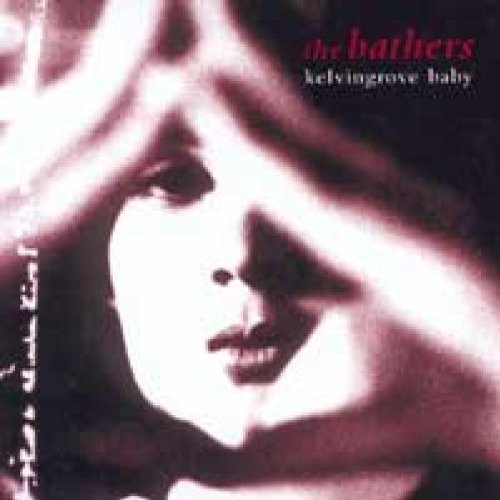
THE OTHER SIDE OF THE TRAX-STAX-VOLT 45PRM RARITIES 1964-1968.
THE OTHER SIDE OF THE TRAX-STAX-VOLT 45PRM RARITIES 1964-1968.
Just like Picasso, the Stax and Volt labels had a blue period. In Stax and Volt’s case, this began in 1964, and lasted until mid-1968. During this period, Stax released over 300 singles and Volt in excess of 120 singles. This included some of best music in in the labels eighteen year history. That’s not surprising, Stax and Volt had enviable rosters. Especially between 1964 and 1968.
During this period, Stax was home to three of the biggest names in soul, Sam and Dave, Otis Redding and Booker T and The MGs. Other names included Johnnie Taylor, Carla Thomas, William Bell, The Mar-Keys, Eddie Floyd and Lynda Lyndell. These artists enjoyed a string of hit singles, and brought even more commercial success the way of Stax and Volt.
The pressure was on songwriters and producers at Stax’s Memphis’ headquarters. Unlike one of their major competitors, songs were carefully crafted at Stax. There was no recycling of backing tracks that had been used before. This was left to lesser labels. Instead, songwriters and producers at Stax took pride in their work. They weren’t willing to rush when it came to writing or recording a song. Not even when it came to a B-Side.
Especially not when it came to a B-Side. They received the same care and attention as a single. Record buyers appreciated this, and when they bought a new single always flipped over to the B-Side to hear what treat was in store. If the single was a ballad, often the B-Side would be a joyous uptempo tracks. Similarly, with an uptempo single, a heart-wrenching ballad would feature on the flip-side. On many an occasion, record buyers felt that the B-Side rivalled the single. That was the case many times during Stax and Volt’s blue period.
Between 1964 and 1968, countless hidden gems found their way on to B-Sides of Stax and Volt singles. Since then, none of these B-Sides have been released on CD before. That’s until now. Twenty-four B-Sides from Stax and Volt’s blue period are celebrate on The Other Side Of The Trax-Stax-Volt 45rpm Rarities 1964-1968, which was recently released by Kent Soul, an imprint of Ace Records.
The Other Side Of The Trax-Stax-Volt 45rpm Rarities 1964-1968 features tracks from some of the biggest names on Stax and Volt’s roster during the blue period. This includes Johnnie Taylor, Carla Thomas, William Bell, The Mar-Keys, Eddie Jefferson, Dorothy Williams, Oscar Mack, Eddie Floyd and Lynda Lyndell. They’re just a few of the artists that feature on The Other Side Of The Trax-Stax-Volt 45rpm Rarities 1964-1968, which is a reminder of the delights tucked away on B-Sides during Stax and Volt’s blue period.
Opening The Other Side Of The Trax-Stax-Volt 45rpm Rarities 1964-1968 is Changes. This was the B-Side of Johnnie Taylor’s 1966 Stax single I Had A Drea. Changes was penned by Johnnie with Isaac Hayes and David Porter. When Changes was recorded, the Stax house band provided a stomping beat, while stabs of horns punctuate the arrangement. Meanwhile, Johnnie literally struts his way through the lyrics, on this hidden gem, which describes Johnnie’s other contribution, Strange Things (Happening In My Heart).
It was the flip-side to one of Johnnie Taylor’s best known, and most successful single Somebody’s Sleeping In My Bed. It was released on Stax in 1967. Accompanied by soulful harmonies, Johnnie delivers an emotive, vocal powerhouse on this Homer Banks and Allen Jones song.
Carla Thomas features twice on The Other Side Of The Trax-Stax-Volt 45rpm Rarities 1964-1968. When she released A Boy Named Tom in 1964, Carla Thomas was just twenty-two. However, her recording career began when she was just seventeen. A Boy Named Tom was penned by Carla, and was the flip-side to I’ve Got No Time To Lose. Just like so many singles released during the blue period, A Boy Named Tom oozed quality and emotion. Carla seems to have lived the hurt and heartache in the lyrics. It seemed she was well on her way to being crowned the Queen Of Memphis Soul.
By the the time Carla Thomas released Pick Up The Pieces as a single on Stax in 1967, the queen had been crowned. That’s apparent on Separation, the B-Side to Pick Up The Pieces. It’s a David Porter and Isaac Hayes composition which features a feisty, assured performance from Carla Thomas. Not only had she matured as a singer, but had been crowned the Queen Of Memphis Soul.
In 1964, Barbara and The Browns released two singles for Stax. The first was Big Party, which was written by Jerry L. Williams and recorded at Chips Moman American Studios in Memphis. Big Party was originally released on Jerry L. Williams Wil-Mo label. and became a local hit. However, Jerry L. Williams knew his small label didn’t have the money to break the single nationwide. So he took it to Stax, who released it in 1964. Sadly, the single just scraped into the lower reaches of the charts, before quickly disappearing without trace. Those that bought Big Party and decided to flip it over, were rewarded with You Belong To Her, another Jerry L. Williams composition. It’s a tale of betrayal, heartbreak and love gone wrong, that’s brought to life by Barbara and The Browns. They do the same on Please Be Honest With Me.
This was the B-Side to Barbara and The Browns’ sophomore single In My Heart. It was released on Stax in 1964, and tucked away on the B-Side was Please Be Honest With Me. It’s a William Bell and Steve Cropper composition that Barbara and The Browns bring to life. Barbara combines power, passion and soulfulness as she asks, begs Please Be Honest With Me. Aided and abetted by The Browns, it’s three minutes of raw emotion.
William Bell played an important part in the rise and rise of Stax Records. Although he’s remembered as a singer, William Bell was also a talented songwriter. He wrote songs for many artists on the Stax and Volt labels. However, William Bell and Steve Cropper cowrote Don’t Stop Now. It’s the B-Side to Crying All By Myself, which was released in the summer of 1965. Don’t Stop Now is a anthemic stomper, which fifty-one years later, sounds just as good as the day it was released. The same could be said of the ballad Ain’t Got No Girl.
It’s a song penned by some of Stax’s best songwriters. William cowrote Ain’t Got No Girl with Steve Cropper, Isaac Hayes and David Porter. Then when William Bell released Everyday Will Be Like A Holiday in time for Christmas 1967, Ain’t Got No Girl was chosen for the flip-side. This was a huge mistake. If ever a song deserved better it’s Ain’t Got No Girl. It could’ve and should’ve been released as a single. Especially the way William Bell sings it. Ain’t Got No Girl becomes an impassioned, needy confessional, where heartache and loneliness shine through. Sadly, the only people who heard Ain’t Got No Girl were those that listened to B-Sides. They enjoyed a very special Christmas present from William Bell and Stax, Ain’t Got No Girl.
Back in 1967, Detroit born Eddie Purell released The Spoiler as a single on Volt in America. The single quickly disappeared without trace. Meanwhile, in Britain, The Spoiler was proving popular in discos. However, if curious DJs had flipped the single over, they would’ve discovered a heart-wrenching ballad, My Pride Won’t Let Me. It’s akin to an outpouring of emotion from Eddie Purell. His hurt and betrayal seems almost real on this spine-tingling slice of soulfulness.
Dorothy Williams career at Volt was short, but memorable. Her one and only single was Closer To My Baby, which was released in 1964. It sunk without trace. That might not have been the case if Volt had released Watchdog, which Dorothy cowrote with Steve Cropper. It’s truly irresistible and would’ve filled any dance-floor in 1964. Fifty-two years later, and Watchdog is still capable of packing dance-floors at all-nighters and soul weekenders.
Gorgeous George will be a new name to many soul fans. He was born Theodopholos George Odell, and released his debut single Now I Believe in 1961 on the Shaw brothers’ Neptune label. Soon, Gorgeous George had established a reputation as a flamboyant, colourfully attired showman. However, success seemed to elude him. However, in 1965, Gorgeous George signed to one of soul’s biggest labels Stax.
By then, Gorgeous George was writing his own songs. He had penned his first Stax single Biggest Fool In Town and the B-Side Sweet Thing. When Biggest Fool In Town was released, the single failed commercially. That was the end of Gorgeous George’s time at Stax. Things could’ve been very different though. Especially, if the flip side Sweet Thing, another Gorgeous George composition, had been chosen as the single. It finds Gorgeous George literally strutting and vamping his way through the lyrics, as if paying homage to James Brown on this sassy soulful hidden gem.
Eddie Floyd is another artist that played an important part in the Stax story. He was one of the label’s most successful artists. In 1967, Eddie Floyd released Love Is A Doggone Good Thing, which reached number twenty-two in the US R&B charts. On the B-Side was Hey Now, which Eddie cowrote with Steve Cropper. Irresistible, funky and soulful, it’s almost too good to be a B-Side. So is the bluesy Under My Nose. It was the B-Side to On A Saturday Night. Penned by Isaac Hayes and David Porter, Under My Knows showcases Eddie Floyd’s versatility and ability to bring a song to life.
My final choice from The Other Side Of The Trax-Stax-Volt 45rpm Rarities 1964-1968 comes courtesy of Lynda Lyndell. She signed to Stax in 1968. By then, she had supported James Brown and Ike and Tina Turner. Then in 1967, Lynda Lyndell joined The Fabulous Georgia Soul Twisters. That’s where DJ Dave Crawford came across Lynda Lyndell. He recommended her to Stax, who signed her.
Lynda Lyndell’s debut single was Bring Your Love Back To Me. However, it failed to chart. Hidden away on the B-Side was Here Am I. It was penned by DJ Dave Crawford, who hoped to forge a career as a songwriter and producer. The dance-floor friendly Here Am I showed what he was capable of. It also became a favourite in British clubs and on the nascent Northern Soul scene. However, Lynda Lyndell’s Stax debut proved to be the end of an era.
Never again would a single be released on the Stax label in both Britain and America. This marked not just the of an era, but the end of Stax and Volt’s blue period. It had been good while it lasted.
Since 1964, Stax had released over 300 singles and Volt had released over 120 singles. This included singles from some of the biggest names in the labels’ history, plus artists who played a mere walk-on part. Many of these familiar faces and new names feature on The Other Side Of The Trax-Stax-Volt 45rpm Rarities 1964-1968.
Among the familiar faces are Johnnie Taylor, Carla Thomas, William Bell, The Mar-Keys and Eddie Floyd. New names include Eddie Purrell, Johnny Jenkins and Lynda Lyndell. They all feature on The Other Side Of The Trax-Stax-Volt 45rpm Rarities 1964-1968. However, the tracks that are included aren’t singles. Instead, they’re the hidden gems that were tucked away on the B-Sides of singles during the blue period.
Just like the singles, the B-Sides were carefully crafted. The utmost care and attention was paid to songs that many people would never even listen to.
Many record buyers were only interested in the single. The B-Side they saw as a makeweight. In a way, that wasn’t surprising. By 1964, B-Sides had gotten a bad reputation. Some lesser labels didn’t care about B-Sides. They stuck any second or third rate songs on the flip-side. However, Stax and Volt were one of the exceptions.
Often, the B-Side to a Stax or Volt surpassed the quality of the single. Those that flipped over were richly rewarded, and heard joyous, uptempo, dance tracks or heartbreaking ballads. Twenty-four of Stax and Volt’s finest B-Sides feature on The Other Side Of The Trax-Stax-Volt 45rpm Rarities 1964-1968. These songs are a reminder to always flip over to the B-Side, as musical gold may be awaiting discovery.
THE OTHER SIDE OF THE TRAX-STAX-VOLT 45PRM RARITIES 1964-1968.







BLACK ROOTS-SON OF MAN.
BLACK ROOTS-SON OF MAN.
In the British reggae scene, Black Roots are viewed as respected elder statesmen. That’s fitting. Black Roots have been making music for over thirty years. Still, though, their music is powerful and full of social comment. That’s the case on their new album Son Of Man, which was released on Soulbeat Records. It features eleven new songs, where Black Roots highlight injustice and speak up for the poor, disenfranchised and dispossessed. This is something that Black Roots have been doing since they were first formed in 1979.
As the Black Roots story began in 1979, change swept across Britain on 3rd May 1979. Margaret Thatcher was elected Prime Minister with a majority of sixty. Britain now had a Conservative government. Among the interested onlookers were the members of Black Roots. They wondered what the future held for them, and the rest of their generation?
By the early eighties, many people had discovered that Britain wasn’t a particularly pleasant place to live in anymore. Especially the unemployed, disabled, poor or elderly. They were all part of an underclass who it seemed, were despised by the right wing Thatcherite government. Britain in the words of the politicians was “broken.”
Unemployment was over two million, and Inflation was rising. The future looked bleak. To make matters worse, poverty and racism was rife. It was no surprise that eventually, riots broke out in Liverpool, London, Leeds, Sheffield and Birmingham. Some commentators saw this as the disenfranchised fighting back.
Many of those who fought back, thought there was no other way. They had had enough. No longer could they walk the streets without being constantly stopped and searched.
Stop and search was one of the most controversial pieces of legislation the police had been using. The powers to stop and search had been instigated under The Vagrancy Act 1824. The new powers enabled police officers to stop and search anyone based upon “reasonable suspicion” that an offence had been committed. In reality, stop and search was often used a fishing trip by the police. To make matters worse, in many inner cities, a disproportionate amount of young black men were victims of stop and search. They had done nothing wrong, and instead, were British citizens going about their lawful business in a peaceful manner. This wasn’t going to end well.
That was the case in 1981, “the year of the riots.” Across England, communities literally exploded. Often, when the dust settled, heavy handed policing was to blame. Especially, when it came to the use of stop and search. So on 27th August 1981, the power to stop and search was repealed when the Criminal Attempts Act 1981 received assent. Maybe things were starting to change?
That looked unlikely. In 1980, Margaret Thatcher gave her “the lady’s not for turning” speech. It seemed the Conservatives were not going to be derailed. Those that took to the streets saw a government that seemed unwilling to listen, never mind change. The only alternative was to make the government listen.
The chances of this happening were slim. Those that weren’t poor, unemployed, disabled or elderly weren’t willing to upset the apple cart. They led comfortable lives in middle class, middle England. Safe in the suburbs, they weren’t willing to stand shoulder-to-shoulder with disenfranchised and dispossessed. So it was left to writers, philosophers, poets and musicians to provide a voice for the disenfranchised and dispossessed. This would include Black Roots.
By 1983, the eight piece Bristol-based band were one of the rising stars of the reggae scene. Black Roots had toured the length and breadth of Britain, and soon, had a large following. Especially, in colleges and universities. Audiences were won over by what Black Roots described as “militant pacifism” roots reggae. It struck a nerve with the bright young minds who were hoping to graduate from colleges and universities across Britain, and enter the workplace. In 1983, this seemed unlikely.
Unemployment was at record levels since the depression. Still the ‘lady’ wasn’t for turning. Things were break in Britain. Bristol, Black Roots’ home city was no different. Unemployment, poverty, racism, disquiet and unrest were almost omnipresent. However, the disenfranchised and dispossessed didn’t have a voice. The eight members of Black Roots decided they would became their voice.
Later in 1983, Black Roots released their eponymous debut album. It featured Black Roots’ unique brand of militant roots reggae. They highlighted injustice and the way large parts of communities had become alienated by the political reform introduced by the Thatcher government. Britain it seemed, was broken; maybe even beyond repair?
That’s how it looked. Right up until 1985, many parts of England were like a powder keg, just waiting to explode. Often it did, The disenfranchised and dispossessed felt they had no option but to take to the streets, and riots broke out. However, as 1985 drew to a close, the riot years were over.
By 1986, a lot had happened to Black Roots. They continued to tour constantly. Black Roots had also released their sophomore album The Front Line in 1984. This seemed fitting, as in parts of Britain, it was like a war zone, with the disenfranchised and dispossessed taking to The Front Line in an effort to have their voice heard. Black Roots were also The Front Line, but used their music to provide a voice for the disenfranchised and dispossessed. Someone was listening.
Soon, Black Roots were making their way to Broadcasting House to record a series of sessions for Radio 1. These sessions allowed Black Roots’ music to be heard by a much wider audience than they played to in several tours. This was a huge break. So was when highlights of the sessions were released in 1985 as the Black Roots ‘In Session’ cassette. By the end of 1985, things were looking up for Black Roots.
The remainder of the eighties saw Black Roots continue to tour and record. Their third album All Day All Night, was released in 1987, but was their first album for Nubian Records. It would become home to Black Roots for over a decade.
When Ina Different Style was released on Nubian Records in 1988, it marked a stylistic change from Black Roots. This was their first adventure in dub. It wouldn’t be their last. Before that Black Roots would release two more albums.
The first was their first live album, Live Power. Released in 1989, Live Power was a reminder of how good a live band Black Roots were. That was no surprise. Black Roots had spent much of the last ten years touring Britain. They were a familiar face in venues the length and breadth of Britain. Especially in colleges and universities, where their songs about injustice would be welcomed and embraced. Some of the people in the audience could they hoped, in the future, make a difference and make Britain a better place.
As the nineties dawned, Black Roots were now into their third decade making music. However, it had been nearly three years since Black Roots had released a studio album. It was time to rectify this.
Later in 1990, Natural Reaction, another album of roots reggae was released by Black Roots. This was the Bristol-based eight-piece’s fifth studio album. It’s not just social comment than can be found on Natural Reaction. There’s emotion and spiritually on an album that was well received by critics. This didn’t stop Black Roots going for another adventure in dub.
Dub Factor: The Mad Professor Mixes was released in 1991, and was Black Roots’ second dub album. Just like Ina Different Style, this latest adventure in dub was well received. It seemed Black Roots were willing to experiment, so that their music stayed relevant. This included collaborating with some familiar faces within the British reggae scene.
Two years passed before Black Roots returned with With Friends in 1993. It was a collaboration with some of the biggest names in the British reggae scene. This included Dub Judah, Mickey Forbes, Trevor Dixon and B.B. Seaton. They joined Black Roots on ten new tracks. While this was a welcome release, and one that was well received by critics and cultural commentators, some of Black Roots’ fans wondered when they would next release a noter studio album?
When Black Roots announced the release of their next album in 1994, the wait for a studio album went on. Fans weaned on militant roots reggae discovered that the next album was Dub Factor 2-The Dub Judah Mixes. The wait went on in 1995, when Dub Factor 3-“In Captivity” Dub Chronicles-Dub Judah/Mad Professor Mixes was released. Still the wait for a studio album continued.
Two years became three and four. Still there was no sign of another studio album from Black Roots. Was this the end of the group once hailed as “the next great hope for [British] reggae?” It seemed like it. Black Roots decided to call time on their career in the mid-nineties.
Nothing was heard of Black Roots until the next millennia. Then in 2004, a compilation On The Frontline was released. Things went all quiet until 2011, when The Reggae Singles Anthology was released on Bristol Archive Records. Some critics thought that was release meant it was the end of the road for Black Roots. If it was, The Reggae Singles Anthology a limited edition release, seemed a fitting farewell to one of the most eloquent of the British roots reggae groups. Little did anyone realise that Black Roots were about to make a comeback.
This came in April 2012, when six of the original members of Black Roots began to record an album of new material, On The Ground. It was well received upon its release in 2012, some nineteen years after their Black Roots’ previous studio album, With Friends. Belatedly, Black Roots were back, just in time. They were the musical superheroes with a social conscience.
Two years previously, a Conservative-Liberal Democrat coalition came to power in 2010. By 2012, the junior partners were enjoying the once in a lifetime opportunity to be part of the decision making process. Suddenly, principles forgotten about as the heady scent of power hung in the air. With a seat at the Cabinet at stake, the disenfranchised and dispossessed were forgotten about. The worst that could happen to the junior partners was they loose their seats at the next election, and retire with a healthy pension and string of directorships.
That’s what happened in 2015. By then, Black Roots had released another new album Ghetto Feel in 2014. It was released on the Soulbeats’ label. The voice of the disenfranchised and dispossessed were back, and were determined to make a difference. However, in 2015, things took a turn for the worse.
Politically, Britain lurched to the right. Many of the junior partners lost their seats, and retired with their pension pots and directorships. This left the the most right wing government in living history with a mandate to govern. Things were about to get messy, very quickly.
The newly elected government announced their plans for the age of austerity. They were determined to go further than previous Conservative governments had gone. Public spending wasn’t just cut, it was slashed. Especially on the welfare state. Hardest hit were the unemployed, disabled, poor and elderly. Suddenly, they that found themselves choosing between eating or heating their home. However, the Conservatives weren’t finished yet.
With wars raging around the Middle East and North Africa, many refugees were came to Britain seeking political asylum from tyrannical regimes. However, they discovered that there was no room at the inn. This was after all, the age of austerity. For many onlookers and commentators this was just the straw that broke the camel’s back. This included Black Roots.
They returned to the studio in 2015, and recorded eleven new songs. These songs became Son Of Man, which was recently released on Soulbeat Records. Just like on previous albums, Black Roots combine social comment, melodies and hooks on Son Of Man. Accompanied by harmonies and horns, Black Roots deliver lyrics that are uncompromising, and provide a voice for the poor, disenfranchised and dispossessed. Especially the victims of the age of austerity and the refugees fleeing the Middle East and North Africa. These are two of the subjects that feature on Son Of Man.
Son of Man opens with the title-track. Quickly, Black Roots’ thirty-seven years of experience shines through. The rhythm section unite with stabs of braying horns. They’re the perfect backdrop for the vocal, which asks: “hey you Son Of Man where’s your heart?” Augmented by harmonies, Hammond organ and the crack rhythm, with the bass to the fore, anger frustration and disappointment shine through in the vocal. Especially when delivering lyrics like: “corruption are their only paradise.” Even then, there’s a soulfulness to this melodic slice of roots reggae with a social conscience. It seems thirty-seven years after Black Roots were founded, they’ve not lost their ability to deliver lyrics full of social comment.
This continues on War Zone, where a hypnotic fusion of horns and the rhythm section set the scene for the vocal. When it enters, it grabs your attention with “it’s like a War Zone, people leave their children and go, it’ll be me or you, that’s what they want us to do.” In an instant, Black Roots at their most eloquent, provide a voice for the dispossessed.
All Sing The Song Key sees Black Roots turn their attention to religion. Keyboards and an electric piano combine with the rhythm section. They provide the heartbeat as horns blaze and bray. When the vocal enters, the lyrics seem to have a spiritual quality. Especially with lyrics like: “repent and your Lord will save you.” That’s until the lyric: “my God is the one Bob Marley, look no further than yourself for your saviour.” Black Roots are too worldly-wise than to pin their colours to the mast of a religion. “When you hear one, your hear them all.” This doesn’t stop Black Roots asking: “heal him, to make ends meet.” Like many people, it seems, when they’re desperate, religion is their last resort. By then, synths strings and harmonies have swept in, and join the horns in providing a backdrop to Black Roots as they explore the subject of religion, in what’s a thoughtful, melodic and hook-heavy song.
There’s another change of style and tempo on One Ebony Girl. A drum roll gives way to synths, before the rhythm section, percussion and horns create a jaunty, joyous arrangement. The vocal sings of a new life coming into the world, “One Ebony Girl.” This is a cause for celebration, so the rhythm section, percussion, Hammond organ and harmonies augment the vocal, on this celebration of the miracle of life.
Drums rattle earnestly on Prevention, as if demanding the listener’s attention. Soon horns bray, while washes of the Hammond organ lock join the rhythm section in creating a tight, groove. This is perfect backdrop for the vocal, as it delivers a words of wisdom. They apply to many facets of modern life, and if heeded, the world might be a better place “Prevention is better than the cure.”
The drums that open Guess Who are similar to those on Prevention. Soon horns blaze, while washes of the Hammond organ lock join the rhythm section in creating a churning, backdrop. As the vocal delivers the spiritual lyrics, chiming guitars and a big, bold, bounding bass play leading roles. So does the heartfelt vocal as this melodic musical parable unfolds.
Wake Up’s roots seem to be in classic seventies reggae. There’s more than a nod to Bob Marley and The Wailers. That’s not surprising. The members of Black Roots may have grown up listening to his music. However, Black Roots are a tight, talented group, with thirty-seven years experience behind them. Together, they create a slow, shuffling arrangement. Washes of Hammond organ join stabs of horns while the rhythm section put their experience to good use. Meanwhile, a heartfelt vocal is sung in a call and response style. It asks: “won’t you Wake Up and penetrate my soul.” By then, it’s obvious that this is Black Roots’ finest hour, as they roll back the years.
The first few chords to Can’t Get Out Of That sound not unlike the introduction The Beatles’ Magical Mystery Tour. That’s the only similarity as horns blaze, percussion plays and the rhythm section combine with harmonies and the Hammond organ. It’s a heady and irresistible brew. There’s a degree of sadness in the vocal, as with an air of resignation it delivers the lyrics: “Can’t Get Out Of That.” One can’t help but wonder what crime was committed? When the vocal drops out, a guitar takes centre-stage, a delivers a crystalline solo. All too soon, it’s over and the story continues, with “the police siren wails, can’t get you out of that.” Still there’s an air of resignation and despair. That’s despite the irresistible backdrop created by the rest of Black Roots.
Black Roots hit the ground running on Trickle Trickle Treat. Horns blaze, while keyboards accompany the rhythm section. Together, they provide a dramatic backdrop, as lyrically Black Roots remember a night out in Manchester. What should’ve been a night with friends, takes a sinister turn, in the stop and search days. It sounds a painful reminder of the past, as the conversation with the police is recollected. Harmonies augment the vocal, while growling horns add an angry backdrop. It’s a a shameful reminder of what life for many people was like, in English cities in the early eighties.
Deliberate drums, stabs of horns and keyboards combine to create an element of drama on Poor Old Mama. As perfusions plays, a rumbling bass accompanies the vocal. Soon, memories come flooding back, of a family all “living together under the one roof.” Not any more. Poor Old Mama has grown old, and is a victim of austerity. She lives a hand to mouth existence. Sadness and frustration fill the vocal and harmonies. Then at the breakdown, it’s the guitar that takes centre-stage again. It’s allowed longer in the spotlight, before the vocal returns. When it does, it’s impassioned and emotive, and realises that around the world there’s lots of people in the same situation as Poor Old Mama. The only difference is where they live, and in some cases, ‘the colour of their skin.”
Rolls of drums signal the arrival of horns, keyboards and the rhythm section on One Thing, which closes Son Of Man. Again, the bass is at the front of the mix, playing a prominent role. Meanwhile, vocal sings “a penny overdrawn they charge you, and write you a letter, £27 it costs you.” This brings home the irony, that the banks are only making a bad situation worse. However, Black Roots realise: “it’s a case that you can’t win.” Later, Black Roots ponder the banking bail out, wondering: “where it’s all gone?” Anger fills the vocal, as Black Roots sing about: “institutional bankers giving to the rich.” Back then, Rome was burning, but nobody had noticed, or if they had, wanted to phone the fire brigade. So it’s no wonder Black Roots are angry. Just like with other subjects, they speak for those without a voice on Son Of Man.
Throughout Son Of Man, Black Roots provide a voice for the poor, disenfranchised and dispossessed. They’ve been doing that since they released their eponymous debut album in 1983. Since then, they’ve doing this eloquently. Their latest album Son Of Man, is no different.
Black Roots highlight injustice, while speaking for those who can’t speak for themselves. They’re the people who have been let down and betrayed by successive governments. This includes the old and infirm, the disabled, unemployed and poor. None of these people have a voice. They’ve been forced to sit back whilst one government almost ruined Britain financially forever. However, the guilty parties don’t pay a price. Instead, its an voiceless underclass who can’t fight back. They don’t have a voice. On Son Of Man, Black Roots provide a voice for them on One Thing. Then on other tracks, they turn their attention to other matters.
This includes the refugees fleeing persecution in the Middle East and North Africa. Black Roots go to bat for them, and provide a voice for them. However, this is no surprise. Black Roots have been providing a voice for the poor, disenfranchised and dispossessed since they released their eponymous debut album in 1979.
Thirty-seven years later, and nothing has changed. Still, Black Roots are highlighting injustice and speaking up for the poor, disenfranchised and dispossessed on Son Of Man, where they mix social comment with a health supply of hooks and melodies.
BLACK ROOTS-SON OF MAN.

SWAMP POP BY THE BAYOU-TROUBLES, TEARS AND TRAINS.
SWAMP POP BY THE BAYOU-TROUBLES, TEARS AND TRAINS.
One of Ace Records longest-running, and most successful compilation series, is their By The Bayou series. Compiled by Ian Saddler, the thirteenth instalment in the By The Bayou series was recently released. However, Swamp Pop By The Bayou-Troubles, Tears and Trains is only the second compilation of swamp pop.
The first compilation of swamp pop was, Swamp Pop By The Bayou, which released back in May 2014. Since then, Ian Saddler’s had his listeners bopping and bluesin’. However, Swamp Pop By The Bayou-Troubles, Tears and Trains sees Ian Saddler return to the vaults of J.D. Miller, Eddie Shuler, Floyd Soileau, Sam Montel, Huey Meaux and Joe Ruffino, Pappy Daily, Murray Nash and Jim Rentz. Ian Saddler even looked for hidden gems with the Hitt and Mercury labels. He struck gold.
Among the treasure unearthed by Ian Sadlder are six tracks that have never been released before. This includes tracks from swamp pop royalty Warren Storm plus Frankie Lowery, The Boogie Kings, Larry Hart, Frankie Lowery and Buck Rodgers. There’s also a trio of alternate tracks on Swamp Pop By The Bayou-Troubles, Tears and Trains. The other nineteen tracks are real rarities. They’re a mixture of skirt swirlers and buckle polishers.
For those unfamiliar with the parlance of swamp pop, skirt swirlers are the uptempo dance tracks; while buckle polishers are the slow songs. Providing the skirt swirlers and buckle polishers are Roy Perkins With Jerry Starr and The Clippers, Dale Houston, Phil Clay, John Fred, Gene Dunlap and The Jokers,Warren Storm, Dale Houston, Johnny Preston and Jay Richards.
Just like previous volumes in the By The Bayou series, familiar faces and new names rub shoulders on Swamp Pop By The Bayou-Troubles, Tears and Trains. So do skirt swirlers and buckle polishers from the land of “gaters and gumbo.” However, how does Swamp Pop By The Bayou-Troubles, Tears and Trains compare with Swamp Pop By The Bayou?
Complier Ian Saddler knows the importance of picking the right track to open a compilation. Swamp Pop By The Bayou-Troubles, Tears and Trains is the thirteenth in the series. He’s almost a veteran. Just like previous volumes, Ian picks the perfect track to open Swamp Pop By The Bayou-Troubles, Tears and Trains, Train To Nowhere.
Just like many tracks on Swamp Pop By The Bayou-Troubles, Tears and Trains, Train To Nowhere is a real obscurity. This buckle polisher from Roy Perkins With Jerry Starr and The Clippers was penned by Ernest Suarez, and recorded at Eddie Shuler’s Goldband studio. It then became the B-Side to Jole Blon, which was released on the Eric label in 1962. Sadly, the single sunk without trace. Since then, Train To Nowhere has been a hidden gem awaiting discovery. It’s tale of heartbreak, hurt and betrayal where Roy Perkins doesn’t so much deliver the lyrics, but live then with his worldweary vocal. He makes a reappearance later in the compilation.
Roy Perkins had released Sweet Lilly three years earlier in 1959. This is a very different from track Train To Nowhere. It’s a skirt swirler, recorded at Mira Smith’s studio. The single was then released on Huey Meaux’s Dart label. Sadly, despite being capable of filling many a Louisiana dance-floor, Sweet Lilly failed commercially. It makes a welcome reappearance on Swamp Pop By The Bayou-Troubles, Tears and Train.
So do two tracks from Dale Houston. The first is Won’t You Believe Me, which was recorded at J.D. Miller’s studio. This heartfelt, needy buckle polisher was released on Rocko in 1958. Three years later, Dale Houston was signed to Sam Montel’s Montel label.
One night in 1960, Sam Montel heard Dale playing in a bar in Baton Rouge. That night, Dale’s set consisted of some of his own songs. Sam Montel like these songs, and signed Dale Houston to his Montel label. In December 1961, Dale Houston released (Big Bad) City Police on Sam Montel’s Montel label. With a much tougher, modern sound Sam Montel hoped that Dale Houston would enjoy a hit single. Sadly, commercial success eluded Dale Houston, and this would be a familiar story as his solo career progressed.
John Fred is another artist that features twice on Swamp Pop By The Bayou-Troubles, Tears and Train. His first contribution is You Know You Made Me Cry, which was the B-Side to Good Lovin’, which was released on Montel in 1959. It’s another tale of hurt and heartbreak. Shirley however is a truly irresistible skirt swirler from John Fred and His Playboy Band. It was released on Montel, and is a truly timeless track.
King Savoy and The Rhythm Rockers released I Beg Of You on the Rocket label in 1957. It’s another buckle polisher, featuring a needy, pleading and impassioned vocal. Sadly, I Beg Of You was the band’s only single. Their career was cut shot when King Savoy left the band, to follow in his father’s footsteps and become a chef. Thus the King Savoy and The Rhythm Rockers’ story is one of what-if?
One of the previously unreleased tracks comes courtesy of Frankie Lowery. Baby What Can I Do is an irresistible skirt swirler, that surely, would’ve filed any Louisiana dance-floor?
The Boogie Kings were one of the most successful of the South Louisiana swamp pop bands. Given the quality of Please Forgive Me, that’s no surprise. With a slow, bluesy arrangement, where horns punctuate the arrangement, lead vocalist Doug (Charles) Ardoin begs and pleads for forgiveness on this buckle polisher. Despite the quality of Please Forgive Me, it was never released. Ian Saddler has rescued this hidden gem from obscurity, and for that, we should be grateful.
Buck Rogers is another artist who features twice. Born Lawrence Rodrigues in 1936, he was discovered by Sam Montel. Crazy Baby was Buck Rogers’ most successful single. However, an alternate take features on Swamp Pop By The Bayou-Troubles, Tears and Trains, allowing listeners to hear a different take on a swamp pop favourite. I Can’t Live Alone is Buck Rogers’ other contribution. It was released on Montel in 1958, and Buck’s vocal is a mixture of hurt and loneliness on this buckle polisher.
Warren Storm is swamp pop royalty, so it’s no surprise that he features twice on Swamp Pop By The Bayou-Troubles, Tears and Trains. Neither the jaunty skirt swirler Troubles, Troubles (Troubles On My Mind), nor the blues-tinged take on I’m A Fool To Care have been released before. The version of I’m A Fool To Care finds compiler Ian Saddler finding swamp pop gold in J.D. Miller’s vaults.
Another hidden gem from J.D. Miller’s vaults is Al “Puddler” Harris’ Wait A Minute. It was released on J.D. Miller’s Rocko label in 1959. Featuring a heartfelt, needy vocal from Al “Puddler” Harris, who also plays piano, Wait A Minute a beautiful belt buckler, is musical gold.
Blazing horns usher in Johnny Preston’s vocal on Satan In Satin. With its jaunty arrangement, hooks haven’t been rationed. Despite this, Satan In Satin was never released and has lain in the Mercury vaults. Thankfully, not any more. This skirt swirler been rescued from obscurity by Ian Saddler, and is the perfect addition Swamp Pop By The Bayou-Troubles, Tears and Trains.
Originally, Forest Rye recorded My Sweet Baby’s Gone for Murray Nash’s Nashville based Do-Re-Me. However, the single was never released, and made its debut on the Stomper Time Records compilation My Sweet Baby’s Gone. Emotive and heartfelt, My Sweet Baby’s Gone is another buckle polisher, this time, from Forest Rye.
Before recording So Many Tears, Johnny Jano had recorded for both Eddie Shuler and J.D. Miller. The ballad Shed So Many Tears was recorded at Eddie Shuler’s Goldband studio, with Johnny playing a steel guitar. The single was then released on the Jador label in 1964, and featured a soul-baring vocal from Johnny Jano, whose a veteran of the By The Bayou series. Given the quality of Shed So Many Tears, that’s no surprise.
My final choice from Swamp Pop By The Bayou-Troubles, Tears and Trains, is Jay Richards’ Sneaking Home. It was recorded at Huey Meaux’s studio, and released on the Tear Drop label in 1962. It’s a delicious horn driven skirt swirler, where Jay Richards shows why producers like J.D. Miller and Huey Meaux were so keen to work with him. Sadly, despite being a talented singer, commercial success seemed to elude Jay Richards. That was the case with many of the artists on Swamp Pop By The Bayou-Troubles, Tears and Trains.
That’s why many of the tracks on Swamp Pop By The Bayou-Troubles, Tears and Trains are such rarities. Those that have been released as a single, are almost possible to find. Far fans of swamp pop, and the music on Louisiana, this has been frustrating in the past. Not any more.
Ian Saddler’s thirteen volume By The Bayou compilation series features many swamp pop rarities. They can be found on Swamp Pop By The Bayou and Swamp Pop By The Bayou-Troubles, Tears and Trains. These two compilations concentrate purely on swamp pop, and for anyone interested in the genre, are a must have. They feature rarities, obscurities, hidden gems, familiar faces old favourites. That’s the case with Swamp Pop By The Bayou-Troubles, Tears and Trains, which was recently released by Ace Records.
It’s packed full of quality swamp pop. This includes skirt swirlers and buckle polishers from the vaults of J.D. Miller, Eddie Shuler, Floyd Soileau, Sam Montel, Huey Meaux and Joe Ruffino, Pappy Daily, Murray Nash and Jim Rentz. Ian Saddler even looked for hidden gems with the Hitt and Mercury labels. He struck gold several times, finding unreleased tracks from swamp pop royalty Warren Storm plus Frankie Lowery, The Boogie Kings, Larry Hart, Frankie Lowery and Buck Rodgers. There’s also a trio of alternate tracks on Swamp Pop By The Bayou-Troubles, Tears and Trains. This is just the tip of the musical iceberg.
The other nineteen tracks on Swamp Pop By The Bayou-Troubles, Tears and Trains feature a mixture of familiar faces, hidden gems, obscurities and rarities from Roy Perkins With Jerry Starr and The Clippers, Dale Houston, Phil Clay, John Fred, Gene Dunlap and The Jokers,Warren Storm, Dale Houston, Johnny Preston and Jay Richards. This mixture of skirt swirlers and buckle polishers on Swamp Pop By The Bayou-Troubles, Tears and Trains brings a taste of the music of Louisiana in the late-fifties and early-sixties to your living room. All you’ve got to do is clear the floor, and let the party begin.
SWAMP POP BY THE BAYOU-TROUBLES, TEARS AND TRAINS.
THE CURTIS COUNCE QUINTET-EXPLORING THE FUTURE-VINYL.
THE CURTIS COUNCE QUINTET-EXPLORING THE FUTURE-VINYL.
One of jazz’s best kept secrets is hard bop, double bassist Curtis Counce. He may not have enjoyed the longevity of many of his contemporaries, but was one of the leading lights of West Coast jazz. Curtis played alongside Teddy Charles, Shelly Manne, Lyle Murphy and Clifford Brown. Then in 1956, Curtis moved from sideman to centre-stage, forming The Curtis Counce Quintet. They released just four albums between 1957 and 1958. The Curtis Counce Quintet’s final album was the inventive and innovative, Exploring The Future, which was recently rereleased by Jazz Workshop on 180 gram heavyweight vinyl. Five years after the release of Exploring The Future, Curtis Counce died aged just thirty-six. West Coast jazz had lost one of its stalwarts. Fifty years after his death, his music is being introduced to a new audience. However, what about the man behind the music?
Curtis Counce was born In Kansas City, in the Midwest. From an early age, it was apparent that Curtis would end up being a musician. He was a gifted musician, who played violin and tuba before he first clapped eyes on a double bass. Straight away, Curtis knew this was the instrument for him. Indeed, it was the double bass Curtis played when he headed out on the road aged just sixteen.
Aged sixteen, Curtis was playing with the Nat Towles Band in Ohama. That was a tantalizing taste of what life was like as a professional musician. Curtis was hooked. From their he became a session music. He picked up session work wherever he could. While he enjoyed that, Ohama was hardly jazz central. So he headed to Los Angeles.
Now living and working in Los Angeles, Curtis become a member of Johnny Otis’ band. Johnny was a legendary bandleader, one who had exacting standards. That gave Curtis a good grounding when he made recording debut in 1946. Curtis was unfazed about shared a studio with jazz greats Charlie Parker and Lester Young. People started to take notice of Curtis, and soon, he was the go-to-guy for anyone looking for a double bass player.
Among the artists he accompanied, were the Stan Kenton Orchestra, Max Roach, Teddy Charles and the Clifford Brown Group. All these legendary musicians wanted Curtis’ bluesy sound. Unique, it was evocative and emotive, painting pictures. With just a few notes, Curtis could change your mood. All was going well for Curtis until 1949, when Miles Davis released one of his landmark albums.
Never has an album had a better title than Birth Of The Cool. It gave birth to the cool jazz sound. Jazz was at a crossroads. Musicians were either members of the cool school or disciples of bebop. Curtis, wisely, kept his options open. Rather than throw in his lot with either group, he kept a foot in both camps. He was a talented and versatile player, so whether it was cool jazz or bebop, Curtis could play it. That worked in his favor. Right up until 1956, Curtis was busy as a sideman. Then he decided to take centre-stage.
In 1956 Curtis formed The Curtis Counce Quintet. The initial lineup featured drummer Frank Butler, pianist Carl Perkins, trumpeter Jack Sheldon, saxophonist Harold Land. With such a multitalented lineup, surprisingly, their 1957 debut album received rave reviews. You Get More Bounce With Curtis Counce was released on the Contemporary label, but sales proved disappointing. It was the age old problem, sales didn’t match the record company’s expectations. After such good reviews, they thought the album would’ve fared better. It didn’t. A blistering set of hard bop, at least, You Get More Bounce With Curtis Counce got the Quintet noticed. Things would surely get better?
Later in 1957, Curtis released his sophomore album Landslide. It was also released on Contemporary. Curtis it seemed had chosen his band well. They all pitched in with ideas and songs. Sadly, success still eluded the Quintet. Record sales were disappointing and sales didn’t reflect their undoubted talent.
Given record sales were disappointing, they toured the West Coast and they toured hard, honing their sound. Soon, they were a tight unit. Even Harold Land, the least experienced member of the band shawn like a star in waiting. The only problem was, the East Coast, West Coast rivalry. This resulted in bands not heading out on the road. West Coast groups like the Quintet didn’t set foot on the East Coast. It was territorial and proprietorial. ironically, jazz lovers lost out. For the rest of 1957, concentrated on playing live. The in 1958, just like 1957, the Quintet released two albums.
History repeated itself in 1958. The Curtis Counce Quintet released two albums within the year. The first was Sonority, their last release on Contemporary. Just like their two previous albums, sales proved disappointing. Again, the sales didn’t reflect the quality of music. For Curtis and the rest of the Quintet, it must have been both disappointing and frustration. Here they were, releasing some inventive music, yet people were neither buying nor hearing it. Following Sonority, the Quintet and Contemporary parted company. Next stop for The Curtis Counce Quintet was the Dooto label, where they’d release their final album Exploring The Future.
As recording of Exploring The Future began, the Quintet had lost two members. Pianist Carl Perkins had tragically died of a drug overdose and trumpeter Jack Sheldon left the Quintet. Their replacements were pianist Elmo Hope and trumpeter Rolf Ericson. They were more than capable replacements. Elmo is seen as one of the greatest bebop players, while Rolf Ericson’s playing is fast, fluid and accurate. Both players added something new to what was essentially The Curtis Counce Quintet Mk. II.
Exploring The Future saw Elmo Hope play an important part in the album. He wrote four of the eight songs on Exploring The Future, So Nice, Into Orbit, Race For Space and The Countdown. Dootsie Williams who founded Dooto, had been a trumpeter, songwriter and bandleader. His contribution was Exploring The Future. Along with Denzil Best’s Move, Earl Brent and Matt Dennis’ Angel Eyes plus Ira and George Gershwin’s Someone To Watch Over Me, these eight tracks became Exploring The Future, a somewhat ironic title.
Rather than moving forward and releasing an album of innovative, progressive music, Exploring The Future saw the Quintet revisit their familiar hard bop sound. They’d perfected this during their first three albums and were among the finest practitioners of the hard bop sound. However, Exploring The Future saw The Curtis Counce Quintet with two new members. Would this affect the quality of music on , Exploring The Future? That’s what I’ll now tell you.
So Nice opens The Curtis Counce Quintet’s fourth album Exploring The Future. Bursting into life, the horns join the piano while the drums are played with brushes. Curtis’ bass provides the heartbeat, powering the arrangement along. Soon, it’s time for Rolf Ericson to deliver his first solo. He doesn’t disappoint, producing a breathtaking display of power, speed and accuracy. The rest of the band play behind him, before saxophonist Harold Land steps up. As if inspired he unleashes a blistering, rasping solo. From there, Elmo Hope takes centre-stage unleashing a fluid piano solo. He’s then joined by Curtis. They feed off each other. From there, the rest of the Quintet enjoy their moment in the sun, as they enjoy Exploring The Future.
Angel Eyes is very different from the previous track. A truly beautiful track, it has a late night, wistful sound. Rolf’s piano sets the scene, for the heartbreaking sound of the horns. Ralph’s trumpet gives way to Harold Land’s saxophone. Emotion and sadness are omnipresent. They take centre-stage, where they quite rightly belong. Each take turns at tugging at your heartstrings, before the song reaches its heartbreaking, melancholy high.
Into The Orbit sees Rolf piano join forces with the horns. Punchy, sharp bursts of horns grab your attention, before a virtuoso performance from Rolf. This seems to result in the Quintet upping their game. It’s like a game daring do. Anything you can do, I can do better. Horns are blown with more power and passion. There’s an urgency in Harold and Ralph’s playing. Rasping and growling their way through the track, they throw down the gauntlet. Meanwhile, Curtis bass provides the heartbeat. Although he enjoys his moment in the sun, he seems quite content to allow the rest of his band to take turns in outdoing each other. After all, the harder they try, the better they play. Proof of this is Into The Orbit.
Rather than Move, this track should be called explode. That’s what happens. Move explodes into life. Drums and horns take charge. What follows is a mesmeric performance. The star of the show is drummer Frank Butler. He produces a breathtaking performance. A mixture of power and speed, it’s as if he feels left out and wants to shine. This he does and never misses a beat. With thirty-seconds to go, the horns come charging in, but good as they are, Frank Butler’s better.
Race For Space has a jaunty introduction. Piano and drums briefly, take the track in the direction of free jazz. They leave space within the arrangement, which is akin to a dramatic pause. Then it’s all change. The tempo increases and another blistering slice of hard bop explodes into life. Horns to the fore, they’re punchy and dramatic. Behind them, drummer Frank Butler and pianist Elmo Hope dramatically fills in the gaps. Curtis bass powers the arrangement. His finger flying up and down the fretboard. Things hot up when the solos are unleashed. Again, everyone seems to be trying to outdo each other. In doing so, they play their part a storming, dramatic and blistering example of hard bop.
Someone To Watch Over Me was written by George and Ira Gershwin. It allows us another opportunity to hear another side of the Quintet. Horns bray, producing a needy cry. Having set the scene, Frank plays the drums with brushes and Curtis tenderly plucks thoughtfully at his bass. Elmo’s deliberate and pensive piano playing is a like a paean or plaintive cry for Someone To Watch Over Me.
Elmo’s piano and drums rolls asks a series of question as Exploring The Future unfolds. It’s another mid-tempo track, one that sees the Quintet play to their strengths. Featuring a series of poignant chord changes, the Quintet quickly shift through the gears. They’re equally at home playing together, or when they embark on solo. As for the solos, Ralph’s trumpet solo is a show stealer. The rest of the group play around him, exploring the subtleties and nuances of the track. Not to be outdone, the other newcomer, Elmo produces another of his trademark solos, where he more than proves his worth.
Closing Exploring The Future is The Countdown. It’s the perfect track to close the album. There’s something about the track, that if this closed a set, you wouldn’t be disappointed. The arrangement meanders along, managing somehow, to sound both melancholy and hopeful. Elmo on piano takes centre-stage while Frank on drums and Curtis on bass provide the heartbeat. Soon, he’s stretching his legs, deciding its time to indulge in some showboating. For that you’re thankful, as what is his finest piano solo on Exploring The Future brings the album to a delicious close. Quite simply, The Countdown is a tantalizing reminder of what jazz music once was. When will we see your likes again?
Exploring The Future proved to be farewell from The Curtis Counce Quintet. It was their final album. While Exploring The Future didn’t exactly offer anything new and innovative from the Quintet, it did find them at their very best. They’d been honing their sound since 1956, and had been playing live constantly. That was the only way to hone their sound and build a following. Sadly, they were restricted in where they could play. The jazz wars were raging. There was a fierce rivalry between the West Coast and East Coast. This meant the East Coast was off-limits for the Quintet. Audiences in the East Coast weren’t fans of the West Coast sound. That meant New York never heard the Quintet live. They might, just have appreciated their sound and transformed The Curtis Counce Quintet’s career. That wasn’t to be.
The Curtis Counce Quintet released just four albums released between 1957 and 1958. That isn’t a fair reflection on their combined talents. None of the albums sold well. Not even Exploring The Future, with its delicious mixture of blistering hard bop and beautiful ballads. Even the delights of Exploring The Future went undiscovered and unloved. Fifty-seven years after its release Exploring The Future has been rereleased on 180 gram heavyweight vinyl by Jazz Workshop. . The sound quality is excellent, with great care and attention taken with the mastering. Nor is the music too loud. Too many albums have been wasted during the loudness wars. Not however, Exploring The Future. This is a welcome reissue of an oft-overlooked album. Maybe now, a new generation of music lovers will realize what jazz fans missed first time round. Sadly, Curtis Counce never found the fame and fortune he deserved.
Five years after the release of Exploring The Future, Curtis Counce died on 31st July 1963. He was just thirty-seven. Jazz lost one of the stalwarts of West Coast jazz and one of the best practitioners of hard bop. At least the final album The Curtis Counce Quintet released, Exploring The Future was their best. A delicious fusion of blistering hard bop and beautiful ballads, Exploring The Future was The Curtis Counce Quintet’s finest moment.
THE CURTIS COUNCE QUINTET-EXPLORING THE FUTURE.


OUT OF LEFT FIELD-WHERE COUNTRY MEETS SOUL.
OUT OF LEFT FIELD-WHERE COUNTRY MEETS SOUL.
Country music has always been inextricably linked with soul music. In some cases, the two go hand-in-hand. This has been documented by Ace Records on their Where Country Meets Soul series.
The series began in June 2012, with the release of Behind Closed Doors: Where Country Meets Soul. It found twenty-three stars of soul covering songs made famous by country artists. With names like Aaron Neville, Esther Phillips, Al Green, James Carr, Candi Staton, Bettye Swann and Millie Jackson, it was no surprise when Behind Closed Doors: Where Country Meets Soul was released to critical acclaim and commercial success. Surely, there would a followup?
There was. Just eleven months later, Sweet Dreams: Where Country Meets Soul Volume 2 was released. The track listing was star-studded, featuring contributions from The Sweet Inspirations, Otis Redding, Bobby Bland, David Ruffin and Dorothy Moore. That’s not forgetting James Carr, Bettye Swann, and Millie Jackson. It was no surprise that Sweet Dreams: Where Country Meets Soul Volume 2 received the same plaudits, and enjoyed the same commercial success as Behind Closed Doors: Where Country Meets Soul. Ace Records had another successful compilation on their hands. Fans of the series crossed their fingers, and awaited Volume 3.
Luckily, the didn’t have long to wait. In August 2014, Cold Cold Heart-Where Country Meets Soul Volume 3 was released. Referring to the track listing as star-studded was almost an understatement. There were contributions from Percy Sledge, Margie Joseph, Arthur Alexander, The Supremes, Bobby Bland, Brook Benton, Esther Phillips and The Isley Brothers. Ace Records had surpassed themselves. Cold Cold Heart-Where Country Meets Soul Volume 3. Critics and music lovers agreed that the third instalment in the series was the finest. Despite this, it’s been eighteen months since the last instalment in the Where Country Meets Soul series.
At last, the wait is over, and Ace Records return with another instalment in the Where Country Meets Soul series, Out Of Left Field-Where Soul Meets Country. It was recently released by Ace Records and is described as as “a complement to this well-received series.” On Out Of Left Field-Where Soul Meets Country, Ace Records flip over the coin, and present an album where country artists cover soul and R&B songs. There’s even a few classics thrown in for good measure, as the great and good of country music reinvent some familiar songs.
Playing a starring role on Out Of Left Field-Where Soul Meets Country, are Hank Williams Jr., Waylon Jennings And Willie Nelson, Anita Carter, Skeeter Davis, Don Gibson, Ronnie Milsap, Tanya Tucker, Conway Twitty and Loretta Lynn and the one and only Man In Black, Johnny Cash. These are just a few members of the great and good of country music who feature on On Out Of Left Field-Where Soul Meets Country. With a compilation that oozes quality, choosing the highlights isn’t going to be neigh on impossible. However, here goes.
Opening Out Of Left Field-Where Soul Meets Country, is Daaron Lee’s cover of Johnny Taylor’s million selling single Who’s Making Love. This was the first release on Stax Records’ Hip Records imprint in 1969. Daaron Lee, which was the alias of Billy Lee Riley, was the perfect choice to launch Hip Records.
He had previously released singles on Sun, Mercury, Rita and Myrl. Despite what was an irresistible, and full full-blown country makeover of Who’s Making Love, Daaron Lee’s cover failed commercially. It seemed that Stax Records lacked the skills required to break a country single. Sadly, since then, Daaron Lee’s cover of Whose Making Love has become a mere footnote in the sometimes turbulent history of Stax Records. Not any more. Now a new generation will hear Daaron Lee’s hidden gem, Who’s Making Love.
Spooner Oldham and Dan Penn’s Out Of Left Field gave Percy Sledge a hit in 1967. Twenty-six years later, and Hank Williams Jr. decided Out Of Left Field. It lent its name to Hank Williams Jr’s 1993 album, which was released on Capricorn Records. One of the highlights was the title-track, a delicious fusion of country, soul and gospel harmonies. By the closing notes of the song, Hank Williams Jr. is no longer just the son of a famous father, but a star in his own right.
Ever since Otis Redding released Sitting On The Dock in 1966, it’s been an oft-covered song. These cover versions have varied in quality. They’re best described as good, bad and indifferent. One of the best covers of Sitting On The Dock Of The Bay, came in 1982, when Waylon Jennings and Willie Nelson covered the song for their sophomore album WWII. Four of the songs were produced by Chips Moman, including Sitting On The Dock Of The Bay. He worked his magic. With a crack band accompanying them, Waylon Jennings and Willie Nelson deliver a beautiful, but understated, wistful and soulful cover of a classic.
Just before he cofounded Philadelphia International Records with Kenny Gamble, Leon Huff cowrote Only The Strong Survive with Jerry Butler. It gave hime one of the biggest hits of his career in 1969. A year later, Skeeter Davis covered Only The Strong Survive for her 1970 album Maryfrances. By then, Skeeter Davis had enjoyed forty hit singles. She certainly knew how to breath life and meaning into a song. Skeeter Davis certainly does that on Only The Strong Survive. Rueful and tinged with hurt and regret, it’s a heart-wrenching fusion of soul and country.
For most people, When Something Is Wrong With My Baby is synonymous with Sam and Dave. They were the first people to enjoy a hit with the Isaac Hayes and David Porter song. However, Charlie Rich recorded the song a week earlier, but his version lay unreleased until the eighties. By then, Sonny James had covered When Something Is Wrong With My Baby in 1976. It was released on Columbia, reaching number six in the US Billboard 100. Heartfelt and emotive, Sonny James doesn’t just deliver the lyrics, but it seems is living them. It’s a truly moving rendition of a familiar song.
In 1978, Don Gibson covered Starting All Over Again. It was penned by Prince Phillip Mitchell, but made famous by Mel and Tim in 1972. Six years later, and fifty year old Don Gibson entered the studio and recorded Staring All Over Again. He was looking for the sixty-sixth hit of his solo career. Staring All Over Again didn’t disappoint. Don Gibson’s lived-in, worldweary vocal sounds as if he’s lived and survived the lyrics. Augmented by soulful harmonies, a peerless cover of Starting All Over unfolds. Later in 1978, the single lents its name to Don Gibson’s latest album. By then, Don Gibson was looking for his sixty-seventh hit single.
Oft-covered describes Warm And Tender Love. Joe Heywood, Percy Sledge, Arthur Prysock and Joe Simon had all cut versions of Warm And Tender Love. However, its hadn’t been cut by a country artist. So Archie Campbell and Lorene Mann decided to do so. They were an unlikely pairing. Lorene Mann was a singer who sometimes, dabbled in songwriting; while Archie Campbell was a DJ, hosted a television chat show, writer, comedian and singer. Archie Campbell was drafted in to replace Lorene Mann’s former partner by RCA Victor. Their debut came in 1968.
That’s when Archie Campbell and Lorene Mann entered the studio with producer Bob Ferguson, and later in 1968, their version of Warm And Tender Love was released as a single on RCA Victor. It also featured on their 1968 album Archie And Lorene Tell It Like It Is, which featured another cover of a soul classic, The Dark End Of The Street. These tracks were two of the highlights of Archie Campbell and Lorene Mann one and only collaboration.
From the opening bars of Ronnie Milsap’s cover of Any Day Now, there’s sense of anticipation. Soon, there’s a sense of sadness as Ronnie delivers Burt Bacharach and Bob Hilliard’s song. It was originally a hit for soul singer. That was ironic.
For years, Ronnie Milsap had tried to make it as a soul singer. However, commercial success eluded him. When he tried his hand as a country singer, Ronnie Milsap enjoyed the commercial success that had eluded him. By the time Ronnie Milsap covered Any Day Now in 1982, he had enjoyed thirty-four country hit singles. When the rueful, soulful strains of Any Day Now reached number one, thirty-four became thirty-five.
By 1982, Tanya Tucker was one of the biggest names in country music, and had just covered Baby I’m Yours. Penned by Van McCoy, it had originally been covered by Barbara Lewis in 1965. Six years later, Jody Miller enjoyed a hit single with Baby I’m Yours. Then in 1982, Tanya Tucker recorded Baby I’m Yours for her Changes album. A heartfelt, soulful ballad, it’s the perfect showcase for the Texan born Tanya Tucker.
Covering a classic is never easy. By then, definitive version has been recorded. The Kendalls must have known this when they covered Dark End Of The Street in 1983. Penned by Chips Moman and Dan Penn, and brought to life by James Carr, it’s a stonewall classic. This didn’t stop Royce and Jeannie Kendall enjoying a top twenty country single with their heart wrenching cover of James Carr’s classic.
Another song written by Chips Moman and Dan Penn is Do Right Woman Do Right Man. They were one of the most successful songwriting team of their generation, and penned countless classics including Do Right Woman Do Right Man. It was originally cut by Aretha Franklin. After that, it was a favourite of country singers.
Barbara Mandrell released it as a single in 1971, before Billie Jo Spears recorded Do Right Woman Do Right Man for her Blanket On The Ground album in 1976. By then, Billy Jo Spears was one of country music’s most successful singers. She was also vying for the title of first lady of country. No wonder. Her vocal bring the lyrics to life, as she this classic song.
My final choice from is David Allen Coe’s He Will Break Your Heart. He had a chequered life before making a career out of music. Thirty years of David’s life were spent in either reform school or prison. However, music offered David an escape.
Originally, he was a blues singer. However, when he turned to country music, he had found his musical niche. His first hit came in 1975 with You Never Even Called Me By My Name. Over the next eight years, David enjoyed a degree of success. Then in 1983, he covered He Will Break Your Heart, for his Hello In The album. He Will Break Your Heart had originally given Jerry Butler a hit on 1961. Producer by Billy Sherrill, David Allen Coe, makes the song his own delivering an impassioned, emotive cover. It’s a truly powerful song from David Allen Coe and one of the highlights of Out Of Left Field-Where Soul Meets Country.
It’s a welcome addendum to the Where Country Meets Soul series, Ace Records Out Of Left Field-Where Soul Meets Country. It certainly complements the Where Country Meets Soul series.
On Out Of Left Field-Where Soul Meets Country, Ace Records flip over the coin, and present an album where country artists cover twenty-four soul and R&B songs. A few classics are thrown in for good measure, and are reinvented by the great and good of country music. Some familiar faces play starring role on Out Of Left Field-Where Soul Meets Country.
Among them are Hank Williams Jr., who was no longer just the son of a famous father. There’s two collaboration between tow country greats, Waylon Jennings And Willie Nelson; and Conway Twitty And Loretta Lynn. Then vying for the title of the first lady of country music are Anita Carter, Skeeter Davis, Tanya Tucker, Linda Martell and Billy Jo Spears. That’s not forgetting Don Gibson sixty-sixth solo country hit, Starting All Over Again. Don’s worldweary vocal make the lyrics sound personal. So does Ronnie Milsap on Any Day Now. Closing Out Of Left Field-Where Soul Meets Country is Johnny Cash. It wouldn’t be a country compilation without the Man In Black, who reworks Joe Tex’s Look At Them Beans (Papa’s Dream). These are just a few of the tantalising tastes of Out Of Left Field-Where Soul Meets Country.
With its star-studded lineup, Out Of Left Field-Where Soul Meets Country is the perfect addendum to Ace Records’ Where Soul Meets Country series. Out Of Left Field-Where Soul Meets Country also “complements” the three previous volumes of Where Soul Meets Country series. Just like Out Of Left Field-Where Soul Meets Country, they belong in the collection of anyone interested in soul or country music.
OUT OF LEFT FIELD-WHERE COUNTRY MEETS SOUL.
SPLASHGIRL-HIBERNATION.
SPLASHGIRL-HIBERNATION.
When doom jazz trio Splashgirl released their sophomore album Arbor in 2009, it was the first release on the newly formed Hubro Music label. Since then, a lot has happened to both Splashgirl and Hubro Music.
Both Splashgirl and Hubro Music’s star have been in the ascendancy. Splashgirl have released two critically acclaimed albums, 2011s Pressure and 2013s Field Day Rituals. These two albums reinforced Splashgirl’s reputation’s one of Norwegian music’s most innovative groups. As a result, their music has been embraced my music lovers far and wide. That’s the case with Hubro Music.
Ever since 2009, Hubro Music has released groundbreaking music. It’s roster includes some of the most groundbreaking artists and bands. They release albums that pushes musical boundaries. These albums are released to widespread critical acclaim. That’s why nowadays, the Hubro Music’s logo is a sign of quality and music that’s innovative and inventive. The same can be said about Splashgirl’s new album Hibernation.
It’s one of the most anticipated albums of 2016 so far. Hibernation, which will be released by Hubro Music on 12th February 2016, is the long-awaited fifth album from musical mavericks Splashgirl. Hibernation finds Splashgirl continue to work closely with producer Randall Dunn. He has guided Splashgirl as they change direction musically on Hibernation. It seems that Splashgirl aren’t willing to stand still. They never have been.
The Splashgirl story began in Oslo in 2003. That’s when Andreas Lønmo Knudsrød, Andreas Stensland Løwe and Jo Berger Myhre decided to form a group together. This group they called Splasgirl. It was no ordinary group.
Splashgirl were a doom jazz group who decided to combine traditional instruments and technology. This was new, exciting and innovative. The members of Splashgirls were one part musician, to one part musical alchemist. Practice rooms and recording studios became a place where Splashgirl experimented with their arsenal of musical instruments and technology
Drummer and percussionist Andreas Lønmo Knudsrø also deployed drum machines when Splashgirl made music. Andreas’ partner in the rhythm section Jo Berger Myhre switches between double bass and a tone generator. The final member of Splashgirl was
pianist Andreas Stensland Løwe. He also played various synths, a clavinet and organ. This captivating combination would be showcased on Splashgirl’s debut album Doors Keys.
Doors. Keys.
By 2007, Splashgirl had been together for four years. They had spent four years honing and tightening their sound. Having taken tentative steps onto the live scene, Splashgirl were now a familiar face around Oslo. However, many people remarked that still, Splashgirl hadn’t released a debut album. It was time to rectify this.
Nine tracks were composed, and would be recorded at Bugge’s Room, the studio owned by Bugge Wesseltoft. At Bugge’s Room, Splashgirl took charge of production. They were joined by guest artists Lars Holmen Kurverud on bass clarinet, tenor saxophonist Joel Wästberg an violinist Sebastian Gruchot. They played their part on what became Doors. Keys., Splashgirl’s debut album.
Later in 2007, the Oslo based jazz trio Splashgirl released their debut album Doors. Keys. It was well received by critics, who forecast a bright future for one of the newest names in Norwegian jazz.
Arbor.
Two year after the release of their debut album, Splashgirl returned with their sophomore album Arbor. By then, Splashgirl’s profile was rising. They were a regular fixture on the live circuit, and were being tipped as one of Norwegian music’s rising stars.
Especially, once Arbor was released. It featured nine new tracks which were penned and produced by Splashgirl. These songs were recorded at Biermannsgården, where Splashgirl were joined by multi-instrumentalist Lasse Passage and Anders Hofstad Sørås on pedal steel. The two guest artists augmented Splashgirl’s considerable skills on this sonic adventure. It was released in 2009 on a new label, Hubro Music.
Arbor was released in 2009, bearing the the serial number HUBRO CD2500. Hubro Music was a new name for many people. Not for long. Especially if they continued to release albums of the quality of Arbor. Here was an album that caught the imagination of critics. Arbor marked the coming of age for Splashgirl. They had released an album of ambitious, groundbreaking and innovative music. It was the perfect way to launch a new label. Little did anyone know this was the start of the rise and rise of Splashgirl and Hubro Music.

Pressure.
Another two years passed before Splashgirl released another album. However, by then, their music was finding a wider audience. So 2011 was the perfect time to release a new album.
Recording of Pressure, Splashgirl’s third album, took place at Malabar Studios. There, Splashgirl were joined by several guest artists. This included Lasse Passage, who would experiment with tape and field recordings. He was joined by guitarist Juhani Silvola, tubaist Martin Taxt, trombonist Erik Johannessen and vocalist Mari Kvien Brunvoll. Together, they helped Splashgirl create what was the best album of their career.
When Pressure was released on Hubro Music in 2011, it was to widespread critical acclaim. It was their most ambitious, inventive and innovative album. Splashgirl were at their most experimental on Pressure, where they were joined by some of the leading lights of the Norwegian music scene. Pressure was their finest hour, and the album that saw Splashgirl and Hubro Music move into the limelight.
Soon, Splashgirl were touring Europe, where their music was embraced by a much wider audience. Meanwhile, Hubro Music were now regarded as a record label that was synonymous with groundbreaking music. Everyone it seemed was a winner, and that would continue to be the case.
Field Day Rituals.
Nearly another two years passed, and Splashgirl returned with the fourth album of their career in February 2013. By then, it was fast approaching Splashgirl’s tenth anniversary. However, only six years had passed since Splashgirl released their debut. Now they were about to release Field Day Rituals on Hubro music. It marked a change for Splashgirl.
Previously, Splashgirl had produced their first three albums. For Field Day Rituals, they brought onboard producer Randall Dunn. He had an impressive track record, having worked with Earth, Sunn O))), Marissa Nadler, Black Mountian and The Cave Singers. His C.V. convinced Splashgirl to bring him onboard for the recording of Field Day Rituals.
Randall Dunn wasn’t the only recruit for the Field Day Rituals’ sessions. Joining team Splashgirl, were Timothy Mason and Eyvind Kang on viola. They aided and abetted Splashgirl as the album took shape at Avast! Recording Co., in Seattle. Eventually, Field Day Rituals was completed, and Splashgirl could celebrate their tenth anniversary with the release of their fourth album.
When Field Day Rituals was released in February 2013, by Hubro Music, it was hailed as Splashgirl’s greatest album. This wasn’t the first time critics had said this. However, Splashgirl weren’t going to tire of hearing this. Critical acclaim was sweet music to their ears. That was no surprise.
Field Day Rituals found Splashgirl at their most adventurous and ambitious. They seemed determined to push musical boundaries to their limits, and sometimes, it seemed way beyond. It was no surprise that Splashgirl were now regarded as one of leading lights of the Norwegian jazz scene. Their rise and rise had mimicked that of Hubro Music.
No longer was Hubro Music the small label it had been in 2009. By 2013, it was one of the most respected and forward thinking European labels. It released an eclectic selection of groundbreaking music. That wasn’t surprising. Hubro Music’s roster was like a who’s who of Norwegian music. One of the “crown jewels” were doom jazz trio Splashgirl.

Hibernation.
They had been busy since the release of Field Day Rituals. Splashgirl had toured as Europe, America and Japan. This didn’t leave much time to record an album. However, somehow, Splashgirl found time to record their fifth album Hibernation with producer Randall Dunn.
Hibernation featured another nine new compositions from Splashgirl. Andreas Stensland Løwe wrote Hibernation, Scorch, Redshift and Rebounds. He also cowrote Community and Two Degrees with Jo Berger Myhre; who wrote Bleak Warm Future. The other track Rounds, was penned by the three members of Splashgirl. Once the nine songs were written, Splashgirl headed to HIjóðriti Studio in Hafnarfjördur, Iceland.
It wasn’t just Splashgirl that made the journey to HIjóðriti Studio at the start of September 2015, it was their array of equipment. In Andreas Lønmo Knudsrød’s case, this meant drums, percussion and a drum machine. This was almost travelling light. Especially when compared to Andreas Stensland Løwe. He played a grand piano, and had to unpack and setup a several synths, including an Arp Solina, Korg Delta and Prophet 5. That’s not forgetting a clavinet, harmonium and “electronics.” This left Jo Berger Myhre, who travelled with his trusty double bass, a halldorophone plus two synths. A Mini Moog and Jupiter 8 were Jo Berger Myhre’s weapon of choice. Despite such an impressive array of equipment, Splashgirl were lacking a saxophonist. Luckily, they knew the very man.
This was none other Eric Walton, or Skerik as the Seattle based saxophonist is known as in musical circles. A pioneer of saxophonics, Skerik combines electronics and his loops in his music. Just like the three members of Splashgirl, Skerik was an innovator. This made him the perfect person to play on Hibernation. So Skerit made the journey to HIjóðriti Studio in Hafnarfjördur, with his tenor and baritone saxophones. He was the missing piece in the musical jigsaw.
With just a week to record the nine tracks that became Hibernation, Splashgirl had to work quickly. That can’t have been easy, given they were using such an array of instruments and equipment. Some of the synths were vintage synths, which can be unreliable. However, Splashgirl began recording on 5th September 2015, and had managed to record Hibernation by the 11th September 2015. All that was left was for Hibernation to be mixed.
Producer Randall Dunn mixed Hibernation at Avast! Recording Co., in Seattle. Then Jason Ward mastered Hibernation at Chicago Mastering Service. Now Hibernation was ready for release.
Before that, Hibernation was scrutinised by the critics. When they heard the album, they realised that musical mavericks Splashgirl had changed direction sonically. Synths, electronics and processing was used much more than on previous albums. While this was very different to previous albums, the reinvention of Splashgirl had been a success.
Hibernation was hailed as the most ambitious and innovative album from doom jazz pioneers Splashgirl. That’s apparent from the opening bars of Hibernation.
Opening Hibernation is the title-track. Deliberately, a piano plays slowly and ominously. Soon, drones emerge from the arrangement, filling the space left the piano. When it returns, it’s accompanied by what sounds like one of Iceland’s volcanos erupting. Despite that, there’s an ethereal and elegiac sound. Contrasts it seems, are everywhere. Later, the sculpted eruption combines with drones and a harmonium. Its unmistakable sound adds another layer and texture to a slow almost pedestrian and pensive soundscape. It showcases the new Splashgirl, as they reinvent their music.
A synth adds a droning sound as Reducer unfolds. It’s not unlike a warning signal from a ship making its way through the mist. Soon, the drone is honed and sculpted, as a myriad of electronics and sound effects are added. So is a scrubbed guitar, drums and plink plonk piano. Together, they create a dramatic cinematic soundscape, which would grace the soundtrack to any Nordic drama or film noir.
Bleak Warm Future sees doom jazz trio Splashgirl seemingly head in in the direction of post rock. The piano, guitar and drums combine, playing slowly and deliberately, as they explore the theme. Their jazz background shines through. Soon, it’s the time for star of saxophonics Skerik to make his debut. His braying, scorching saxophone adds an element of drama, before dropping out. Then the arrangement becomes mesmeric, before Splashgirl drop the tempo and an understated sound takes shape. Just drums, percussion and piano combine as the soundscape takes on a thoughtful, wistful sound. Later, sound effects are added as the piano is played confidently and firmly. Everything else is playing a supporting role, including the double bass and drums. After five minutes, three become four, and Skerik sprays his scorching saxophone across the soundscape. It proves the perfect addition, as Splashgirl head for the finish line, on this glorious fusion of doom jazz, post rock, avant-garde and free jazz.
There’s an almost industrial sound to Rounds. Drums and percussion play slowly, leaving plenty of space in the arrangement. Soon, a gong sounds, a pensive piano plays and a bell rings. Washes of synths are then added as a beautiful, almost ethereal soundscape unfolds. It’s sculpted and hued by Splashgirl. They have the uncanny ability to add the right instrument at the right time. That’s the case whether its the piano, guitar and gently rasping, braying guitar. Then at 3.51 the soundscape almost grinds to a halt, leaving just the occasional brief reminder of what’s beatific, elegiac and cinematic soundscape.
Just like previous tracks, Scorch paints pictures in the listener’s mind’s eye. All the listener needs to do, is follow Funkadelic’s advice and “free your mind.” A drone arrives from the distance. It’s the result of Jo’s double bass, with effects added. Soon, the soundscape crackles and drones. Listen carefully, and sounds flit in and out. Some make a brief appearance, others stay longer. This includes the piano. It’s probed, while synths produce an array of sounds. They crackle, bristle and drone. However, Splashgirl tame the tiger, and sculpt these disparate sounds into a dramatic and intense slice of doom jazz. Later, musical alchemists Spashgirl unleash an array of futuristic sounds that compliment the melancholy beauty of the piano. They’re augmented by what sound like explosions and later, fireworks. As they soar above the rest of soundscape, it’s as if they’re celebrating the triumphant return of Splashgirl, with this latest sonic masterpiece.
The skin of Andreas’ bass drum is pounded on Community. His snare drum cracks, while a piano and shakers combine. Reverb is added to the drums, and they head into the distance, before dissipating. As the piano plays, it has a Cuban influence. Jo’s bass adds a moody, ominous sound. In the background, feedback shrieks, and deep within the mix a myriad of sound can be heard.This is all part of the plan and Splashgirl’s musical palette. They use each of these elements, carefully honing and sculpting them so that they become another texture or layer on this moody, sometimes hypnotic, genre-melting soundscape. Elements of dub, doom jazz, free jazz, avant-garde and experimental music.
With a firmly plucked bass at the forefront of the arrangement, Redshift quickly showcases a dramatic, cinematic backdrop. It’s up the listener to supply the script. Flourishes of piano and washes of synths add to the drama and urgency. Cymbals ring out and occasionally, the bass drum is pounded. Soon, effects are added to the piano. It sounds not just distant, but elegiac. Later, what sounds like angelic, ethereal harmonies are added, as the arrangement briefly crackles, beeps and squeaks before reaching a beatific crescendo.
Jo’s bass is a scene-setter on Two Degrees. He plays carefully and firmly, plucking notes slowly. Soon, he’s joined by a piano and drums caressed by brushes. By then, the soundscape is reminiscent to a sixties film noir. Suspense and mystery spring to mind as Splashgirl play. Especially, as the tempo begins to rise slightly and Splashgirl play with a degree of purpose. It’s as if they’re following a script to a remake of a film noir favourite like Quicksand or Shoot to Kill. The addition of washes elegiac synths are the icing on what’s a delicious musical cake.
Rebounds closes Hibernation. Firmly and insistently the piano is played, a melancholy sound quickly unfolding. Soon, a bass and shakers join the piano. Later, so does a harmonium. It adds to Rebounds’ rueful, wistful sound and later, dramatic sound. The drama occurs as the soundscape reaches a crescendo, and Splashgirl bid the listener farewell, on Hibernation a career defining album.
Hibernation is the fifth album from Norwegian doom jazz pioneers, Splashgirl. It’s also the finest album of their twelve year career. That’s despite Splasgirl deciding to change direction musically on Hibernation which will be released bu Hubro Music on 12th February 2016.
That was a huge risk. Splashgirl had found and honed their sound over four critically acclaimed albums. However, Splashgirl aren’t the type of group who could or would rerecord the same album. That’s for lesser bands, not musical mavericks and pioneers like Splashgirl. So when they made their way to Hljodriti Studio in Hafnarfjördur in September 2015, the decision was made. Splashgirl would make more use of synths, electronics and processing. They play a more important part in Hibernation, which features Splashgirl at their most inventive and innovative.
As Splashgirl innovate, the combine disparate musical genres. Elements of avant-garde, classical, drone, free jazz, post rock jazz and rock. All these genres play their part in Hibernation. It veers between cinematic, dramatic, melancholy and wistful, and sometimes, beautiful, elegiac and ethereal. Hibernation is an album to embrace and cherish, where musical alchemists Splashgirl create a cinematic Magnus Opus.
SPLASHGIRL-HIBERNATION.

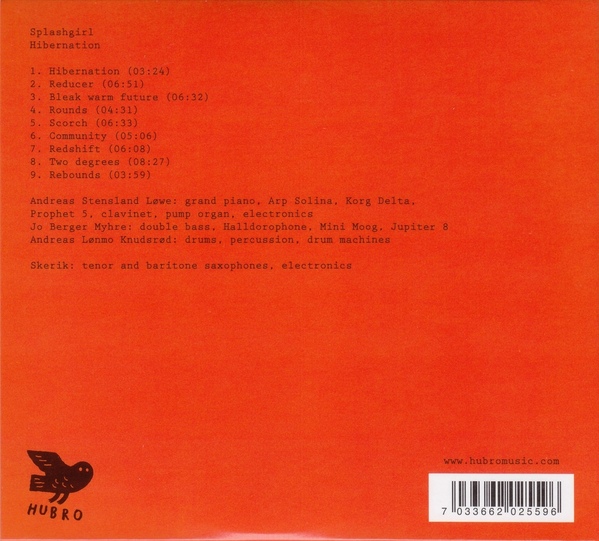
CHES SMITH-THE BELL.
CHES SMITH-THE BELL.
In January 2014, Ches Smith was booked to play at the prestigious New York Winter Jazzfest. This was a huge honour for him. The great and good of jazz descended on New York for Winter Jazzfest. Over these three days, jazz musicians from all over the world would be creating groundbreaking music. Old faces would make a return, and new stars would be born. For Ches Smith these were exciting time.
Given Winter Jazzfest was such a prestigious event, Ches Smith was determined to do something different. So the American drummer and percussionist invited pianist Craig Taborn to join him at Winter Jazzfest. However, Ches Smith realised there was still a piece of the musical jigsaw mussing.
Ches Smith needed someone to join his nascent trio. Eventually, Ches Smith decided that Brooklyn born violist and violinist Mat Maneri, was the perfect addition. He would compliment and augment Ches Smith and Craig Taborn at Winter Jazzfest.
As the trio took to the stage at Winter Jazzfest, none of the three musicians thought that this was the start of a long-term project. For all they knew, they may only play together once. That wasn’t the case.
When Ches Smith, Craig Taborn and Mat Maneri took to the stage at Winter Jazzfest, they began to improvise. Suddenly, everything just clicked. The three musicians complimented and augmented each other perfectly. Onlookers watched as the nascent trio stole not just the show, but Winter Jazzfest.
By the time the trio had finished their set, a star had been born. Some of the most important jazz critics praised Ches Smith’s trio. Peter Margasak of the Chicago Reader hailed the trio as: “the best thing I caught all weekend.” That was high praise indeed. However, he was far from a lone voice in the wilderness. Critics and cultural commentators were in all agreement, that the new trio were one of the highlights of the weekend. Surely, this performance had to be the start of something?
Ches Smith however, wasn’t looking to form another band. However, deep down, he knew that here was a trio that just worked. Their debut performance had received widespread critical acclaim. Amazingly, everything was improvised. The three musicians had played off-the-cuff, seeing where the mood took them. It was then that Ches Smith began to wonder what the trio would be capable of, if he wrote some pieces?
Soon, Ches Smith was warming to the idea of taking the trio further. He decided to speak to Craig Taborn and Mat Maner, and see what they thought. They were a similar mind, and saw a future in the trio. However, the only problem was that the three musicians all had busy schedules.
The more they thought about the project, the more it made sense to take it further. So they decided to prioritise the trio.
Despite doing so, it wasn’t until June 2015 that Ches Smith, Craig Taborn and Mat Maner got round to recording their debut album The Bell at Avatar Studios, in New York. The trio were due to record eight chamber music tracks penned by Ches Smith. These tracks would be produced by multi award-winning producer Manfred Eicher. He founded the ECM label, which recently released The Bell. Having such an experienced producer was an advantage, as The Bell was Ches Smith’s first album as bandleader.
It must have been with a degree of trepidation that Ches Smith entered the Avatar Studios. He had played on countless albums previously. However, that was as a member of a band or as a sideman. This time, he was running the show.
Ches Smith began setting up his drums, timpani and vibes. Craig Taborn took his seat at the piano; and Mat Maneri tuned his viola. Eventually, everyone was ready to record what became The Bell. All that was left was for producer Manfred Eicher to set the tapes running. When he did, Ches Smith, Craig Taborn and Mat Maneri played. Eventually, the eight tracks were recorded, and Ches Smith had seamlessly made the transition from sideman to bandleader on The Bell. All that was left, was for The Bell to be released.
Before that, critics had their say on The Bell. Ches Smith’s debut album as bandleader received the same critical acclaim as their debut that night at Winter Jazzfest, in January 2014. It was exciting times for Ches Smith and the rest of the trio.
They were about to embark on a worldwide tour, promoting The Bell. The tour takes in America, Canada, Portugal, Austria, Denmark, Sweden, and Norway during January and February 2016. Then in March, the trio jet out to South America, where Ches Smith will showcase their eagerly-awaited debut album, The Bell.
Opening The Bell, is the title-track. A bell rings slowly and hesitantly, before strains of viola are joined by a piano. It’s played, tenderly and softly. Literally the keys of the piano are caressed, before vibes make the briefest of appearances. Soon,the piano becomes insistent. Gradually, the arrangement seems to be stirring from its slumbers. Still space is at a premium. Just a scratchy viola and vibes play as bells chime. When they dissipate, the viola drones and the piano continues to play pianissimo. Understated and spacious describes the arrangement. However, it grows in power and drama, before returning to its understated state. From there, the droning viola and piano combine. Later, rumbles of timpani are joined by crashing cymbals, a hypnotic piano and the viola as this first piece of chamber music from the master improvisers reaches a crescendo. As it does, bells ring out, as if to celebrate this triumphant start to The Bell.
The viola sweeps almost dramatically, but leaving space for the rumble of timpani as Barely Intervallic unfolds. When it drops out, the piano picks up the baton. Notes are picked out deliberately. Then the viola and timpani reappear. In the case of the timpani, it merely has a walk-on part. Less is more. With the viola, it combines with, and compliments the piano. Brief bursts of drums add an element of drama, as the arrangement veers between dreamy and melancholy to a cathartic outpouring of frustration. Ches Smith seems to unleash his inner demons, as avant-garde meets free jazz and chamber music. As if spent, the drums disappear, as the vibes and piano create a hypnotic but elegiac backdrop. However, as the piano joins it seems darkness is about to descend. It never does, but there’s a sense of sadness and melancholia in the music.
This continues on Isn’t It Over? Just the piano plays before cymbals are played softly while the viola is caressed. The result is a quite beautiful sound. Complimenting it, is the piano. Each note is picked with care, as if realising that something special is unfolding. Soon, cymbals shimmer and vibes make an appearance. They’re playing supporting roles, as the piano and viola prove to be stars of the show. A pizzicato viola accompanies the piano, and its subtlety is the perfect accompaniment. Later, the vibes replace the viola and prove the perfect foil for the piano. Then when the arrangement stirs, the trio stretch their legs, using their inventiveness to create a dramatic backdrop. Stabs of piano join the wistful cries of the viola and rolls of drums. What follows is a masterful, stirring and dramatic performance that’s guaranteed to captivate.
Just a dark, insistent, probing piano opens I’ll See You On The Dark Side Of The Earth. It’s joined by the plaintive cries of the viola and vibes that ring out. Despite that, the arrangement is wistful, ominous and has a sense of foreboding. Its roots seem to be in classical music, as the arrangement meanders moodily along. Later, the arrangement builds, with the viola and piano at the forefront. By then, there’s shrillness in the arrangement, as percussion and drums combine. Soon, dramatic and melodic describes the insistent, strident arrangement. It builds towards a crescendo as bandleader Ches Smith and Co. deliver a musical masterclass.
Vibes ring out, before almost dissipating on I Think. They reappear, only to disappear and usher in the piano. Just like the preceding track, the arrangement is understated, with a thoughtful, ruminative sound. Soon, the arrangement is washing over the listener. Occasional bursts of near drama ensure that the listener doesn’t become complacent. They don’t; as they’re aware that the trio will spring a surprise. Flourishes of piano and the cries of the viola could be the signal that a change is underway. That’s the case. The piano is played insistently and adds a hypnotic backdrop for the viola and drums. By now, everyone follows the lead of the piano, and creates another dramatic, rousing, cinematic backdrop.
At just over five minutes, Wacken Open Air is one of the shortest tracks on The Bell. Straight away, a cinematic piano is joined by the viola and bursts of drums. Just like the previous track, this would be the perfect addition to a film. Another similarity to the preceding track is the rousing, stirring sound. Drums play an important part as piano is pounded and the viola sweeps the arrangement along. Later, the trio eschew power, but the sense of drama remains. Especially as the elegiac piano combines with the viola. Then the trio take a diversion, as they experiment and innovate before heading towards a dramatic crescendo.
A cymbal shimmers as the dark ominous sound of a piano opens It’s Always Winter Somewhere. It’s joined by an understated, thoughtful viola and Ches Smith’s drums. He plays within with care, ensuring he doesn’t overpower the arrangement. That would be a shame, given the potency of the combination of piano and viola. Craig Taborn’s fingers flit up and down the piano, caressing the keys. The result is ethereal and captivating. At one point, Craig Taborn plays a solo. It’s as if the rest of the trio are watching on in admiration. When they return, Ches Smith beats out a solo as Mat Maneri’s viola sweeps and shimmers. Both men seem to have been inspired by what has to be Craig Taborn’s finest moment on The Bell.
As the viola cascades, drums snap and the piano adds an element of drama to For Days, which closes The Bell. Soon, the tempo rises. So does the drama. At the forefront is the sweeping viola and gentle, thoughtful bursts of piano. They contribute to another cinematic sounding track which meanders lazily along. It almost grinds to a halt. This is purely for dramatic effect; but works. By then the listener is spellbound, wondering what will happen next? Instruments are added, including vibes, the scratchy viola and insistent piano. Soon, though, everything is played with a tenderness, before the viola soars above the arrangement, providing a captivating end to not just For Days, but Ches Smith’s eagerly-awaited debut album, The Bell.
It’s no exaggeration to refer to The Bell as an eagerly awaited album. That’s definitely the case. Everyone who was fortunate enough to witness the trio’s debut at the New York Winter Jazzfest have awaited the release of The Bell. It marks Ches Smith’s move from band member and sideman to bandleader.
He assumes the role and responsibility with aplomb. Everything he’s done so far in his career, seems to have been leading up to this. Ches Smith and his handpicked trio create what’s an ambitious, captivating and innovative album, where chamber music combines with avant garde, classical music and free jazz. This might seem like an unlikely combination, but it’s one that works. With the help of producer Manfred Eicher, seamlessly, Ches Smith, Craig Taborn and Mat Maneri combine musical genres on a captivating musical adventure.
It’s the result of three master musicians in perfect harmony. While Ches Smith is the bandleader, he’s not afraid to let Craig Taborn and Mat Maneri showcase their considerable skills. When this happens, Chess Smith is content to play a supporting role. He knows that they’re playing their part in a rich, multi-textured album, The Bell. It features music that’s variously cinematic, dramatic, elegiac, ethereal, rousing and stirring. Other times, it’s melancholy and wistful. Always, though, The Bell captivates. This makes the long wait for the release of Ches Smith’s debut album, The Bell well worthwhile.
CHES SMITH-THE BELL.

BAUMAN/KOEK-BAUMAN/KOEK.
BAUMAN/KOEK-BAUMAN/KOEK.
By 1978, German music was changing. The Krautrock era had ended in 1977, and there was a move towards electronic music. This wasn’t new.
The Berlin School had been around since the early seventies. It was also a precursor of ambient music, and went on to influence future generations of ambient musicians. Among the founding fathers of The Berlin School were Tangerine Dream, Klaus Schulze and Manuel Göttsching. They began to pioneer electronic music in West Berlin. Over the next few years, they recorded not just some of the most important, influential and innovative electronic music of the seventies, but in the history of music. This included many classic Berlin School albums.
Tangerine Dream, were are at the forefront of The Berlin School sousnd. Lead byEdgar Froese and Christopher Franke, they released back to-back classics. The first was Phaedra in 1974, with Rubycon following in 1975. The same year, a former member of Tangerine Dream released another classic album.
Klaus Schulze released his fifth album Timewind in 1975. Timewind was hailed a groundbreaking, Berlin School classic, and influenced other artists. So did an album Manuel Göttsching released in 1976,
When New Age Of Earth was released in 1976, the album was credited to the band Ash Ra. However, there was no doubt about it, New Age of Earth was a Manuel Göttsching solo album. New Age Of Earth was very different to many albums being released in 1976. With its ambient sound, it would influence several generations of ambient musicians, and nowadays, is regarded as an ambient classic. It seemed with every year that passed, Berlin School classic was released.
1978 was no different. That year, Michael Hoenig released his critically acclaimed album Departure From The Northern Wasteland. It was a career-defining classic, that nowadays, is regarded as a landmark album. However, it wasn’t until much later that Departure From The Northern Wasteland began to receive the critical acclaim it deserved. This wasn’t new.
It had been a familiar story since the birth of The Berlin School. Some of the most important, influential and innovative Berlin School albums passed almost unnoticed. Even in Germany. That was the case with an album from two musicians from Kempten, Bavaria, Wolfgang Baumann and Ata Koek.
They recorded just one album Baumann Koek, which was recently reissued by Bureau B. It’s a welcome reissue of an album that’s one of the hidden gems of The Berlin School. Baumann/Koek deserves to be heard by a much wider audience than heard their eponymous album in 1978. That couldn’t be helped. They were a victim of circumstances, and their story is a case of what if?
The Baumann/Koek began in Kempten, Bavaria in 1978. That was home to Wolfgang Baumann and Ata Koek, two musicians who dreamt of making an album. This wasn’t going to be a traditional rock album. Instead, twenty-eight year old Wolfgang Baumann and twenty-two year Ata Koek wanted to follow in the footsteps of Tangerine Dream, Klaus Schulze and Manuel Göttsching. There was one problem though, they didn’t have the equipment necessary to record an album. So they headed to Bonn.
Back then, Bonn was the capital of West Germany. It was also a good place to buy the equipment they needed. One place especially, would have what Wolfgang and Ata needed to record an album, Synthesizerstudio Bonn. This was where German musical royalty came to buy electronic equipment. Knowing they were following in the footsteps of Kraftwerk, who were one of Germany’s most successful musical exports, meant their was an air of excitement as Wolfgang and Ata journeyed to Bonn. Eventually, they arrived and went shopping.
At Synthesizerstudio Bonn, Wolfgang and Ata bought a secondhand ARP 2600. This they hoped would allow them to record their album.
When Wolfgang and Ata returned home, they began experimenting with the ARP 2600, finding out what it could, and couldn’t do. It was with a heavy heart, that Wolfgang and Ata realised they needed more equipment. So they made another journey to Bonn.
This time, when Wolfgang and Ata they were determined to buy enough equipment to record their album. So in Synthesizerstudio Bonn they bought an ARP sequencer, a Solina String keyboard, and an EKO Computer rhythm drum computer. The final piece of the musical jigsaw was a four-track recorder, which allowed Wolfgang and Ata to record their album.
With this expensive array of equipment, a learning experience began for Wolfgang and Ata. They had to work out how to operate each piece of equipment. That was no mean feat. Especially since 1978 was the pre-MIDI age. There was no standardised interface that allowed equipment from different manufacturers to communicate. With Wolfgang and Ata owning equipment by ARP, Solina and EKO, this was problematic. However, patience, persistence and perseverance resulted in Wolfgang and Ata recording the five tracks that became Baumann/Koek. Now they needed someone to mix their album.
By 1978, there was no person better qualified for the job than the legendary Conny Plank. He had worked with the great and good of German music. However, Conny Plank was just as happy to mix Baumann/Koek. So Wolfgang and Ata booked Conny Plank’s studio for the mix, and watched as the master got to work. Conny Plank sprinkled his magic dust, and now Wolfgang and Ata began to plan for the release of Baumann/Koek.
Rather than take their album to one of Germany’s top labels, Wolfgang and Ata decided to release Baumann/Koek themselves. So they had 1,000 copies of Baumann/Koek pressed. Once the album was pressed, it was released later in 1978.
Reviews of Baumann/Koek were positive. The album was well received, and began to sell well in West Germany. It was then that the Swabian wholesaler Jaguar Records offered to distribute Baumann/Koek worldwide. This seemed like too good an offer to refuse. Sadly, it was.
Not long after Jaguar Records took over the worldwide distribution of Baumann/Koek, the company became insolvent. Soon, Jaguar Records was declared bankrupt. For Wolfgang and Ata, this was a huge blow.
Once they had time to digest how the bankruptcy of Jaguar Records would affect them, Wolfgang and Ata came to a decision. There would be no followup to Baumann/Koek. They weren’t willing to risk any more of their capital. This meant that Baumann/Koek was the one and only album from Baumann/Koek.
Sadly, for a while Baumann/Koek was overlooked by record buyers. It wasn’t until the dawn of the internet age, that a new generation of music lovers rediscovered Baumann/Koek. However, there was a degree of confusion over who played on the album.
When some people heard Baumann/Koek, they were convinced that the album featured Peter Bauman of Tangerine Dream. This was denied, but even today, the rumours persist. Other rumours were that Baumann/Koek featured Peter Bauman who sung on the MPS Records’ cover albums. This was also denied. Still, though, the rumours persist. Maybe Bureau B’s reissue of Baumann/Koek will finally put paid to these rumours, and ensure that Wolfgang Bauman and Ata Koek receive the credit they so richly deserve. Although they only released one album, Baumann/Koek is an album that will grace any self-respecting record or CD collection.
Opening Baumann/Koek, is Yarabbim, a twelve minute epic. The arrangement can be heard in the distance. It sounds like a train making its way down the line, ready to take listener on a musical journey aboard one of Deutsche Bahn’s futuristic looking trains. As the arrangement grows in power and drama, the train nears the station. When the listener climbs onboard, Baumann/Koek are ready to provide the soundtrack,
After a brief nod to Kraftwerk, the train leaves the station, and Baumann/Koek provide an irresistible soundtrack to the journey. As the kilometres go by, the arrangement pulsates, and veers between hypnotic and mesmeric, to elegiac and ethereal. Contrasts abound, as washes of synths join the pounding, hypnotic drums. By then, the listener is hooked, as they’re swept along atop swathes of synths strings. Dramatic, beautiful and full of subtle hooks, Yarabbim is a truly irresistible journey courtesy of musical master craftsmen, Baumann/Koek. One wonders if this is the music they dreamt of recording as they journeyed between Kempten to Bonn, to buy the instruments to record the album?
A myriad of beeps and squeaks are panned left to right on TD-Mem. Soon, urgent synths are added to the pulsating, mesmeric arrangement. It seems the journey that began on Yarabbim continues. Above the arrangement, what sounds like a light aircraft soars, as if surveying man and machine in perfect harmony. By then, swells of synth strings add en elegiac sound, which contrasts perfectly to urgency and mesmerism of the arrangement. Later, the tempo increases, and futuristic bursts of sci-fi synths are added. This adds to the cinematic nature of the track, as the tempo increases again. It’s as if Baumann/Koek are going through the gears as this captivating, cinematic journey continues apace.
Gamabol is another twelve minute epic. The introduction might sound understated and otherworldly. It’s not. Instead, it’s a radio is being tuned, and then a code being tapped out. Then the arrangement beeps, speaks and buzzes. Frantically, a code is tapped out, sounding like a desperate cry for help. Musical alchemists deploy their array of equipment and create an innovative cinematic soundscape. Later, washes of synths envelop the listener. The arrive from left and right, as hypnotic strings chug along. Again, Baumann/Koek are taking the listener on a journey. Melodic and dramatic, the arrangement flows along. After eight minutes, man and machine are in perfect harmony, creating an elegiac, graceful melodic, electronic symphony that sweeps the listener along as their journey continues.
A car races by, before pulsating bass synth dominates the arrangement of Where. It seems Baumann/Koek are taking the listener on a late night drive along the autobahn. Meanwhile, washes of synths sweep in and out. Sometimes, filters are used to transform the dry sound. This works well. Soon, the tempo increases and drums are added. So are synths strings. They add an ethereal backdrop. Filters continue to be used, and signal another increase in the tempo. However, Baumann/Koek don’t fall into the trap of overusing the filters. Instead, they use them sparingly, to compliment the arrangement to Where.
Sequencer Roll closes Baumann/Koek eponymous debut album, and is totally different to previous tracks. So much so, that one can’t help but wonder if I’ve strayed onto the wrong album? Baumann/Koek sound like Canned Heat or ZZ Top, as they boogie their way through this two minute track. It’s a truly irresistible track, and one that showcases Baumann/Koek’s versatility and talent. Not many people could create a track like Sequencer Roll, using the equipment they had available. However, the Kempten based poisoners managed to, and it’s a fitting finale to their one and only album, Baumann/Koek.
Sadly, there was no followup to Baumann/Koek, which was recently reissued by Bureau B. After Jaguar Records became insolvent and was declared bankrupt, Wolfgang Bauman and Ata Koek had to rethink their future plans. Eventually, they decided they couldn’t put more of their capital at risk. Releasing Baumann/Koek had proved expensive.
Wolfgang Bauman and Ata Koek had to buy the equipment to record the album. Then there was the production costs and hiring Conny Plank’s studio so the maestro could mix Baumann/Koek. After the album was mixed, 1,000 copies of Baumann/Koek were pressed. By then, the costs must have been escalating, and surely, Wolfgang Bauman and Ata Koek must have been rueing their decision to self release the album? If only they had taken Baumann/Koek to a record company.
Surely, there would’ve been no shortage of labels willing to release Baumann/Koek? After all, here was an album of innovative music that if promoted properly, could’ve and should’ve been a commercial success. It was an album that oozed quality.
The best way to describe Baumann/Koek was a musical journey. It lasts five tracks and thirty-nine magical minutes. The music veers between cinematic and dramatic, to elegiac and ethereal and even hypnotic and mesmeric. Other times the music is hook-laden, irresistible and melodic. Especially as the listener is swept along atop synth strings. Then as Baumann/Koek draws to a close, Wolfgang and Ata bowl a curveball. A slice of boogie unfolds and Baumann/Koek rock into the distance. Sadly, there was no encore.
Maybe things would’ve been different if a record company had released Baumann/Koek. They would’ve had the money and personnel to promote Baumann/Koek. However, Baumann/Koek valued their independence.
This would ultimately cost them the chance of a long and successful musical career. Neither Wolfgang Bauman nor Ata Koek released another album. Instead, they returned to where the dream began, in began in Kempten, Bavaria.
Thirty-seven years later, and Baumann/Koek has been reissued by Bureau B. This is a welcome reissue of one the hidden gems of The Berlin School. Hopefully, a new generation of music lovers will embrace this timeless, cult classic which should’ve been the beginning a successful career for Baumann/Koek.
BAUMAN/KOEK-BAUMAN/KOEK.
MIKE OLDFIELD-DISCOVERY.
MIKE OLDFIELD-DISCOVERY.
By June 1984, thirty-one year old Mike Oldfield prepared to release the ninth album of his career, Discovery. This was the followup to 1983s Crises, which was Mike Oldfield’s most successful album of recent years. Crises was certified platinum in Germany and Sweden; and gold in Britain, France and Holland. This surpassed the success of his six previous albums. However, the roots of the success can be traced back to Five Miles Out, which Mike released in 1982.
Five Miles Out had been recorded during 1981 and 1982. Before the sessions began, Mike Oldfield had been thinking about the future. His albums were no longer as popular as they had once been. He discovered this in 1980.
QE2.
As the new decade dawned, a new Mike Oldfield seemed to have been born. His first album of the eighties, was very different from previous albums. It was a far certainly a far cry from the symphonic majesty of Tubular Bells, Hergest Ridge and Ommadawn. These were the albums that launched Mike’s career. Since then, his music continued to evolve.
QE2 was no different. However, a more than a few eyebrows were raised when QE2 featured cover versions of Abba’s Arrival and The Shadows’ Wonderful Land featured on QE2. It seemed Mike Oldfield was determined to reinvent his music.
He did this with the help of vocalist Maggie Reilly, who would become a familiar face on future Mike Oldfield albums. She made her debut on QE2, which was co-produced by Mike and David Hentschel, and scheduled for release in October 1980.
Before the release of QE2, the reviews were mixed. It was a long way from Mike Oldfield’s first three albums. Some critics went as far as to say that QE2 was the weakest album of Mike Oldfield’s six album career. Record buyers agreed.
When QE2 was released in 1980, it reached just number twenty-seven in Britain. Despite this, QE2 solid 100,000 copies and was certified gold. Elsewhere in Europe, QE2 didn’t sell in the same quantities as previous albums. The exceptions were Germany and Spain, where QE2 was certified gold. That was as good as it got. In America, QE2 stalled at number 174 in the US Billboard 200. While QE2 was Mike’s first album since 1975s Ommadawn to chart in the US, it was nothing to go overboard about. Far from it.
Mike Oldfield’s music at a crossroads. If he didn’t do something to address the problem, he risked becoming irrelevant. Gone were the days when prog rock was King and two lengthy musical movements appealed to music buyers. That was long gone. Times and music had changed, and not necessary for the better. Mike realised this and his music began to change direction on QE2. However, QE2 saw Mike heading in the wrong direction.
The problem Mike Oldfield faced, was that since the late seventies, music seemed to be in a constant state of flux. Fashion changed quickly. Musical genres seemed to fall quickly out of fashion. As a result, so did artists. Careers were becoming shorter. Mike who was just twenty-seven had already released six albums. However, he had to rethink his musical future. If Mike’s music didn’t change, he risked alienating a generation of record buyers.
While Mike Oldfield was popular within a certain age group, he wanted to appeal to younger record buyers too. This made sense. Those that had bought Mike’s albums in the early seventies were growing older. Many were married, with families and didn’t have the same money to spend on music. This was impacting on record sales. So Mike needed the new generation of record buyers to embrace his music. The “baby boomers” were the ones with the disposable income, who were buying albums. However, there was a problem with their perception of Mike’s music.
Many of the new generation of record buyers saw Mike Oldfield as the music their parents listened to. When they thought of Mike Oldfield, they thought of grandiose, symphonic music and of course, prog rock. That was the problem.
People’s perception of Mike was problematic. It also meant that a whole generation of record buyers were potentially overlooking Mike’s music. This was ironic because throughout his career, Mike Oldfield’s music evolved. It never stood still. Instead, Mike was a musical shapeshifter, who continued to reinvent his music. Sometimes, the changes were subtle; other times, they were more radical. Mike however never shied away from change.
He had changed direction on QE2. That hadn’t gone to plan. So it was time for a rethink, and a further reinvention of Mike Oldfield, It wouldn’t happen overnight. Instead, it would take three albums, and began on Five Miles Out.
Five Miles Out.
Before the recording sessions for Five Miles Out began, Mike Oldfield realised that his music had to evolve, or risk becoming irrelevant. It was like playing a game of high stakes musical poker. At stake was Mike Oldfield’s career. If his reinvention didn’t work, his career could be all but over. So Mike had to record an album that would appeal to a wider audience.
No longer could Mike record the symphonic albums of his past. That wasn’t what the record public wanted in the early eighties. With this in mind, Mike Oldfield decided his music should move towards a much more accessible pop style. Already Mike had introduced vocalists, cover versions and shorter songs. More changes were afoot for his seventh album Five Miles Out.
When Mike started recording Five Miles Out, synths, sequencers and drum machines were starting to replace real musicians. Mike had been using synths since 1979s Platinum, where he’d used a Roland SH-2000 and Sequential Prophet. For his seventh album Five Miles Out, Mike used a Fairlight CMI.
The Fairlight CMI was a digital sampling synth, which Mike Oldfield would put to good use on Five Miles Out. This lead to a change in style. Gone was the symphonic style of earlier albums. Replacing it, were short, poppy songs. Full of slick, poppy hooks, Mike Oldfield had tried to make his music more accessible, and succeed.
For some of his older fans, the stylistic change didn’t please them. They preferred the symphonic style of earlier albums. This was a step too far. Some went as far as to say Mike had sold out. was being a realist. If he didn’t change, he’d become irrelevant. His decision to change direction musically was vindicated.
Five Miles Out was well received by critics. Many of them embraced the stylistic change. Although a few critics yearned for the symphonic rock opus’ of the past, they realised music had changed. Mike had moved on, and in doing so, maybe won some of the younger record buyers who had previously, criticised his music.
The lead single from Five Miles Out was the title-track, which reached number forty-three in the UK. This gave Mike his first single in six years. Released in March 1982 Five Miles Out was Mike most successful album since 1975s Ommadawn. It reached number seven in the UK, where it was certified gold. Five Miles Out was certified gold in Germany and even reached number 164 in the US Billboard 200. Then when Mike released Family Man, which featured the vocals of Maggie Reilly, it reached number forty-five in the UK. Two hit singles and a gold disc in Britain, Five Miles Out marked the beginning of the reinvention of Mike Oldfield. It continued on Crises.
Crises.
For the followup to Five Milles Out, Mike Oldfield decided to appeal to fans old and new. The title-track filled side one, and was a twenty minute opus that his old fans would enjoy. It was written by Mike. The five short songs on side two showcased the “new” Mike Oldfield. This included Moonlight Shadow, Taurus 3 and Shadow On The Wall. The other two tracks were collaborations. Foreign Affair was written by Mike and Maggie Reilly, a frequent collaborator with Mike and regular guest vocalist. Jon Anderson of Yes, cowrote in High Places with Mike. These six tracks became Crises.
Crises was co-produced by Mike and Simon Phillip. Mike decided that it was best to stick with what was a winning formula. This meant hiring the best session musicians, for what the slimmed-down band that played on Crises. There was a reason for that. Mike was relying more on drum machines and synths. Many of the other instruments, Mike played himself. That was the benefit of being a skilled multi-instrumentalist. However, for backing vocals, Maggie Reilly, Jon Anderson and Roger Chapman of Family were drafted in. This was the personnel that featured on Crises, which was recorded at his own studio between November 1982 and April 1983. A month later, Crises was released.
On 27th May 1983, Crises was released to widespread critical acclaim. Crises picked up where Five Miles Out left off, reaching number six in the UK. This resulted in Mike’s third gold disc. Around Europe, Crises was a huge success, reaching the top ten in eight countries. In Sweden and Germany, Crises reached number one, and was certified gold in France, Germany and the Netherlands. In Germany, Spain and Sweden, Crises was certified platinum. Mike was back, with one of the most successful albums of his career. However, this wasn’t an end to the commercial success Mike would enjoy.
Moonlight Shadow which was chosen as the lead single from Crises, and reached number four in the UK. Elsewhere, it was a huge commercial success, reaching number one in eleven countries in Europe. For Mike, Moonlight Shadow was the biggest single of his ten year career. The second single was Shadow On The Wall, which featured Roger Chapman from Family on lead vocal, stalled at just number ninety-five in the UK. Despite that disappointment, Crises had been a huge commercial success, further vindicating Mike’s decision to change direction musically.
After the success of Crises, Mike Oldfield was hailed the comeback King. He had rescued his career, and by June 1984, was preparing to release his ninth album, Discovery, which was recently reissued by UMC.

Discovery.
By the time Mike Oldfield was ready to write what became Discovery, he was living as a tax exile. Home for Mike was Villars-sur-Ollon in the canton of Vaud, in Switzerland. That was where Mike Oldfield wrote and recorded what became Discovery.
For Discovery, Mike Oldfield wrote eight tracks. Mainly, they were short songs, apart from The Lake, which was twelve minutes long. However, compared to Mike’s early albums, The Lake was almost an excercise in brevity. Just like the rest of Discovery, The Lake was recorded in Villars-sur-Ollon.
Gone were the days when Mike would be joined by a full band. These days were in the past. Instead, just drummer Simon Phillips; and vocalists Maggie Reilly and Barry Palmer made their way to Villars-sur-Ollon. Mike a multi-instrumentalist, utilised both traditional instrumehts and technology. Seamlessly, Mike switched from acoutic and electric guitars to a bass and mandolin. He also used guitar and bass synths, and the Fairlight CMI. Mike who was an early adopter of the Fairlight CMI, used it for sampling and sequencing. Sonically, it was a far cry from Tubular Bells, Mike’s classc debut album. However, Mike new in his heart of hearts that his music had to contnue to evolve on Discovery. It was released on 25th June 1984.
Before the release of Discovery, critics had their say on Mike’s ninth album in eleven years. Mostly, the reviews were positive. Some critics preferred Mike’s “old” sound, and found some of the poppier songs too lightweight. However, Mike had been ecouraged to include the more poppy songs by Virgin Records.
They wanted another Moonlight Shadow. So Mike sat at his Fairlight CMI trying to compose another hit single. It wasn’t easy. Moonlight Shadow had taken eight years hard work. So the chances of lighting striking twice were slim. However, Mike had to be seen to appeasing his paymasters at Virgin Records. He knew that record buyers would have the final say. They may not be the arbiters of taste, but they certainly were the arbiters of popularity.
When Discovery was relased in Britain, it failed to replicate the sucess of Crises, reaching just fifteen. However, this was enough for another gold disc. Elsewhere in Europe, Discovery proved popular. It reached number one in Germany and Switzerland; number two in Holland; and number three in Austria, Norway and Sweden. This resulted in Discovery being certified platinum in Spain; and gold in France, Germany and Sweden. While Discovery didn’t quite replcate the success of Crises, the reinvention of Mike Oldfield ensured that his comeback continued.
That’s despite the singles not replicating the success of Moonlight Shadow. Mary, Queen Of Scots reached the top ten in eight European countries. In France it reached number one. However, in Britain, Mary, Queen Of Scote stalled at forty-eight. Tricks Of The Light failed to matche the success of Mary, Queen Of Scots. It reached just ninety-one in Britain and forty-six in Germany. By then, Discovery, the third album from the new Mike Oldfield, was well on its way to selling over a million copies in Europe.
Opening Discovery, is To France, a song about Mary, Queen Of Scots. Straight away, there’s a Celtic influence before eighties drums accompany Maggie Reilly’s heartfelt, emotoive vocal. Soon, guitars, bass and keyboards are provding the backdrop to Maggie’s vocal. She brings the lyrics to life, so much so, that it’s possible to imagine Mary fleeing, seeking sanctuary and safety. By then Maggie’s vocal is etheral, and at the heart of the arrangement. When it drops out, a keyboards, guitar, flugelhorn and drums replace the vocal. Insruments are introdced and just as importantly, withdrawn at the right moment. This includes a searing guitar that cuts across through the arrangement. It’s just the latest addition to this hook-laden fusion of pop and Celtic music, which features a vocal masterclass from Maggie Reilly.
A bass synths opens Poison Arrows, addimg an element of drama. Soon, drums pound deliberately and a guitar cheeps, and accompanies Barry Palmer’s dramatic vocal. Fear is in his voice as he warns: “someone’s out to get you, hiding in the shadows.” Rolls of drums, bass and later, blistering rocky guitars are added. They replace Barry’s vocal. Then Mike Oldfield is transformed into guitar hero. It’s the latest dramatic element. So are a pulsating bass synth and howls, which add to the cinematic nature of the track.
A crystalline guitar joins hypnotic drums on Crystal Gazing. It features the return of Maggie Reilly. Her elegiac, etheral vocal is swept along on the arrangement whichg now includes keyboards and synths. Then when the vocal drops out, a guitar gives way to a horn, before reaching a sudden ending. All that’s left is a pleasnt memory of Maggie Crystal Gazing.
Tricks Of The Light has a real eighties sound to it. The telltale signs are the drums, synths and even the bass. They provide the backdrop for Maggie and Barry, who share vocal duties. That’s despite not meeting until after Discovery was recorded. Their vocals are envloloped by synths and searing guitars. Harmonies augment the vocal, before Mike Oldfield makes another welcome appearance. He adds to the urgency, on what’s another catchy fusion of pop and eighties electronica.
Drums pound, while the blisterng guitar cuts through Discovery’s arrangement. Then when Barry’s vocal enters, it’s a throaty, impassioned roar. He delivers the lyrics with feeling, while banks of keyboards and synths joins machine guitars and ocasional harmonies. Barry’s vocal is a mixture of anger and frustration; especially when he asks: “how can you sleep, how can you turn away, thinking’s so cheap, some day you’ll pay.” By then, Mike Oldfield is firmly in fistpumping, stomping eighties anthem territitory. It’s a long way from Tubular Bells, and QE2, the album the nearly sunk the good ship Oldfield. Three albums later, and Discvery finds the new Mike Oldfield in calmer waters, having rediscovered his Midas Touch.
Talk About Your Life is an elegiac ballad featuring Maggie Reilly. She’s accompanied by a slow arrangement where synths and keyboards dominate. It provides the backdrop to a vocal that can only be described as ethereal. Gradually, the tempo quickens slightly, as different instruments are introdced. This includes a what could be a church organ and even guitar. They’re joined by harmonies, as the drama builds, and Maggie delivers an emotional and hearfelt vocal.
Saved By A Bell has a much more understated, dreamy arrangement. Mike deploys his synths, and they frame the vocal. Soon, the arrangenent begins to unfold. Drums are dropped in. So are the bass, guitars and bold keyboards. By now, the track has been transformed. It’s two sides of the same coin, which are part and parcel of the same song, which later, heads in the direction of an impassioned power ballad.
The Lake, a twlve minute track closes Discovery. It’s a nod to Mike’s older fans, who embraced his symhponic epics. Often, these albums only featured two lengthy tracks. For them, he offers up The Lake. Hpynotic see-saw synths are eventually joined by a dark, pulsating bass. Then Mike throws a curveball, and the arranegennt races away. Drums power the arrangement away, as it references Mike’s seventies heyday. At one point, there’s even a nod to Status Quo. Sci-fi are added, as Mike Oldfield takes the listener on a musical adventure. The arrangement veers between eerie and haunting, futuristic and cinematic. See-saw synths are joined by guitars as the track veers between grandiose and understated. By then, The Lake sounds like the soundtrack to a film that’s yet to be made. Later, Mike’s rocks along before the elgiac soundscape returns. It seems Mike Oldfield has kept the best to last, and at the same time, keeps his old fans onside.
That was important. Mike Oldfield couldn’t risk alienating his old fans. They had been buying his albums since Tubular Bells was released in 1973. Eleven years later, and Discovery was Mike’s ninth album. Many of his old fans had turned their back on Mike’s music. They didn’t like the lightweight, poppy sound. Instead, they preferred the symphonic, preogressive sound of Mike’s early albums.
Ever since QE2, many of Mike’s older fans felt neglected. Things had changed slightly on Five Miles Out, with its twenty-fove minute epic Taurus II. Then on Crises, the title-track was a twenty minute opus. Both albums featured the new and old Mike Oldfield. Mostly, though Mike’s older fans had t watch their onetime hero trying to win over a new generation of music lovers. Some of Mike’s old fans felt neglected and unloved. So on Discovery, he pampered his old fans with the twelve minute epic, The Lake. It was the nearest thing Mike Oldfield’s old sound. Ironically, The Lake was the best track on Discovery. However, there’s more to Discovery than one track.
From the opening bars of To France, right through to The Lake, Mike Oldfield and his friends captivate, and take the listener on a musical journey. Aided and abetted by Maggie Reilly, Barry Palmer and Simon Phillips, Mike Oldfield combines pop, rock and eighties electronica with progressive rock. The result is hook-laden album that should’ve appealed to Mike Oldfield’s fans old and new. As a result, Mike Oldfield’s comeback continued with Discovery, whcoh was recently reissued by UMC.
It seems a longtime ago since Mike Oldfield stood at the musical crossroads. However, he didn’t make the mistake many musicians had made before, and changed direction. This ensured that Mike Oldfield’s career continued, and thirty years later, in 2014 Mike Oldfieled released Man On The Rocks, his twenty-fifth studio album. However, that might not have happened. Especially if Mike Oldfield hadn’t began to reinvent his on Five Miles Out. The reinvention of Mike Oldfield continued on Crises and was complete on his ninth studio album, Discovery.
MIKE OLDFIELD-DISCOVERY.
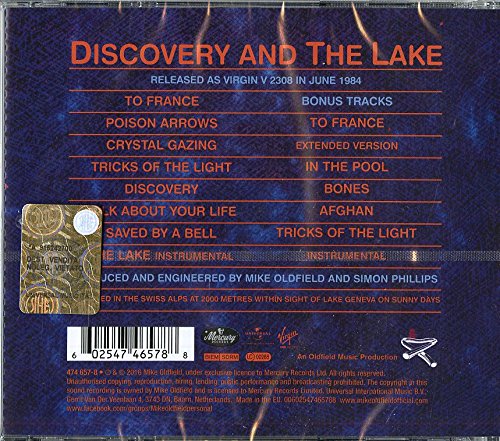
JOHN MARTYN-A LIFE IN MUSIC REMEMBERED.
JOHN MARTYN-A LIFE IN MUSIC REMEMBERED.
It’s hard to believe that it’s seven years since John Martyn passed away on 29th January 2009. Incredibly, John Martyn was only sixty years old. He seemed to have been around forever.
John Martyn’s life revolved around music. His career began in 1967, when he was just seventeen. Back then, John Martyn was a folk singer. Over the next forty-two years, John Martyn continually reinvented his music. He flitted between folk and folk rock to blues, psychedelia, reggae, rock and trip hop during the five decades John spent making music. He had released twenty studio albums during his lifetime, including classics like Bless The Weather, Solid Air and One World. They’re part of the rich musical legacy that John Martyn left behind in 2009. His story started back in 1948.
John Martyn was born Iain David McGeachy, in 1948 in New Malden, Surrey, England. Both his parents were opera singers, so from an early age John Martyn was exposed to music. When John was five, his parents divorced and much of his childhood was spent at his grandmother’s in Glasgow.
His musical career began aged seventeen, playing a mixture of blues and folk music. Legendary folk singer Hamish Imlach was to prove to be an early influence, even a mentor, to John. Quickly, he became a leading figure on the London folk circuit. Thereafter, things started to move quickly for John Martyn.
Aged nineteen, John signed to Chris Blackwell’s Island Records in 1967. In October 1967, his debut album London Conversation was released. Just over a year later, his second album The Tumbler was released in December 1968. On The Tumbler album, the style of music was to change, to a much more jazz influenced sound. This would be the start of the evolution of John Martyn’s music.
By the time John Martyn released his third album Stormbringer in February 1970, he had met and and married Beverley Martin. Stormbringer was their first collaboration.
Previously, Beverley had been a solo artist, Beverley Kutner. She had worked with Jimmy Page and Nick Drake. On Stormbringer John’s sound changed again. John played his acoustic guitar through a fuzzbox, phase shifter and Echoplex. This would become part of John’s trademark sound, when he returned to his solo career. Before that, he released one further album with Beverley.
John and Beverley Martyn released one further album together. This was the The Road To Ruin, like Stormbringer released in November 1970. By then, Island Records wanted to market John Martyn as a solo artist. Beverley Martyn did make an appearance on further albums, singing backing vocals. Mostly though, Beverley returned to her career as a solo artist. So did John.
With Island Records now marketing John as a solo artist, he released six studio albums and one live album, 1975s Live At Leeds between 1971 and 1977. the first of these albums was Bless The Weather.
November 1971 saw the release of Bless The Weather. It was hailed as the finest album of John’s solo career. Mostly, it features acoustic music. The exception is Glistening Glynebourne, which showcased John’s echoplex. It would become part of John’s trademark sound. This was a hint of what was to come from John Martyn.
By far, the best album of the seventies was his seminal album Solid Air. Released in February 1973, Solid Air is seen as one of the best albums of the 1970s. The title track was a tribute to Nick Drake, a close friend of Martyn’s who died tragically of an overdose. During the recording of Solid Air, Martyn was to meet bassist, Danny Thompson. The pair collaborated right up until John’s death in 2009. John’s vocal style changed during the recording of Solid Air. At that time, he started to develop a new slurred vocal style. The timbre of this new vocal style resembled a tenor saxophone. Just like the echoplex, this new singing style became a feature of John’s future albums.
His next album Inside Out, was released in October 1973. It featured a much more experimental style of music. There was much more emphasis on improvisation. John’s sound and style it seemed, was constantly evolving.
For his eight album, Sunday’s Child which was released in January 1975, John reigned in his experimental sound. However, Sunday’s Child was a much more eclectic album, with John flitting between country, folk and rock. The result was an eclectic and critically acclaimed album. However, controversy wasn’t far away for John.
In 1975 Island Records refused to release Martyn’s live album, Live At Leeds. So, John resorted to selling signed copies by mail from his home. After the release of Live At Leeds in 1977, John headed to Jamaica on holiday.
What started out as a holiday, ended up with John collaborating with reggae producer Lee “Scratch” Perry. One World, John Martyn’s second classic album, now is seen by some people as the first ever trip hop album. As a result, John Martyn is perceived as the godfather of trip hop and One World a John Martyn classic. After One World, John didn’t release an album for three years.
The eighties were a turbulent time for John Marten, both personally and professionally. By the end of the seventies, John’s marriage had broken down. This led to John pressing “the self destruct button” as he described it. John became addicted to alcohol and drugs. He later said this was avery dark period in his life. Grace and Danger, which was released in October 1980, was the album that came out of this period.
Grace and Danger was autobiographical, describing what he was going through at that time. Chris Blackwell, realising just how personal an album Grace and Danger was, held the album’s release back a year. Partly, this was because of his friendship with both John and Beverley Martyn. Following Grace and Danger, which is one of John’s most underrated and powerful albums, he left Island Records.
After leaving Island Records in 1981, John Martyn joined two albums for WEA. They thought they could transform John’s career, and turn him into a commercially successful artist. The way to do this, they thought, was to move away from John’s traditional sound, to a more mainstream sound. This didn’t appeal to John. So he only stayed at WEA for two albums.
Glorious Fool was released in September 1981, with and Well Kept Secret following in August 1982. This more mainstream sound didn’t prove successful. So John returned to Island Records.
Back at Island Records, John Martyn only released two studio albums. Sapphire released in November 1984, had a poppy sheen. It was quite unlike John Martyn. So was Piece By Piece, which was released in February 1986. Neither album proved particularly successful. So Island Records released a live album
Foundations in 1987. This was much more representative of John Martyn. Sadly, still commercial success eluded John and Island Records dropped Martyn in 1988. This brought to an end a twenty year association with Island Records.
Two years later, John Martyn returned with a new album, The Apprentice. It was released on Permanent Records, and was hailed as a return to form from John Martyn. This would prove ironic and embarrassing for Island Records.
It’s thought that one of the reasons for John Martyn’s departure from Island Records, was that they didn’t like the demos what would became The Apprentice. So when John left Island Records, he set about proving them wrong.
Rather than sign to another record company, John paid for the recording of The Apprentice. He returned “home” to Glasgow, and with his band, recorded The Apprentice at the city’s Cava Studios. This seemed to inspire John, and when the album was complete, John went in search of a record company to release The Apprentice.
Given his track record, there would be no shortage of record companies willing to release a John Martyn album. However, it was Permanent Records that got the honour of releasing what became John’s best album of recent years. Sadly, John never came close to matching the quality of The Apprentice.
The closest he came was Cooltide, which was recorded at Cava Studios, Glasgow. Cooltide was released in November 1990, and featured a jazz sheen. This was well received by critics. They were won over by Cooltide, which critics felt, came close to the quality of The Apprentice. It seemed John’s career was enjoying an Indian Summer.
Despite this, it was another seven years before John returned with an other studio album. His only release was Live, a double album released by Permanent Records in 1994. This showcased what John Martyn live sounded like by the nineties. Nearly two decades after the release of Live At Leeds, and John was still a stalwart of the live circuit. Wherever he went, he still a popular draw. On tour, John embraced the rock ’n’ roll lifestyle.
John Martyn loved life. However, he loved life in the fast lane. During some part of his career, drink and drugs became part of John’s daily diet. This lead to addiction. Eventually, this caught up with John in 1996, when his pancreas literally exploded. For most musicians this would’ve marked the end of their career, and a much more sedate lifestyle. Not John.
He returned in 1997 with a new album And, which featured his old friend, and sometime collaborator, Phil Collins. And marked another stylistic change from John Martyn. There was a noticeable trip hop influence on And. That’s not surprising, as John is regarded as inventing the genre on One World. Reviews of And were mixed. The standout track was Sun Shines Better, which was remixed for the hidden track on the album. With its trip hop sound, the remix would become a favourite of DJs playing chill-out sets. Despite approaching his fiftieth birthday, John Martyn was still relevant.
After not releasing an album for seven years, John returned with his second album in just under two years. The Church With One Bell was a covers albums, where John and small band recorded ten tracks during one week at CaVa Sound Studios. John had covered songs by Bobby Charles, Ben Harper, Elmore James, Rev. Gary Davis, Lightnin’ Hopkins and Portishead. This eclectic selection of songs was released 1998.
The Church With One Bell, like many of John’s later albums, divided opinion amongst critics and fans. While some loved the albums, others weren’t so sure. It was a disappointing way for John to celebrate his fiftieth birthday.
Many people found it hard to believe John Martyn was just fifty. He seemed, had been around forever.. His career had began thirty-three years earlier. Since then, he had released eighteen studio albums. As the new millennia dawned, eighteen became nineteen.
Glasgow Walker was John’s first album of the new millennia. It was also the first album John wrote on a keyboard. Usually, John sat down with a guitar to write songs. Not this time. At Phil Collins’ suggestion, John wrote Glasgow Walker at a keyboard. The result was a genre-hopping album.
Seamlessly, John flitted between blues rock, folk-rock, jazz, psychedelia, rock and trip hop on Glasgow Walker, which was released in 2000. For his oder fans, Cool In This Life, a trip hop track came as a surprise. However, it showed that John Martyn was still determined to take his music in a new direction. The result was a much more eclectic sounding album, which won over critics. They felt Glasgow Walker was better than And and matched the quality of Cooltide. John Martyn’s first album of the new millennia one of the his best album of the post-Island Years. As a result, critics and fans eagerly awaited John Martyn’s next album.
Sadly, On The Cobbles proved to be the final album released during John’s life. It had been recorded in studios in Britain, Ireland and America. By then, John was suffering from health problems.
This had been the case for some time. For some time, John seemed to be jinxed. It started when had injured his head on a rock whilst swimming underwater. Then he stumbled as he took to the stage, and broke a toe. Next there was the time John dislocated his shoulder. One night when John driving home after a “celebration,” he had forgotten to put the car lights on. The car crashed and John broke his neck. Somehow, John survived to tell the tale. However, despite this close escape, John chose to ignore shooting pains in his right knee.
When John eventually sought medical advice, the pain was misdiagnosed as deep vein thrombosis. Eventually, John sought a second opinion. It turned out that John had a cyst on his knee. Poison had been pumping around his body for months. Soon, John was being operated on. Three operations later, and John’s right lower leg was amputated from the knee down. John’s fear of doctors had const him dearly. Despite the loss of part of his right leg, John’s career continued.
He recorded On The Cobbles from a wheelchair at various studios. A familiar face returned for the On The Cobbles, bassist Danny Thompson. The pair had been playing together for over thirty years. However, they hadn’t recorded an album together for nearly twenty years. It was fitting that they reunited on On The Cobbles.
When On The Cobbles was released in April 2004, it was John’s twentieth studio album. He was joined by Mavis Staples, Andy Sheppard and Paul Weller. They played their part on an album that was well received by critics. Sadly, On The Cobbles proved to be John Martyn’s swan-song.
Nearly five years later, on 29th January 2009, John Martyn passed away, aged just sixty. He had spent five decades making music, and released twenty studio albums. These albums were the soundtrack to many people’s lives. Especially classics like Bless The Weather, Solid Air and One World. Then there were hidden gems like the jazz-tinged Inside Out, the eclecticism of Sunday’s Child and the breakup album Grace and Danger. When it comes to live albums, Live At Leeds, which John sold from his house, is his best live outing. Each of these albums, are from the Island Years. For many, these were the best years of John Martyn’s recording career.
Especially the period between 1967 and 1980. When John returned to Island Records, he never reached the same heights as first time round. The glossy pop sheen of Sapphire and Piece By Piece seemed far removed from John’s classic albums. After that, John released six albums for various record companies.
Some of these albums divided the opinion of critics. However, The Apprentice and Cooltide marked a return to form of one of music’s true mavericks.
John Martyn never seemed willing to “play the game.” Just like Neil Young and Van Morrison, John Martyn preferred to do things his way. He was too much of a maverick, and wasn’t suited to life as part of the major label machine. Instead, he was happy to divide his time between the road, and the recording studio.
In the recording studio, John Martyn never stood still. Instead, he combined disparate musical genres, often on the one album. This was all part of John’s determination to innovate and push musical boundaries. He flitted between folk and folk rock to blues, psychedelia, reggae, rock and trip hop on the twenty studio album released during during his lifetime. Despite innovating, and creating several classic albums, commercial success eluded John Martyn. Maybe that’s why for much of his career, John spent large parts of the year on the road.
For much of his career, John Martyn’s natural habitat was the road. He was a free spirit, who enjoyed touring, and was happy to spend large parts of the year on the road. Especially, if Danny Thompson was by his side. Hi-jinks, hilarity and hell-raising often ensued. Sometimes, this meant getting out of Dodge in a hurry. However, they lived to tell the tale and laughed about it afterwards. Sadly, all the hell-raising and carousing caught up with John.
During large parts of his career, John was addicted to drink and drugs. This resulted in his pancreas exploding in 1996, and the car crash where he broke his neck. By the late nineties, John’s luck seemed to be running out.
Then when a cyst was misdiagnosed, this eventually resulted in part John’s right leg being amputated. John didn’t even let this get him down. Determination kicked in, and John overcame the loss of his lower right leg. With the aid of a prosthetic leg, John Martyn’s career continued.
In 2007, John and his keyboard player Spenser Cozens cowrote and recorded the score for Strangebrew. Then a newly reinvigorated John returned to the studio for what would’ve been his twenty-first album, Heaven and Earth. Sadly, before the album was complete, John Martyn died on on 29th January 2009. That day, music had lost one of its most talented sons.
Since then, many of John Martyn’s albums have been reissued. There’s also been box sets and best offs released. These reissues have introduced a new generation of music lover’s to John Martyn’s music. No longer is he one of music’s best kept secrets. Instead, John Martyn’s music is belatedly reaching a much wider audience, who are discovering an innovative and influential artist, who even today, continues to influence another generation of artists, seven years after his death,
JOHN MARTYN-A LIFE IN MUSIC REMEMBERED.
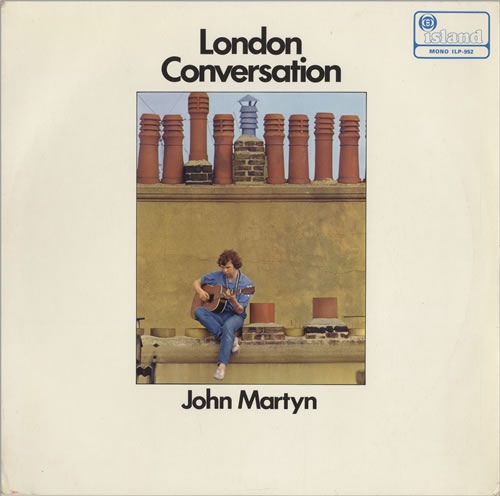
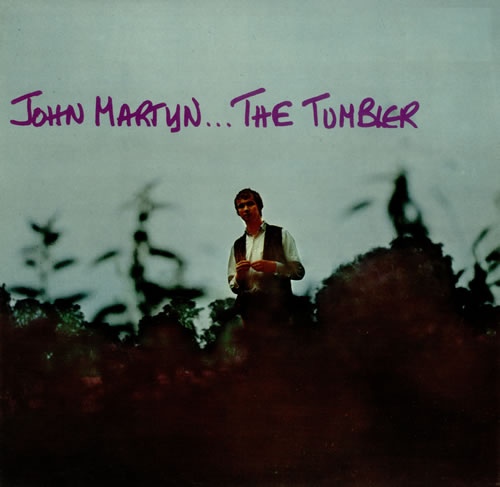
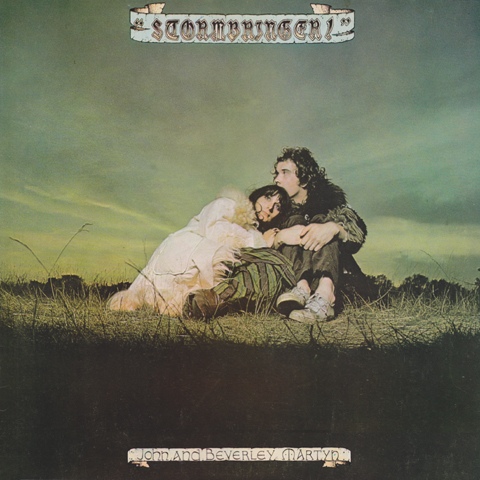




BLACK SABBATH-MASTER OF REALITY-IMPORT.
BLACK SABBATH-MASTER OF REALITY-IMPORT.
1970 had been a year that defined Black Sabbath’s career. They’d released two hugely successful albums. This includes their debut album Black Sabbath, which was released in February 1970. It reached number eight in the UK and number twenty-three in the US Billboard 200 charts. This resulted in Black Sabbath being certified gold in the UK and platinum in the US. Black Sabbath launched the Birmingham trio’s career. However, things were about to get even better.
Paranoid, Black Sabbath’s sophomore album, was released in the UK in September 1970. It reached number one and was certified gold. Then in January 1971, Paranoid was released in the US, reaching number twelve and was certified platinum four times over. Ironically, in the US, Paranoid wasn’t well received by critics. Despite this, Paranoid sold over twelve-million copies and and featured three Black Sabbath classics Paranoid, Iron Man and War Pigs. After just two albums, Black Sabbath were one of the biggest names in rock music.
Unlike many bands, Black Sabbath’s rise and rise had been meteoric. Just two years after they’d formed in Birmingham, bassist Geezer Butler, drummer Bill Ward, guitarist Tony Iommi and lead vocalist Ozzy Osbourne were rubbing shoulders with rock royalty. There was a problem though. How do you followup an album as successful as Paranoid? After all, what chance had Black Sabbath of recording an album that surpassed Paranoid, a stonewall classic?
The answer to that is with Master Of Reality, is an album influenced three genres of music. They were stoner rock, doom metal and sludge metal, a fusion of hardcore punk and heavy metal. It seemed Black Sabbath were determined to continue pushing musical boundaries on Master Of Reality, which was recently rereleased as an import by Rhino.
Black Sabbath didn’t even get the opportunity to enjoy Paranoid’s success in America. It was released in America in January 1971. That was when Black Sabbath headed into Island Studios to record eight tracks. Six of them, Sweet Leaf, After Forever, Children Of The Grave, Lord of This World, Solitude and Into The Void were written by Black Sabbath. Embryo and Orchid were written by Tony Iommi. Between January and May 1971, Black Sabbath got to work.
At Island Studios, producer Rodger Bain was joined bassist Geezer Butler, drummer and percussion Bill Ward. They provided the rhythm section. Guitarist Tony Iommi also played synth, flute and piano. Adding his inimitable vocal was Ozzy Osbourne. By May 1971, Black Sabbath had completed Master Of Reality, which was released in July 1971.
Before the release of Master Of Reality, reviews were mixed. Just like Paranoid, Lester Bangs, the supposed doyen of critics, gave the album a mixed review. Other high profile critics didn’t take to Master Of Reality. It wasn’t cerebral enough for them. Among the criticisms were that Master Of Reality was “monotonous,” “dull and decadent.” Despite the mixed reviews, Master Of Emotion was a huge commercial success.
Master Of Reality, which was Black Sabbath’s third album, was released on 21st July 1971. In the UK, Master Of Reality reached number five and was certified silver. Over the Atlantic, Master Of Reality was certified gold on preorders along. Eventually, Master Of Reality reached number eight in the US Billboard 200 and was certified double-platinum. The Black Sabbath success story continued with Master Of Reality, which I’ll tell you about.
Master Of Reality opens with Sweet Leaf, one of the earliest examples of stoner rock. A loop of Tony coughing, whilst allegedly smoking a joint opens the track. After that, the rhythm section and blistering guitars accompany Ozzy’s powerhouse of a vocal. It’s a mixture of emotion and power., Machine gun guitars and the thundering rhythm section accompany him all the way. Guitarist Tony Iommi gives a guitar masterclass, before Black Sabbath’s rhythm section kick loose. Like a well-oiled machine Black Sabbath pickup where they left off on Paranoid, creating groundbreaking rock music.
After Forever was the only single released from Master Of Reality. However, it failed to chart. Black Sabbath were always more of an albums band. This is one of the most controversial songs on the album, given the lyrics about religion and Christianity. When this song was released in 1971, it must have provoked controversy. Back then, religion played a bigger part in British and American life. A buzzing synth gives way to Black Sabbath in full flow. It’s a joy to behold. Geezer, Bill and Tony lock into a tight groove. Drums like jackhammers accompany blistering guitars. Ozzy’s rabble rousing vocal is accompanied by stomping arrangement as heavy rock anthem unfolds.
The guitars that open Embryo have a sixties influence. There’s also a brief prig rock influence, before Black Sabbath cut loose. Quickly, the arrangement gathers momentum and a glorious, driving arrangement unfolds. Ozzy struts his way through the lyrics, singing about revolution. Dramatic bursts of guitar are fired above the arrangement. Tony unleashes some blistering licks, while the rhythm section drive the arrangement along further honing and defining Black Sabbath’s trademark sound.
Children Of The Grave is an anti-war song. Black Sabbath had two anti-war songs on Paranoid, War Pigs and Electric Funeral. This is just as good. It’s no mealy mouthed protest song, like Give Peace A Chance. They left that to ex-Beatles and conceptual artists. Neither do Black Sabbath do bed ins. That’s unless groupies and class As are involved. The arrangement is big, bold and in-your-face. Literally, the arrangement is a wall of sound. Searing, blistering and crystalline guitar licks and a thundering, driving rhythm section. Ozzy’s vocal is a mixture of anger and frustration. Tony seems to play as if his very life depends on it, before the track reaches a haunting crescendo.
Straight away, it’s obvious that Orchid is very different to the other tracks on Master Of Reality. It has a folk influence. Chiming, crystalline guitars and a subtle bass combine during this beautiful, short and melancholy instrumental.
Normal service is restored on Lord Of This World. Dark. Dramatic and moody describes the arrangement. The rhythm section glue the arrangement together, while scorching guitars match Ozzy’s grizzled vocal. Later, when Ozzy’s vocal drops out, the rest of the band get their chance to shine. It’s obvious that Geezer, Bill and Tony are top class musicians who were among the greatest rock musicians of the seventies. Lord Of This World is a reminder of this, if any was needed.
Solitude has an understated, melancholy sound. Just a chiming guitar and meandering bass combine with Ozzy’s vocal. It’s full of sadness, regrets and confusion. A flute floats above the arrangement, adding to the atmospheric, haunting arrangement. While this is very different to much of Master Of Reality, it’s a beautiful, haunting and cerebral song, that shows another side of Black Sabbath.
Into The Void closes Master Of Reality, was originally called Spanish Sid. A blistering guitar solo joins a pounding, thunderous rhythm section. Black Sabbath seem to be enjoying the opportunity to showcase their inconsiderable skills. They kick loose and are joined by Ozzy. He delivers his vocal urgently, in short, sharp bursts. Behind him Geezer and Tony join forces, while Bill seems determined to punish his drums.
Although Master Of Reality didn’t quite match the success of paranoid, it proved to be a hugely influential album. Master Of Reality influenced three genres of music. They were stoner rock, doom metal and sludge metal, a fusion of hardcore punk and heavy metal. It seemed Black Sabbath were determined to continue pushing musical boundaries on Master Of Reality, which was recently rereleased on import by Rhino.
Master Of Reality also saw Black Sabbath further refine and and hone their unique sound. They were continuing to rewrite the rules of heavy metal. It was a case of the heavier the better. Leading the charge, were Black Sabbath. This didn’t please some people.
Among them were the critics. This self styled tastemaker seemed to have a downer on Black Sabbath. Along with many American critics, they felt Master Of Reality was too heavy. Critics didn’t approve of the aggression and later, satanic lyrics. That’s why Master Of Reality wasn’t released to critical acclaim. Despite that, Master Of Reality was certified gold in the UK and double platinum in the US. Not for the first time, the critics got it wrong.
Black Sabbath continued to redefine heavy metal on Master Of Reality. So much so, that Black Sabbath provided the blueprint for heavy metal If someone asked what heavy metal sounded like, Black Sabbath was what you played them. The albums that started this was Paranoid, Black Sabbath’s sophomore album. That’s why, in the history of heavy metal, there are only two periods, B.P. and A.P. Before Paranoid and After Paranoid. Following Paranoid would’ve been almost impossible for most bands. However, they weren’t Black Sabbath.
By the time Black Sabbath released Master Of Reality, they’d become a musical phenomena. That was the case for the next ten years. Excess and commercial success were ever-present for the band the redefined heavy metal. Black Sabbath rewrote the rules. Right through until 1981s Mob Rules, gold and platinum discs came Black Sabbath’s way. So did controversy. Much of it concerned Ozzy Osbourne. He parted company with the band in 1979. Sacked by the group he formed, both Ozzy and Black Sabbath survived to tell the tale. However, back in 1971, the Black Sabbath story was just taking shape and they’d go on to become one of the biggest and most successful bands in the history of heavy metal. However, back in 1971, when Black Sabbath released the influential and innovative Master Of Reality, they had another ten years of chaos, controversy, commercial success and critical acclaim coming their way.
BLACK SABBATH-MASTER OF REALITY.
JOHN COLTRANE-A LOVE SUPREME-THE COMPLETE MASTERS BOX SET VINYL EDITION.
JOHN COLTRANE-A LOVE SUPREME-THE COMPLETE MASTERS BOX SET VINYL EDITION.
On December 9th 1964, four musicians made their war to the Van Gelder Studio, on 445 Sylvan Avenue, Englewood Cliffs, New Jersey. They were scheduled to record an album with renowned jazz producer Rudy Van Gelder. He was a veteran of countless recordings, and had worked with some of the biggest names in jazz. This included John Coltrane, who was about scheduled to record a new album, which became A Love Supreme.
When John Coltrane arrived at Van Gelder Studio, he was accompanied by bassist Jimmy Garrison, drummer and percussionist Elvin Jones and pianist McCoy Tyner. For most musicians, they would’ve looked at this as just another recording session. Not John Coltrane.
While John Coltrane was still only thirty-eight, he was a veteran of over thirty albums, including many groundbreaking albums. John Coltrane was at the forefront of new musical movements. This included bebop, hard bop and post bop. However, his solo career was just part of the John Coltrane story. He had accompanied some of the legends of jazz, including Miles Davis and Thelonious Monk. Nothing fazed John Coltrane. In racing parlance, John Coltrane was a thoroughbred, who had gone course and distance countless times. It was the same with the band John Coltrane had assembled.
Jimmy Garrison was thirty-one, and had accompanied everyone from Ornette Coleman, Philly Joe Jones and Jackie McLean, to Lee Conitz, McCoy Tuner and John Coltrane. However, Jimmy Garrison had only released one album as bandleader, Illumination! which was released in 1964, and credited to Jimmy Garrison and Elvin Jones. By then, Jimmy Garrison and Elvin Jones had formed a successful partnership as the go-to rhythm section for top jazzers.
Just like Jimmy Garrison, thirty-seven year old Elvin Jones was an experienced musician. He had released a trio of solo albums, and played on around fifty albums. This included several jazz classics, including Miles Davis’ Sketches Of Spain, John Coltrane’s My Favourite Things and Freddie Hubbard’s Ready For Freddie. Anyone looking for a drummer, knew to call Elvin Jones. It was the same with McCoy Tyner.
Although McCoy Tyner was only twenty-six, and the youngest member of John Coltrane’s band, he was already released five albums for Impulse! McCoy Tyner had also played on albums by the great and good of jazz. This included Freddie Hubbard, Joe Henderson, Art Blakey, Wayne Shorter, Lee Morgan and Stanley Turrentine. Then in 1962, McCoy Tyner became an integral part of John Coltrane’s band.
Since then, John Coltrane’s quartet had spent time honing their sound. During this period, John Coltrane’s sound had evolved. John Coltrane was never one to stand still. That was for lesser musicians. He was determined to innovate, and push musical boundaries to their limits, and sometimes beyond. That’s what would happen at Van Gelder Studio, on 9th December 1964.
When John Coltrane entered Van Gelder Studio, he was ready to fuse the music of the past, present and future. Hard bop, free jazz, avant grade and modal jazz were melt into one on what’s now regarded as the finest album of his career, A Love Supreme. It will reissued by Decca on February 12th 2016 as a three LP vinyl box set. This is how John Coltrane envisaged jazz fans listening to A Love Supreme, which has been mastered well. It’s neither too loud, nor too bright. Instead, care and attention has been taken to make this classic album sound just as ‘Trane would’ve wanted it to. For purists A Love Supreme-The Complete Masters will be the definitive version of this classic album, which was recorded in just one day.
With John Coltrane’s quartet assembled in Van Gelder Studio, they began setting up for the session. John Coltrane had written a four part suite, which began with Part 1: Acknowledgement. It was followed by Part 2: Resolution. These two tracks would eventually fill side one of A Love Supreme. On side two, was the eighteen minute epic, Part 3: Pursuance/Part 4: Psalm. The final part, Psalm, is a devotional, or wordless poem, which John Coltrane planned to narrate using his saxophone. Some musicologists have suggested that John Coltrane’s inspiration were the sermons of African-American preachers. This could be the case, as the track ends with John Coltrane giving thanks, saying: “Elation. Elegance. Exaltation. All from God. Thank you God. Amen.” This more than hinted that A Love Supreme was a spiritual album.
By then, John Coltrane had fallen under the spell of Ahmadiyya Islam. Some critics and music historians see this as an influence. However, essentially, A Love Supreme was about John Coltrane’s own personal struggle for purity. He expresses his thanks and gratitude for talent bestowed upon him, and perceives the tenor saxophone he plays as being owned by a higher, spiritual power. A Love Supreme part confessional, part hymnal.
Having explained the concept behind A Love Supreme, the quartet received their parts. They were a guide, and left plenty of room for the quartet to express themselves on what was going to be a genre-defying album, A Love Supreme. It saw hard bop, free jazz, avant grade and modal jazz combined by John Coltrane’s quartet.
The quartet featured double bassist Jimmy Garrison, Elvin Jones on drums, timpani and gong and pianist McCoy Turner. John Coltrane was bandleader, vocalist and wielded his trusty tenor saxophone. By the end of the 9th December 1964, A Love Supreme was complete. However, the quartet returned the following day.
On the 10th December 1964, two alternate takes of Acknowledgement were recorded. Archie Shepp played tenor saxophone and Art Davis double bass. Neither take made its way onto A Love Supreme. Both tracks were included on A Love Supreme-The Complete Masters box set. They’re interesting inclusions, but it’s the versions recorded by the classic quartet that stand head and shoulders above the alternate takes. That’s why the tracks recorded on the 9th December 1964 that feature on A Love Supreme, which was released in February 1965.
Record companies didn’t need months to plan a P.R. campaign to accompany an album’s release. Instead, albums were recorded, then released a couple of months later. This was the case with A Love Supreme. Before that, critics and cultural commentators had their say.
Critics on hearing A Love Supreme, were spellbound. Quickly, critics realised that they were hearing John Coltrane remake jazz history on A Love Supreme. That was the case from Elvin Jones hits the gong, and washes of cymbals resonate. Then comes that familiar four note motif on Jimmy Garrison’s bass. Even by then, some perceptive critics realised that something special was unfolding. Soon, John Coltrane was playing his tenor saxophone as if his very soul depended on A Love Supreme’s success.
By then, John Coltrane was unleashing his legendary “sheets of sound;” his playing combining power and passion. However, not once does John Coltrane resort to showboating. He plays with a humility, but still, there’s a joyousness as he gives thanks.
From there, John Coltrane gives thanks on A Love Supreme. The album is essentially, a thirty-four minute hymnal, where John Coltrane bows down, and gives thanks for the talent bestowed upon him. By then, the classic Coltrane quartet sweep the listener along, as they flit between, and sometime, fuse elements of hard bop, free jazz, avant grade and modal jazz. It’s truly mesmeric, and it’s as if John Coltrane has been touched by genius. Sometimes, there’s a ferocity to John Coltrane’s playing. However, it’s just his way of show his gratitude and appreciation, at being one of the chosen few, one of a higher power’s jazz messengers.
By Psalm, which closes A Love Supreme, John Coltrane offers up a devotional, or wordless poem. Rather than using words, John Coltrane narrates using his saxophone. As he does, he offers his most precious possession, his tenor saxophone as a token of esteem for the talent that’s been bestowed upon him. By the end of Psalm, John Coltrane is almost exhausted and spent, but gives thanks, saying: “Elation. Elegance. Exaltation. All from God. Thank you God. Amen.” This brings to an end one of the most powerful albums any music lover will experience, enjoy and embrace, A Love Supreme.
Incredibly, despite critically acclaimed reviews, which referred to A Love Supreme as a groundbreaking album, and classic-in-waiting, this landmark album wasn’t a huge commercial success. Instead, around Impulse! sold around 30,000 copies of A Love Supreme. This was par for the course for the albums John Coltrane released on Impulse!
By 1970, 500,000 copies of A Love Supreme had been sold. This resulted in A Love Supreme being certified gold. Sadly, John Coltrane didn’t see this momentous event.
On July 17th 1967, John Coltrane died, aged just forty. He had recorded over fifty albums, including classics including 1958s Blue Train, which was the only albu, John Coltrane released on Blue Note Records. However, it was later certified gold. Then in 1959, John Coltrane released his first classic album for Atlantic Records, Giant Steps. Two years later, My Favourite Things followed in 1961. Then in 1965, came the album that came to define John Coltrane’s illustrious career, A Love Supreme.
On 12th February 2016, Decca release A Love Supreme-The Complete Masters on vinyl. It’s just a shame this release couldn’t have been released in 2015, which marked the fiftieth anniversary of the release of A Love Supreme. The important thing is, that A Love Supreme-The Complete Masters has been released on vinyl. For purists, they’ll regard this three album sets is the definitive version of A Love Supreme-The Complete Masters.
The first album in A Love Supreme-The Complete Masters box set features the original album, plus original mono reference masters of Pursuance and Psalm. Then on the second album, there’s eleven bonus tracks. They’re a mixture of alternate takes, including a version of Acknowledgment with a false start, and versions of two other takes of Acknowledgment with vocal overdubs. Essentially, these tracks offer the listener to see how the track evolved, right through to what it ultimately became on disc one. However, for many John Coltrane completists, the third album is musical gold. It features the John Coltrane quartet playing A Love Supreme in its entirety, live in Juan-les-Pins, France. This performance has entered jazz folklore, and is a very welcome addition to A Love Supreme-The Complete Masters. Sadly, just two years after this legendary performance, John Coltrane died.
It’s forty-eight years since John Coltrane died. He was in the prime of his musical life, and could’ve and should’ve gone on to be at the forefront of jazz, as the genre continued to reinvent itself. John Coltrane at spent his career as a pioneer of jazz, ensuring the genre neither stood still, nor became irrelevant. There was no chance that jazz was going to go the way of the blues. Not with musical pioneers like John Coltrane, Miles Davis and Ornette Coleman producing groundbreaking music. Sadly, John Coltrane never got the opportunity to embrace the change in jazz that took place during the late-sixties and early seventies. However, Joh Coltrane left behind a rich musical legacy.
Considering he died when he was just forty, it was remarkable that John Coltrane had managed to record over fifty albums. That’s not forgetting the albums he played on as sideman. John Coltrane was part of Miles Davis and Thelonius Monk’s bands. It was a case of learning from the masters. However, when he stepped out their shadows, John Coltrane was capable of creating groundbreaking, innovative music, that changed the course of jazz history, including his Magnus Opus, A Love Supreme.
JOHN COLTRANE-A LOVE SUPREME-THE COMPLETE MASTERS BOX SET VINYL EDITION.
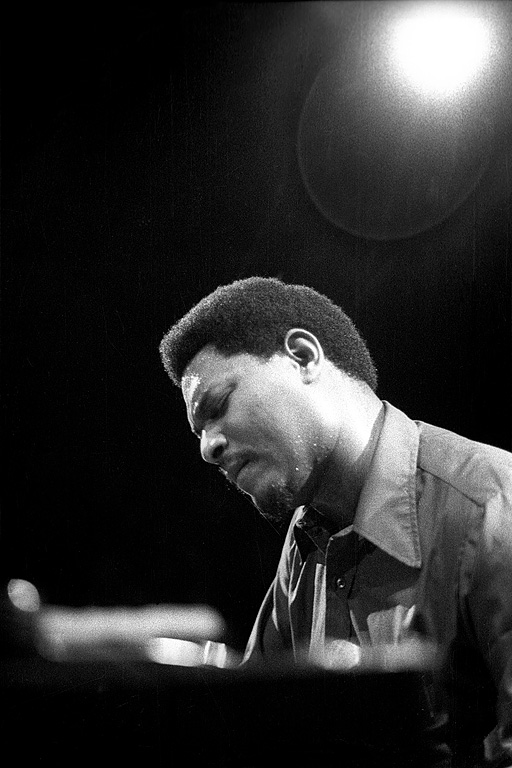
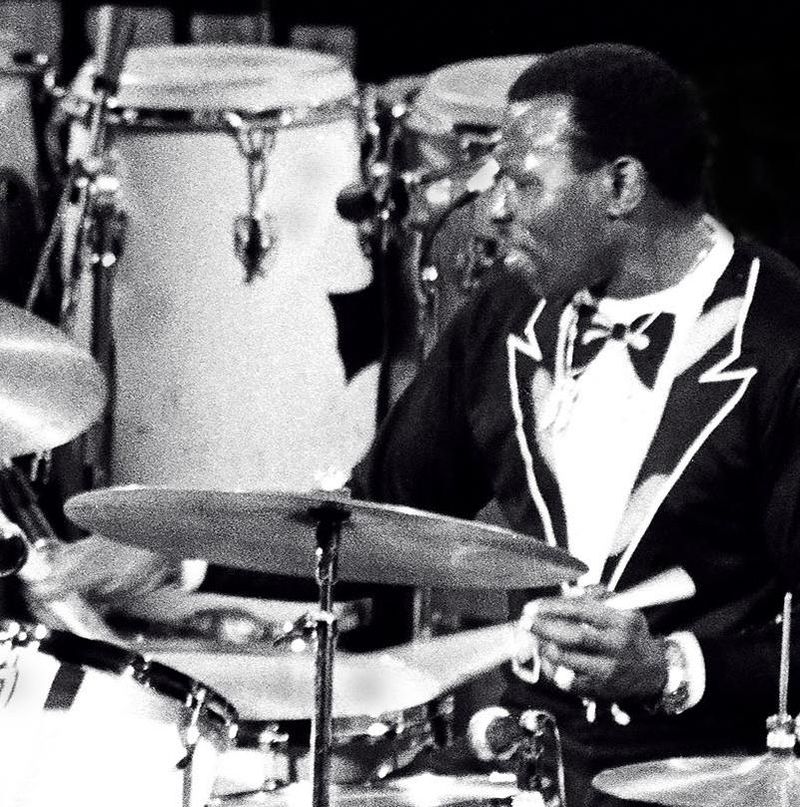
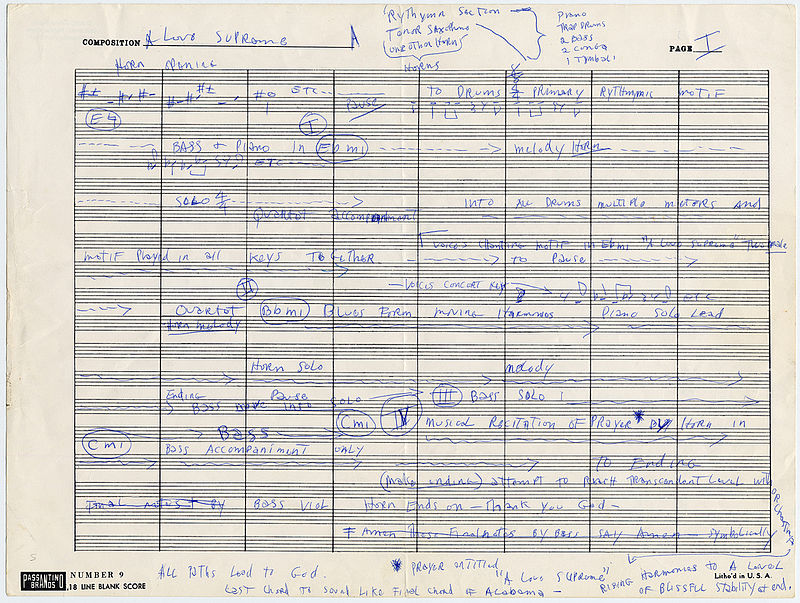
EMMA POLLOCK-IN SEARCH OF HARPERFIELD.
EMMA POLLOCK-IN SEARCH OF HARPERFIELD.
Most people haven’t heard of Castle Douglas. Why should they? It’s a small market town in Dumfries and Galloway, in south-west Scotland. However, Castle Douglas has been home to some famous faces over the last 224 years. This includes a potter, politician, footballer and two rugby players. However, they’ve been usurped as Castle Douglas’ most famous former resident. Nowadays, former Delgado and singer-songwriter Emma Pollock is regarded as CD’s most famous former resident.
Emma Pollock just happens to have released her third solo album, In Search Of Harperfield on Glasgow’s premier label, Chemikal Underground. It’s Emma’s first solo album since The Law of Large Numbers in 2010. Since then, Emma has been busy, not just making music, but running Chemikal Underground, which in 2015, celebrated its twentieth anniversary. Businesswoman is just another addition to Emma Pollock’s impressive CV.
Her story began back in 1994, when The Delgados were formed. Emma’s boyfriend Paul Savage had been a member of the band Bubblegum. That was until a coup d’état. Suddenly, Paul, Alun Woodward and Stewart Henderson found themselves out in the cold. Their only option was to form a new band.
The Delgados.
That’s when The Delgados were born. The three former members of Bubblegum asked Emma to join the nascent band. She became The Delgados vocalist and guitarist. Little did Emma or the rest of the band realise that this was the start of an eleven year journey.
During that journey, The Delgados released a string of singles and E.P.s; not forgetting five albums. However, the first anyone heard of The Delgados was when Liquidation Girl featured on a compilation Skookum Chief Powered Teenage Zit Rock Angst. Those that heard Liquidation Girl realised that The Delgados were rising stars of the Scottish music scene. Surely, record companies would soon be chasing their signature?
That’s not how it worked out. Rather than sign to a record company, The Delgados decided to form their own record label, Chemikal Underground. Two of the new label’s first signings were Mogwai and Arab Strap. Just like The Delgados, they eventually became Scottish music royalty.
Chemikal Underground’s first release came in 1995, when The Delgados debut single Veronica Webster was released. This was the first of a string of singles and E.P.s that Mogwai would release over a ten year period. They would also release five albums. Their debut album was released in 1996.
Domestiques.
Just over years after The Delgados were formed, they released their debut album Domestiques in November 1996. By then, The Delgados were combining running a record label with touring and recording. It was like spinning plates. However, The Delgados made it seem easy.
When Domestiques was released. it was to almost overwhelming critical acclaim. Indie rock met pop and even a punk aesthetic on Domestiques, which was hook-laden and melodic. The Delgados hadn’t yet been shorn of their rough edges, had won over even the mist hard bitten gonzo music critic. So was DJ John Peel.
He began championing The Delgados music in 1996. Soon, his The Delgados were a favourite of his listeners. So much so, that when the votes were counted for John Peel’s Festive Fifty, The Delgados Under Canvas, Under Wraps was number three. This was an unexpected Christmas present, as the adventure continued for The Delgados.
Peloton.
In June 1998, The Delgados returned with their sophomore album, Peloton. Just like Domestiques, its title was another reference to cycling. Another similarity was that the critical acclaim accompanied the release of Peloton.
Critics pointed at a more polished album, which showcased The Delgados unique brand of indie rock. Gone were The Delgados rough edges. It was a very different band to the one that featured on Domestiques, and one that were about to enjoy their first hit single.
Pull the Wires From the Wall was released as a single, and reached number sixty-nine in the UK charts. For The Delgados this was definitely another step in the right direction.
The Great Eastern.
As the new millennia dawned, The Delgados returned with what was their Magnus Opus, The Great Eastern. It was produced by American producer Dave Fridmann, who previously, had worked with Mercury Rev and The Flaming Lips. Now he turned his attention to The Delgados, and played his part in a career-defining album.
Released in 2000, the title referenced a famous Glasgow landmark, a one-time textile mill that in 2000, was home to the city’s homeless. However, for a generation of music lovers, The Great Western meant The Delgados’ third, and best album. Critics agreed.
When the critics had their say, they hailed The Great Western The Delgado’s finest hour. Elements of folk and indie rock combined on The Great Western, a dreamy, sometimes elegiac, minimalist and thoughtful opus. Everything it seemed, had been leading up to The Great Western. The Delgados were hot property. However, things got even better for The Delgados.
American Trilogy reached sixty-one on the UK charts. Then when the end of year awards were announced, The Great Western won prizes galore. The Spirit Of Scotland Award, the Nordoff-Robbins Best Newcomer Award and Jockrock Tartan Cleft Award. Then The Great Western was nominated for the Mercury Music Prize. For Emma Polock and the rest of The Delgados, 2000 had been the most successful year of their six year career.
Hate.
Following up a career-defining album is never easy for a band. That’s been the case throughout musical history. That was the case for The Delgados. The Great Western was their finest hour, and nowadays, is regarded as one of the greatest Scottish albums. However, The Delgados were determined to produce another award winning album.
The four Delgados returned to the studio with producer Dave Fridmann. Over the next few months, they recorded what became Hate. This time around, Dave Fridmann who had worked with the Flaming Lips, seems to use them as a template. This was noticed by critics.
Unlike previous Delgados albums, Hate was released on the Mantra label in October 2002. Reviews of Hate were mostly positive. A few critics even compared Hate to The Flaming Lips 1999 album The Soft Bulletin. That wasn’t surprising.
Both albums had been produced by Dave Fridmann. His star was in the ascendancy. Despite that, Hate didn’t quite receive the same critical acclaim as The Great Western had. Normally, this would’ve been disappointing. However, that was almost expected. The Great Western had been The Delgados’ Magnus Opus. Most groups never reach the same heights as The Great Western, never mind releasing a quartet of successful albums. Soon, four would become five.
Universal Audio.
For The Delgados’ fifth album, they decided to change direction. Dave Fridmann didn’t return for a third time. Instead, Tony Doogan, who had worked with Mogwai, co-produced what became Universal Audio with The Delgados.
It was recorded at Chem 19, Chemikal Underground’s own recording studio. Universal Audio was a much more understated album. Gone was the orchestral sound of previous albums. The Delgados seemed to be reinventing their music. The did this with the help of Belle and Sebastian’s Stevie Jackson and Mother and The Addicts. Once Universal Audio was complete, it was released in September 2004.
Reviews of Universal Audio ranged from positive to critically acclaimed. Mostly, critics embraced the new Delagados. So did record buyers, when the album was released. When they bought Universal Audio, little did they realise it would be The Delgados swan-song.
Eight months after the release of Universal Audio, came the shock news that The Delgados were splitting up. Alan Henderson had announced that he was leaving the band. Rather than seek a replacement, The Delgados called time on their career, but continued to run Chemikal Underground. However, two former members of The Delgados embarked on solo careers, Alun Woodward and Emma Pollock.

The Solo Years.
Later in 2005, Emma Pollock signed a record contract with London based independent label 4AD. She was going to combine a solo career with running Chemikal Underground. It was by then, the most successful Scottish record label. Still, Emma was spinning plates. This was no problem for someone with a degree in physics from Strathclyde University.
Two years later, and Emma Pollock returned with her debut solo album, Watch The Fireworks.
Watch The Fireworks.
Watch The Fireworks featured eleven new songs written by Emma Pollock. She had recorded Watch the Fireworks with Australian producer, Victor Van Vugt. He had an impressive track record; and previously, had worked with everyone from Nick Cave and The Bad Seeds to Beth Orton, Depeche Mode and Einstürzende Neubauten. With a CV like that, he seemed the ideal person to produce Emma’s debut album, Watch The Fireworks. When it was complete, it was scheduled for release in September 2007.
Before then, Adrenaline was released as the lead single from Watch the Fireworks in May 2007. It was paired with A Glorious Day, a poem by Irish poet Brendan Cleary set to music. Adrenaline was a tantalising taste of what Emma Pollock had in store on Watch The Fireworks.
In the lead up the release of Watch The Fireworks, critics had their say on Emma Pollock’s debut album. For any artist, this is a nerve-wracking moment. It doesn’t matter if it’s their first or tenth album. Emma needn’t have worried. Watch The Fireworks was well received by critics. Most of the reviews were positive. They were won over by an eclectic album from a hugely talented, versatile vocalist.
There was everything from waltz, ballads, indie pop and indie rock on Watch The Fireworks. Some critics drew comparisons with The Degados. That wasn’t surprising. Paul Savage played on Watch The Fireworks, and watched as Emma made the transition from band member to solo artist seem ridiculously easy. Effortlessly, Emma changed direction on Watch The Firework as the music veered between atmospheric, emotive, melodic, mesmeric, playful, urgent and wistful. The result was a triumphant debut album from the former Delgado. Now all Emma Pollock had to do, was do it all again.

The Law Of Large Numbers.
And so she did. Three years later, and Emma Pollock returned with her sophomore album The Law Of Large Numbers in 2010. Emma had written twelve new tracks, and recorded them with a tight, talented band of Scottish musicians. This included her partner Paul Savage, who by then, had established a reputation as one of the top Scottish producers. He replaced Victor Van Vugt, and produced The Law Of Large Numbers. It was more than a fitting followup to Watch The Fireworks.
Critics agreed. Critical acclaim accompanied the release of The Law Of Large Numbers. Just like Watch The Firework, The Law Of Large Numbers showcased a talented songwriter. Emma Pollock was a skilled wordsmith, capable of writing clever, catchy songs that didn’t lack in hooks. She was also able to adapt her delivery to suit the song.
Seamlessly, Emma could deliver a vocal with emotion, anger, frustration, joy or even with a weariness. On Chemistry Will Find Me and The Loop, Emma’s thoughtful and introspective. The Child in Me and House on the Hill finds Emma transformed into a folk singer. She handles the role with aplomb, before changing direction again. Then on Hug the Harbour and Confessions are delicious slices of perfect pop. By the end of The Law Of Large Numbers, Emma Pollock had come of age as a solo artist. Surely a third album would follow soon?
In Search Of Harperfield.
That proved not to be the same. Nearly six years have passed since Emma released The Law Of Large Numbers. Since then, a lot has happened.
Chemikal Underground, the label Emma Pollock cofounded, has grown into the most successful Scottish record label. Nowadays, it has an enviable roster. Helping run Chemikal Underground understandably, takes up a lot of Emma’s time. Sadly, for a while, so did family matters.
At one point, both of Emma’s parents were ill at the same time. Her father who still lived in Castle Douglas, was in hospital there. Emma’s mother, who lived in Glasgow, was in one of the city’s hospitals. So Emma, who is an only child, found herself journeying up and down the motorway, visiting her parents in different hospitals. Sadly, things took a turn for the worst in February 2015, when Emma’s mother passed away. This must have been devastating for Emma. Part of the grieving process for Emma was writing what became her third album, In Search Of Harperfield.
It’s an incredibly personal and powerful album. Harperfield Lodge was the first home Emma’s parents, Guy and Kathleen Pollock bought. They eventually bought and sold thirty houses during their marriage. This includes the five Emma lived in, in Castle Douglas alone. However, it’s Harperfield Lodge that has a special place in Emma’s heart. She remembers it vividly. So much so, that she can remember how the light shawn, the sense of space and being surrounded by nature. Harperfield Lodge sounds like a rural idyll that will forever, be imprinted on Emma’s memory. So will her parents.
Maybe that’s why a photograph of a young Guy Pollock dawns the album cover of In Search Of Harperfield? He’s pictured tending his animals on the hillside, on his land at Blair Atholl. That’s not the only time Guy or Kathleen Pollock feature on In Search Of Harperfield. They’re forever in the shadows on what’s the most personal and intense album of Emma Pollock’s career, In Search Of Harperfield.
It’s almost an autobiographical album. Emma looks back at her youth, which was spent growing up in the beautiful Galloway countryside. Other times, Emma introduces a series of characters. They play walk-on parts as Emma deals with a variety of subjects, including some many people would’ve chosen to forget. This includes bullying on Parks and Recreation. It’s one of the eleven songs on In Search Of Harperfield. The making of the album was a family affair.
Producing In Search Of Harperfield, was Emma’s husband, Paul Savage. He’s aided and abetted by Malcolm Lindsay. They provide the perfect backdrops to Emma’s vocals. They frame her vocals beautifully, and are like yin to Emma’s yang. on her much anticipated third album In Search Of Harperfield.
Cannot Keep A Secret opens In Search Of Harperfield. It deals with what Emma describes as “patriarchal machinations of Irish gender politics.” From the opening bars the listener is captivated, and the story unfolds. A distant piano plays, before pensive cooing harmonies usher in Emma’s heartfelt, thoughtful vocal. It’s accompanied by just the bass and harmonies before the piano and drums enter. They augmented by occasional finger clicks, and later as what’s an enchanting and beautiful song literally waltzes along, clicking hi-hats. Later, the arrangement becomes dramatic, elegiac and cinematic. By then the listener is spellbound, as they wonder what every happened to the characters in the song? Did: “they eddy and they flow and bring your sisters home?”
Pizzicato strings and a strident muted guitar combine on Don’t Make Me Wait. As the strings sweep, Emma is transformed into a sixties siren, as she delivers a slice of perfect pop. The hooks haven’t been spared, as Emma accompanied by choppy guitars, lush strings and a tinkling piano. She delivers a needy, but frustrated vocal. Soon, she’s delivering an ultimatum, “Don’t Make Me Wait.” She then rubs salt into wound when she tells her errant love he’ll: “never make it on your own.” What a way to round off a gorgeous slice of perfect pop, with the perfect pay off.
Alabaster opens with the sound of a Tube announcement. “The next stop is Strawberry Hill” signals an arrangement that slowly, plods, lysergically along. Meanwhile, Emma’s vocal is rueful and tinged with sadness and regret. She remembers better days, when: “like king and queen we ruled it all.” Not any more. As the arrangement and drama builds, this tale of betrayal unfolds. Soon, dramatic becomes melancholy, as Emma’s sings: “these little secrets do betray you see.” It’s a four minute soap opera with a pay off that packs a punch.
Quivering, shivering strings join a piano and guitar on Clemency. They set the scene for Emma’s folk-tinged vocal, on what’s another song about betrayal and an errant partner. Anger and frustration are omnipresent. She won’t forgive him in a hurry. He’s looking for clemency. However, hell hath no fury like a woman scorned. “If you confess all, you really think you still won’t face the fire?” Emma is determined to make him suffer, and has revenge on her mind. No ordinary revenge. Instead, it’s Old Testament revenge. As shimmering strings and piano, combines Emma’s mind turns to revenge: “pushed down, fell down..,from every point of view you’ve tumbled.” The woman scorned has been avenged.
Intermission is a truly powerful song. It’s impossible not to be moved by a Intermission. A violin plays, and is joined by a cello. Soon, they’re reaching a dramatic crescendo. It’s then that Emma’s vocal enters. It’s a mixture a sadness, despair and panic. She’s having to watch her parents grow old, and become ill. Suddenly, she’s caring for the people who cared for her. They’re “the man I know best” and ‘“the woman who made me.” Now they’re dependant on Emma. Accompanied by swells of strings, Emma delivers what’s a heart-wrenching song, that many people will be able to relate to, and find solace in, knowing someone else has travelled the road they’re on.
As Parks and Recreation unfolds, there’s a rocky, sometimes post punk sound. Emma sounds like one time Pretender Chriss Hynde. As drums pound and guitars are sprayed across the arrangement, By then, memories come flooding back for Emma. She remembers the bullies who tormented her growing up. “I came down for a game of basketball, but you threw me a punch instead.” By then, the arrangement is rocky, rowdy and features call and response vocals. Mostly, Emma’s vocal is rueful. However, she’s had the last laugh. What are the bullies doing now? They’re certainly not making records, touring the world and running a record company.
Background chatter gives way to a motorbike, percussion and machine gun guitars on Vacant Stare. Soon, Emma’s delivering a questioning, rueful vocal. “How can I dive from over 15 metres high, when I can’t even swim?” Behind her, Paul is responsible for a stomping, rocky arrangement. It’s complete with chiming guitar, bubbling bass and harmonies. Emma’s vocal has been multi-tracked and they fit hand in glove with her vocal. It delivers what are clever, witty vocals. They become part of another hook laden song from Galloway’s finest singer-songwriter.
As In The Company Of The Damned unfolds, it sounds as it’s been recorded by a sixties girl group. The rhythm section and chumming guitars accompany Emma and her younger self. The older and wiser Emma, asks “do you really want to stay here, In the company of the damned, as they prepare to take your hanshd, torment with true ambition?” Like a seer, Emma can see if she had, there wouldn’t be a happy ending. Luckily, she had the courage and foresight to get out, and should be a shining light to a new generation, not just in CD, but small towns across Scotland.
Emma is accompanied by an acoustic guitar and the lushest of strings on Dark Skies. She’s in a thoughtful mood. Meanwhile occasional rolls of timpani and pizzicato strings punctuate the arrangement. All the time, Emma strums her guitar as she delivers a tender, pensive vocal, as the arrangement grows, becoming dramatic. Still there’s a sense of wonderment in Emma’s vocal as she delivers lyrics that are poetic and cerebral.
Monster In The Pack is another guitar lead track. Emma plays the guitar, before scrubbing at in. This adds an element of drama, before dark strings sweep in adding the perfect accompaniment to the cinematic lyrics. Desperation and loneliness in Emma’s voice. She’s also lost her faith. That’s apparent as she sings: “and I only go to church cause my friends are out today.” When Emma sings: “my head is full of noise, won’t you listen it’s so loud in here, my heart and my silence break,” despair and loneliness become a cry for help. That becomes apparent as she sings of the “Monster In The Pack,” in this emotive, cinematic, folk-tinged track.
Closing In Search Of Harperfield is Old Ghosts. What sounds like an eighties drum machine rings out. It’s joined by a poignant sounding piano. As the drum machine shuffles along, Emma who sounds like Karen Carpenter, is having a conversation with her mother. She’s older and wiser, and is speaking with the benefit of maturity. “I’m not sorry that you’re gone, the hell we raised was always fun, but I’m not sorry that you’re gone” is an acknowledgement that the pain and suffering is over, but the love Emma has for her mother isn’t. Soon, Emma is walking through her parents house, reminiscing, talking to them. Like so many adult Emma who’ve argued with their parents, she struggles to understand: “why so reasonable now?” As the song draws to a close, Emma realises she’s alone; and how am I supposed to speak to, those I ridiculed but still looked up to?” Poignant and moving describes what’s a truly beautiful way to end In Search Of Harperfield.
It’s the long-awaited, and much-anticipated, followup to Emma Pollock’s sophomore album In Search Of Large Numbers. It was released in 2010. Since then, a lot has happened in Emma Pollock’s life. At one point, both her parents were ill, and in hospital. Suddenly, Emma was no longer singer, songwriter or businesswoman. Instead, she was a loving and dutiful daughter, who was caring for “the man I know best” and ‘“the woman who made me.” Then in February 2015, Emma’s mother passed away. This must have left a massive void, and been a lot for Emma to cope with. She began to grieve, and part of the grieving process was writing and recording.
Hopefully, writing and recording Search Of Harperfield was cathartic. It’s certainly an album that many people will be able to relate to. Many of the songs are beautiful, moving and poignant. Especially Intermission and Old Ghosts, which is one of the most moving, emotive and beautiful songs I’ve heard in a long time. That’s testament to Emma Pollock’s skills as a singer and songwriter.
From the opening bars of Cannot Keep A Secret, right through to the closing notes of Old Ghosts, Emma Pollock tells a series of stories. Often, her lyrics are cinematic. That’s the case on Cannot Keep A Secret, where harmonies and an orchestral arrangement accompany and augment Emma’s vocal. The arrangement comes courtesy of Paul Savage. He provides a backdrop for Emma, as she sings of betrayal and revenge on Alabaster and Clemency. Very different is Don’t Make Me Wait, a delicious hook-laden slice of perfect pop. Hooks certainly have’t been rationed on In Search Of Harperfield. That’s the case on Cannot Keep A Secret, and Parks and Recreation where Emma remembers the bullies who tormented her younger self. Emma however, has the last laugh. Later, on In The Company Of The Damned an older, wiser Emma advises her younger self on her future. It has a happy ending, with Emma fulfilling her early potential.
That’s almost an understatement. Emma Pollock is the small town girl who headed to the city, and graduated with a degree in physics. She joined a band, they toured the world and released five albums. Then when the band broke up, Emma Pollock embarked on a solo career, and somewhere along the way, married the drummer. Now Emma has just released her third and best solo album, In Search Of Harperfield, on Chemikal Underground.
In Search Of Harperfield is a career defining, autobiographical album from Emma Pollock. Hopefully, writing and recording In Search Of Harperfield has been cathartic for Emma Pollock. The last few years have been tough for her. However, the future looks bright for CDs most famous famous former resident, if she continues to release albums of the quality of In Search Of Harperfield. It has to be an early contender for the 2016 Scottish Album Of The Year Award.
EMMA POLLOCK-IN SEARCH OF HARPERFIELD.
IKARUS-IKARUS.
IKARUS-IKARUS.
In Greek mythology, Icarus, the son of the master craftsman Daedalus, who created the Labyrinth, met a tragic ending. Icarus and Daedalus were desperate to escape from Crete. So Daedalus constructed wings made of feathers and wax. As Icarus prepared to make his escape, Daedalus warned his son of complacency and hubris.
Icarus shouldn’t neither fly too high, nor too low. If he flew too high, the sun would melt the wax. However, if he Icarus flew too low, the dampness of would weigh down the feathers. It seemed Icarus was between the devil and the deep blue sea.
And so it proved to be. Icarus chose to ignore his father’s wise words, and flew too close to the sun. The sun’s rays melted the wax, and Icarus fell into the sea. He became the first of many people who flew too close to the sun.
Sadly, this includes many musicians. Among them are Syd Barrett, Skip Spence and Brian Wilson. These three legendary musicians flew too close to the sun, and as a result, never quite filled their early potential. Sadly, neither did Ikarus.
They could’ve gone on to become one of the greatest German rock bands of their generation. Sadly, Ikarus’ discography consists of just one studio album Ikarus. It was released on the Plus label in 1971, and has just been reissued by the reissue label Long Hair. Ikarus showcased a talented, pioneering group, who many thought were destined for greatness. Their story began a few years earlier..
It was in the mid-sixties, in the musical hotbed that was Hamburg, that Ikarus were formed. Ikarus were just the latest beat group that had been formed in Hamburg. This was where The Beatles served their musical apprenticeship a few years earlier. Now a whole host of local groups wanted to follow in the fab four’s footsteps.
Ikarus were no different. So they spent evenings and weekends practising in various Hamburg basements. They were determined to hone their sound, before making their debut.This didn’t take long, as Ikarus featured some talented musicians.
This included classically trained keyboardist Wulf Dieter Struntz and bassist Wolfgang Kracht. His party trick was to play a violin with his gloves on. Music seemed to come easily to the members of Ikarus, and it wasn’t long until they began to play live.
By 1966, Ikarus made tentative steps onto Hamburg’s live scene. Ikarus’ earliest concerts took place in youth clubs, where they played cover versions of popular song. At first,Ikarus were called Beautique In Corporation. Soon, this was soon shortened to BIC. This found favour among the band’s audience.
Although a relatively new group, BIC quickly won over audiences. Soon, they had large and enthusiastic audience. BIC played what they wanted to hear. They weren’t above playing covers of hits by Elvis Presley and Tom Jones. This was easy on the ear of the audience. However, before long, BIC’s setlist changed.
The band members began to write their own songs. Audiences expected to hear original material. They didn’t just want to hear cover versions. This suited the members of BIC, who were classically trained musicians. Composition came easy to them.
These new songs were added to BIC’s sets. Some of these songs had a psychedelic sound. BIC’s music was evolving, as music evolved. This proved popular when BIC played live.
By then, BIC had graduated from the youth club circuit, and were by now familiar faces on the Hamburg and North German music scene. Their music was a mixture of psychedelia and rock. However, there was an element of comedy in BIC’s sets.
Some of the members of BIC enjoyed the new generation of German vaudeville comedians. So they began to combine vaudeville comedy with their psychedelic sound. It proved a potent and successful combination.
Soon, BIC were one of the most successful Hamburg bands. They were well on their way to becoming one of the leading lights of the Hamburg scene. So when they saw an advert for the 1969 Hamburg student beat band competition, BIC decided to enter.
All of the top Hamburg bands entered. The competition was fierce. Hamburg had a thriving music scene. While the other bands were professional, BIC were still an amateur band. This didn’t matter. When BIC took to the stage, they quickly won over the judges with their psychedelic sound. Once all the bands had played, the judges conferred and the winner was announced. It was BIC, the only amateur band in the competition. They had triumphed, and won what was Hamburg’s most prestigious competition.
Having won the 1969 Hamburg student beat band competition, BIC were invited to in the 1970 Hamburg Pop and Blues festival. It took place between the 1st and 3rd of April 1970. BIC were going to rub shoulders with some of the biggest band on that early seventies. Among them, were Chicken Shack, Steampacket, Alexis Corner and Hardin and York. Despite such an illustrious lineup, it was the hometown band that won the hearts and minds of the audience. BIC had stolen the show.
After their performance at the 1970 Hamburg Pop and Blues festival, things happened quickly for BIC. A live album of BIC’s performance at the Hamburg Pop and Blues festival was released as their debut album. It was augmented by performances from Frumpy and Tomorrow’s Gift. The album sold fairly well, and it looked like BIC’s star was in the ascendancy.
Just a few months later, BIC’s lineup changed, when two new names joined the band. Now BIC was a five piece band. The new lineup of BIC was then asked to open for British band Uriah Heep on their forthcoming tour. This was the start of the rise and rise of BIC.
Not long after this, BIC acquired a manager, who was also a concert promoter, Will Jahncke. One of his first suggestions was that BIC changed their name to Ikarus. While this seemed more in keeping with the psychedelic and progressive rock scene, BIC were a popular and successful band. However, the five members decided to change the band’s name to Ikarus.
Following the name change, Ikarus’ music changed. They were inspired to do so, by King Crimson, Yes, Colosseum and Frank Zappa. Soon, Ikarus were fusing fusion with progressive rock and experimental music. There was still a slight psychedelic sound to their music. However, the new sound didn’t please everyone.
When Ikarus played live, the audience were divided by the stylistic change. While some embraced and welcome Ikarus’ new sound, some weren’t as sure. They weren’t won over by the move towards progressive rock. Instead, they felt the lengthy songs, and changes in tempo and time signature were self-indulgent. However, critics disagreed, and continued to champion Ikarus.
With the critics championing their music, it made sense for Ikarus to record their debut album in the second half of 1971. So the five members of Ikarus made their way to the Windrose Studio, Hamburg.
By then, the members of Ikarus had written four songs. Each of the songs were collaborations between members of the band. That was apart from The Raven Including “Theme For James Marshall.” It was an Edgar Allan Poe poem set to music written by four members of Ikarus. This became a near twelve minute epic that featured on side two of Ikarus. With the album written, the band began recording their debut album.
At the Windrose Studio, there was a sense of anticipation.The original members of the band had spent six years playing in clubs and festivals. All this was preparation for the day that Ikarus recorded their eponymous debut album. If things went to play, Ikarus music would be heard by a much wider audience.
The members of Ikarus realised this as they setup their equipment. By then, Ikarus’ rhythm section featured drummer Bernd Schröder, bassist Wolfgang Kracht and guitarist Manfred Schulz. Jochen Petersen played guitar, but also switched between 12-string guitar, alto saxophone, tenor saxophone, flute and clarinet. Wulf Dieter Struntz played organ and piano. Lorenz Köhler took charge of the lead vocals on three tracks; while Manfred Schulz featured on Early Bell’s Voice. Producing Ikarus was Jochen Petersen. Eventually, Ikarus was complete. Now all that was left was to release Ikarus.
With Ikarus complete, it was scheduled for release in February 1972. Miller International had decided to release it on their Plus imprint. However, before that, critics had their say on Ikarus.
For some time, critics had championed Ikarus’ music. Their eponymous debut album was no different. Ikarus, with its combination of fusion, progressive rock and psychedelia met with the critics approval. Critically acclaimed reviews followed, and Ikarus, who were still an amateur band, looked like they had a successful album on their hands.
So it proved to be. Ikarus sold well, and soon, the band were playing sellout shows across Germany. In Hamburg, Ikarus’ home town, they were asked open for Deep Purple. It looked like Ikarus were were well on their way to becoming one of the stars of the German music scene. Those that heard Ikarus concurred.
Although Ikarus only featured four tracks, they ooze quality. That’s apparent from Eclipse, where Skyscrapers gives way to Sooner Or Later. It’s a fifteen minute epic, featuring Lorenz Köhler on lead vocal. Eclipse epitomises Ikarus’ sound. They combine progressive rock with fusion, classic rock and jazz. King Crimson, Yes, Pink Floyd, Soft Machine and the pioneers of fusion seem to have influenced Ikarus, as they take the listener on a Joycean musical journey.
Blazing, blistering dual guitars are unleashed, as the rhythm section create a hypnotic backdrop on Skyscraper. They’re augmented by brief washes of Hammond organ. Then when Lorenz delivers the lyrics, it’s apparent that Ikarus have a social conscience. They saw Skyscrapers as despoiling cities, and were worried about the effect it was having on the ecosystem. Their lyrics are an impassioned plea: “to save nature it’s a treasure.” Gradually, the arrangement builds, as a flute, clarinet and Hammond organ are added. Everything is added at just the right time. The addition of a clarinet proves to be a masterstroke as as fusion meets progressive rock. When an acoustic guitar is added, it’s reminiscent of Pink Floyd’s later sound. By then, Ikarus have dropped the tempo, before rebuilding, and creating a dramatic backdrop to Lorenz’s latest plea. This is something Ikarus continue to do, and it always proves effective. There’s also continual stylistic changes, as Ikarus switch between disparate genres. After another tempo change, strings sweep adding to the emotion of the song, before Lorenz urges the listener to: “think about the situation.” Later, Ikarus jam with the Hammond organ and rhythm section becoming one. Swathes of strings which add a dramatic, symphonic sound as this genre-melting journey is almost over. By then, the arrangement is choppy and urgent. That’s down to the searing, mesmeric guitars, and the bass that walks the arrangement along. They accompany Lorenz’s vocal, before it drops out. Now it’s time for Ikarus to jam, and showcase their considerable skills, before this Joycean musical epic reaches a close.
Mesentry is another thought provoking song from Ikarus. It has an understated pastoral introduction. Birdsong punctuates the arrangement, which quickly, heads in the direction of folk-rock. There’s an element of theatre to the vocal. This makes me think of Queen in their pomp. However, quickly, Ikarus change direction. The Hammond organ, rhythm section and chiming guitars accompany Lorenz’s thoughtful vocal. It’s augmented by choral harmonies. Again, Ikarus experiment, changing tempo and style. There’s a soulfulness to the vocal and harmonies. Then Ikarus throw a curveball, and the track heads in the direction of avant garde and experimental music. Sci-fi sounds, moans and drones are augmented by lush strings as an otherworldly soundscape meanders beautifully along, proving how versatile inventive and imaginative Ikarus were.
Another epic is The Raven Including “Theme For James Marshall. This was a poem by Edgar Allen Poe set to music by Ikarus. It’s another lengthy track, lasting nearly twelve minutes. The introduction sounds like theme to an early seventies television show. Saxophones play, and the rhythm section join the fray, driving the jazzy arrangement along. Soon, Ikarus are in full flight. Again, they tease the listener, dropping and increasing the listener, as they switch between fusion and progressive rock. Sometimes, the two become one. Ikarus deploy every weapon in their considerable musical arsenal.
This includes braying saxophones, washes of Hammond organ, a driving bass, rolling, cascading drums and searing guitars, Then at 2.22 it’s all change. The arrangement grinds to a halt, before awakening from its slumbers. A myriad of sound gradually fill the arrangement, before elements of free jazz, progressive rock, fusion and classic rock unfolds. Slow, moody, gothic and lysergic describes the backdrop to the vocal. That could change at any moment and does. Instruments are added, and disappear. So do sound effects. A cannon explodes, water flows and thunder sounds. By then, cinematic describes the arrangement. That’s until, there’s a nod to Jethro Tull around 8.30. Then the cinematic sound returns as the tracks becomes melodic, elegiac and ethereal as folk-rock meets progressive rock and jazz.
Early Bell’s Voice closes Ikarus. Just a lone piano plays thoughtfully. That’s enough to capture the listener’s attention. Soon, the rest of Ikarus enter. The rhythm section are joined by a Hammond organ, saxophone and guitar. Gradually, the tempo rises, and Ikarus are in full flight. They’re powered along by the drums. Washes of Hammond organ, searing guitars and bursts of braying saxophone combine, before the tempo drops. Harmonies soar above the arrangement, as fusion meets progressive rock. Constantly, Ikarus experiment with the tempo, and on occasions vary the time signature. Even the vocals change. This time, their theatrical, more than hinting at their love of vaudeville. It’s an interesting and innovative combination. Especially, with the changes tempo. Later, Ikarus can’t resist throwing one last curveball. Bells ring, before the tapes speeds up, giving the arrangement a cartoon quality. Ikarus seem determined to put a smile on the listener’s face, as they close their eponymous debut album.
Sadly, Ikarus was the only album that Ikarus ever released. The Ikarus’ story is a case of unfilled potential.
On Ikarus, listeners were introduced to what could’ve been one of the most successful German bands of the seventies. Their was bang ‘on trend’. Progressive rock and fusion were both hugely popular by the mid-seventies.
That’s when Ikarus were offered a contract by Metronome. They were the owner of the legendary Brian label. For Ikarus, this was the opportunity to dine at the top table in German rock music. Surely, this was an offer that Ikarus couldn’t and wouldn’t resist?
They did. In the mid-seventies, Ikarus were still an amateur band. Its member felt that becoming a professional band was risky. There was no guarantee that their albums would sell. As an amateur band, they had the best of both worlds. Music was a hobby, one they were good at and that they made money with.
The live circuit was lucrative. It was a good way for the members of Ikarus to augment their income. However, to become a full-time band was a step too far for some members of Ikarus, and they decided the band should split-up. It was a case of what might have been.
Listening to Ikarus nearly forty-four years after its release, and one can’t help but wonder if the members of Ikarus regret their decision? Do they ever wonder what would’ve happened if they had signed to Metronome? Maybe they would’ve gone on to enjoy the same success as Can, Guru Guru, Eloy or Birth Control. Or maybe, it would’ve been another generation before Ikarus’ music finally received the recognition it deserves. That was the case with Neu!, Harmonia and Cluster. What I do know, is that Ikarus had the talent to reach the higher echelons of German rock music.
That’s apparent on Ikarus, which was recently reissued by the Long Hair reissue label. The reissue includes a bonus track, Sunwave, a sixteen minute epic, which is welcome addition. Just like the rest of the music on Ikarus, it’s a tantalising reminder of another of the nearly men of German rock, Ikarus, who could’ve and should’ve, enjoyed a long and successful career.
IKARUS-IKARUS.
 dereksmusicblog
 dereksmusicblog