THREE DAY WEEK-WHEN THE LIGHTS WENT OUT 1972-1975.
Three Day Week-When The Lights Went Out 1972-1975.
Label: Ace Records.
In 1973, both Britain and America were experiencing one of the worst years since the end of World War II. The Vietnam War still raged, while the civil rights movement continued to fight for equality and an end to the racial discrimination that blighted America. To add to America’s woes, the Watergate investigation continued, that led to the resignation of President Richard Nixon on August the ‘9th” 1974.
Meanwhile, 1973 started badly when Conservative Prime Minister Edward Heath took Britain into the EEC in January 1973. This the Europhile Prime Minister claimed was the finest moment of his career. However, Britain joining the EEC was much to the chagrin of many politicians and voters.
The British public were denied a vote until the 7th’ 1975, when they voted to remain members of the EEC. Meanwhile, Britain was facing yet another crisis. This was nothing new, during a four-year long depression.
By October 1973, there was a Three Day Week in Britain, after the Conservative government limited pay rises. This resulted in a miners strike.
The miners had threatened to strike in early 1972, and were awarded a pay rise. In doing, so this meant that the three-day week Prime Minister Edward Heath threatened to introduce in manufacturing and industry to hold onto Britain’s energy reserves was averted. While what many business leaders and politicians were relieved, others realised that Edward Heath had given into the union barons, who would be back for more.
And so it proved to be, after the miners slipped from the top of the industrial league to eighteenth. By then, civil servants, medical staff, railway and dock workers were on strike, and the miners withdrew their labour again. The superannuated union barons were causing chaos, and on New Year’s Day 1974 the three-day week began.
It lasted until the ‘7th’ of March 1974, and for that period, there were power cuts and blackouts in houses across Britain. Suddenly, the demand for candles and torches was on the rise. Even television was affected and the three channels closed down at 10:30 pm, and many people decided to have an early night. Nine months later, and nurses and doctors noticed that there was spike in the birth rate.
Much has been written and said about the three-day week, but it has never inspired a compilation. That is until recently when Ace Records released Three Day Week-When The Lights Went Out 1972-1975. It’s lovingly compiled compilation that features twenty-six eclectic tracks.
The Strawbs open Three Day Week-When The Lights Went Out 1972-1975, with Part Of The Union which is tinged with a sense of ambivalence. This must have struck a nerve with many people as the single arched number two in Britain.
Small Wonder contributed the rocky Ordinary Boy, while The Kinks’ When Work Is Over and The Sutherland Bros Band are both welcome additions.
Despite the inspiration for the compilation, there aren’t many overtly political songs. The exceptions are Phil Cordell’s Londonderry, the Edgar Broughton Band’s Homes Fit For Heroes and Pheon Bear’s War Against War, which was released in 1973, but sounds as of it’s from the early sixties folk boom.
There’s a number of familiar faces on Three Day Week-When The Lights Went Out 1972-1975 including The Troggs’ who contribute I’m On Fire. It’s joined by Mungo Jerry’s Open Up, Hawkwind’s Urban Guerilla and What Ruthy Said by Cockney Rebel.
Other songs tap into the feelings of the time, ranging from a sense of despair and helplessness to irreverence like Lieutenant Pigeon’s And The Fun Goes On. It’s joined by Robin Goodfellow’s Why Am I Waiting which features a vocal filled of frustration. Climax Chicago’s Mole On The Dole and I Feel So Down by Barracuda will bring back memories of what it was like to live through this time.
Very different is the Northern Soul Dance from Wigan’s Ovation. This was a private press released in 1975, at the height of the Northern Soul boom.
Closing Three Day Week-When The Lights Went Out 1972-1975 is Stardust by Davis Essex. It’s the title-track from the 1974 film, which was the followup to That’ll Be The Day, which features the further adventures of Jim Maclaine and had the ts tagline: “Show me a boy who never wanted to be a rock star and I’ll show you a liar.” It was the perfect antidote to what was a depressing time for many British people.
Three Day Week-When The Lights Went Out 1972-1975 which was compiled for Ace Records by Bob Stanley and Pete Wiggs of Saint Etienne. This is the latest lovingly curated and eclectic compilation that takes as its inspiration events in recent history in Britain, America and France.
The period Three Day Week-When The Lights Went Out 1972-1975 covers, saw Britain lurch from one political crisis to another. This included the three day week which is wrongly romanticised. Britain was teetering on the brink, as strikes caused chaos and unemployment and inflation rose. However, still British artists and bands continued to create some of the best music being released between 1972 and 1975.
British bands like Led Zeppelin, Black Sabbath, Deep Purple as Genesis,enjoyed commercial success in North America, as rock and progressive bands flew the flag for British music. They were amongst the biggest and most successful British bands, That was just part of the story of British music during this period, and as Three Day Week-When The Lights Went Out 1972-1975 shows while Britain teetered on the brink, the music scene was thriving vibrant and eclectic during what was a golden period.
Three Day Week-When The Lights Went Out 1972-1975.

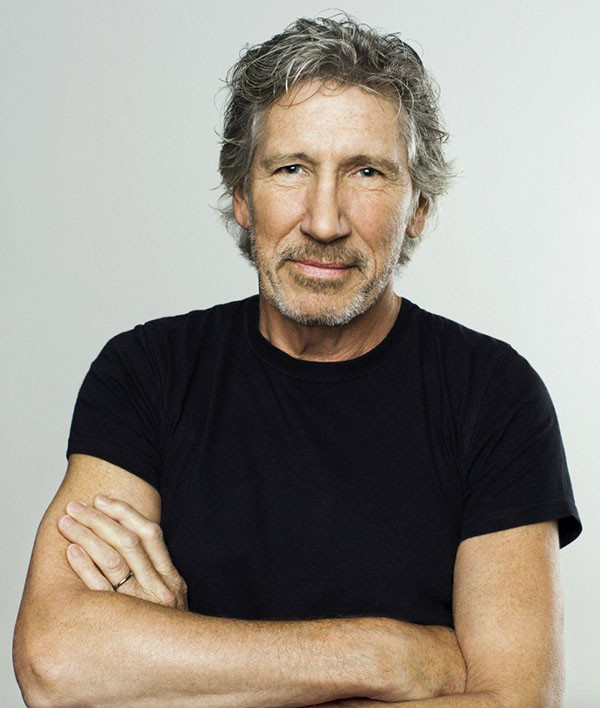
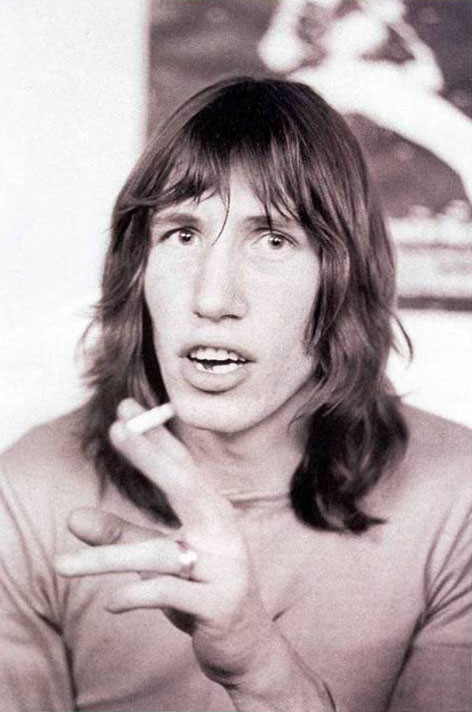
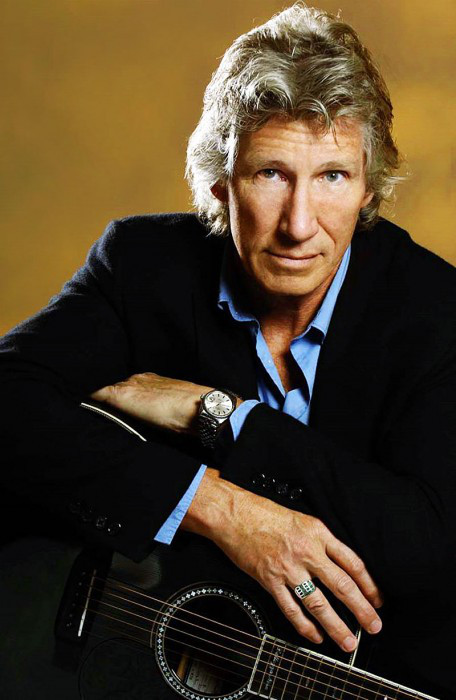
ROGER WATERS-THE SOLO YEARS.
Roger Waters-The Solo Years.
Following the departure of Syd Barrett from Pink Floyd, bassist Roger Waters became the group’s creative force. This was the case from Pink Floyd’s third album, Ummagumma, which was released in 1969, right through to 1983s The Final Cut. After the release of The Final Cut, Roger Waters left Pink Floyd. It was a bitter breakup. However, things had been coming to a head for some time.
Richard Wright, one of the founding members of Pink Floyd had been sacked from the band. As a result, he didn’t feature on The Final Cut. It was the only Pink Floyd album that he didn’t feature on. This was just the tip of the iceberg.
Pink Floyd had been a group divided since 1978. That was when the members of Pink Floyd found out the perilous state of their finances. Some of the investments made on their behalf went south. Amid accusations of financial negligence, Pink Floyd needed to recoup some of the money they had lost. So, Roger Waters presented the other members of Pink Floyd with two propositions.
The Wall.
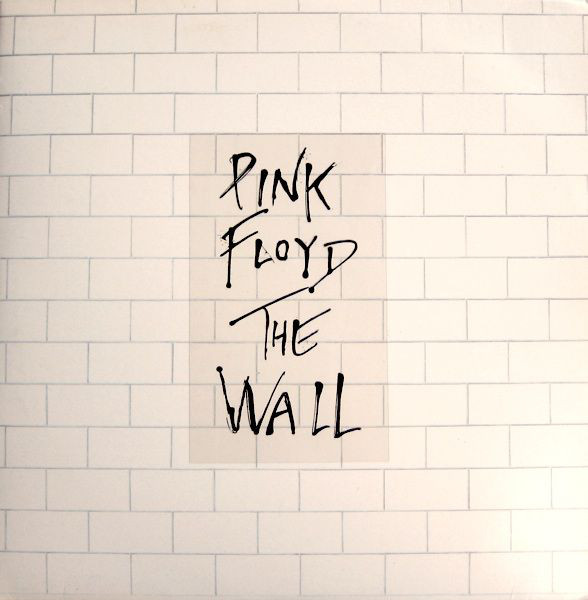
The first was the script to The Wall, Pink Floyd’s 1979 concept album. Roger Waters’ other proposition was The Pros and Cons Of Hitch Hiking. After giving both propositions some consideration, The Wall won out, and The Pros and Cons Of Hitch Hiking became Roger’s 1984 solo debut album. However, from that day on, things weren’t well within Pink Floyd.
Keyboardist Richard Wright’s contribution to The Wall was criticised by Roger Waters. He was accused of not contributing enough and being uncooperative. Eventually, a deal was struck that Rick Wright would remain a member of Pink Floyd until The Wall was complete. That was just as well.
When The Wall was released in 1979, on 21st March 1983, it was to critical acclaim. Soon, The Wall became Pink Floyd’s biggest selling album. Incredibly, The Wall outsold even Dark Side Of The Moon. In Britain, The Wall reached number three and was certified double platinum. Across the Atlantic in America, The Wall reached number one on the US Billboard 200, selling twenty-three million copes, resulting in the album being certified platinum twenty-three times over. This was just the tip of the iceberg.
Elsewhere, The Wall reached number one in Australia, Austria, Canada, France, Germany, Holland and New Zealand. This resulted in The Wall being certified eleven times platinum in Australia; diamond in France; seven times platinum in Germany; fourteen times platinum in New Zealand; three times platinum in Switzerland, two times diamond in Canada; fourteen times platinum in New Zealand. If The Wall was Rick Wright’s swan-song, it was a profitable one. Roger Water’s final album with Pink Floyd never came close to being the same commercial success.
The Final Cut.
Nearly four years passed before the release of The Final Cut. This was the first Pink Floyd album without Rick Wright. Most of the lyrics and music was penned by Roger Waters. Just like The Wall, The Final Cut was a very personal album for Roger. It was exploring what Roger believed was the betrayal fallen servicemen, including his father, who died while serving during World War II. The only other member of Pink Floyd to contribute to The Final Cut was David Gilmour. He cowrote Not Now John. Mostly, The Final Cut was Roger Water’s work. It was scheduled for release on 21st March 1983.
On the release of The Final Cut, it was accompanied by a short film. It was produced by Roger Waters and directed by Willie Christie. The film featured four songs from The Final Cut, The Gunner’s Dream, The Final Cut, The Fletcher Memorial Home and Not Now John. However, despite the final and what was a powerful and moving album, The Final Cut didn’t win favour with critics and cultural commentators. Reviews were mixed, as the release date loomed.
When 21st March 1983 came around, The Final Cut was released. The Final Cut reached number one in Britain and number six on the US Billboard 200. This resulted in a platinum disc in Britain and The Final Cut was certified double platinum in America. Elsewhere, The Final Cut hadn’t sold in the same vast quantities as The Wall. However, at least The Final Cut was certified gold in Austria, France and Germany. Pink Floyd didn’t even bother touring The Final Cut. Instead, they turned to their various solo projects.

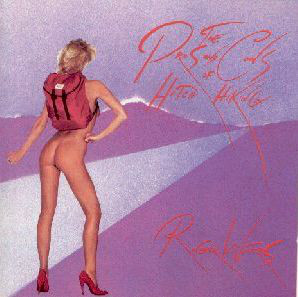
The Pros and Cons Of Hitch Hiking.
In Roger Waters’ case, this was The Pros and Cons Of Hitch Hiking. This was the project he had presented Pink Floyd with in 1978. It was another concept album from the pen of Roger Waters. It’s set in California, and focuses on a man in the throes of a midlife crisis. He’s on a road trip through California, where he dreams of committing adultery with hitchhikers. Other times, he’s beset by fears and paranoia. All this takes place between 04:30:18 AM to 05:12 AM. To bring this to life, Roger called upon some of his musical friends.
This included guitarists Eric Clapton and Ry Cooder. They were joined drummer and percussionist Andy Newmark, percussionist Ray Cooper and saxophonist David Sanborn. Pianist Michael Kamen co-produced The Pros and Cons Of Hitch Hiking. It was recorded between February and December 1983. Once the recording was complete, The Pros and Cons Of Hitch Hiking was released on 30th April 1984.
Before the release of The Pros and Cons Of Hitch Hiking, the critics had their say. Reviews were mixed. Some critics were impressed with The Pros and Cons Of Hitch Hiking. Others hated it, and didn’t shy away from saying so. One of the fiercest critics was Rolling Stone magazine. They gave The Pros and Cons Of Hitch Hiking their lowest rating. This was a huge body blow for Roger Waters. He wanted his solo career to get off to a successful start.
When The Pros and Cons Of Hitch Hiking was released on 30th April 1984, it stalled at number thirty-one on the US Billboard 200, where it was certified gold. In Britain, The Pros and Cons Of Hitch Hiking reached just number thirteen in Britain. The Pros and Cons Of Hitch Hiking hadn’t been the success Roger had hoped.
Things went from bad to worse for Roger. He was due to The Pros and Cons Of Hitch Hiking in 1984 and 1985. The tour began in Stockholm on June 16th 1984. Eric Clapton was part of Roger’s new band. They were going to play new songs, songs from The Pros and Cons Of Hitch Hiking and Pink Floyd classics. However, quickly, it became apparent that the tour wasn’t a success.
Ticket sales were poor, and some of the concerts at larger venues were postponed. It was only when Roger began playing smaller venues, that the sold out signs went up. Eventually, when the tour was over, Roger Waters realised he had lost £400,000 on the tour. That was a conservative estimate. To add to Roger’s problems, the ghost of Pink Floyd was still making its presence felt.
Pink Floyd-The End Of The Roger Waters’ Years.
Following the release of The Pros and Cons Of Hitch Hiking, Roger Waters announced that Pink Floyd would not be reuniting. The only problem was, he hadn’t discussed this with the other members of Pink Floyd. He also wanted to dismiss Pink Floyd’s manager Steve O’Rourke. In his place, Roger employed Peter Rudge to look after his affairs. For the other members of Pink Floyd, all this came as a surprise. However, Roger Waters wasn’t finished.
He wrote to EMI and Columbia, and told them that he had left Pink Floyd, and wanted to be discharged from his contractual obligations. Roger Waters had left Pink Floyd, and in the process, tried to wreck the possibility of the band rising like a phoenix from ashes. This was bound to end up in either tears, or court.
Later, Roger Waters said that, if he other members of Pink Floyd made an album using the band’s name, he thought that they would be in breach of contract. This could result in their royalty payments being suspended. Further, Roger alleged that the other members of Pink Floyd had forced him from the band, by threatening to sue him. While all this was going on, Pink Floyd and its members past and present were in a state of flux. Nobody was making music. A resolution had to be found. So, Roger Waters headed to the High Court in London.
Roger Waters wanted to dissolve Pink Floyd, and also prevent the use of the band name. He believed the band were “a spent force creatively.” However, he was in for a surprise.
His lawyers discovered that the Pink Floyd partnership had never been formally confirmed. It was therefore impossible to dissolve something that never existed in the first place. Despite this, Roger Waters returned to the High Court.
This time, he was trying to stop the other members of the band using the Pink Floyd name. Again, he lost out, and Dave Gilmour stated that “Pink Floyd would continue to exist.” With that, the leadership of Pink Floyd passed from Roger Waters to Dave Gilmour. Roger Waters returned to his solo career.
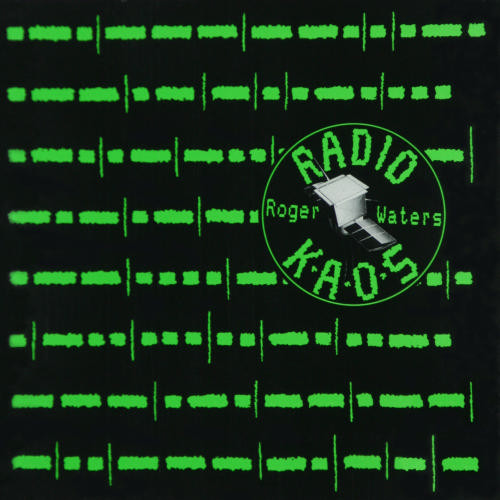
Radio K.A.O.S.
With Pink Floyd returning to the studio, so did Roger Waters. He had penned another concept album Radio K.A.O.S. It was based upon key policies of late eighties politics, especially monetarism. Roger also takes aim at the then Iron Lady, Margaret Thatcher. He was an outspoken critic of Thatcher on The Final Cut. Four years on, and he was equally outspoken. Other subjects Roger tackles include the Cold War, eighties popular culture and world politics. These subjects are seen through the eyes of Billy.
On Radio K.A.O.S., Billy is a mentally and physically disabled man from Wales. His brother Benny, is sent to prison after protesting against the government after he loses his job as a miner. This Benny is told, is the result of market forces. With Benny in prison, there’s nobody left to look after Billy. So he has to live with his uncle David in Los Angeles. Radio K.A.O.S. eavesdrops on Billy’s Billy’s mind and worldview, as he converses with Jim a DJ at a fictitious L.A. radio station, Radio K.A.O.S. This story is brought to life by Roger and what he called his Bleeding Heart Band.
Between October and December 1986, Radio K.A.O.S. was recorded at the Billiard Room, London. Accompanying Roger, was a large band. This included many well known names, including guitarist Andy Fairweather Low, vocalist Paul Carrack and saxophonist Mel Collins. Clare Torry who featured on Great Gig In The Sky, from Pink Floyd’s Dark Side Of The Moon, featured on two tracks. Surely with such an all-star band accompanying Roger, Radio K.A.O.S. would be released to critical acclaim and commercial success?
The first most people knew about Radio K.A.O.S. was a press release from EMI, on on 6 April 1987. It announced that Roger Waters’ sophomore solo album, Radio K.A.O.S. would be released on 15th June 1987, and originally, it was hoped that this rock opera would become a film, stage show and live album. First of all, Radio K.A.O.S. would be released as a studio album.
Just like The Pros and Cons Of Hitch Hiking, reviews of Radio K.A.O.S. were mixed. At least Rolling Stone were more positive about Radio K.A.O.S. However, it was a long way from Pink Floyd’s glory days.
So were the sales of Radio K.A.O.S. It stalled at number fifty in the US Billboard 200 and number twenty-five in Britain. Elsewhere, Radio K.A.O.S. didn’t sell in vast quantities. To rub salt into the wound, five months later, on 7th September 1987, Pink Floyd returned with their first album since Roger Waters left, A Momentary Lapse Of Reason. This coincided with the Radio K.A.O.S. tour
The Radio K.A.O.S. tour began in mid-August 1987, and finished at the end of November 1987. Everywhere he went, copies of Pink Floyd’s comeback album, A Momentary Lapse Of Reason were for sale. It had been released on 7th September 1987, reaching number three in Britain and in the US Billboard 200. A Momentary Lapse Of Reason was certified gold in Britain, and four times platinum in America. Having sold four million copies in America alone, the success continued throughout the world. Gold and platinum discs came Pink Floyd’s way. In Canada, Australia and New Zealand, through Europe, A Momentary Lapse Of Reason was a huge success. As the Radio K.A.O.S. winded its way across the globe, Pink Floyd’s A Momentary Lapse Of Reason continued to outsell Radio K.A.O.S. Roger’s solo career wasn’t the commercial success he had hoped.
Later, Roger admitted that he wasn’t a fan of Radio K.A.O.S. He felt the album sounded “too modern.” That was down to Roger and Ian Ritchie’s production. It spoiled Radio K.A.O.S. for the man who masterminded the project. Maybe that’s why Radio K.A.O.S. wasn’t a huge commercial success? However, Roger hoped that his next album would see him rubbing shoulders with his old comrades commercially.
The Wall-Live In Berlin.
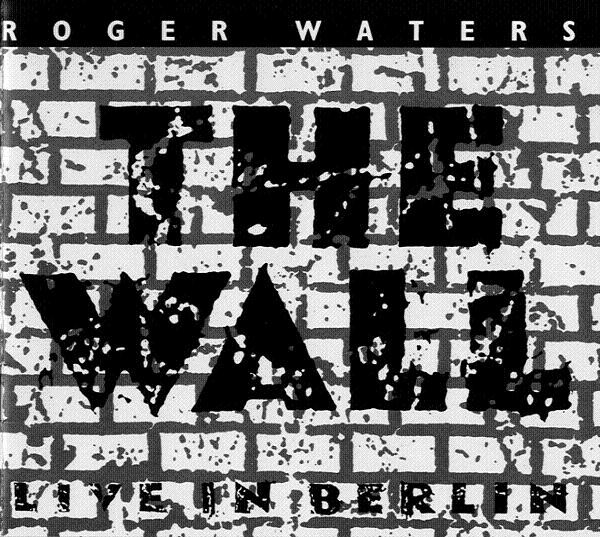
To celebrate the fall of the Berlin Wall eight months earlier, Roger Waters performed The Wall-Live In Berlin on 21st July 1990. Roger Waters financed the project, and put together an all-star cast. Joni Mitchell, Van Morrison, The Scorpions, Snowy White and Bryan Adams were just some of the names that made a guest appearance. The concert was staged in what had been no man’s land between East and West. 350,000 people watched the sellout show which recorded and filmed. It would be released a month later on 21st August 1990.
This was a really fast turnaround. The Wall-Live In Berlin was recorded, produced, mastered and marketed within a month. This was a big ask. Ultimately, it proved too ambitious.
Having financed the project himself, the plan was that once Roger Waters had recouped his expenses, the profits from the live album and film, profits would go the Memorial Fund For Disaster Relief, a British charity founded by Leonard Cheshire. However, it was a case of the best laid plans of mice and men.
Sales of The Wall-Live In Berlin were disappointing. In Britain, The Wall-Live In Berlin reached number twenty-seven. Across the Atlantic, the album stalled at just number fifty-six in the US Billboard 200. Elsewhere, sales were disappointing. They failed to meet the projections. This had disastrous consequences for the charity.
With the sales not meeting expectations, the charity incurred heavy losses. This resulted in the trading arm of the charity, Operation Dinghy, being wound-up a couple of years later. By then, Roger Waters had released his third studio album, Amused To Death which was recently released on double vinyl by Columbia Records/Legacy Recordings.
Amused To Death.
Just like his two previous albums, Amused To Death was a concept album. Roger had been working on Amused To Death since 1987. The inspiration for Amused To Death came from Neil Postman’s book Amusing Ourselves To Death.
By the time the concept was complete, it revolves around the a monkey who randomly switches between television channels. As channels change, different subjects are discussed. Among them are the Gulf War, World War I, the bombing of Jordan and Libya, and the Tiananmen Square protests of 1989. A total of fourteen tracks feature on Amused To Death. It was recorded between 1987 and 1992.
Recording Amused To Death at various London studios. This includes The Billiard room, Olympic Studios, CTS Studios, Angel Studios and Abbey Road Studios Just like Roger’s two previous solo albums, Amused To Death features a large backing band.
Some feature throughout Amused To Death, others feature on just one or two tracks. Many are well known names. Among them are guitarists Jeff Beck, Andy Fairweather Low, Steve Lukather and B.J. Cole, bassist Randy Jackson and drummer Jeff Porcaro. John “Rabbit” Bundrick plays Hammond organ, while vocalists include Don Henley and Rita Coolidge. Once the tracks were recorded, it was mixed in QSound.
There was a reason for this. It was to enhance the spatial feel of the album. Especially, the sound effects used on Amused To Death. There’s a rifle range, sleigh bells, cars, planes, horses, crickets and dogs. They come to life on Amused To Death. It was produced by Roger and Patrick Leonard. Given the problems with production on Radio K.A.O.S. he wasn’t going to make the same mistake again. It had proved a costly mistake, one they weren’t going to repeat.
After five years of work, Amused To Death was released on 7th September 1992. Given the reception The Pros and Cons Of Hitchhiking and Radio K.A.O.S. received, Roger awaited the reviews with bated breath. Reviews were favourable of what was a cerebral, poignant and thoughtful album.
After the favourable reviews, Amused To Death reached number eight on the British charts. This resulted in a silver disc, marking sales of 60,000. While it was a far cry from his days with Pink Floyd, it showed that Roger Waters’ solo career was on the right track.
In America, this proved to be the case. Amused To Death reached number twenty-one on the US Billboard 200. He even enjoyed a hit single, when What God Wants, Part I reached number four on the Mainstream Rock Tracks charts. After three albums and eight years, Roger Waters was forging a successful solo career. Record buyers awaited Roger Waters’ fourth studio album.

In The Flesh-Live.
They waited a year. A year became two, three, four, five and six. Still there was no sign of Roger Waters’ fourth studio album. He returned on 5th December 2000, with a new live album, In The Flesh-Live.
This was a double album featuring recordings from Roger Waters’ three year In The Flesh Tour. It features tracks from what Roger Waters the two classic albums he had worked on: “Dark Side Of The Moon and The Wall” There’s also tracks from his most recent solo album Amused To Death.” These tracks were recorded between the 16th and 27th June 2000 at concerts in Phoenix, Las Vegas, Irvine, California and Portland, during the American leg of the tour. They would eventually become part of a sprawling twenty-four track double album In The Flesh-Live.
James Guthrie was brought onboard to produce In The Flesh-Live. It was to be released as a LP, CD, DVD and SACD. This meant that a stereo and 5.1 mixes were required. This could’ve proved time-consuming. However, the album was ready for released on 5th December 2000. The only problem was that the reviews were mixed.
Rolling Stone magazine, especially took a dislike to In The Flesh-Live. They found very little merit in the album. The opinion of other critics was divided. Reviews ranged from lukewarm to mixed, while some critics praised the album. As usual, record buyers had the last say on In The Flesh-Live.
When In The Flesh-Live was released, it stalled at a lowly 136 in the US Billboard 200 and 170 in the UK. This was the least successful album of Roger Waters’ solo career. Elsewhere, sales of In The Flesh-Live were disappointing. The only places where the album reached the top twenty were Holland, Norway, Poland, Sweden and Switzerland. Commercially, In The Flesh-Live had been a disappointment for Roger Water.

Ça Ira,
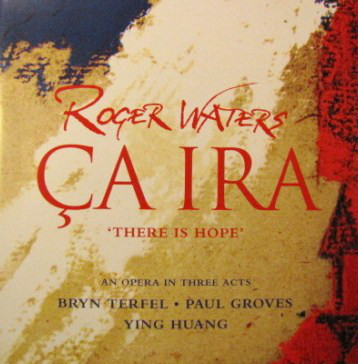
After the disappointment of In The Flesh-Live, nothing was heard of Roger Waters until 2005. Then in 2005 Roger Waters released Ça Ira, a three act opera that was also a concept album about the early part of the French Revolution. .
Ça Ira had been written by two friends of Roger Waters, Étienne Roda-Gil and Nadine Roda-Gil. They asked Roger Water to set their French libretto to music. This he agreed to do, and brought Rick Wentworth onboard to co-produce Ça Ira. It was ambitious project that was eventually completed in 2005. The release of Ça Ira was scheduled for the 26th of September 2005.
Before that, reviews of Ça Ira were mixed. Although Roger Waters’ composition was praised, the opera was regarded by critics as too narrative. This made staging the opera difficult, and means that the flow is constantly disrupted. Meanwhile, critics were divided about Ça Ira’s plot. Some critics regarded the plot as either to difficult to follow, or too simplistic. There was no consensus to the reviews of Ça Ira, as the release loomed.
Upon the release of Ça Ira, it was only a commercial success in one country. Sales in France were minimal, and Ça Ira stalled at 187. In Poland, Ça Ira reached number twelve and was certified platinum. This was seen as a Pyrrhic victory, given the time and money it took to write and record Ça Ira. For Roger Waters, it was another disappointment,
After Ça Ira, Roger Waters seemed to be in no hurry to return to the recording studio. The years passed by and still, there was no sign of a followup to Amused To Death. Meanwhile, Rogers’ former comrades had been busy.
In 2014, Pink Floyd returned with a new album The River. This was Pink Floyd’s first solo album in twenty years. It was released to critical acclaim and commercial success. Still, there was no sign of Roger Water releasing a new studio album. However, Roger Waters was about to release a new film version of the The Wall.
Roger Water: The Wall.
Roger Waters had toured The Wall between 15th September 2010 and 21st September 2013. The six legs of this 219 date tour took just over three years and grossed US $458.6 million. Some of the concerts had had been filmed and recorded. They would eventually become the version of The Wall that was premiered at the 2014 Toronto International Film Festival on 6 September 2014. It would be just over a year before the film and soundtracks were released. Before that, the spotlight shawn on another member of Pink Floyd.

David Gilmour-Rattle That Lock.
David Gilmour had been busy. The man who replaced Roger Waters as Pink Floyd’s creative force, had recorded a new solo album, Rattle That Lock. It was due for release on the 18th of September 2015. This was the fourth album of David Gilmour’s career that began in 1978.
Since then, David had been juggling his solo career alongside his work with Pink Floyd; playing on albums by some of the biggest names in music and his successful production career. That explained why David had released just four albums in thirty-seven years. Each had been commercially successful. Rattle That Lock was no different, and released to critical acclaim. Soon, Rattle That Lock was well on its way to being certified gold. This was the first strike in the battle of the Pink Floyd solo albums.
Roger Water: The Wall.
Just elven days after the release of Rattle That Lock, the concert film of Roger Waters: The Wall was released on 29th September 2015. However, the soundtrack wasn’t released until 20th November 2015. Maybe Legacy who were releasing Roger Waters: The Wall weren’t wanting the release of the two albums billed as a shootout between the two former bandmates? If that was the case, this was a wise move.
Roger Waters: The Wall didn’t replicate the commercial success of previous albums. The album stalled at a disappointing 134 in the US Billboard and fifty-three in the UK. In Australasia, Roger Waters: The Wall reached thirty-eight in New Zealand and forty-six in Australia. Across Europe, the album reached twenty-nine in Austria; twenty-two in Germany; eleven in Norway and twenty in Switzerland. This was a disappointing outcome. Especially as David Gilmour’s Rattle Than Lock was selling well across the world and would be certified gold in the UK. Just like at the High Court, David Gilmour had triumphed again.
Since the release of Roger Waters: The Wall in November 2015, there is still no sign of Roger Waters releasing a new studio album. He’s now seventy-three, and twenty-four years have passed since the release of Amused To Death. It was the third solo album from Roger Waters. Nowadays, it seems that Roger Waters prefers touring than recording.
He’s embarked upon several lengthy tours, with In the Flesh and Roger Waters: The Wall both lasting three years. These tours find Roger Waters playing to huge audiences that span several generations. Night after night, he rolls back the years, combining music from his years with Pink Floyd his solo material. This includes his trio of solo albums, The Pros and Cons Of Hitch Hiking, Radio K.A.O.S. and Amused To Death. They’re ambitious and complex albums that took several years to write and record. Despite this, they never received the recognition they deserved.
Some critics didn’t seem willing to give Roger Waters’ solo albums a fair hearing. Led Zeppelin and to some extent Black Sabbath had been down the same road. They had suffered at the hands of the self-same critics and publications, and had been left shaking their heads.
What must have proved disappointing for Roger Waters, were the sales of his three albums. They never found the audience they deserved. Especially in in the lucrative American market. Only The Pros and Cons Of Hitch Hiking was certified gold. That was as good as it got for Roger Waters in America. It wasn’t much better in Britain, with Radio K.A.O.S. and Amused To Death being certified silver. It was a long way from his days with Pink Floyd, when Roger Waters was able to decorate his walls with gold, platinum and diamond discs. However, he was never going to replicate the success of Pink Floyd.
No one member of Pink Floyd was capable of doing that. This success came as part of a collective, that became one of the most pioneering bands sixties and seventies. Alas, Pink Floyd ended in tears and tantrums. An appearance at the High Court in London spelt the end of Roger Waters’ time with Pink Floyd.
Life after Pink Floyd wasn’t as successful for Roger Waters. He may have been Pink Floyd’s leader after the departure of Syd Barrett, but none of the music the band made would’ve been possible without Dave Gilmour, Nick Mason and Richard Wright. No man is an island. Maybe Roger Waters only realised this after his departure from Pink Floyd. However, Roger Waters still managed to release a triumvirate of ambitious and to some extent, underrated studio albums during his solo years which has spanned the last four decades.
Roger Waters-The Solo Years.

THIS IS LOWRIDER SOUL 1962-1970.
This Is Lowrider Soul 1962-1970.
Label: Ace Records.
Between 1962 and 1970, there was an increase in popularity of soulful ballads in Southern California. These slow jams were played in the clubs in Southern California and could be heard in cars during this eight year period. Initially, it was the Mexican, Central and South American immigrants who had settled around east Los Angeles that embraced the soulful ballads. Their popularity has grown since then.
Since then, the popular of soulful ballads has grown, and now, are favourites of soul fans and record collectors around the world. Some record buyers were drawn to the music after being fascinated by the titles of the songs that were finding favour amongst the lowrider set.
The lowrider scene was named after the members love of classic American automobiles, which were customised as used to cruise the streets of LA. This became really popular between the early sixties and the dawn of the seventies which is the period that Ace Records’ new compilation This Is Lowrider Soul 1962-1970 covers.
This Is Lowrider Soul 1962-1970 features twenty-four tracks including the blue eyed soul of Aesop’s Fables’ 1967 single on Atco, Take A Step. This is the start of what’s a soulful compilation.
Doo wop is represented on This Is Lowrider Soul 1962-1970 by The Vows’ I Wanna Chance, while The Four Tees’ sweet soul harmony ballads One More Chance is a welcome addition.
There’s numerous lowrider classics including Brenton Wood’s Where Were You, Lee Williams and The Cymbals’ Til You Come Back To Me, Barbara Mason’s Oh, How It Hurts, The Whispers’ As I Sit Here and The Ambassadors’ I Really Love You. These classics are joined by some lesser known tracks that ooze quality. Among them are The Lovelles’ Pretending Dear, The Attractions’ Find Me, The Charmels’ As Long As I’ve Got You, Jeff Dale’s Don’t Forget About Me Baby, The Webs’ It’s So Hard To Break A Habit, Reuben Bell with The Casanovas’ It’s Not That Easy and Crying All By Myself by William Bell.
Closing This Is Lowrider Soul 1962-1970 is I’m Just Passing Time by Melvin Hicks and The Versatiles which closes the compilation is soulful style.
It’s a welcome reminder of the lowrider scene scene which became popular in the early sixties and grew in popularity right through to 1960. That is the period that Ace Records’ compilation This Is Lowrider Soul 1962-1970 covers.
This Is Lowrider Soul 1962-1970 us a lovingly compiled compilation that features everything from lowrider classics to unreleased sings and some lesser known slow jams that literally ooze quality. All these classy cuts make This Is Lowrider Soul 1962-1970 a must-have for anyone who likes soulful ballads, slow jams and smoochy music.
This Is Lowrider Soul 1962-1970.

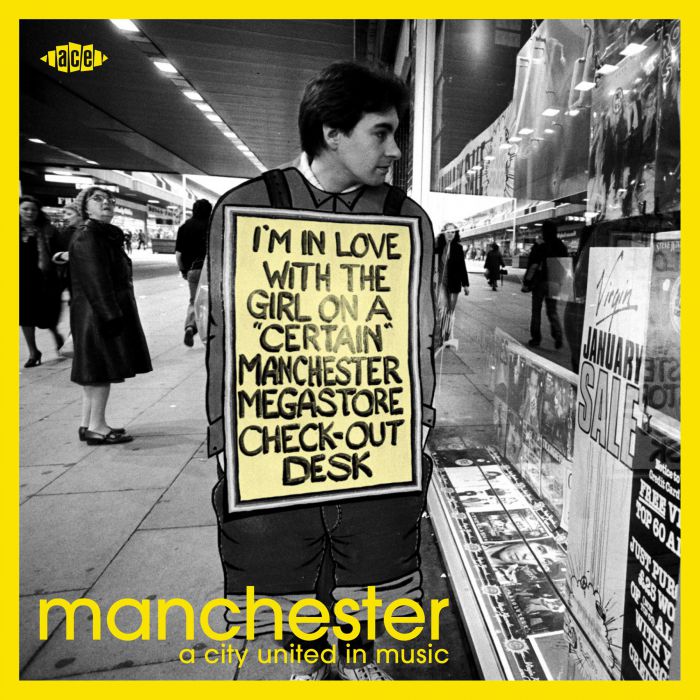
MANCHESTER-A CITY UNITED IN MUSIC.
Manchester-A City United In Music.
Label: Ace Records.
Mention Manchester, and most people think of two things music and soccer, and specifically God’s own team Manchester City who for too long, were perceived as the city’s second team. That wasn’t always the case and isn’t the case any more.
Between 1966 and 1975, Manchester City won eight honours, starting with the Second Division in the 1965-1966 season. This was the start for the renaissance men, and soon, a team that over the next few years featured Colin Bell, Mike Summerbee, Francis Lee and the enigmatic and occasional genius Neil Young were soon winning games and friends across England and Europe.
Meanwhile, across the city Tommy Docherty who was appointed manager of Manchester United in 1972, saved the from relegation from Division One in 1973. His luck ran out when the team were relegated in 1974. However, Manchester United were promoted at the first attempt in 1975 and won the FA Cup in 1976 when they defeated Southampton. Manchester won the FA Cup two more times over the next ten years as Manchester City’s fortunes faded.
Fast forward to 2019 and Manchester City look as if they could win the quadruple that has evaded every other team in Premier League history. Manchester City are back on top, but it’s a different game and not the game that was played at Maine Road. Money has changed, and some would say ruined football which helped make Manchester famous the world over.
So did music, including the many of the forty-five artists and bands on Manchester-A City United In Music, a two CD set which has just been released by Ace Records. Manchester-A City United In Music features many familiar faces, cult songs, hidden gems and what will be new names to many music lovers. It’s a veritable musical feast and the perfect reminder to one of the Britain’s great sporting and musical cities. Here’s why;
Disc One.
Opening disc one of Manchester-A City United In Music is Dirty Old Town by folk singer Ewan MacColl which features Peggy Seeger. They’re joined by sixties stars Freddie and The Dreamers who contribute If You Gotta Make A Fool Of Somebody while The Hollies’ Baby That’s All is a welcome addition. So is Crawling Up A Hill by John Mayall and The Blues Breakers who over fifty years later are still going strong. It’s a similar case with future Vinegar Joe front-woman Elkie Books’ Nothing Left To Do But Cry.
Among the other familiar faces on disc one are Wayne Fontana and The Mindbenders’ whose The Game Of Love is joined by Georgie Fame and The Blue Flames’ In The Meantime and Herman’s Hermits’ This Door Swings Both Ways. Progressive rockers Barclay James Harvest’s Mocking Bird is a reminder of a band that sometimes don’t receive the credit they deserve. It’s a similar case with 10cc who released a string of carefully crafted and polished hit singles and successful albums. A reminder of 10cc at their very best is Life Is A Minestrone. Closing disc one is Mr Cool by Sweet Sensation from the 1975 album Sad Sweet Dreamer which is an oft-overlooked album.
Disc Two.
Disc Two of Manchester-A City United In Music opens with Orgasm Addict by Buzzcocks and gives way to You’re A Bore and Slaughter and The Dogs and John Cooper Clarke and The Curious Yellows’ Innocents. I’m In Love With The Girl On The Manchester Virgin Megastore Checkout Desk by The Freshies is included and so is Leave The Capitol by The Fall who were led by the inimitable Mark E Smith.
Welcome additions include Joy Division’s Dead Souls, New Order’s classic Thieves Like Us and Simply Red’s Come To My Aid. They’re joined by The Stone Roses’ anthemic I Wanna Be Adored, Inspiral Carpets’ This Is How It Feels, the Happy Mondays’ Kinky Afro and Johnny Marr’s New Town Velocity. Closing Manchester-A City United In Music is one of the compilations highlights, is the swaggering anthem Rock ‘n’ Roll Star by Oasis. It closes Manchester-A City United In Music on a resounding high.
For anyone who wants to know more about the Manchester music scene over the past fifty years, then Manchester-A City United In Music is a good place to start. This lovingly compiled two CD set features forty-five eclectic tracks that show the different sides to the Manchester music scene.
Manchester-A City United In Music features superstars, new names, familiar faces and forgotten heroes of yesteryear. They’re joined one hit wonders and nearly men on a compilation that has been five years in the making. It’s been well worth the wait, and Manchester-A City United In Music is another winner from Ace Records and joy to behold like Neil Young’s winner in the 1969 FA Cup Final.
Manchester-A City United In Music.
ARTHUR BLYTHE-THE COLUMBIA YEARS.
Arthur Blythe-The Columbia Years.
Nowadays, prodigy is one of the most overused words in the English language, and all too often it’s used to describe young children who show a modicum of talent in sport and music. Sadly, and all too often, those that were described as a prodigy never fulfil their supposed potential. The young ball player ends up parking cars, and the prodigious violinist ends his days pumping gas. However, there are some prodigies who fulfil their potential, including alto saxophonist Arthur Blythe.
He was born in Los Angeles on July 5th 1940, and when he was nine, Arthur Blythe discovered the alto saxophone. Soon, he was taking lessons with a family friend and saxophonist Junior Foster. He taught Arthur Blythe, and watched as he progressed from elementary school orchestra to the marching band. Within a few years, Arthur Blythe’s life would change when he discovered jazz in his mid-teens. This was a game-changer for Arthur Blythe.
Up until then, Arthur Blythe loved R&B music. That had been his music. This changed when Arthur Blythe discovered jazz. By then, Arthur Blythe was being taught by Kirkland Bradford, who had played in Jimmie Lunceford’s swing band. However, it wasn’t swing that Arthur Blythe gravitated towards.
Instead, it was the music of Thelonius Monk and then John Coltrane. It was only later, that Arthur Blythe discovered one of the greatest jazz saxophonists…Charlie Parker. By then, Arthur Blythe lived and breathed jazz. At last, he had discovered his purpose in life, playing jazz saxophone.
The Early Years.
By the mid-sixties, Arthur Blythe went in search of like-minded musicians. He found them at The Underground Musicians and Artists Association, which had been founded by pianist and composer Horace Tapscott. This was the perfect environment for an up-and-coming musician like Arthur Blythe. Each day, he was surrounded by innovative and influential musicians, and this led to him making his recording debut.
Horace Tapscott was looking for someone to play alto saxophone on his 1969 debut album and first album as bandleader, The Giant Is Awakened.Having gotten to know Arthur Blythe over the last few years, his friend from the Underground Musicians and Artists Association got the call. He was officially a member of the Horace Tapscott Quintet.
The Giant Is Awakened.
With Arthur Blythe onboard, the Horace Tapscott Quintet headed to the studio to meet producer Bob Thiele. He also owned Flying Dutchman Productions, the label the Quintet were signed to. This was an exciting time for everyone involved. Especially Arthur Blythe, who was making his recording debut; and Horace Tapscott who thought he was going to allowed to help mix the album. Before that, the album had to be recorded.
Recording took place between the 1st and 3rd of April 1969. Over the three days, the Quintet recorded four Horace Tapscott compositions with producer Bob Thiele. The veteran producer had worked with some of the biggest names in jazz, and was the perfect person to coax and cajole the best performance from the nascent Quintet. He certainly brought out the best in Arthur Blythe, whose performances were being committed to tape for the first time. Once the sessions were over, it should’ve been a time to celebrate.
Alas, the celebrations were cut short, when it became clear that Horace Tapscott wasn’t going to be involved in mixing of The Giant Is Awakened. Horace Tapscott wasn’t best pleased, and for a musician that had always been suspicious of the music industry this was the last straw. He turned his back on the recording industry for ten years. This was ironic.
When The Giant Is Awakened was released later in 1969, it was to widespread critical acclaim. Sadly the Horace Tapscott Quintet would never released another album. However, Arthur Blythe had enjoyed recording The Giant Is Awakened, and was keen to repeat the experience.
Three years later, in 1972, Arthur Blythe returned to the studio. This time, it was with Julius Hemphill on his album Coon Bid’ness. It was an ambitious and innovative album where avant-garde and jazz combine. When it was released later in 1972, it was to critical acclaim. For the second time, Arthur Blythe had played an important part in the success of an album.
In 1974, two became three when Arthur Blythe joined Azar Lawrence for the recording of what was, a truly groundbreaking album of spiritual jazz, Bridge Into The New Age. Arthur Blythe didn’t seem of place alongside Azar Lawrence, Woody Shaw and Hadley Caliman. Despite this, Arthur Blythe’s career took an unexpected twist.
Just like many jazz musicians, Arthur Blythe had headed to New York, which was then, regarded as the American jazz capital.By the mix-seventies, was struggling to make a career out of music. Competition was fierce, and Arthur Blythe had no option but to take a job as a security guard. This was only temporary. Fortunately, he was soon hired by avant-garde vocalist Lean Thomas.
He was establishing a reputation as a leading light of avant-garde scene. Leon Thomas had also recently worked with a man from Arthur Blythe’s past, Bob Thiele. Their paths would cross again in the future. Meanwhile, Arthur Blythe and joined Leon Thomas’ band, and that was where he was ‘spotted’ by one of the biggest names in jazz,..Chico Hamilton.
He played on Chico Hamilton’s 1975 album for Blue Note, Peregrinations, and the 1976 followup Chico Hamilton and The Players. Right through to 1977, Arthur Blythe played alongside Chico Hamilton. Right up until Arthur Blythe’s solo career began in 1977, his talents were constantly in demand and saw
Before that, Gil Evans Orchestra were looking for an alto saxophonist in 1976. Arthur Blythe answered the call, and would spend several years working with the Gil Evans Orchestra. When he was neither working with Chico Hamilton nor the Gil Evans Orchestra, worked with a variety of jazz musicians.
This included recording an album with Woody Shaw in 1977, This was The Iron Men, which featured Anthony Braxton. However, The Iron Men wasn’t released until 1980. By then, Arthur Blythe had embarked upon a solo career.
The Grip.
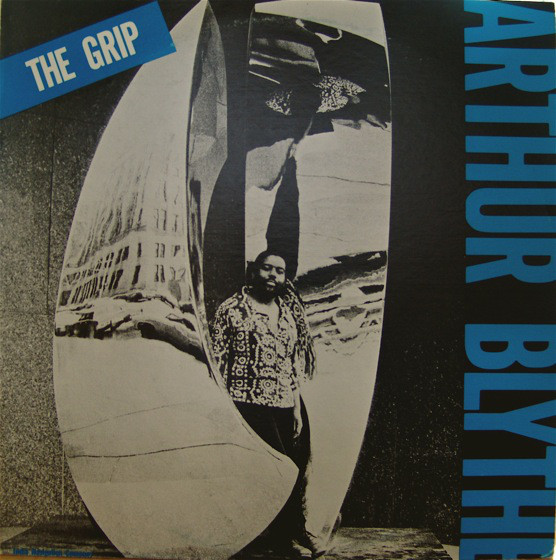
Arthur Blythe solo career began in early 1977, when having signed to the indie label India Navigation, he recorded his debut album The Grip on February 26, 1977. Unlike most debut albums, The Grip was a live album which was recorded at the Brook, in New York.
The Grip was an ambitious and adventurous album of free jazz. That was no surprise, as Arthur Blythe had put together a band that featured some of the most creative, free spirits on the New York jazz scene. Drummer Steve Reid provided the heartbeat, while Bob Stewart on tuba, trumpeter Ahmed Abdullah, cellist Abdul Wadud and percussionist Muhamad Abdullah joined Arthur Blythe. They were responsible for a debut album that won over critics.
When The Grip was released later in 1977, praise and plaudits accompanied the release of a truly groundbreaking album. Arthur Blythe’s band went further than any of his contemporaries. Critics were enthralled by such ambitious and adventurous album. What was all the more remarkable was that it was a live album. There were no second chances. That was the case with the other live album recorded on 26th February 1977.
Metamorphosis.
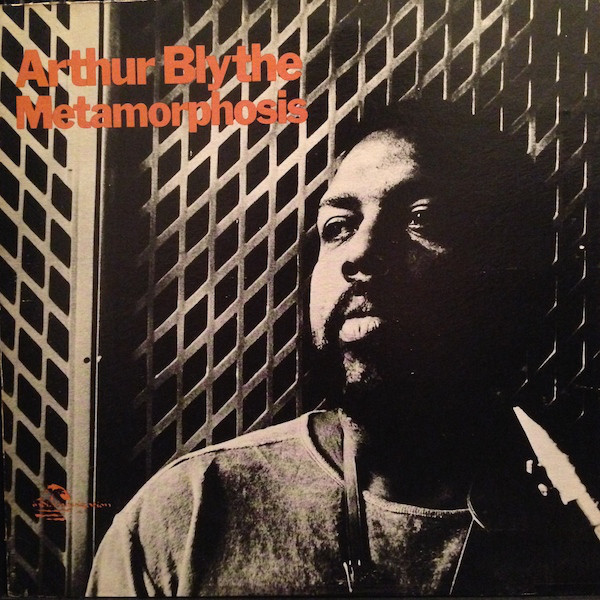
The same night that The Grip was recorded at The Brook, the tapes were left running and a second live album was recorded, Metamorphosis. It was also released later in 1977, and just like The Grip, Metamorphosis, was another album that found favour with critics. They were impressed by Arthur Blythe’s distinctive and unique sound, as he and his band of musical free spirits took the listener on an another musical adventure. For critics and the record buyers who discovered Metamorphosis, it was a tantalising taste of what was to come from Arthur Blythe.
Bush Baby.
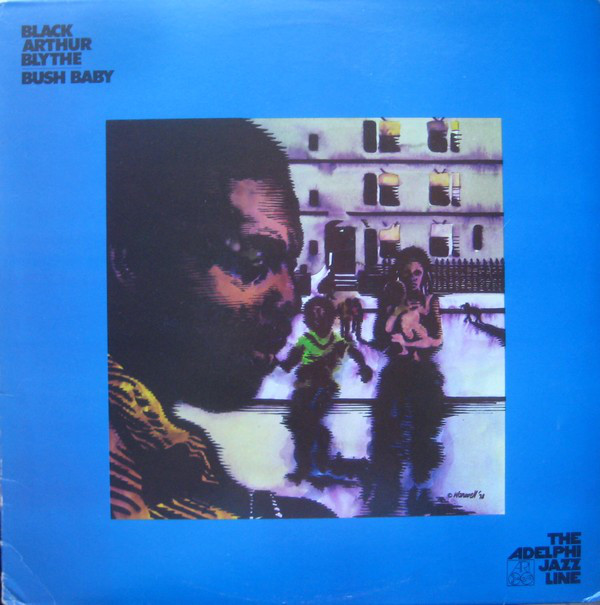
Despite having recorded and released two live albums early in 1977, Arthur Blythe wasn’t willing to rest on his laurels. Instead, he featured on Synthesis’ debut album Six By Six. Then he signed a contract with the Adelphi label, and headed into the studio in December 1977.
For his first studio album, Arthur Blythe four new compositions, They would be recorded by a trio. This featured Bob Stewart on tuba and Ahkmed Abdullah on congas. Sitting atop the arrangement was the unmistakable sound of Arthur Blythe’s alto saxophone. With the four compositions recorded, Bush Baby was released in 1978.
Before the release of Bush Baby, critics had their say on the album. Just like his two live albums, critics remarked upon Arthur Blythe’s adventurous spirit. They also remarked that already, Arthur Blythe was a versatile musician. He could seamlessly switch between playing soulfully, to playing with an unbridled intensity. Critics were won over by Bush Baby which was released in early 1978. Equally impressed by Arthur Blythe, were Columbia Records, who signed him in 1987. This was the start of a new era.
In The Tradition.
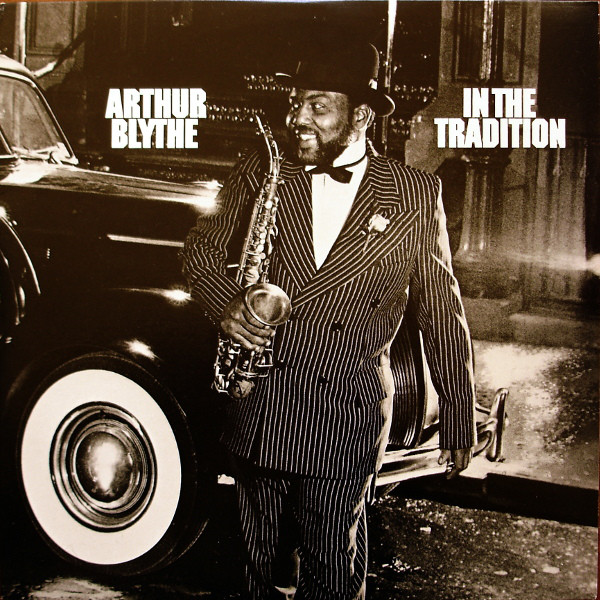
Having signed to Columbia Records, Arthur Blythe got the opportunity to renew his acquaintance with producer Bob Thiele. He was drafted in to produce Arthur Blythe’s Columbia Records’ debut, In The Tradition.
For In The Tradition, Arthur Blythe composed Break Tune and Hip Dripper. The rest of the tracks were cover versions, which took Arthur Blythe back to his teenage years. This included Fats Wallers’ Jitterbug Waltz which had been a favourite when R&B was Arthur Blythe’s passion. The other songs included a cover of Duke Ellington’s In A Sentimental Mood, and Caravan, which the Duke penned with Irving Mills and Juan Tizol. Fittingly, the album closer was Naima, which was written by John Coltrane who was one of the artists who inspired Arthur Blythe. These six tracks were recorded at Mediasound Studios, in New York.
At Mediasound Studios, the free spirits that played on Arthur Blythe’s first three albums were absent. Replacing them, were a rhythm section of drummer Steve McCall and bassist Fred Hopkins. Completing Arthur Blythe’s quartet were pianist Stanley Cowell. Once In The Tradition was complete, Bob Thiele didn’t make the same mistake twice.
Not only did Bob Thiele co-produce In The Tradition with Arthur Blythe, but he allowed him play a part in the mixing of the album. He must have remembered the confusion surrounding the Horace Tapscott Qunintet’s The Giant Is Awakened. So, Arthur Blythe mixed In The Tradition with Doug Epstein. Then later in 1978, Arthur Blythe’s Columbia debut was released.
Critics were in for a surprise when they heard In The Tradition. This time, there were neither sonic experiments, nor musical adventures from Arthur Blythe. Instead, as the title suggested, the album had a much more traditional sound. The quartet embraced and enjoyed this return to a more traditional sound. It allowed the quartet to showcase their considerable skills. This was something critics remarked upon, praising and lauding the standard of musicianship on display on In The Tradition.It was to critical acclaim later in 1977.
The only disappointment was that In The Tradition didn’t chart in the US Billboard 200. However, it found an audience within the jazz community, who wondered what direction Arthur Blythe was heading next?
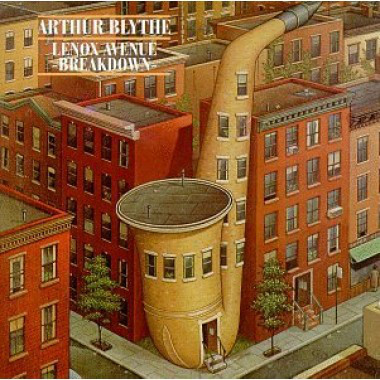
Lenox Avenue Breakdown.
Arthur Blythe returned to Mediasound Studios later in 1978, with four new compositions. They would become Lenox Avenue Breakdown, which featured an expanded lineup of Arthur Blythe’s band.
This time around, Arthur Blythe was working with a septet, which featured some top jazz musicians. The rhythm section alone featured drummer Jack DeJohnette, bassist Cecil McBee and guitarist James Blood Ulmer. They were augmented by the familiar face of Bob Stewart on tuba, flautist James Newton and percussionist Guilherme Franco. Producing this all-star lineup, was a man used to big occasions, Bob Thiele. He coaxed and cajoled a masterful performance out of the septet. It was worth every ounce of effort and energy that had been expounded. After this, it was over to Arthur Blythe to mix Lenox Avenue Breakdown. Then Arthur Blythe’s Magus Opus was almost ready for release.
Before that, critics had their say on Lenox Avenue Breakdown. Critics thought the band had been together for years. However, they were a new band, and had been together just a week when Bob Thiele pressed play. He watched as the septet delivered a masterful performance on an album of innovative and influential contemporary jazz.
Bob Stewart the longest-serving member of Arthur Blythe’s band, played an important part on Lenox Avenue Breakdown. Especially on the title-track, a thirteen minute epic, where he delivered what’s considered one of the finest tuba solos in modern jazz. That’s just one reason why Lenox Avenue Breakdown is the album’s centrepiece. However, the new band all play their part on album that critics exhausted superlatives on.
It was variously hailed a masterpiece and a modern classic. In a later review, The Penguin Guide To Jazz said: “one of the lost masterpieces of modern jazz.” Sadly, that was the case.
When Lenox Avenue Breakdown was released in 1979, the album never troubled the US Billboard 200. Even in the US Billboard Jazz Albums Charts, Lenox Avenue Breakdown reached just thirty-five. Arthur Blythe’s Magnus Opus, was indeed: “one of the lost masterpieces of modern jazz.”
Illusions.
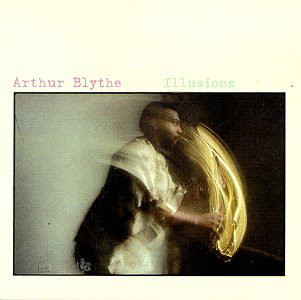
Having spent 1979 and early 1980 working as a sideman, this allowed Arthur Blythe to get over the commercial failure of Lenox Avenue Breakdown. Arthur Blythe must have known it was the best album of his career. Critics had called it a masterpiece and a classic. Now he had it all to do again, in the hope that commercial success wouldn’t continue to elude him. So Arthur Blythe returned to the studio in April 1980.
When recording Illusions began, the changes had been rung, Rather than Mediasound Studios, Illusions was being recorded at CBS Recording Studios, New York. Producing the album, was Arthur Blythe and Jim Fishel. There was no sign of Bob Thiele, nor the septet that featured on Lenox Avenue Breakdown.
While it was still a septet that featured on Illusions, this time there were several new faces. Even two different drummer were used on the album, each playing on three tracks. This meant the rhythm section featured drummers Steve McCall and Bobby Battle, bassist Fred Hopkins and guitarist James Blood Ulmer. Tubaist Bob Stewart returned, and was joined by cellist Abdul Wadud who had featured on Arthur Blythe’s first two albums. Completing the lineup was pianist John Hicks. They spent much of April and May recording Illusions. Once it was complete, critics were in for a surprise.
On Illusions, critics realised, that Arthur Blythe had used two different quartets. Musicians were swapped in and out, depending on the track. The result was an album of innovative and inventive jazz, where Arthur Blythe are at the peak of their powers. Arthur Blythe as a composer, bandleader and musician, was at his creative zenith, as he pushed musical boundaries to their limits, and sometimes, way beyond. It was a fitting followup to Lennox Avenue Meltdown, Arthur Blythe’s Magnus Opus. However, while the music on Illusions was innovative and inventive, Columbia would’ve preferred an album that appealed to a much wider audience.
When Illusions was released, just like Arthur Blythe’s two previous albums, it failed to trouble the US Billboard 200. To make matters worse, Illusions didn’t even match the success of Lennox Avenue Meltdown, which reached thirty-five in the US Billboard Jazz Album Charts. For Arthur Blythe, this was a huge disappointment.
Blythe Spirit.
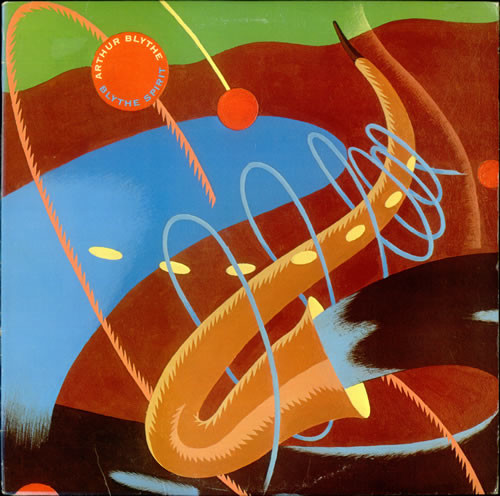
Arthur Blythe returned to CBS Recording Studios, in New York in 1981. This time around, Arthur Blythe had four new compositions, Contemplation, Faceless Woman, Reverence and Spirits in the Field. The other three tracks included George and Ira Gershwin’s Strike Up the Band; Johnny Burke and Erroll Garner’s Misty and a rework of the traditional gospel song Just a Closer Walk With Thee. These songs were recorded by a band that featured familiar faces and new names.
The rhythm section featured drummers Steve McCall and Bobby Battle, bassist Fred Hopkins and guitarist Kelvyn Bell. Tubaist Bob Stewart returned, and was joined by cellist Abdul Wadud and pianist John Hicks. Just like on Illusions, different musicians featured on the seven tracks. They would become Blythe Spirit, which produced by Jim Fishel and Arthur Blythe. It was a quite different album, from Arthur Blythe.
Critics realised this, when they received their advance copy of Blythe Spirit. Elements of avant-garde were combined with hard bop and R&B on Blythe Spirit Arthur Blythe. Some of the tracks featured a trio, while others featured quartet or quintet. They were responsible for tracks the veered between conventional like Misty, and a much more adventurous approach. Especially on the swinging take of Just A Closer Walk With Thee. Strike Up The Band was given an unlikely makeover, while the Arthur Blythe compositions are best described as genre-melting, and innovative. This resulted in an album that was well received by critics, but failed to find a wider audience.
Just like Illusions, Blythe Spirit failed to trouble the US Billboard 200. Illusions never even reached the US Billboard Jazz Album Charts. It was another disappointment for Arthur Blythe, and of course, Columbia.
They had placed their faith in Arthur Blythe, and gave him the freedom to release albums that featured ambitious, inventive and innovative. Sometimes it was almost experimental, as Arthur Blythe became a sonic explorer and took his music in unlikely directions on his first four albums for Columbia. However, Columbia weren’t about to give up on Arthur Blythe.
Elaborations.
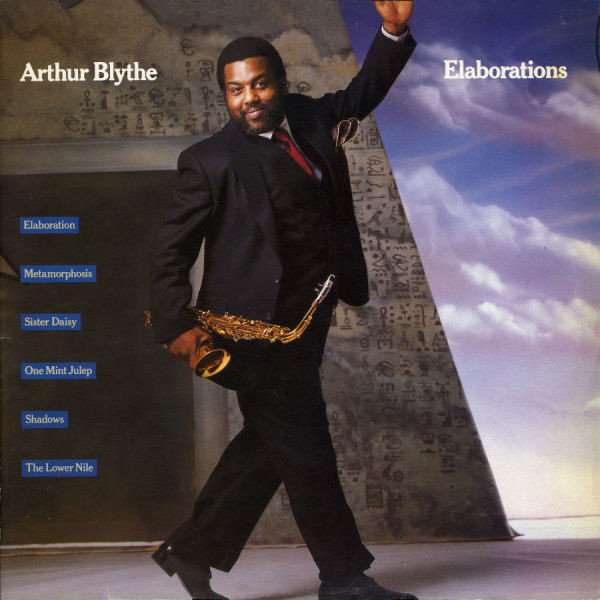
When Arthur Blythe began work on Elaborations he was at his creative peak, and full of new ideas. Arthur Blythe was constantly looking to reinvent his music and take in new directions. He was truly one of jazz’s pioneers, and the music he recorded at Columbia is a reminder of that. This includes Elaborations.
For Elaborations, Arthur Blythe composed five of the six tracks. This included Elaborations, Metamorphosis, Shadows and The Lower Nile. The only cover version on Elaborations was One Mint Julep which was written by Rudolph Toombs. These six tracks were recorded at CBS Recording Studios, in New York.
When the sessions for Elaborations began at CBS Recording Studios, in New York, Arthur Blythe was joined by co-produced by Jim Fishel. Elaborations would be the third Arthur Blythe album he had co-produced. He came onboard for the recording of Illusions in 1980 and returned for the recording of Blythe Spirit in 1981. The pair worked well together, and they reconvened for the recording of Elaborations. Joining them were some top session musicians.
Arthur Blythe’s band featured a rhythm section of drummer Bobby Battle and bassist Wilber Morris who played on Sister Daisy and guitarist Kelvyn Bell. They were joined by cellist Abdul Bob , Bob Stewart on tuba and Muhammad Abdullah who played congas on Sister Daisy. This talented and experienced band accompanied Arthur Blythe’s alto saxophone on Elaborations. When the sessions were over, the release was scheduled for later in 1982.
Before that, critics had their say on Elaborations, which was Arthur Blythe’s fifth album for Columbia. Critics were won over by Elaborations which was another ambitious and criticality album from one of the few remaining jazz pioneers.
Despite that, and the praise and plaudits Elaborations received, it wasn’t a commercial success upon its release in 1982. By then, Arthur Blythe had built up a loyal fan-base that followed his career with interest. They also bought all of the album he had released since 1977. The problem was, there wasn’t enough of them. Deep down though, forty-three year old Arthur Blythe knew his music had to find a wider audience.
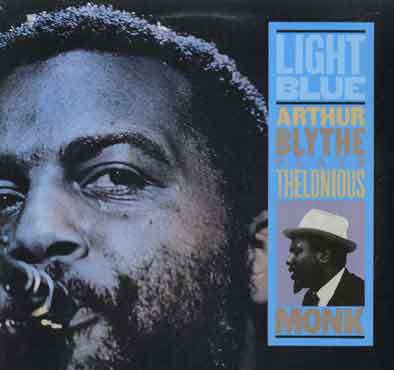
Light Blue: Arthur Blythe Plays Thelonious Monk.
For his sixth album for Columbia, Arthur Blythe decided to pay homage to one of the true legends of jazz Thelonious Monk. He had passed away in 1982, and Arthur Blythe wanted to pay his own tribute to one of the greatest jazz musicians on Light Blue: Arthur Blythe Plays Thelonious Monk. This was fitting in more ways than one.
Just like Thelonious Monk, many critics and cultural commentators regarded Arthur Blythe as an avant-garde musician rather than a jazz musician. This wasn’t the only similarity between Monk and Arthur Blythe. The two men had signed to Columbia, in the hope that their music would find a wider audience. So far, this hadn’t happened for Arthur Blythe. Maybe Light Blue: Arthur Blythe Plays Thelonious Monk would be a game-changer?
Prior to recording Light Blue: Arthur Blythe Plays Thelonious Monk, Arthur Blythe had spent some time going through Monk’s compositions. He wanted to find songs that would translate from Monk’s piano to Arthur Blythe’s alto saxophone. Eventually, he settled on We See, Light Blue, Off Minor, Epistrophy which Monk wrote with Kenny Clarke, Coming On The Hudson and Nutty. These songs would become Light Blue: Arthur Blythe Plays Thelonious Monk, which Arthur Blythe produced himself.
This time around, there was no sign of Jim Fishel who had co-produced three albums with Arthur Blythe. Instead, Arthur Blythe took charge of production, and guided his band through the six songs on Light Blue: Arthur Blythe Plays Thelonious Monk. However, Arthur Blythe’s band featured many familiar faces.
Arthur Blythe’s core band featured the musicians that had featured on Elaborations. The rhythm section of drummer Bobby Battle and guitarist Kelvyn Bell. They were joined by cellist Abdul Wadud, Bob Stewart on tuba and Muhammad Abdullah who played congas. This was a talented, experienced and versatile band who would play their part on what was a fitting homage to Thelonious Monk.
The time that Arthur Blythe had spent choosing the right songs for his homage to Monk had been time well spent. Critics hailed the album a fitting tribute to one of the true legends of jazz. However, this wasn’t a slavish copy of the Monk’s originals. Instead, each composition was given a twist on Light Blue: Arthur Blythe Plays Thelonious Monk, which found favour among critics. They hailed it one of Arthur Blythe’s finest moments.
After receiving critically acclaimed reviews, Light Blue: Arthur Blythe Plays Thelonious Monk was released by Columbia in 1983. Sadly, it followed in the footsteps of his previous albums, and failed to find the audience it so richly deserved. By then, Arthur Blythe and executives at Columbia knew something had change.
Put Sunshine In It.
By the early eighties, jazz was no longer as possible as it had once been. It had been overtaken by other musical genres, and jazz was heading in the same direction as the blues some fifteen years earlier. Something had to change to save jazz from irrelevancy.
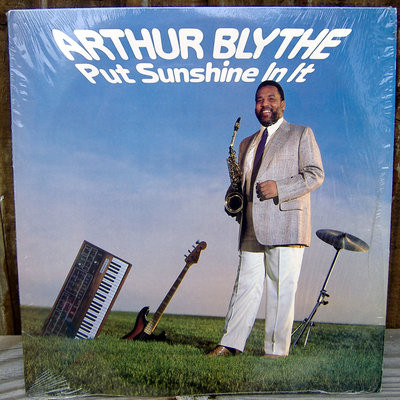
Fortunately, Dr. George Butler Columbia’s head of jazz was a man with a plan. He had been looking at who synths, sequencers, samplers, and drum machines could be used in jazz. This could be the start of a brave new world for the genre. However, moving in this direction could backfire for an artist, and could result in an album that lacked authenticity, tradition and soul. It could also proved to be a musical white elephant, and a blot on an artist’s CV. As a result, there weren’t going to be many people willing to record a jazz album using the new technology. That was until Dr. George Butler persuaded Arthur Blythe to be a guinea pig, and record the most experimental album of his career Put Sunshine In It.
For Put Sunshine In It, Arthur Blythe penned six new tracks for the most experimental album of his career. There must have been a degree of trepidation as he began work on an album that was totally different from anything he had released before. Despite that, the bandleader, composer and alto-saxophonist came up with six new songs including Tumalumah, Put Sunshine In It, Uptown Strut, Silhouette, # 5 and Sentimental Walk (Theme-Diva). These songs would feature on Put Sunshine In It.
A familiar face returned for the recording of Put Sunshine In It, co-producer Jim Fishel. He hadn’t worked on Light Blue: Arthur Blythe Plays Plays Thelonious Monk, which Arthur Blythe produced himself. However, with the addition of the new technology this was uncharted territory for Arthur Blythe. He was joined by his usual band which included a rhythm section of drummer Bobby Battle and bassist Wilber Morris who played on Uptown Strut and guitarist Kelvyn Bell. They were joined by cellist Abdul Wadud, Bob Stewart on tuba and Muhammad Abdullah who played congas on Uptown Strut. This talented and experienced band accompanied Arthur Blythe’s alto saxophone on what was an ambitious and experimental album.
When the recording of Put Sunshine In It took place, tuba player Bob Stewart felt that Arthur Blythe’s heart wasn’t in the album. The band recorded their parts over a backing track that had already been programmed and recorded. This wasn’t the way album Arthur Blythe recorded an album and it wasn’t the album he had wanted to record. Instead, he would’ve rather stuck with the acoustic sound of previous albums. This offered Arthur Blythe the freedom to experiment and reinvent his music on each album. However, Dr. George Butler had persuaded Arthur Blythe to record an album where his band was augmented by a myriad of technology.
It was as if Dr. George Butler was planning to market Arthur Blythe as Columbia’s r answer to David Sanborn. What Dr. George Butler failed to grasp was that Arthur Blythe had no wish to be a David Sanborn clone. He would rather have left this to lesser musicians, lacking in pride and self-worth. However, after releasing six album that hadn’t reached a wider audience, Arthur Blythe delivered the album Columbia wanted.
Deep down, he must have known that if the album wasn’t a success, he could return to recording albums with his acoustic band. That was the music that Arthur Blythe enjoyed making and believed in. Despite the technology, Arthur Blythe’s acoustic band featured on Put Sunshine In It. It was a learning experience for the musicians involved. They were introduced to new technology that would soon play a major part in recording albums. Maybe not for alto saxophonist Arthur Blythe though?
Critics were surprised by the direction that Arthur Blythe’s music had headed in on Put Sunshine In It. Some welcomed the stylistic change, but many critics and commentators recognised that Arthur Blythe’s playing was still of the same high standard on an album that was a marriage of his acoustic band and the latest musical technology. Arthur Blythe had been encouraged to make use of technical tracery and overdubbing, which was a first for him. The result was a jazz album that was obviously recorded in the eighties. That is because of the technology used in the making of the album. It has an unmistakable eighties sound. Having said that, Put Sunshine In It has aged well, unlike much of the music released in the eighties.
When Put Sunshine In It was released in 1984, the album wasn’t a success. Even some of’s most loyal fans weren’t won over by the album. It had been an idea that was doomed to failure from the very start. The only person who failed to realise this, was Dr. George Butler, who was Columbia’s head of jazz.
In some record companies the failure of Put Sunshine In It would’ve cost Dr. George Butler his job. His idea to reinvent Arthur Blythe had backfired. He had press-ganged Arthur Blythe into recording an album he didn’t want to record. The result was the Put Sunshine In It, which was the least successful album of the alto saxophonist’s career. Despite this Dr. George Butler held onto his position as Columbia’s head of jazz. For Arthur Blythe this was a worrying time.
With Dr. George Butler continuing as Columbia’s head of jazz, Arthur Blythe no longer had the same artistic freedom that he had enjoyed up when Bruce Landvall was in charge. He had left Columbia in 1982. Gone were the days when Arthur Blythe could record ambitious and innovative albums, and could continue to reinvent his music on each album.
It was another two years before Arthur Blythe returned in 1986 with his eighth album for Columbia, Da-Da. While it was well received by critics, it failed to find a wider audience. It was a same case with Arthur Blythe’s Columbia swan-song Basic Blythe in 1987. That was the ninth album that Arthur Blythe had recorded for Columbia in nine years.
After the release of Basic Blythe in 1987, Arthur Blythe left Columbia. Although Arthur Blythe’s career continue and he released another nine more albums between 1991 and 2003. While Arthur Blythe continued to release albums of ambitious music, his most productive years were spent at Columbia. That was where Arthur Blythe recorded and released the best music of his four decade career. This includes the seven albums he released between 1978s In The Tradition and 1983s Light Blue: Arthur Blythe Plays Thelonious Monk. They feature the finest music Arthur Blythe’s career and are reminder of the legendary alto saxophonist at the peak of creative powers.
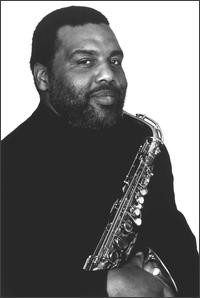
Sadly, legendary bandleader, composer and alto saxophonist Arthur Blythe passed away earlier this year on March the ’27th’ 2017, aged seventy-six. By then, Arthur Blythe was largely unknown outside of a small coterie of jazz aficionados who appreciated the music of this true jazz great. For newcomers to Arthur Blythe’s music, the perfect place to start is the music he released during his Columbia years and especially between 1978s In The Tradition and Light Blue: Arthur Blythe Plays Thelonious Monk in 1983.
Arthur Blythe-The Columbia Years.
THE LIFE AND TIMES OF MOGALLAR
The Life and Times Of Moğollar.
In 1976, one of Turkey’s most successful bands, Moğollar, called time on their career. By then, the Anadolu Pop heroes had been together for nearly a decade. For their swan-song, Moğollar decided to change direction musically, and release an album of instrumental progressive rock. This made sense, as currently, Moğollar didn’t have a lead vocalist. Alas, this was nothing new.
Throughout their career, Moğollar seemed to encounter problems with vocalists. They seemed to come and go, never staying long. However, changes to Moğollar’s lineup was nothing new. It had always been somewhat ‘fluid’. Still, Moğollar carried on as normal. That was the case when Moğollar. Later, in 1976, they released their swan-song Moğollar, which ensured that Moğollar bowed out in style. . It’s a reminder of one Turkey’s greatest groups, Moğollar.
Silüetler.
Their story began in Istanbul, in 1964, when twenty year old guitarist, Mesut Aytunca and Erol Bilem formed Silüetler. In the early days of Silüetler, they were inspired by one of the popular British group, The Shadows. Soon, Silüetler were popular draw within the local music scene. This gave them the confidence to enter various Turkish music competition.
By 1965, Silüetler were faring well in the competitions they entered. Although they hadn’t won, they were always challenging for the top spot. One of the most prestigious competitions was the Altin Mikrofon. Entrants were encouraged to combine Turkish lyrics with Western instrumentation. When Silüetler entered the Altin Mikrofon competition in 1965, they were third. It was a case of so near, yet so far.
A year later, and Silüetler were better prepared for the Altin Mikrofon competition. They had spent much of 1966 recording and touring. The extensive touring allowed Silüetler to hone the Anatolian rock sound that they had pioneered. This fusion of Turkish folk and rock music proved popular wherever Silüetler played. It also proved popular when Silüetler took to the stage at the 1966 Altin Mikrofon. When the winner was announced, it was no surprise when Silüetler won the first prize. Their star was in the ascendancy.
The only problem was that Mesut Aytunca had a tendency to change Silüetler’s lineup to ensure the music stayed relevant. Musicians seemed to come and go. In 1967, two new arrivals were rhythm guitarist and vocalist Aziz Azmet and organist Murat Ses. They were both talented musicians, and were welcome additions to Silüetler.
Within a matter of months, the two new arrivals were plotting the musical equivalent of a coup d’état. Aziz Azmet and organist Murat Ses had been planning to form a new band, Moğollar. Before the end of 1967, Aziz Azmet and Murat Ses had recruited nearly ever member of Silüetler. The only man that remainder was one of the two, founder members Mesut Aytunca. His constant changing of Silüetler’s lineup had backfired spectacularly.

Moğollar.
This was something that the members of Moğollar in 1967 should’ve have learnt from. That wasn’t the case. Within a matter of months, started to change. It wasn’t the occasional change in lineup. Instead, Moğollar seemed to be constantly changing. So much so, that fourteen different musicians were members of Moğollar between 1967-1974.
Complicating matters further, was that some of the members of Moğollar were also successful solo artists. They would often head off on tour or into the studio to record an album. These were interesting times for Moğollar.
By 1968, Moğollar were already a popular live draw in Izmir, where they played in clubs and even at fairs. This the members of Moğollar knew, was all good experience for the nascent band. Moğollar wanted to hone their sound, especially with the Altin Mikrofon competition fast approaching. They had set their sights on wining it. However, Moğollar had to settle for third prize. Considering Moğollar were still a relatively new band, their Dutch manager Anton Oskamp told the band that this was a good result.
Following the Altin Mikrofon competition, Moğollar embarked on a lengthy and gruelling tour of Eastern Turkey. During the tour, Moğollar would play in towns where no rock bands had previously played. In some of the towns, the inhabitants had never heard rock music before. Moğollar were about to become musical pioneers, as they introduced their music to a new and wider audience.
As the tour of Eastern Turkey progressed, so did Moğollar’s interest in Turkish folk music. Soon, Moğollar began to expand the array of instruments they took to the stage with. This began when guitarist Cahit Berkay started buying a variety of traditional Turkish instruments including a baglama, kemence, tambura and three string violin. They would augment the instruments that Moğollar usually took to the stage with.
Gradually, Moğollar’s sound was evolving. Suddenly, the way Moğollar approached music began to change. They began using Western instruments to play parts in song that normally, a traditional instrument would play. This new sound was born during the tour of Eastern Turkey, but took shape over the next couple of years. In 1970, Taner Öngür christened, the new sound Anadolu Pop in an article in Hey magazine.
Despite Taner Öngür coining the term Anadolu Pop, he isn’t regarded as the architect of Anadolu Pop. Instead, Moğollar’s organist and songwriter-in-chief, Murat Ses’ credits his wife Nihal Ses as the true architect of Anadolu Pop. It was pioneered by Moğollar, who were the most successful purveyor of the genre.
By 1970, Moğollar were a hugely successful band. They wanted to taste commercial success and critical acclaim further afield. Even if this meant leaving Turkey, and living in Europe. Members of Moğollar were sent to various European cities to try and find a new base for the band. After considering several cities, Moğollar settled on Paris.
This was purely because Barış Mango lived in Paris, and offered Taner Öngür somewhere to stay. Suddenly, Paris looked very appealing for Moğollar’s new European base. The rest of Moğollar found accommodation elsewhere in Paris. Now they could begin looking for a recording contract.
Not long after Moğollar arrived in Paris, they looked through the telephone book and made a list of all the record companies based in the city. They started phoning each one, in the hope that one of the record companies, would offer them a contract. Eventually, CBS offered Moğollar a three year contract. This was the start of a new chapter for Moğollar.
Danses Et Rythmes De La Turquie D’Hier À Aujourd’hui.
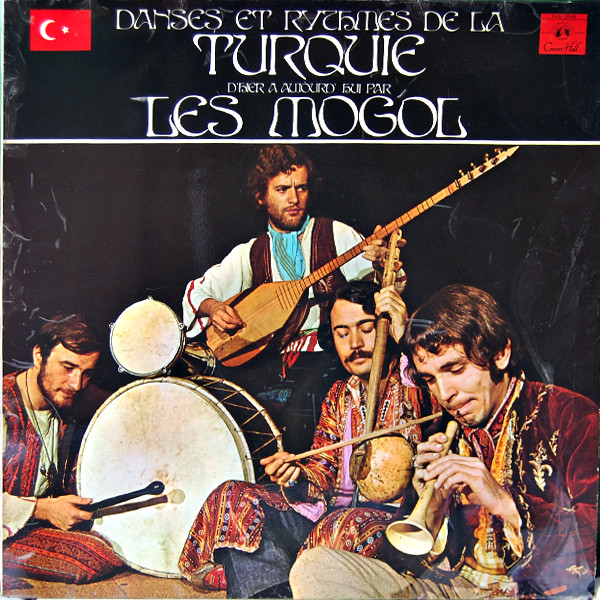
Soon, Moğollar went into the studio to record Hitchin’, their first single for CBS. When Hitchin’ was released, it became the first single that Moğollar had recorded in English. Later in 1971, Moğollar released their debut album Danses Et Rythmes De La Turquie D’Hier À Aujourd’hui in France and Turkey. It featured new songs from. This won them the Grand Prix du Disque award, and Moğollar’s star was in the ascendancy.
Following the release of Grand Prix du Disque, Moğollar started planning a tour. Before the tour could begin, Moğollar began looking for a new lead vocalist. After a couple of singers turned them down, Barış Mango agreed to tour with Moğollar.
It was tantalising prospect, that two of the leading lights of Turkish music were about to head out on tour. Everyone involved was similarly excited. So much so, that Moğollar decided to changed the band name to Manchomongol for the tour. It got underway later in 1971.
One member of Moğollar was missing, Engin Yörükoğlu. He had returned home to Istanbul to get married, but didn’t rejoin Moğollar. Instead, he remained in Istanbul until 1972, when he joined Barış Mango and Kurtalan Ekspres. That would prove ironic.
The tour wasn’t as enjoyable as Moğollar and Barış Mango had hoped. They thought that two titans of Turkish music touring, was going to be the experience of a lifetime. After four long months, that was far from the case. A turning point came in Kütahya, when someone took offence to Barış Mango’s long hair and blew the tour van up. Everyone was shaken by this. Not long after this, Barış Mango caught mumps and had to leave the tour.
Trying to find a replacement at short notice wasn’t easy. However, they recorded with Selda and Ersen and then began touring with Cem Karaca. That tour would last two years. Sadly, one of the members of Moğollar would’ve left the band before the tour ended.
This was organist and songwriter-in-chief Murat Ses. He was looking through Hey magazine in 1972, when he noticed an article about Moğollar. As Murat Ses read the article he was in for a surprise. Guitarist Cahit Berkay had announced that Murat Ses had left Moğollar. The reason given, was he no longer wanted to play concerts in small villages in Eastern Turkey. This was all news to Murat Ses. That day, he was unceremoniously ousted from the band he cofounded.
What those who plotted Murat Ses’ removal had overlooked, was his importance within Moğollar. Not only did he write the majority of the songs, but his organ played an important part in Moğollar’s music. The loss of Murat Ses could be a turning point for Moğollar. However, some saw this as just the latest change in Moğollar’s lineup.
After Murat Ses’ departure from Moğollar, Cahit Berkay became Moğollar’s de facto leader. Before long, most of the band were working on side projects. That was apart from Cahit Berkay. As time passed by, he decided the time was right for Moğollar to try and make a breakthrough in the European market. If that was going to happen, Cahit Berkay had to convince one former member of Moğollar to return to the fold.
That was Engin Yörükoğlu. He was still living in France, so Cahit Berkay journeyed from Istanbul to see his old bandmate. This was something of a mercy mission, as Moğollar seemed to be teetering on the brink. Maybe if Engin Yörükoğlu rejoined Moğollar, then it would have a future?
At the meeting in France, Engin Yörükoğlu agreed to rejoin Moğollar. Three years after the release of their debut album, Moğollar were about to begin work on their sophomore album. Before that, Cahit Berkay returned home to Istanbul with the news that Engin Yörükoğlu was rejoining Moğollar.
When the rest of Moğollar heard the news, they began packing their instruments onto a pickup truck. This included Romain Didier, who would play Fender Rhodes and Minimoog. They would then be joined by Engin Yörükoğlu in the studio.
Hittit Sun.
Before that, Cahit Berkay assumed the role of songwriter-in-chief. He penned nine of the eleven songs. Romain Didier contributed Rue De L’orient, while Moğollar covered the traditional song White Dear. These eleven songs would eventually become Moğollar’s sophomore album Hittit Sun.
As work began on Hittit Sun, Moğollar’s music moved towards progressive rock and jazz. This was very different to their usual Anadolu Pop sound. It was no surprise. Music had changed since Moğollar released their debut album in 1971. Moğollar knew they had to reinvent their music to stay relevant. However, how would their fans respond?
When Moğollar’s sophomore album was released in Turkey in 1975, it was entitled Düm-Tek. By then, four years had passed since they had released their debut album. Düm-Tek wasn’t a commercial success in Turkey. Elsewhere, the album was released as Hittit Sun. Despite what was an ambitious and accomplished album, Hittit Sun failed to find an audience. It was a disaster for Moğollar.
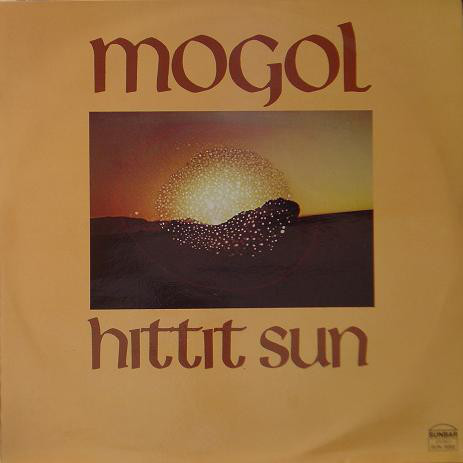
Moğollar.
Despite the commercial failure of Hittit Sun, Moğollar weren’t willing to give up on their dream of making a commercial breakthrough in Europe. It was looking increasingly unlikely, but Moğollar were determined to give it one more go.
So work began on Moğollar’s third album in 1976. It featured Turkish folk songs; Azerbaijani folks song, classical pieces and B-Sides. The album opener Kâtip Arzuhalim Yaz Yare Böyle was from the days of Manchomongol in 1971. These tracks would eventually become Moğollar’s eponymous third album.
For Moğollar, the sound had been stripped back to just the rhythm section and keyboards. By then, drummer and percussionist Engin Yörükoğlu and rhythm guitarist Cahit Berkay were the longest serving members of Moğollar. The rest of the band were relative newcomers. Again, they took charge of arranging the eleven tracks that later in 1976, became Moğollar.
When Moğollar was released on the Diskotür label in 1976, it followed in the footsteps of Hittit Sun and failed commercially. For Moğollar the dream was over. The band decided to call it a day. Moğollar was their swan-song.
Sadly, for Moğollar their eponymous third album was the end of what had been a long and eventful musical journey. They left behind a rich musical legacy, which included was around twenty singles and three albums. The last of this trio of albums was Moğollar.
It’s a captivating fusion of ancient Anatolian melodies and instruments which is combined with elements of classical music, progressive rock and psychedelia. Add to that, Eastern sounds and bursts of fuzzy guitar. The result is a heady brew that comprises Turkish folk songs; Azerbaijani folk song, classical pieces and B-Sides. Sadly, Moğollar wasn’t a commercial success.
When Moğollar followed in the footsteps of Hittit Sun, and failed to find the audience it so richly deserved, that was the last straw for Moğollar. They called time on their career.
After eight years together, Moğollar the remaining members of the band went their separate ways. The Moğollar was a case of what might have been. They never really built on the commercial success and critical acclaim that their 1971 debut album Danses Et Rythmes De La Turquie D’Hier À Aujourd’hui.
The problem was, that Moğollar waited too long to release their sophomore album Hittit Sun. By 1975, music had changed. Moğollar knew they had to change direction to stay relevant. Moving away from their original sound seemed to alienate their fan-base. To make matters worse, Hittit Sun passed the wider record buying public by. They missed out on ambitious and accomplished album, that has since become a cult album.
Sadly, history was to repeat itself a year later when Moğollar was released. Like many albums that passed record buyers by first time round, it started to find an audience long after its release. Noways, original copies of the album are hard to come by. When they become available, it’s for large sums of money that’s beyond most record buyers. Fortunately. It’s a reminder of one Turkey’s greatest groups, as the first chapter in the Moğollar came to an end.
When the Moğollar split-up in 1976, it looked like the end of the line for the group. However, eighteen years later and Moğollar reformed. They released five new studio albums between 1994 and 2009. Not only were Moğollar back to stay, but they were popular than ever. While this was a welcome return, for many of their fans Moğollar’s first three albums feature the band at their very best. This includes Moğollar, where a myriad of disparate music influences and instruments are combined to create a heady, mesmeric and delicious musical brew.
The Life and Times Of Moğollar.
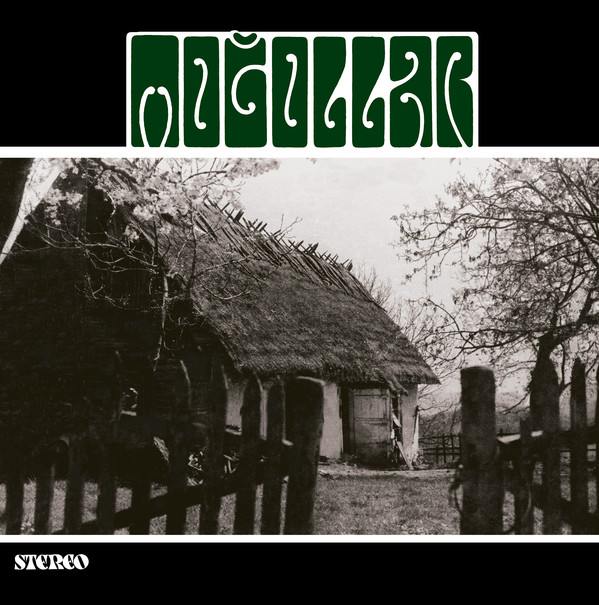
CYCLONE! GALLIC GUITARS A-GO-GO 1962-66.
Cyclone! Gallic Guitars A-Go-Go 1962-66.
Label: Ace Records.
In the early sixties, rock ’n ’roll arrived in France, and was immediately embraced by a new generation of French musicians with an intensity. Among the first wave of French rock groups were Les Chats Sauvages and Les Chaussettes Noires, who nowadays, are regarded as having set the scene for the yé-yé singers and bands that followed in their footsteps.
Before that, many French bands adopted the rockabilly and rock’ n’ roll sounds that led to new a generation of Gallic teens forming their own groups. Many were inspired groups by The Shadows, who nowadays many people think were merely Cliff Richard’s backing band.That is just part of the story of The Shadows.
During the early sixties, The Shadows were without doubt, the most successful British instrumental rock group. The Shadows were also a hugely influential group, who inspired a generation of musicians across Europe to form new groups. This included in the French capital, Paris.
In France, the competition in towns and cities for the title of top instrumental band was fierce. Especially in Paris, and at one particular venue the Golf Drouot, which was variously a venue for mini golf as well as a tearoom and in the evening, a nightclub. That was where every self-respecting French band wanted to play. When they took to the stage at Le Temple Du Rock, which was owned by Henri Leproux, they knew they had arrived.
Le Temple Du Rock was soon playing an important part in the second wave of French rock ’n’ roll, which is documented on Cyclone! Gallic Guitars A-Go-Go 1962-66, which was recently released by Ace Records. Many of the bands on Cyclone! Gallic Guitars A-Go-Go 1962-66, took to the stage at Le Temple Du Rock. Some of these bands feature well known songwriters, musicians and producers. Sadly, many of these instrumental groups have been forgotten about even by French music fans, who preferred their American and British counterparts. However, the twenty-five tracks on Cyclone! Gallic Guitars A-Go-Go 1962-66 is a reminder of this four year period the music was grimier, noisier and not as refined as the similar types of music being released in Britain, America and Italy. There were several reasons for this.
This included the equipment being used and the skill and experience of the recording engineer. Another thing to take into account were the effects used on recordings. These variables added to the vibe and feeling of the tracks on Cyclone! Gallic Guitars A-Go-Go 1962-66 which features musical pleasures aplenty.
Hully Bach by Les Fantômes opens Cyclone! Gallic Guitars A-Go-Go 1962-66 in style and sets the bar high. Rising to the challenge are Les Lionceaux’s SLC Jerk, Les Players’ Manhunt and Les Français’ Palpitations. That isn’t forgetting’ Les Aiglon’s Stalactite and Les Fantômes’ Fort Chabrol which are welcome contributions. The same can be said of Les Guitares’ Neptune and Joey amd The Showmen’s Surf Train who are riding the crest of a wave with this homage to the classic American surf sound which features a nod to The Shadows. That is just part of the story of Cyclone! Gallic Guitars A-Go-Go 1962-66
Les Guitares Du Diable contribute Le Bastion, The Four Dreamers’ the cinematic sounding Attila and Les Sunlights’ Andalucia. Then Les Monégasques add the jaunty sounding instrumental Flirt Avec Le Vent (Countdown while The Four Dreamer closes Cyclone! Gallic Guitars A-Go-Go 1962-66 with the hidden gem To Venus.
After twenty-five tracks it’s apparent that Cyclone! Gallic Guitars A-Go-Go 1962-66 is another quality compilation from Ace Records, who turn their attention to this oft-overlooked genre of music. Many of these Gallic rock ’n’ roll instrumentals are long-forgotten hidden gems that deserve to be heard buy a new audience.
Hopefully, that will be the case and a new generation of music lovers will enjoy the twenty-five instrumentals on Cyclone! Gallic Guitars A-Go-Go 1962-66, which is a lovingly curated compilation that is a reminder of the second wave of French rock ’n’ that took Paris by storm in the early sixties and in the process, transformed French music.
Cyclone! Gallic Guitars A-Go-Go 1962-66.

WHATEVER HAPPENED TO ALICE CLARK?
Whatever Happened To Alice Clark?
Sadly, all too often, hype and image has triumphed over talent, while commercial success and critical acclaim eludes truly talented artists. Chastened by the experience, many of these artists turn their back on the music industry. They’re content to return to civvy street, free from a world populated by A&R executives, PR companies and radio pluggers. At least the artist knows that they gave it their best shot. Alas, it wasn’t to be. Now they begin the first day of the rest of their life.
This is what happened to Brooklyn born soul singer Alice Clark. Her career began in 1968, and was over by 1972. During that four-year period, Alice Clark recorded just fifteen songs during three recording session. This includes two singles, and her 1972 album Alice Clark. After commercial success eluded her, Alice Clark career turned her back on music. Since then, Alice Clark has remained one of the soul music’s best kept secrets. She’s also one of music’s music enigmatic figures.
Very little is known about Alice Clark. Indeed, her story is almost shrouded in mystery. All that’s known, is that Alice Clark was born in Brooklyn, and shared the same manager as The Crystals. It was her manager that introduced Alice to singer-songwriter Billy Vera.
The meeting took place at Billy Vera’s publishers, April-Blackwood Music. That afternoon, Billy spent time teaching her some songs that he had written. These songs would be recorded in 1969.
By the time the recording session took place, Alice Clark had taken to occasionally phoning Billy Vera. However, Alice who seems to have been a private person, only ever made small talk. Despite this, Billy remembers: “I got the impression her home life wasn’t that great.” He remembers that Alice: “had kids and belonged to a religious order.” These are the only thing Billy can remember about Alice. However, what nobody who heard Alice as she made her recording debut will forget is…her voice.
For the 1969 session, Jubliee’s studio was chosen. Billy Vera who wrote and would produce the three tracks put together a tight and talented band. The rhythm section featured drummer Earl Williams, bassist Tyrell and guitarists Butch Mann and Billy Vera. They were augmented by trumpeter Money Johnson and backing vocalist Tasha Thomas. This was the band that accompanied Alice Clark on You Got A Deal, Say You’ll Never Leave Me and Before Her Time. Alice Clark delivered confident and assured performances. Two of these songs became Alice’s debut single.
With the three songs recorded, the Rainy Day label decided to release You Got A Deal in January 1968. It was a driving slice of soul, with a feisty, vocal from Alice. Horns and harmonies accompany Alice as she’s transformed into a self-assured soul singer. The flip side was Say You’ll Never, a quite beautiful ballad. A number of radio stations began playing the song. Despite this, Alice Clark’s first single wasn’t a commercial success. It was an inauspicious start to Alice’s career.
Nothing was heard off Alice Clark until March 1969. By then, Alice had recorded her sophomore single. This was the George Kerr, Michael Valvano and Sylvia Moy penned You Hit Me (Right Where It Hurt Me). On the flip-side was Arthur Mitchell and Eddie Jones’ Heaven’s Will (Must Be Obeyed). The two songs were produced by George and Napoleon Kerr. This GWP Production was released on Warner Bros. Alice Clark was going up in the world.
Alas commercial success continued to elude Alice Clark. When You Hit Me (Right Where It Hurt Me) was released as a single, it failed to trouble the charts. That was despite featuring impassioned, hurt-filled vocal. Tucked away on the B-Side was another ballad, Heaven’s Will (Must Be Obeyed). It features a heartfelt vocal from Alice Clark where the secular and spiritual collide. Both sides of Alice Clark’s sophomore single showcased a truly talented singer. Sadly, very few people heard the single. Alice Clark was still one of music’s best kept secrets.
For the next couple of years, Alice Clark was cast out into the musical wilderness. Then Bob Shad at Mainstream Records decided to take a chance on Alice Clark. Mainstream Records were moving into the soul market, are were signing artists. He decided that Alice Clark fitted the bill, and signed her to Mainstream Records.
Soon, work began on Alice Clark’s debut album. A total of ten tracks were chosen. This included a trio of Bobby Hebb songs, Charms Of The Arms Of Love, Don’t You Care and Hard, Hard Promises. Among the other songs were Jimmy Webb’s I Keep It Hid; Petula Clark and John Bromley’s Looking At Life; Leonard Caston’s Don’t Wonder Why; Juanita Fleming’s Never Did I Stop Loving You and Earl DeRouen’s Hey Girl. The other songs chosen were John Kander and Fred Ebb’s Maybe This Time and Leon Carr and Robert Allen’s It Takes Too Long To Learn To Live Alone. These songs became Alice Clark.
With the material chosen, producer Bob Shad set about putting a band together. Apart from guitarist Ted Dubar, the identity of the rest of the band are unknown. However, Ernie Wilkins was drafted in to arrange the songs on Alice Clark. When it was recorded, the release was scheduled for later in 1972.
By then, three years had passed since a record bearing Alice Clark’s name had been released. You Hit Me (Right Where It Hurt Me) had disappeared without trace upon its release in March 1969. Everyone must have been hoping that history wouldn’t repeat itself. Alas, it did.
I Keep It Hid was chosen as the lead single, with Don’t Wonder Why featuring on the B-Side. On its release, I Keep It Hid sunk without trace. Worse was to come. When Alice Clark was released, the album failed to find the audience it deserved. Very few copies of Alice Clark sold. That was a great shame.
During the three years that Alice Clark had been away, she grown and matured as a singer. Despite this, there was to be no followup album. After Alice Clark failed commercially, Alice turned her back on music. Never again did this talented and versatile vocalist return to the studio. Alice Clark was lost to music.
During her four-year career, Alice Clark had recorded just fifteen tracks. They’re a mixture of beautiful ballads and uptempo songs. On each and every song, Alice breathes life and meaning into the lyrics. Her delivers veers between heartfelt, impassioned and soul-baring, to assured, hopeful and joyous. It seems when Alice Clark stepped into a recording studio, she was transformed.
No longer was Alice Clark the quietly spoken young mother that Billy Vera remembers. Suddenly, the God-fearing Alice Clark disappeared, and was replaced by one that wore her heart on her sleeve. She was comfortable sings songs about love and love lost, and could breathe life and meaning into songs about hope, hurt, heartbreak and betrayal. Despite her ability and versatility, Alice Clark commercial success and critical acclaim eluded Alice Clark.
Chastened by the experience, Alice Clark turned her back on the music industry. Nobody seems to know what happened to Alice Clark? Mystery surrounds this hugely talented singer, who should’ve gone on to enjoy a long and successful career. Sadly, that wasn’t to be.
By 1973, You Hit Me (Right Where It Hurt Me) became a favourite on the UK Northern Soul scene. Apart from that, very few people had heard of Alice Clark or her music. It would be a while before this changed.
As the years passed by, a few copies of Alice Clark found their way into bargain bins. Curious record collectors who chanced upon a copy of Alice Clark decided to take a chance on this little known album. Having paid their money, they discovered one of soul music’s best kept secrets,..Alice Clark. They were the lucky ones.
Since then, Alice Clark has become a real rarity. Anyone wanting an original 1972 copy of Alice Clark on Mainstream, will need to search long and hard. If they can find a copy, it will take at least $500 to prise it out of the hands of its owner. It feature a truly talented singer who could’ve and should’ve enjoyed widespread commercial success and critical acclaim. Sadly, for Alice Clark that wasn’t to be.
Instead, commercial success eluded Alice Clark, and in 1972, she turned her back on music. Since then, nothing has been heard of Alice Clark. Mystery surrounds Alice Clark’s life after she turned her back on music. She seems almost to have vanished into thin air. That’s a great shame. Especially given the resurgence in interest in her music and Ace Records recent release of The Complete Studio Recordings 1968-1972. Belatedly, Alice Clark’s music is finding the wider audience that it so richly deserves. What her newfound fans would like to know is whatever happened to Alice Clark?
Whatever Happened To Alice Clark?





THE LIFE AND TIMES OF THE BETA BAND
The Life and Times Of The Beta Band.
The Beta Band was formed in Edinburgh in 1996, and a year later, in July 1997 released their Champion Versions EP, which was the first of a trio of innovative EP’s the folktronica pioneers released.
In March 1998 The Beta Band released their sophomore EP The Patty Patty Sound, with Los Amigos del Beta Bandidos following in July 1997. By then, critics were starting to take notice of The Beta Band whose popularity was growing.
Nearly two years later, The Beta Band was released to widespread critical acclaim in June 1999, and everyone at Regal Records celebrated as The Beta Band reached number nineteen in the UK, However, not everyone was happy with the album.
Despite their eponymous debut album giving them a hit in the UK, Steve Mason of The Beta Band called the album: “fucking awful” and “it’s definitely the worst record we’ve ever made and it’s probably one of the worst records that’ll come out this year.” Steve Mason then said in an interview with NME that the album had: some terrible songs,” and they weren’t e “fully realised or fully even written. Half-written songs with jams in the middle” The Beta Band seemed determined to sabotage their career at Regal Records.
To make matters worse, The Beta Band seemed in no hurry to record their sophomore album. Steve Mason recorded and released the No Style EP under his King Biscuit Time EP moniker. After this, Steve Mason and the rest of The Beta Band’s thoughts turned to their sophomore album Hot Shots II, which has just been reissued by Because Music.
Eventually, The Beta Band decided it was time to return to the studio, and this time brought onboard British producer Colin Emmanuel, aka C-Swing, who oversaw production of what eventually became Hot Shots II.
During the Hot Shots II sessions, The Beta Band recorded ten new tracks with C-Swing. The tracks were very different to those on The Beta Band. Some of the songs were much quieter and a less is more approach to production was the order of the day. This allowed the songs to breath, with less ‘obstacles’ obscuring the key parts of the songs. Some of the songs were slow and dark and featured descending chords as The Beta Band continued to innovate.
Critics were won over by Hot Shots II, and hailed The Beta Band’s sophomore album as one of the albums of 2001. Hot Shots II was hailed as The Beta Band’s finest hour.
Buoyed by the critical acclaim, Hot Shots II was released in July 2001. Hot Shots II reached number thirteen in the UK and sneaked into the US Billboard 200 at 200. It also reached fourteen in the US Heatseekers chart and eleven in the Independent album charts. The Beta Band looked on the verge of breaking into the lucrative American market. Sadly, they only produced one more album.
This was Heroes To Zeros which was The Beta Band’s swan-song. The Beta Band began demo sessions for what later became Heroes To Zeroes in September 2002. They then entered the studio with producer Tom Rothrock in 2003 and completed a number of tracks. There was a problem though.
Neither The Beta Band nor executives at Regal Records were happy with the recordings and producer Nigel Godrich was brought in to mix the album, which was finally finished in early 2004.
The lead single, Assessment, was released on the ’12th’ of April 2004 and reached number thirty-one in the UK. Two weeks later, the album Heroes To Zeros was released on the ‘26th’ of April 2004 and reached number eighteen in the UK. This would normally be something to celebrate.
Heroes To Zeros featured music that had a much more dense and direct sound but strikes a balance between The Beta Band’s more traditional sound and music that was way ahead of the musical curve. However, some of the music on Heroes To Zeros saw The Beta Band turn their attention to creating pop music.
It was obvious that Brian Wilson of The Beach Boys was still a huge influence on The Beta Band and especially tracks like Good Vibrations and Heroes and Villain. So were albums like 20/20 and Friends. However, The Beta Band were also forging ahead with their own sound, which was intricate and multilayered. They were best qualified to produce the album and bring their new ideas to life.
To do this, The Beta Band adopted a variety of production techniques to bring out the best in what was an idiosyncratic band. No other producer would’ve been able to achieve what The Beta Band did on Heroes To Zeros.
Many of the songs on Heroes To Zeros ended up very different from the initial ideas recorded by The Beta Band. They honed the songs on Heroes To Zeros which open with Assessment and closed with Pure For. Heroes To Zeros featured The Beta Band at the peak of their creative powers on their self-produced swan-song.
By the time The Beta Band released Liquid Bird, as their second single from Heroes To Zeros, many critics had realised that the song was based on a sample of the Siouxsie and The Banshees’ song Painted Bird. This could’ve been an expensive mistake for The Beta Band.
Despite this mistake, The Beta Band released Out-Side, their second from Heroes To Zeroes in July 2004. When it stalled at fifty-four in the UK charts, little did critics or record buyers realise that the end was neigh for The Beta Band.
They announced their breakup on their website on the ‘2nd’ of August 2004. Despite that, The Beta Band performed at the Summer Sundae festival and embarked upon a farewell tour which drew to close in Edinburg, at the Liquid Rooms on the ‘5th’ of December 2004. This was the end of the story for The Beta Band.
Their swan-song Heroes To Zeros was the only album that The Beta Band produced themselves, since signing to an imprint of a major label. They hadn’t been happy with their first two albums and often made their views known in the music press.
Usually, this was before the album was even released. As they made these comments, members of The Beta Band seemed to forget that they still had help promote their latest release. Executives at Regal Records must have been left shaking their heads in exasperation. Despite the comments of the members of The Beta Band, their three albums were all commercially successful. However, the big question is how successful could The Beta Band have been if they had played the PR game, and reigned in their outspokenness, maverick tendencies and tendency to self sabotage.
Looking back, The Beta Band weren’t suited to being signed to a big label, and would’ve been better suited to a smaller indie label or even self-releasing their albums through their own label. Maybe they would’ve enjoyed a longer career and released more that three albums, including their critically acclaimed, self-produced swan-song Heroes To Zeros?
It features the inimitable genre-melting sound of folktronica pioneers The Beta Band at the peak of their creative powers on Heroes To Zeros their self-produced swan-song where the outspoken musical mavericks realise their potential.
The Life and Times Of The Beta Band.


THE CHARLATANS-THE MUSICAL MAVERICKS AND DANDIES WHO HAD IT ALL.
The Charlatans-The Musical Mavericks and Dandies Who Had It All.
Between 1964 and 1969, The Charlatans’ star shawn brightly, and the larger than life musical mavericks dressed like ‘19th’ Century outlaws, and embraced the rock ’n’ roll lifestyle. L.S.D. and pot were part of The Charlatans’ diet. It fuelled The Charlatans as they took San Francisco by storm, and commercial success and critical acclaim looked a formality. Sadly, it wasn’t to be.
By 1969, The Charlatans were no more. They were just the latest band that should’ve enjoyed widespread critical acclaim and commercial success. However, for whatever reason, commercial success passes these bands by. That was the case with The Charlatans whose story begins in the summer 1964.
That’s when The Charlatans were formed in San Francisco, by autoharp player George Hunter, and bassist Richard Olsen. Soon, they were joined by lead guitarist Mike Wilhelm; keyboardist Mike Ferguson and drummer Sam Linde. With the lineup complete, The Charlatans began to practice. Before long the the band realised they had a problem.
The Charlatans had an achilles heel. This was drummer Sam Linde. He just wasn’t good enough for the band moving forward. So a decision was made to replace Sam Linde. His replacement was none other that Dan Hicks. With a new, improved lineup in place, The Charlatans moved forward.
When The Charlatans began to play live, they looked like a cross between 19th Century, wild west outlaws and Victorian dandies. This image wasn’t just thrown together. It was carefully cultivated. Despite this, it soon began to prove popular with the audience at their gigs. They arrived dressed in similar attire. Little did The Charlatans realise that their stage clothes would influence the a generation.
With the hippie counter culture about to blossom, The Charlatans image would go on to influence a generation. They would dress like dandies and outlaws. By then, The Charlatans a familiar face in the San Francisco music scene.
In June 1965, The Charlatans had secured a six week residency at at the Red Dog Saloon in Virginia City, Nevada.. For this residency, two members of The Charlatans had to produce a concert poster. What Mike Ferguson and George Hunter came up with, is regarded as the first psychedelic rock poster. Since then, ordinal copies of The Seed have become prized items among collectors of psychedelia. However, the Red Dog Saloon residency marked a first for The Charlatans.
During the residency, the five members of The Charlatans took L.S.D. for the first time. It wouldn’t be the last. Soon, The Charlatans had a penchant for acid, and were tripping whenever they could. Despite their penchant for acid, The Charlatans weren’t an acid rock band. They were much more than that.
Instead, The Charlatans’ music would veer between folk rock, country rock and psychedelia over the next four years. Their recording career should’ve began in September 1965.
Fresh from their residency at the Red Dog Saloon, The Charlatans had an audition Autumn Records September 1965. They didn’t sign to Tom “Big Daddy” Donahue’s label. He was a local DJ, promoter and producer. However, The Charlatans didn’t sign to Autumn. There were disputes between Tom “Big Daddy” Donahue and The Charlatans over what they would record and money. Soon, though, it became apparent that The Charlatans had had a close escape.
Autumn Records was teetering on the edge of insolvency. Financially, the cupboards were bare. Eventually, Warner Bros. bailed Autumn Records out, and The Charlatans lived to fight another day.
As 1966 dawned, The Charlatans signed to Kama Sutra Records. The Charlatans wasted no time in recording a number of songs. Once the recording sessions were complete, The Charlatans had decided that they wanted to release Codine as their lead single. That executives at Kama Sutra Records said wasn’t going to happen.
They obviously hadn’t listened to Buffy Sainte-Marie’s song about the dangers of drugs. Mistakenly, executives at Kama Sutra Records thought that Codine glorified or encouraged drug taking. So Codine wasn’t releases as a single. It features on he Limit Of The Marvellous. So does The Shadow Knows and 30-20 as The Shadow Knows E.P.
Instead of Codine, The Shadow Knows was chosen as the lead single. On the B-Side was 32-20. When The Shadow Knows was released by Kapp Records in October 1966, the label failed to adequately promote The Charlatans’ debut. Unsurprisingly, The Charlatans debut single failed. This was The Charlatans’ one and only release on Kama Sutra Records. The remainder of the songs weren’t released until 1996, when they resurfaced on the Amazing Charlatans’ album.
Following their departure from Kama Sutra Records, The Charlatans’ lineup changed. Mike Ferguson was sacked in 1967, and replaced by Patrick Gogerty. Not long after this, Dan Hicks vacated The Charlatans’ drum stool. He moved to rhythm guitar and became the lead vocalist, singing many of his own compositions. It was a time of transition for The Charlatans.
During this period, The Charlatans were mostly playing live. They didn’t have a record contract, and watched as many of their contemporaries signed with record companies and enjoyed successful careers. This was galling as The Charlatans had played at the Fillmore Auditorium, California Hall, Avalon Ballroom and Longshoreman’s Hall. They were a popular live draw, and had been since their live debut in 1965. By 1968, The Charlatans must have wondered if a record contract would elude them?
By then, The Charlatans had embraced the rock ’n’ roll lifestyle fully. Their dropped L.S.D. and smoked pot regularly. Many who enjoyed the same diet of drugs would become acid casualties. Not The Charlatans. They were still one of San Francisco’s top live bands. Then in 1968, one of The Charlatans called it a day.
In 1968, Dan Hicks decided to form his own band, Dan Hicks and The Hot Licks. This was always going to happen. It was almost written in the stars. Dan Hicks was a talented singer, songwriter and musician. He seemed destined for greater things. However, this left a huge void in The Charlatans. Filling it wouldn’t be easy.
Worse was to come. Throughout 1968, arguments were commonplace within The Charlatans’ camp. Gradually, the escalated, and reached a breaking point. However, Mike Wilhelm, Richard Olsen and Terry Wilson had a cunning plan.
To all intents and purposes, it looked as if they had decided to disband The Charlatans. However, the cunning plan was that shortly afterwards, they would reform The Charlatans without George Hunter. It was a musical coup d’état. This would ultimately backfire on The Charlatans.
At first, things looked up for The Charlatans. They drafted in a new keyboardist and vocalist, Darrell DeVor. Not long after this, The Charlatans secured a deal with Phillips, and began recording their debut album.
Recording of what became The Charlatans took place at Pacific High Recorders, San Francisco. Dan Healy co-produced what became The Charlatans with the band. Eleven songs were recorded. Five were cover versions and six were written by members of The Charlatans Mike Wilhelm penned Ain’t Got the Time and The Blues Ain’t Nothin’; while Richard Olsen contributed When I Go Sailin’ By. New recruit Darrell DeVore wrote Easy When I’m Dead, Time to Get Straight, Doubtful Waltz and When the Movies Are Over. However, when the album was released, The Charlatans luck changed.
By then, music had changed, and the music on The Charlatans was beginning to sound dated. As a result, The Charlatans failed commercially. So did the the Van Dyke Parks’ penned lead single High Coin. To make matters worse, one of The Charlatans had been busted on a drugs charge.
Drummer Terry Wilson had been caught in possession of marijuana. In 1969, this was a serious offence in America, where the drug laws were quite strict. So when Terry Wilson received a prison sentence he had to leave The Charlatans. This resulted in a u-turn from two members of The Charlatans.
Mike Wilhelm and Richard Olsen agreed to join a reunited lineup of The Charlatans. Mike Ferguson who had previously been sacked returned. So did George Hunter who had been ‘misled’ into thinking that The Charlatans had disbanded in 1968, even was willing to let bygones be bygones. Even Dan Hicks returned to the fold.
While The Charlatans continued as a quintet until the end of 1969, the writing was on the wall. The Charlatans’ music was regarded as outdated, and yesterday’s sound. It was almost inevitable that The Charlatans would split-up at the end of 1969. This was the end of the road for The Charlatans.
Four years earlier, the future looked bright for The Charlatans when they enjoyed their six week residency at Red Dog Saloon. When they returned to San Francisco, The Charlatans looked as if they were going to join the elite of city’s music scene. They had the talent, and their music which veered between country rock to folk rock and psychedelic rock should’ve found a wider audience.
Sadly, The Charlatans struggled to get a record deal. The time they spent at Kama Sutra Records resulted in The Charlatans recording the best music of their five year career.
Little did Kama Sutra Records realise that, they had captured The Charlatans at the peak of their powers. At that moment in time, their music was bang on trend. That was the time to release an album, not 1969.
When The Charlatans released their eponymous debut album for Phillips in 1969, their music hadn’t evolved. Instead, it sound outdated to record buyers who had moved on musically. Sadly, The Charlatans hadn’t. They came late to the party with an album that would’ve fared better if released in 1967. However, by then, the end was neigh for The Charlatans.
Despite getting the classic quintet together, The Charlatans’ story was over by late 1969. Their musical legacy amounted to one album, two singles and material they had recorded for Kama Sutra Records. It was a case of what might have been.
Fiver years earlier, ,usical mavericks The Charlatans, had taken San Francisco by storm. They should’ve found fame and fortune. Sadly, it wasn’t to be. After several breakups, makeups and changes in lineup, The Charlatans, called time on a career that promised much, but ultimately, through bad luck and misfortune, came to little.
The Charlatans-The Musical Mavericks and Dandies Who Had It All.


HALLELUJAH-THE SONGS OF LEONARD COHEN.
Hallelujah-The Songs Of Leonard Cohen.
Label: Ace Records.
On the ‘21st’ of October 2016, Canadian singer-songwriter, novelist and poet Leonard Cohen released what was to be his swan-song You Want It Darker to widespread critical acclaim. Sadly, just seventeen days later Leonard Cohen passed away on the ‘7th’ of November 2016, aged eighty-two. That day, music lost a true great, whose recording career had spanned nearly fifty years.
During that time, Leonard Cohen released fourteen studio albums and eight live albums. They’re a remainder of one of music’s most enduring and cerebral singer-songwriters. Leonard Cohen constantly asked the big questions and tackled subjects other singer-songwriters shied away from. That was the case right up until his swan-song You Want It Darker.
On You Want It Darker, Leonard Cohen revisited the subject of death and God. Maybe Leonard Cohen found this therapeutic or cathartic? After all, he knew he was dying as he recorded You Want It Darker. It may be that Leonard Cohen this was Leonard Cohen’s may of coping with death. This is similar to Dylan Thomas writing the villanelle Do Not Go Gentle Into That Good Night. However, Leonard Thomas didn’t: “rage, rage against the dying of the light.”
He was rueful, reflective, offered advice and gave thanks on If I Didn’t Have Your Love, which was one of nine songs on You Want It Darker. It was the swan-song of one of the greatest lyricists in the history of modern music, Leonard Cohen whose songs are celebrated on Hallelujah-The Songs Of Leonard Cohen, a new compilation that has just been released by Ace Records.
Hallelujah-The Songs Of Leonard Cohen is the latest instalment in Ace Records long-running and critically acclaimed Songwriters series. There’s a total of eighteen tracks from such luminaries as Jeff Buckley, KD Lang, Rufus Wainright, Marianne Faithfull, Madeleine Peyroux, Dion, Judy Collins, Ron Sexsmith, Nina Simone, Lee Hazlewood, David Blue and Joe Cocker. They’re just a few the artists that feature on Hallelujah-The Songs Of Leonard Cohen, which features two tracks that the great man never recorded. Each of the songs on Hallelujah-The Songs Of Leonard Cohen is a reminder of one of the greatest lyricists of his generation.
Jeff Buckley’s breathtakingly beautiful and cover of Hallelujah from his debut album Grace opens Hallelujah-The Songs Of Leonard Cohen, and sets the bar high for what follows.
This includes KD Lang’s cover of Bird On A Wire and Rufus Wainright’s live version of Chelsea Hotel No.2. Both artists breathe new life and meaning into two familiar songs. So does Marianne Faithfull on Tower Of Song and Madeleine Peyroux’s masterful interpretation of Dance Me To The End Of Love, which is a welcome addition as she pays homage to her musical hero.
The first artist to cover a Leonard Cohen song was Judy Collins in 1967, who was well on her way to being crowned Queen of folk. Her contribution is heartfelt, wistful and quite beautiful cover of Hey, That’s No Way To Say Goodbye.
Another highlight is Heart With No Companion by Ron Sexsmith, while Nina Simone personalises Suzanne and Lee Hazlewood takes Come Spend The Morning in a new direction. It’s a similar case with David Blue’s cover of Lover, Lover, Lover and Joe Cocker’s stunning version of First We Take Manhattan. Closing Hallelujah-The Songs Of Leonard Cohen is a reinvention ofAvalanche by Leonard Cohen aficionado Nick Cave Featuring The Bad Seeds who closes this lovingly curated and quality compilation on a resounding high as he pays homage to one of his heroes.
Hallelujah-The Songs Of Leonard Cohen is a reminder of one of the greatest lyricists of his generation, who passed away on the ‘7th’ of November 2016, aged eighty-two. That day, music lost a true great, Leonard Cohen, whose recording career had spanned nearly fifty years.
During that period, countless artists and bands covered Leonard Cohen’s songs. This included the eighteen eclectic recordings on Hallelujah-The Songs Of Leonard Cohen which features an array of talented artists who interpret the songs of one of the greatest lyricists of his generation and Canada’s poet laureate.
Hallelujah-The Songs Of Leonard Cohen.

THE THREE YEAR STORY OF SWEENEY’S MEN.
The Three Year Story Of Sweeney’s Men.
One of the bands that emerged from the mid-sixties Irish roots revival was Sweeney’s Men, who were formed in Dublin in May 1966, by Andy Irvine, “Galway Joe” Dolan and Johnny Moynihan. Sweeney’s Men were together for just three years, and released two albums which feature one of the most important and groundbreaking Irish folk bands who went on to influence a generation of electric folk groups, including Planxty, Moving Hearts, Steeleye Span, and later, groups like The Pogues and Moonshine. By then, Sweeney’s Men story was over.
Four years before Sweeney’s Men was formed, O’Donoghue’s Pub in Dublin was where many Irish folk musicians gravitated and played in the evenings. Those that drank in the pub saw The Dubliners, The Fureys, Seamus Ennis and Irvine who was born in London in 1942 to Scottish and Irish parents.
Andy Irvine was a former child actor, who as an eight year old, had featured in the film A Tale Of Two Cities. He also took to the stage in London and Dublin, which was how he first discovered the city. Later, Andy Irvine became fascinated by American folk and blues music, after discovering Woody Guthrie and Ramblin’ Jack Elliot. However, when the twenty year old moved to Dublin, and discovered O’Donoghue’s Pub he became interested in Irish folk music.
As his interest in folk music blossomed, Andy Irvine met Johnny Moynihan one night in O’Donoghue’s Pub, and the pair started traveling the length and breadth of Ireland to music festivals.
It wasn’t long before the pair began performing at various folk venues in Dublin, an sometimes, they were joined by Johnny Moynihan’s girlfriend Anne Briggs, who was also a folk singer. Regardless of whether they performed as a duo or a trio, the audience’s reaction was inconsistent. Sometimes, they were wildly enthusiastic, other times, the response bordered on indifferent. On these nights, they left the stage feeling deflated and wondering if there was something missing? Maybe they needed to change their lineup?
While Andy Irvine enjoyed playing the gigs with Johnny Moynihan, he decided to busk around Europe and play some gigs with another friend Eamon O’Doherty, Andy Irvine’s musical partner
Johnny Moynihan stayed at home, and continued to work as a draftsman in Roscommon. Music was something he did in his spare time. Meanwhile, Andy Irvine had got as far as Denmark, where he Eamon O’Doherty were playing some club gigs. That was when he received a message from another musician “Galway Joe” Dolan.
He was a former member of Irish showband Premier Aces, who had embarked upon a career as a folk musician. Galway Joe” Dolan had secured a booking for the entire summer at the Enda Hotel in Galway, and wanted Andy Irvine to join him. When Andy Irvine heard the news, he returned home and headed to Galway where they were to stay in a cottage behind the hotel.
At the weekend, Johnny Moynihan would head to Galway and stay at Andy Irvine and Galway Joe” Dolan’s rural idyll, and join them when they played live. Everything was going well for two or three weeks, until Galway Joe” Dolan had a fight with hotel owner. That was the end of their summer season at the Enda Hotel.
Despite not having any bookings, the three friends decided to travel around Ireland, playing wherever they could land a gig. The three men decided to name their group after the pagan king Suibhne, who was cursed for throwing a cleric’s bell into a lake. However, when Suibhne is anglicised it became Sweeney which lead to the trio becoming Sweeney’s Men.
The newly named Sweeney’s Men spent their first summer touring Ireland in an old red Volkswagen van. Little did the trio know that the summer the spent touring the Emerald Isle was akin to a musical apprenticeship and when they return home to Dublin in the autumn, the three members of Sweeney’s Men were well on their way to becoming professional musicians.
With the arrival of autumn, Sweeney’s Men returned to Dublin and lived in a house in North Strand Street. Not long after this, they met Des Kelly, a member of the Capitol Showband who became their manager.
By then, Sweeney’s Men had turned their back on popular, sentimental ballads that peppered the sets of the older Irish bands. Replacing these songs, were a very different type of ballad, that came from America, England, Ireland and Scotland. They featured incredibly complex arrangements that Sweeney’s Men played on a guitar, mandolin and bazouki. They provided the backdrop as the trio of unique voices complimented each other and became part of Sweeney’s Men’s trademark sound that they continued to hone in Dublin’s clubs. However, Sweeney’s Men knew they were more than ready to record their debut single.
Sweeney’s Men went into the studio and recorded several songs, including Pecker Dunne’s Sullivan’s John which was, released on Transatlantic Records in 1968. Before that, Sweeney’s Men would sign to Pye Records, and released Old Maid In The Garret as their debut single during first half of 1967. However, much would happen before then.
This included a change in Sweeney’s Men’s lineup when “Galway Joe” Dolan left the group, and later, journeyed to Israel. Fortunately, Paul Brady was able to replace “Galway Joe” Dolan and probed a more than adequate replacement when he joined Sweeney’s Men for a gig in Limerick. Unfortunately, Sweeney’s Men were unable to secure Paul Brady’s services long-term, and he joined The Johnstons.
Finding a replacement for “Galway Joe” Dolan, and someone of the calibre of Paul Brady proved problematic, and it took time for Sweeney’s Men to settle on Terry Woods. He was a tenor vocalist who played guitar, 5-string banjo and accordion. Terry Woods had grownup listening to folk, blues and country music, and was already a fan of Sweeney’s Men’s music.
With a new lineup of Andy Irvine, Johnny Moynihan and Terry Woods, Sweeney’s Men recorded their second single for Pye International, Waxie’s Dargle. It was also the final single that Sweeney’s Men released on Pye Records.
By then, Sweeney’s Men had changed managers, and were now managed by Roddy Hickson, John Mahon and Gerry McDonagh, also managed The Johnston. Changing managers was a good move for Sweeney’s Men as they were able to get bookings at some of Dublin’s top folk clubs. Their new managers also managed to get Sweeney’s Men onto the ballroom circuit, where they earned £50 a night for a thirty-minute set. Sweeney’s Men’s new management team secured a recording deal with Transatlantic Records in early 1968. This was the break Sweeney’s Men had been waiting for.
Sweeney’s Men.
Now signed to Transatlantic Records, the three members of Sweeney’s Men began working on their eponymous debut album.
They chose thirteen songs, including Pecker Dunne’s Sullivan’s John, Peggy Seeger and Terry Woods’ My Dearest Dear, Dominic Behan’s Dicey Riley and Frank Warner’s Tom Dooley. They were joined by nine traditional songs, including Sally Brown, Exile’s Jig, The Handsome Cabin Boy, Willy O’Winsbury, Dance To Your Daddy, The House Carpenter, Johnstone, Reynard The Fox and Rattlin’ Roarin’ Willy which is believed to have been written by Scottish poet Robert Burns. Most of the traditional songs were arranged by Sweeney’s Men, except Willy O’Winsbury which Andy Irvine arranged. These songs were then recorded during a memorable session.
With the material chosen, Sweeney’s Men entered the studio with their unique mixture of disparate instruments. They all added vocals and harmonies, while Andy Irvine played guitar, mandolin, bazouki and harmonica. Johnny Moynihan played tin whistle and bazouki, and nowadays, is regarded as the first musician to incorporate the bazouki into Irish music. Terry woods played guitar, 12-string guitar, banjo and accordion. Taking charge of production was Bill Leader, who oversaw a thirty-six hour marathon recording session that was fuelled by countless pints of Guinness and a steady supply of Dexedrine. Eventually, after the marathon recording session Sweeney’s Men was completed in time.
This was fortunate, as Terry Woods was about to marry Gay Concaron in Dublin, on the ‘18th’ of May 1968. Terry Woods had asked Andy Irvine to be the best man, and the wedding was a double celebration given Sweeney’s Men had just completed their eponymous debut album.
When Sweeney’s Men was released later in 1968, critics discovered an album which featured a carefully chosen selection of American, English, Irish and Scottish folk songs. Unlike most folk bands, Sweeney’s Men didn’t have just the one, or even two vocalists. Instead, they the vocals were shared between the three musicians, with great care taken to find the right vocal for the song. They were accompanied by harmonies and a unique blend of musical instruments quite different from many Irish folk bands were using. Especially the bazouki which Sweeney’s Men pioneered, on an album where the unique and inimitable choice of instruments was imaginative and inventive as they work their way through the thirteen songs that featured on their eponymous debut album.
Sweeney’s Men was an album that divided the opinion of critics, and the reviews were mixed. It was only later that critics and musical historians would realise how important and influential a Sweeney’s Men and their debut album was.
One member of Sweeney’s Men took the mixed reviews of their eponymous debut album badly. It was the final straw for Andy Irvine, who hadn’t been happy playing the ballroom circuit, even though they were earning £50 a night. The audience didn’t sit and listen to the bands like they did in folk clubs, and Andy Irvine saw this as a disrespectful. By then, he was ready to try something different, and when he left Sweeney’s Men travelled to Eastern Europe to discover the indigenous music.
After Andy Irvine’s departure from Sweeney’s Men, the search for a replacement began. Eventually, the two remaining members settled on Henry McCullough, the Eire Apparent guitarist from Portstewart, Northern Ireland was recruited.
With Henry McCullough onboard, a new era began for what was Sweeney’s Men Mk III. Henry McCullough was part of the band when they played on the RTE television series Twenty Minutes With, and by then, there were elements of African and Eastern music to Sweeney’s Men’s sound. There was also a shift towards a more psychedelic sound.
This became apparent when Sweeney’s Men played at Liberty Hall, in Dublin. For the first half, Andy Irvine joined Johnny Moynihan and Terry Woods. Then after the break, Henry McCullough joined Sweeney’s Men as they showcased their new contemporary sound which sometimes, incorporated elements of psychedelia. Little did Sweeney’s Men realise that this was their swan-song at Liberty Hall.
Later in 1968, Sweeney’s Men played at the Cambridge Folk Festival, where they once again, showcased their new contemporary sound. By then, Henry McCullough who had introduced the electric guitar to Sweeney’s Men had started writing some new songs. Two of these would feature on Sweeney’s Men sophomore album The Tracks Of Sweeney. Much would happen before that.
Not long after their appearance at the Cambridge Folk Festival, Henry McCullough left Sweeney’s Men. He had been won over by the John Mayall’s set of electric blues at the Woodstock Festival. This he thought was the future. For the third time, Sweeney’s Men was reduced to a duo.
The two remaining members of Sweeney’s Men started looking for a replacement. Eventually, the settled on singer, guitarist and 5-string banjo player Al O’Donnell. He became third member of Sweeney’s Men Mk IV. However, Al O’Donnell left Sweeney’s Men by the winter of 1968.
This left Sweeney’s Men to tour Britain as a duo. However, when Sweeney’s Men arrived in London they met Andy Irvine and talks began about him rejoining the band. However, too much water had passed under the bridge.
Not long after this, Sweeney’s Men spilt-up for the first time. Johnny Moynihan played tin whistle on Skid Row’s debut single New Faces Old Places. Meanwhile, Terry Woods had met and started working with Phil Lynott who had founded his new band Orphanage. With the two remaining members of Sweeney’s Men working with other musicians, this looked like the of the band.
That was until early 1969, when Johnny Moynihan and Terry Woods agreed to reform Sweeney’s Men. Soon, they were working on their sophomore album The Tracks Of Sweeney.
The Tracks Of Sweeney.
Rather than try to bring onboard a third member of Sweeney’s Men, Johnny Moynihan and Terry Woods decided to record The Tracks Of Sweeney as a duo.
Eleven tracks were chosen for The Tracks Of Sweeney, including four penned by Terry Woods. He wrote Dreams For Me, Brain Jam, When You Don’t Cry and Afterthoughts, and previously had written A Mistake No Doubt Henry McCullough who also contributed Hall Of Mirrors. They were joined by Leonard Cohen’s Go By Brooks and a quartet of traditional songs. This included the instrumental The Pipe On The Hob, plus Pretty Polly, Standing On The Shore and Hiram Hubbard. These songs were recorded in early 1969.
When recording began at Livingston Recording Studios, Barnet, Sweeney’s Men used the two vocalists and a disparate selection of instruments to achieve their new Acid Folk sound on much of the album. Johnny Moynihan played bazouki and tin whistle, while Terry Woods played guitar, 12-string guitar, banjo and accordion. Once the eleven tracks that became The Tracks Of Sweeney were complete, that marked the end of Sweeney’s Men’s recording career.
Sweeney’s Men’s sophomore album was a mixture of styles, and found them embracing the Acid Folk sound on number of songs Tracks Of Sweeney. Especially tracks like Dreams For Me, Brain Jam, A Mistake No Doubt, Go By Brooks, When You Don’t Care For Me. The only Irish jig was The Pipe On The Hob, while Pretty Polly, Standing On The Shore and Hiram Hubbard on looked towards traditional American folk music. Many critics felt that Tracks Of Sweeney was a much better album that its predecessor. Sadly, by the time it was released in late 1969, the Sweeney’s Men story was over.
After three years and what are now regarded as two important and influential albums, Sweeney’s Men split-up. The two remaining members of the group went their separate ways. In some ways, it was a case of what might have been? What direction would Sweeney’s Men have headed in the future, and were they on the cusp of a commercial breakthrough? However, Sweeney’s Men left behind a rich musical legacy that includes their two albums Sweeney’s Men and The Tracks Of Sweeney.
These two albums, Sweeney’s Men and The Tracks Of Sweeney, feature one of the most important and groundbreaking Irish folk bands of the late-sixties. Sweeney’s Men went on to influence a generation of electric folk groups, including Planxty, Moving Hearts, Steeleye Span, and later, groups like The Pogues and Moonshine. Even today, Sweeney’s Men continue to influence a new generation of folk musicians, who look to their two groundbreaking albums, Sweeney’s Men and The Tracks Of Sweeney for inspiration for the music of tomorrow.
The Three Year Story Of Sweeney’s Men.
THE JOHNSTONS-A STORY OF WHAT MIGHT HAVE BEEN?
The Johnstons-A Story Of What Might Have Been?
During the mid-sixties, folk music on both sides of the Atlantic was growing in popularity, in America and Britain. It was a similar case in Ireland, where a number of folk bands were founded, including The Johnstons in Slane, County Meath, whose original lineup featured Adrienne Johnston, her younger sister Lucy and brother Michael.
When The Johnstons started out in the early sixties, they had a ready-made venue on their doorstep, their father Marty’s pub in Slane. That was where they made their debut, singing Irish ballads and folk songs in their father Marty’s pub in Slane, with Michael Johnston playing a twelve-string guitar as Adrienne and Lucy sang harmonies. This went down well with the customers, and soon, people were coming to the pub to see The Johnstons sing. Before long, The Johnstons were heading further afield.
It wasn’t long before The Johnstons started to get bookings in the Dublin area, and made their to the capital of the Republic Of Ireland. By then, the group had only been together for a short time. This made what happened next a remarkable achievement.
The Johnstons decided to enter the first ever Wexford Ballad Competition in February 1966. At stake was a £100 first prize and more importantly, an appearance on the Irish television programme the Late Late Show. Despite their relative inexperience Adrienne Johnston, her sixteen year old younger sister Lucy, and brother Michael triumphed and won the inaugural Wexford Ballad Competition. They arrived home that night £100 richer and with an appearance on the Late Late Show to look forward to. The Johnstons had come a long way in a short.
Life was about to get even better for The Johnstons, who were offered a recording contract by Pye Records. One of the first songs The Johnstons recorded was a cover of Ewan McColl’s The Travelling People, which topped the Irish charts in 1966. This transformed The Johnstons career and indeed lives.
Suddenly, The Johnstons embarked upon a gruelling touring schedule and were constantly on television. They also had to find time to record a second single. Before that, Michael Johnston left the band that he had founded, and was replaced by Paul Brady who would go on to enjoy a long and successful solo career and become one of the biggest names in Irish music.
When Paul Brady from Strabane, County Donegal, joined The Johnstons, he came from a very different musical background, and had previously played in various R&B and beat groups. He was a talented musician and vocalist who would play an important part in The Johnstons’ success. However, Paul Brady wasn’t the only new name joining The Johnstons.
The other musician joining The Johnstons was Limerick born Mick Moloney, a multi-instrumentalist, who had been a member of The Emmet Folk Group. He had also worked with a number of well known Irish traditional musicians. Mick Moloney and Paul Brady made their debut on The Johnstons’ sophomore single.
For their followup to The Travelling People, The Johnstons recorded and released The Alamo later in 1966. It charted and The Johnstons’ popularity continued to grow. By then, The Johnstons were a popular draw and in Dublin and a familiar face in city’s folk scene. The addition of Paul Brady and Mick Moloney had allowed The Johnstons to expand their repertoire. This ensured that The Johnstons’ popularity continued to grow.
Especially when The Johnstons’ third single I Never Will Marry was released by the Pye Records’ imprint Target in 1967 and charted. This was the group’s third consecutive single, but still, The Johnstons hadn’t released an album. However, this would change when they signed to the London-based Transatlantic Records in early 1968.
Signing to Transatlantic Records was the start of a new chapter for The Johnstons, who many critics though were on the verge of making a breakthrough in Britain and Europe. Their music, which was a mixture of folk songs and traditional music had found an audience in Ireland, and Transatlantic Records hoped would soon, find an audience further afield.
When it came to choosing their debut single The Johnstons recorded and released They’ll Never Get Their Man on Transatlantic Records in 1968. Just like their three previous singles, it gave The Johnstons a hit single in Ireland. Later in 1968, The Johnstons released their eponymous debut album which featured a mixture of folk songs and traditional music. This proved popular in Ireland and was a commercial success.
Further cementing The Johnstons reputation was one of Ireland’s leading folk groups was the success of the Gaelic language singe Gleanntáin Ghlas Ghaoth Dobhair they released on the Gael Linn Records. By then, The Johnstons’ popularity was at an all-time high in Britain and Ireland and critics on both sides of the Irish Sea were praising the group.
After the success of their eponymous debut album, The Johnstons returned in 1969 with not one, but two albums, Give A Damn and The Barley Corn which they released simultaneously. The two albums showcased a versatile band who were able to interpret, arrange and perform a wide range of different songs that would appeal to do different types people.
The Barley Corn saw The Johnstons return to the sound that featured on their eponymous debut album, and was a mixture of folk songs and traditional Irish and Scottish music. This proved popular, as the music chosen replicated The Johnstons’ live sound. However, The Barley Corn featured a polished performance from The Johnstons, who changed direction on Give A Damn, which was another successful album.
Give A Damn.
Part of the success of Give A Damn were the songs that were chosen by The Johnstons and the album’s much more contemporary sound. The Johnstons covered Ewan McColl’s, Sweet Thames Flow Softly and Dave Cousins of The Strawbs’ You Keep Going Your Way. Three of the songs on Give A Damn were by two up-and-coming singer-songwriters. One of these was Joni Mitchell, who wrote Urge For Going and Both Sides, while Leonard Cohen penned Hey That’s No Way To Say Goodbye. These songs were joined Julia and Walking Out On Foggy Mornings which were penned by Irish songwriter Jon Ledingham. These songs featured a slick sounding performance from The Johnstons and a contemporary sound that found favour with a wider audience.
After the success of The Barley Corn and Give A Damn, The Johnstons decided that the only way to further their career, was to make the journey across the Irish Sea to London. This was a journey many Irish artists and bands had made over the years. However, Lucy Johnston didn’t want to leave her home in Dublin, where she had married photographer Roy Esmonde. As a result, there was only one original member of The Johnstons left in the band, and even Adrienne Johnston would later come to regret making the journey to London.
Once The Johnstons had settled in London, they began work on their fourth album Bitter Green,
Bitter Green.
By the time The Johnstons started work Bitter Green, they were regularly touring Britain, Ireland and Europe, especially Germany, Holland and Scandinavia where their popularity was growing. The Johnstons’ music often featured on radio and they were making regular appearances on television. The Johnstons had come a long way since they started singing in Marty’s pub in Slane.
For Bitter Green, The Johnstons decided to combine the music that had featured on The Barley Corn and Give A Damn. Covers of Ewan McColl’s Jesus Was A Carpenter, Gordon Lightfoot’s The Gypsy and Bitter Green joined Leonard Cohen’s The Story Of Isaac and Joni Mitchell’s Marcie. These songs were a reminder of the music on Give A Damn, while a selection of traditions songs harked back to The Barley Corn and their eponymous debut album The Johnstons. This included Lord Thomas and Fair Ellender, The Kilfenora Jig, Fiddler’s Green and The Penny Wager. They were joined by reels a medley of reels which included The Fair Haired Boy, Kiss The Maiden Behind The Barrel and The Dawn which were all arranged by Paul Brady, Adrienne Johnston and Mick Moloney.
The recording of Bitter Green took place at Sound Techniques, in London, where The Johnstons recorded their next single. It was a cover of Ralph McTell’s Streets Of London, which as apt given The Johnstons had just relocated from Dublin to London a year ago.
When Bitter Green was released later in 1969, it found favour amongst critics on both sides of the Irish Sea. Bitter Green was regarded as one the best albums of The Johnstons’ career so far. It was certainly the most eclectic of the four albums that The Johnstons had released on Transatlantic Records.
For some, critics the contemporary sound that The Johnstons revisited on Bitter Green had a much wider appeal than the traditional Irish music. This they believed in the long term, had a limited audience outside of Ireland and the Irish diaspora. Traditional music some critics felt that it would only take The Johnstons so far. However, at that time it seemed unlikely that The Johnstons would turn their back on their musical roots.
After the release of Bitter Green, which sold reasonably well, The Johnstons released their cover of The Streets Of London as a single. in 1970. This was followed by The Johnstons Sampler later in 1970, which featured tracks from their first three albums and their singles. The Johnstons Sampler bought the group time while they recorded their sixth album Colours Of The Dawn.
Colours Of The Dawn.
After a tour of Britain and Ireland, The Johnstons returned to Sound Techniques, in London, where they recorded their next album Colours Of The Dawn. By then, Chris McCloud was part of The Johnstons inner circle after he began a relationship with Adrienne Johnston and the pair would eventually marry. Before that, he produced Colours Of The Dawn which marked the start of a new chapter in The Johnstons’ career.
Unlike previous albums, The Johnstons dispensed with the traditional Irish music that had been a feature of their previous album and moved towards a much more contemporary sound. To do this, Paul Brady wrote Brightness, She Came and penned Colours Of The Dawn and I’ll Be Gone In The Morning with Chris McCloud. He also contributed Crazy Anne and Angela Davies. Cover versions included Gordon Lightfoot’s If I Could, Leonard Cohen’s Seems So Long Ago, Nancy, Ian Campbell’s The Old Man’s Tale and Peggy Seeger’s Hello, Friend. These nine songs would become Colours Of The Dawn which was released in January 1971.
Critics on hearing Colours Of The Dawn, heard a very different album from The Johnstons, whose songs were full of social and political comment to from The Johnstons. They commented on recent political events and even broached the subject of political subversives. The Johnstons also commented on racism and the class struggle on Hello, Friend and The Old Man’s Tale which bookended the album. On the Paul Brady compositions he ruefully remembers the illusory and fleeting nature of relationships, on Brightness, She Came and on I’ll Be Gone In The Morning. There’s a cinematic quality to Colours Of The Dawn, and beautiful, poignant covers of Gordon Lightfoot’s If I Could and Leonard Cohen’s ruminative reading of Seems So Long Ago, Nancy. They played their part in the sound and success of Colours Of The Dawn, which was The Johnstons’ finest album.
The Johnstons’ decision to release an album without any traditional Irish music had paid off. It was as if they had belatedly realised that traditional Irish music was only going to take them so far. Having realised this, The Johnstons decided to return the contemporary sound of Give A Damn. This paid off, when Colours Of The Dawn sold well and was released by Vanguard in America later in 1971.
Just when things were going well for The Johnstons, Mick Moloney decided to leave the band. For The Johnstons this was a huge blow, but they decided to continue as a duo.
Later in 1971, the two reminding members of The Johnstons toured America for the first time, and opened for Joan Baez in front of an audience of 20,000. They then appeared at Gerde’s Folk City in New York, played at the Philadelphia Folk Festival and opened for Arlo Guthrie and Bonnie Raitt. This was all good experience for The Johnstons, who when they retrained home, would begin work on their next album, If I Sang My Song.
If I Sang My Song.
By the time work began on If I Sang My Song, Adrienne Johnston and Paul Brady had made the decision to relocate, this time to America, where New York became their latest base. However, The Johnstons returned to London to record If I Sang My Song, once the material for the album was completed.
By then, the two remaining members of The Johnstons had chosen the ten songs, that became If I Sang My Song. This included December Windows and Continental Trailways Bus which were penned by Paul Brady. He and Chris McCloud wrote The Wind In My Hands, Won’t You Come With Me, Border Child, If I Sang My Song and You Ought To Know. Adrienne Johnston wrote Bread And Wine and The Morning Of Our Love with Chris McCloud, who also contributed I Get To Thinking. These songs were recorded in the now familiar environs of Sound Techniques, London.
Joining the two remaining members of The Johnstons was a band that featured drummer Phil Chesterton and Steeleye Span bassist Rick Kemp. They were joined by pianist Don Fraser, flautist Frank Nolan, fiddler Joseph Templeton and Keith Bleashv on congas. Peter Abrahamsen and Hallvard Kvale ‘played’ kazoo while Steeleye Span’s Tm Hart joined Royston Wood and Paul Brady in adding backing vocals. Paul Brady sang lead vocals and harmonies, plus played acoustic and electric guitar, electronic pain, harmonium and whistle. Adrienne Johnston sang lead vocals and harmonies, while Chris McCloud took charge of production. When If I Sang My Song was completed, it was released in 1972.
When If I Sang My Song was released, critics hailed the album the finest of The Johnstons six-year and seven album career. Many critics thought that The Johnstons had found their sound, and the combination of folk rock and orchestrated ballads was the direction they should head in. This critics and music industry insiders though that this was what The Johnstons should’ve done years ago. Their determination not to turn their back on their roots had held them back long enough. Now was their chance to shine, and realise their potential.
As a result, after the release of If I Sang My Song, The Johnstons added lead guitarist and bassist Gavin Spencer to their lineup, and returned to touring as a trio. They even got as far as working on new songs while The Johnstons toured the East Coast of America. However, the end was nigh for The Johnstons.
In 1973, and after seven years and seven studio albums, it was the end of the road for The Johnstons. The band split-up in 1973, and Paul Brady who remained in New York managed to survive by painting houses and playing in Irish folk clubs. However, he left New York behind when he was invited to join Planxty for the second time.
The first time Paul Brady turned down the chance to replace Donal Lunny due to his commitment to The Johnstons. That proved to be a mistake, but when Christy Moore left Planxty came calling again, and Paul Brady joined the group. By then, he was an experience singer-songwriter, who would go on to enjoy a successful solo career.
Sadly, the story of Adrienne Johnston is a tragic one. For the last few years of Adrienne Johnston’s life, even members of her family and her closest friends were unable to contact her. As a result, Adrienne Johnston never knew that her father Marty, whose pub in Slane, she first sang in, had passed away. Adrienne Johnston died in 1981, and the date on her grave states the former lead singer of The Johnstons passed away on the ’27th’ of May. However, even Adrienne Johnston’s death is shrouded in mystery and speculation.
While the coroner’s ruling was that Adrienne Johnston’s death was accidental, many believe that she was murdered. This stems from a conversation that the medical examiner is alleged to have had with a family member, and expressed: “concerns about this case.” Later, there were allegations that Adrienne Johnston was possibly the victim of a domestic abuse, and suffered at the hands of a partner who was controlling, opportunist. These are just allegations, and nothing has been proven beyond reasonable doubt.
Paul Brady and Adrienne Johnston’s lives took very different paths after The Johnstons’ spilt-up, and one can only wonder what would’ve happened if the band had stayed together?
By 1972, The Johnstons had released a trio of albums that had been released to praise and plaudits, including Bitter Green, Colours Of The Dawn and If I Sang My Song. Bitter Green with its mixture of traditional Irish music and a much more contemporary sound, hinted at what was to come for The Johnstons. They were reborn on Colours Of The Dawn which features the contemporary sound that showed a very different side to the band. The evolution of The Johnstons continued on If I Sang My Song, where The Johnstons combine orchestrated ballads and folk rock on what was their finest hour. However, it was also The Johnstons’ swan-song, who were a band who could’ve and should’ve gone on to reach even greater heights. Sadly, for The Johnstons it was a A Story Of What Might Have Been?
The Johnstons-A Story Of What Might Have Been?
COCTEAU TWINS-FOUR CALENDAR CAFE AND MILK AND KISSES VINYL.
Cocteau Twins-Four-Calendar Café and Milk and Kisses Vinyl.
Label: UMC
It was the best of times, it was the worst of times for 4AD President Ivo Watts-Russell when the Cocteau Twins released their sixth studio album Heaven Or Las Vegas on the ’17th’ of September 1990. He watched as the critically acclaimed album of dream reached number seven in the UK where it was certified silver. Across the Atlantic Heaven Or Las Vegas reached number ninety-nine in the US Billboard 200, as the album sold 250,000 copies worldwide. Heaven Or Las Vegas was one of 4AD’s best and most successful albums which was something to celebrate, but by then Ivo Watts-Russell knew the Cocteau Twins were about to sign to Fontana.
After six albums, the Cocteau Twins whose music was starting to evolved, left 4AD on a high after their most successful album Heaven Or Las Vegas. It was the start of a new era for Liz Fraser, Robin Guthrie and Simon Raymonde who released two albums on Fontana, Four Calendar Café and Milk and Kisses. They’ve been reissued by UMC and are a welcome reminder of what was a new chapter for one of Scotland’s greatest groups of the last forty years.
After the release of Heaven Or Las Vegas, all wasn’t well within the Cocteau Twins. Part of the problems was the conflict with 4AD founder Ivo Watts-Russell. It had gotten so bad that the Cocteau Twins were considering splitting up. To make matters worse, Robin Guthrie was in the throes of drug and alcohol addiction. Things were looking bleak for the Cocteau Twins.
In 1991, the Cocteau Twins left 4AD and signed to Mercury Records’ imprint Fontana in. the UK This was a new start for the Cocteau Twins.
They began recording their seventh album and Fontana debut Four-Calendar Café in early 1993. The album was a response to what the band had been through in the last few years. Robin Guthrie had entered rehab and was no longer addicted to drugs and alcohol. His partner Liz Fraser had undergone a course of psychotherapy, and the Cocteau Twins were a very different band.
Four-Calendar Café was released to critical acclaim on 18 October 1993 and saw the Cocteau Twins move away from the ambient sound of previous albums to a pop-oriented sound. There was still Liz Fraser’s ethereal vocals and dream pop sound as Four-Calendar Café which reached thirteen in the UK, but failed to chart in American. This was a disappointment for the Cocteau Twins who tried a new approach.
In December 1993 the Cocteau Twins returned with their Snow EP, and followed this up with the Bluebeard EP in January 1994. Nothing was heard of the Cocteau Twins for over a year.
In September 1995 the Cocteau Twins released Otherness which was a tantalising taste of their eighth album Milk and Kisses. So was the single Tishbite which the Cocteau Twins released in March 1996.
The same month, March 1996, the Cocteau Twins eighth album Milk and Kisses, and the reviews were mixed. Some critics hailed the album as a fitting followup Four-Calendar Café as the Cocteau Twins combined elements of dream pop with ambient and pop. It was a carefully crafted and vastly underrated album from the Cocteau Twins that stalled at seventeen in the UK and ninety-nine in the US Billboard 200. This was a huge boost to the Cocteau Twins as the Fontana years continued.
Seven months later in October 1996 the Cocteau Twins released Violaine, which was the second single to be released from Milk and Kisses. Sadly, Violaine which features on Treasure Hiding: The Fontana Years was the Cocteau Twins last ever single to be released from a non-compilation album.
Over the next two years, there was no sign of the Cocteau Twins starting work on a new album. Then in 1997 the Cocteau Twins decided to begin work on their ninth album. Their time in the studio was short-lived and the Cocteau Twins disbanded citing irreconcilable differences, which was partly due to the break-up of Robin Guthrie and Liz Fraser’s relationship. It was the end of an era and music fans were in mourning.
At least the Cocteau Twins left behind a rich, innovative and truly timeless musical legacy including Four Calendar Café and Milk and Kisses, which was recorded during their Fontana Years. The highlight was 1993s critically acclaimed Four-Calendar Café while 1996s Milk and Kisses is an underrated hidden gem. Sadly, Milk and Kisses was the final chapter in the story of one of Scotland’s greatest groups of the Cocteau Twins the dream pop pioneers whose inimitable sound was part of the soundtrack during the eighties and nineties, and is a truly timeless reminder of one of the greatest Scottish groups of the last forty years.
Cocteau Twins-Four-Calendar Café and Milk and Kisses Vinyl.
ON THE DETROIT BEAT! MOTOR CITY SOUL-UK STYLE 1963-1967.
On The Detroit Beat! Motor City Soul-UK Style 1963-67.
Label: Ace Records.
As 1959 unfolded, Detroit based songwriter, producer and future musical impresario Berry Gordy Jr had already discovered The Miracles and started to build a successful portfolio of recording artists. There was only one problem, what would Berry Gordy Jr do with these talented artists and groups? It was Smokey Robinson, the leader of The Miracles, that came up with the answer, when he suggested that Berry Gordy Jr found his own record label.
Straight away, this made sense to Berry Gordy Jr, and he borrowed $800 from his family to form his own R&B label. Originally, Berry Gordy Jr planned to call his new label Tammy Records, after a song that had been recorded and released by Debbie Reynolds. There was only one problem, someone had beaten Berry Gordy Jr to the punch, and had already registered the name Tammy Records. This was a huge blow for Berry Gordy Jr, who suddenly, had to think of a new name for his nascent record label.
After some thought, Berry Gordy Jr came up with the name Tamla Records, which was incorporated on January the ‘12th’ 1959, in Detroit, Michigan. That day musical history was made.
Nine days later, Tamla Records began trading on January the ‘21st’ 1959, and not long after that, Marv Johnson’s single Come to Me was the label’s first release. Tamla Records second release was another single by Marv Johnson, You Got What It Takes, which was released later in 1959 and reached number two in the US R&B charts. This was a huge boost to the nascent Tamla Records.
Buoyed by this success, Berry Gordy Jr was already making plans to expand his musical empire, and formed a new record label, Rayber. Its first release was Wade Jones’ single Insane, which sunk without trace and nowadays, one of the rarest singles that was released by one of Berry Gordy Jr’s labels.
Later in 1959, Berry Gordy Jr’s next label, Motown Records released The Miracles’ single Bad Girl, which was released nationally by Chess Records. Little did Berry Gordy Jr realise that his new label Motown Records would become one of the most successful and iconic soul labels.
In the spring of 1960 Berry Gordy Jr decided to merge his two small labels, and on April the ’14th’ 1960 Tamla Records and Motown Records were merged into one label new company, Motown Record Corporation.
Six months later, The Miracles released their single Shop Around nationally on the ‘15th’ of October 1960, which topped the US R&B charts late in the year, and reached number two in the US Billboard 100 in early 1961. By then, Shop Around had become Tamla Records’ first million-selling hit single, and Berry Gordy Jr’s labels were about to provide the soundtrack to America over the next decade.
Meanwhile in Britain, the Motown was releasing passed record buyers by until 1964. By then, around forty singles had been released by Motown but failed to make any impression on the charts. This changed when Mary Wells enjoyed a top ten hit with My Guy. After this, Berry Gordy’s label started to enjoy further success.
Things changed over the next three years for Motown’s top acts between 1964 and 1967, when they enjoyed a series of top ten twenty hits. What helped was when The Beatles recorded three Motown songs on their second British album. Before long, many artists started to cover of songs that had failed to make any impression on the British charts for the original artists. There was one problem though.
It wasn’t easy for artists and brands to replicate the Motown sound, which featured the considerable talents of the Funk Brothers. As a result,many who covered tracks from the Motown vaults, gave the songs their own twist. Not all of these covers were commercially successful, but a new compilation from Ace Records On The Detroit Beat! Motor City Soul-UK Style 1963-67 features twenty-four that gave the artist and bands hit singles with their Motown covers. These songs are a mixture of singles and B-Sides that gave twenty-four artists and brands a hit single.
The artists that feature On The Detroit Beat! Motor City Soul-UK Style 1963-67 include a mixture of familiar faces and what will be new names for many.
Among the familiar faces are Manchester’s very own The Hollies, cover The Miracles Mickey’s Monkey on On The Detroit Beat! Motor City Soul-UK Style 1963-67, while future Vinegar Joe vocalist Elkie Brooks reworks The Temptations’ Way You Do The Things You Do. They’re joined by Georgie Fame’s version of Sweet Thing, The Small Faces’ take on You Really Got A Hold On Me and The Spencer Davis Group’s cover of Every Little Bit Hurts. Dusty Springfield covers early Supremes classic When The Lovelight Stars Shining Through His Eyes. Helen Shapiro’s cover of You’re My Remedy is a welcome addition. So is I’ll Be Doggone by Billy J. Kramer and The Dakotas and Number One in Your Heart and Herbie Goins and The Night-Timers. These singles will be familiar to many people and bring back memories of a time and place.
Sadly, not every single enjoyed the commercial success it deserved. This included Beryl Marsden’s Let’s Go Somewhere, As Long As I Know He’s Mine by Julie Grant and John Leyton and The Leroy’s I Want a Love I Can See. That isn’t forgetting Louise Cordet’s Two Lovers, Bern Elliot and The Fenmen’s Shake Sherry Shake and Truly Smith’s My Smile Is Just a Frown (Turned Upside Down) which are welcome additions to On The Detroit Beat! Motor City Soul-UK Style 1963-67.
Closing On The Detroit Beat! Motor City Soul-UK Style 1963-67 is Cilla Black and Sounds Incorporated’s cover of Junior Walker’s Shotgun. This is a cover one of the best known tracks on the compilation.
On The Detroit Beat! Motor City Soul-UK Style 1963-67 is a lovingly curated compilation where twenty-four British artists and bands pay homage to the Motown sound on Ace Record’ new compilation. It’s sure to be of interest to anyone who loves the Motown sound, sixties music or just a great compilation packed full of memorable music from familiar faces and new names.
On The Detroit Beat! Motor City Soul-UK Style 1963-67.
GORDON JACKSON-A STORY OF WHAT MIGHT HAVE BEEN.
Gordon Jackson-A Story Of What Might Have Been,
Over the past to fifty years, there are many artists in Britain and America who could’ve and should’ve enjoyed long and successful careers. Some of these artists even recorded albums that should’ve launched or kickstarted their solo careers . Sadly, the fickle finger of fate decided otherwise and commercial success eluded them.
That was the case with British singer-songwriter Gordon Jackson. Despite being hugely talented, Gordon Jackson only ever released one album his lost classic Thinking Back, which is often referred to as a: “lost Traffic album.” However, that isn’t strictly true, despite Dave Mason, Jim Capaldi, Chris Wood and Steve Winwood all playing on Thinking Back which should’ve launched Gordon Jackson’s solo career in 1969. By then, he was an experienced musicians.
The Hellions.
The story began in the spa town of Worcester, England, in 1963. That was when drummer and vocalist Jim Capaldi, who previously had been a member of The Sapphires, joined forces with guitarists Gordon Jackson from Unit Five and Dave Mason who had been a member of The Jaguars formed The Hellions. However, the nascent lineup of The Hellions was still looking for a bassist and during the first few months various bassists joined and left the band.
Eventually, The Hellions were introduced to bassist Dave Meredith, who previously, had been a member of The Cherokees. Now a four piece band, The Sapphires were soon a popular draw in the Worcester area and regularly played at the Flamingo Coffee Bar. However, this was just the start for The Hellions.
By August 1964, The Hellions had turned professional, and like The Beatles before them, headed to Star Club in Hamburg, West Germany, where they became the backing band for Tanya Day a singer from Walsall. She had recently appeared on the British television show Thank Your Lucky Stars, and was regarded as something of celebrity in Britain and Germany. The next chapter in career unfolded in Hamburg, with The Hellions
Over the next few months, The Hellions discovered just how gruelling the life of a professional musician was in West Germany. This is something that The Beatles had discovered, and the gruelling schedule helped them to improve as a band. It was a similar case with The Hellions, and another band they met in Hamburg.
This was The Spencer Davis Group, who became friendly with The Hellions. Especially The Spencer Davis Group vocalist Steve Winwood, who quickly discovered that he had much in common with Jim Capaldi and Dave Mason. The friendship that was formed in Hamburg would blossom when the two groups returned home.
After returning home, The Hellions were a much tighter band and were soon backing some of the big names who visited the Midlands, including Adam Faith and Dave Berry. However, by the end of 1964, The Hellions were ready to leave the Midlands after securing a residency at the Whisky-A-Go-Go Club in London.
This brought The Hellions to the attention of the American record producer Kim Fowley and songwriter Jackie De Shannon, who helped the band secure a recording contract with Pye.
In 1964, The Hellions released their debut single Daydreaming Of You on the Pye imprint Piccadilly. It was penned by Jackie De Shannon, and produced by Kim Fowley, but sadly, the single failed to trouble the charts. History repeated itself when The Hellions released Tomorrow Never Comes and A Little Lovin’ in 1965.
Despite their lack of commercial success, The Hellions were asked to open for American vocalist PJ Proby when he toured Britain. This The Hellions hoped would introduce their music to a new and wider audience. However, still The Hellions struggled to make a commercial breakthrough.
Although the band was still to enjoy its first hit single, The Hellions added flautist and vibraphonist John “Poli” Palmer to their lineup. However, he switched to drums, which allowed Jim Capaldi to take charge of the lead vocals.Alas, this change in The Hellions didn’t result in a change in fortune for the group.
By 1966, The Hellions were struggling financially, and the expenses were mounting with each passing week. They had no option but to return to Worcester where they had started out three years earlier. However, the music scene was very different in Worcester by 1966, and things weren’t looking good for The Hellions.
As a last roll of the disc, The Hellions released one more single in 1966. This was Hallelujah, which was credited to The Revolution, but sank without trace. It was the end of the road for one of The Hellions.
Guitarist Dave Mason left The Hellions and played with various local groups, and worked as a roadie for The Spencer Davis Group. Meanwhile, Jim Capaldi brought guitarist Luther Grosvenor who had been a member of The Wavelength onboard and renamed The Hellions as Deep Feeling.
Deep Feeling.
The newly named Deep Feeling started playing in and around Birmingham, and became known for a heavier, psychedelic-tinged type of music. This they wrote themselves, and when they played live, every band member sang. When John “Poli” Palmer switched to flute or vibes, Gordon Jackson played drums. Deep Feeling was a cut above most of the bands on the Birmingham scene, and surely it was just a mater of time before they were discovered?
It was The Yardbirds manager and producer Giorgio Gomelsky that expressed an interest in Deep Feeling after seeing them play live in Cheltenham. Not long after that, Giorgio Gomelsky arranged for Deep Feeling to record their debut album. However, although the band recorded several songs, only the Jim Capaldi, Gordon Jackson and John “Poli” Palmer composition Pretty Colours was released as a single, but only in France.
Meanwhile, Deep Feeling started to travelling to London on a regular basis, and that was where they met The Animals’ manager Chas Chandler. He asked if a young, unknown American guitarist called Jimi Hendrix could join them on stage. Deep Feeling agreed and that night, three became four. Little did anyone realise that Jimi Hendrix who made his debut on a British stage with Deep Feeling would go on to become a legendary musician.
Around this time, the former Hellions guitarist Dave Mason was still drifting between bands and working as road manager for The Spencer Davis Group, who sometimes, played at The Elbow Room in Birmingham. That was there where Jim Capaldi and Dave Mason from Deep Feeling and Steve Winwood from The Spencer Davis Group would sometimes join forces with saxophonist and flautist Chris Wood who previously had been a member of Chicken Shack, and was now a member of Locomotive. However, what started out as a jam session ended up in the formation of a new band.
In early 1967,Steve Winwood announced that he was leaving The Spencer Davis Group and was about to form Traffic with Jim Capaldi, Dave Mason, and Chris Wood. This was a huge shock to the remaining members of Deep Feeling, who after careful consideration, decided to call time on the band and embark upon other musical projects.
The Solo Years.
After the demise of Deep Feeling, Gordon Jackson and John “Poli” Palmer continued to write songs together, and it looked like they had established a successful songwriting partnership. However, this changed when Georgio Gomelsky offered Gordon Jackson a recording contract with his label Marmalade Records.
Georgio Gomelsky had formed Marmalade Records in 1966, and since then, it became home to the many artists that he managed. Marmalade Records which was distributed by Polydor Records, was about to become to Gordon Jackson when he signed his recording contract, and embarked upon a solo career.
Having signed the recording contract, Gordon Jackson was soon working on his debut solo single. He wrote two new songs, Me Am My Zoo which became the single and the B-Side A Day At The Cottage on the B-Side. Both sides were produced by Dave Mason and featured the first lineup complete of Traffic. Sadly, Me Am My Zoo failed to find an audience upon its release in May 1968 and didn’t even come close to troubling the British singles’ charts.
Despite that, Georgio Gomelsky encouraged Gordon Jackson to continue writing his debut album Thinking Back. He eventually had written seven new songs which were recorded in late 1968.
Just like the recording of his debut single,Dave Mason took charge of production on Thinking Back and brought onboard Traffic who became Gordon Jackson’s backing band. They were augmented by some top musicians.
Joining the members of Traffic were Gordon Jackson’s old friend and former songwriting partner, organist and pianist John “Poli” Palmer. He was joined by bassist Rick Grech, soprano saxophonist Jim King, conga player Rocki Dzidzornu and Remic Abacca played tabla, while Chicken Shack’s Rob Blunt switched between acoustic guitar, electric guitar and electric sitar. Adding backing vocalists Julie Driscoll, Spooky Tooth’s Luther Grosvenor and Reg King, Rob Blunt switched between acoustic guitar, electric guitar and electric sitar. Gordon Jackson played acoustic and rhythm guitar and laid down the vocals on Thinking Back. Once the album was complete, Thinking Back was scheduled for release on 1969.
Before the release of Thinking Back, which had the potential to launch Gordon Jackson’s solo career, and could’ve been a profitable release for Georgio Gomelsky’s Marmalade Records the record label failed to promote the album properly. This must have been hugely disappointing for Gordon Jackson given the quality of music on Thinking Back.
When Thinking Back was released by Marmalade Records in July 1969, and was a groundbreaking and melodic fusion of folk, pop, psychedelia, rock, soul, world music and a myriad of Eastern sounds. The supergroup that played the complex music on Thinking Back were tight and versatile, on the seven songs that feature on Thinking Back.
This includes the album opener The Journey which sounds as if belongs on Traffic’s Mr. Fantasy album, until Gordon Jackson delivers his inimitable vocal on this genre-melting track. It’s a memorable and melodic fusion of drama and Eastern sounds which features elements of folk, pop and psychedelia. The tempo drops on My Ship, My Star, which is a slow, beautiful and haunting track with a spartan arrangement where just an acoustic guitar and piano accompany Gordon Jackson’s melancholy vocal. Me and My Dog originally started life as Me Am My Dog when it was released as a single, but by the time Thinking Back was released, this catchy, melodic track had taken on a new lease of life. Despite the lyrics lacking the depth of the other tracks on Thinking Back, the song still leaves a lasting memory. Very different is Song For Freedom along, where the rhythm section drive the arrangement along as horns, percussion and backing vocalists accompany Gordon Jackson on this lost dancefloor friendly sixties anthem.
Sing To Me Woman which was released as a single, but failed to chart is an out-and-out rocker that could’ve given Gordon Jackson that elusive hit single. He’s accompanied by cooing harmonies as he delivers lyrics that are rich in imagery. The seven minute epic When You Are Small is atmospheric and full of Eastern sounds as a jazzy saxophone plays, while Gordon Jackson thinks back to his youth. Closing Thinking Back is Snakes And Ladder which, has a progressive arrangement and as Gordon Jackson’s heartfelt vocal delivers lyrics that are almost surreal on this complex and carefully crafted track. It ensures that Thinking Back which is a lost classic closes on a high.
For Gordon Jackson, his debut album Thinking Back was the one that got away. It featured seven songs that were variously beautiful, haunting, lysergic and ruminative. So much so, that some of the songs on Thinking Back encourage reflection. These songs are part of an album that should’ve launched Gordon Jackson’s solo career.
Sadly, when Thinking Back was released, Marmalade Records were experiencing distribution problems, which wasn’t a good sign for Gordon Jackson. Then after Marmalade Records had pressed around 2,000 copies of Thinking Back, the label collapsed. With Marmalade Records insolvent, this was a huge blow for Gordon Jackson who many critics felt had a big future ahead of him.
While Gordon Jackson continued to play live over the next few years, he never returned to the studio and only ever recorded one single and one album. That album, Thinking Back should’ve been the start of a long and successful career for this talented singer, songwriter and musician. Sadly, Thinking Back was Gordon Jackson’s one and only album, and after the demise of Marmalade Records he spent several years playing live, before turning his back on music and embarking upon a career restoring churches. Music’s loss was liturgical restoration’s gain and Gordon Jackson never released a followup to his lost classic Thinking Back.
Gordon Jackson-A Story Of What Might Have Been,

DR JOHN-THE ATCO YEARS 1968-1974.
Dr John-The Atco Years 1968-1974.
Gris Gris.
When a copy of Dr John’s debut album Gris Gris was sent to Atlantic Records’ founder Ahmet Ertegun he disliked the album so much, that he was reluctant to even release the album and said: “how can we market this boogaloo crap?” This wasn’t the response that Dr John had been hoping when he recorded Gris Gris which was a combination of psychedelia, blues, free jazz, R&B, soul, funk, jazz. Add to this psychedelic stew the authentic music of the melting pot that is New Orleans and the voodoo image that Dr John had carefully cultivated and Gris Gris was like no other album that Atlantic Records had released. That presented the label with a huge problem.
Atlantic Records’ PR department had idea to promote an album like Gris Gris, as they had no cultural reference points, nothing to compare the album to. Despite the best efforts of Atlantic Records PR department, when Gris Gris was released on January the ’22nd’ 1968 and introduced the world to Dr John The Night Tripper, it failed to trouble the charts and neither critics nor record buyers understood Dr John’s groundbreaking debut album. However, like so many albums that fail to find an album on their release, Gris Gris was later reappraised and belatedly, was recognised as a seminal album that was the start of a rich vein of form from Dr John.
This was the start of a six-year period when Dr John could no wrong, and released seven innovative albums that are among the his finest work. These albums are the perfect introduction to Dr John, who followed up Gris Gris with Babylon.
Babylon.
This was Babylon which was recorded in late 1969, which was a turbulent time for Dr John, who was experiencing problems in his personal life. “I was being pursued by various kinds of heat across LA” and this influenced the album he was about to make. So would the assassinations of Bobby Kennedy and Martin Luther King Jr and the Vietnam War which is referenced in The Patriotic Flag-Waiver. The title-track Babylon was recorded in 3/4 and 10/4 time, and featured Dr John thoughts on the state of world in late 1968. It was a part of a powerful album that was released in early 1969.
Babylon was released on January the ’17th’ 1969 was a powerful, cerebral and innovative genre-melting album which socially had much in common with Dr John’s debut album Gris Gris. However, critics didn’t ‘get’ Babylon and the album which failed commercially. However, just like Gris Gris, Babylon was later reappraised by critics and nowadays is regarded as one of his finest albums and a minor classic.
Remedies.
Following the commercial failure of Babylon, things went from bad to worse for Dr John, before he could begin work on his third album Remedies. This started when a deal went south, and he was arrested by the police and ended up in jail. It was a worrying time for Dr John who was parole, and if he ended up with a parole violation, he knew he might end up in the infamous Angola jail. That didn’t bare thinking about, and already Dr John was desperate to get out of the local jail. However, he needed someone to post bail, so contacted his managers who he remembers: “were very bad people.” This proved to be an understatement.
Not long after this, Dr John’s managers had him committed to a psychiatric ward, where he spent some time. By then, it was obvious to Dr John that his managers were no longer playing by the rules. All he wanted to do was make music, and everything that had happened recently were nothing to do with music. Instead, it was all connected to Dr John’s increasingly chaotic lifestyle, which made it all the more frustrating for those that realised just how talented the Gris Gris Man was.
Eventually, having managed to put his problems behind him, Dr John wrote the six tracks that became Remedies using his real name Mac Rebennack. Among the tracks Dr John had written was What Goes Around Comes Around which later became a favourite during his live shows and Mardi Gras Day which paints pictures of New Orleans when it comes out to play. Very different was Angola Anthem which was inspired by a friend of Dr John’s who had just been released from Angola, the Louisiana State Penitentiary after forty years. Dr John paid tribute to his friend with an eighteen minute epic that took up all of side two of Remedies. It was produced by one of the most successful producers of the day.
Although Harold Battiste had produced Gris Gris and Babylon, he was replaced by Tom Dowd and Charles Greene who were tasked with transforming Dr John’s career. However, although Tom Dowd was enjoying the most successful period of his career, he had never worked with anyone like Dr John.
When the recording of Remedies began, Dr John was joined by a small band that featured Cold Grits who played drums, bass and guitar and backing vocalists Shirley Goodman, Tami Lynn and Jessie Hill who also played percussion. Dr John played piano, added his unmistakable vocals and despite losing part of a finger during a shooting a few years previously, he played guitar on Remedies which was released in the spring of 1970.
Just like his two previous albums, critics didn’t seem to understand Remedies, which was credited to Dr John The Night Tripper. Remedies was another ambitious album of genre-melting, voodoo-influenced album where Dr John The Night Tripper through everything from psychedelia, blues, R&B, soul, funk and jazz into the musical melting pot and gave it a stir to create an album where the music was mysterious, otherworldly and haunting.
That was the case from the album opener Loop Garoo while there’s a darkness and defiance to the lyrics to the hook-laden What Comes Around (Goes Around) which showed another side to Dr John. His recent problems and experiences had influenced Wash, Mama, Wash where soaring backing vocals and horns accompany Dr John on a track that is tinged with humour. The horns return and play their part in the success of Chippy Chippy, before the darkness describes and music becomes moody and broody as chants, moans and cries emerge from this lysergic voodoo stew of Mardi Gras Day which gives way to the otherworldly eighteen minute epic Angola. It brought Remedies to a close, which was a potent and heady brew from Dr John The Night Tripper.
By the time Remedies was released on April ‘9th’ 1970, some FM radio stations had picked up on the album, and were playing it on their late shows. Despite the radio play Remedies had received, the album never troubled the charts, and it was only much later that record buyers realised that they had missed out on another important and innovative album from Dr John.
The Sun, Moon and Herbs.
Despite Dr John’s first three albums failing to find an audience, many of his fellow musicians were fans of his music, and were only too happy to feature on his fourth album The Sun, Moon and Herbs. This included Eric Clapton, Mick Jagger, Bobby Whitlock, Graham Bond, Carl Radle, Jim Gordon and Doris Troy. They were joined by The Memphis Horns as Dr John and Charles Greene took charge of production.
They were responsible for a dark and swampy sounding album that is rich in imagery and paints of New Orleans on a hot, sticky night as thunder crackles and rumbles in the distance like the drums on The Sun, Moon and Herbs. When it was released on August the ’31st’ 1971, still critics struggled to understand Dr John’s music, but this time, The Sun, Moon and Herbs which featured an all-star cast, spent five weeks in US Billboard 200 and peaked at 184. At last, Dr John’s music was starting to find a wider audience.
Dr. John’s Gumbo.
Buoyed by the success of The Sun, Moon and Herbs, Dr John decided to record an album of cover versions of New Orleans’ classics for his fifth album Dr. John’s Gumbo. It was produced by Harold Battiste and Jerry Wexler and ironically given Dr. John’s Gumbo featured tracks by legends some of the New Orleans’ musical legends including Professor Longhair, Huey “Piano” Smith, James “Sugar Boy” Crawford and Dr John the album was recorded in LA. However, Dr. John’s Gumbo was The Night Tripper’s most successful album.
Unlike previous albums, Dr. John’s Gumbo was a much more straightforward album of R&B, and it found favour with critics. After Dr. John’s Gumbo was released to critical acclaim, it reached entered the US Billboard 200 where it spent eleven weeks, peaking at 112. Dr John was on his way.
In The Right Place.
Following the success of Dr. John’s Gumbo, Dr John headed to Criteria Studios, in Miami, where he recorded In The Right Place with songwriter, musician, arranger and producer Allen Toussaint. He was one of the most influential figures in the New Orleans’ music scene, and was able to bring out the best in Dr John as he laid down songs of the quality of Right Place, Wrong Time, Same Old Same Old, Peace Brother Peace and Such A Night. Once In The Right Place was completed, the two men returned to the Big Easy and watched as Dr John’s popularity soared.
Critics on hearing In The Right Place which was a fusion of funk, blues and New Orleans R&B hailed the album was one of his finest. Record buyers agreed when In The Right Place was released on February the ’25th’ 1973 thirty-three weeks in the US Billboard 200 and peaked at twenty-four. What Ahmet Ertegun had foolishly described as: “boogaloo crap” just a few years earlier, was now proving profitable for his company. Dr John was having the last laugh.
Desitively Bonnaroo.
The success of In The Right Place was a game-changer for Dr John, whose popularity soared. After six albums, he was enjoying the commercial success and critical acclaim his music deserved. However, Dr John knew that he would have to think about his seventh album, and began writing what became Desitively Bonnaroo.
Of the eleven tracks on Desitively Bonnaroo, Dr John wrote nine and penned Desitively Bonnaroo with Jessie Jill. These tracks were joined by covers of Earl King’s Let’s Make a Better World and Allen Toussaint’s Go Tell the People. These tracks were recorded at Sea-Saint Recording in New Orleans and Criteria Studios in Miami.
Just like In The Right Place, Allen Toussaint produced Desitively Bonnaroo, played piano, keyboards and added percussion and backing vocals. Accompanying Dr John was The Meters, one of New Orleans’ hottest funk band plus a horn section and backing vocalists. They played their part in an album that followed in the footsteps of In The Right Place.
When critics heard Desitively Bonnaroo they were once again won over by another carefully crafted album of funk and New Orleans R&B from Dr John. It oozed quality from the opening bars of Quitters Never Win and included another version of What Come Around (Goes Around) plus the irresistible Mos’ Scocious and songs full of social comment like Everybody Wanna Get Rich) Rite Away and Let’s Make a Better World. They were joined by the soulful and funky Sing Along Song and Can’t Git Enuff which is one of the funkiest cuts on the album. However, one of the most beautiful and poignant was the ballad Go Tell The People, which gives way to the uber funky album closer Desitively Bonnaroo. It closed Dr John’s seventh album on a high.
On the release of Desitively Bonnaroo on April the ‘8th’ 1974, it charted in the US Billboard 200 where it spent eight weeks and reached number 105. Despite the quality of Desitively Bonnaroo it had failed to replicate the commercial success of In The Right Place, which must have been a huge disappointment for Dr John.
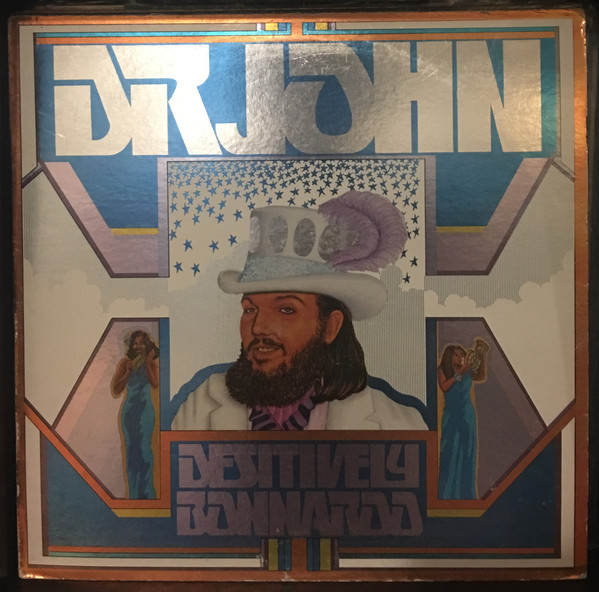
Sadly, Desitively Bonnaroo was the last album that Dr John released on the Atlantic Records imprint Atco, and was the end of a golden period for Dr John. From Gris Gris which was released on January the ’22nd’ 1968, right through to Desitively Bonnaroo which hit the shops on April the ‘8th’ 1974, musical chameleon and pioneer Dr John had been on the hottest streak of his career, releasing a string of groundbreaking albums, including several classic albums.
These albums showed different sides to Dr John’s music, as his music continued to evolve over a six-year period. By the time he released the funky New Orleans R&B of Desitively Bonnaroo in 1974, this was a long way from his classic debut album Gris Gris. It was an album the majority of critics and record buyers failed to understand. Sadly, that was the also case with Remedies which was released in 1970. It saw Dr John The Night Tripper throw psychedelia, blues, R&B, soul, funk and jazz into the musical melting pot and gave it a stir to create an album where the music was mysterious, otherworldly and haunting. However, this vastly underrated album passed record buyers, and it was only much later that record buyers appreciated and embraced this innovative album.
Nowadays, original copies of Dr John’s seven Atco albums aren’t easy to find, Between 1970s Remedies and 1974s Desitively Bonnaroo this musical pioneer had reinvented his music and was enjoying the commercial success and critical acclaim he so richly deserved. Sadly, Desitively Bonnaroo brought to an end what was a golden period where Dr John could do no wrong, as this musical legend released some of the best music of his long and illustrious career.
Dr John-The Atco Years 1968-1974.

WHERE THE GIRLS ARE VOLUME 10.
Where The Girls Are Volume 10.
Ace Records.
Thirty-five years ago, in 1984, Mick Patrick and Ady Croasdell compiled the first volume of Where The Girls Are, which was released on vinyl. This was just before the emergence of the CD, which within a few years, replaced vinyl in many people’s music collection and affections.
By the nineties vinyl was a favourite find in charity shops up and down Britain, and shrewd collectors hoovered up rarities aplenty as record companies continued to release their back catalogue on compact disc. This included Ace Records, who in 1997 released the first volume of Where The Girls Are on compact disc. It was compiled by Mick Patrick and Malcolm Baumgart. For the two compilers,they had no idea just how successful the Where The Girls Are series would become.
Twenty-two years later, and Where The Girls Are Volume 10 brings the curtain down on one of Ace Records’ most successful and critically acclaimed series. However, Where The Girls Are Volume 10 is bowing out at the top, with twenty-six tracks old and new. This includes contributions from The Bronzettes, Kelly Garrett, Naomi Wilson, The Teardrops, The Avons, Jackie and Gayle, Maureen Gray, Diana King, The Sweet Things, Tari Stevens and The Darlenes. They’re just a few of the names on Where The Girls Are Volume 10, which brings the curtain down on one of Ace Records’ most popular and best-loved series.
Where The Girls Are Volume 10 spans the years between 1962 to 1968, and includes tracks recorded in Philadelphia, New York, Los Angeles, Nashville and Cincinnati. Many if these are making their first debut on compact disc. This includes the previously unissued track Top Twenty by the Delicates.
Among the familiar faces are The Shirelles’ Two Stupid Feet, He’s My Hero by The Avons and That Guy Of Mine by The Sherry’s. This is just a small part of the story of Where The Girls Are Volume 10. However, there’s highlights aplenty on compilation that marks the end of an era.
When it comes to highlights there are many, including the dancefloor friendly track Hot Spot by Philly girl group the Bronzettes, which opens the compilation and was produced by Chubby Checker. Then there’s Nothing Can Go Wrong from LA based group The Bea’s who contribute a jangling hidden gem that sounds as if it was recorded in the last thirty years. Another welcome addition is the Phil Spector inspired Big House which comes courtesy The Carolines, from New York. This however, is just one of many quality cuts chosen by Mick Patrick.
Welcome additions from girl groups include The Teardrops’ . I Will Love You Dear Forever, The Vareeations’ It’s the Loving Season, The Sweet Three’s I Would If I Could, The Tiffanys’ Happiest Girl in the World and The Darlenes’ (I’m Afraid) You’ll Hurt Me. These tracks ooze quality and so do the contributions from the solo artists.
There’s a number of solo artists on Where The Girls Are Volume 10. This includes Kelly Garrett’s This Heart Is Haunted, Just a Little Touch of Your Love by Saundra Franklin, Maureen Gray’s Summertime Is Near, Diana King’s That Kind of Love and Donna Loren’s Johnny’s Got Somethin’ which closes Where The Girls Are Volume 10 and this long-running and critically acclaimed series.
While Where The Girls Are Volume 10 marks the end of an era for Ace Records, at least it’s a case of ending on a high. Best to bring the compilation series to a close on a high, rather than following in the footsteps of other franchises who eventually lost their mojo, and after a couple of indifferent additions belatedly called time. At least, music fans will always remember Where The Girls Are as one of the finest girl group compilation series.
Where The Girls Are Volume 10 is a welcome addition to the series, and showcases an array of talented groups and solo artists. Some of them will be familiar names, while others are will be new to most people. They all have one thing in common…quality. The final instalment in this long-running and much-loved series ends on a high with Where The Girls Are Volume 10, thanks to lone compiler Mick Patrick who puts a lifetime of knowledge to good use. For that, music fans should be grateful.
Where The Girls Are Volume 10.
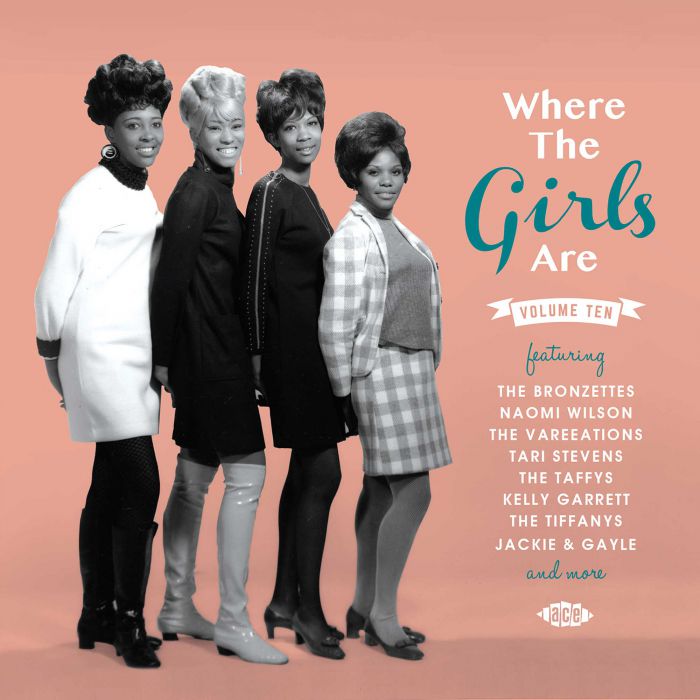
CANNED HEAT’S LIBERTY RECORDS’ YEARS.
Canned Heat’s Liberty Records Records’ Years.
‘8th’ of March 1973 marked the end of an era for Canned Heat who had just released their ninth album, The New Age. It was their swan-song for Liberty Records. After six years and nine studio albums, Canned Heat were about leave Liberty Records. They had managed to negotiate their release from their Liberty Records contract which left Canned Heat free to sign for Atlantic Records. By then, Canned Heat had come a long way since they were formed in Los Angeles in 1965.
Canned Heat’s roots can be traced to a community of blues collectors in Topanga, California. They had been meeting at Bob Hite’s house for some time. where the blues aficionados listened to music, and traded records. Then in 1965, some of the people who attended the group decided to form a band.
The initial lineup featured vocalist Bob Hite, Alan Wilson on bottleneck guitar, Mike Perlowin on lead guitar, bassist Stu Brotman and drummer Keith Sawyer. With the lineup complete, all that was needed was a name. Eventually, they named their new band Canned Heat, after Tommy Johnson’s 1928 song Canned Heat Blues. However, within a matter of days, the lineup changed.
Mike Perlowin and Keith Sawyer both dropped out. This was a huge disappointment for the nascent band. Fortunately, guitarist Kenny Edwards, a friend of Alan Wilson agreed to replace Mike Perlowin. Drummer Ron Holmes agreed to join until permanent replacements could be found.
Fortunately, a friend of Bob Hit’s was between bands. Henry Vestine had been sacked by Frank Zappa for “excessive drug use.” However, Henry Vestine was a talented and experienced lead guitarist. So he joined Canned Heat; and it was agreed that Henry Edwards could remain on a temporary basis. Soon, though, Henry Edwards left Canned Heat to form The Stone Poneys with Linda Rostadt. With the lead guitarist role filled, all that was needed was a new drummer.
Canned Heat found their new drummer in Frank Cook. His previous employers included jazzers Charlie Haden, Chet Baker and Elmo Cook. With their second lineup complete, Canned Heat set about honing their sound.
By 1966, Canned Heat were playing in the clubs of the L.A, and were a popular draw. Their sets included reinterpretations of blues numbers. Canned Heat were keen to promote blues music, which had fallen out of fashion. That was until the British Invasion groups began to promote its merits. Just like Canned Heat, they appreciated the blues and recognised its importance in modern music. It certainly played an important part in Canned Heat’s music as they played in the clubs of L.A. Later in 1966, Canned Heat recorded what should’ve been their debut album.
In the summer of 1966, Canned Heat hooked up with bandleader and producer Johnny Otis. He produced the twelve tracks that Canned Heat recorded. This included covers of Willie Dixon’s Spoonful and John Lee Hooker’s Louise. Once the album was recorded, Stu Brotman announced he was leaving Canned Heat. Worse was to come.
What should’ve been Canned Heat’s debut album lay unreleased until 1970. By then, Canned Heat were a successful band. So Janus Records decided to release the twelve tracks as Vintage Heat. It’s the only Canned Heat album to feature the lineup of Bob Hite, Alan Wilson, Frank Cook, Henry Vestine and Stu Brotman. After Stu Brotman’s departure, the search for a new bassist began.
Despite Canned Heat not having a permanent bassist, they still managed to secure a management contract with Skip Taylor and John Hartmann. Then in March 1967, Canned Heat finally found a permanent bassist in Larry Taylor. He had previously been a member of The Moondogs and had worked with Jerry Lee Lewis and Chuck Berry. Larry Taylor made his debut on the band’s eponymous debut album, Canned Heat.
Canned Heat.
Just month after the classic lineup of Canned Heat was finalised, Canned Heat began recording their debut album for Liberty Records in April 1967. Calvin Carter the former head of A&R was drafted in to produce what became Canned Heat. He was well qualified, having previously recorded albums with Jimmy Reed and John Lee Hooker.
Recording of Canned Heat took place in L.A., with twelve songs being recorded. Eleven of them were cover versions, including Muddy Waters’ Rollin’ and Tumblin’, Willie Dixon’s Evil (Is Going On) and Robert Johnson and Elmore James’ Dust My Broom. The only track penned by Canned Heat, was Bullfrog Blues. Once the twelve songs were recorded, Canned Heat would be released in July 1967.
Before that, Canned Heat were due to appear at the Monterey International Pop Music Festival, on June 17th 1967. Canned Heat pulled out all the stops, and produced one of the best performances of their two year career. Critics struggled for superlatives to describe Canned Heat’s performance. The twin guitars of Henry Vestine and Alan Wilson stole the show; while Bob Hite’s powerhouse vocals came a close second. Critics agreed, that Canned Heat had a bright future in front of them.
Following their successful appearance at the Monterey International Pop Music Festival, Canned Heat released their eponymous debut album in July 1967. Canned Heat reached seventy-six in the US Billboard 200, and in the process, launched the band’s career. Everything seemed to be going almost too well.
Already, drugs had entered the equation. Over the next few years, drugs would become a problem with Canned Heat. It earned them a degree of notoriety, and the reputation “the bad boys of rock.”
One of the first incidents was when the band were arrested and jailed in Denver, Colorado on a possession charge in October 1967. With Canned Heat in jail, their manager Skip Taylor had to sell the band’s publishing rights to Liberty Records’ to raise the bail of $10,000. It was a costly mistake, and cost Frank Cook his place in Canned Heat.
Replacing Frank Cook was Adolfo “Fito” de la Parra. He made his debut on December 1st 1967 at Long Beach Auditorium. That night, Canned Heat and The Doors shared top spot on the bill. This was the debut of the classic lineup of Canned Heat.
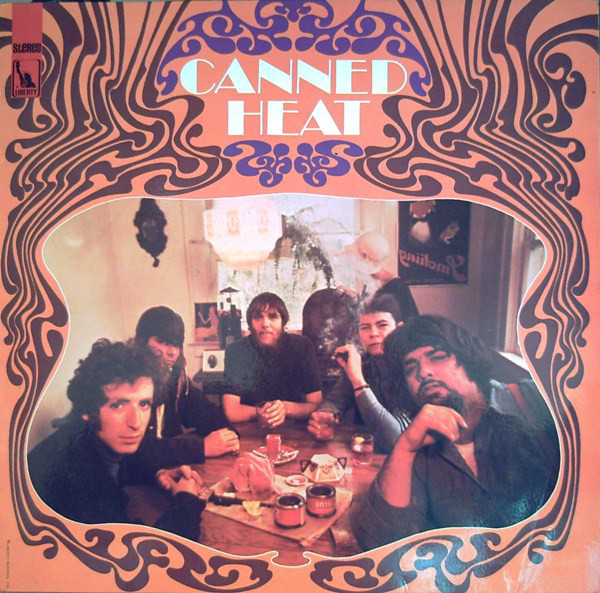
Boogie With Canned Heat.
Just six months after Canned Heat released their eponymous debut album, they returned with their sophomore album Boogie With Canned Heat. It was the first album to feature the classic lineup. By then, each member of Canned Heat had adopted a nickname. Canned Heat now featured Bob “The Bear” Hite, Alan “Blind Owl” Wilson, Henry “Sunflower” Vestine, Larry “The Mole” Taylor and Adolfo “Fito” de la Parra. They made their debut on Boogie With Canned Heat.
By then, Canned Heat were writing more of their own songs. They wrote four of the ten songs. Other songs were written by members of Canned Heat. Bob Hite penned Whiskey Headed Woman No. 2; Henry Vestine contributed Marie Laveau and Alan Wilson wrote An Owl Son. Alan Wilson also cowrote On The Road Again with Floyd Jones. It would play an important part in rise and rise of Canned Heat.
When Boogie With Canned Heat was released on 21st January 1968, it was to critical acclaim. The album epitomised Canned Heat’s unique sound. Loose limbed jams and Canned Heat’s trademark boogies rubbed shoulders on Boogie With Canned Heat. This found favour with record buyers when Boogie With Canned Heat reached number eighteen in the US Billboard 200. That wasn’t an end of the success.
Boogie With Canned Heat included what’s without doubt, Canned Heat’s most famous single, On The Road Again. It reached the top ten in the US Billboard 100. The success of On The Road Again further cemented Canned Heat’s reputation was one of America’s top bands.
Living The Blues.
After the success of Boogie With Canned Heat, there was no resting on their laurels for Canned Heat. They returned to the studio and recorded their part of third album Living The Blues. It was a double album with a twist.
The eight songs on sides one and two were recorded in the studio. They were a mixture cover versions and original songs. The covers included Charley Patton’s Pony Blues, Jimmy Rogers’ Walking by Myself and Blind Lemon Jefferson’s One Kind Flavour. Canned Heat penned nine part suite Parthenogenesis. Bob Hite wrote Sandy’s Blues and Alan Wilson wrote My Mistake. Alan also wrote another of Canned Heat’s best known songs, Going Up The Country. These songs were recorded between August and October 1968, at .D. Sound Studios. However, the two lengthy jams on sides three and four Refried Boogie I and II were recorded live at The Kaleidoscope, Hollywood, This mixture of studio and live songs became Living The Blues.
When Living The Blues was released in October 1968, the reviews of this sprawling double album were mixed. The experimental nature of Parthenogenesis seemed to catch critics on the hop. They didn’t seem to know what to make of this genre-melting collage. However, one track stood out on Living The Blues, Going Up The Country.
When Living The Blues was released, it reached number eighteen in the US Billboard 200 and number forty-five in the US R&B charts. The lead single Going Up The Country seemed to speak to a generation, and it reached number eleven US Billboard 100, and number one in twenty-five countries worldwide. Later, Going Up The Country became the unofficial anthem to Woodstock. That was still to come.
Before that, Canned Heat enjoyed a triumphant end to 1968, when they played at the Shrine Auditorium in L.A. To crown what had been a barnstorming performance from Canned Heat, they were joined by Bob Hope sitting a atop an elephant. It was a surreal sight, but proof that Canned Heat were now one of the biggest bands in America.
Hallelujah.
Canned Heat returned to I.D. Sound Recorders Hollywood, in May 1969. They recorded eleven tracks that became their fourth album Hallelujah. Canned Heat wrote two tracks, while individual members of the band wrote most of the tracks. Alan Wilson contributed four tracks, Change My Ways, Time Was, Do Not Enter and Get Off My Back. He was quickly becoming Canned Heat’s songwriter in chief, and played an important role in Hallelujah.
Canned Heat released their fourth album, the blues based, Hallelujah on July 8th 1969. Again, the reviews were mixed. They ranged from favourable to positive. However, again, there was no consensus on Hallelujah. Despite this, Hallelujah still reached thirty-seven on the US Billboard 200. This in part, was a result of Canned Heat taking Woodtstock by storm. Before that, the classic lineup of Canned Heat was no more.
Just after the release of Hallelujah, Canned Heat were due to play two nights at Fillmore West. On the first night, there was an onstage altercation between Larry Taylor and Henry Vestine. After the show, Henry Vestine left Canned Heat.
With Canned Heat a man down for the second show, Mike Bloomfield and Harvey Mandel filled the void left by Henry Vestine. They jammed onstage with Canned Heat. So impressive were their performances, that both men were offered a place in Canned Heat. However, it was Harvey Mandel that agreed to join Canned Heat.
Harvey Mandel made his official Canned Heat debut in August 1969. Canned Heat played two nights at the Fillmore West, in preparation for their performance at the Woodstock Music and Art Fair.
The Woodstock Music and Art Fair took place between the 15th and 18th August 1969. Canned Heat were booked to play on the 16th August 1969. Logistically, the only way for Canned Heat to arrive was in a helicopter. They flew over what was a heaving mass of humanity. Having arrived by helicopter, Canned Heat took to the stage as the sun set. Their legendary set included some of their greatest songs, including On The Road Again and Going Up The Country, which became the unofficial anthem to Woodstock. As they left the stage, it was apparent that Canned Heat were one of the stars of the Woodstock Music and Art Fair.
Future Blues.
1969 had been both an eventful and momentous year for Canned Heat. They had lost a member of the classic lineup of Canned Heat, then were one of the stars of Woodstock. By 1970, “the bad boys of rock” had been booked to tour Europe. With some time to spare, Canned Heat decided to record their fifth album, Future Blues.
Canned Heat headed to Village Recorders, where they were due to record nine songs. This included covers of Eddie Shuler’s Sugar Bee; Charley Patton’s Shake It and Break It; Arthur “Big Boy” Crudup’s That’s All Right (Mama) and Wilbert Harrison’s Let’s Stick Together. Canned Heat penned So Sad (The World’s In A Tangle) and Future Blues. Alan Wilson who was still Canned Heat’s songwriter-in-chief wrote Skat, London Blues and sadly, prophetic My Time Ain’t Long. Once the album was complete, it was scheduled for release in late summer 1970.
Future Blues was well received by critics. They praised the album, calling it Canned Heat’s best albums of recent years. With critical acclaim accompanying its release, Future Blues was released on August 3rd 1970. However, Future Blues stalled at fifty-nine on the US Billboard 200. This made Future Blues Canned Heat’s least successful album since their eponymous debut album. The only small crumb of comfort for Canned Heat and Liberty Records, was that Let’s Work Together reached twenty-six in the US Billboard 100. By then, Larry Taylor and Harvey Mandel dropped a bombshell.
The two men announced that they were leaving Canned Heat not long after the release of Future Blues. Larry Taylor joined John Mayall’s band, and Harvey Mandel followed in his footsteps. This left just drummer Adolfo de la Parra, vocalist Bob Hite and guitarist Alan Wilson.

Hooker ’N’ Heat.
After the departure of Larry Taylor and Harvey Mandel, guitarist Henry Vestine rejoined Canned Heat. Replacing bassist Larry Taylor was Antonio de la Barreda. He had previously played alongside Adolfo de la Parra in Mexico. This new lineup of Canned Heat entered the studio to record an album with veteran bluesman John Lee Hooker.
Canned Heat had met John Lee Hooker at an airport in Portland, Oregon. When they got talking, the members of Canned Heat told John Lee Hooker they were longtime fans of his music. It turned out that apparently, John Lee Hooker just happened to be a fan of Canned Heat’s music. So they decided to record an album together.
This would be no ordinary album. Instead, Hooker ’N’ Heat was a sprawling double album. It was recorded at Liberty Records, in Los Angeles, with Bob Hite and Skip Taylor taking charge of production. John Lee Hooker wrote or cowrote every song on Hooker ’N’ Heat. Some of the songs, featured just John Lee Hooker. On other tracks, Canned Hat were reduced to a backing band on Hooker ’N’ Heat. Once Hooker ’N’ Heat was completed, the album was scheduled for release in January 1970.
Between the completion and release of Hooker ’N’ Heat, tragedy touched Canned Heat in September 1970. Just after the completion of the Hooker ’N’ Heat, Alan Wilson attempted to commit suicide when he drove his van off a a cliff near Bob Hite’s home in Topanga Canyon. Fortunately, Alan Wilson survived. Sadly, not for long.
After years of bravely battling depression, Alan Wilson’s life came to an end on the 3rd of September 1970. Alan Wilson was found dead on a hillside at the rear of Bob Hite’s Topanga home. The cause of death was an overdose of barbiturates. When the other members of Canned Heat were told of Alan Wilson’s death, they believed that he had committed suicide. It was a huge blow for the rest of Canned Heat. They were grieving over the loss of a not just a bandmate, but a friend.
Despite the death of Alan Wilson, Canned Heat were due to tour America, Australia and Europe. Then they had a studio time booked to record a new album. So Joel Scott Hill, who had been a member of The Strangers and Moby Grape was drafted in to replace Alan Wilson. Then in January 1971, Hooker ’N’ Heat was released
Reviews of Hooker ’N’ Heat were mixed. However, critics agreed that Canned Heat had returned to their R&B roots. Some of the songs varied in quality. Especially some that featured only the veteran bluesman. Two of the poorest songs on Hooker ’N’ Heat were Send Me Your Pillow and Drifter. However, things improved when Canned Heat joined the fray. Together, they formed a potent partnership, and suddenly, Hooker ’N’ Heat was a very different album. Despite this, Hooker ’N’ Heat stalled at seventy-three in the US Billboard 200. Normally, this would be regarded as disappointing. However, given the death of Alan Wilson, this hardly seemed to matter. Some things mattered more than music. The loss of a friend was one of them.
Live At Topanga Corral.
Later in 1971, Canned Heat belatedly released the first live album of their career. The band had wanted to release a live album for several years. However, Liberty Records who Canned Heat were contracted to, weren’t interested in releasing a live album. Despite this, Canned Heat’s manager Skip Taylor managed to get Canned Heat’s live album released.
Skip Taylor took to Liberty Records a recording of five tracks. They he said, had been recorded at the Topanga Corral during 1966 and 1967. That wasn’t strictly true. The recording was of a concert that took place in 1969, at the Kaleidoscope. When Liberty Records heard that Live At Topanga Corral had been recorded in 1966 and 1967, they allowed Canned Heat to release the album on Wand Records.
When Live At Topanga Corral was released, the album was well received by critics. It featured the lineup of Bob Hite, Alan Wlson, Henry Vestine, Larry Taylor and Adolfo de la Parra. They open the set with Bullfrog Blues, and work their way through Sweet Sixteen, I’d Rather Be The Devil, Dust My Broom, Wish You Would and When Things Go Wrong. Sadly, despite being one of the best live recording of Canned Heat, it failed to find an audience. However, it’s a fitting farewell to Alan Wilson. Their next album, Historical Figures and Ancient Heads was the start of a new era for Canned Heat.
Historical Figures and Ancient Heads.
Having released an album in January 1971, Canned Heat closed the year with the released of their eighth album, Historical Figures and Ancient Heads. It was released in December 1971, and was the first album not to feature Alan Wilson. Joel Scott Hill was given the job of replacing Alan Wilson on guitar. His were big shoes to fill.
Alan Wilson was more than a musician. He was also a songwriter. On Historical Figures and Ancient Heads, Canned Heat penned just the one song, Utah. The other seven songs were cover versions. Among them, were Jessie Mae Robinson’s Sneakin’ Around and Jimmy Rogers’ That’s All Right. They were recorded by Canned Heat, and a few friends.
This included Little Richard on the Skip Taylor and Richard Wayne Penniman penned Rockin’ With the King. Harvey Mandel returned to add lead guitar on a cover of That’s All Right. Charles Lloyd joined Canned Heat when they covered his song I Don’t Care What You Tell Me. Producing Historical Figures and Ancient Heads were Skip and Jim Taylor. Once the album was complete, it was released in December 1971.
When Historical Figures and Ancient Heads was released, the reviews were mixed. Some critics felt Canned Heat were no longer the same group. While they still were still able to boogie with the best of them, Canned Heat seemed to have lost their bluesy roots. However, Historical Figures and Ancient Heads was not without merit.
Cherokee Dance and Utah were regarded as the highlights of the album. Both songs found their way onto FM playlists. Another highlight of Historical Figures and Ancient Heads was Rockin’ With The King, where Canned Heat joined forces with Little Richard. They proved a potent partnership. Despite this, and Cherokee Dance and Utah finding their way onto FM radio, the album stalled at a lowly eighty-seven in the US Billboard 200. Historical Figures and Ancient Heads became the least successful album of Canned Heat’s career. Surely, the only way was up?
Following Historical Figures and Ancient Heads, all wasn’t well within Canned Heat. Joel Scott-Hill and Antonio de la Barreda seemed to have developed an attitude problem. This lead to drummer Adolfo de la Parra threatening to quit the band. Fortunately, he was talked out of leaving Canned Heat, and instead, the insurgents exited stage left. This meant another change of lineup for their next album The New Age.
The New Age.
Joining Canned Heat for their ninth album The New Age, were rhythm guitarist and vocalist James Shane, keyboardist Ed Beyer on keyboards and bassist Richard Hite. Bob Hite’s brother would slot into the rhythm section alongside drummer Adolfo de la Parra and rhythm guitarist James Shane. They headed to The Record Plant in Los Angeles to record The New Age.
For The New Age, nine songs were chosen. Most of them were new songs, which were penned by members of Canned Heat. The only cover version was Lieber and Stoller’s Framed. Bob Hite penned Keep It Clean, Don’t Deceive Me and Rock and Roll Music. However, the new recruit came up trumps. Ed Bayer wrote You Can Run, But You Sure Can’t Hide and Election Blue. James Shane went one better, and wrote a trio of songs. This included Lookin’ For My Rainbow, So Long Wrong and the biker anthem Harley Davidson Blues. It would become a favourite of Canned Heat fans. That was still to come. Before that, Canned Heat had an album to record.
When recording of The New Age began at The Record Plant, Clara Ward joined Canned Heat. Her vocal features on Lookin’ For My Rainbow. Sadly, this was the last recording of one the most successful gospel singers. She joined the latest lineup of Canned Heat, as they tried to get their career back on track.
Despite the best efforts of Canned Heat and producer Skip Taylor, The New Age wasn’t the start of a new era for Canned Heat. The album wasn’t well received. One critic in particular, was less than impressed. Lester Bangs savaged The New Age. His over the top review was regarded as “disrespectful,” and Lester Bangs was sacked by Rolling Stone. However, the damage was done.
Other critics took a much more balanced approach to The New Age. They pointed out highlights like Lookin’ For My Rainbow and the biker anthem Harley Davidson Blues. However, when The New Age was released on March 9th 1973, the album failed to trouble the charts. Worse was to come for Canned Heat.
They were now heavily in debt. Skip Taylor was desperately looking for a solution to the problem. That’s when it’s alleged that Skip Taylor advised Canned Heat to sign away all their future royalties to Liberty Records and United Artists’ recordings, and in return, Canned Heat would be allowed to sign to Atlantic Records. If this was the case, it would prove to be one of the worst deals in the history of music.
Having negotiated a release from their Liberty Records’ contract, Canned Heat signed to Atlantic Records in 1973. They began work on their tenth studio album One More River To Cross. However, Canned Heat’s time at Atlantic Records got off to a bad start.
Bob Hite and Henry Vestine were about to use a vending machine at Atlantic Records. Suddenly, the pair began to argue, and brawl began. Now two members of Atlantic Records’ latest signing were fighting amongst themselves. While this didn’t present Canned Heat in a good light. Things didn’t get much better. surely things would improve?
One More River To Cross was released later in 1973. Canned Heat’s Atlantic Records’ debut, was the tenth studio album of their career. This was a remarkable feat, considering Canned Heat only released their debut in 1967. A lot had happened since then.
The lineup had changed numerous times, there had been countless drugs busts and controversies aplenty. However, only one Canned Heat album failed to chart. That was their previous album The New Age. Sadly, One More River To Cross followed in its footsteps and failed commercially. It came to be regarded as possibly, became one of the most expensive albums in music history.
Especially if the allegations that Skip Taylor advised Canned Heat to sign away all their future royalties to Liberty Records and United Artists’ recordings, so they could sign to Atlantic Records were true? After the commercial failure of One More River To Cross, Atlantic Records cut their ties with Canned Heat. Their relationship with Atlantic Records was brief and potentially ruinously expensive.
If the allegation regarding future royalties are indeed true, then Canned Heat were very badly advised. The decision to trade their future royalties, for their freedom, backfired, and backfired badly. Who knows how much this cost Canned Heat in lost royalties? Even today, the cost of One More River To Cross continues to rise. To some extent, all the success Canned Heat enjoyed early in the Liberty Records years had been for nothing, and they became just the latest ill-advised band in musical history.
Canned Heat’s Liberty Records Records’ Years.

MIKE HARRISON-FROM THE V.I.P.s TO HIS SOLO YEARS.
Mike Harrison-From The V.I.P.s To His Solo Years.
For Carlisle born Mike Harrison, the period between 1963 and 1975, proved the most prolific of a six decade career. During that period, Mike Harrison was the lead singer of The V.I.P.s and Art. They would later become known as Spooky Tooth, who signed to Island Records in 1968. Three years later, and with the Spooky Tooth having split-up, Mike Harrison embarked upon a solo career, releasing a trio of solo albums between 1971 and 1975. However, by the time, Mike’s solo career got underway, he had been a member of a band who were popular on both sides of the Atlantic, Spooky Tooth. Their roots can be traced to Carlisle, in Cumbria.
That was when Mike Harrison’s career began in Carlisle in 1963, when he cofounded The V.I.P.s with bassist Greg Ridley. Over the next four years, The V.I.P.s lineup evolved. Rhythm guitarist Frank Kenyon, lead guitarist Jimmy Henshaw, drummer Mike Kellie and guitarist Luther Grosvenor were members between 1963 and 1967. Other musicians played a walk-on roll on The V.I.P.s’ story. This included Keith Emerson whose keyboards would play a starring role in The Nice and Emerson, Lake and Palmer. However, by the time The V.I.P.s decided to change direction musically, Keith Emerson had left the band.
For the four years they were together, The V.I.P.s played blues and R&B. By 1967, they decided that to change direction musically. So The V.I.P.s changed their name to Art. Then in October 1967, Gary Wright joined Art. He played on Art’s one and only album Supernatural Fairy Tales.
Art.
Supernatural Fairy Tales.
In 1967, the newly named Art found themselves signed to Chris Blackwell’s Island Records. Art were about to go into the studio with producer Guy Stevens, so began work on their debut album.
By then, Art still a quartet. However, only two original members of The V.I.P.s remained. Ironically, they were the founding members, vocalist and keyboardist Mike Harrison and bassist Greg Ridley. They were joined by drummer Mike Kellie and guitarist Luther Grosvenor. The four members of Art got to work on what became Supernatural Fairy Tales.
For their debut album Supernatural Fairy Tales, the four members of Art wrote ten tracks. They would be augmented by covers of The Young Rascals’ Come on Up and Buffalo Springfield’s For What It’s Worth. Recording took place at two studios.
Pye Studios was where the majority of Supernatural Fairy Tales was recorded. Some recording took place at Olympic Studios. At the two studios, producer Guy Stevens, whose career was in the ascendancy, took charge of production. He guided Art through the maze that’s recording a debut album. The result was Supernatural Fairy Tales, which became a cult classic.
When critics heard Supernatural Fairy Tales, the reviews of Art’s debut album were mostly positive. Its progressive, psychedelic rock sound was decidedly on trend. It tapped into a sound that was commercial. Surely, Supernatural Fairy Tales would prove a commercial success?
Sadly, when Supernatural Fairy Tales was released in the Autumn of 1967, the album wasn’t a commercial success. This was disappointing for Art and Island Records.
Shortly after the release of Supernatural Fairy Tales Art split-up. However, like a phoenix from the ashes rose a new band, Spooky Tooth.
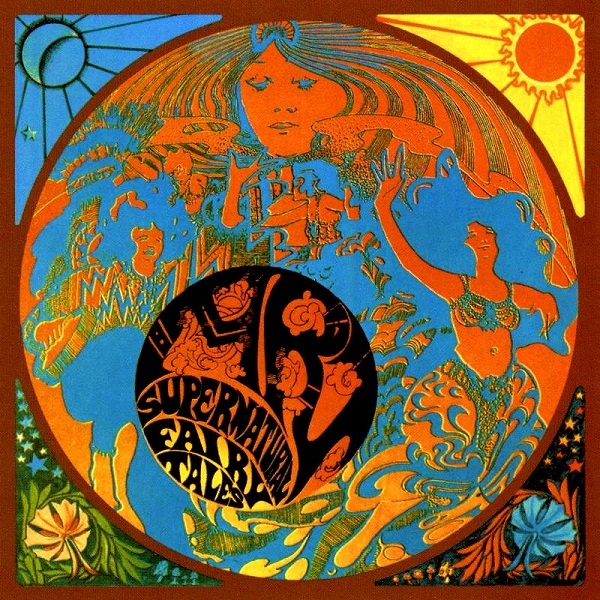
The Birth Of Spooky Tooth.
Gary Wright was also a psychology student, who had travelled to Berlin to finish his studies. That was where Gary Wright formed the band The New York Times with some American expats and a German bassist. They had opened for Traffic, and were thinking about recording an album. So Gary Wright contacted his old friend Jimmy Miller. The producer was working for Island Records, and suggested that The New York Times hotfoot it to London.
When The New York Times arrived in London, the recording sessions didn’t go to plan. The rest of the band split, leaving Gary Wright. It was then, in October 1967, that Gary Wright was introduced to the former members of Art and they formed a new band, Spooky Tooth.
Spooky-Tooth.
It’s All About.
Straight away, work began on Spooky Tooth’s debut album. The new recruit quickly made his presence felt. Whereas the four members of Art cowrote most of their debut album Supernatural Fairy Tales, that wasn’t the case with Spooky Tooth.
Gary Wright penned Sunshine Help Me and cowrote another six tracks. This included It Hurts You So and Forget It and I Got It with his old buddy Jimmy Miller. The Wright and Miller partnership weren’t finished. They penned Love Really Changed Me with Luther Grosvenor. That trio joined Mike Harrison in writing Here I Lived So We. Luther Grosvenor and Chris Wight also wrote Bubbles. Spooky Tooth was quickly becoming the Chris Wright show.
If the other members felt uncomfortable that Chris Wight was playing a leading role in Spooky Tooth. He was friends with Jimmy Miller, who was chosen to produce It’s All About. He just happened to be friends with Island Records’ owner Chris Blackwell. To onlookers, these relationships looked too cosy. After all, it was Chris Blackwell who introduced Chris Wright. He would join the rest of Spooky Tooth at Olympic Studios.
Island Records’ recording sessions were notorious for only allotting a specific amount of time to record an album. Woe betide the band and producer who went over budget. Spooky Tooth had twelve songs to record when they entered the studio in November 1967. This included covers of Janis Ian’s Society’s Child, Bob Dylan’s Too Much Of Nothing and John D. Loudermilk’s Tobacco Road. Along with the songs penned by members of Spooky Tooth, the twelve songs became It’s All About.
Before the release of It’s All About in June 1968, critics had their say on Spooky Tooth’s debut album. They were won over by It’s All About. Many critics gave the albums rave reviews. Some critics liked that Spooky Tooth had two different vocalists. This was uncommon. However, with Mike Harrison and Chris Wright sharing the lead vocals, this allowed the band to take their music in a variety of directions. On It’s All About, this included blues, rock and psychedelia. Despite winning over critics, record buyers weren’t convinced.
When It’s All About was released in June 1968, the album wasn’t the success many had forecast. This would soon change.
Spooky Tooth were about to become one of Europe’s most popular live bands. Then in August 1968, Spooky Tooth were invited to tour America. This was a game-changer. Especially when Spooky Tooth were invited to play at one of the most prestigious venues in America, the Fillmore West in San Francisco.
Promoter Bill Graham invited Spooky Tooth to play the Fillmore West. This was a rite of passage for bands touring America. It was a signal they had arrived. Spooky Tooth were going up in the world, so Island Records’ thoughts turned to their sophomore album, Spooky Two.
Spooky Two.
Unlike their debut album, Spooky Two only featured eight songs. Partly, this was why Spooky Too was a leaner, more focused album. Again, Gary Wright who had assumed the role of Spooky Tooth’s songwriter-in-chief.
Gary Wright penned four tracks and cowrote three others. This included Feelin’ Bad and I’ve Got Enough Heartaches with drummer Mike Kellie. Mike Harrison and Luther Grosvenor cowrote Waitin’ for the Wind with Gary Wright. Spooky Two’s other track, was a cover of Larry Weiss’ Evil Woman. These songs were recorded at Morgan Studios, London.
Just like It’s About You, Spooky Too was produced by Jimmy Miller. Recording began in November 1968, and Spooky Tooth began recording what’s now considered their greatest album, Spooky Too.
Once Spooky Too was complete, the release was scheduled for March 1969. This didn’t leave much time to promote the album. However, the reviews did a good job of this. Spooky Too was hailed a masterpiece of blues, hard rock, psychedelia and classic rock. Luther Grosvenor’s guitar playing was at the heart of the album’s success. It was loose, but fluid. Spooky Tooth’s played hard, raw and rock on Spooky Too. Critics forecast that Spooky Too was going to be Spooky Tooth’s breakthrough album.
That proved to be the case. On its release in March 1969, Spooky Too reached number forty-four in the US Billboard 200. This resulted in Spooky Tooth’s profile rising.
Suddenly, they were playing in front of bigger audiences on nearly every continent. Other musicians wanted to work with Spooky Tooth. This included French electronic musician, Pierre Henry.

Ceremony.
After the release of Spooky Too, there was a change to Spooky Tooth’s lineup. In 1970, bassist Greg Ridley was asked to join Humble Pie. He agreed, and Andy Leigh was drafted in as his replacement. This was the first, but not the last change in Spooky Tooth’s lineup.
After the commercial success and critical acclaim of Spooky Too, Spooky Tooth’s star was in the ascendancy. Suddenly, people wanted to work with Spooky Tooth. This included French electronic musician, Pierre Henry.
He described himself as a found-object” composer. Pierre Henry took everyday objects and transformed them into an instrument. This wasn’t a new concept.
Pablo Picasso had pioneered the idea in 1912, when he pasted aprinted image of chair caning onto his painting Still Life with Chair Caning. Turning everyday objects into musical instruments took the idea further. That’s what Pierre Henry, and many other moderne musicians did.
Originally, Spooky Tooth were collaborating with Pierre Henry. It was his album. The new lineup of Spooky Tooth were essentially his backing band, on Ceremony.
For Ceremony, Pierre Henry and Gary Wright wrote six tracks. He and the rest of the new lineup of Spooky Tooth made their way to France. It was agreed that Pierre Henry and Spooky Tooth would co-produce Ceremony, due to the fact the album takes the form of a church service.
Quickly, Spooky Tooth recorded their parts. This left Pierre Henry to play synths and take charge of electronics on five tracks. On Hosanna, which closed Ceremony, Spooky Tooth took centre-stage. It was Ceremony’s Magnus Opus. Once the recording was complete, Spooky Tooth headed home.
Having returned home, Spooky Tooth were sent a copy of Ceremony. Gary Wright didn’t like what he heard. He was straight on the phone to Chris Blackwell, urging him not to release Ceremony. This didn’t work.
Chris Blackwell disagreed, telling Chris Wright: “people will love this album. We have to put this out.” According to Chris Wright, the rest of Spooky Tooth didn’t want Ceremony released. He went as far as to say: “it was against our wishes.” He thinks that the “release of the album lead to the initial breakup of the band.”
With Island Records determined to release Ceremony, December 1969 was scheduled as the release date. Before that, critics had their say on Ceremony. This fusion of rock and avant-garde was billed as an album from Spooky Tooth and Pierre Henry. Reviews were mixed. It wasn’t what most critics had expected from Spooky Tooth. The problem Mike Harrison says was; “people thought it was Spooky Tooth’s third album.”
When Ceremony was released in December 1969, it reached just ninety-two in the US Billboard 200. Spooky Tooth were going backwards. That was only part of the story.
All wasn’t well within Spooky Tooth. There was disharmony within the ranks. Mike Kellie believes things would’ve been different if Spooky Tooth: “had independent management.” They could have been an arbiter in the conflicts. Without that, Spooky Tooth split-up.

Spooky Tooth Featuring Mike Harrison.
The Last Puff.
That wasn’t the end of the Spooky Tooth story. Instead, it was just the end of a chapter. Mike Harrison, Mike Kellie and Luther Grosvenor remained. Chris Wright exited stage left. So did bassist Andy Leigh. In their place, came some new faces.
Among them, were guitarist Henry McCullough, bassist Alan Spenner and Chris Stainton. He played bass, piano and organ. His versatility would be put to good use on The Last Puff, which was billed as an album from Spooky Tooth Featuring Mike Harrison.
For The Last Puff, seven cover versions were chosen. Among them were Lennon and McCartney’s I Am The Walrus; Joe Cocker and Peter Nichols’ Something to Say; David Ackles’ Down River and Elton John and Bernie Taupin’s Son of Your Father. New recruit Chris Stainton contributed The Last Puff. Ironically, The Wrong Time a song penned by Gary Wright and Hugh McCracken. Given Gary Wright had just left Spooky Tooth this seemed a strange decision.
Recording of The Last Puff took place at Island Studios, London. Producing the album was Island Records’ owner Gary Blackwell and Chris Stainton. Once the new lineup of Spooky Tooth finished recording The Last Puff, it was released in July 1970.
Critics however, received advance copies of Spooky Tooth Featuring Mike Harrison’s album The Last Puff. Critical acclaim accompanied this album of psychedelia, rock and pop. It seemed the loss of two members hadn’t derailed Spooky Tooth.
That seemed to be the case. The Last Puff proved more successful than Ceremony, reaching number eighty-four in the US Billboard 200. However, not long after the release of The Last Puff, Spooky Tooth split-up. That looked like the end of the line for Spooky Tooth. Island Records were dismayed. They had just lost one of their most popular groups.
So a year later, in 1971, Island Records repackaged and rereleased It’s All About as Tobacco Road. When the album was released, it reached number 152 in the US Billboard 200. By then, they had signed a new solo artist..Mike Harrison.

Mike Harrison-The Solo Years.
With Spooky Tooth seemingly consigned to musical history, Mike Harrison embarked upon a solo career. He signed to Island Records, and began working on his eponymous debut album.
Mike Harrison.
For his eponymous debut album, Mike Harrison returned to where it all began for him, Carlisle, in Cumbria. That’s where he found The Junkyard Angels. They would become his backing band on Mike Harrison, and would also contribute several songs.
The Junkyard Angels were a cut above the local Carlisle bands of the early seventies. They weren’t just talented musicians, but also songwriters who played a part in five of the songs on Mike Harrison.
Bassist Peter Batey wrote Mother Nature and Lonely People. Peter also cowrote Call It A Day with Lan Herbert, Kevin Iverson and Mike Harrison. Lan Herbert and Kevin Iverson then penned Pain with Frank Kenyon. The final song penned by a member of The Junkyard Angels, was Damian, which was written by Lan Herbert and Mike Harrison. By then, it was obvious that The Junkyard Angels were more than a backing band. They had written most of Mike Harrison.
The other three tracks on Mike Harrison, were Wait Until Morning, a Harrison-Griffin composition; Cat Stevens’ Hard Headed Woman and Luther Grosvenor’s Here Comes The Queen. Along with the tracks written by The Junkyard Angels, this trio of tracks would become Mike Harrison.
When recording of Mike Harrison began, four members of The Junkyard Angels were ready to accompany Mike. The rhythm section featured drummer and percussionist Kevin Iverson; bassist and percussionist Peter Batey and guitarist Frank Kenyon. Lan Herbert played guitar, piano and organ and vibes. The four members of The Junkyard Angels would also add backing vocals Meanwhile, Mike Harrison added lead vocals, and played piano, harmonica and organ. When the eight tracks were recorded, Mike Harrison was scheduled to be released later in 1971.
On the release of Mike Harrison in October 1971, reviews of the album were mostly positive. Most critics were won over by the fusion of rock, blues, folk and pop. The songs were perfect for Mike’s vocal. That was the case from the opening track Mother Nature. It’s akin to a musical amuse bouche as Mike’s lived-in vocal brings meaning to the lyrics. That’s the case throughout the eight tracks on Mike Harrison. His worldweary vocal sounds as if he’s lived the lyrics to Call It A Day, Pain and Wait Until The Morning. Similarly, Mike sounds as if he can relate to Lonely People, and somewhat ruefully seems to sing Hard Headed Woman as if he’s met her, but lived to tell the tale. However, the Ballad Damian features a soul-baring vocal. Closing the album, is a cover of Here Comes The Queen, where Mike Harrison and The Junkyard Angels takes in a new direction, to Luther Grosvenor’s original. In doing so, it leaves the listener wanting more.
With eight tracks lasting just lasting around thirty-three minutes, Mike Harrison was just a taste of what was to come from Mike Harrison. Freed from the constraints of Spooky Tooth and Gary Wright’s ‘helping hand’, Mike had come in to his own. He had just cowrote three tracks on his eponymous debut album and produced it. Mike Harrison was well received, and although it wasn’t a huge selling album, it’s a hidden gem that showed Mike that there was like after Spooky Tooth.

Smokestack Lightning.
Buoyed by the reception his eponymous debut received, Mike Harrison’s thoughts turned to his sophomore album. This time, there was no sign of The Junkyard Angels, who played such an important part in his eponymous debut album. They cowrote five of the eight tracks. Mike had only written three tracks, including two with members of The Junkyard Angels. So this presented something of a problem. However, Mike Harrison had already thought of the solution.
His sophomore album would mostly feature cover versions. The exception was Turning Over, which Mike and Luther Grosvenor cowrote. However, the other five tracks were cover versions. This included Tears and Pay My Dues, which were penned by Jimmy Stevens. Other familiar songs included Fats Domino and Maddux-Jessup’s What A Price; Joe Tex’s Wanna Be Free and Howlin’ Wolf’s Smokestack Lightning. This blues classic lent its name to Mike’s sophomore album. It was recorded stateside.
To record Smokestack Lightning, Mike Harrison followed in the footsteps of countless musicians. His destination was Muscle Shoals, in Alabama, where he would work with the legendary Muscle Shoals Rhythm Section. They featured some of America’s top musicians, who had worked with everyone from Aretha Franklin, Candy Staton and Etta James to Percy Sledge and Wilson Pickett. Now Mike Harrison was ready to make that journey, and work with the legendary studio band.
When Mike Harrison arrived at Muscle Shoals, the Muscle Shoals Rhythm Section’s lineup featured some of the top session musicians America had to offer. The rhythm section featured drummer Roger Hawkins, bassist David Hood and guitarists Jimmy Johnson and Pete Carr. They were augmented by slide guitarist Wayne Perkins, keyboardists Barry Beckett and Clayton Ivey. Along with the horn section, they recorded six tracks. When it came to record Turning Over, the cowriter Luther Grosvenor added acoustic guitar. When Smokestack Lightning was complete, it was very different album to Mike Harrison.
The soulful and heart-wrenching ballad Tears opens Smokestack Lightning. It comes complete with lush strings and later, some stunning guitar licks. Paid My Dues is best described as mid-tempo slice of string drenched, blue eyed soul. This proved to be very different from the rest of Smokestack Lightning.
It’s all change on What A Price, Wanna Be Free, Turning Over and Smokestack Lightning. These songs see Mike head in the direction of the blues. Accompanied by a smoking band, he embraces the role of bluesman as the Muscle Shoals Rhythm Section jam. Smokestack Lightning is totally reinvented, and becomes a twelve minute hypnotic, smouldering bluesy jam. Mike has kept his best blues until last, as he pays homage to Howlin’ Wolf in a fitting fashion. In an album that oozes quality, Mike Harrison kept one his best songs until last.
When critics heard Smokestack Lightning, they were impressed by Mike Harrison’s new sound. They hailed Smokestack Lightning as Mike Harrison’s best album so far. Most critics preferred Smokestack Lightning, to Mike Harrison and wondered aloud what the Cumbrian’s third album would sound like? However, Mike had a surprise in store for his fans.

The Return Of Spooky Tooth.
You Broke My Heart So I Busted Your Jaw.
In September 1972, Spooky Tooth reformed, with a new lineup. The only musician who had played on The Last Puff was Mike Harrison.
Since then, Luther Grosvenor had joined Mott The Hoople, where he dawned the alias Ariel Bender. His replacement in Spooky Tooth, was future Foreigner guitarist Mick Jones. Mike Kellie was replaced by drummer and percussionist Bryson Graham. Chris Stewart became Spooky Tooth’s fourth bassist. However, the biggest surprise, was the return of Gary Wright.
Quickly, Gary Wright resumed the role of Spooky Tooth’s songwriter-in-chief. He wrote six of the eight songs, and cowrote Times Have Changed with Mick Jones. The other song on You Broke My Heart So I Busted Your Jaw was the Bryson Graham composition This Time Around. These eight songs were recorded at three London studios.
Recording of You Broke My Heart So I Busted Your Jaw. Olympic Studios, Island Studios and Apple Studios. It seemed no expense was being spared for Spooky Tooth’s comeback album. These were some of London’s top studios. One expense that was saved was a producer. Spooky Tooth produced You Broke My Heart So I Busted Your Jaw. It was scheduled for release in ay 1973.
Many of Spooky Tooth’s fans eagerly awaited their comeback album. However, when reviews were published, they were mixed. Some critics felt that You Broke My Heart So I Busted Your Jaw wasn’t Spooky Tooth’s finest hour. It stuck to Spooky Tooth’s familiar mixture of hard rock and psychedelia. While hard rock was still popular, progressive rock dominated the charts. However, other critics were won over by Spooky Tooth’s comeback album.
Other critics liked the dual keyboard sound on You Broke My Heart So I Busted Your Jaw. This brought a new dimension to Spooky Tooth’s sound. There was no consensus. For once, a Spooky Tooth album had divided the critics’ opinion. However, record buyers were of one mind.
On the release of You Broke My Heart So I Busted Your Jaw, in November 1973, the album reached number eighty-four in the US Billboard 200. This matched the popularity of The Last Puff. Spooky Tooth were back to where they were before Ceremony. What could go wrong?

Witness.
After making their comeback with You Broke My Heart So I Busted Your Jaw, Spooky Tooth looked as if their career was back on track. Then there was a change in Spooky Tooth’s lineup.
This time, Spooky Tooth’s original drummer Mike Kellie made a comeback, and replaced recent recruit Bryson Graham. However, that wasn’t the end of Bryson Graham. He played on some of the tracks on Witness. It was a tale of two drummers.
One thing didn’t change, Gary Wright wrote most of Witness. He penned six of the nine tracks, and cowrote the other three tracks with members of Spooky Tooth. Considering the other members weren’t regarded as songwriters, they were proving a reliable source of songs. Gary Wright and Chris Stewart penned Don’t Ever Stray Away. Mick Jones collaborated with Chris Wright on All Sewn Up. Drummer Mike Kellie celebrated his return by cowriting Pyramids with Chris Stewart. It seemed the other members of Spooky Tooth had hidden talents.
They also produced Witness, which was recorded at Olympic Studios and Island Studios, in London. At two of London’s premier studios, Spooky Tooth recorded their sixth studio album. Little did anyone realise, but this would be the last time one of the band set foot in a recording studio with Spooky Tooth. It was the end of an era.
Sadly, with one of the band about to call time on their career with Spooky Tooth, the reviews of Witness were mixed. Not for the first time, a Spooky Tooth album divided opinion. Some critics enjoyed Witness mixture of hard rock and psychedelia. Others felt the sound was dated. Record buyers had the deciding vote.
They too were undecided. When Witness was released in November 1973, it stalled at ninety-nine in the US Billboard 200. Witness hadn’t matched the commercial success of You Broke My Heart So I Busted Your Jaw. That was disappointing. However, it wasn’t as disappointing as losing one of the band’s most important figures.
Mike Harrison, who founded The V.I.P.s ten years previously, called time on the band he cofounded with Greg Ridley. The group’s cofounder wanted to pursue other projects. Another departure was bassist Chris Stewart. While he was a loss, his departure didn’t leave the void that Mike Harrison’s left. It was a case of the King is dead, long live the King.

The Solo Years Part Two.
Rainbow Rider.
After Spooky Tooth split-up, Mike Harrison resumed his solo career in 1974. Two years had passed since Mike had released Smokestack Lightning It was hailed as Mike’s best album. His third album, Rainbow Rider, had a lot to live up to.
For Rainbow Rider, Mike Harrison chose a mixture of new songs and cover versions. Among the cover versions were Somewhere Over The Rainbow; The Beatles’ We Can Work It Out; Bob Dylan’s I’ll Keep It With Mine and Don Nix’s Maverick Woman Blues. Don Nix also cowrote Like A Road (Leading Home) with Dan Penn. The other cover version was the Jennings-Seal composition You and Me. Mike had cowritten the rest of Rainbow Rider.
This includes Friend a Harrison-Belcher composition; while Easy was a Aitkin, Brown and Harrisona composition. Mike Harrison and Luther Grosvenor penned Okay Lay Lady Lay. Along with the six cover versions, they became Rainbow Rider.
As recording of Rainbow Rider began, Mike had a new band. It featured some of Nashville’s top session players. The rhythm section featured drummer Kenny Buttrey, bassist Norbert Putnam and guitarists Kirk Lorange and Bob Cohen. Two familiar faces were Spooky Tooth and then Foreigner guitarist Mick Jones, and Mott The Hoople keyboardist Morgan Fisher. They were joined by The Memphis Horns and a choir from the Corana Stage School. With Mike Harrison taking charge of production, Rainbow Rider soon took shape, and was released in 1975.
When Rainbow Rider was released in 1975, the album was well received by critics. Mike Harrison they said had picked up where he left off on Smokestack Lightning.
Elements of rock, blues, folk and soul shine through on Rainbow Rider. The blues are to the fore on Maverick Woman Blues, before You And Me is a fusion of blues, funk and rock. Mike struts his way through the lyrics, before delivering a soul-baring vocal on the ballad I’ll Keep It With Mine. Accompanied by gospel-tinged harmonies, it’s one of the highlights of Rainbow Rider. So is the Dylan-esque Like A Road (Leading Home). Strings and horns play leading roles in the song’s success. Then a familiar face makes a welcome appearance.
Although The Beatles’ We Can Work It Out had been covered by many artists by 1975, Mike brings something new to the song, and reinvents it. Funky, bluesy and rocky describes Okay Lay Lady Lay. Then Easy is a beautiful ballad, where a piano, stirring strings and gospel-tinged harmonies accompany Mike’s impassioned vocal. Easy proves to be another of the highlights of Rainbow Rider. Almost as beautiful is Mike’s cover of Somewhere Over The Rainbow. Somehow, he brings something new to an oft-covered song. Friend, another heartfelt and melancholy ballad brings Rainbow Rider and the Island Records trilogy to a memorable close.

Rainbow Rider completes the Island Records trilogy in 1973, and the story of Mike Harrison’s all too brief solo career. Sadly, Mike Harrison never quite enjoyed the commercial success his music deserved.
Instead, Mike Harrison is remembered for his time as lead singer with Spooky Tooth. With Mike Harrison at the helm, they found commercial success on both sides of the Atlantic. Sadly, the original lineup of Spooky Tooth split-up after the release of Ceremony. That wasn’t the end of Spooky Tooth though. They continued as Spooky Tooth featuring Mike Harrison, and released The Last Puff. That however, proved to be the end of the road for Spooky Tooth.
After the demise of Spooky Tooth, Mike Harrison embarked upon his solo career, releasing Mike Harrison and Smokestack Lightning. Then in September 1972, Spooky Tooth reformed.
The newly reframed Spooky Tooth released just two albums during 1973, You Broke My Heart So I Busted Your Jaw and Witness. After Witness, Mike Harrison called time on the band he had confounded ten years previously, and returned to his solo career.
In 1975, Mike Harrison released his third solo album, Rainbow Rider This was the final album he released on Island Records. It brought to an end twelve prolific years for Mike Harrison.
Mike Harrison is remembered for his time with Spooky Tooth. The band enjoyed commercial success on both sides of the Atlantic during the Mike Harrison years. However, there’s much more to Mike Harrison’s career than Spooky Tooth, Escpically the period between 1963 and 1975. This is only part of the story of what was the most prolific part of Mike Harrison’s recording career
The three albums Mike Harrison released for Island Records showcase a talented singer, songwriter, musician and producer. Sadly, his music never found a wider audience. Instead, Mike Harrison’s solo albums are often overlooked, and like Michael Chapman and to some extent John Martyn, he’s another artist who is another of music’s best kept secrets.
Mike Harrison-From The V.I.P.s To His Solo Years.



 dereksmusicblog
 dereksmusicblog