ERIC GALE-BLUE HORIZON AND ISLAND BREEZE.
ERIC GALE-BLUE HORIZON AND ISLAND BREEZE.
Eric Gale was born in Brooklyn, New York on September 20th 1938. By the time he was eleven, Eric had discovered music. Fittingly, it was guitarist Les Paul that piqued Eric’s interest in music. He heard Les Paul and his wife Mary Ford on the radio. They were on their way to becoming one of the biggest stars of early fifties. Hearing Les Paul inspired Eric Gale to pickup a guitar for the first time.
At first, Eric Gale had a few guitar lessons. This was just enough to learn the basics. Mostly, though, Eric was self-taught. However, by the time Eric was twelve he briefly turned his back on the guitar.
This came after Eric’s father introduced him to Charlie Parker and Dizzie Gillespie. Bebop captivated the twelve year old. Especially how quickly Bird and Dizzy Gillespie could play. Suddenly, Eric wanted to try the saxophone.
So his father arranged for Eric to take saxophone lessons. However, after a month, Eric decided that the saxophone wasn’t for him. He returned to the guitar, and spent the next few years honing his sound. This would pay off in the long run.
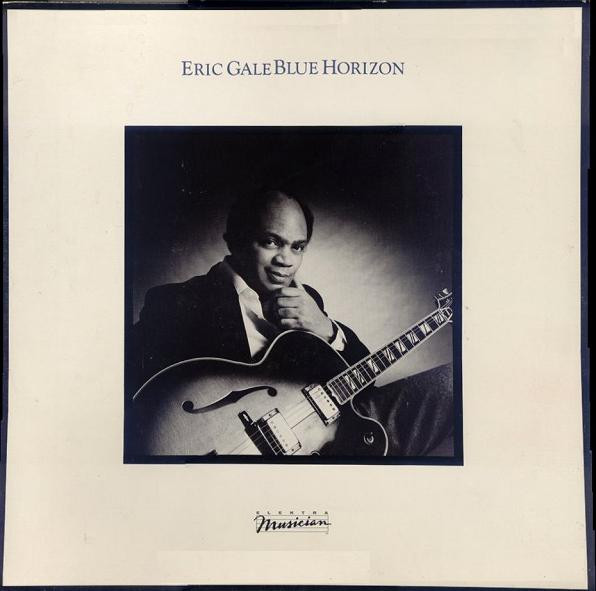
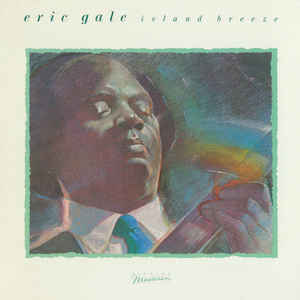
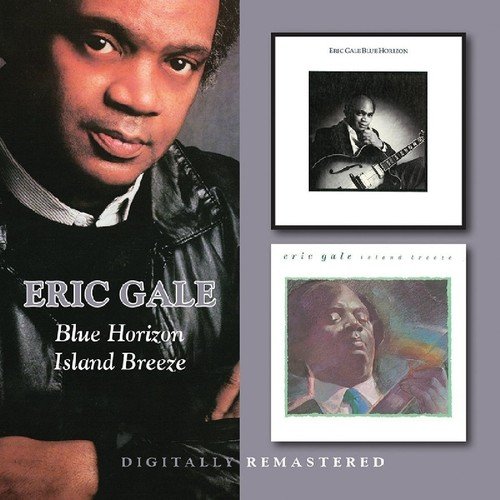
By 1982 Eric Gale was dividing his time between session work and his career as a solo artist. He released Blue Horizon in 1982, and Island Breeze in 1983. Both albums have been reissued on one CD by BGO Records. They’re a welcome reminder of a supremely talented guitarist. However, in the early fifties, it seemed Eric Gale was about to embark on a career as a scientist.
Having graduated high school, Eric headed to Niagara University, where he studied chemistry. It was there that Eric realised he didn’t want to pursue a career in science. So Eric left academia behind, and decided to pursue a career as session musician.
By then, Eric was in his early twenties, and was a novice in terms of session work. Despite this, he caught a break. Bobby Lewis was looking for a guitarist for the session when Tossin’ and Turnin’ was recorded. Eric got the job, and played alongside saxophonist King Curtis. He asked Eric to play on his Old Gold album. However, by then, Tossin’ and Turnin’ had reached number one on the US R&B charts in 1961. Eric Gale’s career was underway.
After playing on a number one single and King Curtis’ Old Gold album, Eric Gale became a familiar face in New York Studios. He played on sessions by The Drifters, Maxime Brown, Aretha Franklin, Red Holloway, Clark Terry, Jimmy McGriff and Oliver Nelson. By 1967, Eric was accompanying a young Van Morrison, drummer Bernard “Pretty” Purdie, Bobby Timmons and Herbie Mann. Unlike many session musicians, Eric didn’t specialise in one type of musician. Instead, he would on everything from jazz and soul to rock. That would be the case throughout his career as a session musician.
As the seventies dawned, there was no sating Eric Gale’s insatiable appetite for session work. He would have happily spend day and night in the studio. That had been the case in the sixties, and wasn’t going to change in the early seventies. Eric played on a number of sessions for Creed Taylor’s CTi and Kudu label. This included on albums by Quincy Jones, Johnny Hammond, Stanley Turrnetine, Hank Crawford and Esther Phillips. This gave Creed Taylor the opportunity to see and hear Eric Gale at close quarters. He liked what he heard, and in 1973, Creed Taylor signed Eric Gale to his Kudu imprint.
No longer was Eric Gale “just” a session musician, now he could add solo artist to his already impressive C.V. His debut solo album was Forecast, which was released later in 1973.
Forecast.
Forecast saw Eric joined by some of the Big Apple’s top session players. They step up to the plate on an album where cover versions sit side-by-side with Eric Gale compositions. With his all-star band for company, Eric showcased his versatility, veering between jazz, funk, blues and soul-jazz. Prior to its release, reviews of Forecast were positive. Alas, Forecast only reached twenty-two in the US Jazz charts, and proved to the only album Eric released on Kudu.
Negril.
It was another two years before Eric Gale released his sophomore album, Negril. By then, Eric was living in Jamaica, where he was enjoying a sabbatical. Despite being on sabbatical, Eric decided to record an album. He wrote, arranged and produced Negril at Harry J’s Studio in Kingston, in Jamaica. The album was a homage to the beautiful village of Negril and its unspoilt beaches. Once the album was complete, it was released in 1975.
When Negril was released in 1975, listeners discovered an album of laid-back, instrumental reggae. It was a very different album from Forecast, and one that showcased Eric’s versatility. This would be put to good use over the next couple of years.
After a three year sabbatical, Eric Gale returned to New York. When he arrived home, the money had run dry and he was without a job. Fortunately, a jazz supergroup were looking for a guitarist. Eric fitted the bill, and he joined Stuff.
With a lineup that featured bassist drummers Chris Parker Steve Gadd; bassist Gordon Edwards, guitarist Cornell Dupree and pianist Richard Tee, Stuff was worthy of being called a supergroup. Eric played on Stuff’s 1976 eponymous album, and the 1977 followup More Stuff. Still thought, Eric was working as a session musician, so would divide his time between Stuff and session work.
Still, Eric Gale was happy to work around the clock. Recording studios were like a second home. During 1976, Eric played on albums by Ashford and Simpson, Stanley Turrentine, Blood, Sweat and Tears, Bob James, Grover Washington, Paul Butterfield, Joe Coker, Patti Austin and Randy Crawford. 1977 was just as busy, with Eric accompanying Ashford and Simpson, Tom Scott, Bob James, Esther Phillips, Jun Fukamachi, Idris Muhammad, Yuseef Lateef and Kenny Loggins. However, 1977 was also the year Eric Gale was offered a solo deal by Columbia.
Ginseng Woman.
For Eric Gale, signing to Columbia meant he could rekindle his solo career. When Ginseng Woman which was released in 1977, Eric’s album of smooth jazz was reasonably well received by critics. Eric was already one of the finest practitioners of the genre. So it was no surprise when Ginseng Woman reached 148 in the US Billboard 200, fifty-six in the US R&B charts and number seven in the US Jazz charts. This was a good start to Eric Gale’s career at Columbia. Especially considering disco was at the peak of its popularity.
Multiplication.
Buoyed by the success of Ginseng Woman, Eric returned in 1978 with Multiplication. It wasn’t as well received as Ginseng Woman. As usual, record buyers had the final say, and Multiplication reached just number six in the US Jazz charts. Multiplication failed to trouble the US Billboard 200 and US R&B charts. For Eric Gale, this was disappointing.
Following the release of Multiplication, Eric continued to juggle his various roles. In 1978, he worked with everyone from Carly Simon, to Billy Joel and Thijs van Leer. Eric also worked on albums by Loleatta Holloway, Ashford and Simpson and his old friend Bob James. Still, Eric found time to play and record with Stuff. Then there was the small matter of his third solo album for Columbia.
Part Of You.
Despite the disappointing performance of Multiplication, Eric Gale returned in 1979 with a new album Part Of You. Before it was released, the album of smooth jazz garnered positive reviews from critics. Part Of You was a return to form from Eric Gale. Record buyers agreed, and Part Of You reached 154 in the US Billboard 200 and eleven in the US Jazz charts. Things were looking up for Eric Gale.
Touch Of Silk.
As a new decade dawned, Eric retuned in 1980 with his fourth album for Columbia Touch Of Silk. Despite the commercial success Part Of You enjoyed, Eric decided to change a winning formula on Touch Of Silk. He moved away from the smooth jazz of Part Of You, and Touch Of Silk showcases a sound that veered between funky to dark and bluesy. While Touch Of Silk was well received by critics, record buyers turned their back on the album. The only success Touch Of Silk enjoyed was in the US Jazz charts, where it reached number twelve. For Eric Gale, this was the end of the road at Columbia.
Blue Horizon.
With Eric Gale’s time at Columbia at an end, he signed to Elektra/Musician. For Eric this was a new start. Things were going to be different. He was going to dispense with the big name session players, and bring in an entirely new band. The other change Eric wanted to make, was to produce his albums at Elektra/Musician. First he had to get Bruce Lundvall to agree.
The question arose when Bruce Lundvall,who oversaw Elektra/Musician, asked who Eric wanted to produce Blue Horizon. Immediately, and hopefully, Eric through his name into the hat. To Eric’s delight, Bruce Lundvall agreed. Now Eric could and would explore various different musical genres.
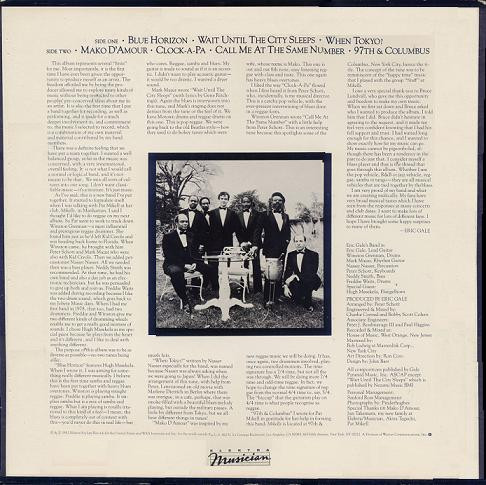
For what became Blue Horizon, Eric Gale wrote Blue Horizon, Mako D’Amour and 97th and Columbus. Wait Until The City Sleeps was penned by Gene Ritchings and Mark Mazur; while When Tokyo? was a Clive Phillips and Nasser Nasser composition. Peter Schott of Kid Creole and The Coconuts wrote Clock-A-Pa and cowrote Call Me At The Same Number with Winston Grennan. These seven songs were recorded by Eric’s new, hand picked band.
Recording of Blue Horizon took place at House Of Music, New Jersey. The new band’s rhythm section featured drummers Freddie Waits and Winston Grennan; bassist Neddy Smith; and rhythm guitarist Mark Mazur. Other members of the band included keyboardist Peter Schott; percussionist Nasser Nasser and Hugh Masakela on flugelhorn. Eric Gale took charge of lead guitar and produced Blue Horizon. Once the recording was complete, Blue Horizon was released in 1982.
Before that, critics had their say on Blue Horizon. They were surprised, but welcomed such an eclectic album. It was as if Eric had been reenergised by the move to Elektra/Musician. Despite this, Blue Horizon only reached twenty-nine on the US Jazz charts. This was a disappointment for Eric and everyone involved.
Record buyers had missed out on an album that featured Eric Gale with a new found musical freedom. He was allowed to explore new musical genres on Blue Horizon, a truly electric album.
That’s apparent from the opening track, where smooth jazz and subtle Caribbean rhythms unite to create a beautiful, melodic and laid-back track. At the heart of the track’s success was Eric’s crystalline guitar. Then stylistically, it’s all change on Wait Until The City Sleeps, a ballad featuring a a vocal by from Mark Mazur. Meanwhile, a piano adds an element of drama, as the rhythm section play a leading role. That’s until Eric’s blues-tinged guitar solo steals the show on this cinematic track. When Tokyo? also has a cinematic sound, and features a masterclass on the piano from Peter Schott. His playing is central to the track’s sound and success. Even when it becomes a tango. Only later, when Eric unleashes a bluesy guitar run, is Peter Schott’s supremacy challenged. A track of this quality was a fitting way to close side one of the original LP.
Mako D’Amour was written by Eric, and allows his crystalline guitar to take centre-stage. It’s a case of less is more, with Eric choosing each note with the utmost care. While his guitar steals the show, the rhythm section create a shuffling, reggae groove. That’s not the end of the reggae influence. There’s a Caribbean influence to the ballad Clock-A-Pa. It features a heartfelt vocal, while the arrangement, while there’s occasional excursions into dub, as Eric’s guitar takes on a bluesy hue
Then on Call Me At The Same Number the reggae influence continues. The rhythm section with its dual drummers play in a 7/4 time signature. Together they create the a pulsating backdrop for the vocal, and Eric’s brisk, searing, bluesy solo. It’s one of Eric’s finest, and shows that seamlessly, he can switch between musical genres. That’s apparent on Blue Horizon’s closing track, 97th and Columbus a pulsating fusion of disco and funk. This reinforces that Blue Horizon was the most eclectic album of Eric Gale’s recording career.
No wonder. Elements of blues, Caribbean, disco, dub, funk, jazz, pop and reggae featured on Blue Horizon. Elektra/Musician had afforded Eric Gale the freedom he longed for. With his new band, Eric Gale explored a verity of disparate new musical genres on Blue Horizon. He sounds as if he’s been reinvigorated, and as a result, delivers a series of almost flawless performances. Sadly, very few people heard Blue Horizon, and it became one of the hidden gems of Eric Gale’s back-catalogue. However, later in 1982, Eric released another solo album.
In The Shade Of A Tree
After releasing Blue Horizon, Eric Gale released In The Shade Of A Tree in Japan later in 1982. Stylistically, he album was similar to Blue Horizon, and was well received in Japan. In The Shade Of A Tree sold well in Japan, where Eric was a popular artist. It was ironic that Eric’s music was more popular halfway around the world than in his home country. Maybe his next album for Elektra/Musician would see Eric Gale’s fortunes improve in America?
Island Breeze.
Having released In The Shade Of A Tree, Eric Gale was constantly busy with various projects. He was a member of the NY-LA Dream Band, and had toured Japan with them. Then on his return, he had only a few days before he headed out to Montruex to record a live album. On his return, Eric Gale’s thoughts turned to his next album for Elektra/Musician.
For what became Island Breeze, Eric chose four cover versions. This included Bob James’ Boardwalk and Dark Romance. The other covers were Joe Sample’s My Momma Told Me So and Jeff Medina’s Island Breeze. Eric’s new musical director Jimmy Kachulis penned We’ll Make It, Sooner Or Later and I Know That’s Right. These songs were recorded by a new lien up of Eric’s band.
Since the recording of Blue Horizon, the lineup of Eric’s band had changed quite dramatically. The rhythm section now featured drummers Webb Thomas and Joey DeFrancesco; bassist bassist Neddy Smith; and rhythm guitarists Mark Mazur and Jimmy Kachulis. Keyboardists included Ted Lo and Andy Schwartz. This new lineup recorded at Rosebud Recording Studio, New York. Just like on Blue Horizon, Eric Gale took charge of production and played lead guitar. Once Island Breeze was complete, the album was released in 1983.
Before the release of Island Breeze, critics had their say on the followup to Blue Horizon. The reviews were positive, and this bode well for the rerelease of Island Breeze. However, Island Breeze reached just thirty-five on the US Jazz charts. It was a huge blow for Eric Gale. Especially considering the quality of music on Island Breeze, which brought Eric Gale’s career at Elektra/Musician to an end.
This was the case from the nine minute cover of Bob James’ Boardwalk, that opens Island Breeze. It’s a slice of smooth fusion that’s the perfect showcase for Eric’s considerable skills. He chooses each note with the utmost care, and enjoys the opportunity too stretch his legs on this epic cover. After that, it’s all change. We’ll Make It (Sooner Or Later) is a beautiful ballad. It features a tender, heartfelt and soulful vocal from one of music’s best kept secrets Sandy Barber. Her vocal is at the heart of the song’s success. Similarly, so is Eric’s blues-tinged guitar solo on My Momma Told Me So. It was written by Joe Sample, and featured on The Crusaders’ album Those Southern Knights. Uptempo, funky, with hint of fusion and Eric’s bluesy guitar, it’s another track that showcases Eric’s versatility. That was the case on side two of Island Breeze.
On Island Breeze, Eric, whose parents were from Barbados, revisits his Caribbean roots. As the arrangement breezes along, percussion and a sultry saxophone play supporting roles; as Eric adds a guitar solo whose roots can be traced back to reggae music. Dark Romance is another nine minute cinematic epic. It would be perfect for a soundtrack, as the track veers between wistful to moody, mesmeric, melodic and hopeful. Sometimes, there a degree of tension and mystery. Always, thought, beauty is omnipresent. Closing Island Breeze, is the uber funky and dance-floor friendly I Know That’s Right. It marks the return of Sandy Barber, who delivers a sassy vocal. Meanwhile, Eric’s guitar sounds not unlike Chic’s Niles Rodgers, as he shows another side to his playing. Just like on Blue Horizon, versatility is Eric Gale’s middle name.
For anyone yet to discover Eric Gale, then BGO Records’ recent reissue of Blue Horizon and Island Breeze on one CD is the perfect starting point. Especially since both albums have been mastered in high definition from the original master tapes. So it’s no surprise that the sound quality is stunning. This is another reason why make Blue Horizon and Island Breeze are the perfect introduction to one of the greatest jazz guitarists of his generation.
As a session musician, Eric Gale played on over 500 albums, accompanying the great and good of music. He also released around a dozen albums. Sadly, as is often the case, Eric Gale’s albums never enjoyed the success they deserved. That’s the case with Blue Horizon and Island Breeze, two of the hidden gems in Eric Gale’s impressive back-catalogue. They’re both hugely underrated albums, and a reminder of a truly talented and versatile guitarist who died far too young. Eric Gale died in 1994, aged just just fifty-five. Jazz had been robbed of one of its most talented sons. However, Eric Gale left behind a rich musical legacy, including Blue Horizon and Island Breeze.
ERIC GALE-BLUE HORIZON AND ISLAND BREEZE.

FIRE! ORCHESTRA-RITUAL.
FIRE! ORCHESTRA-RITUAL.
For their fourth album Ritual, the Fire! Orchestra has undergone a change in lineup. This isn’t unusual. Many groups, including Pink Floyd, Genesis, The Rolling Stones and even The Beatles’ lineup changed. Usually, this happened when one member of the group left. However, what has happened to the Fire! Orchestra is very different.
In business terms, the Fire! Orchestra have downsized. On their third album Second Exit, the Fire! Orchestra’s lineup numbered twenty-nine. For the recording of their fourth album Ritual, which will be released by Rune Grammofon on 13th May 2016, the Fire! Orchestra “slimmed” their lineup down to just twenty-one members. The newly slimmed down lineup of the Fire! Orchestra recorded Ritual in just two days. This isn’t unusual.
The three previous Fire! Orchestra albums were recorded quickly. It was a case of needs must. Fire! Orchestra features some of the biggest names in Scandinavian music. These musicians are always busy, so albums have to be recorded quickly. This was also the case with the group who gave birth to the Fire! Orchestra in 2011…Fire!
It was in 2009, when the Fire! story began. That was when bassist Johan Berthling, drummer Andreas Werliin and saxophonist Mats Gusfasson decided to form a new band. Fire! was to all intents and purposes a Swedish supergroup. After all Johan, Andreas and Mats were three of Sweden’s finest jazz musicians. Their speciality was free jazz. However, there was a minor problem.
Mats Gustafsson ,Johan Berthling and Andreas Werliin all had busy schedule. So they would have to fit playing and recording as Fire! round their existing schedules and other musical commitments.
Reeds player and saxophonist Mats Gustafsson is the elder statesmen of Fire! He was born in 1964, and has been involved in the Swedish music scene since 1988. Since then, Mats Gustafsson has worked as a musician, arranger, composer, conductor and producer. He’s played and performed on over 200 albums. That’s just the tip of the iceberg.
Currently, Mats Gustafsson is a a member of jazz trio The Thing. However, over the past three decides Mats Gustafsson has collaborated with everyone from Jim O’Rourke to Sonic Youth and Lasse Marhaug. Then there’s the solo albums Mats Gustafsson has released. These solo albums and collaborations add another seventy albums to Mats Gustafsson’s C.V. However, he’s not the only member of Fire! with an impressive C.V.
Just like Mats, bassist Johan Berthling is a veteran of numerous bands. Previously, he’s been a member of Angles, Angles 9, Boots Brown, Nacka Forum, Ohayo, Pipeline, Sten Sandell Trio, Tape, The Godforgottens, The Tiny and Time Is A Mountain. Away from these bands, Johan has worked as a hired hand.
Johan has worked as an arranger, musician, producer and songwriter. Already, he has around 170 credits to his name. When Johan’s not working on other people’s albums, he runs a record label.
In 1999, John and Klas Augustsson founded the Häpna record label. It’s based in Stockholm, and has released nearly sixty releases. This includes albums by Tape, who released their eighth album Casino in 2014. Just like other members of Fire!, Johan has a voracious appetite for making music.
The same can be said of drummer and percussionist, Andreas Werliin. He was born in 1982, and is the youngest member of Fire! Although he’s only thirty-four, Andreas is almost veteran of Swedish music. Andreas has worked as an arranger, musician, singer, songwriter and producer. He’s happy to work as a hired hand, when not been working with the various bands he’s been a member of.
Among the groups that Andreas has played in, are Angles 9, Time Is a Mountain, Tonbruket and Wildbirds and Peacedrums. In both Angles 9 and Time Is a Mountain, Andreas is joined by Johan in the rhythm section. They’ve formed a formidable partnership, since Fire! released their debut album in 2009.
You Liked Me Five Minutes Ago.
You Liked Me Five Minutes Ago was Fire!’s debut album. It showcased what was a new and innovative approach to improvised music. Fire! stepped out of their comfort zone on You Liked Me Five Minutes Ago, seamlessly combining free jazz, psychedelic rock and noise. This was the perfect showcase for the three members of Fire!’s considerable musical skills. Critics were won over by Fire!, and forecast a bright future from the Swedish trio.
Unreleased?
Two years later, and Fire! returned with the first collaboration of their career. They had recorded four lengthy improvised pieces with Chicago born, but Tokyo based performer, composer and record producer. He was a veteran of countless collaborations since his career began in the late eighties. Now he was ready to hitch a ride with Fire!
When the album was ready for release in 2011, Fire! received star billing. Fire! With Jim O’Rourke Unreleased? was released on Rune Grammofon. This genre-melting album saw Fire! continue to push musical boundaries, taking the music in hitherto unexpected directions. The collaboration with Jim O’Rourke was regarded as an overwhelming success. So it was no surprise when another artist asked to collaborate with Fire!
In The Mouth-A Hand.
This time, it was Australian experimental electronic guitarist and percussionist, Oren Ambarchi. He was no stranger to collaborations, and previously, had worked a variety of artists, including Keith Rowe. Fire! agreed to the collaboration, and the result was the album In The Mouth-A Hand.
It featured another four lengthy, improvised tracks. This allowed Fire! and Oren Ambarchi to take the listener on a musical adventure, where musical genres and influences were combined. Three of the most prevalent influences were free jazz, noise and psychedelic rock. Just like previous albums, this was a crucial part of Fire!’s sound.
When In The Mouth-A Hand was released on Rune Grammofon, again, Fire! received top billing. They played a huge part in what was another important album collaboration. With Oren Ambarchi, Fire! had created another album of groundbreaking, innovative music. Despite this, Fire!’s next album wasn’t a collaboration. Instead, it featured just the three members of Fire!
(Without Noticing).
By the time, Fire! began work on (Without Noticing), they were regarded as one of the most exciting and innovative groups in the Scandinavian music scene. Fire! had released three albums in three years. Now they were four for four.
When (Without Noticing) was released on Rune Grammofon in 2013, it was hailed a career defining album. It was a fusion of free jazz and psychedelic rock via a more traditional rocky and jazz-tinged sound. Fire! weren’t afraid of pushing musical boundaries, and on (Without Noticing), continued to do so. This resulted in critically acclaimed reviews from critics. However, by then, Fire! had realised the limitations of a trio, and founded the Fire! Orchestra.
Fire!-Orchestra-Exit.
In 2011, that the members of Fire decided to expand beyond the core trio. They hit on the idea to expand the group. The way Fire! did this, was to bring onboard the great and the good of Scandinavian jazz, improvisation and avant rock players and vocalists. They called this new musical venture Fire! Orchestra. It was a musical first in Sweden.
The newly named Fire! Orchestra were building on the music of some of the legendary free jazz big bands. This includes the big bands of Sun Ra, Charlie Haden’s Liberation Orchestra, Mike Westbrook and Mike McGregor. There was more to the Fire! Orchestra that free jazz. They incorporated funk, blues, rock and jazz. This became apparent when the Fire! Orchestra made their tentative first steps.
In the beginning, the Fire! Orchestra played just a handful of shows. They were finding their feet musically. Gradually, they were finding their sound. It’s best described as genre-melting and was showcased on their live debut album, Exit.
It was in 2013, when Fire! released their live debut album Exit. Released to widespread critical acclaim, Exit was a genre-melting sound that people wanted to hear more of.
Enter.
So after playing a couple of concerts early in January 2014, the Fire! Orchestra entered the Svenska Grammofonstudion, in Gothenberg on 10th January 2014. This wasn’t going to be a long session. Instead, the Fire! Orchestra took just one day to record Enter.
The result was an album of music that critics called innovative and progressive. Enter showcased the Fire! Orchestra in full flight. This was an impressive sound. Especially given their fusion of mesomorphic rock rhythms, funk, free jazz and the bluesy, soul-baring vocals of the Fire! Orchestra’s three vocalists. Add to this the scorching free jazz saxophone of Joe McPhee and Enter, has a potent, powerful and captivating sound; which succeeded in bringing back memories of musical luminaries like Sun Ra, Charlie Haden’s Liberation Orchestra, Mike Westbrook and Mike McGregor. So successful was Enter, that Fire! Orchestra released one more album.
Exit Again.
Just like Exit, Exit Again was another live album. The concert was recorded on 2nd September 2012 at Festival Les Rendez-Vous de L’erdre, in Nantes, France. Joining a slimmed down version of the Fire! Orchestra that night, was guitarist Oren Ambarchi. Joined the great and good of Scandinavian music for what was the Fire! Orchestra’s encore.
When Exit Again was released on 14th January 2014, it was a limited edition release. Only 500 copies of the Exit Again were released on vinyl. Again, the Fire! Orchestra in full flight was an impressive sound. On Second Exit Part One and Second Exit Part Two, the Fire! Orchestra showcase their considerable skills and seamlessly, switch between disparate musical genres. Somehow, it all makes sense, and has the listener wanting to hear more of the Fire! Orchestra. Before that, Fire! would return.
Fire!-She Sleeps, She Sleeps.
Work began on She Sleeps, She Sleeps back in March 2015. That’s when the three members of Fire! recorded the four songs they had written, and would produce.
Recording of She Sleeps, She Sleeps took place at Orionteatern studios in Stockholm. The album was recorded by Mikael Werliin, who also recorded guest artist cellist Leo Svensson Sander at Rud Studios, in Stockholm. Halfway around the world, in Melbourne, Australia, guitarist Oren Ambarchi laid down his parts for She Bid A Meaningless Farewell. Once the sessions were complete, the album was mixed and mastered. Only then was She Sleeps, She Sleeps ready for release.
Eventually, She Sleeps, She Sleeps was scheduled for release on 19th February 2016, by Rune Grammofon. The album was released to widespread critical acclaim. Plaudits and praise accompanied She Sleeps, She Sleeps. I described the album as: “groundbreaking, influential and innovative.” She Sleeps, She Sleeps was also “progressive” and Fire!’s “Magnus Opus.” For the three members of Fire!, this was a good way to start 2016.
Fire! Orchestra-Ritual.
After the release of Fire!’s fifth album She Sleeps, She Sleeps, Johan Berthling, Andreas Werliin and Mats Gusfasson’s thoughts turned to the Fire! Orchestra’s new album Ritual. It had already been recorded by the “slimmed down” lineup of the Fire! Orchestra in 2015.
For the Fire! Orchestra’s fourth album Ritual, Johan Berthling, Andreas Werliin, Mats Gusfasson and Mariam Wallentin composed the five part Ritual suite. It examines mysteries and rituals, not just in life, but in music. Ritual featured texts by Erik Lindegren. This included extracts from his poetry books The Man Without A Way and 1942, which when it was published, was heralded as a truly influential piece of work. With Ritual composed, the next step was for the the Fire! Orchestra to record the album.
Recording of Ritual was scheduled to take place at Rixmixningsverket, in Stockholm. That was where the new lineup of the Fire! Orchestra would record the five part Ritual suite. This new lineup saw the Fire! Orchestra slim down from twenty-nine to twenty-one members. Despite its reduced numbers, the Fire! Orchestra were still capable of producing an impressive sound.
Providing Ritual’s heartbeat, were Fire! Orchestra’s rhythm section. This included drummers Andreas Werliin and Mads Forsby; bassist Johan Berthling; and guitarists Finn Loxbo, Julien Desprez. They were joined by keyboardists Edvin Nahlin and Martin Hederos who also played violin. Vocalists included Mariam Wallentin and Ethiopian-born Sofie Jernberg. Add electronics was electro minimalist Andreas Berthling. However, this was only part of the Fire! Orchestra.
The final part of the Fire! Orchestra was the horn section. It included trumpeters Niklas Barnö and Susana Santos Silva; trombonist Mats Äleklint; and tubaist Per Åke Holmlander. They were joined by alto saxophonists Anna Högberg and Mette Rasmussen; baritone saxophonists Jonas Kullhammar, Mats Gustafsson; French hornist Hild Sofie Tafjord; and Lotte Anker who switched between soprano and tenor saxophone. Per ‘Texas’ Johansson played baritone saxophone and also played clarinet. This completed the Fire! Orchestra’s lineup as recorded began on 17th December 2015.
With everyone’s time limited, and Christmas fast approaching the Fire! Orchestra worked quickly, and Ritual was completed by 18th December 2015. It had taken just two days for the Fire! Orchestra to record Ritual. Now the album had to be mixed.
The man tasked with mixing Ritual was Mikael Werliin. He had recorded Ritual with Linn Fijal. So on the 15th and 16th January 2016, Mikael Werliin mixed Ritual at Studio Oodion, Gothenburg. Once Ritual was mixed, the album was mastered by Lupo at Calyx Mastering, Berlin on 5th February 2016. This was the final piece of the jigsaw. Now all that was left was to set a release date.
The date chosen for the release of Ritual was 13th May 2016. That’s when Rune Grammofon will released the Fire! Orchestra’s first album for two long years. Has Ritual been worth the wait, and does the slimmed down lineup of the Fire! Orchestra affect their impressive sound? That’s what I’ll tell you.
Ritual opens with Ritual Part 1, the first part in a five-part suite. Bursts of blazing, scorching horns join the rhythm section in driving the arrangement along. They create an arrangement that’s funky, jazzy and hypnotic.. Panned ninety degrees left is a grinding, buzzing sound. It comes courtesy of electro minimalist Andreas Berthling, and adds an avant-garde influence. Meanwhile, the arrangement continues to build. Then when the horns drop out, the twin vocals of Mariam Wallentin and Sofie Jernberg enter. They’re dreamy, sultry and soulful. Soon, the horns return, rasping, growling and wailing as they head in the direction of free jazz. By then, a crystalline guitar and flourishes of Fender Rhodes have been added. However, it’s the vocals and horns that play starring roles. Then at 5.54 the arrangement becomes understated. Just urgent vocals and percussion combine. This urgency and drama builds, and soon, the Fire! Orchestra are straining at the leash. Before long, it’s impossible to hold them back, and they become an unstoppable force. In full flow, the Fire! Orchestra is an impressive sound, as seamlessly they combine elements of funk, jazz, avant-garde, free jazz and rock.
A scratchy, rasping free jazz saxophone opens Ritual Part 2. Soon, it’s being played quickly and powerfully. It howls, growls and soars above the arrangement. Then at 1.54 a guitar, shimmering cymbals and then the horn section enter. They play as one, while still, the lone wailing saxophone solo unleashes its plaintive and impassioned cry. It’s replaced by an equally impassioned vocal, that veers between soulful to free jazz in style. Meanwhile, the rest of the Fire! Orchestra lock into a groove, and create a hypnotic and sometimes, swinging backdrop. Later, some of the horn section add a New Orleans sound. By then, drums pound thunderously, while hypnotic, rasping, braying horns join the vocals in adding a melodic sound. From there, the horns head in the direction of free jazz, as the arrangement becomes a jam. It’s variously mesmeric, melodic, cinematic, urgent and always captivating. That’s not surprising, given the Fire! Orchestra’s impressive array of talented and innovative musicians.
For the first three minutes of Ritual Part 3, Andreas Berthling unleashes an array of abstract sounds. They buzz, crackle, grind and whirr, as a searing guitar melts into the arrangement. Nothing is as it seems. Later, braying, wailing horns join the myriad of abstract sounds. They whine and growl, before taking their leave, and being replaced by a wailing, scatted vocal. Just like the scratchy violin it becomes part of the bigger picture. Meanwhile, a melancholy French horn plays a lament. It’s joined by subtle, rueful and melancholy horns. As they play, the unmistakable lush sound of a Fender Rhodes plays in the background. Adding other layers of sound are a tuba, drums and beautiful, wistful vocals. Still the horns and drums are restrained, as we hear a very different side to the Fire! Orchestra. Ritual Part 3 is a song of two parts, that shows the Fire! Orchestra at their imaginative and inventive best.
Rolls and pounding drums join crashing cymbals on Ritual Part 4. Then at 2.09, a blistering, searing, scorching guitar is unleashed. It’s played with power and urgency. Fingers fly up and down the fretboard. That the case until a wash of wailing feedback is unleashed. Gradually it dissipates across the arrangement. By then, Andreas Werliin powers his way round his drum kit. Not to be outdone, the rest of the rhythm section join the frae, and drive the arrangement along. So do the twin vocalists. They scat, their vocals soaring above the arrangement. This now includes braying horns. Soon, the scat becomes a soulful vocal, and veers between the two styles. The Fire! Orchestra are in full flight, and it’s a glorious, impressive and melodic sound. Especially with seesaw horns joining the soulful vocals and driving rhythm section. However, at 10.26 the tempo slows, and arrangement almost grinds to a halt by 11.01. From there a melancholy violin joins free jazz horns, as the Fire! Orchestra throw a curveball. In doing so, they showcase their versatility and propensity to innovate.
Closing Ritual is Ritual Part 5. Just the rhythm section and keyboards combine to create a slow, thoughtful backdrop. They’re soon joined by tender, rasping horns. Together they create a moody, cinematic backdrop. A quivering, cooing alto saxophone soars above the arrangement. By then, it’s played with power. That’s the signal for the vocal to enter, and the tempo to rise. The Fire! Orchestra play with more urgency. As they do, all of a sudden a phone rings. This is just the first of an array of sounds that assail the listener. Buzz, crackles and whirs can be heard as the twin vocals and braying horns play starring roles on this beautiful, melodic track. It leaves the listener wanting more.
No wonder. Ritual finds the Fire! Orchestra at their progressive and innovative best. That’s despite the Fire! Orchestra slimming down its lineup from twenty-nine to ‘just’ twenty-one musicians. However, they’re no ordinary musicians.
The Fire! Orchestra features some of the most talented musicians Sweden, Norway, Denmark and France has to offer. When they join the Fire! Orchestra,they become part of a pan European supergroup. It’s featured some of the biggest names in European jazz. However, the lineup is somewhat fluid, and members of the Fire! Orchestra have been ever-present since Johan Berthling, Andreas Werliin and saxophonist Mats Gusfasson formed the Fire! Orchestra back in 2011. Since then, the Fire! Orchestra’s star has been in the ascendancy.
Five years after they first played live, the Fire! Orchestra are now a hugely popular live draw. When they play live, the sold out signs are up. After all, the Fire! Orchestra in full flow, is an impressive sound. That’s the case with each of the three albums the Fire! Orchestra have released. However, three becomes four when the Fire! Orchestra released Ritual on 13th May 2016, on Rune Grammofon. It’s as if everything that’s gone before has been leading up to Ritual, the Fire! Orchestra’s first album since 2014.
Ritual features the five part Ritual suite. It’s a captivating album where the Fire! Orchestra combine avant-garde, experimental, free jazz, funk, jazz and rock. The music veers between restrained and understated to urgent and dramatic. Other times, the music is mesmeric and hypnotic, before becoming melodic and soulful. Occasionally, the music becomes moody, wistful and cinematic. Always, the music is ambitious, experimental and progressive. Just like previous albums, Ritual is imaginative, inventive and innovative. It’s also joyous and uplifting, with the Fire! Orchestra playing with freedom and spontaneity, as they examine mysteries and rituals, not just in life, but in music. This five suite exploration is a musical tour de force from the Fire! Orchestra, Ritual which proves that when it comes to lineups, size isn’t everything.
FIRE! ORCHESTRA-RITUAL.

STIAN WESTERHUS-AMPUTATION.
STIAN WESTERHUS-AMPUTATION.
Over the last few years, Stian Westerhus has established a reputation as one of Europe’s most accomplished and innovative abstract guitar players. This has been the result of a lifetime’s work. That is how long it has taken Stian to hone and tame his unique sound. This dedication has paid off, and nowadays, Stian Westerhus is constantly in demand as a session player, vocalist, mixer, recordist and producer. However, that is just part of the Stian Westerhus’ story.
Stian Westerhus also finds time to collaborate on albums with the great and the good of Norwegian music. That’s not forgetting releasing a quartet of solo albums. Stian Westerhus’ fourth solo album Amputation, was released on 29th April on the House Of Mythology label. It’s the followup to The Matriarch and The Wrong Kind Of Flowers, which was released to critical acclaim in 2012. This was nothing new.
Critical acclaim has accompanied many of the collaborations and solo albums Stian Westerhus has released. His recording career began ten years ago, in 2006. By then, Stian had spent a large part of his adult life studying music. This began at Middlesex University, where Stian graduated as a Bachelor of Music. Next stop, was Trondheim, where Stian gained his Masters degree. Following his graduation, he was ready to embark upon a career as a musician.
Stian’s career began with Puma. who fused experimental rock, noise and jazz. They released three albums between 2006 and 2010. Puma’s debut album Isolationism was released in 2006. It was well received by critics. However, the following year, Stian was part of another group, Fraud.
They were a short-lived jazz group, who only released one album. Fraud were a trio, whose eponymous debut album was released in 2007. Despite positive reviews, Fraud never released another album. So Stian returned to Puma.
Two years after releasing their debut album Isolationism, Puma returned with their sophomore album Discotheque Bitpunchin in 2008. Just like Puma’s debut, the album won praise from critics. However, by 2008, Stian was already collaborating with other artists.
In 2008, Stian had already collaborated with Eldbjørg Raknes and saxophonist Eirik Hegda. The result was the album From Frozen Feet, which was released in 2008. The same year, Stian collaborated with Norwegian percussionist Terje Isungset on Laden With Rain. Together with his work as a session musician, this stand Stian in good stead when he embarked upon his solo career. That was in the not to distant future.
2009 was a busy year for Stian, and found him working on four separate projects. This included adding vocals to Bladed’s 2009 album Mangled Dreams. Stian had also formed Monolithic, an experimented noise duo with drummer Kenneth Kapstad. Monolithic released their debut album Frantic Calm in 2009, which was mixed by Stian. Meanwhile, Stian was working on a collaboration between Puma and Lasse Marhaug. The resultant album, Fist Full Of Knuckles was released to widespread critical acclaim in 2008, and regarded as a union of innovators. However, after the release of Fist Full Of Knuckles, Stian’s solo career began.
Later in 2009, Stian released his debut solo album Galore. It was mixed, recorded and produced by Stian. When it was released, it was to critical acclaim. This bode well for the future, and was the perfect way to start a new chapter in Stian’s career.
Especially, as another chapter was closing. Puma released their final solo album Half Nelson Courtship in 2010. Just like previous Puma albums, Half Nelson Courtship has been well received by critics. However, fittingly, Puma seemed to have saved their best album until last.
After four albums, Puma called time on their career. This allowed Stian more time to concentrate on his solo career and other projects.
Stian released his sophomore solo album later in 2010. Pitch Black Star Spangled saw Stian further develop his abstract guitar style. Critically acclaimed, Stian was seen as one of Norwegian music’s leading musicians. That’s why he was constantly in-demand as a guitarist, vocalist and later, a producer
During 2010, Stian had played on Jaga Jazzist’s album One Armed Bandit by keyboardist Øystein Moen. He had been a member of Puma, so Stian agreed. Stian played everything from percussion, harp, effects, twelve-string guitar, baritone guitar and electric guitar. When One Armed Bandit was released, it was to plaudits and praise. Critics hailed the album, one of the best of 2010. This proved to be the case, and One Armed Band won a Spellemannprisen in 2011. However, Stian’s musical year wasn’t over.
To round off 2010, Stian played on Maurhaug’s All Music At Once. 2010, had been, without doubt, the most productive year of Stian’s career.
2011 saw Stian play on Ulver’s War Of The Roses album. He also played harmonium, mixed and produced Nils Petter Molvær’s Baboon Moon. For Stian, this was all good experience for his solo career, which he returned to in 2012.
The Matriarch And The Wrong Kind Of Flowers was Stian’s fourth solo album. It was released in 2012 to critical acclaim. Critics hailed this genre melting album Stian’s finest album. That wasn’t the end of 2012 for Stian.
During 2012, Stian played on Susanne Sundfør’s album The Silicon Veil. Stian also released a collaborated with Bol and Hans Magnus Ryan on album. Billed as Bol, Westerhus, Snah, the trio released what was hailed as ambitious and innovative album Numb Number. However, the most successful album Stian was involved with during 2012, was his collaboration with Sidsel Endresen.
Stian collaborated with Norwegian jazz vocalist Sidsel Endresen on Didymoi Dreams. This was an album that pushed musical boundaries to their limits, and sometimes, and way beyond. Stian’s blistering, searing guitar licks and Sidsel’s explosive bursts of vocal were a potent partnership. Genres melted into one as Stian and Sidsel challenged musical norms. Ambitious, brave and groundbreaking describes this opus. It was no surprise when Didymoi Dreams won a Spellemannprisen in 2013. By then Stian decided to change direction and founded Stian Westerhus and Pale Horses.
They were a new band in name only. Stian, keyboardist Øystein Moen and drummer and percussionist Erland Dahlen had all played together in Puma. Øystein Moen also was a member of Jaga Jazzist. Stian made a guest appearance on their 2010 album One Armed Bandit. So musically, they knew each other really well. They fused experimental, jazz and post rock on Maelstrom, which was released in 2014. It was hailed as one of the finest Norwegian albums of 2014. This bode well for Stian’s second collaboration,with Sidsel Endresen.
Recording of Bonita took place at Oslo Klang Studio in August 2014. It was recorded by Johnny Skalleberg. Stian mixed and produced Bonita during September 2014. By January 2015, Bonita was ready for release. On its release, Bonita I described the album as “a marriage made in musical heaven. They bring out the best in each other, driving each other to greater musical heights.” The result was one of Stian’s finest collaborations. However, there was no time for Stian to rest on his laurels, he had more music to make,
Later in 2014, Stian played guitar on three tracks on Sivert Høyem’s album Endless Love. For Stian, 2014 had been a busy, but rewarding year for him.
Just like previous years, 2015 proved to be another busy year for Stian Westerhus. Monolithic returned after a six year break, and recorded their sophomore album Frantic Calm. Not only did Stian add guitar and vocals, but he mixed and produced Frantic Calm. The result was an album where rock, experimental and noise were fused by Monolithic. Their comeback was well received, but by then, Stein was working on his fourth solo album Amputation.
Just like previous albums, Stian Westerhus continues to push musical boundaries on Amputation. To do this, he experiments stylistically and sonically. Aided and abetted by an array of effects, Stian follows in the footsteps of pioneers like Michael Rother, Can’s Michael Karoli and Ash Ra Stian showcases his versatility and inventiveness on the six new soundscapes he composed for Amputation. These soundscapes were recorded during 2015.
Recording of Amputation took place at Pitch Black Star Spangled Studio, Notam and Vigeland’s Mausoleum in Oslo. It was just Stian, his trusty guitar and an array of effects. His secret weapons included a drum machine and occasionally, ethereal, elegiac harmonies. They’re reminiscent of Scott Walker’s most recent work. Once the five tracks were recorded, Amputation was mixed and produced at Pitch Black Star Spangled Studio during 2015 and 2016. Then Amputation was mastered at Audio Virus Labs, by Helge Sten, one of Norway’s finest mastering engineer. When the mastering was complete, Amputation was scheduled for release on 29th April on the House Of Mythology label.
After a four year break, Stian Westerhus’ solo career resumes with Amputation. It’s the much-anticipated followup to The Wrong Kind Of Flowers, which was released to critical acclaim in 2012. As the release date approached, critics wondered whether Amputation would live up to The Wrong Kind Of Flowers? That’s what I’ll tell you.
Kings Never Sleep opens Amputation. A tender, soul-baring vocal is delivered, before Stian toys and teases the guitar. Gently Stian plucks and scratches the strings, producing an array of alternative and otherworldly sounds. They add an avant-garde and experimental sound, while Stian’s vocal has a soulful quality. Space is left within the arrangement, as a series crackling, buzzing, chirping and crystalline sounds escape from the arrangement. By 1.18 washes of a weeping, wailing guitar joins Stian’s heart-wrenching vocal. The guitar adds a melodic quality, before Stian’s vocal becomes powerful, elegiac and impassioned. He sounds not unlike Scott Walker. Meanwhile, mesmeric ripples and washes of guitar accompany him. Soon, though, a scorching, searing guitar and futuristic sound effects accompany the ethereal harmonies. Then the arrangement becomes understated. However, it’s transformed when a blistering guitar solo is unleashed. It’s a tantalising taste of a truly talented and versatile guitarist, as he produces a virtuoso performance.
A distant beeping sound sends out a warning signal on Sinking Ships. Emotion fills Stian’s vocal as he delivers the lyrics. Accompanying him, are waves of shimmering, glistening guitar. Effects transform the guitar, as it threatens to distort and reverberates. It grows in power, matching the pain in Stian’s voice. Then when his vocal drops out, he unleashes melodic washes of guitar. That’s until a dark, almost mournful sound replaces it. It’s as if it’s sending out a warning signal about the Sinking Ships. What sounds like a sonar signal enters. Maybe the search is underway? Meanwhile, the mournful sound continues; and the bubbling arrangement takes on a haunting, cinematic sound.
A myriad of disparate sounds open How Long. Together, they take on a strangely melodic sound. They come courtesy of Stian’s dark, buzzing guitar. The original dry signal has been transformed by an array of effects, that results in this melodic, and almost mesmeric backdrop. It’s accompanied by Stian’s vocal, which has been been inspired by Jeff and Tim Buckley and even Scott Walker. He questions and probes, asking: “can you tell me what is happening.” Soon, his vocal becomes a confessional, and a cathartic outpouring of emotion. By then, a drum machine adds a slow, pounding beat that resonates. Midway through the track swells of shrill, uncompromising guitar dominate the arrangement. They replicate strings, and add not just to the drama, but to the melodic nature of the track. When they dissipate, Stian confesses: “I never wanted to know,” as the arrangement grows in power and drama. This result in a powerful, moving and beautiful, melodic track which features Stian at his most inventive.
Amputation is a two part suite. Part one opens with beeping, squeaking sound. It sounds as if Stian is replicating the sound of a life-support machine. An elongated beep gives way to what sounds like a saw, as it cuts and grinds. So realistic is the noise, is that it’s almost possible to imagine the sparks flying as am Amputation takes place. After a small explosion, the sawing, grinding sound continues and the blade cuts through the bone. It’s replaced by a rumbling as an elegiac vocal soars above the arrangement. Disbelief fills the vocal, as it realises what has happened. Ethereal, angelic harmonies accompany the vocal. When the vocal drops out, swells shrill strings add an element of drama to the arrangement. It meanders along, allowing the listener to reflect on what they’ve heard. Meanwhile, a drum machine replicates a heartbeat, which makes the subject matter all the more real. It’s an incredibly powerful and cerebral track that tackles a subject that most musicians would shy away from.
Straight away, Infectious Decay sounds as if it has a foot in eighties synth pop. A drum machine and a myriad of beeps and squeaks adds the eighties sound, while Stian sings: “there’s a times to forgive and time to forget,..there’s a time to let go, and a time to move on.” Meanwhile, he play the guitar with a degree of urgency. It threatens to distort, while what sounds like gun shots punctuate the arrangement. Adding a contrast are his cooing harmonies and pulsating beats. As Stian scats and harmonises, his vocal sounds like Scott Walker. Later, ethereal harmonies give way to Stan’s vocal as he sings: “then ask me to just come home, you say you’d forgive me for all I’ve done, for my birthday you threw me a stone, so I packed up my things and left you alone.” By then, Stian’s vocal is an outpouring of emotion, hurt and regret. He’s becomes a troubled troubadour, who doesn’t know which way to turn on what’s an emotional roller coaster.
Amputation Part II closes Amputation. Straight away, elements of industrial, avant-garde and experimental music combine. The arrangement whirrs, shrieks, roars and grinds. It’s as if the Amputation is taking place again? Maybe it’s a flashback or nightmare, as in the distance, what sounds like a scream can be heard? Despite thgis, there’s a hypnotic and strangely melodic quality to the track. Later, Stian’s guitar creates a myriad of whirring, grinding sounds. This replicates earlier the sound of a saw cutting through bone. When these sound combine, they take on a hypnotic sound. Incredibly, Stian’s guitar is responsible for most of the sounds in the arrangement. Sometimes, he uses feedback, and controls it to replicate another sound. Most guitarists would neither have the technique nor the imagination to do this. However, Stian’s like to a musical magician, who weaves magic with his guitar, and in the process, creates music that’s innovative, cinematic, melodic and thought-provoking.
That’s the case throughout Amputation, where Stian Westerhus creates music that’s cerebral, challenging and thought-provoking. Stian wants the listener to think; sometimes about subjects that will make them uncomfortable. That’s the case on Amputation and Amputation Part II. The sounds that Stian replicates, are the sounds heard in an operating theatre, when an amputation is taking place. That’s something most people will neither hear, nor have to even consider. However, some people have to face the reality of losing a limb. It’s a traumatic and life-changing event. Most musicians would shy away from even broaching such a controversial subject. Not Stian Westerhus. He brings the subject into the open, and faces the reality head on. For that he should be congratulated. However, the Amputation suite is just part of Amputation.
The music on Amputation is also beautiful, cinematic, ethereal and melodic. Other times, it’s dark, haunting and mournful. Sometimes, Stian lays bare his soul, delivering vocals that are akin to an outpouring of emotion. When this happens, there’s a cathartic quality to the vocals, as if Stian is cleansing his soul. He breathes life and meaning into the lyrics on Sinking Ships, How Long and Infectious Decay. Always, the music on Amputation is compelling and innovative.
Incredibly, when Stian Westerhus recorded Amputation, all he used was his guitar, an array of effects and a drum machine. Just like on his three previous solo albums, Stian Westerhus reinvents how to play the guitar. He creates innovative soundscapes peppered with an array of disparate sound. Most of them are made with a guitar. However, most guitarists wouldn’t know how to replicate these sounds, never mind the six tracks on Amputation. Stian Westerhus however has the talent, vision and imagination to create such a groundbreaking album as Amputation.
To do that, draws inspiration from artist like pioneering guitarists including Ash Ra, Michael Karoli and Michael Rother. Vocalists like Jeff Buckley, Scott Walker and Tim Buckley seem to have influenced Stian Westerhus stylistically. So it’s no surprise that Amputation doesn’t fit neatly into a musical genre. Instead, elements of ambient, avant-garde, avant-rock, eighties synth pop, experimental, industrial, post rock and rock can be heard on Amputation, which was released on 29th April on the House Of Mythology label. It’s the much-anticpated followup to The Matriarch and The Wrong Kind Of Flowers, which was released to critical acclaim in 2012. It was regarded as the best album of Stian’s career.
Not any more. Amputation steals the crown from The Matriarch and The Wrong Kind Of Flowers. Seven years after releasing his debut album, Stian Westerhus has released Amputation, which is a career defining. It’s well worth the four year wait. Amputation is not only cerebral, challenging and thought-provoking, but also beautiful, cinematic, ethereal and melodic. It finds Stian Westerhus, one of the most talented Norwegian musicians of his generation, at his innovative best on Amputation, which is undoubtably the best album of his career.
STIAN WESTERHUS-AMPUTATION.
THE BLUE NILE-A WALK ACROSS THE ROOFTOPS.
THE BLUE NILE-A WALK ACROSS THE ROOFTOPS.
To celebrate the fifth anniversary of this particular blog, I decided to revisit one of my favourite albums of all time, The Blue Nile’s debut album A Walk Across The Rooftops. This is an album I’ve treasured and loved for over three decades. It’s been like an old friend, and has been a faithful companion in an ever-changing musical world. A Walk Across The Rooftops is an album that has part of the soundtrack to my life. So when I decided to write about an album that’s played a huge part in my life, there was only one choice, The Blue Nile’s A Walk Across The Rooftops.
Enigmatic, reluctant and contrarian are words that best of describe The Blue Nile’s 1984 debut album A Walk Across the Rooftops. The Blue Nile are the complete opposite of most bands. Describing the Blue Nile as publicity shy, is an understatement. Indeed, since Paul Buchanan, Robert Bell and Paul Joseph Moore formed the Blue Nile, they’ve been one of the most low-profile bands in musical history. It seems that when they formed thirty-five years ago, The Blue Nile ticked the “no publicity” box. This has proved a double-edged sword, and resulted in The Blue Nile becoming one of the most enigmatic groups ever.
Having released their debut album A Walk Across the Rooftops in 1984, only three further albums were released during the next twenty years. Five years after A Walk Across the Rooftops came 1989s Hats. This marked the end of the original Blue Nile sound, where influences so diverse as Kraftwerk, Brian Eno and Frank Sinatra united. The next time Blue Nile released an album, they turned to America for inspiration.
Seven long years passed, where Blue Nile fans wondered what had become of Glasgow’s most enigmatic trio. Then the unthinkable happened. The Blue Nile signed a million Dollar deal with Warner Bros. and along came Peace At Last, released in 1996. Gone was the sound of A Walk Across the Rooftops and Hats, with the American-influenced Peace At Last showing a different side to the Blue Nile and their music. Paul, Robert and P.J. were back, but it was a different sound. One constant was Paul’s worldweary vocal. He was still the tortured soul, who wore his heart on his sleeve. Opinions were divided among fans and critics. Little did we know that Peace At Last was their penultimate album.
High released in 2004, proved to be the Blue Nile’s swan-song. It was very different from their first two albums, Although soulful, High lacked the European influence of A Walk Across the Rooftops and Hats. Some critics unkindly called High soul for the wine bar generation. Obviously, they didn’t quite get High, or more likely, didn’t want to. Maybe they didn’t want to understand its subtleties and nuances. What they neither understood nor realized was that the Blue Nile were never a band to stand still. Instead, they’d always tried to innovate and ensure their music evolved and was reborn. Sadly, there would be no rebirth for the Blue Nile’s music. After just four albums, the Blue Nile were no more. Even when they spilt-up, the Blue Nile never told anyone. Instead, like the lover that waits for the letter that never arrives, Blue Nile fans waited for an album that was never released.
Just like that lover, all we’re left is our memories. This includes the four albums The Blue Nile released between 1984 and 2004. The first of these was A Walk Across The Rooftops, which was released in 1984. That was thirty years ago. Sadly, there’s no fanfare for what was a true classic, and the album that launched the career of the enigmatic Blue Nile. They always did things their way.
Even the story of how A Walk Across the Rooftops came about, is typical Blue Nile. Not for the Blue Nile signing to a traditional record company. First they formed their own label, then released A Walk Across the Rooftops on a label founded by a prestigious hi-fi maker to showcase their products.
The Blue Nile were formed in 1981, when two friends Paul Buchanan and Robert Bell, met Paul Joseph Moore, all of whom met at Glasgow University. Before forming the Blue Nile, Buchanan and Bell were previously members of a band called Night By Night. Try as they may, a recording contract eluded them. Night By Night’s music wasn’t deemed commercial enough. So Paul, Robert and P.J. decided to form a new band, Blue Nile.
Once the Blue Nile were formed, they set up their own record label Peppermint Records. It was on Peppermint Records that The Blue Nile released their debut single, I Love This Life. This single was then picked up and rereleased on the RSO label. Unfortunately for the Blue Nile, RSO became part of the Polygram label and I Love This Life disappeared without trace. Despite this setback, Blue Nile persisted.
Blue Nile kept writing and recording material after the merger of RSO with Polygram. Some of that material would later be found on A Walk Across the Rooftops. When recording engineer Calum Malcolm heard The Blue Nile’s music, he alerted Linn Electronics. At last, their luck had changed.
Linn gave The Blue Nile money to record a song that they could use to demonstrate the quality of Linn’s top-class hi-fi products. When Linn heard the track they were so pleased, they decided to set up their own record label, which would release their debut album A Walk Across the Rooftops 1984.
Although this allowed the band to finally release their debut album A Walk Across the Rooftops, Paul Buchanan later wondered whether Linn was the right label for the Blue Nile to sign to. He felt that Linn didn’t operate like a record label. Mind you, he conceded that, during this period, The Blue Nile weren’t like a band.
When A Walk Across the Rooftops was released in 1984, although it wasn’t quite to critical acclaim, but the reviews were at least positive. A Walk Across the Rooftops was quite different from other albums released in 1984. Since its release, A Walk Across the Rooftops has gained almost a cult status. It’s widely recognised as one of the finest British albums of the last forty years.
A Walk Across the Rooftops opens with the title-track, A Walk Across the Rooftops. Like much of the album, the tempo is slow, the sound moody and hauntingly beautiful. It’s a song about love, and being in love. Washes of Brian Eno influenced synths meander in, joined by percussion. They add drama and tension, while the slow tempo adds to the impact of the lyrics. Beautiful lush strings, the slow steady beat of a drum machine and Paul Buchanan’s worldweary vocal, become one. Soon, Paul’s vocal and the arrangement grow in power, emotion and drama. Although it’s a love song, it’s a love song with a difference. Paul sings of his love for Glasgow, name-checking the things he loves about the city. For five minutes, drama and emotion unite to create what’s quite simply a beautiful track, featuring a vocal tour de force from Glasgow’s Frank Sinatra and troubled troubadour Paul Buchanan.
Tinseltown In the Rain is the most upbeat song on A Walk Across the Rooftops. The funkiest of bass line, stabs of keyboards and guitars unite. When Paul’s vocal enters, he delivers some really beautiful, poetic and Glasgow-centric lyrics. They reminds me of Glasgow. Even the title puts me in mind of a rainy, winter’s night in Glasgow. People going about their business, walking hand in hand on a cold, wet winter’s night. Lovers walking hand in hand, neon lights casting their shadows over them, the buildings and the city. Strings that sweep and swirl furiously, take this track to another level. Meanwhile the slap bass drives the track along, with flourishes of keyboards for company. Together, they create a track that’s a funky, orchestral, symphonic Magnus Opus, and one that’s wonderfully Glasgow-centric.
Rags To Riches like all the tracks on A Walk Across the Rooftops is written and produced by Paul Buchanan and Robert Bell. Sounds and textures shine through. So do the atmospheric sounds that open the track. Along with the mid-tempo beat, meandering waves of synths give the arrangement a somewhat industrial, Kraftwerk sound. What makes the song are the lyrics, plus Paul’s heartfelt, worldweary vocal. He’s like a modern-day minstrel or troubadour, delivering a vocal bathed in sadness, passion and pathos. As the industrial sound continues, building and growing, it becomes dramatic and even, challenging. Still, beauty and emotion shines through. Paul referencing and influenced by troubadours and crooners, lays bare his soul against a post-modernist backdrop, that’s drama personified.
Stay sees the tempo and the emotion and heartache grow. Synths, drums that crack like whips and percussion set the backdrop for Paul’s vocal. He pleads, his vocal tinged with emotion, sorrow and sadness, as sings about his crumbling relationship. Robert Bell’s thunderous, dramatic, slapped bass crackles. It’s as if it’s reflecting the electricity in Paul’s vocal. Welling up with emotion, he pleads, asks, begs, his partner to stay. He’ll change: “learn to understand you.” It’s hugely moving, emotional and soulful. You can’t help but feel and sympathize for Paul and his plight, on what’s quite simply, a Blue Nile classic. Not only is one of the highlights of A Walk Across the Rooftops, but their career.
Just a wistful, melancholy piano opens Easter Parade and accompanies Paul’s weary vocal. The tempo is slow, the sound haunting and beautiful. It’s apparently about a young man being stuck on a street whilst an Easter parade takes place around him. This evokes old and painful memories, when he attended church and learned about religion and the death of Christ. This is a sad, spiritual and incredibly moving and hauntingly beautiful song.
Heatwave sees the Blue Nile tease and toy with you. After meandering slowly into life, stabs of synths, percussion and then thunderous drums signal the arrival of Paul’s vocal. His vocal is filled with sadness, despair and even bitterness. Soon the arrangement loses its moody, pensive sound. Although other bands kick loose, the Blue Nile don’t. That’s not quite their thing. They nearly do though, just don’t tell anyone. Guitars and bass unite. Together with washes of synths and crunchy drums, they provide a sound where hope shines through. They also provide a backdrop for a peerless vocal from Paul. Although his vocal might be worldweary and tired, hope shines through. Textures and layers of music unfold, washing over you, drawing you in. The band play under and around Paul’s vocal, with Paul, Robert and P.J. becoming one. They unite, to create a track that’s a timeless, emotive roller-coaster that you don’t want to ever climb of.
Closing A Walk Across the Rooftops is Automobile Noise. It sees a return to the industrial sound that is heard on Rags To Riches. Again, the tempo is slow, with Brian Eno and Kraftwerk influencing the track. There’s a combination of avante-garde and more traditional sounds as the track reveals its secrets. This works, and works well. Thunderous crashes of cymbals, crispy drums and melancholy keyboards create a compelling backdrop for Paul’s vocal. He delivers some insightful lyrics about one person’s struggle to cope with life in the city. They find urban life tiring, almost soul destroying. Soon, they tire of the daily grind, they’re fed up just keeping their head above water. Gradually, they long to walk away from chasing the wealth the city promises. Sadly and tragically, it’s always just out of their reach. Of all the songs the Blue Nile wrote, the lyrics to Automobile Noise are among their most insightful and honest. Twenty-eight years after A Walk Across the Rooftops, these lyrics are just as relevant, poignant and insightful.
So what makes A Walk Across the Rooftops such a special album? After all, it contains just seven songs and lasts just over thirty-eight minutes. Within these thirty-eight minutes, the lush, atmospheric sound draws the listener in, holding their attention. Before long, the listener has fallen in love. They fall in love with music that’s hauntingly beautiful, emotive, dramatic and pensive. Much of this is thanks to seven peerless vocal performances courtesy of Glasgow’s very own Frank Sinatra, Paul Buchanan. He plays the role of the troubled troubadour, to a tee. His worldweary, emotive, heartfelt and impassioned vocal sounds as if it’s lived the lyrics he’s singing about. Lived them not just once, but several times over. Paul’s vocal adds soulfulness to an album that references Brian Eno, Kraftwerk, Tim Buckley, classic soul and seventies funk. The result is a compelling, innovative album.
A Walk Across the Rooftops, was so innovative that it was way ahead of its time. Released in 1984, Blue Nile were miles ahead of other groups. They were innovators, leaders of a new wave of Scottish bands, who trailed in their wake. In many ways, A Walk Across the Rooftops is a very Scottish album, but not in a traditional way. On several of the seven songs on A Walk Across the Rooftops, the lyrics bring to mind Glasgow, its streets, its people and its secrets. For Glasgow, you could replace it with Philly, Berlin, New York or Oslo.
For anyone yet to discover The Blue Nile, you’ve yet to discover one of the greatest and underrated bands of the last thirty years. Although they have only made four albums in thirty years, they were four great albums. A Walk Across the Rooftops is one of the best debut albums released by a Scottish, or indeed British band. A Walk Across the Rooftops belongs in every self-respected record collection. It’s the perfect introduction to The Blue Nile, and their music. After just one listen to the seven tracks on A Walk Across the Rooftops, you’ll fall in love with the music of The Blue Nile. After that, I’d recommend Hats, which was the follow up to A Walk Across the Rooftops. It’s as good, if not better than A Walk Across the Rooftops. While Peace At Last and High had considerably more commercial success than the first two albums, I prefer A Walk Across the Rooftops and Hats. They’re the perfect introduction to one of Scotland’s best ever bands, the Blue Nile, whose music deserved to savorued and treasured. One listen to A Walk Across the Rooftops, and you’ll be smitten by The Blue Nile, and treasure their majestic music forevermore.
THE BLUE NILE-A WALK ACROSS THE ROOFTOPS.
SKADEDYR-CULTUREN.
SKADEDYR-CULTUREN.
Between the late sixties and the early eighties, a musical revolution took place in Germany. Groups like Amon Düül II, Ash Ra, Can, Cluster, Harmonia, Kraftwerk, Neu! and Popl Vuh released truly groundbreaking music. Sadly, much of that music was way ahead of its time, and passed the German record buying public by. It was a familiar story elsewhere.
Apart from a few dedicated fans in places like Britain and France, Krautrock and the music of the Berlin School were two of music’s best kept secrets. However, this all changed as the internet age dawned.
Suddenly, people around the world discovered Krautrock and the Berlin School. For record buyers worldwide, the internet allowed them to embark upon a voyage of discovery.
Over the next few years, music lovers tastes became much more exotic than ever. They searched the world from the comfort of their home looking for new music. Suddenly, people were listening to music from Africa, the Caribbean, Cuba and Latin America. They were heralded as the next big thing. However, often, it was a false dawn, and a search went on for where the next musical revolution would take place. It happened in what many people regarded as the unlikeliest of places,..Norway.
Those that were surprised at the rise and rise of Norwegian music, hadn’t documented what was a vibrant and thriving musical community. This didn’t happen overnight though. Instead, it took years for Norway to become home to some of the most inventive, innovative and influential musicians in Europe. This includes the twelve members of Skadedyr, a Norwegian supergroup, who are regarded as one of Norway’s most exciting live bands. They’re about to release their sophomore album Culturen, on Hubro Music on the 13th May 2016. Culturen marks a welcome return from one of Norways most groundbreaking bands. They released their debut album Kongekrabbe in 2013. However, Skadedyr’s roots can be traced back to 2011.
That was when Your Headlights Are On released their eponymous debut album. It was well received upon its release, and critics forecast a great future for Your Headlights Are On. Sadly, that wasn’t to be; and the band that Heida Karine Johannesdottir Mobeck and Anja Lauvdal had formed was no more.
From the ashes of Your Headlights Are On, came Skadedyr, which Heida and Anja were determined to make a success of. They’ve been the driving force behind, and brought together a Norwegian supergroup.
Having founded Skadedyr, Heida and Anja went looking for some of Norway’s most talented and innovative musicians. They were spoilt for choice, and brought onboard members of Broen Osk, Karokh, Moskus, Skrap and Hullyboo. The result was a Norwegian supergroup. However, this was no ordinary supergroup.
Instead, Skadedyr describe themselves as an anarchist/democratic band. This makes Skadedyr stand out from the crowd. So does the fact that there’s twelve members of Skadedyr.
These twelve musicians play an eclectic selection of instruments. This includes a brass, string and rhythm section. Even their rhythm section is unlike most other bands. Skadedyr’s rhythm section features two drummers. Then there’s guitars, keyboards and even an accordion. As you can see, Skadedyr aren’t more like other bands. Instead, they were more like pioneering collective of avant-garde musicians. Their recording career began in 2013.
That was when Skadedyr released Kongekrabbe. on Hubro Music. It was released in January 2013, to critical acclaim. Kongekrabbe was heralded as an unyielding, innovative, energetic and enthralling album. Here was a melting pot of musical influences that were guaranteed to captivate. And so it proved to be. Elements of psychedelia, rock, Krautrock, progressive rock and jazz were combined by Skadedyr on Kongekrabbe, which launched the career of the Norwegian supergroup.
Since then, the twelve members of Skadedyr had been busy with various other projects. Still, though, they find time to play live as Skadedyr, and record Culturen, Skadedyr’s long-awaited sophomore album.
For Culturen. the members of Skadedyr penned six new tracks. Hans Hulbækmo wrote Datavirus and Bie; while Lars Ove Fossheim contributed Muggen Loop and Nussi Sinusdatter. Anja Lauvdal and Heiða Karine Jóhannesdóttir Mobeck cowrote Trålertrall and Culturen, which features the poetry of Ivar Aasen. These six tracks became Culturen, which was recorded by Morgan Nicolaysen at Propeller Music Division.
When recording of Culturen began, there was no sign of Andreas Mjøs who had produced Skadedyr’s debut album Kongekrabbe. Not this time around. Instead, Morgan Nicolaysen and Skadedyr took charge of production on Culturen. This could quite easily have been a case of too many cooks spoil the broth. After all, there’s twelve members of Skadedyr, and Morgan Nicolaysen made thirteen. However, the members of Skadedyr were all experienced musicians, and the band was a democracy. They had always taken great care to stress this over the years, and nothing has changed. The democratic process has never failed Skadedyr, and certainly wouldn’t fail them when the recording of Culturen got underway.
Propeller Music Division was chosen for the recording of Culturen. That became the home for the twelve members of Skadedyr during the recording of their sophomore album. The lineup featured a rhythm section of drummers Hans Hulbækmo and Øystein Aarnes Vik; bassist Fredrik Luhr Dietrichson; and guitarists Lars Ove Fossheim and Marius Hirth Klovning. Heiða Karine Jóhannesdóttir Mobeck has a foot in the rhythm and horn section, given he can play bass and tuba. He’s joined in the horn section by trombonist Henrik Munkeby Nørstebø and trumpeter Torstein Lavik Larsen. They’re joined by violinist Adrian Løseth Waade, pianist Anja Lauvdal and accordionist Ida Løvli Hidle. This was the lineup of Skadedyr that featured on Culturen, which marks a change in sound from Skadedyr’s debut album Kongekrabbe.
Not many groups would change a winning sound. However, Skadedyr are unlike most bands. They’re innovators and mavericks, who will constantly seek to reinvent their music. This is what they’ve done on Culturen. The music on Culturen is closer to Skadedyr’s live sound, in that it showcases a much more acoustic sound. The members of Skadedyr believed this resulted “in much more of a team effort.” This soon becomes apparent.
Opening Culturen is Datavirus, a nine minute epic. Straight away, Skadedyr grab the listener’s attention. Drums combine with a piano, percussion and a slow, braying horn. It adds a jazzy influence while the drums and stabs of piano add a mesmeric backdrop. Meanwhile, percussion is sprinkled and gallops atop the arrangement. Soon, it’s all change, when the rest of the horn section adds a free jazz influence. Horns wail and growl, but sometimes, it sounds as if their origins are in New Orleans, not Norway. Joining the horns is a piano which adds an element of darkness and drama. Then at 3.33 the crystalline guitar that’s reminiscent of Johnny Marr enters. Along with a subtle accordion and wistful horn, they combine to create an understated but melodic backdrop. Skadedyr then continue to change tempo and style, as each member of the band gets the opportunity to shine. A hauntingly beautiful gypsy violin solo, comes close to stealing the show. It’s joined by an accordion, bass and tuba, as gradually, the arrangement builds. Joyous scatted vocals are added as the arrangement takes on a lovely loose sound that’s a tantalising taste of Skadedyr’s live sound.
A whirring sound opens Muggen Loop. This is another curveball. It’s quickly replaced by an arrangement that’s veers between melancholy to mournful. Horns are to the fore, creating a slow, jazzy arrangement. Meanwhile, a tack piano and double bass play supporting roles in what’s a hauntingly beautiful track. Sadly, after two minutes, it reaches a sudden ending, leaving just a pleasant a memory.
Bie is very different to the two previous track. There’s a much more experimental, avant-garde sound. The arrangement is understated, droning and meandering along. Skadedyr toy with the instruments, using them to tease out an array of alternative sounds. Gradually, a guitar chirps and a horns rasps. Other times, a droning buzzing sounds escape from the arrangement. So does a wheezing accordion. It’s as if Skadedyr are awakening from their slumber. As they do, elements of free jazz and avant-garde combine. The guitar is played with a degree of urgency. This is the case with the piano. It’s pounded, while the accordion wheezes and shrill strings signal that change is in the air. Soon, the tempo increases and a much more melodic sound makes its presence felt. At the heart of the arrangement, is a pounding piano, strings and rasping horns. They’re responsible for a rousing, joyous sound. Before long, the earlier experimental sound returns. An understated free jazz sound becomes urgent, and heads in the direction of avant-garde and musique concrète. There’s just one more surprise in store, and that’s when the melodic, joyous sound returns as the track reaches a crescendo.
Melancholy, eerie and cinematic describes Nussu Sinusdatter. There’s a sinister, haunting sound as the arrangement wails and drones. Sometimes, it’s as if Skadedyr are warning of some imminent danger. Other times, there’s an otherworldly sound to this fusion of avant-garde, experimental and post rock. However, the best way to describe Nussu Sinusdatter is cinematic. It’s a track that would be the perfect soundtrack to a Norwegian thriller or horror movie.
Trålertrall is another epic track. At nearly eleven minutes long, this allows Skadedyr the chance to experiment. They grab this opportunity with both hands. As the track begins, the arrangement is understated and spacious. Space is left in the arrangement, as a variety of disparate sounds are drizzled across the arrangement. Gradually, though space is at premium, and there’s a degree of urgency. Shakers accompany the sound of a train. Skadedyr it seems are taking the listener on a captivating journey. Sounds flit in and out, and this briefly, includes a brass band playing. Soon, the arrangement becomes minimalist and experimental, Strings are plucked and caressed. A piano is played tenderly, while an array of sounds are added. Later, this includes a melancholy guitar and ethereal vocal. They’re replaced by the horns and strings. Later, Skadedyr’s rhythm section enter, and power the arrangement along. Meanwhile, braying horns play slowly and deliberately, adding an element of melancholia and drama. They’re joined by an array of alternative percussion as musical chameleons Skadedyr continue to combine disparate musical genres, to create something new and innovative.
Culturen closes with the title-track. It features the poetry of Ivar Aasen. As it’s read, percussion scampers across the arrangement. Soon, the unmistakable sound of a tuba plays. It’s joined by a chiming guitar and handclaps. When the vocal drops out, the rest of the horn section replace it, and take centre-stage. They’re playing a starring role, while a wash of guitar, accordion and percussion combine with an array of otherworldly sounds. Together, they create a hypnotic, and irresistible sounding track. This is the perfect way to close, Culturel, with one of the album’s highlights, which marks a welcome return from Skadedyr.
Just over three years have passed since Skadedyr released their debut album Kongekrabbe. It launched the career of Skadedyr, who were already being referred to as one of the most exciting up-and-coming bands in the Norwegian music scene. That was saying something.
Over the last few year, Norway has one of the most vibrant music scenes in Europe. So when a group are described as most exciting up-and-coming bands, critics sat up and took notice. Skadedyr proved to be an exciting and innovative band, Their debut album Kongekrabbe found its way onto many critics best of 2013 lists. Since then, critics and record buyers have eagerly awaited the release of Skadedyr’s sophomore album. At last, the wait is nearly over.
On 13th May 2016, Skadedyr’s sophomore album Culturen, will be released by Hubro Music. Culturen is quite different from Kongekrabbe, and finds Skadedyr showcasing a much acoustic sound, that’s closer to their live sound. However, one thing hasn’t changed, and that still, Skadedyr are creating music that’s and ambitious and groundbreaking.
That was the case with their debut album, and its the case with their sophomore album Culturen. However, nobody should be surprised. Skadedyr are a Norwegian supergroup, that features twelve of the country’s most talented, inventive and innovative musicians. They’ve previously worked with some of the biggest names in Norwegian music, and in the three years since the release of Kongekrabbe have worked on countless different projects. However, when Skadedyr were able to find time, they were determined to record their sophomore album.
Eventually, the members of Skadedyr cleared space in their respective diaries, and the recording of Culturen went ahead. Everything went to plan, and with the pioneering democratic musical collective continued to make music their own way. This means that each member of Skadedyr had their say in the music making process. The result was Culturen, another captivating album where Skadedyr create a dazzling musical tapestry.
On Culturen, Skadedyr combine a disparate selection of musical influences. Everything from avant-garde, electronica, experimental, folk, free jazz and post rock shine through. So does brass band, jazz and industrial musique concrète. These musical genres become Skadedyr’s musical palette, which they put to good use on the six canvases that are Culturen.
These canvases veers between atmospheric, dark, dramatic and eerie, to ethereal, joyous and melodic. Other times, the music is minimalist and understated, but can quickly, become urgent, futuristic and otherworldly. Sometimes, the music becomes melancholy and wistful, but has an inherent beauty. Always, though, Skadedyr captivate with their unique brand of genre-melting music. It’s often cinematic, and allows the listener to paint pictures as they immerse themselves in the music, on Culturen which is a career-defining album from Skadedyr.
To create this career defining album, Skadedyr have moved towards their live sound on Culturen. This is a tantalising introducing to one of most exciting and dynamic bands in Norwegian music. Their sophomore album Culturen, is an album that manages to be accessible and innovative, while showcasing the considerable talents of the twelve members of Skadedyr. For newcomers to Skadedyr’s music, Culturen is the perfect introduction to one of the rising stars of the Nordic music scene.
SKADEDYR-CULTUREN.
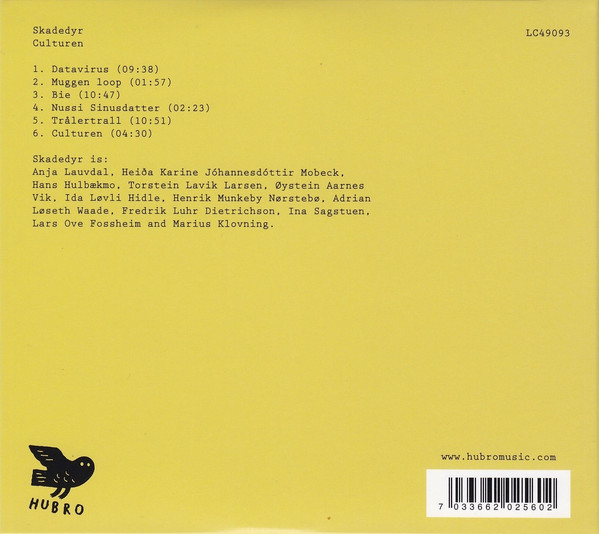
I HAVE A TRIBE-BENEATH A YELLOW MOON.
I HAVE A TRIBE-BENEATH A YELLOW MOON.
Back in 2013, Patrick O’Laoghaire was a member of Slow Skies, the group he had formed with Karen Sheridan and Conal Herron in 2012. They released their debut E.P., Close in May 2013. Close was well received by critics, and a great future was forecast for the Dublin based trio.
This proved to a prescient comment. When Slow Skies released their sophomore E.P. Keepsake in September 2014, critics were taking notice of Slow Skies. They were now classed as “one to watch.” However, by then, Patrick O’Laoghaire had also embarked upon a solo career.
For the last few couple of years, Patrick had been contemplating a career as a singer-songwriter. So, he adopted the pseudonym I Have A Tribe, and was soon being described as one of music’s rising stars.
I Have A Tribe released their debut E.P. Yellow Raincoats on Grönland Records, in May 2014. It was released to widespread critical acclaim. Critics were won over by I Have A Tribe’s fusion of folk and pop. The highlight of the Yellow Raincoats E.P., was Monsoon, a beautiful ballad. It caught the attention of Anna Calvi.
Anna Calvi was about to head off on a tour of Europe. She was looking for an opening act. When she heard Monsoon, Anna decided that I Have A Tribe fitted the bill.
So, each night, during Anna Calvi’s European tour, I Have A Tribe opened for her. Suddenly, I Have A Tribe’s music was being heard across Europe. Patrick O’Laoghaire was winning friends and influencing people, including Villagers.
Just like Anna Calvi, Villagers were looking for someone to open their Irish homecoming show. Who better than fellow countryman, I Have A Tribe? Villagers couldn’t have picked a better act. I Have A Tribe charmed the audience with their unique fusion of pop and folk. This however, wasn’t the end of this whirlwind year.
Over a twelve month period, I Have A Tribe were asked to play at some of the biggest music festivals. This included The Great Escape, Electric Picnic, the Reeperbahn Festival and CMJ in New York. Things it seemed, couldn’t get much better. However, it did.
I Have A Tribe was asked to headline at The Button Factory in Dublin. For Dublin based Patrick O’Laoghaire this was a huge thrill. Especially when he was welcomed with open arms by his hometown audience. With every appearance, it seemed, I Have A Tribe’s star was in the ascendancy.
Given how busy Patrick O’Laoghaire’s schedule was, it wasn’t until October 2015 that I Have A Tribe released their sophomore E.P. No Countries on Grönland Records. Just like Yellow Raincoats, No Countries received the same critical acclaim and showcased a talented singer and songwriter. Given the critical reception and commercial success of I Have A Tribe’s two E.P.s, surely, surely their debut album wasn’t far away?
And so it proved to be. Since the release of No Countries, Patrick O’Laoghaire has been working on I Have A Tribe’s debut album Beneath A Yellow Moon. It will be released on 27th May 2016, on Grönland Records.
Beneath A Yellow Moon features eleven new songs from the pen of Patrick O’Laoghaire. They were recorded at the Chem 19 studio, in Blantyre, Scotland with ex-Delgado Paul Savage. He’s one of the Britain’s top producers, and was the perfect person to produce I Have A Tribe’s much-anticipated debut album, Beneath A Yellow Moon.
Paul Savage has over twenty years experience as a musician, songwriter and producer. The former Delgados’ drummer has around seventy production credits to his name, ranging from Frightened Rabbit, Mogwai, The Twilight Sad, King Creosote, Miaoux Miaoux, The Phantom Band and Emma Pollock. Given three decades worth of experience working with some of the biggest names in music, Paul was more than qualified to guide I Have A Tribe through the minefield that’s recording a debut album. The resulting album, Beneath A Yellow Moon should introduce I Have A Tribe’s music to a wider audience. That’s apparent from from the first time one listens to Beneath A Yellow Moon.
Opening Beneath A Yellow Moon is Passage There’s a degree of urgency as a guitar is strummed, before flourishes of piano, bass and chiming guitar combine. They accompany Patrick’s vocal which is mixture of confusion and despair. He’s at a crossroads in his life. “If I’m not welcome in this town, where should I go?” Meanwhile, washes of cinematic guitar and percussion punctuate the arrangement. Later he sings: “I confess, I undress and have sex and there’s no shame…I think I’m going to quit this scene.” By then, his vocal is an outpouring of an emotion, and Patrick isn’t so much singing the lyrics, but living him. He’s like an actor in a play, that’s directed by Paul Savage.
Just a lone piano accompanies Patrick’s heartfelt vocal on La Neige. Emotion fills his vocal, as the lyrics take on a cinematic quality. Soon, Patrick brings the characters to life. For the first minute it’s just the piano that accompanies the vocal. Briefly, some reverb is added to the piano and it booms adding an element of drama. Then ethereal, harmonies add to the drama, and add element of theatre. By then, Patrick has embraced the role of troubadour. It’s a role that suits him perfectly, and he wears with pride. As the ethereal harmonies coo, the arrangement grows. The piano is pounded, adding to the drama and theatre, while Patrick plays a starring role in what’s akin to a short story set to music.
After We Meet is piano lead ballad. The arrangement is spartan, with just a lone piano proving the perfect foil for Patrick’s vocal. His vocal takes centre-stage, and the listener hangs on his every word. He’s singing of the relationship he hope and dreams that one time he’ll find himself in, “After We Meet.” His vocal is needy and hopeful, as the arrangement builds. This begins at 2.30 when the rhythm section join with piano and impassioned vocal. Then at 3.12 it’s just the vocal and piano that remain. When the vocal drops out, just bold, deliberate chords remain. Along with a flourish of guitar, they provide the crescendo to this beautiful paean.
It’s just a slow, subtle guitar that accompanies Patrick’s vocal on Cold Fact. Soon, a piano and bass are added, as Patrick sings: “got this feeling I’m returning home again, it just took a little time to find again, I’m just grateful to the bodies that have carried me, my family and empathy.” As his vocal drops out, and the dark, deliberate piano combines with the piano and rhythm section. Then when Patrick’s vocal returns, it’s thoughtful sounding: “you’ve got skeletons to fight.” Gradually though, the tempo rises slightly and the arrangement flows melodically along. That’s until the reassuring refrain of: “you’ve got skeletons to fight, you’ve got time to feel safe, you’re not the last to loose faith, you’re not the first to curse the faith.” Later, having returned home and been reunited, Patrick sings: “while we’re here we’ll build a home, I think I’ll lay the first stone.” By then, the Dublin based troubadour, has delivered a spellbinding performance, while Paul Savage’s arrangement is one of the finest on the album. It’s reminiscent of what one would find on a Van Morrison’s seventies albums.
Straight away, Patrick has the listener captivated as he tells the story of the Battle Hardened Pacifist. Just a melancholy piano sets the scene for Patrick’s vocal. Slowly and deliberately he delivers the lyrics: “I have been chosen as a warrior, a Battle Hardened Pacifist and I like the taste of this.” It seems the one-time pacifist has a taste of bloodlust. Soon, the tempo rises and drama builds. The arrangement ebbs and flows, as Patrick combines emotion and power. Adding to the drama is the piano. Part from occasional handclaps, it’s a case of less is more, on one of the most thought-provoking tracks on Beneath A Yellow Moon.
At just over nine minutes, Casablanca is something of an epic track. During the track, Patrick pays homage to the 1942 movie, featuring Humphrey Bogart. This quickly becomes apparent as he incorporates lines from Casablanca. Straight away, it’s easy to imagine Patrick playing the piano in the famous club. Meanwhile, a lone piano accompanies Patrick’s wistful vocal. Soon, he delivers the line: “of all the bars in on world, of all the heads on all the girls, you had to come into mine.” Then comes another famous line: “whose looking at you kid.” However, he adds “I hope this letter finds you well, return address is hell.” As Patrick sings hurt and heartbreak is omnipresent. The song become a lament for the love he lost, and Patrick, the tormented troubadour, delivers a soul-baring vocal on what’s a , beautiful, heart wrenching song.
On Buddy Holly Patrick delivers a tender vocal as a guitar and piano accompany him. The piano is played slowly, and deliberately, so not to overpower a vocal that’s tender and heartfelt. Gradually though, the arrangement builds and grows, with harmonies joining the piano and guitar. Producer Paul Savage pans the harmonies left, while drums are panned right. This leaves plenty of space for the piano and vocal. Later, when the vocal drops out, a piano that’s big, bold and dramatic as the track reaches a crescendo.
Not for the first time, Patrick dawns the role of troubadour on Kamala. That’s the case from the moment he sings: “I would be tired if I was as wise as you.” By then, Patrick sounds not unlike Chris Thompson of The Bathers. Not only does Patrick sound like Chris. Stylistically there are similarities, with Chris’ vocal. Maybe Patrick was a fan of The Bathers? It certainly sounds like it. I Have A Tribe, like The Bathers are purveyors of sophisticated cerebral pop. That’s the perfect description of Kamala, which mostly, features Patrick, the piano and a guitar. Later drums are added, as Patrick’s quivering vocal soars above the arrangement He seems to draw inspiration from Scott Walker. Mostly, though, Patrick reminds me of Chris Thompson, on what’s another breathtaking ballad from I Have A Tribe.
The sound of footsteps opens Tango, before Patrick sings: “I think I’m in a little trouble, so I think I’m going to lie down over there, it was different when I was drinking and seeing double, sober is a quieter affair.” As he sings, he plays guitar and memories come flooding back. Not all are good. By then, a piano is added, and plays a supporting role. Mostly, though it’s just the guitar that accompanies Patrick’s vocal on this brisk arrangement. There’s almost disbelief in his vocal as he ruefully reflects: “it’s hard had to believe, that things have crumbled down to this, I don’t have the facts, I just have the names on a list, while holy man are praying, the devil takes the piss, and we must admire his timing.”
With just a tack piano accompanying Patrick, he delivers a weary vocal on Scandinavia. “I’m done with running, I fear the loss, so I’d rather be alone, so I’d rather be alone, I’m done with shaking.” As Patrick delivers his vocal, it’s akin to a confessional, where he voices his innermost secrets. Meanwhile, tender, soothing harmonies accompany Patrick, as he lays bare his soul.
Cuckoo closes Beneath A Yellow Moon. After a false start, it’s possible to hear Patrick adjust the strings of his guitar. This time, it’s in tune and ready to go. Patrick strums his guitar, and delivers heartfelt and emotive vocal. “Stand up she told me, stay strong she told me.” Still the arrangement is understated, and is reminiscent of Neil Young’s folk rock days. Midway through the track, a piano and harmonies accompany the vocal. The Neil Young influence becomes more apparent, and Cuckoo sounds like a song from the golden age of music. Melodic and almost anthemic, I Have A Tribe leave the listener wanting more. This is the way to close any album, especially a debut album like Beneath A Yellow Moon.
I Have A Tribe have come a long way in less than two years. They’ve released two E.P.s, and opened for Anna Calvi and Villagers. That’s not forgetting playing countless concerts on their own. However, that’s all been leading up to the release of I Have A Tribe’s debut album Beneath A Yellow Moon. It will be released on 27th May 2016, on Grönland Records, and marks a coming of age from a truly talented, singer, songwriter and musician Patrick O’Laoghaire.
He dawned the alias I Have A Tribe back in 2014, and since then, has been winning friends and influencing people. This includes critics and music lovers alike. They can’t fail to be captivated by songs that are beautiful, cerebral, cinematic, melancholy, poignant, thoughtful and touching. They’re framed by arrangements that are understated. They don’t get in the way of the vocal. Instead, the vocal is allowed to breath and becomes the focus of your attention. That’s as it should be.
Patrick’s vocal veers between heartfelt, emotive and melancholy, to needy and hopeful. Other times, hurt and heartbreak shine through on Beneath A Yellow Moon. It was a much-anticipated album. However, I Have A Tribe surpasses everything that’s been released previously. This can’t have been easy, as the two E.P.s set the bar high. However, with the help of producer Paul Savage, I Have A Tribe reach new heights on Beneath A Yellow Moon.
Bringing Paul Savage onboard was well worthwhile. He brought with him a wealth of experience. This includes producing numerous debut albums. Although he’s gone course and distance, Paul didn’t try and reinvent the wheel. Instead, the arrangements are understated, and allow the vocal to take centre-stage. Patrick then dawns the role of storyteller and troubled troubadour. These are roles that are perfectly suited to Patrick, and he embraces them both on I Have A Tribe’s much-anticipated debut album Beneath A Yellow Moon. It’s an album that had a lot to live up to,
Not only does Beneath A Yellow Moon live up people’s expectations, but surpasses them. That can’t have been easy, but I Have A Tribe have succeeded in doing so. However, we shouldn’t be surprised. Patrick O’Laoghaire, the man behind I Have A Tribe is a talented singer, songwriter and musician, who doesn’t so much deliver songs, but lives and experiences them. That is the case throughout Beneath A Yellow Moon, but is especially the case on After We Meet, Kamala. and Casablanca. These tracks just might be “the beginning of a beautiful friendship” with Have A Tribe and their debut album Beneath A Yellow Moon.
I HAVE A TRIBE-BENEATH A YELLOW MOON.
MOGWAI-ATOMIC- VINYL EDITION.
MOGWAI-ATOMIC- VINYL EDITION.
Glasgow-based post rock pioneers Mogwai, are no strangers to the world of soundtracks. They’ve previously released three soundtracks in the last ten years. The first was Zidane: A 21st Century Portrait in October 2006. Just a month later, Mogwai released the soundtrack to The Fountain in November 2006. After releasing two soundtracks in the space of two months, it was almost seven years passed before Mogwai released the soundtrack to Les Revenants in February 2013. It was released to critical acclaim, and was hailed as Mogwai’s the finest soundtrack of their career. That however, may be about to change, as Mogwai recently released their fourth soundtrack Atomic as vinyl on their own label, Rock Action Records.
Last summer, Mogwai had provided the soundtrack Mark Cousins documentary Atomic: Living In Dread and Promise. It was aired on BBC Four, and was a very personal memoir of growing up in the nuclear age. Using archive film, Mark Cousins constructed an impressionistic cinematic memoir of what was a harrowing time.
The Cold War was still dominating the news. America and the U.S.S.R. were at loggerheads, and the sabre-rattling continued into a second decade. For teenagers like Mark Cousins, it was a harrowing time. However, he public weren’t going to stand by and not have their say.
Suddenly, membership of C.N.D rocketed, and protest marches took place in cities across Britain. Placard wielding protesters marched to the tune of “band the bomb.” That became a rallying call as governments tried to reassure a terrified public.
The public service films that were meant to reassure the public, had the opposite effect. They seemed to make the fear even more real. Then on 26th April 1986, the world realised that it wasn’t just the nuclear war that they should fear.
That was the Chernobyl Disaster took place at the Chernobyl Nuclear Power Plant, in Pripyat, Ukraine. A worried public watched on, as the news of a catastrophic nuclear accident and explosion emerged. Then came the news that a fire resulted in a large quantity of radioactive particles escaping into the atmosphere. To make matters worse, they weren’t just heading which spread over much of the U.S.S.R., but Western Europe. When these particles landed in parts of Scotland, where Mogwai were growing up, suddenly, the Atomic Age seemed a very frightening time to grow up.
By then, Mark Cousins had discovered physics, and was discovering he advantages of Atomic Age. X-Rays and MRI scans he discovered were just two of the advantages of the Atomic Age. The subject that had once frightened Mark Cousins, now excited and interested him. So much, that he considered studying physics at university. That did’t happen, but later when Mark Cousins was a filmmaker, he decided to revisit the subject.
The result was his documentary Atomic: Living In Dread and Promise. To provide the soundtrack, post rock pioneers were commissioned to write the soundtrack. It was the perfect backdrop to Atomic: Living In Dread and Promise, which was a personal and poignant cinematic memoir. However, after the documentary was aired in the summer of 2015, Mogwai decided to rerecord the whole of the Atomic soundtrack.
At their Castle Of Doom Studios in Glasgow, Mogwai were joined be an old friend, occasional band member Luke Sutherland. Mogwai were also joined by Robin Proper-Sheppard formally of The God Machine and Glasgow composer Robert Newth. Together, they got to work on on Atomic, which was Mogwai’s twelfth album since they formed back in 1995.
That’s when Stuart Braithwaite and Dominic Aitchison first met in Glasgow. Four years later, they met drummer Martin Bulloch and formed Mogwai, which film buffs will remember, is a character from the movie Gremlins. Mogwai was always meant as a temporary name, but it stuck and was on the label of Tuner, their 1996 debut single.
Tuner was released to critical acclaim and the NME awarded it their single of the week award. Two other singles were released during 1996 Angels v. Aliens and Summer. By then Mogwai were a quartet.
Guitarist John Cummings joined the band in 1995. He’s also something of a maestro when it comes to all things technical and is described as playing “guitar and laptop.” He was part of one of the hottest bands of the late nineties, Mogwai who released two more singles in 1997.
The first of these was New Paths To Helicon Pt. 1 . It showed Mogwai growing and maturing as a band. NME agreed, and just like their debut single Tuner, New Paths To Helicon Pt. 1 was won NME’s single of the week award. Club Beatroot the followup to was also well received by critics. This was the perfect time for Mogwai to record their debut album, Mogwai Young Team.
Mogwai Young Team.
For Mogwai Young Team, Mogwai brought onboard Brendan O’Hare the Teenage Fanclub’s drummer. Another guest artist was Aidan Moffat of Falkirk based band Arab Strap. He added the vocal to R U Still In 2 It. The rest of Mogwai Young Team consisted of instrumentals. Mogwai Young Team was recorded at Chem 19 studios and produced by two of Scotland’s top producers, ex-Delgado Paul Savage and Andy Miller. Once Mogwai Young Team was completed, it was then released on Scotland’s biggest record label, Chemikal Underground.
Before its release, critics were one over by Mogwai Young Team. Mogwai were hailed Mogwai as a band with a big future. Mogwai Young Team was a hailed as a groundbreaking album of post-rock. It’s just one reason critics forecast a big future for Mogwai.
That proved to be a perceptive forecast. When Mogwai Young Team was released on 21st October 1997, sold over 30,000 copies and reached number seventy-five in the UK. The Mogwai Young Team were on their way. However, a few changes were about to take place.

Come On Die Young.
A year later, Mogwai were back in the studio recording their sophomore album Come On Die Young. Much had changed. A new member had joined the band. Barry Buns a flautist and sometimes pianist, had played a few gigs with the band. They then asked him to become the fifth member of Mogwai. Violinst Luke Sutherland joined Mogwai, but not on a full-time basis. This wasn’t the only change.
Recording was split between New York and Glasgow. This time, they’d forsaken Chem 19 in Blantyre and recorded parts of the album in Rarbox Road Studios, New York. Some sessions took place in Glasgow’s Cava Studios. Producing Come On Die Young was Dave Fridman. For some critics, his addition changed Mogwai’s sound.
Some critics felt his production style resulted in a much more orthodox sounding album. However Come On Die You was part of Mogwai discovering their “sound” and direction. Come On Die Young is a much more understated, but also ambient, experimental, multi-textured and melodic. There’s a fusion of ambient, grunge and post rock on Come On Die Young, which was released in 29th March 1999.
On its release, Come On Die Young reached number twenty-nine in the UK. Mogwai it seemed were now on their way to finding their sound and fulfilling the potential evident on their debut album. This was apparent with tracks of the quality of CODY, Hugh Dallas and Christmas Steps. However, like all innovative bands, Mogwai continued to reinvent their music.
This proved to the case on their eponymous E.P. This included Stanley Kubrick, which was recorded in the exotic surroundings of Cowdenbeath in Fife. Burn Girl Prom Queen was recorded at Cava Studios, in Mogwai’s hometown of Glasgow. These two tracks were part of E.P., which further enhanced Mogwai’s reputation as post rock pioneers. So did their third album Rock Action.
Rock Action.
Mogwai’s music continued to evolve on their third album 2001s Rock Action. More use was made of electronics on Rock Action. This was part of a process that would continue over the next few albums. There were even more layers and textures on Rock Action. It was as if Mogwai had expanded their palette. Seven of the songs were instrumentals, while Dial Revenge featured Gruff Rhys of Super Furry Animals.
Again, Rock Action was produced by Dave Fridman, while recording took place in New York and at Glasgow’s Cava Studios. Once Rock Action was completed, it became Mogwai’s first album to be released on Play It Again Sam.
Rock Action was released in April 2001, and proved to be Mogwai’s most successful album. It reached number twenty-three in the UK. Critics remarked upon how Rock Action wasn’t as dark an album as its predecessors. That didn’t mean that Mogwai’s view of the world had changed. They were still worldweary. That would become a Mogwai trademark.
Six months after the release of Rock Action, Mogwai returned with another single, The My Father My King. It was released in October 2001, and was described “as the companion piece to Rock Action.” A sticker on the cover bore Mogwai’s description of the single as: “two parts serenity and one part death metal.” That was about to change. Soon, they’d be happy people writing happy songs and making a breakthrough into the American market.
Happy Songs For Happy People.
Happy Songs For Happy People was released in 2003. Mogwai’s evolution continued. Their music continued further down the electronic road. Yes, electric guitars and a drummer were used, but synths were playing a more important role in Mogwai’s music. So were the addition of strings and a piano. They played their part in what was a much more understated album. Part of this change in style was a change of producer.
Tony Doogan was brought onboard as producer. He replaced Dave Fridman. Gone were transatlantic recording sessions. Happy Songs For Happy People was recorded at Cava Sound Studios, Glasgow. On its release in June 2003, Happy Songs For Happy People was well received by critics. Critics drew attention to I Know You Are But What Am I? and Hunted By A Freak. The critics welcomed Mogwai’s latest change in style. So did record buyers.
While Happy Songs For Happy People only reached number forty-seven in the UK, it spent a week in the American charts, reaching number 182 in the US Billboard 200. After four albums, Mogwai had broken into the American market. Happy Songs For Happy People it seemed, was a landmark album.
Having made inroads into the lucrative American market, Mogwai didn’t rush their fifth album. It was released three years after Happy Songs For Happy People. There’s a reason for this. They were working on tree separate projects.
The first was their fifth album Mr. Beast. Then there was the first soundtrack they’d written and recorded. This was for the 2006 movie Zidane: A 21st Century Soundtrack. Mogwai also collaborated with Clint Mansell on the soundtrack to The Fountain. Although soundtracks were a nice sideline for Mogwai, their fifth album Mr. Beast was of huge importance. Especially, if it was a commercial success in America.
Mr. Beast.
Recording of Mr. Beast took place at Mogwai’s new studio, Castle Of Doom Studios in Glasgow. Co-producing Mr.Beast with Mogwai, was Tony Doogan. Between April and October 2005, Mogwai honed their fifth album. Tony Doogan and Mogwai co-produced Mr. Beast. After six months, Mr. Beast was complete. It was Mogwai’s most important album.
Everyone realised the importance of Mr. Beast. Mogwai were on a verge of breaking into the American market. Happy Songs for Happy People had got Mogwai’s foot in the door. Now was the time for the Mogwai Young Team to kick it in, and make their presence felt. That’s what Mogwai intended to do with tracks like Travel Is Dangerous,Friend Of The Night and We’re No Here. They featured Mogwai at their best. This trio of tracks would please critics.
On its release, it was mostly, to critical acclaim. Critics were fascinated at how Mogwai’s music continued to evolve. For Mogwai, standing still was going backwards. Groundbreaking music was what record buyers expected from Mogwai.
When Mr. Beast was released on 5th March 2006, record buyers found an album of innovative music. It climbed thirty-one in the UK. Across the Atlantic, Mr. Beast reached number 128 in the US Billboard 200. Mogwai were now one of Scotland’s most successful musical exports. They were certainly Scotland’s most innovative band. This was a title they weren’t going to give up without a fight.
Zidane: A 21st Century Portrait.
Following the release of Mr. Beast, the other two projects that Mogwai had been working on, were released. The first was Zidane: A 21st Century Portrait. The project came about in late 2005, when artist Douglas Gordon asked Mogwai to write and record a soundtrack to a film he was making about Zinedine Zidane, Zidane: A 21st Century Portrait. Mogwai agreed, and this gave them their entry into the world of soundtracks.
Maogwai grasped this opportunity. They recorded Zidane: A 21st Century Portrait at Castle Of Doom Studios. At first hand, Mogwai had recorded ten tracks, which were produced by Tony Doogan. However, when the soundtrack was released, it came baring a secret.
That’s the hidden track Untitled, a twenty-three minute epic, featuring Mogwai at their most inventive. That was the case throughout Zidane: A 21st Century Portrait. Most critics realised this. A few, however, didn’t seem to ‘get’ Zidane: A 21st Century Portrait. However, the critics that mattered, gave Mogwai the recognition they deserved when Zidane: A 21st Century Portrait was released on 30th October 2006. Then less than a month later, the soundtrack to The Fountain was released on 27th November 2006.

The Fountain.
The Fountain was a collaboration between contemporary classic composer Clint Mansell, string quartet the Kronos Quartet and Mogwai. To some onlookers, it looked like an unlikely collaboration. That wasn’t the case though.
Mogwai had spent December 2005 locked away in their Castle Of Doom Studios with producer Tony Doogan. Other parts of The Fountain project were recorded in New York and Los Angeles. Then once the project was complete, The Fountain was released on 27th November 2006.
When The Fountain soundtrack was released, the reviews were positive. Mogwai’s contribution to the soundtrack had proved vital, while the Kronos Quartet proved a perfect foil the Mogwai Young Team. Mogwai’s lasted soundtrack had enhanced their reputation as the go-to guys for a soundtrack. That would their sideline in the future. However, before they released another soundtrack, Mogwai would release another two albums.
The Hawk Is Howling.
The first of these was The Hawk Is Howling. To ensure they kept their title of Scotland’s most innovative bands, Mogwai returned to the studio where it all began, Chem 19 in Blantyre.
Andy Miller who’d co-produced Mogwai Young Team, Mogwai’s debut album was chosen to produce what became The Hawk Is Howling. This was Mogwai’s sixth album and marked a first. It was Mogwai’s first album to consist of just instrumentals. Among them were I’m Jim Morrison, I’m Dead, The Sun Smells Too Loud, Batcat and Scotland’s Shame. They feature the post rock pioneers pushing musical boundaries to their limits, and sometimes, beyond. Once The Hawk Is Howling was recorded, Garth Jones mixed the album at Castle Of Doom Studios in Glasgow. After that, The Hawk Is Howling was ready for release.
The Hawk Is Howling was released on 22nd September 2008. Critics were won over by The Hawk Is Howling. There were no dissenting voices. This was one of Mogwai’s best albums. So, it was no surprise it sold well in the UK and America.
On its release, The Hawk Is Howling reached number thirty-five in the UK and number ninety-seven in the US Billboard 200. It seemed with each album, Mogwai’s music evolved and matured. This resulted in even more success coming their way. Would this continue with Hardcore Will Never Die?
Hardcore Will Never Die.
For their seventh album, Mogwai returned to Chem 19 Studios in Blantyre, where they hooked up with ex-Delgado Paul Savage. Since he’d produced Mogwai’s debut album, Mogwai Young Team Paul had established a reputation as one of Scotland’s best producers.
By then, Paul Savage had worked with everyone from Franz Ferdinand to R.M. Hubbert. However, it was a very different Mogwai Paul encountered. They were very different to the band who recorded Mogwai Young Team Paul. Their music had evolved and was continuing to do so. They’d matured as musicians and embraced the new technology. Hardcore Will Never Die, But You Will was proof of this.
Here was an album of groundbreaking, genre-melting post-rock with attitude. Hardcore Will Never Die, But You Will was also an album not short on humour. Poppy soulster Lionel Ritchie provided the inspiration for You’re Lionel Ritchine. There was also a celebratory sound to Hardcore Will Never Die, But You Will. It’s a reminder of an album of pioneering, post rock music crammed full of hooks, humour and attitude. Hardcore Will Never Die, But You Will was an album that couldn’t fail.
Before the release of Hardcore Will Never Die, But You Will, Rano Pano was released as a single. On the flip side was Hasenheide, which didn’t feature on Hardcore Will Never Die. It was a reminder that Mogwai’s B-Sides are better than most band’s singles. Things it seemed were looking good for Mogwai.
Yet again, Mogwai won over the majority of critics with Hardcore Will Never Die, But You Will. A couple of contrarian critics proved to be mere dissenting voices in the wilderness. Most critics realised that Hardcore Will Never Die, But You Will was one of Mogwai’s finest hours. Record buyers would agree.
Hardcore Will Never Die, But You Will reached number thirty-five in the UK and number ninety-seven in the US Billboard 200. For Mogwai, they were now into their third decade as band and had just enjoyed their biggest album to date. What next?
Les Revenants.
The answer to that was Les Revenants, a soundtrack to a French television series. Les Revenants or The Returned is essentially a television program about zombies. Unlike similar programs, when the “undead” return to the town they lived in, it’s as they were, not how most films portray zombies. Another difference was the way Mogwai were commissioned.
Usually, someone writing a soundtrack can see the film they’re writing music to. Not Mogwai. They were just shown a few scripts. Then they were given an overview of what the series was about. From there, Mogwai wrote thirteen of the fourteen tracks. The other track they chose was What Are They Doing In Heaven Today, which was written by Charles Elbert Tilney. These fourteen tracks were recorded by Mogwai, who produced Les Revenants with Neil MacMenamin. Once Les Revenants was finished, it was released in February 2013.
Before Les Revenants was released an E.P. was released. It featured four tracks. That was a tantalising taster of what was to come. After all, Mogwai would approach a soundtrack like Les Revenants in a different manner. They wouldn’t do anything predictable. Les Revenants was a case of expect the unexpected. Critics loved Les Revenants and hailed the album as one of the best albums Mogwai had released. However, Mogwai had other ideas.
Rave Tapes.
Rave Tapes features ten tracks which were written by Mogwai. These tracks were recorded at Mogwai’s Castle Of Doom Studios, in Glasgow. Producing Rave Tapes was ex-Delgado Paul Savage. He’s produced previous Mogwai albums and knew how the band worked. This was important, given Mogwai were at last, enjoying the critical acclaim and commercial success their music deserved. Work began on Rave Tapes on the 28th August 2013.
This was like the first day back at school. Mogwai were ready to begin recording what was their eighth studio album. The lineup of Mogwai has been settled for a few years. This included a rhythm section of bassist and guitarist Dominic Aitchison, drummer Martin Bulloch and guitarists Stuart Braithwaite and John Cummings who also played piano. Barry Burns plays organ, piano and guitar. at Castle Of Doom Studios, Glasgow, Mogwai recorded the ten tracks that became Rave Tapes, which was released on 20th January 2014.
Rave Tapes was one of the most anticipated albums of 2014. The big question was, what direction Mogwai’s music would head? After all, Mogwai’s music never stands still. It’s in a constant state of evolution. That’s no bad thing. Standing still is akin to going backwards in Mogwai’s book. On Rave Tapes, Mogwai’s music continues to evolve. Musical genres and influences melt into one on Remurdered, The Lord Is Out Of Control and Tell Everyone I Love Them, which all feature on the Central Belters’ box set. However, one of the most prominent influences on Rave was Krautrock. Add to this ambient, avant-garde, electronica, experimental, indie rock and rock. We hear different sides to Mogwai on Rave Tapes. Whether it’s fuzzy soundscapes or kicking out the jams, Mogwai don’t disappoint on Rave Tapes, their most recent album.
After the release of Rave Tapes, Mogwai released Music Industry 3. Fitness Industry E.P. on 1st of December 2014. Opening this six track E.P. is one of its highlights, Teenage Exorcists. So fittingly, it finds its way onto Mogwai’s three disc retrospective box set, Central Belters.

Central Belters.
For anyone yet to discover the delights of of post rock pioneers Mogwai, then the Central Belters’ box set is the perfect starting place. It was recently released on Rock Action Records, and costs no more than an individual CD. It’s Mogwai’s way of thanking their loyal fans who have supported them over the last twenty years. And what a roller coaster it’s been.
Since they formed in 1995, Mogwai have released eight albums and three soundtracks. Then there’s countless singles, E.P.s and two remix albums. Mogwai must be one of the hardest working bands in music. That’s not forgetting one of the most innovative.
For the last twenty years, Mogwai’s music has been ambitious, bold, challenging, influential and innovative music. It’s full of nuances, subtleties and surprises as Mogwai seamlessly combine musical genres. They fuse ambient, avant garde, classic rock, electronica, experimental, indie rock, psychedelia and Krautrock, to create their unique post rock sound. All the time, Mogwai continue to push musical boundaries to their limits and even sometimes, way beyond. This becomes apparent on Atomic.
Atomic.
Having made the decision to rerecord Atomic, Mogwai headed to their Castle Of Doom Studios in Glasgow, Mogwai were joined be an old friend, and occasional band member Luke Sutherland. Other guests included Robin Proper-Sheppard formally of The God Machine; and Glasgow composer Robert Newth. Together, they got to work on on Atomic,
At Castle Of Doom Studios, Mogwai and friends got to work. Mogwai’s rhythm section featured drummer Martin Bulloch; bassist and guitarist Dominic Aitchison; and guitarists Stuart Braithwaite and John Cummings who also played piano. Barry Burns played organ, piano and guitar. Occasional member of Mogwai, Luke Sutherland played violin on Are You A Dancer? Robin Newth adds French Horn on Ether; while Robin Proper-Sheppard added guitar on Tzar. Just like previous albums, Tony Doogan took charge of production on Atomic. Once the ten tracks were complete, Atomic was scheduled for release in the spring of 2016.
Given the sombre nature of parts of Mark Cousins’ documentary, there was a degree of irony that Atomic was released on April Fool’s Day. By the time, 1st of April 2016 came around, the reviews of Atomic had surpassed Les Revenants. Critics hailed Atomic Mogwai’s finest soundtrack album. It was a welcome return for Glasgow’s famous five, as they returned with their first studio album in three years…Atomic.
Ominous describes the introduction to Ether. Washes of synths draw closer, before drones sound ominously and a guitar is picked carefully. Then suddenly, ethereal keyboards play and a melancholy French horn punctuates the arrangement. Along with a piano, they provide a thoughtful backdrop. As swells of synths are added, so does the drama and sense of melancholia. It’s as if there’s a yearning for a simpler time, before the Atomic age. Later, synth strings sweep, and the French horn sounds as the rhythm section continue to add to the drama and melancholia. In doing so, they add to what’s a ruminative, dramatic and beautiful cinematic track.
As Scram unfolds, Mogwai pay homage to Kraftwerk, especially Radioactivity. Soon, however, Mogwai are replicating the sound of the man machine. It chatters, buzzes, crackles and chimes almost hypnotically; as drum machines that click and crack. In the midst of the arrangement, there’s what sounds like a warning. No wonder Mogwai advise people to Scram. The man machine has malfunctioned, and the wistful sound of a synth string is joined by buzzing, pulsating synths. Mesmeric and hypnotic the cogs in the machine grind and whine, their sound menacing as they lumber along.
Dramatic is the word that springs to mind as Bitterness Centrifuge gradually shares its secrets. It’s reminiscent of an Eastern European recording from the late-seventies or early eighties. The arrangement is slow, with ominous, gothic synths and dramatic drums combining. They lumber, as fuzzy guitars feedback and join synth that briefly, sound almost ethereal. Mostly, though dramatic, post apocalyptic sound to the arrangement.
It seems fitting that on an album entitled Atomic, Mogwai name a track U-235, which is an isotope of uranium. As the track unfolds, a buzzing bass synth taps out a code. It’s joined by washes of ethereal synths, a keyboard and drum machine. Together, they create another track that references Kraftwerk. As washes of of ethereal, haunting synths sweep in and out, a melodic keyboard joins the bass synth. All the time, the drum machine provides the heartbeat. That’s until later, when the arrangement is stripped bare. All that’s left are the sweeping synths. They create an ethereal, melodic and memorable backdrop
The name Pripyat may not mean much to most people. Chernobyl however, strikes fear into the heart of millions. Pripyat was the town where the Chernobyl Power Plant was situated, and where on 26th April 1986 a catastrophic nuclear accident took place. Given the backstory, it’s no wonder that Mogwai create an arrangement that’s not just big and bold, but dark, dramatic and gothic. It’s as if Mogwai are building up to the moment when the unthinkable happened. From there, they recreate the despair and heartbreak, as a once proud place becomes a desolate and barren, no-go area whose name thirty years later, is remembered with sadness.
In the distance, keyboards are played with a degree of urgency on Weak Force. Continually, they play the same chords, that sweep in and out, in and out. They grown in volume, power and drama. It’s as if they’re sending out a warning. Especially as differenet keyboards combine, and a dark, ominous sound emerges from the arrangement. Combined with the mesmeric, nature of the arrangement, this adds to the cinematic sound. Despite the darkness and drama, Mogwai still manage to create a melodic and is certainly memorable. It wouldn’t sound out of place in a blockbuster, instead of a television documentary.
In Mark Cousins’ documentary, Atomic: Living In Dread and Promise, Little Boy takes the listener back to when the filmmaker was growing up. It was at the height of the Cold War, with fingers never far from the big red button. For young Mark Cousins, it was the stuff of nightmares. That’s why the arrangemement is slow, moody and broody, with droning synths sitting atop the rhythm section and keyboards. It’s as if the drones are sirens warning of impending doom. Scorching guitar solos cut through the arrangement, as synths add to an arrangement that veers between dramatic, thoughtful and even hopeful. It’s as if Mogwai are providing the soundtrack to Mark Cousins nightmares and hopes, as he eventually discovers the positive effects of the Atomic age.
Straight away, Are You a Dancer? sounds like the soundtrack to a Cold War spy thriller. Mogwai conjur up images of Berlin, with spooks passing secrets in what was a game of bluff and double bluff. Drums are caressed, as a bass is plucked carefully and a Hammond organ adds to the atmospheric backdrop. Washes of shimmering guitar reverberate, while hypnotic perucsion joins Luke Sutherland’s haunting violin. By then, Mogwai are creating what’s without a beautiful, haunting and lysergic soundscape. It’s reminsicnent of David Lynch’s cinematic epics, albeit made by six guys from Glasgow,
Whirring, buzzing synths cut through the arrangement to Tzar. They’re soon joined by drums that have been panned left and right, and assail the listener. Meanwhile, stabs and swells of jangling, chiming keyboards play. Still, the synths buzz and whir. Gradually, instrumenets are added. Etheral synths are soon joined by blistering, screaming post rock guitar and a bounding bass. The bass is way back in the mix, while the guitars join the sythns in playing a leading role in the post rock anthem. With a minute to go, the arrangement has reached its crescendo, and begins to slow down. Instruments begin to drop out, as the arrangement is stripped bare. Eventually, all that’s left is a memory of Mogwai in their post rock prime.
Fat Man closes Atomic. Just a pulsating heartbeat can be heard, before a melancholy piano plays. Togther they create a wistful soundscape, Mideway throuhg the track, the arrangement grows in drama and power. Swells of synth and a guitar join the piano as the soundscape reaches a crescendo. Then Mogwai slow things down, and the arrangement features just the occasional beep and squeak that join the piano and pulsating heartbeat. Later, space is left as the piano plays. It’s like a pregnant pause, allowing the pulsating heartbeat to take centre-stage. As this happens, the listener can reflect on the themes explored in Mark Cousins’ documentary Atomic: Living In Dread and Promise.
Mogwai’s twleth album Atomic, is best described as a cinematic Magnus Opus. It’s an album of ambitious, bold, challenging, influential and innovative music. This is music full of nuances, subtleties and surprises. During ten tracksm the mood constantly shifts. One minute, the music is wistful and melancholy, the next pensive and thoughtful, and then dark, disturbing, eerie and moody. That’s not surprising given the subject matter of Mark Cousins’ documentary Atomic: Living In Dread and Promise.
It documents a period in time, when people on both sides of the Iron Curtain lived with a fear that the sabre rattling, would result in a nuclear war. This fear was like a dark cloud that blighted people’s lives, including Mark Cousins. The word Atomic caused him nighmares as he grewup in the seventies. However, this wasn’t just a period of darkness for Mark Cousins.
In the late seventies, Mark Cousins discovered physics, which helped him conquer his fear of the Atomic age. Soon, Mark Cousins discovered that there was a positive side to Atomic age. X-rays and MRI scans he was told had changed lives. That’s why sometimes, the music on Atomic is sometimes, beautiful and melancholy. It tugs at the listener’s heartstrings and poses questions. Constantly, the music paints pictures of the Atomic age in the seventies and eighties. This can’t have been an easy project.
Far from it. Setting out to create the soundtrack to Mark Cousins’ documentary Atomic: Living In Dread and Promise wasn’t going to be easy. It was an ambitious and challenging project. That’s why Mark Cousins brought onboard one of the most influential and innovative bands in Britain…Mogwai. They take the listener on a genre-hopping musical journey.
On Atomic’s ten tracks Mogwai combine everything from avant-garde and Berlin School to electronica and experimental via indie-rock, Krautrock and post-rock to psychedelia. This results in a genre-melting, cinematic album, Atomic, which was recently released on vinyl by Rock Action Records.
Atomic is a double album, and there are two vinyl versions available. The most common version is pressed on really high quality black vinyl. It would a welcome addition to any record collection. So is the second version, which is pressed on heavyweight orange vinyl. That’s the version I’m reviewing. Not only does it look fantastic, but sounds fantastic. It’s been beautifully mastered by Frank Arkwright. He’s made sure that the album isn’t over loud. Far too often, mastering engineers stomp the life out of an album. Not Frank Arkwright. He’s responsible for an album that not only has open sound, where the full dynamic range can be heard. All too often, albums have been over compressed, with the mids seemingly sucked out and the bass lacking punch. Thankfully, not here on this heavyweight orange vinyl version of Atomic. However, it’s got one secret still to reveal, and that’s an autographed screen print. This however, is a real rarity. Only 400 were produced, and it’s just the finishing touch to what is a luxurious and lovingly curated album that deserves to finds its way into every record collection.
Atomic is a mesmeric fusion that captivates and compels. The listener is taken on a musical journey, one that veers between dramatic and dreamy, to surreal and trippy, to beautiful, pensive and understated to melancholy and melodic. Other times the music is dramatic, moody and broody. One thing the music never is, is boring. Not at all. Certainly not with Mogwai providing the soundtrack to Atomic.
Subtleties and surprises are contantly sprung. Mogwai certainly aren’t afraid of changing direction. Using the musical equivalent of a handbrake turn, the Mogwai Young Team perform a volte face. That’s what makes Atomic such a captivating and groundbreaking soundtrack from Glasgow’s famous five…Mogwai.
Atomic is the first soundtrack that Mogwai have released since Les Revenants in 2013. It was regarded as Mogwai’s finest soundtrack. Not any more. Somehow, Mogwai have surpassed the quality of Les Revenants on Atomic. Each of the ten tracks have a story to tell. These stories are chapters in Mark Cousins journey as a child of the Cold War. However, unlike many soundtracks, Atomic works as a standalone album.
So much so, that Mogwai have decided to tour Atomic. This is yet another ambitious project from the post rock pioneers. Replicating the sound of Atomic won’t be easy. However, Mogwai like a challenge, and if anyone can replicate an album as complex as Atomic live, it’s Mogwai. They’ll so, later in 2016.
So much so, that Mogwai have decided to tour Atomic. This is yet another ambitious project from the post rock pioneers. Replicating the sound of Atomic won’t be easy. However, Mogwai like a challenge, and if anyone can replicate an album as complex as Atomic live, it’s Mogwai. They’ll do so, later in 2016.
Mogwai leave will leave their Castle Of Doom Studios in May 2016, as they embark upon their latest musical adventure. For the next three months, Mogwai will tour Europe and Japan showcasing their latest groundbreaking album of cinematic post rock, Atomic.
MOGWAI-ATOMIC-MONORAIL VINYL EDITION.

WILLIAM FITZSIMMONS-CHARLEROI: PITTSBURGH VOLUME 2.
WILLIAM FITZSIMMONS-CHARLEROI: PITTSBURGH VOLUME 2.
It was Mark Twain who wrote: “write about what you know.” Many aspiring writers have taken Mark Twain’s advice, and have gone on to enjoy long and successful careers. However, Mark Twain’s quote also applies to songwriters. This includes William Fitzsimmons who has drawn upon personal experience throughout his career. His latest mini album Charleroi: Pittsburgh Volume 2, which was recently released by Gronland Records.
Charleroi: Pittsburgh Volume 2 is the followup to William Fitzsimmons 2015 album Pittsburgh. It was an intensely personal, moving and hopefully, cathartic album that dealt with the death of the grandmother he knew and loved. However, Charleroi: Pittsburgh Volume 2 also deals with the death of William’s grandmother. This time, though, it’s the grandmother he never knew,
The story began when William’s grandmother took her son to the hospital, suffering from whooping cough. Although the baby recovered, his mother never returned. For several months, the orphan remained in the hospital. Fortunately, a doctor in the hospital adopted the baby, and brought the child up. Since then, mystery surrounded what happened to William’s grandmother.
As the years passed by, William’s father had almost given up finding out what happened to his parents. All William’s father knew about his parents, was that his father died when he was an infant. Apart from that, details were sketchy. The rest of William’s father family never tried to trace him. As the years passed by, there seemed less chance that William’s father would ever known the truth. Then in 2015, after neigh on sixty years, the Fitzsimmons’ family made a remarkable discovery.
After almost sixty years of wondering what happened to his parents, William’s father finally traced his mother. Her name was Thelma, and she had lived in Charleroi, Pennsylvania. Tragically, she had passed away a few years previously, and was never reunited with her song, and her grandson William Fitzsimmons. The songs on William Fitzsimmons’ mini Charleroi: Pittsburgh Volume 2 are about Thelma, the grandmother he never knew. Just like previous albums, Charleroi: Pittsburgh Volume 2 is a highly personal album from a William Fitzsimmons, a truly talented singer-songwriter.
William Fitzsimmons was born in Pittsburgh, Pennsylvania in 1978. He was the youngest child in the Fitzsimmons family. Both of William’s parents were blind. Despite this, both parents were talented musicians, capable of playing a variety of disparate instruments. Their talent rubbed off on William.
By the time William was in elementary school, he was already able to play piano and trombone. This meant that William could join in the impromptu musical evenings in the Fitzsimmons family home.
With William’s parents both blind, music played an important part in the family home. Some nights, William’s parents, and the rest of the family, sang, and played the musical instruments that filled the house. For the Fitzsimmons’ family, these were happy times, with everyone sharing in a common interest, music. It would play an important part in William’s life.
When William entered junior school he began to teach himself guitar. Later, William learnt how to play banjo, melodica and ukelele. This would stand William in good stead when he embarked upon his musical career. That was a long way off.
Before that, William headed to college. He had decided to pursue a career in the mental health. Eventually, William hoped to become a therapist. This meant many years of study at Geneva College in Pennsylvania. Eventually, William graduated with a Masters Degree in Counselling.
Already William had experience working with people with mental health problems. This came during the summer months, when William was on holiday. However, during one summer, William’s interest in music was rekindled.
It was towards the end of his training, that William started writing and recording music. William was on a summer break. As usual, William was working. However, this summer he had been asked to write some songs. Rhis was in preparation for William beginning work as a therapist. However, it was partly a cathartic experience.
For some time, William had been suffering from some psychological problems. Through writing and recording a collection of songs, he was able to exercise some ghosts from William’s past. These songs became William’s debut album Until When We Are Ghosts. William self-released Until When We Are Ghosts in 2005.
Until When We Are Ghosts.
William wrote the eleven tracks that became Until When We Are Ghosts. He also played all the instruments and produced the album. Until When We Are Ghosts was then sold via William’s My Space page. It was a very personal album.
For Until When We Are Ghosts,William drew upon personal experience. With titles like When I Come Home, My Life Changed, Forsake All Others, The Problem Of Pain, When You Were Young and Shattered, it’s a soul-baring album. Until When We Are Ghosts is almost a cathartic confessional. This would be the case with much of William’s music.
Goodnight.
A year after releasing Until When We Are Ghosts, William was still juggling his career as a therapist, and as a musician. However, he had found time to write and record his sophomore album, Goodnight. It too, was a very personal album.
Just like Until When We Are Ghosts, Goodnight which was released in 2006, was a personal album. It dealt with his parent’s divorce. This obviously affected William badly. Songs like It’s Not True, Everything Has Changed, Leave Me By Myself, Please Don’t Go, You Broke My Heart, Never Let You Go, I Don’t Love You Anymore and Goodnight show just how his parent’s divorce affected William. It was a huge body blow, where the foundations of his life were shaken to the core. Suddenly, nothing seemed the same again.
The Sparrow And The Crow.
After a gap of two years, William returned with his third album. Ever since he release his first two albums, William’s profile was on the rise. His music began to feature on national television programs. Professionally, William was just as busy. Something had to give,
Ever since the making of Goodnight, William had been struggling. Things had been difficult. His marriage had come to an end, and William was undergoing a painful divorce. As if that wasn’t bad enough, the demons that had long haunted William had returned. What’s more, psychologically, William was struggling. So when the time came to write and record his third album, William had plenty of experience to draw upon.
Just like his two previous albums, The Sparrow And The Crow was a very personal and intense album. It was akin to a confessional.
On The Sparrow And The Crow, William relived relived the pain and trauma of his divorce. That was apparent on I Don’t Feel It Anymore (Song Of The Sparrow), I Feel Alone, Further From You and Just Not Each Other. Then on Please Forgive Me (Song Of The Crow), William apologises to his wife. There’s a sense of hope on They’ll Never Take The Good Years. It finds William remembering that their time together wasn’t all bad. Like so much of The Sparrow And The Crow, the music is powerful, poignant and personal. So much so, that William revisited The Sparrow And The Crow the following year.
Derivatives.
Derivatives, which was William’s first release on Grönland Records, saw various songs from The Sparrow And The Crow reinvented.
For the reinvention of The Sparrow And The Crow guest artists and remixers were brought onboard. Guest artists included Brook Fraser. She featured on the George Raquet Remix of I Don’t Feel It Anymore. Loane featured on I Don’t Feel It Anymore. The Great Neck South High School Choir featured on You Still Hurt Me. Other tracks were remixed. Mikroboy remixed If You Would Come Back Home, while Pink Ganter remixed Good Morning and So This Is Goodbye. All this resulted in the reinvention of The Sparrow And The Crow. This showed a very different side to William Fitzsimmons’ music. Normal service was resumed on Gold In The Shadow.
Gold In The Shadow.
Three years after the release of The Sparrow and The Crow, William Fitzsimmons returned with his fourth studio album, Gold In The Shadow. It was another personal album, one where William reflected on what was one of the most difficult periods of his life.
Following his divorce, William was at his lowest. Psychologically, he wasn’t in a good place. He had been struggling to come to terms with his divorce, and the psychological problems that had long troubled him. It seemed that he had to reach his lowest, before rebuilding his life. That’s what he did.
Over the next couple of years, William confronted his inner demons. He came to terms with his divorce, and the other mistakes he had made. Most importantly, William sought help for the mental health problems that for a large part of his life, have afflicted him. With the problems of his past addressed, William set about healing his life. Part of this comes through music.
On Gold In The Shadow, William he describes the songs as: “a real and long coming confrontation with personal demons, past mistakes, and the spectre of mental illness that has hovered over me for the great majority of my life.” However, William concedes that the healing has begun.
No longer is William willing to submit to the illnesses and problems that have blighted his life. He had to change. There was no way he couldn’t continue as he had been doing. So William bravely confronted his problems and illnesses head-on. That was apparent on Gold In The Shadow.
There’s a sense of optimism and hope on some of the songs on Gold In The Shadow. Fade and Then Return is proof of this. However, Gold In The Shadow also sees William combine therapy and music. This is the first William has broached first external perspective taking musically. On Gold In The Shadow, William examines not just his own life and psychological struggle, but those around him. He does this on songs like Psychasthenia, Wounded Head, The Tide Pulls From The Moon Most and Blood And Bones. This results in a compelling, cerebral and personal album from singer, songwriter and therapist William Fitzsimmons, who was slowly, rebuilding his life.
Lions.
This continued on Lions, which was released in 2014. The long-awaited follow-up to Gold In The Shadow, was produced by Death Cab For Cutie guitarist Chris Walla. He played his part in what critics referred to as a “career defining album.”
Lions saw William pickup where he left off on Gold In The Shadow. He continued to document how he had rebuilt his life on Lions. It was an album to be proud of.
Prior to the release of Lions, William described his journey as “wonderful, painful, long, incredibly brief, and more educational and rewarding than any I’ve ever lived before. Lions is something I’m terribly proud of and utterly connected to.” And so he should be.
Critics hailed Lions, the finest album of William’s career. Songs like Well Enough, Josie’s Song, Hold On, From You and Speak were proof of this. Lions was a career defining album. It was the album many critics knew he was capable of producing. Everyone wondered what the future held for William Fitzsimmons?
Pittsburgh.
Just a year after Lions, William Fitzsimmons returns with another incredibly personal and poignant album, Pittsburgh.
Pittsburgh featured seven songs, which were written, and produced by William. They play their part in what William describes as: a memorial for my grandmother.” She died in late 2014, “having lived her whole life in Pittsburgh.” William was obviously close to his grandmother. He wanted to tell the wold how: “amazing a woman my grandmother was.” His way of doing this, is through the medium of music. The rest of Pittsburgh, is “an honorarium to my hometown” the city William and his grandmother shared for decades. It provided the inspiration for one of William Fitzsimmons’ most moving albums, Pittsburgh.
On its release, critics hailed Pittsburgh a fitting followup to Lions. Words like personal and poignant were used to describe an album that was incredibly moving, and hopefully cathartic for William. It was as if writing and recording Pittsburgh was part of the grieving process for William. However, Pittsburgh was also the finest album of William’s career. Maybe William was determined that Pittsburgh would a fitting homage to the grandmother he knew and loved. Just under year later, William would release a mini-album about the grandmother her never knew, Charleroi: Pittsburgh Volume 2.
Charleroi: Pittsburgh Volume 2.
Having gotten to the bottom of the mystery that had puzzled the Fitzsimmons’ family for sixty years, William set about making sense of this new information. Just like before, William expressed his feeling via songs.
So for Charleroi: Pittsburgh Volume 2, William penned six new songs. With titles like People Change Their Minds, Hear Your Heart, A Part, Charleroi, Fare Thee Well and Nothing Can Be Changed, William tried to make sense of the situation. His father had been wondering what happened to his family for nearly sixty years? So must William. Then after all the years of uncertainty, to discover that the grandmother he never knew must have been a devastating blow. Both William and his father must have felt cheated, at not knowing Thelma. So William poured his thoughts and feelings into the six songs that became Charleroi: Pittsburgh Volume 2.
Recently, Charleroi: Pittsburgh Volume 2 was released by Groenland Records as a mini album. These six tracks on this mini album are about Thelma, the grandmother he never knew. The result is another moving and poignant album, Charleroi: Pittsburgh Volume 2.
Opening Charleroi: Pittsburgh Volume 2 is People Change Their Minds. There’s almost a degree of urgency as William picks his guitar. It’s as if he’s desperate to tell Thelma’s story. Sadly, he only knows part of the story. Tenderly, he sings: “she was seventeen…as she left you.” Then a piano replaces the vocal and combines with an acoustic guitar and strings. Together, they create a melancholy backdrop, and frame William’s tender vocal as he sings: “you were just a boy as she moves on, I’m told that you were better off.” He wonders; “where did she go?” As haunting strings play; William reassures: “people change, Thelma she was happy once.” Much later, William sings to his father: “I know it’s been a real hard year, but I’m hoping you can let it go, cause you’ve still got so much love to give, to those that still need you.” By then the arrangement is slow, minimalist and quite beautiful. William’s vocal is heartfelt and emotive on this, poignant and moving song.
Just William’s pocked guitar opens Hide Your Heart, before it’s double-traced and panned right and left. In the middle, sits William’s vocal. He takes the listener back sixty years, to the day his father was born. Soon, William dawns the role of his father, and sings: “I never saw you face, before Jesus took my eyes.” Soon, he’s saying: “I don’t what I’d have said if I’d found you alive? I can hear your heart from hear.” Meanwhile, chiming guitar dominate the arrangement, as William sings: “I know it broke your heart, when they took away your son.” Tender, harmonies sweep in, adding to to the melodic nature of this heart-wrenching track about a mother who lost her son.
With a degree of frustration, William plays choppy guitar licks on A Part. Again, he dawns the role of his father: “I was I was born another, heard she was a teenager mother, told it was a painful birth.” By then, the vocal drops out and vibes and cooing harmonies combine. When the vocal returns, somewhere in the depths of Pittsburgh, there’s a kid who looks like me, sleeping softly with his mother, wonder if she thinks of me, I was apart from her.” As he delivers the lyrics frustration, sadness, loneliness and even anger shine through, at not knowing his mother. Meanwhile, the soothing, reassuring harmonies, the choppy guitar licks and wistful strings provide the perfect accompaniment to William’s hurt-filled vocal on this soul-baring song.
As William plays his guitar on Charleroi, he ruefully remembers: “summer was all that we had.” There’s a sense of melancholia to his vocal. Especially as he sings “you are on my shoulders.” The when he adds: “I will never know.” This realisation comes as he’s sorting through his father’s papers. Just tender, reassuring harmonies accompany his vocal. They take care not to overpower William’s vocal as he reflects. There’s a sadness in his voice at the thought of all the questions he’ll never receive an answer to. Although tinged with sadness, and dealing with loss and unanswered questions about his roots, Charleroi is also a beautiful, ruminative track.
Again, it’s just William’s guitar that opens Fare Thee Well. His chord changes are swift, and the listener cam hear each chord change. That’s no surprise, as William immerses himself in the song. He sings the song from the perspective of his grandmother. As the lyrics: “I left you on your own child” are delivered sadness and regret fills William’s voice. By then, a banjo and harmonies accompany him. and briefly replace his vocal. When it returns there’s still a sense of sadness as he sings “Fare Thee Well, Fare Thee Well.” It’s then that the arrangement grows and builds, adding me an element of drama. When the lyric: “you left me first” is sung. is this William’s father replying to his mother he never knew? If it is, she replies “Fare Thee Well, Fare Thee Well” as swells of strings, piano, banjo and harmonies combine on what’s one of the most moving songs on Charleroi: Pittsburgh Volume 2.
Nothing Can Be Changed closes William Fitzsimmons’ mini-album Charleroi: Pittsburgh Volume 2. There’s a melancholy hue to the guitar that sets the scene for William’s thoughtful vocal. As he briefly scats, rolls of drums accompany the guitar. Soon, he sings from the perspective of his father: “forgive my doubt, I was only only told I was better off.” Things might have been different if he had known his mother’s background. Later he learns, “in that motel room she passed alone… Nothing Can Be Changed.” When the vocal drops out, a xylophone is added to the understated arrangement. Equally understated, but full of sadness, regret and even frustration is William’s vocal. Although deep down he knows “Nothing Can Be Changed” he wishes that it could be, and then things would’ve been different for three generations of his family.
For Charleroi: Pittsburgh Volume 2, William Fitzsimmons heeded Mark Twain’s advice, to “write about what you know.” It just so happened that the Fitzsimmons’ family had solved a sixty year old mystery. This was what happened to William’s grandmother? She had left William’s father in the hospital, as he recovered from a bout of whooping cough. After a few months, it became obvious that she wasn’t returning, and the infant was adopted, Since then, William’s father wondered what happened to his mother?
It was only in 2015, that the truth emerged. William’s grandmother was just seventeen when her son was born. She left him in the hospital safe in the knowledge that he would be well looked after. While that turned out to be the case, not knowing his mother haunted William’s father. Eventually, after sixty years, parts of the story became clear, and this provided the inspiration for William Fitzsimmons’ new mini-album Charleroi: Pittsburgh Volume 2, which was recently released by Gronland Records. It’s fitting followup to Pittsburgh.
Just like Pittsburgh, Charleroi: Pittsburgh Volume 2 is a truly poignant and moving album. Charleroi: Pittsburgh Volume 2 is also an intensely personal album. Not every artist would be willing to share such intimate details of their life. However, it’s a story many people will be able to relate to. William, who was a therapist before embarking upon a musical career, will hope that Charleroi: Pittsburgh Volume 2 will help other people in similar circumstances. I’m sure that will be the case. However, Charleroi: Pittsburgh Volume 2 is also is a reminder that William Fitzsimmons is a talented singer, songwriter and musician.
He’s responsible for the six carefully crafted songs on Charleroi: Pittsburgh Volume 2. William wrote and produced each song. They’ve mostly got subtle, sparse and understated arrangements. These arrangements frame William’s vocal, which quite rightly, takes centre-stage. William’s vocals are heartfelt, and full of emotion, sadness, regret and melancholy. So are his lyrics. They range from between beautiful, melancholy and poignant, to thoughtful and moving. It’s impossible not to be moved by the lyrics on Charleroi: Pittsburgh Volume 2, which have a cinematic quality.
As one listens to Charleroi: Pittsburgh Volume 2, it’s almost possible to imagine the story unfolding before your eyes. The seventeen year old giving up her baby, and spending the rest of her life wondering what became of it? Similarly, one can image William’s father constantly wondering what happened to his mother? Has he passed her on the street, sat beside her on the bus or spoken to her in a shop. Sadly, Williams father: “never saw your face, before Jesus took my eyes.” This is another twist in what was a tragic story that took sixty years to solve.
Eventually, it emerges that the grandmother William never knew died alone in a motel room just a few years before. Neither William, nor his father got the chance to meet Thelma. However, William decided to tell Thelma’s story on Charleroi: Pittsburgh Volume 2. It’s a personal, poignant and moving album from William Fitzsimmons, where he tells the story of the grandmother he never knew on Charleroi: Pittsburgh Volume 2.
WILLIAM FITZSIMMONS-CHARLEROI: PITTSBURGH VOLUME 2.

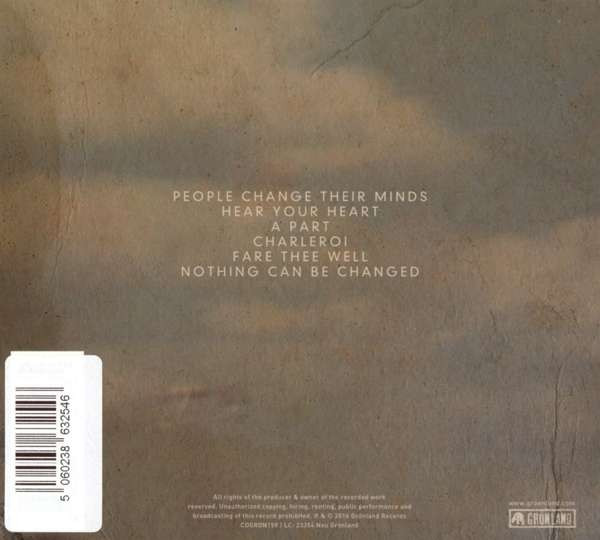
MACARTHUR-MACARTHUR.
MACARTHUR-MACARTHUR.
Having completed a tour of duty with the United States Marine Corp, Ben MacArthur returned home to Sagina, Michigan in 1977. When Ben returned home, jobs were few and far between, and it looked as if a recession was about to hit the rustbelt. It was hardly the welcome home he had envisaged. The future looked bleak. Then he met Bill Heffelfinger a seventeen year old musical prodigy.
Since Ben had been away, Bill Heffelfinger had started dating his younger sister. When the two men met, Ben discovered that Bill was not just a talented musician, but a gifted arranger. One day, it became apparent that Bill wasn’t just a virtuoso guitarist, but was equally comfortable on keyboards.
Ben only realised this when he heard Bill playing the piano in his parent’s house. He was stopped in his tracks as Bill played Neil Young’s The Last Trip To Tulsa. What made this remarkable, was Bill didn’t even know the song. However, Bill could read music so was able to play The Last Trip To Tulsa. What’s more, Bill made it look so easy. Maybe Bill was just the person Ben MacArthur was looking for?
For some time, Ben had been writing poetry. This began when Ben was a member of the U.S. Marine Corp. In his spare time, he retired to his bunk and wrote poetry. Ben was unburdening himself emotionally via poetry. This was maybe a cathartic process, and helped Ben survive his tour of duty. However, when he returned home safely, Ben didn’t stop writing.
After watching Bill play The Last Trip To Tulsa, Ben began talking to his sister’s boyfriend. Soon, they were talking music. Ben told Bill about Neil Young, and then began to tell him about the poetry he had written. Not long after this, Ben went to watch Bill playing with the band Labyrinth.
They were playing at a local fair. When Labyrinth took to the stage, Ben noticed that Bill was playing guitar. Soon, it became apparent that he was an even better guitarist than keyboardist. With Bill giving a virtuoso performance on guitar, he had the band eating out of his hand. Especially, when Labyrinth covered Rush’s 2112. By then, Ben had made his mind up, that he would be in a band with Bill. That was in the future.
Soon, the two men began to write songs together.They were an unlikely partnership. Ben was the senior partner, who had already written a few songs. He was fresh out of the U.S. Marine Corp, and had seen a bit of the world. Bill was just seventeen, but already was regarded as a musical whizz kid. Both men however, had time on their hands.
With jobs scarce, the pair needed something to fill their days. So they grabbed a couple of guitars and began to write songs. For Ben, writing songs wasn’t much different to writing poetry. Both men unburdened themselves through music, and quickly they realised that the songs they were writing had potential. So Bill took them away to arrange them.
Despite being just seventeen, Bill was able to arrange the songs so that they took on a classic sound. By then, Ben MacArthur knew that Bill Heffelfinger was no ordinary seventeen year old. The word prodigy had been invented for him. With Bill’s arrangements in place, the two friends began to think about putting together a band. This band would become MacArthur, who released their eponymous debut album in 1979. MacArthur has recently been by reissued Out-Sider Music, an imprint of Guerssen Records. This is the first official reissue of MacArthur, an ambitious concept album.
What they needed was a rhythm section. Ben MacArthur found his bassist in the unlikeliest of places…on a building site. By then, Ben was working as a roofer, when he met guitarist Scott Stockford. As the two men became friends, they began to write songs together. Eventually, Ben asked Scott if he would interested in joining the nascent band. However, there was a rub, Ben wanted John to play bass. Straight away, he agreed.
That day, Scott Stockford went out and bought a brand new bass. When he arrived at the first band rehearsal, Scott brought along drummer Jeff Bauer. It seemed all Ben’s problems were solved in one fell swoop.
And so it proved. Not only did Jeff Bauer prove to be a talented drummer, but Scott Stockford soon mastered the bass. He was a natural and formed a potent partnership with drummer Jeff Bauer in the rhythm section. The final pieces in the jigsaw that was MacArthur had fallen into place.
By 1978, MacArthur began playing together regularly. They were soon honing their songs and sound. It didn’t take long for them to realise that the songs that MacArthur were playing had potential. So MacArthur decided to record an album in 1979.
Despite deciding to record an album in 1979, MacArthur didn’t play live often. There weren’t many venues who were putting on live bands. The late-seventies was the disco era, and many live venues had been converted into discos. When MacArthur played live, they combined their owns songs with covers of songs by Led Zeppelin, Yes, Pink Floyd and Neil Young. However, concerts were few and far between. Maybe after recording and releasing their debut album, doors would open for MacArthur?
In 1979, the four members of MacArthur began working on their eponymous debut album. Ben MacArthur wrote all the lyrics, while members of MacArthur wrote the music. Everyone had played their part in the album. The music to Laughing Like A Lark, Generations-First Contact and Of Only Then waspenned by the four members of MacArthur. Light Up and Push Up were credited to MacArthur and Bill Heffelfinger. He also penned the music to The Black Forest, Prelude No.1 In C Major and The Shock Of The New. These eight tracks were recorded by MacArthur using what was the latest piece of musical equipment for hobbyist musicians, the four-track recorder.
Using a four-track recorder to record MacArthur wasn’t going to be easy. Ideally, MacArthur could’ve used many more tracks than four. Luckily,Bill Heffelfinger proved to be a talented engineer, and managed to record what was an ambitious album. Partly that was because of how many instruments MacArthur used to record their eponymous debut album.
With their four-track recorder, MacArthur headed to the studio. This was familiar territory for them. With very few live venues where they could play, MacArthur spent most of their time in the studio. This time, though, MacArthur were about to record their eponymous debut album. So when the band began to setup, their must have been a degree of trepidation. The rhythm section of drummer and percussionist Jeff Bauer and bassist Scott Stockford would provide the album’s heartbeat. Lead vocalist Ben MacArthur played acoustic and electric guitar. Bill Heffelfinger played organ, piano, synths and acoustic, classical and electric guitar. He also produced MacArthur, bringing the album together over many a long night. Eventually, MacArthur was completed and now all that was left was to release MacArthur.
That was easier said than done. There was no record company riding to the rescue of MacArthur and offering to released their eponymous debut album. Instead, MacArthur had to find a record company that would press a small amount of albums. However, most labels required an order of 500 or 1,000 album. That was way beyond MacArthur’s budget. It also meant they could be left with piles of unsold albums. Eventually, Bill Heffelfinger’s father found a solution.
Eugene Heffelfinger was a teacher at the local high school, and had a contact at RPC Records, in Camden, New Jersey. Regularly, Euegen Heffelfinger put business RPC Records’ way. So they agreed to press 200 albums for $2,000. There was a problem though..money.
Eventually, Scott Stockford took out a loan for $2,000 and 200 copies of MacArthur were pressed. This left MacArthur to sell the copies.
Once the copies of the album arrived, the members of MacArthur spent time sticking labels on the front of plain white album covers, and then glueing credits on the back. With the money spent on pressing the 200 albums, and it was a case of needs must. After that, MacArthur concentrated on selling the albums.
The members of MacArthur spent their time travelling between Saginaw, Midland and Bay City. They sold copes of MacArthur to record shops, record dealers and at record fairs. MacArthur even managed to secure an appearance on the WKYO radio station, where they promoted the album. All their efforts paid off, and the majority of the MacArthur albums were sold by 1980.
By then, MacArthur had been well received locally. Reviews and radio stations forecast a great future for MacArthur. However, with most of the albums sold, and the members of the MacArthur were drifting apart. The band spent less time playing together, and more time completing college degrees. Gradually, MacArthur drifted apart, and eventually the band went their separate ways.
Since then, MacArthur has never been officially reissued. That’s until recently, when MacArthur was reissued Out-Sider Music, an imprint of Guerssen Records. The reissue of MacArthur is a welcome one, and means that this progressive, psychedelic concept album can be heard by a much wider audience. For too long, MacArthur has been one of the holy grails of record collecting. Record collectors speak almost reverentially in hushed tones about MacArthur. Original copies were almost impossible to find, and if one became available, the price was prohibitive to most record collectors. So the reissue of MacArthur, a cerebral concept album will be welcomed by MacArthur everywhere.
MacArthur is a concept album that looks at the human condition. Everything from new beginnings to difficulties and discoveries are considered by MacArthur, on what proved to be their one and only album…MacArthur.
Light Up, a three minute instrumental opens MacArthur. Crystalline, chiming guitars play while galloping drums join with a piano. Soon, a scorching guitar solo cuts through the arrangement. It’s panned right to left, as gradually, the arrangement builds. Already, it’s hard to believe the album was recorded using just four tracks Engineer and producer Bill Heffelfinger worked miracles. Instruments are spread across the stereo spectrum. The guitar that’s been panned hard right steals the show. This blistering solo is played with speed and accuracy, as the rest of MacArthur jam on what’s a hopeful sounding track. It allows MacArthur to showcase their considerable skills.
Just a quiet, wistful acoustic guitar opens Laughing Like A Lark. Soon, Ben’s impassioned vocal enters. Briefly, he sounds like Led Zeppelin’s Robert Plant. Then, the volume increases and his vocal grows in power as instruments enter. The rhythm section, synths and a droning organ combine. They accompany Ben whose vocal is a mixture of emotion, frustration and drama. When his vocal drops out, MacArthur jam, before the guitar takes centre-stage. As it drops out, rolls of drums are panned right to left, as an acoustic guitar is strummed. Each member of MacArthur gets the chance to shine. Especially Bill as another stunning, bristling guitar solo unfolds. Later, the tempo changes, and the urgency is gone. Replacing it isa much more laid back progressive sound. Gradually, the arrangement stirs as Ben’s vocal returns and he breathes meaning into the lyrics while washes of organ accompany him. Just like the previous track, MacArthur’s playing is almost flawless as they combine elements of classic and progressive rock with fusion.
As Generations-First Contact unfolds, just a guitar laden with effects plays. It’s joined by a wash of synths before Ben’s vocal enters. His vocal is full of emotion, as he sings of an over populated world and a solution to this. Meanwhile, the arrangement is slow, deliberate and moody. A strummed guitar, drums and searing electric guitar enter, and another solo unfolds. Again, it’s flawless as Bill delivers a virtuoso performance. Then at 4.39 the tempo changes, and the arrangement slows, and meanders alone before Ben’s vocal returns. He continues to consider the problem of an over populated world. Then when his vocal drops out, MacArthur enjoy the opportunity to jam, and reserve one of their best performances for a genre-melting track they cowrote.
Just a picked classical acoustic guitar opens Push On. It’s multi-tracked, and panned left and right. Soon, electric guitars replace their acoustic cousins, as the rhythm section enter. as MacArthur soon are combining classic and progressive rock with folk rock. By then, Ben’s singing about fear can haunt people if they fail to deal with it.So much so, that sometimes, they have to briefly escape from it. “In the woods out in the country, there’s a secret place you go, to walk out from reality, but never let it show.” Behind him, guitars, the rhythm section and an organ combine to create a mid-tempo arrangement. When the vocal drops out, the rest of MacArthur stretch their legs. A blistering guitar solo is at the heart of the arrangement. Meanwhile mesmeric guitars are panned right and left, and join with the rhythm section in creating what’s one of the best tracks on MacArthur. Especially given the quality of Ben MacArthur’s thought provoking lyrics.
A distant keyboard opens Of Only Then, and grows nearer.As it does, it’s joined by the rhythm section and guitar. They take care not to overpower Ben’s emotive vocal. Adding to the emotion is the keyboard, as an anthem begins to unfold. Meanwhile, Ben sings of loneliness, love, hopes, dreams and sadness. The most poignant lines are; “I won’t forget your loving stare…and now the time has come to go my weary way.” As the song unfolds, and heads into anthem territory, it’s reminiscent of REO Speedwagon, Styx and even early Chicago. Then at 3.22 the vocal drops out, and MacArthur the song becomes an instrumental. Again, this allows MacArthur to showcase their considerable musical skills. They seem to relish the opportunity to jam. Just like previous tracks, the guitar is at the heart of the song. So is the piano, which adds a beautiful, melancholy hue.
The Black Forest is a six part instrumental suite, lasting six minutes. From an understated introduction, MacArthur take the listener on a musical adventure. Just acoustic guitars play, before an effects laden guitar signals all change. The arrangement becomes rocky, as it explodes into life. Just the guitar and rhythm section kick loose, before the arrangement chugs along. Then when a bristling guitar is unleashed, and unites with the drums there’s an element of drama and urgency. It’s the scorching guitar that’s stealing the show. Briefly, it’s panned, before the drums take centre-stage as the track moves from progressive to futuristic. Later, as if spent, the arrangement takes on an understated sound with just subtle guitars meandering alone, and leaving just a pleasing and pleasant memory of a musical adventure.
Prelude No.1 In C Major is very different to previous tracks. Just a lone acoustic guitar is played in a classical style. It’s played slowly and gently, with space left in the arrangement. Then at 1.39 the track dissipates, and there’s near silence. That’s until a rumbling piano is played with power and passion. It continues the classical theme, as it’s played deliberately and dramatically. Towards the end, the arrangement slows, before reaching a crescendo. By then, this reinforces that MacArthur, a truly versatile band, were no ordinary group.
The Shock Of The New, a piano lead track closes MacArthur. Deliberate, mesmeric stabs and flourishes of piano are replaced by a buzzing synth. Music’s past is replaced by music’s future, as synths dominate the arrangement. A buzzing bass synth and whirling vortexes of synths are joined by an organ. It’s a reminder of music’s past. So are dark chords played on the piano. They’re allowed to take centre-stage, as MacArthur draws to a close. A flamboyant flourish brings to an end what surely the four members of MacArthur thought was only the start of the story.
Sadly, MacArthur was the only album that the band released. By 1980, the band had run its course. The members of the band were concentrating on careers and college degree. MacArthur just drifted apart.
Of the 200 albums that they had pressed, at most 180 had been sold. MacArthur was one of music’s best kept secrets. With its mixture of classic rock. folk rock,fusion, jazz, psychedelia and progressive rock, MacArthur was a truly timeless album. Sadly, it didn’t find the audience it deserved upon its release.Since then, MacArthur has never been officially released.
That’s until recently, when MacArthur was reissued Out-Sider Music, an imprint of Guerssen Records. The reissue of MacArthur is a welcome one, and means that this progressive, psychedelic concept album can be heard by a much wider audience. For far too long, MacArthur has been one of the holy grails of record collecting. Record collectors speak almost reverentially in hushed tones about MacArthur. Original copies were almost impossible to find, and if one became available, the price was prohibitive to most record collectors. So the reissue of MacArthur, a cerebral, timeless concept album will be welcomed.
MacArthur were a band who could’ve and should’ve reached greater heights. They oozed talent. In Ben MacArthur, they had a talented lyricists, vocalist and guitarist. Bill Heffelfinger was a virtuoso guitarist, who was also a gifted keyboardist and producer. Along with a rhythm section of bassist Scott Stockford and drummer Jeff Bauer, MacArthur were a band who were technically flawless. Part of the problem was, MacArthur had to release their eponymous debut album themselves.
They had to find $2,000 to press 200 albums, and then sell them. It must have been a soul-destroying experience, hauling albums from shop to shop, and city to city. Even then, MacArthur didn’t sell the 200 album. Ten albums were impounded by the police, when a record shop that was selling them was raided. Still, MacArthur persisted, and continued the round of record shop, record dealers, record fairs and radio stations. Eventually, the majority of the copies of MacArthur were sold. By then, MacArthur must have wondered how different things might have been if they had been signed to a record label?
If MacArthur had been signed to a record label, one can only wonder what producer Bill Heffelfinger would’ve been able to do with a forty-eight track recording studio at his disposal? He had worked wonder with the four-track recorder on MacArthur, and created an album that thirty-seven years later is a truly timeless, genre-melting cult classic.
MACARTHUR-MACARTHUR.
THE LADIES OF TOO SLOW TO DISCO.
THE LADIES OF TOO SLOW TO DISCO.
Over the last few years, there’s been a resurgence in interest in the West Coast sound. It fell from grace in the late seventies. Before that, the West Coast sound had won over the hearts and minds of record buyers, and provided the soundtrack to much of the seventies. This wasn’t surprising.
The West Coast sound was slick and full of hooks. Trademarks of the West Coast were clever chord progressions and lush harmonies. This proved to be irresistible combination, and why across America, radio station playlists were dominated by the West Coast sound. However, like all good things, the success story that was the West Coast sound had to come to an end. However, over the last couple of years, the West Coast sound has been on the comeback trail.
This comeback began around 2014, when several compilations of the West Coast sound were released. However, it seemed that the West Coast sound had been rebranded. It was referred to as Yacht Rock or Vanilla Funk. Nothing it seems is sacred. At least though, compilers were rediscovering the West Coast sound. This included the DJ Supermarkt and the good people at the How Do You Are label.
They were responsible for a new compilation series that was launched in May 2014.,,,Too Slow To Disco. This nineteen track was compiled by DJ Supermarkt, who had dug deeper than most compilers and was responsible for a compilation where familiar faces and hidden gems sat side-by-side. Too Slow To Disco was well received, and it was no surprise when Too Slow To Disco Volume 2 followed in June 2015. Just like the first instalment in the series, new names and old friends featured on Too Slow To Disco Volume 2. It was welcome addition to this nascent series, and most people thought it was only a matter of time before Volume 3 followed. Wrong.
Instead, the How Do You Are label announced the release of a new addition to the Too Slow To Disco family, The Ladies Of Too Slow To Disco. It’s a nineteen track compilation that features Evie Sands, Rickie Lee Jones, Melissa Manchester, Valerie Carter, Carole Bayer Sager, Carly Simon, Lauren Wood, Carole King and Lynn Christopher. They’re just a tantalising taste of the music awaiting the listener on The Ladies Of Too Slow To Disco.
Opening The Ladies Of Too Slow To Disco is Evie Sands’ You Can Do It. It’s a song Evie cowrote with Ben Weisman and Richard Germinaro. You Can Do It featured on Evie’s third album, Suspended Animation. It was released on RCA Victor 1979, but failed commercially. Suspended Animation was the only album Evie released for RCA Victor. One of Suspended Animation’s highlights is You Can Do It. Against a sultry, funky arrangement, Evie’s delivers a vocal that’s sassy and sensual. This is a reminder of a truly talented singer, who sadly, never enjoyed the commercial success her music deserved.
Chuck E’s In Love is the song that forever will be synonymous with Rickie Lee Jones. That’s despite a recording career that’s lasted thirty-six years. Rickie Lee Jones began in 1979, when she released her eponymous debut album on Warner Bros. It reached number three in the US Billboard 200, and was certified platinum. The lead single was Chuck E’s In Love, which reached number four in the US Billboard 100 and number eighteen in Britain. Since then, Chuck E’s In Love has become an AOR classic. However, it’s just a tantalising taste of one of the most talented singer-songwriters of her generation, Rickie Lee Jones.
Laura Allen was another talented singer, songwriter and musician. She who played mainly stringed instruments, including the dulcimer and zither. Later in her career, Laura dividing her time between music and making musical instruments. They were often bought by musical luminaries like Joni Mitchell and David Crosby. However, Laura’s career began in 1978, when she released her eponymous debut album on Elektra. The opening track was Opening Up To You, a Laura Allen composition. It’s a beautiful heartfelt and soulful ballad, with a folk rock sound. Sadly, Laura’s career was cut tragically short when she died in 2008, aged just fifty-six.
Just like Laura Allen, many people won’t have heard of Franne Golde. She released a trio of albums between 1976 and 1980. Having released her 1976 eponymous debut album on Atlantic Records, Franne released her 1978 sophomore album Franne on the Portrait label. On Franne was Isn’t It Something, which Franne cowrote with Cynthia Weil. It’s melodic, memorable and soulful. Especially with strings and harmonies accompanying, one of the West Coast’s best kept secrets.
Although Carole Bayer Sager is best known as a songwriter, she released a trio of albums between 1977 and 1981. In 1978, Carole released It’s The Falling In Love as a single. It was released on Elektra, and was taken from Carole Bayer Sager’s sophomore album Too. It’s The Falling In Love was written by Carole Bayer Sager and David Foster, and is another dance-floor friendly track with AOR leanings.
Carly Simon however, was one of the stars of the West Sound era. By 1978, Carly Simon had just released her seventh album, Boys In The Trees on Elektra. It featured the single Tranquillo (Melt My Heart), which saw Carly Simon heading in the direction of the dance-floor. This wasn’t surprising, as disco was at the peak of its popularity. Despite its disco influence, doesn’tTranquillo (Melt My Heart) see Carly Simon turning her back on her AOR roots.
By 1979, Lauren Wood was signed to Warner Bros. and preparing released her eponymous debut album. One of the highlights of Lauren Wood, was Gotta Love, which Lauren had written. It showcases a talented vocalist. Seamlessly, Lauren’s vocal veers between tender to powerful and sassy. As she showcases her versatility, an all-star band accompany her. Along with synths, a sultry saxophone and gospel-tinged harmonies, Lauren breathes life and meaning into the lyrics, and in the process, delivers one of her finest vocals on the album.
Maria Muldaur’s ccareer began in the early sixties, when she was a part of folk music revival. By 1973, music had changed and the West Cost sound was part of the soundtrack to America. This was the perfect time for Maria Muldaur to release her eponymous debut album. It was released on Reprise Records, and reached number three on the US Billboard 200, and was certified gold in 1974. The lead single from the album was a cover of David Nichtern and Philip Steir’s Midnight At The Oasis. It reached number six in the US Billboard 100, and nowadays is regarded as a classic. Despite being an oft-covered track, Maria Muldaur’s version is the definitive version of Midnight At The Oasis.
Having released her eponymous debut album in 1979, Leah Kunkel returned with her sophomore album I Run With Trouble in 1980. Just like her debut album, it was released on Columbia. One of the songs Leah Kunkel had written for I Run With Trouble, was Temptation. It’s a track the epitomises the West Coast sound circa 1980. The arrangement combines elements of blues and folk rock, as Leah delivers a vocal that’s a mixture of despair, disbelief and frustration. So good is Temptation, that one can’t help but wonder why Leah Kunkel didn’t enjoy a linger career. I Run With Trouble proved to be her swan-song.
By 1978, everyone was jumping on the disco bandwagon. This was a way of transforming a failing career. However, Carole King’s career wasn’t failing. She was still one of the biggest names in music. Despite this, Carole released Disco Tech, as a single. It was penned by Carole and Navoarro, and featured on her 1978 Columbia album Welcome Home. Although Catchy and dance-floor friendly, Disco Tech was a far cry from Will You Still Love Me Tomorrow and It’s Too Late.
My final choice from The Ladies Of Too Slow To Disco is Lyn Christopher’s Take Me With You. This is a track written by Kaplan Kaye and Navarro. It featured on Lyn Christopher, which was released in 1973 on Paramount Records. Soulful, sensual and dance-floor friendly, it’s a real hidden gem, that leaves you wanting to hear more from Lyn Christopher. Sadly, she only released the one album, and her career was almost over before it began. The Ladies Of Too Slow To Disco compilation is also over.
That was only part of the story of The Ladies Of Too Slow To Disco Although I’ve only mentioned eleven of the nineteen tracks on The Ladies Of Too Slow To Disco, I could just as easily have picked any of the tracks. That’s how good The Ladies Of Too Slow To Disco is. It’s all killer and no filler. That’s thanks to compiler DJ Supermarkt. He’s dug deep to find the music on The Ladies Of Too Slow To Disco.
Classics, hidden gems and rarities sit side-by-side on The Ladies Of Too Slow To Disco. There’s contributions from, Rickie Lee Jones, Melissa Manchester, Carole Bayer Sager, Carly Simon and Carole King. They’re West Coast royalty. There’s also contributions from Evie Sands, Valerie Carter, Lauren Wood and Lynn Christopher. Many of the tracks aren’t the artists biggest hits.
Instead, many are album tracks. This makes a pleasant change. Usually, compilers look no further than singles. However, that’s not DJ Supermarkt’s style. He eschews the obvious for long forgotten album tracks. Many people won’t remember these tracks. No. They’ll only be remembered by diehard fans. Not any more. Now a new generation of music lovers will get the chance to hear these tracks. The same can be said of the West Coast sound.
The Ladies Of Too Slow To Disco is a welcome addition to the Too Slow To Disco series. Along with the two instalments in the Too Slow To Disco series, this is the perfect introduction to the West Coast sound. This hopefully, will the start of a voyage of discovery, where newcomers will discovers the delights of the West Coast sound, including The Ladies Of Too Slow To Disco.
THE LADIES OF TOO SLOW TO DISCO.


MICHAEL CHAMPMAN-SAVAGE AMUSEMENT-VINYL EDITION-RECORD STORE DAY 2016.
MICHAEL CHAMPMAN-SAVAGE AMUSEMENT-VINYL EDITION-RECORD STORE DAY 2016.
Nowadays, artists can spent years recording an album. They announce that they’re about to start work on their next album. That’s the last anyone hears of the artist for years. They’re locked away in their home studio, with only a DAW and a handful of plug-ins for company. What follows is a never-ending quest for perfection. Songs are recorded and rerecorded. Every minor imperfection is removed. Autotune in used on the vocal, drums are programmed and every minor imperfection is removed. Years later, when the artist has completed their “masterpiece,” they’re in for a shock.
Often, music has moved on since they began recording their album. Their music is no longer is fashionable. If their music is still perceived as fashionable by critics, cultural commentators and tastemakers, then often the album is deemed soulless and over polished. Any soul the music ever had, has long been removed. As a result, the album sinks without trace. Not long after this, the artist is quietly dropped by their record company. When the artist is left to work out what went wrong, the root cause is the way music is recorded.
Forty years ago, the only way to record an album, was in a recording studio. This cost money. So, artists were prepared. Songs were written and arranged. Artists and backing bands had practised the songs. They were organised, so when the tapes started rolling, they were ready to role. Often, classic albums were recorded in a matter of a few weeks, or a couple of months at most. Artists and their managers remembered the maxim “time is money.” That was the case in 1976, when Michael Chapman was about to release the eighth album of his career, Savage Amusement, which was recently reissued by Secret Records.
That was quite a feat. Michael Chapman’s career began in 1969, when he released Rainmaker on the Harvest label. Since then, Michael had averaged an album a year.
In 1970, Michael released the most successful album of his career, Fully Qualified Survivor. It reached number forty-five in Britain. The following year, 1971, Michael Michael released two albums.
After the success of Fully Qualified Survivor, Michael was keen to build on the album’s success. So, he went into the studio, and recorded his third album, Window. It was the most controversial album of Michael’s career. After its release, Michael disowned Window, claiming it was an album of demos. However, the second album Michael released in 1971, Wrecked Again, was one of Michael’s finest albums. This proved to be a fitting way for Michael Chapman to leave Harvest.
Next stop for Michael Chapman was Decca Records. After a gap of two years, Michael returned with the fifth album of his career, Millstone Grit. Released in 1973, this was Michael’s Decca debut. It was a return to form from Michael, who was maturing as a singer and songwriter. Maybe, Michael had found his home at Decca Records?
Despite a busy touring schedule, Michael returned to the studio to record Deal Gone Down. It was released in 1974, and is one of the most underrated albums of Michael Chapman’s back-catalogue. Deal Gone Down is a showcase for Michael Chapman’s talent as a singer-songwriter, and his versatility. The thirty-three year old seemed to be maturing with every album.
That was the case with Pleasures Of The Street. Released in 1975, Pleasures of the Street was Michael’s seventh album since 1969. Sadly, despite the quality of music on Pleasures of the Street, Michael was no nearer making a return to the chart. However, Michael Chapman was still a successful artist.
While Michael was averaging an album a year, it was touring where Michael was making his money. This meant Michael had a tempestuous relationship with the recording studio. He realised the longer he spent recording an album, the more money he lost through not touring. Unlike many artists, Michael realised this early in his career. It was no epiphany. Instead, it was a realisation that “time was money.” So Michael worked quickly in the studio. He was always keen to get back on the road. So were his band. The road was their natural habitat. So, when Michael arrived at the studio he was always ready to role.
This was the case when Michael began recording Savage Amusement. Michael had penned seven songs, Shuffleboat River Farewell, Secret Of The Locks, Crocky Hill Disaster, Lovin’ Dove, Stranger, It Didn’t Work Out and Devastation Hotel, Michael had chosen to cover Jimmie Rodgers’ Hobo’s Lament and Jimmy Reed’s How Can A Poor Man? These nine tracks were recorded at various studios, where Don Nix, formerly a member of the Stax Records’ house band, was tasked with reinventing Michael Chapman.
The sessions didn’t get off to the best start. Don Nix, who was on medication, went to a party. Having enjoyed the party just a bit too much, Don fell of a roof. This didn’t please Michael. While Michael’s manager Max, tried to sort out this little local difficulty, there was already an atmosphere. Then Michael took a dislike to the Dolby noise reduction filters. Eventually, though, Michael and Don Nix, got to work on Savage Amusement.
Recording of Savage Amusement took place at Sawmills Studios, Cornwall, Tapestry Studios, London and Ardent Studios, Memphis. Michael was a accompanied by members of his regular band, and a few guest artists. The rhythm section included drummer Keef Hartley, bassist Rick Kemp and guitarists Andrew Latimer and Tim Renwick. They were joined by keyboardist Peter Wood and Leo LeBlanc on pedal steel. Backing vocals came courtesy of Fuzzy, Mutt and Stevie. Michael Chapman played guitar and added vocals. Once Savage Amusement was completed, Michael and his band returned to the road. His eighth album, Savage Amusement was released in 1976.
When critics heard Savage Amusement, they realised it was very different from Michael’s previous albums There was a reason for this. Many of Michael’s favourite guitarists came from Memphis. So, Michael wanted to make music where he could connect musically with them. This was Savage Amusement. However, that was all very well. What of Michael’s loyal fans? They were expecting something quite different? Maybe they, like the critics, would bewon over by the Michael Chapman heard on Savage Amusement?
Opening Savage Amusement is Shuffleboat At River Farewell. Straight away, it’s obvious that Michael’s music is heading in a different direction. Slowly, the warmth of searing electric guitars and an elegiac piano combine. Then a roll of drums signals Michael and his band to combine blues and rock. Blistering guitars soar above the arrangement as the rhythm section provide the heartbeat, driving the arrangement urgently along. Flourishes and stabs of piano accompany Michael’s worldweary vocal. So, do gospel tinged harmonies. By then, everything is seamlessly falling into place as we hear a new side to Michael Chapman. There’s even a nod to Steve Harley and Cockney Rebel’s 1975 hit Come Up and See Me (Make Me Smile). Sadly, Michael never enjoyed the same success after his reinvention by producer Don Nix. He’s responsible to a new and captivating side of Michael Chapman that means you hungrily await the rest of Savage Amusement.
Urgently, a slide guitar opens Secret of the Locks. Soon, guitars joins a moody bass and Michael’s vocal. It’s a mixture of anger, bitterness, frustration and sadness. Slowly, and deliberately he delivers the lyrics. Later, a blistering guitar and drums enter, helping frame Michael’s vocal. It’s now tinged with anger and cynicism. Especially when he delivers the lyrics: “you’ve made one mistake my love, that could have kept you free, you forgot to take your money, you’ll soon be back with me.” This clearly is one relationship that’s gone badly wrong.
The tempo drops on Crocky Hill Disaster. It has a slow, spacious arrangement. A loping bass, hypnotic drums and chiming guitars set the scene for Michael’s vocal. He sounds not unlike Bob Dylan on Blood On The Tracks. His vocal is tinged with hope as he sings “but only the birds were singing, never heard them sing so sweet, I wanted them to sing for evermore” Then hope becomes joy as Michael sings: “and the sweetest, sweetest sight In ever saw, was my lady standing there.” These lyrics are among the finest on Savage Amusement, and are delivered with hope and joy by Micheal.
Again, there’s a nod to Bob Dylan and Steve Harley and Cockney Rebel on Lovin’ Dove. This is another of the songs Michael penned. The rhythm section urgently drive the arrangement along. A piano adds drama and blistering guitar licks are unleashed. Then when Michael’s vocal enters, he sounds not unlike Bob Dylan. He’s accompanied by soaring gospel harmonies. They’re the perfect addition to this joyous, hook laden fusion of rock, gospel and soul.
Hobo’s Meditation was penned by country legend Jimmie Rodgers. Accompanied by washes of pedal steel, Michael delivers drawling, half-spoken vocal, as he tells of living the life of a hobo. This means riding trains and roaming. After a minute, Michael delivers a thoughtful country-tinged vocal. Accompanied by an understated rhythm section and pedal steel, Michael’s vocal is thoughtful and pensive, as he wonders what the future holds for the hobo?
Crystalline guitars chime as Stranger unfolds. A droning wash adds an element of drama. So do synths. They help build the drama. Before long, the stage is set for Michael. His vocal is equally urgent and emotive as he dawns the role of storyteller. He tells the story of this mysterious “Stranger” they hear “walking round the house and yard.” Hopefully, Michael sings “I thought that he might go…but he never made a move down the road.” Worst of all, he stole Michael’s partner and “sometimes I hear them talking in the yard.”
How Can a Poor Man is another cover version. It was penned by Jimmy Reed. While its still retains its bluesy hue, Michael reworks the track. Searing, blistering licks are unleashes while a hypnotic rhythm accompanies Michael’s lived-in vocal. Subtle, cooing, sweeping harmonies are added. They’re the finishing touch to Michael’s reworking of an old blues.
Ethereal harmonics, chiming guitars and a pounding bass open It Didn’t Work Out. Soon, drums and machine gun guitars are joined by keyboards. They provide the backdrop for Michael’s vocal. Again it’s reminiscent of Bob Dylan. Similarly, the arrangement is similar to those on Blood On The Tracks. Especially the way the soaring, cooing harmonies are deployed. Producer Don Nix seems to have the uncanny ability to drop instruments in where they belong. This result is one of the highlights of Savage Amusement, one where blues, folk, gospel and rock combine seamlessly.
Closing Savage Amusement is Devastation Hotel. A guitar weaves its way across the arrangement, before washes of Hammond organ usher in Michael’s despairing vocal. Meanwhile, the rhythm section concentrate on providing the heartbeat. Gospel tinged harmonies are added. They’re yin to Michael’s yang on this tale of despair that closes Savage Amusement, a true hidden gem in Michael Chapman’s back-catalogue.
Seven years after Michael Chapman released his debut album Rainmaker in 1969, he decided to reinvent himself. So, he enlisted the help of producer Don Nix, who formerly, had been a member of Stax Records’ house band. Don Nix was tasked with giving Michael’s music a Memphis makeover.
So, recording of Savage Amusement took place in Cornwall, London and Memphis. Michael and his band recorded what was one of the best albums of Michael Chapman’s career. Savage Amusement was a fusion of blues, country, folk, folk rock, gospel, rock and soul. Almost seamlessly, musical genres and influences are fused over nine tracks. Among the influences are Bob Dylan’s 1975 classic album Blood On The Tracks and Steve Harley and Cockney Rebel’s 1975 album The Best Years of Our Lives. These two albums appear to have influenced Michael when writing and recording Savage Amusement. Sadly, Savage Amusement never enjoyed the same success as Blood On The Tracks nor The Best Years of Our Lives.
Just like his previous album, Savage Amusement failed to chart on either side of the Atlantic. That was an opportunity lost. Stylistically, Savage Amusement could’ve broken Michael Chapman in the lucrative American market. However, that wasn’t to be.
Maybe if Michael had been signed to another label then they would’ve gotten behind Savage Amusement?However, in 1976 Michael Chapman was signed to Decca. They seemed reluctant to go all out to back Savage Amusement. So, after being well received by critics, Savage Amusement sunk without trace. By then, Michael and his band were back on the road.
For Michael, his fans had been divided by Savage Amusement. Some of his fans welcomed the change of sound, and realised that Savage Amusement was a lost classic. Others were shocked at Savage Amusement’s stylistic departure. They took some appeasing when touring Savage Amusement. Since then, Savage Amusement has continued to divide Michael Chapman’s loyal fans.
For newcomers to Michael Chapman, Savage Amusement is a very accessible album. Although quite different from some of Michael’s previous albums, Savage Amusement oozes quality. From the opening bars of Shuffleboat River Farewell, right through to the closing notes of Devastation Hotel, Savage Amusement is a captivating album from one of British music’s best kept secrets, Michael Chapman. Not any more.
Over the last few years, Michael Chapman’s albums have been reissued by various labels. However, one album was still to be reissued..,Savage Amusement. This was surprising, as it was one of the hidden gems of Michael Chapman’s back-catalogue. Thankfully, in 2o15, Secret Records decided to reissue Savage Amusement on CD during 2015. This was a welcome reissue, of an oft-overlooked album. Secret Records’ reissue was a lovingly curated reissue which restored the album to its formed glory. . Great care and attention had been taken with the mastering, which brought new life and meaning to the album. Still, though, a few purists bemoaned the lack of a vinyl reissue. Recently, this has been rectified.
When the list of releases for Record Store Day 2016 was announced, Secret Records announced that Savage Amusement on vinyl. Not just any type of vinyl Instead, Savage Amusement was released on 180 gram black vinyl. This would please purists, given black vinyl’s supposed superior sound quality. Whether that’s the case or not, the reissue of Savage Amusement sounds stunning. It’s been beautifully mastered, and unlike so many albums released over the last few years, hasn’t fallen victim to the loudness wars. That would’ve been act of sacrilege. Thankfully, that hasn’t happened, Instead, Secret Records’ lovingly curated reissue of Savage Amusement will allow a new generations of music lovers to discover Michael Chapman’s lost classic.
MICHAEL CHAMPMAN-SAVAGE AMUSEMENT-VINYL EDITION RECORD-STORE DAY 2016.

NUGGETS-HALLUCINATIONS: PSYCHEDELIC POP NUGGETS FROM THE WEA VAULTS.
NUGGETS-HALLUCINATIONS: PSYCHEDELIC POP NUGGETS FROM THE WEA VAULTS.
For many record collectors, Record Store Day is regarded as one of the most important days in the record collecting year. There’s a sense of anticipation about the day from weeks in advance.
This begins the moment the list of Record Store Day releases is published. Record collectors pore over the list, and begin to draw up a wish list of their wants. That list is fluid, and will change over the days and weeks leading up to Record Store Day. However, once the wish list is finalised, the planning begins for Record Store Day.
Military precision describes the record collector’s approach to Record Store Day. They realise that there’s no point rolling up at midday. By then, the best stuff will be long gone. Instead, an early start is required.
Most record collectors head to bed early on the night before Record Store Day. They’re tucked up early, with a copy of the Record Collector’s Guide for company. For them, it’s like Christmas all over again. There’s a sense of excitement, with record collectors scared they’ll oversleep. That can’t happen. So two alarms are set for 3am. After all, they want to be in the queue at 4am or 5am. This gives them every chance of getting everything on their list.
Having managed not to sleep through the two alarms, the record collectors dawns his several layers of clothing and fills a thermos flask. They even take a selection of snacks to keep their energy levels up. Record Store Day is a marathon not a sprint.
After making their way to their favourite record shop, the record collector joins the queue. There’s a few familiar faces who are swapping war stores of Record Store Day past. While there’s a sense of bonhomie at 6am, deep down everyone knows that when the doors open at 9am, it’s every man or woman for themselves. The rules of Record Store Day are there are no rules.
And so it proves to be. Having watched the lights being switched on and the staff prepare to open the doors to this musical nirvana, everyone tenses. It’s like the 100 metres final in the Olympics. A false start could prove fatal. However, when the doors open, the record collector is quick out the blocks and races towards the racks with the theme to Chariots Of Fire playing in his head. As he arrives at the promised land, the Record Store Day releases await.
Furiously, the record collector flicks through the racks, checking his list. It’s a lengthy list, and much of it is in stock. There’s other things that weren’t on the list, but tantalise. So they’re added to the pile. By now, he’s struggling to carry this weighty pile of vinyl. However, there’s no way he’s leaving his place to take them to the counter. Not until he’s double and triple checked that there’s nothing that’s been missed.
Having double and triple checked, incredibly, nothing has been missed. For the first time ever, he’s managed to find everything he wanted, and a bit more. As he strides to the till to pay, he feels ten feet tall. Record Store Day 2016 has been a good year. Especially when he hears there’s some stuff being released on the 23rd April. Until then, he’s a pile of new music to enjoy, including Nuggets Hallucinations: Psychedelic Pop Nuggets From The WEA Vaults. It’s a double album released on heavyweight purple marble vinyl by Rhino.
The release of Nuggets Hallucinations: Psychedelic Pop Nuggets From The WEA Vaults is a welcome reminder of Rhino’s much loved Nuggets compilation series. This series began in 1984 when Nuggets, Volume 1: The Hits was released. Little did anyone know that the Nuggets series would last twenty-five years, and include fifteen LP, five box sets and two CD compilations. Like all good things, the Nuggets series had to come to an end. The final chapter in the story was Where the Action Is! Los Angeles Nuggets: 1965–1968, which was released in 2009. Since then, it’s been all quiet on the Nuggets’ front.
With seven years passing since the release of Where the Action Is! Los Angeles Nuggets: 1965–1968, it seemed unlikely that there would another instalment in the series. That was until the list of Record Store Day 2016 releases was announced. That’s when eagle-eyed spotted the release of Nuggets Hallucinations: Psychedelic Pop Nuggets From The WEA Vaults, a double album featuring twenty-four tracks from familiar faces and new names alike.
So whose one Nuggets Hallucinations: Psychedelic Pop Nuggets From The WEA Vaults? There’s contributions from The Misty Wizards, The Last Exit, Adrian Pride, The Association, The Salt, Kim Fowley, The Tokens and Lee Mallory. That’s not forgetting The Glass Family, The Holy Mackerel and The West Coast Pop Art Experimental Band. Quite simply, Nuggets Hallucinations: Psychedelic Pop Nuggets From The WEA Vaults is a veritable psychedelic feast.
Having opened the shrink wrap, and taken the first slab of 180 gram purple marble vinyl out its sleeve, Nuggets Hallucinations: Psychedelic Pop Nuggets From The WEA Vaults looks great. Looks however, can be deceiving. The proof of the pudding is in the eating.
Side One.
Opening side one of Nuggets Hallucinations: Psychedelic Pop Nuggets From The WEA Vaults is Baker Knight and The Knightmares’ 1967 single Hallucinations. It was penned by Baker Knight, and produced by Jimmy Bowen. Hallucinations was then released on Reprise in February 1967. It’s the perfect way to open the compilation. Elements of garage rock, psychedelia and sunshine pop combine on a song that’s not just lysergic but melodic.
The Next Exit only ever released the only single, I’m The Only. It was produced by The Tokens, and released in August 1968 by Warner Bros. Sadly, the single disappeared without trace. Hidden away on the B-Side was Breakaway. It’s a track that epitomises the psychedelia, with elements of garage rock, pop and psychedelia combining to create a dreamy trippy track.
Many people will be familiar with The Association music. The Californian sextet were one of the finest purveyors of sunshine pop, and enjoyed several hit singles. This included Pandora’s Golden Heebie Jeebies, a track from their album Renaissance. Pandora’s Golden Heebie Jeebies was released on Valiant in 1966, and reached number thirty-five in the US Billboard 100. For The Association, this was a disappointment. Their previous single Cherish had given them their first number one. However, Pandora’s Golden Heebie Jeebies is regarded as the one that got away, and is something of a hidden gem in The Association’s back-catalogue. It’s a fine example of sunshine pop that’ll brighten even the dullest day,
Side Two
In the late sixties, Joel Kaplan, Dave Meyer, Bob Redding, Joe Odom and Delroy Bridgeman formed The World Column. Their sophomore single So Is The Sun ‘inspired’ The Jam’s Trans-Global Express. Some of The World Column’s singles are also extremely popular within the Northern Soul community. However, the single that started The World Column’s career was Midnite Thoughts.
It was released in July 1968, on Atco, On the flip-side was Lantern Gospel a Joel Kaplan and Dave Meyer composition. It’s The World Column’s most psychedelic sounding track. With a Hammond organ to the fore, a slow, moody and ruminative sounding track unfolds. Quite simply, it epitomises the psychedelic sound of the summer of 1968, and is one of the highlights of Nuggets Hallucinations: Psychedelic Pop Nuggets From The WEA Vaults.
John Wonderling’s recording career was sadly, all too brief. It began in 1968, and was over by 1973. During that period, he released just a trio of singles an album. His debut single was Midway Down, which he cowrote, arranged and produced. It was released by Warner Bros, in 1968. Hidden away on the flip-side was Man Of Straw, which falls into the category of hidden gem. Man Of Straw features a heartfelt vocal from John, while arrangement is a fusion of pop, folk rock and baroque. It’s a potent mix on a track where drama and beauty combine. Given the quality of Man Of Straw, one can only wonder why he didn’t enjoy a longer and more successful recording career?
Jeff Thomas is another artist whose career was all to brief. Between 1966 and 1970, he only released eight singles. This included Straight Aero, which was released in 1968 on Warner Bros.-Seven Arts Records. Straight Aero was penned by Jeff Thomas and produced by Dan Dalton. Sadly, when this slice of psychedelic rock was released, it passed record buyers by. That’s despite being catchy, melodic and memorable.
Side Three.
Brass Buttons open side three of Nuggets Hallucinations: Psychedelic Pop Nuggets From The WEA Vaults with Hell Will Take Care Of Her. This was the B-Side of their only single My Song. It was released on Cotillion in November 1968. Instantly, the listener is transported back to 1968. As the song unfolds, here’s more than a nod to The Beatles on this glorious slice of psychedelic sunshine pop. By the end of track one can’t help but wonder why Brass Buttons didn’t enjoy a longer and more successful career?
Kim Fowley needs no introduction to most music fans. He was a prolific singer, songwriter and producer. Later, Kim Fowley owned his own publishing company. However, back in March 1967, Kim Fowley was signed to Reprise, and about to release Strangers From The Sky as a single. It was a song that he wrote and produced. It’s been inspired by sci-fi and the space race, as Kim Fowley takes the listener on a trip. What follows is a futuristic slice of stomping, psychedelic garage rock. This is a welcome reminder of a musical pioneer, who sadly passed away in 2015.
In 1966, The Bonniwell Music Machine released their debut album (Turn On) The Music Machine on Warner Bros. A year later, they released Bottom Of The Soul as a single. On the B-Side was Astrologically Incompatible. Both sides were penned by the band and produced by Brian Ross and featured on. When the single was released on Warner Bros. in November 1967, it failed commercially. By then, original lineup of The Bonniwell Music Machine was fragmenting. Although the group continued with a new lineup, they broke up in 1969. Their legacy was two albums and a string on singles. That’s note forgetting B-Sides like Astrologically Incompatible, with its fusion of garage rock and psychedelia. It’s a reminder of an innovative group, whose proto=punk sound would influence future generations of musicians.
Side Four.
Lee Mallory opens side four of Nuggets Hallucinations: Psychedelic Pop Nuggets From The WEA Vaults with That’s The Way It’s Got To Be. It was Lee’s debut single, which was released on the Valliant label in September 1966. Poppy, soulful and melodic describes this timeless track which rumour has it, features the Mamas and Pappas on backing vocals.
The Holy Mackerel are another band whose recording career was all too brief. They released their debut single Love For Everyone on Reprise in April 1968, and by 1969 The Holy Mackerel’s career was over. Their discography consists of just three singles and their 1968 eponymous debut album. One of its highlights was Wildflowers, a slice of psychedelic pop with an Eastern twist. It epitomises everything that’s good about psychedelia, and is the perfect introduction to The Holy Mackerel, another oft-overlooked bands from the late-sixtes.
My final choice from Nuggets Hallucinations: Psychedelic Pop Nuggets From The WEA Vaults, comes from one of the most underrated bands of the psychedelic era, The West Coast Pop Art Experimental Band. Their recording career lasted just three years. It began in 1966, and was all over by 1969. However, during this period The West Coast Pop Art Experimental Band released a string of genre-melting singles. Their best known track is The Smell Of Incense, which was released on Reprise in October 1968. It’s a quite beautiful, laid-back and lysergic track that’s truly timeless. What better way to finish Nuggets Hallucinations: Psychedelic Pop Nuggets From The WEA Vaults?
Very few people thought that the Rhino’s Nuggets’ series would ever return. Never had seven years passed without a new instalment in the series. Then when the list of Record Store Day 2016 releases were announced, way down the list was Nuggets Hallucinations: Psychedelic Pop Nuggets From The WEA Vaults. Rhino had decided to revive the Nuggets’ series. It began in 1984, and thirty-two years later is still going strong.
Nuggets Hallucinations: Psychedelic Pop Nuggets From The WEA Vaults is a welcome addition to the series. It’s a reminder of a series that previously, included fifteen LPs, five box sets and two CD compilations. That number has risen by one, with the release of Nuggets Hallucinations: Psychedelic Pop Nuggets on 16th April 2016.
Just like previous volumes in the Nuggets’ series, it’s a luxurious and lovingly curated compilation. As befitting such a prestigious series, black vinyl isn’t good enough. So Rhino have used 180 gram purple marble vinyl. As a result, Nuggets From The WEA Vaults looks great. It also sounds great. The music has been carefully mastered, and isn’t over loud. Instead, the music is clear with all the subtleties and nuances making their presence felt on the twenty-four tracks on Nuggets Hallucinations: Psychedelic Pop Nuggets From The WEA Vaults. It’s sure to bring memories come flooding back.
For many people the Nuggets series was their introduction to psychedelia. It was akin to a musical education for newcomers to psychedelia. Hopefully, that will be case with a new generation of record buyers. Maybe after buying , Nuggets Hallucinations: Psychedelic Pop Nuggets From The WEA Vaults they’ll explore the rest of the Nuggets’ series? Meanwhile, veterans of the Nuggets’ series will enjoy taking a trip down memory lane on Nuggets Hallucinations: Psychedelic Pop Nuggets From The WEA Vaults.
NUGGETS-HALLUCINATIONS: PSYCHEDELIC POP NUGGETS FROM THE WEA VAULTS.

RED SQUARE-RARE AND LOST 70S RECORDINGS.
RED SQUARE-RARE AND LOST 70S RECORDINGS.
Far too often, innovative music falls to find the audience it deserves. Instead, it’s enjoyed by a small, discerning and appreciative audience. These musical connoisseurs recognise the importance of music that could, and should, influence another generation of musicians. Sadly, all too often this doesn’t happen. To rub salt into the wound, musical pioneers have to watch as bland, anodyne generic music sells by the millions.
Sadly, that has been the case since the birth of modern music. This was the case in sixties, when Motown’s bland brand of poppy soul sold by the million. Hits rolled off the assembly line, as Motown became the acceptable sound of soul. Ironically, far better music, including soul failed to find an audience. For many artists, it was a frustrating time. Alas, the seventies were no different.
By 1974, many Krautrock, Berlin School and progressive rock bands released albums that failed to find the audience they deserved. Amon Düül II, Brainticket Can, Cluster, Embryo, Neu! and Xhol Caravan all released albums that disappeared with trace. Meanwhile in Philly, another generic brand of soul was selling by the million.
Again, hits rolled off the assembly line. The process started with teams songwriters providing songs for producers. They allotted them to the various groups they worked with. When the bands went into the studio, the same session musicians and backing vocalists accompanied each band. Along with the producer, they crafted the Philly Soul sound. Its homogenous sound proved to be one of the musical success stories of the early seventies. By 1974 Philly Soul was selling by the millions. Meanwhile, musical pioneers on both sides of the Atlantic were struggling to get their music heard.
This included avant- rockers Red Square, who had been formed in 1974, in Southend-On-Sea, Essex. Red Square were founded by guitarist Ian Staples; drummer Roger Telford; and saxophonist Jon Seagroatt, who also played clarinet. The three men were experienced musicians, whose different backgrounds proved to be a potent combination.
Before forming Red Square, guitarist Ian Staples had been playing with Ginger Johnson and His African Messengers. They had played at London’s famous Middle Earth club. There, Ian Staples had been fortunate to shared the stage with Pink Floyd and Marc Bolan. Having witnessed some of the biggest names in British music at close quarters. Ian began to experiment with multi-tracking, as he combined disparate musical genres. Elements of psychedelia, noise and avant-garde were combined by Ian, in Southend-On-Sea. That’s where he met Jon Seagroatt.
This was around 1972, and way before the Red Square story began to unfold. Back then, Jon Seagroatt was playing bass-clarinet and saxophone. His musical tastes had changed over the years, and are best described as eclectic. He was listening to everything from Albert Ayler and Evan Parker to John Coltrane and Weather Report, plus Can, Faust, Soft Machine and The Art Ensemble Of Chicago. This melting pot of influences would later influence Red Square. Before that, Ian and Jon began to experiment.
Their approach to music was very different to many other musicians. To make music, they combined everything from traditional instruments, like a violin, guitar and percussion to vocals and even toys that were used as part of the music making process. So was extensive multi-tracking. Sometimes, Ian and Jon used instruments that they had no idea to how to play. This became part of their approach to music. They were following in the footsteps of Karlheinz Stockhausen, Can and Faust. Already, the pair were in good company. Eventually, though, Ian and Jon decided they wanted to collaborate with another musician, and Red Square was born in 1974.
Joining Ian Staples and Jon Seagroatt in the new band, was free jazz drummer Roger Telford. He was the final piece of this musical jigsaw. This new band they called Red Square, after the aarly Soviets Constructivists. With a name, and a sense of purpose, Red Square could set about honing their unique sound. It can be heard on a new compilation Rare and Lost 70s Recordings, which was recently released by Mental Experience, an imprint of Guerssen Records.
As Red Square began practising and honing their sound, it quickly became apparent that here was a group that were determined to make innovative music. Red Square were leaders, not followers. They weren’t content to follow in the footsteps of others. Instead, they were determined to make music that would influence other musicians. The music Red Square made, was an innovative fusion of disparate musical genres.
To do that, Red Square fused avant-rock with free-improv and jazz. There’s even a nod towards avant-jazz, noise and psychedelic rock. One of the most important component parts of Red Square’s music was Ian Staples’ searing, scorching atonal guitar riffs. They’re best described as raw power, as he seems to be channel the ghost of Jimi Hendrix, and combines this with elements of Captain Beefheart and avant-garde guitarist Derek Bailey. He was one of the leading light in the British improv scene by 1974, and proved an inspiration for Ian and the rest of Red Square. These disparate influences created a guitar sound that although rocky and atonal, sometimes headed in the direction of lysergic. However, Ian’s guitar playing was more avant-rock than heavy metal. Providing the backdrop for Ian’s guitar were Roger Telford and Jon Seagroatt.
Just like Ian, they drew inspiration from one of the great musical visionaries of the twentieth century, Karlheinz Stockhausen. Not only did he pioneer electronic music, but eschewed traditional forms of music. Red Square became the latest disciple of Karlheinz Stockhausen. Their atonal soundscapes were compelling fusion of musical genres and influences.
Very few groups would’ve thought of combining elements of avant-rock, free-improv and jazz with avant-jazz, noise and psychedelic rock. To that, they added the influence of Jimi Hendrix, Captain Beefheart, Derek Bailiey and Karlheinz Stockhausen. The result was the unmistakable and unique sound of Red Square, which bridged the gap between music’s past and future.
The earliest purveyors of free-noise were AMM and the Nihilist Spasm Band, who were formed in the mid-sixties. AMM were based in Britain; while Nihilist Spasm Band were based in Ontario, Canada. Both bands however, were making free-noise, where practitioners eschewed traditional instruments for handmade or alternative instruments, including kazoos. If they used traditional instruments, they were modified, and transformed into something very different. By 1967, German musician Peter Brotzmann had joined the free-noise revolution, but by 1974 had embraced improv. By then, Red Square had picked the baton up, and were running with it.
Between 1974 and 1978, avant-rockers Red Square became known as musical pioneers, who were determined to push musical boundaries to their very limits. Their genre-melting music was a captivating aural assault on the senses that demanded the listener’s attention. Red Square’s music was loud, and they were proud of it. If demanded the listener’s attention, and once they had it, didn’t let go.
That was the case every time Red Square played live. They shared the bill with everyone from David Toop to Lox Coxhill and National Health. However, one of the biggest names on the scene were Henry Cow, who were signed to Virgin between 1973 and 1975. However, record companies shied away from Red Square.
There were several reasons for this. Some record companies thought Red Square’s music was too extreme and wasn’t commercial. The record company bean counters were worried that Red Square’s music wouldn’t appeal to the majority of record buyers. However, Virgin had taken a chance on Henry Cow in 1973, and they released four albums for Richard Branson’s label. Maybe, there was another reason record companies were reluctant to sign Red Square.
Some groups are regarded within the music industry as being difficult or having an “attitude.” In Red Square’s case, they’re remembered by some as a group who had an attitude. This in an ideal world, shouldn’t have put record companies off. However, it did. So did Red Square’s political beliefs and activities.
The members of Red Square were actively involved with the Music For Socialism movement. This may have been another reason why record companies shied away from signing Red Square. Looking back, this is incredible. Red Square were around in Britain in the mid-seventies, not America during the McCarthy era. Red Square it seemed, were too radical for a conservative British music industry. Sadly, this meant that their music never found a wider audience
Red Square’s only releases were two self-released cassettes. The first Paramusic, was released in 1975 by Red Square. Copies were sold locally, or after Red Square’s gigs. Then in 1976, Red Square released another cassette, Circuitry. Only a small quantity of the cassettes were released, and nowadays, are incredibly rare. This is why new compilation Rare and Lost 70s Recordings is such a welcome reissue. It takes the listener back to Red Square’s glory days. Sadly, they ended in 1978.
By then, Neil Young had still to write Hey Hey, My My (Into the Black), which contained the immortal words “better to burn out, than fade away.” Red Square certainly weren’t going to fade away. Instead, they imploded in 1978, and the Red Square story seemed over.
It would be thirty years before Red Square decided to reform in 2008. Not only did they take to the stage again, but they returned to the recording studio. By then, Red Square had influence several generations of musicians.
The first generation of musicians influenced by Red Square, included free-improv jazz pioneers Borbetomagu. They were formed in the mid-seventies, when Red Square were in their prime. By 1978, when Fushitsusha an experimental rock band who were formed in Tokyo the Red Square story was over. Still they continued to influence bands far and wide.
In the early eighties, the Sonic Youth story was about to begin. Two band who influenced them, were Red Square and The Blue Humans. They had been around since the late-seventies, and had been inspired by Red Square. However, Red Square’s music continued to influence new groups; including The Dead C, who were formed in Dunedin, New Zealand in 1986. Red Square’s music had influenced groups on four continents. For a band who hadn’t even released an album, this was incredible.
As the decades passed, still Red Square continued to inspire and influence new artists. Swedish noise pioneer Mattias Gustafsson’s various projects have obviously been influenced by the late, lamented Red Square. Nearly thirty years since Red Square had imploded, their music was continuing to influence another generation of artists. Most of these artists were too young to remember Red Square. So when Red Square decided to reform, musicians and record buyers got the opportunity to rediscover Red Square.
Red Square reformed in 2008, and soon were playing live. By December 2008, Red Square were ready to release their long-awaited and much-anticipated debut album Thirty Three. It featured music that Red Square made between 1974 and 1978. For fans of a certain age, Thirty Three was a walk down memory lane with a truly pioneering band. What’s more, Thirty Three featured ambitious, inventive and innovative genre-melting music. This proved to the just the first of several releases from Red Square.
Their next release came in 2009, when Red Square released Shuttle Bag. It featured four tracks where avant-garde, free-improv and free jazz melt into one. Then on 22nd November 2010, Red Square released a live album UnReason: Red Square Live At The Vortex. the album had been recorded at the Klub Kakofanney, in Oxford in 2009. By then, Red Square were incorporating electronics into their music as they played at clubs and festivals across Britain. The electronics came courtesy of Jon Seagroatt. Red Square music was continuing to evolve.
This continued when Red Square released a new studio album, Bird Haus on 31st January 2012. It was as if Red Square were making up for lost time. Just like previous releases, Bird Haus was well received by critics, and hailed as an innovative album. However, since the release of Bird Haus, Red Square haven’t released another album.
Still though, Red Square continue to play live. That is despite the three members of Red Square approaching veteran status. Ian Staples, Roger Telford and Jon Seagroatt it seems have lost none of their appetite for music. The only blot on the horizon was the lack of a new album. However, Red Square went one better than a new album when a new compilation Rare and Lost 70s Recordings, was recently released by Mental Experience, an imprint of Guerssen Records. It features Red Square at their very best.
Rare and Lost 70s Recordings sees the listener go back in time with Red Square, to 1976 and 1978. That’s when we hear the two very different sides of Red Square on this seven track album.
The first four tracks on Rare and Lost 70s Recordings were recorded during what’s thought to be the last ever Red Square rehearsal in 1978. Its entitled Nakamichi Studio Live Session, 1978. This previously unreleased set features Nakamichi #3, Nakamichi #4, Nakamichi #5 and Nakamichi #6. These tracks were recorded using just a Nakamichi field recorder, and are described by Jon Seagroatt as: “a guitar-fuelled maelstrom.” He’s not wrong.
Over the four tracks recorded in the studio, Red Square combine disparate musical genres. Elements of avant-jazz, free-improv, psychedelia and blistering rock combine head on. At one point on Nakamichi 3, it sounds as like Jimi Hendrix and avant-garde saxophonistAlbert Ayler are going toe-to-toe. It’s a battle royal, that’s unforgettable given the impressive and captivating sound the two men produce. Quite simply, it’s akin to a glorious and tantalising assault on the listener’s senses. However, as a man once said; “you ain’t seen nothing yet.”
Thunderous, drums and a scorching, avant-rock guitar play starring roles on Nakamichi #4. Then on Nakamichi #5 the three members of Red Square jam, improvising and fusing musical genres and influences. As they do, they create a dramatic and mesmeric epic which features Red Square at their inventive best. They’re constantly pushing musical boundaries, as they reach new heights of inventiveness. Nakamichi #6 is the last of the tracks recorded in the studio. Gradually the arrangement quickens, and fills out. Soon, elements of free jazz, fusion, psychedelia and rock are combining with avant-garde and free-improv. Guitarist Ian Staples plays a starring role, while Roger Telford pounds and punishes his drums. Meanwhile, saxophonist Jon Seagroatt unleashes a wailing, howling Ayler-esque saxophone solo. It’s part of a track that veers between melodic and moody to cinematic, lysergic, rocky and Henrix-esque. It leaves the listener wanting more. Fortunately, there’s still the trio of live tracks.
Having enjoyed hearing Red Square at their heaviest on the four live tracks, Red Square role back the years to 1976, when they were about to open for Henry Cow. Despite the being forty years old, and recorded on relatively modest equipment, the sound quality is peerless. It’s been remastered by Jon Seagroatt, and features what’s regarded as a tantalising taste of one Red Square’s finest live performances.
Circuitry #2 allows Roger Telford free jazz drummer to showcase his considerable skills. Soon, though, the rest of Red Square are fusing avant-jazz, free-improv with another searing, scorching avant-rock guitar solo from Ian Staples. Later, an impressive array of percussion proves to be the icing on what’s a delicious musical cake. The percussion reappears on Circuitry #3, and is joined by Red Square’s modified and handmade instruments. They play an important part in this fusion of avant-garde and free-improv. Later, though a braying saxophone joins washes of feedback and a growling guitar. By then, elements of free jazz, industrial, psychedelia and rock shine through, as Red Square continue to push musical boundaries. Soon though, Red Square’s live performance and Rare and Lost 70s Recordings is almost over.
Red Square’s swan-song on Rare and Lost 70s Recordings, was Circuitry #4. Ian delivers an avant-rock guitar masterclass, as he drives the rest of the band on. Soon, they’re soon reaching new heights as they combine avant-jazz, free-improv and free jazz. At the heart of a truly innovative, genre-melting track is Ian’s fuzzy guitar and Jon’s wailing saxophone. They add to this dramatic musical vortex, which is guaranteed to leave the listener spellbound, after it stops them in their tracks. This proves the perfect way to close Rare and Lost 70s Recordings.
It’s the perfect reminder of a truly innovative band, Red Square. They were formed in 1974, and imploded in 1978. By then, Red Square hadn’t even released an album. Their modest discography consisted of just two self-released cassettes. However, since Red Square reformed in 2008, they’ve been making up for lost time. Rare and Lost 70s Recordings is just the latest release from the avant-rock pioneers, who have influenced several generation of musicians.
Even today, bands cite Red Square as one of the bands who influenced them. Rare and Lost 70s Recordings will allow many of these bands to hear Red Square at the peak of their powers in 1976 and 1978. During that period, Red Square were one of leading lights of the avant-rock and free-improv scenes. Red Square created groundbreaking music that could’ve, and should’ve, reached a much wider audience. Sadly, record companies were reluctant to sign Red Square. The band were regarded as having an “attitude.”while their music was deemed to extreme to be commercial. It seemed none of the British record companies were willing to take a chance on Red Square during the seventies.
As a result, Red Square’s music failed to find the audience it deserves. Instead, it was enjoyed by a small, discerning and appreciative audience. These musical connoisseurs recognised the importance of music that went on to influence several generation of musicians. Nowadays, Red Square are belatedly receiving the recognition, plaudits and critical acclaim their music deserves. Hopefully, the recent release of Rare and Lost 70s Recordings will result in Red Square’s music belatedly reaching the wider audience that it so richly deserves.
RED SQUARE-RARE AND LOST 70S RECORDINGS.
HARMONIA-DOCUMENTS.
HARMONIA-DOCUMENTS.
By 1974, supergroups were popular on both sides of the Atlantic. This had been the case since 1966, when Eric Clapton, Jack Bruce and Ginger Baker formed Cream. Since then, several supergroups had been formed, including Crosby, Stills, Nash and Young, Blind Faith, Emerson, Lake and Palmer and Bad Company. These supergroups enjoyed varying degrees of success. Some enjoyed critical acclaim and commercial success, while others floundered amidst rancour and bruised egos. However, this didn’t stop others following in the footsteps of groups who would eventually be crowned rock royalty.
This included three musicians who would become the first German supergroup..,Harmonia. Germany’s first supergroup was formed in 1974, when Neu!’s Michael Rother travelled to the Forst Commune, where his he had a proposal for two of his friends, Dieter Moebius and Hans-Joachim Roedelius of Cluster. As Michael made his way to the Forst Commune, he wondered if Dieter Moebius and Hans-Joachim Roedelius would be interested in joining an extended lineup of Neu!? Then Michael began to consider another possibility, a German supergroup consisting of Neu! and Cluster? This would be a first. Nobody had ever tried this before. It was the opportunity of a lifetime.
Soon, it became apparent that Michael’s idea of a supergroup was about to take shape, just not in the way Michael had originally envisaged. The three friends began to jam, and the track later became Ohrwurm, a track from Harmonia’s 1974 debut album Musik von Harmonia bggen to take shape. Following their initial jam session, Michael stayed at the Forst Commune to prepare for the recording of Harmonia’s debut album. Germany’s first supergroup had just been born. It wasn’t an extended version of Neu! Instead, it was a new band Harmonia.
Sadly, Harmonia only released two albums while the band was together. Their debut was Musik von Harmonia which was released in 1974. The following year, Harmonia released their sophomore album Deluxe in 1975. These two albums were the only album Harmonia released, before the band ran its course. However, three further Harmnonia albums were released.
The first of these albums was Tracks and Traces, Harmonia’s collaboration with Brian Eno. Sadly, the master tapes went missing, and Tracks and Traces was only released in 1997. Harmonia’s fourth album Live ’74 was released in 2007. This most people believed meant that everything Harmonia had recorded had been released. They were wrong.
Recently, Grönland Records released Documents on CD, LP and digital download. Documents features just four tracks, but they’re essential listening for anyone interested in Harmonia or classic Kominische music. They’re a reminder of one of the most important, influential and innovative Kominische bands, Harmonia. Their story began in 1973, after Neu! released their sophomore album Neu! 2.
Neu! 2.
Back in 1973, Neu! had just released their sophomore album Neu! 2. It failed to match commercial success and critical acclaim of their eponymous debut album. Neu! had sold 30,000 copies in Germany alone. This was good for an underground album. However, Neu! 2 was a different matter.
The problems started when Neu! went into the studio to record Neu! 2. They had booked ten days to record their second album. This should’ve been plenty of time. Neu! had recorded their debut album in four days. However, Micahel and Klaus spent too long recording side one of the album. With only three days left, the pair panicked. Desperation set in. Then they remembered a single Neu! had released, Neuschnee which featured Super on the flip-side. This was the solution to their problems.
So for side two of Neu! 2, Michael and Klaus recorded versions of Neuschnee and Super. Michael remembers “We did all sorts of things. I played the single on a turntable, and Klaus kicked it as it played. We than played the songs in a cassette player, slowing and speeding up the sound, and mangling the sound in the process.” Just like their debut album, Neu! 2 was completed just in time. It was another: “close shave.”
With Neu! 2 complete, it was scheduled for release later in 1973. When the album was released, critics were won over by side one. Neu! were refining the sound of their debut album. Für immer was Neu! 2’s masterpiece. However, critics weren’t impressed by side two.
Many critics saw the music as gimmicky, and accused Neu! trying to fool and rip off record buyers. Indignant critics took the moral high-ground. Some record buyers agreed. “They felt that we were trying to rip them off. That was not the case.” Side two was Neu! at their most experimental, deconstructing ready made music only to reconstruct or manipulate it. However, neither critics nor record buyers realised this, and Neu! 2 failed commercially. This left Michael Rother and Klause Dinger with a problem.

Both men decided to look for a solution to the problem. Klaus headed to London, where he tried to drum up interest in Neu! Meanwhile, Michael found the solution to his problem in a song.
After hearing “Im Süden, a track from Cluster’s sophomore album Cluster II,” Micahel Rother decided to turn Neu! into the first German supergroup. So Michael embarked upon a journey to the Forst Commune, where his he had a proposal for two of his friends, Dieter Moebius and Hans-Joachim Roedelius of Cluster.
As Michael made his way to the Forst Commune, he wondered if Dieter Moebius and Hans-Joachim Roedelius would be interested in joining an extended lineup of Neu!? Then Michael began to consider another possibility, a German supergroup consisting of Neu! and Cluster? This would be a first. Nobody had ever tried this before. It was the opportunity of a lifetime.
Soon, it became apparent that Michael’s idea of a supergroup was about to take shape, just not in the way Michael had originally envisaged. That initial jam later became Ohrwurm, a track from Harmonia’s 1974 debut album Musik von Harmonia. Following their initial jam session, Michael stayed at the Forst Commune to prepare for the recording of Harmonia’s debut album. Germany’s first supergroup had just been born. It wasn’t an extended version of Neu! Instead, it was a new band Harmonia.
Musik von Harmonia.
Soon, Michael Rother, Dieter Moebius and Hans-Joachim Roedelius started recording what became Musik von Harmonia in June 1973. It was meeting of musical minds. Over the next five months, Harmonia recorded eight songs. The two members of Cluster were receptive to Michael Rother’s way of working. Hans-Joachim Roedelius explained recently: “there were no problems, we wanted to learn. Previously, we improvised, which made playing live problematic. A song was merely the starting point, it could go anywhere. Michael however, taught us about structure. We influenced him. It was a two-way thing.”
That’s definitely the case. Michael Rother believes: “that working with Dieter Moebius and Hans-Joachim Roedelius made him a more complete musician.” Over his time working with the two members of Cluster; “I learnt so much.”
This became apparent when Musik von Harmonia was completed in November 1974. Harmonia’s 1974 debut album, Musik von Harmonia, was a move towards ambient rock. Both Michael Rother and the two members of Cluster’s influences can be heard on the nascent supergroup’s debut album. It was released in January 1974.
When Musik von Harmonia was released, many critics realised the importance of what’s a groundbreaking classic. It saw this nascent supergroup seamlessly embrace and incorporate disparate musical genres. In the process, Harmonia set the bar high for future ambient rock albums. Despite the critical acclaim that accompanied Musik von Harmonia, the album wasn’t a commercial success. Michael Rother remember ruefully: “the seventies weren’t a good time for Harmonia. Our music was ignored, it was tough to survive during this period.
Harmonia, just like so many groundbreaking Kominische groups, watched as their debut album Musik von Harmonia passed record buyers by. Incredibly, record buyers failed to realise that the period between 1969 and 1977 was a golden period for German music. Eventually, Musik von Harmonia a truly innovative album, would influence several generations of musicians. That was in the future. Before that, Michael and Klaus reunited for Neu!’s third album in late 1974.
That wasn’t the end of Harmonia though. Neu! spent December 1974 and January of 1975 recording their third album Neu! 75. It was scheduled for release later in 1975. By then, the recording of Harmona’s sophomore album began in June 1975.
Deluxe.
In June 1975, the three members of Harmonia returned to their studio in Forst for the recording of their sophomore album, Deluxe. Joining them, was a new face, Conny Plank, who was co-producing Deluxe. Conny Plank and Michael were good friends, and had worked together on three projects. This included Kraftwerk’s aborted album and Neu!’s two album. The addition of the man who Michael Rother calls: “the genius,” just happened to coincide with Harmonia changing direction musically.
Deluxe saw a move towards Kominische musik. Partly, this was down to the addition of Guru-Guru drummer Mani Neumeier. He played on some track, and added a Kominische influence. Another change was that Michael Rother’s guitar played a more prominent role. That wasn’t Michael’s only influence.
The music on Deluxe was more song oriented. This was Michael Rother’s influence. He had taught the two members of Cluster the importance of structure. However, still Harmonia were experimenting, pushing musical boundaries. This was Cluster’s influence. Other parts of Deluxe had been influenced by Michael Rother. Hans-Joachim Roedelius agrees. “Michael Rother’s influence can be heard on Deluxe, more so than on Musik von Harmonia.” What was also noticeable, was that Deluxe had a more commercial sound.
“This wasn’t a conscious decision. The music morphed and evolved, and the result was Deluxe,” Hans-Joachim Roedelius reflects. Michael Rother agrees. “Every album I’ve made I set out for it to be commercial. Sometimes, though, it doesn’t work out that way.” Sadly, that proved to be the case.
When Deluxe was released in 1975, to the same critical acclaim as Musik von Harmonia. The noticeable shift to what was a more commercial sound, surely would lead to a change in Harmonia’s fortunes?
That wasn’t to be. Deluxe was released on 20th August 1975, and sales of the album were slow. They never picked up, and history it seemed, was repeating itself. Michael reflects: “Still our music was being ignored. It was a difficult time for us. So much so, that Michael decided to record his debut solo album.
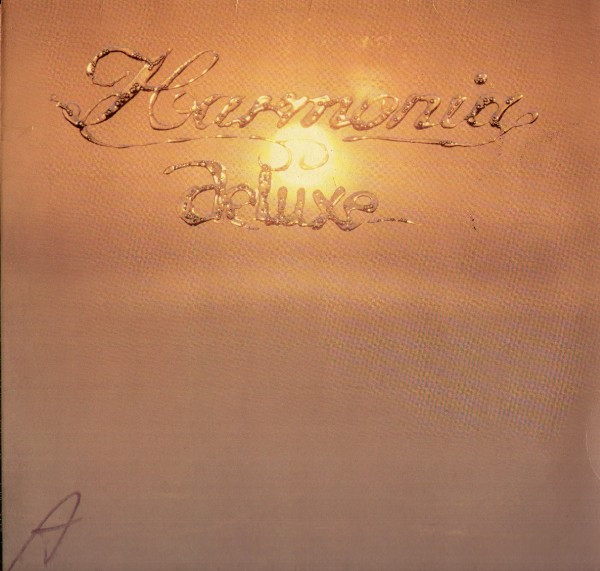
By then, it looked as if Harmonia had run its course. So Michael Rother decided to embark upon a solo career. That would take up the majority of his time. Michael’s first solo album was “Flammende Herzen which I recorded at Conny’s Studio,” during June 1976. Then later in the summer, Harmonia recorded their third and final studio album.
Tracks and Traces.
Little did the three members of Harmonia realise, that Deluxe was the last album they would release for thirty-two years. For what was their swan-song, Harmonia were joined by another legend, Brian Eno.
At the studio in Forst, Hans-Joachim Roedelius, Dieter Moebius, Michael Rother and Brian Eno spent eleven summer days recording what was meant to be their third album. The working title was Harmonia ’76. However, by then, “Michael Rother was wanting to concentrate on his solo career. Once the album was completed, it became apparent Harmonia had run its course. It was evolution.” So, Harmonia ’76 was never released until 1997.
During the next thirty-one years, it was thought that the master tapes had gone missing. “That was a rumour. Harmonia ’76 was released as Tracks and Traces in 1997.” Then ten years later, in 2007, Harmonia reunited.
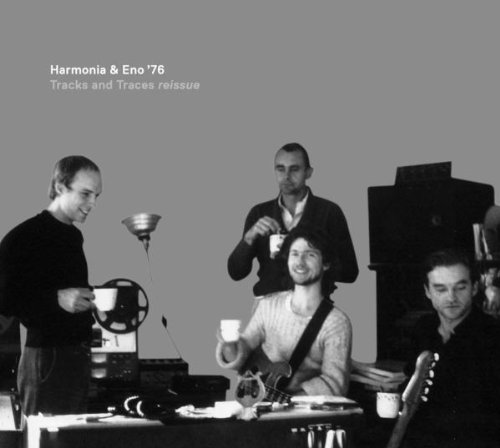
Live ’74.
The reunion was for the release of their Live 1974 album. It featured a a recording of Harmonia’s concert on the 23rd March 1974, at Penny Station Club in Griessem, Germany.
Live ’74 features just five lengthy tracks. As Harmonia open the show with a near eleven minute version of Schaumburg instantly, the listener is transported back to that night on 23rd March 1974. Harmonia then work their way through Veteranissimo, which becomes a seventeen minute epic, Arabesque and the Magnus Opus that’s Holta-Polta. Then Harmonia close the set with Ueber Ottenstein. These five tracks are a snapshot of Harmonia at the peak of their powers. They were one of the greatest German bands, but very few people had realised this. By 2007, when Live ’74 was released, it was common knowledge that Harmonia were Kominische royalty.
To celebrate the release of Live 1974, Harmonia played live for the first time since 1976. This landmark concert took place at the Haus der Kulturen der Welt in Berlin, on November 27th 2007. Sadly, it was the last time Harmonia played together.
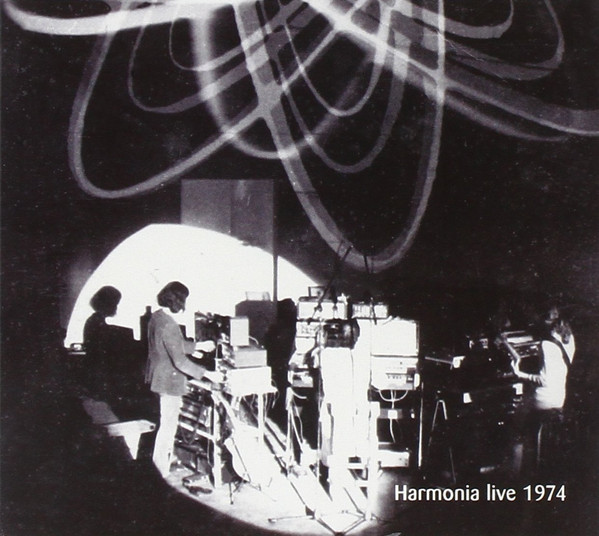
After a brave and lengthy battle against cancer, Dieter Moebius died on 20th July 2015. That day, Germany had lost one of its greatest musicians. Sadly, the man who had been a member of Kluster, Cluster and Harmonia, three of the most influential and innovative bands of the Kominische era, never lived to see the reissue of Grönland Records luxurious and lovingly compiled Harmonia box set The Complete Works. It featured Harmonia’s entire discography, including the Documents album. However, it wasn’t possible to by just a copy of Documents. That’s until now.
Documents.
For many record buyers, Documents will be the only Harmonia album missing from their collection. Thankfully, Grönland Records decided to rectify this, and recently released Documents on CD, LP and as a digital download. This means that Grönland Records have released each of Harmonia’s five albums separately. Documents is the final piece in the jigsaw. However, it’s an album that was very nearly incomplete.
Hans-Joachim Roedelius recounts how when Documents was being compiled; “we realised that we didn’t have two of the recordings. Fortunately, there was a happy ending to the story. A relieved Hans-Joachim Roedelius remembers: “After a concert in Hamburg [on 9th February 1975] a friend of ours [Harmonia] asked for a tape of the concert. Back then, we recorded everything. Each night, we recorded the concert. Tapes were expensive, and we were a poor band, so we rerecorded over previous recordings. Despite how expensive tapes were, we sent our friend the tape, and I never thought anything about it.” That was until The Complete Works box set was being compiled.
“It was then that we remembered giving the tape of the concert away. That tape featured the live recordings on Documents [Live At Onkel Pö, Hamburg and Live At Fabrik, Hamburg].” Fortunately, Harmnonia’s friend was none other than electronic musician and “absolute musician” Asmus Tietchens.
He remembers asking Dieter Moebius “if he could maybe copy him one or two of the pieces played in Onkel Pö and Fabrik?” So when a professionally made recording arrived at Asmus Tietchens it was a joyous occasion. He had his own little piece of musical history. Then forty years later, the Harmonia box set The Complete Works was being compiled.
It was then that Asmus Tietchens was approached by Michael Rother who told him about The Complete Works project. Part of the project was the Documents album. It was then Asmus Tietchens remembered the tape. He made it available for The Complete Works project. However, the big worry was what condition it would be in?
Fortunately, the Gods were smiling on Harmonia, and the recordings were just as good as they had been in 1975. It was hard to believe forty years had passed. Still, though, the recordings of Harmonia in their prime were a reminder of one of the greatest Kominische bands at their innovative best. The marriage between Neu!’s Michael Rother and Cluster’s Hans-Joachim Roedelius and Dieter Moebius was one made in heaven. The three men created some of the most important music of the Kominische era. This was apparent on their two studio albums Musik Von Harmonia and Deluxe. However, Harmonia were able to create innovative music live. That’s apparent on the two live tracks on Documents.
Listening to Live At Onkel Pö, Hamburg and Live At Fabrik, Hamburg, it’s incredible that these two tracks were recorded in February 1975. They were way ahead of their time. So much so, that if a band released them today, it would be hailed as the act of a musical genus. During the two live tracks, Harmonia take the listener on a captivating and innovative musical journey. Sadly, when Harmonia played Hamburg in February 1975, their music wasn’t finding the audience it deserved. So much so, that if a band released them today, it would be hailed as the act of a musical genus. Sadly, that wasn’t the case in 1975. Harmonia’s music passed most people by.
Despite this, Harmonia continued to tour and record new music. This includes Tiki-Taka which opens Documents. It’s one of two tracks recorded at the Harmonia Studio In Forst. Hans-Joachim Roedelius describes this version of Tiki-Taka; “as the ultimate version of the track.” He replicates the urgent Motorik beat as we speak, and enthuses about what he seems to regard as the holy grail of Harmonia’s unreleased tracks. He’s not wrong. Tiki-Taka is guaranteed to stop the listener in their tracks. It’s classic Harmonia. The hypnotic Motorik beat accompanies Harmonia at their inventive best. Sci-fi sounds, subtleties and nuances unfold as one sits spellbound while this lost Harmonia hidden gem works their magic. It’s akin to a Kominische symphony from the trio of musical pioneers. By the end of the track, one can’t help wonder what other tracks recorded at the Forst Studio are hidden in the Harmonia vaults?
Soon, you have your answer, as Proto Deluxe unfolds. It’s another unreleased track. Again, it falls into the category of hidden gem. It’s another truly timeless track, that finds Harmonia doing what they did best…innovating. Collectively, they’re like an artist, except that Harmonia’s pallet includes synths, keyboards, a drum machine, Michael Rother’s guitar and a myriad of effects. These effects transform the dry signal, and result in a timeless, driving, mesmeric and futuristic sounding Kominische track. Again, it’s amazing that it was recorded in 1975. If ever a group were ahead of their time, it’s Harmonia. Thankfully, their music has now been discovered by a new generation of record buyers
Somewhat belatedly, this new generation of record buyers discovered what had been one of the best kept musical secrets, Kominische musik. It was known only to a small, discerning group of musical connoisseurs who feel as if they’re part of the most exclusive club. In this club, they speak in hushed tones of groups like Amon Düül II, Can, Cluster, Embryo, Kraftwerk, Neu! and Xhol Caravan. However, time and time again, one name comes up in conversation… Harmonia.
Although Harmonia released just two albums while they were together, Musik Von Harmonia in 1974 and Deluxe in 1975 were both Kominische classics. After that, Harmonia’s long-lost collaboration with Brian Eno was released in 1997, and is worthy of being referred to as a genre classic. That wasn’t the end of the story. Live ’74 was released in 2007. Many critics thought that the Harmonia story was over. That wasn’t the case, with Grönland Records releasing Documents as part of The Complete Works vinyl box set. Its almost sold out, so Grönland Records reissued Documents on CD, LP and as a digital download. Just like previous albums bearing the Harmonia name, Documents is an album of groundbreaking music from one the most important and influential groups in the history of Kominische music, Harmonia. Their timeless music, including that on Documents, transcends generations, and will continue to do so.
HARMONIA-DOCUMENTS.
MARVIN GAYE-TROUBLE MAN-VINYL EDITION.
MARVIN GAYE-TROUBLE MAN-VINYL EDITION.
When What’s Going On was released on 20th May 1971, it marked the second chapter in Marvin Gaye’s career. For many people, What’s Going On marked the start of Marvin Gaye’s career as a serious artist. Indeed, What’s Going On, was far removed from the poppy soul Marvin Gaye had previously been a purveyor of. Not only did What’s Going On, mark a coming of age as an artist for Marvin Gaye, but was the start of a series of critically acclaimed and commercially successful albums he’d release between 1971 and 1978.
During this seven year period, Marvin Gaye released six albums. Three of these albums reached number one in the US R&B Charts, but only What’s Going On was certified gold. Given the quality of these six albums, that’s a remarkable statistic.
The followup to What’s Going On, was Trouble Man, which saw Marvin follow in the footsteps of Isaac Hayes, Curtis Mayfield and Bobby Womack, in composing the soundtrack to a Blaxploitation movie. So for anyone who is either a fan of Marvin Gaye, or Blaxploitation movies, this should be a must-have? Is that the case though? That’s what I’ll tell you, once I’ve told you about the background to Trouble Man.
After the success of 1971s politically charged classic What’s Going On, this had transformed Marvin Gaye’s career. He’d just signed a new contract with Motown imprint Tamla, worth a million dollars. This was the most lucrative recording contract an R&B artist had signed. Just as importantly, Marvin Gaye had won full creative control over his music. No longer had he seek approval from the Motown hierarchy if he wanted to go off piste musically. Without that creative freedom, Marvin have had to seek permission to record the soundtrack to a Blaxploitation movie, like Trouble Man.
By 1972, Blaxploitation movies were becoming hugely popular. Three of Marvin’s musical contemporaries Isaac Hayes, Curtis Mayfield and Bobby Womack had all composed soundtracks to Blaxploitation movies. Isaac Hayes wrote the score to Shaft, one of the classic films and soundtracks in the Blaxploitation genre. Curtis Mayfield had penned the soundtrack to Super Fly and Bobby Womack wrote the soundtrack to Across 110th Street. Composer Gene Page had contributed the score to Blacula. Throughout the seventies, Blaxploitation movies and similarly, Blaxploitation soundtracks would become hugely popular. Although Blaxploitation movies were released throughout the seventies, many of genre classics were released between 1971 to 1975, including Trouble Man.
Having signed his lucrative new contract with Tamla, Marvin was approached by Motown management about writing the soundtrack to a Blaxploitation movie. Previously, Isaac Hayes, signed to Stax had found commercial success and critical acclaim with his soundtrack to Shaft. Similarly, Curtis Mayfield had composed the soundtrack to Super Fly and released it on his own Curtom label. Following Shaft and Super Fly, Isaac Hayes and Curtis Mayfield won plaudits for their scores. Over at Motown, the label’s management must have cast envious glances. Then Motown won the rights to produce the soundtrack to Trouble Man. This was their chance to get a slice of the lucrative Blaxploitation pie. All they needed was someone to compose the soundtrack. Looking at Motown’s roster circa 1972, Marvin Gaye was the obvious, and some might say, only choice to compose the soundtrack to Trouble Man. With Marvin having signed his new contract, he began work on the soundtrack to Trouble Man.
Trouble Man had been written by John D.F. Black and was directed by Ivan Dixon, with cinematography by Michael Hugo. The cast included Robert Hooks as Mr. T, Paul Winfield as Chalky Price and Paula Kelly as Cleo. However, this was no Blaxploitation classic Marvin was being asked to provide the soundtrack for. Quite the opposite. In Harry Medved and Randy Dreyfuss’ The 50 Worst Films of All Time, Trouble Man has the dubious honor of being one of the fifty flops of filmography. So, it was against that backdrop Marvin began work on Trouble Man.
For Marvin Gaye’s first, and only, film soundtrack, Marvin wrote each of the nineteen songs on the Original Film Score to Trouble Man. Thirteen tracks featured on the original album version of Trouble Man. Whereas previous Blaxploitation soundtracks saw music and dialogue interspersed, Marvin decided to approach Trouble Man in a different way. Instead, he wrote several songs from the main character, Mr. T’s perspective, including “T” Plays It Cool, “T” Stands For Trouble, Don’t Mess With Mr “T,” There Goes Mr, “T” and My Name Is “T.”Five separate version of Trouble Man were recorded, including Main Theme From Trouble Man (2), Trouble Man, Theme From Trouble Man and Main Theme From Trouble Man (1). These five versions of Trouble Man allowed Marvin to demonstrate his versatility as a vocalist. For the alternate version of Trouble Man, Marvin recorded two vocals, one sung falsetto style, the other tenor style. They were the double tracked, the two lead vocals becoming one, when recording took place in Motown’s new Los Angeles studios, following the closure of Motown’s Detroit studios.
At Motown’s Los Angeles studios, Marvin Gaye put out a call to members of the Funk Brothers and Hamilton Bohannon’s band. This included a rhythm section of bassist Wilton Felder, drummer Earl Palmer and guitarists Louis Shelton and Don Peake. Bob Ragland and Larry Mizell played piano, while Gene Page was contracted to provide the strings. Horns came courtesy of saxophonist Trevor Lawrence, Eli Fountain and Marty Montgomery, plus Dale Oehler and James Carmichael. For his part, Marvin played drums, keyboards, piano, synths and took charge of vocals and harmonies. Looking at the booklet that accompanies the newly released version of Trouble Man, disappointingly, many of the personnel that played on the album are listed as “unknown.” Surely, somewhere in Motown’s archives, there must be records of who played on the sessions? Arrangers included Dale Oehler, Jerry Long, James Carmichael and Gene Page. Producing the fusion of soul, jazz and funk that is Trouble Man was Marvin Gaye.
On the release of Trouble Man on 8th December 1972, critics gave the album a favorable reception. Obviously, comparisons were drawn with Isaac Hayes’ Shaft, Curtis Mayfield’s Super Fly and Bobby Womack’s Across 110th Street. Composer Gene Page. This was only reasonable, given they were the same genre of music. While Shaft and Super Fly set the bar high, Marvin’s debut soundtrack was perceived as a success. It reached number fourteen in the US Billboard 200 and number three in the US R&B Charts. Trouble Man became Marvin’s second most successful album. Only the title-track Trouble Man was released as a single, reaching number seven in the US Billboard 100 and number four in the US R&B Charts. Sadly, Trouble Man would be Marvin Gaye’s only foray into world of soundtracks.
Trouble Man features the thirteen tracks that featured on the original 1972 version of Trouble Man. This includes the four versions of Trouble Man, including Main Theme From Trouble Man (2), Trouble Man, Theme From Trouble Man and Main Theme From Trouble Man (1). Of the four versions, the version of Trouble Man was released as a single stands out. Marvin’s vocal is filled with raw emotion, heartfelt and sung in a falsetto style. Then when he gets to the bridge of the song, his vocal becomes a gruff, gospel-tinged growl. The two “theme” versions are instrumentals, featuring Marvin playing synths, that accompany the rasping, blazing saxophones. During the version of Trouble Man that opens the movie, Marvin’s double tracked vocal features him delivering the vocal in tenor and falsetto styles. These two vocals were then combined, to create one of the film and Trouble Man’s highlights. While there are four versions of Trouble Man, four songs were written from Mr T, the main character’s perspective. “T” Plays It Cool, “T” Stands For Trouble, Don’t Mess With Mr “T” and There Goes Mr. “T.” There’s more to Trouble Man than these eight tracks.
Of the other five tracks on the original version of Trouble Man, The Break In (Police Shoot Big) veers between drama and a melancholy, wistful sound. So too does the saxophone led Poor Abbey Walsh. It has a real pensive, heartbreakingly sad sound. Like Cleo’s Apartment, it’s one of the highlights of Trouble Man and is understated with Marvin adding sensual harmonies against a wistful piano. It’s Marvin Gaye at his best, on his only soundtrack album, Trouble. Without doubt, Marvin Gaye’s Trouble Man album was much better than the film itself.
Anyone whose managed to sit through John D.F. Black’s Trouble Man will be familiar with the thirteen tracks. Like many Blaxploitation movies, the soundtracks are far better than the original movie. That’s the case here. Trouble Man features in Harry Medved and Randy Dreyfuss’ The 50 Worst Films of All Time. The best thing about the film was Marvin’s music.
That’s the case from the opening bars of Main Theme From Trouble Man to the closing notes of There Goes Mr. “T”, it becomes apparent that Marvin Gaye written and produced one of the best scores to a Blaxploitation movie. Jazz, soul and funk are fused over thirteen tracks. These tracks are variously atmospheric, moody, broody, dramatic, sensual and action-packed. Once you’ve heard Trouble Man, you can’t resist reaching over and turning the vinyl over and once again, revisit the subtleties, secrets and nuances of the music again.
So Commercial Marketing’s forthcoming reissue of Trouble Man on vinyl on 27th May 2016 will be a welcome one. Trouble Man is a must-have for fans of Marvin Gaye and Blaxploitation music. It’s part of an extended reissue of Marvin Gaye’s seventies album on vinyl that covers the period between 1971 and 1978.
What’s Going On marked the start of Marvin Gaye’s career as a serious artist. Indeed, What’s Going On, was far removed from the poppy soul Marvin Gaye had previously been a purveyor of. Not only did What’s Going On, mark a coming of age as an artist for Marvin Gaye, but was the start of a series of critically acclaimed and commercially successful albums he’d release between 1971 and 1978. The second album in this period was Trouble Man, which has been nicely mastered, and sounds better than the Hippo CD version released in 2013. This vinyl version is the one for purists to buy. Indeed, Trouble Man is something of a hidden gem in Marvin Gaye’s back-catalogue.
Like his 1978 double-album Here, My Dear, Trouble Man is an often overlooked album in Marvin Gaye’s back-catalogue. Both albums contain some of Marvin Gaye’s best music of the seventies. Trouble Man also is also proof that Marvin Gaye, like Isaac Hayes, could’ve enjoyed a career composing movie soundtracks.
Sadly, that wasn’t to be. Trouble Man was his only soundtrack. The followup to Trouble Man, while not a soundtrack, was a stonewall classic, Let’s Get It On. It marked the next chapter in his career, and was the third of six critically acclaimed and commercially successful albums Marvin Gaye released during the seventies. During the period between 1971 and 1978, Marvin Gaye only released one composed one soundtrack, Trouble Man. Mind you, if you’re only going to release one soundtrack, make it one that’s becomes a Blaxploitation classic, like Trouble Man.
MARVIN GAYE-TROUBLE MAN.
FANFARE CIOCARLIA-ONWARDS TO MARS!
FANFARE CIOCARLIA-ONWARDS TO MARS!
2016 finds Fanfare Ciocarlia celebrating their twentieth anniversary. What better way for the world’s premier gypsy brass band to celebrate such an important anniversary, than with their first new album since 2013?
Fanfare will release their new album Onwards to Mars! on 22nd April 2016, on Asphalt Tango Records. Onwards to Mars! is crammed full of Fanfare Ciocarlia’s trademark Balkan party sounds. Blues and Latin influenced tracks, are given a big band makeover by Fanfare Ciocarlia on an album that was recorded in three countries on two continents.
This included the Romanian capital Bucharest, and Zece Prăjini a small village in North East Romania. Zece Prăjini was where the Fanfare Ciocarlia story began,in 1996. Since then, Fanfare Ciocarlia have recorded eight albums, and have taken the world by storm.
Two years after Fanfare Ciocarlia were formed, they released their debut album Radio Pașcani in 1998, It was a recording of a radio broadcast for Radio Pascani. Given the response to their debut album, Fanfare Ciocarlia released their sophomore album Baro Biao: World Wide Wedding in 1999. By then, Fanfare Ciocarlia were constantly touring, and their Balkan party sound was reaching an even wider audience.
Given their gruelling touring schedule, another two years passed before Fanfare Ciocarlia was released Iag Bari in 2001. It became the most successful album of Fanfare Ciocarlia’s five year career. They had come a long way in the space of just five years. However, four years would pass before Fanfare Ciocarlia returned with their fourth album.
Between 2001 and 2005, Fanfare Ciocarlia toured far and wide. They played everywhere from clubs to festivals, and were established a reputation as a popular live act. Still, though, Fanfare Ciocarlia found time to record a new album, Gili Garabdi-Ancient Secrets Of Gypsy Brass. It was their fourth album, but first for their new label Asphalt Tango Records. When Gili Garabdi-Ancient Secrets Of Gypsy Brass was released in 2005, it marked the start of a relationship that’s still going strong eleven years later.
There was just a gap of two years before Fanfare Ciocarlia released a new album, Queens and Kings in 2007. It was well received upon its release, and was regarded as one of Fanfare Ciocarlia’s finest and most successful albums. All Fanfare Ciocarlia’s touring was paying off.
Given how much of their time was spent playing live, it seemed apt that Fanfare Ciocarlia’s next album was a live album. Live was a CD and DVD set released in 2009, and featured a recording of their concert at the Kesselhaus Der Kulturbrauerei, in Berlin, April 4th 2004. On the accompanying DVD, entitled Gypsy Brass Legends-The Story Of The Band, there was a film of the concert, and the film Iag Bari-Brass On Fire. It told the story of Fanfare Ciocarlia’s journey so far. Although they had come a long way, they weren’t finished yet.
Fanfare Ciocarlia next two albums were collaborations. The first was Balkan Brass Battle in 2011. It found two of the top Balkan brass bands going toe-to-toe musically. Boban and Marko Marković Orchestra Versus Fanfare Ciocărlia was indeed a Balkan Brass Battle. Musically, it was a battle royal, with Fanfare Ciocarlia stealing the show. Their second collaboration came two years later.
Devil’s Tale was released in 2013, and was a collaboration between Adrian Raso and Fanfare Ciocărlia. Devil’s Tale was well received by critics, and found an audience not just in Europe, but further afield. Since then, the twelve piece band have been touring Asia, Oceania, USA and Europe. Fanfare Ciocarlia have been doing this again recently.
In anticipation of the release of Onwards To Mars!, Fanfare Ciocarlia headed out on tour in March 2016 touring Asia, Oceania, USA and Europe. By the time Onwards To Mars! is released on April 22nd, this gruelling tour will almost be over. The tour has been publicising Onwards To Mars!, which was recorded in Romania, Germany and Colombia.
When recording of Onwards To Mars! began, Fanfare Ciocarlia’s lineup featured Costică “Cimai” Trifan and Rădulescu Lazăr, who both play trumpet and share vocals. They’re joined by trumpeter Paul Marian Bulgaru; alto saxophonist Daniel Ivancea; while Oprică Ivancea switched between clarinet and alto saxophone. Constantin “Șulo” Călin plays tenor horn; Laurențiu Mihai Ivancea baritone horn and Constantin “Pînca” Cântea and Monel “Gutzel” Trifan play tuba. Completing the lineup of Fanfare Ciocarlia were percussionist Nicolae Ionița and Costel “Gisniac” Ursu, who played the large drum. However, joining Fanfare Ciocarlia were a few friends.
This included vocalist Iulian Canaf; drummer Kai Schönburg; trumpeter Maite Hontel;percussionist Michael Metzer and Vladut Ivancea on clarinet. They final guest artist was Koby Israelite, who wrote and produced seven songs on Onwards To Mars. He also played drums, percussion and accordion. Gradually, Onwards To Mars took shape.
Recording of Onwards To Mars! took place at four different locations. Some of the recording took place in Fanfare Ciocarlia’s hometown of Zece Prăjini. Other sessions in Romania took place at UNDA Recording in Bucharest. Fanfare Ciocarlia also recorded at Popschutz Studio, in Berlin and in Medellin, Columbia at Merlin Producciones. At the four locations, Fanfare Ciocarlia and friends recorded a truly genre-melting album. It mixed the old and new, and saw familiar songs given a new twist.
Onwards To Mars! features fourteen tracks, including seven penned by one of the guest artists Koby Israelite. This includes the album opener Crayfish Hora. It finds Fanfare Ciocarlia adding punchy harmonies that accompany the lead vocal. Then when a sultry alto saxophone enters, and the arrangement begins to sound as if it was recorded in New Orleans, rather than Berlin, Bucharest or Medellin. It’s joyous, irresistible and dance-floor friendly. So eventually does Mista Lobaloba. It’s a slow burner, with an introduction that’s wistful and mournful. That’s until the arrangement explodes into life, amidst blazing horns, hollers and percussion. From there, Fanfare Ciocarlia kick loose, as the track becomes a slice of dance-floor friendly Cumbia. By then, a familiar track has taken on new life and meaning.
3 Romanians and Out To Lounge are two more songs from the pen of Koby Israelite. Both are horn driven instrumentals. The only difference is that 3 Romanians bursts into life, while Out To Lounge is a slightly slower almost cinematic sounding track. However, both tracks feature Fanfare Ciocarlia showcasing their trademark Balkan party sound. At the heart of the track’s success are a myriad of percussion, drums and of course, blazing horns aplenty. It’s an irresistible sound that will get any party started.
Trenul, Masina Mica is one of two traditional Romanian songs on Onwards To Mars! Both are delivered by Radulescu Lazar, one of Fanfare Ciocarlia’s elder statesmen. On Trenul Masina Mica, he delivers a heart wrenching vocal against an arrangement dominated by horns. This proves a potent and emotive combination. Un Tzigan Avea O Casa is a much more uptempo, joyous and celebratory sounding track. Again, Radulescu Lazar takes charge of the vocal, and plays his part in reinventing this traditional Romanian song. Another traditional song is Doina Pentru Un Frant Inima, a wistful sounding Balkan blues. Its mournful, ruminative sound is quite beautiful. So is The Patron’s Funeral, another wistful sounding track that paints pictures of the rural Romania of yesteryear. Just like Doina Pentru Un Frant Inima, The Patron’s Funeral show another side to Fanfare Ciocarlia.
One of Screamin’ Jay Hawkins’ best known tracks was I Put A Spell On You. It’s regarded as a genre classic, and it seems, is a favourite of Fanfare Ciocarlia. With the help of vocalist Iulian Canaf they reinvent the track. The arrangement is slow, dramatic and theatrical. That also describes Iulian Canaf’s vocal. Accompanied by horns, there’s a element of theatre to this Roma inspired cover version. Again, Fanfare Ciocarlia take an old song, and reinvent it, turning it into something very different to it once was.
Cucuritza is another of the tracks written by Koby Israelite. It’s another dance-floor friendly instrumental, that allows Fanfare Ciocarlia to showcase their irresistible Balkan party sound. Fanfare Ciocarlia is a joy to behold, and something everyone should experience once.
Another cover version is Bunica Bate Toba, which originally, was made famous by Moldovian rock band Zdob Si Zdub. Fanfare Ciocarlia totally transform this familiar track, and in the process, show just why they’re regraded as the world’s premier gypsy brass band. They unleash one of their best performances during a track which has a much more traditional sound, than some of those written by Koby Israelite.
Talking of Koby Israelite, he contributes another two instrumental tracks to Onwards To Mars! The first is Saints and Dates, which features the founding fathers of the Balkan Beat at their very best. Seamlessly they combine the old and new, on a truly irresistible and joyous sounding track. Hora Strengarilor picks up where Saints and Dates left off. The pounding drums have a contemporary sound, before the scorching horns take over centre-stage. They bring back memories of another musical age, which is kept alive by Fanfare Ciocarlia.
Closing Onwards To Mars is a cover version of Lucho Bermudez’s, Fiesta de Negritos’. It was recorded in Medellín with cumbia group Puerto Candelaria. Together, they create a track that veers between melancholy to dramatic, theatrical and joyous. It’s also a collaboration guaranteed to fill a dance-floor.
What better way for Fanfare Ciocarlia to celebrate their twentieth anniversary than with a new album, Onwards To Mars! It’s their first album since Devil’s Tale in 2013. Onwards To Mars! is also a reminder of why Fanfare Ciocarlia are regarded as the world’s premier gypsy brass band. They’re a truly talented band who seamlessly combine and flit between Balkan blues and cumbia to jazz and Latin on Onwards To Mars! It will be released on 22nd April 2016, on Asphalt Tango Records, and is without doubt the finest album of Fanfare Ciocarlia’s twenty year career.
No wonder. The music on Onwards To Mars! veers between melancholy, mournful and wistful to dramatic and theatrical to celebratory and joyous. It’s also beautiful and heart-wrenching. Other times, the music is dance-floor friendly and truly irresistible. This makes Onwards To Mars! the perfect introduction to newcomers to Fanfare Ciocarlia’s music. Quite simply, Onwards To Mars! is an emotional roller coaster, where Fanfare Ciocarlia takes the listener on a musical journey that they’ll never forget.
FANFARE CIOCARLIA-ONWARDS TO MARS!
JOHN MARTYN-GRACE AND DANGER-VINYL EDITION.
JOHN MARTYN-GRACE AND DANGER-VINYL EDITION.
In November 1977, John Martyn released what’s was undoubtably one the finest albums of his career, One World. It was an atmospheric, experimental and genre-defying album. Everything from folk, jazz, reggae and rock melted together over eight tracks. Released to overwhelming critical acclaim, One World was hailed a classic album. This was the second classic album of John Martyn’s ten year recording career.
The first came four years earlier, in February 1973, when John released Solid Air. Released to widespread critical acclaim, Solid Air critics realised, was without doubt, the finest album of John Martyn’s career. It was also the album that saw the Glasgow born troubadour make a commercial breakthrough. This should’ve been the start of the rise and rise of John Martyn.
For his eighth album, Sunday’s Child which was released in January 1975, John reigned in his experimental sound. However, Sunday’s Child was a much more eclectic album, with John flitting between country, folk and rock. The result was an eclectic and critically acclaimed album. However, controversy wasn’t far away for John.
In 1975 Island Records refused to release Martyn’s live album, Live At Leeds. So, John resorted to selling signed copies by mail from his home. After the release of Live At Leeds in 1977, John headed to Jamaica on holiday.
What started out as a holiday, ended up with John collaborating with reggae producer Lee “Scratch” Perry. One World is seen by some people as the first ever trip hop album. As a resuly, John Martyn is perceived as the father of trip hop and One World a John Martyn classic. After One World, John didn’t release an album for three years. There was a reason for this.
By the end of the seventies, John’s marriage had broken down. This led to John pressing “the self destruct button” as he described it. John became addicted to alcohol and drugs. He later said this was a very dark period in his life. Grace and Danger, which was released in October 1980, was the album that came out of this period, and the start of a turbulent time for John Martyn, both personally and professionally.
Grace and Danger was an autobiographical album, that described what he was going through at that time. John’s marriage had broken down and divorce proceedings were underway. This makes the music on Grace and Danger very personal. It’s akin to a snapshot to the pain, hurt and regret John was experiencing. This shines through on Grace and Danger which will be reissued on vinyl on 27th May 2016 by UMC.
Eight of the nine tracks that became Grace and Danger, were written by John. They describe what he was going through emotionally. The only track not penned by John was Johnny Too Bad, which was written by Slickers. These nine tracks were recorded by a tight, but talented band.
For Grace and Danger, John played guitars and added vocals. His friend Phil Collins, played drums and sung backing vocals. Tommy Eyre played synths and keyboards, while John Giblin played bass. These three musicians and producer Martin Levan were responsible for a soul baring album from John Martyn’s, Grace and Danger.
Once Grace and Danger was completed, John delivered the album to Chris Blackwell at island Records. When Chris Blackwell realised just how personal an album Grace and Danger was, held the album’s release back a year. Partly, this was because of his friendship with both John and Beverley Martyn. However, Chris also felt that Grace and Danger was “too depressing and didn’t want it released.” This angered John Martyn.
When John heard what Chris Blackwell thought of Grace and Danger, he wasn’t happy. He responded to Chris Blackwell saying: “please get it out! I don’t give a damn how sad it makes you feel-it’s what I’m about: direct communication of emotion.’” Eventually, a year later, Grace and Danger was released.
By then, the relationship between John and Island Records was damaged beyond repair. Grace and Danger was released in October 1980. Contrary to Chris Blackwell’s expectations, Grace and Danger was well received by critics. They realised just how personal an album Grace and Danger was, and empathised with what John had gone through. He had just suffered the breakup of a relationship, and was hurting badly. This however, wasn’t the last relationship that broke down during this period.
After the release of Grace and Danger, John’s relationship with Island Records deteriorated. John submitted another album to Island Records, The Apprentice. Island Records rejected The Apprentice. However, John had the last laugh. The Apprentice was eventually released in 1990, it was hailed as John’s comeback album. By then, it was nine years since John Martyn parted company with Island Records.
A year after the release of Grace and Danger, John left Island Records. This was the end of a fourteen year relationship. During this period, John had released eight albums for Island Records. His Island Records’ swan-song, was Grace and Danger, one of his most underrated and personal albums.
Opening Grace and Danger, is Some People Are Crazy. Just a broody bass, shimmering synths and bold keyboards combine with drums and crystalline guitars. They provide the backdrop for John’s vocal. It’s more a confessional that a vocal. There’s an honesty in his vocal. Belatedly, John’s come the conclusion that people either loved or loathed the hell raising John Martyn of the late seventies. He sings “some people are crazy about him, some people can’t stand his face.” He’s even chased the woman he loves away. This hurts. As if in desperation, John delivers the lyric “yes this loving kind of business, might be the best find you ever had.” Whether John believes this, though, is another matter? His parting line in this confessional is“some people are crazy, some people are just like me.”
Searing guitars and the rhythm section drive the rocky arrangement to Grace and Danger along. John’s vocal has a melancholy quality, as he realises what he’s lost. Against a backdrop of chiming, blistering guitars, keyboards and the rhythm section, John’s vocal is akin to an outpouring of pain. Reflecting, he sings: “I never knew the road that carried me along.” It’s obvious he had no idea where it would lead. It lead to him losing the woman he loved. Despite his being broken, he wishes Beverley well. He’s loved, lost and wishes her “sweet grace, no danger.”
Lookin’ On has a jazz tinged arrangement. A bass plays, guitars chime and stabs of keyboards are joined by drums played tenderly. As the drama builds, a tormented John paints a picture. It’s easy to visualise John returning from a night out, to Beverley who quite rightly, is less than happy. John comes “stealing in, with an innocent grin, to leave you staring, at the empty ceiling, feeling nothing, lookin’ on, I’m just lookin’ on.” At that moment, John wonders what’s gone wrong with his marriage? Previously, this type of behaviour would’ve elicited a laugh. Not any more. Things have gone to far. That’s reflected in the urgent jazz tinged arrangement. It accompanies John’s despairing vocal, on this tale of love gone wrong.
While Johnny Too Bad wasn’t written by John, it sums up the situation he finds himself in. Just like John, Johnny Too Bad has a penchant for hard living. “With your running, and shooting,looting and tooting, you’re too bad, cos one of these days, you’re going to make your woman cry,” these lyrics could’ve been written about John. It’s as if he realises this, and delivers a gravelly, vampish vocal. Again, he makes the lyrics sound like a confessional. Accompanying him are the rhythm section and guitars. One of the guitars is played through John’s trusty echoplex. Then later, John dawns the role of guitar hero, unleashing washes of a blistering, crystalline solo. It’s the perfect foil for John as he vamps his way through the rest of what could be an autobiographical song.
Sweet Little Mystery marks a change in direction on Grace and Danger. It’s the first of a series of ballads. Against a backdrop of twinkling keyboards, synths strings and the rhythm section John tenderly delivers a beautiful, heartfelt ballad about a relationship that’s all but over. Accopanied by backing vocals, John lays bare his soul. His vocal is full of sadness, hurt and melancholy as he sings: “it’s not the letters you just don’t write, it’s not the crying in the dead of the night.” Instead, “it’s that sweet little mystery that’s in your heart, it’s just that sweet little mystery that makes me cry.” These lyrics show just how talented a lyricist John was. He wrote about what he’d experienced, including the breakup of his marriage. It was the inspiration for such a beautiful, poignant tale of love lost.
Deliberately, chords are played on the shimmering keyboards as Hurt In Your Heart unfolds. They’re joined by weeping guitars. They reflect the heartbreak in John’s weary vocal. It’s akin to a cathartic outpouring of hurt and regret, regret at the way he behaved, and how it caused his marriage to end. However, although his marriage is over, John hope that “when that hurt in your heart has gone, I’ll still be your friend, right to the end of our river, and further still.”
Baby, Please Come Home is another beautiful, soul baring ballad. Against a backdrop of an understated rhythm section, glistening keyboards and a sometime, scorching guitar, John delivers a needy, hopeful vocal. Full of regret, he wants to make things right, and almost begging and pleading, sings “Baby, Please Come Home.”
Save Some (For Me) sees John change direction. It’s a mid-tempo track with a punchy, spacious introduction. Drums and synths combine, before John’s tender vocal enters. He leaves space between the lyrics. This adds to the urgency of the arrangement. Soon, John, accompanied by backing vocals from Phil Collins, combines power, emotion and urgency. Behind him, sci-fi synths, shimmering keyboards and the rhythm section combine. They play a supporting role in another emotional roller coaster.
Our Love closes closes Grace And Danger, John Martyn’s Island Records’ swan-song. Phil Collins’ drums set the scene for the rhythm section, keyboards and John’s needy, hurt filled vocal. Memories come flooding back, back to a time when their love was young. Things were good, the future looked bright. “Our love, once was you and me against this world, made a man from a boy and made a woman from a little girl.” Not any more. Now I find I have to beg before you call my name, please call my name, please call my name, and baby take a look, take a good look, baby, baby take a look in your heart.” As John delivers these lyrics he wells up, regrets omnipresent at the hurt he caused, and the love he lost.
While Grace and Danger was well received upon its release, it wasn’t the commercial success that John Martyn classics like Solid Air or One World. This had nothing to do with the music. Partly, it was to do with the type of music that was popular in 1980. By then, John Martyn’s music was the polar opposite of the post punk, hip hop, electronica and new romantic music that filled the charts. Then there was the fact that Chris Blackwell didn’t like Grace and Danger which will be rereleased by UMC on 27th May 2016.
The new vinyl version of Grace and Danger has been well mastered, and isn’t over loud. However, whether it’s better than recent CD versions will depend upon personal preference. Both the vinyl and CD versions have been well mastered. However, what will make some people’s minds up is the bonus tracks on the CD. There’s disc’s worth of bonus cuts on the 2015 CD reissue. However, if you can live without these bonus cuts, then vinyl is the way to go to discover a John Martyn’s soul baring opus.
Chris Blackwell found the music on Grace and Danger “too personal” and “depressing.” As a result, Island Records didn’t seem to cover themselves in glory when it came to promoting Grace and Danger. This was a huge mistake. After all, here was an album that spoke to many people. Grace and Danger was the story of many a failed relationship and marriage. For many, who had loved and lost, Grace and Danger spoke to them. It said everything that they wished they could. Thirty-six years later, that’s still the case.
Many suffering the heartbreak of a marriage breakup, have found solace in Grace and Danger. John speaks for, and too them on Grace and Danger. He’s been where they’ve been, and experienced the hurt, heartbreak and regret. Each song brings back a memory, often, a memory of better times. Especially Our Love, which closes Grace and Danger.
John is at his most eloquent, writing “Our love, once was you and me against this world, made a man from a boy and made a woman from a little girl.” Not any more. “Now I find I have to beg before you call my name, please call my name, please call my name, and baby take a look, take a good look, baby, baby take a look in your heart.” Not only does this prove the perfect way to close Grace and Danger, but sums up succinctly, the thin line between love and hate. That’s one of nine reasons why Grace and Danger is a forgotten classic in John Martyn’s back catalogue.
Quite simply, Grace and Danger is best described as the most personal album John Martyn ever released. It’ tells the story of one of the worst periods in his life, where the newly heartbroken John Martyn lays bare his soul for all to see and hear. What would’ve been fascinating, is if Beverley had replied to Grace and Danger. We could’ve heard her side to the story. Sadly, that never happened, and despite Beverley making a recent comeback, is unlikely to ever happen. As a result, Grace and Danger, one of John Martyn’s most underrated albums, remains one of the most soul-baring and cathartic breakup albums ever released.
JOHN MARTYN-GRACE AND DANGER-VINYL EDITION.

JETHRO TULL-TOO OLD TO ROCK ’N’ ROLL: TO YOUNG TO DIE-STEVEN WILSON STEREO MIX-RECORD STORE DAY VINYL EDITION.
JETHRO TULL-TOO OLD TO ROCK ’N’ ROLL: TO YOUNG TO DIE-STEVEN WILSON STEREO MIX-RECORD STORE DAY VINYL EDITION.
By December 1975, Ian Anderson was only twenty-eight, and was the lead singer of one of the most successful progressive rock bands in the world, Jethro Tull. British music magazine Melody Maker went further. They asked in February 1975; “Jethro Tull–Now The World’s Biggest Band?” No wonder. Jethro Tull had just sold out five nights at the 20,000 seater Los Angeles Forum. This was regarded as a remarkable achievement. However, it wasn’t surprising.
Jethro Tull’s first eight albums had sold over six million copies in America alone. This resulted in six gold discs; while 1971s Aqualung was certified triple-platinum. Back home in Britain, two of Jethro Tull’s albums had been certified silver. Jethro Tull were now regarded as progressive rock royalty. Despite that, bassist Jeffrey Hammond left Jethro Tull in 1975, after touring the Minstrels In The Gallery album.
The four years Jeffrey Hammond spent with Jethro Tull were some of their most successful. Glenn Cornick had left Jethro Tull in 1971. Into the breach stepped Jeffrey Hammond. He made his debut on Aqualung, which was released on 19th March 1971. This was the first of five albums Jeffrey Hammond played on. It was a glittering career, and by the time he left in 1975, gold and platinum discs adorned the walls of Jeffrey Hammond’s house. However, this came at a cost.
By the end of the Minstrels In The Gallery tour, Jeffrey Hammond was exhausted. Life with Jethro Tull seemed to be a schedule of record an album, then tour the album. It was non-stop. Jeffrey Hammond wanted to slow down. So, after the Minstrels In The Gallery tour, he announced he was leaving to become an artist. For Jethro Tull, this presented a problem. They were about to release their ninth album, Too Old To Rock ’N’ Roll: To Young To Die, which has just reissued by Rhino for Record Store Day 2016. This versions is the Steven Wilson Stereo Mix.
After the the Minstrels In The Gallery tour ended, Jethro Tull set about recording their ninth album, Too Old To Rock ’N’ Roll: To Young To Die. It was another concept album, where Jethro Tull told the story of an ageing rock star, who found fame when musical tastes changed. The ten tracks on Too Old To Rock ’N’ Roll: To Young To Die had been written by Ian Anderson. He was Jethro Tull’s songwriter-in-chief. These ten songs were recorded during December 1975.
The recording took place at Radio Monte Carlo, using the Maison Rouge Mobile Studio. This wasn’t the first time Jethro Tull had used the Maison Rouge Mobile Studio. It had been used to record Minstrels In The Gallery. For Too Old To Rock ’N’ Roll: To Young To Die, the Maison Rouge Mobile Studio was situated in the Principality of Monaco.
Radio Monte Carlo provided the soundtrack to the Principality of Monaco. It also housed a recording studio. This should’ve proved an attractive location for groups recording albums in the seventies. Monte Carlo was a tax haven, where many of the wealthiest British people were living. They weren’t will to pay 75% income tax and 83% on earned income. As a result, many groups, including the Rolling Stones became tax exiles.
This meant, they could only spend a limited amount of days in Britain. If they exceeded that amount of days, they became liable for taxation at the highest amount. So it wasn’t unusual for British groups to record albums in unusual locations. Often, their tax rates were much lower in Britain. Whether that’s why Jethro Tull chose to record in Monte Carlo in December 1975, is mere speculation?
When the recording of Too Old To Rock ’N’ Roll: To Young To Die began, there were a change in the lineup. Bassist John Glascock had replaced Jeffrey Hammond. John Glascock had been a member of flamenco rock band Carmen. They opened for Jethro Tull on their Minstrels In The Gallery tour. Now, John Glascock found himself slotting into Jethro Tull’s rhythm section alongside drummer and percussionist Barriemore Barlow and guitarist Martin Barre. John Evans who had been a member of Jethro Tull since 1970, played piano. Ian Anderson, Jethro Tull’s charismatic frontman played flute, acoustic guitar and sang lead vocals. He occasionally switched to eclectic guitar and added percussion. Augmenting Jethro Tull was the man many regarded as the band’s sixth man, David Palmer.
He had long been part of the Jethro Tull success story, orchestrating albums and concerts. However, from the Minstrels In The Gallery tour onwards, David Palmer officially joined the Jethro Tull’s stage show, playing keyboards and synths. However, on Too Old To Rock ’N’ Roll: To Young To Die, David Palmer played saxophone, piano and took charge of orchestrations and conducted the orchestral. Meanwhile, Jethro Tull drafted in another well known name for the recording of Too Old To Rock ’N’ Roll: To Young To Die, Maddy Prior.
The title-track, Too Old To Rock ’N’ Roll: To Young To Die required someone to add backing vocalists. Ian Anderson decided that the Steeleye Span vocalist fitted the bill. However, Angela Allen was chosen to add backing vocals on Crazed Institution and Big Dipper. Once the two backing vocalists laid down their parts, Too Old To Rock ’N’ Roll: To Young To Die, which Ian Anderson produced, was completed. It would another four months before Too Old To Rock ’N’ Roll: To Young To Die was released.
Before that, critics had their say on Too Old To Rock ’N’ Roll: To Young To Die. Before that, Ian Anderson tried to explain the album’s concept. Music Ian Anderson felt, was like fashion it cyclical. Progressive rock had been popular since the seventies dawned. There was nothing to say that progressive rock wouldn’t fall from favour. However, if Jethro Tull stuck with progressive rock, despite it falling out of favour, it may rise like a phoenix from the ashes. This proved prophetic.
The rise of punk, which was the antithesis to progressive rock, resulted in groups like Jethro Tull being labelled musical dinosaurs. They were perceived by the punks as remnants of the musical past. This resulted in a backlash against the musical establishment, including Jethro Tull. Their albums still sold well, but progressive rock was no longer as popular. However, in the eighties, there was a resurgence in progressive rock, with groups like Marillion enjoying commercial success and critical acclaim. Meanwhile, many of the embittered punks were now returned to the sink estates where they had come from. By April 1976, Too Old To Rock ’N’ Roll: To Young To Die was just about to be released, and the public introduced to Ray Lomas.
Too Old To Rock ’N’ Roll: To Young To Die told the story of Ray Lomas. He was ageing rock star, who had retired from music, when the music he played fell out of fashion. Still, Ray Lomas was a greaser. He wasn’t going to have a makeover. Not even when he went onto the “Quizz” show, where won the jackpot. Money however, didn’t bring Ray Lomas happiness.
After winning the money, Ray Lomas tries to commit suicide. Like the Sleeping Beauty, he falls into a deep sleep. When Ray Lomas wakes up, the greaser fashion is back in style, and he makes a comeback. Never did he loose faith that his style would come back into fashion. The story of Ray Lomas was told in a series of cartoons printed in Too Old To Rock ’N’ Roll: To Young To Die’s sleeves. This was meant to guide critics and listeners through Too Old To Rock ’N’ Roll: To Young To Die’s plot.
Or some Jethro Tull thought. Some critics couldn’t quite understand Too Old To Rock ’N’ Roll: To Young To Die. This resulted in mixed reviews of Too Old To Rock ’N’ Roll: To Young To Die. Unsurprisingly, the contrarian Rolling Stone magazine. slated Too Old To Rock ’N’ Roll: To Young To Die. They called the plot “muddled,” and telling Ian Anderson to “stick to music, because he most definitely is not a storyteller.” Other reviews were mixed.
Melody Maker magazine, who up until then, had been a Jethro Tull loyalist, gave Too Old To Rock ’N’ Roll: To Young To Die a mixed review. On the plus side, were Ian Anderson’s songwriting skills and Martin Barre’s stunning guitar solos. However, they felt the rhythm section were subdued, and longed for them to kick loose. What critics were forgetting, was that Too Old To Rock ’N’ Roll: To Young To Die was John Glascock’s debut. He had made the step up from flamenco rockers Carmen, to progressive rock royalty Jethro Tull, who usually, sold 500,000 albums in America.
Not this time around. Too Old To Rock ’N’ Roll: To Young To Die reached number fourteen in the US Billboard 200 and fifteen in Britain. Elsewhere, Jethro Tull’s ninth album reached number ten in Austria, and number twenty-seven in Sweden. This time there were no gold, silver or platinum discs. It was the first time a Jethro Tull album had failed to achieve silver, gold or platinum status. Since then, Too Old To Rock ’N’ Roll: To Young To Die is regarded as a hidden gem in Jethro Tull’s back-catolgue.
Too Old To Rock ’N’ Roll: To Young To Die, was Jethro Tull’s final concept album. It opened with Quizz Kid. Just a strummed guitar accompanies Ian Anderson’s wistful vocal, before strings sweep in and the rhythm section provide an understated heartbeat. Meanwhile, Ian paints a picture of yesterday’s man, the greaser Ray Lomas. Then when Ray wins the Quizz, the arrangement explodes into life. A searing guitar is unleashed, and Ian’s vocal grows in power. Soon, the tempo changes, and Ian briefly plays his flute. When his vocal returns, Jethro Tull the arrangement becomes rocky. The rhythm section are augmented by acoustic guitar, percussion and pizzicato strings. There’s constant changes in tempo and style. From progressive rock, folk rock and classic rock influences can be heard. Later, Ian vamps, while a freewheeling Jethro Tull provide the perfect backdrop, as the story of Ray Lomas begins to unfold.
An urgently strummed guitar and a subtle burst of flute usher in Ian’s vocal on Crazed Institution. Ian embraces the role of Ray Lomas. Winning the Quizz wasn’t the answer to his problems. All the money means, is he’s able to shop at the “Crazed Institution of the stars,” which he calls Horrids. Revulsion fills his voice as he delivers the lyrics. Meanwhile, the arrangement gradually builds. For a while the rhythm section are almost restrained. Eventually, they’re allowed to step out of the shadows. However, it’s flourishes of piano add an element flamboyance and drama. Backing vocals accompany Ian, as the arrangement sweeps along. That’s until the bass signals it’s all change. A braying saxophone, stabs of piano and acoustic guitar accompany Ian, his flute and percussion. By now, Ian’s delivery is impassioned, as Jethro Tull in full flight, on what later became a staple and favourite of Jethro Tull concerts.
Just a lone Spanish guitar plays on Salamander. It’s joined by another guitar. Both are played and picked with a degree of urgency. Eventually, Ian’s vocal enters after midway through the track. His vocal manages to be heartfelt and rueful as he becomes Ray. Suddenly, Ray remembers the first time he saw her: “on the sun kissed lane.” All the time, backing vocals accompany him, as the lyrics take on a cinematic quality. Later, Ian switches to flute on what’s an understated, beautiful hidden gem from the Jethro Tull back-catalogue.
As Ian calls “Taxi,” Taxi Grab begins. A blistering guitar and pounding drum combine with the bass. Ian is like Pied Piper, delivering a jaunty vocal. He observes how each night, London “evacuates” and the “Taxi Grab” begins. Meanwhile, machine gun guitars are panned left. They’re joined by the rest of the rhythm section, and later, a bluesy harmonica. Briefly, Martin Barre unleashes a searing guitar solo. Mostly, his playing is restrained, just like drummer Barriemore Barlow. Technically, it’s hard to fault Jethro Tull’s musicianship. Similarly, Ian’s lyrics and delivery can’t be criticised. However, what some listeners will wonder, is what has this to do with Ray Lomas? They’ll be left to assume this is Ray’s observations, as he watches on, as London evolves as night falls.
Slowly, and gently, an acoustic guitar plays on From a Dead Beat to an Old Greaser. It accompanies Ian’s vocal, which are accompanied by rueful harmonies and wistful strings, as he reminisces: “when bombs were bombed every Sunday, and The Shadows played F.B.I.” Later, Ian sings: “Jack Kerouac, Rene Magritte, to name a few of the heroes…who were too wise for their own good left the young brood to go on living without them.” When the vocal drops out, the sultriest of saxophone is dropped in. It’s an inspired choice, and knits the song together. By then, Jethro Tull sound like another member of progressive rock royalty, Pink Floyd, on what’s without doubt, one of Too Old To Rock ’N’ Roll: To Young To Die’s highlights.
Bad-Eyed and Loveless has a bluesy introduction. Just a guitar accompanies Ian’s gravelly vocal as he sings: “Yes an’ she’s bad-eyed and she’s loveless, a young man’s fancy and an old man’s dream.” His vocal veers between heartfelt and rueful, realising he’s being used. Without the money, she wouldn’t look twice at an old greaser like Ray Lomas.
An airy flute opens Big Dipper, which seems to have been inspired by the town where Ian grew up, Blackpool. The references to the Pleasure Beach and Tower Ballroom are clues. They add to the cinematic quality of the song, which tells of weekends away in Blackpool for the” “weekend happiness seekers.” Fun and frolics are the order of the day. Meanwhile, Ian’s flute and Barriemore Barlow drums and percussion play leading roles. So does Martin’s searing guitar. Although’s he still not let off the leash, the song wouldn’t be the same without it. Jethro Tull are roiling back the years, as Ray Lomas remembers pre-fame, hedonistic weekends where he sough escape from the drudgery of modern life.
A crystalline guitar run joins with the rhythm section and pizzicato strings on Too Old To Rock ‘n’ Roll: Too Young to Die. There’s sadness in Ian’s voice as he realises that Ray’s career is at a crossroads. He’s been cast out into the wilderness, and is: “Too Old To Rock ‘n’ Roll: Too Young to Die.” Behind him, the arrangement has grown, and is one of the best on the album. David Palmer’s strings sweep and swell, adding drama and a wistful quality. The rhythm section add to this drama. Later, Maddy Prior adds a melancholy backing vocal. Even bassist John Glascock stamps his authority on the song. So does a pounding piano, growling saxophone and Martin Barre’s piano. From there, the arrangement reaches a wistful, symphonic crescendo. It’s a fitting finale to this progressive rock epic.
Having reached a crossroads in his life on Pied Piper, Ray can see no way out, and tries to commit suicide. This becomes apparent as Ian sings: “now if you think Ray blew it, there was nothing to it, they patched him up as good as new.” All isn’t well with him though. “You can see him every day riding down the Queen’s highway, handing out his small cigars to the kids from school.” Accompanying Ian, are dark harmonies, sweeping, then pizzicato strings. By then, genres melt into one, becoming part of this musical tapestry. Progressive rock, folk, jazz classical have been combined by Jethro Tull. Similarly, the tempo changes, adding to the drama, as Ray seems to unravel. He’s referred to as the: “Pied Piper, the mad biker.”
The Chequered Flag (Dead or Alive) closes Too Old To Rock ‘n’ Roll: Too Young to Die, which was Jethro Tull’s final concept album. It’s a poignant song to close the album, and features some of Ian’s best lyrics. There’s triumph and sadness throughout the song. However, that’s still to come.
Just a Fender Rhodes join a chiming guitar. Then Ian sings:“the disc brakes drag, the chequered flag sweeps across the oil-slick track, he young man’s home; dry as a bone, his helmet off, he waves: the crowd waves back.” Swathes of strings sweep, and the rhythm section provide a slow, melancholy backdrop. This is fitting as Ian sings: “he hard road’s end, the white god’s sendis nearer everyday, in dying the old man says, isn’t it grand to be playing to the stand, dead or alive.” Ian Anderson seems to have kept his best vocal until last. With harmonies, and David Palmer’s beautiful orchestrated arrangement, it’s a beautiful, melancholy and poignant song, which features Jethro Tull at their best. It’s a fitting way to end an era.
Too Old To Rock ‘n’ Roll: Too Young to Die was the last concept album Jethro Tull released. By then, they were masters of the concept album. That’s why, in 1976, Jethro Tull were one of the biggest progressive rock bands in the world. However, Too Old To Rock ‘n’ Roll: Too Young to Die had failed to sell in the same quantities as their previous albums. That’s despite the undoubtable quality of music on Too Old To Rock ‘n’ Roll: Too Young to Die.
It’s one of the most underrated albums in Jethro Tull’s illustrious back-catalogue. However, Too Old To Rock ‘n’ Roll: Too Young to Die had the misfortune to be released just as punk was born. It came kicking and screaming into the world, kicking out at the musical establishment. Suddenly, progressive rock groups were seen as dinosaurs, and remnants of music’s past by the new breed of gunslinger critics.
Many of these new critics were blinkered. They believed music began in 1976. This was music’s year zero. These new critics slated albums by the musical establishment. Progressive rock groups never stood a chance. However, Too Old To Rock ‘n’ Roll: Too Young to Die is a much better album than many reviews would’ve record buyers believe.
Those that bought Too Old To Rock ‘n’ Roll: Too Young to Die, found a cohesive, cerebral concept album that told the story of ageing greaser, Ray Lomas. He was the retired rocker whose music had fallen out of fashion. However, he believed that one day, his music would become fashionable again. When it did, Ray Lomas would be back where he belonged. That was prophetic.
Following Too Old To Rock ‘n’ Roll: Too Young to Die, Jethro Tull’s fortunes improved. There was a reason for this. Jethro Tull reinvented themselves musically. They had always been musical pioneers, and weren’t content to stand still. Instead, they experimented musically, and pushed musical boundaries to their limit over the next few years. This just happened to coincide with an upturn in Jethro Tull’s fortunes.
Jethro Tull’s tenth album, Songs From The Wood was certified gold in America and Canada. Then 1978s Heavy Wood was certified gold in America and Canada, and silver in Britain. The seventies finished for Jethro Tull with 1979s Stormwatch being certified gold in America and Canada. This meant that Jethro Tull had sold over seven million albums in America alone. The only album of the seventies that wasn’t certified gold or silver, was Too Old To Rock ‘n’ Roll: Too Young to Die. It’s a hidden gem in Jethro Tull’s glorious back catalogue. Sadly, it marked the end of en era for Jethro Tull.
Following Too Old To Rock ‘n’ Roll: Too Young to Die, Jethro Tull’s music continued to evolve. Their music moved towards a folk rock sound. Too Old To Rock ‘n’ Roll: Too Young to Die had been their progressive rock swan-song. Sadly, Too Old To Rock ‘n’ Roll: Too Young to Die was Jethro Tull’s swan-song, when it came to concept albums.
That was great shame. Jethro Tull were one of the finest purveyors of progressive rock. Some of Jethro Tull’s finest albums had been concept albums, including their Magnus Opus Aqualung and Thick As A Brick. While, Too Old To Rock ‘n’ Roll: Too Young to Die may not match the quality of Jethro Tull’s classic, Aqualung, it’s a far superior album to A Passion Play. The newly reissued vinyl version has been nicely mastered, and is superior to the sound quality of the recently released CD versions. This is another reason why Too Old To Rock ‘n’ Roll: Too Young to Die, and even Thick As A Brick and would make a worthy inclusion into any self-respecting record collection.
JETHRO TULL-TOO OLD TO ROCK ’N’ ROLL: TO YOUNG TO DIE-STEVEN WILSON STEREO MIX-RECORD STORE DAY VINYL EDITION.


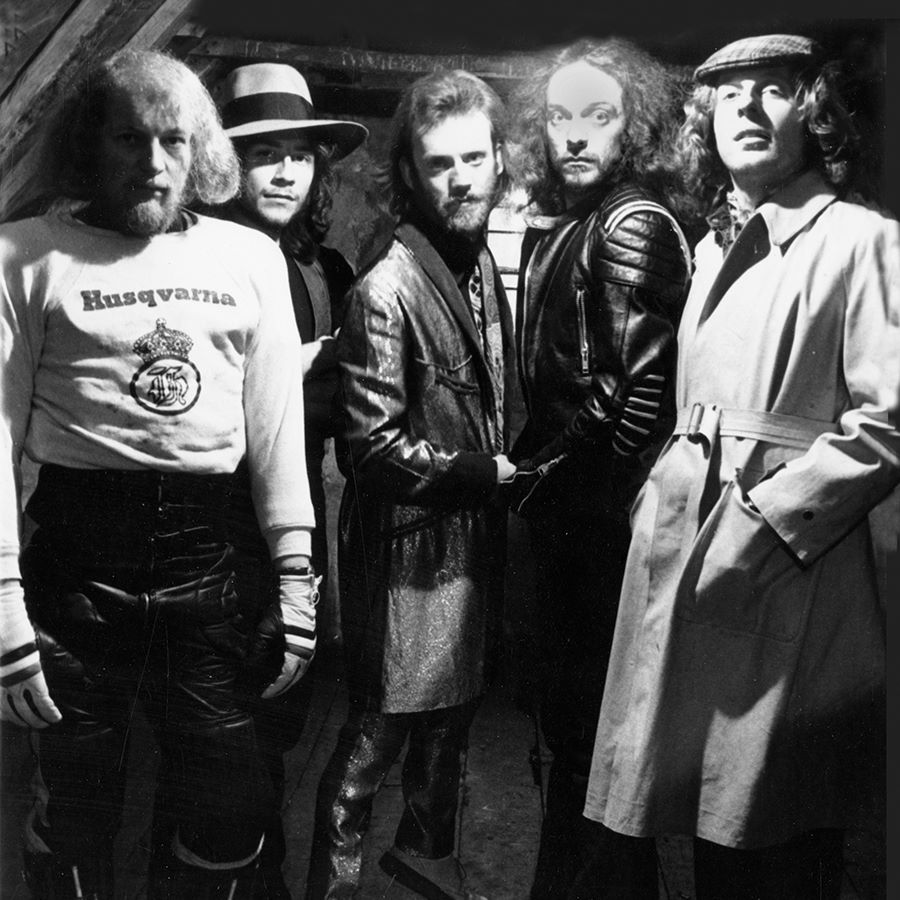
KLAUS SCHULZE-IRRLICHT.
KLAUS SCHULZE-IRRLICHT.
In 1969, Berlin’s vibrant musical scene was thriving. At the heart of Berlin’s music scene was the Zodiak Free Arts Lab. It was the cultural centre of the city. This was where some of Germany’s top bands took their tentative steps towards greatness. However, the Zodiak Free Arts Lab was also a meeting place for musicians and artists.
Members of Can and Agitation Free rubbed shoulders with future members of Ash Ra Tempel and Neu! It was also at the Zodiak Free Arts Lab where Klaus Schulze, who was still the drummer of Psy Free, first met Edgar Froese from Tangerine Dream. Soon, Edgar Froese invited Klaus Schulze to join an early lineup of Tangerine Dream.
Tangerine Dream.
Tangerine Dream quickly became the nearest thing that the Zodiak Free Arts Lab had to a house band. They were a familiar face, playing night after night. This was good practice for when Tangerine Dream recorded their debut album Electronic Meditation.
Electronic Meditation.
Rather than hiring one of Berlin’s recording studios, Tangerine Dream decamped to a factory that the band had rented. This allowed Tangerine Dream to set up their array of traditional instruments and custom made instruments.
Klaus Schulze’s setup was fairly traditional, including drums, percussion and metal stick. Edgar Froese mixed traditional and custom made instruments, bring various guitars, piano, organ, piano, tape recorder and a variety of effects along. Conrad Schnitzer did likewise, bringing a cello, violin and an adapter. They were joined by various found instruments; including broken glass and dried peas which were shaken in a sieve were just two found sounds. The sound of burnt parchment was also used. So were backwards vocals. It was a truly innovative and inventive approach to music, which was produced by Tangerine Dream.
Once Electronic Meditation was complete, eight months passed before the Ohr label released the album in June 1970. When Electronic Meditation was released, it divided the opinion of critics. While some critics didn’t seem to ‘get’ Electronic Meditation, others realised that it was a groundbreaking, genre-melting album. Everything from ambient, avant-garde, electronic, experimental, free jazz, Krautrock, musique concrète and psychedelia can be heard on Electronic Meditation. Each of these influences shine through on what was a truly innovative album. Despite this, the album sold in relatively small quantities. It certainly wasn’t a huge commercial success. Just like a lot of albums released during the Krautrock era, it was only much later that critics recognised how important albums like Electronic Meditation were.
Despite the commercial failure of Electronic Meditation, Tangerine Dream continued. However, it would be without Klaus Schulze. He left Tangerine Dream to join a new group Ash Ra Tempel.
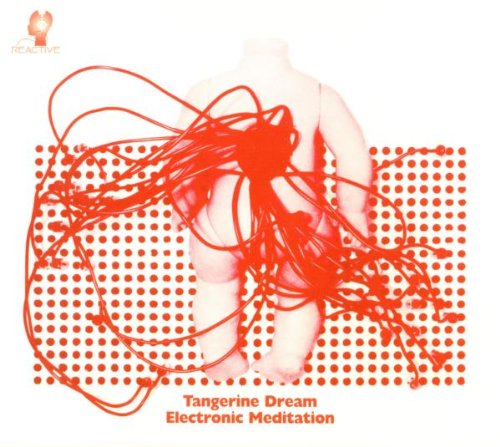
Ash Ra Tempel.
Just like Tangerine Dream, Ash Ra Tempel had frequented and played at the Zodiak Free Arts Lab. They were founded in 1970 by guitarist Manuel Göttsching, drummer bassist Hartmut Enke and Klaus Schulze. Their music was a fusion of space rock, psychedelia, Krautrock and ambient music. This sound they refined playing live, especially at the Zodiak Free Arts Lab where they were a familiar face. Over the next few months, Ash Ra Tempel’s sound evolved, and by March 1971 they were ready to record their eponymous debut album.
Recording of Ash Ra Tempel took place on 11th March 1971. By then, Ash Ra Tempel were incorporating electronics into their sound. Especially when Manuel Göttsching delivered his improvised guitar solos. He used effects in the same way as Jimi Hendrix and Eddie Hazel. Meanwhile, Klaus Schulze played with a ferocity on Amboss, a twenty minute epic. Then on Traummaschine which features on side two, it’s a much more laid-back, sedate track, where drones and electronics play their part. Klaus Schulze gives a shaman-like performance as he switches bongos and adds shimmering, glistening cymbals. This was very different to Amboss. Ash Ra Tempel was definitely an album of two sides, that was the perfect showcase for Klaus’ versatility.
Just three months later, Ash Ra Tempel was released on the Ohr label in June 1971. It was only the label’s thirteenth release, Ash Ra Tempel was well received by critics, who noted that the two lengthy tracks were quite different. The first side which featured Amboss,
had a much heavier sound, while Traummaschine had a much more sedate sound. Again, the album was a fusion of disparate genres. Elements of ambient, free jazz, Krautrock, psychedelia and space rock can be heard on Ash Ra Tempel. It should’ve been an album that appealed to all types of record buyers.
That however, wasn’t to be. Instead, Ash Ra Tempel wasn’t a huge seller. It sold in relatively small quantities. This was the case with many of the Krautrock albums that were released between 1969 and 1977. By then, Klaus Schulze would be a solo artist. He decided to leave Ash Ra Tempel after their eponymous debut album and embark upon a solo career.
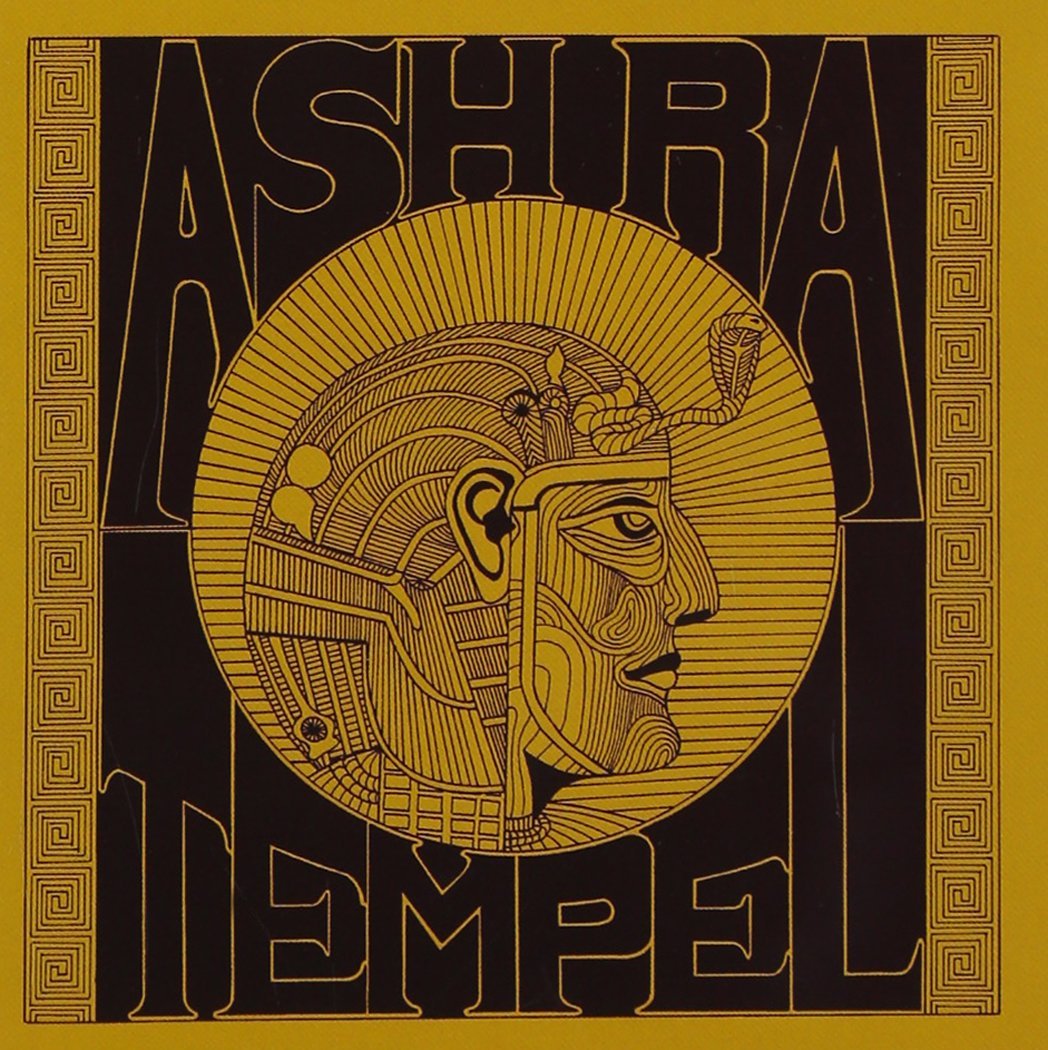
Irrlicht.
Being in a band didn’t seem suit Klaus Schulze. He found that the endless discussions got in the way of the important thing, making music. He wanted to make music, not talk about it. Klaus’ approach was to let the music flow through him. Other musicians seemed to want to discuss every aspect of the music. Meanwhile, Klaus wanted to improvise. It was frustrating, and stifling Klaus’ creativity. As a solo artist, he wouldn’t have to put up with the endless pointless discussions. That’s how in April 1972, Klaus found himself preparing to record to his debut album Irrlicht., which was recently released by MIG.
Having left Ash Ra Tempel, Klaus Schulze wanted to make music that was unique. He couldn’t point at an artist, and say: “that’s the type of music I want to make.” While Klaus was aware of minimalist composers Terry Riley and Steve Reich, but this wasn’t the type of music he was considering making. They did share some things in common, the concepts of repetition, phrasing and sequencing. Apart from that, Klaus was heading in a different direction.
This was perfect, as Klaus was never going to be accused of following in someone’s footsteps. Musically, he had a blank canvas to work with. His palette of sounds were unlike other musicians. He had an amplifier that wasn’t working, an organ, a cheap microphone and a cassette recorder. The cassette recorder and microphone he used to tape the famous Freie Universitat Berlin orchestra. This recording Klaus would alter with filters. Then he would modify some of his equipment.
Klaus set about modifying the broken amplifier. He modified it, so that when he turned the volume up it caused feedback, tremolo and chirping sounds. The organ was modified by Klaus so that it no longer sounded like an organ. Along with his microphone and cassette recorder, Klaus set about recording his debut album, Irrlicht.
Recording of Irelicht took place in Berlin, during April 1972. To the studio, Klaus took his guitar, percussion and zither. They joined Klaus’ array of modified instruments. Another of Klaus’ secret weapons were recordings of the Colloquium Musica Orchestra.
Before the recording of Irrlicht, Klaus had gone along to watch the Colloquium Musica Orchestra rehearse. As he stood and watched, he told the conductor “I like what you are doing, but could you do something different for me for half an hour?” With that, the bemused conductor asked “what would you like to have?” Klaus responded, with: “I don’t care, just play anything. I just want the sound. I’m going to play the tape backwards.” When Klaus returned half an hour later, his tape was ready and an integral part of Irrlicht was complete. Now, it was a case of bringing everything together.
With his bruised, battered and modified equipment, Klaus got to work, and the recording studio became a place where he could experiment. Using his modified organ and amplifier, plus percussion, zither and guitar, Klaus got to work. The backdrop for what was one of the most ambitious and experimental albums of 1972, was the tape played backwards.
Incredibly, Klaus didn’t even a synth. While other artists owned banks of expensive synths, Klaus created an album that sounds as if it’s made entirely by an array of synths. Instead, Irrlicht, with its cosmic sound and ambient drones was a synth free zone. Instead, Irrlicht was more like an album of musique concrète. Klaus manipulated tapes, adding filters, delay, echo and an array of effects. The result was a trio of cinematic tracks that sounded like the soundtrack to an early seventies sci-fi film.
The three tracks on Irrlicht were very different. Satz: Ebene the album opener, deserves to be described as an epic. Understated, stark and desolate, with a moody, broody and dramatic sound, it would’ve been the perfect backdrop for a sci-fi film. It’s the musical equivalent of shifting sands, with ambient drones rumbling almost menacingly. Meanwhile, what sounds like elegiac strings play. Less is more, as the stripped down arrangement reveals its secrets. Later, a heavily modified gothic sounding organ adds what could easily be the backdrop to a scene in a remake of Dracula. By then, Klaus is a musical shape-shifter, as he combines disparate musical genres. This includes ambient, avant-garde, drone and musique concrète. They’re combined to create what sounds like a timeless space symphony. It may have been recorded in 1972, but has aged like a fine wine. So has the rest of Irrlicht.
At just over five minutes, Satz: Gewitte is easily the shortest track. Again the arrangement is understated, but chilling. The arrangement sweeps, crawls and meanders along exuding an air of menace. Especially as various found sound emerge from the arrangement. It becomes like a fire breathing dragon. Meanwhile, drones begin to make their presence felt, sweeping in and adding to the chilling cinematic sound.
Satz Exil Sils Maria closes Irrlicht, and was recorded backwards. The track has a dark, ruminative sound. Slowly and gradually, the arrangement begins to reveal its deepest secrets. Just like the two preceding tracks, the arrangement is understated, but captivating. Klaus’ less is more approach means the listener hangs on every note, just in case they miss a nuance or subtly. Later, the arrangement is like a vortex, discharging otherworldly sounds. They whirr, whoosh and grind, as the drone is like a siren, sending out a warning. Other times, there’s a much more melodic sound. Mostly, though, dark and ruminative describes this compelling soundscape. Just like the rest of Irrlicht, it’s part of a timeless album that launched Klaus Schulze’s solo career.
While Irrlicht was well received by some critics, many critics failed to realise how important an influence Klaus Schulze would have on German music. He would become one of the most important and influential artists in the Berlin School. That was still to come.
Irrlicht was a synth free zone, and owed more to musique concrète than the Berlin School. Klaus Schulze would release several classic Berlin School albums, including 1973s Cyborg, 1975s Timewind and 1976s Moondawn. However, just like many German artists of the late sixties and seventies, Klaus Schulze neither received the critical acclaim nor commercial success they deserved.
When Ohr released Irrlicht in August 1972, it followed in the footsteps of Tangerine Dream’s Electronic Meditation and Ash Ra Tempel, and didn’t sell in vast quantities, Instead, it was more of an underground album, that was more popular in France and Britain than in Germany. It would only be much later that Germany began to realise that they had produced some of the most talented musicians of the late sixties and seventies, including Klaus Schulze.
His debut album Irrlicht was recently remastered and rereleased by MIG. It’s part of an ongoing reissue of Klaus Schulze’s extensive back-catalogue. On the reissue of Irrlicht is the bonus track, Dungeon. At twenty-four minutes long, it’s another epic track. This is a welcome addition to Irrlicht, the album that was the first of over sixty solo albums from Klaus Schulze, who nowadays, is regarded as one of the pioneers of German music. His solo career began in 1972 with Irrlicht.
And what an album for Klaus Schulze to begin his solo career with. Quite simply, Irrlicht was one the most innovative albums of 1972. The music on Irrlicht was understated, broody, moody, dark, dramatic and gothic. It was also chilling, eerie, meditative and ruminative. Constantly, Irrlicht has a cinematic sound. It’s like a 21st Century space symphony from a true musical pioneer, Klaus Schulze. He was making tentative steps in what would be a long and illustrious solo career. That career has lasted six decades and sixty albums, including Irrlicht, Klaus Schulze’s groundbreaking debut album.
KLAUS SCHULZE-IRRLICHT.

DALINDEO-SLAVIC SOULS.
DALINDEO-SLAVIC SOULS.
The Dalindèo story started back in 2003. That’s when composer and guitarist, Valtteri Laurell Pöyhönen, decided to found Dalindèo. They were no ordinary band. Instead, Dalindèo decided to recruit some of Finland’s top jazz musicians.
Joining him in the rhythm section were drummer Jaska Lukkarinen and Pekka Lehti on double bass. They were augmented by the horns of saxophonist Pope Puolitaival and trumpeter Jose Mäenpää. Adding a percussive twist was percussionist Rasmus Pailos. They became Dalindèo. Since then, Dalindèo have released a trio of albums. Three however, will become four, when Dalindèo release Slavic Souls on the 22nd April 2016. Slavic Souls will be released by BBE Records, and is the next chapter in the Dalindèo story, whic began in 2003.
Ever since they founded in 2003, Kalindèo have toured extensively. They’ve played over 150 concerts in Finland, and in twelve other European countries. This allowed Dalindèo to hone their skills, and gain a reputation as one of Finland’s top jazz groups. No wonder. Kalindèo are a Finnish jazz supergroup. That’s no exaggeration. However, it took time.
Originally, Kalindèo’s music was a fusion of Brazilian and jazz. However, before long, Kalindèo’s music began to evolve into the post modern style they describe as cinematic jazz. Kalindèo have been pioneers of this style of music. They’ve drawn inspiration from everyone from Henry Mancini and Lalo Schifrin, to Duke Ellington, right through to the films of Finnish cinematographer Aki Kaurismäki. This unique, and eclectic fusion of influences has inspired Kalindèo’s to make groundbreaking music.
Two years after Valtteri Laurell Pöyhönen founded Kalindèo, they released their debut 12” single Poseidon in 2005. It was released on the Finnish label Ricky-Tick Records, which would become home for Kalindèo for the next five years.
A year after releasing their debut 12” single, Kalindèo returned with their sophomore single Go Ahead. Released in 2006, word was spreading about Kalindèo. They were already a familiar fixture in concert halls and festivals in Finland. So it made sense for Kalindèo to release their debut album, Open Scenes.
Open Scenes, Kalindèo’s debut album was released in 2007. It was well released to critical acclaim by critics. Superlatives weren’t spared. One critic went as far as to use the b word. “The trusty Finnish sextet goes once again about the business of brilliance” Another critic remarked that: “Young Scandinavia continues to offer welcome relief from the furrowed brows of much American jazz. This Finnish sextet are a case in point” Suddenly, Kalindèo were hot property. However, still, Kalindèo were content to do things their way.
With Kalindèo’s star very much in the ascendancy, it seemed that Kalindèo were in no rush to release the followup to Open Scenes. 2008 passed, without Kalindèo releasing any new music. Then in 2009, Kalindèo released two singles, including The Vintage Voyage-EP and New Creation, which featured Bajka. For fans of Kalindèo, this would keep them happy until the release of their sophomore album in 2010.
Soundtrack For The Sound Eye was released by Kalindèo in 2010. It was their final release on Ricky-Tick Records. However, what a swan-song Soundtrack For The Sound Eye proved to be.
Soundtrack For The Sound Eye was released to the same critical acclaim as Open Scenes. Reviews heaped praise on Kalindèo’s latest offering. It was variously described as: “a party for your ears” and “essential.” One critic went as far as to say compare Dalindéo to a “Ferrari.” So, it’s no surprise that other record labels were getting ready to swoop.
By 2013, Dalindéo had been making music for ten years. They were almost veterans of the Finnish jazz scene. They constantly toured and were a familiar face not just in Finland, but a dozen other European countries. This had its advantages. Word was spreading about Dalindéo, who had been constantly honing their sound. By now, they were one of the biggest names in Finnish jazz. This was the perfect time to release Kallio.
Having signed to Finnsh label Suomen Musiikki, Dalindéo released the third album of their ten year career. This was Kallio. It was released in 2013 to widespread critical acclaim accompanied. Critics and cultural commentators hailed Kallio the best album of Kalindèo’s ten year career. One hailed Kallio a future classic. Others called it variously joyous and cinematic.
Released in March 2013, Kallio reached number thirteen on the Finnish album charts. This made Kallio one of the highest ranking jazz albums in the history of Finnish music. For the next six weeks, Kallio were a fixture of the Finnish album charts, and before Finnish long, radio stations. After this, Kallio embarked upon a tour of the major Finnish festivals. However, the highlight was Kallio winning an Emma Award for the Best Jazz Album of 2013. By then, Dalindéo had ambitions beyond Finland.
Kallio had been a huge success within Finland. However, the six members of Dalindéo wanted their music heard further afield. When they played live, their cinematic jazz sound was winning friends and influencing people. So, they needed a label that could release Kallio worldwide.
This is where BBE Music came in. They signed Dalindéo and released Kallio in March 2015. At last, Dalindéo’s cinematic sound, which references everything from the soundtracks of Henry Mancini and Lalo Schifrin, to the swing of Duke Ellington, right through to the surf guitar of Dick Dale. That’s not all. Another major influence are the films of Finnish cinematographer Aki Kaurismäki. Occasionally, there’s a nod to the edginess and tension of Quentin Tarentino’s movies. All this played its part in the sound and success of Dalindéo’s third album, Kallio. It became Dalindèo’s most successful album. However, Dalindèo weren’t going to rest on their laurels.
Far from it. They began work on their fourth album Slavic Souls. It features ten tracks penned by bandleader Valtteri Laurell Pöyhönen. These new songs were recorded and mixed at E-Studio, in the Finnish capital of Helsinki.
At the E-Studio, Dalindèo’s rhythm section featured drummer Jaska Lukkarinen and Pekka Lehti on double bass . They were augmented by the horns of saxophonist Pope Puolitaival and trumpeter Jose Mäenpää. Adding a percussive twist was percussionist Rasmus Pailos. Bandleader and arranger Valtteri Laurell Pöyhönen played guitar, baritone guitar, Casio organ and analog synths. Joining Dalindèo were a few friends.
This included Finland’s premier coloratura-soprano singer Anna-Kristiina Kaappola, who features on Avalanche and Tell Me. Trombonist Heikki Tuhkanen plays on Slavic Souls and Tarantella Finlandese.The other guest artist is Olli Haavisto, who plays pedal steel on Bolero for Miss B. These guest artists played their part in what’s a very different album from Dalindèo…Slavic Souls.
Dalindèo literally combined disparate musical genres and influences on Slavic Souls. The bands describe Slavic Souls as a “ surf jazz Tango extravaganza.” Everything from contemporary jazz is combined with traditional Finnish Tango music and even northern schlager. For those who haven’t been introduced to schlager, it’s a a type of easy listening which was and still is, spopular in Germany and the Nordic region. In the case of northern schlager, it’s been inspired by both Nordic and Slavic folk songs. There’s also a psychedelic sound to Slavic Souls. Sometimes, the darkness descends and music becomes moody, broody and gloomy. Other times, the music is atmospheric. Occasionally, there’s a sense of melancholia during this Dalindè’s fourth album Slavic Souls. It has a lot to live up to, given the success Kallio. Are Dalindèo up to the challenge?
Opening Slavic Souls is Avalanche, where straight away, the marriage of surf guitar and Finnish tango can be heard. Valtteri becomes the Finnish equivalent of Dick Dale. It’s a potent and heady brew. Meanwhile, coloratura-soprano singer Anna-Kristiina Kaappola adds beautiful, elegiac vocals. They drift in and out, soaring above the arrangement. When they drift out, its all change, and a contemporary jazz sound emerges. Warm horns bray, adding an almost melancholy sound while the rest of Dalindèo are flowing arrangement. Later, the arrangement slows down, adding to the sense of melancholy; while Anna-Kristiina Kaappola’s vocal continues to an ethereal beauty. Then Dalindèo briefly up the tempo, as the track reaches a crescendo. It’s more than whets the musical appetite, as a genre-melting feast unfolds.
Straight away, Johnny’s Nightmare is best described as a cinematic surf jazz. However, this being Dalindèo, curveballs will be thrown. A brief burst of a vocal and howling horn emerge from the arrangement. From there, a raffish, cinematic track emerges. It sounds as if from another age. It’s essentially a fusion of jazz and surf guitar combine seamlessly. They’re at the heart of the cinematic sound, while bursts of a a howling, wailing horn add an element of drama and theatre. Hooks certainly haven’t been spared, and as the tempo builds, the rhythm section power the dance-floor friendly arrangement along. The horns and surf guitar play leading roles in what sounds like the perfect soundtrack to a costume drama Surely a television or film company will want to use this track?
Drummer Jaska Lukkarinen gets his chance to shine as Slavic Souls unfolds. He powers his drums before the horns and percussion join in and play their part in this slice of Finnish tango. However, it takes a twist. Valtteri Laurell Pöyhönen adds his trademark surf guitar. When it drops out, jazz and tango combine, before the surf guitar returns. It’s soon replaced by braying horns. Every instrument is introduced, and drops out at just the right time. The brisk arrangement is like a jigsaw, with all the pieces falling into place. That’s down to bandleader Valtteri Laurell Pöyhönen who arranged and produced Slavic Souls. Not many could combine Finnish tango, jazz and surf guitar, but he does with style and aplomb.
Wistful and atmospheric describes the introduction to Once Upon A Time In The North. This soon changes. The tempo changes, and arrangement becomes brisk. At the heart of the arrangement are the rhythm section and rasping horns. Still, though, there’s a wistful sound. Partly that’s to do with the horns. However, when they drop out, and the percussion, rhythm section and guitar combine with sci-fi sounds it still remains. That’s the case as the track becomes a brisk tango, before taking on a jazz tinged sound. Constantly, Dalindèo change direction and spring musical surprises. As they flit seamlessly between musical genres, the horns and guitar contribute to this wistful, ruminative sounding track that’s perfect for losing yourself in.
Highway Lost is another tracks with a cinematic sound. Early on, it has a haunting, moody sound that wouldn’t sound out of place in a modern day Spaghetti Western. Percussion ensures the arrangement almost gallops along. It’s aided and abetted by the rhythm section, haunting synths and subtle horns. Then the arrangement is stripped bare, and just Valtteri Laurell Pöyhönen’s guitar remains. It adds to the atmospheric sound. So do the rasping horns. By then, it’s all change. After this, the arrangement takes on a jazzy sound. Up steps saxophonist Pope Puolitaival and he delivers a musical masterclass. He unleashes a blistering solo. This spurs Pekka Lehti on double bass on. He too, delivers a flawless solo, as he powers the arrangement along. The members of Dalindèo are enjoying opportunity to showcase their individual skills, before uniting and playing as one on this genre-melting, musical roller coaster. It’s variously atmospheric, haunting, moody and joyous. Quite simply, it’s a musical roller coaster.
The tempo drops on Tell as a lone, surf guitar plays. Soon, it’s joined by the bass and coloratura-soprano singer Anna-Kristiina Kaappola. She sings slowly and deliberately, her classical training shining through. Her diction, delivery and timing is perfect, as her vocal soars above the arrangement. Meanwhile, the percussion and rhythm section play with care and tenderness. They don’t want to overpower the vocal. When the vocal drops out, keyboards play before the horns and percussion and rhythm section sweep the arrangement along. All the time the tempo and drama is increasing. Having built up the drama, the vocal returns and the tempo drops. Soon, the vocal soars powerfully yet elegantly above the arrangement. Always Anna-Kristiina Kaappola is in control, as she and Dalindèo become the musical equivalent of yin and yang on this masterful musical marriage.
As a surf guitar plays on Leaving Lalibela, drums pound and and sci-fi add a futuristic sound. Soon, keyboards and rattling percussion are added. So are melancholy horns. Meanwhile the surf guitar and pounding drums nail a hypnotic 4/4 rhythm. Later, a shimmering surf guitar join the sci-fi sounds in adding to the atmospheric sound, jazz-tinged arrangement. By now, the track sounds as if it belongs on a lost noir soundtrack recorded by Dick Dale and Miles Davis. Atmospheric, moody, hypnotic and cinematic, it’s another evocative track that allows the listener’s imagination to run riot.
From the opening bars of Hips and Curves, it’s a truly irresistible track. The unmistakable sound of the surf guitar and Hammond organ combine, while the rhythm section and percussion power the arrangement. Washes of shimmering surf guitar and blazing horns punctuate the arrangement. Drummer Jaska Lukkarinen pounds at the drum, while scorching horns add to the joyous, celebratory sound. So does a sultry saxophone. Rolls of drums seem to encourage Dalindèo as the track heads to its memorable crescendo. By then, Hips and Curves sounds as if it would be part of the soundtrack to London in the swinging sixties.
Tarantella Finlandese continues the celebratory sound. There’s a nod to Herb Albert’s Tijuana Brass, while the surf guitar is reminiscent of the king of the surf guitar, Dick Dale. A chiming guitar, percussion and the rhythm section are encouraged on by the occasional holler and yell. Soon, though, rasping horns are added to this “surf-jazz Tango extravaganza.” The genre-melting arrangement swings joyously along, with Valtteri Laurell Pöyhönen dawning the role of a modern day Herb Albert.
Bolero For Miss B closes Slavic Souls, Dalindèo’s forthcoming fourth album. It’s a much slower Latin influenced track. However, the surf guitar adds a wistful, cinematic sound. Soon, washes of pedal steel and keyboards are added. They sit above an arrangement where the guitar and percussion dominate. Stealing the show is the crystalline, weeping guitar. Everything else plays a supporting role. This includes the rhythm section, percussion and Hammond organ. They leave the field clear for the guitar as it shimmers, glisten and weeps, and in the process, tugs at your heartstrings on another memorable cinematic track. It’s a memorable way to close Slavic Souls.
Earlier I wondered if Dalindèo could live up to their third album Kallio? It was the best album of their career. Dalindèo had set the bar high. They described Slavic Souls as a “surf jazz Tango extravaganza.” Usually, a flowery description like this is mere marketing hype. However, Dalindèo deliver on their “surf jazz Tango extravaganza.”
To do this, Dalindèo combine everything from contemporary jazz to traditional Finnish Tango music and even northern schlager. There’s also a psychedelic sound to Slavic Souls. Sometimes, the darkness descends and music becomes moody, broody and gloomy. Other times, the music is atmospheric. Occasionally, there’s a sense of melancholia during Dalindèo’s Slavic Souls. However, other times, the music is irresistible, joyous and celebratory. For much of Slavic Souls, Dalindèo’s cinematic sound shines through. It’s been part a key part of Dalindèo’s sound since 2003, and plays an important part in Slavic Souls. It’s an album that somehow, manages to be all things to all people. That however, isn’t surprising.
Dalindèo feature six of Finland’s top jazz musicians. They’re also versatile and capable of seamlessly switching between and fusing musical genres. That’s apparent throughout Slavic Souls. However, Dalindèo had three secret weapons on Slavic Souls.
This was a trio hugely talented guest artists. Finland’s premier coloratura-soprano singer Anna-Kristiina Kaappola joined trombonist Heikki Tuhkanen and pedal steel player Olli Haavisto. They play their part in the sound and success of Slavic Souls, which is the best album of their twelve year career.
Indeed, Slavic Souls, which will be released by BBE Records on 22nd April 2016 should be a career defining album from Dalindèo, and introduce their music to a much wider audience. Slavic Souls, Dalindèo’s “surf-jazz Tango extravaganza,” is a veritable musical feast, that’s fit for a King or Queen.
DALINDEO-SLAVIC SOULS.
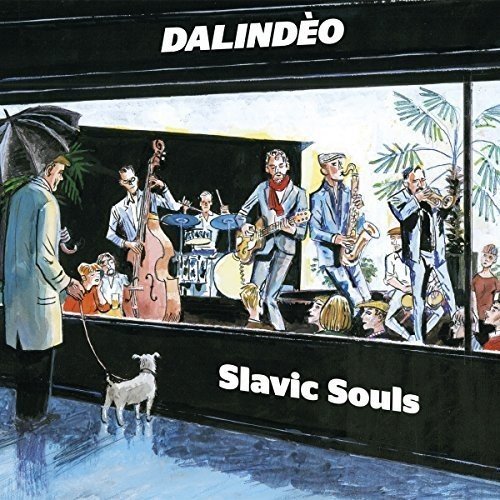
 dereksmusicblog
 dereksmusicblog