BUFFY SAINTE-MARIE-MANY A MILE.
BUFFY SAINTE-MARIE-MANY A MILE.
There’s much more to Buffy Sainte-Marie than music. That’s just part of the story. Buffy Sainte-Marie is an educator, social activist and visual artist. She was born on February 20th 1941, on the Piapot Cree First Nation Reserve in the Qu’Appelle Valley, Saskatchewan, Canada. However, Buffy was later adopted by Albert and Winifred Sainte-Marie.
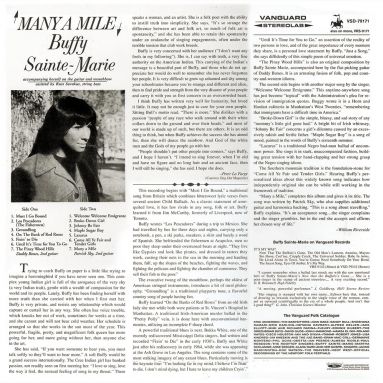
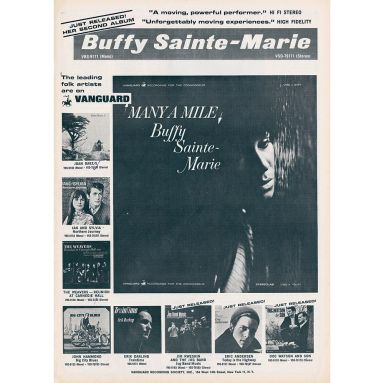
Buffy Sainte-Marie was brought up by her adoptive parents Massachusetts. That’s where Buffy was first exposed to music. She would later make a career out of music, and in 1965, released Many A Mile on Vanguard Records. It’s recently been reissued by Vanguard Records, an imprint of Ace Records. Looking back, it seems almost inevitable that Buffy Sainte-Marie would make a career out of music.
Growing up, Buffy taught herself to play piano and guitar. By the time she was a teenager, Buffy was already writing songs. However, when Buffy left high school, she didn’t embark upon a career in music straight away. Instead, she headed to the University of Massachusetts Amherst.
At the University of Massachusetts Amherst, Buffy studied for a degree in Oriental philosophy. After graduating, Buffy decided to enrol for a second degree. This time, it was a teaching degree. So by the time Buffy departed the University of Massachusetts Amherst, she had two degrees to her name. By then, Buffy’s musical career was underway.
From the early sixties, Buffy was touring around Canada and America. She played everywhere from coffee houses and concert halls to folk festivals. Two places Buffy played frequently were the Yorkville district of Toronto and Greenwich Village in New York. They were the focal points of the Canadian and American folk scenes. Just like Greenwich Village, the folk scene in Yorkville was vibrant. Joni Mitchell, Leonard Cohen and Neil Young. Just like Buffy, they would go on to enjoy long and illustrious careers. However, it wasn’t all plain sailing.
In 1963, Buffy suffered from every singer’s worst nightmare, a throat infection. The doctor prescribed Codeine. Unfortunately, Buffy became addicted to Codeine. However, she eventually beat her addiction, and wrote a song about her experience, Cod’in. It would later, be covered by numerous artists, included Janis Joplin, Donavon, Quicksilver Messenger Service and Gram Parsons. By then, Buffy’s recording career would’ve begun. Before that, she was about to become the homecoming queen.
1964 saw Buffy return to a return trip to where she was born, the Piapot Cree reserve in Canada. She was warmly welcome to her spiritual home. So much so, that she was “adopted” by the youngest son of Chief Piapot, Emile Piapot and his wife. This reinforced Buffy’s interest in her of her people. She would make them proud a year later.
It’s My Way.
By 1964, Buffy found herself signed to Vanguard Records, which by then, was folk’s premier label. Although she was just twenty-three, Buffy was more than ready to record her debut album, It’s My Way.
For It’s My Way, Buffy had penned twelve tracks. Some she had written many years previously. Others, including Cod’in and Universal Soldier were recent compositions. Buffy was inspired to write Universal Soldier. This came about when Buffy saw the first injured veterans arriving back from Vietnam. The US government were denying that their injuries had happened in Vietnam. This prompted Buffy to pen Universal Soldier in The Purple Onion coffee house in Toronto. A year later, in 1965, Universal Soldier gave Donavon a hit single. However, in 1964, Buffy was hoping that her debut album It’s My Way would be a commercial success.
When It’s My Way was released later in 1964, it was to widespread critical acclaim. The songs were a scathing inditement on modern society. They were variously powerful, moving and disturbing. Buffy Sainte-Marie seemed to have struck a nerve. Sadly, this didn’t result in a commercially successful album.
It’s My Way failed to chart. It would only be much later that Buffy Sainte-Marie’s debut album found the audience it deserved. Since then, Buffy Sainte-Marie’s much heralded debut album is regarded as an important musical document. It marked the arrival of a singers-songwriter who would provide a voice for those that didn’t have one. Buffy Sainte-Marie continued to do this on her sophomore album Many A Mile.
Many A Mile.
Despite the commercial failure of It’s My Way, Buffy Sainte-Marie was regarded as one of the rising stars of folk music. By 1965, she was playing in Canada, America and occasionally abroad. Other artists were beginning to cover her songs, including Donavon, who covered Universal Soldier in 1965. However, what Buffy wanted was to release a successful album.
Just like It’s My Way, Buffy wrote many of the songs on Many A Mile. She penned a total of seven songs, including what would become Buffy’s most famous song, Until It’s Time for You To Go. It would be covered by everyone from Elvis Pressley to Françoise Hardy and Neil Diamond. However, in 1965, it was just one of seven songs Buffy had written for her sophomore album Many A Mile. The others were cover versions.
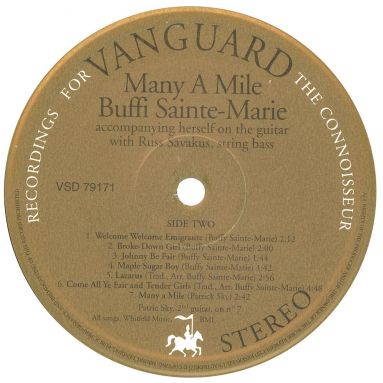
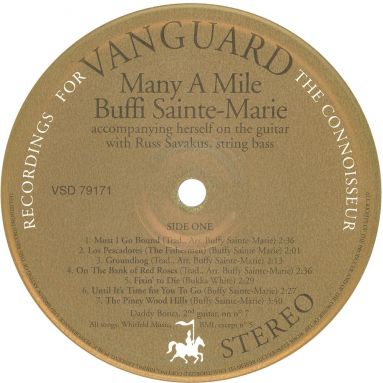
Among the cover versions were adaptations of traditional songs, including Must I Go Bound, Los Pescadores, Groundhog, On the Banks of Red Roses, Maple Sugar Boy, Lazarus and Come All You Fair and Tender Ladies. Other tracks included covers of Bukka White’s Fixin’ To Die and Patrick Sky’s Many A Mile. These tracks were recorded with producer Maynard Solomon.
When recording of Many A Mile began, Buffy was accompanied by bassist Russ Savakus. Daddy Bones played guitar on The Piney Wood Hills. Patrick Sky made a guest appearance on Many A Mile. Once the fourteen tracks were recorded, Many A Mile was released later in 1965.
Before Many A Mile was released, critics had their say on Buffy Sainte-Marie’s sophomore album. They were impressed by the mixture of traditional songs, cover versions and original material that Buffy had chosen. They were brought to life by Buffy, and producer Maynard Solomon.
For Many A Mile, producer Maynard Solomon decided less is more. His productions are sparse and understated. It’s just bass, guitar and taking centre-stage, Buffy’s vocal. Maynard Solomon’s arrangements aren’t polished. This is deliberate. Instead, they’re roughly hewn. This is fitting, given the material on Many A Mile.
Five of the tracks on Many A Mile are traditional songs. They were arranged by Buffy. Some of these songs have been passed from generation to generation. When they were first sung, they didn’t have a lavish arrangement. Instead, it would be just traditional instruments, and later a guitar that would accompany the songs. So, Buffy stays true to their roots. With the roughly hewn, sparse arrangements and Buffy’s vocal taking centre-stage, it’s a captivating combination. This includes on Groundhog, where Buffy plays a mouthbow. It’s a traditional stringed instrument from South Africa. Mostly, though, it’s just guitars and a bass that accompany Buffy.
That’s the case on the seven tracks she wrote. The standout track is Until It’s Time For You To Go. It oozes quality, and it’s no surprise that numerous artists covered this track. Another of Buffy’s compositions on Many A Mile would become a familiar song. That’s The Piney Wood Hills. Buffy later rewrote the song, and it became I’m Gonna Be A Country Girl Again. It became a favourite of country artists, and is another of Buffy’s most famous songs. Each of the songs she wrote for Many A Mile are brought to life by Buffy.
Buffy doesn’t so much deliver lyrics, she lives them, breathing life, meaning and emotion into them. She does this on each of the fourteen tracks, including the ballads and five traditional songs. Stylistically, she veers between folk, country, blues and Americana, proving that she’s a versatile and talented singer. One of the many highlights is her reading of Bukka White’s Fixin’ To Die. This blues takes on new meaning in Buffy’s hands. Given the quality of Many A Mile, surely it would become Buffy’s breakthrough album?
On its release in 1965, Many A Mile failed to chart. This was disappointing for Buffy and everyone at Vanguard Records. However, success wasn’t far away for Buffy Sainte-Marie.
In 1966, Buffy’s third album, Little Wheel Spin and Spin, proved to be her breakthrough album. It reached number ninety-seven in the US Billboard 200. A year later, and 1967s Fire and Fleet and Candlelight then stalled at number 126 in the US Billboard 200. However, by 1968, Buffy had rewritten That’s The Piney Wood Hills.
The newly rewritten song became I’m Gonna Be A Country Girl Again. It lent its name to Buffy’s fifth album, which reached just number 171 in the US Billboard 200. Then in 1971, I’m Gonna Be A Country Girl Again was released as a single and gave Buffy a hit in Britain, Canada and America. While I’m Gonna Be A Country Girl Again only reached number eighty-six in Canada and ninety-eight in the US Billboard 100, it reached number thirty-four in Britain. By then, Buffy was an experienced singer-songwriter.
Buffy had already released seven studio albums and the soundtrack to Illuminations by 1971. Other artists were covering Buffy’s songs, and enjoying commercial success with her songs. By 1971, Buffy was already a regular on Canadian and American television. She had featured on American Bandstand, Soul Train, The Johnny Cash Show and The Tonight Show. Buffy Sainte-Marie had come a long way since the release of her sophomore album Many A Mile in 1965. It was recently reissued by Vanguard Records, an imprint of Ace Records. Many A Mile showcases the considerable talents of Buffy Sainte-Marie, whose much more than a singer, songwriter and musicians.
BUFFY SAINTE-MARIE-MANY A MILE.

LONNIE LISTON SMITH AND THE COSMIC ECHOES-VISIONS OF A NEW WORLD.
LONNIE LISTON SMITH AND THE COSMIC ECHOES-VISIONS OF A NEW WORLD.
Bob Thiele understood musicians. He understood that often, a large record company wasn’t the best environment for musical pioneers and mavericks to thrive. This understanding came from a lifetime in the music industry. His career started in 1969. Thirty years later, in 1969, and Bob Thiele was one of the most powerful men in music.
After eight years running Impulse, and transforming it into one of jazz’s premier labels, Bob Thiele found himself at loggerheads with Larry Newton, the head of ABC Records. It looked as if Bob’s time at ABC was coming to an end. Bob Thiele’s departure from ABC Records was announced 29th April 1969. The man that had run ABC Records’ Impulse and Bluesway was about form his own record company.
Flying Dutchman Productions was no ordinary label though. It was a company where innovators, pioneers and mavericks were welcome. Bob Thiele knew, that within the right environment, innovative and maverick musicians could thrive, creating music that’s influential and forward-thinking. So, Bob Thiele went in search of innovators, pioneers and mavericks.
Over the next few years, Flying Dutchman Productions became home to everyone from Ornette Coleman, through Gil Scott Heron, Leon Thomas, Eddie “Cleanhead” Vinson, Louis Armstrong and Lonnie Liston Smith and The Cosmic Echoes, who signed to Flying Dutchman Productions in 1972.
Lonnie Liston Smith and The Cosmic Echoes debut for Flying Dutchman Productions was Astral Travelling. This groundbreaking album was released in 1973, and was the first of five albums Lonnie Liston Smith and The Cosmic Echoes released for Bob Thiele’s new label. This was the start of an exciting adventure for the cosmic jazz visionary.
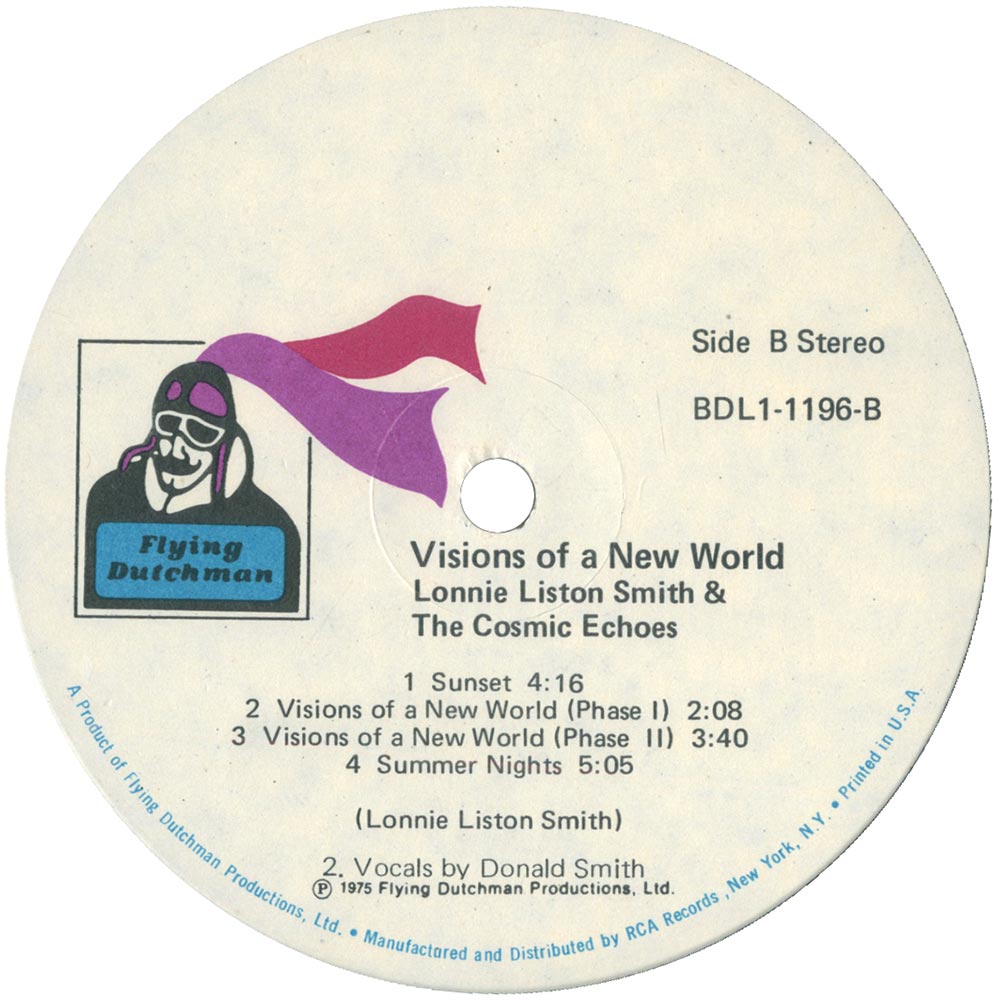
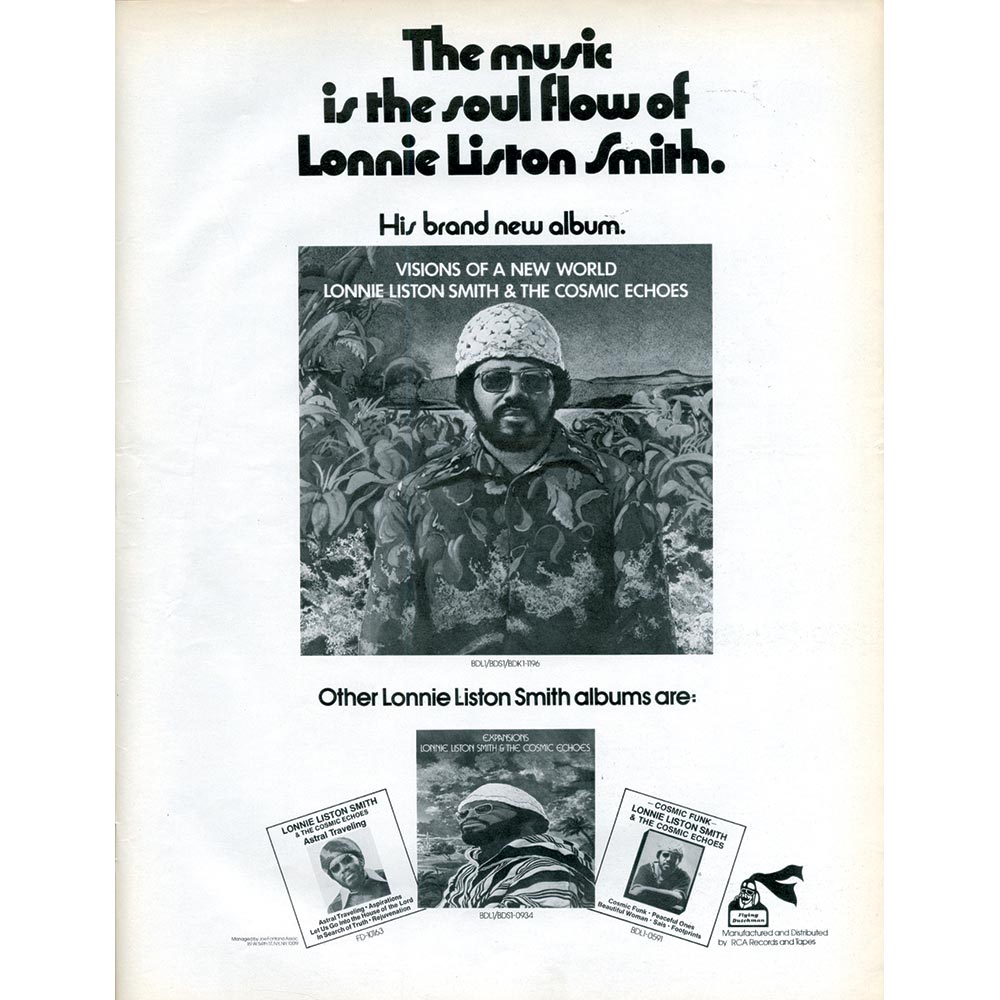
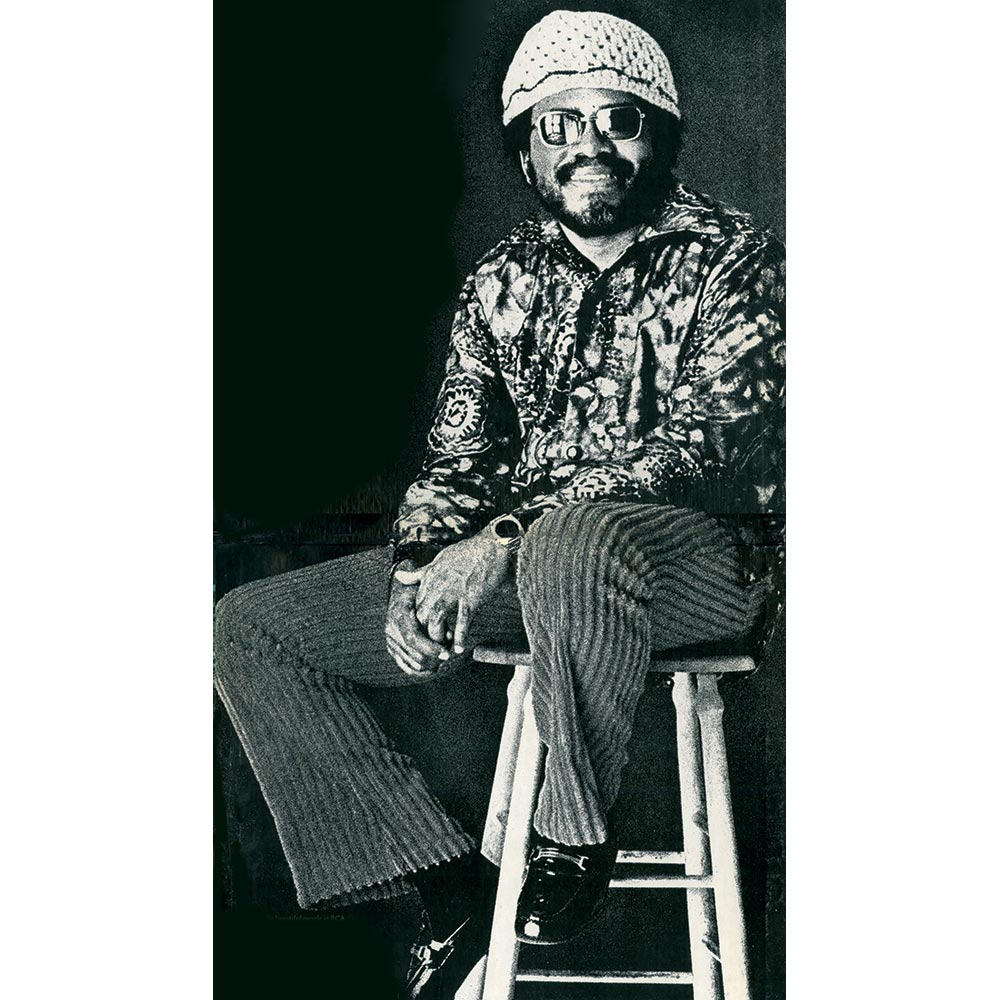
By the summer of 1975, Lonnie Liston Smith and The Cosmic Echoes were about to release their fourth album Visions Of A New World, which was recently reissued by BGP, an imprint of Ace Records. It was the followup to Expansions, which was Lonnie Liston Smith and The Cosmic Echoes breakthrough album. Expansions which was licensed to RCA, sold well, reaching number eight-five in the US Billboard 200, twenty-seven in the US R&B charts and number two in the US Jazz charts.. Radio and club DJs were also spinning tracks from Expansions. Given the success of Expansions, it wasn’t surprising that Bob Thiele sent Lonnie Liston Smith and His Cosmic Echoes into the studio to record Visions Of A New World. For the thirty-five year old Lonnie Liston Smith, he was about to grasp the nettle. This success was what he had been working toward all his life.
For Lonnie Liston Smith, it was almost written in the stars that he’d become a musicians. Lonnie was born in 1940, into a musical family. His father was a member of Richmond Gospel music group the Harmonising Four. Growing up, members of gospel groups The Soul Stirrers and Swan Silvertones were regular visitors to the Smith household. With all this music surrounding him, Lonnie learned piano, tuba and trumpet in High School and college. After college, he headed to Morgan State University.
Inspired by Trane, Bird and Miles Davis, Lonnie embarked upon a degree in musical education. Throughout his time at University, Lonnie continued playing the pianist in local clubs and singing backing vocals. He played with alto saxophonist Gary Bartz and trombonist Graham Moncur. This was all part of Lonnie’s musical eduction. Having completed his BSc in musical education at Morgan State University, Lonnie walked straight into a job.
On leaving Morgan State University, Lonnie got a job with the Royal Theatre’s house band. For a young musician, this was would help turn them into a musical all-rounder. After all, they had to be able to accompany a wide range of artists. For Lonnie, this was the next stage in his musical education. The next part of his musical education took place in New York.
Having moved to New York, Lonnie was luck enough to get a gig playing piano in Betty Carter’s band. This helped Lonnie get his name known in the Big Apple. Then in early 1965, Lonnie caught a break. He joined Roland Kirk’s band and made his recording debut on March 14th 1965. That was when Here Comes The Whistleman was recorded live in New York Lonnie only played on the title-track, Making Love After Hours, Yesterdays and Step Right Up. Then Lonnie featured on Roland andAl Hibbler’s 1965 live album A Meeting Of The Times. After this Lonnie, joined one of jazz’s top bands.
Over the last few years, The Jazz Messengers had established a reputation for young musicians looking to make a name for themselves. Lonnie joined in 1965. He shared the role with Mick Nock and Keith Jarrett. However, with The Jazz Messengers ever evolving lineup, Lonnie only played three in concerts. These three concerts just so happened to be at the legendary Village Vanguard. For Lonnie, despite the prestigious venue, this must have been a disappointing time. Luckily, he was rehired by Roland Kirk.
Lonnie rejoined Roland Kirk’s band in time to play on his 1968 album Now Please Don’t You Cry, Beautiful Edith. This established Lonnie’s reputation as the go-to-guy for a pianist. It was the start of period where Lonnie worked with some of the most innovative and inventive jazz players. Musical boundaries were about to be pushed to their limits as Lonnie joined Pharaoh Saunders’ legendary free jazz band.
Pharaoh Saunders had worked closely with John Coltrane right up to his death in 1967. The following year, Pharaoh formed a new band. Their music is best described as free jazz. Musical boundaries were pushed to their limits and beyond. Recognising a fellow believer in free jazz, Pharaoh asked Lonnie to join his band. Lonnie went on to play on three of Pharaoh’s best albums. The first of this trio was 1969s Karma. It was followed in 1970 with Jewels of Thought and 1971s Thembi. The other Pharaoh Saunders album Lonnie played on was 1970s Summun Bookman Umyun. which was released on Impulse. Just like the three albums Pharaoh recorded for Flying Dutchman, it was a groundbreaking album.
During this period, Pharaoh and his band were constantly pushing boundaries and rewriting the musical rulebook. Their music was truly groundbreaking. Even Lonnie was challenged. On Thembi, Pharaoh asked Lonnie to play the Fender Rhodes. This was the first time that Lonnie came across an electric piano. However, he rose to challenge and wrote Thembi’s opening track Astral Travelling. Later, Astral Travelling would become synonymous with Lonnie Liston Smith and The Echoes. Before that, Lonnie would play with some of jazz’s mavericks.
One of these mavericks was Gato Barbieri. He’d just signed to Bob Thiele’s nascent label Flying Dutchman Productions. It was establishing a reputation for providing musicians with an environment where innovative and creative musicians could thrive. Bob believed musical mavericks didn’t thrive within such an orthodox environment. Their creativity is restricted, meaning they’re unable to experiment and innovate like they’d like. So, Bob signed Gato to Flying Dutchman. Lonnie played on his 1969 debut album The Third World. Bob’s next signing was Leon Thomas and played on his debut album Spirits Known and Unknown. Soon, Lonnie was a regular at Flying Dutchman sessions.
When the time came for Gato to record his 1971 sophomore album Fenix, Lonnie was called upon. He played on Fenix and joined Gato’s band. Lonnie played on Gato’s 1972 album El Pampero. He also toured throughout Europe with Gato. Then came the opportunity of a lifetime. After El Pampero, Lonnie got the chance to work with another jazz legend.
Lonnie was a member of Gato Barbieri’s band when Miles Davis got in touch. He wanted Lonnie to join his band. At this time, Miles’ music was changing direction. The direction it was heading in was funk. Electronic instruments were the flavour of the month for Miles and he was exploring their possibilities. However, Miles was doing this outside the studio environment. That’s why there are very few recordings of Lonnie playing alongside Miles at that time. That came later, when Lonnie would later work with Miles. Meanwhile, Lonnie decided to embark upon his solo career, and record his debut album Astral Travelling.
When recording of Astral Travelling began, Lonnie had put together some of the most talented and innovative musicians. The Cosmic Echoes’ rhythm section included bassist Cecil McBee, drummer David Lee and guitarist Joe Beck. Sonrily Morgan and James Mtume played percussion and conga, Gee Vashi tamboura and Badal Roy tabla. George Barron played tenor and soprano saxophone. Lonnie played piano and electric piano on Astral Travelling which was produced by Bob Thiele. Astral Travelling was released in 1973.
On its release in 1973, Astral Travelling was released to critical acclaim. This was no surprise. Lonnie Liston Smith had worked with some of the biggest names of jazz. It was akin to a musical apprenticeship. Astral Travelling saw Lonnie move from sideman to bandleader. Accompanied by some of the best and most innovative musicians, he had created an ambitious and groundbreaking album. Although Astral Travelling failed to chart, it sold reasonably well upon its release. This bode well for the future.
The followup to Astral Travelling, Cosmic Funk was released in 1974. Lonnie Liston Smith and The Cosmic Echoes’ genre-hopping sophomore album was released to widespread critical acclaim, and sold reasonably well. However, Cosmic Funk wasn’t going to make Lonnie Liston Smith rich. At least word was spreading about this musical visionary. Soon, Lonnie Liston Smith and The Cosmic Echoes would be enjoying both commercial success and critical acclaim.
By the time Lonnie Liston Smith and The Cosmic Echoes released Expansions in early 1975, Bob Thiele had take Flying Dutchman Productions’ releases to RCA. While this safeguarded Flying Dutchman Productions’ future, RCA weren’t a charity. They wanted sales. Sales was what they got. Expansions reached eight-five in the US Billboard 200, twenty-seven in the US R&B charts and number two in the US Jazz charts. This made Expansions one of Flying Dutchman Productions’ most successful albums.
Meanwhile, club and radio DJs were spinning tracks from Expansions. Belatedly, Lonnie Liston Smith and The Cosmic Echoes were the flavour of the month among DJs, dancers and discerning record buyers. So, it’s no surprise that Bob Thiele sent Lonnie Liston Smith and The Cosmic Echoes into the studio again, where they recorded Visions Of A New World.
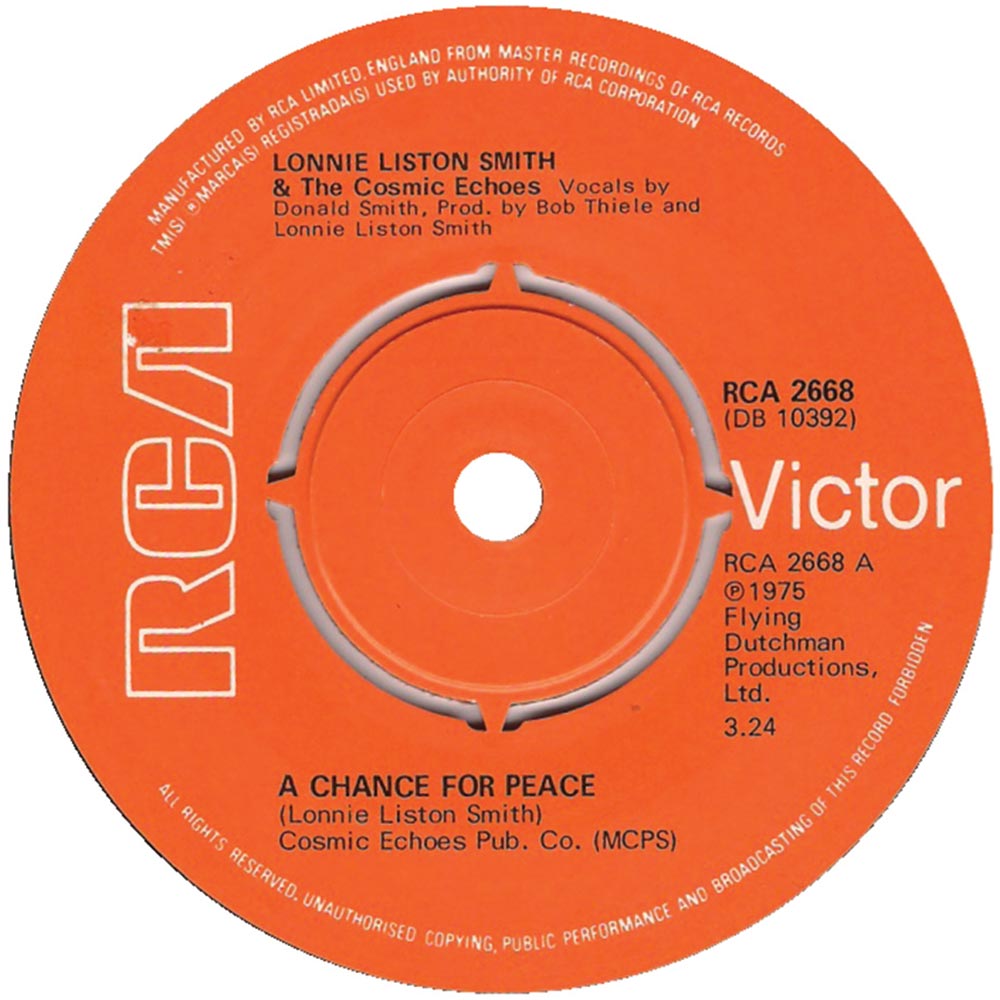
For Lonnie Liston Smith and The Cosmic Echoes’ fourth album, Visions Of A New World, Lonnie penned seven tracks, including Lonnie’s hopeful anthem, A Chance For Peace. The other track, Devika (Goddess) was written by Dave Hubbard and Sarina Grant. These eight tracks were recorded at Electric Ladyland Studios, New York.
At Electric Ladyland Studios, Bob Thiele and Lonnie Liston produced the eight tracks that eventually became Visions Of A New World. Accompanying Lonnie were The Cosmic Echoes. Their rhythm section featured bassist Greg Maker, drummer Art Gore and Wilby Fletcher and guitarist Reggie Lucas. Percussionists included Michael Carvin, Ray Armando, Angel Allende who added bongos and Lawrence Killian who also played congas. Flautist Donald Smith also added vocals on three tracks. The horn section included soprano saxophonist Dave Hubert, trombonist Clifford Adams and trumpeter Cecil Bridgewater. This was a very different lineup of The Cosmic Echoes that featured on Astral Travelling. Lonnie Liston Smith on keyboards was the only constant. This constantly evolving lineup didn’t affect the success of Visions Of A New World.
Just like previous albums, critics hailed Visions Of A New World as a groundbreaking album. Lonnie Liston Smith was seen as a musical pioneer, capable of creating innovative and influential music. That music was way ahead of the musical curve. So, it’s no surprise that when Visions Of A New World was released in the summer of 1975, it reached number seventy-four in the US Billboard 200, fourteen in the US R&B charts and number four in the US Jazz charts. Visions Of A New World was Lonnie Liston and The Cosmic Echoes’ most successful album. Here’s why.
Opening Visions of a New World is one of Lonnie Liston and The Cosmic Echoes’ best known songs, the anthemic A Chance For Peace. Straight away, the rhythm section and guitar lock into a funky, bubbling groove. They’re aided and abetted by Lonnie’s keyboards, plus a myriad of percussion, congas and bongos. They provide the backdrop for Donald Smith’s impassioned, hopeful vocal. Stabs of blazing horns soar above the arrangement, as musical genres seamlessly, melt into one. Then when Lonnie steps out of the shadows, he delivers a masterclass on the keyboards. It’s Hendrix-esque. Meanwhile, the rest of the band are content to let Lonnie take centre-stage, as the uber funky arrangement flows and bubbles along. Then when Donald’s vocal returns, he combines power and passion, breathing hope and meaning into Lonnie’s lyrics. They prove as relevant in 2015, as they were forty years ago in 1975.
Love Beams sees the tempo drop, and a smooth, sensual arrangement unfold. That’s the case from the moment “Love Beams” is sung. The rhythm section combine with percussion and Lonnie’s crystalline keyboards. A smooth, sultry horn sounds, before dropping out. From there, Lonnie Liston and The Cosmic Echoes take the listener on a journey to a faraway, exotic location, on this sensual, dreamy sounding track.
Subtle flourishes of Lonnie’s keyboards open Colours of the Rainbow. They’re soon joined by Donald Smith’s powerful, impassioned vocal. It soars above the arrangement, as percussion accompanies Lonnie’s keyboards. They fill the spaces on what’s a quite beautiful, hopeful sounding song.
Devika (Goddess) was written by Dave Hubbard and Sarina Grant. Just Greg Maker’s lone bass opens the track. It’s soon joined by drums and percussion and keyboards. However, it’s when Dave Hubbard unleashes his soprano saxophone, the track begins to unfold. Its smooths soulful sound provides the perfect accompaniment to the rest of The Cosmic Echoes. Aided and abetted by Lonnie, they create a bubbling, funky arrangement. Dave’s saxophone steals the show. Partly, it’s because of his ability to improvise. He repeats the rhythm, constantly changing things around. Lonnie delivers a brief solo, and with the help of the rhythm section, keeps the funky vibe bubbling. Lonnie then passes the baton, allowing other members of the band to showcase their skills. Then Dave delivers a quivering solo, picking up where he left off, as he plays a starring role on Devika (Goddess).
With its slow, dreamy sound Sunset again, conjures up images of somewhere warm and exotic. Lonnie’s keyboards are to the fore, while the rhythm section and percussion combine. Tender harmonies are added as the arrangement literally meanders lazily along. Space is left within the cinematic arrangement, as if inviting the listener to paint pictures with their imagination. That’s not difficult given the quality of the musical backdrop.
Visions of a New World (Phase I) has a big, bold introduction. It comes courtesy of Lonnie’s rumbling piano. Soon, it gives way to Donald Smith’s impassioned vocal. It’s delivered powerfully, and soars high above the arrangement. For two minutes, Lonnie and Donald combine. However, a change is coming.
It comes on Visions of a New World (Phase II). The tempo rises as a funky rhythm section join Lonnie’s keyboards. They take the arrangement in the direction of fusion. Later, horns are added. As one, they blaze above the arrangement. It’s augmented by percussion, bongos and congas. This is very different from Visions of a New World (Phase I). The tempo has risen, and the experimental, free jazz sound is replaced by a hard, driving slice of fusion. It features Lonnie Liston and The Cosmic Echoes stretching their legs, and showcasing their considerable skills.
Closing Visions of a New World was Summer Nights. Lonnie’s keyboards dominate the introduction, before the rest of the band are counted in. They create a slow, smooth and meandering arrangement. It comes courtesy of Lonnie’s keyboards, percussion, bongos and congas. Providing a subtle heartbeat are the rhythm section. When all this is combined, the sultry sounding Summer Nights glides along, and proves the perfect way to close Visions of a New World. Summer Nights features Lonnie Liston and The Cosmic Echoes at their creating timeless music.
Forty years after Lonnie Liston and The Cosmic Echoes released their most successful album, Visions of a New World, the album sounds just as good, as it did in 1975. Visions of a New World is a timeless album. That’s the case with so much groundbreaking music.
Not only was Visions Of A New World groundbreaking, but commercially successful. That isn’t always the case. Lonnie Liston and The Cosmic Echoes first two albums didn’t sell in vast quantities. Neither 1973s Astral Travelling, nor 1974s Cosmic Funk charted. It wasn’t until the release of Expansions in early 1975 that commercial success came Lonnie Liston and The Cosmic Echoes’ way. However, Bob Thiele held his nerve, and continued to believe in Lonnie Liston and The Cosmic Echoes.
Bob Thiele was rewarded when Expansions reached eight-five in the US Billboard 200, twenty-seven in the US R&B charts and number two in the US Jazz charts. Other labels wouldn’t have been as patient as Bob Thiele. However, he believed in Lonnie Liston Smith, a music innovator who was way ahead of the musical curve. His patience was rewarded again, when Visions Of A New World became Lonnie Liston and The Cosmic Echoes’ biggest selling album.
When Visions Of A New World was released in the summer of 1975, it reached number seventy-four in the US Billboard 200, fourteen in the US R&B charts and number four in the US Jazz charts. Visions Of A New World was Lonnie Liston and The Cosmic Echoes’ became most successful album. No wonder. The music on Visions Of A New World oozed quality.
Elements of free jazz, funk, fusion, rock, smooth jazz and soul are combined on Visions Of A New World. As a result, the music was innovative and guaranteed to influence other musicians. Lonnie Liston Smith was a leader, not a follower. He released five albums on Bob Thiele’s Flying Dutchman Productions. Each of these albums feature a musical visionary at the peak of his creative powers.
One of Lonnie Liston and The Cosmic Echoes’ finest albums is Visions Of A New World, which was recently reissued by BGP, an imprint of Ace Records. Visions Of A New World, which is a truly timeless album, along with Astral Travelling, is the perfect introduction to cosmic jazz pioneer, Lonnie Liston and The Cosmic Echoes.
LONNIE LISTON SMITH AND THE COSMIC ECHOES-VISIONS OF A NEW WORLD.

SWAMP DOGG-I’M NOT SELLING OUT/I’M BUYING IN.
SWAMP DOGG-I’M NOT SELLING OUT/I’M BUYING IN.
During the sixties, Jerry Williams was for most part, a regular guy. He was a successful singer, songwriter and producer. Mostly, Jerry Williams was content to help other people become stars. He wrote songs, played on their albums and produced their music. Then, as the sixties drew to a close, Jerry Williams dropped acid. It was a life changing experience.
The Doors of Perception, as Aldous Huxley said, had been opened. Jerry Williams changed. Psychedelics became his drug of choice. This stimulated his creativity. However, he desperately needed an outlet for this heightened creativity. So he adopted an alter ego Swamp Dogg. He was obsessed by sex, drugs, politics, culture and class. All these subjects came out in his music. His music was funny, prickly, gritty, acerbic and angry. Often, politicians felt the wrath of Swamp Dogg. For the newly enlightened Jerry Williams, his debut album Total Destruction Of Your Mind introduced the world to Swamp Dogg, whose 1981 album I’m Not Selling Out/I’m Buying In was recently reissued Takoma, an imprint of Ace Records.
When Total Destruction Of Your Mind was released in 1970, the album failed to chart. It seemed, that record buyers didn’t seem to understand Swamp Dogg’s unique brand of gonzo soul. Then when Mama’s Baby, Daddy’s Maybe was released as a single, it reached number thirty-three in the US R&B Charts. This was a small crumb of comfort. Sadly, most people had overlooked a groundbreaking album. Total Destruction Of Your Mind featured Swamp Dogg at his most creative.
At the time, Swamp Dogg was compared to Sly Stone. The two men vied for the title of the most creative and innovative man in soul music. Their careers took very different directions during the first half of the seventies. However, by then, Swamp Dogg had been making music since he was twelve.
The future Swamp Dogg was born Jerry Williams in March 1942, in Portsmouth, Virginia. From an early age, Jerry Williams was immersed in music. His parents weaned their son on country music. However, the young Jerry Williams wasn’t just listening to music he released his first single when he was twelve.
Little Jerry Williams released HTD Blues (Hardsick Troublesome Downout Blues) on the Mechanic label in 1954. Despite his tender years, Little Jerry Williams penned his debut single. He wasn’t just a songwriter though. Soon, Jerry Williams would become a multi-instrumentalist.
By the time Jerry Williams turned eighteen, his musical career began in earnest. He released singles on a regular basis. His 1964 single I’m The Lover Man, which was a Jerry Williams composition, was picked up by the Loma label. While it wasn’t the success many forecast, commercial success came in 1966.
When Jerry Williams released Baby You’re My Everything, in 1966, it reached number thirty-two in the US R&B charts. This was the first of a string of singles Jerry Williams released for Calla. They didn’t match the success of Baby You’re My Everything. So Jerry Williams forged a career as a songwriter, musician and producer. He was content to turn other musicians into stars.
Jerry Williams was happy to carve out a niche as a songwriter, musician and producer until the late sixties. Much of the time, Jerry Williams worked at Atlantic.Then came the day Jerry Williams dropped acid. No longer was Jerry Williams willing to remain a star-maker, he wanted to become a star. That was when Jerry Williams’ outrageous alter ego, Swamp Dogg was born.
Total Destruction Of Your Mind was released on the Canyon label in 1970, and introduced the world to Swamp Dogg. While the album didn’t sell in vast quantities, critics realised that Swamp Dogg was a mixture of musical maverick and innovator. Soon, comparisons were being made with Sly Stone, who was enjoying commercial success and critical acclaim.
Back in 1966, when Jerry Williams enjoyed a hit with Baby You’re My Everything, Sly and The Stone didn’t even exist. They were formed in 1967, while Swamp Dogg was enjoying a successful career as a producer. When Sly and The Stone released their debut album, it would’ve taken a brave man to forecast that by 1970, Sly Stone would be one of the biggest names in music.
Sly and The Family Stone released their debut album in A Whole New Thang in October 1967. However, the album failed to chart. This was an inauspicious start for Sly Stone’s new band. Things weren’t going to plan.
Then in April 1968, Dance To The Music reached number 142 in the US Billboard 200 and number eleven in the US R&B charts. Things were looking up. However, when Sly and The Family Stone released Life in September 1968, it stalled at number 195. This wasn’t what had been forecast for a man who was being hailed as one of music’s innovators.
Things improved in 1969, when Sly and The Family Stone released Stand! It reached number thirteen in the US Billboard 200, and number three in the US R&B charts. This resulted in Sly and The Family Stone’s first platinum disc.Around this time, Swamp Dogg had a chemical awakening, when he dropped acid.
A year later, and Swamp Dogg released his Total Destruction Of Your Mind. This was when Swamp Dogg was first compared to Sly Stone. They were both mavericks and innovators, capable of releasing groundbreaking music. However, their fortunes varied hugely.
Total Destruction Of Your Mind didn’t sell well upon its release. However, when Sly and The Family Stone released their Greatest Hits album in November 1970, it sold five million copies, and was certified platinum five times over. For the next five years, this was a familiar pattern.
In November 1971, Sly and The Family Stone released There’s A Riot Goin’ On was certified platinum. There’s A Riot Goin’ On was hailed an instant classic. Gone was the psychedelic soul of previous Sly and The Family Stone albums. Replacing it was a darker, funky and soulful sound. Meanwhile, Swamp Dogg had signed to a major.
Swamp Dogg signed to Elektra in 1971. They saw the potential in Swamp Dogg. Executives at Elektra realised Swamp Dogg, they was one of music’s innovators. Elektra expected great things from Swamp Dogg. What they got was an album that entered the musical history books.
When Swamp Dogg released Rat On, his Elektra debut in 1971, it featured what’s now seen as one of the worst album covers ever. Rat On featured Swamp Dog sitting on top of a giant rat. This was slightly off-putting, and possibly, detracted from the music. Rat On, which featured Swamp Dogg at his creative zenith, didn’t sell well. As a result, Swamp Dogg was dropped by Elektra. It was a case of what might have been.
Sadly, Swamp Dogg’s dalliance with a major label was brief. Now he was back to square one. He released his next two albums on smaller labels. 1972s Cuffed, Collared and Tagged was released on Cream Records, while 1973s Gag A Maggott was released on Stone Dogg. Neither album sold well. Meanwhile, Sly Stone was one of the most successful men in music.
The success story that was Sly and The Family Stone continued apace. Fresh released in June 1973, gave Sly and The Family Stone their third consecutive number one in the US R&B charts. Just like Small Talk, which was released in July 1974, Fresh was certified gold. Good news also came Swamp Dogg’s way in 1974. Island Records wanted to sign him.
After releasing his last two albums on smaller labels, Swamp Dogg was back where his talents belonged, at one of the music’s bigger labels. Island Records was then home to everyone from Bob Marley to John Martin. Joining that list was Swamp Dogg in 1974. Sadly, his time was brief.
Have You Heard This Story?? was released on Island Records in 1974. It was Swamp Dogg’s fifth solo album. However, it was a familiar story. Commercial success eluded Swamp Dogg and he was dropped by Island Records. Meanwhile, Sly and The Family Stone had split-up. This looked like the end of the road for Swamp Dogg’s creative rival.
Sly Stone, was determined to carry on.While 1975s High On You and 1976s Heard Ya Missed Me, Well I’m Back were credited to Sly and The Family Stone, it featured a very different lineup. The other change was Sly Stone himself. Years of hard living had caught up with him. He was no longer the musical giant he once was. Neither High On You nor Heard Ya Missed Me, Well I’m Back reached the heights of Sly and The Family Stone’s previous albums. However, Sly Stone had had a good run. Between 1969 and 1974, Sly and The Family Stone sold eight million albums. With Sly Stone out of the running, the coast was clear for Swamp Dogg to unleash his creativity.
Ever since the release of Total Destruction To Your Mind, Swamp Dogg had been releasing groundbreaking and genre-melting music. However, none of the albums sold well. With Sly Stone no longer making music, there was a musical void needing filled. Swamp Dogg was ready to fill that void.
In 1976, Swamp Dogg released not one, but two albums. This included the ironically titled ?? Greatest Hits ??? on the Stone Dogg label. The irony was, that Swamp Dogg had only one minor hit single, and the album contained mostly, new material. This appealed to Swamp Dogg’s humour. However, the album didn’t sell well. Neither did You Ain’t Never Too Old To Boogie, which released on DJM. Swamp Dogg’s decision to jump onboard the disco bandwagon hadn’t paid off. After seven solo albums, Swamp Dogg was at a musical crossroads.
Each of the seven albums Swamp Dogg released didn’t sell in huge quantities. Quite the opposite. However, it didn’t help that many of the albums were released on small labels. That was the case with the two albums Swamp Dogg released in 1977. An Opportunity… Not A Bargain!!! was released on the Wizard label, while Finally Caught Up With Myself was released on Musicor. Again, neither album sold well. These albums were the last albums Swamp Dogg released during the seventies.
It wasn’t until 1980, that Swamp Dogg resurfaced. He decided to record a disco album. So he put together an experienced band, which featured many musicians who were familiar with the “disco” sound. They recorded Doing A Party Tonite, in L.A. where Swamp Dogg had been living for a couple of years. Once the album was recorded, Cream Records agreed to release the album.
By the time Doing A Party Tonite was scheduled for release in 1980, disco was dead. This presented Cream Records with a problem. However, they decided to release Doing A Party Tonite, but only in France. When it hit the shelves of French record shops, Doing A Party Tonite failed to ignite the excitement of record buyers. It was one of the least successful albums of Swamp Dogg’s career. Swamp Dogg was down, but not out.
While Swamp Dogg was a talented and experienced singer, songwriter, musicians and producer, he couldn’t catch a break. This must have been soul destroying. Swamp Dogg was thirty-eight, and had been making music since 1954. He hadn’t a lot to show for thirty-six years of music. He only had two minor hits to his name. However, in 1981, Swamp Dogg released the eleventh album of his career, I’m Not Selling Out/I’m Buying In.
It had been four years since Swamp Dogg released an album in America. His dalliance with disco had proved disastrous commercially. So, Swamp Dogg decided to return to more familiar musical territory.
For what was Swamp Dogg’s comeback album, he penned Swamping Salutations, Wine, Women And Rock ‘N’ Roll, The Love We Got Ain’t Worth Two Dead Flies, A Hundred And and Sexy Sexy Sexy # 3. Swamp Dogg cowrote the other four tracks. He cowrote Low Friends In High Places and otal Destruction To Your Mind Once Again with Tony Davis. California Is Drowning And I Live Down By The River was a Swamp Dogg and Yvonne Williams composition. They joined with Maurice McCormick and O. Jessie to pen Just A Little Time Left. These nine tracks became I’m Not Selling Out/I’m Buying In.
When recording of I’m Not Selling Out/I’m Buying In began, Swamp Dogg was joined by a band featuring West Coast musicians. The rhythm section featured drummers Carlos (Corky) Carraby and Willie Ornelas, bassist Kenny Lewis and guitarist Bob Ettol, who also played sitar. They were joined by percussionist King Errisson and Nate Morgan on electric piano and organ. Flautist Dashiell Humdy also played tenor saxophone. He was joined in the horn section by trombonists lvin Stanton and Terry Carter; plus trumpeters Gabriell Flemings, Hank Ballard, Jr. William Barnes. Swamp Dogg played piano and co-produced I’m Not Selling Out/I’m Buying In with Yvonne Williams. Once the album was completed, it was ready for release later in 1981.
When Swamp Dogg released I’m Not Selling Out/I’m Buying In, it came complete with the Swamp Dogg cookbook. This gimmick was Swamp Dogg’s way of making the album stand out from the crowd. Sadly, this didn’t work, when I’m Not Selling Out/I’m Buying In failed to attract the attention of critics and record buyers. Swamp Dogg’s comeback album hadn’t been the success he had hoped for. To rub salt into Swamp Dogg’s wounds, Chrysalis who owned Takoma, sold the label in 1982. For Swamp Dogg, this as a disappointing period in his career, one that produced an underrated album I’m Not Selling Out/I’m Buying In.
When Swamp Dogg released I’m Not Selling Out/I’m Buying In, it came complete with the Swamp Dogg cookbook. This gimmick was Swamp Dogg’s way of making the album stand out from the crowd. Sadly, this didn’t work, when I’m Not Selling Out/I’m Buying In failed to attract the attention of critics and record buyers. Swamp Dogg’s comeback album hadn’t been the success he had hoped for. To rub salt into Swamp Dogg’s wounds, Chrysalis who owned Takoma, sold the label in 1982. For Swamp Dogg, this as a disappointing period in his career, one that produced an underrated album I’m Not Selling Out/I’m Buying In.
Opening I’m Not Selling Out/I’m Buying In is Swamping Salutations. It’s just a thirteen second welcome from Swamp Dogg. He combines with the rhythm section and guitar, to give the listener a taste of what’s about to unfold.
Wine, Women and Rock ’N’ Roll literally bursts into life, picking up where Swamping Salutations left off. The rhythm section and searing guitars combine with a boogie woogie piano. They provide the backdrop for Swamp Dogg, as he delivers a joyous vocal about the good things in life. In Swamp Dogg’s case, that’s “Wine, Women and Rock ’N’ Roll.” Accompanied by harmonies and a tight band, Swamp Dogg unleashes a slice of upbeat, good time music.
The tempo drops on It’s Just A Little Time Left, and a much more serious Swamp Dogg takes centre-stage. A piano and acoustic guitar set the scene for Swamp Dogg, as he delivers lyrics full of social comment. Gradually, the arrangement grows, as a bass, Hammond organ and piano enter. They’re then joined by horns.Together, they frame Swamp Dogg’s impassioned, heartfelt vocal. When his vocal briefly drops out, the band enjoy the opportunity to stretch their legs. Then when Swamp Dogg returns, hope fills his voice as he sings of his hopes for the future, a future that includes a better, more equal America.
The Love We Got Ain’t Worth Two Dead Flies sees Swamp Dogg joined by Esther Phillips. Swamp Dogg had tried to rejuvenate her career a few years earlier. By 1981, Esther Phillips was signed to Mercury. Esther’s voice is still instantly recognisable. It’s much more lived-in, but Esther and Swamp Dogg, feed off each other during, the jaunty, disco lite arrangement. While Esther delivers a feisty, sassy vocal stabs of horns are added. Meanwhile, the rhythm section adds a funky backdrop. A distant Fender Rhodes is panned left, and a piano panned right. They frame Esther’s vocal, as she rolls back the years on what’s a real hidden gem from her discography.
Straight away, it’s obvious that Low Friends In High Places is one of I’m Not Selling Out/I’m Buying In’s highlights. A pounding, dramatic rhythm rhythm section and sitar set the scene for Swamp Dogg’s angry, frustrated vocal. Not for the first time, he turns his attention to nepotism and corruption. Sadness, fills his voice as he delivers the lyrics. Stabs of piano and braying horns punctuate the arrangement. Harmonies augment Swamp Dogg’s impassioned, angry vocal, on a track where hooks haven’t been rationed.
A Hundred And bursts into life, taking I’m Not Selling Out/I’m Buying In in the direction of the dance-floor. Soon, gospel soul, funk and disco are combining. Accompanying the vocal are a bass and funky guitar. They join the drums in powering the arrangement along. Add to that, piano, swathes of dancing strings and rasping horns, and everything is in place for an irresistible disco track. This is because the album was recorded when disco was still popular. Much had changed by the time I’m Not Selling Out/I’m Buying In was released. Disco had “died” two years earlier. However, thirty-four years later, and A Hundred And would still fill a dance-floor.
The album that launched Swamp Dogg’s career Total Destruction To Your Mind. The track was also one of the highlights of the album. Eleven years later, and Swamp Dogg picks up the story on Total Destruction To Your Mind. Nothing has changed he believes. Meanwhile, the rhythm section, guitar, piano and sitar provide a funky, dance-floor friendly backdrop. Later, stabs of horns are added. They add to the what’s a fusion of Blaxploitation, disco and soul. It’s a captivating combination of musical genres, which a few years earlier, might have given Swamp Dogg that elusive hit single.
Just a tack piano opens the dramatic sounding California Is Drowning And I Live Down By The River. They were penned by Swamp Dogg and his wife Yvonne Williams. As flourishes of piano play, an angry, frustrated vocal about California’s failings is unleashed. By then, a boogie shuffle is developing. The bass walks the arrangement along, while drums create a hypnotic beat. Boogie woogie piano and stabs of horns are added. This is the perfect for lyrics that are a mixture of frustration, anger, cynicism and satire. They’ve Swamp Dogg’s name written all over them.
Sexy Sexy Sexy # 3 closes I’m Not Selling Out/I’m Buying In. It sees Swamp Dogg head to the dance-floor again. There’s a nod to Joe Tex, as Swamp Dogg vamps and struts his way through the lyrics. More in jest though. It’s as if Swamp Dogg is poking fun at the overblown soul men of the seventies, They took themselves too seriously. Not Swamp Dogg. With the
rhythm section combining with keyboards and a guitar, they provide a funky, soulful and dance-floor friendly arrangement. So do the tabs of horns punctuate the arrangement. They accompany Swamp Dogg, as his one and only album for Takoma I’m Not Selling Out/I’m Buying In, draws to a close.
Sadly, when I’m Not Selling Out/I’m Buying In was released in 1981, the album failed commercially. There’s a reason for this. A number of the songs on I’m Not Selling Out/I’m Buying In have a disco sound. That’s not a surprise. They were recorded during the disco era. However, by the time I’m Not Selling Out/I’m Buying In was released in 1981, the disco era was over.
Despite this, when Swamp Dogg approached Takoma with an album that featured four disco tracks, they agreed to release the album. That’s surprising, as disco albums were no longer selling. So much so, that very few labels even released disco. However, I’m Not Selling Out/I’m Buying In was more than disco.
Alongside disco, was funk, gospel, R&B and soul. The few people who bought I’m Not Selling Out/I’m Buying In, discovered an album that was huge fun. It was just as eclectic as previous Swamp Dogg albums. However, just like previous Swamp Dogg albums, I’m Not Selling Out/I’m Buying In sold badly. Unlike Sly Stone, Swamp Dogg never reached the heights his talents deserved.
That’s despite Swamp Dogg and Sly Stone both being hugely talented, creative and innovative musicians. They both released groundbreaking music. However, Sly Stone spent most of his career signed to small labels. Only twice did he release an album on a major label. Sadly, neither were a commercial success. Swamp Dogg never got the chance to redeem himself. Instead, he was cut loose, and ended up drifting from label to label.
By 1981, Swamp Dogg was signed to Takoma, which is now an imprint of Ace Records. Takoma recently reissued I’m Not Selling Out/I’m Buying In, which finds Swamp Dogg combining social comment and hooks. The result is I’m Not Selling Out/I’m Buying In, an underrated album of good time music from soul music’s social conscience, Swamp Dogg.
SWAMP DOGG-I’M NOT SELLING OUT/I’M BUYING IN.



ASTRID WILLIAMSON-WE GO TO DREAM.
ASTRID WILLIAMSON-WE GO TO DREAM.
Despite just releasing her sixth album, We Go To Dream, Astrid Williamson is still one of music’s best kept secrets. That’s despite a career that’s spanned three decades. Astrid Williamson’s career began in Glasgow, where the Shetland born singer was studying music.
Astrid Williamson was born in 1971, and brought up in the beautiful Shetland Islands, in Scotland. On leaving school, Astrid Williamson headed to the the prestigious Royal Scottish Academy Of Music. By the time she graduated, in the early nineties, Astrid Williamson had cofounded Goya Dress with Simon Pearson and Terry de Castro.
Goya Dress were a Glasgow based indie rock band. The lineup featured bassist Terry de Castro, drummer Simon Pearson and Astrid Williamson on guitar, piano and vocals. They signed to Nude Records, and released the first of four E.P.s in 1995.
Now signed to Nude Records, Goya Dress released their Bedroom Cinema E.P in 1995. It was produced by Tristin Norwell, and was well received by critics. So, later in 1995, Goya Dress released their sophomore E.P.
For their sophomore E.P. a new producer was drafted in. Mark Freegard was the man chosen to produce the Ruby E.P. It featured a string quartet, which was arranged by Astrid. Her classical training was coming in useful. While the Ruby E.P. was very different to much of the music released in 1995, Goya Dress were seen as rising stars of the indie scene.
Rooms.
1996 proved to be the biggest year of Goya Dress’ career. That was the year they released their debut album Rooms. It was produced by John Cale. Nude Records it seemed were backing Goya Dress every step of the way.
The decision to bring onboard John Cale seemed a masterstroke. Previously, the former Velvet Underground bassist had worked with countless bands, including many up-and-coming bands. He came with a wealth of experience, and was a progressive and pioneering producer. If anyone could bring out the best in Goya Dress, it was John Cale.
Rooms was released in 1996. Critics were won over by Goya Dress’ distinctive style. Their brand of indie rock struck a nerve with critics. Things were looking good for Goya Dress.
When Rooms was released in 1996, the album wasn’t a commercial success. Nor was the lead single Crush. For Goya Dress and Nude Records this was a huge disappointment. However, nobody knew who disappointed Goya Dress were.
Later in 1996, Goya Dress released their Glorious E.P. This proved to be Goya Dress’ swan-song. Not long after the release of the Glorious E.P. Goya Dress split-up, and Astrid embarked upon her solo career.
Boy For You.
After Goya Dress split-up, Astrid Williamson decided to embark upon a solo career. She signed to Nude Records, the label Goya Dress had been signed to. Then Astrid as she was now billed as, began work on her debut album.
Astrid penned the ten tracks that would become Boy For You. With her band in tow, which at the time, featured the two other former members of Goya Dress, Astrid headed into the studio. Producer Malcolm Burn guided Astrid through the recording of her debut album Boy For You. It was released in 1998.
Before the release of Boy For You, critics had their say on Astrid’s debut album. It was described as beautiful, ethereal and haunting. Boy For You was a captivating and spine tingling album. Sadly, it wasn’t a huge commercial success. Nor were the singles I Am The Boy For You and Hozanna. However, it was only Astrid’s debut album. There was plenty of time for success to come her way.
Astrid Williamson’s next recording was with Stephan Eicher on his album Louanges. It was released in 1999. By then, the Swiss singer-songwriter was an experienced artist. Louanges was Stephan Eicher’s tenth album. So, Astrid was able to learn from the veteran singer. This was the case with her next recording.
In 2000, Astrid was asked to sing backing vocals on Twisted Tenderness. This was the third release by Electronic. They were formed in 1988, by former Smiths guitarist Johnny Marr and Bernard Sumner of New Order. Astrid was rubbing shoulders with some of the biggest names in music. This was good experience for her sophomore album.
Astrid.
There were five years between the release of Boy For You in 1998, and Astrid in 2003. By then, Astrid was recording as Astrid Williamson, to avoid confusion with a group also called Astrid. However, it wasn’t just a new name Astrid had.
While Boy For You was released on Nude Records, Astrid was released on Astrid’s own label, Incarnation Records. Astrid had founded the label after leaving Nude Records. It would release Astrid’s next two albums, including Astrid, which was recorded in Brighton.
Recording of ten of the tracks on Astrid took place at the Milkhouse, Brighton. Astrid was produced by Robert White. Gone was the band that featured on Boy For You. They were replaced by multi-instrumentalist Robert White. He took charge of synths and programming. The only other musician to feature on Astrid was Terry Bickers, who played guitars and harmonica. Astrid looked like the start of a new era for Astrid Williamson.
History seemed to repeat itself when Astrid was released in 2003. The album was released to widespread critical acclaim. While Astrid was a stylistic departure for Astrid Williamson, her new sound suited her. Sadly, when Astrid was released in 2003, it wasn’t a huge success. While fans of Astrid Williamson bought her sophomore album, she was struggling to win over new fans. That wasn’t going to be easy, given she was on a small label. However, with artists relying more and more on the internet, the future was bright for Astrid.
Day Of The Lone Wolf.
Another three years passed before Astrid Williamson released her third album, Day Of The Lone Wolf in 2006. By then, Astrid had signed a contract where her Incarnation Records licensed its releases to One Little Indian. They were one of the bigger independent labels, and had the marketing power that Astrid needed.
The licensing deal wasn’t the only change Astrid had made. She decided to produce her third album. This made sense. Astrid had been around studios for eleven years and watched various producers at work. However, she kept former producer Robert White onboard as engineer. He was always there if she needed guidance. However, Astrid’s decision to produce Day Of The Lone Wolf was noticeable.
Just like Astrid, Day Of The Lone Wolf didn’t feature a large band. That was a thing of the past. Especially since Astrid was able to play guitar, piano and synths. She was also able to program. This opened up a world of opportunities. Rather than use musicians, Astrid could program virtual instruments. This was, after all, the era of digital audio workstation. Albums could be recorded at home. However, Astrid didn’t turn her back on “real” musicians. She brought in a rhythm section, strings and percussion. They added some soul to Day Of The Lone Wolf. It was ready for release in 2006.
Prior to the release of Day Of The Lone Wolf, critics had their say on Astrid Williamson’s long-awaited third album. No wonder it had taken so long to record. Astrid Williamson had written, arranged, produced and played many of the instruments on Day Of The Lone Wolf. She also added her haunting, breathy and ethereal vocals. Critics hailed Day Of The Lone Wolf as Astrid Williamson’s finest album. One track stood out, the haunting Superman 2.
It just happened to be the lead single from Day Of The Lone Wolf. The followup was Shhh. Sadly, neither of the singles nor Day Of The Lone Wolf were hugely successful. While Astrid Williamson’s fan-base was expanding, she still wasn’t enjoying the commercial success her talent deserved. However, Astrid Williamson wasn’t going to give up.
Here Come The Vikings.
Now based in Brighton, Astrid sought inspiration from home, for the title of her fourth album. During the late 8th and 9th centuries, the Shetland Islands were colonised by the Vikings. Astrid’s fourth album title seemed to be referencing her homeland’s past. So could the closing track, The Stars Are Beautiful. On a clear night in unspoiled and beautiful Shetland Islands, The Stars Are Beautiful. This was one of ten tracks that became Here Come The Vikings.
Written and produced by Astrid Williamson, Here Come The Vikings featured the Shetland siren at her sensual best. Against a backdrop of guitars and piano, Astrid’s vocal veers between seductive, needy, hopeful and frustrated as she sings about love, lust, loss and regret. She even quotes poet Walt Whitman on Sing the Body Electric, which closes Here Come The Vikings. It’s an album of sensual, emotive and cerebral pop that should’ve brought Astrid Williamson to the attention of music lovers everywhere.
Just like Astrid Williamson’s previous albums, Here Come The Vikings was released to widespread critical acclaim. Astrid Williamson, it seemed improved with age. She was the musical equivalent of a fine wine, and Here Come The Vikings was a vintage.
Despite its undoubted quality, still chart success eluded Astrid Williamson with Here Come The Vikings. While each album sold well, it seemed that Astrid Williamson was destined to be forever a singer that flew under the musical radar. That was unless she signed to a major. Sadly, that was beginning to seem unlikely. Either that, or Astrid Williamson changed direction musically.
Pulse.
After four albums where Astrid Williamson carved a niche combining pop and alt rock, a performance at the 2010 Brighton Festival saw the Shetland born singer change direction musically.
This came about when Astrid saw Leo Abrahams perform as part of Brian Eno’s Pure Scenius project at the 2010 Brighton Festival. She was captivated by the former Roxy Music guitarist’s performance. From that moment on, Astrid knew she had to work with Leo.
So, Astrid sent the first of dozens of demos to Leo Abrahams. Eventually, he relented and agreed to work with Astrid. The result was Astrid Williamson’s fifth album Pulse.
Pulse featured ten tracks penned by Astrid Williamson. These soundscapes were produced by Astrid Williamson and Leo Abrahams. The result was Pulse, where Astrid Williamson changes direction musically, a genre-melting album. It was released in 2011, a year after Astrid met Leo.
When critics heard Pulse, they were impressed by Astrid Williamson’s “new sound.” It was variously ethereal, eerie, haunting, intimate, lush, mesmeric and spacey. Elements of ambient, dream pop, electronica, folk, shoe gaze and techno are combined over ten tracks. While it was very different to Astrid Williamson’s previous albums, it oozed quality and introduced her music to a new audience on its release in 2011. However, since then, Astrid Williamson’s loyal fan-base have wondered what direction her next album will take? Will it feature the old or new Astrid Williamson? After four years of waiting, We Go To Dream, was recently released licensed to One Little Indian who released Astrid Williamson’s sixth album.
We Go To Dream.
Four years after the release of Pulse, Astrid Williamson made a very welcome return with We Go To Dream. It features eleven new tracks. Each of these tracks were penned by Astrid Williamson. She recorded these tracks with a small, but talented band.
Given that Astrid Williamson is almost a one-woman band, she doesn’t need to bring onboard many musicians. Astrid plays autoharp, fiddle, guitars, piano, Rhodes Piano, synths and adds vocals. She also arranges strings. The rhythm section features drummer Christian Parsons, bassist Richard Yale and Steve Parker on electric guitar. James Orr takes care of drum programming, and plays synths and keyboard Jamie Orr. Violinist Cye Woods makes a guest appearance on Vermillion, a beautiful ballad. It’s one of the We Go To Dream’s many highlights, which I’ll tell you about.
Opening We Go To Dream is the title-track. It showcases Astrid Williamson’s “new sound.” A myriad of beeps and squeaks are joined by slow, pounding, mesmeric beats and a slow, wistful piano. They set the scene for Astrid’s tender, breathy vocal. It’s joined by strings. As they sweep, a bass probes and a roll or drums are added. Astrid’s phrasing is slow and deliberate as if she’s considering every word. Her vocal is multi-tracked, so she adds spacey harmonies. By then the arrangement has grown, and has become a beautiful, dreamy soundscape featuring the new Astrid Williamson.
A buzzing bass synth is joined by beeps and squeaks on Loaded Like a Gun. Soon, an eerie vocal is sung through a vocoder. It’s aided and abetted by thunderous beats. They accompany Astrid as she heads for the dance-floor. Soon, Astrid becomes a dance-floor diva. Synths, keyboards and beats are combined. Add to this, a healthy supply of poppy hooks and Astrid’s cerebral lyrics. Her lyrics chastise violence and false prophets, as a dance-floor anthem unfolds. This is an anthem with a difference, as the lyrics have a substance, something lacking in most dance music.
Washes of spacey synths shimmer into the distance on Hide In Your Heart. They’re soon joined by broken beat drums, keyboards and waves of lysergic, space-age synths. They provide the perfect backdrop for the haunting beauty of Astrid’s dreamy vocal. Later, snarling synth are added to the broken beat drums. One thing stays the same…the quality of Astrid’s vocal as she sings: “I just wanna hide, hide in your heart, we should be together.” Seamlessly, disparate musical genres, including broken beat, dream pop and electronica combine as Astrid Williamson showcases her versatility.
There’s another change of direction on Vermillion, a truly beautiful ballad. It features Astrid delivering a heartfelt, breathy vocal. She’s accompanied by an autoharp, piano, guitar and Rhodes Piano. They’re all played by Astrid. The only other musician to feature on Vermillion is violinist Cye Woods. She adds beautiful, haunting strings. They prove to be the perfect foil for Astrid. So does the autoharp and harmonies. Each of these instruments play their part in what’s without one of the highlights of We Go To Dream. I’ll go much further, and say that Vermillion is one of the most heartachingly beautiful songs Astrid has recorded during her seventeen year recording career.
Big, bold, spacey beats are joined by otherworldly synths on Ambienza. They’re soon joined by a dreamy, ethereal vocal from Astrid. It floats in and out of the arrangement. So do spacey keyboards. Reverb is added, creating the spacey sound. The reverb is also added to Astrid’s vocal, giving a similar spacey sound. It’s cocooned amidst washes of synths, while the mesmeric beats and keyboards add to Ambienza’s ambient, lysergic and dreamy sound.
It seems with each track, Astrid Williamson changes direction. This shows how versatile she is. Scattered however, features Astrid at her best. It’s a piano lead ballad with some of the best lyrics on We Go To Dream. They’re about being unable to escape the “control” of an unhealthy relationship. As Astrid sings: “I wish I was braver, I wash I were wise, but my heart still turns over, when I look in your eyes.” They’re part of a captivating, thoughtful song; one that made all the better for the understated arrangement. It allows Astrid’s vocal to take centre-stage, and the listener to focus on the lyrics. Their among the best Astrid has ever written. She seems to be maturing as a songwriter with every album.
Say Goodbye sees Astrid head to the dance-floor again. This is a song that sounds as if it was recorded in Munich, by Giorgio Moroder. Drums take the tempo to 124 beats per minute. This is dance-floor friendly. Synths, keyboards and bass are added. They provide the backdrop for Astrid as she metamorphoses into a dance-floor diva. She jumps on what’s like a musical roller coaster. There’s occasional rises and falls in the tempo. The best example is at the end, where the arrangement is stripped bare, leaving just keyboards and Astrid’s pensive vocal. Not only is Say Goodbye dance-floor friendly, but ripe for a remix.
Against a haunting, minimalist arrangement, Captured begins to unfold. Astrid scats before a piano plays slowly and poignantly. Soon, beats are added and a fiddle. It adds an atmospheric sound. By then, Astrid is adding an impassioned, hopeful vocal, singing: “set me free.” She does this against an arrangement that’s atmospheric, haunting and spacey. Just like Say Goodbye, Captured could be remixed and transformed into something even Astrid never imagined.
Synths almost tick as Astrid delivers an ethereal vocal Home. Soon, a curveball is added. Thunderous beats are added. So are strings and keyboards. By then, Astrid’s vocal is a scat, before being swept away atop the choppy keyboards and pounding beats. She’s singing: “take me home again, wrap me up again, take me home again.” As Astrid sings hopefully, strings sweep urgently and another uplifting and dance-floor friendly anthem unfolds.
My Beautiful Muse is very different from Home. It’s a thoughtful ballad, where electronica, folk and pop combines. The lyrics are quite beautiful. Especially the poignancy of: “standing there in your cast of dress, don’t ever think that you are less, cause falling in love, is not something that can be bought.” Astrid delivers the lyrics against a melancholy arrangement. Drums are to the fore, while swells of strings also play a leading role. Augmenting the drums and strings are electric guitars and keyboards. They frame Astrid’s heartfelt, sage like vocal.
Closing We Go To Dream is Saint Saviour. It’s a thoughtful, piano lead ballad. It’s built around the lyrics: “oh Saint Saviour, what do you know? won’t you take me now, or will you let me go.” Poignant, thoughtful, wistful and ultimately beautiful, it’s the perfect way to close We Go To Dream.
It’’s always risky leaving four years between albums. There’s the possibility that the artist will be forgotten about. While that’s happened to many up-and-coming bands, it wasn’t going to happen to Astrid Williamson. She had just reinvented herself with Pulse, her fifth album, released in 2011.
Pulse was the most eclectic album of Astrid Williamson’s career. Everything from ambient, dream pop, electronica, folk, shoe gaze and techno were combined by Astrid Williamson. She takes this even further on We Go To Dream. It’s without doubt, the most eclectic album of Astrid Williamson’s six album career.
From the opening bars We Go To Dream, right through to the closing notes of Saint Saviour, Astrid Williamson combines a disparate and eclectic selection of musical genres. There’s the folk, pop and rock or Astrid’s first four albums. However, there’s diversions via ambient, broken beat, dream pop, Euro disco, electronica, house and even a hint of psychedelia. There’s something for everyone.
For DJs and dancers, there’s anthems like Loaded Like a Gun, Say Goodbye and Home. Then there’s the ambient sound of We Go To Dream, Ambienza and Captured. Captured has a haunting sound, while Hide In Your Heart is best described as dreamy. However, Astrid Williamson comes into her own on We Go To Dream’s ballads. Vermillion, Scattered My Beautiful Muse and Saint Saviour features Astrid Williamson at her very best, not just as a vocalist, but as a songwriter. She’s come a long way since Boy For You.
When Astrid Williamson released Boy For You, she was just twenty-seven. Boy was released to critical acclaim in 1998, and showcased the ethereal beauty of Astrid Williamson’s vocal. Back then, it was obvious that Astrid Williamson was a hugely talented singer-songwriter. Many critics thought that it was only a matter of time before commercial success came Astrid Williamson’s way.
While Astrid Williamson has enjoyed a degree of success, she’s never reached the heady heights her considerable talents deserve. If talent equated to commercial success, then Astrid Williamson would be chart-topper. She’s a talented singer, songwriter and multi-instrumentalist. However, that’s not the way the music industry works.
The widespread commercial success that Astrid Williamson deserves has so far, eluded her. That’s why Astrid Williamson decided to reinvent herself on Pulse. Astrid Williamson continues that reinvention on We Go To Dream. It’s without doubt, the most eclectic album of Astrid Williamson’s career.
So much so, that We Go To Dream is a magical mystery tour through musical genres. Seamlessly, Astrid Williamson flits between and fuses disparate musical genres on We Go To Dream. Effortlessly, Astrid Williamson squares the musical circle on We Go To Dream, which features something for everyone. We Go To Dream is also one of the best albums of 2015, and features the welcome return of Astrid Williamson, the Shetland born chanteuse with the ethereal voice.
ASTRID WILLIAMSON-WE GO TO DREAM.

BONNIE DOBSON-DEAR COMPANION.
BONNIE DOBSON-DEAR COMPANION.
There aren’t many songwriters whose first attempt to write a song, results in a classic. That’s what happened to Bonnie Dobson. The first song she wrote was Morning Dew. It was covered by Fred Neil in 1964. After that, Morning Dew has been covered by Einstürzende Neubauten and The Grateful Dead, to Nazareth, The Jeff Beck Group and Robert Plant. Morning Dew should’ve been providing Bonnie Dobson with a healthy income. However, in 1967, lost title to Morning Dew.
Despite Fred Neil covering Morning Dew in 1964, three years later, in 1967, Tim Rose claimed to have to have penned the song. This was the start of a prolonged dispute that lasted several decades.
That’s how long it took for Bonnie Dobson to reclaim ownership of the song she wrote, and the royalties she was entitled to. By then, Bonnie Dobson had turned her back on music.
This happened in 1969, when Bonnie Dobson withdrew from music. She moved to England in 1969, and retired from music. Bonnie decided to return to university, where she studied politics, philosophy and history. Academic life seemed to suit Bonnie.
Once she finished her degree, Bonnie ended up at working at the Philosophy Department of the University of London’s Birbeck College. That was home to Bonnie for the rest of her working life. By the time she retired, Bonnie was head of administration. It was only after she retired, that Bonnie Dobson thought about making a comeback.
Forty-four years after turning her back on music, Bonnie Dobson returned with a new album in 2013. Take Me For A Walk In The Morning Dew marked the comeback of Bonnie Dobson, fifty-three years after she released her debut album.
Bonnie Dobson’s recording career began in 1960, when she released her debut album She’s Like A Swallow. By then, Bonnie Dobson was only twenty. However, she had been immersed in music since she first saw Pete Seeger at a summer camp. That was a life changing experience for Bonnie Dobson not just musically, but politically.
On her return home, Bonnie Dobson, who was just thirteen, formed a folk group with her friends. This was the first chapter in the Bonnie Dobson story. Seven years later, and Bonnie Dobson found herself recording her debut album at Rudy Van Gelder’s Engelwood Cliffs’ studio. The resultant album, She’s Like A Swallow, was released on Prestige Records in 1960 to critical acclaim. Sadly, She’s Like A Swallow wasn’t a commercial success. Despite this, Prestige still believed in Bonnie, so sent her into the studio again.
Not long after the release of She’s Like A Swallow, Bonnie Dobson began work on her sophomore album Dear Companion, which was recently reissued by Big Beat Records, an imprint of Ace Records. This is a welcome and overdue reissue of an album by a musical pioneer, who was one of the first female folk singers of the sixties folk boom. She had been immersed in music since she was thirteen.
It was on November 13th 1940, that Bonnie Dobson was born. Bonnie family would influence her future career. Her father was a trade unionist and Bonnie’s elder sister was a fan of folk music. By eleven, so was Bonnie.
Her first introduction to live folk music, was seeing Pete Seeger at summer camps in Ontario and Quebec. This was during the McCarthy era. Pete Seeger had been blacklisted after refusing to testify at the House Committee on Un-American Activities. He couldn’t work within America. So he headed to Canada, and soon became a popular draw. This included at summer camps. That’s where Bonnie first heard Pete Seeger.
Having attended the summer camps for a couple of years, eventually, Bonnie met Pete Seeger. This was a huge moment in her life. Pete Seeger was an important influence not just musically, but politically. Bonnie who was just thirteen, hooked. So was her sister.
Soon, Bonnie’s sister formed a folk group with her friends. They called their nascent group The Travellers. They were influenced by The Weavers and Pete Seeger, whose music was extremely political. For the daughter of a trade unionist, this struck a nerve.
Although Bonnie’s was only thirteen, she was already politically aware. Growing up, she was aware of the injustice that surrounded her. The union songs her father sung and Pete Seeger’s songs spoke to Bonnie, and for her. Soon, she would playing the folk songs she had heard other people sing.
Whilst still in high school, Bonnie was already singing in folk clubs. She accompanied herself on guitar. Then on Fridays, Bonnie would sing a folk song in school assembly. After graduating high school, Bonnie headed to university.
The University of Toronto was Bonnie destination. Despite being so politically aware, Bonnie enrolled on an English literature course. The course didn’t work out. Bonnie was deeply unhappy. Luckily, salvation came in the form of an invite to play at a folk club in Denver, Colorado.
So, in May 1960, Bonnie made her way to the Exodus Folk Club, in Denver, Colorado. This gig resulted in Bonne being offered the opportunity to support Sonny Terry and Brownie McGhee. For a relative newcomer to the folk scene, this was the opportunity of a lifetime. However, things were about to get even better for Bonnie.
It wasn’t just a case of supporting Sonny Terry and Brownie McGhee. Bonnie got the opportunity to work with blues greats Lightnin’ Hopkins, Mississippi John Hurt, Reverend Gary Davis and Big Joe Williams. For Bonnie, this was the opportunity of a lifetime. She criss-crossed America playing two shows a day, supporting some of the biggest names in folk and blues music.
Eventually, Bonnie reached what many people regarded as America’s folk capital, New York. Greenwich Village was the centre of New York’s folk scene. That is where Woody Guthrie, Pete Seeger, blues legend Leadbelly and more recently, Bob Dylan had played. The most important venue was the Folklore Centre. So, Bonnie made her way to the Folklore Centre.
At the Folklore Centre, Bonnie met the owner Izzy Young. He had booked some of the biggest names in music. Bob Dylan, Simon and Garfunkel, Emmylou Harris, Sonny Terry and Brownie McGhee had all played at the Folklore Centre. Izzy, having met Bonnie, booked her to play. However, Bonnie met some friends and missed the gig. Despite this, Bonnie would later make her Folklore Centre debut, following in the footsteps of many a musical great. She also followed in the footsteps of many a musical legend by signing to Prestige Records.
After playing a concert at Philadelphia’s Folk Song Society, Kenny Goldstein recommended Bonnie Dobson to Prestige Records. This was a huge honour. Prestige Records had been home to John Coltrane, Miles Davis, Thelonius Monk, Eric Dolphy and Sonny Rollins. These were big shoes to fill, but Bonnie Dobson relished the challenge.
She’s Like A Swallow.
Like so many albums recorded during this period, Bonnie Dobson headed to Rudy Van Gelder’s Engelwood Cliffs’ studio. Rudy’s studio was state-of-the art. He was determined to constantly improve his facilities. No expense was spared, in an attempt to capture the sound as accurately as possible. With Kenny Goldstein acting as producer, Bonnie Dobson headed Rudy Van Gelder’s Engelwood Cliffs’ studio.
Recording of what became She’s Like A Swallow took just four hours. During that period, fourteen songs were recorded. They were songs that Bonnie had chosen. This was unusual. Often, artists had no say in the material they recorded. Bonnie, however, chose what she wanted to record. These songs became She’s Like A Swallow. It was released in 1960.
Before the release of She’s Like A Swallow in 1960, the album was well received by critics. They were won over by Bonnie Dobson’s impassioned vocals and the understated arrangement. Critics were also impressed by Bonnie’s choice of songs. She had chosen well, and brought the lyrics to life beautifully. The critics forecast a bright future for Bonnie Dobson.
With critical acclaim ringing in her ears, Bonnie Dobson must have felt positive about the release of She’s Like A Swallow in 1960. It was released on Prestige Records, but didn’t sell in vast quantities. Despite this disappointment, executives at Prestige Records kept faith in Bonnie Dobson. They sent her into the studio to record her sophomore album Dear Companion.
Dear Companion.
Just like She’s Like A Swallow, Bonnie was allowed to chose the twelve tracks that became Dear Companion. They were an eclectic selection of songs; songs that showcased Bonnie’s versatility as a singer. There was everything from blues and folk ballads to French-Canadian and Yugoslavian songs. These songs were recorded at Rudy Van Gelder’s studio.
Bonnie Dobson made the now familiar journey to Rudy Van Gelder’s Engelwood Cliffs’ studio. As studios went, Rudy Van Gelder’s Engelwood Cliffs’ studio was state-of-the art. He was constantly upgrading the studio. No expense was spared, so he could capture the sound as accurately as possible. As Rudy engineered the Dear Companion sessions, Kenny Goldstein took charge of production. Before long, the twelve songs were laid down, and Bonnie Dobson’s sophomore album was ready for release.
Prior to the release of Dear Companion in 1961, critics had their say on Bonnie Dobson’s sophomore album. They were impressed by Dear Companion, and its disparate selection of songs. Each were brought to life by Bonnie Dobson. She was a combination of singer and storyteller. Bonnie who was a rising star of the folk scene, was quickly coming to the attention of the press and media.
In 1961, Time magazine wrote an article on the blossoming folk scene. The article spoke of how a folk boom was underway, and Bonnie, Joan Baez, Judy Collins and Carolyn Hester were trailblazers. They were making inroads into the previously male dominated folk scene. A great future was forecast for these musical pioneers. One of them, Bonnie Dobson, was about to release her sophomore album, Dear Companion, which I’ll tell you about.
Dear Companion opens with the title-track. It’s a traditional lament, from British Columbia. As Bonnie delivers Cecil Sharp’s lyrics, she accompanies herself on guitar. Her vocal is full hurt and despair, as she plucks at her guitar. She brings to life the hurt and betrayal in the lyrics.
My Mother Chose My Husband is a song that was translated from French to English. Two guitars feature in the arrangement. One is panned right, while the other is panned left. It’s much quieter, to allow space for Bonnie’s vocal. It soars above the arrangement, as Bonnie delivers a realistic portrayal of the lyrics. In an instant, the listener is transported back to an era, when marriages were arranged, much to the chagrin of the participants. This becomes very real in My Mother Chose My Husband.
Girl Of Constant Sorrow is a song that’s evolved over the years. When Bonnie decided to cover the song, she wrote a new verse, the second one. Again, the arrangement features just Bonnie and her guitar. She plays it with a degree of urgency, as she delivers the lyrics. There’s a sense of sadness and melancholia in her voice as she sings of returning home. She’s not making the triumphant return she hoped. Instead, it’s a case of what might have been. There’s no “ruby for my finger”…nor a “a lovely ribbon for my hair.”
Vranyanka is a Yugoslavian folk song, where the a young man pleads with his lover to open the door, as “he burns with love for her.” Accompanied by guitar and whistle, Bonnie delivers the lyrics to this folk dance in Yugoslavian. This delivers a beautiful, heartfelt and ethereal vocal. It’s one of her best, and shows her versatility as a singer.
Ben’s Lullaby is the only song on Dear Companion penned by Bonnie Dobson. She was already a talented songwriter by the time Dear Companion was released. The inspiration for the song came from the son of a friend who was just fourteen month’s old. As she delivers the lyrics to Ben’s Lullaby, Bonnie sings unaccompanied. Her vocal is tender, soothing and reassuring, which is perfect for a lullaby.
Bob Coltman wrote The Bonnie Lass Of Kenmore Town He’s written many songs. However, this traditional folk ballad is one of his finest. Its cinematic lyrics are brought to life by Bonnie. She plays guitar and delivers what can only be described as a heartfelt, emotive vocal. Her vocal changes depending upon the lyrics. She brings to life the hope, sadness, betrayal and the ultimate twist in the tale. It’s like a mini soap opera put to music.
A wistful flute and guitar combine on When I Was In My Prime. They provide the backdrop for Bonnie’s vocal. It’s tinged with sadness and regret, as Bonnie reflects on what might have been, and how different her life could’ve been?
Ah! Si Mon Moine is a song from Novia Scotia. Bonnie delivers the lyrics in French. She’s accompanied by her trusty guitar. It’s responsible for a jaunty arrangement. This is perfect as Bonnie sings about the young girl who tries to get a monk to dance with her. Despite offering him gifts, he stays true his vows and his faith.
Blues Jumped A Rabbit was a song that Bonnie was taught to play by Brownie McGhee. She’s accompanied by two guitars. They provide a backdrop that’s a fusion of blues and folk. That describes Bonnie’s impassioned, ethereal vocal. She combines power and passion on what’s without doubt, her finest vocal.
Dink’s Song is another song where Bonnie sings unaccompanied. That’s not an easy to do. However, Bonnie makes it seem ridiculously easy as she delivers a captivating vocal. There’s a longing and loneliness in her voice. All she wants to do, is sprout wings, and fly off in search of true love.
Vertsa Dievcha is Czech folk song. Bonnie was taught the song by Hennie Kubik and her mother. Hennie duets with Bonnie, and also featured on The Bonnie Lass Of Kenmore. Here, Bonnie and Hennie deliver joyous vocals, against a backdrop of guitars. That’s despite the song being about a man breaking up with his partner.
Closing Dear Companion is The Cruel Mother. It’s another folk ballad. It tells the story of an unmarried mother who kills her two children. They come back to haunt her, and she’s doomed to burn in hell. Accompanied by just her guitar, Bonnie dawns the role of storyteller, and brings to life the lyrics to this gruesome tale. It brings to a close Bonnie Dobson’s critically acclaimed sophomore album.
Critical acclaimed accompanied the release of Dear Companion in 1961. Despite the quality of music, Dear Companion wasn’t a commercial success. Prestige kept faith with Bonnie Dobson. They knew that success wasn’t far away.
That proved to be the case. In 1962 Bonnie released Bonnie Dobson At Folk City. This was Bonnie Dobson’s breakthrough album. It featured one of Bonnie’s best known songs, Morning Dew, which was covered by Fred Neil in 1964. He was just the first of many artists to cover Morning Dew.
It was recorded by some of the biggest names in music. This included Einstürzende Neubauten, The Grateful Dead, Nazareth, The Jeff Beck Group and Robert Plant. Morning Dew should’ve been providing Bonnie Dobson with healthy income. However, in 1967, lost title to Morning Dew.
In 1967, Tim Rose claimed to have to have penned the song. This was the start of a prolonged dispute that lasted several decades.
Bonnie Dobson wasn’t going to give up without a fight. After several decades, Bonnie Dobson reclaim ownership of Morning Dew. Belatedly, she received the royalties she was entitled to. Sadly, then, Bonnie Dobson had turned her back on music.
Two years after the dispute about Morning Dew began, Bonnie Dobson announced she was retiring from music. Whether the dispute with Tim Rose was the cause of Bonnie withdrawing from music isn’t know. However, in 1969, she returned to university.
Bonnie Dobson decided to move to England, and finish what she started nearly a decade earlier. Back then, Bonnie was studying at the University of Toronto. Then Bonnie decided to embark upon a musical career. Ten years later, and her career was over. S it was the perfect time to return to university.
When she enrolled at university, Bonnie Dobson decided to study politics, philosophy and history. She was only twenty-nine. Quickly, she discovered that academic life suited her.
Once Bonnie finished her degree, she began work at the Philosophy Department of the University of London’s Birbeck College. That was home to Bonnie for the rest of her working life. By the time she retired, Bonnie was head of administration.
Now aged seventy-five, and happily retired, Bonnie is busier than ever. In 2013, Bonnie Dobson released her first new album for forty-five years, Take Me For A Walk In The Morning Dew. It saw Bonnie pickup where she left off in 1969. However, eight years earlier, in 1961, Bonnie released one of her finest albums Dear Companion.
Dear Companion was Bonnie Dobson’s sophomore album, which was recently released by Big Beat Records, an imprint of Ace Records. It finds Bonnie Dobson at her most versatile. There was everything from blues and folk ballads to French-Canadian, Czechoslovakian and Yugoslavian songs. Each and every one of these songs are brought to life by Bonnie Dobson. She’s a combination of singer and storyteller on Dear Companion, where she veers between folk, blues and country. As she does, the songs come to life. Not every singer can do that. However, Bonnie Dobson was a pioneer of the sixties folk scene.
Along with Joan Baez, Judy Collins and Carolyn Hester, Bonnie Dobson was one of the stars of the sixties folk scene. Sadly, she retired from music in 1969, having released just five albums. However, it was at Prestige where Bonnie Dobson released the best music of her career. This includes Bonnie Dobson’s two studio albums, She’s Like A Swallow and Dear Companion, and then her live album Bonnie Dobson At Folk City. These albums show just what Bonnie Dobson was capable of?
One wonders if legal problems hadn’t disrupted Bonnie Dobson’s career in 1967, if she would still have retired two years later, aged just twenty-nine? We’ll never know. Nor will we know what heights Bonnie Dobson may have reached? Instead, Bonnie Dobson’s career is a case of what might have been. At least Bonnie Dobson recorded albums of the quality of She’s Like A Swallow and Dear Companion before she retired. They’re a reminder, if any were needed, of what Bonnie Dobson was capable of.
BONNIE DOBSON-DEAR COMPANION.

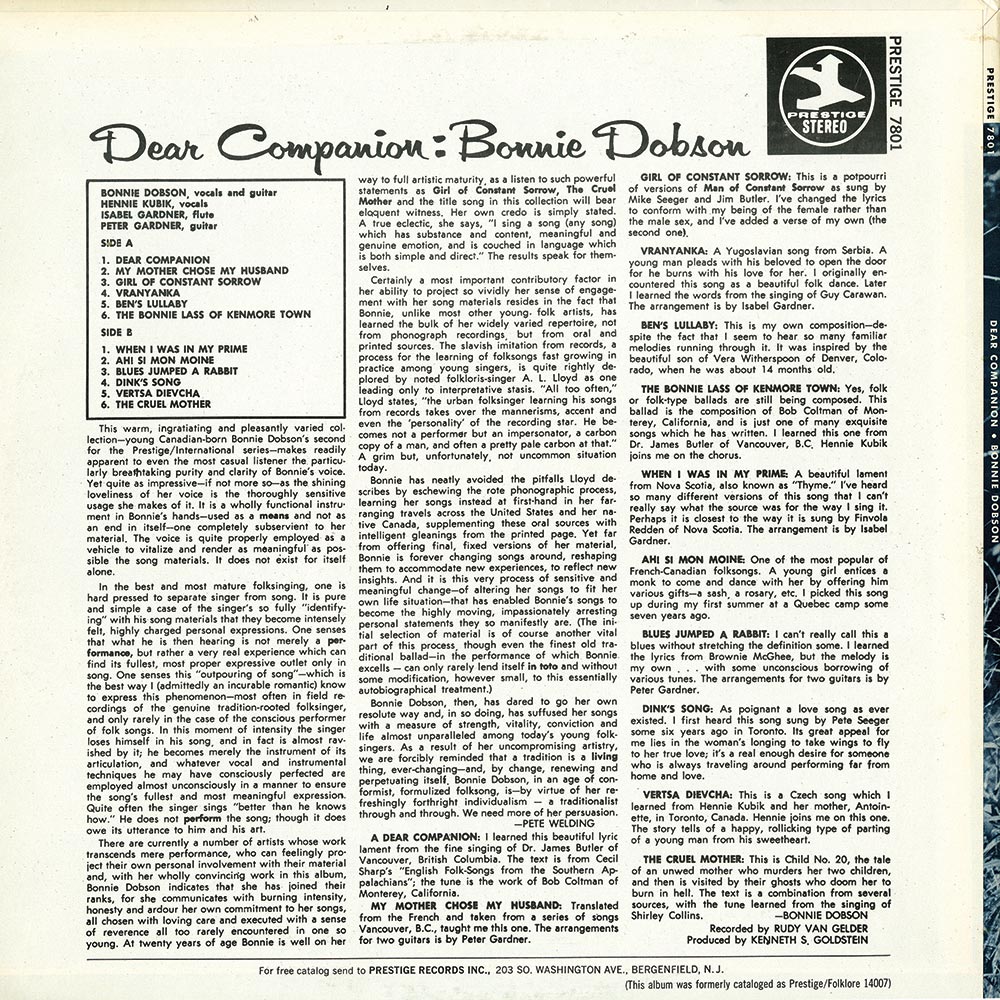
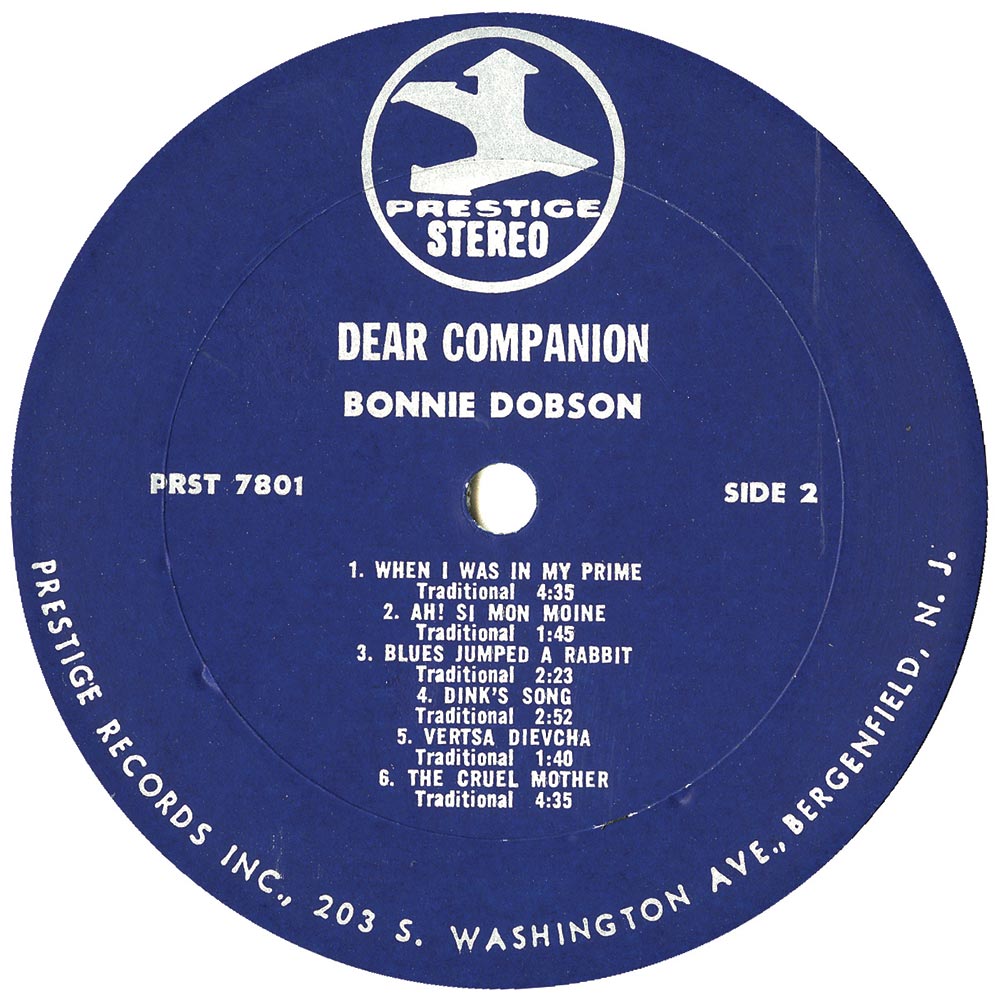
ADMIRAL FALLOW-TINY REWARDS.
ADMIRAL FALLOW-TINY REWARDS.
Often, the hardest thing about forming a new band is coming up with a name. It can be a long and tortuous process. Especially, in the internet age. A new band have to ensure the dot com address hasn’t been taken. If it has, it’s a case of starting the process all over again. Either that, or negotiating with the owner of the dot com to buy the address. That can be an expensive and time consuming process. So for most bands, it’s case of starting again.
That’s been the case since the birth of rock ’n’ roll. Even the biggest band of all changed their name. The Beatles started life as The Blackjacks, before briefly becoming The Quarrymen and then The Silver Beatles. It wasn’t until July 1959 that The Silver Beatles became The Beatles. Since then, countless other bands have had a similar struggle to come up with a suitable name.
In 2007, Glasgow based singer-songwriter Louis Abbott decided to formed a new band with Kevin Brolly, Philip Hauge, Sarah Hayes and Joe Rattray. They settled on the name Brother Louis Collective. Two years later, and the Brother Louis Collective changed its name to Admiral Fallow. The rest as they say, is history.
Since then, Admiral Fallow have toured the world, and played at some of the biggest and most prestigious venues and festivals. Admiral Fallow have also released a trio of albums. Their most recent album Tiny Rewards, was released recently on Nettwork. Tiny Rewards is the latest chapter in the Admiral Fallow story. It began in 2007.
That’s when Glasgow based singer, songwriter and Louis Abbott decided to formed a new band. This wasn’t going to a traditional indie band. Instead, Brother Louis Collective were going to fuse orchestral and indie pop. To bring this about, Louis was joined by four other Glasgow based musicians. This included the rhythm section of drummer and percussionist Philip Hauge and bassist Joe Rattray. They were joined by a two musicians who would help create the orchestral sound. Sarah Hayes played flute, piano and accordion, while Kevin Brolly added clarinet, keyboards and percussion. Along with Louis Abbot, they became Brother Louis Collective.
With a lineup in place, the Brother Louis Collective set about honing their sound. The five friends quickly began to define their sound. Through the rest of 2007 and throughout 2008, the Brother Louis Collective were gaining a reputation as a popular live act. So in early 2009, Brother Louis Collective decided to record their debut single.
For Brother Louis Collective’s debut single, These Barren Years was chosen. The B-Side was Gypsy Woman. These Barren Years was well received upon its release in March 2009. The single brought the Brother Louis Collective’s music to a wider audience. With the Brother Louis Collective’s recording career up and running, the band decided to change their name.
Usually, bands change their name early on in their career. However, after nearly two years, the band realised something wasn’t quite right. That was the name. This resulted in a rethink, and Brother Louis Collective became Admiral Fallow.
Given that the Brother Louis Collective already were a popular live band, and were attracting the attention of critics, a change of name could’v backfired on Admiral Fallow. All the time they had spent during the last two years could’ve been in vain.
Fortunately, that wasn’t the case. Instead, the last two years had been time well spent. The newly named Admiral Fallow had spent much of the last two years playing live. This allowed them to hone and tighten their sound. It also allowed the band to grow their fan-base. Already they were a popular draw wherever they played. So, it made sense for Admiral Fallow to record their debut album.
Boots Met My Face.
In June 2009, Admiral Fallow made the short journey from Glasgow to Blantyre, in Lanarkshire. That’s where former Delgados Paul Savage and Emma Pollock’s studio is situated. Admiral Fallow were following in the footsteps of many successful Scottish bands.
At Chem 19 Studios, Admiral Fallow met former Delgados’ drummer Paul Savage. By 2009, he had established a reputation as a successful and talented producer. Paul was the go-to-guy producer for many Scottish bands, including up-and-coming bands. This made him the perfect person to produce Admiral Fallow’s debut album.
While Admiral Fallow were an experienced live band, they had only recored one single. Recording an album was very different. So, producer Paul Savage guided Admiral Fallow through the recording process. In total, ten tracks were recorded at Chem 19 Studios.
The ten tracks were written by Louis Abbott. He describes the songs as autobiographical, and document his childhood and youth. Each song is based upon a person or event. This includes Subbuteo, where Louis remembers being beaten up in Edinburgh, where he grew up. A lyric from Subbuteo also provided the album title, Boots Met My Face.
With Boots Met My Face recorded, Admiral Fallow started looking for a record label to release their debut album. However, that search was put on hold briefly, as Admiral Fallow played a band-storming set at Scotland’s biggest music festival.
Although Admiral Fallow had only been together two years, they were chosen to headline the Sunday night T Break stage at T In The Park. For a Scottish group, this was a huge honour, one they must have hoped would help in Admiral Fallow’s search for a record label.
That took a while. In March 2010, Admiral Fallow opened for fellow Scot King Creosote at the Fence Collective’s Homegame Festival. Then in April 2010, Admiral Fallow supported The Futureheads in Glasgow, This was perfect timing.
In April 2010, Admiral Fallow released their debut single Squealing Pig on Lo-Five Records. That however, was a mere aperitif.
Later in April 2010, came the release of Boots Met My Face. It was released to critical acclaim. A great future was forecast for Admiral Fallow, who were about to head out on the festival circuit.
Admiral Fallow renewed their acquaintance with King Creosote at the Glasgow West End Festival. They then played the Wee Chill, Rockness and Insider festivals. However, it was at T In The Park that Admiral Fallow made a triumphant return. This time, Admiral Fallow were playing the prestigious BBC Entroducing stage. A lot had happened to Admiral Fallow since they took T In The Park by storm a year earlier. There seemed to be no stopping Admiral Fallow.
They had played their first Scottish tour in August 2010. Then later in 2010, Admiral Fallow opened for another Scottish band, Frightened Rabbit. Then in October 2010, Admiral Fallow released the second single from Boots Met My Face, Subbuteo. This was the perfect way to round off 2010. 2011, looked like being a big year for Admiral Fallow.
In February and March of 2011,Admiral Fallow hit the road, and completed their first tour of Britain. This was to coincide with the reissue of Boots Me My Face. Then on 13th March the band flew to Austin, Texas for SxSW 2011. Given this is one of the most prestigious American festivals, this was a huge boost for Admiral Fallow. During their time in America, Admiral Fallow were embraced by American critics. The critics forecast a great future for Admiral Fallow. They weren’t wrong.
Tree Bursts In Snow.
Just like Boots Met My Face, Tree Bursts In Snow was recorded at Chem 19 Studios. This time however, some guest artists would join Admiral Fallow. Among them were former Frightened Rabbit vocalist Gordon Skene, Jo Mango, Kenny Reid, Tom Gibbs and Tom Stearn. These guest artists featured on three of the ten tracks that became Tree Bursts In Snow.
Before the release of Tree Bursts In Snow on 21st May 2012, Louis Abbot explained what the title meant. Tree Bursts In Snow Louis explained is: “the sound and the image of an artillery shell exploding into a cluster of snow-drenched trees.” It was a poignant picture that Louis Abbot was painting. Especially as he went on to speak about gun crime in America and: ”the effect that losing friends through violence, in particular during times of war or conflict has on young men and women.” Louis had thought deeply about this, and on Tree Bursts In Snow combined social comment and poppy hooks.
When Tree Bursts In Snow was released, critics were won over by Admiral Fallow’s sophomore album. Superlatives were exhausted praising the Glasgow’s band’s unique brand of orchestral and indie pop. Admiral Fallow’s star was in the ascendancy, and would be during the rest of 2012.
During the 2012 festival season, Admiral Fallow played The Great Escape, Glastonbury Festival, Latitude, Cambridge Folk Festival, Green Man and the End of The Road festival. There were also appearances at Sligo Live and Crossing Border. Later in 2012, Admiral Fallow were asked to open for Scottish indie pop royalty Belle and Sebastian. Admiral Fallow also opened for Paul Heaton and The Low Anthem. All this was good experience for Admiral Fallow, who were quickly becoming one of Scotland’s most successful musical exports.
That’s been the case in the last three years. Admiral Fallow have gone from strength to strength. They’ve continued to play live, and are now recognised as one of the best Scottish live bands. However, in late 2013, Admiral Fallow cut back on the live shows they were playing. They had an album to record. That album would become Tiny Rewards, which was released on 25th May 2015.
Tiny Rewards.
Admiral Fallow’s weren’t going to rush their third album. Work began in late 2013. Admiral Fallow wrote the music and Louis Abbott wrote the lyrics for Tiny Rewards. This was Admiral Fallow’s third album, and second album for Canadian label Nettwerk.
Unlike previous albums, Tiny Rewards wasn’t recorded at just one studio. Three studios, Angelic, Red Kite and Voltaire Road Studios were used. So were the familiar surroundings of Chem 19 Studios. That’s where Paul Savage took charge of “additional production.” However, Paul Savage wasn’t in charge of production. This time around, Admiral Fallow and Cameron Blackwood produced the twelve tracks that became Tiny Rewards.
At the three studios, Tiny Rewards’ twelve tracks were recorded by Admiral Fallow and friends. The rhythm section featured guitarist and vocalist Louis Abbott, drummer and percussionist Philip Hauge and bassist Joe Rattray. They were joined by a two musicians who would help create the orchestral sound. Sarah Hayes played flute, piano and accordion, while Kevin Brolly added clarinet, keyboards and percussion. They’re joined by cellist Jackie Baxter, violinist Kristian Harvey and guitarist Stu Goodall. Once Tiny Rewards was recorded, it was mixed by Paul Savage and mastered by in London by Mandy Parnell.
Only then was Tiny Rewards ready for release. The big day was 25th May 2015. That’s when Tiny Rewards was released to widespread critical acclaim. Tiny Rewards was hailed as Admiral Fallow’s finest hours. Here’s why.
Opening Tiny Rewards is Easy as Breathing. A pounding rhythm section, stabs of keyboards and searing guitars create a dramatic wall of sound. In the midst of the arrangement, a piano carries the melody. It’s present when Louis Abbott delivers a soul-baring vocal. He doesn’t so much deliver lyrics, but lives them. Behind him, the thunderous, mesmeric arrangement has an anthemic sound. During the break, the arrangement is stripped bare. Just wistful harmonies, and piano accompany Louis before Admiral Fallow kick loose. By then, it’s easy to imagine East As Breathing becoming a festival favourite.
A drum machine and synths are deployed on Evangeline, as Louis delivers a slow, melancholy vocal. Soon, chiming, crystalline guitars, bass and keyboards are added. They fill out the arrangement, as slowly and dramatically Louis delivers the lyrics. By then, Admiral Fallow sound like a 21st Century version of The Smiths. Later, Sarah Hayes’ backing vocals are the perfect foil for Louis. They’re reminiscent of Lorraine MacIntosh of Deacon Blue. As the arrangement continues to grow, electronica and indie pop combine head-on. It’s a potent partnership, one that’s not short of poppy hooks.
Beeps courtesy of a synth and drums combine with a myriad of disparate sounds on Happened in the Fall. They create a lo-fi, left-field and almost robotic arrangement. Very different, is Louis’ despairing vocal. As his vocal drops out, a guitar rings out, and cuts through the arrangement. Then Louis, accompanied by Sarah Hayes, delivers a tender, hurt filled vocal as he sings: “ it Happened in the Fall” When Louis poignant vocal drops, a blistering guitar gives way to a wistful piano and strings. They frame Louis’ vocal as accompanied by harmonies, memories come flooding back.
From the opening bars of Good Luck, it’s obvious something special is unfolding. A piano and drums combine, before a scorching guitar is unleashed. Then a roll of drums signals the arrival of Louis’ vocal. Slowly and deliberately he delivers the lyrics. Harmonies augment his vocal, as the arrangement grows in power and drama. Admiral Fallow aren’t afraid the unleash their inner rocker. Similarly, they’re not afraid to vary the tempo. This grabs the listener’s attention, and forces them to listen. A pleasant surprise comes when Sarah takes charge of the vocal. She’s a talented and versatile vocalist. Later, though, the baton passes to Louis. He takes charge of the vocal. Aided and abetted by harmonies, a storming, hook heavy anthem unfolds.
Against the chatter of a radio playing, a piano plays and Holding The Strings begins. Drums provide the heartbeat as Louis delivers an emotive vocal. Ethereal harmonies, keyboards, a crystalline guitar and the rhythm section combine. Soon, the tempo is rising and the arrangement takes on a rocky hue. Dramatic flourishes and variations in tempo are used, before the rhythm section and guitar drive the arrangement along. Louis seems to have reserved one of his best vocals. With Sarah encouraging him every step of the way, he breathes life, meaning and emotion into the lyrics, delivering the lyric “we are old” poignantly.
As a piano and drums combine on Sunday, the track takes on an almost hypnotic sound. Then when Louis’ vocal enters, it’s obvious he’s singing about being at a festival. “Far from being alone, surrounded by tents and future friends.” Soon, the track takes a dark twist. Especially, lyrics like; ”take those pills, you bought to take the guilt.” This leaves the listener to wonder what caused the guilt? Was it one night stand? From there, the arrangement becomes a lysergic merry-go-round. It also takes on rocky and sometimes dramatic sound. Meanwhile, Louis and Sarah combine, bringing to life the guilt on the day after the night before, as they leave the festival behind, and return to their respective lives.
On the count of “5,6” a drum and crystalline guitar combine on Building As Foreign. They’re joined by Louis’ vocal and a prowling bass. Like so many of Admiral Fallow’s songs, the lyrics are based upon Louis childhood. That becomes apparent straight away:“how we ended up here, with the start we had is amazing.” He goes on to remembers “measuring his height by the door,” his first football strip, and “first kiss.” Accompanied by ethereal harmonies, pounding rhythm section and searing guitar, memories come flooding back for a wistful, grateful Louis.
A lone guitar opens Salt. It’s just two minutes long, but is a quite beautiful song. The arrangement is understated. Just a chirping, mesmeric guitar accompanies Louis. He’s accompanied by Sarah. She’s a perfect foil for Louis. They’re like yin and yang. They compliment each other, on what’s a beautiful ballad. It shows another side to Admiral Fallow.
Drums pound and crack, while washes of keyboards sweep in on Some Kind of Life. Slowly, the arrangement unfolds. Admiral Fallow don’t rush. They drop in a piano and bass. After a minute, Louis’ heartfelt vocal enters. As he sings: “I left the house and started the next chapter,” confusion and uncertainty fills his voice. Has, and is, he doing the right thing? Behind him, the rest of Admiral Fallow create one of the best arrangement. It unfolds in waves, as Louis delivers an emotive, soul-searching vocal. He describes this as a “never ending tussle with the mind.” By then, the arrangement has grown in drama and power. When Louis’ vocal is added, Some Kind of Life takes on anthemic sound. It’s also one of the highlights of Tiny Rewards.
The drums that open Liquor and Milk are similar to those on Building As Foreign. However, this time, it’s mesmeric, deliberate stabs of piano that accompany the drums. They frame Louis’ vocal as he reminisces. Accompanying him is Sarah, her vocal equally impassioned and emotive. Their vocal take centre-stage, as the drums and piano provide the accompaniment. Later, strings and percussion are added, as the arrangement reaches a crescendo.
Carousel see the tempo rise slightly. Admiral Fallow jump on the merry-go-round. It’s has a much more upbeat sound. Driving along the arrangement along are the piano and drums. They accompany Louis. However, Sarah steals the show, combining power and emotion. Meanwhile, a bass, keyboards and drums power the arrangement along. Louis and Sarah combine, hopefully singing: “get yourself out from under the weather, stick another pin in that map you drew, get yourself out from under the weather, and I long for this to be the pin you want to do.”
Melancholy. That describes the slow, deliberate introduction to Seeds, which closes Tiny Rewards. Louis, accompanied by the piano, delivers a wistful, deliberate vocal. Drums rumble, while keyboards and piano combine with a clarinet. They set the scene for Louis and Sarah. As they sing: “we sow seeds wherever we go,” there’s an element of hope amidst the melancholia. It grows, as the arrangement builds, and Tiny Rewards draws to a close.
Three years after the release of their sophomore album Tree Bursts In Snow, Admiral Fallow returned recently with Tiny Rewards. It was released on the Canadian label Nettwerk. Tiny Rewards was well worth the three year wait.
With its mixture of anthems, future festival favourites, heart wrenching ballads and cinematic tracks, Tiny Rewards is a captivating album. Lyricist and vocalist Louis Abbott is aided and abetted by Sarah Hayes. Together, they bring the lyrics to life, breathing life, meaning, emotion and sometimes, melancholy into the twelve tracks. Other times, there’s a hopeful, sound on Tiny Rewards, which is a career defining album from Admiral Fallow.
Six years after the Brother Louis Collective became Admiral Fallow, the Glasgow based band are now one of Scottish music’s most successful exports. No wonder, given the quality of music on Tiny Rewards. It manages to surpass the quality of Tree Bursts In Snow. Many people thought Tree Bursts In Snow was an album Admiral Fallow would struggle to surpass. However, after three years hard work and the a little from help from their friends, Admiral Fallow return with Tiny Rewards, the eclectic album of their career.
Tiny Rewards sees Admiral Fallow jump onboard the Carousel and combine disparate musical genres. Everything from electronica, folk, indie pop, indie rock, orchestral, pop, psychedelia and rock is combined by Admiral Fallow. The result is Tiny Rewards, the finest, and most captivating and eclectic album ofAdmiral Fallow’s career.
ADMIRAL FALLOW-TINY REWARDS.
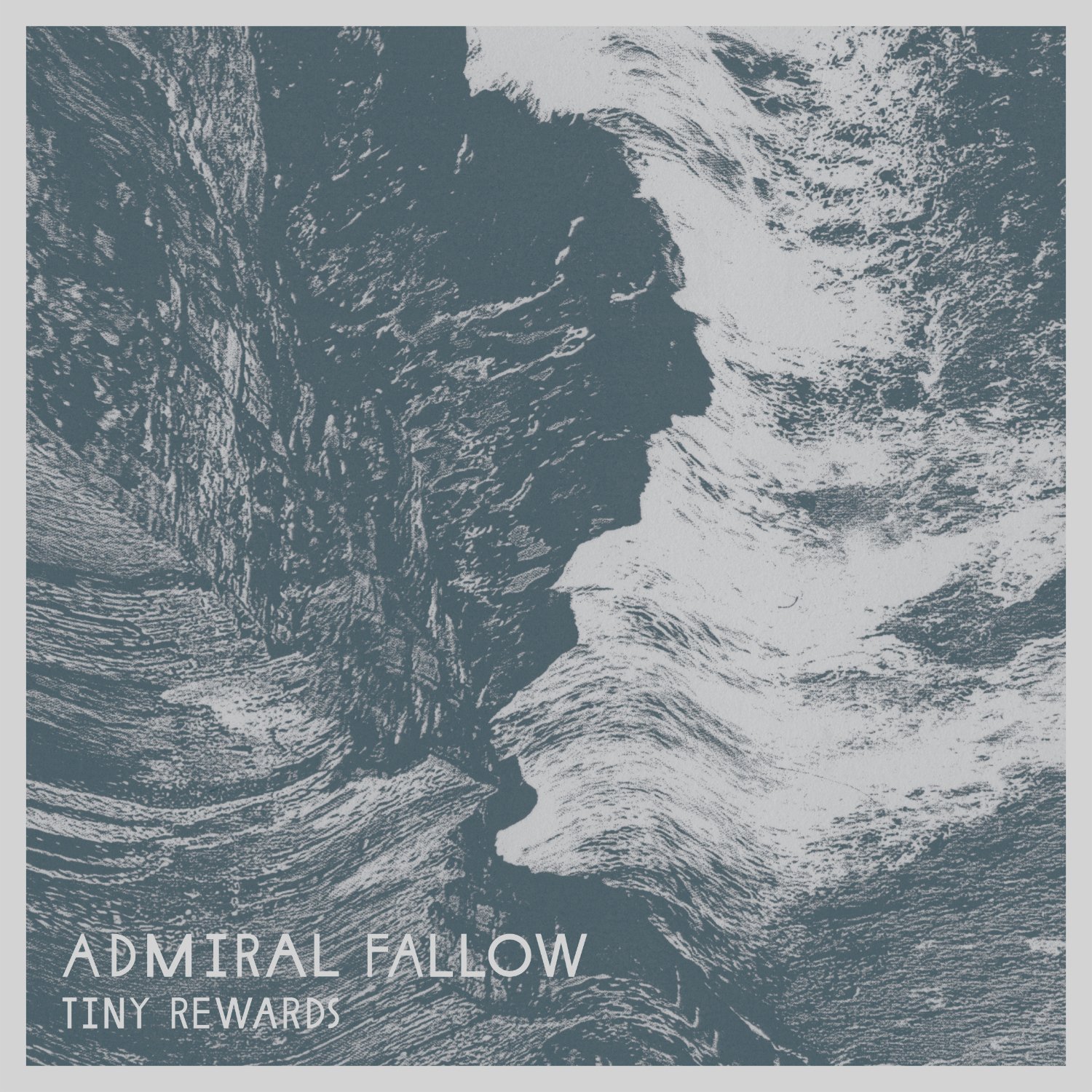
VAN HALEN-VAN HALEN, VAN HALEN II, WOMEN AND CHILDREN FIRST, FAIR WARNING AND DIVER DOWN-VINYL EDITION
VAN HALEN-VAN HALEN, VAN HALEN II, WOMEN AND CHILDREN FIRST, FAIR WARNING AND DIVER DOWN-VINYL EDITION.
In the history of rock ’n’ roll, Van Halen are one the most successful bands. They released twelve studio albums between their 1978 debut Van Halen, and their 2012 swan-song A Different Kind Of Truth. These albums sold an incredible 50.5 million copies in America alone. Four of Van Halen’s albums topped the US Billboard 200 charts. Van Halen were one of the biggest bands in planet rock. Rock ’n’ roll’s great survivors had outsold and out-rocked two generations of bands.
That too many people, was incredible. Van Halen were a notoriously hard living band. They burnt the candle at both ends, replicating the excesses of Led Zeppelin, Black Sabbath and Deep Purple. Just like Icarus, members of Van Halen sailed to close to the sun. Unlike Icarus, Van Halen lived to tell the tale, and in the process, released some of the best rock of a generation. That was the case from Van Halen released their debut album Van Halen in 1978.
When Van Halen released Van Halen in 1978, it wasn’t well received by critics. That’s somewhat ironic, as Van Halen reached number nineteen in the US Billboard 200. Gradually, critics changed their minds about Van Halen. Suddenly, they began to regard Van Halen as one of the best debut albums in the history of rock ’n’ roll. That’s the case today, with critics hailing Van Halen as a classic, and one of the greatest debut albums ever released. That’s why it’s fitting that Rhino are recently released a remastered vinyl edition of Van Halen, Van Halen II, Women and Children First, Diver Down and Fair Warning.
However, it’s not just Van Halen that Rhino are reissuing. Instead, Van Halen’s first five albums have been remastered and will be reissued on 10th July 2015. These five albums were released between 1978 and 1982. During this period, Van Halen were one of the hardest working and successful bands in the world. Having released Van Halen in 1978, they followed this up with Van Halen II in 1979. As a new decade dawned, Van Halen released Women and Children First in 1980, then Fair Warning in 1981 and and Diver Down in 1982. Each of these albums have been remastered, and document the first five years of Van Halen’s recording career. By then, Van Halen were already an experienced band.
The Van Halen story began in the early seventies, when brothers, Eddie and Alex Van Halen had formed a band. Like many bands, they found it difficult to settle on a name. Initially, they were called The Broken Combs, then changed the name to The Trojan Rubber Co. By then, The Trojan Rubber Co. had a settled lineup.
Their lineup featured Alex on drums and Eddie on guitar. They were joined by bassist Mark Stone and vocalist David Lee Roth, who they had hired a sound system from. Eddie had initially failed the audition. However, Eddie and Alex were realists. Money was tight, so if they brought David onboard, they would save having to hire a sound system. They also thought that David might improve as a vocalist. However, in 1974, The Trojan Rubber Co. changed its name and its lineup.
1974 was a pivotal year for The Trojan Rubber Co. By then, bassist Mark Stone had been replaced by bassist Michael Anthony. His audition was unorthodox. Only after Michael took part in an all night jam session, was he hired. So, Michael left local band Snake and joined The Trojan Rubber Co. Soon, The Trojan Rubber Co. changed its name to Mammoth, and then Van Halen. For the next three years, Van Halen spent honing their sound.
Van Halen played wherever they could. Backyard parties, clubs and dive bars, they weren’t proud. Far from it. They certainly were loud. Too loud some thought.
When Van Halen went to audition at Gazzarri’s, a bar on Sunset Strip, that was down on its luck, the owner Bill Gazzarri, told them they were “too loud, and refused to hire them.” However, Van Halen’s new managers stepped in.
Mark Algorri and Mario Miranda had just been installed as Van Halen’s managers. They had also just taken over the booking at Gazzarri’s. So, Van Halen were installed as the house band. Not long after this, Van Halen entered the studio for the first time.
The four members of Van Halen headed to Cherokee Studios, which had recently housed Steely Dan. At Cherokee Studios, Van Halen recorded their demo tape. It would become their calling card, and see them play some of L.A.’s top clubs, including the famous Whisky-A-Go-Go.
Soon, Van Halen were a permanent fixture in L.A.’s top clubs. That’s where they continued to hone their sound. It’s also where they came to the attention of Kiss’ Gene Simmons.
Gene Simmons had heard good things about Van Halen. So, he went to check out Van Halen. According to what he had heard, they were one of the rising stars of L.A.’s music scene. When Gene Simmons arrived at the Gazzarri club in the summer of 1976, he was won over by Van Halen. He knew they were going places.
So, Gene Simmons took Van Halen to Village Recorders in L.A. to produce a new demo tape. Overdubs then took place at Electric Ladyland in New York. Things were looking good for Van Halen. The only thing Van Halen baulked at, was Gene’s suggestion to change the band’s name to Daddy Longlegs. That was a step too far. The next step was for Gene to take the newly recorded demo tape to Kiss’ management.
When Kiss’ management heard the demo, they were pretty disparaging about Van Halen. According to Kiss’ managers, Van Halen “had no chance of making it.” These words would come back to haunt them, after Van Halen sold over 50.5 million albums in America alone. However, with Kiss’ management not interested in signing Van Halen, Gene Simmons bowed out of the story. He would be replaced a year later by Mo Ostin and Ted Templeman.
Down but not out, Van Halen returned to the club circuit. For the next year, they continued to hone their sound on the club circuit. One night, in the middle of 1977, Van Halen were playing at the Starwood in Hollywood. There wasn’t much of an audience. However, little did Van Halen know, that two very special guests were in the audience, Mo Ostin and Ted Templeman of Warner Bros. Records. The pair liked what they heard and less than a week later, Van Halen had signed to Warner Bros. Records. Mo Ostin dispatched Van Halen to Sunset Sound Records with producer Ted Templeman, where recording of Van Halen I began.
Van Halen.
Like many bands recording their debut album, Van Halen were fearless. They had no apprehension. Mind you, this wasn’t exactly a new experience. Van Halen had been in studios before, recording two different demo tapes. However, this was for real. The band had written nine tracks. The other two were covers of The Kinks’ You Really Got Me and John Brim’s Ice Cream Man. These eleven tracks would eventually become Van Halen’s debut album, Van Halen.
Recording of Van Halen began in the middle of September 1977. Van Halen’s rhythm section of drummer Alex Van Halen and bassist Michael Anthony set about proving the album’s pulsating heartbeat. A week was spent recording Eddie’s guitar parts. Another two weeks were spent recording David’s vocals and the backing vocals. By early October 1977, recording of Van Halen was all but complete. The decision was made not to do much in the way of over-dubbing. This meant Van Halen was much more like hearing Van Halen live. How would critics respond to this?
Before the release of Van Halen, critics had their say. For everyone at Warner Bros. Records, they held their breath. Back in 1978, critics could be venomous. It was hardly rock critic’s finest hour. They were in the throes of a love affair with punk. Many critics took great pleasure in trashing rock albums. The critics didn’t hold back when it came to Van Halen. Most of the reviews were negative. One of the worst reviews came from the so called doyen of critics, the contrarian Robert Christgau. The equally contrarian Rolling Stone were not fans of Van Halen. At least they admitted that Van Halen were going places. Mostly, the reviews panned Van Halen. However, soon, critics would be eating their words.
When Van Halen was released on 18th February 1978, it began climbing the charts. Eventually, it reached number nineteen in the US Billboard 200 charts. This was just the start of the rise and rise of Van Halen, who critics had changed their mind about,
Gradually, critics changed their minds about Van Halen. Suddenly, they began to regard Van Halen as one of the best debut albums in the history of rock ’n’ roll. That’s the case today, with critics hailing Van Halen as a classic, and one of the greatest debut albums ever released. From that album, a trio singles were chosen.
Three singles were released from Van Halen. A cover of The Kinks’ You Really Got Me reached number thirty-six in the US Billboard 100. Runnin’ With The Devil Stalled at number eighty-four in the US Billboard 100. The final single released from Van Halen was Ain’t Talkin’ ’bout Love. It failed to chart. While the singles failed to replicate the success of Van Halen, it showcased the band at their hard rocking best.
Literally, Van Halen strut and swagger through the eleven tracks on their debut album Van Halen. It’s no surprise that rock and heavy metal fans were won over by Van Halen. It’s a track full of some of Van Halen’s biggest songs, including Runnin’ With The Devil, Eruption, You Really Got Me, Ain’t Talkin’ ‘Bout Love, Jamie’s Cryin’ and Ice Cream Man. Van Halen’s rhythm section of Alex and Michael provide the backdrop to Eddie’s blistering guitars and David’s lived-in vocal. From the opening bars of Runnin’ With The Devil, right through On Fire, Van Halen win friends and influence people. The band who just a year ago, were being hailed L.A.’s best bar band, were on their way to becoming a one of the biggest bands on planet rock.
Van Halen II.
When Van Halen entered Sunset Sound Recorders, in Hollywood, on 11th December 1978, the the four members of the band must have wondered what had happened in the last ten months? They had gone from bar room band, to a million selling rock band. All of a sudden, they were one of the biggest bands in the America. They were being touted as the saviour of American rock. This was hard to comprehend. It also meant that Van Halen were under pressure to record a fitting followup to Van Halen.
Recording of what became Van Halen II began on 11th December 1978. Nine of the ten tracks were penned by Van Halen. Many of the tracks weren’t new songs. Instead, they featured on the Gene Simmons’ sessions. However, given Van Halen were under pressure to record their sophomore album, it’s no surprise that they chose to dust off these songs. The other track chosen for Van Halen II was Clint Ballard Jr.’s You’re No Good. These ten track were produced by Ted Templeman. By January 1979, Van Halen II was complete, and ready for release.
Given the negative reviews of their debut album, the four members of Van Halen must have awaited the reviews of Van Halen II with bated breath. Mostly, reviews of Van Halen II were positive. That’s apart from the “usual suspects,” who still, failed to be won over by Van Halen. They were in the minority. The majority of critics were impressed by Van Halen II’s upbeat, feel good sound. Especially tracks like Dance The Night Away and Beautiful Girls, which some critics referred to Van Halen II as perfect party music. One track however, was very different to the rest.
This was the instrumental, Spanish Fly. It was perceived as the followup to Eruption on Van Halen. Spanish Fly however, is only a minute long, and featured Eddie Van Halen on an acoustic guitar. Rather than fingerpick, he uses a plectrum. This makes things doubly hard. Despite this, he delivers a guitar masterclass. Eddie deploys a variety of techniques, including finger tapping and tremolo picking. Those who had marvelled at Eruption, would be spellbound by Eddie’s performance on Spanish Fly.
That would be the case with Van Halen’s performance on Van Halen II. When Van Halen II was released on March 23rd 1979, copies of Van Halen II sold quickly. It was one of 1979s must have rock albums. Soon, Van Halen two reached number six in the US Billboard 200. Eventually, it sold five million copies in America, and was certified platinum five times over. Across the border, Van Halen II was certified double platinum in Canada. Meanwhile, in France Van Halen II was certified gold. It seemed Van Halen could do no wrong.
While that was the case with Van Halen’s first two albums, their singles were selling as well. While Dance The Night Away reached number fourteen in the US Billboard 100, Beautiful Girls stalled at number eighty-four. Just like many other rock bands before them, Van Halen looked like being an album’s band. Maybe that would change with their third album?
Women and Children First.
Just a year after Van Halen began recording their sophomore album, the band began work on their third album, Women and Children First. It marked the beginning of a new chapter in the Van Halen story.
On Van Halen’s first two albums, Van Halen had added cover versions. This included a cover of The Kinks’ You Really Got Me and John Brim’s Ice Cream Man on Van Halen. Then on Van Halen II, Van Halen covered Clint Ballard Jr.’s You’re No Good. However, when recording of Women and Children First began in December 1979, cover versions were a thing of the past.
Women and Children First, Van Halen’s third album was their first album featuring just songs written by the four members of the band. Maybe Van Halen had realised that putting cover versions on albums was costing the band royalties? There was certainly no need to resort to cover versions? The four members of Van Halen were talented songwriters, capable of writing their own material. So when Van Halen entered the studio to record Women and Children First, they came with ten new songs they had penned. This however, wasn’t the only change that became apparent.
As recording of Women and Children First began, onlookers in the studio realised that Van Halen’s music was becoming heavier. This wasn’t just a stylistic change, and to some extent, a thematic one. Some of Van Halen’s later songs had a degree of darkness. Mostly, though, Van Halen were still the same hard rocking, good time band. However, what became apparent was that their way of recording was changing.
Unlike Van Halen and Van Halen II, Women and Children First saw Van Halen rely more upon overdubs. Backing vocals weren’t used as extensively. They were on Could This Be Magic?, and Nicolette Larson was drafted in to sing the choruses and backing vocal. This was the one and only time a female backing vocalist featured on a Van Halen album. Another first was the keyboard driven And the Cradle Will Rock. Although it sounds like a guitar, it’s a Wurlitzer electric piano with a phase shifter used to transform the sound. It seemed that Van Halen had the confidence to experiment more on Women and Children First. Given that Van Halen were working with such an experienced producer as Ted Templeman, this was the perfect opportunity to try new things. He could show Van Halen how to make their ideas work.
Despite the stylistic change and change in their way of recording, producer Ted Templeman didn’t try to reign in Van Halen. He must have known that Van Halen wanted to broaden their horizons musically. They had always been a hard rocking band, and weren’t willing to sacrifice what many felt was their true sound. Maybe Van Halen had sacrificed some of their true sound on their first two albums. Now that they had their foot in Warner Bros’ door, they could show their true colours. This may not have pleased everyone.
Van Halen finished recording Women and Children First in February 1980. At last, those within Warner Bros. could hear Women and Children First. Some were aware of Van Halen’s music changing stylistically. This didn’t please everyone. Van Halen were one of Warner Bros.’ biggest success stories. By changing their style, this could alienate their audience. Not everyone who had bought Van Halen, and Van Halen II, would be receptive to a heavier Van Halen. Would this be the case within Warner Bros?
Once the executives at Warner Bros. heard Women and Children First, they were able to form an opinion. Most of those whose opinion mattered liked Van Halen’s new sound. They realised that Van Halen wanted to evolve as a band. They couldn’t keep rehashing Van Halen, and Van Halen II. Instead, they had to move forward. However, it was a big risk. Van Halen, and Van Halen II were million selling albums. There was a lot at stake. If Women and Children First flopped it would prove costly.
Van Halen had two hurdles to overcome before they would know if Women and Children First had been a success. The first was the critics.
As the critics their say, everyone at Warner Bros. and the four members of Van Halen awaited the verdict. Eventually, the reviews were published. Many critics remarked upon Van Halen’s heavier sound. They also noted that the four members of Van Halen had written the ten tracks on Women and Children First. Although Women and Children First was quite different from Van Halen II, it was well received by critics. They felt Van Halen were maturing as a band and songwriters. Proof of this were tracks like Could This Be Magic? and Everybody Wants Some!!, which reinforced Van Halen’s reputation and credentials as a good time party band. Having cleared the first hurdle, now record buyers had the final say.
Only if Women and Children First sold in similar quantities to Van Halen and Van Halen II could the album be declared a success. Women and Children First was released on March 6th 1980. Straight away, Women and Children First was selling well. Soon, Women and Children First reached number six in the US Billboard 200. Eventually, it sold three million copies in America, and was certified triple-platinum. Elsewhere, Women and Children First was certified double platinum in Canada and gold in France. As Van Halen and everyone at Warner Bros. breathed a sigh of relief, still Van Halen weren’t selling singles in vast quantities.
The only single released from Women and Children First, was And The Cradle Will Rock. It stalled at number fifty-five in the US Billboard 100. Van Halen it seemed, were never going to be a singles band. However, what really mattered was that Women and Children First had sold well. That was certainly the case. Worldwide, Women and Children First sold over three million copies. Van Halen’s decision to change direction had paid off.
Fair Warning.
By the time that Van Halen began recording their fourth album, Fair Warning, Van Halen were a divided band. The band’s two main men were at loggerheads. David Lee Roth wanted Van Halen to return to the sound of the first two album. He wasn’t in favour of the heavier sound, which he felt didn’t appeal to as many people. The proof of this was the sales of Women and Children First.
Eventually, Women and Children First sold over three million coupes. Van Halen eventually sold ten million copies and Van Halen II five million copies. David felt it Van Halen continued with the heavier sound, they risked alienating record buyers. Van Halen co-founder didn’t agree.
Eddie wanted Van Halen to continue their heavier sound. Women and Children First was the first time they showcased this sound. He felt that the way forward was longer songs with much more complicated song structures. This would allow Van Halen to shine as musicians, especially Eddie, who was seen one of the best guitarists of the late-seventies and early eighties. Given Eddie was one of the best guitarists of his generation, he felt his guitar playing should take centre-stage. David Lee Roth disagreed, and disagreed with Eddie’s other proposal.
The other change Eddie proposed was a continuation of the darker themes that Van Halen began exploring on Women and Children First. For David Lee Roth, this wasn’t what Van Halen were about. They were, in many people’s eyes, a good time rock ’n’ roll band. However, that wasn’t the direction Eddie wanted Van Halen to take. Instead, it looked as if Eddie wanted Van Halen to become the Led Zeppelin of the eighties. With David and Eddie at loggerheads, work began on Van Halen’s fourth album Fair Warning.
Just like Women and Children First, Van Halen penned the ten tracks on Fair Warning. Recording of these ten tracks began in late 1980. Quickly, it became apparent that Eddie’s ideas had prevailed. The music was fast, rocky and sometimes dark. This allowed Van Halen’s rhythm section to showcase their skills Fair Warning. Especially Eddie, who unleaded a series of fierce, blistering solos on tracks like Mean Street, Hear About It Later, Unchained and So This Is Love? David who seemed to have pst the argument, added his trademark vocals. Producer Ted Templman had the job of bringing Fair Warning together. The result was the hardest rocking album of Van Halen’s career, Fair Warning.
Before Fair Warning was released on April 29th 1981, the critics had their say on Van Halen’s hardest rocking album. Reviews of Fair Warning were mixed. Most of the critics embraced Fair Warning. They were impressed by Eddie’s virtuoso skills. Aided and abetted by his box of sound effects, Eddie unleashes a series of blistering solos. Along with the other two members of the rhythm section, he was key to Van Halen’s new, hard rocking style. Together, they provided the backdrop for David’s vocals. He brought to life the lyrics, as Van Halen continued to evolve musically.
It seemed Fair Warning had won over most of the critics. However, while most of the reviews of Fair Warning praised Van Halen’s fourth album, there were still some doubters. They felt that Van Halen were heading down the wrong road. On Women and Children First and Fair Warning, Van Halen’s music had become much harder. This had cost Van Halen precious sales on Women and Children First. Would this be the case with Fair Warning?
On the release of Fair Warning on 29th March 1981, sales were slow. Fair Warning was the slowest selling Van Halen album of their four album career. Eventually, it reached number six in the US Billboard 200. While this was the same as Van Halen II and Women and Children First, sales were way down. Fair Warning sold “just” two million copies. This was a million less than Women and Children First, and three million less than Van Halen II. To make matters worse, none of the singles charted.
Four singles were released from Fair Warning during 1981. The first was So This Is Love. It failed to chart. So did Mean Street, Push Comes To Shove and Unchained. This wasn’t unexpected, as Van Halen weren’t a singles band. However, it further reinforced David Lee Roth’s argument.
Given that Fair Warning was Van Halen’s slowest selling and least successful album, many onlookers wondered whether Van Halen would rethink their sound. It seemed record buyers weren’t embracing Van Halen heavier sound. Maybe it was time to come round to David Lee Roth’s way of thinking?
Diver Down.
After the release of Fair Warning, Van Halen headed out on tour. They spent months promoting Fair Warning. Still, Fair Warning sold slowly, and failed to match the sales of previous albums. Once the tour was over, Warner Bros. started pressurising Van Halen into recording their fifth album.
That wasn’t what Van Halen wanted to hear. They wanted to take some time out, and then spend time writing and recording their fifth album. That wasn’t to be though.
Not long after the Fair Warning tour ended, David Lee Roth came up with an idea. He wanted Van Halen to record a single and release it just after the New Year. He had the very song in mind, Roy Orbison’s Oh, Pretty Woman. While this wasn’t the most obvious choice for a single, the rest of Van Halen agreed.
So the four members headed to Sunset Sound and recorded their cover of Oh, Pretty Woman. After working out an arrangement with producer Ted Templeman, Van Halen recorded Oh, Pretty Woman. Once it was finished, Oh, Pretty Woman was released early in the New Year.
Just after New Year 1981, Van Halen’s version of Oh, Pretty Woman was released. Van Halen weren’t known as a singles band. However, Oh, Pretty Woman succeeded where better Van Halen songs failed, and reached number twelve in the US Billboard 100 and number one on the US Mainstream Rock charts. Ironically, this became the most successful single of Van Halen’s career. However, the success of Oh, Pretty Woman backfired on Van Halen.
Having just enjoyed the biggest selling single of their career, Warner Bros. started pressurising Van Halen into recording their fifth album. Van Halen didn’t get the time to write and record their fifth album.
Eventually, Van Halen relented. That’s despite having been on tour for months. For the last four years, Van Halen had been recording and touring albums. It was like a merry-go-round, one that Van Halen needed to get off. Especially since the last year hadn’t been easy.
Eddie and David were still at loggerheads. Although Eddie had won the day, David had been vindicated. Sales of Fair Warning were way down. It sold a million less than Women and Children First. This was costing Van Halen and Warner Bros. money. So, Van Halen could hardly refuse Warner Bros.’ request to begin recording their fifth album. However, that wasn’t Warner Bros.’ only request.
Given Fair Warning hadn’t been as successful as previous Van Halen albums, someone at Warner Bros hit on the idea that Van Halen should include some covers on what became Diver Down. The reasoning for this was, that if people recognised some of the songs on the album, they would be more likely to by it. Especially if these songs had been hits before. So, Van Halen went in search of covers.
Having already recorded and released Oh, Pretty Woman, Van Halen got to work on their fifth album, Diver Down. In addition to Oh, Pretty Woman, Van Halen had chosen four other cover versions. This included The Kinks, Where Have all the Good Times Gone and Martha and The Vandellas’ Dancing In The Streets. They were augmented by Milton Ager and Jack Yellen’s Big Bad Bill (Is Sweet William Now) and Dale Evans’ Happy Trails. Apart from the five cover versions, Van Halen had seven new songs. Three of the songs weren’t so new.
Hang ‘Em High started life as Last Night, a track from Van Halen’s 1977 demo. Happy Trails was another song from the 1977 demos, which had been included as a joke. Now the joke was on Warner Bros. The other song was Cathedral, a song Van Halen had been playing for a couple of years. During that period, the song had continued to evolve. These three songs would become part of Diver Down, which was recorded in two studios in Los Angeles.
Recording of Diver Down began in January 1982. Two studios were used by Van Halen. The first was Sunset Sound, where Van Halen had recorded previously. Other sessions took place at Warner Bros. Recording Studios, which before the corporate rebinding, was known as Amigo Studios. At these two studios, Van Halen and Ted Templeman got to work. Things weren’t going to plan as Van Halen began recording eleven of Diver Down’s twelve songs.
During the recording of Van Halen’s previous album, Diver Down, released in 1982, David, Eddie and producer Rod Templeman had clashed. The problem was, Eddie wanted to make keyboards a prominent part of the Van Halen sound. David and Rod disagreed. Thinking that Van Halen was a democracy, the two men thought the matter was settled. They were wrong.
Despite this, Eddie went ahead and recorded much of Diver Down at his home studio. When the band heard it, it was keyboard heavy rock rubbed shoulders with Van Halen’s trademark sound. Presented with what seemed like a fait accompli, David began to reconsider his position. He was far from happy with Eddie’s sudden discovery and love of synths. For a rock ’n’ roller like David, this was sacrilege. Despite this, David and Eddie managed to work together.
Over the next three months, Van Halen worked their way through the twelve tracks. Some were easier to record than others. Sometimes, things didn’t go to plan. Some of the covers were difficult to adapt, so that they took on Van Halen’s sound. One of the most problematic was Dancing In The Streets. The problem was Eddie couldn’t work out a guitar riff. Eventually though, Van Halen figured out an their take on Dancing In The Streets. Gradually, Diver Down began to take shape. By March 1982, Diver Down was completed. It would be released on April 14th 1982.
This meant there wasn’t long before Van Halen completed Diver Down and its release on April 14th 1982. By then, some of the members of Van Halen were beginning to realise that Diver Down wasn’t their finest moment. Eddie Van Halen would later say: “I’d rather have a bomb with one of my own songs than a hit with someone else’s.” However, Van Halen had folded too quickly for a band who had already sold over fifteen million albums. They had been cajoled into recording cover versions. For the hard rocking Van Halen, this almost subservient attitude was surprising. Or was it?
When critics were sent advance copies of Diver Down, they were struck by the album cover. It portrayed the diver down flag, which is used to indicate that a scuba diver is diving within that area. If ever it was a case of “a picture paints a thousand words.” David Lee Roth explained that “there was something going on that’s not apparent to your eyes…it’s not immediately apparent to your eyes what is going on underneath the surface.” That could easily be replaced by the press and record buyers weren’t aware what was going on behind the scenes. They never knew that Van Halen were pressurised to record Diver Down. Would the pressure Warner Bros. under, could come back to bite them?
Having received advance copies of Diver Down, critics were determined to have their say. Most were impressed by Diver Down. Some weren’t enamoured with the cover versions. This was quite unlike Van Halen. However, mostly, the reviews of Diver Down were positive. Things were looking up for Van Halen.
On its release on 29th April 1982, Diver Down reached number three in the US Billboard 100. This was the highest chart position of Van Halen’s first five album. Eventually, Diver Down sold four million copies, which was double the amount of Fair Warning. This was pretty good for album that included cover versions and a trio of tracks from Van Halen’s past. However, the success didn’t stop there.
Dancing In The Street was the second single to be released from Diver Down. It stalled at number thirty-eight in the US Billboard 100. The other four singles, Secrets, Little Guitars, The Full Bug and Where Have All the Good Times Gone failed to reach the US Billboard 100. At least they reached the US Mainstream Rock charts. However, times had changed, with Van Halen having enjoyed two hit singles from Diver Down. For a band who hadn’t been known as a singles band, this was changed times for Van Halen.
That had been the case throughout the last five years. Between the release of Van Halen in 1978, and Diver Down in 1982, Van Halen had been on a musical roller-coaster. Before signing to Warner Bros., Van Halen were just a bar band, albeit the biggest and best bar band in Los Angeles. Their career had began in a blaze of glory, with Van Halen, which went on to sell ten million copies. Van Halen II then sold five million copies. Suddenly, Van Halen were one of the biggest rock bands in the world. From there, the next three years were one filled with twists and turns.
After releasing Van Halen and Van Halen II, which are considered two of Van Halen’s finest albums, the next two years saw Van Halen’s music evolve. It become harder and rockier on Women and Children First. By then, Eddie Van Halen and David Lee Roth were at loggerheads as to the future direction of the band.
While Eddie wanted Van Halen’s music to take on a harder, rockier sound, David wanted Van Halen to continue the populist sound of their first two albums. Eddie won the day. However, it proved to be a Pyrrhic victory. Sales decreased on Women and Children First. The drop in sales continued on Fair Warning, where Van Halen’s music becomes even harder and rockier. After Fair Warning sold three million less than Van Halen II, Warner Bros. decided to intervene.
Ironically, Warner Bros.’ suggestion that Van Halen combine cover versions and original material on Diver Down, resulted in the most successful album since Van Halen II. Diver Down sound four million copies. For most bands, this would’ve been a cause for celebration. Not Van Halen. They soon realised that they had folded too easily. They shouldn’t have given in to Warner Bros., as they were an experienced and successful band. If they had taken the time to write and record the album they wanted, they may have reached the scaled the same heights as their next album.
Two years later, in 1984, and Van Halen’s first five albums were well on their way to selling twenty-four million copies. However, their sixth album, 1984. was a game-changer, in more ways than one.
Van Halen’s sixth album, 1984, was proof that if Van Halen were given time to write and record an album, they could come up with something very special. 1984 was a fusion of keyboard heavy rock, combined Van Halen’s trademark hard rocking sound. Thos proved a winning combination. These two sides of Van Halen resulted in a classic album that would become the biggest selling album of Van Halen’s career.
On its release on January 9th 1984, 1984 started climbing the charts. Eventually, it reached number two in the US Billboard 200. This was the highest chart placing of Van Halen’s six album career. It also became the biggest selling album of Van Halen’s career. Eventually, 1984 sold twelve million copies. 1984 became Van Halen’s second album to be certified diamond. Elsewhere, 1984 was a huge seller.
In Canada, 1984 was certified five times platinum. Over the Atlantic, 1984 was certified gold in Britain and France. Meanwhile, 1984 was certified platinum in Germany. Van Halen had recorded the album everyone knew they were capable of. It came at a cost.
Behind the scenes, all wasn’t well within Van Halen. David Lee Roth, Van Halen’s charismatic frontman would quit after 1984. In some ways, the writing had been on the wall. David left on a high. However, maybe, Van Halen might have released an album of the quality of 1984 two years earlier?
Given the time they wanted and needed, Van Halen’s fifth album would’ve been of a similar quality. Sadly, that wasn’t the case. Instead, Diver Down was an album that Eddie Van Halen openly admitted to disliking. Eddie was quite open when he said: ”I’d rather have a bomb with one of my own songs than a hit with someone else’s.” It as obvious that he didn’t see Diver Down as his finest hour. That’s the case.
While Diver Down is a good, but not great album, it’s nowhere near as good as Van Halen, Van Halen II and Women and Children First. They’re three of the first five Van Halen albums that have been remastered by Rhino. They were reissued on vinyl on 10th July 2015. The others are Fair Warning and Diver Down. Of these two albums, Fair Warning is the best of the two. However, for the newcomer to Van Halen, then s Van Halen, Van Halen II and Women and Children First are the perfect introduction to Van Halen, who were well on their way to becoming one of the biggest selling bands in rock music.
From Van Halen’s 1978 debut album Van Halen, and their 2012 swan-song A Different Kind Of Truth, the former Los Angeles bar band’s twelve studio albums sold 50.5 million copies in America alone. Four of Van Halen’s albums topped the US Billboard 200 charts. Two albums were certified diamond, having sold ten million copies. This includes Van Halen and 1984, two classic albums from Van Halen, who are still one of the biggest bands on planet rock. Van Halen are one of rock ’n’ roll’s great survivors, who have outsold and out-rocked two generations of bands.
VAN HALEN-VAN HALEN, VAN HALEN II, WOMEN AND CHILDREN FIRST, FAIR WARNING AND DIVER DOWN-VINYL EDITION
IAN LEVINE’S SOLID STAX SENSATIONS.
IAN LEVINE’S SOLID STAX SENSATIONS.
The Stax Records’ story began in 1957, when Jim Stewart founded Satellite Records. Four years later, in 1961, Satellite Records changed its name to Stax Records. That day, one of what become one of the most successful independent soul labels was born.
This success lasted fourteen years. Then on December 19th 1975 Stax Records and its sister label Volt Records were forced into Chapter 11 Bankruptcy. Less than a month later, on January 12th 1976, a bankruptcy judge ordered that Stax Records close its doors for the last time. The last person to leave Stax Records was engineer and producer Terry Manning. It was the end of an era.
Since then, countless compilations of Stax and Volt Records have been released. Many play it safe, and stick with the tried and tested. They showcase Stax and Volt’s bigger names, including Otis Redding, Booker T and the MGs, Isaac Hayes, The Soul Children, Johnny Taylor, William Bell, Judy Clay, The Dramatics and The Bar-Kays. However, often, what veterans of Stax and Volt compilations long for, is a compilation where the compiler has dug much deeper. They got their wish recently.
Stax Records, an imprint of Ace Records, recently released Ian Levine’s Solid Stax Sensations. It’s the followup to a compilation Ian Levine compiled back in 1974. That was Solid Soul Sensations, which was the first ever Northern Soul compilations. It featured tracks from the Scepter and Wand back-catalogues. On its release, Solid Soul Sensations was a huge success in Britain, reaching number eleven. A followup was planned, but somehow, Ian Levine never got round to it, until recently.
While Solid Soul Sensations was released on vinyl, and featured just sixteen tracks, the newly released Ian Levine’s Solid Stax Sensations has been released on CD and features a mighty twenty-five tracks. On Ian Levine’s Solid Stax Sensations, Ian digs deeper into the Stax and Volt vaults than other compilers. He’s eschewed the familiar, and tried and tested.
Instead, Ian has chosen tracks from some of the lesser known names to have recorded on Stax and Volt. This includes Bobby Whitlock, Joni Wilson, Annette Thomas, The Stingers, Reggie Milner, Paul Thompson, The Newcomers and John Gary Williams. Familiar faces include William Bell, The Dramatics, Barbara Lewis and David Porter. However, the tracks from these “familiar faces” aren’t the ones most people would expect. That’s what makes Ian Levine’s Solid Stax Sensations such a captivating compilation.
Opening Ian Levine’s Solid Stax Sensations is Bobby Whitlock’s And I Love You. It was the B-Side of Raspberry Rug, which was released on Hip Records, an imprint of Stax Records. And I Love You was produced by Don Nix and Donald “Duck” Dunn. However, Raspberry Rug sunk without trace. Later, the hidden gem that is And I Love You was discovered by the Northern Soul crowd. By then, Bobby Whitlock had been a member of Derek and The Dominoes, and collaborated with Eric Clapton and The Rolling Stones. Bobby also release four solo albums between 1972 and 1976. The best of these albums are Bobby Whitlock and Raw Velvet. They’re the perfect introduction to one of music’s best kept secrets.
The Rance Allen Group feature three times on Ian Levine’s Solid Stax Sensations. They released I Know A Man Who as a single in 1973, on Gospel Truth Records. This was an imprint of Truth Records. Soul and gospel combine as Rance Allen delivers an impassioned vocal powerhouse.
Gonna Make It Alright was hidden away on the B-Side of The Rance Allen Group’s 1973 single I Got To Be Myself. As a result, I Got To Be Myself passed most people by. Not any more, this uplifting, joyous gem makes a welcome comeback on Ian Levine’s Solid Stax Sensations.
Ain’t No Need Of Crying is the third and final track from The Rance Allen Group. It’s a David Porter composition, which was released as a single on Stax Records’ gospel imprint Truth Records in 1974. It features a beautiful, heartfelt vocal where soul and gospel combine seamlessly.
Charlene and The Soul Serenaders’ Can You Win was originally released on Paradox in 1970. When Stax Records heard the single, they decided to take a chance on the single. However, promos were sent out to DJs, Love Changes and Can You Win as a double-A-side on Volt. These singles are now a real rarity. Then when the single was released, Can You Win was the B-Side. Since then, it’s become a favourite in the UK’s Northern Soul scene.
Tony Hester and Richard Wylie cowrote You’re My Only Temptation. It was recorded by Roz Ryan and produced by Don Davis, and released on Volt in June 1970. Despite its smooth, soulful and melancholy sound, You’re My Only Temptation passed record buyer by. This proved to be Roz’s one and only single for Volt. Mind you, what a single it was. Later, Roz would go on to enjoy a successful career as an actress.
Proud As Punch released their one and only since on Stax in 1970. That was So Easy To See, On the B-Side was If You Look Into My Eyes in 1970. It was written by Ted Tierce and produced by Don Nix. With its big, bold and jaunty arrangement, it’s a delicious slice of blue-eyed soul.
The Stingers are another group who only released one single on Stax, Do The Cissy. On the flip-side was Refuse To Be Lonely. It was produced by future member of M.F.S.B. Lenny Pakula. He also cowrote the track with Palmer Lakes and Robert Seville. In The Stingers’ hands, Refuse To Be Lonely is transformed into a stomper, Philly style.
Originally, The T.S.U. Tornadoes were the house band at Skipper Lee Frazier’s Ovide Records. They later, became Archie Bell’s backing band. However, in 1969, they released My Thing Is A Moving Thing. This was the first of two singles The T.S.U. Tornadoes released on Volt. On the flip-side of My Thing Is A Moving Thing is the the Leroy Lewis penned I Still Love You. It has Northern Soul written all over it, and is a real find by Ian Levine.
A real rarity is Ilana’s single Where Would You Be Today. It was released on Volt in 1971, and proved to be her only single. Accompanied by female backing vocalists Ilana delivers an under soulful vocal of a single that’s almost impossible to find. When copies of Where Would You Be Today become available, they’re beyond the budget of most record buyers. So its inclusion on Ian Levine’s Solid Stax Sensations is to be welcomed. It’s one of my highlights of Ian Levine’s Solid Stax Sensations.
Before signing to Volt, Margie Joseph was briefly signed to Okeh. That’s where she released her debut single Why Does A Man Have To Lie? After that, Margie Joseph signed to Volt, and released One More Chance as a single in 1969. It was produced in New Orleans by Larry McKinley. Margie Joseph delivers what’s without doubt one of the most soulful ultimatums as she sings I’m gonna give you One More Chance to prove your love.”
After leaving Atlantic Records in 1968, Barbara Lewis signed to Enterprise, an imprint of Stax Records. Two years later, in 1970, Barbara released what was the final album of her career, The Many Grooves Of Barbara Lewis. It featured The Stars, which features Barbara at her soulful best, delivering a heartfelt, hopeful vocal. It’s a tantalising taste of what Barbara Lewis is capable of.
One of the most underrated albums released on Stax was John Gary Williams’ 1973 eponymous album. It was released on Stax, and featured John Gary Williams’ 1973 single The Whole Damn World Is Going Crazy. His melancholy vocal is tinged with disbelief as he sings “The Whole Damn World Is Going Crazy.” Social comment and soulfulness, it doesn’t get much better than that.
My final choice from Ian Levine’s Solid Stax Sensations is David Porter’s If I Give It Up, I Want It Back. This is the opening track on what’s regarded as the finest album of David’s career, Victim Of The Joke?….An Opera. It was released in 1973. However, If I Give It Up, I Want It Back had been released two years earlier, in 1971 on Stax. Sadly, the single failed commercially. However, by the time Victim Of The Joke?….An Opera was released in 1973, David Porter was enjoying the commercial success and critical acclaim his talent as a singer deserved.
Over the years, I’ve bought countless Stax compilations and box sets. Sometimes, compilers stick to the tried and tested. They never stray far from Stax and Volt’s biggest names. This means a compilation packed full of tracks from Otis Redding, Booker T and the MGs, Isaac Hayes, The Soul Children, Johnny Taylor, William Bell, Judy Clay, The Dramatics and The Bar-Kays. Usually, they’re these artists biggest hits. Occasionally, however, a compiler goes of piste and digs deeper. This includes veteran DJ Ian Levine.
For Ian Levine’s Solid Stax Sensations, the veteran and venerable DJ has dug deep in the Stax vaults. He’s also dipped into the Volt, Truth, Hip and Enterprise vaults, and found twenty-five tracks that eschew the familiar and predictable. The result is Ian Levine’s Solid Stax Sensations, a compilation that’s all killer, and no filler. That’s no surprise.
Ian Levine’s life has revolved around soul for over forty years. He’s lived and breathed all things soul. From his days spinning Northern and Modern Soul at the Blackpool Mecca, Ian Levine knew where the soulful secrets were hidden. He’s decided to share a few of them on Ian Levine’s Solid Stax Sensations, which was recently released by Stax Records on Ace Records. It’s one of the best Stax compilations money can buy. Ian Levine’s Solid Stax Sensations is also the perfect way to dig deeper into Stax’s discography.
Especially for those whose budget can’t stretch to the trio of box sets that were reissued earlier this year. They feature every single released by Stax and its various imprints between 1958 and 1975. However, they’ll set you back in excess of £200. Ian Levine’s Solid Stax Sensations won’t break the budget, and is a welcome introduction to some of the best kept, soulful secrets in the Stax Records’ vaults.
IAN LEVINE’S SOLID STAX SENSATIONS.
DAVID PORTER-…INTO A REAL THING…AND MORE.
DAVID PORTER-…INTO A REAL THING…AND MORE.
Ten years ago, in 2005, David Porter was inducted into the Songwriter’s Hall Of Fame. By then, David Porter was a veteran of the music industry. He started off as a singer, and then became a producer and songwriter. It was as a songwriter that Dave Porter’s best known.
Between 1962 and 2005, David Porter penned 1,700 songs. These songs sold over 300 million units. This includes a trio of Grammy Award singles. The first was Sam and Dave’s Soul Man in 1968. Twenty-five years later, and David Porter won a second Grammy Award with Mariah Carey’s Dreamlover. David Porter wasn’t done yet. He wrote Get Jiggy Wit It for Will Smith. It won a Grammy Award in 1999. However, there’s much more to David Porter than three songs.
Much more. It’s fair to say that David Porter has written songs for some of the biggest names in music. He penned tracks for an eclectic selection of artists. This includes Aretha Franklin, Bonnie Raitt, Charlie Rich, Don Covay, Dusty Springfield, James Brown, Joe Cocker, Otis Redding, Patsy Cline, The Sweet Inspirations, Wilson Pickett and ZZ Top. They’re just a few of the artists that David Porter penned songs for. However, it was at Stax that David Porter’s career took off.
At Stax, where David formed a successful songwriting partnership with Isaac Hayes. The pair wrote songs for everyone from Sam and Dave and The Soul Children to The Astors, Carla Thomas and Johnny Taylor. However, although David Porter was enjoying a successful career as an A&R man, songwriter and producer at Stax, he hadn’t given up on his solo career.
Despite the success he was enjoying, David Porter still wanted to pursue a solo career. He had brief brush with fame in 1965, with his single Can’t See You When I Want To. After that, David Porter’s solo career was put on hold until 1970. That’s when he released Gritty, Groovin’ and Gettin’ It. Sadly, it wasn’t a commercial success. However, David Porter wasn’t for giving up. He was made of stronger stuff.
So David Porter released his sophomore album …Into A Real Thing in 1971. It’s been recently released by Stax Records, an imprint of Ace Records as …Into A Real Thing…and More. There’s a recent for this. The newly released …Into A Real Thing…and More features a trio of bonus tracks, one of which has never been released before. These tracks were recorded during the …Into A Real Thing sessions, when David Porter was determined to get his solo career back on track. That determination had taken David Porter a long way.
Thirty years before, David Porter was born on November 21st 1941. He was the ninth of twelve children born in Memphis, to James and Corean Porter. David first sang in church. Later, he would enter competitions with his friend and classmate at Booker T. Washington High, Maurice White. The future founder of Earth, Wind and Fire and David proved a potent partnership, winning numerous competitions. It seemed almost inevitable that they would both pursue a career in music.
That proved to be the case. While still at school, David worked part-time in a grocery. As luck, or fate would have it, the grocery was across the road from Satellite Records. One day, David plucked up the courage to go across and ask if Satellite Records would consider recording soul music? Soon, David was having regular meeting with Chips Moman. This resulted in David becoming a songwriter at Satellite Records.
With his new role, David Porter set about bringing some of his musical friends to Satellite Records. This included Booker T. Jones, William Bell and Andrew Love. These three men would play an important part in the future of Satellite Records.
Not long after David Porter was brought onboard, Satellite Records became Stax Records and became a soul label. Little did anyone realise that it would become one of soul’s biggest and most successful labels. David Porter played an important role in the rise and rise of Stax Records.
Despite his new role, David Porter made sure he graduated from Booker T. Washington High in 1961. He later enrolled on a music course at LeMoyne College. However, in 1962, the twenty-one year old David Porter was playing a crucial role at Stax Records.
David Porter became Stax Records’ first staff songwriter. The first song he wrote at Stax was That was The Life I Live, the B-side to Barbara Stephens single I Don’t Worry. Soon, he was writing songs for many artists at Stax. This wasn’t his only role at Stax.
Given Stax Records was a new company, David Porter juggled various roles. He was also Stax Records’ A&R man. David signed The Emotions, Homer Banks and The Soul Children to Stax, and produced many of these acts. However, one of his most important signings was the man who would become his songwriting and production partner…Isaac Hayes.
Bringing Isaac Hayes to Stax Records proved to be a masterstroke. The pair became songwriting and production partners. Isaac was yin to David’s yang. One complimented the other. Their track record of success was enviable. They wrote most of Sam and David’s biggest hits, including Soul Man, which won David Porter and Isaac Hayes a Grammy Award. David Porter and Isaac Hayes also wrote songs for Otis Redding, Carla Thomas, Mabel John, Albert King and The Bar Keys. It seemed the pair had the Midas touch. They wrote and produced numerous hit singles for artists signed to Stax; and played a huge part in the rise and rise of Stax Records. Away from Stax, David Porter was writing songs for some of the biggest names in music.
Away from Stax David Porter penned tracks for Aretha Franklin, Dusty Springfield, Wilson, Pickett, Charlie Rich, The Sweet Inspirations, Don Covay and Joe Cocker. It seemed David Porter could do no wrong. His songs were released to critical acclaim and commercial success. Artists were desperate to record David Porter’s songs. Everything was going right for David Porter during the sixties. However, as the sixties gave way to the seventies, there was a huge void in David Porter’s life.
Something was nagging away at David Porter. Here he was, nearly thirty years old, and was one of the most successful songwriter and producers. Artists were literally queuing up to record his songs. Still though, something was missing from David’s life. That was a successful solo career.
Writing and producing songs was one thing, but David wanted to forge a career as a solo artist. He had a tantalising taste of commercial success in 1965, when Can’t See You When I Want reached the top thirty in the US R&B charts. That was the sum-total of David’s solo career. Since then, David’s solo career had been put on hold. Now as he approached this thirtieth year, David decided to relaunch his solo career. Maybe his luck would change when David Porter released his debut solo album Gritty, Groovin’ and Gettin’ It? Especially, if Isaac Hayes cowrote some songs with David.
With David needing some new songs for his debut album, Many expected that David and and old friend and songwriting partner Isaac Hayes would pen some tracks. That wasn’t going to happen.
By the time David Porter set about rebuilding his solo career, his old songwriting partner Isaac Hayes was now well on his way to becoming a musical superstar. His 1969 sophomore album reached number eight on the US Billboard 200 and number one on the US R&B charts. Isaac Hayes was no working on the followup, The Isaac Hayes Movement. It would also reach number eight on the US Billboard 200 and number one on the US R&B charts. With Isaac Hayes now well on his way to superstardom, it was unlikely he would collaborate with David. Their partnership wasn’t as strong as it had once had been. So David launched a plan B.
When David set about choosing material for Gritty, Groovin’ and Gettin’ It. David dusted off his lucky charm Can’t See You When I Want. Five years after it was released as a single, it joined seven cover versions and became Gritty, Groovin’ and Gettin’ It. They were recorded in 1970.
Recording of Gritty, Groovin’ and Gettin’ It took place in the familiar surroundings of McLemore Avenue, Memphis. That’s where all the Stax sessions took place. It must have been like a second home to David, who’d spent many a session in the McLemore Avenue studios. Recording began on 10th September and stretched into October. With The Mar-Keys accompanying David Porter, he laid down the eight tracks that became his debut album Gritty, Groovin’ and Gettin’ It. Dale Warren and Isaac Hayes arranged the eight tracks and Isaac produced Gritty, Groovin’ and Gettin’ It. Overdubbing of strings took place on 29th December 1969, and Gritty, Groovin’ and Gettin’ It was ready for release in 1970.
Gritty, Groovin’ and Gettin’ It was released in March 1970. It reached just number 163 in the US Billboard 200 and number four in the US R&B Charts. For David, this vindicated his decision to pursue a solo career. Now his thoughts turned to the followup to Gritty, Groovin’ and Gettin’ It.
While Gritty, Groovin’ and Gettin’ It was a commercial success, one thing was missing, David Porter compositions. There was a reason for this. David liked to work with a songwriting partner. He didn’t have one for Gritty, Groovin’ and Gettin’ It. However, by the time David began work on what became …Into A Real Thing, he had found a new songwriting partner, Ronnie Williams.
Ronnie Williams had been around the Memphis music scene since the mid-sixties. He worked at Onyx, one of the city’s smaller studios. The following a recommendation from Mickey Gregory, who was the trumpeter in Isaac Hayes band. This recommendation saw Ronnie Williams moved to Stax just at the right time.
David Porter was going out on the road. He was putting a band together when Ronnie Williams arrived at Stax. All David needed was two keyboard players. When David added Lester Snell, two became one. Then Ronnie Williams arrived and filled the in David’s band. Later, Ronnie Williams became David Porter’s songwriting partner for much of the seventies.
The Ronnie Williams and David Porter partnership made its debut on …Into A Real Thing. They cowrote four of the six tracks. Ooo-Wee Girl, Too Real To Live A Lie, Grocery Man and Thirty Days were all composed by the new songwriting partnership. This time around, the only cover versions were Bert Berns and Wed Farrell’s Hang On Sloopy, and Luther Dixon and Chuck Jackson’s I Don’t Wanna Cry. These six tracks became …Into A Real Thing.
Recording of …Into A Real Thing took place at Muscle Shoals Sound Studio. It’s thought that accompanying David were the Muscle Shoals’ house band. David Porter, Ronnie Williams and Dale Warren arranged five tracks. These five tracks were produced by David Porter and Ronnie Williams. However, I Don’t Wanna Cry was arranged and produced by Isaac Hayes. He brought along his three backing vocalists Hot Buttered Soul. However, for I Don’t Wanna Cry, Rosie Williams, Pat Lewis and Diane Lewis were billed as The Precious People. Once …Into A Real Thing was completed, it was released later in November 1971.
Ironically, just a month before …Into A Real Thing was due to be released in November 1971, Stax released Isaac Hayes’ fourth album …To Be Continued in Octover 1971. It reached number eleven in the US Billboard 200 and number one in the US R&B charts. This was Isaac Hayes third consecutive number one album on the US R&B charts. Matching the success of his old friend was going to be almost impossible.
When …Into A Real Thing was released, the album reached number 104 on the US Billboard 200 and number nine on the US R&B charts. Although …Into A Real Thing hadn’t matched the success of Isaac Hayes’ …To Be Continued, David Porter was enjoying a successful solo career.
A cover of Hang On Sloopy opens …Into A Real Thing. It’s transforms a familiar song. What could easily be a church organ, combines with dramatic rolls. They’re scene setters. Stabs of stirring string add to the drama. Then David drops the tempo, and delivers a vocal that veers between heartfelt, powerful and soul-baring. Accompanying him are The Precious People. They add soulful, soaring harmonies. Bursts of blazing horns, stabs of piano and to the drama. The tempo changes at just the right moment, and David delivers a half-spoken vocal. He’s like a soul preacher, as a piano and percussion add a subtle backdrop. Strings and drums interject dramatically. So does a moody bass and crystalline guitar. Later, a Thom Bell French horn sounds as David dawns the role of “narrator.” That’s until he and the band kick loose, combining soul and funk during what’s a dramatic, emotionally charged eleven minute epic.
Despite the big, bold introduction complete with blazing horns and thunderous rhythm section, Ooo-Wee Girl sees David’s impassioned, needy vocal accompanied by cooing, ethereal harmonies from The Precious People. As strings sweep, harmonies coo and horns interject, a flute flutters above the arrangement. Later, David’s vocal is impassioned and full of pride as he sings: “they’ve got the castle, and I’ve got the Queen.”With rasping horns, dancing strings and the rhythm section providing the heartbeat, David delivers a vamps his way through the lyrics, giving thanks for the love he’s found on this beautiful ballad.
From the opening bars of Too Real To Live A Lie, it’s obvious that David isn’t happy. Bursts of drums and horns interject, while percussion replicates the sound of a clock. It’s marking the time running out on David’s relationship. He’s angry, frustrated and hurt, that his girlfriend has cheated on him. There’s an air of menace in his voice as he sings: “don’t lie to me.” Then as David sings: “if you want to have a ball, go ahead but don’t play in my park” all of a sudden, the tempo changes and a smooth, soulful ballad unfolds. With lush strings, gently braying horns for company, David lays bare his soul; “don’t be stepping in my heart, say it if you don’t love me.” As David breathes life, meaning and emotion into the lyrics, he delivers a heart-wrenching vocal, that’s without doubt, one of his finest.
Horns sound and flourishes of piano open Grocery Man. Soon, percussion and the rhythm section enter. By then, David’s delivering a powerhouse of a vocal. Machismo fills his voice as he sings: “I’m the Grocery Man, with all the love you want.” Meanwhile, strings sweep and swirl, and the arrangement is beginning to sound as if it belongs on a seventies Blaxploitation movie. Especially, as stabs of growling horns, dancing strings, percussion and a driving rhythm section accompany David’s sassy, strutting vocal.
I Don’t Wanna Cry sees David drop the tempo on another ballad. It’s cover of a song penned by Luther Dixon and Chuck Jackson. This is the only track arranged and produced by Isaac Hayes. he’s responsible for an understated arrangement. The drums play subtly, marking time as the bass, washes of Hammond organ and quivering strings combine. They’re joined occasionally by the piano, as David delivers a slow, seductive and needy vocal. Adding the finishing touch are The Precious People’s soulful interjections. This results in David Porter at his best, delivering a beautiful, romantic ballad.
Thirty Days closes David Porter’s sophomore album …Into A Real Thing. Drums pound, strings sweep, a guitar chimes and a horn sounds. Only then does David Porter deliver a needy, hopeful vocal. Behind him, washes of Hammond organ, piano and chirping guitar are added. They’re the perfect foil for David’s needy vocal. When his vocal drops out, a tack piano takes centre-stage. When David returns, his vocal is an outpouring of emotion. The stabs of horns that accompany him compliment his vocal perfectly, as the song and the original album reaches its emotive crescendo.
It’s almost ironic that while Isaac Hayes was receiving plaudits and critical acclaim, for albums like Hot Buttered Soul, The Isaac Hayes Movement and …To Be Continued, David Porter’s albums were going under the radar. Granted they were successful in the US R&B charts. Gritty, Groovin’ and Gettin’ It reached number four in the US R&B charts, while …Into A Real Thing reached number nine. However, David Porter didn’t have the same crossover appeal. Neither of his first two albums reached to top 100 in the US Billboard 200. That’s a great shame, as David Porter is a hugely talented artist.
While David Porter’s third album, Victim of the Joke? An Opera is considered by many as his finest hour,…Into A Real Thing is an often overlooked album. The best known track is the eleven minute reinvention of Hang On Sloopy. A familiar song takes on new life and meaning. However, that’s just part of the story.
There’s much more to …Into A Real Thing than one track. Ballads Ooo-Wee Girl, I Don’t Wanna Cry and Thirty Days feature David Porter at his best. Then there’s the hurt-filled Too Real To Live A Lie. Very different is the strutting machismo of Grocery Man. It shows David Porter’s versatility. He’s one of the most underrated of the seventies soul men.
For anyone yet to discover David Porter, then the reissue of …Into A Real Thing is the perfect place to start. Three bonus tracks Come Get From Me, Gotta Get Over The Hump and Somebody’s Trying To Ride Piggy Back have been added; and …Into A Real Thing became …Into A Real Thing…and More. It was recently released by Stax Records, an imprint of Ace Records. …Into A Real Thing…and More is the perfect introduction to the best seventies soul man you’ve never heard…David Porter.
DAVID PORTER-…INTO A REAL THING…AND MORE.


BLACK MOON CIRCLE-THE STUDIO JAMS VOLUME I: YELOW NEBULA IN THE SKY.
BLACK MOON CIRCLE-THE STUDIO JAMS VOLUME I: YELOW NEBULA IN THE SKY.
Norwegian psychedelic space rock band Black Moon Circle are one of the rising stars of the Norwegian music scene. Their previous album Andromeda was released to critical acclaim in October 2014. A great future was forecast for the Trondheim based trio. No wonder. Black Moon Circle are one of the most talented bands in the Nordic music scene. They’re also one of the most ambitious. Why?
While most bands don’t plan any further than their next single or E.P., Black Moon Circle plan to release a trilogy of albums in the next two years. They’re no ordinary album. Instead, they’re a trilogy of studio jams. The first instalment is The Studio Jams Volume I: Yellow Nebula in the Sky. It will be released on limited edition vinyl, on the 14th August 2015, on Crispin Glover Records, and is the perfect introduction to Black Moon Circle.
Founder member of Black Moon Circle Øyvin Engan, describes The Studio Jams Volume I: Yellow Nebula in the Sky as an album: “all about intensity. “Intense heavy fuzzed out guitars, blasting bass and drums and spaced out synthesisers. This is an intense instrumental trip with some killer jamming from the entire band.” And what a band Black Moon Circle are. They’ve been together since 2012.
That was when brothers Øyvin Engan and Vemund Engan formed Norwegian psychedelic space rock band, Black Moon Circle. This wasn’t the Engan brothers first band. No. They were previously, members of Trondheim-based punk rock band The Reilly Express. That was the past.
By 2012, the Engan brothers were ready to form their own band. However, it wasn’t another punk rock band. Instead, Black Moon Circle would become a psychedelic space rock band. Øyvin, plays bass, guitar and takes charge of vocals. His brother Vemund is also a guitarist. Now all that Black Moon Circel needed was a drummer.
Completing Black Moon Circle’s lineup was drummer, Per Andreas Gulbrandsen on drums. He was the final piece of the jigsaw. Now Black Moon Circle could set about honing their sound.
Gradually, Black Moon Circle’s sound began to evolve. It’s essentially a combination of lengthy jams, searing guitar riffs and a myriad of effects added to the bass and guitar. This Black Moon Circle describe as space rock band. They’re not alone.
Black Moon Circle are just one of many Norwegian space rock bands. Earthless and Colour Haze are two other Norwegian bands, who are flying the flag for space rock. In Black Moon Circle’s case, they’ve been doing this since 2013.
That’s when Black Moon Circle recorded their eponymous, debut, mini-album, at Nautilus studios in 2013. Black Moon Circle was then released in February 2014 by Space Rock Productions, the label run by the Øresund Space Collective from Copenhagen, Denmark. However, Black Moon Circle aren’t the type of band to let the grass grow under their feet.
No. Black Moon Circle returned to the studio in April 2014. That’s when Black Moon Circle recorded Andromeda. They worked quickly and efficiently. As a result, the five songs on Andromeda were recorded in one day. Six months later, and Andromeda was ready to be released.
Black Moon Circle’s sophomore album, Andromeda, was released by Crispin Clover Records, to critical acclaim in October 2014. A great future was forecast for the Trondheim based trio. They were already hatching a plan that sounded like something from the seventies, the golden age of rock.
What Black Moon Circle had in mind was a trilogy of studio jams. The first of this trilogy of albums is The Studio Jams Volume I: Yellow Nebula in the Sky. Fittingly, it features a trio tracks. One of the tracks was recorded during the first jam session in April 2013, while the other two tracks were recorded in 2014. Joining Black Moon Circle were Scott Heller Scott Heller the synth player in Øresund Space Collective. He plays an important part in the three tracks which became The Studio Jams Volume I: Yellow Nebula in the Sky, which showcases the hugely talented Trondheim trio, Black Moon Circle.
Closed Loop Circle opens side one of The Studio Jams Volume I: Yellow Nebula in the Sky. What sounds like a howling gale is accompanied by a bounding bass. It reverberates into the distance while drums add an element of drama. Synths beep and squeak, like a siren sending out a warning. A blistering, searing fuzzed-out guitar cuts through the slow, moody, cinematic arrangement. Soon, a fuzzy guitar unleashes a wall of feedback. It’s controlled though, in a Hendrex-esque manner. Meanwhile, the bass bounds along. By then, Black Moon Circle are seamlessly combining elements of electronica, experimental, free jazz, psychedelia, rock and space rock. As musical genres combine, Black Moon Circle are locked into a groove, creating a rocky, psychedelic, space age soundtrack for a film that’s yet to be made. In doing so, Black Moon Circle showcase their considerable skills.
Sea Of Vapors is the other track on side two of The Studio Jams Volume I: Yellow Nebula in the Sky. Futuristic, space-age sounds are scene setters, before the rhythm section enter. They lock into a groove, playing within themselves. As they do, Black Moon Circle sound like a power trio from the seventies. That’s no bad thing, as it was the golden age of rock. Listening to Black Moon Circle is like being transported back to another time and place. Meanwhile, a scorching guitar and bass cut through the arrangement, and drums provide the heartbeat. The futuristic synths give the impression that Black Moon Circle are under attack from an alien nation. When the synths drop out, a blistering guitar solo is unleashed. It soars higher and higher, and is best described as a gravity defying masterclass. Later, the arrangement takes on a darker sound. However, there’s another surprise is store. It’s another scorching guitar solo, which is accompanied by space invader synths. Together, they lighten the mood, as Black Moon Circle drive this musical Magnus Opus to even greater heights. Psychedelic space rock doesn’t get better than this.
The whole of side two of The Studio Jams Volume I: Yellow Nebula in the Sky is given over to Yellow Nebula in the Sky. It’s a twenty-two minute epic where Black Moon Circle stretch their legs. There’s plenty of opportunity to head off on a musical voyage of discovery. Washes of whirling synths set the scene for a crunchy, rocky guitar. Soon, Black Moon Circle unite, and become a power trio. They unleash a dramatic, rocky backdrop. Atop the arrangement a myriad of futuristic synths float. These sounds are twisted and transformed. Meanwhile, a blistering, crunchy guitar threatens to feedback and Black Moon Circle’s rhythm section relentlessly drive the arrangement along. Later, sirens sound, squeak and beep. They’re the perfect foil to Black Moon Circle as they kick loose and get into the tightest of grooves. Everything from electronica, psychedelia, rock and space rock melts into one. The result is music that’s gloriously loud, rocky, dramatic and mesmeric. Black Moon Circle never miss a beat on this epic track, as they show why they’re one of the rising stars of the Nordic music scene.
That’s no exaggeration. Black Moon Circle are, without doubt, one of the most exciting, talented and pioneering Norwegian groups. Considering how rich and vibrant the Nordic music scene is, that’s high praise indeed. They remind me of their fellow countrymen, Motorpsycho and Moster! That’s not all. It sounds as of Black Moon Circle have been influenced by Led Zeppelin, Hawkwind, early Pink Floyd and Jimi Hendrix’s guitar playing. All these influences shine through on The Studio Jams Volume I: Yellow Nebula in the Sky.
Black Moon Circle’s third album, The Studio Jams Volume I: Yellow Nebula in the Sky will be released on limited edition vinyl, on the 14th August 2015, on Crispin Glover Records. It’s the first of a trilogy of albums of studio jams Black Moon Circle will release during the next two years.
If the next two volumes of The Studio Jams are as good as The Studio Jams Volume I: Yellow Nebula In The Sky, then they’ll be well worth buying. Black Moon Circle are a 21st Century band, but musically, their roots are in proudly in the past.
Black Moon Circle are, essentially, a power trio, who create their unique brand of psychedelic space rock. The basis for this, is the classic rock of the sixties and seventies, psychedelia and space rock. To this, Black Moon Circle add elements of electronica, experimental music and free jazz. Seamlessly, these disparate musical genres and influences merge into something new and innovative. It’s cinematic, dramatic, futuristic, moody, rocky and as Øyvin Engan says, “intense.”
This intensity is deliberate. It comes courtesy of the three members of Black Moon Circle. They deploy layers of fuzzy guitars, spacey, lysergic synths and a mesmeric rhythm section. When all this is combined, the result is the next instalment in the Black Moon Circle story, The Studio Jams Volume I: Yellow Nebula In The Sky. It’s without doubt the best album of Black Moon Circle’s three album career. That’s why, for anyone yet to discover Black Moon Circle, The Studio Jams Volume I: Yellow Nebula In The Sky is the perfect introduction to the Norwegian psychedelic space rock pioneers at their hard rocking best.
BLACK MOON CIRCLE-THE STUDIO JAMS VOLUME I: YELOW NEBULA IN THE SKY.


SUN RA ARKESTRA UNDER THE DIRECTION OF MARSHALL ALLEN-BABYLON LIVE.
SUN RA ARKESTRA UNDER THE DIRECTION OF MARSHALL ALLEN-BABYLON LIVE.
2014 marked the 100th anniversary of the birth of one of most enigmatic and innovative musicians in the history of music, Sun Ra. The man that many referred to as Mr. Mystery has proved to be one of the most important figures in jazz. Constantly, Sun Ra’s pushed musical boundaries. Sun Ra was never content to stand still musically. Similarly, he was always striving to reinvent his music. That was the case throughout his long and illustrious career.
Accompanied by his Arkestra, that sometimes numbered thirty musicians, the original version of a song was merely the starting point. What it became, was anyone’s guess? Under Sun Ra’s guidance the Arkestra set out to innovate. Their mission was to reinvent a track, and take it in the most unexpected direction. It was a case of expect the unexpected. No wonder.
Sun Ra combined Egyptian history and space-age cosmic philosophy with freeform jazz. This innovative fusion transformed the career of the man born Herman Poole Blount. He was born on 22nd May 1914, and became a giant of jazz.
Herman Poole Blount was also a cosmic philosopher, composer, bandleader, musician, writer and poet. However, it was music that Sun Ra became famous for. Becoming one of the most innovative musicians in the history of jazz didn’t come easily.
Sun Ra was a perfectionist and relentless taskmaster. He brought together some of most talented, inventive and adventurous musicians he could find. They became his Arkestra. After that, Sun Ra’s started transforming them into one of jazz music’s legendary orchestras. This took time, patience and dedication.
Having honed their sound, Sun Ra took his band on the road. That’s where they developed and refined their unique chemistry. Eventually, Sun Ra and His Arkestra made their recording debut. Their debut album was 1956s Jazz by Sun Ra. This was the first of over a hundred studio and live albums Sun Ra and His Arkestra recorded. It’s fair to say that Sun Ra was one of the most prolific recording artists ever.
So when Marshall Allen decided to celebrate the 100th anniversary of Sun Ra’s birth by taking the Sun Ra Arkestra on the road, choosing the setlist can’t have been easy. Literally, Marshall Allen was spoiled for choice. However, when the Sun Ra Arkestra reached the Babylon Club, Istanbul on 21st May 2014, the concert was recorded. Eight of the eleven tracks feature on Babylon Live which was recorded by the Sun Ra Arkestra Under The Direction Of Marshall Allen. It was recently released on the German label, In and Out Records.
For Babylon Live Marshall Allen chose eight tracks. Seven were penned by Sun Ra. The other was a cover of Hoagy Carmichael and Mitchell Parish’s Stardust. These eight tracks are brought to life by the hugely talented Sun Ra Arkestra.
Back when the Sun Ra Arkestra were in their prime, Sun Ra hit the road with thirty musicians. For last year’s tour, their number was somewhat reduced. However, in full flow, they still packed a potent punch. That was the case on 21st May 2015, at the Babylon Club in Istanbul, Turkey. That’s where the latest lineup of the Sun Ra Arkestra took to the stage, and paid homage to its founder and a giant of jazz. Fittingly, the Sun Ra Arkestra was under the guidance of one of Sun Ra’s closest friends, Marshall Allen.
Directing the Sun Ra Arkestra was alto saxophonist Marshall Allen who also added vocals. He was joined by violinist and vocalist Tara Middleton. The rhythm section features drummer Wayne Anthony Smith, bassist Tyler Mitchell and guitarist Dave Hotep. They’re joined by pianist Farid Barron, percussionist Elson Nascimento and Stanley Morgan on congas and percussion. In the horn section are vocalist and alto saxophonist Knoel Scott, trumpeter Cecil Brooks, trombonist Dave Davis, tenor saxophonist James Stewart, baritone saxophonist Danny Ray Thompson and Vincent Chauncey on flugelhorn. This fourteen piece version of the Sun Ra Arkestra worked their way through eight tracks, taking them in the most unexpected directions.
Opening Babylon Live is Astro Black, which originally, was Sun Ra’s proclamation of spiritual emancipation. It opens with a congas and percussion combining urgently. They set the scene for vocalist Tara Middleton. As she delivers a powerful, but heartfelt vocal, joyously, Marshall Allen answers her call. A slow moody bass meanders along. Above the arrangement, the frantic percussion provides a backdrop for Tara Middleton’s vocal powerhouse, as the Sun Ra Arkestra whet your appetite.
On Ra # 2, whose origins are rehearsal tapes discovered by Marshall Allen, the Sun Ra Arkestra threaten to cut loose. That’s the case from the get-go. Pounding drums create a 4/4 beat. Meanwhile, flourishes of piano are joined by the bass and bursts of scorching horns. They play in a bar in 4/4 time, before switching to 5/4. By then, stabs of searing, blistering kick loose. They’re at the heart of everything that’s good, combining elements of avant-garde, free jazz, funk and jazz. Pianist Farid Barron joins the fun. So do the rest of the band. Drummer Wayne Anthony Smith pounds the skins, as if encouraging the Sun Ra Arkestra to greater heights. However, they don’t need any encouragement. Nobody does it better than the Sun Ra Arkestra in full flight. It’s a joy to behold. Especially, as they kick loose. Their late founder and the great cosmic philosopher Sun Ra would be proud of the latest incarnation of his Arkestra.
Saturn is one of Sun Ra’s classic tracks. This time around, the Sun Ra Arkestra play it straight. There’s no no heading off at a tangent. However, this allows certain members of the Sun Ra Arkestra to enjoy their moment in the sun. This includes pianist James Stuart. He gets the ball rolling, laying down a solo before dramatic bursts of horns enter. Together, they produce a wall of sound. It’s impressive. The Sun Ra Arkestra play as one, swinging their way through Saturn. That’s until individual members get the opportunity to express themselves on the solos. Vincent Chauncey on flugelhorn and Knoel Scott on alto saxophone play starring roles. So does the veteran bassist Tyler Mitchell and pianist Farid Barron producing stunning, show stealing performances. Then when one thinks things can’t get any better, Marshall Allen, whose ninety years old, unleashes a stunning improvised solo. Despite his age, he hasn’t lost his magic touch, and steals the show.
The unmistakable sound of Danny Ray Thompson’s baritone saxophone opens Discipline 27B. He plays slowly and deliberately. Maybe even dramatically. Soon, the rhythm section, piano and horn sections combine, creating a hypnotic, mesmeric arrangement. Pianist Farid Barron ploughs his own furrow, playing above the arrangement. However, as the horns howl, lead trumpeter Cecil Brooks steps out of the shadows, and blows a blistering, fluttering solo. Meanwhile, Farid Barron pounds his piano. He Dave Hotep and Marshall Allen prove a potent partnership as they improvise, feeding off each other and reaching new heights musically.
Stardust might seem like unlikely track for the Sun Ra Arkestra to cover. However, they’re a hugely versatile Arkestra, who are just as happy playing what’s a quite beautiful version of an old classic. Pianist Farid Barron takes the lead, setting the scene for Tara Middleton’s hauntingly, beautiful, heartfelt vocal. Soon, the alto saxophone and enters. It’s accompanied by the trum pet and walking bass. Instantly, it’s like being transported to a smokey jazz club in the thirties, as the Sun Ra Arkestra become a big band. However, Farid Barron isn’t content to play it straight. He unleashes flamboyant flourishes as the horns unite. While Tara’s vocal is at the heart of the song’s success, so are the solos from the alto saxophone and the trumpet. Together they play their part in a twelve minute, epic cover of Stardust.
A punchy baritone saxophone is joined by percussion and congas as Carefree #2 unfolds. They’re joined by the horns. They rasp, growl and bray. The result is a melodic, joyous and occasionally mesmeric groove. Marshall Allen on his trusty EVI adds space age beeps and squeaks. It’s as if he’s trying to contact another galaxy. This is the signal for the Sun Ra Arkestra to play with an increased urgency. Stabs of piano, thunderous drums and a myriad of percussion join braying, blistering horns. As musical adventures go, this is one you’ll want to undertake often, as the Sun Ra Arkestra take you on an innovative, intergalactic journey par excellence.
Dancing Shadows is another epic track, lasting over eleven minutes. Farid Barron adds cinematic, then free jazz piano. Whoops and hollers signal the arrival of the Sun Ra Arkestra. As drums rumble, horns blaze and the bass helps drive the arrangement along. Still, at the heart of the arrangement is the piano. That’s until the tenor saxophone takes centre-stage. It competes with the piano for supremacy. While the tenor saxophone is much more melodic, the piano is much more innovative. This seems to encourage the drummer Wayne Anthony Smith and guitarist Dave Hotep. Marshall Allen unleashes his otherworldly, cosmic UVI. Soon, the Sun Ra Arkestra are in full flight, improvising and pushing musical boundaries. There’s even an excursion in slow, dramatic and moody fusion. Before long, howling, wailing, haunting horns take the arrangement in the direction of otherworldly jazz. It’s the free jazz equivalent of ju ju, as the Sun Ra Arkestra work their musical magic.
Closing Babylon Live is Satellites Are Spinning. It features Tara Middleton on lead vocal. Her call is answered by Marshall Allen and other members of the Sun Ra Arkestra. Behind them, percussion, piano and bass combine. They’re create a sparse, but sprightly arrangement. Soon though, the horns make their presence felt. They wail, howl and bray. Sometimes, they’re punchy and abrupt. Accompanying them, are drums, percussion and piano. Tara’s vocal has a hypnotic, hopeful sound. It draws the listener in, as she delvers what’s akin to her mantra: “we sing this song to a great tomorrow, to abolish sorrow.” This proves a fitting way to close Babylon Live, because in 1990, Sun Ra performed Satellites Are Spinning in Babylon in Istanbul, where the album was recorded.
Babylon Live was recorded at the Babylon Club in Istanbul, Turkey on the 21st May 2014. That was always 100 years to the day that Sun Ra was born Herman Poole Blount. Little did anyone realise that, that day, one of most enigmatic and innovative musicians in the history of music was born.
In later years, Herman Poole Blount adopted his Sun Ra personal. He combined Egyptian history and space-age cosmic philosophy with freeform jazz. Some felt that Sun Ra hid behind his newly adopted personal. Throughout his life, he remained an enigmatic figure. So much so, that many people referred to Sun Ra as Mr. Mystery. Despite being an enigma, he was one of jazz music’s great innovators.
Sun Ra’s approach to music was unique. He combined Egyptian history and space-age cosmic philosophy with freeform jazz. Over a career that spanned nearly forty years, Sun Ra and His Arkestra pushed musical boundaries. He was a perfectionist and a relentless taskmaster. Continually, he surrounded himself with some of most talented, inventive and adventurous musicians of their generation. They became the Sun Ra Arkestra. All Sun Ra had to do, was hone the Arkestra’s sound.
That was easier said than done. Sun Ra was demanding bandleader, one with exacting standards. Second best was no use to Sun Ra. What he was after was an Arkestra who were innovators and musical adventurers. That describes Sun Ra perfectly. He found that in Marshall Allen.
That’s what it’s fitting that it’s Marshall Allen that leads the Sun Ra Arkestra. He took the Sun Ra Arkestra out on tour during 2014. On 21st May 2014, they played at the Babylon Club, in Istanbul, Turkey. That was nearly a hundred years to the day Sun Ra was born. The concert was recorded for posterity, and became Babylon Live, which was recently released by the German label In and Out Records. There’s two versions of Babylon Live available, a single CD version and a double album featuring CD and DVD. The version reviewed her is the single album. It finds the Sun Ra Arkestra paying homage to a musical innovator and giant of jazz, Sun Ra.
He died back in 1983, aged seventy nine. By then, Sun Ra was already one of the most important musicians in the history of jazz. Constantly, Sun Ra pushed musical boundaries. Sun Ra was never content to stand still musically and was always striving to reinvent his music. That was the case throughout his long and illustrious career.
Now twenty-two years after the death of the great man, Sun Ra’s music is kept alive by the Sun Ra Arkestra Under The Direction Of Marshall Allen on Babylon Live, which is a fitting way to celebrate the 100th anniversary of the man born Herman Poole Blount.
SUN RA ARKESTRA UNDER THE DIRECTION OF MARSHALL ALLEN-BABYLON LIVE.
RICHARD THOMPSON-STILL.
RICHARD THOMPSON-STILL.
Not many musicians enjoy the longevity that Richard Thompson has. His professional career career began in 1967, when Richard was just eighteen. He had just left the William Ellis School in Highgate. That’s where Richard Thompson formed his first band, Emile and The Detectives with future Strangler Hugh Cornwell.
It was with Emile and The Detectives that Richard Thompson honed his skills as a guitarist. Then when he was eighteen, he joined the newly formed Fairport Convention. They came to the attention of American producer Joe Boyd. Partly, that was down to Richard Thompson’s guitar playing. Joe Boyd decided to take a chance on Fairport Convention. So he signed them to his Witchseason production and management company.
For Richard Thompson, this was the start of a career that’s spanned forty-eight years. This began with the five alums he released with Fairport Convention.
Fairport Convention.
Their debut was Fairport Convention, which was released by Island Records in June 1968. Fairport Convention was heavily influenced by American music. It was well received by critics, who forecast a bright future for Fairport Convention.
What We Did on Our Holidays.
They were right. The followup What We Did on Our Holidays, was released in January 1969 and became one of Fairport Convention’s classic albums. It marked the move away from the Amerian influence to a much more traditional, English folk rock sound. A combination of Sandy Denny’s ethereal vocals and Richard’s guitar playing proved a potent combination. This continued with Unhalfbricking, which released in July 1969. Sadly, by then, tragedy had struck for Richard Thompson.
On 11th May 1969, Fairport Convention were returning from a concert in Birmingham. The band’s van crashed, and drummer Martin Lambie and Richard’s girlfriend’s Jeannie Franklyn both died. For Fairport Convention, and Richard Thompson who was just twenty, it was a lot to cope with. At one point, the remaining members of Fairport Convention almost called time on the band. However, eventually, they chose to continue.
Unhalfbricking.
Fairport Convention released Unhalfbricking in June 1969. It completed Fairport Convention’s move towards the traditional English folk rock sound that began on What We Did on Our Holidays. When critics heard Unhalfbricking, they hailed the album as Fairport Convention’s finest. Record buyers agreed, and the album reached number twelve in Britain. However, good as Unhalfbricking was, it was surpassed by Fairport Convention’s third album of 1969.
Liege and Lief.
Liege and Lief was released in December 1969. The album was a mixture of tradition folk song and original compositions. After four albums, it seemed, Fairport Convention had found their own style.
Critics hailed Liege and Lief a classic. Record buyers agreed, and Liege and Lief spent fifteen weeks in the British charts, reaching number fifteen. Later, Liege and Lief would become a hugely influential album. It’s been called the first British folk rock album. However, that’s since been disputed. For Fairport Convention, it was a case of “when will we see your likes again?”
After the release of Liege and Lief, Sandy Denny left Fairport Convention and formed Fotheringay. This left a huge void. Her vocals played a huge part in the sound and success of Fairport Convention.
Full House.
Sandy Denny wasn’t the only person to leave Fairport Convention. So did Ashley Hutchings. However, bassist Dave Pegg joined the band, and recording of Full House began. It was Fairport Convention’s first album without a female vocalist.
Despite the absence of Sandy Denny, Full House was well received by critics. They were won over by Fairport Convention reinterpreting traditional folk songs. Some went as far as to compare Fairport Convention to The Band. However, despite the critically acclaimed reviews, commercial success eluded Full House. Maybe this made Richard Thompson’s mind up to leave Fairport Convention?
In January 1971, Richard Thompson announced he was leaving Fairport Convention, and was about to embark upon a solo career. At the time, Richard Thompson said he hadn’t planed his departure from Fairport Convention. Instead, it was a spur of the moment decision. It’s a decision that’s worked well.
Henry The Human Fly.
Just over a year later, in April 1972, Richard Thompson released his debut album Henry The Human Fly. It featured many of the biggest names in folk music. This included two former members of Fairport Convention, Sandy Denny and Ashley Hutchings. Other guest artists included Pat Donaldson, Linda Peters and Andy Roberts. Despite this star studded lineup, Henry The Human Fly wasn’t a commercial success. However, since then, Richard Thompson has been a truly prolific artist. Following the release of Henry The Human Fly, Richard Thompson recorded six albums with his then wife Linda. These albums were released between 1974 and 1982. They weren’t particularly successful. So, in 1982, Richard Thompson resumed his solo career. Since then Richard Thompson has released another fifteen albums. His sixteenth album is Still, which was released on Proper Music.
Despite Still being Richard Thompson’s twenty-fifth album, he’s still determined to reinvent himself musically. So, for Still, Richard Thompson brought onboard Wilco’s Jeff Tweedy to produce Still. Jeff Tweedy brought new ideas to the table, and resulted in a quite different album from the folk-rock veteran. However, after his 1972 debut album Henry The Human Fly, Richard Thompson decided to put his solo career on hold.
I Want To See The Bright Lights Tonight.
Following the commercial failure of Henry The Human Fly. Richard Thompson decided to record an album with his then wife Linda. I Want To See The Bright Lights Tonight was recorded in May 1973. However, due to the petrol shortage, the album was held over until April 1974.
On its release in April 1974, critics were won over by I Want To See The Bright Lights Tonight. Richard had written most of the lyrics. They feature Richard’s somewhat bleak worldview. While the lyrics were appreciated by critics and the album would become a minor classic, the album was all but ignored by record buyers. So was their sophomore album.
Hokey Pokey.
By the time Hokey Pokey was released in April 1975, Richard and Linda had converted to Islam, and were living in an Islamic commune. The songs on Hokey Pokey had been written prior to their conversion to Islam, so didn’t represent where the Thompsons were spiritually.
Instead, Hokey Pokey continued with Richard’s bleak worldview. In Richard’s world, people lived a shallow existence. They weren’t spiritually enlightened. Instead, they found solace in drink, drugs and casual sexual encounters. It’s as if Richard is casting a disapproving eye at the faithless. Later, in Hokey Richard declares his new found faith on A Heart Needs a Home.
However, while critics gave Hokey Cokey a warm reception, record buyers continued to turn their back on Richard and Linda Thompson. They still owed Island Records an album, so began recording what was their final album together.
Pour Down Like Silver.
Richard and Linda Thompson recorded Pour Down Like Silver in the summer of 1975. It was ready for release in November 1975. Pour Down Like Silver was a very personal album for Richard and Linda Thompson.
Having converted to the Sufi faith in 1974, and trying to make a living as a musician wasn’t easy. At one point, one of Richard’s ‘spiritual’ leaders forbade Richard to make music. This contradicted his earlier advice that “you have a voice and you’ve got to sing.” On another occasion, another ‘spiritual’ leader forbade Richard from playing his guitar. All this was proving hugely frustrating for Richard. He poured his frustration into Pour Down Like Silver which was released in November 1975.
Pour Down Like Silver was quite different from Richard and Linda Thompson’s two previous albums. Much of the album was about God and faith. However, stylistically, Pour Down Like Silver was different. Richard’s electric guitar was much more prominent. Over-dubbing wasn’t used as extensively and the album had a much sparser sound. Critics remarked that despite the changes, it was still very much a Richard and Linda Thompson album. When it failed commercially, Richard and Linda Thompson were dropped by Island Records. This resulted in Richard and Linda withdrawing from music.
After three years away from music, Richard and Linda Thompson returned refreshed and reenergised. Richard and Linda released another three albums together.
First Light.
The first was First Light, which was released in October 1978. It was the first album the Thompsons released for Chrysalis. First Light featured mostly religious songs, and saw Richard and Linda accompanied by musicians who were practitioners of the Sufi faith. Unsurprisingly, First Light wasn’t a commercial success, and the Thompson’s continued their journey into the musical wilderness.
Sunnyvista.
Another year passed before Richard and Linda Thompson released another album, Sunnyvista. It had been recorded at Olympic Studios, and was a very different album from First Light.
It’s thought that Richard and Linda Thompson were under pressure to deliver a commercially successful album. Sunnyvista was a vast improvement on First Light. Partly, that was down to the musicians that accompanied Richard and Linda. They were much more accomplished and talented than those that featured on First Light. The other reasons were the songs were much more commercial, and rocky. Maybe, just maybe, the Richard and Linda Thompson’s luck was going to change?
That proved not to be the case. While critics praised Sunnyvista, it wasn’t a commercial success. Granted it was a bigger success than First Light. That didn’t stop Chrysalis dropping Richard and Linda Thompson. Things were looking bleak for Richard and Linda Thompson.
Following the commercial failure of Sunnyvista, Richard and Linda Thompson toured with Gerry Rafferty. They were reduced to the role of the support act during Gerry’s 1980 tour. Once the tour was completed, Richard and Linda recorded some demos. No record company was expressing an interest in Richard and Linda Thompson. That’s until Gerry Rafferty stepped in.
Gerry Rafferty offered to finance and produce a new Richard and Linda Thompson album. This proved to an expensive mistake. The album was recorded between September and October 1980. When it came to the mixing of the album, Richard who worked quickly and spontaneously, couldn’t cope with Gerry Rafferty’s approach. He was a perfectionist, someone who took pride in his work. Eventually, Richard stopped turning up. Soon, the project was doomed.
Gerry Rafferty tried to interest record companies in Richard and Linda’s new album. However, after what happened to Island and Chrysalis with Richard and Linda Thompson albums, nobody was interested. For Gerry Rafferty this was a disaster. He lost £30,000, and the Thompson’s journey into the musical wilderness continued apace.
Shoot Out The Lights.
It was Joe Boyd rode to the rescue of Richard and Linda Thompson. He was running his own record label Hannibal Records, and decided to offer Richard and Linda Thompson a contract in the summer of 1981. However, there was a catch.
Rather than spend months recording what became Shoot Out The Lights, Joe Boyd decided that the album would be recorded quickly, over the space of a few days. The money saved could be spent on an American tour. Richard and Linda agreed.
For Shoot Out The Lights, Richard and Linda rerecorded six of the songs from the ill-fated Gerry Rafferty sessions. Two other songs were recorded. They became Shoot Out The Lights, the song the relaunched Richard and Linda’s career.
By the time Shoot Out The Lights was released on March 15th 1982, Richard and Linda’s marriage was over. This was ironic. Shoot Out The Lights was released to widespread critical acclaim. It Richard and Linda’s biggest selling album. In American and Britain, Richard and Linda Thompson were back.
While Richard and Linda split-up after the release of Shoot Out The Lights, their sixth and final album rescued their careers. In the aftermath of Shoot Out The Lights Richard Thompson decided to return to his solo career, and in 1983, released Hand Of Kindness his belated sophomore album.
Hand Of Kindness.
Hand Of Kindness saw Richard team up with Joe Boyd again. Eleven years after releasing his debut solo album, Richard was back, and back with a critically acclaimed album.
After being down and nearly out, Richard, aided and abetted by his old friend Joe Boyd pulled a rabbit out of the bag. Hand Of Kindness saw Richard combine Americana, country, folk-rock and rock. It was a much more upbeat and palatable album. Gone was Richard’s dark, cynical worldview. It was as if someone had said, “let there be light.” Richard’s response to that was Hand Of Kindness, the album the completed the reinvention of Richard Thompson.
Since then, Richard Thompson has released another fourteen solo albums. Among the highlight are 1988s Amnesia, 1991s Rumour and Sigh and 1999s Mock Tudor. Richard’s most recent album is Still. It was recently released, and see Richard collaborate with Jeff Tweedy of Wilco. Jeff produced Still, Richard Thompson’s sixteenth studio album.
Still.
For what became Still, Richard Thompson penned twelve new tracks. Richard was determined that his sixteenth studio album be different from previous albums. Deep down, he was scared of standing still. The last thing Richard wanted to do, was keep making the same kind of album. Instead, he wanted to change things around. So he decided to bring onboard a new producer.
Given how long Richard has been involved in music, he could’ve chosen just about anyone. However, eventually, he made what many regarded as an unlikely choice, Jeff Tweedy of Wilco. It wasn’t though.
Richard liked the way Jeff Tweedy makes albums. He felt that: “Jeff is musically very sympathetic.” This was important. The changed that Jeff would make would be subtle, rather than radical. It was the musical equivalent of a nip and tuck. However, for this minor surgery, Richard Thompson had to journey to Chicago.
Recording of Still took place at Jeff Tweedy’s The Loft Studio in Chicago. Richard who sang vocals and played guitar, was accompanied by a small, but tight and talented band. The rhythm section featured drummer Michael Jerome, bassist Taras Prodani and guitarist Jim Elkington. Liam and Sima Cunningham add backing vocals. Producer Jeff Tweedy plays guitar and adds backing vocals. Once Still was completed, it was released in June 2015.
Critical acclaim accompanied the release of Still. It reached number eighty-two in the US Billboard 200 and number ten in Britain. Elsewhere, Still reached number eighty-six in Belgium, number twenty in Holland and number ninety-one in Germany. However, it was in Britain and America that Still proved most popular. It seems Richard Thompson’s decision to reinvent himself on Still, his sixteenth studio album was vindicated. I’ll tell you why.
She Never Could Resist A Winding Road opens Still. Just a lone crystalline guitar accompanies Richard’s heartfelt, wistful vocal. Soon, the rhythm section add a slow, moody and country tinged backdrop. Meanwhile, Richard dramatically tells the story of a restless spirit; “she never could stay any place too long.” He’s accompanied by harmonies. They compliment his vocal, as elements of Americana, country, folk and folk-rock are combined by producer Jeff Tweedy and his band. They’re the perfect foil for Richard as he delivers a heart wrenching vocal.
The drums that open Beatnik Walking have a traditional folk sound. They provide the heartbeat while guitars are played quickly. Fingers flit up and down the fretboard. Soon, Richard accompanied by backing vocals enters. He’s determined “to leave the beatnik blues behind.” His destination is: “Amsterdam where good things come in threes, soothe your troubles and shoot the breeze.” These lyrics play their part in an upbeat and catchy song about escaping the tedium of everyday life.
Straight away, Patty Don’t You Put Me Down has a cinematic folk-rock sound. Stylistically, it’s quite different from the first two songs. It’s has a much more rocky sound. That’s down to the guitars. They play an important part in the mix, and could easily belong on a Neil Young album. The rest of the rhythm section lock into a groove. Richard struts his way through the track, delivering a feisty,sassy vocal. Complimenting his vocal, are backing vocalists. They add the finishing touch to what’s easily, one of Still’s highlights.
Broken Doll marks another change in style. Gone is the rocky style. Instead, it’s replaced by a ballad. The arrangement meanders along. Muted guitars and the rhythm section provide a backdrop for Richard’s vocal. It’s variously dramatic, emotive and heartfelt as he almost serenades the “Broken Doll.” By then, the arrangement is like a lysergic merry-go-round. There’s a sense of despair in Richard’s voice as he realises ahe can’t mend the “Broken Doll.”
All Buttoned Up has a jaunty arrangement. As the band march along to the beat of the drum, guitars chime. Richard’s vocal is full of frustration, as he sings: “I got a girl-best girl in the world, but she won’t give me a taste of it.” Accompanied by harmonies and duelling guitars, he continues to vent his frustration.” However, Richard’s delivery is tongue in cheek, as as he combines humour and hooks.
Just a guitar opens Josephine. It sounds as if it belongs on a folk album from the late-sixties or early-seventies. The arrangement is understated. Meanwhile, Richard’s delivery is both dramatic. He’s like an actor on the stage, as he paints pictures. So much so, it’s easy to imagine a haunted and tormented Josephine, in her room scribbling frantically her thoughts on the wall.
Long John Silver sees another stylistic change. The tempo increases and Richard and his band plug-in. Bristling, electric guitar are accompanied by the rhythm section. They anchor the arrangement. Meanwhile, Richard and his backing vocalists combine, and warn about Long John Silver. “Don’t bet you shirt on Long John Silver.” Regardless of how hard they try,the lyrics to Long John Silver let the song down. Producer Jeff Tweedy does his best, but isn’t a magician.
Pony In The Stable proves to be a bit of a slow burner. That’s the case as Richard sings: “you’re messing with my mind, you’re thrilling me, you’re killing me.” Just drums and a guitar combine to create an understated, folk-tinged arrangement. Then after thirty seconds, the band kick loose, combining elements of folk, country, Americana and rock. They move up through the gears. Eventually, Richard, accompanied by backing singers and a rocky arrangement sings: “I’m flattered but I’m scared, you picked me out from all the others.” There’s a sense of insecurity in his voice as he wonders why this modern day Cleopatra has chosen him?
Where’s Your Heart sees the tempo drop. Guitars shimmer and the rhythm section create a slow, moody backdrop. This is perfect for Richard’s soul-searching vocal. With backing vocalists for company, he asks “Where’s Your Heart, it should be there?” The backing vocalists are perfect accompaniment for Richard, as his band provide an atmospheric and moody arrangement. It’s the highlight of Still.
No Peace, No End has a folk rock sound. Producer Jeff Tweedy isn’t trying to reinvent Richard Thompson. Instead, he given him a sympathetic makeover. Here, Jeff and Richard take Still in ten direction of folk rock. It’s a driving, rocky track with an anthemic sound and some of the best lyrics on Still. He poses a series of questions to a shallow, uncaring person; “where were you when the walls were crumbling, where were you when the guns were rumbling, where were you when the hounds of hell, took sons and lovers away?” They show that Richard hasn’t lost his ability to write insightful, relevant lyrics. The song also features some blistering guitar licks. Especially as Richard asks: “someday won’t you, stand in my shoes, and see the world as I see.”
After a rocky workout, Richard and the band drop the tempo on Dungeons For Eyes. As guitars chime, and the rhythm section create a moody, dramatic backdrop, Richard sings: “he’s smiling at me, the man with the blood on his hands, the man with the snakes in his shoes, how am I supposed to love him?” Just like No Peace, No End, the lyrics are among the best on Still. Especially, the way Richard delivers them. He literally lives the lyrics as another anthem unfolds.
Guitar Heroes close Still, Richard Thompson’s sixteenth studio album. In an instant, Richard is transported back to his you, when he stayed in at weekends to practice his guitar. Or as he sings “the Django way.” Seamlessly, Richard pays a homage to Django Reinhart, before recollecting how the teachers threatened to throw him out of school: “cos I’m nothing but a bebop, twang-headed, rock ’n’ roll fool.” Sixteen studio albums, five with Fairport Convention and six with his ex-wife Linda, Richard Thompson has the last laugh, and is now a fully fledged guitar hero.
Now aged sixty-six, Richard Thompson returns with the sixteenth studio album of his career. He’s now a musical veteran, one who has been releasing music for six decades.
Richard Thompson’s career started with Fairport Convention. After leaving Fairport Conventionin January 1971, Richard released his debut solo album Henry The Human Fly in 1972. When it failed commercially, Richard could never have imagined that forty-three years later, he would be one of the biggest names in folk-rock. Back in 1972, Richard Thompson was forced to put his solo career on hold.
Between 1974 and 1982, Richard and Linda Thompson released six solo albums. The only album that was a commercial success, was their swan-song Shoot Out The Lights. By the time it was released, Richard and Linda’s marriage was over. This left Richard with no option, but to resume his solo career.
In 1983, Richard released his belated sophomore album Hand Of Kindness. Eleven years after the release of his debut album, Richard Thompson was back with a critically acclaimed album. It
launched Richard Thompson’s solo career. Thirty-two years and fourteen albums later, and Richard Thompson is still going strong, and is still determined to reinvent himself musically. That’s what he did on Still, which was recently released by Proper Music.
Before releasing Still, Richard Thompson made the conscious decision to reinvent himself. So he brought onboard Jeff Tweedy of Wilco. At Jeff’s Chicago studio The Loft, he and Richard combined elements of Americana, country, folk, folk-rock, jazz and rock. Seamlessly, these elements are combined by Jeff Tweedy and a small, but tight and talented band. They provide the perfect backdrop for Richard Thompson on Still, as he showcases lyrics that are cerebral, heartfelt, humorous, incisive and insightful. When Richard Thompson’s lyrics were combined with Jeff Tweedy’s musical backdrop, the result is Still, an album that shows that after six decades making music, he’s still relevant musically. Long may that continue to be the case.
RICHARD THOMPSON-STILL.
OMAR SOULEYMAN-BAHDERI NAMI.
OMAR SOULEYMAN-BAHDERI NAMI.
It’s safe to say that Omar Souleyman is Syria’s most successful musical export. He has released over 550 albums. Granted some of these albums feature Omar Souleyman singing at weddings. They’re sold in kiosks in Omar’s native Syria. That’s where his nickname the Wedding Singer comes from. Despite Omar’s prolificacy, and nearly twenty years in the music industry, he only released his debut album Wenu, Wenu in October 2013.
By then, Omar Souleyman was enjoying commercial success and critical acclaim in America and Europe. Omar was the first Syrian artist to make a breakthrough in the West. He was already playing at some of the biggest festivals in Europe and America. This included Glastonbury in 2011, where Omar took the festival by storm. His barnstorming set at Glastonbury resulted in artists queuing up to collaborate with Omar. His star was definitely in the ascendancy.
So it was no surprise that in October 2013, Omar Souleyman released his debut studio album Wenu, Wenu. It was released to widespread critical acclaim. Critics and cultural commentators were won over by Omar Souleyman’s unique and irresistible sound. His songs were played on radio and remixed for the dance-floor. Suddenly, Omar Souleyman was well onto his way to becoming a musical phenomenon.
Just over two years later, and Omar Souleyman recently released Bahderi Nami, his second studio album. Bahderi Nami, which was released on Monkeytown Records, 27th July 2015. This is fitting, as it was forty years ago in 1975, that Omar Souleyman made his first professional appearance. Since then, Omar Souleyman’s life has revolved around music.
Omar Souleyman was born in 1968 and when he was just seven years old, he sang at his first wedding. That day, The Wedding Singer was born.
Soon, he was performing almost daily with his band, which included Rizan Sa’id. Then as technology improved, Omar incorporated a Korg synth into his band. This was able to replicate the traditional Dabke band. Omar continued to play at weddings right up until 2000. He was the go-to-guy for anyone looking for a Dabke band.
With their mesmeric, joyous, stomping beat, dabke music is infectious and truly irresistible. Listen to a tape of his band live, and you’ll realise why he’s a hero to fellow Syrians. Despite this, he continued to work as a labourer. However, cassettes of his band were sold at kiosks throughout northeaster Syria. Then as the new millennia unfolded, Omar’s popularity grew.
Gradually, Omar Souleyman’s found the wider audience it so richly deserved. From being just a Syrian phenomenon. Seattle-based Sublime Frequencies, a label that releases an eclectic selection of folk, pop and urban music. Sublime Frequencies released Highway To Hassake (Folk and Pop Sounds Of Syria in 2007. This was the first in the Folk and Pop Sounds Of Syria series. Dabke 2020 followed in 2009, with Jazeera Nights released in 2010. By then, Omar Souleyman’s profile was in the ascendancy. He was playing at high profile events in America. This was down to Omar hooking up with Sublime Frequencies. Soon, the name Omar Souleyman was known much further afield.
Now Omar Souleyman was the first Syrian singer to enjoy commercial success and critical acclaim in America. Quickly, his reputation spread to Europe. He released Leh Jani in 2011, for the Sham Palace label. His popularity was soaring. The usual hipsters and bandwagon jumpers were suddenly “fans” of his music. Omar was appearing at some of the biggest festivals in Europe and America, including Glastonbury in 2011. Well known artists wanted to work with him. So did Bjork and Gorillaz. DJs were remixing his music, making it dance-floor friendly. The only thing Omar still had to do, was release a studio album. This he did in 2013.
Wenu Wenu featured just seven songs which were written by Omar Souleyman. He and Rizan Sa’id play on Wenu Wenu, which was recorded at Studio G, New York. Producing Wenu Wenu was Kieran Hedben. Once Wenu Wenu was finished, it was released on Ribbon Music. So after a lifetime of releasing live albums Omar Souleyman somewhat belatedly, released his debut studio Wenu Wenu.
It was well worth the wait. Critical acclaim accompanied the release of Wenu Wenu on its release in October 2013. Omar Souleyman’s unique and irresistible music quickly won over everyone from critics, cultural commentators, DJs and record buyers. In Britain, Europe and America Omar Souleyman was no longer one of music’s best kept secrets. Instead, his star was in the ascendancy. He’s also one of the best live acts.
Ask anyone who has been fortunate to see Omar Souleyman live. From the moment he and his band play the first couple of bars, it’s a wild, but joyous dance party. Night after night, week after week, month after month, Omar Souleyman continues to take this musical dance party on the road. It makes its way to the four corners of the globe. From the Glastonbury Festival and SXSW to rock clubs and even the Nobel Peace Prize Concert, Omar Souleyman’s guaranteed to get the party started. No wonder. He’s been doing this since for forty years.
In the early days, things were very different. Back then, Omar sung at weddings. Soon, he was being booked for birthdays, Christenings and later, corporate parties. For around twenty-six years, Omar Souleyman honed his sound, before leaving his homeland. Now aged forty-seven, and Omar Souleyman is a much loved and respected musician. His name is known the world over. That’s why some well known producers and remixers wanted to work with Omar Souleyman on his sophomore studio album Bahderi Nami.
Whereas Wenu, Wenu was recorded in New York, Bahderi Nami was recorded in Istanbul. This made sense, as it’s closer to Omar’s native Syria. The other advantage of recording in Istanbul, was some old friends could join Omar. This included Omar’s favourite poet Ahmad Alsamer. They go back a long time, to way before Omar started touring the West. Ahmad Alsamer wrote a number of hit singles for Omar, including
Kaset Hanzel, Khattaba, and Shift al Mani. On Bahderi Nami adds claps and wails of encouragement. Joining Omar and Ahmad on Bahderi Nami, are Khaled Youssef on bağlama. He’s from Omar’s hometown, and the pair are longtime collaborators. Keyboardist Rizan Said has been a part of Omar’s band for more years than they care to remember. Rizan’s ability to improvise brings a new dimension to the songs on Bahderi Nami.
On Bahderi Nami, Omar revisits familiar subject matters. This includes eternal love, consoling the broken hearted and pleas to spend a lover to spend the rest of their lives together. These lyrics form the basis for an introductory mawal, four dance tracks and an Arabian ballad. These six tracks in Istanbul.
With the six tracks that became Bahdeni Nami recorded in Istanbul, the opening track Mawal Menzal and Darb El Hawa were left untouched. The other four tracks were handed over to three producers.
Kieran Hebden who produced Wenu Wenu in 2013, produced just the one track this time round. It was the title-track Bahdeni Nami. He produced it using his Four Tet alias. Berlin based electronic duo Modeselektor produced two tracks, Leil El Bareh and Enssa El Aatab. DJ Gilles Peterson ‘produces’ Tawwalt El Gheba. The title track Bahdeni Nami, was given a a four to the floor makeover by Dutch producer Legowelt. Once the productions and remix was complete, Bahdeni Nami was ready for release in late July 2015. How would Bahdeni Nami compare with Wenu, Wenu?
Mawal Menzal opens Bahdeni Nami. Straight away, strings sweep and swirl, adding an element of drama and theatre. By then, a crystalline guitar and bağlama combine to create an almost hypnotic backdrop. Especially, when combined with the strings. Omar’s vocal is heartfelt and heartachingly beautiful on this mawal. If the rest of Bahdeni Nami is as good as then it’s going to be a joy to behold.
Compared to the opening track, Bahdeni Nami is way louder. It literally bursts into life, grabbing your attention in the process. The drums sound as if they’r clipping. Thankfully, they’re soon reigned in. By then, Four Tet has the listener’s attention. They’re enthralled by this myriad of mesmeric musical delights. Omar and his band combine a myriad of traditional Arabian and Western instruments. This includes the bağlama. Meanwhile, there’s a sense of urgency in Omar’s vocal. Behind him, poet Ahmad Alsamer adds wails and handclaps. So is percussion and keyboards. They come courtesy of Omar’s longtime collaborator Rizan Sa’id. Just like Ahmad Alsamer, Rizan Sa’id aids and abets Omar on this mesmeric and irresistible dance track.
Tawwalt El Gheba was ‘produced’ by DJ Gilles Peterson. He gives the track a dance-floor makeover. The basis for this makeover are four to the floor beats. They literally pogo along. Above the arrangement, Omar and his band give another masterful performance. Omar’s vocal oozes emotion. Along with his band, he transports the listener to the blistering heat of Syria. One can imagine Omar and his band performing in a tent, at a wedding or festival. There the thunderous drums that have been added to the mix wouldn’t be present. Instead, it would just be Omar and his band, sans those thunderous drums.
Berlin based electronic production duo were given the task of producing Leil El Bareh. The drums they deploy are more in keeping with the track. They’ve a subtlety as the track draws the listener in. Soon, a breathtaking journey, destination dance-floor unfolds. Pounding, hypnotic beats accompany percussion, drums, keyboards and a myriad of traditional instruments. They provide the backdrop for Omar’s urgent, heartfelt vocal. When it drops out, the journey continues apace. Then it’s as of the bağlama is signalling the return of Omar. He combines emotion, energy and enthusiasm. Meanwhile, Modeselektor continue on their journey with Omar Souleyman, one whose ultimate destination is dance-floors worldwide.
Darb El Hawa was left untouched. What the listener hears, is the track as it was meant to be heard. It was produced by Omar. There’s no 4/4 drums. Instead, it’s more like the album opener, Mawal Menzal. Personally, I prefer this. This is the music Omar Souleyman would play live. His impassioned, pleading vocal is accompanied by swathes of strings, subtle drums, percussion and a bağlama. Poet Ahmad Alsamer adds handclaps and encouragement, while Rizan Sa’id plays keyboards. When all this is combined, the music is variously haunting, hypnotic and beautiful. It’s also a reminder of Omar Souleyman’s traditional sound, the sound that made him famous worldwide.
Enssa El Aatab is the other track produced by Modeselektor. This time, their drums are like those on Bahdeni Nami. They sound as if they’re almost clipping. They’re gradually reigned in. Behind the drums, the bağlama and percussion combine. They’re joined by an unmistakable wailing sound. It transports the listener to the hot, dusty Saharan desert. Omar’s vocal is veers between joyous, emotive and heartfelt. His friend Ahmad Alsamer adds handclaps and encouragement. Meanwhile, pounding drums and keyboards drive the arrangement along. They match Omar every step of the way, as Modeselektor set about transforming Omar Souleyman to the King of the dance-floor.
Closing Bahderi Nami is the Legowelt Remix of Bahderi Nami. Straight away, it seems very little of the original track has been used. Pounding drums and a pulsating bass synth combine. It spews out beeps and squeaks. They’re reminiscent of early Acid House records, and the space invader games that influenced them. Filters and stabs of synths are deployed. Atop them sits Omar’s vocal. Sometimes, effects are added. Other times, the vocal is chopped up. Meanwhile, other parts of the arrangement are used. This includes the cries of encouragement from Ahmad Alsamer. However, mostly, the track has been remade. Despite this, it’s impossible to fault the quality of Legowelt remix, as he gives Bahderi Nami a pulsating, Acid House tinged, makeover. It’s guaranteed to fill a dance-floor. There lies a lesson.
Legowelt was asked to remix Bahderi Nami, and give the track a dance-floor friendly sound. That’s what he did, and did successfully. However, what were Four Tet, Gilles Peterson and Modeselektor’s instructions?
Were they given free reign to do what they wanted; or were they meant to produce a track that stayed true to the original track? I would suggest that the three producers were given free reign to take the tracks in the direction they wanted. Granted, they were somewhat constrained by the tempo and the instruments used. However, each of the producers took the track in the same direction. The direction the tracks took was to the dance-floor. Much of that is down to the drums. They give the tracks a dance-floor friendly sound. As a result, the four tracks sound more like a remix than an original production.
While that may broaden Omar Souleyman’s appeal, and transform him into the King of the dance-floor, it’s very different to the other tracks on Bahderi Nami, and indeed Wenu, Wenu.
Both Mawal Menzal and Darb El Hawa feature a much more traditional sound. That’s no bad thing. The two tracks are much more representative of Omar Souleyman’s music. They’re also much more like Wenu, Wenu, a gloriously eclectic, genre-melting album. However, strip away the pounding drums, and all those elements are still present on Bahderi Nami.
Over Bahderi Nami’s seven tracks Omar fuses everything from Arabic, dance, electronica, folk, funk and soul. The three producers and remixer add elements of Acid House, tech house, and techno. Somehow, this musical melting pot of disparate and eclectic sounds produces a tasty and tantalising dish, one that should be tasted be music lovers everywhere. Especially, if they’ve never been introduced to the delights of Omar Souleyman.
It’s impossible not to be captivated by Omar Souleyman’s voice. As he sings in Arabic, his rasping vocal veers beteen worldweary, lovelorn, heartfelt and heartbroken. This man of few words, Omar takes the music of Syria’s past and reinvents it. The result is Bahderi Nami, a delicious fusion of Arabian and Western music from Omar Souleyman. This marriage of Arabian and Western music is the result of a collaboration between musicians, DJs and remixers from two continents. They joined together to Omar Souleyman’s second studio album, Bahderi Nami.
It’s the latest addition to Omar Souleyman’s discography. It includes over 550 live albums. However, Omar Souleyman has only released two studio albums, Wenu, Wenu, and Bahderi Nami. These two albums are the perfect introduction to the one time Wedding Singer, Omar Souleyman, who somewhat belatedly, is well on his way to becoming a musical phenomenon, forty years after he made his professional debut.
OMAR SOULEYMAN-BAHDERI NAMI.
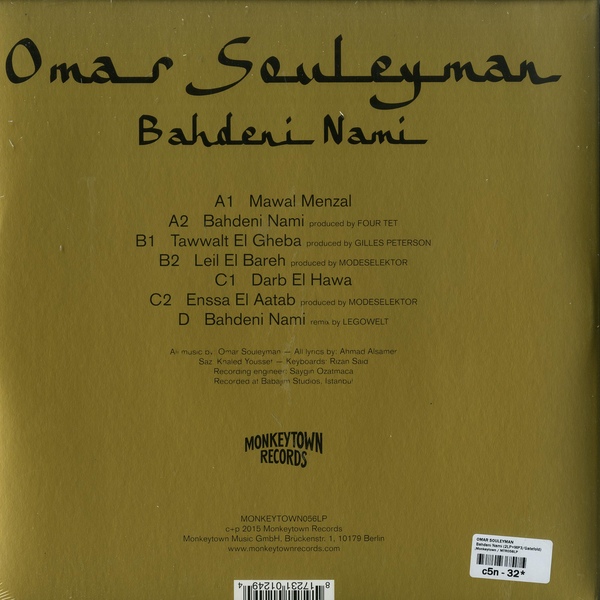
ROLLING STONES-STICKY FINGERS-DELUXE VINYL EDITION.
ROLLING STONES-STICKY FINGERS-DELUXE VINYL EDITION.
By 1970, The Rolling Stones were in the middle of what is now perceived as their “golden age.” It began in 1968, when The Rolling Stones released Beggars Banquet in December 1968.
Beggars Banquet was released to widespread critical acclaim. It featured an outpouring of creativity from The Rolling Stones. The Jagger and Richards’ songwriting partnership were at the peak of their powers, penning tracks of the calibre of Sympathy For The Devil and Street Fighting Man. Sadly, Brian Jones influence on The Rolling Stones was waning. His appearances in the studio were sporadic.
Despite Brian Jones playing a lesser role in Beggars Banquet, the album was a resounding success. It reached number three in Britain, and number five in the US Billboard. This resulted in Beggars Banquet being certified gold in Britain, and platinum in America. For Rolling Stones, this was their most successful album since Aftermath in 1966. However, a year later, they would surpass the success of Aftermath with Let It Bleed.
Sadly, by the time that Let It Bleed was released on 5th December 1969, tragedy had struck The Rolling Stones. Founding member Brian Jones had drowned in mysterious circumstances on 3rd July 1969. For the rest of The Rolling Stones, this was a huge body blow. Brian Jones had been the one-time leader of The Rolling Stones.
Two days after Brian Jones death, shell-shocked Rolling Stones played a free concert in London’s Hyde Park on 5th July 1969. An estimated 250,000 saw The Rolling Stones pay tribute to Brian Jones. The group’s one-time leader’s influence may have lessened over the past couple of albums, but Brian Jones had played an important part in the rise of The Rolling Stones. Sadly, he only featured twice on Let It Bleed, on You Got The Silver and Midnight Rambler. His musical farewell was brief one. So was the debut of a new addition to The Rolling Stones, Mick Taylor.
When Let It Bleed was released, eager eyed listeners spotted a new addition, Mick Taylor. He was Brian Jones replacement. Mick played featured on just two tracks, Country Honk and Live With Me. Just like Brian Jones’ contribution, Mick’s success was an important one in the sound and success of Let It Bleed.
On its release, Let It Bleed surpassed the success of previous Rolling Stones’ albums. It reached number one in Britain, and number three on the US Billboard 200 charts. This saw Let It Bleed certified gold in Britain, and double-platinum in America. Meanwhile, critics exhausted their supply of superlatives on songs like Gimme Shelter, Love In Vain, Midnight Rambler and You Can’t Always Get What You Want. The hard rocking Let It Bleed was considered one of The Rolling Stones’ finest moments.
The Rolling Stones had picked up where they left off on Beggars Banquet, and taken it further. In doing so, they had created the most successful album of their career. This should’ve been a time for celebration. However, as 1969 and the sixties drew to a close, The Rolling Stones didn’t feel much like celebrating.
A day after the release of Let It Bleed, The Rolling Stones had agreed to put on a free concert at Altamont Speedway, in Northern California on 6th December 1969. What was meant to be a concert featuring the great and good of psychedelia went badly wrong. Santana, Jefferson Airplane, The Flying Burrito Brothers, Crosby, Stills, Nash and Young, The Rolling Stones and Grateful Dead were all booked to play. It was meant to be a major event in psychedelic’s musics history. After the carnage in Los Angeles, everyone hoped this would be a good news story. It wasn’t.
As the Rolling Stones took to the stage, the concert descended into chaos. The Hell’s Angels fought with the audience, and Meredith Hunter, a black teenager, was allegedly stabbed by a member of the Hells’s Angels who were meant to be providing security at Altamont. After this, the event was cancelled. The Grateful Dead never even took to the stage. Altamont had been a disaster. There were three accidental deaths, many were injured, property was destroyed and cars stolen. As the sixties drew to a close, the events at Altamont played its part in the decline of psychedelia and a backlash against the hippie movement.
Between the death of Brian Jones, and the chaos and carnage at the Alatmont Free Festival, The Rolling Stones didn’t feel like celebrating the success of Let It Bleed. They were castigated in the American press. Their decision to use the Hell’s Angels as security drew a huge amount of criticism. Especially when the details of Altamont became clear. Whilst firefighting criticism from politicians and America’s self appointed moral guardians, the press, it was soon business as usual for The Rolling Stones.
Following the success of Let It Bleed, The Rolling Stones began work on the followup, Sticky Fingers, which was recently reissued by Polydor. This Vinyl Deluxe Edition is a double album features a second disc of live material recorded at The Roundhouse, in 1971. However, the “main event” is Sticky Fingers, the third album The Rolling Stones’ during their “golden age.”
Just like previous albums, Sticky Fingers was mostly the work of the Jagger and Richards songwriting partnership. They cowrote Brown Sugar, Sway, Wild Horses, Can’t You Hear Me Moving, Bitch, I Got The Blues, Dead Flowers and Moonlight Mile. Jagger and Richards also cowrote Sister Morphine with Marianne Faithful. The other track chosen for Sticky Fingers, was a cover of Fred McDowell and Gary Davis’ You Gotta Move. These ten tracks were recorded by The Rolling Stones and “friends” at various studios between March 1969 and January 1971.
Most of Sticky Fingers was recorded during 1970 and 1971. However, the story starts in 1969. The Rolling Stones began recording Sister Morphine between 22nd and 31st March 1969. Further sessions took place between May and June 1969. By then, Sister Morphine was completed. Then just before Let It Bleed was released, three day session took place between 2nd and 4th December 1969, Muscle Shoals Sound Studio, Sheffield, Alabama. That was last session of 1969.
The first recording session of 1970 took place Olympic Studios on 17th February. Then the sessions began in earnest in March 1970, at Olympic Studios, and continued right through to May 1970. Further sessions at Olympic Studios took place between 16th and 27th July. After a three month break, The Rolling Stones returned tp Olympic Studios on 17th October 1970. Right through to 31st October, they worked on Sticky Fingers. It was nearly completed.
Eventually, recording of Sticky Fingers was completed in January 1971. The Rolling Stones recorded in both Olympic and Trident Studios with producer Jimmy Miller.
The Sticky Fingers’ sessions had been a poignant time. It was the first recording session without Brian Jones. His replacement, Mick Taylor, played a bigger part in the recording of Sticky Fingers, playing lead, rhythm and acoustic guitar. Meanwhile, Mick Jagger sang vocals and played acoustic guitar. The Rolling Stones’ rhythm section featured drummer Charlie Watts, guitarist Keith Richards and Billy Wyman on bass and electric piano. Joining The Rolling Stones were a few of their musical friends.
Among their musical friends The Rolling Stones brought onboard were Ry Cooder on slide guitar, saxophonist Bobby Keys, percussionist Jimmy Miller, organist Billy Preston and pianists Jim Dickinson, Nicky Hopkins, Ian Stewart and Jack Nitzsche. Rocky Dzidzornu added congas and Jim Price trumpet and piano. Most of these artists only featured on one track. Often their contribution was invaluable. That was also the case with producer Jimmy Miller and engineers included Glyn Johns, Andy Johns, Chris Kimsey and Jimmy Johnson. They all played their part in sound and success of Sticky Fingers.
So did artist Andy Warhol. He was responsible for “designing” Sticky Fingers’ album sleeve. Andy Warhol was inspired by the innuendo laden title. However, the design was by Craig Braun. He shot a close up of a jeans clad male crotch. By the time it made its way onto the album sleeve, it featured a working zip and mock belt buckle. When the zip was undone, a pair of cotton briefs could be seen. They had Andy Warhol’s name stamped in gold on them. This design, like Sticky Fingers, would become a classic, and was a fitting debut for their new label.
The release of Sticky Fingers, marked a new era in The Rolling Stones’ career. It was the first album they had released on their newly founded Rolling Stones’ label. This brought to an end The Rolling Stones’ seven year association with Decca Record in Britain, and London Records in America. Despite the lengthy association between the two parties, it ended on a sour note.
After the end of relationship between The Rolling Stones and Decca and London Records, an expensive error discovered. It came to light that inadvertently, The Rolling Stones had signed over the copyright to their sixties recordings to their former manager Alan Klein, and his company ABKCO. Having lost the copyright to their Decca and London Records’ recordings, The Rolling Stones decided to form their own label. Their first studio album of seventies, Sticky Fingers launched Rolling Stones Records.
Before Sticky Fingers was released, The Rolling Stones held their breath as the critics had their say. Most critics heaped praise on Sticky Fingers, calling it The Rolling Stones’ finest album of their career. Tracks like Brown Sugar, Wild Horses, Can’t You Hear Me Knocking, Bitch and Moonlight Mile showed that The Rolling Stones had just created a career defining album. Not everyone agreed.
Unsurprisingly, the self appointed “Dean Of American Rock Critics” Robert Christgau didn’t agree. While others were heaping praise on Sticky Fingers, he disagreed. As 1971 drew to a close, the contrarian Christgau called Sticky Fingers the seventeenth best album of 1971. Robert Hilburn gave Sticky Fingers a backhanded compliment. While he conceded that Sticky Fingers was one of the best albums of 1971, it was “only modest by The Rolling Stones’ standards.” Lynn Van Matre also proved a past master of the backhanded compliment. She said that The Rolling Stones were “at their raunchy best” but that the music is “hardly innovative.” She did agree that Sticky Fingers was one of the albums of 1971. Record buyers agreed.
When Sticky Fingers hit the shops on 23rd April 1971, it reached number one in Britain and in the US Billboard 200 charts. Across the world, Sticky Fingers was a huge seller, reaching the top ten in ten countries. Apart from America and Britain, Sticky Fingers reached number one in Australia, Canada, Holland, Norway, Spain, Sweden and West Germany. Sticky Fingers was certified gold in Britain and France. In America, Sticky Fingers sold three million copies and was certified triple-platinum. Forrty-four years after its release, and Sticky Fingers is perceived as a Rolling Stones’ classic.
No wonder. Sticky Fingers features The Rolling Stones at their very best. It was as if everything had been leading up to Sticky Fingers and then, a year later, Exile On Main Street. That is the case from the opening bars of Brown Sugar, which opens Sticky Fingers.
Instantly, The Rolling Stones are turned in to a good time, rock ’n’ roll band on Brown Sugar. With Mick at the helm, they strut their way through this homage to the rock ’n’ roll lifestyle. It was recorded in Muscle Shoals, where its its tough, blues rock sound took shape. Everything falls into place. Jimmy Miller’s decision to pair Bobby Keys’ saxophone and Keith’s guitar in the breakdown is a masterstroke. He plays his part in a future Rolling Stones’ classic.
From good time, rock ’n’ roll, The Rolling Stones drop the tempo on Sway, the first of the ballads. Who wrote the song is disputed. Officially, it’s credited to Jagger and Richards. However, Mick Taylor has subsequently claimed to have written the track. He certainly plays an important part in this slow, bluesy ballad. Mick adds a bottleneck slide guitar solo, while Mick Jagger exercises demons via his vocal. Then on Wild Horses, Mick delivers one of his finest vocals. It’s best described as soul-baring, on what is easily, a Rolling Stones’ classic.
Can’t You Hear Me Knocking sees The Rolling Stones transformed into a good time rock ’n’ roll band. In 1971, their only opposition was The Faces. Mick’s accompanied by harmonies from the rest of Stones, vamps and struts his way through the lyrics. Then at 2.43, the instrumental break begins, and The Rolling Stones stretch their legs. Rocky Dijon’s congas propels the arrangement along, before Bobby Keys unleashes a saxophone solo whilst Keith and Mick trade guitar licks. Augmenting the arrangement is Billy Preston’s organ. However, later, Mick Taylor unleashes a blistering guitar solo, as he makes his mark on The Rolling Stones.
The Rolling Stones first played You Gotta Move on their 1969 American tour. This inspired them to cover the song on Sticky Fingers. It’s reinvented, and transformed into a rousing, bluesy jam. Partly this reinvention is down to waves of bluesy guitar, and Mick’s drawling, mid-Atlantic vocal.
Originally, Bitch was the B-Side to Brown Sugar. However, it soon found its way on radio playlists. No wonder. It benefits from an impressive, almost overblown arrangement. Mick whose been unlucky in love, doesn’t hold back; “love is a bitch.” Behind him, big bold horns and duelling guitars fill out the arrangement. Soon, The Rolling Stones in full flow. It’s an impressive sound, and one of Sticky Fingers’ highlights.
Bluesy and soulful describes I Got the Blues. Again, The Rolling Stones drop the tempo. Mick, accompanied by growling horns, delivers a needy, soulful vocal.
The first time anyone heard Sister Morphine, was when Marianne Faithful released it as the B-Side to her 1969 single Something Better. Two years later, it’s given a makeover by The Rolling Stones and friends. Ry Cooder plays slide guitar and Jack Nitzsche piano and organ. Against this understated arrangement Mick’s vocal is like a confessional. It’s as if he can relate to, and understand the poignant lyrics. There is also a darkness to the country-tinged Dead Flowers. Especially the line: “I’ll be in my basement room, with a needle and a spoon.” During the period Sticky Fingers was recorded, Keith Richards and Gram Parsons had become friends. Some people believe he inspired the song, which is one of the most underrated in The Rolling Stones’ back-catalogue.
Closing Sticky Fingers is Moonlight Mile. It’s another ballad with country influence. Jimmy Miller is responsible for a big, bold arrangement. Strings sweep in the background, while Mick sings about how difficult it is being a rock ’n’ roll star, whose constantly in the spotlight. The way he delivers the lyrics, it’s as if he is tiring of life as a Rolling Stone.
That would never happen. Forty-four years later, and Mick Jagger is still a Rolling Stone. They went on to release a string of critically acclaimed and commercially successful albums. However, Sticky Fingers is one of The Rolling Stones’ finest moments.
Throughout Sticky Fingers, The Rolling Stones are at their best. They are at their most versatile. Seamlessly, they switch between blues, rock and country. Similarly, one minute The Rolling Stones are a good time rock ’n’ roll band, the next they’re delivering soul baring ballads. That is why Sticky Fingers is a captivating, timeless album and career defining album from The Rolling Stones. Sticky Fingers was the best album of their career.
Forty-four years on, and Sticky Fingers is a stonewall classic. So popular was Polydor’s recent Deluxe Edition reissue, that it charted around the world in 2015. Sticky Fingers reached number seven in Britain and five in the US Billboard 200. It seemed that music fans old and new, were keen discover or rediscover the delights of Sticky Fingers. This was the third studio album of The Rolling Stones “golden era.” The final album of this period was Exile On Main Street. Somehow, it managed to surpass the quality of Sticky Fingers. That was still to come.
In 1971, The Rolling Stones were back where they belonged, at the top of the charts. They were now the biggest rock ’n’ roll band in the world. That took some doing. The last few years had taken their toll on The Rolling Stones. They had been arrested, lost Brian Jones and replaced him with Mick Taylor. Then there was the controversy surrounding Altamont. Somehow, The Rolling Stones had survived all this, and were still going strong, having just released a career defining classic album Sticky Fingers.
ROLLING STONES-STICKY FINGERS-DELUXE VINYL EDITION.

FOTHERINGAY-NOTHING MORE: THE COLLECTED FOTHERINGAY.
FOTHERINGAY-NOTHING MORE: THE COLLECTED FOTHERINGAY.
Sandy Denny left Fairport Convention in December 1969. The reason she gave, was that the wanted to hone her skills as a songwriter. However, less than a year after her departure from Fairport Convention, Sandy Denny formed a new group. That group was Fotheringay, who although they were a short lived band, made a lasting impression on British folk music. So much so, that recently, a four disc box set Nothing More: The Collected Fotheringay was released by U.M.T.V. It celebrates the music of Sandy Denny’s “other” band.
The Fotheringay story began in 1970, not long after Sandy Denny’s departure from Fairport Convention. Sandy decided to put together a new band. One of the first musicians she brought onboard was guitarist Trevor Lucas.
He had been born in Australia, but was now based in Britain. Trevor was now a familiar face in the British folk scene. Previously, Trevor was a member of Eclection. That’s when Trevor met Sandy Denny. The pair started dating in May 1969, and eventually, married in 1973. However, Trevor’s career began back in Australia, in the early sixties.
Back then, Trevor Lucas was a solo artist. He released his debut solo album See That My Grave Is Kept Clean in 1964. Then on New Year’s Eve Trevor boarded a ship and made the journey from Australia to Britain. That’s when he became a member of Eclection, and met drummer Gerry Conway.
Eclection were a folk-rock band, who were formed in 1967, and broke up two years later in 1969. However, by then, Trevor Lucas and Gerry Conway were firm friends. They renewed their musical partnership in Fotheringay.
Gradually, Sandy’s new band was taking shape. The final pieces in the musical jigsaw were two former members of the Poet and the One Man Band. Guitarist Jerry Donahue had moved from Manhattan to Britain, where he quickly became stalwart of the folk scene. This wasn’t surprising. Jerry’s father was big band saxophonist Sam Donohue. However, Jerry wasn’t inspired by his father. Instead, Gerry McGee, Earl Scruggs, Chet Atkins and Duane Eddy inspired Jerry, who in 1970, joined Fotheringay with Edinburgh born bassist Pat Donaldson.
By 1970, Pat Donaldson was a familiar face in the London music scene. He had moved to London in the early sixties. Since then, he had been a member of Bob Xavier and the Jury, Zoot Money’s Big Roll Band and the reformed Dantalian’s Chariot. Fotheringay was just the latest group the twenty-seven year old bassist work with.
With the lineup of her new band finalised, all Sandy Denny needed was a name for the band. She decided on Fotheringay, after Fotheringay Castle where Mary Queen Of Scots was imprisoned. With its lineup complete and a name in place, Sandy Denny’s new band could begin work on their debut album.
Fotheringay.
Sandy Denny didn’t waste any time recording Fotheringay’s debut album. She wrote four tracks and cowrote Peace in the End with Trevor Lucas. He also penned The Ballad of Ned Kelly. Other tracks included covers of Gordon Lightfoot’s The Way I Feel, Bob Dylan’s Too Much Of Nothing and Banks of the Nile. These ten tracks were recorded between February and April, 1970 at Sound Techniques, in London with Joe Boyd producing what became Fotheringay. It features on disc one of Nothing More: The Collected Fotheringay.
Once Fotheringay was completed, the album was released in June 1970. It was one of the most eagerly awaited albums of the year. Critics and record buyers eagerly anticipated the release of Fotheringay.
They weren’t disappointed. Critics hailed the album a masterful debut. Sandy Denny was back, and better than ever. Her enchanting, ethereal vocal was complimented by a tight, talented band. They won not just the critics, but record buyers.
Fotheringay sold well upon its release in June 1970, and reached number eighteen in Britain. Good as this was, it wasn’t good enough for Island Records. Their expectations and Fotheringay’s differed. Island Records hoped the album would be one of the label’s biggest selling albums. That wasn’t the case. This resulted in Island Records’ pressurising Sandy to embark upon a solo career.
Sandy Denny dug her heels in. She was determined to continue with Fotheringay. So work began on what was meant to be Fotheringay’s sophomore album.
Fotheringay 2.
A total of eleven tracks were meant to feature on Fotheringay’s sophomore album. This time, Sandy Denny only wrote two songs. Trevor Lucas and Pete Roach penned Knights of the Road and Restless.Among the other tracks were traditional songs, a cover of Bob Dylan’s I Don’t Believe You and the Dave Cousins’ composition Two Weeks Last Summer. These eleven tracks were recorded by an expanded lineup of Fotheringay.
Joining the usual lineup of Fotheringay was Linda Thompson. She was going to add backing vocals when the sessions began in November 1970. The sessions continued into December 1970. Everyone thought that things were going to plan. Sadly, that wasn’t the case.
In January 1971, it was announced that Fotheringay were no more. The band broke up and what would eventually become Fotheringay 2 was shelved.
It wasn’t until 2008 that Fotheringay 2 was released. By then, many of the tracks had been released. However, Fotheringay 2 was the first time the album had been released.
When Fotheringay 2 was released, the long lost album was well received. It was a reminder of Fotheringay’s potential. If they had stayed together, they could’ve become one of the great British folk bands. That was apparent by listening to Fotheringay 2. However, critics wondered what Fotheringay 2 would’ve sounded like if more time had been spent on the album? If Fotheringay hadn’t split-up, would’ve Fotheringay 2 have rivalled the groups debut album?
Nothing More: The Collected Fotheringay gives fans of Fotheringay the opportunity to compare the two albums. Fotheringay features on disc one. It’s augmented by two audio demos, a trio of alternate tracks and the original version of The Way I Feel. These bonus tracks, plus the original version of Fotheringay document the first chapter in the band’s career. Disc two documents the aborted Fotheringay 2 sessions.
On disc two of Nothing More: The Collected Fotheringay,the first eleven tracks feature Fotheringay 2 in its entirety. After that, there’s another six tracks. This includes versions of Late November, Gypsy Dave, Bold Jack Donahue and Two Weeks Last Summer. That’s not all. There’s versions of Silver Threads and Golden Needles and Bruton Boy from 2004. The other track is an interesting artefact. It’s a band rehearsal of Bruton Boy. It shows the song coming together and taking shape. However, that’s not the end of Nothing More: The Collected Fotheringay.
The first nine tracks of disc three of Nothing More: The Collected Fotheringay feature Fotheringay live. These tracks were recorded in Rotterdam in 1970. The other seven tracks feature Fotheringay at the BBC. These sixteen tracks feature Fotheringay at the peak of their powers.They’re a reminder of just how good a band Fotheringay were live. So do the four tracks on disc four, which is a DVD.
Disc four of Nothing More: The Collected Fotheringay, features Fotheringay Live At The Boat Club, in Bremen, Germany. Although there’s only four tracks on the DVD it’s more than enough to realise that Fotheringay had the potential to become one of the biggest folk rock bands of the early seventies. Sadly, that wasn’t to be.
Fotheringay were only together for a year. They split-up in January 1971, whilst recording Fotheringay 2. That album was shelved, and didn’t see the light of day until 2008. Until then, Fotheringay’s musical legacy numbered just one album. Then on September 30th 2008, one album became two. Both these albums feature on Nothing More: The Collected Fotheringay, which was recently released by U.M.T.V.
This four disc four box set documents Sandy Denny’s short-lived, “other” group Fotheringay. They were the band that could’ve gone on to rival Fairport leaving behind a musical legacy that numbers just two albums and
If Fotheringay hadn’t split-up in January 1971, would they have become a serious rival to Fairport Convention for the title of Britain’s premier folk-rock band. While that might seem unlikely, Fotheringay had something Fairport Convention didn’t…Sandy Denny. Her enchanting, ethereal vocal was at the heart of the sound and success of Fotheringay. So was her songwriting skills.
That’s why Sandy Denny left Fairport Convention. She wanted to improve as a songwriter. While she formed Fotheringay not long after leaving Fairport Convention, Sandy Denny was already a talented songwriter. She got the chance to shine on Fotheringay’s 1970 eponymous debut album. Not only did Sandy pen four tracks, but she wrote Peace in the End with Trevor Lucas. It seemed away from Fairport Convention, Sandy Denny was maturing as a singer and songwriter. Maybe, it was because was Fotheringay was her band? No longer was she surrounded by strong personalities who maybe, overshadowed Sandy. Given time, Sandy Denny’s new group could’ve rivalled Fairport Convention.
Sadly, that wasn’t to be. When Fotheringay reached a respectable number eighteen in 1970, this wasn’t good enough for Island Records. They started whispering in Sandy Denny’s ear, encouraging her to embark upon a solo career. While this wasn’t what Sandy Denny wanted, it would be financially advantageous to Island Records. However, Sandy Denny wanted to continue with Fotheringay. Sadly, Fotheringay was short-lived.
In January 1971, the announcement came, that Fotheringay had split-up. Island Records got their wish. Sandy Denny embarked upon a solo career.
Her debut album was The North Star Grassman and the Ravens. It was released in September 1971, and featured many of the tracks that originally, were meant to feature on Fotheringay 2. Critical acclaim accompanied the release of The North Star Grassman and the Ravens. Sandy Denny it seemed, could do no wrong.
A year later, Sandy Denny released her sophomore album Sandy in September 1974. It was released to the same critical acclaim as The North Star Grassman and the Ravens. However, Sandy surpassed the quality of The North Star Grassman and the Ravens. Indeed, it would prove to be the best album of her solo career.
It wasn’t until 1974, that Sandy Denny released Like an Old Fashioned Waltz followed in June 1974. The album saw a philosophical Sandy consider themes like loneliness, fear of the dark, the passing of time and even the changing seasons. Essentially, Sandy was fixating on growing old and death. That would prove ironic
When Like an Old Fashioned Waltz was released, critics noticed Sandy’s stylistic departure. Pop and folk featured heavily. It seemed Island Records were trying to turn Sandy Denny into something she wasn’t. Maybe that’s why Sandy returned to Fairport Convention.
Sandy rejoined Fairport Convention in 1974. By then, Sandy’s husband Trevor Lucas was also a member. They joined for the Fairport Convention’s world tour. It was captured on the 1974 live album Fairport Live Convention. Sadly, Sandy and Trevor left Fairport Convention in 1975. Their swan-song was Rising For The Moon.
Following her second departure from Fairport Convention, Sandy returned to her solo career. She released Rendezvous in May 1977. Rendezvous saw Sandy embrace a contemporary rock sound. Despite touring Britain promoting Rendezvous, the album didn’t sell well. The final night of the tour took place on 27th November 1977, at the Royalty Theatre, in London. It was recorded and was meant to be released as a live album, Gold Dust. Problems with the guitars meant this didn’t happen until 1998, when Gerry Donhue rerecorded the guitars. Ironically, that ill-fated concert was Sandy Denny’s swan-song.
When Rendezvous failed commercially, Island Records dropped Sandy. She was already drinking heavily, smoking and snorting cocaine. Her behaviour became erratic. Sandy was also suffering from severe headaches. So a doctor prescribed a distalgesic. However, Sandy continued to drink. Whether this played a part in a fall she had in late March 1978 is unknown. What we know, is that tagedy struck on 17th April 1978.
That night, Sandy Denny was admitted to the Atkinson Morley Hospital in Wimbledon. She fell into a coma, and four days later, on 21st April 1978, Sandy Denny died. The cause of Sandy’s death was a brain haemorrhage and blunt force trauma. It’s likely that when Sandy Denny fell, this played a contributory factor in her death. Tragically, Sandy Denny was only thirty-one. That day, British folk music lost one of finest voices.
While Sandy Denny is remembered for her two spells with Fairport Convention and four solo albums, often her time with Fortheringay is often overlooked. That’s a great shame, as Sandy Denny’s short-lived other group features Sandy Denny at the peak of her powers. With Sandy Denny at the helm, Fotheringay could’ve gone on to rival Fairport Convention. Sadly, they never got the opportunity to do so, and the Fotheringay story was over before it had began. It’s documented on Nothing More: The Collected Fotheringay, which is a poignant reminder of Sandy Denny’s “other,” sometimes forgotten group.
FOTHERINGAY-NOTHING MORE: THE COLLECTED FOTHERINGAY.

KATHRYN JOSEPH-BONES YOU HAVE THROWN ME AND BLOOD I’VE SPILLED.
KATHRYN JOSEPH-BONES YOU HAVE THROWN ME AND BLOOD I’VE SPILLED.
In the history of the Scottish Album Of The Year Award, Kathryn Joseph recently became the first artist to win Scotland’s most prestigious music award with a debut album. That debut album is Bones You Have Thrown Me and Blood I’ve Spilled, which was released in January 2015, on Hits The Fan Records.
A few months later, and Bones You Have Thrown Me and Blood I’ve Spilled was one of 147 albums nominated for the Scottish Album Of The Year Award. This was narrowed down to what the judges considered the twenty best Scottish albums of 2015. They were an eclectic selection featuring everything from folk to indie rock and everything in between. The long-list featured some of the biggest names in Scottish music. Mogwai, Belle and Sebastian, Errors, King Creosote, The Twilight Sad, The Phantom Band and Withered Hand had all been nominated. This was to be expected. Some names however, were missing.
There was no sign of Lau’s The Bell That Never Raung, Bill Wells and Aidan Moffat’s The Most Important Place In The World and Vashti Bunyon’s Heartleap. Somehow, these three albums been passed over. On another day, they could’ve easily found their way onto the long-list. Sadly, it wasn’t to be. However, this meant three other artists would have their moment in the sun.
When 147 became twenty, critics and record buyers studied the long-list with interest. There were what some considered some unexpected names. One of these names was Kathryn Joseph.
She had only released Bones You Have Thrown Me and Blood I’ve Spilled a couple of months earlier. However, it was released to widespread critical acclaim. The Aberdeen born singer, songwriter and pianist had made an impression on music critics, DJs and music lovers. So for those of us who had followed Kathryn’s career with interest, it was no surprise when Bones You Have Thrown Me and Blood I’ve Spilled made the long-list for the 2015 Scottish Album Of The Year Award. Doubters however, thought that Bones You Have Thrown Me and Blood I’ve Spilled wouldn’t make the short-list of ten.
It looked like a close call. Certain albums looked nailed on to make the short-list. Especially, Mogwai’s Rave Tapes, Withered Hand’s New Gods, King Creosote’s From Scotland With Love, Belle and Sebastian’s Girls In Peacetime Want To Dance, Errors’ Lease Of Life and The Phantom Band’s Strange Friend. They were almost guaranteed to make the cut. So was The Twilight Sad’s Nobody Wants To Be Here and Nobody Wants To Leave. This left thirteen albums fighting it out for three places.
In the end, it was up to the public and judges to choose the ten albums that would make the short-list. Eventually, the short-list was announced. The record buying public and judges had spoken. Incredibly, King Creosote, Mogwai, The Phantom Band and Withered Hand never made the short-list. To rub salt into the wound, faux soul singer Paolo Nutini did. At times like this, and democracy is flawed. The only small crumb of comfort was that Kathryn Joseph’s debut album is Bones You Have Thrown Me and Blood I’ve Spilled made the short-list.
From the 147 albums nominated, only ten remained. The biggest names on the short-list were Belle and Sebastian and Errors. Worryingly Paolo Nutini was still there. Surely, his poppy brand of lite soul wasn’t going to steal the prize? All would become clear.
The ten who made the short-list, were invited to a glittering gala dinner in late June 2015. It was attended by what the “great and good” of Scottish music. Critics, bloggers, bookers, promoters and DJs eagerly awaited the announcement of the winner of the Scottish Album Of The Year Award for 2015.
When the announcement was made, many within the room were surprised. The winner of Scotland’s most prestigious music award was Kathryn Joseph, who had just released her debut album
Bones You Have Thrown Me and Blood I’ve Spilled in January 2015. Five months later, Kathryn Joseph was clutching the Scottish Album Of The Year Award for 2015 and a cheque for £20,000. Kathryn Joseph had come a long way in a short space of time.
Originally born in Aberdeen, Kathryn now lives in Scotland’s musical capital, Glasgow. That’s where she recorded the award winning Bones You Have Thrown Me and Blood I’ve Spilled.
Kathryn Joseph wrote the ten tracks that became Bones You Have Thrown Me and Blood I’ve Spilled. They were recorded and mixed at The Diving Bell Lounge in Glasgow. Producing Bones You Have Thrown Me and Blood I’ve Spilled was Marcus MacKay. He also plays bass and rhythm guitar. Kathryn played piano and added vocals to the ten tracks. When they were completed, they became Bones You Have Thrown Me and Blood I’ve Spilled, which I’ll tell you about.
Opening Bones You Have Thrown Me and Blood I’ve Spilled is The Bird. Just a lone piano plays, while in the distance, “cheep cheep,” can be heard. Quickly, Kathryn’s vocal veers between fragile and vulnerable, to emotive and powerful. Soon, a bass cuts in and accompanies Kathryn and her piano. Sometimes, Kathryn’s vocal quivers. Especially, as she sings: “you do not know me, and never will, Bones You Have Thrown Me and Blood I’ve Spilled.” Meanwhile, the piano and bursts of drums add an element of drama. Then later, there’s an overwhelming sense of sadness as she sings: “you bring dead birds, then you go.” Ruefully and wistfully she delivers the lines to a captivating and dramatic track.
As the piano plays, The Blood takes on a wistful sound. That’s even before Kathryn sings. When her vocal enters, it has an almost otherworldly sound. It has the same vulnerable quality as she delivers a breathy, but urgent vocal. The drama increases when the rhythm section kicks in. Folk veers towards folk rock, and Kathryn seems to have been inspired by Astrid Williamson, Jerry Burns, Liz Fraser and Kate Bush. Especially Kate Bush, as she unleashes a vocal where power and emotion are omnipresent.
Washes of Kathryn’s vocal assail the listener on The Want. Her vocal is truly impassioned and becomes a plea: “hear me out.” Later, her vocal is tinged with regret as she sings: “I can’t be with you, hear me out.” Despite just accompanying herself on the piano, The Want is one of the most moving songs on Bones You Have Thrown Me and Blood I’ve Spilled.
The piano comes close to overpowering Kathryn’s ethereal vocal on The Why What, Baby? As a result, you listen intently as Kathryn delivers her lyrics. Again, her vocal has a vulnerable quality. Not when she delivers the line: “God knows what you are guilty of.” Anger and frustration shines through. Other times though, her vocal veers between tender and impassioned, as she breathes life and meaning into her powerful lyrics.
Just like previous tracks, The Outtakes opens with just Kathryn playing her piano. Her fingers flit nimbly across the piano, playing boldly and confidently. Soon, her tender, ethereal vocal enters. It quivers, before a pounding drum joins is added. Whether it’s needed at that point is debatable? Granted it adds an element of drama. However, so does Kathryn’s expressive vocal. Later, melancholy strings are added. So is a bass. Both add to the mix. It’s better with their inclusion. That’s even the case with drum, but just at that point. Everything falls into place, in what sounds like a homage to Kate Bush.
For the first six bars of The Bone it’s just a lone piano that plays. This isn’t unusual. Most of the songs on Bones You Have Thrown Me and Blood I’ve Spilled open with Kathryn’s piano. She plays unaccompanied, and sets the scene for her vocal. It’s heartfelt and impassioned, and has the same fragility of previous tracks. Another similarity is the use of a lone drum. It’s added at the nineteenth bar. Again, its raison d’être is to add a dramatic backdrop. This time it succeeds. Producer Marcus MacKay doesn’t overuse the drum. Nor does it come close to overpowering Kathryn’s captivating and impassioned vocal.
Slowly, The Crow decides to show its secrets. Lazily, the arrangement meanders slowly along the piano playing. By the fifteenth bar, Kathryn delivers a dreamy, ethereal vocal. Just the piano and plucked guitar accompany her. They play their part in a stark, understated vocal. It’s definitely a case of less is more, as a beautiful, emotive song unfolds.
The Mouth picks up where The Crow left off. Its arrangement is understated. For the time being, less is more. Just the piano, accompanies Kathryn’s vocal, which she almost turns into another instrument. Later, harmonies accompany her. Soon, the drum and guitar are added, as the arrangement swells. Seamlessly, the instruments, harmonies and Kathryn’s vocal intertwine, becoming one, and reach a dramatic crescendo. The instruments, harmonies and Kathryn’s vocal. Then it’s just Kathryn and her trusty piano, as the track reaches its sudden a poignant ending.
Each of Kathryn’s songs take the listener on a journey. The Good is no different. It may only be just over two minutes long, but Kathryn, accompanied by her wistful piano paints pictures. Her vocal is fragile and ethereal. Slowly and thoughtfully, she delivers the lyrics. She doesn’t rush. Instead, she dramatically and sometimes, defiantly delivers the lyrics.
Closing Bones You Have Thrown Me and Blood I’ve Spilled is The Weary, a homecoming song. It’s a fitting way to close Bones You Have Thrown Me and Blood I’ve Spilled is The Weary. Just like previous songs, Kathryn’s accompanied by her piano. One change is Kathryn’s vocal. Her accent is slightly stronger. On other tracks, Kathryn Joseph doesn’t sound Scottish. That’s not the case here. Another difference is the way the arrangement builds. It’s as if Kathryn’s determined to bring her debut album to a dramatic finale, with this homecoming song about The Weary traveller, home “safe and sound.”
Kathryn Joseph’s debut album Bones You Have Thrown Me and Blood I’ve Spilled features ten tracks and lasts less than a forty-five minutes. During this captivating musical journey, the listener is introduced to what many people consider Scottish music’s best kept secret, Kathryn Joseph. However, not any more.
Earlier this year, Kathryn Joseph was nominated for the 2015 Scottish Album Of The Year Award. Incredibly, she beat off competition from another 146 artists. The result was a first in the history of the Scottish Album Of The Year Award. No artist had won the Scottish Album Of The Year Award with their debut album. That was until Kathryn Joseph triumphed with Bones You Have Thrown Me and Blood I’ve Spilled. Winning Scotland’s most prestigious music award was a game-changer for Kathryn Joseph. Suddenly, her music was being heard by a much wider audience. Now she has just embarked upon a European tour, where Kathryn Joseph is sure to win over the hearts and minds of music lovers.
Especially given Kathryn Joseph’s vocal. It’s variously ethereal, haunting, heartfelt, melancholy and otherworldly. On each of the ten tracks on Bones You Have Thrown Me and Blood I’ve Spilled, Kathryn Joseph lyrics come to life. That’s down to Kathryn. She’s part singer, part storyteller. Each of her vocals are captivating. Partly, that’s because she tailors her vocal to suit the song. Sonically and stylistically, her vocal is unique. Especially, when she transforms her vocal into another instrument. This adds an extra dimension to the award winning Bones You Have Thrown Me and Blood I’ve Spilled. It’s an enchanting album. However, is it a worthy winner of Scotland’s most prestigious music award?
The fifteen months that the 2015 when the Sottish Album Of The Year Award covered, just so happen to coincide with the release of many critically acclaimed Scottish albums from Mogwai, Belle and Sebastian, Errors, King Creosote, The Phantom Band and Withered Hand. They had all been nominated and made the long-list. Some albums, including Lau’s The Bell That Never Raung, Bill Wells and Aidan Moffat’s The Most Important Place In The World and Vashti Bunyon’s Heartleap didn’t make the long-list. This just goes to show the strength in depth of the competition Kathryn was up against. However, when the long-list became the shortlist, Kathryn Joseph’s chances improved.
Incredibly, King Creosote, Mogwai, The Phantom Band and Withered Hand all failed to make the shortlist. Any one these albums would’ve been worthy winners. The loss of such high profile albums meant Kathryn Joseph’s odds shortened. Her chances of doing a Hubby improved.
Just like R.H. Hubbard in 2013, Kathryn Joseph snuck up on the rails to win the Sottish Album Of The Year Award by a head. The debutant had beaten veterans of Scottish music like Belle and Sebastian, and innovators and leaf lovers Errors. Just like the last couple of years, the Sottish Album Of The Year Award was won by an outsider.
Whether Bones You Have Thrown Me and Blood I’ve Spilled was the best album released between 1st January 2014 and March 31st 2015 is subjective. A strong case could be made for any one of eight albums on the long-list.
Ultimately, the winning album was the choice of twelve people. They sat in judgement, and eventually came up with Kathryn Joseph’s Bones You Have Thrown Me and Blood I’ve Spilled. Whether it would’ve been the choice of the public is another thing? That’s debatable.
If the Scottish Album Of The Year was chosen by public vote, the result could’ve and would’ve been very different. Any one of Mogwai, Belle and Sebastian, King Creosote, Errors, The Phantom Band or Withered Hand would’ve won. However, allowing the public to choose the winner of the Scottish Album Of The Year could’ve proved risky.
Leaving the record buying public to choose the winner of the Scottish Album Of The Year could’ve turned a prestigious award into a popularity contest? Imagine if populism had triumphed, and Paolo Nutini had won? The Scottish Album Of The Year would’ve lost its credibility. Thankfully, that wasn’t to the case.
Instead, Kathryn Joseph, one of the rising stars of Scottish music triumphed, with what was one of the best debut albums of the last two years. Against all odds, Kathryn Joseph beat off competition from another 146 artists to win Scottish music’s most prestigious price, the Scottish Album Of The Year Award. The winning album was Bones You Have Thrown Me and Blood I’ve Spilled, which looks like launching the career of Kathryn Joseph, who previously, was Scottish music’s best kept secret.
KATHRYN JOSEPH-BONES YOU HAVE THROWN ME AND BLOOD I’VE SPILLED.
THE LAST HURRAH!!-MUDFLOWERS.
THE LAST HURRAH!!-MUDFLOWERS.
For over thirty years, H.P. Gundersen has been at the heart of Bergen’s thriving and vibrant music scene. The Bergen based singer, songwriter, guitarist and producer is a veteran of many groups, including Animal Farm, House Of Hiss, Nekken, Rust, Sensible Twins and The Stain Monster. He’s also discovered and developed many up-and-coming artists.
Their careers have been guided by H.P. Gundersen. Many have gone on to enjoy commercial success and critical acclaim. This includes Sondre Lerche, Stockhaus, Nathalie Nordnes and Ronni Le Tekrø. In total, H.P. Gundersen has produced around fifty albums. He’s also produced Madrugada huge hit Lift Me and Tim Rose’s final album American Son. Despite forging a reputation as a successful producer, H.P. Gundersen is still making music with his latest band.
H.P. Gundersen’s latest project is The Last Hurrah!!, who will release their third album Mudflowers on Rune Grammofon on 7th August 2015. Mudflowers marks the debut of the latest member of The Last Hurrah!!, up-and-coming vocalist Maesa Pullman.
For those who are unfamiliar with Maesa Pullman, she’s a singer, songwriter, guitarist and pianist. She’s based in Los Angeles, and made her recording debut back in August 2013.
That’s when she released her Whippoorwill E.P. This six track E.P. introduced the world to Maesa Pullman. It was well received by critics locally. Following the release of Maesa Pullman’s Whippoorwill E.P., her star been in the ascendancy.
Following the release of her Whippoorwill E.P., Maesa Pullman has been playing live and collaborating with various artists within her local musical community. Locally, she was seen as a star in the making. However, further afield, many people were still to discover Maesa Pullman. That didn’t include H.P. Gundersen.
As has been the case for the past thirty years, H.P. Gundersen has his finger on the musical pulse. Not just in Bergen though. He’s well aware of that’s happening much further afield. So, when he was looking to add a vocalist to his latest project The Last Hurrah!!, he knew who to turn to, Maesa Pullman.
Despite several thousand miles separating Bergen and Los Angeles, HP Gundersen had heard about Maesa Pullman. She was a young, rising star of the Los Angeles’ music scene. What’s more, Maesa Pullman was said to have a big future in front of her. This made her perfect addition to The Last Hurrah!!.
Spiritual Non-Believers
Previously, The Last Hurrah!! have released two albums on Rune Grammofon. Their debut came in 2011, when Spiritual Non-Believers was released. It was a genre-melting album, one that allowed H.P. Gundersen to explore the sonic possibilities of drone guitar on a trio of tracks. The centrepiece was the thirty-one minute epic, The Ballad Of Billy And Lilly. This ambitious and groundbreaking track was guaranteed to set tongues wagging.
Critics were won over by Spiritual Non-Believers. They called Spiritual Non-Believers a bold and ambitious project. It was released to widespread critical acclaim. A great future was forecast for sonic pioneers The Last Hurrah!!
The Beauty Of Fake.
Two years after the release of Spiritual Non-Believers, The Last Hurrah!! returned with their sophomore album The Beauty Of Fake. It was released in 2013, and marked a change in The Last Hurrah!!’s sound.
While Spiritual Non-Believers explored the sonic possibilities of the drone guitar, The Beauty Of Fake was a shift towards a more song oriented album. However, The Beauty Of Fake weren’t leaving their old sound behind. Instead, their sound was gradually evolving. This appealed to critics.
Given H.P. Gundersen’s reputation as a musical pioneer, critics weren’t surprised that The Beauty Of Fake marked a slight stylistic shift from The Last Hurrah!! They welcomed The Last Hurrah!!’s new sound. This was what they expected from a group lead by H.P. Gundersen. He had been around the Norwegian music scene for nearly thirty years, and knew that that musically, any group who stood still musically, were risking becoming irrelevant. That wasn’t going to happen to The Last Hurrah!!
Mudflowers.
Another two years have passed since The Last Hurrah!! released The Beauty Of Fake. They return with their third album Mudflowers on the 7th August 2015. It will be released on Rune Grammofon, the label that released Spiritual Non-Believers and The Beauty Of Fake. However, Mudflowers is a quite different album from The Last Hurrah!!
The main difference is The Last Hurrah!!’s lineup on Mudflowers. Vocalist Maesa Pullman makes her debut. She’s joined by her cousin Rosa Pullman, who sings lead vocal on You Ain´t Got Nothing and Those Memories. That’s not the end of the guest artists.
Joining Maesa and Rose Pullman, are Marty Rifkin on pedal steel. He’s previously played alongside Bruce Springsteen and Tom Petty. John Thomas on Hammond organ has previously been a member of
Captain Beefheart’s band. They’re joined by a rhythm section of drummer Kiel Feher and bassist Jason Hiller. Another notable name is U2 drummer Larry Mullins. He’s part of what’s an all-star band. This all star band is augmented by some of the finest musicians and backing vocalists in Norwegian music. However, the man behind the project is H.P. Gundersen.
Masterminding Mudflowers is H.P. Gundersen. He wrote nine of the songs and cowrote You Soothe me. H.P. Gundersen also plays guitar, adds backing vocals and co-produced Mudflowers with Jason Hiller and Rune Kristoffersen. He’s the man behind Elephant Song and Monolight, and is the founder of the Rune Grammofon label. Jason and Rune played an important part in producing Mudflowers, which I’ll tell you about.
Opening Mudflowers, is the ballad Okay. It marks the debut of Maesa Pullman. A roll of drums signals the entrance of the piano, rhythm section and pedal steel. It adds a country sound, while gospel tinged harmonies accompany Maesa’s hopeful, heartfelt vocal. By then, the arrangement brings to mind Wilco and The Jayhawks. Later, swells of strings sweep slowly. They’re the perfect accompaniment to Maesa as tenderly she sings: “dreams are forever…under the neon, nights don’t get dark.” All the time, cooing, sweeping harmonies accompany and compliment Maesa on this beautiful ballad, where Americana, country, gospel and pop combine.
From the opening bars of The Weight Of The Moon, it’s apparent something special is unfolding. Drums are joined by a searing guitar. It cuts through the arrangement, before the band lock into a tight groove. They provide the backdrop for Maesa’s heartbroken vocal. She delivers the lyrics as if she’s lived them. Behind her, washes of guitar and swathes of strings are joined by cooing harmonies. It’s a heady and melodic brew, one whose cinematic sound is irresistible.
The tempo drops on Can´t Wait No More, which straight away, heads in the direction of Nu Country. Partly, that’s down to the weeping pedal steel. It’s joined by hypnotic drums and swells of strings. Meanwhile, Maesa is delivering a soul-baring, needy vocal. That’s apparent as she sings: “I can’t wait anymore.” By then, washes of Hammond organ are accompanying a vocal that’s soulful, hopeful and needy. Just like on Okay, it’s as if Maesa has lived the lyrics, and knows exactly how to bring them to life.
Fairweather Friend sees the tempo increase slightly and the country influence continue. The pedal steel and rhythm section join forces with slow, thoughtful bursts of piano. Maesa’s vocal is tinged with sadness and regret. Especially as she delivers the lines: “I should’ve been there to flame your fire till the end, but in the end I let you down.” Having delivered those lines, the band enjoy a country tinged workout. In doing so, they showcase their considerable skills. Their decades of experience comes into play, before Maesa picks up the baton and ruefully sings: “you must love me, more than I love you.”
You Ain´t Got Nothing marks the debut of the other Pullman cousin, Rosa. Just like her cousin Maesa, she’s a talented singer whose able to breath life, meaning and emotion into lyrics. Behind her, the rhythm section, guitar and combine pop, rock and and country. Rosa, meanwhile, unleashes a vocal that’s a mixture of power and emotion. Especially, the way she sings: “you ain’t got nothing, you ain’t got nothing.” It’s as if she’s venting the frustration and anger that’s built up inside. Her cathartic vocal becomes a soulful version of Primal Scream Therapy.
Those Memories is the second song to feature Rosa Pullman. It’s a song that could easily have been recorded in Nashville. The arrangement features just a pedal steel, piano and understated rhythm section. That’s all that’s needed to frame Rosa’s thoughtful, wistful vocal. Her delivery and interpretation seems to have been inspired by Patsy Cline and Marlene Dietrich. That might seem like an unlikely mix. Especially as she delivers the closing line: “when I’m finally done.”
After two songs from Rosa Pullman, Maesa Pullman returns on Is It Me? As a guitar cuts through the arrangement, the rhythm section, pedal steel and piano combine. They’re soon joined by a thoughtful Maesa: “is it you, it me, is it love, I don’t know?” The way she delivers the lyrics, it’s as if if she’s drawing upon personal experience. Maesa don’t so much deliver lyrics, but lives them. As she sings, “when you were strong, and I was weak,” a guitar and pedal steel provide a backdrop that’s more Nashville than Bergen. Partly, that’s down to guitarist and co-producer H.P. Gundersen’s versatility. He provides the perfect backdrop for Maesa heart wrenching vocal.
You Soothe Me marks a change in direction from The Last Hurrah!! They move Mudflowers in the direction of psychedelia, blues and rock. From the get-go, the rhythm section, Hammond organ and slow and shuffling blues guitars combine. Soon, the Hammond organ and guitar are adding a psychedelic backdrop. It’s triply with a capital T. Then, the guitars veer between blues and rock. Meanwhile, Maesa delivers a slow, seductive vocal. This change in sound suits her. Just
like the rest of The Last Hurrah!!, Maesa is proves a versatile singer who seamlessly, can shift between musical genres.
In the first few bars of Tried To Lose You, The Last Hurrah!! combine blues, psychedelia, pop and country. There’s even a cinematic sound. That’s before a blues harmonica sets the scene for Maesa. Her vocal is rueful, as she makes the song swing. Meanwhile, the harmonica, chiming guitar and rhythm section create a bluesy, psychedelic backdrop. Maesa’s vocal references Americana and country. Then when it drops out, the rest of The Last Hurrah!! enjoy the opportunity to stretch their legs. They prove a tight, talented and versatile band. The finishing touch are the swells of strings that accompany the harmonica solo. It’s like listening to the best bar band ever.
Closing Mudflowers is The Jig. Stabs of piano and the rhythm section are joined by the pedal steel. They provide the country backdrop for Maesa’s tender, rueful and country tinged vocal as she sings: “I’ve never been quite the marrying kind,… and that’s why I’ve got to go…bye bye baby I’ve got to go.” Playing leading roles are the pedal steel, harmonies and washes of Hammond organ. They’re the perfect accompaniment to Maesa Pullman, as she delivers one of her best vocals. That’s a fitting way to close Mudflowers, The Last Hurrah!!’s third album.
Two years after the release of The Last Hurrah!!’s last album The Beauty Of Fake, they return with their much anticipated album Mudflowers. It’s the best album of The Last Hurrah!!’s three album career.
For Mudflowers, bandleader H.P. Gundersen put together what can only be described as an all-star band. Each of them played their part in the sound and success of Mudflowers. Two musicians who played starring roles were Marty Rifkin on pedal steel and John Thomas on Hammond organ. They’ve worked with some of the biggest names in music. However, one person who plays a huge part in the sound and success of Mudflowers is H.P. Gundersen’s latest discovery Maesa Pullman. She breathes life, meaning and emotion into eight of the ten tracks. Maesa Pullman is a versatile and talented vocalist with a great future ahead of her. Although Mudflowers will be most people’s introduction to Maesa Pullman, it won’t be the last they hear of her. She’s destined for great things. Hopefully, Mudflowers is the start of this. However, Maesa isn’t the only Pullman on Mudflowers.
Maesa Pullman’s cousin Rosa Pullman features on two tracks. She’s also a talented singer, who looks like forging a successful career in music. The Pullman family it seems, is a talented family. They’ve played a huge part in the success of The Last Hurrah!!’s third album, Mudflowers.
It’s an album that’s been inspired by an eclectic and disparate selection of musical genres. Everything from Americana, blues, country, pop, psychedelia, rock and even soul shine through on Mudflowers. One influence overshadows the rest. That’s country. Sometimes, Mudflowers sounds as if it’s been written and recorded in Nashville. However, it wasn’t. Instead, Mudflowers, The Last Hurrah!!’s third album was written and recorded in Bergen, Norway.
That’s a long way from Nashville, Tennessee. However, it was in Bergen that H.P. Gundersen’s latest project The Last Hurrah!! recorded what’s a career defining album, Mudflowers. It will be released by Rune Grammofon on 7th August 2015. Mudflowers introduces the world to The Last Hurrah!!’s latest recruit, Maesa Pullman a truly talented and versatile vocalist. On Mudflowers, A Star Is Born, and her name is Maesa Pullman.
THE LAST HURRAH!!-MUDFLOWERS.
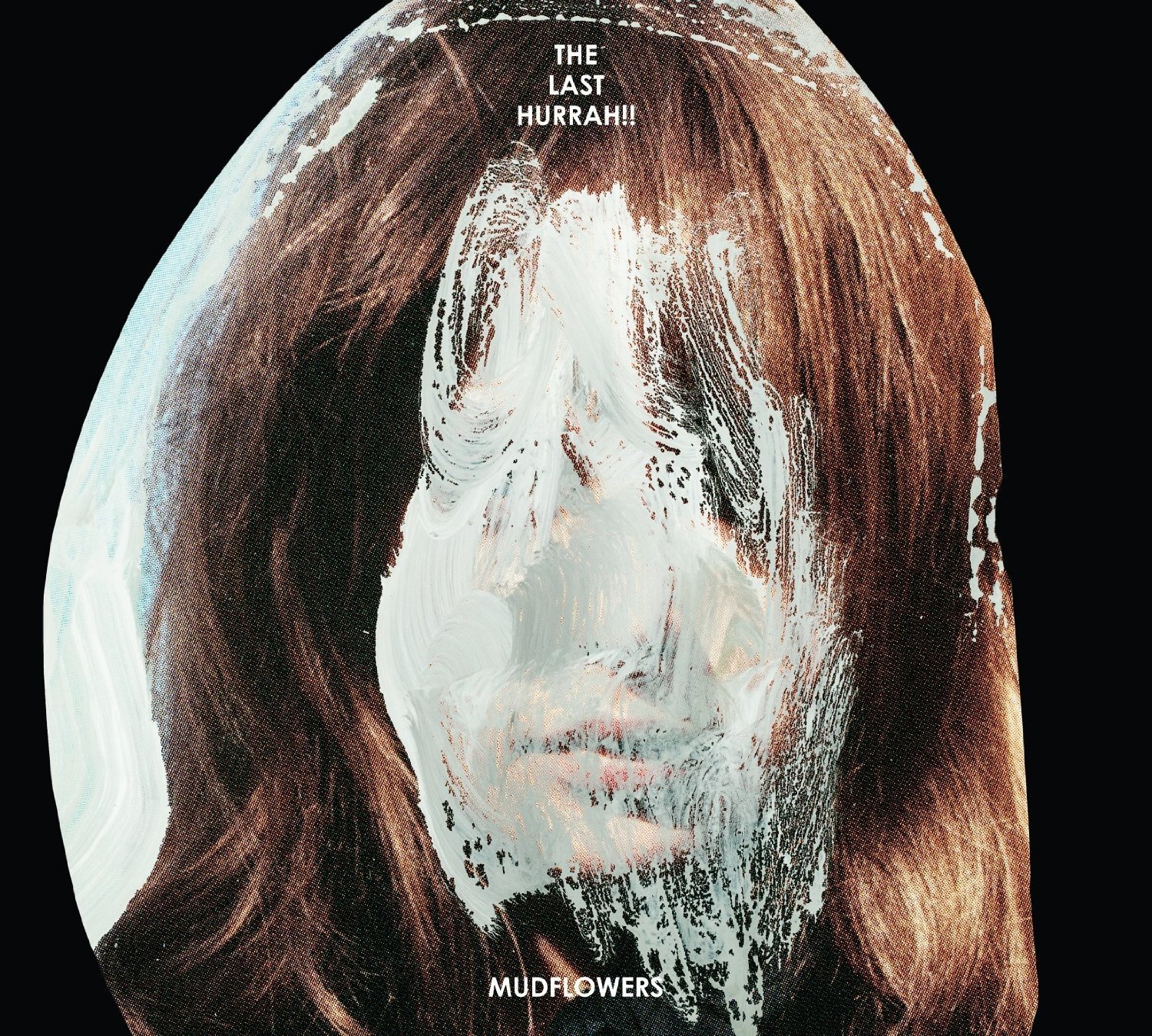

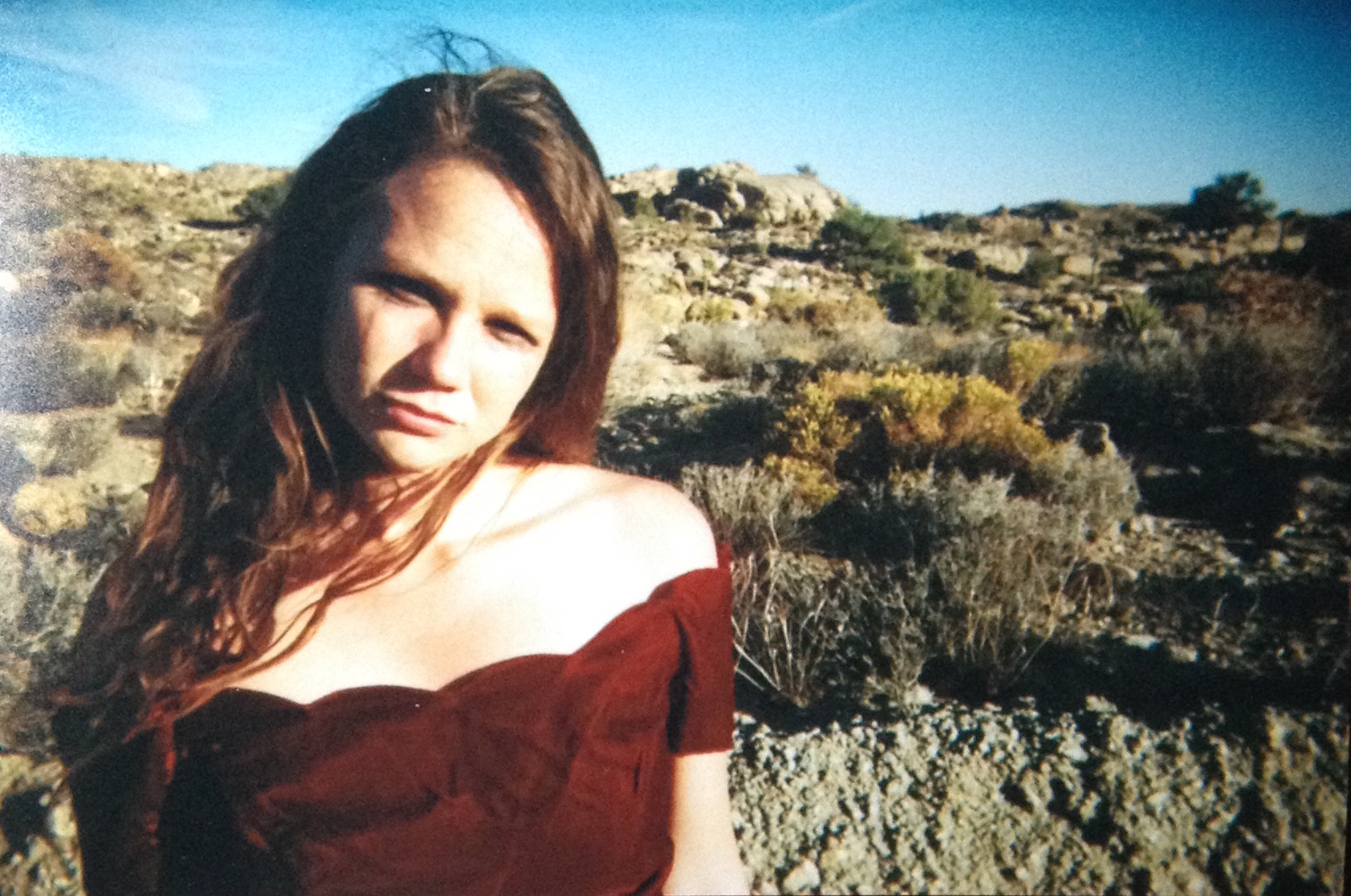
THE HOUSE IS ROCKIN’- A TRIBUTE TO STEVIE RAY VAUGHAN.
THE HOUSE IS ROCKIN’- A TRIBUTE TO STEVIE RAY VAUGHAN.
Twenty-five years ago, music was robbed of one of the most influential electric blues guitarists ever, Stevie Ray Vaughan. He was killed in a helicopter crash on August 27th 1990. The Texan blues man was just thirty-six, and had only enjoyed seven years in the spotlight.
Despite only enjoying seven years at the top, Stevie Ray Vaughan has influenced several generations of musicians. This includes the musicians who pay tribute to Stevie Ray Vaughan on a compilation recently released by Cleopatra Records, The House Is Rockin’-A Tribute To Stevie Ray Vaughan. It features eleven tracks from likes of Trevor Rabin ,Steve Morse, John Sykes, Scott Hill, Walter Trout and Stanley Jordan. They pay tribute to a blues pioneer who first came to prominence in 1982.
It was Stevie Ray Vaughan’s performance at 1982s Montreux Jazz Festival that transformed his career. From the moment he took to the stage, the twenty-eight year old bluesman had the audience spellbound. By the time he walked off the stage, a star had been born and Stevie Ray Vaughan’s career was transformed. However, Stevie Ray Vaughan was no overnight success.
Ever since Stevie Ray Vaughan had dropped out of high school in 1971, he had been playing the blues. Having played in a series of bands, Stevie’s break came when he started playing with Marc Benno’s band The Nightcrawlers. After The Nighcrawlers, Stevie played with Danny Freeman in The Cobras. For Stevie, this was all part of his musical apprenticeship. Then in 1977, Stevie Ray Vaughan went from sideman to bandleader, when he formed Triple Threat Revue.
Triple Threat Revue would later become Double Trouble. This came about, when Stevie Ray Vaughan brought onboard the rhythm section of drummer Chris Layton and bassist Tommy Shannon. It was with Double Trouble at his side, that Stevie Ray Vaughan announced his arrival at 1982s Montreux Jazz Festival.
That night, at 1982s Montreux Jazz Festival, Stevie Ray Vaughan and Double Trouble announced their arrival. Stevie, playing vintage guitars, eschewed the use of effects. Effects were used sparingly during his performance. While Stevie turned his back on effects, he and Double Trouble liked to crank the sound up. To do this, they combined a series of amplifiers. This made the audience sit up and take notice. What they saw was a a blistering, virtuoso performance. By the time Stevie Ray Vaughan and Double Trouble left the stage, at 1982s Montreux Jazz Festival their star was in the ascendancy.
Double Trouble.
Eleven months later, Stevie Ray Vaughan and Double Trouble released their debut album Texas Flood on Epic. It had been recorded before Stevie Ray Vaughan and Double Trouble signed to Epic. The ten tracks were recorded at Jackson Browne’s recording studio in Los Angeles. Stevie Ray Vaughan and Double Trouble worked quickly. The sessions took place between 22nd to 24th November 1982. These ten tracks that would become their debut album, Texas Flood.
At Jackson Browne’s recording studio, Stevie Ray Vaughan and Double Trouble hooked up with engineer Richard Mullen. He would co-produced Texas Flood with Stevie Ray Vaughan and Double Trouble.
Texas Flood featured ten tracks. Five were penned by Stevie, who also cowrote Dirty Pool with drummer Doyle Bramhall. Along with covers of Howlin’ Wolf’s Tell Me and Buddy Guy’s Mary Had a Little Lamb, these tracks became eventually become Texas Flood.
On the first of the three days at Jackson Browne’s recording studio, Stevie Ray Vaughan and Double Trouble spent setting up their equipment. The next two days, Stevie Ray Vaughan and Double Trouble recorded what would become Texas Flood. Now all Stevie Ray Vaughan and Double Trouble needed, was a label to release Texas Flood.
In early 1983, Epic signed Stevie Ray Vaughan and Double Trouble. Epic having heard the master tapes of Texas Flood, decided it needed remastered. So, a $65,000 advance was given to remaster the recordings. The advance also allowed Stevie to lay down his vocals Riverside Sound in Austin, Texas. Then on June 13th 1983, Texas Flood was released.
On Texas Flood’s release, it was mostly, well received by critics. No wonder. Stevie Ray Vaughan was easily, one of music’s most exciting guitarists. However, Rolling Stone magazine and Robert Christgau, forever the contrarians, weren’t won over by Texas Flood. This didn’t affect sales of Texas Flood, which reached number thirty-eight in the US Billboard 200. Having sold two million copies, Texas Flood was certified double platinum. Following the success of Texas Flood, Stevie Ray Vaughan and Double Trouble headed out on a gruelling tour.
For much of the remainder of 1983, Stevie Ray Vaughan and Double Trouble toured America and Canada. It was the longest and most punishing tour of Stevie Ray Vaughan and Double Trouble’s career. However, this was what life was going to be like for Stevie Ray Vaughan and Double Trouble. They were now on their way to becoming one of the most successful blues acts of the eighties.
Couldn’t Stand the Weather.
Just like Texas Flood, Couldn’t Stand the Weather, Stevie Ray Vaughan and Double Trouble’s sophomore album Stevie penned half the tracks. He wrote four of the eight tracks. The other four tracks were cover versions, including a cover of Jimi Hendrix’s Voodoo Child (Slight Return). These eight tracks were recorded at The Power Station, New York.
Over nineteen days at The Power Station, Stevie Ray Vaughan and Double Trouble recorded Couldn’t Stand the Weather. Producing Couldn’t Stand the Weather, were Stevie Ray Vaughan and Double Trouble, Richard Mullen and Jim Capter. From the minute Stevie Ray Vaughan and Double Trouble laid down their cover of Tin Pan Alley, it was obvious to those in the control room that, here was a band at the top of their game.
That proved to be the case. On the release of Couldn’t Stand the Weather, on 15th May 1984, Stevie Ray Vaughan and Double Trouble’s fusion of blues rock, electric blues and Texas rock, won friends and influenced people. This included the programmers at MTV. They put the video for Couldn’t Stand the Weather on heavy rotation. For Stevie Ray Vaughan and Double Trouble this meant their music reached a much wider audience.
Then when critics heard Couldn’t Stand the Weather, it received widespread critical acclaim. So, it’s no surprise that Couldn’t Stand the Weather reached number thirty-one on the US Billboard 200 charts. This resulted in Couldn’t Stand the Weather being certified platinum. It seemed that Stevie Ray Vaughan and Double Trouble could do no wrong.
Soul To Soul.
In March 1985, Stevie Ray Vaughan and Double Trouble returned to the studio. This time, they headed to the Dallas Sound Lab. Between March and May 1985, Stevie Ray Vaughan and Double Trouble recorded the ten tracks that became Soul To Soul.
For Soul To Soul, Stevie only penned four of the ten tracks. They were Only Say What, Ain’t Gone ‘N’ Give Up On Love, Empty Arms and Life Without You. Drummer Doyle Bramhall contributed Lookin’ Out the Window and Change It. The other tracks were cover versions, including Willie Dixon’s You’ll Be Mine and Earl King’s Come On. Just like Texas Flood, Soul To Soul was co-produced by Stevie Ray Vaughan and Double Trouble and Richard Mullen. Soul To Soul would be released on September 30th 1985. Before that, Stevie Ray Vaughan and Double Trouble made a triumphant return to where it all began, the Montreux Jazz Festival.
Three years after making their breakthrough at 1982s Montreux Jazz Festival, Stevie Ray Vaughan and Double Trouble returned to where it all began. They played a storming ten song set. That night, just like three years earlier, Stevie Ray Vaughan and Double Trouble had the audience enthralled. Here was the most exciting blues band in the world. Since their Montreux debut, Stevie Ray Vaughan and Double Trouble had sold four million albums in America alone. Before long, four would become five.
When critics heard Soul To Soul, it was well received by critics. Soul To Soul received the same critical acclaim as their two previous albums. Change It, one of two singles released from Soul To Soul, found flavour with MTV programmers. Despite this, Soul To Soul wasn’t as big a commercial success as Stevie Ray Vaughan and Double Trouble’s two previous albums.
On the release of Soul To Soul on September 30th 1985, the album reached number thirty-four in the US Billboard 200 charts. In Canada, where Stevie Ray Vaughan and Double Trouble’s two previous albums were certified platinum, Soul To Soul was only certified gold. This was a troubling time for Stevie Ray Vaughan and Double Trouble.
Live Alive.
After the release of Soul To Soul, it would be four years before Stevie Ray Vaughan and Double Trouble released another album. During this period, Stevie’s appetite for drink and drugs couldn’t be sated. After breakfast, Stevie would begin his daily diet of a quart of whiskey and a quarter ounce of cocaine. This was Stevie’s daily diet. It would’ve killed most people. Not Stevie. He continued to record and play live. One of Stevie Ray Vaughan and Double Trouble live performances was released in July 1986, as Live Alive.
Live Alive was a double album recorded during 1985 and 1986s Live Alive tour. Stevie Ray Vaughan and Double Trouble swagger their way through fourteen tracks on Live Alive. Despite his chaotic lifestyle, Stevie was still one of the best blues guitarists of his generation. Backed by the tightest of rhythm sections, Stevie unleashes a series of blistering performances. Whether it’s original songs or cover versions, they come alive in Stevie Ray Vaughan and Double Trouble’s hands. As a result, critics and record buyers were won over by Live Alive.
Most critics gave Live Alive positive reviews. A few critics disagreed. However, that’s not surprising. Live albums always divide opinion. Not record buyers. When Live and Alive was released in July 1986, it reached number fifty-two in the US Billboard 200 charts. Although this was the lowest chart placing of any Stevie Ray Vaughan and Double Trouble album, Live Alive was certified platinum in America and Canada. This would be the last album Stevie Ray Vaughan and Double Trouble would release for three years.
In Step.
By the time Stevie Ray Vaughan and Double Trouble returned with their fourth album, In Step, Stevie was a changed man. Gone was the hard living, wild man, with the insatiable appetite for drink and drugs. This was reflected in some of the songs on In Step.
For In Step, Stevie only wrote two tracks, Travis Walk and Riviera Paradise. However, Stevie cowrote four tracks with Doyle Bramhall. This included Wall of Denial and Tightrope, which reflect Stevie’s newfound sobriety. Along with covers of Willie Dixon’s Let Me Love You Baby, Buddy Guy’s Leave My Girl Alone and Howlin’ Wolf’s Love Me Darlin,’ these songs became In Step.
Recording of In Step began on January 25th 1989 and lasted right through to March 13th 1989. Further sessions took place at Kiva Sudios, Memphis, and then in Los Angeles at Sound Castle and Summa Studios, where Double Trouble and Jim Gaines co-produced In Step. Once In Step was finished, it was released on June 6th 1989.
Little did anyone know, but In Step would be the final album Stevie Ray Vaughan and Double Trouble would release. Less than a year later, on August 27th 1990, Stevie died in a helicopter crash. In Step was their swan-song.
When In Step was released on June 6th 1989, what would be Stevie Ray Vaughan and Double Trouble swan-songs, was well received. In Step’s fusion of blues, rock and soul was perceived as an incredibly honest, personal and autobiographical album. This appealed to record buyers.
On In Step’s release, it reached number thirty-three in the US Billboard 200 charts. This resulted in In Step being certified double platinum in America, and platinum in Canada. That meant that since 1983s Texas Flood, Stevie Ray Vaughan and Double Trouble had sold eight million albums. Sadly, In Step was the final Stevie Ray Vaughan and Double Trouble album released during Stevie’s lifetime.
Since then, many artists have been influenced by Stevie Ray Vaughan and Double Trouble. No wonder. They were one of the most exciting and influential blues bands of the eighties. While Stevie Ray Vaughan and Double Trouble only enjoyed seven years in the spotlight, they made a lasting impression on musicians and record buyers. So, it’s no surprise that recently, Cleopatra Records released a tribute to Stevie Ray Vaughan, The House Is Rockin’-A Tribute To Stevie Ray Vaughan. It’s an eighteen track compilation, which I’ll pick the highlights of.
Trevor Rabin’s cover of Tightrope opens The House Is Rockin’-A Tribute To Stevie Ray Vaughan. It was released as single by Stevie Ray Vaughan and Double Trouble in 1989, and featured on their final album Tightrope. South African singer, songwriter, and producer unleashes a guitar masterclass on Tightrope, and in the process, conjures up the spirit of the late, great Stevie Ray Vaughan.
Cold Shot is covered by Brooklyn born guitarist Steve Stevens. He joined One Hand Clap in 1979, and later, went on to work with everyone from Billy Idol to Ben Watkins, Faudel, Gregg Bissonette, Chris Squire and Billy Sherwood. With thirty-six years experience, it’s no surprise that Steve brings Cold Shot to life. It’s a track from Couldn’t Stand The Weather, Stevie Ray Vaughan and Double Trouble’s 1984 sophomore album. Steve Stevens delivers a lived-in vocal and a blistering, lightning fast guitar solo.
For Stevie Ray Vaughan, The House Is Rockin’-A Tribute To Stevie Ray Vaughan, Steve Morse chose to cover Travis Walk, a track from Stevie Ray Vaughan and Double Trouble’s 1989 swan-song In Step. The former Deep Purple and Kansas guitarist joins forces with a tight, talented band. While they all enjoy the opportunity to take centre-stage, Steve steals the show on this blues rock instrumental.
Albert Ammons and Pete Johnson collaborate on Empty Arms. It featured on Stevie Ray Vaughan and Double Trouble’s 1985 album Soul To Soul. Six years later, Empty Arms was released as a single. Tragically, Stevie Ray Vaughan had died the year before. The single was a reminder of what Stevie Ray Vaughan and Double Trouble. As for Albert Ammons and Pete Johnson’s cover of Empty Arms, it’s a delicious fusion of blues and boogie woogie.
John Sykes covers Pride and Joy on The House Is Rockin’-A Tribute To Stevie Ray Vaughan. It was released as a single in 1983, and featured on Texas Flood. This was Stevie Ray Vaughan and Double Trouble’s debut album. It’s brought to life by John Sykes. He’s played with Streetfighter, Tygers Of Pan Tang, Badlands, Thin Lizzy, Whitesnake and Blue Murder. His five decades of experience shines through on Pride and Joy. He lives the lyrics before unleashing a scorching, searing soaring guitar solo. Seamlessly, his fingers fly up and down the fretboard, as the English born guitarist delivers what can only be described as a musical tour de force.
With the whole of Stevie Ray Vaughan and Double Trouble’s back-catalogue to choose from, Scott Hill was spoiled for choice. However, he chose Couldn’t Stand The Weather, the title track to Stevie Ray Vaughan and Double Trouble’s 1984 album. It’s something of a slow burner. Scott teases the listener before hitting his stride and delivering a fitting blues rock homage to Stevie Ray Vaughan.
Ain’t Gone ‘N’ Give Up On Love featured on Stevie Ray Vaughan and Double Trouble’s 1985 album Soul To Soul. Thirty years later, and Mark Kendall, the Great White lead guitarist covers the song on The House Is Rockin’-A Tribute To Stevie Ray Vaughan. Mark’s cover has a slow, moody and bluesy backdrop, while his vocal veers between needy and hopeful. When this is combined, it’s one of the highlights of The House Is Rockin’-A Tribute To Stevie Ray Vaughan.
Although Los Angeles based guitarist Doug Aldrich is only forty-one, he’s a veteran of many groups. This included Bad Moon Rising, Burning Rain, Dio, Hurricane, Lion, Mansfield, Revolution Saints, The Brutal Brothers and Whitesnake. In 1994, Doug relaxed the first of five solo albums. The hard rocking guitarist covers The House Is Rockin’, which opened In Step, Stevie Ray Vaughan and Double Trouble’s final album. It was also released as a single in 1989, and lents its title to the compilation. Doug Aldrich stays true to the original, and comes up with a version of The House Is Rockin’ that would get any house rocking.
Richie Kotzen solo career began back in 1989. Since then, he’s released around twenty albums. He covers Honey Bee, a track from Stevie Ray Vaughan and Double Trouble’s 1985 album Couldn’t Stand The Weather. Drawing on four decades of experience, Richie delivers a strutting slice of blues rock.
For anyone whose still to discover the one and only Walter Trout, The House Is Rockin’-A Tribute To Stevie Ray Vaughan is the perfect opportunity. He was formerly a member of Canned Heat and John Mayall and The Bluesbreakers. Here, Walter covers Say What!, a track from Stevie Ray Vaughan and Double Trouble’s 1985 album Soul To Soul. It’s as if Walter’s heard what’s gone before, and decides to blow the opposition away. That’s what he proceeds to do over the next four-and-a-half minutes. What follows is some of the best guitar playing on The House Is Rockin’-A Tribute To Stevie Ray Vaughan. It’s a fitting tribute to Stevie Ray Vaughan.
Stanley Jordan’s cover of Riviera Paradise closes The House Is Rockin’-A Tribute To Stevie Ray Vaughan. Fittingly, Riviera Paradise is a track from what proved to be Stevie Ray Vaughan and Double Trouble’s final album In Step. It was released in 1989. A year later, in 1990, and Stevie Ray Vaughan was dead. That day music lost one of its greats. Twenty-five years later, and Stanley Jordan delivers a mellow, melancholy and jazz-tinged cover of Riviera Paradise. It later veers in the direction of fusion. However, mostly, it’s a beautiful, thoughtful sounding track that allows the listener to remember the late, great, Stevie Ray Vaughan.
It’s hard to believe it’s nearly twenty-five years since Stevie Ray Vaughan died. Sadly, apart from the release of The Complete Epic Recordings box set, tributes to one of the greatest guitarists of his generation have been few and far between. That’s sad, given that Stevie Ray Vaughan influenced several generations of musicians. To this day, musicians cite Stevie Ray Vaughan as an influence. No wonder. He was one of the greatest blues guitarists of his generation. Sadly, Stevie Ray Vaughan was only in the spotlight for seven years.
During the seven years that Stevie Ray Vaughan and Double Trouble’s star was in the ascendancy, they released four studio albums and one live album. Their swan-song was In Step, which was released in 1989. By then, Stevie had turned his life around. No longer was he living the rock ’n’ roll lifestyle.
Stevie was a changed man. Gone was the hard living, wild man, with the insatiable appetite for drink and drugs. The change in Stevie Ray Vaughan was reflected on In Step’s lyrics. It introduced the listener to a new, changed Stevie Ray Vaughan. They liked what they heard, and In Step reached number thirty-three in the US Billboard 200 charts. This resulted in In Step being certified double platinum in America, and platinum in Canada. Stevie Ray Vaughan and Double Trouble looked like becoming one of the biggest bands of the nineties. They had already sold over eight million copies between 1982 and 1989.
Sadly, that never happened. On August 27th 1990 Stevie Ray Vaughan was killed in a helicopter crash. He was only thirty-six years old. That day music lost one of its most talented sons.
That’s why to mark the twenty-fifth anniversary of Stevie Ray Vaughan’s death, Cleopatra Records have released The House Is Rockin’-A Tribute To Stevie Ray Vaughan. It features a series of guitar masterclasses from musicians of the calibre of Trevor Rabin ,Steve Morse, John Sykes, Scott Hill, Walter Trout and Stanley Jordan. They ensure that The House Is Rockin’, which seems a fitting way to celebrate the life and career of a modern blues legend, Stevie Ray Vaughan.
THE HOUSE IS ROCKIN’- A TRIBUTE TO STEVIE RAY VAUGHAN.
JETHRO TULL-THICK AS A BRICK-STEVEN WILSON MIX.
JETHRO TULL-THICK AS A BRICK-STEVEN WILSON MIX.
Jethro Tull came of age musically in 1971. That’s when they released Aqualung, the most successful album of their four album career. Aqualung sold three million copies in America, and was certified triple platinum. This surpassed the success of their three previous albums, including 1969s Stand Up and 1970s Benefit. Both were certified gold in America. However, Aqualung was a game-changer.
Suddenly, Jethro Tull were one of the biggest bands in the world. They were well on their way to becoming one of the most successful, groundbreaking and innovative prog rock bands. Partly, that was down to Jethro Tull’s determination to reinvent themselves musically. Jethro Tull weren’t content to stand still. Instead, they experimented musically, and pushed musical boundaries to their limit. This saw Jethro Tull become one the most groundbreaking and inventive bands. However, very few people were prepared for Thick As A Brick, the followup to Aqualung.
Thick As A Brick, which was recently reissued by PLG, was a concept album. Not just any concept album though. Instead, Thick As A Brick was a concept album featuring just one lengthy track. This track, Jethro Tull described as “bombastic” and “over the top.” It was meant to be an adaptation of an epic poem written by an fictional eight year old prodigy. It’s meant to be Homeric, but with a bombastic, humorous style. The album came complete with a cover that replicates a comedic newspaper, which features the poem penned by the child prodigy. In reality, the lyrics were written by Ian Anderson, Jethro Tull’s lead singer. Up until then, he could do no wrong. Was this about to change?
The origins of Jethro Tull can be traced to Blackpool, in 1962, That’s when Ian Anderson formed his first group Blades. Originally a four piece, featuring Ian Anderson on vocals and harmonica, they became a quintet in 1963 and sextet in 1964. By that time, they were a blue eyed soul band. After three years, the band decided to head to London.
Having moved to London, the band split-up within a short time. Just Ian Anderson and bassist Glen McCornick were left. This proved a blessing in disguise. They were soon joined by blues guitarist Mick Abrahams and drummer Clive Bunker. This was the lineup that featured on their debut album This Was. That was still to come.
Before that, the band had to settle on a name. Various names were tried. Then someone at a booking agent christened them Jethro Tull, after the eighteenth century agriculturalist. Not long after that, Ian Anderson acquired his first flute.
Up until then, Ian Anderson played just harmonica and was trying to learn to play the guitar. He realized wasn’t a great guitarist though. So, decided the world had enough mediocre guitarists, decided to expand his musical horizons. So he bought his flute. Little did he realize this would be one of Jethro Tull’s trademarks. After a couple of weeks, Ian had picked up the basics of the flute. He was learning as he played. Not long after this, Jethro Tull released their debut single.
Sunshine Day was penned by Mick Abrahams, with Derek Lawrence producing the single. On its release, the single was credited to Jethro Toe. It seemed thing weren’t going right for Jethro Tull. The single wasn’t a commercial success and failed to chart. Despite this disappointment, thing got better when they released their debut album This Was.
This Was.
Recording of This Was took place at Sound Techniques in London. The sessions began on 13th June 1968, and finished on 23rd August 1968. Unlike later albums, Jethro Tull recorded This Was on a tight budget. Only £1,200 was spent recording Jethro Tull’s debut album This Was. This money would soon be recouped when This Was released.
Having released their debut album This Was in 25th October 1968, it reached number ten in the UK. This Was was well received by critics. They were won over by Jethro Tull’s fusion of blues rock, R&B and jazz. This lead to This Was being launched at the Marquee Club.
Jethro Tull were only the third band to launch their debut album at the Marquee Club. The other two were The Rolling Stones and The Who. Both were now amongst the biggest bands in the world. They had certainly conquered America. So would Jethro Tull.
When This was released in the US on 3rd February 1969, it reached just number sixty-two in the US Billboard. This was seen as a success by Island Records in Britain and Reprise in America. Jethro Tull had made inroads into the most lucrative music market in the world. It was a successful start to Jethro Tull’s career, which was about to enter a period where critical acclaim and commercial success were almost ever-present. However, there was a twist in the tale.
Prior to the recording of Stand Up, Jethro Tull’s sophomore album, Mick Abrahams left the band. Mick and Ian Anderson disagreed over the future direction of Jethro Tull. The problem was, Mick wanted Jethro Tull to stick with blues rock. Ian Anderson realised there was no real future in blues rock. He wanted to take Jethro Tull in different directions, exploring a variety of musical genres. So Mick left Jethro Tull and was replaced by Michael Barre. Little did either Mick nor Michael realize that Stand Up marked the start of a period where Jethro Tull sold over sixty-million albums.
Stand Up.
Following the departure of Mick Abrahams, who was replaced by Michael Barre work began on Jethro Tull’s sophomore album. It would be very different to This Was.
Stand Up was a much more eclectic album. Ian Anderson, who was now the primary songwriter, penned nine of the ten tracks. He drew inspiration from everything from blues rock, Celtic, classical, folk and rock. The ten tracks became Stand Up, which was recorded over three months in 1969.
Recording of Stand Up took place at Morgan Studios and Olympic Studios. The sessions began in April 1969, and continued through to May 1969. They recommenced in August 1969, when Stand Up was completed. A month later, and Stand Up was released.
Before the release of Stand Up in September 1969, reviews of the album were positive. The musicianship and production were praised. Whilst there was still a blues rock sound, Jethro Tull were expanding their musical palette. This struck a nerve with critics and record buyers.
On its release in September 1969, Stand Up reached number twenty in the US Billboard 200 Charts and number twenty in Britain. This resulted not just in the start of Jethro Tull’s first gold disc of their career and the beginning of a golden period in their career. The next album in this golden period was Benefit.
Benefit.
Following the commercial success of Stand Up, Jethro Tull returned to the studio in December 1969. Ian Anderson had written ten new tracks. These ten tracks were recorded at Morgan Studios, London. For the first time, Ian Anderson was the sole producer of a Jethro Tull album. He started as he meant to go on, producing what would become a much more experimental, and darker album, Benefit. It was completed in January 1970 and release in April and May 1970.
Before the release of Benefit, the critics had their say. They remarked upon the much more experimental sound of Benefit. Ian Anderson had allowed Jethro Tull more freedom to express themselves. He also wanted Benefit to have a live sound. This shines through. So, does Benefit’s darker sound. This Ian Anderson claimed was because of the pressure of a forthcoming American tour, and his disillusionment with the business side of the music industry. However, this didn’t affect sales.
When Jethro Tull released Benefit in the America. It was released 20th April 1970, and reached number eleven in the US Billboard 200 Charts. This meant another gold disc for Jethro Tull. However, how would British record buyers react to Benefit?
Already, Jethro Tull were more popular in America, than in Britain. Stand Up, Jethro Tull’s previous album was more successful in America, than Britain. It seemed American record buyers “got” Jethro Tull more than their British counterparts. Benefit just reinforced this. Upon its release on May 1st 1970, Benefit reached number three in Britain. While there was no gold disc, Jethro Tull were on a roll, and about to release a classic album.
Aqualung.
By December 1970, Jethro Tull had just returned from their American tour. They were on a gruelling schedule, where they recorded an album, then embarked upon long, exhausting tours. It wasn’t ideal, and already, Ian Anderson wasn’t enjoying the months away from home. He missed his friends and family. However, this was one of the downsides of being a member of one of the most successful rock bands in the world. So, while others were readying themselves for the forthcoming festive season, Ian Anderson and the rest of Jethro Tull were about to begin recording their fourth album, Aqualung.
Despite Jethro Tull’s gruelling touring schedule, Ian Anderson’s creativity hadn’t been stifled. Far from it. Ian returned with the lyrics to Jethro Tull’s most ambitious and cerebral album, Aqualung. It was a concept album that examined ”the distinction between religion and God.” This seemed an unlikely subject for an album, even a seventies concept album. However, Aqualung, which feature two new members, would transform Jethro Tull’s fortunes.
As Jethro Tull arrived at Island Studios in December 1970, two new members made their debut. Keyboardist John Evans and bassist Jeffrey Hammond were the latest recruits to Jethro Tull. Right through to February 1970, Jethro Tull recorded their most cerebral and philosophical album. Aqualung was produced by Ian Anderson and Terry Ellis. It was also their most successful album.
Once Aqualung was completed, neither Chrysalis in Britain, nor Reprise in America wasted time in releasing Jethro Tull’s fourth album. Given the subject matter, there must have been a some trepidation amongst the executives at Chrysalis and Reprise. After all, concept albums were controversial. However, what about a concept album that examined ”the distinction between religion and God?”
As copies of Aqualung were sent out to critics, executives at Chrysalis and Reprise awaited their reviews with baited breath. They need not have worried. Most of the reviews were positive. Reviews remarked upon the quality of the music, the standard of the musicianship and Ian Anderson’s lyrics. Many critics hailed Aqualung Jethro Tull’s finest album. Since then, Aqualung is seen as a classic album. However, forty-five years ago, critics embraced they hailed as an extremely cerebral album. Aqualung was music for the mind, and music the world would embrace.
On the release of Aqualung on 19th March 1971, it reached number seven in the US Billboard 200, and was certified triple platinum. Across the Atlantic, Aqualung reached number four in Britain. Elsewhere, Aqualung reached number five in Germany, and was certified gold. In total, Aqualung sold over seven million copies. This transformed Jethro Tull. They were now one of the biggest rock bands in the world.
For the two new members of Jethro Tull, this must have been hard to take in. Suddenly, the were part of a band who had just sold over seven million albums. This doesn’t happen often, even in the seventies, the heyday of the album. However, after the success of Aqualung, another member of Jethro Tull decided to call it a day.
Drummer Clive Bunker had been a member of Jethro Tull since the early days. He was part of the furniture, and replacing him wasn’t going to be easy. However, at least Clive Bunker had been able to enjoy what was the most successful album of Jethro Tull’s career, Aqualung. Following up Aqualung wasn’t going to be easy.
Thick As A Brick.
After the commercial success and critical acclaim of Aqualung, critics, record company executives and the record buying public wondered what Ian Anderson had in-store for the fifth Jethro Tull album?As always, it was a case of expect the unexpected.
What nobody expected, was that Ian Anderson would’ve penned one lengthy track that took up both sides of Thick Of A Brick. Side one of the original album featured Thick as a Brick Part I, while side two featured Thick as a Brick Part II. This song of two parts comprised Jethro Tull’s latest concept album.
Following critics conclusion that Aqualung was a “concept album,” Ian Anderson decided to have some fun at the critic’s expense. He decided to “come up with something that really is the mother of all concept albums”. One of his influences was Monty Python. Another influence was the movie Airplane. Just like Airplane poked fun at the cinema goers, filmmakers and critics, Thick Of A Brick saw Jethro Tull poke fun at their audience and music critics. However, Jethro Tull weren’t laughing at their audience, they were laughing with them. They maybe, were laughing at other groups.
Later, Ian Anderson would say Thick As A Brick was a reaction against the concept albums being released by groups like Yes and Emerson, Lake and Palmer. That would explain why Ian Anderson produced an album that he later described as “bombastic” and “over the top.”
When Jethro Tull entered the Morgan Studios, on 10th December 1971, Jethro Tull had a new drummer, Barriemore Barlow. Thick As A Brick wasn’t his most exacting album with Jethro Tull. Far from it.
Thick As A Brick was recorded in a day. It was meant to be an adaptation of an epic poem written by an fictional eight year old prodigy, Gerald Bostock. Ian Anderson even went as far as giving the fictional Gerald Bostock a co-credit. The poem was
meant to be pseudo Homeric, but with a bombastic, humorous style. The album came wrapped in a cover that replicates a comedic newspaper. It features the poem penned by the child prodigy. Although Thick As A Brick’s album cover and the album had spoof written all over it, many people didn’t get Jethro Tull, or more specifically, Ian Anderson’s unique style of humour. It was way too subtle.
With Thick As A Brick complete, and the fictional Gerald Bostock’s epic poem brought to life, copies of the album were sent out to critics. They hailed the album one of Jethro Tull’s finest. The music on Thick As A Brick was groundbreaking, innovative, slick and sophisticated. Most critics were won over by music that was complicated, but tinged with subtle humour. Incredibly, some critics failed to find the funny side of Thick As A Brick, and bought it hook, line and sinker. They failed to see that Jethro Tull were poking fun at the concept album, and laughing along with their audience at what Ian Anderson perceived as its pomposity. However, what very few critics overlooked was Jethro Tull’s first prog rock offering.
Thick As A Brick marked the completion of Jethro Tull’s move towards prog rock. They had toyed with the genre before. On Thick As A Brick they embraced it. There were numerous musical themes, changes in time signature and tempo shifts on Thick As A Brick. Even the instruments used differed from Jethro Tull’s early blues rock offerings. Never before had harpsichord, lute, saxophone, timpani, trumpet, violin or xylophone featured on a Jethro Tull album. This was a first. What Ian Anderson regarded as a satirical album, marked the beginning of Jethro Tull’s conversion to prog rock pioneers.
When Thick As A Brick was released, it came wrapped in a pun riddled cover. It was disguised as a British regional newspaper, and openly mocked the style of journalism that prevailed in these provincial publications. Thick As A Brick’s newspaper cover poked fun at the style of journalism. Most of the cover was designed by Ian Anderson, with the rest of the band having a hand in the design. Ironically, the cover took longer to design than the album took to record. However, it proved to be worth the effort.
On 10th March 1972, Thick As A Brick was released, it reached number one in Australia, Canada and the US Billboard 200 charts. Back home in Britain, Thick As A Brick reached number thirteen. This wasn’t unlucky for Jethro Tull. Thick As A Brick proved to be Jethro Tull’s most popular album in Britain. It was certified silver, while Thick As A Brick was certified gold in America. Ian Anderson’s parodic concept album saw Jethro Tull triumph again, as they became prog rock pioneers.
Following Thick As A Brick, Jethro Tull went on to see eight further albums certified gold. In total, Jethro Tull sold over sixty-million albums over a recording career that lasted five decades. The most successful period of Jethro Tull’s career came between 1969s Stand Up and 1989s Rock Island. During that period, Jethro Tull were one of the most successful bands in the world. Their albums sold by the million, while their tours sold out. That’s not surprising. Jethro Tull were one of the most innovative bands of their generation.
Before Thick As A Brick, Jethro Tull experimented musically. Thick As A Brick was a turning point in Jethro Tull’s career. It sees Jethro Tull full embrace prog rock. Before Thick As A Brick, they had toyed with prog rock. Not any more. On Thick As A Brick, Jethro Tull became converts to the prog rock cause. Jethro Tull were like Paul on the road to Damascus.
Following this conversion to prog rock, Jethro Tull constantly, sought to reinvent themselves, and their music. They were determined not to stand still, and constantly release music that was ambitious, cerebral, groundbreaking and sophisticated. Aqualung had been the most cerebral album of Jethro Tull’s career. Thick As A Brick was the most ambitious and sophisticated. It was also tinged with subtle satire, satire that forty-three years later, has stood the test of time.
Thick As A Brick which was recently released by PLG. This however, is no ordinary reissue. It’s Steven Wilson’s Stereo Mix. While many purists will hold up their hands at the thought of Jethro Tull’s albums being remixed, they need not worry.
Just like previous albums Steven Wilson has mixed, his mix bring out all Thick As A Brick’s subtleties and nuances. Thick As A Brick, and its numerous musical themes comes to life. Steven Wilson’s new mix highlights the changes in time signature and tempo shifts. Similarly, the eclectic palette of music instruments deployed by Jethro Tull can be heard much more clearly. They stand out in the mix. Especially, the harpsichord, lute, saxophone, timpani, trumpet, violin or xylophone. The use of these instruments marked a stylistic departure for Ian Anderson and Jethro Tull. Never before had they used such an eclectic selection of instruments before. However, Thick As A Brick was a first, and marked Jethro Tull’s Damascene conversion to prog rock pioneers on Ian Anderson satirical pièce de résistance.
JETHRO TULL-THICK AS A BRICK-STEVEN WILSON MIX.
AMARA TOURE-1973-1980.
AMARA TOURE-1973-1980.
Amara Touré’s recording career lasted just seven years. It started in 1973, and finished in 1980. His discography consists of just ten tracks. This includes three singles, and the four tracks on his 1980 album Accompagné Par L’Orchestre Massako. These ten tracks comprise Amara Touré’s discography. While that might not seem like much, but for seven years, Amara Touré released groundbreaking music. Thirty-five years later, and Amara Touré is remembered as one of the most influential and inventive artists of his generation. His recording career is documented on Analog Africa’s eighteenth release, Amara Touré 1973-1980. It features the ten tracks Amara Touré released during his all too brief career. However, Amara Touré’s career began back in 1958.
Back then, Senegal had been won over by Son Montuno and Patchanga music. That had been the case since the early forties, when Cuba sailors first brought Son Montuno and Patchanga home from their travels. It quickly found an audience within the local music scene. Soon, Caribbean music was providing the soundtrack to many clubs in Senegal. Before long, the locals had embraced this vibrant, exotic sound. The next stop was to combine Son Montuno and Patchanga with their own music.
Soon, Caribbean music was being combined with West African and Latin music. The result was a unique and unlike musical fusion, where the music of three continents combined. This new unique sound was quickly embraced by local musicians and producers.
This included Ibra Kassé, who also owned the Miami nightclub in Dakar. His club would at the heart of this new scene as it exploded into life. Across Dakar, bands were being formed and ballroom parties were being thrown. There were hardly enough local musicians to fulfil the demand. So musicians were coming from much further afield. This included Amara Touré, a percussionist and singer from Guinea-Conakry.
Amara Touré was discovered by Ibra Kassé when he was accompanying Dexter Johnson. When Ibra Kassé first heard Amara Touré he realised the young percussionist and singer had potential. He was destined for greater things. So Ibra Kassé asked Amara Touré of he wanted to become part of a new band he was putting together in Dakar. It didn’t take Amara Touré long to agree. What he didn’t realise, was that this new band would change Senegalese music forever.
Having agreed to move to Dakar, Amara Touré packed his belongings and said goodbye to Guinea-Conakry. His destination was Dakar, where he was about to become a member of Le Star Band de Dakar. Little did Amara Touré know, that Le Star Band de Dakar would become one of the most important bands in the history of modern Senegalese music.
The leader of Le Star Band de Dakar was Mady Konaté. He would mentor many up-and-coming musicians, so that eventually, they would be able to go on and become bandleaders in their own right. Just like many other musicians, Amara Touré severed his musical apprenticeship in Le Star Band de Dakar. From the day he was brought onboard by Ibra Kassé, Mady Konaté realised that Amara Touré was destined for greater things.
As Mady Konaté oversaw rehearsals, he realised that Le Star Band de Dakar latest recruit was something special. Not only was Amara Touré a gifted percussionist, but he had a voice that mixed power, passion and emotion. Watching on, Mady Konaté was captivated as Amara Touré brought the songs to life, breathing meaning and emotion into the Cuban songs. Straight away, Mady Konaté saw what Ibra Kassé saw in Amara Touré. With Amara Touré onboard, Mady Konaté realised that Le Star Band de Dakar were about to change Senegalese music forever.
Having joined Le Star Band de Dakar in 1958, they continued their residency at Ibra Kassé’s Miami nightclub. Soon, Le Star Band de Dakar’s star was soon in the ascendancy. They swept aside all-comers, and quickly became Dakar’s top orchestra. No other orchestra came close. This meant that patrons flocked to Ibra Kassé’s Miami nightclub. It became the only place in town. As a result, each night, the Miami was packed to the rafters. This lasted for the ten years that Amara Touré was a member of Le Star Band de Dakar. He left Le Star Band de Dakar in 1968, and a new chapter in his career began.
While Amara Touré was enjoying his time with Le Star Band de Dakar, by 1968, he was thinking about returning home, and forming his own band. However, then he received an offer that he couldn’t turn down when he was contacted by Assane Dieye, about joining L’Ensemble Black and White.
For some time, there had been tension between members of Lynx Tall and the other members of the L’Ensemble Black and White. They thought that Lynx Tall was a “big head,” and that he was more important than the other band members. So Assane Dieye was dispatched to ask Amara Touré whether he wanted to join L’Ensemble Black and White as their new lead singer.
With Amara Touré looking for a new challenge, it made sense to accept this new offer. Especially since he would be playing with some of the top musicians in Senegal. So, Amara Touré agreed to join ’Ensemble Black and White, and journeyed to Cameroon, where they become L’Ensemble Black and White were playing.
For five years, the Black and White ensemble toured Cameroon relentlessly. Night after night, week after week, month after month they played live. One year became two, became three, four and five. During that period, L’Ensemble Black and White played the top venues. They were seen as the top band in Cameroon. So much so, that they were regarded as Cameroon’s presidential band. However, despite their undoubtable popularity, L’Ensemble Black and White had never recorded a single. That changed in 1973, when the first of the three singles on Amara Touré 1973-1980 were recorded.
For their first singles, Amara Touré and the rest of L’Ensemble Black and White headed to the studio. L’Ensemble Black and White’s lineup features Amara Touré on tenor vocal and percussion, with Ahanda on second vocal. Many members of L’Ensemble Black and White were from Cameroon, including bassist Jean-Claude N’Jo, rhythm guitarist Lucien, lead guitarist Charles and keyboardist Tina Brown. Drummer Mosquito and alto saxophonist Fete are from the Congo, while clarinet player Peter was from Nigeria. This musical league of nations entered the studio for the first time in 1973.
In total, L’Ensemble Black and White recorded just three singles with Amara Touré as lead singer. The first of these singles was N’Niyo, which featured Cuando Llegare on the B-Side. They were released on the French label Sonafric, which was an imprint of Sondisc. Despite their popularity, L’Ensemble Black and White’s debut single wasn’t a commercial success. However, at least Amara Touré had fulfilled what he set out to do.
Before he set foot in a recording studio, Amara Touré knew exactly what he wanted to do. He wanted to put on record some of the most sensual, seductive music in the history of African music. This was how he described his music. Especially a song like N’Niyo, where he delivers a truly impassioned, pleading vocal. It’s accompanied by stabs of horns and a hypnotic, meandering arrangement. Sadly, this sensuous music never found the audience Amara Touré hoped when it was released. He wasn’t going to give up though.
The followup to N’Niyo was Temedy, a song written by Amara Touré. He also penned the B-Side Fatou. Temedy was released in 1974, and just like N’Niyo, wasn’t a commercial success. As a result, copies of Temedy are extremely rare, and change hands for over £150, $210 or €175. This genre-melting single is a real hidden gem, which is a prized possession amongst collectors of African music. No wonder, given its undeniable quality. It features one of Amara Touré’s finest vocals. Quickly, it becomes apparent what Ibra Kassé and Mady Konaté saw in Amara Touré. It’s a fusion of Amara Touré’s Mandingue roots and the Senegalese sound that he mastered with Le Star Band de Dakar. This was the platform for Amara Touré’s impassioned Afro-Cuban interpretations of L’Ensemble Black and White, including Temedy and Fatou. Both feature on Amara Touré 1973-1980. So does the third single Amara Touré recorded with L’Ensemble Black and White.
The followup L’Ensemble Black and White recorded what would be the third and final single with Amara Touré. N’Ga Digne M’Be was chosen as the single, and Lamento Cubano as the flip side. Once the two songs were recorded, N’Ga Digne M’Be was released as a single in 1975. It was a similar story to the other two singles released by L’Ensemble Black and White. Commercial success eluded N’Ga Digne M’Be. At the time, they must have thought that L’Ensemble Black and White would release other singles with Amara Touré?
That proved not to be the case. Although Amara Touré continued to tour with L’Ensemble Black and White, they never entered a recording studio together.
Right up until Amara Touré left L’Ensemble Black and White in 1980, they were still one of the most popular bands in Cameroon. They continued to tour relentlessly, playing some of the most desirable venues in the country. However, by 1980, Amara Touré wanted to expand his musical repertoire. So in 1980, he crossed the Cameroonian border and headed to Libreville, Gabon, where he collaborated with the L’Orchestre Massako.
The collaboration between Amara Touré and the L’Orchestre Massako resulted in what many connoisseurs of African music consider a stonewall classic album, Amara Touré Accompagné Par L’Orchestre Massako.
While Amara Touré Accompagné Par L’Orchestre Massako may only feature four tracks, but they’re akin to lost musical treasure. There’s a reason for this. Before Analog Africa recently released Amara Touré 1973-1980, copies of Amara Touré Accompagné Par L’Orchestre Massako were incredibly rare. They don’t come up often, but when they do, their prices are beyond most people. A recent copy sold for £230, $345 or €280. So very few people had heard the musical gold that is Amara Touré Accompagné Par L’Orchestre Massako.
From the opening bars of Afalago, through Tela, Salamouti and right through to the closing bars of Africa, the collaboration between Amara Touré and L’Orchestre Massako is a meeting of musical giants. Accompanied by some of the most talented musicians in the Gabon, Amara Touré reaches previously unreached musical heights. Musical genres melt into one, while L’Orchestre Massako prove the perfect foil to Amara Touré’s vocal prowess. His vocals are variously heartfelt, impassioned, powerful, pleading and hopeful. Twenty-two years of experience shines through, on Amara Touré’s swan-song.
Following the release of Amara Touré Accompagné Par L’Orchestre Massako in 1980, Amara Touré disappeared. It’s thought that he stayed in Cameroon for a while. What’s not known, is whether Amara Touré is still alive. Nobody has seen or heard from Amara Touré in thirty-five years. That’s ironic.
Not long after the disappearance of Amara Touré, his music found the audience it so richly deserves. Since then, Amara Touré’s music has grown in popularity. That’s why recently, Analog Africa recently released Amara Touré 1973-1980.
This compilation, Amara Touré 1973-1980 features just ten tracks. That amounts to Amara Touré recording career. He recorded with songs with L’Ensemble Black and White and four with L’Orchestre Massako. These songs showcase a musical pioneer at the height of his career, as he fuses elements of African, Afro-Cuban and Latin music. He even adds elements of funk, jazz, soul and rock. This results in a tantalising musical fusion, one which is continually captivating. That’s thanks to Amara Touré and some of the best African musicians of their generation. They’re responsible for then ten tracks on Amara Touré 1973-1980, which documents the career of one of the best, but most underrated African singers you’ve never heard.
AMARA TOURE-1973-1980.


 dereksmusicblog
 dereksmusicblog