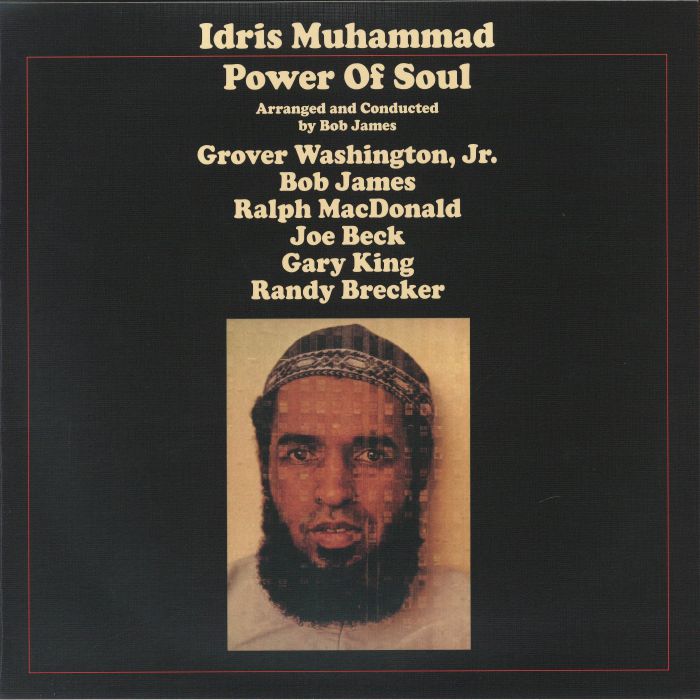
IDRIS MUHAMMAD – POWER OF SOUL.
Idris Muhammad – Power of Soul.
Label: Music On Vinyl.
Format: LP.
Drummer Idris Muhammad’s solo career began at Prestige, where he was also a member of the label’s house band. Truly talented and versatile, Muhammad was primarily a jazz drummer. However, he also played on everything from funk, fusion and soul to disco, jazz-funk, R&B and soul-jazz. Muhammad was Mr Versatility.
Before his solo career began he had already worked with some of the biggest names in jazz. This included Nat Adderley, Gene Ammons, George Benson, Rusty Bryant, Donald Byrd, Lou Donaldson, Charles Earland, Grant Green and Andrew Hill. However, in 1971 Muhammad went from sideman to bandleader.
On November 2nd’ 1970, backed by an all-star band he recorded his debut solo album ‘Black Rhythm Revolution!’ at the Van Gelder Studio at 445 Sylvan Avenue, Englewood Cliffs, New Jersey. It was produced by Bob Porter, and released in 1971.
On its release, ‘Black Rhythm Revolution!’ was reasonably well received. Soul-jazz sat side-by-side with a slight Latin influence and what’s best described as funky fusion. The followup would be quite different to ‘Black Rhythm Revolution!’
Later in 1971, on September ‘13th’ and ‘20th,’ Muhammad returned to Van Gelder Studio to record ‘Peace and Rhythm.’ Just like his debut, it was produced by Porter and featured giants of jazz including bassist Ron Carter, guitarist Melvin Sparks and Kenny Barron on electric piano. ‘Peace and Rhythm’ was released in 1972.
‘Peace and Rhythm’ was released to plaudits and praise. It was poppy with a mellow soul-jazz sound. However, the two-part ‘Peace and Rhythm Suite’ was very different. It was spacey, atmospheric, arrhythmic and innovative. The two tracks were way ahead of their time and have stood the test of time.
After the release of ‘Peace and Rhythm’ Muhammad left Prestige. The next stop for him was Kudu, a subsidiary of Creed Taylor’s CTI Records.
It was founded in 1967, and was a jazz label. By the time Muhammad released his debut album ‘Power Of Soul’ in 1974, Johnny “Hammond” Smith, Lonnie Smith, Grover Washington Jr, Esther Phillips, Hank Crawford and Eric Gale had all released albums on Kudu.
In March 1974, Idris Muhammad entered the Van Gelder Studio where Taylor recorded all of CTI Records and Kudu’s albums. Taylor produced ‘Power of Soul’ which featured an all-star band. This included bassist Gary King, guitarist Joe Beck, percussionist Ralph MacDonald and Bob James on Fender Rhodes and keyboards. They were joined by Grover Washington Jr on tenor and soprano saxophone and Randy Brecker on trumpet and flugelhorn. They played their part in what was a career-defining album for Muhammad.
‘Power of Soul’ was released to widespread critical acclaim in June 1974. Nowadays, the album is regarded as a high-water mark of soul-jazz fusion. It features just four tracks that last just under thirty-five minutes. The album combines seventies groove with a mesmeric balance between jazz sophistication, funk momentum and Taylor’s slick studio production.
Unlike some jazz-fusion albums, ‘Power of Soul’ wasn’t over-produced. It avoided the smooth and shiny sound of albums on other labels that haven’t stood the test of time. Instead, the album benefits from a raw, organic warmth which is anchored by Muhammad’s drumming. Aided and abetted by his all-star band, the result is a genre classic, ‘Power of Soul.’
Side A.
A reworking of Jimi Hendrix’s ‘Power of Soul’ opens the album. The rhythm section of Muhammad’s drums and King’s bass transform the track to a heavy, sassy, strutting, swaggering funk groove. Muhammad’s playing is in the pocket and his hi-hat is tight and injects a degree of urgency. Meanwhile, the rest of the band are allowed the freedom to showcase their considerable skills. Beck’s guitar works against the beat creating tension, while Grover Washington, Jr. delivers a blistering, soul-tinged saxophone solo. All this results in an incendiary opening track that reveals the album’s musical DNA. From here on in, Muhammad and his band will combine jazz in its purist form with uncompromising funk.
Bob James wrote ‘Piece Of Mind.’ It’s an atmospheric slice of cinematic soul-jazz. James sets the scene with lush Fender Rhodes chords and is joined by sweeping, spacious horns. As the track reveals its subtleties and secrets Muhammad combines crisp snare accents and subtle ride cymbal work. In doing so, he lifts and the sheer intensity of Washington Jr.’s soaring, spiralling soprano saxophone solo. Meanwhile, MacDonald’s percussion adds layers of rhythmic detail, and play an important part in this nine minute filmic epic.
Side B.
The tempo drops of the Joe Beck composition ‘The Saddest Thing.’ This ballad encourages one to reflect and ruminate. Beck’s guitar playing is clear and expressive and carries the primary melody over a gentle, swinging groove. Muhammad demonstrates his restraint and sensitivity so not to overpower the rest of the band. He almost caresses the snares and feathers the bas drum feathering. Then Brecker adds a warm, lyrical trumpet solo that accentuates the track’s melancholy and wistful mood.
‘Power of Soul’ saves the best until last. This is the Grover Washington Jr composition ‘Loran’s Dance.’ It opens with what’s without doubt, a truly iconic and haunting Fender Rhodes introductions in jazz-funk history. This gives way to a beautiful, mellow, laid-back groove. Muhammad adds downbeat accents creating an addictive momentum. Washington unleashes one of the finest tenor sax solos of his long and illustrious career, while Randy Brecker’s trumpet work sparkles over Gary King’s mesmeric bassline. During this ten minute opus, Muhammad and his band seamlessly sustain th groove and never lose an ounce of energy. It’s a musical masterclass.
Muhammad’s 1974 masterpiece ‘Power Of Soul’ stands as a definitive high watermark for jazz-funk and soul-jazz fusion. It captures a rare alignment of elite talent, visionary production, and cultural resonance.
On ‘Power Of Soul,’ Muhammad’s explosive yet effortlessly in the pocket drumming serves as the engine for the entire album, and shows that deep groove and technical virtuosity can coexist seamlessly.
Creed Taylor’s pristine production paired with Bob James’ sharp, cinematic arrangements elevated ‘Power Of Soul’ far beyond standard jam-session jazz, turning each track into a sculpted piece of funk architecture. The result was a career-defining album, ‘Power Of Soul,’ that nowadays, is regarded as a genre classic where jazz freedom is fused with funk grit and features the future DNA of hip-hop.
Idris Muhammad – Power of Soul.
- Posted in: Funk ♦ Jazz ♦ Jazz Funk ♦ Jazz Fusion ♦ Soul Jazz
- Tagged: Black Rhythm Revolution!, Bob James, Creed Taylor, Gary King, Grover Washington Jr, Idris Muhammad, Joe Beck, Kudu, Music On Vinyl, Peace and Rhythm, Power of Soul, Ralph MacDonald, Randy Brecker
 dereksmusicblog
