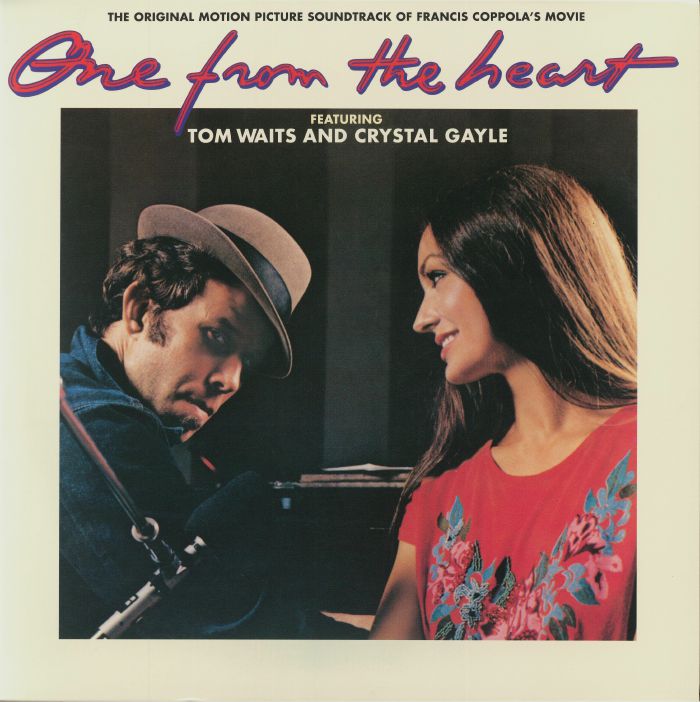
ONE FROM THE HEART FEATURING TOM WAITS AND CRYSTAL GAYLE.
One From The Heart Featuring Tom Waits and Crystal Gayle.
Label: Music On Vinyl.
Format: Vinyl.
When Francis Ford Coppola envisioned ‘One From The Heart’ in 1982, he sought to create a stylised, artificial “live cinema” musical – a neon-drenched fairy tale set against a soundstage facsimile of Las Vegas. To score this hyper-real romance between Hank (Frederic Forrest) and Frannie (Teri Garr), Coppola made a seemingly paradoxical artistic choice: he paired Tom Waits, the gravelly-voiced poet laureate of skid-row dive bars and Tin Pan Alley melancholy, with Crystal Gayle, the crystalline-voiced queen of crossover country-pop.
Released in February 1982 via Columbia Records, the ‘One From The Heart’ original motion picture soundtrack stands not merely as cinematic accompaniment, but as a landmark of late-twentieth-century American songcraft – a lush, nocturnal song cycle that bridged the closing of Waits’s bohemian jazz-lounge era and the sonic experimentation that would define his subsequent masterworks.
Coppola originally approached Bette Midler to duet with Waits, aiming for a theatrical, vaudevillian counterpoint. When Midler proved unavailable, Coppola suggested Gayle, whose pure, effortless soprano possessed a classic Nashville poise. On paper, the pairing seemed an oil-and-water proposition: Waits’s whiskey-soaked, rhythmic growl against Gayle’s pristine, pitch-perfect legato. Yet in practice, the contrast became the album’s emotional engine. In the film’s narrative, Hank and Frannie are two ordinary people trapped in the disillusionment of a five-year relationship, seduced by the illusion of glamour and escape. Gayle’s voice embodies the idealised, romantic yearning of Frannie – clear, hopeful, yet tinged with quiet heartbreak – while Waits’s weathered baritone serves as both Hank’s grounded, stubbled reality and the omniscient, worldweary Greek chorus of the Vegas strip.
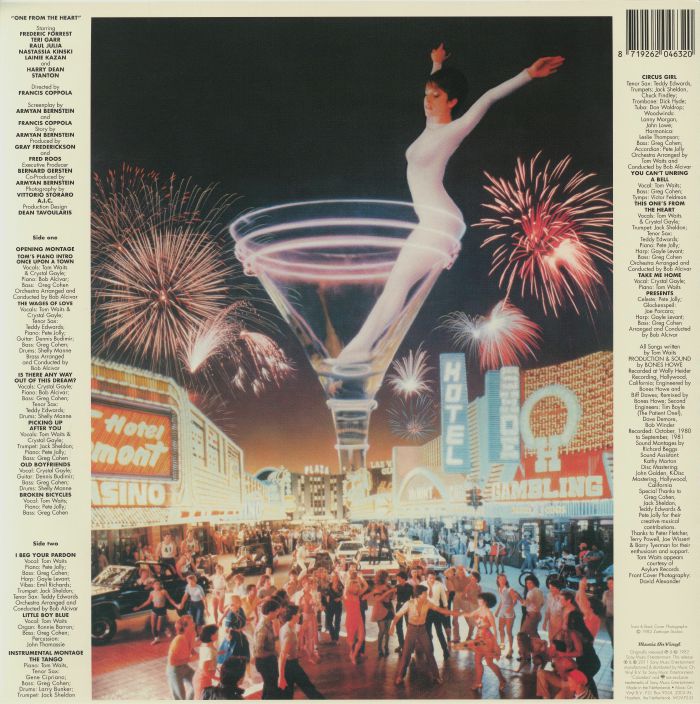
Musically, the soundtrack represents the pinnacle of Waits’s collaboration with arranger and conductor Bob Alcivar, alongside a staggering ensemble of jazz luminaries including pianist Pete Jolly, saxophonists Teddy Edwards and Jack Sheldon, bassist Greg Cohen, and drummer Shelly Manne.
Recorded at Hollywood’s Wally Heider Studios and Zoetrope Studios between October 1980 and September 1981, the album abandons the minimalist, small-combo intimacy of Waits’s seventies Asylum Records catalog in favour of sweeping, Technicolor orchestrations. Strings swell like Douglas Sirk melodramas; muted trumpets sigh in the distance; celestes and vibes shimmer like artificial neon against a painted desert sky. Importantly, this album also marks the creative gestation of Waits’s lifelong partnership with Kathleen Brennan, whom he met on the Zoetrope lot during production, signalling the impending arrival of 1983s ‘Swordfishtrombones;’ Here, however, Waits allows himself one final, glorious embrace of the Great American Songbook, crafting an Academy Award-nominated score that transforms pulp romance into high tragicomic art.
Side One.
The album opens with a masterclass in theatrical world-building, establishing the duality between gritty street-level realism and gilded Hollywood illusion within its first five minutes. ‘Tom’s Piano Intro’ begins alone in the dark: Waits sits at an upright piano, picking out a hesitant, nocturnal blues melody punctuated by the distant, lonely wail of a muted trumpet. It is the sound of 3:00 AM on an empty sidewalk. Suddenly, the curtain rises into ‘Once Upon A Town,’ as Bob Alcivar’s lush string section blossoms into full widescreen splendour. Waits’s vocal enters with a conspiratorial, slightly raspy warmth, introducing the setting as a mythic landscape where “neon is the moonlight.” The suite then pivots seamlessly into ‘The Wages of Love,’ sung by Gayle. Her entrance is revelatory; her voice cuts through the orchestral haze like a beam of pure light, delivering lyrics about romantic transaction and emotional debt with disarming sincerity. By weaving Waits’s cynical prologue directly into Gayle’s earnest aria, the montage immediately establishes the album’s central thesis: in a city built on artifice, love is both the ultimate gamble and the only currency worth spending.
Following the grand overture, the second track narrows the focus to an intimate, late-night interior monologue. Built around a languid, cocktail hour jazz arrangement featuring delicate brush work on the snare and shimmering vibraphone accents, ‘Is There Any Way Out of This Dream?’ showcases Gayle’s remarkable adaptability as a jazz vocalist. Stripped of any country inflection, Gayle approaches the melody with a smoky, understated vulnerability reminiscent of Peggy Lee or Julie London. Waits’s lyricism here is deceptively simple, capturing the quiet claustrophobia of a relationship that has drifted from passion into routine. When Gayle asks the titular question, there is no melodrama in her delivery – only a tired, aching recognition that fantasy and reality have become indistinguishable. The arrangement’s subtle harmonic shifts mirror the sensation of waking up from a vivid dream only to realise the room around you hasn’t changed.
Injecting a dose of brisk, swinging levity into the proceedings, ‘Picking Up After You’ is a classic theatrical argument duet in the tradition of Cole Porter or Frank Loesser, filtered through Waits’s rumpled, working class wit. Driven by a jaunty walking bass-line, crisp rimshots, and playful muted brass stabs, the track dramatiSes the petty domestic frictions that erode a partnership. Waits and Gayle trade verses like seasoned sparring partners: he complains about domestic clutter and emotional nagging with a half-hearted defensive growl, while she counters with crisp, exasperated precision. What elevates the track beyond novelty is the palpable chemistry between the two vocalists. Gayle leans into the rhythmic syncopation with unexpected comedic timing, while Waits plays the lovable, incorrigible rogue. Beneath the snappy Tin Pan Alley bounce, however, lies a sharp psychological truth: couples rarely break up over grand betrayals; they unravel over unwashed dishes and unkept promises.
One of the album’s emotional centrepieces, ‘Old Boyfriends’ is a haunting, bittersweet ballad that demonstrates the extraordinary alchemy of Waits’s songwriting in Gayle’s hands. Accompanied primarily by a melancholic acoustic piano, mournful cello lines, and the occasional sigh of a tenor saxophone, Gayle delivers a masterclass in narrative restraint. The lyrics read like a collection of faded Polaroids – a catalog of past lovers, forgotten names, and roads not taken that resurface when a current relationship hits a rough patch. Gayle’s crystalline tone gives these memories an almost unbearable poignancy; she avoids vocal histrionics, allowing the natural tremor in her upper register to carry the weight of nostalgia and regret. It is a rare moment where Waits’s romantic fatalism is completely unvarnished by irony, resulting in one of the finest vocal performances of Gayle’s career.
If ‘Old Boyfriends’ looks backward with tender regret, ‘Broken Bicycles’ confronts emotional abandonment with stark, poetic desolation. Set to a sparse, minor-key waltz anchored by a lonely, music box piano figure and weeping strings, the song uses discarded childhood toys – rusted handlebars, bent wheels, forgotten wagons – as a devastating metaphor for discarded lovers. Waits’s imagery is quintessential: he finds profound pathos in urban detritus, elevating rust and neglect into high tragedy. Gayle sings the piece with a fragile, porcelain delicacy that makes every syllable sting, particularly on the recurring refrain asking where old lovers go when nobody wants them anymore. The arrangement never swells to a cathartic climax; instead, it lingers in a suspended state of quiet grief, making it one of the most heartbreaking tracks in the entire Waits canon.
Side Two.
Transitioning back to Waits’s solo spotlight, ‘I Beg Your Pardon’ is a smoky, late-night saloon confession steeped in bourbon-soaked regret and Tin Pan Alley sophistry. Backed by a supple, blues-inflected jazz combo featuring a weeping muted trumpet and rolling piano triplets, Waits adopts the persona of a man trying to talk his way back into his lover’s good graces after a night of reckless self-sabotage. His vocal performance is a study in expressive grit – croaking, pleading, and cajoling with self-aware desperation. The lyrics are packed with clever internal rhymes and streetwise metaphors, balancing genuine remorse with the smooth patter of a seasoned gambler trying to hedge his bets. It serves as the masculine counterpoint to Gayle’s ‘Old Boyfriends,’ revealing the clumsy, defensive vulnerability beneath Hank’s bravado.
At just over three minutes, ‘Little Boy Blue’ functions as a darkly whimsical, carnivalesque character study that foreshadows the surrealist direction Waits would pursue later in the eighties. Driven by a lurching, off-kilter rhythm, wheezing reed instruments, and a cynical, swaggering horn section, the track subverts the innocent nursery rhyme into a portrait of disillusioned adulthood. Waits’s voice drops into a gravelly, theatrical rasp, painting a portrait of a faded dreamer stranded in a neon wasteland where fairy tales go to die. The orchestration here is deliberately slightly askew – strings slide uneasily between notes, and percussion clatters like coins in a slot machine—capturing the disorienting glare of the Las Vegas Strip at dawn. It is a vital tonal pivot that prevents the soundtrack from becoming overly sentimental.
This instrumental montage showcases Bob Alcivar’s remarkable architectural command of the orchestra and the sheer musicality of Waits’s compositional sketches. The suite opens with ‘The Tango, a sultry, dramatic showcase fuelled by brooding bass-lines, staccato string accents, and an impassioned, weeping saxophone solo that evokes the illicit glamour of Frannie’s romantic fantasy with Ray (Raul Julia). The tension is thick, theatrical, and unapologetically melodramatic. Gradually, the tango dissolves into ‘Circus Girl,’ shifting into a dizzying, calliope-inflected waltz that captures the intoxicating, slightly manic euphoria of escapism. Flute flourishes, shimmering harp glissandos, and swirling strings create a sonic carousel, brilliantly illustrating how Coppola used music not merely as background, but as the emotional choreography of the film’s characters.
Anchored by a menacing, finger-snapping beat and a slinky, noir-ish upright bass groove, ‘You Can’t Unring A Bell’ is pure midnight fatalism. Waits prowls through the arrangement like a hard-boiled detective delivering a post-mortem on a doomed affair. Punctuated by sharp brass stabs, eerie vibraphone chords, and a sinuous tenor saxophone, the track builds a palpable sense of irreversible consequence. Waits’s vocal delivery is rhythmic and percussive, spitting out aphorisms about time, regret, and finality – “You can’t put the toothpaste back in the tube. You can’t take the whiskey out of the proof.”. It is a masterclass in atmosphere – taut, cynical, and rhythmically hypnotic – demonstrating how seamlessly Waits could merge beat-poetry cadence with classic film-noir orchestration.
The title track serves as the emotional and thematic summit of the entire album, bringing Waits and Gayle together for a sweeping, unabashedly romantic duet. Opening with a lush, cascading piano and string introduction worthy of Golden Age MGM musicals, the song unfolds at a stately, majestic tempo. Waits takes the opening verse with a tender, weathered sincerity, stripping away his defensive cynicism to offer an unguarded vow of devotion. When Gayle joins him, their voices intertwine in a way that feels genuinely miraculous – the rough sandpaper of his baritone cradling the pure silk of her soprano. Rather than smoothing over their differences, the harmony celebrates them, turning their vocal contrast into a metaphor for romantic compromise. As the orchestra swells around them, ‘This One’s From The Heart’ achieves a rare, transcendent grace that earns every ounce of its sentimentality.
Coming immediately after the cathartic sweep of the title track, ‘Take Me Home’ offers a quiet, exhausted coda – the emotional exhale after a long night of reckoning. Sung solo by Gayle over a delicate, lullaby-like arrangement of acoustic guitar, soft strings, and subtle woodwinds, the song radiates a warm, bruised tranquility. There are no grand declarations left to make; instead, there is only the simple, human desire for shelter, familiarity, and grace. Gayle’s vocal is luminous and deeply comforting, conveying a hard-won maturity that acknowledges the flaws of love while choosing it anyway. In the context of the album’s narrative arc, ‘Take Me Home’ feels like the quiet drive back from the airport at dawn, where forgiveness doesn’t require words.
The soundtrack concludes with ‘Presents,’ a brief, atmospheric instrumental miniature that functions as the cinematic equivalent of a slow fade to black. Built around a tender, reflective solo piano melody echoed by soft, lingering strings and a final, distant sigh from a muted trumpet, the piece reprises the core melodic motifs of the album with quiet dignity. Stripped of lyrics, the music allows the listener to sit with the emotional residue of the preceding eleven tracks – the neon glare, the domestic squabbles, the bitter regrets, and the fragile, hard-fought reconciliation. Ending on an unresolved, gently suspended chord, ‘Presents’ leaves the door slightly ajar, reminding us that every love story remains a work in progress.
More than four decades after its release, the ‘One From The Heart’ soundtrack remains an extraordinary anomaly in both film music and popular recording history. Though Francis Ford Coppola’s film suffered a notorious commercial collapse upon its initial release – nearly bankrupting American Zoetrope in the process – its score endured as an undisputed artistic triumph, earning an Academy Award nomination for Best Original Song Score and cementing Tom Waits’s stature as a composer of astonishing range and sophistication.
Historically, the album occupies a pivotal threshold in Waits’s discography. It represents both the grand, orchestral culmination of his early-career obsession with Tin Pan Alley, jazz ballads, and nocturnal Americana, and the springboard from which he would leap into the avant-garde percussive theater of his Island Records trilogy. By forcing himself to write within the disciplined framework of a narrative film – and specifically for a female vocal foil – Waits refined his melodic instincts and stripped his lyricism down to its purest emotional essentials.
Above all, the enduring magic of ‘One From The Heart’ lies in the audacious, unlikely chemistry between its two leads. In pairing Tom Waits and Crystal Gayle, Coppola and Waits achieved a sonic alchemy that defied genre boundaries and commercial logic. Gayle brought warmth, vulnerability, and classical clarity to Waits’s street corner poetry, while Waits grounded Gayle’s ethereal elegance in gritty, lived-in humanity. Together, they transformed an artificial soundstage version of Las Vegas into a landscape of genuine emotional truth – proving that even in a world built of cardboard and neon, a song sung straight from the heart never loses its lustre.
One From The Heart Featuring Tom Waits and Crystal Gayle.
- Posted in: Easy Listening ♦ Jazz ♦ Lounge ♦ Lounge Jazz ♦ Pop ♦ Rock ♦ Soundtrack
- Tagged: Bob Alcivar, Columbia Records, Crystal Gayle, Francis Ford Coppola, Greg Cohen, Jack Sheldon, One From The Heart, One From The Heart Featuring Tom Waits and Crystal Gayle, Pete Jolly, Shelly Manne, Teddy Edwards, Wally Heider Studios
 dereksmusicblog

