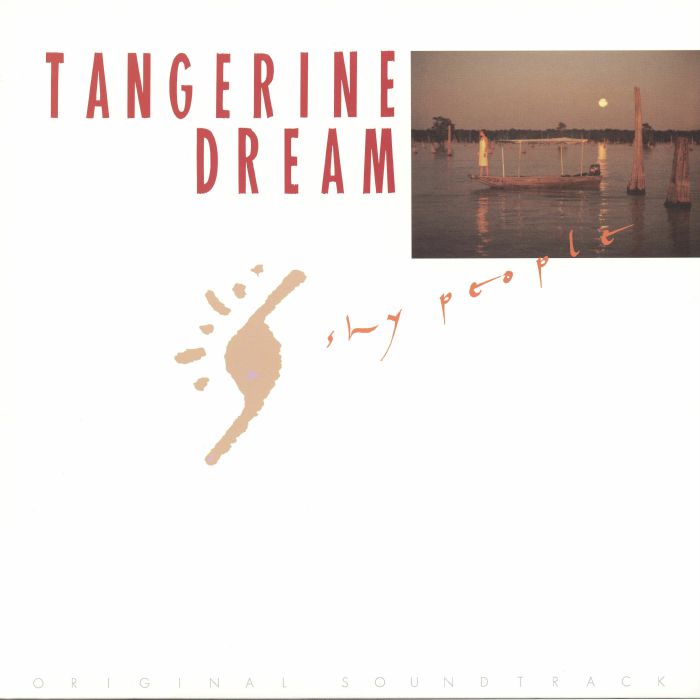
TANGERINE DREAM – SHY PEOPLE.
Tangerine Dream – Shy People.
Label: Music On Vinyl.
Format: Vinyl.
By 1987, Tangerine Dream had completed a remarkable metamorphosis, evolving from pioneers of cosmic, analogue improvisation into one of cinema’s most sought-after electronic scoring ensembles. Released that same year, the soundtrack to Andrei Konchalovsky’s ‘Shy People’ stands as a pivotal document of this transformation, capturing the band at the exact crossroads of avant-garde atmospheric synthesis and glossy, commercial pop accessibility. Emerging during an extraordinarily prolific creative window – immediately following the William Blake-inspired vocal experiments of ‘Tyger’ and running parallel to seminal scores such as ‘Near Dark’ and ‘Three O’Clock High’ – the album translates the dramatic friction of Konchalovsky’s Southern Gothic narrative into a compelling sonic dichotomy.
Anchored by formidable performances from Jill Clayburgh and Barbara Hershey, Konchalovsky’s film examines the volatile collision between two estranged branches of a family: an urbane, neurotic New York journalist and her fierce, intensely protective cousin living in the primordial isolation of the Louisiana bayou. Rather than relying on traditional Americana, swamp-rock, or acoustic folk idioms to establish a sense of place, Tangerine Dream imposed an alien, synthetic soundscape upon the setting. This deliberate aesthetic displacement mirrors the psychological disorientation of the urban protagonists, transforming the humid, claustrophobic expanse of the wetlands into an internal landscape of repressed trauma, paranoia, and generational secrets.
From a musicological perspective, ‘Shy People’ captures a fascinating transitional lineup comprising founder Edgar Froese, longtime rhythmic architect Christopher Franke – in one of his final major collaborations with the ensemble – and classically trained newcomer Paul Haslinger. This trio was actively navigating an acute stylistic tension between their foundational heritage and the commercial realities of the late-eighties music market.
Integrating cutting-edge digital sampling via the Fairlight CMI, crisp electronic percussion, and prominent guest vocalists including Jacquie Virgil and Diamond Ross, the score frequently leans into polished, radio-adjacent synth-pop structures. Compositions such as the title track and ‘Dancing on a White Horse’ reflect a conscious effort to embrace conventional verse-chorus architecture and melodic immediacy. Beneath this commercial veneer, however, the group’s subterranean DNA remained firmly tethered to the vast, brooding textures of the Berlin School. In purely instrumental cues—most notably ‘The Harbor’ and ‘Swamp Voices’—the trio strips away rhythmic predictability in favour of ominous, slow-morphing synthesiser pads, jagged digital textures, and sparse, hypnotic sequencing that evoke dread and emotional stagnation.
Viewed in retrospect, ‘Shy People’ operates on two distinct levels: as a psychological cartography of Konchalovsky’s drama and as an essential artefact of Tangerine Dream’s late-decade evolution. While the abrupt shifts between commercial synth-pop and austere ambient minimalism produce an undeniable sense of tonal whiplash, that very friction is precisely what grants the album its enduring intrigue. Ultimately, the score exemplifies a legendary electronic ensemble willing to destabilise its own artistic identity – sacrificing purist cohesion in order to capture both the commercial zeitgeist of 1987 and the haunting, unresolvable tension at the heart of the film.
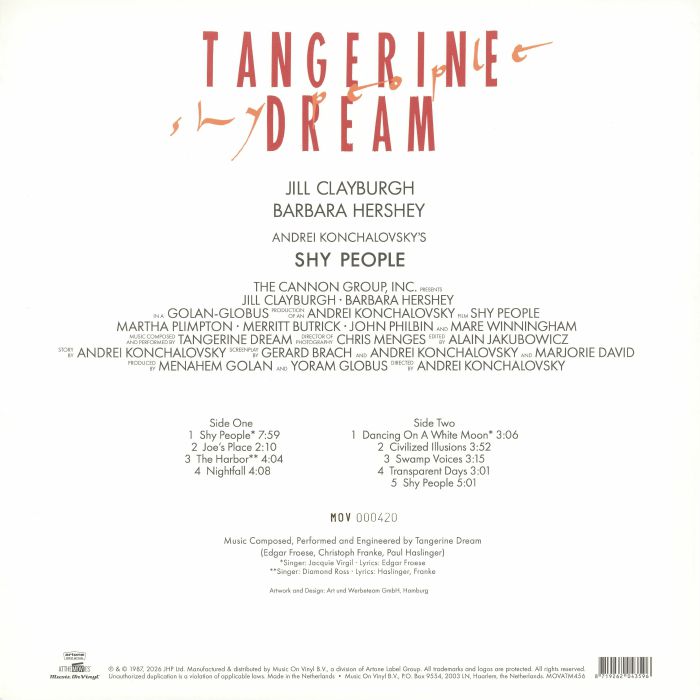
Side A.
Setting the tone for the entire record, the imposing title track immediately challenges expectations by announcing Tangerine Dream’s decisive late-eighties departure from purely instrumental soundscapes. Propelled by a stately, mid-tempo groove and lush, expansive synthesiser pads, the arrangement is anchored by Virgil’s deep, smoky vocal delivery. Her performance imparts a melancholic, blues-tinged gravity that resonates directly with the film’s central themes of cultural alienation and deeply buried family trauma. Although longtime purists have historically viewed the ensemble’s vocal-driven excursions of this period with scepticism, this composition succeeds remarkably well on its own terms – standing as a moody, theatrical overture that seamlessly marries commercial songwriting sensibilities with an unmistakable cinematic grandeur.
Stripping away the theatrical grandiosity of the preceding vocal pieces, ‘Joe’s Place’ pivots abruptly into stark, narrative-driven underscoring. Spanning just over two minutes, the cue unfolds as a cold, minimalist sketch constructed from sparse, drifting keyboard textures and subtle metallic resonances. Deliberately eschewing conventional melodic development or rhythmic structure, the composition functions instead as an acoustic study of physical space- evoking an atmosphere that feels isolated, detached, and heavy with humid stillness. Ultimately, the piece stands as a testament to Tangerine Dream’s refined economy of means, proving how effortlessly the trio could conjure an unsettling sense of psychological and geographic unease from the most restrained sonic palette.
Marking a decisive departure from the opening track’s brooding introspection, ‘The Harbor’ introduces an entirely different vocal dynamic through guest singer Diamond Ross. Built upon a galloping rhythmic pulse, razor-sharp electronic percussion, and synthetic horn and flute voicings, the arrangement embraces the sleek, high-tech production conventions of 1987 with unashamed conviction. Above this kinetic backdrop, Ross delivers a commanding, uninhibited performance that leans boldly into the theatrical. Although its sonic palette is unmistakably rooted in late-eighties adult-contemporary pop and commercial soundtrack aesthetics, this surge of rhythmic urgency provides vital structural relief – infusing the album with a welcome jolt of momentum before the narrative descends back into its darker, more claustrophobic textures.
Emerging as one of the score’s quintessential exercises in pure ambient synthesis, ‘Nightfall’ represents an undisputed high point on the record. Constructed from overlapping strata of chilled, nocturnal synthesiser pads, the composition evokes the gradual descent of darkness across the Louisiana swamplands. Completely devoid of crisp electronic percussion or overt pop artifice, the piece immerses the listener in quintessential Berlin School atmospherics – its glacial harmonic shifts casting long, ominous shadows that mirror the creeping chill of an isolated evening outdoors. In its quiet, unhurried restraint, the cue reaffirms Tangerine Dream’s enduring command of pure cinematic suspense, illustrating the profound emotional resonance they could achieve when relying solely on unadulterated electronic texture.
Side B.
Reclaiming the spotlight for the album’s vocal-driven material, ‘Dancing On A White Moon’ embraces its commercial ambitions without hesitation. Reuniting with guest vocalist Jacquie Virgil, the track is propelled by a crisp, dance-pop rhythm section and bright, effervescent synthesiser hooks reminiscent of mid-eighties radio staples. Although its unapologetically glossy production has occasionally divided longtime enthusiasts – drawing frequent comparisons to mainstream synth-pop contemporaries of the era – the composition serves a vital dramatic purpose within the broader sequence, acting as a sonic intrusion of the modern outside world piercing the suffocating isolation of the bayou.
Bridging the album’s glossy pop sensibilities with its darker thematic undercurrents, ‘Civilized Illusions’ distils the uneasy friction between modern human artifice and untamed nature into pure electronic form. Driven by taut, interlocking sequenced patterns and sleek, precision-tooled keyboard arrangements, the piece generates a distinctly urban tension. Its calculated, almost clinical symmetry mirrors the psychological displacement of metropolitan outsiders thrust into an unforgiving wilderness. Through the delicate interplay of expressive mid-range synthesiser leads and cascading ambient textures, the track achieves an intricate, multi-layered sophistication – transforming a functional dramatic cue into one of the score’s most rewarding sonic studies.
Retreating abruptly from the structured, urban polish of the preceding tracks, ‘Swamp Voices’ draws the album back into an unsettling realm of organic desolation. Constructed from eerie, vocal-like synthesiser patches and windswept ambient pads, the composition simulates the haunting, nocturnal acoustics of an untamed wetland. Despite its frustrating brevity, the piece commands an extraordinary atmospheric weight—stripping away every trace of commercial artifice to submerge the listener once again in the murky, claustrophobic heart of the bayou.
Offering a rare moment of radiant contemplation amid the album’s shifting emotional terrain, ‘Transparent Days’ gracefully reconciles the ambient depths of Tangerine Dream’s past with the melodic clarity of their late-eighties output. Built upon sweeping minor chords and delicate, crystalline electronic arpeggios, the composition achieves a majestic, almost liturgical solemnity reminiscent of Vangelis’s finest introspective works. Balancing monumental scale with an aching sense of fragility, the piece emerges as the score’s luminous emotional centrepiece – grounding the second half of the record with enduring poignancy and grace.
Bringing the album full circle with a telling structural reversal, the closing reprise revisits ‘Shy People’ in a distilled, purely instrumental arrangement, stripped of its vocal lines and condensed from its sprawling opening runtime. Removing the lyrics allows the underlying architecture to breathe in an entirely new light; unencumbered by conventional verse-chorus framing, the intricate layers of Fairlight textures, measured rhythmic pacing, and moody harmonic progressions step firmly into the foreground. By resolving the record’s stylistic duality through unadulterated electronic synthesis, this final statement offers a poised, introspective conclusion that honours Tangerine Dream’s instrumental heritage while bringing Konchalovsky’s psychological journey to a haunting close.
Any comprehensive reassessment of ‘Shy People’ demands an appreciation of its dual identity: both as a standalone studio release within Tangerine Dream’s vast discography and as a functional piece of dramatic underscoring. In critical retrospectives, the album has frequently been consigned to the margins as a respectable yet non-essential curiosity—often grouped alongside ‘Tyger’ as an uneasy excursion into commercial vocal integration. To listeners accustomed to the seamless, long-form hypnosis of the group’s Virgin Records era, the abrupt juxtaposition of austere, nocturnal ambient sketches such as ‘Nightfall’ and ‘Swamp Voices’ with the polished, late-eighties synth-pop sheen of ‘Dancing On A White Moon’ can indeed induce a pronounced sense of stylistic whiplash.
Yet it is precisely this internal friction that underpins the work’s enduring artistic legitimacy. Andrei Konchalovsky’s film is fundamentally an exploration of cultural and psychological collision – a study of metropolitan neurosis crashing against ancient, insular isolation. Rather than smoothing over these contradictions for the sake of conventional album cohesion, Edgar Froese, Christopher Franke, and Paul Haslinger weaponised their own transitional identity to mirror the narrative’s central conflict. By embedding sleek, cosmopolitan pop structures directly alongside primordial, formless electronic soundscapes, the trio created an audacious musical metaphor for the irreconcilable worlds depicted on screen.
Viewed from the vantage point of the modern era, ‘Shy People’ emerges not as an aesthetic misstep, but as a remarkably candid portrait of a pioneering ensemble refusing to calcify into self-parody. Stripped of the commercial expectations that clouded its initial 1987 reception, the record endures as a bold, multifaceted document of creative reinvention – demonstrating that even amid shifting lineups and mainstream industry pressures, Tangerine Dream retained an unmatched gift for sculpting haunting, psychologically resonant sonic environments.
Tangerine Dream – Shy People.
- Posted in: Ambient ♦ Avant Garde ♦ Berlin School ♦ Experimental ♦ Krautrock ♦ Soundtrack
- Tagged: Andrei Konchalovsky, Christopher Franke, Diamond Ross, Edgar Froese, Jacquie Virgil, Music On Vinyl, Near Dark, Paul Haslinger, Shy People, Tangerine Dream, Three O'Clock High, Tyger
 dereksmusicblog

