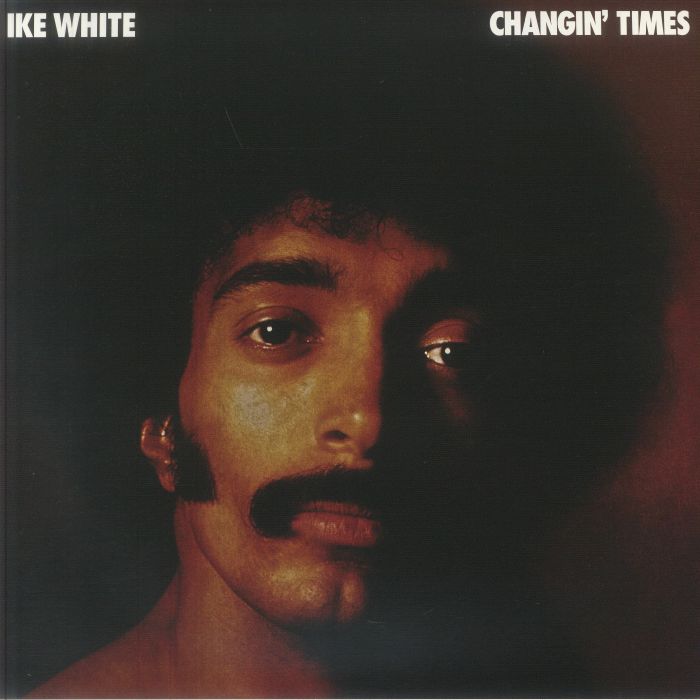
IKE WHITE – CHANGIN’ TIMES (50TH ANNIVERSARY VERSION) (RECORD STORE DAY 2026).
Ike White – Changin’ Times (50th Anniversary Edition) (Record Store Day 2026).
Label: Rhino.
Format: Vinyl.
Captured in 1974 within the concrete confines of the California Institution for Men in Chino and issued in 1976 via the LA International imprint – before achieving mythic, “holy-grail” status among crate-diggers and eventually receiving a revered archival resurrection by Rhino – ‘Changin’ Times’ stands as one of the most astonishing and singular artefacts in the annals of American soul and funk. At its creative epicentre is multi-instrumentalist, vocalist, and songwriter Ike White, who had been serving a life sentence since the age of nineteen.
Working against formidable institutional barriers, White conceived, arranged, and performed the vast majority of the record behind bars, supported by a tightly knit ensemble of fellow incarcerated musicians. The project’s improbable journey from prison cellblock to commercial pressing was championed from the outside by legendary producer Jerry Goldstein – fresh off his era-defining work with War and Sly Stone – alongside soul-jazz titan Jimmy Smith, both of whom recognised the undeniable genius radiating from White’s demos.
Analytically, what elevates ‘Changin’ Times’ far beyond the realm of poignant biographical curiosity is the sheer, uncompromising mastery of its execution. Historically, recordings made inside correctional facilities are valued for their raw documentary immediacy rather than their technical polish; yet White’s vision defies those limitations entirely. Utilising mobile recording equipment brought directly into the facility, the sessions capture a remarkable degree of sonic warmth, spatial depth, and harmonic sophistication that rivals the premier Los Angeles studios of the mid-seventies. White’s command over electric pianos, synthesisers, guitars, and bass serves as the architectural backbone of the album, allowing him to sculpt lush, multi-layered arrangements that feel simultaneously intimate and cinematically expansive.
Across just six sprawling, unhurried tracks, White synthesises the defining currents of seventies Black progressive music into a deeply personal idiom. He marries the loose-limbed, Latin-inflected street funk of Goldstein’s own War with the orchestral, socially conscious psychedelic soul of Curtis Mayfield and Norman Whitfield, while infusing his keyboard voicings and phrasing with the fluid, jazz-inflected intuition of Stevie Wonder. Yet White never sounds merely derivative; every chord change, syncopated bass-line, and soaring vocal passage is filtered through the lived reality of his incarceration. Lyrically and emotionally, the album resists bitterness in favour of profound introspection and spiritual resilience – meditating on the weight of confinement, the ache of lost love, and an unshakeable yearning for personal redemption. Ultimately, ‘Changin’ Times’ endures as a triumph of human creativity over physical captivity, proving that transcendent art can flourish even in the most restrictive environments.
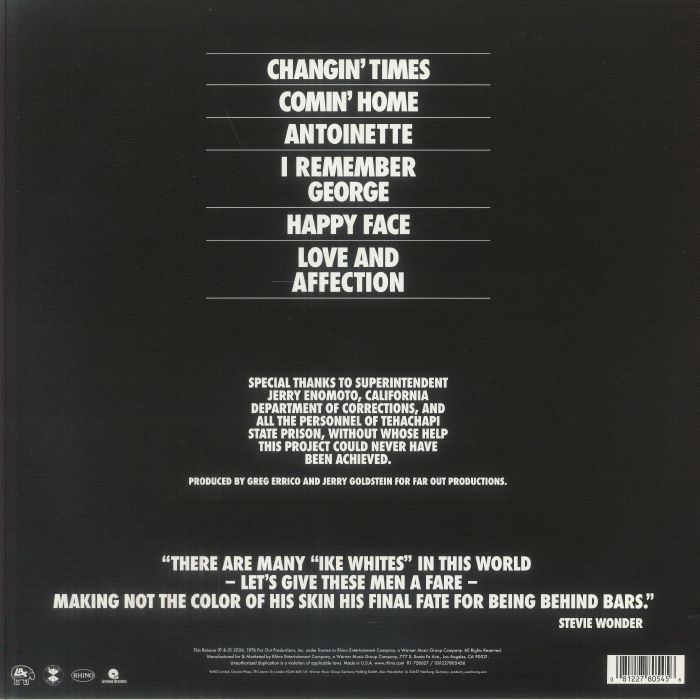
Side A.
Opening the record with its monumental title track, Ike White wastes no time establishing both his musical authority and his philosophical worldview. Driven by a tight, syncopated rhythm section, wah-wah guitar accents, and warm electric piano chords, the track channels the socially observant spirit of mid-seventies War and Marvin Gaye. White’s vocal delivery is remarkably poised – balancing gritty street realism with smooth, melodic phrasing as he surveys a turbulent world from behind prison walls. The arrangement builds patiently through layered percussion and soaring vocal harmonies, turning a commentary on societal upheaval into an anthem of perseverance.
Where the opener carries weight and urgency, ‘Comin’ Home’ erupts with pure, sun-drenched anticipation. Built around an infectious, head-nodding groove, the track showcases White’s extraordinary prowess as a guitarist and keyboardist. Crisp rhythm guitar chops lock seamlessly with bubbly clavinet lines and a buoyant, melodic bass-line. White’s vocals soar with genuine emotional release – singing of freedom and reunion not as abstract concepts, but as visceral, hard-won realities. The communal backing vocals reinforce the sense of shared hope, making the track an irresistible burst of life-affirming funk.
Closing Side A with a dedication to his young daughter, ‘Antoinette’ strips away grand philosophical statements in favour of pure paternal devotion. Built over a gentle, swaying acoustic-and-electric groove, the track glows with warmth and humility. White’s guitar playing is delicate and conversational, framing a vocal performance filled with longing, regret, and unconditional love. Ending ‘Changin’ Times’ on such an intimate, human note grounds the entire record – reminding the listener that behind the virtuosity and studio legend stands a father reaching across prison bars to hold onto his humanity.
Side B.
Slowing the tempo down for one of the album’s most emotionally devastating moments, ‘I Remember George’ serves as a heartfelt eulogy for a fallen friend. Anchored by solemn organ swells, weeping electric guitar bends, and an unhurried, heartbeat-like rhythm, the track avoids melodrama in favour of quiet dignity. White sings with raw, unguarded grief, his voice cracking with sincerity as he honours memory and brotherhood. The instrumental arrangement leaves generous space around the vocals, letting every sustained note and subtle percussive accent carry emotional weight.
‘Happy Face’ reveals White’s gift for psychological subtlety. Beneath its bright, swinging tempo and lush, jazzy chord progressions lies a poignant meditation on emotional armour – the quiet necessity of projecting strength and cheerfulness in environments designed to break the spirit. White weaves intricate, fluid guitar lines around shimmering Fender Rhodes voicings, demonstrating a jazz-inflected harmonic vocabulary that sets him far apart from standard funk songwriters. His phrasing is tender and conversational, allowing vulnerability to peek through the polished melodic surface.
Closing ‘Changin’ Times,’ ‘Love and Affection’ is an epic, slow-burning odyssey that rivals the finest extended suites of Isaac Hayes, Curtis Mayfield, or Funkadelic. Stretching past the eleven-minute mark, the composition unfolds with cinematic patience: shimmering electric piano arpeggios, hypnotic hand percussion, and warm string-like keyboard textures establish a deeply sensual, meditative groove. White’s vocal performance is extraordinarily tender, pleading for human connection across physical and spiritual distance. In its extended second half, the track blossoms into an extended instrumental showcase – highlighting White’s lyrical, singing lead guitar work, which climbs steadily in intensity without ever losing its melodic grace.
Viewed through the broader lens of twentieth-century American music, ‘Changin’ Times’ occupies a singular, nearly mythical space – existing simultaneously as a high-water mark of seventies progressive soul and a profound testament to the redemptive power of artistic self-determination. To appreciate the full weight of Ike White’s achievement, one must separate the album’s extraordinary backstory from its purely musical merits, only to realise how deeply the two inform one another. Had ‘Changin’ Times’ been conceived in a state-of-the-art Hollywood studio with unlimited budgets and session players, it would still stand shoulder-to-shoulder with the era’s finest auteur-driven soul statements. That it was imagined, arranged, and largely performed from within the regimented, sensory-deprived confines of a state penitentiary elevates it into something bordering on the miraculous.
Analytically, White’s genius lies in his refusal to let his physical environment dictate his sonic horizon. Rather than producing a stark, stripped-back document of confinement, he constructed an expansive, technicolor musical universe characterised by intricate harmonic voicings, unhurried tempos, and deeply empathetic interplay. His multi-instrumental fluency—seamlessly bridging jazz-inflected Fender Rhodes phrasing, fluid bass lines, biting wah-wah guitar, and a vocal delivery capable of shifting from intimate vulnerability to soaring, gospel-steeped conviction – gives the record a cohesive auteur vision rarely matched by his free-world contemporaries. Crucially, the contributions of his fellow incarcerated bandmates, alongside the sympathetic, non-intrusive production guidance of Jerry Goldstein, ensure that the music breathes with organic, street-level warmth rather than feeling like an isolated studio exercise.
Thematically, ‘Changin’ Times’ achieves a rare emotional equilibrium. Writing from behind bars, White avoids both maudlin self pity and nihilistic despair, opting instead for a clear-eyed, deeply spiritual humanism. His lyrics grapple honestly with the psychological toll of incarceration, the passage of lost years, and the fragility of human connection, yet every bar is underpinned by an unyielding current of hope, dignity, and resilience. In doing so, the album taps directly into the socio-political heartbeat of mid-seventies Black American music – transforming a deeply personal struggle for freedom into a universal meditation on endurance and grace.
Ultimately, the enduring legacy of ‘Changin’ Times’ – cemented by its decades-long status as an elusive collector’s talisman and its subsequent rediscovery by new generations of listeners – rests on its sheer emotional and musical authenticity. While Ike White’s subsequent life after his eventual parole took complex, often elusive turns that prevented him from building a conventional commercial discography, this single, luminous statement says everything that needed to be said. ‘Changin’ Times’ remains an essential, deeply moving monument in soul and funk history: proof that walls and bars can confine the body, yet remain powerless against a liberated creative spirit.
Ike White – Changin’ Times (50th Anniversary Edition) (Record Store Day 2026).
- Posted in: Funk ♦ Jazz ♦ Psychedelic Soul ♦ Soul
 dereksmusicblog

