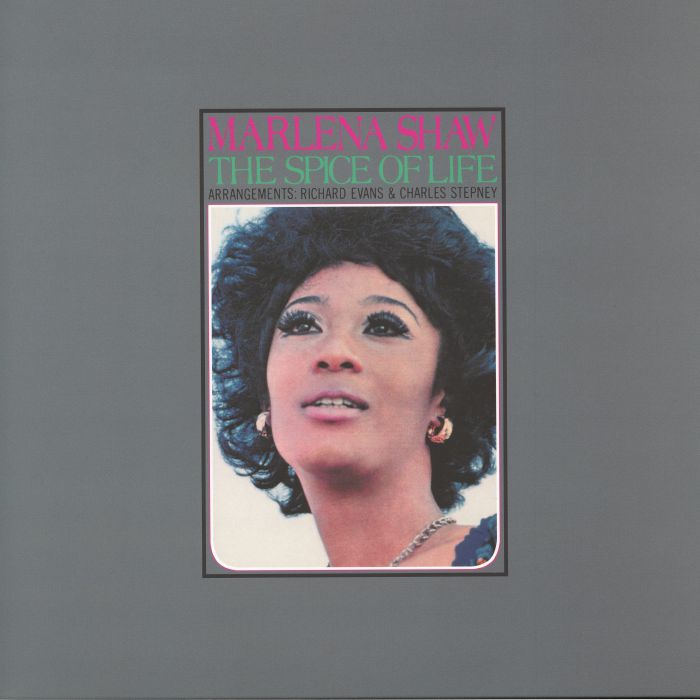
MARLENA SHAW – SPICE OF LIFE (FONTANA THOUSAND CLUB SERIES).
Marlena Shaw – The Spice Of Life (Fontana Thousand Club Series).
Label: Fontana.
Format: Vinyl.
In the late sixties, American popular music underwent a profound structural transformation as the boundaries separating jazz improvisation, soul vernacular, and symphonic pop began to dissolve. At the epicentre of this convergence in Chicago sat Cadet Records, the progressive jazz and vocal subsidiary of the legendary Chess Records imprint. When Marlena Shaw entered Chess’s Ter Mar Studios in February and July of 1969 to record her second studio album, ‘The Spice Of Life,’ the resulting work transcended conventional genre categorisation. More than a mere sophomore followup, the record stands as a landmark achievement in late-twentieth century vocal production – an ambitious synthesis of hard-grooving soul-jazz, densely layered orchestral R&B, and urgent social commentary that captured a watershed moment in both Shaw’s career and the broader trajectory of Black American music.
Prior to the 1969 sessions, Shaw had already established herself as a formidable technician on the East Coast club circuit and through her 1967 Cadet debut, ‘Out Of Different Bags.’ Those early performances showcased a vocalist of remarkable agility, capable of pivoting seamlessly from the melismatic urgency of the Black church to the wry, conversational phrasing of supper-club jazz. However, it was the catalytic pairing of Shaw with Chicago arranger-producers Charles Stepney and Richard Evans – working under the executive supervision of producer Bobby Miller – that unlocked the full dramatic potential of her instrument. Stepney and Evans recognised that Shaw’s voice did not merely sit atop an accompaniment; it required a dynamic, three-dimensional environment capable of matching her narrative range and emotional acuity.
At the core of ‘The Spice Of Life’ lies the revolutionary sonic architecture engineered by Stepney and Evans, two visionary orchestrators who treated the multi-track studio as a compositional instrument in its own right. Rejecting the standard templates of the era – which typically confined female jazz-soul vocalists to either intimate organ trio backing or predictable, punchy horn charts – the duo constructed intricate, multi-tiered arrangements. They anchored the low end with muscular, syncopated Chess rhythm sections driven by the kinetic precision of drummer Morris Jennings, then suspended sweeping string sections, contrapuntal woodwinds, dramatic brass swells, and textured percussion above the groove. This interplay between visceral, street-level rhythmic drive and high-art symphonic colour created an unmistakable tension: the arrangements feel simultaneously grounded in the body and expansive in scope, providing a lush yet urgent framework for Shaw’s vocal delivery.
Contextualised within the socio-political turbulence of 1969 – a year defined by intensifying civil rights struggles, Black cultural self-determination, and rapid aesthetic experimentation—the album’s title operates as an explicit artistic thesis. ‘The Spice Of Life’ is curated as a study in deliberate stylistic juxtaposition, moving fluidly between militant, first-person street testimony, reimagined Brill Building pop standards, civil rights anthems, classic blues structures, and theatrical torch songs. Rather than fracturing the album’s cohesion, this radical eclecticism serves to highlight Shaw’s interpretive authority. Whether delivering a pointed social critique or unpacking the psychological nuances of romantic vulnerability, her razor-sharp diction, rhythmic elasticity, and commanding tonal control act as the gravitational centre holding every stylistic pivot in place.
Ultimately, the enduring legacy of ‘The Spice Of Life’ rests on its refusal to compromise complexity for accessibility, or groove for sophistication. Decades after its initial release, the album remains a touchstone for crate-diggers, hip hop producers, and vocalists alike – not merely as a nostalgic artefact of late-sixties Chicago soul, but as a masterclass in collaborative studio craft. By uniting Marlena Shaw’s peerless vocal storytelling with the avant-garde orchestral sensibilities of Charles Stepney and Richard Evans, ‘The Spice Of Life’ codified a blueprint for progressive soul that continues to resonate across generations of contemporary music.
Side One.
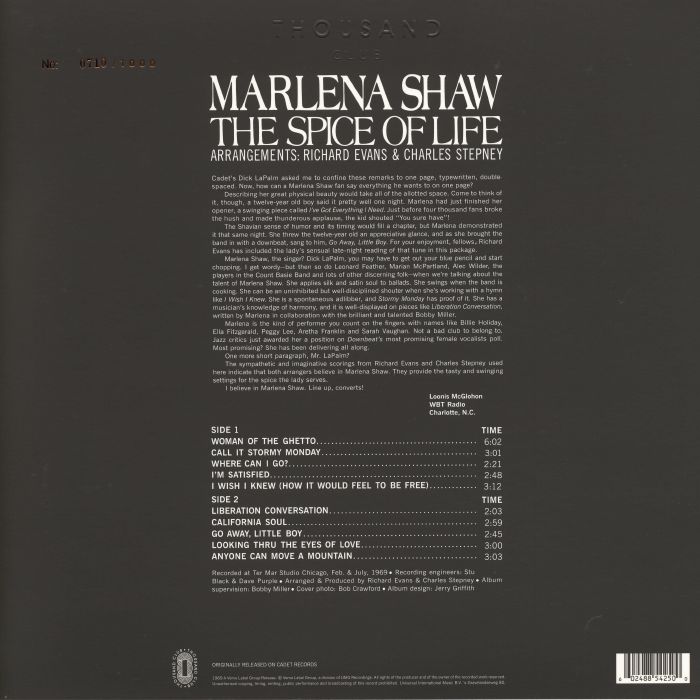
From its very first bars, ‘Woman Of The Ghetto’ sets the artistic and ideological tone for ‘The Spice Of Life,’ unveiling a six-minute tour de force of incisive social commentary and rhythmic mastery co-written by Marlena Shaw, Bobby Miller, and Richard Evans. Anchored by a hypnotic, mid-tempo Latin-inflected groove – propelled by crisp percussion, a resonant upright bass-line, and punctuating brass stabs – the track bypasses conventional verse-chorus predictability in favour of a simmering, cyclical tension. Over this kinetic foundation, Shaw balances maternal warmth, prophetic authority, and razor-sharp irony, vividly chronicling systemic neglect, economic disparity, and enduring resilience within urban Black communities. Her phrasing locks effortlessly into the pocket before erupting into searing, gospel-charged melismas ,seamlessly complemented by Evans’s lush orchestration of swirling flutes and sweeping strings. Ultimately, the piece endures as a defining triumph of the soul-jazz canon, marrying undeniable dancefloor magnetism with unflinching political urgency.
Following the urgent modernity of the opener, Shaw turns backward to honour foundational blues lineage with T-Bone Walker’s perennial standard, ‘Call It Stormy Monday.’ Rather than rendering it as a dusty museum piece, the arrangement reframes the twelve-bar blues through a sleek, late-sixties Chicago soul-jazz lens. Slowing the tempo to a languid, after-hours crawl, the rhythm section lays down a heavy, simmering pulse punctuated by stinging electric guitar licks and warm organ chords. Shaw approaches the familiar lyric – chronicling the weeklong emotional grind from Monday’s misery to Sunday’s redemption – with theatrical restraint. She bends notes with sly precision, leaning behind the beat to extract maximum emotional weight from every syllable before unleashing a soaring, blues-drenched climax in the final stanzas. It is a masterclass in vocal control that validates her credentials as a premier interpreter of classic American song.
Written by Leo Fuld, Sigment Berland, and Sonny Miller, ‘Where Can I Go?’ shifts the album’s emotional register toward existential vulnerability and cabaret intimacy. Clocking in at just over two minutes, this poignant ballad strips away heavy funk propulsion in favour of lush, cinematic orchestration. Sweeping strings and delicate woodwind flourishes cradle Shaw’s voice as she inhabits the perspective of a wanderer searching for belonging and sanctuary in an indifferent world. Here, Shaw showcases the purity of her midrange tone and her immaculate diction, treating each line like dramatic monologue rather than mere melody. The brevity of the track amplifies its impact; it serves as a quiet, reflective palate cleanser on Side A, demonstrating that Shaw’s power relies as much on whispered nuance as on full-throated projection.
Penned by Morris Dollison, ‘I’m Satisfied’ snaps the listener back to attention with a jubilant, gospel-charged surge of pure R&B energy. Driven by a buoyant, rolling groove, punchy horn stabs, and call-and-response vocal dynamics, the track radiates unbridled romantic and spiritual contentment. Shaw’s delivery is effortless and exuberant, riding the crest of the rhythm section with playful syncopation and infectious warmth. Where earlier tracks explored struggle and displacement, ‘I’m Satisfied’ celebrates arrival and emotional fulfilment. The interplay between Shaw’s agile vocal improvisations and the tight, celebratory brass arrangement captures the golden-era chemistry of Chicago soul at its most uplifting.
Side one culminates in a commanding interpretation of ‘I Wish I Knew (How It Would Feel To Be Free),’ transforming Billy Taylor and Dick Dallas’s civil rights anthem into a deeply personal statement of resolve. Though forever linked to Nina Simone’s landmark 1967 recording – a daunting benchmark for any vocalist – Shaw claims the composition entirely on her own terms. Beginning with stately, gospel-inflected piano chords, the arrangement swells into a majestic, symphonic crescendo propelled by rolling percussion and sweeping strings. Mirroring this architectural build, Shaw’s delivery evolves from quiet, aching introspection in the opening verses to an ecstatic, full-throated declaration of liberation at its climax. Positioned immediately after ‘I’m Satisfied,’ the track provides an essential thematic counterweight, underscoring that individual contentment remains fundamentally incomplete without the realisation of collective freedom.
Side Two.
Launching the second half of the record with unmistakable urgency, ‘Liberation Conversation’ -co-written by Shaw and Bobby Miller – compresses the album’s musical and political ethos into two minutes of pure kinetic force. Driven by a blistering, syncopated funk-jazz breakbeat, rapid-fire conga patterns, and incisive brass accents, the arrangement channels the volatile energy of 1969’s liberation movements. Shaw matches this instrumental velocity with a breathless, conversational cadence that blurs the line between agile scat improvisation and impassioned street-corner testimony. Every bar surges forward without a wasted gesture, seamlessly bridging hard bop discipline with the raw pulse of emergent funk. In its concentrated brilliance, the track endures as a vital, forward-looking high-water mark in Shaw’s discography.
Reimagining Nickolas Ashford and Valerie Simpson’s Motown-penned gem as a landmark of psychedelic-orchestral soul,’California Soul’ stands as the radiant centrepiece of ‘The Spice Of Life.’ Guided by Charles Stepney’s kaleidoscopic production, the track announces itself with an iconic, propulsive drum break and cascading harp and string flourishes before blooming into an exhilarating wall of sound. Stepney weaves sweeping strings, jubilant horns, driving percussion, and shimmering tambourine into a dizzying, Technicolor soundscape. At the centre of this orchestral storm, Shaw delivers a performance of magnetic charisma – commanding, luminous, and effortlessly buoyant. Riding the surging arrangement with soaring high notes and rhythmic grit, she elevates a straightforward travelogue into an enduring anthem of liberation and joy – one whose seismic cultural footprint spans Northern Soul dancefloors, foundational hip hop sampling, and global pop consciousness.
Shifting gears from the euphoric intensity of ‘California Soul,’ Shaw turns her attention to Brill Building pop craftsmanship with a nuanced reinterpretation of Gerry Goffin and Carole King’s ‘Go Away, Little Boy.’ Originally a 1962 teen-pop hit for Steve Lawrence, the composition is thoroughly transformed into a sophisticated, mid-tempo soul-jazz confession. Grounded by a warm walking bassline, crisp brushwork, and lush string swells, the arrangement replaces youthful melodrama with measured adult complexity. Shaw’s jazz instincts take centrestage as she navigates the bittersweet friction between desire and self-preservation, urging a conflicted lover to walk away before inevitable heartbreak ensues. By bending Goffin and King’s melody through subtle rhythmic displacements, she demonstrates the interpretive depth of a master stylist – effortlessly elevating a mainstream pop standard into a work of lasting emotional resonance.
Extending her deep dive into premier sixtes songwriting partnerships, Shaw brings a luminous new dimension to Barry Mann and Cynthia Weil’s ‘Looking Through The Eyes of Love.’ Previously defined by Gene Pitney’s dramatic original, the ballad is recast here within a shimmering baroque-soul framework built on harpsichord-inflected textures, sweeping strings, and a propulsive backbeat. Shaw infuses the lyric with radiant conviction, her voice gliding effortlessly across the ornate orchestration to capture the transformative clarity of devotion. Crucially, the performance avoids maudlin excess by pairing romantic grandeur with crisp rhythmic discipline—letting Shaw’s crystalline upper register and measured vibrato command the centre of a richly layered arrangement.
Bringing ‘The Spice Of Life’ to a resonant, theatrical close, Shaw delivers a stirring interpretation of Johnny Marks’s ‘Anyone Can Move A Mountain.’ Anchored by a stately, hymnal progression that gradually builds into a sweeping orchestral finale, the arrangement provides a fitting benediction for a record steeped in perseverance, struggle, and triumph. Shaw approaches the philosophical lyric with measured poise, underscoring the quiet resolve required to confront seemingly insurmountable obstacles. As strings and brass crest behind her in the final bars, her voice rings out with gospel-inflected conviction – completing the album’s emotional trajectory by bridging the gritty systemic realities of ‘Woman Of The Ghetto’ with an enduring testament to human agency and hope.
Released in 1969 on Chicago’s storied Cadet Records – an imprint of Chess Records best known for pushing the boundaries of jazz, soul, and R&B – Marlena Shaw’s sophomore studio album, ‘The Spice Of Life,’ stands as a watershed achievement in late-sixties Black popular music. Arriving at a moment of profound cultural, political, and sonic upheaval, the record captures an artist stepping decisively out of the supper-club jazz tradition and into the vanguard of progressive orchestral soul. While Shaw’s 1967 debut, ‘Out Of Different Bags,’ hinted at her interpretive versatility, ‘The Spice Of Life’ realises her full artistic dimension, positioning her alongside contemporaries such as Nina Simone, Roberta Flack, and Aretha Franklin as a vocalist capable of holding radical social critique and sublime romanticism in seamless equilibrium.
Crucial to the album’s enduring power is the creative synergy between Shaw and Cadet’s visionary in-house architects, arrangers Richard Evans and Charles Stepney. Together, they forged a daring hybrid aesthetic that dissolved the rigid commercial boundaries separating hard bop improvisation, gospel testimony, Brill Building pop, and psychedelic orchestration. Under their direction, traditional jazz rhythm sections – grounded by upright bass, intricate brushwork, and syncopated Latin percussion – collide with kaleidoscopic walls of sweeping strings, stabbing brass, harpsichord textures, and propulsive funk breakbeats. Rather than overwhelming Shaw’s instrument, these maximalist arrangements act as an expressive canvas, amplifying every nuance of her phrasing – from conversational intimacy and biting irony to seismic, church-bred melismas.
Conceptually, ‘The Spice Of Life’ lives up to its title not as a scattershot collection of covers and originals, but as a deliberate, deeply unified emotional and political journey. Across its sequencing, Shaw interrogates the full spectrum of the Black American experience at the close of the sixties: the systemic neglect and economic hardship of urban life, the urgent call for collective liberation, the vulnerability of adult romance, and the quiet resilience of spiritual faith. By treating every composition – whether co-written in the studio or borrowed from the mainstream pop canon – as a vehicle for personal truth, Shaw establishes a singular vocal authority that anchors the album’s stylistic breadth.
Viewed in its entirety, ‘The Spice Of Life’ succeeds because it refuses to compartmentalise the human condition; instead, it insists that political urgency, romantic vulnerability, and transcendent joy are vital, inseparable threads of the same tapestry. Across its runtime, Marlena Shaw demonstrates an extraordinary command of dramatic pacing and vocal architecture, effortlessly pivoting from the searing social realism of ‘Woman Of The Ghetto’ and the breathless militancy of ‘Liberation Conversation’ to the psychedelic euphoria of ‘California Soul’ and the poised introspection of ‘Go Away Little Boy.’ Aided by the visionary arrangements of Richard Evans and Charles Stepney, Shaw transforms every stylistic shift into an organic extension of her own emotional truth, proving that orchestral ambition and rhythmic grit need never come at the expense of intimacy.
More than half a century after its initial release, the album’s cultural resonance has only deepened. While ‘California Soul’ and ‘Woman Of The Ghetto’ found vibrant second lives across Northern Soul dancefloors, rare groove compilations, and foundational hip hop sampling, the true triumph of ‘The Spice Of Life’ lies in its cohesion as an album statement. It remains a masterclass in interpretive artistry and studio craft – a fearless, genre-defying work that captures the volatile spirit of 1969 while offering a timeless blueprint for soul-jazz sophistication. Ultimately, ‘The Spice Of Life’ stands not merely as Marlena Shaw’s defining masterpiece, but as an indispensable monument in the canon of American music.
Marlena Shaw – The Spice Of Life (Fontana Thousand Club Series).
- Posted in: Blues ♦ Funk ♦ Gospel ♦ Jazz ♦ Pop ♦ R&B ♦ Soul ♦ Soul Jazz
- Tagged: Bobby Miller, Cadet Records, California Soul, Call It Stormy Monday, Charles Stepney, Chess Records, Fontana, Liberation Conversation, Marlena Shaw, Morris Jennings, Out of Different Bags, Richard Evans, Ter Mar Studios, The Spice of Life, The Spice Of Life (Fontana Thousand Club Series), Woman of the Ghetto
 dereksmusicblog

