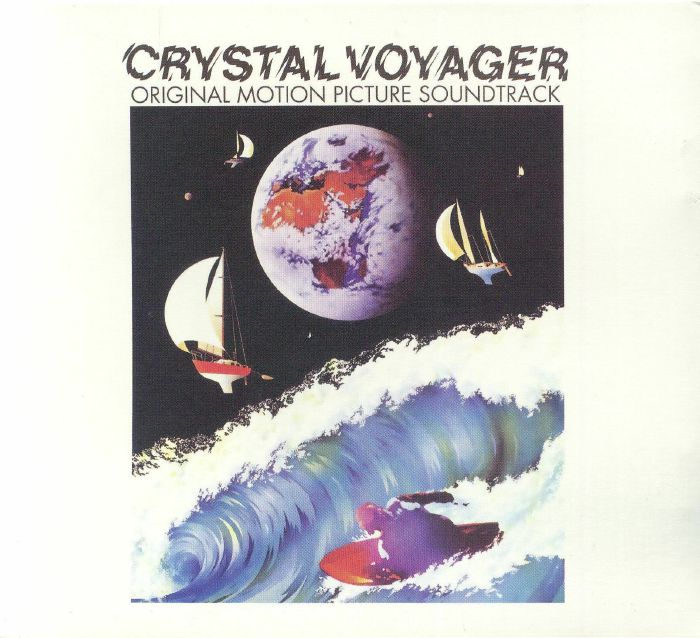
G WAYNE THOMAS – CRYSTAL VOYAGER ORIGINAL MOTION PICTURE SOUNDTRACK.
G Wayne Thomas – Crystal Voyager Original Motion Picture Soundtrack.
Label: Waveface.
Format: CD.
Within the canon of seventies Australian independent cinema and countercultural soundtracks, few works achieve the formal cohesion and sonic intimacy of the 1973 score to ‘Crystal Voyager.’ Issued on the independent Warm and Genuine imprint, the album operates far beyond the conventional boundaries of incidental film music, functioning instead as a sustained meditation on craftsmanship, solitude, and marine hydrodynamics. Directed by David Elfick, photographed by Albert Falzon, and written and narrated by Californian surf pioneer George Greenough, the film deliberately rejected the prevailing ensemble travelogue template of contemporary surf cinema. Rather than documenting a nomadic cohort chasing swells across tropical coastlines, ‘Crystal Voyager’ turned its lens inward, offering an unhurried psychological and technical portrait of Greenough himself – an autodidactic inventor and marine filmmaker constructing his thirty-seven foot ocean-going ferro-cement yacht, Morning Light, in a coastal junkyard while refining flexible kneeboards (“spoons”) and dolphin-inspired fin geometries.
To articulate this study of solitary engineering and oceanic immersion in sound, Elfick enlisted New Zealand-born, Sydney-based singer, songwriter and producer G. Wayne Thomas. Arriving directly after the commercial and cultural watershed of ‘Morning Of The Earth – a multi-artist compilation he had curated and produced in 1972 – Thomas opted for an inverse methodology for ‘Crystal Voyager.’
Abandoning the anthology model, he conceived, composed, and tracked a singular, through-composed song cycle in approximately ten days, convening a bespoke studio unit billed as The Crystal Voyager Band. The personnel represented a cross-section of early-seventIes Australia’s premier progressive and session talent: keyboardist Bobby Gebert (also credited as Gibbert on original sleeves), whose modern jazz fluency and command of Moog and ARP synthesisers anchored the album’s harmonic architecture; guitarist Mick Liber (formerly of Python Lee Jackson), who contributed lyrical, blues-inflected phrasing; bassist Rod Coe; and drummer John Proud.
A critical distinction separates the theatrical print from the commercial phonograph record. While the film’s climactic twenty-three minute tube-riding sequence famously incorporated Pink Floyd’s ‘Echoes’ via a reciprocal licensing exchange – granting the British quartet Greenough’s liquid, slow-motion 16mm cinematography for their live concert projections – the album release belongs exclusively to Thomas and his studio ensemble.
Stylistically, the recording synthesises the acoustic warmth of West Coast Laurel Canyon folk-rock, the pastoral lyricism of British progressive rock, and the textural subtlety of jazz-inflected soft psychedelia.
Equally significant to an analytical reading of the work is its physical sequencing. Original 1973 Australian vinyl pressings (Warm and Genuine 2907 010) diverge markedly in track order from several contemporary digital streaming editions – most notably in the placement of the suite-like title piece for Greenough’s vessel, ‘Morning Light,’ which inaugurates Side B on the original pressing rather than serving as a closing coda. Assessing the album in its authentic, two-sided analog configuration exposes a deliberate dramaturgical architecture: Side A establishes the terrestrial themes of labor, isolation, and mechanical preparation, while Side B transitions into maritime release and metaphysical transcendence. Ultimately, ‘Crystal Voyager’ endures not merely as an artifact of early-seventies Australian surf culture, but as an exemplar of unified auteurist scoring—where compositional restraint, studio virtuosity, and physical format sequencing converge to mirror the exact rhythm of its subject’s life and work.
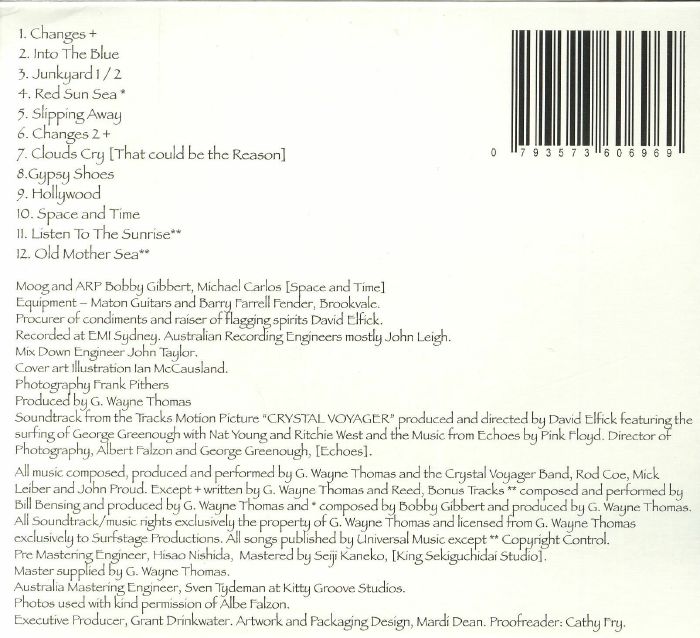
‘Changes’ wastes no time setting the emotional and sonic parameters of the record, immediately anchoring the listener in a rhythmic and harmonic palette that feels both grounded and quietly propulsive. Driven by Thomas’s warm, mid-range acoustic strumming and an understated, syncopated pocket from John Proud and Rod Coe, the track introduces the album’s central philosophical motif: a commitment to perpetual motion and a rejection of static, terrestrial routines.Thomas’s unhurried, conversational vocal delivery acts as a natural, third-person extension of Greenough’s own soft-spoken narration. Throughout the arrangement, Bobby Gebert’s electric piano fills thread deftly through the midrange without cluttering the stereo field, while Mick Liber’s clean electric guitar lines offer subtle melodic counterpoints. By eschewing a conventional, explosive rock chorus in favour of gradual textural layering, the arrangement exercises a deliberate restraint – one that signals the album’s unforced, organic discipline long before the first track fades.
If ‘Changes’ establishes the record’s philosophical compass, ‘Into The Blue’ delivers the visceral rush of casting off from the shore. Propulsive yet airy, the track is carried by a rolling acoustic progression and lush, multi-tracked harmonies that distill the sunlit melancholy at the heart of early-seventies Australasian folk-rock. Its chord voicings drift effortlessly between major-key warmth and wistful minor suspensions, mirroring the shifting light across an open Pacific horizon. Beneath the vocal blend, Coe’s melodic bass lines anchor the low end with remarkable harmonic independence, frequently walking upward to converse with Gebert’s shimmering keyboard textures. Within the narrative arc of the film, the piece marks the threshold where landbound preparation gives way to maritime freedom – a cinematic shift realised through pure, open-voiced acoustic resonance.
‘Junkyard 1’ and ‘Junkyard 2’ are two distinct movements on the album, whereas they are a continuous suite on digital reissues. This centrepiece signals the album’s sharpest pivot toward earthy, rhythmic grit. Built to score footage of Greenough salvaging scrap metal, shaping fibreglass, and fabricating custom boat hardware, the piece trades coastal airiness for mechanical muscle. The opening movement locks into a taut, mid-tempo funk-rock pulse, propelled by Proud’s crisp snare work and a clanking, percussive guitar motif that subtly echoes the industrial clatter of a working boatyard. Crossing into its second act, the arrangement breaks free into an exploratory instrumental jam, where Liber steps forward with biting, blues-inflected leads to trade space with Gebert’s swirling organ and early analog synthesizer textures. Ultimately, the diptych mirrors the very alchemy of Greenough’s craft—forging raw, discarded industrial scrap into a sleek vessel of oceanic escape.
Stepping outside the album’s singer-songwriter framework, keyboardist Bobby Gebert commands the atmospheric centrepiece of Side A of the original album with ‘Red Sun Sea,’ a pure, wordless showcase of the ensemble’s jazz-rock fluency. Gebert builds an evocative modal soundscape anchored by warm Fender Rhodes electric piano and sustained analog synth pads, allowing the music to breathe without lyrical distraction. As the tempo eases into a hypnotic, tidal sway, the rhythm section abandons rigid backbeats in favour of subtle, conversational dynamic shifts. Over this fluid foundation, Liber’s guitar enters with lyrical, volume-swelled sustain that blurs the boundary between stringed instrument and human voice. Acting as a quiet threshold between dusk and open-water contemplation, the composition stands as definitive proof of how Gebert’s jazz pedigree elevated Crystal Voyager far beyond the conventions of standard acoustic surf scores.
Receding from the expansive modal horizons of ‘Red Sun Sea,’ ‘Slipping Away’ draws the listener back into the quiet intimacy of an acoustic folk ballad. Built around delicate fingerpicking and a vulnerable, close-mic’d vocal from Thomas, the arrangement exercises remarkable economy across its sub-three-minute runtime – relying on soft brushed percussion, warm bass notes, and understated keyboard accents to frame reflections on transience, impermanence, and the fleeting nature of peak moments on the water. Distilled to its emotional essentials, the track reads like a private journal entry penned by lamplight aboard a moored vessel, offering a vital breath of stillness before the album surges toward the climactic Side A closer.
Bringing the first half of the original album to a resonant close, ‘Changes 2’ circles back to the melodic and harmonic DNA of the opening track, transforming its initial statement of intent into a reflective coda. Rather than replicating the full-band momentum of track one, this variation pares the arrangement down to an intimate, chamber-folk register that invites quiet introspection. Functioning as an architectural bookend for Side A, the reprise confirms that even as the journey shifts from the industrial clutter of the boatyard to the boundless expanse of open water, the core commitment to self-reliance and continuous evolution remains steadfast.
Shifting the album’s emotional barometer toward cooler, more overcast skies, ‘Clouds Cry (That Could Be The Reason)’ weaves baroque pop elegance into fluid soft rock orchestration. Set to a pensive mid-tempo cadence, the track is grounded by a descending bass figure and wistful electric piano chords that create a sense of gentle downward drift. Through lyrics that personify shifting weather patterns, Thomas draws a quiet parallel between atmospheric turbulence and human introspection. At the song’s midpoint, the arrangement opens up to welcome soaring, melancholic electric guitar lines from Mick Liber—phrased with an ache of deliberate restraint that evokes the solitary calm of waiting out a coastal squall in anticipation of the coming swell.
injecting a burst of sunlit momentum into the record’s second half, ‘Gypsy Shoes’ distills the itinerant, anti-materialist spirit of seventies countercultural surf life into its most infectious cut. Carried by a brisk, shuffling country-rock groove and crisp acoustic strumming, the track radiates an immediate kinetic lift. Behind the kit, Proud drives the ensemble forward with effortless swing, leaving space for Gebert to weave playful, honky tonk-inflected electric piano runs through subtle analog synthesiser flourishes. In both lyric and arrangement, the song captures the pure exhilaration of rootlessness – trading conventional expectations for an open horizon, and standing out as one of the album’s sharpest, most irresistible standalone moments.
Disrupting the album’s sun-drenched coastal reverie with a sudden flash of urban cynicism, ‘Hollywood’ aims a wry, incisive critique at the artificiality, commercialism, and manufactured glamour of the entertainment machine. To match the bite of the lyrics, Thomas and the band pivot toward a heavier, world-weary rock posture – driven by minor key tension, serrated electric guitar riffs, and brooding organ drones. Within the broader narrative of ‘Crystal Voyager,’ the track embodies the very mainland culture Greenough turned his back on: a synthetic world of spectacle and conformity set in stark opposition to the raw, unscripted truth of the sea. By plunging the record into its darkest harmonic territory, ‘Hollywood’ supplies the essential dramatic friction needed to launch the album into its transcendent, cosmic finale.
Unfolding across nearly seven hypnotic minutes, ‘Space and Time’ stands as the undisputed centrepiece of ‘Crystal Voyager’ – an expansive, psychedelic odyssey where every thematic and sonic thread of the record converges. Crafted to mirror the sensory distortion of riding deep inside the barrel of a hollow wave, where linear time dilates and physical orientation dissolves, the piece emerges from echoing guitar notes and shimmering synthesiser washes before locking into a slow-burning, subterranean groove. Thomas’s vocals drift through the mix like distant radio transmissions, gradually surrendering the space to an immersive, multi-layered instrumental passage. Beneath the surface, Gebert sculpts swirling, underwater textures from Moog and ARP synthesisers, while Liber unleashes soaring, sustained solo lines that crest and recede like deep-ocean swells. Eschewing rock bombast in favour of pure atmospheric suspension, the Crystal Voyager Band achieves a rare, effortless weightlessness – carrying the album out on a transcendent horizon that lingers long after the final note fades.
Distilling the contemplative heart of early-seventies Australian folk-rock into a moment of pure stillness, ‘Morning Light (That Could Be the Reason)’ opens the listener onto the quiet expanse of the sea at daybreak. Conceived by composer and producer G. Wayne Thomas to score George Greenough’s solitary coastal voyages aboard his custom-built thirty-seven foot yacht, Morning Light, the composition honours the vessel by name while translating the visual hush of dawn breaking over open water into warm, unhurried musical reflection.
Sequenced directly after the sprawling psychedelic climax of ‘Space and Time,’ G. Wayne Thomas’s ‘Listen To The Sunrise’ brings the listener gently back to shore. Built around warm, open-voiced acoustic strumming and Thomas’s unhurried, conversational vocal delivery, the track shares the pastoral optimism of ‘Morning Light’ and ‘Into The Blue.’ Subtle electric guitar accents and soft keyboard textures frame a lyric centred on renewal, quiet observation, and greeting the dawn. Rather than competing with the progressive ambition of the main album’s closing suite, it functions as a breezy, comforting acoustic encore that reinforces Thomas’s strength as a melodic folk-rock craftsman.
Closing out the expanded tracklist is ‘Old Mother Sea,’ performed by Californian surfer-musician Bill Bensing. He was a key figure in the Byron Bay/North Coast surf counterculture of the era, and his work also intersects with the Morning of the Earth orbit. Stripping the production back to intimate, earthy folk essentials, Bensing delivers a soulful, reverent ode to the ocean as a timeless, maternal force. His weathered, sincere vocal phrasing and organic acoustic accompaniment provide a fittingly grounded finale – anchoring the cosmic, synthesizer-laced explorations of the Crystal Voyager Band in the raw, humble reverence for the ocean that inspired George Greenough’s film in the first place.
In the lexicon of seventies documentary filmmaking, music was routinely deployed as a blunt instrument – a kinetic backdrop engineered to amplify physical spectacle or manufacture theatrical suspense. ‘Crystal Voyager’ rejects that convention entirely, elevating G. Wayne Thomas’s compositions from passive accompaniment into the film’s primary psychological engine. Functioning as an observant, reflective Greek chorus, the score bridges the distance between the audience and George Greenough, a protagonist defined by quiet, obsessive interiority rather than conventional on-screen charisma. Where Greenough’s own soft-spoken narration remains understated and technical, Thomas’s songwriting performs the essential dramatic labor of externalising his inner philosophy. Lyrical centrepieces such as ‘Changes,’ ‘Slipping Away,’ and ‘Hollywood’ articulate the anti-commercial, fiercely self-reliant ethos that compels Greenough to fabricate his own hardware, construct his own ocean-going vessels, and position himself inside the hollow barrel of a breaking wave. Concurrently, instrumental works like ‘Junkyard 1 and 2″ and ‘Red Sun Sea’ bypass verbal exposition altogether, transmuting physical craftsmanship and coastal weather patterns directly into rhythmic pulse and harmonic timbre. The resulting architecture achieves a rare cinematic symbiosis, wherein image, voiceover, and score operate as indivisible facets of a single contemplative sensibility.
Captured across a remarkably compressed ten day studio window, the album derives its enduring vitality from the immediate, live-in-the-room chemistry of its five-piece ensemble. Far from betraying signs of haste, those tight production parameters enforced an intuitive, unvarnished musicality that stripped away studio excess. Thomas’s foundational career crafting commercial jingles and radio-ready pop hooks instilled in him an acute discipline of melodic economy – a structural instinct ensuring that even the record’s most open-ended, exploratory passages remain tethered to memorable thematic motifs. Working in tandem with that songwriter’s clarity, the collective pedigree of Bobby Gebert, Mick Liber, Rod Coe, and John Proud elevated the album’s folk-pop framework with seasoned jazz-rock sophistication, fluid rhythmic counterpoint, and nascent analog synthesiser colour. Together, they forged a distinctly Southern Hemisphere dialect of early-seventies psychedelia: a sonic aesthetic that deliberately eschewed the dense, distortion-heavy maximalism of contemporary British and North American acid rock in favour of luminous acoustic clarity, wide stereo separation, and organic, unhurried propulsion.
For decades, mainstream rock historiography has frequently reduced ‘Crystal Voyager’ to an archival curiosity – remembered primarily as the midnight-movie vehicle that paired Pink Floyd’s ‘Echoes’ with Greenough’s groundbreaking underwater cinematography. Yet experiencing G. Wayne Thomas’s album as a self-contained artistic statement exposes the limitation of that footnote. While Pink Floyd supplied the film’s monolithic, twenty-three minute psychedelic climax in the theater, it is Thomas’s eleven-track suite that supplies the human pulse, emotional vulnerability, and philosophical arc that render that climax transcendent. By uniting disciplined thematic sequencing with telepathic ensemble interplay and timeless, sunlit production, ‘Crystal Voyager Original Motion Picture Soundtrack’ transcends its origins as a vital artefact of 1973 surf counterculture, securing its legacy as a landmark achievement in Australian progressive folk-rock—a record whose quiet, elemental power continues to resonate far beyond the shoreline.
G Wayne Thomas – Crystal Voyager Original Motion Picture Soundtrack.
- Posted in: Acid Folk ♦ AOR ♦ Baroque Pop ♦ Folk ♦ Folk Rock ♦ Jazz ♦ Jazz Funk ♦ Jazz Fusion ♦ Pop ♦ Prog Rock ♦ Rock
- Tagged: Albert Falzon, Bobby Gebert, Crystal Voyager, Crystal Voyager Band, Crystal Voyager Original Motion Picture Soundtrack, David Elfick, G Wayne Thomas, George Greenough, John Proud, Mick Liber, Rod Coe
 dereksmusicblog

