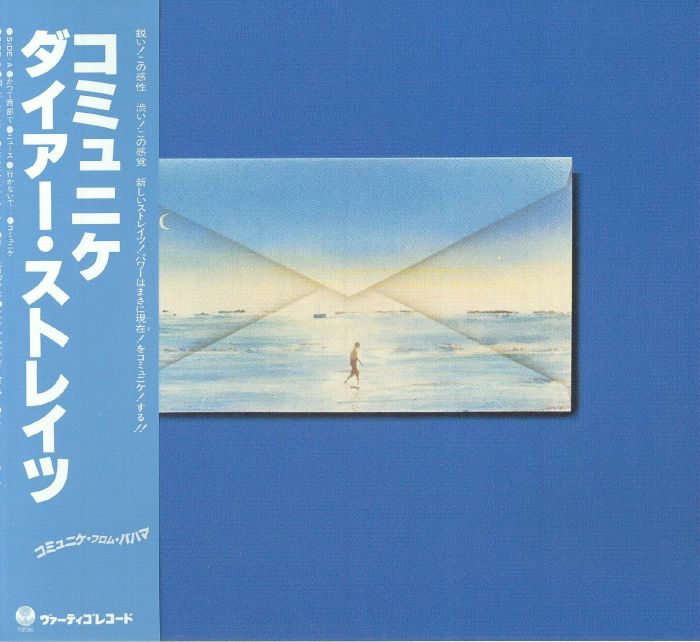
DIRE STRAITS – COMMUNIQUE.
Dire Straits – Communiqué.
Label: UMC.
Format: SHM-CD.
Arriving in the summer of 1979 amid the waning tremors of punk and the glossy ascent of new wave, Dire Straits’ second studio album, ‘Communiqué,’ stood as a deliberate study in artistic restraint. Issued just eight months after the band’s self-titled debut transformed them from South London pub-circuit veterans into international fixtures, the record initially drew lukewarm appraisals from contemporary reviewers who mistook its stylistic continuity for creative inertia. Critics eager for radical reinvention largely characterised the album as a safe, commercially pragmatic consolidation of the template established by ‘Sultans Of Swing’ and ‘Down To The Waterline.’ Reassessed with historical distance, however, ‘Communiqué’ emerges not as an exercise in stagnation, but as an exacting work of sonic architecture, rhythmic subtlety, and psychological introspection.
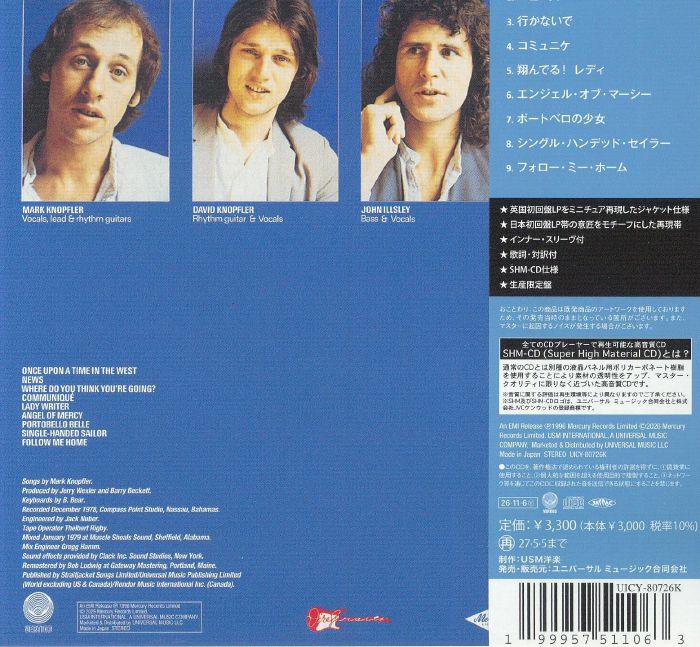
Tracked over an intensive two-week span in late November and December 1978 at Compass Point Studios in Nassau, Bahamas, and mixed the following January at Muscle Shoals Sound Studio in Alabama, the album placed the British quartet under the guidance of Jerry Wexler and Barry Beckett – two architects of classic American soul and R&B. Rather than overlaying the group with ornate studio embellishments, Wexler and Beckett recognised that Dire Straits’ distinctive power resided in negative space, dynamic patience, and unhurried groove.
Working alongside Beckett – who contributed understated keyboard textures under the pseudonym “B. Bear” – the production team pared back the raw, pub-rock immediacy that Muff Winwood had captured on the debut. In its place, they engineered a warm, mahogany-toned acoustic environment characterised by remarkable spatial separation. Within this mix, every percussive nuance of Pick Withers’ rimshots and brush work, every melodic counterpoint from John Illsley’s bass, and every fingerpicked harmonic from Mark Knopfler’s Fender Stratocaster registers with three-dimensional clarity. The result is an aesthetic of disciplined minimalism, where silence and sustain carry as much structural weight as the notes themselves.
Historically, ‘Communiqué’ also serves as the definitive final studio document of Dire Straits’ original four-piece configuration prior to rhythm guitarist David Knopfler’s departure during the fractured sessions for 1980’s ‘Making Movies.’ Throughout the record, the fraternal interplay between the Knopfler brothers functions as the ensemble’s structural spine: David’s dry, percussive chording provides a taut rhythmic lattice that allows Mark’s vocal-like lead lines to weave freely without overcrowding the arrangement.
This tight, conversational interplay imparts a chamber-rock intimacy to the album – an organic, locked-in equilibrium that the band would consciously leave behind as it expanded its lineup and pursued widescreen, symphonic ambition in the decade ahead.
Beneath its deceptively relaxed, mid-tempo surface, ‘Communiqué’ is a deeply restless work shaped by the psychological disorientation of sudden global celebrity. Having spent his late twenties working as a college lecturer, regional journalist, and unheralded club musician, Mark Knopfler found himself abruptly thrust into relentless touring schedules and media scrutiny.
The resulting songwriting reflects an acute sensitivity to artifice and displacement. Across the tracklist, Knopfler populates his vignettes with transients, weary observers, and guarded lovers navigating environments marked by romantic ambiguity, skepticism toward commercial spectacle, and quiet existential fatigue. Far from celebrating arrival, the lyrics trace a state of perpetual transit – an inward-looking, nocturnal travelogue veiled in the effortless poise of roots-oriented rock.
Ultimately, ‘Communiqué’ endures as the essential hinge in Dire Straits’ discography: a bridge between the stripped-down modesty of their club-band origins and the monumental stadium craftsmanship that would define their eighties peak. By refusing to rush past their foundational sound, the band distilled it to its purest essence, leaving behind a record whose quiet authority, audiophile precision, and emotional candour continue to reward close listening decades after its release.
Opening the album with unhurried, cinematic patience, ‘Once Upon A Time In The West’ immediately announces the sonic elevation brought by Wexler and Beckett. Built upon a hypnotic, mid-tempo groove anchored by Illsley’s supple bass-line and Withers’ crisp, rim-shot-heavy drumming, the track avoids the immediate hook of a traditional album opener in favor of slow-burning atmospheric immersion. Mark Knopfler’s Stratocaster enters like a nocturnal narrator, trading clean, bell-like arpeggios with David Knopfler’s steady rhythmic pulse while Barry Beckett’s electric piano adds a subtle, humid shimmer beneath the surface. Lyrically, Knopfler borrows Sergio Leone’s mythic title to survey modern urban decay and cultural alienation – “Some people get a kick out of stepping on a dream.” His vocal delivery – half-spoken, weary, and steeped in Dylanesque phrasing – conveys a sense of detached observation rather than moral outrage. Over its five-and-a-half-minute runtime, the song gradually tightens its rhythmic coil, culminating in an extended instrumental outro where Knopfler’s soloing shifts from conversational phrases to fluid, cascading runs that never once break the track’s cool composure.
Where the opener looked outward at a decaying landscape, ‘News’ turns the gaze inward toward the emotional toll of constant touring and public scrutiny. Driven by a deceptively gentle, country-inflected shuffle, the song juxtaposes warm, inviting instrumentation against lyrics bristling with quiet paranoia and exhaustion. Knopfler portrays the music industry and press apparatus as an inescapable shadow – a cycle of superficial praise and relentless expectation – “Now the news is full of lies, and the truth is hard to find.” Musically, ‘News’ showcases the band’s extraordinary dynamic discipline; the verses remain hushed and intimate, allowing Knopfler’s vocal nuances to carry the weight, before opening up into a melancholic, bittersweet chorus. The interplay between acoustic strumming and weeping electric fills evokes the ghost of J.J. Cale, yet the harmonic sophistication – particularly the subtle shifts between major warmth and minor resignation – is unmistakably Knopfler. The closing guitar solo acts as an emotional release valve, weeping gently over Withers’ brushed snare work until the track dissolves into silence.
A masterwork of tension and release, ‘Where Do You Think You’re Going?’ strips the band’s sound down to its skeletal essentials before erupting into one of the most compelling crescendos on the record. Beginning with a sparse, moody acoustic figure and a bassline that prowls restlessly beneath the vocal, the track captures the claustrophobia of a fractured relationship on the brink of collapse. Knopfler’s protagonist is neither pleading nor furious; instead, his questioning – “Where do you think you’re going? Don’t you know it’s dark outside?” – carries a chilling, fatalistic calm. As the song progresses, the arrangement slowly accumulates mass – electric guitars weave tighter counter-melodies, Beckett’s organ swells ominously in the background, and Withers transitions from restrained percussion to propulsive, driving fills. When the final instrumental section arrives, the restraint finally breaks: Mark Knopfler unleashes a series of stinging, blues-inflected bends and rapid-fire triplets that feel like unspoken arguments finally given voice, proving how devastating quiet dynamics can be when detonated at the exact right moment.
Closing Side One of the original vinyl LP, the title-track is the album’s philosophical centrepiece and its most overt critique of media sensationalism and institutional hypocrisy. Clocking in at nearly six minutes, ‘Communiqué’ rides a taut, syncopated funk-rock groove that highlights Pick Withers’ jazz-trained dexterity; his hi-hat work and syncopated snare accents give the song a nimble, forward-leaning momentum. Lyrically, Knopfler skewers the sanitised language of official press releases, broadcast journalism, and corporate double-speak, contrasting lofty rhetoric against gritty street-level reality —“They’re sending out a communiqué, Saying everything is gonna be okay.“ There is a wry, journalistic skepticism coursing through every verse – a reflection of Knopfler’s pre-fame career writing for the Yorkshire Evening Post. Musically, the track thrives on repetition and subtle variation: the interlocking guitars create a hypnotic, cyclical riff over which Knopfler drops razor-sharp, staccato fills, turning the song into an extended meditation on how language is weaponised to obscure the truth.
Opening Side Two of the original album with an immediate burst of kinetic energy, ‘Lady Writer’ served as the album’s lead single and remains its most overtly accessible moment. Inspired by Knopfler watching an academic author (widely believed to be Marina Warner) discussing the Virgin Mary on late-night television, the song transforms an ordinary domestic moment into a brisk, infectious rock-and-roll character sketch. Critics at the time frequently pointed out its structural kinship to ‘Sultans Of Swing’ – both share a brisk tempo, a narrative focus on an intriguing figure, and a cascading, clean-toned guitar solo – yet ‘Lady Writer’ possesses a distinct, lighthearted buoyancy of its own. David Knopfler’s brisk rhythm guitar propels the track forward like a ticking clock, while Mark’s lead lines dance effortlessly around the vocal melody, punctuating every couplet with sparkling, country-blues licks. Rather than feeling derivative, ‘Lady Writer’ functions as a welcome palate cleanser after the brooding intensity of Side One, demonstrating that Dire Straits could deliver effortless pop-rock craftsmanship without sacrificing instrumental rigour.
If ‘Lady Writer’ provides sunshine, ‘Angel Of Mercy’ plunges the listener straight back into neon-lit urban noir. Built on a sinuous, minor-key groove with a distinct Latin-blues undercurrent, the track showcases Beckett’s subtle keyboard work, which adds a smoky, nocturnal warmth to the rhythm section’s tight pocket. Knopfler’s lyrics sketch a cinematic vignette of late-night desperation, temptation, and fleeting grace on city streets, populated by characters searching for salvation in dimly lit bars and rain-washed alleyways. Vocally, Knopfler leans into a lower, more gravelly register, allowing the rhythm of the words to interlock with Illsley’s throbbing bass notes. The guitar work here is particularly evocative: rather than relying on flashy pyrotechnics, Knopfler uses volume swells, muted string rakes, and lyrical, vocal-like phrasing to create an atmosphere thick with humidity and moral ambiguity. It is an understated gem that rewards close headphone listening, revealing new layers of percussive and harmonic detail with every spin.
A charming, waltz-time detour into British folk-rock storytelling, ‘Portobello Belle’ stands as one of the warmest and most affectionate tracks in the early Dire Straits catalog. Stepping away from the transatlantic roots rock template that dominates much of the record, Knopfler crafts a swaying, 3/4-time ballad set amidst the bustling stalls and bohemian energy of West London’s Portobello Road market. The arrangement is tactile and intimate – acoustic guitars strum with woody resonance, Withers switches to delicate, sweeping brushwork, and Beckett adds gentle, accordion-like organ textures that evoke European street music. Lyrically, Knopfler paints a vivid, tender portrait of a magnetic street-market beauty, balancing romantic infatuation with his characteristic eye for concrete, everyday detail. The song’s unhurried grace and melodic simplicity offer a glimpse of the folk-inflected solo direction Knopfler would explore decades later, proving that his songwriting could charm through sheer warmth and observational wit rather than rhythmic drive.
Maritime imagery runs deep throughout Mark Knopfler’s songwriting, and ‘Single-Handed Sailor’ represents its earliest full realisation on record. Anchored by a rolling, undulating groove that mimics the steady swell of open water, the track is a study in solitude, self-reliance, and emotional detachment. The interplay between John Illsley’s melodic bass runs and Withers’ nuanced cymbal work creates a vast, open sonic horizon across which Knopfler’s Stratocaster glides with effortless grace. Lyrically, the sailor becomes an explicit metaphor for the artist himself – navigating treacherous, unfamiliar waters alone, insulated from the noise of the shore yet perpetually isolated from human connection – “You’re a single-handed sailor, and you’re heading out to sea.” As the song builds toward its climax, Knopfler’s guitar soloing expands in scale and emotional intensity, soaring above the rhythm section with long, sustained notes that ache with both freedom and loneliness. It is one of the album’s finest performances, seamlessly uniting lyrical metaphor with instrumental expression.
Closing the album on a deeply atmospheric, hypnotic note, ‘Follow Me Home’ begins with the ambient sound of crashing ocean waves and distant seagulls before easing into a slow, sultry, swamp-blues groove. Across nearly six minutes, the band locks into a meditative trance, refusing to rush a single bar. The rhythm section operates with telepathic restraint – Withers lays down a deep, unhurried pocket while Illsley’s bass anchors the harmonic progression with minimal, resonant notes. Over this lush foundation, Knopfler delivers one of his most intimate vocal performances on the record, offering a quiet, nocturnal invitation to retreat from the clamor of the outside world – “Follow me home, away from the crowd.” Beckett’s electric piano shimmers like moonlight on water, while Knopfler’s guitar weaves delicate, improvisational filigree around the vocal lines. Rather than ending Communiqué with a triumphant rock anthem, ‘Follow Me Home’ lets the record drift gently out to sea, fading back into the sound of the surf – a fittingly introspective conclusion to an album defined by nuance over spectacle.
When surveying the artistic evolution of late-seventies British rock, few sophomore albums have been as persistently mischaracterised – or as quietly vindicated by time – as Dire Straits’ ‘Communiqué.’ Arriving in June 1979 on the heels of a debut that had unexpectedly catapulted the quartet from South London pubs onto international charts, the record occupied a precarious commercial and creative space. Contemporary commentators, conditioned to equate artistic progress with abrupt stylistic pivots, largely dismissed the album as an overly cautious holding pattern that refused to stray from the blueprint of its predecessor. Yet viewed across the broader trajectory of the band’s catalog, ‘Communiqué’ reveals itself as an indispensable evolutionary hinge: the critical connective tissue linking the unvarnished, pub-rock immediacy of 1978s ‘Dire Straits’ with the expansive, keyboard-driven theatricality of 1980s ‘Making Movies’ and 1982s ‘Love Over Gold.’
To fault ‘Communiqué’ for failing to reinvent the band’s vocabulary is to misunderstand its foundational objective. Rather than pursuing novelty for its own sake, Mark Knopfler and his bandmates approached their second studio effort as an exercise in distillation – testing just how much emotional weight, narrative complexity, and dynamic tension could be extracted from a stripped-down four-piece rock ensemble.
In stripping away the residual urgency and rough edges of their first outings, the group turned inward, prioritising groove, pacing, and structural economy. The album’s arrangements resist conventional rock theatrics in favour of slow-building momentum, demonstrating that subtle shifts in cadence and phrasing can carry as much dramatic force as high-volume catharsis.
The commitment to expressive minimalism found its ideal studio translation under the supervision of veteran American producers Jerry Wexler and Barry Beckett. Drawing upon decades of experience shaping classic soul and R&B recordings, Wexler and Beckett rejected the heavy-handed compression and artificial sheen increasingly common in late-seventies studio craft. Instead, they sculpted a transparent, warm acoustic environment in which every frequency is balanced with surgical precision
Tis audiophile clarity preserves the physical mechanics of live ensemble performance. Across the record, the listener is placed directly inside the room with the musicians, able to discern the tactile friction of fingers sliding across wound guitar strings, the delicate decay of drumsticks grazing bronze cymbals, and the natural resonance of wooden instrument bodies. Coupled with David Knopfler’s tight, percussive rhythm work and John Illsley’s melodic bass lines, Mark Knopfler’s fluid Stratocaster phrasing operates within generous pockets of negative space, transforming restraint into a primary sonic signature.
Elevated above a mere showcase of impeccable roots-rock craftsmanship, ‘Communiqué’ is anchored by a remarkably cohesive thematic architecture. Written amid the disorienting glare of sudden global fame, Knopfler’s lyrics examine the psychological toll of abrupt personal and professional upheaval.
Throughout the song cycle, recurring motifs of geographic displacement, skepticism toward media distortion, emotional guardedness, and a quiet yearning for sanctuary bind the tracks into a unified narrative. Rather than indulging in rock-star triumphalism, Knopfler adopts the vantage point of a detached, slightly weary observer – charting the friction between public spectacle and private vulnerability with literary restraint and wry disillusionment.
In the final reckoning, ‘Communiqué’ represents the zenith of Dire Straits’ original chamber-rock ethos – a last, unhurried snapshot of the founding quartet before lineup changes and symphonic ambitions reshaped their sound in the eighties. Its enduring stature lies precisely in its refusal to clamour for immediate validation; by placing unwavering faith in space, textural nuance, and collective discipline, Dire Straits produced a work of rare poise whose quiet authority continues to reveal new layers with every passing decade.
Dire Straits – Communiqué.
- Posted in: Blues ♦ Blues Rock ♦ Country ♦ Country Rock ♦ Jazz ♦ Pop ♦ Rock
- Tagged: Barry Beckett, Communiqué, Compass Point Studios, David Knopfler, Dire Straits, Down To The Waterline, Jerry Wexler, John Illsley, Love Over Gold, Making Movies, Mark Knopfler, Muscle Shoals Sound Studio, Pick Withers, Sultans Of Swing, UMC
 dereksmusicblog

