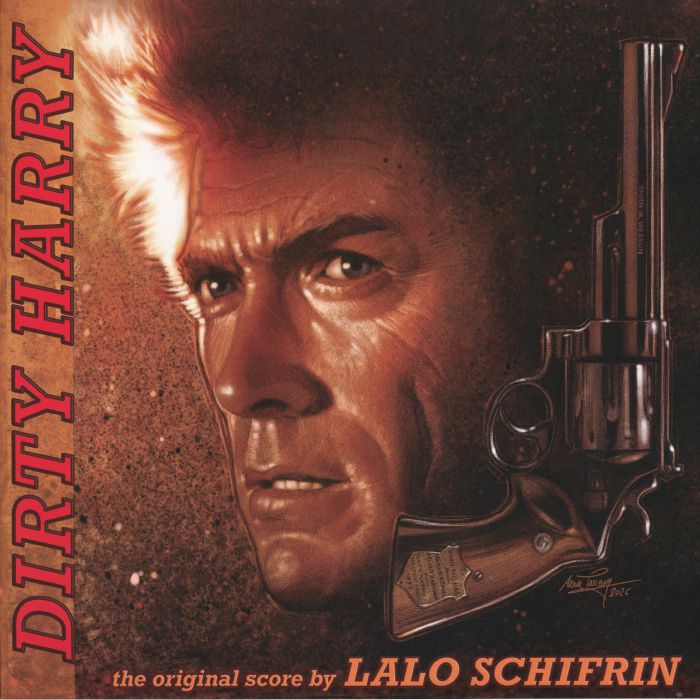
DIRTY HARRY THE ORIGINAL SCORE BY LALO SCHRIFIN.
Dirty Harry The Original Score By Lalo Schrifin.
Label: Aleph Records.
Format: Vinyl.
The late-sixties and early-seventies collapse of the Hollywood studio system precipitated a profound aesthetic reckoning in American cinema, dismantling the tidy moral binaries of the Golden Age in favour of gritty, urban naturalism. Few artefacts of this New Hollywood renaissance illustrate that transformation more forcefully than Don Siegel’s 1971 cinematic Magnus opus ‘Dirty Harry.’
While cultural historians routinely dissect the film’s controversial politics and Clint Eastwood’s laconic embodiment of Inspector Harry Callahan, its revolutionary sonic architecture – crafted by Argentine composer Lalo Schifrin- remains an equally vital catalyst in modernising the American crime thriller. Dispensing with the lush, late-Romantic symphonism and upbeat big band tropes that had long telegraphed institutional righteousness in studio-era police procedurals, Schifrin engineered an abrasive, psychologically unsparing score. Through an audacious synthesis of street-level jazz-funk, avant-garde concert modernism, and nascent electro-acoustic manipulation, the composer reimagined San Francisco not as a picturesque civic backdrop, but as an alienated, morally compromised battleground.
For more than three decades following the film’s theatrical debut, full appreciation of Schifrin’s achievement was hampered by archival obscurity. Despite Dirty Harry’s immediate commercial triumph and enduring cultural footprint, the original 1971 Warner Bros. session masters remained locked in the vaults, leaving enthusiasts reliant on substandard bootleg pressings or the re-recorded concert suites featured on Schifrin’s 1998 ‘Dirty Harry Anthology.’ That void was finally filled in 2004, when Schifrin’s independent imprint, Aleph Records, partnered with Eastwood’s Malpaso Productions to release ‘Dirty Harry: The Original Score.’
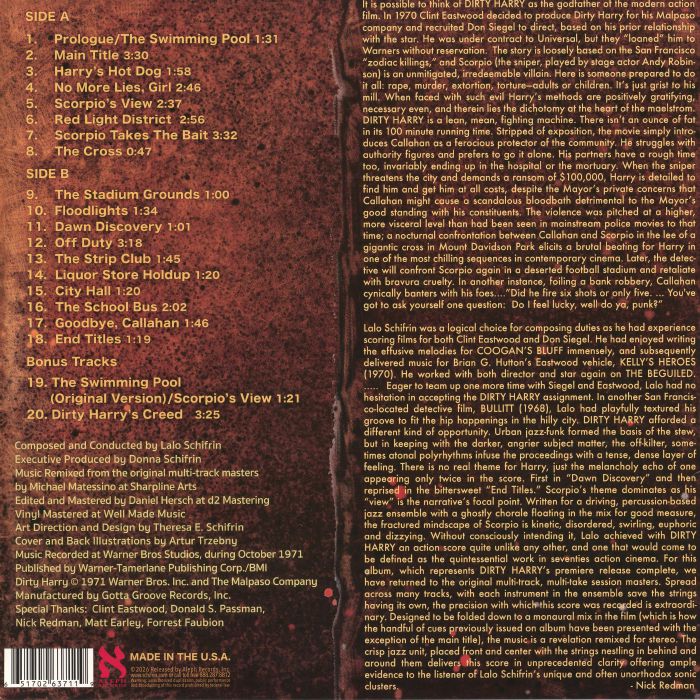
Recently, Aleph Records have reissued ‘Dirty Harry: The Original Score.’ Ir features the eighteen cues used in the film and two bonus tracks.
Experiencing these original cues in chronological sequence exposes the score’s remarkable dramatic economy, revealing how Schifrin bypassed conventional thematic sentimentality in favour of raw timbral friction and rhythmic propulsion. At the structural core of the score lies a deliberate dialectical tension between two antithetical musical vocabularies, each mapped onto the film’s central psychological adversaries:
To ground Eastwood’s weary, pragmatic detective in the tactile reality of early-seventies San Francisco, Schifrin drew upon the vernacular of contemporary soul-jazz and studio-funk. Built upon taut, syncopated electric bass ostinatos, percussive wah-wah guitars, Fender Rhodes electric piano, Hammond B-3 organ, and razor-sharp drum kit grooves, Callahan’s musical profile exudes cynical resilience and street-level autonomy. Blues-inflected brass figures punctuate these rhythms without ever swelling into heroic fanfare, reflecting a protagonist whose authority derives from hard-bitten competence rather than institutional endorsement.
Conversely, to inhabit the fractured psyche of Andrew Robinson’s serial sniper, Schifrin turned to the radical techniques of twentieth century concert modernism – drawing clear lineage from Krzysztof Penderecki, György Ligeti, and John Cage. Scorpio’s sonic signature is defined by aleatoric string clusters, prepared piano strikes, detuned percussion, and microtonal brass shrieks. Most arresting is Schifrin’s deployment of soprano Sally Stevens, whose eerie, wordless vocalisations – treated with heavy tape delay, pitch modulation, and cavernous reverberation – hover over the orchestration like a disembodied siren call, externalising a mind entirely severed from human empathy.
Crucially, Schifrin refuses to keep these two idioms neatly compartmentaliSed. As the narrative escalates and Scorpio’s sadism systematically dismantles due process, the composer executes a subtle process of musical contamination. At first, Callahan’s cool, disciplined grooves and Scorpio’s dissonant textures occupy distinct dramatic spaces; gradually, however, the sniper’s destabilising electro-acoustic motifs begin bleeding into the detective’s rhythmic framework. By the final act, the jazz-funk pulse is increasingly fractured by jagged percussive interruptions and unresolved harmonic tension, sonically mirroring how the pursuit of an unrepentant killer erodes Callahan’s procedural restraint and isolates him from the very legal order he is sworn to defend.
Ultimately, Lalo Schifrin’s work on ‘Dirty Harry’ stands as a watershed in the evolution of dramatic film scoring, establishing a minimalist, texture-driven grammar that reshaped the sound of thriller cinema for decades to come. By rejecting reassuring orchestral orthodoxy in favour of rhythmic ambiguity and electro-acoustic dread, Schifrin transformed the film’s soundtrack from mere accompaniment into an active psychological narrative. Nearly half a century after its creation – and fully vindicated by its long-overdue archival preservation – the score endures not merely as a masterclass in cinematic suspense, but as an incisive sonic portrait of an era confronting the limits of law, order, and moral certainty.
Side A.
Schifrin opens the score not with heroic fanfare, but with immediate psychological dread on ‘Prologue / The Swimming Pool.’ Beginning over the opening memorial dedication to fallen San Francisco police officers, solemn, low-register brass chords establish a funeral gravity before abruptly giving way to the infamous rooftop sniper sequence. As Scorpio’s rifle scope tracks a woman swimming in a rooftop pool, Schifrin introduces Sally Stevens’s eerie, wordless soprano—floating over shimmering vibraphone, bowed cymbals, and dissonant string harmonics. The cue is a study in suspended breath: rhythmic pulse is deliberately absent, creating a weightless, voyeuristic tension that shatters the moment the shot rings out.
Following the cold-blooded precision of the opening murder, ‘Main Title’ detonates with one of the most celebrated grooves in film history. Anchored by a taut, insistent electric bass ostinato and razor-sharp hi-hat work, Schifrin layers an asymmetric, loping melody across low brass, electric piano, and wah-wah guitar. What makes the cue extraordinary is its refusal to sound triumphant; the groove is propulsive yet heavy-lidded, propelled by minor-key blues inflections and biting horn stabs that capture Callahan’s disillusioned swagger as he surveys the crime scene and the city below.
Scoring the famous midday diner stakeout that culminates in Callahan’s iconic “Do I feel lucky?” monologue, Schifrin plays the scene with deceptively cool restraint. Built around a laid-back, medium-tempo jazz-funk vamp ‘Harry’s Hot Dog’ features a muted trumpet, Fender Rhodes, and a slinky bassline, the music mimics Callahan’s outward nonchalance while maintaining a simmering undercurrent of alertness. As the bank robbery unfolds across the street, subtle percussive accents and tightened harmonic voicings signal Callahan’s transition from casual observer to lethal tactician – notably cutting out entirely so Eastwood’s dialogue commands the climax.
After Scorpio’s ransom note threatens another victim, Callahan’s investigation takes on a darker, more urgent edge. Schifrin constructs ‘No More Lies, Girl’ around a restless, pulsing bass figure paired with agitated conga patterns and nervous woodwind interjections. The cue exemplifies Schifrin’s gift for procedural suspense: there is no melodramatic swelling, only a steady, claustrophobic tightening of rhythmic screws as detective work races against a ticking clock.
Returning to the antagonist’s distorted perspective, Schifrin strips away all jazz warmth. ‘Scorpio’s View’ is pure avant-garde chamber horror, driven by skittering, high-register strings, ominous contrabassoon and low piano clusters, and the return of Stevens’s spectral, echo-drenched vocalisations. The cue functions as a psychological portrait of mania – fragmented, unpredictable, and devoid of harmonic resolution – placing the listener directly inside Scorpio’s crosshairs.
As Callahan and his rookie partner Chico Gonzalez patrol San Francisco’s neon-lit Tenderloin and North Beach nightlife searching for the sniper, Schifrin leans into gritty urban source-inflected scoring. Driven by a greasy, syncopated backbeat, organ riffs, and bluesy tenor saxophone phrases, ‘Red Light District’ evokes the sleaze and nocturnal energy of early-seventies San Francisco. Beneath the street-level funk, however, lingering dissonant brass chords remind the listener that this is a hunt for a predator, not a casual night out.
One of the score’s extended architectural centrepieces, ‘Scorpio Takes the Bait’ accompanies the tense rooftop surveillance operation as police wait for the sniper to strike again. Schifrin builds suspense through masterly textural layering: a quiet, heartbeat-like bass pulse underpins eerie glissandi, muted brass whispers, and sporadic percussive clicks. As the trap springs and gunfire erupts across the rooftops, the cue erupts into jagged, polyrhythmic chaos – piercing trumpets clashing against frantic percussion before dropping back into breathless stillness.
Brief yet devastating at under a minute, ‘The Cross’ underscores the grim discovery of Scorpio’s latest victim, Ann Mary Deacon, near Mount Davidson. Schifrin eschews sentimental tragedy in favour of stark, glacial coldness: hollow, sustained string harmonics and a desolate solo woodwind line hang in the air like morning fog, conveying shock and moral numbness rather than tearful melodrama.
Side B.
‘Goodbye, Callahan’ marks the emotional and psychological turning point of the narrative, scoring the harrowing sequence in which Scorpio forces Callahan to run across San Francisco with a duffel bag of ransom money – culminating in the brutal beating beneath the Mount Davidson cross. Schifrin drives the track with a relentless, breathless ostinato that mirrors Callahan’s physical exhaustion. As the cue progresses, fragmented brass blasts and disorienting percussion batter the groove until the music fractures entirely during the assault, leaving only a wounded, lingering echo.
Following the discovery of Scorpio’s lair beneath Kezar Stadium, ‘The Stadium Grounds’ establishes an atmosphere of grim anticipation. Low, stalking bass figures and tense, tremolo strings create a sense of creeping enclosure as Callahan prepares to corner the wounded killer on the empty football field at night.
A tour de force of minimal suspense, ‘Floodlights’ accompanies Callahan’s nocturnal pursuit of Scorpio across the turf of Kezar Stadium, ending in Callahan’s ruthless interrogation on the fifty-yard line as the stadium floodlights blaze on. Schifrin uses stark dynamic contrasts – whisper-quiet, eerie string textures and electronic shimmer suddenly punctuated by violent, metallic percussive hits as the stadium lights ignite – capturing the blinding, clinical brutality of Callahan’s methods.
When legal technicalities force the District Attorney to release Scorpio due to Callahan’s warrantless search and coercive interrogation, ‘Dawn Discovery’ underscores the bitter institutional fallout. A melancholic, world-weary variation of the main theme surfaces in muted brass and electric piano, drained of its earlier swagger and steeped in disillusionment.
Clocking in at over three minutes, ‘Off Duty’ is one of the album’s richest standalone musical pieces. Tracking Callahan as he shadows the newly freed Scorpio through the city on his own time, Schifrin crafts a hypnotic, slow-burn nocturnal jazz-funk piece. A sinuous electric bass line and brushed drums anchor reflective, blues-drenched Rhodes chords and lyrical horn lines, capturing both the tedium of surveillance and Callahan’s solitary obsession.
As Callahan’s tail leads him into a seedy topless bar, Schifrin provides authentic, period-accurate diegetic-style jazz-funk. Featuring a swaggering horn section, wah-wah guitar licks, and a punchy R&B groove, ‘The Strip Club’ demonstrates Schifrin’s effortless command of contemporary popular idioms while maintaining a slightly lurid, off-kilter harmonic edge that keeps the scene unsettled.
When Scorpio stages a brutal assault and stages a fake beating to frame Callahan for police brutality, ‘Liquor Store Holdup’ unleashes sudden, explosive violence. Jagged, dissonant brass stabs, frantic snare rolls, and chaotic piano clusters collide in a brief, breathless burst of sonic anarchy that mirrors Scorpio’s unhinged desperation.
‘City Hall’ returns to the cold, bureaucratic reality of San Francisco’s halls of power. Schifrin employs sparse, sobering woodwinds and muted low brass over a subdued, uneasy harmonic bed, subtly underscoring the vast divide between political expediency and street-level justice.
For the film’s climactic hijacking – in which Scorpio commandeers a school bus full of children – Schifrin synthesises every musical threat developed throughout the score on ‘The School Bus.’ A relentless, driving rhythm section collides head-on with Scorpio’s shrieking strings, frantic percussion, and Stevens’s haunting soprano, generating overwhelming momentum as Callahan leaps onto the bus roof from an overpass.
Following the final confrontation at the gravel quarry—where Callahan shoots Scorpio and famously tosses his inspector’s badge into the water – ‘End Titles’ offers no conventional resolution. Instead, Schifrin reprises the iconic loping bass ostinato and melancholic brass motif of the ‘Main Title,’ now stripped down and shadowed by a sense of finality and alienation as the camera pulls back over the bay.
The first of the bonus tracks is ‘The Swimming Pool (Original Version).’ It restores the unadulterated orchestral and percussive architecture designed for the film’s iconic opening assassination. In the finished picture, sound effects and editorial trimming tightly sculpt the sequence; heard here in its original session form, Schifrin’s avant-garde textures emerge with chilling clarity. Beneath a deceptive veneer of sunlit, California stillness, taut string harmonics, muted brass, and dry, clinical percussion build a sense of predatory patience. Rather than telegraphing violence with conventional thriller swells, Schifrin captures the cold, mechanical detachment of a killer sighting his target through a rifle scope – an exercise in pure sonic suspense where silence and microtonal tension carry as much weight as the notes themselves.
Seguing directly into ‘Scorpio’s View,’ the track isolates the score’s most celebrated and disturbing element: soprano Sally Stevens’s wordless vocal motif. While the master album presents the finalised composite heard in the film, this alternate take highlights the sheer physicality and precision required to achieve such an otherworldly effect. Stripped of final mix balances, Stevens’s eerie, hovering timbre – treated with cavernous reverberation and tape delay – sounds simultaneously human and spectral, oscillating between fragile vulnerability and psychotic dissociation. Hearing this alternate pass reveals just how finely calibrated the studio processing had to be; even slight variations in vocal attack and echo decay subtly shift the emotional temperature from mournful lament to predatory dread.
Featured among the archival bonus selections on Aleph Records’ restoration of ‘Dirty Harry: The Original Score,’ ‘Dirty Harry’s Creed’ distills the entire musical identity of Inspector Harry Callahan into a lean, self-contained statement. Freed from the split-second timing demands of film editing, Lalo Schifrin lets Callahan’s early-seventies urban soul-jazz idiom unfold in an unbroken, deliberate arc. Driven by a taut, syncopated electric bass ostinato, crisp drums, Fender Rhodes, and subtle wah-wah guitar, the cue avoids all traditional Hollywood heroic bombast in favor of muted, blues-inflected brass and cool, unsentimental restraint. Remixed cleanly from the 1971 multi-track masters, it serves as far more than a collector’s curiosity – it is the philosophical thesis statement of the score, capturing Callahan’s weary pragmatism and moral isolation with unmistakable modernist precision. This is the perfect way to close this reissue of a classic neo-noir police procedural score.
When the New Hollywood movement dismantled the comforting moral certainties of classical studio filmmaking in the early seventies, it demanded an equally radical reinvention of the dramatic film score. Within that turbulent cultural landscape, Lalo Schifrin’s music for Don Siegel’s ‘Dirty Harry’ released in 1971, emerged not merely as a triumph of genre craftsmanship, but as one of the supreme structural and aesthetic achievements of twentieth-century screen composition. More than five decades after its creation, the score’s architectural rigour, timbral daring, and psychological acuity remain undiminished. What elevates ‘Dirty Harry’ far beyond routine thriller accompaniment is Schifrin’s resolute refusal to flatten the narrative’s profound ethical ambiguities into musical shorthand. Had he underscored Inspector Harry Callahan with traditional, late-Romantic brass heroism, the film would have collapsed into simplistic, reactionary caricature; conversely, had he relied on conventional horror melodrama for the serial sniper “Scorpio,” the antagonist would have been reduced to a theatrical villain rather than a chillingly modern pathology. Instead, Schifrin forged an incisive dialectical language – pitting street-level urban jazz-funk against twentieth-century concert modernism and electro-acoustic manipulation – to articulate the sound of an American metropolis fracturing under the weight of institutional decay and existential dread.
Crucially, this compositional dialectic operates not as static background colour, but as an active dramatic engine that mirrors the film’s darkening moral trajectory. By anchoring Callahan in the tactile vernacular of early-1970s soul-jazz – taut, syncopated electric bass ostinatos, percussive wah-wah guitars, Fender Rhodes electric piano, and dry, blues-inflected brass – Schifrin imbued the detective with an aura of weary, working class pragmatism rather than institutional righteousness. Simultaneously, his deployment of aleatoric string clusters, prepared piano, detuned percussion, and soprano Sally Stevens’s reverb-drenched, wordless vocalisations externalised Scorpio’s complete detachment from human empathy. As the narrative progresses and procedural law proves powerless against sadistic violence, Schifrin systematically allows Scorpio’s dissonant, electro-acoustic textures to contaminate Callahan’s disciplined rhythmic framework – sonically charting the protagonist’s gradual erosion of restraint and his descent into moral and legal isolation.
Beyond its immediate dramatic brilliance, the sonic DNA of ‘Dirty Harry’ has permeated both modern screen scoring and broader popular music culture with remarkable longevity. Its audacious hybrid of propulsive, groove-driven funk rhythms and abrasive, avant-garde orchestral dissonance established the definitive acoustic blueprint for an entire generation of gritty, seventoes urban neo-noirs – casting a direct influence over landmarks such as Don Ellis’s The ‘French Connection’ (1971) and David Shire’s ‘The Taking of Pelham One Two Three’ (1974), as well as decades of subsequent crime cinema and television procedurals. Simultaneously, the raw, close-miked rhythmic authority of Schifrin’s rhythm-section writing transformed the soundtrack into a foundational crate-digging touchstone for generations of hip-hop, trip-hop, and acid-jazz producers, who recognised in those brooding bass-lines and atmospheric electric-piano voicings an enduring language of urban tension and nocturnal cool.
Even when measured against the extraordinary breadth of Lalo Schifrin’s own storied discography – spanning ‘Mission: Impossible,’ ‘Bullitt,’ and ‘Enter The Dragon’ – ‘Dirty Harry’ occupies a singular, unassailable summit. It represents the rare convergence of high modernist experimentation and visceral popular idiom, executed with an economy of means in which every rhythmic pulse carries narrative weight and every suspended silence cuts with surgical precision. In refusing to offer the audience easy emotional resolution, Schifrin created far more than an iconic accompaniment to a controversial classic; he authored an enduring sonic masterwork that redefined how cinema gives voice to psychological terror, moral ambiguity, and the fragile boundaries of social order.
Dirty Harry The Original Score By Lalo Schrifin.
- Posted in: Avant Garde ♦ Blues ♦ Funk ♦ Jazz ♦ Jazz Funk ♦ Soul Jazz
- Tagged: Aleph Records, Clint Eastwood, Dirty Harry, Dirty Harry The Original Score By Lalo Schrifin, Harry Callahan, Lalo Schrifin
 dereksmusicblog

