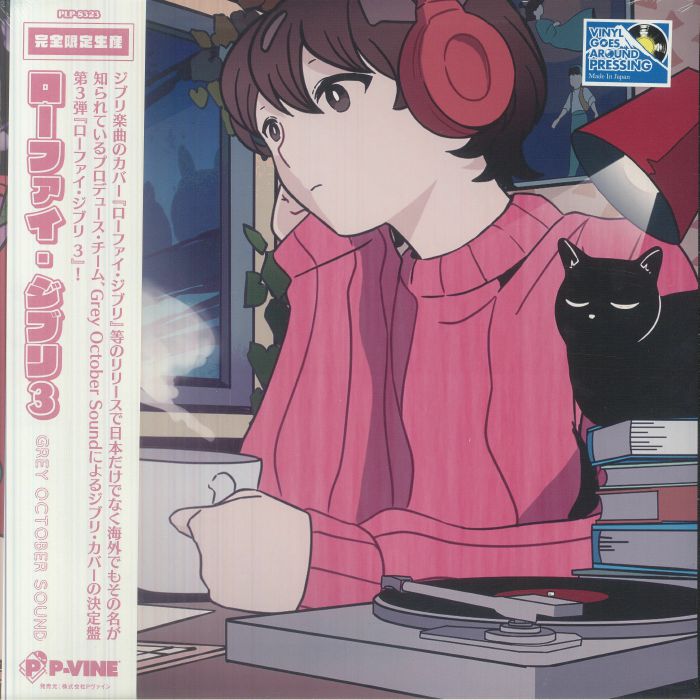
GREY OCTOBER SOUND – LO FI GHIBLI 3.
Grey October Sound – Lo Fi Ghibli 3.
Label: P-Vine.
Format: Vinyl.
Produced by the Tokyo-based beatmaking collective Grey October Sound – spearheaded by prolific jazz-hip-hop producer Ryosuke Kojima – ‘Lo Fi Ghibli 3’ marks the third and most refined instalment in their acclaimed series reimagining Studio Ghibli’s beloved film scores. Rather than relying on disposable, algorithm-friendly loops or heavy-handed vinyl crackle clichés, the collective treats Joe Hisaishi’s and Yumi Arai’s iconic compositions as living jazz standards. Across its ten tracks, the album balances deep reverence for Hayao Miyazaki’s cinematic worlds with the warm, dusty percussion, rich Rhodes voicings, and supple upright bass-lines of golden era Japanese instrumental hip-hop.
Studio Ghibli’s soundtracks occupy a sacred space in global popular culture, defined by Hisaishi’s sweeping orchestral romanticism, minimalist piano motifs, and poignant pentatonic melodies. Adapting such universally cherished themes into lo-fi hip hop carries an inherent artistic risk: strip away too much harmonic sophistication, and the music becomes generic background wallpaper; overcomplicate the arrangement, and the fragile emotional intimacy of the original films vanishes.
On ‘Lo Fi Ghibli 3’ solves this riddle by approaching the repertoire through the lens of live instrumented jazz-hop, drawing direct lineage from Nujabes, Uyama Hiroto, and classic Tokyo jazz kissaten (jazz café) culture. By the third volume in the series, the collective’s sonic signature has crystallised into something remarkably cohesive. Instead of leaning on synthetic nostalgia, the production relies on genuine musicianship – tactile Fender Rhodes chords, brushed snare drums, muted trumpet flourishes, and warm acoustic guitar plucks – to translate cinematic wonder into late-night, headphone-ready introspection.
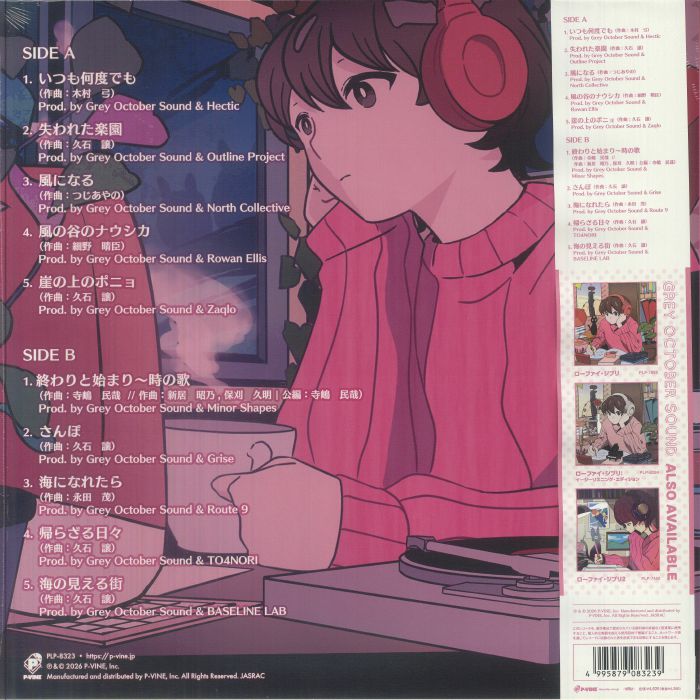
Side One.
Opening the album with ‘Always With Me’ (‘Itsumo Nando Demo’), Youmi Kimura’s iconic closing theme to ‘Spirited Away’ (is a bold statement of intent. In its original waltz time, the piece carries a fragile, music box innocence; here, Grey October Sound gently reshapes its rhythmic architecture into a languid, swaying lo-fi groove. A warm, slightly detuned Rhodes piano traces the familiar vocal melody with delicate phrasing, cushioned by soft sub-bass swells and a crisp, brushed snare that lands just behind the beat. Rather than leaning into overt melancholy, the arrangement captures the quiet optimism of Chihiro’s train ride across the water – setting an intimate, reflective benchmark for the rest of the album.
Drawing from Joe Hisaishi’s sweeping 1986 score for Laputa: Castle in the Sky (‘Ushinawareta Rakuen’), ‘The Lost Paradise’ pivots toward atmospheric mystery. Where Hisaishi’s orchestral original evokes ancient, cloud-veiled ruins and airborne wonder, Grey October Sound translates that sense of scale into spacious, reverb-drenched minimalism. Filtered synth pads drift like mist beneath a hypnotic, mid-tempo drum loop, while muted electric guitar plucks outline the haunting minor key motif. Soft vinyl texture and distant rain-like percussion frame the melody without ever intruding upon it. The result is one of the album’s most immersive textural moments, trading grandeur for a hypnotic, nocturnal stillness that lingers long after the track fades.
Ayano Tsuji’s breezy, ukulele-driven folk-pop classic ‘Kaze ni Naru’ from The Cat Returns undergoes one of the most charming transformations on ‘Lo-Fi Ghibli 3.’ Stripping away the brisk acoustic strum of the original, the producers reimagine the track as a sun-dappled, jazz-hop stroll. Bright, Rhodes-led chord voicings bounce over a supple, melodic bassline and shuffling hi-hats that mimic the unhurried pace of a lazy afternoon in a quiet Tokyo alleyway. The track radiates effortless warmth, injecting a welcome burst of levity and groove into the centre of Side A without losing its airy, carefree spirit.
Returning to the earliest roots of the Ghibli legacy, Grey October Sound tackles the main theme of 1984 anime soundtrack ‘Nausicaä Of The Valley Of The Wind’ with remarkable poise. This composition carries an inherent sense of tragedy, resilience, and ecological vastness, and the arrangement honours that weight through disciplined production. Built around a steady, earthy boom-bap pulse, the track layers wistful, sustained keyboard chords over subtle tape hiss and sparse harmonic embellishments. By resisting the urge to overcomplicate the melody, the producers allow the bittersweet nobility of the original theme to speak directly through the speakers.
Closing out Side one is ‘Ponyo On The Cliff By The Cliff,’ an inventive, tongue-in-cheek reworking of the exuberantly bouncy theme from Ponyo. Transforming an irrepressibly upbeat children’s march into credible lo-fi hip-hop is no small feat, yet Grey October Sound pulls it off by slowing the tempo and re-harmonising the melody with lush, neo-soul seventh and ninth chords. The recognisable vocal hook is rendered via a mellow, bell-toned electric keyboard, grounded by a punchy, rubbery kick drum. What could easily have felt like a novelty instead lands as a playful, deeply groovy Side One closer that smiles without ever breaking the album’s relaxed spell.
Side Two.
‘The End and The Beginning’ is a deep-cut selection for devoted Ghibli listeners. It is the closing theme from Studio Ghibli’s 2006 fantasy film ‘Tales from Earthsea.’ This piece leans fully into contemplative, late-night introspection. Built around sparse, echoing piano phrases and lush, low-passed ambient textures, the arrangement honours the quiet, existential weight of ‘Tales from Earthsea.’ The drum programming is minimal and unhurried, acting as a gentle pulse beneath rich, melancholy chord progressions. It is a deeply immersive cut that showcases the group’s ability to find profound emotional resonance in Ghibli’s more understated musical moments.
‘Walk’ reimagines ‘Sanpo’ arguably the cheerful, marching-band-style tune from ‘My Neighbor Totoro.’ To do this requires a delicate touch to avoid novelty. Grey October Sound succeeds brilliantly by translating the bouncy rhythm into an infectious, neck-snapping lo-fi swing. Muted, jazz-inflected keys carry the playful melody while a warm, walking bassline and crisp snare cracks keep the momentum buoyant. It captures the pure, unbridled joy of exploring a sunlit forest path, filtered through the cozy lens of a lazy Sunday afternoon.
Few Ghibli films embody nostalgic teenage yearning quite like the 1993 high school drama Ocean Waves. However, ‘If I Become the Sea’ distills that exact aesthetic into pure sound. Lush, chorus-drenched electric guitars and soft Rhodes chords wash over a hazy, tape-saturated drum loop, evoking humid summer evenings and coastal train rides. The harmonic voicings are rich with bittersweet ninths and elevenths, turning the understated television-film score into a poignant, city-pop-adjacent chill-hop gem that lingers long after the final note fades.
Returning to the world of Spirited Away, this arrangement taps directly into the aching nostalgia at the heart of Hisaishi’s composition. A solitary, expressive piano takes centrestage, surrounded by subtle, swelling pad textures and a featherlight percussive groove that never intrudes on the melody’s fragility. Every pause between phrases feels intentional, allowing the quiet sorrow of growing up and leaving cherished memories behind to resonate with remarkable clarity and grace.
Closing Side two and ‘Lo Fi Ghibli 3’ is ‘Kiki’s Delivery Service.’ It was a coming-of-age fantasy film written, produced, and directed by Hayao Miyazaki for Studio Ghibli. The track closes the album on note of reflective, bittersweet optimism, Grey October Sound transforms the track from a bright daytime waltz into a twilight coastal reverie. Dialling back the tempo into a smooth, head-nodding groove, the collective pairs nimble electric bass-lines with lush, extended jazz chords on the Rhodes. As the familiar theme unfolds with unhurried elegance, it evokes the feeling of watching dusk settle over a bustling harbour – a fitting, deeply comforting conclusion to the journey.
‘Lo-Fi Ghibli 3’ succeeds where countless tribute albums falter because Grey October Sound approaches Studio Ghibli’s music not as a collection of easy nostalgia triggers, but as a living, breathing jazz and soul songbook. In an era where “lo-fi beats” has frequently been reduced to a homogenised utility genre engineered solely for passive algorithmic playback, this record stands as a compelling argument for intentionality, arrangement craft, and genuine musicianship within the beatmaking space.
Analytically, the album’s greatest strength lies in its mastery of tonal translation and negative space. Across these ten tracks, the collective demonstrates a keen understanding of how to preserve the melodic DNA of disparate compositions – from the folk-pop brightness of ‘Kaze Ni Naru’ and the march-like exuberance of ‘Walk’ to the poignant, orchestral weight of ‘Days That Never Return’ – while unifying them under a cohesive sonic palette. By favouring warm analog textures, nuanced chord reharmonisations, and crisp, human-feeling drum pockets over heavy-handed production gimmicks or dialogue samples, Grey October Sound avoids sentimental cliché.
Ultimately,’ Lo-Fi Ghibli 3’ captures the exact emotional alchemy that makes Studio Ghibli’s films enduringly resonant across generations: the ability to uncover profound beauty, gentle melancholy, and quiet wonder in fleeting, everyday moments. Whether experienced as an unobtrusive companion for late-night focus or an intimate, headphone-driven listen, the album stands as a benchmark for how tribute projects can honour beloved source material while forging an authentic artistic identity of their own.
Grey October Sound – Lo Fi Ghibli 3.
- Posted in: Ambient ♦ Boom Bap ♦ Chill Out ♦ Chill-Hop ♦ Cinematic Soul ♦ City Pop ♦ Folk ♦ Folk-Pop ♦ Hip Hop ♦ Jazz ♦ Jazz-Hop ♦ Lo-fi ♦ Pop ♦ Soundtrack
- Tagged: Grey October Sound, Hayao Miyazak, Lo Fi Ghibli 3, P-Vine, Ryosuke Kojima, Studio Ghibli, Yumi Arai
 dereksmusicblog

