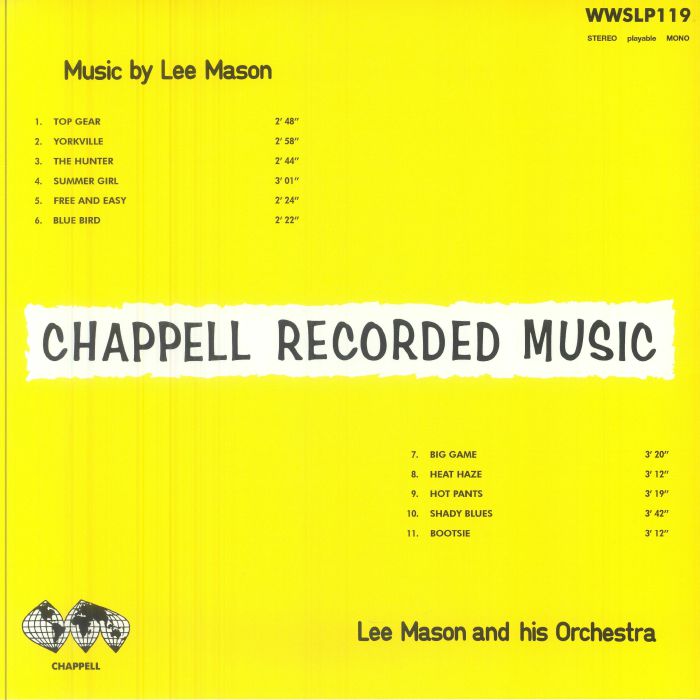
LEE MASON AND HIS ORCHESTRA – MUSIC BY LEE MASON.
Lee Mason and His Orchestra – Music By Lee Mason.
Label: Wewantsounds
Format: Vinyl.
Originally issued in 1971 on the prestigious Chappell Recorded Music Library – and subsequently canonised as a coveted “holy grail” among beat-miners, crate-diggers, and connoisseurs of British jazz-funk – ‘Music By Lee Mason’ stands as a triumphant masterclass in functional, high-craft studio composition. Credited to the enigmatic alias Lee Mason, a pseudonym utilised by the celebrated British composer, arranger, and orchestra leader Pete Moore, the album encapsulates the creative zenith of the UK library music movement during the early seventies.
At the time of its release, library records – also known as production music, were strictly intended for internal broadcast and media industry use. Pressed in remarkably small quantities and never made available to the general public, these albums were engineered as utilitarian sonic toolkits for television producers, film editors, newsrooms, and advertising agencies seeking immediate, cost-effective mood music. ‘Music By Lee Mason’ was conceived within this precise commercial framework, offering a versatile suite of short-form cues, dramatic stings, and rhythmic underscores tailored to soundtrack everything from detective dramas and documentary features to contemporary lifestyle commercials.
Despite its anonymous, work-for-hire origins, the record effortlessly transcends its functional remit, enduring as an extraordinary artistic statement in its own right. Operating outside the rigid commercial pressures of the mainstream pop charts, Moore was afforded total creative autonomy in the studio. Drawing upon London’s elite pool of first-call session musicians – virtuosos who routinely populated the city’s premier scoring stages and jazz clubs, Moore crafted arrangements defined by razor-sharp precision, harmonic sophistication, and undeniable visceral energy.
Musically, the album captures a thrilling transitional moment in British popular music, seamlessly bridging the gap between swinging sixties big-band jazz, sleek cinematic lounge, and the emerging, hard-hitting rhythms of early seventies funk and soul. Across its runtime, taut, syncopated drum breaks and muscular, fuzz-tinged electric bass-lines lock into an irresistible pocket, providing a kinetic foundation for punchy brass stabs, fluid flute melodies, and shimmering electric piano motifs. Every composition demonstrates an acute understanding of pacing and dynamics; because cues had to establish an atmosphere within seconds, Moore eliminated all superfluous padding, resulting in lean, urgent tracks packed with memorable hooks and crisp textural contrasts.
Decades after its quiet distribution to broadcast archives, ‘Music By Lee Mason’ experienced a profound cultural resurrection as hip-hop producers, rare-groove DJs, and archival record collectors began excavating the forgotten vaults of European library labels in the late twentieth century. Moore’s work emerged as a premier source of pristine, unvarnished drum breaks and evocative instrumental samples. Today, the album is revered not merely as an artefact of British broadcasting history, but as a benchmark of studio craft, proving that music designed to remain in the background can possess the timeless vitality to command centre-stage.
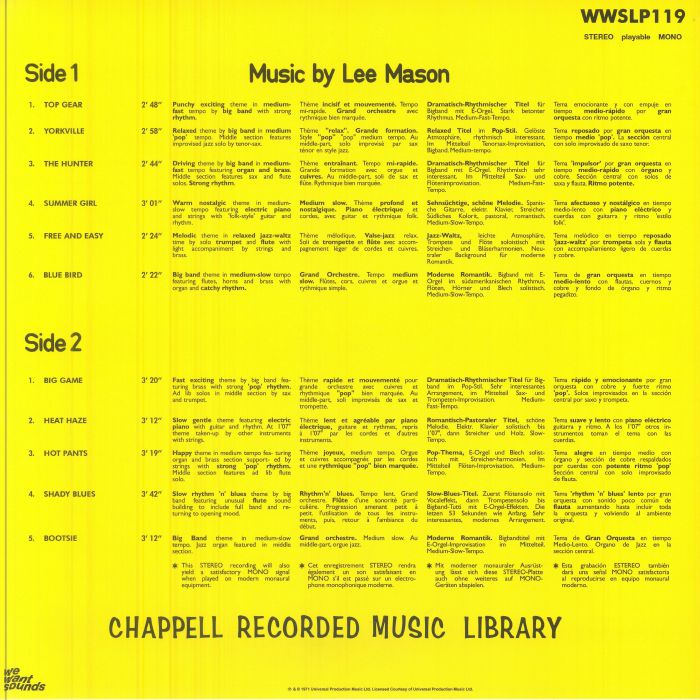
Side One.
Opening the album with an unbridled surge of kinetic energy, ‘Top Gear’ lives up to every ounce of its high-octane title.This punchy, medium-fast theme is propelled by explosive big-band brass and a rock-solid rhythm section, moving from the very first bar with unmistakable cinematic urgency. Anchored by bright, staccato horn stabs and razor-sharp orchestration, the arrangement captures the breathless momentum of high-speed pursuits and fast-paced 1970s television title sequences, setting an exhilarating standard for the record.
Dialling back the intensity just a fraction, ‘Yorkville’ eases into a cool, mid-tempo pop-jazz groove. Restless, rolling drum patterns and a sleek, melodic bassline establish an understated pocket, anchoring the arrangement with effortless poise. At its midpoint, the composition opens up to showcase a fluid, improvised tenor saxophone solo, infusing the cue with a warm, cosmopolitan sophistication.
Shifting into darker, more suspenseful territory, ‘The Hunter’ pairs a driving, medium-fast big-band tempo with eerie Hammond organ flourishes and razor-sharp brass. At its core, the arrangement seamlessly weaves together duelling saxophone and flute solos, cultivating a taut, shadowy atmosphere tailor-made for a gritty British crime thriller.
Offering a stark tonal shift, ‘Summer Girl’ unfolds as a warm, nostalgic composition set to a unhurried, medium-slow tempo. Trading brass bombast for understated intimacy, the arrangement pairs delicate electric piano work and sweeping string pads with a gentle, folk-inflected acoustic guitar. While it leans into the sentimental pastoralism characteristic of classic British television scores, its lush, sun-drenched textures remain effortlessly charming and deeply comforting.
As the title hints, ‘Free And Easy’ glides forward with an infectious, carefree bounce and a sleek, unhurried groove. The composition highlights Moore’s mastery of economical orchestration, stripping away unnecessary ornamentation so that buoyant melodic lines and crisp rhythmic syncopation can shine. The result is an effortlessly cool, perpetually sun-drenched backdrop that radiates understated elegance and mid-century charm.
Serving as the graceful conclusion to Side One, ‘Blue Bird’ is a concise, airy miniature that radiates an uplifting, avian lightness. Foregrounding delicate flute melodies and crisp, understated percussion, the composition highlights the more refined and lyrical dimensions of Moore’s orchestral palette, offering a serene and contemplative counterpoint to the album’s bolder rhythmic statements.
Side Two.
Opening Side Two with an explosive burst of energy, ‘Big Game’ propels the record forward through an aggressive pop-funk rhythm and towering layers of roaring brass. The arrangement builds its dynamic momentum entirely on masterclass tension and release, punctuated by fiery, ad-libbed solos from both saxophone and trumpet that decisively elevate the track far beyond conventional broadcast utility.
A masterclass in atmospheric scene-painting, ‘Heat Haze’ unfolds as a slow, hypnotic composition anchored by shimmering electric piano and understated guitar accompaniment. Around the one minute mark, the primary melody blossoms gracefully as lush, sweeping strings enter the mix, perfectly capturing the mirage-like distortion and listless tranquility of a sweltering afternoon.
Channeling the vibrant cultural mood and spirit of the early seventies, ‘Hot Pants’ delivers an exuberant, mid-tempo funk workout anchored by a muscular, impeccably locked-in rhythm section. The arrangement masterfully weaves driving Hammond organ lines and triumphant brass swells over buoyant string accents, while an inventive, organic flute solo enlivens the middle eight with effortless charm, dynamic contrast, and refined rhythmic dexterity.
Undisputedly celebrated as the highlight of the album for contemporary listeners, ‘Shady Blues’ is a sublime, slow-burning R&B masterpiece. Famously immortaliSed by legendary producer Madlib – who sampled its distinct atmosphere for Lootpack’s ‘Answers.’ The track is anchored by an unusual, haunting flute motif that billows outward with hypnotic restraint. As the composition builds in intensity, the full orchestra swells into a smoky, late-night groove of breathtaking depth and cinematic resonance.
Bringing the album to a triumphant close, ‘Bootsie’ unfolds as a mid-to-slow tempo big-band showcase that serves as a fitting victory lap. Anchored by a deeply resonant, walking groove, the arrangement spotlights a soulful jazz organ throughout its central movement, rounding out the record with effortless warmth, understated elegance, and consummate musicianship.
‘Music By Lee Mason’ occupies a uniquely compelling intersection in the history of recorded music, residing squarely between the pragmatic, utilitarian demands of commercial broadcasting and the uninhibited creative freedom of elite studio jazz-funk. In the early seventies, the British library music industry was frequently characterised by tight budgets, rapid turnaround times, and strict functional briefs designed solely to provide unobtrusive sonic wallpaper for television editors, radio producers, and advertising executives. Within such a system, it would have been effortless and sometimes, commercially expected to deliver formulaic, disposable production cues.
Instead, Pete Moore, operating under his enigmatic Lee Mason pseudonym, subverted the limitations of the medium entirely. Liberated from the commercial anxieties of the mainstream pop charts yet armed with London’s most formidable session musicians, Moore seized the studio as an experimental laboratory. He approached each brief not as a mere background assignment, but as an opportunity for genuine artistic expression — infusing every arrangement with visceral soul, widescreen cinematic depth, and rigorous orchestral craftsmanship.
From explosive, horn-driven action themes and taut thriller underscores to smoky, slow-burning rhythm-and-blues grooves and sun-drenched pastoral miniatures, the album demonstrates an extraordinary command of texture, pacing, and harmonic sophistication. Decades after its quiet, industry-only pressing, ‘Music By Lee Mason’ endures precisely because Moore refused to treat functional music as second-rate art, transforming what was intended as ephemeral broadcast utility into a timeless benchmark of British studio craft.
Fifty-five years after its initial, industry-only pressing, the remarkable longevity of ‘Music By Lee Mason’ stands as an enduring testament to its pristine craftsmanship and uncompromising musical integrity. Whereas lesser production records from the era have frequently aged into kitschy curiosities – marred by heavy-handed novelty gimmicks or dated studio tropes Pete Moore’s work effortlessly sidesteps such pitfalls. Instead, the album offers a timeless, crystal-clear snapshot of early-seventies British studio ingenuity, preserved with an analog warmth and dynamic clarity that continues to captivate audiophiles and musicians alike.
This enduring relevance stems largely from Moore’s refusal to compromise on arrangement or execution. Every cue is anchored by disciplined, razor-sharp orchestration and performed by London’s premier session virtuosos, whose organic interplay imbues the recordings with a living, breathing vitality that resists obsolescence. Because the music was engineered to establish distinct emotional atmospheres within seconds – free from the lyrical clichés or passing commercial trends of mainstream pop, it retains a purity of form that feels just as vital today as it did over half a century ago.
Whether excavated by contemporary hip hop producers and beat-makers as a rich archive of unvarnished breakbeats, crisp horn stabs, and atmospheric samples, or experienced from start to finish as a seamless, evocative journey through sophisticated lounge-jazz and muscular orchestral funk, the record rewards every mode of engagement. Ultimately, ‘Music By Lee Mason’ remains an essential, endlessly rewarding cultural artefact – a definitive monument to a golden era when the strictures of functional broadcast utility inspired the absolute pinnacle of studio composition.
Lee Mason and His Orchestra- Music By Lee Mason.
- Posted in: Big Band ♦ Funk ♦ Jazz ♦ Jazz Funk ♦ Library Music ♦ Lounge Jazz ♦ Pop ♦ Soul
- Tagged: Chappell Recorded Music Library, Lee Mason and His Orchestra, Music By Lee Mason, Pete Moore, Wewantsounds
 dereksmusicblog

