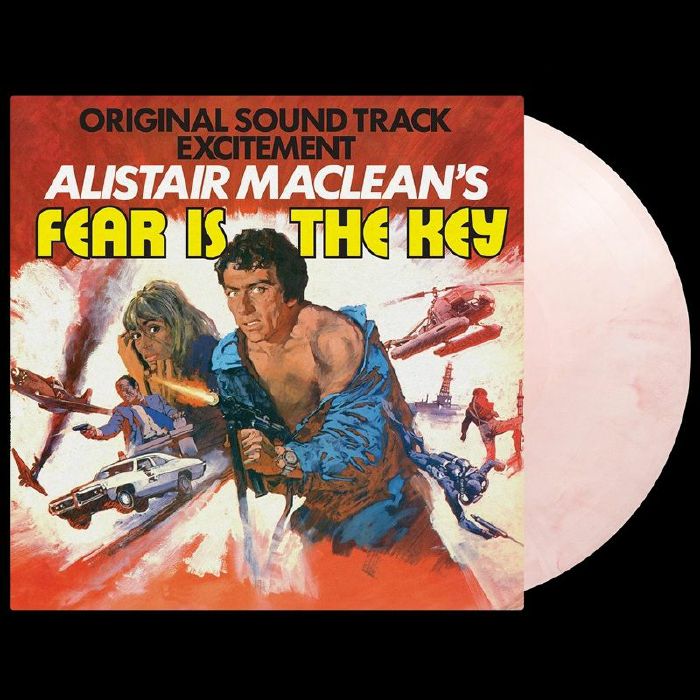
ROY BUDD – FEAR IS THE KEY (SOUNDTRACK).
Roy Budd – Fear Is The Key (Soundtrack).
Label: Music On Vinyl.
Format: Vinyl.
In the early seventies, the transatlantic crime thriller underwent a decisive sonic transformation, trading lush symphonic romanticism for the propulsive, street-level urgency of contemporary jazz and funk. At the vanguard of this movement stood British composer and pianist Roy Budd, who was just twenty-five years old when he accepted the commission to score Michael Tuchner’s 1972 adaptation of Alistair MacLean’s ‘Fear Is the Key.’
Having first gained recognition on the London club circuit as a teenage piano prodigy before fronting his own acclaimed trio, Budd possessed an innate command of groove, rhythmic displacement, and small-group dynamics. Only twelve months prior, his stark, harpsichord-and-tabla-driven score for Mike Hodges’s 1971 ‘Get Carter’ had upended the conventions of British noir. With ‘Fear Is the Key,’ Budd adapted that modernist sensibility to an ambitious Anglo-EMI co-production filmed on location across the bayous, highways, and offshore oil rigs of Louisiana, featuring Barry Newman, Suzy Kendall, John Vernon, and a young Ben Kingsley in his theatrical feature debut.
The dramatic architecture of ‘Fear Is the Key’ relies entirely on an elaborate psychological feint, requiring a score capable of sustaining a sustained double bluff without prematurely betraying its protagonist’s motives. On its surface, the narrative follows John Talbot (Newman), an apparently unstable drifter who orchestrates a violent courtroom escape, abducts oil heiress Sarah Ruthven (Kendall), and enters into a treacherous alliance with ruthless industrialist Vyland (Vernon) to salvage a sunken Douglas DC-3 carrying millions in uncut diamonds and gold bullion. Beneath this kinetic facade, however, every calculated provocation is part of Talbot’s three year vendetta to expose and destroy the men responsible for murdering his family.
Budd’s compositional strategy mirrors this structural duality with remarkable precision.Refusing to telegraph Talbot’s true vulnerability through conventional, sentimental leitmotifs, Budd erects a muscular exterior of sun-bleached funk, brass-heavy big-band jazz, and visceral percussion to underscore the film’s relentless forward momentum, while subtly threading the score’s underbelly with brooding modal harmonies, sparse solo piano introspection, and claustrophobic orchestral dissonance that hint at the grief driving the protagonist’s vengeance.
Equally vital to the score’s enduring power is its status as a watershed meeting between Budd’s rigorous structural discipline and the elite vanguard of London’s early-seventies jazz and session scene. Produced in London under the supervision of Budd’s longtime creative partner Jack Fishman, the recording sessions brought together an extraordinary roster of British jazz soloists – anchored by tenor saxophonist Ronnie Scott alongside fellow luminaries Tubby Hayes, trumpeter Kenny Baker, bassist Jeff Clyne, and percussionist Chris Karan – performing in dynamic counterpoint with a full symphonic orchestra. Crucially, substantial portions of the score were recorded live to picture rather than locked to a rigid click track. This methodology preserved the organic rhythmic elasticity, micro-timings, and breathless collective risk-taking of a live jazz ensemble, lending Tuchner’s extended vehicular pursuits and underwater sequences an unvarnished, tactile immediacy.
Across its ten distinct cues – spanning roughly thirty-six minutes on the original Pye Records LP and subsequent archival reissues on Cinephile, Silva Screen and now Music On Vinyl – ‘Fear Is the Key’ stands as one of the most sophisticated fusions of jazz improvisation, regional American idiomatic colour, and modernist suspense writing in seventies cinema. Rather than treating jazz merely as atmospheric local flavour for its Gulf Coast setting, Budd elevates it into the primary structural engine of the drama, proving that idiomatic spontaneity and tight architectural control could coexist seamlessly in service of psychological thriller filmmaking. In the broader arc of Budd’s tragically brief career, the score remains a definitive masterclass in kinetic restraint – a work that captured the raw electricity of British jazz at its peak while establishing a high watermark for transatlantic action scoring.
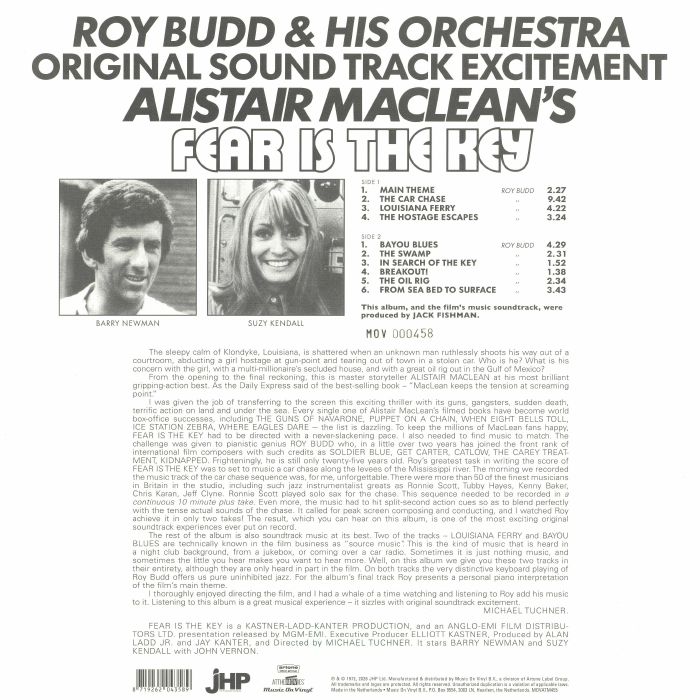
Side One.
Budd opens the album with ‘Main Theme,’ an immediate statement of intent, establishing a rhythmic and harmonic DNA that bridges British big-band sophistication with American Deep South grit. Built over a crisp, mid-tempo funk groove anchored by electric bass, brushed and snapped snare work, and percussive acoustic guitar, the cue introduces the score’s primary melodic cell: a cool, slightly veiled motif voiced initially by muted brass and electric piano before blooming into a wider ensemble statement. There is none of the bombast typical of sixties Alistair MacLean adaptations like Where Eagles Dare; instead, Budd opts for lean, coiled tension. The harmonic language hovers around minor-seventh and suspended chords that refuse easy resolution, reflecting Talbot’s guarded, unreadable persona. Within two and a half minutes, Budd locks in the score’s sonic geography – sleek enough for an international thriller, yet earthy enough to belong on the highways of Louisiana.
Anchoring the entire score – and standing as a landmark achievement in seventies action scoring – is Budd’s nearly ten-minute cue accompanying Carey Loftin’s stunt-driven pursuit. Following Talbot’s courtroom escape with Sarah, the sequence demanded sustained kinetic momentum without devolving into sonic fatigue. Budd resolves this structural challenge by conceiving the cue as a multi-movement jazz-funk concerto. Driven by a relentless, syncopated rhythm section – marked by lockstep bass patterns, crisp hi-hat work, and incisive brass stabs – the arrangement provides a volatile canvas for tenor saxophonist Ronnie Scott, whose searing, breathless soloing cuts through the ensemble with raw physicality. Rather than remaining locked at a single dynamic peak, Budd meticulously modulates the tension: pulling back to taut bass-and-percussion vamps during moments of tactical evasion before erupting into full-throated brass and saxophone interplay as pursuit vehicles collide. Because the ensemble recorded live to picture, their split-second responsiveness infuses the performance with an organic, razor-sharp urgency, securing its place alongside Lalo Schifrin’s ‘Bullitt’ and Don Ellis’s ‘The French Connection’ in the pantheon of great screen chase music.
After the kinetic exhaustion of ‘The Car Chase,’ Budd pivots sharply in tone and texture, trading urban-highway propulsion for humid, atmospheric suspense. ‘Louisiana Ferry’ underscores Talbot and Sarah’s cautious movement through the bayou waterways, and Budd uses the space to highlight his gift for orchestrational colour. Sparse, echoing piano notes – played by Budd himself with crystalline restraint – interlock with low woodwinds, shimmering vibraphone, and muted strings to evoke dark water and dense coastal fog. An ostinato bass figure maintains a subtle undercurrent of forward motion, reminding the listener that pursuit is never far behind, while dissonant string clusters swell and recede like passing wakes. It is a masterclass in textural pacing, proving that Budd’s control over silence and register is every bit as compelling as his command of a roaring horn section.
On ‘The Hostage Escapes’ Budd reintroduces rhythmic urgency, crafting a tight, cat-and-mouse suspense piece marked by nervous metric shifts and clipped instrumental phrasing. Pizzicato strings and dry percussion establish an anxious, tiptoeing pulse as Sarah attempts to break free from Talbot’s custody. Budd layers short, agitated woodwind motifs over angular brass accents, creating a sense of physical confinement and sudden, panicked bursts of movement. Unlike the expansive, improvisatory freedom of ‘The Car Chase,’ the writing here is tightly scripted and cellular – each musical phrase behaves like a locked door or a sudden turn down a narrow corridor. Mid-cue, the full orchestra surges to capture a moment of acute physical peril before settling back into a wary, unresolved cadence.
Side Two.
One of the score’s richest character pieces, ‘Bayou Blues’ slows the tempo to explore the psychological ambiguity between captor and captive, as well as the regional atmosphere of the American South. Anchored by a languid, late-night blues progression, the cue features soulful solo piano work from Budd paired with warm, smoky saxophone phrasing and subtle acoustic guitar embellishments. Rather than lapsing into Hollywood Southern pastiche, Budd filters blues harmony through his distinctly British modern-jazz sensibility – employing rich chord voicings, bittersweet ninths, and unhurried rubato passages. Beneath the surface warmth lies a palpable melancholy, quietly foreshadowing the personal tragedy driving Talbot’s elaborate scheme. On album, it provides a vital emotional exhale at the midpoint of the listening experience.
Returning to visceral danger, ‘The Swamp’ strips away melodic comfort in favour of primal, percussive dread. Budd leans heavily on his percussion section—combining congas, bongos, timpani, and metallic accents – to create a dense, claustrophobic rhythmic bed that mimics the disorienting terrain of the Louisiana wetlands. Low brass growls and flutter-tongued flutes punctuate the mix like unseen threats beneath the surface, while discordant string glissando tighten the harmonic vice. Though brief at just under two and a half minutes, the cue packs remarkable sonic density, showcasing Budd’s modernist orchestral instincts and his ability to generate genuine unease without relying on cliché horror tropes.
Compact and focused, ‘In Search Of The Key’ captures the investigative, procedural gears of Talbot’s plan clicking into place. Budd constructs a sleek, stealth-oriented miniature driven by a walking electric bass line, crisp rimshots, and cool, interrogative figures on electric piano and muted trumpet. The cue operates like a musical sleight of hand – light on its feet, rhythmically exact, and deliberately understated. Every instrument stays in a tight dynamic pocket, allowing the interplay between keyboard and rhythm section to convey quiet calculation and nocturnal reconnaissance as Talbot probes the perimeter of Vyland’s operation.
The shortest track on the album is an adrenaline jolt of pure kinetic energy. ‘Breakout!’ explodes out of the gate with sharp, syncopated brass hits, frantic snare fills, and surging string lines. Budd compresses the big-band power of the score’s earlier action writing into ninety-four seconds of relentless forward drive, utilising ascending chromatic runs and punchy horn riffs to propel the visual action. Despite its brevity, the cue feels structurally complete – building from an immediate percussive snap to a decisive, full-ensemble climax that leaves zero wasted motion.
When the narrative transitions from the humid bayous to an isolated offshore drilling platform battered by an encroaching storm, Budd dramatically recalibrates his sonic palette. ‘The Oil Rig’ abandons the intimate textures of a jazz combo in favour of stark, industrial orchestral weight. Cavernous brass pedals and churning low strings evoke both the towering steel superstructure and the turbulent Gulf waters surrounding it, while incisive, metallic percussion strikes suggest wind-sheared machinery and imminent danger. By fracturing the main theme’s intervals and embedding them within an austere, minor key architecture, Budd strips away any lingering warmth – sonically trapping the characters within a hostile, inescapable environment that heightens the climax’s visceral dread.
For the film’s climactic confrontation – in which Talbot traps Vyland and his accomplice inside a submersible beside the sunken DC-3 and cuts their oxygen to force a confession – Budd crafts a gripping, psychologically charged finale. ‘From Sea Bed to Surface’ opens in suffocating, abyssal stillness: high, sustained string harmonics hover over cavernous bass pedals and a slow, heartbeat-like pulse, capturing the agonising countdown on the ocean floor. As panic escalates within the flooded wreck, Budd methodically layers dissonant brass swells and agitated ostinato, mirroring the psychological unraveling of the trapped conspirators. Once the confession is extracted and the submersible begins its ascent, the score undergoes a sweeping structural release – unfolding into a cathartic orchestral resolution where the main theme’s core motifs finally emerge with full emotional weight, bringing both the narrative and the album to a resonant, definitive close.
Within the broader trajectory of British film music – and the tragically foreshortened career of Roy Budd, who died of a brain haemorrhage in 1993 aged just forty-six – ‘Fear Is the Key’ stands as an indispensable evolutionary bridge. Positioned chronologically between the stark, small-combo minimalism of 1971s ‘Get Carter,’ 1973s then‘The Stone Killer’ and the expansive symphonic adventure scores of his late-seventies partnership with producer Euan Lloyd (The Wild Geese, The Sea Wolves), 1972s ‘Fear Is The Key’ captures Budd at the exact inflection point where his dual identities as a virtuosic jazz bandleader and a sophisticated symphonic dramatist fused into a singular voice.
Whereas ‘Get Carter’ weaponised a tight, cold quartet to project northern urban alienation, ‘Fear Is the Key’ demonstrates Budd’s complete command over a volatile hybrid ensemble. Across its runtime, the score pivots effortlessly between the smoky, late-night lyricism of ‘Bayou Blues,’ the modernist, dissonant weight of ‘The Oil Rig,’ and the blistering jazz-funk ferocity of ‘The Car Chase,’ proving that Budd could scale his dramatic architecture to match an international action thriller without forfeiting his signature rhythmic bite.
What fundamentally elevates ‘Fear Is the Key/ above routine seventies genre scoring is Budd’s refusal to compartmentalise his jazz and orchestral idioms. In lesser hands, merging a hard-swinging British rhythm section with a dramatic film orchestra frequently resulted in jarring stylistic seams – contemporary “source-style” grooves pasted awkwardly alongside traditional suspense underscores. Budd circumvents this pitfall entirely by anchoring both worlds in shared motivic cells and rigorous rhythmic discipline. The syncopated intervals introduced in the ‘Main Theme’ are never treated as mere melodic hooks; instead, they function as structural DNA, reappearing fractured inside the cold brass pedals of ‘The Oil Rig’ and inverted beneath the claustrophobic string harmonics of ‘From Sea Bed To Surface.’ This thematic economy gives the thirty-six-minute program a taut, symphonic cohesion that anchors its volatile surface. Equally crucial is Budd’s trust in the improvisational instincts of his ensemble. Rather than reducing elite London session players to rigid note-readers, he afforded titans like tenor saxophonists Ronnie Scott and Tubby Hayes genuine structural room to breathe, bend phrasing, and react to the edited picture in real time – infusing the score with an organic, human electricity that no purely notated score could replicate.
More than fifty years after its original Pye Records pressing, ‘Fear Is the Key’ has transcended its status as a prized artefact among soundtrack collectors and rare groove aficionados to stand as a masterclass in dramatic pacing and hybrid orchestration. Its enduring power lies in its refusal to compromise: it demonstrates that commercial thriller scoring can achieve high modernist sophistication without sacrificing visceral propulsion, cementing Budd’s legacy as a rare compositional polymath capable of bridging the worlds of Oscar Peterson and Bernard Herrmann within a single, unforgettable frame.
Roy Budd – Fear Is The Key (Soundtrack).
- Posted in: Easy Listening ♦ Free Jazz ♦ Funk ♦ Improv ♦ Jazz ♦ Jazz Funk
- Tagged: Alistair MacLean, Chris Karan, Fear Is The Key, Fear Is The Key (Soundtrack), Get Carter, Jack Fishman, Jeff Clyne, Kenny Baker, Music On Vinyl, Pye Records, Ronnie Scott, Roy Budd, The Stone Killer, Tubby Hayes
 dereksmusicblog

