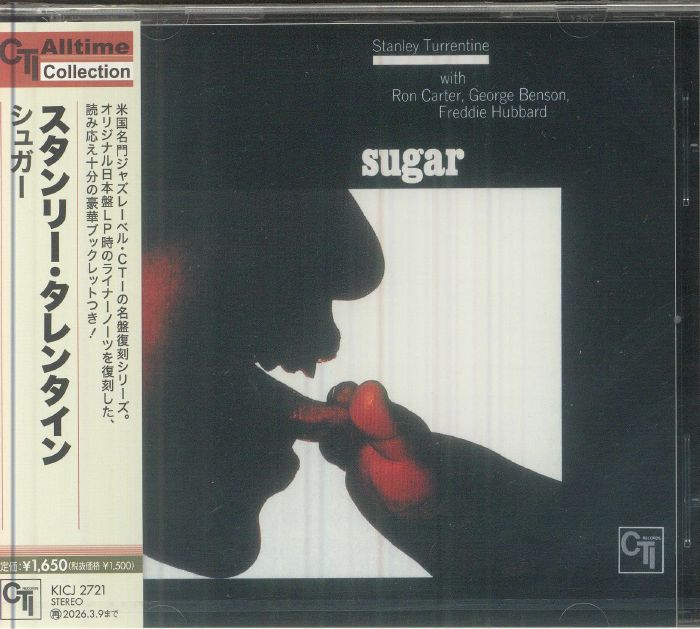
STANLEY TURRENTINE – SUGAR.
Stanley Turrentine – Sugar.
Label: King Japan.
Format: CD.
Tracked over two decisive days in November 1970 inside engineer Rudy Van Gelder’s hallowed studio in Englewood Cliffs, New Jersey, ‘Sugar’ captures the exact artistic inflection point where tenor saxophonist Stanley Turrentine evolved from a revered Blue Note hard bop stalwart into one of the defining voices of seventies soul-jazz. Serving as his inaugural release for producer Creed Taylor’s newly independent CTI Records, the album occupies a unique transitional space within the label’s discography. Rather than deploying the lush, string-laden orchestral sweetening and dense studio arrangements that would soon become CTI’s signature aesthetic, Taylor opted here for an unadorned, high-voltage small group summit – allowing the raw chemistry of the ensemble to dictate the sonic architecture.
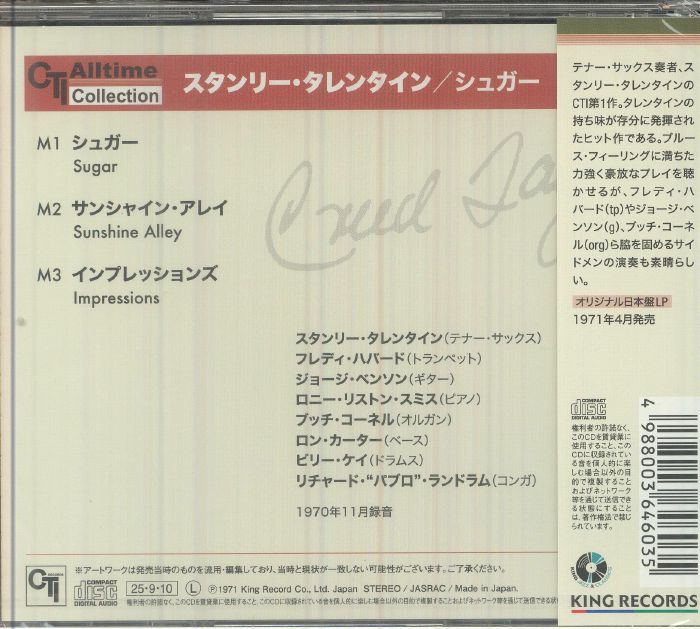
To realise this vision, Taylor assembled an extraordinary, combustible lineup of modern jazz innovators: trumpeter Freddie Hubbard, guitarist George Benson, Lonnie Liston Smith on electric piano, Butch Cornell on Hammond organ, Ron Carter on acoustic bass, Billy Kaye on drums, and Richard “Pablo” Landrum on congas. Anchored by Van Gelder’s crisp, immediate engineering – which balances the warm, woody resonance of Carter’s acoustic bass against the gritty, electric textures of Smith’s Fender Rhodes and Cornell’s organ – this seven-piece unit bridges the gap between acoustic post-bop rigour and earthy, groove-driven funk, providing the ideal rhythmic and harmonic launchpad for Turrentine’s muscular, blues-drenched tenor.
The title track became Turrentine’s signature calling card for good reason – it distills his entire musical ethos into a hypnotic, minor key groove. Driven by Carter’s elastic, walking bass-line and Kaye’s understated pocket, the piece establishes a simmer rather than a boil. Liston Smith’s Fender Rhodes supplies a warm, shimmering harmonic bed without cluttering the midrange. When Turrentine enters, his tone is massive, burnished, and vocalised; he leans into bent blue notes and spacious phrasing, proving that restraint carries more weight than velocity. Hubbard follows with a masterclass in dynamic contrast, starting in his middle register before unleashing crisp, brassy cascades that cut cleanly through the mix. Benson’s subsequent solo bridges the two horns, weaving Wes Montgomery-indebted octaves with darting, bebop-inflected runs before the ensemble rides out on the unforgettable main theme.
Swapping Liston Smith’s electric piano for composer Butch Cornell’s gritty Hammond organ, ‘Sunshine Alley’ pivots immediately into celebratory, gospel-drenched territory. Richard “Pablo” Landrum’s congas lock tightly with Kaye’s snare, infusing the shuffle with a buoyant, street-level Latin-soul pulse. Turrentine thrives in this environment – his Pittsburgh R&B roots come roaring to the surface as he digs into muscular riffs and vocal growls. Cornell’s organ solo is a highlight of textural warmth, swelling from percussive, staccato chords into full-throated harmonic swells. Hubbard matches the energy with ebullient, high note fanfares, turning the track into a seamless showcase of collective swing where every soloist pushes the rhythm section harder.
Closing the album was this fourteen minute tour de force takes John Coltrane’s landmark Dorian-mode workout ‘Impressions’ and filters it through the raw electricity of an organ and conga powerhouse. Rather than attempting to mimic Coltrane’s sheets of sound spirituality, Turrentine grounds ‘Impressions’ in earthbound blues power, carving out bold, declarative motifs over Carter’s ferocious ostinato. Hubbard delivers arguably his finest solo of the entire date here – an astonishing display of technical bravura, half-valve smears, and blistering double-time phrasing that pushes the ensemble to the edge of combustion. Benson follows with razor-sharp articulation, trading rhythmic accents with Kaye and Landrum before Cornell’s swirling organ drives the track toward an exhilarating climax. It remains one of the most compelling evidence points that CTI could match Blue Note or Impulse! in sheer jazz ferocity.
Few recordings in the post-bop canon manage to resolve jazz’s most enduring aesthetic dilemma with the effortless authority of Sugar: how to achieve immediate, visceral resonance with an R&B-attuned audience without sacrificing improvisational rigour or harmonic depth. Throughout his prolific sixties tenure at Blue Note, Stanley Turrentine had established himself as an undisputed master of the soulful hard bop quintet, yet his artistic reach was occasionally circumscribed by compact, radio-conscious song forms or routine commercial cover assignments. On Sugar, producer Creed Taylor and engineer Rudy Van Gelder liberated Turrentine from those constraints, affording him an expansive, unhurried canvas – allowing two of the album’s compositions to stretch well past the ten-minute mark – and surrounding him with an elite cadre of improvisers who refused to merely coast on repetitive vamps.
From an architectural standpoint, the album derives its extraordinary momentum from deliberate textural and generational contrast. By situating Lonnie Liston Smith’s shimmering, forward-looking Fender Rhodes alongside Butch Cornell’s gritty, church-inflected Hammond B-3 organ, the arrangement bridges two distinct eras of jazz keyboard lineage within a single sonic frame. A parallel duality anchors the rhythm section, where the woody, elastic authority of Ron Carter’s acoustic upright bass locks seamlessly into the syncopated pulse of Richard “Pablo” Landrum’s congas – grounding the ensemble simultaneously in classic New York swing and contemporary Afro-Latin funk.
Commanding the centre of this rich tapestry is Turrentine himself, operating at the absolute apex of his expressive powers. Through his commanding economy of notes, vocalised warmth, and unshakable rhythmic poise, he demonstrates that soulfulness is never a superficial garnish applied to jazz, but rather its very lifeblood. Over half a century since its inception, ‘Sugar’ endures not merely as the crown jewel of CTI’s early, pre-orchestral catalog, but as a watershed blueprint for how groove-driven accessibility and uncompromising jazz musicianship can coalesce into timeless art.
Stanley Turrentine – Sugar.
- Posted in: Blues ♦ Funk ♦ Jazz ♦ Modal Jazz ♦ Post Bop ♦ Soul Jazz
- Tagged: Billy Kaye, Butch Cornell, Creed Taylor, CTi Records, George Benson, Lonnie Liston Smith, Richard "Pablo" Landrum, Ron Carter, Rudy Van Gelder, Stanley Turrentine, Sugar
 dereksmusicblog

