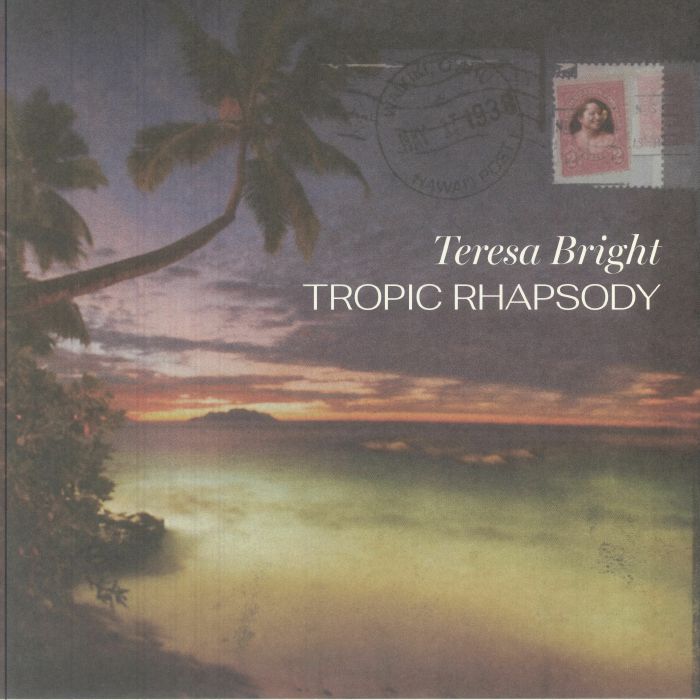
TERESA BRIGHT – TROPIC RHAPSODY.
Teresa Bright – Tropic Rhapsody.
Label: Aloha Got Soul.
Format: Vinyl.
Few recordings in the modern Hawaiian canon achieve the rarefied equilibrium of cultural stewardship and cosmopolitan elegance found on ‘Tropic Rhapsody.’ Initially unveiled in 2008 by the venerable Mountain Apple Company, the album’s enduring resonance has been further solidified in recent years through discerning archival reissues – most notably the definitive vinyl pressing curated by the Honolulu-based imprint Aloha Got Soul, which introduced the work to a global audience of audiophiles and vinyl enthusiasts. At the centre of this achievement is the inimitable Teresa Bright, an artist whose crystalline vocal clarity, nuanced jazz phrasing, and deep-seated respect for Hawaiian musical lineage allow her to transform ‘Tropic Rhapsody’ into a benchmark for contemporary hapa haole interpretation.
By definition, the hapa haole tradition—encompassing songs about Hawaii composed largely in English or built upon Western Tin Pan Alley and jazz harmonic frameworks – has long existed in a state of delicate aesthetic tension.Throughout the twentieth century, the genre frequently teetered between genuine expressions of island affection and the commercialised artifice of mid-century exoticism and kitsch. Bright, however, transcends these historical clichés entirely. Instead of leaning into nostalgic pastiche, she elevates these compositions to the stature of canonical jazz standards, stripping away novelty to expose their underlying melodic sophistication. Through a judicious synthesis of understated swing, sun-drenched Bossa nova rhythms, and intimate acoustic arrangements, she breathes fresh, contemporary vitality into the repertoire without ever compromising its emotional authenticity.
To fully appreciate the breadth of Bright’s vision, one must examine the album’s sequencing and musical architecture in detail. In the granular, track-by-track analysis that follows, each selection is unpacked to highlight the subtle interplay of instrumentation, the disciplined poise of Bright’s vocal delivery, and the stylistic triumphs that define this landmark recording.
Side One.
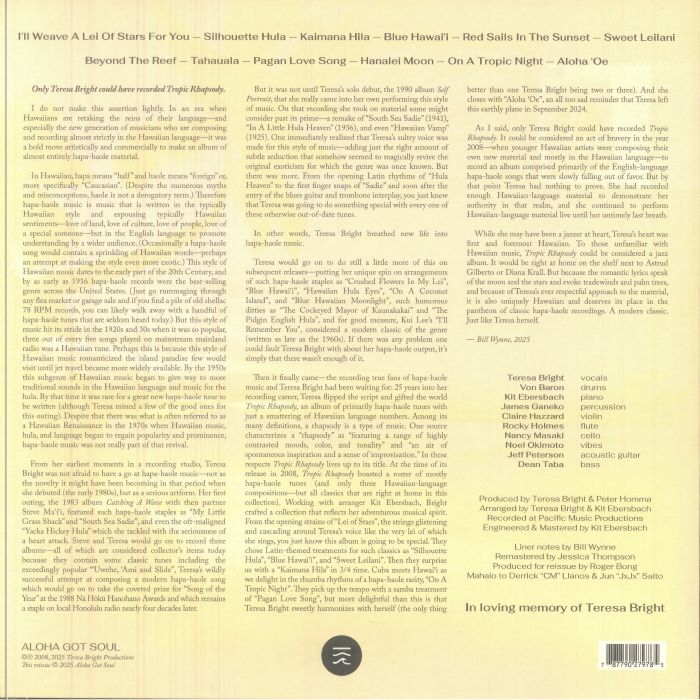
Written by legendary hapa haole composer R. Alex Anderson, ‘I’ll Weave A Lei Of Stars For You’ opens the album with a gentle, floating cadence. Bright’s vocals are pristine, capturing a sense of starry-eyed devotion without leaning into saccharine overstatement. The arrangement relies on subtle string-like textures and warm guitar phrasing, giving the melody ample room to breathe. It acts as an open invitation, drawing the listener directly into a breezy, moonlit Hawaiian night.
‘Kaimana Hila’ picks up the tempo with a playful, swaying groove. Bright navigates the syncopated phrasing with absolute ease, demonstrating her innate jazz sensibilities. The interplay between the rhythm section and the vocal melody evokes images of dancers moving against a twilight horizon. Her tone remains airy yet anchored, effortlessly hitting the micro-nuances of the tune’s melodic leaps.
‘Kaimana Hila’ is one of the most canonical entries in the hapa-haole canon, yet Bright and her ensemble inject it with vibrant new life. Leaning heavily into a swinging jazz club framework, the song bounces forward on nimble instrumentation and a driving, upbeat tempo. Bright’s voice exudes a smiling warmth, proving that reverence for tradition and playful rein-formation can comfortably coexist.
Long overshadowed in the popular imagination by its mid-century Hollywood associations and Elvis Presley’s iconic rendering, ‘Blue Hawai’i’ is thoughtfully restored here to a state of unvarnished, organic grace. Stripping away decades of cinematic artifice and over-orchestrated gloss, Bright offers an intimate, nocturnal interpretation defined by warmth and restraint. Her phrasing is remarkably tender and unhurried, exercising a disciplined control of space that allows the poignant, melancholic undercurrent of the lyric to emerge naturally against a sparse yet richly textured acoustic accompaniment.
Though not natively Hawaiian in origin, the classic ballad ‘Red Sails In The Sunset’ integrates seamlessly into the island jazz tapestry of ‘Tropic Rhapsody.’ Bright’s vocal performance is hauntingly smooth, carrying a oceanic expanse within its timbre. The arrangement utilises a steady, undulating pulse that mimics the motion of distant waves, making the track feel both timeless and deeply personal.
Academy Award-winner ‘Sweet Leilani’ is delivered here with a supreme lack of sentimentality, which ironically heightens its emotional resonance. Bright avoids vocal grandstanding, opting instead for pure, bell-like clarity. The gentle acoustic accompaniment cradles her voice, creating a sanctuary of quiet grace that closes out Side One with profound serenity.
Side Two.
Ushering in Side Two, ‘Beyond The Reef’ pivots the album toward a markedly more introspective, contemplative register. Jack Pitman’s enduring composition is steeped in themes of yearning and absence, and Bright navigates this emotional terrain with a hushed, smoky delivery that balances vulnerability with quiet resolve. Framed by a deeply atmospheric, nocturnal arrangement, the instrumentation envelops the listener in a sense of tranquil solitude – evoking the stillness of an empty Pacific shoreline after dusk.
Drawing directly from the royal musical canon, this inspired rendering of Prince Leleiohoku’s composition ‘Tahauala’ anchors the album in deep cultural memory while bridging ancestral Hawaiian traditions with contemporary harmonic sensibilities. Bright navigates the piece’s chant-like cadence with measured poise and scholarly reverence, seamlessly weaving traditional Hawaiian vocal inflections—such as delicate haʻi breaks and idiomatic phrasing – into a sleek, modern acoustic framework. Driven by an infectious, grounded groove, the performance ultimately crystallises the album’s overarching thesis: that authentic Hawaiian heritage and cosmopolitan sophistication are not merely compatible, but mutually enriching.
Historically prone to tropical cliché, ‘Pagan Love Song’ is successfully rehabilitated here through sheer musicality. Bright approaches the melody with a sly, knowing elegance. The arrangement emphasises cool jazz chords and subtle percussion rather than thunderous exotic tropes, turning a dated Hollywood artefact into a genuinely chic, sophisticated groove.
Celebrated across the islands as a modern benchmark of hapa haole songwriting, ‘Hanalei Moon’ which is Bob Nelson’s lyrical tribute to Kauaʻi’s iconic crescent bay receives an interpretation of rare sensitivity and poise. Bright’s vocal performance effortlessly evokes the misty, ethereal atmosphere of Hanalei, balancing crystalline clarity with a deeply felt sense of place. Supported by an arrangement that is at once lush and remarkably transparent, her voice glides over a delicate cushion of acoustic accompaniment – resulting in one of the album’s most transcendent and emotionally resonant moments.
Rooted in the romantic, Latin American compositional elegance of ‘Agustín Lara’ yet seamlessly adapted to an island sensibility, ‘On a Tropic Night’ introduces an understated, infectious Bossa nova sway to the sequence. Bright navigates the song’s shifting harmonic architecture with effortless intuition, her vocals gliding over the syncopated rhythm with fluid grace. The result is an intoxicating, sun-warmed performance that captures the intimate magic of a balmy Hawaiian evening – leaving the listener suspended in the quiet romance of a twilight dance beneath glowing patio lights.
Bringing the album to a poignant conclusion, the decision to place Queen Liliʻuokalani’s ‘Aloha ʻOe’ – the quintessential Hawaiian anthem – at the close of the sequence proves to be an inspired stroke of artistic curation. Eschewing the grand, theatrical flourishes that frequently accompany this historic farewell, Bright opts instead for a reading of disarming intimacy and restraint. Delivered with deep reverence, her voice carries a delicate, tear-veiled sweetness that honours the profound cultural gravity of the composition—gently dissolving into silence and lingering long after the final note fades.
Viewed in its totality, ‘Tropic Rhapsody’ operates far beyond the conventional parameters of a nostalgic revival project, functioning instead as an incisive yet deeply affecting inquiry into the mechanics of cross-cultural synthesis. Musically, Teresa Bright navigates a remarkably delicate equilibrium: she preserves the historical integrity and cultural specificity of the hapa haole canon while systematically stripping away the kitschy, tourist-oriented artifice that clouded its mid-twentieth-century reception. By refracting these compositions through the sophisticated harmonic vocabulary of chamber jazz, the syncopated warmth of Bossa nova, and the crystalline intimacy of acoustic pop, she excavates the genuine melodic and structural elegance embedded within the original songwriting.
From an architectural standpoint, the record’s enduring triumph is rooted in its disciplined pacing and unwavering tonal cohesion. Bright exhibits extraordinary vocal restraint, resisting the impulse toward pyrotechnics in favour of an understated, conversational delivery that trusts the inherent power and emotional directness of the melodies themselves.The surrounding arrangements mirror this philosophy, eschewing superfluous ornamentation in favour of negative space, organic warmth, and rhythmic subtlety – an intentional minimalism that keeps Bright’s voice squarely at the centre of the sonic frame. Rather than treating Hawaiian musical history as a static artefact to be admired from afar, ‘Tropic Rhapsody’ reimagines it as a living, adaptable idiom, establishing an enduring standard for how regional traditions can be brought into contemporary focus without sacrificing an ounce of cultural dignity, nuance, or artistic truth.
Teresa Bright – Tropic Rhapsody.
- Posted in: Bossa Nova ♦ Chamber Jazz ♦ Cool Jazz ♦ Jazz ♦ Pop
- Tagged: Aloha Got Soul, Mountain Apple Company, Teresa Bright, Tropic Rhapsody
 dereksmusicblog

