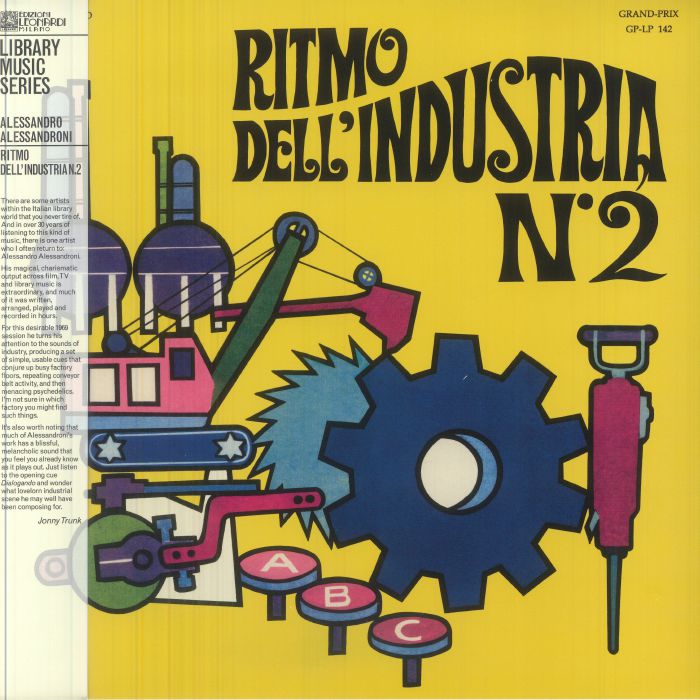
ALESSANDRO ALESSANDRONI – RITMO DELL’INDUSTRIA No2.
Alessandro Alessandroni – Ritmo Dell’Industria N°2.
Label: Vinyl Magic
Format: Vinyl.
Originally released in 1969 on the boutique Italian library imprint Grand Prix, Alessandro Alessandroni’s ‘Ritmo Dell’Industria N°2’ stands as a monumental achievement in the canon of Italian library music and is an undisputed holy grail for vinyl collectors, hip-hop producers, and avant-garde sound researchers worldwide. Pressed in strictly limited quantities solely for television, radio, and industrial film licensing rather than commercial retail, the album has evolved over the decades from an obscure functional artefact into one of the most sought-after and revered documents of late-twentieth century European sonic experimentation.
While Alessandroni is most widely celebrated in popular culture for his indelible contributions to Ennio Morricone’s Spaghetti Western scores – most notably his iconic, razor-sharp whistling and his leadership of the renowned vocal ensemble I Cantori Moderni on ‘The Good, The Bad and The Ugly’ – ‘Ritmo Dell’Industria N°2’ captures the Roman multi-instrumentalist, composer, and arranger in an entirely different creative element.
Stripped of cinematic melodrama and dusty frontier romanticism, ‘Ritmo Dell’Industria N°2’ is a focused, conceptual triumph designed to soundtrack the mechanised pulse, urban labor, and rapid technological modernisation of late-sixties industrial Europe. Reflecting the sociopolitical and economic realities of Italy’s economic miracle, the compositions translate the architecture of factories, assembly lines, and heavy machinery into a sophisticated, kinetic musical language.
At the core of the album’s enduring appeal is its audacious sonic alchemy. Alessandroni bridges the gap between strict utilitarian broadcast music and radical psychedelic funk, fusing raw, heavy-hitting drum breaks with hypnotic, elastic bass-lines that anticipate modern breakbeat culture by decades. Over this relentless rhythmic foundation, he layers eerie proto-ambient synthesiser textures, percussive studio effects, and the signature wordless scat vocals of ‘I Cantori Moderni.’
Rather than portraying mechanisation as a cold, sterile, or dystopian force, Alessandroni’s arrangements imbue the industrial landscape with humanity, groove, and psychological tension-transforming the clatter of modern industry into a living, breathing organism of rhythm and avant-garde soul.
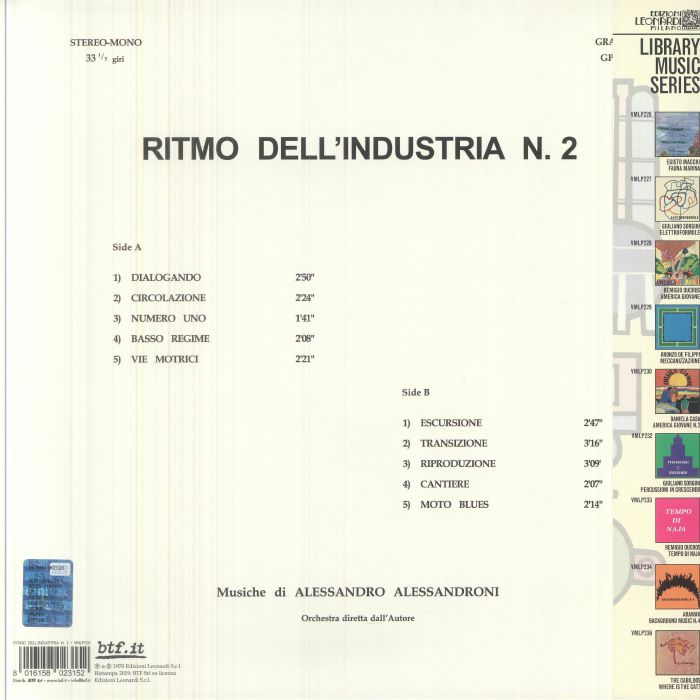
Side A.
The album opens with an immediate sense of space and psychological interplay. ‘Dialogando’ sets a sophisticated, nocturnal mood driven by understated, pulsing rhythms and suspenseful instrumentation. Rather than plunging straight into brutal industrial clatter, the track builds an atmosphere of modern corporate or urban communication. Subtle guitar phrasing and rhythmic accents weave in and out, establishing the masterclass in texture and minimalism that defines the entire record.
Shifting gears into literal and figurative motion, ‘Circolazione’ mimics the constant flow of goods, vehicles, and information in a hyper-modernised metropolis. The rhythm section takes on a relentless, forward-moving momentum. Propelled by tight, crisp drum work and looping motifs, the track creates an environment of perpetual motion – capturing the anxious yet exhilarating rush of late-sixties urban infrastructure.
Serving as the opening statement and immediate centre-piece of the album, ‘Numero Uno’ shifts the album’s focus squarely toward kinetic, floor-shaking groove. Anchored by a thick, hypnotic bass-line and crisp, propulsive drum breaks, the arrangement immediately establishes a formidable rhythmic foundation before introducing Alessandroni’s signature use of haunting, wordless vocalisations. The dynamic interplay between the relentless, grounded percussion and the ethereal, floating vocal chants creates an intoxicating sonic juxtaposition – one that balances visceral physical momentum with atmospheric abstraction. Ultimately, this masterful synthesis of raw, muscular swagger and sophisticated European studio craft cements the track as an enduring touchstone for funk purists and sample-based hip hop producers alike.
True to its title, ‘Basso Regime’ centres heavily on a low-end, brooding foundation.” It explores the darker, more claustrophobic side of industrial labor. The atmosphere is tense and atmospheric, utilising sparse instrumentation to leave cavernous spaces between notes. It evokes the image of empty factory floors after hours, where the machinery has stopped, but the structural tension remains heavy in the air.
Closing out Side A, ‘Vie Motrici’ returns to themes of velocity and structural transit. It bridges the gap between orchestral library composition and jazz-funk progression. The arrangement is clean, aerodynamic, and purposeful, functioning seamlessly as a sonic backdrop for documentary footage of highways, assembly lines, and technological triumphs.
Side B.
Side B opens with ‘Escursione,’ a piece that injects a sense of wide-angle perspective and movement into the track-list. It feels exploratory, blending lounge-adjacent sophistication with minor-key tension. The instrumentation balances organic warmth with synthetic-sounding precision, guiding the listener across changing sonic landscapes with effortless poise.
‘Transizione’ acts as a brilliant sonic bridge. True to its name, it captures a state of change- disorientating, shifting, and deeply atmospheric. Alessandroni uses overlapping textures, subtle pitch movements, and fragmented rhythms to mirror the friction experienced during periods of radical structural or industrial shifts. It is an exercise in mood management, favouring psychological unease over traditional melodic comfort.
Focusing on the concept of reproduction – whether biological, mechanical, or industrial replication – ‘Riproduzione’ utilises cyclical motifs that loop and mutate just enough to keep the listener off balance. The percussion mimics a tireless heartbeat or a synchronised machine cycle, while atmospheric keyboards and guitar lines sketch a portrait of automation taking root in daily life.
‘Cantiere’ is amongst the most structurally evocative tracks on the album. It physically sounds like construction in progress: rhythmic, clanging, metallic accents layered over a persistent, muscular groove.Alessandroni captures the chaotic yet strangely organised choreography of manual and mechanical labor, transforming blueprints and scaffolding into high-grade aesthetic groove music.
The album concludes with a stroke of brilliance: ‘Moto Blues.’ By fusing the mechanical momentum of the industrial age with the melancholic, structural cadence of the blues, Alessandroni crafts a unique hybrid genre piece. It grounds the album’s futuristic and technological anxieties into a deeply human, earthy groove. The guitar phrasing carries a weeping, reflective quality, providing a brilliant counterweight to the cold steel and concrete themes of the earlier tracks. It leaves the listener with a sense of lingering, thoughtful resonance.
While most late-sixties library music was engineered to dissolve invisibly behind television newsreels, corporate films, and broadcast advertisements, Alessandro Alessandroni’s ‘Ritmo Dell’Industria N°2’ refused to remain a passive accompaniment. Within the commercial broadcast ecosystem of 1969, production records were typically treated as utilitarian audio wallpaper – modular, anonymous cues designed never to upstage a visual narrative. Yet, liberated from the commercial formulas and radio-friendly constraints of the mainstream pop industry, visionary Italian composers like Alessandroni utilised these modest studio commissions as clandestine laboratories for radical composition, turning tightly budgeted recording sessions into sites of fearless sonic experimentation.
From a structural and aesthetic standpoint, the album’s enduring brilliance lies in its sophisticated exploration of the dialectical tension between organic humanity and cold mechanisation. Rather than depicting late-20th-century industrialisation through harsh musique concrète, sheer noise, or alienating avant-garde dissonance, Alessandroni refracts the modern technological landscape through the visceral, grounded idioms of jazz, heavy funk, cinematic lounge, and modal blues. Throughout the record, distinctly human elements – manifested in raw, syncopated drum breaks, expressive fuzz-tinged guitar phrasing, and the spectral, wordless vocal choruses of I Cantori Moderni – constantly push and pull against the rigid, unyielding tempos of the underlying rhythmic machinery. This deliberate friction turns each track into a compelling psychological study of modern labor, capturing both the relentless momentum of the assembly line and the emotional pulse of the individuals operating within it.
Furthermore, viewed through a broader musicological lens, ‘Ritmo Dell’Industria N°2’ stands as a remarkably prescient work that anticipates the minimalist, motorik, and electronic aesthetics that would define Krautrock, ambient electronica, and downtempo trip-hop in subsequent decades. By stripping arrangements down to their hypnotic, cyclical essences while maintaining a ferocious, low-end rhythmic anchor, Alessandroni constructs an immersive masterclass in spatial mood, studio timbre, and textural restraint. What began as an ephemeral tool for broadcast editors has thus endured as a vital piece of avant-garde sonic architecture – a definitive testament to how Italian studio craft could transform the functional soundscape of modern industry into a timeless, deeply expressive art form.
Alessandro Alessandroni – Ritmo Dell’Industria N°2.
- Posted in: Ambient ♦ Funk ♦ Jazz ♦ Jazz Funk ♦ Library Music ♦ Soul
- Tagged: 'Ritmo Dell'Industria N°2, Alessandro Alessandroni, Ennio Morricone, Grand Prix, I Cantori Moderni, The Bad and The Ugly, The Good, Vinyl Magic
 dereksmusicblog

