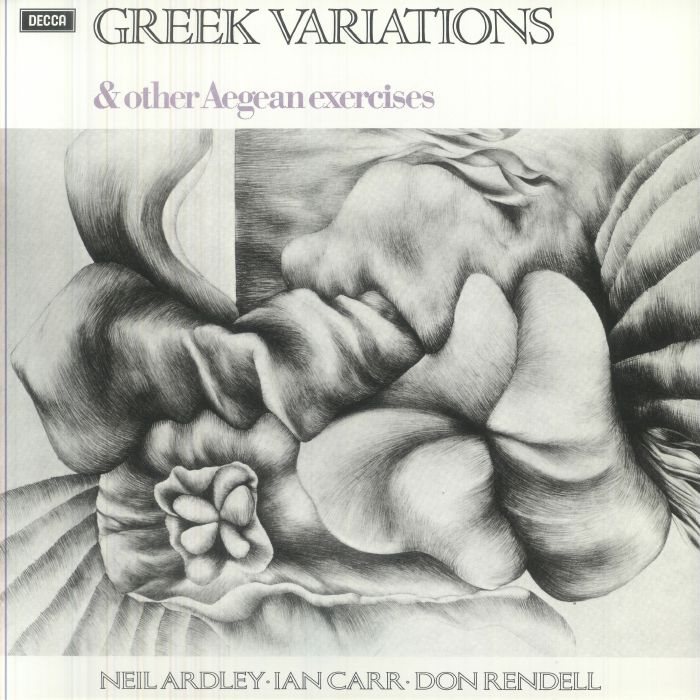
NEIL ARDLEY/DON CARR/DON RENDELL – GREEK VARIATIONS AND OTHER AEGEAN EXERCISES (BRITISH JAZZ EXPLOSION SERIES).
Neil Ardley/Ian Carr/Don Rendell – Greek Variations and Other Aegean Exercises (British Jazz Explosion Series).
Label: Decca.
Format: Vinyl.
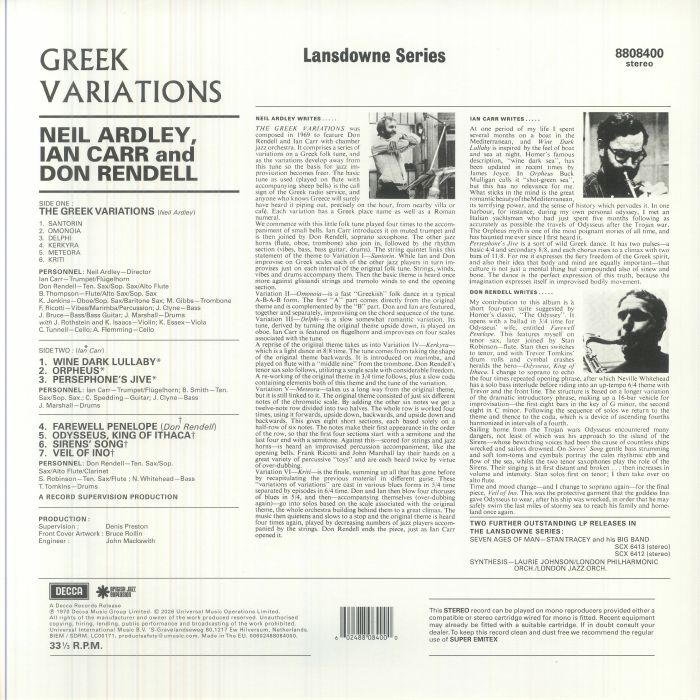
Captured in London during the waning months of 1969 and issued in 1970 under the auspices of producer Denis Preston’s legendary Columbia Lansdowne Series, ‘Greek Variations and Other Aegean Exercises’ represents a landmark triumph of the British progressive jazz renaissance. Conceived as an ambitious, three-way compositional summit uniting visionary arranger-composer Neil Ardley, trumpeter, Ian Carr on flugelhorn and tenor and soprano saxophonist Don Rendell, the project emerges at a fascinating, transitional inflection point in European improvised music.
Arriving just as the celebrated Rendell/Carr Quintet was drawing its influential five-year tenure to a close – and mere months before Carr would spearhead the pioneering electric jazz-rock outfit Nucleus – the two frontline titans aligned themselves with Ardley, director of the New Jazz Orchestra and the United Kingdom’s foremost architect of orchestral colour, modal harmony, and third-stream form.
To bring their expansive musical blueprints to life, the trio convened a veritable who’s who of the vibrant London jazz and progressive scenes, recruiting woodwind virtuosos Barbara Thompson and Karl Jenkins, pianist Michael Garrick, double bassist Jeff Clyne, drummers Trevor Tomkins and John Hiseman, and Cream icon Jack Bruce on electric bass.
Drawing rich structural inspiration from traditional Greek folk modes, asymmetric Aegean time signatures, and timeless classical mythology, the ensemble navigates a deeply evocative, multi-part suite with breathtaking poise and collective intuition. Rather than treating Mediterranean folklore as superficial exoticism, Ardley, Carr, and Rendell integrate its modal complexities into the very fabric of their writing—balancing intricate, chamber-like contrapuntal scoring with fiery, uninhibited solo excursions.
Decades after its initial pressing, Greek Variations and Other Aegean Exercises endures as a singular high-water mark of British jazz: a work of rare intellectual rigour, atmospheric depth, and cross-cultural imagination that continues to reward close listening.
Side A.
Occupying the entirety of the first side of the landmark 1970 album ‘Greek Variations and Other Aegean Exercises,’ Neil Ardley’s six-movement suite – ‘Santorini,’ ‘Ouzo,’ ‘Delos,’ ‘Delphi,’ ‘Kritiko,’ and ‘Kalamatiano’ – stands as one of the most cohesive, architecturally daring achievements in British progressive jazz. Rather than treating its Mediterranean inspiration as mere programmatic window dressing or postcard exotica, Ardley approaches Greek geography, folklore, and rhythmic tradition as rigorous structural catalysts. Drawing upon authentic Aegean folk scales, asymmetric meters, and modal harmonic frameworks, he crafts a continuous musical journey that balances intricate, chamber-like contrapuntal writing with expansive, open-ended spaces for individual improvisation.
Opening the suite with breathtaking atmospheric poise, ‘Santorini’ immediately establishes the geographic and emotional terrain of the cycle. Evoking the stark volcanic beauty and blinding sunlight of the Aegean archipelago, Ardley constructs a shimmering, spacious harmonic bed anchored by delicate keyboard textures and bowed double bass. Over this suspended foundation, the ensemble introduces modal woodwind voicings and lyrical brass lines that unfold with unhurried, cinematic grandeur. Rather than rushing into a conventional swing feel, the movement breathes organically, utilising subtle dynamic swells and translucent orchestration to draw the listener inward – setting a contemplative, sun-drenched tone that anchors the entire suite.
Pivoting sharply from the serene vastness of the opening movement, ‘Ouzo’ injects a surge of earthy, tavern-infused vitality and rhythmic playfulness. Built around a buoyant, infectious pulse that nods toward traditional Greek dance idioms without slipping into pastiche, the piece showcases Ardley’s gift for agile, multi-layered ensemble writing. Crisp, punchy brass figures interlock with nimble reed counter-melodies, creating a sense of lively communal celebration. As the arrangement opens up, the soloists – led by incisive, spirited statements from the frontline horns – navigate the shifting modal changes with infectious swagger, capturing the warmth and conviviality of its namesake.
Named after the sacred island of classical mythology – birthplace of Apollo and Artemis – ‘Delos’ returns the suite to a mood of mythic reverence and ancient mystery. Here, Ardley leans heavily into his third-stream sensibilities, blurring the boundaries between contemporary classical chamber music and modern modal jazz. Haunting, intersecting lines from the flutes and reeds weave a hypnotic tapestry over an understated, ritualistic rhythmic undercurrent. The harmonic language is richly ambiguous and deeply evocative, conjuring the image of weathered marble ruins standing silent against the sea while allowing solo voices to emerge like solitary echoes across time.
Serving as the dramatic and intellectual fulcrum of the suite, ‘Delphi’ channels the enigmatic, prophetic aura of the ancient oracle into a tour de force of tension and release. Ardley builds the movement around brooding, subterranean bass motifs and ominous, low-register brass chords that steadily accumulate psychological weight. As the rhythmic intensity mounts, the arrangement fractures into fiery, impassioned solo excursions that push against the boundaries of the written score. The interplay between Ardley’s tightly disciplined contrapuntal architecture and the raw, searching urgency of the improvisers gives ‘Delphi’ a formidable, almost ceremonial power – making it the emotional centrepiece of the work.
Drawing directly from the proud, rugged musical traditions of Crete, ‘Kritiko’ places rhythmic propulsion and folkloric authenticity at the forefront. Driven by an insistent, asymmetrical groove, the movement demonstrates how naturally Aegean rhythmic structures can lock into a contemporary progressive jazz framework. Ardley’s scoring highlights the sharp, percussive attack of the ensemble, pitting crisp ensemble unisons against fluid, soaring solo lines that echo the ornamental phrasing of traditional Cretan string and wind music. The result is a thrilling synthesis of folkloric drive and modernist jazz sophistication.
Closing the suite on an exhilarating, celebratory crescendo, ‘Kalamatiano’ takes its name and rhythmic DNA from the most famous of all traditional Greek circle dances, built upon a signature, loping 7/8 meter. In lesser hands, an asymmetric seven-beat cycle risks sounding like a stiff rhythmic exercise; under Ardley’s direction, however, the ensemble rides the undulating pulse with effortless grace and propulsive joy. Each section of the band trades radiant, interlocking motifs as the momentum steadily builds toward a triumphant, full-ensemble climax – bringing the six-part odyssey to a resolution that feels both structurally inevitable and emotionally uplifting.
Taken as a unified whole, Neil Ardley’s six-movement ‘Greek Variations’ suite represents a watershed moment in European jazz composition. At a time when many progressive jazz projects fractured under the weight of self-indulgent solos or disjointed stylistic experiments, Ardley’s unwavering focus on form, pacing, and orchestral colour ensures that every movement flows logically into the next. By seamlessly integrating Greek modal theory and asymmetric dance meters into the language of late-sixtes British jazz, he avoided the twin traps of academic sterility and superficial exoticism. Decades after its initial release, the suite remains a masterclass in cross-cultural orchestration – a luminous, deeply humane work where intellectual riguor and improvisational freedom exist in perfect equilibrium.
Side B.
Side Two reveals a fascinating shift in energy – moving from Ardley’s tightly woven, chamber-orchestral tapestries toward muscular, small group modal exploration and nascent jazz-rock fusion.
Named after Homer’s famous maritime epithet in The Odyssey, ‘Wine Dark Lurch’ immediately announces a radical departure from polite British modern jazz. Built around an asymmetric, lurching odd-metered ostinato, the track is anchored by Jack Bruce’s snarling, overdriven electric bass and Hiseman’s thunderous, polyrhythmic drum work. Rather than swinging in a conventional 4/4 pattern, the rhythm section heaves and rolls like a vessel navigating choppy Aegean swells. Over this relentless foundation, Carr’s trumpet enters with sharp, declarative authority – delivering angular, Miles Davis’ ‘In a Silent Way’ and ‘Bitches Brew’ adjacent phrasing that slices through the dense midrange. Jenkins’s reedy oboe and Thompson’s flutes weave eerie, ancient-sounding counter-melodies around the electric churn, creating a visceral collision between archaic Mediterranean modality and late-sixties London progressive rock.
Inspired by the sensory vibrancy and rhythmic street cries of a Greek island marketplace, Carr’s second composition ‘Olives, Apples, Oranges, Fish’ shifts the mood from Homeric brooding to bustling, celebratory motion. Driven by a crisp, infectious, syncopated groove, the track showcases the ensemble’s extraordinary rhythmic agility. Bruce and Hiseman lock into a buoyant, propulsive pocket that gives the horn section ample room to trade playful, overlapping melodic motifs. Carr’s soloing here is bright, nimble, and conversational, bouncing effortlessly off Thompson’s soaring flute lines and Jenkins’s muscular baritone saxophone accents. Beneath its joyful surface lies intricate contrapuntal writing, proving that Carr could infuse complex modal structures with immediate, street-level vitality.
Closing the album on a note of profound emotional resonance, Don Rendell’s ‘Farewell to a Wine-Dark Sea’ pulls back from the electric storm of Carr’s pieces to restore an intimate, acoustic modal sanctuary. Anchored by Clyne’s resonant double bass and Michael Garrick’s crystalline piano voicings, the composition unfolds over a haunting, unhurried pedal point that evokes twilight receding across an empty horizon. Rendell’s tenor saxophone – steeped in the late-period lyricism of John Coltrane yet unmistakably British in its understated poise – speaks with warm, vocaliSed tenderness. Every phrase breathes with unforced melancholy and quiet dignity, serving not only as an evocative musical departure from the Aegean theme, but also as a fitting farewell to the five-year Rendell/Carr Quintet era.
Viewed through the broader arc of twentieth-century European improvised music, ‘Greek Variations and Other Aegean Exercises’ occupies a pivotal, near-mythic position – standing both as a summation of sixtiess British acoustic modernism and as a luminous doorway into the progressive jazz-rock era that followed. Captured at the precise moment when the venerable Rendell/Carr Quintet was concluding its storied five-year partnership and Ian Carr was preparing to unleash the electric fusion vanguard of Nucleus, the album preserves an extraordinary meeting of creative minds at peak fluency.
By uniting Neil Ardley’s panoramic, third-stream architectural vision with Carr’s cerebral, Miles Davis-inflected lyricism and Don Rendell’s deeply expressive, woodwind-driven soulfulness, the project transcends the boundaries of a conventional studio date to become a genuinely collaborative triumph.
Analytically, the enduring brilliance of the album lies in its refusal to treat cross-cultural inspiration as mere surface ornamentation. Throughout the late sixties, Western jazz and rock musicians frequently raided non-Western traditions for exotic timbres – a sitar drone here, an unfamiliar scale there – without engaging the underlying structural grammar of those idioms. Ardley, Carr, and Rendell take the opposite approach.
Whether navigating the sweeping, six-movement programmatic narrative of Ardley’s titular suite on Side A or exploring the taut, chamber-sized “Aegean Exercises” contributed by Carr and Rendell on Side B, the composers internalise Greek modal theory and asymmetric time signatures – such as the loping 7/8 and 9/8 pulses of traditional circle dances – as organic engines for harmony and improvisation. Rather than sounding like an academic exercise in odd-meter counting, these rhythmic and scalar frameworks liberate the soloists, prompting deeply melodic, unhurried statements from luminaries like Barbara Thompson, Karl Jenkins, and Michael Garrick, while the dual-bass axis of Jeff Clyne and Jack Bruce bridges acoustic warmth and electric propulsion.
Equally remarkable is the sense of balance achieved across the recording’s shifting textures. Under Denis Preston’s crystalline Lansdowne production, the ensemble moves seamlessly between dense, Gil Evans-inspired orchestral voicings, intimate small-group interplay, and muscular, forward-leaning grooves driven by drummers Trevor Tomkins and John Hiseman. Nothing feels overcrowded or self-indulgent; every contrapuntal woodwind line, muted brass swell, and percussive accent serves a clear dramatic purpose, guiding the listener through moods ranging from sun-drenched Mediterranean reverie to stark, mythic intensity.
Ultimately, ‘Greek Variations and Other Aegean Exercises’ endures as one of the crown jewels of the British jazz canon precisely because it harmonises intellect and emotion in equal measure. It demonstrates that rigorous compositional architecture need not stifle spontaneous individual expression, and that looking outward toward ancient musical traditions can yield something startlingly modern. Decades after its initial pressing, the album remains an essential, endlessly rewarding touchstone – a testament to the golden age of London studio craftsmanship and the boundless possibilities of cross-cultural musical imagination.
Neil Ardley/Ian Carr/Don Rendell – Greek Variations and Other Aegean Exercises (British Jazz Explosion Series).
- Posted in: Jazz ♦ Jazz Fusion ♦ Modal Jazz ♦ Progressive Jazz
- Tagged: Barbara Thompson, Columbia Lansdowne Series, Decca, Don Rendell, Greek Variations and Other Aegean Exercises, Greek Variations and Other Aegean Exercises (British Jazz Explosion Series), Ian Carr, Jack Bruce, Jeff Clyne, John Hiseman, Karl Jenkins, Michael Garrick, Neil Ardley, Nucleus, Rendell/Carr Quintet, Trevor Tomkins
 dereksmusicblog

