J JAZZ: DEEP MODERN JAZZ FROM JAPAN VOLUME 5
J Jazz: Deep Modern Jazz From Japan Volume 5.
Label: BBE.
Format: CD.
All good things come to an end. Sadly, that was the case with BBE Music’s critically acclaimed and iconic J Jazz series. The fifth and final volume in the series was released recently. It’s a series that’s been a labour of love by curators Tony Higgins and Mike Peden. They’ve devoted many years mapping out the oft-overlooked, once-hidden, highly coveted world of Japanese jazz. A final tantalising taste can be found on ‘J Jazz: Deep Modern Jazz From Japan Volume 5.’
Some UK reissue labels often throw together a compilation using unreleased tracks and alternate takes. These compilations are scraping the bottle of barrel, and attempt to make a quick buck. That isn’t Higgins and Peden’s style.
Instead they’ve dug deep and discovered fourteen extremely rare tracks. This includes independent pressings, private releases, and legendary live sessions. The result is a fitting farewell to BBE Music’s landmark J Jazz series. Let’s look more closely at the compilation
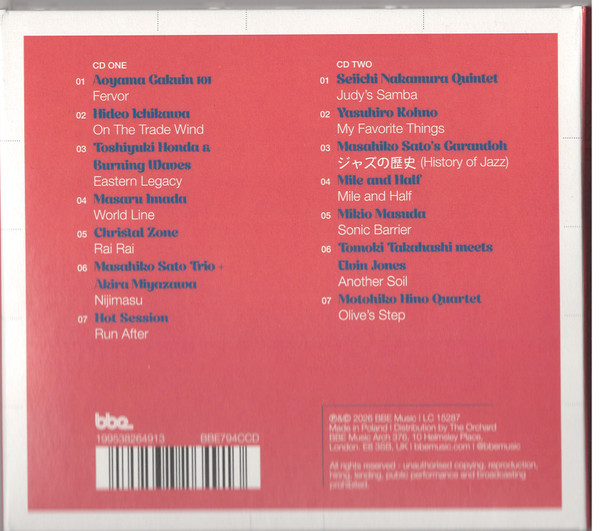
Disc One.
Aoyama Gakuin 101 opens the compilation with ‘Fervor.’ This is a holy-grail private press that was released in 1975. It was a gift from Aoyama Gakuin University to its graduating class. This track epitomises just what makes J jazz so unique. It’s a big band ensemble record, and sees this powerhouse unleash psychedelic jazz-fusion. They fuse hard-driving rhythmic shifts with a fiery, competitive energy that feels completely untethered from mainstream commercial constraints. It’s a bold, explosive statement to start the final chapter in the J Jazz series.
Pianist Hideo Ichikawa cools down the temperature with ‘On The Trade Wind.’ It was the title-track to his 1977 album, and is a beautifully serene piece of cinematic modern jazz. The track emphasises and highlight the importance of space, melody, and texture over pure speed. Ichikawa’s delicate touch on the keys acts like a gentle breeze, backed by a rhythm section that floats effortlessly underneath. It showcases the deeply reflective, impressionistic side of the 1970s Japanese scene.
‘Eastern Legacy’ is a track from Toshiyuki Honda and Burning Waves’ 1981 album ‘Spanish Tears.’ Stylistically it’s a very different track. It’s a high-octane combination of fusion and jazz-funk. Led by saxophonist Toshiyuki Honda, the track features razor-sharp horn arrangements, the tightest of rhythm sections and blistering energy. The result is an infectious, white-hot groove that showcases the immaculate mixture of studio polish and technical perfectionism that Japanese musicians brought to jazz-funk.
Masaru Imada’s ‘World Line’ is a fifteen minute epic. It’s a masterful exercise in tension and release. Rooted in deep, head-nodding soul-jazz, the track evolves slowly over a heavy, hypnotic modal groove. Imada’s piano work is patient but incredibly soulful, allowing the accompanying horn and percussion players to build towards an intense, ritualistic atmosphere that rewards long-form listening.
Crystal Zone’s ‘Rai Rai’ is an extremely rare ethnic jazz-crossover piece. It’s taken from the 1975 private press album ‘Tachibana Vol. 1.’ The track stands out for its hypnotic and mesmeric use of unique tonal texture. They move far away from standard Western jazz structures toward something far more esoteric and mystical. It’s brief, tightly wound, carries a striking, almost haunting atmosphere and is one of the highlights of the compilation.
‘Nijimasu (Part 1 and 2)’ is taken from Masahiko Sato Trio + Akira Miyazawa’s ‘Essence Of Jazz’ album. Quite simply it’s a musical masterclass in angular post-bop geometry that lasts twelve magical minutes. There’s an unpredictability to a track that’s filled with sharp dynamic contrasts and lightning-fast improvisational dialogues. It’s best described as a captivating, compelling and intellectual workout that’s unforgettable.
Hot Session’s ‘Run After’ closes disc one. It was taken from the group’s eponymous sophomore album. Sadly, it was also their Swanson. Written by bassist Mitsuaki Furuno, the energy never drops within what was a driving, classic modal framework. The rhythm section creates a breathtaking sense of forward momentum, and solos are unleashed with an urgent, kinetic velocity. In doing so, this results in a truly memorable example of the straight-ahead acoustic jazz that continued to thrive in Tokyo’s underground jazz clubs despite the increasing popularity of fusion.
Disc Two.
Opening disc two is Seiichi Nakamura Quintet’s ‘Judy’s Samba.’ This ten minute epic is from their 1974 album ‘First Contact.’ The track is, without doubt, one of the highlight of the compilation. It’s a jazz-dance classic where the pace is relentless. Bandleader and saxophonist Nakamura is like a musical Pied Piper as he leads his quintet through a fast-paced, infectiously-catchy samba rhythm. It’s impossible not to tap your feet, and be moved by the dizzying percussion and euphoric horns that play their part in this joyous and uplifting slice of J Jazz.
Richard Rogers composed the much-covered ‘My Favorite Things.’ John Coltrane’s classic modal version is regarded as the definitive version. However, pianist Yasuhiro Kohno breathes new life into the track on what’s a personal take on the much-loved classic. With his Trio, this cover permeates an intimate, deeply emotive lyricism that slowly builds into a powerful, undulant storm of acoustic energy.
Masahiko Satoh’s Garandohs ‘History of Jazz’ is a sprawling, avant-garde epic. It’s wild, theatrical and a deeply tribal piece. It subverts traditional jazz structures by the use of complex polyrhythms, vocal chants, and abstract sonic collisions. It’s a challenging, groundbreaking track that pushes musical boundaries to their limits and beyond. In doing so, it shows how willing Japanese musicians were willing to experiment and deviate from musical norms.
Mile and Half released their self-titled debut album on 1988. It’s an extremely rare album, and is coveted by collectors of J Jazz. The title track is a perfectly balanced, mid-tempo piece that lets the listener breathe after Satoh’s sonic storm. It’s a track that bridges the gap between deep modal post-bop and subtle, late-night fusion textures. It relies on a beautifully constructed central melody and elegant, flowing solo work that conjures up the images of a late night spent in a smokey jazz club.
Keyboardist Mikio Masuda was an early adopter of the synths and electronic keyboards being developed by Japanese and American companies in the early seventies. He puts them to good use on the albums he recorded during the seventies and early-eighties. This included ‘Silver Shadow’ in 1980. It featured ‘Sonic Barrier.’ It’s a short, sharp burst of stunning jazz-funk. Masuda’s keyboard playing is tight, rhythmic, and complemented by a hard-hitting slap-bass groove. The result is one of the standout tracks on the album, and one that jazz-funk DJs and collectors will appreciate and enjoy.
They say never meet your heroes. Not only did Tomoki Takahashi meet Elvin Jones, he recorded an album with him in 1980. Thos was ’Another Soil’ from the 1980 album by Tomoki Takahashi meets Elvin Jones. The title-track was on of the highlights of the album. Jones unleashes his trademark thunderous, polyrhythmic rolling style, while Takahashi to deliver a raw, almost visceral and blistering saxophone performance. The result is an explosive, post-bop collaboration that’s essential listening.
Closing the final instalment in BBE Music’s J Jazz series is the Motohiko Hino Quartet’s ‘Olive’s Step.’ It’s taken from the 1975 album ‘Toko – Motohiko Hino Quartet At Nemu Jazz Inn.’ It’s a ten minute Magnus Opus that acts as the perfect summary of the J Jazz ethos. The Quartet are highly proficient and unleash a performance that is both hugely energetic and extremely expressive. The track reaches an ecstatic peak before bringing critically acclaimed five-volume series to a triumphant end.
‘J Jazz: Deep Modern Jazz From Japan Volume 5’ features a mixture o fourteen independent pressings, private releases, and legendary live sessions. It’s quality all the way on a compilation that’s full of rarities. The compilation features some familiar names from Japanese and American jazz. They play their part in what’s a truly eclectic compilation that documents how J Jazz changed and evolved between 1970 and 1980. It’s also a compilation that oozes quality.
Higgins and Peden have dug deep into the world of J Jazz one last time, and the compilation certainly doesn’t disappoint. Far from it. They’ve kept the best until last and are bowing out on a high. This is a fitting farewell to BBE Music’s landmark J Jazz series.
However, maybe ‘J Jazz: Deep Modern Jazz From Japan Volume 5’ won’t be Higgins and Peden’s swan-song, and the pair will return for what will be a welcome encore. One can only hope that’s the case.
J Jazz: Deep Modern Jazz From Japan Volume 5.
- Posted in: Avant Garde ♦ Hard Bop ♦ J-Jazz ♦ Jazz ♦ Modern Jazz ♦ Soul Jazz
- Tagged: BBE Music, Crystal Zone, Hideo Ichikawa, Hot Session, J Jazz: Deep Modern Jazz From Japan Volume 5, Masaru Imada, Mike Peden, Mikio Masuda, Mile and Half, Motohiko Hino Quartet, Seiichi Nakamura Quintet, Tomoki Takahashi meets Elvin Jones, Tony Higgins, Toshiyuki Honda and Burning Waves, Yasuhiro Kohno
 dereksmusicblog

Excellent series, thanks for the review