AFONSO SOLIANO -TIGA TROMBONE.
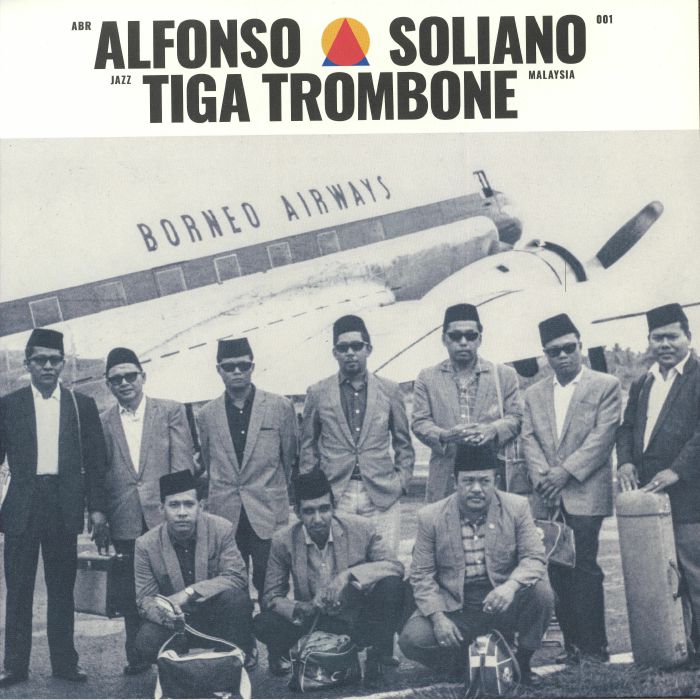
Alfonso Soliano – Tiga Trombone.
Label: Audible Beauty Records.
Format: Vinyl and CD.
Nowadays, Alfonso Soliano is regarded as one of the most transformative figures in Southeast Asian musical history. Widely celebrated as the “Father of Malaysian Jazz,” Soliano was a visionary composer, pianist, arranger, and bandleader who bridged modern Western jazz harmonisations with traditional Malay melodies. His influence helped define the nation’s broadcast era, establish its foundational broadcast orchestras, and foster an enduring multi-generational musical dynasty.
Born in Singapore on February 25th, 1925, into a musical lineage of Filipino descent, Soliano’s talent emerged remarkably early. He secured his first professional position at just seven years old, touring as a prodigy pianist for the Grand Jubilee troupe.
Exposed to bebop, swing, and classical composition from a young age, Soliano quickly mastered complex harmonic structures. In 1948, he contributed to the film score of Chinta, the debut movie featuring screen legend Tan Sri P. Ramlee, marking an early milestone in his defining role within post-war cinema and popular music.
In 1951, Soliano joined Radio Malaya, where he was entrusted with the task of assembling the nation’s inaugural radio orchestra. By 1961, he was named Music Director of Orkes Radio Malaya which was later known as Orkestra (RTM). Through daily broadcasts during an era when radio was the primary medium of national identity, Soliano arranged and conducted scores that reached millions across the Malay Peninsula.
His musical craftsmanship extended to historic national milestones. Soliano is credited with arranging the initial full orchestral score for the Malaysian national anthem Negaraku at the request of Malaysia’s founding Prime Minister, Tunku Abdul Rahman.
Soliano personally recruited and trained key figures in Malaysian music, including legendary composer and saxophonist Tan Sri Dato’ Sri Ahmad Nawab and renowned trumpeter Dato’ Johari Salleh. That is not all.
He introduced complex modern jazz idioms, sophisticated brass voicings, and Latin rhythms to Malay pop and folk compositions.
Soliano’s forward-thinking fusion of modern Western harmonies with traditional melodies was not without controversy. During the mid-1960s, rising cultural conservatism and media criticism regarding his heavy use of jazz influences led to his resignation from Radio Televisyen Malaysia (RTM).
Relocating to Bangkok, Thailand, Soliano was warmly embraced by the regional music scene. His virtuosic performances and orchestral arrangements gained high acclaim, earning him a royal honour from the Thai Royal Family. Recognising his immense contributions, the Malaysian government awarded him the Ahli Mangku Negara (AMN) honour in 1966, and he subsequently returned to Malaysia in the 1970s to serve as a high-level musical advisor to the Ministry of Information and RTM.
Beyond his compositions, Alfonso Soliano cultivated a remarkable family legacy. Raised in a disciplined environment centered around music, all ten of his children became professional musicians.
The ensemble The Solianos was officially recognised by the Malaysian Book of Records as the nation’s longest-performing family group. Today, his children and grandchildren—including prominent jazz artists like pianist Rachel Guerzo and bass player Don Alfonso—continue to preserve and innovate upon his artistic repertoire.
Sadly, Alfonso Soliano passed away on June 16th, 1990. His enduring compositions, historical role as a broadcast innovator, and lasting influence on generations of musicians solidify his legacy as a cornerstone of Southeast Asian music history.
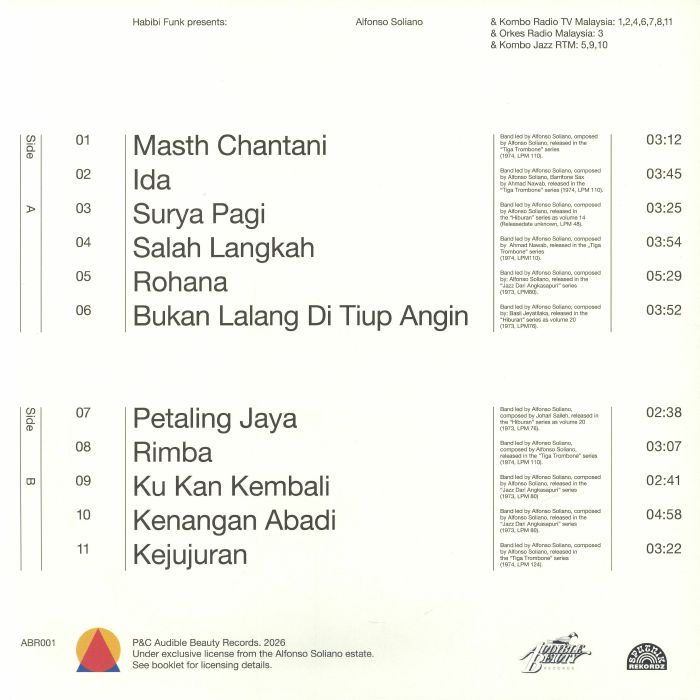
Recently, Audible Beauty Records the sister label to Habibi Funk released ‘Tiga Trombone’ on CD and vinyl. It features eleven tracks. They’ve been unearthed from the vaults of Radio Television Malaysia (RTM).
‘Tiga Trombone’ serves as a monumental historical and sonic collection. It showcases the genius of Malaysian pianist, composer and arranger at the peak of his powers. The collection bridges Western post-bop idioms, Latin rhythmic structures, and deep Southeast Asian traditional roots. The eleven tracks on this lovingly curated collection and a reminder and also the perfect introduction to a giant of Malaysian music, Alfonso Soliano.
Side A.
The album opens with ‘Masth Chantani.’ It is akin to an immediate burst of tropical electricity. Backed by the taut rhythm section of Kombo RTM, Soliano builds an infectious bridge between buoyant Latin jazz syncopation and regional melodies. Horn lines interlock with playful precision, establishing an inviting, sun-drenched tone for the record.
A more introspective groove takes hold on ‘Ida.’ Soliano’s piano work is economic yet deeply expressive, coloUring the background with modal chords while the rhythm section lays down a light, rolling bossa-adjacent tempo. The arrangement allows ample breathing room for subtle brass harmonies.
Surya Pagi’ translates to ‘Morning Sun.’ The piece features the sweeping grandeur of Orkes Radio Malaysia. Orchestral elements blend seamlessly with big band arrangements, evoking a cinematic golden-hour imagery. Soliano uses sweeping string-like textures and bright brass accents to simulate the breaking dawn.
Shifting toward a punchier jazz-funk orientation, ‘Salah Langkah’ introduces a strutting bassline and crisp drum breaks. Soliano’s arrangement relies on tension and release, injecting playful, dynamic stabs from the horns that keep the listener thoroughly engaged.
As the longest piece on the standard track-listing, ‘Rohana’ leans heavily into modal jazz exploration. The Kombo Jazz RTM unit stretches out here, offering a moody, hypnotic soundscape. Soliano’s piano acts as the anchor, guiding the ensemble through winding, contemplative harmonic territory.
‘Bukan Lalang Di Tiup Angin’ translates as ‘Not a Weed Blown by the Wind.’” This track balances lyrical grace with rhythmic backbone. The melodic phrasing feels distinctly narrative, driven forward by tasteful percussion and a warm, enveloping horn arrangement that highlights Soliano’s gift for emotional resonance.
Side B.
A brisk, urban snapshot of a fast-developing metropolis, ‘Petaling Jaya’ is a compact sprint of modal energy. Despite its short runtime of 2:38, it packs a punch, showcasing tight horn arrangements and a driving rhythm section that mimics city transit.
Translating to ‘Jungle,’ ‘Rimba’ embraces organic, hypnotic textures. Soliano orchestrates a dense, atmospheric soundscape that evokes deep rainforest shadows through cascading piano runs and evocative, wind-like brass voicings.
‘Ku Kan Kembali’ is a brief, soulful lament infused with jazz-club intimacy. The Kombo Jazz RTM ensemble creates a smoky, melancholic atmosphere where every note feels calculated and poignant, distilling a vast emotional arc into under three minutes.
‘Kenangan Abadi’ translates to ‘Eternal Memories’ and acts as one of the emotional centrepieces of the album. Slow-burning and deeply cinematic, it allows the soloists to wax poetic over a lush backdrop. Soliano’s chord choices are strikingly sophisticated, touching on impressionistic jazz harmony.
Closing ‘Tiga Trombone’ is ‘Kejujuran’ which means ‘Honesty.’ It is akin to a note of clarity and grace. The track synthesises the disparate threads of the album – Latin rhythm, big band punch, and regional warmth into a cohesive, satisfying final statement that leaves a lasting impression.
‘Tiga Trombone’ stands as far more than a routine archival anthology; it represents a crucial, long-overdue reclamation of Southeast Asia’s rich and frequently overlooked jazz legacy. Throughout the recording, Alfonso Soliano executes a masterclass in artistic balance, effortlessly weaving the sleek sophisticated structures of Western modernism with the distinct nuances of local musical identity. In doing so, he captures a golden era of post-war public broadcasting and mid-century cultural ambition – a historic movement that fully merits international study and reverence. Masterfully arranged and historically profound, ‘Tiga Trombone’ is essential listening for music historians, rare groove aficionados, and serious collectors of spiritual jazz.
Alfonso Soliano – Tiga Trombone.
- Posted in: Big Band ♦ Hard Bop ♦ Jazz ♦ Jazz Funk ♦ Latin Jazz ♦ Modal Jazz
- Tagged: Alfonso Soliano, Audible Beauty Records, Habibi Funk, Radio Televisyen Malaysia, Tiga Trombone
 dereksmusicblog

