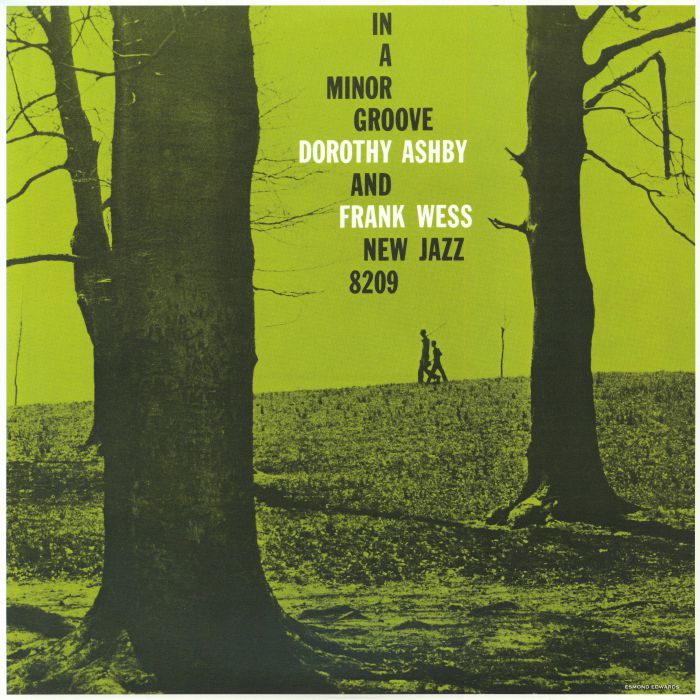
DOROTHY ASHBY AND FRANK WESS – IN A MINOR GROOVE.
Dorothy Ashby and Frank Wess – In A Minor Groove.
Label: Real Gone Music.
Format: Vinyl.
Recorded in September 1958 at Rudy Van Gelder’s legendary Hackensack studio and released on the Prestige Records sub-label New Jazz, ‘In A Minor Groove’ stands as one of the most sublime chamber-jazz recordings of the post-bop era. Prior to Dorothy Ashby’s emergence, the harp in jazz was treated primarily as a novelty or a lush, orchestral embellishment. Ashby revolutionised the instrument by treating it as a fully realised hard-bop lead voice – complete with lightning-fast single-note runs, bluesy phrasing, and percussive block chords.
On ‘In A Minor Groove,’ her second collaboration with Count Basie woodwind master Frank Wess. The pair had collaborated on ‘The Hip Harp’ which was released earlier in 1958.
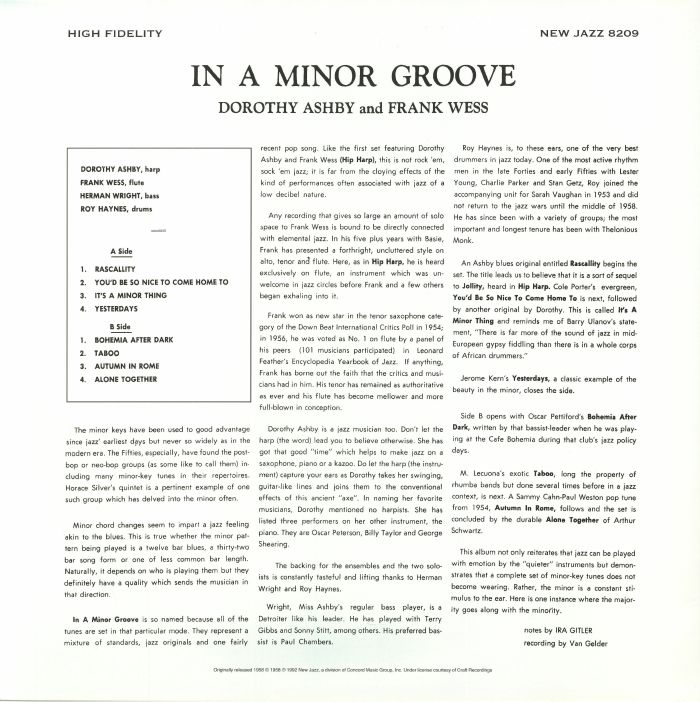
Joining Ashby and Wess on ‘In A Minor Groove’ was a powerhouse rhythm section featuring bassist Herman Wright and master drummer Roy Haynes. The pairing of Ashby’s intricate harp voicings with Wess’s airy flute and velvet tenor saxophone creates a uniquely intimate, late-night acoustic landscape that feels both effortlessly swinging and sophisticatedly understated.
Side A.
‘Rascallity’ opens the album with immediate rhythmic authority, and establishes the session’s crisp, relaxed swing. Ashby leads with a sparkling main theme, executing swift single-note lines that demonstrate her ability to phrase with the agility of a jazz guitarist. Wess joins on flute, weaving agile counter-lines that complement Ashby’s chordal resonance. Roy Haynes’s brushed snare work drives the track forward without overpowering the harp’s delicate timbre, allowing Ashby’s blues-inflected solo to take centre stage.
This reading of the Cole Porter classic ‘You’d Be So Nice To Come Home To’ highlights the ensemble’s ability to recontextualize standard repertoire. Played at a breezy medium-up tempo, the arrangement opens with a syncopated rhythmic hook between Ashby and bassist Wright. Frank Wess switches to tenor saxophone here, providing a warm, breathy contrast to Ashby’s glassy, arpeggiated voicings. Her solo is a highlight of the album, utilising rapid glissandos not as decorative flourishes, but as harmonic transitions embedded seamlessly into her bop phrasing.
‘It’s a Minor Groove’ stands as a masterclass in dynamic balance and blues feeling. Built around a subtle, haunting minor blues motif, Wess’s flute work is particularly expressive, employing subtle pitch bends and overtones. Ashby responds with rich block chords and complex modal runs, demonstrating how effectively the harp can function as both a lead melodic instrument and a comping chordal foundation. Wright’s steady walking bassline anchors the groove, giving the track a deep, late-night atmosphere.
Jerome Kern’s melancholic standard ‘Yesterdays’ receives an inventive, moody treatment. Ashby begins solo, setting a dark, reflective tone with dense, harp-plucked harmonies. When Wess enters on flute, the duo engages in a delicate contrapuntal dialogue that highlights their shared classical discipline alongside their jazz fluency. The tempo remains measured, allowing the natural resonance of the harp to decay naturally into the soundscape, creating an eerie, hypnotic tension.
Side B.
Composed by Oscar Pettiford, ‘Bohemia After Dark’ injects a burst of high-octane bebop energy into the middle of the record. Driven by Roy Haynes’s crisp rimshots and energetic cymbal work, the quartet manoeuvres through the rapid-fire head with precision. Ashby handles the complex chromatic runs effortlessly, proving that the harp could navigate fast bop tempos without losing articulate clarity. Wess delivers a fiery, blues-drenched tenor sax solo that pushes the quartet to its dynamic peak.
Margarita Lecuona’s exotica-tinged composition ‘Taboo’ is transformed here into a modal jazz excursion. Haynes lays down a Latin-influenced groove, utilising tom-toms to establish a brooding rhythmic floor. Ashby uses unique plucking techniques near the soundboard to evoke a guitar-like, percussive timbre, while Wess’s flute provides haunting, chromatic lines above. It is the album’s most experimental track, showcasing the group’s willingness to push beyond traditional hard-bop conventions.
The album transitions back to balladry with Vern Duke’s ‘Autumn in New York.’ Ashby takes a prominent role, opening the track with an intricate, unbacked prelude that underlines her deep harmonic vocabulary. When Wess enters on flute, the arrangement settles into a gentle, swaying rhythm. The duo’s interaction is sympathetic and uncluttered, emphasising lyricism and timbre over technical flash.
Closing ‘In A Minor Groove’ on a joyful, soul-jazz note, “4-11-44” relies on a catchy, gospel-tinged blues riff. Wess returns to the tenor saxophone, offering a earthy solo grounded in swing traditions. Ashby matches his energy with rhythmic chord comping and bluesy, single-note runs. The track serves as a reminder that despite the rare instrumentation, Ashby and Wess were thoroughly rooted in the blues-driven jazz lexicon of Detroit and New York.
‘In a Minor Groove’ is far more than a historical curiosity; it is a vital entry in late-fifties modern jazz. Dorothy Ashby single-handedly redefined the harp’s place in black American music, transforming an instrument traditionally relegated to orchestral backgrounds or impressionistic flourishes into a articulate vehicle for bebop improvisation and soulful blues.
Frank Wess proves to be her ideal collaborator, alternating between airy, expressive flute work and robust tenor saxophone lines that match Ashby’s dynamic range. Supported impeccably by Herman Wright and Roy Haynes, the duo created an album defined by warmth, technical ingenuity, and enduring swing. Decades after its release, ‘In a Minor Groove’ remains a triumphant demonstration of technical mastery and innovative spirit.
Dorothy Ashby and Frank Wess – In A Minor Groove.
 dereksmusicblog

