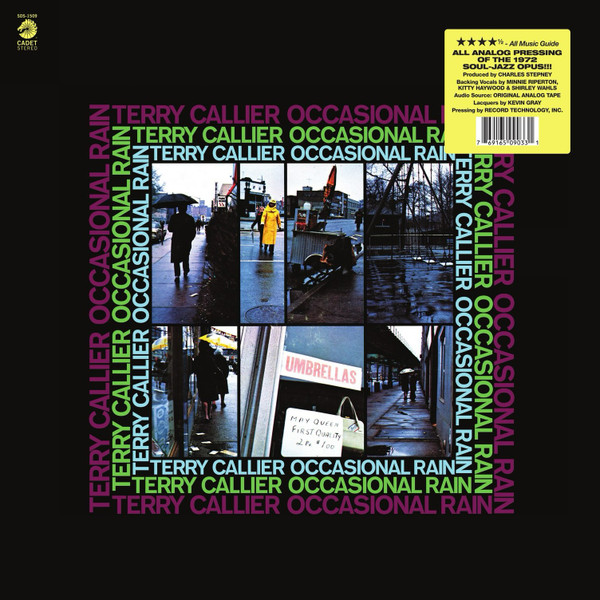
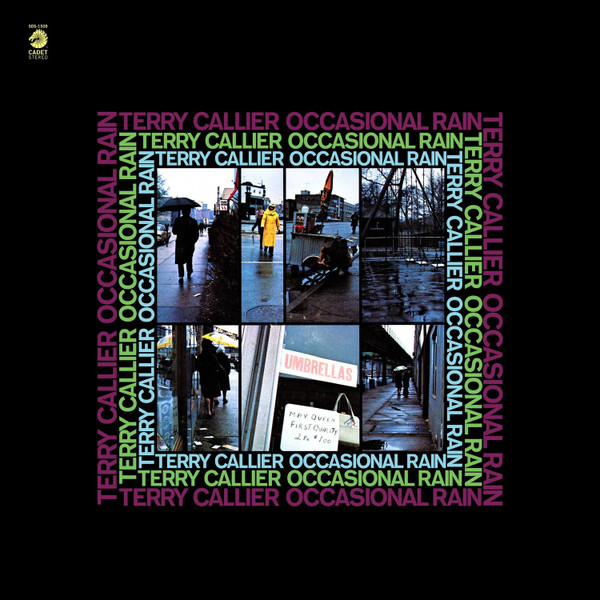
TERRY CALLIER – OCCASIONAL RAIN.
Terry Callier – Occasional Rain.
Label: Slow Down Sounds
Format: Vinyl.
Talent alone is rarely a guarantee of success; had it been, the late, great Terry Callier would have enjoyed a long and lucrative commercial career from the outset. For much of his life, however, he remained one of music’s best-kept secrets – an artist whose profound artistry resonated far more deeply in Britain than it did in his native United States.
By the time his work finally began to find a devoted following across the Atlantic, Callier had already built a rich catalog of material, leading up to his definitive sophomore breakthrough, ‘Occasional Rain’ which was recently released on vinyl by Slow Down Sounds.
Born in Chicago’s Cabrini-Green neighbourhood on the city’s North Side, Callier grew up alongside legendary peers such as Curtis Mayfield, Jerry Butler, and Major Lance. Showing an early aptitude for music, he learned piano as a child before mastering the guitar – foundational skills that would shape his distinctive, genre-blending sound.
As a teenager, Callier began singing in local doo-wop groups, little realising that this modest start would spark a musical journey spanning five decades. In 1962, an audition at Chicago’s famed Chess Records led to his debut single, ‘Look At Me Now’ – a minor classic that later became a revered staple of the UK’s Northern Soul scene.
While balancing early recording ambitions with college studies in Chicago, Callier gravitated toward the city’s vibrant folk clubs and coffee houses. Around this period, he discovered the music of John Coltrane, whose avant-garde jazz sensibilities left an indelible mark on his artistic evolution.
In 1964, two years after his debut single, Callier crossed paths with Samuel Charters of Prestige Records. The following year yielded the session recordings for ‘The New Folk Sound Of Terry Callier.’ Bizarrely, Charters subsequently misplaced the master tapes in the Mexican desert, delaying the album’s release until 1968.
That same year, psychedelic rock band H.P. Lovecraft covered Callier’s ‘Spin, Spin, Spin’ and ‘It’s About Time’ on their self-titled album, introducing his songwriting to a broader audience. By 1969, H.P. Lovecraft’s George Edwards was co-producing tracks for him. Yet, despite being a fixture of the Chicago music scene for nearly a decade, Callier still had only one official album to his name.
As the 1970s dawned, Jerry Butler established the Chicago Songwriters Workshop. Alongside his writing partner Larry Wade, Butler was composing for Chess Records and its Cadet Records imprint, which soon signed Callier.
Now signed to Cadet Records, Callier began work on his sophomore album, ‘Occasional Rain.’ Released in 1972, it became the first of a critically acclaimed album trilogy for the label. Though commercially overlooked upon its initial release, the record was eventually recognised as a masterwork of 1970s acoustic soul.
Released in 1972 on Cadet Records, ‘Occasional Rain’ marked the beginning of Terry Callier’s defining artistic trilogy alongside producer Charles Stepney. Fusing introspective folk lyricism, soul vulnerability, and modal jazz orchestration, the album stands as a landmark of American chamber soul.
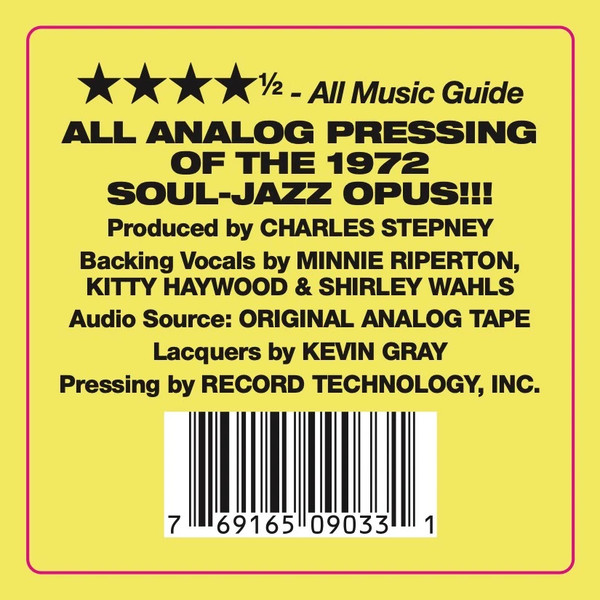
Stepney’s production is punctuated by lush string phrasing, subtle electronic flourishes, and delicate backing harmonies from Minnie Riperton. She provides a cinematic backdrop for Callier’s rich baritone. Anchored by a recurring modal motif, the record operates as a continuous thematic suite exploring urban solitude, devotion, and self-examination.
Side A.
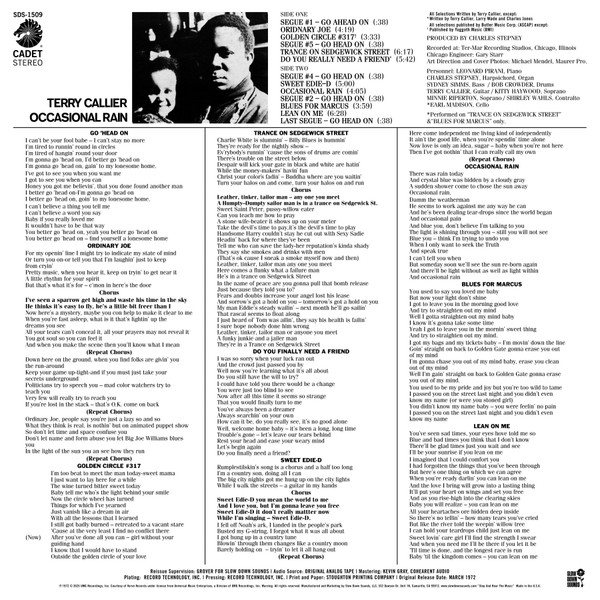
Opening ‘Occasional Rain’ opens with ‘Segue #1 – Go Head On.’ It’s a thirty-eight second acoustic guitar motif that establishes the thematic glue of the record. Built on a rolling, syncopated folk pattern accompanied by Callier’s soft humming, it serves as an intimate invitation into his headspace before the band enters.
‘Ordinary Joe’ is Callier’s signature anthem. It opens with driving percussion and a swaggering bassline before resolving into an uplifting chorus. Stepney balances folk-jazz acoustic rhythm with soulful brass and sweeping strings, while Callier delivers a humble, resilient perspective on life’s ups and downs.
‘Golden Circle #317’ sees a shift into eerie, ethereal territory. Anchored by sparse guitar picking and drifting vocal harmonies featuring background support from Riperton, the arrangement feels haunting and dreamlike, capturing an atmosphere of late-night urban isolation.
On ‘Segue #5 – Go Head On’ the recurring guitar interlude returns, cleansing the sonic palette after the shadowy textures of “Golden Circle #317.”
‘Trance on Sedgewick Street’ lasts over six minutes, and is the album’s centrepiece. Earl Madison’s expressive cello lines interweaves with Callier’s fingerpicking. Callier paints a portrait of Chicago city life with poetic clarity, his vocal rising from a quiet murmur to a soaring plea as the arrangement builds in intensity.
Do You Finally Need a Friend closes side A. It’s a gospel-infused soul track co-written with Charles Jones and Larry Wade. Driven by electric piano and swelling backing vocals, the song poses pointed questions about vulnerability, pride, and human connection, culminating in a raw,impassioned climax.
Side B.
Segue #4 – Go Head On makes the transition into Side B. This interlude re-establishes the album’s steady, meditative pulse.
Sweet Edie-D is a tender character study built around warm acoustic strumming and dynamic jazz-pop flourishes. Stepney’s arrangement swings effortlessly, letting Callier showcase his nimble rhythmic phrasing and storytelling craft.
Occasional Rain is a masterclass in mood-setting. Gentle Fender Rhodes, sparse acoustic chords, and subtle synthesizer textures simulate a quiet downpour. Reflecting on impermanence and heartbreak, Callier uses rain as a metaphor for fleeting sorrow in one of the album’s most poignant moments.
The recurring refrain can be heard on Segue #2 – Go Head On. It acts as a brief moment of reflection before the final movement.
Blues for Marcus is a melancholic folk-blues ballad featuring Earl Madison’s return on cello. Callier’s stark delivery strips away complex studio layering to focus on raw acoustic tone and heartfelt lyricism.
Lean On Me serves as the album’s emotional peak. Starting quietly with acoustic guitar and vocal, the track steadily ascends into a triumphant climax powered by gospel harmonies and soaring strings, capturing Callier’s core message of radical empathy in a cold world.
The album comes full circle with a final iteration of the motif on Last Segue – Go Head On. As the guitar fades out, it leaves the listener with a sense of completion, framing the record as a unified, interconnected journey.
Occasional Rain remains an enduring classic of early-1970s acoustic soul and soul-jazz. Stepney’s production provided Callier with the perfect canvas to bridge folk, jazz, and R&B without sacrificing an ounce of intimacy, securing its place as an essential entry in his discography
Terry Callier – Occasional Rain.
- Posted in: Folk ♦ Jazz ♦ R&B ♦ Soul ♦ Soul Jazz
- Tagged: Cadet Records, Charles Stepney, Occasional Rain, Ordinary Joe, Slow Down Sounds, Terry Callier, The New Folk Sound of Terry Callier
 dereksmusicblog

