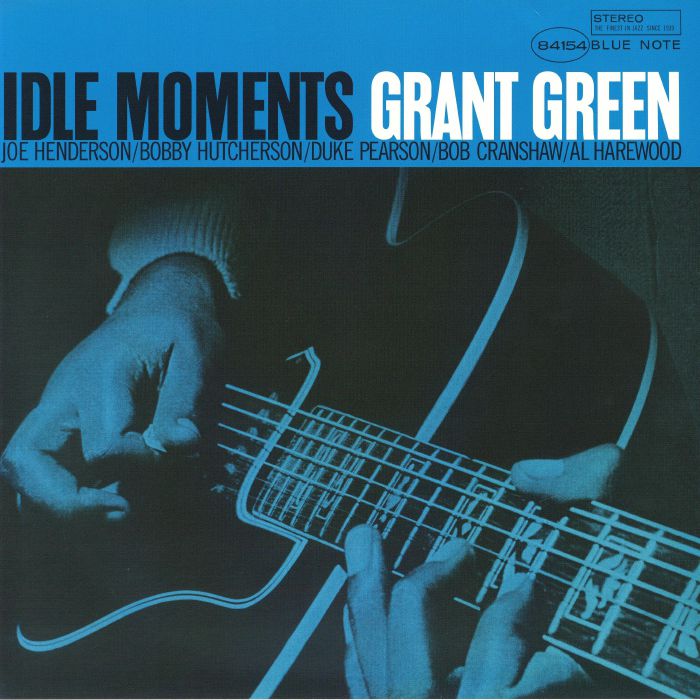
GRANT GREEN – IDLE MOMENTS (BLUE NOTE ESSENTIAL VINYL SERIES).
Grant Green – Idle Moments (Blue Note Essential Vinyl Series).
Label: Blue Note Records.
Format Vinyl.
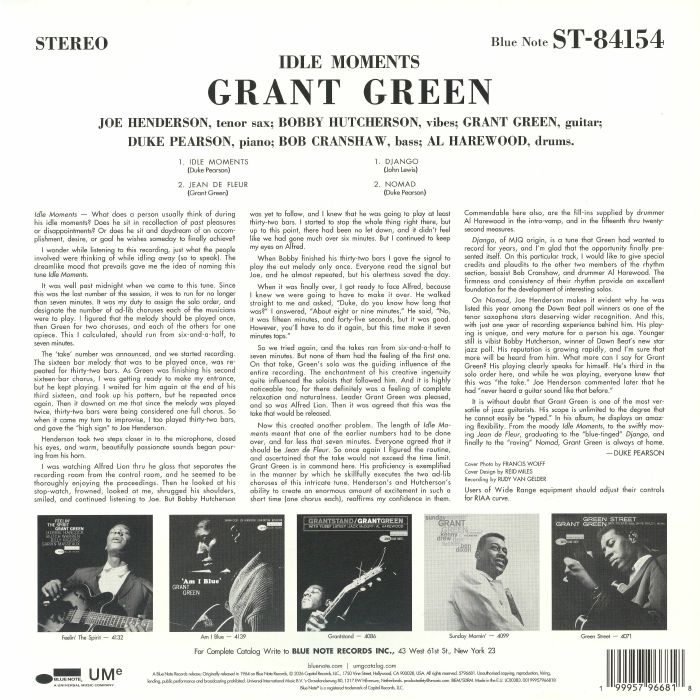
Recorded on November 4th and 15th, 1963, at Rudy Van Gelder’s legendary Englewood Cliffs Studio and released on Blue Note Records in 1965, Grant Green’s ‘Idle Moments’ is widely celebrated as one of the crown jewels of 1960s modern jazz. While Green established his formidable reputation on fiery, single-note blues lines and hard-driving soul-jazz organ trios, ‘Idle Moments’ captured him in a far more spacious, reflective, and structurally ambitious setting.
Backed by an extraordinary sextet—Joe Henderson on tenor saxophone, Bobby Hutcherson on vibraphone, Duke Pearson on piano, Bob Cranshaw on double bass, and Al Harewood on drums—Green produced an album defined by sublime group dynamic, pristine note selection, and late-night elegance.
Composed by pianist Pearson, the title track ‘Idle Moments’ unfolds as a near fifteen-minute Magnum Opus defined by an unhurried minor-key progression, crystalline vibraphone shimmers, patient single-note guitar phrasing, and expansive modal solos. It is a masterclass in tension, restraint, and atmospheric mood-setting. Originally conceived as a standard-length composition, the piece expanded into a sprawling fifteen-minute showcase when the band settled into an effortlessly slow, hypnotic groove during the initial take.
Green opens the piece with his signature clean, unadorned tone—devoid of heavy reverb or amplifier distortion—allowing every plucked note to ring out with deliberate emotional weight. Hutcherson’s vibraphone hovers behind Green like cool night air, offering a luminous harmonic cushion that replaces the traditional rhythm guitar. Henderson delivers a tenor saxophone solo that shifts gracefully from breathy, nocturnal warmth into subtle, smouldering heat, while Pearson contributes delicate, blues-inflected piano fills. Ultimately, it stands as one of the most hauntingly beautiful long-form tracks in the entire Blue Note catalog.
Penned by Green, ‘Jean De Fleur’ abruptly breaks the opener’s hypnotic spell, shifting the album into gear with a brisk, muscular swing. Characterised by uptempo hard-bop rhythms, syncopated guitar riffs, a driving rhythm section, and sharp horn-guitar interplay, the piece highlights Green’s extraordinary rhythmic articulation at faster tempos.
Cranshaw’s walking bass-line and Al Harewood’s crisp snare work establish an unshakeable foundation, leaving Green ample room to spin out intricate, blues-rooted linear runs. Henderson enters with an assertive, edge-of-the-horn cadence that contrasts sharply with Green’s smooth, linear picking. The track brilliantly demonstrates the band’s ability to pivot seamlessly from modal introspection to high-energy hard bop without disrupting the album’s overarching structural balance.
Composed by John Lewis in tribute to gypsy jazz legend Django Reinhardt, “Django” opens with a stately funeral-march motif before easing into a relaxed, mid-tempo swing transition. Enhanced by delicate vibraphone comping and subtle chamber-jazz textures, this arrangement highlights the sextet’s sophisticated ensemble chemistry.
Green honours Reinhardt’s legacy not through direct imitation, but by weaving his own signature bop vocabulary with subtle, haunting blues inflections. Hutcherson’s bell-like chords and Pearson’s understated comping lend the performance a light, transparent texture, allowing the natural acoustic resonance of each instrument to shine through Rudy Van Gelder’s meticulous recording setup.
Composed by Pearson, ‘Nomad’ serves as the album’s triumphant closing track. Built as a minor-key modal vamp around an evocative, eastern-tinged melodic hook, the piece features extended solo improvisations set against a driving, strutting rhythm. It returns to the long-form minor-key modal exploration pioneered on the title track, albeit at a livelier, medium-fast pace that affords each soloist full freedom to stretch out.
Green constructs a long, masterfully paced solo that steadily builds in intensity through subtle melodic variations and compelling rhythmic repetition. Henderson follows with a modern, post-bop bite, pushing the harmonic boundaries of the composition before Hutcherson and Pearson trade fluid, cerebral phrases. Throughout it all, Cranshaw and Harewood maintain an airtight, swinging pocket, bringing the album to a confident and deeply satisfying resolution.
‘Idle Moments’ occupies a unique and pivotal place in Grant Green’s discography and the broader sixties jazz canon. It successfully bridged the accessible, soulful hard bop of Green’s earlier career with the more adventurous modal and post-bop directions that Blue Note Records was actively pioneering during the mid-sixties.
Much of the ‘Idle Moments’’ enduring triumph relies on its inspired instrumentation and personnel. By replacing a secondary horn or rhythm guitar with Hutcherson’s vibraphone, the ensemble achieved a unique sonic weightlessness. Furthermore, the interplay between Green’s linear blues orientation and Henderson’s modern harmonic sensibilities created a compelling stylistic dialogue.
Engineered with remarkable intimacy and warmth by Rudy Van Gelder, ‘Idle Moments’ transcends its era. It stands not only as Grant Green’s supreme artistic statement as a bandleader, but as one of the finest, most complete guitar-led jazz albums ever recorded.
Grant Green – Idle Moments (Blue Note Essential Vinyl Series).
- Posted in: Hard Bop ♦ Jazz ♦ Modern Jazz
- Tagged: Al Harewood, Blue Note Records, Bob Cranshaw, Bobby Hutcherson, Grant Green, Idle Moments, Joe Henderson
 dereksmusicblog

