EDDIE KENDRICKS-GOIN’ UP IN SMOKE.
EDDIE KENDRICKS-GOIN’ UP IN SMOKE.
For Eddie Kendricks, hooking up with Norman Harris for his seventh album He’s A Friend had rejuvenated his flagging career. Just three years before He’s A Friend, the future looked a lot brighter for Eddie Kendricks. Eddie had made his commercial breakthrough with his third album Eddie Kendricks, released in May 1973. It reached number eighteen in the US Billboard 200 and number five in the US R&B Chart and featured the number one US R&B single Keep On Truckin.’ Critics predicted Eddie would become one of the biggest soul singers of the seventies. Their predictions looked to be coming true when Eddie released his fourth album Boogie Down, his most successful album. Boogie Down reached number thirty in the US Billboard 200 and number one in the US R&B Charts. The title-track Boogie Down gave Eddie his most successful single, reaching number three in the US Billboard 100 and number one in the US R&B Charts. Critics hailed Boogie Down Eddie Kendricks’ best album so far. Eddie’s star was definitely in the ascendancy. That wasn’t to be the case.
After Boogie Down, Eddie released For You in December 1974. It failed to match the success of his two previous albums, stalled at number 108 in the US Billboard 200, it reached number eight in the US R&B Charts. At least the single Shoeshine Boy, reached number eighteen in the US Billboard 100 and number one in the US R&B Charts. In July 1975, things got worse for Eddie. His sixth solo album The Hit Man, reached just number sixty-three in the US Billboard 200 and number eight in the US R&B Charts. This was where Norman Harris and some of Philly’s best songwriters, arrangers, producers and musicians came in. Norman and His Philly friends played their part in getting Eddie’s career back on track. He’s A Friend was released in February 1976, reaching number thirty-eight in the US Billboard 200 and number three in the US R&B Charts. That’s not forgetting the four hit singles released from He’s A Friend. So after the success of He’s A Friend, Eddie Kendricks and Philly’s finest joined forces once again, for the recording of Eddie’s eights album Goin’ Up In Smoke. Could they replicate the success of He’s A Friend with Goin’ Up In Smoke?
Buoyed by the commercial success and critical acclaim of He’s A Friend, work began on Goin’ Up In Smoke. Norman Harris and Allan Felder penned five tracks, Goin’ Up In Smoke, The Newness Is Gone, Sweet Tendori, Born Again and Don’t Put Off Till Tomorrow. Bruce Gray cowrote two tracks. With Phil Hurtt he penned Thanks For The Memories and with T.G. Conway Frank Snowdon and Mike Holden, wrote To You From Me. The songwriting team of Reginald Turner, Jerry Akines, Johnny Belmon and Victor Drayton contributed two tracks, Music Man and Skeleton In Your Closet. Brian Evans, Donald Harmon and John Falson wrote the other track, Don’t You Want Light. These ten tracks became Goin’ Up In Smoke, which was recorded and mixed at Philly’s Sigma Sound Studios, owned by Joe Tarsia.
At Philly’s Sigma Sound Studios, many of the same personnel that played on He’s A Friend reconvened. Providing the album’s heartbeat were the Baker, Harris, Young rhythm section, along with bassist Michael “Sugar Bear” Foreman and drummer Charles Collins, who played supporting roles. Guitarists included Bobby “Electronic” Eli and T.J. Tindall, while Larry Washington played congas and Vince Montana Jr. vibes. Ron “Have Mercy” Kersey, Carlton Ken, T.G. Conway and Bruce Hawkes played keyboards. Strings and horns came courtesy of Don Renaldo. Adding backing vocals along with The Sweethearts of Sigma, Barbara Ingram, Evette Benton and Carla Benson, assisted by Allan Felder, Bruce Gray, Carl Helm and Phil Hurtt. Arrangers included Jack Faith, Ron “Have Mercy” Kersey, T.G. Conway and Norman Harris who produced Goin’ Up In Smoke.
On the release of Goin’ Up In Smoke in September 1976, right at the height of disco’s popularity, the album stalled at number 114 in the US Billboard 200 and number twenty-two in the US R&B Charts. Looking back, with the benefit of hindsight, it’s is no surprise that Goin’ Up In Smoke didn’t replicate the success of He’s A Friend, given disco was now the most possible musical genre. Suddenly, soul albums, regardless of their quality, were no longer as popular. Only the title-track Goin’ Up In Smoke, charted, when released as single, stalling at number eleven in the US Dance Charts. It seemed after the commercial failure of Goin’ Up In Smoke, Eddie Kendrick’s career was at another musical crossroads. However, what does the music on Goin’ Up In Smoke sound like?
Opening Goin’ Up In Smoke is the title-track Goin’ Up In Smoke, written by Allan Felder and Norman Harris, who arranged and produced the track. It’s as if producer Norman Harris is determined to lay down his marker with this track. Growling horns, sweeping, swirling strings and a pulsating heartbeat courtesy of the Baker, Harris, Young rhythm section set the scene for Eddie’s tender, joyful falsetto. Urgent, soulful harmonies from The Sweethearts of Sigma answer Eddie’s vocal, soaring above the arrangement. Soon, Eddie’s vocal grows in power and emotion. Strings dance, while Earl Young’s drums and Ron Baker’s bass match each other, every step of the way. Bursts of drama from Earl’s drums, cascading strings and funky guitars unite with Eddie. He picks up where he left off on He’s A Friend, with a dramatic, emotive and deeply soulful track.
The Newness Is Gone is another of the Allan Felder and Norman Harris penned tracks. The tempo drops, but the drama remains. Just percussion, subtle plucked strings, wistful horns and a prowling Baker, Harris, Young rhythm section combine. Then when Eddie’s vocal enters, it’s wistful, filled with hurt and sadness. Harmonies sweep in, reflecting the heartache and emotion in Eddie’s vocal. Adding to this are the swathes of strings, melancholy horns. Eddie’s wonders, ponders who things have gone so wrong? Reflecting and heartbroken, he sings: “The Newness Is Gone and the love is gone,” laying bare his soul in the process. Quite simply, heartachingly beautiful.
Sweet Tendori sees a the tempo increase and Eddie deliver a sassy, sensual vocal. Dancing strings, searing, sizzling guitars and Baker, Harris, Young’s thunderous, pounding rhythm section combine. They drive the arrangement along, tempo and temperature rising. Eddie’s sassy, playful and teasing vocal is swept along, above layers of cascading strings, while percussion, vibes and chiming guitars join The Sweethearts of Sigma sweet harmonies. Providing the pulsating heartbeat are the rhythm section. Eddie having recovered from his heartbreak, has found his sass and zest for life again, delivering the vocal with a swing.
Born Again is the last of four consecutive Allan Felder and Norman Harris penned tracks. Norman arranges and produces the track, where there’s no drop in tempo, on a dance-floor friendly track, with made in Philly written all over it. It literally bursts into life, Baker, Harris, Young and Don Renaldo’s dancing strings at the heart of the arrangement. Like a musical juggernaut, with Baker, Harris, Young take turns at the steering wheel. Eddie’s falsetto floats above the arrangement, while The Sweethearts of Sigma reflecting the hope and happiness in Eddie’s vocal.
Don’t You Want Light sees T.G. Conway take over arranging duties, as this as this slice of musical sunshine unfolds. Punchy rasping horns, swirling strings and the rhythm section accompany Eddie’s joyous, soaring vocal. Filled with happiness, harmonies answer Eddie’s cascading, heartfelt falsetto. Meanwhile, Baker, Harris, Young, layers of lush strings, percussion and searing guitars provide the irresistible, uptempo backdrop for Eddie’s vocal, as this slice of musical sunshine closes Side One of Goin’ Up In Smoke.
Side Two of Goin’ Up In Smoke, opens with Music Man, arranged by Ron “Have Mercy” Kersey. At first glance, this is a very different sounding track. It was written by Reginald Turner, Jerry Akines, Johnny Belmon and Victor Drayton. Having said that, it’s infectiously catchy, uptempo track. Driven along by the bass, the arrangement marches and hustles along, strings sweeping and swirling and horns rasping. Spurred on, Eddie’s vocal is filled with joy, The Sweethearts of Sigma adding gospel-tinged backing vocals. Meanwhile, the arrangement takes on a hustle sound, as Eddie vamps his way through this hook laden track.
Bruce Gray and Phil Hurtt cowrote Thanks For The Memories, an uptempo Philly Soul track. Pizzicato strings give way to searing guitars, dancing strings and the Baker, Harris, Young rhythm section. They ensure the arrangement explodes into life. Eddie’s vocal is quick, tender and thankful. The Sweethearts of Sigma’s sweeping harmonies are the perfect foil, joyous and thankful. Chugging, funky guitars give the arrangement a hustle sound, while blazing horns, cascading strings and funk-drenched bass combine. By then the drama has grown. Now Eddie and The Sweethearts of Sigma drive each other to greater heights of drama, emotion and soulfulness, against a pulsating, sultry backdrop, as funk and Philly Soul unite.
Jack Faith arranged To You From Me, where the tempo drops. The arrangement has a real Jack Faith, Philly Soul sound. He combines swathes of strings, rasping horns and the Baker, Harris, Young rhythm section with Vince Montana Jr’s vibes. Eddie’s impassioned, heartfelt vocal is accompanied by The Sweethearts of Sigma’s cooing harmonies, a wistful, floaty flute and bursts of growling horns. Bobby “Electronic” Eli adds chugging guitars, as Earl Young’s drums provides bursts of drama and Eddie delivers a tender, impassioned and deeply soulful vocal.
Don’t Put Off Till Tomorrow was written the fifth and final track written by Norman Harris and Allan Felder. Keyboard player Ron “Have Mercy” Kersey arranged the track. It’s a mid-tempo track, where Baker, Harris, Young join with cascading strings and blazing horns to accompany Eddie. His falsetto soars above the arrangement, with deep harmonies providing a contrast to his airy falsetto. Then when the harmonies drop out, the strings sweep the arrangement along, and it floats hopefully and joyfully to the close.
Closing Goin’ Up In Smoke is Skeleton In Your Closet arranged by Norman Harris and Ron “Have Mercy” Kersey. This is quite an apt way to close the album, given the track’s Philly Soul sound. Key to this are layers of lush strings, Baker, Harris, Young who provide the track’s heartbeat. The Sweethearts of Sigma add some of their sweetest and soulful harmonies, as Eddie’s vocal is tender, heartfelt and sincere. Providing contrasts are the guitars. Norman Harris’ guitar is jazz-tinged, while Bobby “Electronic” Eli’s chukka chukka guitar, is funkier. However, it’s Eddie’s vocal and The Sweethearts of Sigma’s harmonies that make this track such a soulful way to close Goin’ Up In Smoke.
While Eddie Kendricks’ eighth album Goin’ Up In Smoke failed to replicate the success of He’s A Friend, this wasn’t so much to do with the music, but changes in musical tastes. When He’s A Friend had been released in February 1976, disco was popular, but by September 1976, disco was now the most popular musical genre. After that, soul artists, including Eddie Kendricks, were no longer as popular. The only alternative was climb onboard the disco bandwagon, or get left behind. Although some soul artists made a successful transition from soul to disco, some either couldn’t or wouldn’t. Not being willing or able to do so, meant their careers were often in jeopardy. For some artists, disco meant at least a temporary halt to their career. Worse still, their careers were over.
For many artists, including Eddie Kendricks, they released many great albums, including Goin’ Up In Smoke, during the disco era. Sadly, many of these albums often went unnoticed. It’s only now, that many of these albums, including Goin’ Up In Smoke, are receiving the recognition they so richly deserve. in the case of Goin’ Up In Smoke, Norman Harris and his team of Philly songwriters, arrangers, musicians and backing vocalists helped produce one of Eddie’s most underrated albums, Goin’ Up In Smoke. Indeed, Goin’ Up In Smoke with its combination of heartfelt, soul-baring ballads and uptempo, hook-laden, dance-floor friendly tracks is a glittering, hidden gem in Eddie Kendricks’ back-catalogue. Now thirty-seven years after the release of Eddie Kendricks eighth album, Goin’ Up In Smoke, maybe it’ll get the recognition and critical acclaim it truly deserves. Standout Tracks: Goin’ Up In Smoke, The Newness Is Gone, Born Again and To You From Me.
EDDIE KENDRICKS-GOIN’ UP IN SMOKE.

BODDHI SATVA FEATURING OUMOU SANGARE-NGNARI KONON.
BODDHI SATVA FEATURING OUMOU SANGARE-NGNARI KONON.
It’s hard to believe, nearly a year has passed, since Boddhi Satva released his critically acclaimed debut album Invocation, on BBE Music. Not only was Invocation Boddhi Satva’s debut album, but it introduced many people to some of Africa’s finest and most talented musicians and singers. This includes Freddy Masamba, C. Robert Walker, Pegguy Tabu, Vivian K, Athenai and Mangala Camara. However, there was one artist that Boddhi was honored to collaborate with, Oumou Sangaré. She joined Boddhi on Ngnari Konon, one of many highlights of Invocation. Given that Ngnari Konon was one of my personal favorites from Invocation, I’m especially pleased that this is Boddhi Satva’s next single BBE Music will release from Invocation. Like many singles released by BBE Music, Ngnari Konon is no ordinary single. Quite the opposite. It’s a ten-track Magnus Opus of an E.P. Apart from the Main Mix of Ngnari Konon, there are nine other mixes, including mixes by Boddhi Satva, Louie Vega, Manoo and Josh Milan. Before I tell you about Ngnari Konon E.P, I’ll tell you about Oumou Sangaré, The Songbird of Wassoulou.
Oumou Sangaré was born in Bamako, the largest city in Mali in 1968. From an early age, Oumou Sangaré sang to help her mother provide food for the rest of their family. Her father had abandoned them, so it was up to Oumou Sangaré and her mother to provide for their family. Then at the age of five, Oumou Sangaré’s talent as a singer was spotted. She was entered into a competition for all the nursery schools in Bamako. Having made it to the final in Bamako, Oumou Sangaré sang in front of six-thousand people. Then when Oumou Sangaré was sixteen, she started her career in music.
By 1990, Oumou Sangaré had released her debut album Moussolou, which sold over 200,000 copies. Then, with the guiding hand of Ali Farka Toure, Oumou Sangaré signed to the British label World Circuit. Her sophomore album Ko Sira followed in 1993. After that, three further albums followed. Three years later, Worotan was released in 1996, with Oumou following in 2003 and Seya in 2009. In 2010, Seya was nominated for a Grammy Award, for Best Contemporary World Music Album. A year later, Oumou Sangaré won a Grammy Award for Best Pop Collaboration With Vocals. However, this wasn’t for one of her solo albums. Instead, it was for Herbie Hancock’s The Imagine Project. The Grammy wasn’t the only illustrious award Oumou Sangaré has won.
Away from music, and her life as a singer and musician, Oumou Sangaré The Songbird of Wassoulou, is an an advocate for women’s rights. Previously, Oumou Sangaré has protesed against child marriage and polygamy. In 2001, Oumou Sangaré was jointly awarded the IMC-International Music Prize. Then in 2003, she was made Goodwill Ambassador for the United Nations Food and Agriculture Organization in 2003. Away from music, In 2001, Oumou Sangaré owns several successful businesses. Until last year, when In 2001, Oumou Sangaré featured on Boddhi Satva’s Invocation, many people weren’t aware of this remarkable, singer, musician, humanitarian and businessperson. Once they’ve heard, Oumou Sangaré’s voice on Ngnari Konon, they’ll never forget her.
Ngnari Konon opens with dialogue between Oumou and Boddhi, before giving way to dark and foreboding synths. They’re augmented by percussion, flutes and koras. Then, quickly, pounding drums enter, dominating the arrangement, as Oumou’s vocal enters. Her vocal is a mixture of emotion, passion and power. Backing vocalists accompany her, while the drums are accompanied by percussion, flutes and koras. African and Western music combines seamlessly. Oumou’s vocal has a joyous quality, uplifting and with a spiritual quality. Add to that the thunderous drums and proliferation of percussion, koras and flutes and you’ve a track that’s not only joyous and beautiful, but uplifting and spiritual.
Apart from the Main Mix of Ngnari Konon there are also nine other remixes of the track. This is something BBE Music have done before. It’s a fascinating concept, allowing you to hear how different remixers approach the same track. After all, each remixer starts with the same stems. From there, they each approach the track differently. Boddhi Satva has two remixes, the Ancestral Soul Mix and the Ancestral Poetry Mix. Both are among the highlights of the nine remixes. Louise Vega, one half of Masters At Work remixes the track three times. This includes the Roots Remix, DJ Tools and Ritual II Mix, which is the best of the three. Manoo also has three remixes on the E.P. These are the Maffe Mix, Yassa Deep Mix and the Ambassade Mix. Of the three the Yassa Deep Mix stands out. The final mix of Ngnari Konon is Josh Milan’s Honeycomb Mix, which is a case of saving one of the best until last. Each of these nine remixes of Ngnari Konon bring something new and different to the original track, and demonstrate just how differently each remixer approaches a track. However, each remixer and remix has one thing in common. Each remixer loves music, while every remix is of the highest quality.
So, nearly a year after the release of what was my favorite album of 2012, Boddhi Satve’s debut album Invocation, I still find Invocation one of the most enchanting, captivating and compelling albums of the past few years. Eclectic, emotive, uplifting, spiritual and beautiful, Invocation is all these things and much, much more. One of the many highlights of Invocation was Ngnari Konon, where Boddhi Satva was honored to be joined by Oumou Sangaré, The Songbird of Wassoulou. The result was Ngnari Konon, a track that’s not only joyous and beautiful, but uplifting and spiritual. Ngnari Konon will soon be released by BBE Music, as Boddhi Satva’s next single from Invocation. Together with nine remixes, where the original version of Ngnari Konon, are reinterpreted, and transformed into something new and innovative. Quite simply, Ngnari Konon is the perfect introduction into both Boddhi Satva and Oumou Sangaré, The Songbird of Wassoulou.
BODDHI SATVA FEATURING OUMOU SANGARE-NGNARI KONON.

MARVIN GAYE-TROUBLE MAN.
MARVIN GAYE-TROUBLE MAN.
What’s Going On, released on 20th May 1971, marked the second chapter in Marvin Gaye’s career. For many people, What’s Going On marked the start of Marvin Gaye’s career as a serious artist. Indeed, What’s Going On, was far removed from the poppy soul Marvin Gaye had previously been a purveyor of. Not only did What’s Going On, mark a coming of age as an artist for Marvin Gaye, but was the start of a series of critically acclaimed and commercially successful albums he’d release between 1971 and 1978. During this seven year period, Marvin Gaye released six albums. Three of these albums reached number one in the US R&B Charts, but only What’s Going On was certified gold. Given the quality of these six albums, that’s a remarkable statistic.
The followup to What’s Going On, was Trouble Man, which saw Marvin follow in the footsteps of Isaac Hayes, Curtis Mayfield and Bobby Womack, in composing the soundtrack to a Blaxploitation movie. To mark the fortieth anniversary of the release of Trouble Man, Hip-O Select.com somewhat belatedly, released a luxurious and lovingly compiled double album on 31st January 2013. Disc One features the original album version of Trouble Man, plus nine bonus tracks entitled The T Sessions. On Disc Two of Trouble Man, are the nineteen tracks that comprised the Original Film Score, plus a bonus track, T At The Cross, which, like the nine bonus tracks on Disc One, were mixed by DJ John Morales. So for anyone who is either a fan of Marvin Gaye, or Blaxploitation movies, this should be a must-have? Is that the case though? That’s what I’ll tell you, once I’ve told you about the background to Trouble Man.
After the success of 1971s politically charged classic What’s Going On, this had transformed Marvin Gaye’s career. He’d just signed a new contract with Motown imprint Tamla, worth a million dollars. This was the most lucrative recording contract an R&B artist had signed. Just as importantly, Marvin Gaye had won full creative control over his music. No longer had he seek approval from the Motown hierarchy if he wanted to go off piste musically. Without that creative freedom, Marvin have had to seek permission to record the soundtrack to a Blaxploitation movie, like Trouble Man.
By 1972, Blaxploitation movies were becoming hugely popular. Three of Marvin’s musical contemporaries Isaac Hayes, Curtis Mayfield and Bobby Womack had all composed soundtracks to Blaxploitation movies. Isaac Hayes wrote the score to Shaft, one of the classic films and soundtracks in the Blaxploitation genre. Curtis Mayfield had penned the soundtrack to Super Fly and Bobby Womack wrote the soundtrack to Across 110th Street. Composer Gene Page had contributed the score to Blacula. Throughout the seventies, Blaxploitation movies and similarly, Blaxploitation soundtracks would become hugely popular. Although Blaxploitation movies were released throughout the seventies, many of genre classics were released between 1971 to 1975, including Trouble Man.
Having signed his lucrative new contract with Tamla, Marvin was approached by Motown management about writing the soundtrack to a Blaxploitation movie. Previously, Isaac Hayes, signed to Stax had found commercial success and critical acclaim with his soundtrack to Shaft. Similarly, Curtis Mayfield had composed the soundtrack to Super Fly and released it on his own Curtom label. Following Shaft and Super Fly, Isaac Hayes and Curtis Mayfield won plaudits for their scores. Over at Motown, the label’s management must have cast envious glances. Then Motown won the rights to produce the soundtrack to Trouble Man. This was their chance to get a slice of the lucrative Blaxploitation pie. All they needed was someone to compose the soundtrack. Looking at Motown’s roster circa 1972, Marvin Gaye was the obvious, and some might say, only choice to compose the soundtrack to Trouble Man. With Marvin having signed his new contract, he began work on the soundtrack to Trouble Man.
Trouble Man had been written by John D.F. Black and was directed by Ivan Dixon, with cinematography by Michael Hugo. The cast included Robert Hooks as Mr. T, Paul Winfield as Chalky Price and Paula Kelly as Cleo. However, this was no Blaxploitation classic Marvin was being asked to provide the soundtrack for. Quite the opposite. In Harry Medved and Randy Dreyfuss’ The 50 Worst Films of All Time, Trouble Man has the dubious honor of being one of the fifty flops of filmography. So, it was against that backdrop Marvin began work on Trouble Man.
For Marvin Gaye’s first, and only, film soundtrack, Marvin wrote each of the nineteen songs on the Original Film Score to Trouble Man. Thirteen tracks featured on the original album version of Trouble Man. Whereas previous Blaxploitation soundtracks saw music and dialogue interspersed, Marvin decided to approach Trouble Man in a different way. Instead, he wrote several songs from the main character, Mr. T’s perspective, including “T” Plays It Cool, “T” Stands For Trouble, Don’t Mess With Mr “T,” There Goes Mr, “T” and My Name Is “T.”Five separate version of Trouble Man were recorded, including Main Theme From Trouble Man (2), Trouble Man, Theme From Trouble Man and Main Theme From Trouble Man (1). These five versions of Trouble Man allowed Marvin to demonstrate his versatility as a vocalist. For the alternate version of Trouble Man, Marvin recorded two vocals, one sung falsetto style, the other tenor style. They were the double tracked, the two lead vocals becoming one, when recording took place in Motown’s new Los Angeles studios, following the closure of Motown’s Detroit studios.
At Motown’s Los Angeles studios, Marvin Gaye put out a call to members of the Funk Brothers and Hamilton Bohannon’s band. This included a rhythm section of bassist Wilton Felder, drummer Earl Palmer and guitarists Louis Shelton and Don Peake. Bob Ragland and Larry Mizell played piano, while Gene Page was contracted to provide the strings. Horns came courtesy of saxophonist Trevor Lawrence, Eli Fountain and Marty Montgomery, plus Dale Oehler and James Carmichael. For his part, Marvin played drums, keyboards, piano, synths and took charge of vocals and harmonies. Looking at the booklet that accompanies the newly released version of Trouble Man, disappointingly, many of the personnel that played on the album are listed as “unknown.” Surely, somewhere in Motown’s archives, there must be records of who played on the sessions? Arrangers included Dale Oehler, Jerry Long, James Carmichael and Gene Page. Producing the fusion of soul, jazz and funk that is Trouble Man was Marvin Gaye.
On the release of Trouble Man on 8th December 1972, critics gave the album a favorable reception. Obviously, comparisons were drawn with Isaac Hayes’ Shaft, Curtis Mayfield’s Super Fly and Bobby Womack’s Across 110th Street. Composer Gene Page. This was only reasonable, given they were the same genre of music. While Shaft and Super Fly set the bar high, Marvin’s debut soundtrack was perceived as a success. It reached number fourteen in the US Billboard 200 and number three in the US R&B Charts. Trouble Man became Marvin’s second most successful album. Only the title-track Trouble Man was released as a single, reaching number seven in the US Billboard 100 and number four in the US R&B Charts. Sadly, Trouble Man would be Marvin Gaye’s only foray into world of soundtracks. Hip-O Select.com recently released Trouble Man as a double album, celebrating Marvin Gaye’s one and only foray into the world of soundtracks. The last time Trouble Man was rereleased was in 1999, so Trouble Man is due a luxurious and lovingly compiled rerelease? However, is the recent release of Trouble Man a must-have for fans of Marvin Gaye, or Blaxploitation movies? That’s what I’ll tell you.
Disc One of Trouble Man features the thirteen tracks that featured on the original 1972 version of Trouble Man. This includes the four versions of Trouble Man, including Main Theme From Trouble Man (2), Trouble Man, Theme From Trouble Man and Main Theme From Trouble Man (1). Of the four versions, the version of Trouble Man was released as a single stands out. Marvin’s vocal is filled with raw emotion, heartfelt and sung in a falsetto style. Then when he gets to the bridge of the song, his vocal becomes a gruff, gospel-tinged growl. The two “theme” versions are instrumentals, featuring Marvin playing synths, that accompany the rasping, blazing saxophones. During the version of Trouble Man that opens the movie, Marvin’s double tracked vocal features him delivering the vocal in tenor and falsetto styles. These two vocals were then combined, to create one of the film and Trouble Man’s highlights. While there are four versions of Trouble Man, four songs were written from Mr T, the main character’s perspective. “T” Plays It Cool, “T” Stands For Trouble, Don’t Mess With Mr “T” and There Goes Mr. “T.” There’s more to Trouble Man than these eight tracks.
Of the other five tracks on the original version of Trouble Man, The Break In (Police Shoot Big) veers between drama and a melancholy, wistful sound. So too does the saxophone lead Poor Abbey Walsh. It has a real pensive, heartbreakingly sad sound. Like Cleo’s Apartment, it’s one of the highlights of Trouble Man. Its understated sees Marvin add sensual harmonies against a wistful piano. However. as an added bonus, Disc One includes The “T” Sessions.
The “T” Sessions includes nine tracks. This includes the Main Theme From Trouble Man (2) with strings added and two takes of Poor Abbey Walsh, an extended version of the single, Trouble Man and a vocal version of Theme From Trouble Man. There’s also unedited and alternate versions of “T” Stands For Trouble and a vocal version of Main Theme From Trouble Man. These nine tracks were mixed by DJ and remixer, John Morales. For fans of Marvin Gaye or Blaxploitation movies, then these nine tracks will be a welcome addition. They allow you hear familiar tracks in a different way. None of the tracks are better than the versions on the original version of Trouble Man. That’s why they were left on the cutting-room floor. I don’t thing that suddenly people will begin heated debates whether the Main Theme From Trouble Man (2) with strings added is better than the original version, or that 1st Take of Poor Abbey Walsh is better than the original. Personally, the nine tracks are a welcome bonus, which Marvin Gaye completists will cherish. However, what’s on Disc Two of Trouble Man is a bigger bonus for fans of Marvin Gaye or Blaxploitation movies.
On Disc Two of Trouble Man, the real bonus is the Original Film Score from Trouble Man. For fans of Blaxploitation moves, myself included, it’s a case of sit back, relax and let Marvin entertain you. Anyone whose managed to sit through John D.F. Black’s Trouble Man will be familiar with the nineteen tracks. Like many Blaxploitation movies, the soundtracks are far better than the original movie. That’s the case here. While Trouble Man features in Harry Medved and Randy Dreyfuss’ The 50 Worst Films of All Time, Marvin’s music is a Blaxploitation classic. The Original Film Score to Trouble Man, mixed by John Morales, ws three years in the making. His time has been well spent. It allows you to hear the music without watching the film. From the opening bars of Trouble Man, right through to My Name Is “T/End Credits, what you hear is one of the best scores to a BLaxploitation movie. Among the highlights of Trouble Man’s Original Film Score are “T” Plays It Cool, Bowling Alley Parking Lot, Closing Jimmy’s, Car Ride Looking For Pete and My Name Is “T.” Jazz, soul and funk are fused over nineteen tracks. These nineteen tracks are variously atmospheric, moody, broody, dramatic, sensual and action-packed. Only one bonus track, the previously unreleased “T” At The Cross features on Disc Two. It was also mixed by John Morales, who mixed Trouble Man’s Original Film Score. It’s an interesting track, given the title. You wonder what was going through Marvin’s mind at the time? Once you’ve heard the nineteen tracks on Trouble Man’s Original Film Score, you can’t resist reaching over and pressing play again, revelling in the opportunity to revisit the subtleties, secrets and nuances of the music again.
Earlier I wondered whether the recent rerelease of Trouble Man was a must-have for fans of Marvin Gaye and Blaxploitation music. The answer to that is yes. There’s no doubt that. From the moment you unwrap Trouble Man, you realize that this is a luxurious and lovingly compiled double album. You only need to read the sleeve-notes and you realize this was a labor of love. My only gripe is that more effort and research could’ve been made to find out who played on the various sessions. Then when you press play, the sound quality is good, no overloud but clear and well balanced. It allows you to hear the subtleties and nuances of Marvin’s forgotten classic, Trouble Man. Like his 1978 double-album Here, My Dear, Trouble Man is an often overlooked album in Marvin Gaye’s back-catalogue. Both albums contain some of Marvin Gaye’s best music of the seventies. The real bonus when it comes to Trouble Man is the Original Film Score on Disc Two.
While the rerelease of original version of Trouble Man would be a cause for celebration, then the rerelease of the Original Film Score is a cause to rejoice. For John Morales, this was a labor of love. Good as the nine bonus tracks the comprised The “T” Sessions were, they were after all, only outtakes and alternate mixes. There was nothing to rival the thirteen original tracks on the original version of Trouble Man. John could only work with the material he was presented with. He really surpasses himself on Disc Two.
It’s as if this was a project that was deeply personal for him, one that was part of his musical legacy. He mixes the nineteen tracks on Original Film Score and the bonus track “T” On The Cross. Not only is this the icing on the musical cake that is Trouble Man, but the cherry on the top. John should be proud of his efforts and realize that these three years were well spent. It allows the listener to sit down, and enjoy two versions of the album. Granted several tracks on the original version of Trouble Man feature on Original Film Score, but there’s much more to explore and enjoy. By the time you’ve listened to the original version of Trouble Man and the Original Film Score, then you’ll have come to the conclusion that Marvin Gaye, like Isaac Hayes, could’ve enjoyed a career composing movie soundtracks.
Aadly, that wasn’t to be. Trouble Man was his only soundtrack. The followup to Trouble Man, while not a soundtrack, was a stonewall classic, Let’s Get It On. It marked the next chapter in his career, and was the third of six critically acclaimed and commercially successful albums Marvin Gaye released during the seventies. During the period between 1971 and 1978, Marvin Gaye only released one composed one soundtrack, Trouble Man. Mind you, if you’re only going to release one soundtrack, make it one that’s becomes a Blaxploitation classic, like Trouble Man. Standout Tracks: Poor Abbey Walsh, Cleo’s Apartment, Trouble Man and “T” Plays It Cool.
MARVIN GAYE-TROUBLE MAN.

KEV BEADLE PRESENTS PRIVATE COLLECTION.
KEV BEADLE PRESENTS PRIVATE COLLECTION.
BBE Music’s first compilation of 2013 is Kev Beadle Presents Private Collection, which will be released on 18th March 2013. This is a very special compilation. Why I hear you ask? Well, Kev Beadle Presents Private Collection is Kev’s first compilation for sixteen long years. That’s far too long for someone with such an enviable record collection as Kev Beadle. Indeed, it’s twenty years since Kev was last asked to delve into his record collection, and compile a collection of rarities from yesteryear. For Kev, the twelve tracks on Kev Beadle Presents Private Collection are very personal for him. They represent a journey back in time, to when his career as a record collector and DJ began. I’m sure that in the twenty years since Kev last delved into his record collection, like all collectors, it’ll have grown to include a multitude of musical delights, including rarities and obscure tracks aplenty. So without further ado, I’ll tell you about the twelve tasty jazzy treats Kev has chosen for Kev Beadle Presents Private Collection. Before that, I’ll tell you about Kev Beadle, DJ and record collector extraordinaire.
Ever since the eighties, Kev Beadle’s life has revolved around music, especially jazz and soul. Since then, Kev has worked in many roles within the music industry. Kev’s worked in A&R, promotion, managed labels and run his own, sadly missed label Clean Up. Like many DJs, Kev has added production to his ever expanding CD, under the pseudonym Messengers. Then there’s compilations.
During Kev’s career, he’s compiled compilations for Blue Note, Cadet and of course BBE Music. For Cadet, Kev compiled The Best of Terry Callier On Cadet, plus five of Cadet Grooves. Kev was also the man behind three volumes of Blue Note’s Capitol Rare. Then there was Nu Jazz Generation II, released on BBE Music, who will soon release Kev Beadle Presents Private Collection. DJ-ing, however, has been a mainstay of Kev’s career.
Whether it’s DJ-ing on radio, or in clubs, Kev’s just as comfortable. Kev’s one of the longest serving DJs on Solar Radio, having spent thirteen years on the station. It’s club DJ-ing that many people will know the name Kev Beadle. SInce the eighties, Kev has been spinning soul and jazz. However, never afraid to investigate other musical genres, Kev will spin music from past, present and sometimes, the future side-by-side. Mind you, Kev’s musical influences prepared him for an appreciation of an eclectic selection of music.
For Kev Beadle, some of his earliest musical memories are heading to London clubs like The Horseshoe, on Tottenham Court Road, where Paul Murphy DJ-ed. After that, Kev would head on a voyage of discovery, tracking down hard-to-find tracks. Soon, Kev was on the other side of the decks, spinning the wheels of steel.
Soon, Kev was spinning at London’s legendary Wag Club. There he met Giles Peterson, Bob Jones, Chris Bangs. For Kev, this was the next step in his musical education. They enjoyed a good-natured rivalry, seeing who could break tracks. Then the next night Kev would be involved in, would make musical history.
Giles Peterson, Bob Jones and Kev started the Talkin’ Loud sessions at Dingwalls, on Sunday afternoons. The Talkin’ Loud sessions were the place to go to hear soul and jazz rarities. New tracks were discovered and soon, the Acid Jazz scene exploded. Out of this came the Acid Jazz label, which in 2012, celebrated its twenty-fifth anniversary. These Sunday afternoons at Dingwalls would become legendary. Open-minded, music hungry music fans, heard and enjoyed, old soul and jazz tracks being unearthed almost on a weekly basis. Out of these afternoons, a whole scene was born, with Kev Beadle at its heart. Since then, Kev Beadle has remained at the heart of London’s music scene, enjoying DJ-ing residencies at the Beat Bar and at the Southport Weekender and at the SunceBeat Festival in Croatia. Thankfully, Kev has found time to compile the twelve-track Kev Beadle Presents Private Collection.
Now the twelve tracks on Kev Beadle Presents Private Collection aren’t just any jazz tracks. Quite the opposite. These are twelve privately pressed, independent jazz. It’s not possible to wander into your local record shop and find these tracks. Not unless you’re very lucky and the owner doesn’t know how rare they are. Instead, these twelve tracks are real rarities, which should you want to try to collect them, then you’d need to take out a second mortgage on your house. Even if you had the budget to buy these twelve tracks, finding them is another matter. Persistence, patience and the determination to dig deeper, way deeper than you’ve ever dug before would be needed. To save you the time, money and frustration, Kev Beadle has done all the hard work for you. These twelve tracks, can be found on the lovingly compiled Kev Beadle Presents Private Collection, which I’ll now tell you about.
Opening Kev Beadle Presents Private Collection is Peter Giger’s Family of Percussion and Archie Shepp’s Here Comes The Family. Now most people will know jazz saxophonist, Archie Shepp, from critically acclaimed albums like Attica Blues and Cry of My People, on Impulse. Equally important was Archie’s work with John Coltrane and Cecil Taylor. Here Comes The Family came two years after Further Fire Music, his final album for Impulse. This was the title-track from Peter Giger’s Family of Percussion and Archie Shepp’s 1980 album. It was released on the German label Nagara. Written and sung by Archie, Doug Hammond and Peter Giger, Family of Percussion fused jazz, folk and World Music. With a wistful, melancholy arrangement and a vocal that’s both impassioned and fiery, it’s a glorious reminder of just how talented Archie Shepp is.
Kamal Abdul Amil released his album Dance in 1988, on the 52 Rue Est label. On Dance was the track Brotherhood. It features legendary jazz drummer Idris Muhammed, pianist Rahn Burton and James Spaulding. Together they fuse a delicious combination of jazz, Afro-Beat and funk. The result is eight of the best minutes of music you’ll hear in a long time. I’m sure after you’ve heard this track, you’ll be searching out a copy of Dance, which is one of Kev Beadle’s musical memories.
Many of the tracks on Kev Beadle Presents Private Collection are personal to Kev, as they are part of his musical journey. Kev remembers hearing Paul Murphy spin Johnny Walker’s Dupping at The Horseshoe in London, then rushing out to find a copy. Dipping is the opening track from Johnny’s 1982 jazz-funk album Advent. Released on the Walk On label, Advent was an album that contained everything from hard bop right through to funk. Johnny wrote, produced and played trumpet on Advent. Kim Davis is responsible for that uber funky bass line. It only takes one listen to Dipping to realize just why before releasing Advent, Johnny had been a member of Lionel Hampton’s band.
By 1979, Irakere were one of Cuba’s most innovative bands, when they released their sixth album Chekere Son on JVC. Irakere contained some of Cuba’s best musicians. This was akin to an all-star band of Cuba’s finest musicians. Throughout their career, Irakere’s music had been a melting pot of genres and influences. Afro-Cuban music was mixed with jazz, rock, funk and European music. They’d also incorporate electronic music within this fusion of styles. On the title-track Chekere Son, Irakere, over nearly ten minutes, delve deeply into their musical palette. In doing so, they create an infectiously catchy, percussive heavy, jazz-infused fusion of musical genres.
What amazed me about The Pharaohs’ Freedom Road, was that it was only the B-side to their single Love and Happiness, a cover of Al Green’s classic. Released on Zimbabwe’s Scarab Records, The Pharaohs fuse elements of jazz, funk, soul and Afrobeat. Riffing, blazing horns, percussion and chanted backing vocals demand Freedom, as they accompany a tender, heartfelt vocal. Soon, you realize one of the best tracks on Kev Beadle Presents Private Collection is unfolding. You can’t resist the temptation to press play again and head down Freedom Road, with The Pharaohs for company.
Southern Energy Ensemble released their only album Southern Energy in 1993. It was released on the American label Black Fire. Produced by Jimmy Grey and Marvin Daniels, the track that opened Southern Energy, was Open Your Mind. Here, elements of jazz, soul and gospel unite. Against a backdrop of percussion and piano, the vocals and harmonies veer between soul and gospel. Soulful and spiritual describes them perfectly. When they drop out, the piano blazing horns and percussion take charge, proving a perfect jazzy foil.
Roy Porter was something of a musical prodigy. He grew up in the Rocky Mountains of Colorado and by the time he was nineteen, was playing alongside T-Bone Walker and in Milton Larkin’s Orchestra. Soon, he was playing with Dexter Gordon, Benny Carter, Louis Jordan and even Charlie Parker. In 1984, he released his self-produced, jazz album In A Groove, on Vistone Records. On In The Groove, was the instrumental Jessica, written and arranged by Roy. The track shuffles along, jazz intermingling with a Latin influence, thanks to Oscar Dye’s congas. Given Roy has such an experienced and accomplished musician, it’s no surprise that Jessica, is one of the highlights of Kev Beadle Presents Private Collection.
Byron Morris and Unity released two albums on E.P.I. Records. Their debut was 1974s Blow Thru Your Mind, with their followup and final album Vibrations, Themes and Serenades following in 1978. Sun Shower is a bright, breezy nine minute epic, where jazz, sixties lounge music and Latin unite. The addition of a beautiful, heartfelt vocal is just the finishing touch, to this gorgeous track, that floats elegantly and wistfully along.
Seeds of Fulfillment were one of many groups who jazz-funk groups from Canton, Ohio during the seventies. Their signature sound was jazz-funk, but were just as comfortable playing traditional jazz. Sometimes there was a rocky twist to Seeds of Fulfillment’s music. Namaste demonstrates Seeds of Fulfillment at their finest, doing what they do best, playing jazz-funk.
Reverie released two albums during the eighties. Their debut album was Revere, released in 1980 on Encounter Records. Three years later, Watch The Skies was released. In Every Was opened their debut album and veers between jazz and jazz-funk. Even from this five-minute track, you get a sense that Reverie were a tight, talented band, who could’ve, and indeed should’ve, enjoyed wider commercial success.
Another of Kev Beadle’s musical memories is the Grandma’s Rocking Chair, a track from Finnish pianist, composer and producer Olli Ahvenlahti. This is a track I hadn’t heard in years, and is from Olli’s 1976 album The Poet, released on Finland’s Love Records. Olli was something of a musical innovator, his music ranging from free jazz, jazz-funk and Latin jazz. Here, he combines elements of jazz-funk and Latin jazz seamlessly and peerlessly, like only a true musical pioneer can.
Closing Kev Beadle Presents Private Collection is James Williams’ Flying Colors. This is the title-track from James 1978 album, which featured trombonist Slide Hampton, while James plays keyboards, piano and electric piano. The seven tracks that comprise Flying Colors, were recorded in just one day, on July 6th 1977. Gradually, the track bursts into life. Soon, it’s veering between jazz and jazz-funk. James’ keyboards, Bill Easley’s flute and later, Slide Hampton’s trombone are at the heart of the action, ensuring closes on a memorable high.
After an absence of sixteen years from compiling compilations, Kev Beadle certainly hasn’t lost his Midas touch. Quite the opposite. The jazz-tinged walk down memory lane that is Kev Beadle Presents Private Collection, is one that’s filled with memorable moments aplenty. Every track is a winner, chosen carefully and lovingly, from Kev’s ever expanding record collection. It’s as if compiling Kev Beadle Presents Private Collection was a labor of love. He seems determined to delve deep into his collection, dusting off rarities and hidden gems, to share his music with a much wider audience. Just like DJ-ing at The Wag Club was part of Kev’s musical eduction, for anyone who loves jazz music, or indeed good music, Kev Beadle Presents Private Collection is part of your musical education. Kev Beadle Presents Private Collection is a compilation they’ll enjoy and cherish. Not only that, but Kev Beadle Presents Private Collection is the first step on a musical journey of exploration, into the world of jazzy, rarities and hidden gems. As BBE Music’s slogan says, Kev Beadle Presents Private Collection is “ real music, for real people,” which will be released by BBE Music on 18th March 2013. Standout Tracks: Kamal Abdul Amil Brotherhood, The Pharaohs Freedom Road, Byron Morris and Unity Sun Shower and James Williams Flying Colors.
KEV BEADLE PRESENTS PRIVATE COLLECTION.

THE DETROIT SPINNERS-YESTERDAY, TODAY AND TOMORROW.
THE DETROIT SPINNERS-YESTERDAY, TODAY AND TOMORROW.
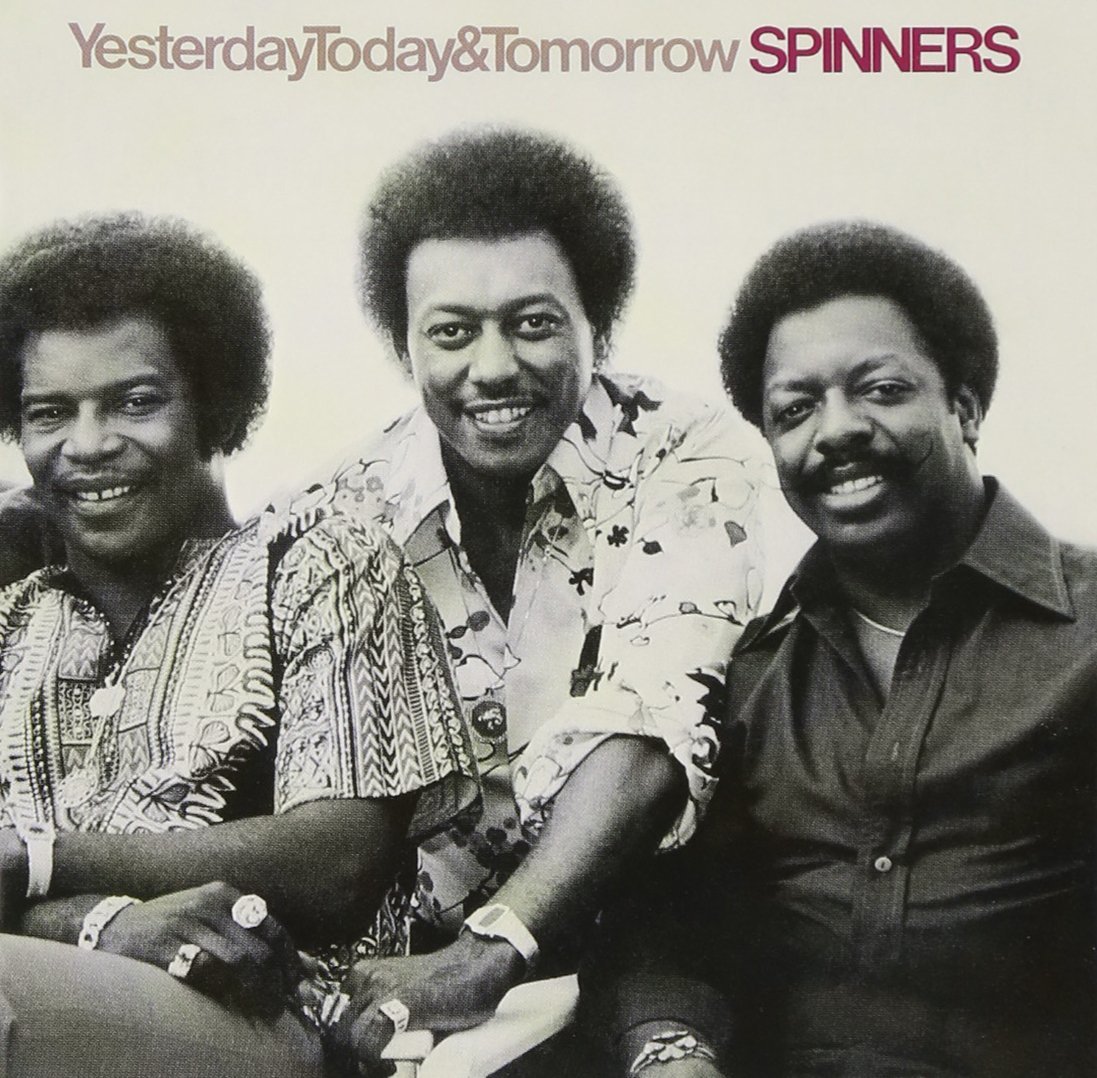
For The Detroit Spinners, their 1977 album Yesterday, Today and Tomorrow would mark an end of an era for the group. Yesterday, Today and Tomorrow was Phillip Wynn’s final album as lead singer of The Detroit Spinners. This wasn’t the only thing to change. Unlike their five previous studio albums, there were no songs written by Thom Bell and Linda Creed. Similarly, there was a change in the personnel that accompanied The Detroit Spinners.
No longer was the classic lineup of M.F.S.B. providing the musical backdrop for The Detroit Spinners. Granted guitarist Bobby “Electronic” Eli, percussionist Larry Washington and legendary backing vocalists The Sweethearts of Sigma all feature on Yesterday, Today and Tomorrow. Given much of Yesterday, Today and Tomorrow was recorded at the same time as Happiness Is Being With The Spinners, the Baker, Harris, Young rhythm section didn’t provide the Yesterday, Today and Tomorrow heartbeat. The biggest difference with Yesterday, Today and Tomorrow was its commercial performance. Between 1973s Spinners, through 1974s Mighty Love and New Improved then 1975s Pick of The Litter, The Detroit Spinners and 1976, The Detroit Spinners and Happiness Is Being With The Spinners had enjoyed five consecutive gold albums. That was about to change, as you’ll find out, when I tell you the background to The Detroit Spinners’ seventh album Yesterday, Today and Tomorrow.
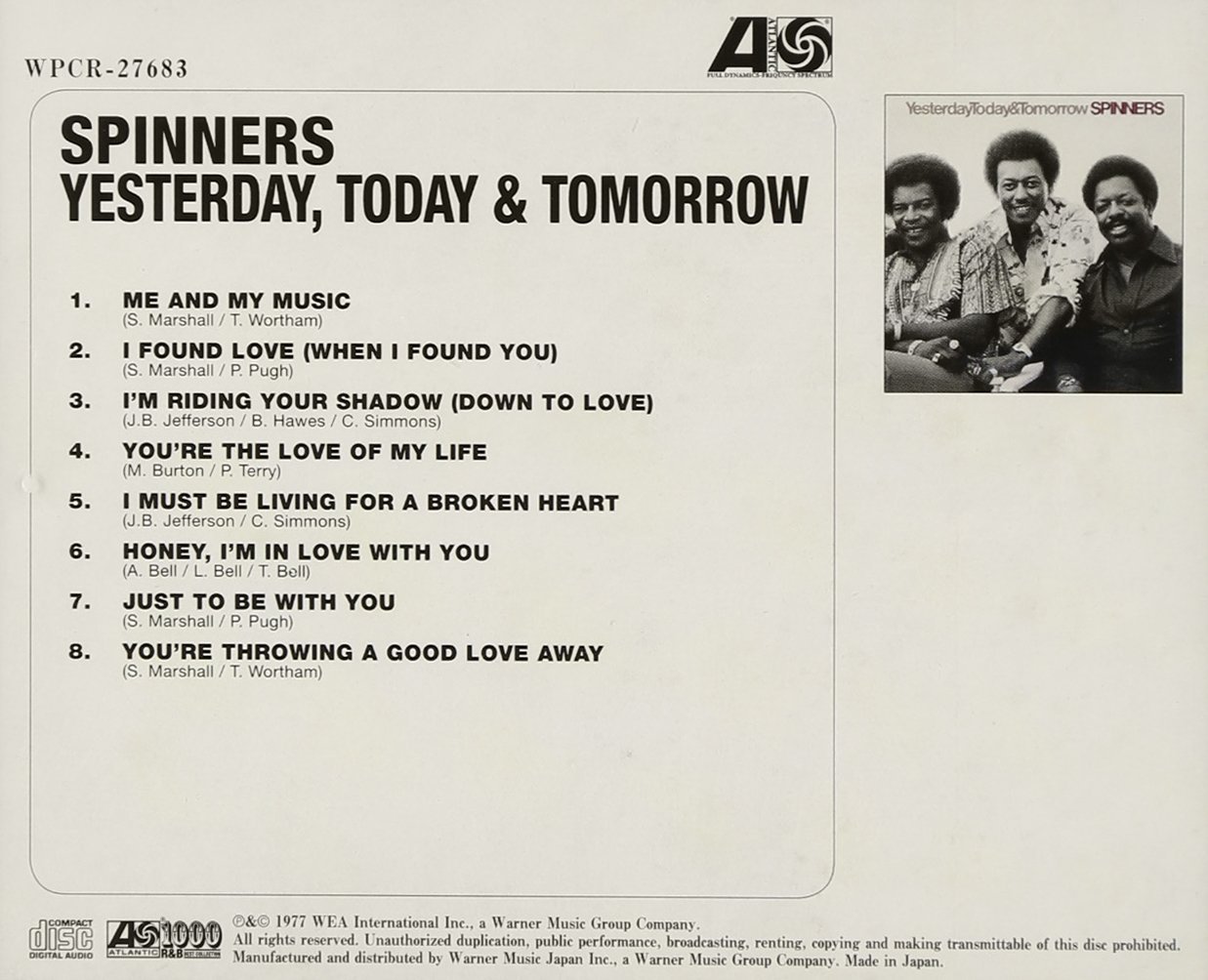
For Yesterday, Today and Tomorrow, eight songs were chosen. Thom Bell only cowrote one track, Honey, I’m In Love With You, with Leroy and Tony Bell. Sherman Marshall cowrote four tracks on Yesterday, Today and Tomorrow. He penned Me and My Music and You’re Throwing A Good Love Away with Ted Wortham, plus I Found Love (When I Found You) and Just To Be With You with Phillip Pugh. Charles Simmons and J.B. Jefferson wrote I Must Be Living For A Broken Heart and I’m Riding your Shadows Down To Love with Bruce Hawkes. Phil Terry and Michael Burton cowrote You’re The Love of My Life. These eight tracks became Yesterday, Today and Tomorrow. Like the Happiness Is Being With The Spinners, recording of Yesterday, Today and Tomorrow was split between Philly’s Sigma Sound Studios, but also at Kaye Smith Studios in Seattle. Indeed, much of Yesterday, Today and Tomorrow was recorded at the same time as their Happiness Is Being With The Spinners.
When the recording sessions began at the two studios, Philly’s Sigma Sound Studios, but also at Kaye Smith Studios in Seattle, little did The Detroit Spinners realize that Yesterday, Today and Tomorrow would be the final album released by the classic lineup. This included the three lead singers Phillip Wynn, Bobby Smith and Henry Fambrough. They were joined by Billy Henderson and Pervis Jackson. John Edwards makes his Spinners’ debut on You’re Throwing A Good Love Away. Accompanying them, were joined by a tight, talented band. This included a rhythm section of drummer Andrew Smith, bassist Bob Babbit and guitarists Tony Bell and Bobby “Electronic” Eli. Pervis Jackson also played bass on Yesterday, Today and Tomorrow. They were joined by keyboardist Thom Bell and percussionist Larry Washington. Adding backing vocals were legendary backing vocalists the Sweethearts of Sigma, Carla Benson, Evette Benton and Barbara Ingram. Thom Bell arranged and produced Yesterday, Today and Tomorrow, which would be released in 1976.
In the release of Yesterday, Today and Tomorrow in 1977, it reached number twenty-six in the US Billboard 200 and number eleven in the US R&B Charts. This became The Detroit Spinners’ least successful album since signing to Atlantic. There was no sixth gold disc for Yesterday, Today and Tomorrow. However, considering that disco was now at the height of its popularity, this is no surprise. Indeed, for a soul album, Yesterday, Today and Tomorrow had been a commercial success. After all, disco was now King. Over in the UK, Yesterday, Today and Tomorrow didn’t fare any better, stalling at number thirty-six. By the time Yesterday, Today and Tomorrow was released, Phillip Wynn had announced his departure from The Detroit Spinners. You’re Throwing A Good Love Away was the lead single from Yesterday, Today and Tomorrow, reaching number forty-three in the US Billboard 100 and number five in the US R&B Charts. Me and My Music then stalled at number thirty-nine in the US R&B Charts. While Yesterday, Today and Tomorrow, and the singles released from the album weren’t as successful as previous releases, this was the end of an era for The Detroit Spinners. DId this era end on a high? That’s what I’ll tell you, when I tell you about the music on Yesterday, Today and Tomorrow.
Opening Side One of Yesterday, Today and Tomorrow, is Me and My Music, the second single released from the album. A piano, rhythm section and chiming guitar combine, before growling horns enter. They set the scene for Phillip’s joyous vocal, which swings along. He seems to be holding back, doesn’t quite unleash his vocal. Punchy harmonies and braying horns accompany him, while the rhythm section provide the arrangement’s heartbeat. There’s quite a different sound and feel from The Detroit Spinners’ previous albums. Although the band are tight, they don’t have the slick, polished sheen of M.F.S.B. Having said that, it’s still a good song, although not a classic from The Detroit Spinners.
Just subtle, pizzicato strings opens I Found Love (When I Found You), Straight away, this much more like what you’d expect from The Detroit Spinners. The tempo is slow, with layers of lush, emotive strings and wistful horns accompanying Phillip’s heartfelt tender vocal. Meanwhile, the rhythm section provide an understated backdrop, while harmonies from the other Spinners and The Sweethearts of Sigma sweep in. They provide the perfect accompaniment and play their part in a track that has “Philly Sound” written all over it.
I’m Riding Your Shadows (Down To Love) picks up where the previous track left off. Here, the tempo is slow. Thom Bell’s arrangement combines swathes of sweeping strings, keyboards, pensive horns and a subtle rhythm section. When the lead vocal enters, Henry takes charge, and then shares lead vocal with Pervis. The vocals are beautiful and impassioned vocal. The contrast between the vocal styles adds to the emotion of the lyrics, as do the tight, soulful harmonies. Flourishes of harpsichord punctuate the arrangement, adding to the beauty and emotion of this tender ballad, something The Detroit Spinners do so well.
You’re The Love of My Life is another track that has The Detroit Spinners’ name written all over it. Growling horns and swirling strings swirl are at the heart of the arrangement. The rhythm section and Larry Washington’s percussion combine, as the band build the drama. Having set the scene, Henry’s grateful, needy vocal enters. He goes on to deliver one of his best vocals on Yesterday, Today and Tomorrow with Phillipe Wynne singing the hook Harmonies from the Spinners and The Sweethearts of Sigma sweep in. They match the emotion and sincerity of the lead. Meanwhile, strings dance and horns punctuate the arrangement, as The Detroit Spinners roll back the years, one more time.
I Must Be Living For A Broken Heart, written by Charles Simmons and J.B. Jefferson closes Side One of Yesterday, Today and Tomorrow. It’s a hurt-filled ballad, where each of The Detroit Spinners play their part. Just piano, the rhythm section, complete with Southern Soul guitars and harmonies combine to create an emotive backdrop. Then Pervis, Henry and Philippe take turns of delivering the lead vocal. Phillip’s delivers his vocal with equal amounts of hurt and heartache. Quivering strings and piano add to the melancholy sound of the arrangement. Later, harmonies from the Spinners and The Sweethearts of Sigma. They add to the sheer emotion and heartache, as The Detroit Spinners demonstrate how they were capable of breathing life and meaning into lyrics.
A chiming, funky guitar opens Honey, I’m In Love With You, which opens Side Two of Yesterday, Today and Tomorrow. Soon, things get uber funky, thanks to the rhythm section, wah-wah guitars, percussion and growling horns. The tempo increases, as the arrangement mixes funk, soul and disco. John Edward makes his Spinners’ debut, combining power and passion. Sometimes, it becomes vampish, complete with hollers and whoops Punchy, soaring harmonies accompany him, while sometimes, the horn riffs seem to “borrow” from David Bowie’s Fame. It’s a very different track from The Detroit Spinners, straddling musical genres, as they attempt to keep up to date with musical fashions
Just an understated combination of piano and drums opens Just To Be With You. It’s the first of two eight-minute epics on Side Two of Yesterday, Today and Tomorrow. Gradually, the arrangement builds. The bass and half-spoken, almost ironic vocal are joined by the lushest of sweeping strings. Then come the wistful horns and Phillip’s hopeful, needy vocal as Thom Bell’s arrangement reveals its beauty and secrets. Heartfelt harmonies join the deliberate piano, swathes of strings as the rhythm section create a beautiful, emotive backdrop as Phillip delivers a captivating, soul-baring vocal, that demonstrates how important he was to The Detroit Spinners’ success story.
Closing Yesterday, Today and Tomorrow and Phillip Wynn’s time as lead vocalist of The Detroit Spinners is You’re Throwing A Good Love Away. This eight minute epic, is a fitting finale from Henry singing lead and Phillipe following him. Bursts of rasping horns, cascading strings and a rhythm section complete with hissing hi-hats give way to a melancholy vocal. Flourishes of harpsichord, bursts of braying horns and dancing strings see the vocal change hands. Soulful, heartfelt harmonies cascade, while Thom Bell adds jazz tinged piano and Larry Washing adds piano. Here, The Detroit Spinners deliver some of their tightest, most soulful harmonies, demonstrating just why this was the classic lineup of The Detroit Spinners.
In many ways, Yesterday, Today and Tomorrow closed a chapter in The Detroit Spinners’ career. Not only was Yesterday, Today and Tomorrow Phillip Wynn’s final album as lead singer of The Detroit Spinners, but ended a run of five gold albums. From 1973s Spinners, through 1974s Mighty Love and New Improved then 1975s Pick of The Litter, The Detroit Spinners could do no wrong. This incredible run of critically acclaimed and commercially successful music ended with Happiness Is Being With the Spinners. While Yesterday, Today and Tomorrow was still a commercial success, it didn’t match the success of The Detroit Spinners’ five previous albums. This wasn’t helped by the lack or material from the songwriting team of Thom Bell and Linda Creed. Although they’d only written two tracks on Happiness Is Being With the Spinners, they contributed no songs for Yesterday, Today and Tomorrow. Similarly, the lack of the Baker, Harris, Young who for so long, had provided the heartbeat on The Detroit Spinners’ albums, including Spinners, Mighty Love, New and Improved and Pick of The Litter, were badly missed. Granted the rhythm section that played on Yesterday, Today and Tomorrow were tight and talented, they were no match for The Mighty Three. Another problem for The Detroit Spinners was the change in musical tastes.
By 1977, when The Detroit Spinners released, Yesterday, Today and Tomorrow, disco was the most popular musical genre. Soul groups, even commercially successful and critically Philly Soul groups weren’t as popular. So in some ways, that Yesterday, Today and Tomorrow was as commercially successful bucked musical trends. Phillip Wynn, seeing how musical tastes were changing, decided it was time to part company with The Detroit Spinners. In January 1977, Phillip announced he was leaving The Detroit Spinners. When, Yesterday, Today and Tomorrow was released, John Edwards was chosen as Phillip Wynn’s replacement. Although The Detroit Spinners still enjoyed sporadic success, they never replicated the success they enjoyed with Phillip Wynn as one of the three lead singers. Yesterday, Today and Tomorrow marks Phillip Wynn swan-song. Although not as consistent as previous Detroit Spinners albums, Yesterday, Today and Tomorrow demonstrates just why The Detroit Spinners were one of the most commercially successful and critically acclaimed groups in the history of Philly Soul, which their five albums between Spinners and Pick of The Litter proves.
THE DETROIT SPINNERS-YESTERDAY, TODAY AND TOMORROW.
DISCO RECHARGE: FESTIVAL-EVITA SPECIAL EDITION & BORIS MIDNEY-THE EMPIRE STRIKES BACK.
DISCO RECHARGE: FESTIVAL-EVITA SPECIAL EDITION & BORIS MIDNEY-THE EMPIRE STRIKES BACK.
By 1979, Boris Midney had established himself as one of the most prolific and pioneering producers of the Euro Disco era. Indeed, it’s no exaggeration to call Boris Midney one of the founding fathers of Euro Disco. Having defected from Russia, Boris became a member of the Russian Jazz Quartet. Soon, Boris had established a career in the music industry. This is no surprise, given he was multitalented musician, a true multi-instrumentalist who could read and write music. By 1976, at just as disco was becoming the most popular musical genre, Boris launch his career as a producer.
Two years later, in 1978, Boris released two albums by studio bands he’d created. These were USA-European Connection’s Come Into My Heart and Beautiful Blend’s Make That Feeling Come Again. A year later, in 1979, Boris released three further albums. This included USA-European Connection’s sophomore album USA-European Connection, Masquerade’s Pinocchio and his debut album as Boris Midney, Caress. By then, Boris Midney had established a reputation as a prolific, innovative producers, who pioneered 48-track recording. For Boris’ next album, it wouldn’t be new material, but songs composed by others, which he’d reinterpret.
In 1979, Boris met Robert Stigwood, who in 1977, had produced Saturday Night Fever. He was also the owner of RSO Records and manager of The Bee Gees. Robert had a proposal for Boris. His idea was that Boris would reinterpret the work of other composers. This wasn’t a new idea. The Salsoul Orchestra had been doing this for several years, reinterpreting The Wiz, Fiddler On the Roof and West SIde Story. However, Robert’s idea was that Boris reinterpret songs from the musical Evita, written by Tim Rice and Andrew Lloyd Webber. With Evita about to be launched as a musical in America, this would help promote the show. Boris accepted the commission. Released in 1979, by another Boris Midney studio band, Festival, Evita resulted in his most commercially successful album.
After the success of Evita, Robert commissioned Boris to do the same with The Empire Strikes Back’s soundtrack. It was released by Boris Midney in 1980, but didn’t replicate the success of Evita. Since then, both Festival’s Evita and Boris Midney’s The Empire Strikes Back have become disco classics. Now over thirty years later, Harmless Records’ Disco Recharge imprint are rereleasing both albums, complete with bonus track. They’ll be rereleased as Disco Recharge: Festival-Evita and Boris Midney The Empire Strikes Back on February 18th 2013. Before I tell you about the music on Evita and The Empire Strikes Back, I’ll tell you about the background to two classic albums.
FESTIVAL-EVITA.
Evita was the latest musical from lyricist Tim Rice and Andrew Lloyd Webber. Based on the life of Eva Peron, the wife of Argentine President Juan Peron, Eva became known as the first Lady of Argentina. Born into poverty in 1919, she rose to become a revered figure within certain section of Argentine society. Known as Evita, Eva Peron died of cancer, aged just thirty-three in 1952. It was Evita’s story the Rice and Lloyd Webber team transformed into a musical.
June 21st 1978 saw the premier of Evita in London’s West End. By then, the Evita Soundtrack had been released. It became a commercial success, reaching number one throughout Europe. Julie Covington sang the track Don’t Cry For Me Argentina, which gave her a huge hit single. She didn’t want to appear in the West End show, so Elaine Paige was chosen instead. By 1979, Evita was about to be premiered in America.
There was a problem with staging Evita in America. Neither the Evita Soundtrack, nor Julie Covington’s Don’t Cry For Me Argentina had been commercially successful. So with Evita about to open in Los Angeles, a publicity campaign got underway. As part of this campaign, Robert Stigwood hit on the idea of giving Evita a disco makeover. To do this, he headed to see Boris Midney. Soon, Boris was commissioned to record seven tracks from Evita, using the newly formed studio band Festival.
Festival headed to Boris Midney’s legendary 48 track recording studio Eras, in New York. Boris had built the studio from scratch, to his own specification. He was able to properly utilize the potential of the 48 track studio, fusion soul, disco and symphonies. WIth bassist Francisco Centeno, guitarists Brad Johnson and Ray Volpe, percussionist Johnny Santana, harpist Reinhardt Elster plus a string and horn section, recording got underway. Catalina Seviilla, Kevin Owens, plus Lucia and Sylvia Suarez delivered the vocals.Six of the tracks were from the original soundtrack, while Boris wrote Evita’s closing track, Eva’s Theme: She’s A Women. Boris arranged, produced and played keyboards on Evita, and was responsible for the album cover. Once Festival finished recording Evita, Boris Midney’s most intriguing and compelling project would prove the biggest commercial success of his career.
On the release of Evita in 1979, on Robert Stigwood’s RSO Records, the album soared to number one in the US Billboard Disco Charts and reached number fifty in the US Billboard 200. Evita also reached number three in the Dance Music/Club Pay Charts. Don’t Cry For Me Argentina was released as a single, reaching number seventy-two in the US Billboard 100 Charts. However, what made Evita such a commercial success? That’s what I’ll tell you.
Opening Evita is the nine-minute epic Buenos Aires, which sees a wistful piano and subtle strings combining. Gradually, Boris builds the drama, fusing tender, soulful harmonies, percussion and flourishes of piano. That signals the arrangement’s explosion into life. Latin percussion, harmonies and a pounding Euro Disco beat combine, as Festival drive the arrangement along. With Boris keyboards, flourishes of harpsichord and growling horns join swathes of strings it’s a delicious combination. When the punchy harmonies enter midway through the track, you realize a classic is unfolding. They’re joyous, punchy and soulful, the perfect foil for Boris’ disco symphony. Euro Disco, soul and Latin music combine seamlessly and sometimes, dramatically and grandly. As Buenos Aires fades into the distance, you hungrily await the next six tracks.
There’s no let up in tempo on I’d Be Surprisingly Good For You. A pulsating disco beat, dancing strings, rasping horns, Latin percussion and funky rhythm section join forces. Then the heartfelt, sincere vocal enters. Cascading harmonies accompany the vocal, while Festival mix funk, Euro Disco and soul. Melancholy strings sweep and swirl, horns bray and the rhythm section provide a pounding, funky backdrop, as hooks aplenty are delivered by Festival.
Most people will have heard Don’t Cry For Me Argentina, but never like this. Rather than a slow ballad, it’s reinterpreted by Boris an uptempo dance track, with a poppy twist. Layers of lush strings, dramatic horns and tight harmonies combine, while the rhythm section create a the arrangement’s pulsating heartbeat. The lead vocal is delivered emotively and dramatically, but quicker than the original version. This suits a track, where disco and pop unite. Here, Boris breathes new life and meaning into a familiar song, while giving it a dance-floor friendly makeover.
From the opening bars of High Flying Adored, a pulsating Euro DIsco beat thunders along. Horns growl, strings quiver and percussion and keyboards then join the arrangement. Even before the punchy harmonies enter, you’re smitten, by this irresistibly catchy slice of Euro Disco. They accompany a deliberate vocal, which tells the story of Evita at the peak of her popularity. High Flying Adored, with a long way to fall describes her situation perfectly. The interplay between the vocal and harmonies is seamless. It’s as if they drive each other to greater heights, as one of this irresistible track proves one the highlights of Evita.
Rainbow High picks up where High Flying Adored left off. Flourishes of Boris’ keyboards, blazing horns and dancing strings unite with the rhythm section. Like other tracks, they provide the track’s pulsating Euro Disco beat. Urgent, choppy, cascading harmonies join percussion and handclaps. Then at just the right time, Boris drops the strings and horns in. During a breakdown, harpsichord and piano take charge, as Boris teases and tantalizes. Then, he unleashes the rest of the arrangement. It’s as if he can no longer hold it back. What unfolds, is classic Boris Midney, forever the musical innovator, always a leader and never a follower.
She Is A Diamond sees Kevin Owens take charge of vocal, on the last of the original tracks from the Evita soundtrack. Drums pound, horns rasp and strings dance, as the arrangement explodes into life. Meanwhile, a funky bass helps drive the dancing arrangement along. Kevin’s vocal is deliberate and pensive, while harmonies are similarly melancholy, as they question. Later, Johnny Santana unleashes a percussive masterclass, before the track bursts back into life. It’s Euro Disco, funk, soul and Latin music combined, and then given a symphonic twist by Boris. It’s compelling, captivating and sweeps you along, holding you spellbound.
Closing Evita is Eva’s Theme: She’s A Woman, written by Boris. Piano, harpsichord, Latin percussion and cascading strings combine with growling horns. Add to that a pounding, Latin-tinged beat and breathy harmonies. From there, the arrangement dances elegantly, grandly and beautifully along. Harmonies soar soulfully, strings sweep and swirl and horns punctuate the arrangement. It seems Boris is determined to create a track that brings Evita to a dramatic and memorable high. This he does, using a Latin twist to pay homage to Evita, in a way she’d surely approve of.
While Eva’s Theme: She’s A Woman, closed Festival’s Evita, it doesn’t close Disc One of Disco Recharge: Festival-Evita and Boris Midney The Empire Strikes Back. Not at all. Indeed, there are four other tracks. Two are 12” Promo Mixes released by RSO. They’re Evita Special Dance Music Version Pt. 1, a three-part movement and Evita Special Dance Music Version Pt. 2, a four-part movement. Then there’s the 7” and 12” Version of the single Don’t Cry For Me Argentina. These four tracks are a very, welcome added bonus for collectors of Boris Midney’s work. Indeed, the rerelease of Evita, which was Boris’ most commercially successful album will be welcomed by anyone who loves disco or Euro Disco. Evita saw Boris Midney doing what he did best, pioneering, innovating and fusing musical genres and influences aplenty. So it’s no surprise that following the success of Evita, Robert Stigwood commissioned Boris to give another soundtrack a disco makeover, The Empire Strikes Back.
THE EMPIRE STRIKES BACK.
The Empire Strikes Back, which was the fifth installment in the Star Wars series, was released in 1980. Like previous films, the script was written by George Lucas. Produced by Gary Hurtz, directed Irvin Kershner and starring Carrie Lucas, Harrison Ford and Mark Hammil The Empire Strikes Back was an space opera. British composer and musician John Williams had written the soundtrack to The Empire Strikes Back. It was these songs that Boris Midney would reinterpret when he gave The Empire Strikes Back a disco makeover.
Many of the same musicians and vocalists joined Boris at his Eras Studios in New York. Bassist Francisco Centeno, guitarists Ray Volpe and percussionist Johnny Santana were joined by Bob DePasquale’s Ensemble, who provided the strings and horns. Just like on Evita, Boris arranged, produced and played keyboards on The Empire Strikes Back. He was also responsible for album cover’s photo. When The Empire Strikes Back was released, disco was no longer as popular.
When The Empire Strikes Back was released by Boris Midney in 1980, this came a year after the Disco Sucks’ movement had almost killed disco. It came to a head at Comiskey Park, Chicago on 12th July 1979. After that, disco was no longer as popular. Instead, record companies weren’t releasing disco albums. Disco artists suffered, having been cast aside, in favour of the next musical trend. So, when The Empire Strikes Back wasn’t a commercial success, it’s no surprise. Since then, Boris Midney’s The Empire Strikes Back has become a disco classic, which I’ll tell you about.
Yoda’s Theme opens Boris Midney’s The Empire Strikes Back. There’s a dramatic, sci-fi sound as the track opens. Distant drums boom, synths beep and squeak and then drums, searing, rocky guitars and blazing horns add to the drama. With percussion, keyboards and a pounding, funk-laden rhythm section, complete with hissing hi-hats the arrangement reveals its secrets. Quickly, the drama builds, with urgent harmonies, bursts of grizzled horns and swirling strings combining Euro Disco, funk, classical music and elements of jazz. Elegant, symphonic and grand describes this disco concerto. Later, the arrangement takes on a rocky sound as this dramatic, space opera takes shape. For over seven-minutes, Boris takes you on a genre-fusing journey, that’s bold, brave, dramatic and like all his work, truly groundbreaking.
A sci-fi sound opens The Imperial March (Darth Vader’s Theme), before hissing hi-hats, harpsichord percussion and shivering strings combine. Then having resisted the temptation to drop the rhythm section in earlier, they drive the arrangement along. Soon, they’re like a musical juggernaut, a funky one at that. Strings dance above the arrangement, quivering and shimmering, while horns growl and blaze. By now, funk, Euro Disco, jazz, Latin music and classical music have become one. Breathy harmonies urgently accompany jazzy horns and Latin percussion, as musical genres and influences melt seamlessly into one, molded by the maestro, Boris Midney.
As if from a faraway, distant galaxy, Han Solo And The Princess (Love Theme) meanders into being. The arrangement prowls along. Elements of it briefly remind me of the Love Unlimited Orchestra, albeit with a slow, moody, funky twist. Melancholy, wistful horns, keyboards and the rhythm section create a quite beautiful, pensive sounding track. Percussion is added, while sultry horns and thoughtful keyboards and a slow, but funky rhythm section combine. Later, pizzicato string add to the arrangement’s wistful, pensive and beautiful sound, resulting in this being the highlight of The Empire Strikes Back.
Closing The Empire Strikes Back, is Star Wars (Main Theme). Beeps and squeaks combine with percussion, Blaxploitation era horns and a funky rhythm section. From a slow, moody opening, Boris and his band kick loose one last time. Elegant harmonies, lush strings, braying horns and chiming guitars combine. For their part, the rhythm section provide the necessary funky beat, creating a six-minute Magnus Opus, which closes Disc Two of Disco Recharge: Festival-Evita and Boris Midney The Empire Strikes Back.
Just like Evita, The Empire Strikes Back saw Boris continue to innovate and fuse musical genres. On The Empire Strikes Back, the Euro Disco influence isn’t as prominent. Granted it’s still there, but much more subtle in parts. In its place, Boris combined elements of everything from funk, soul, classical, Latin and rock music. The result was as equally captivating, innovative musical journey as Evita. Listening to The Empire Strikes Back, I wonder whether Boris Midney could’ve made a career composing film soundtracks? He certainly had the vision, talent and creativity to do so. Like Evita, The Empire Strikes Back sees Boris combine and fuse musical genres and influences. Indeed, his influences and inspiration are eclectic. To his beloved Euro Disco, Boris delves deeply into his musical palette. Like an artist, he produced in Evita and The Empire Strikes Back two very different albums. Ever since their release in 1979 and 1980 respectively, Evita and The Empire Strikes Back have become disco classics.
Both Evita and The Empire Strikes Back have been unavailable on CD for many years. Now, Harmless Records’ Disco Recharge imprint are rectifying this. On February 18th 2013, Disco Recharge will rerelease Disco Recharge: Festival-Evita and Boris Midney The Empire Strikes Back as a lovingly compiled and luxurious double-album. This is just the latest rerelease from Disco Recharge of Boris Midney’s music. Previously, Disco Recharge-Boris Midney Volume 1-Beautiful Blend and Caress and Disco Recharge Come Into My Heart and USA-European Connection-Special Edition. Joining these two rereleases, will Disco Recharge: Festival-Evita and Boris Midney The Empire Strikes Back, the next installment in the musical career of Boris Midney, one of Euro Disco’s founding fathers, and a man who is worth of the description visionary, innovator and pioneer. Standout Tracks: I’d Be Surprisingly Good For You, High Flying Adored, Yoda’s Theme and Han Solo And The Princess (Love Theme).
DISCO RECHARGE: FESTIVAL-EVITA SPECIAL EDITION & BORIS MIDNEY-THE EMPIRE STRIKES BACK.

CHANGE THE BEAT-THE CELLULOID RECORDS STORY 1979-1987.
CHANGE THE BEAT-THE CELLULOID RECORDS STORY 1979-1987.
In 2012, Strut Records released Only For You: The Sound of Cajmere and Cajual Records, which paid homage to Cajmere, one of the innovators of the Chicago house scene and his label Cajual Records. This proved to be one of Strut Records’ most critically acclaimed and commercially successful releases of 2012. Now, for Strut Records first release of 2013, they’ve decided to revisit another pioneering, innovative and experimental record label Celluloid Records. To do this, Strut Records will release Change The Beat-The Celluloid Records Story 1979-1987, on 25th February 2013. I’ll now tell you about the story behind Celluloid Records, and and music on Change The Beat-The Celluloid Records Story 1979-1987.
It was in Paris, France in the late seventies that Jean Karakos founded Celluloid Records. This wasn’t Jean’s first involvement with music. He’d spent the last decade running record shops. Much of Jean’s success running record shops came by importing music. Towards the end of the seventies, Jean had established a routine that would prove profitable. Each Sunday night, he headed to London’s Rough Trade Records just when the latest releases arrived. After looking through the new independent releases, Jean would buy copies of he forthcoming week’s releases. Then he’d head back to Paris. Once Jean returned to Paris on Tuesday morning, he’d phone other record shops and sell the records. This was at a time when music was evolving, and evolving quickly.
Punk had proved to a musical game changer three years earlier in 1976. After punk and post-punk, the musical rules change. Indeed, the rules weren’t just rewritten, but ripped up and thrown away. Following punk and post-punk, music was about to change again. In many ways from the nihilistic sound of punk, music was about to evolve into something with a more sophisticated sheen. This change came about as technology entered the musical equation.
Drum machines, synths and samplers were all becoming much more affordable. No longer were drum machines, synths and samplers only available to groups with large budgets and found in high-end recording studios. Instead, they were within the budget of aspiring musicians and producers. This meant artists and producers were able to create and manipulate music that was much more complicated, multi-textured and complex. For anyone looking to start a new record label, this was the perfect opportunity.
When Jean founded Celluloid Records in 1979, he’d already had experience running a record label. Previously, he’d run spiritual jazz label BYG, which meant he knew how a record label was run and the pitfalls surrounding this. So in the Porte de Lilas in Paris, Jean and Gilbert Castro, a former Director of the Maoists founded Celluloid Records. They were a contrasting partnership. While Jean was an extrovert, Gilbert was cultivated and urbane. Jean had also founded Actuel, a monthly magazine, which focused on the artist and current affairs. With Celluloid Records founded, they began releasing music, including reggae tracks licensed from London’s Jetstar label. However, from the day Celluloid was founded, they were releasing cutting-edge music.
One of Celluloid Records first releases in 1979 was Robert Leer and Robert Rental’s album The Bridge. It featured Day Breaks, Day Heals, four minutes where new wave, industrial and ambient music hypnotically combine. As a new decade dawned, then Celluloid Records would enter the most important years of the nascent label’s history.
Five very eclectic tracks from 1980 feature on Change The Beat-The Celluloid Records Story 1979-1987. It seems quite apt that the first is a dub reggae track licensed from Studio 16, a London label. Winston Edwards and Blackbeard’s Downing Street Rock, was a track At 10 Downing Street-Dub Conference. Demonstrating the eclectic nature of Celluloid’s releases is Mathematiques Modernes’ single Disco Rough. Written by Claude Arto and Edwige Belmore, electro and synth pop unite. Similarly eclectic was Ferdinand’s album El Forme, which included Tele: Apres La Metro. Here, Ferdinand, a French group merged new wave, art rock and punk seamlessly. That year, Snakefinger released their genre-fusing, sophomore album Greener Pastures on Ralph Records. Celluloid Records licensed this experimental album, which featured Living In Vain, a track that has Celluloid’s name written all over it. So too does Nini Raviolette experimental, synth pop track Suis-Je Normale. Filed will beeps and squeaks and Nini’s deliberate, sultry vocal. Already, people were taking notice of this pioneering French label Celluloid Records. The following year, 1981, would prove an important one for Celluloid Records, for several reasons
Not only did 1981 see Celluloid Records start building a reputation as a pioneering and experimental label, but Jean would meet a likeminded man who’d prove crucial to the label’s future. That man was Bill Laswell. Jean was now regularly flying between Paris and New York to sell Celluloid’s releases. It was on one of these trips, Jean met Bill, who’d just flown in from Michigan to New York. Bill was another musical innovator, who produced genre-sprawling music. He took various musical genres, deconstructed them and reinvented them as something, new, pioneering and cutting-edge. So Jean, liking what he heard from Bill’s group Massacre, decided Celluloid would release their debut album Killing Time, where avant garde, improvisation and rock combine. Given the importance of this meeting, the title-track, Killing Time features on Change The Beat-The Celluloid Records Story 1979-1987.
Massacre wasn’t the only Bill Laswell project Celluloid would release. They also released Bill’s post-punk dance project Material’s I’m The One in 1982. It sees Bill collaborate with Michael Beinhorn, Bernard Fowler and Nile Rodgers. Another Bill Laswell project is Last Exit, whose track Big Boss man features on Change The Beat-The Celluloid Records Story 1979-1987. Having established their reputation as one of the most eclectic and innovative labels, Celluloid would continue to do so.
Richard Hell and The Voidoids had been releasing music since 1977. Having started as a punk band, their music had mutated into new wave. 1982 saw the release of their sophomore album Destiny Street. In many ways, they were too good as musicians to be called a punk band. They combine funk, rock, garage, new wave and even hip hop. It was delicious fusion of genres and influences, proving their was life after punk. One musical genre that proved even more important that punk, was hip hop.
During his trips to New York and through meeting Bill Laswell, Jean Karakos had first gotten involved with hip hop. This was during the early eighties, when hip hop was growing in popularity. Soon, Celluloid Records started releasing a series of hip hop singles. Several of these hip hop tracks feature on Change The Beat-The Celluloid Records Story 1979-1987. This includes Fab 5 Freddy’s Anglo-French slo-mo rap Beside. It was released in 1982, the same year as Futura 2000’s The Escapades of Futura 2000, which features The Clash. Produced by The Clash, who were now embracing various musical genres and influences, Mick Jones wrote this fusion of electro and hip hop with Futura 2002. Little did they realize, they’d just released a cult classic. The next year, 1983, would prove to be one of Celluloid Records most important years.
By 1983, Celluloid’s reputation as innovative, progressive label had been established. Four tracks on Change The Beat-The Celluloid Records Story 1979-1987, demonstrate this. Celluloid licensed Shockabilly’s 1983 album Earth Vs. Shockabilly from Rough Trade Records. Day Tripper fuses elements of electro, avant garde, rock and punk. That year, Celluloid released two albums of Afrobeat.These were Bobongo Stars’ album Makasi, which features Koteja, and Senegalese singer Toure Kunda’s sophomore album Amadou Tilo. The title-track Amadou Tilo and Bobongo Stars’ Koteja both demonstrate how gradually the emergence in popularity of what was then known as World Music.
Timezone’s The Wildstyle was also released in 1983. Produced by UK DJ Rusty Egan and featuring Afrika Bambaataa and French MC B SIde. It’s the 12’ Vocal version that features on Change The Beat-The Celluloid Records Story 1979-1987. So too does World Destruction, Timezone’s collaboration with former Sex Pistol and now member of PIL, John Lydon. Then later in 1983, Jean and Bill would have a profitable collaboration with a jazz giant.
Later in 1983, Jean and Bill Laswell were working with jazz legend Herbie Hancock, on his electro hit Rockit. Indeed, it was Jean who suggested using a keyboard riff from an early demo as the single’s hook. Jean’s suggestion proved profitable, with the income he received from publishing royalties allowing the pair to continue exploring hip hop. After that came Grandmaster DS.T’s seven-minute epic Home of Hip Hop, released in 1985. Before that, came an eclectic year for Celluloid, 1984.
Change The Beat-The Celluloid Records Story 1979-1987 features three tracks from 1984. This includes Lightnin’ Rod’s Sport, a delicious fusion of funk, jazz and hip hop. It was released eleven years after Lighnin’ Rod released his only album Hustlers Convention in 1973. 1984 also saw the release of B Side With Bernard Fowler’s electro hip hop SIngle Odeon and Mandingo’s album Watto Sitta.
Access to Mandingo’s album Watto Sitta, which featured Foday Musa Suso came about through Bill Laswell. He’d moved on from Celluloid Records, although they continued to support his musical project. Harima, Watto Sitta’s opening track, is a glorious melting pot of influences, sung call and response style. Folk, World Music and a twist of electronic music combine, creating one of the most enchanting tracks on Change The Beat-The Celluloid Records Story 1979-1987.
Two tracks from 1985 demonstrate just how eclectic a label Celluloid was. Sapho released her fifth album Passions, Passions in 1985. Carmel was the track that opened Passions, Passions and the 12” version features on Change The Beat-The Celluloid Records Story 1979-1987. It’s hypnotic synth pop combined with dance music. The same year, 1985, veteran Manu Dibango released his E.P. Pata Piya, which featured Abele Dance ’85 Remix, where dub, hip hop beats and electro combine.
1986 saw a slowdown in the amount of music Celluloid was releasing. Bill Laswell was now collaborating with other artists, including Fred Firth, Yoko On and jazz legends John McLaughlin and Eric Dolphy. However, Celluloid did release ex member of Cream, Ginger Baker’s album Horses and Trees. It featured Dust To Dust, one of the highlights of Change The Beat-The Celluloid Records Story 1979-1987. It’s a fusion of jazz, country and rock, featuring some incredible slide guitar.
Bill Laswell wasn’t the only person to influence and collaborate with Jean at Celluloid Records. So would US producer and music entrepreneur Alan Douglas. This meant that Celluloid Records were able to license albums by The Last Poets and Ronald Shannon Jackson. Indeed, closing Disc Two of Change The Beat-The Celluloid Records Story 1979-1987 is The Last Poets Mean Machine/Mean Machine Chant. Mean Machine was a track from their 1992 hip hop album Retro Fit. This came seven years after their first release for Celluloid Records, Oh My People. Given that The Last Poets had been such an innovative group, it seems fitting that it’s a Last Poets’ track that closes Change The Beat-The Celluloid Records Story 1979-1987, a retrospective of one of the most pioneering European labels of the last forty years.
So, the two discs that comprise Change The Beat-The Celluloid Records Story 1979-1987, feature a suitably eclectic selection of tracks that’s representative of Celluloid Records back-catalogue. Celluloid Records lasted only eight years, but during that time, Celluloid proved one of the most innovative, pioneering and bold record labels. They were never afraid to challenge musical norms, releasing music that strayed from the norm. Sometimes, well away from what was the established musical norm. Indeed, Celluloid Records proved to be a trendsetting label, masterminded by Jean Karakos. Hip hop, electro, synth pop, Afro Beat, dance, avant garde, jazz, rock and much, much more. Often some of Celluloid’s releases defied description, as musical genres seamlessly melted into one. Celluloid Records back-catalogue hasn’t been available since 1995, when it was last licensed. That’s why Strut Records’ forthcoming compilation Change The Beat-The Celluloid Records Story 1979-1987, which will be released on 25th February 2013, will be so widely welcomed by music fans. For anyone whose yet to discover the many and eclectic delights of Celluloid Records’ back-catalogue, then Change The Beat-The Celluloid Records Story 1979-1987 will prove the perfect starting point for a compelling and captivating, genre-sprawling, majestic, musical journey. Standout Tracks: Robert Leer and Robert Rental Day Breaks, Day Heals, Bobongo Stars Koteja, Lightnin’ Rod Sport and Ginger Baker Dust To Dust.
CHANGE THE BEAT-THE CELLULOID RECORDS STORY 1979-1987.

THE STYLISTICS-ROCKIN’ ROLL BABY.
THE STYLISTICS-ROCKIN’ ROLL BABY.
Often, when a group decide to change producer, this can mark a change in their fortunes. This is even more risky when the producer has co-written some of your biggest hits. Forty years ago, The Stylistics were about to release their third album Rockin’ Roll Baby. Their two previous albums, 1971s The Stylistics and 1972s Round 2 had both been certified gold. Much of their success had been down to Thom Bell, who produced these two albums. However, was much more than a songwriter. With Linda Creed, Thom had written much of The Stylistics two previous albums. So if The Stylistics, or their management decided to change producer, not only were they risking losing one of the best producers of the time, but access to one of the hottest songwriting teams. That however, was what happened after the release of Rockin’ Roll Baby. Granted, Rockin’ Roll Baby didn’t match the success of The Stylistics two previous albums, but was certified silver in the UK and featured a million selling single. Quite simply, the story of Rockin’ Roll Baby is a compelling one, as you’ll realize.
After back-to-back gold albums, The Stylistics must have felt under pressure to match the success of their first two albums. So, Thom Bell and Linda Creed got to work, writing six of the ten tracks. They were, Only For The Children, Let Them Work It Out, Make It Last, Love Comes Easy, Rockin’ Roll Baby and The Stylistics’ classic You Make Me Feel Brand New. Thom Bell and Kenneth Gamble penned Payback Is A Dog. Bruce Hawkes and Joseph B. Jefferson cowrote There’s No Reason and with Charles Simmons, penned Could This Be The End and I Won’t Give You Up. These ten track became Rockin’ Roll Baby, which, like The Stylistics first two albums, would be recorded at Sigma Sound Studios in Philly.
For recording of Rockin’ Roll Baby, the five members of The Stylistics Russell Tompkins Jr, James Dunn, Herb Murrell, James Smith, James Smith and Airrion Love headed to the familiar surroundings Sigma Sound Studios in Philly. Accompanying them, were Philadelphia International Records’ legendary house-band M.F.S.B. They included some of Philadelphia’s best musicians. This included a rhythm section of Baker, Harris, Young. Guitarist included Bobby “Electronic” Eli, keyboardist Thom Bell, percussionist Vince Montana Jr, Larry Washington on timbales, bongos and congas. Don Renaldo and His Swinging Strings were joined by a full horn section that included John Davis on tenor and baritone saxophone. Jack Faith played alto saxophone and flute.Adding backing vocals were legendary backing vocalists the Sweethearts of Sigma, Carla Benson, Evette Benton and Barbara Ingram. Thom Bell arranged and produced Rockin’ Roll Baby, and once the album was finished, it which was released in November 1973.
On the release of Rockin’ Roll Baby in November 1973, it reached number sixty-six in the US Billboard 200 and number five in the US R&B Charts. Over in the UK, Rockin’ Roll Baby reached number forty-two. The title-track Rockin’ Roll Baby was released as a single, reaching number fourteen in the US Billboard 100 and number three in the US R&B Charts. Ironically,You Make Me Feel Brand New wasn’t released as a single. It also features on The Stylistics fourth album, Let’s Put It All Together. This single became a stonewall Philly Soul classic, reaching number two in the US Billboard 100, number five in the US R&B Charts and number two in the UK. Eventually,You Make Me Feel Brand New sold over a million copies worldwide, and was certified gold. By then, Thom Bell and The Stylistics had parted company. I’ll tell you about that, after I’ve told you about the music on Rockin’ Roll Baby.
Rockin’ Roll Baby opens with the Thom Bell and Linda Creed penned Only For The Children. For an opening track, it’s perfect. The choppy arrangement grabs your attention. Stabs of piano, growling horns, searing guitars and cascading strings unite with percussion, building the drama. Having set the scene, Russell Tompkins Jr’s vocal enters. It’s delivered dramatically, but with sincerity and tenderness. Meanwhile, the arrangement is growing in drama, with harp, flourishes of strings, wistful horns and tender harmonies. Russell seems determined to get across the lyrics meaning. His delivery is deliberate, while the dramatic arrangement is almost saying: “listen.” Powerful, moving and dramatic best describes this opening track.
Could This Be The End is one of the most beautiful, melancholy songs on Rockin’ Roll Baby. Just Earl Young’s drums and hi-hats join Thom Bell’s piano. Then Vince Montana Jr’s vibes and Norman Harris’ guitar enter. Soon, the track decides to give up its melancholy secrets. Russell’s falsetto is tender and thoughtful. Gradually, lush strings, wistful horns and an understated Baker, Harris, Young rhythm section combine. Ron Baker’s bass prowls along the arrangement while tight, soulful harmonies sweep above the arrangement. What follows is one an incredibly beautiful, pensive song, that’s something of a hidden gem in The Stylistics’ back-catalogue.
Let Them Work It Out is another of the slower songs on Rockin’ Roll Baby. It’s another Thom Bell and Linda Creed composition. Here, Russell delivers one of his most heartfelt, tender vocals. His vocal is slow, with harmonies accompanying him. Thom Bell’s keyboards are crucial to the slow, spacious arrangement. Jack Faith’s flute and Ron Baker’s meandering bass add to the thoughtful sound of the arrangement, as Russell, emotively advices: “if you can, Let Them Work It Out.” This he sings with hope and feeling.
Make It Last is quite different in sound to previous tracks. There’s a Latin sound to the shuffling arrangement. M.F.S.B. get the chance to showcase their skills. Percussion, flute, sweeping strings and melancholy horns join Baker, Harris, Young. Then comes Russell’s joyous vocal. He’s in love, found someone he loves. With hope and tenderness he sings: “Make It Last.” Taking their lead from him, strings dance, quiver and shiver, horns rejoice and harmonies sweep in. For their part, the rhythm section and percussion add a shuffling beat. However, it’s Russell’s vocal and Don Renaldo and His Swinging Strings’ that make this one of the highlights of Rockin’ Roll Baby.
Payback Is A Dog, which Thom Bell and Kenny Gamble penned. It’s one of those songs where the maxim what goes around, comes around is put to music. In this case, beautiful music, tinged with heartache and pain. Russell’s vocal is filled with hurt and sadness, while swathes of lush strings sweep slowly. The strings are at the heart of the song’s success. Harmonies sweep in, while Baker, Harris, Young provide the song’s hurt-filled heartbeat. Brief bursts of wistful horns and drama from Earl Young’s drums join Vince Montana Jr’s vibes. They add to the emotion, sadness and pain, as Russell delivers a heartbroken vocal, that closes Side One of Rockin’ Roll Baby.
Side Two of Rockin’ Roll Baby opens with Love Comes Easy. The unmistakable sound of Vince Montana Jr’s vibes and Norman Harris’ jazz tinged guitar are joined by Thom Bell’s keyboards. Horns rasp and Baker, Harris, Young provide the backdrop for Russell’s tender, blissful vocal. He reminisces, thinks back, to the time his relationship started. After that, “Love Comes Easy.” Harmonies accompany him, while Norman’s guitar chimes, strings quiver as Russell offers hope. He almost assures, promises that one day, “Love Comes Easy.” If only life and love were that simple.
There’s No Reason was written by Bruce Hawkes and Joseph B. Jefferson, and is very different to the Thom Bell and Linda Creed tracks. That’s not a criticism, merely an observation. Just hissing hi-hats, pizzicato strings and Norman Harris’ guitar joins cascading strings. Gradually, the arrangement unfolds. Earl Young’s drums signal the arrangement to reveal its secrets. Baker, Harris, Young drive the arrangement along, while deliberate stabs of keyboards, dancing strings and tender, cooing, soaring harmonies accompany Russell’s vocal. He’s given the opportunity to unleash his vocal, his falsetto soaring high and powerfully above the arrangement. Then Thom Bell drops the horns in at the perfect time. Suddenly, as Thom Bell does so well, everything makes sense.
Rockin’ Roll Baby was the lead single from Rockin’ Roll Baby. Horns growl as bongos and the Baker, Harris, Young rhythm section combine. After teasing the listener, M.F.S.B. and The Stylistics kick loose. Baker, Harris, Young drive the arrangement along, with punchy, growling horns and harmonies from the other Stylistics and The Sweethearts of Sigma accompanying Russell’s vocal. Soon, rock and roll, R&B, Philly Soul and jazz combine. By then, M.F.S.B. and The Stylistics have hit their stride, creating an irresistibly catchy fusion of musical genres, where hooks are plentiful.
The Stylistics’ classic You Make Me Feel Brand New sold over one million copies worldwide and was certified gold in the US. Quite simply, this is a stonewall Phlly Soul classic. With Norman Harris’ guitar, layers of lushest strings cascading, stabs of keyboards and rasping horns combine. Once they’ve reached a crescendo Airrion Love takes charge of the lead vocal. His delivery is impassioned and heartfelt. Then he passes the baton to Russell. As if spurred on, he delivers a vocal that surpasses everything that’s gone before. Power, emotion and beauty combine. Meanwhile, M.F.S.B. create the most beautiful backdrop on Rockin’ Roll Baby. Baker, Harris, Young provide the heartbeat, while layers of lush strings from Don Renaldo and His Swinging Strings join Vince Montana Jr’s vibes and tight, soaring harmonies. The result is a five minute Philly Soul Magnus Opus from The Stylistics.
Closing Rockin’ Roll Baby is I Won’t Give You Up. It was written by Bruce Hawkes , Joseph B. Jefferson and Charles Simmons, who previously, had written many hits for The Detroit Spinners. This is another bold, uptempo track, that sometimes, is dramatic and always emotive. With Baker, Harris, Young providing the song’s pulse, strings sweep and swirl, Vince Montana Jr adds vibes and Thom Bell keyboards. Russell’s vocal is deliberate, sincere and filled with emotion. It’s as if he means every word when he sings: “I Won’t Give You Up.” His delivery is heartfelt and impassioned, with harmonies and strings adding the finishing touch, and closing Rockin’ Roll Baby on an emotive high.
In many ways, Rockin’ Roll Baby marked an era for The Stylistics. Rockin’ Roll Baby was Thom Bell’s last album as The Stylistics’ producer. Maybe if Rockin’ Roll Baby had matched the success of The Stylistics and Round 2, then Thom Bell might have produced their fourth album. There was nothing wrong with the music on Rockin’ Roll Baby. Like their two previous albums, The Stylistics, M.F.S.B. and Thom Bell proved a potent partnership. Sadly, that was the end of this dream team. The Stylistics next album, would see a change of producer.
For The Stylistics fourth album, Put It All Together, Hugo and Luigi, who owned Avco Records, The Stylistics’ record label took over production duties. Although Put It All Together proved a commercial success, they had Thom Bell and Linda Creed to thank for that. You Make Me Feel Brand New featured on Put It All Together, and sold over a million copies when released as a single. Following Thom Bell’s exit,The Stylistics never had access to the same quality of songs. If it hadn’t been for Thom Bell and Linda Creed’s Philly Soul classic, You Make Me Feel Brand New, might not have been nearly as successful an album. Thom Bell must have found that quite ironic. After all, he’d supplied the most successful track on Put It All Together.
Sadly, Rockin’ Roll Baby was the last Stylistics album recorded in Philly. After that, their success waned in the US, although they remained popular in the UK. For three albums, The Stylistics were one of Philly Soul’s greatest groups. Following Rockin’ Roll Baby, The Stylistics star never shawn as bright. Different producers and songwriters worked with The Stylistics. They moved label in search of that elusive missing link. That missing link was Thom Bell. He was their producer and mentor, and his songwriting partnership with Linda Creed provided the best material of The Stylistics’ career. What Thom Bell also brought, was M.F.S.B. Philadelphia International Records’ legendary house-band. These three things were irreplaceable. Rockin’ Roll Baby marked the end of an era as far as The Stylistics were concerned. The Stylistics best albums proved to be the three they recorded with Thom Bell. After The Stylistics, Round 2 and Rockin’ Roll Baby, sadly, nothing else came close. Standout Tracks: Only For The Children, Let Them Work It Out, Love Comes Easy and You Make Me Feel Brand New.
THE STYLISTICS-ROCKIN’ ROLL BABY.

THE RITCHIE FAMILY-LIFE IS MUSIC.
THE RITCHIE FAMILY-LIFE IS MUSIC.
Mention the words concept album, and it conjurs up a certain image. Music journalists of a certain vintage, sixth formers in the seventies and of course, bloated prog rock bands. Indeed, every home should have one of these albums. After all, it’s a great way to deal with unwanted guests. Picture the scene, you’ve had a party, it’s down to the people who you’d rather had left much earlier. Things are getting tedious, they’ve cleaned out your drinks cabinet, and getting to the stage where they’re either getting maudlin, boring or unruly. Now is the time to utter the words, “I’ve got this great concept album you must hear.” Abracacadabra, and just like waving a magic wand, you’re home is your own again. Suddenly, excuses are being made, taxis are being called and you can breath a sigh of relief. At last, it’s time for bed. However, not all seventies concept albums fall into the category I’ve described.
Indeed, back in the seventies, one of disco’s most innovative groups, The Ritchie Family, released four disco concept albums. Previously, I’ve reviewed two of The Ritchie Family’s albums, their 1975 debut album Brazil and their 1976 sophomore album Arabian Nights. By January 1977, The Ritchie Family were ready to release their third album, Life Is Music. For Life Is Music, Richie Rome, who was the brainchild behind the Philly based The Ritchie Family decided the concept would be the thirties, albeit with a disco twist.
The Ritchie Family’s two previous albums had been concept albums. Brazil was an album where Latin music and disco became one. Legendary Philly backing vocalists The Sweethearts of Sigma took charge of the lead vocals. Then for Arabian Nights, a new lineup of The Ritchie Family was put in place. They had a lot live up to. After all, the Sweethearts of Sigma, Carla Benson, Evette Benton and Barbara Ingram had set the bar high on Brazil. For Arabian Nights, The Ritchie Family’s three new vocalists included two former members of Honey and The Bees, Gwen Oliver and Cassandra Wooten. Joining them were Cheryl Jacks. Having made their Ritchie Family debut on Arabian Nights. Both of The Ritchie Family’s two previous albums had proved commercially successful. Could Life Is Music make it a trio of commercially successful concept albums?
For Life Is Music, Richie Rome, Jacques Morali, Henri Belolo and Phil Hurtt penned four tracks, Lady Luck, Liberty, Super Lover and Disco Blues. They also penned Lady Luck with Max Gazzola. Long Distance Romance saw the French songwriting and production team of Henri Belolo and Jacques Morali join with Richie Rome and Phil Whitehead. These six tracks became Life Is Music, which like the first two Ritchie Family albums was arranged and produced by Richie Rome and Jacques Morali at Philly’s Sigma Sound Studios.
With Richie Rome and Jacques Morali producing Life Is Music, Gwen Oliver, Cassandra Wooten and Cheryl Jacks headed to Sigma Sound Studios to record their second album as The Ritchie Family. They were heading back to the thirties, with Richie and Jacques adding a disco twist. Adding that disco twist, were some of Philly’s best musicians, including many former or current members of M.F.S.B, including conga player Larry Washington. With Richie and Jacques arranging and producing Life Is Music, the album was released as the height of disco’s popularity in January 1977.
On the release of Life Is Music in January 1977, the album reached number 100 in the US R&B Charts. The title-track Life Is Music was released as a single but failed to chart. Life Is Music hadn’t quite matched the commercial success of Brazil or Arabian Nights. However, is the music on Life Is Music as good as the music on The Ritchie Family’s first two albums?
Life Is Music bursts into life with the title-track Life Is Music. The rhythm section create a pulsating heartbeat, while strings dance and percussion joins the mix. When the vocals enter, the drama continues. Each of The Ritchie Family take turns of the lead vocal, before combine to create delicious elegant, soaring harmonies. Driven along by the bass, with strings dancing in joy, The Ritchie Family demonstrate their vocal prowess. Delivered with confidence and joy, while spreading hooks aplenty, it’s no surprise this joyous and infectiously catchy track was chosen as the lead single.
When Lady Luck unfolds, instantly, you think of Donna Summer’s I Feel Love. There’s a real Euro Disco sound. The rhythm section drive the arrangement along, while strings cascade, sweeping and swirling. Vocals are delivered powerfully and sensually, while strings and the rhythm section take charge. By then, Euro Disco, Euro Pop and Philly Soul harmonies have united. With a pulsating heartbeat and hooks aplenty, The Ritchie Family pick up where they left off on Life Is Music. Eventually, a breakdown occurs. It gives The Ritchie Family a well deserved break. Bursts of percussion, chiming guitars and the rhythm section combine, before The Ritchie Family take the song to its dramatic crescendo.
Long Distance Romance has a real vintage jazz sound, albeit set to a pounding disco beat. It’s quite different to the previous track. Growling horns, rhythm section and swathes of the lushest strings set the scene for Cassandra’s vocal. Vince Montana Jr’s vibes join the quivering, shimming strings, chiming guitars and pounding disco beat. When a telephone rings, Cassandra answer is sensual and sultry, before being swept away above dancing strings, chiming guitars and rasping horns. For nearly seven minutes, two decades forty years apart unite. Richie Rome fuses thirties jazz with disco and the sweetest Philly Soul. Quite simply, this captivating and bewitching fusion closes Side One of Life Is Music with a jazz, tinged high.
Liberty, which opens Side Two of Life Is Music instantly grabs your attention. Flourishes of strings, a pounding disco beat ensure this is the case. Flamboyant is a perfect description of the track. Cassandra’s vocal is answered by punchy harmonies, while the bass marches the arrangement along. Layers of strings, pounding drums and growling horns see vintage jazz, Philly Soul and disco become one. Again, the thirties and seventies are one. Forty years makes no difference to Richie Rome, as innovator that he was, combines seamlessly musical genres.
Like other tracks on Life Is Music, Super Lover explodes into life. Rasping horns, swirling strings, bells chime and the rhythm section are like a disco juggernaut, driving down the freeway. When The Ritchie Family enter, there’s similarities to The Three Degrees. If you imagine they’d worked with Richie Rome not Giorgio Moroder, this could’ve been them. Strident, sassy, confident and soulful describes their vocals and harmonies. With layers of dancing strings and the bass and drums locked in the tightest of grooves Life Is Music’s best track unfolds. Growling, sultry horns add the finishing touch to this hidden gem of a disco track, that once heard, you’ll never forget.
Closing Life Is Music is Disco Blues, which takes a thirties boogie woogie sound and adds a disco beat. Like other tracks, it works seamlessly. Driven along by a boogie woogie piano and bass lead rhythm section, Richie Rome, ever the innovator, manages to combine disco and boogie woogie jazz. Horns rasp and growl, taking on a sultry sound. Then there are the sassy vocals and whooping, hollering harmonies. Both The Ritchie Family and Philly finest musicians are in disco heaven, ensuring Life Is Music closes on a memorable and hook laden high.
While Life Is Music may not have matched the commercial success of their two previous albums, Brazil and Arabian Nights, there was nothing whatsoever wrong with the music. Indeed, Life Is Music sees The Ritchie Family come close to replicating the success of their debut album Brazil, which featured The Sweethearts of Sigma’s backing vocals. Life Is Music saw the new lineup of The Ritchie Family raise their game. It was as if they were more comfortable as a group and used to each other’s vocals than during Arabian Nights. With a band featuring some of the best musicians in Philly and Richie Rome and Jacques Morali producing Life Is Music, it’s no surprise this is such a good album. Maybe when people heard the words concept album, suddenly, Life Is Music didn’t sound as appealing. Possibly, they were still suffering flashbacks to the dreaded prog rock concept albums earlier in the seventies. What they missed was an absolutely delicious disco album, tinged with vintage thirties jazz, courtesy of The Ritchie Family and Richie Rome. Although just six tracks long, Life Is Music is one of disco’s real hidden gems. During the six tracks on Life Is Music, The Ritchie Family, guided by Richie Rome and Jacques Morali fuse disco, Euro Disco, thirties jazz, boogie woogie and Philly Soul, proving that not all concept albums are the stuff of nightmares. Life Is Music, a delicious disco album from The Ritchie Family proves that. Standout Tracks: Lady Luck, Long Distance Romance, Super Lover and Disco Blues.
THE RITCHIE FAMILY-LIFE IS MUSIC.

GILES-PETERSON-BLACK JAZZ RADIO.
GILES-PETERSON-BLACK JAZZ RADIO.
While there are numerous compilations of music released on jazz labels like Blue Note, Prestige, Columbia, Impulse, Verve and Pacific, one label is often overlooked…Black Jazz Records. Indeed, compilers of compilations often overlook the riches of Black Jazz Records’ back-catalogue. Thankfully, Giles Peterson, one of the UK’s best DJs and crate digger extraordinaire, has recently rectified this, by releasing Giles Peterson-Black Jazz Records on 31st December 2012 on the Snow Dog label. This is Giles’ way of paying homage to one of his favorite labels. Indeed, Giles says that the day he discovered a Doug Carn album, his life changed. So, Giles Peterson-Black Jazz Records, which is a twelve-track mix, is Giles way on sharing one of the musical loves of his life. Before I tell you about Giles Peterson-Black Jazz Records, I’ll tell you about Black Jazz Records.
It was in 1971, in Los Angeles, that pianist Gene Russell and Dick Schlrly cofounded Black Jazz Records. They were two men with a vision. Their vision was a label that released an alternative to the style of jazz that was popular. Not only would this music, which some of is now referred to as spiritual jazz, offer an alternative to traditional jazz, but was tinged with political comment and funk. However, it wasn’t just jazz that Black Jazz Records would release.
Between 1971, when Black Jazz Records was founded and 1976, when the label folded, there was much more to their music than jazz. The music grew to include funk and soul. Spiritual jazz was what Black Jazz Records became best known for. Gradually, Black Jazz Records built an eclectic roster of artists. During 1971, Black Jazz Records released albums that included Gene Russell’s New Direction, Walter Bishop Jr’s Coral Keys, Rudolph Johnson’s Spring Rain, Chester Thompson’s Powerhouse and Calvin Keys’ Shawn-Neeq. Then there were a husband and wife, who’d both become successful recording artists.
They were Jean and Bill Carn. Jean would find fame at Philadelphia International Records, releasing four albums between 1976 and 1981. This included 1976s Jean Carn, 1978s Happy To Be With You and 1979s When I Find You Love. Jean’s final album for Gamble and Huff’s label, was 1981s Sweet and Wonderful, released on the T.S.O.P. imprint. Husband Bill, would become one of Black Jazz Records’ most successful artists. His debut for Black Jazz Records was 1971s Infant Eyes. Spirit of The New Land followed in 1972 and Revelation in 1973. By 1974, when Bill released his fourth and final album for Black Jazz Records, Adam’s Apple, Bill was one of the label’s biggest selling artists. Indeed, Billboard magazine announced Doug Carn was selling more albums than either jazz legends Dave Brubeck and Ramsey Lewis.
By 1972, Black Jazz Records were adding new artists to their roster. The Awakening released their debut album Hear, Sense and Feel in 1972. Similarly, bassist Henry Franklin released his debut album The Skipper. That year, Doug Carn released his sophomore album Spirit of The New Land. The following year, 1973, would prove to be a much busier year for Black Jazz Records.
Among the new signings to Black Jazz Records in 1973, were Walter Bishop Jr’s 4th Cycle. They released Keeper of My Soul, their only album. Kellee Patterson also released Maiden Voyage her only release for Black Jazz Records. Some familiar faces also released new albums for Black Jazz Records.
In 1973, Gene Russell released his second and final album for Black Jazz Records, Talk To My Lady. Similarly, Ari Brown’s The Awakening released Mirage, their second and final album. Two years after his debut album, Rudolph Johnson released his sophomore album The Second Coming. Sadly, this would the end of Rudolph’s time at Black Jazz Records. Bill Carn, who was becoming the label’s most successful artist, released Revelation. The next year, Bill would release his final album for Black Jazz Records.
1974 saw jazz guitarist Calvin Key release his sophomore albums Proceed With Caution. This came three years after his debut Shawn-Neeq. Henry Franklin also released his sophomore album The Player At Home. The same year, Doug Carn was at the height of his commercial success. He was outselling jazz legends like Dave Brubeck and Ramsey Lewis. Bill Carn released Adam’s Apple in 1974. That was his final release on Black Jazz Records. It seemed Bil Carn’s decision to leave Black Jazz Records was well time.
During 1975 Black Jazz Records weren’t exactly a prolific label. Having said that, there were two new albums released, both by new signings. Roland Haynes released his only album 2nd Wave. Cleveland Eaton would release his sophomore album Pretty Good Eaton on Black Jazz Records in 1975. This was the followup to Half and Half, which had been released on Gamble Records in 1973. The following year, Black Jazz Records would close.
When Gene Russell died, Black Jazz Records closed its doors for the first time. After that, the Black Jazz Records was purchased by James Hardge in the early nineties. Most of Black Jazz Records’ back-catalogue was released, apart for three Doug Carn albums. Since then, Black Jazz Records has been unavailable. So the release of Giles Peterson-Black Jazz Records on the Snow Dog label, comes as a welcome surprise for anyone who loves the label’s music. On Giles Peterson-Black Jazz Records, eleven tracks are mixed by Giles. It’s the eleven tracks on Giles Peterson-Black Jazz Records, that I’ll tell you about.
After the Giles Peterson-Black Jazz Radio introduction, comes The Awakening’s Awakening-Prologue Spring Thing, a track from their 1972 album Hear, Sense and Feel. Then two tracks see the mix head in the direction of soul-jazz. First up is Gene Russell’s Black Orchid, from his 1971 album New Direction. It’s followed by the title-track from Rudolph Johnson’s 1972 sophomore album, Second Coming. Henry Franklin’s Beauty and The Electric Tub, a track from 1972s The Skipper sees the mix head in the direction of jazz. Next up is track from one of the most compelling albums Black Jazz Records released.
This was Walter Bishop Jr’s 4th Cycle’s Keeper of My Soul, where elements of modal jazz, blues, Afro-Cuban and soul-jazz becomes one. N’Dugu’s Prayer is the track Giles chose from Keeper of My Soul. His next choice was a no-brainer. There was no way he could omit Bill Carn’s spiritual jazz classic, Higher Ground, from the 1974 album Adam’s Apple. The quality continues with the chanted, hypnotic funk of Cleveland Eaton’s All Your Lover, All Day, All Night. This nine-minute Magnus Opus, along with Bill Carn’s Higher Ground are two of the highlights of Giles Peterson-Black Jazz Radio. Following two tracks of that quality isn’t easy, but Giles manages to do so.
Following two Black Jazz Records’ classic isn’t easy. Chosen to do is, Roland Haynes Second Wave, the title-track to his 1975 soul jazz album is next up. It was Roland’s only album and features Henry Franklin on bass. Then comes the soulful, jazz-tinged sound of Kellee Patterson’s Maiden Voyage, the title-track from her 1973 album. The penultimate track is jazz guitarist Calvin Keys’ Aunt Lovey, from his 1974 album Proceed With Caution. Bookending Giles Peterson-Black Jazz Radio is The Awakening’s Awakening Epilogue. Just like the track that opens Giles Peterson-Black Jazz Radio, this is a track from The Awakening’s Hear, Sense and Feel album, released in 1971. That closes Giles Peterson-Black Jazz Radio, a tantalizing taster of the music of Black Jazz Records, one of the great labels in jazz music.
If you’ve never heard of Black Jazz Records, then Giles Peterson-Black Jazz Radio is the perfect starting point. This will introduce you to the music of one of jazz’s pioneering labels. During a five year period, between 1971 and 1976, they released cutting-edge, innovative music. While some of the music might not have been hugely commercial, it’s because it was brave, bold and ahead of its time. Like many small labels, they were ahead of musical trends and tastes. It would only be later, that people would realize the importance of Black Jazz Records. Indeed, since Black Jazz Records closed its doors, music lovers have delved deep into the label’s back-catalogue. While, Black Jazz Records wasn’t a prolific label, they were more concerned with quality. Whether it’s soul, jazz, funk, spiritual jazz or soul-jazz, Black Records released it. Nowadays, music lovers, plus DJs and crate-diggers, like Giles Peterson spread the Black Jazz Records gospel. Hopefully, Giles Peterson-Black Jazz Radio won’t be the only time Giles dips into the Black Jazz Records’ back-catalogue.
Maybe in the future, Giles will delve deeper into the depths of Black Jazz Records’ back-catalogue? Surely, there’s plenty of material for a carefully and lovingly compiled box set. Giles Peterson is the man for the job. He’s more than a DJ, label owner and crate-digger, he’s a musical educator and tastemaker, who previously, has played his part in the growling popularity of Latin, Cuban and African music. His next job should be increasing Black Jazz Records’ popularity. Giles Peterson-Black Jazz Radio, which was released on 31st December 2012 on Snow Dog Records, is the first in a trio of mixes which will be released by Giles. Once he’s released the last of them, then maybe he could consider a box set to followup Giles Peterson-Black Jazz Radio? Standout Tracks: N’Dugu Prayer, Bill Carn Higher Ground, Cleveland Eaton All Your Lover and Walter Bishop Jr, 4th Cycle’s Keeper of My Soul.
GILES-PETERSON-BLACK JAZZ RADIO.

GINA CAREY…THE SONGBIRD.
GINA CAREY…THE SONGBIRD.
Recently, I interviewed American soul singer Gina Carey, ahead of the release of her ninth album, Gina Carey…The Songbird. During that interview, Gina spoke of how Gina Carey…The Songbird is the start of a new chapter in her seventeen year career. With a new manager guiding her career, the future looks bright for Gina. She’s back, stronger, wiser and even more soulful than ever. Then there’s her forthcoming album Gina Carey…The Songbird which will be released on 31st January 2013. Gina Carey…The Songbird has been kept tightly under wraps. Few people have had the opportunity to hear Gina Carey…The Songbird. I however, am one of the lucky ones. Just a few days ago, I received a copy of Gina Carey…The Songbird, and will tell you about the album, after I’ve told you about Gina’s career so far.
Back in 1996, Gina got her professional breakthrough. She was asked to sing backing vocals for God’s Original Gangsters. After that, Gina signed to Grapetree Records, who released Gina’s debut album In His Time. This was the first of three gospel albums Gina released. In His Time sold over ten thousand copies throughout the United States. Gina was later nominated for two awards by the Black Music Academy Association of America. Following the success of In His Time, Gina came crashing back to earth. Grapetree Records folded, leaving Gina without a label.
Seven years after the release of In His Time, Gina was back, but now she was independent artist. She released her sophomore album Changes in 2003. Then in 2006, Gina released her third gospel album, Tell Um. Her next album would be quite different.
Having released a trio of gospel albums, Gina released her fourth album and what was first soul album My Journey, in 2008. Then three years later, Gina released her most successful soul album, Melodic, in 2011. Melodic reached number one in the UK Soul Charts and was named as one of the best soul albums of 2011. The following year, 2012, Gina would be crowned as the hardest working woman in soul music, releasing three albums.
During 2012 released her trio of albums, Love Letters, Love Letters 2 and Live, Love and Laugh Volume 1. This she managed to do between February and September 2012. Having released three albums during 2012, Gina decided to start work on her ninth album. Gina returned to the studio. She started work on what would become he ninth album Gina Carey…The Songbird, which features thirteen slices of deeply soulful music, which I’ll now tell you about.
Opening Gina Carey…The Songbird is Love Me Too, an uptempo track. Gina’s sultry whispered vocal and a wistful flute combine, before pounding drums and backing vocals enter. Soon, she unleashes a heartfelt, soaring vocal. She scats jazz style, her vocal drenched in delay, demonstrating a powerful, versatile vocal style. Jazz and soul become one. Searing guitars and drums, dramatically accompanying her. The result is a dramatic, but soulful track. Having gotten your attention, you hungrily await the rest of Gina Carey…The Songbird.
There’s no drop in tempo during This Joy, an uplifting and inspirational dance-floor friendly track. Here, Nu-Soul and dance music combine seamlessly. A pumping arrangement, driven along by pounding drums, a sprinkling of melodic keyboards and percussion accompany Gina’s sassy, joyous vocal. The lyrics are a paean to positivity, with Gina’s delivery filled with joy and emotion. Hooks certainly haven’t been rationed, during this soulful, inspirational, dance-floor friendly track.
When The One For Me opens, Gina throws something of a curveball. Keyboards and a roll of drums give way to crispy drums and Gina’s smooth, soulful vocal. Then things get even better. Gina delivers one of her inimitable vocals. It’s unmistakably Gina Carey, but even better than previous albums. Since Live, Love and Laugh Volume 1, Gina’s vocal has gotten even better. Tender, sensuous and sincere are just some words that describe her vocal. Beautiful and soulful are two more. Her vocal cascades and quivers as backing vocals accompanying her. Just drums, keyboards and the backing vocalists, for company, Gina delivers one of her best vocals on Gina Carey…The Songbird.
Never Ending is a mid-tempo Nu-Soul track, where Gina delivers a powerful, confident vocal. Drums, hissing hi-hats and bursts of rasping horns set the scene for her vocal. Multi-tracked backing vocals accompany her, as she delivers a vocal that’s strident, soulful and confident.
My Hero is one of four singles that’ll be released from Gina Carey…The Songbird. It’s another mid-tempo track, that feature a sassy, playful vocal from Gina. Crispy drums, keyboards and organ accompany Gina, as she kicks loose. Her vocal grows in power, passion and playfulness, giving thanks to her hero. Soon, strident and sassy, describes her vocal, as is becomes a confident drawl as she sings: “a real cool daddy.” By the end of the track, you realise why it’s been chosen as a single. Not only is it hooky and infectiously catchy, but anthemic and radio friendly.
Stabs of organ open This Is Our Moment, while a bass prowls along and is joined by drums. Gina scats, while backing vocals take charge. Having set the scene, Gina delivers a quick, quivering vocal. Swathes of backing vocals answer his call, while stabs of organ and the prowling bass. The interplay between Gina and the backing vocals are key to the track. They drive each other to greater heights of urgency and soulfulness.
Take Me Hold Me sees the tempo drop. Not only is it the slowest song on Gina Carey…The Songbird, but one of the most beautiful. Just an acoustic guitar, whispered backing vocals and keyboards accompany Gina’s heartfelt and tender vocal. Later, the rhythm section and percussion combine, as the arrangement meandering along, providing the perfect backdrop for Gina’s sensual, seductive vocal.
Hey Mr. is the lead single from Gina Carey…The Songbird. It’s no wonder. Quite simply, it’s laden with poppy hooks and is one of those tracks that once you’ve heard, won’t forget. The lyrics are infectiously catchy. Here, Gina fuses country and folk with soul and dance music. This works magically. Gina, like a sassy Pied Piper, swings along, trailing mesmeriSing, poppy hooks aplenty, while seamlessly fusing musical genres. One listen and you’ll be smitten.
Straight away, when you hear With You, you’d think that Gina’s musical roots were in New Orleans, not the Windy City of Chicago. The reason for this are the New Orleans’ horns that are crucial to this track’s success. Drums open the track, before the horns take charge. They remind me of New Orleans’ marching bands. When they drop out, Gina’s joyous vocal enters. Backing vocalists join her. Together, they march along, with the horns and drums providing a musical backdrop. Yet again, Gina demonstrates her versatility as a songwriter and singer. Here she’s mixed soul, funk and New Orleans’ marching bands. In doing so, the result is quite irresistible.
Of the thirteen tracks on Gina Carey…The Songbird, Step Into My Love is my favorite track. Slow, sensual and soulful describes the song perfectly. Just slow, spacious drums and a dusting of percussion sets the scene to Gina’s slow, sultry and heartfelt vocal. An acoustic guitar, drums and bass join backing vocalists, join Gina. She surpasses everything that’s gone before. Not only is this her best vocal on Gina Carey…The Songbird but is the best track on the album. It’s so good, it sounds like it belongs on an album by Sade.
Lullaby sees the tempo increase, but there’s no drop in the quality. Indeed, Gina picks up where she left off on Step Into My Love. She delivers one of her sweetest and soulful vocals. Her delivery is impassioned and tender, quivering and shivering in emotion. Just keyboards, percussion and the rhythm section join Gina and the backing vocalists, as she delivers a vocal that’s sweet and soulful, but also heartfelt and tender.
Swathes of keyboards build the drama and emotion before Nothing reveals its soulful secrets. Once the drama has reached a crescendo, the baton passes to Gina. Her vocal is sincere and impassioned. Just drums, organ and backing vocalists accompany her, before the arrangement takes on a contemporary sound. There’s even the addition of a few hip hop scratches. Sometimes, it becomes a sassy drawl, when it soars powerfully above the arrangement. Always it’s soulful, just as you’d expect from Gina Carey…The Songbird.
Closing Gina Carey…The Songbird is My Sunshine. This is a fitting title, given it’s an uplifting, uptempo track where Nu-Soul, jazz, funk and dance music combine. As if determined to close Gina Carey…The Songbird on a real high, Gina unleashes a powerful, passionate and soulful vocal. Piano and the rhythm section join backing vocalists accompany Gina. Later, she unleashes a jazzy scat, demonstrating her talent and versatility, as only Gina Carey…The Songbird can.
As Gina Carey opens a new chapter to her career, I can honestly say that Gina Carey…The Songbird, is the best album of Gina’s seventeen year career. It’s as if since we last heard from Gina Carey…The Songbird that she’s matured, developed and grown as a singer and songwriter. Gina wrote and produced each of the thirteen tracks on Gina Carey…The Songbird. Not only has her voice matured, but so has her songwriting and production skills.
Like previous albums, Gina combines musical genres and influences. There’s everything from Nu-Soul, jazz, funk, soul and Latin music. To that, there’s also a hint of blues, folk and country. I’d describe Gina Carey…The Songbird as a genre-sprawling album, where Gina explores and incorporates musical influences seamlessly.
Good as albums like Melodic, Love Letters and Live, Love and Laugh Volume 1 were, Gina Carey…The Songbird surpasses this. Quite simply Gina Carey…The Songbird is a game-changer of an album. Gina Carey…The Songbird should see Gina make the next step in her career. Commercial success and critical acclaim are about to come Gina Carey…The Songbird’s way. It’s as if each of Gina’s previous eight albums have been working towards Gina Carey…The Songbird.
Although Gina Carey has enjoyed commercial success before, Gina Carey…The Songbird which will be released by Gico Music on 31st January 2013 should surpass their success. Indeed, I wouldn’t be surprised if the next time we hear from Gina Carey…The Songbird, she’ll be signed to a much bigger label. Given how talented and versatile a singer, songwriter and producer Gina Carey…The Songbird this, would be no surprise. With new management guiding her career, then Gina Carey…The Songbird is the start of a new, exciting and successful chapter in the career of Gina Carey…The Songbird. Standout Tracks: This Joy, Hey Mr, Step Into My Love and Lullaby.
GINA CAREY…THE SONGBIRD.

THE TRAMMPS-THE TRAMMPS III.
THE TRAMMPS-THE TRAMMPS III.
Just five days apart, in November 1977, two albums were released that would play a huge part in The Trammps’ career. On 10th November 1977, The Trammps released The Trammps III. Then five days later, on 15th November 1977, the Saturday Night Fever: The Original Movie Soundtrack was released. It featured Disco Inferno, the title-track from The Trammps 1976 album. Little did any of The Trammps realize that Saturday Night Fever: The Original Movie Soundtrack would sell over fifteen-million copies and was certified platinum fifteen times. For The Trammps, this surpassed the success of any of their previous albums. Suddenly, The Trammps were known worldwide, having recorded an iconic and anthemic disco classic. Before this, The Trammps most successful album had been Disco Inferno, which had reached number forty-six in the US Billboard 200 and number sixteen in the US R&B Charts. So when The Trammps III was released, surely the success of Saturday Night Fever: The Original Movie Soundtrack would give The Trammps career a huge boost. Was that the case?
Like previous Trammps albums, many of the same personnel worked on The Trammps III. This included some of Philly’s finest and most talented musicians. Among them, were Ron Baker and Norman Harris, Trammps drummer Earl Young’s partners in the Baker, Harris, Young rhythm section. They also worked together as songwriters, arrangers and producers. When Norman Harris produced an album, Ron Baker and Earl Young would both be there. So would many other Philly songwriters, arrangers and producers. This was the case for the recording of The Trammps III.
Of the eight tracks that became The Trammps III, Ron Baker and Ron Tyson cowrote four tracks, Living The Life, Life Ain’t Been Easy, I’m So Glad You Came Along and It Didn’t Tale Much. Norman Harris cowrote two tracks, including The Night The Lights Went Out with his songwriting partners Allan Felder and Ron Tyson. People of The World, Rise was penned by Norman, Bruce Gray and T.G. Conway. Ron “Have Mercy” Kersey and Leroy Green cowrote Love Per Hour, while Jerry Akines and Johnny Belmon penned Seasons For Girls. These eight tracks became The Trammps III, which was recorded at Philly’s SIgma Sound Studios.
For the recording of The Trammps III, the five members of The Trammps, Jimmy Ellis, Earl Young, Robert Upchurch and Harold and Stanley Wade, head to SIgma Sound Studios. They were joined by many musicians that played on Disco Inferno. Baker, Harris, Young provided the rhythm section and Bobby “Electronic” Eli and T.J. Tindall the guitars. Larry Washington played congas, while Bruce Grey, Carlton Kent, Ron “Have Mercy” Kersey and T.G. Conway added keyboards. Evette Benton, Carla Benson and Barbara Ingram, The Sweethearts of Sigma added backing vocals and were joined by Don Renaldo Strings and Horns. Producers included Norman Harris, Ron Baker, T.G. Conway and Ron “Have Mercy” Kersey. Once The Trammps III was recorded it was released on 10th November 1977, right at the height of disco’s popularity. Would The Trammps III build on the success of Disco Inferno and later, by helped by the popularity of Saturday Night Fever: The Original Movie Soundtrack?
On the release of The Trammps III on 10th November 1977, it reached number eighty-five in the US Billboard 200 and number twenty-seven in the US R&B Charts. The Night The Lights Went Out was released as the lead single in 1977. It reached number eighty in the US R&B Charts. Given the success of Saturday Night Fever: The Original Movie Soundtrack, Disco Inferno was rereleased as a single, reaching number eleven in the US Billboard 100 and number eleven in the UK. Seasons For Girls was then released as the second single from The Trammps III, reaching number fifty in the US R&B Charts. Maybe if The Trammps III had been released later, then it might have cashed in on the popularity of Saturday Night Fever: The Original Movie Soundtrack? However, that wasn’t the case and The Trammps III didn’t achieve the commercial success the music deserved? You’ll realize that when I tell you about the music on The Trammps III.
The Trammps III opens with The Night The Lights Went Out, which Norman Harris arranged and produced. This seven minute epic, was the lead single, and tells the story of the power cuts that hit New York during 1977. Keyboards and a flute build the drama. Then the powerhouse that’s the Baker, Harris, Young rhythm section combine with blazing horns and swirling strings. They signal the arrival or tight, cascading harmonies before Jimmy Ellis growling, impassioned and dramatic vocal enters. The interplay between Jimmy and harmonies from the other Trammps is peerless. Similarly, the arrangement matches the power, passion and drama of Jimmy’s vampish vocal. Strings sweep and swirl, horns bray and blaze and the rhythm section power the arrangement along. Later, during a breakdown The Trammps ad-lib, to a backdrop of congas and rhythm section. After that, Jimmy unleashes another of his trademark vamps, playing his part in another Trammps’ classic.
Love Per Hour was arranged by Fred Wesley and sees no let up in the tempo and drama. Searing guitars and an explosive combination of Baker, Harris, Young growling horns and handclaps provide the backdrop for Jimmy’s vocal. He grabs the song by the scruff of the neck, mixing power, passion and soulfulness. Elegant, soulful harmonies sweep in, while percussion and Norman Harris’ jazz-tinged guitar weave their way across the arrangement. Keyboards and Earl’s drums take charge during a breakdown, as The Trammps add harmonies and handclaps. You sense that soon, Jimmy’s about to make his entrance. Jimmy scats while together, braying horns bray and Baker, Harris, Young provide a funky laden backdrop. Then Bobby “Electronic” Eli’s searing, riffing guitars provide the finishing touch, as The Trammps brilliantly fuse funk, Philly Soul, disco with a twist of Latin and rock.
Norman Harris produced People of The World, Rise, which gradually reveals its secrets. A howling wind and banks of synths add a hint of mystery to the track. Baker, Harris, Young join blazing horns and cascading strings, setting the scene for sweeping harmonies. They float in and out of the arrangement, playing their part in building the drama. Key to the drama are the pounding rhythm section, rasping horns, sweeping, swirling strings. By then, Jimmy Ellis becomes like a preacher, encouraging People of The World, Rise. That is Jimmy’s hopeful message, delivered with passion and sincerity. He drives The Trammps and band to even greater heights of drama. This proves a fitting way to close SIde One of The Trammps III.
Living The Life opens Side Two of The Trammps III. It’s the first of four Ron Tyson and Ron Baker penned tracks. Ron Baker arranged and produced the track, which marks a change in style. The tempo drops and we hear a deliciously soulful ballad. Cooing harmonies from The Trammps and Sweethearts of Sigma give way to Baker, Harris, Young, blazing horns and keyboards. Having set the scene for Robert Upchurch to take charge of the lead vocal. He delivers a beautiful, tender and wistful vocal. Elegant, equally heartfelt and soulful harmonies match prove the perfect accompaniment for Jimmy. Lush strings join the rasping horns, rhythm section and keyboards. They play their part in this beautiful, wistful and soulful ballad.
Seasons For Girls was produced by Ron “Have Mercy” Kersey and is another ballad. This allows Jimmy to showcase another side to his delivery. His slow, gentle, and impassioned delivery, brings to life the lyrics. Harmonies tight and soulful, sweep above the arrangement. They join the lushest of strings, keyboard and Baker, Harris, Young. Norman Harris’ chiming guitar weaves its way across the arrangement. One difference, is the use of synths. Thankfully, they’re used properly, especially as Jimmy delivers one of his tenderest and most heartfelt vocal. Transformed into a Philly Soul balladeer, Jimmy Ellis handles the role perfectly.
After two slow ballads, Life Ain’t Been Easy produced by Ron Baker sees The Trammps and their all-star Philly band lick loose. Earl Young’s drums opens the track, before Baker, Harris, Young drive the arrangement along. As the drama builds, horns growl, strings cascade and Jimmy embarks on a heartbroken vamp. Harmonies from the other Trammps and the Sweethearts of Sigma accompany him, as he lays bare his soul. Meanwhile, the uptempo Philly-made arrangement unfolds in waves. Melancholy horns, jazzy piano and wistful, but soulful harmonies provide the backdrop for Jimmy, as he unleashes a soul-baring, heartbroken vocal. To me, this is Jimmy Ellis at his very best.
I’m So Glad You Came Along has an unmistakable Philly Soul sound. Growling horns, woodwind and Baker, Harris, Young combine. Earl’s hissing-hats and Ron Baker’s prowling bass are joined by swathes of lush sweeping, swirling strings. By now, the Philly Sound is evident. When Jimmy’s powerful vocal enters, it’s filled with hope and happiness. “I’m So Glad You Came Along” Jimmy sings, with harmonies, stabs of piano and dancing strings for company. Soon, Jimmy unleashes his powerful, heartfelt vocal and hope and happiness become one.
Closing The Trammps III is It Didn’t Tale Much, which was produced by Ron Baker and features Robert Upchurch’s lead vocal. Just Norman Harris melancholy guitar, deliberate, thoughtful stabs of piano and pensive strings combine. Then bursts of rasping horns signal the arrival of Robert’s heartfelt, grateful vocal. Filled with joy, and even tinged with disbelief, the arrangement grows. It matches the emotion and drama in Robert’s vocal. Swathes of lush strings, rasping horns and soulful harmonies provide the perfect backdrop, as Robert gratefully and joyously sings of the happiness he’s found. Just like Robert’s vocal on Living The Life, this shows that there was more to The Trammps than Jimmy Ellis lead vocals. Indeed, The Trammps weren’t short of talented vocalists. Indeed, any one of them could deliver a vocal with style, panache and soulfulness.
The Trammps III proved to be quite different to their two previous albums That’s Where The Happy People Go and Disco Inferno. On The Trammps III there were a number of ballads, with Jimmy Ellis and Robert Upchurch each delivering the lead vocal. Like previous albums, there were still plenty of uptempo, dance-floor friendly songs. Maybe The Trammps had realized that disco’s popularity was bound to fall. Then they could fall back on the ballads, taking their music in the direction of The O’Jays and previously, Harold Melvin and The Blue Notes. By 1977, when The Trammps III was released, groups like Blue Magic, The Detroit Spinners and The Stylistics and Harold Melvin and The Blue Notes were no longer as successful. Now The O’Jays were the biggest, most successful Philly Soul group. So, maybe The Trammps were looking at challenging The O’Jays success? This would’ve meant there was life after disco. Although The Trammps III was quite different from previous Trammps albums, it certainly wasn’t lacking in quality.
Indeed, from the opening bars of The Night The Lights Went Out, right until the run out grooves on It Didn’t Tale Much, The Trammps are at their best. The only surprising thing about It The Trammps III, is that it wasn’t a bigger commercial success. Especially given the success of Saturday Night Fever: The Original Movie Soundtrack, which featured The Trammps anthemic disco classic Disco Inferno. Sadly, The Trammps III was the last of The Trammps albums to be a commercial success. While The Trammps released three more albums, 1979s The Whole World’s Dancing, 1980s Mixin’ It Up and 1981s Slipping Out, The Trammps III was their last album to prove commercially successful. For anyone yet to discover The Trammps music, then then Where The Happy People Go, Disco Inferno and The Trammps III, are The Trammps as their very best, fusing disco, funk and Philly Soul with panache, aplomb and sheer soulfulness. Standout Tracks: The Night The Lights Went Out, Life Ain’t Been Easy, I’m So Glad You Came Along and It Didn’t Tale Much.
THE TRAMMPS-THE TRAMMPS III.

DISCO RECHARGE: VOYAGE-ONE STEP HIGHER.
DISCO RECHARGE: VOYAGE-ONE STEP HIGHER.
By 1982, Voyage had established themselves as one of Euro Disco’s most innovative groups. Since 1978, Voyage had released a trio of critically acclaimed, cutting-edge albums. Their debut was 1978s Voyage, with Fly Away following later in 1978. Two years later, in 1980, came Voyage’s third album Voyage 3. Now two years after the release of Voyage 3, Voyage would release One Step Higher. This would prove to be Voyage’s final album. Just like Voyage’s three previous albums, musical genres and influences would be seamlessly fused. The man behind Voyage’s musical journey was guitarist Slim Pezin.
Joining Slim in Voyage, were three more of France’s top session musicians. Together, keyboardist Marc Chantereau, bassist Sauveur Malia, drummer Pierre-Alain Dahan and Slim were Voyage. These four musicians, were at the heart of the French Euro Disco scene. Previously, members of Voyage had played on albums by Don Ray, Cerrone and Alec R. Constandinos. Quite simply, Voyage were a group with rich musical heritage. So it’s no wonder that Voyage had established a reputation as one of Euro Disco’s most pioneering groups. When Voyage reconvened to record One Step Higher, this would prove to be Voyage’s final album. Since then, One Step Higher has never been rereleased…until very soon. On 18th February 2013, Harmless Records’ Disco Recharge imprint will release One Step Higher as Disco Recharge: Voyage-One Step Higher.
Just like the three previous Voyage albums Disco Recharge have rereleased, this is no ordinary rerelease. Instead, Disco Recharge: Voyage-One Step Higher is a luxurious double album. Disc One features the original version of One Step Higher, remastered from the original master tapes in Paris. Then Disc Two of Disco Recharge: Voyage-One Step Higher features fifteen original, alternate and remixes of Let’s Get Started, One Step Higher, I Surrender, Nowhere To Hide and Magic In The Groove. An added bonus is the previously unreleased track Almost Made It. As you’ll realize, Disco Recharge: Voyage-One Step Higher this is no ordinary rerelease. Mind you, One Step Higher was no ordinary Euro Disco album, as you’ll realize when I tell you about the music on Disco Recharge: Voyage-One Step Higher.
When Voyage reconvened to record One Step Higher in 1982, music was very different to when they released their 1978 debut Voyage. By 1982, computers were becoming much more commonplace in recording studios. Similarly, synths and drum machines played a much bigger role in recording an album. Most importantly, music was changing. Grandmaster Flash and The Furious Five released their debut album The Message, Afrika Bambaataa released Planet Rock and Michael Jackson released Thriller. Hip hop and electronic music were starting to challenge the now dominance of rock music on the UK, European and US charts. The times they were a changing. So too was Voyage’s music.
For One Step Higher, Voyage would fuse musical genres and influences aplenty. Granted, they’d been doing this since their debut album Voyage. However, they were incorporating the latest musical influences and seamlessly fusing them with a multitude of musical genres. Everything from Euro Disco, funk, soul, rock, electronica and poppy hooks were fused. There’s even a hint of reggae, Latin and Caribbean music by the four members of Voyage over seven tracks.
The four members of Voyage cowrote seven tracks. They’d become One Step Higher, which was recorded at Studio 56, Studios Ferber in Paris and at Farmyard Studios in Little Chalfon in Buckinghamshire. Joining guitarist Slim Pezin, keyboardist Marc Chantereau, bassist Sauveur Malia and drummer Pierre-Alain Dahan were many musicians and backing vocalists Voyage had previously worked with.
Among the musicians and backing singers joining Voyage for the recording of One Step Higher, were the backing vocalists the Birds of Paris. This included Stephanie De Sykes, Kay Garner and Vicki Brown. They were joined by vocalists Anne Calvert, Carole Fredericks who was the sister of Taj Mahal and Arthur Simms who sang the lead vocal on Come and Get It. Tony Bofils played bass on two tracks and Georges Rodi programmed the synths. Once One Step Higher was recorded and mixed at the Farmyard Studios, it was released in 1982.
On the release of One Step Higher in 1982, it may not have been a commercial success, but proved hugely popular in clubs. The single Let’s Get Started, released in 1982, also failed to replicate the success of Voyage’s earlier singles. However, One Step Higher, which was a genre sprawling album, where musical genres and influences were seamlessly fused, has since become a Euro Disco classic, which I’ll now tell you about.
One Step Higher opens with Let’s Get Started, which is the perfect title. From the get-go, Voyage grab your attention, fusing musical genres. Rock, funk and Euro Disco combine, as Voyage remind you of their early albums. Searing rocky guitars riff and thunderous drums pound. Banks of synths and the rhythm section then build the drama. Stabs of synths, the funkiest of basses and vibes combine, while sizzling guitars weave their way across the arrangement. Then comes the lead vocal and accompanied by the sweetest harmonies. They’re delivered urgently and dramatically, but soulfully, in a call and response style. This reflects the flourishes of flamboyance that punctuate the arrangement. Other times, there’s a solidity, precision and tightness to the arrangement. In many ways, this is classic Voyage, doing what they do so well, producing an anthemic, hook laden track.
Come And Get It features Arthur Simms’ lead vocal and sees no let up in the sense of urgency. Like the opening track, Voyage fuse musical genres, while incorporating the latest technology. Synths and sound effects are at the heart of the choppy, driving arrangement. The rhythm section power the arrangement along, while horns growl and rasp and a phone rings. Arthur’s vocal is delivered powerfully, with passion and urgency. Harmonies sweep in, soaring above an arrangement dominated by synths and the rhythm section. Funk, Euro Disco, soul and eighties’ electronic music are the destination. Voyage seamlessly blend these into one. It’s a hopeful, urgent and joyous musical roller coaster journey, where Voyage act as your tour guide.
Latin percussion and spacious rolls of drums open the dramatic sounding One Step Higher. When the vocal enters, Voyage sound not unlike Cameo. The resemblance is uncanny. A tough, sassy and deliberate vocal takes centre stage. With just percussion, rolls of drums and riffing guitars for company, you hear a very different side of Voyage. It’s an innovative, reinvention. From here, you feel, Voyage could’ve forged a career in eighties funk. Handclaps, synths, Latin percussion and Afro-beat influenced drums accompany the synthesized, sneering vocal. Again, this demonstrates that Voyage were never content to stand still. Instead, they strived to innovate and reinvent their sound, like they do here.
I Surrender sees funk and Euro Disco combine with soulful harmonies. It’s another uplifting track where Voyage fuse musical genres and add a plentiful supply of hooks. Unlike many similar songs, I Surrender has stood the test of time. Indeed, like a fine wine, it’s matured with age. Sometimes, there’s even a Talking Heads’ influence to the song. The vocal is sung call and response style, with soaring, soulful harmonies for company. Swathes of synths, blazing horns, percussion and a funky rhythm section joining Chic-style chiming guitars. Key to the song’s success are the sumptuously soulful harmonies. As if spurred on, Voyage produce a funky backdrop. It’s as if they’ve raised their game One Step Higher.
Nowhere To Hide has a uptempo, joyous and singalong eighties sound. Synths are joined by the rhythm sections while whoops punctuate the arrangement. When the vocal enters, Voyage start spreading a plentiful supply of hooks. Melodic, memorable and infectiously catchy, perfectly describes this eighties dance track. Quite simply, resistance is impossible. A pounding bass, chiming guitars, braying horns and harmonies join the synths. Together, they play their part in another uptempo, hook-laden track, where Euro Disco, funk, soul and eighties electronica become one.
Magic In The Groove literally, bursts into life. Soon, you’re on another musical Voyage. Probably, roller coaster is a more fitting description. At breakneck speed, chiming guitars and the rhythm section power this swinging arrangement along. A holler and bursts of laugher signal what’s to come. That’s one of the best vocals on One Step Higher. The vocal is akin to musical sunshine. Along with gospel tinged harmonies and Caribbean percussion and drums three minutes of uber funky, irresistibly catchy music unfolds. Euro Disco, Caribbean percussion and drums, reggae and funk are all thrown into the mix, given a stir by Voyage and hey presto, a delicious dish that’s best tasted often, and regularly, is served up by them.
Closing One Step Higher is Follow The Brightest Star. A thunderous rhythm section, complete with rolls of dramatic drums builds and builds the drama. Then stabs of synths, percussion, pounding drums and funky bass take charge. Somehow, they continue to build the drama. Jazz, funk, Euro Disco and electronica combine. If proof was needed, this demonstrates just how talented and versatile a group of musicians Voyage were. Then midway through the track, punchy, soulful harmonies which remind me of Chic enter. Just when you thought things couldn’t get any better, they do. Voyage then decide to showcase their considerable musical talents, which they do with considerable panache and aplomb. Not only does that provide the icing on the cake to One Step Higher, but is the cherry on top. It’s a fitting finale to One Step Higher and Voyage’s recording career.
While Follow The Brightest Star closed One Step Higher and Disc One of Disco Recharge: Voyage-One Step Higher, there’s still Disc Two to enjoy. This includes fifteen original, alternate and remixes of Let’s Get Started, I Surrender, Nowhere To Hide and Magic In The Groove. An added bonus is the previously unreleased track Almost Made It. That’s what’s in store on Disc Two of Disco Recharge: Voyage-One Step Higher.
Disc Two of Disco Recharge: Voyage-One Step Higher includes four remixes of Let’s Get Started. This includes the original 7” and 12” mixes, plus the alternate and short versions. My favorite is the original 12” mix. Only the original version of One Step Higher features on Disc Two, while there are three mixes of I Surrender. Then there’s four separate versions of Nowhere To Hide. Two versions of Magic In The Groove are featured on Disc Two. There’s the Original 12” Mix and the TV Mix. The previously unreleased Almost Made It isn’t just an added bonus, but a very welcome surprise for Voyage’s many fans. Just like Disc One, Disc Two of Disco Recharge: Voyage-One Step Higher is a tantalizing reminder of why Voyage were one of Euro Disco most successful groups.
So, One Step Higher was Voyage’s final album. In many ways, this was a fitting finale to their recording career. Like their three previous albums, One Step Higher was an innovative, genre-sprawling fusion. During the seven tracks on One Step Higher, Voyage fuse everything from Euro Disco, funk, soul, rock, electronica and poppy hooks. There’s even a hint of reggae, Latin and Caribbean music. Listen carefully and layers of music will unfold, revealing the influence of classic disco, eighties electronic, Chic, Talking Heads and Philly Soul. It’s all there, mixed together by the four members of Voyage.
Unlike so many albums released during the early eighties, Voyage’s One Step Higher hasn’t just stood the test of time, but matured like a fine wine. Thirty-one years after its release One Step Higher, sounds just as good, if not better, than it did in 1982. It was almost fitting that an album as good as One Step Higher closed Voyage’s career. Since then, Voyage have been remembered as one of the pioneers, innovators and finest purveyors of Euro Disco. Disco Recharge’s rerelease of One Step Higher as Disco Recharge: Voyage-One Step Higher, on 18th February 2013, is the perfect tribute to one of Euro Disco’s pioneering groups. If you’re unable to wait until then, then I’d suggest you investigate the many delights of Voyage’s first three albums, 1978s Voyage, with 1979s Fly Away and 1980s Voyage 3, which have all been previously rereleased by Disco Recharge. That will keep you occupied to their swan-song, Disco Recharge: Voyage-One Step Higher. Standout Tracks: Let’s Get Started, One Step Higher, Nowhere To Hide and Follow The Brightest Star.
DISCO RECHARGE: VOYAGE-ONE STEP HIGHER.


GEORGE DUKE-DON’T LET GO.
GEORGE DUKE-DON’T LET GO.
There aren’t may artists who’ve worked with such an eclectic range of artists as George Duke. Among the artists George Duke has worked with are Frank Zappa, Anita Baker Flora Purim, right through to Jean Luc-Ponty, Cannonball Adderley, Billy Cobham and George Clinton. Whether it was jazz, rock, soul, disco, R&B or funk, George was the sideman go-to-guy. Singers, producers and musicians had his phone number and would regularly give George a call. It’s now wonder. After all how many musicians were true multi-instrumentalists like George Duke. Piano, keyboards, trombone, contrabass and synths, George could play them. He was also in demand as a producer. Then there’s George’s solo career.
By 1978, George was thirty-two, and already had recorded thirteen solo albums since his 1966 debut George Duke Presented By The Jazz Workshop. He’d signed to Epic and released his two album in 1977, From Me To You and Reach For It. 1978 saw George begin work on album number fourteen, Don’t Let Go, which will be rereleased by SoulMusic Records on 21st January 2013. Joining George were a tight, funky, all-star band, who helped make Don’t Let Go one of George Duke’s most successful albums.
For Don’t Let Go, George wrote eight of the eleven tracks and cowrote two other tracks. He penned We Give Our Love with Leon Ndugu Chancier, Byron Miller and Charles Johnson. Leon Ndugu Chancier and George cowrote Yeah We Going. Pete Escovedo of Azteca and Sheila Escovedo, who later reinvented herself as Sheila E and worked with Prince cowrote Percussion Interlude. Recording of the eleven tracks would take place at Paramount Recording Studios, Los Angeles.
At Paramount Recording Studios, Los Angeles, George was joined for the recording of Don’t Let Go by some of the hottest musicians in town. The rhythm section alone, contained drummer Leon Ndugu Chancier, bassist Byron Miller and guitarists Charles Johnson and Wah Wah Watson. Carol Shive played violin and Sheila Escovedo congas and percussion. Backing vocals came courtesy of Pattie Brooks and Petsye Powell, while Josie James and Napoleon M. Brock add lead vocals. Once Don’t Let Go was recorded, George was about to enjoy one of his most successful albums.
On the release of Don’t Let Go in 1978, it reached number thirty-nine in the US Billboard 200, number five in the US R&B Charts and number seven in the US Top Jazz Albums Charts. Things got even better when the lead single Dukey Stick Pt. 1 reached number four in the US R&B Charts. Then Movin’ On reached number sixty-eight in the US R&B Charts. Don’t Let Go had proved to be one of George Duke’s most successful albums. You’ll realize why, when I tell you about the music on Don’t Let Go.
Opening George Duke’s fourteenth solo studio album Don’t Let Go, is We Give Our Love. A dramatic crash of thunder gives way to a snake like bass, frenzied percussion, keyboards and guitars. Then urgent harmonies enter, before George unleashes a keyboard solo. At breakneck speed, his keyboards weave their way across the arrangement. Percussion and harmonies reflect the sense of urgency and drama, as jazz, funk and Latin music unite. Later, a searing, sizzling rocky guitar from Wah Wah Watson and pounding bass line join the fun, playing their part in grabbing your attention. George does this dramatically, urgently and with aplomb.
Morning Sun sees a change in style, but no drop in tempo. George delivers a heartfelt vocal. It veers between tender, sassy and powerful, sung call and response style with backing vocalists. Meanwhile, crystalline, wah wah guitars dance along the arrangement while the rhythm section and keyboards drive the arrangement along. Harmonies join George, adding a joyful sound, before a ballsy vocal takes charge. It’s fiery, sassy and confident and adds the finishing touch to this explosive slice of musical sunshine.
Percussion Interlude is a two minute track where percussion and congas courtesy of Sheila Escovedo join chanted vocals. TImbales are added by drummer Leon Ndugu Chancier. The result is a track, with an authentic real Afro-Cuban sound.
It’s almost ironic that Dukey Stick, which George delivers with his tongue placed firmly in cheek, gave him one of his most successful singles. His playful, sassy vocal is delivered against an arrangement which is uber funky. A pounding, funky bass, hissing hi-hats and equally funky guitars, are joined by squelchy synths and sweet, bubblegum harmonies. The interplay between George and the harmonies playful, good natured and littered with innuendo. Although something of a novelty track, hooks and innuendo aplenty are in-store for the listener.
Starting Again sees George get back to his usual style. He delivers a tender, hopeful vocal against an understated backdrop. Just the rhythm section, percussion and melodic keyboards accompany him, as the arrangement builds. The taking their lead from George’s emotive soaring vocal, the arrangement grows. This signals the arrival of impassioned, soulful harmonies. By now, George’s vocal is needy, pleading and filled with hurt, resulting in one of the highlights of Don’t Let Go.
The tempo rises on Yeah We Going, which George and Leon Ndugu Chancier cowrote. Here, funk, jazz-funk, soul and R&B combine. George and backing vocalists soulfully and joyfully scat, as the rhythm section, keyboards and percussion provide a pounding, pulsating and action-packed backdrop. Funk later becomes jazz-funk, with the keyboards taking charge. Never does George miss a beat. Neither does he let the tempo drop. He encourages, even cajoles, his band of multitalented musicians to keep this majestic musical juggernaut en route to its destination.
Josie James takes charge of the lead vocal on The Way I Feel. The tempo drop, with the arrangement unfolding in roles. Her ethereal vocal soars elegantly above the jazzy backdrop provided by rhythm section and keyboards. Then as cascading harmonies enter, you sense things are about to change. They do, a Latin infused arrangement unfolds. Quickly, the tempo increases and the arrangement heads in the direction of jazz funk. Just as quickly, things slow way down, the arrangement meandering along Josie and punchy, then soaring, cascading harmonies combining. From there, this musical roller coaster gathers speed, taking you on a musical journey via jazz, jazz-funk, Latin and R&B.
Movin’ On has a jaunty, uptempo introduction. Just keyboards, rolls of drums and George’s vocal combine. Like other tracks, George delivers a curveball. His vocal becomes fiery, sassy and grizzled. Behind him, just the rhythm section, keyboards and harmonies combine. Soon, he’s unleashing a soaring, powerful with harmonies augmenting his lead. When Josie takes charge of the lead vocal, her vocal is a mixture of power, passion and control. It’s as this spurs the band and backing vocalists on to even greater heights. She takes the song to another level. A good song becoming a very good song, and another of Don’t Let Go’s best tracks.
Napoleon Murphy Brock takes over the lead vocal on the title-track Don’t Let Go. It’s another uptempo track, that unfolds at breakneck speed. Both Napoleon and George’s vocal are delivered rapidly. It’s like a musical duel. The band manage to keep up. They seem to rise to, and enjoy the challenge. George’s jazz-drenched keyboards are at heart of the action. Indeed, this is George Duke at his best. He gives a virtuoso performance, with the rhythm section for company. Later, George and Napoleon continue they’re musical duel, but it’s too close to call and is declared a draw.
Preface is just a ninety-second track that you wish was longer. Just keyboards, rhythm section and harmonies produce a dramatic, melancholy and pensive sounding track. It gives way to The Future, which closes Don’t Let Go. Like the preceding track, it has melancholy sound, that meanders blissfully along. Keyboards, rhythm section and crystalline guitars mix jazz and jazz funk. One last time, George and his all-star band demonstrate their talents, producing a wistful, space-age sounding track. It’s the perfect way to close Don’t Let Go.
So, Don’t Let Go was George Duke’s fourteenth solo album in a twelve year period. Given how prolific an artist George was during this time, not just as a solo artist, but as a sideman, the quality you’d expect from George Duke is there. It’s as if George set high standards, and only his best music was released. On Don’t Let Go, he fused everything from jazz, R&B, soul, funk, Afro-Cuban, Latin and his trademark jazz-funk. Much of Don’t Let Go is innovative and bold. Not for George Duke churning out album after album of similar music. Instead he was a musical pioneer, a leader not a follower. Listening to Don’t Let Go, you realize how brave, bold and innovative George Duke’s music was. He wasn’t afraid to fuse musical genres and influences. Neither was he afraid to take advantage of advances in technology. Indeed, George embraced synths and used them properly, utilizing their potential, while producing music that has aged well. With a cast of multitalented band and guest vocalists, Don’t Let Go proved to be one of George Duke’s most successful album. Now Don’t Let Go will be rereleased by SoulMusic Records on 21st January 2013. My advice to anyone buying Don’t Let Go, is Don’t Let Go of what is one of George Duke’s most innovative, genre-sprawling albums. Standout Tracks: We Give Our Love. The Way I Feel, Preface and The Future.
GEORGE DUKE-DON’T LET GO.

PATTI AUSTIN-END OF A RAINBOW-THE CTI MASTERS.
PATTI AUSTIN-END OF A RAINBOW-THE CTI MASTERS.
For Patti Austin, it was almost as if it was written in the stars that she would become a singer. It was her destiny. Quite simply, Patti Austin was born to sing. That is almost indisputable. After all, how many children aged five sign a recording contract. Patti Austin did. Mind you, how many children have Quincy Jones and Dinah Washington as godparents? Patti Austin did.
Born in Harlem, New York in 1950, Patti Austin released her first singles in 1965, when she was just fifteen. A Most Unusual Boy and He’s Good Enough For Me were released on Coral, with Somebody’s Gonna Cry released in 1966 and Got To Check You Out in 1967. By the late sixties, Patti was one of the most in-demand session singers. Her other speciality was singing jingles, with voice advertising everything from burgers, coffee and cosmetic. Then in 1969 Patti released the single Magical Boy on United Artists. Your Love Made the Difference followed in 1970. After that, Patti released singles on Columbia Records and Probe, a subsidiary of ABC Records. The only surprise in the Patti Austin story, is that she was twenty-six when she released her debut album End Of A Rainbow.
Patti Austin’s debut End Of A Rainbow, was released on CTi Records. This was the first four albums Patti recorded for CTi. Havana Candy followed in 1977 and then Live At The Bottom Line in 1979. Body Language, released in 1980, was Patti’s final released for CTi. This brought to an end the opening chapter in a long and illustrious recording career. Now, on 21st January 2013, SoulMusic Records will rerelease End Of A Rainbow-The CTi Masters. This compilation includes End Of A Rainbow in its entirety, plus nine tracks from Patti Austin’s time at CTi, which I’ll now tell you about.
CTi Records had established a reputation as one of jazz’s leading labels by the time Patti Austin signed to them. Given Patti was more of a soul and R&B singer, CTi might seem a strange choice for Patti to sign to. For her debut album, End Of A Rainbow, CTi put together a team of top musicians to work with Patti.
Of the nine tracks that became End Of A Rainbow, Patti wrote eight of them. More Than Yesterday the other track on End Of A Rainbow, was penned by Pat Upton. For the recording of End Of A Rainbow, CTi put together a tight, talented band of leading musicians. This included drummer Steve Gadd, bassist Jeff Berlin and guitarist Eric Gale. Joining them were saxophonist Michael Brecker, percussionist Ralph McDonald and backing vocalists Gwen Guthrie and Vivian Cherry. Recording of End Of A Rainbow, Mediasound in New York and Van Gelder Studios were chosen. Mixing the album was the legendary Rudy Van Gelder, while Creed Taylor produced End Of A Rainbow. Given the personnel involved, you’d have thought End Of A Rainbow would be huge success?
On the release of End Of A Rainbow in 1976, it reached number thirty-one in the US Billboard Jazz Albums Charts. Say You Love Me was released as a single in 1977, reaching number sixty-three in the US R&B Charts. While End Of A Rainbow wasn’t as successful as it might have been, it at least established Patti’s career. Maybe the problem was releasing a soul album on a jazz label, which CTi was. Having released her debut album End Of A Rainbow, Patti’s sophomore album Havana Candy would be released two years later, in 1978. It would see her fortunes improve.
Havana Candy was released in 1977. Much of the same personnel played on Havana Candy, with Dave Gruisin and Larry Rosen producing the album. Unlike her debut album End Of A Rainbow, Havana Candy was a much more eclectic album. Rather that just soul, it encompassed a variety of musical genres. This resulted in Havana Candy reaching number 116 in the US Billboard 200. Now this was progress. Gradually, Patti’s career was taking off. We’re In Love was released as a single, reaching number ninety in the US R&B Charts. For Patti’s next album, CTi would release an album of Patti live.
Live At The Bottom Line was released in 1979. She was accompanied by a tight, multitalented band. This included bassist Will Lee, guitarist David Spinozza and saxophonist Michael Brecker. Each track was a cover version, with covers of Cynthia Biggs and Dexter Wansel’s Jump For Joy, Jeffrey Osborne’s Let’s All Live and Give Together and Bob Dylan and Stephen Bishop’s One More Night. In many ways, Live At The Bottom Line was the perfect showcase for Patti. She was a charismatic and versatile singer, who could sing a variety of musical genres. Sadly, Live At The Bottom Line only reached number thirty-three in the US Jazz Charts. After Live At The Bottom Line, Patti would release just one more album on CTi. However, Body Language would prove her most successful album.
Body Language saw Patti heading to Muscle Shoals to record with what had been one of the best rhythm sections of the sixties and early seventies. However, that was a decade or more ago. This seems a strange decision. Surely, Philly was the place CTi should’ve sent Patti to? Still, drummer Roger Hawkins, bassist David Hood and guitarist Jimmy Johnson were asked to work their magic. Some familiar faces from previous sessions joined them. Saxophonist Michael Brecker and trumpeter Randy Brecker would add the horns. Producing Body Language was Creed Taylor, who’d produced End Of A Rainbow. It seemed that the Muscle Shoals boys weaved their magic.
When Body Language was released in 1980, it reached number sixty-two in the US R&B Charts and number twenty-eight in the US Billboard Top Jazz Charts. The title-track Body Language was released as a single, reaching number forty-five in the US R&B Charts. That brough Patti Austin’s time at CTi to an end. Now I’ll tell you about some of the songs on End Of A Rainbow-The CTi Masters.
The first nine tracks on End Of A Rainbow-The CTi Masters are Patti Austin’s debut album End Of A Rainbow. Opening End Of A Rainbow is the single Say You Love Me, which features Patti at her soulful best. It’s the perfect showcase for Patti, who delivers one of her most tender, heartfelt vocals. Layers of strings, flourishes of harp and an understated rhythm section accompany Patti, as she demonstrates her wide vocal range. This is just the first of the slow ballads that Patti delivers so well. Two more follow in quick succession. In My Life sees Patti scat jazz style, with just crystalline guitars and keyboards guitar for company. Gradually, another emotive, impassioned vocal unfolds. Layers of strings and deliberate chord changes on the keyboards reflect the drama and beauty in her vocal. Soon, it grows in power and emotion, with the sultriest of saxophones proving the perfect finishing touch. Then things get even better on You Don’t Have To Say You’re Sorry. Just an understated arrangement complete with lushest of strings, accompanies Patti. Slowly, deliberately and tenderly she delivers a vocal that’s truly heartbreaking. Her voice tinged with sadness, regret and emotion brings her lyrics to life, demonstrating not only is she a hugely talented singer, but songwriter and storyteller too.
More Today Than Yesterday sees a change in style, with funk and jazz combining. A funky bass, percussion and finger-clicks set the scene for Patti’s jazzy vocal. Light and joyous, she makes the song swing. Her vocal cascades, strings sweep in and cooing harmonies join her. By then, her band flex their musical muscles, adding an arrangement where jazz and R&B combine. As the song closes you wonder why oh why this wasn’t released as a single? There’s no drop in the tempo on Give It Time, where Patti unleashes a powerful, confident vocal. Similarly, her band kick loose. They seem to enjoy showcasing their talents. Strings dance, the rhythm section provide the song’s strident heartbeat, as Patti shows another side to her music.
There Is No Time sees the tempo drop slightly. This mid-tempo track features confident keyboards, percussion and a deliberate rhythm section. Patti’s vocal is pensive, tinged with heartache and hurt. Backing vocalists accompany her, providing the perfect accompaniment to her sweet, rueful vocal.
What’s At The End of A Rainbow sees Patti surpass everything that’s come before. With a subtle, understated arrangement, Patti delivers a spine-tinglingly slow, gentle and beautiful vocal. Just keyboards, acoustic guitar and swathes of strings accompany her. Quite simply, this is the best song not just on End Of A Rainbow, but the whole compilation.
This Side of Heaven sees the tempo increase, and features one of Patti’s most joyous vocal. Its matched by one of the best arrangements on End Of A Rainbow. Patti’s vocal sweeps above the arrangement, which is a mass of lush strings, percussion and keyboards. Like Patti’s vocal, it’s a slice of sunshine. Sunny days on sandy beaches spring to mind, as Patti’s cascading vocal is a mixture of happiness, hope and positivity.
When you hear the opening bars of Sweet Sadie The Savior, you realize something special is unfolding. Just a piano and percussion accompany Patti’s powerful, passionate vocal. Gradually, the arrangement builds. You’re hoping Patti and her band will kick loose. Patti does, her vocal filled with power and emotion, gospel style before the band are allowed of the leash. Throughout the track, you feel that gospel tinged harmonies would be the finishing touch. At last, they arrive, and Patti sings call and response with them. They drive each other to greater heights. The band get in on the act, kicking loose and bringing End Of A Rainbow to a gospel-tinged high.
So what of the other tracks on End Of A Rainbow-The CTi Masters? There are six tracks from Patti’s sophomore album Havana Candy. These are That’s Enough For Me, I Just Want To Know, Havana Candy, I Need Somebody, We’re In Love and Lost in the Stars. Of the six tracks from Havana Candy, three stand out. I Just Want To Know, with a sultry saxophone introducing Patti’s needy vocal. This is Patti at her best. Soulful and heartfelt, and accompanied by backing vocals quite simply, it’s one of the highlights of Havana Candy. The title-track Havana Candy is a hooky, Cuban influenced track, that demonstrates Patti’s versatility. However, It’s surpassed by I Need Somebody, with its gospel influence. Bold, dramatic and fervent describes Patti’s delivery, as the arrangement builds and builds. Cooing, sweeping harmonies accompany Patti as soul and gospel unite, gloriously and deliciously.
Just three tracks from Body Language feature on End Of A Rainbow-The CTi Masters. These three tracks are the title-track Body Language, Another Nail In My Heart and I Want You Tonight. Of these three tracks, the sensual, pulsating Body Language sees a very different side to Patti. Her sultry, sassy vocal is accompanied by a pulsating heartbeat, courtesy of the rhythm section. Bursts of rasping horns, flourishes of keyboards, sweeping harmonies and even rocky guitars are added to the mix resulting in a new sound for Patti Austin for a decade that had newly dawned.
The rerelease of Patti Austin’s End Of A Rainbow-The CTi Masters, by SoulMusic Records on 21st January 2013 is an album anyone who likes their music soulful should enjoy and embrace. Not only does it feature Patti’s debut and best album for CTi End Of A Rainbow, in its entirety, but gives a tantalizing taste of the two other albums she recorded for CTi. This won’t be the only Patti Austin album you buy. Believe me. It took me much longer to review this album than many other albums I’ve reviewed recently. Why? Well, because I enjoyed the eighteen tracks on End Of A Rainbow-The CTi Masters so much, I listened to them so often.
Indeed, End Of A Rainbow-The CTi Masters features an artist who was more than ready to record her debut album. It was as if End Of A Rainbow and her two other albums for CTi were an outpouring of artistic endeavor. At last, Patti Austin had an opportunity to showcase her talents as a singer and songwriter. While End Of A Rainbow, Havana Candy and Body Language may not have been Patti Austin’s most successful albums, it features some of the best music of her career. Following her four years on CTi Patti Austin would enjoy a long and successful career in music, winning a Grammy Award rather belatedly, in 2008. The music on SoulMusic Records’ compilation End Of A Rainbow-The CTi Masters showcases the multitalented singer, songwriter Patti Austin, as she embarked on her career. Should you enjoy your music soulful, then you should enjoy and embrace the eighteen tracks End Of A Rainbow-The CTi Masters. Standout Tracks: Say You Love Me, In My Life, What’s At The End of A Rainbow and Body Language.
PATTI AUSTIN-END OF A RAINBOW-THE CTI MASTERS.

AUDIO ARQUE RECORDS.
AUDIO ARQUE RECORDS.
Since the birth of the digital age, one of the many benefits is that nowadays, musicians worldwide can have their music heard by a much wider audience. This came about at the perfect time. Computers and digital audio workstations were becoming much more affordable. Now all a producer needed, was a copy an Apple Mac, copy of Logic and some inspiration. From their home, anywhere in the world, they could make their own music, found their own label and sell it worldwide. That was all without involving a traditional record company. No longer did artists and producers have to beat a path to a record company’s door, pleading to have their record released. Suddenly, record labels sprung up world. Labels were founded from Paris to Perth and everywhere between Philadelphia and Pretoria.
Indeed, it was in Pretoria, South Africa, two years ago, in November 2010 when Audio Arque Records were founded. Hosia Salvation Mokale was one of the three founders of Audio Arque Records. Since then, the label has been gradually building a reputation as one of South Africa’s up and coming labels. So when I got the chance to hear some of Audio Arque’s music, I jumped at the chance. What I found was a label with a big future ahead of them.
The first of the three tracks I heard was Troy DeepSounds’ Underground Mix of Porompeta. Troy DeepSounds is a DJ, remixer and producer based in Pretoria. From the opening bars, Troy seems determined to grab your attention. Soon, a dramatic and bold slice of the deepest house unfolds. Crunchy drums pound creating a hypnotic effect. Then deliberate stabs of synths enter, just like a clock chimes on the hour. Growling horns join the stabs of synths and steady beats that gallop along. Gradually, the track is revealing its secrets, subtleties and mysteries. It’s like a musical journey, that’s dramatic, bold and orchestral. Too that hooky and hypnotic also describes this eight minute epic.
Launatic Deep released an E.P. Locomotion on Audio Arque Records. Locomotion, the title-track was remixed by Troy DeepSounds. His Rational Deep Mix has hypnotic, choppy sound It marches melodically along. Bursts of vocal escape from the mix of pounding drums, percussion and washes of synths. Reverb is added as the mix moves into the distance. The arrangement canters along, atmospherically and pensively, the vocal probing, quizzing and asking a series of question. Throughout the track, the drums compete and clash, while stabs of synths add to the melodic, mysterious sound.
Troy DeepSounds’ Too Deep, from the Too Deep E.P. is the final track from AudioArque Records. This version is the Blazing Blue mix. It’s more than a little bit special. They’ve definitely kept the best until last. Crisp drums, hissing hi-hats, shimmering synths and percussion are mixed together. They create a delicious slice of the deepest, moodiest house. It meanders along, synths buzzing and shivering, drums pounding and snatches of vocal escaping from the mix. Grandiose flourishes of strings, flamboyantly glide across the arrangement. That’s just the finishing touch to what is the best of this trio of tracks from Pretoria’s Audio Arque Records.
Although I’ve only heard a trio of tracks from Audio Arque Records, this is a label with a good future ahead of it. If they can market themselves further afield than their native South Africa, then Audio Arque Records could, and should establish a good following. They’ll also gain a reputation as a label that produces innovative, quality deep house music. The proof of this is the three tracks I’ve told you about. Hopefully, they’ll continue to grow their roster of artists and expand beyond deep house music. With dance music, or EDM as it’s now called, at the height of its popularity, then Audio Arque Records should seek to benefit from this and allow the rest of the world to hear their music.
AUDIO ARQUE RECORDS.

RONNIE LAWS-MR. NICE GUY AND CLASSIC MASTERS.
RONNIE LAWS-MR. NICE GUY AND CLASSIC MASTERS.
Having spent two years at university in Texas, Ronnie Laws decided the world of academia wasn’t for him. He left university to join a new band who were fusing funk and soul. Ronnie played flute and saxophone on their third album Last Days and Time, released in November 1972. While Last Days and Time reached number eighty-seven in the US Billboard 200 and number fifteen in the US R&B Charts, Ronnie decided being a member of a group wasn’t for him. Following the success of their fourth album Head To The Sky, maybe Ronnie would regret leaving Earth, Wind and Fire? Three years later, in 1975, Ronnie would release his debut solo album, for jazz’s premier label…Blue Note Records.
Ronnie Law’s 1975 Blue Note debut album was Pressure Sensitive, which featured his biggest and best known single, Always There. He released two more albums on Blue Note, 1976s Fever and 1977s Friends and Strangers. After releasing three albums on Blue Note, Ronnie left the label. This couldn’t have been easy, given Blue Note was such a prestigious label.
Next stop was another prestigious label Capitol Records which Ronnie would call home for the next five albums. This included 1978s Flame, 1980s Every Generation and 1981s Solid Ground. Then in 1983, showcasing a new sound was Mr. Nice Guy. Two years later, in 1985, Classic Masters, a retrospective of Ronnie’s career was released by Capitol Records. This covered Ronnie’s career between 1975 and 1982. On 21st January 2013, SoulMusic Records will rerelease both Mr. Nice Guy and Classic Masters on one album. For newcomers to Ronnie Law’s music, this is the perfect introduction to a man whose career started as a jazz saxophonist, but eventually encompassed R&B.
By the time Ronnie Laws came to records Mr. Nice Guy, not only was jazz-funk changing, but so was Ronnie’s music. Not only had jazz-funk’s popularity peaked, but synths were starting to play a bigger role in the jazz-funk. For Ronnie, he was going down a similar path to George Benson. Both were moving from being jazz musicians to R&B artists. Ronnie, like George Benson, was now relying more on his voice than his saxophone. He was now becoming known as a talented singer, with his voice his secret weapon. So it was against this backdrop that work began on Mr. Nice Guy.
MR. NICE GUY.
For Mr. Nice Guy, Ronnie penned six of the nine tracks, Can’t Save Tomorrow, Mr. Nice Guy, Third Hour, Big Stars, Rolling and Off and On Again. Trevor Veitch and Greg Mathieson cowrote In The Groove and Lou Johnson and Jackie English You. Harvey Fuqua, Johnny Bristol and Junior Walker penned What Does It Take (To Win Your Love). These nine tracks became Mr. Nice Guy, which saw old and new techniques deployed.
When recording for Mr. Nice Guy got underway, it was almost like two different albums were being made. While four tracks featured “live” drummer Carlos Vega, Leon Johnson and Raymond Pounder, other tracks featured programmed drums. Back then, drums machines were fashionable. So were synths. They were played by Greg Mathieson, Larry Dunn and Michael Boddicker. This was, after all, the way music was heading. Among the other musicians playing on Mr. Nice Guy were bassists Lee Sklar and Leon Johnson, who also played guitar. Other guitarists included Paul Jackson Jr. and Roland Bautista. Percussionists Lenny Castro and Mayuto Korea, were joined by pianists Barnaby Finch and Greg “Harpo” Hiffman and backing vocalists Brenda Gooch, Gwenche Machu, Debra Laws and Maxi Anderson. Ronnie played saxophone, keyboards, synths, bass and sang vocals. With Mr. Nice Guy completed, it was released in 1983.
On the release of Mr. Nice Guy in 1983, it reached number ninety-eight in the US Billboard 200, number twenty-four in the US R&B Charts and number six in the US Jazz Charts. it seemed that Ronnie’s new style had proved popular with his fans. Reinforcing this were the two singles released from Mr. Nice Guy. The title-track Mr. Nice Guy reached number eighty in the US R&B Charts in 1983. Then In The Groove reached thirty-one in the US R&B Charts. However, what made Mr. Nice Guy such a successful album?
When you press play, and the first few bars of Ronnie Laws’ Mr. Nice Guy flow out of your speakers, two things strike you. One is how underrated a vocalist Ronnie was. Can’t Save Tomorrow demonstrates this. Ronnie’s heartfelt, tender vocal soars dramatically above the arrangement, with rasping horns for company. What also strikes you is how rich in hooks the track is. Although thirty years old, the track, synths and all, has stood the test of time well. The same can be said of In The Groove, one of Ronnie’s most successful singles. It features one of Ronnie’s best vocals, sung joyously call and response style, with a dance-floor friendly arrangement. What Does It Take (To Win Your Love) is Ronnie Laws at his best. Gentle and emotive describes his delivery. With just his saxophone, and a female backing vocalist responding to his call, Ronnie’s vocal surpasses everything that’s gone before.
You sees Ronnie deliver one of his most beautiful, impassioned vocals. He’s accompanied by a backdrop where traditional and modern instruments become one. His saxophone rasps and growls, punctuating the arrangement, while the rhythm section, aided by a drum machine provide the backdrop for his vocal. It’s very much a track with its feet rooted in two decades, the seventies and eighties, with R&B, jazz and eighties electronica fused by Ronnie. Big Star has similarities to You. Drum machines and synths provide the mainstay of this meandering arrangement. Joining Ronnie’s emotive vocal is percussion and his sensual, soaring saxophone. This provides a contrast to the synths and drum machines, as one of Ronnie unleashes a potent vocal and saxophone solo.
Mr. Nice Guy the title-track sees drum machines and synths at the forefront of the eighties arrangement. Sweet harmonies accompany Ronnie’s brisk delivery, while squeaks and beeps aplenty fill the arrangement. Of the nine tracks on Mr. Nice Guy, examine this track’s D.N.A. and it’ll read 1983. For fans of eighties electronic music and jazz, this will bring back memories. The same can be said of Third Hour, where drums machine produce crunchy beats and stabs of synths accompany Ronnie’s needy vocal. Soulful harmonies and a dancing saxophone accompany him, as his vocal veers between R&B and jazz. Big Star sees the drum machines and synths provide the mainstay of this meandering arrangement. Joining Ronnie’s emotive vocal is percussion and his sensual, soaring saxophone. They provides a contrast to the synths and drum machines, as one of Ronnie unleashes an outstanding vocal and saxophone solo.
Rollin’ is one a moody, spacey song where Ronnie unleashes one of his best saxophone solos. It’s so good you don’t want it to end. Then things get interesting. A broody, space-age backdrop unfolds, with Ronnie’s half-spoken vocal drifting in and out. Synths and drum machines merge majestically, as this spacey, surreal and space-age sounding track proves to be a true hidden gem.
Off and On Again which closes Mr. Nice Guy sees Ronnie fuse musical genres. A soaring jazz saxophone, searing rock guitars, eighties drum machines and a vocal that’s almost rapped by Ronnie are all thrown into the musical melting pot. Given a stir by Ronnie, who produced this innovative fusion of musical genres.
Not only did Mr. Nice Guy see Ronnie Laws’ music changing, but so was music and jazz-funk. It was now fashionable and for drum machines and synths to feature on albums, including jazz-funk albums. Gone were the days when “traditional” instruments played by “live” or “real” musicians ruled the roost. Not any more. Technology was available, so musicians took advantage of it. It made their lives much easier. However, the debate that will forever rage is did the music suffer?
Some critics suggest synths and drum machines lead to soulless, dated music. Other critics argue that this was progress, made recording cheaper and easier. Suddenly, it didn’t take the same budget or personnel to record an album. Granted some albums recorded when technology was in its infancy haven’t aged well, others have. Another argument is that the use of early drum machines and synths can make an album sound dated. Again, that album can be countered. Many musical genres can be dated to a time. For example, listen to albums that are either the Philly Sound, classic disco or Motown and you can guess within a few years when the album was recorded. Certain tracks on Ronnie Laws’ Mr. Nice Guy may sound like it was recorded during the early eighties. That’s on observation, not a a criticism. Mr Nice Guy certainly contains some innovative, quality music. The nine tracks on Mr. Nice Guy represents a snapshot of Ronnie Laws’ career, as does Classic Masters, which features some of the best music from his career.
CLASSIC MASTERS.
The second album on SoulMusic Records double-album of Ronnie Laws’ albums is Classic Masters. This eight track album, features two new tracks and six tracks from his six previous albums. These six albums included three albums Ronnie released for Blue Note and three for United Artists and Capitol. His first three albums were on Blue Note Records, 1975s Pressure Sensitive, 1976s Fever and 1977s Friends and Strangers. Then at Capitol Records, Ronnie released another trio of albums, 1978s Flame, 1980s Every Generation and 1981s Solid Ground. Classic Masters, released in 1985 features two new tracks and six tracks from these six albums.
Looking at Classic Masters chronologically, Always There, from Ronnie’s 1975 Blue Note jazz-funk debut Pressure Sensitive, is the earliest track. Produced by ex-Crusader Wayne Henderson and written by Ronnie, William Fulton and Paul B. Allen it gave Ronnie a number forty-five hit in the US R&B Charts. Since then, Always There has been covered by many artists, including Incognito and Side Effect. It’s since become one of Ronnie Laws’ classic tracks.
Fever was Ronnie’s second Blue Note album, released in 1976. By now, jazz-funk and smooth jazz were the order of the day. Sadly, there are no tracks from Fever included on Classic Masters. If you get the chance to hear Fever, the classic title-track is reinvented by Ronnie Laws and his all-star band.
Only Saturday Evening from Ronnie’s third Blue Note album 1977s Friends and Strangers featured on Classic Masters. It failed to chart. By then, jazz-funk was no longer as popular. Disco was now King. Indeed, Ronnie realized this. Released at the height of disco’s popularity, Friends and Strangers saw Ronnie’s signature jazz-funk, give more than a mere nod to disco. Mind you, Ronnie wasn’t alone. Everyone wanted a slice of the disco pie. Instead, we jump to Ronnie’s fourth album Flame, released in 1978.
Flame was released on United Artists in 1978. One of the singles released from Flame was Love Is Here. It reached number fifty-seven as a single. Then, as a new decade dawned, Ronnie’s sound started to evolve.
Every Generation, released in 1980, saw R&B enter Ronnie’s musical equation. Every Generation features Ronnie at his soulful best. His tender, emotive vocal, accompanied by equally heartfelt harmonies is one of the highlights of Every Generation. This gave Ronnie his most successful single, reaching number twelve in the US R&B Charts.
Ronnie’s second album of the eighties was 1981s Solid Ground. Stay Awake was released as a single in 1981, reaching number sixty in the US Billboard Charts and number nineteen in the US R&B Charts. This gave Ronnie his first hit single in the US Billboard 100.
Following Solid Ground was 1983s Mr. Nice Guy. In between the release of Mr. Nice Guy and 1985s Classic Masters, was the single City Girl. It reached number thirty-one in the US R&B Charts and featured on 1975s Classic Masters. Like many of the tracks on Mr. Nice Guy, City Girl featured synths and drum machines aplenty. By then, synths had progressed, and George Shaw joined Ronnie to play the Juno 106, DX7 and Jupiter 6. The other new track on Classic Masters was (You Are) Paradise. There are similarities to Off and On Again on Mr Nice Guy. Again, Ronnie and his band fuse musical genres, while incorporating the new technology. There’s everything from eighties electronica, jazz, rocky guitars and R&B.
So, Classic Masters charts the first six albums of Ronnie Laws’ career. Only 1976s Fever is overlooked. Every other album Ronnie released is represented on Classic Masters. As an added bonus, he wrote two new songs for Classic Masters City Girl and (You Are) Paradise. This allows a newcomer to Ronnie’s music to hear how his career evolved. These six tracks demonstrate a career that changes as musical fashions and technology evolved. Ronnie Laws wasn’t going to be one of these artists who changing musical tastes and fashions saw his career stall. He was determined to change as music changed. He went from a jazz musician to becoming a talented R&B vocalist. Soon, his saxophone was playing second fiddle to his soulful vocal.
Similarly, rather than shun new technology, Ronnie embraced it. He incorporated it into his music. Both his 1983 album Mr. Nice Guy and the two new tracks from Classic Masters demonstrate this. This worked for and against him. It works for him, by showing he was innovative, determined to use and incorporate the benefits technology brought to music. Critics of technology in music would argue it resulted in music that’s dated. However, if Ronnie Laws had continued to make albums like his first three Blue Note albums, he’d also be accused of producing dated music by the pro-technology lobby. In many ways, Ronnie and other musicians who either embraced or ignored technology were between a rock and the proverbial hard place. Not a good place to be. What’s is a good place to be, is sitting in front of your stereo, enjoying Ronnie Laws’ music, including his two album Mr Nice Guy and Classic Masters, which will be rereleased 21st January 2013, on SoulMusic Records. Standout Tracks: Can’t Save Tomorrow, Rollin,’ What Does It Take (To Win Your Love) and Every Generation.
RONNIE LAWS-MR. NICE GUY AND CLASSIC MASTERS.

CARMEN MCCRAE-I AM MUSIC.
CARMEN MCCRAE-I AM MUSIC.
There’s not many artists who, during their career, release over sixty albums and are nominated for seven Grammy Awards. Carmen McCrae did both. It’s no understatement to say that Carmen McCrae was one of the most influential jazz singers in musical history. Having referred to Carmen McCrae as a jazz singer is almost an understatement. Although best known as a jazz singer, there’s much more to Carmen’s career than just jazz. Inspired by the great Billie Holliday, Carmen was a versatile singer, just just as comfortable singing popular music as jazz. Her voice has a warmth and soulfulness. Quite simply, Carmen brought a song to life. So it’s no surprise that in 1975, Carmen McCrae signed to one of the greatest labels in music…Blue Note Records. Her 1975 Blue Note debut I Am Music, which will be rereleased by BBR Records on 28th January 2013, marked the next chapter in Carmen McCrae’s career. Would this new chapter to Carmen McCrae’s career, which opened with I Am Music prove successful?
By the time Carmen McCrae signed to Blue Note, she was already an experienced singer. Her recording career had started in 1953, when she’d released her debut album A Foggy Day With Carmen McCrae on Stardust Records. After that, Carmen had worked with many legendary jazz musicians, including Dave Brubeck. Similarly, Carmen had been signed to some of the biggest record companies.
Decca, Columbia and Atlantic had all been home for Carmen. Now she’d arrived at the iconic jazz label Blue Note. Carmen was one of the first female artists to sign to Blue Note. Marlena Shaw had been the first. and now that Blue Note’s door was open, Carmen strolled through it. By the time Carmen prepared to release her Blue Note debut, I Am Music, music was changing. Even Carmen’s beloved jazz was changing. Although jazz-funk was at the height of its popularity, jazz was no longer as popular. Soul, disco and rock had now surpassed jazz in popularity. So it was against this backdrop, that Carmen began work on what would become I Am Music, her Blue Note debut.
Now at Blue Note, Carmen’s voice had changed and matured. Similarly, under Dr. George Butler, Blue Note Records had changed. He’d been made a director in 1972, and set about making Blue Note the powerhouse it previously had been. Albums by artists like Donald Byrd, Ronnie Foster and Bobbi Humphrey proved commercial successful. Then Marlena Shaw somewhat belatedly, become the first female singer signed to Blue Note. It seemed the sixties sexual revolution had spurred Blue Note into action. For Carmen McCrae’s Blue Note debut, I Am Music, Roger Kelloway was chosen to produce the album.
I Am Music featured ten tracks. They were a mixture of new songs and cover versions. Bernard Ighner, who had already established a reputation as a successful songwriter, penning songs for Marlena Shaw, Jon Lucien, Jerry Butler and Sergio Mendes contributed two songs, A Letter For Anna-Lee and You Know Who You Are. Marilyn and Alan Bergman contributed five songs. They cowrote Like A Lover and with Dave Gruisin penned The Trouble With Hello Is Goodbye. Quincy Jones joined them to write Faraway Lover and producer Roger Kelloway cowrote I Have the Feeling I’ve Been Here Before. The Bergman’s other contribution was Who Gave You Permission? Two songs written by Jelsa Palao, I Never Lied To You and I Am Music, plus a cover of Lieber and Stoller’s I Ain’t There made up I Am Music. Recording of I Am Music took place at United and Western Studios in Los Angeles, during April 1975.
Joining Carmen McCrae for the recording sessions of I Am Music were some of the most talented jazz players. This included a rhythm section of drummers Spider Web and John Geurin, bassist John Ginaelli and guitarist Dennis Budimir. Roger Kelloway played piano and Dave Grusin Fender Rohdes and Arp. They were joined by a string and horn section. Once I Am Music was completed, it was released in August 1975.
On the release of I Am Music in August 1975, it reached number fifty-six in the US R&B Charts and number twenty-two in the US Jazz Charts. In the UK, Who Gave You Permission was released as a single in October 1975, but failed to chart. Carmen McCrae’s career at Blue Note had got off to a successful start with I Am Music, which I’ll now tell you about.
Opening I Am Music, is the Benrnard Ingher penned A Letter For Anna-Lee. After the melancholy, wistful introduction where keyboards, piano and the rhythm section provide an understated backdrop, comes that unmistakable voice. With its lived-in, weary and resigned sound, Carmen carefully and deliberately delivers the lyrics. It’s a voice that’s lived a thousand lives and survived to tell the tale. Gradually, the arrangement grows in power and drama. Strings cascade, the rhythm section adds drama as keyboards provide an atmospheric backdrop. Carmen though takes centre-stage, with powerful, dramatic vocal. She questions, probes and pleads: “do you care?” Given the emotion and feeling in her voice, surely that’s a rhetorical question?
Trouble With Hello Is Goodbye has a similar understated introduction as the opening track. Percussion, tender harmonies, keyboards and weeping guitars set the scene for Carmen’s vocal. It’s heartfelt, tinged with sadness and regret. Soon, her vocal grows in power, as breathes life, meaning and emotion into the lyrics. Harmonies are added at the perfect time, cascading above the arrangement. From there, Carmen delivers a heartbreakingly beautiful and deeply moving vocal.
Faraway Forever is Quincy Jones’ Love Theme From The Getaway soundtrack, with additional lyrics by Marilyn and Alan Bergman. They allow Carmen to roll back the years. Quite simply, her delivery is vintage Carmen McCrae. Again, the arrangement doesn’t overpower Carmen’s vocal. Just standup bass, drums played with brushes and piano accompany her slow, wistful vocal. She delivers each syllable with the utmost care. Soon, Carmen has given herself over to the lyrics, delivering them real feeling. Melancholy strings, subtle vibes and occasional flourishes of harpsichord accompany Carmen. As the years roll back, Carmen demonstrates just why she’s one of the finest jazz vocalists ever. One listen, proves this.
I Ain’t Here sees Carmen deliver Lieber and Stoller’s lyrics with a sassy swing. In an age when musical arrangements were growing ever lavish, all Carmen needs is jazzy piano to accompany her confident, sassy, fiery vocal. Finger clicks and the occasional roll of the bass drum accompany her. The result is a delicious reminder of how jazz used to sound, courtesy of Carmen McCrae.
You Know Who You Are is the second Benrnard Ingher song. Just the piano, the rhythm section, Hammond organ and growling horns set the scene for Carmen. Her powerful, impassioned vocal is accompanied by soaring, gospel tinged harmonies. Then with just the rhythm section and keyboards for company, Carmen delivers one of her best vocals. One minute it’s wistful, tinged with heartache and regret, the next hope and forgiveness shine through. Wiser and stronger, with celebratory gospel style harmonies for company, Carmen is reborn, while demonstrating her versatility as a vocalist and as a storyteller.
I Have The Feeling I’ve Been Here Before is an apt title, given the song sounds like its from another era. Strings wistful and weeping, are joined by standup bass and piano. Carmen’s slow, deliberate reading of the lyrics, highlights their meaning and potency. Flourishes of harp accompany her, as she carefully annunciates lyrics. Swathes of strings add to the emotion and beauty, as Carmen takes you on a melancholy, rueful trip down memory lane, to when music, like life, was very different.
Who Gave You Permission was a track the Bergans cowrote with Billy Goldenberg, for the TV movie Queen of The Stardust Ballroom. Layers of strings tug at your heartstrings, while the arrangement meanders and dances along. Just vibes, piano and the rhythm section accompany the strings. Carmen’s delivery is different. It’s half-spoken vocal. She reminisces, remembering times and places. Now she’s alone, lonely and heartbroken, Carmen asks” Who Gave You Permission” to leave?
For more years than I care to remember, I’ve championed Jon Lucien’s music. Like A Lover is one of Jon’s best known songs. Jon’s version might be the best version, but Carmen’s comes close. With quivering, shivering strings, guitars reverberating and piano combining, Carmen slows the song down, carefully and tenderly delivering the Bergam’s beautiful lyrics. You can’t fail to adore this song. Quite simply, you surrender to its beauty, allowing it to wash over you. Not only is this the best song on I Am Music, but sees Carmen McCrae reinvent a classic track.
I Never Lied To You is the first of two consecutive Jelsa Palao songs. Just a subtle backdrop of ethereal harmonies, piano, wandering bass and guitar accompany Carmen’s pensive vocal. Heartache and hope fill her voice, as it soars and swoops. One minute it’s tender, the next powerful. Always, it’s filled with emotion, hope and heartache competing with each other.
Closing I Am Music is the title-track I Am Music. Just a piano accompanies Carmen’s gentle, thoughtful vocal. Strings reflect the pensive nature of Carmen’s vocal. Soon, the arrangement and Carmen’s vocal grows in power and drama. So too does the emotion that fills her voice. Midway through the track, the rhythm section, flourishes of harpsichord, layers of strings and piano combine with Carmen as the song builds and builds. Woodwind join the arrangement as Carmen delivers one of her most dramatic, emotive vocals, closing I Am Music beautifully and pensively.
Twenty-two years after Carmen McCrae released her debut album A Foggy Day With Carmen McCrae in 1953, and after dalliances with Decca, Columbia and Atlantic, Carmen released I Am Music for jazz’s premier label Blue Note. This must have seemed the perfect fit for Carmen. She was now fifty-five, and one of the most celebrated jazz singers of her generation. So Blue Note must have seemed the perfect label for her career to thrive. Thrive it did.
Carmen McCrae’s career seemed to be rejuvenated at Blue Note. That’s no surprise, given the label was run by many people who knew and understood jazz music. This seemed to spur Carmen on, encouraging her to create one of her best albums of the seventies. I Am Music, which will be rereleased by BBR Music on 28th January 2013, is Carmen McCrae at her very best. Here, Carmen McCrae, the first Lady of jazz is at her very best, delivering each track on I Am Music with care, emotion, soulfulness and beauty. Quite fittingly and apt, is the title, which describes Carmen McCrae perfectly, I Am Music. Standout Tracks: A Letter For Anna-Lee, Faraway Forever, Like A Lover and I Never Lied To You.
CARMEN MCCRAE-I AM MUSIC.

YESKING-OVERPROOF.
YESKING-OVERPROOF.
2008. That’s when Yesking released their debut album Rock This World, which was produced by Yesking head honcho Rhys Adams and Mark Rae, of Rae and Christian. Now five years later, on March 18th 2013, Yesking will release their sophomore album Re-Record Not Fade Away on BBE Music. For Yesking’s legion of fans, that means the wait is nearly over. At Last, as Etta James sang, Yesking’s fans have something to look forward to. To tide any impatient or restless Yesking fans over, during the next two months, comes Overproof, the lead single from Re-Record Not Fade Away. Overproof, you’ll realize when I tell you about it, isn’t just any single. Not all all. Instead, Overproof is a luxurious eight track digital download, which should keep Yesking fans everywhere occupied for the next two months.
Since we last heard from Yesking, they, like music, and the music industry, have undergone a number of changes. Musical fashions seem to change even quicker than before, with new musical genres becoming flavor of the month. Then just as quickly as a new musical genre blossoms, something new comes along to surpass it. For record companies, never before have they faced such challenging times. The way people are consuming and buying music has changed.
Long gone are the days when singles were released on vinyl and sold through record shops. When I first bought singles, they were the old seven inch singles. The twelve inch single had yet to be invented. From there came the invention of the compact disc, which like the twelve inch single, people at the time wondered whether “it would catch on?” To many cynics, both the twelve inch single and compact disc were “fads,” doomed to go the way of betamax video recorders. Eventually, singles were released on compact disc. Then, with the advent of the digital download, the physical sales of singles gradually died a slow and painful death. Much loved and much mourned, the birth of MP3 and MP4s, meant the way people buy, consume and listen to music has changed. Now in 2013, downloads outsell compact discs. For labels like BBE Music, and groups like Yesking, they’ve had to adapt, react to the changes in how people buy, consume and listen to music. An example of this is Yesking’s single Overproof, which will be released on BBE Music.
When singles were released on vinyl, usually their were only two tracks. For an E.P. four tracks were squeezed in. Now with the digital download, there’s no restrictions on the number of tracks on a single package. Overproof, the lead single from Yesking’s sophomore album Re-Record Not Fade Away is a good example of this. In total, there are eight different versions of Overproof in this digital release. There’s the original version of Overproof, an instrumental version, a radio edit and three remixes. The remixes are from BBE Music favorites Chris Read, Sola Rosa and Joe Revell. As an added bonus, Overproof is reinvented, reinterpreted and retitled, becoming Raise Up. An acapella version also is included, which should please DJs everywhere. So that’s eight slices of Yesking to keep their fans occupied. However, what can they expect?
For Yesking fans buying Overproof, and then in March Re-Record Not Fade Away, they’re in for two pleasant surprises. The first is that Overproof feature a new lineup of Yesking. Overproof features the Yesking debut of Mel Uye-Parker’s sultry, sensuous vocal. Raise Up sees Kenny Knotts, a regular feature of the UK’s Dancehall scene add the vocal. Another difference is that, this time around, Rhys Adams produces Re-Record Not Fade Away. So Yesking’s lineup has changed and so has their sound.
Previously, Yesking fused R&B, hip hop, dancehall, ska and ragga. Much of Rock That World was recorded by Rhys Adams and Mark Rae in Ladbroke Grove, which has a rich Jamaican musical heritage. Many of Yesking’s collaborators were based in the borough. Kenny Knotts, Dawn Penn and Veba all featured on Rock That World. That was in the Mark Rae era Yesking. Now Rhys Adams takes sole charge of production duties for Yesking’s sophomore album Re-Record Not Fade Away. Rhys seems to be stamping his authority on the post Mark Rae Yesking sound, producing music which is best described as “dubbed out, reggae influenced songs” which are in similar to the style of music Massive Attack have championed. I’ll explain more when I tell you about Overproof.
From the opening bars of Overproof, you’re won over by Yesking’s new sound. It’s impossible not to be. Harmonies joyfully soar, before things get spacey and gloriously dubbed out.The tempo is slow, the rhythms transporting you far, far away. You head to Jamaica, via Labroke Grove. Spacey, dubby drums, a pounding bass and percussion meander along. Drums crack, then echo in the distance. Then Mel Uye-Parker’s sultry, heartfelt vocal enters. It’s surrounded by the fruits of Yesking’s rhythm section. They provide a pulsating heartbeat, that wanders and ambles along. An angelic, crystalline choir of backing vocalists enter, their scatted harmonies sung emotively and with sheer joy. For five minutes, you’re captivated and enthralled, by this spacey, smokey dub-delicious track, from the new Yesking.
Having enjoyed the original version of Overproof, there’s the added bonus of five other version to revel in. The instrumental version, or should that be the dub version, is just as good. You can hear the keyboards, guitar and rhythms even better. Listen carefully and you’ll hear some atmospheric, vintage Hammond organ licks, chiming guitars and glorious rhythms. Here, the drums seEm spacier and deeper. Effects are added to them, resulting in an uber dubby sound. Similarly, bass seems punchier, pounding, testing the tolerance of your speakers. Certainly the track doesn’t suffer from the loss of Mel Uy-Parker’s vocal. Quite the opposite. Subtleties and nuances reveal themselves, and a new track is born.
Of the other four versions of Overproof, each version offers something new and different to the original track. The Radio Mix sees the track shortened, coming in at just under four minutes. This results in a much more punchier track, which as the description suggests, would be “radio friendly.” The other three remixes, well they offer something different.
BBE Music regulars Chris Read and Sola Rosa are first up. Chris Read’s version of Overproof is dubbier, much more moody and atmospheric. To do this, Chris uses echo and delay, but cleverly and subtly, especially on the vocals and drums. Sola Rosa takes a different approach. This remix is quicker, brisker and more uptempo. It transforms the original track. Then it’s Joe Revell’s turn to get busy remixing Overproof. Joe Revell’s mix is different again. He totally rearranges the track from the opening pensive, wistful beats. There’s a much more understated sound to the track, building up to the joyous harmonies which in the original, were at the start. Again, Joe has transformed the original track, chopping it up, rearranging it and turning it into something that Rhys Adams probably neither imagined, nor envisaged. The beauty of this is that with each remixer approaching the original track in a different way, they’ve come up with something innovative and imaginative. While there’s no right or wrong way to remix a track, there’s only good and bad remixes. Here, Chris Read, Sola Rosa and Joe Revell prove that they’re talented and innovative remixers. As far as remixers go, well they’re three of the good guys. These three remixes demonstrate this.
There are two more tracks on the Overproof single’s package. They demonstrate just how inventive the personnel involved with this project is. Here. Overproof is reinvented and reinterpreted, becoming a totally new track, entitled Raise Up. Most of the track is the same, apart from the vocal. That’s where Kenny Knotts comes in. Kenny a regular feature of the UK’s Dancehall scene, takes charge of vocal duties. His vocal is very different from Mel Uy-Parker’s vocal. While her vocal is sultry and sensual, Kenny’s is heartfelt, has a spiritual quality and an authentic Jamaican sound. An added bonus, which will appeal to DJs is the acapella version of Raise Up.
So, five long years, after the release of Yesking’s debut album Rock This World, Yesking are back. Not only are they back, but they’re back with a new lineup and new sound. Overproof is a tantaliSing taster of what’s just around the corner. What’s around the corner is their sophomore album Re-Record Not Fade Away, which will be released on BBE Music, on 18th March 2013. From what I’ve heard listening to Overproof, then Re-Record Not Fade Away, Yesking have neither burnt out, nor faded away. Just like their debut album Rock This World, Yesking are just as innovative, brave and bold as before. Indeed, Re-Record Not Fade Away is a fitting description of Yesking and their music, as they continue to Rock This World, and at the same time, innovate bravely and boldly.
YESKING-OVERPROOF.
 dereksmusicblog
 dereksmusicblog