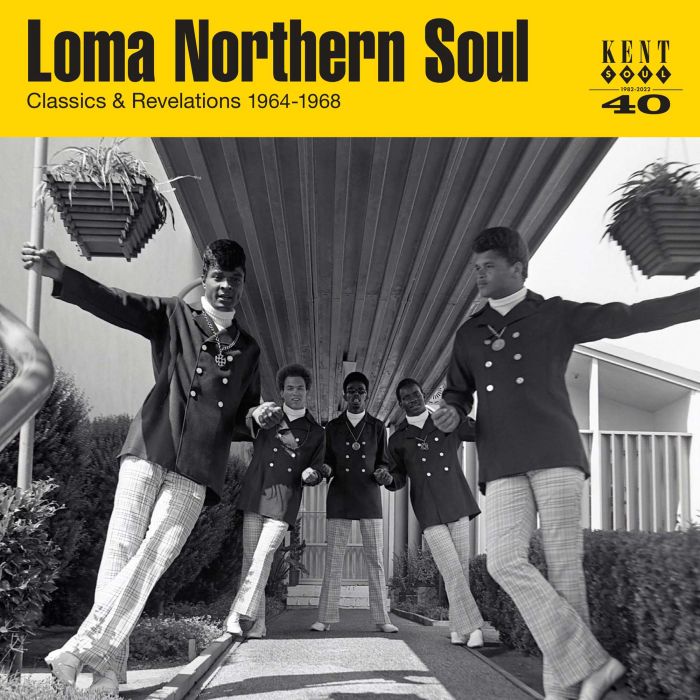
LOMA NORTHERN SOUL-CLASSICS AND REVELATIONS 1964-1968.
Loma Northern Soul-Classics and Revelations 1964-1968.
Label: Kent Soul.
Format: CD.
Release Date: ‘27th’ January 2023.
The Loma Records’ story began in March 1964. That was when Mike Maitland, the Warner Bros president, announced that the label was launching a new imprint. It was to be managed by former PR man and record producer Bob Krasnow.
Mike Maitland said that it was hoped that Loma Records would help expand the “singles coverage.” Up until then, Warner Bros and Reprise were releasing singles. The new label would release soul and R&B singles.
Warner Bros had watched on as labels like Stax, Motown and Atlantic’s popularity grew. It was a lucrative market and they wanted a share.
Initially, the nascent label purchased masters for their first releases. Then Loma Records started to add artists to its roster.
One of the label’s first signings was R&B duo Ike and Tina Turner. By then, they were already a successful act. It was a big signing for a new label. Their first single on the new label was Tell Her I’m Not Home. It stalled at thirty-three on the US R&B charts. This was disappointing for everyone concerned.
In 1965, Bob Krasnow resigned as manager of Loma Records, and was replaced by Russ Regan. Over the next three years the label signed Bob and Earl, JJ Jackson, Lorraine Ellison, Mighty Hannibal, Redd Foxx and The Olympics.
Meanwhile, the label had recruited top songwriters, arrangers and producers in New York and LA. This should’ve been a recipe for a string of commercially successful singles and albums.
Especially as there were songwriters of the calibre of Gene Page, Mort Shuman and Jerry Ragovoy, Randy Newman, Sammy Turner Van McCoy and Willie Hutchison working for the label.
Arrangers and producers in New York included Don Costa, Garry Sherman, George Kerr, Jerry Ragovoy, Richard Tee, Robert Banks and the legendary Van McCoy.
In LA, arrangers and producers included Gene Page, James Carmichael, Jerry Long, Len Jewell Smith and Marc Gordon. They were joined by Joe Hooven and Winn as well as Billy Revis. Everything was in place for Loma Records to become a successful label specialising in soul and R&B.
Sadly, despite the quality of the artists signed to the label and the arrangers and producers they were working with, the majority of the singles weren’t a commercial success.
Linda Jones was one of the few success stories. She enjoyed two hit singles in 1967. The first was Hypnotized which reached twenty-one in the US Billboard 100 and four in the US R&B charts. This was followed by What’ve I Done (To Make You Mad) which stalled at sixty-one in the Billboard 100 but reached number eight in the US R&B charts. That was as good as it got for Loma Records.
The following year, 1968, the label’s roster and back-catalog were absorbed into Warner Bros. The Loma Records’ story was a case of what might have been.
By the early seventies, many of the singles released on Loma Records were being played on the UK’s Northern Soul. They quickly became favourites of DJs and dancers. That’s still the case among connoisseurs of soul music who appreciate the hidden gems and rarities within the label’s back catalog.
These singles are just part of the Loma Records’ story. There were a number of tracks that have lain unreleased within the label’s vaults for over forty years. They were recorded by some of the familiar faces signed to the label as sell as some of the lesser known names. However, they all have one thing in common….their quality.
The unreleased tracks are joined by a selection of single on Loma Northern Soul-Classics and Revelations 1964-1968. It’ll be released on the ‘27th’ January 2023 as part of Kent Soul’s fortieth birthday celebration. This new compilation is the perfect reminder of the music Loma Records released during its lifetime. The twenty-five tracks are also the perfect introduction to the label.
Opening Loma Northern Soul-Classics and Revelations 1964-1968 is It’s Your Love That I Need by The Marvellos. This Willie Hutchison composition was recorded in 1966 and produced by Marc Gordon. Sadly this joyous dancer lay unreleased and makes a welcome debut on the compilation.
The Invincibles recorded Heartstrings with producers Joe Hooven and Winn in 1967. Despite oozing quality this hook-laden dancefloor filler was never released. It’s a welcome addition to the compilation and a reminder of the standard of music recorded at Loma Records.
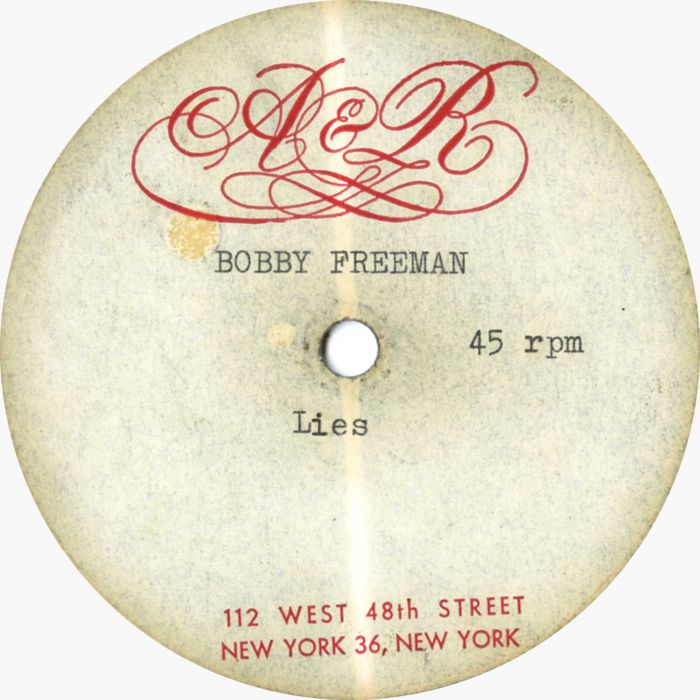
When Bobby Freeman recorded Lies in 1967 it was arranged and conducted by Gerry Sherman with Jerry Ragovoy taking charge of production. The single was released in 1967. It’s a powerful and melodic hidden gem of a dancer that features a soul-baring and emotive vocal.
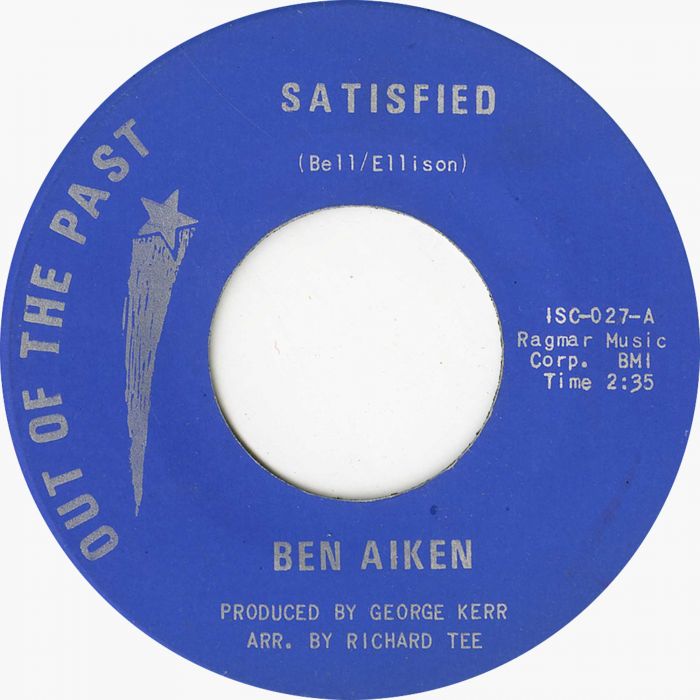
From the opening bars of Ben Aiken’s the feelgood sound of That’s All You Gotta Do washes over and envelops you. Suddenly the world seems a better place as this stunning slice of Northern Soul transports you to another time and a place. It’s 1966, the year the song was recorded. Incredibly this song was never released. This was a missed opportunity as it’s a song that oozes quality. So does another unreleased track If You Should See Her. It features a needy vocal that’s full of emotion and longing. Very different is Satisfied which was released as a single in 1967. It’s a joyous and uplifting dancer that epitomises everything that’s good at about Northern Soul.
Carl Hall started out as a gospel singer with The Raspberry Singers. However, eventually he decided to crossover and signed to Mercury in 1965. By 1967 he was signed to Loma Records and recorded Mean It Baby. The single was released later in 1967 and he delivers an impassioned and powerful vocal breathing life and meaning into the lyrics.
Having signed to Loma Records, The Enchanters recorded their first session in New York in 1965. One of the tracks they recorded was Just A Little Longer. Despite its undeniable quality it was never released and is another track that makes its debut on the compilation. It’s a reminder of the New York studio sound in the mid-sixtes and showcases a talented group who should’ve enjoyed greater success than they did.
The staff at Loma Records had high hopes for Linda Jones who was one of the label’s highest profile signings. She recorded If You Should See Her with producer George Kerr. It featured on her 1967 album Hypnotized. It’s one of the album’s highlights and features a vocal that’s soulful, expressive, emotive and powerful as she lives the lyrics.
Charles Thomas wrote The Man With The Golden Touch which was released as a single in 1966. It was arranged and produced by Mike Rubini. He added handclaps, horns and strings to an arrangement where waves of joyful and memorable music with a feelgood sound unfolds. Sadly, this memorable and cinematic hidden gem which sadly failed to find the wider audience it deserved.
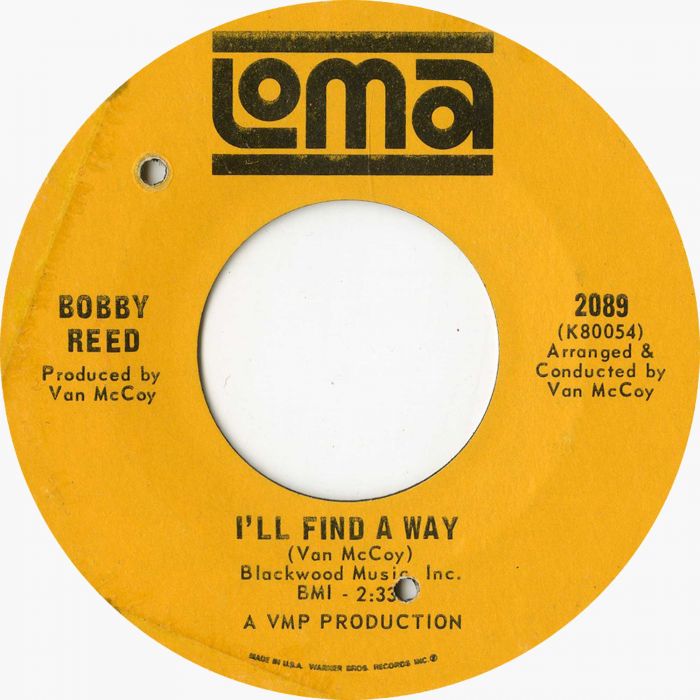
Van McCoy arranged, conducted and produced I’ll Find A Way for Bobby Reed. It was released by a single in January 1968 but was only a minor hit single. That’s despite a vocal that’s needy, hopeful and impassioned and is full of yearning and emotion as the Washington DC soul man lays bare his soul for all to see and hear.
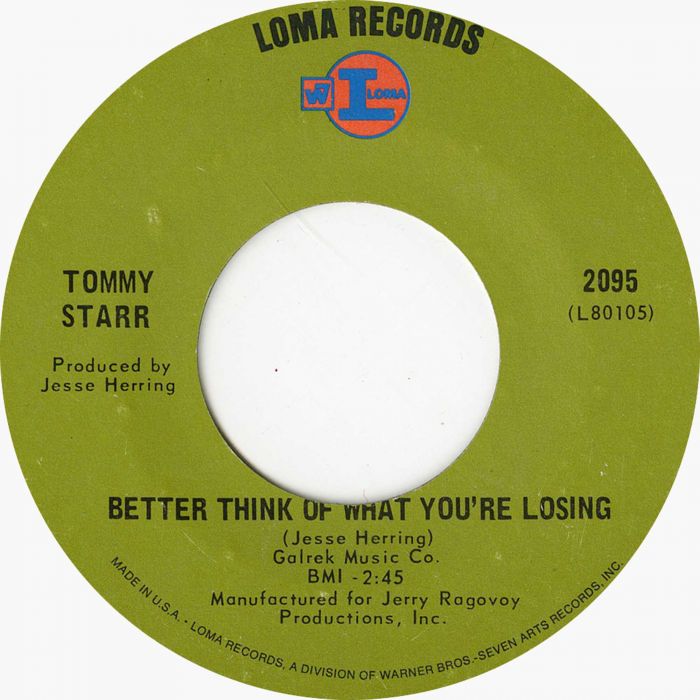
Closing Loma Northern Soul-Classics and Revelations 1964-1968 is Better Think Of What You’re Losing by Tommy Starr. This beautiful single was released in 1968. The broody arrangement to this ballad tugs at the heartstrings and is the perfect accompaniment to a vocal that’s filled with emotion, sadness, hurt and regret. It’s definitely a case of saving one of the best tracks until last on this compilation.
For anyone yet to discover the delights of the Loma Records this new compilation is the perfect way to do so. For longtime fans of the label the unreleased tracks alone will make this a must-have. Add to this singles plus an album track as well as hidden gems and rarities and this lovingly curated collection of Northern Soul. There’s stompers, dancefloor fillers and beautiful ballads on Loma Northern Soul-Classics and Revelations 1964-1968.
Nowadays, hardly a week goes by without a new Northern Soul compilation being released. That has been the case for a number of years. The quality of these compilations varies. However, Loma Northern Soul-Classics and Revelations 1964-1968 oozes quality and is a cut above the competition. This is what we’ve come to expect from Kent Soul, who celebrate their fortieth anniversary in 2023.
Loma Northern Soul-Classics and Revelations 1964-1968.
CULT CLASSIC: MOONSHINE AKA MONICA RYPMA AND FRIENDS-CLASSIFIEDS.
Cult Classic: Moonshine aka Monica Rypma and Friends-Classifieds.
When Monica Rypma’s released her album Classifieds as a private press in 1985, little did she know that one day, it would be much-prized rarity amongst collectors and fans of the folk-funk genre. That’s why nowadays, original copies of Classifieds are changing hands for ever increasing sums of money, and the album is belatedly starting to find a wider audience. Classifieds is also an album with a fascinating backstory that showcases a truly talented singer-songwriter.
Monica Rypma’s musical career began in 1976, when she decided to make the move from her home in Holland to London, to follow her dream of making a career out of music.
Upon her arrival in London, Monica Rypma wanted to find as a flat as close as possible to the West End where she began making her dream reality. Soon, she was taking classes, doing auditions, working as a backing vocalist and writing songs. To make ends meet, the aspiring singer worked in hotels and restaurants during the day. By night, she followed her dream.
In the early eighties, Monica Rypma returned home to Holland, where she enrolled at Conservatorium van Amsterdam. It had followed the example of American universities including Berkeley and The Juliard School and had opened a Jazz Department. This was the start of the next chapter in Monica Rypma’s career.
By then, had already started singing with bands and was singing professionally. This included with Moonshine and The Blaze which featured her brother Hans and friends. The band were soon making progress, embarking upon a tour and even playing in London. Things were looking good for Monica Rypma.
Then in 1985, when a relationship ended, Monica Rypma walked out of her course at the Conservatorium van Amsterdam. She took refuge in music, and after being inspired by René Van Helsdingen, the composer, pianist and crowdfunding pioneer who was also based in Amsterdam, began work on the project that would eventually become her debut album Classifieds.
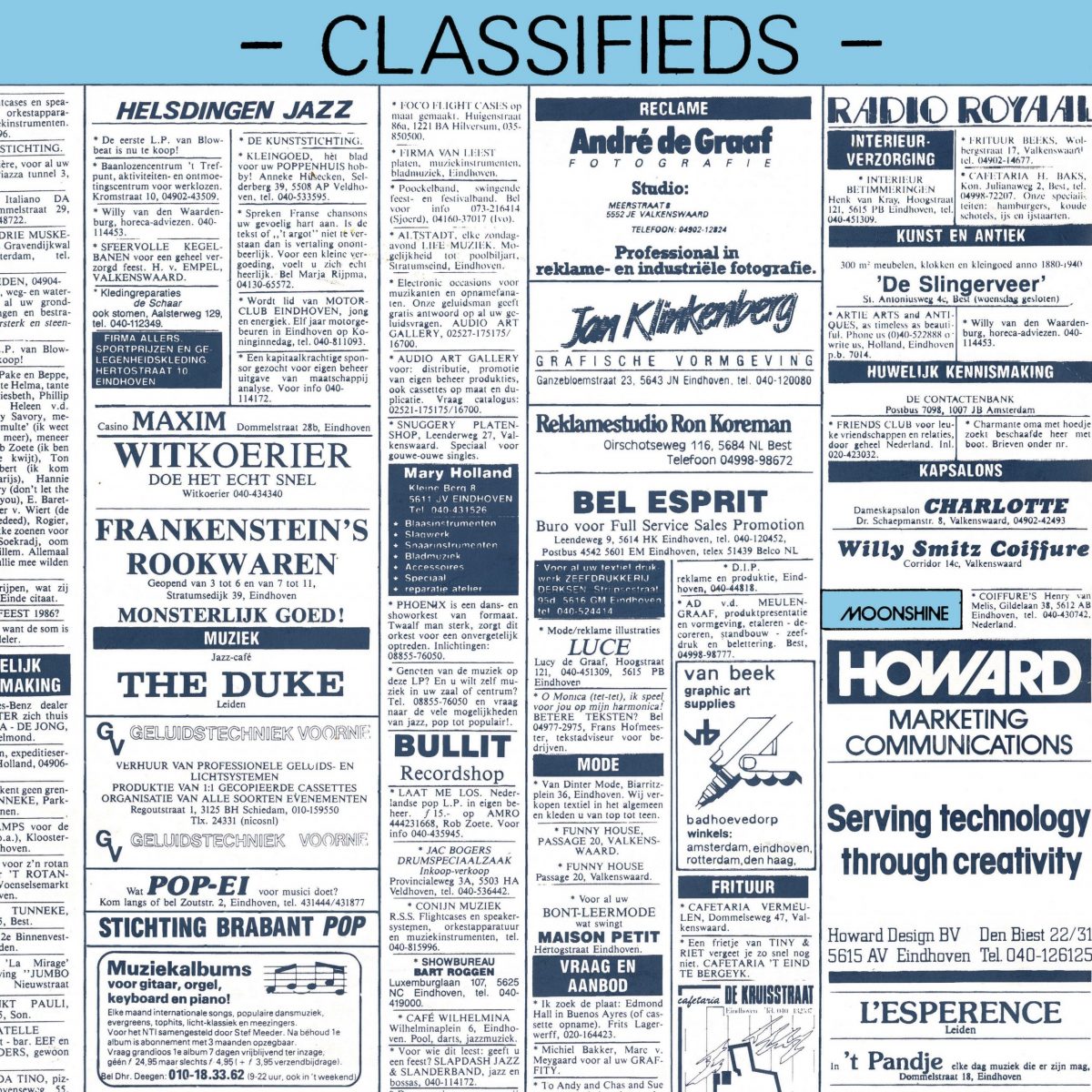
To raise the funds to produce the album, Monica Rypma decided to fund the album using sponsorship and crowdfunding which was in its infancy. She decided to sell advertising space on the album sleeve, which would look like a newspaper. That was why the album was entitled Classifieds.
Fortunately for Monica Rypma it was relatively easy to sell advertising space on the cover of Classifieds. Businesses including shops, bars, restaurants and record shops bought space. This was just the start.
Having recorded a demo at a local studio Monica Rypma went to trade fairs and anywhere else she thought she would encounter potential advertisers. When they heard the demo and saw a mock-up of the album sleeve they bought advertising space. With this being an LP, there was plenty of space for dozens of advertisers. This was enough to fund the recording of the album.
Now that Monica Rypma enough money to record her debut album, there was just one problem. She didn’t have enough material for an album. Over the next few months, jam sessions took place but still there was a shortage of new material. That was when René Van Helsdingen mentioned the name of a musician he had worked with before, Brian Batie.
He was an arranger, composer, producer, synth virtuoso and multi-instrumentalist who at the time, was living in Los Angeles. Brian Batie returned home to work on the album and his contribution to Classifieds proved to be invaluable.
Initially, Monica Rypma, René Van Helsdingen and Brian Batie had what was akin to a few musical sketches. These they fleshed out, and soon, they had the lyrics to the songs on Classifieds. They were joined by the six Interludes on that featured on the album.
The thirteen tracks on Classifieds were recorded in just three days during September 1985 at Farmsound Studios. Monica Rypma and Brian Batie produced the album, which was engineered by Wil Hesen. With the album completed, the release of Classifieds was scheduled for later in the year.
Before that, friends and family helped Monica Rypma to print, fold and assemble the copies of Classifieds. It was like a cottage industry. By the time the process was complete, it looked like there were three different versions of the album.
This caused wasn’t the case. With a tight budget, when one colour of ink ran out, another was used. This explained why there some of the Classifieds’ album covers were yellow while others were green or pink.
Now the album could be distributed to people who had supported the crowdfunding of Classifieds. The remaining copies were distributed to shops. However, before long the album had disappeared from view and nothing more was heard of Classifieds until recently.
That was when a new generation of DJs and music lovers discovered the delights of Classifieds with its mixture of DIY synch pop, eighties electronica, folk-funk, psychedelia and Balearic interludes. It’s a truly enchanting and oft-overlooked hidden gem.
Classifieds opens with Everybody Came To Rock. It’s hook-laden, melodic and memorable as synth pop meets elements of electronica and rock and sets the bar high for the rest of the album. The quality continues on Haunted, one of the album’s highlights. This heartachingly beautiful ballad is wistful, ruminative and and features a vocal full of hurt and heartache. It’s sure to tug at the heartstring.
Interlude “After War” is an ambient, understated, experimental and cinematic track that paints pictures. Then What’s The Sense Of War is a quintessential and thought-provoking slice of eighties synth pop that showcases Monica’s vocal prowess. In an instant, the listener is transported back to 1985 on a track that’s the musical equivalent of time travel.
Interlude “Senses” is an ethereal, spacious, dreamy and truly beautiful track that meanders magically along. On Sunrise joyous, scatted vocal sits above a genre-melting arrangement where synth pop, eighties electronica and a hint of Eastern influences collide. Then it’s all change on Interlude “Record Change” which closed the first side of Classifieds. It’s dark , dramatic and even gothic
Very different is Hey, Where You Goin.’ It features a driving arrangement where an eclectic selection of instruments melt into one and provide the perfect accompaniment to a breathy, coquettish, needy and sensual vocal on a truly memorable track.
Interlude “Westertoren” is a cinematic scene setter that deserves to feature in a movie.
Ik Hou Veel Van Jou features an emotive vocal that one minute seems wistful but later, delivered with a smile. Meanwhile, drums provide the heartbeat to the synth pop arrangement. Then synths play and transport the listener far from Amsterdam during this Interlude “Koto.”
The centrepiece of the album is a beautiful synth pop ballad that features Monica’s finest vocal. Harmonies accompany her providing the perfect accompaniment offering encouragement to “Let Love Flow.”
Then it’s all change on Interlude “Aqua + Uitro.” It’s best describes as otherworldly, experimental, filmic and latterly rhythmic as the album marches to a close leaving just magical memories of Classifieds the debut from Moonshine aka Monica Rypma and Friends.
Monica Rypma is without doubt, a truly talented singer-songwriter. Sadly, her 1985 debut album Celebrations failed to find the audience it so richly deserved. This oft-overlooked cult classic is a captivating mixture of musical genres where carefully crafted songs and ambient interludes sit side-by-side. Everything from ambient, DIY synch pop, eighties electronica, folk-funk, psychedelia, rock and soul are joined by beautiful ballads and Balearic interludes on Celebrations which is Moonshine aka Monica Rypma and Friends’ oft-overlooked and enchanting hidden gem that belatedly, is starting to find the wider audience it deserves thanks to a new generation of DJs and music lovers.
Cult Classic: Moonshine aka Monica Rypma and Friends-Classifieds.
SAMMI SMITH-A CASE OF WHAT COULD’VE BEEN.
Sammi Smith-A Case Of What Might Have Been.
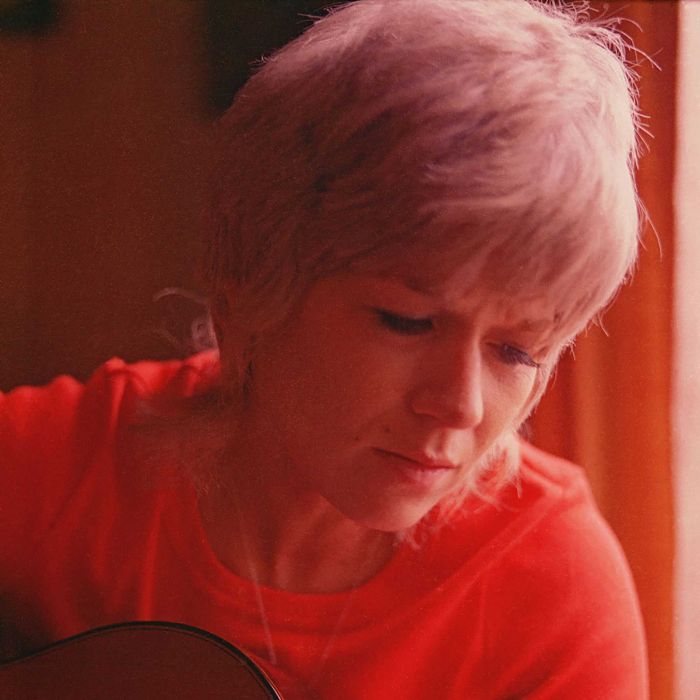
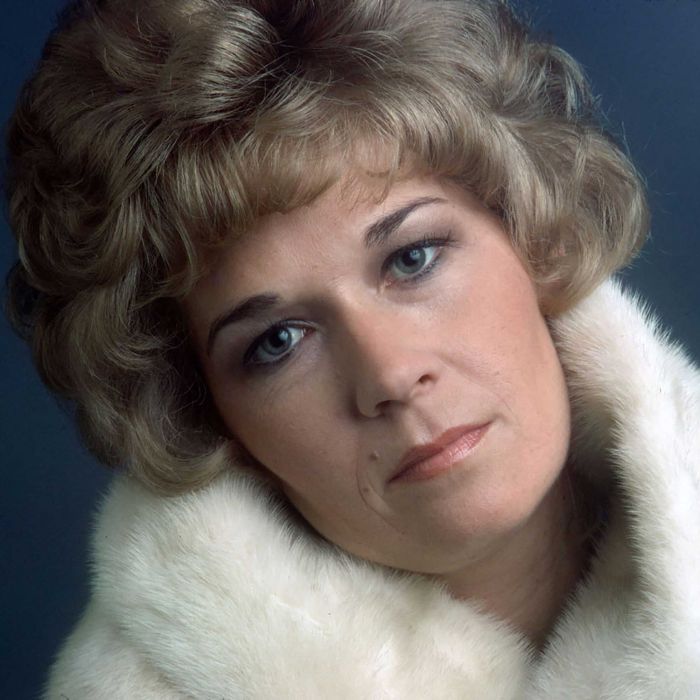
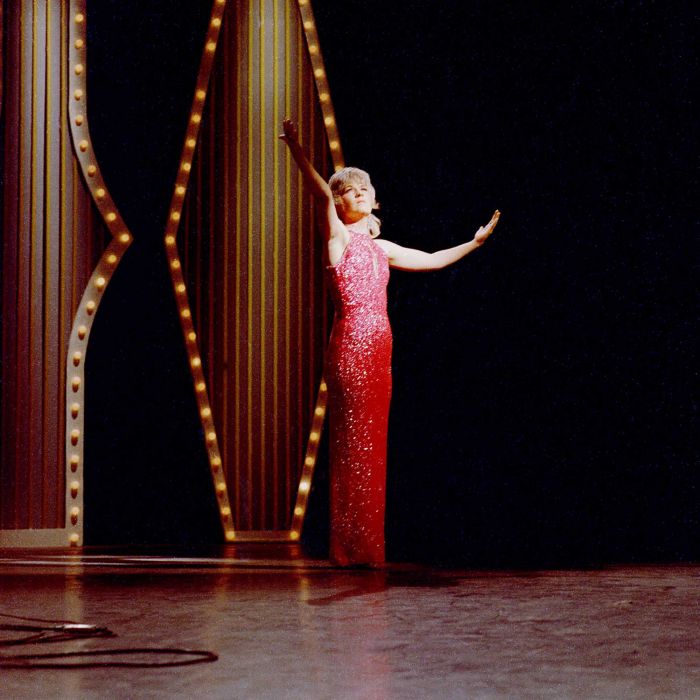
Without doubt, country singer singer-songwriter Sammi Smith had a voice, the talent and potential to crossover and become a huge, mainstream star. Her records were cinematic, soul-baring confessionals where her inimitable husky voice veered between melancholy and full of hurt and heartache to sensuous. It sounded as if Sammi Smith had lived the lyrics she delivered which were poignant and powerful. It was no wonder she was dubbed the: “South’s own Dusty Springfield.”
Sadly, Sammi Smith didn’t enjoy the same commercial success as Dusty Springfield and instead, reminded a major star of country music. Mainstream commercial success eluded her and outside of country music circles many music fans haven’t heard of Sammi Smith. Her story is a case of what might have been.
By 1979, her recording career was almost over, just twelve years after releasing her debut album He Went A Little Bit Farther in 1967. Sammi Smith turned her back on music after a relatively short recording career.
Despite recording career that spanned just twelve years Sammi Smith enjoyed and released eleven albums. This included seven for Nashville-based Mega Records between 1970 and 1975. These albums featured Sammi Smith at her best. They’re also a reminder of a truly talented singer who could breath life, meaning and emotion into lyrics as she laid bare her soul. Sadly, still so many music fans have yet to discover the delights of Sammi Smith’s music. It was shaped by an eventful life and a nomadic childhood that saw her grow up fast.
The future Sammi Smith was born Jewel Faye Smith on August the ‘5th 1943, in Orange County, California. Her father was a serviceman and the family lived a nomadic life moving between Oklahoma, Texas, Arizona and Colorado. Aged just eleven, Sammi Smith dropped out of school and started singing professionally in nightclubs. This was her introduction to a career in music that would span twenty-five years.
By the times she was fifteen, Sammi Smith had married steel guitar player nightclub owner Bobby White. The couple had three children but divorced in 1966.
A year later, in 1967, Sammi Smith was booked to sing in the Someplace Else Night Club in Oklahoma City. In the audience that night was Marshall Grant who was Johnny Cash’s bassist. He was so impressed by the talented twenty-four year old singer that he told Johnny Cash, who having heard her sing helped her to get signed by Columbia Records. This was the start of a recording career that lasted just twelve years.
Having signed to Columbia Records, Sammi Smith released He Went A Little Bit Farther later in 1967. Although the single failed to chart, commercial success wasn’t far away for Sammi Smith.
In 1968, she released Brownville Lumberyard on Columbia Records, and reached sixty-nine on the US Billboard Country charts. This was followed later that year by Why Do You Like Me Like You Do. It reached fifty-three on the US Billboard Country charts and is regarded as the finest single she released on Columbia Records. The followup Sand-Covered Angels failed to chart and shortly after this Sammi Smith left the label. However, she had made one friend who would help launch her career.
This was Kris Kristofferson, who at the time, was working as a janitor at Columbia Records. When he had some free time the two friends would play together, and even went into the studio and recorded twelve songs. Sammi Smith would take them to producer Jim Malloy who would work with her at her new label.
Sammi Smith wasn’t without a label for long and in 1969 signed to Mega Records. The label had just been founded that year by insurance executive Harry Pratt and Brad McCuen who previously was an executive at RCA. Their new label was the perfect platform for Sammi Smith, as music started to find a wider audience within the country music community.
At Mega Records, a decision was made to pair Sammi Smith with producer Jim Malloy. He was vastly experience and had worked with everyone from Duane Eddy to Elvis Presley and on Eddy Arnold’s The Last Word In Lonesome Is Me, which was nominated for a Grammy. Jim Malloy went one better and one a Grammy for Henry Mancini’s Charade. More recently, he had worked with Townes Van Zandt’s Second Lover’s Song. Its wistful arrangement would influence the melancholy sounding songs he recorded with Sammi Smith.
He’s Everywhere.
When Jim Malloy listened to the twelve tracks he decided that Sammi Smith should record the Kris Kristofferson composition Help Me Make It Through The Night. It was one of eleven tracks recorded during May 1970 and produced by Jim Malloy. These tracks became Sammi Smith’s debut album He’s Everywhere.
The lead single from the album was He’s Everywhere which was released in July 1970 and reached twenty-five on the US Billboard Country charts. Other highlights of the album include Saunder’s Ferry Lane, But You Know I Love You, When Michael Calls and This Room For Rent. However, the best known track from this critically acclaimed album which was released in September 1970.
In November 1970, Help Me Make It Through The Night was released as the second single. It topped the US Billboard Country charts and reached number eight on the US Billboard 100. This led to the album being retitled Help Me Make It Through The Night.
It wasn’t long before Sammi Smith’s debut album had topped the US Billboard Country charts, reached thirty-three in the US Billboard 200 and fifty-one in Canada. Great things were forecast for Mega Records’ latest signing, including mainstream success.

Lonesome.
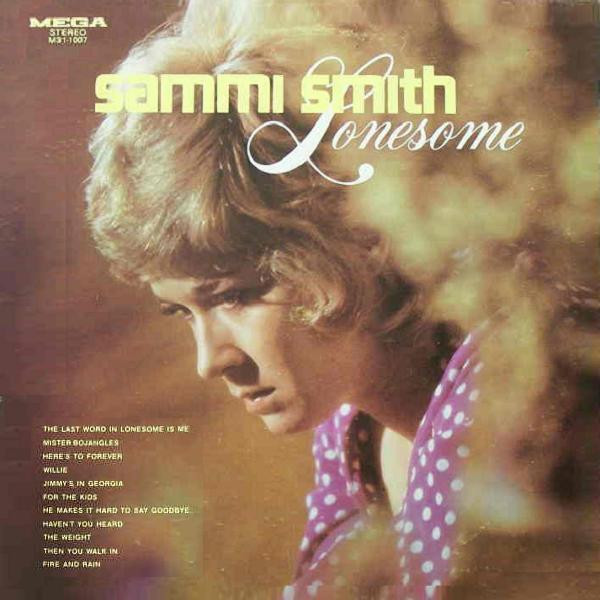
A year after the release of her debut, Sammi Smith who had married second husband Jody Payne, returned with her sophomore album Lonesome in September 1971. Again, it was produced by Jim Malloy who brought about the best in country music’s rising star.
The album reached fifteen on the US Billboard Country charts but stalled at 191 in the US Billboard 200. Three of the highlights of the album were Jimmy’s In Georgia, the cinematic He Makes It Hard To Say Goodbye which features a vocal full of hurt and heartache and the hopeful sounding Then You Walk In. Given the quality of the music on the album, its relative lack of commercial success must have been disappointing. Sammi Smith must have been hoping her third album would be a bigger commercial success.
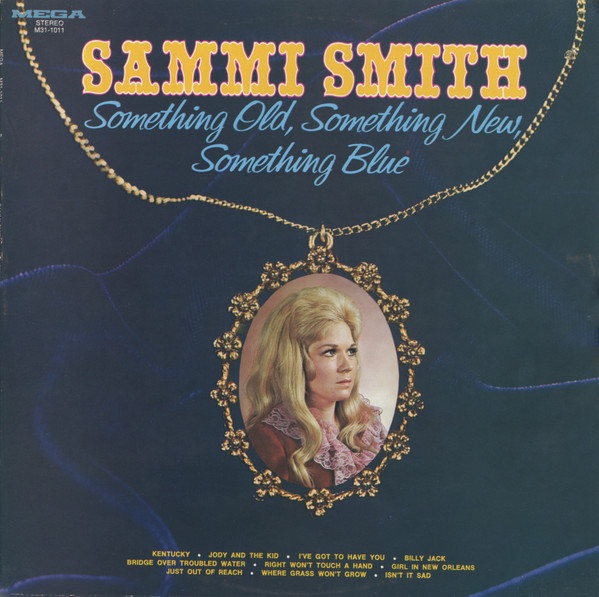
Something Old, Something New, Something Blue.
Just seven months after the release of Lonesome, Sammi Smith returned with Something Old, Something New, Something Blue. It was released in April 1972 and reached seventeen in the US Billboard Country charts but failed to trouble the US Billboard 200.
This must have come as a huge disappointment to Sammi Smith and everyone at Mega Records. Especially given songs of the quality of I’ve Got To Have You which features a vocal that’s a mixture of sadness and longing. Just like in so many of her songs, the lyrics come to life and have a cinematic quality. Sadly, the wider record buying public had yet to discover Sammi Smith whose career seemed to have stalled and mainstream success seemed even further away.
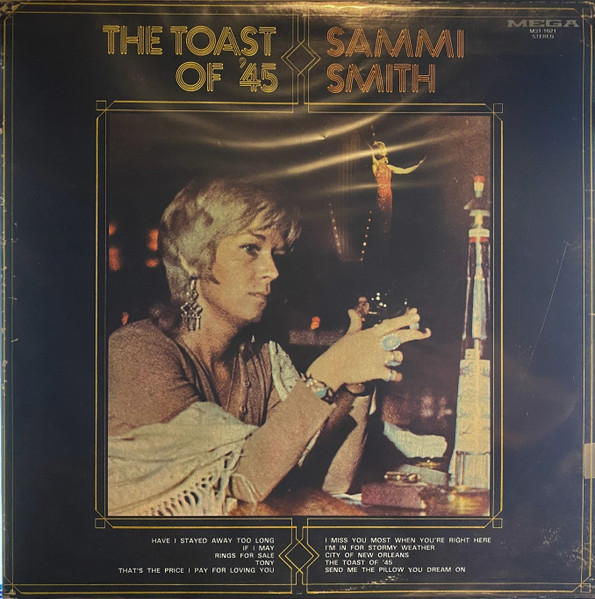
The Toast Of ’45.
Just over a year passed before Sammi Smith released her fourth album The Toast Of ’45 in May 1973. Just like her previous albums it was produced by Jim Malloy and featured some of the top musicals Nashville had to offer. Despite this, the album only reached forty-three in the US Billboard Country charts, making it Sammi Smith’s least successful album. However, it’s something of a hidden gem.
Especially with tracks like the heartachingly beautiful I Miss You Most When You’re Right Here, the wistful sounding I’m In For Stormy Weather with its lush string arrangement and The Toast Of ’45. They’re among the highlights of this oft-overlooked album that should’ve fared better upon its release. Little did Sammi Smith know things would get worse before they got better.
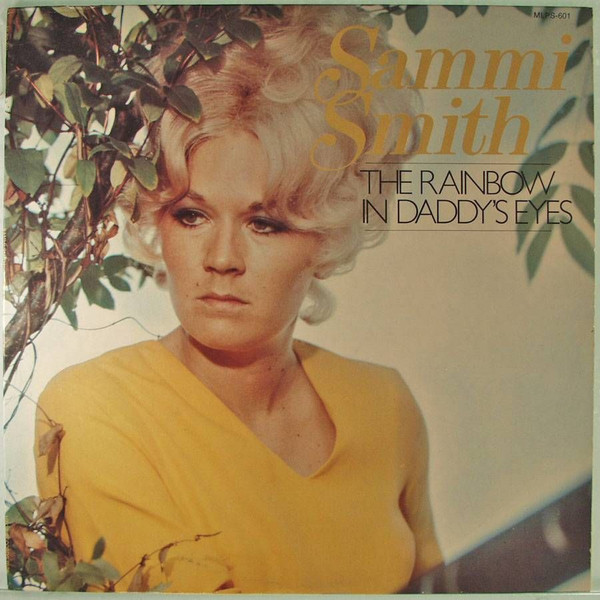
The Rainbow In Daddy’s Eyes.
By 1974, Sammi Smith was still enjoying hit singles in the US Billboard Country charts. Some were just minor hits but still she continued to find favour amongst the country music community. Sammi Smith and Mega Records hoped her fifth album The Rainbow In Daddy’s Eyes would be a turning point in her career.
Sammi Smith’s last couple of albums hadn’t been big sellers. None of her albums had matched the success of her debut which set the bar high. Sadly, The Rainbow In Daddy’s Eyes failed to chart and was the least successful album of her career. That was despite songs of the quality of Manhattan, Kansas and Birmingham Mistake which were two of the album’s highlights. Sadly, very few people heard this underrated album.
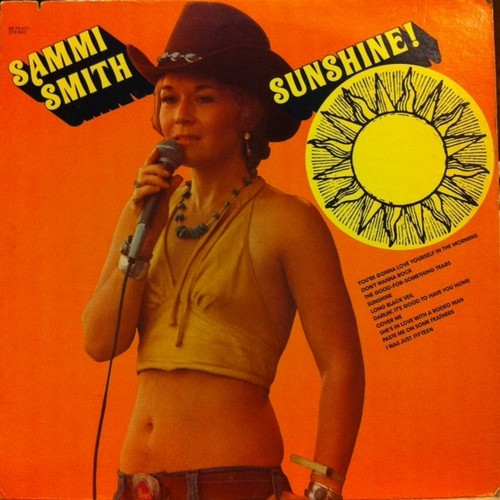
Sunshine.
1975 was a busy year for Sammi Smith, which saw her release two albums. The first was Sunshine which was released at the start of the year. Despite an all-star cast of Nashville musicians and songs of the standard of I Was Just Fifteen, The Good-For-Something Years, Cover Me, Long Black Veil and Sunshine the album failed to trouble the charts. This was another disappointment. There was, however, a small crumb of comfort.
The three singles from the album all charted in the US Billboard Country charts. Never Been to Spain reached seventy-five giving Sammi Smith a minor hit single. Long Black Veil then reached twenty-six before Cover Me peaked at thirty-three. This was something to build on when Sammi Smith released her seventh album for Mega Records later in 1975.
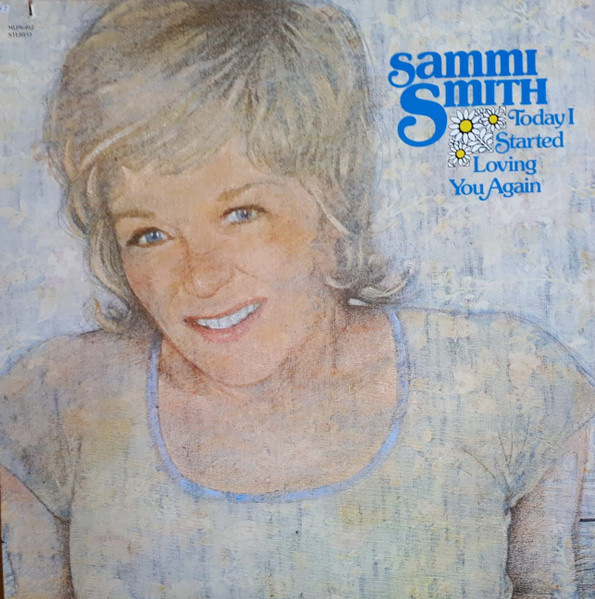
Today I Started Loving You Again.
Later in 1975, Sammi Smith returned with her second album of the year Today I Started Loving You Again. When the title-track was released as a single it reached number nine in the US Billboard Country charts. It’s since become one of Sammi Smith’s best known tracks.
Buoyed by the success of the single, the album reached nineteen in US Billboard Country charts. This meant that Today I Started Loving You Again was Sammi Smith most successful album since her third album Something Old, Something New, Something Blue in 1972. She was back after a couple of difficult years and two albums that failed to even trouble the charts.
After the success of Today I Started Loving You Again Sammi Smith signed to Elektra and released a trio of albums between 1976 and 1978. However, they failed to match the success of Today I Started Loving You Again and in she left the label after New Winds, All Quadrants in 1978.
Next stop for Sammi Smith was Cyclone Records who released her 1979 album Girl Hero. Just like her final album for Elektra it failed to chart and this was the end of a short stay on Cyclone Records.
In 1980, Sammi Smith returned to the studio and recorded Texas 1947 and Desperados Waiting For A Train. Neither track was released at the time. However, they’re a reminder of a truly talented country singer-songwriter who should’ve reached greater heights than she did.
Sadly, Sammi Smith never crossed over into the mainstream and her music wasn’t heard by the wider audience it deserves. Given Sammi Smith’s undoubtable talent, her music deserved to crossover and she deserved to become a star who enjoyed a long and successful career. However, it was a case of what might have been.
Somewhat belatedly music fans are starting to discover the delights of Sammi Smith’s music. Especially the seven albums she recorded for Mega Records between 1970 and 1975. They’re a reminder of Sammi Smith at the peak of her powers when she looked like she was going to become one of the giants of country music and go on to forge a career in mainstream music.
Sadly, that remained tantalisingly out of reach. Sammi Smith died on February the ’12th’ 2005 aged just sixty-one. That day, music lost a truly talented and much loved singer who effortlessly breathed life, meaning and emotion into soul-baring confessionals who brought the powerful and poignant lyrics to life.
Sammi Smith-A Case Of What Might Have Been.
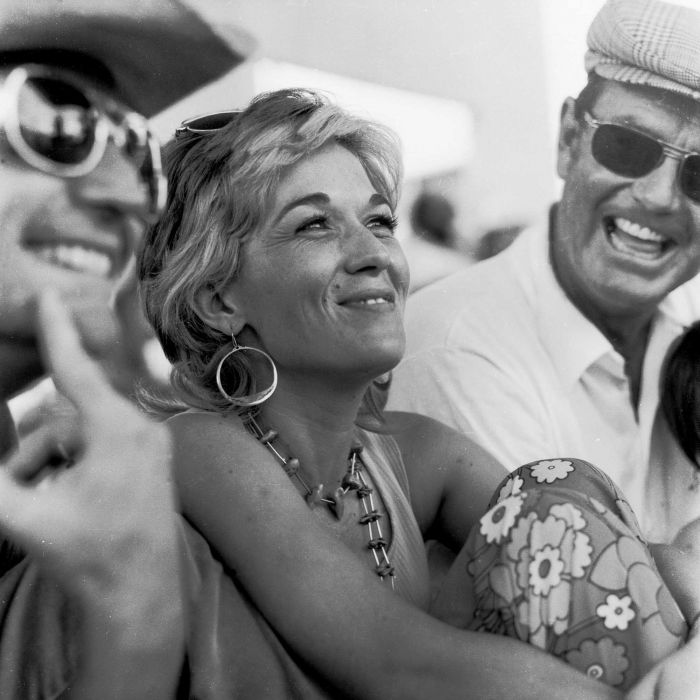
SONGS OF LIGHT AND DARKNESS WRITTEN BY LEONARD COHEN.
Songs Of Light and Darkness Written By Leonard Cohen.
Label: Ace Records.
Format CD.
Release Date: ‘25th’ November 2022.
Just over six years ago, on October the ’21st’ 2016, Canadian singer-songwriter, novelist and poet Leonard Cohen releasedYou Want It Darker to widespread critical acclaim. Sadly, it turned out to be that last album released during his lifetime.
Just seventeen days later, on the ‘7th’ of November 2016, Leonard Cohen passed away aged eighty-two. That day, music lost a true great whose recording career had spanned nearly fifty years.
During that time, Leonard Cohen released a total of fourteen studio albums as well as eight live albums. They’re a remainder of one of music’s most enduring, cerebral and thought-provoking singer-songwriters.
Leonard Cohen wasn’t scared of asking the big questions and tackling subjects that other singer-songwriters shied away from. This included everything from religion and politics to isolation, depression as well as relationships and sexuality right through to loss and death. That was the case right up until his final album You Want It Darker.
On the album, Leonard Cohen revisited familiar subjects, death, God and even humour. Maybe he found this therapeutic or cathartic? Or it may have been his way of coping with death? This was similar to Dylan Thomas writing the villanelle Do Not Go Gentle Into That Good Night. However, Leonard Cohen didn’t: “rage, rage against the dying of the light.”
Instead he was rueful, reflective, offered advice and gave thanks on If I Didn’t Have Your Love. It was one of the highlights of the You Want It Darker. However, it was the title-track that won a Grammy Award in January 2018 for the Best Rock Performance. Many critics and cultural commentators thought that this was a fitting end to a long and illustrious career.
However, during a recording career that spanned six decades, Leonard Cohen won many of the most prestigious awards. That’s no surprise as he released a string of classic albums that nowadays, are regarded by critics as influential, innovative and hugely important.
Over the years, Leonard Cohen’s best known and most celebrated songs have been covered by many artists. This includes the seventeen artists that feature on Songs Of Light and Darkness Written By Leonard Cohen. This is a new compilation that will be released by Ace Records on ‘25th’ November 2022. It’s the followup to Hallelujah-The Songs Of Leonard Cohen, and is the latest instalment in the long-running and critically acclaimed Songwriter Series.
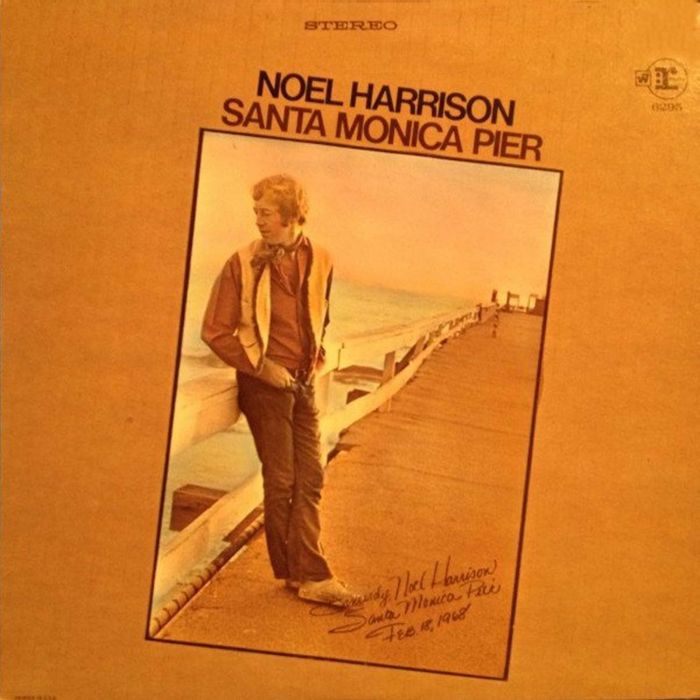
Songs Of Light and Darkness Written By Leonard Cohen features covers from many familiar faces. This includes KD Lang, Emmylou Harris, Jonathan Richman, Mama Cass, Madeleine Peyroux, The Webb Sisters, Judy Collins, Richie Havens, Noel Harrison and Fairport Convention. There’s also contributions from The Last Shadow Puppets and Anna Calvi on the compilation.
It opens with KD Lang’s cover of Hallelujah. It featured on her 2004 album Hymn Of The 49th Parallel. It’s a song that Leonard Cohen laboured long and hard to write. He spent five years writing and rewriting this anthemic track. During that time, he wrote between eighty and 180 draft verses of this oft-covered, powerful, joyous and emotive song that’s the perfect way to open the compilation.
The Stranger Song featured on Songs of Leonard Cohen which was released in 1967. This was the debut album by the Canadian singer-songwriter. Forty-nine years later, in 2016, the song featured on country music legend Emmylou Harris’ album Deeper Well: The Wrecking Ball Outtakes. It’s a beautiful rendition of the song where she reinvents it and breathes new life and meaning into it.
Mama Cass covered You Know Who I Am on here 1968 album Dream A Little Dream. She delivers an impassioned and heartfelt vocal against a big, bold jazz-tinged arrangement. It’s a reminder if any was needed of a truly talented vocalist.
When The Last Shadow Puppets released The Dream Synopsis EP in 2016 it featured a cover of Is This What You Wanted. The song featured on Leonard Cohen’s 1974 album New Skin For The Old Ceremony. Previously, the group had covered Memories from Death Of A Ladies Man, and often included Leonard Cohen songs in their setlist. The cover is sung as a duet and sounds as if it was heavily inspired by Leonard Cohen. It’s a welcome addition to the compilation where the group pay homage to one of their musical heroes.
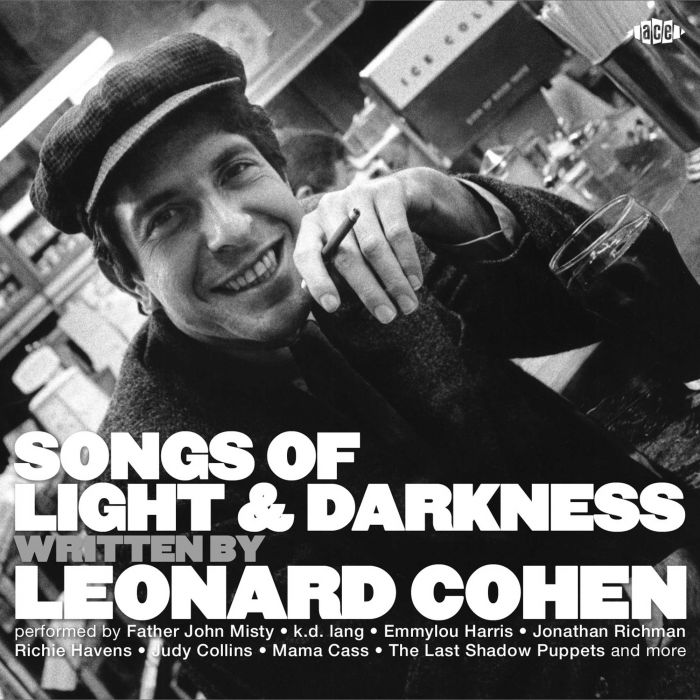
Anjani penned Nightingale with Leonard Cohen which featured on his Dear Heather album in 2004. Two years later, in 2006, she covered the song on her album Blue Alert. The song which was produced by Leonard Cohen benefits from a spartan, piano-led arrangement. This is the perfect backdrop for a beautiful tender vocal that’s full of emotion.
Madeleine Peyroux covered Blue Alert on her 2006 album Half The Perfect World. This is another song that was written by Anjani Thomas and Leonard Cohen. Drums are played with brushes as the song is transformed into a slinky yet atmospheric and moody slice of jazz.
Judy Collins recorded a cover of Story Of Isaac for her 1968 album Who Knows Where Time Goes. She stays true to the original and delivers an impassioned vocal that bristles with emotion on this thought-provoking song full of symbolism.
Another of Leonard Cohen’s best known songs is Joan Of Arc. It’s been covered by many artists over the years. Very different is Anna Calvi’s instrumental version from 2011. Her Fender guitar takes centre-stage on the single where she reinvents the song. It sounds as if it belongs on the soundtrack to a Wim Wenders or David Lynch movie.
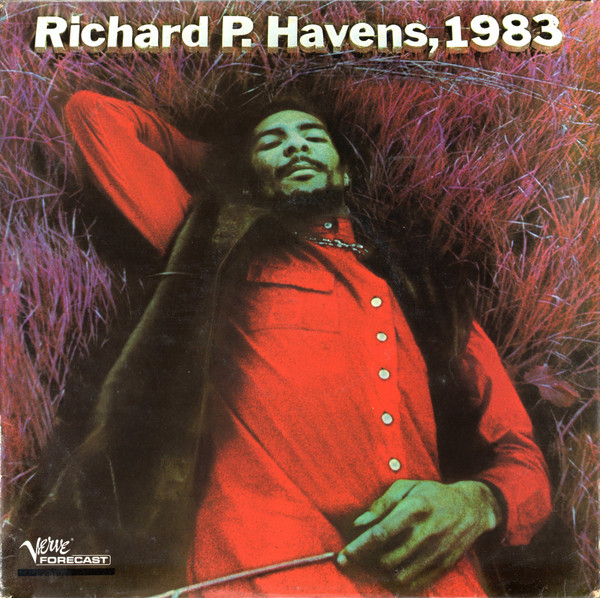
When Richie Havens entered the studio in 1968 he decided to record a cover of Leonard Cohen’s Priests. The following year, 1969, it featured on the album Richard P. Havens, 1983. It was a mixture of folk rock, psychedelia and early art rock. However, the cover of Priests was understated, spartan and even dark and moody even with a vocal that’s thoughtful and reflective. This cover shows another side to a familiar and much-loved song.
The final track on Songs Of Light and Darkness Written By Leonard Cohen is Closing Time by Fairport Convention. It’s taken from their 1995 album Jewel In The Crown. The veteran folk-rockers unleash an uptempo fiddle led cover of the track that closes the album on a high.
Songs Of Light and Darkness Written By Leonard Cohen Proof is a carefully curated compilation and is the latest instalment in Ace Records’ long-running and critically acclaimed Songwriter Series. It’s also another reminder of one of the greatest lyricists of his generation, who sadly, passed away on the ‘7th’ of November 2016, aged eighty-two. That day, music lost a true great, whose recording career had spanned nearly fifty years and six decades.
During that period, countless artists and bands covered Leonard Cohen’s songs. This included the array of talented artists that feature Songs Of Light and Darkness Written By Leonard Cohen. Some reinvent familiar songs and take them in a new direction, while others stay true to the original. However, all the artists that feature on Songs Of Light and Darkness Written By Leonard Cohen pay tribute to one of the greatest lyricists of his generation who is still regarded as Canada’s poet laureate.
Leonard Cohen’s music is cerebral and thought-provoking. It’s still relevant and continues to speak to several generations of music lovers. This includes the seventeen artists and bands who pay homage to the great man on Songs Of Light and Darkness Written By Leonard Cohen who three years after his death is sadly missed.
Songs Of Light and Darkness Written By Leonard Cohen.

WHERE SOUL BEGINS…KENT MODERN-FOR DANCERS FORTY.
Where Soul Begins…Kent Modern-For Dancers Forty.
Label: Kent Soul.
Format: CD.
Release Date: 25th November 2022.
In 1982, a new label, Kent Records, released its first ever compilation, For Dancers Only to widespread critical acclaim. It was released to critical acclaim and was hailed a commercial success. This landmark compilation was also the start of a musical journey that’s lasted forty years.
Since then, the Kent family of labels has grown and released over 400 compilations. They’re regarded by critics, collectors and connoisseurs of soul as some of the finest reissue labels. That’s no surprise.
The labels are known for releasing carefully curated compilations where the emphasis is on quality. This doesn’t just include the sound quality. There’s also lengthy and detail sleeve notes which have been carefully researched. This is why the releases are much-prized and cherished by several generation of soul fans.
So will the compilation that Kent Soul is about to release on ‘25th’ November 2022. This is Where Soul Begins…Kent Modern-For Dancers Forty which celebrates the fortieth anniversary of the label’s first ever release and draws inspiration it.
There’s twenty-four tracks on Where Soul Begins…Kent Modern-For Dancers Forty. These tracks are from the vaults of Kent and Modern Records which were based in LA. Some of the artists that feature on the new compilation also featured on the very first. This includes R&B from T-Bone Walker, BB King, Little Joe Blue and Flash Terry and His Orchestra. Then there’s oft-overlooked hidden gems from Jeanette Jones, Lowell Fulson and Tommy Youngblood. Then there’s contributions from familiar faces and some new names. The compilation is a veritable feast of soul and R&B with highlights aplenty.
This includes Satisfied Feeling by Mary Love was released on Modern in 1967. It’s an uptempo and joyful dancer with a feel-good sound that’s a reminder of a truly talented singer.
One of the hidden gems on the compilation is You’d Be Good For Me by Jeanette Jones. It was recorded as a demo for Gerry Goffin and Barry Goldberg at Golden State Records in 1974. The song was covered by Jackie Wilson for his 1976 album Nobody But You. This version song made its debut on the BGP combination SuperFunk Is Back: Rare and Classic Funk 1968-1977 in 2007. Fifteen years late later and it returns for a welcome encore on Where Soul Begins…Kent Modern-For Dancers Forty.
Soul man Arthur Adams was also a staff songwriter for Modern Records. He penned Gonna Put It On Your Mind with Larry Perrault and recorded the song in 1966. Sadly, it was never released and has lain unreleased until now. That’s a great shame as the song features an impassioned vocal powerhouse that’s bristling with emotion.
In 1970, The Soul Of Tommy Youngblood was released by Kent. One of the tracks on the album was the moody sounding Tobacco Road North which features a stunning soul-baring vocal.
Nowadays, blues man T-Bone Walker is regarded as a pioneer of the electric guitar. He’s also influenced several generations of guitarists. His contribution to the compilation is Jealous Woman which was recorded in 1964 but only made its debut on the box set 60 Great Blues Recordings which was released by Cascade Records. The track is a perfect introduction to a blues great who at the time, was at the peak of his powers.
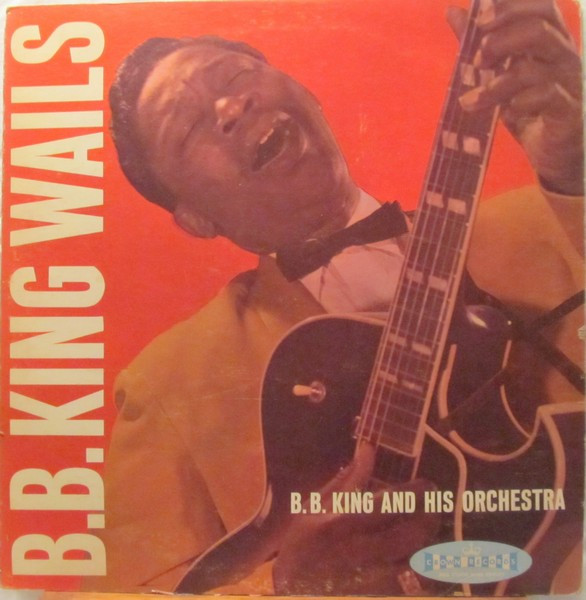
In 1959, Crown Records released BB King Wails. It featured I’ve Got Papers On You Baby which he penned with Jules Taub. It showcases another pioneer of the electric blues whose backed by His Orchestra on this irresistible dancer.
After embarking on a musical career, Texas-born blues and soul singer donned the stage name ZZ Hill. This was a homage to BB King who had influenced him groaning up. He released his debut single Five Will Get You Ten on Mesa Records in 1963. Two three years later and he was signed to LA-based Kent and released That’s It. The track combines a dancefloor friendly beat and vocal whose roots are in Southern Soul. When this is combined the result is a memorable and melodic soulful dancer.
Lowell Fulson’s career began in the late forties and he made his name playing the blues. However, by 1967 he was signed to Kent and released Tramp, a fusion of soul and funk. It gave him the biggest R&B hit single of his career. Wanting to build on this success, two similar sounding singles were recorded and released. They were among six singles released during 1967. The final one was the Push Me. This hidden gem is a much more soulful sounding song with a Stax influence.
Clay Hammond released You Brought You Brought It All On Yourself as a a single on Kent in 1967. The big, bold and slick arrangement swings and is the perfect backdrop for an uber soulful and emotive vocal as he delivers the cinematic lyrics.
In 1967, Kent released The Soul Of Ike and Tina Turner. This was the pair’s debut album. One of the highlights of the album was It’s Crazy Baby which features a spellbinding and soulful performance.
Flash Terry and His Orchestra recorded On My Way Back Home for Kent. This slice of R&B single was released in 1958 and showcased a talented bandleader, singer, songwriter and guitarist early in his career.
Closing the compilation is I’ll Let Nothing Come Between Us by Billy Watkins. It was recorded for Kent in 1965 but was never released. That’s a great shame as it’s a beautiful, ballad with a heartfelt vocal delivered with emotion and sincerity.
It’s hard to believe that forty years have passed since Kent Records released For Dancers Only. It was a lovingly curated compilation that oozed quality that set the bar high.
Many soul fans grew up and some have grown old with Kent. They’ve watched as the Kent family has grown since that first ever release in 1982. It’s gone on to release over 400 lovingly curated, quality compilations. This includes many focusing on one or two labels.
That was the case with For Dancers Only which featured tracks from the LA-based Kent and Modern labels. So does Where Soul Begins…Kent Modern-For Dancers Forty which will be released on ‘25th’ November 2022 to celebrate the label’s fortieth anniversary.
Where Soul Begins…Kent Modern-For Dancers Forty is yet another lovingly curated compilation. Familiar faces rub shoulders with lesser known names and contribute twenty-four slices of soul, blues and R&B. There’s singles, deep album cuts, hidden gems and unreleased tracks on Where Soul Begins…Kent Modern-For Dancers Forty. It’s the perfect way to celebrate Kent’s fortieth anniversary. Here’s to many more compilations and another forty years.
Where Soul Begins…Kent Modern-For Dancers Forty.


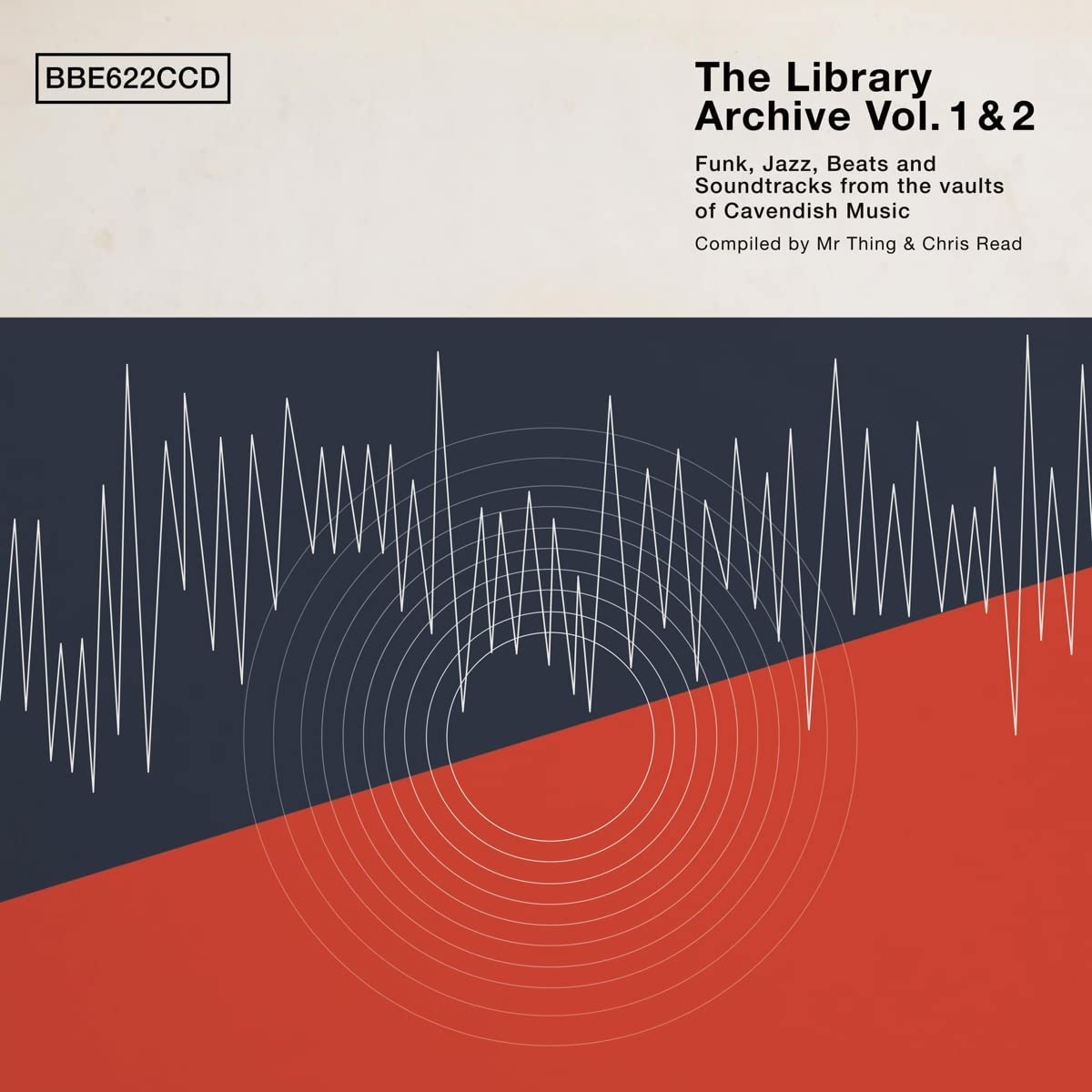
THE LIBRARY ARCHIVE VOLUME 1 AND 2-FUNK, JAZZ, BEATS AND SOUNDTRACKS FROM THE ARCHIVES OF CAVENDISH MUSIC-COMPILED BY MR THING AND CHRIS READ.
The Library Archive Volume 1 and 2-Funk, Jazz, Beats and Soundtracks From The Archives Of Cavendish Music-Compiled By Mr Thing and Chris Read.
Label: BBE Music.
Format: 2CD Set.
The names Sonoton, De Woife, Amphonic, Conroy and Cavendish Music roll off the tongue of aficionados of library music. This ranges from a coterie of collectors to sample hungry hip hop producers to DJs and compilers like Mr Thing and Chris Read.
One of their favourite library music companies is Cavendish Music. In 2014, the two BBE Music stalwarts entered the vast Cavendish Music vaults for the first time. They were participating in WhoSampled’s Samplethon event. This was a competition where producers had to create new tracks using samples of tracks from the Cavendish vaults. There was a catch though. Everyone participating was against the clock.
This must have been hugely frustrating for Mr Thing and Chris Read. At last, they had gained access to the what many collectors of library music called the holy grail, the vaults of Cavendish Music. It’s the largest independent library music publisher in Britain, and also represents many music catalogues from the four corners of the globe.
That day in 2014 time was at a premium, and Mr Thing and Chris Read were unable to take time to discover all of the treasure and hidden gems within the Cavendish vaults. However, whilst looking through a box of records and tapes the pair discovered an eclectic selection of timeless library music that they felt deserved to be heard by a wider audience in its original form.
Some of that music found its way onto a compilation released to critical acclaim in 2017 by BBE Music. This was The Library Archive-Jazz, Beats and Soundtracks From The Archives Of Cavendish Music-Compiled By Mr Thing and Chris Read. It was a captivating and fascinating insight into the little known world of library music.
However, there was plenty more music in the Cavendish Music vaults that deserved to feature on a compilation. Three years later, in 2020, the pair returned with The Library Archive 2-More Funk, Jazz, Beats and Soundtracks From the Archives of Cavendish Music-Compiled By Mr Thing and Chris Read. Just like its predecessor it was released to plaudits and praise and was welcomed by both collectors of library music and newcomers to the genre. For many, it was a fascinating insight to the little known world of library music and one of biggest and best known companies, Cavendish Music.
Given the popularity of the two Cavendish Music compilations it was no surprise when BBE BBE Music recently announced that it was releasing them as a two CD set. The Library Archive Volume 1 and 2-Funk, Jazz, Beats and Soundtracks From The Archives Of Cavendish Music-Compiled By Mr Thing and Chris Read is a tantalising taste of Britain’s biggest library music company during the genre’s golden age.
The origins of Cavendish Music can be traced back to 1930. That was when two of Britain’s long-established and well-respected musical companies Boosey and Company and Hawkes and Son agreed to merge. A new company was born, Boosey and Hawkes.
By the time Leslie Boosey and Ralph Hawkes’ companies became one, the combined company manufactured brass, string and woodwind instruments. It was also well on the way to becoming the world largest classical musical publisher.
Later, Boosey and Hawkes became the largest independent library music publisher in Britain, and represented many different music catalogues from around the world. That was still to come.
For Boosey and Hawkes and the other British library music companies, the birth of television in the mid-fifties was a game-changer. Up until then, classical music had long been a staple of their business and popular among their clients.
As a result, Boosey and Hawkes decided to diversify into library music publishing. By then, there was already a huge demand for music to provide the soundtrack to radio, television and film.
Originally, library music was meant to be used by film studios or television and radio stations. It was never meant to be commercially available. The music was recorded on spec by music libraries who hired often young unknown composers, musicians and producers. This ranged from musicians who were known within publishing circles, to up-and-coming musicians who went onto greater things, and later, looked back fondly at their time writing, recording and producing library music. This they now regard as part of their musical apprenticeship.
For the musicians hired to record library music, their remit was to provide companies like Cavendish Music with a steady stream of new music, which was originality referred to as production music. During some sessions, the musicians’ remit was write and record music to match themes or moods. This wasn’t easy, but after a while they were able to this seamlessly. Soon, the musicians were able to enter the audio and write and record a piece of music that matched a theme or mood for a film or television show.
Once the library music was recorded, record libraries like Boosey and Hawkes, which is now known as Cavendish Music, sent out demonstration copies of their music to production companies. If the production companies liked what they heard, they would license a track or several tracks from the music libraries. That was how it was meant to work.
Often, the music recorded on spec by library companies was never licensed. Since then, many of the tracks have lain unheard in the vaults of music libraries like Cavendish Music. That was no surprise, because during the sixties and seventies, which was the golden age for library music, and indeed Cavendish Music, when a vast quantity of music was recorded in the hope that it would license the tracks and use them in films, television or radio.
Sometimes that proved to be the case. Especially during the sixties and seventies when the music created by these groups of largely anonymous composers, musicians and producers provided the soundtrack to some of the biggest television programmes on British television. This included everything from The Sweeney and The Professionals to cartoons like Dangermouse and current affairs to quiz shows. Many of these themes became part of the soundtrack to British life and are fondly remembered by a generation of adults. However, not everyone in Britain was a fan of library music.
This included the Musician’s Union in Britain who banned their members from working on recording sessions of library music. Somewhat shortsightedly, they thought that eventually, there would come a time when there was no need for any further recordings of library music. Their fear was that the sheer quantity of back-catalogue would mean no new recordings would be made and their members would be without work. Soon, the record libraries had worked out a way to circumvent the ban which suited all parties.
Some record libraries would fly out composers, arrangers, musicians and producers to Holland and Belgium, where local musicians would join them for recording sessions. This meant that often, the same musicians would play on tracks for several composers. These were lucrative sessions for the musicians involved who had the last laugh.
Incredibly, it was only in the late seventies, that the Musician’s Union lifted their ban on new recordings of library music. By then, the golden age of library music was at an end. The Musician’s Union ban had cost their members dearly.
Later, sample hungry hip hop producers who dug deep into the crates found albums of library music. This was the ‘inspiration’ that they were looking for, and many ‘borrowed’ samples from their newfound musical treasure. Soon, other producers, DJs and collectors went in search of these long-overlooked albums of library music.
Since then, they’ve become increasingly collectable, with producers continuing to sample them, while DJs incorporating library music into their sets.
There’s also a number of collectors who spend their time and money looking for, and buying albums of library music. Nowadays, many of these albums are rarities and are highly collectable. This includes many albums produced by Cavendish Music. They’re on the wish-lists of many producers, DJs and collectors.
They’ll also appreciate and enjoy The Library Archive Volume 1 and 2-Funk, Jazz, Beats and Soundtracks From The Archives Of Cavendish Music-Compiled By Mr Thing and Chris Read. There’s twenty-three tracks on the first instalment and thirty on the second. These two lovingly curated compilations feature a tantalising taste of the library music during the genre’s golden age.
Both volumes feature an eclectic section of music that was recorded by largely anonymous groups of musicians. They were given a variety of names by the staff at Cavendish Music. On Volume 1 this included Sound Studio Orchestra, The Cavendish Orchestra, The New Dance Orchestra and the groovy sounding Sound Studio Set. There’s also contributions from exotic The Latin American Orchestra and The New Percussion Octet. Eclectic describes the music on the compilation. It ranged from jazz and funk to big band and orchestral sounds right through to proto hip hop. The music ranged from atmospheric and moody to thought provoking, funky and groovy and played an important part in defining British culture as this truly talented and versatile group of musicians seamlessly switch between themes, moods and genres on twenty-three timeless tracks on The Library Archive-Jazz, Beats and Soundtracks From The Archives Of Cavendish Music-Compiled By Mr Thing and Chris Read.
That was also the case on The Library Archive 2-More Funk, Jazz, Beats and Soundtracks From the Archives of Cavendish Music-Compiled By Mr Thing and Chris Read. It featured thirty tracks from The Gentle Giants, The New Concert Orchestra, Dennis Farnon, Bob Adams and Chris Barron. They were joined by old friends including The New Dance Orchestra and the Sound Studio Set. The thirty tracks were even more eclectic. This included everything from jazz and funk as well music for soundtracks and some more experimental tracks. Other tracks were bluesy and soulful as the versatile and talented musicians hired by Cavendish Music switched between musical genres and seamlessly created different themes and moods on tracks that it was hoped would feature in films and on television and radio.
Many did and became part of the soundtrack to the seventies. However, other tracks lay unreleased in the Cavendish vaults, the holy grail of British of library music.
BBE stalwarts Mr. Thing and Chris Read dug deep into the Cavendish Music vaults for the fifty-three tracks on the two compilations released in 2017 and 2020. They struck gold unearthing a myriad of hidden gems and musical treasure. The two compilations have been reissued on a two CD set as The Library Archive Volume 1 and 2-Funk, Jazz, Beats and Soundtracks From The Archives Of Cavendish Music-Compiled By Mr Thing and Chris Read by BBE Music. This musical treasure trove will be of interest to anyone interested in library music. That’s no surprise.
The music on the compilation is a reminder of the golden era of library music. Many of the tracks are a reminder of the type of music that provided the soundtrack to films and television and radio shows during the seventies. For those of a certain age the music on The Library Archive Volume 1 and 2-Funk, Jazz, Beats and Soundtracks From The Archives Of Cavendish Music-Compiled By Mr Thing and Chris Read is a reminder of the seventies, which was a golden age for library music and many would say, British television.
The sixties and seventies was the golden age of library music, when companies like Sonoton, De Woife, Amphonic, Conroy and Cavendish Music commissioned a vast amount of music which fifty years later, has found an appreciative audience that includes DJs, sample hungry producers and record collectors.
Especially the music recorded and released by Cavendish Music, which was is the largest independent library music publisher in Britain. Very few people outside of the environs of Cavendish Music have gained access to the company’s vaults until relatively recently.
The Library Archive Volume 1 and 2-Funk, Jazz, Beats and Soundtracks From The Archives Of Cavendish Music-Compiled By Mr Thing and Chris Read features two of the best compilations of library music that has been released during the last few years. It’s a reminder of the golden age of library music and British TV and features a myriad of hidden gems, musical treasure and hidden gems aplenty.
The Library Archive Volume 1 and 2-Funk, Jazz, Beats and Soundtracks From The Archives Of Cavendish Music-Compiled By Mr Thing and Chris Read.
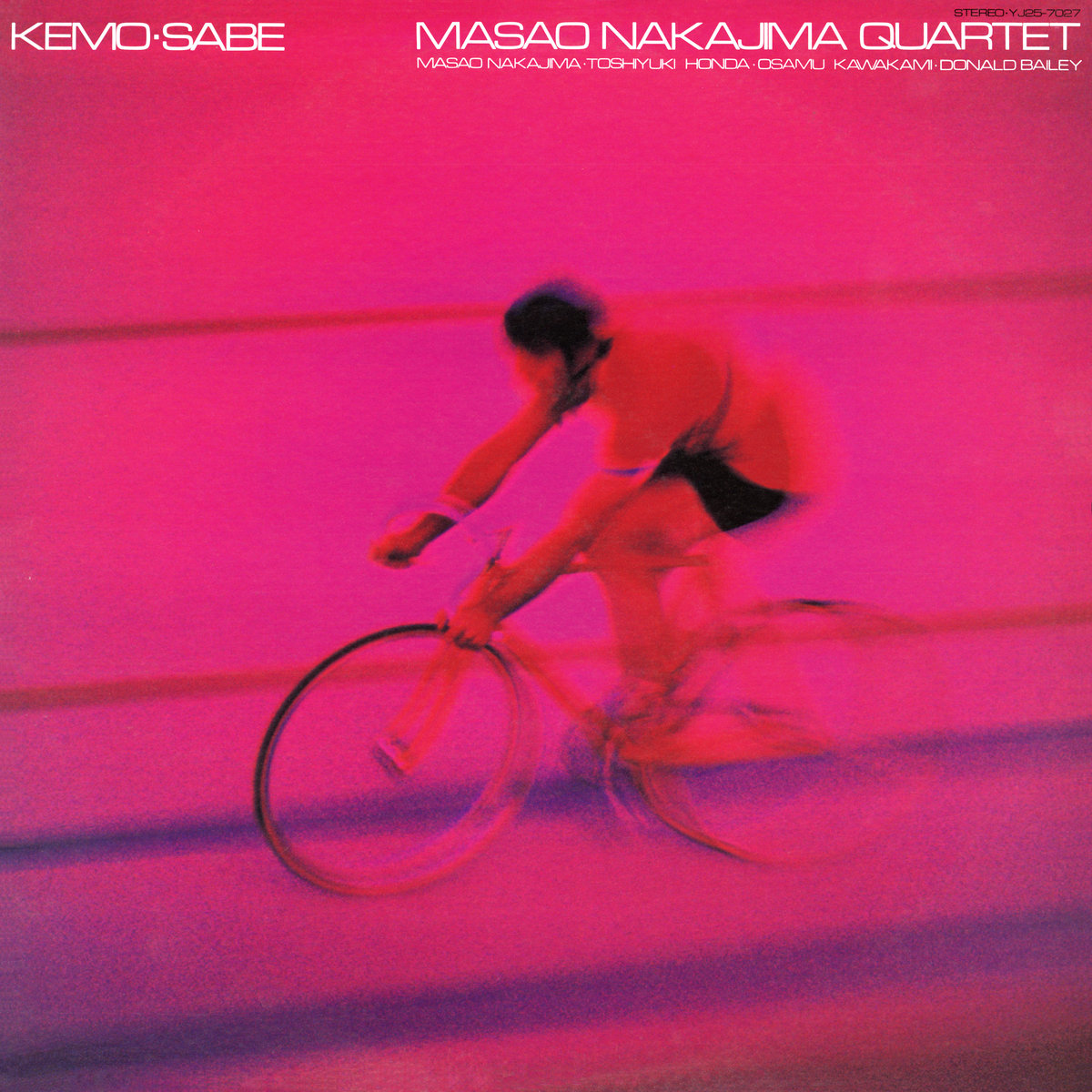
MASAO NAKAJIMA QUARTET-KEMO SABE.
Masao Nakajima Quartet-Kemo Sabe.
Label: BBE Music.
Format: CD.
Masao Nakajima was born in Senzoku, Ohta ward, Tokyo in 1950. His father was a councilman and his mother worked in music and also sang classical music. It was no surprise that her son started playing piano aged seven.
In 1959, aged nine, Masao Nakajima discovered jazz and began listening to Dave Brubeck, Errol Garner, Oscar Peterson and George Shearing. This was to be the start of a lifelong love-affair with jazz which would eventually, become his career.
Four years later, aged thirteen, Masao Nakajima saw Oscar Peterson in concert. Seeing the great American pianist play would influence him because at the time, he didn’t know much about the Japanese jazz scene. That would soon change.
By the time he was sixteen, Masao Nakajima was the pianist for the house band at a club owned by Teruo Isono. The house band accompanied everyone from Isao Sukuki and Charlie Haden to Eki Kitamura, Hideo Shiraki and Takeru Muroka. It was good practise for the young pianist.
When he was eighteen he moved to the Hilton Hotel in Tokyo. That was where be met and befriended a number of jazz musicians including Hampton Hawkes. By then great things were being forecasted for Masao Nakajima.
Not long after this he started to tour Japan and play at festivals with the George Kawaghuci Big Four, Hideyuki Matsumoto Quartet, Shoji Suzuki Band and Shungo Sawada Band. This was good experience for Masao Nakajima.
In 1969 composer Keitaro Miho recommended that he formed a band with the flautist in his band, Yasuo Kitamura. The resultant studio orchestra was named Flying Dr Merry Freud. Their eponymous debut album was a mixture of fusion and free jazz and featured a mixture of classical and popular songs. This new project opened doors for the bandleader.
Japanese music critic Teruo Isono invited Masao Nakajima to play a session with Art Blakey’s band. After this, the pianist played in the Glen Miller Orchestra’s concert in Japan. This was good experience.
At the time, he was the producer of pop singer Hideo Saijo and produced his Budokan concert. Masao Nakajima played at the inaugural TBS International Music Festival and helped to arrange visiting orchestras.
Meanwhile, he was playing at various clubs in Tokyo including Body and Soul, Shinuki Pit Inn and Shinuki Taro. Masao Nakajima also played at Max Hall in Roppongi and Yuzuru Sara’s live house.
Then in 1971 Masao Nakajima was a gust performer for Shoji Suzuki’s All Night Jazz Festival. When he played live the tapes were running and an album entitled Shoji Suzuki Rhythm Ace No Subete was later released.
Two years later in 1973, Masao Nakajima journeyed to America for the first time. That was where he met composer Mike Nock in San Francisco. The second meeting came when they were then introduced by a mutual friend.
The third time they met was at the Sweet Basil on 7th Avenue, in New York, when Mike Nock was playing alongside Michael Brecker and Peter Erskine. That night at the club, Masao Nakajim asked his new friend some questions. Having answered the questions he handed Masao Nakajima a copy of a piece that he had written entitled Kemo Sabe and told him to play it when he returned to Japan. This track would eventually be recorded in by the Masao Nakajima Quartet in 1979. That was still to come.
In 1978, Masao Nakajima decided to spread his wings and spent a year in America. During that time he lived in LA and New York which he preferred as a jazz musician.
Having decided to live in the Big Apple, he toured with local musicians and did some session work. This included an album of disco-tinged fusion that guitarist Cornell Dupree was recording. Masao Nakajima played keyboards and was the arranger which showcased his versatility.
Much of Masao Nakajima’s time was spent playing live. Especially in the jazz clubs of New York. He played at Sweet Basil on 7th Avenue and appeared at the Long Island Beach Jazz Festival. It was after this he was approached by Ron McClure to work with him. By then, Masao Nakajima had decided that he wanted to return home and decided to decline the offer.
Having returned to Japan, Masao Nakajima was approached to work on a session with Billy Hart. This came after someone at the label read an article in Swing Journal. By then, the twenty-eight year old pianist was regarded as a rising star in Japanese jazz.
In 1979, the Masao Nakajima Quartet had signed to Yupiteru Records and were about to enter the studio with producer Tadao Shimo. The group were about to record six tracks including Mike Nock’s Kemo Sabe which had been registered in 1977. It was joined by Masao Nakajima’s Beloved Diane, Herbie Hancock’s Tell Me A Bedtime Story, Ron Carter’s Third Plane, John Coltrane’s Moments Notice and Bob James’ My Love. These tracks were recorded by a group of top jazz musicians.
This included Philly-born drummer Donald Bailey, double bassist Osamu Kawakami and bandleader Masao Nakajima on piano. Meanwhile Toshiyuki Honda played flute as well as alto and soprano saxophone. At the session the Masao Nakajima Quartet recorded an album of modal jazz that would go on to become one of the hidden gems of J Jazz.
Side One.
It opens with Kemo Sabe which Mike Nock told Masao Nakajim to play on his return to Japan. A year later, it opened the album which it also lent its name to. It’s a vibrant, joyous and uplifting opener that’s also compelling and captivating. Beloved Diane was named after Masao Nakajima beautiful girlfriend. It’s essentially a paean where he express his love for her. The beautiful ballad Tell Me A Bedtime Story closed side one of the album and the Quartet breath new life and meaning into Herbie Hancock’s composition.
Side Two.
Masao Nakajima Quartet open side two of Kemo Sabe with Ron Carter’s Third Plane. It’s a mid tempo piece that was recommended by Toshiyuki Honda and showcases his considerable skills. This includes his funky but accessible alto saxophone playing which takes centre-stage before the baton’s passed to the bandleader’s piano. He delivers a masterclass putting all his years of experience to good use on this peerless cover.
Then the band pays homage to John Coltrane by covering Moments Notice from his album Blue Train. This was the first time that Masao Nakajima had played the piece. It doesn’t show as they unleash an energetic and impassioned performance as they pay homage to the late, great giant of jazz.
Closing Kemo Sabe was My Love written by Bob James. It’s a gorgeous rendition full of warmth and emotion with the piano and double bass playing leading roles and closing the album on a high.
Sadly, when Kemo Sabe was released by Yupiteru Records in 1979 the Masao Nakajima Quartet wasn’t a commercial success. Despite a star studded and incredibly talented lineup the album failed to make any impression on the lucrative Japanese jazz market. It was hugely disappointing for the twenty-nine year old bandleader and the Quartet never released a followup album.
Since then, copies of Kemo Sabe have become much-prized amongst collectors of J Jazz. Copies are extremely difficult to find and sadly, it’s now beyond the budget of most collectors. However, it was recently reissued by BBE Music as part of their J Jazz Masterclass Series.
Kemo Sabe is a welcome addition to this loving curated series. With its mixture of new and cover versions it’s a captivating album of top quality modal jazz that’s a mixture of beauty, emotion, energy and warmth that’s also joyous, uplifting. The playing is tight, almost flawless and impassioned as the members of the Masao Nakajima Quartet feed off each other and drive each other to new heights on this oft-overlooked J Jazz hidden gem which lasts just under thirty-six majestic minutes but oozes quality.
Masao Nakajima Quartet-Kemo Sabe.
DO IT AGAIN! THE SONGS OF BRIAN WILSON.
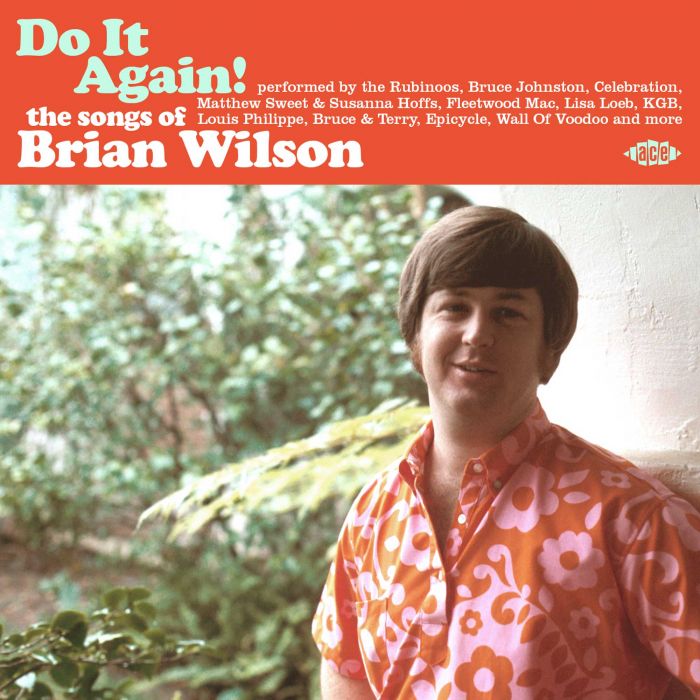
Do It Again! The Songs Of Brian Wilson.
Label: Ace Records.
Format: CD
Release Date: ‘28th’ October 2022.
Brian Wilson is seen by some as the closest thing music has had to a genius. Proponents of this argument cite the Beach Boys 1966 progressive, psychedelic Magnus Opus Pet Sounds. By then, he was one of the most successful singer, songwriter and producers of his generation. Already, he had masterminded twenty-four hit singles including two number one singles for the Beach Boys. It looked like he could do no wrong.
Sadly, Smile, the followup album to Pet Sounds was cancelled. It was a huge blow to him.
Brian Wilson then suffered the first of several nervous breakdowns. As a result of his health problems his influence on the Beach Boys diminished. This just happened to coincide with a decrease in sales of the group’s albums.
Following Pet Sounds, the Beach Boys their albums were produced by the group. No longer was Brian Wilson the sole producer.
When the Beach Boys entered the studio in 1975, Brian Wilson was back in charge of producing the album 15 Big Ones. It was released in 1976, reached number eight in the US Billboard 200, and was certified gold. Many critics and record buyers thought that Brian Wilson was back. Sadly, that wasn’t the case.
By 1975, Brian Wilson was suffering from substance abuse problems and his health was failing. His wife Marilyn enlisted the help of psychologist and psychotherapist Eugene Landy.
He was best known for an unconventional twenty-four hour treatment program. At first, Brian Wilson was resistant to the demanding program. However, with the only alternative being admitted to a psychiatric hospital, he agreed to the program. Then in 1976, when Eugene Landy tried to double his fees he was sacked by the Beach Boys manager.
Six years later and Brian Wilson’s health was failing. The Beach Boys hadn’t released an album for two years. A decision was made to rehire Eugene Landy. He would be part of the Beach Boy’s life for the next ten years. Sadly, the relationship didn’t end well.
Part of Eugene Landy’s treatment, was micromanaging his client’s lives. Usually, he did this with team of counsellors, nurses and doctors. However, in Brian Wilson’s case he took a much more hands-on approach.
Not only was he Brian Wilson’s therapist but gradually, became his business adviser and cowrote songs with him. This was far from the usual therapist and client relationship.
Then when Brian Wilson released his long-awaited eponymous debut album in 1988, Eugene Landy was credited as executive producer. This was just the latest controversy.
Eugene Landy also co-wrote a memoir about Brian Wilson. Wouldn’t It Be Nice: My Own Story was published in 1991. However, by then people were questioning his relationship with Brian Wilson.
A year later and the relationship was over. A restraining order was issued by the court barring Eugene Landy from contacting Brian Wilson ever again. However, this wasn’t the end of the story.
In 1994, the state of California revoked Eugene Landy’s license to practise. There had been accusations of ethical violations and patient misconduct during his years working with Brian Wilson. While the relationship ended badly, Brian Wilson was on the comeback trail.
He returned with his sophomore album I Just Wasn’t Made for These Times in August 1995. The album featured songs Brian Wilson had originally recorded with the Beach Boys. He had rerecorded them for the soundtrack to Don Was’ documentary about his life.
Just two months later, in October 1995, Brian Wilson released Orange Crate Art his 1995 collaboration with Van Dyke Parks. The pair had first met in the early sixties and over thirty years later were still friend and making music together.
Since 1995, Brian Wilson has continued released another nine albums. Many of these albums have been released to critical acclaim. His most recent album is At My Piano which was released in November 2021.
Brian Wilson celebrated his eightieth birthday on June the ‘20th’ 2022. He’s now one of music’s elder statesman and his music still continues to influence several new generation of musician. Over the years, many musicians have covered Brian Wilson’s songs and that’s still the case today.
In 2015, Ace Records released Here Today!-The Songs Of Brian Wilson, as part of their long-running and critically acclaimed Songwriter Series. Seven years later comes the much-anticipated followup Do It Again! The Songs Of Brian Wilson. The compilation features twenty-four songs that cover a twenty-five year period.
The earliest is Steve Almaas and Ali Smith’s cover of The Lonely Sea which originally featured on the Beach Boys’ 1963 album Surfin’ USA. Libera cover Love And Mercy which featured on Brian Wilson’s 1988 eponymous debut solo album. There’s contributions from some of the biggest names in music, familiar faces and some lesser known names on Do It Again! The Songs Of Brian Wilson.
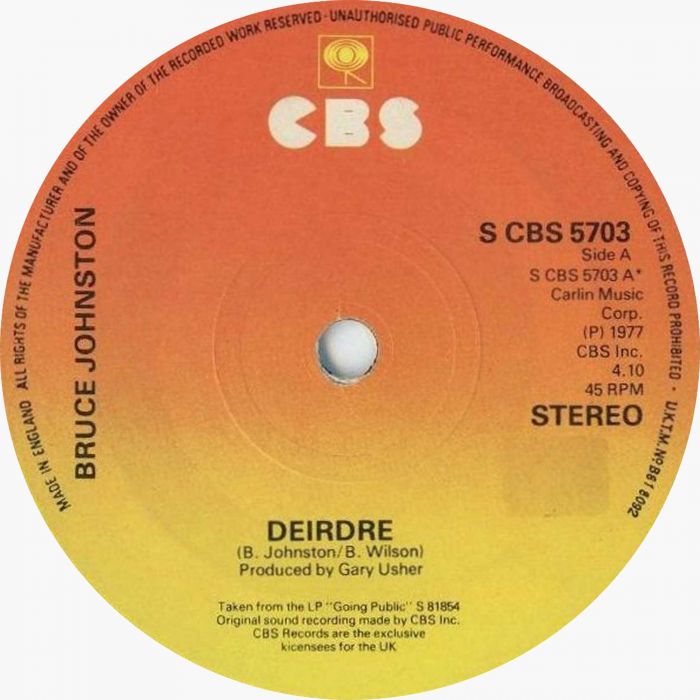
The compilation opens with Wall Of Voodoo’s cover of Do It Again. They released this genre-melting single on I.R.S. in 1987 and on the album Happy Planet. It’s a mixture of new wave and synth pop where the group take the song in a new direction but also pay homage to the Beach Boys.
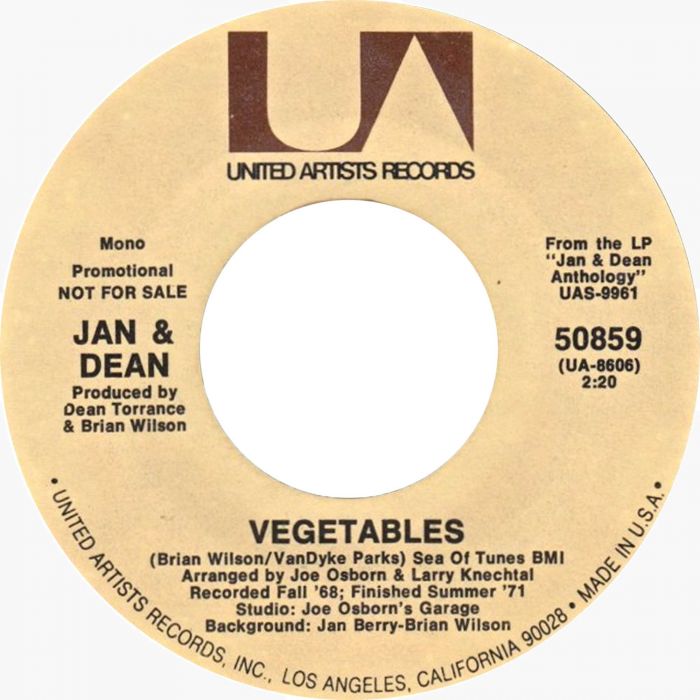
Jan and Dean’s recording career began in 1959 and they were one of pioneers of the California Sound and vocal surf. Their most successful single was Surf City which reached number one in the US in 1963. They covered Vegetables which was released as a single in 1967 and then featured on the Jan and Dean Anthology Album in 1971. The cover features their trademark mixture of rock and pop as the duo rode the crest of a musical wave.
Bruce and Terry released a string of surf singles between 1964 and 1966. They also covered Hawaii which was penned by Brian Wilson and Mike Love. The song featured on the surf duo’s 1998 compilation The Best Of Bruce and Terry and is a reminder of their trademark sound.
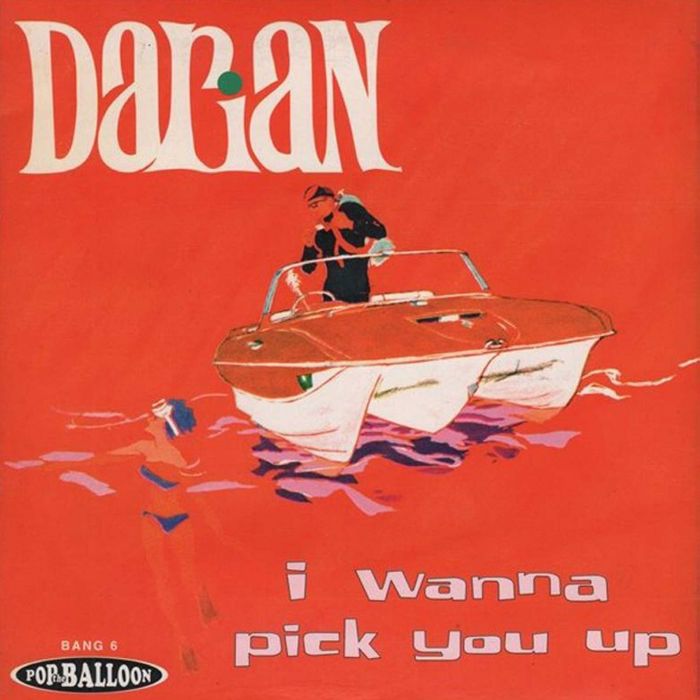
In 1994, Darian Sahanaja released a cover of Brian Wilson’s Do You Have Any Regrets? On the B-Side was another of his songs. This was a heartachingly beautiful and heartfelt cover of I Wanna Pick You Up which is a hidden gem and welcome addition to the compilation.
In My Room was written by Brian Wilson and Gary Usher. The song was covered in 2017 by Lisa Loeb for her album Lullaby Girl. The arrangement is understated and the vocal breathy and impassioned as she breathes new life and meaning into the lyrics.
Matthew Sweet and Susanna Hoffs released Under The Covers, a four CD box set of cover versions in 2006. One of the tracks they covered was The Warmth Of The Sun. The song was perfectly suited for their voices which combine to create a quite beautiful and truly memorable cover of this Brian Wilson and Mike Love composition.
On Fleetwood Mac Live, which was released in 1980, the legendary group covered The Farmer’s Daughter. This is another song written by Brian Wilson and Mike Love. The song is taken in a new direction by the Anglo-American group and is best described as a melodic earworm.
When Samantha Sidley released her debut album Interior Person in 2019, it featured a cover of Brian Wilson’s Busy Doing Nothing. It features a vocal that veers between coquettish to emotive on this jazzy makeover where she reinvents the song.
Vocal ensemble The King’s Singers were formed in Cambridge, England, on May the ‘1st’ 1968. When they covered Please Let Me Wonder for their 1997 album Spirit Voices, they were joined by two high profile guest vocalists. This was none other than Bruce Johnston and Mike Love. They play their part in a heartfelt and thoughtful cover of this Brian Wilson and Mike Love song.
When Glasgow group The Pearlfishers released their maxi single Even On A Sunday Afternoon in 1997, they covered Let’s Put Our Hearts. This was no surprise as founder member and lead singer was a big fan of Brian Wilson and the Beach Boys music. Their music has always influenced the group who have released nine albums since their debut Za Za’s Garden in 1993. For newcomers to the group, the perfect starting place is their third album The Young Picnickers, which was released in 1999 and is an album of perfect pop and rock.
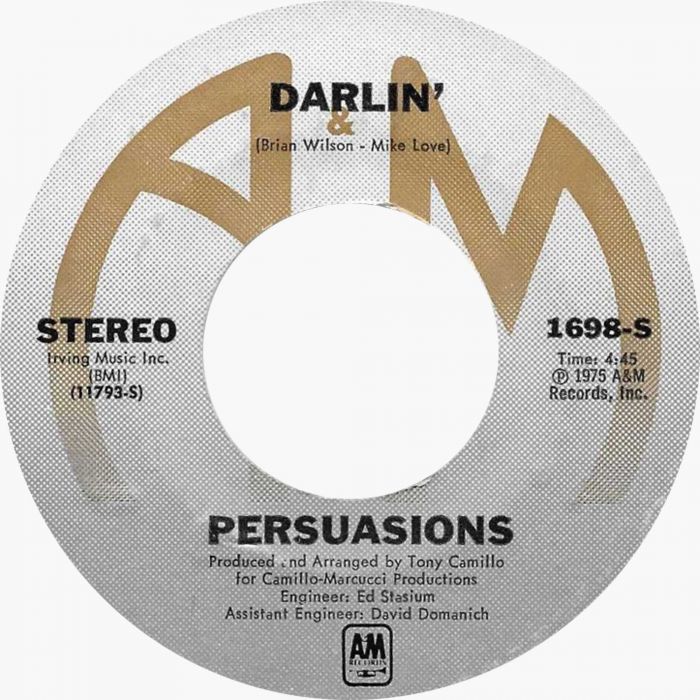
Darlin’ was the B-Side to the Persuasions 1975 single One Thing On My Mind. This paean is a soulful hidden gem from the pen of Brian Wilson and Mike Love.
Closing Do It Again! The Songs Of Brian Wilson is a cover of Hang On To Your Ego by Frank Black. The alternative rocker released the song as a single in 1994. He reinvents the song and transforms it into a driving rocky anthem that ends the compilation on a high.
Brian Wilson is, without doubt, one of the most talented and singer, songwriter and producers of his generation. Some people have described him as a musical genius citing his career-defining opus Pet Sounds as proof.
Sadly, because of health issues, substance abuse and maybe even the internal politics of the Beach Boys, Brian Wilson never again reached the heights of Pet Sounds. Following the release of such a groundbreaking album that revolutionised music he was seen as the man who could’ve been King.
That is no surprise as Pet Sounds is a classic album that’s regarded as a masterpiece of modern music. When the Beach Boys released other albums they were always compared to Pet Sounds. It was a similar case when he embarked upon a solo career in 1988.
However, during a career that has spanned the best part of sixty years Brian Wilson has written, recorded and produced many classic songs. These songs have influenced several generations of singers and bands. Many have gone on to cover songs by the Beach Boys or from Brian Wilson’s solo career.
This includes the artists on Do It Again! The Songs Of Brian Wilson. It’s the latest instalment in Ace Records Songwriter Series. It’s the followup to Here Today!-The Songs Of Brian Wilson which was released in 2015. It features twenty-four songs that cover the period between 1963 and 1988. There’s contributions from familiar faces, giants of music, indie artists and some lesser known names. The result is a lovingly curated musical voyage of discovery where artists from the past and present pay tribute to Brian Wilson one of the greatest singer, songwriter and producers of his generation and for many the man who could’ve been King.
Do It Again! The Songs Of Brian Wilson.
NORIKO MIYAMOTO WITH ISAO SUZUKI-PUSH.
Noriko Miyamoto With Isao Suzuki-Push.
Label: BBE Music.
Format: CD.
During a long and illustrious career, double bassist Isao Suzuki was one of the most important and influential Japanese jazz artists of his generation. His career began in 1956, and over a career that spanned seven decades he released over fifty solo albums. That’s not all. He also helped to develop many young, up-and-coming artists. Many of these artists joined his band Soul Family.
Its line-up was constantly changing, and by 1978 many top Japanese jazz musicians had been a member of Soul Family. The group also featured Push the debut album by Noriko Miyamoto With Isao Suzuki. This J-Jazz cult classic was recently reissued by BBE Music as part of their J-Jazz Masterclass Series.
It’s also an album that launched the career of a truly talented vocalist. However, just a few years earlier Noriko Miyamoto was a dancer at the Mugden disco in Akasaka.
The Mugden disco opened its doors in 1968, and nowadays, is remembered by former patrons for its psychedelic interior. It was very different to other clubs and jazz kissas in postwar Japan and soon, became the most fashionable place in Akasaka. Everyone from creatives to cultural and literary giants made their way to the new club. Before long, so did Noriko Miyamoto.
She was born in Ginza, Tokyo, in 1951, and like many Japanese teenagers discovered Western music in the sixties. Initially, it was The Beatles and The Rolling Stones. This was just the start of her love affair with music.
Noriko Miyamoto’s other passion was dancing. Despite only being in junior high school, she used to go to Tokyo’s trendy go-go clubs. That was where she first heard soul and funk music including Otis Redding and James Brown. Soon, the music became part of the soundtrack to her life as she became a regular at the clubs.
Having graduated from high school, Noriko Miyamoto decided not to enrol at university. Instead, she continued to dance at various go-go clubs. Then once she was eighteen, she made her way to the legendary Mugden disco.
By then, she was living in Yohohama, some distance from Tokyo’s clubs. However, Noriko Miyamoto still made the journey to Mugden where she danced a couple of times. Then she was hired as a dancer at the club. Little did she know this would be the start of a musical career. That was still to come.
Mugden was a popular club, and was popular with soldiers from US air bases. They knew the latest dances which were popular back home. Noriko Miyamoto was able to learn the new dances, which soon, were popular in Tokyo’s clubs. However, it was in Mugden that the new dances emerged in Japan.
One night in Mugden, Ike and Tina Turner were booked to perform at the club. It turned out to be a life-changing moment for Noriko Miyamoto. That night, she realised that she was at the peak of her powers as a dancer. It was time to pursue a new career.
Seeing Tina Turner play live inspired Noriko Miyamoto to follow in her footsteps. She too, wanted to be a singer and entertainer. Not long after this, fate intervened.
Noriko Miyamoto was approached by a local rock band who were looking for a new lead singer. As a top dancer, her boss at Mugden didn’t want to leave. However, she had made her mind up to become a singer. It also meant that when she took to the stage she could sing Tina Turner’s songs.
Having joined the group, Noriko Miyamoto discovered that the covers they played were mostly rock songs. This included groups like Mountain who were popular at the time. She wasn’t going to get the chance to sing Tina Turner songs. Eventually, she left the group and joined the funk septet, The Three Cheers.
The group were popular in clubs and military bases around Tokyo. However, The Three Cheers were different from other groups as they had a triumvirate of vocalists. This meant that Noriko Miyamoto had to shine. Each night she took to the stage, she was determined to be noticed. Sadly, this took its toll on her voice.
This resulted in Noriko Miyamoto needing throat surgery. Following the surgery, she was advised to rest for a month. During this period, she became even more determined to make a career as a singer.
By then, The Three Cheers’ popularity was growing. So much so, that a record label expressed an interest in signing the group. The only problem was that the label didn’t want an album of Western R&B. Instead, they wanted the group to become a Japanese pop group.
So the band began writing an album of original Japanese pop song. These The Three Cheers tried to record in LA. However, the sessions were unsuccessful and the band broke up.
By then, The Three Cheers had been together for between two to three years. They decided to have a farewell party in Tokyo. Ironically, the venue was the Mugden disco.
Not long after the farewell party, Noriko Miyamoto met Isao Suzuki who would later produce Push. The meeting took place after the singer decided to continue her musical education.
Wanting to continue her career as a singer, Noriko Miyamoto decided that it would help if she could sing jazz. She started singing few jazz standards. They were on a demo tape that she made and found its way in the hands of Isao Suzuki. When he listened to the demo he wanted to meet Noriko Miyamoto.
When she went to meet Isao Suzuki in 1977, she realised that it was like an audition. She was asked to sing with his band Soul Family. This resulted in Noriko Miyamoto being hired to sing with the band. She was the latest up-and-coming singer to join the band.
At the time, she was told that Soul Family had a gig booked. Her debut was at Select: Live Under The Sky ’77 Jazz Festival. That day, she took to the stage with a group that By then, then they were known as a group that featured some of the top young Japanese musicians.
Later in 1977, Noriko Miyamoto made her recording with Soul Family on a live album. This was Jazz of Japan: Live Under The Sky ’77 which was released by the Flying Disk label. However, a year later, in 1978, the twenty-seven year old singer would release her debut album Push.
Members of Soul Family featured on Push. The musicians had been experimenting by combining a mixture of orthodox jazz with crossover and fusion. This sound was popular at the time and featured on Push.
Not long after this, Isao Suzuki received the offer of a recording contract from Yupiteru Recods for Push. The only problem was that, at the time, he was signed to JVC Victor. However, he worked out a way to get around this problem.
When Push which was released in 1978 it was credited to Noriko Miyamoto With Isao Suzuki. This suited everyone, including Noriko Miyamoto. She was keen to continue to singing and embark upon a solo career. This began with Push.
The album opened with Monologue which was penned by Isao and Shihoko Suzuki. It’s the only track on the album which is sung by Noriko Miyamoto in Japanese. She sings four songs in English. At the time, this was unusual. Despite that, it was something that she continued to do throughout her career.
Victor Young’s Stella By Starlight is an instrumental that’s been covered by everyone from Charlie Parker and Chet Baker to Miles Davis and Stan Getz. The track allows Soul Family to showcase their considerable talents. The band features a mixture of Japanese musicians who are augmented by some of the country’s musical rising stars. They reinvent this oft-covered track and take it in a new direction. Closing the first side is the jazz standard Everything I Have Is Yours. It features an impassioned vocal by Noriko Miyamoto that’s one of her finest moments on the album.
Originally, the title-track Push was an instrumental. However, Noriko Miyamoto wrote English lyrics. She delivers a breathy, tender and heartfelt vocal tour de force against an understated jazzy arrangement. This allows the vocal to take centrestage and play a starring role on what’s one of the highlights of the album.
Cadillac Woman was originally an instrumental that featured on Isao Suzuki’s debut album. Later, it became a feature of Soul Family’s sets when they played live. They combine elements of funk and fusion with jazz and jazz-funk. Adding the finishing touch is Noriko Miyamoto’s vocal. She’s a truly talented vocalist who can breath meaning an emotion into lyrics. So much so, that it’s hard to believe that this was her debut solo album.
Closing Push is My Life. It’s a song that Isao Suzuki wrote for jazz singer Kimiko Kasai. However, Noriko Miyamoto’s version features a breathy, coquettish vocal against Soul Family’s genre-melting arrangement. This six minute opus is the perfect way to close the album. It showcases the versatility and talent of Soul Family and launched the career of Noriko Miyamoto.
Sadly, when Push was released in 1978 sales were disappointing. That’s despite Isao Suzuki’s involvement and Soul Family backing Noriko Miyamoto on what was a near flawless genre-melting album.
Push featured elements of contemporary jazz, funk, fusion, jazz, soul and soul jazz on an album that introduced the world to vocalist Noriko Miyamoto. She was destined for greatness.
After the release of Push, Noriko Miyamoto received an offer to sing on a commercial for the cosmetics brand Kenebo. She accepted and said goodbye to Isao Suzuki and his band Soul Family as the entertainment industry beckoned.
The advert was huge all over Japan and Noriko Miyamoto was approached by a talent agency. Not long after this, she signed to Trio Records who released her sophomore album Vivid.
Noriko Miyamoto sang just two of the songs on Vivid in English. When it was released in 1979, the result was a hugely successful album that featured soul and city pop. This was very different from Push.
However, Noriko Miyamoto was nominated for the Best New Artist at the annual Japan Record Awards. Although she failed to win the award she won the Foreign Judges Award at the Tokyo International Music Festival. This was a prestigious award and showed just how far Noriko Miyamoto in a short space of time.
Noriko Miyamoto’s third album Rush was released in 1980 and was an album of Japanese pop. It built on the success of Rush and showcased a versatile and talented singer who continued to reinvent herself on the seven solo albums she released.
However, her debut album was Push, a glorious and almost flawless opus. Sadly, this hidden gem of an album failed to find the audience it so richly deserved. For many years, Push was a hidden gem in Noriko Miyamoto’s discography that was often overlooked in favour of her more commercial and successful albums. However, now and somewhat belatedly, connoisseurs and collectors of J-Jazz have discovered the delights of Push which launched the career of the truly talented and versatile vocalist Noriko Miyamoto.
Noriko Miyamoto With Isao Suzuki-Push.
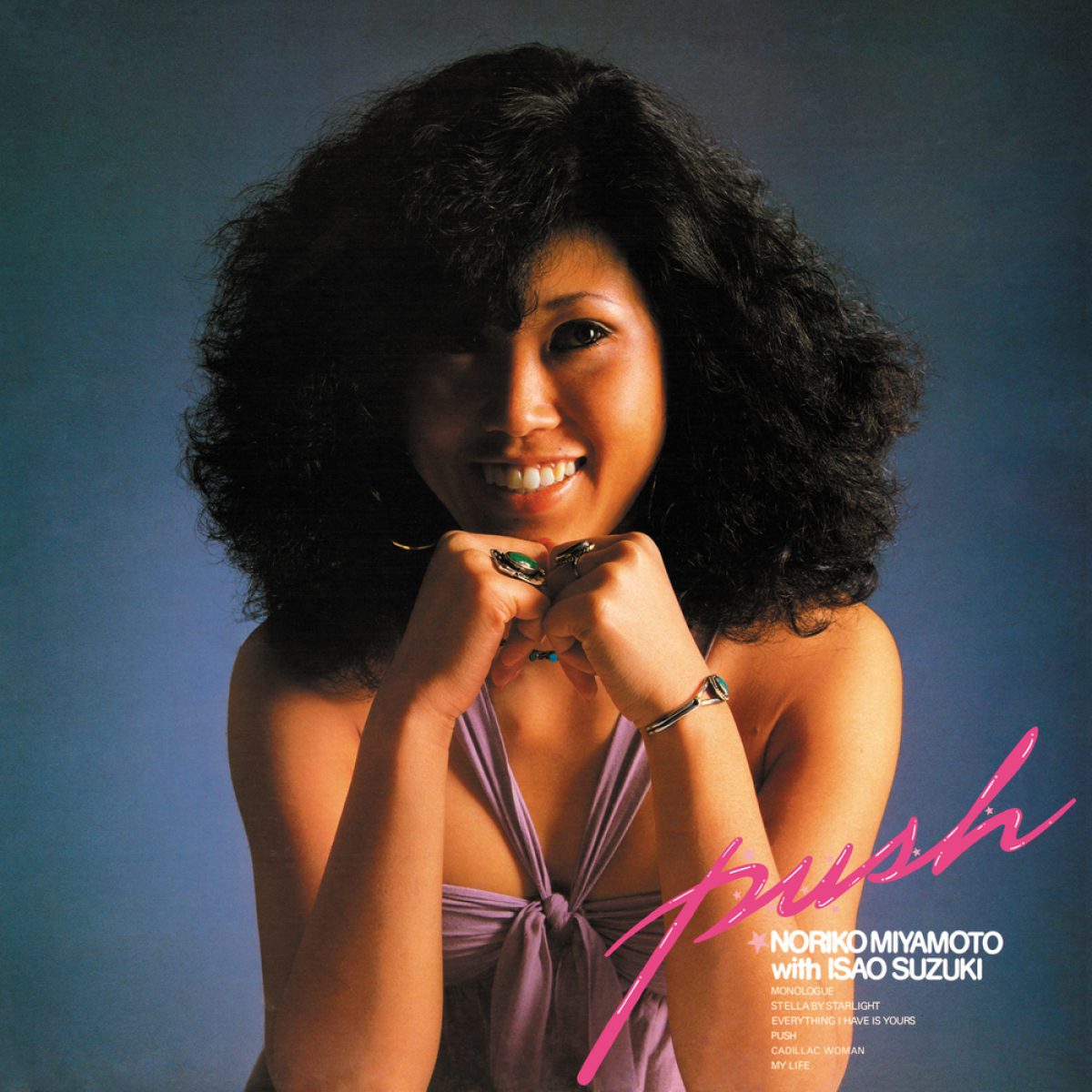
PER HUSBY SEPTETT-PEACEMAKER.
Per Husby Septett-Peacemaker.
Label: BBE Music.
Format: CD.
Release Date: 21st October 2022.
Growing up, Per Husby never dreamt of becoming a musician. That was despite music playing an important part in his life. Initially he took piano lessons and later, enrolled in a correspondence course from Berklee that covered elementary jazz theory and the principles of arrangement. He also spent many hours listening to everything from classical to jazz as well as the albums he bought from an American mail order company. This included the albums he read about in Downbeat magazine. However, despite his love of music he wanted to become a civil engineer.
This changed after Per Husby graduated in 1969 and enrolled at the Norwegian Institute of Technology in the city of Trondheim. Back then, it had a thriving jazz scene. That’s still the case in the city today.
Back in 1969, there were many venues where jazz was played. This included at the Student’s Union, where concerts regularly took place. However, at the time, there was a shortage of pianists and this is how Per Husby became an accidental musician.
Having arrived in the city planning to become a civil engineer, he took part in the occasional jam session. That was how Bjørn Alterhaug heard Per Husby play. He was so impressed that he asked him to join his band. This was just the start.
Soon, the pianist in the Bodega Big Band left Trondheim. Founder and bassist Jan Tro, who at the time, was looking for a replacement. He invited Per Husby to join the Band. Before long, he also became the arranger and composer. This turned out to be good practice.
Although music was still a hobby for Per Husby, this was about to change. One day in Trondheim, he met a friend from Oslo. The pair had played handball as teenagers, and shared a love of music. It turned out his friend had written a children’s musical for local theatre. He also needed a musical director for the project.
Per Husby became the new musical director. As a student struggling to make ends meet, the extra money was a big help and would finance his civil engineering studies. Little did he know they were almost at an end.
Those running the theatre were so pleased with Per Husby’s work as musical director that they offered him the role on a permanent basis. He accepted the offer that day, he realised then that he was never going to become a civil engineer. That was despite finishing his course and receiving his diploma from the Norwegian Institute of Technology. Instead, Per Husby knew that he was going to pursue a musical career.
In 1974, saxophonist Asmund Bjørken had been asked to for a band to play at the Molde Jazz Festival. Per Husby liked the concept and wrote a few arrangements for the nascent ensemble. It featured a talented horn section that was drawn from the local jazz scene. The only problem was that they weren’t good at reading music, and the band was short-lived.
However, Per Husby liked the idea of this type of ensemble. He knew to make it work that he needed better musicians. That was when he decided to move to Oslo.
At the time, Oslo was where the best and most experienced jazz musicians were based. It was also home to most of the recording studios in Norway. Now based in the Norwegian music capital, Per Husby started putting together a list of musicians who would form his “dream band.” They were really enthusiastic about the project.
Following some concerts and a recording session, Per Husby was approached by Roger Arnhoff who owned a studio in Oslo. He was planning to set up a new label. It would take a different approach to the other labels who tended to sign the more commercial bands and artists. The new label would offer a platform for new and up-and-coming bands. This he hoped would include the Per Husby Septett.
The bandleader accepted the offer, and an album was recorded. This was Peacemaker, which when it was released by the nascent label should’ve been the debut album by the Per Husby Septett.
However, just a couple of months after the album was recorded, Roger Arnhoff phoned Per Husby to tell him that he had had to cancel his plans to start a new label. This must have been a huge disappointment. However, to cushion the blow Per Husby was allowed to keep the recording of Peacemaker and do what he wished with it.
It just so happened that in Trondheim, the Students’ Union had formed their own record label Studentersamfundets Plateselskap. The new label was looking for projects by musicians who had a connection to the Students’ Union. It just so happened that Per Husby lived in a Students’ Union house.
That was how the label came to release Peacemaker by the Per Husby Septett in 1977. This Norwegian jazz rarity will be reissued by BBE Music on the ‘21st’ October 2022. It’s an album that deserved to much fare better when it was released in 1977.
Having agreed to release Peacemaker by the Per Husby Septett, the nascent Studentersamfundets Plateselskap label had 700 copies of the album pressed. There was a problem though. The label had no budget for had no budget for PR or distribution. This was hugely disappointing.
To make matters worse, Peacemaker didn’t sell well. With no PR campaign record buyers weren’t aware of the Per Husby Septett’s debut album. The lack of a distributor proved problematic as record shops were unable to source copies of album.
Before long, Peacemaker became a collector’s item in Norway and across the world. Nowadays, the album is a much-prized rarity which showcases the considerable talents of the Per Husby Septett. It features some of Norway’s top jazz musicians as what was described as a: “small big band” work their way through a captivating collection of cover versions and original tracks.
Side A.
Opening the first side of the album is a combination of two of Charlie Parker’s best known, and finest blues themes, Au Privave and Bloomdido.
They’re followed by the ballad Nokve. This Per Husby composition finds tenor saxophonist Harald Bergersenplaying a starring role. He delivers a musical masterclass and sets the bar high for the rest of the album.
At the time Peacemaker was recorded Kenny Wheeler was one of Per Husby’s favourite composers and musicians. He decided to cover two of his compositions Smatta and Introduction To No Particular Song. They provide the perfect showcase for this all-star band.
Then on Cedar Walton’s classic Fantasy In D it’s Bjørn Johansen on soprano saxophone who steals the show. That’s despite this being a difficult piece to play. However, it’s an almost effortless performance one of the greats of Norwegian jazz. This is the perfect way to close the first side.
Side B.
Harold Land’s The Peacemaker opens the second side. It’s another difficult piece to play as it moves between 3/4 and 4/4 time. However, it’s an effortless transition by the Per Husby Septett as they interpret this track and enjoy the opportunity to improvise and experiment musically.
The second Per Husby composition on the album was Adgang F. The track title is actually the Norwegian translation for Piglet’s house in Winnie The Pooh. Again, it’s Harald Bergersen’s solo that steals the show. It should be a difficult part to play, but he makes it look undemanding as he plays with a fluency that belies the complexity of this piece.
Closing Peacemaker is a cover of Charlie Parker’s Confirmation. It was a track Per Husby had always wanted to cover. However, the only problem was that he only had one trumpeter and three saxophonists. This he realised wasn’t enough. So in the second part of the piece he augments the horn section with a flugelhorn that helps fill out the sound. The result is a fitting tribute to Bird and the perfect way to close the album.
Sadly, like so many albums released on smaller labels in over the past fifty years, Peacemaker failed to find the audience it deserved. That was a great shame as the Per Husby Septett features some of the great and good of Norwegian jazz.
They showcase their considerable skills on Peacemaker, which features cover versions and original compositions where the Per Husby Septett seamlessly veer between ballads and bossa nova to modal and post bod on this oft-overlooked hidden gem of a Norwegian jazz album that belatedly is starting find the wider audience it deserves.
Per Husby Septett-Peacemaker.

THE MICK COX BAND-THE MICK COX BAND.
The Mick Cox Band-The Mick Cox Band.
Label: Another Planet Music.
Format: CD.
Mick Cox was born in Gillingham, Kent, in 1943. His father was a bandsman in the Royal Marines, and he encouraged his son to play classical piano as a child. However, by the time he was eleven, and attending Grammar Schoo,l he switched to guitar. This was the instrument he later made his name playing.
Before that, Mick Cox left school and joined the Royal Air Force. He was posted to an RAF station in Downpatrick, in Northern Ireland. Soon, he was involved in Belfast’s vibrant local music scene.
His break came when Billy Hollywood, the lead guitarist of The Alleycatz left the group in 1963. Twenty year old Mick Cox replaced him.
Two years later, in 1965, The Alleycatz recorded a four song demo at Peter Lloyd’s studio in Belfast in 1965. Mick Cox stayed with the group until 1967, when he decided to return to London.
In London, Mick Cox spent time with musicians he had met during his time in Northern Ireland. This was how he ended up becoming a member of Eire Apparent.
The group was originally called The People, who were formed in Belfast in 1965. In 1967, the group moved to the UK.
Having travelled to the UK, the group gigged around the North West of England. When the group arrived in London, they were reunited with their former manager Dave “Robbo” Robinson, who later, went on to found Stiff Records. He secured the group gigs at the Speakeasy and the UFO Club.
That was where The People was spotted by Mike Jeffreys who had managed The Animals and was currently managing Jimi Hendrix. Soon, he was the group’s manager.
At the suggestion of his wife, and to build on the group’s popularity in Ireland, Mike Jeffreys suggested that the group change their name from The People to Eire Apparent.
Soon, Mike Jeffreys had negotiated a deal for the newly named Eire Apparent with Track Records. As soon as the group had recorded their debut single, they embarked upon a tour of North America.
During the tour, Henry McCullough was arrested for possession of marijuana and departed. The group needed a new guitarist and Mick Cox was brought onboard.
This new lineup of Eire Apparent continued to tour with The Jimi Hendrix Experience and Soft Machine. They even found time to record sessions for their next single Let Me Stay at the Record Plant in New York.
Then most of the album Sunrise was recored in LA in October 1968, with Jimi Hendrix taking charge of production. However, by the time the album was released Mick Cox was no longer a member of Eire Apparent.
He was as replaced by guitarist David “Tiger” Taylor in November 1968, not long after the Sunrise album was recorded. Soon, a new chapter began for Mick Cox.
By the start of the seventies he was working as a session player and may have been gigging with his band, Magnet. Then in 1972 he joined Arrival.
They had already enjoyed a couple of hit singles in 1970, and played at the Isle of Wight Festival. However, by the time Mick Cox joined the band in 1972 it was on its last legs. Member were leaving to join other bands and work with other musicians. The lineup of Arrival with Mick Cox only played a few gigs. However, by the time the band called time on their career he had been working on a new project.
This was the eponymous album by The Mick Cox Band which was recently released by Another Planet Music. Recording of the album began on the ‘17th’ April 1972. Further sessions took place on the ‘24th,’ ‘25th’ and ‘27th’ April 1972. During this period, eight tracks penned by the bandleader were recorded and he was joined by an experienced and talented group.
The sessions featured drummers Andrew Steele and Steve Chapman; bassist Chris Stewart; keyboardists Mick Weaver and Peter Arneson; saxophonist Alan Skidmore; John Field on congas and backing vocalists Frank Collins, Paddie McHugh and Dylan Birch. Producer Shel Talmy added percussion while
Mick Cox had played the guitar parts and added guide vocal. The missing part of the musical jigsaw was someone to add the lead vocals.
Mick Cox had got to know Tony O’Malley when he was a member of Arrival. He joined the nascent Band and added vocals to the eight tracks at Morgan Studios, in London. In doing so, he had added the finishing touches to the album. It was mixed and mastered and completed in late May 1972.
A year passed before The Mick Cox Band released their eponymous debut album in May 1973. When the album was released, it was to critical acclaim in Billboard magazine. Soon, radio stations in San Francisco, Miami, Hartford, Philly, New York, Texas, Kansas and Baltimore to Albuquerque in New Mexico were playing The Mick Cox Band.
Although The Mick Cox Band sold around 50,000 copies it failed to chart in the US Billboard 200.
However, the album was only released by Capitol Records in America. There was no release in the UK. The label didn’t even release a single. This was another disappointment for Mick Cox.
In the UK, a four piece version of The Mick Cox Band rehearsed but never got round to playing any gigs. Music fans never got to hear the band live of their one and only album.
The Mick Cox Band’s eponymous debut album is an oft-overlooked hidden gem where disparate genres melt into one. However, the album is mainly an album of white soul with elements of blues, rock, a touch of funk and even hard rock. This genre-melting album comes courtesy of a versatile and multitalented group of musicians. Some members of the group had been members of Arrival. This includes lead singer Tony O’Malley who breathes life and meaning into the lyrics. However, it’s Mick Cox’s guitar playing that plays a starring role. He gives a virtuoso performance on the album and it looked as if he was destined for greatness.
Sadly, The Mick Cox Band only released the one album. However, on Another Planet Music’s CD reissue of the album there’s also eight bonus tracks. These tracks were recorded by the same musicians. There’s two theories about the eight bonus tracks.
Maybe when the album was recorded Mick Cox envisaged his debut would be a double album? The other possibility is that he decided to record the followup album at the sessions in April 1972. Sadly, we’ll never know as Mick Cox died in August 2008, aged just fifty-five. His 1973 genre-melting album The Mick Cox Band is an oft-overlooked hidden gem that’s a reminder of a hugely talented songwriter and guitarist whose music deserves to be heard by a much wider audience.
The Mick Cox Band-The Mick Cox Band.
A SNAPSHOT IN TIME.
A Snapshot In Time.
Ace Records.
Format: CD.
Ever since the birth of rock ’n’ roll, youth cults have come and gone. Some have proven to be nothing more than passing fads that nowadays, and nowadays, are mere footnotes in cultural history. Some youth cults have endured and played an important part in British culture. However, none of the youth cults of the past sixty years have enjoyed the same longevity as the modernists.
The modernists came to prominence in the late fifties, and their name came about because of their love of modern jazz. However, by the early sixties, things were starting to change and the modernists had become the mods.
Musically, mods had eclectic taste in music and embraced American R&B and soul music. Especially singles that were released on Stax, Atlantic Records and Tamla Motown. This led to the mods investigating some of the smaller American labels during their frequent trips to local record shops.That was where the mods ordered imports, and discovered new musical genres.
This soon included ska and reggae, which they discovered whilst looking through the racks of new arrivals and imports. While the mods enjoyed soul, R&B, reggae and ska, they didn’t turn their back on British music. The mods also enjoyed pop and rock music, and especially groups like The Rolling Stones, The Who, Small Faces and The Kinks, who were perceived as mod groups. That is still the case even today. However, music was only part of the mod movement.
Image was everything for the mods. They carefully tried to cultivate an air of coolness. The suits they wore were often tailor-made. Sometimes their suits were made out of cashmere with narrow lapels. They also sported button-down collar shirts, thin ties and wool or cashmere jumpers. All this was de rigueur for the mod around town. So too, were fishtail parkas, desert boots, Chelsea boots and bowling shoes. A few mods even took to wearing makeup. In sixties Britain, this didn’t go unnoticed. However, the mods were unlike no other youth subculture, and even had their own mode of transport.
The Lambretta or Vespa scooters were the mods choice of transport. They drove them around town, where they visited dance-halls, coffee bars and cinemas. At cinemas, mods took to watching French and Italian films. This was all part of a sense of continental coolness they were attempting to cultivate. After all, image was everything to the mod. So was music. The two went hand-in-hand as the sixties donned.
Little did anyone know that doing the sixties the sixties the world would change beyond recognition. Nothing would be the same. This included everything from film and fashion to music and politics.
During the sixties, many influential films were released. This included Lawrence Of Arabia, A Kind Of Loving and The Loneliness Of A Long Distance Runner in 1962 with Billy Liar and The Servant following in 1963. Then The Ipcress File and The Spy Who Came In From The Cold were released in 1965 with Alfie released in 1966 and Far From The Madding Crowd in 1967. As the decade drew to a close, The Italian Job, Women In Love and The Prime Of Miss Jean Brodie were released in 1969. The British film industry was able to showcase its considerable talents during the sixties. So was music industry.
In the early sixties, many young British started wearing American clothing. They were also heavily influenced by the music coming out of America. Everything from blues, Motown, R&B and Southern soul was influencing music lovers.
Meanwhile, British music was changing. The early sixties saw the demise of the manufactured pop star, as a new breed of pop and rock groups made their presence felt.
One group whose career spanned the sixties were The Beatles.They were formed in Liverpool, England, in 1960, and the Fab Four went on to provide the soundtrack to the decade. By late 1962, the group had already enjoyed their first hit single, Love Me Do. This was just the start.
Less than two years later in early 1964, The Beatles were international stars who were enjoying commercial success and critical acclaim. Their finest albums include 1965s Rubber Soul, 1966s, Revolver, 1967s Sgt. Pepper’s Lonely Hearts Club Band and 1969s Abbey Road. By then, The Beatles were one of the biggest and most successful group in the world. They were already the best selling music act of all time. In the UK eleven of their twelve studio albums had topped the charts and the had sold a record 21.9 million singles. Add to this seven Grammys and the Academy Award the group had won. The Beatles like the Rolling Stones, The Who and The Kinks had transformed British music from the early sixties onwards.
Meanwhile, the early sixties were troubling times politically. At the heart of the Cold War spies defected, and in 1963: “the world held its breath” during the Cuban Missile Crisis.
The same year, 1963, saw the Profumo Scandal. It first came to light in March, when rumours started to emerge of the affair between John Profumo, the Conservative Secretary of State For War in Harold Macmillan’s government and the model Christine Keeler. However, that was only part of the story. It turned out that the model was also having a relationship with a Yevgeny Ivanov a naval attaché at the Russian Embassy in London who was engaged in espionage. Obviously, this presented a security risk.
Initially, Profumo denied the affair in a statement to the House of Commons. However, a police investigation discovered the truth and that he had lied to Parliament. On June the ‘5th’ 1963, it was announced that Profumo was resigning as an MP. This was the latest chapter in one of the biggest political scandals to rock Britain.
Between 1960 and 1963 Britain saw many changes. Things were changing and changing fast. They’re documented on A Snapshot In Time, which was recently released by Ace Records. It’s subtitled Society, scandal and the first stirrings of modernism 1960-1963.
It features an eclectic selection of twenty-four tracks. There’s contributions from a mixture of familiar faces and what will be new names to some people. However, like previous mod compilations it’s quality all the way on A Snapshot In Time.
Opening the compilation is Jimmy Powell with Sugar Baby Part 1 and 2. These tracks were released by Decca in 1962 as a single and were produced by Jack Good. The Birmingham-born singer unleashes a vocal powerhouse on tracks that have been heavily influenced by blues, R&B and soul. They’re a reminder of a truly talented singer who sadly, never enjoyed commercial success.
Baby Please Don’t Go was released as a single on Columbia in 1964 by Ottilie Patterson. He was accompanied by legendary blues harmonica player Sonny Boy Williamson who had written the track. It was arranged and conducted by Ivor Raymonde with Bob Barratt taking charge of production on this Anglo-American blues.
Having signed to EMI in March 1963, Manfred Mann released their debut single Why Should We Not. It’s a slow and moody instrumental that’s a fusion of blues, jazz and R&B that would become a favourite of mods
Chicago Calling was released as a single by Cyril Davies and His Rhythm & Blues All Stars on Pye International in 1963. By then, the bandleader was known as a blues purist. He transformed The Savages into his new blue band and they released two singles. This is their finest and it still stands the test of time fifty-nine years later.
Jimmy Cliff was only a teenager when he recorded his composition King Of Kings for Chris Blackwell’s nascent Island Records. The single was released in 1963 and nowadays, is regarded as a genre classic.
Chris Farlowe released Air Travel as a single on Decca in 1962. Hooks aren’t in short supply in this memorable slice of early sixties soulful pop.
Sounds Inc were a Kent-baed septet. They often backed visiting American stars when they played in the UK. However, in 1962 the group released Sounds Like Locomotion on Decca. This R&B track was a dancefloor filler and favourite of mods in the early sixties.
In 1961, Moanin’ was released as a single by Lynn Cornell on Decca. This sultry fusion of jazz and blues was produced by Jack Good and is one of the compilation’s highlights.
When The Blue Flames released J.A. Blues on the R&B label in 1963, hidden away on the B-Side was Orange Street. It was written by the group who seamlessly combine blues and jazz on this timeless Hammond organ led instrumental.
I’m Built For Comfort by Alexis Korner’s Blues Incorporated features a vocal by the legendary British blues man Long John Baldry. This Willie Dixon cover belatedly featured on the 1981 compilation Alexis Korner’s Blues Incorporated and is a reminder of one of the great groups of the great British blues groups.
Closing A Snapshot In Time is Theme From Danger Man’ by The Red Price Combo with Orchestra. The single was released by Parlophone in 1961. It’s a dramatic cinematic single where horns play a leading role as the rhythm section drive the arrangement along and close the compilation on a high.
A Snapshot In Time is the latest modernist compilation from Ace Records. The tracks were recorded between 1960 and 1963. This was still the early years of the mod era.
However, by then, the mods had embraced much more than modern jazz. This included everything from blues, jazz, R&B and soul to ska and reggae. Then there was the music being released by Atlantic Records, Stax and Tamla Motown. All this was part of the soundtrack to the early sixties. The mods embraced and enjoyed an eclectic selection of music which provided the soundtrack to their lives.
Nearly sixty years later, A Snapshot In Time features an eclectic selection of tracks that were released between 1960 and 1963. They were recorded by a number of familiar faces and what will be new names to some music fans. However, in an instant the music on A Snapshot In Time will transport mods young and old back to the early sixties. This was a time when everything from music to film and fashion and politics was changing. Nothing would ever be the same again. However, this lovingly curated compilation of modernist music from Ace Records provides A Snapshot In Time.
A Snapshot In Time.


WRAP IT UP-THE ISAAC HAYES AND DAVID PORTER SONGBOOK.
Wrap It Up-The Isaac Hayes and David Porter Songbook.
Label: Ace Records.
Format: CD.
Release Date: 30th September 2022.
One of the most important songwriting partnerships in the history of Stax Records was Isaac Hayes and David Porter. They started writing together towards the end of 1964, and success came quickly for the pair when they teamed up with Raymond Moore to write How Do You Quit (Someone You Love) for Carla Thomas. The single reached number thirty-nine in the US R&B charts. This was just the start for the nascent songwriting partnership.
Over the next five-and-a-half years, Isaac Hayes and David Porter wrote over fifty songs. This included many hit singles and soul classics. Other tracks were album tracks or ended up or B-Sides. However, some of the pair’s best known songs won a various awards and accolades. What became one of Stax Records’ most important and successful partnerships had come a long way.
Nowadays, both men are celebrated in their home town. There’s a street named after David Porter, and part of Interstate 40 was posthumously renamed ‘The Isaac Hayes Memorial Highway.’ This is fitting given the part the two men played in the Memphis music industry and the rise of Stax Records.
David Porter originally worked in a grocery shop opposite Stax Records. However, all his free time was spent in the studio where he tried to convince staff of his potential as a singer and songwriter. Eventually his persistence paid off and landed a job at Stax Records. So did his future songwriting partner, Isaac Hayes.
He also wanted to pursue a career as a singer and songwriter. Isaac Hayes’ introduction to Stax Records was when he was the pianist in tenor saxophonist Floyd Newman’s band. Before that, he applied to be the lead vocalist in doo wop band The Ambassadors, and with blues band Calvin and The Swing Cats. Despite becoming one of the most successful singer and songwriters of his generation, he never landed either role. However, it wasn’t long before success came Isaac Hayes’ way.
This came after he met David Porter at Stax Records, and the pair embarked upon a songwriting partnership towards the end of 1964. They eventually wrote over fifty hit singles for artists signed to Stax Records. This included Carla and Rufus Thomas, Johnnie Taylor, The Soul Children, William Bell, The Emotions and Mable John. However, the pair also wrote a string of hits for one of the most successful soul duos, Sam and Dave.
Stax Records was distributed by Atlantic Records, which was the label that soul men Sam Moore and Dave Prater were signed to. A decision was made by Atlantic to “lend” the duo known to soul fans as Sam and Dave to Stax. It was hoped that the pair would be a beneficiary of the Stax sound.
Sam and Dave were paired with Isaac Hayes and David Porter between 1966 and 1969. By then, the pair had forged a successful songwriting and production partnership. They were at the peak of their powers and it turned out to be a fruitful period for Sam and Dave. They enjoyed twelve consecutive pop and R&B hits and albums were peppered with Hayes and Porter compositions. The pair had the Midas touch. However, nothing lasts forever.
After five-and-a-half years and over fifty songs it was the end of the road for the Isaac Hayes and David Porter songwriting partnership.
The partnership was over by mid-1969. By then, Isaac Hayes had just released his hugely successful Hot Buttered Soul album which launched his solo career and was the start of period when he could do wrong. However, the pair had enjoyed a successful songwriting partnership that played its part in the rise and rise of Stax Records.
After the pair went their separate ways, it was Isaac Hayes who went on to bigger and better things. Between 1969 and 1973 four of the five albums he released topped the US R&B charts and Joy was certified gold. Isaac Hayes was by far the most successful artist signed to Stax or one of it imprints.
Sadly, in early 1975 Stax Records was no more. The label became insolvent and was bankruptcy proceedings began.
Up until the demise of Stax Records, David Porter continued to work as a singer, songwriter and producer at the label. He had worked with new songwriting partners and including label executive Don Davis. The pair cowrote the Guide Me Well for Carla Thomas which was the penultimate hit the label had.
Nearly ten years earlier, Carla Thomas had enjoyed a hit with How Do You Quit (Someone You Love) which Isaac Hayes and David Porter wrote with Raymond Moore. A lot had happened since then, and in the intervening years the pair had written themselves into soul music history.
Since then, this successful songwriting and production partnership is remembered for the five-and-a-half years spell where they could do no wrong, and were at the peak of their powers. Their partnership is celebrated on Wrap It Up-The Isaac Hayes and David Porter Songbook which will be released by Ace Records as part of their Songwriter Series on ‘30th’ September 2022.
There’s twenty-four tracks on Wrap It Up-The Isaac Hayes and David Porter Songbook. It features contributions from familiar faces including many who were signed to Stay Records during its glory days. There’s also tracks by Aretha Franklin, Charlie Rich, Delaney and Bonnie, Peter Frampton, Rachel Sweet and ZZ Top on this latest instalment in the long-running and successful Songwriter Series.
Opening the compilation is Sixty Minutes Of Your Love by Homer Banks. He covered this Isaac Hayes and David Porter composition for Minit in 1966. This driving, soulful dancer was recorded at the Royal Studios, in Memphis, but when it was released failed to find an audience. However, nowadays it’s a favourite of UK soul fans and is akin to a call to dance.
The Emotions recorded As Long As I’ve Got You for Volt but the song lay unreleased until 2004. That was when this demo made its debut on the compilation Songs Of Innocence and Experience…and Then Some. The arrangement is spartan and its understated sound allows the vocals to take centrestage and shine.
When Freddie King released his album Texas Cannonball on Shelter Records, in 1972, it featured Can’t Trust Your Neighbour. It’s a slow, moody blues with a soul-baring vocal that’s like a hurt-filled confessional from the late Texan blues man.
Originally, Isaac Hayes and David Porter wrote You’re Taking Up Another Man’s Place for Mable Johns. However, in 1986 the Queen of Soul, Aretha Franklin covered the song. Her bewitching and captivating cover appeared on her album The Delta Meets Detroit: Aretha’s Blues.
Sam and Dave’s version of Hold On I’m Coming is regarded as a soul classic. However, in 1967 The Righteous Brothers covered the song which was released as a single on Verve. The song is slower but the vocals are delivered with power, passion and intensity as they breath new life into a familiar song.
It was Sam and Dave last single for Stax Records was I Thank You. However, in 1979 the song was covered by Houston-based group ZZ Top for their album Degüello. It featured on their first album for Warner Bros, and when it was released as single reached thirty-four in the US Billboard 100. The song is a mixture of blues rock, Texas blues and classic rock which the group had developed during the seventies during their time signed to London Records.
Isaac Hayes and David Porter wrote Never Like This Before with Booker T Jones. The song was originally recorded by William Bell. After this, the song was covered by a number of artists including Louisiana’s R&B Queen Marcia Ball. She transforms the song into an irresistible, hook-laden dancer on her album Hot Tamale Baby which was released by Rounder in 1985.
When Stax Records released Sam and Dave’s Soul Man in 1967, the single reached number two on Billboard 100 and topped US R&B. Fifty-five years later and the song is a soul classic that’s a favourite of DJs and has also been covered by over eighty artists.
After the success of Hot Buttered Soul, Isaac Hayes decided to concentrate on his solo career. This marked the end of his songwriting partnership with David Porter. However, one of the last songs they wrote was The Sweeter He Is (Parts 1 and 2) which was recorded by The Soul Children. It featured on their 1969 eponymous debut album when it was released on Stax Records. This beautiful song features a heartfelt vocal that’s bristling with emotion and is full of intensity. It’s a timeless track and was, without doubt, one of the highlights of the album.
Something Is Wrong With My Baby was recorded by Otis Redding and Carla Thomas in 1966 and featured on their Queen and King album which was released by Stax in 1967. The song is a stunning slice of Southern Soul that epitomises everything that’s good about the genre.
During his career, the Silver Fox, Charlie Rich recorded everything from rockabilly, soul, jazz, blues, soul and country music, a genre which he helped transform. However, in 1966 he was signed to Hi and recorded Love Is After Me. This soulful dancer was his only single for the label and showcases his talent and versatility.
I’m Dedicating My Life by Danny White closes Wrap It Up-The Isaac Hayes and David Porter Songbook. It’s a song they had written with Steve Cropper. The single was released on Atlas in 1967 and is an oft-overlooked hidden gem that’s a reminder of a truly talented songwriting partnership who achieved so much in just five-and-a-half years.
Despite their songwriting partnership lasting just five-and-a-half years, Isaac Hayes and David Porter achieved more than most. They wrote over fifty songs including anthems, hits singles and soul classics. Initially, many were recorded by artists signed to Stax. Soon, other artists were covering songs written by the pair and this continued into the seventies and eighties and beyond.
This continues to be the case and is testament to the quality of Isaac Hayes and David Porter’s songs. They’ve stood the test of time which is why artists continue to cover them.
This includes some of the songs on Wrap It Up-The Isaac Hayes and David Porter Songbook which is the latest instalment in Ace Records’ Songwriter Series. It features songs from familiar faces and the great and good of music. Legends rub shoulders with some lesser known names on a compilation that oozes quality. It’s also a reminder of one of the great songwriting partnerships who for five-and-a-half years played their part in the rise and rise of Stax Records as it become one of soul music’s greatest labels.
Wrap It Up-The Isaac Hayes and David Porter Songbook.
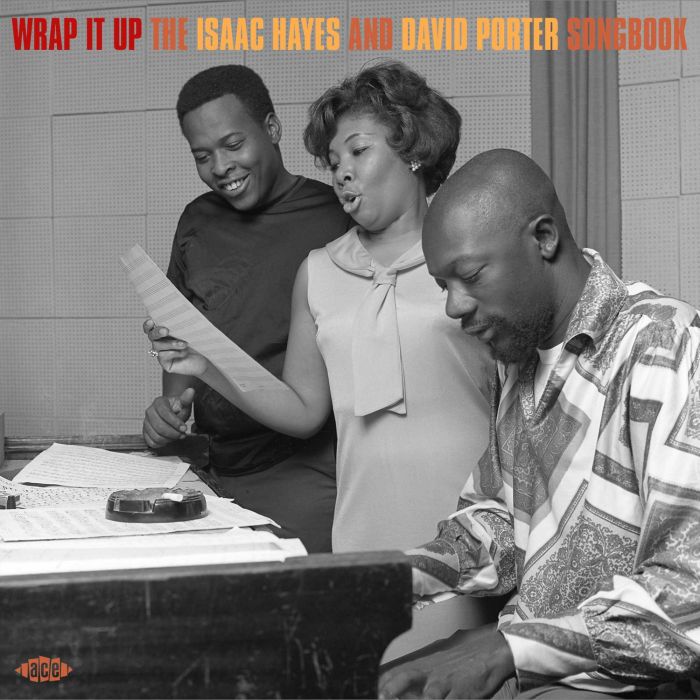
TRIP ON ME-SOFT PSYCH AND SUNSHINE (1966-1969).
Trip On Me-Soft Psych and Sunshine (1966-1969).
Label: Big Beat Records.
Format: CD.
Release Date: 30th September 2022.
The perfect soundtrack to a long hot summer is Trip On Me-Soft Psych and Sunshine (1966-1969). It’s a lovingly curated collection of late-sixtes California sunshine pop and psych nuggets from the vaults of various independent labels and production houses.
This new compilation from Big Beat Records, an imprint of Ace Records, features twenty-four pop tracks. They’re an eclectic selection of songs that were recorded in LA and San Francisco between 1966 and 1969. Some were recorded for labels like Mira and Era, while others showcase the talents of pioneering producers including Gary S. Paxton and SF’s Trident Productions.
Among this veritable feast of sunshine pop and trippy soft psych are contributions by JP Rags, The Pretty People and A Thousand Faces. Then there’s sunshine pop favourites from The Forum, Primrose Circus and Filipino female quintet The Third Wave, who contribute two of their early rare recordings. On several songs legendary producer legendary Curt Boettcher adds backing vocals. That’s not all. There’s also album tracks, hidden gems and obscurities aplenty on Trip On Me-Soft Psych and Sunshine (1966-1969). It’s a captivating compilation.
Opening the compilation is Soul Sunrise a collectible obscurity by JP Rags. This fusion of folk and psych is taken from the group’s 1968 album Scruffety on World Pacific Records and was produced by Larry Goldberg and Doug Cox. Sadly, the album wasn’t a commercial success but nowadays is much-prized by collectors.
Originally, The Forum started life as a folk ensemble. However, by the time they recorded Trip On Me for Mira in 1967 they had reinvented themselves as a sunshine pop group. This single is regarded as the group’s finest moment, and nowadays, is a favourite by connoisseurs of the genre.
A much-prized album is The Pretty People’s 1969 eponymous debut album on Crestview Records. One of the highlights of the album is Going To San Diego where harmony pop and psych seamlessly melt into one.
Curt Boettcher produced The Candy Company’s 1966 single for ABC, The Happies. The single was recorded at Gary S. Paxton’s Homewood Studio and featured a stellar cast of session players. Tucked away on the B-Side was the Sugar Stone which was penned by Gordon Hayes and Doug Rothwell. The group chant their way through this hooky, lysergic hidden gem which is a welcome addition to the compilation.
The Primrose Circus were from Houston, Texas but spent some time in San Francisco where they recorded the single PS Call Me Lulu for Mira in 1967. Dramatic describes this single which was produced by Don Altfeld and features the group at the peak of their powers.
One of the previously unreleased track is Meadows and Flowers by Curt Boettcher who, at the time, was making a name as a producer. However, it was Gary S. Paxton who takes charge of production duties on this dreamy and trippy mixture of sunshine pop and psych.
Originally, The High started life as The Echoes in 1966. In August 1968, the group recorded The Beatles’ influenced Roamin’ which was produced by Leo Kulka. Sadly, the song was never released and like Meadows and Flowers, makes a welcome if belated debut on Trip On Me-Soft Psych and Sunshine (1966-1969).
The second contribution from The Forum is Go To Try And Put Out The Sun. It was released on Mira in 1968 and is quite different to their previous singles. It’s a catchy and memorable slice of sunshine pop that shows a different side to the group.
The origins of Evergreen Tangerine can be traced to the Bay Area folk scene which Tom and Carolee Gillespie were part of. Back then, they were better known as Tom and Carol. However, by 1968 they had reinvented themselves and recorded a cover of Richard And Me with producer Leo Kulka. This song is perfectly suited to the female lead vocal which is heartfelt, emotive and dramatic. Sadly, the song which could’ve transformed the group’s fortunes was never released. It makes its debut on the compilation and is one of the highlights.
One of the last singles released on Mira in 1968 was Little Balloon Lady by The Gallery. Sadly, this The Beach Boys infused single failed to make any impression on the charts. Nowadays the single is regarded as an oft-overlooked hidden gem from the label’s vaults.
It’s A Groovy World was released by The Lollipop Fantasy on Era in 1967. It’s catchy and long on hooks as sunshine pop and psych unite and become one.
Closing Trip On Me-Soft Psych and Sunshine (1966-1969) is Until Now by Augie Moreno which was released on the Mammor label in 1968. It was arranged and produced by Gary S. Paxton and Ben Benay. Their arrangement features horns and a sitar which compliment the impassioned vocal on this paean. Although quite different to other tracks it’s the perfect way to close the compilation.
Trip On Me-Soft Psych and Sunshine (1966-1969) is a lovingly curated compilation. It features a mixture of singles, B-Sides, unreleased tracks, hidden gems and oft-overlooked obscurities. These come courtesy of familiar faces and new names that were recorded in LA and San Francisco between 1966 and 1969. It’s quality all the way on Trip On Me-Soft Psych and Sunshine (1966-1969). This compilation of sunshine pop and psych nuggets is a veritable musical feast one that anyone interested in either genre will enjoy and want to add to their collection.
Trip On Me-Soft Psych and Sunshine (1966-1969).
LOOK BUT DON’T TOUCH! GIRL GROUP SOUNDS USA 1962-1966.
Look But Don’t Touch! Girl Group Sounds USA 1962-1966.
Label: Ace Records.
Format: LP.
Ever since the eighties, Ace Records has been the go-to label for girl group compilations. Since then, they’ve released ten volumes of their critically acclaimed Where The Girls Are as well as the Girls About Town and Stop, Look and Listen compilation series. Add to this various standalone collections on CD and the most recent addition to the Ace Records’ girl group family, the Girl Group Sounds USA series.
Recenly, Look But Don’t Touch! Girl Group Sounds USA 1962-1966 was released. This much-anticipated compilation is the fourth instalment in the series. Just like previous instalments in this successful compilation series it’s been released on vinyl. This has been the choice of discerning record collectors for the last few years. What better way to listen to a collection of tracks from the golden age of girl groups. Putting on the compilation is akin to musical time travel, and instantly, the listener is transported to another time and place when music sound very different and many people would say much better. Picking a few highlights from this lovingly compiled compilation isn’t going to be easy. However, here goes
Side One.
One of the familiar faces opens the compilation. This is The Shirelles who are best remembered for their girl group classic Will You Still Love Me Tomorrow. Their contribution on Look But Don’t Touch! Girl Group Sounds USA 1962-1966 USA is Hey Rocky. This catchy and soulful sounding uptempo song was originally recorded when the group was signed to Scepter but never released. It made a belated and welcome debut on the Lost and Found collection which was released by Ace Records’ imprint Impact in 1987. Twenty-five years later and it returns for a well deserved and belated encore.
Nobody Loves Me was the first of six singles The Ikettes released on Modern Records. The group’s debut for their new label was released in 1964 and showcases the combined talents of Robbie Montgomery, Jesse Smith and Venetta Fields. Sadly, the single wasn’t a commercial success, and is best describe as girl group hidden gem. It’s also a reminder of what was a truly talented lineup of this group, who later, became The Mirettes.
LA- based group The Delicates were signed various labels between 1963 and 1969. This includes the Challenge label where they recorded the Keith Colley and Nancy Mantz composition Dumb Song. Sadly, the this soulful tale of young love which says sashays along was never released. However, it makes a welcome debut on Look But Don’t Touch! Girl Group Sounds USA 1962-1966 and is a real find.
Singer and songwriter Linda Laurie wrote the song Chico with Bert Sterns whose label Keetch she was signed to. He also produced her 1964 single Jose He Say. Tucked away on the B-Side was Chico a heady brew of girl group, pop, R&B and Latin influences.
Tossin’ A Ice Cube was released by The Hollywood Chicks in 1962, and is one of the many dance craze records that were released over the next few years. This one was a commercial success, and also marks the recording debut of the legendary soul man Barry White who contributes handclaps on the track.
Side Two.
Larry Weiss produced the two singles that The Carolines released between 1966 and 1968. Many people thought was the only tracks the group recorded. However, that wasn’t the case. They recored Baby That’s Me with producer Larry Weiss which was never released until it was released on an EP in 2018 by Ace Records. It’s so good it returns for a well deserved encore on Look But Don’t Touch! Girl Group Sounds USA 1962-1966. Take a bow The Carolines with their version of this Jackie DeShannon and Jack Nitzsche song.
Sweet Kind Of Loneliness by The Darlettes was produced by Van McCoy and released on Mira in 1965. It features a beautiful, emotive vocal that’s wistful and tinged with sadness and later, longing. It’s a roller coaster of emotions on this cinematic relationship song that’s one of the highlights of the compilation.
Carol Slade’s career began in the late-fifties when she was a member of The Gospelaires which also included sisters Dee Dee and Dionne Warwick. However, when not singing gospel, the talented singer worked as a backing vocalist with Judy Clay and Cissy Houston on records by some of the biggest names of the day including The Drifters, Garnet Mimms and Solomon Burke. After a successful solo career as a gospel singer Carol Slade crossed over. This she hoped would be a new and successful cheaper in her career. Sadly, she released just five singles including the Van McCoy penned I Wanna Know Right Now on Domino in 1963. It features a heartachingly beautiful and emotive vocal that’s tinged with uncertainty. Complimenting the vocal are lush sweeping strings and cooing harmonies. They play their part in what’s the finest single of a career that should’ve lasted longer and resulted in more success.
Closing Look But Don’t Touch! Girl Group Sounds USA 1962-1966 is Chu Sen Ling by The Bermudas. It was the B-Side of Donnie, which was the group’s first single for Era in 1964. It’s a reminder of the early sixtes West Coast sound which is still popular and remembered fondly today.
For anyone who has enjoyed the Where The Girls Are as well as the Girls About Town and Stop, Look and Listen compilations the Girl Group Sounds USA is another must have series.
This includes the latest instalment in the series, Look But Don’t Touch! Girl Group Sounds USA 1962-1966. It was recently released on vinyl which is the perfect way to enjoy this eclectic selection of fourteen songs. It’s girl group goodness all the way on Look But Don’t Touch! Girl Group Sounds USA 1962-1966 which features singles, B-Sides, oft-overlooked hidden gems and previously unreleased tracks which make a welcome debut on this loving curated compilation from Ace Records.
Look But Don’t Touch! Girl Group Sounds USA 1962-1966. 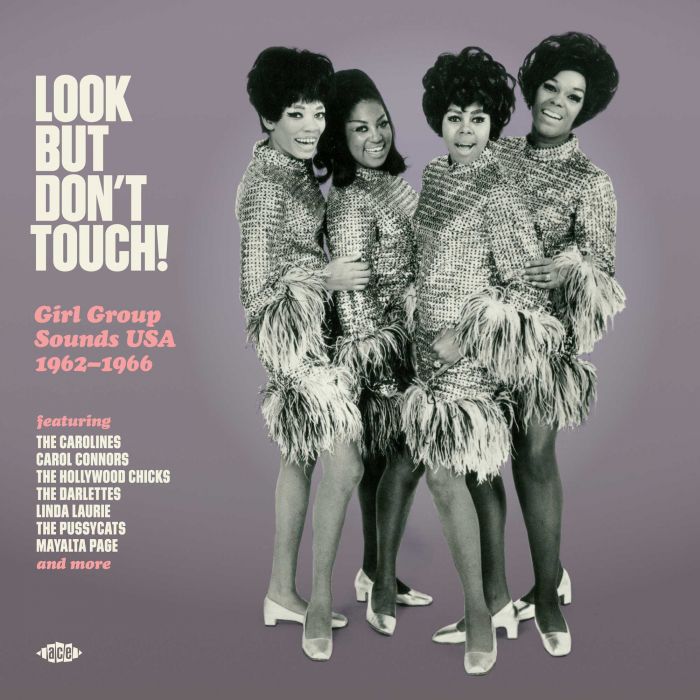
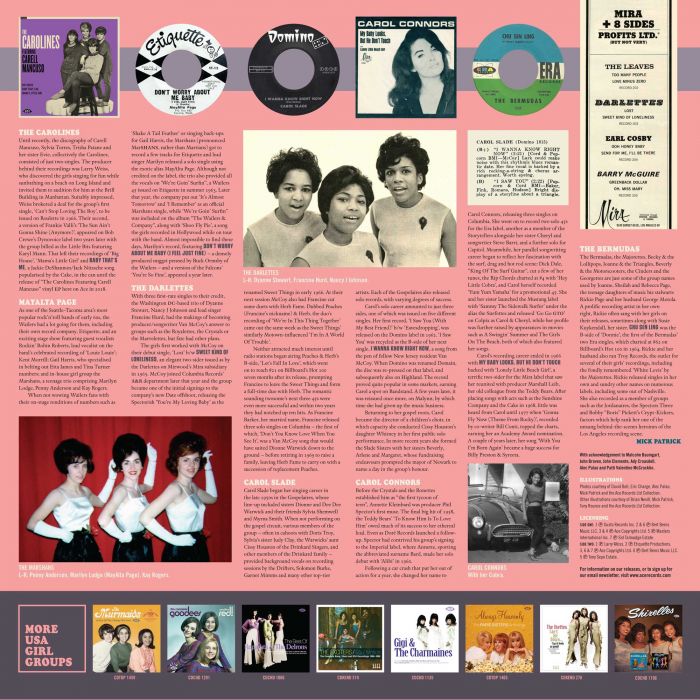
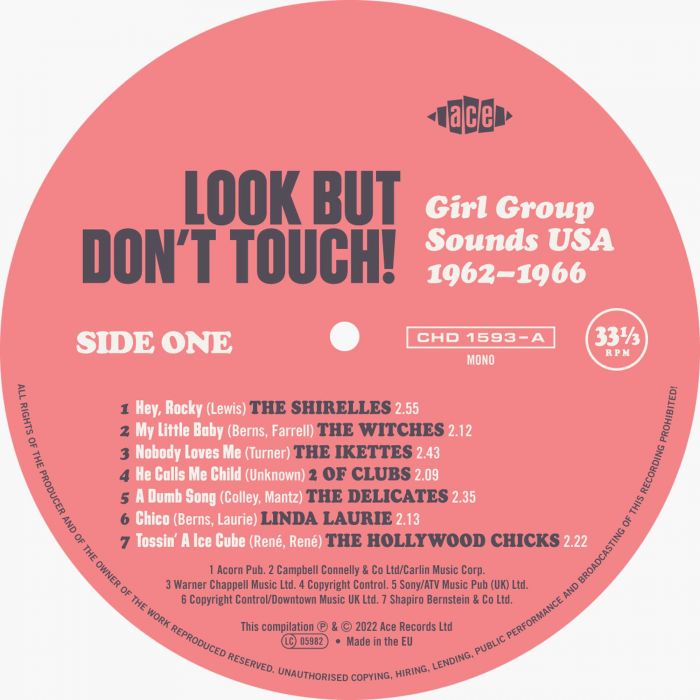
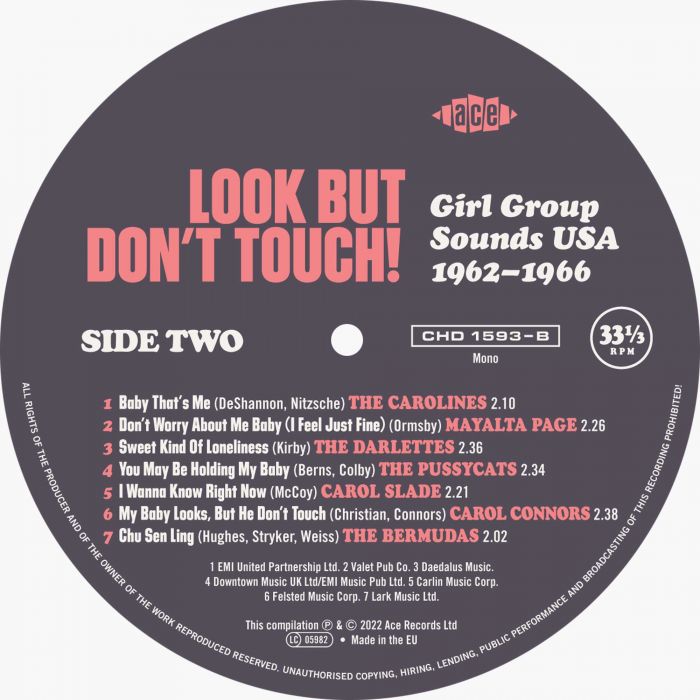
GIRLS WITH GUITARS GONNA SHAKE!
Girls With Guitars Gonna Shake!
Ace Records.
Format: CD.
There are very few compilation series that are still going strong after thirty-three years. Often, by then, the compiler has run out of material or musical tastes have changed. However, some compilation series survive changing musical tastes and prosper. That’s the case with Ace Records’ long-running and successful series.
Incredibly, Ace Records Girls With Guitars compilation series is still going strong after thirty-three years and recently, the seventh instalment hit the shops. This is Girls With Guitars Gonna Shake!
This new compilation features twenty-five tracks from the golden age of girl groups and she pop. This golden age began around 1964 and continued right through to the dawn of the seventies. However, the tracks on Girls With Guitars Gonna Shake! were recorded between 1960 and 1969. Sadly, a number of tracks weren’t released until much later, and three make their debut on Girls With Guitars Gonna Shake!
The Belles were formed by guitarist Debbie Weaver, who formed the group in South Florida when she was just fourteen. In 1966, the group signed to the Tiara label and released a feminised remake of Them’s Gloria which was retitled Melvin. In an instant, this familiar Van Morrison composition is transformed and the track is reinvented. Tucked away on the B-Side is Come Back. With its lo-fi arrangement and an emotive vocal it’s a welcome addition to the compilation, and showcases this talented group whose career was sadly, short-lived
In 1963, in Blackpool, Lancashire, bassist Pauline Moran, drummer Janet Baily and guitarist Andrea Tune formed The Missfits. The three teenage friends advertised for a rhythm guitarist and fourteen year old Carola Daish applied and completed the lineup. A year later, in April 1964, the nascent group entered and won a talent competition at Pontins’ Squires Gate holiday camp. The prize was to record a single in a London studio. Three covers were chosen John Lee Hooker’s Dimples, the Willie Dixon composition You Can’t Judge A Book By The Cover and Chuck Berry’s I’m Talking About You. Sadly, the tracks were never released and the group split-up in 1965. Now fifty-eight years after they were recorded, this triumvirate of girl group gold makes a belated and welcome debut on Girls With Guitars Gonna Shake! They’re a reminder of a truly talented girl group who could’ve and should’ve gone on to greater heights.
In 1965, the second lineup of Goldie and The Gingerbreads covered Ray Charles’ What Kind Of Man Are You. It was produced by Shel Talmy and released on the Atco label. This cover version is a slow, moody and mesmeric mix of blues and R&B that without doubt, is one of the highlights of the compilation.
Previously, the five members of The Beat-Chics had been members of the prestigious Ivy Benson Band, This new group was a new chapter in their career. In late 1964, they released a cover of Bill Haley and The Comets’ Skinny Minnie. A familiar track is reimagined and reinvented and taken in a new direction. On the B-Side was Now I Know the urgent and driving mix of girl pop and R&B which has stood the test of time.
When Joyce Harris recorded a blistering version of I Got My Mojo Working in 1960, she was backed by the Texas bar band The Daylighters. The track for Domino was never released until 1998. That was when I Got My Mojo Working by Joyce Harris and The Daylighters made its debut, on the Ace Records’ compilation The Domino Records Story.
Sandra Barry and The Boys released Really Gonna Shake on Decca in 1964. By then, the singer was a familiar face in the London club scene, where she was usually backed by The Jet Blacks, a group which featured John Paul Jones. However, this memorable slice of girl group pop from its golden era is one of the highlights of Sandra Barry’s career.
The legendary Bob Shad produced The Wrongh Black Bag’s cover of the Al Kooper’s Wake Me, Shake Me. It was released as a single on the Mainstream label in 1968. It’s a driving, fusion of garage rock and psychedelia that features a powerhouse of a vocal from Chris Bernardoni who struts and swaggers her way through the song oozing sass.
Closing the compilation is Stardust Come Back by Girls Take Over. It was the B-Side of their 1969 single Hi Heel Sneakers which was released on Pentagon. However, as is often the case, the flip-side is vastly underrated and this heartachingly beautiful ballad brings Girls With Guitars Gonna Shake! to a poignant close.
It’s now thirty-three years since the release of the first instalment in Ace Records Girls With Guitar compilation series. Recently they released the seventh volume in this long-running and successful series. This was Girls With Guitars Gonna Shake! which has been released on CD. It’s a welcome addition to the series. The reason for this is simple, the quality of music
Rather than making the Girls With Guitar series an annual occurrence, Ace Records have decided to concentrate on quality rather than quantity. It’s two years since the previous volume in the Girls With Guitars Take Over! series was released.
Just like previous instalments in the series Girls With Guitars Gonna Shake! doesn’t disappoint. No wonder. It features twenty-five songs from the golden age of the girl group and she pop. There’s familiar faces, new names and a sprinkling of hidden gems on Girls With Guitars Gonna Shake!which is a welcome addition to this long-running and critically acclaimed compilation series.
Girls With Guitars Gonna Shake!



CLOWNS EXIT LAUGHING-THE JIMMY WEBB SONGBOOK.
Clowns Exit Laughing-The Jimmy Webb Songbook.
Label: Ace Records.
Format: CD.
Although singer-songwriter Jimmy Webb was born in Elk City, Oklahoma, on August the ’15th’ 1946, he grew up in Laverne, Oklahoma. His father, a US Marine Corps veteran, was now a baptist minister, who ran and preached in churches in rural southwestern Oklahoma and west Texas. The Webb’s were a family a religiously conservative family. However, the church was where Jimmy Webb’s musical talents first came to prominence.
His mother had encouraged her son to learn to play the piano and organ. Jimmy Webb was a naturally talented and gifted musician.
By the age of twelve Jimmy Webb was good enough to accompany the choir on the organ at his father’s church Each Sunday,his mother played accordion and his father the guitar during worship. The Webb family were all musical. Despite this, strict restrictions were placed on the music that Jimmy Webb could listen to.
His father only allowed him to listen to white gospel and country music on the radio. Meanwhile, Jimmy Webb’s musical creativity was burgeoning.
The more he practised the better Jimmy Webb got. By the late-fifties, he was still playing at his father’s church. However, he was already rearranging hymns, improvising and breathing new life into them. He even wrote some new religious songs. However, already the aspiring songwriter was changing direction because of the music he was hearing on the radio.
A big influence was Elvis Presley who he had heard in the radio. However, the first record that fourteen year old Jimmy Webb bought in 1961 was Turn Around, Look At Me by Glen Campbell. It was the singer’s distinctive voice that the young songwriter was drawn to. This was fate.
Just six years later, on October ‘23rd’ 1967, Glen Campbell released By the Time I Get to Phoenix, which was written by Jimmy Webb. It was one of the singer’s most successful singles and this future classic won two Grammy Awards. That was still to come.
In 1964, the Webb family moved to from Oklahoma to Southern California. Jimmy Webb enrolled at San Bernardino Valley College where he studied music. However, in 1965 tragedy struck for the Webb family.
After Jimmy Webb’s mother passed away in 1965, his father started making plans to return to Oklahoma. His son decided to stay in LA and continue to pursue his career as a songwriter. As his father, Robert was about to leave Southern California he warned his son: “This songwriting thing is going to break your heart.” Seeing that his Jimmy Webb was determined to make a success of his chosen career, he handed his son $40, saying: “It’s not much, but it’s all I have.”
Jimmy Webb’s breakthrough came when he was hired to transcribe other people’s music for a small music publisher in Hollywood. This was just the start.
Like so many aspiring songwriters Jimmy Webb went in search of a songwriting contract. After several rejections he made his way to Jobete Music, the publishing arm of Motown, in LA, where he had a meeting with Frank Wilson and Marc Garden.
Fortunately, Frank Wilson who spotted Jimmy Webb’s potential and offered him a songwriting contract.
In 1965, The Supremes recorded My Christmas Tree for their 1965 album, Merry Christmas. This was the first time that a Jimmy Webb song had been recorded. Despite this, his time at Jobete was short-lived. However, it wouldn’t be long before Jimmy Webb made a name for himself as a songwriter.
After leaving Jobete Music, he moved to the Audio Arts company where he over the next few years, Jimmy Webb wrote several of the songs that established his reputation as a musical master craftsman.
Meanwhile, Marc Gordon joined forces with singer Johnny Rivers to setup Music City Records. They needed singers and songwriters. That was when Marc Gordon remembered Jimmy Webb.
They went in search of the young songwriter and having found him, and listened to the new songs that he had written, realised that he was a truly talented songwriter. Jimmy Webb signed to Music City Records, and the next chapter in what would be a long and illustrious career began.
It’s documented on Clowns Exit Laughing-The Jimmy Webb Songbook, which was recently released by Ace Records. It’s the latest addition to the label’s long-running and critically acclaimed Songwriter Series. It features classics, singles, album tracks and hidden gems penned by one of the greatest songwriters of his generation.
Opening Clowns Exit Laughing-The Jimmy Webb Songbook is the cinematic opus By The Time I Get To Phoenix by Glen Campbell. It was the title-track to the 1967 album released on Capitol. When it was released as a single it reached just twenty-six on the US Billboard 100. It’s one of the songs that Marc Gordon and Johnny Rivers bought the publishing rights to. Later, Frank Sinatra called this classic: “the greatest torch song ever written.” That’s very true, and the perfect way to open the compilation.
Although Sunshine Company originally recorded Up, Up and Away, it gave 5th Dimension a number seven hit in 1967. A year later, in 1968, it was covered by Dionne Warwick for her Valley Of The Dolls which was released by Scepter. The song was produced by Hal David and Burt Bacharach and Hal David. Their carefully crafted multilayer production includes lush, meandering strings, subtle bursts of horns that provide the perfect accompaniment to a vocal that’s best described as tender and benefits from an intimacy and is beautiful.
The Latin-tinged Carpet Man was the third single that Jimmy Webb wrote for 5th Dimension. It reached twenty-nine on the US Billboard in 1968. Later that year, the song was covered by The Nocturnes, a Manchester-based group. Sadly, the single wasn’t a hit and remains a hidden gem. from a group who went on to release two further albums before splitting-up in 1969 after five years making music together.
Jimmy Webb penned Honey Come Back while he was a songwriter at Jobete Music, Motown’s publishing company. In 1967, soul man Chuck Jackson covered the song. It featured on his Goin’ Back to Chuck Jackson and features a needy, impassioned, pleading vocal.
The Moon’s A Harsh Mistress was recorded by The Walker Brothers in 1975, but wasn’t released until 2001 when it featured on the If You Could Hear Me Now compilation. It’s a tender and deeply moving rendition of a this Jimmy Webb song.
Tony Joe White’s cover of Wichita Lineman featured on his album Black and White, which was released on Monument, in 1968. It’s quite different to Glen Campbell’s version which was released the same year and nowadays, is regarded as a classic. Strings are also deployed on this version which benefits from a lived-in vocal that sounds as if it’s live the lyrics. Despite that, there’s a tenderness and warmth to the vocal, that’s a reminder of a truly underrated singer.
Since James Darren first recorded Didn’t We for Warner Bros in 1967, over 150 artists have recorded the song. This version is slightly quicker than future covers. There’s a sense of melancholia as the lyrics are delivered by the former teenage star who was no longer as popular as he had once been. It was the one that got away, but is a welcome addition to the compilation.
In 1972 The Supremes released their Produced and Arranged By Jimmy Webb on Motown. One of the highlights was I Keep It Hid, a beautiful song which showcases the combined talents of this latest lineup of the group.
When Johnny Rivers originally recorded Do What You Gotta Do for his album Rewind in 1967, it was a powerful and heartfelt reading of the song. A year later in 1968, Nina Simone covered the song for her album Nuff Said. It was released as a single but stalled at eighty-three in the US Billboard 100. This beautiful, soul-baring rendition breathes life and meaning into Jimmy Webb’s lyrics.
By 1699, B.J. Thomas was signed to the Scepter label. For his album Young and In Love he covered The Worst That Could Happen. He tries to exercise restraint upon receiving unwelcome news from a former girlfriend but still his vocal is tinged with emotion, sadness and regret.
P.F. Sloan was a tribute to Jimmy Webb’s fellow songwriter. He recorded the song o his album Words and Music, which was was released on Reprise in 1970. In 2012, Rumer covered the tribute to the songwriter for her 2012 album Boys Don’t Cry. It features a spartan country-tinged arrangement and a quite beautiful, rueful, tender vocal.
Closing Clowns Exit Laughing-The Jimmy Webb Songbook is If This Was The Last Song by Dee Dee Warwick With The Dixie Flyers. It featured on the album Turning Around which was released on Atco in 1970. The album was produced by Dave Crawford. Sadly, the album wasn’t a commercial success but is a reminder of the genius of songwriter Jimmy Webb.
On August the ’15th’ 2022 Jimmy Webb celebrated his seventy-eighth birthday. He followed his dream and has spent a lifetime as songwriter and recording artist.
Since his official debut album Words and Music in 1970, Jimmy Webb has released albums to plaudits and praise. They may not have have been huge commercial successes but showcase a truly talented singer and songwriter who nowadays, is regarded as one of the greatest songwriters of his generation.
Jimmy Webb has written countless classics and songs that nowadays, are regarded as standards. These songs have been recorded by the great and good of music, and are still heard on radio all over the world. Many of these songs are cinematic, painting evocative pictures that the vocalist brings to life. This includes many of songs on Clowns Exit Laughing-The Jimmy Webb Songbook. It features twenty-four tracks that are a tantalising taste of one of the twentieth century’s greatest songwriters and a musical master craftsman at the peak of his considrable powers.
Clowns Exit Laughing-The Jimmy Webb Songbook.
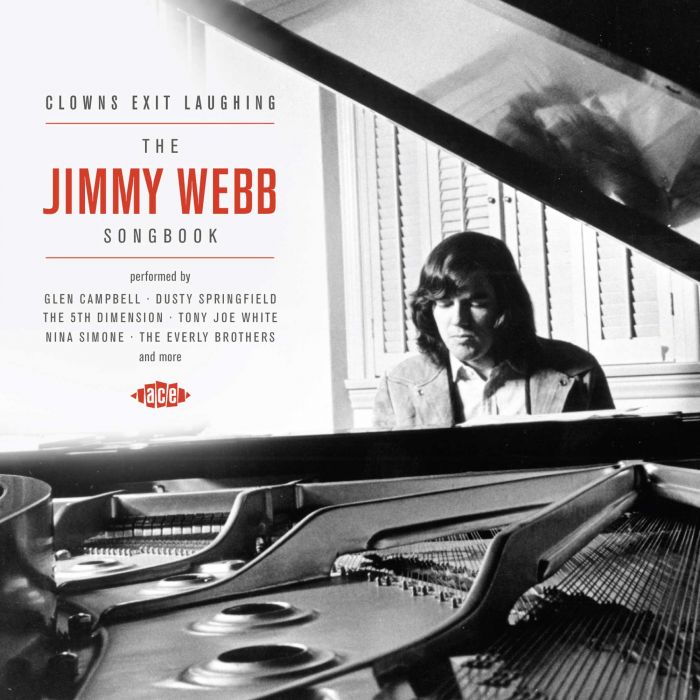

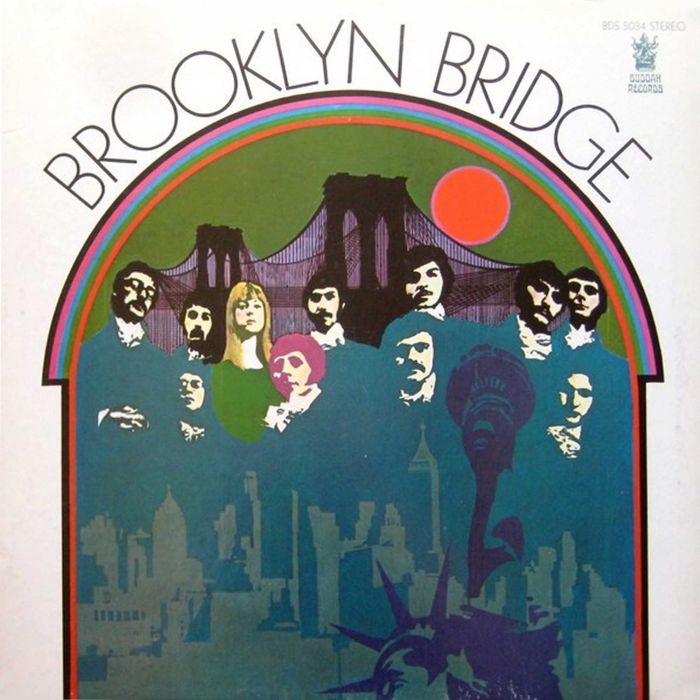
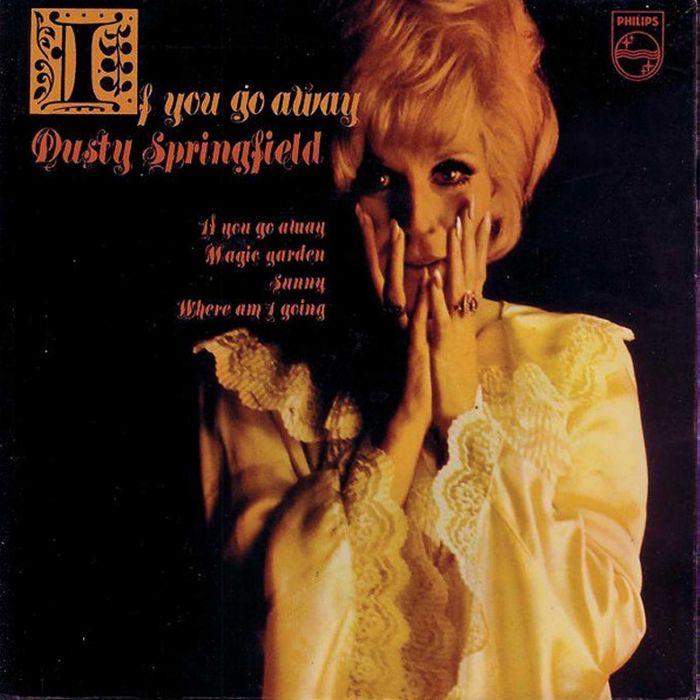

LEON THOMAS-BLUES AND THE SOULFUL TRUTH.
Leon Thomas-Blues and The Soulful Truth.
Label: BGP.
Format: LP.
Release Date: 26th August 2022.
Some labels prove to be the perfect fit for an artist, and this was the case when Leon Thomas signed to Bob Thiele’s Flying Dutchman Productions.
By the late sixties, Leon Thomas had embraced free jazz fully. He turned his back on the blues and his vocal style was totally transformed. His vocal encompassed Afrobeat, blues, jazz R&B and soul as he scatted and yodeled. It was a vocal style that was truly unique. Many people within the music industry didn’t understand what Leon Thomas was doing but Bob Thiele at Flying Dutchman Productions did.
During his career, Bob Thiele had worked with some of the most innovative and creative musicians in the history of jazz. He realised that often, large record companies aren’t the best environment for innovative and creative musicians. Often, these musical mavericks didn’t thrive within such an orthodox environment. Their creativity is restricted, meaning they’re unable to experiment and innovate like they would like.
Having left Impulse following the musical equivalent of a musical coup d’etat, Bob Thiele founded Flying Dutchman Productions. His new label would be the perfect environment for musical mavericks to thrive. He signed some of the most innovative jazz musicians of the late-sixties and early seventies. Among them weer Ornette Coleman, Gil Scott Heron, Eddie “Cleanhead” Vinson, Louis Armstrong and Lonnie Liston Smith and His Cosmic Echoes. Another artist signed to Flying was Leon Thomas.
Leon Thomas released a quartet of albums between 1969 and 1973. His Flying Dutchman debut was 1969s Spirits Known And Unknown. The following year, he released his sophomore album The Leon Thomas Album in 1970. Flying Dutchman was the perfect label for Leon Thomas. It was as if having found a label that understood him. He was allowed to unleash his creativity, and with each album, pushed musical boundaries even further. That was the case on his third album, Blues And The Soulful Truth which will be reissued on LP by BGP on the 26th August 2022.
By Blues And The Soulful Truth release in 1972, Bob Thiele’s latest signing had come a long way since he first heard Miles Davis back in St. Louis.
Leon Thomas was born in East St. Louis, Illinois, in October 1937. From an early age, his life revolved around music. His parents were avid music lovers and his hometown had a thriving musical scene. Inspired by a blues’ shouters like Big Joe Turner, was a familiar face on the local music circuit. Then when Miles Davis came to town, it was akin to a musical awakening
The night Miles Davis played St. Louis his band featured John Coltrane. That night, they embraced improvisation and pushed musical boundaries to their extremes. For Leon Thomas, this showed him what was possible musically. Here was musical that was inventive, innovative and influential. So much so, that it inspired Leon Thomas to study musical at Tennessee State University.
Having left Tennessee State University, Leon Thomas became a familiar face on the jazz circuit. Having signed to RCA in 1958, he recorded what should’ve been his debut album. Sadly, it wasn’t released and this was a huge disappointment.
By the early sixties, Leon Thomas was the vocalist with Count Basie’s band. This continued right through until the mid-sixties. During that time, his style is best described as traditional blues. However, his style changed when he headed to Los Angeles.
It was is Los Angeles that Leon Thomas embraced free jazz. Already an admirer of improvisation within jazz, free jazz took things further. Even better, Leon Thomas met musicians who not only shared similar musical philosophies, but political and social values.
This included saxophonist Arthur Blythe, drummer Leroy Brooks and pianist Horace Tapscott. Together, they were the Underground Musicians and Artists Associations. Meeting these three musicians, resulted in Leon Thomas finding his real voice. With their help, his voice became like an instrument. He fused musical influences, with blues, jazz and Afro-beat combining with soul, as his vocal veered between a scat and a yodel. This was unique, avant garde and groundbreaking. Leon Thomas was a pioneer, as he headed to New York looking for fellow travellers.
By 1967, Leon Thomas had met saxophonist Pharoah Sanders. This was a perfect match for Leon. Here were two groundbreaking musicians. In Pharoah Sanders’ hands, the saxophone was transformed. He had been a member of John Coltrane’s band until the legendary saxophonist’s death in 1967.
After that, he formed his own band comprising Leon Thomas, pianist Lonnie Liston Smith and Pharoah Sanders. This band of musical pioneers recorded Pharoah Sanders 1969 album Karma, which was released on Impulse. It featured The Creator Has A Master Plan which showcased Leon Thomas’ unique vocal style. A compelling, spiritual track where he yodels and scats his way through the track, it was truly groundbreaking.
One man who realised Leon Thomas’ potential was Bob Thiele, founder of Flying Dutchman Productions.Having heard the vocalist feature on Pharoah Sanders’ album Karma ,he signed Leon Thomas to Flying Dutchman Productions.
His Flying Dutchman Productions’ debut was 1969s Spirits Known and Unknown. It was an ambitious and groundbreaking album that showcased Leon Thomas’ unique vocal style. Plaudits and praise accompanied the release of the album. Sadly, it wasn’t a commercial success. However, Spirits Known and Unknown was only Leon Thomas’ debut album.
A year later, he returned with The Leon Thomas Album. Released in 1970, as the new decade dawned, it was hailed as innovative and ambitious. Critics realised that here was an artist who was determined to move jazz in a new direction. Standing still wasn’t an option, and this was admirable. However, the album didn’t sell well. It was an age old problem. Here was an artist that was way ahead of the musical curve. Would his third album Blues And The Soulful Truth see him make a breakthrough when it was released in 1972?
For his third album, Blues And The Soulful Truth, Leon Thomas wrote Love Each Other and L-O-V-E. He also arranged the traditional song C.C. Rider; cowrote Shape Your Mind To Die with Neal Creque and Let’s Go Down To Lucy’s with Alfred Ellis. He and Leon Thomas cowrote China Doll with Jesse Kilpatrick. Other tracks included covers of Gabor Szabo and George David Weiss’ Gypsy Queen and John Lee Hooker’s Boom-Boom-Boom. These eight tracks became Blues And The Soulful Truth.
When recording of Blues And The Soulful Truth began, Pee Wee Ellis had been drafted in to arrange and conduct the band. He also played piano and tenor saxophone. Different lineups played on different tracks. So the rhythm section included variously drummers Bernard Purdie, Jesse Kilpatrick and Airto Moreira, bassists Stanley Clarke, Donald Pate and Gordon Edwards, plus guitarists Cornell Dupree and Larry Cornell They were joined by pianist Neal Creque, percussionist Baba Feme and Gene Golden on congas. Horns came courtesy of trumpeter Dick Griffin, trombonist John Eckert and baritone saxophonist Cecil Payne. Leon Thomas sang the vocals and played percussion on Blues And The Soulful Truth.
When Blues And The Soulful Truth was released in 1972 it marked a change in direction from Leon Thomas. Critics called it the most accessible album he had released. The addition of Pee Wee Ellis had played an important part in this. He realised the importance of choosing the right tracks for the album. The eight tracks allowed a pioneering vocalist to shine. They also allowed what’s a hugely talented band to showcase their considerable talents and sometimes, stretch their legs musically. The result was one of the most exciting and exhilarating vocal jazz albums of the early seventies.
Despite this, Blues And The Soulful Truth passed record buyers by. However since then, a new generation of music lovers have discovered the album.
Side One.
Let’s Go Down To Lucy’s opens Blues And The Soulful Truth. From the get-go the listener is hooked as chiming guitars, growling horns and a funky rhythm section join forces with meandering keyboard. It’s powerful, sassy, lived-in. Meanwhile, the rhythm section provide the funky, pulsating heartbeat as bursts of blazing horns punctuate the arrangement. Leon Thomas vamps his way through the lyrics. He vamps and jive-talks his way through the track combining jazz and soul with power, sass and humour.
Finger clicks, percussion and a meandering piano create the groove to L-O-V-E. Soon, the bass, hissing hi-hats and soaring, soulful harmonies sweep in. That’s Leon Thomas’ signal to kick loose as crystalline guitar licks, grizzled free jazz horns and a hypnotic bass combine. By now, he’s singing call and response with the backing vocalists. He seems to be drawing inspiration from Isaac Hayes on this gloriously soulful, funky track.
Straight away, Gypsy Queen sees Leon Thomas return to the more familiar sound of his two previous albums. Keyboards flit across the arrangement, while the arrangement create a shuffling, spacious beat. A tender scatted vocal is joined by rasping horns enter. Then the vocal grows in power. It sometimes sounds like Terry Callier and is heartfelt, impassioned and like the arrangement, grows in power. Meanwhile elements of jazz, funk and soul are combined as the vocal veers between a scat and a yodel. This is very different from the previous tracks. Especially it’s transformed into a free jazz powerhouse. The song is transformed and becomes something very different to the song Santana popularised on Abraxas. It’s reinvented and transformed into something that writers Gabor Szabo and George David Weiss never envisaged.
Side Two.
Love Each Other has a funky, jazz-tinged and soulful sound. The rhythm section, electric piano and harmonies accompany Leon Thomas’ impassioned, joyous vocal. Horns rasp and growl punctuating the arrangement. The rhythm section lock into a groove and with the electric piano create the perfect backdrop for a heartfelt, impassioned and soulful vocal tour de force.
Shape Your Mind To Die has an Eastern sound. That comes courtesy of the horns. They’re joined by percussion and the rhythm section. Just like the previous track the bass line is at the heart of the arrangement. Leon Thomas’ vocal is deliberate and dramatic. The lyrics are cerebral and full of social comment. Midway through the track he unleashes a haunting laugh. That’s the signal for the band to stretch their legs. They don’t need to be asked twice, and combine everything from funk, jazz, psychedelia and rock. When the vocal returns it breathes life and meaning into the lyrics on a tracks which is spiritual jazz at its finest.
Most people will know John Lee Hooker’s Boom-Boom-Boom. It’s a familiar blues track. However, Leon Thomas transforms the track. In his hands, the song swings. Driven along by the piano rhythm section and crystalline, rocky guitar he combines jazz, blues and rock. A scratchy fiddle and Hammond organ are added. By now, an old blues track has been transformed and swings.
China Doll marks another change of direction from Leon Thomas. Flourishes of piano join percussion, cymbals and finger clicks. He adds a scatted vocal and gradually, the arrangement shows its hidden secrets. A wistful piano, meandering bass and myriad of percussion combine. They create the backdrop to a needy, sassy vocal. Harmonies coo while the piano meanders and percussion is sprinkled across the understated arrangement. When all this is combined, the result is a track that’s soulful, sassy and jazz-tinged. It also showcases versatile vocalist and talented storyteller who can bring lyrics to life.
The familiar sound of C.C. Rider closes Blues and The Soulful Truth. Growling horns, jazzy piano and the rhythm section combine blues, funk and jazz. They’re joined by a glistening guitar and scratchy fiddle. Together, they set the scene for a heartbroken vocal. It’s a mixture of power, frustration and despair. Then when his vocal drops out, the band take centre-stage. They enjoy the opportunity to kick loose. A glorious rocky guitar solo steals the show. Then an atmospheric Hammond organ picks up the baton it unleashes flourishes of jazz-tinged, funky and dramatic music. Stabs of piano, rocky guitar and scratchy fiddle compete for the listener’s attention as the all-star band grandstand. However, with a minute to go, a heartbroken, dramatic and impassioned vocal powerhouse takes centrestage and provides a fitting finale to Blues and The Soulful Truth.
Released in 1972, Blues and The Soulful Truth was Leon Thomas’ third album for Flying Dutchman Productions. However, his two previous albums hadn’t sold well. Something had to change. What changed was his musical direction.
Gone was Leon Thomas’ unique and inimitable free jazz style.Whereas he scatted and yodelled on his two previous albums, Blues and The Soulful Truth had a much more traditional sound. Granted he returned to his trademark sound on Gypsy Queen. Apart from that, he eschews scatting and yodelling and instead, sticks to a much more traditional vocal jazz style. Leon Thomas had moved towards the jazz mainstream. Maybe it was a case of needs must?
No record label can continue to release albums that don’t sell. That would be folly, and a recipe for insolvency. It was why Leon Thomas recorded his most accessible and mainstream album, Blues and The Soulful Truth. It was a revelation and should’ve been a huge commercial success. It showcased a versatile and multi-talented vocalist who could sing blues, jazz, R&B, rock or soul.
The band were equally versatile as they strut their way through eight tracks flitting between, and sometimes, fusing blues, free jazz, funk, jazz, psychedelia, R&B, rock and soul. Not once do they miss a beat. Mind you, what do you expect from what was a band comprising some of America’s top musicians? Sadly, despite their best efforts, Blues and The Soulful Truth wasn’t a commercial success.
Leon Thomas it seemed, wasn’t going to enjoy the commercial success his music deserved. He had even changed direction and released the most accessible and mainstream album of his career, Blues and The Soulful Truth which is the album that should’ve transformed his career and fortunes. Sadly, that wasn’t to be and Blues and The Soulful Truth proved to a lost classic.
That wasn’t the end of Blues and The Soulful Truth. As time went by, a new generation of music lovers discovered Leon Thomas’ music. They realised that he was one of music’s best kept secrets. Here was an artist whose groundbreaking, genre-melting albums should’ve enjoyed commercial success.
Sadly, as many artists have discovered, talent alone doesn’t result in commercial success. If it did, Leon Thomas would’ve been one of the most successful jazz singers of the early seventies. That wasn’t the case. However, Leon Thomas will always be remembered as one of jazz music’s true pioneers.
Proof of that is the quartet of albums Leon Thomas released for Flying Dutchman Productions. Blues and The Soulful Truth was the most accessible and mainstream album of Leon Thomas career, and a reminder of a pioneering jazz vocalist who had his own unique and inimitable vocal style.
Leon Thomas-Blues and The Soulful Truth.


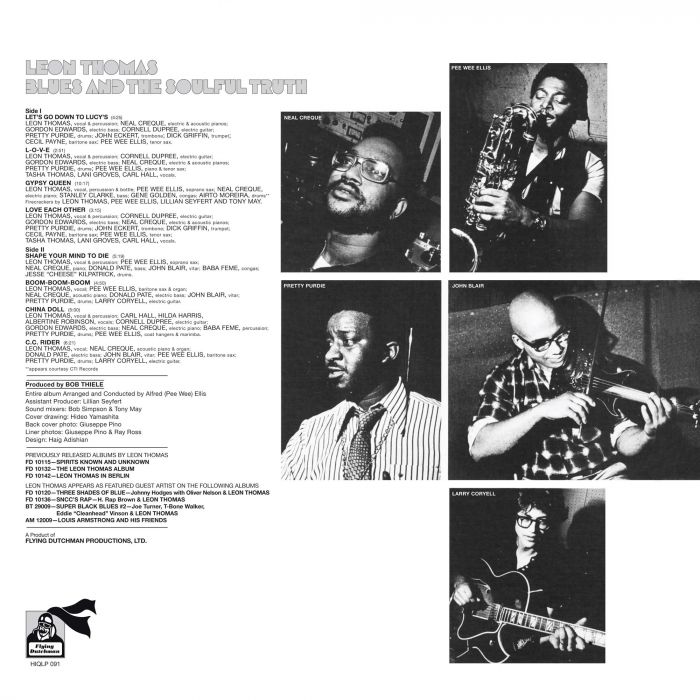

LONNIE LISTON SMITH AND THE COSMIC ECHOES-RENAISSANCE.
Lonnie Liston Smith and The Cosmic Echoes-Renaissance.
Label: BGP.
Format: LP.
Release Date: 26th August 2022.
Innovative, influential and way ahead of the musical curve, describes the music of Lonnie Liston Smith, and specially the five albums he recorded with The Cosmic Echoes for Bob Thiele’s Flying Dutchman Productions between 1973 and 1976 This began with Astral Travelling in 1973 with Cosmic Funk followed in 1974. This was just the start.
Expansions which followed in 1975 featured Lonnie Liston Smith at the peak of his powers on what was the most successful album of his career. He had brought onboard his brother Donald, whose vocals added a new dimension to the groundbreaking music.
Later in 1975, Lonnie Liston Smith and The Cosmic Echoes released Visions Of A New World. It was their penultimate album for Flying Dutchman Productions which was tailor made for pioneering artists like Lonnie Liston Smith. It was a smaller label where artists were encouraged to experiment and innovate and produce music the music that they really wanted. Often this resulted in albums of groundbreaking music. This included Reflections Of A Golden Dream which was released in 1976, and turned out to be Lonnie Liston Smith and The Cosmic Echoes’ swan-song for Flying Dutchman Productions.
In 1976, there was a takeover of Flying Dutchman Productions by RCA. After some changes at the parent company it was decided to release Lonnie Liston Smith and The Cosmic Echoes’ next album on RCA rather than Flying Dutchman Productions. It was the end of an era. However, Renaissance which will be reissued by BGP on LP on the 26th August 2022, was another album of innovative music from Lonnie Liston Smith and The Cosmic Echoes.
Led by musical visionary Lonnie Liston Smith Renaissance finds him pushing musical boundaries to their limits and sometimes, beyond. That’s had been the story of his career which began a decade earlier. Since then, the man who had been born to make music had been establishing himself as a musician.
For Lonnie Liston Smith, it was almost written in the stars that he would become a musicians. He was born in 1940, into a musical family and his father was a member of Richmond Gospel music group the Harmonising Four. Growing up, members of gospel groups The Soul Stirrers and Swan Silvertones were regular visitors to the Smith household. With all this music surrounding him, Lonnie Liston Smith learned piano, tuba and trumpet in High School and college. After college, he headed to Morgan State University.
Inspired by Trane, Bird and Miles Davis, Lonnie Lonnie Liston Smith embarked upon a degree in musical education. Throughout his time at University, he continued playing the pianist in local clubs and singing backing vocals. He played with alto saxophonist Gary Bartz and trombonist Graham Moncur. This was all part of Lonnie’s musical eduction. Having completed his BSc in musical education at Morgan State University, Lonnie Liston Smith walked straight into a job.
On leaving Morgan State University, Lonnie Liston Smith got a job with the Royal Theatre’s house band. For a young musician, this was would help turn them into a musical all-rounder. After all, they had to be able to accompany a wide range of artists. For Lonnie Liston Smith this was the next stage in his musical education. The next part of his musical education took place in New York.
Having moved to New York, Lonnie Lonnie Liston Smith was luck enough to get a gig playing piano in Betty Carter’s band. This helped Lonnie Liston Smith get his name known in the Big Apple. Then in early 1965, he caught a break.
He joined Roland Kirk’s band and made his recording debut on March 14th 1965. That was when Here Comes The Whistleman was recorded live in New York Lonnie Liston Smith only played on the title-track, Making Love After Hours, Yesterdays and Step Right Up. Then he featured on Roland andAl Hibbler’s 1965 live album A Meeting Of The Times. After this, he joined one of jazz’s top bands.
Over the last few years, The Jazz Messengers had established a reputation for young musicians looking to make a name for themselves. Lonnie Liston Smith joined in 1965. He shared the role with Mick Nock and Keith Jarrett. However, with The Jazz Messengers ever evolving lineup and only played in three concerts. These three concerts just so happened to be at the legendary Village Vanguard. Despite playing at such prestigious venue this must have been a disappointing time for an up-and-coming pianist. Luckily, Lonnie Liston Smith was rehired by Roland Kirk.
He rejoined Roland Kirk’s band in time to play on his 1968 album Now Please Don’t You Cry, Beautiful Edith. This established his reputation as the go-to-guy for anyone looking for a pianist. It was the start of period where Lonnie Liston Smith worked with some of the most innovative and inventive jazz players. Musical boundaries were about to be pushed to their limits as Lonnie joined Pharaoh Saunders’ legendary free jazz band.
Pharaoh Saunders had worked closely with John Coltrane right up to his death in 1967. The following year, Pharaoh Saunders formed a new band. Their music is best described as groundbreaking free jazz. Musical boundaries were pushed to their limits and beyond by one of the genre’s pioneers. Recognising a fellow believer in free jazz, Pharaoh Saunders asked Lonnie Liston Smith to join his band.
He went on to play on three of Pharaoh Saunders best albums. The first of this trio was 1969s Karma. It was followed in 1970 with Jewels of Thought and 1971s Thembi. The other Pharaoh Saunders album Lonnie Liston Smith played on was 1970s Summun Bukmun Umyun. which was released on Impulse. Just like the three albums Pharaoh Saunders recorded for Flying Dutchman Productions it was an innovative album that was way ahead of the musical curve.
During this period, Pharaoh Saunders and his band were constantly pushing boundaries and rewriting the musical rulebook. Their music was truly groundbreaking. Even Lonnie Liston Smith was challenged. On Thembi, Pharaoh asked Lonnie to play the Fender Rhodes. This was the first time that Lonnie Liston Smith came across an electric piano. However, he rose to challenge and wrote Thembi’s opening track Astral Travelling. Later, Astral Travelling would become synonymous with Lonnie Liston Smith and The Echoes. Before that, Lonnie Liston Smith would play with some of jazz’s maverick.
One of these mavericks was Gato Barbieri. He had just signed to Bob Thiele’s nascent label Flying Dutchman Productions. It was establishing a reputation for providing musicians with an environment where innovative and creative musicians could thrive.
Bob Thiele believed musical mavericks didn’t thrive within such an orthodox environment like a major label. Their creativity was restricted meaning that were unable to experiment and innovate like they would like. So, he signed Gato Barbieri to Flying Dutchman and Lonnie Liston Smith was asked to play on his 1969 debut album The Third World.
The next signing to Flying Dutchman Productions was Leon Thomas, and Lonnie Liston Smith played on his debut album Spirits Known and Unknown. Soon, Lonnie was a regular at Flying Dutchman sessions.
When the time came for Gato Barbieri to record his 1971 sophomore album Fenix, Lonnie Liston Smith was called upon. He played on Fenix and joined Gato Barbieri’s band. A year later he played on his 1972 album El Pampero and toured throughout Europe with the band. Then came the opportunity of a lifetime. After El Pampero, Lonnie Liston Smith got the chance to work with another jazz legend.
Liston Smith was a member of Gato Barbieri’s band when Miles Davis got in touch. He wanted the pianist to join his band. At this time, Miles Davis’ music was changing direction. The direction it was heading in was funk.
Electronic instruments were the flavour of the month for Miles Davis and he was exploring their possibilities. However, he was doing this outside the studio environment. That’s why there are very few recordings of Lonnie Liston Smith playing alongside Miles Davis at that time. That came later when the two men were reignited and worked together. Meanwhile, he decided to move on with his solo career and his debut album Astral Travelling.
Astral Travelling.
When recording of Astral Travelling began, Lonnie Liston Smith had put together some of the most talented and innovative musicians. The Cosmic Echoes’ rhythm section included bassist Cecil McBee, drummer David Lee and guitarist Joe Beck. Sonrily Morgan and James Mtume played percussion and conga, Gee Vashi tamboura and Badal Roy tabla. George Barron played tenor and soprano saxophone and Lonnie played piano and electric piano on Astral Travelling. Bob Theile produced Astral Travelling, which was released in 1973.
On its release in 1973, Astral Travelling was critically acclaimed. Critics were won over by Astral Travelling’s fusion of avant garde, experimental, free jazz and orthodox jazz. The music was variously beautiful, dramatic, explosive, ethereal, flamboyant languid, mellow, serene spiritual and urgent. It was as if Lonnie had drawn upon all his experience working as a sideman. He had worked with Pharaoh Saunders, Gato Barbieri, The Jazz Messengers, Leon Thomas, Stanley Turrentine and Miles Davis.
The result was Lonnie Liston Smith’s unique brand of cosmic jazz. It went on to influence several generations of musicians and music lovers, and show that Lonnie Liston Smith was no ordinary musician. Instead, he was an innovator, who was determined to push musical boundaries to their limits and beyond. This was apparent on Astral Travelling, and its followup Cosmic Funk.

Cosmic Funk.
Cosmic Funk featured six tracks, three of which Lonnie Liston Smith wrote. They were the title-track Cosmic Funk, Beautiful Woman and Peaceful Ones. The other tracks were Wayne Shorter’s Footprints, James Mtume’s and John Coltrane’s Naima. These six tracks were recorded by an all-star band.
For the recording of Cosmic Funk, Lonnie had put together some of the most talented and innovative musicians. The Cosmic Echoes’ rhythm section included bassist Al Anderson, drummer Art Gore. Lawrence Killian played percussion and conga, while Doug Hammond, Ron Bridgewater and Andrew Cyrille played percussion. George Barron soprano saxophone, flute and percussion, while Donald Smith played piano, flute and added vocals. Lonnie played acoustic and electric piano plus persuasion on Cosmic Funk. Bob Theile produced Cosmic Funk, which was released in 1974.
Cosmic Funk was released in 1974. Critics heard a different side to Lonnie Liston Smith on Cosmic Funk. It was a much more orthodox album. One thing remained the same, the reaction of critics. Just like Astral Travelling, plaudits and critical acclaim followed the release of Cosmic Funk. It turned out to be a a transitionary album Lonnie Liston Smith, which sadly, wasn’t a huge commercial success.
Cosmic Funk proved to be a much more orthodox jazz album from Lonnie Liston Smith and The Cosmic Echoes. Elements of jazz, funk, Latin and soul were combined on Cosmic Funk. The music veered between anthemic, beautiful, ethereal, experimental, flamboyant, funky, futuristic and wistful. Lonnie Liston Smith and The Cosmic Echoes was a stepping stone.
Despite its much more orthodox jazz sound, Cosmic Funk found Lonnie Liston Smith and and The Cosmic Echoes one step nearer finding his trademark sound. They found his trademark sound on his third album, Expansions, which was released in 1975. It was the first two albums of which were part of a musical voyage of discovery.
Expansions.
By the time Lonnie Liston Smith and The Cosmic Echoes released Expansions in early 1975, Bob Thiele had take Flying Dutchman Productions’ releases to RCA. This safeguarded Flying Dutchman Productions’ future. By then, Bob Thiele had discovered RCA wanted sales, and sales was what they got.
Expansions reached eight-five in the US Billboard 200, twenty-seven in the US R&B charts and number two in the US Jazz charts. This made Expansions one of Flying Dutchman Productions’ most successful albums.
Meanwhile, club and radio DJs were spinning tracks from Expansions. Belatedly, Lonnie Liston Smith and The Cosmic Echoes were the flavour of the month among DJs, dancers and discerning record buyers. So, it’s no surprise that Bob Thiele sent Lonnie Liston Smith and The Cosmic Echoes into the studio again, where they recorded Visions Of A New World.

Visions Of A New World.
For Lonnie Liston Smith and The Cosmic Echoes’ fourth album, Visions Of A New World, Lonnie penned seven tracks, including Lonnie Liston Smith’s hopeful anthem, A Chance For Peace. The other track, Devika (Goddess) was written by Dave Hubbard and Sarina Grant. These eight tracks were recorded at Electric Ladyland Studios, New York.
At Electric Ladyland Studios, Bob Thiele and Lonnie Liston produced the eight tracks that eventually became Visions Of A New World. Accompanying Lonnie were The Cosmic Echoes. Their rhythm section featured bassist Greg Maker, drummer Art Gore and Wilby Fletcher and guitarist Reggie Lucas. Percussionists included Michael Carvin, Ray Armando, Angel Allende who added bongos and Lawrence Killian who also played congas. Flautist Donald Smith also added vocals on three tracks. The horn section included soprano saxophonist Dave Hubert, trombonist Clifford Adams and trumpeter Cecil Bridgewater. This was a very different lineup of The Cosmic Echoes that featured on Astral Travelling. Lonnie Liston Smith on keyboards was the only constant. This constantly evolving lineup didn’t affect the reception of Visions Of A New World.
Just like previous albums, critics hailed Visions Of A New World was hailed an album of ambitious and groundbreaking music. Lonnie Liston Smith was seen as a musical pioneer, capable of creating music that was dreamy, elegiac funky, hopeful, ruminative, sensual, smooth and sultry. It was also ambitious and innovative, and soon, was hailed a minor classic where elements of free jazz, funk, fusion, rock, smooth jazz and soul. The result was another album that was way ahead of the musical curve. It was also Lonnie Liston Smith and The Cosmic Echoes’ most successful album.
When Visions Of A New World was released in the summer of 1975, it reached number seventy-four in the US Billboard 200, fourteen in the US R&B charts and number four in the US Jazz charts. Visions Of A New World was Lonnie Liston and The Cosmic Echoes’ most successful album. After four albums, Lonnie Liston and The Cosmic Echoes’ music was reaching a much wider audience. Now Lonnie Liston and The Cosmic Echoes had to do it all again on Visions Of A New World.

Reflections Of A Golden Dream.
For his fifth solo album, Reflections Of A Golden Dream, Lonnie Liston Smith penned nine tracks, and cowrote Peace and Love with Leopoldo Fleming. The ten tracks were recorded by Lonnie Liston Smith and The Cosmic Echoes, which featured some top musicians.
Just like with previous albums, the lineup of The Cosmic Echoes seemed in a constant state of flux. The Cosmic Echoes’ rhythm section featured bassist Al Anderson and drummer Art Gore and Wilby Fletcher. Percussionists included Guilherme Franco and Leopoldo Fleming who also added congas and guaitar. Flautist Donald Smith also added vocals on three tracks; while Dave Hubert switched between flute and soprano saxophonist. The horn section also included tenor saxophonist George Opalisky; plus Joe Shepley and Jon Faddis who played trumpet and flugelhorn. Backing vocalists included Maeretha Stewart, Patti Austin and Vivian Cherry. They augmented this latest version of The Cosmic Echoes on Visions Of A New World Astral Travelling.
Lonnie Liston Smith, played keyboards, piano and added vocals. He also co-produced Reflections Of A Golden Dream with Bob Thiele. However, it later became apparent that Lonnie Liston Smith more or less took charge of production on Reflections Of A Golden Dream. Bob Thiele’s role, was more of an executive producer. That didn’t seem to affect the reviews of Reflections Of A Golden Dream.
Critics, when they received their advance copies of Reflections Of A Golden Dream, found Lonnie Liston Smith and The Cosmic Echoes combining dance-floor friendly music with social comment on Get Down Everybody (It’s Time For World Peace) and Peace and Love. Meditations featured a much more pensive, spiritual sound; while Journey Into Space saw Lonnie Liston Smith became a musical voyager. Just like previous albums, Reflections Of A Golden Dream received plaudits and critical acclaim. That was all very well. However, would Reflections Of A Golden Dream ensure that Lonnie Liston Smith and The Cosmic Echoes run of commercial success continued?
When Reflections Of A Golden Dream was released in 1976, the album sold well, but didn’t match the commercial success of Visions Of A New World. It remained the most successful album of Lonnie Liston Smith and The Cosmic Echoes’ time at Flying Dutchman Productions. However, it turned out that Reflections Of A Golden Dream was the last album that Lonnie Liston Smith and The Cosmic Echoes released on Bob Thiele’s Flying Dutchman Productions.
By 1976, changes were afoot at Flying Dutchman Productions. Bob Thiele’s label had been taken over by RCA who had distributed the label since 1972. Straight away, RCA began a review of their latest acquisition.
Eventually, RCA decided that the only artist from the Flying Dutchman Productions’ roster they wanted to keep was Lonnie Liston Smith and The Cosmic Echoes. This wasn’t good news for the label Bob Thiele had spent years building up. Worse was to come for him. He would be retained as a producer on a project-by-project basis. This began with Lonnie Liston Smith and The Cosmic Echoes’s album Renaissance.
Renaissance.
For Renaissance, which was Lonnie Liston Smith and The Cosmic Echoes’s debut for RCA Victor, the bandleader and pianist wrote five tracks. This included Space Lady, Mardi Gras (Carnival), Starlight And You, A Song Of Love and Between Here. He also wrote the music to Renaissance which features lyrics by Jeff Gaines. Meanwhile, Dave Hubbard had written Mongotee which would feature on Lonnie Liston Smith and The Cosmic Echoes sixth album of cosmic jazz, Renaissance.
Bob Thiele brought Horace Ott onboard to arrange the strings, woodwinds and backing vocals on Renaissance. It was another ambitious, innovative genre-melting album from Lonnie Liston Smith and The Cosmic Echoes.
When recording began, Harvey Goldberg was the engineer and would later mix the album with Bob Thiele. The latest incarnation of The Cosmic Echoes was a multitalented and versatile band who were capable of making groundbreaking music. It featured a rhythm section of drummer Wilby Fletcher and bassist Al Anderson. They were joined by Gene Bertoncini on acoustic guitar, Leon Pendarvis on clavinet, conga player Lawrence Killian, percussionist Guilherme Franco and Ken Bichel on Moog synth. Two musicians who played an important role on David Renaissance were Hubbard who played flute, tenor and soprano saxophone while Donald Smith played flute and added vocals. Bandleader Lonnie Liston Smith switched between acoustic and electric piano and coproduced the album with Bob Thiele who had mixed Renaissance.
When Renaissance was released it was to plaudits and praise. Critics were impressed with an album that combined cosmic jazz and jazz funk. Lonnie Liston Smith and The Cosmic Echoes had effortlessly combined to create a musical potpourri that was melodic, rhythmic and continued the spiritual consciousness of previous albums. Later, the album would be considered a cosmic jazz classic. That’s no surprise given the quality of music on the album.
Side One.
Renaissance opens with Space Lady where cosmic jazz and jazz funk are combined by Lonnie Liston Smith and The Cosmic Echoes. They then unleash the jazz dance classic Mardi Gras (Carnival) which is one of the highlights of the album. Starlight and You which features a vocal masterclass from Donald Smith is a beautiful cinematic ballad that’s often overlooked and is one of the hidden gems on the album.
Side Two.
Very different is Mongotee which opens side two and heads in the direction of jazz. It’s all change on the dancer A Song Of Love which benefits from an emotive and heartfelt vocal from Donald Smith. However, the thoughtful, pensive and spacey sounding Between Here And There is without doubt one of the album’s finest moments. Bringing Renaissance to a close is the title-track which features lyrics by Jeff Gaines. Originally the song was going to be an instrumental but a chance meeting resulted in the lyrics being written and a new ending to Lonnie Liston Smith and The Cosmic Echoes’ sixth album and RCA Victor debut.
Lonnie Liston Smith and The Cosmic Echoes’ sixth album and RCA Victor debut was an captivating and eclectic mixture of moods and musical genres. It finds the pioneering bandleader and pianist leading a band on Renaissance which later became a cosmic jazz classic. However, it’s not just a cosmic jazz that features on Renaissance. There’s also jazz funk and elements of avant-garde, experimental, free jazz, funk, fusion and jazz on what was a truly ambitious album.
Renaissance like the five albums that Liston Smith and The Cosmic Echoes released on Bob Thiele’s Flying Dutchman Productions was an innovative genre-melting album that is still influenced a new generation of musicians. That’s no surprise as Lonnie Liston Smith was a leader, not a follower, and pioneer whose music was way ahead of his time. Renaissance. and the albums that Liston Smith and The Cosmic Echoes released on Flying Dutchman Productions feature a true musical visionary at the peak of his considerable creative powers.
Lonnie Liston Smith and The Cosmic Echoes-Renaissance.

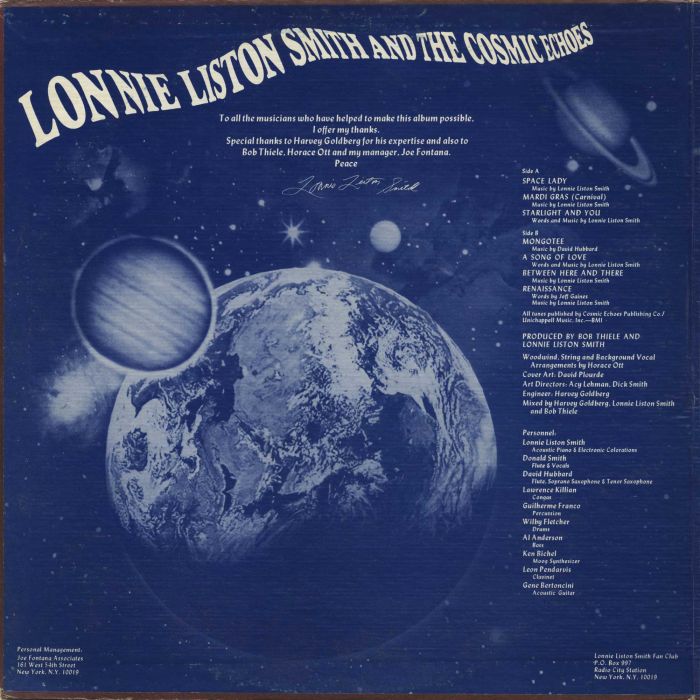
HAPPY IN HOLLYWOOD-THE PRODUCTIONS OF GARY USHER.
Happy In Hollywood-The Productions Of Gary Usher.
Label: Ace Records.
Format: CD.
Release Date: ‘29th’ July 2022.
Although Gary Usher was born in Los Angeles, California, on December ‘14th’ 1938, he spent his childhood and teenage years living in New England. That was where his lifelong love affair with music began.
Growing up, music was an important part of Gary Usher’s life. He spent time listening to the radio at the family home in New England. Then at the dawn of the rock ’n’ roll era he began collecting records. Elvis was a favourite of the future producer.
By 1957, Gary Usher had returned to California and was working as a labourer for his uncle Benny who lived in Hawthorne, south-west LA. This wasn’t far from the Wilson family who had three sons Brian, Dennis and Carl.
Gary Usher’s career as a labourer was short-lived, when he got a job with the Bank Of America. This was where he met guitarist Dick Burns, who taught him how to play a few basic chords. Little did either man realise that this was the start of Gary Usher’s musical career.
Before it began, Gary Usher enlisted in the US Army and was posted to Seoul, where he became a company clerk. In his spare time, he formed a group with other soldiers.
The nascent group played a mixture of chart hits while Gary Usher began writing his own compositions for the first time. This was an important development.
When Gary Usher was discharged from the US Army and returned to California he knew that wanted to pursue a career in music. He was reunited with his friend Dick Burns when he joined Bobby Fry and His Troupe. The group entered the studio which was a new experience for Gary Usher. However, he had a dilemma.
He wasn’t sure whether he wanted to pursue a career as a songwriter or producer. Despite this, Gary Usher released singles on two local labels, Titan and Lan-Cet. However, neither single sold well and it looked like his solo career was going to be short-lived.
It was at this time that Gary Usher met the Podolor brothers. Don Podolor helped him with the business side of music, while his brother Richard would go on to play on a number of Gary Usher productions.
Over the next few months and years, Gary Usher met musicians who would play on his sessions. This included drummer Wayne Edwards plus singer and guitarist Les Weisner, who were part of the Bobby Fry Group. That was in the future.
Before that, in 1962, Gary Usher, who was still living in Hawthorne at the time, heard good things about the Wilson brothers and visited them for the first time. Straight away, he bonded with Brian the eldest brother and they began writing songs for The Beach Boys.
The group was just starting to make a breakthrough, and the first Usher and Wilson composition was 409, which featured on the B-Side of their sophomore single, Surfin’ Safari. The song lent its name to the group’s debut album, which featured five further compositions from the burgeoning songwriting partnership. This, however, didn’t please everyone.
Brian, Dennis and Carl Wilson’s father Murray, who was also the group’s manager, made it clear to his sons that he didn’t want outsiders cowriting songs. He was of the belief that songwriting should be kept within the family. After all, publishing was a lucrative business.
By 1963, Gary Usher had signed to Four Star Music as a songwriter and to Challenge Records as a recording artist. However, during this period, he started to learn more about the music business. This included the role of the producer. Gary Usher watched and listened to the arrangers and engineers he worked with, absorbing their knowledge which he would soon be put to good use.
Later in 1963, Gary Usher released singles by two studio he groups he put together. This included The Sunsets and The Four Speeds, a project which Dennis Wilson was involved with. There was also The Super Stocks, which was the up-and-coming producer’s first project for Capitol Records.
Meanwhile, Gary Usher was also working with local DJ Roger Christian. The pair cowrote numerous surf, drag and hot rod tracks that became singles and various compilations. Many groups recorded the pair’s songs including The Competitors, The Hondells and The Kickstands. Usually, Gary Usher was the arranger but by 1964 was being credited as producer.
In 1964, Gary Usher was in demand as a producer and was enjoying the most successful period of his career. Between 1962 and 1969 he produced twenty-four hit singles and twenty-four of the albums that he produced went on to chart. Three of these albums were certified gold.
As the sixties drew to a close, Gary Usher was regarded as a versatile producer who was able to seamlessly switch between musical genes. Music was changing and producers had to be adaptable. By then, the thirty-four year old had already produced an eclectic selection of successful singles and albums. This was just the start of a long career as a producer.
His career is celebrated on Happy In Hollywood-The Productions Of Gary Usher. It’s the latest instalment in Ace Records’ Producer Series, and this twenty-four track compilation will be released on the ‘29th’ July 2022.
Amongst the artists on Happy In Hollywood-The Productions Of Gary Usher are The Byrds, Gene Clark, The Hondells, Keith Allison, The Spiral Starecase, The Neptunes, The Surfaris, The Sons Of Adam, Brian Wilson and The Peanut Butter Conspiracy. These tracks are part of a carefully curated overview of Gary Usher’s production career between 1964 and 1987.
Opening Happy In Hollywood-The Productions Of Gary Usher is Lady Friend by The Byrds. It’s the B-Side to their 1967 single Old John Robertson. The session wasn’t an easy one for the newly appointed producer. Gene Clark had left the group in late 1966, and this session was punctuated by squabbling between Roger McGuinn and David Crosby. This resulted in the producer spending part of his time acting as referee and peacemaker. Despite the conflict, the group recorded what’s regarded as one of their finest songs.
Gene Clark was seen as the best songwriter within The Byrds. He left the group in March 1966, and was soon offered a solo recording contract by Columbia. So You Say You Lost Your Baby is one of the singer’s compositions and features on the album Gene Clark With The Gosdin Brothers. The song was arranged by Leon Russell and produced by Gary Usher and is one of the highlights of what’s now regarded as an influential album which featured everything from baroque pop to country rock and folk rock.
In early 1967, a studio only lineup of The Hondells entered the studio to record a new single for Columbia. This was Yes To You. The B-Side was Just One More Chance a slice of memorable sixties pop-psych arranged and produced by Gary Usher who proves that he’s an innovative producer who could work across disparate musical genres.
Keith Allison was a familiar face on American television by 1967. He featured on the popular program Where The Action Is. That was how Larry Marks asked him to record the In Action album. Originally, the project was meant to be produced by Larry Marks. However, when he left Columbia Gary Usher took over and completed the project. The finest is the album opener Louise, a joyous fusion of sixties pop, psych and rock.
The Spiral Starecase were based in Sacramento where this talented group played regularly. However, for many people lead singer Pat Upton was seen as the group’s shining star. This included Gary Usher who arranged and produced their cover of Baby What I Mean, which had previously given The Drifters a hit single. For the session, members of the Wrecking Crew replaced band members and were augmented by a horn and string session as they accompanied the charismatic vocalist. Despite the all-star lineup this pop-rock single stalled at 111 on the US Billboard 100.
When The Neptunes recorded Shame Girl for Warner Bros in April 1964, at Western Recorders in LA, members of the Wrecking Crew played on the session. Sharing lead vocal dudes were Chuck Girard and Gary Usher who also arranged and produced a track whose roots are in the surf, drag and hot rod which was popular at the time.
I Don’t Wanna Say Goodnight was released by The Forte Four in November 1966. It was Gary Usher’s first production for Decca. It’s a slick, carefully crafted track with a commercial sound that should’ve found favour with DJs and record buyers.
Gary Usher began working with The Surfaris in 1964. In 1965, he arranged and produced their cover of The Beach Boys’ Don’t Hurt My Little Sister. Tucked away on the B-Side was Catch A Little Ride With Me a memorable example of a sixties Californian pop song which is based around a fairground theme and features drummer Ron Wilson on lead vocal. Sadly, the single failed commercially and this hidden gem was only unearthed much later.
For their classic album Sweethearts Of The Rodeo, this latest lineup of The Byrds covered Bob Dylan’s You Ain’t Going Nowhere. It was recorded in Nashville while Gram Parsons was a member of the group during the session. He plays an important part in the sound and success of this country rock track. It’s a reminder of a truly talented group who pioneered this genre.
Show Me, Girl was The Hondells swansong for Mercury. This Goffin and King cover was one of six recorded during June 1966. Just like the rest of the songs, it was arranged and produced by Gary Usher and released as a single later in 1966. Despite its commercial sound, the single failed commercially and it was a case of what might have been for the group?
When Brian Wilson recorded his 1988 eponymous album for Sire, a variety of producers were used during the lengthy and complicated sessions. Gary Usher produced Let’s Go To Heaven In My Car, which featured on the soundtrack for Police Academy 4. It’s one of the highlights of the album and is a welcome reminder of one the legendary figures of music as he makes a welcome return.
Happy In Hollywood was the title-track from California’s 1976 album for A&M. The group features many big names from the LA music scene, including David Batteau who in 1967 worked with Gary Usher on his previous project, Sagittarius. This time around, the pair co-produced the album. The title-track is a perfect example of laid back soft rock and without doubt, is one of the album’s highlights. It’s the perfect way to close the compilation.
Happy In Hollywood-The Productions Of Gary Usher is the perfect introduction to one of the most innovative and versatile producers in LA during the sixties. He was able to seamlessly switch between musical genes. Proof of this can be found on the compilation which features a variety of disparate genres which show that music was changing and producers had to be adaptable.
Not all producers were as adaptable as Gary Usher. However, his ability to work with a wide range of groups resulted in him producing many critically acclaimed albums during the sixties across various musical genres. Between 1962 and 1969 he produced twenty-four hit singles and twenty-four albums that he produced went on to chart. Three of these albums were certified gold. This was just the start of a long career as a producer.
Gary Usher’s career continued through the seventies and into the eighties. By then, he was a hugely respected figure and was working with some of the biggest names in music. This included his old friend Brian Wilson who he met back in Hawthorne, LA in the early sixties. A lot had happened to both men since.
Just two years after working with Brian Wilson, Gary Usher died in LA on May the ’25th’ 1990. He was just fifty-two. The singer, songwriter, musician, arranger and producer had enjoyed a career that spanned three decades and enjoyed commercial success and critical acclaim.
However, it’s as a producer that Gary Usher is best known. He was a musical pioneer whose productions were inventive and innovative. Partly, this was to do with the musicians he worked with, including members of the legendary Wrecking Crew. They can be heard on some of the tracks on Happy In Hollywood-The Productions Of Gary Usher which is a fitting tribute to a pioneering producer whose much missed.
Happy In Hollywood-The Productions Of Gary Usher.
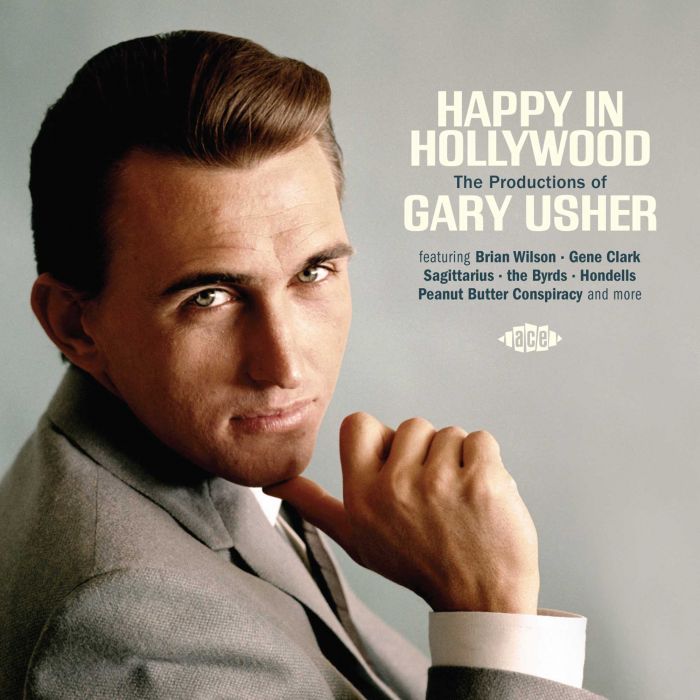

 dereksmusicblog
