THE ZODIAC-COSMIC SOUNDS.
The Zodiac-Cosmic Sounds.
Label: Cherry Red Records.
By 1967, many critics and record buyers regarded Elektra Records as a folk rock label, that had released albums by some of the genre’s finest exponents including Judy Collins, Love, Tom Rush and Tim Buckley. Many of these albums would later become important and influential albums, and some are nowadays regarded as genre classics. However, some people’s perception of Elektra Records was about to change in May 1967 with the release of The Zodiac’s album Cosmic Sounds, which became a cult classic. That is the still the case when Cherry Red Records reissued Cosmic Sounds fifty years after its initial release.
The Zodiac’s Cosmic Sounds was a groundbreaking concept album which featured twelve tracks that were described as psychedelic mood music. It featured a myriad of exotic and electronic instruments and spoken prose that came courtesy of Cyrus Faryar. Cosmic Sounds was no ordinary album, and The Zodiac was no ordinary band.
That was certainly the case. The Zodiac didn’t even exist before the recording of Cosmic Sounds. Jac Holzman the head of Elektra Records came up with the concept for Cosmic Sounds after the success of The Doors’ eponymous debut album which had been released in January 1967. He then set about making The Zodiac and their debut album Cosmic Sounds reality.
To do that, Jac Holzman hired Alex Hassilev, formerly a member of The Limeliters, to produce the album. Alex Hassilev brought onboard Mort Garson who he had recently formed a production company with, to write the music for Cosmic Sounds.
With producer Alex Hassilev and composer and musician Mort Garson onboard, the Cosmic Sounds’ concept quickly grew legs, and the pair were planning to record and release a series of similar concept albums. Before that, Mort Garson began work on Cosmic Sounds.
Eventually, composer, arranger, orchestrator, conductor and pianist Mort Garson had written twelve tracks, with one for each astrological sign. This included Aries-The Fire-Fighter, Taurus-The Voluptuary, Gemini-The Cool Eye, Cancer-The Moon Child, Leo-The Lord of Lights, Virgo-The Perpetual Perfectionist, Libra-The Flower Child, Scorpio-The Passionate Hero, Sagittarius-The Versatile Daredevil, Capricorn-The Uncapricious Climber, Aquarius The Lover Of Life and Pisces-The Peace Piper. These tracks would become Jac Holzman’s album of psychedelic mood music-Cosmic Sounds.
By then, producer Alex Hassilev had returned from producing The Dusk ‘Till Dawn Orchestra’s Sea Drift album. One of the tracks incorporated a piece of music that was meant to feature on a followup album, The Sea. However, it had been scrapped, after Rod McKuen, who was meant to feature on the project, left and worked on his own version with Anita Kerr. This had been a disappointment, but Alex Hassilev was fully focused on producing Cosmic Sounds.
To record Cosmic Sounds, and capture the sounds that producer Alex Hassilev required wasn’t going to be easy. It would require a variety of exotic and electronic instruments. Fortunately, Alex Hassilev knew a couple of musicians who could help create the sound that he was looking for.
This included Paul Beaver, who back in 1967, was known as someone who provided sound effects for the film industry. He was also passionate about the new electronic instruments and had amassed an enviable collection, including a Moog synth. He would play the Moog and other electronic instruments on The Zodiac.
In 1967, the Moog synth was a new instrument, which its inventor Robert Moog and Paul Beaver had just demonstrated at the California Audio Engineering Society convention in early 1967. This was the assembled audience got the opportunity to see and hear the Moog on the West Coast. They realised it was a gamechanger, as did Jac Holzman the head of Elektra Records. The Moog he knew would play an important part on Cosmic Sounds.
Jac Holzman was keen to bring Paul Beaver onboard for The Zodiac project, as he was one of just a handful of people on the West Coast who knew how to setup and use the Moog synth. Paul Beaver agreed to join The Zodiac project and was keen to showcase the instrument’s vast capabilities on Cosmic Sounds,
With Paul Beaver onboard, producer Alex Hassilev was keen to enlist percussionist Emil Richards, who had played with great and good of music, and on over 1,700 movies. Emil Richards was also a collector percussion instruments, and had already amassed a collection of 700 instruments from all over the world. He would put some of the strange and exotic percussion to good use on The Zodiac.
The day of the recording sessions, electronics guru Paul Beaver setup his Moog synth, and an array of electronic instruments. When percussionist Emil Richards arrived at the studio, it was in a truck. As members of the band looked out, they were amazed to see that half of the truck was filled with myriad of exotic percussion instruments including water chimes and angklungs, bamboo rattles from Southeast Asia. They were unloaded from the truck, along with a sitar and harpsichord. These instruments were taken into the studio, where producer Alex Hassilev introduced Emil Richards to the rest of the band.
It featured some of L.A’s top session musicians, including members of the legendary Wrecking Crew were waiting. This included drummer Hal Blaine, who was joined in the rhythm section to bassist Carol Kaye. They were joined by keyboardist Mike Melvoin and Bud Shank on bass flute. Other members of this experienced group of musicians that recorded Cosmic Sounds weren’t credited on the album.
With The Zodiac in the studio, they began recording the twelve tracks that became Cosmic Sounds. Mostly, the recording sessions ran smoothly. The only problem the band encountered was that the Moog’s oscillators were somewhat unstable and this meant that Paul Beaver had switch the machine on way before the sessions began, to allow them to warm up. Occasionally, the Moog failed to stay in frequency and the tuning was out. Apart from that, there were very few problems. What many members of the band remembered, was percussionist Emil Richards dashing round the studio playing anything up to five or six instruments live. Somehow, he managed this and after four recording sessions, the twelve backing tracks were recorded.
With Cosmic Sounds complete, The Zodiac listened to the playback, and listened intently to the twelve tracks that featured a spacey but tight groove. Cosmic Sounds sounded like an instrumental psychsploitation soundtrack. However, that would soon change.
With the backing tracks completed, folk singer Cyrus Faryar was brought onboard to narrate Cosmic Sounds. He was the final member or The Zodiac, and added the twelve vocals against a futuristic, moody, haunting and lysergic backdrop that combined the debut of a Moog synth with a sitar, flute, Hammond organ, haunting harpsichord and even searing, mid-sixties rocky guitar riffs as Cyrus Faryar’s voice veered between ruminative to dramatic and ironic. This was the final piece of the musical jigsaw that was Cosmic Sounds.
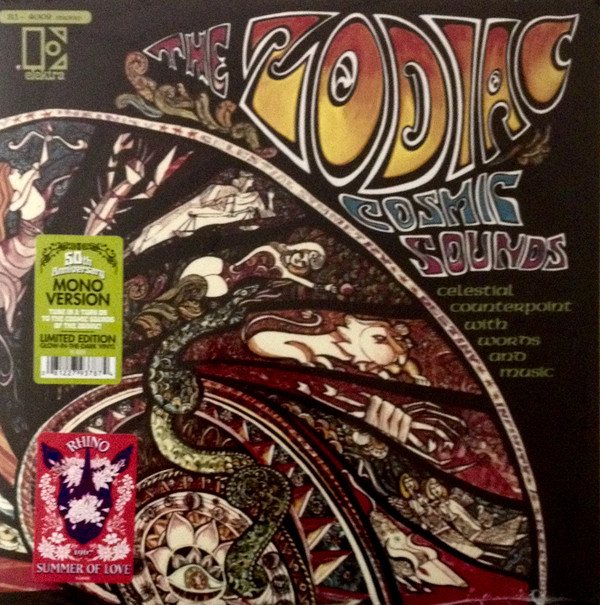
Once Cosmic Sounds was completed, Jac Holzman decided to release The Zodiac’s debut album in May 1967. William S. Harvey was hired to take charge of the artwork on Cosmic Sounds, and must have surpassed even Jac Holzman’s expectations. The elaborate sleeve was a patchwork of bright, bold and gaudy colours, and was almost luminous. It also featured wavy undulating lettering and pictures that were lysergic and had been influenced by classical mythology. This was a perfect cover for The Zodiac’s album of psychedelic mood music, Cosmic Sounds.
Not for the first time, Jac Holzman’s timing was perfect, with the release of The Zodiac’s debut album in May 1967 coinciding with a resurgence of interest in astrology, while psychedelia had also become hugely popular. Surely, this was the perfect time for The Zodiac to release their groundbreaking and innovative concept album Cosmic Sounds? It was sure to appeal to those who were about to turn on, tune in, drop out.
Unfortunately, Cosmic Sounds divided the opinion of critics, many of whom failed to understand this groundbreaking and imaginative album of psychedelic mood music, which came with instructions that the album “must be played in the dark.” Some critics embraced and understood the album, and were won over by its mixture of exotic and electronic instruments and spoken prose.
It was essentially a fusion of psychedelia, rock and astrology played by some the of L.A’s top musicians and narrated by Cyrus Faryar. This Jac Holzman hoped would tap into the burgeoning market for all things psychedelic.
Unfortunately, there was a degree of confusion amongst critics and soon, record buyers who were unsure about who the album was by. Some thought that the album was The Zodiac by Cosmic Sounds, while others were of the opinion that the album was Cosmic Sounds by The Zodiac. Even after looking at the sleeve and the insert critics and record buyers remained confused. This wasn’t good news for Jac Holzman who had masterminded Cosmic Sounds.
It was his concept, and one that he hoped would cash-in in the recent resurgence of interest in astrology and psychedelia’s popularity. Sadly, The Zodiac’s debut album Cosmic Sounds didn’t sell in vast quantities, but still found a small but appreciative audience. Soon, Cosmic Sounds was a cult classic, and for many, who aficionados of psychedelia, the album was part of the soundtrack to the psychedelic era. Some record buyers played the record so often that they got through several copies. Especially as they sat cross-legged on bean bags ingesting tetrahydrocannabinol as lava lamps flickered in the background.
Despite the popularity of Cosmic Sounds within some parts of the psychedelic community, the album failed to crossover and find audience within mainstream music fans. By then, Cosmic Sounds was a psychedelic cult classic, and over the next fifty years would be discovered by several new generations of record buyers.
That is the still the case in 2017 fifty years after the released of The Zodiac’s groundbreaking concept album Cosmic Sounds, which is a cult classics that features psychedelic mood music that: “must be played in the dark.”
The Zodiac-Cosmic Sounds.
THE STORY OF SWEENEY’S MEN.
The Story Of Sweeney’s Men.
One of the bands that emerged from the mid-sixties Irish roots revival was Sweeney’s Men, who were formed in Dublin in May 1966, by Andy Irvine, “Galway Joe” Dolan and Johnny Moynihan. Sweeney’s Men were together for just three years, and released two albums which feature one of the most important and groundbreaking Irish folk bands who went on to influence a generation of electric folk groups, including Planxty, Moving Hearts, Steeleye Span, and later, groups like The Pogues and Moonshine. By then, Sweeney’s Men story was over.
Four years before Sweeney’s Men was formed, O’Donoghue’s Pub in Dublin was where many Irish folk musicians gravitated and played in the evenings. Those that drank in the pub saw The Dubliners, The Fureys, Seamus Ennis and Irvine who was born in London in 1942 to Scottish and Irish parents.
Andy Irvine was a former child actor, who as an eight year old, had featured in the film A Tale Of Two Cities. He also took to the stage in London and Dublin, which was how he first discovered the city. Later, Andy Irvine became fascinated by American folk and blues music, after discovering Woody Guthrie and Ramblin’ Jack Elliot. However, when the twenty year old moved to Dublin, and discovered O’Donoghue’s Pub he became interested in Irish folk music.
As his interest in folk music blossomed, Andy Irvine met Johnny Moynihan one night in O’Donoghue’s Pub, and the pair started traveling the length and breadth of Ireland to music festivals.
It wasn’t long before the pair began performing at various folk venues in Dublin, an sometimes, they were joined by Johnny Moynihan’s girlfriend Anne Briggs, who was also a folk singer. Regardless of whether they performed as a duo or a trio, the audience’s reaction was inconsistent. Sometimes, they were wildly enthusiastic, other times, the response bordered on indifferent. On these nights, they left the stage feeling deflated and wondering if there was something missing? Maybe they needed to change their lineup?
While Andy Irvine enjoyed playing the gigs with Johnny Moynihan, he decided to busk around Europe and play some gigs with another friend Eamon O’Doherty, Andy Irvine’s musical partner
Johnny Moynihan stayed at home, and continued to work as a draftsman in Roscommon. Music was something he did in his spare time. Meanwhile, Andy Irvine had got as far as Denmark, where he Eamon O’Doherty were playing some club gigs. That was when he received a message from another musician “Galway Joe” Dolan.
He was a former member of Irish showband Premier Aces, who had embarked upon a career as a folk musician. Galway Joe” Dolan had secured a booking for the entire summer at the Enda Hotel in Galway, and wanted Andy Irvine to join him. When Andy Irvine heard the news, he returned home and headed to Galway where they were to stay in a cottage behind the hotel.
At the weekend, Johnny Moynihan would head to Galway and stay at Andy Irvine and Galway Joe” Dolan’s rural idyll, and join them when they played live. Everything was going well for two or three weeks, until Galway Joe” Dolan had a fight with hotel owner. That was the end of their summer season at the Enda Hotel.
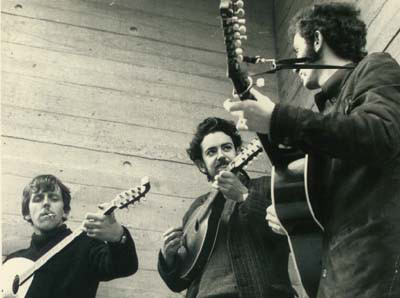
Despite not having any bookings, the three friends decided to travel around Ireland, playing wherever they could land a gig. The three men decided to name their group after the pagan king Suibhne, who was cursed for throwing a cleric’s bell into a lake. However, when Suibhne is anglicised it became Sweeney which lead to the trio becoming Sweeney’s Men.
The newly named Sweeney’s Men spent their first summer touring Ireland in an old red Volkswagen van. Little did the trio know that the summer the spent touring the Emerald Isle was akin to a musical apprenticeship and when they return home to Dublin in the autumn, the three members of Sweeney’s Men were well on their way to becoming professional musicians.
With the arrival of autumn, Sweeney’s Men returned to Dublin and lived in a house in North Strand Street. Not long after this, they met Des Kelly, a member of the Capitol Showband who became their manager.
By then, Sweeney’s Men had turned their back on popular, sentimental ballads that peppered the sets of the older Irish bands. Replacing these songs, were a very different type of ballad, that came from America, England, Ireland and Scotland. They featured incredibly complex arrangements that Sweeney’s Men played on a guitar, mandolin and bazouki. They provided the backdrop as the trio of unique voices complimented each other and became part of Sweeney’s Men’s trademark sound that they continued to hone in Dublin’s clubs. However, Sweeney’s Men knew they were more than ready to record their debut single.
Sweeney’s Men went into the studio and recorded several songs, including Pecker Dunne’s Sullivan’s John which was, released on Transatlantic Records in 1968. Before that, Sweeney’s Men would sign to Pye Records, and released Old Maid In The Garret as their debut single during first half of 1967. However, much would happen before then.
This included a change in Sweeney’s Men’s lineup when “Galway Joe” Dolan left the group, and later, journeyed to Israel. Fortunately, Paul Brady was able to replace “Galway Joe” Dolan and probed a more than adequate replacement when he joined Sweeney’s Men for a gig in Limerick. Unfortunately, Sweeney’s Men were unable to secure Paul Brady’s services long-term, and he joined The Johnstons.
Finding a replacement for “Galway Joe” Dolan, and someone of the calibre of Paul Brady proved problematic, and it took time for Sweeney’s Men to settle on Terry Woods. He was a tenor vocalist who played guitar, 5-string banjo and accordion. Terry Woods had grownup listening to folk, blues and country music, and was already a fan of Sweeney’s Men’s music.
With a new lineup of Andy Irvine, Johnny Moynihan and Terry Woods, Sweeney’s Men recorded their second single for Pye International, Waxie’s Dargle. It was also the final single that Sweeney’s Men released on Pye Records.
By then, Sweeney’s Men had changed managers, and were now managed by Roddy Hickson, John Mahon and Gerry McDonagh, also managed The Johnston. Changing managers was a good move for Sweeney’s Men as they were able to get bookings at some of Dublin’s top folk clubs. Their new managers also managed to get Sweeney’s Men onto the ballroom circuit, where they earned £50 a night for a thirty-minute set. Sweeney’s Men’s new management team secured a recording deal with Transatlantic Records in early 1968. This was the break Sweeney’s Men had been waiting for.
Sweeney’s Men.
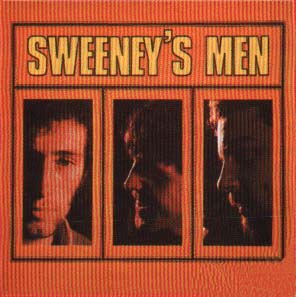
Now signed to Transatlantic Records, the three members of Sweeney’s Men began working on their eponymous debut album.
They chose thirteen songs, including Pecker Dunne’s Sullivan’s John, Peggy Seeger and Terry Woods’ My Dearest Dear, Dominic Behan’s Dicey Riley and Frank Warner’s Tom Dooley. They were joined by nine traditional songs, including Sally Brown, Exile’s Jig, The Handsome Cabin Boy, Willy O’Winsbury, Dance To Your Daddy, The House Carpenter, Johnstone, Reynard The Fox and Rattlin’ Roarin’ Willy which is believed to have been written by Scottish poet Robert Burns. Most of the traditional songs were arranged by Sweeney’s Men, except Willy O’Winsbury which Andy Irvine arranged. These songs were then recorded during a memorable session.
With the material chosen, Sweeney’s Men entered the studio with their unique mixture of disparate instruments. They all added vocals and harmonies, while Andy Irvine played guitar, mandolin, bazouki and harmonica. Johnny Moynihan played tin whistle and bazouki, and nowadays, is regarded as the first musician to incorporate the bazouki into Irish music. Terry woods played guitar, 12-string guitar, banjo and accordion. Taking charge of production was Bill Leader, who oversaw a thirty-six hour marathon recording session that was fuelled by countless pints of Guinness and a steady supply of Dexedrine. Eventually, after the marathon recording session Sweeney’s Men was completed in time.
This was fortunate, as Terry Woods was about to marry Gay Concaron in Dublin, on the ‘18th’ of May 1968. Terry Woods had asked Andy Irvine to be the best man, and the wedding was a double celebration given Sweeney’s Men had just completed their eponymous debut album.
When Sweeney’s Men was released later in 1968, critics discovered an album which featured a carefully chosen selection of American, English, Irish and Scottish folk songs. Unlike most folk bands, Sweeney’s Men didn’t have just the one, or even two vocalists. Instead, they the vocals were shared between the three musicians, with great care taken to find the right vocal for the song. They were accompanied by harmonies and a unique blend of musical instruments quite different from many Irish folk bands were using. Especially the bazouki which Sweeney’s Men pioneered, on an album where the unique and inimitable choice of instruments was imaginative and inventive as they work their way through the thirteen songs that featured on their eponymous debut album.
Sweeney’s Men was an album that divided the opinion of critics, and the reviews were mixed. It was only later that critics and musical historians would realise how important and influential a Sweeney’s Men and their debut album was.
One member of Sweeney’s Men took the mixed reviews of their eponymous debut album badly. It was the final straw for Andy Irvine, who hadn’t been happy playing the ballroom circuit, even though they were earning £50 a night. The audience didn’t sit and listen to the bands like they did in folk clubs, and Andy Irvine saw this as a disrespectful. By then, he was ready to try something different, and when he left Sweeney’s Men travelled to Eastern Europe to discover the indigenous music.
After Andy Irvine’s departure from Sweeney’s Men, the search for a replacement began. Eventually, the two remaining members settled on Henry McCullough, the Eire Apparent guitarist from Portstewart, Northern Ireland was recruited.
With Henry McCullough onboard, a new era began for what was Sweeney’s Men Mk III. Henry McCullough was part of the band when they played on the RTE television series Twenty Minutes With, and by then, there were elements of African and Eastern music to Sweeney’s Men’s sound. There was also a shift towards a more psychedelic sound.
This became apparent when Sweeney’s Men played at Liberty Hall, in Dublin. For the first half, Andy Irvine joined Johnny Moynihan and Terry Woods. Then after the break, Henry McCullough joined Sweeney’s Men as they showcased their new contemporary sound which sometimes, incorporated elements of psychedelia. Little did Sweeney’s Men realise that this was their swan-song at Liberty Hall.
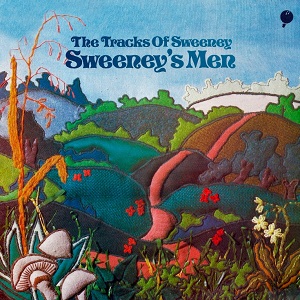
Later in 1968, Sweeney’s Men played at the Cambridge Folk Festival, where they once again, showcased their new contemporary sound. By then, Henry McCullough who had introduced the electric guitar to Sweeney’s Men had started writing some new songs. Two of these would feature on Sweeney’s Men sophomore album The Tracks Of Sweeney. Much would happen before that.
Not long after their appearance at the Cambridge Folk Festival, Henry McCullough left Sweeney’s Men. He had been won over by the John Mayall’s set of electric blues at the Woodstock Festival. This he thought was the future. For the third time, Sweeney’s Men was reduced to a duo.
The two remaining members of Sweeney’s Men started looking for a replacement. Eventually, the settled on singer, guitarist and 5-string banjo player Al O’Donnell. He became third member of Sweeney’s Men Mk IV. However, Al O’Donnell left Sweeney’s Men by the winter of 1968.
This left Sweeney’s Men to tour Britain as a duo. However, when Sweeney’s Men arrived in London they met Andy Irvine and talks began about him rejoining the band. However, too much water had passed under the bridge.
Not long after this, Sweeney’s Men spilt-up for the first time. Johnny Moynihan played tin whistle on Skid Row’s debut single New Faces Old Places. Meanwhile, Terry Woods had met and started working with Phil Lynott who had founded his new band Orphanage. With the two remaining members of Sweeney’s Men working with other musicians, this looked like the of the band.
That was until early 1969, when Johnny Moynihan and Terry Woods agreed to reform Sweeney’s Men. Soon, they were working on their sophomore album The Tracks Of Sweeney.
The Tracks Of Sweeney.
Rather than try to bring onboard a third member of Sweeney’s Men, Johnny Moynihan and Terry Woods decided to record The Tracks Of Sweeney as a duo.
Eleven tracks were chosen for The Tracks Of Sweeney, including four penned by Terry Woods. He wrote Dreams For Me, Brain Jam, When You Don’t Cry and Afterthoughts, and previously had written A Mistake No Doubt Henry McCullough who also contributed Hall Of Mirrors. They were joined by Leonard Cohen’s Go By Brooks and a quartet of traditional songs. This included the instrumental The Pipe On The Hob, plus Pretty Polly, Standing On The Shore and Hiram Hubbard. These songs were recorded in early 1969.
When recording began at Livingston Recording Studios, Barnet, Sweeney’s Men used the two vocalists and a disparate selection of instruments to achieve their new Acid Folk sound on much of the album. Johnny Moynihan played bazouki and tin whistle, while Terry Woods played guitar, 12-string guitar, banjo and accordion. Once the eleven tracks that became The Tracks Of Sweeney were complete, that marked the end of Sweeney’s Men’s recording career.
Sweeney’s Men’s sophomore album was a mixture of styles, and found them embracing the Acid Folk sound on number of songs Tracks Of Sweeney. Especially tracks like Dreams For Me, Brain Jam, A Mistake No Doubt, Go By Brooks, When You Don’t Care For Me. The only Irish jig was The Pipe On The Hob, while Pretty Polly, Standing On The Shore and Hiram Hubbard on looked towards traditional American folk music. Many critics felt that Tracks Of Sweeney was a much better album that its predecessor. Sadly, by the time it was released in late 1969, the Sweeney’s Men story was over.
After three years and what are now regarded as two important and influential albums, Sweeney’s Men split-up. The two remaining members of the group went their separate ways. In some ways, it was a case of what might have been? What direction would Sweeney’s Men have headed in the future, and were they on the cusp of a commercial breakthrough? However, Sweeney’s Men left behind a rich musical legacy that includes their two albums Sweeney’s Men and The Tracks Of Sweeney.
These two albums, Sweeney’s Men and The Tracks Of Sweeney, feature one of the most important and groundbreaking Irish folk bands of the late-sixties. Sweeney’s Men went on to influence a generation of electric folk groups, including Planxty, Moving Hearts, Steeleye Span, and later, groups like The Pogues and Moonshine. Even today, Sweeney’s Men continue to influence a new generation of folk musicians, who look to their two groundbreaking albums, Sweeney’s Men and The Tracks Of Sweeney for inspiration for the music of tomorrow.
The Story Of Sweeney’s Men.
RHYTHM ’N’ BLUESIN’ BY THE BAYOU-LIVIN’, LOVIN’ AND LYIN’.
Rhythm ‘N’ Bluesin’ By The Bayou-Livin’, Lovin’ and Lyin’.
Label: Ace Records.
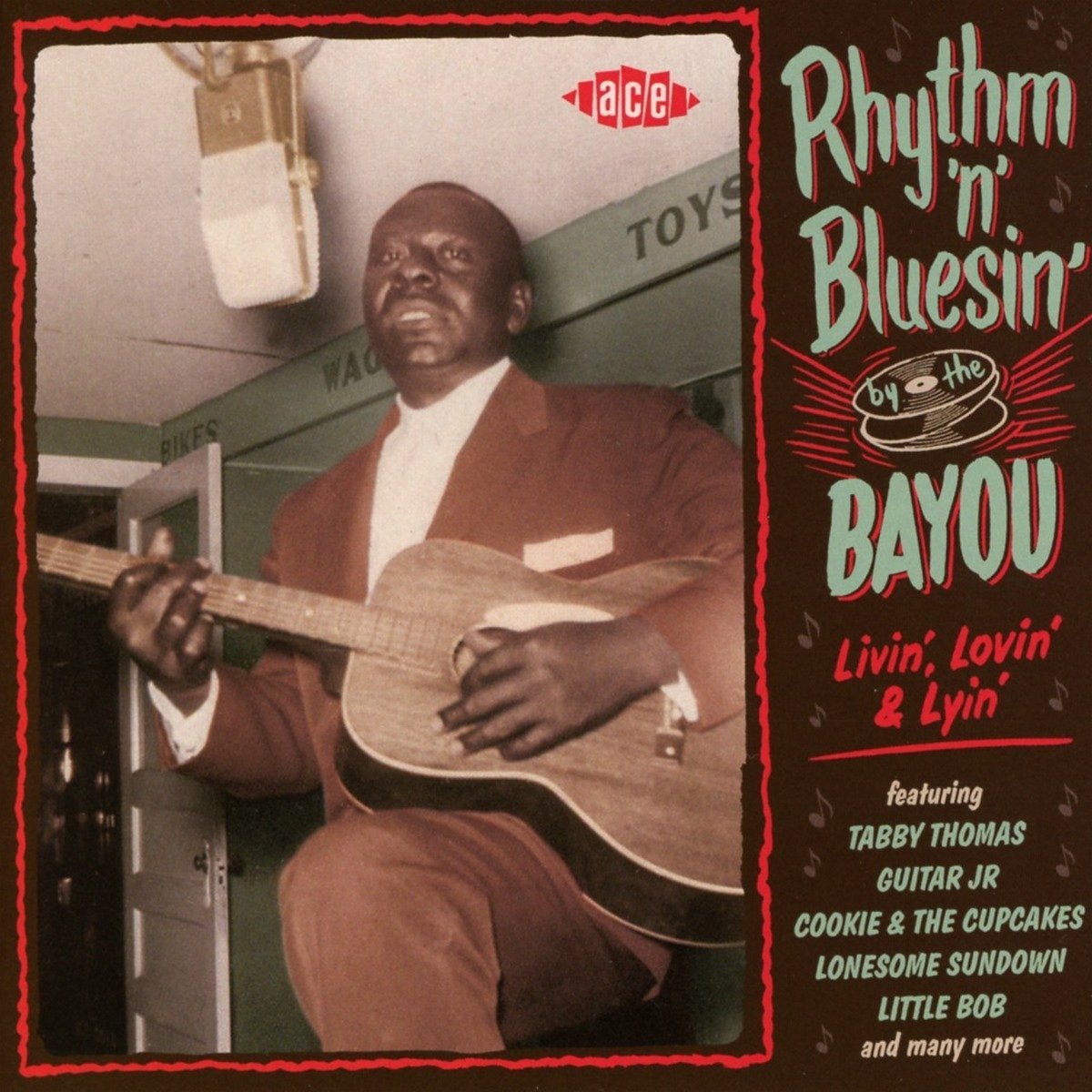
For the latest instalment in Ace Records’ long-running and critically acclaimed By The Bayou compilation series, compiler Ian Saddler returned to South Louisiana and East Texas where he compiled Rhythm ‘N’ Bluesin’ By The Bayou-Livin’, Lovin’ and Lyin’ which is the sixth volume of downhome R&B. It features another twenty-eight tracks from labels like Ron, Feature, Excello, Goldband, Hollywood, Rocko and Flip.
The music these labels recorded and released provided the soundtrack to juke joints along Route 90, and got the party started across South Louisiana and East Texas. From New Orleans, in the East, to Lake Charles in the West, black Americans danced to Cookie and The Cupcakes, Van Preston, Lonesome Sundown, King Karl, Charles Sheffield, Tal Miller, Eddie Williams and Little Nolton. They’re just a few of the names on Rhythm ‘N’ Bluesin’ By The Bayou-Livin’, Lovin’ and Lyin’.
This includes contributions from familiar faces, new names and a couple of mystery recordings on Rhythm ‘N’ Bluesin’ By The Bayou-Livin’, Lovin’ and Lyin’. Even Ian Saddler with his encyclopaedic knowledge of South Louisiana and East Texas’ R&B struggled to discover the identity of two tracks. This include two singles recorded for JD Miller, Love Me Chile and Won’t Be Blue No More. They’re among a number of hidden gems that feature on Rhythm ‘N’ Bluesin’ By The Bayou-Livin’, Lovin’ and Lyin’.
Several artists feature more than once on y The Bayou series, open Rhythm ‘N’ Bluesin’ By The Bayou-Livin’, Lovin’ and Lyin’, including Cookie and The Cupcakes who are veterans of the By The Bayou series. Their first contribution is a hurt filled version of
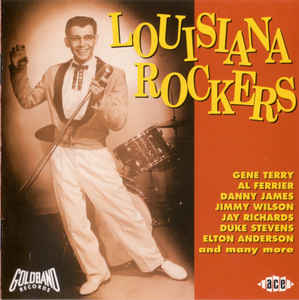
I Keep Crying which was penned by Eddie Shuler, George Khoury, Huey Thierry. However, this Eddie Shuler composition wasn’t released until 1994, when it made its debut on the Ace Records’ compilation Louisiana Rockers. Cookie and The Cupcakes’ other contribution is Keep Livin’ which was written by Clarence Garlow and Eddie Shuler took charge of production. Sadly, Keep Livin’ has lain unreleased and this hidden gem makes a welcome debut on Rhythm ‘N’ Bluesin’ By The Bayou-Livin’, Lovin’ and Lyin’.
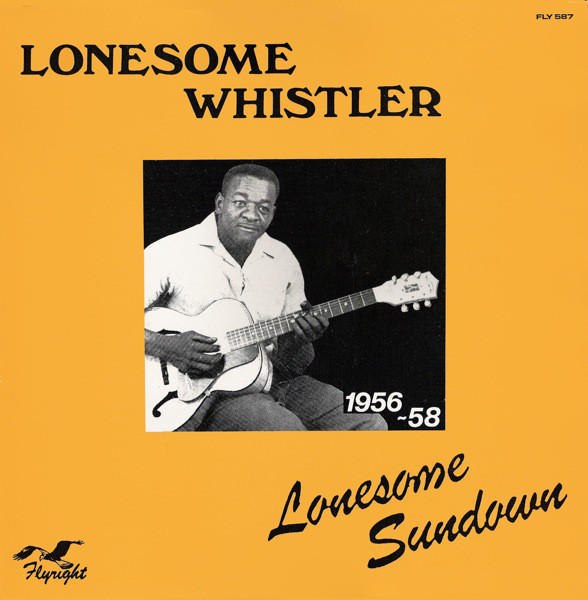
Cornelius Green was better known as Lonesome Sundown, and is another veteran of the By The Bayou series. He contributes Give It Up, which first featured on the Flyright Records compilation Lonesome Whistler 1956-58 which was released in 1983. Give It Up features one of Louisiana’s top bluesmen at his best, and is one of the reasons why Lonesome Sundown was belatedly inducted into the Louisiana Blues Hall Of Fame.
Very little is known about Little Nolton who recorded Don’t Know Why for Eddie Shuler. However, the song was never released and since then, has languished in the vaults. Not any more, as Don’t Know Why makes its debut, and showcases Little Nolton’s needy vocal full of heartbreak and pain.
Another of the lesser known names is Elizabeth, who is no stranger to the By The Bayou series. She featured on the very first edition in this long-running series, and contributes two tracks on Rhythm ‘N’ Bluesin’ By The Bayou-Livin’, Lovin’, including Tell Me Why a piano lead blues with a vocal full of hurt and heartache. I Know is an almost jaunty blues where Elizabeth’s vocal is a mixture of power, hurt and defiance. Both tracks feature a talented singer who deserves wider recognition.
Tabby Thomas was a familiar face around Baton Rouge until his passing on New Year’s Day in 2014. He contributes two tracks to Rhythm ‘N’ Bluesin’ By The Bayou-Livin’, Lovin’ and Lyin’, including the dancefloor filler Roll On Mule which featured on the Flyright Records album Hoodoo Party in 1988. The second track is Don’t Say, a glorious slice of downhome R&B which is a reminder of another musical era.
Van Preston’s contribution is an alternate take of the Eddie Shuler composition Mama’s Little Girl. This tender ballad was recorded by Van Preston and The Nite Rockers for Goldband Records in 1966. However, the alternate take has never been released until it made a welcome debut on Rhythm ‘N’ Bluesin’ By The Bayou-Livin’, Lovin’ and Lyin’.
Bandleader King Charles is another artist who contributes two tracks to the compilation. His first contribution is as a solo artist on the bluesy It Won’t Be Me, where King Charles takes charge of the lead vocal on a song that originally featured on the Goldband Records’ compilation Swampcats Beat in 1967. The second contribution from King Charles dates back to 1954, when he released Bop Cat Stomp on Me on Folk-Star Records. Tucked away on the B-Side is a hidden bluesy gem But You Thrill Me, which features some blistering guitar licks. These two tracks show just why blues aficionados hold King Charles in such high regard.
Tal Miller released a trio singles on the Hollywood label between 1957 and 1959. The final singe was Scorched which was released in 1959, and was sure to have filled dancefloors in juke joints in South Louisiana and East Texas.
Chuck Martin recorded for various producers during his career, including Eddie Shuler. One of Chuck Martin’s recording that was never released was Carry On Yvonne, which makes its debut on Rhythm ‘N’ Bluesin’ By The Bayou-Livin’, Lovin’ and Lyin’. It’s a real find, and it’s inclusion is to be welcomed. Anyone interested in the blues and R&B in South Louisiana and East Texas will enjoy Carry On Yvonne, another dancefloor filler from the truly talented Chuck Martin.
When Sticks Herman With Marcelle Dugas Combo released Beautiful Doll on Goldband Records in 1957, those that bought the single and flipped over to the B-Side discovered the ballad of Crying, Crying. It’s a mixture of theatre, hurt and emotion from Sticks Herman, who recorded fifteen sides for Eddie Shuler.
Blues singer Joe (Mr “G”) August, was born Joseph Augustus, in New Orleans, in 1931. He was one of the first generation of New Orleans’ R&B singers to embark upon recording careers. Later, Billy Eckstine gave Joseph Augustus the nickname Mr. G. In 1955, Joe (Mr “G”) August recorded Boogie With Calypso for the Flip label. This irresistible slice of R&B closes Rhythm ‘N’ Bluesin’ By The Bayou-Livin’, Lovin’ and Lyin’, on a high.
Just like the five previous volumes in downhome R&B from South Louisiana and East Texas in the By The Bayou series, Rhythm ‘N’ Bluesin’ By The Bayou-Livin’, Lovin’ and Lyin’ oozes quality. It’s a welcome addition to the long-running and critically acclaimed series, which is complied by Ian Saddler, who has an encyclopaedic knowledge of blues and R&B from South Louisiana and East Texas.
Ian Saddler has put that to good use on Rhythm ‘N’ Bluesin’ By The Bayou-Livin’, Lovin’ and Lyin’, and combines familiar faces and old friends with new names and mystery singers. There’s also hidden gems and ten previously unreleased tracks on Rhythm ‘N’ Bluesin’ By The Bayou-Livin’, Lovin’ and Lyin’ which was recently released by Ace Records. It’s a welcome addition to the By The Bayou series, which is a long running series where each volume oozes quality. Rhythm ‘N’ Bluesin’ By The Bayou-Livin’, Lovin’ and Lyin’ is no different, and thanks to Ian Saddler’s knowledge and love this wonderful music is the best of the six volumes of blues and R&B from South Louisiana and East Texas.
Rhythm ‘N’ Bluesin’ By The Bayou-Livin’, Lovin’ and Lyin’.

JAMES CARR-THE BEST OF JAMES CARR.
James Carr-The Best Of James Carr.
Label: Kent Soul.
By 1964, Memphis was a musical hotbed, and home to many up-and-coming soul singers and songwriters looking to make a breakthrough. Roosevelt Jamieson was a friend of many of these songwriters and soul singers, including OV Wright and James Carr, who were both looking for a label. It was a frustrating period for the two future soul greats, and Roosevelt Jamieson was determined to help the singers on the road to success.
Roosevelt Jamieson arranged for OV Wright and James Carr to audition at Stax, in the hope that his two friends would be signed to what was one of soul’s top labels. When the three men arrived at Stax, they were greeted by Steve Cropper who was going to audition OV Wright and James Carr. Given both singer’s voice’s and talent surely, Steve Cropper would be keen to secure the signature of OV Wright and twenty-two year old James Carr?
After OV Wright and James Carr had auditioned, Steve Cropper showed very little interest in signing either singer. His rational was that they already had two male vocalists on their roster, Otis Redding and William Bell on their roster. Stax didn’t want to add any more male vocalists to their roster. This was a decision that Stax would come to regret.
In late-1964, Roosevelt Jamieson arrived at the home of Quinton Claunch the owner of Goldwax Records on a cold wet winter’s night with OV Wright and James Carr. After some small talk, the two singers sung unaccompanied in front of Quinton Claunch. That was all he needed to hear, and that night, Quinton Claunch signed both OV Wright and James Carr. Stax’s loss was Goldwax Records’ gain.
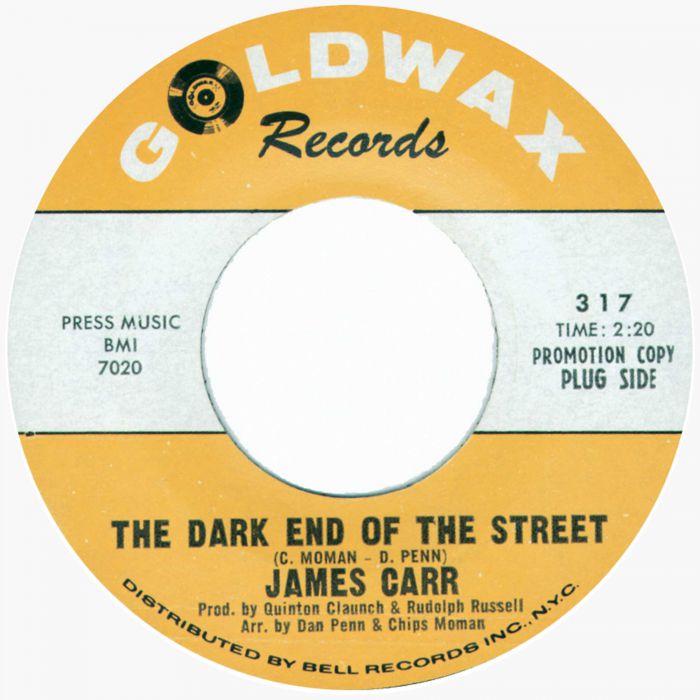
During his time with Goldwax Records, James Carr matured into one of the greatest soul singers of the past six decades, and his single Dark End Of The Street which redefined the future of Southern Soul. Dark End Of The Street is one twenty songs on The Best Of James Carr, which was recently released by Kent Soul, an imprint of Ace Records.
With OV Wright and James Carr now signed to Goldwax Records, Quinton Claunch set about finding the right song for his latest signings. He chose That’s How Strong My Love Is for OV Wright, which when it was released on Goldwax Records, charted and gave the twenty-five year old a hit single. There was only one problem though.
After the success of That’s How Strong My Love Is, Don Robey who owned and ran Duke-Peacock Records claimed to have OV Wright under contract, dating back to when he was a member of The Sunset Travellers. Quinton Claunch, who knew of Don Robey’s alleged business practises, wasn’t going to argue with the ‘music impresario’ who had a reputation for allegedly using intimidation and violence to get what he wanted. OV Wright’s contract at Goldwax Records was canceled, leaving Quinton Claunch with just James Carr.
With OV Wright out of the picture, Quinton Claunch decided to give his other new signing his full attention. Quinton Claunch started looking for the right song for James Carr’s debut single for Goldwax Records. Eventually, the pair settled on Only Fools Run Away, which was released in late-1964 and distributed through Vee-Jay Records.
By then, Vee-Jay was starting to experience financial problems, and no longer had the budget to promote singles, including James Carr’s powerful and emotive reading of Only Fools Run Away. Sadly, James Carr’s debut single failed to trouble the charts, which was a disappointing way to start his career at Goldwax Records.
Things didn’t improve for James Carr when I Can’t Make It with the uptempo Lover’s Competition on the B-Side. It’s included on The Best Of James Carr, and shows another side to him. However, when I Can’t Make It was released in February 1965, it failed commercially. By then, Vee-Jay’s finances were worsening, and it no longer had the financial muscle it once had.
History repeated itself in September 1965, when James Carr released his third single She’s Better Than You. With Vee-Jay’s financial situation worsening all the time, James Carr watched as another single failed to find the audience it deserved. This was a frustrating time for James Carr and Goldwax Records’ owner Quinton Claunch.
Fortunately, by late-1965 Quinton Claunch had managed to negotiate a new long-term distribution deal with the New York-based Amy, Maia and Bell group of labels. Quinton Claunch was pleased because this meant that Goldwax Records’ releases would be distributed and promoted properly. This was perfect timing, as James Carr’s career was about to be transformed.
For James Carr’s fourth single for Goldwax Records, and his first under the next distribution deal was You’ve Got My Mind Messed Up was chosen. It was a song with a complicated past.The roots of You’ve Got My Mind Messed Up could be traced back to That’s How Strong My Love Is, which OV Wright sung at his Stax audition. Steve Cropper liked the song, and after putting the words to a different melody, gave it to Otis Redding. This didn’t please its Roosevelt Jamieson and Quinton Claunch, who asked one of the Goldwax Records’ staff writers OB McLinton, if he could change the melody. The last thing that Quinton Claunch wanted was to release a hit single, and be accused of plagiarism. After OB McLinton made the necessary changes, James Carr could record You’ve Got My Mind Messed Up which features on The Best Of James Carr,
Quinton Claunch sent James Carr to Chips Moman’s American Studio in late-1965, where he recorded You’ve Got My Mind Messed Up. For the B-Side James Carr recorded the driving, stomping uptempo soul of That’s What I Want To Know. These two tracks Quinton Claunch hoped would be James Carr’s breakthrough single.
Goldwax Records scheduled the release of You’ve Got My Mind Messed Up for February 1966, and when the single was released, the powerful, soul-baring ballad entered the charts and reached sixty-three on the US Billboard 100 and seven on the US R&B charts. After four attempts, James Carr had a hit single to his name.
Four months later, James Carr returned with his fifth single for Goldwax Records, a cover of Quinton Claunch’s Love Attack. It featured an impassioned, hurt-filled vocal, and was released in June 1966. Love Attack reached ninety-nine on the US Billboard 100 and twenty-one on the US R&B charts. While Love Attack hadn’t replicated the success of You’ve Got My Mind Messed Up, it gave James Carr his second hit single. James Carr was no one hit wonder.
In September 1966, James Carr returned with his sixth single, Pouring Water On A Drowning Man. Tucked away on the B-Side was Forgetting You where James Carr delivers a needy, hurt-filled and hopeful vocal. It’s too good a track to languish on the B-Side of Pouring Water On A Drowning Man. Just like James Carr’s two previous singles, it sounded as if he had lived the lyrics as he combined power, passion and emotion on Pouring Water On A Drowning Man. It reached eighty-five on the US Billboard 100 and twenty-three on the US R&B charts. However, James Carr would one more single during 1966.
For his fourth single of 1966, James Carr covered the Chips Moman and Dan Penn composition Dark End Of The Street. It was recorded at Hi Studios in Memphis, as Chips Moman’s American Studio was being upgraded. With some top session players accompanying James Carr, he recorded one of the greatest songs in the history of soul music. Its lyrics hinted at an extramarital or interracial relationship, and James Carr sounded as if he had experienced the hopelessness and torment that comes with this pursuit of forbidden fruit. When Dark End Of The Street was released by Goldwax Records in December 1966, and reached seventy-seven on the US Billboard 100 and ten on the US R&B charts, and redefined the future of Southern Soul.
As 1966 gave way to 1967, James Carr had four hit singles to his name, and was seen by many within the Memphis music industry as one of soul’s rising stars. Steve Cropper must have been ruing his decision not to sign James Carr, as he was outperforming pipe smoking, hep cat William Bell. He had just two minor hit singles, and hadn’t enjoyed the crossover appeal that James Carr had. It looked like Steve Cropper had backed the wrong horse.
After enjoying the biggest hit of his career with The Dark End Of The Street, James Carr and Goldwax Records’ owner Quinton Claunch were keen to build on that success. The beautiful ballad Let It Happen was chosen for his next single, with the stomping soul of A Losing Game featuring on the B-Side. When Let It Happen was released in May 1967, it just missed out on the US Billboard 100, but reached thirty in the US R&B charts. This gave James Carr his fifth consecutive hit single.
James Carr’s hot streak continued when he released I’m A Fool For You in August 1967. He was joined by Betty Harris, who wasn’t credited on the single. Their duet reached ninety-seven on the US Billboard 100 and forty-two on the US R&B charts. James Carr had now enjoyed six consecutive singles.
During 1967, James Carr released his debut album You Got My Mind Messed Up on Goldwax Records. It featured the Dan Greer composition I Don’t Want To Be Hurt Anymore which is an outpouring of hurt and emotion from James Carr. It’s joined by other tracks including You Got My Mind Messed Up were Pouring Water On A Drowning Man, Love Attack, The Dark End Of The Street and You’ve Got My Mind Messed Up. When You Got My Mind Messed Up was released in 1967, the album reached twenty-five in the US R&B charts. The James Carr success story continued.
For James Carr’s final single of 1967, he released a cover of Quinton Claunch and OB McLinton’s A Man Needs A Woman. It’s a Southern Soul ballad whose roots are in the church, and features a tender, heartfelt vocal from James Carr. When A Man Needs A Woman was released in December 1978, it reached thirty-three on the US Billboard 100 and sixteen on the US R&B charts. Just like 1966, 1967 had been a good year for James Carr who had enjoyed seven consecutive hit singles.
James Carr was by then, one of Quinton Claunch’s most successful signings for Goldwax Records. What must have made James Carr’s success even sweeter was that Stax had rejected the chance to sign him. However, tragedy had struck during 1967, and Stax’s most successful male vocalist Otis Redding, had died in a plane crash. However, they still had William Bell, who had a handful of minor hit singles to his name and Johnny Taylor who had signed to Stax in 1966. Neither were of the standard of James Carr though.
During the first half of 1968, James Carr had released his sophomore album A Man Needs A Woman. However, when it was released disaster struck and the album failed to trouble the charts. This was a disappointment for James Carr and Quinton Claunch.
When James Carr released A Man Needs A Woman in Britain, the track-listing was different and included the Southern Soul ballad You Hurt So Good. It epitomises everything that is good about Southern Soul, is a hidden gem in James Carr’s back-catalogue. It’s just a pity it didn’t feature on the American version of A Man Needs A Woman.
It wasn’t until June 1968 that James Carr returned with a new single Life Turned Her That Way. It was a moving and poignant ballad from his sophomore album A Man Needs A Woman, which James Carr breathed life and meaning into. Sadly, Life Turned Her That Way failed to chart, and he didn’t enjoy his eighth consecutive hit single.
With his sophomore album A Man Needs A Woman and the single Life Turned Her That Way falling to chart, it was a worrying time for James Carr, and Quinton Claunch the owner of Goldwax Records. However, he believed in James Carr, and in October 1968 Freedom Train was released as a single. Uptempo, catchy and full of social comment, Freedom Train reached thirty-nine in the US R&B charts. James Carr was back with his eighth hit single.
Five months later, and James Carr returned with a new single To Love Somebody which was written by the Gibb brothers, who were better known as the Bee Gees. When To Love Somebody was released in March 1969, it reached forty-four in the US R&B charts. This was James Carr’s ninth, and sadly, final hit single.
By then, music was changing, and soul music was no longer as popular as it had been. The exceptions were some of the music being released by the Motown soul factory, and artists like Aretha Franklin. However, other genres had overtaken soul in the popularity stakes and artists like James Carr was no longer as popular as they had once been.
Nothing more was heard of James Carr until he released Everybody Needs Somebody in December 1969. Sadly, the single failed to chart, and proved an inauspicious end to James Carr’s time at Goldwax Records.
Little did he realise that he had enjoyed the most successful period of his recording career. He would never again scale the same heights. That was despite James Carr signing to Atlantic Records after his departure from Goldwax Records. However, when Hold On was released in July 1971, it failed to chart and James Carr left Atlantic Records having just released one single.
Two years later, reissues of two of James Carr’s singes were released on the Flashback label. Neither The Dark End Of The Street which was released in 1973, nor A Man Needs A Woman troubled the charts. It looked as if James Carr was yesterday’s man.
Nearly four years passed before James Carr released Let Me Be Right (Don’t Want To Be Wrong) on the Memphis based River City label in 1977. By then, disco was flavour of the month and neither Southern Soul, nor soul in general, were no longer as popular.
Despite that, James Carr released a new album Freedom Train in 1977. It bore the Goldwax Records name and was released in conjunction with Vivid Sound. Freedom Train featured Lets Face Facts and These Arms Of Mine, which is another soul-baring ballad which was vintage James Carr. However, the album was only released in Japan and available as an import. Soul fans in America and Britain missed out on Freedom Train, and tracks of the quality of These Arms Of Mine, which features on The Best Of James Carr.
A year after the release of Freedom Train, James Carr returned in 1978 with Oriental Live And Living. It was James Carr’s first live album, and again, was only released in Japan where he was still popular.
Nothing more was heard of James Carr, until Ace Records released Take Me To The Limit in 1991. By then, James Carr wasn’t in good health, but showed more than a few glimpses of his old magic. It was a similar case when Ace Records released the aptly titled Soul Survivor in 1993. The Soul Survivor showed further glimpses of why he was regarded as a true soul great on what was his swan-song.
Sadly, James Carr died of lung cancer in a nursing home in Memphis, Tennessee, on January the ‘7th’ 2001, aged just fifty-eight. Life had been tough for James Carr after freezing on stage during a tour of Japan in 1979. In his later years, he lived with his sister, and bravely battled the bipolar disorder that he had suffered from for much of his life. Sometimes, he required hospitalization, but for much of the final years of his life, soul great James Carr lived quietly with his sister. Music was his past, and was the legacy that he left after his death in 2001.
Since his death, Ace Records have released a triumvirate of compilations, starting with The Complete Goldwax Singles in 2001. This was followed by My Soul Is Satisfied-The Rest Of James Carr in 2004 and A Man Worth Knowing-The 1990s Goldwax and Soultrax Recordings in 2006. Kent Soul also reissued You Got My Mind Messed Up, and one of the bonus tracks was A Lucky Loser. It returns for an encore on The Best Of James Carr, which was released by Kent Soul, an imprint of Ace Records.
For anyone yet to discover James Carr’s music, then The Best Of James Carr is the perfect starting place. It features some of the best music that James Carr released for Goldwax Records, plus a few songs from later in his career. However, it was also at Goldwax Records that James Carr enjoyed the most successful period of his career. Sadly, James Carr’s Goldwax Records’ years lasted just five years between 1964 and 1969, and saw him enjoy nine hit singles. His most successful single was the timeless Southern Soul classic Dark Side Of The Street, which redefined Southern Soul and is part of James Carr’s rich musical legacy, which is celebrated and documented on The Best Of James Carr.
The Best Of James Carr.




EMILIO APARICIO MOOG EXPANSION GALACTICA.
Emilio Aparicio Moog Expansión Galáctica.
Label: Mental Experience.
Nowadays, the words pioneer and innovator tend to be overused, and musicians who create truly groundbreaking music seem to be sadly, few and far between. While there are some pioneering musicians whose music continues to push musical boundaries, there are no longer as many as there once were. Especially in the sixties and seventies, which was a golden period for music that saw creativity and innovation blossom.
The sixties and seventies was also when Emilio Aparicio, an electronic experimental musician from Guatemala, pioneered the use of the Moog synth in Latin America. Between 1969-1971 he used his newly acquired Moog synth to record the music on Expansión Galáctica which was recently released by Mental Experience, an imprint of Guerssen Records, and showcases the a musical pioneer, Emilio Aparicio.
Just two years before Emilio Aparicio started to record the music on Expansión Galáctica, he was a student at the National Music School, in Guatemala City. That was where he first came across fellow student and member of Abularach dynasty, Roberto Abularach. Twenty-one year Roberto Abularach came from a very different background to Emilio Aparicio, but their paths would cross after they had completed their respective studies.
After leaving the National Music School, the friendship between Emilio Aparicio and Roberto Abularach continued. By then, Roberto Abularach was managing the La Estrella warehouse in the Zona 1. It was where musical instruments were imported into Guatemala and sold. However, before long the warehouse was a favourite place for local musicians and bands.
Soon members of Apple Pie, Modulo 5 and Cuerpo y Alma and were hanging out at the La Estrella warehouse. So were local musicians who weren’t part of bands. Some of these musicians went on to form bands, including Les Prince. Many of the bands and musicians were supported by Roberto Abularach, who became their patron. There was no ulterior motive to this, as Roberto Abularach was a kind, generous and wealthy young man.
Not only did Roberto Abularach’s generosity include helping musicians buy their instruments, he sometimes gave instruments to musicians embarking upon musical careers. One of the musicians who made their way to the La Estrella warehouse was Emilio Aparicio.
A graduate of the National Music School, Emilio Aparicio had two passions in life, music and electronics. When he entered the La Estrella warehouse he remembered Roberto Abularach from the National Music School. Soon, they started talking and realised that they had much in common. This was the start of a close friendship.
Emilio Aparicio and Roberto Abularach enjoyed long conversations on music and electronics. By then, Roberto Abularach had spotted Emilio Aparicio’s potential, and was keen to help his friend.
The opportunity arose when Emilio Aparicio decided to buy purchase what was his very first piano. However, the piano was expensive, so Roberto Abularach helped his friend buy the piano. This Emilio Aparicio put to good use, and his talent blossomed.
Over the next year, Emilio Aparicio interest in electronic and experimental music grew. This was something he discussed at length with his friend Roberto Abularach, who in 1969 was about to journey to New York.
During Roberto Abularach’s visit to New York, he visited the Modern Art Museum. That was where Roberto Abularach saw the very first Moog synth, which had been presented to the Modern Art Museum by its founder Robert Moog. Having seen the Moog synth, Roberto Abularach decided to purchase one directly from its inventor, Robert Moog and take it home to Guatemala.
When Roberto Abularach met Robert Moog, he bought a 3P modular synth which bore the serial number 00003. This was only the third Moog modular synth that Robert Moog had made, and Roberto Abularach was taking it home to Guatemala, where it would go to a good home.
Given his interest in electronic and experimental music, it seemed fitting that Roberto Abularach gave the Moog 3P modular synth to his friend Emilio Aparicio. His passion for music and electronics, and interest in both electronic and experimental music meant he would put the Moog to good use.
Having gifted the Moog 3P modular synth to Emilio Aparicio, Roberto Abularach had it installed in his friend’s home in late 1969. Roberto Abularach told Emilio Aparicio that the Moog was his, and he had complete freedom to use the synth in whatever way he wished. While Emilio Aparicio had gained a synth, he had also gained a patron and the man who would support and champion his music.
From late-1969 until 1971, Emilio Aparicio transformed a room in Roberto Abularach country mansion in Zona 12 into a makeshift studio. This was the perfect location for a recording studio, as the country house was empty for much of the year, which allowed Emilio Aparicio to concentrate all his efforts on writing and recording new and innovative music.
In his new studio, was Emilio Aparicio’s newly acquired Moog 3P modular synth and some of the early drum machines. Compared to the drum machine available nowadays, the drum machines were almost primitive. Meanwhile, it took time and patience to work with the Moog 3P modular synth.
It was a relatively instrument which its inventor Robert Moog had demonstrated in early 1967. Even two years later, only a relatively small number of people knew how to setup and use the Moog synth. Through patience and persistence this now included Emilio Aparicio, who had even worked out how to deal with a couple of common problems.
One of the problems that Moog users encountered were that the its oscillators were somewhat unstable. However, soon, Emilio Aparicio realised that if he switched the machine on way before the session began, this allowed them to warm up. Occasionally, the Moog failed to stay in frequency and the tuning was out. Emilio Aparicio knew to expect teething problems with such a complex and groundbreaking piece of equipment. Having got to grips with the Moog 3P modular synth, Emilio Aparicio started making music.
Sometimes, the seclusion that Emilio Aparicio enjoyed was interrupted when Roberto Abularach arrived at his country house. Sometimes, he was joined by various musicians and poets, and the assembled company experimented with hallucinogenic drugs including LSD and Floripondio. This helped Emilio Aparicio open the doors of perception, as he created experimental, innovative and ambitious music.
Not only did the Moog 3P modular synth transform now Emilio Aparicio made music, but also what type of music he made. It was unlike most of the music being made within Guatemala, especially what the pop and rock bands were making. Instead, the music that Emilio Aparicio was making had more in common with the electronic and experimental music being made in Europe and America.
As the sixties gave way to the seventies, Emilio Aparicio continued to spend long periods of time in the studio he had built in Roberto Abularach’s country home. Little did anyone who visited the studio or even heard the music realised that Emilio Aparicio was making the music of tomorrow, today.
After two years locked away in his studio, Emilio Aparicio had completed the ten tracks that feature on Expansión Galáctica. There was only one problem, though, Emilio Aparicio had no idea what to do with the music?
Emilio Aparicio wasn’t chasing the rock star dream, and had no interest in fane and fortune. His interest was making music. Fortunately, his friend and patron, Roberto Abularach, who continued to champion Emilio Aparicio’s pioneering music had come up with a plan to introduce his friend’s music to a wider audience.
To do this, Roberto Abularach planned to use one of one of the Abularach dynasty’s businesses, Salvavidas Rojas. It was a popular drink within Guatemala, and Roberto Abularach had come up with a plan that if customers sent four corks from Salvavidas Rojas’ bottles and three quetzal coins they would receive the five volumes of 45 singles featuring the music that Emilio Aparicio had recorded between late-1969 and 1971. This must have seemed a good idea at the time.
Sadly, very few people took the time to collect the corks and return them to Salvavidas Rojas. Those that sent away for Emilio Aparicio’s five singles, didn’t understand the music. It was unlike anything they had heard on the radio or bought in local record shops. What didn’t help was that Emilio Aparicio didn’t play live and wasn’t part of a band. Instead, he was a relative unknown, who was part scientist, sonic explorer and musician, whose natural habitat was the recording studio. That was where he had spent the best part of two years recording the music on Expansión Galáctica.
It was frustrating that people who sent away for the records often threw them away, or that they were recycled with the other discarded vinyl. Meanwhile, in the Salvavidas Rojas factory piles of unclaimed vinyl sat in the store rooms. They too, were destined for the recycling plant. This was something that many people would later regret.
Following the failure of his first release, Emilio Aparicio dusted himself down and created his next project, La Banda Plastica. Just like his previous project, La Banda Plastica was an experimental and non-commercial project. It was signed to Guatemala’s biggest record label Dideca. They gave Emilio Aparicio total freedom to record whatever he wanted.
This was unusual for Dideca, who usually told bands and artists what type of sound they expected from them. Dideca frowned upon music that wasn’t commercial or had an aggressive sound. That was a no-no. The exception to this was Emilio Aparicio and his new La Banda Plastica project. However, deep down, executives at Dideca and Emilio Aparicio knew that a single from La Banda Plastica had no commercial appeal. La Banda Plastica released just a couple of singles, including Libertad Viene, Libertad Va. Neither single sold well, and the majority of the singles were given away to DJs at radio stations during the Christmas period. This brought to an end what was a somewhat surreal period for Emilio Aparicio.
Sadly, after the commercial failure of La Banda Plastica, Emilio Aparicio became a much more reclusive figure, who recorded purely for his own interest. The music Emilio Aparicio made he had no intention of releasing. That was his hobby, while the jingles and videos he made for television and technical companies paid the bills.
Later, Emilio Aparicio changed direction and started working with computers. He went on to build the first ever computer to be used by the National Bank of Guatemala. Emilio Aparicio had come a long way from when he started working with his Moog synth.
By the early eighties, Emilio Aparicio was one of the leading lights in electronics and technology in Guatemala. He was also working on a new piece of musical technology which he hoped would be used by musicians and bands across the world. This was a guitar synth, and he presented the prototype at Audio Engineering Society’s conference when it took place in Anaheim, California, in 1982. While Audio Research bought patent for the guitar synth, developing it proved problematic. Emilio Aparicio’s invention never made the same impression as Robert Moog’s Moog 3P modular synth.
Still, Emilio Aparicio never lost his love of music, and he continued to record at the home he shared with his wife. Now Emilio Aparicio was recording onto cassettes, which were cheaper and allowed him to record much more music. These recordings were only heard by the person who was closest to him…his wife. She was his musical confidante. It was as if Emilio Aparicio feared that his music would be rejected for a third time. As a result, the music he recorded has never been released.
While music was Emilio Aparicio’s first love, he gradually started to concentrate his efforts on video art in his spare time. By day, Emilio Aparicio was a professor at the Galileo University, which was founded on October ’31st’ 2000 in Guatemala City. Emilio Aparicio taught a new generation of computer scientists, who knew nothing about his former career in music.
Sadly, Emilio Aparicio fell victim to prostate cancer and passed away in 2012. By then, Ruffy Tnt had rediscovered the five volumes of music that Emilio Aparicio had recorded between late-1969 and 1971.
Ruffy Tnt was on a crate-digging expedition in Quetzaltenango in Guatemala, and found himself in a dusty basement that had once been the warehouse of Iximché, who had once distributed the rock-o-la machines. With dust and detritus on the floor, Ruffy Tnt was wary as he hunted through the warehouse. The last thing he wanted was to be bitten by one of the rats that had obviously been present. However, his patience, persistence and bravery was rewarded when he spotted two rooms crammed full of old singles. In amongst some incredibly rare records were two of the five privately pressed volumes of Emilio Aparicio’s music released by Salvavidas Rojas.
The two volumes of Emilio Aparicio’s music that Ruffy Tnt left the warehouse with were Brujería (Witchcraft) and Transmutación del iniciado (Transmutation Of The initiated). However, this was just the start of a seven-year treasure hunt.
Over the next seven years, Ruffy Tnt searched far and wide for the remainder of Emilio Aparicio’s recordings. By 2017, Ruffy Tnt had found the eight singles released baring Emilio Aparicio’s name. This includes the five volumes that were released by Salvavidas Rojas as part of special offer, which Roberto Abularach hoped would introduce Emilio Aparicio’s music to a much wider record buying public.
Sadly, that wasn’t the case, and very few Guatemalan record buyers were won over by the music on the five singles that recently featured on Expansión Galáctica. They’re a reminder of Emilio Aparicio, who throughout his career, was a musical pioneer, who pushed musical boundaries to their limits, and sometimes, way beyond. Proof of that are the ten genre-melting tracks on Expansión Galáctica.
The genre-melting tracks that Emilio Aparicio made between late-1969 and 1971, were way ahead of their time and incorporated elements of disparate musical genres. This included everything from electronic and experimental music, to abstract and avant-garde, through to Latin and psychedelia. There’s also occasional elements of dub, jazz, musique concrète pop and rock on Expansión Galáctica, which was lysergic and mind-expanding magical mystery tour where a true musical pioneer combines the music of the past and present to make the music of the future.
Dubby, experimental, lysergic and eerie describes Expansión Galáctica which opens the album, and gives way to Los Visitantes de Sirio. It’s cinematic, futuristic and veers between moody and joyous as lo-fi electronics, dub and space-age jazz combine with a myriad of effects. La Pipa de Lucas is melodic and breezes along, sounding like it’s part of the soundtrack to an early seventies experimental animation series. There’s an almost military sound to El Nacimiento Diario as horns and drums combine with bubbling, gurgling synths. They combine to create a catchy, space-age and surreal soundtrack fit for a psychedelic army. Very different is La Ceremonia ,which is slow, futuristic, robotic, mesmeric and cinematic track that even today would perfect for a sci-fi soundtrack.
Dramatic and cinematic describes El Misterio de Tiahuanaco, which sounds as if it belongs on a low-budget movie from the early seventies. Brujería has a much more spartan arrangement, with the Moog synth taking centre-stage during what’s a captivating and timeless electronic track. Dubby, dramatic and cinematic describes Transfiguración del Iniciado which sounds as if it belongs on the soundtrack to a seventies cop show. Just like many of the tracks Expansión Galáctica, Bo Bo Bo Beu hints at the music of the future. The keyboards and squelchy synth sound as if they’re from a late-eighties Acid House track. However, Emilio Aparicio Moog had created that sound two decades before the birth of Acid House. Paren La Contaminación del Aire which closes Expansión Galáctica is another track that sounds as if it’s part of the soundtrack to a seventies action movie. It’s also one of Emilio Aparicio Moog’s finest moments on Expansión Galáctica, a remainder of true musical pioneer.
Apart from a few aficionados of electronic and experimental music, sadly, very few people will have heard of the late Emilio Aparicio Moog. This little known musical pioneer, who created ambitious, innovative and imaginative music during what was a short, but unsuccessful recording career.
Emilio Aparicio Moog only released eight singles, which sadly, failed to find the audience they so richly deserved. Especially the five singles he released as part of an offer in conduction with the popular drinks’ company Salvavidas Rojas. Very few people took up the offer, and those that did, failed to understand the music. Many of the singles were thrown away or recycled and nowadays, the five singles are extremely rare. Fortunately, Ruffy Tnt rediscovered these singles, and they feature on Expansión Galáctica, which was recently released by Mental Experience, an imprint of Guerssen Records. This is the first time these singles have been released, and they’re a welcome reminder of Emilio Aparicio Moog, who was a groundbreaking musician whose music was way ahead of its time.
That was why people failed to understand Emilio Aparicio Moog’s music, which is ambitious, innovative, imaginative and even today, has the potential to inspire a new generation of electronic musicians.
Emilio Aparicio Moog spent two years recording the music on Expansión Galáctica, where he pushed musical boundaries to their limit, and sometimes, way beyond. In doing so, musical pioneer Emilio Aparicio Moog created the truly timeless, genre-melting music that features on Expansión Galáctica, which hopefully, will somewhat belatedly find the audience that it deserves.
Emilio Aparicio Moog-Expansión Galáctica.
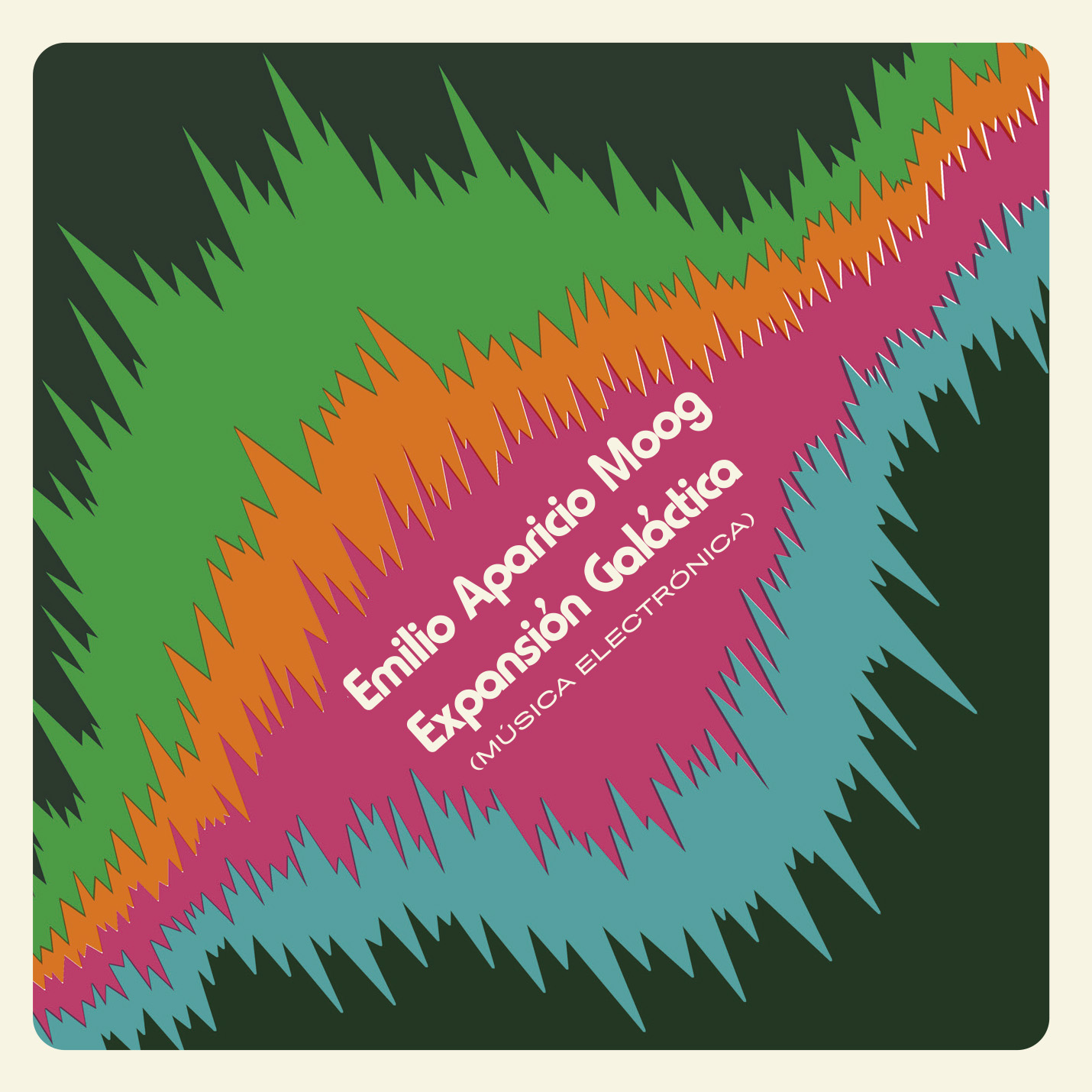
BETTYE SWANN-THE MONEY MASTERS-VINYL.
Bettye Swann-The Money Masters-Vinyl.
Label: Kent Soul.
All too often, talented singers fail top to enjoy the commercial success and critical acclaim that their talent deserves. That was the case with Bettye Swann who had the potential, talent and voice to become one of the great soul singers of the sixties. She released her debut single Don’t Wait To Long in 1964, and three years later in 1967, Betty Swann topped the US R&B charts with Make Me Yours. The future looked bright for Bettye Swann, with critics forecasting that she was about to enjoy a long and successful career.
Sadly, that wasn’t to be. Bettye Swann never again, scaled the same heights. Apart from a couple of minor hit singles, commercial success eluded Bettye Swann, and her recording career was over by 1976. Four years later in 1980, Bettye Swann gave her last concert.
Following the death of her husband and manager, Bettye Swann retired from the music industry aged thirty-six. It was then that Bettye decided upon a change of name and career.
In a sense Bettye Swann died and Bettye Barton was born. The “newly born” Bettye Swan embarked on a career in education in Las Vegas, and became a Jehovah’s Witness. Never again, did Bettye return to soul music, and instead, dedicated her life to education and the church.
Thirty-seven years after Bettye Swann turned her back on music, her music is more popular than ever. Bettye Swann’s fans old and new will welcome the release of The Money Masters by Kent Soul, an imprint of Ace Records on vinyl. It features fourteen of the songs that Bettye Swann recorded during the four years she spent at Money Records between 1964 and 1968. However, the Bettye Swan story began in Shreveport, Louisiana, on October 24th 1944.
That was the date that Bettye Jean Champion was born. She was one of fourteen children, and grew up in Arcadia, Louisiana. It wasn’t until Bettye was in her teens that she starting singing secular music.
Bettye became part of a The Fawns, a vocal group, who sung locally. This was the start of Bettye’s musical career, and a stepping stone to greater things.
In 1963, when nineteen year old Bettye Jean Champion decided to move to Los Angeles, where she would stay with her sister. Once she had settled in Los Angeles, Bettye was spotted by songwriter Huey Harris. Realising that Bettye had potential, Huey Harris told Bettye about a friend of his, Al Scott who ran Money Records.
Just like Huey Harris, Al Scott spotted Betty’s potential and wanted to sign her to Money Records. However, he didn’t like her name, and advised Betty to change her name. What she needed was a name that rolled off the tongue. After some time, Al Scott came up with the name Bettye Swann, which he thought was more showbiz. With her new name, Bettye Swann signed to Money Records.
Soon, Bettye Swann’ life was transformed. Not only had she a new name, but a manager. She also began writing songs, in the hope that one of them would become her first hit. After a few false starts, Bettye Swann had penned Don’t Wait Too Long, which Al Scott decided become her first single which features on The Money Masters.
Once Bettye Swann had recorded The Man That Said No, everything just seemed to fall into place. Bettye Swann was booked to appear on television, where she would sing her new her irresistibly catchy, Motown-inspired sophomore single The Man That Said No. Accompanying Bettye Swann was a full backing band and The Blossoms, who added backing vocals. This was priceless publicity and Al Scott must have thought this would boost sales.
When The Man That Said No was released in July 1965, neither Bettye Swann’s television appearance nor Money Records’ publicity campaign helped sales of the single. It failed to trouble the charts which was huge disappointment for Bettye Swann and Money Records’ owner Al Harris. It was a case of back to the drawing board.
After the disappointment of The Man Who Said No, Bettye Swann wrote two new songs, which featured on her third single. Both feature on The Money Masters, including the soulful sounding The Heartache Is Gone, which showcased a different sound to Bettye Swann’s two previous singles. This new sound was hailed as the new soul sound, and regarded as the future of soul. Tucked away on the B-Side was the heart wrenching ballad Our Love which features one of Bettye Swann’s finest vocals. Given the quality of both sides of her third single, Bettye Swann hoped that her fortune was about to improve. Sadly, that wasn’t to be.
When The Heartache Is Gone was released in April 1966, it also failed to find an audience. This was another huge disappointment for twenty-one year old Bettye Swann, and couldn’t have come at a worst time. Bettye Swann had just started work on her debut album with and Money Records’ owner Al Scott. Sadly, that never happened.
With Bettye’s last two singles having failed commercially, the proposed album was shelved. For Bettye Swann this was a huge disappointment. However, Al Scott hadn’t lost faith in Bettye Swann.
Al Scott sent Bettye Swann back into the Arts Studio to record a song that she had just written, Make Me Yours. It was Bettye Swann’s finest hour, and a song that would become synonymous with her. Fittingly, Make Me Yours opens The Money Masters and is joined by an alternate take of the B-side, I Will Not Cry. It’s another Bettye Swann composition and features an emotive, hurt-filled vocal. Just like Make Me Yours, I Will Not Cry showcases a talented singer-songwriter whose career was about to be transformed.
Make Me Your was released in April 1967 and straight away, the single began to climb the charts. Eventually, it reached number one on the US R&B charts and number twenty-one on the US Billboard 100. After three long and frustrating years, Bettye Swann had made a breakthrough. Now came the hard bit, following up Make Me Yours.
Having enjoyed a number one single in the US R&B charts, the pressure was on Bettye Swann to come up with another hit single. She came up with two new songs, including the uptempo and soulful Fall In Love With Me which was chosen as the single. It was paired with Lonely Love a catchy and uptempo dancefloor friendly song that was tucked away on the B-Side. Both sides feature on The Money Masters, and document the next chapter in the Bettye Swann story.
When Fall In Love With Me was released in August 1967, it charted, but stalled at just thirty-six in the US R&B charts. While this was disappointing compared to Make Me Yours, Bettye Swann had enjoyed two consecutive hit singles, and three hits in three in three years. This was the perfect time for Bettye Swann to release her debut album.
Rather than rush out Bettye’s debut album, Al Scott decided to rerecord some of the tracks. This included two B-Sides, I Will Not Cry and Lonely Love. New tracks were recorded, including The Temptations’ Don’t Look Back, Ray Charles’ I Can’t Stop Loving You and Sam Cooke’s A Change Is Gonna Cone which is reinvented by Bettye Swann. However, instead of the original recording of A Change Is Gonna Cone, it’s a Rob Keyloch remix that features on The Money Masters. However, fifty years ago the original version of A Change Is Gonna Cone closed Bettye Swann’s debut album Make Me Yours.
With the album completed, Make Me Yours was released in 1967. Sadly, despite the effort of everyone at Money Records put into the release of Make Me Yours, the album wasn’t the commercial success that they had hoped. The album passed records by, and Al Scott’s thoughts turned to Bettye Swann’s next single.
The song chosen was a track from Make Me Yours, Don’t Look Back. It doesn’t feature on The Money Masters. However, the B-Side You Gave Me Love which was penned by Bettye Swann and Arthur Wright does. It’s a soulful hidden gem from Bettye Swann, and deserved better than to be hidden away on a B-Side.
Don’t Look Back was released in 1968, but failed commercially. Just a year after she had topped the US R&B charts, things weren’t going well for Bettye Swann, and her time at Money Records was almost at an end.
Bettye Swann would only released one more single on Money Records. Don’t Take My Mind. It’s a Bettye Swann composition that featured on Make Me Yours. It was paired with the soul-baring I Think I’m Falling In Love, which was written when Bettye Swann was still Bettye Jean Champion. While the original version of Don’t Take My Mind features on The Money Matters, an alternate take of I Think I’m Falling In Love from 1966 is included.
History repeated itself when Don’t Take My Mind was released in March 1968, and failed to chart. That proved to be the end of two chapters in Bettye Swann’s career.
The money spent on promoting Bettye’s Make Me Yours album had taken its toll on Money Records’ finances. This wasn’t helped by the failure of her last two singles. Something had to give, so Bettye Swann left Money Records.
Just a year after enjoying a number one single, Bettye Swann parted company with Al Scott. Not only did Al Scott produce and manage Bettye, but they had been a couple. Mixing business and pleasure is always dangerous, and that proved to be the case for Bettye Swann. The relationship faltered, and by 1968, Bettye had a new manager George Barton.
Following her departure from Money Records, Bettye and George Barton moved to Athens, Georgia. George Barton who was twenty years older than Bettye, was a veteran of the music industry. He knew his way around the music business, and in mid-1968 Bettye Swann signed to what was one of the biggest, and most prestigious labels in music, Capitol Records.
The Capitol Records’ Years.
At Capitol Records Bettye Swann was paired with producer Wayne Shuler. He was a relative newcomer to Capitol Records, but certainly wasn’t a rookie. Wayne Shuler’s father was Eddie Shuler, the producer and owner of Goldband Records. From early age, he had taught Wayne Shuler the tricks of the trade, and when he began work at Capitol Records, he had an edge on the real “rookies.” Especially when it came to producing soul and R&B. Given his background, it was hoped that Wayne Shuler could get Bettye’Swann’s career back on track,
Unlike Money Records, Capitol Records’ priority was albums. That was where the money was to be made. Singles were regarded as a bonus.
Despite this, Bettye’s Capitol Records debut was the single, I’m Lonely For You. It was released in September 1968 but failed to chart. This wasn’t a good start to Bettye’s time at Capitol Records. However, better times weren’t far away.
For Bettye’s second single for Capitol Records, Bettye covered Hank Cochran’s Don’t Touch Me. When it was released in January 1969, it reached number fourteen in the US R&B charts. Now all thoughts turned to Bettye Swann’s first album for Capitol Records
Bettye Swann’s first album for Capitol Records, The Soul View Now! was released in the first half of 1969, and reached number forty-eight in the US R&B Charts. It looked as if Bettye Swann’s luck was changing.
To build on the success of The Soul View Now!, Capitol Records released the Chip Taylor composition Angel Of The Morning in May 1969. However, when the single failed to chart this was another disappointment for Bettye Swann. Fortunately, Capitol Records had faith in Bettye Swann, and sent her back into the studio.
Capitol Records didn’t spare any expense when it came to recording
her third album Ever Get Tired Of Hurting Me? with producer Wayne Shuler produced Don’t You Ever Get Tired Of Hurting Me? It was released later in 1969, but failed to chart. Little did Bettye Swann realise, that thing were going to get a whole lot worse.
Bettye Swann released just two more singles on Capitol Records. The first was Don’t You Ever Get Tired (Of Hurting Me)? It was released in September 1969, and failed to chart. Neither did Little Things Mean A Lot when it was released in January 1970. Sadly, it was the last single that Bettye Swann on Capitol Records.
The Fame Years.
After her departure from Capitol Records, Bettye Swann found herself without a record deal for the first time in her career. With the help of her husband and manager George Barton, she secured a deal with Fame Records in 1971. It was enjoying the most successful period in its history, and Fame Records were alway looking to add to their roster. When Fame realised that Bettye Swann was without a label, they swooped and signed the former chart topper. Sadly, Bettye’ Swann’s time at Fame Records was short-lived.
Mickey Buckins had been trying to get an in at Fame Records for some time, and eventually h is patience was eventually recorded, when he was given a job as staff songwriter and technician. Although Mickey Buckins was mainly based at Fame Records’ demo studio, this didn’t matter to him. He was just happy to be working at such a prestigious studio, and soon, formed a fruitful songwriting partnership with George Jackson. One of their songs was I’m Just Living A Lie. It seemed like the perfect song for Bettye Swann.
Bettye Swann went into the Fame studios and cut I’m Just Living A Lie, which was released in March 1971, but failed to chart. For Bettye Swann, history was repeating itself. There was no followup to I’m Just Living A Lie, and Bettye’s time at Fame Records was over.
The Atlantic Records Years.
It was nearly another year before Bettye Swann released Victim Of A Foolish Heart as single. It was well worth the wait. Victim Of A Foolish Heart had been written by George Jackson and Mickey Buckins who produced the song with Rick Hall. When executives at Atlantic Records heard the song, they knew they had a hit on their hands.
When Victim of A Foolish Heart was released on the ‘30th’ of March 1972, it reached number fourteen in the US R&B Charts and sixty-one in the US Billboard 100. After six singles that failed to chart, Bettye Swann was back. The big question was, could she make it two in a row?
For the followup to Victim of A Foolish Heart, the song chosen was Merle Haggard’s Today I Started Loving You Again. Again, recording took place at Fame Studios, with Phil Hurtt, Tony Bell and LeBaron Taylor taking charge of production and reinventing the song. When I Started Loving You Again was released in November 1972, it reached number twenty-four in the US R&B charts and number forty-six in the US Billboard 100. Bettye Swann’s career had been rejuvenated at Fame.
Sadly, Bettye wouldn’t return to Fame to record the follow-up to Today I Started Loving You Again. Instead, Bettye Swann was Philly bound, where she would receive a Philly Soul makeover. However, Bettye Swann wasn’t working with Gamble and Huff or Thom Bell. The Big Three were too busy, so Bettye was paired with The Young Professionals.
Their first single with Bettye was The Boy Next Door. On its release in August 1974. which stalled at a disappointing seventy-four in the US R&B charts. For the followup to The Boy Next Door, Time To Say Goodbye and When The Game Is Played On You were chosen and released as a double-A-side. Neither track caught the imagination of the record buying public, who missed one of the best tracks from Bettye Swann’s short-lived Philly Soul era. After the commercial failure of Bettye Swann’s latest single, executives at Atlantic Records were watching events in Philly closely.
Time To Say Goodbye was released in September 1974, bit failed to trouble the charts. This was the last single he Young Professionals produced for Bettye Swann and marked the end of her Philly Soul era.
When The Young Professionals failed twice to deliver a hit, executives at Atlantic Records brought onboard a new producer, Dave Shapiro. His first production was All The Way In Or All The Way Out which released in March 1975, but stalled at eighty-three in the US R&B charts. For Bettye Swann this was just another disappointment. Sadly, things didn’t get any better.
In September 1976, Bettye Swann released Heading In The Right Direction which she hoped would rescue her career at Atlantic Records. However, when the single failed to chart, this spelt the end of Bettye Swann’s time at Atlantic Records.
Four years later, in 1980, Bettye Swann made what was the final live appearance of her career. Tragedy struck later in 1980 when Bettye Swann’s husband and manager George Barton died in 1980.
Following the death of George Barton, Bettye Swann retired from the music industry aged just thirty-six. It was then that Bettye decided upon a change of name and career. In a sense Bettye Swann died and Bettye Barton was born. The “newly born” Bettye Swan embarked on a career in education in Las Vegas and became a Jehovah’s Witness. Never again, did Bettye Swann return to soul music. However, Bettye Swann left behind a rich musical legacy.
A tantalising taste of Bettye Swann’s musical legacy can be found on The Money Masters which was recently released by Kent Soul, an imprint of Ace Records. This fourteen track covers Bettye Swann’s time at Money Records, and includes singles, B-Sides and alternate tracks. The Dance Is Over a track written when Bettye Swann was still Betty Jean Champion makes a welcome return eleven years after making its debut on The Soul Of Money Records Volume 2. Just like the rest of songs on The Money Masters, they’re a reminder of Bettye Swann at the peak of her musical powers.
Bettye Swann Bettye Swann was one of the most talented singers of her generation, and could breath new life, meaning and emotion into lyrics. They were transformed, and sometimes, familiar songs took on new meaning. Sometimes, it seemed as if Bettye Swann had lived and survived the lyrics as she brought them to life. However, despite her undoubtable talent, Bettye Swann didn’t enjoy the commercial success and critical acclaim that their talent so richly deserves.
Over the last few years, Bettye Swann’s music has started to find the audience that it deserves. While Bettye Swann has always been popular since her career began in 1964, a new generation of record buyers have discovered her music, and will embrace and enjoy The Money Masters, which was recently released on vinyl by Kent Soul, an imprint of Ace Records on vinyl.
Bettye Swann-The Money Masters-Vinyl.
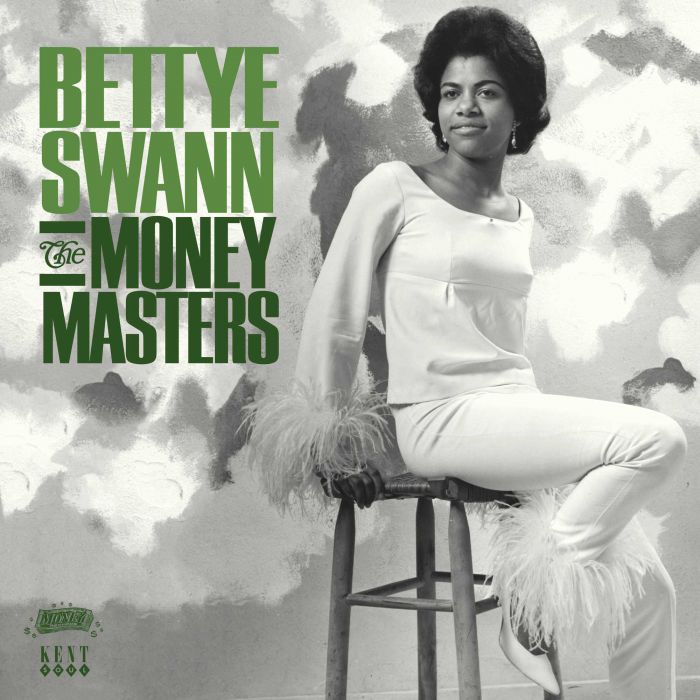
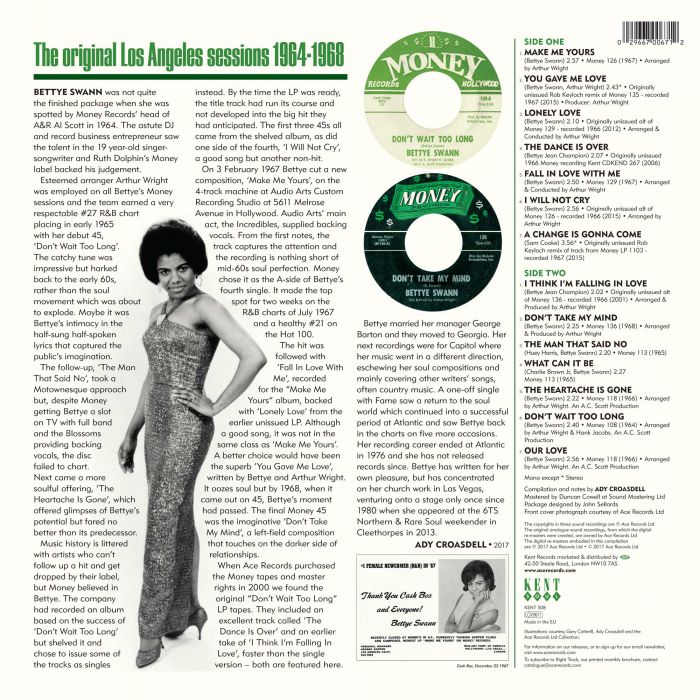
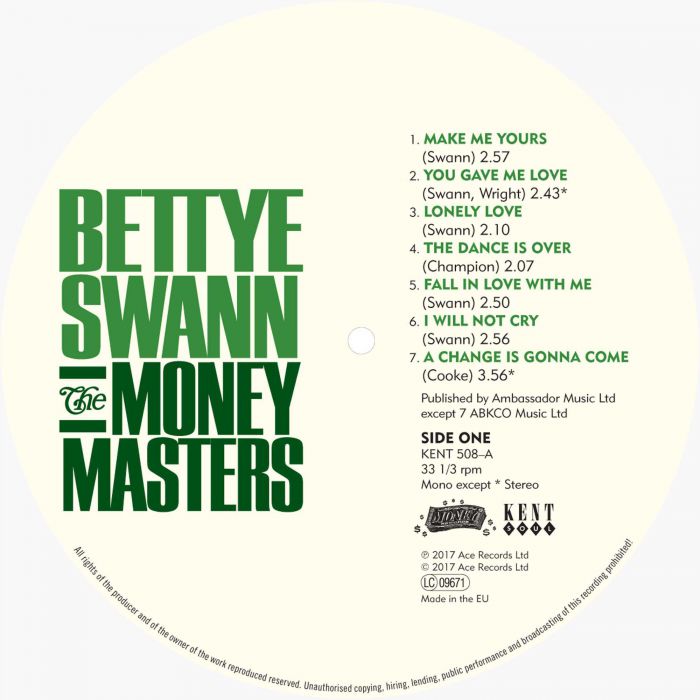

NORTHERN SOUL’S CLASSIEST RARITIES VOLUME 6.
Northern Soul’s Classiest Rarities Volume 6.
Label: Kent Dance.
Nowadays, Northern Soul compilations are two a penny and hardly a week goes by without yet another Northern Soul compilation being released. That has been the case for the last few years, and nothing has changed during 2017. Most of the compilations are third-rate, and are nothing more than hastily compiled cash-ins, where labels old and new jump on the Northern Soul bandwagon, which has been rolling along for many years, and shows no slowing down.
It’s a similar case with the disco bandwagon, with record companies clambering aboard ever since the latest resurgence of interest in the genre that once sucked. This has resulted in the release of countless disco compilations, including compilation of bloated remixes by DJs who have spent the last forty years playing the same set. Just like the record companies who have jumped on the disco bandwagon, the remixers rehash the same tired songs that they pass off as ‘classics.’
Sadly, the same fate has befallen many Northern Soul compilations, with the same tracks being rehashed on numerous compilations. Especially those compilations that feature the words: “featuring songs played at the Wigan Casino or Blackpool Mecca. With these compilation it’s a case of caveat emptor. After all, not every track played Wigan Casino or Blackpool Mecca was a classic. Far from it, it’s a case of: “don’t believe the hype.”
There’s several ways to separate the wheat from when the chaff, when it comes to Northern Soul compilations. Who compiled the compilation is hugely important, and so is the label that released the compilation. Some labels have established a reputation for releasing quality Northern Soul compilations, while others are just jumping on the bandwagon, looking to make a quick buck. They neither care about the music, nor the people that made it. However, labels like Ace Records care about Northern Soul and the about the people who made it.
That has been the case for the last three decades. Through their Kent imprint, Ace Records have been releasing Northern Soul compilations for over twenty years. Their most recent Northern Soul compilation, was Northern Soul’s Classiest Rarities Volume 6, which was released by their Kent Dance subsidiary. It has everything you could want in a Northern Soul compilation.
That’s not surprising as Northern Soul’s Classiest Rarities Volume 6 was compiled by veteran compiler Ady Croasdell. He’s a man with an encyclopaedic knowledge of all things soulful and is steeped in the Northern Soul scene. Ady Croasdell has put his knowledge of Northern Soul to good use when compiling Northern Soul’s Classiest Rarities Volume 6, and combines classics and collectors items with future classics, hidden gems, obscurities, rarities and five unissued tracks. The result is Northern Soul’s Classiest Rarities Volume 6, which is a welcome addition to the Northern Soul’s Classiest Rarities’ rarities series.
Opening Northern Soul’s Most Classiest Rarities Volume 6 is Peggy Woods’ Love Is Gonna Get You which sounds as if it was recorded at Motown, in Detroit. Instead, it was recorded in Nashville in 1966 for Modern Records. Sadly, the song lay unreleased until 1988 when a version of Love Is Gonna Get You was released as a single by Kent to celebrate the 100 Club Anniversary. However, the single featured a different backing track to the original version. This has been rectified and for the first time, the original version Peggy Woods’ Love Is Gonna Get You can be heard. With its brassy horns, stomping beat and coquettish vocal, it epitomises everything that is good about Northern Soul.
Former Soul Stirrer Johnny Taylor signed to Stax in 1965, and three years later in 1968, enjoyed the biggest hit of his career with Who’s Making Love which topped the US R&B charts. In 1970, Johnny Taylor was still trying to replicate the success of Who’s Making Love. When he released Friday Night in 1970, it reached number three on the US R&B charts. Tucked away on the B-Side was Friday Night which features a vampish vocal and funky arrangement that would find favour with DJs and dancers on the British Northern Soul scene.
In 1970, Betty Everett from the Windy City of Chicago released I Got To Tell Somebody on Fantasy. It was arranged by Donny Hathaway and produced by Calvin Carter, who played their part in the sound and success of the single. When it was released, it reached twenty-two on the US R&B charts. That is no surprise as it’s über soulful and dancefloor friendly and is the perfect showcase for Betty Everett’s talents as a vocalist.
When The Hyperions released their debut single Why Do You Wanna Treat Me Like You Do on Ruth Conte’s Los Angeles based Chattahoochee Records in 1965, they must have hoped that this was the first of many singles the group would release. Sadly, Why Do You Wanna Treat Me Like You Do an impassioned, uptempo dancer that is punctuated by washes of swirling Hammond organ was The Hyperions’ only single. However, fifty-two years later, this classy rarity is still a favourite within the Northern Soul scene.
DiFosco was the musical vehicle of Big Dee Irwin, who wrote Sunshine Love which he arranged and produced with Frank Clark. It was released on the Earthquake label in 1971, but failed to find an audience in America. However, when Northern Soul DJs started playing Sunshine Love this soulful dancer soon became a favourite amongst dancers.
By 1968, twenty-four year Detroit born Jock Mitchell already had twelve years experience of the music industry and had released several singles. His career began as a twelve-year-old, when he recorded four songs for Chess Records as Jake Mitchell. None of these songs were ever released, and Jock Mitchell returned to Detroit where he would later founded his new label Golden Hit Productions which also owned a recording studio. That was where Jock Mitchell with The Fabulous Agents recorded Nomad Woman, which was released in 1968 on Golden Hit Productions. Despite Jock Mitchell’s hurt-filled, soul-baring vocal the single failed commercially. It’s a soulful hidden gem and a welcome addition to Northern Soul’s Classiest Rarities Volume 6.
Maxine Brown’s released One In A Million on Wand in 1966, and later, it became a Northern Soul classic. Over fifty years later, One In A Million is still a favourite of many dancers and DJs within the Britain Northern Soul scene. However, they won’t have heard the version of One In A Million on Northern Soul’s Classiest Rarities Volume 6. It’s one of five recently discovered alternate takes of One In A Million that Maxine Brown recorded prior to recording her Northern Soul classic
In 1965, Jackie Day recorded Naughty Boy which was written and produced by Cyril D. Roberts Jr at Modern Records’ studio. Joining Jackie Day was a band that featured some top musicians. However, when Naughty Boy was released on the short-lived Phelectron Records, the single sunk without trace. It wasn’t until two decades later that the horn driven, driving soul of Naughty Boy, which features an accusing vocal from Jackie Day found an audience on the eighties Northern Soul scene.
J. J. Barnes has long been a favourite of both dancers and DJs on the UK Northern Soul scene. This included his 1964 single Poor Unfortunate Me (I Ain’t Got Nobody), which was produced by Fred Brown and Joe Hunter. It was released in November 1964, on the short-lived label, Ring Records. Its only release was Poor Unfortunate Me (I Ain’t Got Nobody) which features J.J. Barnes at his most soulful as he delivers a heartfelt and hurt-filled vocal.
When The Detroit Emeralds released their debut album Do Me Right on Westbound Records in 1971, it featured Long Live The King. While it wasn’t released as a single in America, Long Live The King was released as a single by Pye International in Britain. With It’s a truly timeless track that was one of the highlights of Do Me Right in 1971, and Northern Soul’s Classiest Rarities Volume 6 in 2017.
In 1972, Alabama born soul singer OC Tolbert made his way to Dave Hamilton’s Detroit studio, where he was about to record (Marriage Is Only) A State Of Mind. It had been written and produced by Dave Hamilton, and O.C. Tolbert hoped the song would be his next single. Sadly, (Marriage Is Only) A State Of Mind was never released and record buyers never got the opportunity to hear OC Tolbert’’s soul-baring vocal. It’s by far the best of the unreleased tracks and one of the compilation’s highlights.
Closing Northern Soul’s Classiest Rarities Volume 6 is Carla Thomas’ Little Boy, which was recorded for Stax in 1961. This was the same year Carla Thomas enjoyed a hit with Gee Whiz. However, Little Boy which is a beautiful ballad, was the one that got away for The Queen Of Memphis Soul. It wasn’t released until 1994, when it featured on the compilation Hidden Gems. Now twenty-three years later, this beautiful hidden gem returns for a well-deserved encore, and closes the compilation on a high.
There aren’t many compilations are still going strong after six volumes. Usually, the compiler is struggling to find material for a sixth instalment. However, that isn’t the case with Northern Soul’s Classiest Rarities Volume 6 which literally oozes quality, It finds classics and collectors items rubbing shoulders with future classics, hidden gems, obscurities, rarities and even a quintet of unissued tracks. As a result, Northern Soul’s Classiest Rarities Volume 6 which was recently released by Kent Dance, an imprint of Ace Records, will be a must-have for anyone with a passing interest in Northern Soul. There’s a reason for this compiler Ady Croasdell.
Just like previous instalments in the series, Northern Soul’s Classiest Rarities Volume 6 was compiled by veteran compiler Ady Croasdell. He’s a man steeped in Northern Soul, and has an almost encyclopaedic knowledge of all things soulful. Ady Croasdell’s knowledge of soul and specially Northern Soul has been put to good use when compiling Northern Soul’s Classiest Rarities Volume 6.
While other compilers are happy to rehash the same tracks for the umpteenth time, Ady Croasdell knows that there’s still mountains of soulful delights awaiting discovery and that it’s just a case of discovering them. Like a musical man from Del Monte, Ady Croasdell goes in search of hidden gems for the Northern Soul’s Classiest Rarities series. Some of these make a welcome appearance on the sixth instalment in this long-running and successful series.
The success of Northern Soul’s Classiest Rarities series is down to its compiler Ady Croasdell. He knows that in the cutthroat world of compilations that competition is fierce, so digs deeper than other compilers of Northern Soul compilations.
Often there’s a myriad of delights awaiting discover within a record company vaults. Ady Croasdell knows that a hidden gem could be hidden in a mislabelled tape box. Within that box, could be a killer track, that crate-diggers find a lifetime searching for. Ady Croasdell knows his way around record company vaults, and has spent hours, days, weeks and months searching. That takes patience and dedication and yet again, this has paid off on Northern Soul’s Classiest Rarities Volume 6 which is one of the finest compilations of Northern Soul released during 2017.
Northern Soul’s Classiest Rarities Volume 6.
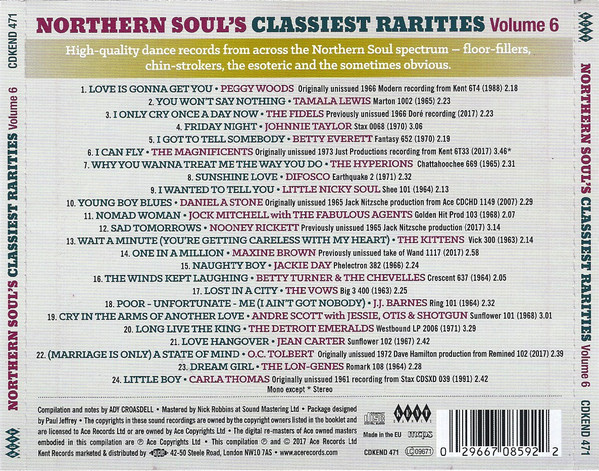


THE JOHNSTONS-WHAT MIGHT HAVE BEEN?
The Johnstons-What Might Have Been?
During the mid-sixties, folk music on both sides of the Atlantic was growing in popularity, in America and Britain. It was a similar case in Ireland, where a number of folk bands were founded, including The Johnstons in Slane, County Meath, whose original lineup featured Adrienne Johnston, her younger sister Lucy and brother Michael.
When The Johnstons started out in the early sixties, they had a ready-made venue on their doorstep, their father Marty’s pub in Slane. That was where they made their debut, singing Irish ballads and folk songs in their father Marty’s pub in Slane, with Michael Johnston playing a twelve-string guitar as Adrienne and Lucy sang harmonies. This went down well with the customers, and soon, people were coming to the pub to see The Johnstons sing. Before long, The Johnstons were heading further afield.
It wasn’t long before The Johnstons started to get bookings in the Dublin area, and made their to the capital of the Republic Of Ireland. By then, the group had only been together for a short time. This made what happened next a remarkable achievement.
The Johnstons decided to enter the first ever Wexford Ballad Competition in February 1966. At stake was a £100 first prize and more importantly, an appearance on the Irish television programme the Late Late Show. Despite their relative inexperience Adrienne Johnston, her sixteen year old younger sister Lucy, and brother Michael triumphed and won the inaugural Wexford Ballad Competition. They arrived home that night £100 richer and with an appearance on the Late Late Show to look forward to. The Johnstons had come a long way in a short.
Life was about to get even better for The Johnstons, who were offered a recording contract by Pye Records. One of the first songs The Johnstons recorded was a cover of Ewan McColl’s The Travelling People, which topped the Irish charts in 1966. This transformed The Johnstons career and indeed lives.
Suddenly, The Johnstons embarked upon a gruelling touring schedule and were constantly on television. They also had to find time to record a second single. Before that, Michael Johnston left the band that he had founded, and was replaced by Paul Brady who would go on to enjoy a long and successful solo career and become one of the biggest names in Irish music.
When Paul Brady from Strabane, Tyrone, joined The Johnstons, he came from a very different musical background, and had previously played in various R&B and beat groups. He was a talented musician and vocalist who would play an important part in The Johnstons’ success. However, Paul Brady wasn’t the only new name joining The Johnstons.
The other musician joining The Johnstons was Limerick born Mick Moloney, a multi-instrumentalist, who had been a member of The Emmet Folk Group. He had also worked with a number of well known Irish traditional musicians. Mick Moloney and Paul Brady made their debut on The Johnstons’ sophomore single.
For their followup to The Travelling People, The Johnstons recorded and released The Alamo later in 1966. It charted and The Johnstons’ popularity continued to grow. By then, The Johnstons were a popular draw and in Dublin and a familiar face in city’s folk scene. The addition of Paul Brady and Mick Moloney had allowed The Johnstons to expand their repertoire. This ensured that The Johnstons’ popularity continued to grow.
Especially when The Johnstons’ third single I Never Will Marry was released by the Pye Records’ imprint Target in 1967 and charted. This was the group’s third consecutive single, but still, The Johnstons hadn’t released an album. However, this would change when they signed to the London-based Transatlantic Records in early 1968.
Signing to Transatlantic Records was the start of a new chapter for The Johnstons, who many critics though were on the verge of making a breakthrough in Britain and Europe. Their music, which was a mixture of folk songs and traditional music had found an audience in Ireland, and Transatlantic Records hoped would soon, find an audience further afield.
When it came to choosing their debut single The Johnstons recorded and released They’ll Never Get Their Man on Transatlantic Records in 1968. Just like their three previous singles, it gave The Johnstons a hit single in Ireland. Later in 1968, The Johnstons released their eponymous debut album which featured a mixture of folk songs and traditional music. This proved popular in Ireland and was a commercial success.
Further cementing The Johnstons reputation was one of Ireland’s leading folk groups was the success of the Gaelic language singe Gleanntáin Ghlas Ghaoth Dobhair they released on the Gael Linn Records. By then, The Johnstons’ popularity was at an all-time high in Britain and Ireland and critics on both sides of the Irish Sea were praising the group.
After the success of their eponymous debut album, The Johnstons returned in 1969 with not one, but two albums, Give A Damn and The Barley Corn which they released simultaneously. The two albums showcased a versatile band who were able to interpret, arrange and perform a wide range of different songs that would appeal to do different types people.
The Barley Corn saw The Johnstons return to the sound that featured on their eponymous debut album, and was a mixture of folk songs and traditional Irish and Scottish music. This proved popular, as the music chosen replicated The Johnstons’ live sound. However, The Barley Corn featured a polished performance from The Johnstons, who changed direction on Give A Damn, which was another successful album.
Give A Damn.
Part of the success of Give A Damn were the songs that were chosen by The Johnstons and the album’s much more contemporary sound. The Johnstons covered Ewan McColl’s, Sweet Thames Flow Softly and Dave Cousins of The Strawbs’ You Keep Going Your Way. Three of the songs on Give A Damn were by two up-and-coming singer-songwriters. One of these was Joni Mitchell, who wrote Urge For Going and Both Sides, while Leonard Cohen penned Hey That’s No Way To Say Goodbye. These songs were joined Julia and Walking Out On Foggy Mornings which were penned by Irish songwriter Jon Ledingham. These songs featured a slick sounding performance from The Johnstons and a contemporary sound that found favour with a wider audience.
After the success of The Barley Corn and Give A Damn, The Johnstons decided that the only way to further their career, was to make the journey across the Irish Sea to London. This was a journey many Irish artists and bands had made over the years. However, Lucy Johnston didn’t want to leave her home in Dublin, where she had married photographer Roy Esmonde. As a result, there was only one original member of The Johnstons left in the band, and even Adrienne Johnston would later come to regret making the journey to London.
Once The Johnstons had settled in London, they began work on their fourth album Bitter Green,
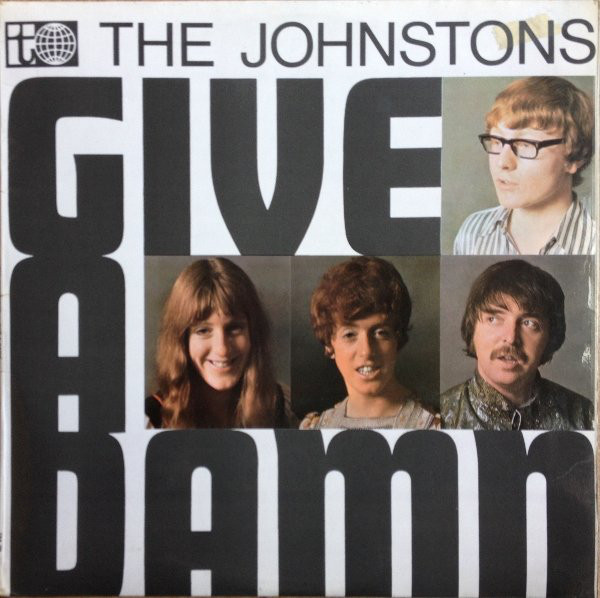
Bitter Green.
By the time The Johnstons started work Bitter Green, they were regularly touring Britain, Ireland and Europe, especially Germany, Holland and Scandinavia where their popularity was growing. The Johnstons’ music often featured on radio and they were making regular appearances on television. The Johnstons had come a long way since they started singing in Marty’s pub in Slane.
For Bitter Green, The Johnstons decided to combine the music that had featured on The Barley Corn and Give A Damn. Covers of Ewan McColl’s Jesus Was A Carpenter, Gordon Lightfoot’s The Gypsy and Bitter Green joined Leonard Cohen’s The Story Of Isaac and Joni Mitchell’s Marcie. These songs were a reminder of the music on Give A Damn, while a selection of traditions songs harked back to The Barley Corn and their eponymous debut album The Johnstons. This included Lord Thomas and Fair Ellender, The Kilfenora Jig, Fiddler’s Green and The Penny Wager. They were joined by reels a medley of reels which included The Fair Haired Boy, Kiss The Maiden Behind The Barrel and The Dawn which were all arranged by Paul Brady, Adrienne Johnston and Mick Moloney.
The recording of Bitter Green took place at Sound Techniques, in London, where The Johnstons recorded their next single. It was a cover of Ralph McTell’s Streets Of London, which as apt given The Johnstons had just relocated from Dublin to London a year ago.
When Bitter Green was released later in 1969, it found favour amongst critics on both sides of the Irish Sea. Bitter Green was regarded as one the best albums of The Johnstons’ career so far. It was certainly the most eclectic of the four albums that The Johnstons had released on Transatlantic Records.
For some, critics the contemporary sound that The Johnstons revisited on Bitter Green had a much wider appeal than the traditional Irish music. This they believed in the long term, had a limited audience outside of Ireland and the Irish diaspora. Traditional music some critics felt that it would only take The Johnstons so far. However, at that time it seemed unlikely that The Johnstons would turn their back on their musical roots.
After the release of Bitter Green, which sold reasonably well, The Johnstons released their cover of The Streets Of London as a single. in 1970. This was followed by The Johnstons Sampler later in 1970, which featured tracks from their first three albums and their singles. The Johnstons Sampler bought the group time while they recorded their sixth album Colours Of The Dawn.
Colours Of The Dawn.
After a tour of Britain and Ireland, The Johnstons returned to Sound Techniques, in London, where they recorded their next album Colours Of The Dawn. By then, Chris McCloud was part of The Johnstons inner circle after he began a relationship with Adrienne Johnston and the pair would eventually marry. Before that, he produced Colours Of The Dawn which marked the start of a new chapter in The Johnstons’ career.
Unlike previous albums, The Johnstons dispensed with the traditional Irish music that had been a feature of their previous album and moved towards a much more contemporary sound. To do this, Paul Brady wrote Brightness, She Came and penned Colours Of The Dawn and I’ll Be Gone In The Morning with Chris McCloud. He also contributed Crazy Anne and Angela Davies. Cover versions included Gordon Lightfoot’s If I Could, Leonard Cohen’s Seems So Long Ago, Nancy, Ian Campbell’s The Old Man’s Tale and Peggy Seeger’s Hello, Friend. These nine songs would become Colours Of The Dawn which was released in January 1971.
Critics on hearing Colours Of The Dawn, heard a very different album from The Johnstons, whose songs were full of social and political comment to from The Johnstons. They commented on recent political events and even broached the subject of political subversives. The Johnstons also commented on racism and the class struggle on Hello, Friend and The Old Man’s Tale which bookended the album. On the Paul Brady compositions he ruefully remembers the illusory and fleeting nature of relationships, on Brightness, She Came and on I’ll Be Gone In The Morning. There’s a cinematic quality to Colours Of The Dawn, and beautiful, poignant covers of Gordon Lightfoot’s If I Could and Leonard Cohen’s ruminative reading of Seems So Long Ago, Nancy. They played their part in the sound and success of Colours Of The Dawn, which was The Johnstons’ finest album.
The Johnstons’ decision to release an album without any traditional Irish music had paid off. It was as if they had belatedly realised that traditional Irish music was only going to take them so far. Having realised this, The Johnstons decided to return the contemporary sound of Give A Damn. This paid off, when Colours Of The Dawn sold well and was released by Vanguard in America later in 1971.
Just when things were going well for The Johnstons, Mick Moloney decided to leave the band. For The Johnstons this was a huge blow, but they decided to continue as a duo.
Later in 1971, the two reminding members of The Johnstons toured America for the first time, and opened for Joan Baez in front of an audience of 20,000. They then appeared at Gerde’s Folk City in New York, played at the Philadelphia Folk Festival and opened for Arlo Guthrie and Bonnie Raitt. This was all good experience for The Johnstons, who when they retrained home, would begin work on their next album, If I Sang My Song.
If I Sang My Song.
By the time work began on If I Sang My Song, Adrienne Johnston and Paul Brady had made the decision to relocate, this time to America, where New York became their latest base. However, The Johnstons returned to London to record If I Sang My Song, once the material for the album was completed.
By then, the two remaining members of The Johnstons had chosen the ten songs, that became If I Sang My Song. This included December Windows and Continental Trailways Bus which were penned by Paul Brady. He and Chris McCloud wrote The Wind In My Hands, Won’t You Come With Me, Border Child, If I Sang My Song and You Ought To Know. Adrienne Johnston wrote Bread And Wine and The Morning Of Our Love with Chris McCloud, who also contributed I Get To Thinking. These songs were recorded in the now familiar environs of Sound Techniques, London.
Joining the two remaining members of The Johnstons was a band that featured drummer Phil Chesterton and Steeleye Span bassist Rick Kemp. They were joined by pianist Don Fraser, flautist Frank Nolan, fiddler Joseph Templeton and Keith Bleashv on congas. Peter Abrahamsen and Hallvard Kvale ‘played’ kazoo while Steeleye Span’s Tm Hart joined Royston Wood and Paul Brady in adding backing vocals. Paul Brady sang lead vocals and harmonies, plus played acoustic and electric guitar, electronic pain, harmonium and whistle. Adrienne Johnston sang lead vocals and harmonies, while Chris McCloud took charge of production. When If I Sang My Song was completed, it was released in 1972.
When If I Sang My Song was released, critics hailed the album the finest of The Johnstons six-year and seven album career. Many critics thought that The Johnstons had found their sound, and the combination of folk rock and orchestrated ballads was the direction they should head in. This critics and music industry insiders though that this was what The Johnstons should’ve done years ago. Their determination not to turn their back on their roots had held them back long enough. Now was their chance to shine, and realise their potential.
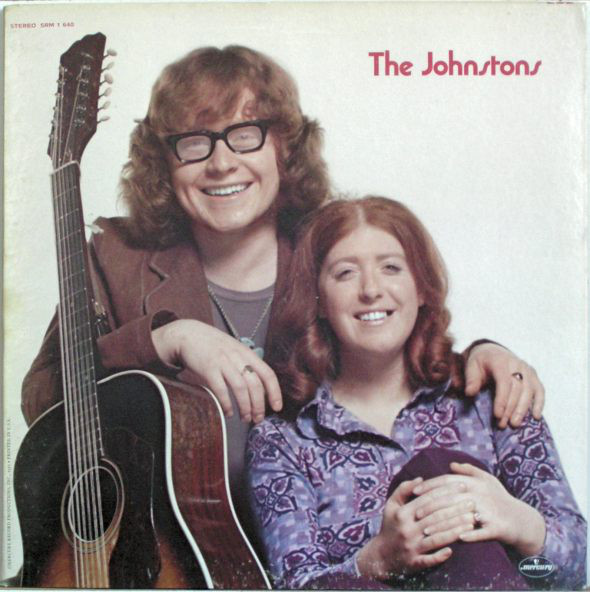
As a result, after the release of If I Sang My Song, The Johnstons added lead guitarist and bassist Gavin Spencer to their lineup, and returned to touring as a trio. They even got as far as working on new songs while The Johnstons toured the East Coast of America. However, the end was nigh for The Johnstons.
In 1973, and after seven years and seven studio albums, it was the end of the road for The Johnstons. The band split-up in 1973, and Paul Brady who remained in New York managed to survive by painting houses and playing in Irish folk clubs. However, he left New York behind when he was invited to join Planxty for the second time.
The first time Paul Brady turned down the chance to replace Donal Lunny due to his commitment to The Johnstons. That proved to be a mistake, but when Christy Moore left Planxty came calling again, and Paul Brady joined the group. By then, he was an experience singer-songwriter, who would go on to enjoy a successful solo career.
Sadly, the story of Adrienne Johnston is a tragic one. For the last few years of Adrienne Johnston’s life, even members of her family and her closest friends were unable to contact her. As a result, Adrienne Johnston never knew that her father Marty, whose pub in Slane, she first sang in, had passed away. Adrienne Johnston died in 1981, and the date on her grave states the former lead singer of The Johnstons passed away on the ’27th’ of May. However, even Adrienne Johnston’s death is shrouded in mystery and speculation.
While the coroner’s ruling was that Adrienne Johnston’s death was accidental, many believe that she was murdered. This stems from a conversation that the medical examiner is alleged to have had with a family member, and expressed: “concerns about this case.” Later, there were allegations that Adrienne Johnston was possibly the victim of a domestic abuse, and suffered at the hands of a partner who was controlling, opportunist. These are just allegations, and nothing has been proven beyond reasonable doubt.
Paul Brady and Adrienne Johnston’s lives took very different paths after The Johnstons’ spilt-up, and one can only wonder what would’ve happened if the band had stayed together?
By 1972, The Johnstons had released a trio of albums that had been released to praise and plaudits, including Bitter Green, Colours Of The Dawn and If I Sang My Song. Bitter Green with its mixture of traditional Irish music and a much more contemporary sound, hinted at what was to come for The Johnstons. They were reborn on Colours Of The Dawn which features the contemporary sound that showed a very different side to the band. The evolution of The Johnstons continued on If I Sang My Song, where The Johnstons combine orchestrated ballads and folk rock on what was their finest hour. However, it was also The Johnstons’ swan-song, who were a band who could’ve and should’ve gone on to reach even greater heights. Sadly, for The Johnstons it was a case of What Might Have Been?
The Johnstons-What Might Have Been?
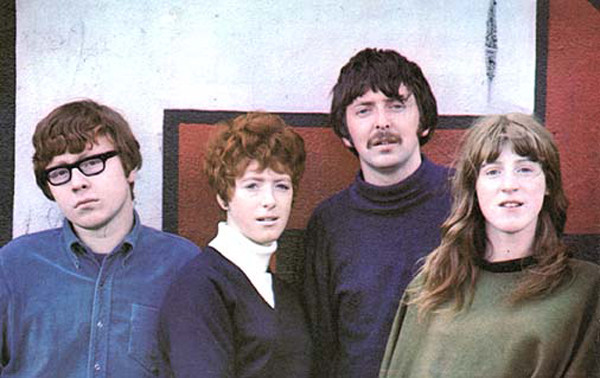
DEUTSCHE ELEKTRONISCHE MUSIK: EXPERIMENTAL GERMAN ROCK AND ELECTRONIC MUSIC 1971-83.
Deutsche Elektronische Musik: Experimental German Rock And Electronic Music 1971-83.
Label: Soul Jazz Records.
Over four years have passed since Soul Jazz Records released the second instalment in their criticality acclaimed Deutsche Elektronische Musik compilation series. Deutsche Elektronische Musik 2 was released in February 2013 and was the eagerly awaited followup to Deutsche Elektronische Musik which was released in April 2010. Both volumes in the Deutsche Elektronische Musik compilation series looked back at what was the golden age of modern German music.
The two instalments of Deutsche Elektronische Musik featured a mixture of Krautrock and tracks from the Berlin and Düsseldorf Schools of Electronic Music. This included some of the most important, innovative and influential German artists and bands from the seventies and early eighties. This included Amon Düül. Can, Faust, Harmonia, Neu!, Popul Vuh and Tangerine Dream. Their contributions were augmented by hidden gems from Between, Emak, Gila, Harald Grosskopf and Kollectiv. Together, they played their part in two compilations that are the perfect introduction to the golden age of modern German music. However, two has now become three.
As November gives way to December, Soul Jazz Records have just released Deutsche Elektronische Musik: German Rock And Electronic Musik 1971-83, which is the long-awaited third instalment in this occasional compilation series. It features twenty-three tracks from familiar faces and old friends which are spread across a two CD set.
Disc I.
Opening disc one is Klaus Weiss’ Wide Open Space Motion the track that opens his 1981 album Open Space Motion (Underscores). It was released on the Munich based label Coloursound Library, which was created in 1979 by Gunter Greffenius. By the time Open Space Motion (Underscores) was released, the label who had a reputation for releasing innovative and ambitious music. This described Klaus Weiss’ first album for his new label. Especially Open Space Motion where a bass synth is at the heart of the futuristic cinematic arrangement, were Klaus Weiss marries eighties electronica with seventies Berlin School.
In 1971, A.R. and Machines released their debut album Die Grüne Reise-The Green Journey on Polydor. It featured the psychedelic Krautrock of I’ll Be Your Singer, You’ll Be My Song, which was produced by Achim Reichel and Frank Dostal. It’s a tantalising taste of an oft-overlooked album that anyone interested in the golden age of modern German music will enjoy.
The name Alexander Wiska means different things to different people. Some remember him for his electrified turkish Saz solos while others remember the Alex Oriental Experience. There’s also the triumvirate of albums he recorded as Alex between 1973 and 1984. This included their eponymous debut album Alex, which was released by Pan in 1973. Holger Czukay and Jaki Liebezeit of Can produced Alex which Derulé, combines elements of Turkish music with psychedelic and progressive rock. Derulé is the perfect introduction to a vastly underrated album which is becoming something of a rarity.
During a long and successful career that has spanned five decades, Georg Deuter has been a prolific and groundbreaking musician. Especially during the period he was signed to the Kuckuck label. His third album for Kuckuck, was Soundtrack an album of library music which featured Pearls. It’s an example of the beautiful ambient music that Georg Deuter was producing during this period.
By 1975, Florian Fricke’s musical vehicle Popol Vuh had just signed to United Artists and their major label debut album was Das Hohelied Salomos. It was Popol Vuh’s seventh album, and featured Ja, Deine Liebe Ist Sußer Als Wein. It’s a fusion of Krautrock and progressive rock and showcase the considerable talents of a pioneering musician.
The progressive rock band Novalis was formed in Hamburg in late-1971, and in 1975 released their eponymous sophomore album on Brain. It featured Dronsz, a dark, futuristic and cinematic track that is one of the Novalis’ highlights.
Disc Two.
Fittingly, Neu! who are regarded as one of the most important, innovative and influential German bands of the seventies open disc two with Neuschnee. It’s a track from Neu! 2 which recorded in January 1973 at Windrose-Dumont-Time Studios, Hamburg by Conny Plank who co-produced the album with the two members of Neu! Later in 1973, Neu! 2 released on Brain, and one of the album’s highlights was Neuschnee which features Neu! at their most inventive and innovative.
Constellation is another track form Klaus Weiss’ 1981 album Wide Open Space Motion (Underscores) which was released on the Munich based label Coloursound Library. Again, it’s a genre-melting track with Klaus Weiss drawing inspiration from Germany’s musical past to create new and innovative music which has stood the test of time.
Legend is an overused word, but when it comes to Hans-Joachim Roedelius it’s a fitting description for the man who cofounded Kluster, Cluster, Harmonia and much later, Qluster, but still found time to enjoy a successful solo career. In 1981, Roedelius as he was billed released his Lustwandel album on Sky Records. The title-track which opened Lustwandel is an understated and beautiful piano lead track that is augmented by lush strings. The result is a track that combines elements of ambient and modern classical, and shows a very different side to the man who cofounded Kluster, Cluster and Harmonia during the golden age of modern German music.
Hans-Joachim Roedelius and Dieter Moebius founded Cluster, after leaving Kluster and signed to Sky Records. By 1974, Cluster had released their third album Zuckerzeit, where their music started to evolve. Michael Rother’s influence is apparent and he placed more emphasis on melody, rhythm and the Motorik beat. He also introduced structure and discipline to Cluster’s music on Zuckerzeit. All this is apparent on Hollywood one of Cluster’s finest moments on Zuckerzeit.
Tragedy struck for Wolfgang Riechmann in August 1978, when he was stabbed to death by two drunken men. This meant that the man who was billed as Riechmann never lived to see his debut album Wunderbar which was released by Sky Records in 1978 become a genre classic. A year later, Wolfgang Riechmann and Streetmark’s eponymous debut album was released on Sky Records in 1979. It featured Passage, whose ethereal and otherworldly beauty is one of the album’s highlights.
Closing Deutsche Elektronische Musik: Experimental German Rock And Electronic Music 1971-83 is the title-track to Michael Bundt’s 1979 album Neonb. It was released on Hansa International and was Michael Bundt’s sophomore album. It’s Neonb a near thirteen minute genre-melting epic, where Michael Bund fuses experimental music with Krautrock and synth pop that is Michael Bundt’s finest hour his sophomore album. Sadly, it’s another oft-overlooked album that didn’t find the audience it deserved.
It’s been well over four years since the second instalment in Soul Jazz Records’ Deutsche Elektronische Musik compilation series. However, Deutsche Elektronische Musik: Experimental German Rock And Electronic Music 1971-83 which was released on the ‘1st of December 2017 has been well worth the wait. It’s another lovingly curated compilation that features familiar faces and new names from the golden age of German modern music.
Deutsche Elektronische Musik: Experimental German Rock And Electronic Music 1971-83 features familiar faces like Cluster, Novalis, Neu!, Georg Deuter, Popul Vuh and Roedelius, are joined by A.R. and Machines, Dzyan and Alex who will be new names to be many record buyers. Some of the lesser known artists and bands released albums that are hidden gems that are well worth discovering. It’s a similar case with the familiar faces, who were musical pioneers and enjoyed
long and illustrious careers. The tracks that feature on Deutsche Elektronische Musik: Experimental German Rock And Electronic Music 1971-83 is just tantalising taste of the music that they’ve released during their long careers.
Just like the two previous instalments in the series, Deutsche Elektronische Musik: Experimental German Rock And Electronic Music 1971-83 features talented, innovative and influential bands and musicians who were part of what was a musical revolution in Germany. In the late-sixties, a group of musicians set out to rewrite musical history in Germany and create new, exciting and innovative music for a new generation. They succeeded in doing so, and the proof of that is the music on Deutsche Elektronische Musik: Experimental German Rock And Electronic Music 1971-83.
It includes Krautrock and tracks from the Berlin and Düsseldorf Schools of Electronic Music. There’s also elements of ambient, avant-garde, electronica, experimental, industrial, modern classical, progressive rock, psychedelia and rock. All these influences can be heard on Deutsche Elektronische Musik: Experimental German Rock And Electronic Music 1971-83, which is the latest instalment in this occasional series.
Deutsche Elektronische Musik: Experimental German Rock And Electronic Music 1971-83 is the perfect introduction to the golden age of modern German music, especially when added to the two previous volumes. This could be the start of a lifelong love affair with Krautrock or the Berlin and Düsseldorf Schools of Electronic Music. However, Deutsche Elektronische Musik: Experimental German Rock And Electronic Music 1971-83 will also be of interest to anyone who is interested in the golden age of German modern music.
Hopefully, Deutsche Elektronische Musik: Experimental German Rock And Electronic Music 1971-83 won’t be the last in this occasional series, and Soul Jazz Records will return with future instalments in the series. After all, Deutsche Elektronische Musik: Experimental German Rock And Electronic Music 1971-83 and the two previous critically acclaimed compilations are among the best compilations of music from that the golden age of German modern music, and feature some of the most important, innovative and influential German artists and bands from this era.
Deutsche Elektronische Musik: Experimental German Rock And Electronic Music 1971-83.


ERLEND APNESETH TRIO-ARA
Erlend Apneseth Trio-Åra.
Label: Hubro Music.
Just a year after the Erlend Apneseth Trio released their critically acclaimed debut album Det Andre Rommet, they recently returned with their sophomore album Åra, which was released on Hubro Music. Åra finds the talented triumvirate return with another album of original music that is regarded as an almost perfect improvised update of the post modern string trio.
It’s led by twenty-seven year old Erlend Apneseth who is already regarded as one of Norway’s top young Hardanger fiddlers. Joining Erlend Apneseth in his Trio are drummer Øyvind Hegg-Lunde and guitarist Stephan Meidell. Together, the become the Erlend Apneseth Trio who switch seamlessly between musical genres and push musical boundaries to their limits, and sometimes, beyond on Åra. The result is another ambitious album of genre-melting music from the Erlend Apneseth Trio who are led by one of the pioneers of Norwegian music.
Erlend Apneseth was born on the ’11th’ of August 1990, in Jølster, in Sogn og Fjordan, a county in Western Norway. It’s a small town with a population of just over 3,000 that is a popular destination for skiers. It was also where Erlend Apneseth first picked up the Hardanger fiddle and began a journey that would see him become an award-winning musician. That was still to come.
Before that, Erlend Apneseth enrolled at the prestigious Ole Bull Akademiet in Voss, Norway, where he studied traditional Norwegian folk music. Erlend Apneseth’s turbo at the Ole Bull Akademiet was none other than Håkon Høgemo, another Hardanger fiddler who had already released a quartet of solo albums and featured on many other albums. He mentored Erlend Apneseth during his time at the Ole Bull Akademiet. By the time Erlend Apneseth graduated, he was ready to embark upon a musical career.
The first many people heard of Erlend Apneseth was when he won Grappa’s New Artist Award in 2012. Buoyed by winning such a prestigious award, Erlend Apneseth began work on his debut album Blikkspor.
Prior to the release of Erlend Apneseth’s debut album Blikkspor, he was one of five folk musicians under the age of twenty-five nominated for the Fureprisen award. This was one of the most prestigious prizes in Norwegian music, and one that came with a first prize of 50,000 Norwegian Kroner.
At the award ceremony in June 2013, the five young, up-and-coming musicians waited to hear who had won the Fureprisen award. When the announcement came, Erlend Apneseth won the Fureprisen award and the first prize of 50,000 Norwegian Kroner. This augured well for the release of his debut album Blikkspor in October 2013.
Blikkspor.
Blikkspor had been recorded at and mixed at Rainbow Studio during April and August 2013. The album was recorded with the help of a few of his musical friends, including trumpeter Arve Henriksen who also produced Blikkspor. When it came to record Sommarflukt, which closed Blikkspor, Erlend Apneseth brought onboard drummer Øyvind Hegg-Lunde and guitarist Stephan Meidell. They worked well together, but little did the three musicians realise that they would become part of one of the most exciting and innovative trios in the Norwegian music scene.
Before that, Blikkspor was released by Hubro Music, in October 2013. Critical acclaimed accompanied the release of Blikkspor, which was described as an ambitious album of groundbreaking and genre-melting music that announced the arrival of innovative musician. It was also a tantalising taste of what Erlend Apneseth was capable of. Critics awaited his sophomore album with interest.
Critics and record buyers had to be patient, as Erlend Apneseth was busy over the next couple of years. He found himself collaborating with musicians from a variety of different backgrounds, including folk, improv, jazz and rock. Groups big and small were joined by the Jølster born fiddler. So were folk singer Torgeir Vassvik and poet Erlend O. Nødtvedt. For Erlend Apneseth it was a case of have fiddle will travel, as he worked with a variety of different artists and bands. Erlend Apneseth even enjoyed a spell as a soloist with the Bergen Philharmonic Orchestra.
Meanwhile, Erlend Apneseth was winning further awards that boosted his burgeoning CV. This included the Øivind Bergh Memorial Award and the Music Scholarship from Sparebanken Vest in 2014. The third award that Erlend Apneseth won in 2014 was the Ingerid, Synnøve and Elias Fegerstens Foundation For The Norwegian composers and Performing Musicians. Winning these three awards boosted Erlend Apneseth’s as his thoughts turned to recording a new album.
Det Andre Rommet.
While Blikkspor was credited to Erlend Apneseth, his next album was credited to the Erlend Apneseth Trio. Its origins can be traced to the recording of Blikkspor, and when Erlend Apneseth brought drummer Øyvind Hegg-Lunde and guitarist Stephan Meidell onboard to feature on the album closer Sommarflukt. Erlend Apneseth hit it off with the two musicians, and asked them if they wanted to join him in a trio? They agreed, and that day, the Erlend Apneseth Trio was born.
Since then, the Erlend Apneseth Trio had been playing live, and the supergroup was honing their sound. Having played together for the best part of two years, the Erlend Apneseth Trio still hadn’t recorded their debut album. That would soon change.
For Det Andre Rommet, a total of ten tracks were written. Erlend Apneseth wrote Trollsuiten, Dialog, Sapporo, St Thomas-klokkene, Hugskot and Draum Om Regn. The other four tracks, Under Isen, Det Andre Rommet, Nattkatt and Magma St. Thomas-klokkene, were written by the Erlend Apneseth Trio. These tracks would become their debut album Det Andre Rommet
The Erlend Apneseth Trio recorded their debut album Det Andre Rommet at Hallibakken Lydproduksjon between the ‘9th’ and ‘12th’ if March 2015. A total of ten tracks were recorded and would become Det Andre Rommet.
When Det Andre Rommet was released by Hubro Music in early July 2016, it was to widespread critical acclaim. The three musical mavericks had created an a groundbreaking and innovative album where they fused elements of avant-garde, improv, jazz, Musique Concrète and even rock. This resulted in an album that has the capacity to captivate as the Erlend Apneseth Trio spring surprises, as they take the listener in new and unexpected directions. Often, it’s Erlend Apneseth’s Hardanger fiddle that takes the listener on the emotional roller coaster that is Det Andre Rommet was. It was hailed one of the finest Norwegian albums at the end of 2016. By then, Erlend Apneseth’s thoughts had turned to his sophomore solo album.

Nattsongar.
As 2017 dawned, Erlend Apneseth entered the Engfelt Forsgren Studio on the ‘5th’ of January 2017 to record his sophomore album Nattsongar. Just like his debut album Blikkspor, Erlend Apneseth brought onboard some of his musical friends. This included Stein Urheim, Ole Morten Vågan and Hans Hulbækmo. They were part of the band that spent the next three days recording eight of the nine tracks on Nattsongar, which was completed on the ‘7th’ of January 2017.
Three months later, Erlend Apneseth’s sophomore album Nattsongar was released to the same critical acclaim as his debut album Blikkspor. Just like Blikkspor, Nattsongar was hailed as an ambitious and innovative album from Erlend Apneseth when it was released on the Heilo label, an imprint of Grappa Musikkforlag AS which also owns Hubro Music. It would release the Erlend Apneseth Trio’s sophomore album Åra later in 2017.
Åra.
Just over a year after the release of their critically acclaimed debut album Det Andre Rommet, the Erlend Apneseth Trio make a welcome return with their sophomore album Åra. It features ten new tracks from the Erlend Apneseth Trio.
For Åra, Erlend Apneseth wrote five of the tracks on Åra, including Utferd, Tundra, Undergrunn, Sakura and Klokkespel. Guitarist Stephan Meidell contributed Øyster, while Stryk and Bølgebrytar were written by the Erlend Apneseth Trio. Lysne was written by poet Erlend O. Nødtvedt, who also adds the vocal. The other track on the album is Saga which began life when the Erlend Apneseth Trio found an archive recording of an unknown musician playing a saw. This the Erlend Apneseth Trio decided to use as the basis for the track that became Saga. These ten tracks were recorded by the Erlend Apneseth Trio in early January 2017.
Recording of Åra took place at Jørgen Træen’s Duper Studio in Bergen during January 2017. Drummer and percussionist Øyvind Hegg-Lunde provided the heartbeat while guitarist Stephan Meidell also took charge of sampling. Erlend Apneseth played Hardanger Fiddle and co-produced Åra with the Norwegian musician Andreas Meland whose responsible for the Hubro Music. When Åra was completed, all that remained was for the album to be mixed and mastered.
Jørgen Træen mixed Åra at Lydgrotten Studio, Bergen, during May 2017. Then Helge Sten a.k.a. Deathprod mastered Åra at Audio Virus Lab, June 2017. Now Åra was ready for release.
Four months later, and Åra was released by Hubro Music, and finds the Erlend Apneseth Trio. It’s an almost flawless improvised album, where the Erlend Apneseth Trio modernise the contemporary format of the post-modern string trio. It takes on new meaning on Åra, which has been compared to a Nordic retort to Tin Hat or Trio Taksim where the Erlend Apneseth Trio seamlessly switch between disparate musical genres on their second album of groundbreaking music.
Opening Åra is Utferd, which gradually reveals its secrets. Initially, the soundscape is reminiscent of an orchestra as it tunes up. Soon, though,the unmistakable sound of the Hardanger Fiddle emerges from the soundscape and adds a rueful, wistful sound. It’s joined by urgent percussion and pitter patter drums. They become urgent as they propel the improvised arrangement along. By then, the Hardanger Fiddle wheeze and whines while distant percussion can be heard. Later, the soundscape becomes understated and melodic as calmness descends, after the captivating musical storm.
Straight away, there’s an understated, minimalist and even an Eastern sound to Tundra as a plucked fiddle and washes of guitar combine with the rhythm section. It takes care not to overpower other instruments, as the Erlend Apneseth Trio carefully craft a ruminative, cinematic soundscape that meanders along, all the time painting pictures in the mind’s eye.
The guitar on Øyster sounds as if it belongs on the soundtrack to a Wim Wenders’ film. It shimmers and glistens, while the Hardanger Fiddle quivers and then plays with a degree of urgency. Sometimes, it plays second fiddle to the guitar, while other times, they combine and create a moving and poignant backdrop. Meanwhile, drums and percussion are used sparingly, allowing the Hardanger Fiddle and guitar to take centre-stage. They create a track that sounds as if it belongs in the remake of a Spaghetti Western. Later, this moody, moving and poignant soundscape dissipates allowing time for reflection.
Stryk features the Erlend Apneseth Trio at their inventive and innovative best. To create this soundscape they combine a droning fiddle and washes of guitar. Sometimes, the guitar threatens to feedback, but this never happens. Instead, it’s part of the Erlend Apneseth Trio’s carefully sculpted soundscape that veers between dark, eerie and chilling to moody and broody. Always though, the soundscape is cinematic and would be perfect soundtrack for a short film.
Erlend Apneseth’s Hardanger Fiddle sets the scene on Undergrunn. Straight away, there’s a sense of sadness as it takes centre-stage and tugs at the heartstrings. Midway though the track, it’s all change as the drums create a raga backdrop. It locks down a groove and provides a contrast to the fiddle. Soon, washes of jagged, angular, improvised guitar are added. Later, it’s just subtle drums and a scratchy guitar that combine to create mesmeric backdrop, to what’s been a magical musical mystery tour.
Bølgebrytar finds the Erlend Apneseth Trio let their imagination run riot as they combine instruments, found sounds and samples. They flit in and out this soundscape. This ranges from a plucked, chirping fiddle and jangling, shimmering guitar to the samples of traffic and lorry. These became part of another carefully constructed and imaginative soundtrack that seamlessly combines avant-garde, free jazz and Musique Concrète in such a way that it makes perfect musical sense.
Saga features the sound of someone playing a saw. It produces an eerie, haunting sound. Adding to the sense of unease is the jangling bells and the jarring, screeching fiddle. As various instruments and found sounds are added, a dark, ominous sound emerges from the soundscape. Especially when the otherworldly haunting sound of the saw reappears. Adding the earlier sense of unease is the sound of something being sawn, and falling to the floor. This gives way to the muffled sound of bells ringing, against a crackly analogue backdrop. It’s part of the most chilling and atmospheric soundscape on Åra.
In the distance, fingers fly up and down the fretboards on Lysne, and gradually, the music draws neared and starts to reveal its secrets. Reverb has been added as the guitar and plucked fiddle combine with drums. They usher in poet Erlend O. Nødtvedt’s impassioned soliloquy. Just like the rest of the arrangement, it gradually grows in power. Meanwhile, drums and percussion provide the heartbeat to this powerful and moving multicultural soundscape from the Erlend Apneseth Trio.
Sakura has an understated introduction as the Erlend Apneseth Trio play within themselves. Pizzicato strings combine with drums and percussion while electronics crackles. Gradually, the soundscape starts to reveal its secrets. This includes drums and percussion which are played softly and join with an Eastern inspired fiddle, chirping, chiming guitar and the crackling electronics create musical fireworks Later, the fiddle becomes wistful as its plaintive cry provides what sounds like the soundtrack to a battle as the bell tolls, but for whom?
Klokkespel closes the Erlend Apneseth Trio’s sophomore album Åra. As a guitar chimes, the wistful sound of Erlend Apneseth’s fiddle takes centre-stage. It plays a leading role in the sound and success of this beautiful heart-wrenching track that closes Åra.
Just over a year after Erlend Apneseth’s modest supergroup released their critically acclaimed debut album Det Andre Rommet, the supremely talented and versatile Erlend Apneseth Trio return with their sophomore album Åra. It’s ambitious, innovative and genre-melting opus that surpasses the quality of Det Andre Rommet. That was never going to be easy, but the Erlend Apneseth Trio features three of Norway’s top musicians Erlend Apneseth, Øyvind Hegg-Lunde and Stephan Meidell. They continue to push musical boundaries to their limits and beyond by combining disparate musical genres.
This includes elements of ambient, avant-garde, drone, experimental, free jazz, improv, jazz, Musique Concrète, Nordic Wave and rock. To this, the Erlend Apneseth Trio add found sounds, samples and Eastern sounds and guest artist Erlend O. Nødtvedt. When all this is combined the result is album of ten soundscapes that veer between abstract to atmospheric to broody and moody, to chilling, dark, eerie and otherworldly. Sometimes the music is beautiful, emotive and heart-wrenching, while other times it’s poignant and powerful. Sometimes, the music is thoughtful and ruminative and invites reflection. Often it’s cinematic as the Erlend Apneseth Trio paints pictures with their carefully crafted soundscapes. They’ve been created by master musicians who have dedicated their lives to the pursuit of musical perfection.
The Erlend Apneseth Trio come tantalizingly close on Åra, which is another groundbreaking album of inventive and imaginative music from a pioneering group of like-minded musicians who reach new heights in their continuing pursuit of musical perfection. So much so, that in years to come Åra is will be remembered as a career-defining album from the Erlend Apneseth Trio and the album that future albums will be compared to.
Erlend Apneseth Trio-Åra.
NILS OKLAND BAND-LYSNING.
Nils Økland Band-Lysning.
Label: Hubro Music.
Nowadays, fifty-six year old composer and Hardanger fiddle virtuoso Nils Økland is regarded as one of the elder statesman of Norwegian music, and a truly versatile musician whose played everything from folk, jazz, baroque and rock to art rock and improv. Regardless of what type of music Nils Økland has played, he has been always an innovator, and someone who pushed boundaries to their limits, and sometimes beyond. That has been the case with Nils Økland’s solo albums, and also the Nils Økland Band’s debut album Kjølvatn which was released to critical acclaim in 2014.
After the release of Kjølvatn, the Nils Økland Band’s debut album won a Norwegian Folk Music Award, and was nominated for a Spellemannspris, which is the Norwegian equivalent of a Grammy Award. This is the most prestigious award in Norwegian music, and to be nominated was a huge honour and recognition of just how good an album Kjølvatn was.
Since then, the followup to Kjølvatn has been eagerly awaited by both critics and music fans, who were wondering what direction the Nils Økland Band’s music would head in? After all, its leader was a musical chameleon who had reinvented his music numerous times during an illustrious four decade career. Now after a three-year wait, the same lineup of the Nils Økland Band return with Lysning which was recently released by Hubro Music.
The first thing that will strike many music fans os the title of the Nils Økland Band’s sophomore. What is a Lysning? It’s defined in English as a “clearing” or “forest glade.” However, in the case of Nils Økland and the Nils Økland Band, Lysning is the album that he’s spent a lifetime working towards, and is his Magnus Opus.
Lysning is also an album that showcases Nils Økland and the Nils Økland Band’s unique and imitable, genre-melting sound. This is a sound that has taken shape over the past four decades and doesn’t fit into just one genre. Instead, it’s a mixture of disparate and sometimes unlikely genres that all become part of a Nils Økland and the Nils Økland Band’s own genre. It was heard on the Nils Økland Band’s 2014 debut album Kjølvatn, and returns on their long-awaited and much-anticipated sophomore album Lysning.
For Lysning, the same lineup of the Nils Økland Band made a welcome return to play on the band’s sophomore album. Joining bandleader Nils Økland who played Hardanger fiddle, Viola d’Amore and violin was double bassist Mats Eilertsen, Sigbjørn Apeland on harmonium and Håkon Stene who played electric guitar, percussion and vibraphone. The final band member was Rolf Erik Nystrøm, who switched between alto and baritone saxophone. They began work on the album in summer of 2015.
When work began on Lysning, Nils Økland had already written the main themes to the nine compositions. Some of them weren’t new, and had been written for other projects. They seemed to fit the Lysning project, where Nils Økland wanted to pickup where he left off on Kjølvatn, he wanted to take it further. Nils Økland was aiming to produced a much deeper and more intense followup to Kjølvatn. Fortunately, the rest of the Nils Økland Band could play their part in the completing the writing of Lysning.
When Nils Økland was joined by the rest of his own band, who were all composers in their own right, some of the tracks were musical sketches. These sketches Nils Økland and his four fellow master musicians fleshed out, and were arranged by ear by the five band members. Eventually, they were transformed into the nine fully fledged tracks on Lysning. So much so, that Nils Økland noted in the sleeve notes that: “all the music has been developed and arranged in cooperation with the musicians.” Lysning was very much a group affair, with each member of the Nils Økland Band playing their part in writing of their sophomore album.
With the album written, the five members of the Nils Økland Band were joined by sound engineer, Audun Strype, who has worked with Nils Økland since they played together in the new wave band, Lover and Tigre, in the early eighties. They made their way to the Hoff Church, Østre Toten stone church in Lena, in Norway’s Oppland country on the ‘17th’ of August 2015.
The venue had been chosen with the utmost care, and for two days the Østre Toten stone church was transformed into a makeshift recording studio. Set in a rural idyll, the Østre Toten stone church is beautiful, impressive and imposing structure that would play an important part in shaping the music on Lysning and its structure. When the Nils Økland Band started all the instruments that played were cushioned by the reverb of the simple stone church. It also added a liturgical sound to Lysning, as the soared high into their air, as their voices united and melted into one. Nils Økland’s choice of venue was hailed a masterstroke, as the sessions finished on the ‘18th’ of August 2015.
After just two days, the Nils Økland Band had already recorded seven of the nine tracks on Lysning. They had been produced by the triumvirate of Nils Økland, Håkon Stene and recordist Audun Strype. However, just over a year later, they would produce the rest of the rest of Lysning.
The Nils Økland Band and d recordist Audun Strype made their way to the prestigious Norwegian Academy of Music, in Oslo on the ‘25th’ of August 2016 to complete Lysning. That day, the Nils Økland Band recorded Flukt, and the track that closed the album, Sikt. That meant that the recording of Lysning was complete.
With the nine tracks recorded, Nils Økland, Håkon Stene and recordist Audun Strype mixed and then mastered Lysning. Now the Nils Økland Band’s sophomore album Lysning was ready for release.
Over a year later, and Hubro Music have released Lysning, which marks the welcome return of the Nils Økland Band. They return with an album that has been worth the three-year wait… Lysning.
As Drøm opens Lysning, the wistful, ruminative sound of the Hardanger fiddle, before washes and swells of harmonium add a liturgical sound. Sigbjørn Apelan’s harmonium is played slowly and deliberately droning as the thoughtful sounding fiddle is augmented by fluttering and whistling sounds plus scampering percussion. Occasionally feedback threatens to interject, but the tiger is tamed, and this beautiful, reflective track continues to reveal its secrets and tug at the heartstrings.
Straight away, Nils Økland’s Hardanger fiddle takes centre-stage on Lysning, while Sigbjørn Apelan’s harmonium meanders, ebbing and flowing below it. All the time it provides a backdrop for the fiddle, and helps Nils Økland to paint vivid and evocative musical pictures. That is despite the Hardanger fiddle and harmonium producing very different sounds that come from very different backgrounds. The fiddle’s roots are in folk music, while the harmonium again produces a liturgical sound. They become yin and yang, and play leading roles this wistful and rueful cinematic track that also has a poignant sound.
Nils Økland switches to violin on Flukt, which sweeps and swirls while Mats Eilertsen’s double bass accompanies him. It’s played carefully, leaving space which Nils Økland proceeds to fill. He plays slowly and produces a beautiful, dreamy sound that sounds as it’s from another musical era. Very occasionally, Rolf Erik Nystrøm’s braying saxophone interjects, but mostly, it’s just the bass and violin that play leading roles. That is until the closing bars, when Håkon Stene sprinkles subtle percussion below the violin on this beguiling genre-melting track. I
A subtle shimmering, glistening sound gives way to the mournful violin on Skygger. Meanwhile, low in the mix sits various percussive and found sounds drip and shimmer while another is mesmeric. However, the violin takes centre-stage before swells of harmonium enter. Later, an ominous droning sound, and later, wailing but melodic sound emerge from the arrangement. They’re produced by the Nils Økland Band’s musical arsenal, while some have been treated with effects. All this adds to ruminative sounding track that invites reflection, as the listen embraces its beauty.
There’s a much more experimental sound as dark, droning sound emerge from Blåmyr’s arrangement. They set the scene for the viola d’amore, which blends perfectly with the rest of the soundscape as the tempo rises slightly. Together the Nils Økland Band produce a dark and evocative cinematic soundscape that is sure to set the listener’s imagination racing.
Drums set the scene for the thoughtful Hardanger fiddle on Skumring, and add an element of drama.They’re joined by washes of harmonium which combine with occasional subtle bursts of raspy saxophone that sit back in the mix and become one. This leaves the drums and fiddle to play leading roles. At one point, the arrangement is stripped bare and only the drums remain. Mostly, though the fiddle marches to the beat of the drum, while occasionally harmonium and saxophone are drizzled across the arrangement or interject. This less is more approach works, and plays it part in a wistful and evocative track that is rich in imagery.
Just a lone Hardanger fiddle plays as Speiling starts to reveal its secrets. It’s played slowly and carefully producing a thoughtful, plaintive cry that is full of emotive. Later the fiddle is played briskly, and the bass is plucked it seems like the tempo is about to increase and the arrangement reveal its secrets. However, the Nils Økland Band seem to be toying with the listener as elements of modern classical, folk and jazz combine. Even when the wispy saxophone and swells of harmonium enter, the arrangement continues to meander along, revealing its secrets, nuances and beauty which is omnipresent during this genre-melting eight minute epic.
A drum roll is followed by a dramatic pause on Bølge. This happens twice before the viola d’amore enters. It soon, drops out leaving the dark, dramatic drums to fill the space. Before long, the viola d’amore returns and sometimes unites with the drums. They add to the sense of drama, and sometimes, add tension and a sense of sadness on another cinematic
Sikt closes Lysning and finds Nils Økland playing a vintage Hardanger fiddle made in 1925. It has a beautiful tone as he caresses the strings, as subtle swells of harmonium accompany him. Soon, all the Nils Økland Band are playing their part in Sikt, as a plucked bass and washes of effects-laden guitar glisten. They’re part of an understated, but ethereal soundscape that is one of the highlights of Lysning.
Three years after the Nils Økland Band released their debut album Kjølvatn in 2014, they return with their eagerly awaited sophomore album Lysning, which was recently released by Hubro Music. It’s a genre-melting opus where the Nils Økland Band fuse elements of disparate genres including avant-garde, folk, improv, jazz, modern classical and musique concrète on Lysning. There’s also a liturgical sound on Lysning which is no surprise as much of the album was recorded in the Østre Toten stone church was transformed into a makeshift recording studio.
In that makeshift studio, the Nils Økland Band produced seven of nine tracks on Lysning. It’s an album where the music is variously dark, dramatic and dreamy, but also beautiful, and cinematic, and also enchanting, ethereal, emotive, evocative and full of imagery. Other times, the music on Lysning is rueful, wistful, poignant and guaranteed to tug at the listener’s heartstrings. Lysning is also the album that Nils Økland has spent a lifetime working towards, and a career-defining innovative Magnus Opus that that showcases the Nils Økland and the Nils Økland Band’s unique and imitable genre-melting sound.
Nils Økland Band-Lysning.
 \
\
FUNKADELIC REMIXED BY DETROITERS.
Funkadelic Remixed By Dettroiters.
Label: Westbound Records.
Although George Clinton was born in Kannapolis, North Carolina in 1941, he grew up in New Jersey, where he formed the doo wop quintet The Parliaments in the late fifties, whilst straightening hair at a barber salon in Plainfield he co-owned. George Clinton became the leader and manager of The Parliaments who entertained customers in the barber shop. This was good practice for The Parliaments, as they honed their sound.
The Parliaments released their debut single Poor Willie in June 1959, and as the fifties gave way to the sixties, George Clinton’s group had honed a sound that fused elements of soul and funk with increasingly bizarre and surreal lyrics. Initially, this didn’t find favour with record buyers, despite The Parliaments constantly switching between record labels. Still, though, a hit single continued to elude The Parliaments.
By 1967, George Clinton had been living and working in Detroit for some time, and for a while, was a staff songwriter at Motown. He had also arranged and produced numerous singles for other independent labels in Detroit. However, still The Parliaments hadn’t made a breakthrough.
This was about to change when The Parliaments released I Wanna Testify in May 1967 on the Detroit-based label Revilot Records. It reached number twenty on the US Billboard 100 and three on the US R&B charts. At last, The Parliaments had enjoyed a hit single, and it looked as if this was the breakthrough that they had been working towards.
It may well have been if Revilot Records weren’t forced to file for bankruptcy. This lead to The Parliaments becoming embroiled in a contractual dispute which lead to the band losing the rights to the name “The Parliaments.” For a band that had just enjoyed the biggest hit of their career, this was a disaster,
Despite the disappointment of being unable to use the name “The Parliaments,” George Clinton dusted himself down and renamed the group Funkadelic, which was coined by bassist Billy Bass Nelson. This allowed the newly named Funkadelic to continue to record for other labels.
George Clinton decided that Funkadelic would be a funk-rock band, which featured five backing musicians and The Parliaments’ as uncredited guest artists. This would be the lineup of Funkadelic that featured on their debut albums which was released on Westbound Records.
On May the ‘11th’ 1970, Funkadelic released their genre-melting eponymous debut album, which fused blues-tinged acid rock, lysergic space funk and conventional soul songs whose sound hinted at Stax and even Motown influences. It was an innovative and imaginative debut album that showcased what George Clinton and the rest of Funkadelic were capable of. Funkadelic found favour with critics, and reached 126 in the US Billboard 200 and eight in the US R&B Charts. This was a solid start to Funkadelic’s career.
Two months later, Westbound Records released Funkadelic’s sophomore album Free Your Mind…and Your Ass Will Follow on July the ’20th’ 1970. George Clinton later claimed that the album was an attempt to record an entire album whilst tripping on LSD. The result was an album of cerebral, funky space-rock which was meant to deal with the subversion of Christian themes. However, some critics thought the album was designed to promote and inspire escapist utopianism and to seek liberation from the mundane reality of everyday life. Despite the debate about Free Your Mind…and Your Ass Will Follow’s message, it was well received by critics and reached ninety-two on the US Billboard 200 and eleven on the US R&B charts. Funkadelic’s popularity was already growing, and they would one of the most successful funk groups of the seventies.
By 1970, George Clinton’s former group The Parliaments, had been sold to Atlantic Records. This was a disappointment for George Clinton, who decided he world rather abandon doo-wop than record for Atlantic Records. However, George Clinton then decided relaunched a new group R&B and funk Parliament, which he would run alongside Funkadelic.
Parliament and Funkadelic became two of the most successful funk groups of the seventies, selling in excess of ten million albums in America alone. They also inspired other members of the Parliament-Funkadelic family to found bands including Parlet, Bootsy’s Rubber Band and The Brides Of Funkenstein. None of these bands matched the success that Parliament and Funkadelic enjoyed. Parliament and Funkadelic were innovative and influential bands, whose music inspired future generations of record buyers, musicians and producers.
Especially in Detroit, which was home to both Parliament and Funkadelic. Their music was a source of inspiration to local producers and remixers over the past five decades. Recently, some of the Detroit-based producers and remixes got the opportunity to remix some of Funkadelic’s genre-melting music. They reimagined and reinvented seventeen of Funkadelic’s tracks on Funkadelic Remixed By Dettroiters, which was recently released as a two CD set by Westbound Records, an imprint of Ace Records.
Given how much of an influence Funkadelic’s music has had on Detroit’s musicians, producers and remixers, it’s no surprise that everyone involved in the Funkadelic Remixed By Dettroiters project was fully committed to playing their part in this homage to a truly groundbreaking group.
Funkadelic had their own inimitable, unique, genre-melting sound which they combined with social comment and often, their off-the-wall humour. This featured on eighteen studio albums and one live album. With such an impressive back-catalogue, the various musicians, producers and remixers had plenty of music to choose from for their contribution to Funkadelic Remixed By Dettroiters. Some opted for familiar songs, while others eschewed the obvious and dug deeper into Funkadelic’s back-catalogue for this seventeen song, two disc set. It’s full of highlights aplenty.
Disc One.
Opening disc one was the Recloose Disco Flip of Sexy Ways which was a track from Funkadelic’s 1974 album Standing on the Verge of Getting It On. DJ and remixer Matthew “Recloose” Chicoine has reinvented the original three-minute song into a nine minute disco epic that is guaranteed to fill any dancefloor.
Anton Miller reimagines You Can’t Miss What You Can’t Measure which featured on Funkadelic 1973 album Cosmic Slop. What was three-minute song is modernised and takes on a Latin influence. Still, though, the vocals which played an important part in the sound and success of the original song still take centre-stage.
Without doubt, Moodyman’s Mix of Cosmic Slop, which is the title-track to Funkadelic’s 1973 album is one of the highlights of Funkadelic Remixed By Dettroiters. The original song is transformed by occasionally dropping drums out for the first two minutes. This allows the bass to prowl while searing guitars and harmonies combine. Later, when the vocal enters Amp Fiddlers adds keyboards which adds to this masterful reinvention of Cosmic Slop.
While most of the tracks on Funkadelic Remixed By Dettroiters are remixes, Undisco Kidd was edited by Gay Marvine. For an edit, a producer doesn’t necessary need the original stems of the song. Undisco Kidd featured on Funkadelic’s eighth album Tales Of Kidd Funkadelic which was released in 1976. Comparing the edit to the original version of Undisco Kidd, it seems that Gay Marvine has increased the tempo by around twenty percent and in doing so, the song becomes a disco anthem, as Funkadelic reach 127 disco seven.
Detroit rockers The Dirtbombs cover Super Stupid from Funkadelic’s third album Maggot Brain, which was released in 1970. Forty-seven years later, The Dirtbombs unleash an imaginative and über rocky remake where they strut their way through Super Stupid. The result is one of the best covers of a Funkadelic song ever recorded by a rock band.
Disc Two.
Opening disc two of Funkadelic Remixed By Dettroiters is the Underground Resistance Mix of Music 4 My Mother. It originally featured on Funkadelic’s 1970 eponymous debut album, which introduced the world to George Clinton and Co. Forty-seven years later, and Underground Resistance deconstruct and reinvent this Music 4 My Mother. To do this, they draw inspiration from the original version of Music 4 My Mother, and add elements of George Clinton’s 1982 single Atomic Dog where P-Funk met electro. The final piece of the musical jigsaw is Underground Resistance’s unique brand of ‘21st’ Century tough, Detroit funk. This fusion of influences is a potent and heady musical brew.
Amp Fiddler is regarded as a musical legend in Detroit, and has been around the local music scene for four decades. Sadly, many music fans in other parts of the world have yet to discover the delights of Amp Fiddler’s music. That is a great shame as he’s a truly talented singer, songwriter, musician and producer. He remixed the title-track Funkadelic’s 1975 album Let’s Take It To The Stage. It features George Clinton’s trademark humour as wryly comments on Sly Stone and the self-styled Godfather of Funk James Brown. In Amp Fiddler’s hands, the song that was originally 3.32 is transformed into a six-minute groove-a-licious jam. This allows the listener to enjoyed one of the deepest and funkiest grooves on the compilation.
Each and every producer and remixer that contributed to Funkadelic Remixed By Dettroiters took a different approach. Claude Young Jr was no different, when he remixed You And Your Folks which featured on Maggot Brian in 1971. He took the original stems and took the track in the direction of dub. However, it subtly done and he doesn’t drown the blistering guitar solo or harmonies in effects. Instead, Claude Young Jr takes a less in more approach to effects, and in doing so, produces a memorable remix that reinvents what was one of the highlights of Maggot Brian.
Looking Back At You was recorded by Funkadelic, but never released, and has lain unloved in the Westbound Records’ vaults. That was Ectomorph decided to remix this long-lots track. The version that Ectomorph chose for his Stripped And Dubbed remix was a demo version. It’s been stripped bare, with just the reggae rhythms and Moog synth creating a loose, dubby, lysergic sound on this remix of a hidden gem.
The BMG Dub of Maggot Brain closes Funkadelic Reworked By Detroiters. For the remix, BMG chose an Alternate Take which was first heard on a reissue of Maggot. It forms the basis for a ten minute remix of this epic cosmic jam. BMG take a minimalist approach, removing some instruments from the mix, and reduce the influence of the others. However, Eddie Hazel’s guitar plays a starring role as it soars above an arrangement that is variously dreamy and dubby to futuristic, otherworldly and sometimes lysergic. As is often the case, one of the best tracks has been kept until last.
Nowadays, Funkadelic is regarded as one of the most important, innovative and influential funk bands. Their music has inspired and influenced several generation of musicians, including the producers, remixer and bands that contributed to, or featured on Funkadelic Reworked By Detroiters. It was recently released as a two CD set by Westbound Records, an imprint of Ace Records, and is also available as three LP set.
For anyone whose a fan of Funkadelic, or anyone who appreciates and enjoys good music, Funkadelic Reworked By Detroiters is an opportunity to discover some of the Detroit’s top producers and remixers reinventing and reimagining seventeen tracks from George Clinton and Co. These remixers take the tracks in new directions, as they deconstruct and then reconstruct seventeen tracks from Funkadelic’s back-catalogue. This includes singles, familiar songs, deep album cuts, an alternate take and even an unreleased song. They’re all part of Funkadelic Reworked By Detroiters, which is a lovingly curated compilation that is a fitting homage to Funkadelic, an innovative and influential band who have inspired several generations of musicians and producer over the past five decades with their genre-melting music.
Funkadelic Remixed By Dettroiters.
AKSHARA-IN TIME.
Akshara-In Time.
Label: Akshara Music.
It was in 2008, that composer, vocalist and percussionist Bala Skandan founded Akshara in New York. Seven years later, and Akshara’s Mohana Blues won the Best World Traditional Song award at the 13th Annual Independent Music Awards in 2015. This made all Akshara’s hard work worthwhile, and spurred them on to even greater heights.
Now, two years later, the New York based ensemble return with their eagerly awaited debut album In Time. Fittingly, In Time features Mohana Blues which introduced the Akshara to many within the musical community. It epitomises what Akshara’s music is about, as this multitalented ensemble fuse jazz with Western classical music, and Indian sensibilities and instrumentation. The result is Akshara’s innovative, mathematically elegant, genre-melting musical fusion which features on In Time which was recently released by Akshara Music. It’s the album that Akshara have been working towards over the last few years.
For those yet to discover Akshara, the eight piece ensemble is based in New York, and is led by composer, vocalist and percussionist Bala Skandan, vocalist and percussionist. He was initiated into the Carnatic percussion art of Mridangam, and started to play the violin at the age of six. Since then, Bala Skandan has come a long way.
Nowadays, he’s regarded as one of finest exponents of the Mridangam, and has accompanied the great and good of Carnatic music. Bala Skandan is a talented composer, whose compositions embrace Hindustani and Carnatic music. He’s also a respected educator in Carnatic music, and has taught students the Mridangam, kanjira, solkattu, and violin. Still Bala Skandan has managed to find time to lead Akshara, which he founded in 2008, and features some New York’s most talented musicians.
This included the first of two violinists to join Akshara, Trina Basu-Ramamurthy. She is a talented player and improviser who has been influenced by everything from folk and jazz to European and Indian classical music. Trina Basu-Ramamurthy is also a composer, educator and performer who was worked with everyone from Mos Def, Gil Scott Heron, Susan McKeown and Urban Bush Women. However, soon, Trina Basu-Ramamurthy was joined in Akshara by another violinist who would later become her husband.
Little did Arun Ramamurthy realise when he joined Akshara, that he would meet his life partner. When he joined Akshara, he was one of the rising stars of World Music and Indian classical music. Arun Ramamurthy had trained in Carnatic music, and was taught by some of the most distinguished teachers. Nowadays, Arun Ramamurthy is a versatile and talented violinist who performs Carnatic & Hindustani music, and is involved in a variety of other projects, including Akshara.
Next to join Akshara was Nitin Mitta, whose regarded as one of the greatest tabla players of his generation. He trained under some of the top tabla players, and nowadays, is one of the finest exponents of the Farukhabad gharana playing style. Nitin Mitta is a technical player, but plays with freedom fluidity and clarity, whilst incorporating subtleties and melodic nuances into the music.
This becomes apparent as this dynamic soloist takes to the stage, or when he accompanies top Hindustani classical and Carnatic musicians. Nitin Mitta has also collaborated with Grammy nominated jazz pianist Vijay Iyer and Carnatic guitarist R Prasanna on the 2011 album Tirtha, which is an innovative fusion of contemporary jazz and North and South Indian traditional ragas that showcased this talented musician.
Soon, Bala Skandan had recruited two talented cellists to join Akshara. He explains why: “I love cello, which is why I have two cello player. Cello is not an instrument usually associated with Carnatic music. I feel that cello and viola really add a lot of depth.” Especially if the players of the quality of the cellists Bala Skandan brought onboard.
Cellist Amali Premawardhana is a graduate of the Manhattan School of Music, and when she joined Akshara, was a member of a classical orchestral, chamber musician and Suzuki cello instructor. Still Amali Premawardhana found time to play with the Brooklyn Massive and co-lead her own ensemble, Karavika. Despite her hectic schedule, Amali Premawardhana agreed to join Akshara, where she would play alongside Dave Eggar.
Dave Eggar started playing the cello and piano at the age of three. By the age of seven, he had already performed on Broadway, and played with the Metropolitan Opera. Dave Eggar debuted at the Carnegie Hall as a fifteen year old, and later, studied and graduated from, Harvard University and the Julliard School’s Doctoral Program. Since then, this versatile, talented and award-winning musician has played alongside many top musicians, including The Who, Michael Brecker, Coldplay, Pearl Jam, Fall Out Boy, Dave Sanborn, Ray Lamontagne, Roberta Flack, Carly Simon and Bon Jovi. Just like the other members of Akshara Dave Eggar, has an impressive CV.
Gradually, Akshara’s lineup was taking shape, and Bala Skandan continued to recruit top musicians. This included Max ZT who is known as the Jimi Hendrix of the hammered dulcimer, and was called a: “force of nature” by the New York Music Daily. No wonder, as Max ZT is an innovative player whose taken the hammered dulcimer in a new direction.
Max ZT started off playing Irish folk music, and later, studied the Mandinko technique with the Cissoko griot family in Senegal. After this, Max ZT spent time in Mumbai, India, studying under the Santoor maestro Padmavibhushan Pt Shivkumar Sharm. Since then, Max ZT has shared a stage with many top names, including Jon Bon Jovi, Jimmy Cliff, Karsh Kale, Bela Fleck and Victor Wooten, and has played an important part in Akshara’s sound and success.
Bansuri maestro Jay Gandhi is the final member of Akshara. Initially, he trained in vocal music, before turning his attention to the bansuri, which is a side blown flute. This resulted in Jay Gandhi studying under several master musicians. Still, Jay Gandhi had a thirst for musical knowledge and studied the gayaki ang vocal style and the tantrakari ang. Later, he studied under jazz saxophonist Gary Bartz and trumpeter Marcus Belgrave. For Jay Gandhi, this was all part of his musical eduction, as he became a Bansuri maestro, and later, a member Akshara.
These musicians became part of Akshara, which is regarded as a dynamic music ensemble which brings together world music traditions on the rhythmic and modal foundations of Indian classical music. The other ingredients of Akshara’s music is jazz and Western classical music. They’re all part of Akshara’s innovative, mathematically elegant and genre-melting musical fusion. It’s found favour amongst critics and musical aficionados over the last few years.
It’s no surprise, as Akshara is a pioneering group, who reinterpret ragas like Kamboji, Mohana, Gambira Natai and Shanmugapriya, which are arranged for Carnatic, Hindustani, and Western classical and folk instruments. Using this unique and disparate combination of musical instruments, the ragas take on new life and meaning. This isn’t easy though.
Bala Skandan explains that: “at its root, Carnatic music is very complex and mathematical. That makes it interesting rhythmically, even for seasoned Indian musicians.”
Each member of Akshara, who are drawn from two New York ensembles the Brooklyn Raga Massive and House of Waters, are certainly seasoned, talented and versatile musicians. They’ve a wealth experience which they brought with then to Akshara, when Bala Skandan was putting the band together.
This allowed Bala Skandan to put some of his new ideas into practise. These were things he had been thinking of during his stay in London. One of his ideas was to put together a new band that played Indian classical music. However, unlike other ensembles the new band would have permanent members. This was very different to many other ensembles, where the lineups were fluid, with members coming and going. Another of Bala Skandan’s idea was to only play shorter pieces, which he hoped would capture the audience’s imagination. Little did he know that this was a masterstroke.
Now Bala Skandan began recruiting musicians for his new band, Akshara. Many of the members of Akshara were from a classical music background, and were won over by Bala Skandan’s ideas of playing shorter-form pieces of Carnatic music. This he and the rest of Akshara hoped would make Carnatic music much more accessible, and introduce it to a much wider audience.
The new audience embraced and were won over by the much more accessible short arrangements of Carnatic music. Bala Skandan and the rest of Akshara had achieved what they set out to do. In doing so, Akshara introduced the principles and pleasures of Carnatic music to a new audience. For Bala Skandan this was satisfying:“Indian classical music has a lot of depth. It takes time to appreciate its different levels or layers. You need to peel the layers back and make it easier to engage with.”
Now that Bala Skandan and his new band Akshara had introduced a new audience to Carnatic music, the bandleader started to introduce new pieces to their set. He had plenty of compositions to choose from, as there’s a huge canon of Carnatic music compositions available. These Carnatic music pieces are more flexible than Western classical works. This flexibility is something that Bala Skandan is keen to incorporate to new music, and does so in a way that they’re compatible and in harmony with Western musical practises. Bala Skandan says: “it’s important to not cram your music with your own thought processes. I love it when the band adds harmony, because that’s not part of my training. You want to create space for other people to explore.”
This they’ve been doing over the last few years, and have won Akshara many friends and in 2015, a prestigious award. Akshara’s Mohana Blues won the Best World Traditional Song award at the 13th Annual Independent Music Awards in 2015. Now two years later, the New York-based Akshara return with their eagerly awaited debut album In Time, which showcases the combined talents of the ensemble.
Akshara’s debut album In Time was recorded at Figure 8 Studios, in New York and was produced by bandleader Bala Skandan. In Time features their award-winning composition Mohana Blues, plus Mind The Gap, Opus In 5, ShaDJam and Urban Krithi. They’re part of a captivating and enchanting album that epitomises what Akshara’s music is about.
The multitalented eight piece ensemble fuse jazz with Western classical music, and Indian sensibilities and instrumentation. The result is Akshara’s innovative, mathematically elegant, genre-melting musical fusion.
In Time opens the albums, and finds Akshara toying with the listener. Mesmeric beats power the arrangement along before the arrangement pauses. These dramatic pauses give way to graceful, effervescent fragments of melody as Akshara showcase their considerable talents as soloists and as part of the ensemble. It’s a similar case on Akshara’s award-winning song Mohana Blues, which combines konnakol, which are spoken rhythmic patterns with a tabla and swaths of the lushest cascading strings. No wonder Mohana Blues was an award-wining song.
Opus Im 5 is a fifteen minute epic where Akshara stretch their legs on a track where each band member plays their part. This includes heartachingly beautiful cellos, urgent beats and Max ZT, who is known as the Jimi Hendrix of the hammered dulcimer. Whether as a soloist or as part of the ensemble, Max ZT and the rest of Akshara play their part in a groundbreaking track. At one point, Akshara successfully combine Celtic strings with a Mridangam, to create an irresistible and genre-melting track. This is followed by the mesmeric and enchanting ShaDJam, where disparate musical genres and influences combine as Akshara jam on a track that ebbs and flows, revealing subtleties, surprises and nuances.
Closing In Time is Urban Krithi where initially, Max ZT caresses his dulcimer with the hammers. Soon, he’s playing is quick and fluid, as the dulcimer builds up a head of steam. It’s then joined by Nitin Mitta’s tabla and Jay Gandhi’s cascading bansuri flute, which soars above the rest of the arrangement. They’re joined sweeping and later, dark, broody strings as the arrangement continues to build and reveal the rest of secrets. By the time this fourteen minute opus, draws to a close it’s obvious that Akshara have kept the best until last.
After seven years together, the multitalented Akshara have recently released their much-anticipated debut album In Time. It features five lengthy tracks that are the perfect introduction to this pioneering musical group lead by Bala Skandan. Just like several members of Akshara, he’s a master musician, and is a talented, versatile and imaginative musician.
They came together to pioneer the short form versions of Carnatic music, which introduced the music to a much wider audience. However, there’s much more to their music than Carnatic music.
They came together to pioneer the short form versions of Carnatic music, which introduced the music to a much wider audience. However, there’s much more to their music than Carnatic music on In Time, which was recently released by Akshara Music.
Carnatic music is just one of the component parts to Akshara’s sound on In Time. This multitalented octet fuse jazz with Western classical music, and Indian sensibilities and instrumentation during the five captivating tracks. They’re part of the innovative, imaginative and mathematically elegant, genre-melting musical fusion that Akshara showcase on In Time which is an enchanting, multilayered debut album full of subtleties, surprises and nuances.
Akshara-In Time.

PHIL SEYMOUR-PRINCE OF POWER POP-HIS VERY BEST AND 11 MORE.
Phil Seymour-Prince Of Power Pop-His Very Best and 11 More.
Label: Big Beat Records.
Sadly, not every artist goes on to enjoy a long and successful musical career, and their star shines only briefly. That was the case with Nick Drake and Gram Parsons, whose tragic and untimely deaths cut short what could’ve and should’ve been a long and successful career. Neither of these talented singer songwriters got the chance to fulfil their potential, and it was only later that their music found the wider audience that it so richly deserved.
It was a similar case with Phil Seymour, the Prince Of Power Pop, who had the potential and talent to become one of the biggest artists of the eighties. Sadly, Phil Seymour’s star shawn briefly and he released just two albums and half-a-dozen carefully crafted singles between 1980 and 1982. Eleven years later, on August the ’17th’ 1993, forty-one year old Phil Seymour succumbed to lymphoma, a disease he had bravely battled for eight years. The Prince Of Power Pop’s death left his friends, family and fans distraught at the loss of one so young, and indeed talented.
There was no doubt about that, as Phil Seymour was a hugely talented singer, songwriter and musician. A reminder of Phil Seymour’s talent is the new compilation Prince Of Power Pop-His Very Best, which was released by Big Beat Records, an imprint of Ace Records. Prince Of Power Pop-His Very Best and 11 More features twenty-four songs, including eleven previously unreleased tracks. They’re a reminder of Prince Of Power Pop in his musical prime.
Phillip Warren Seymour was born in Oklahoma City, on May the ‘15th’ 1952, and growing up, discovered music. Soon, his life revolved around listening to and playing music. By then, Phil Seymour could play the drums, bass and guitar. He was a one man rhythm section, who live and breathed music.
By the age of fifteen, it was apparent that Phil Seymour would eventually embark upon a musical career. However, his career began sooner rather than later, when Phil Seymour met Dwight Twilley met by chance in 1967.
This chance meeting took place at the Bowman Twin Cinema, in Tulsa, which was showing The Beatles’ 1965 film A Hard Day’s Night. Despite being two years old, Phil Seymour decided to take in the film. So did Dwight Twilley, another local musician, who lived just a couple of blocks from Phil Seymour, and who also a pupil at Charles Edison High School, in Tulsa. The two young musicians shared much in common, and realised this when they met at the Bowman Twin Cinema.By the time they parted that night, the two young musicians had already decided to write and record together.
Having decided to write and record together, Phil Seymour and Dwight Twilley using the name Oister. For the next few years, they spent much of their free time honing their skills as musicians, playing piano, drums, bass and guitar, and also learning to harmonise.
This took time, practise, patience and persistence. Eventually, their two voices became one, as they seamlessly harmonised. This had taken time and many hours of practise, but they realised was worth it. The next thing that Phil Seymour and Dwight Twilley started to do, was write songs.
After a couple of years, two became three, when Phil Seymour and Dwight Twilley were joined by guitarist Bill Pitcock IV, who had started life as a drummer. He had been taught the drums by his father, who had his own band. However, the drums wasn’t for Bill Pitcock IV and he switched to guitar. This worked out well for Bill Pitcock IV, and soon, he was playing with his father’s band. The young guitarist was a talented player, and soon was ready to spread his wings.
Bill Pitcock IV started to join Phil Seymour and Dwight Twilley as they practised and played, in an attempt to hone their skills. He joined them during these practise sessions, and as they started to write songs. The next step was to form a band together, Oister.
Oister.
The nascent Oister started to practise in a room above Pitcock Electrical, which was run by Bill Pitcock IV’s grandfather. He spent his days installing recording equipment and running his own recording studio he called The Shop. It was where Oister spent much of their time, recording their new songs. Later, Oister recorded a session at B.J. Recordings in Arkansas. What they didn’t do much of, was playing live.
On the occasions that played live, they proved a popular draw on the local live scene. Instead, Oister concentrated on recording demos, in the hope that they would be signed by a record company.
While The Shop was a good place for Oister to record demos in the early days of the band, by the late-sixties they had started to outgrow the small studio. However, they didn’t have the funds to hire a studio in L.A., New York or Nashville. Despite that, the three members of Oister found themselves in Tupelo, Mississippi where they met Ray Harris.
He had been sent a tape by Judd Phillips, who was Sam Phillips’ brother, and was running Sun Records. Judd Phillips had been impressed by Oister and decided to send the band Ray Harris’ way. Maybe his old friend could help Oister, and in doing so, help himself. While Oister never recorded with Ray Harris, he introduce the band to rockabilly, but encourage Oister to toughen up their vocals.
These two pieces of advice proved invaluable for Oister, who when they returned home to Tulsa, changed their musical approach slightly. Soon, it had taken on a roots sound that added a much-needed character and depth to Oister’s music. They were on the right track now.
Back home in Tulsa, Oister continued to hone and refine their sound. Sometimes, at sessions the three members of Oister were joined by bassist Johnny Johnston and pianist Jim Barth, who augmented the core trio’s sound. When they played live this proved popular. However, before long, the members of Oister had decided to leave town.
By 1974 Oister decided that the time had come to try to make the breakthrough that they had been working towards. This they realised wasn’t going to happen if they stayed in Tulsa, so Oister decided to head to Los Angeles, which was one of America’s musical capitals.
Dwight Twilley Band.
Within just two weeks of arriving in Los Angeles, Oister was signed by Shelter Records, which was owned and run by Leon Russell and Denny Cordell. Oister decided to change their name, and it was the Dwight Twilley Band that signed to Shelter Records. The newly named band was told by executives at Shelter Records that they had to get used to working in a sixteen track studio.
That was how the members of the Dwight Twilley Band found themselves in Church Studio, Tulsa, in November 1974. With a sixteen track desk, it was very different to anything they had studio they had worked in. Despite that, Phil Seymour took charge of the situation, and told Dwight Twilley: “let’s make a hit record right now.”
Incredibly, the song that the Dwight Twilley Band recorded, I’m On Fire, gave the band their first hit single. When I’m On Fire was released in 1975, the single with very little promotion, peaked at number sixteen in the US Billboard 100. This was just the start for the Dwight Twilley Band.
The initial lineup of the Dwight Twilley Band saw bassist and drummer sharing lead vocal and harmonising with guitarist Dwight Twilley, while Bill Pitcock IV played guitar. This was the lineup that featured on the Dwight Twilley Band’s 1976 debut album Sincerely. It saw the band fused power pop with classic pop and rock influences on a carefully crafted and effervescent album that found favour with critics. On its release, Sincerely reached 138 in the US Billboard 200, and built on the success of the single I’m On Fire.
Before long, the Dwight Twilley Band’s started thinking about a sophomore single, and chose Shark (In The Dark). However, it was pulled by Shelter Records who feared that the single would be seen as a cash-in on the film Jaws, and that the Dwight Twilley Band would be regarded as a novelty act. While this made sense, it was a disappointing for the band. However, there was worse to come.
At the end of 1976, Shelter Records was in the process if changing distributors, from ABC to Arista. This the two owners hoped would steer the label into calmer waters. However, after an argument between Leon Russell and Denny Cordell, Leon Russell quit Shelter Records. This was a disaster for the Dwight Twilley Band, who were caught in the crossfire, and had no idea where they stood contractually.
It wasn’t until 1977 that the Dwight Twilley Band returned with Twilley Don’t Mind, which was released on Arista. Just like their debut album Sincerely, critical acclaim accompanied the release of Twilley Don’t Mind. Although it featured power pop at its best, some songs, including Rock And Roll 47 showcased a tougher, R&B sound. This combination of power pop and R&B proved popular and Twilley Don’t Mind reached seventy on the US Billboard 200. The Dwight Twilley Band’s popularity was growing, and it looked as if the band had a bright future.
After touring Twilley Don’t Mind during 1977 and 1978, Phil Seymour decided to call time on his career with the Dwight Twilley Band. A solo career beckoned for twenty-six year old Phil Seymour, who was managed by Denny Cordell.
The Solo Years.
With Denny Cordell’s help and guidance, Phil Seymour embarked upon a solo career. By then, Denny Cordell who was born in England, and was a successful producer who had worked with The Moody Blues, Joe Cocker and Leon Russell, had decided not to produce Phil Seymour. He knew someone who he believed would bring out the best in Phil Seymour, Chris Spedding.
Once again, Phil Seymour journeyed to London, and Olympic Studios, where he worked with guitarist Chris Spedding and some top session musicians. Phil Seymour was no stranger to London, as the Dwight Twilley Band had regularly recorded in the city. While it wasn’t exactly a second home for Phil Seymour, he enjoyed his time in London, which he hoped had been fruitful. Sadly, the tracks recorded in London weren’t released until 2016.
Following the London sessions, Phil Seymour continued to work as a session musician, and added backing vocals on Darlin’ a track from Dwight Twilley’s debut solo album. After that, Phil Seymour then met another Tulsa musician, Scott Musick of the L.A. based band Airtight, which also featured songwriter and bassists Michael Been and keyboardist Dale Ockerman. This looked like the perfect fit for Phil Seymour, until However, Scott Musick and Michael Been went onto form Call. For Phil Seymour it was a case of what might have been?
It was a similar case when producer Phil Spector spotted Phil Seymour’s potential, and wrote to Denny Cordell. The two men tried to work out a deal, but couldn’t come to an agreement. It was another case of what might have been for Phil Seymour.
Live On Detroit Street.
In 1980, Phil Seymour put together a band that featured drummer Lee Kix, bassist Michael Anderson and guitarist Jeff Rollings. They recorded a session in a house on Detroit Street, which is just off Sunset Strip. That day, this tight band unleashed a nine track set of high energy rock ’n’ roll. Just before the band started to play, someone pressed play as Phil Seymour and his band launch into Baby It’s You which gives way to I Found A Love, Let Her Dance, Looking For The Magic, We Don’t Get Along, Stand Back And Take A Good Look, You Can’t Hurry Love and Love Is Like An Itching In My Heart. Closing this blistering set is I’ll Be Waiting. Sadly, these songs have lain unreleased since they were recorded in 1980, but make their debut on Prince Of Power Pop-His Very Best and 11 More. They’re a tantalising taste of what Phil Seymour was capable of.
Later in 1980, producer Richard Podolor and engineer Bill Cooper heard a cassette that featured Phil Seymour’s music, and within thirty-seconds had spotted his potential. They asked the other passenger in the car Mark Levy, a talent agent, what he knew about Phil Seymour? He hadn’t heard of Phil Seymour, but soon would be hearing more about him.
Richard Podolor and Bill Cooper were the most successful team at American Recording Company, and had already enjoyed success with Three Dog Night, Iron Butterfly and Steppenwolf, decided to see Phil Seymour live. They went to a show at the Starwood, where Phil Seymour was opening for 707. That night, after Phil Seymour had blown the headliners away, he headed backstage which was where he met Richard Podolor and Bill Cooper. Their message was simple, that they wanted to record him.
Phil Seymour.
It didn’t take Phil Seymour long to agree to work with producer Richard Podolor and engineer Bill Cooper, who had an enviable track record of success. This Phil Seymour helped would transform his fortunes when he joined them at the American Recording Company, where they would soon, begin work on his long-awaited eponymous debut solo album.
Of the ten tracks on his eponymous debut solo album, only Precious To Me, baby It’s You and I Really Love You were penned by Phil Seymour. They were joined by three songs from two of old friends and bandmates. This included Dwight Twilley’s Love You So Much and Then We Go Up, and Bill Pitcock IV’s Won’t Finish Here. These were tracks that Phil Seymour had been playing for years, and were part of his live shows. Phil Seymour also decided to include four cover versions on his eponymous debut album.
Phil Seymour was recorded at Recording Company with band that featured some top session players. Adding lead and rhythm guitar was Phil Seymour’s old friend and former bandmate Bill Pitcock IV. He played his part on Phil Seymour, which was produced by Richard Podolor and engineered by Bill Cooper.
Before the release of Phil Seymour, it found favour amongst critics, who were won over by this near flawless album of slick, polished power pop which showcased a talented singer, songwriter and musician. It was no surprise that when Neil Bogart’s new label The Boardwalk Entertainment Co released Phil Seymour later in 1980 the album reached sixty-four on the US Billboard 200. This was no surprise.
By 1980, Phil Seymour was able to craft melodic songs with poppy hooks that also packed a punch. These songs were also slick, polished and featured Phil Seymour’s trademark harmonies that had been honed over many years. They featured on songs like It’s You, Precious To Me, I Really Love You, Then We Go Up, Don’t Blow Your Life Away and Love You So Much, which ooze quality and feature on the compilation Prince Of Power Pop-His Very Best and 11 More. With their slick, melodic, memorable and often radio friendly sound, they played their part in the sound and success of Phil Seymour, which showed what Phil Seymour was capable of.
When it came to choose a single from Phil Seymour, Precious To Me was chosen and released later in 1980. Tucked away on the B-Side of later version of the single was the melodic ballad Suzie Glider. The single Precious To Me went on to reach twenty-two in the US Billboard, and built on the success of Phil Seymour. Meanwhile, Precious To Me was so successful when it was released as a single, that it gave Phil Seymour his first gold disc. For Phil Seymour this was the icing on what was a delicious cake.
Phil Seymour 2.
Despite the success of Phil Seymour, the Prince Of Power Pop continued to work as a session musician and backing vocalist. By then, he had made many friends within the L.A. scene, and was a familiar and popular draw when he played at the city’s top clubs. Before long, it was time for Prince Of Power Pop to record his sophomore album Phil Seymour 2.
This time around, Phil Seymour had only written Better To Me Than You, and cowrote Suffering with Jimmie Podlor. Just like his eponymous debut album, Phil Seymour featured a Dwight Twilley composition, Looking For The Magic. These and the rest of the ten tracks were recorded by a tight, talented band at Recording Company by producer by Richard Podolor and engineer Bill Cooper.
Critics on hearing Phil Seymour 2, were impressed by the Prince Of Power Pop’s sophomore album. Just like its predecessor, the songs on Phil Seymour 2 were slick, polished and packed a power pop punch.
This was quite remarkable, as Phil Seymour seemed to be struggling to cope with his newfound fame. On several occasions Phil Seymour failed to turn up to shows, and other times seemed confused as he took to the stage. Some music industry insiders feared that Phil Seymour couldn’t cope with the fame, and worried about his future.
When Phil Seymour 2 was released in 1982, but didn’t stand a chance of making an impression on the charts. The Boardwalk Entertainment Co which was struggling financially, failed to promote the album, and many record buyers never even knew the album was out. This was a huge disappointment given the success of Phil Seymour.
With Phil Seymour 2 failed to even trouble the lower reaches of the US Billboard 200, record buyers missed out on hearing songs of the quality of Dancing A Dream and Better To Me Than You. These two songs were among the highlights of Phil Seymour 2, and feature on Prince Of Power Pop-His Very Best and 11 More. Little did anyone know that Phil Seymour 2 was the last album the thirty year old would release.
After the commercial failure of Phil Seymour 2, Phil Seymour found himself at a crossroads. The death of Neil Bogart spelt the end for his record company The Boardwalk Entertainment Co, and Phil Seymour found himself without a recording contract.
Even though he had no recording contract, Phil Seymour recorded the anthem-in-waiting Now and Teaching Me, which feature on Prince Of Power Pop-His Very Best and 11 More. They showcase the Prince Of Power Pop’s considerable talents. Despite his talent, no recording contract was forthcoming and Phil Seymour continued to work as a session musician.
In 1984, Phil Seymour became the drummer in Carla Olson’s band The Textones. They were a familiar face on the LA live scene, and Phil Seymour transformed The Textones’ sound and played on their debut album Midnight Mission. However, Carla Olson knew that Phil Seymour was too good to be playing drums in her band, and made it her mission to help her drummer secure a new recording contract.
That was admirable, as The Textones had been booked to tour America, Britain and Europe, and Phil Seymour played an important part in the band’s sound. Replacing Phil Seymour wasn’t going to be easy. However, the solo deal wasn’t forthcoming, and Phil Seymour played on The Textones’ albums Through The Canyon and Back In Time. Three songs by The Textones that featured Phil Seymour would also feature on the 1985 movie Sylvester. By then, Phil Seymour’s life had been turned upside down.
During a tour in 1985, Phil Seymour discovered a lump on the back of his neck, which later, was diagnosed as a lymphoma. Phil Seymour left The Textones and returned to Tulsa for chemotherapy treatment. Suddenly, music wasn’t as important as it had once been.
Just a year later, and Phil Seymour was back in the studio in 1986, and covered Michael Anderson’s Maybe It Was Memphis. Sadly, it lay unreleased until 2011, when it was released alongside Teaching Me. Both tracks make a welcome return on Prince Of Power Pop-His Very Best and 11 More.
It’s a similar case with Phil Seymour’s cover Bill Pitcock IV’s fist pumping anthem-in-waiting How About You which originally featured on The Phil Seymour Archive Series Volume 1. It returns for an encore on the Prince Of Power Pop-His Very Best and 11 More.
Despite making a comeback in 1986, Phil Seymour never again released another album. Eight years after he was diagnosed with lymphoma, forty-one year old Phil Seymour passed away on August the ’17th’ 1993. Forty-one year old Phil Seymour succumbed to lymphoma, a disease he had bravely battled for eight years. The Prince Of Power Pop’s death left his friends, family and fans distraught at the loss of one so young and talented.
A reminder of that talent can be found on the Prince Of Power Pop-His Very Best and 11 More, which was released by Big Beat Records, an imprint of Ace Records. The twenty-four tracks on Prince Of Power Pop-His Very Best and 11 More are reminder of a truly talented singer, songwriter, musician and producer, who had the potential and talent to become one of the biggest artists of the eighties.
Sadly, Phil Seymour’s the Prince Of Power Pop’s star shawn briefly, when he released just two albums and half-a-dozen carefully crafted singles between 1980 and 1982. During that period, it looked like Phil Seymour was going to become one of the biggest stars of the eighties. That way well have been the case, if Phil Seymour hadn’t been diagnosed with lymphoma in 1985, which was the illness that robbed music of one of its most talented sons in 1993, and the man many still refer to as the Prince Of Power Pop.
Phil Seymour-Prince Of Power Pop-His Very Best and 11 More.
GEORGE HARRISON-ALL THINGS MUST PASS (LIMITED EDITION VINYL BOX SET).
George Harrison-All Things Must Pass (Limited Edition Vinyl Box Set).
Label: UMC.
On the ‘10th’ of April 1970, Paul McCartney announced his departure from The Beatles. This signalled the end of The Beatles, and start of his solo career, which began a week later, when Paul McCartney he released his debut album McCartney. Meanwhile, The Beatles were in the process of releasing their swan-song, Let It Be.
Just a month later, the Phil Spector produced Let It Be, and the single The Long and Winding Road were released on the ‘8th’ May 1970. Let It Be was a disappointing swan-song from The Beatles, and was their only album not to be accompanied by glowing, critically acclaimed reviews. It was a disappointing end to The Beatles’ career.
Worse was to come, later in May 1970, when the documentary that accompanied Let It Be was released. Critics were far from impressed by a documentary that had been eagerly awaited. Despite this, the Let It Be documentary still managed to win the 1970 Academy Award for Best Original Song Score. By then, the four former Beatles were concentrating on their solo careers.
After the breakup of The Beatles in 1970, John Lennon, Paul McCartney and Ringo Starr embarked upon solo careers. Most of the attention was centred around John Lennon and Paul McCartney. This suited George Harrison fine.
George Harrison had already released two albums by the time the four Beatles went their separate ways. By then, George Harrison had already released two solo albums, including the soundtrack to Wonderwall Music, which when it was released in November 1968. Wonderwall Music was one of the most of the most innovative, yet underrated music released by a former Beatle, and was the album that launched George Harrison’s solo career.
Wonderwall Music.
The album that became George Harrison’s debut album was unlike the other three Beatles’ solo albums. Wonderwall Music was the soundtrack to Joe Massot’s film, and was a fusion of two disparate musical cultures. George Harrison and some of his musical friends recorded an album where Indian classical music and rock sat side-by-side on Wonderwall Music. This wasn’t surprising as George Harrison had been interested in Indian music since 1966. Recording Wonderwall Music allowed George Harrison to experiment with his new musical love.
Recording of Wonderwall Music took place between November 1967 and February 1968 at EMI Studios, London, HMV Studios, Bombay and De Lane Lea Studios, London. These studios were where George Harrison collaboration with renowned classical pianist and orchestral arranger John Barham took shape He played an important part in Wonderwall Music, as did a number of Indian musicians, including Mahapurush Misra, Shivkumar Sharma and Aashish Khan. However, it wasn’t just classical musicians that featured on Wonderwall Music.
Some of George Harrison’s friends from the rock world joined him in the studio. This included former Cream guitarist Eric Clapton, ex-Beatle Ringo Starr and Peter Tork. They were joined on Wonderwall Music by Tony Ashton and his band The Remo Four. This all-star band, that included the best Indian music and rock music had to offer, spent the best part of three months recording of Wonderwall Music. Once the album was complete, it was released on The Beatles’ new record label Apple.
Before Wonderwall Music was released, critics had their say on George Harrison’s debut album. Sadly, Wonderwall Music failed to catch the attention of critics, and many didn’t even bother to review the album. They perceived Wonderwall Music as “just a soundtrack,” and not worthy of a review.
Ironically, since then, the same critics have reevaluated Wonderwall Music and it’s now perceived as a compelling and innovative album. Indeed, Wonderwall Music is now one of the most underrated solo albums by a former Beatle. Not many people would’ve realised this in back 1968.
When Wonderwall Music was released in Britain on the ‘ 1st’ of November 1968 it failed to chart. A day later, Wonderwall Music was released on the ‘2nd’ of November 1968 and peaked at number forty-nine in the US Billboard 200. This vindicated George Harrison’s decision to release such a groundbreaking album. The followup to Wonderwall Music saw George’s music head in a much more avant-garde direction.
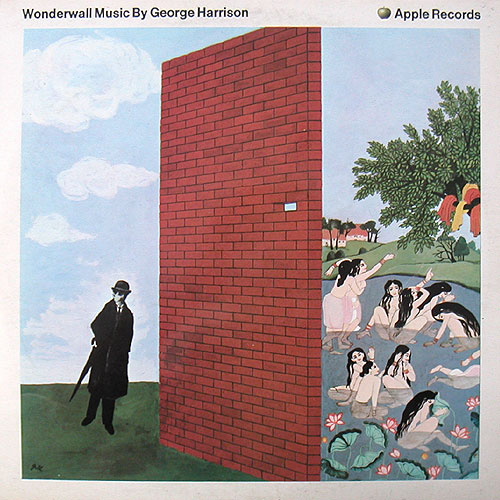
Electronic Sound.
Just over a year after the release of Wonderwall Music, George Harrison returned with his sophomore album, Electronic Sound. Critics and record buyers wondered what direction the Quiet One’s music would head in on his sophomore album? None of them would have guessed that George Harrison was about to release an album of avant-garde music, Electronic Sound.
Electronic Sound was recorded during November 1968 and February 1969 at Sound Recorders Studio, Los Angeles and at Kinfauns, George Harrison’s home in Surrey.The album featured just two lengthy pieces played on Robert Moog’s latest groundbreaking invention, the Moog synth. With a Moog synth, George Harrison recorded Under The Mersey Wall, which lasted nearly nineteen minutes and No Time Or Space, which was a twenty-five minute epic. These two songs became Electronic Sound, which was released on the ‘9th’ of May 1969.
Just like Wonderwall Music, critics weren’t interested in Electronic Sound. Reviews of George Harrison’s sophomore were few and far between, and to some extent, that wasn’t surprising. The problem was that Electronic Sound was an album that was so far ahead of its time, that critics who were used to reviewing albums of pop and rock failed to understand that album, never mind understand what George Harrison was trying to achieve.
It was only later when critics revisited Electronic Sound that they regarded the importance of the album. Electronic Sound was pioneering and innovative album of avant-garde electronic music that later, would be a reference point and inspiration for future generations of musicians. However, the critics that reviewed Electronic Sound in 1969 regarded it as an an album for completists only, or those interested in avant-garde or electronic music. Despite the importance of Electronic Sound, it hasn’t stood the test of time. Neither was it a commercial success.
Electronic Sound was scheduled for released in Britain on the ‘9th’ of May 1969 on The Beatles’ Zapple label. It was an imprint of Apple, with a raison d’être was to release albums of avant-garde music. However, Zapple was a short-lived venture for The Beatles, and was closed down by their new manager Allen Klein as part of his cost cutting measures. One of the few albums Zapple released was Electronic Sound.
Electronic Sound was released in Britain on the ‘9th’ of May 1969, and failed to chart. For George Harrison this was another disappointment. Just over two weeks later, Electronic Sound was released in America on 25th May 1969, and history repeated itself and Electronic Sound failed to chart. However, George’s luck was about to change when he released his third album All Things Must Pass, which was recently released by UMC on vinyl as a Limited Edition three LP Box Set. All Things Must Pass was the album that transformed George Harrison’s solo career.
All Things Must Pass.
While his first two album had been adventurous and groundbreaking, George Harrison’s third album, All Things Must Pass was a much more traditional album. It was also an album that showcased George Harrison’s talent as a singer,songwriter, and musician.
For All Things Must Pass, George Harrison headed into the studio with eighteen tracks to record. Many of the songs on All Things Must Pass were new songs, while others were written while George Harrison was still a member of The Beatles. They had turned down tracks like All Things Must Pass and Isn’t It A Pity, preferring to record Lennon-McCartney compositions. While this was frustrating for George Harrison. the Quiet One shrewdly kept them for his solo career. Now was the time to showcase these songs on All Things Must Pass.
Sixteen of the tracks on All Things Must Pass were written by George Harrison. He also cowrote I’d Have You Anytime with Bob Dylan. The only cover version on All Things Must Pass was the Bob Dylan composition If Not For You . These eighteen songs were part of what became a triple album, which was recorded in three top studios and featured an all-star cast.
Recording of All Things Must Pass began on 26th May 1970 and finished in late October 1970, with recording sessions taking place in the familiar surroundings of Abbey Road Studios, Trident Studios and Apple Studios. During that five month period, the great and good of music played a walk on part on All Things Must Pass.
This included George Harrison’s friend and ex-Beatle Ringo Starr played drums on some of the tracks. He was joined by two men who had been members of The Beatles’ inner circle. Billy Preston who played with both The Beatles and the Rolling Stones played piano and organ. Klaus Voormann another Beatles’ confidante arrived at the sessions and played guitar and bass.
They were joined by three members of Derek and The Dominoes, drummer Jim Gordon, bassist Carl Radle and Eric Clapton who played acoustic and electric guitars. Among the other top names that made their way to the sessions were Blind Faith drummer Ginger Baker, Yes’ drummer Alan White, Traffic’s Dave Mason who played electric and acoustic guitars and Phil Collins of Genesis added percussion. These big names were joined by some top session players.
This included Bobby Whitlock, who was formerly a member of Delaney and Bonnie, and in 1970, session musician to the stars. Bobby Whitlock played piano, organ, tubular bells and harmonium. Pete Drake played pedal steel, while Pete Ham, Tom Evans and Joey Molland played acoustic guitar, and Tony Ashton and Gary Brooker played piano. Horns came courtesy of saxophonist Bobby Keys and trumpeter and trombonist Jim Price. Joining this crack band of session players was The Beatles’ former roadie Mal Evans, who played percussion. He played a small part in what would become the most successful album of George Harrison’s career, All Things Must Pass.
With All Things Must Pass completed, George Harrison’s third solo album was scheduled to be released on the ‘27th’ of October 1970. Before then, the music critics passed judgment on All Things Must Pass. They hadn’t been won over by George Harrison’s two previous albums Wonderwall Music and Electronic Sound, and there was a degree of trepidation as the Quiet One awaited the reviews of All Things Must Pass.
When the reviews were published, there was not one dissenting voice. Critics hailed All Things Must Pass as a classic, and critical acclaim accompanied George Harrison’s third solo album. It was, without doubt, the greatest album of George’s three album solo career, and marked the coming of age for George Harrison.
It was as if George Harrison had been freed from the shackles that were The Beatles. No longer was he being held back by the Lennon-McCartney axis who dictated what songs featured on The Beatles’ albums. Most of the time, George Harrison’s songs had been rejected out of hand, and often, inferior songs from Lennon-McCartney partnership were given preference. However, George Harrison was about to have the last laugh.
The cover of All Things Must Pass saw George Harrison surrounded by four comedic looking gnomes, which many veteran Beatles watchers believed were meant to represent The Beatles. The same Beatles watchers saw this as George Harrison commenting on his removal from The Beatles. That was George Harrison’s past, and he was no longer defined by his membership of The Beatles. Since the breakup of The Beatles, George Harrison had his own identity back and could forge a career as a solo artist. What better way to start the next chapter in his career that by releasing a classic album, All Things Must Pass.
The ‘27th’ of October 1970 was D-Day for George Harrison. That was the day All Things Must Pass was released as a triple album. The first four sides featured the main part of All Things Must Pass which was produced by George Harrison and Phil Spector. On sides five and six, was Apple Jam which It featured five jams. The lavish triple album that was All Things Must Pass, was about to become one of the most successful solo albums by a former Beatle.
The lead single released from All Things Must Pass during 1970 was a double A-Side. This was My Sweet Lord and Isn’t It A Pity. It reached number one in America, Australia, Britain, Canada, Germany, Holland, Norway, Sweden and Switzerland. Having sold one million copies in America, My Sweet Lord was certified gold, and later, was nominated for a Grammy Award. There was a problem though.
Anyone familiar with Ronnie Mack’s He’s So Fine immediately spotted the similarities between the two songs. So did Bright Tunes Music who filed a writ against George’s Harrisongs Music on the ‘10th’ of February 1971. Nearly five years later, on the ‘23rd’ of February 1976, the case was settled. It was held that George Harrison had “subconsciously copied” He’s So Fine and Bright Tunes Music was awarded damages that totalled $1,599,987, which was deemed 75% of the North American royalties. For George Harrison, the case brought by Bright Tunes Music caused him huge problems, and he became so paranoid about subconsciously copying some else’s work, that he could hardly write. However, back in 1970, that wasn’t the case.
On the release of All Things Must Pass on the ‘27th’ of October 1970, it reached number one in America, Australia, Britain, Canada, Holland, Norway and Sweden. All Things Must Pass also reached number four in Japan and number ten in Germany. Given how successful All Things Must Pass was, it’s no surprise it was certified gold in Britain and Canada. In America, All Things Must Pass was certified platinum six times over. That equates to sales of six million copies of All Things Must Pass. Never again, would George Harrison reach these heights. This was no surprise, as All Things Must Pass was a stonewall classic.
After the release of All Things Must Pass, no longer was George Harrison perceived as a junior partner in The Beatles. That was far from the case as he was a talented and prolific songwriter. The sixteen songs that featured on All Things Must Pass was just the tip of a musical iceberg. For a number of years, George Harrison had been quietly writing songs. By 1970, he had accumulated a vast body of work. Now was the time to let the record buying public hear what he was capable of on All Things Must Pass.
All Things Must Pass was George’s Magnus Opus. It’s an epic album. Lavish, epic arrangements are the perfect foil for George’s vocal. The music is both melodic and mystical. Especially when George draws inspiration from Indian music. This is part of All Things Must Pass’ spiritual sound.
During All Things Must Pass spirituality and religion play an important part. This is apparent on My Sweet Lord. Just like other tracks on All Things Must Pass, My Sweet Lord is a mixture of rock ’n’ religion. It’s an anthemic modern-day hymnal. However, there’s other influences on All Things Must Pass.
This includes The Band, Bob Dylan and of course Phil Spector. His arrangements are part of the albums lavish, grandiose sound. Phil Spector co-produced All Things Must Pass, and was yin to George’s yang. Now that George Harrison was freed from the constraints of Lennon and McCartney he had blossomed as singer, songwriter, musicians and producer. Phil Spector had helped the genie escape from the bottle.
In doing so, Phil Spector helped George Harrison record an album that he would never better, All Things Must Pass. Cerebral, thoughtful and spiritual, the music is often beautiful and sometimes wistful and melancholy on what is a compelling classic album that is spread across side sides of vinyl. It features many musical highlights.
Some of the many highlights include My Sweet Lord is a stonewall classic. It’s one of the best songs ever written and recorded by a former Beatle. It’s a timeless, spiritual song, written in praise of the Hindu god Krishna, where George Harrison calls for the abandonment of religious sectarianism. Sadly, forty-seven years later, this beautiful song is just as relevant.
The thoughtful Isn’t It a Pity was written after the demise of The Beatles, George Harrison is in a reflective mood. There’s a sadness in his voice that no longer are The Beatles such close friends. On All Things Must Pass, it’s as if George has come to terms that The Beatles are no more. Considering they were a part of his life for so long, this couldn’t have been easy.
George Harrison is in an equally reflective mood on What Is Life? Written in 1969, it’s one of George Harrison’s love songs. This is something that he does so well. In this song, the lyrics aren’t just about a woman, but a deity too.
Beware Of The Darkness is another spiritual song, where t he lyrics reflect the supposed philosophy of Radha Krishna Temple. It’s a song full of powerful imagery which gives the track a cinematic sound and feel. Art Of Dying is another spiritual track where George Harrison deals with reincarnation and the need to avoid rebirth. Closing All Things Might Pass is Hear Me Lord, a song that originally, George Harrison put the song forward for Let It Be. It was rejected and makes its debut on All Things Might Pass. A personal prayer in a rock gospel style, George Harrison asks for help and forgiveness from his deity on Hear Me Lord.
Apple Jam, which fills sides five and six, allows George Harrison’s multitalented all-star band to cut loose. On the longer tracks Out of the Blue, I Remember Jeep and Thanks for the Pepperoni they showcase their versatility and considerable talents. This is a fitting way to end All Things Must Pass.
Although George Harrison went on to release nine further solo albums, none of them match All Things Must Pass in terms of success and quality. Most of his albums were commercially successful, but neither replicated the success nor critical acclaim that All Things Must Pass enjoyed. It was George Harrison’s career defining album, and sadly, he would never again reach the same heights.
Try as he may, George Harrison always came up short when he released future albums. All Things Must Pass was George Harrison’s Magnus Opus. Freed from the shackles of The Beatles, George Harrison had blossomed, and was no longer the “junior partner” or “quiet Beatle.” George Harrison was only quiet because he never had was given opportunity to speak musically. When he did, it was a case of tokenism, which The Beatles would come to regret.
Just six months after Paul McCartney announced he was leaving The Beatles in April 1970, George Harrison released All Things Must Pass, which sold over seven million copies and reached number one in Australia, Britain, Europe and North America. There was the small matter of two Grammy Award nominations.
When the Grammy Award nominations came out, George Harrison was nominated twice. All Things Must Pass was nominated for the Album of The Year Award and My Sweet Lord was also nominated for Record of the Year. This was a huge honour, and a recognition of how far he had come since leaving The Beatles. All Things Must Pass also marked the coming age musically of George Harrison.
When George Harrison recorded All Things Must Pass he neither resorted to controversy nor gimmicks Instead, he let his music do the talking, and didn’t need to resort to bed ins, bagism, third-rate protest songs or adaptations of nursery rhymes. Instead, George Harrison who was already one of the most respected figures in music, was joined by some of the biggest names in music
The musicians who joined George Harrison on All Things Must Pass reads like a who’s who of music. They recorded the twenty-three tracks that became All Things Must Pass, which was recently released by UMC on vinyl as a Limited Edition three LP Box Set. This all-star band played their part on became the most successful solo album released by a former Beatle.
After the success of All Things Must Pass, none of the rest of The Beatles’ came close to replicating its success. That is no surprise, as All Things Must Pass is a classic album. Even the contrarian Rolling Stone magazine agree, and include All Things Must Pass in their list of 500 albums of all time. It’s the album that launched George Harrison’s solo career, after the release of two very different albums.
1968s Wonderwall and 1969s Electronic Music were much more groundbreaking, avant-garde albums, while All Things Must Pass saw George Harrison return to a much more familiar sound. The only difference was All Things Must pass marked the debut of George Harrison’s trademark slide guitar sound. Washes of slide guitar play an important part in All Things Must Pass’ sound. This sound would feature on further George Harrison albums.
Over the next thirty-two years, another nine George Harrison albums were released. His final album was Brainwashed, which was released posthumously in 2002, a year after George Harrison’s death. However, George Harrison left behind a rich musical legacy, including the albums he recorded with The Beatles and the twelve solo albums he released between 1968 and 2002. The includes George Harrison’s career-defining Magnus Opus All Things Must Pass, which is a stonewall classic, and the most successful album released by a former Beatle.
George Harrison-All Things Must Pass (Limited Edition Vinyl Box Set).

MIRWOOD NORTHERN SOUL LP.
Mirwood Northern Soul LP.
Label: Kent Dance.
For many aficionados of Northern Soul, whether DJs, dancers or collectors, Randy Wood’s Mirwood Records, which was based in Los Angeles, is one of their go-to labels. Its discography has been, and still is, a source of many dancefloor favourites and fillers for DJs within the Northern Soul scene. They’ll welcome the recent release of Mirwood Northern Soul on vinyl by Kent Dance, an imprint of Ace Records. Mirwood Northern Soul features fourteen dancefloor fillers, that feature the label’s own unique and distinctive style.
The Mirwood Records story began in Los Angeles in 1965, when Randy Wood, a former Vee-Jay executive who owned and ran Mira Records decided to found another label. That label became Mirwood Records which mostly, would release soul and jazz recordings during its three-year existence.
Having founded Mirwood Records, Randy Wood brought onboard songwriter and producer Fred Smith. Along with arranger James Carmichael, they would forge Mirwood Records’ unique sound. It was variously energetic had a sophisticated and soulful sound befitting an LA label.
Mirwood Records first single was The Gas Co’s Blow Your Mind, which was released in October 1965 baring the catalogue number 5501. With its garage rock sound this was very different to the soulful sound of the label’s next release.
In November 1965, Mirwood Records released its sophomore single The Duck, which was credited to Jackie Lee. The Duck gave the nascent label and Jackie Lee their first hit single. However, the only problem was that The Duck had actually been sung by Earl Nelson of Bob and Earl. However, the success of The Duck launched Mirwood Records, which over the next three years released over fifty singles. These singles include the: “fourteen outstanding stomping soul dancers” on Mirwood Northern Soul.
Side One.
Opening Mirwood Northern Soul is That Beatin’ Rhythm by Richard Temple. It was the B-Side to Could It Be which was released in 1967. That Beatin’ Rhythm was produced by Leonard Jewell Smith and Sir Graham and is a melodic stomper which showcases Mirwood Records sophisticated and soulful sound.
A year after Jackie Lee’s The Duck launched Mirwood Records, she released The Shotgun and The Duck as a single in March 1966. Tucked away on the B-Side was Do The Temptation Walk a Fred Smith and Earl Nelson song. It was arranged by James Carmichael and produced by Fred Smith who had already crafted the Mirwood Records sound. All that was left was Jackie Lee, accompanied by backing vocalists to deliver a powerful soulful vocal on this timeless dance track.
The Olympics released a cover of Sherie Matthews’ The Same Old Thing as a single in November 1966. It’s another song that was arranged by James Carmichael and produced by Fred Smith. This uptempo dancer would go on to become a favourite of DJs and dancers on the UK Northern Soul scene, and even today would fill a dancefloor.
I Wanna Do Everything For You Baby by The Mirettes lay unreleased in the Mirwood Records’ vaults until 2006 when it featured on Kent Soul’s compilation The Mirwood Soul Story Volume 2. Somewhat belatedly, this soulful stomper penned by Sherie Matthews, made its debut and is a reminder of the quality of music The Mirettes released on Mirwood Records.
Three years after Mirwood Records closed its doors for the last time, the Jay Boy label released The Bob and Earl Band’s single My Little Girl. This is another Sherie Matthews that was arranged by James Carmichael and produced by Fred Smith. A driving, stomping slice of irresistible string drenched soul, it’s a pity it wasn’t released on Mirwood Records. It’s the one that got away for Randy Wood’s Mirwood Records and could’ve given The Bob and Earl Band a hit single.
Unlike the other tracks on Mirwood Northern Soul, Curtis Lee penned Is She In Your Town? which was released on Mirwood Records’ sister label Mira Records in 1967. It was arranged by Bob Mercereau, while Rod Krohn and Sonny Knight took charge of production. Despite being released on Mira Records, the stomping beat and blazing horns are still present. What’s different is the bluesy sound that comes courtesy of a harmonica. Meanwhile Curtis Lee’s vocal veers between pop and blue-eyed soul influence. on a track that later, would find favour in the British Northern Soul scene.
Closing side A of Mirwood Northern Soul is Oh, My Darlin’ by Jackie Lee. It’s a Sherie Matthews that was arranged by James Carmichael and produced by Fred Smith. Oh, My Darlin’ was released in October 1966 and featured a hurt-filled vocal that was delivered against the omnipresent stomping beat. This was a powerful and successful combination.
Side B.
Bobby Garrett’s Oh, My Darlin’ opens Side B of Mirwood Northern Soul LP. It’s a Fred Smith, Earl Nelson and Robert Relf composition that was released in December 1965. It was produced by in-house producer Fred Smith who combines Bobby Garrett’s soul-baring vocal with soaring harmonies and rasping horns. They’re joined by the stomping beat that is the final touch to what’s one of the finest singles from Mirwood Records’ back-catalogue.
The Olympics released Mine Exclusively as a single in April 1966. It’s another Sherie Matthews composition that was arranged by James Carmichael and produced by Fred Smith. The triumvirate had formed a successful partnership, with Sherie Matthews’ songs being recorded by various artists and groups singled to Mirwood Records. They were also beneficiaries of the Mirwood Records’ sound that arranger James Carmichael and producer Fred Smith had masterminded. An example of this can be found on the hook-laden Mine Exclusively which features The Olympics at their best.
July 1966 saw singer-songwriter Jimmy Thomas release Just Tryin’ To Please You. Tucked away on the B-Side was another Jimmy Thomas composition Where There’s A Will (There’s A Way) which was arranged by James Carmichael and produced by Fred Smith. Where There’s A Will (There’s A Way) is a true hidden gem is every bit as good, if not better that the single.
For their debut single, The Belles released the Sherie Matthews composition Don’t Pretend in 1966. It was arranged by James Carmichael and produced by Fred Smith. They played their part is sweet soulful stomper that epitomises the Mirwood Records sound.
Jackie Lee’s third contribution on Mirwood Northern Soul is Anything You Want (Any Way You Want It) which lay unreleased until February 2005. That was when this Sherie Matthews and Earl Nelson song made its debut on The Mirwood Soul Story compilation. Belatedly, aficionados of Mirwood Records were able to hear this driving stomper with testifying backing vocals accompanying Jackie Lee’s impassioned vocal.
Mirwood Records wouldn’t release many more singles after The Performers released I Can’t Stop in June 1968. It was penned by Lawrence Scarbrough and Robert McGlothin, who produced the single Hank Graham. Although the single was arranged by James Carmichael, it’s a move away from the Mirwood Records’ sound, with a rawer sound replacing the sophisticated sheen of earlier releases. Despite that, it found favour with DJ and dancers on the Northern Soul scene.
Stubborn Heart by The Sheppards closes Mirwood Northern Soul. It was penned and produced by Eddie La Shea and released in 1967. It’s a heartwrenching ballad from The Sheppards and a beautiful way to close Mirwood Northern Soul.
Mirwood Northern Soul which was recently released on vinyl by Kent Dance, an imprint of Ace Records, is the latest compilation of music from the Mirwood Records’ vaults. It’s a a reminder of Randy Wood’s LA-based Mirwood Records, which for the three years between 1965 and 1968 released fifty-two singles. Some of these singles, plus the occasional B-Side are joined by two tracks that were only released in the noughties. They’re part of what’s a lovingly curated compilation which aficionados of Northern Soul will embrace and enjoy. Whether it’s DJs, dancers or collectors, Mirwood Northern Soul is sure to find its way into record boxes or record collections.
For newcomers to Mirwood Records, then Mirwood Northern Soul is the perfect place to start. After that, they can investigate the delights of The Mirwood Soul Story and The Mirwood Soul Story Volume 2 which were released on CD. They’re reminders of Randy Wood’s LA-based Mirwood Records, which for many soul fans, is one of the greatest sources of Northern Soul. Proof of that is Mirwood Northern Soul which features: “fourteen outstanding stomping soul dancers” that are still dancefloor favourites and fillers for DJs and dancers within the Northern Soul scene.
Mirwood Northern Soul LP.

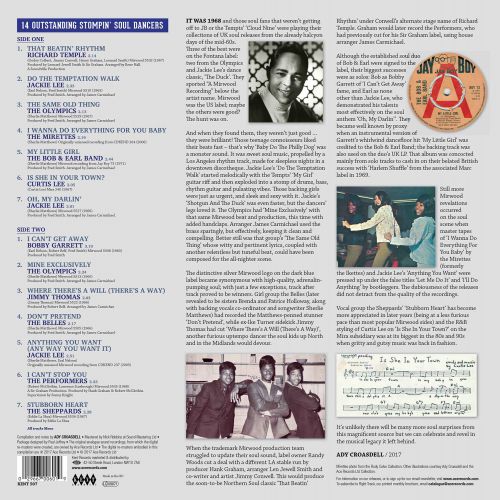
CHOPTEETH AFROFUNK BIG BAND-BONE READER.
Chopteeth Afrofunk Big Band-Bone Reader.
Ten years after the Chopteeth Afrofunk Big Band were founded in Washington DC in 2007, the twelve piece, award-winning, Afrofunk orchestra return with their eagerly anticipated third album Bone Reader. It’s the first album the Chopteeth Afrofunk Big Band have released since Chopteeth Live in February 2010. Since then, the Chopteeth Afrofunk Big Band have performed all over America and opened for everyone from Funkadelic and Parliament to Aaron Neville, Konono No. 1 and Gov’t Mule. Night after night the Chopteeth Afrofunk Big Band have been winning friends with their own unique trademark sound, where they fuse the funkiest music West Africa has to offer, with American popular music. This is a potent and heady brew, one that features on Bone Leader, the latest chapter in the Chopteeth Afrofunk Big Band story.
It’s a band that was essentially born after a terrible tragedy made Robert Fox rethink his priorities in life. At the time, Robert Fox was a labor organiser and he was mourning the death of one of his closest friends after a car accident. He remembers “it was a terrible, terrible thing…I came back from this and thought, ‘Wow, that could have been me!’ It made me assess what’s important in life.”
After much time thinking about what was important in life, and where his life was heading. The two thing that were important to Robert Fox were his family, and his work within the labour movement. However, there was also something that Robert Fox had wanted to do for many years, but had never plucked up the courage to form an Afrofunk band. The death of his friend made him realise that if he didn’t grasp the nettle, and do so he would regret not doing so in later life
Having made the decision, Robert Fox decided to bring to life his dream of playing bass in a band that played like Fela Kuti’s seventies Afrobeat band, and combining this with James Brown’s high energy funk and the Yoruba musical tradition. To do this, needed the right personnel for his new band.
Robert Fox started looking for the musicians that would become the Chopteeth Afrofunk Big Band. The first to join the new band was guitarist and songwriter Michael Shereikis, whose musical CV included playing in the Central African Republic and on the stages of Abidjan in Côte d’Ivoire. This would stand him in good stead when he became the Chopteeth Afrofunk Big Band’s musical director.
Having recruited Michael Shereikis, Robert Fox continued his search for the right blend of musicians. Some were recruited after answering small ads, while others heard through the Washington DC musical grapevine that Robert Fox was putting together a new band. Eventually, Robert Fox had recruited the three women and nine men that became the Chopteeth Afrofunk Big Band.
The twelve band members all came from different very backgrounds, and were a mixture ages and nationalities. Three decades separated the youngest and eldest members who came from far and wide. Some were local musicians from Washington DC, while others came from the Deep South. Other band members came from as far failed as Romania and Kenya. They were part of a rainbow nation of musicians, that became the Chopteeth Afrofunk Big Band, who would soon, become familiar faces in the Washington DC music scene.
It was a Nigerian businessman that offered the Chopteeth Afrofunk Big Band. This was the break the nascent band was looking for. More importantly, he introduced the Chopteeth Afrofunk Big Band to Kenyan singer Anna Mwalagho. She would play an important part in the rise and rise of the Chopteeth Afrofunk Big Band.
Chopteeth.
Just a year after the Chopteeth Afrofunk Big Band was formed in Washington DC, in 2007, the twelve piece band began work on their debut album Chopteeth. It showcased the band’s unique and eclectic sound, which had its roots in Afrobeat, the big-band funk sound invented by Fela Kuti in seventies Nigeria. Afrobeat was a fusion of modern jazz, Yoruba tribal music and funk. The Chopteeth Afrofunk Big Band had initially fused this with the Yoruba musical tradition. However, this was only part of the story, as the Chopteeth Afrofunk Big Band sound that also included salsa, soukous and Balkan-style time signatures. This was all part of a truly eclectic debut album.
When the Chopteeth Afrofunk Big Band released their debut album Chopteeth in 2008, it was a call for rhythmic regime change. The “Crazy Fools of Afrobeat”combined new and original songs from Ghana, Senegal, Congo, Guinea, and Nigeria on an album that showcased their new and inimitable sound. Chopteeth found favour with critics and the Washington Area Music Association.
At the Washington Area Music Association awards ceremony later in 2008, the Chopteeth Afrofunk Big Band won awards for Debut CD of the Year, Artist of the Year and World Music Group of the Year. This was recognition of how far the Chopteeth Afrofunk Big Band had come.
Chopteeth Live.
Nearly two years after the release of Chopteeth, the Chopteeth Afrofunk Big Band returned with their sophomore album Chopteeth Live in February 2010. It captured the award-winning, twelve piece from Washington DC’s live sound.
They fuse Afrobeat, funk, jazz and soul as they recreate the seventies glory days of African music. In doing so, they pay homage to legendary African musicians like Fela Kuti and Peter King on a vampish take on Freedom Dance. Elsewhere the Chopteeth Afrofunk Big Band take the listener on journey through Africa, as the play songs from Nigeria, Guinea, Senegal and Congo. This allows the Chopteeth Afrofunk Big Band to showcase their versatility and talent on an album that was an irresistible reminder of their live sound. So impressed were the Washington Area Music Association that the Chopteeth Afrofunk Big Band won the World Music CD of the Year in 2010.
Since then, the Chopteeth Afrofunk Big Band have spent much of their crisscrossing America, playing prestigious festivals and opening for some of the biggest names in music, including Funkadelic and Parliament to Aaron Neville, Konono No. 1 and Gov’t Mule. The Chopteeth Afrofunk Big Band have also added to their tally of awards over the past seven years.
By 2016, the Chopteeth Afrofunk Big Band had won thirteen awards at subsequent Washington Area Music Association award ceremonies. The Chopteeth Afrofunk Big Band have now won Artist of the Year, Debut CD of the Year and have twice won the World Music CD of the Year. However, the all-conquering the Chopteeth Afrofunk Big Band have now won the World Music Group of the Year award for the past nine years. The recent release of Bone Reader should see the Chopteeth Afrofunk Big Band make that ten in a row, and add to their impressive list of awards.
Bone Reader,
For Bone Reader, the “Crazy Fools of Afrobeat” have combined new compositions with updates of African dance classics. However, The Chopteeth Afrofunk Big Band stay true to the original spirit of these classic songs. With the new songs, the Chopteeth Afrofunk Big Band have been inspired by Twi proverbs, Ivorian pop, the death of Freddie Gray and Edward Snowden the former Intelligence Community officer and whistleblower who leaked classified documents. All this influenced the Chopteeth Afrofunk Big Band as they began work on their much-anticipated third album Bone Reader which is dancefloor friendly and full of social comment.
Cofounder and guitarist Michael Shereikis explains the concept behind Bone Reader: “You’re dancing, so let’s engage on another, more challenging level as well. You may be having a good time, but you’re also hearing and considering an issue that has a resonance for you. That’s how many of us approach songwriting for this band.”
On an album which features seven different vocalists, it’s no surprise that several members of the Chopteeth Afrofunk Big Band contributed songs to Bone Reader. Cofounder and bassist Robert Fox wrote two Edward Snowden and Rambeau, while other songs were collaborations between several band members.
This included Funtumfunafu, whose roots can be traced to the day percussionist David McDavitt brought in a Ghanaian adinkra, the symbol of a two-headed crocodile into the studio. It provided part of the inspiration for the song. So did the Twi proverbs that Michael Shereikis had researched. He then worked out the horn chart on a piano, and sent them to horn section arranger and trumpet player Cheryl Terwillinger. The result was Funtumfunafu, a beautiful, mid-tempo song that sounds as if it was recorded in the seventies, which was the golden age of African music.
Another song, Warriors, took shape after drummer Mahiri Keita showed the group the powerful balanta rhythm he had learned from his Ghanaian teacher. Mahiri Keita explains more about the song’s background, and how it took shape. “Lanta are warriors from Guinea-Bissau and Gambia, and balanta is a popular dance. But no one’s put it into a contemporary funk context. The breakdown goes with the warrior dance. I wanted to see if the band could play it. And they could! I laid the foundation on the drum, and the band built from there.” They were able to do so when they entered the studio, and an irresistible energetic workout where the Chopteeth Afrofunk Big Band combine the balanta rhythm with Afrobeat horns and funk. It’s one of ten tracks laid down one Washington DC studio.
In the studio, the Chopteeth Afrofunk Big Band’s sound was much tighter as they fused West African rhythms, funk and hip hop on Bone Reader, which is full of social comment and also, dancefloor friendly.
Opening Bone Reader is Questions Of Our Day where the Chopteeth Afrofunk Big Band fuse blazing Afrobeat horns, funk and social comment in dancefloor filler designed to make the listener think. So too is Edward Snowden where samples are deployed, including one of the former Intelligence Officers vocal. Meanwhile, the Chopteeth Afrofunk Big Band jam, fusing elements of Afrobeat, funk, blistering jazzy horns and later, a searing rocky guitar. It’s a glorious, thought-provoking musical potpourri.
DC Vote features Head-Roc and initially, sounds as if it’s been inspired by seventies Afrobeat, funk and Blaxploitation soundtracks. Soon, Head-Roc adds an impassioned rap, which adds a new dimension to another song full of social comment. It gives way to Rambeau, a genre-melting jam where the Chopteeth Afrofunk Big Band are at their tightest as they kick loose and pay homage to Monica Rambeau a Marvel comic character who later, became a leader of the Avengers. Her roots are in the Big Easy, and it’s the music of New Orleans that has influenced the Chopteeth Afrofunk Big Band on this musical homage the Big Easy’s first female superhero.
From superheroes the Chopteeth Afrofunk Big Band move on to Cop Show, which straight away, takes the listener back to the seventies. It’s not unlike the funky theme to a Cop Show. That was what the Chopteeth Afrofunk Big Band thought when they recorded the track. However, they were so worried that they had been influenced by another track that they scoured the internet listening to themes to seventies cop show. By the time they realised that they hadn’t been influenced by another track, Freddy Gray had died in Baltimore. This resulted in Flex Mathews being drafted in to lay down an impassioned rap which is the final piece of this musical jigsaw.
So You Say was written by Justine Miller, and is a song that stands up for those that are defiant and skeptical. It features a vocal that veers between tender and soulful to defiant powerful and sometimes is full of scepticism. Meanwhile, fought horns and washes of Hammond organ join percussion and the rhythm section in powering the arrangement along. In doing so, Justine Miller shows another side to the Chopteeth Afrofunk Big Band.
Tribulation is soulful Afrobeat with lyrics full of social comment. It gives way to Solomon’s Party which closes Bone Reader, and is another song that shows the soulful side of the Chopteeth Afrofunk Big Band. They combine their soulfulness with their trademark sound, on what’s a melody and ruminative track, that closes the album on a high.
After a seven-year wait, the Chopteeth Afrofunk Big Band make a welcome return with their third album Bone Reader. The twelve-piece band from Washington DC is a much tighter band on this carefully crafted album of new songs with updates of African dance classics. They’re part of what’s a career-defining album from the Chopteeth Afrofunk Big Band.
Bone Reader is a genre-melting album, where the Chopteeth Afrofunk Big Band fuse Afrobeat, funk, jazz, soul and even the occasional rocky guitar lick. Much of the music on Bone Reader is also dancefloor friendly, but is also full of social comment. The Chopteeth Afrofunk Big Band certainly don’t shy away from tackling important issues on Bone Reader, and set out to record an album that was designed to make the listener think.
This isn’t always easy, but fortunately the Chopteeth Afrofunk Big Band have a number of talented songwriters that contribute to the new songs on Bone Reader. They tackle various social problems and deal with recent injustices. These songs are also designed to encourage the listener to think about what’s going on in the world around them, ranging from politics to recent injustices. The lyrics to these songs are brought to life by the Chopteeth Afrofunk Big Band’s seven vocalists, whose vocals are impassioned and full of emotion. Each of the seven vocalists play their part in the sound and success of Bone Reader.
The Chopteeth Afrofunk Big Band have succeed in what they set out to do when they began work on Bone Reader, and have created a dancefloor friendly album that will make the listener think. It can’t have been easy, but the twelve members of the Chopteeth Afrofunk Big Band have succeeded in doing so on Bone Reader, which has been worth the seven-year wait,
Bone Reader showcases the multitalented and versatile Chopteeth Afrofunk Big Band who are a much tighter and even better band than they were when they released Chopteeth Live in 2010. They reach new heights on Bone Reader, which is a cerebral, thought-provoking and dancefloor friendly album from the Chopteeth Afrofunk Big Band which is sure to add to the Washington DC band’s impressive array of awards.
Chopteeth Afrofunk Big Band-Bone Reader.
LETS DO THE BOOGALOO.
Lets Do The Boogaloo.
Label: BGP.
By the time eighteen year old Chubby Checker released his cover of The Twist in the summer of 1960, records that that launched new dance crazes were nothing new. They had been around since the late-fifties, when The Diamonds 1957 single The Stroll launched a short-lived dance craze. It was a similar case in 1959, when The Olympics enjoyed a minor hit with The Hully Gully and a new dance craze was born. However, a year later, when Chubby Checker’s The Twist topped the US Billboard 100, it launched what was one of the most popular dance crazes in the history of popular music.
In the wake of The Twist, record companies across America started releasing singles that they hoped would launch a new dance craze. This included The Pony in 1961; The Hitchhiker, The Loco-Motion, The Mashed Potato and The Watusi following in 1962 and The Swim and The Jerk in 1964. These dance crazes enjoyed differing degrees of success, and some are still remembered fondly by the Baby Boomers.
So too is the boogaloo, whose roots can be traced to the spring of 1965 when comedians, dancers and singers Tom and Jerrio enjoyed a top twenty single Boo-Ga-Loo. It was essentially an instrumental, with occasional vocal interjections from Tom and Jerrio. Their single launched the Boo-Ga-Loo dance craze, which the pair first saw at a Herb Kent record hop in the Windy City of Chicago.
The boogaloo was unlike any previous dance, and saw the dancer’s entire body, including their upper body, shoulders and head moving in a what was essentially a pulsating movement from side-to-side. This soon caught on, and just like The Twist five years earlier became a hugely popular dance.
For the next eighteen months, boogaloo which started life as a soul dance, became a favourite on dancefloors across America. By then, the soul boogaloo had been joined by the Latin boogaloo and the two coexisted, potentially appealing to different audiences who would happily dance side by side.
In America which to some extent was still a country divided by race, the boogaloo brought together young Americans from different backgrounds together. On the dancefloors, a rainbow nation of white, Latin and African-American danced together as pulsating proto-funk beat was joined by braying horns and sometimes, frenzied percussion. They danced to soundtrack that included a mixture of old and new tracks.
Given the popularity of boogaloo, artists were recording and record companies were releasing records to cash-in on the genre. Other records were perfectly suited to the soul boogaloo or Latin boogaloo, and quickly became favourites of dancers and DJs.
By 1968, soul boogaloo was no longer as popular as it had been, and by the end of the year, had more or less disappeared from the soul scene.
Still, the Latin boogaloo scene was popular right up until the sixties gave way to the seventies. By then, boogaloo sound had been replaced by salsa. It looked the end of the boogaloo era.
Some five decades and forty-eight years after boogaloo’s supposed demise in 1969, the music still remains popular today amongst DJs, dancers and compilers. This includes Dean Rudland, who compiled Lets Do The Boogaloo, which was recently released by BGP, an imprint of Ace Records. Lets Do The Boogaloo features twenty-four tracks, including two that make their debut on the compilation.
Opening Lets Do The Boogaloo is Prince and Princes’ cover of the Harold Thomas composition Ready, Steady, Go, which was released by Bell Records in July 1965. It was co-produced by Jimmy Miller and Larry Fallon. This was way before Jimmy Miller found fame producing the Rolling Stones, Traffic, Blind Faith, Spooky Tooth and Bobby Whitlock. However, Jimmy Miller and Larry Fallon add blazing Latin horns and frenzied horns, which play an important part in the sour and success of Prince and Princes’ hook-laden dancefloor filler.
In December 1966, Hector Rivera released Playing It Cool on the Barry label. It was written and arranged by the New York born bandleader Hector Rivera, whose family were from Puerto Rica. His music provided part of the soundtrack to the Latin boogaloo era, including his club classic Playing It Cool.
Although Jimmy Castor’s music was popular during the boogaloo era, his popularity increased after hip hop producers sampled some of his best known tracks. Soon, a new generation of music fans started to discover Jimmy Castor’s music. After this, his songs started to appear on compilations, and his albums were reissued. One of Jimmy Castor’s finest moments during the Latin boogaloo era was Block Party, which he wrote with John Pruit. This irresistible dance track became a favourite of DJs and dancers during Latin boogaloo era, and later found favour with sample-hungry hip hop producers
During the fifties, vibes player, percussionist and bandleader Pete Terrace, became known as The King Of Latin Jazz after releasing a series of critically acclaimed and now incredibly rare albums. By 1967, Pete Terrace’s music had fallen out of favour, and he decided to reinvent himself as a Latin boogaloo musician. With the help of producer Marty Wilson, The King Of Latin Jazz recorded King Of The Boogaloo for A/S Records. One of the tracks on the album was I’m Gonna Make It a Pete Terrace, Marty Wilson and Marty Sheller composition, which was released in Britain and Europe by Pye International. With its infectious, feelgood sound, it’s a track that has stood the test of time and shows why Pete Terrace was regarded by some as the true King Of The Boogaloo.
The Bar-Kay’s story began in 1966, when the group was formed in Memphis, Tennessee. By 1967, they had become Otis Redding’s backing band and toured with him. They were also signed to Stax, and in 1967 recorded their debut album Soul Finger, which was also the title of their hit single. The Soul Finger album was released on Atlantic in America, and on the Stax imprint Volt in Europe. One of the highlights of the album was Bar-Keys Boogaloo, which became a favourite on the soul boogaloo scene, and fifty years later is a timeless track that’s a reminder of the Stax sound.
As the sixties drew to a close, it was official, Mongo Santamaría was the most successful Latin musician of the sixties. He had also played an important part in the development of Latin boogaloo. In 1963, Mongo Santamaría and His Orchestra had released the album Watermelon Man! Little did Mongo Santamaría realise that the beat to the title-track would provide the basis for Latin boogaloo. Three years later, Mongo Santamaría covered the Rodgers Grant composition Mongo’s Boogaloo, which was released on Columbia in 1966. It was fitting that the man who provided the Latin boogaloo beat, now had Latin boogaloo named after him. It’s a glorious reminder of the Cuban percussionist who helped define the Latin boogaloo sound.
Lou Courtney’s recording career began as an eighteen year old in 1962. By 1967, he was still to make a breakthrough, so decided to record a soul boogaloo single Me and You (Doin’ The Boogaloo). It was penned by Lou Courtney and Bob Bateman and released on the Riverside label. While it was played on soul boogaloo scene, commercial success continued to elude Lou Courtney. Later, Me and You (Doin’ The Boogaloo) became a favourite on the British Northern Soul scene.
Houston born Shirley Butler only released half-a-dozen single on various independent label in her home city. This included Boogaloo Zoo, which was released on Tear Drop label in 1968. It’s funky, soulful and features vocal powerhouse from one of Houston’s best kept musical secrets Shirley Butler.
After scoring a hit single with Harlem Shuffle in 1963, Bob and Earl struggled to replicate its success. It was a frustrating time for the pair, who even tried releasing songs about the latest dance craze. This included The Sissy and The Jerk. When the boogaloo era began, the duo decided to jump on the boogaloo bandwagon. The Bob and Earl Band entered the studio to record Boogaloo Part 1, which is an irresistible, stomper. Sadly, the track was never released and makes a welcome debut on Lets Do The Boogaloo.
Willie Rosario and His Orchestra signed to Atco in 1968, and recorded Boogaloo and Guaguanco, an album of mainly Latin jazz which was augmented by three covers of popular songs. When it came to release a single from Boogaloo and Guaguanco later in 1968, there was only one option Watusi Boogaloo It’s without doubt the highlights of Boogaloo and Guaguanco with stabs of blazing horns, percussion and vocals sung in Spanish. They play their part in this carefully crafted Latin boogaloo hidden gem.
Soul singer, songwriter and keyboardist Timmy Thomas from Evansville, Indiana, is best remembered for his 1972 hit single Why Can’t We Live Together. However, Timmy Thomas’ solo career began in 1967 when he signed to Goldwax Records. Later that year, he released his sophomore single Have Some Boogaloo for Goldwax Records. It was the first single to feature the drum machine that became part of his trademark sound over the next few years.
Closing Lets Do The Boogaloo is Funky Funky Boogaloo, which is taken from Jimmy Brown With The Jimmy Brown Band’s debut album The Jimmy Brown Organ-Ization. It was released on A-Bet in 1967, and when it came to choose the lead single, Funky Funky Boogaloo was chosen. This jazz boogaloo showcases the skills of little-known organist and bandleader Jimmy Brown, who sounds like a disciple of legendary jazz organist Jimmy Smith.
For anyone yet to discover the delights of boogaloo, then Lets Do The Boogaloo, which was recently released by BGP, an imprint of Ace Records is the perfect starting place. Lets Do The Boogaloo features twenty-four tracks, including two that make their debut on the compilation. This includes The Bob and Earl Band hidden gem Boogaloo Part 1. It’s just one of the many highlights on Lets Do The Boogaloo, which featured familiar faces, old friends and a number of new names. They contribute a mixture of soul boogaloo, Latin boogaloo and in the case of Jimmy Brown With The Jimmy Brown Band, jazz boogaloo on Lets Do The Boogaloo, which oozes quality.
That is no exaggeration. While other record companies have released boogaloo compilations in the past, Lets Do The Boogaloo stands head and shoulders above the competition. It’s sure to bring back memories for DJs and dancers who remember the boogaloo era between 1965 and 1969. They’ll be able to relive these days by buying a copy of Lets Do The Boogaloo, which is without doubt, the best boogaloo compilation money can buy.
Lets Do The Boogaloo.
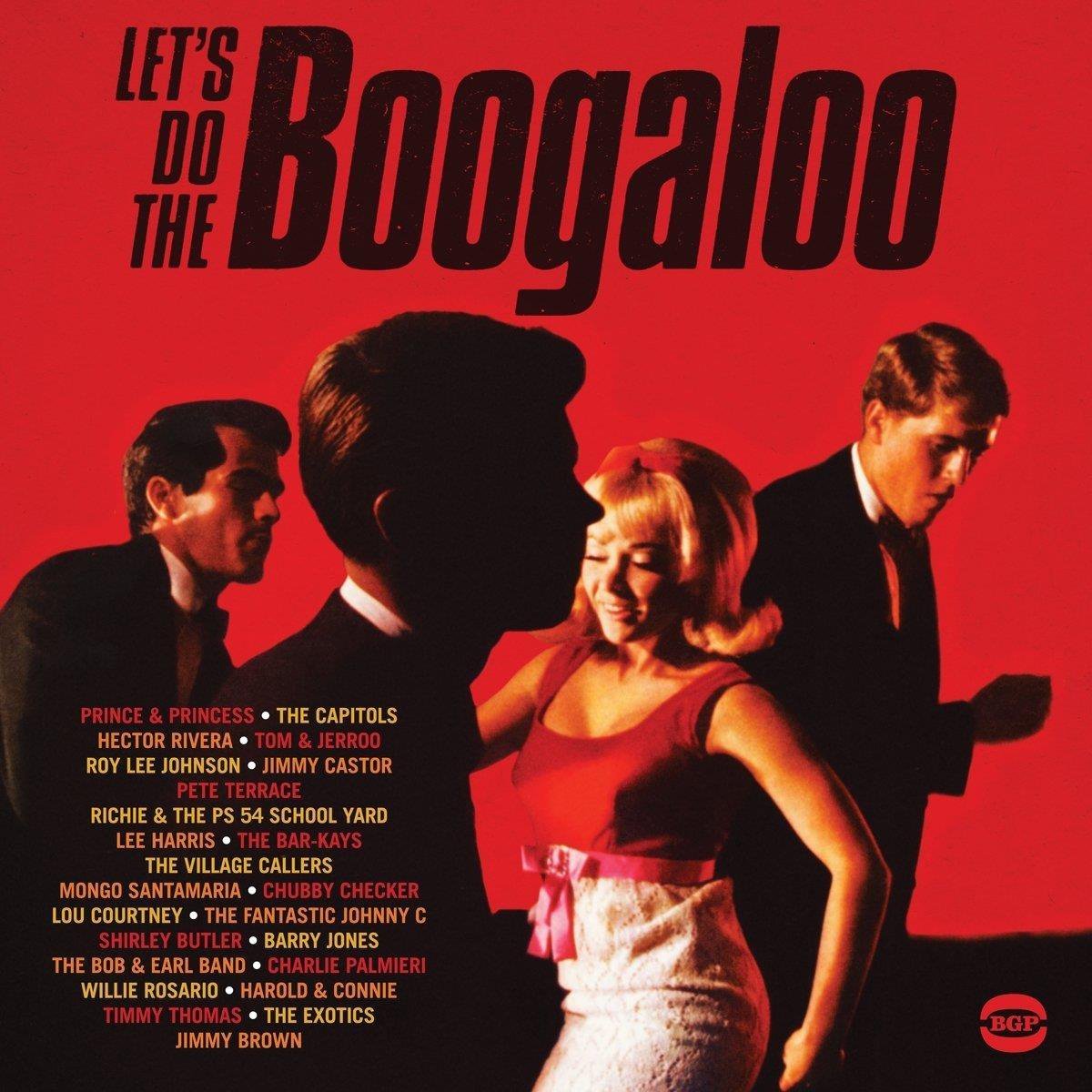
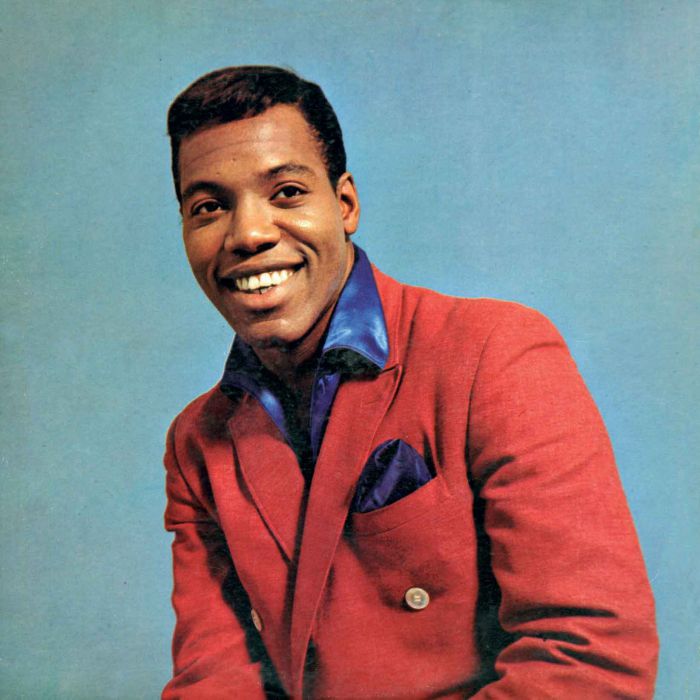
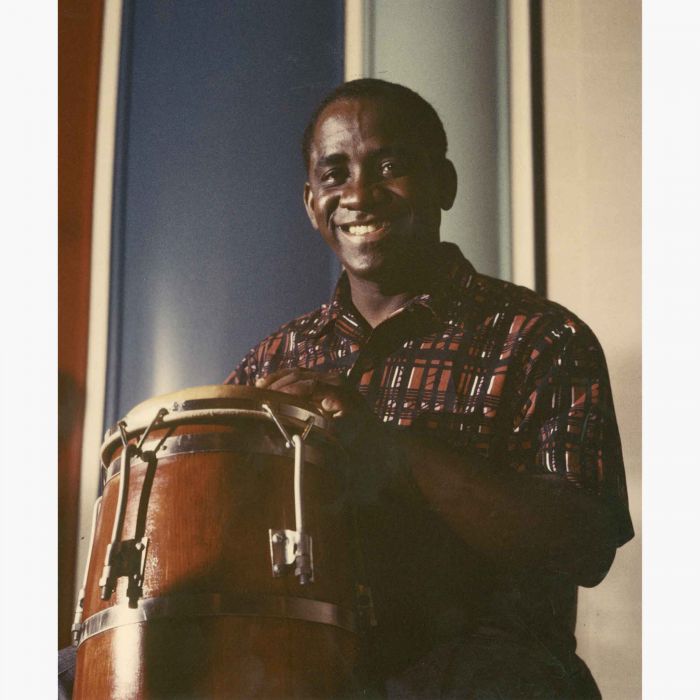
HASA-MAZZOTTA-NOVILUNIO
Hasa-Mazzotta-Novilunio.
Label: Ponderosa Music Records.
Just over three years ago, Albanian cellist Redi Hasa and vocalist Maria Mazzotta from Puglia, in Southern Italy, released their first critically acclaimed collaboration Ura, in September 2014. Ura was the result of a four-year journey, which showcased and combined the powerful and poignant sound of Redi Hasa’s cello and the tenderness and emotion of Maria Mazzotta’s vocal. They were combined with a myriad of live recorded loops during what was a groundbreaking cross-cultural collaboration.
Ura found Redi Hasa and Maria Mazzotta revisiting and reinterpreting ancient stories from South Italy and the Balkans. The key to reinventing these ancient stories was experimentation and improvisation. This was something that had never been tried before, and Redi Hasa and Maria Mazzotta were heading into what was unchartered water. Despite this, critics described Redi Hasa and Maria Mazzotta’s reinvention of the ancient stories on Ura as evocative, haunting and uplifting. Redi Hasa and Maria Mazzotta’s cross-cultural collaboration was hailed a resounding success.
This was fitting, as Ura in Albanian mean bridge and in the Salento dialect translates to now. Redi Hasa and Maria Mazzotta had set out, and succeeded, in creating what was essentially a bridge between§ their respective cultures, in the here and now. Having succeeded in doing so, Redi Hasa and Maria Mazzotta then set about thinking about the followup to Ura, which had been an ambitious and groundbreaking project.
Three years later, and Redi Hasa and Maria Mazzotta return with their much-anticipated sophomore album Novilunio which was recently released by Ponderosa Music Records. Novilunio finds Redi Hasa and Maria Mazzotta continue the journey that began on Ura. This means more music from the two shores of the Adriatic, the Balkans and Puglia, which are joined by melodies from Roma, Bulgaria and Montenegro. There’s also song that were first sung by migrants, odes to the pagan tarantella and the Virgin Mary during Novilunio, which brings together songs from different eras and songs that were originally sung in lost languages. Novilunio promises to be another beautiful and enchanting album that builds on Ura, and continues this musical journey.
It’s a journey that began back in 2010, when the two musical pioneers, embarked upon what proved to be a seven-year voyage of discovery, where Albanian cellist Redi Hasa and vocalist Maria Mazzotta from Puglia, in Southern Italy, have been revisiting and reinventing the musical traditions of their birthplace. This is something that other musicians have tried before, but Redi Hasa and Maria Mazzotta’s approach on Ura was very different.
Redi Hasa and Maria Mazzotta’s partnership was a meeting of musical minds, with each complimenting each other perfectly. This was no surprise as Redi Hasa was regarded as one of Albania’s top cellists, while Maria Mazzotta had played an important role in the rebirth and revival of Salento’s musical heritage. Her nascent partnership with Redi Hasa marked a new chapter in her career.
Over the next four years, Redi Hasa and Maria Mazzotta were like a musical yin and yang, as they reinvented the ancient songs of their birthplaces, and took them in a new direction on Ura. To do this, they relied upon experimentation, improvisation and innovation. This included the use of live recorded loops. However, at the heart of Ura’s sound was the brooding, opulent and lyrical sound of Redi Hasa’s cello which was combined with the tenderness, emotion and radiance of Maria Mazzotta’s mesmeric vocal. The result was Ura, a groundbreaking and crucially acclaimed cross-cultural collaboration. Now they continue their journey on the followup to Ura, Novilunio.
Recording of Novilunio took place at Peter Gabriel’s Real World Studios, where Redi Hasa and Maria Mazzotta recorded eight new songs and covered two traditional ballads. They were produced by Alberto Fabris and recorded by Tim Oliver. With Novilunio complete, Redi Hasa and Maria Mazzotta’s sophomore album was scheduled for release in the autumn of 2017 by Ponderosa Music Records.
Opening Novilunio is E’ Tiempu, where Maria Mazzotta’s impassioned, powerful vocal is joined by two very special guest artists. This includes Iranian percussionist Bijan Chemirani who is joined by Mehdi Nassouli, of the Gnawi brotherhood of mystics. Later, Redi Hasa’s sweeping cello helps power the arrangement to this uplifting and rousing song along. Later, Maria Mazzotta’s vocal becomes tender and heartfelt during this captivating cross-cultural collaboration
Very different is Aux Souvenirs, where Redi Hasa’s cello ensures the arrangement waltzes along painting pictures of another musical era, as Maria Mazzotta sings of lost love. Her vocal oozes emotion, sadness and regret. This changes later, when a big band enter. Still, the arrangement waltzes along, but Maria Mazzotta’s vocal becomes joyous before Aux Souvenirs reaches a memorable crescendo.
Capufrisca is the second song to feature Iranian percussionist Bijan Chemirani and Mehdi Nassouli of the Gnawi brotherhood of mystics. They play their part in another cross-cultural collaboration. This time, the song combines Redi Hasa and Maria Mazzotta’s respective musical roots. Again, Maria Mazzotta’s vocal is impassioned, as she sings with an urgency while Redi Hasa provides a poignant and sometimes almost dramatic accompaniment. Later, harmonies and percussion combine, before the cello returns and Maria Mazzotta delivers soul-baring vocal. It’s one of her finest on Novilunio.
One of the most beautiful song on the album is Novilunio, which features a tender, ethereal vocal from Maria Mazzotta. She delivers this intimate song to the moon, with cello, percussion, harmonies and a lone horn accompanying her. Meanwhile, Maria Mazzotta delivers a whispery vocal on this intimate song to the moon. It comes complete with the hope of love in the future, and also of peace. Novilunio is a beautiful song, and showcases a truly talented and versatile vocalist.
A lone, wistful cello opens 25 Trecce (25 Braids), which is an Albanian love song, before Maria Mazzotta delivers a tender, heartfelt vocal. Her reading of the evocative lyrics is accompanied by, and later, replaced by the broody cello. Together, they transport the listener to the Balkan Peninsula, and Albania where this love song is part of the country’s rich musical heritage.
Contine is a more lighthearted and ironic sounding song, which in some ways is reminiscent of a children’s nursery rhyme. It bursts into life, with Redi Hasa’s plucked cello being joined by Maria Mazzotta’s brisk vocal. She matches him every step of the way during a song that shows another side to Redi Hasa and Maria Mazzotta.
Woodroom came about after Redi Hasa decided to improvise on his cello. Little did he realise that a thought-provoking and cinematic piece of music was about to flow through him. It has a ruminative sound, and there’s sense of trepidation and anxiety, as if Redi Hasa fears for the future in what’s becoming an increasingly uncertain world. He sounds as if he has the weight of the world on his shoulders, during two minutes of thought-provoking, ruminative and cinematic music,
Cu Ti Lu Dissi is a classic tune by Italian folk singer and songwriter Otello Profazio and Rosa Balistreri, another Italian singer-songwriter. They wrote this song about a “creaky heart” which is reinterpreted Redi Hasa and Maria Mazzotta. Her vocal is a mixture of emotion, drama and theatre, as she breaths life and meaning into the lyrics. Meanwhile, Redi Hasa’s cello plays a supporting role on this emotive and impassioned fusion of music and drama.
Another beautiful ballad is Il Mondo Di Rosso e Di Blu, which features a tender, elegiac vocal from Maria Mazzotta. She’s joined by Redi Hasa’s subtle and haunting cello, which augments Maria Mazzotta’s vocal which takes centre-stage, where it belongs.
Novilunio closes with Libro D’Amore (The Book Of Love) a pizzica tarantata, which features a fusion of traditional rhythms and unusual melodies. They’re meant to represent the concept behind Novilunio, which is music that heals and regenerates, whilst finding a new equilibrium. That’s sure to be case as Maria Mazzotta unleashes a vocal powerhouse, where she combines power, passion and emotion. Later, swells of strings sweep and swirl having replace her vocal, and add an element of drama as Novilunio ends on a resounding high. The Hasa-Mazzotta partnership have kept one of the best until last.
After ten tracks lasting thirty-nine minutes, Hasa-Mazzotta’s sophomore album Novilunio is over, and is a reminder of what this talented and versatile duo are capable of. They reach new heights on Novilunio, which manages to surpass the quality of their critically acclaimed debut album Ura. Novilunio which was recently released by Ponderosa Music Records, is the second album since their musical journey began back in 2010.
Hopefully, Hasa-Mazzotta will return in the future with the followup to Novilunio, which is a career-defining collaboration. On Novilunio they revisit and reinterpret two songs from their musical heritage, and draw inspiration for the eight new tracks on the album. They’re an eclectic selection, and range from soul-baring ballads to rousing, uptempo tracks and cinematic instrumentals.
They’re part of Novilunio, which features music that is meant to heal and regenerate, whilst finding a new equilibrium. Novilunio is also a career-defining cross-cultural collaboration that features beautiful, cinematic, thought-provoking and uplifting music from Hasa-Mazzotta, who are a musical yin and yang.
Hasa-Mazzotta Novilunio.
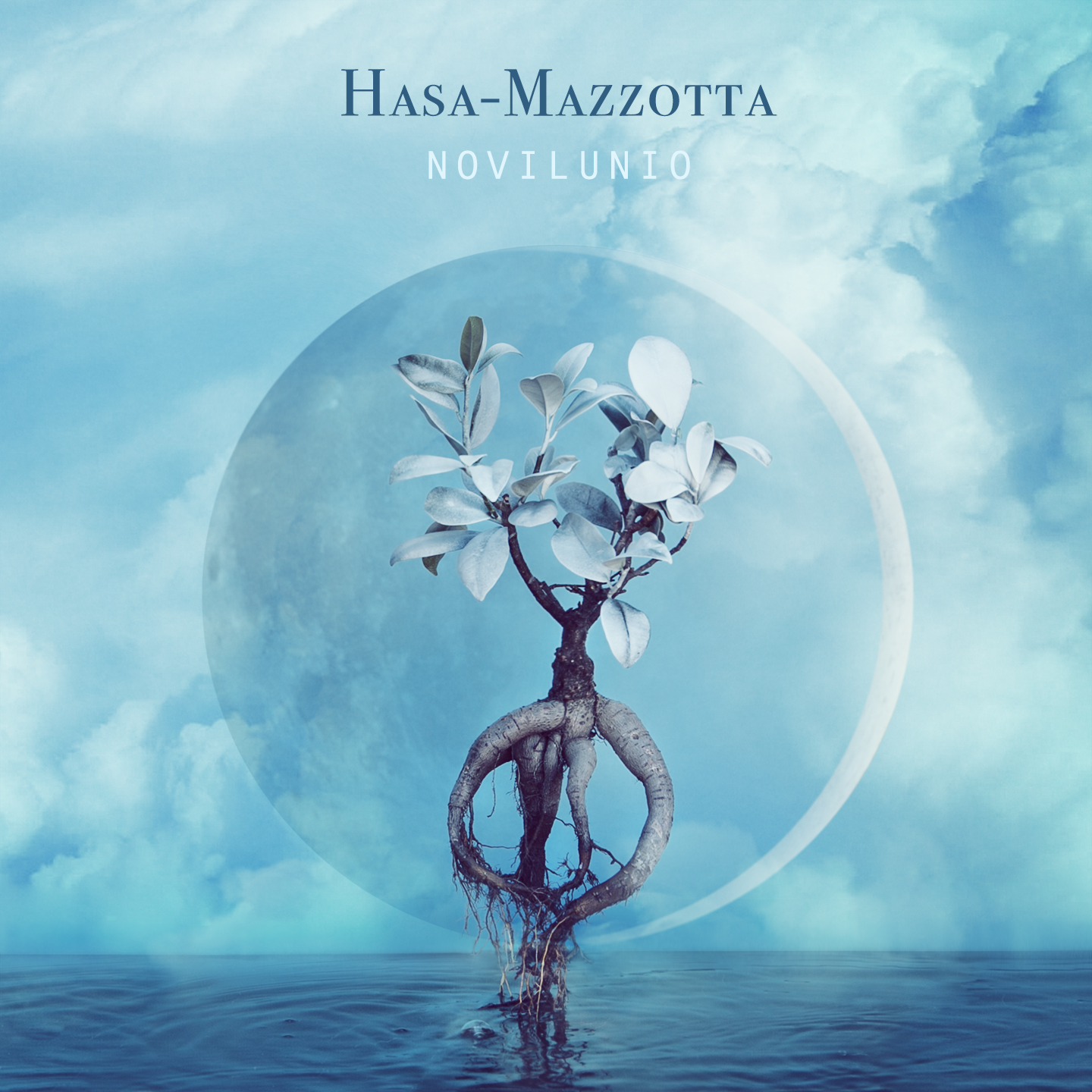


 dereksmusicblog
