GIRLS WITH GUITARS TAKE OVER!
Girls With Guitars Take Over!
Label: Ace Records.
Not many compilation series’ are still going strong after twenty-eight years.Those that do, must be doing something right. That is certainly the case with Ace Records’ Girls With Guitars’ series, which began in 1989.
That was when the first instalment in the Girls With Guitars’ series was released by Ace Records’ Impact Records imprint. The first instalment in the Girls With Guitars’ series was released on vinyl, which was still to be overtaken in the popularity stakes by the compact disc. This would’ve changed by the time the Girls With Guitars’ series returned.
Fifteen years passed before Girls With Guitars’ series was released on Ace Records in April 2004. Ace Records was now the permanent home to the Girls With Guitars’ series, and this was a new start for what would become a popular and long-running series.
By the time Girls With Guitars was released in April 2004, the music industry was a very different place. Everything from how music was made, distributed and consumed had changed since 1989. So had the way people listened to music. While the first instalment in the Girls With Guitars’ series was released on vinyl, the second volume was released on compact disc was. That was how most people listened to music by 2004. Vinyl had fallen from favour in the early nineties, with many record collectors selling off their collections and trading up to compact disc in the pursuit of perfect sound quality. Back then, it looked as if vinyl was gone for good.
Another five years passed before the next instalment in the Girls With Guitars series was released in April 2009. This was Destroy That Boy! More Girls With Guitars, which was released on compact disc. Just like previous volumes, Destroy That Boy! More Girls With Guitar received praise and plaudits upon its release. It seemed that with every new instalment in Ace Records’ Girls With Guitars series it found a wider audience.
Despite the increasing popularity of the Girls With Guitars’ series, there was no sign of it becoming an annual event. Instead, it continued to be one of Ace Records’ many occasional compilation series. Eventually, a new instalment in the Girls With Guitars series arrived five years later. However, by then, much had changed.
The Rebel Kind-Girls With Guitars 3 was released on compact disc in March 2014. It was the third instalment in the series since it found a home on Ace Records in 2004. This latest volume was released to critical acclaim, and found favour with music fans. By then, there had been a resurgence of interest in all things vinyl.
This was good news for record companies and remaining record shops, who had experienced some tough times over the past twenty years. They welcomed the resurgence of interest in vinyl, which began not long after Ace Records had released Destroy That Boy! More Girls With Guitars in April of 2009. Suddenly, a new generation of younger music fans had discovered vinyl. Older music fans clambered into their attics for their long forgotten vinyl collections. Other music fans regretted selling their vinyl collections in the late-eighties and early nineties and began rebuilding their record collection. Vinyl was back.
As a result, the sales of turntables were soaring and many record companies started to release albums on vinyl. This was just as well, as the resurgence of interest in vinyl meant that record buyers were eschewing the compact disc. Instead, they were willing to play extra for the high quality 180 grams heavyweight vinyl. This included many fans of the Girls With Guitars’ series.
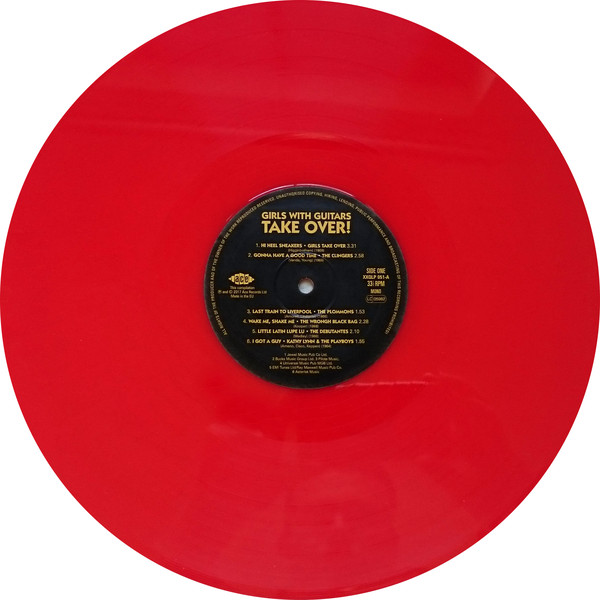
In October 2014, Ace Records released Girls With Guitars on red 180 grams heavyweight vinyl. This was fitting, as twenty-five years had passed since the first instalment of the Girls With Guitars was released on vinyl. The newest addition to the Girls With Guitars’ series found favour with record buyers old and new. So will the latest addition in this long-running series.
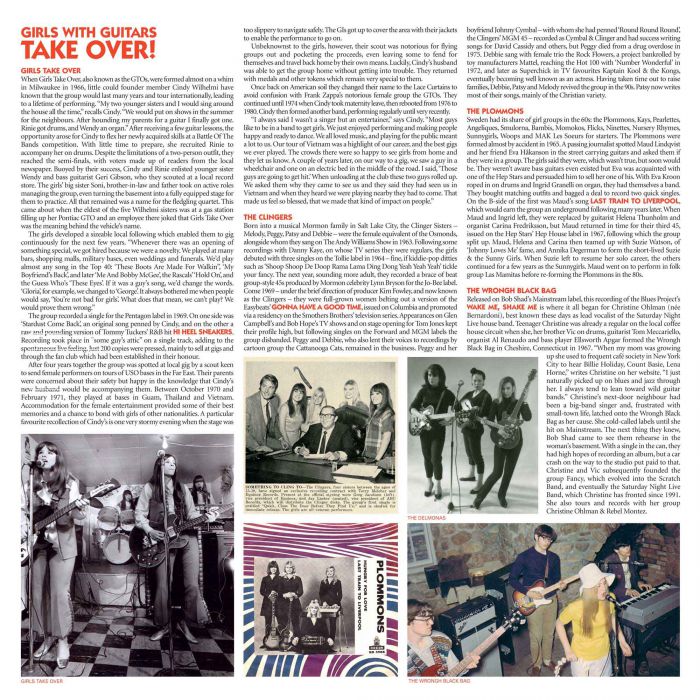
Recently, Ace Records released Girls With Guitars Take Over! on red 180 grams heavyweight vinyl. It features twelve tracks from Girls Take Over, The Clingers, The Wrongh Black Bag, The Debutantes, Karen Verros, The Delmonas, The Tomboys and The Lady-Bugs. They’re among the twelve guitar-totting girl groups that strut their stuff on Girls With Guitars Take Over!
Side One.
By 1969, the Milwaukee-based Girls Take Over had been together three years, and were a familiar face on the local live scene. They had come a long way since they were formed in 1966. So much so, that Girls Take Over had recorded their debut single Stardust Come Back. 200 copies were pressed and the single was released later in 1969 on the Pentagon label. Tucked away on the B-Side was a cover of the Robert Higginbotham composition Hi-Heel Sneakers. It found Girls Take Over giving Tommy Tucker’s hit a garage rock makeover. With its raw, lo-fi sound, Hi-Heel Sneakers epitomised the garage rock sound and sets the bar hight for the rest of Girls With Guitars Take Over!
The Clingers featured four sisters, Debbie, Melody, Patsy and Peggy, who were born into a musical family in Salt Lake City. In 1964, The Clingers embarked upon a recording career. Five years later, and The Clingers had signed to Columbia, and were about to release their cover of Harry Vanda and George Young’s Gonna Have A Good Time in January 1969. It was produced by Michael Lloyd and Kim Fowley who were responsible for a melodic, memorable, rocky and sassy fusion of pop rock and psychedelia. Forty-eight years later, and it’s stood the test of time and is a welcome addition to Girls With Guitars Take Over!
Plommons were Swedish girl group whose recording career began in 1966 and was over by 1967. During this period, they released a trio of singles, including Hungry For Your Love which was released on the Odeon label in January 1966. Hidden away on the B-Side was Last Train To Liverpool which was penned by Joakim Amorell and Maud Lindqvist. The members of Plommons bring to life this pop rock homage to the city of Liverpool.
When The Wrongh Black Bag came to record their debut single, they decided to cover Al Kooper’s Wake Me, Shake Me. It was produced by Bob Shad and released on his Mainstream Records in August 1968. Wake Me, Shake Me is best described as garage rock meets psychedelic rock, and features some blistering guitar licks. Despite the quality of the single, it failed to find an audience and The Wrongh Black Bag’s recording career was over before it had even begun.
The Debutantes were formed in Detroit, in 1964 by fourteen year old singer Jan McClellan. Over the next few years, the band’s lineup continued to evolved, and in 1966 The Debutantes made their recording debut. They released several singles, including On Broadway. On the B-Side was a cover of Bill Medley’s Little Latin Lupe Lu, which The Righteous Brothers released as a single in November 1962. Since then, several bands had covered the song. Little Latin Lupe Lu featured on the B-Side to The Debutantes single On Broadway, which was released on the Gail and Rice label in 1966. Ironically, Little Latin Lupe Lu which was a really catchy pop song, was the stronger of the two tracks and may have fared better than On Broadway. Despite that, The Debutantes’ popularity grew, and they worked with some of the biggest names in music. However, by 1969 years of constant touring caught up with The Debutantes, and the band called time on their career.
When Kathy Lynn and The Playboys were looking for a song to record for their sophomore single, they eventually settled on Carl Cisco, Kathleen Keppen and Nick Ameno’s My Special Boy. It was released on Swan in August 1964 and is a mixture of pop, garage rock and surf rock. It’s a potent, melodic and memorable combination, and is the perfect way to close side one of Girls With Guitars Take Over!
Side Two.
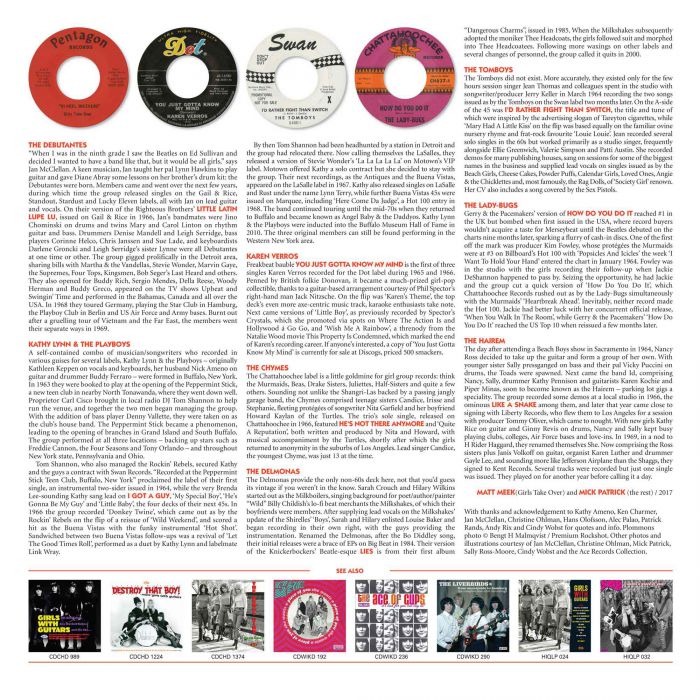
In October 1965, Karen Verros released her sophomore single You Just Gotta Know My Mind on Dot Records. It was a cover a Donovan composition that was arranged by Jack Nitzsche and produced by Dave Hassinger and Mike Minor. They played their part in Karen Verros’ future freakbeat cult classic Just Gotta Know My Mind.
The Chymes released their debut single Bring It Back Home on OKeh Records in March 1966. Five months later, in August 1966 they released Quite A Reputation on the Chattahoochee label. Hidden away on the B-Side was He’s Not There Anymore which was penned and produced by Howard Kaylan and Nita Garfield. It’s a hook-laden hidden gem from The Chymes, who are responsible for an enchanting example of jangling garage rock.
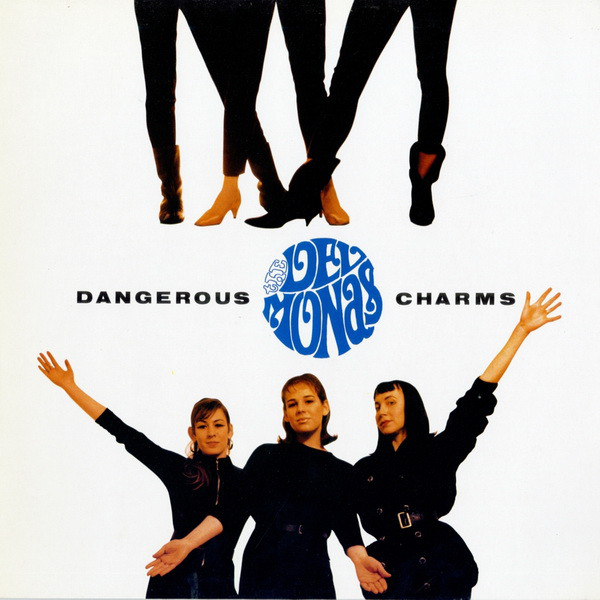
Eleven of the twelve band on the compilation were around in the sixties. The exception is The Delmonas, whose recording career began in 1984 and lasted until 1989. In 1985, The Delmonas released their debut album Dangerous Charms on Big Beat Records. One of the songs on the album was the Beau Charles and Buddy Randall composition Lies. It was given a Beatles’ influenced makeover, as tight harmonies accompany a defiant vocal on one of the highlights of Dangerous Charms.
For their debut single, The Tomboys covered Jay Goodis and Jerry Keller’s I’d Rather Fight Than Switch. It was released on Swan in May 1964. By then, there were a number of successful girl groups, and record labels were looking for the ‘next big thing’. Alas, commercial success eluded The Tomboys, and they never released a followup to I’d Rather Fight Than Switch. Fifty-three years later, and I’d Rather Fight Than Switch returns for a well deserved and belated encore on Girls With Guitars Take Over!
Just like The Tomboys, The Lady-Bugs only released the one single. This was the Mitch Murray composition How Do You Do It, which was released on the Chattahoochee label in February 1964. By then, the Chattahoochee label had enjoyed some success with girl groups and The Lady-Bugs were hoping that How Do You Do It would bring commercial success and critical acclaim their way. While it’s a melodic fusion of pop and rock, commercial success eluded The Lady-Bugs and the they never released another single.
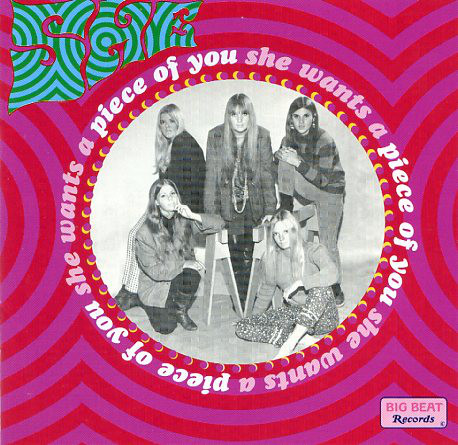
By 1966, Nancy Ross had formed three bands The Toads, Id and The Hairem. She had been inspired to form a band after seeing the Beach Boys live in Sacramento in 1964. That was a turning point for Nancy Ross. Two years later, and The Hairem were preparing to enter the studio and record some demos. This included Like a Snake, a moody, lysergic sounding track. It lay unreleased until 1999, when Big Beat Records released a compilation of music by Nancy Ross’s next band, She. The compilation was She Wants A Piece Of You, which was part of the Nuggets From The Golden State series which featured songs by She and The Hairem. Among them were The Snake, which brings Girls With Guitars Take Over! to a close.
Nearly three years after the previous instalment in the Girls With Guitars series, this long-running and successful series make a welcome return with Girls With Guitars Take Over! It was recently released by Ace Records on red 180 gram vinyl. Not only does Girls With Guitars Take Over! look great, but sounds great. Girls With Guitars Take Over! is welcome addition to the Girls With Guitar series, which celebrated its twenty-eight anniversary earlier this year.
The first instalment in the Girls With Guitar series was released in 1989, Impact Records, which was an imprint of Ace Records. Fifteen years later, the second instalment in the Girls With Guitar series was released on Ace Records. That was a fresh start for the series, and since then, Ace Records has become a permanent home for the Girls With Guitar series. It’s one of many occasional series’ that Ace Records release.
Rather than making the Girls With Guitar series an annual occurrence, Ace Records concentrate on quality rather than quantity. As a result, each and every instalment in the series has oozed quality and features a mixture of songs from familiar faces, new names and plenty of hidden gems. This has proven to be a winning formula, and Girls With Guitars Take Over! is no different.
Among those who play leading roles in Girls With Guitars Take Over! are Girls Take Over, The Clingers, The Wrongh Black Bag, The Debutantes, The Delmonas, The Tomboys, The Lady-Bugs and The Hairem. They’re among the twelve guitar totting tracks on Girls With Guitars Take Over! which is a welcome addition to Ace Records’ long-running and successful Girls With Guitars’ series.
Girls With Guitars Take Over!






MAINSTREAM MODERN SOUL 2 1969-1976.
Mainstream Modern Soul 2 1969-1976.
Label: Kent Soul.
By 1964, had already spent over twenty years working in the music industry. He had started at the bottom and worked his way up, and now he was one of the most respected figures in American music. Bob Shad knew everyone and they knew him. They knew that Bob Shad had worked as a session musician, producer, A&R man and had founded several record labels. With such a wealth of experience, any one of the major labels would’ve welcomed Bob Shad onboard, and could’ve put his experience to good use. However, Bob Shad had other plans, and in 1964, founded a new label, Mainstream Records. The new label would allow to put all his experience to good use.
When Bob Shad founded Mainstream Records in 1964, it was originally a jazz label, which mainly released albums and a few singles. However, by 1965, music was changing, and rock was King.
Bob Shad decided that Mainstream Records should release a wider and more eclectic election of music. This included rock music. For the next five years, Mainstream Records’ new and expanded roster proved popular and profitable. That changed in 1970, so Bob Shad decided to relaunch Mainstream Records.
The newly relaunched Mainstream Records would feature a newly designed label and would release just jazz. Mostly, Bob Shad intended to return to releasing mostly albums, with the occasional single. This was the way Mainstream Records had originally operated. However, Bob Shad had developed a criteria for choosing the albums he was willing to release.
He was going to only release what he saw as traditional jazz albums. Bob Shad didn’t want to release albums where synths and electronics featured. This was unrealistic given that fusion’s popularity was on the rise, and it was no surprise that this new policy didn’t last long, The other change at Bob Shad’s Mainstream Records was that the began to release soul and jazz.
By then, the there had been a blurring of the lines between what was soul and jazz. Even critics and record buyers were confused. This blurring of the lines resulted in Mainstream Records’ musical policy changing, and the label releasing a much wider selection of music. This included the music on Mainstream Modern Soul 2 1969-1976, which was recently released by Kent Soul.
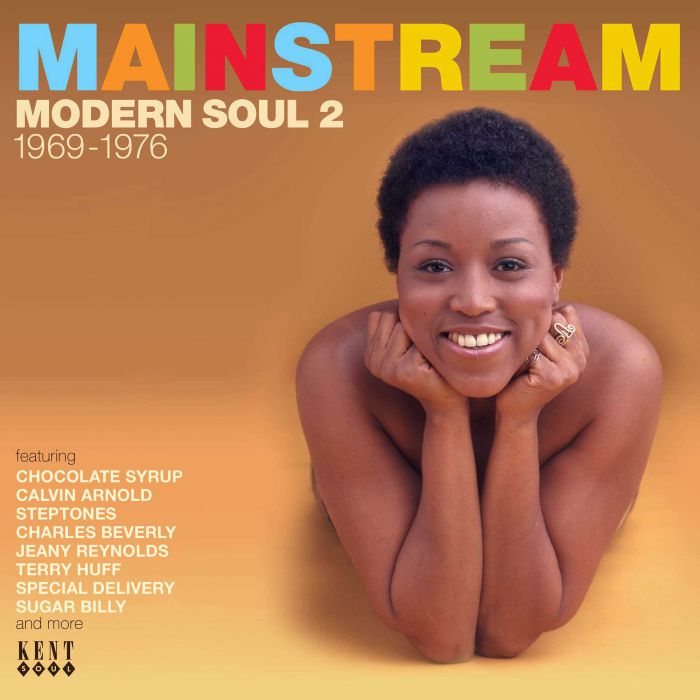
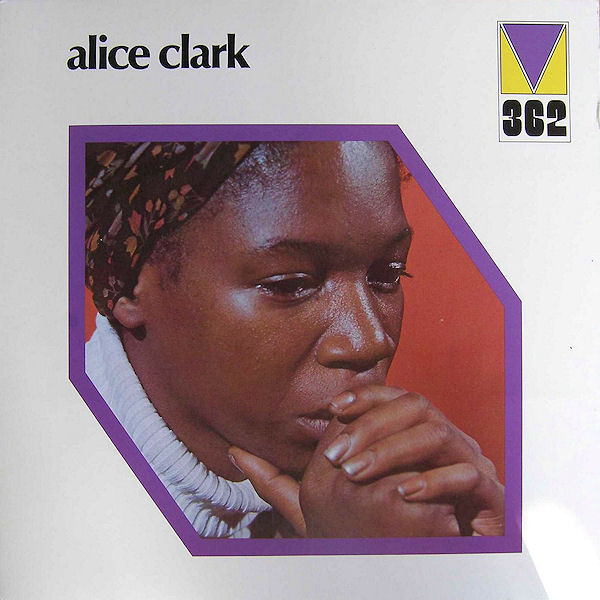
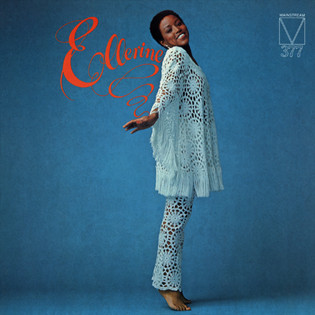
Mainstream Modern Soul 2 1969-1976 is a much-anticipated followup to Mainstream Modern Soul 1969-1976. It features the twenty-three tracks from Mainstream Records and its various imprints. Among the artists, are a mixture of familiar faces and new names. Charles Beverly joins Special Delivery, Chocolate Syrup, Almeta Lattimore, McArthur, Jeany Reynolds, Alice Clark, Ellerine Harding, Calvin Arnold, Terry Huff and Linda Perry. These are just a few of the artists that feature on Mainstream Modern Soul 2 1969-1976, which features the soulful side of Bob Shad’s label.
Mainstream Modern Soul 2 1969-1976 opens with Charles Beverly’s debut single Grass Ain’t Greener, which was released on IX Chains Records in 1975. It’s one of the hidden gems on the compilation, and finds Charles Beverly unleashing a soulful vocal powerhouse,as his band fuse elements of rock are combined with Southern Soul. Sadly, the single failed to make any impression on the charts, and Charles Beverly never released another single on IX Chains Records. He went on to release several singles on the Vanessa label and his debut album In The Mood on Torrid Records, Inc. in 1991. However, the song that started it all of for Charles Beverly was Grass Ain’t Greener, which whets the appetite for the rest of the compilation.
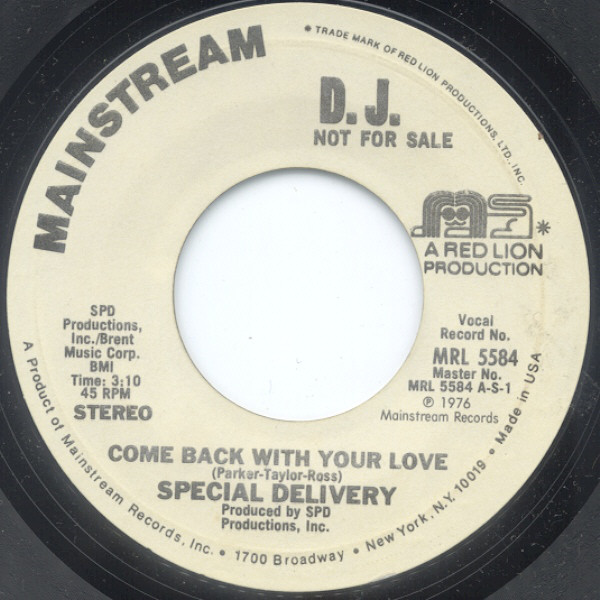
When Special Delivery released Come Back With Your Love Pt 1 in 1976, the story of the few years was like the script to a musical soap opera. The problems had started when vocalist Terry Huff was recruited, and with him onboard, Special Delivery recorded I Destroyed Your Love. Just before its release in 1975, an argument led to Terry Huff being thrown out of the group. When I Destroyed Your Love became a hit, Mainstream Records sent Terry Huff and some session singers into the studio to record an album. Meanwhile, the original lineup of Special Deliver were left sitting on the sidelines. Terry Huff and Special Delivery released The Lonely One in 1975, and title-track reached number eleven in the US R&B charts and seventy-five in the US Billboard 100. Despite the success of The Lonely One, Bob Shad had decided that it was time for the original lineup of Special Delivery to resume recording. They were after all, the rightful owner of the group’s name.
Later, in 1976, Bob Shad returned the name Special Delivery to remaining members of the original group. With a new recruit, they headed into the studio and recorded Come Back With Your Love Pt 1 which is slick, soulful and showcases Special Delivery’s trademark. Sadly, this beautiful, string drenched, soul-baring single failed to chart. This was a first for Special Delivery, and was remembered as the one that got away.
In 1975, Almeta Lattimore went into the studio to record her new single with producer Leonard Jones. For the B-Side Almeta Lattimore had written Oh My Love. Despite being destined for the B-Side arranger Jimmy Roach and producer Leonard Jones deployed layers of lush strings and a subtle chiming guitar. They provided the backdrop for Almeta Lattimore’s impassioned vocal on this hidden soulful gem.
All-male quartet McArthur was founded by former Royal Joker Willie Jones in 1974. The group was named in honour of the United States Supreme Commander of the Allied Pacific Forces during World War II, General Douglas McArthur. Just a year after McArthur were formed, they released their debut single I’ll Never Trust Love Again on Brown Dog Records in 1975. It’s a slow, confessional ballad where tight harmonies and sweeping strings accompany the soul-baring ballad. Sadly, I’ll Never Trust Love Again was the only single the talented and soulful McArthur released. Forty-three years later, and it’s a welcome addition to Mainstream Modern Soul 2 1969-1976.
Lenny Welch’s recording career began in the late-fifties, and over the next fifteen years he had moved between record labels. Cadence, Kapp Records, Cadence, Columbia, Mercury and Atco Records were all home to Lenny Welch at one point. Then in the summer of 1973, Lenny Welch left Atco Records and signed to Bob Shad’s Mainstream Records. In December 1974, he released When There’s No Such Thing As Love (It’s Over). It was arranged by Bert DeCoteaux who produced the single with Lenny Welch. He’s joined by backing vocalist, lush strings and horns during this lush, orchestrated production. If finds Lenny Welch delivering an impassioned, emotive and soulful vocal on what was his fourth single for Mainstream Records. Sadly, it was also his swan-song. When the single failed to find the audience it deserved, Lenny Welch left Mainstream Records. However, he had kept one of his best until last.
Alice Clark should’ve and should’ve gone on to enjoy a long and illustrious career. She was a hugely talented singer, and had a vocal that could breath meaning and emotion into lyrics. This she showcased it on her 1972 eponymous debut album, Alice Clark. It was released on Mainstream Records and featured Never Did I Stop Loving You, where Alice Clark combines power and passion and delivers the lyrics as if she’s lived and experienced them. Sadly, after the release of her eponymous debut album, Alice Clark turned her back on music. That day, soul music lost a singer who had the potential to become one of the great female vocalists of her generation. Never Did I Stop Loving You is a reminder of what soul music lost the day Alice Clark turned her back on music.
Sadly, the story of Ellerine Harding is one of what might have been. She only ever released the one album Ellerine in 1972, which featured I Know Something You Don’t Know. Bob Shad produced Ellerine which featured some top session players. They’re joined by strings and horns and provide a soulful, funky backdrop for Ellerine Harding. Her vocal soulful, sassy and playful on what’s one of the highlights of Ellerine which was released on Mainstream Records in 1972, Just like Alice Clark, Ellerine Harding was a truly talented singer who should’ve reached greater heights.
In 1976, Nia Johnson released what proved to be the only single of her career, You Are The Spice Of My Life. It was penned and produced by Willie Lester and Rodney Brown. They’re responsible for a lush, orchestrated arrangement and cooing harmonies that provide the perfect accompaniment to Nia Johnson as she deliver a beautiful soulful, heartfelt paean.
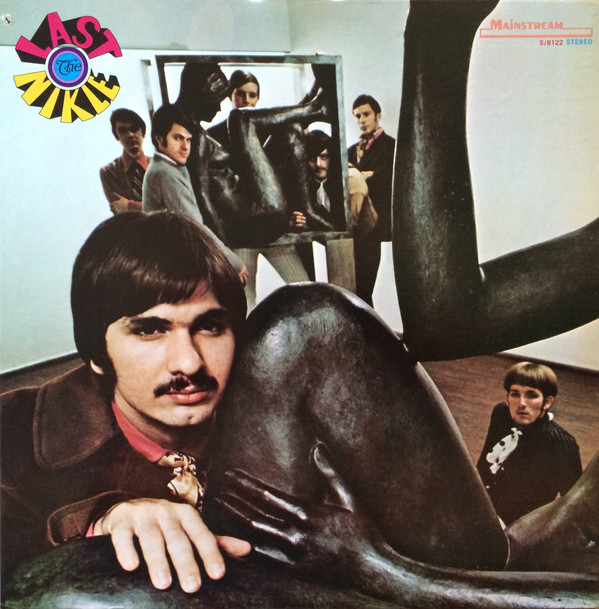
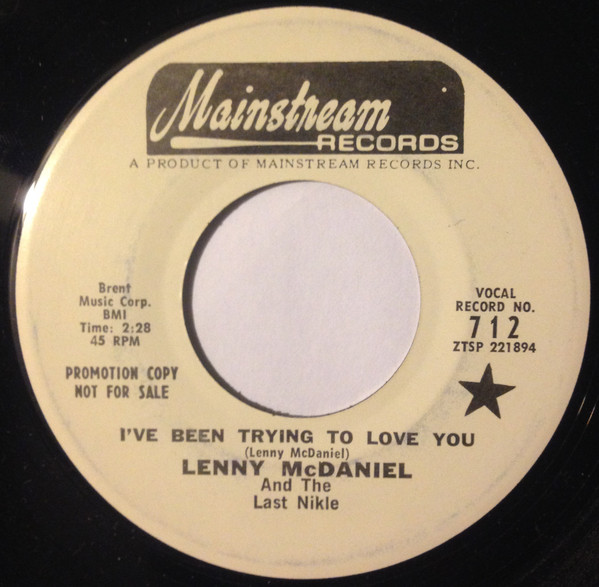
Lenny McDaniel was born and brought up in New Orleans, where he played bass and guitar for many local bands. By 1968, Lenny McDaniel’s recording career began, and a year later, in 1969, Lenny McDaniel and The Last Nikle released I’ve Been Trying To Love You as a single on Mainstream Records in September 1969. It was penned by Lenny McDaniel, who unleashed an emotive vocal powerhouse, as he lays bare his soul. I’ve Been Trying To Love You also features on The Last Nikle’s 1969 debut eponymous album. This was the only album Lenny McDaniel and The Last Nikle released together. Instead, Lenny McDaniel became a session musician, and didn’t release any further albums until the nineties, when he released two solo albums.
Before signing to Bob Shad’s IX Chains Records, Calvin Arnold was something of a musical nomad. He had wandered from label to label, searching for that ever elusive hit single. His luck changed when he met Bob Shad and signed to his IX Chains Records’ imprint. For his IX Chains Records’ debut, Calvin Arnold released Satisfy My Love later in 1975. It reached seventy-nine in the US R&B charts, and gave Calvin Arnold a minor hit single. Tucked away on the B-Side was You’ll Do It another Calvin Arnold composition. It’s a chugging slice of Southern Soul where occasional strings punctuate the tight arrangement. Meanwhile, Calvin Arnold delivers a lived-in, emotive vocal that showcases a truly talented singer. Sadly, he only enjoyed one other minor hit single, (I’m Your) Friendly Neighbourhood Freak in 1975. That was as good as it got for the journeyman soul man, Calvin Arnold.
After leaving Special Delivery, Terry Huff embarked upon a solo career at Mainstream Records. In July 1976, Terry Huff released one of his own compositions Where There’s A Will (There’s A Way), which became his third single. Despite being an irresistible fusion of disco, funk and soul, this dance-floor friendly single failed to find an audience. For Terry Huff this modern soul classic was his Mainstream Records’ swan-song. He had kept his best single until last.
Closing Mainstream Modern Soul 2 1969-1976 is Linda Perry’s 1974 single Everyone Has Someone. This was the second single that Linda Perry had released for Mainstream Records. Accompanied by backing vocalists, Linda delivers a vocal that is full of hurt and heartache on a song that successfully fuses soul with fifties rock ’n’ roll. When it failed to find an audience, that marked the end of Linda Perry’s career at Mainstream Records.
These are just a few of the tracks on Mainstream Modern Soul 2 1969-1976, which was recently released by Kent Soul, an imprint of Ace Records. It’s the followup to Mainstream Modern Soul 1969-1976, which was the first in the is occasional series. This was followed up by Super Duper Love-Mainstream Hits and Rarities 1973-76, which was another welcome excursion into the Mainstream Records’ vaults. It was one of the finest compilations of music from the Mainstream Records’ vaults. Mainstream Modern Soul 2 1969-1976 picks up where its predecessors left off.
Again, it’s quality all the way during this welcome excursion into the Mainstream Records’ vaults. A total of twenty-three tracks from Mainstream Records and its various imprints were chosen, and made their way onto Mainstream Modern Soul 2 1969-1976. Some of these artists and groups featured on Mainstream Modern Soul 1969-1976 or Super Duper Love-Mainstream Hits and Rarities 1973-76, while others make their debut on Mainstream Modern Soul 2 1969-1976. These tracks feature the soulful side of Mainstream Records and various imprints.
Among the artists on Mainstream Modern Soul 2 1969-1976, are many familiar faces, old friends plus a few names. They sit side-by-side on Mainstream Modern Soul 2 1969-1976, which is a compilation that oozes quality. It’s the Kent Soul third excursion into the Mainstream Records’ vaults. Hopefully, there will be further excursions in the future. Meanwhile, the this triumvirate of compilations is the perfect introduction to the soulful side of Bob Shad’s Mainstream Records.
The triumvirate began with Mainstream Modern Soul 1969-1976 in April 2016, then Super Duper Love-Mainstream Hits and Rarities 1973-76 in October 2016 and the recent release by Kent Soul of Mainstream Modern Soul 2 1969-1976. This trio of compilations are a welcome reminder of the soulful side of Bob Shad’s Mainstream Records and will be worthy addition to any record collection.
Mainstream Modern Soul 2 1969-1976.

THE STEVE AND THE BOARD STORY.
The Steve and The Board Story.
Although Steve and The Board were formed in Brisbane, Australia, in 1965, the story began 9,000 miles away in 1950. That was when Steve Kipner, the founder of Steve and The Board was born in Cincinnati, Ohio. However, Steve Kipner didn’t spend much of his young life in Cincinnati.
His father Nat Kipner, who was a songwriter and producer, who wanted a better life for his family, and started looking for a future beyond Ohio. Eventually, Nat Kipner decided that his family would move to Brisbane, in the state of Queensland. It was situated on Australia’s gold coast, which seemed the perfect place to start a new life, and bring up a young family.
Fifteen years later, in 1965, Steve Kipner found himself studying at Brisbane Art and Technical College. By then, Steve Kipner had caught the music bug from his father who was now a songwriter, producer and promoter. Steve Kipner’s love of music began at an early age, and he had already penned She Used To Be Mine which featured on Normie Rowe’s debut album So Much Love From Normie Rowe. Already it looked as if Steve Kipner had a big future ahead of him after he left Brisbane Art and Technical College. However, it was at that venerable institution that Steve Kipner met two of his future band mates.
This was drummer Colin Petersen and guitarist Carl Groszman. They were both students at Brisbane Art and Technical College and it was purely by chance that the three aspiring musicians met. Soon, the three students had formed a friendship and Carl Groszman was introducing Steve Kipner to new music, including bluesmen like Lightnin’ Hoplkins and Muddy Waters and the R&B of Ike and Tina Turner.
All this was new to Steve Kipner, and he enjoyed discovering the new music. The third member of the trio Colin Petersen, had taken to picking Steve Kipner up in Mini Cooper and they would work out the harmonies to Beatles’ songs on the journey to and from college. On one of these journeys, they Steve Kipner and Colin Petersen came up with the idea of forming a band. That band would become Steve and The Board, who became of one Australia’s top sixties’ garage rock bands.
Having made the decision to form a band, the three members of what later became Steve and The Board, began the search for a bassist. That was how they met Dennis Neville, who previously, had been the drummer for The Tempests. However, since leaving The Tempests, Dennis Neville had started to learn the guitar. When the three members of Steve and The Board met they Dennis Neville they managed to persuade him to learn to play the bass.
Using a borrowed bass and amplifier, Dennis Neville taught himself to play the bass, and before long had mastered it. Dennis Neville became Steve and The Board’s bassist, and when they started to play live, drove the band’s van.
Despite the band lineup still evolving, the nascent began playing the live scene around Brisbane. At first, they drew inspiration from The Beatles and British Invasion groups like The Hollies. Harmonies played an important part in the band’s nascent sound. That was until they met two musicians from Sydney.
Terry Hanagan and Chris Grey, who had previously, been a member of the Missing Links had just arrived in Brisbane from Sydney when they first met Steve and The Board. The two Sydney-based musicians started telling the members of the band about City Blues, which was the urban take on R&B that the Rolling Stones had made their name playing. Having heard about City Blues, the band changed direction musically and even adopted a new name.
By then, the band had still to adopt the name Steve and The Board. However, they weren’t far away, and renamed the band Board Of City Blues. Their set lists featured a mixture of R&B and songs by The Animals, The Yarbirds, the Rolling Stones, Them and The Pretty Things. Sometimes, they dipped into The Kinks, The Who and The Beatles’ back-catalogue during their sets. Board Of City Blues also started to include some of the songs that two members of the band had written.
Despite Steve Kipner’s track record, he wasn’t one of the two songwriters in Board Of City Blues. That would come later. Instead, Colin Petersen and Carl Groszman, who had adopted the stage name Carl Keats, had started writing songs. Some of these songs would feature in Board Of City Blues’ set lists. This included the gigs the Board Of City Blues in a Nat Kipner’s club.
Board Of City Blues were in the fortunate position that Steve Kipner’s father Nat owned a small club. He allowed the band to practise there, and to play live. This was perfect for the group to hone their sound.
Having honed their sound, the Board Of City Blues were ready to make their tentative steps on the Brisbane live scene for the second time. However, this time they were a different band not just in name, but musically. One of the first gigs that the Board Of City Blues played was at a club called the Prim in the Piccadilly Arcade. After that, it looked as if the future was bright for the Board Of City Blues. That was until Nat Kipner sprung a surprise.
He announced that the Kipner family were moving to Sydney, where he felt there were better business opportunities for him. A reluctant Steve Kipner made the move.
With Steve Kipner moving to Sydney, it looked as if this spelt the end for the Board Of City Blues. That was until bassist Dennis Neville received a phone call from Steve Kipner asking him to bring the band to Sydney. Steve Kipner’s father had managed to get the Board Of City Blues some gigs, and there was even talk of a recording contract. This was too good an opportunity to turn down.
The first to arrive in Sydney was Dennis Neville, who had resigned from his job the Monday. Given what he had sacrificed, Steve Kipner’s parents allowed Dennis Neville to move into the family home. Over the next two months, the rest of the Board Of City Blues arrived in Sydney. Carl Keats was last to arrived, and in the interim, a local guitarist had deputized for him. By the time the rest of Board Of City Blues had arrived in Sydney, they began the search for a lead guitarist.
Auditions were held, and several guitarists tried out. This included ‘Long’ Tom Cowburn mentioned his friend Alex Hill. He had arrived with his family from Croatia, and as a child, studied classical violin. Eventually, he turned his back on classical music and the violin, and learnt to play the guitar. That was how Alex Hill found himself auditioning for the Board Of City Blues. It didn’t take long for the rest of the Board Of City Blues to realise that they had found their lead guitarist.
At last, the Board Of City Blues’ lineup was complete, and they went in search of their first gig. The new lineup of the Board Of City Blues took place at a surf club in Wollongong. That night, the Board Of City Blues were well received by the audience, and this proved to be the start of something for the Board Of City Blues.
Suddenly, the Board Of City Blues were playing nearly every night. Soon, the Board Of City Blues had more gigs that they could cope with. They were a hugely popular draw on the local scene. So much so, that some night, the Board Of City Blues played three gigs a night and sometimes, more. The move to Sydney had paid off for the Board Of City Blues.
Especially when Nat Kipner secured the Board Of City Blues an audition with Everybody’s, a Sydney-based record company. Although Nat Kipner had secured the audition, it wasn’t a done deal. Instead, the Board Of City Blues had to audition with Maggie Makeig, the pop music editor at Everybody’s. Everything went well, but the record label weren’t sure of the band’s name. It was then that the Board Of City Blues became Steve and The Board.
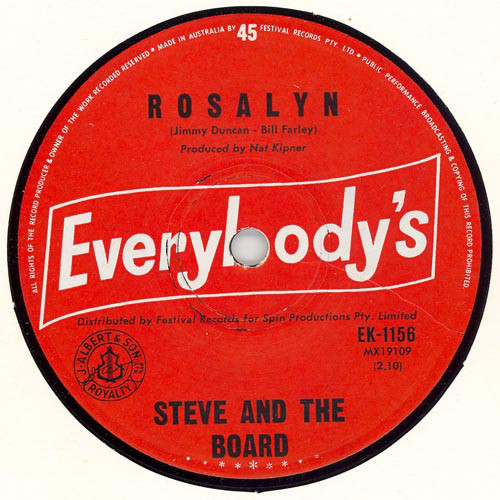
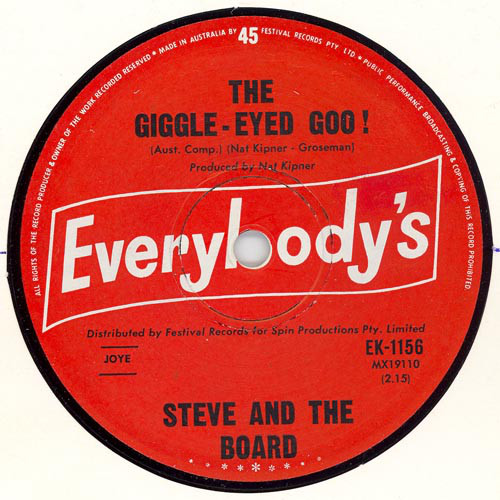
This was a much more acceptable and marketable name for the record label, and having signed on the dotted line, Everybody’s, sent Steve and The Board into the studio to record their debut single. The song that Steve and The Board had chosen, was a cover of The Pretty Things’ Rosalyn, with The Giggle-Eyed Goo! on the B-Side. This was a song that Nat Kipner had already written. However, Carl Keats made a few changes to the lyrics and wrote the music. Little did Steve and The Board know when they recorded The Giggle-Eyed Goo! in mid-1965 that it would launch their career.
Steve and The Board released their debut single Rosalyn in October 1965. It found Steve and The Board stay true to The Pretty Things’ original version. Steve and The Board’s reading of Rosalyn showcased a talented young band. However, it wasn’t Rosalyn that caught the attention of the record buying public, and their children.
Nat Kipner was able to secure Steve and The Board priceless publicity. He was involved with the children’s television show Saturday Date, and ran a competition that had children send in a drawing of what The Giggle-Eyed Goo! looked like. This was invaluable promotion, and propelled The Giggle-Eyed Goo! to number four in the Melbourne charts and thirty-four in the Brisbane charts. While the song gave Steve and The Board their first hit single, it proved to be a double-edged sword.
While Steve and The Board received a lot of publicity due to the success of The Giggle-Eyed Goo!, it was regarded as a novelty song. The problem with novelty songs, was that very few people take them seriously. There was always the risk that promoters and other bands might not take Steve and The Board seriously. However, when Steve and The Board played live in Adelaide, it was like Beatlemania all over again. Having played two songs, Steve and The Board were mobbed by young girls. Nat Kipner’s novelty song had transformed Steve and The Board’s career.
Soon, they were sharing the stage with some of the biggest names in Australian music. They also shared top billing with Herman’s Hermits. By them, Steve and The Board even had their own fan club. They had come a long way in a short time.
Despite the success, Steve and The Board weren’t making any money. This wasn’t helped by a number of disreputable promoters refusing to pay Steve and The Board. As a result, they were left living a hand to mouth existence. Suddenly, the music business wasn’t such a glamorous way to make a living.
By March 1966, plans were in place for Steve and The Board to release their sophomore single Margot, which featured I’ve Just Realised on the B-Side. While the single was given a catalogue number, it was never released.
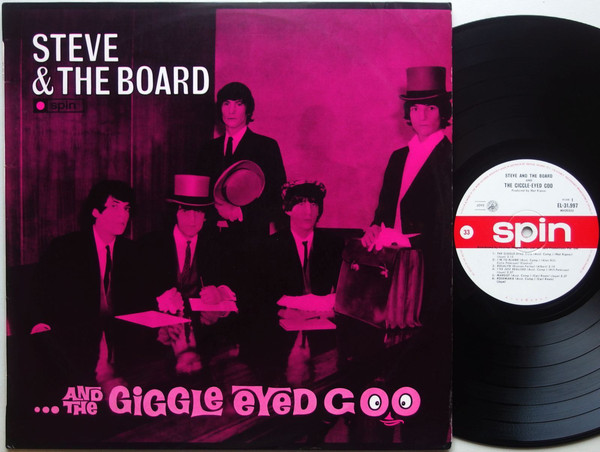
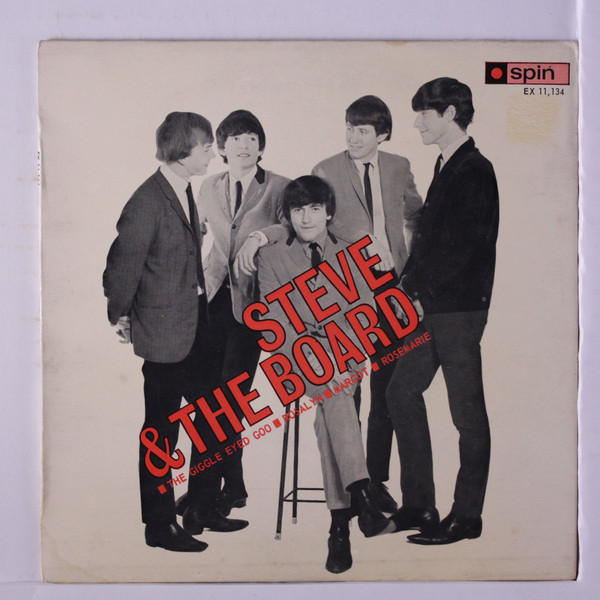
This changed when Steve and The Board released The Giggle-Eyed Goo! EP, which featured four tracks. They were The Giggle-Eyed Goo!, Rosalyn, Margot and Rosemarie, which were all produced by Nat Kipner. When The Giggle-Eyed Goo! EP was released in 1965, Steve and The Board had been promoted to the main Spin label. With plenty of hype, The Giggle-Eyed Goo! EP was released on the record buying public. However, it never replicated the success of their debut single.
Later, The Giggle-Eyed Goo! EP would featured on Steve and The Board’s debut album The Giggle-Eyed Goo! However, by then, the writing was on the wall for the band. That was still to come.
A month after the aborted release of Margot, Steve and The Board decided to leave Sydney, as things were starting to cool down for the band. They packed their bags and headed to Melbourne, and soon, had secured a residency at the 10th Avenue Discotheque. It was run by Eddie Floyd, who soon, became the band’s manager.
While Eddie Floyd ensured the band didn’t go hungry and secured them plenty of gigs, still Steve and The Board weren’t making much money. Each week, Steve and The Board played over forty-five hours, but only made £16 each. To make matters worse, Melbourne was notorious for promoters failing to pay bands, and Steve and The Board fell victim to this several times. It was a frustrating experience.
Steve and The Board had some good times in Melbourne, and featured on ATV’s music show Go!! several times. This was invaluable publicity for the band. So was appearing on Kommotion, another popular music program that was presented by Ken Sparkes. Appearing on these shows would stand Steve and The Board in good stead when they released their next single.
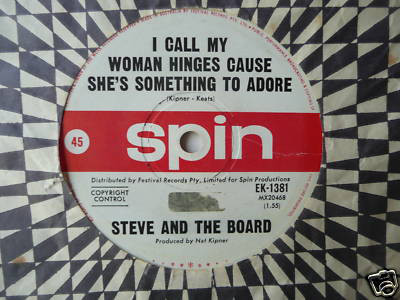
This was I Call My Woman Hinges (Cause She’s Something To Adore). On the B-Side was I Want. When the singles was released, it reached the top five in the Australian charts. It was a hook-laden, R&B stomper that caught the imagination of the record buying public. I Call My Woman Hinges (Cause She’s Something To Adore) was very different to The Giggle-Eyed Goo!, and showed Steve and The Board in their true colours.
Not long after the release of I Call My Woman Hinges (Cause She’s Something To Adore), Steve and The Board released their sophomore EP in 1966. It was entitled I Call My Woman Hinges (Cause She’s Something To Adore), and also featured Farmer John, Little Miss Rhythm And Blues and Love’s Made A Fool Of You. Producing the new tracks was Nat Kipner, who had produced all of Steve and The Board’s releases. This would soon include their debut album.
By the time executives at Spin started talking about Steve and The Board releasing their debut album, the band had nearly enough material for an album. They were sent into the studio to record three more tracks, including I’m To Blame, Love’s Made A Fool Of You and Lonely Winter which Carl Groszman had written. When these three new songs were added to songs from their two EPs and singles, Steve and The Board had more than enough for their debut album.
Originally, Steve and The Board had considered the Board Meeting for album title. That would’ve been the perfect title for the album, given Steve and The Board were trying to establish a reputation as a serious R&B band. However, instead of common sense prevailing, it was decided to call the album The Giggle-Eyed Goo! It seemed that what had originally been a novelty song for a B-Side was going to haunt the band.
Worse was to come though. After Steve and The Board completed The Giggle-Eyed Goo!, drummer Colin Petersen announced that he was leaving the band. This was a huge blow for the band, as Colin Petersen had been a member from day one and was a talented drummer. Replacing him wasn’t going to be easy.
The loss of Colin Petersen couldn’t have come at a worse time, with Steve and The Board about to release their debut album The Giggle-Eyed Goo! It showcased a talented and versatile band that should’ve had a big future ahead of them.
By the time Steve and The Board’s debut album The Giggle-Eyed Goo! was released, the band had a new drummer, Geoff Bridgeford. He gave up a job with an advertising agency to join Steve and The Board. This was a decision he might later rue.
Once Geoff Bridgeford settled into the role of Steve and The Board’s drummer, the band continued their gruelling touring schedule. This found Steve and The Board crisscrossing Australia, as they played in towns and cities. Some nights, the band played four, even five gigs. This was a relentless schedule, and one the band continued day after day, week after week. Somehow, Steve and The Board found some time to record some new songs.
Steve and The Board went into the studio and recorded So Why Pretend, Now I’m Older and Sally Was A Good Old Girl. After recording the new songs, it was back to the live circuit.
Despite the constant touring, Steve and The Board managed to squeeze in a couple of appearances on television. Somehow the members of Steve and The Board were managing to cope with a schedule that even older, more experienced bands would’ve struggled with. By then, Steve and The Board’s popularity was at all-time high. They were mobbed after gigs, and literally, had run to their cars. Sometimes, they were accosted by jealous boyfriends. It got to the stage that Steve and The Board had a police officer living with the group, who were experiencing Beatlemania. The members of Steve and The Board should be wealthy young men.
As Steve and The Board returned to Sydney, the group realised that their finances needed some attention. New recruit Geoff Bridgeford was given the job of looking their finances. For a group who had literally lived on the road, playing four and five gigs each night, Geoff Bridgeford worked out that all Steve and The Board were owed was just $600. This must have come as a huge blow. To make matters worse, collecting what they were owed was easier said than done.
During September 1966, Steve and The Board released their next single, Now I’m Older which featured So Why Pretend on the B-Side. Later that month, Steve and The Board were one of the bands booked to support PJ Proby at Melbourne’s Festival Hall.
On the ‘30th’ September 1966, Steve and The Board took to the stage at the Festival Hall. For a group that had played hundreds of gigs, this was the one that went wrong. They weren’t alone though.
It was a disastrous gig for everyone involved, with technical problems sabotaging Steve and The Board’s performance. Despite this, the press turned on Steve and The Board. Just like many other bands, the press had built them up to knock them down.
Steve and The Board headed out on another tour, which was billed as The Steve and The Board Spectacular. It began on the ‘5th’ October 1966, and concluded six days later on the ‘11th’ October. Despite its brevity, it had been another gruelling tour. There was no rest for the band though.
They had to film a promotion film for their next single, which was the Alex Hill composition Good For Nothing Sue. It’s one of the four bonus tracks on The Complete Steve and The Board. So is the B-Side Sally Was A Good Old Girl. After the film was complete, Steve and The Board headed out on the first of two tours. Then on ‘1st’ December 1966 featured on the Go!! television show for what would be the last time.
In January 1967 Good For Nothing Sue was released by Spin. By then, music was starting to change, and the psychedelic era was in full swing. Steve and The Board was just one of many bands who suddenly were no longer as popular.
By the spring of 1967, gigs were starting to dry up for Steve and The Board. They were only playing two, maybe three nights a week. Steve and The Board continued for a couple of months, and on ‘17th’ May 1967 the band split up. After two years, the dream was over.
Despite all their hard work, and the gruelling tours, Steve and The Board didn’t end up rich men. Just like many other groups before them, much of the money ended up in other people’s pockets. Sadly, that still happens today. For Steve and The Board, there was no gold at the end of the rainbow.
Later, Colin Petersen enjoyed a brief spell as the Bee Gees’ drummer. Later Colin Petersen joined the band Humpy Bong who released the single Don’t You Be Too Long in 1970. However, another former member of Steve and The Board went on to enjoy fame and fortune.
After a brief solo career, Steve Kipner became an award-winning songwriter and producer. He penned songs for everyone from America, Diana Ross, George Benson and Olivia Newton John, to Heart, Joe Cocker, Neil Diamond and Rod Stewart. The songs that Steve Kipner have written have solid by the million, and he has a string of gold and platinum discs to his name. Steve Kipner has also won the prestige Ivor Novello Award. For Steve Kipner, there was life after Steve and The Board, who are still remembered some city years after they split-up.
Although they were only together for two years, they were a whirlwind for the members of Steve and The Board. During that period, Steve and The Board toured relentlessly and but recorded just sixteen songs. Still they’re remembered fondly in Australia as one of the country’s greatest garage bands.
Sadly, outside of Australia, Steve and The Board are largely unknown. That is a great shame, given they were a talented and versatile band. Within Australia, Steve and The Board are remembered by many people, who remember that two-year period when they enjoyed their own version of Beatlemania. Ironically, many people remember Steve and The Board for their first hit single The Giggle-Eyed Goo! However, the followup single I Call My Woman Hinges (Cause She’s Something To Adore) is much more representative of Steve and The Board’s music, who were one of Australia’s greatest garage bands of the sixties.
The Steve and The Board Story.

BOBBY HATFIELD-THE OTHER BROTHER: THE VERVE RECORDS AND MGM RECORDS YEARS 1968-1970
Bobby Hatfield-The Other Brother: The Verve Records and MGM Records Years 1968-1970,
When twenty-two year old Bobby Hatfileld met Bill Medley in 1962, and formed The Righteous Brothers little did the pair realise that this was the start of a journey that would see the pair become one of the most successful musical partnerships of the sixties. The most successful period of The Righteous Brothers’ career was between 1963 and 1965, when he formed a formidable partnership with producer Phil Spector.
During that period, The Righteous Brothers released eight albums and a string of hit singles on Phil Spector’s Philles Records. This included classic singles like You’ve Lost That Loving Feeling in November 1964; and Unchained Melody in July 1965. Three months later, in October 1965, The Righteous Brothers parted company with Phil Spector and signed to Verve/MGM Records.
The split with Phil Spector was acrimonious, with Phil Spector suing The Righteous Brothers. Eventually, the case was settled out of court, with The Righteous Brothers paying Phil Spector $600,000. This allowed The Righteous Brothers to embark upon a new chapter of their career at Verve/MGM Records.
While this might have seemed like a brave new world for The Righteous Brothers, there was a downside to the move to Verve/MGM Records. No longer would The Righteous Brothers be working with Phil Spector. At first, it looked as if The Righteous Brothers could manage without Phil Spector, when (You’re My) Soul and Inspiration was released in February 1966, and reached number one in the US Billboard 100. This gave The Righteous Brothers’ the first gold disc of their career. When the album Soul and Inspiration was released later in 1966, it reached number seven in the US Billboard 200 and was certified gold. However, that as good as it got for The Righteous Brothers.
They never reached the same heights during the rest of their stay at Verve/MGM Records. By 1968, The Righteous Brothers’ best days were behind them, and singles, like their twee cover of My Darling Clementine in 1967 and Here I Am in 1968 failed to chart. Meanwhile, the three albums The Righteous Brothers’ albums released between 1967 and 1968 all struggled in the lower reaches of the US Billboard 200. Music had changed, but The Righteous Brothers hadn’t. Maybe Bill Medley realised that, when he announced he was leaving The Righteous Brothers to resume his solo career in 1968 at MGM Records. It was the end of an era for The Righteous Brothers.
After Bill Medley signed to MGM Records, Bobby Hatfileld signed to Verve Records in 1968. With both Righteous Brothers resuming their solo careers, industry insiders wondered who the winner would be? It was going to be a close run race, that lasted five years. It began in 1965.
By the time Bobby Hatfileld’s solo career resumed, Verve Records had bought The Righteous Brothers and Bobby Hatfield’s recordings from Phil Spector’s Philles Records. This meant that the only company releasing Bobby Hatfield recordings would be Verve Records. This would included some of those recorded in Los Angeles, during his first recording session for Verve Records.
On the ‘15th’ March 1968, Bobby Hatfileld entered the studio to record his first solo recording for Verve Records. Five songs were recorded, including what became Bobby Hatfield’s debut single for Verve Records. This was a cover of Barry Mann and Cynthia Weil’s beautiful ballad Hang Ups. Among the other songs recorded were Bobby Hatfield’s rueful cover of Barry Mann and Cynthia Weil’s See That Girl, and a soul-baring cover of Goffin and King’s So Much Love. Previously unreleased versions of both tracks feature on The Other Brother: A Solo Anthology 1965-1970. It seemed released from the shackles of The Righteous Brothers, Bobby Hatfield was embracing this new start.
Three weeks later, in early April 1968, Bobby Hatfield returned to the studio and recorded two more songs. This included the Bobby Hatfield composition Soul Cafe, which would feature on the B-Side of Hang Ups when it was released as a single.
In May 1968, Hangs Up was released in May 1968, but failed to make any impression on the charts. This was disappointing for Bobby Hatfield and executives at Verve Records. However, two months later, and Bobby Hatfield was back in the studio.
When Bobby Hatfield entered the studio on ‘17th’ July 1968, it proved a productive session. He managed to record three songs, but none of these songs were ever released. This includes a cover of Harry Nilsson’s Paradise. Sadly, the song was never released.
Just a month after recording Paradise, Bobby Hatfield returned to the studio on ’21st’ August 1968 and cut three songs. This included In My Mind, and Brothers, a poignant Bobby Hatfield song that dealt with his time as one half of The Righteous Brothers. That would become Bobby Hatfield’s second single for Verve Records, and featured a cover of What’s The Matter Baby on the B-Side.
When Brothers was released in October 1968, it also failed to find an audience. The song never even made it into the lower reaches of the charts. Bobby Hatfield’s solo career wasn’t going to plan.
Despite this, Verve Records weren’t about to turn their back on Bobby Hatfield. They scheduled another recording session for ’23rd’ December 1968. That day, Bobby Hatfield recorded four songs, including The Wonder Of You and I’ve Got My Eyes On You. The other two songs, My Prayer and Only You two, had previously given The Platters’ hit singles. This quartet of songs were intended to feature on Bobby Hatfield’s debut solo album. However, one of these songs became Bobby Hatfield’s next single.
The song chosen was Only You, which was released in February 1969, but stalled at a lowly ninety-five on the US Billboard 100. Bobby Hatfield’s solo career wasn’t going to plan.
Bobby Hatfield returned to the studio in early 1969, including U Wish I Didn’t Love You So Much. It featured on the B-Side of Bobby Hatfield’s next single My Prayer, which was released in April 1969. Just like Only You, My Prayer failed to chart, and the search for a hit single continued.
In July 1969, Bobby Hatfield released his fifth single for Verve Records. This was Answer Me My Love, which featured I Only Have Eyes For You on the B-Side. It was a familiar story for Bobby Hatfield when Answer Me My Love never came close to troubling the charts. Little did Bobby Hatfield know that it was the final single he would release for Verve Records.
Later in 1969, Bobby Hatfield’s career took an unexpected twist. Having dissolved his partnership with Bill Medley, Bobby Hatfield recruited Jimmy Walker of The Knickerbockers’ as his replacement. The new lineup of The Righteous Brothers released a new album, Re-Birth which failed to even trouble the charts. It was a similar case when The Righteous Brothers released Woman, Man Needs Ya as a single. For Bobby Hatfield, this was a huge blow and he resumed his solo career.
When Bobby Hatfield resumed his solo career, Bobby Hatfield had been moved from Verve Records to MGM Records. This was as a result of MGM Records’ decision to reduce its roster, and move all pop and R&B artists to the main label, MGM Records. With the label reducing its roster, it was a worrying time for Bobby Hatfield, who after two years of trying, was still looking for his first hit single.
Despite this, Verve Records were still planning to release Bobby Hatfield’s debut album. A decision was made to send Bobby Hatfield to Rick Hall’s Fame Studios, in Muscle Shoals to record his debut album. It was hoped that Rick Hall could transform Bobby Hatfield’s fortunes. He had a good track record, and had worked with some of the biggest names in music. Now he was tasked with transforming the fortunes of Bobby Hatfield.
Having made the journey to Fame Studios, Bobby Hatfield began working with Rick Hall and his legendary studio band. However, it was chief engineers Mickey Buckins and Sonny Limbo who produced the sessions, with Rick Hall overseeing the recording. The sessions went smoothly, and before long, Bobby Hatfield had recorded more than enough tracks for an album.
Back at Verve Records, work began on choosing the songs for Bobby Hatfield’s debut album. Eventually, they settled on ten tracks which included You Left The Water Running, Let It Be, If I Asked You, The Promised Land, Shuckin’ And Jivin’, I Saw A Lark, You Get A Lot To Like, Show Me The Sunshine, The Feeling Is Right and Messin’ In Muscle Shoals. These ten tracks would become Bobby Hatfield’s debut album Messin’ In Muscle Shoals.
With the Messin’ In Muscle Shoals ready for release later in 1970, a single was chosen from the album. It was decided to release The Promised Land, with Woman Go No Soul on the B-Side. However, at the last minute, the single was cancelled, and since then, Woman Go No Soul has lain unreleased. Despite this Messin’ In Muscle Shoals was released, but just like Bobby Hatfield’s five singles, failed to find an audience. For Bobby Hatfield it was the end of the line.
After the commercial failure of Messin’ In Muscle Shoals, Bobby Hatfield left MGM Records. It’s unclear if he was dropped, or left of his volition. It was the end of an era, which found Bobby Hatfield’s career at a crossroads.
Four years later, in 1974, Bill Medley and Bobby Hatfield decided to resume their career as The Righteous Brothers. While Bill Medley hadn’t enjoyed a huge amount of commercial success, he had enjoyed more success than Bobby Hatfield. That would be the case when they later resumed their solo careers. As a result, the blue-eyed soul of Bobby Hatfield is often overlooked.
Sadly, Bobby Hatfield was unable to replicate the commercial success that he enjoyed with The Righteous Brothers between 1963 and 1965. Looking back, it was a case of what might have been? Maybe if Bobby Hatfield had been signed to another label, he would’ve enjoyed the commercial success his talent deserved?
Certainly, another label would’ve chosen different material for his third, fourth and fifth single. The songs chosen were oft-covered and familiar songs, Only You, My Prayer and Answer Me My Love seems to be Verve Records’ attempt to tap into the market for nostalgia? This didn’t pay-off, as music was changing, and changing fast. Bobby Hatfield needed to change direction. This didn’t happen until he made the journey to Fame Studios, in Muscle Shoals to record his debut album Messin’ In Muscle Shoals.
By then, it was too little too late. When Messin’ In Muscle Shoals was released in 1970, MGM Records was reducing its roster. The MGM Records PR machined didn’t seem to get behind Messin’ In Muscle Shoals, and the album failed to find an audience. That marked the end of Bobby Hatfield’s time at Verve Records and MGM Records. Sadly, for Bobby Hatfield it was another case of what might have been and his brand of blue-eyed soul failed to find the audience it so richly deserved. It was only later, that Bobby Hatfield’s music found a wider audience and received the praise, plaudits and recognition that it deserved.
Bobby Hatfield-The Other Brother: The Verve Records and MGM Records Years 1968-1970,


DIETER MOEBIUS-KRAM AND DING.
Dieter Moebius-Kram and Ding.
Label: Bureau B.
Ten years after Hans-Joachim Roedelius and Dieter Moebius formed Cluster in 1971, the first chapter in the Cluster story drew to a close 1981, after the release of their seventh studio album, Curiosum. Hans-Joachim Roedelius said: “Cluster had run its course. We decided to concentrate on other projects. There was no fall-out, Cluster just came to a natural end.”
In the post-Cluster years, Dieter Moebius divided his time with a variety of projects, including a variety of collaborations and, his solo career. Dieter Moebius’ solo career solo career had to fit round his many other musical commitments. As a result, solo albums were sporadic. In total, Dieter Moebius released just five solo albums during his lifetime, including Kram in 2009 and Ding in 2011, which were recently reissued by Bureau B. By the time, Dieter Moebius released Kram and Ding, his career had taken a few twists and turns.
Moebius and Plank.
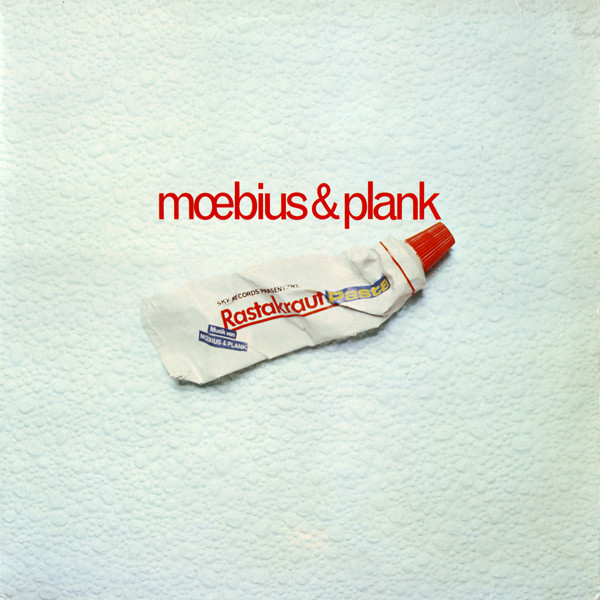
Rastakraut Pasta.
In 1980, Dieter and Conny Plank entered Conny’s Studio to record seven tracks. They were joined by another giant of German music, Can bassist Holger Czukay. He played on Feedback 66, Missi Cacadou and Two Oldtimers. When the seven tracks were completed, Rastakraut Pasta was would be released later in 1980.
Critics hailed Moebius and Plank’s debut Rastakraut Pasta a truly groundbreaking album. It was a fusion of avant-garde Kominische, industrial, electronica, experimental and dub reggae. This disparate and unlikely fusion of genres proved a potent musical pot-pourri, that proved popular with critics and record buyers. So much so, that Conny Plank and Dieter Moebius released a second album together.
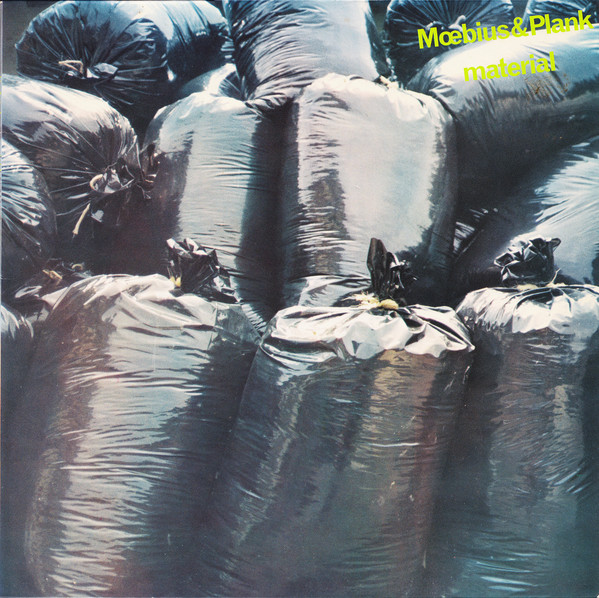
Material.
The Moebius and Plank partnership returned in 1981 with their sophomore album, Material. It featured five songs recorded at Conny’s Studio. This time, there was no sign of Holger Czukay. Instead, the two old friends and musical pioneers worked together on another album of truly groundbreaking music that became Material.
Just like Rastakraut Pasta, Material was hailed as another album of groundbreaking, genre-melting music. Elements of avant-garde Kominische, industrial, electronica, experimental and dub reggae. This resulted in music that wasn’t just innovative, but way ahead of its time. Material was also a timeless album, and one that resulted in what seemed like a queue of musicians wanting to collaborate with Dieter Moebius.
First in the queue was Gerd Beerbohm. They released their first collaboration, Strange Music in 1982. This was the first of two albums that the pair would record tougher. The followup Double Cut was released in 1983. That same year, Dieter Moebius released his debut album Tonspuren.
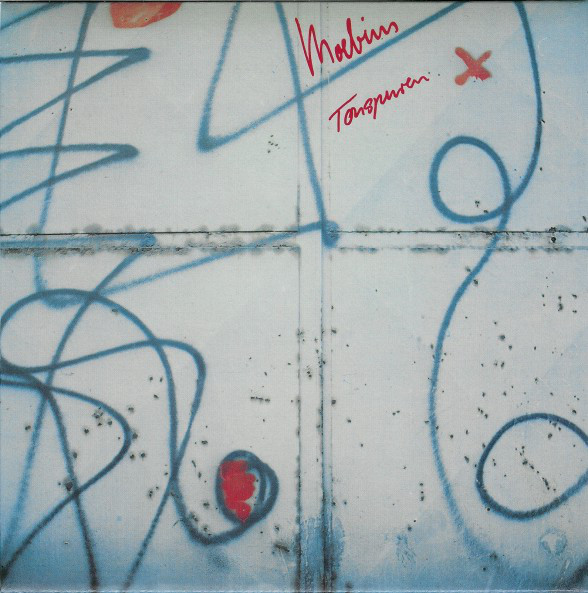
Tonspuren.
To record his debut solo album, Dieter Moebius headed for the familiar surroundings of Conny’s Studio, in Cologne. He had made this journey countless times before, and in the second half of 1982, Dieter began recording ten soundscapes. With Conny looking on approvingly, and making a few suggestions, Tonspuren began to take shape. Once the album was recorded, Conny mixed Tonspuren. It was then released in 1983.
Just like his previous collaborations with Conny Plank, Tonspuren was released on Günter Körber’s Sky Records. It was the perfect label for an album of minimalist, experimental and ambient music.
Günter Körbe had setup Sky Records in 1975, and had never been afraid to release music that many labels would’ve shied away from. Many other German labels were only interested in commercial music. However, Sky Records, just like Brain and Ohr before them, were determined to released groundbreaking music. This was how some critics described Tonspuren.
Critics had awaited the release of Tonspuren with interest. They wondered what direction Dieter Moebius’ music would head? When they heard Tonspuren, with its minimalist, ambient and sometimes experimental sound, they knew. It was a captivating debut album, and critics awaited Dieter’s sophomore album with interest. Sadly, they would have a long wait.
Sixteen years to be exact. Dieter Moebius would released several collaborations, and Cluster would’ve reunited before Dieter Moebius released his sophomore album. By then, Dieter Moebius had reinvented himself, while music, and the way it was made had changed.
Following the release of Tonspuren, Dieter Moebius continued to collaborate with other artists, This included two collaborations with Karl Renziehausen. Dieter Moebius also wrote the soundtrack to Blue Moon in 1986. However, it was Conny Plank that Dieter Moebius collaborated with most often. They recorded three further albums with Conny Plank, This included 1983s Zero Set which featured Guru Guru drummer Mani Neumeier; 1995s En Route; and Ludwig’s Law which featured Mayo Thompson. However, still, Dieter Moebius found time to reunite with Hans-Joachim Roedelius for the comeback of Cluster.
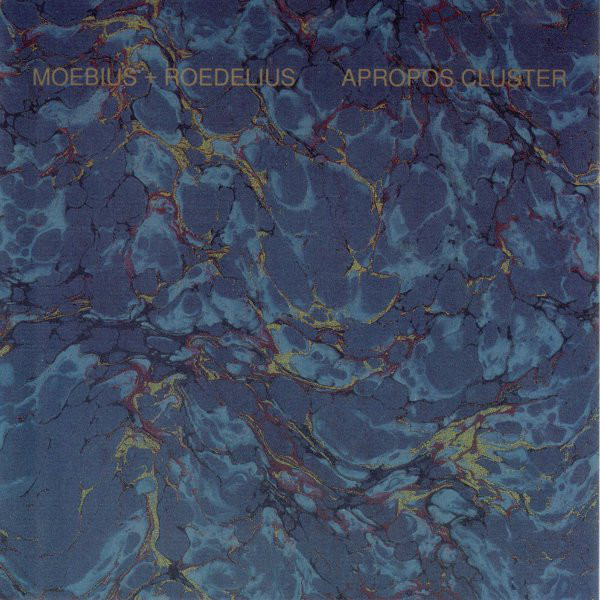
Apropos Cluster.
Recording of Cluster’s tenth album took place during 1989 and 1990. Dieter Moebius and Hans-Joachim Roedelius recorded five tracks, including the twenty-two minute epic title-track. It was part of an album that was similar to Grosses Wasser.
That is the comparisons critics drew, when Apropos Cluster was released in 1991. The only difference was, that Apropos Cluster wasn’t as rhythmic as Grosses Wasser. Instead, it was understated, ethereal and thoughtful ambient music. The followup to Apropos Cluster was the first of three live albums that Cluster would release.
One Hour
The first of the trio of live albums Cluster released during the nineties, was One Hour. It came about after Cluster improvised in the studio for four hours. This they edited this down to One Hour, and the result is a truly captivating album that was released in 1995.
One Hour features Cluster at their most imaginative as they take their music in the most unexpected directions. Curveballs are constantly bowled, as what sounds like the soundtrack to a surrealist film unfolds. Elements of ambient, avant-garde and modern classical music combine, resulting in one of the most intriguing albums in Cluster’s discography.
Two years later, in 1997, Cluster released the first of two live albums. The first was Japan 1996 Live. It was followed by First Encounter Tour 1996, which was their thirteen album, was the first double album Cluster had released. It would also be the last album they released for eleven years. During that period, Dieter Moebius released four further solo albums. The first of this quartet of solo albums was Blotch.
Blotch.
After a sixteen year period where he was constantly collaborating with other artists, the release of Blotch in 1999, marked the start of a period where mostly, Dieter Moebius would concentrate on his solo career. While there was the occasional excursion with Cluster, and a collaboration with Asmus Tietchens in 2012, mostly, the period between 1999 and 2014 are best described as the solo years.
One thing that never changed during the solo the solo years, was Dieter Moebius’ determination to innovate. Helping Dieter Moebius to innovate, was the technology that hadn’t been available when he recorded his debut solo album, Tonspuren in 1983. Dieter Moebius embraced this new technology when he recorded Blotch, which featured Tim Story. The result was his long-awaited comeback album, Blotch.
Blotch featured a series of playful mesmeric loop based tracks. They’re atmospheric and experimental, with Dieter Moebius adding bursts of speech and samples to the musical canvas. They were ‘painted’ by Dieter Moebius, who makes full use of musical palette, which included the new technology. Dieter Moebius’ willingness to innovate and embrace this new technology resulted in an album that was well worth the sixteen year wait.
When Blotch was released, Dieter Moebius was hailed as the comeback King. He had reinvented himself musically, and recorded a much more experimental, genre-melting album. Dieter Moebius had made good use of new technology, and added snatches of speech to the seven soundscapes. This proved a potent combination on album that fused everything from ambient and avant-garde, through to electronica and experimental to industrial, Krautrock and Musique Concrète. The result was an album of atmospheric, dramatic, futuristic and sometimes, ethereal, understated and beautiful music. These soundscapes were always cinematic and mostly, have a hypnotic quality on Blotch, the album that marked the return of Dieter Moebius.
Nurton.
Seven years after Dieter Moebius’ comeback, he returned in 2006 with the third album of his solo career, Nurton. The album was recorded a year earlier in 2005, with Dieter Moebius making good use of some of the technology that he had used on Blotch. One of Dieter Moebius’ secret weapons was the Korg Prophecy which replicated a variety of analog synths. This Dieter Moebius put to good use on Nurton.
Dieter Moebius had pushed musical boundaries to their limit on Nurton. Just like he had throughout his career, he had turned his back on musical convention and structure. Instead, he let his imagination run riot, and studio became a laboratory, where Dieter Moebius experimented.
The result was Nurton, which veers between moody and broody, to dark and dramatic, to ethereal and elegiac to understated and beautiful. Always, though, the best words to describe Nurton were futuristic, cinematic and hypnotic. Dieter Moebius had pulled out the stops on Nurton, which was a captivating album that painted pictures in the mind’s eye. Much of the music on Nurton was akin to a sci-fi soundtrack. Nurton also has a timeless quality, and featured some of the most ambitious, innovative and experimental music of Dieter Moebius’ career. He had set the bar high for the followup album, which was Kram, which was released in 2009.
Kram.
By the time Dieter Moebius came to record Kram, life was good for one of the leading lights of the German music scene. Somewhat belatedly, the music Dieter Moebius recorded with Kluster, Cluster and Harmonia was receiving the recognition it deserved at home and abroad. German music fans realised that Dieter Moebius was one of their national treasures and had grown to appreciate his music.
Dieter Moebius was still one of the leading lights of the Berlin music scene in 2008, when his thoughts turned to recording a new studio album. By then, Dieter Moebius and his wife Irene were dividing their time between Berlin and Majorca, where they could enjoy a much more agreeable climate. However, Dieter Moebius spent some of his time in Majorca working on new music. He had a small mobile recording setup, which replicated the one he kept at him home in Berlin.
This meant that whenever he felt inspired to make music, Dieter Moebius could enter his studio, and work on music for his latest project. In 2008, the project that Dieter Moebius was working on was his fourth studio album, which would eventually become Kram, which translates as “stuff”. The time he sent in his studios in Berlin and Majorca resulted in ten soundscapes which lasted nearly fifty-two minutes. These soundscapes became Kram, which when it was released, became Dieter Moebius’ first album in three years.
With the release of Kram fast approaching in 2009, it was changed days for Dieter Moebius. In the early days of his career, when albums by Kluster, Cluster and Harmonia failed to attract the attention of critics. Sometimes, they passed almost unnoticed, or received just a few reviews. By 2009, Dieter Moebius was fifty-five and one of the elder statesmen of German music. He had been one of the pioneers in the late sixties, and forty years later, was still going strong and releasing ambitious and innovative music on Kram.
Critics upon hearing Kram, hailed the album one of Dieter Moebius’ finest hours as a solo artist. The album received praise and plaudits, with one of the founding fathers of modern German music creating a captivating album that was a musical roller coaster.
Kram is best described as veering between understated, ruminative and elegiac to playful, joyous and tinged with humour, to charming and moderne. Other times, the music is mesmeric and hypnotic, before becoming dark and dramatic. Sometimes, the music becomes experimental and ambitious, while other times, Dieter Moebius unleashes a myriad of futuristic and sci-fi sounds. They join found and throwaway sounds, samples and Dieter Moebius’ trusty synths which he uses to create another genre-melting album which is sometimes cinematic, but captivates from the opening bars of Start to the closing notes of Markt.
During Kram, Dieter Moebius combines elements of ambient, avant-garde, the Berlin School, electronica, experimental music, Krautrock and even briefly rock. The result is an album that features Dieter Moebius at most ambitious and innovative. Proof of this are some of the highlights of Kram.
This includes Kommit, where the mesmeric music pulsates and before becoming rocky ands futuristic. On Wommit which has a Krautrock influence, Dieter Moebius toys with the controls of his synths as avant-garde meets electronica. Then Dauert is an ethereal soundscape where Dieter Moebius adds sci-fi sounds. Steigert is dark, dramatic and cinematic. So too is Rennt, which features an urgency and a myriad of futuristic sounds. The hypnotic Schwitzt also has darkness, and is moody, broody and cinematic. Closing Kram is Markt, a dramatic and cinematic soundscape where Dieter Moebius fuses elements of avant-garde, electronica, experimental and Musique Concrète and ensures the album ends on a high. He had kept one of the best until last.
After three years away, Dieter Moebius returned with one of the finest solo albums of his career. Sadly, it would prove to the penultimate album of his long and illustrious career.
Ding.
Two years after the release of Kram returned with his fifth solo album Ding in 2011. He had recorded Ding a year earlier, in Berlin studio. Now he was ready to release the much-anticipated followup to Kram. By then, the music Dieter Moebius had created with Kluster, Cluster and Harmonia had never been as popular. This resulted in an upsurge of interest in his solo career.
Just like previous solo albums, Dieter Moebius had embraced the latest technology. This included a random loop generator, which he had put to good use during the making of Ding. The loops it generated, were combined with bifurcate rhythms, impalpable and ghostly voices and a myriad of assorted audio matter which became part of the eleven soundscapes on Ding.
When critics heard Ding, they realised that it was quite different from its predecessor. It was another ambitious album, where Dieter Moebius set about reinventing his music once again. To do this, he combined elements of avant-garde with the Berlin School, electronica, experimental, industrial, Krautrock and Musique Concrète. There was also an array of hypnotic, industrial mechanical and robotic sounds on Ding, which was one of the most ambitious and experimental albums of Dieter Moebius’ solo career.
That is apparent straight away, on the album opener Walksol, where a myriad of repetitive and hypnotic sounds join various mechanical and industrial sounds as Dieter Moebius unleashes a fleet-fingered keyboard solo. Then Defekt has a much more understated, but moody and cinematic sound. Flink and Neue Newsw are among the most ambitious tracks as Dieter Moebius knits together a myriad disparate of sounds and samples. Somehow, they make perfect sense musically. So does Alaise a dramatic, futuristic and cinematic soundscape. Alfred also showcases a cinematic sound, albeit one that has an understated and lo-fi sound. Still though, it captivates and finds Dieter Moebius innovating. Ding marks a return to the more robotic and mechanical sounds, while Zufall sounds like it’s part of the soundtrack to a sci-fi film. Dramatic describes Bone, which has moody, mechanical sound, before Fou Dieter Moebius unleashes a menagerie of samples to create a menacing backdrop. Closing Ding is Ruston and Monotron, which picks up where Fou left off. Drones, samples and found sounds combine on this fusion of avant-garde, industrial and Musique Concrète. As befitting of a true musical pioneer, Dieter Moebius closes the album with one of his most ambitious soundscapes.
Just as he had been doing throughout his long and illustrious career, Dieter Moebius had created groundbreaking music and ambitious music on Ding. He embraced new technology, and used an array of samples, found sounds and leftfield sounds to create new and ambitious music. The music on Ding pushed musical boundaries to their limit, which amongst the most ambitious music released during 2011. That was what critics and record buyers had come to expect from sonic pioneer Dieter Moebius. Sadly, Ding was the last album that Dieter Moebius released.
Musik für Metropolis
The following year, 2012, Dieter Moebius was invited to perform music to accompany a screening of Fritz Lang’s legendary silent film Metropolis. For the screening, Dieter Moebius began work on producing new tracks and samples. These he would play on the night and treated with a myriad of effects during Dieter Moebius’ improvised performance. His performance was planned so that it would provide the soundtrack to what was happening on the sliver screen. The Metropolis project took a lot of planning, but it was well worthwhile.
When the day of the screening of Metropolis arrived, Dieter Moebius made his way to the venue. With him, he took the equipment which he planned to put to good use that night. That was the case. It was a masterful and triumphant performance from Dieter Moebius, as he provided the perfect soundtrack for Metropolis. It had highlighted the drama and tension of Fritz Lang’s classic film. Buoyed by the success of his performance, Dieter Moebius began contemplating the next part in the Metropolis project.
All along, Dieter Moebius planned to record a full-length album featuring the music from the Metropolis project. Dieter Moebius began work on the Metropolis’ project, and continued to work on other projects. The sixty-eight year old still had an insatiable appetite for music, and immersed himself in the Metropolis’ project, which gradually started to take shape. Then tragedy stuck, when Dieter Moebius was diagnosed with cancer.
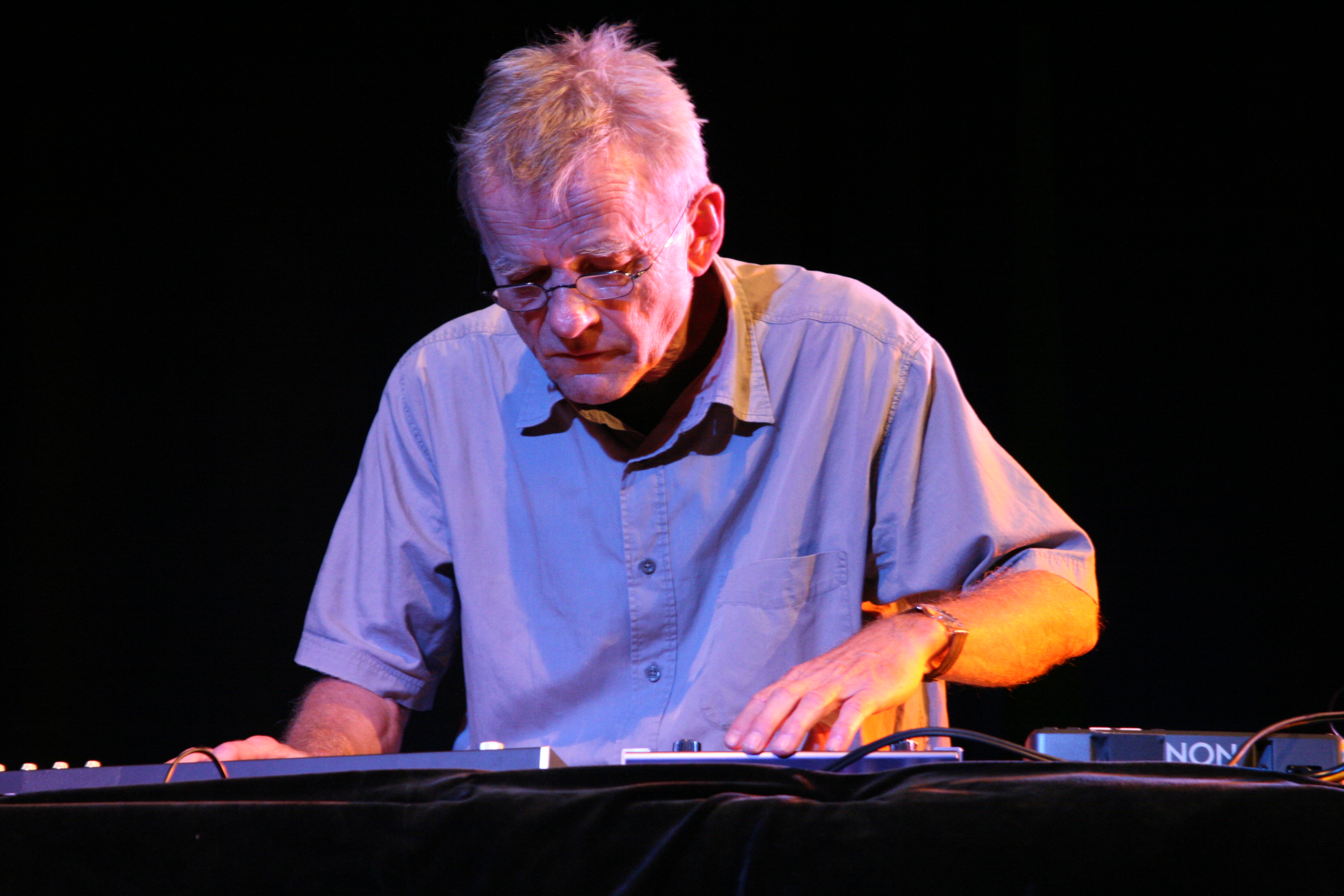
Suddenly, music didn’t matter any more, as Dieter Moebius was fighting for his life. He battled bravely against cancer, fighting for his future and very life. Sadly, Dieter Moebius died on the ‘20th’ of July 2015’ after what had been a brave and lengthy battle against cancer. He left behind a richest musical legacy.
This included the albums he released with Kluster, Cluster and Harmonia, plus his many collaborations and five solo albums. Two of his finest solo albums are Kram and Ding, which feature one of the founding fathers of modern German music doing what he did best, creating ambitious and innovative music. Kram and Ding along with were recently reissued by Bureau B and compete the Dieter Moebius’ reissue program.
Now Blotch, Nurton, Kram and Ding have all been reissued by Bureau B. So has the newly completed Musik für Metropolis, which should’ve been Dieter Moebius’ sixth solo album. Musik für Metropolis was completed by some of Dieter Moebius’ closest musical friends Tim Story, Jon Leidecker and Berlin based musician Jonas Förster. The completed album was a fitting homage to Dieter Moebius, and meant that all the albums the Dieter Moebius had recorded between 1999 and 2012, where is regarded as his solo years, were now available for a new generation of music lovers to discover. This quintet of albums feature sonic pioneer and musical maverick Dieter Moebius, at the peal of his powers, during his constant and continual quest to reinvent his music during his solo years.
Dieter Moebius-Kram and Ding.

BLACK MOON CIRCLE-FLOWING INTO THE 3RD DIMENSION.
Black Moon Circle-Flowing Into The 3rd Dimension.
Label: Crispin Glover Records.
In mid-2105, Trondheim-based psychedelic space rockers Black Moon Circle, announced that they planned to release a trilogy of studio jams. This was, without doubt, the most ambitious project of Black Moon Circle’s career so far. Just over two years later, and Black Moon Circle have recently returned with the final instalment in their critically acclaimed Studio Jamms series, Flowing Into The 3rd Dimension, which was released by Crispin Glover Records. The release of Flowing Into The 3rd Dimension, which featured a guest appearance by Motorpsycho’s guitarist Snah on Waves, marks the welcome return on of one Norway leading space rock bands, but also marks the end of another chapter in Black Moon Circle’s career. It began five years ago, in 2012.
By 2012, brothers Øyvin and Vemund Engan were ready to form their own band, in their home city of Trondheim, in Norway. This was where the Engan brothers’ musical career began, when they joined the punk rock band The Reilly Express. After a tour of duty with The Reilly Express, the Engan brothers were more than ready to form their own band. This wasn’t going to be another punk band though. Punk was firmly in the past for Øyvin and Vemund Engan.
Instead, the Engan brothers decided to form a new psychedelic space rock band, which they called Black Moon Circle. Øyvin would play bass, guitar and take charge of vocals, while his brother Vemund also played guitar. All that the nascent Black Moon Circle needed was a drummer, and this would be the start of a new and exciting chapter in the Engan brothers musical career.
Before long, Black Moon Circle’s lineup was complete when drummer Per Andreas Gulbrandsen joined the band. He was the final piece of the musical jigsaw. Black Moon Circle then began to hone their sound.
Gradually, Black Moon Circle’s sound began to evolve. It was essentially a combination of lengthy jams, searing and blistering guitar riffs and a myriad of effects added to the bass and guitar. This Black Moon Circle described as psychedelic space rock, which soon began to find an appreciative audience.
Now that they had honed and tightened their sound, Black Moon Circle made their first tentative steps onto the local live scene. Although they were the newest addition to Norway’s thriving and vibrant psychedelic space rock scene, their music soon found an appreciative audience. Black Moon Circle’s timing was perfect, as space rock was growing in popularity throughout Europe. Flying the flag for Norwegian space rock was Black Moon Circle, whose music was about to find a wider audience in 2013.
Black Moon Circle.
That was when Black Moon Circle made their recording debut. The band entered Nautilus Studios during 2013 to record Plains, American Eagle and Enigmatic Superbandit which would feature on their mini-album album Black Moon Circle.This would mark the debut of the Trondheim-based psychedelic space rockers.
Black Moon Circle wa released in February 2014 by Space Rock Productions, the label run by the Øresund Space Collective from Copenhagen, Denmark. The release of Black Moon Circle introduced the band’s music to a new and wider audience, and launched their career.
After the release of their mini-album, Black Moon Circle were already making plans for the future. This included recording their much-anticipated first full-length album. Black Moon Circle weren’t the type of band to let the grass grow under their feet, and the recording began in the spring of 2014.
Andromeda.
Psychedelic space rockers Black Moon Circle returned to the studio in April 2014, where they began recording their debut album Andromeda. By then, Black Moon Circle had been together the best part of two years, and were tight band who were capable of seamlessly creating genre-melting music. Black Moon Circle worked quickly and efficiently, seamlessly creating genre-melting music. As a result, the five songs on Andromeda were recorded in one day. Six months later, and Andromeda was ready to be released.
Black Moon Circle’s sophomore album, Andromeda which showcased their psychedelic space rock sound was released to critical acclaim by Crispin Clover Records in October 2014. A great future was forecast for the Trondheim-based trio. They were already hatching a plan that sounded like something from the seventies, the golden age of rock.
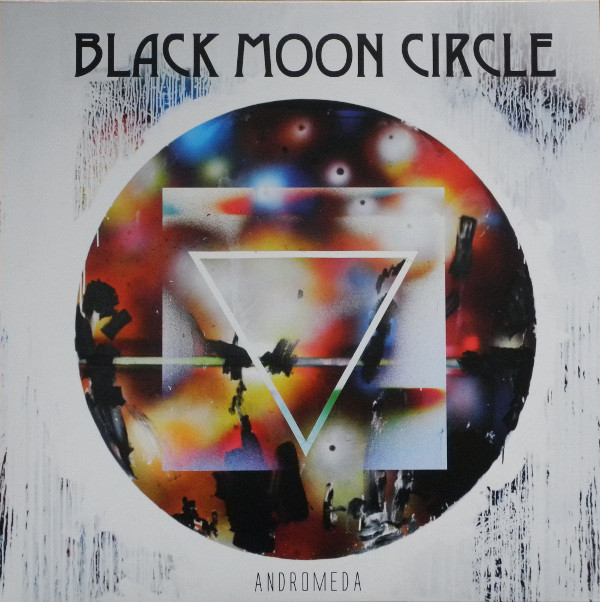
The Studio Jams Volume I: Yellow Nebula in the Sky.
What Black Moon Circle had in mind was to release a trilogy of studio jams. This was something that harked back to the seventies, when rock was King. It seemed that this was Black Moon Circle’s way of paying homage to the golden age of rock which had influenced their music. Black Circle announced their intention to release a trilogy of studio jams in mid-2015. This was by far, the most ambitious project of Black Moon Circle’s career.
The first of the trilogy was The Studio Jams Volume I: Yellow Nebula in the Sky. Fittingly, for the first album in the trio’s trilogy, the album featured three tracks. One of the tracks was recorded during the first jam session in April 2013, while the other two tracks were recorded in 2014. These three tracks became The Studio Jams Volume I: Yellow Nebula in the Sky, which was the second album to showcase the hugely talented Trondheim trio, Black Moon Circle who were joined by Scott Heller a.k.a. Dr. Space who played synths.
Critics hailed The Studio Jams Volume I: Yellow Nebula in the Sky as the finest album of Black Moon Circle’s career. It features their unique brand of psychedelic space rock with elements of electronica, experimental music and free jazz added for good measure. Seamlessly, these disparate musical genres and influences merge into something new and innovative. It’s cinematic, dramatic, futuristic, moody, rocky and as Øyvin Engan says; “intense.”
This intensity is deliberate, and comes courtesy of the three members of Black Moon Circle. They deployed layers of fuzzy guitars, spacey, lysergic synths and a mesmeric rhythm section on The Studio Jams Volume I: Yellow Nebula In The Sky. However, for their fourth album, Sea Of Clouds Black Moon Circle add two new ingredients to their successful musical formula.
Sea Of Clouds.
With The Studio Jams Volume I: Yellow Nebula In The Sky recorded, but not yet released, Black Moon Circle’s thoughts turned to their fourth album. This wasn’t going to be another instalment in the Studio Jams’ series. Instead, what became Sea Of Clouds found Black Moon Circle changing direction slightly.
Having written four new tracks, the Trondheim based trio returned to the studio in June 2015. They were again joined by Scott Heller who played synths, while Magnus Kofoed played keyboards. During the course of just one day, Black Moon Circle recorded the four lengthy jams that became Sea Of Clouds which featured Øyvin Engan’s vocals. This was a stylistic departure for Black Moon Circle.
When Sea Of Clouds was released in April 2016, critics were won over by another album of Black Moon Circle’s hard rocking brand of psychedelic, space rock. Black Moon Circle revisit what’s by now a familiar sound, but one that combines elements of heavy metal, Krautrock, avant-garde, free jazz and post rock. Black Moon Circle have also drawn inspiration from Black Sabbath, Can, Deep Purple, Emerson, Lake and Palmer, Hawkwind, Iron Maiden, Led Zeppelin, Hawkwind, Moster, Motorpsycho, Radiohead and Yes. These disparate musical genres and influences merge into something new and innovative on Sea Of Clouds.
The music veered between dramatic, futuristic, moody, otherworldly and gloriously rocky. Sometimes, Sea Of Clouds finds Black Moon Circle at their hard rocking best, and features an intensity that has always been an intensity to Black Moon Circle’s music. It’s as much a part of Black Moon Circle’s music as the layers of fuzzy guitars, spacey, lysergic synths and futuristic sci-fi sounds. That was the case throughout Sea Of Clouds, which shows another side to space rock pioneers Black Moon Circle, who were already preparing to release the most accessible album of their career.
The Studio Jams Volume 2.
Seven months after the release of Sea Of Clouds, Black Moon Circle returned with their eagerly awaited fifth album, The Studio Jams Volume 2. It had been recorded in June 2015.
The Trondheim based trio returned were joined in the studio by Scott Helller a.k.a. Dr. Space on synths. Black Moon Circle recorded two epic tracks Serpent: The Head and Serpent: The Tail, which would become The Studio Jams Volume 2.
Just like previous albums, critical acclaim accompanied the release of The Studio Jams Volume 2. It found Black Moon Circle fusing the classic rock of the sixties and seventies with psychedelia and space rock. To this, Black Moon Circle add elements of avant-garde, electronica, experimental music, free jazz, Krautrock and post rock. Seamlessly, these disparate musical genres and influences merge into something new, exciting and innovative. It’s also cinematic, dramatic, futuristic, moody, rocky and features Black Moon Circle’s trademark intensity.
This intensity was deliberate, and has always been part of Black Moon Circle’s ‘sound’. To create this, they deploy layers of fuzzy guitars, spacey, lysergic, futuristic, sci-fi synths and a mesmeric rhythm section. Together, they create two “lengthy jams” which features “heavy riffage and the extensive use of effects.” They’re used extensively on The Studio Jams Volume 2, where Black Moon Circle reach new heights on what was the finest album of their career. The final instalment in The Studio Jams series had a lot to live up to.
Flowing Into The 3rd Dimension.
As 2016 drew to a close, Black Moon Circle celebrated releasing two successful albums during the year. The second of these albums, The Studio Jams Volume 2 had been hailed by critics as the finest album of Black Moon Circle’s career. This was something to celebrate. Already though, Black Moon Circle’s thoughts were turning to their next album, which would be the third and final instalment in The Studio Jams series. Although
The Studio Jams Volume 2 had set the bar high for the third and final instalment in The Studio Jams series Black Moon Circle welcomed the challenge, and were determined to reach new heights on their next album.
Earlier in 2017, Black Moon Circle returned to the studio complete The Studio Jams series. They planned to record two lengthy jams Barnard´s Loop and Waves. As usual, Øyvin Engan would play bass and guitar, while his brother Vemund added another layer of fuzzy guitars. Joining Øyvin Engan in the rhythm section was drummer Per Andreas Gulbrandsen who would provide the heartbeat. Completing Black Moon Circle’s lineup was the newest recruit, Scott Heller a.k.a. Dr. Space. The four musicians recorded Barnard´s Loop together, but when it came to record Waves, Black Moon Circle were joined by one of the legendary figures in Norwegian music, Hans Magnus “Snah” Ryan a.k.a. Snah, who is Motorpsycho’s guitarist. With Snah onboard, Black Moon Circle recorded Waves which features on side two of Flowing Into The 3rd Dimension.
With Flowing Into The 3rd Dimension completed, Black Moon Circle recently released the album on Crispin Glover Records. The release of Flowing Into The 3rd Dimension marked the end an era, but Black Moon Circle had saved the best until last.
Opening Flowing Into The 3rd Dimension is Barnard´s Loop, a near twenty-five minute adventure in sound. Effects-laden guitars are unleashed, and take centre-stage, showcasing Black Moon Circle’s trademark ‘heavy riffage” Then as feedback briefly howls, the rhythm section add to the drama. Meanwhile synths unleash futuristic and otherworldly sounds as this uber rocky soundscape unfolds. Still the drama builds, as a vortex of sci-fi synths, blistering guitar riffs and the powerhouse of a rhythm section combine. They create a powerful and potent brew that Black Moon Circle have perfected over the past five years. By then, Black Moon Circle is in full flight and at their hard rocking best. Playing a leading role are the rhythm section who provide a thunderous, hypnotic heartbeat, while synths swirl, howl, bubble and provide a futuristic backdrop as searing, screaming and wah-wahing effects-laden guitars are unleashed. Later, the tempo rises as the rhythm section power the arrangement along. Still,the guitars steal the show with some fleet-fingered guitar licks. They’re fast and furious and join sci-fi synths and the hard rocking rhythm section as Black Moon Circle prove rock is alive and well, and in safe hands on this Magnus Opus.
With Motorpsycho’s guitarist Snah onboard, Waves becomes a twenty-six minute roller coaster. Guitars reverberate and feedback briefly howls, before machine gun guitars are unleashed at breakneck speed. They’re joined by swirling sci-fi synths and the rhythm section who drive the hard rocking soundscape along. It’s a glorious fusion of blues-rock, hard rock, avant-garde, improv and psychedelic space rock, and before long Black Moon Circle’s expanded lineup is in full flight. Snah’s addition means a wall of searing, screaming and screeching guitars assail the listener. The guitars play a leading role and are played with speed and accuracy. Augmenting the guitars is the hard rocking rhythm section and sci-fi synths. Later, the guitars become fuzzy as effects are deployed as Black Moon Circle draw breath. No longer are they in full flight, as the rhythm section provide a mesmeric backdrop as this lysergic soundscape meanders along. Buzzes, beeps, squeals and sci-fi sounds are emitted, and effects are deployed as Black Moon Circle create an atmospheric and futuristic backdrop. Even when a guitar roars, Black Moon Circle resist the temptation to kick out the jams. Instead, this epic soundscape heads in the direction of post-rock as it becomes moody, dramatic, futuristic and ruminative as if Black Moon Circle is creating the soundscape to a film documenting the post-Trump apocalypse.
It’s fitting that Black Moon Circle have saved Flowing Into The 3rd Dimension until last in their critically acclaimed Studio Jamms’ trilogy. Flowing Into The 3rd Dimension is, without doubt, the best instalment in Black Moon Circle’s Studio Jamms’ trilogy. It’s also the best album of Black Moon Circle’s career, and finds the band reaching new heights on Flowing Into The 3rd Dimension.
Black Moon Circle seem to mature like a fine wine, as each album surpasses the one that preceded it. That is the case on Flowing Into The 3rd Dimension which was recently released by Crispin Glover Records. It’s another genre-melting opus where Black Moon Circle fuse psychedelic space rock with avant-garde, Berlin School, electronica and experimental music, Krautrock, post rock and progressive rock. The classic rock of sixties and seventies has also influenced Black Moon Circle during the final instalment in the Studio Jamms’ trilogy, Flowing Into The 3rd Dimension. So has sixties psychedelia, and the unholy trinity of hard rock Black Sabbath, Deep Purple, and Led Zeppelin plus Pink Floyd, Can, Emerson, Lake and Palmer, Hawkwind, Henry Cow, Iron Maiden, Motorpsycho and Radiohead. All these influences can be heard on Flowing Into The 3rd Dimension which features sonic pioneers Black Moon Circle at their very best.
The two epic soundscapes on Flowing Into The 3rd Dimension find Black Moon Circle in full flight at their hard rocking best. However, the soundscapes are also dark, dramatic, ethereal, futuristic, moody, otherworldly and ruminative. They’re also lysergic and cinematic, which has long been a feature of Black Moon Circle’s music. Especially, on Flowing Into The 3rd Dimension, which is the final instalment in Black Moon Circle’s Studio Jamms’ trilogy. This marks the end of a chapter in Black Moon Circle’s career.
When Black Moon Circle return with their next album in early 2018, they’ll be a five piece band. The newest recruit is Magnus, who plays organ, mellotron and Fender Rhodes which the rest of Black Moon Circle believe will fill out and complete their sound, as they embark on a new chapter in their career.
Closing this chapter in the Black Moon Circle is the finest album and hardest rocking album of their five-year career, Flowing Into The 3rd Dimension. It’s another ambitious and genre-melting adventure in sound with Black Moon Circle. Flowing Into The 3rd Dimension is also a reminder that the future of rock is in the safe hands of pioneering and hard rocking psychedelic space rockers Black Moon Circle, as they prepare to embark upon yet another journey into sound.
Black Moon Circle-Flowing Into The 3rd Dimension.
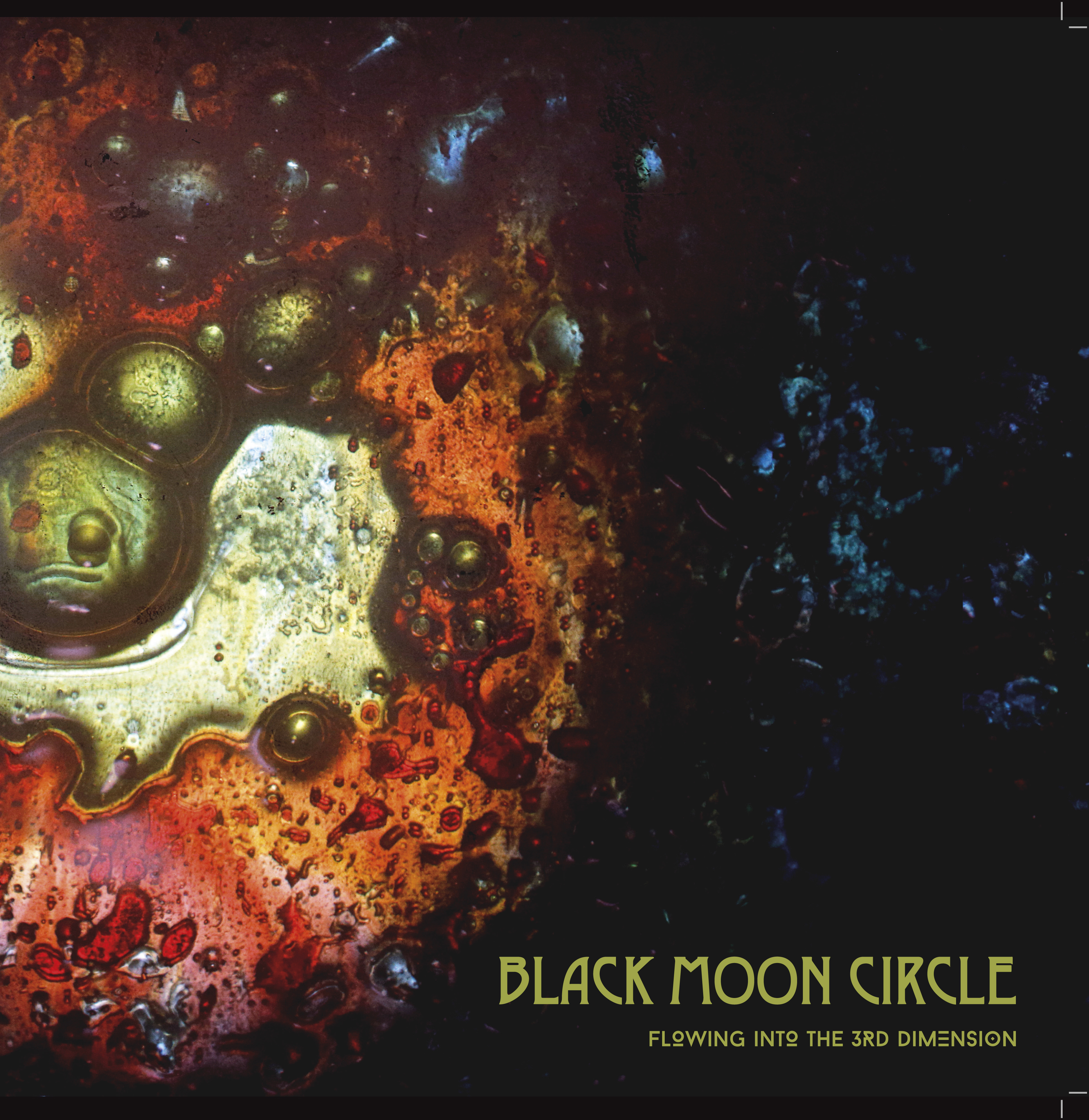
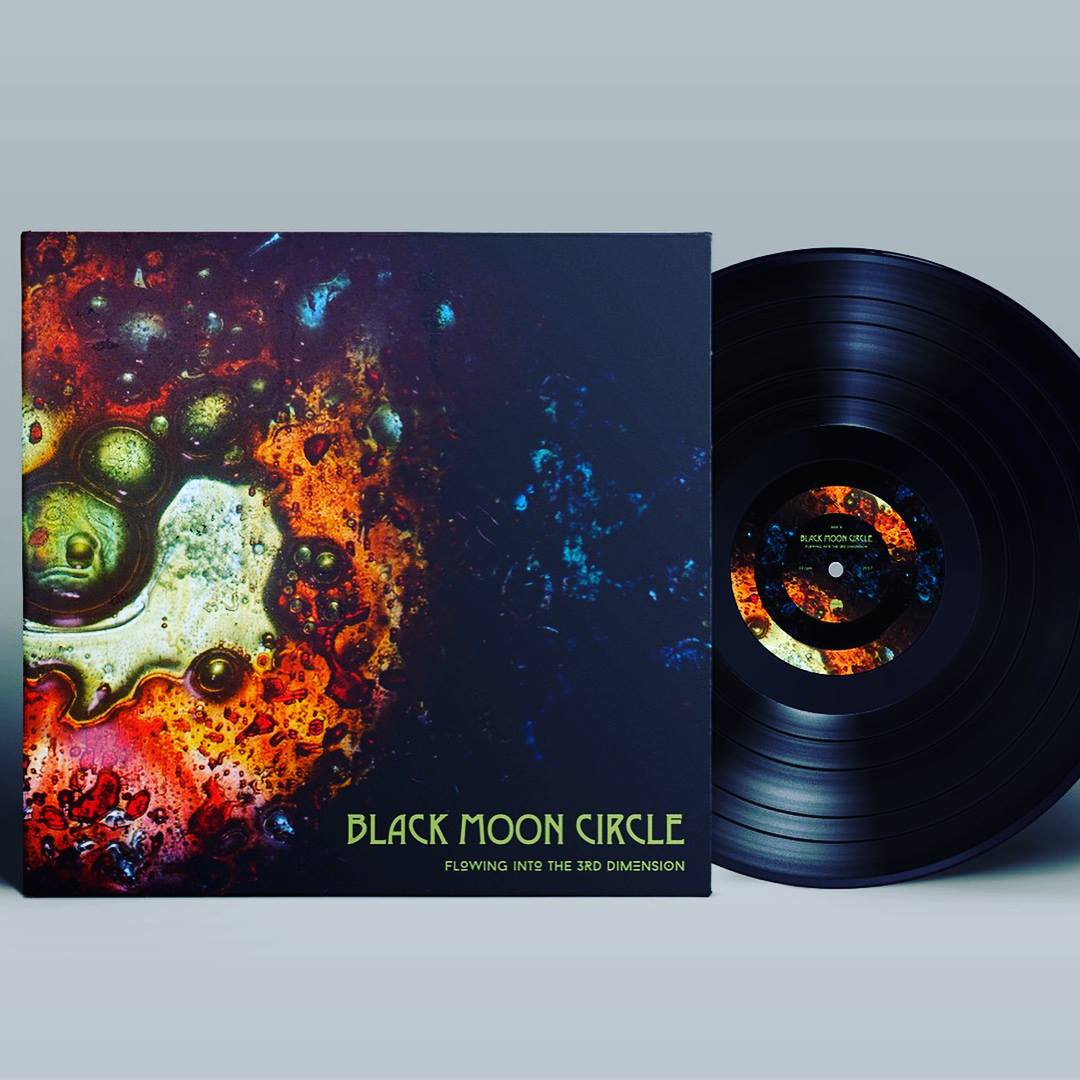
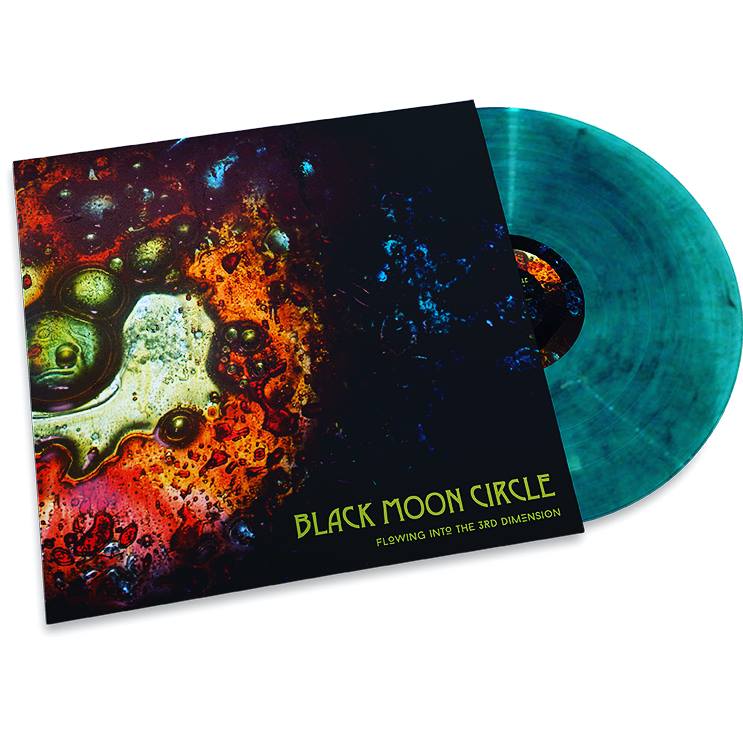
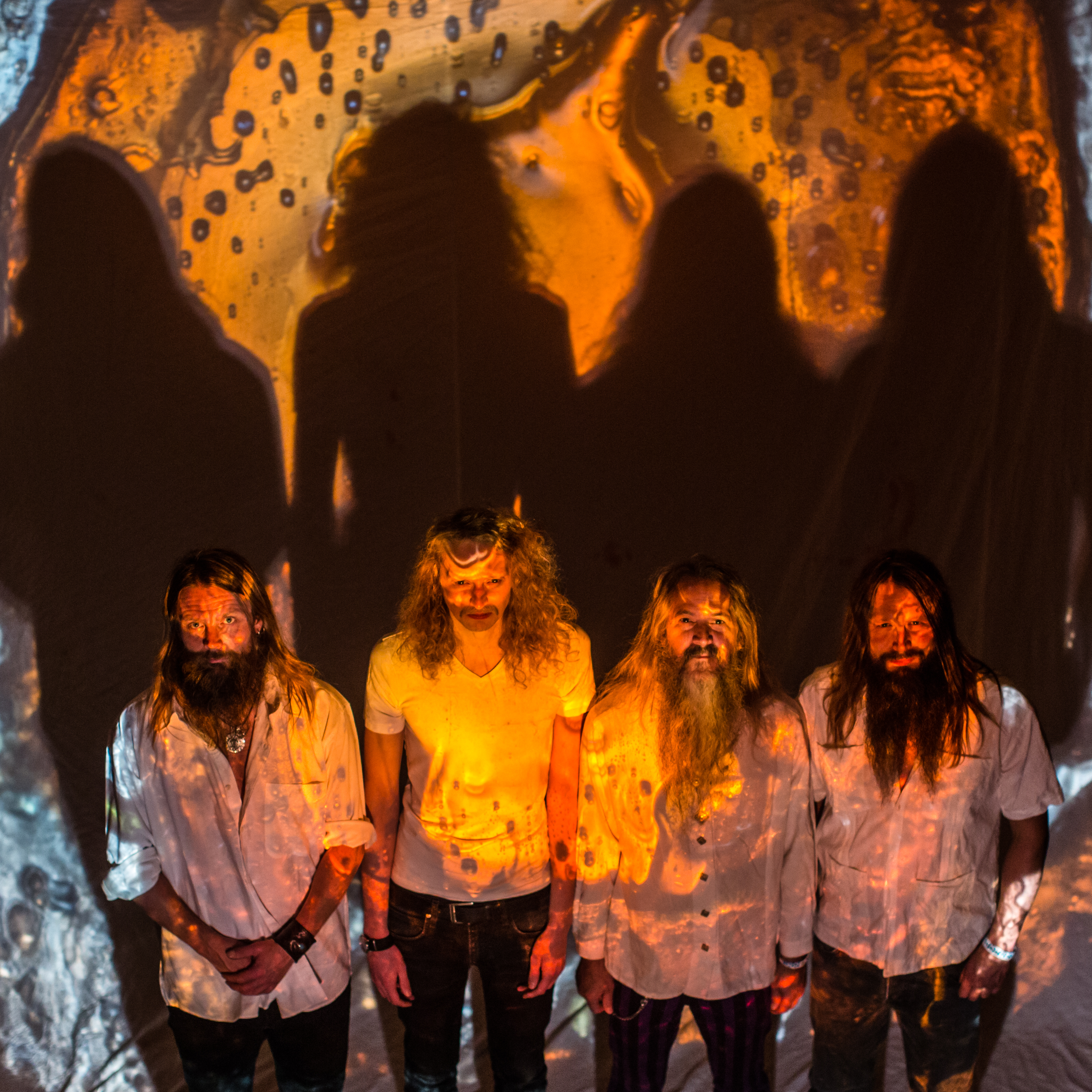
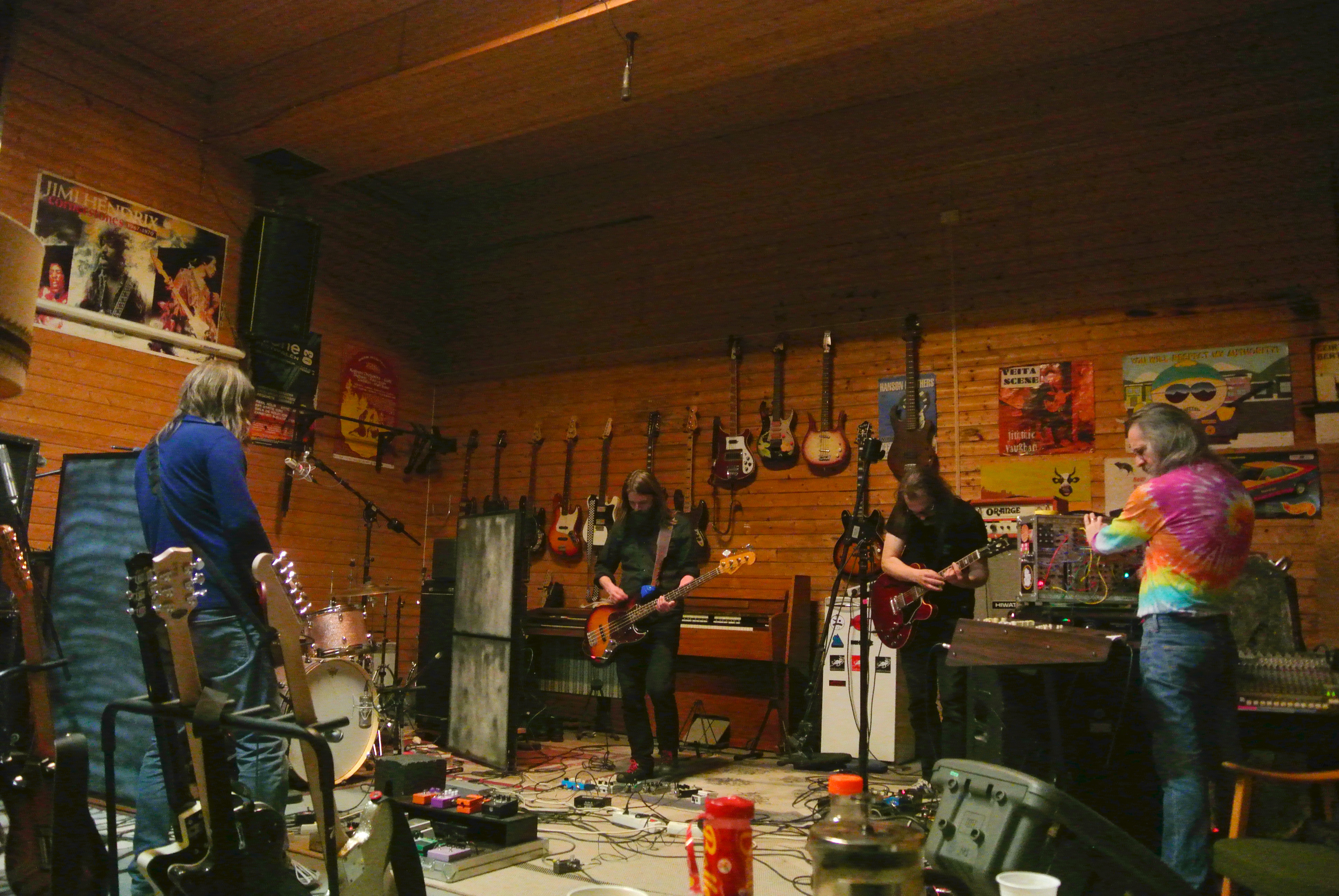
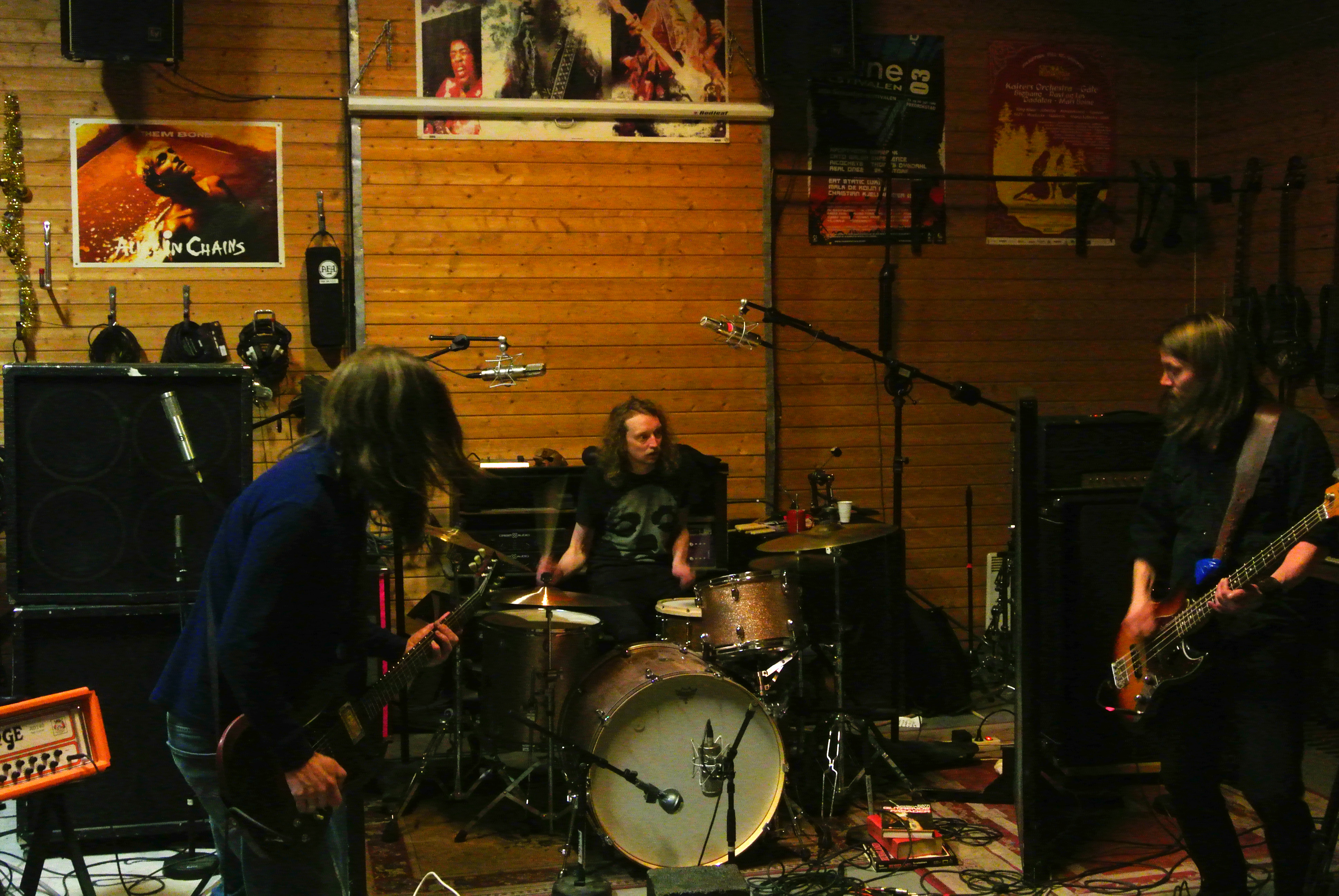
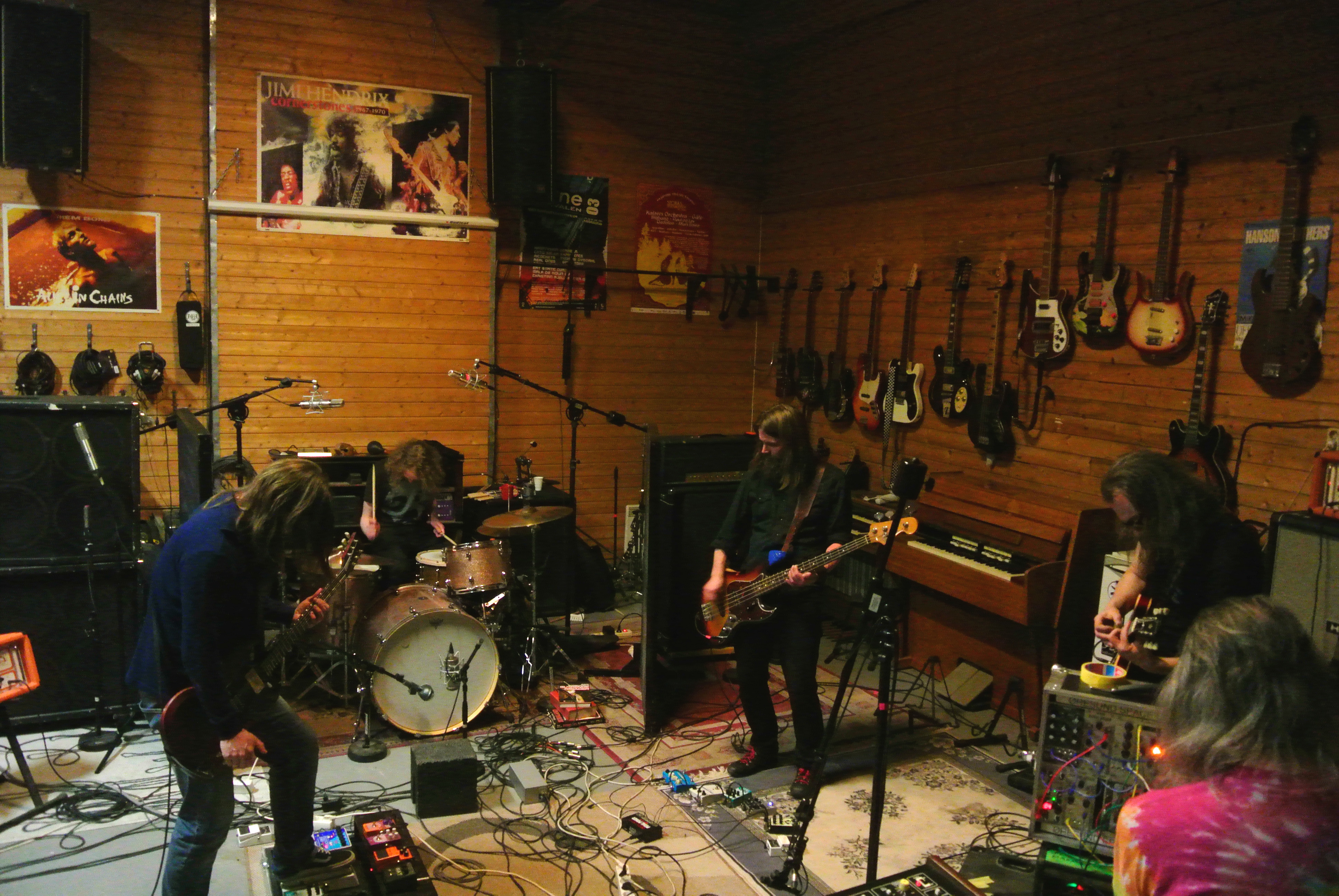
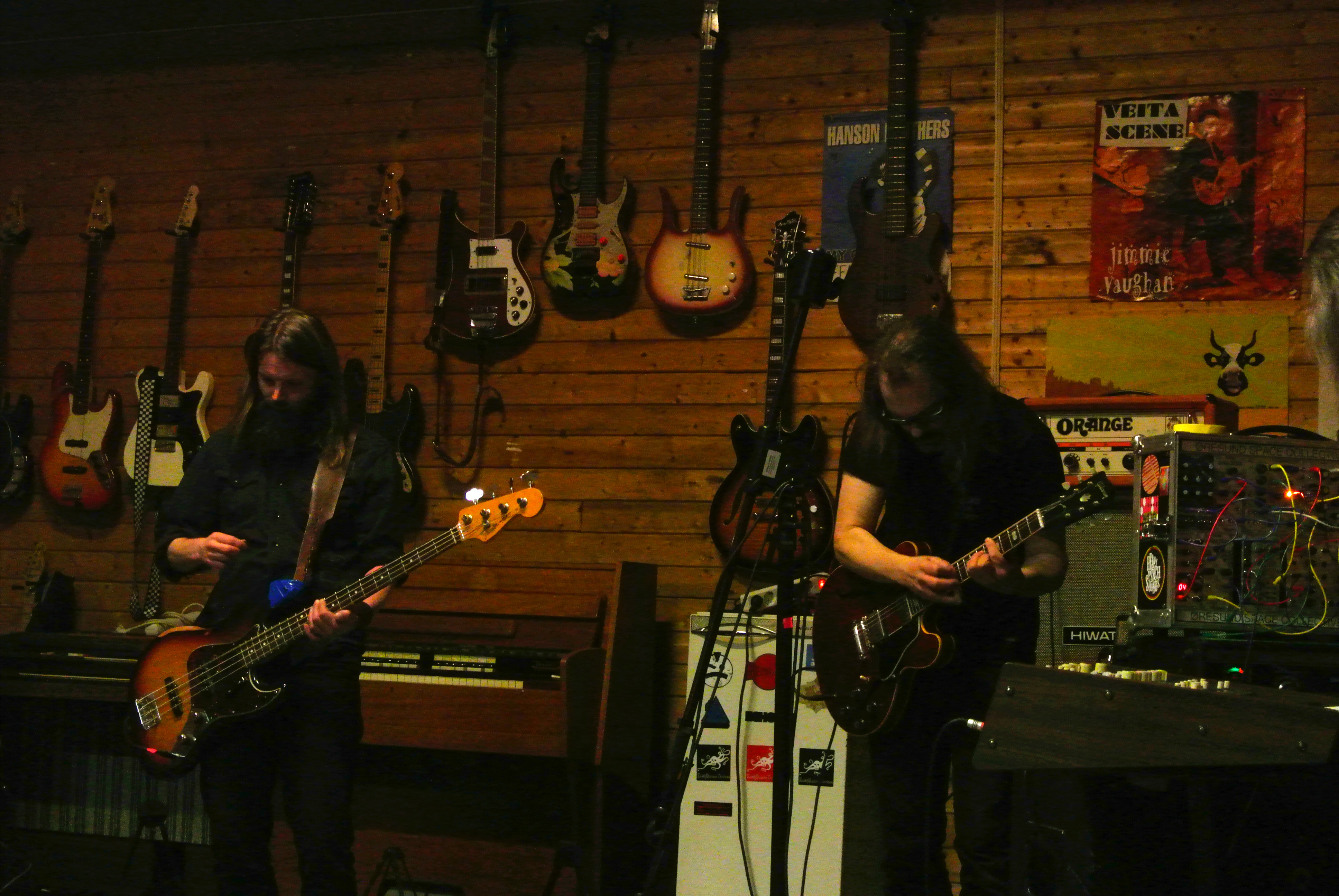
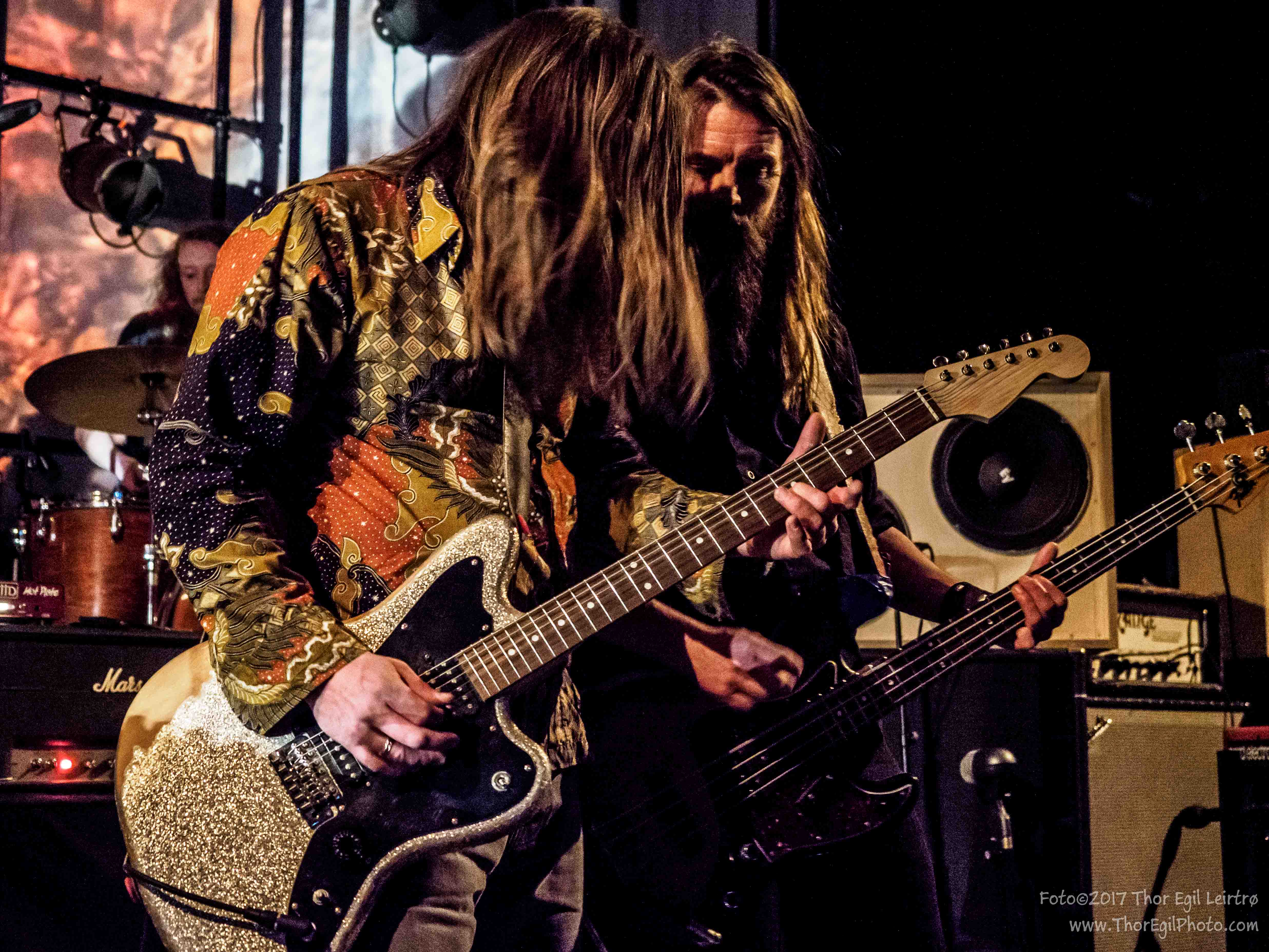
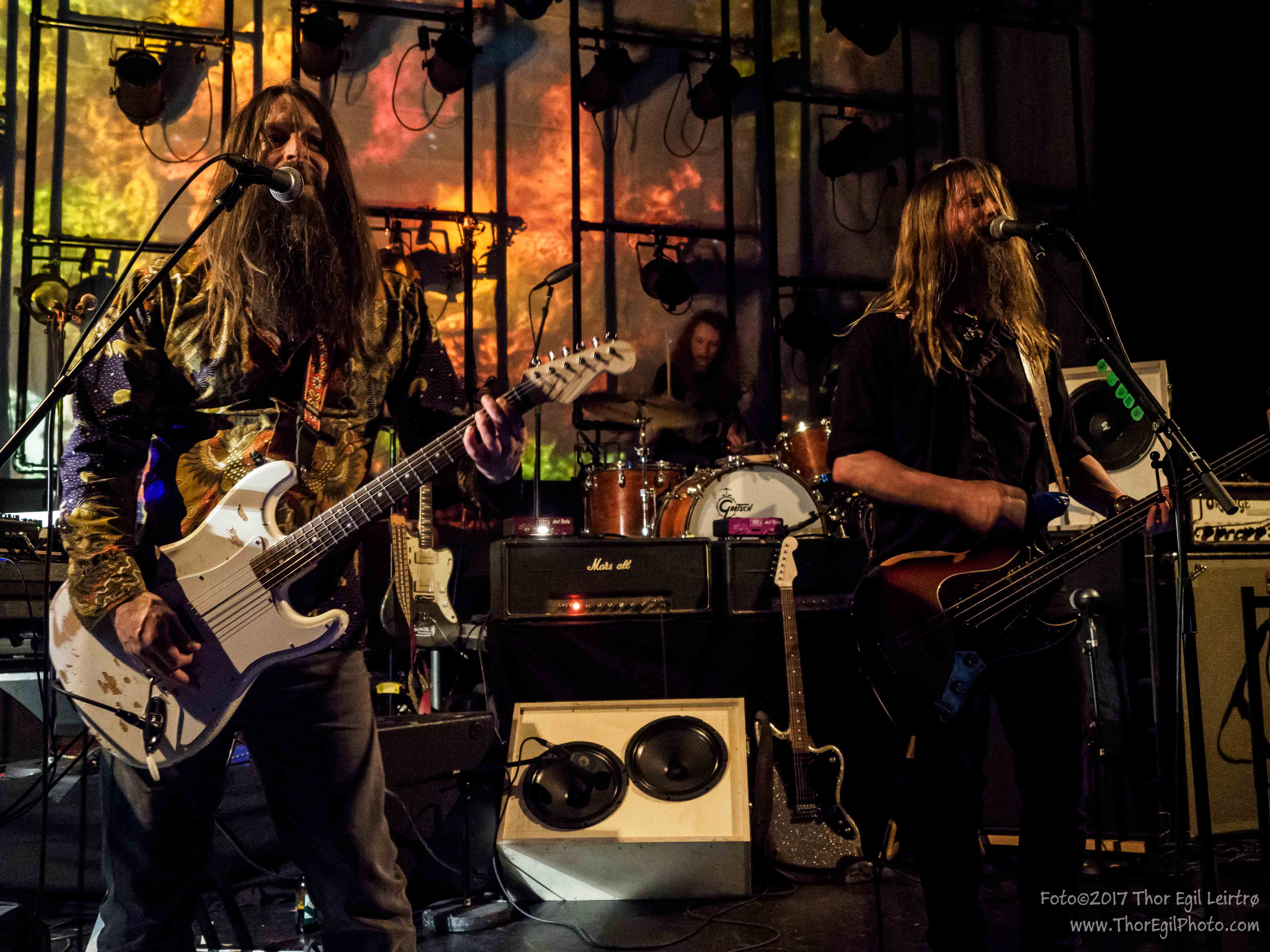
Live Photos Courtesy of Thor Egil Leirtrø.
GALACTIC EXPLORERS-EPITAPH FOR VENUS.
Galactic Explorers-Epitaph For Venus.
Label: Mental Experience.
In October of 2016, Mental Experience, an imprint of Guerssen Records released Cologne Curiosities-The Unknown Krautrock Underground 1972-1976, which featured seven tracks from the Pyramid Records’ vaults. The compilation was a musical amuse-bouche, that allowed music fans to experience a tantalising taste of the music that Pyramid Records’ had recorded and released during its four-year existence. The main course in this musical feast would the albums that Mental Experience planned to release in the future. They would be a mixture of albums released and recorded by Pyramid Records.
The first in this series was the Cozmic Corridors’ eponymous debut album, which was released in February 2017. This was an album that had lain unreleased in Pyramid Records for over forty years. Somewhat belatedly, Cozmic Corridors eponymous debut album was released by Mental Experience.
Now six months later, and Mental Experience have recently with the second instalment in this series of albums from the Pyramid Records vaults. The album they’ve chosen is the Galactic Explorers’ debut album Epitaph For Venus. It was recorded between 1972 and 1976, but lay unreleased until 1996 when it was belatedly released and copies sold out. Since then, the Galactic Explorers’ debut album Epitaph For Venus has been out of print, and makes a welcome return. However, just like any album that was recorded by Pyramid Records, the album is sure to provoke debate within Krautrock circles.
The story began just over twenty years ago with the rediscovery of the Pyramid Records’ tapes. These newly discovered taps had been missing for the best part of twenty years. This should’ve been an exciting musical discovery, and one that was welcomed by all Krautrock connoisseurs. Instead, the discovery of the Pyramid Records’ tapes was the start of a debate that still rages over twenty years later.
When the Pyramid Records’ tapes first resurfaced just over twenty years ago, this was an exciting discovery. After all, it wasn’t every day that a hitherto small, unknown private record label’s back-catalogue was discovered? This was what Cologne based Pyramid Records had been.
Pyramid Records was founded by British expat Robin Page, in 1972. By then, Robin Page was forty and one of the leading lights in the Fluxus arts movement. He had moved from London, England to Cologne, in Germany in 1969 which had been his home ever since. However, Robin Page wasn’t the only expat living in Cologne.
So was Tony Robinson, a South African, who had travelled from Cape Town, to Germany to work with the legendary Karlheinz Stockhausen, the Godfather of modern German electronic music at the WDR Studio. This was akin to serving an engineering apprenticeship, and would serve Tony Robinson well. When he left Karlheinz Stockhausen’s employ, Tony Robinson went to work at Dierks Studio in Cologne. That was where the future Genius P. Orridge would meet Robin Page.
By then, Robin Page was a successful and established artist. He was a leading light in the Fluxus movement, and was regarded as a groundbreaking artist. Robin Page used humour within his work, which sought to challenge what was regarded as good taste within the art establishment. Before long, Robin Page’s painting found an audience, and became particularly sought after. This was what Robin Page had dreamt of, and worked towards since ‘leaving’ art college in Vancouver. His new-found success and financial security allowed Robin Page to work towards fulfilling another of his dreams, making music.
Robin Page was serious about making music, and had a recording studio in the basement to what looked like to anyone passing by, a derelict building. Deep within its bowels, was Robin Page’s recording studio, and where Pyramid Records first album was recorded. It was then pressed by a Turkish entrepreneur, who just happened to keep his cutting lathe within the same building. Although was more used to producing bootlegs, but was able to cut what became PYR 001, Pyramid Records’ first release. It came wrapped in a cover designed by a local student. History had just made with the release of Pyramid Records’ first release.
Soon, Robin Page’s nascent label had established a reputation for releasing ambitious and innovative albums. However, Pyramid Records was only in existence until 1976. During that four-year period, Pyramid Records only ever released fifteen albums. These albums were pressed in small quantities. Usually, no more than 50-100 copies of each album was pressed.
Once the albums were ready for release, founder Robin Page gave away many of the copies to his friends, while the remainder were sold in Cologne’s clubs or art galleries. None of the Pyramid Records’ releases found their way into Cologne’s many record shops. To some extent, that explains why nobody seemed to have heard of Pyramid Records, which was an underground label.
One person who was presented with a copy of PYR 001, was Toby Robinson who by 1972, had become friends with Robin Page. He was persuaded to provide the material for Pyramid Records second release, which bore the serial number PYR 002.
Essentially, Tony Robinson’s album comprised a recording of sounds bounced from one tape recorder to another. When the recording was complete, Robin Page went to visit his had a master cut, and between 50-100 copies were either given away to Robin Page’s friends, or sold in Cologne’s art galleries and clubs. No copies of PYR 001 nor PYR 002 seem to have survived. It’s a similar story with the label’s next two releases.
Neither the master tapes nor copies of PYR 003 and PYR 004 seem to have survived the passage of time. Instead, the first Pyramid Records release to survive is believed to be PYR 005. It’s one of just eleven Pyramid Records’ recordings that remain in the vaults. These recordings were made between 1974 and 1976. This contradicts the claims in 1996 that the Galactic Explorers’ album Epitaph For Venus took place in 1972 and 1973.
Many of the bands released albums on Robin Page’s Pyramid Records were part of the Krautrock scene. That was apart from The Nazgul and the Galactic Explorers. Their music was very different and had a much more avant-garde sound. Other noticeable influences include Karlheinz Stockhausen, who had influenced many of the leading lights of the German music scene, and even the Fluxus movement. All this had influenced the three Galactic Explorers.
Very little is known about the members of the Galactic Explorers. It’s believed that Johannes Lutz, Holst Seisert and Reinhard Karwatky are all aliases. One claim was the some of the musicians who played on the Pyramid Records’ sessions were well-known musicians, who were members of top Krautrock bands. They played in the Pyramid Records’ sessions after they had finished playing with their respective bands. As a result, they had to dawn aliases when the albums were released. It may be that other musicians featured on the Galactic Explorers’ album Epitaph For Venus.
Only three musicians are credited as playing on Epitaph For Venus, which was produced by Tony Robinson. Johannes Lutz played Minimoog and Hammond organ, Holst Seisert played Fender Rhodes and synths and Reinhard Karwatky added electric organ, percussion and synths. However, snatches of guitar and bass can be heard on Epitaph For Venus. However, who played them is a mystery. So is when the sessions took place.
When Epitaph For Venus was originally released in 1996, it was claimed that the album was recorded during 1972 and 1973. This contradicts the claim that the eleven Pyramid Records’ tapes that survived were recorded between 1974 and 1976.This makes it more likely that Epitaph For Venus was recorded between 1974 and 1976. By then, the group that inspired the Galactic Explorers’ name had released their trio of albums.
Inspiration for the name Galactic Explorers, most likely came from The Cosmic Jokers, whose lineup featured top German musicians including Dieter Dierks, Harald Großkopf, Jürgen Dollase, Klaus Schulze, and Manuel Göttsching. They spent the three-month period between February to May of 1973 taking part in psychedelic jam sessions. The musicians drinks had been spiked with LSD, and as they played at Studio Dierks, which was owner Dieter Dierks and where Tony Robinson once worked. However, during The Cosmic Jokers’ sessions, Dieter Dierks noticed that the sessions were being surreptitiously recorded. These sessions resulted in three albums The Cosmic Jokers and Sternenmädchen’s Planeten Sit-In, The Cosmic Jokers and Galactic Supermarket.
If the Galactic Explorers were indeed inspired by The Cosmic Jokers, then this would suggest that the album was recorded at least after May 1973 when the recording sessions ended. It may be that the Galactic Explorers recorded their album after 1974, when The Cosmic Joker released their debut album? However, playing Devil’s Advocate, it could be that the group was named the Galactic Explorers at a later date by someone involved in the sessions? After all, not everyone was convinced by the Pyramid Records’ story.
Pyramid Records closed its door for the final time in 1976. Not long after that, Robin Page decided to emigrate to Canada. With him, he took Pyramid Records’ master tapes and the remaining albums. Almost nothing was left of Pyramid Records. It was as if the label had never existed.
That was until nearly twenty years later, when Tony Robinson approached Virgin Records with some of Pyramid Records’ master tapes. This resulted in the release of Unknown Deutschland-The Krautrock Archive Volume 1 in 1996. Later that year, two further volumes were released. This further fuelled the mythology and speculation that built up around Pyramid Records.
Since then, the Pyramid Records’ story has been debated ad infinitum. Sadly, far too many people have become bogged down by the controversy and speculation that surrounds the Pyramid Records’ story. It’s as if they’re determined to disprove that the music was recorded between 1972 and 1976. In doing so, all they’re doing is adding fuel to the fire, and fuelling the debate and speculation. That is a great shame, because for too long, people have become caught up in the Pyramid Records’ mythology. In doing so, they lose sight of the important thing, the music.
This includes the fifteen albums Pyramid Records released between 1972 and 1976, albums that have still to be released and albums that made their belated debut twenty years after Pyramid Records closed its doors for the final time. This includes the Galactic Explorers album Epitaph For Venus, which was made its debut in 1996. Twenty-one years later, and Epitaph For Venus was reissued by Mental Experience, and is a reminder of an album that showed a different side to the music that Pyramid Records’ released.
Lunarscape an eighteen-minute epic opens Epitaph For Venus. It drones and whines as otherworldly and futuristic sounds emerge from the soundscape. Soon, bubbling sounds cascade melodically and urgently. Meanwhile, subtle sounds glisten, bubble and shimmer as this captivating soundscape becomes mesmeric, as it continues to reveal its secrets. Before long, the mix is an ethereal vortex that draws the listener in. By then, an electric guitar can be heard deep in the mix amongst washes of synths and a Fender Rhodes. Constantly, sounds flit in and out, with some making only the briefest of appearances. Later, darkness emerges from the hypnotic mix. Especially when an electric organ drones and feedback howls briefly. Still, there’s an elegiac and futuristic sound as washes of synths emerge from the mix. So do a myriad of ominous, droning, sci-fi and cascading sounds. They’re part of a lysergic, cinematic soundscape that paints pictures, continues to captivate and captures the listener’s imagination. All the listener is left to do, is provide the script to this captivating and futuristic cinematic soundscape.
Understated describes Ethereal Jazz as it unfolds and sounds are emitted from the soundscape. Bubbling synths, hissing hi-hats, a chanted vocal and bursts of Fender Rhodes combine. Sometimes, there’s an Eastern influence as the genre-melting arrangement grows in power and cascades along. Avant-garde is combined with electronica, experimental and improv in a soundscape where synths are to the fore. They’re joined by a Fender Rhodes, shimmering cymbals and various beeps, squeaks and otherworldly sounds. Sometimes, cymbals crash, adding an element of drama. They joined the Fender Rhodes, while effects are used heavily to manipulate sounds. Meanwhile, the soundscape continues to bubble and meander hypnotically along. Gradually, though, the tempo rises and there’s an urgency, before the music become eerie, dramatic and spacious. It’s a case of less is more, as the sound storm blowing is replicated and is accompanied by a slow, shimmering Fender Rhodes and synths. They combine to create a moody, dramatic and ruminative ending to this sixteen minute opus.
Venus Rising closes Epitaph For Venus, where a dark, dramatic sound bubbles ominously. Soon, a droning synth is added and adds to the drama as the soundscape reverberates and eerie and futuristic sounds are emitted. By then, it sounds as if the Galactic Explorers have been asked to provide the soundtrack to a short sci-fi film. They take the listener on a trip on a spacecraft which soars high into the night sky. Always though, there’s a degree of drama which continues to build as this journey to a distant planet continues. Just like the two previous soundscapes, there’s a cinematic quality which sets the imagination racing as the Galactic Explorers take the listeners to infinity and beyond.
Twenty-one years after the Galactic Explorers debut album Epitaph For Venus was belatedly released, it was recently reissued by one Mental Experience, an imprint of Guerssen Records. The reissue of Epitaph For Venus is the second in the series of albums recorded and released by Pyramid Records.
Sadly, the label only released fifteen albums during the four years it was in existence, and Epitaph For Venus spent over twenty years in the Pyramid Records vaults. For whatever reason, Robin Page’s Pyramid Records never got round to releasing Epitaph For Venus. It was the one that got away for the Cologne based label.
It seems strange that Epitaph For Venus was never released by Pyramid Records? Here was a cinematic opus that was variously dark, dramatic, eerie, futuristic, hypnotic, melodic and mesmeric. Other times, sci-fi and otherworldly sounds are added as the Galactic Explorers take the listener on a captivating and genre-melting journey during this carefully sculpted album.
Using just synths,a Fender Rhodes, Hammond organ, electric organ and percussion the Galactic Explorers create what was a cinematic epic. It marries elements of avant-garde with elements of ambient, Berlin School, experimental, Musique concrète and rock. Although there’s a Krautrock influence on Epitaph For Venus, it’s not as apparent as other albums that bore the Pyramid Records’ name. Just like The Nazgul’s album, the Galactic Explorers’ album Epitaph For Venus showcases a much purer Kominische avant-garde sound that shows a very different sound to the Pyramid Records’ sound. This is a move away from the Krautrock that can be heard on the majority of albums Pyramid Records recorded and released.
Epitaph For Venus is also one of the hidden gems in the Pyramid Records back-catalogue. Sadly, the music that Pyramid Records released and recorded doesn’t receive the recognition it deserves. That is despite producing albums of groundbreaking and innovative music. This includes the Galactic Explorers’ debut album Epitaph For Venus. If it had been released on Brain or Ohr, it would received critical acclaim. Sadly, that isn’t the case.
Instead, a small cabal of so-called, self-important musical experts are hellbent on disproving the Pyramid Records’ story. What they forget, is that during the seventies, there were many small labels that operated under the radar in cities across Europe. They released albums in small quantities, including albums that were later reissued. When these albums were reissued, they weren’t subject to the same scrutiny as the albums recorded and released by Robin Page’s Pyramid Records.
Maybe that will start to change as a new generation of record buyers discover the music Pyramid Records recorded and releases between 1972 and 1976? Hopefully, these record buyers will concentrate on the music Robin Page’s label released, rather than the rumour, speculation and myth that surrounds Pyramid Records. If they do, they will discover some groundbreaking and innovative music, including the Cozmic Corridors’ eponymous debut album, and one of Pyramid Records’ finest moments, the Galactic Explorers’ debut album Epitaph For Venus.
Galactic Explorers-Epitaph For Venus.
CARL PERKINS-WHOLE LOTTA SHAKIN’, KING OF ROCK, GREATEST HITS AND ON TOP.
Carl Perkins-Whole Lotta Shakin’, King Of Rock, Greatest Hits and On Top.
Label: BGO Records.
By the time Carl Perkins signed to Sam Phillips’ Sun Records in 1954, he had already been a professional musician for eight years. His career began in 1946, when Carl Perkins was fourteen, and still living in Tiptonville, Tennessee, where his parents worked as sharecroppers.
Life was tough for Buck and Louise Perkins, who spent twelve to fourteen hours each day toiling in the fields. Despite working such long days, the Perkins family lived in poverty. To try to make life easier for his family, six-year-old Carl Perkins joined his parents in the cotton fields during the school holidays. After the first day, he knew how hard his parents worked for so little. Carl Perkins was exhausted and his reward for a day in the cotton fields was just fifty cents, which he gave to his parents.
After that, Carl Perkins spent every school holiday in the cotton fields, working from dawn to dusk dawn. By the time he was a teenager, he promised himself that he one day, sooner, rather than later, he would escape from the grinding poverty of life in the cotton fields. Offering Carl Perkins an escape from poverty was music.
The young Carl Perkins was introduced to music by the Grand Ole Opry, which he heard on his father’s radio. Carl Perkins listened intently to the music, and one night, asked his father if he could have a guitar? With money tight, there was no way the Perkins family could afford a guitar, so Carl Perkins had to make do with a homemade guitar which his father made out of a cigar box and broomstick. This was enough to get Carl Perkins started, and allow him to learn the basics of the guitar.
Later, Buck Perkins bought a Gene Autry model guitar from a neighbour who had fallen on hard times. They were grateful for the couple of dollars that Buck Owens gave him for the old guitar. Carl Perkins didn’t care that the guitar had seen better days, at last, he had his first real guitar.
Not long after this, Carl Perkins met John Westbrook, an African-American field worker who he called Uncle John. He took Carl Perkins under his wing, and taught him blues and gospel. Uncle John was a good teacher, and Carl Perkins was a willing pupil, who came on leaps and bounds.
Around this time, Carl Perkins was asked to join the Lake County Fourth Grade Marching Band. There was a problem though, the Perkins family couldn’t afford the uniform. Fortunately, Lee McCutcheon the lady who organised the Band gave Carl Perkins the uniform he needed, and he joined the Lake County Fourth Grade Marching Band.
In late 1946, Carl Perkins and his brother Jay made their professional debut at the Cotton Boll tavern on Highway 45, which was twelve miles south of Jackson. At first, the Perkins brothers played on Wednesday night, but soon, they were playing further afield at the Sand Ditch tavern, which is near the western boundary of Jackson. Both taverns had reputations as places where trouble could break out all of a sudden, but the Perkins brothers proved a popular draw.
As 1947 dawned, the Perkins family were on the move. They left Lake County, Tennessee and settled in Madison County, Tennessee. Over the next couple of years, Carl and Jay Perkins continued to play further afield. They were a popular draw, but Carl Perkins felt their sound was incomplete. What he felt he needed was a bassist, and Carl Perkins recruited his brother Clayton on standup bass. At last, the band was complete and went from strength to strength.
By the late forties, Carl Perkins was playing on WTJS, which was the local radio station in Jackson. This lead to an appearance on another radio program, Hayloft Frolic, where Carl Perkins played a couple of songs, including Talking Blues. Sometimes, Carl Perkins took to the stage with the Tennessee Ramblers, which augmented his income. Still, though, he was only a part-time musician and worked during the day in various jobs, including the cotton fields. However, what Carl Perkins wanted was to become a full-time professional musician.
This came about not long after his marriage to Valda Crider in 1953. By then, Carl Perkins was working in bakery, and one day, he was told that his hours were being cut and he would be working part-time. When Valda heard this, she encouraged Carl Perkins to start playing the taverns on a full-time basis. This was the encouragement that Carl Perkins needed, and he embarked upon his career as a professional musician.
A turning point for Carl Perkins was hearing Elvis Presley, Scotty Moore and Bill Black’s newly released Blue Moon of Kentucky in July 1954. Upon hearing the song, Carl Perkins told Valda: “there’s a man in Memphis who understands what we’re doing. I need to go see him.” Not only did Carl Perkins journey to Memphis, but this resulted in auditioning for Sam Phillips’ Sun Records.
Five months later, and Carl Perkins released his debut single Movie Magg which he had written as a thirteen year old. On the B-Side was Turn Around which was another Carl Perkins composition. Movie Magg released on the Sun Records’ imprint Flip on March ‘19th’ 1955. While
Movie Magg wasn’t Carl Perkins’ most successful single, although the B-Side Turn Around gave him a regional hit single. So did Gone Gone Gone in October 1955. However, around this time, Carl Perkins wrote one of the most famous songs in music.
This was Blue Suede Shoes, which Carl Perkins wrote in autumn 1955. When he completed the song, which was recorded on December ’19th’ 1955. Little did Carl Perkins know that it would change his life forevermore. When January Blue Suede Shoes was released on January the ‘1st’ 1956, it gave Carl Perkins the biggest hit of his career. It reached number one on the US Billboard Country charts, two on the US Billboard 100 and three on the US R&B charts. For Carl Perkins this was a game-changer.
It should’ve been, but disaster struck after a show in Norfolk, Virginia on March ’21st’ 1956. The Perkins Brothers Band was heading for New York, where they were due to appear on Perry Como’s NBC-TV show the following day. However, the car that The Perkins Brothers Band was travelling in hit the back of a pickup truck, and landed int a ditch containing about a foot of water. Carl Perkins was lying facedown in the water until his drummer WS Holland rescued him. Carl Perkins had fractured three vertebrae in his neck, a broken collar-bone, and lacerations all over his body and lay unconscious for a day. His brother Jay Perkins fractured his neck and suffered various internal injuries. Sadly, he never fully recovered and died two years later in 1958. The driver of the pickup truck was declared dead at the scene of the accident. March ’21st’ 1956 was a day that Carl Perkins would never forget.
It was only later that Carl Perkins discovered, that Sam Phillips was going to present with gold disc for Blue Suede Shoes Perry Como’s NBC-TV show. Blue Suede Shoes had sold over 500,000 copies and transformed Carl Perkins’ career.
On April ‘21st’ 1956, Carl Perkins returned to recording and touring. Boppin’ The Blues was released in May 1956, and reached number seven on the US Billboard Country charts, seventy on the US Billboard 100. Later in 1956, Boppin’ The Blues joined Blue Suede Shoes on Carl Perkins debut album, Dance Album Of… Carl Perkins. This was the first of two albums Carl Perkins released during 1956.
Carl Perkins’ next single was Dixie Fried, which was released in August 1956, and reached number ten in the US Billboard Country charts. Dixie Fried was the third hit single Carl Perkins had enjoyed during 1956, and as 1957 dawned, the future looked bright for the twenty-five year old.
Sadly, Carl Perkins was unable to replicate the success of 1956, and he only enjoyed one hit single during 1957, Your True Love. It reached number thirteen in the US Billboard Country charts, and took Carl Perkins number of hits to four. Carl Perkins was hoping he would enjoy a change of fortune during 1958.
On January ‘25th’ 1958 Carl Perkins signed to Columbia Records, after spending three years on Sam Phillips’ Sun Records. It was the start of a new era for Carl Perkins, who in June 1958, recorded his Columbia Records’ debut Whole Lotta Shakin, which joins King Of Rock, Greatest Hits and On Top on a two CD set recently remastered and rereleased by BGO Records.
Whole Lotta Shakin’.
For his first album for Columbia Records, the majority of the tracks that Carl Perkins chose were rock ’n’ roll standards, This included Whole Lotta Shakin’ Goin On, Tutti Frutti and Shake Rattle And Roll which joined the country blues of Sittin’ On Top Of The World. It was joined by Ready Teddy, Long Tall Sally, That’s All Right, Where The Rio De Rosa Flows, Good Rockin’ Tonight, I Got A Woman, Hey Good Lookin’ and Jenny Jenny. These tracks became Whole Lotta Shakin’, which was recorded during two days in June 1958.
When Carl Perkins joined his band entered the studio in early June 1958, he was sporting a new Fender Stratocaster, which he intended to play on Whole Lotta Shakin’. As the tapes ran, Carl Perkins and his new Fender Stratocaster became one, as he and his band recorded the ten tracks that became Whole Lotta Shakin’ over a two-day period. After that, Carl Perkins found time to record another four tracks which Sun Records would later release as singles.
With Whole Lotta Shakin’ complete, the album was sent to Columbia, who scheduled a release date for the autumn of 1958. That was when record buyers would hear what was one of the greatest albums Carl Perkins would record.
Whole Lotta Shakin’ features some of the truest rock ’n’ roll ever committed to vinyl. It’s essentially a rock ’n’ roil masterclass from twenty-six year old Carl Perkins. Proof of that is Whole Lotta Shakin’, Tutti Frutti, Shake Rattle And Roll, That’s All Right and I Gotta Woman. Critics upon hearing the album thought that Whole Lotta Shakin’ marked a coming of age for Carl Perkins who was about to step out of Elvis Presley’s shadow. Critics thought that it would be Carl Perkins’ biggest selling album.
When Whole Lotta Shakin’ was released in the autumn of 1958, incredibly, the album failed to even trouble the lower reaches of the charts. Record buyers missed out on a future rock ’n’ roll classic. For Carl Perkins the commercial failure of Whole Lotta Shakin’ must have been hugely frustrating, given the quality of music on the album.

Carl Perkins’ fortunes improved later in 1958, when he released Pink Pedal Pushers as a single. It reached seventeen on the US Billboard Country charts and ninety-one on the US Billboard 100. Little did he know this was the last hit single he would enjoy until 1966.
By then, Carl Perkins had visited Britain in 1964 sharing a bill with Chuck Berry, Carl had been greeted with cries of “King Of Rock”. After one London show, his agent Don Arden told him four friends wanted to see him. When he opened the door, Carl Perkins was greeted by The Beatles, who took him to a recording studio, where the Fab Four recorded Matchbox. When it was released in America, the Carl Perkins composition reached number one.
The Beatles were just the latest band to cover Carl Perkins’ songs. By then, everyone from The Beatles and Elvis Presley, Johnny Cash, June Carter, Nancy Sinatra, Lee Hazelwood had covered Carl Perkins compositions. This provided him with a steady income stream, given the hits had dried-up.
This changed in 1966 when Country Boy’s Dream reached twenty-two on the US Billboard Country charts. It looked as if Carl Perkins was back. The following year, Shine, Shine, Shine reached forty on the US Billboard Country charts. Although it was only a minor hit, Carl Perkins was back where he belonged, in the charts.
King Of Rock.
After enjoying two hits in two years, 1968 seemed the perfect time for CBS to release King Of Rock, a sixteen track compilation. It was compiled by David Howells and featured several singles and B-Sides. This included hits like 1958 hit Pink Pedal Pushers and the B-Side Jive After Five and 1959s Pointed Toe Shoes and the flip-side Highway Of Love. They were joined by singles that failed to chart including 1958s Levi Jacket (And A Long Tail Shirt) and Pop, Let Me Have The Car; 1960s Honey, Cause I Love You and Just For You and L-O-V-E-V-I-L-L-E and Too Much For A Man To Understand; 1962s Twister Sister and Hambone and Hollywood City and The Fool I Used To Be and 1963s Forget Me (Next Time Around). Completing King Of Rock was This Life I Have, which covered the first five years of Carl Perkins’ career at Columbia Records.
For fans of Carl Perkins, King Of Rock gave them an overview of his career between 1958 and 1963. It featured hits, hidden gems, B-Sides and the ones that got a way. King Of Rock showcases the considerable talents of the man who would later be crowned the King of Rockabilly.
Just like Whole Lotta Shakin’, King Of Rock failed to chart upon its release in 1968. This was becoming a regular occurrence, with none of Carl Perkins albums reaching the charts. This changed in 1969.
Carl Perkins’ Greatest Hits.
In 1969, the King of Rockabilly entered the studio to record what became Carl Perkins’ Greatest Hits. It found Carl Perkins re-record Blue Suede Shoes, Match Box, Mean Woman Blues, Turn Around, Folsom Prison Blues and Daddy Sang Bass. They joined Boppin’ The Blues, Honey Don’t, That’s Right, Your True Love and Restless on Carl Perkins’ Greatest Hits.
When Carl Perkins’ Greatest Hits was released in 1969, it came with a forward from Johnny Cash, who grew up not far from him. The pair was so close that Johnny Cash says in the forward: “I consider him a brother”and encourages him: “to keep singin’ old songs that you know.” That was what he did on Carl Perkins’ Greatest Hits. He recorded ten familiar song, with some given a makeover, while Carl Perkins stayed true to the original on others. This resulted in an album found favour with critics and record buyers.
Before the release of Carl Perkins’ Greatest Hits in 1969, Restless was released as a single and reached twenty on the US Billboard Country charts. This was Carl Perkins since Your True Love in 1957, which reached thirteen on the US Billboard Country charts. Things were looking up Carl Perkins.
Upon the release of Carl Perkins’ Greatest Hits in 1969, the album reached thirty-two in the US Billboard Country charts. At last, one of Carl Perkins had charted. With the monkey was off his back, Carl Perkins began work on another new album.
On Top.
This was On Top, which found Carl Perkins cover an eclectic selection of songs. This ranged from blues-rock to country and soul, and included songs by Buddy Holly’s I’m Gonna Set My Foot Down and Brown Eyed Handsome Man; Ronnie Self’s A Lion In The Jungle; Jimmy Reed’s Baby, What You Want Me To Do? and Eddie Polo’s Riverboat Annie. They were joined by Champaign, Illinois which Bob Dylan and Carl Perkins wrote. Carl Perkins also wrote Soul Beat, Power Of My Soul and arranged C.C. Rider with Bill Denny. These ten songs became On Top.
When On Top was released later in 1969, it was hailed as one of the best albums of the rock ’n’ roll revival. On Top featured some of the best material Carl Perkins had released in recent years. Among the highlights were the blues of Baby, What You Want Me to Do and the , rock ’n’ roll of C.C. Rider and Brown Eyed Handsome Man. They joined Champagne Illinois which was Carl’s collaboration with Bob Dylan, and two of the new compositions from Carl Perkins, Soul Beat and Power Of My Soul. On Top was one of Carl Perkins’ strongest albums of recent years, and received praise and plaudits from critics. The King of Rockabilly’s comeback continued.
On Top reached forty-two in the US Billboard Country charts later in 1969. This meant that Carl Perkins had enjoyed two successful album in 1969 already. Things got even better when Sun released Original Golden Hits and it reached forty-three in the US Billboard Country charts. Carl Perkins the King of Rockabilly, was now the comeback king.
Two of the albums, that mark the comeback of Carl Perkins, Carl Perkins’ Greatest Hits and On Top feature on BGO Records’ recently released two CD set. It features 1958s Whole Lotta Shakin’, 1968s King Of Rock, and Greatest Hits and On Top which were both released in 1969. This quartet of albums feature some of the best music that Carl Perkins released during his Columbia Records’ years.
During the Columbia Records’ years, Carl Perkins was still a popular draw in Britain and America. The King of Rockabilly had also influenced a generation of artists and bands, who had recorded Carl Perkins’ songs. Everyone from The Beatles, Elvis Presley, Johnny Cash, June Carter and Lee Hazelwood had covered Carl Perkins songs. These artists, especially The Beatles, championed Carl Perkins’ music and intruded it to new audience.
They followed the career of the King of Rockabilly up until his death on January ’19th’ 1998. By then, Carl Perkins had won a Grammy Award and had been inducted into the Rock ’N’ Roll, Rockabilly, Memphis and Nashville Halls Of Fame. Carl Perkins had come a long way from when he first picked up a guitar in Tiptonville, Tennessee. This was how Carl Perkins escaped the poverty of his early years, and went on to live the American Dream.
Nowadays, Carl Perkins is regarded as musical royalty, and one of the founding fathers of modern music. While he recorded some of his best known music during his three years Sun Records, Carl Perkins recorded some of his best and most underrated music during his Columbia Records’ years when he recorded Whole Lotta Shakin’, King Of Rock, Carl Perkins, Greatest Hits and On Top.
Whole Lotta Shakin’, King Of Rock, Greatest Hits and On Top.


MAGNETBAND-EXPERIMENTELLER ELEKTRONIK-UNDERGROUND DDR 1984-1989.
Magnetband-Experimenteller Elektronik-Underground DDR 1984-1989.
Label: Bureau B.
Between 1984 and 1989, a new D. I. Y. scene sprung up on both sides of the Berlin Wall. This new scene was inspired by both punk and post punk, and saw the participants in East and West Germany distribute their music on cassette. It was the ideal medium for the various filmmakers, musicians, painters, performers and poets that were part of the new D. I. Y. Cassettes were cheap, and it was quick and easy to duplicate further copies to satisfy the rising demand.
In West Germany, there was an air of excitement at being part of a new and developing scene. There was a sense that anything was possible, as the participants created and distributed music on their own terms. They didn’t want to be part of the record company machine. However, the participants were determined that they would fulfil their potential. Abraham Maslow would’ve been proud of the participants in the developing scene’s determination to self-actualise. It was a similar case on the other side of the Berlin Wall.
There was also a burgeoning D. I. Y. scene in East Germany, albeit one that was much more underground. Unlike in West Germany it was illegal to duplicate cassettes. Anyone wanting to duplicate cassettes had to seek permission, and the duplication had to be sanctioned by the state authorities before it could go ahead. If the state authority didn’t approve of what the applicant was wanting duplicated, no sanction was given, and in some cases the applicant was punished. Especially if they had criticised the state in some way. There was no such thing as free speech behind the Iron Curtain, which would stay closed until 1989.
Given how difficult it was to get tapes duplicated for the burgeoning East German D. I. Y. scene, it was no surprise that participants set about trying to subvert the system. Some were so disillusioned with life that they made plans to escape to the West. They knew in doing so, that they were risking their life. However, if they stayed in the East, they knew that they would never fulfil their potential and self-actualise. However, escaping to the West was extremely risky, and many had lost their life when trigger happy guards shot those making their escape from the East, in search of a better life.
Those who were unwilling to risk their life, stayed behind and tried to create a scene from within. That scene had ideological motives, which risked upsetting the authorities. This was a risk that musicians, painters, performers and poets were will to take. They were unwilling to be silenced, and the nascent music scene offered a conduit for their message.
For others within the scene, their music was non-political. Instead, they were creative and had a way with words and were drawn to music. They quickly became part of the scene, which included musicians with a political agenda and those who hadn’t. The latter turned their attention to a variety of disparate subjects. Others came to the scene looking for an outlet for their creativity, while some saw the scene as a way of escaping the reality and poverty of day-to-life in East Germany.
Life was very different in East Germany, than it was on the other side of the Berlin Wall. To those in the East, the Berlin Wall was the land of plenty and a nirvana that they dreamt of. While they dreamt of one day, enjoying the same freedom, those within the D. I. Y. scene in the East took refuge in their music. As the scene developed, it became apparent that there were many talented musicians within D. I. Y. scene. They seamlessly flitted between and fused different musical genres. Often, the result was ambitious and inventive music. This music found its way onto illicit cassettes, which at first, were only heard by those within the D. I. Y. scene. Then things started to change.
This began with the partial opening of state controlled media and cultural sites, which was part of a wider change of conditions within East Germany. Suddenly, it looked as of there was a wind of change blowing through the East. That proved to be the case, when the state-run radio station started to play some of the previously illegal cassettes. For those within the D. I. Y. in the East, this was progress.
Not long after this, some of the participants within the D. I. Y. scene took to the stage at the Palast der Republik, which was a prestigious venue. No longer was this underground scene, as newcomers watched and embraced the music. At first, they struggled to understand the myriad of what they called “weird noises” that emerged from the stage. Gradually, though, it started to make sense, and by then, some of the bands that had been part of the D. I. Y. scene well-known names.
They had signed to the state-owned record label AMIGA. Some saw this as progress, while others saw it as selling out and kowtowing the state machine. However, soon, this would all be irrelevant.
On the ‘9th’ of November 1989, a few sections of the Berlin Wall were opened, and thousands of East Germans crossed freely into West Berlin and West Germany for the first time in nearly thirty years. This was the beginning of the end for East Germany. East Germany held what proved to be its last elections in March 1990. The East German branch of the Christian Democratic Union of Germany were declared the victors, which accelerated the reunification process.
It took place on the ‘3rd’ of October 1990, when the five East German states officially joined the Federal Republic of Germany. After forty-one years apart, East and West Berlin united as a third city-state, while East and West Germany formed the new Germany. This was a landmark for Germany and all Germans.
This included all those who had participated in the D. I. Y. scenes in East and West Germany. Many within the two scenes who had managed to communicate over the last few years met for the first time. Some of those who had been part of D. I. Y. scene in East Germany were left to reinvent themselves, and found their career at a crossroads. While some became part of the newly unified Germany’s music scene, others turned their back on music. Their legacy was the cassettes that they had recorded. Fourteen tracks from these cassettes feature on Magnetband Experimenteller Elektronik-Underground DDR 1984-1989, which was recently released by Hamburg based Bureau B.
The fourteen tracks on Magnetband Experimenteller Elektronik-Underground DDR, 1984-1989 feature contributions from A. F. Moebius, Kriminelle Tanzkapelle, Heinz and Franz, Magdalene Keibel Combo, Choo Choo Flame, Stoffwechsel, Corp Cruid, Taymur Streng/Ornament and Verbrechen, Der Demokratische Konsum, Gesichter, Ihr Arschlöcher, Aponeuron and Robert Linke. They’re a reminder of what was a vibrant musical scene that sprung up in East and West Germany, before the two countries were reunited after forty-one years.
Just one name features twice on Magnetband Experimenteller Elektronik-Underground DDR 1984-1989..A. F. Moebius, which is the alias East German musicians Frank Bretschneider dawned for his early solo recordings. His two contributions come from a cassette album he recorded with Heinz and Franz. The album was recorded between 1986 and 1997, and eventually, Heinz and Franz/A. F. Moebius released Alle Aufnahmen/Eine Auswahl on Frank Bretschneider’s KlangFarBe label in 1988. A. F. Moebius’ two contributions are Erika which was recorded in 1986, and Böser Traum in 1987. Both tracks are best described as experimental electronica, with Erika heading in the direction of avant-garde. These two tracks more than hint at what was to come from Frank Bretschneider, who nowadays, is one of the leading lights of the German electronic music scene and runs the Raster-Noton label.
One of the tracks Heinz and Franz contributed to Alle Aufnahmen/Eine Auswahl in 1988, was Immer. It’s a moody and dramatic electronic track with an electric guitar adding to the cinematic sound. Nearly thirty years later, Immer is a timeless track that is a tantalising taste of the delights to be found on Alle Aufnahmen/Eine Auswahl.
Another of Frank Bretschneider’s projects, was Kriminelle Tanzkapelle which was in existence between 1985 and 1986. Kriminelle Tanzkapelle recorded their debut album on the ‘5th’ of April 1985, and released their Glückliche Jahre album on Frank Bretschneider’s KlangFarBe label in 1985. One of the tracks on Glückliche Jahre was Klatschmohn, an urgent electronic track where synths and dialogue combine to create another ambitious avant-experimental track.
When Christian Lorenz and Paul Landers decided to form a band together, they decided to name the band after two streets in East Berlin, Magdalene Keibel Combo. That might seem innocuous at first glance. However, anyone whose familiar with the history and geography of East Berlin will know that Magdalenenstraße was the former headquarter of the Stasi, and Keibelstraße was the central police station. Having dawned what was a somewhat risky name, and guaranteed to bring unwanted attention to them, the pair began recording their debut album Das Gemeine Reitbein. It was recorded in a flat in East Berlin, and given away free with issue six of Verwendung magazine in 1989. One of the tracks on the album was Er Hat’s Geschafft, which showcases Magdalene Keibel Combo’s unique and unmistakable brand of fun-packed punk rock.
When Bo Kondren recorded Nein, he was known within the D. I. Y. scene as Choo Choo Flame. One of the tracks he recorded and mixed on a two-track recorder was Nein. It lay unreleased until 2015, when it made its debut on Spannung. Leistung. Widerstand. Magnetbanduntergrund DDR 1979-1990. Two years later, the atmospheric and haunting sound of Nein make a welcome return on Magnetband-Experimenteller Elektronik-Underground DDR, 1984-1989.
Stoffwechsel recorded Fly, Fliege, Fly in November 1989, and two years later, it made its debut on the cassette Trotsch: Le Petit Ortkos, which was released by Peking Records in 1991. However, the album wasn’t successful and the next time the track was heard was on Spannung. Leistung. Widerstand. Magnetbanduntergrund DDR 1979-1990. Fly, Fliege, Fly is best described as broody, cinematic fusion of electronica, downtempo and Nu Jazz which was way ahead of the musical curve. It’s a welcome addition to Magnetband-Experimenteller Elektronik-Underground DDR 1984-1989.
In 1989 Corp Cruid released their eponymous debut album on a C60 cassette. Corp Cruid was released on the Blei:Bei label, featured 37 °C. Essentially, 37 °C is a fusion of electronica and experimental music and dialogue. However, the keyboards sometimes head in the direction of progressive rock. They add a darkness to this ambitious, genre-melting track.
The collaboration between Taymur Streng/Ornament and Verbrechen in 1982 resulted in Das Sentimentale Ufo. It’s a futuristic sounding example of experimental lo-fi electronica. Although it lasts just over a minute, it’s music that leaves a lasting impression.
Der Demokratische Konsum Die Kuh was recorded in 1984, and is a fusion of electronica and punk. The vocal is akin to Primal Scream Therapy, as it’s delivered with power and passion. After the recording the song lay released until 1984, when its debut on Spannung. Leistung. Widerstand. Magnetbanduntergrund DDR 1979-1990. Two years later, it returns for an encore on Magnetband-Experimenteller Elektronik-Underground DDR 1984-1989.
SK 8 Gesichter’s Böser Traum was recorded in the Black Room, at a flat in Metzer Street in East Berlin in 1989. For twenty-six years the track lay unreleased, until it made its debut on Spannung. Leistung. Widerstand. Magnetbanduntergrund DDR 1979-1990. Two years later, this ambitious genre-melting track also takes a bow on Magnetband-Experimenteller Elektronik-Underground DDR 1984-1989.
Another track that made its debut on Spannung, Leistung, Widerstand, Magnetbanduntergrund DDR 1979-1990 is Ihr Arschlöcher’s Urtramp which was recorded in April 1988. It’s a fusion of avant-garde and industrial music, that later, become futuristic and lysergic. Sometimes, Urtramp sounds as if it’s been inspired by Faust and some of the of the pioneers of the Berlin School. The result is a truly captivating track from a group who if they had been on the other side of the Wall, would’ve flourished and enjoyed a lengthy career.
Aponeuron’s Jab Gab Hej made its debut on issue six of Verwendung magazine in 1989. The track was recorded for Acid House party, and is sure to remind many people of what was in 1989 and a new and exciting musical movement. Twenty-six years later, and Jab Gab Hej featured on Spannung. Leistung. Widerstand. Magnetbanduntergrund DDR 1979-1990. Two years later, and Jab Gab Hej is a welcome addition to Magnetband-Experimenteller Elektronik-Underground DDR 1984-1989.
Robert Linke’s Musik Zum Weltuntergang closes Magnetband-Experimenteller Elektronik-Underground DDR 1984-1989. Unlike other tracks on the compilation, it’s a nine minute epic that made its debut in 1987 when to provide the soundtrack to Weltuntergang Berlin III-Szenen und Berichte aus der Geschichte diner Stadt. It drones and oscillates ominously and proves a thought-provoking way to close Magnetband-Experimenteller Elektronik-Underground DDR 1984-1989
For anyone who has even a passing interest in Eastern European music, then Magnetband-Experimenteller Elektronik-Underground DDR 1984-1989, which was recently released by Bureau B is a must-have release. It documents the five year period before the reunification of Germany. During this period, artists, musicians, performers and poets became part of the burgeoning D. I. Y. scene. Using whatever instruments and technology they could lay their hands on, they recorded the fourteen tracks on Magnetband-Experimenteller Elektronik-Underground DDR 1984-1989.
Some of these tracks were released between 1984 and 1989, while others weren’t released until much later. Although these tracks were all recorded during the same period, they’re all quite different. These artists weren’t dedicated followers of fashion, who slavishly latched on to the latest musical genre. Instead, they combined elements of disparate genres to create new, ambitious and inventive music. To do this, they combined elements of Acid House, ambient, avant-garde, Berlin School, drone, electronica, experimental and industrial, which join jazz, Krautrock, psychedelia, progressive rock and punk on Magnetband-Experimenteller Elektronik-Underground DDR 1984-1989. The result was ambitious, inventive and captivating music.
Some of the tracks on Magnetband-Experimenteller Elektronik-Underground DDR 1984-1989 may be over thirty years old, but they have stood the test of time. In some cases, it’s hard to believe that these songs were recorded so long ago, using equipment which compared to that available today, seems quite basic. Using that equipment, these musicians were able to use that equipment to create ambitious music that pushed musical boundaries to their limits and sometimes, way beyond. Some of that music on Magnetband-Experimenteller Elektronik-Underground DDR 1984-1989 is also timeless, while other tracks are inventive, thought-provoking and cinematic as some of the leading lights of East German D. I. Y. scene showcase their considerable skills.
Magnetband-Experimenteller Elektronik-Underground DDR 1984-1989.


THE LIFE AND MUSIC OF JUNIE-FROM OHIO PLAYER TO SOLO ARTIST, FUNKADELIC AND BEYOND.
The Life and Music Of Junie-From Ohio Player To Solo Artist, Funkadelic and Beyond.
In 1970, most sixteen years in Drayton, Ohio, were still at high school and were making plans for college or the world of work. Some were worrying about being drafted, and heading for Vietnam to fight in a war that America was struggling to win. Meanwhile, Walter “Junie” Morrison Jr. was living the musical dream. He had just joined The Ohio Players, who with Junie onboard, were about to become one of the most successful American funk bands of the early seventies.
Junie joined in time to play on The Ohio Players’ sophomore album Pain, which was released in February 1972. Pain proved to be The Ohio Players’ breakthrough album, and was certified gold. The success continued with Pleasure in December 1972, which featured the number one US R&B single Funky Worm. Nine months later,The Ohio Players released Ecstasy in September 1973, which was their swan-song for Westbound. They then parted company with Westbound, and with Walter “Junie” Morrison. This was a huge blow for the nineteen year old.
He hoped that The Ohio Players might have a change of heart, and that he would rejoin their ranks. When this seemed unlikely, Walter decided to embark on a career as a solo artist, and signed a recording deal with Westbound Records, Junie went on to release a trio of albums as Junie for Westbound Records, When We Do, Freeze and Suzie Supergroupie. They’re a reminder of Walter “Junie” Morrison, who was a truly talented songwriter, musician, producer and musical entrepreneur, who sadly, he passed away on January ’21st’ 2017, aged just sixty-two. His story begins in America’s funk capital, Drayton, Ohio in 1954.
The Early Years
Walter Morrison Jr was born in Drayton, Ohio in 1954, and at early age showed an aptitude for music. At school, Walter sang and played the piano, and soon, started to learn a variety of other musical instruments. Given his prodigious talent, it was no surprise that Walter eventually became the school choir director and orchestra conductor. This many thought was the start of Walter’s musical career.
While his teachers may have envisaged Walter heading to college or university to study music, they didn’t think that sixteen year old Walter would leave school and join a funk band. That was what happened when the man who would become known as Junie joined The Ohio Players in 1970.
Pain.
Two years later, and Junie featured on The Ohio Players’ 1972 sophomore album Pain. It was a slick soulful, and sometimes, jazz-tinged and funky album, and was released to widespread critical acclaim. When Pain was released in February 1972, it reached 177 in the US Billboard 200 and twenty-one on the US R&B charts. This was enough to earn The Ohio Players’ their first gold disc.
Pleasure.
Ten months later,The Ohio Players released Pleasure in December 1972. The album was still soulful and funky, and sometimes moved in the direction of jazz. However, The Ohio Players revived the vocal harmonies that had been part of their original sound. They added to the radio friendly sound of some of the songs on Pleasure. Other songs were the result of late-night jam sessions. These would play their part in the sound and success of Pleasure.
Just like Pain, critics were won over by Pleasure, and the album received plaudits and praise. It reached sixty-three on the US Billboard 200 and four on the US R&B charts. When Funky Worm was released as a single, it reached number fifteen on the US Billboard 100 and topped the US R&B charts. This gave The Ohio Players biggest hit single of their career. Junie who was still only eighteen, was part of one of the most successful funk groups of the early seventies.
Ecstasy.
When The Ohio Players came to record their fourth album Ecstasy, Junie was asked to arrange the album, and just like the two previous albums, cowrote and co-produced the album with the rest of the band. That was apart from Not So Sad and Lonely and Food Stamps Y’all. Walter continued to voice the character of Granny, which first featured on Pain and reappeared on Pleasure. His role in The Ohio Players’ organisation seemed to be growing in importance.
When Ecstasy was released in September 1973 the album was well received by critics, who poured praise on another carefully crafted album of soul and funk. It reached seventy on the US Billboard 200 and nineteen on the US R&B charts. Although Ecstasy didn’t quite match the success of Pleasure, the rise and rise of The Ohio Players continued.
One man wouldn’t be part of The Ohio Players when they left Westbound, and signed to Mercury was Walter “Junie” Morrison. The Ohio Players and Walter parted company, and he missed out on the most successful part of The Ohio Players career. Their next four albums went on to sell over 3.5 millions copies, with three being certified platinum and one gold.
When Junie left The Ohio Players in 1973, there was no bad feeling. He continued to work on projects with members of the band. Although some of these projects were low-key, the important thing for Junie, was that he was still working with the band and maybe, he would return to The Ohio Players ranks. As time passed by, this proved began to look increasingly unlikely. However, when Junie later signed to Mercury Records, members of The Ohio Players worked with him on his solo albums. That was still to come.
Tight Rope.
Junie was keen to begin the next chapter of his career, and headed into the studio to record his debut single. The result was two new songs, the single Tight Rope, which was soulful and funky with a clavinet adding a tougher edge. This was reminiscent of the type of music Stevie Wonder was recording circa 1973. On the B-Side was Walt’s Third Trip, which was an ambitious track that incorporated elements of disparate genres. Although it was jazz-tinged, funky and soulful, it’s best described as symphonic and sounds like the type of music the disco orchestras would produce later in the decade. Not for the first time, Junie was way ahead of the musical curve.
Later in 1973, Tight Rope was released as a single, with Walt’s Third Trip consigned to the B-Side. However, the single failed to trouble the charts, and Junie’s career at Westbound got off to an inauspicious start.
Rather than begin work on his debut album, Junie decided to hold off, just in case he was asked to rejoin The Ohio Players. This didn’t happen. Instead Junie was forced to watch from the sidelines The Ohio Players fifth album Skin Tight was released in April 1974, and reached number eleven in the US Billboard 200 and number one in the US R&B charts. Skin Tight went on to sell over a million copies and was certified platinum. For Junie, this must have been a frustrating time, knowing that he had played his part in the rise and rise of The Ohio Players.
Seven months later, The Ohio Players released Fire, which reached number one on the US Billboard 200 and the US R&B charts, and again, sold over a million copies. This resulted in a second platinum disc for The Ohio Players, who were well on their way to becoming one of the biggest funk bands in world. For Junie, it was a case of what might have been.
When We Do.
Realising that he was unlikely to be reunited with The Ohio Players, Junie began work on his debut solo album When We Do. He had written eight new songs, which with Skin Tight and Walt’s Third Trip would form the basis for his debut album, When We Do.
Junie who was a talented multi-instrumentalist, was able to lay down many of the instruments himself. However, when it came to add the strings, the Detroit Symphony Orchestra were contracted. They featured on several tracks, including Junie, The Place, Anna and Walt’s Third Trip. Gradually, When We Do started to take shape, as heartfelt ballads and uptempo tracks rubbed shoulders with each other on a truly eclectic album. Junie combined elements of disco funk, jazz, P-Funk, rock, samba and soul on When We Do, which marked a return to the eclectic and playful sound that featured on the trio of albums Junie recorded with The Ohio Players.
Critics on hearing When We Do, were reminded of a playful nature of the music that was a feature of the trio of albums that Junie was a member of The Ohio Players. Although they now had two million selling albums under their belt, critics noted that The Ohio Players had lost this playfulness. That wasn’t all they The Ohio Players had lost. Critics commented that their music was no longer as eclectic as it had been with Junie onboard. However, critics noted that Junie had incorporated this playfulness and eclecticism to When We Do, which was well received upon its release.
Buoyed by the praise and plaudits the genre-melting When We Do had garnered, the album was scheduled for release later in 1975. Upon its release, Junie’s much-anticpated debut album sold reasonably well. However, despite its undeniable quality, and eclectic and playful sound, When We Do, didn’t replicate the success of the three albums he recorded with The Ohio Players. However, the executives at Westbound thought When We Do was a good start to Junie’s career, and soon, he began recording his sophomore album, Freeze.
Freeze.
When it came to record Freeze, Junie dispensed with services of sidemen, strings and backing vocalists. He became a one-man band, writing, recording and producing the eight new tracks at Ardent Studios, in Memphis. Over the days and weeks, Junie recorded an album that combined cartoon funk, soul and funky jams with a tougher and occasionally, psychedelic sound. The result was another eclectic album, albeit one that showcased a very different sound on Freeze.
Critics on hearing Freeze, noticed a stylistic change on some of the songs on Freeze. While some of the songs were similar to those on When We Do, including the ballads World Of Woe, Junie had reinvented himself on several songs. To do this, Junie deployed effects during several songs, including a vocoder on Musical Son and Super J. Junie also revisited the character Granny on Granny’s Funky Rolls Royce. This was a character from his days with The Ohio Players. Freeze with its mixture of the familiar and Junie’s new sound, found favour with critics, who hailed the album inventive and innovative.
Freeze was a stepping stone for Junie, as he started to reinvent his music. However, the big question was how would record buyers react to Freeze? Before that, an edit of Granny’s Funky Rolls Royce was released as a single, with an edit of Super J on the B-Side. When Granny’s Funky Rolls Royce was released as single, it too, failed to find an audience. Worse was to come when Freeze was released in the second half of 1975, and it didn’t come close to troubling the charts. For Junie and executives at Westbound, this was a worrying development. Despite this, Junie was allowed to begin work on his third album, Suzie Super Groupie.
Suzie Super Groupie.
For Suzie Super Groupie, Junie returned to Detroit, and Pac Three Studio where he had recorded When We Do. That was where the nine songs on Suzie Super Groupie took shape. Just like previous albums, they had been penned and produced by Junie. However, this time, Junie was joined by band that included several members of the Crowd Pleasers. Their raison d’être was to help Junie rescue his ailing career.
He realised that if Suzie Super Groupie failed commercially, there was every chance he would be dropped by Westbound Records. For the twenty-two year old, this would be a disaster, and could spell the end of his career. However, with a talented and versatile band behind him, Junie was responsible for an album that was slick, smooth and soulful, but also headed in the direction of proto-boogie, funk and jazz. He waited with bated breath to hear what critics made of Suzie Super Groupie.
When critics heard Suzie Super Groupie, they preferred the album to Freeze. It was a much more eclectic album, that eschewed many of the effects and synths that featured on Freeze. They had been replaced by a talented band that who provided the perfect backdrop to Junie on his genre-melting album. Suzie Super Groupie was hailed as a return to form, and the album that had the potential to launch Junie’s career.
Suzie Super Groupie was released in 1976, and history repeated itself once again. Sales of Suzie Super Groupie were disappointing, and Junie knew that the end of his time at Westbound Records could well be near. That was despite the quality of Suzie Super Groupie.
Not long after the release of Suzie Super Groupie, Junie left Westbound Records. This was almost inevitable. Junie knew before the release of Suzie Super Groupie that the album had to sell well. If it didn’t Westbound Records wouldn’t renew his contract. After all, no record company that wanted to stay solvent, would continue to allow an artist continue to release albums that failed to sell. It didn’t matter that they were of the quality of When We Do, Freeze and Suzie Supergroupie and showcase a truly talented musician as he tried to make a commercial breakthrough.
When Junie left Westbound Records, the musical prodigy was still only twenty-two. Despite his relative youth, Junie had a wealth of musical experience. He had featured on three of The Ohio Players’ album and had released a trio of solo albums. Junie was an experienced, talented and versatile singer, songwriter, musician, arranger and producer. It wouldn’t be long before someone came calling, wanting to hire Junie.
Funkadelic
That proved to be the case. In 1977, Junie was appointed musical director of Funkadelic, and made his debut on One Nation Under A Groove in 1978. The addition of Junie helped transform the fortunes of Funkadelic, when One Nation Under A Groove reached number sixteen on the US Billboard 200 and one on the US R&B charts. This gave Funkadelic and Junie their first platinum disc.
Uncle Jam Wants You was released a year later in September 1979, and reached number eighteen on the US Billboard 200 and two on the US R&B charts. Funkadelic received their first gold disc. However, after just two albums with Funkadelic, Junie and the band parted company.
The Solo Years Take Two.
Junie returned to his solo career in 1980, after writing playing his part in Funkadelic two million selling albums. Suddenly, Junie was hot property, with record companies fighting for his signature. Eventually, he signed to Columbia and released two albums. However, neither Bread Alone in 1980, nor Junie 5 in 1981 found an audience. Three years later, Junie returned with Evacuate Your Seats in 1984, but it was a familiar story when the album passed record buyers by. For Junie, this prompted a change of career.
A Change Of Career.
In the late eighties, Junie decided to relocate to London, where he founded the Akashic record label. Junie also worked as a songwriter, and wrote songs for Soul II Soul, Sounds Of Blackness and God’s Property. Later, Junie moved into production, and worked with a variety of artists, including James Ingram. By the mid-nineties, Junie was reunited with someone from his past.
This was none other than George Clinton, and the pair began the first of several collaborations. Then in 2004, Junie returned with what would be his final solo album When The City, which was released on his own label Juniefunk. Little did anyone realise that this was the last that would be heard of Junie.
By then, Junie’s music started to find an audience within the hip hop community. They realised that Junie’s music was ripe for sampling. On some of the songs on The Complete Westbound Recordings, Junie literally invites hip hop producers to sample his music. This was an invitation they accepted, and this has continued up until relatively recently. In 2016, songs from Kayne West’s album Life Of Pablo and Solange Knowles’ A Seat At The Table feature samples of Junie’s music. These two high-profile artists introduced Junie’s music to a new generation of record buyers.
Sadly, not long after this, Walter “Junie” Morrison passed away on January ’21st’ 2017, aged just sixty-two. Music had lost a truly talented singer, songwriter, musician, arranger and producer, who to some extent, is still one of music’s best kept secrets. Somewhat belatedly, this seems to be starting to change, since hip hop producers have started to sample Junie’s music. This has resulted in some hip hop fans going in search of Junie’s albums, and rediscovering the five solo albums that he released during his career. However, the highlights of Junie’s solo career are the trio of albums he released on Westbound Records, When We Do, Freeze and Suzie Supergroupie. They feature a musical prodigy at his innovative best, as Junie just like he did with The Ohio Players, creates music that is soulful and funky, and also eclectic and playful.
The Life and Music Of Junie-From Ohio Player To Solo Artist, Funkadelic and Beyond.

MOGWAI-THIRTEEN NOT OUT.
Mogwai-Thirteen Not Out.
As Scottish post rock pioneers Mogwai prepare for the release of their ninth studio album Every Country’s Sun, on their own Rock Action Record, on ‘1st’ of September 2017, it’s hard to believe that twenty-two years have passed since they released their debut single. Since then, Mogwai have released eight, soon to be nine studio albums, four soundtracks. founded their own record label Rock Action Records and toured the world several times, showcasing their unique brand of pioneering post rock. That is only part of the Mogwai story which began back in 1995.
Just a year after Mogwai were founded, the nascent band founded their own record label Rock Action Records in 1996. Mogwai released several of their early singles on Rock Action Records, which like Mogwai, has come a long ways since then.
Nowadays, Rock Action Records is home to some of Scotland’s top bands, and bands from much further afield. As a result, Rock Action Records is now one of Scotland’s most successful record labels. Equally successful is the recording studio Mogwai co-founded in 2005.
This was Castle Of Doom Studios, which is situated in the West End of Glasgow. It was cofounded by Mogwai and Tony Doogan in 2005. Since then, the great and good of Scottish music have beaten a path to Castle Of Doom Studios. So have artists from across the globe, and twelve years later, Castle Of Doom Studios is now one of the most successful recording studios in Scotland. It’s also where Mogwai have recorded several albums. However, the Mogwai story began way back in 1991.
That is when Stuart Braithwaite and Dominic Aitchison first met in Glasgow, which is Scotland’s musical capital. Four years later, they met drummer Martin Bulloch and formed Mogwai, which film buffs will remember, is a character from the movie Gremlins. Mogwai was always meant as a temporary name, but it stuck and was on the label of Tuner, their 1996 debut single.
Tuner was released to critical acclaim and the NME awarded it their single of the week award. Later in 1996, Mogwai released two further singles. Angels v. Aliens and Summer. By then, Mogwai were a quartet.
Guitarist John Cummings had joined the band in 1995, and nowadays, is something of a maestro when it comes to all things technical. His role in Mogwai is described as playing “guitar and laptop.” However, not long after John Cummings joined Mogwai, they were well on their way to becoming one of the hottest bands of the late nineties.
Mogwai’s career continued apace in 1997, when they released two more singles.The first of these was New Paths To Helicon Pt. 1, which showed Mogwai growing and maturing as a band. NME agreed, and just like their debut single Tuner, New Paths To Helicon Pt. 1 won NME’s single of the week award. Club Beatroot the followup, was also well received by critics. This was the perfect time for Mogwai to record their debut album, Mogwai Young Team.
Mogwai Young Team.
For Mogwai Young Team, Mogwai brought onboard Brendan O’Hare the Teenage Fanclub’s drummer. Another guest artist was Aidan Moffat of Falkirk based band Arab Strap. He added the vocal to R U Still In 2 It, while the rest of Mogwai Young Team consisted of instrumentals. Mogwai Young Team was recorded at Chem 19 studios and produced by two of Scotland’s top producers, ex-Delgado Paul Savage and Andy Miller. Once Mogwai Young Team was completed, it was then released on Scotland’s biggest record label, Chemikal Underground Records.
Before its release, Mogwai Young Team was a hailed as a groundbreaking album of post-rock by critics. They were won over by Mogwai Young Team, and Mogwai were hailed as a band with a big future.
That proved to be a perceptive forecast. When Mogwai Young Team was released on 21st October 1997, sold over 30,000 copies and reached number seventy-five in the UK. The Mogwai Young Team were on their way. However, a few changes were about to take place.
Come On Die Young.
A year later, Mogwai were back in the studio recording their sophomore album Come On Die Young. Much had changed. A new member had joined the band, Barry Buns a flautist and sometimes pianist, who had already played a few gigs with the band. He was invited to become the fifth member of Mogwai. Not long after this, violinist Luke Sutherland joined Mogwai, but not on a full-time basis. This wasn’t the only change.
Recording of what became Come On Die Young was split between New York and Glasgow. This time, they’d forsaken Chem 19 in Blantyre and recorded parts of the album in Rarbox Road Studios, New York. Some sessions took place in Glasgow’s Cava Studios. Producing Come On Die Young was Dave Fridman. For some critics, his addition changed Mogwai’s sound.
Some critics felt his production style resulted in a much more orthodox sounding album. However, others felt that Come On Die You was part of Mogwai discovering their “sound” and direction. Come On Die Young is a much more understated, but also ambient, experimental, multi-textured and melodic. There’s a fusion of ambient, grunge and post rock on Come On Die Young, which was released in 29th March 1999.
On its release, Come On Die Young reached number twenty-nine in the UK. Mogwai it seemed were now on their way to finding their sound and fulfilling the potential that was evident on their debut album. This was apparent with tracks of the quality of CODY and Hugh Dallas s. However, like all innovative bands, Mogwai continued to reinvent their music.
This proved to the case on their eponymous E.P, which includes Stanley Kubrick, which was recorded in the exotic surroundings of Cowdenbeath in Fife. Burn Girl Prom Queen was recorded at Cava Studios, in Mogwai’s hometown of Glasgow. These two tracks were part of E.P., which further enhanced Mogwai’s reputation as post rock pioneers. So did their third album Rock Action.
Rock Action.
Mogwai’s music continued to evolve on their third album 2001s Rock Action. More use was made of electronics on Rock Action. This was part of a process that would continue over the next few albums. There were even more layers and textures on Rock Action, as Mogwai continued to expand their sonic palette. Seven of the songs were instrumentals, while Dial Revenge featured Gruff Rhys of Super Furry Animals. Again, Rock Action was produced by Dave Fridman, while recording took place in New York and at Glasgow’s Cava Studios. Once Rock Action was completed, it became Mogwai’s first album to be released on Play It Again Sam.
Rock Action was released in April 2001, and proved to be Mogwai’s most successful album. It reached number twenty-three in the UK. Critics remarked upon how Rock Action wasn’t as dark an album as its predecessors. That didn’t mean that Mogwai’s view of the world had changed. They were still worldweary which would become a Mogwai trademark.
Six months after the release of Rock Action, Mogwai returned with another single, The My Father My King. It was released in October 2001, and was described “as the companion piece to Rock Action.” A sticker on the cover bore Mogwai’s description of the single as: “two parts serenity and one part death metal.” That was about to change. Soon, they’d be happy people writing happy songs and making a breakthrough into the American market.
Happy Songs For Happy People.
Happy Songs For Happy People was released in 2003, and Mogwai’s evolution continued. Their music continued further down the electronic road. While Mogwai still deployed electric guitars and a drummer, synths were playing a more important role in Mogwai’s music. So were the addition of strings and a piano. They played their part in what was a much more understated album. Part of this change in style was a change of producer.
Tony Doogan was brought onboard as producer, and replaced Dave Fridman. Gone were transatlantic recording sessions. Happy Songs For Happy People was recorded at Cava Sound Studios, Glasgow. On its release in June 2003, Happy Songs For Happy People was well received by critics. Critics drew attention to I Know You Are But What Am I? and Hunted By A Freak, two of the album’s highlights. The critics also welcomed Mogwai’s latest change in style. So did record buyers.
While Happy Songs For Happy People only reached number forty-seven in the UK, it spent a week in the American charts, reaching number 182 in the US Billboard 200. After four albums, Mogwai had broken into the American market. Happy Songs For Happy People it seemed, was a landmark album.
Having made inroads into the lucrative American market, Mogwai didn’t rush their fifth album. It was released three years after Happy Songs For Happy People. There’s a reason for this. They were working on tree separate projects.
The first was their fifth album Mr. Beast. Then there was the first soundtrack they’d written and recorded. This was for the 2006 movie Zidane: A 21st Century Soundtrack. Mogwai also collaborated with Clint Mansell on the soundtrack to The Fountain. Although soundtracks were a nice sideline for Mogwai, their fifth album Mr. Beast was of huge importance. Especially, if it was a commercial success in America.
Mr. Beast.
Recording of Mr. Beast took place at Mogwai’s new studio, Castle Of Doom Studios in Glasgow. Co-producing Mr.Beast with Mogwai, was Tony Doogan. Between April and October 2005, Mogwai honed their fifth album, and after six months, Mr. Beast was complete. It was Mogwai’s most important album.
Everyone realised the importance of Mr. Beast. Mogwai were on a verge of breaking into the American market. Happy Songs for Happy People had got Mogwai’s foot in the door of the American market. Now was the time for the Mogwai Young Team to kick the door of its hinged, and make their presence felt. That was what Mogwai intended to do with tracks like Travel Is Dangerous, Friend Of The Night and We’re No Here. They featured Mogwai at their innovative and creative best. This trio of tracks were part of an album that would please critics, Mr. Beast.
On its release, it was mostly, to critical acclaim. Critics were fascinated at how Mogwai’s music continued to evolve. For Mogwai, standing still was going backwards. Record buyers agreed and expected Mogwai to continually release groundbreaking and innovative. That was what Mogwai delivered.
When Mr. Beast was released on 5th March 2006, record buyers found an album of groundbreaking and innovative music. It climbed thirty-one in the UK. Across the Atlantic, Mr. Beast reached number 128 in the US Billboard 200. Mogwai were now one of Scotland’s most successful musical exports. They were certainly well on their way to becoming Scotland’s most innovative band. This was a title they weren’t going to give up without a fight.
Zidane: A 21st Century Portrait.
Following the release of Mr. Beast, the other two projects that Mogwai had been working on, were released. The first was Zidane: A 21st Century Portrait. This was project that came about in late 2005, when artist Douglas Gordon asked Mogwai to write and record a soundtrack to a film he was making about footballer Zinedine Zidane. This was Zidane: A 21st Century Portrait. Having heard the details of the project, it didn’t take Mogwai long agree to provide the soundtrack to Zidane: A 21st Century Portrait, which gave them their entry into the world of soundtracks.
Mogwai grasped this opportunity, and recorded Zidane: A 21st Century Portrait at their Castle Of Doom Studios. During the sessions, Mogwai recorded ten tracks, which were produced by Tony Doogan. However, when the soundtrack was released, it came baring a secret.
This was the hidden track Untitled, which was a twenty-three minute epic, that featured Mogwai at their most inventive. That was the case throughout Zidane: A 21st Century Portrait. Most critics realised this. However, a few didn’t seem to ‘get’ Zidane: A 21st Century Portrait. Despite the slings and arrows of the critics that didn’t get Mogwai’s introduction into the world of soundtracks, the critics that mattered gave Mogwai the recognition they deserved when Zidane: A 21st Century Portrait was released on 30th October 2006. Then less than a month later, the soundtrack to The Fountain was released on 27th November 2006.
The Fountain.
The Fountain was a collaboration between contemporary classic composer Clint Mansell, string quartet the Kronos Quartet and Mogwai. To some onlookers, it looked like an unlikely collaboration. That wasn’t the case though.
Mogwai had spent December 2005 locked away in their Castle Of Doom Studios with producer Tony Doogan. Other parts of The Fountain project were recorded in New York and Los Angeles. Then once the project was complete, The Fountain was released on 27th November 2006.
When The Fountain soundtrack was released, the reviews were positive. Mogwai’s contribution to the soundtrack had proved vital, while the Kronos Quartet proved a perfect foil the Mogwai Young Team. Mogwai’s lasted soundtrack had enhanced their reputation as the go-to guys for a soundtrack. That would their sideline in the future. However, before they released another soundtrack, Mogwai would release another two albums.
The Hawk Is Howling.
The first of these was The Hawk Is Howling. To ensure they kept their title of Scotland’s most innovative bands, Mogwai returned to the studio where it all began, Chem 19 in Blantyre.
Andy Miller who had co-produced Mogwai Young Team, Mogwai’s debut album was chosen to produce what became The Hawk Is Howling. This was Mogwai’s sixth album and marked a first. It was Mogwai’s first album to consist of just instrumentals. Among them were I’m Jim Morrison, I’m Dead, The Sun Smells Too Loud, Batcat and Scotland’s Shame. They feature the post rock pioneers pushing musical boundaries to their limits, and sometimes, beyond. Once The Hawk Is Howling was recorded, Garth Jones mixed the album at Castle Of Doom Studios in Glasgow. After that, The Hawk Is Howling was ready for release.
The Hawk Is Howling was released on 22nd September 2008. Critics were won over by The Hawk Is Howling. There were no dissenting voices. This was one of Mogwai’s best albums, and it was no surprise it sold well in the UK and America.
On its release, The Hawk Is Howling reached number thirty-five in the UK and number ninety-seven in the US Billboard 200. It seemed with each album, Mogwai’s music evolved and matured. This resulted in even more success coming their way. Would this continue with Hardcore Will Never Die?
Hardcore Will Never Die, But You Will.
For their seventh album, Mogwai returned to Chem 19 Studios in Blantyre, where they hooked up with ex-Delgado Paul Savage. Since he had produced Mogwai’s debut album, Mogwai Young Team Paul had established a reputation as one of Scotland’s best producers.
By then, Paul Savage had worked with everyone from Franz Ferdinand to R.M. Hubbert. However, it was a very different Mogwai Paul encountered. They were very different to the band who recorded Mogwai Young Team Paul. Their music had evolved and was continuing to do so. They’d matured as musicians and embraced the new technology. Hardcore Will Never Die, But You Will was proof of this.
Here was an album of groundbreaking, genre-melting post-rock with attitude. Hardcore Will Never Die, But You Will was also an album not short on humour. Poppy soulster Lionel Ritchie provided the inspiration for You’re Lionel Ritchine. There was also a celebratory sound to Hardcore Will Never Die, But You Will.
The death of Scotland’s nemesis, Margaret Thatcher sparked celebration in Glasgow’s George Square. Hardcore Will Never Die, But You Will, celebrated provided the soundtrack to the celebrations. It was just one track on an album of pioneering, post rock music crammed full of hooks, humour and attitude. Others highlights Mexican Grand Prix, Rano Pano and How To Be A Werewolf . With music of this quality, surely Hardcore Will Never Die, But You Will couldn’t fail?
Before the release of Hardcore Will Never Die, But You Will, Rano Pano was released as a single. On the flip side was Hasenheide, which didn’t feature on Hardcore Will Never Die. . Things it seemed were looking good for Mogwai.
Yet again, Mogwai won over the majority of critics with Hardcore Will Never Die, But You Will. A couple of contrarian critics proved to be mere dissenting voices in the wilderness. Most critics realised that Hardcore Will Never Die, But You Will was one of Mogwai’s finest hours. Record buyers would agree.
Hardcore Will Never Die, But You Will reached number thirty-five in the UK and number ninety-seven in the US Billboard 200. For Mogwai, they were now into their third decade as band and had just enjoyed their biggest album to date. The question was, what would Mogwai do next?
Les Revenants.
The answer to that was Les Revenants, a soundtrack to a French television series. Les Revenants or The Returned, is essentially a television program about zombies, albeit with a twist. Just like similar films, Les Revenants, finds the “undead” returning to the town they lived in. However, the zombies in Les Revenants weren’t how most films portray zombies. Another difference was the way Mogwai were commissioned.
Usually, someone writing a soundtrack can watch the film they’re writing music to. Not Mogwai. They were just shown a few scripts, which gave them an overview of what the series was about. From there, Mogwai wrote thirteen of the fourteen tracks including Wizard Motor and Hungry Face. They’re two of the album’s highlights. The other track on Les Revenants was What Are They Doing In Heaven Today, which was written by Charles Elbert Tilney. These fourteen tracks were recorded by Mogwai, who produced Les Revenants with Neil MacMenamin. Once Les Revenants was finished, it was released in February 2013.
Before Les Revenants was released an E.P. was released. It featured four tracks. That was a tantalising taster of what was to come. After all, Mogwai would approach a soundtrack like Les Revenants in a different manner. They wouldn’t do anything predictable. Les Revenants was a case of expect the unexpected. Critics loved Les Revenants and hailed the album as one of the best albums Mogwai had released. However, Mogwai had other ideas.
Rave Tapes.
Rave Tapes features ten tracks which were written by Mogwai. These tracks were recorded at Mogwai’s Castle Of Doom Studios, in Glasgow. Producing Rave Tapes was ex-Delgado Paul Savage, who had produced previous Mogwai albums and knew how the band worked. This was important, given Mogwai were at last, enjoying the critical acclaim and commercial success their music deserved. Work began on Rave Tapes on the 28th August 2013.
This was like the first day back at school for Mogwai, as they began recording what was their eighth studio album. The lineup of Mogwai has been settled for a few years. This included a rhythm section of bassist and guitarist Dominic Aitchison, drummer Martin Bulloch and guitarists Stuart Braithwaite and John Cummings who also played piano. Barry Burns plays organ, piano and guitar. at Castle Of Doom Studios, Glasgow, Mogwai recorded the ten tracks that became Rave Tapes, which was released on 20th January 2014.
Rave Tapes was one of the most anticipated albums of 2014. The big question was, what direction Mogwai’s music would head? After all, Mogwai’s music never stands still. It’s in a constant state of evolution. That’s no bad thing. Standing still is akin to going backwards in Mogwai’s book. On Rave Tapes, Mogwai’s music continues to evolve. Musical genres and influences melt into one on tracks like Remurdered, The Lord Is Out Of Control and Tell Everyone I Love Them. However, one of the most prominent influences on Rave was Krautrock. Add to this ambient, avant-garde, electronica, experimental, indie rock and rock. We hear different sides to Mogwai on Rave Tapes. Whether it’s fuzzy soundscapes or kicking out the jams, Mogwai didn’t disappoint with Rave Tapes.
Critics agreed. Rave Tapes was released to widespread critical acclaim. Superlatives were exhausted in search of a fitting description of what many felt was Mogwai’s finest hour. Some critics wondered aloud whether Mogwai’s music was mellowing. Others felt that Mogwai were improving with age. Record buyers agreed.
When Rave Tapes was released on 14th January 2014, the album reached number ten in Britain and fifty-five in the US Billboard 200 charts. Rave Tapes became Mogwai’s most successful album in Britain and America. Elsewhere, Rave Tapes sold well across Europe. Mogwai were enjoying the most album of their three decade career. However, it would be two years before Mogwai released a new album. Before that, Mogwai decided to celebrate their twentieth anniversary in style.
Central Belters.
In 2015, Mogwai were celebrating their twentieth anniversary. By then Mogwai were Scottish music’s elder statesmen, A lot had happened to them during the first twenty years of their career. Mogwai have released eight studio albums and three soundtracks. That’s not forgetting there’s countless singles, E.P.s and two remix albums. It was official, Mogwai had been one of the hardest working bands in music between 1995 and 2015. They were also one of the most innovative.
So it was no surprise that critical acclaim and commercial success accompanied the release of each Mogwai album. Suddenly, the Glasgow-based were enjoying success not just in Britain, Now was the perfect time for Mogwai to release Central Belters, a three disc career retrospective box set. Central Belters tells the story of the first twenty years of Mogwai.
With Mogwai not planning to release a studio album or soundtrack during 2015, Central Belters was a perfect stopgap. It was released on 23rd October 2015, and reached number forty in Britain, Central Belters sold reasonably well across the Europe, and was a perfect primer to the first twenty years of Mogwai’s career. The next part of Mogwai’s career began with a soundtrack album, Atomic.
Atomic.
Having enjoyed celebrating their twentieth anniversary during 2015, Mogwai got back down to business on 1st April 2016. That was when they released Atomic, their first new album in over two years. Atomic was Mogwai’s fourth soundtrack album,
During the summer of 2015, Mogwai had provided the soundtrack Mark Cousins documentary Atomic: Living In Dread and Promise. It was aired on BBC Four, and was a very personal memoir of growing up in the nuclear age. Using archive film, Mark Cousins constructed an impressionistic cinematic memoir of what was a harrowing time.
Post rock pioneers Mogwai were commissioned to write the soundtrack to Atomic: Living In Dread and Promise. It was hailed as the perfect backdrop to Atomic: Living In Dread and Promise, which was a personal and poignant cinematic memoir. However, after the documentary was aired in the summer of 2015, Mogwai decided to re-record Atomic.
At their Castle Of Doom Studios in Glasgow, Mogwai were joined be an old friend, occasional band member Luke Sutherland. Mogwai were also joined by Sophie, Robin Proper-Sheppard formerly of The God Machine and Glasgow composer Robert Newth. Together, they got to work on Atomic, which was Mogwai’s twelfth album since they formed back in 1995.
Once Atomic was completed, it was scheduled for release on 1st April 2016. Before that, Atomic was hailed as Mogwai’s finest soundtrack album, and a welcome addition to their discography.
On Atomic, Mogwai combine disparate and eclectic musical genres. Elements of avant-garde, Berlin School, electronica and experimental music are combined with indie-rock, Krautrock, post-rock and psychedelia. This results in a genre-melting, cinematic album. Atomic captivates and compels, and takes the listener on a musical journey. It veers between dramatic and dreamy, to surreal and lysergic, to beautiful, pensive and understated to melancholy and melodic. Other times the music is dramatic, moody and broody. One thing the music never is, is boring. That is one thing that can never be levelled against Mogwai. Instead, it was another case of always expect the unexpected.
That’s been the case since Mogwai were formed in 1995. Since then, Mogwai have released eight albums and four soundtracks. Then there’s countless singles, E.P.s and two remix albums. Mogwai must be one of the hardest working bands in music. That’s not forgetting one of the most innovative.
For the last twenty years, Mogwai’s music has been ambitious, bold, challenging, influential and innovative music. It’s full of nuances, subtleties and surprises as Mogwai seamlessly combine musical genres. They fuse ambient, avant-garde, classic rock, electronica, experimental, indie rock, psychedelia and Krautrock, to create their unique post rock sound. All the time, Mogwai continue to push musical boundaries to their limits and even sometimes, way beyond.
That’s why Mogwai’s music has continued to evolve. They’ve never been content to stand still. Mogwai never play it safe, and their music is never predictable. Leave that to lesser mortals, like Coldplay, Mumford and Sons and Ed Sheeran. While they churn out album after album of predictable and anodyne music, the Mogwai Young Team will be off on a new adventure on the ‘1st’ of September 2017. That is when Mogwai will released Every Country’s Sun on their own label, Rock Action Records.
Every Country’s Sun is the latest musical adventure from Glasgow’s famous five Mogwai, and the followup to Atomic. Every Country’s Sun will be thirteenth musical adventure from Glasgow’s famous five. This isn’t the type of adventure Enid Blyton’s Famous Five once enjoyed.
Far from it. There’s no picnics, lashings of ginger beer and bicycle trips. Instead, it’s Mogwai’s music adventures are a bit more edgy and gritty. That has been the case throughout Mogwai’s twenty-two year career where the post rock pioneers have continually created groundbreaking and innovative music. That is sure to continue with Every Country’s Sun, which will make it thirteen not out for Mogwai.
Mogwai-Thirteen Not Out.
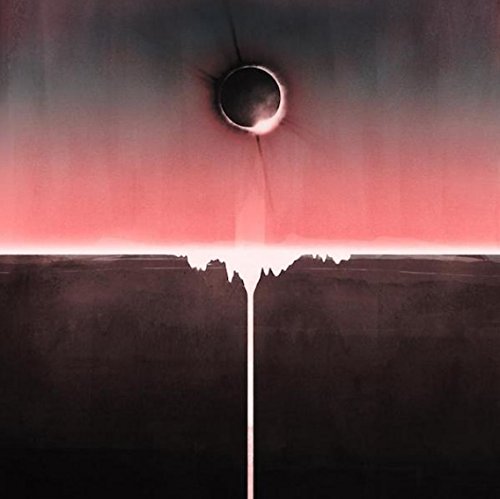
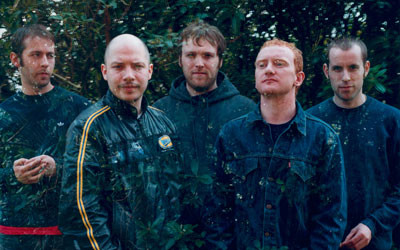
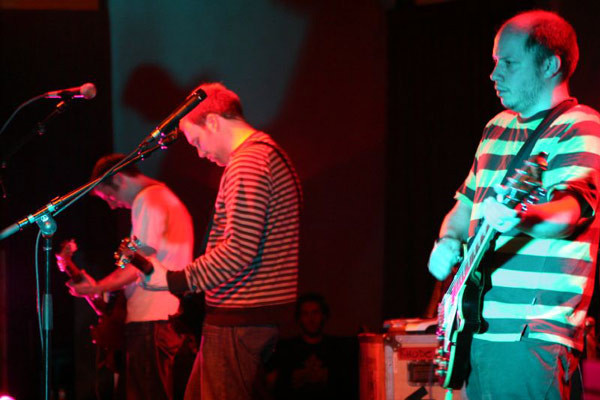
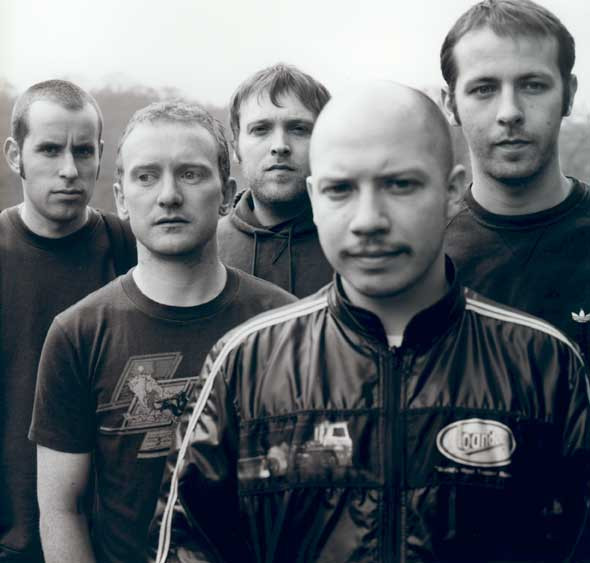

MIKI YUI-DUAL (HOLLOW).
Miki Yui-Dual (Hollow).
Label: Soft Error.
For the best part of fifty years, Scotland has had a vibrant music scene, that has produced many successful artists and bands. They’ve enjoyed success both at home, and abroad. However, to make a breakthrough, many artists and bands had to move to London, which was where the major labels and top recording studios were based. Thankfully, these days are long gone, and Scottish artists and bands no longer need to head south of the border.
Nowadays, Scotland has a thriving music industry, and is home to many well equipped recording studios and record labels. That has been the case since Postcard Records was founded by Alan Horne in 1979. Since then, many other record labels have been founded in Scotland, including Chemikal Underground and Rock Action. These labels are based in Glasgow, where much of the Scottish music industry is situated. The rest of the Scottish music industry is situated in major cities like Edinburgh, Aberdeen and Dundee. That is starting to change.
Recently, filmmaker and sound artists Mark Lyken founded a new label Soft Error, in Dumfries and Galloway, in the South West of Scotland. Mark Lyken say Soft Error specialises in: “small editions of sound art, field recording, drone, sound collage, tape music and unruly electronics.” These limited edition albums are curated by Mark Lyken and are currently released on cassettes, featuring original photography by artist and filmmaker Emma Dove. Her photography is: “created in response to the audio works,” and can be found on Miki Yui’s live album Dual (Hollow), which was recently released by Soft Error. Dual (Hollow) features excerpts from a concert in Düsseldorf in October 2016, and is the first live album that Miki Yui has released during her long career.
Miki Yui was born in Tokyo, Japan in 1971, and when she was growing up, her artistic side began to blossom. Upon leaving high school in 1990, it was no surprise that Miki Yui enrolled at Tokyo’s prestigious Tama Art University. Four years later, Miki Yui graduated as a Bachelor of Art. This was just the start of Miki Yui’s academic and indeed, artistic career.
In 1995, Miki Yui left Japan, and moved to Düsseldorf, in Germany, which twenty-two years later, is still her home. When Miki Yui first arrived in Düsseldorf, it was to study Video Art at Kunstakademie. For the next two years, Miki Yui studied under the Dutch-American artist, Professor Nan Hoover, who was one of the pioneers of video art. When Miki Yui’s course ended in 1997, Miki Yui’s academic career continued.
Later in 1997, Miki Yui enrolled at the Academy of Media Arts, in Cologne, Germany, and for the next five years, studied media art and audio-visual. By then, Miki Yui’s career was well underway.
Miki Yui’s career began in earnest in 1998. That was when the twenty-seven year old began: “working in the field of fine art and music.” Little did she realise that this was the start of a globe-trotting career where Miki Yui would forge a successful and critically acclaimed career: “in the fields of music, drawing, installation and performance.” Despite her versatility artistically, it would be music that would introduce Miki Yui to a wider audience.
Small Sounds.
A year after her career began, Miki Yui released her debut album, Small Sounds in 1999. It was released on the short-lived Bmb Lab label. Small Sounds was an album of carefully sculpted, delicate and minimalist soundscapes. This would become Miki Yui’s trademark sound.
She recently describes her music as: “sonic landscapes emerging out of delicate noises, samples, electronic sounds, and field recordings.” This had proven popular when Miki Yui released Small Sound 1999, and would continue to prove popular throughout her career. So would the music Miki Yui recorded and released with one of Germany’s top musicians.
The Origins Of Japandorf.
As the new millennia dawned, Miki Yui who was based in Düsseldorf, met one of Klaus Dinger in 2000, who during the seventies, was one of the leading lights of the Krautrock scene. Klaus Dinger had been a member of Kraftwerk, and went on to cofound Neu! and later, La Düsseldorf. He was also responsible for his trademark “Dinger beat, which has influenced several generations of drummers. Little did Miki Yui and Klaus Dinger know that that initial meeting in 2000, was the start of an eight year relationship.
Not only did Miki Yui and Klaus Dinger live together, but they eventually played in Japandorf together. That was still to come. Before that, Miki Yui’s solo career continued apace.
Lupe Luep Peul Epul.
Two years after the release of her debut album Small Sounds, Miki You returned with her much-anticipated sophomore album, Lupe Luep Peul Epul. It was released in March 2001, as a limited edition of 500, on the Line imprint. Just like Small Sounds, Lupe Luep Peul Epul was an album of minimalist soundscapes where Elements of ambient, abstract and experimental music were combined by Miki Yui. The result was a captivating and critically acclaimed album from Miki Yui, who was already regarded as one of the rising stars of experimental music. This however, was just one part of the Miki Yui story.
By 2001, there was much more to Miki Yui’s career than music. Her career revolved around: “fine arts and works in the fields of music, drawing, installation and performance.” She had managed to successfully combine and cultivate several different careers since 1998. In doing so, Miki Yui was well on her way to becoming a successful, highly respected and award-winning artist.

Silence Resounding.
Another two years passed before Miki Yui returned with her third solo album, Silence Resounding in July 2003. By then, Miki Yui was still successfully juggling the different parts of career. As a result, the name Miki Yui meant different things to different people. To some, she was an artist, while others knew Miki Yui for her sound installations. Music lovers knew Miki Yui for her ability to create captivating and enchanting albums.
This included Silence Resounding, which was released in July 2003, on the Line imprint as a limited edition of 500. Again, the album featured Miki Yui’s trademark soundscapes. They had been carefully and lovingly honed by Miki Yui, who continued to fuse elements of ambient, abstract and experimental music to create Silence Resounding. These soundscapes caught the imagination of critics and music fans. Silence Resounding they believed, was Miki Yui’s finest moment.

Small Sounds Meet Small Music.
Just a year after the release of her third album, Miki Yui released the first collaboration of her musical career. This was Small Sounds Meet Small Music, which was a collaboration with the late Rolf Julius.
He was a talented and innovative sound and visual artist, sadly, passed away in 2011. Rolf Julius is best known for his installations and sound works. They focused on what John Cage called “small music,” sounds so subtle that they’re hardly audible. The influence of small music was omnipresent throughout Miki Yui and Rolf Julius’ collaboration.
Small Sounds Meet Small Music was a recording of a concert that took place in Torino, Italy on the ‘16th’ of April 2005. It showcased the considerable skills of two talented and innovative musicians and artists. The fruits of their labour was released on the Italian E/Static label later in 2005, as Small Sounds Meet Small Music. Just like her previous albums, Small Sounds Meet Small Music won over critics. Despite her star being in the ascendancy, Small Sounds Meet Small Music was the last album Miki Yui released until 2010.

Miki Yui’s Japandorf Years Part One.
After the release of Small Sounds Meet Small Music, Miki Yui rejoined Japandorf. Over the next few years, its lineup began to take shape.
By 2005, Japandorf’s lineup featured Klaus Dinger and Miki Yui, who had been joined by the Japanese artist Masaki Nakao; keyboardist Satoshi Okamoto, who previously had worked with various J-Pop groups and Kazuyuki Onouchi. While Japandorf were already a popular live draw, their recording career wasn’t going to plan.
Japandorf had already recorded two albums by 2007. When the albums were completed, they were shopped to various record labels. The problem was, none of the labels were interested in releasing either of the Japandorf albums. Despite this, Japandorf headed into the studio again later in 2007.
Recording sessions took place throughout the rest of 2007, and into the spring of 2008. By then, Japandorf had more than enough material for a new album. Sadly, tragedy struck on Good Friday. Klaus Dinger passed away on the ‘21st’ March 2008. He was just three days short of his sixty-second birthday. German music had lost one of its most talented sons, and Miki Yui lost her partner of eight years.
The death of Klaus Dinger looked like the end of the Japandorf story. That wasn’t the case, and the album that Japandorf had been recording would be posthumously released. Before that, Miki Yui would release her long-awaited fourth album, Magina.
Magina.
By then, seven years had passed since the release of Miki Yui’s third solo album, Silence Resounding. Since then, she had released her collaboration with Rolf Jukius, Small Sounds Meet Small Music in 2005, worked with Japandorf, and worked and on a variety of non-musical projects. Eventually, though, Miki Yui found time to complete recording of Magina.
The eleven soundscapes that eventually became Magima had been recorded at the Dingerland-Lilienthal Studio between 2001 and 2010. These soundscapes become Magina, which was released on the Japanese label Hören in December 2010.
Magina was another captivating album of timeless music from Miki Yui, who had fused elements of abstract, avant-garde and ambient music. This resulted in what another critically acclaimed album from Miki Yui after seven years away. Little did critics know, that it would be another six years before she returned with her next solo album. Before that, she returned to the Japandorf project.

Klaus Dinger and Japandorf.
After the death of Klaus Dinger, the album that Japandorf had been working on lay unreleased. Eventually, Miki Yui, who was tasked with curating Klaus Dinger’s musical legacy, began thinking about releasing the album. This must have been painful emotionally. Despite this, Miki Yui was determined to that Japandorf would be released, and that it would be a fitting tribute to her late partner. Little did Miki Yui realise that how problematic the Japandorf would prove.
Originally, Klaus Dinger had envisaged releasing Japandorf as a La Düsseldorf album. The only problem was that Hans Lampe, whom had been Klaus Dinger’s partner in La Düsseldorf, hadn’t played on the album. Despite this, the album was scheduled to be released under the La Düsseldorf name. However, as the release of Japandorf drew closer, Hans Lampe decided to block the release. For Miki Yui, it was a case of back to the drawing board.
Instead, Miki Yui decided that the album should be released as Klaus Dinger and Japandorf, and eventually, it was released om Grönland Records in April 2013. Critical acclaim accompanied the release of Klaus Dinger and Japandorf, which most critics hailed the album a fitting swan-song to Klaus Dinger’s long and illustrious career.
With Klaus Dinger and Japandorf now released, Miki Yui’s thoughts turned to other aspects of her career. This eventually included her fourth solo album, Oscilla.
Oscilla.
This was the long-awaited and much-anticipated followup to Magina, which had been released in 2010. Since then, Miki Yui had spent time ensuring the Klaus Dinger and Japandorf album was released, and had also focused on other parts of her burgeoning career.
Miki Yui was now a successful and highly respected artist. Her music, drawings, installations and performances attracted a global audience. Especially,across Europe and Asia, where Miki Yui’s work had found a wide and appreciative audience. Despite that, she found time to begin work on what became Oscilla.
Eventually, Miki Yui had written and recorded eleven captivating, enchanting and cinematic soundscapes. These soundscapes became Oscilla, which was released on Miki Yui’s new label MY in October 2015.
Critics discovered that Miki Yui had fused field recordings with delicate noises, electronic sounds, samples and analog synths. They played their part in an album of cinematic soundscapes that were guaranteed to set the listener’s imagination racing, as Miki Yui combined elements of ambient, avant-garde and Berlin School, with experimental and small music. The result was Oscilla, which featured Miki Yui at her most inventive on what critics hailed as the finest album of Miki Yui’s career.
Realistic Monk (Carl Stone and Miki Yui)-5.3.17.
After the release of Oscilla, nothing was heard of Miki Yui until earlier this year, when she released the second collaboration of her career. This time, Miki Yui had collaborated with American composer Carl Stone, who specialises in the field of live electronic music. They recorded an album together as Realistic Monk, and 5.3.17 was released in the spring of 2017.
When 5.3.17 was released, critics discovered an album that was a fusion of experimental and abstract music. It was also thoroughly modern and innovative album ‘21st’ Century album. The music on 5.3.17 was made using Carl Stone’s computer and Miki Yui’s samplers. However, the result was another ambitious and captivating album from two of musical pioneers.

Dual (Hollow).
Just four months after the release of 5.3.17, Miki Yui returned with her first live album Dual (Hollow) on July ‘24th’ 2017. This was the fifth album of Miki Yui’s career, and Dual (Hollow) was released on the Soft Error label, which is based in Dumfries and Galloway, in the South West of Scotland. For founder Mark Lyken, the opportunity to release an album of Miki Yui’s music was something of a coup for his new label.
When Dual (Hollow) was released, it featured the SE 03 catalogue number, and was a limited edition of just fifty cassettes. This is perfect timing, as recently, there’s been a resurgence of interest in cassettes. It’s a case of never mind the vinyl, here comes the cassettes. For those that don’t have a cassette deck, Dual (Hollow) is album is also available as a digital download. This means that everyone has the chance to discover Miki Yui’s first like album Dual (Hollow).
Dual Hollow features excerpts from one of the Miki Yui’s concerts, in her adopted home city of Düsseldorf. That night, Miki Yui took to the stage with her samplers and solar oscillators and showcased a number of her compositions. This included the two lengthy soundscapes that feature on Dual (Hollow).
The first soundscape on Dual (Hollow) is Two To One, a near twenty minute epic that features on side one of the album. Then on side two, is another twenty minute opus One To Two. Both soundscapes find Miki Yui taking the listener on an enthralling sonic adventure.
During the sonic adventure that is Two To One, the music on veers between understated and atmospheric to cinematic and chilling as Miki Yui deploys her trusty samples and solar oscillators. Samples emerge from the soundscape as it gradually reveals it sonic secrets. It’s a case of the closer one listens, the more of its secrets Two To One reveals. Sometimes, the music is futuristic and otherworldly, as sci-fi sounds emerge. Soon, the soundscape becomes understated and minimalist as Miki Yui draws inspiration from small music. In the distance, samples of chatter can be heard and one can eavesdrop as this journey continues. Samples of a steam train are added, adding to the feeling of being on a journey. The sound of someone singing, children chattering and a myriad of found sounds are added as the minimalist sound dissipates. Suddenly, it’s a very different soundscape as it continues to evolve, bubbling, cracking, squeaking and droning adding a ruminative and sometimes, menacing sound. Always though, this innovative and cinematic soundscape has the capacity to captivate and set one’s imagination racing.
Flip over to side two and press play, and gradually the understated, dark and almost menacing sound of One To Two begins to reveal its cinematic sound. It’s panned and drones, growing in power, as washes of this dramatic and atmospheric soundscape assails the listener. This proves powerful, chilling and is guaranteed to enthral. The listener is left to provide their own script as wave upon wave of music continue to assail them. Later,the music becomes futuristic, dramatic and mesmeric as beeps escape from soundscape.They add a hypnotic backdrop as rumbling, bubbling and scampering sounds escape from soundscape. Latterly, what sounds like water can be heard in the soundscape, as it bubbles, before beeps, drones, melodic and menacing sound are emitted before this musical voyage draws to a close. It features Miki Yui at her most inventive and imaginative as she creates the second soundtrack to film that has to be made.
The two epic soundscapes on Dual (Hollow) feature Miki Yui at their most inventive and innovative as she takes the listeners on a musical voyage of discover. During this journey, Miki Yui throws curveballs and springs surprises aplenty during these captivating cinematic soundscapes. Even by the end of Two To One, the listener realises that they can never second guess Miki Yui.
She paints pictures using a myriad of samples, field recordings and found sounds. They’re her musical palette, which she puts to good use, throughout Dual (Hollow). It features one of the leading lights of experimental music as they create music that is
dark, broody and moody, and other times, is melodic and Sometimes, it’s chilling, eerie and unsettling, other times, is understated and minimalist. Always, though, the music on Dual (Hollow) captivates and is innovative and inventive, as Miki Yui combines disparate musical genres.
These two genre-melting soundscapes find Miki Yui flitting between and fusing elements of avant-garde, drone, electronic and experimental music and Musique concrète. Miki Yui also draws inspiration from the pioneers of the Berlin and Düsseldorf schools of electronic music, improv and incorporates elements of what John Cage called “small music”during these two ambitious and captivating cinematic soundscapes. They were recorded live, which makes the quality of the music on Dual (Hollow) all the more remarkable.
The recently released Dual (Hollow) is the first live album from the multitalented Miki Yui, and is without doubt, one of the finest albums of her near twenty year career. Dual (Hollow) is also the first album that Miki Yui has released on Mark Lyken’s new label Soft Error, which is based in Dumfries and Galloway, in the South West of Scotland. Hopefully, Soft Error will release many more albums of the quality of Miki Yui’s Dual (Hollow), which features a sonic pioneer at the peak of powers.
Miki Yui-Dual (Hollow).


THE MONKEES -SUMMER OF LOVE-VINYL.
The Monkees-Summer Of Love.
Label: Rhino.
On September the ‘8th’ 1965, the Daily Variety contained an advert that said: “Folk & Roll Musicians-Singers for acting roles in new TV series.” This was a new sitcom that had been written by Bob Rafelson and Bert Schneider about a struggling rock band from Los Angeles. The new sitcom would follow the adventures of Micky, Davy, Michael, and Peter as they searched for their big break. 437 musicians looking for their big break responded to the advert.
Eventually, Bob Rafelson and Bert Schneider whittled their way through the hopeful applicants, and settled on three Americans Micky Dolenz, Michael Nesmith, Peter Tork and British actor and singer Davy Jones. They became The Monkees, which Mickey Dolenz later described as: “a TV show about an imaginary band … that wanted to be The Beatles, [but] that was never successful.”
While The Monkees never replicated the success of The Beatles, Bob Rafelson and Bert Schneider’s television show proved popular in America and further afield. It ran for three series’ between 1966 and 1968, with Americans tuning in to fifty-eight episodes that followed the adventures of Micky, Davy, Michael, and Peter. During this period, The Monkees were one of the biggest selling bands in America.
The Monkees recording career began in October 1966 with their eponymous debut album, and lasted four years. Less than four years later, The Monkees released their swan-song Changes, in June 1970. Within a year, The Monkees has split-up after releasing nine album in less than four years.
These albums divided the opinion of critics and record buyers, and continue to do so, forty-six years after The Monkees originally split-up. Some critics and record buyers regard The Monkees’ music as perfect pop, while others claim it as nothing more than bubblegum pop or manufactured pop. Both sides are firmly entrenched in their views about the merits or otherwise of The Monkees’ music. However, there are other record buyers who are only interested in some of the music The Monkees recorded between 1966 and 1968.
This was when The Monkees released some of the most psychedelic music of their career. Twelve of The Monkees’ most psychedelic songs are documented on a new compilation Summer Of Love, which was recently released by Rhino on red and white splatter vinyl. Given Summer Of Love contains the most psychedelic music of The Monkees’ career this seems fitting.
Rather than document The Monkees’ psychedelic era chronologically, Summer Of Love has been programmed so the compilation flows. This will disappoint many record collectors, who prefer a compilation to be in chronological order, as it allows them to hear how an artist’s music evolves. Alas, that isn’t the case on Summer Of Love. Despite that, Summer Of Love features an oft-overlooked period of The Monkees’ career their psychedelic side.
When The Monkees released Last Train To Clarksville as their debut single on ‘18th’ August, the single started climb the charts, and reached number one in Canada and on the US Billboard 100. This was enough to give The Monkees their first gold disc in America. However, tucked away on the B-Side of the single was a taste of the psychedelic side of The Monkees, Take A Giant Step. It would feature on The Monkees’ eponymous debut album.
The Monkees.
Just a month after The Monkees released their debut single, they released their debut album The Monkees in September 1966. Reviews of the album were mixed, with some critics still not convinced that The Monkees were a serious band. However, the positive reviews outnumbered the negative reviews of The Monkees. It started climbing the charts, and reached number one in Britain, Canada and on the US Billboard 200. The Monkees sold five million copies in America alone, and was certified platinum five times. Micky, Davy, Michael, and Peter’s debut album had proven popular and appealed to a wide range of record buyers.
It wasn’t just fans of pop and rock that were won over by The Monkees. So were fans of psychedelic music. The Monkees’ psychedelic side first emerged on their eponymous debut album. Goffin and King’s Take A Giant Step and David Gates’ Saturday’s Child showcased the psychedelic sound of The Monkees, which was very different to other songs on the album. Maybe The Monkees had designs on becoming a serious band?
More Of The Monkees.
Just four months after the release of The Monkees, America’s version of the Fab Four returned with their sophomore album More Of The Monkees in January 1967. By then, what had been dubbed Monkeemania was in full swing. As a result, More Of The Monkees was rushed out to capitalise on the band’s popularity. This showed, and More Of The Monkees proved not to be the band’s finest hour.
Critics weren’t won over by More Of The Monkees, and their reviews reflected this. They weren’t alone. The Monkees weren’t happy with their contribution to More Of The Monkees. It consisted of adding the vocals, and very occasionally playing the instruments that they were meant to be playing. Mostly, though, the interments were played by members of the Wrecking Crew who stood in for The Monkees. They weren’t happy about this and wanted full artistic control.
Three weeks after the release of More Of The Monkees, Michael Nesmith began lobbying the creators of The Monkees to play their instruments on future records. Don Kirshner who had been brought onboard to secure music for The Monkees was against the idea of The Monkees playing their instruments on future records.Things came to a head a heated meeting between The Monkees, Don Kirshner and Colgems lawyer Herb Moelis. At one point, Michael Nesmith threatened to leave The Monkees. Given the album sales, there was only going to be one winner.
From their third album, The Monkees, not members of the Wrecking Crew would play their instruments. Executives at the Colgems label were scared of upsetting the cash cow that was The Monkees. While More Of The Monkees wasn’t the band’s finest hour, it reached number one in Britain, Norway, Canada and America. More Of The Monkees sold five million copies and was certified platinum five times over. This was pretty good for an album that many considered to be rushed out to cash in on the popularity of Monkeemania.
One of the finest songs on More Of The Monkees is She, which was penned by Tommy Boyce and Bobby Hart. Micky Dolenz adds a vocal on She, which featured The Monkees at their most lysergic. The psychedelic sound of The Monkees would return on their third album, Headquarters.
Headquarters.
Four months after the release of More Of The Monkees, came the release of The Monkees’ third album Headquarters in May 1967. Headquarters which was produced by Chip Douglas, was the first album where The Monkees enjoyed full artistic control over their music. This came at a price.
After the dismissal of Don Kirshner, the songs that he had supervised were discarded. They wouldn’t feature on the album. Instead, it would only feature tracks where The Monkees enjoyed full artistic control. Still, though, session musicians were occasionally used, but they seemed to be a thing of the past.
Another difference was that much of the albums was written by members of The Monkees. This included the Micky Dolenz penned Randy Scouse Git and For Pete’s Sake which was written by Peter Tork and Joey Richards. Both songs were sung by Micky Dolenz and featured the psychedelic side of The Monkees. The strongest of the two tracks is For Pete’s Sake, which were part of a new era for The Monkees.
While most of the reviews of Headquarters were positive, some critics weren’t impressed by the first album where The Monkees enjoyed full artistic control. They felt some of the songs penned by members of The Monkees shouldn’t have made the cut. They wouldn’t if Don Kirshner had been around. His loss cost The Monkees dearly.
When Headquarters was released in May 1967 the album reached number two in Britain and Norway. In North America, Headquarters reached number one in Canada and in the US Billboard 100. However, the album sales were way down, with Headquarters selling ‘just’ two million copies. While this resulted in Headquarters being certified double platinum, the album had sold three million copies less than More Of The Monkees. To make matters worse, when Randy Scouse Git was released as a single, it never came close to troubling the charts. The Monkees had learnt an expensive lesson from Headquarters, that full artistic control came at a cost.

Two months after the release of Headquarters, The Monkees released a cover of Goffin and King’s Pleasant Valley Sunday as a single in July 1967. This example of perfect pop was one of the finest songs of The Monkees’ psychedelic era. It reached number three and was the fourth Monkees single to be certified gold. Maybe The Monkees’ luck was starting to change?
Pisces, Aquarius, Capricorn and Jones Ltd.
There was no let up for The Monkees, who returned with another album in November 1967, Pisces, Aquarius, Capricorn and Jones Ltd. It was a quite different album from Headquarters.
Unlike Headquarters, where seven out of the twelve songs were written by members of The Monkees, only three of thirteen songs were written by the band. The remainder was cover versions, including songs written by successful songwriters and songwriting partnerships. This included Tommy Boyce and Bobby Hart’s Words, Barry Mann and Cynthia Weil’s Love Is Only Sleeping and Goffin and King’s Star Collector. They were joined by Goffin and King’s Pleasant Valley Sunday. These songs would showcase the psychedelic side of The Monkees.
When they came to record Pisces, Aquarius, Capricorn and Jones Ltd, session musicians were drafted in. They had featured to some extent on Headquarters, but played a bigger part in the recording of Pisces, Aquarius, Capricorn and Jones Ltd. This made sense, as they weren’t accomplished enough musicians to record an entire album. The Monkees played their instruments on some of the songs, but elsewhere on the album, session musicians took their place. However, as the years went by, The Monkees improved as musicians.
The Chip Douglas produced Pisces, Aquarius, Capricorn and Jones Ltd was released in November 1967, and was well received by most of the critics. However, The Monkees had their critics, who saw the them as nothing more than a made for television band. That was unfair, as The Monkees had just released one of the best albums, and an album that pioneered the use of the Moog synth.
While Pisces, Aquarius, Capricorn and Jones Ltd was released, it reached number five in Britain, four in Norway and three in Canada. In America, it became The Monkees’ fourth album to reach number one. However, Pisces, Aquarius, Capricorn and Jones Ltd ‘only’ sold two million copies in America, and was certified double platinum. Maybe The Monkees’ popularity had peaked?

The Birds, The Bees and The Monkees.
Five months after the release of Pisces, Aquarius, Capricorn and Jones Ltd, The Monkees returned with their fifth album The Birds, The Bees and The Monkees. It marked the start of a new era for The Monkees, who had rung the changes in their pursuit of full artistic control. The Monkees had dispensed with the services of producer Chip Douglas, who had produced The Monkees first four albums. This was a huge risk.
By the time The Birds, The Bees and The Monkees was released, The Monkees television show had been cancelled. As a result, The Monkees were concentrating all their efforts on their music. Deep down, they wanted to be seen as a serious band. However, still, many critics and record buyers saw The Monkees as a manufactured, made for television band. They hoped that The Birds, The Bees and The Monkees would convince their critics that there was much more to them than that.
For their fifth album, members of The Monkees wrote six of the twelve tracks. This included Tapioca Tundra which was penned by Michael Nesmith. When it was recorded, The Monkees fused psychedelia and country. During the sessions, The Monkees continued to employ session musicians, who added backing vocals on some tracks. This was playing into the hands of The Monkees’ critics, who continued to accuse them of not being a ‘proper’ band. Their fans pointed The Monkees were a successful band, whose first four albums had sold in excess of fourteen million albums.
Before the release of The Birds, The Bees and The Monkees, critics had their say. The reviews were mixed, and again, there was no consensus amongst the critics. Some of the reviews were positive, while other were critical of The Monkees’ fifth album and the first they had produced themselves. With no consensus amongst the critics,record buyers had the casting vote.
The perfect pop of Daydream Believer was chosen as the lead single, and released in October 1967, It reached number one on the US Billboard 100 and was certified gold. Alas, Daydream Believer was the last of The Monkees’ nineteen singles to top the charts. However, the success of Daydream Believer augured well for the release of When The Birds, The Bees and The Monkees.
When The Birds, The Bees and The Monkees was released in April 1968, it failed to replicate the success of previous albums. The album failed to trouble the charts in Britain, where The Monkees had always been popular. It was a similar case in Canada, where The Birds, The Bees and The Monkees stalled at number six. In America, The Monkees was hoping that The Birds, The Bees and The Monkees would give them their fifth consecutive number one album. It was a case of close but no cigar, when The Birds, The Bees and The Monkees reached number three in the US Billboard 200. For The Monkees this was another disappointment. Especially when they heard that the album had sold just over a million copies. While this was enough for a platinum disc, it was a far cry from when both The Monkees and More Of The Monkees sold five million copies. Monkeemania it seemed, was now a thing of the past.
Maybe not? In February 1968, The Monkees released Valleri as the second single from The Birds, The Bees and The Monkees. The followup to Daydream Believer reached number three in the US Billboard 100 and was certified gold. Little did The Monkees realise that Valleri was their last single to be certified gold.
The followup to Valleri was D. W. Washburn, which was released in June 1968. However, it stalled at number nineteen in the US Billboard 100. This was a sign of what was to come
Head.
Four months later, and The Monkees returned with a new single in October 1968. The song that had been chosen was Goffin and King’s Porpoise Song, which featured on the soundtrack to Head. The Monkees had been asked to provide the soundtrack, and with a few friends created a soundtrack that mixed satire and darkness. Porpoise Song was a taste of what The Monkees had in store for their fans. However, the single stalled at a lowly sixty-two in the US Billboard 100, and became the second least successful single when it stalled at a lowly sixty-two in the US Billboard 100. This was worrying as Head was due to be released in late 1968.
Just like their previous albums, reviews of Head were mixed and there was no consensus among critics. While some critics loved the albums, others loathed it. This was nothing new. However, Head was the first soundtrack album The Monkees had recorded, and it featured six songs, including the lysergic Porpoise Song. It’s one of the best songs on Head. These six songs were joined by Ken Thorne’s incidental music, dialogue fragments, and sound effects from the film. As a result, it was very different to previous albums and it was unfair to compare Head to The Monkees’ studio albums. That was what the critics had done.
On the release of Head in December 1968, the album stalled a lowly forty-five in the US Billboard and twenty-four in Canada. This was the lowest chart placing in either country. Across the Atlantic in Britain, Head was the second album that failed to trouble the charts. This was a worrying time for The Monkees.
Not long after the release of Head, Peter Tork left The Monkees, citing exhaustion. The Monkees had recorded six albums in less than three years. They also filmed three series of the television series The Monkees and toured extensively. It was no wonder Peter Tork was exhausted. However, leaving The Monkees proved costly, as he had four years remaining on his contract. After paying a large, six figure sum of money, Peter Tork was no longer a monkey. However, he would feature on The Monkees’ swan-song Good Times!

Good Times!
After the commercial failure of Head, The Monkees didn’t revisit their psychedelic side until 2016, when they were celebrating the fiftieth anniversary of their eponymous debut album. To celebrate the anniversary, a new album was commissioned, which became Good Times!
This was the twelfth album of The Monkees career, and the first album since the death of Peter Tork. He appears posthumously on Little Girl, alongside the remaining Monkees Micky Dolenz, Michael Nesmith and Peter on Good Times! It’s one of thirteen songs on Good Times!, which reached number twelve in the US Billboard 200.
The songs on Good Times! are a mixture of old new and old. Some of the songs are penned by giants of music including the late, great Harry Nilsson and Neil Diamond. Others were written by successful songwriting partnerships like Tommy Boyce and Bobby Hart and the legendary Goffin and King. One of the new songs, Birth Of An Accidental Hipster, was written by Noel Gallagher and Paul Weller and finds The Monkees revisiting their psychedelic side one last time.
The psychedelic side of The Monkees is documented on the Summer Of Love compilation which was recently released by Rhino on red and white splatter vinyl. It features twelve tracks where The Monkees music heads in the direction of psychedelia.
Some of the twelve tracks on Summer Of Love aren’t overtly psychedelic. Instead, they find The Monkees moving in the direction of psychedelia. Maybe this was The Monkees seeking credibility in the eyes of critics and record buyers?
Despite their dalliances with psychedelia, The Monkees never fully embraced the genre like other sixties bands. Maybe it was a relationship that lacked commitment? The Monkees certainly never released a psychedelic masterpiece. However, during their occasional dalliances with psychedelia, The Monkees created several memorable moments, including Pleasant Valley Sunday, and underrated songs like Take A Giant Step, She, Love Is Only, Star Collector and Tapioca Tundra. There is only one forgettable moment on Summer Of Love, and that is Gallagher and Weller composition, Birth Of An Accidental Hipster. Apart from that, Summer Of Love features some of the finest moments of The Monkees’ dalliance with psychedelia.
While The Monkees may have never fully embraced psychedelia like many other sixties bands, ironically, this worked in their favour. The music on their first five albums, including the psychedelic side of The Monkees was accessible and was hugely popular, selling fifteen million copies in America alone. However, by December 1968, The Monkees had already enjoyed the most successful years of their career.
In America six of The Monkees singles had been certified gold, while one album of their albums had been certified platinum, two double platinum and The Monkees and More Of The Monkees had been certified platinum five times over. Never again would The Monkees reach these heights again.
The Monkees split-up in 1971, and later, made several comebacks. They even recorded three albums, including their swan-song Good Times! in 2016. By then, The Monkees had released nineteen singles, twelve studio albums and six live albums between 1966 and 2016. However, still, the most successful period of The Monkees career was between 1966 and 1968.
For just over two years, The Monkees were one of the biggest bands in America. They had found a winning formula, with albums that featured pop, rock and sometimes psychedelia. The psychedelic side of The Monkees is oft-overlooked and makes a welcome appearance on Summer Of Love which documents what were the Good Times! for America’s very own Fab Four.
The Monkees-Summer Of Love.
TIMBILA AND CHARTWELL DUTIRO-SADZA WITH HEAD OF A MOUSE.
Timbila and Chartwell Dutiro-Sadza With The Head Of A Mouse.
Label: Lion Songs.
Nowadays, not many bands stay together for twenty years. Even some of the biggest bands only stay together long enough to releases four or five albums at most. They’re the lucky ones, as many bands only release one or two albums before calling time on their career. By then, they’ve realised just how difficult it is to make a living out of music nowadays.
Especially, through album sales, which once proved one of the most lucrative sources of income for bands. Not any more, as an album is no longer the cash cow that it once was during the late-sixties and seventies, which was a golden age for music. Sadly, these days are gone for good and bands are having to readapt. Those bands that readapt, stand a good chance of enjoying a degree of longevity in the modern music industry.
New York based Afrodelic band Timbila must be doing something right, as 2017, marks their twentieth anniversary. Timbila were formed in Zimbabwe in 1997, when expat Americans met and started to fuse Zimbabwean and Mozambican music with East Village rock. They’ve continued to create this captivating combination of disparate musical genres ever since. It’s allowed Timbila to carve out their own niche in New York vibrant music scene.
Still Timbila found time to collaborate on an album with one of the leading lights of the Zimbabwean music scene, Chartwell Dutiro. The maverick mbira player has been a star of the world music scene for many a year. He too, found time in his busy schedule to collaborate on an album with Timbila. The collaboration between Timbila and Chartwell Dutiro began in 2013, and four years later, Sadza With The Head Of A Mouse was recently released. This long-awaited and much-anticipated album showcases the combined talents of Timbila and Chartwell Dutiro.
The Timbila story began in 1997, when vocalist and multi-instrumentalist Nora Balaban met guitarist Banning Eyre and bassist Dirck Westervelt in Harare, Zimbabwe, in 1997. They were all from different backgrounds, but shared a love of African music.
Nora Balaban explained that he was a veteran of CBGB’s punk and San Francisco’s worldbeat scene in the eighties. He had travelled to Zimbabwe to study two indigenous instruments under master teachers the Harare. Gradually, Nora Balaban was mastering the mbira and timbila, which was a Chopi xylophone. However, Nora Balaban wasn’t the only one with a passion for African music.
So was Banning Eyre, who was a writer and producer for public radio’s Peabody Award-winning program Afropop Worldwide. He hd travelled to Zimbabwe in 1988, to undertake some research for the Afropop Worldwide program. One of the musicians Banning Eyre interviewed was Chartwell Dutiro. The two men got on so well, that they spoke about collaborating in the future.
By then, Banning Eyre was playing guitar, bass and Westervelt banjo with Thomas Mapfumo and The Blacks Unlimited, who were Zimbabwe’s top traditional pop band. His trip to Zimbabwe was a fruitful one. Not only had it furthered his musical career, but introduced Banning Eyre to Chartwell Dutiro and Nora Balaban
It turned out that Banning Eyre and Nora Balaban had much in common, and soon became friends. The two American expat musicians also decided to make music when they returned home.
That was where Banning Eyre and Nora Balaban met the other future members of Timbila, including percussionist Bill Ruyle, who had been seduced by Zimbabwean music. When Bill Ruyle met Banning Eyre and Nora Balaban, he played a drums, a myriad of percussion and tabla. Another addition to Timbila’s ranks was Louisa Bradshaw, a vocalist and actress. She was joined by Rima Fand violinist and vocalist, who can play a variety of different music, ranging from Balkan music to the old-time music of yesteryear. Rima Fand completed Timbila’s lineup, and a musical adventure that has already lasted twenty years, began.
Soon, it became apparent that the members of Timbila were perfectly suited musically as they seamlessly combined Western and African instruments and music when they play live. Audiences watched on as blistering guitars join the buzzing beauty of the timbila and hypnotic dreamy melodies of mbira. They soar above the arrangement, where they’re joined by ethereal, celestial vocals, that fuse ancient Shona and Chopi melodies with contemporary harmonies. Often the vocals are layered as Timbila combine southern African spirituality with expressive and emotive pop. Meanwhile, Timbila have locked down a groove that ranges from fierce and funky to dance-floor friendly. By the end of a gig, every member of Timbila have played their part the band’s sound and success.
Especially guitarist Banning Eyre and Rima Fand who came alive when they improvise. Rima Fand responds to the melodies that emanate from the mbira and timbila, and embarks on yet another musical adventure. So does Banning Eyre, as his fingers fly up and down the fretboard, as he unleashes searing, scorching guitar licks. They’ve been part of Timbila’s potent and heady musical brew for twenty years. This has won them friends at home and abroad.
Someone who had heard about Timbila was Zimbabwean mbira player Chartwell Dutiro. In 2012, it was announced that Timbila were about to collaborate on an album with Chartwell Dutiro, who was one of the leading lights of the Zimbabwean music scene.
Chartwell Dutiro grew up in rural Rhodesia, which in 1980, became known as Zimbabwe. By the age of four, Chartwell Dutiro started playing the mbira. From playing in his village in Southern Rhodesia Chartwell Dutiro began playing at ceremonies conducted by a local. However, this was just the start of a long and distinguished career.
Later, Chartwell Dutiro graduated to performing and recording with one of the biggest names in Zimbabwean music, Thomas Mapfumo The Lion of Zimbabwe. Chartwell Dutiro also played alongside Blacks Unlimited. However, recently, Chartwell Dutiro has divided his time between his solo career, teacher and as a bandleader in his adopted home, Britain.
By then, Chartwell Dutiro was one of the leading lights of Zimbabwean music, and a star of world music. He’s a talented instrumentalist who is blessed with a deeply soulful voice. Chartwell Dutiro puts them to good use when he delivers traditional Shona songs which feature distinctive arrangements. The songs range from innovative to inspirational and allow this gifted storyteller, who also happens to have a wry sense of humour, to take listeners on what many critics describe as an unforgettable musical journey. However, this is only part of the Chartwell Dutiro story.
Chartwell Dutiro has also spent much of his career collaborating with other artists. He’s crisscrossed the world collaborating with many different artists on a variety of projects. Each and every one of these projects are different, with Chartwell Dutiro flitting seamlessly between musical genres since he met Banning Eyre in 1988.
Twenty-four years later, in 2012, came the announcement that Timbila and Chartwell Dutiro were to collaborate together on an album. A year later, and the project that lead to the album Sadza With The Head Of A Mouse began in 2013. At long last, Banning Eyre and Chartwell Dutiro were collaborating together, twenty-five years after they first discussed the possibility.
It took four years before Timbila and Chartwell Dutiro had completed and released the album. However, when Timbila and Chartwell Dutiro were looking for a title to their first collaboration, the paid homage to one of the staple foods of Zimbabwe, the sadza. This lead to Timbila and Chartwell Dutiro naming the album Sadza With The Head Of A Mouse.
This collaboration between Timbila and Chartwell Dutiro is no ordinary album. Instead, Sadza With The Head Of A Mouse is an ambitious double album, which provides a showcase for both sides Timbila and Chartwell Dutiro. On the first disc Sadza, Timbila back Chartwell Dutiro as he delivers new interpretations of seven ancient Zimbabwean songs. Then on the second disc, Chartwell Dutiro takes charge of production as Timbila work their way through eight of their own productions. These two tracks allow Timbila and Chartwell Dutiro to showcase their considerable skills.
Disc One-Sadza.
Chakwi opens Sadza, and finds Chartwell Dutiro delivering an impassioned vocal as he deals remembers the hardships brought about colonialism. This gives way to Bukatiende, a poignant song, that deals with the hardships of life in Zimbabwe during Zimbabwean liberation struggle. Sadness fills Chartwell Dutiro’s voice as he remembers those who were lost during this struggle. Then on Taireva, it’s a case of I told you so, as Chartwell Dutiro recounts how he told the subject of the song that if he didn’t mend his way he would end up in trouble. This Chartwell Dutiro recounts has sadly, come true. Soon, it’s all change.
The tempo rises on Chikende, which is an energetic dance. Before this dance participants apparently eat Sadza With The Head Of A Mouse, which is supposed to be a Shona speciality. However, on the album, Chikende is a joyous call to dance, with Timbila providing the backdrop for Chartwell Dutiro’s scatted vocal. After that, Chartwell Dutiro rings the changes again.
The mbira, timbila and harmonies accompany Chartwell Dutiro’s heartfelt vocal on Chinyan’anya which describes a ritual ceremony, where the participant calls out to their ancestors. Baya Wa Baya is ancient war song, where members of Timbila accompany and augment Chartwell Dutiro on the most soulful song Sadza. Nyuchi closes the Sadza and its mesmeric and understated backdrop provides the perfect accompaniment as Chartwell Dutiro accompanied by Timbila’s vocalists sing of the paradox that is life. Chartwell Dutiro tries to reconcile why life is a mixture of joy and sadness, and hurt and happiness. As he does, he calls out to the ‘protectors’. It’s thoughtful way to end Sadza, which features one of the leading lights of Zimbabwean music as he showcases his soulfulness and his talents as singer, songwriter and musician.
Disc Two-Mouse.
Walking The Pink Fire opens disc two, Mouse and straight away, Timbila are showcasing their inimitable genre-melting sound. They fuse Zimbabwean and Mozambican music with East Village rock and Eastern sounds to create a rocky, soulful, mesmeric and otherworldly track. It sets the bar high for the rest of Mouse.
This includes My Heart Is A Real Thing which is based on Shanje, which is a traditional mbira song. Against the understated arrangement, Nora Balaban’s beautiful heartfelt, vocal takes centre-stage and features Timbila at their most soulful. Bones is also based on another mbira song. Nora Balaban delivers another deeply soulful vocal, while the rest of Timbila create a six-minute, genre-melting epic where the music of two continents combines seamlessly. Just like the two previous songs, Toita Seiko is based on a mbira song. However, this time, the arrangement is much more subtle, and featured traditional instruments, percussion and an acoustic guitar. They provide the backdrop for the vocals that soar above the arrangement becoming part of this beautiful ballad. Soon, it’s all change.
Kachoo was based upon a Chopi timpila piece, and straight away, sounds quite different to the previous songs. As the arrangement meanders along, a myriad of traditional and modern instruments provide the backdrop for Nora Balaban’s vocal. It’s soulful, impassioned and full of emotion as this genre-melting track reveals its secrets. So does Kiss Kiss Abyss, which is based on a mbira song. It features a soul-baring vocal from Nora Balaban, while the rest of Timbila showcase their versatility and considerable talent during this enchanting song. This continues on I’m Gone, which is also based upon a Chopi timpila piece. Later, Nora Balaban’s tender, emotive vocal enters, adding the finishing touch to the song. Closing disc two, Mouse, is Winter To Spring which is based on a mbira song. Nora Balaban’s ethereal vocal plays a starring role, and is one of the best on the album. The rest of Timbila a mesmeric backdrop to her vocal, and later, add harmonies on what’s one of the highlights of the album.
Timbila have saved one of the best until last on Sadza With The Head Of A Mouse, which is the perfect introduction to one of top American Afrodelic bands. They’ve been together since 1997, and the release of their long-awaited and much-anticipated collaboration with Chartwell Dutiro is the perfect way to celebrate their twentieth anniversary. Timbila and Chartwell Dutiro seem to bring out the best in each other on Sadza With The Head Of A Mouse, which was recently released by Lion Songs.
Disc one finds Timbila accompanying Chartwell Dutiro as revisits seven songs from Zimbabwe’s musical past. His interpretations veer between joyous to heartfelt and impassioned to poignant and tinged with sadness and regret. Some of the songs look back at Zimbabwe’s history, while others revisit the country’s traditions. The result is a captivating collection of songs, that are the perfect introduction to one of the leading lights of Zimbabwean music, the maverick mbira player Chartwell Dutiro. However, this was only part of the story of Sadza With The Head Of A Mouse.
The second disc introduces the listener to the inimitable sound of Timbila as the New York based Afrodelic band Timbila fuse Zimbabwean and Mozambican music with East Village rock. Timbila showcase their unique genre-melting sound on disc two. Straight away, it becomes apparent that Timbila is a hugely talented band, with musicians who are able to switch between and seamlessly combine disparate musical genres.
While all the members of Timbila are talented musicians, the band has their very own secret weapon, vocalist Nora Balaban. Her vocals play a big part in the sound and success of Timbila, as she breathes meaning and emotion into the lyrics. Timbila has been fortunate to keep hold of Nora Balaban, who wouldn’t be out-of-place fronting a much bigger band. However, having spent twenty years with Timbila, Nora Balaban must enjoy fronting one of America’s leading Afrodelic bands who showcase their considerable talents on their new album Sadza With The Head Of A Mouse.
For Banning Eyre, the release of Sadza With The Head Of A Mouse is a dream come true. He first met Chartwell Dutiro in 1988, which was when they first discussed working together. Little did they realise it that it would be twenty-nine years before their collaboration would be released.
By then, Banning Eyre had been a member of Timbila for twenty years, while Chartwell Dutiro was one of the leading lights of the Zimbabwean music scene, and divided his time between his solo career and working as a bandleader and teacher. During those twenty-nine years, neither Banning Eyre nor Chartwell Dutiro gave up on their dream of collaborating on an album. That dream came true recently, when Timbila, and Chartwell Dutiro released their ambitious, genre-melting double album Sadza With The Head Of A Mouse which is beautiful, captivating and thought-provoking.
Timbila and Chartwell Dutiro-Sadza With The Head Of A Mouse.
BOBBY HUTCHERSON-HIGHWAY ONE, CONCEPTION: THE GIFT OF LOVE AND UN POCO LOCO.
Bobby Hutcherson-Highway One, Conception: The Gift Of Love and Un Poco Loco.
Label: BGO Records.
Less than three years after Bobby Hutcherson made his recording debut, the twenty-three year old vibraphonist released his debut album The Kicker on Blue Note Records in 1963. This was the start of the most prolific period of his long career.
Over the next fourteen years, Bobby Hutcherson released fifteen studio albums, one live album, two collaborations with Herbie Hancock and five with Harold Land. Bobby Hutcherson was also the go-to-guy for anyone looking for a vibes player and played on over forty albums during his time at Blue Note Records. These albums featured the great of jazz, and most of them were released on the legendary Blue Note Records. However, by 1977, Bobby Hutcherson’s time at Blue Note Records was at an end. His swan-song was Knucklebean, which had been released in 1977. After releasing twenty-one albums for Blue Note Records, Bobby Hutcherson was heading for pastures new.
Next stop for Bobby Hutcherson was Columbia Records, where he released a trio of albums between 1978 and 1980. Bobby Hutcherson’s Columbia Records’ debut was Highway One in 1978, with 1979s Conception: The Gift Of Love and Un Poco Loco following in 1980. These three albums were recently remastered and reissued as a two CD set by BGO Records. This is the first time that Bobby Hutcherson’s Columbia Records’ years have been reissued on CD. It’s the long-awaited opportunity to revisit what was the start of a new chapter in Bobby Hutcherson’s career.…the Columbia Records’ years.
By the time that Bobby Hutcherson signed to Columbia Records, jazz’s number one vibes man was thirty-seven, and had been a familiar face on the American jazz scene since he made his recording debut on the West Coast August 1960.
Nineteen year old Bobby Hutcherson made his debut with the Les McCann Trio, on the ‘3rd’ of August 1960 when they recorded a single that was released on Pacific Jazz in 1961. Just over four months later, and Bobby Hutcherson joined the Curtis Amy-Frank Butler Sextet when they recorded Groovin’ Blue on December the ‘10th’ 1960. This was the first of many albums that featured Bobby Hutcherson’s vibes.
In 1962, Bobby Hutcherson moved to New York, and was living in the Bronx. Although he was determined to make a career as a jazz musicians, he supplemented his income by driving a taxi.
Just over a year later, Bobby Hutcherson had released his debut album The Kicker on Blue Note Records in 1963. This was the start of the rise and rise of Bobby Hutcherson. Over the next four years, Bobby Hutcherson divided his time between his solo career and his work as a sideman. By 1967, Bobby Hutcherson was already a stalwart of the New York scene. Then disaster struck for Bobby Hutcherson.
This came after Bobby Hutcherson and Joe Chambers were arrested for possession of marijuana in 1967. As a result, the twenty-six year old lost his New York City Cabaret Card and taxi license. For Bobby Hutcherson this was a disaster, as he was no longer able to work on New York City’s cabaret circuit or drive a taxi, which was how Bobby Hutcherson had supplemented his income since the earliest days of his career. That was no longer possible. With his New York City Cabaret Card and taxi license revoked, Bobby Hutcherson decided to go west.
Bobby Hutcherson moved to the West Coast in 1967, looking for a new start. While he continued to record for Blue Note Records until 1977, life on the West Coast suited Bobby Hutcherson, and he eventually found a house forty-five miles outside of San Francisco, just off Highway One. This was an idyllic place to live, and would provide the inspiration for Bobby Hutcherson’s first album for Columbia Records, Highway One.
Highway One.
When it became known that Bobby Hutcherson was leaving Blue Note Records, Bruce Lundvall made his move and signed the vibes man. This was the second major coup of the past two years. Bruce Lundvall had signed Dexter Gordon in 1976, and his signing was a commercial success. Soon, Bruce Lundvall got the green light to sign more ‘straight ahead’ jazz musician. This included Woody Shaw and in 1978, Bobby Hutcherson.
Having signed to Columbia Records, Bobby Hutcherson was keen to begin work on his first album since leaving Blue Note Records. He was hoping to replicate the success that Dexter Gordon had recently enjoyed. To help him write his Columbia Records debut, Bobby Hutcherson and his keyboardist George Cable began work.
It was Bobby Hutcherson that came up with the concept of Highway One, which he named after the Pacific Coast Highway that winds its way around the Californian coast. This beautiful coastal road provided the inspiration for Highway Road. However, as Bobby Hutcherson knew, Highway One meant different things to different people. For those travelling from Mexico and South America, it was the road they travelled through on their way to their other parts of the America. As a result, Highway One is representative of everyone who has travelled that road over the years. Highway One which was one of two tracks penned by Bobby Hutcherson, tries to paint pictures of a journey along that famous coastal road.
Having written Highway One, Bobby Hutcherson also wrote Bouquet. His keyboardist George Cables wrote Secrets Of Love, Sweet Rita Suite (Part 2-Her Soul) and Circle. George Cables and producer Todd Barkan wrote Secrets of Love (Reprise). These six tracks were recorded in San Francisco.
Recording of Highway One took place at Wally Helder Studios, San Francisco, California between the ‘30th’ of May and the ‘23rd’ of June 1978. Accompanying Bobby Hutcherson was an all-star band. The rhythm section featured drummer Eddie Marshall and bassist James Leary. Bobby Hutcherson’s go-to keyboardist, George Cables played piano and electric piano, while Cedar Walton drafted in to play on Bouquet. They were joined by percussionist Kenneth Nash, flautist Hubert Laws and Freddie Hubbard on flugelhorn. When it came to record the closing track Secrets of Love (Reprise), vocalist Jessica Cleaves was brought onboard. This left just strings and horns to be overdubbed and Highway One was completed.
The release of Highway One was scheduled for later in 1978. When critics heard Highway One, they were impressed by the first album of Bobby Hutcherson’s post Blue Note Records’ career. It wasn’t just a case of Bobby Hutcherson picking up where he left off at Blue Note Records. He seemed to have been reinvigorated.
That was the case from the suspense and cinematic sound of Secrets Of Love, through to the beautiful ballad Bouquet and the album’s centrepiece Highway One. It finds Bobby Hutcherson painting vivid pictures of a captivating journey down Highway One using broad brush strokes. Sweet Rita Suite (Part 2-Her Soul) finds Bobby Hutcherson and his band playing with fluidity as the track waltzes along in 3/4 time. Pianist George Cables who wrote the track, and Freddie Hubbard on flugelhorn join Bobby Hutcherson in playing leading role on this beautiful, evocative and ruminative track. The quality continues on Circles, which features legionary flautist Hubert Laws. He plays his part in the success of the track, which features one of pianist George Cables’ best solos and a vibes masterclass from Bobby Hutcherson. Bookending Highway One was Secrets Of Love (Reprise), which features vocalist Jessica Cleaves. Her thoughtful almost spiritual vocal elevates what’s a very different version to the original version of Secrets Of Love. It seems that Bobby Hutcherson had kept one of the best until last.
With Highway One finding favour with critics, this augured well for the release of Highway One later in 1978. Upon Highway One’s released, the album found an audience within the jazz community. However, it didn’t follow in the footsteps of Dexter Gordon’s albums for Columbia, and introduce Bobby Hutcherson’s music to the wider audience it deserved. Despite this, Bobby Hutcherson began work on his second album for Columbia Records, Conception: The Gift Of Love in 1979.
Conception: The Gift Of Love.
When work began on Conception: The Gift Of Love, Bobby Hutcherson only contributed one of the seven tracks, No Siree Bob. George Cables wrote Dark Side, Light Side and Quiet Fire. The other tracks included Cedar Walton’s Clockwise, James Leary’s Remember To Smile and Hold My Hand and Eddie Marshall’s Dreamin’. These tracks become Conception: The Gift Of Love which was inspired by the new life that Bobby Hutcherson’s wife Rosemary was carrying.
Recording of Conception: The Gift Of Love took place at A&R Recording Studios and Rudy Van Gelder Studio, Englewood Cliffs, New Jersey. Bobby Hutcherson was joined by some of the same musicians that featured on Highway One, including the rhythm section of drummer Eddie Marshall, bassist James Leary and George Cables on piano and electric piano. They were joined by percussionists Kenneth Nash and Bill Summers and flautist Hubert Laws. The horn section featured trumpeters Jon Faddis, Danny Moore, Anthony Tooley, Joseph Wilder and Earl Gardner; tenor trombonists Robert Alexander, John Gale and Urbie Green;alto saxophonist Lenny Hambro; tenor saxophonists Daniel Trimboli and Frank Wess; while Romeo Pinque played baritone saxophone and bass clarinet. Cedar Walton took produced Conception: The Gift Of Love, which was released later in 1979.
Before that, the critics had their say on what was album number twenty-four for Bobby Hutcherson, Conception: The Gift Of Love. The album was well received by critics, who were won over by an album that took as its starting point hard bop.
This was the music that Bobby Hutcherson grown up listening to and he still loved. However, Conception: The Gift Of Love wasn’t a homage to hard bop. Instead, Bobby Hutcherson reworked hard bop and transformed it into music that would appeal to an audience in 1979. Just like the twenty-three albums that preceded Conception: The Gift Of Love, it was album that was an album that was guaranteed to swing.
That was the case on No Siree Bob, a swinging and irresistible example of hard bop, where Bobby Hutcherson seamlessly flits between 4/4 and 7/4 on the first and second bars of what’s essentiality a twelve bar song. Clockwise is a laid back ballad that features a dizzying solo from Bobby Hutcherson’s vibes. He and George Cables’ piano plays leading roles and vie for supremacy on Clockwise. Joyous and irresistible described Remember To Smile which combines jazz with a samba beat.
Then as Dark Side, Light Side is powered along, contrasts abound as Bobby Hutcherson unleashes a another breathtaking vibes solo. He’s accompanied by pianist and George Cables and the horns, who play their part in the sound and success of the track. It’s a similar case on the beautiful, mid-tempo ballad Hold My Hand. However, it’s Bobby Hutcherson that steals the show. Dramatic describes the horn-driven Dreamin’, before the tempo drops and the Bobby Hutcherson and his band ensure the song swings. Closing the album is Quiet Fire, where the tempo rises and the horns power the arrangement along. They leave space for Bobby Hutcherson who unleashes another flawless solo. He’s accompanied by pianist George Cables, and the two stars of Conception: The Gift Of Love ensures the album ends on a high.
After Conception: The Gift Of Love had received praise and plaudits from critics, the album was released later in 1979. While the album sold well within jazz circles, Conception: The Gift Of Love eluded mainstream record buyers. Still, Bobby Hutcherson was one of jazz music’s best kept secrets, even though he had released twenty-four albums.
Un Poco Loco.
Soon, work began on the twenty-fifth album of Bobby Hutcherson’s career, Un Poco Loco. Just like his previous album Conception: The Gift Of Love, Bobby Hutcherson only penned one track I Wanna Stand Over There, while George Cables contributed Love Song and Ebony Moonbeams. The other tracks included Jack DeJohnette’s Silver Hollow, Bud Powell’s Un Poco Loco, Red Young’s Ivory Coast and The Sailor’s Song which was written by Steve George, John Lang, Jerry Manfedi and Richard Page. These tracks became Un Poco Loco, which was produced by Dale Oehler.
Recording of Un Poco Loco took place at A&M Recording Studios, Los Angeles later in 1979. This time round, the band was quite different to the two albums Bobby Hutcherson had recorded for Columbia. The rhythm section featured drummer and percussionist Peter Erskine, bassist Chuck Domanico, guitarist John Abercrombie and pianist George Cables. They accompanied Bobby Hutcherson who switched between vibes and marimba on Un Poco Loco. It was released in 1980, which marked the start of Bobby Hutcherson’s third decade as a musician.
Prior to the release of Un Poco Loco, critics hailed the album as Bobby Hutcherson’s finest since signing to Columbia. Opening Un Poco Loco was a cover of Page’s The Sailor’s Song, which is laid-back and tranquil, as it ebbs and flows. It gives way to the beautiful, dreamy Silver Hollow where guitarist John Abercrombie steals the show with some flawless and fluid playing. Un Poco Loco is a reworking of Bud Powell’s classic, where Bobby Hutcherson and his band bring it up to date.
Very different is Love Song, another beautiful track from the pen of George Cables. Again, John Abercrombie’s steel-string guitar plays a leading role as the song reveals in secrets and considerable charms. Ivory Coast then moves in the direction of funk and fusion, as Bobby Hutcherson ensures that his music stays relevant. That is certainly the case, as his band showcase their skills. They continue to do so on Ebony Moonbeams, a seven minute epic, where Bobby Hutcherson and his band seamlessly combine jazz and samba on what’s one of the highlights of Un Poco Loco. Closing the bright and breezy I Wanna Stand Over There ensures the album closes on a high.
Bobby Hutcherson had saved his best album until last during his spell at Columbia. Alas, history repeated itself when Un Poco Loco proved popular amongst the jazz community, but failed to find the wider audience that executives at Columbia had hoped. For Bobby Hutcherson, Un Poco Loco marked the end of a two-year spell at Columbia.

Between 1978 and 1980, a newly reinvigorated Bobby Hutcherson released a trio of timeless albums which sadly, have never been reissued. This changed recently, when BGO Records remastered and reissued Highway One, Conception: The Gift Of Love and Un Poco Loco as a two CD set. For jazz fans, this was a welcome reissue and one that they had been waiting for, for a long time. At long-last, these three hidden gems from Bobby Hutcherson’s back-catalogue are available for jazz fans and indeed, all music lovers to enjoy.
Highway One, Conception: The Gift Of Love and Un Poco Loco are carefully crafted and accomplished albums which feature a much more commercial and contemporary sound. This should have introduced legendary vibes virtuoso Bobby Hutcherson and his music to a much wider audience. Sadly, that wasn’t to be.
By the time Bobby Hutcherson left Columbia, the thirty-nine year old had already released twenty-five albums. The first twenty-two albums were released on Blue Note Records between 1963 and 1977. This included some of the best and most important music of his long and illustrious career. Then between 1978 and 1980, Bobby Hutcherson released Highway One, Conception: The Gift Of Love and Un Poco Loco on Columbia. That took his toll of albums to twenty-five.
After that, Bobby Hutcherson continued to record and between 1982 and 2012 released another twenty albums. Sadly, just three years after releasing Somewhere In The Night (Kind of Blue) in 2012, Bobby Hutcherson passed away on August the ’15th’ 2016, aged seventy-five. That day, music lost one of its most talented sons. However, Bobby Hutcherson left behind a rich musical legacy.
This includes around forty-five solo albums, and all the albums which feature Bobby Hutcherson as sideman. For newcomers to Bobby Hutcherson’s music, they’ve plenty of choice. The only problem is separating the best from the rest.
While Bobby Hutcherson recorded some of his best, and most important, albums at Blue Note Records, the trio of albums he recorded at Columbia Records, are, without doubt, among the most underrated albums of his long and illustrious career. Backed by all-star bands, Highway One, Conception: The Gift Of Love and Un Poco Loco feature vibes virtuoso Bobby Hutcherson at the peak of his powers on this trio oft-overlooked hidden gems. They’re a welcome addition to addition to any music collection.
Bobby Hutcherson-Highway One, Conception: The Gift Of Love and Un Poco Loco.
TRANSPARENT DAYS: WEST COAST NUGGETS-VINYL.
Transparent Days: West Coasts Nuggets-Vinyl.
Label: Rhino.
By the summer of 1967, around 100,000 people had arrived in the Haight-Ashbury neighbourhood of San Francisco. Many of those who had arrived were flower children or hippies, who had rejected consumerist values and embraced what was seen as an alternative lifestyle. The flower children, including many students on their summer break, had headed to San Francisco to meet with likeminded people, and to: “tune in turn on drop out.” They weren’t alone.
In other American cities including New York, and in Canada, many young people had embraced the hippie ideals. It was a similar story in parts of Europe, and in Britain. Especially in the capital London, which enjoyed similar gatherings and happenings to those in San Francisco. Just like in San Francisco’s Timothy Leary’s phrase: “tune in turn on drop out” became a mantra.
Suddenly, people were dropping out of society and embracing the hippie ideals and lifestyle. This meant rejecting consumerist values held by the ‘straights’, who rejected the hippie ideals. Some hippies were interested in politics, and were anti the Vietnam War, and campaigned for equality, racism and to legalise ‘pot’. Other hippies believed they were on a spiritual journey, and embraced religion and meditation. Many hippies were more interested in art, and especially painting, poetry and music.
The music that provided the soundtrack to the Summer of Love, included some of the most important and influential music not just of 1967, but the late-sixties. This included The Beatles’ Sgt. Pepper’s Lonely Hearts Club Band and albums by Love, The Doors, Van Morrison, The Jimi Hendrix Experience, Cream, the Rolling Stone and Bob Dylan. These are just a few of the albums that provided the soundtrack to the Summer of Love.
To celebrate the fiftieth anniversary of the original Summer of Love, Rhino have recently reissued a number of albums that provided the soundtrack to the Summer of Love on vinyl. These albums are a mixture of classic albums and cult classics. This includes Van Morrison’s Astral Weeks, The Association’s Insight Out, Arlo Guthrie’s Alice’s Restaurant, The Beau Brummels’ Triangle, The Zodiac’s Cosmic Sounds, Judy Collins’ Wildflower, The Young Rascal’s Groovin’, Dusty Springfield’s Dusty In Memphis, Aretha Franklin’s Aretha Arrives and eponymous albums by Love, Vanilla Fudge and The Electric Prunes. There’s also several compilations, including The Monkees at their most lysergic and a selection of songs from the The Grateful Dead’s earliest albums. Another new compilation from Rhino is Transparent Days: West Coasts Nuggets which was released as a double album on transparent vinyl.
Transparent Days: West Coasts Nuggets was compiled by Alec Palao and features thirty songs that celebrate the Summer of Love. There’s contributions from The West Coast Pop Art Experimental Band, The West Coast Branch, Gerry Pond, The Tikis, Art Guy, The Mojo Men, The Association, The Truth, The Bonniwell Music Machine, The Electric Prunes and Love.
Side One.
In 1967, The West Coast Pop Art Experimental Band released their sophomore album Part One on Reprise. Part One was produced by vocalist Bob Markley, who wrote Transparent Day with bassist Shaun Harris. Transparent Day features the psychedelic rockers at their most melodic on what’s one of the highlights of Part One. It also lends its name to and opens Transparent Days: West Coasts Nuggets.
The West Coast Branch released Linda’s Gone as a single on Valiant Records in September 1966. It’s a John Hill and Joel Lester composition that was produced by Faz-Kay Productions. They play their part in two minutes of genre-melting music. Elements of folk-rock, blues, pop and garage rock are combined by The West Coast Branch on Linda’s Gone.
Another track from the Valiant Records’ vaults is The Motleys’ My Race Is Run. It was the B-Side to You, which was released as a single in March 1966. Both sides were penned by Mitchell Bottler and Harvey Price of The Motleys. Of the two sides, My Race Is Run is the strongest, and is also most melodic and memorable. This long-lost slice of perfect pop from The Motleys, is also reminiscent of The Hollies.
The Rose Garden was founded in 1967, and later that year, the Los Angeles’ based folk rock band signed to Atco Records. During their time signed to Atco Records, The Rose Garden released two singles, one EP and their 1968 eponymous debut alum. In March 1968, The Rose Garden released their sophomore If My World Falls Through, which was the followup to The Rose Garden’s EP, which had been released in January 1968. Tucked away on the B-Side of If My World Falls Through, was Here’s Today. It’s a hidden gem that marries elements of folk rock, pop and psychedelia. Here’s Today is a welcome addition to Transparent Days: West Coasts Nuggets, and one of the highlights of side one.
Side Two.
In September 1966, The Allies, a little-known Los Angeles’ based band, released what proved to be their one and only single, I’ll Sell My Soul on Valiant Records. Even today, mystery surrounds The Allies, who married elements of thunderous garage rock with psychedelic rock on I’ll Sell My Soul. It’s a tantalising taste of what The Allies were capable of, and what might have been?
Prior to becoming The Waphphle, the Sacramento based band were known as The Marauders. By June 1967, The Marauders had been consigned to history, and The Waphphle had released I Want You (To Be My One And Only Girl) on Elektra. Hidden away on the B-Side, was Goin’ Down on a rocky and marauding slice of psychedelia that is guaranteed to leave a lasting impression.
It’s a similar case with the B-Side to The Front Line’s debut single I Don’t Care, which was released on York Records, in October 1965. Tucked away on the B-Side side was the psychedelic garage of Got Love. It lasts just 1.45, but this is long enough for the defiant, explosive and lysergic I Don’t Care to leave a lasting impression. Sadly, The Front Line only released one more single, Saigon Girl in 1967. By then, they left their mark with I Don’t Care.
When The Mojo Men released She’s My Baby as a single in December 1965, it was the fourth single they had released on Autumn Records. She’s My Baby was a cover of a Sly Stone song, that seems to have been inspired by the Rolling Stones, blues and garage rock. The result is whats without doubt, one of the finest singles of Mojo Men’s career.
Side Three.
For their fifth American single, The Association chose Pandora’s Golden Heebie Jeebies, which was released on Valiant Records in November 1966. This was the followup to their number one single Cherish. However, Pandora’s Golden Heebie Jeebies stalled at thirty-five in the US Billboard 100. When The Association released their sophomore album Renaissance in 1967, it also featured Pandora’s Golden Heebie Jeebies. It features The Association marrying sunshine pop and baroque pop with psychedelia on what was one of the highlights of Renaissance, and indeed, Transparent Days: West Coasts Nuggets.
M.C. 2 + only released just four singles between 1967 and 1968. This includes their third single Smilin’, which was produced by Lenny Waronker and released on Reprise in February 1968. By then, The M.C. 2 + had matured as a band. Smilin’ which features The M.C. 2 + at their most melodic on a carefully crafted marriage of psychedelia and baroque pop. It’s a reminder of a truly talented band who should’ve reached greater heights than they did.
It was a similar case with The Ballroom, who in May 1967, released Spinning, Spinning, Spinning on Warner Bros. They were a five piece band that featured Curt Boettcher, Michele O’Malley, Jim Bell and Sandy Salisbury. Spinning, Spinning, Spinning was produced by Curt Boettcher. He also produced the B-Side, which was a cover of Joe Williams’ Baby, Please Don’t Go. The Ballroom transform the song, and take it in new and unexpected directions. Suddenly, Please Don’t Go becomes a lysergic and otherworldly, and very different to previous or indeed, later versions of this oft-covered song.
Side Four.
Los Angeles based Things To Come released a trio of singles between 1967 and 1968. Their sophomore single was the Russ Ward composition Come Alive, which was produced by Dave Hassinger. Come Alive was released on Warner Bros, in January 1968. It finds Things To Come marrying garage rock with psychedelic and Eastern influences. It’s a potent and heady brew, that shows Things To Come at their most inventive.
Nowadays, The Bonniwell Music Machine is regarded as one of the founding fathers of garage rock and psychedelia. They were formed in Los Angeles in 1965, and cultivated a sound that was dark, raw and featured a fusion of proto-punk and psychedelia. That can be heard on The Eagle Never Hunts The Fly which was released as a single on Original Sound in June 1967. It was one of the earliest singles where The Bonniwell Music Machine were billed as The Music Machine. A year later, in 1968, Warner Bros released The Bonniwell Music Machine’s eponymous sophomore album, which featured The Eagle Never Hunts The Fly. The Bonniwell Music Machine was the last album the group released, and is the perfect introduction to a truly influential group.
The Electric Prunes were formed in 1965 in Los Angeles’ San Fernando Valley. Within a year, they had signed to Reprise and released I Had To Much to Dream Last Night, which reached number eleven in the US Billboard 100 in 1966. Little did The Electric Prunes that they had just enjoyed their biggest hit single. Two years later, in June 1968, The Electric Prunes released Shadows, which was a one-sided single. This they hoped would give them another hit single. Alas, commercial success eluded The Electric Prunes and Shadows is one of the ones that got away for the LA based psychedelic rocker
Closing Transparent Days: West Coasts Nuggets is a band who were regarded as the Kings of the Los Angeles’ psychedelic rock scene during the late sixties, Love. By 1968, they had released three albums for Elektra, 1966s Love, 1966s De Capo and the classic Forever Changes in 1967. The following year, 1968, Love released Your Mind and We Belong Together as a single in May 1968. Despite its quality, the single failed to chart, Your Mind and We Belong Together remains one of Love’s hidden gems. It proves the perfect way to close the newest addition Rhino’s long-running Nuggets’ series.
Transparent Days: West Coasts Nuggets which was recently released by Rhino as a double album on transparent vinyl, is welcome addition to the Nuggets series. However, eighteen months ago, fans of this long-running and successful series were wondering if their would ever by another new addition to the Nuggets series? Even the most optimistic thought that this was unlikely.
The Nuggets series made a welcome return on Record Day 2016 with Nuggets Hallucinations: Psychedelic Pop Nuggets From The WEA Vaults. A year later, and Record Store Day 2017 saw the reissue of Come To The Sunshine: Soft Pop Nuggets From The WEA Vaults. Now just three months later, in July 2017, and Rhino released Transparent Days: West Coasts Nuggets, which is the first new addition to the Nuggets’ series since 2009. It has been released to celebrate the fiftieth anniversary of the Summer of Love. So have a number of other classic albums, cult classics and compilations.
Among the reissues are Van Morrison’s Astral Weeks, The Association’s Insight Out, Arlo Guthrie’s Alice’s Restaurant, The Beau Brummels’ Triangle, The Zodiac’s Cosmic Sounds, Judy Collins’ Wildflower and The Young Rascal’s Groovin’. That is not forgetting Dusty Springfield’s Dusty In Memphis, Aretha Franklin’s Aretha Arrives and eponymous albums by Love, Vanilla Fudge and The Electric Prunes. There’s also several compilations, including The Monkees at their most lysergic and a selection of songs from The Grateful Dead’s early albums. Every one of these albums has been released on vinyl, which is how people listened to the albums during the Summer of Love. The only difference is that most of the albums have been released on coloured vinyl. These albums are a perfect introduction to the music that was being released during the Summer of Love.
Especially for younger record buyers, who want to discover some of the most important and influential music released during the Summer of Love. They also have the opportunity to discover several albums that slipped under the radar. It was only much later that these albums were rediscovered, and nowadays, they’re regarded as underground and cult classics.
It’s a similar case with Transparent Days: West Coasts Nuggets, which features everything from baroque pop, garage rock, power pop, sunshine pop, plus psychedelia pop and rock. There’s thirty songs from old friends, familiar faces and new names. They contribute singles, B-Sides and album tracks on a compilation that literally oozes quality. That is what fans of the Nuggets’ series have come to expect since it began in 1984. Thirty-three years later, and that is still the case with latest instalment in the long-running and successful Nuggets series, Transparent Days: West Coasts Nuggets.
Just like previous volumes in the Nuggets’ series, Transparent Days: West Coasts Nuggets is a luxurious and lovingly curated compilation. As befitting such a prestigious series, black vinyl isn’t good enough, so Rhino have used 180 gram transparent vinyl. As a result, Transparent Days: West Coasts Nuggets looks great and more importantly sounds great. It’s sure to bring memories come flooding back for music fans of a certain vintage.
They will remember when some of the songs that feature on Transparent Days: West Coasts Nuggets were part of the soundtrack to the Summer of Love, which this year, celebrates its fiftieth anniversary. Rhino ensures that the Summer of Love celebrates such a prestigious anniversary in style with a string of important reissues and compilations, including the best compilation of them of all, Transparent Days: West Coasts Nuggets.
Transparent Days: West Coasts Nuggets-Vinyl.
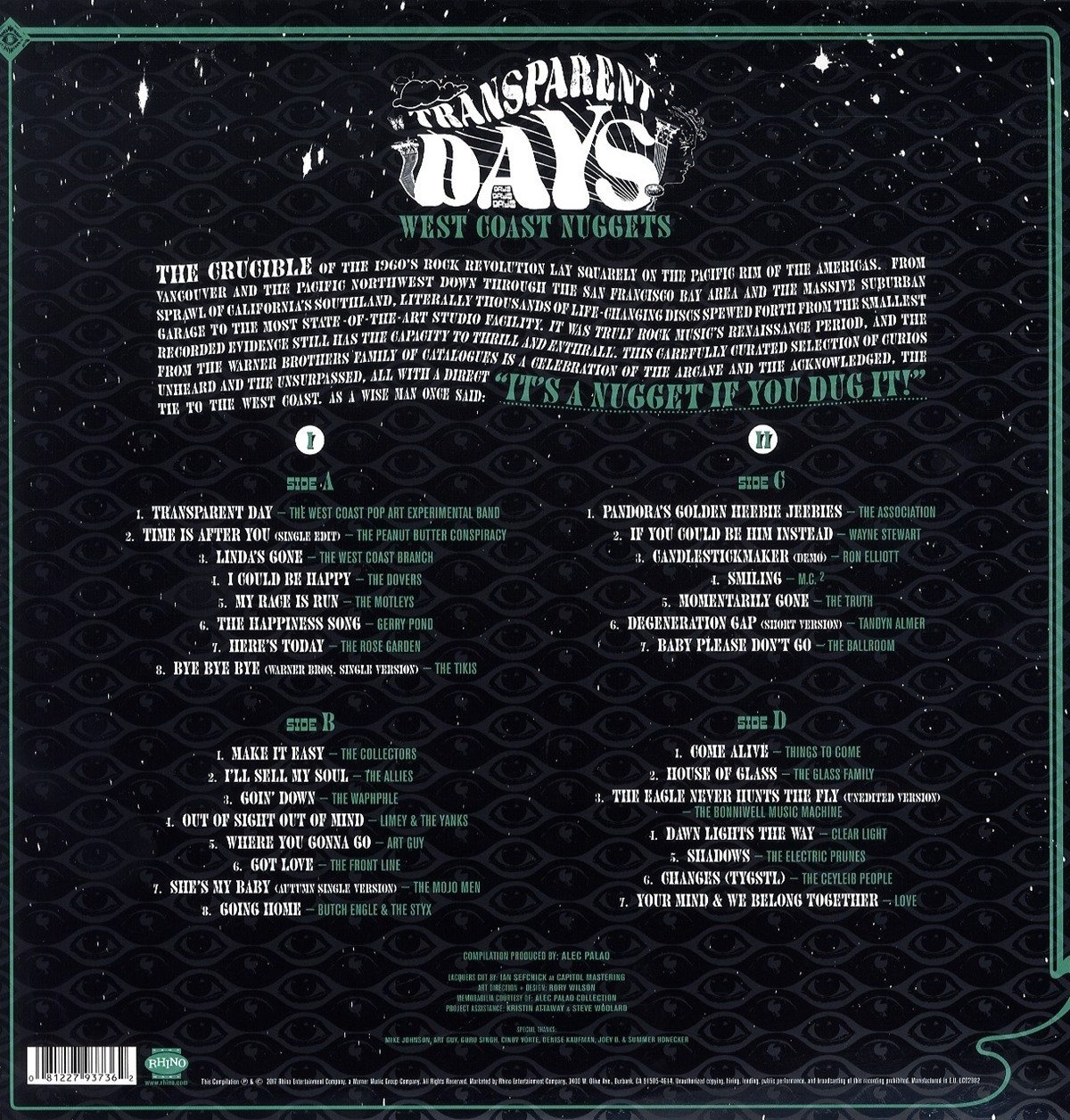
THE MURMAIDS-WHAT MIGHT HAVE BEEN?
The Murmaids-What Might Have Been?
Sadly, musical history is littered with groups that are remembered as one-hit wonders. Their brush with commercial success may have been brief, but at least they enjoyed a tantalising taste of what some established groups take for granted. As a result, after a group has enjoyed one hit single, they want another. This comes as no surprise.
Commercial success and the fame and money it can sometimes bring, are as powerful as any drug. Once experienced, a group can spend the rest of their career trying to reach the same heights. Sadly, often, they never comes close to enjoying the same success.
Part of the problem is that a second hit single always proves to be tantalizingly just out of reach, and the group is destined to be remembered as a one-hit wonder. That was the case with The Murmaids, who had an enviable musical pedigree.
Two of The Murmaids, sisters Carol and Terry Fischer, came from a family that was steeped in music. The two previous generations of their family had been involved in the music industry all their lives. This included their grandmother and her three sisters, who had been part of a vaudeville act, The Locus Sisters. However, Carol and Terry Fischer’s parents were also steeped in music.
Carl Fischer had been a successful songwriter and arranger who had written You’ve Changed, which was recorded by Billie Holliday. Then during a ten-year period where Carl Fischer was Frankie Laine’s musical director, he wrote the jazz standard We’ll Be Together. Sadly, tragedy struck in 1954 when Carl Fischer died suddenly. With two young daughters to support, Terry Fischer Sr. returned to singing with big bands.
That was what Terry Fischer Sr. had been doing when she had first met Carl Fischer. She had sung with various big bands, and became the first female vocalist in Stan Kenton’s Orchestra. Now after the tragic death of her husband, Terry Fischer Sr. was back singing in the big bands. She was a talented vocalist and managed to pickup where she had left off.
Little did Terry Fischer Sr. know that soon, a third generation of her family would be embarking upon a musical career. However, with such a strong musical pedigree, it was almost inevitable that Carol and Terry Fischer would embark upon a career in music. Music was family business.
Terry Fischer Sr. encouraged and supported her daughters, who were proving to be talented singers. They were active in their school’s glee club, and by high school, were music majors. It was around this time, that Carol and Terry met a young songwriter and producer, Mike Postil.
The future Mike Post had just graduated from Los Angeles University High, and had written some songs. Once he had recorded these songs, he would shop them around town. There was a problem though, Mike Post had nobody to sing backing vocals on his demos.
By 1963, Carol Fischer who was fifteen, and Terry Fischer who was seventeen, were living in Los Angeles. For some time, the sisters had been singing with seventeen year old Sally Gordon, who was a friend and neighbour. With Terry Fischer Sr’s help, they were a polished and professional trio. This was what Mike Post was looking for.
When Mike Post met Carol, Terry and Sally, he knew that he had the backing vocalists that he had been looking for. They sang backing vocals on demos for producer Mike Post. Sometimes, Mike Post would bring them in to add backing vocals on some of his productions at Gold Star Studios. That was where Kim Fowley first came across the trio.
By 1963, producer and songwriter Kim Fowley, who was another alumni of Los Angeles University High, was working at Gold Star Studios as an in-house producer. He had already enjoyed hits with Nut Rocker and Alley Oop. However, the twenty-four year old was keen to forge a career as a producer. That was why he had taken the job at Gold Star Studios.
That was also where Kim Fowley first heard the trio sing. Realising that they were talented, he offered to record them. This was the break the trio had been looking for, and they jumped at what could be a once in a lifetime opportunity.
The trio’s first recording session with Kim Fowley was hardly a resounding success. He had them record a version of Alley Oop, but the song didn’t work. Despite that, Kim Fowley wasn’t going to give-up on the trio.
Fortunately, Kim Fowley encountered a talented, but as yet, unknown singer-songwriter, David Gates. The future founder of Bread was driving along one day, when he saw a hitchhiker. Curiosity got the better of David Gates. He stopped and picked up Kim Fowley.
Soon, the two men got talking, and Kim Fowley volunteered that he was a producer. David Gates told him he was a songwriter, and had written a song for a girl group. He reached into the back seat, and produced a guitar, and proceeded to play Kim Fowley Popsicles and Icicles. When Kim Fowley heard the song, he had David Gates send him a demo, as he had someone in mind for the song.
Originally, Kim Fowley felt Popsicles and Icicles would be perfect for Skip Battin, who previously, had been one half of Skip and Flip. However, Skip Battin passed on the song. It was only Kim Fowley remembered the trio he had recorded at Gold Star Studios.
Kim Fowley even had a label lined up for the song. This was Chattahoochee Records, an imprint of Conte Records. It had been formed by Ruth Conte Yardum, with the help of Kim Fowley. Originally, it was to release singles by actor-singer John Conte. However, Conte Records had a pop imprint, Chattahoochee, which Kim Fowley owned a share in. This was the label Kim Fowley planned to release Popsicles and Icicles on. All he had to do was firstly to convince Ruth Conte Yardum about the merits of his masterplan, and then convince Terry Fischer Sr. that this was the right song for her singing trio.
Eventually, Kim Fowley managed to convince Ruth Conte Yardum that Popsicles and Icicles had the potential to be a hit, and that he could record the single for $100 using three high school students. Now Kim Fowley’s only potential obstacle was Terry Fischer Sr. He had to win her over, and her that Popsicles and Icicles had the potential to be a hit. Only then, could Kim Fowley book time at Gold Star Studios. Now he could concentrate on recording the trio’s debut single. However, the trio needed a name.
When the trio arrived at Gold Star Studios, they were now called The Murmaids. Terry Fischer was The Murmaids’ lead singer, and Carol and Sally would add harmonies. The Murmaids were shown the five tracks that Kim Fowley wanted them to record. This included Blue Dress, Bunny Stomp, Comedy and Tragedy and Huntington Flats. However, one track stood head and shoulders above the rest, the David Gates’ penned Popsicles and Icicles.
Given that funds were limited, it was always going to be touch and go whether The Murmaids could record two tracks in the time allotted. They managed to record Popsicles and Icicles but there was no time left to record a B-Side. This didn’t faze Kim Fowley.
Once Kim Fowley tallied up the costs, it came to $108. He hadn’t quite recorded the single for the $100 he had predicted. However, he was convinced he had a hit on his hands. That was despite not having recorded a B-Side. So Popsicles and Icicles was paired with a surf styled instrumental Bunny Stomp and released in late 1963.
When Popsicles and Icicles was released in early November 1963, straight away, The Murmaids’ debut single was being played on the radio. From 119 in the US Billboard 100 on 9th November 1963, Popsicles and Icicles reached sixteen by the 16th November 1963. Eventually, in the charts of 11th December 1963, Popsicles and Icicles peaked at number three on the US Billboard and Cash Box charts. However, in Record World, Popsicles and Icicles reached number one. Little did The Murmaids realise that Popsicles and Icicles would become their only hit single, and they had just joined the ranks of the one-hit wonders.
For their sophomore single, another David Gates’ composition was chosen, Heartbreak Ahead. On the flip side was He’s Good To Me. Kim Fowley wasn’t going to let the record buying public forget The Murmaids, so released Heartbreak Ahead on Chattahoochee Records whilst Popsicles and Icicles was still in the top thirty. This backfired on Kim Fowley, and Heartbreak Ahead stalled at 116 in the US Billboard 100. After two weeks, at 116 in the US Billboard 100 it was a case of Heartbreak Ahead for The Murmaids.
They were on a roller coaster. Their debut single reached number three in the US Billboard 100, but the followup failed commercially. There was nothing wrong with the song. The Murmaids brought the lyrics to life. Much of the blame lay can be laid at aspiring pop impresario, Kim Fowley’s door.
Heartbreak Ahead was released far too soon, and Suddenly The Murmaids had two singles competing for radio play. Three if The Lady Bugs’ cover of How Do You Do It was counted.
Rather than concentrate his efforts on getting The Murmaids career back on track, Kim Fowley had Carol and Terry Fischer record How Do You Do It with Jackie DeShannon. How Do You Do It had given Gerry and The Pacemakers a number one single. The Lady Bugs version was released in February 1964, but failed to make an impression on the charts. This was a worrying trend.
Later in 1964, The Murmaids released their third single, Wild And Wonderful. It came from the pen of the Brill Building songwriting team of Ben Raleigh and Barkan. They had just written Lesley Gore’s She’s A Fool. For the B-Side, Sam Friedman’s Bull Talk. These two tracks were supposed to get The Murmaids’ career back on track.
On its release, Wild And Wonderful never came close to troubling the charts. Wild And Wonderful became The Murmaids’ second single that had failed to chart. Things weren’t looking good for The Murmaids.
After the success of Popsicles and Icicles, major record labels came knocking on The Murmaids’ door and wanting to buy out their contract with Chattahoochee. Terry Fischer Sr. who was managing the group’s career, decided that they should stay to Ruth Conte Yardum and her Chattahoochee Records. That proved to be a huge mistake.
As the summer of 1964 drew to a close, Terry Fischer and Sally Gordon were about to leave home, and head to college. They needed the royalties from Popsicles and Icicles to pay their way through college. However, the royalties weren’t forthcoming.
This lead to Chattahoochee Records having to circulate a memo to other record labels explaining why The Murmaids hadn’t been paid. The memo explained that the funds in a trust for each member of The Murmaids. However, Chattahoochee Records alleged that the agreement hadn’t been honoured by Terry Fischer Sr; and claimed that Sally Gordon had received her funds. The label further claimed that Terry Fischer Sr. had stipulated she had the final say over the other two members participation in the group. However, even fifty-one years later, some of Chattahooche Records claims are disputed.
Recently, Terry Fischer claimed that when The Murmaids received their first royalty statement; “it showed that we were owed nothing at all!” The expenses charged by Chattahoochee Records amounted to $10,000, exactly the sum The Murmaids were owed. Further muddying the waters, was Kim Fowley’s claim that The Murmaids were in breach of contract for recording with The Rip Chords. However, their producer Terry Melcher disputes this claim. What was clear, was that all wasn’t well with The Murmaids and Chattahoochee Records.
Despite this, Chattahoochee Record decided to reissue Bull Talk. The former B-Side was about to enjoy its moment in the sun. There was a reason for this. Shirley Ellis’ single Name Game was riding high in the charts, and just about to reach the top twenty. By then, teenagers were adding the word “bull” to sentences, so that adults wouldn’t be able to understand what they were saying. Ruth Conte Yardum and Kim Fowley thought they could jump on the “bull” bandwagon, and score a novelty hit. That wasn’t the case. Despite this, ‘aspiring pop impresario’ Kim Fowley had another plan up his sleeve.
He decided to repress Popsicles and Icicles. However, he needed a B-Side, so drafted in five new girls who recorded as The Murmaids. They got to sing on the B-Side Comedy and Tragedy, by agreeing to phone a local radio station, and request Popsicles and Icicles. The song that was chosen was played non-stop for a week. However, Comedy and Tragedy wasn’t the only B-Side to the newly reissued Popsicles and Icicles.
When Popsicles and Icicles began garnering more radio play, three other versions of the single were pressed. Each had a different B-Side. Bunny Stomp was followed by Huntington Flats and Blue Dress. As as all this unfolded, the “real” Murmaids were “baffled.” Their group had essentially been hijacked by Kim Fowley and Chattahooche Records. Despite this betrayal, incredibly, Terry Fischer and the rest of the Murmaids returned to the studio.
With Popsicles and Icicles growing in popularity once again, The Murmaids went into the studio and recorded enough music for an album. However, that album was never released until 1980. To make matters worse, The Murmaids were never paid for the session. That wasn’t the end of The Murmaids saga.
Rubbing salt in the real Murmaids’ wound, was that two singles were released baring The Murmaids’ name. Whether any of the original lineup of The Murmaids sung on the two singles is the subject of debate?
The first was Stuffed Animals, which featured Little White Lies on the flip side. On its release, Little White Lies claims to have been: “Produced and Recorded in Britain by Kim Fowley.” Who sung on the single is still disputed. However, when Stuffed Animals was released as a single, it failed commercially. So did the followup.
The Cathy Brasher penned Go Away was chosen as The Murmaids’ next single. On the flip side was Little Boys, which Yvonne Vaughan wrote. When Go Away was released in 1966, the single failed to chart. That was all that was heard of The Murmaids until 1968.
After two years away, The Murmaids returned in 1968 with their swan-song Paper Sun. It was released on Liberty, with Song Through Perception on the B-Side. The only original member of The Murmaids was Sally Gordon. Even she couldn’t revive the group’s flagging fortunes. After five eventful, off and on years, The Murmaids were history.
Fast forward to 1980, and The Murmaids Resurface was belatedly released on the Chattahoochee Records. It featured previously unreleased including Don’t Forget, Alone, Three Little Words, Mr. Sandman, Playmates, So Young and You Cheated. At last, the songs The Murmaids had recorded for the album all these years ago, had been released. It was just a pity nobody bothered to tell Terry Fischer about the release of The Murmaids Resurface.
Terry Fischer only found out about The Murmaids Resurface when a friend discovered a copy at a record fare in the Mid West. They sent Terry Fischer a copy of The Murmaids Resurface. When Terry Fischer looked at the credits to The Murmaids Resurface the producer was Ruth Conte. This was just the latest twist to The Murmaids story. Seventeen years after they first signed to Chattahooche Records, The Murmaids was proving to be the gift that kept on giving.
That wasn’t the case for Terry Fischer and the other two Murmaids. Even today, they’ve no idea of how many records they really sold. That is somewhat ironic.
After the commercial success of Popsicles And Icicles, major labels were knocking on Terry Fischer Sr’s door wanting to buy The Murmaids’ contract out, and sign them to their label. Terry Fischer Sr. decided to stay loyal to the label that gave The Murmaids’ their break. Sadly, that proved to be a huge mistake.
If The Murmaids had signed to a major, they could’ve enjoyed a much more successful career. They wouldn’t be remembered as a one-hit wonder. The Murmaids, a talented trio, deserved much better. Certainly much better than happened next.
Less than a year later after spurning the advances of major labels, The Murmaids never received the royalties they were owed. This couldn’t have come at a worse time, as Terry and Sally Gordon were about to head off to college. By then, The Murmaids’ story was almost at an end. It had lasted around six months.
During that period, The Murmaids had played live a few times, and made a couple of appearances on television. After six months, The Murmaids’ story was all but over. That’s despite singles being released for another four years.
These singles were either songs the original lineup of The Murmaids recorded, or different lineups put together by musical ‘impresario’ Kim Fowley. The only other time Terry Fischer entered a recording studio as a Murmaid, was to record The Murmaids Resurface, which was belatedly issued in 1980. By then, The Murmaids had long joined the one-hit wonder club.
While the one-hit wonder club may not be the most exclusive club in the world, at least The Murmaids enjoyed a brief, but tantalising taste of fame and commercial success. Although it didn’t last long, nor proved particularly profitable, at least The Murmaids enjoyed their moment in the spotlight, and enjoyed what every band dreams of, a hit single.
The Murmaids-What Might Have Been?



FUZZY HASKINS-THE WESTBOUND YEARS.
Fuzzy Haskins-The Westbound Years.
Between 1970 and 1977, Fuzzy Haskins was a member of not one, but two of the most prolific and successful funk bands of the seventies,..Parliament and Funkadelic. They released a total of fourteen albums, which sold in excess of 2.5 million copies. Still, though, Fuzzy Haskins found time to embark upon a solo career.
Fuzzy Haskins released his debut album, A Whole Nother Thang on Westbound Records in 1976. Two years later, and Fuzzy Haskins returned with his sophomore album Radio Active in 1978. However, these two solo albums are just part of the story of Fuzzy Haskins time at Westbound Records. Making music it seems, was what Fuzzy Haskins was born to do.
Clarence Eugene “Fuzzy” Haskins was born on June ‘8th’ 1941, in Elkins, West Virginia. That was where the future Fuzzy Haskins became interested in music. Just like many future singers, the church influenced Fuzzy Haskins. Some nights, the Haskins family would join together and they would sing hymns. They would harmonise together, which would stand Fuzzy Haskins in good stead for the future. So would the music he heard on local radio.
At first, it was country music that Fuzzy Haskins heard on the local radio station. Later in the evening, there would sometimes be an hour of R&B and blues music. So much so, that Fuzzy Haskins was inspired to go out and buy a three-stringed guitar for $3, which he taught himself how to play. This would stand him in good stead when the Haskins family moved to New Jersey in 1956.
By then, Fuzzy Haskins was fifteen and still at high school. When he arrived in New Jersey, Fuzzy Haskins joined a high school band The Bel-Airs. He would be a Bel-Air for four years, until he met George Clinton 1960.
George Clinton was nineteen, and working in a New Jersey barbershop when Fuzzy Haskins first met him. They both shared a love of music and were members of vocal groups. While Fuzzy Haskins was a Bel-Air, George Clinton lead his own group The Parliaments, who had already released their debut single Poor Willie, a year earlier, on the Apt label in 1959. Soon, Fuzzy Haskins would be joining The Parliaments.
The Parliaments.
When one of The Parliaments left the group, Fuzzy Haskins was chosen as his replacement. Little did Fuzzy Haskins realise when this was the first step on a journey that would see him joined The Parliaments that would see him inaugurated into the Rock and Roll Hall of Fame in 1997.
Having joined The Parliaments, Fuzzy Haskins was soon singing lead vocal. He was also regularly travelling to Detroit. The first time was to audition for Motown. While The Parliaments weren’t signed to Motown, they were soon a familiar face on the Detroit music scene
Not only were The Parliaments a familiar face on Detroit’s live circuit, they also released singles on several local labels during the sixties. This included on Jobette and then Revilot Records, which released The Parliaments’ breakthrough single (I Wanna) Testify. It reached number three on the US R&B charts and twenty on the US Billboard 100. However, for four of The Parliaments, (I Wanna) Testify was a Pyrrhic victory.
At the time The Parliaments recorded (I Wanna) Testify, the band were experiencing cash-flow problems. They didn’t have enough money for the bus fare from New Jersey to Detroit. After a group meeting, it was decided that only George Clinton would travel to Detroit to record (I Wanna) Testify. Ironically, when (I Wanna) Testify was released in May 1967, it gave The Parliaments’ the biggest hit single of their career. As a result, The Parliaments embarked upon a promotional tour.
After touring (I Wanna) Testify, The Parliaments returned to the studio to record a followup single All Your Goodies Are Gone (The Loser’s Seat). When it was released in September 1967, The Parliaments embarked upon another tour. Despite this, All Your Goodies Are Gone (The Loser’s Seat) failed to replicate the success of (I Wanna) Testify. This was the start of what was a familiar pattern.
Never again did The Parliaments come close to replicating the success of (I Wanna) Testify. However, it was during this period that things started to change for The Parliaments.
Not only did The Parliaments’ sound begin to evolve, and move towards a psychedelic soul style, the lineup changed. Joining George Clinton, Fuzzy Haskins, Calvin Simon, Grady Thomas and Ray Davies were the backing band of Eddie Hazel, Billy Nelson and Tiki Fulwood. They became known as Funkadelic, as The Parliaments were locked in a lengthy legal dispute.
This resulted in The Parliaments being unable to release any recordings for the next few years. However, George Clinton decided to transform The Parliaments’ backing band into the main event, Funkadelic.
Funkadelic.
The nascent band set about honing the P-Funk sound, which was a fusion of blues, funk and rock. This would make its debut on Funkadelic’s eponymous debut album, which featured the Fuzzy Haskins composition I Got a Thing, You Got a Thing, Everybody’s Got a Thing. Later in 1970, it was released as a single, reaching eighty in the US Billboard 100 and thirty in the US R&B charts. By then, Funkadelic had released their eponymous debut album.
Funkadelic.
When Funkadelic was released by Westbound Records on February ’24th’ 1970, what was a groundbreaking album where psychedelic soul, funk and acid rock melted into one. While Funkadelic was well received by critics at the time, it would only be much later, that critics realised and recognised the importance of the album. By then, Funkadelic had reached 126 in the US Billboard 200 and eight in the US R&B charts upon its release. For Fuzzy Haskins, Funkadelic was a game-changer.
In 1967, The Imperials couldn’t afford to pay the bus fare from New Jersey to Detroit to record a single. Three years later, and Funkadelic were basking in the success of their eponymous debut album, which had reached the top ten in the US R&B charts. Now Fuzzy Haskins knew that Funkadelic had do it all again.
Free Your Mind… and Your Ass Will Follow.
Fuzzy Haskins, George Clinton and the rest of Funkadelic entered the studio in Detroit to record their sophomore album Free Your Mind… and Your Ass Will Follow. George Clinton later described the album Funkadelic trying to: ”see if we can cut a whole album while we’re all tripping on acid.” What Funkadelic had achieved, was a critically acclaimed, genre-melting album.
When Free Your Mind… and Your Ass Will Follow was released in July 1970, reaching ninety-two in the US Billboard 200 and eleven in the US R&B charts. Five decades later, and Free Your Mind… and Your Ass Will Follow is regarded a classic. So is the followup, Maggot Brain. However, before its release, Parliament would make release their debut album.
Parliament-Osmium.
September 1970 marked the release of Parliament’s debut album Osmium. It featured the five members of The Parliaments and the three members of Funkadelic. They had created an ambitious, experimental and genre-melting album where funk, psychedelic soul and psychedelic rock melt into one. The result was an ambitious and innovative album, but alas, was one that failed to find an audience. This was a huge disappointment, and things were about to get worse.
Contractual difficulties meant that Parliament were unable to record under the name Parliament, until 1974. This meant that George Clinton, Fuzzy Haskins and Co. concentrated their efforts on Funkadelic.
Funkadelic-Maggot Brain.
A year after the release of Free Your Mind… and Your Ass Will Follow, Funkadelic released their third album Maggot Brain in July 1971. By then, Eddie Hazel, Billy Nelson, Tawl Ross and Tiki Fulwood had left Funkadelic for a variety of reasons. Funkadelic were a band divided.
They weren’t alone. Maggot Brain divided the opinion of critics. Some critics hailed the album bland and boring, others hailed it a masterful funk rock album. Nowadays, Maggot Brian is regarded as a classic album, and a truly influential psychedelic rock album that’s dance-floor friendly. Record buyers were also won over by Maggot Brian, which reached 108 in the US Billboard 200 and fourteen in the US R&B charts. While this wasn’t quite as successful as their previous album, Funkadelic’s star was still in the ascendancy.
America Eats Its Young.
Ten months after the release of Maggot Brian, Funakdelic returned in May 1972 with America Eats Its Young. It was Funkadelic’s first double album, and featured a very different lineup of the Funkadelic that had joined George Clinton and Fuzzy Haskins.
While America Eats Its Young featured contributions from Eddie Hazel, Billy Nelson, Tawl Ross and Tiki Fulwood, Funkadelic were joined by members of two other bands. This included United Soul and the funk group The House Guests They were a five piece band which had been founded in 1971 by brothers Bootsy Collins and Catfish Collins after they left The JBs. These two bands augmented Funkadelic on America Eats Its Young.
Just like Maggot Brain, America Eats Its Young divided the opinion of critics. Although it received praise and plaudits from some critics, other critics weren’t won over by what was a sprawling album. That was part of America Eats Its Young. Just like many double albums, there was more than enough material for a single album, but in truth, not enough for a double album. As a result, America Eats Its Young stalled at 123 in the US Billboard 200 and twenty-two in the US R&B charts. This was the least successful album of Funkadelic’s career. For Fuzzy Haskins, this was a disappointment. However, it was the least of his worries.
Cosmic Slop.
When it came time for Funkadelic to record their fifth album Cosmic Slop, there was no sign of Bootsy Collins nor Fuzzy Haskins. He had been a mainstay of Funkadelic on their first four albums. Not any more though, as his role in Funkadelic started to change post 1972. He would add the occasional vocal on an album or play guitar. Sometimes, he would even head out on tour with Funkadelic. However, no longer was he one of the mainstays of the group.
Upon the release of Cosmic Slop in July 1973, most of the reviews were positive. There were still a few dissenting voice who weren’t convinced by P-Funk. This included Cosmic Slop, which later, was hailed as one of Funkadelic’s most important albums. However, in July 1973, Fuzzy Haskins watched as Cosmic Slop reached 112 in the US Billboard 200 and twenty-one in the US R&B charts. Commercially the album hadn’t fared much better than America Eats Its Young.
Standing on the Verge of Getting It On.
Fuzzy Haskins returned for Standing on the Verge of Getting It On, which was released in April 1974. It was a very different album from Cosmic Slop, with the music and jamming playing a more important role than the lyrics on the album. Especially, Eddie Hazel’s guitar, which plays a starring role on Standing on the Verge of Getting It On. With a guitar masterclass from Eddie Hazel and the return of Fuzzy Haskins, would this result in a change of fortune for Funkadelic?
Despite favourable reviews, Standing on the Verge of Getting It On failed to match even the success of Cosmic Slop. It stalled at 163 in the US Billboard 200, but reached thirteen in the US R&B charts. While this was disappointment, at least Parliament were free to record a new album.
Parliament-Up For The Down Stroke.
After a four-year absence, Parliament returned with their sophomore album Up For The Down Stroke. It was the first album since 1972s America Eats Its Young to feature Bootsy Collins, who cowrote two tracks on the album. Fuzzy Haskins also cowrote two tracks, Up For The Down Stroke and All Your Goodies Are Gone. This was the first time that Fuzzy Haskins’ had contributed a song for an album since Funkadelic in 1970. The members of Parliament hoped that Up For The Down Stroke would prove as successful as Funkadelic.
When Up For The Down Stroke was released in July 1974, it featured a reworking of The Parliaments’ hit (I Wanna) Testify, which became Testify. However, Up For The Down Stroke was released as the lead single, reaching sixty-three in the US Billboard 100 and ten in the US R&B charts. Testify was chosen as the followup, but stalled at just seventy-seven on the US R&B charts. By then, Up For The Down Stroke had reached seventeen on the US R&B charts. It looked as if Parliament’s was changing. Fuzzy Haskins had played his part in the success of Up For The Down Stroke.
Chocolate City.
April 1975 marked the return of Parliament with their third album. This time around, Fuzzy Haskins cowrote I Misjudged You and Bigfootin’, and was one of the vocalists used on Chocolate City. It was Parliament’s tribute to Washington DC, where the band had a large following. This became apparent when Chocolate City was released.
Most of the reviews of Chocolate City were positive. However, there were a few dissenting voices who weren’t won over by Chocolate City. They felt it wasn’t as cohesive an album as its predecessor. Despite that, Chocolate City reached ninety-one in the US Billboard 200 and twenty-two in the US R&B charts. 150,000 copies of Chocolate City were sold in Washington DC alone. This was the start of period when Parliament could do no wrong. It looked as if Fuzzy Haskins would play an important part in the Parliament story.
Funkadelic-Let’s Take It to the Stage.
Just a couple of weeks after Parliament released Chocolate City, Funkadelic returned with their seventh album Let’s Take It to the Stage in late April 1975. It featured ten tracks, including Good to Your Earhole which Fuzzy Haskins cowrote. He was one of the vocalists that featured on Let’s Take It to the Stage.
Let’s Take It to the Stage found Funkadelic at their tightest, as they lived up to their early promise. This time, there were no dissenting voices among the critics and it was critical acclaim that accompanied Let’s Take It to the Stage. It reached 102 in the US Billboard 200 and fourteen in the US R&B charts. This meant that Let’s Take It to the Stage was Funkadelic’s most successful album since Free Your Mind… and Your Ass Will Follow in July 1970. Soon, that would pale into comparison when Parliament released their next album.
Parliament-Mothership Connection.
When the latest lineup of Parliament returned with their fourth album Mothership Connection in December 1975, it featured two new additions…Fred Wesley and Maceo Parker. They joined what was fast becoming an all-star band that featured the great and good of funk. It already featured George Clinton, Bootsy Collins, Bernie Worrell and Fuzzy Haskins. The addition of Fred Wesley and Maceo Parker resulted in what critics hailed as the best album of Parliament’s career.
Mothership Connection was an innovative and influential funk rock concept album based on P-Funk mythology. It reached number thirteen in the US Billboard 200 and four in the US R&B charts. Soon, Mothership Connection had sold over 500,000 copies and was certified gold. Eventually, Mothership Connection sold a million copies and gave Parliament their first gold disc. For Parliament it was a career defining album.
Fuzzy Haskins-A Whole Nother Thang.
Despite the success of Mothership Connection, Fuzzy Haskins was growing frustrated that his songs were no longer featuring on albums by Funkadelic and Parliament. He also watched as Bootsy Collins, a relative newcomer to the Funkadelic and Parliament family, embarked upon a solo career. This added to Fuzzy Haskins’ frustration.
Fuzzy Haskins and George Clinton went back a long way together. He had joined George Clinton in The Parliaments in 1960, fifteen years ago. Since then, Calvin Simon, Grady Thomas and Fuzzy Haskins had shared good times and had bad with George Clinton. Maybe though, Fuzzy Haskins had to think about the future. So he decided to record a solo album during the time Funkadelic and Parliament weren’t recording or touring.
For his debut solo album A Whole Nother Thang, Fuzzy Haskins wrote eight of the nine songs. He also wrote Fuz and da Boog with Funkadelic and Parliament bassist Cordell Mosson. He was one of the members of the Funkadelic and Parliament family who joined Fuzzy Haskins when he recorded A Whole Nother Thang.
Recording took place at three studios in Detroit, Artie Fields Studios, Pac Three Studios and United Sound Studios. Joining Fuzzy Haskins was rhythm section that featured drummers Tiki Fulwood; bassist Bootsy Collins and Cordell Mosson who also played drums; and guitarists Donald Austin and Ron Bykowski. Keyboardist Bernie Worrell also arranged strings and horns. Fuzzy Haskins played drums, added the lead vocals and produced A Whole Nother Thang. It was released in the first half of 1976.
When A Whole Nother Thang was released in 1976, it was released to critical acclaim. That was no surprise, as A Whole Nother Thang featured some of the backlog of songs that had built up over the last few years. At last, Fuzzy Haskins got the opportunity to showcase these songs when he entered the studio with creme de la creme of P-Funk. The result was album that oozed quality. Despite the quality of music on A Whole Nother Thang, the album didn’t sell in vast quantities, and didn’t find the audience it deserved.
After the release of A Whole Nother Thang, Fuzzy Haskins returned to the Parliament and Funkadelic family. He had to rejoin the P-Funk Live Earth Tour in late 1976. By then, Parliament and Funkadelic had both been busy.
Parliament-The Clones Of Dr. Funkenstein.
Nine months after the release of Mothership Connection, came The Clones of Dr. Funkenstein in September 1976. Parliament were keen to build upon the success of their million selling album. By then, George Clinton, Bootsy Collins and Bernie Worrell had established a successful songwriting partnership. Still, Fuzzy Haskins remained one of the vocalists on what was a critically and commercially successful album of P-Funk.
Just like Mothership Connection, The Clones Of Dr. Funkenstein was hailed as one of Parliament’s finest albums. Although it didn’t quite match Mothership Connection, The Clones Of Dr. Funkenstein sold well, reaching twenty on the US Billboard 200 and three in the US R&B charts. Fuzzy Haskins was now a member of one of the biggest selling funk bands of the seventies.
Funkadelic-Tales Of Kidd Funkadelic.
Not long after Parliament released of The Clones Of Dr. Funkenstein, Funkadelic released their eighth album Tales Of Kidd Funkadelic. It was the last album that Funkadelic were contractually obliged to release for Westbound. Already, Funkadelic had recorded their Warner Bros’ debut Hardcore Jollies. Tales Of Kidd Funkadelic was essentially an album of outtakes and unused recordings from the Hardcore Jollies. It was rushed out to cash-in on the success of Parliament’s album The Clones Of Dr. Funkenstein.
This was a risky move, and one that could’ve backfired on Funkadelic. Especially if the album didn’t find favour with critics or failed to sell. Fortunately, the album was well received by critics and upon its release in September reached 103 in the US Billboard 200 and fourteen in the US R&B charts. Now Funkadelic signed to Warner Bros and a month later, released their major label debut.
Hardcore Jollies.
In October 1976, Funkadelic released their ninth album Hardcore Jollies. It featured the best of the tracks recorded during a recording session that took place earlier in 1976. Funkadelic were at their inventive best on an album that featured inventive and genre-melting funky music.
Critics hailed Hardcore Jollies as one of Funkadelic’s best and strongest albums of recent years. It reached ninety-six in the US Billboard 200 and twelve in the US R&B charts. This was the most successful album Funkadelic had released since Free Your Mind… and Your Ass Will Follow in 1970.
Live: P-Funk Earth Tour.
After the success of Hardcore Jollies, Fuzzy Haskins joined true rest of the Parliament and Funkadelic family on the P-Funk Live Earth Tour in October 1976. The tour continued into 1977, when the Live: P-Funk Earth Tour arrived Los Angeles. At the show at the Los Angeles Forum on the ‘19th’ January the tapes were running for a live album. That was the case at the Oakland Coliseum on the ‘21st’ January 1977. Recordings from these two shows would feature on Parliament’s live double album Live: P-Funk Earth Tour, upon its release in May 1977.
By then, three of the original members of The Parliaments, Fuzzy Haskins, Calvin Simon, and Grady Thomas had left the band. Not long after the three former Parliaments left the band, Glen Goins parted company with Funkadelic. This was no surprise.
The P-Funk Live Earth Tour was a hugely expensive tour to take on the road. Given the expenses, it was imperative that the show sold out, each night. That wasn’t the case, and as throughout the tour, it lost money. By the end of the P-Funk Live Earth Tour had lost so much money, that the musicians weren’t getting paid. When they received the news, Fuzzy Haskins, Calvin Simon, and Grady Thomas left the P-Funk family.
The only small crumb of comfort came when Live: P-Funk Earth Tour was certified gold upon its release in May 1977. By then Fuzzy Haskins was looking towards the future, and his sophomore album, Radio Active.
Radio Active.
Having left the P-Funk family, Fuzzy Haskins began work on his sophomore album Radio Active. He penned six of the songs and cowrote Silent Day with Cordell Mosson. The other song on Radio Active was the Glenn Goins composition This Situation Called Love. These eight tracks were recorded with some top musicians, including some of the P-Funk family and members of the Funk Mob.
When it came to recording Radio Active, Fuzzy Haskins and his band headed into one of Detroit’s many studios. That was where he and his multitalented band laid down the eight songs. Accompanying him was drummer Jerome Brailey, bassist Cordell Mosson and guitarists Garry Shider and Michael Hampton. They were joined by keyboardist Bernie Worrell, percussionist Jerome Podgajski and Glen Goins who played drums, guitar and piano. Meanwhile, Gary Schunk played synths and piano and Bruce Nazarian played bass synth. Fuzzy Haskins switched between drums and guitar, while taking charge of the lead vocals and production. Once Radio Active was complete, it was released later in 1978.
Recording Radio Active hadn’t been easy for Fuzzy Haskins, who was finding it hard to reconcile his life as a musician to his newfound spirituality. Throughout the recording of Radio Active, Fuzzy Haskins was conflicted, and was constantly questioning what he had done and was doing. Considering he was producing the album, other musicians were looking to Fuzzy Haskins for guidance, it can’t have been an easy album to record. Fortunately, most of the musicians were experienced and were able to overcome any problems arose. However, by the time Radio Active was released Fuzzy Haskins seemed detached from the project.
So much so, that he never even embarked upon the tour Westbound Records financed to promote Radio Active. Given his detachment from the Radio Active project, it was no surprise when the album failed commercially. That was shame given the quality of some of the songs on Radio Active.
After the release of Radio Active, Fuzzy Haskins, who was a truly talented and versatile singer, songwriter and musician, never released any further solo albums.
Instead, Fuzzy Haskins turned his back on the music industry and became a preacher. It was only after a chance meeting with Armen Boladian that Fuzzy Haskins recorded a gospel album. This resulted in Fuzzy Haskins working with Calvin Simon, Ray Davis and Grady Davis of The Parliaments. They were reunited as the Original P, but never recorded together. It was just four old friends making music together, like it had once been. That was how The Parliaments started out in 1960.
As a result, the final secular songs that Fuzzy Haskins recorded were those that featured on Radio Active when it was released in 1978. They marked the secular swan-song of the truly talented Fuzzy Haskins, before he embarked upon a career as a preacher. Seven songs from Radio Active feature Got My Thang Together: The Westbound Years, which was released by Westbound Records, an imprint of Ace Records, and is a reminder of Fuzzy Haskins’ solo career.
Fuzzy Haskins-The Westbound Years.

I WANT YOU, I NEED YOU!: GARAGE-BEAT NUGGETS FROM THE FESTIVAL VAULTS.
I Want You, I Need You!: Garage-Beat Nuggets From The Festival Vaults.
Label: Playback Records.
Nowadays, the Festival Records’ vaults are a regarded as a musical treasure trove, and is proving a popular hunting ground for compilers and reissue label. This includes one of Playback Records who on the ‘4th’ of August 2017 will release I Want You, I Need You!: Garage-Beat Nuggets From The Festival Vaults. It features twenty-six tracks from The 5, Toni McCann, The Black Diamonds and The Pogs, who were all signed to Festival Records during the sixties, when it was Australia’s leading independent label.
Festival Records was established in Australia on the ’21st’ October of 1952, by one of Australia’s first merchant banking companies, Mainguard which had been founded by Paul Cullen. He had bought two small companies based in Sydney, Microgroove Australia which was a record pressing company and Casper Precision Engineering. These two companies were merged and became Festival Records.
A turning point for the nascent Festival Records came in 1954, when it managed to secure the Australian rights to Bill Haley and The Comets’ 1954 single Rock Around The Clock. It became the biggest selling Australian single, much to the chagrin of the executive at EMI Australia who had turned down the single. For Festival Records this was a game-changer.
So was Festival Records’ decision to sign Australian rock ‘n’ roll bands. They were the first Australian label to do so, and they were able to sign Australia’s Big Three groups of the fifties Johnny O’Keefe and The Dee Jays, Col Joye and The Joy Boys and Dig Richards and The R’Jays. The popularity of the Big Three resulted in Festival Records’ profits trebling. Despite this, Mainguard was experiencing financial problems and Festival Records was sold to Australian property tycoon LJ Hooker in 1957.
The new owner of Festival Records, LJ Hooker was a music fan, and took an interest in the day-to-day running of the label. A year after the label changed hands, Johnny O’Keefe and The Dee Jays’ single Wild One reached number one in 1958. Another of the Big Three, Col Joye and the Joy Boys enjoyed four number ones during 1959. To outsiders, Festival Records looked like a successful label. However, it continued to lose money, and in 1961, Festival Records was sold to Rupert Murdoch’s News Limited.
Festival Records hadn’t been Rupert Murdoch’s first choice when he went in search of a record label. He tried to buy the Australian division of the American label Ampar. However, soon, the new owner of Festival Records was making his mark on his latest acquisition.
A then unknown Herb Alpert and The Tijuana Brass were recommended to Festival Records in 1962 by Sydney based DJ Bob Rogers. Festival Records decided to take a chance on Herb Alpert and The Tijuana Brass, and they made a breakthrough with The Lonely Bull. It was a worldwide hit, and its success in Australia lead to Festival Records signing a distribution deal with Herb Alpert’s A&M Records. This proved to be a profitable business deal, and helped transform Festival Records’ fortunes.
Under the astute stewardship of chairman Alan Hely, Festival Records became one of the most successful Australian record labels during the sixties. So was the New Zealand operation, Festival Records (NZ), which was a separate company, but was also chaired by Alan Hely. Festival Records was well on its way to becoming the biggest record label in Australasia, and would eventually surpass EMI in the seventies. By then, The 5, Toni McCann, The Black Diamonds and The Pogs, would’ve passed through Festival Records’ doors a decade earlier. They feature on I Want You, I Need You!: Garage-Beat Nuggets From The Festival Vaults which features twenty-six songs from The 5, Toni McCann, The Black Diamonds and The Pogs.
The 5.
The first group to feature on the compilation are The 5, who were a Brisbane based quintet. It featured vocalist Ronnie Williams, who up until late 1964, had been in a duo with his brother who sung in a local nightclubs called DBs. However, in late 1964, Ronnie Williams and joined forces with members of a band that had just split-up.
It was also the end of the Williams’ brothers’ duo. However, Ronnie Williams asked their guitarist Barry Pearson to join The 5. Eventually, its lineup included drummer Peter Thompson, bassist Ian Jacobs, guitarists Stan Lenz and Barry Pearson and vocalist Ronnie Williams. They became The 5, which were signed by Ivan Dayman, who sent the nascent group out onto the Brisbane live circuit.
This he knew would allow The 5 to hone their sound and learn stagecraft. The 5 soon proved popular on the local live scene, and in 1965 the band moved to Melbourne.
The 5 stopped off in Sydney to record their debut single I’ll Be There which was released on Festival Records’ Sunshine imprint in October 1965, with How Can She Know on the B-Side. By then, guitarist Barry Pearson had left to complete his apprenticeship and was replaced by Andy Paradise. He was only a temporary replacement, and Barry Pearson returned for the recording The 5’s sophomore single.
This was There’s Time, which featured I Can’t Find Her on the B-Side. There’s Time which is a power pop cult classic, was released on Sunshine in February 1966 and reached the lower reaches of the Melbourne Top 40. Five months later, The Five as they were now billed, returned with their third single Bright Lights, Big City in August 1966. Tucked away on the B-Side was the hidden gem, Wasting My Time which is one of the most melodic songs The Five recorded. Sadly, it was also one of the final songs they recorded.
Although they continued to play live until 1967, there were a couple of changes in the lineup. Eventually, the band ran its course and they went their separate ways in 1967.
Toni McCann.
Brisbane born Toni McCann was just fifteen in 1965, when she made her recording debut. Toni McCann was around at the same time as The 5, and they often shared the bill. Just like The 5, a great future was forecast for Toni McCann, who was known for her powerhouse of vocal.
There was much hype surrounding Toni McCann, who had signed to Festival Records’ imprint, Sunshine Records, which was run by Ivan Dayman. By then, Toni McCann had won a number of local talent contests, and was a familiar face on the Brisbane live circuit. However, when she signed to Sunshine Records, Toni McCann was sent out on a package tour where she played what was known as the Sunshine circuit. That was where many heard Toni McCann’s inimitable voice, who come critics would later compare to Wanda Jackson and Mick Jagger.
After returning from her tour of the Sunshine circuit, Toni McCann recorded her debut single, My Baby, with No on the flip-side. When it was released in July 1965 the fifteen year old vocal was billed as Toni McCann With The Blue Jays. It features a vocal powerhouse from Toni McCann, and a fifteen-second scorching guitar solo from Mal Clarke who wrote My Baby. Despite the quality of what’s one of the wildest Australian garage rock singles, My Baby failed to chart.
Four months later, and Toni McCann returned in December 1965 with Saturday Date, which featured If You Don’t Come Back on the B-Side. By then, Toni McCann was a regular on Australian television. Saturday Date which much more raucous and rocky than its predecessor, featured another vocal powerhouse from Toni McCann. However, it failed to find an audience and it was back to the drawing board for Ivan Dayman.
He hit on the idea of Toni McCann and Royce forming a duet, that he hoped would see them become Australia’s answer to Sunny and Cher. Toni and Royce released By Some Love in 1966, had a garage beat and influence, but again, failed commercially. After this, Toni and Royce’s singles headed in the direction of folk and pop. For Toni Royce, her garage beat years were over.
Black Diamonds.
The Black Diamonds were from Lithgow, in New South Wales’ coal fields. This was also where they served their musical apprenticeship, playing mostly, at local dances. Before long, The Black Diamonds were soon an accomplished band, and their music went down well among the people who by day mined The Black Diamonds.They were won over by the thunderous drums, pulsating bass line, fuzzy guitars and charismatic frontman Glenn Bland. So too was a local DJ.
This was DJ Bob Jolly, from 2LT, who thought that the Black Diamonds were destined for bigger and better things. He helped the Black Diamonds to record demos which were sent to Festival Records. These demos were heard by producer Pat Aulton, who saw the potential in The Black Diamonds.
Soon, The Black Diamonds was ensconced in Festival Records’ Sydney studio, where they would record their debut single. The song chosen See The Way, with I Want, Need, Love You on the B-Side I Want, Need, Love You, which were both penned by band member Alan Oloman. When these songs were recorded, The Black Diamonds released their debut in late 1966.
When See The Way was released on Festival Records in November 1966, this memorable and melodic fusion of power pop and psychedelia passed record buyers by. This was ironic, as the Black Diamonds were one of the most accomplished of the Australian garage bands, and their carefully crafted debut single was streets ahead of many similar releases.
For their sophomore single, The Black Diamonds decided to cover J.J. Cale’s Outside Lookin’ In, with the hidden garage gem Not This Time on the B-Side. Just like their debut single, Outside Lookin’ In showcased an accomplished and talented band. However, Outside Lookin’ In was quite different from their debut single. It was a ballad, which showed a very different side of The Black Diamonds. When Outside Lookin’ In was released in March 1967, the single failed to trouble even the local charts. For The Black Diamonds this was a disappointment, but they hoped that it would be a case of third time lucky.
In late 1967, The Black Diamonds moved to Sydney, and soon, they were a familiar face on the local live scene. Despite this, The Black Diamonds changed their name to Tymepiece as 1968 dawned. This resulted in a change in fortune for the group.
Not long after this, Tymepiece recorded The Bird In The Tree as a single. Around this time, Festival Records’ producer Pat Aulton asked the members of Tymepiece if they would record a song anonymously as his studio band The Love Machine. They agreed, and also agreed to record another single as The Tokens.
Pat Aulton wanted The Tokens to cover The Lion Sleeps Tonight, with The Lonely Hearts Club Christmas Party on the B-Side. Both sides feature on I Want You, I Need You!: Garage-Beat Nuggets From The Festival Vaults. Once The Lion Sleeps Tonight was recorded, it was released in the summer of 1968
By August 1968, Tymepiece were enjoying a hit single with The Bird In The Tree. Love Machine were also enjoying a top twenty hit and The Tokens were riding high in the charts with The Lion Sleeps Tonight. For the group that started life as The Black Diamonds, this was ironic. They had never enjoyed a hit single, but since changing their name and adopting two separate aliases, they now had three hit singles in the charts at the same time. While this must have pleased them, it must have been galling that The Black Diamonds’ music never enjoyed the success it deserved.
The Pogs.
The last group to feature on I Want You, I Need You!: Garage-Beat Nuggets From The Festival Vaults are The Pogs, who were formed in Sydney by fifteen year old actor, singer and lead guitarist Rory O’Donahue. He had already appeared in a number of stage productions, but had decided to turn his attention to music and formed The Pogs.
Joining Rory O’Donahue in The Pogs were drummer Paul Brownlow, bassist Roco Bellantonio and rhythm guitarist Nino Bellantonio. They were all older than the precocious and youthful frontman. Soon, the band were playing on the lucrative Sydney Northshore party circuit and became the house band at the University of Sydney’s Architectural revues which were organised by Graeme Bond. Playing at the revues was good experience for The Pogs, and resulted in them meeting Pete Best.
He was a friend of Graeme Bond’s, who had recently won a songwriting competition. Pete Best was looking for a band to record these songs, and The Pogs fitted the bill. Now all The Pogs needed was a recording contract. Fortunately, Pete Best had a contact at Festival Records, when they heard The Pogs signed them to their Leedon imprint.
The first single that The Pogs signed for Festival Records’ Leedon imprint was Claret and Tears, which featured Heidi on the B-Side. Claret and Tears was released in July 1966, and Leedon had high hopes for Pete Best produced single. Despite a slick, accomplished sound the folk-rock of Claret and Tears failed to find an audience, and it was back to the drawing board for The Pogs.
Three months later, The Pogs returned with Now That It’s Over in October 1966, which featured Hey, Miss Thompson on the flip-side. Both sides were penned and produced by Pete Best, who was a talented songwriter and producer. Equally talented was The Pogs, on the rueful, melodic Now That It’s Over. However, just like Claret and Tears, commercial success eluded The Pogs’ sophomore single. For The Pogs, it was a frustrating time.
They hoped their luck would changed as 1966 gave way to 1967. I’ll Never Love Again was released in January 1967, with The Pogs’ Theme on the B-Side. Just like their two previous singles, I’ll Never Love Again was penned and produced by Pete Best. However, just like The Pogs’ two previous singles, I’ll Never Love Again failed to trouble the charts.
After three carefully crafted, but ultimately unsuccessful singles The Pogs, were needing a hit single. Leedon wouldn’t keep releasing singles that failed to find an audience. For their fourth single, the Pete Best composition Scenes From An Affair was chosen, with another of his songs Goodnight, But Not Goodbye on the B-Side. This was somewhat ironic.
Six moths after the release of I’ll Never Love Again, The Pogs released the cinematic Scenes From An Affair in August 1967. Sadly, history repeated itself when the single failed to trouble even the lower reaches of the charts. For Pete Best, it was Goodnight, But Not Goodbye.
In late 1967 Pete Best moved to Melbourne where he wrote advertising jingles. This he had experience of, having written the Aboriginal Referendum Jingle for the referendum in May 1967. It was sung by The Fogs, who after Pete Best moved to Melbourne, were left to right their own songs.
The Pogs changed their name Oak Apple Day, and released two singles. However, the change of name didn’t result in a change in the group’s fortunes. In 1972, Rory O’Donahue had returned to theatre, and Festival Records continued on their way to becoming Australia’s biggest record label.
By the seventies, the Festival Records’ vaults was a musical treasure trove, and forty years later, that is still the case. Many compilers and reissue label are beating a path to Festival Records’ vaults in search of musical treasure. This included Playback Records who on the ‘4th’ of August 2017 will release I Want You, I Need You!: Garage-Beat Nuggets From The Festival Vaults. It features twenty-six tracks from The 5, Toni McCann, The Black Diamonds and The Pogs. This includes singles and B-Sides, including many an oft-overlooked hidden garage gem.
The 5, Toni McCann, The Black Diamonds and The Pogs never enjoyed the success that their singles deserved. Not one of the singles on I Want You, I Need You!: Garage-Beat Nuggets From The Festival Vaults charted. Instead, each and every one of these singles passed record buyers by.
These singles were very different, ranging from uptempo rockers, to thoughtful ballads. While some were cover versions, many were new songs were written by talented songwriters. These songs were carefully crafted by some of Festival Records’ top producers. However, the most important people were the musicians, including The 5, Toni McCann, The Black Diamonds and The Pogs. They recorded songs that ranges from raw, raucous garage rock to folk rock, power pop and psychedelia. However, they all have the one thing in common…quality. They’re also timeless, and were recorded between 1965 and 1967, which was the start of a golden period for music. A reminder of that period is the twenty-six timeless songs on I Want You, I Need You!: Garage-Beat Nuggets From The Festival Vaults, which features long-lost, hidden gems aplenty.
I Want You, I Need You!: Garage-Beat Nuggets From The Festival Vaults.
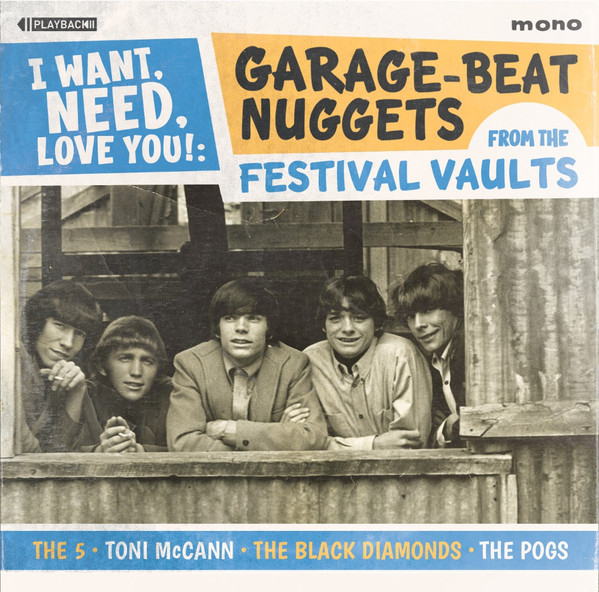
AMMOYE-THE LIGHT.
Ammoye-The Light.
Life has been easy for Jamaican-Canadian singer and songwriter Ammoye, who has had to cope with a number of setbacks during her life. This has made the three-times Juno nominated singer stronger, and inspired Ammoye to keep following her dream of becoming a successful singer-songwriter. It’s a dream that she has never lost sight of, even over the last few years, when times were tough. Still Ammoye kept believing that one day, she would become a successful singer-songwriter. Now two years after the release of Enter The Warrioress in 2015, Ammoye returns with her new album, The Light, on July the ’28th’ 2017. The Light is the latest chapter in Ammoye’s story, and is the album she hopes that will introduce her music to a new and wider audience.
Ammoye was born in Jamaica, and named after the Italian word for love. She was brought up by her grandparents in Clarendon, Jamaica. Sometimes, though, growing up in Jamaica wasn’t easy, but Ammoye was able to overcome the trials and tribulations of island life. One way was through music, which offered an escape for Ammoye.
She always loved to sing, and from the age of five Ammoye knew that she wanted to become a singer. While she sang at home in the backyard, it was at church where Ammoye first sung in front of an audience. This she enjoyed and thrived upon. So much so, that when she returned home she had the confidence to sing the songs and read the poetry she had written. By then, Ammoye’s artistic side was developing and shining bright.
By the time Ammoye left high school at Clarendon College, she moved to Toronto, Canada where her mother was living. Ammoye who still attended the local church, formed the Sisters In Christ group. However, the move to Toronto was where her career started to take shape.
To help further her nascent musical career, Ammoye formed The Voices Of The Underground Artist Movement. This new organisation gave local artists who were similar to Ammoye, the opportunity to perform and promote their music. The new organisation was welcomed by the local artists, and was well supported.
After forming The Voices Of The Underground Artist Movement, Ammoye became heavily involved within Toronto’s thriving and vibrant music scene. Ammoye was even involved in several collaborations. By then, Ammoye’s music combined a variety of disparate genres, ranging from rock, reggae and R&B to drum and bass, hip hop and soul. This was just the start for Ammoye.
Over the next few years, Ammoye’s sound began to develop. Her music fused the soulfulness of her Jamaican roots with muscular groove of R&B and the tough edge of drum and bass. This sound proved popular, and Ammoye found herself singing alongside Michael Buble, and with the rock band The Arkells. By then, Ammoye was winning both fans and awards, including three Junos , which are Canada’s equivalent to the Grammy Awards. This was just part of the story.
In 2010, Ammoye and Rise Ashen collaborated on the album Haffi Win, which was well received by critics. Soon, Ammoye was being booked to sing at major festivals and shows on four different continents. Suddenly, Ammoye found herself sharing the stage with Barrington Levy, Freddie McGregor, Beenie Man, Sean Paul, Chris Martin, Ziggy Marley, Chronixx, Romain Virgo and, Tarrus Riley and Exco Levi. Ammoye had come a long way since she sung in her grandparent’s backyard in Jamaica.
By 2013, Ammoye was receiving recognition for all her hard work when she was nominated for Juno Awards in 2013. The following year, 2014, Ammoye was once again nominated for a Juno award. However, it was around this time that Ammoye’s life changed.
That was when Ammoye underwent a spiritual experience which totally transformed her worldview. Ammoye started to rethink what her identity meant. Previously, she had felt defined by the pain and hurt she had experienced, and held back by the burdens of her past. For Ammoye: “it was uplifting, and it helped me see that piece of God in everyone. I had to put it into song.” This spiritual awakening would influence Ammoye as a songwriter.
In 2015, Ammoye released a new album, Enter the Warrioress. It was well received upon its released, and critics forecast a bright future for the Jamaican-Canadian singer and songwriter.
Two years later, and the self-styled “soul rebel” is just about to release her new album The Light. Ammoye admits that: “I call myself a soul rebel,” which is one of the themes on The Light. Ammoye explores this theme on the song Soul Rebel. “It’s about following your soul path, the path of your higher self. This is especially important for black women, who are told they are less than, that they don’t matter. I follow my inner voice, my intuition.” This is something that Ammoye decided to do a couple of years ago.
Following her intuition led to Ammoye’s spiritual awakening, and resulted in her returning home to Jamaica, where she started looking for musicians to collaborate with on her next album. Ammoye hit the musical jackpot, when two veterans of Jamaican music agreed to collaborate with Ammoye. Sly Dunbar collaborated on Jah Jah, while Donovan Germain on Don’t Count Me Out and Inna De Ghetto, two veterans of Jamaican music agreed to collaborate with Ammoye. They were joined by Dubmatix on Outta Town and Reggae Rockit Boy, while funky Kingston duo Natural High Music produced Soul Rebel, Honeymoon, Cool Gypsy Island, Cool Vibez, Guns Off The Street and Cool Gypsy Island. This all-star lineup played their part in an ambitious nineteen track album.
Fourteen of the nineteen songs on The Light were written by Ammoye, who wrote the other five tracks with a variety of songwriting partners. However, what is apparent is that Ammoye is maturing as a songwriter. There’s a reason for this: “I use my own experience to push my writing. My music has a message of love”. Ammoye also wants her songs to affect women positively: “I want to inspire women and girls to find that sense of love and light within themselves, not outside themselves. I want to share the messages I have gotten, the healing I’ve received. I hope people find that in the music.”
When Ammoye writes songs, she writes from the heart. Other songs can be inspired from daily life, including melodies that she hears. “It may be something I hear in a movie, or something a friend says that moves me” Ammoye says. She also describes who she changes when she’s writing a song: “I always go into a meditative state when I’m writing and let my intuition guide me.” One such song on The Light was Jah Jah, where Ammoye was inspired after hearing a friend play a guitar riff. Suddenly, the scenario for the song started to take shape, and she began recording it on her phone. Not long after this, Ammoye was playing the song to reggae legend Sly Dunbar, who loved the song and agreed to produce it. This was a sign of how far Ammoye had come in what’s sill a male dominated music.
Reggae is one of the few remaining musical genres that are male dominated. However, Ammoye is a pioneer, who is determined to level the playing field, and inspire a new generation of female reggae singer. This includes Jah9, who has been struggling to receive the recognition she deserves. Hopefully, a new wave of reggae singers will follow in Ammoye’s footsteps and make a breakthrough.
This breakthrough hasn’t been easy. It’s taken time, strength and persistence. Ammoye deals with this on Don’t Count Me Out, which deals with some of the hardships and hurdles she’s had to overcome. . “I had to heal, but I was headed back to Jamaica…I couldn’t record, but I could still write. I took the tracks that Donovan gave me and sat there on the veranda, at my aunt’s, right across the beach. I get a lot of inspiration around water, and the song came to me.” This wasn’t the only source of inspiration.
Ammoye also received inspiration from her bandmates, the Di Cru Band. They’re a familiar face to artists who regularly visit Jamaica. The Di Cru Band is regarded as the house band for big name artists visiting Jamaica. That was how Ammoye met the Di Cru Band, when she was opening for one of the big names visiting Jamaica. Soon, the Di Cru Band were working with Ammoye on a regular basis. Ammoye muses: “I built relationships with these musicians as we performed together. We’re just so in synch. We bounce off each other…They are my main go-to band.” It’s proving to be a successful relationship, and one that is beneficial to everyone involved as it shines The Light on Ammoye and the Di Cru Band.
The partnership between Ammoye and the Di Cru Band can be heard on her nineteen track genre-melting album The Light. It finds Ammoye flitting between and combining dubwise, gospel, hip hop, R&B, reggae, rock, rocksteady and soul on this captivating album. The Light has the listener spellbound from the opening bars of Bloody Fiya, which features an impassioned vocal from Ammoye. This is the first of many.
Outta Town with its old school rocksteady vive,showcases Ammoye’s silky, smooth and sassy vocal. Are You Ready finds Ammoye musing on the problems with the modern dating scene. This gives way to Soul Rebel, which could well be Ammoye’s theme song. Jah Jah was co-produced by Sly Dunbar, who uses his many years of experience to create one of The Light’s highlight. It features Ammoye at her most soulful, while Good Vibez has an eighties R&B vibe and Honeymoon is a delicious musical potpourri where disparate genres melt into one. That is the case throughout The Light.
It finds Ammoye flitting between, and fusing musical genres, as she delivers songs about a variety of subjects, including life, love, and justice. Some of the songs are uplifting, joyous and inspirational. A quiet beautiful, uplifting and genre-defying song is Gypsy Island, that is soulful and dubby. It gives way to the soulful delights of The Lights, while Reggae Rockit Boy also reveals a soulful side.
Oneness’ lyrics are full of social comment, as Ammoye delivers an impassioned plea for unity, peace and an end to violence and bloodshed. Salvation-Redemption features Ammoye at her most soulful, as she delivers a heartfelt, breathy vocal. This soulfulness returns on Where Do We Go, where Ammoye fuses Nu Soul and reggae. The dubby infused Guns Off The Streets is another song full of social comment, where Ammoye deals with the problem of gun crime in Jamaica. This is followed by the vocal and dub versions Don’t Count Me Out, a song that was inspired by the hardships that Ammoye has had to overcome. On the vocal version, Ammoye delivers an impassioned vocal, on a song that draws inspiration from reggae and soul. The dub version is one that many DJs will be definitely be tempted to spin. Closing The Light is Inna Di Ghetto, where Ammoye sings of trying to get out of the ghetto. Not only did she manage to do so, but is now one of rising stars of the Jamaican and Canadian music.
Two years after the release of her previous album Enter The Warrioress, Ammoye returns with her new album The Light on July the ’28th’ 2017. It’s an ambitious, nineteen track album which Ammoye hopes will introduce her music to a new and wider audience.
Ammoye’s music deserves to be heard by a much wider audience, as she’s a talented singer and songwriter. She writes music that she hopes will influence and inspire young women, and help them change their life for the better. In some ways, Ammoye is a role model, and is proof that if someone wants something, and is willing to work hard for it, they will be richly rewarded.
For Ammoye, she wanted to become a singer and dreamt about that since she was a young girl growing up in Clarendon, Jamaica. While many thought that this was a pipe dream, Ammoye was determined to make her dream come true in the world of reggae. However, through determination and hard work, Ammoye had made a breakthrough in the world of reggae. This resulted in Ammoye being recognised at the 2015 Reggae Exclusive Recognition Awards, and earlier in 2017, she was nominated for a Juno award for her hit single Sorry. Ammoye’s star is definitely in the ascendancy.
She writes music that is joyous and uplifting, and also influences and inspires. Other songs deal with justice and social issues affecting Jamaica, including gun crime and violence. However, in other songs, Ammoye deal with life, love and even the trials and tribulations of the dating scene in 2017. No subject it seems, is off-limits for Jamaican-Canadian singer-songwriter Ammoye on her new album The Light.
The Light the next chapter in the story one of Ammoye, who has triumphed over adversity and dared to dream of becoming a successful singer-songwriter. That dream has come true for Ammoye who will step into the spotlight with release of her much-anticipated new album The Light.
Ammoye-The Light.


 dereksmusicblog
