BIG STAR-THE GREATEST BAND YOU’VE NEVER HEARD.
BIG STAR-THE GREATEST BAND YOU’VE NEVER HEARD.
Sadly, in music, talent doesn’t equate to commercial success. If it did, Big Star would’ve been the biggest bands in musical history. That wasn’t the case. Lady luck failed to smile on Big Star when they released a trio of albums between 1972 and 1978. Despite this, nowadays, Big Star are regarded as one of the most influential bands in musical history. That’s why Big Star have gone to influence two generations of bands. Their story Began in 1971, in Memphis, Tennessee.
Memphis was twenty-one year old Alex Chilton’s hometown. It’s where his career began five years earlier, when he recorded a solo album. Then when Alex was seventeen, he became lead singer with The Box Tops.
Alex Chilton was The Box Top’s lead singer between 1967 and 1970. During that period, The Box Tops enjoyed a number one single with The Letter. However, by 1970, Alex’s time with The Box Tops was over. Aged twenty, he was offered the chance to join one of the biggest bands of the time.
This was Blood, Sweat and Tears. They approached Alex, asking if he would consider joining as their lead singer. That wasn’t going to happen. Alex rejected the idea out of hand, saying Blood, Sweat and Tears were “too commercial.” Not long after this, Alex Chilton met Chris Bell.
Alex Chilton and Chris Bell had known each other for a while. Both spent time at Ardent Recording Studios, Memphis. That’s where Alex Chilton first asked Chris Bell to collaborate with him. Originally, Alex Chilton’s idea was that he and Chris Bell would become a duo like Simon and Garfunkel. Chris Bell however, rejected the idea, and instead, asked Alex Chilton to join his band IceWater.
IceWater’s lineup featured guitarist Chris Bell, drummer Jody Stephens and bassist Andy Hummel. Alex having heard the group’s music liked it. However, Alex felt he could improve IceWater. So, Alex brought along a new song he’d written Watch The Sunrise. The other members of IceWater liked what they hear. Soon, IceWater’s had a new addition, Alex Chilton, who compared to the rest of Icewater, seemed a musical veteran. Unsurprisingly, before long, Alex was making his presence felt.
This included suggesting Icewater changed their name to Big Star. This came about during a recording session.Alex headed out to the local Big Star Markets for some food. The Big Star Markets were a chain of stores across Memphis. Their logo was a five pointed star. Within the five pointed star was Big Star Markets. Seeing this logo was a eureka moment for Alex Chilton.
Once in the store, he realised that Big Star was a name that matched his ambitions for his new band. The five pointed star would make the perfect logo for the band. That was, as long as he didn’t infringe the copyright. They wouldn’t, as long as they didn’t put Big Star within the five pointed star. With these ideas flying around his head, Alex returned to the studio to convince the rest of IceWater to change their name to Big Star.
Not long after this, IceWater became Big Star. By now, the band had written several songs, of which two, Thirteen and Watch the Sunrise, would appear on their debut album, Number One Record.
Number One Record.
By April 1972, Big Star were ready to release their debut album, Number One Record. They’d signed to Ardent Records, and the company founder John Fry would record Number One Record.
Initially, all four band members of Big Star were going to contribute songs for Number One Record. It didn’t pan out that way. Instead, Alex and Chris wrote eleven of the twelve tracks. The exception was The India Song, penned by Andy Hummel. These twelve tracks would become Number One Record.
Recording of Number One Record took place at Ardent Studios Memphis. The rhythm section of drummer Jody Stephens and bassist Andy Hummel were joined by the twin guitars of Alex and Chris. Augmented by Terry Manning’s piano, Number One Record, which was produced by Jon Fry began to take shape.
During the Number One Record sessions at Ardent Studios, Big Star became one of the first groups to use a sixteen track tape recorder. This allowed Big Star to experiment and learn how best to best use the new technology to their advantage. The result was a polished album of power pop, featuring elegiac harmonies.
By the time Number One Record was due for release in June 1972, critics already loved Big Star’s music. The release of Number One Record further enhanced critics love affair with Big Star. Released to critical acclaim, many, critics including Billboard and Cash Box thought that Big Star were on their way to becoming music’s next big thing. Record World Magazine went as far to say that Number One Record “was one of the albums of 1972.” Surely, Big Star were on the verge of greatness when they released Number One Record?
Sadly, when Number One Record was released in June 1972, there were problems with distribution. Stax Records couldn’t get copies of Number One Record into record shops. For Big Star, this was hugely frustrating. Especially, after such critically acclaimed reviews. This resulted in plenty of demand for Number One Record. Big Star watched on feeling helpless, as Number One Record sold less than ten thousand copies. For Big Star, this was a disaster. Things would get even worse.
Eventually, Stax signed a deal with Columbia Records to distribute their whole catalogue. However, Columbia didn’t seem interested is using the independent distributors previously used by Stax. This resulted in Number One Record being removed from the stores who previously sold Stax releases. After this tensions arose within Big Star.
Following the problems regarding the distribution of Number One Record, tensions arose within the band. Fights erupted between band members, instruments were destroyed and Chris Bell left the group, to record his own solo album. Not long after this, Big Star split-up, for the first time.
After a few months, they decided to reform the group who by now, were down but not deterred or defeated. Problems galore occurred. There was drug abuse, instruments destroyed, band members became ill and a master tape went missing. Again the band spilt up.

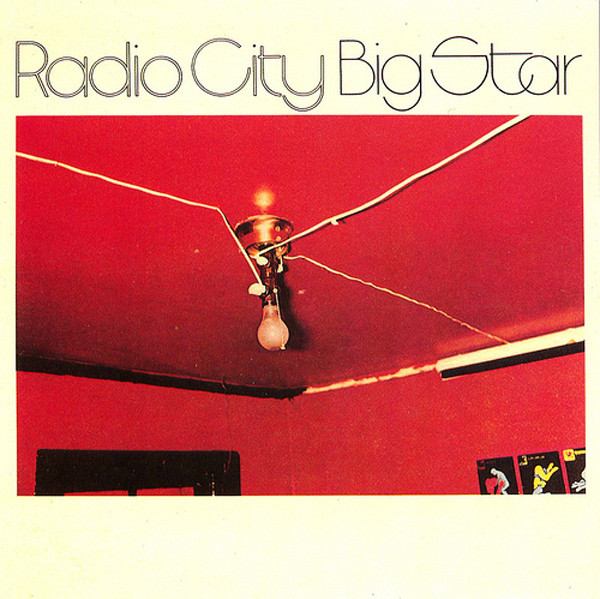
Radio City.
Eventually, Big Star reconvened and Alex Chilton, Jody Stephens and Andy Hummel decided to record an album as a three piece band. This would become Radio City.
For Radio City, Alex Chilton wrote six tracks and cowrote four others, including three with Andy Hummel, who contributed Way Out West. Alex and Andy wrote Daisy Glaze with Jody Stephens. One name was missing though, Chris Bell. It later emerged that Chris Bell did help write some songs on Radio City, but wasn’t credited. This includes O My Soul, and the Big Star classic Back of a Car. Chris’ omission would prove an expensive one. However, during the period Radio City was written and recorded, Chris was no longer a member of Big Star.
Recording of Radio City took place at Ardent Studios, Memphis in the autumn of 1973. John Fry and Big Star co-producer Radio City, which was Big Star’s first album as a trio. This being Big Star, things didn’t go to plan.
Alex, Jody and Andy only recorded part of Radio City. With nine tracks completed, Alex was left without a rhythm section. So, to complete Radio City, Alex brought in the rhythm section of drummer Richard Rosebrough and occasionally, bassist Danny Jones. Together, they finished recording Mod Lang, She’s A Mover and What’s Going Ahn. Eventually, Radio City was released in February 1974.
Just like Number One Record, Radio City was released to widespread critical acclaim. Radio City was seen as Big Star’s breakthrough album. It was described as commercial, polished and even brilliant and addictive. Surely, Big Star were about to make a breakthrough with Radio City?
Sadly, not. History repeated itself when Stax Records failed to get Radio City into record shops. Stax Records’ disagreement with Columbia Records made a bad situation worse. What many regarded as a future classic, and the definitive power pop album was stuck in a distributor’s warehouse. Eventually, when Stax Records counted sales of Radio City, the sales amounted to just twenty thousand. For Alex Chilton and co. this was a huge body blow.
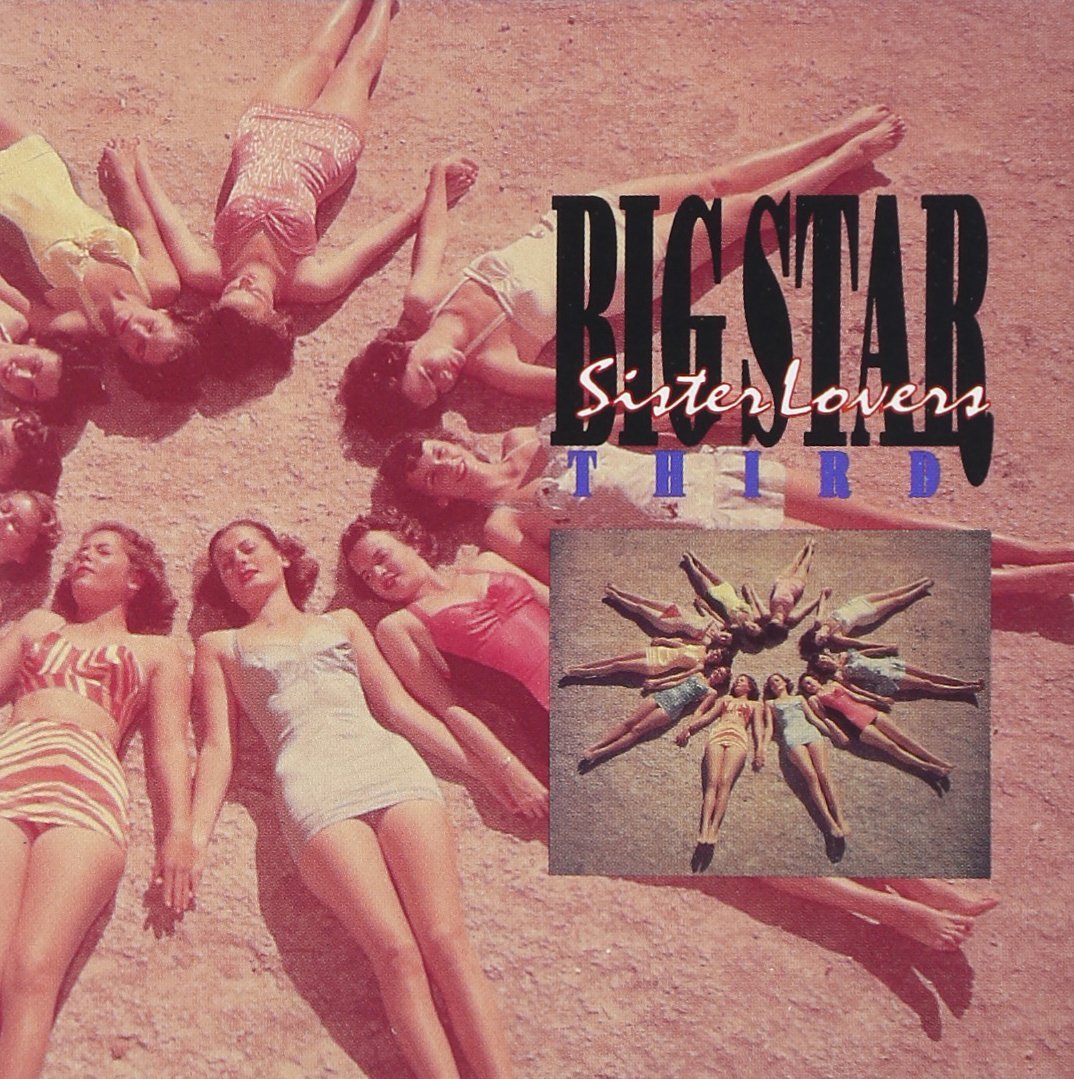
Third/Sister Lovers.
So, when Big Star returned to the recording studios in September 1974 to record what would eventually become Third/Sister Lovers, Big Star’s numbers were reduced. Andy Hummel had left the band. It was a case of and then there were two.
For Third/Sister Lovers, Alex contributed twelve of the fourteen tracks. Jody Stephens penned For You. The other track was a cover of The Velvet Underground classic Femme Fatale, penned by Lou Reed. These tracks would become Third/Sister Lovers, which was produced by Jim Dickinson.
With just Alex Chilton and Jody Stephens remaining, Big Star entered the recording studio for what would proved to be the last time. Given their numbers were reduced, the two members of Big Star had to bring onboard various session musicians and a few friends.
This included drummer Richard Rosebrough, Alex’s girlfriend, vocalist Lesa Aldridge and guitarist Steve Cropper. With Jim Dickinson producing Third/Sister Lovers, Big Star proceeded to produce music that was variously beautiful, ethereal, experimental, haunting and innovative. That’s not surprising. Many of the songs were Alex had written were deeply personal. Many onlookers thought that Third/Sister Lovers wasn’t going to be a Big Star album.
At the time, Third/Sister Lovers looked more like an Alex Chilton solo album. Other onlookers remember seeing the session sheets naming the band as Sister Lovers. However, this was a reference to Alex and Jody dating sisters Lesa and Holliday Aldredge. Eventually, however, Third/Sister Lovers was completed on 13th February 1975, when Larry Nix completed the mastering. However, it would be another three years before Third/Sister Lovers was released.
Following the completion of Third/Sister Lovers, producer Jim Dickinson and John Fry headed to New York looking for a record label willing to release Big Star’s third album. By then, Big Star were history. Despite this, 250 copies had been pressed for promotional purpose. Sadly, nobody expressed an interest in releasing Third/Sister Lovers. Record company executives didn’t understand Third/Sister Lovers. The music seemed too stark, emotive and occasionally, disturbing. In a way, that’s not surprising.
Alex Chilton wasn’t in a good place during the recording of Third/Sister Lovers. Third/Sister Lovers was a cathartic album, where he unburdened himself. This made Third/Sister Lovers a very personal album. However, within Third/Sister Lovers there was beauty. It wasn’t until 1978, that Third/Sister Lovers’ beauty was heard.
Eventually, three years after Third/Sister Lovers was completed, the album was released. Previously, Third/Sister Lovers was perceived as uncommercial by record companies. Neither Alex nor Jody had shown any interest in releasing Third/Sister Lovers. Then there were the continuing financial problems. That’s why three years passed before the release of Third/Sister Lovers.
Prior to the release of Third/Sister Lovers, the critics had their say. Critics recognised the Third/Sister Lovers’ potential when the group were promoting it. Many wrote paeans exalting the Third/Sister Lovers’ beauty. However, it was only in later years that many critics realised the importance of Third/Sister Lovers. By then, it was being hailed as a minor classic. So were Number One Record and Radio City. Big Star were by then, one of the most influential bands in musical history. Not in 1978.
On the release of Third/Sister Lovers commercial success eluded what became Big Star’s third album. While many saw this a disaster for Big Star, much worse was around the corner.
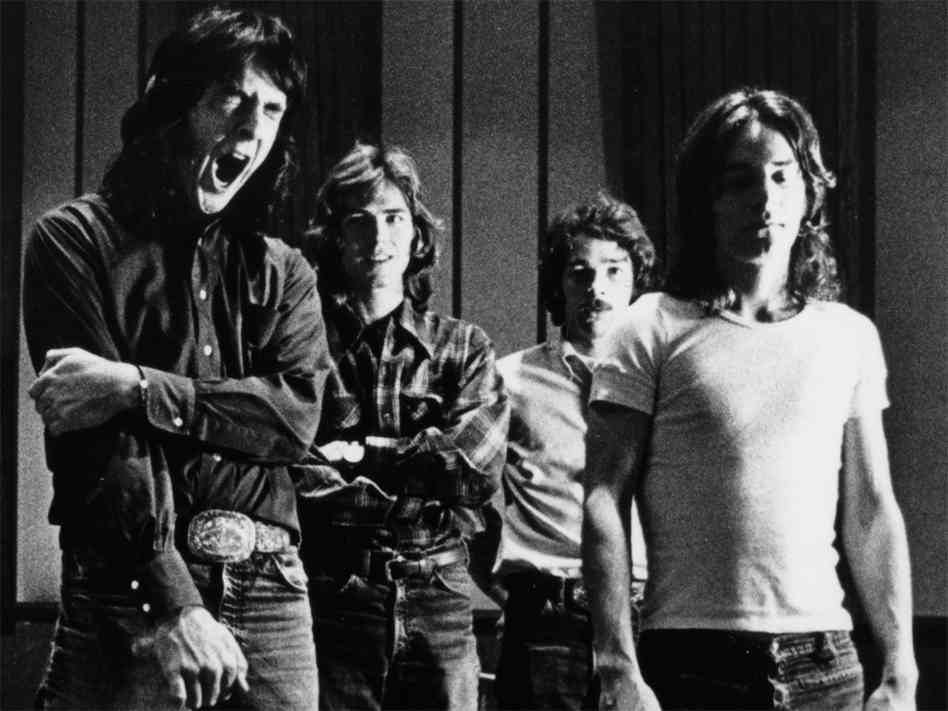
Not long after Third/Sister Lovers was eventually released, tragedy struck, and Chris Bell died in a car crash. It was a tragedy for music and Big Star. That was the last anyone heard of them for fifteen years.
Interest in Big Star grew and in 1993, the group reformed. Alex Chilton and Jody Stephens, were joined by guitarist Jon Auer and bassist Ken Stringfellow. Their first concert was at the University of Missouri Music Festival. This concert was recorded, and released as an album entitled Columbia: Live At Missouri. The new line up toured extensively, and a new album was released in 2005.
In Space.
In Space consists mostly of new songs, songs written by Alex Chilton, Jody Stephens, Jon Auer and Ken Stringfellow. When it was released in 2005, it was well received by critics, who welcomed the return of Big Star. Despite the resurgence in interest in Big Star, In Space didn’t sell in vast quantities. Record buyers it seemed, were more interested in Big Star’s first three albums.

Big Star’s first three albums are regarded as their classic period. It featured the band at the peak of their musical powers. These albums had attracted a new generation of record buyers to Big Star’s music a few years earlier. For the next seven years Big Star’s music grew in popularity.
Sadly after over ten years of belated success and recognition, Alex Chilton died of cancer on 19 July 2010. That day, music lost one of its most creative and greatest musicians.
Looking back, things could’ve been very different if Stax Records hadn’t been responsible for distributing Big Star’s first two albums. With another record company distributing Number One Record and Radio City, Big Star could’ve and should’ve been one of the biggest bands of the seventies. Sadly, while their first two albums enjoyed critical acclaim, commercial success eluded them. By 1975, Big Star were history.
Big Star third album, Third/Sister Lovers, was completed forty years ago, in February 1975. Sadly, Third/Sister Lovers, which was eventually released in 1978, proved to be Big Star’s final album for four decades.
After a resurgence in interest in Big Star Alex and Jody reformed the band and released their fourth and final album, In Space, in 2005. By now, Big Star’s trio of albums were considered minor classics, which feature in Rolling Stone magazine’s list of the 500 greatest albums of all time. Meanwhile, Big Star were being hailed as one of the most influential, innovative and inventive bands in musical history. That’s apparent when you listen to their trio of classic albums Number One Record, Radio City and Third/Sister Lovers. This triumvirate of albums feature power pop pioneers Big Star, the greatest band you’ve never heard, at the peak of their powers.
BIG STAR-THE GREATEST BAND YOU’VE NEVER HEARD.



ORNETTE COLEMAN-THE ATLANTIC YEARS.
ORNETTE COLEMAN-THE ATLANTIC YEARS.
A year ago, on June 11th 2015, that Ornette Coleman passed away, aged eighty-five. Music had lost a true legend, whose album Free Jazz: A Collective Improvisation lent its name to a musical genre, free jazz. It’s the genre that Ornette Coleman became synonymous with. However, two years earlier, this nascent genre had no name.
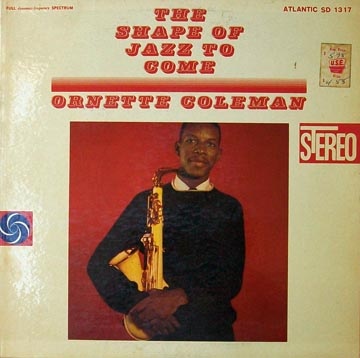
Ornette Coleman released his Atlantic Records’ debut in 1959. The Shape of Jazz to Come hinted that jazz was changing. However, it wasn’t until the release of Ornette Coleman’s fourth album for Atlantic Records, Free Jazz: A Collective Improvisation that the genre was christened. Suddenly, free jazz was born. It was being hailed the most exciting development in jazz, and Ornette Coleman was one of its most innovating practitioners. His story began in 1930.
It was on March 9th, 1930, that Ornette Coleman was born Randolph Dernard Ornette. He was born and brought up in Forth Worth, Texas, where his musical skills were apparent from an early age. A true multi-instrumentalist, Ornette played saxophone, violin and trumpet and composed music. His trademark sound is blues-based, with a crying, keening timbre. Growing up, Ornette played in his high school band, but was thrown-out, for jamming during a rendition of Washington Post.
As a teenager, Ornette formed a band, with fellow students Prince Lasha and Charles Moffett. Then in 1949, he started playing with Silas Green, in his R&B show. It was during a show in Baton Rouge, that Ornette was assaulted and his saxophone destroyed. This resulted in Ornette changing to alto-saxophone. After the Baton Rouge assault, Ornette decided to leave Silas Green’s band.
After leaving Silas Green’s band, Ornette joined Pee Wee Crayton’s band. When he wasn’t making music, Ornette worked a variety of jobs, including lift operator. Still, he was determined to make a living playing music. Other musicians, however, didn’t understand Ornette’s style of music.
From his high school days, Ornette had a unique musical style. Schooled in R&B and bebop, Ornette’s approach to chord progression and harmony was very different. It was much more fluid. He played what heard in his head, which coupled with his blues’ influence, may have resulted in the rawness in Ornette’s playing. For some musicians, they thought Ornette was out-of-tune. That wasn’t the case. Unlike them, Ornette was a visionary, an innovator, a musician who’d become one of the giants of free jazz.
Even though many musicians didn’t understand Ornette Coleman, he was gradually building up a group of influential supporters. This included pianist Paul Bley, who later collaborated with Ornette. Paul however, didn’t feature on Ornette’s 1958 debut album Something Else. Released on Contemporary Records, Something Else featured Don Cherry on trumpet and Walter Norris on piano, as be bop combined with free jazz. Ornette released his sophomore album in 1959s. Tomorrow Is The Question was also released on Contemporary Records. All of sudden, people were taking notice of Ornette Coleman. They were “getting” Ornette’s unique sound and approach to jazz.
So it was no surprise that in 1959, Ornette Coleman signed to what was then, one of the biggest record labels, Atlantic Records. They had a huge roster, and released an eclectic selection of music. This included everything from blues, R&B, soul and of course, jazz. Ornette Coleman was their latest signing.
Atlantic Records was home to Ornette Coleman between 1959 and 1962. During that time, he entered the studio ten times. The first time came on 22nd May 1959, when Ornette Coleman made his way to Radio Recorders in Hollywood, California. With his quartet, Ornette Coleman recorded eight tracks. This included the six tracks that became The Shape Of Jazz That To Come. It was released in October 1959, and was the first of six albums released by Ornette Coleman between 1959 and 1962.
During the ten sessions Ornette Coleman recorded between 1959 and 1962, a total of fifty-eight tracks were recorded. Atlantic Records, just like all jazz labels, would get their money’s worth.
Following the release of Ornette On Tenor in December 1962, Ornette Coleman left Atlantic Records. However, there were still thirty-six tracks unreleased. This proved enough for another three albums. These nine albums include some of the best and most innovative music of Ornette Coleman’s career. He was one of the founding fathers of free jazz, who came of age at Atlantic Records.
The Shape Of Jazz To Come.
Having served his musical apprenticeship, Ornette Coleman was more than ready to sign to a major label. On his first two albums, Ornette Coleman pioneered this new musical genre. Some likened it do avant garde. Others thought that what Ornette Coleman and his band were playing had an experimental sound. However, after his first session with ‘producer’ Nesuhi Ertegun, he had the answer to this conundrum.
On 22nd May 1959, Ornette Coleman made his way to Radio Recorders in Hollywood, California. Joining him, were the other three members of his quartet, drummer Billy Higgins, bassist Charlie Haden and Don Cherry on cornet. They recorded eight tracks with Ornette Coleman recorded eight tracks. These tracks followed a different format to what most musicians were used to.
Each of the eight compositions Ornette Coleman’s quartet record a brief thematic statement. After that, there were several of minutes of free improvisation. Then they revisit the main theme. While this may sound similar to bebop, there’s a big difference. Advocates of free jazz abandoned the use of chord structures. Having listened to Ornette Coleman’s quartet pioneer this nascent genre, Nesuhi Ertegun had an idea for the album title.
After thinking about the session he had just ‘produced,’ Nesuhi Ertegun realised that it was important that the album title gave record buyers: ”an idea about the uniqueness of the LP.” It Nesuhi Ertegun realised, was a game-changer. This new sound was about to change jazz
Ornette Coleman’s Atlantic Records’ debut was The Shape Of Jazz To Come. It was released in October 1959, and initially, divided the opinion of critics.
Some critics and cultural commentators hailed the music on The Shape Of Jazz To Come as innovative and inventive. Lonely Woman, the album’s opener was seen as a future classic. That proved prescient. Nowadays, Lonely Woman is a jazz standard. These critics that forecast this, and realised the importance of The Shape Of Jazz To Come knew that something important was happening.
So did some of Ornette Coleman’s peers and contemporaries. They realised that potentially, this new musical movement could be the biggest innovation since bebop. Especially when Ornette Coleman began a two week residency at the Five Spirit on November 17th 1959. It became the hottest ticket in town. Ornette Coleman’s residency was extended, and eventually, last two-and-a-half months. It seemed Ornette Coleman was well on his way to becoming one of the major players in jazz. Not everyone agreed.
The lack of chordal structure proved controversial. Up until then, a pianist and guitarist gave compositions chordal structure. Not on The Shape Of Jazz To Come. That was jazz’s past. Another criticism was the harsh timber of Ornette Coleman’s saxophone. However, this wasn’t surprising. He eschewed the finest saxophone, instead, preferring a plastic Grafton saxophone. This he believed gave his music, a “harmolodic” sound, which was a fusion of harmony, movement, and melody. There was a reason for this.
Harmonic accompaniment, Ornette Coleman believed, wasn’t important. Instead, he focused merely on improvising melodies and variations on themes and motifs. Proof of this could be found on The Shape Of Jazz To Come, which in 1959, was recognised as an important, innovative and inventive album. It was also an album that changed jazz. At the forefront of this new musical movement was Ornette Coleman.
Change Of The Century.
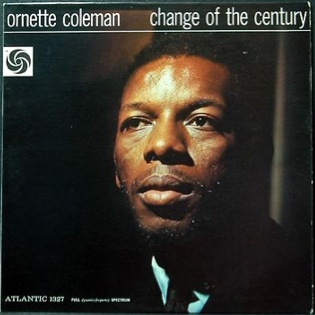
By the time that The Shape Of Jazz To Come was released, Ornette Coleman had been back in the studio twice. On the 8th October 1959, Ornette Coleman and the his band recorded four tracks. That day, Don Cherry switched from cornet to pocket trumpet. Then the following day, 9th October 1959 another five tracks were recored. Seven of these tracks became Change Of The Century.
When Change Of The Century was released in June 1960, it was to widespread critical acclaim as The Shape Of Jazz To Come. There were no dissenting voices. Ornette Coleman critics realised, was a trailblazer, and with his fellow travellers, was the future of jazz.
This Is Our Music.
Having just recorded eight tracks on the 8th and 9th July 1960, Ornette Coleman returned to the studio later that month. On 19th July 1960, his band recorded nine new tracks. That day, there was a new face in the studio
Drummer Ed Blackwell had replaced Billy Higgins. Seamlessly, he slotted into the rhythm section alongside bassist Charlie Haden. Once the nine tracks were recorded, the band took a break for a week.
Ornette Coleman and his band returned on the 26th August 1960. That day, they recorded eleven songs. This was enough for two albums at least. It seemed that Atlantic Records were stockpiling recordings. This was nothing new. Record companies had been doing this since the musician’s strike two decades ago. Never again, would they be short of material to release.
Music was a record company’s lifeblood. Nesuhi Ertegun realised this. So on August 2nd 1960, Ornette Coleman and his band returned to Atlantic Recoding Studio, New York. That day, they recorded three of the tracks that featured on Ornette Coleman’s next album, This Is Our Music. Not content with recording Ornette Coleman’s next album, Nesuhi Ertegu decided that the band began work on the next album, Free Jazz: A Collective Improvisation.
Just as 1960 was drawing to a close, Ornette Coleman’s band found themselves A&R Studios, New York between 19th and 21st December. The first two days were spent recording two tracks for a new project, John Lewis Presents Contemporary Music Jazz Abstractions. It featured music composed by Gunther Schuller and Jim Hall. This new project allowed Ornette Coleman to work with different musicians.
So on Monday 19th December, six days before Christmas, Ornette Coleman was due to record the Gunther Schuller and Jim Hall composition, Abstraction. It featured an expanded lineup of Ornette Coleman’s band.
The rhythm section featured drummer Sticks Evans; bassists Scott LeFaro and Alvin Brehm; and guitarists Jim Hall. Augmenting this new lineup, was The Contemporary String Section. Once Abstraction was recorded, it was all change again,
On Tuesday 20th December 1960, Ornette Coleman and another expanded lineup of his band were due to record Variants On A Theme Of Thelonious Monk. The lineup read like a who’s who of jazz.
In the rhythm section alongside drummer Sticks Evans; were bassists Scott LeFaro and George Duvivier; and guitarists Jim Hall. Pianist Bill Evans joined Eddie DeCosta on vibes and flautist Robert DiDomenica and Eric Dolphy on alto saxophone, flute and clarinet. Adding the finishing touch, were The Contemporary String Section. This all-star lineup recorded one of the most complex suites Ornette Coleman’s band had recorded. When Variants On A Theme Of Thelonious Monk was completed, it would find its way onto the the 1961 album John Lewis Presents Contemporary Music Jazz Abstractions. However, on the final day of the session, Ornette Coleman recorded two tracks for his own career.
Wednesday 21st December 1960, Ornette Coleman’s band recorded two tracks, including Free Jazz, which was destined for Free Jazz: A Collective Improvisation. It featured a double quartet.
This was unheard of. Ornette Coleman decided that a different quartet feature on the right and left channel. On the left channel, was Ornette Coleman on alto saxophone, Don Cherry’s pocket trumpet and a rhythm section of drummer Billy Higgins and bassist Scott LeFaro. The right channel featured a rhythm section of drummer Ed Blackwell and bassist Charlie Haden. They were joined by trumpeter Freddie Hubbard and Eric Dolphy on bass clarinet. With this expanded lineup, Ornette Coleman was making the music of the future. It was an exciting time, and one that could change music. Before that, however, This Is Our Music was released.
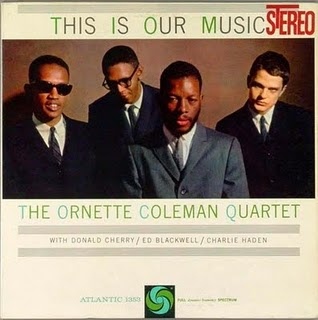
Having recorded twenty-three tracks during the last three sessions, there was plenty of music to choose from. Eventually, seven tracks were chosen. This included a cover of George and Ira Gershwin’s Embraceable You. It was the first time Ornette Coleman’s had covered a jazz standard. However, never had Embraceable You been covered the way Ornette Coleman did on This Is Our Music.
The release of This Is Our Music in February 1961, was Ornette Coleman’s third release for Atlantic Records, and his fifth album overall. This Is Our Music marked the first release from the new lineup. However, what didn’t change, was the critics response to This Is Our Music. Described as inventive and innovative, Ornette Coleman was one of the pioneers of this new and exciting musical movement. It still didn’t have a name. That would soon change.
Free Jazz: A Collective Improvisation.
Just over a month after their last recording session, Ornette Coleman’s band returned to Atlantic Recording Studios, New York. There was a new member of the band. Scott LaFaro had replaced Charlie Haden. Over the last six months, a new rhythm section had joined Ornette Coleman’s band. This latest lineup was all set to make their debut on 31st January 1961.
The tapes started rolling at 3pm on 31st January 1961. By 7.30pm, another seven tracks were in the can. By now, Atlantic records still had twenty-three unreleased tracks. At this rate, they had enough for at least three albums. Despite this, less than two months later, Ornette Coleman’s band would return to the same studio.
Wednesday March 21st 1961 found another new lineup of Ornette Coleman’s band at Atlantic Recording Studios, New York. Jimmy Garrison was the new bassist, and replaced Scott LaFaro. This new lineup only recorded one track, EOS, which found its way onto Ornette On Tenor. Recording of that album was completed on Monday, March 27th 1961.
That was the last time Ornette Coleman’s band returned to Atlantic Recording Studios, New York. Never again, would Ornette Coleman record for Atlantic Records. However, that day proved productive. Ornette Coleman’s band recorded five tracks for Ornette On Tenor, and Harlem’s Manhattan for Art Of The Improvisers. This session marked the end of era for Ornette Coleman. Not for Atlantic Records.
It was ironic that Ornette Coleman’s contract with Atlantic Records was over. When Free Jazz: A Collective Improvisation was released in September 1961, it was a game-changer.
Critics listened intently to Free Jazz: A Collective Improvisation. Each side featured one lengthy track. Free Jazz (Part One) filled side one, and lasted nearly twenty minutes. On side two, Free Jazz (Part Two) lasted just over sixteen minutes. On both tracks, the two rhythm sections played as one. Then came the solos, where the soloists were allowed the freedom and opportunity to improvise on the two tracks. No longer were musicians constrained, they were allowed the opportunity to take the music wherever they wanted. This was revolutionary music. So it was fitting that the album cover featured Jackson Pollock’s painting The White Light.
Just like so many landmark albums, Free Jazz: A Collective Improvisation divided opinion. Critics either loved or loathed the album. There was no middle ground. Most reviews were filled with praise and plaudits. Some critics saw no merit in Free Jazz: A Collective Improvisation. To them, it was forty minutes of their life they would never see again. However, since then, Free Jazz: A Collective Improvisation is regarded as one of the most innovative and influential free jazz albums. For Ornette Coleman, who had left Atlantic Records, it must have been a bittersweet moment.
His latest album would lend its name to a genre, free jazz. Free Jazz: A Collective Improvisation was also being hailed one of the most innovative and influential albums in the nascent free jazz genre. To add to the irony, Atlantic Records had plenty more music to release.

Ornette!
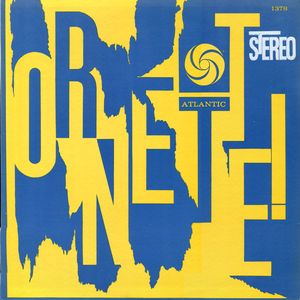
Just five months after the release of the groundbreaking Free Jazz: A Collective Improvisation, Atlantic Records released Ornette! in February 1962. It was the first album to feature Scott LaFaro on bass.
He played his part in an album where elements of free jazz and avant garde combined on the four tracks on Ornette! These four tracks, W.R., U, T and T, C and D, R.P.D.D. were an acronym of Sigmund Freud’s Wit and Its Relation To The Unconscious, Totem and Taboo. Civilization and Its Discontents, and the essay Relation of the Poet to Day Dreaming. This was a first. Never before had a jazz musician been inspired founding father of psychoanalysis. Ornette! was released to widespread critical acclaim.
While Ornette! was released to critical acclaim, it didn’t match the quality of Free Jazz: A Collective Improvisation. That was Ornette Coleman’s Magnus Opus. However, Ornette! didn’t divide opinion in the same way as Free Jazz: A Collective Improvisation. It seemed that Ornette Coleman could do no wrong. That however, was about to change.
Ornette On Tenor.
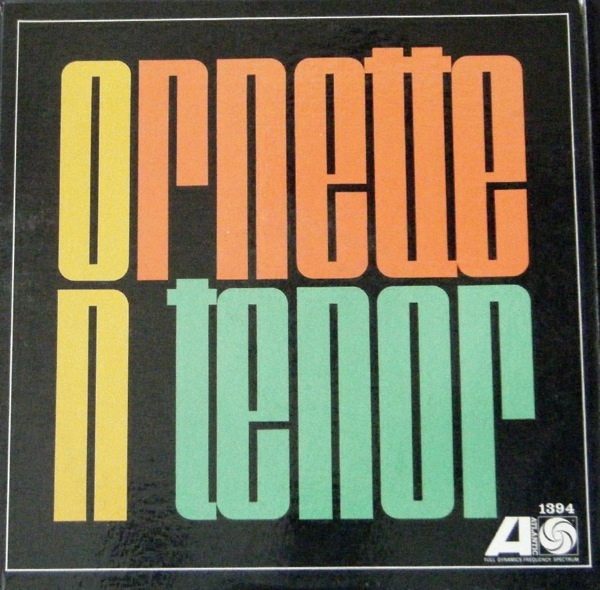
Twenty-one months after Ornette Coleman’s last recording session for Atlantic Records, Ornette On Tenor was released in December 1962. It was Ornette Coleman’s eight album, and sixth for Atlantic Records.
Ornette On Tenor featured further changes to the lineup of Ornette Coleman’s band. Jimmy Garrison replaced Scott DeFaro on bass. The other change was Ornette Coleman switched from alto to tenor saxophone. This wasn’t the success he hd hoped.
When Ornette On Tenor was released in December 1962, critical opinion was, once again divided. Some critics called the album a classic. They thought that the Ornette Coleman Quartet were continuing to revolutionise jazz. Others disagreed.
They thought Ornette On Tenor was the weakest by the Ornette Coleman Quartet. The album, in their opinion, wasn’t regarded as as innovative or groundbreaking as its predecessors. Once again, Ornette Coleman had divided opinion, with what was meant to be his Atlantic Records’ swan-song.
After that, Ornette Coleman became something of a musical nomad. He flitted between labels, never spending long at any label. Briefly, Columbia and Impulse were home to Ornette Coleman. The exception was Blue Note, where he released three albums.
Ornette Coleman’s Blue Note years began with 1966s The Empty Foxhole. Two years later, in 1968, Ornette Coleman released New York Is Now. Later in 1968, Ornette Coleman’s Blue Note years were at an end, when Love Call was released. After this, Ornette Coleman’s signed to Impulse Records.
At Impulse Records, Ornette Coleman released just two albums. The first was Ornette At 12, which was released in late 1968. It was another album that divided the opinion of critics and record buyers. Things improved in 1969, when Ornette Coleman released the live album Crisis, which critics felt marked a return to form from Ornette Coleman. However, after the release of Crisis, Ornette Coleman found himself without a record label.
While labels recognised Ornette Coleman’s undoubtable skill, they seemed reluctant to sign him. However, Bob Thiele took a chance on Ornette Coleman, and signed him on a one album deal. The result was Friends And Neighbors-Ornette Live At Prince Street.
Ornette Coleman’s second live album in two years found the founding father of free jazz back to his inventive best. Along with his Friends And Neighbors-Ornette Live At Prince Street showed that Ornette Coleman still a pioneer, who had much to offer music. Maybe that what’s made Atlantic Records release The Art Of The Improvisers.
The Art Of The Improvisers.
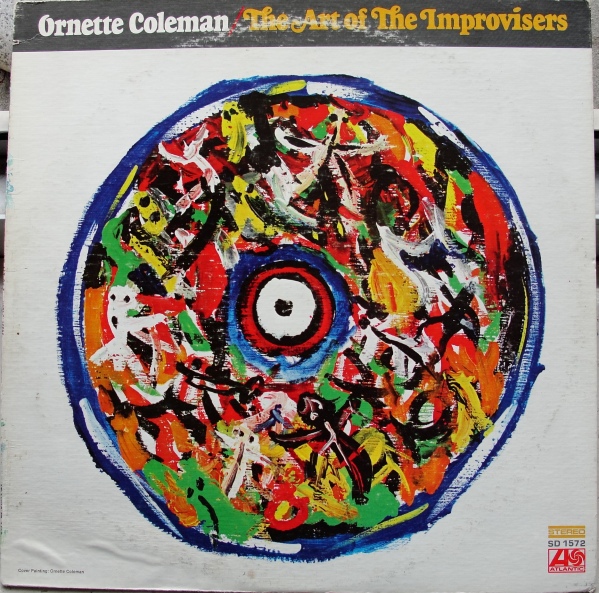
When The Art Of The Improvisers was released in 1971, many record buyers presumed that Ornette Coleman was back at Atlantic Records. They were wrong, very wrong.
The Art Of The Improvisers had been recorded between May 22nd 1959 and 31st January 1961. This meant the music was between ten and twelve years old.
Despite a moderne album cover, the music on The Art Of The Improvisers sounded as if it had been recorded a decade ago. There was a big difference to what Ornette Coleman had been releasing recently. However, some critics and record buyers welcomed this return to the past. This was when Ornette Coleman released the best music of his career. While this was all very revisiting the vaults once, if Atlantic Records did this too often, there would be the sound of the barrel being scrapped.
Twins.
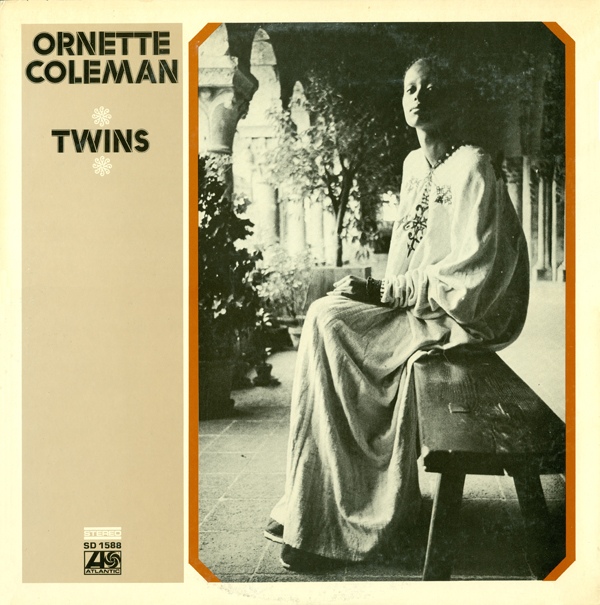
1971 saw Atlantic Records return to the well for the five tracks that became Twins. It was released on October 4th 1971. Just like The Art Of The Improvisers, Twins wasn’t a new album of material.
The five tracks that became Twins, were recorded between 8th October 1959 and 2nd August 1960. This meant that Little Symphony had been recorded two decades ago. However, it wasn’t just Atlantic Records who were doing this.
Many jazz labels were releasing tracks that had been recorded many years previously. Some of the tracks had been initially regarded as outtakes. However, if an artist’s career was enjoying an Indian summer, their old record companies would sometimes release an album of unreleased tracks. They knew that those who had purchased their previous albums. Often they were in for a surprise.
When critics heard Twins, they realised that just like The Art Of The Improvisers, it was an album from Ornette Coleman’s classic era. Some critics realising that Twins didn’t feature new material overlooked the album. They missed a hidden gem of an album.
Twins features some masterful performances from Ornette Coleman. Aided and abetted by his usual, tight, talented band, apart from on Little Symphony and Joy Of A Toy, Ornette Coleman turns back the clock. The music is variously uptempo, soulful, bluesy and features masterful interplay between Ornette Coleman and Don Cherry. They’re like two master craftsmen as they weave their way across Twins, reminding listeners what Ornette Coleman in his prime, sounded like. That looked like it was the last Ornette Coleman album Atlantic Records would release. However, it wasn’t.
To Whom Who Keeps A Record.
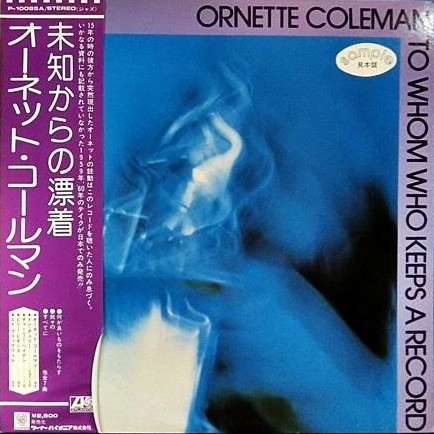
Late 1975, which was over four years since the release of Twins, Warner Japan released To Whom Who Keeps A Record. The album was released only in Japan.
That’s despite Ornette Coleman having a worldwide fan-base. They missed out on an album of uncompromising, fiery and provocative free jazz. It was well received in Japan, forty years ago, and is a welcome addition to Ornette Coleman’s discography.
Despite over fifty albums bearing Ornette Coleman’s name being released, the albums he released at Atlantic Records included some of the best music. Ornette Coleman released a total of nine albums for Atlantic Records between 1959 and 1975. These albums find one of the founding fathers of free jazz at his most inventive and innovative.
Freed from the constraints of bebop, Ornette Coleman and his band embark upon what was akin to a series of musical adventures. During these adventures, they push musical boundaries to their limits, and sometimes way beyond. They challenge what was conventional thinking, and create music that’s ambitious, groundbreaking and innovative. This new genre of music free jazz, was the future of music. It was far removed from the blandness of the Cool School, and the constraints of bebop. Ornette Coleman was at the vanguard of this new musical movement.
That’s not surprising. Ornette Coleman was one of jazz’s most innovative and inventive musicians and composers in the history of jazz. Bold, and unafraid to produce cutting-edge music, Ornette Coleman produced music that was challenging music, music that challenged musical norms. Realising musical rules were there to be broken, Ornette Coleman set about breaking these rules. However, Ornette Coleman knew when to break the rules.
By breaking these rules, Ornette Coleman created some of the most inventive, influential and innovative music in the history of jazz. This was music that fused various musical genres and influences. Bebop, free-jazz, blues, avant-garde and experimental music all influenced Ornette Coleman’s music. These genres and influences were thrown into the melting pot of one of the most creative and inventive musicians of the twentieth century. Sadly, Ornette Coleman died on June 11th 2015, that Ornette Coleman passed away, aged eighty-five. Music had lost a true legend, whose album Free Jazz: A Collective Improvisation lent its name to a musical genre, free jazz.
Free Jazz: A Collective Improvisation was Ornette Coleman’s Magnus Opus, and was recorded during what was the most productive and fertile period of his career. That was the three years he spent at Atlantic Records. During the Atlantic Records’ years, Ornette Coleman recorded enough music for nine albums. This included some of the best music of Ornette Coleman’s his long and illustrious career.
ORNETTE COLEMAN-THE ATLANTIC YEARS.

JODY REYNOLDS-THE COMPLETE DEMON AND TITAN MASTERS.
JODY REYNOLDS-THE COMPLETE DEMON AND TITAN MASTERS.
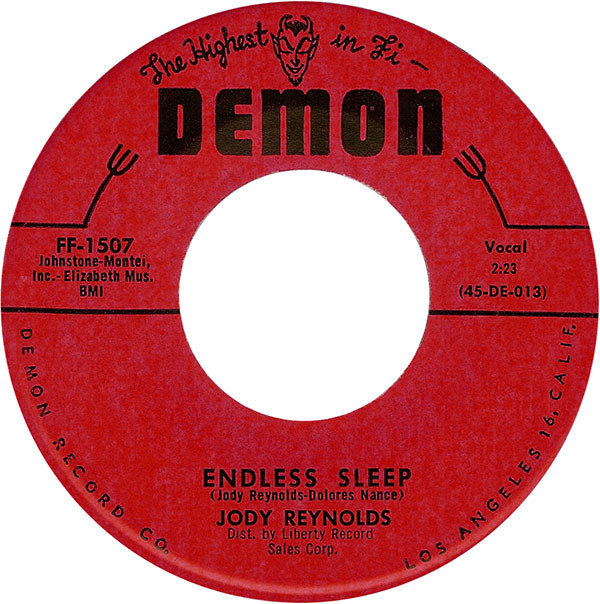
Jody Reynolds life was changed forevermore in 1958, when Demon Records released Endless Sleep as a single. This was a song that Jody Reynolds had written in 1956, after hearing Elvis Presley’s Heartbreak Hotel. Not long after this, Jody Reynolds performed Endless Sleep for the first time. The song was about a teenager who disappeared after having an argument with her boyfriend. Little did Jody Reynolds realise that Endless Sleep would go on to inspire a string similar songs. That looked highly unlikely.
Having recorded a demo of Endless Sleep, Jody Reynolds took the demo round various record labels. They all rejected Endless Sleep, saying the teen tragedy or death disc was too depressing. It looked like Jody Reynolds was going to be unable to convince a label to release Endless Sleep. That was until he played his demo at Demon Records. They were willing to release endless sleep.
So Jody Reynolds went into the studio with guitarists Al Casey and Howard Roberts. As they accompanied Jody, his vocal was drenched in echo. For the B-Side, Tight Capris, which was written by Jody with Al Casey and Sonja Sturdivant. These two tracks would became Jody Reynolds’ debut single for Demon Records.
When Endless Sleep was released in March 1958, the song was credited to Jody Reynolds and Dolores Nance. This was to ‘fool’ the listener that it had been written by a professional songwriting team. The ruse worked, and by 7th July 1958 Endless Sleep had peaked at number seven on the US Billboard 100, having sold one million copies in the process. This complex and captivating death disc would inspire countless imitators Meanwhile Jody Reynolds’ career at Demon Records continued. It’s documented on Ace Records’ recently released compilation The Complete Demon and Titan Masters. It covers the period between 1958 and 1966, and also features six previously unreleased tracks.
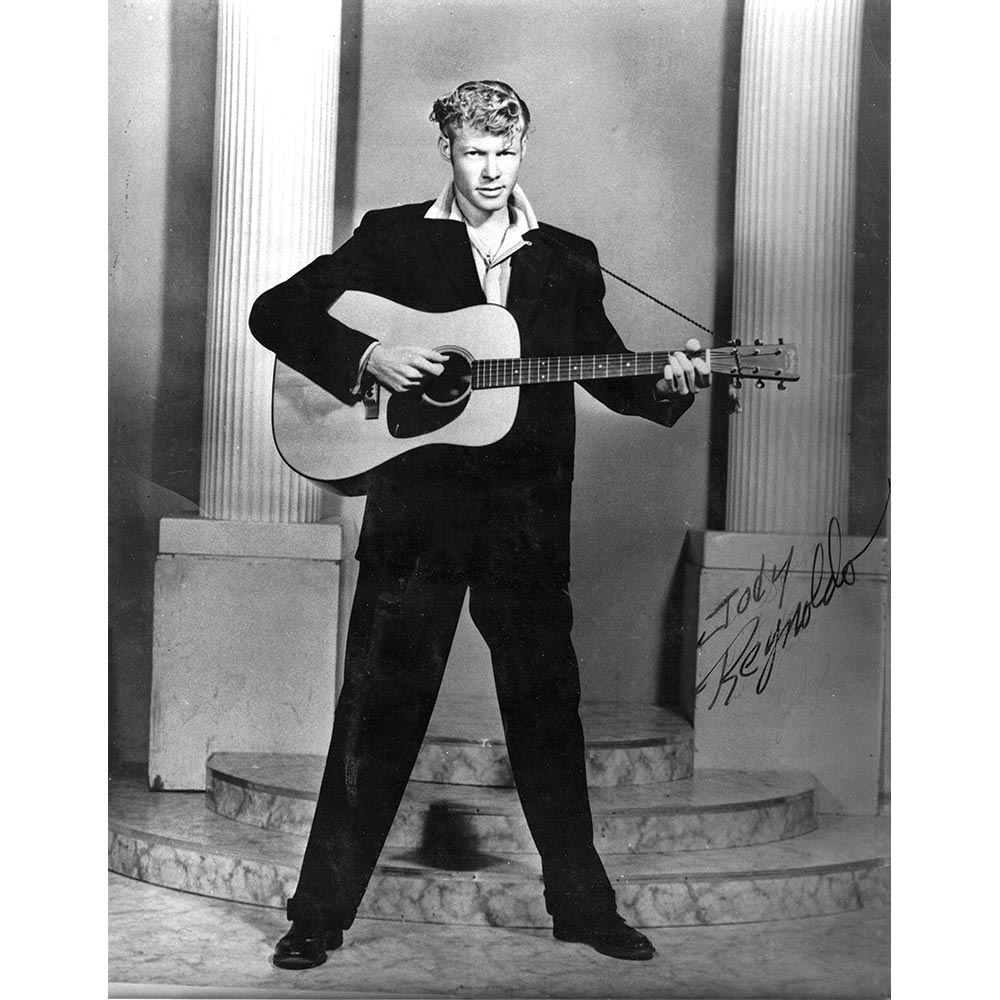
When Jody Reynolds signed to Demon Records, he was already twenty-six. He was born Ralph Joseph Reynolds in Denver, Colorado on December 3rd 1932. Soon, the Reynolds family moved to Shady Grove, Oklahoma. That was where Jody’s love of R&B and western swing music began. Indeed, it was through listening to music that Jody decided to pickup a guitar when he was fourteen.
By the fifties, Jody Reynolds had mastered the guitar, and was playing professionally. Guiding the newcomer through the musical maze that lay ahead was Jimmy Bryant, a lighting fast guitar picker. The two became friends in 1955, when Jimmy came to stay in Jody’s mother’s hotel in Palm Springs. Jody admired Jimmy’s ability to play with speed and accuracy. Jimmy cautioned that not everyone could play with the same speed and accuracy. He also lent a guiding hand and advised the young singer, songwriter and guitarist. So did another guitar player, Al Casey.
He was a native of Phoenix, Arizona, and was one of the top guitarists in the area. So when Al Casey joined Jody Reynolds and The Stormers this was something of a coup. The band would head out on the road, and during these road trips Al Casey would help Jody Reynolds hone his sound. This paid off in 1958.
Having signed to Demon Records, Jody Reynolds released Endless Sleep in March 1958. Soon, Jody was promoting the single across America. He swapped life on the road for a series of appearances on television and radio. This was very different to life before Endless Sleep. One of the highlights of this time was his debut appearance on American Bandstand on 9th May 1958. The constant round of promotion worked, and at one point, Endless Sleep was selling 40,000 copies a day. Eventually, it peaked at number seven on the US Billboard 100, but sold one million copies in the process. This resulted in a gold disc for Jody Reynolds. On the flip-side was Tight Capris, which Jody cowrote with Al Casey and Sonja Sturdivant. Al was sharing in Jody’s success. The two friends celebrated the success of Jody’s million selling debut single. His star was in the ascendancy. Now it was a case of doing all again.
By then life for Jody Reynolds was very different. He had made a breakthrough after years of trying. Others were keen to jump on the bandwagon, in the hope that some of Jody’s success would rub off. In America, Jimmy Witherspoon and Gene Ross covered Endless Sleep. Across the Atlantic, Marty Wilde also covered Endless Sleep. However, Jody was already thinking of his sophomore single, Fire of Love.
Having released a million selling single, Jody Reynolds was in a no win situation. Unless he released another million seller, this would be regarded as a failure. So Jody had to consider his options carefully. The song he chose to release as his sophomore single was Fire Of Love. Just like the B-Side Daisy Mae, Fire Of Love was written by Jody and Sonja Sturdivant. It was released in July 1958.
When Fire Of Love was released in July 1958, the single stalled at just sixty-six in the US Billboard 100. This was a far cry from the million selling Endless Sleep. For Jody Reynolds this was a huge blow. The only small crumb of comfort for Jody was that Fire Of Love became regarded as a rock ’n’ roll and blues-punk classic. MC5 and Gun Club would go on to record the song. However, that was way down the line. Before that, Jody had to get his career back on track. However, little did Jody realise that he would never enjoy another hit single.
It was a case of back to the drawing board for Jody Reynolds. For his third single, he decided to cover Doug Marlin’s Closin’ In. On the flip-side was Elope With Me which Jody wrote, but was credited to Jody Reynolds and Delores Nance. Both cuts showcased a new style from Jody, balladry. This was quite different to previous releases. Despite this, when Closin’ In was released in November 1958, the single failed to chart. This was a first for Jody.
Before the release of Closin’ In, Jody Reynolds had enjoyed two hit sits. After the million selling Endless Sleep, it looked like commercial success was going to be a constant companion of Jody’s. It was only a passing acquaintance, with Fire Of Love giving Jody a minor hit. Now that Closin’ In hadn’t even troubled the charts, Jody must have been wondering how did he rescue his recording career. It had started in March 1958, and by the year end, looked like it had hit he buffers.
A year after the release of his debut single, Jody Reynolds returned with his fourth single in March 1959. The song that had been chosen was the ballad Golden Idol, which Jody Reynolds and Delores Nance cowrote with Johnny Burnette. On the B-Side was Beaulah Lee, which Jody and Sonja Sturdivant penned. It was a storming rocker which featured the debut of Jody’s new guitarist fifteen year old guitar virtuoso Dan Cole. His guitar playing was at the heart of the track’s sound and success. Many thought that Beaulah Lee should’ve been released as a single. Especially when Golden Idol was released as a single in March 1959, and failed to chart. History it seemed, had a habit of repeating itself.
After the commercial failure of Golden Idol, it wasn’t until August 1959 that Jody Reynolds returned with his new single, The Storm. This was a cover of a song that had been written by Delpha Nelson. The B-Side Please Remember Me was written by Jody Reynolds and Delores Nance with Bobby Adams. However, when the moody, atmospheric The Storm was released as a single, it failed to find the audience it deserved.
Although The Storm wasn’t a death disc, some record buyers may have mistaken it for one. By August 1959, producers like Lee Hazelwood had jumped on the bandwagon. He knew that death discs and splatted platters could prove profitable, and further his nascent career. Sadly, by then, Jody Reynolds, one of the men who pioneered the genre, realised that his recording career seemed to be going nowhere.
Jody Reynolds had released five singles, and the last three failed to trouble the charts. This was worrying. There was no sentiment in music, and if Jody didn’t come up with a hit single, then his recording career could be in jeopardy.
With Jody Reynolds no longer releasing hits, nine months passed before he released another single, The Whipping Post. This was one of Jody’s compositions. So was the flip-side I Wanna Be With You Tonight. Both sides were cut at Gold Star studios in Los Angeles in March 1969. Accompanying Jody, were some top session players. This resulted in two very different tracks.
The Whipping Post country-tinged track; while I Wanna Be With You Tonight saw the jazz session players come into their own. They played their part in a track that deserved to fare better than a B-Side. Once the songs were complete, the Jody’s sixth single was scheduled for April 1960.
When The Whipping Post was released, it was a familiar story, and the single failed to chart. This wasn’t helped by the lyrical content of the song. Some radio stations were reluctant to play the song. Maybe if I Wanna Be With You Tonight had been chosen as the single, things would’ve been different; and Jody wouldn’t have found himself in the last chance saloon?
Just two months passed before Stone Cold was released in June 1960. Stone Cold had been written by Jody with Johnny Bachelor and Rupert Stephens. For the flip-side (The Girl With The) Raven Hair was chosen. It was a collaboration between Jody, his regular songwriting partner Sonja Sturdivant and Bobby Adams. When the moody ballad Stone Cold was released in June 1960, it found Jody revisiting one of his previous ‘sounds’. Maybe the songs had been recorded at an earlier date, given the same songwriting team wrote together in 1959. On the B-Side, (The Girl With The) Raven Hair had rockabilly sound. Alas, Stone Cold failed to chart, and after seven singles, Jody Reynolds left Demon Records.
After leaving Demon Records, Jody Reynolds continued to play live in clubs. Jody Reynolds and The Storms were still a popular live draw, and was a regular face on the live circuit. So with George Brown having left Demon Records, and having founded Titan Records here was an outlet for singles by Jody Reynolds and The Storms.
Jody Reynolds sold George Brown had recorded two instrumentals, Makin’ Out and Shot Down. Both feature saxophonist Plas Johnson, who plays a crucial role in both sides. His growling, grinding saxophone plays a starring role, and is the perfect foil to Jody Reynolds and The Storms.
Later in 1961, Jody Reynolds and The Storms rerecorded Thunder and Tarantula for Indigo Records. These song don’t feature on The Complete Demon and Titan Masters. Nor were they new songs. Thunder had been released on the Sundown label in 1959, with Tarantula on the B-Side. However, following the release of Thunder, Jody Reynolds moved on.
Next stop was Emmy Records where Jody Reynolds released Dusty Skies in 1962. It was a familiar story, and Dusty Skies failed to chart. From Emmy Records, Jody moved to Smash Records, where he released Don’t Jump in 1963. When the single failed to chart, Jody moved to Brent Records, where he released The Girl From King Marie in April 1963. Again, commercial success eluded the single, it would be another three years before Jody released another single.
Between 1963 and January 1966, Jody Reynolds concentrated on playing live. Then Jody Reynolds came full circle, and returned to Titan Records. He entered the studio with his latest band, and cut four sides. This included Tear For Jesse, It a George Brown and Dennis Hardesty composition. The B-Side Devil Girl, was penned by Jody. Both sides featured a guitarist Roberta Lee Streeter, who was known with music circles as Bobbie Gentry. She accompanied Jody on his second Titan Records debut was Tear For Jesse.
When Tear For Jesse was released, it was another ballad. This time, it featured a contemporary country sound. This was on-trend, and should’ve proved popular. However, the single failed to attract the attention of record buyers. Jody Reynolds wasn’t ready to give up.
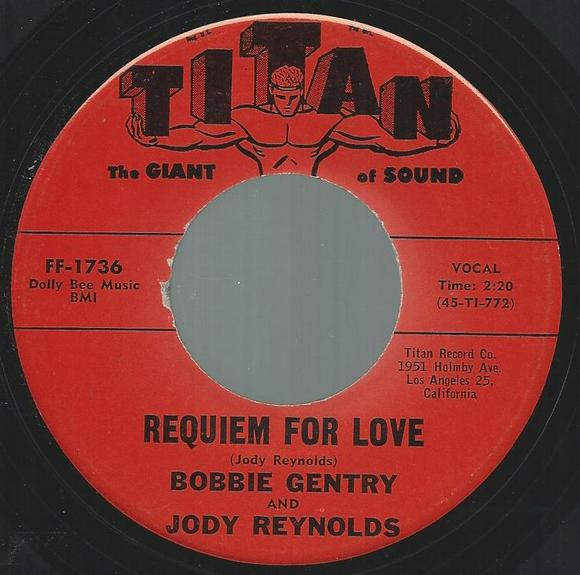
He returned later in 1966 with a new single. This time, it was a duet with Bobbie Gentry. This it seemed George Brown trying to build on the popularity of the partnership between Nancy Sinatra and Lee Hazelwood. For their first single, Jody Reynolds penned two tracks, Stranger In The Mirror and Requiem For Love. Stranger In The Mirror, a country-tinged ballad was chosen as the single.
Later in 1966 Stranger In The Mirror was released on Titan Records. Sadly, commercial success eluded what is now regarded as a hidden musical gem. There was no followup to Stranger In The Mirror and Jody Reynolds left Titan Records.
A year later, and Bobbie Gentry was a star. She had moved to L.A. and recorded her classic single, An Ode To Billie Joe. It reached number one on the US Billboard 100, and was a hit for Bobbie worldwide. An Ode To Billie Joe was nominated for eight Grammy Awards, and eventually won three for Bobbie and one for arranger Jimmie Haskell. The success of An Ode To Billie Joe inspired George Brown to reissue Stranger In The Mirror in October 1967. This time around, the partnership was billed as Bobbie Gentry and Jody Reynolds. He was relegated to the role of supporting artist. This was the final ignominy for Jody, who nine years earlier had watched as his own debut single sold over a million copies. That seemed a lifetime ago.
Since then, it had been all downhill for Jody Reynolds. Following the million selling Endless Sleep, Fire of Love gave Jody a minor hit. He had to endure thirteen consecutive singles fail to chart. For Jody Reynolds it must have been a soul destroying time. Especially when many of the singles he was releasing deserved to fare much better. This included the singles Jody Reynolds released on The Complete Demon and Titan Masters, which was recently released by Ace Records. The compilation features some of the best music Jody Reynolds recorded during a career that lasted six decades. However, the singles and B-Sides are only part of the story to The Complete Demon and Titan Masters.
There’s a number of unreleased songs on The Complete Demon and Titan Masters. This includes the wistful My Baby’s Gone; the heartfelt beautiful ballad Kiss Of Love; I’m Not Afraid Anymore is a tender ballad with a needy vocal. It’s a real hidden gem, that’s a welcome addition to The Complete Demon and Titan Masters. Ballad Of Love features a vocal that’s full of hurt and regret, at the love he’s lost. It Goes On And On showcases Jody’s verstility, and there’s even a nod to Elvis in his vocal. Jody’s cover of the standard Blue Moon, has a melancholy sound that works well with the understated arrangement. These unreleased tracks are further proof of a talented singer, songwriter and musician whose singles sadly, never enjoyed the success they deserved.
Fortunately, the rockabilly revival of eighties resulted in an upsurge of interest in Jody Reynolds’ career. Suddenly, a new generation of record buyers discovered an artist whose debut single was a million seller that pioneered the death disc. However, there’s more to Jody Reynolds’ career than death discs or teenage tragedy. That was just a small part of his recording career that’s celebrated on The Complete Demon and Titan Masters. It’s a reminder of Jody Reynolds, who sadly, passed away on November 7th 2008. However, the music world was a better place for Jody Reynolds contribution including which features on The Complete Demon and Titan Masters. It’s the definitive Jody Reynolds compilation.
JODY REYNOLDS-THE COMPLETE DEMON AND TITAN MASTERS.




LONNIE MACK-THE WHAM OF THAT MEMPHIS MAN!
LONNIE MACK-THE WHAM OF THAT MEMPHIS MAN!
By 1963, twenty-two year old Lonnie Mack was already an experienced musician. He had been making a living as a musician since he was thirteen. That was when Lonnie Mack quit school, after getting involved in an argument with a teacher. For most thirteen year olds, this would’ve spelt disaster. This wasn’t the case for Lonnie Mack. He knew exactly what he wanted to do with his life…make a career out of music.
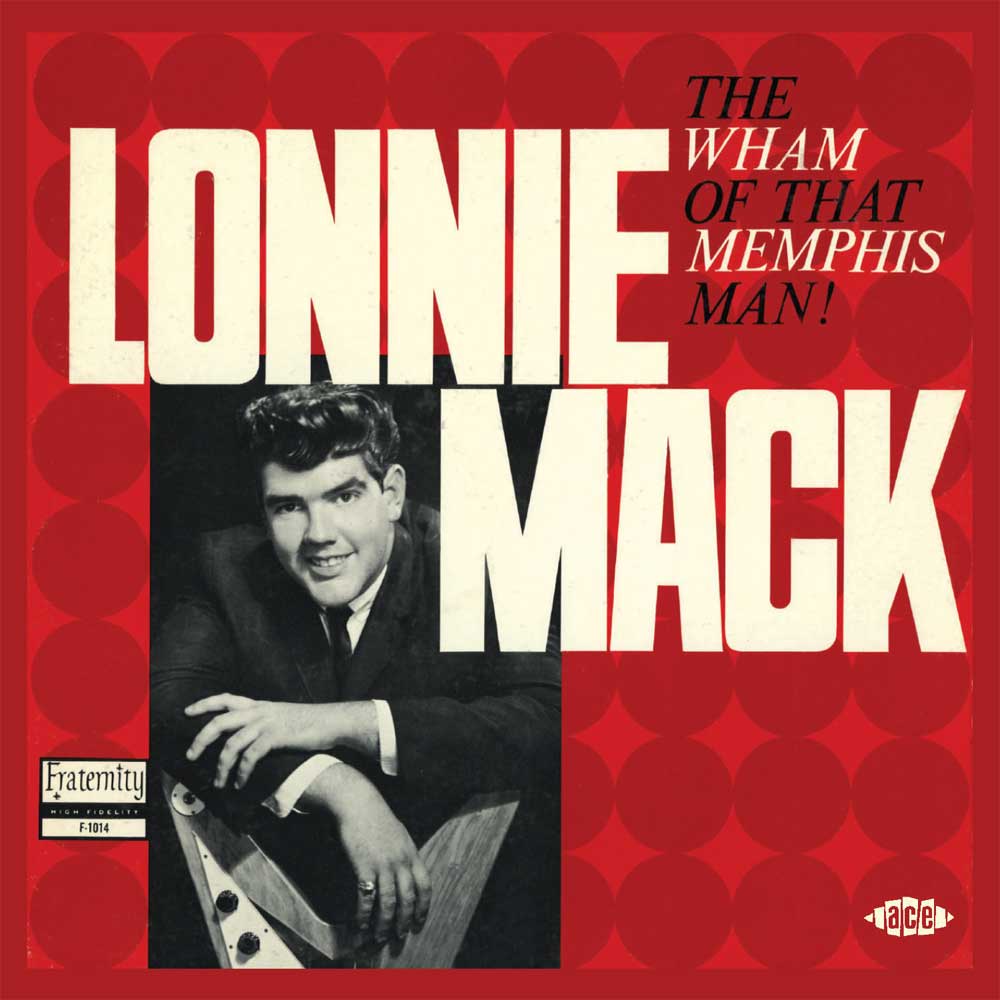
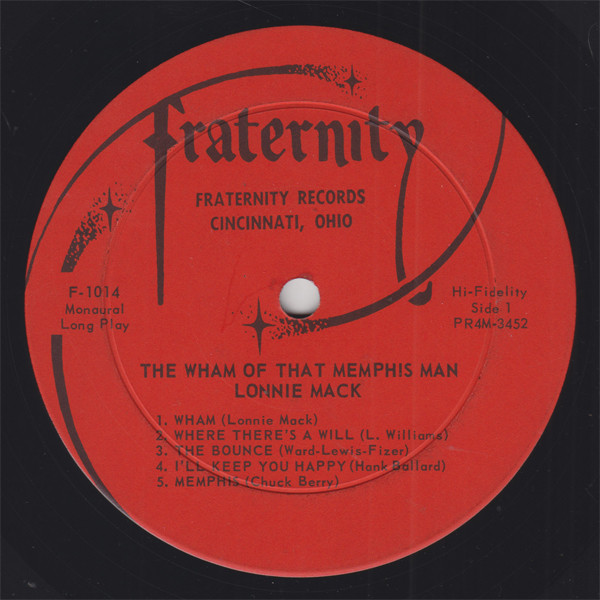
That’s what Lonnie Mack went on to do. He recorded thirteen albums during a career a career that spanned six decades. Lonnie’s debut album was The Wham Of That Memphis Man, which was recently released by Ace Records. By then, Lonnie Mack was being hailed a musical pioneer who had changed music. However, when Lonnie embarked upon a musical career aged thirteen this must have seemed a pipe dream to Lonnie’s parents, Robert and Sarah Sizemore McIntosh.
They were living in West Harrison, Indiana when the future Lonnie Mack was born on July 18th 1941. He grew up in a series of farms along the Ohio River. However, by the time Lonnie Mack was seven, he had already developed an interest in music. The young Lonnie Mack swapped his bicycle for an acoustic guitar. It would soon prove to a wise move.
It was Lonnie Mack’s mother that showed him a few rudimentary chords on his new guitar. After this Lonnie practised long and hard, in an attempt to master the guitar. Then when his finders were sore with practising, he would listen to The Grand Ole Opry on a battered old radio. It was powered by a truck battery, as there was no electricity in the McIntosh house. Listening to the stars of The Grand Ole Opry made Lonnie all the more determined to master his guitar.
Before long, Lonnie Mack had mastered the acoustic guitar, and would sit outside the family home and playing country music. Passers-by would throw spare change to Lonni3. Soon, he was braving the nearby hobo jungle, where he would play for spare change. Little did Lonnie know, that he was serving what was akin to the first part of his musical apprenticeship.
Lonnie Mack’s musical apprenticeship ended somewhat suddenly, when he was thirteen. He got involved in an argument with one of his teachers. When Lonnie came off second best, he vowed never to return. He was as good as his word, and that proved to be the end of his formal education. Now the next chapter in Lonnie’s life began; when he decided to embark upon a career as a musician.
There was a problem though. Lonnie Mack was only thirteen, and too young to play in Cincinnati’s bars and roadhouses around. Luckily, Lonnie looked older, so with the help of a fake id, he was able to play in Cincinnati’s bars and roadhouses. They were a tough and uncompromising audience, but this never phased Lonnie . Nothing seemed to.
Not even the thought of forming his own band or making an appearance on television. This came after Lonnie Mack heard Elvis Presley and Carl Perkins. This inspired him to form his own rockabilly trio. They were invited to appear on a local television show, and covered Blue Suede Shoes. For fifteen year old, Lonnie Mack this was his first, but wouldn’t be his last television appearance. Not long after this, Lonnie played on his first recording.
This came when Lonnie Mack played on a session by Al Dexter. He was recording Pistol Packin’ Mama. Later, Lonnie played on two single by his cousins Aubrey Holt and Harley Gabbard. Already, it seemed, Lonnie was comfortable within the environs of a recording studio. However, before long, he would make a change to his sound.
Up until then, Lonnie Mack’s musical weapon of choice had been a Gibson Kalamazoo. However, in 1958 Lonnie decided to buy a Gibson Flying V. This came at a cost. The Gibson Flying V was an expensive and desirable guitar. Lonnie knew this, and was willing to pay $300 to order the new guitar. Maybe he secretly knew it would be a musical investment? Especially when he added the final piece of the jigsaw? Then his trademark sound would be complete.
Over the next few years, Lonnie gigged regularly throughout Ohio. It was in the early sixties at the Twilight Inn, that club owner Frog Childs christened Lonnie’s band. Thereafter, they became known as Lonnie Mack and The Twiliters. However, when Lonnie heard Robert Ward play in 1960 he realised what was missing from his sound..,a tube driven amplifier.
This was what gave Robert Ward’s guitar the rich vibrato sound. When Lonnie Mack asked about the amplifier, Robert Ward explained it was a tube driven Magnatone 460 amplifier. However, it had been modified, and included an inbuilt electronic vibrato. Instantly, Lonnie knew that this amplifier could transform his guitar sound. He went out and bought one of the amplifiers, and Lonnie’s trademark sound was complete.
With the new amplifier Lonnie Mack showcased his new sound. This involved Lonnie fitting the thickest strings available to his guitar. However, the Magnatone 460 amplifier was crucial to what Lonnie called a “watery” sound. Later, Lonnie added a Magnatone 440 amplifier, and ran it through a Fender Twin guitar amplifier. Gradually, Lonnie began to experiment, changing amplifiers to suit venues. At one point, he used an organ amplifier, which Lonnie described as a “rotating, fluttery sound.” That was still to come. Before that, Lonnie was a session musician at Fraternity Records, based in Cincinnati, Ohio
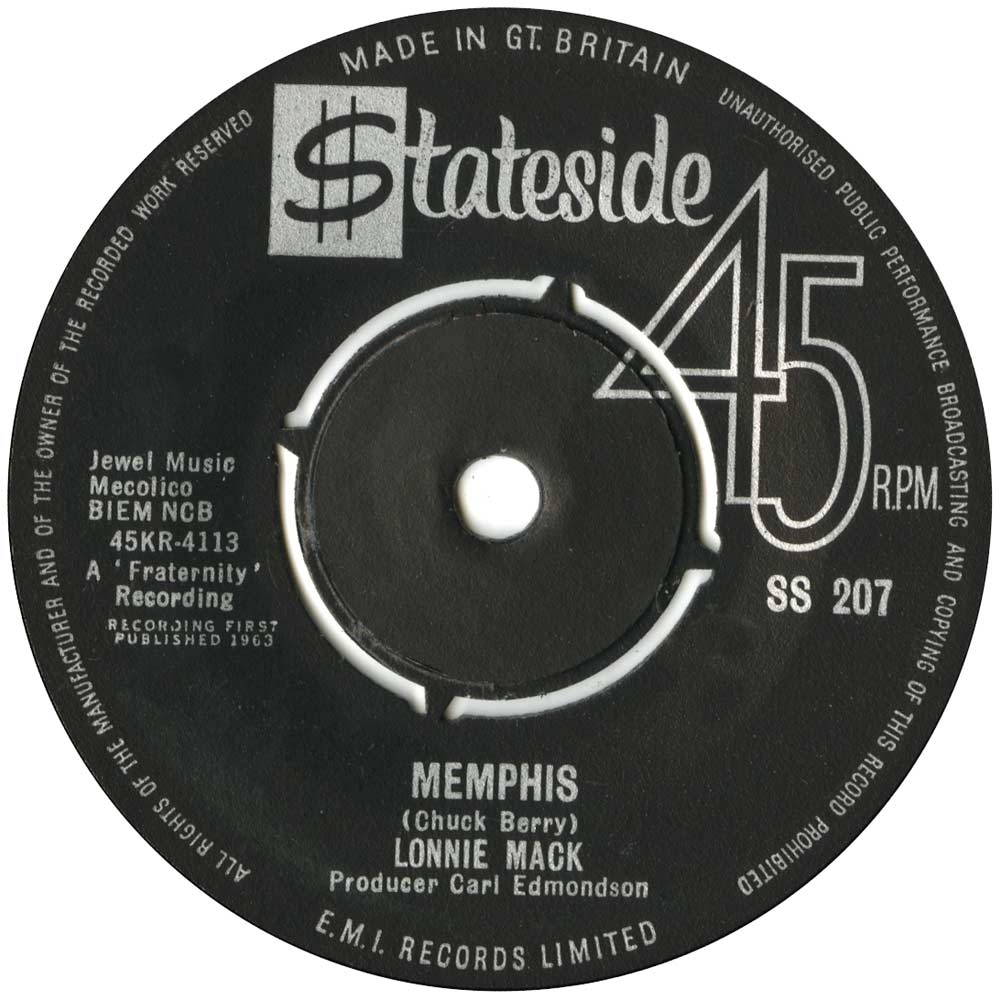
After working at Fraternity Records for a few years, Lonnie Mack’s solo career began on 12th March 1963. The sessions took place at King Records’ studio, where Lonnie and his band were backing The Charmaines, who were signed to Fraternity Records. At the end of the sessions, there was just enough time for Lonnie and his band to lay down an instrumental version of Chuck Berry’s Memphis. The with literally minutes to spare. Lonnie and his band recorded his own composition Down In The Dumps. When producer Carl Edmondson heard the recordings, he thought they had potential.
So Carl Edmondson went to see Harry Carlson, who owned Fraternity Records. Harry Carlson agreed, and decided to release Memphis as a single.
By the time Memphis was released, Lonnie Mack was out on tour, working with the Troy Seals band. Troy had been a member of Lonnie band in the late fifties; and the two men had been friends ever since. So when news came through that Memphis reached number five in the US R&B charts, it was a cause for celebration.
The release of instrumental version of Memphis saw Lonnie Mack hailed a musical pioneer. The electric guitar took centre-stage on Memphis, as Lonnie unleashed breathtaking and blistering solos. Lonnie played with speed, accuracy and some said, aggression. Other guitarists could only look on enviously. It was obvious to them that the arrival of Lonnie was a game changer. Critics agreed, hailing Lonnie a musical pioneer. Already, Lonnie’s thoughts had turned to the followup to Memphis.
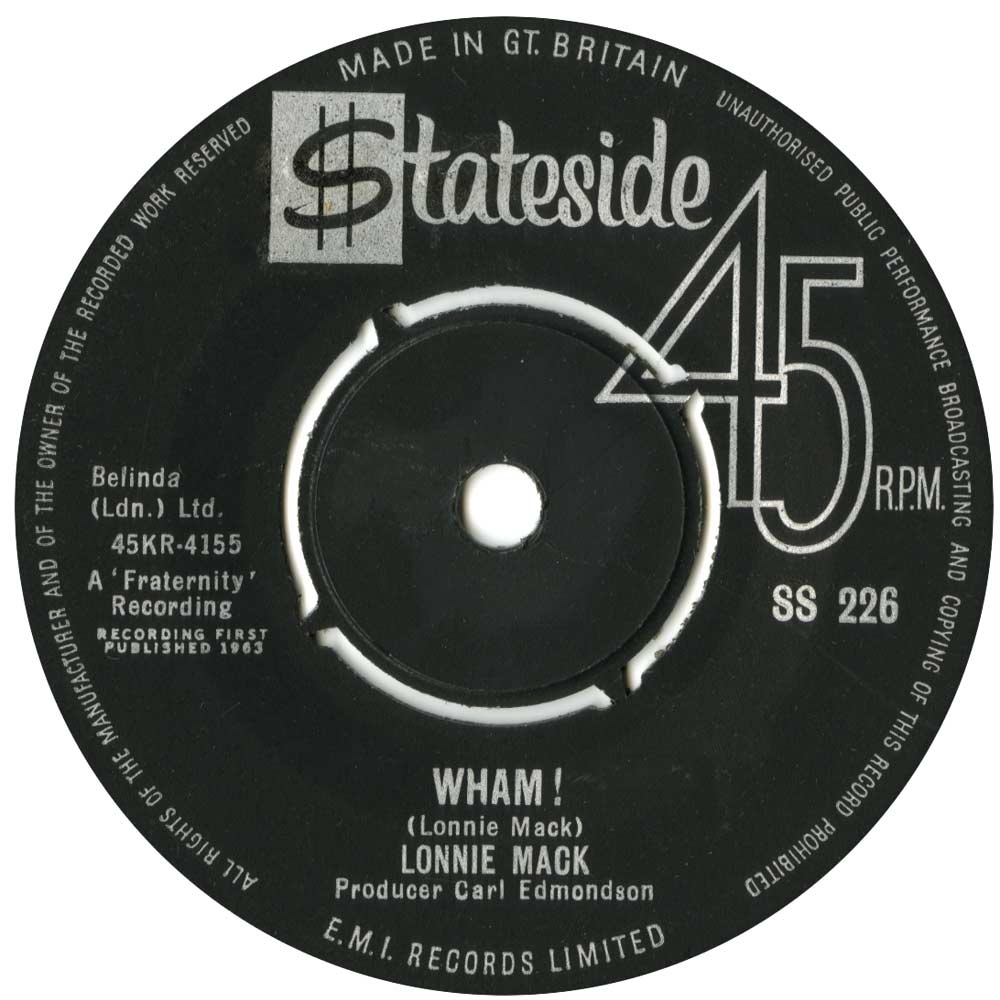
For his sophomore single, Lonnie Mack chose one of his own compositions, Wham. On the B-Side, he added a cover of Dale Hawkins, Stanley Lewis and Eleanor Broadwater’s Suzy-Q. Everyone thought that Wham would repeat the success of Memphis. However, the single stalled at twenty-four on the US R&B charts. Wham dissevered to fare much better. Lonnie’s sophomore single had been short-changed. It featured another breathtaking performance from Lonnie, as he unleashed a series of blistering solos on Wham. Again, he played with speed, accuracy, determination even a little aggression. Lonnie’s rivals were awestruck, as he drew inspiration from the blues and R&B to create his own unique blues-rock sound. It would go on to influence everyone from Eric Clapton and Jeff Beck; to Duane Allman and Stevie Ray Vaughan; and even Ted Nugent and Bootsy Collins. However, in 1963, Lonnie was thinking no further than his next single.
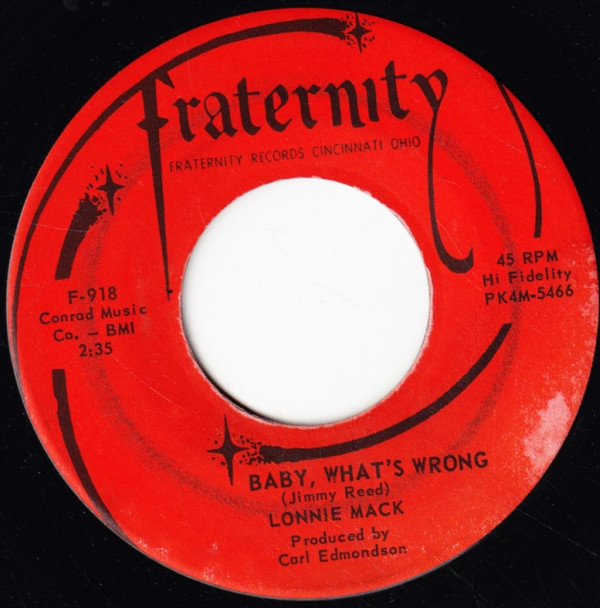
The song chosen, was Jimmy Reed’s Baby, What’s Wrong. On the flip-side, was Lou William’s Where There’s A Will (There’s A Way). On its release later in 1963, the Carl Edmondson entered the US Billboard 100. Usually, this would’ve been a cause for celebration. Not this time. Baby, What’s Wrong reached a lowly ninety-three on the US Billboard 100. For Lonnie Mack, this was a bitter blow. It had been downhill since the release of his debut single. Despite this, Fraternity Records’ owner Harry Carlson agreed to release Lonnie’s debut album The Wham Of That Memphis Man in October 1963.
In many ways, Harry Carlson had little to lose. The Wham Of That Memphis Man featured Lonnie Mack’s first three singles and their B-Sides. To this, two new songs from Lonnie and three cover versions were added. Lonnie penned the ironically titled Down and Out and Why. The cover versions included Hank Ballard’s I’ll Keep You Happy; Martha Carson’s Satisfied and Charlie Fizer, Eddie Lewis and Walter Ward’s The Bounce. These songs were recorded at King Records’ studio and produced by Edmondson. Once the tracks were recorded, Fraternity Records began work on the release of Lonnie Mack’s debut album.
The Wham Of That Memphis Man was released in October 1963, and was hailed a groundbreaking album. Critics and record buyers had never heard an album like The Wham Of That Memphis Man. Partly, that was down to Lonnie Mack’s band.
Accompanying Lonnie Mack on The Wham Of That Memphis Man were a rhythm section of drummer Ron Grayson and bassist Wayne Bullock. Pianist Fred Stemmerding was joined by a horn section of Irv Russotto, Marv Lieberman and tenor saxophonist Donald Henry, who also added maracas. He and the rest of the band provide eleven backdrops that veer between bluesy and soulful. Meanwhile Lonnie Mack steps up and unleashes a series of breathtaking, virtuoso performances.
Wham! opens The Wham Of That Memphis Man. It’s two minutes of foot to the floor music. Growling horns add an element of drama, as the rhythm section power the arrangement along. When the horns drop out, up steps Lonnie Mack. He unleashes a blistering solo. It climbs high above the arrangement, as the fleet fingered virtuoso never misses a note. Later, when the horns return, Lonnie and the band are heading towards a crescendo, and do so in style. However, it’s Lonnie the musical pioneer, that steals the show.
Where There’s A Will (There’s A Way) shows another side to Lonnie Mack. It’s a heartfelt, soulful ballad, where gospel tinged harmonies accompany Lonnie. He delivers a soul-baring vocal, as the rhythm section, origin and harmonies provide a slow backdrop. This proves the perfect accompaniment to his vocal which later, becomes needy, impassioned and emotive. It’s a track that shows there’s more to Lonnie Mack than a fleet fingered guitar slinger.
Braying horns join the jaunty rhythm section in driving the arrangement to The Bounce along. They’re joined by Lonnie, and his shimmering, vibrato guitar. Its crystalline sound is accompanied by punchy, soulful harmonies. Meanwhile, Lonnie fingers fly up and down the fretboard. Later, a backing vocalist sings: “just one more time.” She sings calla and response, as Lonnie and the bands head for the finishing line and another impressive crescendo.
I’ll Keep You Happy marks another change in style. Lonnie delivers another heartfelt, needy vocal. He’s joined by backing vocalists, while the rhythm section and wistful piano create a slow meandering backdrop for this ballad. His vocal veers between needy to hopeful, as Lonnie breathes emotion into the lyrics. It’s further proof that Lonnie was a talented vocalist, as well as a virtuoso guitarist.
Memphis was the single that launched Lonnie Mack’s career. Choppy, bristling and chiming guitar licks join the rhythm section, and add a degree of urgency. The guitar is crucial to the sound and success of this instrumental. Especially, as this instrumental unfolds. By then, Lonnie has taken centre-stage and is playing a starring role. His searing, blistering guitar is played briskly, chirping and chiming. A hint of vibrato is used sparingly, before the choppy licks bookend this instrumental version of Chuck Berry’s Memphis. It’s one of the highlights of The Wham Of That Memphis Man.
Baby, What’s Wrong was written by a giant of the blues Jimmy Reed. It’s given a makeover by Lonnie Mack. Choppy, chirping guitar licks join the rhythm section in setting the scene for Lonnie’s vocal. It’s full of hurt and sadness, as he asks “Baby, What’s Wrong with you.” Backing vocalists accompany and then augment his scorching guitar solo. They add soaring harmonies, before Lonnie rejoins them. He adds a vocal, while adding a bristling guitar solo. It rings out, as the punchy and later, soulful harmonies join Lonnie’s hurt-filled vocal. By then, it’s obvious that this another of Lonnie’s finest moments. Despite this, commercial success eluded this song when it was released as a single. Fifty-three later, and this reworking of Baby, What’s Wrong has an almost timeless sound.
Down And Out is a slow, bluesy shuffle. The horns add to the bluesy sound while stabs of piano help the rhythm section drive the arrangement along. Meanwhile, Lonnie unleashes a vibrato soaked guitar solo. It shimmers, glistens and quivers. Other times Lonnie plays with urgency and aggression, before later, deploying speed and accuracy. This shows how versatile a guitarist he is. However, playing an important part in the sound of the bluesy instrumental, are Lonnie’s band. They frame another spellbinding performance from the virtuoso guitarist, as he pioneers the blues rock sound.
Horns bray, and washes of organ join the rhythm section on Satisfied. It has a surprise in store. This comes when Lonnie sings: “on well you ask me if I’m happy, I have a peace within, if I worry…as I reach my journey’s end.” This gospel track is reworked by Lonnie, and shows yet another side to him and his music. Blazing horns, gospel tinged, soaring harmonies testify as Lonnie unleashes an impassioned, powerful vocal. It’s soulful and delivered with sincerity as also Lonnie adds a guitar part. This time, it’s Lonnie’s vocal that steals the show. Aided and abetted by the backing vocalists, Martha Carson’s song takes on new life and meaning; and back in 1963, was heard by a new audience.
Dale Hawkins is regarded as being responsible for the definitive version of Susie Q. Despite this, Lonnie’s version is one of the best cover versions. Subtle rasping horns punctuate the arrangement while the rhythm section provide the heartbeat. Meanwhile, Lonnie’s crystalline, chiming and bristling guitar soars above the arrangement. It quivers, as vibrato is added and steals the show. Especially, as Lonnie’s fingers fly up and down the fretboard at breakneck speed. All this effort is well worthwhile, and results in one of the best cover versions of Susie Q.
Slow, bluesy and moody describes Why. Lonnie’s crystalline guitar quivers, ringing out as blues horns join the rhythm section. They set the scene for Lonnie’s heartbroken vocal. He delivers the lyrics as if he’s lived them. His vocal is a mixture of power, emotion and hurt. Meanwhile, cooing harmonies soothe and sympathise. Lonnie continues to lay bare his soul on this tale of hurt and heartbreak. It’s without doubt one of the best songs Lonnie wrote for The Wham Of That Memphis Man, and is one of most moving songs on the album.
Down In The Dumps closes The Wham Of That Memphis Man. It’s another instrumental, penned by Lonnie Mack. His quivering guitar is joined by braying horns as the rhythm section and piano drive the arrangement along. Soon, the scorching guitars soar high above the arrangement. When they drop out, Lonnie’s guitar takes centre-stage. From there, the horns and guitar play leading roles, on what’s a perfect showcase for Lonnie Mack and his talented band.
Despite the undeniable quality of The Wham Of That Memphis Man, the album reached just 103 in the US Billboard 200 when it was released in October 1963. Those that bought a copy of The Wham Of That Memphis Man heard a musical pioneer, who changed the future direction of music.
Suddenly, the electric guitar could play a starring role in track. It was no longer just playing a supporting role. Nobody tried this before Lonnie Mack released Memphis and Wham as singles. They were game-changers, which would influence several generations of musicians. Everyone from Eric Clapton and Jeff Beck to Duane Allman, Stevie Ray Vaughan and Ted Nugent were inspired by Lonnie Mack. They owe him a debt of gratitude.
Without Lonnie Mack, the musical landscape would be very different. Many musical historian credit Lonnie for laying the foundations for Southern Rock. Lonnie Mack was also a pioneer of blues rock, but was equally comfortable playing rock ’n’ roll, rockabilly and singing soul. Indeed, Lonnie Mack is regarded as one of the greatest blue eyed soul singers in musical history. He shows his considerable skills as a vocalist and guitarist on The Wham Of That Memphis Man, which was recently reissued by Ace Records. It’s an album that’s stood the test of time.
That’s not all. The Wham Of That Memphis Man is a reminder of a multitalented and versatile musician, as he embarked upon a recording career that lasted until 1990. During that period, Lonnie Mack released thirteen solo albums. Sadly, in 1990, Lonnie Mack called time on his recording career.
That wasn’t the end of Lonnie Mack’s career. He continued to play live up until the early years of the new millennia. Sadly, on April 21st 2016, Lonnie Mack passed away in Smithville, Tennessee. Lonnie Mack was only seventy-five. That day, music lost a true pioneer, whose had a huge influence in modern music. Even today, Lonnie Mack continues to influence a generation of guitarists. So it’s fitting that Lonnie Mack’s debut album The Wham Of That Memphis Man has been released, and is a fitting reminder of a truly versatile and talented musician whose sadly missed, but will always be remembered.
LONNIE MACK-THE WHAM OF THAT MEMPHIS MAN!
DIE KRUPPS-STAHLWERKREQUIEM.
DIE KRUPPS-STAHLWERKREQUIEM.
In 1978, German music began to change. The Krautrock era which began in 1969, had ended in 1977. There was then a shift more towards electronic music. This wasn’t new.
The Berlin School had been around since the early seventies. It was also a precursor of ambient music, and went on to influence future generations of ambient musicians. Among the founding fathers of the Berlin School were Tangerine Dream, Klaus Schulze and Manuel Göttsching. They began to pioneer electronic music in West Berlin. Over the next few years, they recorded some of the most important, influential and innovative electronic music of the seventies. Nothing however, lasted forever.
This included the Berlin School. Although it wasn’t quite ready to shut its doors, the classic period was over by late 1978. After this, German music would begin to evolve and reinvent itself. It was time for the musical baton to pass to a new generation of musicians.
Waiting in the wings, were a newly formed Düsseldorf band, Die Krupps. They were formed in 1980, just as the new decade dawned. The initial members of Die Krupps were Jürgen Engler, Bernward Malaka and Ralf Dörper. Together, they set out to create music that was new and innovative. This was a big challenge. However, Germany bands and musicians had been releasing groundbreaking music since 1969. This included Kraftwerk, Can, Cluster, Neu!, Harmonia, Popol Vuh Ash Ra and Tangerine Dream. Maybe Die Krupps would follow in their footsteps?
Not only did Die Krupps want to make new and innovative music, they wanted to make a type of music that had never been made before. It would have to be unorthodox and radical. To create this music, the members of Die Krupps looked to Germany’s recent musical past. They soon discovered Germany’s rich musical past, and discovered that they were following in the footsteps of other musicians who set out reinvent German music. Groups like Can, Cluster, Faust, Guru Guru, Kraftwerk and Neu! had all set out to do so, and succeeded. Now was the turn of Die Krupps.
Soon, Die Krupps were gaining a reputation locally as a pioneering, up-and-coming band. Die Krupps early music was atonal genre-melting music. It sounded as if Die Krupps had combined elements of avant-garde with experimental, free jazz, industrial and jazz. This musical potpourri was very different to what the new breed of German bands were making.
Already it seemed as if Die Krupps were trailblazers. This would prove to be the case, when Die Krupps released their debut album Stahlwerksynfonie (Steelworks Symphony) in June 1981.It was a fusion of industrial rock and Electronic Body Music.
Critics hailed Stahlwerksynfonie an innovative and influential album. Soon, it had become a musical phenomenon, which went on to inspire a generation of musicians. They were in thrall to what was regarded as a thirty-minute musical opus. Some critics even compared Stahlwerksynfonie with Cluster’s early albums. This was no surprise. Cluster’s early albums had been of Die Krupps’ reference points. So it was no surprise when these comparisons were made. However, this wasn’t the only similarly between Die Krupps and Cluster.
Both groups would go on to enjoy long careers, and would be hailed as musical pioneers. Die Krupps are still going thirty-six years later. Granted the lineup has changed over the years, but still, Die Krupps continue to play live and release new albums. Their most recent album is Stahlwerkrequiem which will be released by Bureau B, on 20th June 2016. Stahlwerkrequiem is a reworking of the album that launched the career of Die Kupps, Stahlwerksynfonie.
To record Stahlwerkrequiem, Jürgen Engler was joined by three musicians who inspired Die Krupps’ early music. These musicians just so happen to shared the same musical philosophy. This included Guru Guru’s founder and drummer Mani Neumeier. He’s joined by two members of another groundbreaking band, Faust. Drummer Zappi Diermaier and bassist Jean-Hervé Peron both played on Faust’s 1971 eponymous debut album. Joining these three veterans of German music, were two musicians from two generations.
The first was Kurt Dahlke aka Pyrolator. He joined Der Plan in 1979, and they became a musical contemporary of Die Kupps. Just like Kurt Dahlke, Jürgen Engler found himself following in the footsteps of groups like Guru Guru and Faust. However, Der Planb didn’t enjoy the same longevity as Guru Guru and Faust. Der Plan disbanded in 1993,and Pyrolator embarked upon a solo carer. Since then, he’s been work as an electronic musician and producer. However, by the time Pyrolator’s solo career began, guitarist Scott Telles’ career was blossoming.
His career began in 1980, when punk band Vast Majority released their debut single, Wanna Be A Number. Since then, Scott Telles has been a member of several bands. This includes, experimental space rocker ST 37, who were formed in 1987. They released their debut album The Invisible College in 1992. Since then, they’ve released around seventeen albums. However, when Scott Telles isn’t working with ST 37, he works on a variety of other side projects.
This includes post rockers My Education, who have released eight albums between 2001 and 2014. Scott Telles’ has also been a member of Bahrain, Moray Eels and Guru Freakout, which also featured Guru Guru drummer Mani Neumeier. They reunited for the recording of Die Krupps’ latest album Stahlwerkrequiem.
When recording of Stahlwerkrequiem began, Die Krupps’ lineup featured a rhythm section that included drummers Mani Neumeier and Zappi Diermaier; bassist Jean-Hervé Per and guitarist Scott Telles. They were joined by Pyrolator on synths and keyboards. Die Krupps’ founder Jürgen Engler added synths and guitar. This extended lineup of Die Krupps recorded two lengthy tracks, Stahlwerkrequiem/Rheinhausen and Stahlwerkrequiem/Westfalenhütte. The former was a twenty-three minute epic, while the latter lasted ‘just’ thirteen minutes. This was similar to Die Krupps had done, when they recorded Stahlwerksinfonie in 1981. Does Stahlwerkrequiem match the quality Stahlwerksinfonie? That’s what I’ll tell you, after I’ve told you about Stahlwerkrequiem.
Stahlwerkrequiem opens with Stahlwerkrequiem/Rheinhausen. Straight away, there’s an industrial sound, as metal is bashed and pounded. This is reminiscent of early Faust. Soon, a bass is plucked, before drums are joined by screaming, searing and blistering guitars. They head in the direction of free jazz, veering between discordant and strangely and satisfyingly melodic. In the background, the industrial sound is part of the musical landscape. A myriad of clinking, clanking and metallic sounds are added, while rocky guitars cut through the arrangement. Effects are added to the guitar while the all-star rhythm section nail the relentless, mesmeric and pounding beat. By then, the guitar solo is playing a starring role. A virtuoso performance is unleashed, and a dark, hypnotic bass helps power the arrangement along. By then, elements of avant-garde, experimental, free jazz, industrial Krautrock, post rock, psychedelia and space rock have played their part in the story so far.
Later, drums and a scampering guitar join the bass as the industrial symphony unfolds. Sometimes, this industrial sound becomes futuristic, before guitars are thrashed and ring out. They’re at the heart of this epic track. So are the hypnotic rhythm section and the industrial sounds. What sounds like peels of bells ring out. However, they’re part of an arrangement that’s variously industrial, futuristic, melodic and mesmeric. The bass adds the mesmeric sound. It’s relentless, and continues to drive and power the arrangement along. Meanwhile, sounds assail the listener. They range from futuristic, sci-fi and otherworldly, to dark and dramatic, to industrial. That’s not forgetting a screeching, blistering guitar. It becomes part of a musical vortex, that assails the listeners as it whirls and soars around and above them. From there the guitars and electronics play leading roles. Chiming, driving, searing guitars join crackling, whirring, bristling, otherworldly sci-fi sounds. Adding the finishing touch are the myriad of metallic sounds. They play their part in a genre-melting epic.
Stahlwerkrequiem/Westfalenhütte closes Stahlwerkrequiem. The bass sound similar to the one on the previous track. It’s slow steady and provides the heartbeat. Soon, a myriad of sounds join hissing hi-hats and blistering, screeching, searing guitars. They kick loose, while the bass is still slow, steady and mesmeric. They’re like the tortoise and the hare. Meanwhile, effects are added to the guitars, they ring out, adding futuristic, otherworldly and post rock sounds. They sometimes sound as if they belong in a computer game. Later, electronics sounds are added, as guitars are pushed to their limits, and sometimes, way beyond. They’re played quickly, confidently and flamboyantly. They bristle, scamper, reverberate and threaten to feedback. By then, an elegiac wash encircles the arrangement, as very briefly, the bass deviates from its course. It seems content to create the pulsating beat, and leave the flashy, flamboyant playing to others. This includes a guitar solo that’s unleashed at breakneck speed. Even the drums get in on the act. However, the last man standing is the bass. It continues to drive an arrangement that’s variously industrial, futuristic, otherworldly, robotic, dramatic and gloriously rocky along. Just like its predecessor, it features Die Krupps at their innovative best, pushing musical boundaries, before reaching an über rocky crescendo.
After just two lengthy tracks lasting thirty-seven minutes, Die Krupps exit stage left. They’ve achieved what they set out to do on Stahlwerkrequiem. That was rework their debut album Stahlwerksinfonie. It was released in 1981, and is regarded as a genre classic. Stahlwerksinfonie become a musical phenomenon, which went on to inspire a generation of musicians. They were in thrall to what was regarded as a thirty-minute musical opus. However, thirty-five years later, and Jürgen Engler decided to rerecord a new version of Stahlwerksinfonie. This became Stahlwerkrequiem, which will be released by Bureau B on 24th June 2016. Stahlwerkrequiem is an epic genre-melting album.
Die Krupps combine elements of avant-garde, experimental, free jazz, industrial Krautrock, post rock, psychedelia and space rock on Stahlwerkrequiem. It’s a truly captivating and inspirational album, where musical and genres and influences melt into one.
Stahlwerkrequiem features blistering and breathtaking Hendrix inspired guitar solos. That’s not forgetting the influence of Frank Zappa, Lou Reed and Faustian industrial sounds. Then there’s the influence of Krautrock pioneers like Can, Neu! and Guru Guru.
Their influence can be heard throughout Stahlwerkrequiem. Especially Guru Guru, whose drummer Mani Neumeier features on Stahlwerkrequiem. So do Faust’s rhythm section of drummer Zappi Diermaier and bassist Jean-Hervé Peron. They add a relentless, mesmeric and hypnotic heartbeat to Stahlwerkrequiem. It’s a reminder of the glory days of Krautock. To that, Pyrolator and post rock guitarist Scott Telles set about helping Jürgen Engler set about what many people thought was impossible. That was creating an album that surpassed the quality of Stahlwerksinfonie.
With an all-star band accompanying him Jürgen Engler set about to create an album that was one of the biggest challenges of his long musical career. The result was Stahlwerkrequiem, a truly groundbreaking album of genre-melting music. Die Kupps took the listener on a journey though musical genres and influences. The music was veered between dark and dramatic, to elegiac and melodic, to futuristic and otherworldly. Other times, the music is hypnotic and mesmeric. Sometimes, the metallic and industrial sounds take a strangely melodic sound as they ring out. Always, the industrial and rocky sounds that are omnipresent throughout Stahlwerkrequiem play a leading role in the album’s sound and success.
They play starring roles throughout Stahlwerkrequiem, which is a musical Magnus Opus from Die Krupps. It will be released thirty-five years after Die Krupps released their genre classic Stahlwerksinfonie in 1981. This was the album that many felt that Die Krupps would never surpass. That was until Jürgen Engler decided the time was right record a new version of Stahlwerksinfonie. The resultant album, Stahlwerkrequiem surpasses Die Krupps’ debut album. With a few musical friends, Die Krupps created what is a truly groundbreaking genre-melting Magnus Opus Stahlwerksinfonie. It features Die Krupps doing what they’ve spent a lifetime doing, pushing musical boundaries to their limits and beyond on Stahlwerkrequiem, which is sure to influence and inspire a new generation of musicians.
DIE KRUPPS-STAHLWERKREQUIEM.
MODERNISM.
MODERNISM.
Ever since the birth of rock ’n’ roll, youth cults have come and gone. Some have been nothing more than passing fads. Others have lasted longer. None of the youth cults of the past sixty years have enjoyed the same longevity as the modernists.
Their longevity is unrivalled, and is celebrated on Modernism, a new compilation from Kent Dance, an imprint of Ace Records. It’s the much-anticipated followup to Modernists-A Decade Of Rhythm and Soul, which was released back in March 2015. Fifteen months later, and Modernism features another twenty-four tracks that provided the soundtrack to life as a modernist. Their story began in nearly sixty years ago.
The modernists came to prominence in the late fifties. Their name came about because of their love of modern jazz. However, by the early sixties, the modernists had become mods.
Musically, mods had eclectic taste. Mods embraced American R&B and soul music. Especially labels like Stax and Tamla Motown. They also listened to ska and reggae. However, mods didn’t turn their back on British music. The mods enjoyed pop and rock music. Groups like The Rolling Stones, The Who, Small Faces and The Kinks were perceived as “mod” groups. However, music was only part of the mod movement.
Image was everything for mods. They carefully tried to cultivate an air of coolness. The suits they wore were often tailor made. Sometimes, their suits were made out of cashmere, with narrow lapels. They also sported button-down collar shirts, thin ties and wool or cashmere jumpers All this was de rigueur a mod around town. So were fishtail parkas, desert boots, Chelsea boots and bowling shoes. A few mods even took to wearing makeup. In sixties Britain, this didn’t go unnoticed. However, mods were unlike no other youth subculture. Mods even had their own mode of transport.
Lambretta or Vespa scooters were the mods’ choice of transport. They drove them around town, where they visited dance-halls, coffee bars, and cinemas. At cinemas, mods took to watching French and Italian films. This was all part of a sense of continental coolness they were attempting to cultivate. After all, image was everything to the mod. So was music.
Every time there’s been a mod revival in the last fifty years, at the heart of the revival has been music. Whether it was in the late-seventies or mid-nineties, music and fashion was at the heart of these mod revivals. The music being made during the mod revivals during the late-seventies and mid-nineties, was inspired by the music of the sixties. For mods of all vintage, this was a golden era for music. However, the music on Modernism is a return to the early years of the mod.
The majority of music that features on Modernism, was released between 1958 and 1967. That’s apart from two tracks that weren’t released until the nineties, and two unreleased tracks Modernism. It features twenty-four tracks, including contributions from Teddy Reynolds, Joe Mayfield, Eddie Bo, King Carl, Chuck Jackson, Bob and Earl, The Shirelles, Lou Johnson, Leroy Harris, Sammy Jones, Jackie Lee and Darrow Fletcher. That’s just a tantalising taste of the musical delights that awaits the listener to Modernism. So dust off your mohair suit, dawn your fishtail parka and climb a aboard your Vesta, as I pick the highlights of the musical adventure that’s Modernism.
Opening Modernism, is a previously unreleased version of Teddy Reynolds’ Ain’t That Soul. The song was written by Teddy Reynolds, and released ias a single by Speciality Records in. By then Teddy Reynolds’ career had spanned two decades. It began in 1950, and for the next twenty years he continues to release singles. This included Ain’t That Soul in 1969. However, the version on Modernism was recorded at an earlier date. Despite that, it’s funky, soulful and guaranteed to get the mods on the dance-floor.
The name Bernard Jolivette probably won’t mean much to most mods. That’s unless they’re the type to pore over the credits on singles. If they are, they’ll know that Bernard Jolivette was a successful songwriter,who lived in Louisiana. He wrote a number of hits, and influenced the chord structure of the swamp pop ballad. Away from writing songs, Bernard Jolivette released a string of single as King Carl. Unfortunately, commercial success eluded these singles. This includes Blues For Men, which was released as a single on the La Lousinianne label in 1965. Tucked away on the B-Side was one of Bernard Jolivette’s compositions, Everybody’s Feelin’ Good. It’s an irresistible dance track that even today, would have mods heading for the dance-floor.
In 1964, Chuck Jackson was signed to Wand, when he released Beg Me. It was penned by Rudy Clark; arranged by Stan Green and is produced by Luther Dixon for Ludix Production. It’s a typical New York production, and showcases a talented singer, Chuck Jackson. He delivers a needy, pleading vocal, which is answered by female backing vocalists. It’s potent combination, and when Beg Me was released, the single reached number forty-five in the US Billboard 100 and number five in the US R&B charts. It was no surprise when Pye decided to released Beg Me in the UK. Quickly, it became a favourite in mod clubes, and even today, that’s still the case.
During his career, Chet Ivel released around twenty singles. This includes Chet “Poison” Ivey and His Fabulous Avengers’ 1968 single The Poo Poo Man. It was released on the Bee and Cee label, but failed to find an audience. How different things might have been if the B-Side Soul Is My Game had been released as a single. This Chet Ivey composition is stomping slice of dance-floor friendly boogaloo.
Back in the sixties, The Shirelles were trailblazers. They were one of the earliest girl groups to enjoy commercial success. Soon, others followed in their footsteps. However, when The Shirelles were signed to Scepter in the sixties, some of the music the recorded was never released. This was no reflection on the quality. So in 1987, Ace Records released Crossroads In Your Heart. It was written by Luther Dixon and George Kerr. Although there’s a rawness to this stomper, it’s a reminder of another era, when girl groups ruled the roost.
Joan Moody’s The Life Of The Party is another B-Side. It was penned Freddie Dobbs and Scott Douglas; while it was produced by Lee Porter Ronald Miller. The Life Of The Party was the flip-side to We Must Be Doing Something Right, which was released in Sylvia Records on 1965. When copies of We Must Be Doing Something Right made their way across the Atlantic, they eventually became a favourite on the UK Norther Soul scene. However, when curious record buyers flipped over to The Life Of The Party they discovered another side that would go down well on the mod or Northern Soul scene. Wistful and tinged with irony, it’s a hidden gem that might even be The Life Of The Party.
When Lou Johnson released his The Magic Potion Of EP on London Records in 1964, little did he realise that two decades later, it would be a much prized item amongst eighties mods. The EP featured four very danceable songs. They had been favourites of the first generation of mods. One of their favourites was Bacharach and David’s Magic Potion. It was one of the legendary songwriting partnership’s finest songs. Lou Johnson delivers a heartfelt and soulful version of Magic Potion, which fifty-two years later, sounds just as good.
Leroy Harris only ever released the one single, Crow Baby Crow. It was released on the Swan label in 1966. Hidden away on the B-Side was I’m Gonna Get You. It was written by Leroy Harris and Ellis Taylor, who produced the two sides. They feature Leroy Harris and his band The Teardrop Review. They’re the perfect foil for Leroy Harris’ vocal, and create a jaunty, dance-floor friendly arrangement that sounds as if it’s been inspired by an o James Brown track. The result is a real hidden gem. Alas, this was Leroy Harris’ only single. He returned to Kansas, where he was a regular fixture on the club circuit.
Fifty years ago, in 1966, Joe Johnson set off to J.D. Miller’s Crowley studio in Louisiana. That was where he was due recorded several tracks, included We Gonna Rub Part 1. Whie most of the tracks were released, one lay in J.D. Miller’s vaults, We Gonna Rub Part 1. It never saw the light of day until Ace Records unearthed this bluesy slice of soul for one of their compilations. We Gonna Rub Part 1 makes a welcome return on Modernism, and is a reminder of a truly talented artist.
Sammy Jones released Cinderella Jones as his sophomore single. It’s a William Miler composition that was released on Wand. Accompanied by some of the Big Apple’s finest session players, Sammy Jones unleashes a vocal that veers between impassioned and needy, before becoming a sassy vamp. By then, Sammy Jones seems to be paying homage to Otis Redding. There’s similarities in their delivery, during what’s another long-lost soulful gem.
Back in 1966,Darrow Fletcher was signed to the Groovy label, where he released a couple of singles. This included Gotta Draw The Line. On the flip-side was the Maurice Simpkin penned I’ve Gotta Know Why. It was a favourite amongst the mod scene, who had taken Darrow Fletcher to their heart. No wonder, given this delicious slice of soulful music.
My final choice from Modernism is Listen To Me (Baby), from Ralph Ventsha and Red Julian Combo. It was penned by Ralph Black, and released as a single in 1958 on the Vistone label. With its slow, bluesy, late night sound, it would be the perfect way for mods to end the evening. It’s certainly the perfect way to close Modernism.
Modernism, the eagerly awaited followup to Modernists-A Decade Of Rhythm and Soul, is a welcome addition to what looks becoming a regular series. Just like its predecessor, Modernism documents and celebrates a youth cult that’s enjoyed unrivalled longevity, the mods.
Across Britain, between 1958 and 1967, mods spent nights listening to, and dancing to the music on Modernism. Artists like Teddy Reynolds, Joe Mayfield, Eddie Bo, King Carl, Chuck Jackson, Bob and Earl, The Shirelles, Lou Johnson, Leroy Harris, Sammy Jones, Jackie Lee and Darrow Fletcher were all favourites of the mods. Their tastes were discerning and eclectic, ranging from American R&B, blues and soul music. They also listened to ska and reggae, plus some of the music being released in Britain during the sixties. Mostly, the mods looked across the Atlantic for musical inspiration.
The trawled record shops, ordering imports and even, ordered direct from American labels. There was a great deal of one-upmanship, with collectors and DJs competing to get a copy of a record first. That can’t have been easy in the late-fifties and sixties. So collecting the twenty-four tracks on Modernism would’ve expensive and time consuming. Record collectors needed patience as they awaited the elusive singles. Weeks and sometimes, months would pass by before the single wound its way across the Atlantic. Nowadays, it’s changed days.
Now it’s possible to buy a compilation like Modernism which features some of the best music from the early days of the mods. Modernism was compiled by Dean Rudland for Kent Dance, an imprint of Ace Records. It’s a fitting reminder of the music the mods danced to in the late-fifties and sixties. This was a dawn of new era, when a new youth culture was blossoming.
Over fifty years later, and there’s been several mod revivals. However, the mods have never really gone away. Across Britain, mods of every vintage continue to celebrate the music of their youth. Modernism will bring back memories when they used to dust off their mohair suit, dawn their fishtail parka and climb aboard a Vesta and head to places like Blackpool, Brighton or Skegness.
MODERNISM.




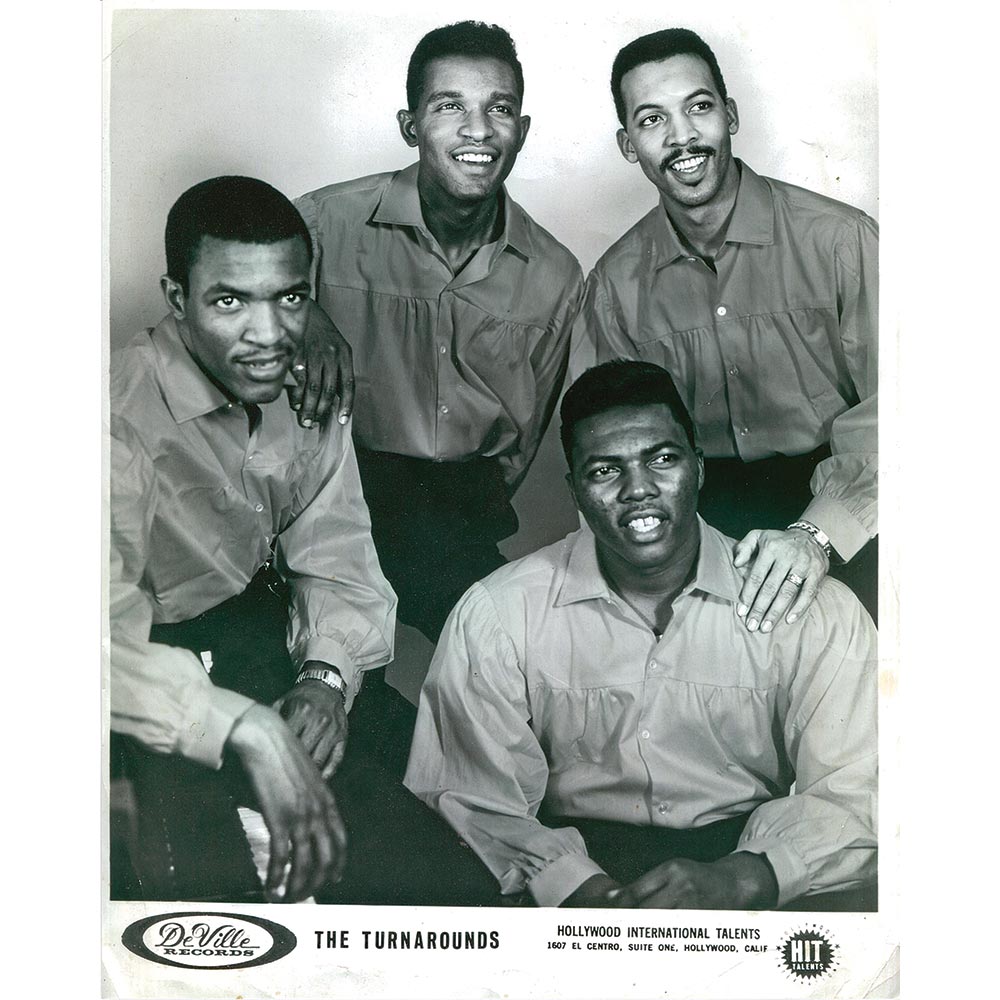

TYLL-SEXPHONIE.
TYLL-SEXPHONIE.
During 1975, a number of Krautrock’s most innovative bands released new albums. The year began when Neu! released their third album Neu! 75 in January 1975. This got the ball rolling.
Over the next eleven months, many of the leading lights of the Krautrock scene released new albums. Harmonia released their sophomore album Deluxe; while Cluster released Zuckerzeit and Can Landed. Amon Düül II returned with Made In Germany and Kraftwerk with Radio-Activity. Manuel Göttsching released his landmark album Inventions For Electric Guitar; while Popol Vuh released Das Hohelied Salomos. Many of these albums would eventually be regarded as Krautrock classics. However, another album released during 1975 which was a much more low profile release.
This was Tyll’s debut album Sexphonie, which will be rereleased on the Metal Experience label on 9th June 2016. Sexphonie is an album that back in 1975, was shrouded in mystery and controversy. Indeed at one point, it looked like Tyll’s debut album Sexphonie would never be released. It was, and proved to the opening and closing chapter in the Tyll story.
The story behind Tyll began back in early 1975. That was when Fred Kersten, the owner of Kerston Records, approached Teflon Fonfara to ask if he would be interested in recording a Krautrock album. For Teflon Fonfara this was interesting proposition.
Especially since his previous group Eulenspygel had been put on hold. They hadn’t released an album since Ausschuß in 1973. Two years later, and there was no sign of the group returning to the studio or heading out on tour. It was beginning to look as if there was little chance of Eulenspygel reuniting. So Teflon Fonfara decided to take Fred Kersten up on his offer of a week’s studio time. After all, man cannot live on bread alone.
As a familiar face on the local music scene, it didn’t take long for Teflon Fonfara to put together a new studio band. One of the earliest recruits was Eulenspygel’s drummer Günter Klinger. Teflon Fonfara thought nothing of this. After all, Eulenspygel had been put on hold; and it wasn’t even clear if the band would reunite. However, the decision to bring onboard Günter Klinger would prove to be a controversial. That was in the future.
With drummer Günter Klinger onboard, Teflon Fonfara concentrated on recruiting the rest of the band. They were all friends of Eulenspygel. This included bassist Achim Bosch and vocalists Michael Scherf, Susanne Schempp and Ulrike Schempp. They were joined by Teflon Fonfara who appeared as Del Fontana. With the lineup finalised, work began on Tyll’s debut album.
For what became Tyll’s debut album Sexphonie, Teflon Fonfara wrote seven of the songs, and penned Siamesische Überraschung and Grammophon with Achim Bosch. His other contribution was Rita. Ulrike Schempp wrote Für Michael Pfadpfinder; while Michael Scherf contributed the album closer Morgenlicht. These twelve songs would recorded at TFE Studios.
On 1st April 1975, Tyll arrived at TFE Studios, Neustadt, Weinstraße. The six members of Tyll were ready to record the twelve new songs. Producing Sexphonie was Fred Kersten, who owned his own record company, Kerston Records. It would release Sexphonie once it was completed. So the members of Tyll got to work.
At TFE Studios, Tyll’s equipment was unpacked and setup. Then Tyll began recording their debut album. Things were happening fast. It was only a couple of months since Teflon Fonfara put together Tyll. Now the rhythm section which featured drummer Günter Klinger and bassist Achim Bosch began laying down the rhythm tracks. Then it was Teflon Fonfara’s turn to lay down the guitar parts. Once this was complete, it left just the vocals to be added. Tyll’s trio of vocalists, Michael Scherf; Susanne Schempp and Ulrike Schempp began laying down the vocals. Once the vocals had been recorded, Tyll had completed their debut album. The six members of Tyll hd spent just twelve days recording their debut album Sexphonie. It was completed on 12th April 1975.
With Sexphonie recorded, now Tyll and producer Fred Kersten were able to reflect on how quickly and smoothly things had gone. It wasn’t long since Fred Kersten first approached Teflon Fonfara about putting together a studio band. Now Tyll had recorded their debut album Sexphonie, and it would soon be released. Or so they thought.
What neither Fred Kersten nor Teflon Fonfara foresaw, was the threat of legal action that loomed over the release of Sexphonie. Eulenspygel weren’t happy that Tyll had poached or stolen their drummer, Günter Klinger. They threatened Tyll with legal action. This could’ve been disastrous, and resulted in a long and expensive legal battle. Luckily, common sense prevailed, and Tyll were allowed to release Sexphonie.
Even the threat of legal action hadn’t unduly delayed the release of Sexphonie. Still, only a matter of months had passed since Fred Kersten approached Teflon Fonfara with the idea of releasing a Krautrock album. Now, the newly formed studio band Tyll were about to release their debut album Sexphonie.
When Sexphonie was released later in 1975 by Kersten Records, the album wasn’t a commercial success. Certainly nobody was going to get rich after the release of Sexphonie. However, those who bought a copy of Sexphonie discovered an album were Tyll fused acid-rock with hard-psych, polit-rock, progressive rock. There were even the occasional excursion into avant-garde, folk, funk and polit-rock. Sometimes, Eastern influences shawn through on Sexphonie a hidden Kraurtrock gem.
Following the release of Sexphonie, Tyll never released a followup album. Sexphonie proved to a one-off musical experiment from Teflon Fonfara’s studio band Tyll. However, nearly a generation later, and Tyll’s debut album Sexphonie began to attract a cult following. By then, copies of the original album were real rarities. Very few copies of Sexphonie ever change hands. When they do, the price is beyond most record buyers. This meant that Sexphonie was out of reach of most record buyers. Not any more. The Metal Experience label will reissue Sexphonie on 9th June 2016. As you’ll soon realise, it’ll be a welcome reissue.
Tim opens Sexphonie. Just a Spanish guitar plays firmly and briskly. Flamboyant flourishes punctuate the arrangement, before a searing guitar cuts through the arrangement. It’s joined by the rhythm section. Before long, there’s a mesmeric nature to the drums. Then midway through the arrangement, Tyll throw a curveball. The track meanders, as grating, jarring, dramatic sounds add an experimental sound. That’s until Tyll kick loose, and a blistering rocky track unfolds. Teflon Fonfara’s guitar plays a starring role, as he unleashes a series of searing licks. Matching him every step of the way are the rhythm section. That’s until a myriad of beeps and squeaks signal that this captivating rocky track is almost over. However, it whets the listeners appetite for this hidden gem of an album.
Sexphonie is one of the shorter tracks on the album. However, it doesn’t lack in quality. Quite the opposite. Straight away, the rhythm section and quivering, bristling guitar unite, before an impassioned, powerful male vocal is added. It’s augmented by sweet, punchy pop harmonies. Meanwhile, blistering guitars are unleashed. They add a lysergic sound. Meanwhile a nimble fingered bass line sits atop the drums, as genres melt into one. Acid rock, pop and psychedelic rock combine to create a catchy and memorable track.
A lone guitar plays slowly and thoughtfully on Asiatische Liebeserklärung. Its crystalline sound is joined by Eastern sounds. They create an understated arrangement. That’s until 1.47, when the rhythm section and the guitars join. This fills out the arrangement, and transforms it. Soon, the Eastern influence dissipates, and the track heads in the direction of progressive folk. This allows Tyll to showcase their talent and versatility.
Just a crystalline guitar is strummed and sets the scene for the vocals on Paranoia Eines Verliebten. They’re shared by a male and female vocalist, and range from heartfelt to emotive, to powerful and dramatic. At the moment the vocal changes, so does the arrangement. The rhythm section frame the vocal and add an element of drama. Briefly, Teflon Fonfara adds a funky, chiming guitar. Later, a manic laugh punctuates the arrangement. So do effects that come courtesy of Teflon Fonfara’s tapes. By then, the story is unfolding, and the drama building on this genre-melting track. Elements of psychedelia rock, folk, funk and avant-garde combine to create a song that sounds as if it belongs on an early seventies Krautrock concept album. However, Sexphonie was no concept album.
There was neither a concept nor message on Sexphonie. Instead, Sexphonie was almost a reaction against the concept albums of the first half of the seventies. Teflon Fonfara was no fan of them, and seemed regarded concept albums as overblown. He was unwilling to further romanticise concept albums, never mind record one of his own. Instead, this musical maverick recorded what was an innovative musical adventure.
From the distance, Eastern percussion adds an eerie cinematic sound to Nervenzusammenbruch Einer Gitarre. Soon, a probing bass adds to what’s an unsettling sounding track. It sounds as if it would be perfect for a horror movie. That’s until a blistering guitar cuts through the arrangement. Before long, the unnerving sound is almost gone, and is replaced by a futuristic sound. At the heart of the arrangement is the rhythm section and guitar. The rhythm section drive the arrangement along, while the guitar rings out, and plays a starring role. Effects are added, as the guitar is the last man standing. From there, the arrangement meanders melodically along, before its melancholy sound is just a pleasant memory of what’s been a memorable musical adventure.
Teflon Fonfara delves into his tapes, and adds the sound of animal as Siammesische Überraschung unfolds. Meanwhile, he adds effects and they add an otherworldly sound to the avant-garde soundscape. Midway through the track, a bass joins a jazz-tinged guitar. They’re like yin and yang, and prove a perfect foil for each other. That’s until a curveball is thrown. The guitar and bass are replaced by the sound of a music box, which adds a wistful reminder of another era. It’s another innovative, musical potpourri from Tyll, as they continue to push musical boundaries.
There’s a melancholy, cinematic sound to Kristinas Traum as a crystalline guitar chimes and is joined by a bass. In the background, the wind roars and gusts, while a clock chimes. Together, they create a melancholy, cinematic soundscape.
Delirium Song-Grammophon is a seven minute epic. A rumbling bass leads the way, before scorching guitars, pounding drums and vocals enter. Male and female vocalist share vocal duties. Meanwhile, the arrangement is driven along, with the bass and bristling guitar playing starring roles. The vocals are impassioned and delivered quickly. Adding to the drama, is the rhythm section. They provide the perfect backdrop to vocals that veer between urgent to tender. Later, Teflon Fonfara unleashes another of his blistering guitar solos, before what sounds like the helicopter soars across the arrangement. Not to be outdone, a fleet fingered bass line helps propel the arrangement along. Everyone plays their part in the sound and success of what’s a dramatic, urgent and later futuristic and melodic epic. It shows yet another side to musical chameleons Tyll.
Rita has a much more understated and sedate sound. Just guitars and the bass combine as the arrangement meanders melodically along. There’s a wistfulness to the arrangement, as strummed and crystalline guitars combine with the bass. Later, Teflon Fonfara adds the sound of a thunderstorm to the arrangement. This works and adds the finishing touch to a melancholy, cinematic track.
The tempo increases on Suzie Steno, as a bristling, scorching guitar cuts joins the rhythm section. They’re soon joined by the a male lead vocal, which tells the story of Suzie Steno. Augmenting the vocal are harmonies, which sometimes, soar above the arrangement. Framing the vocal are the crystalline guitar and the rhythm section, which provides the heartbeat. Later, when the vocal drops out, another blistering guitar solo takes centre-stage. Its briefly joined by one of Teflon Fonfara found sounds. From there, the rest of this slick slice of hook-laden pop-rock shows its secrets.
Für Michael Pfadfinder is another ballad from Tyll. Just a guitar is strummed as the rhythm section play slowly. They set the scene for the two female vocalists. One sings lead, while the other augments her vocal. There’s a sense of sadness in their heartfelt, emotive vocals. Then when the vocal drops out, Teflon Fonfara steps up, and delivers a bristling, shimmering guitar solo. He then takes his leave, and the vocalists return as this beautiful, melodic and wistful ballad draws to a close.
Morgenlicht closes Sexphonie. A guitar is strummed slowly and deliberately, before Michael Scherf delivers his vocal. It’s accompanied by harmonies, and is delivered slowly and with a sense of sadness and regret. Teflon Fonfara adds a mini collage of sound, before this rueful sounding track is but a distant memory. However, Sexphonie is not an album to forget in a hurry.
Far from it. Sexphonie is a truly memorable debut from Tyll. It was an innovative album of genre-melting music. Lead by Teflon Fonfara, Tyll set out to create the Krautrock album Fred Kersten wanted. To do that, Tyll combined acid-rock with hard-psych, polit-rock and progressive rock on Sexphonie. There were even occasional excursion into avant-garde, folk, funk jazz, polit-rock and pop. This musical melting pot of genres and influences resulted in Fred Kersten getting the Kraurock album he wanted.
Sexphonie was a captivating album of groundbreaking music, where no two tracks were the same. Tyll were musical chameleons, who could create music that was variously beautiful, cinematic, dramatic, lysergic and melancholy. Other times, the music on Sexphonie was progressive, rocky, melodic and mesmeric. Alas, the album wasn’t a commercial success.
When Sexphonie was released in 1975, that album passed record buyers by. This was a familiar story. Even albums by some of the biggest names in Krautrock failed to find an audience first time round. Neither Harmonia nor Neu! were getting wealthy making music. Sadly, neither were Tyll.
After the commercial failure of Sexphonie, Fred Kersten of Kersten records decided not to release a followup album. It was a case of once bitten, twice shy. That was a great shame. Maybe, Tell would’ve made a breakthrough next time around? However, we’ll never know.
Sexphonie was the only album featuring Tyll, a truly talented and versatile band. They weren’t together long, but left a lasting impression. Tyll were founded in 1975, and by the time the year was over. the band was history. Despite being together less than a year, Tyll left behind a memorable musical legacy. That’s their groundbreaking debut album Sexphonie. If finds Tyll switching seamlessly between musical genres, as they create what’s nowadays regarded as a hidden gem and a lost Krautrock cult classic, Sexphonie.
TYLL-SEXPHONIE.
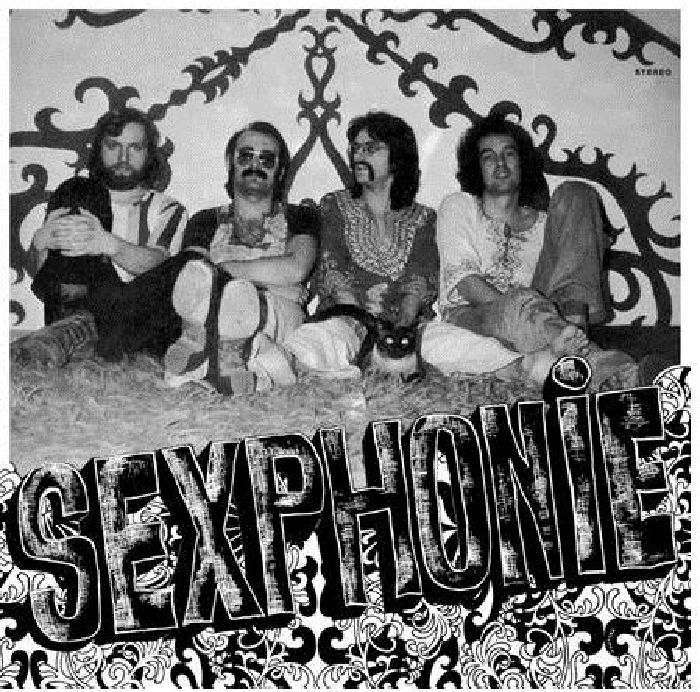

PHIL’S SPECTRE-A WALL OF SOUNDALIKES.
PHIL’S SPECTRE-A WALL OF SOUNDALIKES.
Imitation is the sincerest form of flattery. So it must have seemed to Phil Spector, as producers on both side of the Atlantic tried to replicate his famous Wall Of Sound. These producers looked enviously at Phil Spector, and wanted to enjoy the same commercial success and critical acclaim that he was enjoying. However, this hadn’t come overnight. Phil Spector had first to overcome a major hurdle.
This problem was one that had plagued the record industry for years. When many records were played on jukeboxes and AM radio, they sounded weak and lacked presence. So Phil Spector decided to find a solution to this problem. He found this at Gold Star Studios, in Los Angles.
With engineers Stan Ross, Larry Levine and the legend session musicians the Wrecking Crew, Phil Spector about finding the solution to the problem. Eventually, they realised it was about augmenting arrangements and creating a density. To do this, Phil Spector would record with a large ensemble, including strings, horns and woodwind. Phil Spector often layered instruments. Often, many of his hits featured two or three layers of the same instrument. The result was a much fuller and richer sound. This new sound was proudly described by its creator as: “Wagnerian rock ’n’ roll” and “symphonies for kids.” The new sound was also innovative and would prove hugely successful.
Now Phil Spector set about showcasing his new sound. He had the perfect vehicle for his new sound, his new record label Philles Records.
Between 1962 and 1965, Phil Spector was regarded as a star-maker. He transformed the career of artists. It released thirty-nine singles between 1962 and 1967. Thirty-two of these singles reached the US Billboard 100. However, the most success period for Philles Records and the Wall Of Sound was the period between 1962 and 1965.
That was when Phil Spector swept all that was before him. Phil Spector produced hits for Bob B Soxx and The Blue Jeans, Darlene Love, The Crystals, The Righteous Brothers and The Ronettes. In many cases, Phil Spector launched careers or transformed previously struggling career. Phil Spector had the Midas touch, and was regarded as a star-maker. However, some producers looked on enviously. Other producers decided to replicate the Wall Of Sound.
They figured that if they could replicate Phil Spector’s Wall Of Sound, then they might enjoy the commercial success and critical acclaim that had come its inventor might enjoy. There was a problem though. Some producers struggled to work out Phil Spector’s secret. However, other producers managed to create a similar sound to Phil Spector’s Wall Of Sound. This included the artists on Phil’s Spectre-A Wall Of Soundalikes, which was recently released by Ace Records on 180 grams heavyweight red vinyl.
Phil’s Spectre-A Wall Of Soundalikes features twelve tracks. This includes contributions from Jerry Ganey, Johnny Caswell, Maureen Grey, Dorothy Berry, Dan Folger, The Knickerbockers and Noreen Corcoran. Each of these artists create what’s essentially a homage to Phil Spector. They feature on Phil’s Spectre-A Wall Of Soundalikes.
Side One.
Jerry Ganey’s Who Am I opens Phil’s Spectre-A Wall Of Soundalikes. It matched the pupil against the master. Phil Spector was the master, while Bill Medly of The Righteous Brothers had been one of the beneficiaries of the Wall Of Sound. However, by 1966, Bill Medley was now a producer, and had produced Jerry Ganey’s debut single Just A Fool. That left just the B-Side.
For the B-Side, a Bill Medley composition, Who Am I was chosen. While Jerry Ganey delivers a vocal full of hurt and despair on this ballad, Bill Medley is responsible for an authentic Spector-esque Wall Of Sound. Bill Medley it seems had learnt from the master; and with Jerry Ganey’s soul-baring vocal it was a potent and powerful combination.
In 1964, Johnny Caswell was signed to Smash Records, an imprint of Mercury Records. He had already released his debut single, which had passed record buyers by. He was looking for the right song for his sophomore single. Luckily, the songwriting and production team of David White and John Madara had just signed a production deal with Mercury Records. They would provide Johnny Caswell with his sophomore single.
This was My Girl, a song that they penned and produced. It was released on Smash Records in 1964, and sounded as if it was a Phil Spector production. There’s a Ronettes’ sound and influence to My Girl, which was the best of the three singles Johnny Caswell released for Smash Records.
Once songwriter and producer Peter Antell had written (Baby) You Don’t Have To Tell Me, the next step was finding the right singer for the song. He hadn’t written the song with a singer in mind. Eventually, soul singer Bobby Coleman was chosen, and after rehearsing the song, recording began.
Peter Antell hadn’t set out to record a Spector-esque track. It’s just the way the track evolved, as he layered instruments. Adding the finishing touch to the multi-layered arrangement, were backing vocals from the girl group The Percells. They added an ethereal, dramatic sound to this heart-wrenching, soulful, ballad from Bobby Coleman. It showcases a talented vocalist. Alas, when (Baby) You Don’t Have To Tell Me was released on Bounty Records in 1966, it passed record buyers by. Nowadays, it’s a prized rarity, which is much in demand among the soul fraternity.
The only single Kane and Abel released Red Bird Records was He Will Break Your Heart. It was penned by James Holvay and James Peterson; while the single is A DeFrancesco production. He Will Break Your Heart was was released on the Red Bird label in Mayne 1966. Kane and Abel are reminiscent of The Righteous Brothers during their time with Phil Spector. Their vocals are akin a heartfelt warning of the hurt and betrayal that’s still to come; and are accompanied by Spector-esque arrangement of biblical proportions. When the two are combined, it’s the recipe for a emotive and memorable track.
The Falcons originally recorded You’re So Fine in 1959. Four years later, Dorothy Berry was about to released Cryin’ On My Pillow as a single, on the Challenge label, in November 1963. It was penned and produced by David Gates. For the flip-side, You’re So Fine was chosen.
You’re So Fine was written by Lance Finnie,William West and Robert Schofield. In Dorothy Berry’s hands, You’re So Fine becomes an irresistible, hook-laden slice of pop perfection. Just like the other two single Dorothy Berry released for Challenge, Phil Spector’s production style heavily influenced David Gates. Of the six sides, You’re So Fine is regarded as the best. It’s just a pity it hadn’t been released as a single. It had the potential to launch Dorothy Berry’s solo career.
Side Two.
Nino Tempo and April Stevens had started out as songwriters, and worked with Lieber and Stoller in the early sixties. By 1963, Nino Tempo and his sister April Stevens had won a Grammy Award for writing Deep Purple. The same year, 1963, Nino Tempo began playing keyboards on many of Phil Spector’s recordings for his Philles Records. However, by 1966, Nino Tempo and April Stevens had gone out on their own.
That had been the case for the last couple of years. It hadn’t been easy. The last year, the hits had dried up. That was until Nino Tempo and April Stevens recorded All Strung Out, a song they had written for The Righteous Brothers in 1963. They turned the song down. Three years later, in 1966, Nino Tempo and April Stevens released All Strung Out on the White Whale label. This quite beautiful single was produced by Nino Tempo and April Stevens, and ended their barren spell. After a year, Nino Tempo and April Stevens were back with a hit single.
Dan Folger only ever released a handful of singles. His fifth and final single was The Way Of The Crowd, a Dan Folger composition. It was produced by Bobby Russell and Buzz Cason. The Way Of The Crowd was released on Elf on 22nd July 1967. Elf had been home to Dan Folger throughout his career. Many thought he had kept his finest single until last. It’s a single that has everything; a vocal dripping in emotion and an impressive, multilayered arrangement. Sadly, commercial success passed The Way Of The Crowd by. However, nearly fifty years later, and it’s a timeless, heartachingly beautiful song.
Back in 1963, Timmy and The Presidents released Timmy Boy for Olympia Records. It was arranged by Bob Finiz and produced by Lee Lovett. The song had been inspired by Bob B Soxx and The Blue Jeans’ 1962 hit Zip-A-Dee Doo-Dah. This was one of Phil Spector’s earliest Wall Of Sound recordings. Zip-A-Dee Doo-Dah inspired countless imitators. However, Timmy and The Presidents’s Timmy Boy was one of the best.
Before The Knickerbockers released Wishful Thinking as a single, they had released singles that had been inspired by The Beatles and Jan and Dean. However, when The Knickerbockers covered the Wynn Stewart penned Wishful Thinking in 1966, this present a new challenge for the group. They had yet to perfect the sound of The Righteous Brothers. That was until The Knickerbockers released their 1966 album Lies. It features a cover of Wishful Thinking, which is arranged by Leon Russell and produced by Jerry Fuller. The result is an authentic and melancholy homage to The Righteous Brothers.
In May 1966, Lorraine and the Delights released I Just Couldn’t Say as a single on Barry Records. It was written by Keith Paris and produced by George Kerr. Sadly, this was the only single Lorraine and the Delights released. However, if a group is only going to release one single, make it one as good as I Just Couldn’t Say. It’s best described opera meets Phil Spector’s girl groups. Ethereal, heartfelt and tinged with sadness it’s a real hidden gem. I Just Couldn’t Say is also a reminder of the years Phil Spector swept all before him, and inspired a generation of producers.
Closing Phil’s Spectre-A Wall Of Soundalikes is Noreen Corcoran’s Why Can’t A Boy and Girl Just Stay In Love? It was the B-Side to Noreen Corcoran’s sophomore single Love Kitten, which was written and produced by Nino Tempo. He also wrote Why Can’t A Boy and Girl Just Stay In Love with Phil Spector. When Love Kitten was released on Vee Jay in September 1963, the single failed commercially. However, the wistful sounding ballad Why Can’t A Boy and Girl Just Stay In Love, was too good to be a B-Side.With its Spector-esque arrangement and a rueful vocal full of hurt, it’s a song that oozes quality. That is the case throughout Phil’s Spectre-A Wall Of Soundalikes.
Not only do the twelve tracks that feature on Phil’s Spectre-A Wall Of Soundalikes ooze quality, but they’re akin to a truly innovative producer, Phil Spector. Between 1963 and 1967, when the twelve tracks on Phil’s Spectre-A Wall Of Soundalikes were released, Phil Spector’s star was in the ascendancy. He inspired countless other producers and musicians. This included the producers on Phil’s Spectre-A Wall Of Soundalikes.
These producers hoped or thought that by trying to replicate Phil Spector’s Wall Of Sound, some of his success would rub off. Sadly, that wasn’t the case. Most of the tracks that were released as a single, failed commercially. That was no reflection on the quality of music. Instead, it was the age old problem, with many of the singles being released on small labels. They lacked the personnel and budget to promote a hit single. Other tracks on Phil’s Spectre-A Wall Of Soundalikes were relegated to B-Sides. This sometimes, proved to a mistake. A couple of these Spector-esque tracks had hit potential. However, for whatever reason, they were consigned to the B-Side. Just one of the singles on Phil’s Spectre-A Wall Of Soundalikes became a hit single, Nino Tempo and April Stevens. This was fitting, as Nino Tempo had worked with Phil Spector.
After working alongside Lieber and Stoller, Nino Tempo played keyboards on many of Phil Spector’s Wall Of Sound sessions. This allowed Nino Tempo to see firsthand how the Wall Of Sound worked. Others would have been envious of this, and given anything to stand in Nino Tempo’s shoes.
This included Beach Boy Brian Wilson. He regarded Phil Spector as a musical genius, and was inspired by the Wall Of Sound. Later, in the post Pet Sound years, some would refer to Brian Wilson as a genius. However, genius is flawed. That was certainly the case with Phil Spector.
Phil Spector’s post Wall Of Sound life has been a chequered one. 1967 marked the end of era, when Philles Records released its final single. Phil Spector then withdrew from public life after marrying Veronica “Ronnie” Bennett of The Ronettes. For the next two years, very little was heard of Phil Spector.
Eventually, Phil Spector made a comeback in 1969, and over the next five years, produced albums for John Lennon, George Harrison and Harry Nilsson. However, gradually, Phil Spector became reclusive. Especially, after a near fatal car accident in 1974. Very little was seen of Phil Spector until his second comeback.
In 1977, Phil Spector returned and produced Leonard Cohen’s Death of a Ladies’ Man. Two years later, and Phil Spector produced End of the Century. However, Phil Spector’s comeback was cut short.
From 1981 right through to 1995 Phil Spector disappeared from public view. He tried to work with Céline Dion in 1995 on her album Falling into You. This didn’t work out, and it wasn’t until 2003 when Phil Spector returned to produce Starsailor’s sophomore album Silence Isn’t Easy. By the time it was released in September 2003, Phil Spector’s life had been turned upside down.
On February 3rd 2003, actress Lana Clarkson was found dead in Phil Spector’s mansion in Alhambra, California. Phil Spector was later charged with murder.
Whilst awaiting trial, Phil Spector produced what was surely his swan-song. Singer-songwriter Hargo asked Phil Spector to produce Crying for John Lennon. It featured on Hargo’s 2006 album In Your Eyes. A year later, Phil Spector faced the biggest battle of his life, the one for his liberty.
The first trial ended with mistrial because of a hung jury. A second trial took place in 2009. Phil Spector was sentenced to nineteen years to life on May 29th 2009. Seven years later, and Phil Spector is still resident in the Californian penal system. For Phil Spector, a man many regarded as a musical genius it was a sad way to end his career. Genius it seems is flawed.
Sadly, Phil Spector’s glory days were short lived. Probably his most productive period of his career was between 1962 and 1967. For five years his Wall Of Sound featured on thirty-two hit singles. This included several classic singles. The hit singles Phil Spector produced, influenced many producers and artists. This includes those on Phil’s Spectre-A Wall Of Soundalikes. It was recently released by Ace Records on 180 grams heavyweight red vinyl. Phil’s Spectre-A Wall Of Soundalikes features a dozen homages to a pioneering producer, Phil Spector during his glory years.
PHIL’S SPECTRE-A WALL OF SOUNDALIKES.
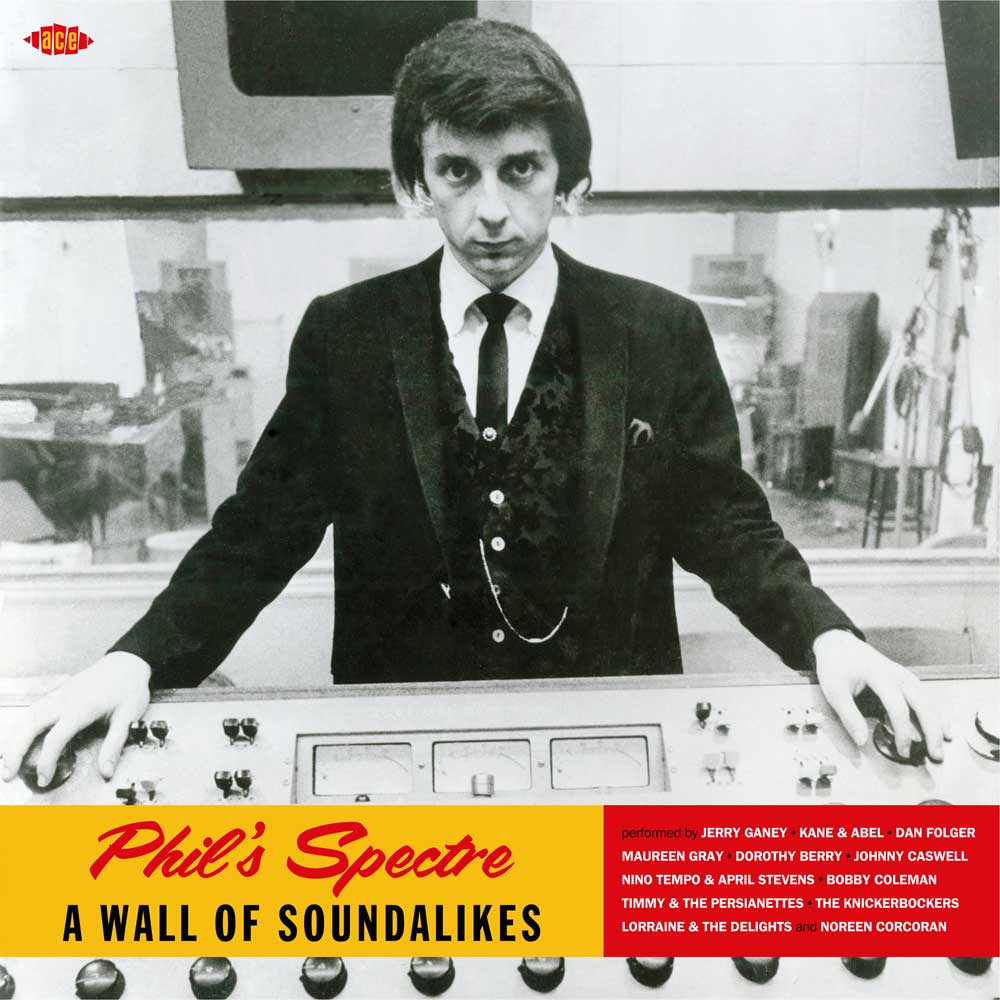
INTERVIEW WITH HOLGER CZUKAY OF CAN.
INTERVIEW WITH HOLGER CZUKAY OF CAN.
The word innovator is one of the most overused words in the English language. However, Holger Czukay, who cofounded Can in 1968 deserves to be called an innovator. He’s also a fascinating person to interview. When I interviewed him, we discussed all things Can, Holger’s solo career and even, the merits of vinyl versus digital. That’s particularly relevant given that recently Holger Czukay’s sophomore album Movies has just been released by Gronland Records as Movie! It showcase the talents of one of the most innovative and progressive musicians of his generation, Holger Czukay. His story begins in 1938.
The future Holger Czukay was born in March 1938, as Holger Schüring. Holger’s home was what was then called the Free City of Danzig. Nowadays, it’s known as Gdansk. In January 1945, Holger and his family were forced to flee their home.
“When I was a child I had to leave my hometown Danzig in Poland. My mother had already bought the tickets for the ship, the Wilhelm Gustlof, when my grandmother warned us that the “water hasn’t got any planks”. I never forgot this sentence, because it saved our lives. We didn’t go onboard the ship, but went to the main station on January 13th 1945. It was a freezing night We were extremely lucky that a train with wounded soldiers picked us up, and they gave us a little bit of room on their mattresses to sleep, and we headed to Berlin. When we arrived i looked out of the window and all I could see were stones and a free field and I asked myself if this can be a capital city?” Having arrived in Berlin, Holger and his family became refugees.
Just like so many children, the war had an impact upon Holger’s education. Like so many displaced children, Holger’s education suffered. Despite this, Holger managed to get a job in a radio repair shop. Not only did he learn how to repair electrical equipment, but became fascinated by radio and the opportunities it offered. This would prove crucial to Holger Czukay’s later career. Before that, Holger served his musical apprenticeship.
For a three-year period between 1963 and 1966, Holger Czukay was privileged to study music under the legendary Karlheinz Stockhausen. “A true pioneer, Karlheinz was way ahead of time.” During his time studying with Karlheinz, Holger met Conny Plank and Irmin Schmidt.
Holger remembers “Conny sitting behind him, writing out a score by hand.” At first “Conny was quiet,” but they “soon became close friends,” during their time studying with Karlheinz Stockhausen. It was a thorough musical education, where Karlheinz taught his pupils about aleatoric music, serial composition and musical spatialisation.
Karlheinz wasn’t just a “visionary” in terms of electronic music, but was fascinated by aleatoric music. Essentially, aleatory is controlled chance. With aleatoric music, some element of a piece are left to chance. Granted there will only be a certain number of outcomes, but the musician has to choose the outcome they believe is correct. Serialism was another subject Karlheinz was interested in. With serialism, a series of values are used to manipulate musical elements. This form of composition fascinated Karlheinz. So did musical spatialisation, which would influence Can. Karlheinz was an evangelist, encouraging his pupils, including Holger Czukay, Irmin Schmidt and Conny Plank to investigate, examine and scrutinise each of these subjects between 1963 and 1966.
For Holger, he could have asked for a better musical education. He admits “Karlheinz taught me so much.” When I asked Holger the most important thing Karlheinz taught him, he didn’t hesitate. Karlheinz told him to “find your own sound.” Holger never forget those words of advice. They became his musical mantra, when eventually, he decided to make a career as a musician. However, when Holger finished studying with Karlheinz Stockhausen in 1966, he became a musical teacher.
Having graduated, Holger was enjoying life as a music teacher. Holger was enjoying his newfound career as an educator. He wasn’t a fan of pop or rock music. That was about to change in 1967.
That’s when Holger heard The Beatles’ I Am A Walrus in 1967, he was captivated by this psychedelic rock single. Holger describes this “as a life-changing moment…the music of the past and present came together.” At last, “here was music that made the connection between what I’d studied and I was striving towards” With the innovative use of bursts of radio and the experimental sound and structure, “I went in search of similar music.”
So I asked Holger about what type of music he started listening to? Specifically, I asked about Frank Zappa and Velvet Underground? Did they influence you, and ultimately Can? “Frank Zappa I didn’t really get.” “Velvet Underground they were different, they really influenced me and my music” “They influenced the music I made…I remember the first time I heard Velvet Underground and where I was when I heard it”
Much of the music that influenced Holger, he heard whilst spending time with friends. Holger is a huge fan of vinyl. He remembers “sitting in a friend’s flat “looking through piles of albums. We’d study the sleeve-notes and then spread the album covers all over the floor. We scrutinised them, then immersed ourselves in the music. It was a shared experience. We listened and discussed the music. I can remember these times well.” Listening to Holger speak, he’s a real music fan. His enthusiasm is infectious. So much so, that it’s as if you’re sitting in the flat with Holger and his friends, looking at the album covers, listening to the music and discussing it.
Holger:’s “pleased to hear they’re being rereleased, especially on vinyl. That’s the perfect medium, you hear the music as you’re meant to.” Listening to Holger he’s evangelic about the vinyl. Not compact discs though. “Compact discs reduce music to background music. No longer do you have to immerse yourself in the music. Instead, it becomes background noise.” In a way Holger is correct, music becomes an accidental soundtrack to daily life. That’s not right. Music is much more important than that. Especially for someone who founded one of the most influential and innovative groups in musical history, Can.
Inspired by what he’d heard, Holger decided to form his own band in 1968…Can. Can’s roots can be traced back to the previous year, when one of Can’s co-founders was studying in time. This was Irmin Schmidt, who’d studied under Karlheinz Stockhausen, at the same time as Holger. The two fellow pupils of Karlheinz Stockhausen, Irmin Schmidt and Holger would eventually form Can. Before that they went their separate ways,
After graduating, Irmnin headed to New York, where he spent time with avant-garde musicians like Steve Reich, Terry Riley and La Monte Young. Soon, Irmin was aware of Andy Warhol and Velvet Underground. This inspired him to form his own band when he returned home to Cologne.
In Cologne, Irmin a pianist and organist formed Can with the American avant-garde flautist David C. Johnson and bassist Holger Czukay. Up until then, the trio had exclusively played avant-garde classical music. Now their ambitions lay beyond that. Their influences included garage, rock, psychedelia, soul and funk. So they brought onboard three new members of the group, which started life as Inner Space, and then became The Can. Eventually, they settled on Can, an acronym of communism, anarchy, nihilism
The first two new additions were guitarist Michael Karoli and drummer Jaki Liebezeit. Vocalist and New York-based sculptor Malcolm Mooney joined the band midway through 1968. By then, they were recording material for an album Prepare To Meet Thy Pnoom. Two tracks, Father Cannot Yell and “Outside My Door were already recorded. Unfortunately, record companies weren’t interested in Prepare To Meet Thy Pnoom. As a result, it wasn’t released until 1981, when it was released as Delay 1968. Undeterred, Can continued to record what became their debut album, Monster Movie.
Despite not being able to interest a record company in Prepare To Meet Thy Pnoom, Can were confident in their own ability. So Can continued recording what would become their debut album Monster Movies. That’s despite being what Holger referred to as “a poor man’s band.” They didn’t have the equipment that other groups did. What Can had was: “an ambition to create innovative music.” However, before long, there was a problem.
David C. Johnson left Can at the end of 1968. He was disappointed at the change in musical direction. Little did he realise that he’d lost the chance to be part of one of the most groundbreaking band’s in musical history, Can.
Monster Movie.
Monster Movie had been recorded in Schloss Nörvenich, a 14th-century castle in North Rhine-Westphalia. Can recorded Monster Movie between 1968-69. It was the released in August 1969. This marked the debut of Can. Their career started as they meant to go on, creating a groundbreaking, genre-melting fusion of blues, free jazz, psychedelia, rock and world music. Monster Movies has a Velvet Underground influence. It’s as if Can have been inspired by Velvet Underground, but pushed musical boundaries to their limits.
Throughout Monster Movie, Can improvised, innovated and experimented. Multilayering and editing played an important part in Monster Movie’s avant-garde sound. So did spontaneous composition, which Can pioneered.
Spontaneous composition was hugely important in Can’s success. Holger remembers “that the members of Can were always ready to record. They didn’t take time to think. It was spontaneous. The music flowed through them and out of them.” Holger remembers that he was always “given the job of pressing the record button. This was a big responsibility as the fear was failing to record something we could never recreate.” In some ways, Can were an outlet for this outpouring of creativity, which gave birth to a new musical genre.
This new musical genre was dubbed Krautrock by the British music press. So not only was Monster Movie the album that launched Can’s career, but saw a new musical genre, Krautrock coined. The founding father’s of Krautrock was Can, lead by Holger Czukay.

Canaxis 5.
1969 saw the release of Holger Czukay’s debut album. Credited to the Technical Space Composer’s Crew, Canaxis 5 was a collaboration between Holger and Ralf Dammers. Canaxis 5 is an often overlooked album, which features two lengthy tracks. It shows two innovative musicians pushing the musical envelope, as Can would continue to do.
Soundtracks.
Released in 1970, Soundtracks, was Can’s sophomore album. Essentially, Soundtracks is a compilation of tracks Can wrote for the soundtracks to various films. It’s the album that marked the departure of vocalist Malcolm Mooney. Replacing him, was Japanese busker, Kenji Damo Suzuki. He features on five of the tracks, contributing percussion and vocals. The addition of Damo wasn’t the only change Can were making.
Soundtracks was a coming of age for Can. It marked a move away from the psychedelic jams of Monster Movie and a move towards their classic sound. That saw the music becoming much more experimental and avant-garde. The music took an ambient, meditative, mesmeric and thoughtful sound. This marked the beginning of what became known as Can’s classic years, when albums like Tago Mago, Ege Bamyasi and Future Days were released.

Tago Mago.
The first instalment in the golden quartet was Tago Mago. This was the first album where Kenji Damo Suzuki was a permanent member of Can. He and the rest of Can spent a year in the castle in Schloss Nörvenich. It was owned by an art collector named Mr. Vohwinkel. He allowed Can to stay at Schloss Nörvenich rent free. For what Holger described as “a poor man’s band,” this was perfect.
Holger remembers Can during this year as “just jamming and seeing what took shape. Songs started as lengthy jams and improvised pieces.” This Holger remembers is “how Can always worked” After that, Holger worked his magic. He edited them and these mini masterpieces featured on Tago Mago, which was four months in the making.
For four months between November 1970 and February 1971, Can recorded what would become one of their most innovative and influential albums, Tago Mago.
A double album, Tago Mago featured seven groundbreaking tracks. Tago Mago was released in February 1971. Straight away, critics realised the importance of Tago Mago. Here was a game-changer of an album. It has an intensity that other albums released in 1971 lacked. Jazzier with an experimental sound, the music is mysterious, mesmeric and multilayered. It’s innovative, with genres and influences melting into one. Nuances, subtleties and surprises reveal themselves. No wonder. Can deliver an avant-garde masterclass.
This comes courtesy of jazz-tinged drumming, improvised guitar playing and showboating keyboard solos. Then there was Kenji Damo Suzuki’s unique vocal style. All this, resulted in an album that was critically acclaimed, influential and innovative.
Released to widespread critical acclaim in 1971, Tago Mago was the start of a golden period for Can. Their reputation as one of the most innovative groups of the seventies started to take shape. Can had released one of the most innovative albums, Tago Mago. Holger remembers the reaction to Tago Mago. “I knew Tago Mago was an innovative album, but I never realised just how innovative an album it would become?
On Tago Mago’s release, it was hailed as Can’s best album yet. However, not in Holger’s opinion. “Tago Mago is a classic album, but I much prefer Future Days.” Despite Holger’s preference, several generations of musicians have been inspired by Tago Mago, a true Magnus Opus, that belongs in every record collection. So does the followup Ege Bamyasi.

Ege Bamyasi.
Can were on a roll. It seemed they could do no wrong. They released Spoon as a single in 1972. It reached number six in Germany, selling over 300,000 copies. That was helped no end, by the single being used as the theme to a German thriller Das Messer. It seemed nothing could go wrong for Can. The money the made from Spoon, allowed Can to hire disused cinema to record what became Ege Bamyasi.
Can advertised for a space to record their next album, Ege Bamyasi. Recording began in a disused cinema, which doubled as a recording studio and living space. The sessions at Inner Space Studio, in Weilerswist, near Cologne didn’t go well. Irmin Schmidt and Kenji Damo Suzuki took to playing marathon chess sessions. As a result, Can hadn’t enough material for an album. This resulted in Can having to work frantically to complete Ege Bamyasi. Despite this, Can were still short of material. So Spoon was added and Ege Bamyasi was completed.
Ege Bamyasi was a fusion of musical genres. Everything from jazz, ambient, world music, psychedelia, rock and electronica melted into one. When it was Ege Bamyasi released in November 1972, it was to the same critical acclaim as previous albums. Critics were won over by Can’s fourth album which was perceived as a more accessible album than its predecessors. Just like Can’s previous albums, the quality of music was consistent.
Critics hailed Can as one of the few bands capable of creating consistent and pioneering albums. They were one of the most exciting bands of the early seventies. Can were continuing to innovate and influence musicians and music lovers alike. Just like its predecessor, Tago Mago, Ege Bamyasi is an essential part of any self-respecting record collection. Having released two consecutive classic albums and their first single, it seemed nothing could go wrong for Can.

Future Days.
Despite Tago Mago and Ege Bamyasi being referred to as two of the most influential albums ever released, Holger Czukay prefers Future Days. This is the album he calls “my favourite Can album.” It was the third in Can’s golden quartet, and marked a change in direction from Can.
Future Days saw Can’s music head in the direction of ambient music. The music is atmospheric, dreamy, ethereal, melancholy, expansive and full of captivating, mesmeric rhythms. It’s also pioneering and progressive, with elements of avant-garde, experimental, psychedelia and rock melting into one. Rather than songs, soundscapes describes the four tracks. Future Days and Bel Air showcase Can’s new sound. Bel Air was the Future Day’s epic. It lasted just over nineteen minutes, and sees can take you on an enthralling musical journey. Just like the rest of Future Days, critics hailed the album a classic.
On its release in August 1973, Future Days was hailed a classic by music critics. The move towards ambient music may have surprised some Can fans. However, Brian Eno was just one artist pioneering ambient music. This move towards ambient music must have pleased Holger’s guru Karlheinz Stockhausen. He must have looked on proudly as Can released the third of a quartet of classic albums. The final album in this quartet, Soon Over Babaluma was released in 1974.
Soon Over Babaluma.
Soon Over Babaluma marked the end of Can’s golden period. It was the end of a period where they were releasing some of their most innovative and groundbreaking music. There was a change of direction on Soon Over Babaluma. Can were without a vocalist. Kenji Damo Suzuki left Can and married his German girlfriend. He then became a Jehovah’s Witness. Despite the lack of a vocalist, Can continued as a quartet. They released Soon Over Babaluma in November 1974.
When Can released Soon Over Babaluma in November 1974, it received praise from critics. With a myriad of beeps, squeaks and sci-fi sounds, Soon Over Babaluma is like musical journey into another, 21st Century dimension. A musical tapestry where layers of music are intertwined during five tracks on Soon Over Babaluma. It followed in the ambient footsteps of Future Days and brought to a close the most fruitful period of Can’s career. Following the “golden quartet,” Can didn’t go into decline. Instead, Can continued to reinvent themselves and their music.
Landed.
Landed was released in September 1975. It had been recorded between February and April 1975 at Inner Space Studios. Just like previous albums, Can produced Landed. Holger and Tony Robinson mixed the first four tracks at Studio Dierks, Stommeln. The other two tracks were mixed by Holger at Inner Space Studios. These six tracks marked a change of direction from Can.
As well as a change in direction musically, Landed was the first Can album to be released on Virgin Records. Gone is the ambient sound of Soon Over Babaluma. Only Unfinished on Landed has an ambient influence. Instead, Landed has a poppy, sometimes glam influence. With uptempo, shorter songs, Landed was a much more traditional album. How would the critics react?
Critics were divided about Landed. Some critics saw Landed as the next chapter in the Can story, while others praised the album as adventurous, eclectic and innovative. Others thought Can were conforming. Surely not?
Flow Motion.
Flow Motion was Can’s eight album. As usual, it was recorded at Inner Space Studios. Produced by Can, Flow Motion was an album that drew inspiration from everything from funk, reggae, rock and jazz. It was an eclectic, genre-melting album. It’s also one of Holger Czukay’s favourite Can albums.
Holger remembers Flow Motion as an “Innovative and eclectic” album. He calls it “one of Can’s underrated albums.” Flow Motion also marked a another change in Can’s way of working.
Released in October 1976, Flow Motion featured lyrics written by Peter Gilmour. This was a first. Never before, had anyone outside the band had written for Can. It worked. Can enjoyed their first UK single I Want More. It would later be recorded Fini Tribe and then Italo disco group Galaxis. With what was just their second hit single in seven years, maybe Can were about to make a commercial breakthrough?
Saw Delight.
Sadly, that wasn’t to be. Saw Delight which was released in March 1977, wasn’t the commercial success many people forecast. That’s despite the new lineup of Can embracing world music.
Joining Can were bassist Rosko Gee and percussionist and vocalist Rebop Kwaku Baah. They’d previously been members of British rock band Traffic. Rosko Gee replaced Holger on bass. Holger decided to add a percussive element, Holger added a myriad of sound-effects. This was Holger at his groundbreaking best. Experimental sounds including a wave receiver was used. The result was one of the most ambitious albums can had released.
Despite the all-star lineup and a bold, progressive and experimental album, Saw Delight wasn’t a commercial success. It was well received by critics. The problem was, Saw Delight was way ahead of its time. If it had been released in the eighties, like albums by Paul Simon or Peter Gabriel, it would’ve been a bigger commercial success. Sadly, by then Can would be no more. That was still to come. However, things weren’t well within the Can camp.
Out Of Reach.
Nine years after Can had released their debut album Monster Movie, they released their tenth album, Out Of Reach. It was released in July 1978. The title proved to be a prophetic. After all, commercial success always seemed to elude Can. Not only did Out Of Reach fail commercially, but the Out Of Reach proved to be Can’s most controversial album.
So much so, that they disowned Out Of Reach. On Out Of Reach Holger was left to add myriad of sound-effects. Bassist Rosko Gee and percussionist Rebop Kwaku Baah of Traffic returned. They were part of the problem. Holger confirms this.
When I asked him what he meant by this, he said “During the recording of Out Of Reach, I felt an outsider in my own group. I was on the outside looking in. I was on the margins. All I was doing was add sound-effects.” For Holger, he felt” his group had been hijacked by Rosko Gee and Rebop Kwaku Baah.” Things got so bad, that Holger quit Can.
Rosko Gee and Rebop Kwaku Baah dominated Out Of Reach. Gone was the loose, free-flowing style of previous albums. Even Jaki Liebezeit’s play second fiddle to Baah’s overpowering percussive sounds. The only positive thing was a guitar masterclass from Michael Karoli. Apart from this, things weren’t looking good for Can. It was about to get worse though.
The critics rounded on Out Of Reach. They found very little merit in Out Of Reach. Rosko Gee and Rebop Kwaku Baah were rightly blamed for the album’s failure. Even Can disliked Out Of Reach. They later disowned Out Of Reach. Despite this, Rosko Gee and Rebop Kwaku Baah remained members of Can.
Unable to play with the necessary freedom Can were famed for, the two ex-members of Traffic stifled Can. Rebop’s percussion overpowers Jaki’s drums, which have always been part of Can’s trademark sound. At least Michael’s virtuoso guitar solos are a reminder of classic Can. A nod towards Carlos Santana, they showed Can were still capable of moments of genius. There wouldn’t be many more of these. Can would breakup after their next album.
Can.
Following the failure of Out Of Reach, the members of Can began recording what became Can. Remarkably, Rosko Gee and Rebop Kwaku Baah were still part of Can. Sadly, Holger was not longer a member of Can. He’d left during the making of Out Of Reach. His only involvement was editing Can.
Can, which is sometimes referred to as Inner Space, was released in July 1979. Again, critics weren’t impressed by Can. It received mixed reviews. No longer were Can the critic’s darlings. The music on Can was a fusion of avant-garde, electronica, experimental, psychedelia and rock. Add to that, a myriad of effects including distortion and feedback, and here was an album that divided the opinion of critics. The critics agreed, it was better than Out Of Reach. They agreed that Holger was sadly missed.
Even Holger’s renowned editing skills couldn’t save Can. Try as he may, he could only work with what he was given. He did his best with Can, which the eleventh album from the group he co-founded. By the time Can was released, Holger “had come to a realisation, that it was time to go his own way.” Holger describes this as “necessary.”
Can decided to split-up after the release of Can. Sadly, Can was their swan-song. However, even before that, Holger “felt marginalised, this had been the case since he Rosko Gee and Rebop Kwaku Baah became part of Can. They’d hijacked Can.” Now, Holger would embark upon his solo career.
Movie!
Holger hadn’t really been making music since 1976. The last two Can albums saw Holger editing the music. So, Holger set about finding “his own sound again.” He’d “been through this with Can,” Now he’d have to do so again. It would be worth it though, when he released his first solo album since 1969s Canaxis 5, Movies. It’s been recently released by Gronland Records as Movie!
Recording of Movie! took place at Inner Space Studio, Cologne. This was where Can had recorded the best music of their career. It was like a Can reunion. Jaki Liebezeit played drums on Movie! Irmin Schmidt and Michael Karoli played on Oh Lord, Give Us More Money. Even Baah was drafted in to play organ on Cool In The Pool. Holger threw himself into the project. He recorded Movie! and played guitars, bass, keyboards and synths. Then when the four songs that became Movie! were completed, Holger mixed and produced the album. Movie! saw Holger hailed the comeback King.
Released to critical acclaim, Movies! was hailed as one of the best albums of 1979. It was an eclectic album. Described as variously psychedelic, cinematic, melodic, moody, understated and progressive, here was the next chapter in Holger’s musical career. The one track that everyone agreed was a minor masterpiece was Cool In The Pool. It was Movies’ Magnus Opus. Holger’s decision to embark upon a solo career had been vindicated. He was back doing what he did best, creating ambitious, groundbreaking and pioneering music. That would continue in 1981, when Holger released On The Way To The Peak Of Normal.
On The Way To The Peak Of Normal.
When I spoke to Holger, he said “one of the albums I’m most proud of, is 1981s On The Way To The Peak Of Normal. It was Holger’s first collaboration with Conny Plank.
Working with Conny Plank Holger remembers, was a revelation. Holger felt Conny was a consummate professional. “Here was someone who understood what I was trying to achieve.” He ensured that I never made music people neither understood, nor wanted to buy. The sessions were organised and disciplined, very difference from the indiscipline of late Can albums.”
Recording took place in the familiar surroundings of Inner Space Studios, Cologne. The only member of Can were present was Jaki Liebezeit. Other members of the band included Conny Plank and Jah Wobble, who Holger and would collaborate with on the 1982 E.P. Full Circle and the 1983 Snake Charmer E.P. They’re two of many collaborations Holger would be involved with. That was still to come.
Before that, Holger released On The Way To The Peak Of Normal in 1981. Just like the early days of Can, Holger was the critic’s darling.
Critics were won over by On The Way To The Peak Of Normal. The album was a fusion of ambient, avant-garde, electronic, experimental, funk, industrial, jazz, psychedelia and rock. Genre-melting describes an album of bold, challenging, innovative, inventive and influential music. It was a case of expect the unexpected on On The Way To The Peak Of Normal, which saw Holger continue to create groundbreaking music. Here, was one of the most inventive albums Holger had recorded.
Although Holger had been making music for three decades, he still had plenty to say musically. That would continue throughout the rest of the eighties, with his various collaborations and his 1984 album Der Osten ist Rot.
Der Osten ist Rot.
There was a three-year gap between On The Way To The Peak Of Normal and Der Osten ist Rot. During that period, Holger was busy collaborating with other artists. A new generation of artists discovering his music, and Holger was discovering their music.
He remembers spending time with Conny Plank in Cologne. Devo and the Eurythmics had been working with Conny. Holger was able to spend time in their company. One night, Holger remembers “Devo jamming, and they asked me to join them. I was impressed by their discipline and stability. It was a pleasure to play with them. Compared to Can in the end, it was totally different and a great experience. Especially with the Eurythmics watching.” Conny Plank, Holger remembers, was a hugely important influence on him and his music.
When recording of Der Osten ist Rot began at Inner Space Studios, Cologne, there was still a Can influence. Holger had written six songs and cowrote three with Jaki Liebezeit of Can. Jaki also played drums, piano, trumpet and organ. Conny played synths and Michy took charge of vocal duties. Together, they played their part in another groundbreaking album from Holger Czukay.
Released in 1984, critics welcomed another ambitious and groundbreaking album. The combination of Holger, Conny Plank and Jaki Liebezeit had proved a powerful partnership. This is apparent when you listen to Der Osten Ist Rot, which remarkably, was released thirty years ago. Ambitious, progressive and eclectic, Holger and his band weave musical genres. They become something other artists will never have envisaged. These artists however, aren’t a visionary like Holger Czukay. That’s obvious on Der Osten Ist Rot, and its followup.
Rome Remains Rome.
The followup to Der Osten Ist Rot, Rome Remains Rome it would feature a tantalising taste of a musical pioneer who at that time, was at the peak of his powers. That’s apparent on Rome Remains Rome.
Rome Remains Rome saw Holger joined by some familiar faces. This included two of Holger’s old friends from Can, guitarist Michael Karoli and drummer Jaki Liebezeit. Bassist Jah Wobble completed what was a fearsome rhythm section. They provided the heartbeat to Rome Remains Rome, which was released in 1987.
On its release in 1987, Rome Remains Rome saw the continued reinvention of Holger Czukay. Rome Remains Rome was a fusion of art rock, avant-garde, electronica, experimental and rock. Determined not to stand still, Holger takes you on a mesmeric, genre-melting musical adventure.
Veering between musical genres, the album is like a musical tapestry. Layers of music go into the making of Rome Remains Rome. Again, it’s a case of expect the unexpected. No wonder. Holger as always, was a musical chameleon. That’s why no two Holger Czukay albums are the same. Far from it. Holger’s music continued to evolve. That’s what you’d expect from one of the most innovative musicians of his generation, Holger Czukay. It seems that after leaving Can, Holger had been rejuvenated. He agreed with that. That wasn’t the end of my conversation with Holger Czukay. We’d much more to discuss.
Listening to Holger, he enthuses about his solo career. It’s obvious that Holger feels his solo albums are overlooked. As a longtime Can and Holger Czukay fan, I don’t need convinced. He’s preaching to the converted. The problem is, that having been a member of one of the biggest and most innovative bands in musical history, anything that Holger released would be compared to that.
Even today, I told Holger, that still, a generation of bands still reference Can as one of their main influences. When I asked Holger who that felt, he quietly and modestly said “nice.” “We never expected that. We were just a poor man’s band making music.” He did admit that “when we made albums like Tago Mago and Ege Bamyasi, we knew these albums were good, special even. However, we never knew the effect they would have. It’s incredible. I’m proud to have been a part of that.” As our interview drew to a close, I’d a few questions left for Holger.
I was interested to hear his thoughts on Neu and Kraftwerk, who I described as the Holy Trinity of German music during the seventies. Holger remembers “spending time with the members of Neu. Sadly, we never got the opportunity to play together. That’s a regret. We didn’t even share a bill.” There’s a sense of sadness in Holger’s voice at the thought of two giants of German music sharing the same stage. What about Kraftwerk I asked?
“Now back then, Kraftwerk were a very different band. They were just an ordinary band, not the art band they’ve become. Their music was very different, especially when you listen to their first two albums.” Holger isn’t envious of Kraftwerk’s success. He seems proud to have known them, and seen them play, before they changed direction. Looking back, the Holy Trinity of German music are all success stories. They’ve all played an important part in modern music. Can, Neu and Kraftwerk were all innovators, who influenced several generations of musicians and music lovers. They’ll continue to do so. However, what if Can were a new band nowadays I asked Holger?
“Would I like be to starting Can today?” Holger said “no. “I’m happy we founded our poor man’s band when we did. We achieved more than we ever expected.” I mentioned the technology available to bands nowadays? He seems happy that Can had to “make do, mend and innovate.” Holger is also a huge fan of “analogue equipment and vinyl.” He recommends that “people should listen to Can on vinyl. That’s how the music was meant to be heard back then. We recorded our music with vinyl in mind, not eight-track, cassettes or compact discs.” Holger is disparaging about compact discs. He’s far from a fan of their sound.
Instead, Holger is an advocate of vinyl’s superior sound. He chided me for having listened to all my Can albums on compact disc. “You must buy the albums on vinyl. The music comes alive.” Fortunately, record buyers will have the opportunity to do that.
Gronland Records have just rereleased Holger’s 1979 sophomore album Movies, which is renamed Movie! It’s available as an on white vinyl, plus CD and as a digital download. Movie! is without doubt Holger’s finest solo album. After discovering the delights of Movie!, then why not delve into Holger’s and Can’s back-catalogue? There’s so much innovative music awaiting discovery. Holger has spent a lifetime pushing boundaries, and ensuring his music stays relevant. That’s certainly the case.
With that, my time with Holger was almost over. I had one question left. So, with a new generation of musicians in mind, I asked Holger what would his advice be for a new band? Without hesitation, he said “find your own sound.” That’s what Karlheinz Stockhausen told Holger to do. “It’s what Can did, and I then had do so as a solo artist.” With those words of wisdom from the legendary, maverick musicians, we said our farewells. It had been a pleasure spending time with Holger Czukay, one of the greatest musicians in the history of modern music.
Holger Czukay is also an innovative and pioneering musician. Whether it was with Can, or as a solo artist, Holger Czukay wasn’t afraid to push musical boundaries to their limits, and sometimes, way beyond. That’s what you expect from a maverick musician like Holger Czukay.
Throughout his long and successful career, he released some of the most ambitious, innovative, inspiring and influential music of the past fifty years. He’s also a musical visionary who was way ahead of his time. That’s why in the future, the music of Holger Czukay and Can, will continue to influence and inspire further generations of musicians.
THE COSMIC DEAD-RAINBOWHEAD.
THE COSMIC DEAD-RAINBOWHEAD.
For over forty years, Glasgow has had a vibrant and thriving music scene. That’s why Glasgow is regarded as Scotland’s true musical capital. Edinburgh by comparison, is the poor relation. I dare say, denizens of Edinburgh will protest, and claim The Proclaimers as their own. That however is nothing to boast about. Especially when you think of the bands that have come out of Glasgow over the past forty years.
This includes Aztec Camera, Belle and Sebastian, Camera Obscura, Chvrches, Errors, Lloyd Cole and The Commotions, Orange Juice, S.A.H.B, Simple Minds, The Bathers, The Blue Nile and The Pastels. That’s not forgetting artists like Al Stewart, Frankie Miller, John Martyn, Maggie Bell and Mark Knopfler. These are just a few of the bands and artists that have resulted in Glasgow becoming Glasgow’s musical capital. It’s a list new bands are keen to join.
Every years, countless new bands are formed in Glasgow. Each of these bands hope that one day, commercial success and critical acclaim will come their way, and they’ll join the elite of Glasgow’s music scene. This included The Cosmic Dead in early 2010.
They were formed by James T. Mckay, Julian Dicken, Lewis Cook and Omar Aborida in Glasgow, in 2010. Since then, The Cosmic Dead have been one of the hardest working bands in Scottish music. They’ve just released their eighth album, Rainbowhead, which was recently released on the Blackfest Rainbow label. It’s the next chapter in a story that began in 2010.
Having formed in 2010, The Cosmic Dead didn’t waste time in recording and releasing their eponymous debut album. It was released in 2011, and was a fusion of space rock, Krautrock and psychedelia. The Cosmic Dead showcased a group who channelled the spirit of Hawkwind and Ash Ra Tempel. This won the approval of the record buying public. They awaited The Cosmic Dead’s sophomore album with interest.
In 2012, The Cosmic Dead returned with The Exalted King. It was a captivating album of über trippy psych-rock. The Exalted King trumped The Cosmic Dead’s eponymous debut album. By then, word was spreading about The Cosmic Dead.
2013 established The Cosmic Dead’s reputation as the hardest working band in Scotland. They released four albums. This included their first live album Live At The Note. It was released in March 2013, and found The Cosmic Dead fusing Krautrock and psychedelia. However, Live At The Note was just tip of the musical iceberg.
The Cosmic Dead released two studio albums during 2013. Inner Sanctum and Orbiting Salvation found The Cosmic Dead continuing to innovate, and create genre-melting music. However, 2013 wasn’t over for The Cosmic Dead.
After releasing three album during 2013, The Cosmic Dead still had one more album to release. It was released in November 2013, and was no ordinary album. Instead, The Cosmic Dead released a split album with Newcastle based Pigs Pigs Pigs Pigs Pigs Pigs Pigs. This made sense. Both bands shared a similar sound, and were looking to get their music heard by a wider audience. So the release of the split album provided a showcase for both bands music; and brought the busiest album The Cosmic Dead’s career to a close.
There was no resting on their laurels for The Cosmic Dead. During 2014 they released another three albums. This included their fifth studio album Easterfaust. It found The Cosmic Dead combining space rock and psychedelic rock on Easterfaust. For many, Easterfaust was the finest album of The Cosmic Dead’s career. However, it wasn’t the only album The Cosmic Dead released.
During 2014, The Cosmic Dead released their second live album Live At The Trades. Their third released of 2014 was the split album Breathing Mirror/Fukahyoocastaluh. It featured Liverpool based Mugstar and The Cosmic Dead. Again, stylistically, the two groups had much on common. Both fused Krautrock, psychedelic rock and space rock. So it made sense to release the split album, in the hope it would introduce both bands to a new audience. However, by then, The Cosmic Dead’s star was in the ascendancy.
Despite this, the only album The Cosmic Dead released during 2015, was another split album. It featured The Cosmic Dead and Girl Sweat. Cosmic Dead Girlsweat provided a showcase for both bands music, and in The Cosmic Dead’s case kept their fans happy until they returned with a new studio album, Rainbowhead.
For their sixth studio album, The Cosmic Dead wrote four new tracks. They became Rainbowhead, which was recorded by Luigi Pasquini. He also acted as engineer and co-produced Rainbowhead. with The Cosmic Dead. The sessions took place on the Kyle of Lochalsh, back in 2014. During the sessions, drummer Julian Dicken was joined by bassist Omar Aborida; guitarist James T. Mckay and Lewis Cook on synths. Fuelled by a secret diet that includes beans and that little known Scottish delicacy Buckfast, The Cosmic Dead recorded the four tracks that eventually became Rainbowhead. However, did their secret diet result in a career defining album?
Opening Rainbowhead, is Human Sausage. Literally, the arrangement explodes as rhythm section power the had rocking arrangement along. Drums are pounded and lock into a groove with the bass that anchors the arrangement. They become one, as searing, blistering guitars cut through the arrangement. Soon, The Cosmic Dead are in full flight. Adding the finishing touch, are bursts of otherworldly and sci-fi synths. They crackle above the arrangement. Later, synths add an almost mesmeric sound to the hard rocking arrangement. Suddenly, a sample of a sheep is triggered. Then synths buzz and blink, as The Cosmic Dead become an unstoppable force on this epic, genre-melting track. It finds The Cosmic Dead fusing heavy rock, Krautrock, psychedelic rock and space rock. It’s an impressive sound, that whets the listener’s appetite for the rest of Rainbowhead.
There’s an element of drama and sadness as Skye Burial unfolds. Soon, a vortex of sci-fi synths are unleashed. They give way to a deliberate synth solo. From there, synths play a leading role. However, already the arrangement has taken on an otherworldly sound. It’s like an alternative, futuristic lament that gradually shows it inherent beauty.
In the distance, a scorching guitar plays, and open Inner C. It’s soon joined by a powerhouse of bass. A burst of feedback can be heard, before the thunderous bass is joined by the drums. By then, The Cosmic Dead sound like a power trio. Blistering guitar licks punctuate the arrangement, while the rhythm section drive the arrangement along. Guitarist James T. McKay is delivering a masterclass. This inspires the rest of the band. They reach new heights as they jam on this thirteen minute track. Washes and vortexes of synths are added, and augment the power trio. They ring out, as the right side of the arrangement takes on a hypnotic sound. However, the guitar that’s panned left is stealing the show. That’s despite the rhythm section never missing a beat, and the synths adding a new dimension. Later, machine gun guitars are unleashed. After this, The Cosmic Dead have locked into the tightest of grooves, and continue to the drive the arrangement relentlessly along, before taking their bow on this rocky, Magnus Opus.
The title-track Rainbowhead, an eighteen minute track, closes the album. Straight away, the rhythm section kick loose. By then, what sounds like hypnotic siren sends out a warning. This comes courtesy of the synths. James unleashes another searing, scorching solo. Meanwhile, the rhythm section show their considerable talents, as they power the thunderous arrangement along. However, again, the guitar steals the show. Especially as the siren dissipates. This leaves more room for the virtuoso guitar solo. Fingers fly up and down the fretboards, and not once does James come unstuck. Not to be outdone, everyone raises their game one last time. Thunderous, frantic drums rolls go toe-to-toe with the guitar. The rumbling, urgent bass isn’t left behind, and matches the drums every step of the way. Nobody drops the ball, as the blistering guitar leads the way. Then as the track heads towards its crescendo, growling synths are added, before The Cosmic Dead become one. The four master craftsmen pull out the stops, and the result is the highlight of Rainbowhead, a career defining album.
Every album that The Cosmic Dead have released, has been leading to Rainbowhead. It’s a career defining album, where the hard rocking Glaswegians kick loose, and create a quartet of genre-melting tracks. These tracks are a fusion of heavy rock, Krautrock, psychedelic rock and space rock. This is the sound that The Cosmic Dead have been honing for the past six years on their five previous albums. However, Rainbowhead trumps everything that The Cosmic Dead have released.
That’s why Rainbowhead should be the album that introduces The Cosmic Dead to a much wider audience. Especially given their hard rocking brand of music is becoming increasingly popular. Across Europe and North America, there are many practitioners of this sound. This includes Black Moon Circle, Casua Sui, Moster and Motorpsycho. They all incorporate elements of heavy rock, Krautrock, psychedelic rock and space rock into their music; and are enjoying commercial success and critical acclaim. These groups are part of a new wave of bands, who combine disparate musical genres and influences to create something new and innovative. That’s what The Cosmic Dead have done on Rainbowhead, which was recently released on the Blackfest Rainbow label.
Rainbowhead features Glaswegian groove-meisters The Cosmic Dead at their hard rocking best. They kick loose from the opening bars of Human Sausage, and never let go until the closing notes of Rainbowhead. In between you’re treated a glorious assault on the sensory system that unleashes endorphins aplenty. This comes courtesy of those genre-melting innovators The Cosmic Dead, and their latest critically acclaimed album Rainbowhead. It’s a career defining album from The Cosmic Dead, and shows that they’re destined to join the elite of Scottish music.
THE COSMIC DEAD-RAINBOWHEAD.
ELEKTRO HAFIZ-ELEKTRO HAFIZ.
ELEKTRO HAFIZ-ELEKTRO HAFIZ.
For many musicians who have been part of a band, embarking upon a solo career isn’t easy. It can be a risky business. Especially if the band is successful, and has released groundbreaking albums. This makes embarking upon a solo career a big decision.
Often, band members have invested much of their career in getting the group to where it is. For some musicians, it’s all they’ve know. They grew up in the band, and have enjoyed various adventures and shared experiences. However, for some musicians, the band has become a musical comfort blanket. Other musicians simply outgrow a band; while some decide the time is right to embark upon a solo career. That was the case with Elektro Hafiz.
He’s been a musician for twenty years, and for the majority of that time, was a member of Fairuz Derin Bulut. They were founded in Istanbul in 1996, the city where Elektro Hafiz was born and grew up. It was also where Elektro Hafiz met the other members of psychedelic rockers Fairuz Derin Bulut.
Originally, their music was a fusion of arabesque, funk, oriental, pavilion music, psychedelia and rock. These genres were the foundations for Fairuz Derin Bulut’s music. It evolved over the next nineteen years, when they released a trio of innovative albums between 2003 and 2015.
Fairuz Derin Bulut released their debut album Kundante. It was hailed a landmark album from one of the second generation of Anatolian psychedelic rock bands. However, it was another five years before Fairuz Derin Bulut released their sophomore album in 2008. Arabesk was a collaboration with Ali Tekintüre. Just like their debut album Arabesk was regarded as an influential and innovative album. So was Fairuz Derin Bulut’s third album Patlantis, which was released in 2015. Patlantis proved to the final Fairuz Derin Bulut album featuring Elektro Hafiz.
After nineteen years with Fairuz Derin Bulut, Elektro Hafiz decided the time was right to embark upon a solo career. So he moved to Cologne, in Germany where Elektro Hafiz began the next chapter in his career. This began with the recording of debut album Elektro Hafiz, which will be released by Pharaway Sounds on 10th June 2016. It’s a genre-melting album which is full of contrasting sounds.
For his eponymous debut album, Elektro Hafiz wrote seven of the nine new tracks. Elektro wrote the music to John Dere whole Stephen Ouma wrote the lyrics. Ozan Ata Canani wrote Deutsche Freunde, and like Steven Ouma joined Elektro in the studio in Cologne.
When the recording of Elektro Hafiz began, Elektro had assembled a band that featured musicians from Austria, France, Germany, Kenya, Switzerland and Turkey. This included a rhythm section of drummer Christoph Guschlbauer and bassist Famer Ozsevim. They were augmented by vocalists Dennis Matto and Steven Ouma; Ismail Darıcı who added talking drum and Ozan Ata Canani who played electric saz. Playing most of the instruments, was Elektro Hafiz who also acted as recordist.
Elektro Hafiz seamlessly switched between bass, guitar and synths, to programming drums, adding vocals and playing Eastern instruments, including the electric saz, darbuka and finger cymbals. During the recording sessions, Elektro used his guitar primarily as a rock instrument, but used the Anatolian scale. This was part of Elektro’s determination to innovate and fuse contrasting instruments and sounds on his debut album. Once the album was recorded, Yasin Bayrak mixed and mastered Elektro Hafiz.
The finished album, Elektro Hafiz was album full of contrasts and surprises. Anatolian psychedelia was a starting point for Elektro Hafiza. From there, he and his band experimented and innovated, adding Eastern sounds and elements of electronica, funk, rock and even dub. This resulted in an innovative, genre-melting album of new, progressive music, Elektro Hafiz.
Hayat Bu Malum opens Elektro Hafiz. Straight away East meets West, as musical influences unite. A searing, glistening guitar is panned quickly, and assails the listener. That’s sure to grab their attention, before Eastern percussion is added. Anchoring the arrangement, is the rhythm section, while the vocal is understated, whispery and dramatic. Soon, washes of synths join the arrangement, and later they buzz and beep. Along with the crystalline guitar, and rhythm section they play leading roles in a genre-melting arrangement that’s mesmeric, moderne and full of clever hooks.
Contrasts abound on Günahkar Helvasi. A buzzy synth is joined by a talking drum before a chiming, chirping, funky guitar enters. It’s soon joined by the rhythm section and crystalline guitar. It adds an Eastern influence as the arrangement is powered along by the rhythm section. Meanwhile, synths punctuate the arrangement before a tender, heartfelt vocal enters. When it drops out, the searing, bristling, guitar takes centre-stage, and proves a fitting replacement. From there, the vocal and guitar, swap places, each enjoying their moment in the sun. Both play their part in a joyous, Eastern sounding psychedelic anthem.
There’s an almost futuristic sound to Belki Son Kez as the arrangement unfolds. This comes courtesy of clunky, robotic synths. They’re soon joined by the rhythm section, who spring into action and propel the arrangement along. Washes and vortexes of synths whoosh and whirl, before a searing guitar solo cuts through the arrangement. It’s replaced by the clunky, robotic and sci-fi synths. Then it’s all change. A brief burst of vocal gives way to DJ Steel. He adds a myriad of urgent scratches and dubby sounds, before the band kick loose one more time. They continue to fuse rock, psychedelia and electronica to create an innovative musical marriage of genres and sounds.
As Dubb-i Akbar begins, synths whirl. They’re reminiscent of a helicopter taking off. That’s until the melancholy sound of a guitar enters. Meanwhile, synths sound as if they’re replicating the gunfire of an eighties computer game. Soon, the melancholy sound grows and builds, as Eastern percussion, including a darbuka, which plays slowly, adding a moody backdrop. Elektro plays an electric saz. It adds to the cinematic sound. So do a myriad sounds that encircle the arrangement. Later, a squelchy acidic synth adds a contrast to the authentic Eastern sounds. The bass synth drifts in and out, while distant vocals drums and percussion combine. Mostly, though, the track is cinematic, evocative and atmospheric. Then Elektro throws as a curveball, and the squelchy synth takes centre-stage as the track meanders to a close, adding complete contrast to the earlier cinematic, evocative and atmospheric sound.
John Dere sees Elektro Hafiz change direction again. Straight away, dub and electronica seem to have influenced him. Synths join the rhythm section, who anchor the arrangement. The bass sits atop the beats, while the synths further fatten the sound. Eletro’s brisling guitar rings out, as the arrangement meanders along. All the time, effects are add to the dubby sound. Then Steven Ouma adds a reggae vocal. Still, there’s a dubby sound. Later, a brief scratch ushers in a rocky guitar as the drama builds at 2.40. Suddenly, the reggae has given way to rock, as a blistering guitar cuts through the arrangement. Elektro adds a guitar masterclass as scratches augment his playing. The result is four magical minutes where dub, electronica, reggae, rock and hip hop create a captivating, genre-melting track.
Synths are panned left to right, and buzz, bubble and squeak on Destur III. They add a myriad of sci-fi sounds, before an electric saz rings out, and joins a darbuka. From there, the arrangement meanders along. That’s until DJ Steel adds scratches, and the arrangement flows melodically along. By then, contrasts are everywhere. The synths and darbuka prove to be polar opposites. Despite this, both play an important role in the sound and success of the track. So do the rhythm section, guitar and weeping gypsy violins. They’re played against a backdrop of static, while a darbuka plays. Later, Elektro adds a brief moody vocal, as the rhythm section add a degree of drama. After that, the arrangement meanders melodically along and Elektro Hafiz’s musical adventure continues.
Alas, Nossa Bowa Gitara closes Elektro Hafiz’s eponymous debut album. Birds cheep and chirp; water flows; and stabs of keyboards are joined by the rhythm section and percussion. Soon, a guitar with reverb added plays, and provides the finishing touch as the arrangement as it breezes along. Stabs and washes of keyboards punctuate the arrangement, as the rhythm section provide the heartbeat. However, it’s the guitar that plays the starring role in Nossa Bowa Gitara’s summery sound. It’s a beautiful way to close Elektro Hafiz.
After nineteen years with Fairuz Derin Bulut, Elektro Hafiz decided it was time to leave the band he had cofounded. This was 2015, and Elektro Hafiz decided that he wanted to embark upon a solo career. For even members of the most successful groups, a successful solo career doesn’t always follow. However, Elektro Hafiz should enjoy a successful solo career. He’s a talented and innovative musician, whose eponymous debut album oozes quality.
Elektro Hafiz will be released by Pharaway Sounds on 10th June 2016. Two versions of the album will be available. There’s the Dub version, which features dub and remixes of the nine songs; and then there’s the original version of Elektro Hafiz which I’ve reviewed. It finds Elektro Hafiz as he experiments and innovates.
As a starting point, Elektro Hafiz used Anatolian psychedelia. To this he and his band added elements of dub, funk, jazz, reggae and rock. The result was an album new, progressive, genre-melting music full of subtleties, surprises and contrasts.
These contrasts come from the instruments used on Elektro Hafiz. He experimented with a myriad of traditional Eastern and Western instruments and scales. When Elektro Hafiz was laying down the rock guitar parts, he stayed true to his Anatolian roots, and used the Anatolian scale. This transformed the rock guitar. So did the other instruments Elektro Hafiz deployed,
Alongside his bass, drumbeats and synths, he added traditional Eastern instruments like an electric saz, darbuka and finger cymbals. Each of these instruments added contrasting sounds, and became part of the bigger musical picture that became Elektro Hafiz. It’s the equivalent to a magical mystery tour.
During this magical mystery tour, Elektro Hafiz combines musical instruments, genres and influences. The result are nine tracks that are variously anthemic, beautiful, joyous and melodic. Other times, the music is dramatic, mesmeric and moody. Occasionally, Elektro Hafiz is tinged with humour. Sometimes, the music on Elektro Hafiz is cinematic and paints pictures. Always, though, the music on Elektro Hafiz is captivating, inventive and innovative, as Elektro Hafiz continues to pushed musical boundaries, and experiment.
That’s what Elektro Hafiz spent nineteen years doing with Fairuz Derin Bulut. Now that he’s embarked upon a solo career, Elektro Hafiz continues to experiment, innovate and create genre-melting music on his eponymous debut album. It features Anatolian psychedelic pioneer Elektro Hafiz, as he embarks upon what’s a new and exciting musical adventure.
ELEKTRO HAFIZ-ELEKTRO HAFIZ.


DJ FORMAT’S PSYCH OUT.
DJ FORMAT’S PSYCH OUT.
Nowadays, compilations of psychedelia are commonplace. Indeed, hardly a week goes by without another compilation of psychedelia being released. Alas, these compilations vary in quality, and are best described as the good, the bad and ugly.
The best compilations of psychedelia are lovingly curated by knowledgeable and enthusiastic compilers. Others compilations fail to rise above mediocre. It’s definitely a case of could do better. Then there’s those that fall into the category of ‘ugly.’
These compilations recycle the same tired and third rate tracks and offer nothing new to the record buying public. So much so, that they’re enough to put record buyers off psychedelia for life. What these record buyers need, is a compilation of psychedelia that’s guaranteed to tantalise their jaded palette. Step forward DJ Format’s Psych Out, which will be released on BBE Records on 10th June 2016.
DJ Format’s Psych Out is unlike most psychedelia compilations. Rather than focus on just American or British psychedelia, DJ Format picks fourteen tracks from the four corners of the globe. So tracks that were originally released in America, Britain, Czechoslovakia, France, Germany, Hungary, Peru, Poland, Singapore, U.S.S.R. and Yugoslavia can be found on DJ Format’s Psych Out. These tracks come courtesy of The Quests, The Tijuana Brats, The CT Four Plus, 49th Blue Streak, Bana Pop Band, Friar Tuck and His Psychedelic Guitar, Sergio Ferraresi and Pro Arte. This is the type of music that DJ Format wishes he could spin at clubs each weekend. Essentially, DJ Format’s Psych Out features tracks that would be part of his dream set. However, DJ Format had never thought about releasing a compilation of tracks from his dream set. That was until fate intervened.
For a while, DJ Format had been searching for an elusive single. A DJ friend had played this funky slice of psychedelia, and DJ Psych knew he had to add a copy to his collection. That was easier said than done.
DJ Format hunted high and low in what became the great record hunt. However, the single was a real rarity. It wasn’t going to be easy to find a copy of the record. As the search began, days became weeks and eventually months. Having tried record dealers, record shops and searched online, DJ Format was about to retire defeated. Then he saw a copy for sale online. There was a problem though. The seller was looking for serious money.
Having come this far, and eventually found a copy of this particularly elusive record, DJ Format wasn’t going away empty handed. Incredibly when DJ Format contacted the seller, it turned out to be a friend of a friend. The seller was none other that Jake Holloway, record dealer and the man that designs BBE Records album covers. They agreed to meet and do the deal.
It was then that DJ Format began telling Jake about his love of psychedelia. Especially the funky psychedelia that he played live. DJ Format mentioned how often the singles that he bought were too “heavy” for his live sets. That was when Jake hit on the idea of DJ Format releasing a compilation of heavy, fuzzed-out psychedelia for BBE Records. The compilation became DJ Format’s Psych Out, a globe-trotting compilation from the sixties and seventies.
Opening DJ Format’s Psych Out is The Quests’ cover of the folk song Hava Nagila. The Quests were a Singapore band, whose recording career began in 1964. By 1967, The Quests had released a string of singles and two albums. Their second album was The 33rd Revolution, which was released in 1967 on Columbia. One of the songs The Quests decided to cover was Hava Nagila. They reinvented what was an oft-covered song, and take it in a totally unexpected direction. It takes on an über trippy, Eastern psychedelic sound, that’s far removed from any previous version of Hava Nagila.
In November 1968, The Tijuana Brats released Yakety Brats as a single on RCA Victor. Alas, the single disappeared without trace. Fast forward forty years, and curious DJs flipped over Yakety Brats to see what was on the B-Side. That was when they discovered Karate Chop. It was arranged by Bob Shemenek and produced by Joe René. It’s a funky, psychedelic and cinematic hidden gem that sounds as if it belongs in the soundtrack to a late sixties Kung Fu movie.
Rainbow Family only ever released the one single, a cover of Manfred Mann’s Travellin’ Lady. This was a track from the 1969 album Manfred Mann Chapter Three. Three years later, and Rainbow Family were about to record their debut single with producers David Kassner and Mickey Clarke. The song that they had chosen was Travellin’ Lady. It was released on President Records in 1972, and was very different from the original. In Rainbow Family’s hands, Travellin’ Lady takes on a glorious heavy psych rock sound. Never has Manfred Mann’s Travellin’ Lady sounded like this.
The CT Four Plus were a German band that featured five brothers; Brother Bodo, Brother Diether, Brother Fritz, Brother Karl and Brother Michael. They were part of a Christian order. This didn’t stop the releasing a trio of singles on MFB Productions, including Salz Sollt Ihr Sein. On the flip-side was Exodus II, another long forgotten hidden gem. It’s a mesmeric fusion of garage rock and psychedelia, that comes complete with blistering guitars. Exodus II is proof that devil doesn’t have all the best songs.
Covering a classic track is always risky. After all, the definitive version already exists. Despite this, 49th Blue Streak still decided to cover Jimi Hendrix’s Foxy Lady. It featured on the B-Side of 49th Blue Streak’s 1969 single Fire. Just like Foxy Lady, it’s a Jimi Hendrix track. When Fire was released on the MBM label, this single failed commercially. Since then, the single has become something of a rarity. That’s not surprising given the quality of both sides. Especially Foxy Lady, where 49th Blue Streak try to outdo the late, great Jimi Hendrix. While they don’y surpass the quality of the original, 49th Blue Streak’s cover is one of the heavy psych cover of Foxy Lady is one of the best I’ve heard.
Bana Pop Band were a French band from the late sixties. Their recording career amounted to just one single, Jet Pop. This was a Jack Arel and Pierre Dutour composition and production. Originally, the song was commissioned by an advertising company to promote a chocolate bar. The plan was to release Jet pop as a flexi-disc, which are collector’s items. Vinyl 45s were released on the Grand Volle label back in 1967. They’re also collectors item. That’s no surprise. Jet Pop is funky, jazz-tinged and psychedelic, and comes complete with searing rocky guitar solo. It’s a welcome addition to DJ Format’s Psych Out.
By 1970, Hungarian Chanson and pop singer Koncz Zsuzsa had forged her own style. Or so people thought. That was until Koncz Zsuzsa released her 1970 sop home album Szerelem on the Qualiton label. It featured the song Visz A Vonat, a feisty slice of psychedelic fusion of pop and rock. Szerelem was the last album Koncz Zsuzsa released on Qualiton. She briefly signed for United Artists Records, and went on to release over thirty albums.
La Logia Sarabanda were a Peruvian band, who covered Miguel Loubert’s Todos O Ninguno. It was released on the Lider label, and is an irresistible fusion of cumbia, funk and psychedelic rock. Quite simply, this long forgotten track is one of the highlights of DJ Format’s Psych Out.
Back in 1967, Los Angeles session guitarist Mike Deasy dawned the role of Friar Tuck and His Psychedelic Guitar. Later in 1967, Friar Tuck and His Psychedelic Guitar released their eponymous debut album. It’s essentially a Mike Deasy solo album. One of the tracks on the album was a cover of Richard Berry’s Louis, Louis. It’s laid-back, lysergic and dreamy, as elements of lounge and psychedelic rock are combined and breath new life into familiar song.
Next, DJ Format’s musical journey takes us to the Czech Republic, which back in 1971 was known as Czechoslovakia. That was home to Flamengo, who had been signed to the Supraphon label since 1967. By 1971, Flamengo’s music was changing, and they embraced progressive rock on what was their penultimate single, Každou Chvíli. On the flip-side was Tyden V Elektrickém Meste. It’s a jazz-tinged slice of musical theatre, where progressive rock and psychedelia combine to create a reminder of Flamengo, one of the best Czechoslovakian bands of the late-sixties and early seventies.
Krzysztof Klenczon was only twenty-nine when he released his eponymous debut album in 1971. It was released on the Pronit label, which was owned by the Polish state. One of the songs on the album was Nie Przejdziemy Do Historii (We’ll Never Make History). It’s a heavy, Hendrix inspired slice of fuzzy psych, where Krzysztof unleashes a virtuoso guitar solo. Despite his undoubted talent, Krzysztof Klenczon only ever released two further albums and died a car accident in Chicago in 1981. He was only thirty-nine. Since then, Krzysztof’s music has featured on a variety of compilations, and is a reminder of a truly talented musician.
Aleksandr Sergeyevich Zatsepin wrote and recorded The Shaman’s Dance for the soundtrack to the movie The Sannikov Land. It’s a Soviet film, that was released in 1974. The story is based on Vladimir Obruchev’s novel Sannikov Land. However, The Shaman’s Dance has a genre-hopping, cinematic sound. There’s everything from funk, jazz, lounge and even an excursion into psychedelia during this dramatic, cinematic and sometimes kitsch, but memorable track.
Closing DJ Format’s Psych Out is Pro Arte’s Stari Dvorac. This is a track from Pro Arte’s 1972 sophomore album Toplo Ljeto. It was released on the Yugoslavian label Jugoton. The label had been founded in 1947, but had been nationalised by 1972. Stari Dvorac was penned by Pro Art bassist Slobodan M. Kovačević. He’s responsible for a percussive slice of psychedelia rock that shows closes this globe-trotting musical journey.
DJ Format’s Psych Out, which will be released by BBE Records on 10th June 2016, featured fourteen tracks from eleven country. This globe-trotting musical journey begins in Singapore, and ends up behind the Iron Curtain in Yugoslavia. In between, DJ Format takes the listener to America via Britain, Czechoslovakia, France, Germany, Hungary, Peru, Poland, Singapore and U.S.S.R. Each of these countries contribute at least one memorable slice of heavy, fuzzed-out psychedelia. They feature on DJ Format’s Psych Out, which is one of the good guys, which it comes to compilations of psychedelia.
There are all kinds of compilations of psychedelia. They’re best described as the good, the bad and ugly. Thankfully, there are still knowledgeable and enthusiastic compilers, who are responsible for lovingly curated compilations. This includes DJ Format’s Psych Out, which is the perfect antidote to the third rate compilations of psychedelia that pollute the market.
If you’ve suffered at the hands of one of these compilations, then DJ Format’s Psych Out will sooth and tantalise your jaded musical palette, and restore your faith in psychedelia.
DJ FORMAT’S PSYCH OUT.









HOLGER CZUKAY-MOVIE!
HOLGER CZUKAY-MOVIE!
In 1979, Holger Czukay’s career was at a crossroads. Can the group he cofounded in 1968, had split-up. After releasing eleven albums in eleven years, one of music’s most innovative groups were no more. This came as no surprise to Holger Czukay, who was about to resume his solo career.
During the ten years Can had been together, Holger Czukay’s solo career had been on hold. He had released his debut solo album Canaxis 5 in 1969. Since then, there had been no sign of Holger’s sophomore album. With Can consigned to musical history, Holger began work on Movies, which was released in 1979. Movies which will be reissued by Gronland Records as Movie! on 3rd June 2016. However, back in 1979, Movie! marked the comeback of Holger Czukay, after the demise of Can.
The last few years had been tough for Holger Czukay. He had watched as Can slowly disintegrated. Latterly, Can were a far cry from the group that released some of the most innovative Krautrock that was released between 1969 and 1977. This included their legendary golden quartet of albums.
From Tago Mago in 1971, to 1972s Ege Bamyasi, 1973s Future Days and 1974s Soon Over Babaluma, Can were all conquering colossus of a group. They were musical pioneers, who released groundbreaking and genre-melting music. This music would go on to influence several generations of musicians. However, latterly, things had gone awry for Can.
The problems began in 1977, when Rosko Gee and Rebop Kwaku Baah had joined Can. They made their debut on Can’s ninth album Saw Delight, which was recorded at the group’s Inner Space Studio in Cologne, in January 1977.
Saw Delight.
When recording of Saw Delight got underway, Can’s music had changed since they released their golden quartet. Landed in 1975, and 1976s Flow Motion saw Can’s music move towards a more traditional sound. So much so, that Flow Motion featured a disco track, I Want More. It reached twenty-six in the UK. Can were still basking in the glow of their hit single when work began on their ninth album.
At Inner Space Studio in Cologne, the old and new members began work for the first time. Drummer Jaki Liebezeit was joined by guitarist Michael Karoli and keyboardist Irmin Schmidt. Bassist Holger Czukay was relegated to adding a myriad of sound-effects. Replacing Holger was former Traffic bassist Rosko Gee. He was joined by another former member of Traffic, percussionist Rebop Kwaku Baah. Along with the original members of Can, the new recruits spent January 1977 recording Saw Delight.
Before Saw Delight was released, critics had their say on Can’s ninth album. It was an ambitious album that found Can embracing world music. Alas, Saw Delight was way ahead of its time, and failed commercially. For Can, it was a familiar story.
They had always been trailblazers, who were ahead of their time. This had been the case with their golden quartet. History repeated itself on Saw Delight, which if it had been released in the eighties, like albums by Paul Simon or Peter Gabriel, would’ve been a commercial success. Sadly, by then Can were no more. That was still to come. However, already things weren’t well within the Can camp as they began recording the prophetically titled Out Of Reach.
Out Of Reach.
Following the commercial failure of Saw Delight, Can returned to Inner Space Studio in Cologne, in October 1977. By then the cracks were showing within Can. Holger felt he was being: “sidelined.” When I asked him what he meant by this, he said: “during the recording of Out Of Reach, I felt an outsider in my own group. I was on the outside looking in. I was on the margins. All I was doing was adding sound-effects.” Holger felt his group had been “hijacked by Gee and and Baah Things got so bad, that I quit Can.”
Following the departure of Holger from Can, Baah and Gee began to dominate the recording of Out Of Reach. However, they didn’t understand what Can were about.
As a result, gone was the free flowing sound that featured on classic Can albums. It was replaced by the rhythmic discipline that Baah and Gee introduced. This hampered Can. Jaki Liebezeit’s drumming was reigned in, and became almost subdued. Considering Jaki provided the group’s heartbeat, this was a major faux pax. Only Michael Karoli’s guitar sound remained unchanged. Everything else was changing.
The critics rounded on Out Of Reach. They found very little merit in Out Of Reach. Gee and Baah were rightly blamed for the album’s failure. Even Can disliked Out Of Reach. Holger, Michael, Jaki and Irmin later disowned Out Of Reach.
So it was no surprise that when Out Of Reach was released in July 1978, that the album passed record buyers by. By then, Can had already recorded their eleventh album Can. Holger’s role in the making of Can was minimal.
Can.
Following the failure of Out Of Reach, the members of Can began recording what became Can. Remarkably, Gee and Baah were still part of Can. Sadly, Holger was not longer a member of Can. He’d left during the making of Out Of Reach. His only involvement was editing Can.
Can had been recorded during February 1978, at the familiar surroundings of Inner Space Studio in Cologne. As the group reconvened to record their eleventh album, Can were a group on the brink. It was touch and go whether they would survive the recording sessions. They did, and the result was Can, which provided a challenge for Holger Czukay.
Even Holger’s renowned editing skills couldn’t save Can. Try as he may, he could only work with what he was given. Once he completed editing Can, which is sometimes referred to as Inner Space, the album was released in July 1979.
Again, critics weren’t impressed by Can. It received mixed reviews. They agreed one one thing, that Holger was sadly missed. However, little did anyone realise how bad things were within the Can camp.
Things had gotten so bad, that Can split-up after the release of Can. It proved to be their swan-song. However, even before that, the warning signs were there. Holger had “felt marginalised since Gee and Baah became part of Can. They had hijacked Can,” who were now consigned to musical history. A once proud and innovative group became a shadow of its former self since 1977. This saddened Holger, as he decided to resume his solo career.
There was a problem though. Holger hadn’t really been making music since 1976. The last three Can albums saw Holger editing the music. So, Holger set about finding “his own sound again. I had “been through this with Can,” Now he’d have to do so again. It would be worth it though, when he released his first solo album since 1969s Canaxis 5, Movie!
Movie!
For his sophomore album Movie, Holger Czukay wrote four new songs, Cool in the Pool, Oh Lord, Give Us More Money, Persian Love and Hollywood Symphony. These four tracks were recorded with friends a foe alike.
Recording of Movie! took place at Inner Space Studio, Cologne. This was where Can had recorded the best music of their career. It was like a Can reunion. Jaki Liebezeit played drums and congas on Movie! The other original members of Can played walk-on parts on Movie! Guitarist Michael Karoli featured on Oh Lord, Give Us More Money; while Irmin Schmid added grand piano. Incredibly, Rebop Kwaku Baah was drafted in to play organ on Oh Lord, Give Us More Money!. Meanwhile, Holger was akin to a one-man band. Not only did Holger record Movie, he also played guitars, bass, keyboards and synths. Then when the four songs that became Movie! were recorded, Holger mixed and produced the album. Movie would see Holger hailed the comeback King.
When Movie! was released in 1979, it was to widespread critical acclaim, and was hailed as one of the best albums of 1979. Movie! found its way into NME’s album of year list. Sounds’ magazine went even further, and called Movie! one of the top 100 albums.
Holger’s decision to embark upon a solo career had been vindicated. He was back doing what he did best, creating ambitious, groundbreaking and pioneering music on Movie!
Cool In The Pool opens Movie!, and shows another side to Holger Czukay’s music. A briskly strummed guitar is panned right, before a French horn is panned left, and ushers in the rhythm section and Holger’s vocal. It’s tinged with humour, theatre and faux sass. Especially as Holger suggests: “let’s get Cool In The Pool.” Backing vocalists reply: “is it hot?”Meanwhile, washes of keyboards join the rhythm section who nail a 4/4 beat. It provides the heartbeat, as Holger adds a variety of instruments, sounds and samples. Everything is added at the right time, as if Holger is putting together a musical jigsaw. He adds a chiming guitar, scratchy strings, a wailing braying, horn and a variety of samples. This includes a cockerel, snippets of dialogue and what sounds like a horse whinnying. By now, the newly enlivened Holger plays a starring role. So do the keyboards, and rhythm section who inject some funk into a track where the hooks haven’t been rationed. The result is an irresistible, innovative and timeless slice of hook-laden musical magic that once heard, will never be forgotten.
Oh Lord, Give Us More Money is a thirteen minute epic. Straight away, washes of synths add a degree of drama. They’re joined by a crystalline guitar, probing bass, rustling, rumbling drums and crashing cymbals. Meanwhile, stabs of the grand piano add to the darkness and drama. Again, Holger has carefully chosen each instrument, and deploys them when it makes sense. This includes a variety of synths, a funky bass and searing, blistering guitar. It cuts through the arrangement, which is powered by Can’s former rhythm section. By then, there’s a progressive rock influence. Then the arrangement is stripped bare, and only a pulsating bass remains. That’s until a burst of drama signals the arrival of Holger’s vocal.
It’s delivered quickly and with passion, as a myriad of disparate sound flit in and out of this musical vortex. Shrill synth strings, a pulsating bass, a dark, dramatic piano and a myriad of samples and sounds are added. Snippets of dialogue; animals snarling and growling; traffic, sirens and thunder punctuate the arrangement. Still, Holger ensures the drama remains. Key to this is the grand piano and funky rhythm section. Then as futuristic otherworldly sounds are added, Holger’s vocal veers between whispered, impassioned and pleading. Later, the arrangement is understated before Michael Karoli adds a crystalline, blistering guitar and join with the rhythm section and organ in adding the finishing touch to a dramatic, cinematic opus.
Deliberate washes of synths sweep in as Persian Love unfolds. They’re joined by an impassioned vocal, while a chirping guitar joins washes of synths and exotic percussion. The cinematic arrangement literally meanders along, constantly painting pictures of a distant, ancient land. Then the rhythm section add a pulsating heartbeat. They’re soon joined by a crystalline guitar which is panned left, and replaces the synths, On their return, the arrangement continues to meander along. Holger adds snippets of dialogue, and then a sample of a Middle Eastern female vocalist. Her quivering, heartfelt vocal gives way to another sample of male vocalist, while the rhythm section, congas and guitar lay down the groove on this fusion of Afro-reggae, funk and world music. Later, a chirping guitar dances above the bass while the drums provide the heartbeat on this beautiful captivating and genre-melting track.
Hollywood Symphony a fifteen minute epic, closes Movie! Radio waves bristle and quiver, before a thunderous rhythm section and guitar set the scene for Holger’s tender, thoughtful vocal. Synth strings accompany him, while bursts of the thunderous rhythm section and guitar are added. Meanwhile, Holger’s vocal has been multi tracked, with a touch of delay add to the second vocal. Soon, sound effects and samples are added, as the arrangement veers between dramatic, cinematic and melodic. Still, the earlier drama remains. Now it comes courtesy of a bristling, crystalline guitar runs; a broody, moody bass and bubbling, futuristic, sci-fi sounds. Along with a myriad of samples, they punctuate the atmospheric arrangement, before it’s all change.
Having built up the drama, the tempo rises, as synth strings and the rhythm section propel the arrangement along. They’re join by squelchy, acidic synths and the earlier bristling, crystalline guitar. Later, swathes of synth strings, samples and a blistering guitar solo play leading roles as the tempo drops. However, the drama remains for the rest of this captivating, sprawling, cinematic epic. It marked the welcome return of Holger Czukay.
After three years away, Holger Czukay certainly hadn’t lost his Midas touch. Instead, he had reinvented himself musically with a truly eclectic album that captured the imagination of critics and record buyers alike. They realised that Movie! marked a return to form from the former Can bassist.
For the other members of Can, this must have been embarrassing. They had backed the wrong horse back in 1977, when Holger decided to quit Can. The problem lay with Gee and Baah, who Holger felt had “hijacked” Can. However, rather than sack Gee and Baah, the other members of Can watched as their old comrade left the group he had cofounded. Sadly, after two further albums, Can were no more. This proved ironic.
While Can split-up in 1979, later that year, Holger resumed his solo career with Movie! It featured a newly enlivened Holger Czukay. He embarked upon a creative spree that included a string of albums and collaborations. Through the eighties, nineties and beyond, Holger continued to create groundbreaking music that introduced his music to a much wider audience. However, the album that started this creative spree was Movie!
Holger Czukay’s sophomore album will be reissued by Gronland Records, on 3rd June as Movie! This reissue comes complete with a new album cover, and an instrumental version of Cool In The Pool. The original version of Cool In The Pool is a truly irresistible, hook-laden track. This whets the listener’s appetite for what was the finest album of Holger Czukay’s long and illustrious solo career.
Movie! features a musical pioneer at the peak of his powers, on a genre-melting album. Holger combines elements of Afro-Reggae, avant-garde, disco, funk, pop, progressive rock, rock and world music. These genres are combined by Holger, as he incorporates a myriad of musical instruments, sounds and samples. Indeed, sampling and editing played an important part in the sound and success of Movie!
Holger has used sampling throughout his long and illustrious career. Indeed, he was one of the pioneers of sampling, and used sampling extensively on Movie! That was also the case with editing, which Holger pioneered from the early days of Can. After lengthy jams, Holger edited the various takes, splicing the parts together to make a complete track. This was the case on Movie!, where a myriad of instruments, sounds and samples were akin to part of a musical jigsaw which Holger had to put together.
Seamlessly, Holger puts all various parts together in a way that the music on Movie! makes sense. The result is an album that’s variously beautiful, captivating, cinematic, dramatic, hook-laden, irresistible and melodic. After three year years away from making music, Holger Czukay returned with Movie! a career defining album. Movie! is the album that marked the return of one the most innovative and progressive musicians of his generation, the comeback King Holger Czukay.
HOLGER CZUKAY-MOVIE!
KLAUS GESING, BJORN MEYER, SAMUEL ROHRER-AMIIRA.
KLAUS GESING, BJORN MEYER, SAMUEL ROHRER-AMIIRA.
Collaborations are nothing new. Musicians have been collaborating for over a hundred years. Some of the earliest collaborations took place between delta blues’ singers. Then as music evolved, and new genres were born, artists continued to collaborate. Especially jazz musicians, who have collaborated on many intriguing and innovative albums. However, as music continued to evolve and rock ’n’ roll was born, artists continued to collaborate.
From the sixties onwards, artists and groups contained to collaborate. It didn’t matter what type of music they were making. Whether it was folk, pop, rock, reggae and soul, artists would collaborate. So would purveyors of avant-garde, psychedelia, progressive rock, Kominische and electronica. It was a case of never mind the genre, let’s collaborate. Some of the artists were from very different backgrounds. Other artists were from similar backgrounds, and shared a similar musical philosophy. This includes Klaus Gesing, Björn Meyer and Samuel Rohrer.
Their paths had crossed over the years, and Klaus Gesing, Björn Meyer and Samuel Rohrer had become friends. They come from similar musical backgrounds, and share the same musical philosophy. So it was no surprise when Klaus Gesing, Björn Meyer and Samuel Rohrer decided to record an album together in March 2015. The resultant album Amiira, will released on Arjunamusic’s acoustic series on the 10th June 2016. Amiira is a showcase for three innovative musicians.
These three musical innovators have known each other for some time. They’ve also played together, and even share a similar musical philosophy. Improvisation is at the heart of Klaus Gesing, Björn Meyer and Samuel Rohrer’s approach to music. This is the polar opposite to the way most groups record an album.
When most groups arrive at a studio to record an album, the songs have already written. That wasn’t the case when Klaus Gesing, Björn Meyer and Samuel Rohrer arrived at the studio in Berne, Switzerland to record their debut album, Amiira.
By then, the three musicians were all experienced musicians.The elder elder statesman of the group was Björn Meyer. He was born in Stockholm, Sweden in 1965, but nowadays calls Switzerland. Björn is a member of Asita Hamidi’s Bazaar and Bazar Blå, and previously, was a member of Nik Bärtsch’s Ronin and SNAG. During a recording career that’s lasted three decades, Björn has written, arranged, produced and played on a variety of different albums. However, never before had he recorded an album with Samuel Rohrer and Björn Meyer.
Just like Björn Meyer, Klaus Gesing is an experienced musician and composer. He was born in Germany in 1968, and plays saxophone and bass clarinet. Klaus is a member of the Flip Philipp-Ed Partyka Dectet Dectet and the Norma Winstone Trio, and has previously, has worked as a composer, arranger and session player. So has Samuel Rohrer.
Swiss jazz drummer and percussionist Samuel Rohrer was born in 1977. He’s a vastly experienced musician, who released his debut solo album Tree in 2005. Since then, Samuel has recorded with Ambiq, BraffOesterRohrer, the Peter van Huffel Quartet and Wolfert Brederode Quartet. He’s also been a member of the Colin Vallon Trio and Km3. That’s not forgetting Samuel’s work as an composer sideman, arranger and producer. All this experience would serve him well when work began on Amiira.
Recording of Amiira took place in Berne, in Switzerland. This made sense, as Switzerland was home to Björn Meyer and Samuel Rohrer. Only Klaus Gesing had to leave the comfort of his home behind. At the studio, Klaus Gesing, Björn Meyer and Samuel Rohrer got the opportunity to put their musical philosophy into actions.
At the heart of their musical philosophy, was improvisation. These instrumentals songs hadn’t been written beforehand. Instead, everything was off the cuff and improvised. It was like a conversation, that would take a few twists and turns, with instruments interacting with each other. This musical discourse should Klaus Gesing, Björn Meyer and Samuel Rohrer hoped, result in cinematic music that the listener could to meditate, contemplate and lose themselves in. The music would also inspire and invite ideas and images, which pour forth from the mind’s eye. With the musical philosophy in mind, Klaus Gesing, Björn Meyer and Samuel Rohrer began work on Amiira.
Björn Meyer played bass; Samuel Rohrer drums and percussion and Klaus Gesing bass clarinet and soprano saxophone. A total of ten tracks were recorded. Seven of these tracks were written and arranged by the three musicians. The exceptions were Shine On Me and Minne, while Klaus wrote. Sirènes Sacrées was penned by Khachatur Avetisyan. These ten tracks became Amiira, the first album from Klaus Gesing, Björn Meyer, Samuel Rohrer.
There’s an element of drama and mystery as drums and steel pans rumble and resonate on Shine On Me, which opens Amiira. Soon, the bass probes, before a wistful soprano saxophone plays. It adds to the cinematic sound, as the dubby drums and percussion resonate. They conjure up pictures of somewhere distant, dusty and exotic. Especially, as the midday sun shines and lonely travellers finds themselves far from home. By then, the sultry strain of the clarinet is taking centre-stage. Meanwhile, the rhythm section and percussion are playing supporting roles. They create a slow, steady backdrop. Later, drums are played pounded while cymbals crash and rinse. It’s the bass that provides the heartbeat, as the soprano saxophone soars above an arrangement playing its part in a beautiful, melancholy and cinematic soundscape. It paints pictures as it unfolds over nearly nine magical minutes. while Klaus Gesing, Björn Meyer, Samuel Rohrer fuse elements of dub, jazz, funk, fusion and rock.
Straight away, the mystery and melancholia continues on Minne. This comes courtesy of the soprano saxophone, while drums and cymbals are caressed. Meanwhile, percussion is sprinkled across the arrangement as the bass begins to add an element of drama. By then, cymbals crash, bells rings and drums roll. Still, there’s a degree of melancholy and mystery. The drum rolls add an element of drama, while the soprano saxophone adds a sense of sadness, regret and yearning for something and someone.
The tempo and urgency increases on Fulminate. It’s as if the trio are determined to vent their frustrations and mount a three man protest. A guitar rings out, as a wash of celestial, ethereal sounds encircle the arrangement. Soon, the rhythm section propel and power the arrangement along. It’s a frenzied and impassioned protest, with the thunderous, almost funky bass joining clicking, cracking drums and the wailing soprano saxophone. After a minute, the arrangement dissipates, leaving just a glistening, dramatic and elegiac wash. Before long, the protest continues, and the rhythm section pound and power their way across the arrangement. Drums pound and cymbals crash as the thoughtful soprano saxophone takes a more cerebral approach to the problem in hand. Later, it’s all change, as the rhythm section joins the soprano saxophone as the soundscape reaches a meandering, melodic and melancholy ending. It’s as if the rhythm section are exhausted after fulminating, while Klaus is spent after ruminating.
A briskly strummed acoustic guitar opens Flimmer, which is an atmospehric soundscape. Percussion rattles, while bursts of thunderous drums pound. Briefly bursts of a haunting bass clarinet sound, and quickly play a starring role. It’s augmented by a chirping guitar, drums and percussion. Together, they create an atmospehric, moody and dramatic soundscape that invites the listener to let their imagination run riot.
Percussion rustles, rumbles, rattles and resonates on After You Left. Meanwhile rolls of drums join a briskly plucked bass as a wistful horn delivers its plaintive cry. It speaks of hurt, heartbreak, yearning and despair. Meanwhile, the rhythm section frame the plaintive cry. However, the sombre sound of the horn is like a lament for a lost relationship, and lost love.
From the opening bars, Source One has a cinematic sound. The subtle sound a horn meanders, while the bass is plucked and the persuasion rattles and rumbles. Soon, the understated horn is joined by the grizzled sound of the bass clarinet. By then, the tempo has risen, and rhythm section and horns sail across the arrangement. They bob and weave, playing around and above each other. Sometimes, they complement each other, other times acting as a musical foil. Mostly, they complement each other as they take part in a musical dialogue. At the heart of this dialogue, is a braying, blazing horn and a driving rhythm section. Then later, the arrangement dissipates, becoming understated, thoughtful and beautiful memory of Klaus Gesing, Björn Meyer and Samuel Rohrer at their cinematic best.
There’s an almost mournful sound to the horn that encircles the arrangement to Clouds Below. Meanwhile, the pitter patter and chatter of drums and percussion sounds like raindrops falling from the Clouds Below. Their sound beats out what sounds like a secret code. However, the horn plays a lament. Maybe it’s for the latest recruit to the ranks of the angels as they look down at the Clouds Below?
Refraction is just a short two minute track. However, it’s an intriguing musical experiment, where sound waves interact and change direction. They’re deflected, change direction and are transformed sonically. That’s the case as the bass rings out, drums join in and play with a hesitancy. This is deliberate, and is part of the musical instrument. Soon, cymbals are played delicately and briskly. They ring and resonate, as sonic explorers Klaus Gesing, Björn Meyer and Samuel Rohrer transform the recording studio to a laboratory, and in the process create intriguing and captivating music.
Just like the other tracks on Amiira, What We Leave is an invitation from Klaus Gesing, Björn Meyer and Samuel Rohrer to the listener to let their imagination run riot. It’s impossible not to accept their invitation, and embrace what is a wonderfully cinematic album.
Each of the ten soundscape on Amiira tells a story. The listener is left to interpret the dialogue between Klaus Gesing, Björn Meyer and Samuel Rohrer. This is a dialogue with a difference.
There are no words. Instead, instruments are responsible for the discourse and dialogue. This works, and works well.
The ten improvised soundscapes on Amiira are variously moving, elegiac and ethereal, to melodic, mesmeric, poignant and ruminative. Other times, the music is a plaintive cry, and a lament for lost love. Sometimes, the music is otherworldly, futuristic and robotic. Then on Fulminate, Klaus Gesing, Björn Meyer and Samuel Rohrer kick out the jams, and unite in a three man protest. In doing so, the listener hears a very different side to the pan European triumvirate of musical innovators.
They’re masters of their craft, and have spent a career reaching the upper echelons of European improvisational music. Once they had arrived, it was a case of finding like minded musicians. Luckily, Klaus Gesing, Björn Meyer and Samuel Rohrer’s paths crossed. When this happened, they discovered that they shared the same musical philosophy. Part of this, was that improvisation was central to the music making process. Klaus Gesing, Björn Meyer and Samuel Rohrer got the opportunity to put this into practise on Amiira, which will released on Arjunamusic’s acoustic series on the 10th June 2016. Hopefully, Amiira won’t be the only album that Klaus Gesing, Björn Meyer and Samuel Rohrer will release.
They’re a talented triumvirate of innovative musicians, who are capable of creating cerebral, cinematic music. Amiira is proof of this. Klaus Gesing, Björn Meyer and Samuel Rohrer invite the listener to let their imagination run riot and lose themselves in this cinematic opus. It’s impossible not to accept their invitation to embrace what is a wonderfully cinematic and cerebral album, Amiira.
KLAUS GESING, BJORN MEYER, SAMUEL ROHRER-AMIIRA.

LAU-THE BELL THAT NEVER RANG-S.A.Y.A. NOMINEE.
LAU-THE BELL THAT NEVER RANG-S.A.Y.A. NOMINEE.
Ever since the release of their 2007 debut album. Lightweights and Gentlemen, Lau have been variously described as “adventurous,” and “modern folk’s most innovative band.” That’s no exaggeration. Lau are, without doubt, one of the most exciting and ambitious folk bands of their generation. That’s why Kris Drever, Martin Green and Aidan O’Rourke have been winning awards, praise and plaudits ever since. This includes, winning the BBC Folk Award for the best group four times in six years. That takes some doing. However, recently, Lau’s album The Bell That Never Rang has been nominated for an equally prestigious award, the 2016 Scottish Album Of The Year Award.
It’s an award many artists and bands start to think about at this time of year. That’s no surprise. The Scottish Album Of The Year Award is, without doubt, the most prestigious music award in Scotland. Only album released between April 2015 and March 2016 were eligible for the 2016 Scottish Album Of The Year. However, now only twenty albums remain. The ‘great and good’ of Scottish music have sat in judgement and produced what they believe to be a short-list of the twenty best albums. These twenty albums will then be reduced to a shortlist of ten.
At this point, the record buying public then get the opportunity to cast their votes for the winner. They will receive the trophy and a cheque for £20,000. However, like an eighties gameshow, nobody leaves the Scottish Album Of The Year empty handed.
The other nine artists on the shortlist are described as ‘runner-ups’. They received runners-up prizes of £1,000 and a Graduate Design Commission valued at £2,500. These runners-up prizes are meant to soften the blow, and make the journey to the glittering Award ceremony in Paisley worthwhile. Alas, in reality, there will only be one winner. One band hoping to win the day will be Lau, who have been described as “no ordinary band.”
That’s been the case throughout their career. Lau are a groundbreaking group who release pioneering music. They’re also perfectionists. They always have been.
Ever the perfectionists, Lau freely admit to spending up to three weeks on a song. That’s been the case since Lau’s early days. They spent a year honing their songs and sound before releasing their debut album, Lightweights and Gentlemen. There was no way that Lau were going to release Lightweights and Gentlemen until they, and the album was ready. Their patience paid off, and ever since the release of Lightweights and Gentlemen, Lau’s star has been in the ascendancy.
Over the next eight years, Lau have released four further albums. This includes their latest album, The Bell That Never Rang. It was released in 2015 on Reveal Records. It’s the first album Lau have released since 2012s critically acclaimed Race The Loser. That’s not unusual though.
Ever since the early days of Lau, the three members have worked on other projects. Despite these other projects, they’ve always returned to Lau, which the three members fondly describe as “the mothership.”
On their return to the “the mothership,” Kris Drever, Martin Green and Aidan O’Rourke hit the live circuit with Lau. Soon, Lau had established a reputation as one of Scotland’s best live bands. Whether it was festivals or small intimate venues, Lau lifted the roof with their unique brand of folk music. Proof of this came on their second album Live. Combining electronic and traditional instruments Lau soon garnered a large, loyal following, who waiting Lau’s next studio album with baited breath.
Two years after their debut album Lightweights and Gentlemen, Lau released their sophomore studio album Arc Light, in 2009. Released to critical acclaim, critics hailed Arc Light as further proof that Lau were the future of folk music. Soon, other artist were wanting to collaborate with Lau.
First to collaborate with Lau was Karine Polwart. Five new songs were recorded. When Lau Vs. Karine Polwart released Evergreen, this reinforced and enhanced both Lau and Karine’s reputation as two of modern folk’s most best artists. Then in 2010, acoustic and electronic artist and producer Adem collaborated with Lau. Together, they recorded seven new tracks, which were released as Lau Vs. Adem’s Ghosts. The second in the Vs. Lau series proved just as successful as the first. As if this wasn’t encouraging enough, Lau’s reputation as a live band was still growing at home and abroad. All that was needed was another studio album from Lau.
Back in Castlesound Studios, Pencaitland, Lau recorded the nine tracks that became Race The Loser in May 2012. Lead vocalist Kris Drever played guitars and harmonica, Martin Green played accordion, Wurlitzer organ and electronics, while Aidan O’Rourke played the fiddle. Producing Race The Loser was Grammy Award nominated producer Tucker Martine. With a C.V. that included working with Sufjan Stevens, Camera Obscura, R.E.M. and Laura Veirs, having Tucker produce Race The Loser was quite a coup. However, would it pay off?
When Race The Loser was released in 2012. Praise, plaudits and critical acclaim came Lau’s way. Race The Loser was no ordinary folk album. It was much more than that. While folk was the most predominant influence, but were elements of jazz, rock, electronica and soul. The soul comes in the shape of Kris’ world-weary, all-knowing vocal. His vocal played a part in what was a folk album for the 21st Century. Race The Loser was a career defining album from Lau. However, would Lau followup an album like Race The Loser?
Lau’s loyal fans have been waiting three years to find out the answer to that question. Now the wait is over. Lau released recently The Bell That Never Rang. This six track album is the next chapter in the Lau story.
For The Bell That Never Rang, Kris Drever penned the lyrics to the six songs. These six songs were recorded at Lau’s studio of choice, Castlesound Studios. Producing The Bell That Never Rang, was Joan Wasser, a.k.a. Joan As Police Woman. Adam Sachs and Stuart Hamilton took charge of engineering duties. This allowed Lau to do what they did best, make music.
As The Bell That Never Rang sessions got underway, vocalist Kres Drever played guitars, Martin Green played accordion and “electronics,” while Aidan O’Rourke played the fiddle. They were joined by the Elysian Quartet. Its lineup features violinists Emma Smith and Jennymay Logan, Vince Sipprell on viola and Laura Moody on cello. Joan Wasser added vocals on The Bell That Never Rang. Once the recording of The Bell That Never Rang was completed, it was mastered in New York by Fred Kevorkian. All that was left was for The Bell That Never Rang to be released.
Just like previous albums, The Bell That Never Rang was released to widespread critical acclaim. Lau were back, and back to their innovative best. The Bell That Never Rang was triumphant return from Lau. So, when
The Bell That Never Rang was released earlier this week it should’ve been a joyous occasion. It was. However, there was a sense of sadness. When recording The Bell That Never Rang, Lau brought onboard a string quartet, the Elysian Quartet. They player their part in The Bell That Never Rang’s sound and success. Sadly, their viola player, Vince Sipprell, had died on 30th January 2015. By then, The Bell That Never Rang recording session were completed. So, Lau dedicated The Bell That Never Rang to Vince Sipprell, a talented and dedicated musician. He played his part in the success of Lau’s new album The Bell That Never Rang.
Opening The Bell That Never Rang is First Homecoming. It’s a track that showcases Lau’s unique brand of innovative folk. A rumbling sound in joined by a plink plonk guitar and wistful strings. Soon, thunderous drums signal the arrival of Kris’ vocal and a chirping guitar. There’s a sense of hope and joy in Kris’ vocal as he delivers the cinematic lyrics. He’s a changed man. No longer is he alone, now that he’s found someone to love: “in this new place I call my home.” Previously, this seemed out of reach, but: “I’ve lost the urge to be by myself.” By the time Kris delivers that line, seamlessly, the arrangement has come together. As the strings dance, drums pound and the guitar chimes, as Kris experiences hope, happiness and joy.
Martin Green’s accordion and Kris Drever’s chirping guitar unite on the irresistible The Death of the Dining Car. Soon, the Elysian Quartet add dancing strings. Lau it seems are returning to their traditional Scottish roots. However, being Lau, there’s always expect a twist. It comes when pounding, mesmeric drums accompany Kris’ vocal. He dawns the role of a storyteller. Meanwhile the drums inject a sense of urgency and drama. It’s with a sense of sadness that Kris delivers the lyrics. They too have a cinematic quality, as the rest of Lau fuse musical genres. Everything from electronica, folk, indie rock and Scottish traditional music are combined seamlessly, on his stomping anthem.
Back in Love Again has a much more understated sound. Kris strums his trusty acoustic guitar. Soon, lush strings sweep in from the distance. They flit in and out of the arrangement, playing yin to Kris’ yan. That’s until gradually, things begin to change. From the distance, a wash of sound enters. Gradually, it grabs your attention. That was its raison d’être. Now you’re paying attention, Kris delivers another hopeful vocal. Or is should it be cautious optimism, given he’s: “falling Back in Love Again?” As he delivers his hopeful vocal, the accordion and guitar propel the arrangement along. Augmenting Kris’ vocal are tender harmonies, they add to the beauty and soulfulness of this captivating, ethereal ballad.
A Lau album is not unlike Forest Gump’s box of chocolates, you never know what you’re gonna get.” Tiger Hill (Armoured Man) marks another change of direction. With its plink plonk guitars and myriad of disparate sounds, it’s as if Lau have been inspired by Fridge. Soon, a wash of moody, broody music sees a change of tack, before briefly, Lau pay homage to firstly Cream and then C.S.N.&Y. It’s the harmonies that leads to the C.S.N.&Y comparison. Later, washes of strings and a quivering, shivering guitar are added. They play their part what’s beginning to sound like another a cinematic sounding track. That’s until later, when Lau are transformed into an innovative power trio. Stabs of mellow keyboard accompany harmonies, as musical chameleons Lau, bring this magical, musical mystery tour on a melodic high.
The one way to describe The Bell That Never Rang is a seventeen minute epic. Slowly, and gradually, the arrangement begins to take shape. At the heart of its sound and success are the Elysian Quartet. Their elegiac and balletic strings, meander and skip across the arrangement, adding an ethereal, and sometimes wistful beauty. Later, they add an element of drama, as they’re played firmly and with a sense of purpose. As they reach a crescendo, the arrangement briefly bubbles dramatically. It then returns to its wistful, ethereal sound. Especially with Kris adding guitar, Martin accordion and Aidan his fiddle. Seamlessly, Lau the Elysian Quartet feed off each other, inspiring each other to greater heights. Sometimes, the music becomes cinematic, other times the Celtic influence is unmistakable. The Celtic influence is the signal for Kris to deliver his vocal. With just Lau accompanying him, he delivers a pensive, wistful and emotive vocal. Sadness is omnipresent as he sings: “nobody knows when you’ll go and no-one thinks to tell you.” While Kris delivers a thoughtful vocal, the rest of Lau add harmonies adding to the ethereal beauty and wistfulness of this seventeen minute Magnus Opus.
Ghosts closes The Bell That Never Rang. It’s another understated ballad. This is something Lau do so well. As Kris plays his acoustic guitar, he hums. It’s as if he’s just sitting at home playing his guitar. Instead, the red light is shining, and the tape is running. He delivers an inspired performance, singing of the “Ghosts” of his past. They surround him, and are everywhere. He realises that as he wonders where he would go to escape them. His lyrics, and his delivery of them are both beautiful and haunting. Especially with washes of accordion and a pulsating drums that plays in the background. They prove the perfect accompaniment to Kris on this hauntingly beautiful ballad.
Although it’s three years since we last heard from Lau, the three year wait for The Bell That Never Rang has been well worth the wait. The Bell That Never Rang oozes quality and beauty. From the opening bars of First Homecoming, right through to the closing notes of Ghosts, The Bell That Never Rang is a captivating album. The music is beautiful, dramatic, elegiac, ethereal, haunting and wistful. Other times it’s anthemic, hopeful and joyous. Quite simply, it’s an album that’s designed to toy with your emotions.
Throughout The Bell That Never Rang, Lau toy with your emotions on what’s akin to a magical, musical mystery tour. As mystery tours go, Lau spring surprises aplenty. No two tracks are the same. Indeed, often during the same track, Lau throw a curveball. The song heads in a totally different direction. It’s as if Lau are determined to keep the listener on their toes during The Bell That Never Rang. They succeed in doing so, on this old school album.
There’s a reason I refer to The Bell That Never Rang as an old school album. It features just six songs and lasts forty-four minutes. This means that The Bell That Never Rang would fit perfectly onto a vinyl album. That’s what bands used to do. However, that’s until the CD.
Since then, bands release sprawling, fifteen track albums. It’s as if they feel obliged to fill the CD. Ironically, they’re doing themselves a huge disservice. Usually, by the tenth track, the quality is starting to suffer. By the fifteenth and final track, the track should’ve stayed on the cutting room floor. Quality control, it seems, is sadly lacking. That, however, isn’t case with Lau.
Far from it. Only the creme de la creme makes it onto a Lau album. Remember, Lau are the archetypal perfectionists. They home and shape song until they’re totally satisfied with it. Only then, will they make it onto an album. That was the case with The Bell That Never Rang.
Each of the six of songs that made it onto The Bell That Never Rang, feature the Edinburgh based musical alchemists at their innovative best. The Bell That Never Rang sees Lau seamlessly combine disparate musical genres. Everything from Celtic, electronica, electro, folk, indie rock and rock is thrown into Lau’s melting pot. Producer Joan Wasser sprinkles some sonic magic and then gives this musical melting pot a stir. Only then is this musical treat ready to serve.
And what a dish it is. It’s fit for a king or queen. Lau have surpassed their previous efforts. The Bell That Never Rang marks a triumphant return from Lau. After three years away, Edinburgh based musical mavericks Lau, make a welcome return with their genre defying Magnus Opus, and The Bell That Never Rang. It’s sure to be a contender for Scotland’s most prestigious music award, Scottish Album Of The Year Award.
LAU-THE BELL THAT NEVER RANG-S.A.Y.A. NOMINEE.

CHVRCHES-EVERY OPEN EYE-S.A.Y.A. NOMINEE.
CHVRCHES-EVERY OPEN EYE-S.A.Y.A. NOMINEE.
It was 10.30pm, when there was a knock at the door. The old couple from up the stairs stood there almost embarrassedly. “Could you possibly turn it down a wee bit. We’re trying to sleep?” This actually happened to Chvrches during the recording of their new album Every Open Eye which recently made the long-list of twenty for the Scottish Album Of The Year Award. Every Open Eye deserves its place on the long-list, and must be regarded as a contender for the £20,o00 first prize and the Scottish Album Of The Year Award. That would be fitting, as Chvrches are one of the hardest bands in music. They’ve spent the last three years recording and touring. However, Chvrches eschew the top recording studios of London and L.A, and return to their home studio in Glasgow. That’s where recording of Open Every Eye took place.
When Chvrches were laying down some drum loops for a track on Every Open there was often, the temptation just to increase the volume slightly. Usually, that’s okay. Especially if it’s a luxurious, custom-built studio on the outskirts of town. However, that doesn’t describe Chvrches’ studio. It’s a basement flat, situated on the South side of Glasgow. To passers by, it’s just another Glasgow tenement. However, that’s not the case. Instead, it’s been Chvrches’ headquarters since they formed in 2011.
Their rented basement flat was where Chvrches recorded their debut album The Bones Of What You Believe. This was the album that transformed the fortunes of Lauren Mayberry, Ian Cook and Martin Doherty. It was released on 20th September 2013, and was hit Britain, America, Europe, Japan and Australasia. After selling over a million copies worldwide, Chvrches’ thoughts turned to recording their sophomore album.
Many who had charted the rise and rise of Chvrches, presumed that they would head off to one of the major studios. There’s plenty to choose from. How about Sunset Sound in Los Angeles or Electric Ladyland in New York. Closer to home Abbey Road is just a shuttle flight away. However, Chvrches chose to forsake the splendour and dare I say expensive of these legendary studios. Instead, they returned to their basement studio in the Southside of Glasgow. This was where the story began.
Ian Cook and Martin Doherty, who was a member of The Twilight Sad when they played live, were working on a new project. They needed someone to lay down some vocals. Neither Ian nor Martin saw themselves as lead vocalists. Ian suggested a singer he had encountered recently Lauren Mayberry.
They met came about when Ian was producing an E.P. for Blue Sky Archives in September 2011. Their lead singer was Lauren Mayberry. Ian had been impressed by her voice. It was only when Ian and Martin started discussing bringing onboard a vocalist, that he remembered the Blue Sky Archives singer. So, Ian told Martin about Lauren, and they decided to ask her to sing on one of their demos. A phone call was made and Lauren agreed to add a vocal to Ian and Martin’s demos.
Little did Lauren realize what she’d let herself in for. Ian and Martin it seems, are perfectionists. That proved to be no bad thing. They spent eight months in a basement studio, working on their new project. Eventually, it was finished. It had been such a success, they decided to transform this studio project into a live band, that became Chvrches.
The newly named band released its debut single in May 2012. Chvrches did this in an unusual way. People were able to download a free copy of their debut single Lies, via the Neon Gold label’s blog. This somewhat unorthodox release worked.
Soon, people were talking about Chvrches. They were fast becoming an internet sensation. Before long, the press and media were taking notice of Chvrches. One of the first publications to do so, were The Guardian. Quickly, others followed. Momentum was building. What helped was that Chvrches were a great live band.
Throughout the summer of 2012, were honing their live act. Quickly, word was spreading about this new Glasgow band. September 2012 it seemed, was the right time to release their sophomore single.
Chvrches found two free days in their increasingly hectic touring schedule. Somehow, they wrote and recorded The Mother We Share in just two days. Little did they know that these two days would transform their nascent career.
When The Mother We Share was released in September 2012, critics were falling over themselves to heap praise on Glasgow’s newest band. This classy and classic slice of glistening, ethereal electro-pop, had made an impression on critics. It would also make an impression on record buyers.
Across the world, The Mother We Share was introducing Chvrches’ music to a much wider audience. It reached thirty-eight in Britain, and was a hit in Belgium, Germany, Japan and most importantly for a new band, America. The Mother We Share had reached number twelve in the all important US Alternative charts. Things were looking good for Chvrches, and were about to get a whole lot better.
At the end of 2012, various blogs, magazines and radio stations publish their best of 2012 polls, Chvrches name loomed large. The NME, BBC and Huffington Post praised Lies and The Mother We Share. This new band had made a big impression. However, this was just the start of Lauren, Ian and Martin’s big musical adventure.
By February 2013, Chvrches were ready to release third single Recover. Just like The Mother We Share, Recover was released to widespread critical acclaim. Not only was it a hit in Britain, but in Australia, Belgium and Germany. With every release, Chvrches’ fan-base was growing. Every concert sold out and record buyers awaited the release of their debut album. So Chvrches got to work.
This meant time spent in their basement studio in the South side of Glasgow. That was where Ian wrote and recorded his music for films and television. Compared to many studios, Chvrches studio was almost minimalistic. There were just two synths, samplers, drum machines, guitars and bass. However, this was more than enough to record an album. Especially given Chvrches combined talents and determination. This wasn’t easy.
For much of the spring and summer of 2013, Chvrches had a busy touring schedule. So when they had time, they recorded their debut album The Bones Of What You Believe. Once it was completed, Chvrches headed back out on tour. There were still parts of the world where Chvrches’ gospel hadn’t been heard. Agnostics had to be transformed into believers. This was working.
In July 2013, Chvrches released their fourth single Gun. It was a tantalising taste of Chvrches’ debut album. Critics hailed Gun the finest single of their career. Record buyers agreed. Gun was a hit everywhere from Britain, to Belgium and Japan. Chvrches were on a roll. This was perfect timing for a band about to release their debut album.
Two years after Chvrches first recorded together, they released their debut album The Bones Of What You Believe on 23rd September 2013. It had been released to widespread critical acclaim. By then, Chvrches had had been on a coast to coast tour of America. Just like everywhere they had been, they had been winning friends and influencing people. This became obvious when The Bones Of What You Believe was released.
When The Bones Of What You Believe hit the shops, it reached number nine in Britain and five in Scotland. Across the Atlantic, The Bones Of What You Believe reached number twelve in the US Billboard 200 and topped the US Alternative charts. That wasn’t the end of the story.
Elsewhere, The Bones Of What You Believe was a hit in Australia, Canada, Germany, Holland, Ireland, Japan and New Zealand. Chvrches debut album had been a huge success. The icing on the cake was when The Bones Of What You Believe was certified gold in Britain. Chvrches were riding a roller coaster.
It was showing no sign of stopping. That was the case through much of 2014 and 2015. Chvrches seemed to have continually toured the world. They’ve undertaken coast-to-coast tours of America, before crossing the border to Canada. Then they’re off on their travels again. There’s been tours of Europe and concerts in Japan. That’s not forgetting the festival circuit.
Recently, Chvrches have been familiar faces at the biggest festivals in the worlds. Scotland’s finest have played at SXSW, Canadian Music Fest, The Great Escape, T in the Park, Electric Picnic, Reading and Leeds Festival and the V Festival. Despite this punishing touring schedule, Chvrches still found time to record their eagerly awaited sophomore album.
The recording of Every Open Eye began in January 2015. That was just six weeks after they had finished touring The Bones Of What You Believe. So Lauren, Ian and Martin returned to where it all began, the basement studio on the South-side of Glasgow.
They had decided that rather than move from their old studio, they would upgrade the equipment. Using some of the royalties from The Bones Of What You Believe some new synths were installed in the studio. This meant Chvrches were no longer having to rely on just two synths. Now they had banks of synths to deploy. While the synths were mainly for Ian and Martin, Lauren had a new room to record her vocals.
Next door to their studio, was another room. That studio was occupied by engineer David Simpson. Chvrches were needing anther room. So they made David an offer he couldn’t refuse. If he gave up his studio, Chvrches would employ him full-time. He accepted the offer, and proved invaluable over the next five months.
Much of David’s time was spent in his former studio. It had been given a makeover. A vocal booth was installed, and Lauren laid down her vocals. They were recorded by David Simpson. He was kept busy.
When the recording sessions began, Chvrches had written thirty demos. A total of twenty-one were recorded. The way Chvrches worked, was Ian, Martin and Lauren recorded a backing track. Then Lauren had to write the lyrics and record a vocal. It could’ve been very different.
Unsurprisingly, various people had offered to cowrite songs with Chvrches. Chvrches decided to continue to write the songs themselves. It had worked well so far. So for the next five months, Chvrches worked six hours a day, five days a week. They proved a potent partnership.
The three members of Chvrches are multi-talented, multi-instrumentalists. Ian played guitar, bass, synths and added vocals. Martin added synths, samplers and vocals. Lauren added lead vocals and played synths and samplers. After five months, the three members of Chvrches had written, recorded and produced Every Open Eye. It was then sent to mixer Mark “Spike” Stent. He applied the finishing touches to Every Open Eye.
Once Every Open Eye was mixed, it was scheduled for release on the 25th September 2015. This was fitting, as it was nearly two years to the day Chvrches had released their debut album The Bones Of What You Believe. A lot had happened since then. Not all of it pleasant.
Over the last year of so, Lauren had been threatened on social media. Vile and explicit threats were made against her. Although the other members of Chvrches put a protective cordon around Lauren, it must have been a difficult time for Lauren, and her family and friends. After all, how was she to know that these were idle threats? Something had to be done about this situation.
The last thing many people in this situation would’ve done, was expose and confront the perpetrators. However, they had picked the wrong lady to threaten. Lauren Mayberry is no shrinking violet. She exposed the threats on social media, and has spoken spoken and written about them. With all this going on in the background, writing, recording, producing and promoting Every Open Eye can’t have been easy.
Somehow, though, Lauren and the rest of Chvrches have managed to write, record and produce an album that won the approval of both critics and record buyers. Every Open Eye was far from the difficult second album. It was released to widespread critical acclaim, and commercial success. Every Open Eye reached number four in Britain, one in Scotland and number eight in the US Billboard 200. Elsewhere, Every Open Eye has reached the top twenty in Australia, Germany, Ireland and New Zealand. That’s despite Every Open Eye only being released a couple of weeks ago. Every Open Eye, which I’ll tell you about, looks like surpassing the success of The Bones Of What You Believe.
Never Ending Circles opens The Bones Of What You Believe. It’s the perfect way to start Chvrches’ sophomore album. Banks of the new acquired synths play a big part in the arrangement. A bass synth buzzes, while crystalline, chirping synths join rattling drums. They provide the backdrop for Lauren’s urgent vocal. It’s tinged with sadness and anger on this relationship song. Soon, her vocal is feisty, as ultimatums are issued. There’s a degree of uncertainly though: “cut off, I’ll go my way, if I’m going at all…I will try and find my feet and go.” Lauren’s vocal plays a starring role on this hook-laden, anthem. It’s sure to be a favourite of as Chvrches continue their never-ending tour.
Almost otherworldly synths open Leave A Trace. That’s until the buzzing, mesmeric synth and drums that crack usher in Lauren’s vocal. It’s full of emotion and anger. Soon, there’s relief in her vocal at the thought of leaving a failing relationship behind. By then, her vocal grows in power and passion, before reaching a crescendo. Then at the breakdown, the arrangement becomes wistful before this emotional, and sometimes ethereal sounding roller coaster sweeps you away.
Briefly, a vocoder makes its presence felt on Keep You On My Side. Then the arrangement explodes into life. Synths and drums propel the arrangement along. Atop the arrangement sits Lauren’s diva-esque vocal. She doesn’t so much sing the lyrics, but lives them. It’s as if she’s experienced them, and survived to tell the tale. By then, it’s obvious that this track’s been designed with the dance-floor in mind. Elements of electro-pop, Euro pop, Euro Disco and even trance-influenced synths are deployed by Chvrches. Together, they create a track that’s guaranteed to fill any dance-floor, anywhere.
Shimmering synths and thunderous, urgent drums are at the heart of the arrangement to Make Them Gold. That’s until Lauren joins the fray. She delivers a dreamy, joyous vocals. Behind her, the arrangement seems to have been influenced by electro-pop, Euro pop, Euro Disco, Hi-NRG and house. Again, it’s an anthemic dance-floor friendly track. It’s truly irresistible.
Briefly, the tempo drops on Clearest Blue. That’s until Lauren’s vocal enters. It’s pensive, melancholy and tinged with hurt and heartbreak. Behind her, banks of synths drive the pulsating arrangement along. Later, Lauren’s vocal is needy, as she sings: “so please say you’ll meet me, meet me half way.” Briefly, when the vocal drops out, Martin and Ian go through the gears. The tempo increases and there’s an injection of urgency. Stabs and jabs of synths punctuate the arrangement, before poignantly Lauren asks: “will you keep it, half-way?”
Crystalline, shimmering synths open High Enough To Carry You Over . They’re joined by drums and the vocal. Surprisingly, it’s not Lauren. It’s an eighties, yacht rock influenced vocal. That, by the way, isn’t a bad thing. Needy, rueful and tinged with sadness, the line “if I only hadn’t given you up” will be one that resonates with many people.
Lauren returnson Empty Threat. Her ethereal vocal seems to march to the beat of the drums. Gradually synths play a bigger part in the arrangement. As Lauren delivers a powerhouse of a vocal, the synths and drums match her every step of the way. She delivers a needy, desperate vocal. At the breakdown at 2.07 it sounds as if her vocal has been pitched up. This adds to the urgency and emotion. Especially as Lauren sings: “take it back with no regrets, I was better at your side.” From there, the arrangement rebuilds and the drama builds, before reaching arrangement swaggers to a crescendo.
Spacey sci-fi synths open Down Side Of Me, before Lauren’s dreamy vocal enters. Harmonies accompany her, as the arrangement to this ballad becomes floaty and dreamy. A very different side of Chvrches is unfolding. It suits them. Their trusty synths provide the perfect backdrop, veering between floaty and dreamy, to big, bold and sometimes, dramatic. It’s one of the highlights of Every Open Eye, and has single written all over it.
Filters are added to the chattering synths as Playing Dead unfolds. Briefly, the notes run into one another. In doing so, they’ve gotten your attention. So does Lauren’s delivery of: “no more excuses and no more playing dead, there are no silver linings in anything you said.” Her vocal is impassioned, defiant and powerful. Later, that defiance shines through as she sings: “you can tell me to go move and I won’t go.” Like the lyrics to others songs, the way they’re delivered seem personal. Aided and abetted by an arrangement that’s big, bold and not short of hooks, it’s Chvrches doing what they do best, delivering anthems.
Stabs of a bass synth open Bury It, before Lauren accompanied by a shimmering synth and drums begin in another journey into anthem territory. By then, emotion and power are being combined by Lauren. Chvrches aren’t a one woman band. Ian and Martin play their part. They lay down the synth lines and program the beats. They add occasional backing vocals, and knowing that a classy slice of electro-pop is unfolding, whoop in the distance. They’re like lottery winners as they realise they’ve just won the jackpot.
Afterglow closes Every Open Eye. It’s another ballad. Just slow, washes of synths accompany Lauren’s tender, ethereal and heartfelt vocal. The minimalist arrangement is the perfect accompaniment. Even when the vocal briefly drops out, Chvrches resist the temptation to overload the arrangement. Instead, it’s a case of more is less. This is perfect for Lauren’s beautiful, soul-baring vocal. It’s like a cathartic unburdening, as she cleanses herself of all the hurt and heartache. This had to be the final track on the album. Not only is it the best track on Every Open Eye, but it’s the most beautiful and poignant song Chvrches have written and recorded.
Chvrches set the bar high with their debut album The Bones Of What You Believe. Many critics felt it wasn’t going to be hard to surpass its quality. Oh ye have little faith.
With its mixture of anthems and heart wrenching ballads, Open Every Eye is almost flawless. From the opening bars of Never Ending Circles, right through to the closing notes of Afterglow, it’s a emotional and musical roller coaster. The music veers between anethemic, beautiful, dreamy, ethereal and joyous, to dramatic, haunting, poignant and rueful. Elements of Euro pop, Euro disco, Hi-NRG, house, and pop are combined with Chvrches’ unique brand of electro-pop. It’s music that tells a story.
Unlike so much modern day music, this isn’t throwaway pop. Lauren Mayberry is an intelligent and educated young woman. Her lyrics are bound to resonate with many people. They speak of heartbreak and hurt. Other times, hope and joy shines through. Sometimes there’s a poignancy and ruefulness. Occasionally there’s a defiance. Combined with hook-laden arrangements, it’s proved to be a potent and successful musical partnership.
Proof of this is Every Open Eye, an album full of dance-floor fillers, anthems and beautiful ballads. The five months Chvrcges spent recording Every Open Eye was five months well spent. Every Open Eye is a stunning album, and almost flawless album.
Chvrches’ sophomore album featured heavily on the best of 2015 lists. It deserve to, and may bring another award Chvrches’ way. When the winner of the Scottish Album Of The Year Award is announced, maybe Glasgow’s talented trio Chvches will walk away with the first prize for their sophomore album Every Open Eye.
CHVRCHES-EVERY OPEN EYE-S.A.Y.A. NOMINEE.



THE GOLDEN AGE OF AMERICAN POPULAR MUSIC: MORE COUNTRY HITS.
THE GOLDEN AGE OF AMERICAN POPULAR MUSIC: MORE COUNTRY HITS.
For many people, the golden age of country music was the late fifties and early sixties. During that period, country music provided the soundtrack to much of American life. Providing the soundtrack were giants of country music like Johnny Cash, Don Gibson, Carl Perkins, George Jones, Jerry Lee Lewis and Marty Robbins. Their singles regularly topped the country charts and crossed over into the US Billboard 100. Songs from each of these artists feature on a recently released compilation by Ace Records, The Golden Age Of American Country Music: More Country Hits.
This is the long-awaited followup to The Golden Age Of American Country Music: The Country Hits, which was released back in 2008. Fast forward eight years, and The Golden Age Of American Country Music: More Country Hits features another twenty-eight hits from some of the giants of country music. Essentially, The Golden Age Of American Country Music: More Country Hits features a who’s who of country music. There’s also contributions from Jim Reeves, Patti Page, Stonewall Jackson, Ray Price, Bill Anderson and Carl Smith. Given the quality of music on The Golden Age Of American Country Music: More Country Hits, choosing the highlights isn’t going to be easy. However, here goes.
Opening The Golden Age Of American Country Music: More Country Hits is a true legend of country music, Jim Reeves. His recording career began in 1949. Since then, he had enjoyed a string of hit singles in the US Country charts, including two number one singles. Two became three when Gentleman Jim Reeves released Four Walls in on RCA Victor 1957. It was a thoughtful ballad which George Campbell and Marvin Moore penned. Unlike previous singles, Four Walls, a thoughtful ballad, crossed over into the US Billboard 100, where it reached twenty-seven. This was a first for a country single, and not for the first time was Jim Reeves a trailblazer in country music.
Between the late fifties and early seventies, Hank Locklin was one of the most successful country singers. The Florida born singer spent these years signed to RCA Victor, where he released Send Me The Pillow You Dream On in 1958. This was a song he had written and recorded in 1951. However, back then, the single failed commercially. Seven years later, and Send Me The Pillow You Dream On, with a vocal full of yearning gave Hank Locklin a hit single. It reached number five on the US Country charts, and number seventy-seven on the US Billboard 100. For Hank Locklin, it was a case of second time around.
Probably the best known country singer is Johnny Cash. In a career that spanned forty-nine years, The Man In Black released ninety-three albums that sold ninety-million copies. However, in 1958 released I Got Stripes as a single. It was penned by Johnny and Charlie Williams, and released on Columbia in 1958. I Got Stripes reached number four on the US Country charts, and number forty-three on the US Billboard 100. Fittingly, when Johnny Cash released At Folsom Prison in 1968, I Got Stripes featured on this classic album.
Eventually, Don Gibson became one of the biggest names in country music. However, success didn’t come easy for Don Gibson. He endured some lean years at MGM, before he Sweet Dreams reached number nine in the US Country charts in 1956. While this kickstarted his career, Don Gibson’s fortunes improved when he moved from MGM to RCA Victor. In 1958, Don released one of his own compositions Blue Blue Day as a single. It gave Don his second number one on the US Country charts, and reached number twenty on the US Billboard 100. Blue Blue Day went on to feature on Don’s 1958 debut album Oh Lonesome Me. This was the first of forty albums Don Gibson released in a long and illustrious career.
George Jones is regarded by many as the greatest country singer. However, back in 1959, George Jones was just twenty-eight, and had been releasing singles since the early fifties. Since 1957, George Jones was signed to Mercury, and in 1959 released the piano driven Who Shot Sam as a single. It reached number seven in the US Country charts, and number ninety-three on the US Billboard 100. After this, George Jones went on to become one of the most successful country singers, enjoying nine country number one singles.
Hank Snow’s career began in thirties, when he was signed to RCA’s Canadian division. By the time he released Rockin’ Rollin’Ocean in 1960, Hank Snow was signed to RCA Victor, which was country music’s most successful label. Regularly artists signed to RCA topped the charts. However, the almost wistful Rockin’ Rollin’ Ocean stalled at just twenty-two in the US Country charts, and number eighty-seven on the US Billboard 100. It was a far cry from the fifties, when Hank Snow topped the US Country charts. Music had started to change since the birth of rock ’n’ roll.
In 1957, Sonny James released what’s undoubtably his best known single, Young Love. It was the first of twenty-six country number one singles Sonny James enjoyed. Three Years later, in 1960, Sonny released Jenny Lou, which stalled at twenty-two in the US Country charts, and number sixty-seven on the US Billboard 100. This was just a blip, and Sonny enjoyed went on to enjoy seventy-two hit singles, including sixteen consecutive number country number ones. The Southern Gentleman was one of the most successful artists of his generation, and specialised in songs about the trials and tribulations of life, like Jenny Lou.
Without doubt, Skeeter Davis’ name will forever be in the annals of country music. She was one of the first female country singers, and paved the way for future generations. Skeeter Davis was also one of the first country singers to enjoy crossover appeal. Her music appealed to fans of country and pop. An example of this the heartfelt ballad I’m Saving My Love. It was released in 1963, on RCA Victor, and featured on the 1963 album Cloudy, With Occasional Tears. I’m Saving My Love reached number nine in the US Country charts, and number forty-one on the US Billboard 100. Following I’m Saving My Love, Skeeter Davis’ enjoyed a commercial success right into the seventies, and was a popular live draw into the eighties.
Texan born Bill Anderson was unlike many country singers. He came from a middle class background. However, this didn’t stop Bill Anderson enjoying a successful career. He released eighty singles during a career that spanned five decades. This included 8X10, which Bill wrote with Walter Haynes. It was released on Decca in 1963, and reached number two in the US Country charts, and number fifty-three on the US Billboard 100. This resulted in the tenth hit single of Bill Anderson’s long and illustrious career.
In 1958, Carl Smith was on a hot streak, and had enjoyed a string of successful singles. Many were penned by John Gluck and Diane Lampert. This included Your Name Is Beautiful, a beautiful, heartfelt paean. It was released on Columbia, and reached number six in the US Country charts, and number eighty on the US Billboard 100. For Carl Smith, this was the first crossover hot of his career. However, by the end of his career, Tennessee born Carl Smith had amassed thirty-five country hits and five crossover singles.
When Jerry Lee Lewis released a cover of Charlie Rich’s I’ll Make It All Up To You in 1958, he was well on his way to becoming one of the biggest names in music. Alas, it all came crashing down in the early sixties. However, when Sun released I’ll Make It All Up To You in 1958, the single reached number nineteen in the US Country charts, and number eighty-five on the US Billboard 100. Although this wasn’t the most successful single of The Killer’s career, it features an impassioned, reassuring vocal and is a hidden gem in Jerry Lee Lewis’ back-catalogue.
Marty Robbins’ cover of Melvin Endsley’s Singing The Blues closes The Golden Age Of American Country Music: More Country Hits. Singing The Blues was released by Columbia in 1956, reaching number one on the US Country charts and number seventeen on the US Billboard 100. It’s one of the best versions of this oft-covered and familiar track. It epitomises everything that’s good about country music.
The same can be said of The Golden Age Of American Country Music: More Country Hits. It was recently released by Ace Records, and is a welcome reminder of the golden age of American country music. Many of the giants and country music feature on the long-awaited followup to The Golden Age Of American Country Music: The Country Hits. There’s contributions from Johnny Cash, Don Gibson, Carl Perkins, George Jones, Jerry Lee Lewis and Marty Robbins. That’s not forgetting Jim Reeves, Patti Page, Stonewall Jackson, Ray Price, Bill Anderson and Carl Smith. Each of these artists played an important part in the rise and rise of country music.
While the golden age of country music was the late fifties and early sixties, country music continued to be popular right into the 21st century. The majority of the twenty-eight artists on The Golden Age Of American Country Music: More Country Hits went on to enjoy long and successful careers. Often their careers spanned four or five decades, and sometimes, even longer. Country music it seemed was here to stay.
That’s the case today. While other musical genres crashed and burned, and disappeared without trace, country music has evolved and reinvented itself. By reinventing itself, country music has ensured that it stayed relevant. That was also the case back in the late fifties and early sixties, when the artists on The Golden Age Of American Country Music: More Country Hits reinvented country music. Many artists gave country music crossover appeal, which introduced a whole new audience to the music coming out of Nashville. Little did they realise that they were enjoying what was the golden age of American country music. A reminder of that time can be found on The Golden Age Of American Country Music: More Country Hits. It’s the perfect introduction to the golden age of American country music, and one of the best country compilations of 2016.
THE GOLDEN AGE OF AMERICAN POPULAR MUSIC: MORE COUNTRY HITS.




IDRIS ACKAMOOR AND THE PYRAMIDS-WE BE ALL AFRICANS.
IDRIS ACKAMOOR AND THE PYRAMIDS-WE BE ALL AFRICANS.
By the time The Pyramids arrived at the UC Berkeley Jazz Festival in 1977, they had established a reputation as one of the most exciting and innovative live bands on the international circuit. The Pyramids shows were unique, and were a mixture of percussive, spiritual and space-age jazz, which also featured performance, theatre, and dance. This was quite unlike what other bands were doing in 1977. However, by then, The Pyramids were familiar faces on the live circuit. Despite this, tickets to see The Pyramids at the UC Berkeley Jazz Festival were one of the hottest tickets in town.
For The Pyramids, it was a case they came and they conquered, and in the process, won friends and influenced people with their unique and groundbreaking stage-show. Alas, The Pyramids concert at the UC Berkeley Jazz Festival proved to be their swan-song, and after five years and three albums, the adventure was over. Not long after the show at UC Berkeley Jazz Festival, The Pyramids disbanded.
Nothing more was heard of The Pyramids until 2011, when the group reunited. Some of the original members of The Pyramids were augmented by new names. This mixture of the old and new, recorded and released The Pyramids’ album Otherworldly. It was released in 2011, to critical acclaim. Since then, The Pyramids have embarked on seven tours, but have yet to release a new album. That’s until now. The Pyramids new album The Pyramids We Be All Africans will be released on Strut Records on 27th May 2016. That’s forty-four years after The Pyramids’ story began.
Alto saxophonist Bruce Baker was born in Chicago in 1951. However, by the time Bruce founded The Pyramids in Paris in 1972 he had adopted the name Idris Ackamoor.
By then, Idris Ackamoor had graduated from Antioch College, Yellow Springs, in Ohio. That was where he met flautist Margo Simmons and bassist Kimathi Asante. They would become members of the globe-trotting band The Pyramids.
At first, The Pyramids played in Europe. Holland was where The Pyramids played one of their earliest shows. Soon, though, The Pyramids were travelling further afield. They criss-crossed Africa, on a Homeric musical Odyssey. Leading this musical caravan was multi-instrumentalist Idris Ackamoor.
With Idris Ackamoor at the helm, the musical caravan took music to far flung corners of Africa. It was what “Idris Ackamoor” later described as a cultural odyssey, where The Pyramids discovered new instruments and musical genres. They influenced the evolution of The Pyramids’ sound. Especially, Idris Ackamoor and Kimathi Asante.
Originally, Idris Ackamoor was an alto saxophonist. However, as he journeyed across Africa, he discovered native instruments like the Balafon, Masenqo and Moroccan talking drum. Similarly, bassist Kimathi Asante discovered various native instruments; including the Ugandan harp, Ethiopian drum and bamboo flute. Just like Idris, Kimathi learnt how to play these instruments and incorporated them into their live show. These instruments would also feature on The Pyramids’ debut album, Lalibela.
Lalibela.
Recording an album was a way of The Pyramids’ music reaching a much wider audience. So they headed to Schumacher’s Studios and began to record the three tracks that became Lalibela. The two parts of Lalibela had been written by Idris Ackamoor and his new wife Margo Simmons. The other alumni of Antioch College, Kwame Kimathi Asante wrote Indigo. These three tracks were recorded by the six members of The Pyramids.
At Schumacher’s Studios band leader and multi-instrumentalist Idris Ackamoor was joined by flautist Margo Ackamoor and bassist Kwame Kimathi Asante. He was also a multi-instrumentalist, who could play a myriad of percussion instruments. Along with drummer and percussionist Marcel Lytle; percussionist Hekartah; and Masa who switched between soprano saxophone, flute and percusion the six members of The Pyramids recorded the three tracks that became Lalibela.
When Lalibela was mixed at Schumacher’s Studios, The Pyramids decided to release the album privately. So in 1973, Lalibela was released on the group’s own label Pyramid Records. However, just like so many small labels, Pyramid Records lacked the budget to promote Lalibela. As a result, Lalibela was an underground album that passed the majority of record buyers by. That was a great shame, as they missed out on what was a groundbreaking fusion of avant-garde, free jazz, free funk, improv and soul. For The Pyramids, this must have been disappointing. Despite this, The Pyramids continued to tour, and in 1974, recorded their sophomore album King Of Kings.
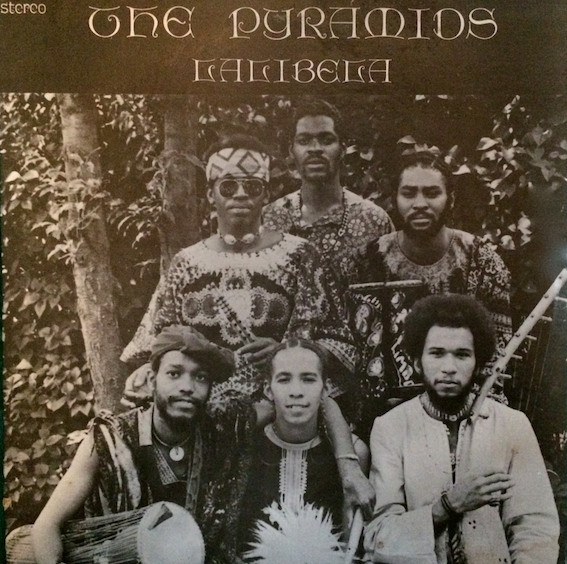
King Of Kings.
For King Of Kings, Idris Ackamoor wrote four new songs. They were recorded in rural surroundings of Appalachia Sound Studios. By then, The Pyramids original lineup had changed.
Two members of The Pyramids were absent when recording of King Of Kings began. There was neither of Marcel Lytle nor Masa. However, new names included bassist Thomas Williams; percussionist, drummer and bongo player Donald Robinson and percussionist and conga player Bradie Speller. Guest artists included cellist Chris Chafe and pianist and percussionist Jerome Saunders. This new and extended lineup recorded King Of Kings, which was released in 1974.
Just like their debut album King Of Kings, was a fusion of musical genres. Elements of avant-garde, free jazz, free funk, improv, soul and space-age jazz melted into one on King Of Kings. It was released independently in 1974, on the band’s own Pyramid Records.
Copies of King Of Kings were sold in local record shops and after The Pyramids’ live shows. Alas, the album didn’t sell in vast quantities. Instead, King Of Kings become something a cult album that today, is a prized possession among record collectors. They’ll pay £200 or $300 for a copy of King Of Kings. Somewhat belatedly, King Of Kings and The Pyramids other seventies albums are finding the audience they deserve. This includes their third album Birth/Speed/Merging.
Birth/Speed/Merging.
It wasn’t until November 1975, that The Pyramids began work on their third album Birth/Speed/Merging. By then, The Pyramids were a quite different band. The new recruits that played on King Of Kings had left The Pyramids. Only the core of Idris Ackamoor, Margo Ackamoor and bassist Kimathi Asante remained for the recording of Birth/Speed/Merging.
The three members of The Pyramids were augmented by bassist Mark Anthony Williams; percussionists Kenneth Nash and Augusta Lee Collins on Birth/Speed/Merging. The six members of The Pyramids headed to His Master’s Wheels Studio in November, 1975.
At His Master’s Wheels Studio, The Pyramids recorded five new songs. Four had been penned by Idris Ackamoor, while Jamaican Carnival was credited to The Pyramids. These five songs became Birth/Speed/Merging, which would prove to be The Pyramids’ swan-song.
Just like their first two albums, Birth/Speed/Merging was a fusion of disparate musical genres. Elements of avant-garde, free jazz, free funk, free improv, soul, space-age jazz and spiritual jazz became part of a musical potpourri. It was released independently in 1976, on the band’s own Pyramid Records.
Birth/Speed/Merging followed in the footsteps of The Pyramids’ previous albums, and was an underground album. Lacking the financial muscle to promote and distribute Birth/Speed/Merging, The Pyramids continued to sell albums locally and after their live shows. These live shows were a spectacle.
When The Pyramids played live, their shows were a mixture of music, performance, theatre, and dance. It was totally different to what other bands were dong at the time. Maybe that’s why The Pyramids were booked to play at the 1977 UC Berkeley Jazz Festival?
By the time of the 1977 UC Berkeley Jazz Festival, little did anyone realise that the end was neigh for The Pyramids. They played a barnstorming performance, that won friends and influenced people among the jazz community. This could’ve introduced The Pyramids’ music to a much wider and appreciative audience. Alas, The Pyramids had decided to disband the band. After five years, and three albums The Pyramids called time on their career. That looked like the end of the story.
Over thirty years later, and The Pyramids reunited. By then, a new audience had been introduced to their music. So a new lineup of The Pyramids embarked upon what was the first of numerous European tours. This new lineup featured original members and some new names. A familiar face was percussionist Kenneth Nash, who had played on Birth/Speed/Merging. With The Pyramids back together, and touring, everything seemed right with the world. However, there was a problem.
With the increased interest in The Pyramids music, the demand for their albums outstripped supply. The Pyramids three seventies albums were changing hands for ever increasing sums of money. Vinyl aficionados were driving the prices of the albums up. Copies of Lalibela were almost impossible to find, and when one came up, a bidding frenzy ensued. Similarly, copies of King Of Kings were changing hands for £200 or $300. Birth/Speed/Merging was also a prized catch among vinyl collectors. So a decision was made to reissue The Pyramids’ three albums. As an added and welcome bonus, The Pyramids released a new album Otherworldly.
When Otherworldly was released in 2011, it was to widespread critical acclaim. Still The Pyramids were creating groundbreaking, genre-melting music. By then, Idris Ackamoor had received a Lifetime Achievement Award at Gilles Peterson’s Worldwide Awards. This introduced The Pyramids’ music to an even wider audience.
So when The Pyramids next headed out on tour, they were welcomed by a new fans who had only discovered their music. Suddenly, The Pyramids had a fan-base they could only have dreamed of in the seventies. They attended concerts every time The Pyramids toured Europe. However, many of The Pyramids’ fans wondered when the group would release a new album?
We Be All Africans.
Little did they realise that The Pyramids had already recorded seven new songs that would become their fifth album, We Be All Africans. The recording sessions for We Be All Africans took place during 2015, at Max Weissenfeldt’s Philophon studio, in Berlin.
Unlike many modern recording studios, Max Weissenfeldt’s Philophon studio is a fully analogue setup. There were neither DAWs nor soft synths in Max Weissenfeldt’s Philophon studio. This old school setup was a reminder of the studios where The Pyramids had recorded their trilogy of seventies albums. For The Pyramids, Max Weissenfeldt’s Philophon studio was the perfect place to record We Be All Africans.
Having recorded the seven songs that became We Be All Africans, The Pyramids decided to release a single later in 2015. By then, The Pyramids were billed as Idris Ackamoor and The Pyramids. The song chosen for their new forty-five was Rhapsody In Berlin. It gave Idris Ackamoor and The Pyramids’ fans a tantalising taste of We Be All Africans. With their fans licking their lips at an album of Afro- jazz-funk, Idris Ackamoor and The Pyramids began the search for a record company to release their fifth album.
Eventually, Strut Records agreed to release We Be All Africans. The release date was scheduled for 27th May 2016, when Idris Ackamoor and The Pyramids’ first album in five years hits the shops. We Be All Africans is a welcome return to form from a band that was founded in 1972.
Opening We Be All Africans, is the title track. An urgently plucked bass joins drums and a myriad of exotic, bustling, chiming, ringing percussion, in driving the arrangement along. They create an irresistibly catchy arrangement that stays true to The Pyramids’ original sound. Partly, that is the decision to using analogue equipment; and partly the type of instruments deployed. Soon, though, a chant of: “We Be All Africans” enters. Before long, female vocalists deliver the lead vocal, and harmonies respond to their call. By then, the percussion is panned hard left, while the vocal dominated the rest of the arrangement. That’s until the vocals drop out, and a bass ushers in braying, scorching horns are added. Just as one thinks the track can’t get any better, it does. In full, flight Idris Ackamoor and The Pyramids unleash a glorious mixture of percussion, horns and rhythm section. The vocals add the finishing touch to what’s akin to a truly irresistible call to dance.
There’s a thoughtful, mesmeric sound to Epiphany, as the arrangement gradually unfolds, and meanders along. A melancholy, jazz-tinged horn plays, sounding as if it belongs in a late night jazz club in Dakar, Brazzaville or Kinshasa. That’s until the tempo rises, and the sultry sound becomes celebratory. Percussion and the rhythm section combine, as the track takes on a much more contemporary Nu-Jazz sound. Sometimes, the arrangement almost explodes, and dances along before briefly teasing the listener into thinking that a journey into jazz is about to ensue. That doesn’t happen. However, there’s an almost downtempo influences to this genre-melting track that veers between celebratory, smooth, sultry, ruminative and mellow. In doing so, it proves that Idris Ackamoor and The Pyramids are still relevant.
Bursts of horn punctuate the arrangement to Silent Days, before an array of percussive delights unite with Bajka’s vocal. It’s rueful, and tinged with sadness and regret. Just below her vocal, the backing vocals sit. They augment her reflective vocal, while drums crash and clamber across the arrangement. Meanwhile, the subtle, sultry sound of the alto saxophone briefly replaces the vocal, and takes centre-stage. This happens several times, before the horns enjoy their moment in the sun. They bobs and weaves across the arrangement, adding to the wistful, heart wrenching sound of what’s a beautiful track.
As Rhapsody In Berlin unfolds, Idris Ackamoor and The Pyramids provide a funky backdrop. The rhythm section, clunky guitar and wailing Hammond organ combine with percussion. Yelps punctuate the dusty sounding arrangement. It ’s a fusion of funk and Afrobeat that could easily have been recorded forty years ago. Braying, growling, rasping horns are added, filling the sound out, while whoops, hollers and yelps punctuate this slice of joyous good time music.
From the opening bars of Clarion Call, there’s a sombre, mournful sound. It comes courtesy of the horns. Soon, though, flourishes of horns build, and join with percussion and drums in creating a dramatic, jazzy backdrop. Scorching horns threaten to kick loose. Instead, they encircle, creating a mesmeric backdrop. At one point, the horns head in the direction of free jazz as they create their own Clarion Call. Then cymbals crash, drums roll, a horn coos and the pitter patter of percussion punctuates the arrangement. The result is an inventive and dramatic track that reaches a ruminative crescendo.
Idris sings unaccompanied on Traponga, before thunderous drums beat out a rhythm. They’re soon join by an array of percussion, as drums are pound and cymbals crash. Maybe playing with such power and passion is cathartic? However, after just over two minutes, the arrangement dissipates. It’s as if the musician are exhausted by their efforts, and Traponga is some sort of alternative to Primal Scream Therapy. For the listener it’s certainly impressive and impassioned performance from Idris Ackamoor and The Pyramids.
Closing We Be All Africans is Whispering Tenderness, where the bass, glistening, ringing percussion and drums propel the arrangement along. Soon, they’re joined by the horns. They wander off, ploughing their own furrow, rather than play as one. Still, this works, with the sultry horn playing a starring, as it supports Bajka’s vocal. It veers between rueful to hopeful, as the horns weave above and below her vocal. Sometimes, they respond to the vocal, punctuating the arrangement. Later, when the vocal drops out, the horns join with keyboards, percussion and the rhythm section. However, it’s the sultry, rasping horn that steals the show. That’s until the tender, thoughtful vocal returns. It’s accompanied by tender, cooing, sympathetic harmonies. They’re the perfect accompaniment to a vocal that’s rueful, needy and full of hurt. Especially as it sings the final line: “you’re still here, in my life.” The result is a quite beautiful, cinematic ballad. Idris Ackamoor and The Pyramids it seems, have kept the best until last.
Having said that, We All Be Africans is an album that literally oozes quality. That’s not surprising. Idris Ackamoor is a musical veteran, whose spent his adult life involved with music and the arts. Similarly, the original and new members of The Pyramids have dedicated their lives to music. This shows throughout We All Be Africans, which is an old school album from Idris Ackamoor and The Pyramids.
There’s just seven tracks lasting just thirty-eight minutes on We All Be Africans. This is similar to the trio of albums that The Pyramids recorded between 1973 and 1974. So is the studio that We All Be Africans was recorded in. It was recorded in a fully analogue studio, which makes a huge difference. Many albums that have been recorded in a digital studio sound almost soulless in comparison. That’s definitely not the case with We All Be Africans.
From the opening bars of We All Be Africans, which is a truly irresistible and joyous track, Idris Ackamoor and The Pyramids have the listener spellbound. Over the next six tracks, they combine elements of Afrobeat, avant-garde, free jazz, funk, fusion, jazz and soul. This genre-melting album features music that’s celebratory, melancholy, mesmeric, reflective and uplifting. Other times, the music is beautiful, cinematic, heart-wrenching and sombre. Always, the music on We All Be Africans provokes an emotion, and is guaranteed to makes the listener think. Not many albums do that.
We All Be Africans is unlike most albums, and is reminder of the comeback kings Idris Ackamoor and The Pyramids. They’ve spent the last five years constantly touring, but still, have found the time to record a new album, We All Be Africans. Idris Ackamoor and The Pyramids’ much-anticipated and long awaited fifth album, We All Be Africans marks a welcome return to form from one of the hardest working bands in music.
IDRIS ACKAMOOR AND THE PYRAMIDS-WE BE ALL AFRICANS.
MOSKUS-ULV ULV.
MOSKUS-ULV ULV.
The roots of pioneering jazz trio Moskus, can be traced to the prestigious Trondheim Conservatory of Music. That’s where bassist Fredrik Luhr Dietrichson first met drummer Hans Hulbækmo and pianist Anja Lauvdal. Little did they realise at that first meeting, that they would go on to form one of the most innovative groups of their generation…Moskus.
Moskus were formed at Trondheim Conservatory of Music, and released their critically acclaimed debut album Salmesykke in 2012. Salmesykke was nominated for two Spellemannspriser awards, which are the Norwegian equivalent of Grammy Awards. Suddenly, people were taking notice of this new, up-and-coming band.
Two years later, in 2014, Moskus returned with their sophomore album Mestertyven. Just like their debut album, critical acclaim accompanied the release of Mestertyven. It was hailed as an innovative and groundbreaking album from a group who were no longer an up-and-coming band. Instead, Moskus who had spent time touring North America and Europe, had arrived.
Since 2014, the Moskus story has continued apace. They continue with their hectic touring schedule, which included a tour of Japan. On their return, Moskus began work on their eagerly awaited third album Ulv Ulv. It will be released by Hubro Music on 27th May 2016, and is the next chapter in a story that began in 2012.
Salmesykkel.
It was back in 2012 that pioneering jazz trio, Moskus, released their debut album, Salmesykkel on Hubro Music. It was released to widespread critical acclaim, and hailed as a groundbreaking debut. And so it proved to be.
When the shortlist for the Norwegian music Spellemannspris were announced in 2013, Moskus had been nominated twice for the Norwegian equivalent of a Grammy Award. Moskus were nominated in two categories, the highly prized best jazz album and best new act. For the three members of Moskus, this was the perfect start to their recording career. Since then, Moskus have been winning friends and influencing people throughout Europe and North America.
Just like several generations of bands, Moskus embarked on a gruelling touring schedule. At first, the three members of Moskus were touring Norway. They played at both clubs and some of the Norway’s biggest festivals. After that, Moskus headed much further afield.
By 2014, much of Europe had been introduced to Moskus’ unique and groundbreaking brand of Nordic jazz. Everywhere from England, Germany, Poland and Portugal, have been won over by Morkus’ music. Audiences realised that Morkus are the future of jazz. Having conquered Europe with their music, Morkus headed to North America. Canada was just the latest country to embrace Morkus’ music. Morkus’ gruelling touring scheduled had paid off.
Mestertyven.
No longer were Morkus just a Norwegian musical phenomenon. No. They were perceived as as one of the most exciting and pioneering jazz groups. This was the perfect time for to Morkus release their sophomore album Mestertyven. So in May 2014, Mestertyven was released by Hubro Music. Mestertyven marks a change in approach and direction from Morkus.
For their debut album Salmesykke, Morkus had recorded the album at Stockholm’s famous Atlantis Grammofon Studio. When the time came to record their sophomore album, Moskus decided to try a new approach to recording. Gone was the venerable surroundings of Atlantis Grammofon Studio. Its replacements was the Risør Church. It became a de facto recording studio, albeit one that didn’t have the same standard of equipment.
One of the most important pieces of equipment Atlantis Grammofon Studio has is a grand piano. Morkus used this on their debut album Salmesykkel. Its unmistakable sound played an important part in the sound and success of Salmesykkel. However, their makeshift studio didn’t come complete with a grand piano. So, Moskus found themselves swapping a grand piano for an upright piano. This was all part of Morkus’ new sound which they showcase on Mestertyven.
Whereas the music on Morkus’ debut album Salmesykkel was well rehearsed, the music on Mestertyven was new and untried. Morkus hadn’t spent ages honing and tightening the tracks. This was deliberate.
As the sessions began, Moskus pressed record. Every single idea was recorded. This made sense. There was no chance that a moment of genius would be missed. Songs were recorded from their genesis to fruition. Songs evolved on the tapes. Eventually, Moskus were left with a pile of tapes. What they had to do was then sift through the tapes. Gradually, eleven songs took shape. Some ideas and experiments were kept, others discarded. The result was Mestertyven, Moskus’ much-anticipated sophomore album.
When Mestertyven was released, it was to the same critical acclaim as their debut album. Critics used words like unique, melodic, playful and intimate. However, Mestertyven was also dramatic, ethereal, wistful and innovative. Mestertyven featured a group who were determined to continually reinvent their music, and push musical boundaries. They continue to do so, on their third album Ulv Ulv.
Ulv Ulv.
Since the release of Mestertyven, Moskus have continued their hectic touring schedule. Previously, they had played across North America and Europe. Then in late 2014, Moskus got the opportunity to tour Japan. The only problem was, on their return, Moskus would begin work on their third album Ulv Ulv.
Despite this, Moskus headed to Japan in late 2014. During their Japanese tour, Moskus enjoyed the opportunity to and improvise and play with an inventiveness and freedom. Japanese audiences were able to experience Moskus at their innovative best. Once the tour was over, Moskus returned home and began work on Ulv Ulv.
For their third album Ulv Ulv, Moskus had written eight new tracks. They would also write Den Store Skjønnheten and Borre Borre Gulleple, Slå Vekk with fiddler Nils Økland. He joined Moskus at the Haugesund Billedgalleri. This to outsiders seemed a strange place to record an album. However, Moskus had played a concert at Haugesund Billedgalleri, and liked the acoustics. An aded bonus was the Haugesund Billedgalleri boasted a vintage Steinway. For Moskus pianist Anja Lauvdal this was an added bonus.
So between the 2nd and 4th of January 2015, the Haugesund Billedgalleri, in Haugesund was converted into a makeshift studio. Bassist Fredrik Luhr Dietrichson was joined by drummer Hans Hulbækmo who also played Jews Harp, percussion, saw and various wind instruments. Pianist Anja Lauvdal switched between the piano, a harmonium and synths. Guest artist Nils Økland played a Hardanger Fiddle. Audun Strype recorded the Ulv Ulv sessions, while Moskus and Andreas Risanger Meland co-produced the album. After three days, Ulv Ulv was completed on 4th January 2015. This left Ulv Ulv to be mixed and mastered.
Audun Strype, who had recorded Ulv Ulv was asked to mix and master the album. This took place at his Strype Audio, in the autumn 2015. Once this was complete, Moskus’ thoughts turned to the release of their third album, Ulv Ulv.
Just over six months later, and Moskus’ much anticipated third album Ulv Ulv will be released by Hubro Music on 27th May 2016. Ulv Ulv features jazz pioneers at their innovative best, as they play with a freedom, inventiveness and intuitiveness that most groups can only dream of.
Opening Ulv Ulv is Medstrøms (Countercurrent), where urgent percussive beeps, punctuate the arrangement. It’s as if they’re tapping out a code or sending out a warning signal. Meanwhile just a thoughtful piano plays, while an occasional drum adds an element of drama. Mostly, it’s the piano that takes centre-stage, meandering wistfully and thoughtfully along. Sometimes, a note is highlighted, or chord repeated. By then, an acoustic bass is plucked gently, and sits behind the piano. Then when the piano drops out, washes of quivering, jagged and droning synths make their presence felt. They’re soon joined by the piano, as a clock chimes and cooing, quivering sounds join bursts of drums. They’re like a countercurrent, flowing in opposite directions, but ultimately play their part in a captivating and innovative soundscape that invites the listener’s imagination to run riot.
Angelfossen is just a short soundscape, lasting less than two minutes. However, it leaves a lasting impression. That’s the case from the moment the wheezing harmonium awakes from it slumbers. It slowly stretches, whines and wheezes, and in the process, creates a melodic, melancholy and sometimes mournful backdrop. It washes over the listener, allowing them to ruminate and bathe in its inherent beauty.
Noe Med Utopia, Klondike (Something With Utopia, Klondike) is a much more uptempo track, with an almost jaunty arrangement. Jangling percussion joins the carefully plucked bass and deliberate stabs of piano. Soon, Anna pounds the piano, playing with passion and power. Other times, her playing is restrained, while the bass plays a more prominent role. Still, the percussion jingles and jangles. Later, Anna’s piano powers its way through the arrangement, as she plays with freedom and spontaneity. So much so, that she’s allowed to take centre-stage. Only the pitter patter of a drum can be heard, before the arrangement builds and the percussion reenters. At one point, Anna stabs at notes, while there’s an urgency in the rest of Moskus’ playing. It’s as if they’re in search of a musical Utopia, that has the same riches as Klondike. This pursuit of perfection and riches takes its toll, and after the song reaches a crescendo meanders wistfully and beautifully like a tributary of the Yukon River.
Den Store Skjønnheten (The Great Beauty) is the first of two tracks to feature Norwegian fiddler Nils Økland. Drums play slowly and occasionally, while Anna’s elegiac piano plays a leading role. So does Nils’ melancholy fiddle as this slow, meandering and wistful track unfolds. Soon, Nils and Hans’ percussion improvise. The scratchy fiddle joins percussion and crashing cymbals. They provide a counterpoint to the melancholy beauty of the Anna’s piano. By then, Fredrik’s bass has made an appearance, and accompanies the piano, which plays slowly and gently. Later, just the fiddle accompanies the elegiac piano on a track that’s ethereal, wistful and deserves to be called The Great Beauty.
Moskus improvise as Chimes/Gullregn unfolds. Cymbals ring out, while a piano is played deliberately and percussion jingles and jangles. A wind instrument soars above the arrangement, and the bass is plucked carefully. By then, Moskus are playing with freedom and feeding off each other. There’s an intuitiveness to their playing. This is a result of years playing together. As the wind instrument is blown with power, the bass is plucked deliberately and Anna picks out chords on the Steinway piano. Together, Moskus are akin to an alternative orchestra, who are channeling the spirit of Sun Ra. Instruments flit in and out. Some only make a fleeting appearance, while others play starring roles as Moskus play with unbridled freedom and spontaneity.
From the opening bars of Kullgraver, Moskus are improvising, and pushing musical boundaries. They fuse elements of avant-garde, free jazz, industrial and improv. This comes courtesy of a detuned bass, crashes of percussion and stabs of piano. The crashing percussion and pounding piano adds a mesmeric, industrial sound to the track. It’s if Moskus are replicating the sound of someone labouring over an anvil. By then, the music veers between challenging and discordant, hypnotic, melodic and captivating. Moskus continue to play with a freedom, and create a multilayered, cinematic track.
We Will Always Love You Too, Whitney Houston isn’t an overblown power ballad. No chance. It’s something much better, and more innovative. Just slow, solemn drums combine with a harmonica and bass. They’re joined by Anna’s piano. Her fingers flit up and down the keyboard, before she pounds the piano. Still the harmonica wheezes and joins the bass and drums, as they play a lament. It’s not a lament for forgotten power ballads. Instead, it’s the antidote, which should be taken regularly.
Gramjeger is a musical amuse bouche, that shows another side to Moskus. It lasts just forty-one seconds, where synths produce a chattering, futuristic and cinematic sound. Maybe in the future, Moskus will produce an album of similar tracks?
Borre Borre Gulleple, Slå Vekk is a ten minute epic, and features the return of Nils Økland. There’s a degree of urgency as Fredrik plucks the bass. He constantly plays the same note, and adds drama as Hans switches between percussion and drums. A wailing, squealing, screeching fiddle adds an atmospheric and haunting hue. It’s like a scene from Macbeth as an otherworldly soundscape takes shape. Drums, percussion and piano combine with the wind instrument and fiddle. Later, the fiddle drum and percussion play leading roles, as drama and urgency combine on the epic, otherworldly soundscape.
Ei Signekjerring closes Ulv Ulv. It’s another track with a futuristic sound. Synths crackle, creak, beep and squeak. In the midst of this vortex, a melodic soundscape makes its presence felt. So do ghostly, haunting and ethereal sounds. They seem to be channeled through Moskus, from some distant galaxy. This brings Ulv Ulv to an innovative close.
Moskus’ long-awaited and much-anticipated third album Ulv Ulv, will be released by Hubro Music on 27th May 2016. It’s an album that has been well worth the two year wait. Ulv Ulv is a career defining album, where Moskus reach new heights. They play with a freedom, intuitiveness and spontaneity that most groups can only dream of. The result is music that’s inventive, innovative, ambitious, bold and challenging. This is what we’ve come to expect from Moskus.
Just like on their two previous albums, Moskus create music that continue to challenges musical norms on Ulv Ulv. Moskus continue to push musical boundaries to there limits, and beyond on Ulv Ulv. To do this, they combine elements of avant-garde, experimental, free jazz, improv and industrial. There’s also the influence of Ornette Coleman, Charles Mingus, Albert Ayler and Sun Ra on Ulv Ulv. The result is an album that’s variously atmospheric, beautiful, cinematic, dark, dramatic, elegiac, ethereal, haunting, hypnotic, melodic, mesmeric, otherworldly and ruminative. The result was Ulv Ulv the finest of Moskus’ career.
Incredibly, it took Moskus just three days to record Ulv Ulv. They eschewed a traditional recording studio, and recorded Ulv Ulv at the Haugesund Billedgalleri. With just three days to record Ulv Ulv, Moskus worked quickly and efficiently, and recorded what is a captivating and career defining album. Ulv Ulv finds Moskus one step closer to the musical Utopia that bands spent their career in search of.
MOSKUS-ULV ULV.
FIREFALL-FIREFALL, LUNA SEA AND ELAN.
FIREFALL-FIREFALL, LUNA SEA AND ELAN.
In 1973, Gram Parsons and The Fallen Angeles headed out on tour. Little did anyone realise that this tour would be Gram Parsons’ swan-song. By then, he had an insatiable appetite for drink and drugs. Sadly, this would result in Gram Parsons’ death on September 19th 1973.
The cause of Gram Parsons’ death was an overdose of morphine and alcohol. Sadly, the rock ’n’ roll lifestyle that Gram Parsons had embraced, had resulted in his death, aged just twenty-six. Gram Parsons’ friends, family and band struggled to come to terms with his death. This included Rick Roberts.
He had known Gram Parsons since they had been members of The Flying Burrito Brothers. Gram Parsons had been one of the founding members in 1968. Rick Roberts joined in 1970. However, when Gram Parsons embarked upon a solo career, Rick Roberts left The Flying Burrito Brothers and became a member of The Fallen Angels, Gram’s backing band. That was until that fateful night in September 1973.
After Gram Parson death, Rick Roberts began to think of the future. By then, Rick Roberts was back home in Colorado. So was Jock Bartley, who had replaced Tommy Bolin in Zephyr. They had first met when Gram Parsons and The Fallen Angels were playing two nights in the same venue in New York. Since then, they had kept in touch.
Now back home in Colorado, Rick Roberts and Jock Bartley were reunited. One day, Rick arrived as Jock was playing his guitar. Rick watched as Jock unleaded a virtuoso-like performance. This lead to Rick suggesting they practise together.
Soon, Rick Roberts and Jock Bartley were practising together regularly. Before long, they began to think about forming a band together. So they began to think of possible additions. The first name on their list was Mark Andes, a bassist and singer.
Mark Andes had previously been a member of Spirit and Jo Jo Gunne. That was until he decided to retire, albeit temporarily, and went to live in the rocky mountains outside of Boulder, Colorado. Rick and Jock were hoping to tempt Mark out of retirement. They succeeded, Mark Andes joined the nascent band. This left just three possible names on the list.
The first was Larry Burnett, a singer, songwriter and guitarist. Rick had met Larry on his travels, and when it came to putting a new band together, decided Larry Burnett fitted the bill. So did
keyboardist and guitarist Mark Hallman, who knew Mark Andes from the band Navarro. However, when Mark Hallman was asked to join Firefall, he rejected the opportunity, and eventually joined Carole King’s backing band. While this was a disappointment, the search for a drummer went on.
Various local drummers were auditioned, but failed to make the grade. Eventually, Rick Roberts decided to phone an old friend…
Chris Hillman. He had an impressive C.V, and previously had been a member of The Byrds and The Flying Burrito Brothers. That was where he met Rick Roberts. However, since leaving The Flying Burrito Brothers, Chris had lived first in Hawaii and then in Washington. When Rick phoned Chris, he agreed to head to Colorado and join Firefall.
For their first year together, Firefall played in the pubs and clubs around Colorado. Quickly, Firefall became a popular draw in Boulder and Aspen, where the nascent band honed and tightened their sound. After just over a year of playing live, Firefall decided to record a demo.
Firefall recorded a three song demo, which was produced by Chris Hillman. The demo was shopped to the major labels, but failed to find a taker. Things weren’t looking good for Firefall.
So much so, that in 1975, Rick Roberts, Jock Bartley and Mark Andes were drafted in to Chris Hillman’s band for several performances. This included a gig at The Other End in New York, during June 1975. Not long after the band arrived in New York, Chris Hillman became ill, and couldn’t continue the tour. So Larry Burnett and The Byrds’ drummer were drafted in to play at The Other End and finish the tour.
At The Other End, was Atlantic Records’ A&R executive. He listened to Firefall’s demo tape, and then made his way to the front of the stage. After Firefall’s set, the Atlantic Records’ A&R executive returned, and signed Firefall on a multi-album contract. At last, Firefall were signed to a major label.
There was a problem though. Rick Roberts had agreed to head out on tour with Stephen Stills during the summer of 1975. This meant the recording of Firefall’s eponymous debut album had to be postponed until Rick’s return. It wasn’t until late 1975 that work on Firefall could begin. Firefall, Luna Sea and Elan have all been remastered and were recently reissued by BGO Records as a double album.
Firefall.
After Rick Roberts returned from touring with Stephen Stills, a decision was made that David Muse should join Firefall in the studio. He was a talented multi-instrumentalist, who could seamlessly switch between saxophone, flute, keyboards and harmonica. David Muse would add a new dimension to Firefall’s sound. So would Jim Mason, who had been chosen to produce Firefall’s debut album.
For Firefall’s eponymous debut album, Rick Roberts penned the album opener It Doesn’t Matter with Stephen Stills and Chris Hillman. He was no longer a member of Firefall, and had been replaced by Michael Clark. Rick Roberts also wrote Livin’ Ain’t Livin’, Dolphin’s Lullaby,You Are The Woman and Mexico. Larry Burnett wrote Love Isn’t All, No Way Out, Cinderella, Sad Ol’ Love Song and Do What You Want. These songs were recorded at Criteria Studios, in Miami.
When Firefall arrived at Criteria Studios, the lineup featured a rhythm section of drummer Michael Clark; bassist Mark Andes; and Larry Burnett on electric and acoustic rhythm guitar. Jock Bartley added lead, slide and pedal guitar; while Rick Roberts added acoustic guitar. New recruit David Muse played piano, clavinet, synths, flute, tenor sax and harmonica. Guest artist Joe Lala was drafted in to add a myriad of percussion. The man tasked with producing Firefall was Jim Mason. Once the album was recorded and mastered, the release of Firefall was scheduled for May 1976.
Before that, critics had their say on Firefall. They were won over by a polished and accomplished album where soft rock rub shoulders with folk rock, country and Americana. It Doesn’t Matter opened the album, and was a slice of Californian soft rock, which whetted the listener’s appetite for the rest of Firefall.
This included songs like No Way Out and the ballads Dolphin’s Lullaby, Love Isn’t All and Sad Ol’ Love Song, which lead to comparisons with The Eagles. However, for many critics, one song stood head and shoulders above the rest; the soft rock classic You Are the Woman. It oozed quality, and had single written all over it. So had Livin’Ain’t Livin’, and the wistful country rock ballad Cinderalla. You Are The Woman with its close harmonies was a fusion of soft rock, folk rock and country. Then it’s all change on Do What You Want, as blistering guitar licks augment the rueful vocal. It shows Firefall’s versatility, and showcased a tight, talented band who put all their years of experience to good use on Firefall. So it was no surprise when critically acclaimed reviews accompanied the release of Firefall in May 1976.
When Firefall was released, the album reached number twenty-eight on the US Billboard 200, and was certified gold. By then, Firefall were being compared to The Eagles and Poco. This was a lot to live up to. However, Firefall had just enjoyed their first hit single.
You Are The Woman had been released as a single, and reached number nine on the US Billboard 100 and number six on the US Billboard Adult Contemporary Charts. Livin’ Ain’t Livin’ then reached forty-two in the US Billboard 100; while Cinderella reached just forty-two in the US Billboard 100. Partly, this was because of the controversial lyrics, which meant that radio stations didn’t play the single. However, two hit singles and an album that had been certified gold was the perfect start to Firefall’s recording career. It was no surprise that they had embarked upon such a gruelling touring schedule.
Over the next two years, Firefall were constantly touring. They shared the bill with everyone from Leon Russell to The Doobie Brothers and Tom Waits to Lynyrd Skynyrd, Roy Buchanan, Electric Light Orchestra and The Band. However, Firefall had to fit in the recording of their sophomore album Luna Sea.
Luna Sea.
Originally, the working title for Firefall’s sophomore album was Tropical Nights. Just like their eponymous debut album, it was scheduled to be recorded at Criteria Studios, in Miami. This would be David Muse’s debut as a full time member of Firefall. However,
percussionist Joe Lala, who returned for the recording of Luna Sea, was still a guest artist. So were The Memphis Horns, who join Firefall at Criteria Studios. When recording of their sophomore album got underway, Firefall were joined by Poco’s Timothy B. Schmidt and a trio of female backing vocals. They joined percussionist Joe Lala, and the newly expanded lineup of Firefall. Again, Jim Mason had been drafted in to produce Luna Sea. Everything seemed to go to plan, and within a month, Luna Sea was completed. However, there was a problem.
Once Luna Sea was completed, the album was sent to Atlantic Records. They decided after hearing the final mix, that the album would have to be recorded.
This time, Fireball headed to Los Angeles, where some of the songs on Luna Sea were rerecorded. Other songs were discarded, and replaced by new songs. By the time Luna Sea was complete, Rick Roberts had written four songs, and Larry Burnett three songs. They also cowrote Even Steven, while Just Think and Piece Of Paper were credited to Firefall. This was the first time the band had written songs together. Both made their way onto Luna Sea, which was released in 1977.
Prior to the release of Luna Sea, critics received advance copies of the album. Just like Firefall, Luna Sea was a slick, polished and accomplished album that attracted critical acclaim from critics. Again, soft rock rubbed shoulders with folk rock, country and Americana. So Long the album opener, was a guitar driven slice of soft rock. It gives way to one of Luna Sea’s highlights, Just Remember I Love You. Just like Someday Soon and Only A Fool, it’s a beautiful country-tinged ballad, that’s reminiscent of The Eagles. These ballads offer ample opportunity for Firefall to showcase their trademark close harmonies. However, other tracks find Firefall showcasing their versatility.
Someday Soon is a fusion of blues and country; while Just Think finds Firefall heading in the direction of blues rock. Getaway features The Memphis Horns, who add stabs of horns on a track that wouldn’t sound out of place on an Eagles album. Head On Home, a mid tempo country rocker, where the trio of female backing vocalists add the finishing touches. Very different is Piece Of Paper, which is a melancholy ballad. It features Firefall at their best. This leaves just Even Steven, another catchy country rock track, which bookends Luna Sea perfectly.
When Luna Sea was released in 1977, it reached twenty-seven in the US Billboard 200. The lead single, Just Remember I Love You reached number eleven in the US Billboard 100, and number one in the US Billboard Adult Contemporary Charts. However, the followup So Long, stalled at just forty-eight in the US Billboard 100. Despite this, Luna Sea had built on the success of Firefall. The future it seemed looked bright for Firefall
Elan.
Behind the scenes, it was a different story. All was not well within Firefall. The band had spent nearly two years touring nearly nonstop. That had been the case since the release of Firefall in May 1976, right through to 1978 when the band’s thoughts turned to recording their third album Elan. By then, Firefall had toured with the great and good of music. This included opening for Fleetwood Mac on their Rumours’ tour. For Firefall, this should’ve introduced their music to a wider audience. Instead, it almost tore Firefall apart.
During the two years of nonstop touring, some of the members of Firefall had acquired expensive habits. Rick Roberts, Larry Burnett and Michael Clarke all began to drink heavily and began to experiment with drugs. Soon, things had escalated, and drink and drugs became a problem within Firefall, as Rick, Larry and Michael became heavy drug users. This started to affect the group dynamics. To further complicate matters, Firefall were having problems with their management. For a group who were at the peak of their popularity, and about to record their third album, this didn’t bode well.
For their third album, Firefall decided to bring a new producer onboard. This was a huge risk, as Jim Mason had played an important part in the rise and rise of Firefall. However, their minds were made up, and Tom Dowd was brought onboard to produce Elan.
By 1978, Tom Dowd had an enviable track record. His career began in 1947, and over the last thirty-one years he had produced everyone from Charlie Mingus and Cream to Dusty Springfield and Eric Clapton, to Aretha Franklin, Otis Redding, The Allman Brothers, Chicago and Lynyrd Skynyrd. Now Tom Dowd was tasked with uniting a band divided.
For Elan, ten new songs had been penned. Just like Firefall’s two previous albums, they came from the pen of Larry Burnett and Rick Roberts. This time around, Larry Burnett wrote three songs, while Rick Roberts wrote five new songs. Rick also wrote Sweet and Sour with Jock Bartley; and Anymore with Mark Andes. These tracks were recorded at Criteria Sound with Tom Dowd.
When recording began at Criteria Studios, Miami, Firefall were joined by drummer Jim Keltner; vocalist Laura Taylor and percussionist Steve Forman. They would augment Firefall as they recorded ten new tracks. However, the Firefall and Tom Dowd partnership proved not to be the dream team everyone had hoped.
While the members of Firefall got on well with Tom Dowd, the problem was he had a different ‘vision’ for the band. They were content to stick with the formula that had served them well for two albums. Rather than trying to sort out their differences, Firefall continued to record Elan. Eventually, Firefall’s new management company decided to intervene. By then, Elan was recorded, and a large amount of money had been spent. This was money wasted, in light of what happened next.
Firefall’s management company approached Mick Fleetwood, who the band had recently befriended. He was part of one of the most successful bands in the world. So if he spoke to executives at Atlantic Records, maybe they would allow Firefall band to rerecord Elan? So Mick Fleetwood got in touch with Atlantic Records. They agreed to let Firefall rerecord Elan. However, Firefall would pay for the rerecording of their third album. While this put the band into debt, they were willing to do so.
For the rerecording of Elan, Atlantic Records brought onboard Howard and Ron Albert to coproduce the album. The sessions took place at Criteria Sound in Miami, and the Record Plant in Los Angeles. By the time the sessions were complete, Elan was transformed and was a very different album. Firefall’s decision to rerecord Elan paid off.
Before the release of Elan, critics had their say on Firefall’s third album. They hailed the album Firefall’s finest hour. That is not surprising; given the quality of songs on Elan. Strange Way opens Elan, and is a heart wrenching ballad, where Rick Roberts is accompanied by harmonies and strings. It’s a quite beautiful ballad. So are Baby, Goodbye, I Love You and Sweet Ann. They’re a reminder of the songs that introduced the world to Firefall. However, they change tack on other tracks on Elan.
Sweet And Sour is a mid tempo country rocker, while Wrong Side Of Town heads in the direction of blues rock. Then it’s all change, as Count Your Blessings becomes a wistful, country rock ballad. It comes complete with lush strings, and is a beautiful and memorable song. However, then Firefall change direction.
Get You Back features Firefall at their rockiest. Coming a close second is Anymore, which heads in the direction of country rock. It comes complete with horns, and shows another side to Firefall. So does the album closer, Winds Of Change, which is a bluesy rocker. While Elan was different from their two previous albums, critics agreed it had one thing in common…quality.
When Elan was released in 1978, it reached number twenty-seven in the US Billboard 200, and was certified platinum. The lead single Strange Way reached number eleven in the US Billboard 100; while Goodbye, I Love You stalled at number forty-three. Despite this, Firefall had just enjoyed the most successful album of their career. It should’ve been a time to celebrate.
Sadly, it wasn’t. The three years Firefall had spent constantly touring and recording, had caught up on the band. Firefall were almost burnt out. Michael Clarke was drinking heavily, and sometimes, missed shows. Other times, Michael was ‘unfit’ to play. It got that German drummer Dan Holsten was on standby, and was ready to replace Michael. However, before long, Firefall realised there was another problem.
After three successful albums, which had sold over 1.5 million copies in America alone, the members of Firefall must have thought there was a nice nest egg awaiting them. Alas, that proved not to be the case. Firefall’s finances weren’t in the best of health. That wasn’t surprising. They had rerecorded two of their three albums, and embraced the rock ’n’ roll lifestyle. That could prove expensive, and something that Firefall would regret.
Firefall never reached the same heights as Firefall, Luna Sea and Elan, which were remastered and reissued by BGO Records recently as a double album. The sound quality is stunning, and this is the perfect introduction to Firefall’s music. Their first three albums were their best, and most successful albums of their career.
While Firefall record another six studio between 1979 and 1994, their best days were behind them. Following Elan, Firefall released Undertow in 1979 and Clouds Across The Sun in 1980. By then, Firefall’s career was on the slide, and they were dropped by Atlantic Records. It looked as if this was the end of the road for Firefall.
Then in early 1982, Jock Bartley began putting together a new lineup of Firefall. This new lineup of Firefall signed to Atlantic Records, and released two albums. Break of Dawn was released in 1982, with Mirror Of The World following in 1983. However, neither album matched the success of Firefall’s first three albums. After Mirror Of The World failed commercially, Firefall were dropped again by Atlantic Records. It would be another eleven years before they released another studio album.
By the time Firefall released Messenger in 1994, they were a very different band. However, this didn’t stop Jim Mason returning to the produce Messenger. It featured Firefall’s usual mixture of ballads and rockier songs. When Messenger was complete, it was released on Redstone Records, and regarded as a return to form from Firefall. Some critics went as far as compare Messenger to their early albums. This was stretching things somewhat. However, Firefall’s fans welcomed the release of Messenger. However, Messenger wasn’t the end of the Firefall story.
After a gap of thirteen years, Firefall returned with Colorado to Liverpool–A Tribute To The Beatles in 2007. Then in 2009, Firefall Reunion Live was released some forty-three years after Firefall released their eponymous debut album. Firefall were still making music, and still continue to do so.
Seven years later, and Firefall continue to play live. The only original members of the band that remain are Jock Bartley, Mark Andes and David Muse, who featured on Firefall, but only became a permanent member on Luna Sea. They’ve not lost their appetite for music, and continue to play live and bring back memories of Firefall’s glory days.
Alas, Firefall’s glory days were short lived. Between Firefall in 1976, through 1977s Luna Sea and 1978s Elan, Firefall looked as if they would enjoy a long and successful career. Sadly, the constant touring and recording took their toll on Firefall. So did the lifestyle problems and problems with their new management company. After three critically acclaimed albums, Firefall’s career went into decline and never fully recovered. Sadly, Firefall would never come close to rescaling the heights of Firefall, Luna Sea and Elan. These three albums feature Firefall at their very best, when anything seemed possible for the Colorado based band.
FIREFALL-FIREFALL, LUNA SEA AND ELAN.
 dereksmusicblog
 dereksmusicblog