ROY HAYNES-HIP ENSEMBLE.
ROY HAYNES-HIP ENSEMBLE.
In the history of jazz music, Roy Haynes’ name looms large. He is one of the most recorded drummers in jazz history. During a career that spanned sixty years, Roy Haynes worked with the great and good of jazz music. This included Charlie Parker, Bud Powell, Wardell Grey, Stan Getz and Sarah Vaughan. Roy’s also a truly versatile drummer.
Referring to Roy as versatile is no exaggeration. Roy Haynes is one of the most versatile drummers in jazz history. He could play swing, bebop, hard bop, jazz fusion, avant-garde jazz. However, it wasn’t just jazz Roy could play.
Later in his career, Roy found himself sharing the stage with Southern Rock legends The Allman Brothers. Then Roy collaborated with Page McConnell of indie-rockers Phish. However, there was more to Roy’s career than working as a sideman. He enjoyed a successful solo career.
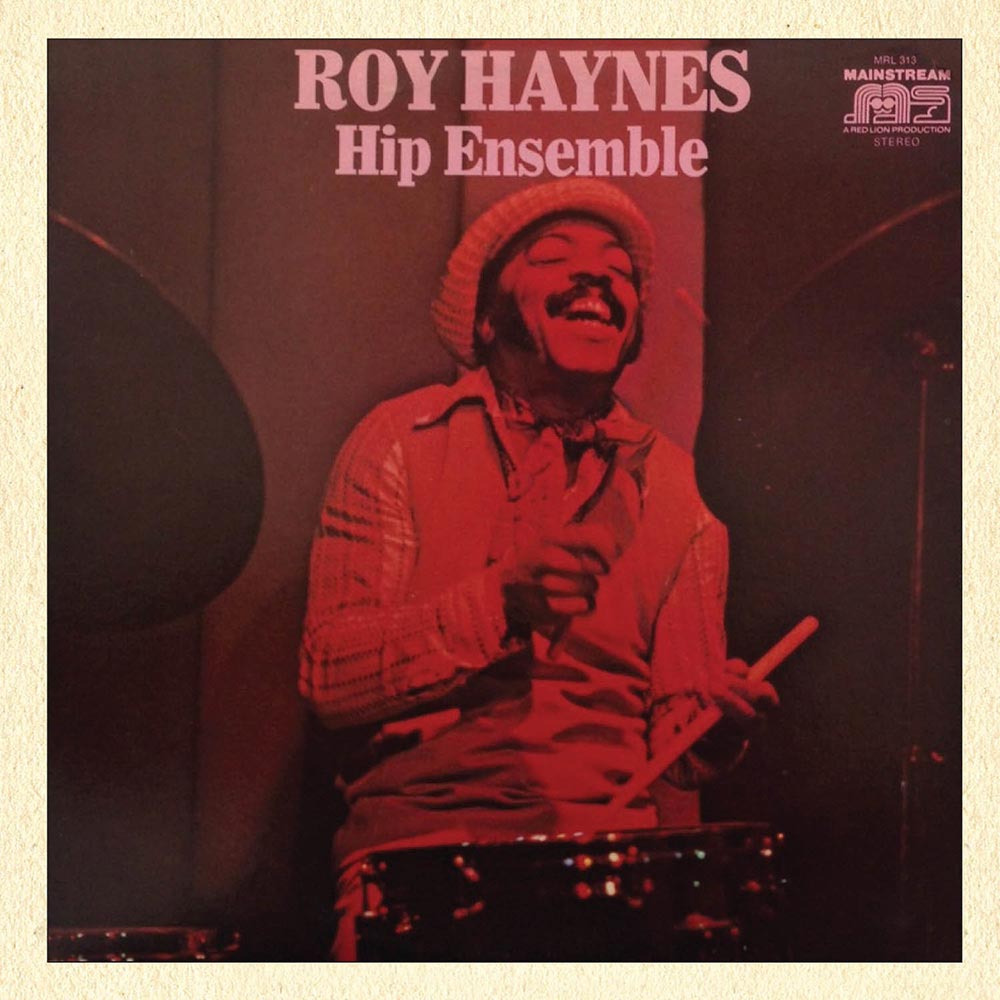
It was sixty years ago, in 1954 that Roy’s solo career began. That was when he released his debut album Busman’s Holiday. This was just the first of over twenty albums Roy Haynes as a solo artist. This included Roy’s 1971 album Hip Ensemble, which was recently rereleased on Boplicity, a subsidiary of Ace Records. By then, Roy Haynes was one of the most experienced drummers in jazz music. Roy had come a long way since his early days in Boston.
Roy Hayes was born in Boston, on March 13th 1925. He grew up in a musical family. His father played organ and his mother sung in the church choir. Growing up, it was always Roy’s ambition to play the drums. His dream came true when Roy’s brother, a roadie for Cab Calloway’s sister Blanche, introduced him to Jo Jones. For Roy this was a dream come true. Jo Jones was Roy’s hero since he heard him playing with the Count Basie Orchestra. This inspired Roy to became a drummer.
His dream came true in 1944. That’s when Roy started playing with bands in the Boston area. Roy’s breakthrough came when he got the chance to tour with Luis Russell. He was a member of Luis’ band between 1945 and 1947. Then Roy joined Lester Young’s group.
Joined Lester Young’s group was akin to a musical apprenticeship. Having served his time, Roy left Lester Young’s group and headed to New York. Bebop was calling. That Roy realised was jazz’s future. He was a member of Bud Powell, Miles Davis and Charlie Parker’s bands. His time with Bird’s band allowed Roy the freedom to develop his own style. Soon, he was one of jazz’s top drummers. So much so, he was offered the chance to become Duke Ellington’s drummer. Roy declined the opportunity. He decided to stay with Bird’s band until 1953, when he joined Sarah Vaughan’s band.
For five years, Roy played with Sarah Vaughan’s band. He wasn’t just her drummer. Roy was also a backing vocalist. His time with Sarah Vaughan lasted to 1958, when Roy decided to return to playing with smaller bands. It was also during his time with Sarah Vaughan that Roy’s solo career began.
By 1954, Roy’s solo career began. He released two albums that year, Busman’s Holiday and Roy Haynes Modern Group. This was just the first of over twenty albums Roy Haynes as a solo artist
Two years later, Roy embarked upon the first of many colaboration. He and Quincy Jones collaborated on Jazz Abroad. Then in 1958, the year Roy left Sarah Vaughan’s band, he collaborated with Phineas Newborn Jr. and Paul Chambers on We Three.
Having left Sarah Vaughan’s band, Roy decided to play with smaller bands. He was a talented drummer whose services were always in demand. Especially among some of the top jazz musicians.
In 1958, Thelonius Monk was looking for a drummer and saxophonist. He had a residency at the Five Spot in New York. However, he needed a drummer and saxophonist. Roy and John Coltrane were hired. They were part of the band who played a series of legendary dates at the Five Spot in New York. For Roy, his career was on the up and up. So it’s no surprise that as a new decade dawned, Roy decided to concentrate on his solo career.
During the sixties, Roy was at his most prolific as a solo artist. The decade started with 1960s New Dawn. Two years later, Roy was signed Impulse and released Out of the Afternoon in 1962. Then in 1963 Roy and Booker Ervin collaborated on Cracklin.’ Just like Roy’s solo album Cymbalism, it was released on New Jazz in 1963. A year later, Roy released People, which was Roy’s final solo album of the sixties. His only other release was with the George Ohtsuka Trio. For the remainder of the sixties, Roy was content to be a sideman, playing with Eric Dolphy, John Coltrane and Stan Getz. However, as the seventies dawned, Roy decided it was time to record again.
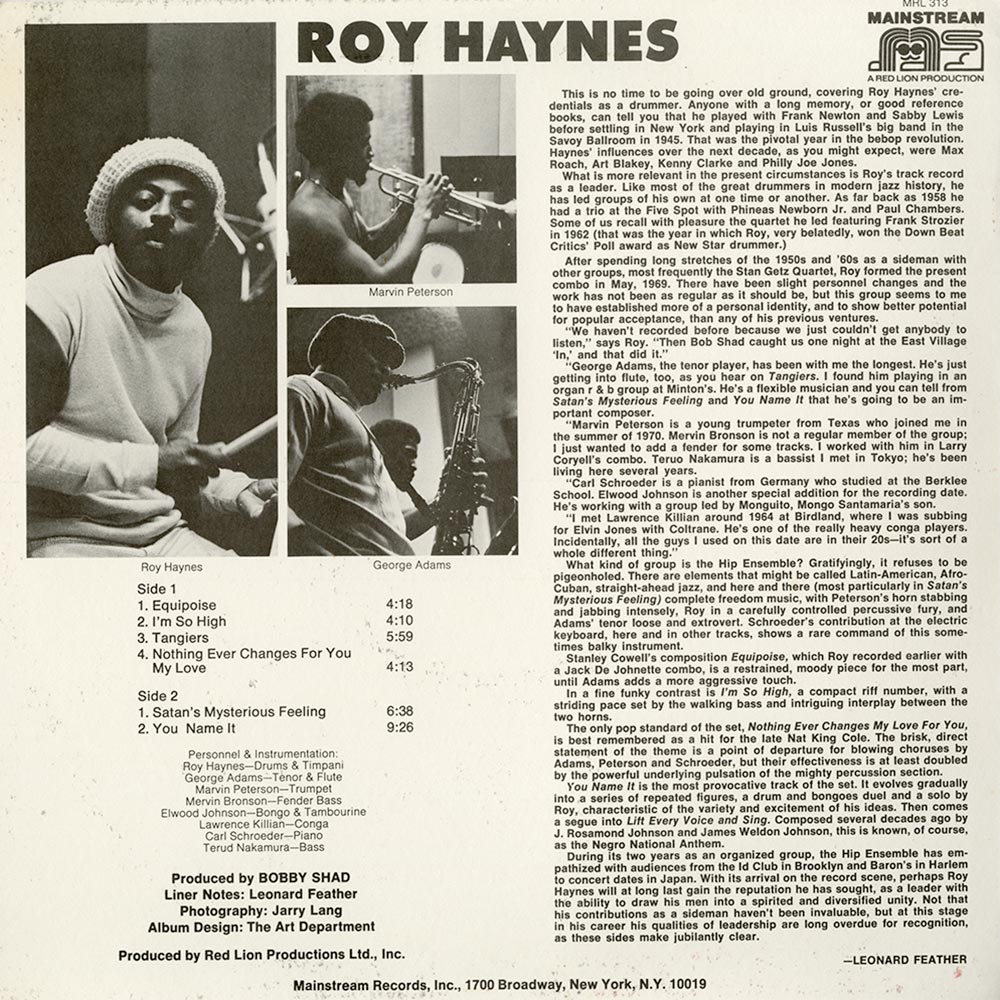
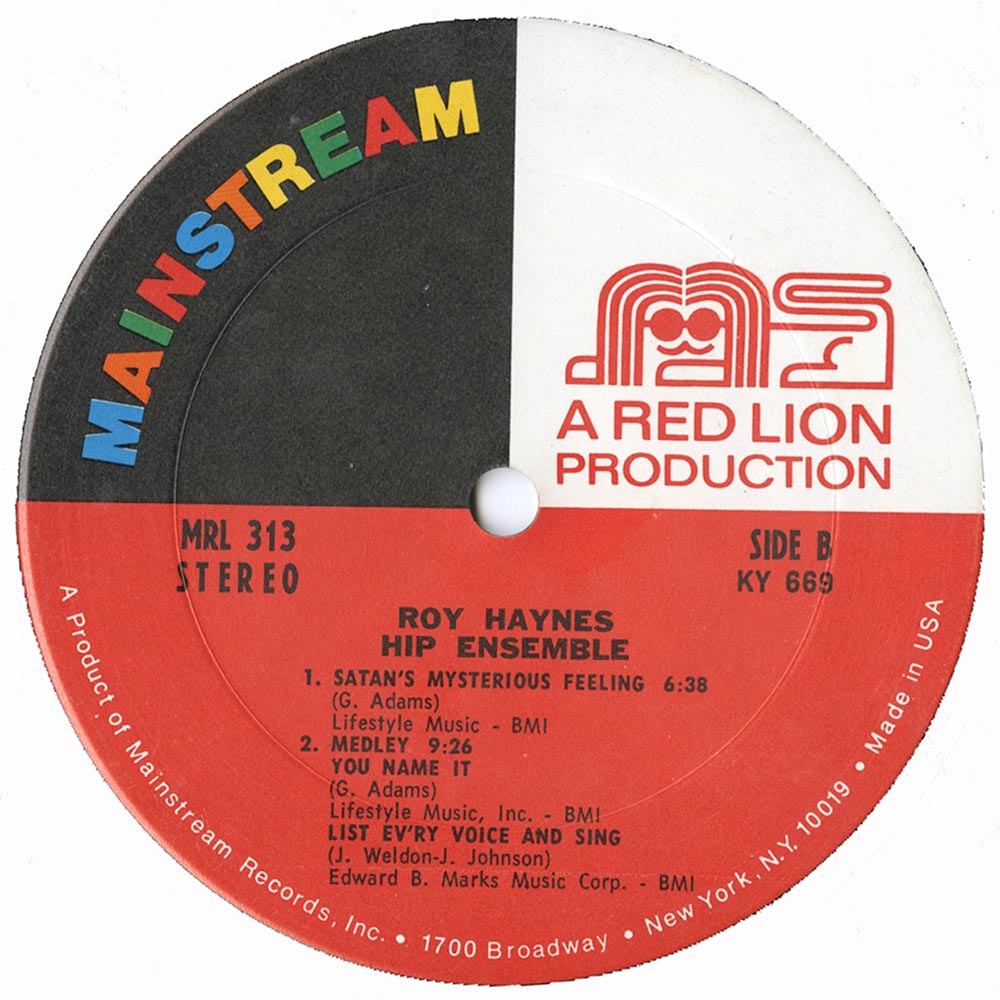
Roy had formed a new band, The Hip Ensemble in May 1969. His new group was made up of mainly young jazz musicians. Roy at forty-four was the elder statesman. They made their debut on Roy’s 1971 album Hip Ensemble. It was released on Bob Shad’s Mainstream in 1971 and featured an eclectic mix of songs.
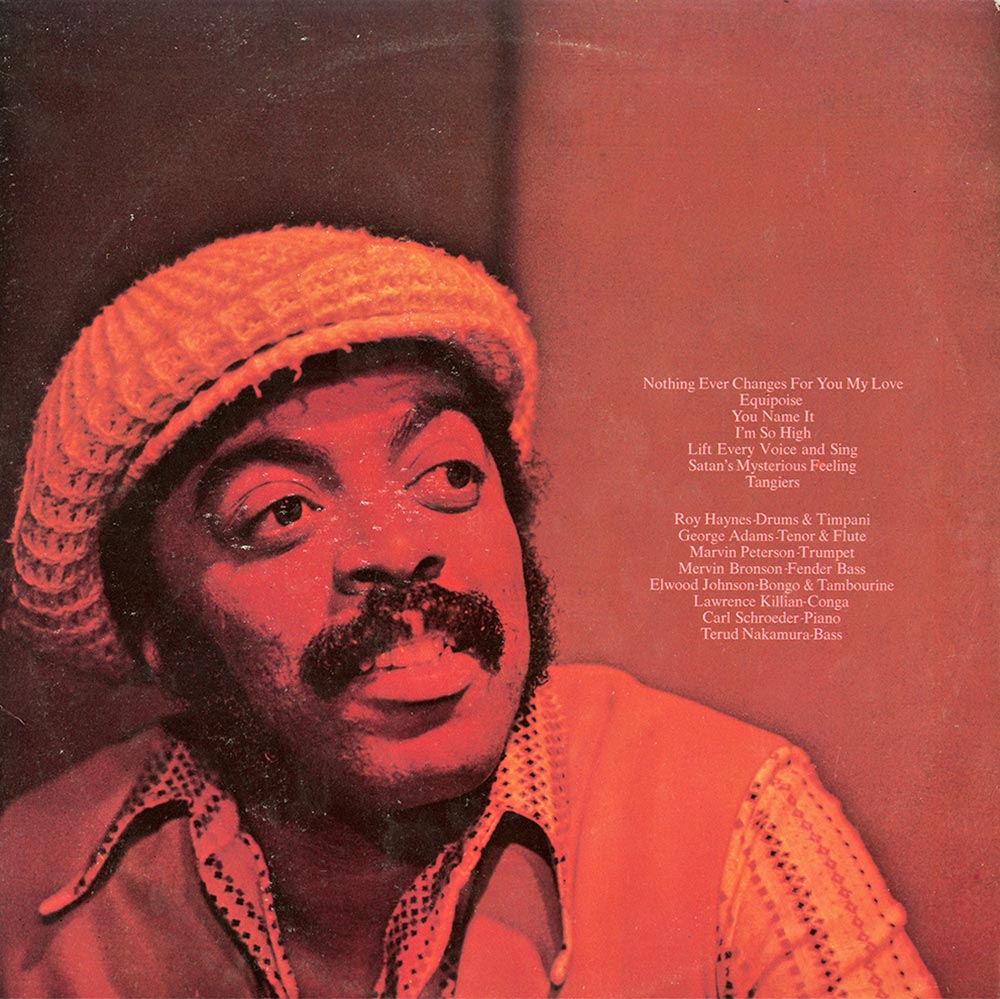
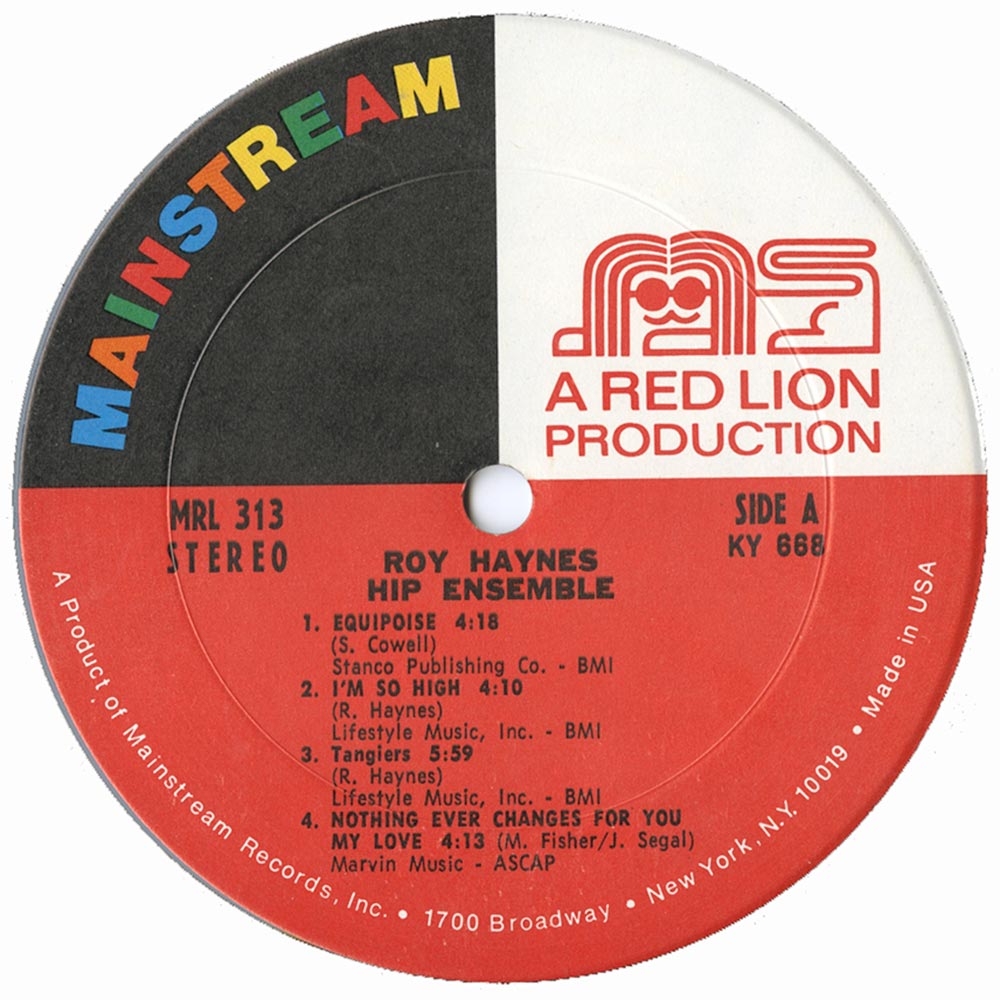
Hip Ensemble features six songs. Roy contributed I’m So High and Tangiers. George Adams wrote Satan’s Mysterious Feeling and You Name It. The other tracks were Stanley Cowell’s Equipoise and Marvin Fisher and Jack Segal’s Nothing Ever Changes For You My Love. These six songs became Hip Ensemble, which marked the recording debut of The Hip Ensemble.
When recording of Hip Ensemble began, Roy had put together a tight, talented band. The rhythm section featured Roy on drums and timpani, bassist Teruo Nakamura and Mervin Bronson on Fender bass. Percussion came courtesy of Elwood Johnson om bongos, Lawrence Killian on congas and Elwood Johnson on tambourine. They were joined by pianist Carl Schroeder, flautist and tenor saxophonist George Adams and trumpeter Marvin Peterson. Once Hip Ensemble was recorded, it was released in 1971.
On its release in 1971, Hip Ensemble failed to chart. Jazz was no longer as popular. Rock was now King. What didn’t help was that Roy hadn’t released a solo album for seven years. That’s a long time for any artist. However, that wasn’t the end of The Hip Ensemble. They recorded two further albums for Bob Shad’s Mainstream Records, 1972s Equipoise and 1973s Senyah. Hip Ensemble, which I’ll tell you about, was just the start of Roy Haynes Mainstream trilogy.
Opening Hip Ensemble is Equipoise, a mid-tempo track. Drums, cymbals and braying horns unite confidently. They produce a melancholy sounding track. As the horns carry the melody, Roy pounds his drums. There’s an urgency in his playing. With the bass, he drives the arrangement along. However, the horns play starring roles. First they playing in unison. Then the solos come round. This affords them the opportunity to enjoy their moment in the sun. The same can be said of the rest of The Hip Ensemble. Together, they play their part in a track that veers between moody to melancholy and urgent to dramatic.
The rhythm section propel the arrangement to I’m So High along. It’s a funky track where keyboards sit above the strolling arrangement. Braying horns enter. They’re almost free jazz in style. They provide a contrast to the rest of the arrangement. It’s funky and swings. Especially with Roy helping drive the arrangement along. Later, the horns change tack. The free jazz influence is gone and the horns help this sultry, funky slice of jazz along.
Tangiers offers Roy the opportunity to showcase why in 1971, he was one of the top jazz drummers. He takes centre-stage before the arrangement unfolds. Wailing horns, a pounding piano and wistful flute intertwine. Again, there’s a free jazz influence as The Hip Ensemble explore the subtleties and nuances of this Roy Haynes’ penned track. It heads in the direction of avant-garde, experimental, free jazz and funk. Roy is at the heart of the action. He pounds his drums and unleashes a series of rolls. It’s apparent that The Hip Ensemble are marching to the beat of Roy’s drum on this innovative, adventurous track.
Nothing Ever Changes For You My Love bursts into life. It’s driven along by blazing horns. Providing the heartbeat are the rhythm section. Teruo Nakamura gives a masterclass on the bass. He plays at breakneck speed, as the rhythm section become one. They’re accompanied by keyboards. They too play an important role, adding texture to the arrangement. Then there’s the horns. Quite simply, they steal the show. George Adams and Marvin Peterson are a perfect foil for each other. It’s as if they’re egging each other on, as they try to reach previously unreached heights. This makes for compelling listening as a familiar song is reinvented.
Satan’s Mysterious Feeling is another George Adams’ song. Roy’s drums opens the track. He injects some funk into the arrangement. His kick drum pounds and his hi-hats hiss. He’s augmented by mesmeric keyboards and braying, blistering horns. They kick loose as the track heads in the direction of jazz-fusion. All the time, Roy’s keeping it funky. So is Carl Schroeder, courtesy of his hypnotic keyboard playing. Similarly, mesmeric are the horns. Marvin Peterson unleashes what’s easily one of his best solos. He’s set the bar high for George Adams. When his tenor saxophone enters, he’s not going to give up without a fight. George delivers a blistering solo, while the rest of The Hip Ensemble play a supporting role. It’s almost as good as Marvin’s and plays an important part in the highlight of Hip Ensemble.
Closing Hip Ensemble is a medley of You Name It and Lift Every Voice and Sing, which is often referred to as the African American national anthem. Keyboards and hissing hi-hats join forces before grizzled horns enter. Along with the rhythm section they drive the arrangement along. Just like previous tracks, the horns get the opportunity to shine. George and Marvin relish the opportunity. This isn’t a band comprising two people. Roy’s drumming veers between understated and thoughtful to urgent and powerful. Soon, everyone gets a chance to shine. Carl Schroeder on keyboards goes toe-to-toe with Roy’s drums. Later, Roy takes charge and delivers a masterclass on drums. It’s a tantalising taste of one of jazz’s top drummers in full flight. After that, the band join together and play a moving version of You Name It and Lift Every Voice and Sing. It’s interspersed with some of Roy’s trademark licks. That’s the perfect way to close Hip Ensemble, which featured the debut of Roy Haynes’ new band The Hip Ensemble.
After seven years away from a recording studio, Roy Haynes was back. He was excited. He’d put together some of the most talented and exciting young jazz players. Formed in May 1969, Roy had spent two years moulding The Hip Ensemble into a tight unit. They were similar to Roy.
Just like Roy Haynes, The Hip Ensemble were a versatile band. They could seamlessly switch between musical genres, sometimes, in the space of one track. Not many bands are capable of that. The Hip Ensemble were. There’s a reason for this. Roy had put together a talented and versatile band.
Joining Roy in the rhythm section were bassist Teruo Nakamura and Mervin Bronson on Fender bass. They provided Hip Ensemble’s heartbeat. Then there was pianist Carl Schroeder. He added texture to the six tracks. Playing starring roles were tenor saxophonist George Adam and trumpeter Marvin Peterson. When they kick loose, it’s a joy to behold. Unlike some bandleaders, Roy wasn’t scared to allow his band to shine. Given the opportunity to shine, George and Marvin shawn like the brightest stars. They play an important part in what’s an adventurous, inventive and innovative jazz album. Sadly, Hip Ensemble, failed commercially.
The reason for that is twofold. Jazz was no longer as popular. Rock music was King. Since the late sixties, jazz’s popularity had plummeted. Things had gotten so bad for jazz, that many jazz venues were now rock venues. For jazz musicians like Roy Haynes, this was a disaster. What didn’t help that Bob Shad’s Mainstream Records was an independent label. It didn’t have the same budget to promote an album as Blue Note, Impulse or Capitol. Without a promotional campaign behind it, Hip Ensemble failed commercially. However, thankfully, music lovers have the opportunity to rediscover Hip Ensemble.
Recently, Hip Ensemble, which was rereleased on Boplicity, a subsidiary of Ace Records. At least, Hip Ensemble receives a welcome release. For too long, Hip Ensemble has lain unloved in Mainstream’s vaults. Belatedly, Hip Ensemble has been rediscovered. It features Roy Haynes’ jazz supergroup The Hip Ensemble, which contained some of the most exciting and talented musicians of the late sixties and early seventies. The Hip Ensemble, kick loose, and work their magic on six spellbinding tracks that comprise on what’s one of Roy Haynes’ finest solo albums Hip Ensemble.
ROY HAYNES-HIP ENSEMBLE.

MEGA JAWNS-TEN LETTERS FROM HOME.
MEGA JAWNS-TEN LETTERS FROM HOME.
From the day Bernie Lowe and Karl Mann founded Cameo Records in 1956, Philadelphia was on its way to becoming one of America’s musical capitals. Throughout the sixties, Philly’s reputation as a musical centre of excellence grew. This was in part down to a trio of songwriters and producers, known as The Mighty Three, Thom Bell, Kenny Gamble and Leon Huff.
They were three of the architects of Philly Soul. Thom Bell’s started career began when he produced The Delfonics. He then transformed the careers of The Spinners and The Stylistics. They become some of Philly’s most successful musical exports. So did some of the artists signed to Philadelphia International Records,
In 1971, Gamble and Huff founded Philadelphia International Records. They transformed the fortunes of groups like The O’Jays, Harold Melvin and The Blue Notes and The Three Degrees. They were backed by M.F.S.B. Philadelphia International Records’ legendary house band. M.F.S.B. featured musical legends like the Baker, Harris, Young rhythm section, Vincent Montana Jr, Larry Washington and Bobby “Electronic” Eli. After playing an important part in the Philly Soul sound, many members of M.F.S.B. would play an important part in disco’s rise and rise.
After a dispute with Gamble and Huff over money, many members of M.F.S.B. left and signed to Salsoul Records. The former members of M.F.S.B. became The Salsoul Orchestra. They released a string of successful albums and backed Loleatta Holloway, First Choice, Double Exposure and Love Committee. For the next few years, The Salsoul Orchestra played an important part in disco’s rise and rise. Then when disco died Philly’s moment in the musical sun looked like it was over.
That wasn’t the case. Since 1979, a number of successful artists have come out of Philly. Hall and Oates, Jill Scott, Kurt Vile and most recently, A War On Drugs have joined Philly’s musical role of honour. Each year, new artists vie for a place on Philly’s prestigious Walk Of Fame. One of Philly’s newest groups is the Mega Jawns.
Mega Jawns were founded on 10th March 2014. That’s when two veteran producers met in a basement in West Philly. That’s where Philly keyboard player, vocalist and producer Will Brock met UK producer and DJ Will Sumsuch. Having shaken hands on the 10th March 2014, seven days later Mega Jawns’ debut album Ten Letters From Home was completed. Six months later, Ten Letters From Home will be released by BBE Records on 22nd September 2014. It’s been a roller coaster ride for the Mega Jawns in their quest to join Philly’s Walk Of Fame.
Sometimes, artists or producers can struggle for years before they make a breakthrough. Then when they meet a new collaborator, their fortunes change. That wasn’t quite the way it was for the two Wills, Will Brock and Will Sumsuch. They were both enjoying relatively successful careers. However, they were approaching the stage in their musical careers when they were referred to as veterans. This was the case with the two Wills.
Philly keyboardist, vocalist and producer Will Brock has been a stalwart of the international jazz and soul scene for more years than he can care to remember. He’s spent what seems like a lifetime touring and performing. Will hasn’t just criss-crossed America, but the world. In doing so, Will has toured and played with everyone from The Stylistics, Miles Jaye and Marion Meadows. However, it’s not just touring that Will Brock enjoys.
When he’s at home, Will enjoys working in the studio. He’s a pianist and producer. Previously, Will has released singles on King Street Records. He’s also recorded with Stephanie Cooke and King Britt. Will is also one as one half of production duo Soul Dhamma. The other Will, Will number two, has an equally impressive CV.
Will Sumsuch is a UK based producer and DJ. He’s a mainstay of the European deep house scene. That’s been the case for over ten years. With his DJ case packed with the deepest house, Will has played all over Europe. One night it’ll be Barcelona, the next Helsinki. The life of a globe-trotting DJ is best described as have passport, will travel. When he’s not DJ-ing, Will’s a respected producer.
Just like most successful DJs, Will is also a producer. His music is popular among the DJ-ing community. Look into the DJ case of Ben Watt, Osunlade, Justin Martin and Jody Wisternoff, and they’ll have tracks by Will Sumsuch amongst their secret weapons. Will’s cerebral style of electronic music is winning over DJs and dancers. It was whist Will Sumsuchwas making one of his singles Simpatico, that he first met Will Brock.
That was back in 2013. The two Wills first collaborated on Will Sumsuch’s 2013 single Simpatico. Will released Simpatico on his own label Colour and Pitch. Quickly, Simpatico found a following within the DJ-ing fraternity. One of the first people to pick up on Simpatico was house vocalist Robert Owens. That was just the start. Soon, others got behind Simpatico. For the two Wills, this was the start of a fruitful collaboration.
Fast forward to 10th March 2014. That’s when the two Wills first met. Having shook hands, they started work. They joked about making an album within a week. However, they both thought that maybe, they’d manage to record a couple of tracks. After all, recording an album in a week was a step too far? Surely?
It wasn’t. Ten Letters From Home is proof of that. It’s a meeting of two musical minds. On Ten Letters From Home, Will Brock adds a Philly Soul influence. Meanwhile, Will Sumsuch adds an understated European electronica influence to Ten Letters From Home. The Mega Jawns debut album Ten Letters From Home, you’ll soon realise, is an intriguing fusion of ideas, influences and genres.
Just a thoughtful piano opens I Know. It opens Ten Letters From Home. Soon, thundering drums make their presence felt. They introduce the main event, Will Brock’s powerhouse of a soulful vocal. Soon though, the track is over. Accompanied by wistful keyboard chords and drenched in reverb, this poignant track is over. However, it’s a taste of what’s to come.
Straight away, Joy has Will Sumsuch’s influence writ large all over it. Drums pound while an understated, electronic arrangement unfolds. Keyboards and washes of synths shimmer combine. They seem to be leaving space for something. That something is Will’s heartfelt, joyous and soulful vocal. It soars above the arrangement, a reminder of Philly’s soulful heritage. Having said that, there’s a nod to soulful house, classic garage and gospel house. There’s a jazzy twist at a breakdown before this slice of joyous, soulful music rebuilds. At the heart of song’s sound and success is Will’s vocal.
As a storm breaks, thunderous drums and percussion combine on Close To The Storm. Then calm is restored. Stabs of keyboards and a shuffling minimalist arrangement combine. That’s before the arrangement rebuilds. Drums and a tender, hopeful vocal combine with the melancholy sound of keyboards. Midway through the track, the storm breaks as strings and harmonies sweep in. This results in the arrangement taking on a symphonic sound. Bubbling synths then emerge from the arrangement. It’s the finishing touch as the Mega Jawns are combine soul, jazz and electronica to create a symphony for the EDM generation.
Blink Of An Eye marks a change in direction from the Mega Jawns. Washes of synths, hypnotic drums and stabs of a bass synth are joined by the occasional handclap. They provide the backdrop for Will’s vocal. It’s a mixture of power, emotion and soulfulness. Sometimes, he vamps against the electronic backdrop. It’s augmented lush keyboards, as Will embarks upon a vamp as he dawns the role of Philly’s 21st Century soul man.
Running Home features guest artist, Sachrias. From the get-go, the arrangement has a cinematic sound. That’s down to the keyboards and synths. They’re joined by strident drums, piano and Will’s thoughtful vocal. When his vocal drops out, the arrangement veers between haunting, eerie and ethereal. Then when the drums and bass synth kick loose, the pulsating arrangement becomes dance-floor friendly. Still the cinematic sound shines through, resulting in an intriguing track.
Shimmering synths and thunderous beats pound as Dirty Film unfolds. Hissing hi-hats join the fray, while synths beep and squeak. Soon, Will’s sassy, sultry vocal enters. It’s shrouded in effects and panned left to right. All the time, drums pound and with synths, help drive the arrangement along. Atop the arrangement, constantly, synths shimmer and quiver. When this is combined, the result is a breezy, sleazy sounding dance-track that’s irresistible.
Cinematic and futuristic describes The Game. So does dance-floor friendly. It’s an arrangement of two parts. Above the arrangement thoughtful, hypnotic percussive sounds constantly repeat. Futuristic synths occasionally interrupt. All the time, drums thunder. They’re then joined by Will’s wistful, hurt-filled vocal. Shrill strings sweep in, while sound effects sit back in the arrangement. Instruments constantly drift in and out, playing their part in this hypnotic, dance track where hope and hurt are omnipresent in Will’s vocal.
Bubbling synths join percussion as Silver Lining begins to share its secrets and subtleties. Washes of synths and handclaps are joined by a bass synth and Will’s emotive vocal. It’s joined by harmonies as memories come flooding back. His vocal becomes soulful and heartfelt. This is very different to the electronic arrangement. There’s one difference. Drums have been reigned in. This allows other things to take centre-stage. Especially, Will’s heartfelt, soulful vocal.
If I seems reluctant to share its secrets. Expectantly, you wait to see the direction the track is heading. Cinematic describes the introductions. Washes of synths add a wistful, ethereal sound. Then drums pound, synths beep and squeak before Will delivers a Nu Soul vocal. He’s accompanied by harmonies and a poignant piano. It’s a case of Nu-Soul meets classic soul. All the time, bubbling synths and pounding drums give the arrangement an electronic heartbeat as the two Wills musical influences shine through.
Little Lady closes Ten Letters From Home. Straight away, the arrangement gets funky. Bass, guitar and keyboards join forces with drums as Will delivers another powerhouse of a vocal. He’s augmented by harmonies. They add the finishing touch to this joyous, uplifting slice of Nu Philly Soul.
Philadelphia’s music scene has changed since the days when The O’Jays, The Spinners, The Stylistics and Harold Melvin and The Blue Notes ruled the roost. Back then, DAWs, drum machines and synths were a thing of the future. Artists had to head to studios like Joe Tarsia’s legendary Sigma Sound Studios where songs were recorded onto tape. Things have changed now.
Nowadays, producers like Will Brock and Will Sumsuch can meet and collaborate over the internet. Using DAWs packed full of VSTs and samples, the Mega Jawns can collaborate across the Atlantic. All they need is a high speed broadband connection. Many producers collaborate like this. Not the Mega Jawns.
Will Sumsuch jumped on a plane and flew the redeye to Philly. That’s where he met Will Brock. They met on 10th March 2014 and joked about making an album in a week. That might have seemed like a pipe dream. It wasn’t. The Mega Jawns managed to record their debut album Ten Letters From Home in seven days.
The Mega Jawns wrote, recorded and mixed Ten Letters From Home within seven days. That’s good going nowadays. No longer do artists record quickly. Instead, they spend years trying to complete an album. That Ten Letters From Home was recorded within seven days, is testament to Philly’s musical past.
Thom Bell and Gamble and Huff didn’t take long to record an album. They entered a studio and within no time at all, had recorded an album. This included a string of million-selling, classic albums. There’s a reason they were able to do that. They were prepared, and realised that, studio time costs money. Modern producers don’t think like that.
Instead, they don’t attach a monitory value to the time they spent within their home studio. So when they dawdle, it’s costing them money. For every hour, day and week they spent auditioning claps and kick drums, it’s costing them money. So if an artist spends a year on an album, there’s no way they’re really making money. Their royalties won’t come close to covering costs. The Mega Jawns didn’t make this mistake.
They worked quickly and they worked well. Pooling their resources, the Mega Jawns wrote, recorded, produced and mixed the ten tracks on Ten Letters From Home. The result is music that’s a fusion of electronica, funk, house, jazz, Nu-Soul and Philly Soul. There’s even a nod to soulful house, classic garage and gospel house. Essentially, Ten Letters From Home is a fusion of the Mega Jawns’ musical influences.
This means European electronica meets Nu Soul, jazz and Philly Soul. It’s an intriguing, eclectic and potent fusion that’s soulful and dance-floor friendly. Remarkably, Ten Letters From Home was written, recorded, produced and mixed within seven days. You wouldn’t know this. The quality of music hasn’t suffered. Working to such a tight deadline concentrated the Mega Jawns’ minds.
Six months after finishing Ten Letters From Home, the Mega Jawns debut album will be released on BBE Records on 22nd October 2014. Soulful and dance-floor friendly, let’s hope that Ten Letters From Home is the first of many transatlantic collaborations from the Mega Jawns.
MEGA JAWNS-TEN LETTERS FROM HOME.

BOBBY WOMACK-PIECES.
BOBBY WOMACK-PIECES.
On June 27th 2014, Bobby Womack, one of the legends of soul music died. Bobby’s career had lasted over fifty years. It began when Bobby was a member of The Valentinos. After that, Bobby embarked upon a solo career. He released his debut album Fly Me To The Moon in 1968. Bobby would then release another twenty-five albums. His swan-song was 2012s The Bravest Man In The Universe. That was a fitting title for his final album.
By 2012, Bobby Womack was suffering from Alzheimer’s disease. His health was deteriorating rapidly. Sadly, this was one battle Bobby couldn’t win. Previously, Bobby had beaten drug addiction and cancer. He had also managed to reinvent himself musically several times. Bobby Womack was a soul survivor.Right up until the final days of his life, Bobby Womack was fighting.
Just three months after his death, it’s become apparent that Bobby Womack was broke. He was technically insolvent. Bobby had cash reserves of $52,000 and $8,000 in material goods. However, Bobby owed $250,000 in child support. For a man who’d written Lookin’ For A Love, That’s the Way I Feel About Cha, Harry Hippie and Across 110th Street, this looked like an ignominious end to a great career. However, just before his death, the soul survivor had managed to secure the rights to some of his back-catalogue. This should solve the financial problems Bobby left behind. The soul survivor it seemed, was still fighting from beyond the grave. That describes Bobby Womack. He was always a fighter. In 1977, Bobby Womack was fighting to save his career.
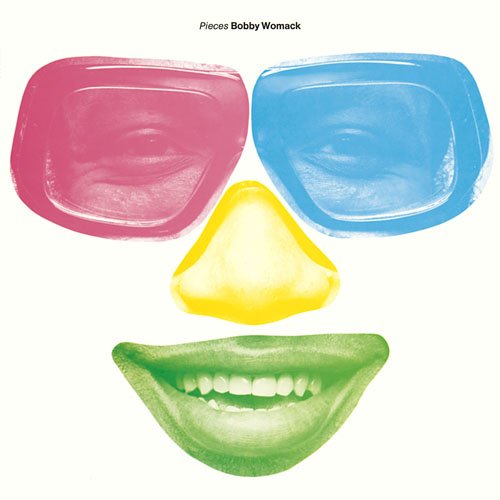
In 1977, when Bobby Womack entered the recording studio in to record his twelfth studio album Pieces, his career had hit the buffers. Bobby’s music was no longer as successful as it had been in late-sixties and early-seventies. His two previous albums, BW Goes C&W and Home Is Where the Heart Is showed that Bobby was lacking in musical direction. Like many soul singers, his music wasn’t as popular in the disco era. With disco flavour of the month, soul singers like Bobby were even struggling to get a record contract. As if that wasn’t bad enough Bobby’s personal life wasn’t in a good place.
Bobby felt that his life was falling to pieces. He was struggling to keep his life together. So it was almost ironic that Bobby’s twelfth studio album was called Pieces. In many ways, Pieces was a good description of the album, as different songs were recorded at different times, with different personnel and guest artists. Eventually, and just like a jigsaw, all the pieces fell into place and Pieces was ready for release in 1977. Would Pieces which will be rereleased on Blu-spec CD2 format by Columbia on 22nd September 2014, and featured guest appearances from David Ruffin and Candi Staton see a return to form from Bobby Womack? That’s what I’ll tell you, after I’ve told you the background to Pieces.
With Bobby ready to record what became Pieces in 1977, he headed to Detroit, and Don Davis’ studio. In Detroit eight songs would be recorded. This included three tracks that Bobby cowrote. Bobby and Leon Ware, who’d produced Marvin Gaye’s seminal album Here My Dear, cowrote two tracks. They were Trust Your Heart with producer Don Davis and Wind It Up With Bobby’s brother Cecil. Cecil also cowrote Never Let Nothing Get the Best of You. Don Davis would cowrite two other track. These were the album opener It’s Party Time with Willie Schofield, and Caught Up In the Middle with Jerry Stephens and Ronnie McNeir. Other tracks included the Jimmy George and John Hammond composition Is This the Thanks I Get and the Allee Willis’ penned When Love Begins Friendship Ends. Stop Before We Start, which Arenita Walker and Cynthia Girty cowrote, was one of two tracks that featured longtime friends of Bobby.
When Bobby headed to Don Davis’ Detroit studio, he hooked up with two of his longtime friends, Candi Staton and David Ruffin. The three of them had grownup together and stayed close since then. By 1977, Candi had just enjoyed one of her most successful songs, the disco classic Young Hearts Run Free in 1976. Candi would duet with Bobby on Stop Before We Start. Given Candi’s success, this would surely help sales of Pieces. David Ruffin was still a successful artist, having released Everything’s Coming Up Love in 1976 and would release In My Stride in June 1977. Bobby had long respected David Ruffin as a singer, and wanted to have him feature on one of his albums. So for Pieces, David added backing vocals on Trust Your Heart. Accompanying David, Candi and Bobby Womack would be some of the best session musicians of the time.
Among the musicians joining Bobby Womack and his guest artists were a rhythm section of drummer Roger Hawkins, bassist Anthony Willis and rhythm guitarist Jimmy Johnson. Charles Fullove played lead guitar, Barry Beckett keyboards and percussion was played by Laurence Fratangelo and Barbara Huby. Horns were provided by The Detroit Horns and The Horny Horns. Adding backing vocals were Friendly, Curtis, Cecil and Bobby Womack, along with Peggy Young, Cassetta George and Josephine Howard. Once the eight songs that comprise Pieces were recorded, the album was set for release later in 1977.
On the release of Pieces in 1977, it wasn’t a huge commercial success, reaching a lowly 205 in the US Billboard 200. This wasn’t surprising. Many other soul singers were releasing quality albums but they weren’t selling. Disco it seemed, had overtaken soul in terms of popularity. One singer who’d crossed over from soul to disco was Candi Staton, who duetted with Bobby on Stop Before We Start. Trust Your Heart was chosen as the lead single from Pieces, but only managed to reach number forty-seven in the US R&B Charts. Maybe the problem was that Pieces was the wrong album at the wrong time?After all, disco was King, whereas soul was no longer as popular. Was that the case? That’s what I’ll tell you, after I’ve told you about the music on Pieces.
Opening Pieces is It’s Party Time, a track that more than tips its hat to disco. Bobby vamps his way through the introduction with the rhythm section, testifying backing vocalists and blazing horns creating an uptempo, dance-floor friendly arrangement. From the opening bars, Bobby grabs the song by the scruff of its neck, delivering his vocal with a powerful, sassy, swagger. Although not quite Bobby does disco, it’s quite different to previous Bobby Womack albums. One thing doesn’t change, the quality of Bobby’s vocal. It’s just as good. Especially with the cooing, soaring backing vocals, rasping horns and pounding rhythm section that accompany Bobby. They play their part in the track’s irresistibly catchy, dance-floor friendly, good-time sound.
Trust Your Heart was the lead single from Pieces, but it only gave Bobby a minor US R&B hit. Bobby’s vocal is a sassy rasp, before he delivers a heartfelt, impassioned vocal. He’s accompanied by a slow, moody backdrop, where the rhythm section and piano add to the drama. His vocal is soulful, soaring and cascading above the arrangement, as swathes of strings sweep and swirl. The drama builds and builds, and Bobby’s vocal matures as the song progresses. Soon, he unleashes a vocal tour de force, where power, passion and drama unite as one.
Stop Before We Start is a much slower song, and features Bobby duetting with Candi Staton. Keyboards and synths show the changing sound of soul and R&B in 1977, while lushest of strings add to the song’s emotion and beauty. They might seem strange bedfellows, but they work, giving the track an innovative sound for 1977. With wistful horns and Bobby’s heartfelt, emotive vocal added, this a potent partnership. Proving the perfect accompaniment to Bobby’s vocal is Candi’s impassioned pleas. Her vocal is needy and full of feeling, matching Bobby each step of the way.Their vocals are a perfect match, the soulful equivalent of ying and yang, playing their part in making this one of the highlights of Pieces.
Allee Willis wrote the philosophical When Love Begins Friendship Ends. It’s a track that quickly grows in drama and emotion, as if designed to grab your attention. Soon, you’re glad you are. Just searing guitars, wistful strings and bursts of a dramatic rhythm section give way to Bobby’s impassioned vocal. He unleashes a vocal that’s full of sadness and regret, accompanied by bursts of growling horns and drums. Quickly, the drama grows. Bobby’s vocal grows in power, as he breathes life and meaning into the track. So good is is vocal, you can sense his hurt and heartache. Sometimes, the arrangement takes on an understated sound, but then, just as quickly changes, matching Bobby’s vocal for power, drama and emotion.
As Wind It Up begins, you realize that something is about to unfold. You’re certainly not disappointed. Bobby powerfully vamps his way through the track fusing funk, soul and jazz. The arrangement is full of blazing horns, driving rhythm section, percussion and a jazzy piano, that’s key to the track’s sound and success. It’s a real stomping track, that allows Bobby to kick loose. His vocal is fiery and feisty as he vamps his way through a track he cowrote with his brother Cecil and Leon Ware. Truly, this is vintage Bobby Womack. He he rolls back the years, delivering one of his best vocals on Pieces accompanied by one of the best arrangements.
Jimmy George and Johnny Hammond were a successful songwriting partnership, writing songs for George Benson and O.C. Smith. Is This The Thanks I Get is another of their compositions. It has a much more understated, laid-back sound, which grows in power and drama. It veers between the two styles throughout the track. Just rasping horns, backing vocalists and a meandering bass combine with Bobby’s vocal. His vocal is a mixture of sadness and hope, his voice growing in power like the arrangement. Crucal to this are blazing horns, guitars and bass. Then as the hope leaves Bobby’s voice, the arrangement is stripped bare, taking on an understated sound. This is perfect for Bobby’s melancholy, wistful vocal and is hugely effective.
Caught Up In The Middle is one of two songs producer Don Davis cowrote. Don cowrote the track with Ronnie McNeir and Jerry Stephens. Bobby scats, before he sings about being caught up in a love-triangle. Just woodwind, piano and a wandering bass combine with Bobby. He seems to have reserved one of his best vocals, throwing himself into the track, singing it with feeling and sass. It’s almost as if the lyrics are personal for Bobby. Rasping jazz-tinged horns, piano and harmonies, are joined by a wandering bass and lush strings. Together, they add to the drama and emotion of this jazz-tinged track.
Bookending Pieces is Never Let Nothing Get The Best Of You, written by Bobby and Cecil Womack. It’s another uptempo, dance-floor friendly track, where Bobby vamps and testifies his way through the track. Backing vocalists accompany Bobby, responding to his call, while growling horns, piano, percussion and the rhythm section drive the arrangement along at breakneck speed. For nearly five-minutes, Bobby unleashes a powerful vamp, as his band and backing vocalists fuse funk, soul and a touch of disco. Like the opening track, it’s an irresistibly catchy, dance track, where Bobby unleashes one of his trademark vamps with the power, passion and panache you’d expect of him.
Like so many other soul albums released during the disco era, Bobby Womack’s twelfth album Pieces, was one of these albums that passed almost unnoticed. This was because of disco’s popularity. Disco had surpassed soul as the most popular genre of the second half of the seventies. That meant music fans missed out on what was one of Bobby Womack’s best album of the late-seventies. Pieces followed BW Goes C&W and Home Is Where the Heart Is, which weren’t Bobby’s finest hours. Thankfully, Pieces was a welcome return to form from the veteran soul man. He combined soul, funk and even elements of disco during the eight tracks on Pieces.
Helping Bobby on Pieces were some of the best session musicians of the seventies, plus guest artists Candi Staton and David Ruffin. They all played their part in Pieces’ sound and success. After Pieces, Bobby Womack didn’t release another great album until 1981s The Poet. During this four year period, Bobby only released one album, Roads of Life, which like Pieces, wasn’t a commercial success.
Sadly, after Roads of Life, Bobby like so many other soul singers, found himself without a recording contract. This was a long way from the height of Bobby’s success during the late-sixties and early-seventies. However, Bobby Womack’s last great album of the seventies was Pieces, which will be rereleased on Blu-spec CD2 format by Columbia on 22nd September 2014. This allows anyone who back in 1977, when Pieces was released, was caught in disco’s spell and as a result missed out on each of soulful secrets and delights of Pieces, to discover what they missed out on first time round.
BOBBY WOMACK-PIECES.
KILINDU-KILINDU.
KILINDU-KILINDU.
There aren’t many bands who are fortunate enough to have a Grammy Award winning producer working on their debut alum. Kilindu have been. They’ve recently been working with Grammy winning producer, Robert Cutarella. He produced their eponymous debut album, Kilindu which was released as a digital download on 20th September 2014.
Previously, Robert Cutarella has worked with the great and good of music. This includes some of the biggest names in music. Musical legends like Eric Clapton, Jeff Beck, Keith Richard, Alice Cooper and Slash have worked with Bob. So have Allison Krauss, John Legend and Joss Stone. Then there’s the 160 platinum discs artists Robert has been awarded. This is the equivalent to having sold 160 million albums. With a track record like this, Robert Cutarella can pick and choose who he works with. So when Robert agreed to work with Kilindu, people sat up and took notice. If Robert Cutarella was working with Kilindu, they must be a band going places.
They were right. In March 2014, Kilindu released their debut single O Que O Futuro. Released to critical acclaim, O Que O Futuro was an internet sensation. It was a genre-melting single whose beauty was breathtaking. Just by listening to O Que O Futuro, it was obvious Kilindu were a band going places. I looked forward to the release of their debut album Kilindu. Six months later, and Kilindu have released their eponymous debut album. It’s the next chapter in the Kilindu story.
Kilindu are a sextet, who were formed in Lisbon, Portugal by guitarist Pedro Duarte and singer João Pedreira. Just like the rest of the band, Pedro and João are experienced musicians who’ve spent a lifetime dedicated to music. Each member brings something new to the band. Their musical tastes, influences and styles vary. That’s no bad thing. It makes for eclectic music.
Music from Europe, Latin America, Afro Cuban, African and American music melts into one. Everything from Portuguese ‘Fado’ music, Cape Verde’s traditional Morna, Brazilian Samba, Bossa Nova, Cuban Habanera and Latin jazz plays its part in Kilindu’s music. So does blues, flamenco and folk. This results in a delicious musical fusion, that comes courtesy of a talented band lead by composer and guitarist Pedro Duarte.
Kilindu however, is no one man band. Far from it. Instead, Kilindu comprises a group of experienced musicians from Lisbon. They were formed in 2012, when composer and guitarist Pedro Duarte met R&B vocalist Joao Pedreira. Pedro is a guitarist who also plays mandolin, ukulele and Cuban trés. Soon, drummer Joaquim Preto, bassist Ivan Pedreira, violinist Tiago Simao, percussionist, Emanuel Pitra and saxophonist Daniel Vieira joined Kilindu. This is the lineup that would feature on their debut album Kilindu.
Recording of Kilindu took place at at Atlantico Blue Studios. Eleven tracks were recorded. Pedro wrote the music and with vocalist Joao Pedreira, penned the lyrics. Kilindu were joined by producer Robert Cutarella and engineer Rui Guerreiro, who also mixed the album. With their debut album recorded, Kilindu started thinking about the album cover.
Kilindu could have easily chosen any number of top designers. After all, there’s more than a little kudos being involved with such a high profile project. However, Kilindu decided to have a contest. They asked designers worldwide to submit their idea for an album cover. The winner was American designer Arjun Gheewala. His design is truly striking. Just like the music on Kilindu, Arjun Gheewala’s album cover grabs your attention. Kilindu certainly caught the attention of critics.
When critics heard Kilindu’s eponymous debut album, they were won over by this genre-melting album. Critically acclaimed, great things were forecast for Kilindu. The critics saw what Robert Cutarella saw in Kilindu, a hugely talented band with bags of potential. That’s apparent on Kilindu, which I’ll tell you about.
Opening Kilindu is Adamastor. There’s two versions on the album, the original version and a radio edit. An acoustic guitar toys with you, before a drum pounds and a cymbal crashes. Soon, a sultry saxophone enters and Kilindu become one. They set the scene for Joao Pedreira’s tender, heartfelt vocal. Accompanying him is a myriad of percussive delights, a gypsy violin and acoustic guitar. Providing the heartbeat is the rhythm section. Soon, Kilindu are in full flow. It’s a joy to behold. They’re a tight, talented band and Adamastor is the perfect way to open Kilindu. Jazz-tinged, smooth, soulful and beautiful it’s a tantalising taste of what’s to come.
Very different is Oxala Estivesses Aqui. It has a much more traditional sound. When the arrangement unfolds, Kilindu march to the beat of Joaquim Preto’s drums. Violins, keyboards and percussion combine with Joao Pedreira’s impassioned vocal. The rest of Kilindu add equally impassioned, sweeping harmonies. Midway through the track, Pedro takes centre-stage during a brief breakdown. After this, this joyous, anthemic track heads towards its crescendo.
As the arrangement to Ja Nao Te Quero Mais unfolds, it literally bursts into life. Gypsy violins and the rhythm section drive the arrangement along. Then handclaps signal the arrival of Joao’s emotive vocal. Soon, he’s joined by the rest of Kilindu. They add handclaps and harmonies. This adds to what’s a much more traditional sounding track. It’s given a modern twist by Kilindu, and the result is truly irresistible.
The tempo drops on O Ceu Chorou, and the arrangement is understated and spacious. A guitar is strummer, violins sweep and the rhythm section create a shuffling beat. When Joao enters, he’s dawned the role of troubled troubadour. He delivers the lyrics with feeling. Meanwhile the arrangement literally floats along. It has taken on a much more subtle sound. Before long, it grows in power. This matches the emotion in Joao’s vocal. Later, when his vocal drops out during a breakdown, melancholy violins take centre-stage. This is a masterstroke. They add to the beauty, drama and melancholia of this track,
O Que O Futuro was Kilindu’s debut single. This was my introduction to Kilindu. From the opening bars I was hooked. The rhythm section, guitars and violins combine confidently. My immediate thoughts were that this was a tight, talented, band. They’d obviously spent time honing their sound. I was right. Then percussion signals the arrival of a heartfelt, soul baring vocal from João Pedreira. As João lays bare his soul, the rest of Kilindu create a pulsating, joyous and sultry backdrop. The result is a single that’s soulful, jazz-tinged and beautiful. One listen and they’ll be won over by its breathtaking beauty.
Two versions of Rua da Saudade on Kilindu. There’s the original version and the radio edit. A saxophone floats above the arrangement and is joined by percussion and a probing bass. They meander along until João’s heartfelt, earnest vocal enters. It takes centre-stage. This seems to signal the arrangement to unfold in waves. Sometimes, the tempo quickens. It reflects the emotion in João’s vocal. His vocal is key to the song’s sound and success. It’s no wonder this song has been earmarked as a single.
A crystalline guitar, gypsy violin and the rhythm section combine on O Sermao Do Pescador. Just like most of the songs on Kilindu, it’s a fusion of disparate influences and genres. Elements of folk, jazz, Latin and soul shine through. The soul comes courtesy of João’s vocal. His vocal is deeply soulful, as he breaths life and meaning into the lyrics. Later, his vocal drops out and a floaty, jazz-tinged breakdown allows the rest of Kilindu to showcase their considerable talents. After that, João returns to add the finishing touch to this six minute opus.
The sultriest of saxophone and hissing hi-hats provide the understated backdrop to Maria. Soon, João delivers a tender, seductive vocal. While the saxophone takes centre-stage, the rhythm section provide a shuffling beat and washes of keyboards float in and out. Then during a breakdown, Pedro’s acoustic guitar takes centre-stage. He’s joined by the rest of Kilindu. They’re let of the leash and enjoy the opportunity to stretch their legs, combining elements of jazz, rock, flamenco and Latin. There’s an urgency to Kilindu’s music that we’ve never heard before. This shows another side to the multitalented and versatile Kilindu.
Straight away, there’s a Latin influence on Lavava No Rio Lavava. This comes courtesy of an acoustic guitar and braying saxophone. Soon, they’re joined by bongos and the wistful sound of gypsy guitars. Equally wistful is João’s hurt-filled vocal. As his vocal takes centre-stage, a rasping saxophone floats above the arrangement and the violins tug at your heartstrings.
Fado Bailarico is just the latest track that’s given a Fado makeover. The arrangement takes on a much more traditional sound. That’s apparent from the get-go. There’s a sense of urgency as violins, percussion and an acoustic guitar combine with drums. Their raison d’être is to set the scene for João’s impassioned vocal. Adding a moderne twist are the bass and the guitars. They play their part in a track that’s Fado, but Fado given an urgent, moderne, makeover by Kilindu.
Closing Kilindu is Amor A Agua Que Corre. Straight away, it’s obvious this is the perfect track to close Kilindu. It bursts into life a guitar joined by the rhythm section and percussion. They provide a pulsating, urgent backdrop for João’s seductive vocal. Soon, he’s joined by the rest of Kilindu. Their handclaps replace Joao’s vocal, as a breakdown begins. It’s the perfect showcase for each member of Kilindu to demonstrate their musical prowess. Each member enjoys the opportunity to take centre-stage. Then Joao returns and this irresistible track brings Kilindu to a joyous close.
When I reviewed Kilindu’s debut single O Que O Futuro, I said that their debut album Kilindu was the main event. Their debut single, O Que O Futuro, was just a tantalising taste of what Kilindu were capable of. After I reviewed O Que O Futuro, I wondered what Kilindu’s debut album would be like? They had set the bar high with O Que O Futuro. It was a huge internet sensation, being played over 230,000 times. That’s almost unheard of for a debut single by an unsigned band. However, not every band are as talented as Kilindu.
Similarly, not many unsigned bands get the opportunity to work with a Grammy Award winning producer like Robert Cutarella. He saw the potential in Kilindu. Not only that, but Robert Cutarella brought out the potential in Kilindu. He ensured that Kilindu fulfilled their potential. They’ve created a genre-melting album that oozes quality.
From the opening bars of Adamastor, right through to the closing notes of Amor A Agua Que Corre, Kilindu combine musical genres and influences. What follows is an eclectic album of traditional and modern music. European, Latin, Afro Cuban, African and American music melts into one. Everything from Portuguese ‘Fado’ music, Cape Verde’s traditional Morna, Brazilian Samba, Bossa Nova, Cuban Habanera and Latin jazz plays its part in Kilindu’s music. So does blues, flamenco and folk. This results in a delicious musical fusion, that comes courtesy of a talented band lead by composer and guitarist Pedro Duarte.
Pedro Duarte and the rest of Kilindu are a band with a huge future ahead of them. Although unsigned, they won’t be unsigned for long. Word is out that Kilindu are going places. Kilindu comprises experienced and talented musicians. They’ve spent a lifetime dedicated to music. Each member brings something new to the band. Their musical tastes, influences and styles vary. That’s no bad thing. It makes for eclectic music.
Eclectic is one way of describing Kilindu’s eponymous debut album. It was released as a digital download on 20th September 2014. This is just the next chapter in the rise and rise of Kilindu. Who knows what heights Kilindu will have scaled by the time they release their sophomore album. If it’s anywhere near as good as Kilindu, then it’ll be an album to cherish.
KILINDU-KILINDU.

MARSHALL ALLEN PRESENTS SUN RA AND HIS ARKESTRA-IN THE ORBIT OF RA.
MARSHALL ALLEN PRESENTS SUN RA AND HIS ARKESTRA-IN THE ORBIT OF RA.
Enigmatic and innovative describes the man whose been referred Mr. Mystery, Sun Ra. He was, without doubt, one of the most important figures in jazz music. Constantly, Sun Ra’s pushed musical boundaries. Sun Ra was never content to stand still musically. Similarly, he was always striving to reinvent his music.
The original version of a song was merely the starting point. What it became, was anyone’s guess? Sun Ra, forever determined to innovate, and reinvent a track, took his music in the most unexpected direction. He combined Egyptian history and space-age cosmic philosophy with freeform jazz. This innovative fusion transformed the career of the man born Herman Poole Blount. He became a giant of jazz. However, this didn’t come easily.
Sun Ra was a perfectionist and relentless taskmaster. He brought together some of most talented, inventive and adventurous musicians he could find. They became his Arkestra. After that, Sun Ra’s started transforming them into one of jazz music’s legendary orchestras. This took time, patience and dedication.
Having honed their sound, Sun Ra took his band on the road. That’s where they developed and refined their unique chemistry. Eventually, Sun Ra and His Arkestra made their recording debut. Their debut album was 1956s Jazz by Sun Ra. This was the first of over a hundred studio and live albums Sun Ra and His Arkestra recorded. With so many albums in his back-catalogue, choosing twenty tracks for a compilation to celebrate the 100th anniversary of Sun Ra’s birth can’t have been easy.
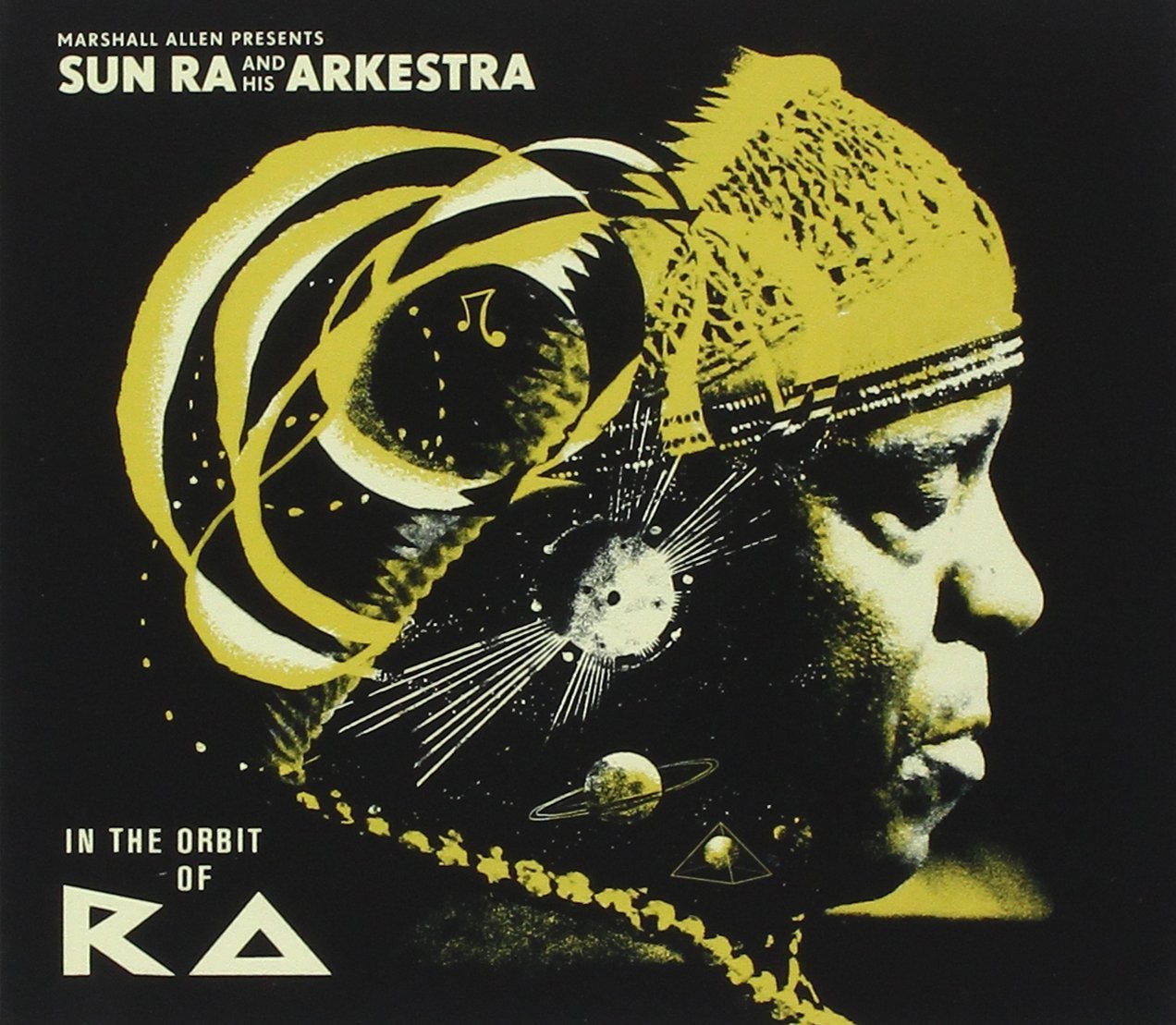
However, Strut Records managed to do so. They had an advantage though. Art Yard, one of Sun Ra’s most loyal lieutenants in the Arkestra helped compile Marshall Allen Presents Sun Ra and His Arkestra-In The Orbit Of Sun Ra. It’s a twenty-track, double album, that be released on Strut Records on 22nd September 2014. Before I pick the highlights of Marshall Allen Presents Sun Ra and His Arkestra-In The Orbit Of Herman’s, I’ll tell you about Sun Ra’s career.
Before dawning the role of Sun Ra, he was born Herman Poole Blount, on 22nd May 1914, in Birmingham, Alabama. Very little is known about Herman’s’s early life. So much so, that for years, nobody knew what age Herman was. What we do know, that growing up, Herman immersed himself in music. He learnt to play the piao at an early age. Soon, he was a talented pianist. By the age of eleven, Herman was to able read and write music. It wasn’t just playing music Herman enjoyed. When musicians swung through Birmingham, Herman was there to see everyone from Duke Ellington to Fats Waller. This inspired Herman to become a professional musician.
By his mid teens, Herman was a high school student. However, music was Herman’s’s first love. Music teacher John T. “Fess” Whatley realised this. He helped Herman’s’s nascent musical career. John was a strict disciplinarian. This rubbed off on Herman. Later, he would be relentless taskmaster when he formed his Arkestra. This worked. When the Arkestra were in full flow, they were peerless. However, that was way in the future. Before that, Herman’s’s career was just unfolding.
In his spare time, Herman was playing semi-professionally. He played in various jazz and R&B groups and as a solo artist. Before long, Herman was a popular draw. This was helped by his ability to memorise popular songs and play them on demand. Strangely, away from music, the young Herman was very different.
He’s remembered as studious, kindly and something of a loner. Herman’s was a deeply religious young man. That’s despite not being a member of a particular church. One organisation that Herman joined was the Black Masonic Lodge. This allowed Herman’s access to one of the largest collection of books in Birmingham. For a studious young man like Herman’s, this allowed him to broaden his knowledge of various subjects. Whether this included the poetry and Egyptology that would later influence Herman’s’s musical career, isn’t known.
The next step in Herman’s’s musical career came in 1934. Ethel Harper, his biology teacher from the high school, had a band. Herman was asked to join. After joining the musician’s union, Herman toured the Southeast and Midwest. Then when Ethel left the band to join The Ginger Snaps, Herman took over the band.
With Ethel gone, the band was renamed The Sonny Blount Orchestra. It headed out on the road and toured for several months. Sadly, The Sonny Blount Orchestra wasn’t making money. Eventually, the band split up. However, other musicians and music lovers were impressed by The Sonny Blount Orchestra.
This resulted in Herman being always in demand as a session musician. He was highly regarded within the Birmingham musical community. So much so, that Herman was awarded a music scholarship to Alabama Agricultural and Mechanical University in 1937. Sadly, he dropped out after a year when his life changed forever.
It was in 1937, that Herman experienced a life-changing experience. It’s a story he tells many times throughout his life. He describes a bright light appearing around him and his body changing. “I could see through myself. And I went up… I wasn’t in human form….I landed on a planet that I identified as Saturn. They teleported me. I was down on a stage with them. They wanted to talk with me…They told me to stop attending college because there was going to be great trouble in school … the world was going into complete chaos … I would speak through music, and the world would listen. That’s what they told me.” For a deeply religious young man, this was disturbing and exciting. It certainly inspired Herman.
After his “trip to Saturn,” Herman dedicated himself to music. He devoted himself to music. So much so, that he hardly found time to sleep. All Herman did was practice and write songs. The first floor of his home was transformed into a musical workshop. That’s where he rehearsed with the musicians in his band. Away from music, Herman’s took to discussing religious matters. Mostly, though, music dominated Herman’s’s life.
So it’s no surprise that Herman decided to form a new band. He decided to reform The Sonny Blount Orchestra. It showcased the new Herman’s. He was a dedicated bandleader, who like his mentor John T. “Fess” Whatley, was a strict disciplinarian. Herman’s was determined his band would be the best in Birmingham. Seamlessly, The Sonny Blount Orchestra were able to change direction, and play an eclectic selection of music. Before long, The Sonny Blount Orchestra were one of most in-demand bands in Birmingham. Things were looking good for Herman. Then in 1942, The Sonny Blount Orchestra were no more. Herman was drafted.
On receiving his draft papers, Herman declared himself a conscientious objector. He cited not just religious objections to war and killing, but that he had to financially support his great-aunt Ida. Then there was the chronic hernia that blighted Herman’s’s life. The draft board rejected his appeal. Things got worse. His family were embarrassed by Herman’s’s refusal to fight. Some turned their back on him. Eventually, Herman was offered the opportunity to do Civilian Public Service. However, he failed to appear at the camp in Pennsylvania on December 8th 1942.
This resulted in Herman being arrested. When he was brought before the court, Herman debated points of law and the meaning of excerpts from the Bible. When this didn’t convince the judge Herman said he’d would use a military weapon to kill the first high-ranking military officer possible. This resulted in Herman being jailed. For Herman, this lead to one of the most disturbing periods in his life.
So bad was Herman’s experience in military prison that he had to write to the US Marshals Service in January 1943. By then, Herman felt he was on the verge of a nervous breakdown. He was suffering from stress and suicidal. There was also the constant fear that he’d be attacked. Luckily, the US Marshals Service looked favourably on his letter.
By February 1943, Herman was allowed out during the day to work in the forests around Pennsylvania. At nights, he was able to play piano. A month later, Herman was reclassified and released from military prison.
Having left prison, Herman formed a new band. They played around the Birmingham area for the next two years. Then in 1945, when his Aunt Ida died, Herman’s left Birmingham. Next stop was Chicago.
Moving to Chicago, Herman’s quickly found work. He worked with Wynonie Harris and played on his two 1946 singles, Dig This Boogie and My Baby’s Barrelhouse. After that, Herman worked with Lil Green in some of Chicago’s strip clubs. Then in August 1946, Herman’s started working with Fletcher Henderson. However, Fletcher’s fortunes were fading.
Fletcher Henderson’s band was full of mediocre musicians. The main man, Fletcher Henderson, was often missing. He was still recovering after a car accident. So Fletcher needed someone to transform his band’s fortunes. This was where Herman’s came in. His role was arranger and pianist. Herman’s realising the band needed to change direction, decided to infuse Fletcher Henderson’s trademark sound with bebop. However, the band were resistant to change. So in 1948, Herman left Fletcher Henderson’s employ.
Next for Herman was forming a trio with saxophonist Coleman Hawkins and violinist Stuff Smith. This trio didn’t last long and didn’t release any recordings. Not long after this, Herman would make his final appearance as a sideman on violinist’s Billy Bang’s Tribute to Stuff Smith. After this, Herman Poole Blount became Sun Ra.
Chicago was changing. It was home to a number of African-American political activists. A number of political movements sprung up. They were seeking political and religious change. Herman became involved. He was immersing himself in history. Especially, Egyptology. He was fascinated with the Chicago’s many ancient Egyptian-styled buildings and monuments. This resulted in Herman discovering George G.M. James’ The Stolen Legacy. Discovering this book was a life-changing experience.
In The Stolen Legacy, George G.M. James argues that classical Greek philosophy actually has its roots in Ancient Egypt. This resulted in Herman concluding that the history and accomplishments of Africans had been deliberately denied and suppressed by various European cultures. It was as if his eyes had been opened. For Herman, this was just the start of a number of changes in his life.
As 1952 dawned, Herman had formed a new band, The Space Trio. It featured saxophonist Pat Patrick and Tommy Hunter. At the time, they were two of the most talented musicians Herman knew. This allowed him to write even more compacted and complex songs. However, by October 1952, he wasn’t writing these songs as Herman Poole Blount. No. Sun Ra was born in October 1952.
Just like Malcolm X and Muhammad Ali, adopting the name Sun Ra was perceived by some as Herman choosing to dispense with his slave name. This some felt, was a kind of rebirth for Sun Ra. It certainly was a musical rebirth.
After Pat Patrick got married, he moved to Florida. This left The Space Trio with a vacancy for a saxophonist. Tenor saxophonist, John Gilmore filled the void. Soon after, Marshall Allen an alto saxophonist joined. So did saxophonist James Spaulding, trombonist Julian Priester and briefly, tenor saxophonist Von Freeman came onboard. Another newcomer was Alton Abraham, who would become Sun Ra’s manager. He made up for Sun Ra’s shortcomings.
While he was a hugely talented bandleader, who demanded the highest standards, Sun Ra, like many musicians, was no businessman. With Alton Abraham onboard, Sun Ra could concentrate on music. Alton took care of business. This included setting up El Saturn Records, an independent record label, which would release many of Sun Ra’s records. However, El Saturn Records didn’t released Sun Ra and His Arkestra’s debut album, Jazz By Sun Ra.
Jazz By Sun Ra was released in 1956, on the short-lived Transition Records. However, Sun Ra and His Arkestra’s sophomore album Super Sonic Jazz was released in March 1956, on El Saturn Records. Sound Of Joy was released on Delmark in November 1956. For the next few years, El Saturn Records released most of Sun Ra and His Arkestra’s albums. By his death in 1993, Sun Ra had released over 100 albums. This veritable feast of music meant there was plenty of choice for Strut Records’ forthcoming compilation Marshall Allen Presents Sun Ra and His Arkestra-In The Orbit Of Sun Ra. It’s a double album featuring twenty tracks, which I’ll pick the highlights of
Disc One.
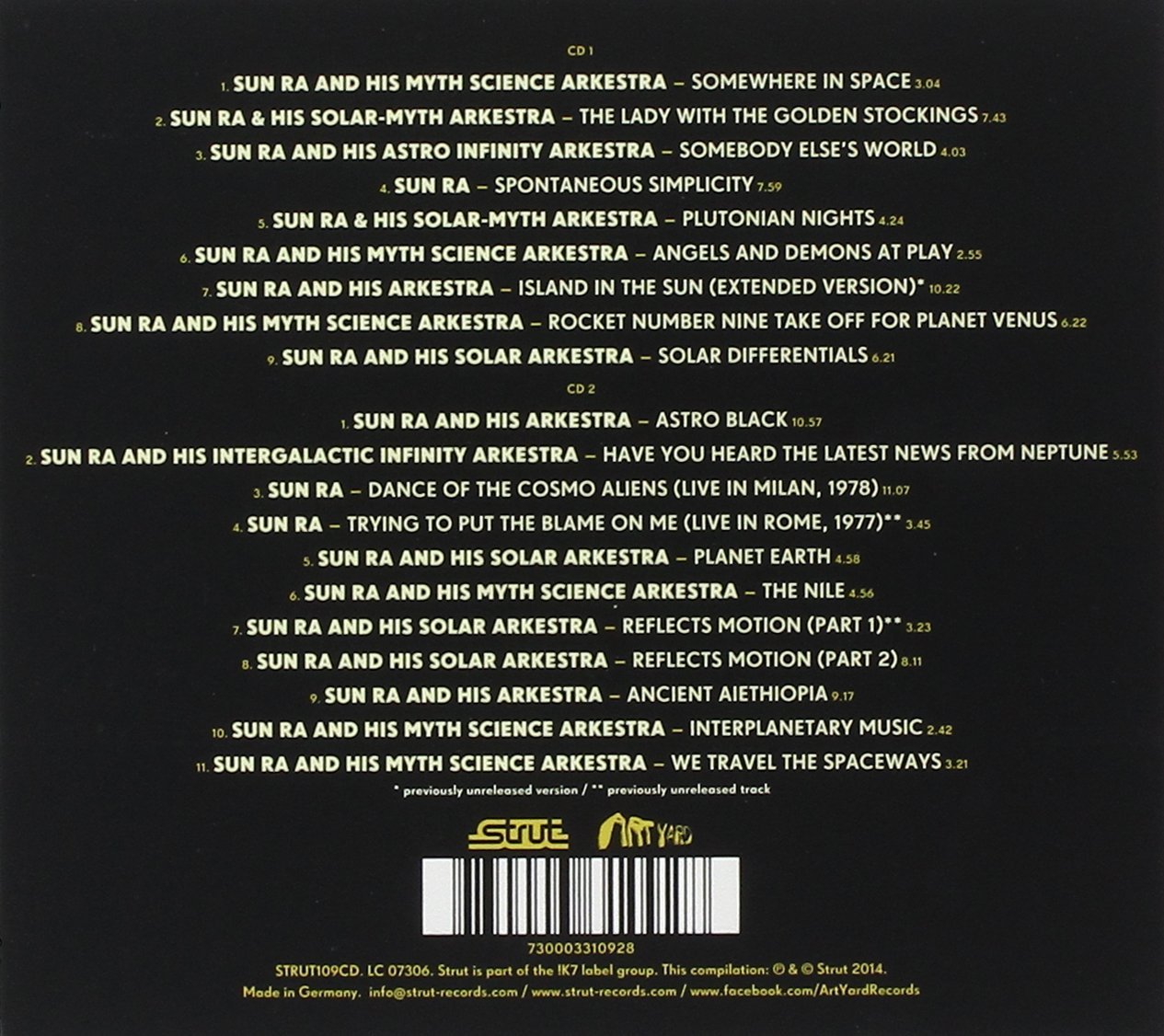
There are nine tracks on disc one of Marshall Allen Presents Sun Ra and His Arkestra-In The Orbit Of Sun Ra. They’re taken from throughout Sun Ra’s career. The eleven tracks show how Sun Ra’s music evolved from his 1956 debut album Jazz By Sun Ra. What follows is a compelling musical journey.
Opening Marshall Allen Presents Sun Ra and His Arkestra-In The Orbit Of Sun Ra is Somewhere In Space. It’s a track from Interstellar Low Ways, which was released in 1966. Given its innovative sound, it’s hard to believe Somewhere In Space was recorded in 1966. It wasn’t. Interstellar Low Ways were originally recorded between 1959 and 1960. Between thirty and forty songs were recorded. The best became Interstellar Low Ways. Somewhere In Space is one of album’s highlights and showcases a musical pioneer as his musical career takes off.
The Lady With The Golden Stockings (The Golden Lady) is a track by Sun Ra And His Solar-Myth Arkestra. It featured on the 1960 album The Nubians Of Plutonia which was released on Sun Ra’s Saturn Records. There’s a change in sound on The Nubians Of Plutonia. That’s apparent on The Lady With The Golden Stockings (The Golden Lady). There’s a looser and much more abstract sound. Percussion plays a more important part as Sun Ra fuses elements of free jazz, blues and African music. This results in a coming of age from a musical alchemist.
Somebody Else’s World featured on Sun Ra and His Astro Afinity Arkestra’s 1970 album My Brother The Wind Volume II. Originally, it was released on Sun Ra’s Saturn Records. As the new decade dawns, Sun Ra becomes a musical alchemist. Accompanied by the classic lineup of tyne Arkestra, they produce a genre melting track. Elements of Afro-beat, avant garde, experimental, free jazz and soul jazz melt into one.
Spontaneous Simplicity is a track from Sun Ra and His Arkestra’s 1971 album, Pictures Of Infinity. It’s has an understated, wistful sound. A flute and percussion combine while the rhythm section and piano provide a subtle heartbeat. Gradually, the arrangement’s secrets and subtleties unfold. Sun Ra And His Solar-Myth Arkestra take you on a mystical, magical and beautiful musical adventure.
Angels And Demons At Play was the title-track from The Sun Ra Arkestra’s 1967 album. Released on El Saturn Records, it’s a captivating fusion of percussive delights, free jazz and hard bop. Sometimes, the track borders on avant garde as Sun Ra pushes musical boundaries to their limits, and sometimes, beyond.
In 1965, Sun Ra and His Solar Arkestra released Secrets Of The Sun. One of its highlights, was Solar Differentials which closes Marshall Allen Presents Sun Ra and His Arkestra-In The Orbit Of Sun Ra. Sun Ra dawns the role of musical adventurer and combines avant garde, free jazz and his own brand of space age jazz on the piano lead Solar Differentials. It represents Sun Ra at his most innovative and adventurous, as he tries to open the doors of perception.
Disc Two.
Disc two of Marshall Allen Presents Sun Ra and His Arkestra-In The Orbit Of Sun Ra features a total of eleven tracks. They were chosen by Art Yard, one of Sun Ra’s most trusted and loyal lieutenants in the Arkestra. He’s chosen well on disc two. There’s a mixture of familiar tracks and some hidden gems.
Astro Black was the title-track of Sun Ra’s 1973 album. It was recorded at El Saturn Studio, Chicago, Illinois, May 7, 1972. Released in 1973, it sees Sun Ra experiment with synths and electronic vibes. This gives a hint of what’s to come. The music is left-field and experimental. Free jazz, soul and Sun Ra’s unique brand of space age jazz is combined with elements of classical and soul. The soul comes courtesy of June Tyson, while the Arkestra create a futuristic, experimental and groundbreaking epic track.
There’s two live tracks on disc two. The first is Dance Of The Cosmo-Aliens, which was recorded in Milan in 1978. This is a track from his Disco 3000 album, which was released in 1978 ,on El Saturn Records. Just like Trying To Put The Blame On Me, which was recorded in Paris in 1977, this showcases just how talented and inventive Sun Ra and His Arkestra were. They were a well drilled band. Sun Ra was a demanding bandleader, who put his band through lengthy practice sessions. This paid off. Each night, Sun Ra expected and demanded his band to be at the peak of their powers each night. That’s the case on these nights in Milan and Paris.
The Nile is a track from Sun Ra and His Myth Science Arkestra’s 1963 album, When Sun Comes Out. It was released on the Saturn Research label. Just like so many of the tracks on Marshall Allen Presents Sun Ra and His Arkestra-In The Orbit Of Sun Ra, it’s hard to believe this track was recorded in 1963. It was way ahead of its time. Indeed timeless is one way to describe The Nile, a pioneering slice of free jazz from a musical visionary.
On disc one, Art Yard chose Solar Differentials, a track from Sun Ra and His Solar Arkestra’s 1965 album Secrets Of The Sun. He returns to Secrets Of The Sun for Parts One and Two of Reflects Motion. It features Sun Ra and his all-star band in full flight. Pat Patrick, Marshall Allen, Eddie Gale and Tommy Hunter accompany Sun Ra on this two part, twelve minute epic. It’s an eclectic musical adventure that’s best described as dubby, avant garde, cosmic and experimental. Free jazz and Sun Ra’s futuristic space-age age sound collide head on.
My final choice from disc two of Marshall Allen Presents Sun Ra and His Arkestra-In The Orbit Of Sun Ra is We Travel The Spaceways. This is another track from Sun Ra and His Myth Science Arkestra’s 1963 album, When Sun Comes Out. Understated, thoughtful, spacious and wistful, describes We Travel The Spaceways. Essentially, it’s a mixture of the music of the past, present and future. Although it’s not as intense as some of the music Sun Ra made, it’s cerebral, melancholy and beautiful.
The twenty tracks on Marshall Allen Presents Sun Ra and His Arkestra-In The Orbit Of Sun Ra are just a tantalising taste of Sun Ra’s music. Over a career lasting forty years, Sun Ra released over 100 years. These albums showcase one of the most enigmatic and innovative musicians of the 20th Century. That’s no exaggeration.
While many artists are described as innovative, very few really are. Sun Ra is one of the exceptions. From the moment he dawned the role of Sun Ra, his music was transformed. It became much more complex. This was only possible because Sun Ra found liked minded musicians. Among them were Pat Patrick, Tommy Hunter, John Gilmore, Marshall Allen, James Spaulding, Julian Priester and Art Yard. They became part of Sun Ra’s legendary Arkestra.
For nearly forty years, Sun Ra and His Arkestra pushed musical boundaries. Sun Ra was a perfectionist and relentless taskmaster. With some of most talented, inventive and adventurous musicians of their generation, Sun Ra set about honing the Arkestra’s sound. He was demanding and exacting standards. Second best was no use to Sun Ra. What he was after was an Arkestra who were innovators and musical adventurers.
Sun Ra was never content to stand still musically. Similarly, he was always striving to reinvent his music. The original version of a song was merely the starting point. What it became, was anyone’s guess? Sun Ra was forever determined to innovate. When he reinvented a track, he took the music in the most unexpected direction. He combined Egyptian history and space-age cosmic philosophy with freeform jazz. This innovative fusion transformed the career of the man born Herman Poole Blount. He became a giant of jazz. However, this didn’t come easily.
To create the music on Marshall Allen Presents Sun Ra and His Arkestra-In The Orbit Of Sun Ra didn’t come easy. It took time, patience and dedication. Sun Ra with like minded musicians recorded over 100 albums. This gave Art Yard, one of Sun Ra’s most loyal lieutenants in the Arkestra plenty of music to choose from. Eventually, Art narrowed the music down to the twenty tracks that feature on Marshall Allen Presents Sun Ra and His Arkestra-In The Orbit Of Sun Ra. This double album will be released on Strut Records on 22nd September 2014. It’s the perfect starting point for anyone yet to discover an enigmatic musical innovator. For those familiar with Sun Ra’s music, then Marshall Allen Presents Sun Ra and His Arkestra-In The Orbit Of Sun Ra is a reminder of true a musical visionary as we celebrate the 100th anniversary of his birth.
MARSHALL ALLEN PRESENTS SUN RA AND HIS ARKESTRA-IN THE ORBIT OF RA.
BRENT SUPERB 60S SOUL SIDES.
BRENT SUPERB 60S SOUL SIDES.
When Bob Shad founded Brent Records in 1959, he was no newcomer to the music industry. Music had been his life. Originally, Bob, a native New Yorker, started life as a session guitarist. Bob made it his business to know everyone within the New York music scene. He knew everyone that mattered. Whether it was Dizzy Gillespie, Charlie Parker or Coleman Hawkins, Bob knew them. There was a reason for this. Bob Shad was looking to the future.
Bob Shad didn’t want to remain a session player. The role of musical hired gun wasn’t for Bob. He had ambition and saw the bigger picture. Soon, Bob Shad was working as a producer in post-war New York. Mostly, Bob was producing R&B. This was just the next step in Bob’s game-plan.
In 1948, Bob founded his first label Sittin’ In With. He was inspired to do this because of his love of jazz. This resulted in Bob discovering the blues. With his portable tape recorder, Bob Shad headed South and taped some of the greatest names in blues music. Lightnin’ Hopkins, Memphis Slim, Big Bill Broonzy and Smokey Hogg. Having recorded one blues player, they would tell Bob about another. So he criss crossed the South taping blues players. Mostly, these singles appeared on his own labels.
Somehow, Bob still found time to freelance. Some of the artists he discovered were released on other labels. This includes Eddie “Cleanhead” Vinson and Savannah Churchill. While these records sold in vast volumes, Bob didn’t make much money. It taught him an important lesson. That was only to release music on his own labels.
During the early fifties, Bob founded a series of labels. This included the Castle, Harlem, Jackson, Jade, Jax and Spirituals’ labels. He realised the importance of having separate labels for separate genres of music. Bob realised that when record buyers saw a label, they had to know what type of music it would release. This was the case throughout his career.
Later in the fifties, Bob Shad founded further labels, including Shad, Time and Warner. Then in 1959, Bob founded Brent Records, which for eight years, was Bob Shad’s soul label. Between April 1959 and October 1967, Brent Records released seventy-five singles. Some of these singles feature on Brent Superb 60s Soul Sounds, which was recently released by Kent Soul, an imprint of Ace Records.
Brent Superb 60s Soul Sounds features a total of twenty-four tracks. This includes fifteen of the singles released on Brent Records. The other nine tracks are either unreleased tracks, or tracks that weren’t released until after Brent Records closed its doors. There’s contributions from Dave Crawford, Jeannie Trevor, The Moovers, Brenton Wood, Clyde Wilson, Laura Johnson, Clarence Hill, Ronnie White and Bertha Tillman. Essentially, Brent Superb 60s Soul Sounds is a mixture of familiar faces and hidden gems, which I’ll now choose the highlights of.
Opening Brent Superb 60s Soul Sounds, is Dave Crawford’s Praying For The Rain To Come It was released in 1967, the year Bob Shad shut Brent Records’ doors. Praying For The Rain To Come, which was written by Dave, was a double-A side. The flip side was Millionaire, which was penned by Van McCoy and Luther Dixon. Originally, Praying For The Rain To Come and Millionaire was meant to be a demo. However, with Bob closing Shad’s doors, he decided to release it as a double-A side. Sadly, success eluded the single. Given the quality of quality of both tracks that’s surprising. Praying For The Rain To Come is akin to an outpouring of hurt and pain, while Millionaire features a wistful, emotive and needy vocal from Dave.
Originally, Jeannie Trevor was a jazz singer. She recorded a jazz album for Bob Shad’s mainstream label in 1964. The following years, she recorded two soul cuts. Neither tracks have been released before. They’ve languished in the Brent Records’ vaults. Both tracks were recorded at a session on 24th August 1965. The first track is You Did It Before, which is also known as You Did It For Me. Jeannie’s other contribution is Tinklin’ Bells. It’s the best of the two tracks. It was written by Robert Banks, Miriam Lewis and Rose Marie McCoy. Joyous, soulful and full of hooks, Tinklin’ Bells is a real find.
Another unreleased track is Julius Wright’s I Pray That Things Will Change. Very little is known and Julius or the song. All that’s known is that it was written by Julius. It was probably recorded in New York, with one of Brent’s vocal groups adding harmonies. What I do know about I Pray That Things Will Change, is it oozes quality and emotion. It’s also bound to find favour within the Northern Soul community.
The Moovers were one of Brent Records’ soul vocal groups. They only released one single, I Love You Baby, which was written by Arnold Albury, Willie Clark and Johnny Pearsall. I Love You Baby is a slow, heartfelt ballad, which showcases The Moovers’ considerable vocal talents. It’s a truly beautiful paean. Almost as good is the B-Side, One Little Dance. Penned by Willie Clark and Johnny Pearsall, it features a needy, pleading, heartbroken vocal. Sadly, The Moovers never released another single. I Love You Baby, which was released in 1967, was their one and only single. Later, in 1967, Brent closed its doors.
Brenton Wood also features twice on Brent Superb 60s Soul Sounds. His first contribution is the beautiful balladry of I Want Love. Penned by Joe Hooven, Alfred Smith and Jerry Win, it was released as single in 1966. Cross The Bridge is Brenton’s second contribution. Released in 1966, it’s a real rarity. It was never released as a single. A promo was pressed and copies change hands for nearly $200.
Ronnie White released Begging You as a single in 1967. It was written by Mike and William Leanburg. Accompanied by harmonies, Ronnie unleashes a needy vocal powerhouse. Emotion, hurt and insecurity are ever-present. Got To Give You Up is Ronnie’s other contribution, which wasn’t released until 2006. Driven along by bursts of blazing horns, Ronnie reigns in the power somewhat and delivers a despairing vocal. Incidentally, if you’re wondering what Got To Give You Up reminds you of, it’s Knock On Wood.
Laura Johnson was an accidental singer. She originally worked in Correc-Tone’s offices. After her coworkers remarked upon the her voice, she started singing semi-professionally. By 1962, she cowrote Wondering If You Still Miss Me with Robert Bateman and Wilbur Herbert. It was released on Brent Records in 1962. It’s two-and-a-half minutes of heartbreak, hurt and melancholy.
Linda Lyndell was born in Gainesville, Florida. By the sixties, she was signed to Bob Shad’s Brent Records. She recorded Pretty Boy, a track she wrote herself. It was never released, though. Until now. Pretty Boy makes its debut on Brent Superb 60s Soul Sounds. It’s storming slice of soulful music. A stomping musical juggernaut, it deserves to be heard by a wider audience. So does My Man, He’s A Loving Man, which wasn’t released until 2011. Written by James Bennett and Johnnie Mae Matthews, Linda delivers a sassy, sultry vocal. After leaving Brent, Linda signed to Volt Records in 1967 and released Bring Your Love Back To Me.
Clarence Hill wrote A Lot Of Lovin’ Goin’ Round, and released it as a single in 1965. Accompanied by stabs of braying horns and cooing harmonies A Lot Of Lovin’ Goin’ Round is a delicious slice of soulful music.
Marvel Harrell recorded Don’t Play With My Heart on 19th December 1962. It’s never been released since then. Belatedly, Don’t Play With My Heart makes its debut on Brent Superb 60s Soul Sounds. It features a heartfelt, pleading vocal. The way Marvel sings the lyrics, it’s as if he’s lived the lyrics.
My final choice from Brent Superb 60s Soul Sounds is Bertha Tillman’s Someone (Who Needs You Like I Do). It’s another of the unreleased tracks. It must have been released around 1962. That’s when Brenda was signed to Brent. She released two singles in 1962, Oh My Angel and (I Believe) Something Funny Is Going On. Someone (Who Needs You Like I Do) is a missed opportunity. It could’ve given Brenda a hit single.
Against a slow, understated arrangement Brenda delivers an impassioned vocal that’s a mixture of emotion and sincerity. Listening back to this hidden gem, it’s obvious that Bertha Tillman was a talented singer who should’ve enjoyed more success than she did.
During the eight years Brent Records were in business, Bob Shad travelled coast to coast in search of talent. Starting in New York, Bob headed to Los Angeles and Detroit. He was constantly searching for new talent. After all, they could be the artist who brought fame and fortune to his door. However, Bob didn’t just have one label.
After founding Brent in 1959, Bob founded Mainstream in 1964. He also had labels like Shad, Time and Warner. Mainstream released mainly pop and jazz. Then in 1969, two years after Brent closed its doors, Mainstream became a soul label. Jazz was still released on Mainstream. Not pop. Bob turned his back on pop. It was as if he decided to stick with what he knew.
Blues, jazz, R&B and soul were what had brought Bob Shad success. For this serial musical entrepreneur, it was a case of sticking to what he knew and loved. However, there was no sentiment involved. His record labels were businesses. They had to make money. That was their raison d’être. Too often, owners of record labels fail to realise this. Not Bob Shad.
When Bob realised that Brent Records wasn’t making money, he closed its doors. He tried a few throws of the dice before that. They failed to succeed. So some of Brent’s artists were moved to Bob’s Mainstream imprint. Then Bob closed Brent Records’ doors. By 1967, Mainstream was Bob’s only label. His Time imprint had closed its doors in 1965. Only Bob’s Mainstream imprint remained after Brent closed its doors in 1967.
Things weren’t looking good for Bob Shad. His fortunes improved in the seventies. Mainstream became a successful label. So Bob founded two further labels, Brown Doors and IX Chains. Now into his fourth decade in the music industry, Bob Shad remained one of music’s pioneers.
This was the case throughout his career. In 1948, Bob had founded his first label Sittin’ In With. He was inspired to do this because of his love of jazz. Soon, Bob discovered the blues. he bought a portable tape recorder, and headed South, where he taped some of the greatest names in blues music. After that, Bob Shad founded a string of labels over the next twenty years. One of these labels was Brent Records, a soul label founded in 1959.
For the next eight years, Bob Shad headed across America in search of artists to sign to Brent Records. He found Dave Crawford, Jeannie Trevor, The Moovers, Brenton Wood, Clyde Wilson, Laura Johnson, Clarence Hill, Ronnie White and Bertha Tillman. They all feature on Brent Superb 60s Soul Sounds, which was recently released by Kent Soul, an imprint of Ace Records. Brent Superb 60s Soul Sounds is a cornucopia of soulful delights, which will be a welcome and worthy addition to any record collection.
BRENT SUPERB 60S SOUL SIDES.
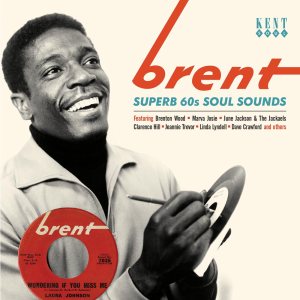
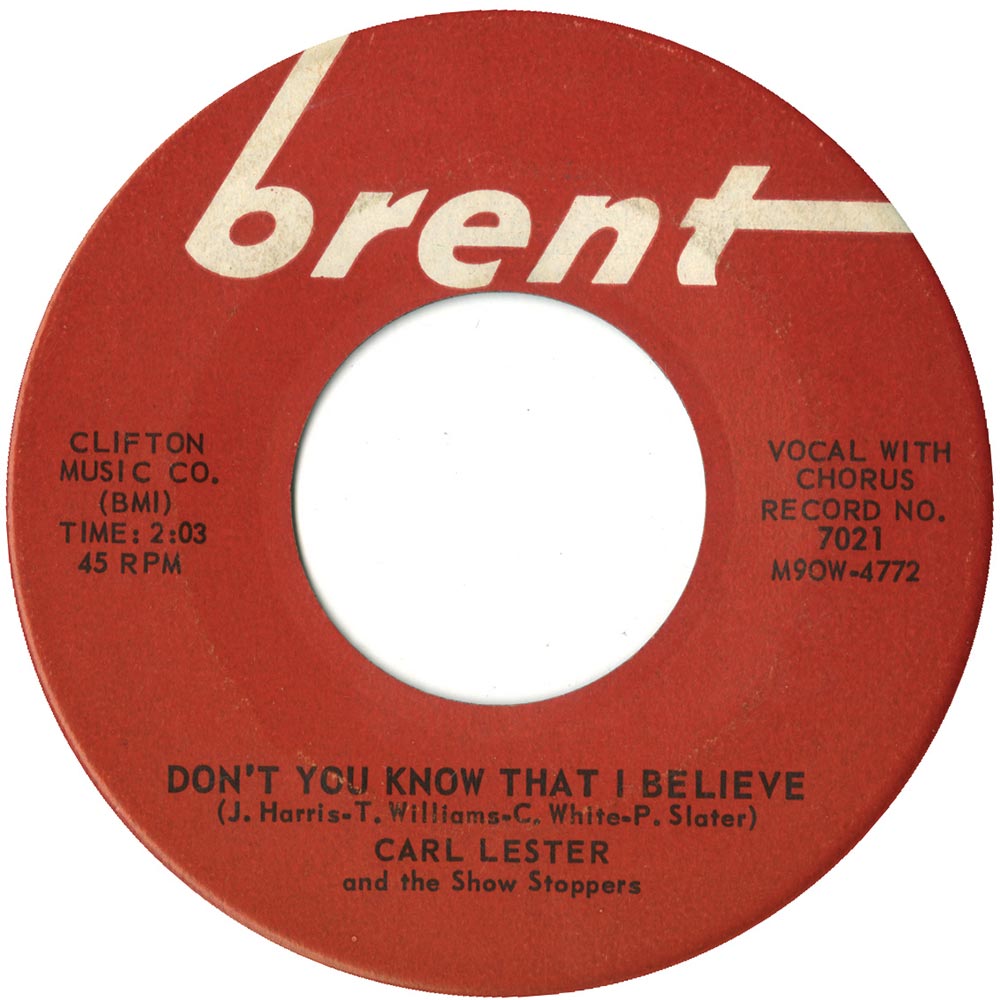
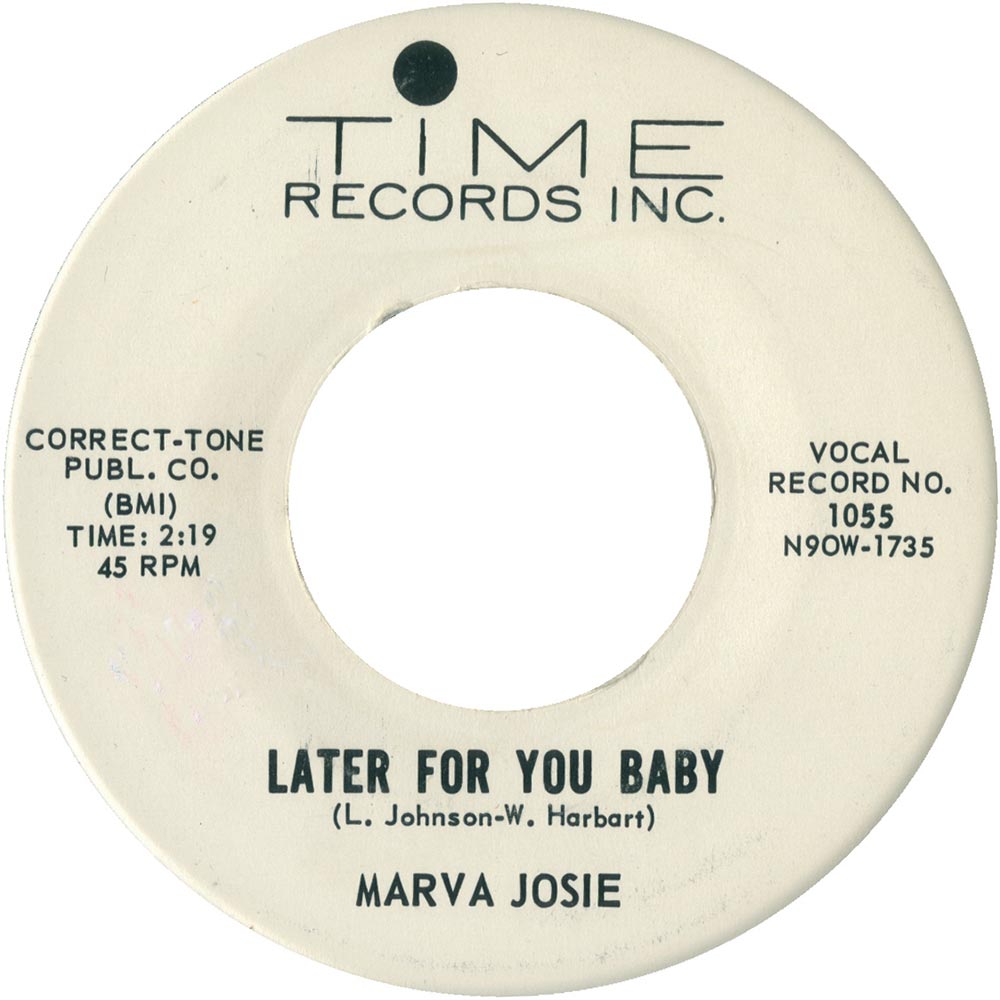
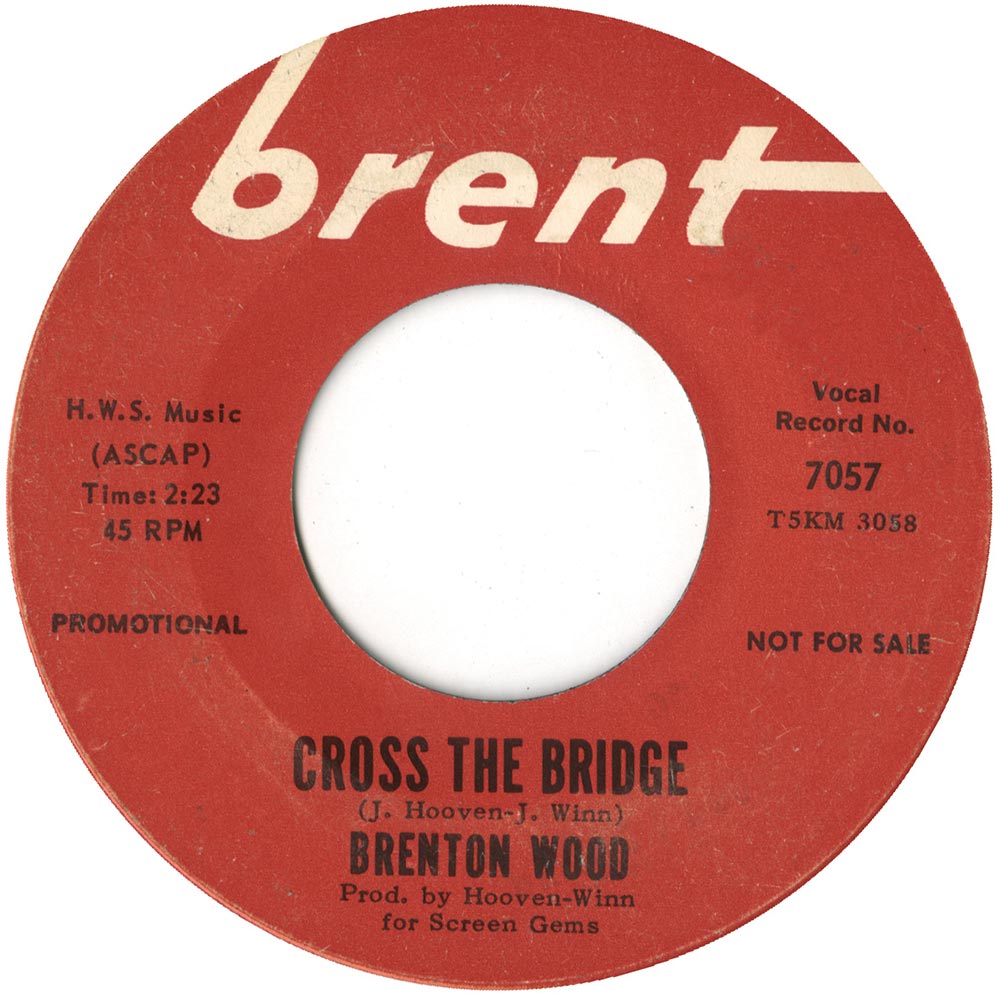
THE EXCELSIORS-CONTROL THIS.
THE EXCELSIORS-CONTROL THIS.
When The Excelsiors recently released their debut album Control This, on BBE Records, one thing shawn through, Shane “Sureshot” Hunt’s love of Jamaican music. It shines through from the opening bars of Mrs. Magic, right through to the closing bars of Soon I Will Be Done. So much so, that Control This is akin to a love letter to Jamaican music. That’s no surprise.
Shane “Sureshot” Hunt is a devotee of all things reggae. What Shane doesn’t know about Jamaican music isn’t worth knowing. His knowledge of Jamaican music from the sixties to the eighties can only be described as encyclopaedic. He loves everything from ska, rocksteady, reggae and dancehall. That’s not all. Shane is also a fan of hip hop. The best way to describe Shane’s musical taste is eclectic.
That’s been apparent throughout Shane’s career. He and Danny Clavesilla released a trio of albums as Sharpshooters. Their debut was 1996s Choked Up, which was released on Conception Records. They also released Buck The Saw in 1997. Then six years later, the Sharpshooters’ third album Twice As Nice was released on Light In The Attic Records. That was the last we heard from the Sharpshooters.
After the Sharpshooters, Shane released three volumes of the Soundbwoy Super Status Reggae Breaks And Beats series. They’re regarded as some of the best reggae compilations released in recent years. No wonder. They feature the great and good of reggae music, which is Shane’s first love. That’s apparent on Shane’s new project, The Excelsiors.
His new project The Excelsiors is the perfect showcase for Shane’s eclectic musical tastes. On Control This, Shane has been inspired by everything from AOR, Afrobeat to classic soul, disco, jazz-funk, Northern Soul, Philly Soul and even two-tone. This comes courtesy of the cover versions on Control This. This starts with with Grover Washington’s jazz-funk staple Mr. Magic. It’s given a makeover and becomes Mrs. Magic. Then there’s covers of Debbie Deb’s freestyle favourite Lookout Weekend and Carole King’s classic It’s Too Late. That’s not all. Barrington Levy’s Here I Come becomes a mammoth live jam and the two-tone of The Beat’s Mirror In The Bathroom is given a much needed rework. One of the most intriguing covers is People Make The World Go Round. Penned by Thom Bell and Linda Creed, it was originally a hit for The Stylistics. Since then, it’s been covered by numerous artists. None of the covers is quite like The Excelsiors’ rework of this Philly Soul classic. However, there’s more to Control This than cover versions.
Control This is also a showcase for Shane’s songwriting and arranging skills. He’s penned two of the eleven tracks on Control This, In The Name Of The Father and Cold As Steel. Shane has also rearranged a traditional spiritual, which becomes Soon I Will Be Done. It’s another compelling track that shows another side to The Excelsiors’ music which is best described as old school with a modern twist.
Unlike many modern artists, Shane isn’t a fan of music software. No. He prefers “real” instruments and analogue equipment. This means a real live rhythm section comprising bass, drums and guitars. They’re augmented by keyboards, percussion, steel pans, horns, harmonies and strings. The result is real music, which was recorded live to tape. All the various takes were then comped. Eventually, the eleven tracks on Control This were completed.
The result is an album that’s very different to other albums that have been released recently. That’s because Shane has eschewed modern production methods. You won’t find software, samples and plug-ins on Control This, The Excelsiors’ debut album, which I’ll tell you about.
Opening Control This is Mrs. Magic. Drums reverberate before washes of Hammond organ set the scene for a needy, heartfelt vocal. Strings sweep in. So do harmonies. By then, The Mighty Pope’s vocal is a mixture of power and passion. Deep down in the arrangement, the rhythm provide the sultry heartbeat. What grabs and holds your attention is the vocal. Needy and desperate, it’s an outpouring of emotion.
Covering a classic like Carole King’s Too Late Baby, isn’t easy. After all, the definitive version has been recorded. This doesn’t put The Mighty Pope of. He grabs the song and delivers a soulful, heart wrenching vocal. It’s as if he’s lived the lyrics. The arrangement is understated. Instruments drift in and out. When they do, they make their presence felt. Especially the strings. They sweep and swirl. Keyboards, percussion and the rhythm section add a reggae groove. Later, horns and harmonies play important roles. However, it’s The Mighty Pope who plays the starring role. He dawns the role of soul survivor and wears it like a badge.
In a previous life, Lookout Weekend was a freestyle favourite. It’s totally transformed by The Excelsiors. Straight away, it heads in the direction of Afrobeat. That’s down to blazing horns and the rhythm section. There’s more than a hint of reggae. That’s not all. Listen carefully and disco hi-hats hiss while The Mighty Pope delivers a stomping, vamp, as this freestyle favourite takes on new life and meaning.
Another track that’s transformed is Barrington Levy’s Here I Come (Broader Than Broadway). It becomes a joyous and irresistible live jam. From the opening bars, the familiar sound of crackling vinyl makes its presence help. It’s akin to listening to an old and much loved slice of vinyl. A buzzing bass, stabs of keyboards and soaring, testifying harmonies accompany The Mighty Pope’s urgent, enthusiastic vocal. The addition of the harmonies are a masterstroke. They’re the perfect foil for the lead vocal on this joyous and irresistible live jam.
In the Name of the Father is one of two tracks on Control This, that Shane wrote. It has a spiritual sound. That’s obvious from the get-go. This spiritual sound comes courtesy of The Mighty Pope’s powerhouse of a vocal. It’s yin. Yang is an arrangement that’s bold, dramatic and theatrical. Together, they play their part in a powerful and spiritual sounding track.
Thom Bell and Linda Creed wrote People Make The World Go Round for The Stylistics. They were one of Philly Soul’s top songwriting teams. People Make The World Go Round is a classic, with lyrics that ooze social comment. They’re just as relevant today. Especially when Omega Rae delivers the lead vocal. Behind her, a pulsating, driving arrangement unfolds. Providing a contrast to the rest of the arrangement are steel pans and horns. Then there’s an Eastern influenced drone. All this plays a part in the reinvention of a Philly Soul classic.
A Land Far Away (Satta Massagana) was originally written and recorded by Gene Rondo. Shane decided it was ripe for reinvention. He was right. Gospel tinged harmonies and braying horns join forces. They provide the backdrop for The Mighty Pope’s emotive, sincere vocal. He’s accompanied all the way the rhythm section and percussion. Harmonies and horns drift in and out, as a joyous genre-melting anthem unfolds.
This Is Sunshine Music is a funky, soulful version of Zap-Pow’s This Is Reggae Music. Most people won’t have heard the original. Hopefully, they’ll be inspired to do so. The unmistakable sound of a Hammond organ is joined by the rhythm section and another powerhouse of a vocal from The Mighty Pope. He never gives less than 100% when he delivers a vocal. Power, sincerity, hope and emotion melt into one. That’s the case here. It’s as if he’s desperate for you to listen to every word he sings. Later, strings shimmer and quiver, adding to the feel-good sound of this funky, soulful opus.
Mirror In The Bathroom gave The Beat a hit single in 1981, during the two-tone era. Here, it’s reinvented by The Excelsiors. A digital rhythm is accompanied by bursts of space invader synths and washes of Hammond organ. Old and new sit side-by-side. Adding to the soulfulness of the Hammond organ are harmonies. They’re the perfect foil to The Mighty Pope’s vocal. He combines power, emotion and social comment. The result is a familiar track that’s reworked for a new musical generation.
Cold As Steel is an instrumental written by Shane. It has a moody understated introduction. That soon changes. The darkness is gone and sun comes out. What follows is musical sunshine. Steel pans, percussion, rhythm section and keyboards join forces. The music becomes joyous, cinematic and irresistible.
Closing Control This is the spiritual sound of Soon I Will Be Done. Hypnotic drums pound and washes of keyboards sweep in. So do gospel tinged harmonies. Taking centre-stage is The Mighty Pope. His vocal is full of belief, sincerity and hope. It’s almost joyous as he sings “Soon I Will Be Done…there will be no dying over there.” After the spiritual sounding vocal, The Mighty Pope exits stage left right. He’s kept one of his best vocals until last.
As debut albums go, The Excelsiors’ Control This is one of the best I’ve heard this year. It features eight cover versions, a reworking of a spiritual and two new songs from Shane “Sureshot” Hunt. They showcase Shane’s talent as a songwriter. However, he’s more than a songwriter.
Arranger, musician and producer are three other rolls Shane has dawned during the making of Control This. Another roll Shane has taken on is musical arbiter. For Control This he’s chosen eight cover versions. This meant a trip through his record collection. Shane has delved deep into the furthest corners of his record collection. In doing so, he’s chosen a compelling collection of cover versions for Control This, which was recently released on BBE Records
Shane’s crate digging expedition resulted in covers of AOR, classic soul, disco, jazz-funk, Northern Soul, Philly Soul and even two-tone finding its way onto Control this. This compelling collection of cover versions are a mixture of classes and hidden gems. Among them are Grover Washington’s Mr. Magic, Debbie Deb’s Lookout Weekend, Carole King’s It’s Too Late, Barrington Levy’s Here I Come, The Beat’s Mirror In The Bathroom and Thom Bell and Linda Creed’s People Make The World Go Round. These songs are reworked.
In The Excelsiors’ hands, they take on new life and meaning. Sometimes, they’re far removed from the original, that it’s as if they’re new songs. That’s down to one person, Shane “Sureshot” Hunt. His vision, imagination and adventurous spirit is behind the sound and success of The Excelsiors’ debut album Control This, which marks the next step in the career of Shane “Sureshot” Hunt.
THE EXCELSIORS-CONTROL THIS.
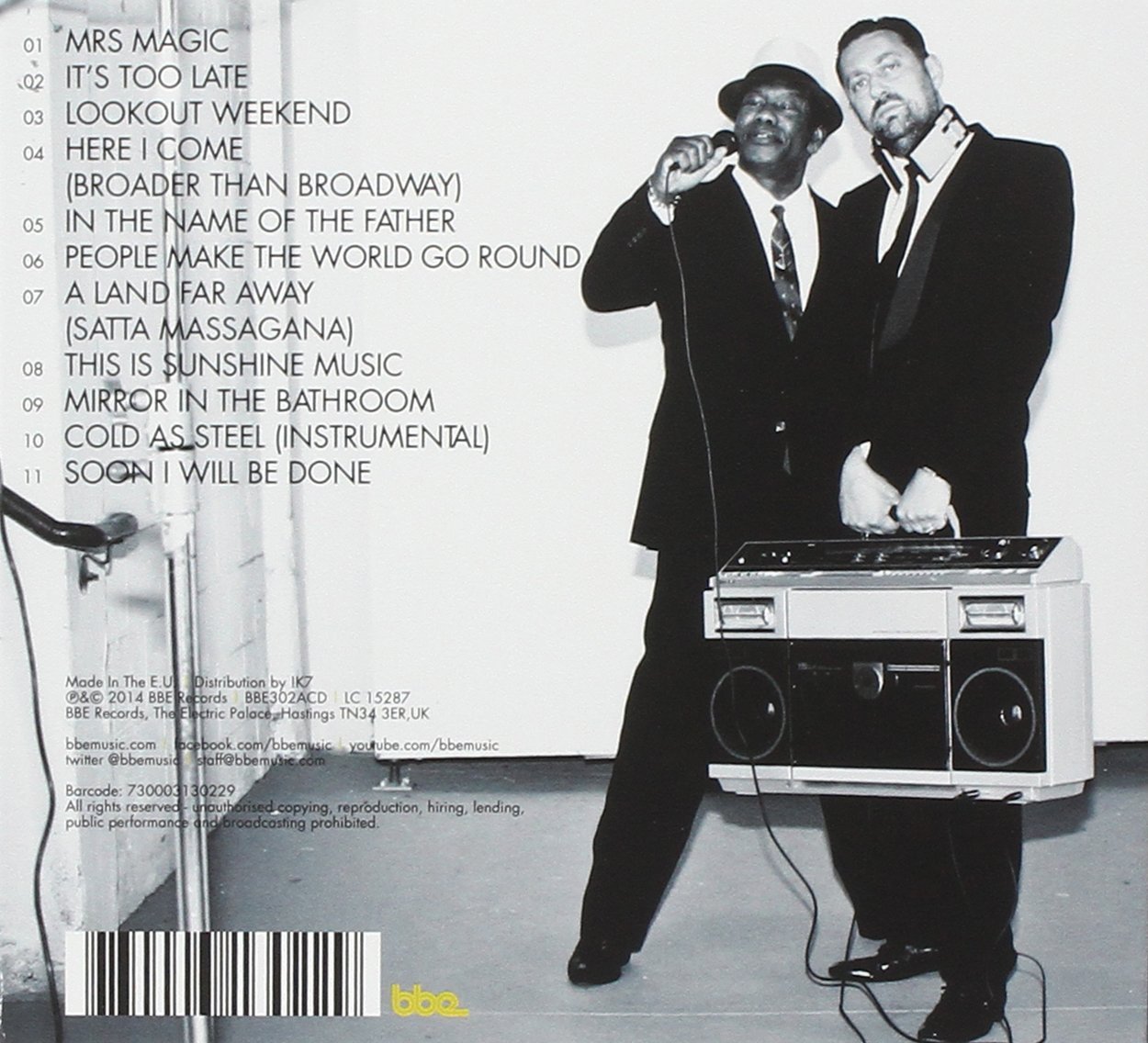
CRACKING THE COSIMO CODE-60S NEW ORLEANS R&B AND SOUL.
CRACKING THE COSIMO CODE-60S NEW ORLEANS R&B AND SOUL.
Between 1956 and 1968, Cosimo Matassa owned what was the most important recording studio in New Orleans. Situated at 521-525 Governor Nichols Street, Cosimo Matassa’s studios were where some of the most important soul and R&B to come out of New Orleans was recorded. Cosimo Matassa’s studio sat between J&M Recording Studios and the Jazz City Studio, Cosimo Matassa’s studio seemed to the only studio that mattered. That’s where the great and good of soul and R&B headed to record their latest single.
Eddie Bo, Earl King, Barbara Lynn, Dave Bartholomew and his Orchestra, Ronnie Barron, Lee Dorsey, Willie Tee, Aaron Neville and Joe Haywood all made their way to Cosimo Matassa’s studio. There they were produced by some of the top producers in New Orleans. This began with Dave Bartholomew, who produced Fats Domino. Soon, legendary New Orleans producers like Allen Toussaint, Harold Battiste, Eddie Bo and Wardell Quezergue were making their way to Cosimo Matassa’s studio. It soon became the go-to studio for artists and producers wanting to lay down the latest slice of R&B or soul. That was the case right through until 1968, when Cosimo Matassa’s studio closed its doors. It was a case of gone but not forgotten.
Cosimo Matassa’s studio is one of the most celebrated studios in the history of soul and R&B. So much so, that it has its very own website dedicated to cracking what’s been referred to as the “Cosimo Code.” That’s the system Cosimo Matassa used to catalogue his recordings. It’s continued to puzzle music lovers over the years. Try as they may, they’ve never been able to solve this enigmatic system. Eventually, in 2013, a group of musicologists decided to setup a website dedicated to “Cracking The Cosimo Code.” Since then, they’ve dedicated themselves to shedding light on Cosimo Matassa’s enigmatic system. However, there’s another meaning to “Cracking The Cosimo Code.”
Cracking The Cosimo Code-60s New Orleans R&B and Soul is also the title of a compilation recently released by Ace Records. It features the giants of the New Orleans’ music scene. Everyone from Eddie Bo, Earl King, Barbara Lynn, Dave Bartholomew and his Orchestra, Ronnie Barron, Lee Dorsey, Willie Tee, Aaron Neville and Joe Haywood feature on Cracking The Cosimo Code-60s New Orleans R&B and Soul. It’s a twenty-four track compilation that celebrates Cosimo Matassa’s famous New Orleans studio.
Opening Cracking The Cosimo Code-60s New Orleans R&B and Soul, is Jessie Hill’s Ooh Poo Pah Doo. It was written by Jessie Hill, whose musical career began as a drummer in Professor Longhair’s band. By 1958, Jessie had his own band, The House Rockers. One of their favourite tracks was Ooh Poo Pah Doo. Eventually, Jessie recorded the song in Cosimo’ studio. Produced by Allen Toussaint, it was released on Minit Records. This resulted in one of the biggest hist of his career, reaching number twenty-eight in the US Billboard 100 and number three in the US R&B charts.
Eddie Bo was an important player in New Orleans’ post-war music scene. Singer, songwriter and producer, Eddie tried everything during a career that lasted fifty years. In 1962, Eddie recorded Harold Batiste and Melvin Lastie’s I Got To Know. Soulful, sultry and funky, this Harold Batiste producer track failed to chart. Six years later, Eddie and Innez Cheatham recorded Edwin Bocage’s Lover and A Friend. Produced by Eddie, he and Innez prove the perfect, soulful foil for each other. Despite this Lover and A Friend failed to chart. However, it’s a hidden gem that deserves a wider audience.
Just like Eddie Bo, Earl King played an important part in the New Orleans music scene. During a forty year career, Eddie had been an arranger, label owner and singer. He also worked with some of New Orleans best producers. This included Dave Bartholomew, in 1962. Dave produced Eddie’s single Trick Bag. Released on Imperial, it sold well within the New Orleans area. Five years later Earl worked with producer Wardell Quezergue. He produced Earl’s 1967 single, Poor Sam. Originally released on Nola imprint Hot Line, Poor Sam was eventually picked up by Checker and was the perfect showcase for Eddie’s bluesy, soulful, lived-in vocal.
Chris Kenner was a talented singer and songwriter. He’s best remembered for singles like Land Of The 1000 Dances, Sick and Tired and I Like It Like That. He also wrote and recorded Something You Got. It was produced by Allen Touissaint, and released as a single in 1962, on Instant. Something You Got was a regional hit and was responsible for the Popeye dance craze that swept New Orleans. However, fifty-two years later, and Something You Got is best remembered as a deeply soulful, soul-baring single.
Barbara Lynn wrote Second Fiddle Girl and entered Cosimo Matassa’s studios in 1962. There she was joined by producer Huey Meaux, the man who discovered Barbara. She was his greatest discovery. A year before she released Second Fiddle Girl, she’d enjoyed a number one US R&B hit with You’ll Lose A Good Thing. Lightning didn’t strike twice with Second Fiddle Girl. No. Released on Jamie, it stalled at number sixty-two in the US Billboard 100. If ever a single deserved to fare better, it’s Second Fiddle Girl, which features a feisty, swaggering vocal from Barbara Lynn.
In 1963, John Williams’ group The Tick Tocks entered Cosimo Matassa’s studio with Harold Battiste, one of New Orleans’ top producers. They recorded the Alvin Carter, Eugene Harris, Walter Washington and John Williams’ composition I’m Gonna Get You Yet. It was released on the Fire label in 1963. I’m Gonna Get You Yet literally oozes quality, emotion and frustration. It’s also reminder of the quality of R&B coming out of New Orleans in the early sixties.
Fifty years ago, in 1964, Ronnie Barron covered the Dr. John penned Did She Mention My Name. They were old friends. Before becoming Dr. John, he was Mac Rebennack. He had recorded with Ronnie as Drifts and Davy and then as Ronnie and The Delinquents. Now Ronnie had embarked upon a solo career. Sam Montel produced Did She Mention My Name. It was released on the Michelle label, but disappeared without trace. That’s a great shame. With a nod to The Impressions, Ronnie delivers a beautiful, heartfelt vocal against an understated arrangement. The result is one of the highlights of Cracking The Cosimo Code-60s New Orleans R&B and Soul.
Lee Dorsey was one of the most successful artists to come out of New Orleans during the sixties. One of his hit singles was Get Out Of My Life, Woman, which was written and produced by Allen Toussaint. Released on the Amy label, Get Out Of My Life, Woman reached number forty-four in the US Billboard 100 and number three in the US R&B charts. No wonder. Get Out Of My Life, Woman epitomises everything that’s good about Lee Dorsey’s music.
June Gardner’s 99 Plus One is a drum led instrumental where elements of blues, jazz and R& melt seamlessly into one. It’s a truly timeless track. Providing the heartbeat is Albert “Gentleman” June Gardner’s drums. He started life as a jazz drummer. By 1960, he was Sam Cooke’s touring drummer. After that, his music headed in the direction of funk. On 99 Plus One, his jazzy roots shine through. In 1965, he recorded 99 Plus One which was produced by Wardell Quezergue. It was released on Hot Line and later, Blue Rock where June Gardner became J. Gardner. Despite this change of name, sadly, commercial success eluded 99 Plus One, which is a glorious genre-melting instrumental.
Aaron Neville’s Tell It Like It Is is without doubt the highlight of Cracking The Cosimo Code-60s New Orleans R&B and Soul. Written by George Davis and Lee Diamond, Tell It Like It Is is was produced by George and Alvin “Red” Tyler. Released on the Parlo label in 1966, Tell It Like It Is is reached number two in the US Billboard 100 and number one in the US R&B charts. It’s a heartachingly beautiful, stonewall soul classic. It should also inspire everyone to check out Aaron Neville and The Neville Brothers’ illustrious discography.
An oft-covered song is Please Release Me. Written by Eddie Miller, James Pebworth and Robert Yount, it was covered by Johnny Adams in 1967. Produced by Wardell Quezergue and released on the Watch label, this heartfelt and emotive cover should’ve been a huge hit. However, musical tastes had changed and the single stalled at eighty-two in the US Billboard 100 and number thirty-four in the US R&B charts.
Closing Cracking The Cosimo Code-60s New Orleans R&B and Soul is Joe Haywood’s Play A Cornbread Song For Me And My Baby. Joe is best known for his hit single Warm and Tender Love. This dictated the direction Joe’s music would head. That’s until Play A Cornbread Song For Me And My Baby. It was produced by New Orleans veteran Larry Lucie. Larry had played some of the biggest names in music, including Jelly Roll Morton. Play A Cornbread Song For Me And My Baby was released on Kent in 1967, and saw Joe change direction. He get’s funky on a track that previously, had been a hit for Esther Phillips in 1962. However, Joe’s uber funky, vampish version of Play A Cornbread Song For Me And My Baby failed to chart.
It’s no exaggeration to say that musical magic took place at Cosimo Matassa’s New Orleans’ studio. Between 1956 and 1968, Cosimo Matassa owned what was without doubt, the most important recording studio in New Orleans. Situated at 521-525 Governor Nichols Street, Cosimo Matassa’s studios were where some of the most important soul and R&B to come out of New Orleans was recorded. That’s apparent on Cracking The Cosimo Code-60s New Orleans R&B and Soul.
The great and good of New Orleans’ music feature on Cracking The Cosimo Code-60s New Orleans R&B and Soul. I’ve mentioned just fourteen of the tracks. I could just as easily have mentioned any of the twenty-four tracks. That’s not surprising. Look at Cracking The Cosimo Code-60s New Orleans R&B and Soul’s track listing.
Everyone from Eddie Bo, to Earl King, Barbara Lynn, Dave Bartholomew and his Orchestra, Ronnie Barron, through Lee Dorsey, Willie Tee, Aaron Neville and Joe Haywood all made their way to Cosimo Matassa’s studio. They were joined by some of New Orleans top producers.
One of the first was Dave Bartholomew, who produced Fats Domino. Very soon, legendary New Orleans producers like Allen Toussaint, Harold Battiste, Eddie Bo and Wardell Quezergue were making their way to Cosimo Matassa’s studio. They made magic happen at 521-525 Governor Nichols Street. This was the case for twelve years. Cosimo Matassa’s studio closed its doors in 1968. That wasn’t the end of the story.
Since then, Cosimo Matassa’s studio has become one of the most celebrated studios in the history of soul and R&B. That’s no surprise. Look at the music that was created within its four walls. It was one of the busiest and most successful studios in New Orleans. A huge amount of music was recorded within Cosimo Matassa’s studio. The twenty-four tracks on Cracking The Cosimo Code-60s New Orleans R&B and Soul are just a taste of the magic that happened at 521-525 Governor Nichols Street. There’s plenty more music still to be discovered. So, lets hope that Ace Records recently released compilation is Cracking The Cosimo Code-60s New Orleans R&B and Soul just the start of a regular series of compilations.
CRACKING THE COSIMO CODE-60S NEW ORLEANS R&B AND SOUL.
DAN MASTROIANNI-TEARS AND WHISPERS.
DAN MASTROIANNI-TEARS AND WHISPERS.
All too often, an album fails to find the audience it deserves first time round. This can be a result of a number of reasons. The albums was released on the wrong label, it wasn’t promoted properly or it was too far ahead of its time. There can be any number of reasons. Time and time again I’ve written about these albums. Often, it’s hard to believe that these albums weren’t released to widespread commercial success and critically acclaim. Sadly, often it’s only much later that these albums are appreciated. Another example is Dan Mastroianni’s Tears and Whispers, which was recently rereleased by BBE Records as part of their Masters We Love series. In their press release Tears and Whispers is described as a unique album. That’s no exaggeration.
When Tears and Whispers was released in 1984, it was described as an experimental and innovative album. That’s apparent from the opening bars of Lead On, right through to the closing note of When You Say Goodnite. The eight tracks find Dan Mastroianni constantly pushing musical boundaries. To do that Dan, a talented keyboardist embraced musical technology. However, he didn’t turn his back on traditional musical methods.
No. Tears and Whispers is a marriage of musicians and technology. To augment the synths, sequencers, keyboards and drum machines Dan had amassed, he brought onboard some of his musical friends. The result was Tears and Whispers, a compelling melting pot of soul, funk, boogie and even psychedelic synths that was recorded in 1984.
The story behind Tears and Whispers begins in 1984. That’s when Dan Mastroianni set about recording his debut album Tears and Whispers. It featured eight tracks written by Dan. He was a talented keyboardist, who embraced the new musical technology.
That’s apparent throughout Tears and Whispers. During the eight tracks, Dan plays keyboards and synths. He also programmed drum machines and sequencers. Dan used samples on Tears and Whispers. Especially, horn and drum samples. This makes Dan Mastroianni one of the pioneers of samples. He was way ahead of the musical curve. However, Dan was still something of a traditionalist. Augmenting Dan’s technology were some of his musician friends.
For the recording of Tears and Whispers, Dan brought onboard his brother John Mastroianni. John played flute and saxophone. Al Shulick played drums, and arranged the drums and percussion with Sam Eckhardt and Dan. Vocalists included George “Cooter” McCallister and Dave Smith. These were the only musicians to feature on Tears and Whispers. Mostly, Tears and Whispers was Dan’s musical “baby” He arranged Tears and Whispers and produced the album with Sam Eckhardt. Tears and Whispers was released later in 1984.
Tears and Whispers was released as a private pressing in 1984. It was a fusion of man and machine. Musicians and technology became one. The result was a genre-melting album of experimental, groundbreaking music. Boogie, funk, soul and psychedelia synths all melt into one on Tears and Whispers. There was a problem though.
Maybe, just maybe, Tears and Whispers was way ahead of the musical curve? Here was another case of an album that if it was released a couple of years laters, might have much more successful. Sadly, Tears and Whispers, failed commercially. What didn’t help was that Tears and Whispers was a private pressing.
With private pressings, the labels haven’t the same resources as a major label. Sometimes, the label is owned by the artist. It’s sometimes been setup for the release of this one album. This means that it’s unlikely that the album will reach a much wider audience. Often though, the release will be only a short run, maybe one or two thousand copies. In this case, the best the artist can hope is that the album is picked up by a bigger label. Sadly, Tears and Whispers disappeared without trace.
Since then, thirty years have passed. Just like many albums, Tears and Whispers has belatedly found an audience. It’s only now, that people realise just how groundbreaking an album Tears and Whispers is. Sadly, copies of Tears and Whispers were extremely rare. Copies were few and far between. When they came up for sale, the price was prohibitive to most people. Then BBE Records announced they were rereleasing Tears and Whispers. Belatedly, Dan Mastroianni’s Tears and Whispers can now be heard by a wider audience. They can enjoy Tears and Whispers, which I’ll now tell you about.
Tears and Whispers opens with Lead On. Dramatic drums and swells of synths rise up. Then banks edgy keyboards make their presence felt. So do drums and a fluttering bass. George “Cooter” McCallister adds a hurt-filled, needy vocal. Harmonies accompany him, adding to the soulful sound. Meanwhile, synths beep, squeak and then gradually, rise towards a crescendo. That’s the signal for this delicious fusion of blue-eyed soul meets boogie to kick loose, before reaching a dramatic ending.
Thirty years ago, You and I would be described as new age soul. It was very different to much of the soul being released. In fact, it was very different to much of the music being released in 1984. Oozing quality, emotion and beauty, You and I features a soul searching vocal from Dave Smith. He delivers it against an arrangement that comes courtesy of a a myriad of synths and banks of keyboards. This allows Dan the opportunity to dawn the role of musical alchemist. He unleashes some spellbinding solos. They veer between dramatic to thoughtful and wistful. It’s the perfect foil for the soulful delights of Dave Smith’s vocal.
A Million and One bursts urgently into life and a magical musical adventure unfolds. This urgency reminds me of the White Rabbit at the start of Alice’s Adventures in Wonderland. What follows is akin to a lysergic trip through the looking glass. Swells of synths, banks of synths and an uber funky bass line join drums and shimmering harmonies. They’re the backdrop for George’s urgent, soulful vocal. Later, a braying swirling saxophone is added as boogie, funk and soul combine seamlessly to create a dance-floor friendly track.
Slow, soulful and sultry described Shine. George’s scatted vocal gives the way to the sultry sound of a saxophone. When it drops out, George’s heartfelt, needy vocal enters. Sometimes, his vocal becomes a jazzy scat. All the time, drums provide the heartbeat. Later, harmonies float in. However, it’s George’s vocal and John’s saxophone that play starring roles in what’s the most soulful track on Tears and Whispers.
Stabs of keyboards linger, adding to the emotion in Dave’s vocal on Blame It On Love. They’re part of what looks like an understated arrangement. That’s until Dan throws a curveball. Then the arrangement bursts into life. It becomes an irresistible explosion of joy, emotion and hooks. This reminds me of Dan Hartman. Providing the backdrop to Dave’s vocal is Dan. He dawns the role of one man band. Banks of keyboards and synths take charge. He unleashes some peerless solos. Later, drums and blazing horns augment Dan’s one man band during this irresistible, hook-laden track.
Tears and Whispers sees the tempo drop and things get deeply soulful. George take charge of the vocal. It’s full of emotion and soulfulness. Dan provides the backdrop for the vocal. His keyboards and synths provide a multilayered arrangement. Drums provide the heartbeat and like the saxophone, add to the drama. They frame George’s vocal as he revels in the role of troubled troubadour.
Just One Touch is another boogie track. From the get-go, the arrangement bursts into life. Keyboards, synths and drums propel the arrangement along. Unlike previous tracks, the two vocalists feature. George and Dave are like yin and yang, complimenting each other perfectly. They drive each other to greater heights of soulfulness. This seems to spur Dan on. He unleashes some of his best solos on Tears and Whispers. When George and Dave return, this solo spurs them on. They surpass their previous efforts on this soulful slice of boogie.
When You Say Goodnite closes Tears and Whispers. The swathes of synths give the track a cinematic sound. So does the flute that swirls above the arrangement. It’s very different from the rest of Tears and Whispers. Then it’s all change. Rolls of drums and George’s urgent, melancholy vocal combine. A slapped bass and rolls of drums makes their presence felt. They add to the drama and emotion on this wistful fusion of electronica, funk and soul.
Belatedly, Dan Mastroianni’s debut album Tears and Whispers can be heard by a wider audience. Previously, copies of Tears and Whispers were extremely rare. Dan had released Tears and Whispers as a private pressing. This meant, that Tears and Whispers was a limited run. Very few copies seem to change hands. When they did, the price of a copy of Tears and Whispers was beyond most people. That was a great shame, because many people were desperate to hear Tears and Whispers.
Over the past few years, interest in Tears and Whispers was growing. A few discerning music lovers had discovered copies of Tears and Whispers. Soon, the word was out. Tears and Whispers was another hidden gem. It had lain undiscovered for nearly thirty years. Then the story got even more interesting.
Last year, 2013, a track from Tears and Whispers, Just One Touch, featured on Americana 2, a compilation released by BBE Records. This resulted in even more interest in Tears and Whispers. Suddenly, it was obvious, there was a new audience who were hungrily awaiting a rerelease of Tears and Whispers.
Nearly a year later, and BBE Records have rereleased Dan Mastroianni’s debut album Tears and Whispers. This is just in time to celebrate the thirtieth anniversary of Tears and Whispers. Listening to Tears and Whispers, it’s hard to believe that Dan Mastroianni recorded the album in 1984. It’s a truly timeless album that was way ahead of the musical curve. However, innovative is only one half of the story.
The music on Tears and Whispers is experimental. Dan a talented keyboardist, pioneered the use of samples, sequencers, synths and drum machines. This resulted in Tears and Whispers’ experimental and innovative sound. Experimentation and innovation are the two threads that run through Tears and Whispers. They’re constants. So is the quality of the vocal and musicianship. All this meant that Tears and Whispers should’ve transformed Dan Mastroianni’s career.
Sadly, that wasn’t the case. This wasn’t helped by the fact that Dan decided that Tears and Whispers should be a private pressing. With private pressings, the labels haven’t the same resources as a major label. This means that it’s unlikely that the album will reach a much wider audience. That was the case with Dan Mastroianni’s Tears and Whispers.
As a result, Dan Mastroianni’s groundbreaking and experimental fusion of man and machine Tears and Whispers, failed commercially. Thirty years later, and somewhat belatedly, Tears and Whispers, Dan Mastroianni’s debut album is receiving the critical acclaim it so richly deserves. Even better, Tears and Whispers is being heard by the wider audience it deserves. No longer is Dan Mastroianni’s Tears and Whispers a hidden gem awaiting discovery.
DAN MASTROIANNI-TEARS AND WHISPERS.
JEFF BUCKLEY-GRACE.
JEFF BUCKLEY-GRACE.
Twenty years ago, Jeff Buckley released the one and only album of his career, Grace. Jeff was the son of Tim Buckley, one of the most talented singer-songwriters of his generation. Tim could’ve and should’ve enjoyed widespread commercial success and critical acclaim. Sadly, that wasn’t to be. Having released nine albums between 1966 and 1974, Tim died in 1975. He was only twenty-eight. Sadly, Tim never got to the opportunity to realise his potential. Tragically, history would repeat itself twenty-two years later.
Originally, Jeff played in various struggling bands. After that, he worked as a session guitar. Then in 1990, Jeff decided to follow in his father’s footsteps. Just like his father Tim, it became apparent that Jeff Buckley was a talented singer-songwriter. Four years later, Jeff Buckley released his debut album Grace. Released to widespread critical acclaim, Grace was a stunning and successful debut album. A great future was forecast for Jeff. Sadly, tragedy intervened in Jeff Buckley’s life.
On 29th May 1997 Jeff was in based in Memphis, where he was in the process of recording his sophomore album. He was awaiting the arrival of his band. With nothing to do, Jeff decided to go for a swim in the Wolf River. Having dived fully clothed into the river, Jeff was caught in the wake of a passing boat. Various attempts were made to rescue Jeff. These attempts were in vain. It wasn’t until 5th June 2014, that Jeff Buckley’s body was recovered. That day, music lost one of its most potentially talented sons. Jeff Buckley’s musical legacy was his only album Grace, which will be rereleased by Sony BMG on 15th September 2014. This twentieth anniversary edition of Grace includes both a vinyl and CD version of Grace, Jeff Buckley’s opus. Before I tell about Grace, I’ll tell you about Jeff Buckley’s life.
Jeff Buckley was born on November 17th 1966, in Anaheim, California. Although the son of Tim Buckley and Mary Guibert, he was brought up as Scotty Moorhead. He was brought up by his mother and stepfather. During his childhood, he was steeped in music. His mother was a classically trained musician, playing cello and piano. Tim Buckley, his father, was a successful singer-songwriter. However, it was his stepfather, Ron Moorhead who introduced Jeff to artists like Jimi Hendrix, Led Zeppilin, Pink Floyd and Queen. He had started playing guitar aged five, and by thirteen, owned his first electric guitar. During high school, he played music, even playing in the school jazz band.
On graduating from high school, he spent a year at the Musician’s Institute, graduating aged nineteen. This course taught him about music theory and harmonies. After this, he spent six years playing guitar in various bands. Their style of music ranged from rock to reggae, and jazz to heavy metal. To make ends meet, he worked in a hotel during this time. He also worked as a session musician, playing in funk and R&B sessions.
In February 1990, Jeff moved to New York. Once settled in New York, he found it hard to get work as a musician. Whilst there, his musical tastes widened. He became interested in blues musician Robert Johnson’s music, hardcore punk band Bad Brains and Qawwali, a form of Sufi devotional music, and Nusrat Fateh Ali Khan’s work in particular. It was whilst in New York that Jeff got his next major break in music. His late father’s manager Herb Cohen, offered to help Jeff record a demo tape. This was called the Babylon Dungeon Sessions. The idea was to attract interest in Buckley as a solo artist.
This worked. The Babylon Dungeon Sessions brought Jeff’s music to the attention of a wider audience. Soon, word spread that Tim Buckley’s son was a talented singer-songwriter. However, although Babylon Dungeon Sessions had been a success, Jeff was still looking for that elusive “big break.” It came when Jeff was asked to sing at a 1991, tribute show to his father Tim in New York.
At that tribute concert in New York, Jeff performed one of his father’s classic songs I Never Asked To Be Your Mountain. His performance at the concert stimulated interest in his career. At last, his music career was going somewhere. For the next couple of years, he played numerous gigs around New York, where he honed his skills as a musician. During his concerts, he would play a wide range of material. In his sets he would play covers of everything from Edith Piaf to The Smiths and Led Zeppelin to Leonard Cohen. After a while, he started attracting interest from major record labels. Eventually, he signed to Columbia Records, signing a three album deal, worth roughly one million dollars in October 1992. In July and August 1993, he headed to the studio, to record his debut EP Live At Sin-e.
Midway through 1993, he began working on his debut album Grace. It featured ten tracks. Three were written by Jeff, Last Goodbye, Lover, You Should’ve Come Over and Eternal Life. He cowrote Mojo Pin and Grace with Gary Lucas, and So Real with Michael Tighe. Dream Brother was the other track Jeff cowrote Matt Johnson and Mick Grondahl. The other three tracks were cover versions. They were James Shelton’s Lilac Wine, Leonard Cohen’s Hallelujah and Benjamin Britten’s Corpus Christi Carol. These ten tracks would become Grace.
For Grace, Jeff put together a tight, talented band. The rhythm section included drummer and vibes player Matt Johnson, bassist Mick Grondahl and guitarists Michael Tighe and Gary Lucas. Other musicians included organist Loris Holland and Misha Masud on tabla. Jeff played guitar, harmonium, organ, dulcimer and tabla. The sessions were produced by Andy Wallace, who previously, had mixed Nirvana’s Nevermind album. After a few weeks practice, the band headed to Bearsville Studios, in Woodstock, New York. They spend six weeks recording parts of Grace. Overdubbing took place in New York and Manhattan. It was there, that Jeff Buckley recorded numerous takes of his vocals, attempting to achieve perfection.
Between finishing the recording and overdubbing sessions for Grace, and its release in August 1994, Jeff Buckley headed out on the road to tour his EP, Live At Sin-e. His tour was a huge success, with many well known musicians taking in Jeff’s shows. This would include Chrissie Hynde of The Pretender and U2’s The Edge. With such high profile names accompanying him, this created a buzz for the release of Grace.
When Grace was released in August 1994, it was critically acclaimed. The great and good of music all queued up to praise the album. Luminaries such as Robert Plant, Jimmy Page and David Bowie all loved Grace, and widely praised it. Rolling Stone magazine loved the album, and have included it in their 500 Greatest Albums of All Time. Sales started slowly, and eventually, Grace stalled at number 149 in the US Billboard 200 and number forty-four in Britain. This was disappointing, considering the reviews Grace received. Since then Grace has been certified gold in Australia, France and the US. However, it was very different back in 1994.
After the release of Grace, Buckley spent the next eighteen months touring the album. Wherever he played, he was a sell out. After all the years he’d struggled to make ends meet, Jeff was suddenly a huge star. After the tour ended in 1996, he prepared to write his next album. This was entitled Sketches For My Sweetheart the Drunk. Tom Verlaine ex-member of Television was to produce the album. Several recordings took place, and after a recording session in Manhattan, Buckley was still not happy with the album. To him, the album wasn’t finished yet. He played a few new songs at The Knitting Factory’s tenth anniversary concert. After that, he decided to head to Easley McCain Recording studios in Memphis, to work on his album. He hired a house, and became so attached to it, that he asked the owner’s if he could buy it. Whilst there, he even played a number of concerts at local venues. However, the album wasn’t going well, Buckley wasn’t happy with Tom Verlaine as producer, and contacted Andy Wallace, producer of his first album, Grace. In preparation for the arrival of Andy Wallace, Jeff recorded some demos and sent them to Andy Wallace.
Whilst his band returned to New York, Buckley stayed behind to work on the album. His band arrived back in Memphis on May 29th 1997. They were going to join him in the studio to see some new material he’d been working on. That night, Buckley decided to go swimming in Wolf River Harbor, part of the Mississippi. He entered the river fully clothed. A member of his road crew watched his swim. He’d swam there before. The roadie turned, and moved a guitar and radio out of the reach of the wake of a tug-boat, that was about to pass. When he turned round, Jeff Buckley was gone, nowhere to be seen. Tragedy had struck. Sadly, after a long search that night, there was no sign of Buckley. Then on June 5th, two local residents found Jeff Buckley’s body. He was thirty years of age. That day, music lost one of its a hugely talented singer-songwriter.
Since his death, Jeff Buckley’s music is more popular than ever. A number of live albums, greatest hits and Sketches For My Sweetheart the Drunk have been released since his death. His music is still attracting new fans, and his debut album Grace, is widely recognized as an outstanding album, one of the best albums of the 1990s’ I will now tell you just why Grace is such an outstanding album.
Grace opens with Mojo Pin, a song that starts quietly, the sound distant, gradually getting nearer. When it does, Jeff Buckley’s vocal emerges, soaring high at first, then dropping almost to a whisper. His hesitancy could be because he’s singing about a dream. Behind him the track meanders gently, before opening out, becoming louder and fuller. As this happens, Jeff’s voice veers between high and low. His range is wide, his voice full of character. You get the impression he’s holding himself back, and any minute he could launch into a vocal thats loud and passionate. It happens. He almost screams, but gathers control. The same can’t be said of his band, they really let go and unleash a wall of glorious sound. Mojo Pin is a dichotomy of a track, one minute quiet, gentle, with Buckley sounding thoughtful, the next his voice soars, he nearly screams, joining the band in an almost explosive crescendo. It’s a powerful track, one that demonstrates Jeff Buckley’s considerable talent as a vocalist.
The introduction to the title-track, Grace sees a change in tack from Jeff and his band. Grace is based upon an instrumental Rise Up to Be, which was penned by Gary Lucas. Jeff added the lyrics after saying goodbye to his girlfriend at an airport. Straight away, the sound is full, the tempo faster. When Buckley sings his voice is softer, he articulates the lyrics perfectly, bringing out the beauty in the lyrics. It’s one of his best performances on the album. His band play really well, the guitars particularly are a highlight of the track. Later in the track, Jeff adds beautiful harmonies. Then later, his voice is much stronger, he really lets go, forces the high notes to emerge. When he does, his band join in, upping the tempo, the sound getting louder, nearly frenetic. Then suddenly, the track ends. You’re left wondering, where did it go? However, at least you’re are left with a wonderful memory of Jeff Buckley in full flight.
Last Goodbye begins with a slide guitar playing, as if just warming up. Quickly, things get serious. What follows is a beautiful song. Buckley’s voice is strong, clear and full of emotion. Despite the emotion, Jeff is perfectly in control of his voice. Again, he demonstrates that wide vocal range. This allows him to veer from gentle and tender to high and soaring. Always though, Jeff in control. As for Jeff’s lyrics, they are among the best on the Grace. When he delivers them, his vocal is heartfelt, impassioned and emotive. That’s one reason why, seamlessly, everything falls into place. Jeff’s vocal, the lyrics and his band’s play their part in one of Grace’s high points.
Lilac Will will be familiar to many people. It has been covered by many artists. I’ve heard many of these versions. Some are good, others bad, and some the equivalent of a musical car crash. Jeff’s version is, by far, my favorite version. He poured everything he had into this song. During the song, you’ll experience a wide range of emotions. You’ll feel sad and happy, and experience highs and lows. Here his rendition is heartfelt, passionate and loaded with emotion. He brings the tempo way down low, when he sings his voice is brilliant, perfectly suited for the song. The arrangement is minimalist, just Jeff and his band playing softly behind him. It’s truly a gorgeous, soul-baring version of this song. After you’ve heard this version, anything else is second best.
After Jeff’s vocal masterclass on Lilac Wine, it’s going to be hard to either equal, or better that song. On So Real, he tries, tries very hard. It’s a good attempt. So Real is another of the album’s highlights. His voice is at its best, going between soft and gentle, to high and soaring. When he does this, he’s always in control of his powerful voice. This is something he shared with his father Tim. On this track, the arrangement is much fuller, the band are occasionally, allowed of the leash. Like Jeff Buckley’s vocal, the band’s performance veers between almost understated to full on. Having said that, they never overpower Jeff Buckley’s vocal, and compliment him perfectly.
Hallelujah sees Jeff cover another song that has been covered by many people. Written by Leonard Cohen, it’s a beautiful song, with Cohen’s version in many people’s opinion the best. Until now. Jeff sings the song beautifully, the arrangement wonderfully understated. He immerses himself into the song. So much so, that his version is one of the most moving versions of this song you’ll ever hear. When he delivers the lyrics, there are no frills. Instead, you’re fortunate to hear what’s an extremely moving and heartfelt reading of Leonard Cohen’s beautiful lyrics. This version is dramatic and emotive. When you first hear this track, it takes your breath away. It’s so different from many of the songs on the album. Only one word can describe this performance. Seminal.
Lover You Shouldn’t Have Come is a track that starts slowly. Gradually, it reveals its secrets and subtleties. After nearly a minute before Jeff Buckley sings. When he does, it’s well worth the wait. His performance is truly compelling. Jeff’s delivery of the lyrics he wrote is full of despondency and despair. He sounds as if he’s outlived the relationship he’s singing about. What follows is a snapshot into Jeff’s turbulent personal life. It’s also the perfect showcase for Jeff’s talents as a songwriter. Quite simply, these are some of his best lyrics on Grace. His vocal is just as good. When Jeff sings, he sings from the heart. You feel he means every word of the lyrics. Heartfelt, sincere and tinged with equal parts despair and despondency, Lover You Shouldn’t Have Come features Jeff at his very best.
Corpus Christi Carol, is from Benjamin Britton’s, A Boy Is Born. This was a song that Jeff was first introduced to in school. It’s the last of the three cover versions on the album. His version of this song is stunning. When you hear his voice, it has an ethereal quality, he controls his voice really well, resisting the urge to reinterpret the song. Instead he sings the song as it’s meant to be sung. The arrangement is subtle, understated and perfect for this beautiful song.
Eternal Life is the complete opposite to many tracks on Grace. Whereas Lilac Wine, Hallelujah and Corpus Christi Carol are quiet tracks, with a subtlety and understated arrangement, Eternal Life is the complete opposite. Straight away, the sound is loud and unapologetic. It’s right in your face. Truthfully, you worry if your speakers will survive nearly five minutes of this. Searing, scorching guitars soar above the arrangement and the drums pound. So much so, that it sounds as if they’re being punished. After the initial shock, when you listen to the track, it grows on you. You begin to enjoy it. Jeff Buckley’s vocal is loud, as if he’s battling his band, almost struggling to make himself heard. When eventually the tempo drops, you breath a sigh of relief, draw breath. Mistake. They start straight back up, launching another assault on their instruments. By the end, I’m exhausted, but in all honesty, I really enjoyed the track, as it showed a very different side to Jeff.
Grace ends with Dream Brother, a track that has a hesitant start. When the track starts the arrangement is gentle. A guitar plays quietly, drums play in the distance and Jeff’s vocal is understated. The song meanders along. I’m always waiting for the song to open out, the volume to increase, Jeff and the band to cut loose. After two and a half minutes the sound gets fuller, the band and Jeff still showing restraint. They’re resisting the temptation to end the album with a band. Instead Jeff Buckley’s vocal is controlled, very much within himself. His voice is still full of character and feeling when he sings the lyrics. They’re powerful, his rendition of them adding a dramatic impact. Then the song ends, not with a bang, but with a subtle, understated ending. It’s a lovely track to end the album, keeping up the consistent quality that runs throughout Grace.
Grace was the only album released during Jeff Buckley’s short life. It was one of the best debut albums of the nineties. Twenty years later, Grace is still one of the best debut album you’ll be lucky enough to hear. So good was Grace, that was hailed as one of the best album of the 1990s. That’s still the case. Grace is a truly timeless album. It’s an album that has stood the test of time well. Today, Grace still sounds as good today as the day I first heard it back in 1994. Indeed, so good was Grace that it was hailed one of the finest albums of the nineties. In the twenty years since Grace’s release, it’s been hailed as a classic album. Whenever lists of the best albums of all-time are released, Grace features on it. As a result, Grace has sold over two million copies. That’s no surprise. It’s a classic album that belongs in every record collection. For those yet to discover Grace, now is their opportunity to do so.
Grace which was released just over twenty years ago, will be rereleased by Sony BMG on 15th September 2014. This twentieth anniversary edition of Grace includes both a vinyl and CD version of Grace, Jeff Buckley’s Magnus Opus. Grace should’ve launched Jeff Buckley’s career. Sadly, fate decided to intervene.
Nearly three years after the release of Grace, on 29th May 1997 Jeff was in based in Memphis, where he was in the process of recording his sophomore album. Things hadn’t been going well. He’d changed producer and came to Memphis seeking inspiration. Tom Verlaine was replaced by Andy Wallace, who produced Grace. Tragedy occurred when Jeff was awaiting the arrival of his band.
With nothing to do, Jeff decided to go for a swim in the Wolf River. Having dived fully clothed into the river, Jeff was caught in the wake of a passing boat. Various attempts were made to rescue Jeff. These attempts were in vain. It wasn’t until 5th June 2014, that Jeff Buckley’s body was recovered. That day, music lost one of its most potentially talented sons. Jeff Buckley’s musical legacy was his only album Grace,
Although Jeff Buckley only released one album, Grace was a stonewall classic. It’s a mixture of three cover versions and seven new songs. There is not one bad song on Grace. This is unusual. Usually, there are a couple of mediocre tracks on most albums. Not on Grace. It’s an album that oozes quality. Similarly, emotion and beauty is omnipresent throughout Grace. That’s why Grace is one of these albums that I return to time and time again. Each time, I hear something new. With every listen to Grace, subtleties or nuances continue to reveal themselves. That’s why I never tire of listening to Grace. It was the perfect showcase for Jeff Buckley.
He could’ve become one of the most talented singer-songwriters of his generation. Jeff could’ve and should’ve enjoyed widespread commercial success and critical acclaim. Sadly, that wasn’t to be. Jeff died aged thirty, having never come close to fulfilling his potential. Grace is just a taste of what Jeff Buckley was capable of. Sadly, we’ll never know what heights Jeff Buckley might of reached? Grace is just a hint of the heights Jeff Buckley might have reached and what he was capable of.
JEFF BUCKLEY-GRACE.

SHE DID IT! THE SONGS OF JACKIE DESHANNON VOLUME 2.
SHE DID IT! THE SONGS OF JACKIE DESHANNON VOLUME 2.
When eventually, the definitive history of modern music is written, Jackie DeShannon will be remembered as one of the first, and most successful singer -songwriters. Her career began in 1956, when as Sherry Lee, she released her debut single Baby Honey. Jackie was just fifteen. This was the start of a songwriting and recording career that would span six decades.
A reminder of Jackie’s long and illustrious career of Jackie De Shannon, is She Did It! The Songs Of Jackie De Shannon Volume 2, which was recently released by Ace Records. It features twenty-three tracks which Jackie DeShannon wrote or cowrote. There’s hit singles, hidden gems and even an unreleased track on She Did It! The Songs Of Jackie De Shannon Volume 2. It’s a musical voyage of discovery and tantalising taste of a talented singer and songwriter, Jackie DeShannon, whose story began in 1941.
Jackie DeShannon was born Sharon Lee Myers, in Hazel, Kentucky, on 21st August 1941. She discovered music at an early age. That was partly, thanks to her parents. They were music lovers, who encouraged Jackie’s love of music. Before long, people realised that Jackie was a talented singer.
Aged six, Jackie was singing country songs on a local radio station. By the time she was eleven, Jackie was hosting her own radio show Breakfast Melodies. Sadly, life for her parents became difficult on their farm. So they made the decision to move to Batavia, Illinois.
Having moved to Batavia, Jackie attended the local high school. Then when she was a thirteen year old, eighth grader, Jackie featured in a local newspaper. They wrote about how Jackie was a talented and aspiring singer who also presented her own radio show. Jackie also made many appearances at various events within the local community. It seemed Jackie was being prepared for life as a singer.
The next step in Jackie’s career was an appearance on Pee Wee King’s Country and Western Television Show, in March 1956. This was the same year as Jackie released two singles as Sherry Lee. They were Baby Honey and I’m Crazy Darling. When neither singles charted, this proved an inauspicious start to the the future Jackie DeShannon’s music career.
Having spent two years at the Batavia High School, Jackie left in 1957, her sophomore year. The same year, Jackie’s recording career began. She would go on to release singles as Sherry Lee, Jackie Dee, and Jackie Shannon. Then later, she dawned the role of Jackie DeShannon. That was still to come. Before that, she signed to George Goldner’s Gone label in New York.
When Jackie signed to Gone, her management decided to change her name to Jackie Dee. Her debut single was I’ll Be True, which was released in 1957. She released three more singles as Jackie Dee, 1957s I’ll Be True and 1958s Buddy and Strolypso Dance. However, none of these singles charted. This resulted in a rethink from Jackie’s management.
They decided that Jackie Dee become Jackie Shannon. As Jackie Shannon, she released two singles, Just Another Lie and Lies. Neither country-tinged single charted. While this was disappointing for Jackie, these two singles came to the attention of Eddie Cochran.
Eddie Cochran was impressed with Jackie’s interpretation of country songs. He was also impressed with Jackie’s songwriting. So he arranged for Jackie to travel to California and meet his girlfriend Sharon Sheeley.
Sharon Sheeley was a Californian based singer-songwriter. When she met Jackie, the pair immediately got on. They decided to form a songwriting partnership. This proved a successful songwriting partnership. Together, they penned a string of hit singles. One of the biggest hit singles was Dum Dum, which gave Brenda Lee a hit in America, Australia and Britain. For Jackie, this was just the start of her luck changing.
1960 saw Jackie sign to Liberty Records. She decided to adopt the name Jackie DeShannon. This she felt, would help her sell records. Sadly, that wasn’t the case.
The first nine singles that Jackie released failed to chart. Her tenth single, 1962s Faded Love reached number ninety-seven in the US Billboard 100. Then Jackie’s cover of Needles and Pins reached number eighty-four in the US Billboard 100. Jackie also released her eponymous debut album in 1963. Later in 1963, Jackie’s cover of When You Walk in the Room reached number ninety-nine in he US Billboard 100. Despite the early promise Jackie had showed, commercial success was continuing to elude her. However, she received a big break in 1964.
In 1964, The Beatles were about to tour America for the first time. Belatedly, America “got” The Beatles. They needed someone to open for them. That’s where Jackie came in. This lead to the release of her album Breakin’ It Up On The Beatles Tour! Later that year, Jackie penned Don’t Doubt Yourself Babe, for The Byrds’ debut album. She also released another album, Don’t Turn Your Back On Me. It seemed Jackie’s luck was changing.
1965 saw Jackie move to New York. It was there she met Randy Newman. They formed a songwriting partnership and penned two love songs, She Don’t Understand Him and Did He Call Today Mama? Jackie also formed a brief songwriting partnership with Jimmy Page. However, 1965 was the year Jackie released her breakthrough single. What The World Needs Now Is Love reached number four in the US Billboard 100. It also featured on her 1965 album This Is Jackie DeShannon. So did A Lifetime of Loneliness, which reached number sixty-six in the US Billboard 100.For Jackie, 1965 had been the best year of her career. Surely this was just the start of the rise and rise of Jackie De Shannon?
That looked like being the case. Sadly, in 1966, Jackie enjoyed just one minor hit single, Come and Get Me. It stalled at just number eighty-three in the US Billboard 100. Her album Are You Ready for This? didn’t fare much better. This was the start of two lean years for Jackie De Shannon.
During 1967 and 1968, none of Jackie De Shannon’s singles charted. She released three albums during this period, New Image and For You in 1967. Then in 1968, she released two further albums, Me About You and Laurel Canyon. The only commercial success she enjoyed was with The Weight, which reached number fifty-five in the US Billboard 200. Things would improve in 1969.
Jackie’s career was transformed in 1969. She cowrote Put a Little Love in Your Heart it with her brother, Randy Myers, and Jimmy Holiday. It reached number four in the US Billboard 100. The followup Love Will Find a Way reached number forty in the US Billboard 100. Put a Little Love in Your Heart lent its name to Jackie’s 1969 album. As a new decade was about to dawn, things looked good for Jackie.
She moved to Los Angeles and signed to Atlantic Records in 1970. For Jackie these changes had mixed results. Her single You Keep Me Hanging On stalled at number ninety-six in the US Billboard 100. It’s So Nice then reached just number eighty-four in the US Billboard 100. Her 1970 album Love, marked a change in Jackie’s sound. It was well received by critics.
1971 was a huge disappointment for Jackie. Neither of the two singles she released charted. Her 1971 Love marked the evolution in Jackie DeShannon’s sound and style.
It came to a fruition in 1972. This was when Jackie DeShannon released her new album Jackie. Released to critical acclaim, everything looked good for Jackie. Sadly, Jackie sold badly, failing to match the success of previous albums. A small crumb of comfort was the single Vanilla Olay, which reached number seventy-six in the US Billboard 100. After this, Jackie would enjoy just two minor hit singles 1977s Don’t Let the Flame Burn Out and 1980s I Don’t Need You Anymore. However, in 1973, Jackie released one of the best albums of her career, Your Baby Is a Lady.
Released in 1973, Your Baby Is a Lady was hailed by critics as one of the finest albums of Jackie DeShannon’s career. Unfortunately, history repeated itself when Your Baby Is a Lady followed in the footsteps of Jackie and failed to chart. This was the start of a period where commercial success as a singer eluded Jackie. Her career as a songwriter was a different matter. You’ll realise that when I tell you about the highlights of She Did It! The Songs Of Jackie De Shannon Volume 2.
Doris Duke’s Bad Water opens She Did It! The Songs Of Jackie De Shannon Volume 2. I’m pleased to see a Doris Duke song on any compilation, especially this one. It was written by Jackie, Randy Myers, and Jimmy Holiday. Produced by Swamp Dogg and with strings arranged by Richard Rome this is track from Doris’ 1971 album A Legend In Her Own Time. Released on the Mojo label, one of the highlights of A Legend In Her Own Time was Bad Water. It’s a track that epitomises the country soul sound, and is a tantalising taste of one soul music’s best kept secrets.
Originally, Bettye Davis Eyes featured on Jackie’s 1975 album New Arrangement. It was written by Jackie and Donna Weiss. Nobody bothered much about the song. That was until six years later, when Kim Carnes released Bettye Davis Eyes as a single in 1981. Not only did it reach number one in the US Billboard 100, but was awarded Grammy Awards for Record of The Year and Song Of The Year. This was well deserved. Kim brings the lyrics to life and turns the track into a timeless classic. Thirty-three years later, it sounds just as good.
Put A Little Love In Your Heart is an oft-covered track. Dorothy Morrison covered Jackie, Randy Myers, and Jimmy Holiday’s song in 1969. She was formerly a member of the Edwin Hawkins Singers, a gospel group. Her gospel-tinged cover was the B-Side of her 1969 single All God’s Children’s Got Soul brings new meaning to a familiar track.
Brenda Lee was one of the first artists to cover a Jackie DeShannon song, when she covered Dum Dum. She also covered My Baby Likes Western Guys in May 1958. It featured on her 1960 eponymous sophomore album. My Baby Likes Western Guys is a reminder of what Little Miss Dynamite was capable of.
Before working with Phil Spector, The Ronettes were signed with Coldpix. When Phil Spector came along, The Ronnettes managed to escape their contract with Coldpix. They didn’t take this lying down. No. In 1965, they released an album The Ronettes Featuring Veronica. It was essentially designed to cash-in on the success of The Ronnettes. Opening the album was He Did It, penned by Jackie and her first songwriting partner Sharon Sheeley. He Did It shows a very different side to The Ronettes. It’s The Ronnettes without Phil Spector’s Wall Of Sound. One thing is apparent though, and that’s The Ronnettes were going places.
Marianne Faithfull covered Jackie DeShannon’s With You In Mind in 1966. Produced by Mike Leander, With You In Mind featured on Marianne’s 1967 album Love In A Mist. It’s a tender, beautiful fusion of folk, chanson and pop.
Gerri Diamond’s cover of I’m Breaking The Law sounds as if it was released in 1967. That’s not the case. Instead, it was released thirty years later in 1997. It was later released in 2005 on the Saxony Records Vaults compilation. The Ohio born singer delivers a sultry, sensual vocal that oozes emotion.
One of the unreleased songs on She Did It! The Songs Of Jackie De Shannon Volume 2 is Tammy Grimes’ The Greener Side. Tammy made her name as a Broadway Star, who won two Tony Awards. She also enjoyed a recording career. This includes recording The Greener Side in 1966. Written and Jackie and produced by Jack Nitsche, this song was never released. That’s a great shame, Tammy is obviously a talented singer. That’s apparent as she delivers a sensual vocal in her own, unique style.
Olivia Newton-John is best known for her performance in Grease. There’s much more to her career than that. Her career began in the sixties. She released her debut single in 1966. This was the Jackie DeShannon penned Till You Say You’ll Be Mine. Three years earlier, Jackie released Till You Say You’ll Be Mine as a single. Then in 1966, it’s given a makeover and launched Olivia Newton-John’s long successful career.
Rita Coolidge’s I Wanted It All is the perfect showcase for her tender, wistful vocal. Written by Jackie and John Bettis I Wanted It All featured on Rita’s 1975 album It’s Only Love. It was produced by David Anderle and released on A&M Records. One of the highlights of It’s Only Love is the melancholy beauty of I Wanted It All.
From one great vocalist in Rita Coolidge, to another with Karen Carpenter. She delivers a beautiful version of Boat To Sail. Written by Jackie, it’s a track from The Carpenters’ 1976 A Kind Of Hush album. Featuring a lush, orchestrated arrangement from Richard Carpenter it’s another of the highlights of She Did It! The Songs Of Jackie De Shannon Volume 2.
Closing She Did It! The Songs Of Jackie De Shannon Volume 2 is Jackie DeShannon’s version of Love Forever Stay. It’s never been released before. It featured on a 1967 demo album. Just a few copies of these demos were pressed to showcase Jackie’s new songs. Unlike other artists, Jackie’s demos weren’t hurried affairs. Time and effort went into them. That’s why Jackie’s demo are comparable with other artists demos. Here, she’s accompanied by an acoustic guitar as Jackie breathes meaning and emotion into this hidden gem.
During a career that’s spanned fifty-eight years, Jackie DeShannon has established a reputation as one of the most successful singer songwriters. Commercial success and critical acclaim came the way of Jackie DeShannon. She was destined to make a career out of music. It was literally written in the stars.
From the age of six, Jackie DeShannon was singing live on the radio. By the time she left high school, Jackie DeShannon was a musical veteran. However, commercial success eluded her. It took a six years and four changes of name before she had a hit single. By then, Jackie DeShannon was enjoying a successful career as a songwriter.
She started as she meant to go on, writing hits for the biggest names in music. The first big single Jackie wrote was Dum Dum for Brenda Lee. After that, the hits kept on coming. Just a tantalising taste of the hits Jackie wrote feature on She Did It! The Songs Of Jackie De Shannon Volume 2. Apart from hit singles, hidden gems and unreleased tracks feature on She Did It! The Songs Of Jackie De Shannon Volume 2. This is just the tip of a musical iceberg.
There’s plenty more songs that Jackie wrote and recorded. Maybe, Ace Records will release a followup to She Did It! The Songs Of Jackie De Shannon Volume 2? I hope so. Especially if it’s as good as She Did It! The Songs Of Jackie De Shannon Volume 2.
SHE DID IT! THE SONGS OF JACKIE DESHANNON VOLUME 2.
DJ SNOWBOY PRESENTS THE GOOD FOOT.
DJ SNOWBOY PRESENTS THE GOOD FOOT.
Mark Cotgrove was just fourteen when he made his DJ-ing debut. This was at Deanes School, in Thundersley, Essex. The future DJ Snowboy assisted his metalwork teacher on the wheels of steel. This could’ve, and should’ve, been the start of his DJ-ing career. It wasn’t.
By the time Mark was seventeen, he’d enrolled at a graphic design course at Southend Art College. This was in 1978. Post-punk and and jazz funk were de rigeur. The Essex music scene was thriving. However, Mark had stopped going out.
Each night, Mark stayed in. He spent his evenings listening to fifties rock ’n’roll. His love of rock ’n’roll was inspired by his elder brother, Paul. Rock ’n’roll became the soundtrack to Cotgrove brother’s lives. Then one night, some of Mark’s college friends convinced Mark to go along to a local club, Crocs.
Initially, Mark wasn’t bothered about going out. However, he was starting to feel lonely. He also didn’t want to be left out. So he agreed to go along to Crocs. His visit to Crocs was a life-changing experience. It was at Crocs Mark first heard Donald Byrd, Funkadelic, Brainstorm, George Benson, Weather Report and P-Funk. Originally, this was something of a culture shock. After all, Mark was listening to fifties rock ’n’ roll. His taste would soon change.
In October 1978, Chris Hill was one of the top DJs in Essex. He was playing at the Goldmine, in Canvey Island. He was playing everything from disco, funk, jazz, P-Funk, Philly Soul and Salsoul. This was a whole new musical world for Mark. He dived head first into this brave new world.
Soon, Mark was feverishly collecting everything from disco, funk, jazz, P-Funk, Philly Soul, Salsoul and street funk. Before long, Mark became evangelical about the music he had collected. He wanted to share his love of this new music with other people. So with just sixty or seventy records to his name, Mark hired out the Goldmine and the Mad Marx Roadshow made its debut in October 1978. Since then, Mark has made a career out of DJ-ing.
Mark has spent much of the last thirty-six years DJ-ing. At the last count, Mark has played in thirty-three different countries. He has also run a number of successful club nights.
One of Mark’s most successful club nights is at the Good Foot, in Soho, London. At the Good Foot, Mark plays what he describes as vintage music. He has been doing this since 4th June 2010. Since then, Mark has built the night into one of London’s most popular club nights. People come from far and wide to the Good Foot club night. For those that can’t make the journey, DJ Snowboy Presents The Good Foot, which was recently released on BGP Records, a subsidiary of Ace Records is the next best thing. DJ Snowboy Presents The Good Foot is the latest compilation Mark has compiled, during his thirty-six year career, that started back in 1978.
From the very first night the Goldmine, in October 1978, the Mad Marx Roadshow was a huge success. The popularity of the night grew and lasted right throughout until 1983. Then in 1979, Mark met Dr. Bob Jones who Mark credits with influencing his musical tastes.
Throughout his career, Mark’s musical tastes would continue to evolve. Mark’s tastes are best described as eclectic. Afro-beat, electro, go go, Tex Mex, rap, jazz and funk would all inspire Mark musically. Similarly varied has been Mark’s career, since he dawned the roll of DJ Snowboy.
For anyone not yet familiar with the career of DJ Snowboy, he’s a man with many strings to his bow. Not only is he a highly accomplished Latin percussionist, but a band leader, recording artist and DJ.
Not only did DJ Snowboy’s DJ career start back in 1978, but this was the same time as he started learning percussion. He released his first single Bring On the Beat in 1985 as Snowboy and The G.L. Band. By the late eighties, DJ Snowboy signed to Acid Jazz Records.
As Snowboy and The Latin Section, Ritmo Snowboy his 1989 debut album was released. After that, Snowboy and The Latin Section released seven further albums between 1991 and 2008. That’s not all.
Away from Snowboy and The Latin Section, DJ Snowboy has found time to compile numerous compilations. However, there is much more to DJ Snowboy than musician, band leader and compiler.
Back in 2009, DJ Snowboy, using his “real” name Mark Cotgrove, wrote The History of The UK Jazz Dance Scene. This put Mark’s encyclopaedic knowledge of music to good use. A year later, so did Wayne Hemmingway.
In 2010, Wayne Hemmingway was looking for a curator for the first Vintage Festival. It was due to be held at Goodwood. Various names were banded about. Then Mark’s name came up. It was then that Wayne Hemmingway realised he had found his curator. Given Mark’s love of the vintage scene, he was the perfect person to take on the role of the curator to the Vintage Festival at Goodwood. However, Mark’s first love was DJ-ing.
DJ Snowboy is now into his fifth decade as a DJ. Over the years, he has run a number of successful and long running residencies and club nights. His latest successful club night is held at The Good Foot, in Soho.
At the Good Foot, DJ Snowboy plays what he describes as vintage music. Just like Mark’s musical taste, the playlist is eclectic. Blues, funk, R&B, rare groove and soul. Some nights, DJ Snowboy will even throw boogaloo, mambo and ska into the mix. He has been doing this since 4th June 2010. Since then, Mark has built the night into one of London’s most popular club nights. Given the eclectic and open minded music policy, it’s no surprise that people come from far and wide to the Good Foot club night.
For those that can’t make the journey, DJ Snowboy Presents The Good Foot, which was recently released on BGP Records, a subsidiary of Ace Records is the next best thing. DJ Snowboy Presents The Good Foot is the latest compilation Mark has compiled. Featuring Etta James, The Dynamics, Jimmy Norman, Luther Ingram, James Carr, Aretha Franklin, Z.Z. Hill, The Contours and Mark Murphy. They’re just a few of the twenty-three tracks of the eclectic delights on DJ Snowboy Presents The Good Foot, which I’ll pick the highlights of.
Opening DJ Snowboy Presents The Good Foot is a medley from Little Eva Harris. She begins with William Robinson’s anthem Get Ready. before moving onto Uptight. It was written by Henry Cosby, Sylvia Rose Moy and Stevie Wonder. Released in 1968, on Spring Records, this was six years after her biggest hit Locomotion. Although the single failed to chart, it was a reminder of what Little Eva Harris was capable of.
Not many artists enjoy the longevity that Etta James enjoyed. Her career began in the sixties, when she was signed to Argot Records. In 1964, Etta recorded I Can’t Shake It, for Chess Records. Sadly, it was never released. Instead, it sat in the Chess Records’ vaults. That’s where it was discovered by Kent Soul. It featured on the 2011 Etta James compilation Who’s Blue? Rare Chess Recordings of the 60s & 70s. Belatedly, this joyous, carefree song found the wider audience it deserved.
In 1963, The Dynamics released their debut single Misery. Written by Gary Stratton and Andy Wilson, it was released on Big Top Records. Soulful, funky and laden with emotion, Misery was the start of The Dynamics’ career. They released a series of singles and two albums. Their debut album was 1969s First Landing. Four years later, What A Shame was released. It spawned a trio of singles, Funkey Key, What a Shame and “She’s for Real (Bless You). However, the single that launched The Dynamics’ career was Misery.
Sue Ann Jones’ released I’ll Give You My Love in 1968. It was written by Dave Hamilton and James Moorman. Released on the TCB label, this is a deliciously funky slice of Northern Soul. Sadly, it failed to give Sue Ann Jones the hit single she deserved.
Jimmy Norman released his sophomore single I Don’t Love You No More (I Don’t Care About You) in 1962. Released Little Star Records, it was penned by H.B. Barnum. In Jimmy’s hands, the tracks is a fusion of funk, R&B and soul. Unfortunately, the single disappeared without trace. That wasn’t the end of Jimmy’s career. It continued and in 1987, he released his debut album Home, on Bad Cat Records.
Luther Ingram is another artist who has enjoyed a long and successful career. He cowrote Respect Yourself for The Staple Singers. Then in 1972, Luther enjoyed the biggest hit of his career with (If Loving You Is Wrong) I Don’t Want To Be Right. Thirty-six years later, hi career was still going strong. He released Oh Baby Don’t You Weep as a single on Kent Select. Bluesy and soulful, it’s a reminder of the hugely talented Luther Ingram.
The Barrino Brothers have been around since the sixties. They released their debut album Livin’ High Off The Goodness Of Your Love in 1973. Four years earlier, they released a single that’s a true hidden gem, Just A Mistake. It was written by Ray Barrino and Wardell Montgomery Jr. Just A Mistake is The Barrino Brothers at their soulful best. A heartfelt, impassioned vocal and cooing harmonies play their part in glorious fusion of funk and soul.
The story of James Carr is a case of what might have been. Ill health robbed soul music of one of its most talented sons. Coming Back To Me Baby was released as the B-Side to his 1966 single Love Attack. Penned by Qiunton Claunch, Come Back To Me Back featured on James’ 1967 debut album You Got My Mind Messed Up. A stomping beat provides the accompaniment to James needy, lived-in vocal as he delivers a soul masterclass.
Way before Aretha Franklin was crowned the Queen of Soul, her career was struggling. Her first two albums failed to chart. So did her third album The Electrifying Aretha Franklin. Released on Columbia Records in 1962, The Electrifying Aretha Franklin features Rough Lover, which was written by John Leslie McFarland. It features a sassy, feisty vocal powerhouse from Aretha. It’s a long way from her gospel roots, but gives more than a hint of what Aretha Franklin was capable of.
Still, Z.Z. Hill is one of the most underrated soul singers of his generation. That seems strange, when you listen to You Don’t Love Me. Z.Z. wrote and recorded this song fifty years ago. in 1964. It was released as a singe on Kent, and in 1965, featured on his The Soul Stirring Z.Z. Hill album. It’s an album that oozes quality. However, one of the highlights is You Don’t Love Me, where Z.Z. lays bare his soul for all to see.
In 1962, Hank Mart released The Watusi Roll as a single on Federal Records. What follows is a masterclass on the Hammond organ. Hank proves to the Hendrix of the Hammond. Flamboyant flourishes are unleashed as he gives a truly barnstorming performance.
My final choice from DJ Snowboy Presents The Good Foot is The Contours’ Do The See Saw. This was a track that The Contours recorded when signed to Motown, where they spent much of their career. It was also where they recorded the best music of their career. They recorded much more music than they released. This wasn’t unheard of. Record companies liked to stockpile music. Do The See Saw was an example of this. It’s a dance track that lay undiscovered until 2011, when Kent Records released Dance With The Contours.
The twelve tracks I’ve mentioned are just a some of the highlights of DJ Snowboy Presents The Good Foot. There’s much more to DJ Snowboy Presents The Good Foot than these twelve track. I could just as easily have mentioned contributions by The Ikettes, James Brown, Little Willie John, The Shirelles, Little Johnny Taylor, Mark Murphy and Willis Jackson. That’s how good DJ Snowboy Presents The Good Foot is.
A lot of thought and care has gone into compiling DJ Snowboy Presents The Good Foot. That’s the way it should be. Sadly, not every compiler takes the same care as DJ Snowboy. He has taken care to ensure that DJ Snowboy Presents The Good Foot is representative of a night at The Good Foot.
At The Good Foot, DJ Snowboy plays what is best described as eclectic selection of vintage music. DJ Snowboy’s playlist is eclectic. Blues, funk, R&B, rare groove and soul. Some nights, DJ Snowboy will even throw boogaloo, mambo and ska into this eclectic mix. Equally eclectic is DJ Snowboy Presents The Good Foot. It’s a snapshot of the eclectic musical taste of a veteran DJ.
DJ Snowboy is also a veteran when it comes to compiling compilations. He’s previously compiled several successful compilations. DJ Snowboy Presents The Good Foot, which was recently released by BGP Records, an imprint of Ace Records, is the latest compilation from DJ Snowboy. It’s one of his best and most eclectic.
Having listened to, and thoroughly enjoyed DJ Snowboy Presents The Good Foot, The Good Foot sounds like one of the final bastions of good music. The Good Foot started out in June 2010. Since then, The Good Foot has been growing in popularity. Given how good the music on DJ Snowboy Presents The Good Foot is, that’s no surprise.
DJ SNOWBOY PRESENTS THE GOOD FOOT.


COLD COLD HEART-WHEN COUNTRY MEETS SOUL VOLUME 3.
COLD COLD HEART-WHEN COUNTRY MEETS SOUL VOLUME 3.
For the past fifty years, country music has influenced soul music, and soul singers. Many soul singers grew up listening to soul music. This would later influence and help shape their careers. Later, when their careers began, many soul singers would pay homage to how country music influenced their early lives. To understand this, you’ve got to go back to the fifties and early sixties.
Many soul singers, especially Southern Soul singers, grew up in the southern states. They listened so to a soundtrack of country music coming out of Nashville, Memphis and Muscle Shoals on the local radio stations. Back then, country music was one of the most popular genres.
Artists like Hank Williams, George Jones, Webb Pierce, Jerry Lee Lewis, Merle Haggard and Patsy Cline some of the biggest names in country music. Each of singers were influencing the next generation, including a new generation of soul singers. One of the biggest influence was Ray Charles.
There is no doubt, Ray Charles deserves to be described as a musical pioneer. That was the case from when he released his 1962 album Modern Sounds In Country and Western Volumes 1 and 2 on ABC-Paramount. These albums struck a chord, reaching numbers one and two in the US Billboard 200 Charts. After that, the crossover between country and soul became much more popular during the sixties and seventies. Since then, record companies have often released compilations of how country music influenced soul music. This includes Kent Soul, a subsidiary of Ace Records. Recently Kent Soul released Cold Cold Heart-Where Country Meets Soul Volume 3.
Just like the two previous volumes in the Where Country Meets Soul series, the release of Cold Cold Heart-Where Country Meets Soul Volume 3 has been eagerly awaited. No wonder. The track listing reads like a list of the great and good of soul music. There’s contributions from Percy Sledge, Solomon Burke, The Temptations, Arthur Alexander, The Supremes and Bobby Bland. Then there’s hidden gems.
The hidden gems include tracks from some of soul music’s best kept secrets. This includes from soul sisters Margie Joseph, Bettye Swann and Esther Phillips. Johnny Adams and Ralph “Soul” Jackson contribute two tracks that epitomise the country soul sound. However, one of the most intriguing tracks is George Benson’s 1969 My Woman’s Good To Me. It’s proof that George Benson found his voice way before the mid-seventies. Good To Me is just one of twenty-four tracks Tony Rounce has chosen for the latest instalment in the Where Country Meets Soul series, Cold Cold Heart-Where Country Meets Soul Volume 3. Tony has chosen well. You’ll realise that, when I pick the highlights of Cold Cold Heart-Where Country Meets Soul Volume 3.
Percy Sledge’s True Love Travels On A Gravel Road opens Cold Cold Heart-Where Country Meets Soul Volume 3. It was released as a single on Atlantic Records in 1969. True Love Travels On A Gravel Road was taken from Percy’s fifth album, My Special Prayer. It’s one of My Special Prayer’s highlights. A fusion of country, soul and gospel tinged harmonies, hope, beauty and melancholia are omnipresent on True Love Travels On A Gravel Road.
Before signing to Atlantic Records in 1972, Mississippi born Margie Joseph was signed to Okeh and Volt Records. She had enjoyed several minor hit singles and released two albums. After Margie covered Stop In The Name Of Love, which give her the biggest hit of her career, this brought her to the attention of Atlantic Records. They signed Margie in 1972. Her Atlantic debut was Touch Your Woman. It was written by Dolly Parton, and the song had already given her a top ten single. Arif Mardin decided Touch Your Woman was the perfect song for Margie’s Atlantic debut. The song is given a soulful makeover. In Margie’s hands, it becomes slow, sultry and sensuous. Sadly, if failed to chart. However, it wasn’t long before commercial success came Margie’s way at Atlantic.
Solomon Burke’s recording career began back in 1956, when he released his debut single on Apollo Records. Seven years later, in 1963, he was signed to Atlantic Records. He had just released his debut album If You Need Me. Later that year, he released You’re Good For Me as a single. Tucked away on the B-Side Beautiful Brown Eyes in 1963. Written by Roy Acuff and Arthur Smith and produced by Bert Sterns, it’s a heartachingly beautiful hidden gem.
Listening to The Temptations’ cover of Bobby Russell’s Little Green Apples, it’s hard to believe that they recorded this track during their psychedelic period. Featuring an understated arrangement and Paul Williams wistful, thoughtful vocal, it’s very different to much of the music they recorded during this period. Little Green Apples, featured on their 1969 album Puzzle People. It reached number five in the US Billboard 200 and number one on the US R&B charts. This resulted in another gold disc for The Temptations, who during this period, could seemingly do no wrong.
Bo Kirkland and Ruth Davis joined together to cover Freddie Hart’s Easy Loving. It was released as a single on Claridge Records, in 1976. Easy Loving also featured on their 1976 album Bo and Ruth. Accompanied by bursts of braying horns and swathes of the lushest strings, Bo and Ruth deliver heartfelt, tender vocals. The result is a a beautiful, seductive paean.
Of all the artists on Cold Cold Heart-Where Country Meets Soul Volume 3, Arthur Alexander is an artist whose music epitomises the country soul sound. That’s the case with I Hang My Head And Cry. It was the B-Side to Arthur’s 1962 single Anna, which was released on Dot Records. I Hang My Head And Cry was a cover of a song made famous by one of country music’s first superstars, Gene Autry, the “Singing Cowboy.” However, Arthur Alexander’s version is very different. It’s full sadness and pathos, and showcases a vocal that’s rueful and tinged with regret.
Stand By Your Man is an oft-covered track. It was written by Tammy Wynette and Billie Sherrill. The original version was recorded by Tammy Wynette in 1968. A year later, The Mirettes covered Stand By Your Man. Their version was produced by Clarence Paul, Ernie Shelby and Dick Cooper. It’s best described as an impassioned fusion of country, soul and gospel.
Without doubt, one of the finest tracks on Cold Cold Heart-Where Country Meets Soul Volume 3, comes courtesy of Bobby Bland. It’s his cover of Charlie Rich’s Who Will The Next Fool Be? It has a late-night, bluesy sound. A despairing, rueful Bobby is accompanied by rasping horns as he wonders “Who Will The Next Fool Be?” Quite simply, this is vintage Bobby Bland.
In 1972, Laura Lee decided to cover Another Man’s Woman, Another Woman’s Man. It was originally recorded by Faron Young and Margie Singleton as a country song. Then in 1968, Lee Rundless covered Marlin Greene, George Jackson and Dan Penn’s song. Candi Staton recorded Another Man’s Woman, Another Woman’s Man in 1969. That for many, was the definitive version. However, in 1972 Laura Lee breathed new life and meaning into a now familiar track. It featured on her 1972 sophomore album Love More Than Pride. Despite bristling with emotion and electricity, Chess decided not to release this song as a single. If they had, maybe Laura Lee’s name would be synonymous with Another Man’s Woman, Another Woman’s Man?
It was in 1963, that Johnny Adams decided to cover Cold Cold Heart. This was a song penned by the man they called the hillbilly Shakespear, Hank Williams. Released on the Ron label, and produced by Joe Ruffino, Johnny Adams delivers a soul-baring vocal that equal parts hurt and disbelief.
Nearly fifty years after releasing he debut single, Bettye Swann is still one of soul music’s best kept secrets. That’s a great shame. It certainly wasn’t through a lack of talent. No. Bettye had a voice that stood comparison with the biggest names in soul music. Sadly, Bettye never got the breakthrough her talent deserved. By 1972, Bettye was signed to Atlantic Records. She released Larry Henley and Red Lane’s Till I Get It Right. Produced by Mickey Buckins, Till I Get It Right is the perfect showcase for a hopeful, heartfelt vocal from Bettye.
Having started life in a doo woo group, Brook Benton was forced to change direction in the early sixties. As his career progressed, his singles weren’t as successful. So he decided to reinvent himself as a balladeer. In 1963, producer Shelby Singleton took Brook to Nashvile, where he recorded Darrell Edwards and George Jones’ Tender Years. It then became the B-Side to his 1963 single My True Confession. It’s a track that oozes quality and emotion. With Shelby Singleton’s help, he recorded a wistful, country-tinged take on Tender Years.
My final choice from Cold Cold Heart-Where Country Meets Soul Volume 3 is Esther Phillips’ Too Late To Worry, Too Blue To Cry. It was released as a single on Roulette Records in 1969. By then, Esther Phillips was on the comeback trail. Her career had been on hold due to heroin addiction, which blighted her career. Esther hoped lightning would strike twice. Country music rescued her career in 1962. Seven years later, she headed to Nashville and recorded a bunch of songs. This includes Too Late To Worry, Too Blue To Cry. While it never gave Esther a hit single, it shows just what she was capable of.
Cold Cold Heart-Where Country Meets Soul Volume 3 has a pleasure to review. It’s an album that absolutely oozes quality. Compiler Tony Rounce has chosen well. There’s a nice mix of the familiar and hidden gems.
The track listing reads like a list of the great and good of soul music. There’s contributions from Percy Sledge, Solomon Burke, The Temptations, Arthur Alexander, The Supremes and Bobby Bland. Then there’s more than a few hidden gems.
The hidden gems include tracks from some of soul music’s best kept secrets. This includes from soul sisters Margie Joseph, Bettye Swann and Esther Phillips. Then there’s contributions from Johnny Adams and Ralph “Soul” Jackson. They contribute two tracks that epitomise the country soul sound. However, one of the most intriguing tracks comes courtesy of George Benson.
His 1969 single My Woman’s Good To Me is proof that George Benson found his voice way before the mid-seventies. Of the hidden gems, this is the most intriguing of the lot. It’s just one of many reason why Cold Cold Heart-Where Country Meets Soul Volume 3 is without doubt, the best instalment in the Where Country Meets Soul series.
It seems that with each instalment in the Where Country Meets Soul series surpasses the previous one. That’s the case with Cold Cold Heart-Where Country Meets Soul Volume 3. The man to thank for this, is compiler, Tony Rounce. He’s a man who knows his country soul. Tony has surpassed himself with Cold Cold Heart-Where Country Meets Soul Volume 3. It was recently released by Kent Soul, an imprint of Ace Records. So good is Cold Cold Heart-Where Country Meets Soul Volume 3 that I’m already looking forward to Volume 4.
COLD COLD HEART-WHEN COUNTRY MEETS SOUL VOLUME 3.

CHANCHA VIA CIRCUITO-AMANSARA.
CHANCHA VIA CIRCUITO-AMANSARA.
It’s been three long years since Chancha Via Circuito released his sophomore album, Rio Arriba in 2011. Hailed as an innovative, groundbreaking, genre-melting album, Rio Arriba lifted the profile not just of Chancha Via Circuito, but cumbia.
The commercial success and critical acclaim of Rio Arriba lead to Chancha Via Circuito being asked to remix several high profile tracks. This included tracks from The Ruby Suns, The Gotan Project and a track for Giles Peterson’s Havana Remixed project. Then in 2013, Chancha Via Circuito contributed a track, Lacandona to the Sub Pop 1000 compilation. Rio Arriba had transformed it seemed, had transformed Chancha Via Circuito’s career. It also lifted the profile of cumbia music.
Although Rio Arriba featured cumbia, this was cumbia reinvented. it wasn’t like anything people had heard before. This was cumbia reimagined and given a modern makeover by a musical maverick. Essentially, Chancha Via Circuito took what some people perceived as obscure Latin rhythms, chopped them up, then combined them with native drum beats. They were then given a contemporary twist. This became Rio Arriba, which found favour with a global audience.
As soon as music lovers heard Rio Arriba, they were won over by this captivating combination of musical influences and genres. No wonder. Chancha Via Circuito is akin to a call to dance, one that is impossible to resist. All you can do is submit to the charms of Chancha Via Circuito’s music. That’s what discerning music lovers did on 2011, upon the release Rio Arriba. Having won over a new audience with Rio Arriba, his new fans hungrily awaited Chancha Via Circuito’s third album.
They’ve had to be patient. Three years have passed since the release of Rio Arriba. However, the wait is almost over. Chancha Via Circuito will release his fourth album Amansara on 29th September 2014 on Crammed Discs. Amansara is Chancha Via Circuito’s first album for Crammed Discs. The long awaited followup to Rio Arriba marks a new chapter in the career of musical maverick, Chancha Via Circuito.
Originally, Argentinian producer Pedro Canale came to prominence as part of Buenos Aries’ famous digital cumbia scene. It was during that period, that Pedro adopted the nom de plume Chancha Via Circuito. By then, he was gaining a reputation for pushing musical boundaries.
Soon, Chancha Via Circuito was gaining a reputation as a musical alchemist. He was fusing the unlikeliest of musical genres. Brazilian rhythms were combined the music of the Andean mysticism, Argentinean folklore and the Paraguayan harp. Add to this elements of avant-garde, electronica and post dub-step. The result was music that’s futuristic and innovative. This was music for 21st Century dance-floors. It was also music that caught the imagination of other artists and music lovers.
Rodante.
This was the case from Chancha Via Circuito’s debut album Rodante. Released in 2008, Rodante saw Chancha Via Circuito accompanied by a cast of guest artists. This included Khumba Keta, Jahdan and Rancho MC. With their help, Chancha Via Circuito took cumbia in the most unexpected directions on Rodante.
During the ten tracks on Rodante, cumbia headed off on a genre-melting, musical journey. It’s a captivating journey full of twists and turns aplenty. Before long, you realise to expect the unexpected. You never try to second guess Chancha Via Circuito on Rodante. This made Rodante a truly refreshing and innovative album. Rodante was also an album caught the imagination of other artists.
Cumbia, other artists realised, was only the starting point for Chancha Via Circuito. It was just one of many musical building blocks on Rodante. What he added to cumbia made all the difference. This inspired other artists to follow in Chancha Via Circuito’s footsteps. Music lovers were also inspired by Rodante. They were won over by the futuristic sound of a musical alchemist. This they realised, would be the music that filled dance-floors in the future. So would the music of Chancha Via Circuito’s sophomore album Rio Arriba.
Rio Arriba.
Three years later, in 2011, Chancha Via Circuito returned with his sophomore album, Rio Arriba. The release of Rio Arriba was eagerly awaited. Both other artists and music lovers wanted to hear the direction Chancha Via Circuito’s had headed. After all, music is in a constant state of evolution. Similarly, Chancha Via Circuito wasn’t the type of artist who would stand still.
That proved to be the case. The three previous years had been well spent. Chancha Via Circuito took these so called obscure Latin rhythms, chopped them up, then combined them with native drum beats. They were combined with South American folklore and then given a contemporary twist. This resulted in Rio Arriba, which was released in 2011.
On the release of Rio Arriba in 2011, it was released to critical acclaim. Rio Arriba has hailed as a truly groundbreaking album. Chancha Via Circuito was lauded by critics and hailed as an artist with a big future. That proved to be the case.
Following the commercial success and critical acclaim of Rio Arriba, Chancha Via Circuito was asked to remix several high profile tracks. This included tracks from The Ruby Suns, The Gotan Project and a track for Giles Peterson’s Havana Remixed project. Then in 2013, Chancha Via Circuito contributed a track, Lacandona to the Sub Pop 1000 compilation. The success of Rio Arriba had Chancha Via Circuito’s career. However, during this period, Chancha Via Circuito was still making new music.
Semillas E.P.
This included his Semillas E.P. It was released in 2012, and featured five new tracks from Chancha Via Circuito. Two of the tracks were collaborations. Karpis and Papas featured on Gevgelis, while Leando Frías featured on Tornasol. Just like his two previous albums, the Semillas E.P. was a reminder that Chancha Via Circuito’s music was constantly moving forward. It was as if Chancha Via Circuito was determined to reinvent himself and his music. Chancha Via Circuito. continues to do this on Amansara.
Amansara.
For Amansara, Chancha Via Circuito has been busy. Over the last few years, Chancha Via Circuito has written and recorded eleven tracks. Of these eleven tracks, he wrote seven tracks and cowrote the four other tracks. This includes Jardines with Lido Pimienta, Coplita with Miriam García and Camino de posguerra with Sara Hebe. The other track is Sabiamantis, which Chancha Via Circuito penned with Barrio Lindo and Sidirum. These four collaborations became Amansara, Chancha Via Circuito’s long-awaited third album.
Opening Amansara is Hola (intro). Drums pound. They drift around, reverberating and pulsating. Then washes of eerie synths meander in. They quiver, shiver and shimmer, adding to the cinematic sound.
Percussion plays as Sueño en Paraguay’s arrangement unfolds. Before long, a myriad of instruments combine. A Paraguayan harp, keyboards, guitar and drums join percussion. Briefly a haunting, mocking laugh escapes from the arrangement. Midway through the track, the arrangement is stripped bare, before rebuilding. The instruments gradually rejoin before musical influences and genres melt into one.
Futuristic. That describes the introduction to Jardines. Waves of synths reverberate. Drums are added, giving the arrangement a broken beat, nu jazz sound. Then Lido Pimienta’s vocal enters. It’s best described as heartfelt, soulful and beautiful. It grabs your attention and doesn’t let go. When it drops out, a myriad of sci-fi sounds and drums take centre-stage. After that, the sultry sound of Lido Pimienta’s vocal returns. It’s crucial to the track’s success. Her vocal is yin to the arrangement’s yang.
Dramatic drums open Tarocchi. They plod across the arrangement. It has an almost uneasy, eerie sound. That’s the case as waves of synths and percussion combine with drums Adding to uneasiness are bursts of a cooing vocal. Then there’s stabs of synths and wistful keyboards. When all this is combined, the results is a haunting, mysterious, cinematic sounding track.
Thunderous drums opens Sauce. Having more than made their presence felt, they’re joined by jangling percussion. What sounds like a harmonium is added. It’s distant, hidden amidst the drums of percussion. The result is a what’s best described as hypnotic meets melancholy.
Dark, dramatic and guaranteed to grab your attention. That’s how to describe the arrangement to Coplita. It’s made up of layers. The foundation is the drums. They pound and drive the arrangement along. Above them, sits percussion, flutes and synths. Then there’s Miriam García’s pensive, thoughtful and emotive vocal. This is the perfect foil to the arrangement. It proves the perfect contrast to the darkness and drama of the arrangement.
Urgent, stabs of synths and percussion open Guajaca. Together, they create a futuristic, eerie and industrial arrangement. Avant-garde, electronica, experimental and industrial combine. A melange of disparate influences and genres, it’s a track full of twists and turns. Just like previous Chancha Via Circuito albums, it’s a case of expect the unexpected, as he creates what’s akin to a musical representation of a 22nd Century futuristic cityscape.
As Coroico reveals its secrets, it has a much more understated sound. Gradually, the arrangement unfolds. The arrangement is reminiscent of a late night walk through an urban environment. Chancha Via Circuito toys with your emotions. Sometimes, you think danger lurks round every corner. Then later, it’s all change. The track takes on an irresistible Latin influence. It’s Chancha Via Circuito at his best, as he creates the soundtrack to a film that’s yet to be made.
Camino de Posguerra is a fusion of Latin and hip hop. There’s even a nod to the old Spaghetti Westerns and French film soundtracks of the sixties. Joining Chancha Via Circuito is Sara Hebe. She delivers an impassioned, swaggering rap. This she does against a bold backdrop of drums and washes of synths. Although Sara’s vocal takes centre-stage, there’s much more going on. The keyboard that sits deep in the mix plays an important role. Its atmospheric sound helps frame Sara’s feisty, swaggering vocal.
Sabiamantis features the last of the guest artists, Barrio Lindo and Sidirum. Again, the arrangement is full of contrast. Bells and percussion provide a subtle contrast to the thunderous drums and washes of otherworldly synths. Before long, a captivating fusion of influences unfolds. Avant-garde, electronica, experimental and industrial rub shoulders. They play their part in a futuristic, industrial sounding track that veers between eerie, ethereal and otherworldly.
De Tu Mano (Outro) closes Amansara. At just over a minute long, this bookends Amansara nicely. After all, a short track opened Amansara. With its hesitant, melancholy, understated sound, this shows another side to Chancha Via Circuito and his music.
Three years have passed since Chancha Via Circuito released his sophomore album, Rio Arriba in 2011. It was hailed as an innovative, groundbreaking, genre-melting album. The same can be said of Amansara which will be released on 29th September 2014 on Crammed Discs. Amansara, like Rio Arriba, is another fusion of musical genres and influences.
Listen carefully and Chancha Via Circuito combines a myriad of disparate musical influences. As a starting point, Chancha Via Circuito uses cumbia. He adds to that avant-garde, electronica, experimental, hip hop, industrial, Latin and soul. The soul comes courtesy of Lido Pimienta and Miriam García. Although they’re both Latin vocalists, they’re both deeply soulful. They provide a contrast to Chancha Via Circuito’s arrangements. Each of these arrangements are very different.
That was case with Rio Arriba. It’s also the case with Amansara. During Amansara, Chancha Via Circuito seems determined to constantly reinvent himself and his music. He successes in doing so. Amansara is a genre-melting, musical journey. It’s a captivating journey full of twists and turns aplenty. Before long, you realise to expect the unexpected. The other thing you realise, is never try to second guess Chancha Via Circuito. He is after all, a musical maverick. That’s why Amansara is a truly refreshing, genre-melting and album of ambitious, innovative music.
CHANCHA VIA CIRCUITO-AMANSARA.

VELVET REVOLUTIONS PSYCHEDELIC ROCK FROM THE EASTERN BLOC VOLUME TWO 1968-1971.
VELVET REVOLUTIONS PSYCHEDELIC ROCK FROM THE EASTERN BLOC VOLUME TWO 1968-1971.
One of the last sources of undiscovered music has to be what was the former Eastern Bloc. Especially the music released during the psychedelic era. As a result, music lovers in the West never got to discover the psychedelic rock music that was popular within the Czechoslovakia, Yugoslavia, Poland and Hungary. Each of these countries had a thriving psychedelic scene between 1968 and 1971. However, many music lovers are still unaware of this. It’s only very recently that Eastern European psychedelia is starting to be heard by a wider audience.
One of the labels flying the flag for Eastern European psychedelia are Particles. They recently released Velvet Revolutions Psychedelic Rock From The Eastern Bloc Volume Two 1968-1971. It’s the followup to Velvet Revolutions-Psychedelic Rock From The Eastern Bloc 1969-1973. Released in 2013, this for many people, was their introduction to Eastern European psychedelia. This was just the tip of a musical iceberg.
The seventeen tracks on Velvet Revolutions-Psychedelic Rock From The Eastern Bloc 1969-1973 were just a taste of what Eastern European psychedelia had to offer. As with all things psychedelic, there is always an audience for newly discovered psychedelia. However, since the release of Velvet Revolutions-Psychedelic Rock From The Eastern Bloc 1969-1973, most record labels seem to have been reluctant to release further compilations or albums of Eastern European psychedelia. Maybe, that may be about to change?
Eastern European psychedelia deserves to be heard by a much wider audience. Hopefully, the release of Velvet Revolutions Psychedelic Rock From The Eastern Bloc Volume Two 1968-1971 marks the coming of age of Eastern European psychedelia. It has, for too long, been the poor relations in the psychedelic family. That is quite ironic, given the plethora of hidden musical gems awaiting discovery. Many of them feature on the recently released Velvet Revolutions Psychedelic Rock From The Eastern Bloc Volume Two 1968-1971.
Among the twenty tracks on Velvet Revolutions Psychedelic Rock From The Eastern Bloc Volume Two 1968-1971, are contributions from some of the biggest names in Eastern European psychedelia. This includes Olympic, Progress Organisation, Kameloni, The Matadors, Romauld I Roman, Crupa 220, Breakout, Blue Effect, Omega and No To Co. These bands are one of the reasons why Eastern European psychedelia is one of the most underrated musical genres. That is apparent when you listen to Velvet Revolutions Psychedelic Rock From The Eastern Bloc Volume Two 1968-1971. You want to hear much more than the twenty tracks on Velvet Revolutions Psychedelic Rock From The Eastern Bloc Volume Two 1968-1971. They’re just a tantalising taste of Eastern European psychedelia.
Olympic feature four times on Velvet Revolutions Psychedelic Rock From The Eastern Bloc Volume Two 1968-1971. They played an important part in the Czech music scene. So much so, that they’re credited with being the founding fathers of Eastern Bloc Rock. Formed in Prague in 1963, Olympic released their debut album Želva in 1968. This was the very first Czechoslovakian psychedelic album.
Želva which was released on the Suphraphon label, features Psychiatrický Prášek one of the four tracks Olympic contribute to Velvet Revolutions Psychedelic Rock From The Eastern Bloc Volume Two 1968-1971. It’s a fusion of blues, pop, rock and psychedelia. This is very different to Báječné Místo and Čekám Na Zázrak from Olympic’s 1969, sophomore album Pták Rosomák. Báječné Místo veers between understated, jazz-tinged and urgent. Čekám Na Zázrak incorporates elements of folk and sunshine pop as Olympic’s psychedelic sound evolves.
By 1971, Olympic released their album Jedeme Jedeme 3. It’s apparent from Bláznivej Kiki that Olympic were coming of age musically. They had much more tighter, focused rocky sound. It’s no surprise that they would become one of the most successful and important bands in the history of Czech music. However, who knows what heights they might have reached if politics hadn’t gotten in the way of music?
Progress Organisation are another band from Czechoslovakia. Their 1971 album The Barnodaj features a cover of I Feel Free. Washes of Hammond organ give way to a driving, stomping, hysteric take on a rock classic.
Kameloni were formed in Koper, Yugoslavia in 1965. They made their debut later that year. Before long, they became a successful touring band, playing in Italy and Austria. By 1968, Kameloni were nearly history. Out of money and luck, they were ready to call it a day. Then Yugoslavian film director Bostjan Hladnik asked Kameloni to provide the soundtrack to his new film Soncni Cri (Sunny Cry). This saved their career. The blistering, explosive psychedelic Svnny Day and I’m Gonna Tell You Part 1, are a reminder of one of Yugoslavian music’s best kept psychedelic secrets.
The Matadors were formed in Czechoslovakia in 1965. Their music ranged from psychedelia, R&B and garage. It was in East Germany that The Matadors were most popular. They spent three years honing their sound. Mostly, The Matadors played covers of The Kinks, The Who and Motown songs. Then in 1968, The Matadors released their eponymous debut album. Released in 1968 on the Suphraphon label, The Matadors became the second Czechoslovakian psychedelic album. One of the album’s highlights was Extraction. Don’t Bother Me is another psychedelic reminder of why The Matadors were so highly regarded for three years. Sadly, in 1968, The Matadors were no more. Members of The Matadors left and formed Blue Effect.
Romauld I Roman are a Polish group, who were formed in Warsaw in 1968. Their speciality was producing left-field, avant-garde psychedelic sounds. Much of their music was experimental, including Człowiek, their debut single. It was released in 1969. Later in 1969, Bobas featured on a Polish compilation album. Bobas would become synonymous with Romauld I Roman, whose career lasted until 1976
Grupa 220 were one of the most innovative Yugoslavian bands of the mid-to-late sixties. They were formed in Zagreb in 1965. Three years later, Grupa 220 released their debut album Naši Dani. It was unlike most Yugoslavian music being released in 1968 on the Jugoton label. Instead, Naši Dani was an album of Western influenced music. However, Prolazi Jesen Grupa 220’s third single didn’t feature on Naši Dani. Written by Drago Mlinarec, it’s an innovative, moody and trippy slice of psychedelia.
Originally, Breakout were called Blackout when they formed in 1968. They changed their name when they signed to the Pronit record label. It was on Pronit, that Breakout released their critically acclaimed debut album Na Drugim Brzegu Tęczy. This was the first step on a journey where Breakout became one of the most successful bands in the Polish underground music scene. That’s no surprise when you hear the fusion of blues, rock, folk and psychedelia that’s I Would Follow You.
Crni Bisert were formed in 1963. Back then, they were called The Black Pearls. A change of name to Crni Biseri resulted in a change of fortune. By 1968, were about to release their sophomore E.P. Nisam Više Taj. It featured Dreams the B-Side to Cupid’s Inspiration single Yesterday Has Gone. In Crni Biseri’s hands, Dreams is transformed into a glorious fusion of rock and psychedelia that’s best described as a hidden lysergic gem.
Tamas Barta formed Hungaria in 1969, He had just completed national service in the Hungarian army. A year later, in 1970, Hungaria released their debut album Koncert A Marson on Qualiton, the Hungarian state record company. Koncert A Marson showcases a talented band. One of the highlights is A Barbanos Lady. From the get-go, the driving, rocky sound has you hooked. Rocky, anthemic and full of hooks, what more do you want?
Blue Effect were formed when members of The Matadors decided to form a new band. The five members of Blue Effect were dedicated to the psychedelic cause. They wanted to keep the psychedelic flag flying in Communist Poland. Formed in 1968, Blue Effect had an eye for the Western psychedelic market. Rather than sing in Polish, they sung in English. This worked well. They became a popular psychedelic band. So well regarded were Blue Effect, that they’re ranked alongside Eastern European psychedelic royalty. Their debut album was 1970s Meditace, which features Rainy Day (Deštivý Den). That year, 1970, Blue Effect released their Snakes E.P. It showcases Blue Effect at their very best, fusing rock and psychedelia. One track stands out, the title-track, Snakes which shows just how good a band Blue Effect were. It’s no wonder they enjoyed such a long career.
In 1968, Omega Red Star became Omega and set about transferring their sound. Originally, their music ranged from pop to rock. From their third studio album 10000 Lépés, released in 1969, Omega’s music moved in the direction of psychedelic rock. This continued on their fourth album Éjszakai Országút. Released in 1970 on the Qualiton label, It featured Maradj Velem, a track that also featured on their 1972 eponymous album. A fusion of folk, and psychedelic rock, there’s even a nod to Led Zeppelin as seamlessly, Omega combine musical genres and influences.
Illes’ roots can be traced as far back as 1960. By 1969, they were perceived as a progressive, pioneering band. They were sometimes referred to as The Hungarian Beatles. No wonder. One listen to Sárika (Sally), a track from their 1969 album Illések És Pofonok…(№ 3) and you’ll realise why. This is the type of music The Beatles would’ve made if they’d been born in Hungary.
Not To Co were one of the most popular Polish bands of the early seventies. So much so, that they were briefly signed to UK CBS. As So What, Not To Co recorded two songs for UK CBS. Sadly, nothing became of this single. By 1971, Not To Co were back home and signed to the Pronit label. Back home in Poland, their star was in the ascendancy. Their 1970 album was an album of folk tunes given a makeover by Not To Co. This includes Smolidvpka, which is total transformed by Not To Co and given a psychedelic twist.
That’s the story of Velvet Revolutions Psychedelic Rock From The Eastern Bloc Volume Two 1968-1971. It was recently released by the Particles reissue label. This is their second venture into the Eastern European psychedelia. Particles have chosen twenty tracks from some of the biggest names in Eastern European psychedelia.
There’s music from Czechoslovakia, Yugoslavia, Poland and Hungary. This includes Olympic, Progress Organisation, Kameloni, The Matadors, Romauld I Roman, Crupa 220, Breakout, Blue Effect, Omega and No To Co. The music is groundbreaking and genre-melting. Everything from avant garde, blues, folk, pop, psychedelia, prog rock and rock can be heard on Velvet Revolutions Psychedelic Rock From The Eastern Bloc Volume Two 1968-1971. Most of the music is timeless.
Just like the best in American, African, British and Western European psychedelia, the music on Velvet Revolutions Psychedelic Rock From The Eastern Bloc Volume Two 1968-1971 has stood the test of time. The music doesn’t sound dated. For from it. It sounds ahead of its time. So much so, that it’s hard to believe that the music on Velvet Revolutions Psychedelic Rock From The Eastern Bloc Volume Two 1968-1971 was recorded when it was. That’s the case though. These twenty tracks were recorded between 1968 and 1971. Sadly, for most people, they’ll never have heard the music on Velvet Revolutions Psychedelic Rock From The Eastern Bloc Volume Two 1968-1971.
When the music on Velvet Revolutions Psychedelic Rock From The Eastern Bloc Volume Two 1968-1971 was released, it was at the height of the Cold War. Music fans on the West were unable to hear the music coming out of the Eastern Bloc. Sadly, that’s still the case. Very little of the music recorded in the Eastern Bloc has been rereleased. Recently, however, that’s beginning to change.
A few small, independent labels are proving to be trailblazers. They’re trying to introduce the music of the Eastern Bloc to a much wider audience. This includes Eastern European psychedelia. Hopefully, Velvet Revolutions Psychedelic Rock From The Eastern Bloc Volume Two 1968-1971 is just the start of a comprehensive reissue program of Eastern European psychedelia.
VELVET REVOLUTIONS PSYCHEDELIC ROCK FROM THE EASTERN BLOC VOLUME TWO 1968-1971.
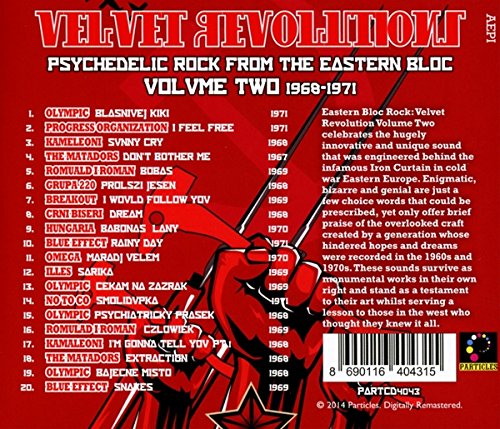
WILLIAM ONYEABOR-WHAT?!
WILLIAM ONYEABOR-WHAT?!
It was only when David Byrne’s Luaka Bop released World Psychedelic Classics 5: Who is William Onyeabor in October 2013, that the wider world first heard the music of one the most mysterious and elusive musicians. The title Who is William Onyeabor was one that nobody could answer with any certainly,
There’s a good reason for this,Much of William Onyeabor’s life is shrouded in mystery. After releasing eight albums between 1978 and 1984, William Onyeabor became a born-again Christian. He turned his back on music and refused to talk about his life or music. In some ways, this has helped perpetuate the myths surrounding William Onyeabor.
With William Onyeabor refusing to discuss his past, numerous rumours surrounded his life after music. Rumours were rife about what happened next. Some believe William studied cinematography in the Soviet Union, then returned to Nigeria, where he founded his own film company, Wilfilms. Then there’s the rumour that William studied law in England, then became a lawyer in his native Nigeria. Others believe William became a businessman in Nigeria. According to other people, William worked for the Nigerian government. No-one can say with any degree of certainty. The only person who knows what happened next, is William Onyeabor. William Onyeabor however, isn’t for telling.
Thirty-nine after William Onyeabor found religion, and turned his back on music, he’s still refusing to discuss his past. This means still, little is known about Nigerian music’s most enigmatic musicians, William Onyeabor. The effect this has, is to perpetuate the myth of William Onyeabor. He’s a a musical riddle, wrapped in a mystery, inside an enigma. Sadly, one that looks like never being solved. There’s no clues in William Onyeabor’s biography.
Trying to write an accurate biography of William Onyeabor is almost impossible. Especially when William Onyeabor refuses to talk about his past. There are some things we can say with a degree of certainty. The first is that growing up, William Onyeabor was a talented musician.
William Onyeabor was born either in 1945 or 1946. Nobody knows. Only William Onyeabor and he won’t say. He was born and brought up Enugu, in the Nigerian provinces. Growing up, William Onyeabor showed an interest in music.
Soon, William was hooked. Music began to play a bigger part in his life. Before long, he realised listening to music was one thing. He wanted to make music. So he decided it was tine to learn how to play an instrument. It’s thought that the first instrument William learnt to play were keyboards. That was his musical weapon of choice. Before long, it became apparent that William Onyeabor was a talented musicians. Some people thought that when William Onyeabor left school, he would make a living out of music. They were in for a surprise.
When William was a teenager and ready to leave high school, it’s thought he was awarded a scholarship to study cinematography in the old Soviet Union. That may, however, be one of the myths surrounding William Onyeabor.
Anyone who has a copy of William Onyeabor’s 1977 debut album, Crashes in Love, will see he is described as an American and French trained filmmaker on the back cover. Crashes in Love is allegedly the soundtrack to the film of the same name. It’s meant to have been made by William’s own film company Winfilms. That however, is another of the controversies surrounding William Onyeabor.
On his return to his native Nigeria, William Onyeabor founded his own film company, Winfilms. Between 1977 and 1985, when William’s career was at its height, people speculated whether Winfilms released any films? It was known if Winfilms had even released a film? Since then, efforts have been made to trace whether Winfilms released any films. There has been no trace of Winfilms releasing any films. That includes Crashes in Love. It’s billed as “a tragedy of how an African princess rejects the love that money buys.” However, another company William Onyeabor founded was more active and successful.
Winfilms wasn’t the only company William Onyeabor founded. No. A subsidiary of Winfilms, Wilfims Records released William Onyeabor’s eight albums. They were recorded at Winfilms Recording Studio in Enugu, Nigeria. William Onyeabor’s debut album was 1978s Crashes In Love.
Crashes In Love.
Crashes In Love was released in 1978 on Wilfims Records. This was supposedly a soundtrack album. However, no trace of the film Crashes In Love has ever been traced. That’s not the only mystery surrounding William Onyeabor’s debut album Crashes In Love.
Seemingly, there are two versions of Crashes In Love in existence. There’s what’s known as the electronic version. It’s essentially a remix album. The four songs have added drumbeats. Then there’s the original version.
The original version of Crashes In Love has just five tracks. It opens with the ten minute spic Something You’ll Never Forget. After that, the music continues to be funky, soulful and dance-floor friendly. Especially Ride On Baby and Crashes In Love would showcase William Onyeabor’s trademark sound. However, with two version of Crashes In Love being released, it seems even mystery surrounds William Onyeabor’s debut album.
Atomic Bomb.
Following his debut album, William Onyeabor released his sophomore album Atomic Bomb in 1978. Featuring the Winfilms Resident Band, Atomic Bomb was groundbreaking, genre-sprawling album. Released on his own label, Wilfilms Records, William Onyeabor Atomic Bomb was a career defining album further established William’s reputation as a pioneering musician.
Atomic Bomb is one of those albums where there’s no weak tracks. It just oozes quality. From Beautiful Baby to the defiant, social comment of Better Change Your Mind and Atomic Bomb, William Onyeabor unleashes a series of musical tour de forces. They’re just three reasons why William Onyeabor would be hailed as one of the most innovative musicians with Nigeria in the late seventies. So is the understated, spacey lo-fi funk of Shame and I Need You All Life.
Tomorrow.
For the recording of his third album Tomorrow, William Onyeabor headed to the familiar surroundings of Wilfilms Studios Limited, Awakunanaw, Enugu. William had written another five tracks. They would feature what was his trademark sound.
Essentially, this was funk and soul fused with a pulsating Afro-beat beat. Sometimes, the female backing vocal took the music in the direction of gospel music. Especially when they sung call and response with William. The music was joyous and irresistible. What made William Onyeabor’s music stand out, were the banks of synthesisers. This was very different from most of the music coming out of Nigeria.
William it seemed, was determined to stand out musically. Tomorrow and Fantastic Man are proof of this. This is Why Go To War, one of many ant-war songs William recorded. His music had a social conscience. It was also evolving with each album. There was no chance of William Onyeabor standing still. That wasn’t his style. He was determined his music would continue to evolve. That would be the case as a new decade dawned.
Body and Soul.
For the cover of Body and Soul, William Onyeabor dawns a while suit and bow tie. This makes him resemble Lou Rawls. So when you drop the needle on The Way To Win Your Love, you’re expecting a slice of the smoothest soul. You’re in for a shock. It’s all beeps, squeaks from the music and sound-effects department of Wilfilms Ltd. Add to this stabs of horns and hissing hi-hats. After that, soul, funk and Afro-beat melt into one. This is the case right Poor Boy, Body and Soul and Believe In God, which provides a clue to William Onyeabor’s future.
Five years after the release of Body and Soul, William Onyeabor would become a born-again Christian. Was the release of Believe In God a hint of the direction William Onyeabor’s life was leading? He was certainly known for his anti-war songs and social conscience, but religion was apparently a new thing. Believe In God was just a hint that William Onyeabor was changing.
Great Lover.
Just like Body and Soul, the cover of Great Lover is akin to a homage to the album covers of giants of American soul. William Onyeabor dawns a tuxedo and top hat on Great Lover. Wearing a watch that’s the size of a dinner plate, William Onyeabor looks urban and debonair. This is very different to the younger version of William Onyeabor that headed to the former Soviet Union to study cinematography. The image William Onyeabor is also very different to the reality of his life.
By 1981, when he released Great Lover, William Onyeabor wasn’t exactly a giant of Nigerian music. He was enjoying a modicum of success. However, he wasn’t one of Nigerian’s most successful musical exports. So it’s no wonder rumours continued to surround this mystery man. However, one thing wasn’t in doubt, William Onyeabor’s talent.
That’s apparent on the genre-hopping Great Lover. Elements of Afro-beat, Afro-Cuban, funk and soul melt into one during this concept album. Just like his previous albums, William Onyeabor is determined to innovate. He manages to do that on an album that’s soulful, funky and tinged with the influences of three continents.
Hypertension.
In 1982, William Onyeabor was ready to release his sixth album, Hypertension. It marked a change of direction from the man they called a musical chameleon, William Onyeabor. He fused Afro-beat, funk, psychedelia, rock and even a hint of soul. This musical melange also so songs of praise and protest songs sit side-by-side. Hypertension was William Onyeabor his eclectic best.
From the opening bars of The Moon And The Sun, what was probably William Onyeabor’s most eclectic and ambitious album proved a musical mystery tour. After The Moon And The Sun gave way to Papa Na Mama and Hypertension, William’s social conscience shines through on Politicians. They’re far from William Onyeabor’s people. They’re to blame for Nigeria and the wider world’s problems. This impassioned track closes William Onyeabor’s most eclectic and innovative album Hypertension.
Good Name.
Little did anyone realise it, but 1983s Good Name would be the penultimate album William Onyeabor released. Good Name is a truly compelling album. Although it only features two tracks, where elements of Afro-beat, electronica and funk are fuses, these two tracks speak volumes.
On side one, William almost dawns the role of a preacher. The message he preaches is about Love. That he believes leads to peace, harmony and happiness. Then on side two, Williams sings about the importance of good name. It he believes is better than silver and gold. William reinforces this message by singing: “no money, no money, no money, Nn money can buy good Name.” Looking back, this could be seen as the beginning of a change in William Onyeabor. Maybe this was the start of William Onyeabor turning his back on music?
Anything You Sow.
If Good Name gave a hint of what was about to happen, Anything You Sow spelt it out in large letters. Given the title, Anything You Sow, it looks as if William was changing. Maybe he was on the verge of a spiritual awakening and was questioning the world around him? This would explain songs like When The Going Is Smooth and Good, This Kind Of World, Anything You Sow and Everyday?
A fusion of Afro-beat, funk and soul, the changes in William’s life didn’t affect the quality of music on Anything You Sow. William was continuing to push musical boundaries. He was determined, maybe even fearful of releasing music that didn’t evolve. There was no chance of that. Similarly, there was no hint of what was about to happen next.
Looking at the back cover to Anything You Sow, William Onyeabor continued to give an impression that Wilfilms Limited was an important, thriving company. It wasn’t a case of what Wilfilms Limited did, it was case of what they didn’t do. Their services were listed as “recording and record manufacturing industry. Music, video and film producers.” They also had within their portfolio of business interests an office, factory and recording studios within the Wilfilms Complex. To the onlooker, it looked like William Onyeabor was on his way to building a business empire on the back of his recording career. Surely, the last thing he was about to do was walk away from music?
1984s Anything You Sow was William Onyeabor’s final album. After that, William Onyeabor turned his back on music. He became a born-again Christian. Since then, he has refused to discuss his music or his past. Both his musical career and his past are another country. Since then, rumours, myths and speculation have surrounded William Onyeabor.
One of the most controversial parts of his life was where he studied. Which side of the Iron Curtain did William Onyeabor study? Originally, he claimed to have won a scholarship to study cinematography in the former Soviet Union. Then on his 1977 debut album Chains Of Love, which was the alleged soundtrack album, William Onyeabor claims to have studied cinematography in France and America. Just like the rest of his life, William Onyeabor refused to speak about this period of his life. So tight lipped is William Onyeabor, that ge wouldn’t even confirm if he had ever made a film. As a result, allegations of the Russian connection in William Onyeabor’s life refuse to go away.
Even when Luaka Bop released World Psychedelic Classics 5: Who is William Onyeabor in October 2013, William would neither discuss his music nor life. That is a great shame. This means that those who love his music are denied the opportunity to discover more about his life and music. Especially his music.
No longer is it just discerning musical connoisseurs who love the music of William Onyeabor. No. Many people within the music industry are fans of William Onyeabor’s music. So much so, that when Luaka Bop decided to release an album of cover versions and remixes of William Onyeabor’s music, that many high profile musicians and remixers offered their services. This includes Hot Chip, The Vaccines, Justin Strauss and Brian Mette, JD Twitch, Javelin, Policy and Scientist. They all feature on William Onyeabor-What?! It’s a ten track compilation which will be released on 8th September 2014.
For William Onyeabor-What?! the ten artists have chosen some of the best music in William’s back-catalogue. There’s no better way to start than Hot Chip Vs. William Onyeabor’s take on a stonewall classic, Atomic Bomb. Hypnotic, spacey, melodic, sultry and spiritual it’s a joyous take on one of William Onyeabor’s finest musical moments.
The Vaccines gave William Onyeabor’s Do You Want A Man a moody makeover on their E.P. d Melody Calling. Released in August 2013, The Vaccines transform Do You Want A Man, It becomes moody and rocky. Especially with machine gun guitars added. The result is a track that melodic and not short of hooks.
There’s three versions of Body and Soul on William Onyeabor-What? They’re all very different. The first is Justin Strauss and Brian Mette’s whatever/whatever remix. Uber funky, soulful and dance-floor friendly, it’s a glorious remix. It brings out the best in another William Onyeabor classic. Body and Soul epitomises his trademark sound. Space-funk meets psychedelia, soul and gospel-tinged female backing vocals.
Joakim featuring Akwetey covered Good Name, the title-track from William’s 1983 album. It’s then given a remix Dragons of Zynth. Twinkling, crystalline synths provide the backdrop for the vocal as the original track is reinvented, not once but twice. It’s transformed from the track that William Onyeabor originally envisaged and is given a contemporary dance-floor friendly sound.
JD Twitch Vs William Onyeabor breathes new life and meaning into another of William Onyeabor’s best known tracks, Why Go To War? Mesmeric and pulsating the arrangement is driven along by synths, percussion and a persistent, prying guitar. Genres melt in one. This includes electronica, funk and Afro-beat. The vocal is impassioned as bewildered and despairing it asks Why Go To War?
Daphni’s remix of Ye Ye is quite different to the other tracks on William Onyeabor-What?! It’s painted from a different musical palette. The track takes on a darker, pensive sound. Having said that, the combined efforts of the pulsating bass and synths drive this compelling remix along.
Javelin takes on the job of remixing Heaven and Hell. This is a track from William Onyeabor’s 1977 Crashes In Love. Two versions of Crashes In Love were released. This means two versions of Heaven and Hell. In Javelin’s hands, the track is given a musical makeover. Its reinvention transforms the track and gives it a dance-floor friendly sound.
With three remixes of Body and Soul on William Onyeabor-What?!, David Terranova decides to take the track in a very different direction. He gives Body and Soul an understated nu-jazz sound. Later, his remix heads in the direction of house. The result is a laid-back, chilled out remix with a summery sound.
Policy’s remix of Something You Will Never Forget bursts into life. Afro-beat and house melts into one. What follows is is irresistibly catchy and guaranteed to fill a dance-floor. William Onyeabor’s original track is reinvented. It becomes an uplifting anthem that’s akin to aural sunshine.
Closing William Onyeabor-What?! is Scientist’s take on Body and Soul. It’s totally different from the two other versions. Scientist’s remix is darker and dubby. The arrangement is also understated and mesmeric. It holds your attention and proves the perfect way to close William Onyeabor-What?!.
Less than a year after Luaka Bop released World Psychedelic Classics 5: Who is William Onyeabor, they’ll release on William Onyeabor-What?! It’s best described as a homage to one of the most mysterious and elusive men in music. However, don’t let the mystery and speculation surrounding William Onyeabor’s life overshadow his music.
William Onyeabor is a hugely talented singer, songwriter, musicians, arranger and producer. The eight albums he released between 1977 and 1984 are a reminder of this. Throughout his career, William Onyeabor pushed musical boundaries. He wasn’t content to stand still. That was for other, less talented artists. Instead, William Onyeabor innovated and created music that was groundbreaking and pioneering.
From 1980 onwards, William Onyeabor’s music evolved. It became much more reliant on synths, keyboards and drum machines. Sometimes, it’s best described as futuristic, with a sci-fi sound. William Onyeabor fuses musical disparate genres seamlessly. Sometimes, these fusions pf musical genres that shouldn’t work. They do and sit happily side-by-side work. It seems William Onyeabor dared tread where others fear to tread. That’s why for some people, William Onyeabor is perceived as a musical innovator.
It’s also why ten artists and remixers have taken some of William Onyeabor’s best known tracks and reinvented them on William Onyeabor-What?! The tracks are transformed. New life and meaning is breathed into a selection of William Onyeabor classics. As a result, William Onyeabor-What?! is the perfect companion to World Psychedelic Classics 5: Who is William Onyeabor. They’re the perfect introduction to a musical innovator, who fused a multiplicity of musical genres and influences to create his own unique and inimitable sound.
Thirty years after William Onyeabor released his final album Anything You Sow, his music is still relevant. It’s also timeless. That’s apparent when you listen to the music on the eight albums William Onyeabor released between 1977 and 1984. When William Onyeabor walked away from music, music lost a true innovator.
A reminder of this musical innovator can be found on Psychedelic Classics 5: Who is William Onyeabor. It was released by Luaka Bop in 2013. The next chapter in theWilliam Onyeabor story is William Onyeabor-What?!, which will be released by Luaka Bop on 8th September 2014. Hopefully, William Onyeabor-What?! will introduce a new generation of music lovers to one of Nigerian music’s most innovative sons, William Onyeabor.
WILLIAM ONYEABOR-WHAT?
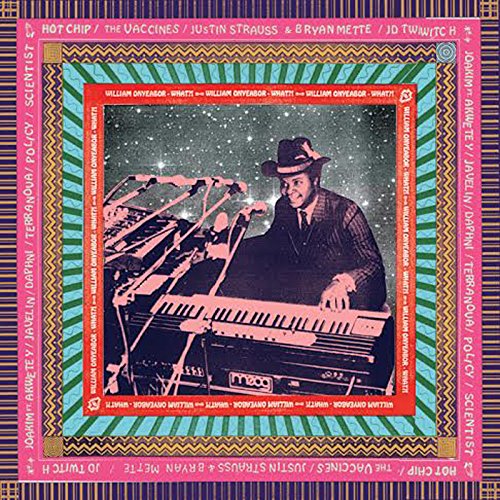
LED ZEPPELIN-LED ZEPPELIN IV.
LED ZEPPELIN-LED ZEPPELIN IV.
When Led Zeppelin III was released in October 1970 music critics gave the album mediocre reviews. This had been the case throughout their career. Critics didn’t seem willing to Led Zeppelin a fair hearing. For Robert Plant, Jimmy Page, John Paul Jones and John Bonham, this was hugely frustrating. Things got so bad that Jimmy Page refused to speak to the press for eighteen months. That wasn’t end of Led Zeppelin’s protest.
Having recorded their fourth album between October 1970 and March 1971, it came to giving the album a name. The four members of Led Zeppelin decided that their fourth album would officially be untitled. There was a good reason for this. Led Zeppelin decided they wanted to remain anonymous. They also didn’t want to their music to be pigeonholed or stereotyped. This added an air of mystery to the album. So did the inner sleeve’s design. It featured four symbols. Each symbol represented each band member. With no official titled, Led Zeppelin’s fourth album became known variously as Four Symbols, The Fourth Album, Untitled, Runes, The Hermit, and ZoSo. However, since then, Led Zeppelin’s fourth album has been known as Led Zeppelin IV.
Led Zeppelin IV is one of the next instalment in Atlantic Records’ reissue program. A deluxe remastered version of Led Zeppelin IV will be rereleased by Atlantic Records as a double album on 27th October 2014. Disc one features the original version of Led Zeppelin IV remastered. Then on disc two there’s alternate versions of Led Zeppelin IV.
This means that on disc two of Led Zeppelin IV the version of Black Dog is the basic track with guitar overdubs. It’s followed by an alternate mix or Rock ’N’ Roll. The version of The Battle Of Evermore is the mandolin/guitar mix from Headley Grange. That would close what was the end of side one of Led Zeppelin IV.
Opening what would be the alternate version of Led Zeppelin IV is the Sunset Sound Mix of Stairway To Heaven. Just like the previous tracks, this shows another side to a familiar track. Having said that, nothing will match the original version of Stairway To Heaven. Alternate mixes of Misty Mountain Hop and Four Sticks follow, before the mandolin/guitar mix of Going To California proves a welcome addition. Closing this alternate version of Led Zeppelin IV is the alternate UK mix in progress of another stonewall Led Zeppelin classic, When The Levee Breaks. This alternate version of Led Zeppelin IV is a welcome addition to the remastered version. However, the main event is the original version of Led Zeppelin IV which was recorded between October 1970 and March 1971.
As Led Zeppelin set about recording what became Led Zeppelin IV, the four members of the band had written their strongest album so far. The Jimmy Page and Robert Plant songwriting partnership cowrote The Battle Of Evermore, Stairway To Heaven, Four Sticks and Going To California. Jimmy Page and Robert cowrote Rock ’N’ Roll with John Bonham and Misty Mountain Hop with John Paul Jones. Led Zeppelin cowrote the other two tracks, Black Dog and When The Levee Breaks, which is also credited to Memphis Minnie. She is credited as having written the original song. These eight tracks became what’s referred to as Led Zeppelin IV.
Led Zeppelin set about recording what would become Led Zeppelin IV in October 1970. The initial session took place at Island Record’s new recording studios in Basing Street, London. After that Led Zeppelin decided to move Headley Grange.
On the recommendation of Fleetwood Mac, Led Zeppelin decided to move to Headley Grange. It was an old Victorian house in Hampshire. Led Zeppelin used a mobile studio belonging to the Rolling Stones. After the tracks had been completed, they returned to Island Records’ studio for overdubbing. Mixing of Led Zeppelin IV, which was produced by Jimmy Page, took place at Sunset Studios, Los Angeles. By March 1971, Led Zeppelin IV was completed. However, there was a problem.
Once Led Zeppelin started mixing Led Zeppelin IV, they encountered some problems. The group weren’t happy with the mix, and they returned to London to redo some of the work they’d just finished in Los Angeles. This meant Led Zeppelin IV’s release date became delayed by several months. Indeed, Led Zeppelin IV wasn’t released until November 1971. Before that came the promotion of the untitled album.
Now Led Zeppelin had finished Led Zeppelin IV, they could set about promoting it. First they had to decide the album’s title. Instead of giving the album a title, it featured four hand drawn symbols, on both the inner sleeve and record label. Each symbol was meant to represent a band member. Nor would there be any information on the album cover, with the band’s name being downplayed. This was almost unheard of, and many people at Atlantic, their record company feared that this would damage sales of the album. Before the album was released, Atlantic sent copies of the graphics to the press, so they could include the symbols in articles about the album. Since the album’s release, it has been referred to as Led Zeppelin IV, although that wasn’t the original title. However, the lack of a conventional title didn’t harm the album, or sales.
When Led Zeppelin IV, was released, reviews were mixed. They ranged from lukewarm to positive, Unlike nowadays, Led Zeppelin were far from a favourite of music critics. It was only late that Led Zeppelin IV became critically acclaimed and referred to as a “genre classic.” Music critics never quite got Led Zeppelin. Music lovers did. That was the case from their eponymous debut album. By Led Zeppelin IV, Led Zeppelin were one of the biggest selling rock bands in the world. They were also referred to as one the “unholy trinity of rock.”
Led Zeppelin’s reputation preceded them. Their appetite for the rock ’n’ roll lifestyle was legendary. Excess was encouraged within the Led Zeppelin camp. They wore their infamy with pride. Drink, drugs and debauchery was commonplace. So was destruction. The four members of Led Zeppelin weren’t averse to wrecking hotel rooms. Having trashed a room in the Tokyo Hilton, Led Zeppelin were banned from the chain for life. Hotel rooms weren’t just trashed. Television sets out of hotel windows. Another time, John Bonham rode a motorcycle the Continental Hyatt House, which Led Zeppelin nicknamed Riot House. However, when it came time to recording an album, Led Zeppelin put their game head on. That was apparent when Led Zeppelin IV went on sale.
On the release of Led Zeppelin IV, across the world, the album sold in huge quantities. In Britain, Led Zeppelin IV. Over the Atlantic, Led Zeppelin IV reached number two in the US Billboard 200 and number one on Canada. Led Zeppelin IV reached the top ten in Australia, France, Germany, Italy, Japan, Norway and Spain. Gold and platinum discs came Led Zeppelin IV’s way.
It was in America, Britain and Canada where Led Zeppelin IV was most successful. in America Led Zeppelin IV was certified platinum twenty-three times. Across the border, Led Zeppelin IV was certified double diamond in Canada. Over the Atlantic in Britain, Led Zeppelin IV was certified six times platinum. Led Zeppelin IV was certified gold in Brazil and gold three times over in Germany. In Argentina, Holland, Spain and Switzerland, Led Zeppelin IV was certified platinum. Led Zeppelin IV was also certified double platinum in France and eight times platinum in Australia. When executives at Atlantic counted the sales of Led Zeppelin IV, nearly thirty million copies of were sold. By far, Led Zeppelin IV was Led Zeppelin’s most successful album. However, what does Led Zeppelin IV sound like?
Opening Led Zeppelin IV is Black Dog. After a hesitant start, before the track bursts powerfully into life. Robert Plant’s unleashes a lung bursting, unaccompanied vocal. This gives no indication of what’s to come. What follows is a masterclass in full on rock ‘n’ roll at its very best. Jimmy Page’s screaming, lightning fast, guitar playing, John Bonham’s frantic drumming driving the song along with John Paul Jones bass guitar. The tempo is fast, the sound akin to a wall of loud. As the song drives along, there’s occasional pauses, before the track builds back up, returning to the earlier frantic pace. You can’t help but admire Robert Plant’s vocal, it’s one part raw power, to one part sheer passion, as he almost screams and bawls his way through the track. Black Dog inspired a new generation of bands, but none of them canA brilliant way to open the album.
How do you follow a classic track like Black Dog? It’s quite simple really, with one called Rock and Roll. It begins with Bonham playing a drum solo, that’s fast, full and power personified. After that, the group treat us to some old school rock ‘n’ roll. Plant’s gives his usual energetic and enthusiastic vocal, as the band turn back the years. Again, Jimmy Page’s guitar playing is peerless. He unleashes some blistering, screaming, howling guitar riffs. His playing is quick, accurate and sounds like something you’d expect Chuck Berry to play in years gone by. Behind him, John Bonham punishes his drums and John Paul Jone’s bass sits at the bottom of the mix. Later, Rolling Stone Ian Stewart lays down piano solo. A lengthy part of the track is just an instrumental where the group showcase why in 1971, Led Zeppelin were rock ’n’ royalty.. Together, the band produce a track that although relies on power, embodies the true spirit of rock ‘n’ roll.
After two really rocky songs, Led Zeppelin change styles with The Battle of Evermore which features Sandy Denny on vocals. It has a distant, meandering start with Jimmy Page playing mandolin. Then Robert delivers the lead vocal accompanied by Sandy Denny. This is a very different track, it’s slower, with a folk feel and sound, especially with the instruments used and the way the vocal is sung. By now, it’s mandolin and acoustic guitar that are playing. There are no electric instruments used on the track, but one thing hasn’t changed and that is Robert Plant’s vocal. Sometime’s he cut’s loose, and unleashes a powerful, energetic vocal, especially towards the end of the song. Mostly, though, he resists this temptation, and it’s a much more restrained vocal from him, more in keeping with Sandy Denny’s vocal style. Although very different stylistically, The Battle of Evermore shows Led Zeppelin’s versatility.
Probably the most famous song that Led Zeppelin ever recorded is next, Stairway To Heaven, an eight minute epic. It’s one of the band’s best known, and best loved tracks. An acoustic guitar is played slowly and gently, before a recorder plays. Robert Plant’s vocal is much gentle, as the track meanders beautifully along. As for the lyrics, they’re among the best on Led Zeppelin IV. After just over two minutes, the song starts to fill out, the arrangement growing slowly. A bass plays, guitars too, as Robert Plant gives one of his best vocal on Led Zeppelin IV. Things start to really take shape when John Bonham plays, his drumming much more restrained here. Eventually, drums, guitar and bass let loose. Another blistering guitar solo from Page takes shape and John Bonham’s drumming is much louder and faster. Then Robert Plant decides he’s had enough of the restrained vocal style, and gives another lung bursting vocal performance, just before the track ends. Overall, this was a career defining moment for Led Zeppelin, as it’s both a rock track, and one of the most famous and best loved songs ever recorded.
After Stairway To Heaven, anything else will sound second best. However, Misty Mountain Hop is the track they chose to follow Stairway To Heaven. Keyboards, guitars and drums all play, before Robert Plant sings the vocal. They combine powerfully, driving the track along, with John Bonham’s drums at the front of the mix. Robbert Plant’s vocal is a powerhouse. He shows no restraint. Sometimes, he screams, hollers and roars his way through the lyrics. Behind him, the rest of the band similarly, forget about subtlety, and really let loose. Jimmy Page’s guitar playing and John Bonham’s drumming are key to the sound. They provide a powerful and dynamic backdrop for the vocal. Jimmy Page demonstrates just how great a guitar player he was, playing a stunning solo during the track. Robert Plant’s vocal launched a thousand wannabe impersonators, many of whom went on to form bands and have successful careers. However, there was and only ever will be one Robert Plant. Here, he and the rest of Led Zeppelin produce another slice of peerless, hard, driving rock music.
Straight away, guitars and rhythm section combine to produce a loud, powerful and driven backdrop for Robert Plant’s vocal on Four Sticks. Although his vocal is forceful and loud, he’s somewhat struggling against the hard rocking arrangement. It’s loud, repetitive, full of power and energy. It’s an example of what Led Zeppelin do best. John Bonham’s drumming is among his best on Led Zeppelin IV. Quite simply, it’s loud, fast, accurate and powerful. Meanwhile, Jimmy Page’s guitar playing chugs along, it’s dynamic and dramatic with riffs aplenty, while Robert Plant shrieks, screams and wails, as he really forces the vocal. By the end of the track, you can’t help but admire the sheer power displayed by Led Zeppelin. What they produce is dramatic wall of sound, which Robert Plant copes admirably with, producing a dramatic and energetic vocal.
An acoustic guitar, then mandolin plays when Going To California unfolds. Straight away, you realise that this is a very different type of song. Here it’s just acoustic instruments that accompany Robert Plant’s vocal. His vocal is much softer, gentler and is much more restrained. Here he doesn’t indulge in any theatricals, no howls, wails or hollers, just a thoughtful vocal, sung beautifully, against a backdrop of acoustic guitar and mandolin.
Led Zeppelin IV ends with When the Levee Breaks, a seven minute opus. John Bonham’s slow booming drums and a bluesy harmonica solo plays, join a screaming guitar. It solos, soaring above the arrangement. It’s an arrangement that builds and builds, and as it does just gets better. After a dramatic pause, Robert Plant’s vocal enters, seemingly, much more restrained. This doesn’t last, he soon breaks free of his shackles, and is roaring, giving a powerful, energetic and passionate vocal for the last time on Led Zeppelin IV. It seems Led Zeppelin have kept one of the album’s best tracks for last. This is a track with everything. Guitar solos, that screech, scream and howl, pounding, booming drums and a frenetic bluesy harmonica solo. Over seven minutes, the band really let loose, showcasing their talents as musicians, and demonstrating just why they were the greatest rock band of their era.
Released in November 1970, Led Zeppelin IV was Led Zeppelin’s most successful album. It sold nearly thirty million albums. This was the perfect response to critics who consistently failed to give Led Zeppelin a fair hearing. A case in point was Led Zeppelin IV.
If it was released today, critics would instantly realise that Led Zeppelin IV was a stonewall classic. Not back in 1970. Reviews ranged from lukewarm to positive. For a Led Zeppelin album, that was good. Led Zeppelin were far from a favourite among critics. So it’s no surprise that Jimmy Page refused to speak to the press for eighteen months. Another reaction to the treatment Led Zeppelin were receiving from the press was not giving their fourth album a title.
For their fourth album, Led Zeppelin eschewed traditional marketing methods. They decided not to give the album a “traditional” title. What became Led Zeppelin IV was released at a time when Led Zeppelin hadn’t toured for a while. This meant Led Zeppelin’s profile wasn’t as high as it had been. That didn’t matter. Led Zeppelin IV was a career defining moment for Led Zeppelin.
Led Zeppelin IV was the perfect response from Led Zeppelin. Since their debut album, they’d been a victim to the slings and arrows of outrageous critics. These critics seemed determined to sabotage Led Zeppelin’s success. They failed miserably.
From the opening bars of Black Dog right through to When the Levee Breaks, Led Zeppelin have your attention. Led Zeppelin IV becomes like a musical fairground ride. All you can do is hold on and enjoy the ride. What follows is a mixture of blues, folk and Led Zeppelin’s unique brand of heavy rock. It’s played with power, passion and commitment, by four hugely talented musicians. They were in the peak of their career. It was as if everything had been leading up to Led Zeppelin IV, which is worth of being a called classic album.
Nearly forty-three years after the release of Led Zeppelin IV, a deluxe remastered version of Led Zeppelin IV will be rereleased by Atlantic Records as a double album on 27th October 2014. This is the latest addition in the long overdue reissue of Led Zeppelin’s back-catalogue.
Led Zeppelin IV finds one of the members of the infamous unholy trinity, Led Zeppelin, at the peak of their power, doing what they do best unleashing, their own brand of blistering, swaggering, Rock ’N’ Roll.
LED ZEPPELIN-LED ZEPPELIN IV.
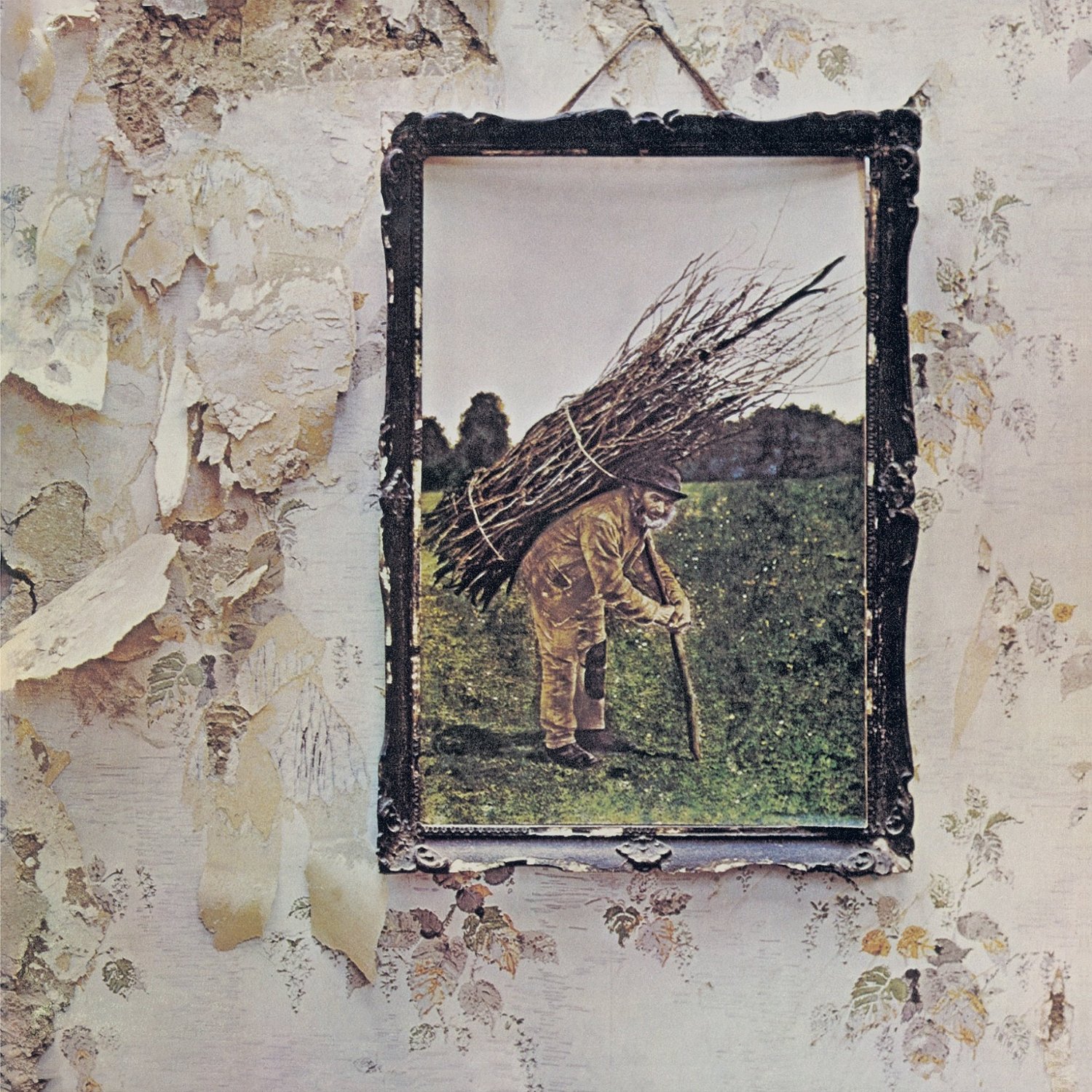
UNDER THE INFLUENCE VOLUME 4-COMPILED BY NICK THE RECORD.
UNDER THE INFLUENCE VOLUME 4-COMPILED BY NICK THE RECORD.
Over the last few years, ZR Records Under The Influence compilation series has become one of the most eagerly awaited releases. The first volume of Under The Influence first hit the shops back in October 2011. Under The Influence Volume 1 was compiled by Red Gregg. Featuring a plethora of soul, funk and disco, Under The Influence Volume 1 was one of the most popular compilations of soul, funk and disco released during 2011. Record buyers eagerly awaited Volume 2.
When Under The Influence Volume 2 was released in 2012, there was a change of compiler. This time Paul Phillips was responsible for what was billed “a collection of rare soul and disco.” It actually went further. There was everything from soul, funk, disco and 80s club boogie. When I reviewed Under The Influence Volume 2, I remarked that it wasn’t as good as Volume One. Cue the soul mafia sharpening their knives. The equivalent of emails written in green pencil came my way. However, I speak as I find. That was the case with Under The Influence Volume 3.
Under The Influence Volume 3 was released in 2013. Again, there was another change of compiler. I was pleased by this. A change of compiler ensures a compilation doesn’t became stale. James Glass was responsible for this latest “collection of rare soul and disco.” The change of compiler worked well and The Influence series was back on track. Luckily for me, the soul mafia didn’t need to draw arms this time round. There were neither threatening letters nor fatwas. Everything was rosy in the Under The Influence garden. However, will that be the case with Under The Influence Volume 4?
For Under The Influence Volume 4, there is a a new compiler. Nick The Record takes over compiling duties on Under The Influence Volume 4. Nick is responsible for compiling the latest in the Under The Influence series. That’s to give it its full title Under The Influence Volume 4-Compiled By Nick The Record.
I was going to say that Nick The Record has been busy. That’s an understatement. He has been on a crate digging expedition extraordinaire. Nick has been in search of hidden gems. Digging deep into his crates, Nick has come up with some of the rarest disco, funk and boogie. Over the two discs on Under The Influence Volume 4-Compiled By Nick The Record, the listener is introduced to a platter of musical delights.
The delighted awaiting discovery on Under The Influence Volume 4-Compiled By Nick The Record included Boogsie, The Family Tree, Jean Adebambo, Wild Fire, Leston Paul, Santth, Shelbra Deane, Ronnie Jones, Charlie Mike Sierra and State Of Grace. There’s many more awaiting discovery on Under The Influence Volume 4-Compiled By Nick The Record. You’ll realise that when I pick the highlights of Under The Influence Volume 4-Compiled By Nick The Record. Before that, I’ll briefly tell you about Nick The Record.
Like many people within music, Nick The Records music has been consumed by music. He caught the music bug early in his life and it has never left him. During his life, his musical tastes have changed and evolved.
During the eighties, Nick was listening to hip hop and house. Then Nick decided to trace the origins of the music used in hip hop. This lead him to soul, funk, rare groove and rare disco. Before long Nick was discovering musical history. For him, this was a voyage of discovery. It also lead to Nick making his living out of music.
For the last thirty-five years Nick has been buying records. This lead to Nick selling records for twenty-five years. This allows to continue to search for that elusive piece of vinyl. After all, record collecting is all about the search for that elusive record, especially disco. Nick The Record is an expert in all things’s disco. That’s reflected on Under The Influence Volume 4-Compiled By Nick The Record. However, there’s more to Under The Influence Volume 4-Compiled By Nick The Record that disco.
Under The Influence Volume 4-Compiled By Nick The Record is a compilation that reflects Nick’s record collection and his musical taste. The twenty tracks are also a reflection of one of Nick The Record’s DJ sets. These twenty tracks feature a mixture of familiar faces and hidden gems. I’ll now pick my ten highlights of Under The Influence Volume 4-Compiled By Nick The Record.
Boogsie’s Can’t You See Me opens disc one of Under The Influence Volume 4-Compiled By Nick The Record. Can’t You See Me is a track from Boogsie’s 1979 album Phase2. Released in Trinidad and Tobago by Sharc Productions, Phase2 was Boogsie’s only album. Featuring soul and funk with a Latin twist, one of Phase2’s highlights was Can’t You See Me.
Proton Plus released Pay Up back in 1981. This was their sophomore single. Released on the Yew Wood label, Proton Plus is best described as post disco with a soulful side. Essentially, it’s boogie, the genre that filled the void left by disco. Rather than the original version of Proton Plus, Nick The Record has flicked over to the B-Side and given the Remixed Rhythm Track a welcome airing.
Bill Campbell is a UK based singer, songwriter and producer. He released Boogie All Night as a single in 1980. Released on Union Records, Bill was part of the first wave of British boogie. Boogie All Night is funky, soulful and dance-floor friendly. So much so, that you’ll Boogie All Night.
Under The Influence Volume 4-Compiled By Nick The Record is a bit like a magical musical mystery tour. Wild Fire were a Barbados based group. They released Try Making Love as a single on WIRL in 1977. The twelve inch version of Try Making Love was released on Strakers Recordings. It’s a real fusion of includes and genres. Disco, funk, soul and even a hint of psychedelia shine through on Try Making Love.
Leston Paul’s What A Surprise is a track from his 1983 debut album The Arrival. Released on the Barbados based Ibiris Records, The Arrival was a genre melting album. There’s everything from elements of electronica, funk and soul. Hailed as innovative upon its release, The Arrival sunk without trace. Three decades later, The Arrival is a prized possession among record collectors. One of The Arrival’s highlights and delights is What A Surprise.
Disc Two.
Sugar and Spice’s The Beast opens disc two of Under The Influence Volume 4-Compiled By Nick The Record. The Beast was released as a single on the much missed Philly Town Records in 1982. This was three years after Sugar and Spice released the hugely underrated You’re My Sugar, You’re My Spice on West End Records. Music had changed in three intervening years. Boogie replaced disco as the music of choice amongst DJs and dancers. Despite this, Sugar and Spice had kept their finger on the musical pulse. Whilst there’s elements of disco during the instrumental version The Beast, boogie shines through. As a result, the instrumental version of The Beast is one of the highlights of Under The Influence Volume 4-Compiled By Nick The Record.
Skye released Ain’t No Need as single way back in 1976. Released on Anada Records, it’s a track that’s been ripe for a remix since the day it came out. Sadly, that’s never happened to this glorious melange of funk, soul and disco. The closes thing is the DJ Nick The Record part and & 2 Re-united Re-Edit. Both the original and long version on the B-Side are transformed into something mightier than the individual parts.
Shelbra Deane released You Move Me as a promo on Muscle Shoals Sound Records. It was produced by Muscle Shoals legend Roger Hawkins and also Gino Soccio. They had the Midas Touch. You Move Me was then picked up by T.K. Disco. A driving, slice of funky, soulful music from Muscle Shoals.
The futuristic, proto boogie of Charlie Mike Sierra came to the attention of discerning music lovers back in 1977. His debut and only album, On The Moon was like nothing around. Especially the title-track. It’s an irresistible hidden gem. Futuristic, with sci-fi sounds and a pulsating beat, you’ll find yourself pressing play time and again.
My final choice from Under The Influence Volume 4-Compiled By Nick The Record is Blackway and Helene’s Music For Us. This slice of Italo Disco is the perfect way to close Under The Influence Volume 4-Compiled By Nick The Record. Released on Moon Records International in 1982, the version chosen is the iInstrumental version. It’s a memorable reminder of the heyday of Italo Disco from some of its finest exponents.
That’s the story of the latest addition to the Under The Influence series. Under The Influence Volume 4-Compiled By Nick The Record is, without doubt, the best of the four volumes. There’s no filler whatsoever. Instead, Under The Influence Volume 4-Compiled By Nick The Record is chock full of quality music.
As one great song finishes, another begins. Just when you think you’ve heard the highlight of Under The Influence Volume 4-Compiled By Nick The Record, you’re forced to think again. Under The Influence Volume 4-Compiled By Nick The Record is an eclectic selection of floor-fillers. Some of them are familiar faces, others hidden gems. Boogie, disco, electronica, funk, Italo Disco and soul can all be found on Under The Influence Volume 4-Compiled By Nick The Record. They sit happily side-by-side on Under The Influence Volume 4-Compiled By Nick The Record, the latest on ZR Records Under The Influence series.
Under The Influence Volume 4-Compiled By Nick The Record will be out on 8th October 2014. For anyone who likes their music funky, soulful and dance-floor friendly, then Under The Influence Volume 4-Compiled By Nick The Record is a must have. Don’t just take it from me, pick up a copy of Under The Influence Volume 4-Compiled By Nick The Record. You won’t regret it.
UNDER THE INFLUENCE VOLUME 4-COMPILED BY NICK THE RECORD.
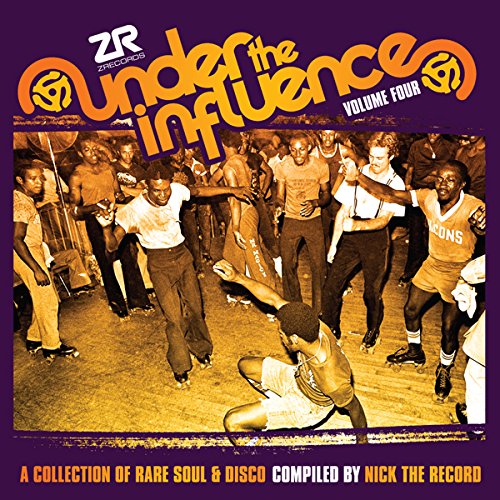
THE PEARLFISHERS- OPEN UP YOUR COLOURING BOOK.
THE PEARLFISHERS- OPEN UP YOUR COLOURING BOOK.
“Everything comes to he who waits.” So the sayings goes. Even a new album from The Pearlfishers. Recently, Scotland’s best kept musical secret, The Pearlfishers, released their seventh album, Open Up Your Colouring Book, on Marina Records. Open Up Your Colouring Book was released seven years after their previous album, Up With The Larks.
Open Up Your Colouring Book was a labor of love for David Scott and the rest of The Pearlfishers. There’s a reason for this. The Pearlfishers you see, aren’t a full-time band. Some of the members of The Pearlfishers have other commitments.
David Scott for example, is a lecturer in music at the University of the West of Scotland. So he has to fit The Pearlfishers around his “real job.” That’s why Open Up Your Colouring Book has taken seven long years. Unlike full-time bands, The Pearlfishers have to record when and wherever they can.
For fans of The Pearlfishers this has left them waiting in vein. After a few barren years passed, it was no longer a case of “when” the new Pearlfishers’ album would drop. No. It was a case of if. Some Pearlfishers fans thought they’d more chance of seeing Santa than a new Pearlfishers’ album. They were wrong. “Everything comes to he who waits.” That was the case when recently, The Pearlfishers released Open Up Your Colouring Book.
Open Up Your Colouring Book is The Pearlfishers’ seventh album. I find that hard to believe. It doesn’t seem long ago that I was holding a copy of Za Za’s Garden which was released on the Iona Gold label. That was back in 1993. I was hooked. This was the beginning of a twenty-one year love affair with The Pearlfishers’ music. Since then, each Pearlfishers’ album has been eagerly awaited.
Having enjoyed the musical delights of Za Za’s Garden, I awaited The Pearlfishers’ sophomore album. Four years passed before The Strange Underworld of the Tall Poppies was released on Marina Records. The Strange Underworld of the Tall Poppies saw the emergence of The Pearlfishers’ trademark sound.
Two years later, The Pearlfishers released what is, without doubt, their musical Magnus Opus, The Young Picnickers. Released in 1999, comparison were drawn with The Beach Boys. David Scott was seen as East Kilbride’s answer to Brian Wilson. Nobody knew if David had his own sandpit within chez Scott. As a songwriter and singer, David came of age on The Young Picnickers.
The Pearlfishers were at their melodic best on The Young Picnickers. No wonder. David introduces you to a cast of quirky characters and scenarios. With the song’s cinematic quality, the scenarios unfold before your eyes. Hope, humour, optimism, beauty and romance are omnipresent. For me, The Young Picnickers is a classic Scottish album. Following The Young Picnickers up wasn’t going to be easy.
As the new millennia dawned, The Pearlfishers returned with their fourth album Across The Milky Way. Released in 2001, Across The Milky Way featured a band who were maturing. Just like The Young Picnickers, Across The Milky Way was released to widespread critical acclaim. Great things were being forecast of The Pearlfishers. They were too good for we Scots to keep as our own. It was our duty to share The Pearlfishers with the world.
Sadly, The Pearfishers remain one of music’s best kept secrets. Although they’ve a fan-base outside Scotland, David Scott et al, haven’t enjoyed the commercial success and critical acclaim their music deserves. In some ways, The Pearfishers’ story reminds me of The Blue Nile. Both are hugely talented bands who could’ve and should’ve rubbed shoulders with the giants of music. Sadly, that’s not the case. Instead, The Pearlfishers are best known by their own kith and kin. That would continue to be the case.
The Strange Underworld of the Tall Poppies was released in 2002, on Marina Records. This was quite unlike The Pearlfishers. They never before had released two albums within the space of two years. Some critics and fans wondered whether The Pearlfishers were keen to make up for lost time. Maybe they were looking to make the great leap forward?
Listening back to The Strange Underworld of the Tall Poppies, it’s impossible not to be swept away by the melodic delights of The Pearlfishers. The songs are irresistibly catchy and hook laden. There’s a reason for that. David Scott is one of the great Scottish songwriters of his generation. He’s a student of what makes a great song. Anyone who has hard David talk at length about songwriting, will realise this.
About a year ago, David Scott did a workshop for BBC Radio Scotland. He talked about some of his favourite songs and what made them great song. It was a mini masterclass into the art of songwriting. During this workshop, he explained who the great songs were written. He played these songs and delivered them with emotion and passion. One of the highlights was a new Pearlfishers’ song The Way My Father Spoke About Vincent. Breathtaking is the only way to describe the song. Just like so many Pearlfishers songs, it had a cinematic quality. The characters unfolded before your eyes. So did the song’s ethereal beauty. However, back in 2002, David had yet to write The Way My Father Spoke About Vincent. Indeed, he still had two more albums to write and release.
The first of these was Sky Meadows. Released in 2003, on Marina Records, fans of The Pearlfishers were enjoying a veritable musical feast. Sky Meadows was the third album The Pearlfishers had recorded in three years. Surely, they must be nearing that elusive breakthrough?
That proved not to be the case. It was a familiar scenario. The Pearlfishers released Sky Meadows to critical acclaim. However, it didn’t sell in the vast quantities that it deserved. For David and the rest of The Pearlfishers, this must have been really frustrating? After all, they were releasing albums laden with musical jewels. Sadly, these jewels were being lost within the racks of record shops. As anyone whose had any involvement in the music business knows, many potential classic albums don’t find the audience they deserve. Following the disappointment of Sky Meadows, it was another four years before we heard from The Pearlfishers again.
2007 saw the release of The Pearlfishers’ sixth studio album, Up With The Larks. Oozing optimism, positivity, joy and a healthy load of hooks, The Pearlfishers were back. Up With The Larks marked the welcome return of a Scottish musical institution. Critics hailed Up With The Larks as another welcome addition to The Pearlfishers’ back-catalogue. Music lovers privy to the secrets of The Pearlfishers bathed in its delights. Everyone was happy. However, still The Pearlfishers’ music wasn’t being heard by the wider audience that it deserved. Maybe that would change with their seventh album?
Time goes slowly when you are a Pearlfishers’ fan waiting for a new album. Seven long years passed before David Scott and the rest of The Pearlfishers completed Open Up Your Colouring Book.
It’s no wonder it’s taken seven years for Open Up Your Colouring Book to be recorded. There’s sixteen songs on Open Up Your Colouring Book. David Scott wrote fourteen tracks. He cowrote Chasing All the Good Days Down with Amy Alison and I Don’t Want to Know About It with Erin Moran. These sixteen songs were recorded at a variety of studios in the West of Scotland.
Open Up Your Colouring Book was recorded over the last couple of years, at a variety of studios. This includes what’s become known as The Pearlfishers’ headquarters, East Kilbride Arts Centre. That’s become David Scott’s centre of operations throughout his career. Other sessions took place at the University Of West Of Scotland Studio and at Gorbals Sound. Even The Fruitmobile was called into service for the recording of Open Up Your Colouring Book which featured The Pearlfishers and friends.
For the recording of Open Up Your Colouring Book David played guitar, bass, keyboards, mandolin, concertina and recorder. The rhythm section includes drummer Jamie Gash, bassist Dee Bahl and guitarist Gabriel Telerman. Strings come courtesy of violinist Lawrence Dunn, Alison Lucas, Tom Prentice on viola and cellist Wendy Wetherby. Arran Fitzpatrick and Adam Welsh played trumpets. Backing vocalists included Stuart Kidd, Madaleine Pritchard and Stefanie Lawrence. This was the lineup that recorded Open Up Your Colouring Book, The Pealfishers’ latest opus.
Diamanda opens Open Up Your Colouring Book. The introduction brings back memories of The Boo Radleys’ Wake Up Boo. After that, The Pearlfishers’ trademark sound evolves. There’s an optimism and sense of wonderment in David’s vocal. Gradually, the arrangement unfolds. Instruments are like an artist’s palette. He’s accompanied by handclaps, cooing, sweeping harmonies, an acoustic guitar and jaunty keyboards. providing the heartbeat are the rhythm section. Later, a crystalline guitar is sprayed above the arrangement. Adding a finishing touch to this joyous anthem are lush strings.
To The Northland sees a real change in sound. A hypnotic rhythm section lock into a groove. Chiming guitars reverberate. David’s vocal is heartfelt, tender and thoughtful. Soon, strings sweep and swirl. Later, David’s voice becomes melancholy and rueful. This is reflected by the swathes of grand strings sweeping in the background.
Chasing All the Good Days Down has a country-tinged sound. That’s until the strings dance in. They set the scene for a pensive vocal from David. Its’ tender, thoughtful and veers between emotive, joyous and dramatic. Before long, it’s obvious that this is classic Pearlfishers. Everything works. The arrangement proves the perfect backdrop for David’s emotive vocal. Lush strings, jangling guitars and the rhythm section provide the backdrop for David, as he delivers some beautiful lyrics.
The Way My Father Talked About Vincent was the first song I heard from Open up Your Colouring Book. That was the version from the songwriting workshop, which featured David duetting with a female vocalist. Sadly, she’s absent on the album version. Instead, David drops his vocal and sings that part. It works though. As David sings the lyrics, memories come flooding back. He remembers his father telling him about Vincent Van Gogh. There’s the same wonderment in his voice. It’s as if he’s being transported back. Suddenly, he’s young and spellbound by the story his father is telling him. You become an onlooker in their conversation. Accompanying David is an understated piano lead arrangement. A melancholy violin and harmonies enter. Mostly it’s David’s vocal that takes centre-stage. It’s responsible for a poignant and beautiful song.
From the opening bars, The Last Days of September is instantly recognisable as a Pearlfishers’ song. It has their trademark sound. Partly it’s down to David’s vocal. It’s instantly recognisable. There’s also The Pearlfishers’ use of harmonies. They compliment David’s vocal. Here, his love of Brian Wilson and The Beach Boys shines through. Even the meandering, understated arrangement brings back memories of previous Pearlfishers’ albums. What really makes this song are the lyrics. They’ve a poignancy and paint a picture of a town as summer become autumn. David lyrics leave you imagining the town’s faded grandeur as the seasons change.
Just an acoustic guitar accompanies David on You’ll Never Steal My Spirit. David’s vocal is heartfelt and disbelieving. His lover wants him back. There’s something she’s not telling him. Something is different. He realises it, but she doesn’t. The love they once had is gone. David doesn’t love her any more. She doesn’t realise it. There’s only one reason she wants him back, loneliness. Swathes of wistful strings sweep and a thoughtful David whistles. This results in the song sounding like something from a French movie. Later, a defiant David sings: “you can pull me down, but You’ll Never Steal My Spirit.”
A spacious, melancholy Fender Rhodes provides the backdrop to David’s tender vocal on Gone In The Winter. He sings “I fly free, I fly free, I fly free, over the buildings, out past the cornfields.” He sings of escaping the winter, but is that the case? Is it not more likely he’s escaping a relationship or responsibility? Cooing, cascading harmonies accompany David. So do deliberate drums and reverberating, crystalline, guitars. As David sings of escaping, he wants to be remembered. “You’ll feel my skin or hear my call” It’s as if he wants the best of both worlds. He wants to be remembered and loved, but also wants to escape for the winter.
Attacked by Mountain Cats has a Spanish sound. Deliberate guitars set the scene. Then briefly David whistles. It’s then replaced by the guitars as this musical Amuse Bouche shows its secrets.
Open up Your Colouring Book has a lush, wistful introduction. Strings combine with a plucked guitar. As the guitar drops out, it’s replaced by David’s heartfelt, emotive vocal. He reassures the person he’s singing to. It’s as if he believes in them and loves them. When he sings: “Open up Your Colouring Book” this is a metaphor. It’s more him saying I believe in you and believe you can do this. Later, trings sweep and dance, harmonies soar above the arrangement and a jaunty piano plays. Percussion can be heard as the arrangement unfolds. There’s a nod to The Beach Boys. Especially when David drops the tempo and his vocal signals the rebuilding of the arrangement. It becomes an orchestral opus where beauty is omnipresent during this heartfelt paean.
A Peacock and a King is another track with a cinematic quality. David accompanied by piano, percussion and tender harmonies paints pictures with the lyrics. He takes you to a special and surreal world, where A Peacock and a King “roamed the city streets, the hills and valleys and through the country fair.” Images take shape before your eyes. It’s akin to revisiting another time and place, with David Scott and The Pearlfishers your time travel guide.
Just like other tracks on Open up Your Colouring Book, Silly Bird has a subtle arrangement. Mostly, it’s keyboards and harmonies that accompany David. Later, percussion enters, and a guitar chirps. Mostly the arrangement allows David’s vocal to take centre-stage. An envious David sings about how the bird the song about is free, then remembers that: “like you and me, pal, passing through.”
I Don’t Want to Know About It features a heartbroken David accompanied by a lone piano. Soon, harmonies sweep in. A despairing David sings: “I Don’t Want to Know About It, don’t want to know about it.” Recorders, triangles, cascading harmonies and a seeing guitar replace David’s despairing, heartbroken vocal, as he lays bare his hurt for all to see. The result is one of Open up Your Colouring Book’s highlights.
After one of Open up Your Colouring Book’s highlights, The Pearlfishers are on a roll. When Love Was a River is The Pearlfishers at their best. That’s down to David’s vocal and the arrangement. It features Byrdsian guitars, lush strings and cooing harmonies. All the time the rhythm section join harmonies in providing the backdrop David’s vocal. He sounds as if he’s lived and survived the lyrics, unlike his former beau.
Keyboards, pounding drums, dark piano chords and an acoustic guitar combine on You Can’t Escape the Way You Feel. It’s full of twists and turns. You never quite know where the track is heading. A despairing David awaits the call that never comes. It was one night only. The disappointment and sadness fills his voice as David delivers the lyrics You Can’t Escape the Way You Feel.
Straight away, there’s a sense of melancholy in Her Heart Moves Like the Sea Moves. Again, there’s a cinematic quality to the lyrics. The characters seem very real. So does their faith. Especially the central characters, McGarvey and his mother. Against just a piano, David Scott becomes the narrator in what sounds like a very Scottish play.
Closing Open up Your Colouring Book is A Christmas Tree in a Hurricane. Just washes of Fender Rhodes accompany David’s vocal. His vocal is slow and tender. Before long, it grows in power and emotion. When his vocal drops out, a guitar chimes and meanders. This sets the scene for the return of David’s vocal, as he unleashes a vocal that’s emotive and heartfelt.
After a gap of seven long years, The Pearlfishers make a very welcome comeback. They’ve been away far too long. Open up Your Colouring Book is a reminder of what we’ve been missing.
Hook-laden, joyous, cerebral, thoughtful, melancholy and wistful describe the music on Open up Your Colouring Book. That’s just a few words that describe Open up Your Colouring Book. So does captivating, bewitching and beautiful.
Especially when David Scott, dawns the role of troubled troubadour. His lived-in, weary vocal sees him breath life, meaning and emotion into the lyrics. For anyone whose lived, lost and lost love, then Open up Your Colouring Book speaks to and for them. It brings to life their heartache and hurt, their sense of how life will never be quite the same again.
Other songs have a cinematic quality. They’re akin to soundtrack to short films or plays. You can shut your eyes and imagine the lyrics unfolding before your eyes. The characters, their hurt and lives seem very reals. Sometimes, it’s as if they’re laying bare their soul. Not only do they lay bare their soul, but articulate their hopes, fears, frustrations and dreams.
Articulating this gambit of emotions and musical vignet, is David Scott, another of Scotland’s troubled troubadours. Just like previous albums, David Scott, accompanied by the rest of The Pearlfishers. They play their part in Open up Your Colouring Book’s sound and success.
Seven long years after the release of Up With The Larks, Scotland’s best kept musical secret, The Pearlfishers, return with their seventh album, Open Up Your Colouring Book. It was recently released on Marina Records. Open Up Your Colouring Book is a welcome return to form from The Pearlfishers, Scotland’s best kept musical secret.
THE PEARLFISHERS- OPEN UP YOUR COLOURING BOOK.

PORTISHEAD-DUMMY.
PORTISHEAD-DUMMY.
Over the years, I’ve often written about many groups groups who were innovators within their chosen genre. This includes King Tubby, Kraftwerk, The Orb and Primal Scream. Each of theses groups have produced albums that have been influential in various ways. King Tubby pioneered dub reggae. Krafwerk were one of this first groups to use electronic instruments and computers in music.The Orb were pioneers in their use of samples within music. Primal Scream fused rock and dance to produce their masterpiece Screamadlica. Portishead were also innovators and pioneers who popularised trip hop. They released a trio of albums including Dummy, which was recently rereleased by Island Records on vinyl twenty years after its initial released. Dummy was Portishead’s 1994 debut album, which is now perceived as a trip hop classic.
Portishead are an English band from Bristol. They were formed in 1991 and are named after the nearby town of Portishead. Since 1991, Portishead have only released three albums. These are Dummy in 1994, Portishead in 1997 and Third in 1998. Portishead consist of three members, Geoff Barrow, Beth Gibbons and Adrian Utley. Sometimes, Dave McDonald who was the engineer on their debut album Dummy, is referred to as the fourth member of Portishead.
When it was released in 1994, this album was widely acclaimed by music critics and as an innovative and pioneering album. Portishead mixed together elements of psychedelic and and experimental music, which together, became known as trip-hop. At that time, the music scene was in Bristol was thriving. The Bristol Sound was at his peak, with groups such as Massive Attack, Portishead, Tricky and the Wild Bunch Soundsystem providing the city’s soundtrack. Another thriving scene in the city, was the graffiti art scene. Graffiti artists such as Banksy, were contributing a colorful backdrop to Bristol’s landscape, much to the chagrin of Bristol’s denizens.
During the early 1990s, the city of Bristol was exposed to a huge variety of musical styles. These musical influences, all helped to spawn the genre that became known trip hop. Throughout the city, it was a musical melting pot, people were listening to hip hop, dub reggae, acid jazz, techno, disco and psychedelic music. Being exposed to such a huge variety of different music styles, groups such as Portishead, were bound to use these influences in the music they were producing.
When we look back at Portishead, the group’s various talents complimented each other perfectly. Each brought their own unique talent to the group. Beth Gibbons was the vocalist, and without her delicate, and almost sullen, or sulky, vocals on the tracks, their music would not have same impact. The other two members, Geoff Barrow and Adrian Utley were renowned sonic manipulators, who had the ability to take a sound or sample and transform it totally into something unimaginable.
One of the biggest influences on Portishead, at the time they were making Dummy, was 1960s and 1970s film soundtracks. The music on these albums are said to be there primary musical influence. When one listens to Dummy carefully, these influences are apparent. For example one track features a sample of Lalo Schifrin’s The Danube Incident, Eric Burdon and War’s Margic Mountain, Isaac Hayes Ike’s Rap III and the Smokey Brookes’ track Spin It Jig. Having told you about Portishead, and the musical environment that spawned Dummy, I will now tell you about the album.
Dummy features ten tracks written by Portishead. Opening Dummy is Myterons. Mysterons starts with various samples and scratches. One of the samples has an eeriness to it, this is magnified by the various scratches. Next Beth Gibbons vocal takes centre-stage in the track. She has the perfect voice for the track. There is a moodiness and sense of mystery in her voice, and Adrian Utley and Geoff Barrow show their mastery of sonic manipulation by using a multitude of samples, scratches and drumbeats to accompany, and highlight the vocal track. This is a good track to start the album. It has a moody and atmospheric feel to it, but at the same time, provides a showcase for Beth Gibbons vocal ablilities.
Sour Times starts with the use of a sample from Lalo Schifrin’s, The Danube Incident. The track brings to mind Cold-War spy thrillers and secret assignations between rival agents in the shadow of the Berlin Wall. This track also features a sample of Smokey Brookes’ track Spin It Jig. These samples are the building blocks for the track. Portishead use other instruments and samples within the track. Both a Rhodes keyboard and Hammond organ feature on the track as well as guitar. The highlight of the track is Beth Gibbons’s vocal. Her voice perfectly suits the Lalo Schifrin’s, sample and blends in well with it. This track demonstrates how samples, instruments and vocals can be blended together to produce something totally different to the component parts. I am sure Lalo Schifrin never envisaged a piece of his work being used so effectively in this way, to produce something quite different and compelling.
Strangers starts with a shrill sound, and then various samples and scratches. When you first hear the start of the track you wince somewhat. It does not have the most promising start. However, if you give the track time, it opens up, and begins to show promise. Not only does, the song improve, but you’re drawn into it. The song maybe lacks the quality of the first two tracks, but features some interesting aspects. Beth Gibbons vocal, as i the previous tracks is good, and the samples used are interesting. I found myself listening carefully, trying to identify one the samples, and suddenly realized that they had sampled an old Weather Report track, Elegant People. Portishead were innovators when they produced this album, and their manipulation of sounds, samples and scratches works well.
It Could Be Sweet sees a return to form for Portishead. This is a much better track than Strangers. The sound is much more subdued. Beth Gibbons’ voice is given the opportunity to shine. Her voice sits at the front of the track, and the drum beats and Fender Rhodes sit behind the vocal. The arrangement on this track has a minimalist sound to it. Here, this works perfectly. This arrangement has made It Could Be Sweet is one of the Dummy’s highlights.
Wandering Start starts with a dull repetitive sound, and then Gibbons’ vocal joins the song. She is accompanied by various drum beats, samples and scratches. These are almost like an alternative twenty-first century orchestra. Adrian Utley and Geoff Barrow have used these extremely effectively to build a track that has an atmospheric and almost sinister quality to it. With this track, you concentrate on everything that is happening in the song, you find yourself trying to second guess what will happen next. Sometimes your guess is correct, other times you are way of the mark during this mini-masterpiece. Incidentally, for sample spotters wondering what the sample is, it’s Eric Burdon and War’s, Magic Mountain.
Numb features a glorious multitude of instruments, samples, scratches and almost other-worldly sounds. To accompany this varied sonic palette is Beth Gibbons voice. Her vocal is stunning. She has reserved one of her finest vocal performances for Numb. Her voice accompanies, and is complimented by, the the cornucopia of sounds that have been used within this track. This track shows what can be done with a just Hammond organ, bass, drum beats and a lot of imagination.
Roads begins with a dark and brooding sound, and then opens up to feature a vocal by Beth Gibbons that sounds like not unlike Liz Fraser of the Cocteau Twins. The track then features a wider array of instruments than on any other track on the album. The tempo is almost pedestrian in places, and this brings out the track’s beauty. On this track there is a fantastic arrangement of strings. This, the vocal and the dark brooding sound, that repeats throughout the track contribute towards producing one of the standout tracks on Dummy.
Pedestal begins with a multitude of samples and scratches, and a vocal that sounds subdued. The samples and scratches in combination with the muted vocal, provide an atmospheric track, that draws its inspiration from early hip hop tracks. Andy Hague provides a masterful trumpet solo that adds a different dimension to the track. His trumpet solo adds a variety to the arrangement. Without it, the atmospheric Pedestal might sound as if it lacks something. .
Biscuit is another track where you find yourself trying to identify the sample used in the track. This time the sample is from an old Johnnie Ray track, I’ll Never Fall In Love Again. It’s a track that could divide opinion. For some, it’s the weakest track on the album. There’s too much happening in this track. Portishead have used too many samples, scratches and surreal sounds. This does not help the track. Quite the opposite, it detracts from the track. At the start of the track, a variety of samples are used. Thereafter, a wide variety of strange and otherworldly sounds feature. Even Beth Gibbons’ vocal can’t even rescue the track, and maybe Portishead should have heeded the maxim less is more. If they had used fewer samples, sounds and scratches this track may have been a better one.
The final track on Dummy is Glory Box. This track begins with a sample of an Isaac Hayes track Ike’s Rap III, which is used throughout the track. On this track, the sample works, even the scratchy sound! In some ways, it adds to the effectiveness of the sample. Beth sings the vocal well, and uses her vocal range well. The guitar solo is well placed in the track, it does not overpower the vocal, and highlights the quality of the vocal and also, the track. The track features waves of sound. They rise to a crescendo, and fall, quite suddenly. A good example is Beth’s vocal towards the end of the track. This results in a the perfect end to a trip hop classic.
That is the story of Portishead, and their debut album Dummy. I have always been impressed that Portishead were able to produce such a good first album. They used the technology that was available to them at the time, well. At that time, technology was nowhere near as advanced as it is now. So what Portishead were able to achieve is a considerable achievement. The resulting music, is a fusion of traditional instruments such as, guitar, bass and drums, and the newer technology including samplers, samples and scratches. Added to that, Beth Gibbons glorious and ethereal vocal, and of course, a lot of creativity and imagination. What all of that has combined to produce is an album that led the way, and help launch a new genre of music, trip hop.
Looking back with the benefit of hindsight, Dummy is a trip hop classic. Considering this was Portishead’s debut album, this is quite an achievement. That’s why, if you have never heard of Portishead, or their album Dummy, I can strongly recommend that you consider buying this album. Should you do so, you will not be disappointed. Dummy is an album that you will return to time and time again. Each time you do so, you will hear sounds, subtleties and nuances that you have never have hear before. In many ways, each time you listen to this album, is like hearing a different album, as you will hear and focus on, different aspects of the mesmeric, magical and moody music on Dummy.
PORTISHEAD-DUMMY.
 dereksmusicblog
 dereksmusicblog