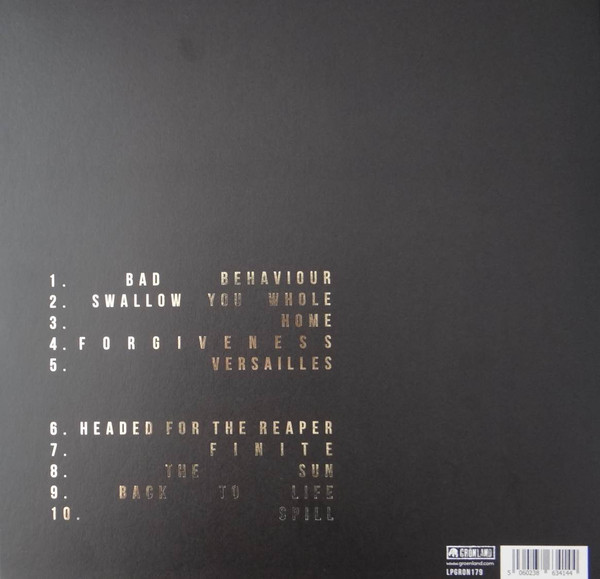
KAT FRANKIE-BAD BEHAVIOUR.
Kat Frankie-Bad Behaviour.
Label: Grönland Records.
Romanian author Nico J. Genes wrote in her book Magnetic Reverie: “follow your dreams, let them guide you. Who knows where they may take you.” This is what Kat Frankie decided to do in 2004, when she gave up her job in Sydney, Australia, and left her family and friends behind, to travel half way round the world to Berlin, Germany, where she embarked upon a career as a singer-songwriter. That was a huge gamble for Kat Frankie bit it paid off, and she’s now a successful singer-songwriter who has just released her fourth album Bad Behaviour, on the Berlin-based label Grönland Records. However, that is just part of the Kat Frankie story, which began 10,000 miles from Berlin.
Kat Frankie was born and brought up in Sydney, and has been singing since she was a child. Songwriting came later, and she recorded her first compositions onto a tape and sent them to grandmother. This was Kat Frankie first recording, and wouldn’t be her last.
By the time she was a teenager, Kat Frankie had graduated to singing R&B songs, and she remembers: “Boyz II Men were huge role models of mine.” However, at that time, it looked unlikely if Kat Frankie would be able to pursue a musical career.
Sadly, Kat Frankie’s parents weren’t able to pay for music lessons, and certainly couldn’t afford to by a guitar or piano. The only musical equipment Kat Frankie had access to, were two tape decks. This allowed Kat Frankie to practice her beat-boxing. Even now she remembers what she used to do: “I would record a beat on one cassette, then play it and sing along with it while recording it on the second cassette.”
This is the technique that Kat Frankie still uses. However, she’s incorporated a loop station which is her favourite piece of equipment, and allows her record a chorus, accompany herself or even to play a one-woman guitar duet. However, up until Kat Frankie was seventeen, this wouldn’t have been possible.
Kat Frankie was a latecomer to the guitar, and only started to playing when she was seventeen. Maybe that is why Kat Frankie hasn’t embraced the guitar like many singer-songwriters have? That was despite the guitar kickstarting her musical career.
At the time, Kat Frankie was studying design, and playing in pubs in Sydney. “I played guitar and sang songs, some angry, some sad–it was totally cliché.” Soon, Kat Frankie was enjoying a degree of success, which prompted her to quit her job and travel 10,000 miles to Berlin. The big question her friends and family must have wanted to know was why Berlin?
“I was a big fan of Chicks on Speed. In an interview they said Berlin was the best place in the world to make music, and I believed them.” So in 2004, Kat Frankie relocated to Kat Frankie and moved to Berlin.
When Kat Frankie arrived in Berlin, the antifolk scene was thriving. So much so, that antifolk was the most popular musical genre in Berlin’s eclectic and vibrant music scene. It was a scene that Kat Frankie became part of, almost by accident.
Having arrived in Berlin where she knew nobody, Kat Frankie met singer-songwriter Kitty Solaris, who also owned the Vitamin record label owner. Kitty Solaris had been influenced by the Velvet Underground, Patty Smith and Catpower, but had honed her own unique and inimitable style. She also knew what it took to make inroads into the Berlin music scene, and decided to take Kat Frankie under her wing.
Three years after arriving in Berlin, Kat Frankie was part of antifolk scene which was still thriving, and was preparing to release her debut album on Kitty Solaris’ Vitamin label. This was Pocketknife, which was released in 2007. By then, Kat Frankie had come a long way in a short space of time. However, when she looks back at this time and the antifolk scene Kat Frankie says: “that’s how I slipped into that scene back then, although it didn’t suit me at all. Antifolk always has this cutesy, superficial quality to it, whereas I always wanted to be truthful and write emotion-laden songs.”
Kat Frankie was an accidental antifolk singer who deep down, wanted to follow in the footsteps of PJ Harvey, Tom Waits and Rufus Wainwright who were her role models. The “cutesy, superficial” antifolk scene was soon in the past, and as Kat Frankie plotted the next stage in her career she remembered a quotation from Hamlet: “to thine own self be true.”
When Kat Frankie came to record her sophomore album, she had added a loop station to her musical arsenal. “It is such a simple device, but you can do so much with it! On the one hand it felt like going back to my childhood, but the vocal harmonies I could sing with myself allowed me to venture into completely new styles.” The resulting album, Dance Of A Stranger Heart was released on Frankie Kat’s new label Zellephan in 2010, three years after she released her debut album Pocketknife. Dance Of A Stranger Heart was a much more eclectic album and saw Kat Frankie move in new directions. This continued on her third album.
Just two years later, Kat Frankie returned in 2012 with Please Don’t Give Me What I Want which was released on Kat Frankie’s Zellephan label. It was the start of a new chapter in Kat Frankie’s career, which she remembers well: “on the one hand it felt like going back to my childhood, but the vocal harmonies I could sing with myself allowed me to venture into completely new styles.” This included the R & B and soul that Kat Frankie had listened to when she was a teenager. The music from her past played a part in the success of her third album Please Don’t Give Me What I Want which was the most eclectic album of Kat Frankie’s career.
Despite releasing two album in the space of two years, another five years passed before Kat Frankie returned with her fourth album. During that period, she worked on various side projects including playing guitar in Olli Schulz’s backing band. Kat Frankie also write
Get Well Soon, which became the theme tune to Schulz and Böhmermann’s talk show. Then in 2016, Kat Frankie was one half of the duo Keøma who competed in the preliminary rounds of the Eurovision Song Contest. Later in 2016, Kat Frankie’s backing vocals sweetened the Erfurt-based rapper Clueso’s single Wenn du Liebst.
All this was a learning process for Kat Frankie, who realised that the life of a singer-songwriter is quite different to mainstream pop artists. Kat Frankie’s realised this after her short dalliance with mainstream as part of Keøma. She wrote, recorded, played the synths and produced the songs within the digital audio workstation Ableton Live. The time that Kat Frankie spent working on the Keøma project she regards as part of life’s rich tapestry. “Everything I do propels me forward; I never want to stop learning.”
Kat Frankie enjoys working on new and disparate projects, which allow her to widen her skill set. Unlike many musicians, she manages to move almost effortlessly between projects and is regarded as someone whose easy to work with and a talented musician. That is apparent even after one listen to Kat Frankie’s fourth album Bad Behaviour which was released on Grönland Records.
Bad Behaviour shows a different side to Kat Frankie. “I never wanted to be just the sad girl with a guitar,” and she has set about reinventing herself on Bad Behaviour. There’s always been two sides to Kat Frankie’s music, the sad and sombre and the bright and joyous. However, never before has Kat Frankie dared to combine the sides until Bad Behaviour which is her first album in five years. It’s also an album that is full of surprise aplenty.
Kat Frankie explains: “I didn’t want to be the least bit melancholic anymore. This new album was a joyous album; I wanted to be a bit obnoxious… Somehow there’s just not a good German word for that.”
That may be the case. However, the easiest way to explain Kat Frankie’s decision to change direction, is that she wants to challenge the expectations of those who have followed her career since the release of Pocketknife in 2007. They were in for a surprise when they bought Bad Behaviour and pressed play. Suddenly, power riffs, rasping horns and a pitched up vocal that is accompanied by a “Californian hippie” chorus. Incredibly, Kat Frankie managed to record all this using her loop station, rather than a cast of thousands.
Using her guitar, loop station and a vocal that can breathe life, meaning and emotion into lyrics, Kat Frankie recorded Bad Behaviour which is a captivating album that is akin to embarking upon a new relationship. Bad Behaviour is also a very intimate album, where Kat Frankie writes about love, suffering from love and the joy of loving. Sex is also another the threads that runs through Bad Behaviour. In fact, Kat Frankie admits that: “I have never made an album as loaded with sex as this one is.”
Despite that, the intimacy and images of togetherness, Bad Behaviour is still a romantic album. Other times, Kat Frankie is introspective as she seems to look deeply into psyche. Elsewhere on Bad Behaviour, Kat Frankie takes time to reflect and ruminate. Sometimes she looks at the bigger picture, and the current political picture in public. All this is a long way from the “cutesy, superficial” antifolk scene,” that a younger Kat Frankie once inhabited. That was in the past, when Kat Frankie’s recording career was in its infancy.
Now Kat Frankie is an experienced recording artist with four albums to her name, including her most recent album Bad Behaviour. It’s a groundbreaking, genre-melting album where Kat Frankie combines elements of pop, R&B and folk on this carefully crafted album. It features surprises aplenty during the ten tracks. This includes the harmonies that sounds as if they belong on a classic doo-wop single. Still, Kat Frankie continues to be influenced and inspired by the music that she listened to during her formative years.
This music can be heard throughout the ten tracks on her career-defining fourth album Bad Behaviour. It literally oozes quality from the opening bars of Bad Behaviour right through to the closing notes of Spill. In between, Kat Frankie breathes meaning and emotion into the lyrics to Home, Forgiveness, Headed For The Reaper, The Sun and Back To Life on this powerful, poignant and melodic album.
Bad Behaviour is also the latest and greatest album from Kat Frankie who once said: “I never wanted to be just the sad girl with a guitar.” That is certainly not the case on Bad Behaviour which in places, is a hopeful and joyous album. It’s also an intimate album where Kat Frankie focuses on love and loving. The other theme on Bad Behaviour is sex. This is part of what’s a grownup and mature album from the enigmatic Kat Frankie.
Her fourth album Bad Behaviour which was recently released by Grönland Records, is an album to explore embrace and enjoy. Bad Behaviour features a truly talented songwriter Kat Frankie, who left her home in Australia in 2004 to follow her dreams. This has paid off and fourteen years later, Kat Frankie is at the peak of her powers and has just released her career defining album Bad Behaviour.
Kat Frankie-Bad Behaviour.

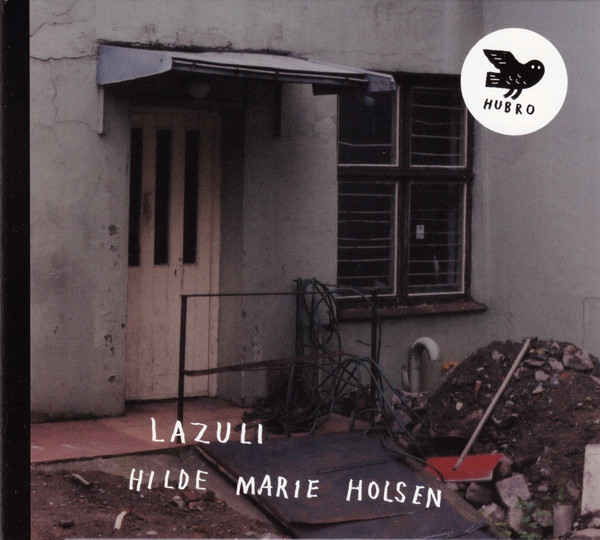
HILDE MARIE HOLSEN-LAZULI.
Hilde Marie Holsen-Lazuli.
Label: Hubro Music.
Three years after releasing her critically acclaimed debut album Ask, trumpeter and soundscape artist Hilde Marie Holsen returns with her much-anticipated sophomore Lazuli, on Hubro Music. It features a suite of four compositions that were inspired by visual art, and were named after minerals that are used to colour paint. Hilde Marie Holsen’s approach to composition was very to different to many artists.
Having partly composed the four compositions, Hilde Marie Holsen improvised the remainder of the soundscapes on Lazuli. Despite this approach, the suite sounds cohesive and fully formed. It’s also a dark, atmospheric and mysterious sounding album of carefully crafted soundscapes where the interplay between sound and music is captivating. Lazuli is a truly ambitious album of experimental music that will challenge the listener, and make them think about what constitutes music? This makes Lazuli a fitting followup to Ask, as Hilde Marie Holsen embarks upon the next stage of her career.
During her career, Hilde Marie Holsen has managed to combing the wistful, mournful and melancholy sound of the trumpet with electronic music. Sometimes, Hilde Marie Holsen adds effects to her trumpet, which transforms the sound of this traditional instrument. This is all part of Hilde Marie Holsen’s unique and inimitable sound as she creates music that has been described as somewhere between jazz, the contemporary and drone music. It’s new, ambitious and groundbreaking, which was the response to her debut album.
This was Ask which was released to widespread critical acclaim in 2015. Ask was a genre-melting album of soundscapes where Hilde Marie Holsen combined elements of abstract, avant-garde, experimental and improv. It was a groundbreaking album that left critics and record buyers excited about the followup to Ask.
Before that, Hilde Marie Holsen was part of the Dutch-Norwegian multidisciplinary live project Ljerke, who released their debut album Ljerke (Eilean 36) earlier in 2018. Ljerke’s debut album was a fusion of everything from acoustic ambient and avant-garde to classical, electronica and experimental. It was a captivating project from some of Holland and Norway’s top experimental musicians.
This included Hilde Marie Holsen who had recorded her sophomore album Lazuli at Galleri RAM, Oslo, on the ‘6th’ of June 2017. That day, it was just Hilde Marie Holsen in the studio when she played her trumpet and array of electronic equipment. She worked quickly and efficiently having already composed part of the four tracks within the suite. The rest of the tracks saw Hilde Marie Holsen improvise and that day a suite fully formed songs were born.
Hilde Marie Holsen and Maja S. K. Ratkje then mixed Lazuli at Svartskog. After that, all that was left was for Maja S. K. Ratkje to master Lazuli and her much-anticipated sophomore would be ready for release. However, Lazuli was no ordinary album.
There’s an intensity to the music on Lazuli which features a dialogue between the processes of composition and improvisation. Despite taking this rather unusual approach to composition and recording, everything had fallen into place during a recording session lasting just one day. The music was fully formed and Lazuli was complete.
It was a relief for Hilde Marie Holsen that she didn’t need to rerecord anything. Hilde Marie Holsen knew that if she rerecorded anything, it wouldn’t be for the better. It was similar to a writer changing a page in the book, and impossible for her to contemplate.
The interaction of music and sound has resulted in an album of experimental compositions that are ambitious, innovative and challenging. By then, Hilde Marie Holsen had decided that the title to her sophomore album should be Lazuli, which are the chemical minerals used to create the pigment in paint. This was fitting as Hilde Marie Holsen saw herself as a musician who painted with sound during the recording process.
There was still work to be done by Hilde Marie Holsen, and it was during the production process where Hilde Marie Holsen works her magic. Hilde Marie Holsen uses the production process to tweak and rework the recordings. This included the recording of her trumpet, where Hilde Marie Holsen added processing which transformed the dry signal. Suddenly, something new revealed itself. Hilde Marie Holsen had breathed new life and meaning into the original recording through the use of electronic effaces. It was the musical equivalent of turning water into wine, as musical alchemist Hilde Marie Holsen watched as a new musical work of art revealed itself to her.
Hilde Marie Holsen explains her approach during the recording of Lazuli: “all the electronic sounds on the album are still live and processed trumpet, as they were on ‘Ask…Since ‘Ask’, I’ve been exploring, among other things, different ways to play the acoustic trumpet, both conventional and unconventional, trying to find different timbres that can also give a larger register of processed sound in the electronic soundscape. The music on ‘Lazuli’ began as improvisation, and then later on I’ve had the chance to do minor adjustments and edits on the tracks. ‘Lazuli’ came about through a collaboration with the artist and painter Tyra Fure Brandsæter. We’ve spent some time practising our art together, using each other’s expression as an inspiration for our own performance and artistic production. The titles on the album are an homage to this collaboration: they are all different types of minerals that have been used as colour pigment in painting.”
There are similarities between visual art and the way that Hilde Marie Holsen worked to develop the suite of soundscapes on Lazuli. Initially, the soundscapes were minimalist, as Hilde Marie Holsen starts to introduce different sounds. This is akin to painter as they prepares the thick white ground on their blank canvas. Later, it will feature layers of oil as the picture starts to take shape and details emerge. It was the same for Hilde Marie Holsen as she added layer upon layer of disparate sounds to the soundscapes. Eventually, Hilde Marie Holsen had painted her musical picture which sonically was rich in detail.
This was Hilde Marie Holsen’s sophomore album Lazuli, which is an impressive and innovative genre-melting album. It’s also cerebral, challenging and cinematic. By the end of the suite of soundscapes on Lazuli, the listener will be thinking about what constitutes music?
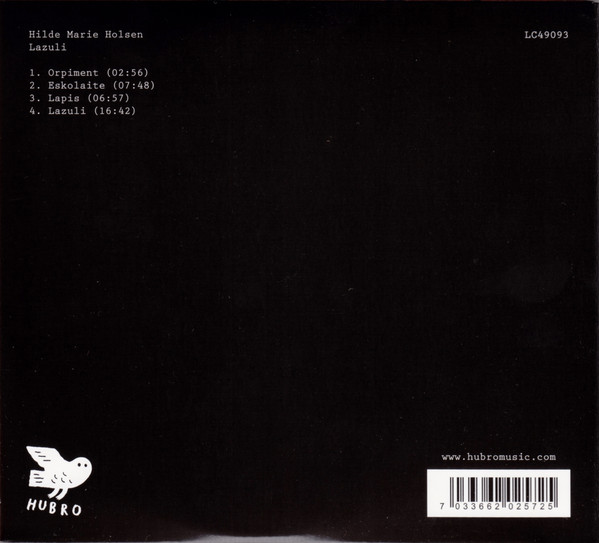
Lazuli opens with Opriment a three-minute track which is the shortest on the album. Swirling sci-fi sounds are joined by a drone and what resembles as an aeroplane flies above the arrangement. It’s joined by the mournful, plaintive sound of the trumpet. Meanwhile, a myriad of whirrs, clicks, ticks and metallic sounds are joined by the rumbling sound of the aeroplane returning. This signals the entrance of an organ which adds a liturgical sound to this carefully crafted and cinematic ruminative soundscape.
Scritchy, scratchy sounds are fired off as soon as Eskolaite unfolds. Soon, a myriad of sounds assail the listener and they rattle, rub, scrub and sometimes take on a metallic sound as effects transform the sound of the trumpet. It becomes a plaintive cry before wailing and reverberating. This it does as sweeping, bubbling and gurgling sounds are added and the trumpet brays and rasps. Later, it takes on a much more orthodox and melodic sound, as its rueful sound reverberates against a backdrop of droning and sweeping sounds. Soon, the jazz-tinged trumpet’s rueful sound becomes dubby and lysergic. Other times its played with power and the note is strangled as stew of sounds emerges from the genre-melting arrangement. Later, the meandering arrangement clicks and crackles as drones are added and the dubby trumpet quivers. Meanwhile, the aeroplane returns for another flyover, bringing to end this action packed soundscape that sets the imagination racing.
Initially, no effects have been added to the trumpet on Lapis. This allows the listener to hear Hilde Marie Holsen, who is a talented trumpeter. After a minute, there’s two resounding thuds, and soon, the trumpet shimmers. Meanwhile, clanking, metallic, gurgling, whirring and dark droning sounds are added and add a menacing edge and provide a contrast to the mournfulness of the trumpet. Soon, an array of clanking and metallic sounds are joined by futuristic sounds as the whirring, droning ominous sound. Combined with the futuristic sounds it’s as if Hilde Marie Holsen has been asked to provide the score to a sci-fi movie. Her music is rich in imagery and filmic as a myriad of sounds combine with her trumpet. Sometimes, she overblows in the tradition of the free jazz musicians, but this only adds to what’s a powerful, futuristic filmic soundscape that is rich in imagery.
Lazuli closes with the title-track which is a near seventeen minute epic, which pushes musical boundaries to their limits and beyond. Just like the three previous parts of the suite, the music is cinematic as a variety of sounds and drones are deployed. The sounds vary, and range from shrill and splashes to futuristic and sci-fi and even droning and whirring. Their addition makes it sound as if it’s part of the soundtrack to a movie about interplanetary invasion or warfare. The music is atmospheric, moody and dramatic as the tension builds. Shrill strings are the perfect addition as scratchy, whining and whirring sounds are joined by drones. They all prove the perfect additions as the tension continues to build, before the trumpet enters.
When it does, the trumpet is played slowly and tenderly as it produces a rueful, ruminative sound as it’s accompanied by a whirring and droning sound. The beautiful lament that trumpet produces is haunting. Still sounds sweep in and out, as the drone is omnipresent even when the trumpeter drops out. It’s joined by gurgling, whining, bubbling and otherworldly sounds as the drone hovers above. Soon, the trumpet returns as sound flutter, scamper, hover and drone while others have a futuristic sound. Meanwhile, Hilde Marie Holsen’s trumpet playing is impassioned and haunting before it drops out. As a myriad of mesmeric, otherworldly sound replace the trumpet, the listener wonders what has happened? Especially as otherworldly sounds gurgle, bubble, and cheep during this cinematic epic from soundscape artist extraordinaire Hilde Marie Holsen.
Hilde Marie Holsen’s sophomore album Lazuli, which has just been released on Hubro Music, is a fitting followup to Ask and is another groundbreaking opus from a musical pioneer. Stylistically i t finds Hilde Marie Holsen following in the footsteps of Terry Riley’s Music For The Gift, and experimental albums by Jon Hassell, Mark Isham and Graham Haynes. Closer to home, Hilde Marie Holsen is walking the same road as fellow Norwegians Nils Petter Molvaer and Ave Henriksen. Just like these musicians Hilde Marie Holsen’s music in ambitious, cerebral, challenging and innovative as she pushes music to their limit on this genre-melting album.
During the suite on Lazuli, Hilde Marie Holsen combines elements of ambient, avant-garde, classical, electronica, experimental, free jazz, improv, industrial and Musique concrète. The result is a captivating and cerebral album of cinematic music that is rich in imagery. Lazuli also encourages the listener to Ask what constitutes music? Hilde Marie Holsen’s sophomore album Lazuli is an ambitious album that features a filmic suite of groundbreaking and genre-melting music from a true musical pioneer who has a great future ahead of her.
Hilde Marie Holsen-Lazuli.
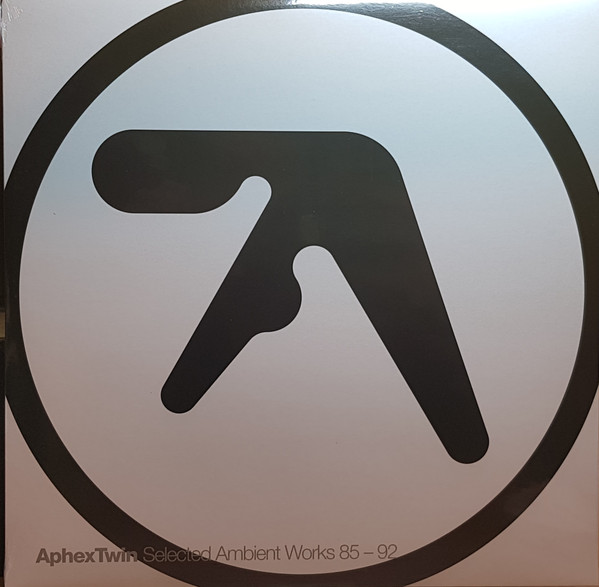
APHEX TWIN-SELECTED AMBIENT WORKS 85-92.
Aphex Twin-Selected Ambient Works 85-92.
Label: Apollo Records.
Richard D. James was just twenty-one, when he dawned the Aphex Twin moniker, and released his debut album Selected Ambient Works 85-92 on Apollo Records in late November 1992. Initially, Selected Ambient Works 85-92 was only available as an import as Apollo Records, which was an imprint of R&S Records, which was based in Belgium. This meant that many record buyers were struggling to find copy of Aphex Twin’s debut which soon, had a cult following.
Especially after February 1993 when it became easier to find copies of Selected Ambient Works 85-92, which although it Aphex Twin’s debut album, was the third release by Richard D. James. He was already an experienced producer by the time he released Selected Ambient Works 85-92.
Although Richard D. James was born in Limerick, Ireland, on the ’18th’ of August 1971, he grew up in Lanner, Cornwall, which was where he first discovered music. Richard D. James was a product of a laissez-faire approach to parenting, and was allowed to do pretty much as he grew up.
This included experimenting with the family piano, and rather than try to play it in a traditional way, Richard D. James experimented with the strings. Unbeknown to him this was similar to John Cage’s prepared piano experiments. This was got Richard D. James interested in experimenting with music.
By the age of nine, Richard D. James started purchasing tape recorders and tapes, which allowed him to do rudimentary experiments. Two years later, eleven year old Richard D. James won a ZX81 and started experimenting with machine. After that things happened quickly for Richard D. James.
He bought his first synth aged twelve which allowed him to make his first piece of music. By then, Richard D. James had already started modifying analogue synths and anything else he could make music with. Within a few years, Richard D. James was DJ-ing locally in St Ives, and with future DJ and remixer Tom Middleton were DJ-ing in Crantock. This was all part of Richard D. James’ musical education.
In 1988, Richard D. James enrolled at Cornwall College, and spent the next two years studying HND in engineering. This made sense to Richard D. James as electronics played a big part in the music he was making. However, having completed the HND, Richard D. James left Cornwall College, and a new chapter in his career began.
By then, Richard D. James was DJ-ing in Newquay every other week. The other DJ was Grant Wilson-Claridge and the pair soon became friends. It was then that Grant Wilson-Claridge suggested that they make music together. However, by then, Richard D. James was already making music on his own, including some of the music that eventually featured on Selected Ambient Works 85-92.
Grant Wilson-Claridge’s suggestion that they made music together made sense, as living in a rural area they were isolated and didn’t have access to the music available in cities. That was unless they recorded their own music.
The first release was the EP Analogue Bubblebath Volume I, which was released in 1991, and initially, was credited to Aphex Twin. Later, though, this was changed to AFX. Aphex Twin’s debut EP made it onto the Kiss FM playlist, and was a successful release.
Buoyed by the success of their first EP, Richard D. James and Grant Wilson-Claridge founded Rephlex Records and the new label released two Analogue Bubblebath EPs and the Bradley’s Beat EP by 1993. By then, Richard D. James had moved to London to continue his electronics studies, and was living in a former bank. However, when he discovered techno Richard D. James’ studies fell by the wayside.
Much of his time was spent DJ-ing in local clubs, and in between his DJ sets, Richard D. James spent much of his time making music. Some of this music featured on the first full-length Aphex Twin album Selected Ambient Works 85-92 had been released in 1992.
While Selected Ambient Works 85-92 was primarily an instrumental album, many of the tracks on Aphex Twin featured samples. This included samples of female vocalists and samples of people talking. We Are the Music Makers features Gene Wilder’s reciting: “We are the music makers, and we are the dreamers of dreams” which excerpts from Arthur O’Shaughnessy’s poem Ode. It featured in the original 1971 version of Willy Wonka and the Chocolate Factory. Green Calx features samples from RoboCop, a sample of PIL’s Fodderstompf and an excerpt from the opening titles of John Carpenter’s The Things. It’s distorted in what seems like an attempt to hides the identity of the sample. Although sampling wasn’t new, the way Aphex Twin used the samples was regarded as innovative.
Over a seven-year period, Aphex Twin had woven thirteen musical tapestries by combining samples with the sounds produced by his computer, trusty synths, drum machines and a myriad of percussive sounds. The music Aphex Twin made with his musical arsenal was beat driven, and although it had a simplicity, was atmospheric, spartan and sometimes eerie. Partly, this was down to the synths that Aphex Twin used during the recording of Selected Ambient Works 85-92. Some of the recordings are best described as lo-fi and primitive. However, the sound quality of some recordings weren’t of the best quality. There was a reason for this, a cat had damaged the cassette that contained the recordings. This could’ve had disastrous consequences.
Despite this, critics were won over by Aphex Twin’s debut album, and critical acclaim accompanied the release of Selected Ambient Works 85-92. Some critics went as far as to compare the Selected Ambient Works 85-92 to some of Brian Eno’s early solo albums. Aphex Twin’s debut album was hailed as landmark ambient album, and one the best albums recorded with a computer and keyboards. This was high praise. However, some critics went further, stating that Selected Ambient Works 85-92 was a truly groundbreaking album. It would play in important part in the history of ambient, intelligent dance music (IDM) and modern electronic music. There were no dissenting voices and Selected Ambient Works 85-92 was genre classic that would influence future generations of musicians.
Little did Aphex Twin realise that Selected Ambient Works 85-92 would go on to influence a new generation of electronic musicians. Many of them went on to cite Selected Ambient Works 85-92 and Aphex Twin major influences on their careers.
By 2018, Richard D. James was forty-seven and was recording albums using a number of monikers, including AFX, Bradley’s Beat, Polygon Window, The Tuss and Caustic Window. There’s also the small matter of the six albums Richard D. James has recorded as Aphex Twin. Despite the quality of albums like Selected Ambient Works Volume II, …I Care Because You Do and the Richard D. James Album, every Aphex Twin is compared to the album that llaunched his career in 1992…Selected Ambient Works 85-92. It’s regarded as Aphex Twin’s finest hour, which means that it’s fitting that Selected Ambient Works 85-92 has just been reissued by Apollo Records.
Selected Ambient Works 85-92 which is much more than an ambient album. It features elements of ambient techno, avant-garde, electronica, IDM and musique concrète. These genres were woven together by Aphex Twin over seven years as he recorded his debut album which made musical history. That album was Selected Ambient Works 85-92, which is an innovative, timeless, genre classic that was a landmark ambient album that went on to influence a new generation of electronic musicians.
Aphex Twin-Selected Ambient Works 85-92.
DAVID AXELROD-SONGS OF INNOCENCE.
David Axelrod-Songs Of Innocence.
Label: Now Again Records.
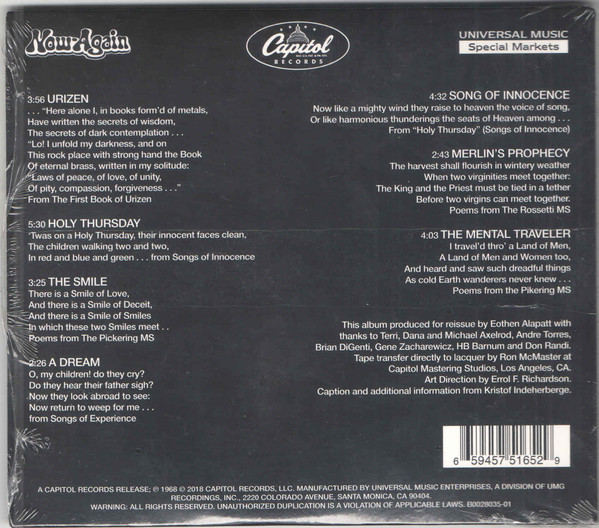
By the time David Axelrod began work on his debut album Songs Of Innocence in 1968, the thirty-seven year arranger, composer, drummer and producer old had enjoyed a chequered career. He had started off as a boxer, before changing direction and finding work in film and television. However, in 1959 David Axelrod embarked upon a musical career when he produced Harold Land’s album The Fox. This launched David Axelrod’s nascent musical career.
Four years later, David Axelrod was hired by Capitol Records as a producer and A&R man. Initially, he worked with R&B artists, including Lou Rawls who was signed to Capitol Records. David Axelrod produced a string of hit singles for Lou Rawls, his Live album and several albums that were certified gold. David Axelrod was the man with the Midas Touch.
Soon, David Axelrod was working with jazz saxophonist Julian “Cannonball” Adderley, and produced his 1966 Grammy Award winning album Mercy, Mercy, Mercy! Live at “The Club.” The album also featured the hot single Mercy, Mercy, Mercy which reached number eleven in the US Billboard 100. By then, David Axelrod’s star was in the ascendancy at Capitol Records.
It was around this time, David Axelrod began working with some top session musicians including drummer Earl Palmer, bassist Carol Kaye and guitarist Howard Roberts. This band would play an important part in David Axelrod’s future.
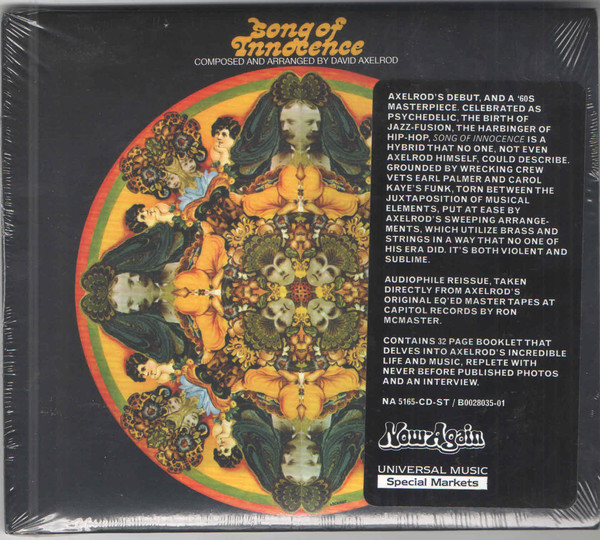
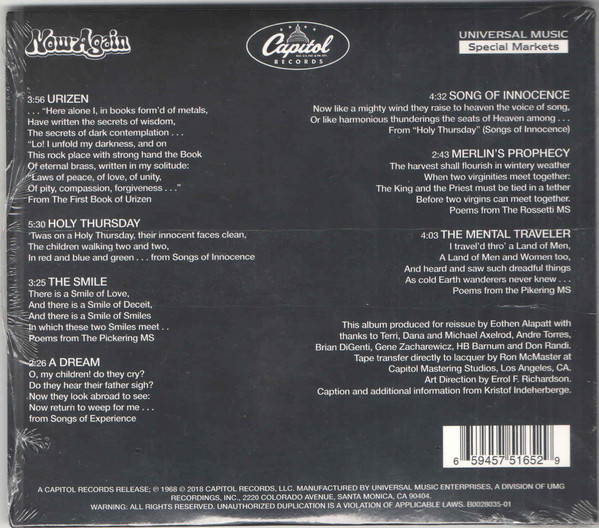
David Axelrod wrote and arranged Mass in F Minor and Release of an Oath for the psychedelic rock band The Electric Prunes. The only problem was that both songs were complex pieces of music. Mass in F Minor consists of a mass sung in Latin and Greek and performed in a psychedelic style. However, there was a problem, it was too complex a piece for The Electric Prunes to record and it was recorded by David Axelrod’s band. This lead to The Electric Prunes disbanding and David Axelrod’s band completed the albums. Executives at Capitol Records were grateful that David Axelrod had rescued what was a particularly tricky situation, and wanted to reward him for his recent success. This resulted in David Axelrod being allowed to record his debut solo album Songs Of Innocence which was recently reissued by Now Again Records.
David Axelrod had been watching trends in popular music and realised that there was a new breed of record buyer with much more sophisticated taste than the three chord pop of the early Beatles’ record. They were willing to embrace and buy much more experimental sounding albums, including two of the best known, The Beach Boys’ Pet Sounds and The Beatles’ Sgt Peppers Lonely Hearts Club Band. Both of these experimental had been hugely successful, and was proof to David Axelrod that there was a demand for this type of music.
Buoyed by the experimental climate of popular music David Axelrod decided to write and record his what was akin to a suite-like tone poem, which was based on Songs Of Innocence which was an illustrated collection of poems written in 1789 by William Blake. The poet had inspired many composers and musicians during the twentieth century. Many composers had set his poems to music, and William Blake’s music had been used in theatre and inspired everyone from folk musicians to David Axelrod who was a self-confessed “Blake freak.”
Over the space of a week, David Axelrod wrote seven compositions and borrowed titles from William Blake’s poems. The compositions death with a variety of themes, ranging from visions, religious iniquity, rite of passage and life experience after a person’s birth and innocence. After just a week, David Axelrod had completed Songs Of Innocence, which was his homage to William Blake. David Axelrod had been captivated by William Blake’s poetry since he was a teenager and seemed to relate to the poet. Neither William Blake nor David Axelrod were regarded as sociable men, and this could’ve hindered the producer’s career. However, he had a successful track record as he began recording Songs Of Innocence in 1968.
Having written Songs Of Innocence in just one week, David Axelrod arranged the seven tracks which he intended to produce and add the vocals to. Now he was ready to record his debut album, and work was scheduled to start in mid-1968 at Capitol Studios, in Los Angeles.
David Axelrod decided to use many of the musicians that he worked with on a regular basis. This included drummer Earl Palmer, bassist Carol Kaye and guitarist Al Casey. They were joined by percussionist Gene Estes and organist and pianist Don Randi who would conduct the string and horn section that David Axelrod planned to use on Songs Of Innocence. They would allow David Axelrod to create his musical vision.
Songs Of Innocence was essentially an instrumental album of jazz-fusion, but incorporated elements of baroque pop, blues, classical music, funk, jazz, liturgical music, pop, psychedelia, R&B, rock and theatre music. During Songs Of Innocence, David Axelrod used contrast extensively during the orchestral compositions which was peppered with euphoric psychedelic soul and dramatic, sometimes, distressing arrangements to reflect the supernatural themes that are found within William Blake’s poems. So does the music’s almost reverential psychedelic undercurrent which brings to mind the themes of innocence and spirituality that is a feature William Blake’s poems which inspired David Axelrod to write such an ambitious album as Songs Of Innocence.
His arrangements on Songs Of Innocence accentuated the pounding drums played in 4/4 time, complex baselines, searing and gritty guitars, sweeping melodramatic and progressive strings, organ parts designed to disorientate and blazing, dramatic horns. David Axelrod who had written Songs Of Innocence in the rock idiom, but used a mixture of jazz, rock and classical musicians to record his debut album.
They were all comfortable when David Axelrod asked them to improvise during this psycheliturgical opus. David Axelrod had been influenced by György Ligeti’s 1961 piece Atmosphères, and Lukas Foss’ concept of starting a piece with a sustained chord and improvising for over 100 bars, and ending on a different chord. However, it wasn’t joust improvisation that David Axelrod embraced.
David Axelrod encouraged musicians to use various sound effects, including reverb and echo during the recording sessions. This included adding echo to breakbeats to reflect the spiritual nature of William Blake’s poetry. For much of the album, David Axelrod’s rock orchestra painted pictures with music which veered between spartan, dramatic and harrowing to liturgical, ruminative and celebratory. As the music changed, so did the rock orchestra.
Seamlessly David Axelrod’s rock orchestra changed direction and were transformed into a vampish big band. Other times, they played bluesy bop or locked into a jazzy groove and on occasions started to swing. Meanwhile, producer David Axelrod was constantly encouraging his band to experiment, and not be afraid to improvise. Towards the end of recording sessions, David Axelrod’s rock orchestra had fully embraced psychedelia deploying organ licks that seemed to be designed to disorientate and gritty guitars. Then as The Mental Traveler was recorded, David Axelrod was keen to embrace and experiment with atonality. However, he felt that music that lacks a tonal centre of key was a step too far even on such an ambitions and innovative album as Songs Of Innocence.
When David Axelrod completed recording his suite-like tone poem, everyone who had worked on the concept album realised that it was an impressive, innovative and immersive album, that was ambitious, cerebral. However, the big question was what would the critics who make of Songs Of Innocence?
Not only was Songs Of Innocence David Axelrod’s debut album, but it was ambitious concept album inspired by William Blake’s poetry. This was too much for many critics, and the album regarded as something of a curio when it was released in October 1968 by Capitol Records. Many critics failed to understand what was essentially a mixture of genre-melting music, mysticism and philosophy that was cerebral, creative and showed just how much music had changed over the last few years. David Axelrod’s suite-like tone poem Songs Of Innocence, was a long way from Love Me Do in 1962. Music was changing, and record buyers were embracing much more experimental and sophisticated music. This augured well for the release of Songs Of Innocence.
Sadly, when Songs Of Innocence was released in October 1968, AM and FM radio stations started playing the title-track and Holy Thursday, which became the best known track on the album. However, despite being played on radio, Songs Of Innocence wasn’t the commercial success that David Axelrod or executives at Capitol Records had hoped. By October 1969, Songs Of Innocence had only sold 75,000 copies in America.
It was the best part of twenty-five years before critics reassessed the oft-overlooked Songs Of Innocence, and realised that it was a groundbreaking and timeless release that was unlike nothing else that had been released in the late-sixties. Maybe the problem was that Songs Of Innocence was way ahead of its time? If that was the case, a new audience was discovering David Axelrod’s Songs Of Innocence.
This soon included many DJs and producers who realised that David Axelrod’s Songs Of Innocence was a rich source of samples. One of the producers who sampled Songs Of Innocence was DJ Shadow who sampled the album for his debut album Endtroducing. Soon, the DJs and producers who were sampling Songs Of Innocence were championing David Axelrod’s music and especially his debut album, which was soon well on its way to becoming a cult classic.
Now fifty years after David Axelrod released his debut album Now Again Records have reissued Songs Of Innocence on CD and LP. The album was initially reissued for Record Store Day 2018 as a limited edition, but is now available for a wider audience to discover or rediscover. This is a welcome and overdue reissue of Songs Of Innocence, which will be followed by a reissue of David Axelrod’s sophomore album Songs of Experience. It’s another highlight of David Axelrod’s long and illustrious career.
Sadly, David Axelrod didn’t live to see this latest resurgence of interest in his solo career. One of music’s pioneers passed away on February the ‘5th’ 2017, aged eighty-six. However, David Axelrod left behind a rich musical legacy, including the trio of albums he recorded for Capitol Records.
This included his debut album Songs Of Innocence, which is an ambitious, cerebral and innovative album that for far too long was overlooked by critics and record buyers. That is no longer the case. Somewhat belatedly, this genre-melting cult classic, which is a mixture of music, mysticism and philosophy is finally starting to find the wider audience who understand and appreciate David Axelrod’s timeless, psycheliturgical opus Songs of Experience, which was inspired by his hero, poet William Blake.
David Axelrod-Songs Of Innocence.
ALE HOP-BODILESS.
Ale Hop-Bodiless.
Label: Buh Records.
Recently, Berlin-based Ale Hop, who is one of Peru’s leading composers and experimental electronic musicians released her new album Bodiless on Lima-based Buh Records. Bodiless is a carefully crafted collection of nine new songs that feature Ale Hop’s trademark complex pop arrangements. However, Bodiless is quite different from Ale Hop’s previous releases, as the songs were inspired by the landscape and radio drama. These influences can be heard on Bodiless, which is the latest project from Ale Hop, whose career has blossomed over the past decade.
The Ale Hop story began in Lima, Peru, where Alejandra Cárdenas was born in 1985. Growing up, Alejandra Cárdenas discovered music, and eventually gravitated towards electronic, experimental music, indie, noise and synth pop. This struck a chord with Alejandra Cárdenas who later, decided to embark upon a musical career.
Twenty-one year old Ale Hop joined the Lima-based all-female electronic pop band Pestaña in 2006. Pestaña was a group that didn’t take themselves too seriously, and described their music as electro stupidity with punk attitude. They showcased their inimitable sound on the Three Way CD which was released in 2007 and featured songs by Pestaña, Alive and Delicado Sonico. However, later in 2007 Ale Hop decided to part company with Pestaña, and it wasn’t long before she joined a new band.
This was Las Amigas De Nadie which was a new indie band that formed in Lima in 2008. The four piece band made their live debut, but it would be two years before they released their debut EP. Before that, Ale Hop embarked upon a new career.
By 2009, twenty-four year old Ale Hop was regarded as a talented, up-and-coming composer and musician in her native Peru. That was why she was commissioned by Interbank to write the score for one of their adverts. This was the first of many scores to adverts, internet campaigns, television programmes and films that Ale Hop would write over the next decade.
In 2009, Ale Hop also wrote the score to the short film Resta El Vacio, which was directed by Ricardo Ayala. Ale Hop’s score was the perfect soundtrack to the short film, and it wasn’t long before she was asked to write another film soundtrack.
Ale Hop’s next commission was to write the soundtrack to the documentary El Niño Del Cuzco, which was once again directed by Ricardo Ayala. It was released in 2010, the same year that Las Amigas De Nadie made their debut.
The band had been formed in Lima in 2008, but it wasn’t until 2010 that Las Amigas De Nadie released their debut EP Eres Nadie. It was well received by critics, and Las Amigas De Nadie returned with their debut album Sincronía in 2011 which was released to critical acclaim.
Buoyed by the success of Las Amigas De Nadie’s debut album, Ale Hop returned to the world of soundtracks, and began work on two new projects. She wrote the score to the documentary La Noche de Jhinna and the short film La Mala. Both projects were released in 2012, and Ale Hop’s career as a composer was going from strength to strength.
Meanwhile, 2013 was by far one of the busiest and most successful years of Ale Hop’s career, as she worked on a number of different projects. She provided the score to an internet campaign, starred in the film What Difference Does It Make? A Film About Making Music, provided the score to Ricardo Ayala’s short film Publica and won the residency at the Red Bull Music Academy in New York. However, 2013 was also the year that Ale Hop embarked upon a solo career when she released La Guerra Invisible. This was a tantalising taste of what was to come from Ale Hop as a solo artist.
Despite embarking upon a solo career, Ale Hop continued to work with the Lima-based indie band Las Amigas De Nadie, and they released their sophomore album Human Dress in 2014. It was released to plaudits and praise and later, was nominated for the Best Album of The Year in Peru. This was something to celebrate. However, it was a case of so near yet so far for Las Amigas De Nadie. Human Dress proved to be the band’s swan-song, and the band split-up in 2015.
Following the demise of Las Amigas De Nadie, Ale Hop became one half of the new experimental pop duo Mother Sun in 2015. Still, Ale Hop spent much of her time writing scores and working on so projects, including during 2015.
It was another important year for Ale Hop who turned thirty in 2015. She had been working on two projects, including writing the score to Hector Delgado’s short film Cumulo. Ale Hop also released another groundbreaking solo project Pangea, which was released on DVD by Buh Records. It was nominated for the Best Experimental Album in Peru, but yet again it was a case of close but no cigar.
This was a disappointment for Ale Hop, but writing her first full length film score must have softened the blow. She had been commissioned to write the score to Videofilia: Y Otros Síndromes Virales which was directed by Juan Daniel F. Molero and released in 2016.
By then, Ale Hop was had many written scores to many films, television programs, adverts and internet campaigns. This she was able to do in tandem with her solo career and the other projects that she was working on.
One of these projects was The Way Of Love which was a collaboration between Ignacio Briceño and Ale Hop. It was released to critical acclaim in 2017, and later, was nominated for the Album of The Year in Peru. However, once again, it was a case of so near yet so far. This might be about to change in 2018.
Bodiless.
Recently, Ale Hop returned with her new solo album Bodiless, which was recently released by Lima-based Buh Records. It’s a carefully crafted collection of nine new songs that feature Ale Hop’s trademark complex pop arrangements. The inspiration for the songs on Bodiless came from two separate sources.
This includes the landscape, after Ale Hop made a series of field recordings whilst she was traveling around South America. Some of these field recordings feature on tracks on Bodiless. The other source of inspiration for Ale Hop was radio drama. It’s provided Ale Hop with a narrative thread for several of the songs on Bodiless which is another ambitious album of groundbreaking music.
Bodiless is best described as a genre melting album where Ale Hop combines elements of disparate musical genres. This includes abstract pop, ambient, avant-garde, experimental electronic music, industrial music and even hints of synth pop. The result is an album of cinematic music that sets the listener’s imagination racing.
Bodiless opens with Bodiless, Pt. I (Matter and Resistance) which meows, beeps and squeaks, before becoming mesmeric and dramatic as Ale Hop crafts a cinematic track that sounds as if it belongs on the soundtrack to a short film. It meanders along, the complex, multilayered arrangement gradually revealing its secrets as bells ring, drums add a dramatic backdrop and sci-fi synths are unleashed. Later, the arrangement a whispery vocal shares its secret as the drums crack and beeps and squeaks emits a code, before the arrangement to this ten minute cinematic opus becomes understated as it draws to a close.
Found sounds combine with synths and an ethereal vocal on Today, which is one of the shorter songs on Bodiless. Soon, a guitar shimmers and combines with a myriad of samples and dubby vocals. Sounds assail the listener from another complex arrangement during this captivation and laid-back, languid track.
Samples of dialogue open Migration Data before futuristic sounds emerge from the arrangement. It’s as if the man machine has awaken and is lurching into life as Ale Hop paints pictures with this cinematic track that says more than ten thousand words.
Even the title As You Seek Faintly the Shore conjures up pictures in the mind’s eye. Bubbling synths and a guitar combine as a haunting, elegiac vocal that soon becomes dubby. Later, machine gun drums are unleashed briefly as Ale Hop crafts a melodic and memorable fusion of experimental electronic music, avant-garde and synth pop.
Otherworldly describes the introduction to Bodiless, Pt. III (Cosmic Ocean) before clanking industrial, Faustian sounds are added to the soundscape. So too is a deliberate and dramatic vocal, that is delivered against an understated and otherworldly arrangement that clanks and meanders along. Later, futuristic and sci-fi sounds punctuate the lysergic arrangement, which clanks and crackles along but is strangely melodic and continually captivates.
A myriad of samples and field recordings combine with keyboards and synths during Home Jpg, which is another filmic sounding track from Ale Hop. Her uses of samples plays an important part in this poignant sounding track which for many people will be a snapshot of home.
At nearly seven minutes, Bodiless, Pt II (Ritual VS. Indiscriminate Felling) is another of the longer tracks on Bodiless. As it gradually unfolds, a mesmeric backdrop accompanies lo-fi and sci-fi synths and various futuristic and industrial sounds. There’s a lot going on during this complex, multilayered arrangement, and continually, sounds assail the listener. It sounds as if sound sculptor Ale Hop is creating the soundtrack to a sci-fi film, If she was, it would be guaranteed to set the listener’s imagination racing.
While Therubberboom.jpg is just two minutes long, it leaves a lasting impression. Here, Ale Hop combines shrill synths, a piano and samples which she combines with dialogue. It sounds as if it’s an excerpt from a film, and sometimes, effects are added to the dialogue which distorts and becomes dubby. Other times, bursts of sci-fi synths, industrial sounds and samples are combined as Ale Hop weaves another dramatic, cinematic track.
As the arrangement You which closes Bodiless meanders along, gradually revealing its secrets, Ale Hop delivers a slow, deliberate and sultry vocal. Meanwhile, industrial and percussive sounds combine with synths and harmonies. Together, they ensure that Bodiless closes on a high, and leaves the listener wanting to hear more from Ale Hop.
Ale Hop’s much-anticipated new album Bodiless was recently released by Lima-based Buh Records, and is available as a cassette or digital download. Bodiless is a carefully crafted album, and features nine new songs that were inspired by the by the landscape and radio drama. These influences are apparent on Bodiless which is an ambitious and innovative genre-melting album from Berlin-based Ale Hop.
She combines a variety of disparate musical genres on Bodiless, including abstract pop, ambient, avant-garde, experimental electronic music, industrial music, musique concrète and even synth pop. These genres are seamlessly combined on Bodiless, by Ale Hop who earlier in 2018 graduated from the Universität der Kunst Berlin with a MA in Sound Studies. This Ale Hop added to the BA in Art History from the Universidad Nacional Mayor de San Marcos. However, nowadays, most of Ale Hop’s tine is spent making music which she’s been doing since 2006.
Twelve years later, and Ale Hop has been written the scores to adverts, internet campaigns, television programs and films. She’s also been a member of Pestaña and Las Amigas De Nadir, and nowadays, is one half of the experimental pop duo Mother Sun. However, in 2012 Ale Hop embarked upon a solo career and is known for creating groundbreaking music. Proof of that is her new album Bodiless, which is an ambitious, innovative and sometimes cinematic genre-melting album from Berlin-based Ale Hop who is a musical pioneer with a big future ahead of her.
Ale Hop-Bodiless.




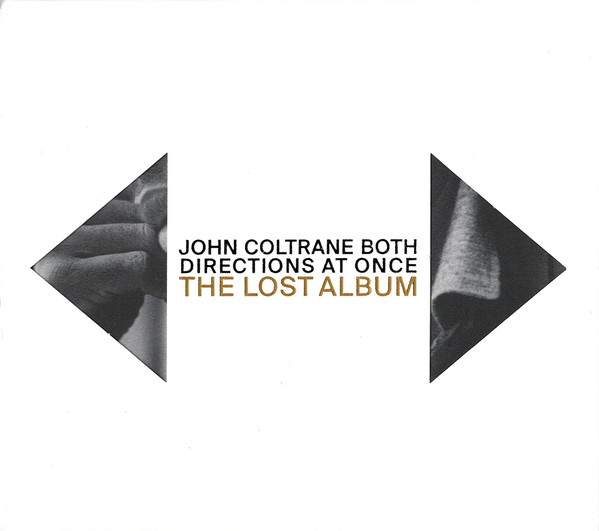
JOHN COLTRANE-BOTH DIRECTIONS AT ONCE: THE LOST ALBUM.
John Coltrane-Both Directions At Once: The Lost Album.
Label: Impulse!
As John Coltrane and his classic quartet arrived at the Van Gelder studios in Englewood Cliffs, on the ‘6th’ of March 1963, the band were in good spirits having played a barnstorming set at Birdland the night before. It was one of the best sets that the quartet that had been together since 1962 had played, and this set them up nicely to record a new album with Rudy Van Gelder, which would be released by Impulse later in 1963.
When John Coltrane arrived at the studio, he unpacked his tenor and soprano saxophone, and watched drummer as Elvin Jones, double bassist Jimmy Garrison and pianist McCoy Tyner prepared for the session. The rest of the quartet featured experienced musicians and it was just another day at the office for the John Coltrane quartet. Soon, they were ready to roll and make some music.
Bandleader John Coltrane planned to record an entire album during the session, which was something he had done many times before, and so had the other members of the quartet.This time, John Coltrane planned to record an album that featured mostly his own compositions. He had written Slow Blues, One Up, One Down and Villa which was based on Franz Lehár’s Vilja Song from The Merry Widow. John Coltrane planned to revisit another of his compositions Impressions, and had decided to cover Nature Boy. However, John Coltrane knew from experience that anything could happen when he was recording an album.
Buoyed by their performance at Birdland the night before, John Coltrane and his quartet recorded a total of fourteen tracks at the Van Gelder studios. At the end of the session, Rudy Van Gelder made a separate copy of the quarter-inch reference tapes for John Coltrane to listen at home.
After John Coltrane had listened to the sessions, he gave the tape to his first wife Juanita Naima to look after. This was just as well in light of what happened.
Despite having recorded enough material for a new album, Impulse never released the album. For some reason, neither Bob Thiele who ran Impulse, nor Rudy Van Gelder lobbied for the release of the new John Coltrane album. This meant that the master tapes languished in the Impulse vaults. What happened to the tapes after this is unknown, and there’s several possibilities.
It may be that it was a case of human error, and the master-tape were misplaced, or that someone recorded over John Coltrane’s album. There’s even the possibility that when executives at Impulse decided to save on storage space, the tapes of the sessions on the ‘6th’ of March 1963 were thrown out or destroyed. A more likely explanation is that when Impulse’s parent label ABC-Paramount moved to Los Angeles that was when the tapes were lost somewhere between New York and LA. The other possibility is that when ABC-Paramount was purchased by MCA in 1979, that that is when the master-tapes were lost.
Sadly, by 1979 John Coltrane it was nearly twelve years since the legendary saxophonist had passed away on July the ’17th’ 1967. Sadly, nobody seemed to be lobbying for the release of the lost Impulse album. Not even Bob Thiele who left ABC-Paramount and founded his own label Flying Dutchman Records. It seemed that everyone had forgotten the album that the classic lineup of the John Coltrane quartet had recorded on the ‘6th’ of March 1963.
Meanwhile, the quarter-inch reference tapes that Rudy Van Gelder had made for John Coltrane was still in the possession of his first wife Juanita Naima. She looked after the tapes for forty-three years, until her death in 1996. After that, the tapes disappeared for another nine years.
Nothing more was heard of the tapes until 2005, when Guernsey’s auction house in New York announced that they planned to sell a selection of John Coltrane artefacts. This included the copy of the quarter-inch reference tapes that Rudy Van Gelder made of the session on ‘6th’ of March 1963, for John Coltrane to listen to at home. Although this wasn’t the original master tape, at last it would be possible to hear John Coltrane’s lost album.
It was no surprise to music industry insiders when the record company contacted Guernsey’s auction house to prevent the sale of the tapes, and then acquired them. This would allow them to release the tapes containing John Coltrane’s lost album.
Many within the music thought that it wouldn’t be long before the tapes were released in their entirety. Just like the rest of the story of John Coltrane’s lost album, there was a twist in the tale and it was thirteen long years before Impulse released Both Directions At Once: The Lost Album.
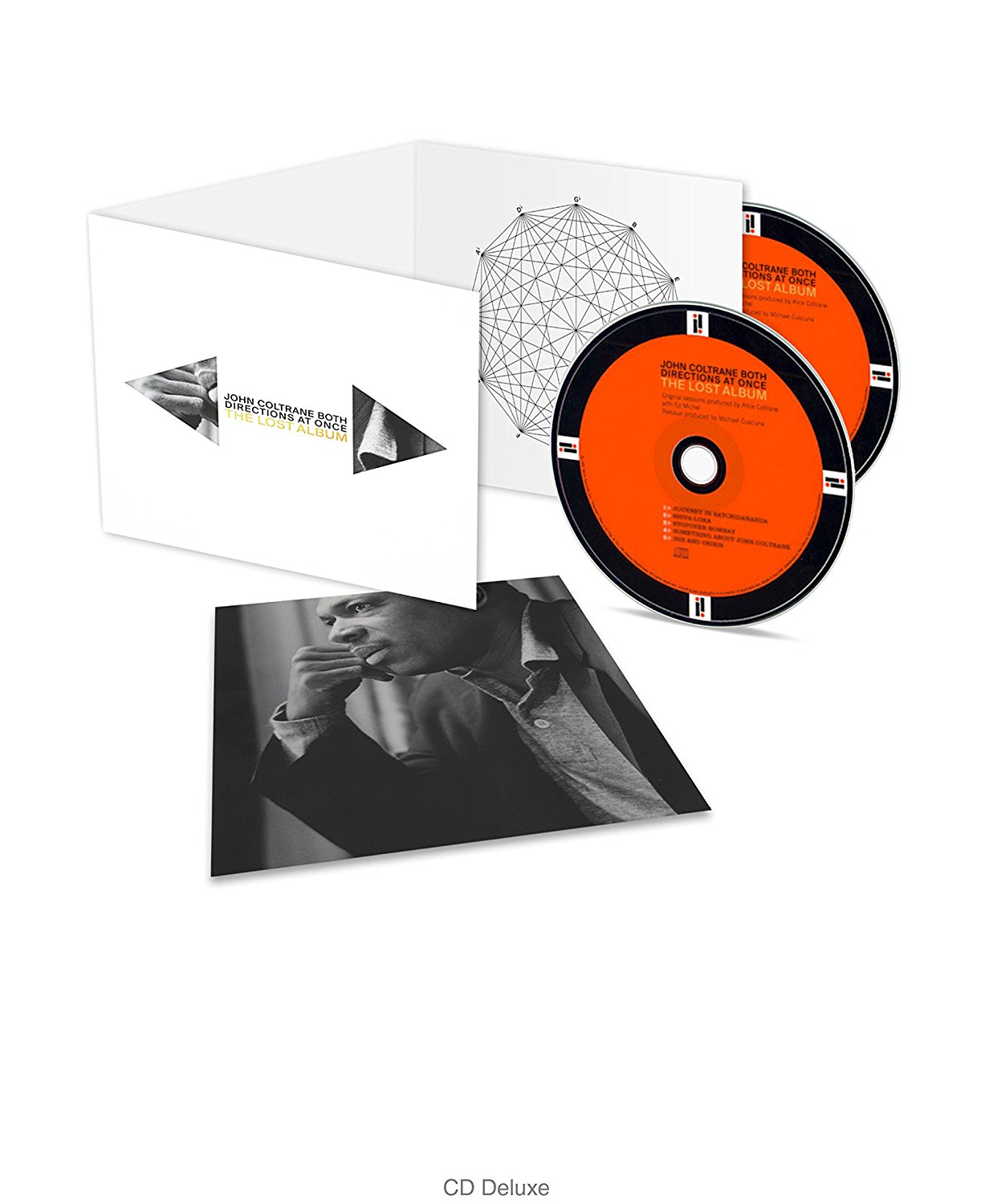
John Coltrane’s son Ravi Coltrane compiled Both Directions At Once: The Lost Album with studio executive Ken Druker. The sleeve notes were written by saxophonist Sonny Rollins who was a friend of John Coltrane. However, given the importance of Both Directions At Once: The Lost Album, two different versions of the album were released on LP and CD. There was the standard edition and the deluxe edition of Both Directions At Once: The Lost Album.
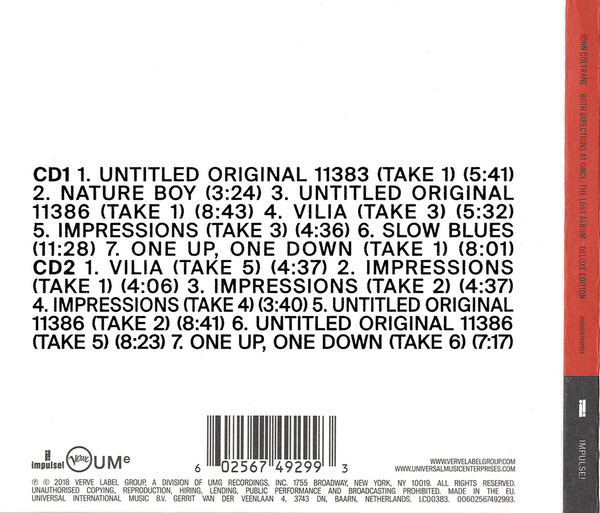
The deluxe edition of Both Directions At Once: The Lost Album was a double album, and the first featured the album that had been missing for fifty-five years. Seven bonus tracks featured on the second disc, including three takes of Impressions, two takes of Untitled Original 11386 and versions of Villa and One Up, One Down. Listening to Both Directions At Once: The Lost Album was like stepping back in time.
Indeed, when John Coltrane recorded Both Directions At Once: The Lost Album, the saxophonist was at a crossroads in his career. He felt constrained by traditional song structure, and was already contemplating moving in the direction of free jazz. This made sense as John Coltrane was a talented improviser who was keen to move beyond song shapes and chords and embrace a freer style of music. It was against this backdrop that John Coltrane recorded what eventually became Both Directions At Once: The Lost Album.
It opened with Untitled Original 11383 (Take 1) where John Coltrane plays soprano saxophone on the Latin-tinged minor key example of swinging modal jazz. John Coltrane then switches to tenor saxophone on the minor-key Nature Boy, which sometimes seems to hint at Summertime and It Was A Very Good Year as ‘Trane plays with power and passion. Meanwhile, the arrangement veers between dark and sombre before becoming melodic and joyous as it dances along. After this, the quartet lightens the mood on the Untitled Original 11386 (Take 1) which is like a Bossa Nova on steroids. Playing a starring role is ‘Trane’s saxophone which wails and squeals as he plays with speed and power as the quartet reach new heights. It gives way to the ballad Villa which is full of longing as pianist McCoy Tyner plays a melodic and memorable solo. So too is John Coltrane’s playing on Impressions (Take 3) as he plays with speed, fluidity, freedom and invention. In doing so, his band raise their game and match ‘Trane every step of the way.
It’s all change on Slow Blues which has a much more understated arrangement which allows John Coltrane’s to take centre-stage. he plays with control looking back at his past, rather than to the future when he embraced free jazz. Closing Both Directions At Once: The Lost Album is One Up, One Down (Take 1) which bursts into life and features triadic chords aplenty during this fearless, fluid and emotionally charged performance from the classic quartet who close this lost album on a high
For fifty-five years after the classic lineup of John Coltrane’s quartet recorded Both Directions At Once: The Lost Album, the album was belatedly released by Impulse. At long last, this revered lost album was available for all to hear. The big question was would Both Directions At Once: The Lost Album be as good as many critics and jazz fans had hoped?
It was and much more. Listening to Both Directions At Once: The Lost Album was like taking a step back in time to Van Gelder studios in Englewood Cliffs, on the ‘6th’ of March 1963. Suddenly, the listener is in the studio as the classic quartet plays as Rudy Van Gelder runs the session. Meanwhile, John Coltrane who is at a crossroads in his career combines elements of his past with his future as he and jazz music evolved.
John Coltrane continued with his classic quartet up until 1965, with the classic album A Love Supreme proving to be one of the their finest albums. Indeed, many critics regard A Love Supreme as John Coltrane masterpiece and a jazz classic. However, after releasing A Love Supreme, John Coltrane changed direction for the last two years of his life.
He moved towards a much looser, free jazz style from 1966s Ascension onwards. This included his avant-garde album Meditation which features Pharaoh Saunders, and is seen as John Coltrane’s spiritual followup to his Magnus Opus A Love Supreme. John Coltrane and his band continued to move in the direction of free jazz on the followup Live at the Village Vanguard Again! which was released in December 1966. The final album released during John Coltrane’s lifetime was Kulu Sé Mama which was released in January 1967 and was an album of free jazz recorded in 1965.
Sadly, John Coltrane passed away on July the ’17th’ 1967 aged just forty. That day, jazz music lost one of its greatest saxophonists who left behind a rich musical legacy including Both Directions At Once: The Lost Album, which was belatedly released after being missing for fifty-five years and is a reminder of one of jazz’s legends at his innovative best.
John Coltrane-Both Directions At Once: The Lost Album.

MILLIE JACKSON EXPOSED: THE MULTI-TRACK SESSIONS MIXED BY STEVE LEVINE.
Millie Jackson Exposed: The Multi-Track Sessions Mixed By Steve Levine.
Label: Southbound Records.
To remix or not to remix, that is the question that many critics and music fans have asked over the last few years. Especially if it’s a classic album, which adds to the controversy. Soon, feelings are running high at the thought of Giles Smith remixing Sgt Peppers Lonely Heart’s Club Band or Steven Wilson remixing albums by Jethro Tull or Yes. The remixed album is almost guaranteed to divide the opinion of critics and music fans.
For many traditionalists, remixing a classic album like Sgt Peppers Lonely Heart’s Club Band just shouldn’t be done. A classic album to many critics and music fans believe and argue is a work of art, and can’t be improved in any way, shape or form. That is despite many museums using all manner of new techniques to clean paintings, and bring new life to masterpieces painted 200 years ago. While some traditionalists may concede this point, they’ll still argue that Sgt Peppers Lonely Heart’s Club Band is off-limits and shouldn’t be remixed.
That was despite Giles Smith having access to the latest technology when he remixed Sgt Peppers Lonely Heart’s Club Band. Giles Martin used the digital audio workstation Pro Tools which meant he had access to an unlimited amount of tracks, something his father could only have dreamt about during the sixties. Plug-ins were used in Pro Tools, although Giles Martin used some outboard equipment during the remixing. By using the latest new technology and modern mixing technique Giles Martin and his team were able to remix the album so that Beatles’ fans heard this classic album in a new way.
When the remix of Sgt Peppers Lonely Heart’s Club Band was released, those that worked on the project stressed that this wasn’t a replacement for the original album. Instead, the remix showed what it was possible to do with new technology.
Many critics were won over by the remix of Sgt Peppers Lonely Heart’s Club Band, and felt it breathed new life into this classic album. Many Beatles’ fans conceded that the remix allowed the listener to hear the album in a different way from the original. However, not everyone was of the same opinion.
Sadly, many traditionalists were over-protective of their favourite album, and were unwilling to give Giles Martin and his team the credit that they deserved for his remix. As far as they were concerned, Sgt Peppers Lonely Heart’s Club Band like the rest of The Beatles’ back-catalogue was sacrosanct, and apart from some sympathetic remastering nothing else should be done to this classic album.
The same arguments have been trotted out when other classic albums have been remixed over the last few years. Usually, the only work that takes place on these projects is remastering and remixing.
Remixers like Steven Wilson and Giles Smith don’t get involved in correcting timing, editing or remaking a track. If they did, this would’ve caused huge controversy. However, Southbound Records, an imprint of Ace Records recently released Millie Jackson Exposed: The Multi-Track Sessions Mixed By Steve Levine where the veteran producer does all this and more.
Steve Levine, has always loved soul music, and has always been a huge fan of Millie Jackson’s music. Especially the albums she recorded in the seventies with producer Brad Shapiro at Muscle Shoals, where Millie Jackson was accompanied by David Hood, Roger Hawkins, Barry Beckett and Jimmy Johnson. They were often joined by Brandye and The Moments who added backing vocals. The majority of the albums were recorded in Muscle Shoals, although some sweetening often took place in New York, Philly or Detroit. This was where some of Millie Jackson’s finest albums were completed, before they were released by Southbound.
Steve Levine.
One of the many soul fans who bought Millie Jackson’s albums was Steve Levine, whose career began in 1975, when he got a job at CBS Studios as a trainee tape-op. Soon, he had progressed to in-house engineer and was working with The Clash, XTC, The Jags and many of the pop acts signed to CBS’ roster. Working with such a wide range of artists was good experience for Steve Levine.
In the early eighties, Steve Levine started working with Culture Club, and produced the five albums that the band released between 1982 and 1999. These albums were certified gold and platinum, and suddenly, Culture Club were enjoyed worldwide success. Meanwhile, artists and groups on both sides of the Atlantic wanted to work with the man with Midas Touch.
This lead to Steve Levine producing everyone from America, The Beach Boys, China Crisis Deniece Williams, Gary Moore and Motörhead. However, after a meeting with Bruce Johnson of The Beach Boys in the early eighties, Steve Levine produced their 1985 eponymous album. For Steve Levine who had grown up listening to The Beach Boys, this was a huge honour.
As Steve Levine’s career progressed, he went from producer, to award-winning producer. He won a Brit Award for Producer of the Year, a Grammy Award for his work with Deniece Williams and in 2011, a Sony Radio Award. Steve Levine even authored a successful book Hit Kit and the Art of Downloading Music. The London-based producer has enjoyed a five decade career and produced many hit singles and albums, and it seemed, had everything in music. That was until Roger Armstrong from Ace Records approached Steve Levine about a Millie Jackson new project.
Millie Jackson Exposed: The Multi-Track Sessions Mixed By Steve Levine.
This was music to Steve Levine’s ears, as he like Roger Armstrong was a huge fan of Millie Jackson’s music. Roger Armstrong wanted to investigate the Millie Jackson multi-track tapes to see if it would be possible to do something new and fresh with them. Especially now that technology had improved since the original albums were recorded. When Steve Levine heard of Roger Armstrong’s plans he was excited and was keen to get involved.
The next stage was for all the available analogue tapes to be transformed to digital and stored on a hard drive which was sent to Steve Levine’s studio in Liverpool. This was where the hard work began for Steve Levine, who spent a while sifting through the various tracks, before he arrived at a potential track listing.
This track listing was a mixture of ballads and dance tracks that showcased Millie Jackson’s vocal prowess. Other songs that Steve Levine had chosen featured some of her early proto-raps. The subject matter of the songs were always powerful with a narrative that death with social and sexual politics. Great care had been taken choosing the songs that Steve Levine planned to remix on Millie Jackson Exposed: The Multi-Track Sessions Mixed By Steve Levine.
Now one of the great engineer and producers of his generation began to breath new life and meaning into the twelve songs that he had chosen. Steve Levine was determined to stay true to Millie Jackson’s original artistic vision, but was determined to restore the music to its former glory. This was similar to restoring an oil painting, except that Steve Levine used the latest musical technology, including the now ubiquitous digital audio workstation.
It was one of Steve Levine’s secret weapons as made use of the unlimited tracks on the digital audio workstation. Some of the instruments including a Fender Rhodes and Hammond organ had to be recorded in mono or combined on a single track became stereo in the digital audio workstation. This transformed the sound the interments produced. Meanwhile, Steve Levine set about sorting mistakes in timing, reducing noise, improving clarity and dynamic range. Steve Levine also created a wider stereo image which is apparent when one listens to the songs on Exposed and compares them with the original recordings.
While Steve Levine was making good use of the new technology, he used some of the outboard equipment that is housed within his Liverpool studio. Graphic equalisers, echo, compression and reverb were deployed by Steve Levine. Other times, he used plug-ins modelled on the outboard equipment that engineers used during the seventies. For Steve Levine it was important that he was using similar equipment to the engineers who worked on the Millie Jackson albums. It was a case of staying true to her vision.
Despite wanting to stay true to Millie Jackson’s vision, Steve Levine used some outtakes of her vocal to comp harmonies that were added to the track. In one case, he makes a new track by floating the vocal over the top of the arrangement. This may prove controversial.
After all, Steve Levine has literally rebuilt a new track from scratch. However, as he points out, the materials he uses were all recorded during the original sessions. It’s not as if new parts were recorded and used during this contemporary remix which shows a new side to one of Millie Jackson’s best known songs.
That is the case throughout the twelve tracks on Millie Jackson Exposed: The Multi-Track Sessions Mixed By Steve Levine. Using his five decades of experience and modern technology, Steve Levine breathes new life and meaning into twelve tracks from Millie Jackson’s Southbound years. These tracks were recorded between 1971 and 1979, and include some of Millie Jackson’s best known songs
The earliest track is the Motown influenced My Man, A Sweet Man which was recorded in August 1971, and released by Spring Records on Millie Jackson’s 1972 eponymous debut album. Steve Levine’s remix brings new life to a song that would go down a storm on the UK Northern Soul scene.
It Hurts So Good, I Cry and Help Yourself are all from Millie Jackson’s 1973 sophomore album It Hurts So Good. It features a soul-baring vocal from Millie Jackson while swathes of lush strings and soulful backing vocals play their part in the arrangement. So does a Fender Rhodes that was originally recorded in mono and is now in stereo on this new and improved version of It Hurts So Good. I Cry features an impassioned vocal from Millie Jackson as she delivers powerful lyrics against an arrangement that is funky and soulful. However, the strings that sweeten don’t play as prominent a role in the remix and are replaced by horns as Steve Levine takes a familiar song in a new direction. Then on the ballad Help Yourself reverb is used subtly and briefly, before strings sweep as horns and harmonies accompany Millie Jackson at her soulful best.
If Loving You Is Wrong I Don’t Want To Be Right from Millie Jackson’s 1974 classic album Caught Up, and is regarded by many as one of the highlights of the album. Here, Steve Levine seems to slow the song down slightly and adds reverb to the arrangement which is given an innovative trip hop makeover.
Bad Risk is a track from Millie Jackson’s 1976 album Free and In Love, which stalled at seventeen in the US R&B. Despite failing to replicate the success of earlier albums there’s several highlights on the album, including Bad Risk where lush strings sweep and swirl take centre-stage and later, a blistering, effects-laden guitar cuts through the funky, soulful arrangement. Meanwhile, Millie Jackson delivers a sensual, soulful vocal on this underrated ballad that is given a welcome makeover by Steve Levine.
So is A House For Sale which is an oft-overlooked Millie Jackson track that is also taken from Free and In Love. It was long overdue a remix, Steve Levine extends the song by the best part of a minute and seems to tightened the drums up so that they’re in time Soon, strings and harmonies accompany Millie Jackson’s vocal powerhouse during Steve Levine carefully crafted and irresistible dancefloor friendly remix.
Millie Jackson released two albums during 1977, including Lovingly Yours which features I’ll Continue To Love You. It was originally just under three minutes long, but Steve Levine extends it to just over five minutes. One criticism of the original track were the synths that were used. It must have been tempting to give them a mere supporting role, or remove them from the track. However, Steve Levine resists this temptation, and stays true to Millie Jackson’s vision on this soulful dance track.
In 1978, Millie Jackson released Get It Out’cha System which gave her the third gold disc of her career. It featured Go Out and Get Some (Get It Out ‘Cha System) which was originality just under three minutes long. Steve Levine works his magic and extends the track by a minute. He also changes the Fender Rhodes to stereo which makes a difference. Meanwhile, now that there seems to be much more separation between the instruments. The strings dance, horns rasp and backing vocalists accompany Millie Jackson’s sassy, powerful vocal, as the widescreen arrangement breathes new life into the songs.
Although Sweet Music Soft Lights And You was recorded in May 1975, this duet with Isaac Hayes only featured on the 1979 album Royal Rappin’. Just like the original, the introduction is understated and funky as the arrangement builds before things change. Steve Levine extends the original song by two minutes as two of the biggest names of seventies join forces on this funky, soulful remix which features a stunning bass solo.
Millie Jackson also released Moment’s Pleasure during 1979, which featured a deeply soulful cover of Kiss You Over. It features a stereo Fender Rhodes, searing guitar, rasping horns and bubbling pizzicato strings as harmonies accompany Millie Jackson’s needy vocal. Just like other tracks, Steve Levine has extended the track albeit only by twenty-seconds as Millie Jackson shows another side to Kiss You Over
Closing Millie Jackson Exposed: The Multi-Track Sessions Mixed By Steve Levine is Never Change Lovers In The Middle Of The Night. It’s another track from the 1979 album Moment’s Pleasure and has been extended by a minute. After a big, bold introduction, the arrangement just glides along with Millie Jackson’s vocal starting off tender and soulful, before growing in power. By then, horns and strings are playing leading roles in the arrangement to this melodic and memorable track.
Millie Jackson Exposed: The Multi-Track Sessions Mixed By Steve Levine which was recently released by Southbound, an imprint of Ace Records is a compilation that will be of interest to all fans of Millie Jackson. This is an opportunity to hear twelve tracks from her seventies albums given a contemporary remix by Steve Levine.
His remixes on Millie Jackson Exposed: The Multi-Track Sessions Mixed By Steve Levine are inventive, sympathetic and breath new life and meaning into familiar tracks and hidden gems. Steve Levine even sorts a timing problem, remakes a track and reinvents one of Millie Jackson’s classic songs. Never before will you hear If Loving You Is Wrong I Don’t Want To Be Right like this. It heads in the direction of trip hop and is bound to be a favourite of DJs playing downtempo sets.
Sadly, some traditionalists, including one Napoleonic ‘music journalist’ neither appreciate nor understood Steve Levine’s inventive remix of a Millie Jackson classic and wasn’t won over by the compilation. These traditionalists are stuck in the past and sadly are reluctant to embrace innovation in music. Especially if it’s a remix project, and especially if it’s a remix of a classic album. That was the case with remixes of classic albums by The Beatles, Yes and Jethro Tull. Thankfully, the traditionalists are in the minority and the majority have embraced what was a labour of love for the two men who masterminded this project, Roger Armstrong and remixer extraordinaire Steve Levine.
He laboured long and hard on Millie Jackson Exposed: The Multi-Track Sessions Mixed By Steve Levine, but all his hard work has paid off on what has been a successful project as he breathes new life and meaning into twelve carefully crafted and inventive remixes.
Millie Jackson Exposed: The Multi-Track Sessions Mixed By Steve Levine.
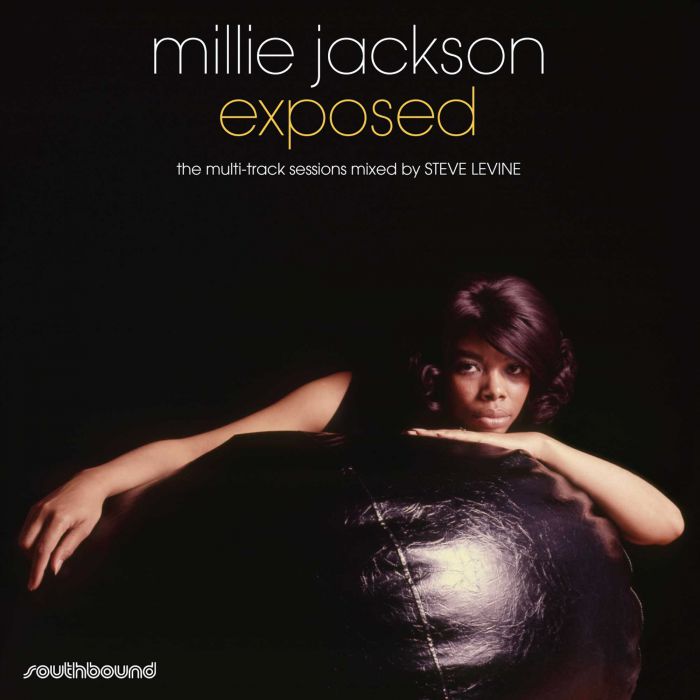
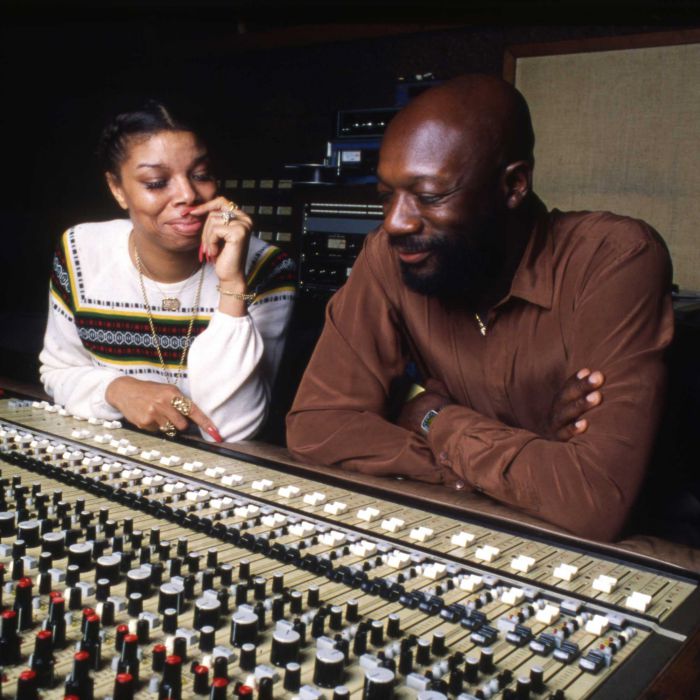
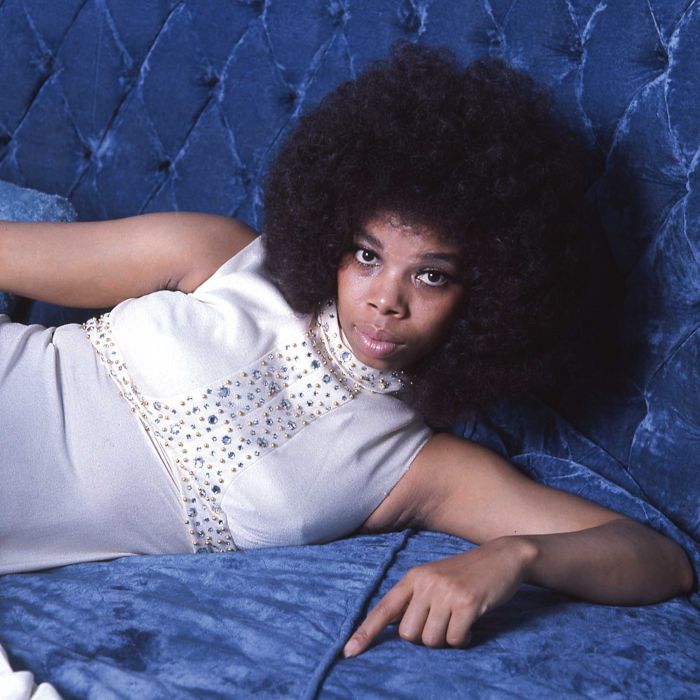
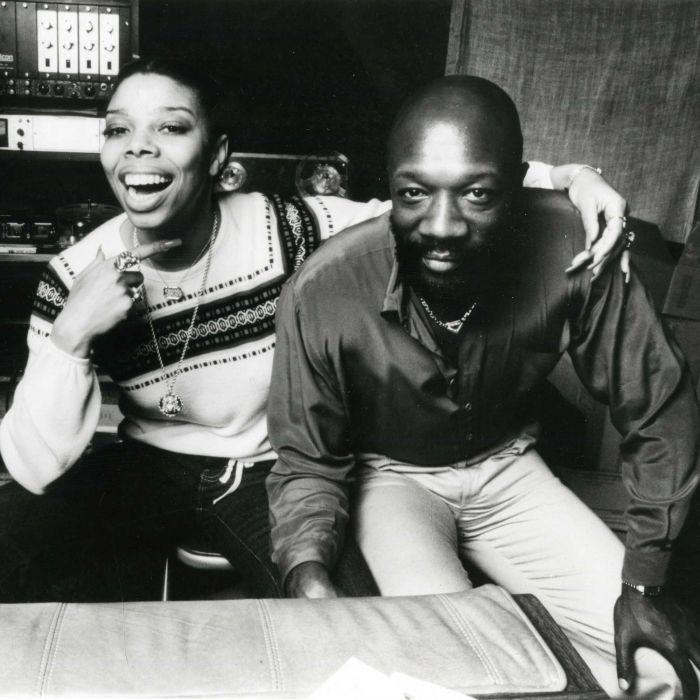
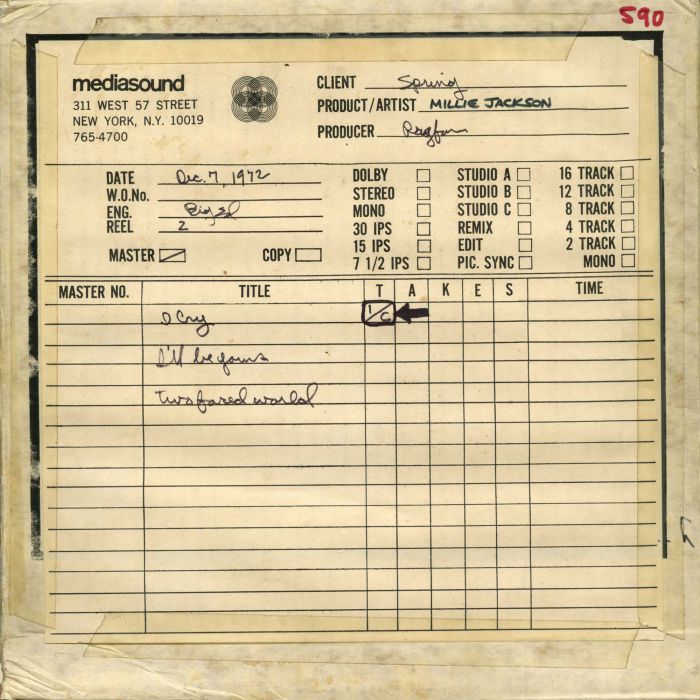
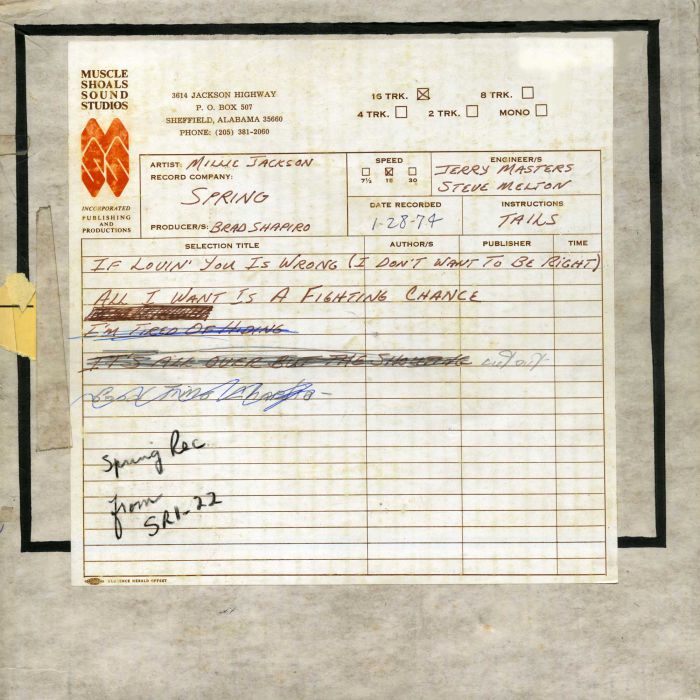
MAKE MINE MONDO!
Make Mine Mondo!
Label: Ace Records.
Nowadays, with a record number of albums being released and each and every week, independent and major labels spend a considerable part of their budget promoting their latest releases. However, it wasn’t always that way, and Lew Bedell the owner of Doré Records was reluctant to spend money promoting a new single.
In fact, Lew Bedell only ever commissioned photographs of his artists unless their single had charted, and very rarely advertised in the trade press. By then, Doré Records had already enjoyed a million-selling single with The Teddy Bears’ To Know Him Is To Love Him, and Lew Bedell a former standup comedian turned musical impresario was content to do things his way.
So much so, that Lew Bedell was willing to take a chance on all sorts of artists and bands that arrived at Doré wanting to record a single. Those that had potential Lew Bedell took into the studio, and quickly recorded a single. This Lew Bedell knew wouldn’t cost much, and if the single was even a minor success would more than repay his costs. However, not all of these singles were a success, and many were destined for obscurity.
Other times, Lew Bedell put a band together, and they went into the studio and recorded all sorts of tracks. This included fuzzed out garage, instrumentals and rockabilly songs. Some of these tracks feature on Ace Records’ new compilation of tracks released on Doré, Make Mine Mondo! It’s the latest compilation of music recorded and released by Doré that Ace Records have released. However, this time, the spotlight is turned on Lew Bedell.
Having graduated from high school, Lew Bedinsky headed to LA College and later, studied at the Santa Barbara State College, which was where he met Doug Mattson. Soon, the pair were performing a comedy show together on shows around the college campus, and it was soon apparent that the pair had the makings of a successful act.
So much so, that they turned professional. Before that, Lew Bedinsky decided to change his name in 1941, and became Lew Bedell. That was the name he used for the next twelve years, when he and Doug Mattson performed their musical comedy act. However, in 1953, the pair spilt-up, and Lew Bedell embarked upon a solo career as a stand-up comedian.
Lew Bedell didn’t enjoy the same success when he worked on the comedy circuit as a solo stand-up comedian. So much so, that after a year his career was at a crossroads and he was thinking a career after comedy.
Fortunately, Lew Bedell was approached by his cousin Herb Bedell who was a music industry veteran and his father Max Newman with a business proposition. They were offering him the opportunity to invest in a new record company. Lew Bedell realising that his comedy career was at a crossroads decided to invest $7,500 which helped to launch the new Era Records’ label with Herb Bedell and Max Newman.
The nascent Era Records opened its door for business in March 1955, and over the next three years, enjoyed several successful singles. With things looking good for Era Records, a decision was made to expand the business.
In 1958, Doré Records, an imprint of Era Records was founded. The newly founded Doré Records was named after Lew’s first son, who’d been born to Lew and his wife Dolores in 1957. The rationale behind forming a second label was that it would double the chances of having a record played on the radio. Its founders were also determined that Doré Records would release much more groundbreaking records.
This was the case from the day that Doré Records opened its doors. Having released two singles, a young Phil Spector approached the Bedell cousins with a new song by The Teddy Bears To Know Him Is To Love Him. When Herb Bedell heard the understated arrangement, he thought that if it was to be released on Era the record would be rerecorded. Phil Spector disagreed and so did Lew Bedell. He heard the potential in the To Know Him Is To Love Him and agreed to release the track on Doré Records its original form which became a huge worldwide hit and topped the charts in Britain and America.
For the next couple of years, Lew and Herb Bedell’s opinions on music differed, and eventually, in May 1959, they decided to go their own ways. It was an amicable spilt with Herb Newman continuing to run Era Records, which he moved the company to new premises. Lew Bedell retained Doré Records, which stayed at 1481 Vine Street, Hollywood.
Now that Lew Bedell owned Doré Records, he was able to run the record company the way he wanted. His cousin had been known to hire orchestras to record lavish arrangements, while
Lew Bedell’s arrangements were very different. They were usually simpler and tended to lack the polish of his cousin’s arrangements. However, they were also cheaper to produce so Lew Bedell wasn’t spending as much producing new singles.
Sometimes, Lew Bedell purchased masters from producers who stopped by Doré Records looking to sell a new recording. They usually didn’t cost Lew Bedell much, and would release the recording on Doré Records.
Other times, artists or bands would arrive at Doré Records looking to cut a record. Lew Bedell would listen to them play, and if they showed any potential, he would signed them to Doré Records. After that, Lew Bedell would take them into the studio to record a single which was released on Doré Records.
It wasn’t unknown for Lew Bedell to put a band together and have them record a single, which would be released on Doré Records using a moniker. This allowed Lew Bedell to follow the latest musical trend, in the hope of enjoying a hit single. That was why Lew Bedell was running a record label.
While some record labels had their own “sound” during the pre-rock era, musical impresario Lew Bedell was willing to release an eclectic selection of music as he went in search of hit singles. That was what mattered to Lew Bedell, and why the singles that Doré Records released during the pre-rock age were often very different. This included the various novelty singles that were released on Doré Records. They were part of the Doré Records’ story, and so are the twenty-eight tracks on Make Mine Mondo!
Among the artists and bands that feature on Make Mine Mondo! are The Altecs, The Zanies, Los Corvets, The Debonairs, The Wrench, Bobby Fry, The Rebels, The Whips, The Syndicate, Motion, Bobby Troup and Opus Five. They all feature on Make Mine Mondo! which includes: “fuzzed out garage bands, manic instrumentalists and wayward rockabillies.”
Opening Make Mine Mondo! in style is Gorilla Hunt by The Altecs which is one of the novelty singles that Doré Records released in the late-fifties and early sixties. Gorilla Hunt was produced by Jim Aguirre, and released as a single in September 1962. As a surf guitar cuts through the arrangement and a piano plays, the sound of the Gorilla Hunt punctuates this “manic instrumental.”
In December 1958, The Zanies released the Dore Jay and Leila Newman composition The Mad Scientist as a single. It’s a cinematic sound single that sounds as if it would’ve used as part of the soundtrack to a B-Movie. The same can be said of The Blob which us an early Bacharach and David composition that was released by The Zanies in October 1959, which is one of the group’s finest recordings.
When Johnny O released Don’t Run Johnny-O as a single in April 1959, tucked away on the B-Side was Meet the Bongo Man. It was penned by Danny Gould and Steven Howard and is one of the many novelty single Doré Records released in the late-fifties.
The Debonairs from Long Beach, California, released two singles on Doré Records. The first was Everybody’s Movin’ which was recorded at Gold Star Recording Studios, in Hollywood, and released in June 1964. It’s an irresistible slice of rock ’n’ roll that is a reminder of another musical era.
The Wrench released the Gary Scott composition You’ll Understand as a single in June 1969, but sadly commercial success eluded this emotive fusion of garage rock and psychedelia. It’s a welcome addition to Make Mine Mondo! So is the side of The Wrench’s one and only single The Day Is Hard. This is another Gary Scott composition that haunting and trippy fusion as garage rock and psychedelia combine to create one of the highlights of Make Mine Mondo!
In June 1960, The Brentwoods who had previously been known as The Misfits, released As I Live From Day To Day as a single. On The B-Side was Warren Joyner, H. B. Barnum’s Midnight Star which is a beautiful string-drenched ballad.
Another group who only released one single were The Whips, who released Yes, Master! in 1958. It’s a Wayne Shanklin composition which features a brisk and sometimes exotic sounding arrangement during what is essentially a novelty track..
LA-based group The Syndicate, only recorded one single for Doré Records, My Baby’s Barefoot. It was penned by Bill Rash of The Syndicate and released as a single in June 1966, and is a driving slice of garage rock. On the B-Side was Love Will Take Away, which was written by Karole Hensle, and features a heartfelt vocal on this hidden gem of a ballad.
When Tony Casanova released Showdown as a single in December 1959, his composition Boogie Woogie Feeling was on the B-Side, Tony Casanova. It’s another timeless reminder of the rock ’n’ roll era.
Fifty years ago in 1968, The South Hampton Story released their one and only single Leave Me Behind on Doré Records. The South Hampton Story successfully combine garage rock and psychedelia on this ,memorable and melodic hidden gem. It’s without doubt one of the highlights of Make Mine Mondo!
Dave Porrazzo wrote Midnight Beach Party which was released as a single by Johnny Z in April 1963. This oft-overlooked surf rock instrumental was the only single that Johnny Z released during his career.
In 1960, Seventh Son was released as a single by Bobby Troup. His deliberate and dramatic vocal is accompanied by an underrated arrangement that was a feature of many Doré Records. This less is more approach works well on Seventh Son, which was Bobby Troup’s last single for Doré Records.
Lew Bedell wasn’t content to run Doré Records, he was also an aspiring songwriter wrote a number of songs using a variety of pseudonyms. This included B. J. Hunter which was the moniker Lew Bedell used when he wrote the psychedelic ballad Haight (In Haight Ashbury Street) for Opus Five was . It was released as a single in April 1967, and is another of the highlights of Make Mine Mondo!
Closing Make Mine Mondo! is Russian Roulette which is the third contribution by The Zanies. It’s another instrumental, that was released by Doré Records in January 1963. A saxophone and piano drive the arrangement along during what’s another of The Zanies finest offerings. Russian Roulette is also a reminder of the pre-rock era, when lawyers and accountants took over the music industry and changed it forevermore.
Before that, musical impresarios and mavericks like Lew Bedell ran their own record companies, and were constantly looking for new and exciting music to release. That was what Lew Bedell set out to do when he founded Era Records in 1955, and continued to do when he parted company with his cousin Herb in May 1959.
With a steely eyed determination, Lew Bedell set about turning Doré Records into one of the leading independent labels in America and through hard work succeeded in doing so. Part of his success was realising that music was constantly evolving and not getting trapped in the past. Lew Bedell constantly reacted to changes in musical fashion and sometimes, and sometimes, was a musical trendsetter.
These changes are documented on the new Ace Records’ compilation Make Mine Mondo! which features twenty-eight tracks. This includes rock ’n’ roll, rockabilly, garage rock, psychedelia plus instrumentals and novelty songs. The eclectic selection of singles on Make Mine Mondo! are proof that Lew Bedell was willing to react to the changes in musical tastes. That was the only way a record label could survive and thrive during the late-fifties and sixties.
Just like any label, Doré Records needed singles, and Lew Bedell went in search of new artists and bands. Some of his new signings were up-and-coming bands, others were established artists that joined Doré Records’ roster. Some enjoyed a degree of success, while commercial success eluded some of the artists on Make Mine Mondo!
Some of these artists that feature on Make Mine Mondo! released several singles, while others played a walk-on part on the history of Doré Records. This includes several artists who only released one single, but often these singles are oft-overlooked hidden gems. So too are some of the B-Side and unreleased tracks on Make Mine Mondo! which are a reminder of Lew Bedell’s Doré Records, that was one the leading American independent record label for twenty-five years.
Make Mine Mondo!



HOT PEPPER-SPANGLISH MOVEMENT.
Hot Pepper-Spanglish Movement.
Label: Espacial Discos.
By 1977, it looked as if the disco bubble would never burst as it provided the soundtrack to danceflooors in Britain, Europe and North America. DJs and dancers had been won over by disco which had grown in popularity over the past few years. Initially, disco was an underground movement that eventually moved into the mainstream. However, in late-1977 disco’s popularity exploded.
The first hint of what was about to happen was when the Saturday Night Fever soundtrack was released a month earlier and on November the ‘15th’ 1977. It featured a disco-lite soundtrack that included Bee Gees, Yvonne Elliman, Kool and The Gang and The Trammps that eventually sold sixteen million copies in America alone.
Just a month later, the Robert Stigwood produced movie Saturday Night Fever was released on December the ’14th’ 1977. The film that cost just $3.5 million to make grossed $237.1 million in America, and played a huge part in introducing disco to an even wider audience.
They were a captive audience for the myriad of disco singles that were released during the first few months of 1978. Week after week, the charts were full of disco singles which were selling in vast quantities. Disco was proving profitable for some record companies, but other record companies were late to the party.
When they saw the success that other labels were enjoying, they wanted to add disco artists and groups to their roster. Some labels started signing anything that was vaguely disco related, while other labels gave artists and groups on their roster a disco makeover. Meanwhile,artists whose career had stalled were jumping on the disco bandwagon, hoping to kickstart their career. Even some television and movie stars were jumping on the disco bandwagon in an attempt to give their profile a much-needed boost. Soon, though, the quality of music was starting to suffer.
Ironically, in their quest for short-term gain, many A&R executives at major labels were overlooking some talented producers who were producing groundbreaking disco singles and albums in America, Canada and Mexico. This included the man many within the Mexican music referred to as Tilico, who had just masterminded the new project by Hot Pepper, Spanglish Movement who was released as a private press in 1978. Sadly, this innovative cosmic disco cult classic passed A&R executives and record buyers by when it was released. That was a great shame. However, forty years later Hot Pepper’s Spanglish Movement which has just been reissued by Espacial Discos, an imprint of Guerssen Records and is a welcome reissue of this cosmic disco cult classic masterminded by Tilico.
Tilico was born Jose de Jesus Munoz Lopez in Compostela, in the Mexican state of Nayarit, on the ‘28th’ of October 1936. When he was growing up, Tilico discovered music and started playing the drums. Little did anyone realise that he would go on to play an important part on modern Mexican music.
This included working with some of the top Mexican conductors and producers, including Chucho Ferrer, Mario Patrón, Nacho Méndez and Raúl Lavista. Many of the recordings Tilico played on, were recorded at Estudios Churubusco. That was where Tilico played on recordings by Jose Jose, Juan Gabriel, Jose Luis Gabriel, Lanny Hall, Perez Prado and Perry Como. They’re just a few of the artists Tilico accompanied whilst working as a session musician.
He was also the official drummer for the OFI International Festival and backed Carl Tjader, Paul Mauriat and Ray Conniff when they played live. Tilico also worked with Jorge Neri when he worked with the Teatro de los Insurgentes when they performed a variety of plays and musicals, including Cabaret and Una Eva y Dos Patanes. This was all good experience for Tilico who was a well known face on the Mexican music scene.
Especially when Tilico started writing songs. Soon, they were being recorded by the likes of Alberto Vazquez, Carlos Campos, Carmen Del Valle, Jose Jose, Los Dandys, Perez Prado and Sophy. With the great and good of Mexican music recording Tilico’s songs, his career as a songwriter was blossoming by 1977.
Buoyed by the success of his newfound success as a songwriter, and the popularity of disco, Tilico decided to embark upon a new project in 1977. He would write, record and produce Hot Pepper’s disco album Spanglish Movement.
For Spanglish Movement, Tilico wrote the lyrics and music to four lengthy tracks Deja Que El Mundo Sea Feliz Otra Vez (Let The World Be Happy Again), Camino Equivocado (Wrong Way), No Me Presiones (Don’t Push Me) and Cancion Ritual (Ritual Song). These songs were recorded by some of the top Mexican session musicians and vocalists, which included Tilico’s wife.
Although Tilico had decided to play drums and percussion on Spanglish Movement, he was also taking charge of production. He let his imagination run riot during four lengthy tracks which were punctuated by everything from funky and fuzzy guitars to stabs of Latin horns, spacey synths, thunderous drums, congas and myriad of percussion. There provided the backdrop for the soulful male and female vocals on an album that married elements of Afrobeat, disco, funk, Latin, proto-boogie and soul. Spanglish Movement was disco with a difference.
Spanglish Movement was a groundbreaking album of funky cosmic disco that oozed quality. That was apparent from the opening bars of Deja Que El Mundo Sea Feliz Otra Vez (Let The World Be Happy Again) which opens the album. It sounds as if The Salsoul Orchestra have been transported to Mexico and Vince Montana Jr is taking charge of production on this soulful and memorable fusion of disco, funk and proto-boogie.
Camino Equivocado (Wrong Way) explodes into life, and initially, sounds as if it belongs on a Blaxploitation soundtrack. That is until Hot Pepper head in the direction of proto-boogie, while blazing horns punctuate the funky, cosmic disco arrangement. There’s even a Spanish guitar solo and soulful cooing vocals during this club classic that sounds as good today as it did in 1978.
No Me Presiones (Don’t Push Me) is another fusion of cosmic disco, funk and proto-boogie where a sassy vocal, synths, stabs of horns and handclaps play their in the sound and success of the track.
The funky and soulful comic disco of Canción Ritual (Ritual Wrong) incorporates elements of African, Latin and proto-boogie to create a timeless track. This closes Spanglish Movement on a dancefloor friendly high.
Spanglish Movement was very different and much more innovative album than much of the formulaic and third-rate disco that was being released in America and Britain in 1978. Back then, many artists were jumping on the disco bandwagon in the hope of kickstarting or launching their career. Meanwhile, Tilico was preparing to release Hot Pepper’s debut album Spanglish Movement.
Rather than shop the album to some of the bigger Mexican labels, or the major labels in America, Tilico decided to release Spanglish Movement as a private press. He approached the Discos label which was a relatively small label, who agreed to release the album later in 1978 as a private press.
Only a relative small number of Hot Pepper’s debut album Spanglish Movement were released by Discos 1978. Just like many small labels who released private presses, Discos neither had the budget, nor the expertise to promote Spanglish Movement. If they had, maybe a bigger label would’ve heard Spanglish Movement and offered to license what was a groundbreaking, genre-melting album of funky cosmic disco. Sadly, Spanglish Movement failed to find the wider audience it deserved when it was released in 1978.
Just a year later, the disco bubble burst in spectacular style on the ‘12th’ of July 1979. Disco had gone from her to zero in the space of two years, and was now a musical pariah. Record companies dropped disco artists, and DJs started looking for new music to play in clubs in Britain and America.
Some DJs started spinning boogie which became flavour of the month in the post-disco era. Boogie rubbed shoulders with Italo disco, funk and New York sound as some DJs started playing much more eclectic sets. They dug deeper for floorfillers, and some launched onto the Hot Pepper single Deja Que El Mundo Sea Feliz Otra Vez. However, other DJs who had belatedly come across a copy of Spanglish Movement took to spinning Ritual Song, which became an underground classic. Somewhat belatedly, Hot Pepper’s debut album Spanglish Movement was starting to find an audience.
Since then, Spanglish Movement has become a cult classic. The only problem was that original copies of the album were becoming almost impossible to find. Despite the increase in demand for Hot Pepper’s debut album, it was forty years before Spanglish Movement was reissued by Espacial Discos, an imprint of Guerssen Records. When work began on the project there was a problem, the original master tapes to Spanglish Movement were missing.
This is not uncommon, and there are several ways around the problem. Some record companies use the backup copies of the master tapes. However, this wasn’t possible with Spanglish Movement. Instead, a near mint copy of the original vinyl version of Spanglish Movement was used to master the reissue, which was recently reissued on CD and LP. The reissue of Spanglish Movement is a welcome one.
At last, Hot Pepper’s carefully crafted groundbreaking and genre-melting album Spanglish Movement, is available for a new generation of DJs and music lovers to discover. It was masterminded by drummer, producer and songwriter Tilico, and with the help of some of Mexico’s top session musicians, fused cosmic disco, electronica, funk, proto-boogie and soul on what was Hot Pepper’s one and only album Spanglish Movement. However, what an album Spanglish Movement was. Hot Pepper’s 1978 debut album Spanglish Movement is an oft-overlooked funky cosmic disco cult classic, that features four floorfillers including the underground club classic Ritual Song.
Hot Pepper-Spanglish Movement.



PLANET BEAT-FROM THE SHEL TALMY VAULTS.
Planet Beat-From The Shel Talmy Vaults.
Label: Big Beat.
From 1962, right through until the early seventies, Chicago-born Shel Talmy was one of the most successful and innovative record producers working in the British music industry. He’s best known for discovering The Kinks and produced their first five albums. However, Shel Talmy also worked with The Who, Pentangle and Cat Stevens, and helped launch their careers. For over a decade it seemed that Shel Talmy was the man with the Midas touch. This period has been documented and celebrated by Ace Records, whose Big Beat imprint have just released Planet Beat-From The Shel Talmy Vaults. It’s another reminder of a man who helped transform British music.
Shel Talmy arrived in Britain from Los Angeles in 1962, as a twenty-five year old. By then, his dreams of becoming a film director had been dashed. This had happened nine years previously, when Shel Talmy attended a routine check-up at his ophthalmologist. That day, sixteen year old Shel Talmy discovered that he had retinitis pigmentosa. This inherited degenerative eye disease meant that Shel Talmy would eventually loose his sight. For Shel Talmy this was a crushing blow.
Realising his dream of becoming a film direction was in tatters, Shel Talmy was forced to rethink his plans for the future. He decided to settle on the next best thing and become a record producer. Shel Talmy was determined that when the time came, he would make his dream a reality.
By 1961, twenty-four year old Shel Talmy was ready to embark upon a career as a record producer. Rather than knocking on the doors of LA’s recording studios, Shel Talmy headed to one of Los Angeles’ many music business hang outs to network with music industry insiders.
At Martoni’s, Chicago-born Shel Talmy met Phil Yeend, a British expat who owned Conway’s Recorders. The two men talked and soon, Phil Yeend, offered twenty-four year old Shel Talmy a job as an engineer. By then, Phil Yeend had assured his newest employee that he would train him as an engineer.
Shel Talmy began work at Conway’s Recorders in early 1961. During his first three days at Conway’s Recorders, Shel Talmy was shown the basics, including how to work the board. After that, he was thrown in at the deep end.
Over the next few months, Shel Talmy spent much of his time working with members of the legendary studio band the Wrecking Crew. They were by then, seasoned veterans who had a wealth of experience, and Shel Talmy was able to tap into their experience. Shel Talmy also found himself working with the Beach Boys and Lou Rawls during his first year as an engineer and producer. For Shel Talmy, his first year at Conway’s Recorders was a whirlwind.
Shel Talmy also found himself working with Gary Paxton, who having started out as one half of Skip and Flip, was well on his way to becoming a successful producer. Meanwhile, Shel Talmy’s friend Nic Venet was the A&R man at Capitol Records. He allowed Shel Talmy to sit in on recording sessions with Bobby Darin. Through watching these sessions Shel Talmy learnt how to run a session. This was all part of his musical apprenticeship.
Back at Conway Recorders, when Phil Yeend and Shel Talmy weren’t working with clients, they spent time experimenting with new recording techniques. Especially working out the best way to record guitars and drums. The pair was interested in the advantages of isolating instruments during the recording sessions. This was unheard of, but eventually, would become the norm. Shel Talmy was already innovating, and would continue do so throughout his career.
When there was some downtime at Conway Recorders, Phil Yeend allowed Shel Talmy to try out new recording techniques. This was all part of a steep learning curve. However, this crash course in engineering and production would stand Shel Talmy in good stead for the future.
Especially when Shel Talmy decided to spend a few months working in Britain. This visit wasn’t planned. Instead, it was a case of curiosity getting the better of Shel Talmy. During his time working with Phil Yeend, the Englishman had told him about life in Britain and how great a country it was. Eventually, Shel Talmy decided he would like to spend some time working in Britain.
Fortunately, a friend of Shel Talmy’s who worked at Liberty Records setup a meeting with Dick Rowe at Decca Records. When Shel Talmy went into the meeting, he wasn’t lacking in confidence and went as far as playing Dick Rowe acetates of some of the records that he had worked on. British record company executives in the early sixties weren’t used to such confident interviewees. However, Dick Rowe, who was a huge fan of all things American, liked Shel Talmy and hired him on the spot.
Just over a year later, Shel Talmy and Dick James founded a new label, Planet Records. This joint venture was the start of a new chapter in Shel Talmy’s career.
By then, he was well on his way to enjoying the most successful chapter in his musical career. This lasted seventeen years and saw Shel Talmy become one of the most successful producers working in Britain. During this period, Shel Talmy had the Midas touch.
He discovered The Kinks, when their manager Robert Wace took a demo into one of music publishers on Denmark Street. When Robert Wace asked if anyone wanted to hear the demo, Shel Talmy answered in the affirmative. Having heard the demo and heard what he liked, Shel Talmy took The Kinks to Pye.
Having signed to Pye, Shel Talmy produced The Kinks’ first five albums. During this period, The Kinks were one of the most successful British bands of the sixties. However, The Kinks were just one many band that Shel Talmy worked with after his arrival in Britain in 1962 and some of these bands feature on Planet Beat-From The Shel Talmy Vaults.
This is an intriguing release, as over half of the songs on Planet Beat-From The Shel Talmy Vaults have never been released before. They’re demos, outtakes and alternate versions of what are regarded classics of the beat group genre. This includes songs by The First Gear, Sean Buckley and The Breadcrumbs, The Hearts and The Lancastrians. There’s also contributions by The Untamed, The Pathfinders, The Zephyrs, The Presidents, The Tribe, The Talismen, The Trekkas and The Rising Sons. Some of the beat groups on Planet Beat-From The Shel Talmy Vaults feature twice on this new compilation, which is the third instalment in this occasional series.
Opening Planet Beat-From The Shel Talmy Vaults is My Baby Is Gone which is the first of two tracks from The Untamed. They released I’ll Go Crazy as a single on Stateside in June 1965, and hidden away on the B-Side was the Lindsay Muir composition My Baby Is Gone. Ironically, it’s a much stronger track than I’ll Go Crazy and before long, the melodic and memorable My Baby Is Gone, which became a favourite of British mods.
After the success of The Beatles, new bands across Britain were formed and attempted to combine the sound of a hard rocking guitar and harmony vocals. This included The First Gear who released two singles on Pye, including A Certain Girl which was released in October 1964. On the B-Side was Leave My Kitten Alone, which features a young Jimmy Page on guitar. His guitar wizardry is key to the success of this hard rocking song from the beat era. Sadly, commercial success eluded The First Gear, and they didn’t follow in the footsteps of The Beatles.
The Zephyrs were formed in London in 1961, and signed to Decca in 1963. However, their stay at Decca was brief and they signed Columbia later in 1963, and went on to release five singles. This included She’s Lost You in February 1965, which features the Pete Cage composition There’s Something About You on the B-Side. It’s the stronger of the two tracks and is a truly memorable driving, beat anthem that would’ve made a good single.
When The Dennisons released Nobody Like My Babe as a single on Decca in October 1964, Lucy (You Sure Did It This Time) featured on the B-Side of this Shel Talmy production. It’s a hidden gem that is almost epitomises everything that is good about the British beat era, and is too good to languish on a B-Side.
By September 1965, The Lancastrians were about to release their fourth single Lonely Man on Pye. It was produced by Shel Talmy and features peerless harmonies that are almost Byrdsian on this beautiful beat ballad.
For Wayne Gibson and The Dynamic Sounds’ third single, the released Kelly, which featured a young Jimmy Page on guitar. Tucked away on the B-Side was a cover of an irresistible rocky version of See You Later Alligator that is one of the highlights of Planet Beat-From The Shel Talmy Vaults.
In February 1966, The Tribe released The Gamma Goochie, which was produced by John D. Sullivan for Shel Talmy’s Planet label. Before long, the single was regarded as a minor beat classic. Despite that, many record buyers and especially mods preferred the bluesy beat of the B-Side I’m Leaving which benefits from a soulful and emotive vocal.
When The Talismen released a cover of Bob Dylan’s Masters Of War on Stateside in April 1966, Edwin Johnson and Alvin Johnson’s Casting My Spell featured on the B-Side. It’s an urgent and hard rocking example of beat rock that is very different to the cover of Masters Of War. These two songs show very different sides of The Talismen
Another single released on Planet in February 1966 was The League Of Gentlemen’s How Can You Tell. Those that turned over to the B-Side discovered the wistful ballad How Do They Know, which is one of the finest songs that The League Of Gentlemen recorded.
The Pathfinders were formed in Birkenhead, in Merseyside, England, in the mid-sixties and released just two singles. One of the songs that wasn’t released is Love Love Love which is a melodic and memorable song that is a reminder of the Merseybeat sound.
When Stateside signed The Rising Sons in Britain, a cover of Goffin and King’s You’re My Girl was released as the debut single in June 1966. A month later, the Amy label released Talk To Me Baby as The Rising Sons’ debut single. Sadly, commercial success eluded this melodic beat pop single when it was released in July 1966. By then, music had moved on and Talk to Me Baby had missed the boat. If it had been released a year of two earlier, things might have been very different for The Rising Sons.
Closing Planet Beat-From The Shel Talmy Vaults is another song from The Talisman, Just Can’t Keep a Good Man Down. It’s a much more melodic and poppier sounding song that shows yet anther side to this underrated band.
Between 1962 and 1979, Shel Talmy was one of the most successful producers in Britain, and it would take a box set to do his career justice. However, Big Beat, an imprint of Ace Records, have just released Planet Beat-From The Shel Talmy Vaults, which is their third compilation from the legendary producer’s back-catalogue.
This time, Planet Beat-From The Shel Talmy Vaults focuses on his work with British beat bands during the sixties. Rather than focusing on the obvious, it’s a case of digging deep for Planet Beat-From The Shel Talmy Vaults and combining well known songs from familiar beat bands with B-Sides, alternate takes, demos and unreleased tracks. Great care has been taken when compiling Planet Beat-From The Shel Talmy Vaults, and hidden gems aplenty have been discovered by the compilers. This includes a number of B-Sides which knock spots of the single, and are a welcome addition to Planet Beat-From The Shel Talmy Vaults which is a reminder of one the great producers of his generation.
Whilst other producers stuck to tried and tested production techniques, Shel Talmy was constantly experimenting and innovating. That had been the case since he started work at Conway’s Recorders in early 1961. Since then, Shel Talmy was a blue sky thinker when it came to production. This was similar to George Martin, when he worked with The Beatles.
Producers had to be able to think outside the box in the sixties, as they were hamstrung by what is now regarded as basic equipment. By being able to innovate, some producers were able to make groundbreaking recordings with this basic equipment. This included George Martin, Phil Spector, Joe Meek, Jimmy Miller and Jack Nitzsche. To that list the name Shel Talmy can be added as he belongs in such illustrious company.
After all, Shel Talmy wasn’t just a producer. He was a songwriter and talent spotter and pioneering producer who worked with some of the biggest names in British music. His innovative approach to production transformed many groups, and made stars of The Kinks and The Who, who went on to become two of the biggest names in British musical history. They’re just two of the hundreds of bands and artists who were produced by Shel Talmy. Twenty-four feature on Planet Beat-From The Shel Talmy Vaults, which is reminder of a pioneering producer at the peak of his powers.
Planet Beat-From The Shel Talmy Vaults.




NEW BREED R&B (VINYL)
New Breed R&B (Vinyl).
Label: Kent Dance.
The phrase New Breed R&B was coined way back in 2001, when Adrian Croasdell was compiling a new compilation for Kent Dance. This was New Breed R&B: Soulful 60’s Blues For Today’s Dancers, which featured a selection of songs from the original Kent and Modern labels. It was scheduled for release in the summer of 2001, and not even Adrian Croasdell had any idea of the effect the new compilation would have.
When Kent Dance released New Breed R&B: Soulful 60’s Blues For Today’s Dancers was released in July 2001, it was to critical acclaim. Meanwhile, discerning soul fans welcomed this lovingly compiled compilation with open arms, and wanted to know would there be a followup?
The answer was yes, and King New Breed Rhythm & Blues was released a year later in July 2002. It enjoyed the same success as New Breed R&B: Soulful 60’s Blues For Today’s Dancers had a year earlier. Despite that, nobody realised that this the New Breed R&B series would become eventually one of Kent Dance’s most successful compilation series.
That was despite it being the best part of six years before this occasional compilation series made a welcome return with New Breed R&B With Added Popcorn in February 2008. The compilation series that had been missing in action for too long, was back with a bang as it celebrated the music played on the Belgian Popcorn scene.
After the release of the third volume in the series, noting was heard of the New Breed R&B compilation for over four years. However, in April 2012 King New Breed R&B Volume 2 was released, and hailed as one of the highlights of this occasional compilation series.
Buoyed by the success of King New Breed R&B Volume 2, Kent Dance released New Breed Blues with Black Popcorn in April 2013. It was a case of feast of famine for fans of the New Breed R&B series.
Having enjoyed two compilations in the space of two years, the best part of three years passed before New Breed Workin’: Blues With A Rhythm was released in January 2016. This was the sixth instalment in the series which began in 2001 .That was something to celebrate.
Now just two-and-a-half years later, Kent Dance have decided to celebrate the success of one of their longest running compilation series’ with New Breed R&B which was recently released on vinyl. It features fourteen tracks, including some of the highlights of this long-running and successful compilation series. This includes tracks from Luther Ingram, Johnny “Guitar” Watson, B.B. King, Gladys Bruce, Barbara Perry, The Phillips Sisters, Bobby Mitchell and Albert Washington and The Kings. There’s also tracks that make their debut on New Breed R&B series, including Prince Conley’s Hard Times (Every Dog’s Got His Day, Sterling Magee’s You’re Supreme and Johnny Gosey’s Double Locks on this vinyl celebration of New Breed R&B.
Side 1.
There’s no better way to open New Breed R&B than with Luther Ingram’s Oh Baby Don’t You Weep which made its debut on New Breed R&B With Added Popcorn in 2008. This bluesy, soulful floor filler was originally a favourite on the Belgian popcorn scene, but nowadays, is guaranteed to fill any dancefloor.
In 1964, Austin Taylor released Can’t You See I’m Busy as a single on the Sprout Artist label. Tucked away on the B-side was Nat Lewis’ Why Oh Why which was arranged by Jimmy Bailey. It’s a driving and soulful slice of early sixties R&B that has matured like a fine wine.
Another single from 1964 is Johnny “Guitar” Watson I Say, I Love You which was released on King. It’s a hook-laden uptempo track that will entice even the most reluctant dancers onto the dancefloor.
Having released The Jungle as a single on Kent in February 1967, B.B. King watched as his latest release reached ninety-four in the US Billboard 100 and seventeen in the US R&B charts. Meanwhile, curiosity had gotten the better of many record buyers who flipped over the B-Side and discovered the delights Long Gone Baby and discovered a glorious soulful dancer from the man they called Blues Boy King.
Way back in May 1961, Mike Pedicin released Burnt Toast and Black Coffee as a single on the Federal label. It’s a hugely popular dance track that is guaranteed to get any party started.
Prince Conley recorded Hard Times (Every Dog’s Got His Day for the Stax imprint Satellite Records in 1961. Despite featuring a heartfelt, soulful vocal and a mid-tempo arrangement that has made in Memphis written all over it, Satellite Records never released the song. It lay in the vaults until 1995, where it made a welcome debut on the latest instalment in The Stax Sessions’ series, 4000 Volts Of Stax and Satellite.
Johnny Gosey’s tale of struggling to pay the rent Double Locks, made its debut on Kent Harris’ R&B Family when it was released in 2012. This hidden gem from Johnny Gosey makes its debut on vinyl on New Breed R&B.
Side 2.
I Idolize You by The Charmaines opens the second side of New Breed R&B. The first time many soul fans heard the song was when it made its debut on the compilation Gigi and The Charmaines which was released by Ace Records in 2006. Sadly, I Idolize You was never released as a single, and was the one that got away for The Charmaines. However, twelve years after it made its debut, I Idolize You which is an über soulful dancefloor filler returns for a well deserved encore, allowing The Charmaines to take a bow.
Gladys Bruce’s I’ve Got a Feeling For You Baby featured on New Breed R&B With Added Popcorn which was released on Kent Dance in 2008 and celebrated the Belgian popcorn scene. It only takes one listen to realise why it’s long been a favourite of DJs and dancers on the Belgian popcorn scene.
Barbara Perry’s A Man Is A Mean Thing is another track that featured on the Kent Dance’s 2008 compilation New Breed R&B With Added Popcorn. It’s another irresistible, hook-laden dancer that is a favourite on the Belgian popcorn scene.
Fifty-four years ago, The Phillips Sisters released Where Did You Stay Last Night on the Romark label. Sadly, this was the last single that The Phillips Sisters released, but they bowed out in style with a memorable floor filler. Well, I Done Got Over It
When soul man Bobby Mitchell recorded Well, I Done Got Over It in New Orleans on March the ‘12th’ 1960, Mac Rebennack, the future Dr John was part of his band, and took charge of production. Later in 1960, Bobby Mitchell released Well, I Done Got Over It on the Sho-Biz label. Sadly, commercial success eluded this hidden gem of a timeless dancer.You’re Supreme –
Sterling Magee has had what can only be described as an eventful career. In the sixties, he recorded with Jesse Stone and Al Sears at Sylvia Records, and later was signed to Ray Charles’ Tangerine Records and ABC Records. Sadly, some of Sterling Magee’s career spent busking on the streets of New York, and later, he appeared alongside U2 in a video. However, one of Sterling Magee’s most memorable moments was the stomping, sultry and soulful You’re Supreme.
Closing New Breed R&B is I’m The Man by Albert Washington and The Kings. It featured on the B-Side of their cover of Otis Redding’s These Arms Of Mine which was released as a single on Fraternity in January 1966. On the B-Side was the Albert Washington composition I’m The Man which was produced by Ray Allen. It’s soulful, bluesy and dancefloor friendly song that is truly memorable and closes the compilation in style.
Releasing six instalments of the New Breed R&B series was something that was well worth celebrating, and there was no better way to this than with a “best of” that spanned ten years of the series. Even better, Kent Dance, an imprint of Ace Records decided to release New Breed R&B on vinyl, which was something of a masterstroke.
After all, many soul fans love vinyl, and believe that no better way to listen to the music. This includes New Breed R&B which will also appeal to the new generation of music fans just discovering the delights of vinyl. Some may not have heard the previous instalments in the New Breed R&B series, and this could be the start of a musical voyage of discovery.
There’s the six instalments in Kent Dance’s lovingly compiled compilation and successful compilation series which is still going strong seventeen years. The success of New Breed R&B is down to compiler Adrian Croasdell and his impeccable musical taste which he showcases on the recently released vinyl version of New Breed R&B.
New Breed R&B (Vinyl).

SYLVIAN AND CZUKAY-PLIGHT AND PREMONITION AND FLUX AND MUTABILITY.
Sylvian and Czukay-Plight and Premonition and Flux and Mutability.
Label: Grönland Records.
By early 1986, former Can bassist Holger Czukay was now a successful solo artist, and was working on his fourth solo album was eventually released in 1988 as Rome Remains Rome. It was being recorded at Can Studio, in Cologne, and Holger Czukay was joined by drummer Jaki Liebezeit and guitarist Michael Karoli who had both been members of Can. They were joined by a new generation of musicians of who had been influenced by Can’s music, including Jah Wobble and former Japan frontman David Sylvian who flew in to Cologne to record the vocal to Music In The Air.
After leaving Cologne airport, David Sylvian was driven to the Can Studio in on of the city’s many taxis. However, that day, he never saw the best of Cologne. The leaves had long fallen from the trees, and pavements were covered in snow and it was cold, bitterly cold. Cologne looked like the backdrop to a Cold War movie, but that didn’t matter to David Sylvian who was about to work with Holger Czukay, who was a pioneering musician who had been pushing musical boundaries to their limits and beyond for three decades. Eventually, the taxi arrived and David Sylvian made his way into the Can Studio.
David Sylvian’s destination had once been a cinema in a former life, but had been converted into a recording studio by Can. The Can Studio was where the group had recorded many of their albums, and was where Holger Czukay recorded his previous album Der Osten Ist Rot.
After meeting Holger Czukay, David Sylvian was introduced to the rest of the musicians who were working on Rome Remains Rome and looked around the famous Can Studio. He noticed that there were mattresses were scattered on floor, but what he was pleased to see was a pump organ in the studio. Twenty-eight year old David Sylvian hoped that he would get the opportunity to play the pump organ during his stay in Rome.
Plight and Premonition,
Little did David Sylvian know that when he got the opportunity to play the pump organ against a soundtrack of orchestral samples provided by Holger Czukay. Meanwhile, Holger Czukay who was watching from the control room had the tapes running and was recording the former Japan frontman’s performance. He was in a trancelike state and was enjoying playing the pump organ. Music flowed through and out of him, and it was as if it was being channeled through David Sylvian. In the control room, Holger Czukay watched and listened, realising that something special was unfolding.
After David Sylvian stopped playing the pump organ, he stood up and moved across to the piano and sat down. As airy, ethereal sounds filled the Can Studio soon, music was flowing through David Sylvian as he continued to improvise. However, after just ten or fifteen minutes, Holger Czukay told David Sylvian via the talkback system to move on to something new, a different concept.
This was the pattern for the remainder of the remainder of the evening, with Holger Czukay coaxing and cajoling a series of performances out of David Sylvian. Later, as they listened back to the performances, the ambient, avant-garde music was atmospheric and spartan and seemed to reflect winter in Cologne in early 1986. However, although both musicians were happy with what they had recorded, they realised that although they had the basis for an album, they knew that there was still a lot of work to be done.
The music that David Sylvian and Holger Czukay had recorded that night, formed the basis for their first collaboration Plight and Premonition, which was recently reissued alongside Flux and Mutability by Grönland Records as a two CD set. This is a welcome reissue of two collaborations between two musical pioneers that began by chance.
After reviewing the recordings made during the all-night session at Can Studio, David Sylvian and Holger Czukay continued to work on their first collaboration. Holger Czukay who had collaborated on several albums took charge of production on what later became Plight and Premonition.
Holger Czukay wasn’t just the producer, and was soon playing an important part in the recording process. One of his earliest and most important contributions was the piano motif he added to Plight. After that, Holger Czukay added flute samples. Elsewhere, he used orchestral and piano samples, environmental treatment and deployed his trusty short wave radio. However, his musical partner took a different approach to making music.
Meanwhile, David Sylvian who was a talented multi-instrumentalist played piano, harmonium, vibraphone synths and guitar. They were recorded and manipulated by producer Holger Czukay.
He was joined by his old friend and former Can drummer Jaki Liebezeit who added infra-sound effects. His drums weren’t necessary for the recording of Plight and Premonition which was a beat free zone.
When David Sylvian and Holger Czukay completed recording and Plight and Premonition, they mixed their first collaboration in 1987. It featured two lengthy tracks Plight (The Spiralling Of Winter Ghosts) featured on the first side, with Premonition (Giant Empty Iron Vessel) featuring on the second side of this what was an ambient classic in waiting.
With Plight and Premonition completed, David Sylvian and Holger Czukay began looking for a record company who were willing to release their first collaboration. Record companies were reluctant to release such an ambitious and innovative album. The problem was it wasn’t commercial album, and Plight and Premonition would likely only appear to connoisseurs of ambient, avant-garde and leftfield music, and maybe, fans of Can and Japan.
Eventually, Plight and Premonition was released to critical acclaim by Virgin Records in March 1988. Ironically, both David Sylvian and Holger Czukay were signed to as solo artists to Virgin Records. Somewhat belatedly, David Sylvian and Holger Czukay’s first collaboration Plight and Premonition was released and sold well enough to reach seventy-one in the UK album charts.
David Sylvian and Holger Czukay had combined elements of ambient, avant-garde, experimental and musique concrète on Plight and Premonition. The music was variously atmospheric, beautiful, elegiac, ethereal, futuristic, haunting and otherworldly. However, much of the music that David Sylvian and Holger Czukay recorded was cinematic.
Plight and Premonition’s cinematic sound transports the listener back to the bitterly cold Cologne winter in early 1986. Other times, it’s like listening to excerpts from a lost sci-fi soundtrack as a myriad of otherworldly sounds chatter as found sounds and samples interject during the two lengthy soundscapes. For much of Plight and Premonition, the music sets the listener’s imagination racing.
Sometimes, though, when David Sylvian plays the piano, beautiful music seems to flow through and out of him. However, other times the multilayered soundscapes meander along and seem almost reluctant to reveal their secrets which is the result of the first collaboration between two musical pioneers.
Buoyed by the success of Plight and Premonition, David Sylvian and Holger Czukay’s thoughts turned to a second collaboration. This eventually became Flux and Mutability.
Flux and Mutability.
After David Sylvian returned from his 1988 solo tour, which was neither the most successful nor memorable of his career, he returned to Can Studio, in Cologne in 1989, to record a new album with his friend Holger Czukay. When David Sylvian arrived at Can Studio, he realised that the old studio had received a makeover.
David Sylvian noticed that a new mixing console had been installed in the Can Studio since his last visit. There was even new lighting and a new recording engineer in the Can Studio which seemed brighter and more modern. This would make recording David Sylvian and Holger Czukay’s new album much easier, which they made with a little help from their friends.
Just like their first collaboration at the Can Studio, David Sylvian and Holger Czukay played many of the instruments themselves. David Sylvian played guitar and keyboards, while Holger Czukay played bass, guitar and added vocals. He also took charge of electronics and used a Dictaphone as a makeshift instrument. Meanwhile, former can guitarist Michael Karoli and Jaki Liebezeit who played flute and a high-pitched hand-held drum played on Flux and Mutability. Other guest artists included vocalist Michi and Markus Stockhausen who played flugelhorn. For Holger Czukay this seemed fitting as he had had studied under Marcus’ father Karlheinz Stockhausen who was one of the most important and influential composers of the ‘20th’ and early ‘21st’ centuries.
Again, David Sylvian and Holger Czukay recorded two lengthy ambient soundscapes Flux (A Big, Bright, Colourful World) and Mutability (“A New Beginning Is In The Offing”). Both were written and produced by David Sylvian and Holger Czukay. Later, they mixed Flux and Mutability, which delivered to Virgin Records.
Flux and Mutability which was the much-anticipated followup to Plight and Premonition, was released later in 1989. Just like their first collaboration, Flux and Mutability was released to widespread critical acclaim. Critics heaped praise upon the two lengthy and carefully crafted soundscapes.
Just like on Plight and Premonition, the soundscapes on Flux and Mutability are atmospheric and cinematic. Flux which is cinematic and benefitted from a widescreen sound, where David Sylvian and Holger Czukay were keen to portray a brave new world where everything was “big, bright and colourful.” That was the case as the listener basked in Flux’s feelgood sound as the multi-layered arrangement meanders melodically along with weeping guitars and Eastern sounds playing leading roles in this seventeen minute opus.
Although sonically and stylistically Mutability had much in common Flux, David Sylvian and Holger Czukay took a different approach to recording this soundscapes. It’s akin to a musical tapestry which is woven by the two sound designers. Rather then thread, they weave using weeping guitars, electronics, samples and found sounds, and also deploy all sorts of effects and processing and result is impressive.
Together, David Sylvian and Holger Czukay create anther beautiful, cinematic ambient soundscape. It’s a case of less is more as it once again, the soundscape meanders melodically along, as the listener basks in the beauty that is omnipresent during this musical tour de force.
After the release of Flux and Mutability, David Sylvian and Holger Czukay never recorded another album together. Flux and Mutability wasn’t as successful as Plight and Premonition, which had only released seventy-one in the UK charts. That was the end of what could’ve been a long and fruitful partnership from two musical pioneers.
Despite that, David Sylvian and Holger Czukay went on to enjoy long and successful careers. Sadly, Holger Czukay passed away on the ‘5th’ of September 2017, seventy-nine. Holger Czukay was one of music important, influential and innovative German musicians of his generation. He recorded and released several classic albums with Can, and then went on to enjoy a successful solo career and collaborated on several albums. They’re all part all part of Holger Czukay’s rich musical legacy.
While Can’s albums haven been reissued several times, and many of Holger Czukay’s solo albums have been reissued recently, some of his collaborations have yet to be reissued. The two albums that David Sylvian and Holger Czukay released, were only reissued in Japan in 1993. For the next twenty-five years, Plight and Premonition and Flux and Mutability were out of print. That was until Berlin-based Grönland Records reissued Plight and Premonition and Flux and Mutability as a two CD set. This is a welcome reissue, and one that will be welcomed by Holger Czukay’s legion of fans.
At last, they’re able to rediscover the delights David Sylvian and Holger Czukay’s two ambient classics, Plight and Premonition and Flux and Mutability, which featured beautiful, atmospheric and cinematic music that make the world seem a better place.
Sylvian and Czukay-Plight and Premonition and Flux and Mutability.
LARAAJI-SUN TRANSFORMATIONS-RECORD STORE DAY 2018.
Laraaji-Sun Transformations-Record Store Day 2018.
Label: All Saints Records.
Laraaji’s career has spanned five decades, and during that period, the American multi-instrumentalist has released around forty albums and countless collaborations. Many of these albums were self released by Laraaji on cassettes, and feature his unique and inimitable genre-melting sound. This is best described as a fusion of ambient, avant-garde, experimental and psychedelia which is hypnotic, mesmeric and meditative which features the zither, Mbira and piano. However, Laraaji is best known as a zither player, and as is the man who transformed and reinvented this oft-overlooked traditional instrument.
Having bought a zither in a local pawn shop in the early seventies, Laraaji set about converting it into an electronic instrument. This he succeeded in doing, to the bemusement of traditionalists who saw the zither as an acoustic instrument. Soon, that was no longer the case, as Laraaji began experimenting and playing his newly adapted zither like a piano. Nobody had ever seen this before, not even Brian Eno.
He and Bill Laswell were walking through Washington Square Park, when they came across Laraaji sitting cross-legged on top of a blanket with his eyes closed, played his zither using the open tunings he favoured. Brian Eno watched for a while and realising he was watching a talented musician wrote a message, which he left for Laraaji.
The next day, Brian Eno and Laraaji met and discussed ambient music and electronics. Three weeks later, Laraaji, recorded Ambient 3 (Day Of Radiance) at Apple Studios, in Green Street, New York. Once the album was recorded, Ambient 3 (Day Of Radiance) was released later in 1980. This album it was hoped would launch Laraaji’s career, and transform the busker’s fortunes.
While Ambient 3 (Day Of Radiance) was released to critical acclaim, and is nowadays, considered a cult classic, it didn’t change Laraaji’s life. Three years after Brian Eno ‘discovered’ Laraaji, the zither player back self-releasing albums.
It was only much later that Laraaji’s music was discovered by a wider audience, and in 2017 he released Bring On The Sun and Sun Gong on the All Saints’ label. Tracks form Bring On The Sun and Sun Gong were remixed and re-edited for the Sun Transformations’ album was released by the All Saints label for Record Store Day 2018. These remixes and edits show anther side to Laraaji’s music, and hopefully will introduce this remarkable musician’s music to a new audience. The Laraaji story began in 1943.
In The Beginning.
Laraaji was born Edward Larry Gordon in Philadelphia in 1943, and at early age, moved with his family to New Jersey. That was where Larry studied violin, piano, trombone and took singing lessons. At high school, Larry played in the school band and orchestra. Music was part of his life, and he was exposed to an eclectic range of music.
His family attended the local Baptist church, where Larry heard choral and gospel music, as well as negro spirituals. At home though, he heard very different music.
Larry sat and absorbed everything from jazz to R&B and rock ’n’ roll. However, it was the great piano players that especially inspired Edward Larry Gordon, including Oscar Peterson, Fats Domino and Ahmad Jamal. Over the next months and years, Laraaji spent much of his time listening to music. Still, though, he continued to play the violin, piano, trombone and sang. Music was Larry’s passion and it was no surprise that having graduated from high school this talented multi-instrumentalist decided to study music.
Having won a scholarship to study piano and composition, Larry headed to one of the most prestigious universities in America, Howard University, in Washington DC. During the next few years, Larry totally immersed in music, and where he first discovered marijuana in his second year and also psychedelic drugs. They would play a part in opening Larry’s consciousness during his spiritual awakening, while he would later use marijuana as an aide to the creative process. Before that, it seemed that Larry was destined to pursue a career in music. However, that wasn’t the case.
Laughter: Is The Best Medicine.
After graduating from Howard University, Larry decided not to pursue a career in music, which was a huge surprise to his friends, including this he had studied alongside. Instead, Larry decided to pursue a career as a standup comic. His love of comedy began in college, and when he left University, Larry and his comedy partner decided to head to New York to audition at the Bitter End, who regularly held talent shows.
This was where Bill Cosby’s comedy career began. For an aspiring comedian, the Bitter End seemed the perfect place to launch their new career. However, the night Larry and his comedy partner were meant to make their debut, his partner never turned up. Having been left in the lurch, Larry had not option to make his debut as a solo artist. He was well received, and this was the start of Larry’s new comedy career. Soon he became a regular on New York’s thriving comedy circuit. However, comedy wasn’t the only career Larry had.
Through his exploits as a comedian, Larry came to the attention of Ernestine McClendon, who was a respected theatrical agent. She took Larry under her wing and guided his nascent career. Soon, she was sending Larry to auditions, and before long, he found himself appearing on television commercials, theatre and even films.
On The Big Screen.
One of these films that Larry appeared in was Putney Swope, which was a comedy directed by Robert Downey which examined the of role race and advertising in America. Putney Swope was very different to anything Larry appeared in before, as much of the film was improvised. This which was new to Larry, but something he coped with in a film, the chairman of an advertising company dies, and the firm’s executive board must elect someone to fill the vacant position. However, each member, is unable to vote for himself, and Swope who was the token African-American on the board is unexpectedly elected chairman. He decides to do things his way, and fires all the staff, apart from a lone white employee. Swope then renames the company Truth and Soul, Inc. and no longer accept represents companies selling tobacco, alcohol, or war toys. The film must have made a big impression on Larry, because when Putney Swope was released it inspired him to look at the role of the mass media. Looking for answers, Larry read books and learnt to meditate.
To help him, he turned to teachers who taught Larry how to meditate properly He soon was practising meditation and calisthenics. Larry was also using piano exercises as an outlet which was how he discovered spontaneous music. Everything was improvised, off-the-cuff and experimental. Straight away, Larry realised the possibilities were endless. However, meditation was key to this. Soon, Larry was starting to realise just what he could do with music and art now that he had discovered meditation. Discovering meditation was akin to the first part of Larry’s spiritual awakening. Before long, the next part of Larry’s Meditation spiritual awakening took place.
Spiritual Awakening.
Around 1974 or 1975, Larry found himself was living not far from JFK airport, and decided to go out for a walk in the evening. On his return home, he started hearing what he describes as: “the music of the spheres.” This was akin to a cosmic symphony where the music was joyous and celebratory. Larry became part of the music and was at one with the music. The whole experience had a lasting effect and was his spiritual and cosmic awakening.
Suddenly, he understood things that had previously puzzled him. Things now started to make sense after what Larry refers to as: “a trigger for a cosmic memory.” It was as if Larry had been enlightened. However, he wanted to know more about what had happened, and decided to embarked on a course of study.
To further understand what had happened to him, Larry embarked upon a study of Vedic teachings. Part of the Vedic teachings is that the yogis hear music in layers. When Larry heard this, he realised this what he had experienced and was why he was able to describe the music so vividly. His teachers told him that he had reached such a high level of consciousness that he was now able to see things differently from most people. It seemed his spiritual and cosmic awakening was almost complete. Now he decided that he wanted to recreate the music that he heard that night near JFK Airport.
At last, Larry was able to put his musical education to good use. He had always played music, even when he was working as a comedian and actor. Latterly, he’d been playing the Fender Rhodes, but was fed up having to transport such a heavy instrument. One night as he was preparing to go onstage, he told his “cosmic ear” that he would: “like a lighter instrument to share his musical consciousness with the world.”
A few days later, Larry found himself in a pawn shop where he was ready to pawn his guitar when suddenly, out of nowhere, a voice told Larry to swap his guitar for a stringed instrument in the shop window. This he realised was an autoharp, which he was unable to play. However, Larry decided to swap his guitar for the autoharp, and he after that, he headed home, where he was determined to master this new instrument.
A Musical Voyage Of Discovery Begins.
When Larry took the instrument home, he tuned it to his favourite piano chords and open guitar tunings. The effect this had, was to return it to what was essentially a zither, whose roots can be traced back the ancient, traditional instrument the kithara. Gradually, through a process of experimentation, Larry discovered what the autoharp was capable of. Then when he added an electric pickup, this was a game-changer, and he discovered that the possibilities were endless. He was able to begin creating the music that he had heard that fateful night, albeit with a little help from a friend.
Not long after Larry begin playing the autoharp, he was strumming and plucking it like a guitar which seemed to him the way to play the autoharp. That was until he met Dorothy Carter who was a hammered dulcimer artist and encouraged Larry to play his autoharp with hammers. The other thing Dorothy did, was invite Larry to the Boston Globe Music Fest where he met another innovator.
At the Boston Globe Music Fest, Larry met Steven Halpern who is one of the pioneers of new age music. Meeting Steven Halpern exposed him to music that he never new existed, and changed Larry’s way of thinking. He realised that music didn’t need to follow the structures that he had been taught as a child and at university. Music didn’t need to have a beginning, end or even a melody. Instead, it could be a freeform stream of consciousness. Larry also learnt that there was always room for experimentation and improvisation within music. For Larry this changed his approach to music. Inspired and confident in his ability to play the autoharp, Larry was ready to make his debut.
The old saying that the world is a stage proved to be the case for Larry, who made his debut as a busker on the streets of New York in 1978. He had released his first album Celestial Vibration in 1978, which he hoped would introduce his music to a wider audience.
A year later, Larry was still busking and had self-released his sophomore album Lotus-Collage in 1979. However, he was busking abet in a different location. This proved fortuitous, while other said it was fate.
Enter Brian Eno.
Larry was now busking in Washington Square Park and on that fateful day, he sat on top of a blanket, cross-legged and with his eyes closed, played his zither using the open tunings he favoured. As a result, he never saw Brian Eno standing watching him play. The man who many called The Godfather of ambient music was transfixed as he watched Larry play. Little did Brian Eno realise when he walked through the park with Bill Laswell that he would come across a fellow innovator. Recognising the potential that Larry had, Brian Eno wrote a message on a piece of paper which Laraaji as he was now calling himself found later.
The next day Brian Eno met with Laraaji and the two men spoke about ambient music and electronics. Straight away, they got on and three weeks Laraaji, was heading to Apple Studios, in Green Street, New York where he recorded Ambient 3 (Day Of Radiance).
Ambient 3 (Day Of Radiance).
When Laraaji arrived at Apple Studios, he brought with him his zither and dulcimer, and five tracks that he had composed. With Brian Eno taking charge of production the five tracks that became Ambient 3 (Day Of Radiance) were recorded, which was the latest instalment in this groundbreaking series.
Later in 1980, Laraaji was preparing to release Ambient 3 (Day Of Radiance), which it was hoped would launch his career and transform him from an underground artist to a successful experimental musicians. The only worry was in the post punk days, the snarling angry young gunslingers in the music press weren’t exactly accommodating to music that didn’t fit their particular agenda. However, some critics gave Ambient 3 (Day Of Radiance) a chance, and realised that this was a groundbreaking album where elements of ambient, avant-garde, dub, electronica, experimental, folk, New Age and world music were combined by Laraaji on this future cult classic.
Despite the critically acclaimed reviews of Ambient 3 (Day Of Radiance), the album wasn’t a huge success and didn’t transform Laraaji’s career. It was disappointing for Laraaji who over the next few years, continued to record new music, often late at night in his flat not far from Columbus University which was where a young man called Barrack Obama was studying.
The Eighties.
In 1981 Laraaji returned with his new album, I Am Ocean which was released on the Celestial Vibration label, and was the much-anticipated followup to Ambient 3 (Day Of Radiance). However, it failed to make much of an impression upon its release. Later in 1981, Laraaji was back to self-releasing his next album Unicorns in Paradise. This was something he would do regularly throughout his five decade career.
A year later, when Laraaji released Rhythm N’ Bliss in 1982, it was on the Third Ear label. This was the start of a period when Laraaji was a prolific artist, who often self-released his own music on cassettes which are now sought after.
1984 was one of the most prolific years of Laraaji’s career. He released a triumvirate of albums including Om Namah Shivaya on the Celestial Vibration label and self-released Sun Zither. However, one of the most important albums he released at this period was his epic album Vision Songs Volume 1.
Unlike previous albums, which featured freeform songs where Laraaji enjoyed the opportunity to improvise, Vision Songs Volume 1 featured eighteen gospel inspired songs where he wrote and sang the vocals. This was a stylistic departure from Laraaji, who had released his debut album Celestial Vibration six years previously in 1978. By 1984, Laraaji who was a talented and versatile multi-instrumentalist who wasn’t afraid to innovate.
Laraaji continued to innovate during the remainder of the eighties, and was a truly prolific recording artist between 1985 and 1989. He often recorded and released several albums during a year, which he self-released. This included 1986s Once Upon A Zither, and the following year, Zither Bliss, White Light Music and Urban Saint which were released during 1987. However, as the eighties gave way to the nineties, Laraaji’s profile was rising.
The Nineties.
By 1992, Laraaji had signed to All Saints Records and recorded an album with Canadian producer Michael Brook. That album was Flow Goes The Universe which was released to plaudits and praise.
In 1994, Laraaji was part of Channel Light Vessel, when they released their debut album Automatic. This was then first of several projects Laraaji would work on during the nineties.
This included Laraaji’s 1995 collaboration with the Japanese reggae fusion band Audio Active. It was released by All Saints Records and introduced Laraaji’s music to a new audience.
The same year, 1995, Laraaji and Roger Eno’s album Islands was released to critical acclaim. Soon, Laraaji was working with some of the leading lights of the experimental music scene.
Before that, Laraaji was part of Channel Light Vessel, when they released their sophomore album Excellent Spirits on All Saints Records. It was becoming a home from home for Laraaji.
Laraaji’s next collaboration was with Bill Laswell, and in 1998, they released Divination/Sacrifice. It featured two musical pioneers at the peak of their powers.
A New Millennia.
So did Celestial Reiki which was a collaboration between Laraaji and Jonathan Goldman that was released in 2000, as the new millennia dawned. By then, Laraaji was nearly fifty-seven and had been making music for four decades.
While many musicians start to slow down in their late-fifties, that wasn’t the case with Laraaji. In 2000 he released Shiva Shakti Groove, with Celestial Zone and My Orangeness following in 2002. That same year, Laraaji and Jonathan Goldman released their second collaboration Celestial Reiki II which also featured Sarah Benson.
Two years passed before Laraaji returned with a triumvirate of self-released albums in 2004. This included Water and Soft Zither, Laughter: The Best Medicine and Chakra Balancing Music. In a Celestial Water Garden followed in 2006, and was the only solo album Laraaji realised until Ambient Zither in G Pentatonic and Mountain Creek Water in 2007. As Laraaji approached his sixty-fifth birthday, he self-released Sonic Portals. After that, it was three years before Laraaji returned.
In 2011, the experimental music duo Blues Control and Laraaji released their collaboration FRKYWS, Volume 8. Blues Control were the latest in a long line of artists to collaborate with Laraaji and the results were impressive.
Over the next few years, Laraaji the master of celestial music continued to make and release music. He also masterminded what he described as: “seriously playful laughter workshops” which he believed were therapeutic. He had showcased this form of therapy on his Laughter: The Best Medicine album, which featured five untitled tracks. However, the next album Laraaji released was very different.
This was the genre-melting album Professional Sunflow which was a collaboration between Laraaji and Sun Araw, which was released in June 2016. Critics were impressed by this latest collaboration from Laraaji, whose recording career now spanned six decades.
Bring On The Sun and Sun Gong.
Having re-signed to All Saints Records, Laraaji released Bring On The Sun and Sun Gong on as a two CD set, while Bring On The Sun and Sun Gong were released on vinyl as two separate albums. However, when Laraaji’s new collection of blissed out percussive jams and ruminative hymnals was released to widespread critical acclaim in late September 2017, and hailed as one of seventy-five year old musician’s finest albums. However, the big question what was next for Laraaji?
Sun Transformations.
Following the success of Bring On The Sun and Sun Gong, a decision was made for remixers and DJs to remix and edit tracks from Laraaji’s latest collection with a view to releasing them as an album for Record Store Day 2018.
Among the ten remixers and DJs that were invited to work on the project were Mia Doi Todd, Dntel, Diva, Benjamin Tierney, Natureboy Flako, Dexter Story, Daniel Marcelus Givens, La Ras_ G, Carlos Niño and Mizell. They each contributed a remix or edit of a track from Bring On The Sun and Sun Gong, to the Sun Transformations project.
The idea behind Sun Transformations was to connect Laraaji’s new age ambient music to the kaleidoscopic cut-ups of the LA beat scene. This it was hoped, would introduce Laraaji to a new audience. Ironically, and despite a career that had spanned six prolific decades, Laraaji was still one of music’s best kept secrets. Maybe Sun Transformations would change this?
When Sun Transformations was released for Record Store Day 2018, it was as a limited edition. Only 2,000 albums were pressed and released by All Saints Records for Record Store Day 2018. For many who bought Sun Transformations, this was their introduction to Laraaji, and the start of a voyage of discovery.
Side A.
Sun Transformations opens with Mia Doi Todd’s remix of Ocean Flow Zither, which is floats dreamily along as ethereal harmonies and Eastern sounds combine to create a beautiful track.
Quite different is the Dntel remix of Introspection, which initially has a spiritual quality before becoming ruminative and encouraging reflection. Diva’s Treasure Expand remix of Open The Gift is understated and spartan as it glistens and shimmers, gradually revealing its hidden depths and spiritual sounds.
Benjamin Tierney’s Gong Sun edit of Sun Gong 2, is a mixture of the old and new as he fuses Laraaji’s new age ambient sound with elements of the LA beat scene. To do that, he combines an ethereal vocal, contemporary sounding drums and hissing hi-hats to create a track that has the potential to introduce Laraaji to new and younger audience. It’s a similar case with the Natureboy Flako remix of Laraajazzi, where the track has been deconstructed and reconstructed as plink plonk sounds, wailing synths and crisp beats are combined to create a mesmeric and memorable track.
Side B.
Uplifting, joyous and spiritual describes Dexter Story’s remix of the hymnal Enthusiasm where lo-fi sounds, soul and gospel combine successfully. Daniel Marcellus Givens’ Lotus and Lion mix of LRJ n DUB 2 is another successful mixture of the old and new where Laraaji’s new age ambient sound is combined with electronica and dub.
Laraaji and La Ras_G join forces on Laraaji meets La Ras_G. Here, Laraaji’s heartfelt and soulful vocal is accompanied by celestial harmonies and tapestry of samples and sounds while the drums that drive the arrangement along are dancefloor friendly.
It’s all change on LaraajiCollaji, which is the Carlos Nino edit and features additional parts by Jamael Dean. This beautiful shimmering, meditative arrangement which is punctuated by a myriad of sounds including piano and birdsong which wash over the listener.
Closing Sun Transformations is the (Mizell remix of Change, which is stop-start, spartan and sometimes dubby. However, when it’s just a guitar and Laraaji’s vocal this proves effective, especially as he encourages the listener to change.
For newcomers to Laraaji’s music, Sun Transformations which was released for Record Store Day 2018 by All Saints Records is a good place to start. However, it would be a good idea to listen to Sun Transformations in conjunction with Bring On The Sun and Sun Gong which was released by All Saints Records in 2017 and features the original tracks. This will allow the listener to compare and contrast the original with the remix or edit. However, the remixes and edits on Sun Transformations are sympathetic interpretations and don’t take Laraaji’s music in the wrong direction. That isn’t always the case with albums of remixes or edits.
Many albums of remixes and edits that have been released in the last few years have been extremely disappointing, and often the spoil the memory of the original songs. That was the case with one particular box set released last year. The remixer in question was like a musical assassin, as he carried out what was the equivalent to a series of drive by shootings.
By comparison, Sun Transformations is the acceptable face of remixing and editing, and the remixes of tracks from Bring On The Sun and Sun Gong have the potential to introduce Laraaji’s music to a new audience.
Sadly, for too long, Laraaji’s music has slipped under the musical radar. Maybe part of the problem was Laraaji’s decision to self-release much of his music? This meant that the majority of record buyers never got the opportunity to discover many of his albums. That is a great shame as consistently Laraaji released albums of quality music. The music was variously beautiful, cerebral, dreamy, ethereal, melancholy, mystical, soulful, spiritual, thought-provoking and uplifting. Anyone who has heard Bring On The Sun and Sun Gong and Sun Transformations which are the latest chapter in Laraaji’s career five decade career will agree with this.
Forty years after Laraaji released his debut album Celestial Vibration, sadly, the man who reinvented the zither remains one of music’s best kept secrets. However, over the last few years, Laraaji’s music has started to find a wider audience thanks to the release of 2017s Bring On The Sun and Sun Gong in and Sun Transformations which was released for Record Store Day 2018 by All Saints Records. Bring On The Sun and Sun Gong and the remix album Sun Transformations are the perfect opportunity to discover or rediscover Laraaji, who is one of music’s best kept secrets and musical pioneer who seems to go from strength-to-strength musically.
Laraaji-Sun Transformations-Record Store Day 2018.


LA DISCOTEQUE PSYCHEDELIQUE VOLUME 1 (VINYL).
La Discoteque Psychédélique Volume 1 (Vinyl).
Label: Boss-A-Tone Records.
Nowadays, the compilation market in Britain is fiercely competitive, with independent and major record companies from home and abroad fighting for the compilation pound week after week. That has been the case for the last few years, and with every passing week new record companies join the frae, hoping to entice record buyers with their newest releases.
Many of these smaller record companies start with good intentions, and get as far as releasing one or two carefully curated compilations, before falling by the wayside. It’s only then that their owners realise that there’s more to running a record label than having impeccable taste in music.
Meanwhile, there are other record companies in Britain and Europe who continue to release lovingly compiled compilations that introduce record buyers to music that might otherwise have passed them by. This is something that Boss-A-Tone Records have been doing for the best part of two decades.
The Boss-A-Tone Records’ story began in 2002 with the compilation Love, Strings And… Bossa! on vinyl. This was just the start for Boss-A-Tone Records.
Buoyed by the success of Love, Strings And… Bossa!, Boss-A-Tone Records started compiling the first instalment in their Stasera Shake series. After that came Mondo Girls and Holding A Dream which were all released on CD. However, by the time the Jigsaw Puzzle compilation was released in 2015, there had been a resurgence of interest in vinyl.
Many critics and even some label managers thought that vinyl was just a passing fad, and thought that downloads and streaming was the future. These poor misguided fools were wrong, and three years later, record companies are reissued albums and compilations that were originally released on CD. This includes Boss-A-Tone Records who have just reissued their 2007 compilation La Discoteque Psychédélique Volume 1 on transparent heavyweight yellow vinyl. It’s a welcome reissue of one of Boss-A-Tone Records’ finest hours.
The CD version of La Discoteque Psychédélique Volume 1 featured twenty-two tracks, but because of the time constraints of vinyl, only seventeen tracks feature on the LP. Even that is something of a squeeze, with side A lasting a mighty twenty-eight minutes, while side B is just over twenty-six minutes. Maybe it would’ve been better to include the twenty-two tracks and make La Discoteque Psychédélique Volume 1 a double album? Especially given the myriad of hidden gems on offer on La Discoteque Psychédélique Volume 1.
Among the seventeen artists and bands that are included on La Discoteque Psychédélique Volume 1 are The Pawnshop, Round House, The Ghost, Tony Ritchie, Birth Control and Tony Hendrik. There’s also contributions from Spencer Mac, Black Velvet, Dany Martin, Gene Latter and Electra. These artists and bands on La Discoteque Psychédélique Volume 1 contribute to a truly eclectic compilation that is described as: “17 European Folky-Funky and Pop-Sike Tunes.”
Side A.
Opening La Discoteque Psychédélique Volume 1 is by the Italian group The Pawnshop, who released My Shade as a single on the Roman Record Company in 1971. It’s a memorable and melodic psychedelic rock ballad that showcases an underrated and talented band.
Round House was formed in Zurich, Switzerland, in 1969 and were heavily inspired by Chicago and Blood Sweat and Tears. Sadly, Round House only released one single and two albums on the Harvest label. This includes Down To Earth In 1973, which featured Alchemy Is Good For You (Don’t You Know It). It finds Round House seamlessly combing elements of funk, fusion, psychedelic rock and progressive rock. Sadly, Round House’s music failed to find the audience that this talented group deserved.
The Ghost was founded in Birmingham, England, in the late-sixties, and soon, the five piece band combining psychedelia with dark imagery. To this, combined searing guitars, soaring Byrdsian harmonies and a swirling Farfisa organ. This was a potent combination, and featured on their bluesy, psychedelic single I’ve Got To Get To Know You which was penned by Shirley Kent. It was released by the Gemini label in 1970, and later, that year, I’ve Got To Get To Know You opened The Ghost’s vastly underrated debut album When You’re Dead-One Second.
Anyone with even a passing interest in German music will have heard of Birth Control, who have enjoyed an almost unrivalled longevity. They were formed in Berlin in 1968 and are still going strong fifty years later. However, in 1972, Birth Control released What’s Your Name as a single on the Ohr label, and it features one the Berlin-based band at their hard rocking best.
Another hard rocking track is Work All Day by The Tony Hendrik, which was a beat band led by the Cologne-based singer, songwriter and producer Tony Hendrik. Work All Day was written by Eddie Phillips and Kenny Lee and released on the Vogue Schallplatte label in 1969.
Nuova Idea was another beat band that was founded in the late-sixties. However, Nuova Idea outgrew their beat roots and moved in the direction of psychedelia and later progressive rock. They also worked on several soundtracks during the seventies. However, by 1972 Nuova Idea had embraced progressive rock and released the single and album Mr. E. Jones on the Italian label Ariston Progressive. Mr. E. Jones manages to be trippy, melodic and hard rocking all at once, and is a tantalising taste of Nuova Idea in full flight. It’s the perfect way to close the first side of La Discoteque Psychédélique Volume 1.
Side B.
Spencer Mac was a short-lived British group that featured Joe Gillingham and Paul Spencer Mac. They released just two singles as Spencer Mac, including Ka-Ka Kabaya Mow-Mow on the Penny Farthing label in 1970. It’s a genre-melting and gimmicky single where Spencer Mac combine elements of funk, jazz, pop and even soul. However, it’s far from the strongest song on La Discoteque Psychédélique Volume 1 compilation.
Although the British funk and soul band Black Velvet was formed in 1969, they had started life as The Raisins. Just two years and several record labels later, Black Velvet was signed by Gordon Mills for his MAM label. Management, Agency and Music Ltd was also home to Tom Jones and Engelbert Humperdinck who were Gordon Mills’ two biggest clients. However, Black Velvet’s time at MAM was short, and they only released two singles during 1971. This included the funky, soulful Tropicana which was produced by Don Lawson.
François Wertheimer wrote L’Automne which was released as a single by BYG Records in 1971. It finds the French singer, songwriter and musician combining elements of psychedelia and progressive rock during one of the earliest singles of his career.
In 1968, Manuel de la Calva and Ramón Arcusa decided to change direction musically, so changed their name to Manolo Y Ramón. They signed to the Spanish label Vergara, and later in 1968, released their eponymous debut album. Two years later, Manolo Y Ramón were signed to the Odeon label in South America, and in 1970 released their eponymous sophomore album. It featured Lagrimas, Sonrisas which a punchy slice of soulful and psychedelic pop-rock which is a memorable reminder of this talented duo.
Many connoisseurs of progressive rock remember Electra as one of the longest running East German progressive rock bands. They have the honour of closing La Discoteque Psychédélique Volume 1 with Über Feuer, which was penned by Bernd Aust and Heinz Kahlau. This track has long been a favourite of compilation compilers. In 1972, it featured on Hallo Nr. 5 which was released by the Berlin-based Amiga label. Then in 2007, Über Feuer featured on the CD version of La Discoteque Psychédélique Volume 1. Six years later, in 2013, Über Feuer made a welcome return on Velvet Revolutions: Psychedelic Rock From The Eastern Bloc 1968-1973. Now Über Feuer returns for an encore and is a welcome reminder of one of the greatest East German progressive rock bands in their prime…Electra.
Eleven years after Boss-A-Tone Record released La Discoteque Psychédélique Volume 1 on CD in 2007, seventeen of the twenty-two tracks feature on the newly released vinyl version. However, this is no ordinary vinyl release. Instead, it’s a deluxe, limited edition of 300, that has been pressed on transparent yellow heavyweight vinyl. With only 300 copies available, there’s every chance that, one day, La Discoteque Psychédélique Volume 1 will become a collector’s items. Especially given the quality of music on this lovingly compiled, eclectic compilation.
There’s everything from beat and blues to funk and fusion to jazz, pop, pop-rock, psychedelia and progressive rock from The Pawnshop, Round House, The Ghost, Birth Control, Tony Hendrik, Spencer Mac, Black Velvet and Electra. These artists and bands come from all over Europe. A number come from Britain, but other bands and artists come from Belgium, East Germany, France, Hungary, Italy, Spain, Switzerland and West Germany. While some of these artists will be familiar to many record buyers, many will be new names. That is why La Discoteque Psychédélique Volume 1 is best described as a musical voyage of discovery, which at the end can compared to a veritable feast of eclectic music.
La Discoteque Psychédélique Volume 1 (Vinyl).
TORTUSA AND BREISTEIN-MIND VESSEL.
Tortusa and Breistein-Mind Vessel.
Label: Jazzland Recordings.
In March 2016, Norwegian-American electronic musician John Derek Bishop a.k.a.Tortusa, released his critically acclaimed debut album I Know This Place-The Eivind Aarset Collages on Jazzland Recordings. It was hailed by critics as an ambitious and innovative album of groundbreaking music.
The judges of the prestigious Spellemann Prize 2016 agreed, and later in 2016, I Know This Place-The Eivind Aarset Collage was nominated in the Norwegian equivalent of a Grammy Award in the electronic category. This was a huge honour for the Stavanger-based musician, who was regarded as one of the rising stars of Norwegian music.
Sadly, there’s no fairy tale ending, and Tortusa didn’t win his first Spellemann Prize. However, the nomination lifted Tortusa’s profile, and introduced his music to a new audience.
Buoyed by the success of his critically acclaimed debut album I Know This Place-The Eivind Aarset Collages, Tortusa’s thoughts soon turned to his sophomore album. However, while many critics thought that Tortusa would return with a new solo album, he decided to collaborate with Norwegian saxophonist Inge W. Breistein. The resulting album Mind Vessel which was recently released by Jazzland Recordings, and is the much-anticipated collaboration between Tortusa and Breistein.
This may have seemed like an unlikely collaboration, but the two musicians have much in common. When Tortusa was still known as John Derek Bishop, he studied jazz music and played both standup and electric bass. It looked like he was about to become part of the thriving and vibrant Norwegian jazz scene. That was until John Derek Bishop discovered electronic music.
As John Derek Bishop became Tortusa, and embarked upon a career as an electronic musician, he used an array of samplers and synths, rather than his beloved basses. The samplers and synths became part of Tortusa’s new musical arsenal. So did the ambient sounds that he has spent the best part of ten years collecting. This library of ambient sounds would play an important part in Tortusa’s musical future.
I Know This Place-The Eivind Aarset Collage.
When the time came for Tortusa to record his debut album, he used a vast array of ambient samples to create eight carefully crafted collages that became his debut album I Know This Place-The Eivind Aarset Collage.The samples played an important part in what was akin to musical tapestry. So did the various effects which Tortusa deployed, ranging from reverb to delays or echo. However, when the time came for Eivind Aarset to Maybe You Still Do and There’s So Much Static, guitarist Eivind Aarset was brought onboard.
Apart from that, Tortusa’s debut album I Know This Place-The Eivind Aarset Collage was all his own work. He had written, recorded and mixed the album with Steven Grant Bishop. Tortusa who is a talented visual artist even provided the photos that featured on his critically acclaimed debut album I Know This Place-The Eivind Aarset Collage.
Mind Vessel.
When the time came to record the followup to I Know This Place-The Eivind Aarset Collage, Tortusa decided to bring onboard freelance musician Inge W. Breistein. The Norwegian composer and saxophonist has previously recorded with Alveland, Grønn Te, Psudoku and Egg3, but never had enjoyed star billing. That would change with the release of Mind Vessel.
Before recording began, Tortusa explained his plans to Inge W. Breistein. Tortusa explained that he wanted to record Inge W. Breistein’s saxophone, which would then be sampled and processed through electronic software and hardware. Longer sections of the soundscapes were improvised sections and the melodies were partially composed. They were combined with hypnotic rhythmic repetition, layers of harmonic textures and the all-important ambience.
On the soundscapes on Mind Vessel, the ambience plays an important part in the music which was recorded is a variety of large rooms at the Cultural Center, and a former brewery Tou Scene, in Tortusa’s home town of Stavanger. The sound of these rooms is regarded as every bit as important as the notes that a musician plays. Indeed, a recordist will take tine choosing the right room to record a track or an album. That was the case with Mind Vessel, where organically produced sounds are manipulated using an array of electronic software and hardware. This was something that has fascinated Tortusa throughout his career as an electronic musician. It was no different on Mind Vessel where Tortusa and Breistein join forces.
The ten carefully crafted collages on Mind Vessel showcases Tortusa and Breistein’s electronic-experimental sound, where the pair flit between and combine disparate musical genres. Listen carefully, and elements of ambient, avant-garde, electronic, jazz, Nordic Wave and minimalist music shine through. So does the influence of Aphex Twin, Biosphere, Boards Of Canada, Brian Eno and Jon Hopkins. There’s also a nod to Flying Lotus and even Oneotrix Point Never and Xploding Plastix as Tortusa and Breistein push musical boundaries to their limits in the pursuit of an ambitious and innovative album.
That is the case from the opening bars of Hopes which opens Mind Vessel, and introduces the listener to the talented duo of Tortusa and Breistein. Waves of this slow, understated and cinematic soundscape unfold, and wash over the listener and suddenly, the world seems a better place. The combination of Tortusa’s ambient sounds and Breistein’s wistful saxophone proves a potent one, and whets the listener’s appetite for the rest of Mind Vessel.
This includes the minimalist Snow Mold, where later, Breistein’s rueful and rasping saxophone adds the finishing touch. Sounds scamper along during the genre-melting Corrosion Is A Natural Process, where improvisation plays an important part in this melodic electronic-experimental soundscape, that in places, harks back to nineties downtempo music. Cinematic and dramatic describes There’s Beauty In That which ebbs and flows as it reveals its secrets. Breistein’s rasping saxophone plays a leading role during Mind Vessel, as it bobs above a sea of ambient sounds. Initially, Keep Coming Back could be described as minimalist, before a jazz-tinged saxophone enters and later, combines with samples and sci-fi sounds as Tortusa sculpts another captivating and melodic soundscape.
During Ladder, Breistein’s rasping saxophone reverberates and paints pictures as it drifts atop the sea of ambient sound created by Tortusa. It meanders and flows, while the saxophone is melodic and mesmeric.
Although the titles to Mind Vessel may hint at Tortusa and Breistein’s intention, sometimes it’s better for the listener to let their imagination run riot. That is the case on Ceiling Filled With Water, where Eastern sounds are part of Tortusa’s musical tapestry. Above this bubbling backdrop sits Breistein’s braying saxophone, while is replaced by a myriad of sounds and samples as Tortusa weaves a vivid musical tapestry.
Futuristic and hypnotic otherworldly sounds open the filmic Oestroidea, before Breistein’s saxophone enters and is played briskly and with a degree of freedom. Together,Tortusa and, Breistein combine to create a jazz-tinged, filmic collage that is one of their finest hours.
Closing Mind Vessel Rusting In The Shallow Deep where Tortusa and Breistein paints pictures of a once proud ship being towed to the its final resting place. Fittingly, there’s a sombre sound to the music. Sometimes, it sounds as if this one proud vessel is scraping against an obstacle, but nobody cares as it’s heading to a watery grave. This adds a poignancy to this cinematic collage which closes Mind Vessel on a high.
After the release of Mind Vessel, Tortusa and Breistein embarked upon a tour, and played in Norway, Germany and England. Concert-goers watched as the duo improvised parts of songs, and replicated some of the songs on Mind Vessel. To do that, Tortusa used live sampling and deployed loops and used pre-recorded material effects, while Breistein’s saxophone added the final piece of the jigsaw during this series of concerts, where a new audience discovered some of the music on Mind Vessel.
Mind Vessel which is a collaboration between Tortusa and Breistein, is a fitting followup to the critically acclaimed I Know This Place-The Eivind Aarset Collage. There’s not a weak track on this captivating album of carefully crafted collages where musical genres combine.
Tortusa and Breistein combine elements of ambient, avant-garde, electronic, free jazz, improv, jazz, Nordic Wave and minimalist music. These musical genres are weaved by Tortusa and Breistein during Mind Vessel, which is carefully crafted genre-melting album from two musical pioneers that is ambitious and innovative.
Tortusa and Breistein-Mind Vessel.

NARADA MICHAEL WALDEN-LOOKING AT YOU, LOOKING AT ME, THE NATURE OF THINGS AND DIVINE EMOTION.
Narada Michael Walden-Looking At You, Looking At Me, The Nature of Things and Divine Emotion.
Label: BGO Records.
The first many record buyers heard of Narada Michael Walden, was when he was announced as Billy Cobham’s replacement in the second lineup of the Mahavishnu Orchestra in 1974. By then, Narada Michael Walden was just twenty-two and the Mahavishnu Orchestra was one of the top fusion bands. However, Narada Michael Walden seemed to settle into the role and played on the four albums the Mahavishnu Orchestra’s released between 1974 and 1976s Inner Worlds. That was the last album the second lineup of the Mahavishnu Orchestra would release, and it would be eight years before the fusion pioneers returned with a new album.
Inner Worlds was the last Mahavishnu Orchestra album that Narada Michael Walden played on, and later in 1976 was signed by Atlantic Records where he realised seven albums between 1976 and 1982. This included Looking At You which is the first three albums on two CD set released by BGO Records. Joining Looking At You is The Nature of Things and Divine Emotion which were released on Warner Bros and was the start of a new chapter for Narada Michael Walden. However, much had happened to since his solo career began in 1976.
Garden Of Love Light.
In late 1976, Narada Michael Walden released his debut album Garden Of Love Light on Atlantic Records. The label offered Narada Michael Walden the choice of two producers, but given the album had a rocky sound, he chose staff producer Tom Dowd who had an enviable track record.
Between the ’21st’ of August and the ‘6th’ of September 1976, nine songs were recorded, including seven penned by Narada Michael Walden. They showcased a talented singer-songwriter who Atlantic Records had high hopes for.
When Garden Of Love Light was released, Narada Michael Walden’s debut album sunk without trace. This was a huge disappointment for the twenty-four year old.

I Cry, I Smile.
For his sophomore album I Cry, I Smile, Narada Michael Walden wrote ten new tracks and decided to take charge of production. He had decided to change direction and recorded his first fusion album during April and May 1977.,
I Cry, I Smile was released by Atlantic Records later in 1977, and history repeated itself when his sophomore album failed to chart. This was a disaster for Narada Michael Walden who realised that he needed a hit single.
Atlantic Records had invested heavily in Narada Michael Walden and were yet to see any return on their investment. The two albums that Narada Michael Walden hadn’t even troubled charts and if his third album failed to make an impression on the US Billboard 200 and US R&B charts, Narada Michael Walden’s career could be over before it began. Fortunately, Narada Michael Walden had a plan.
Awakening.
By the time Narada Michael Walden began work on his third album, disco was at the peak of his popularity, and many artists looking to revive ailing and failing careers had jumped on the disco bandwagon. For some artists, a discover makeover had done wonders for their career. Narada Michael Walden was hoping that this would be the case when he began recording the nine new songs he had written for Awakening.
Recording of Narada Michael Walden’s third album Awakening took place at three of New York’s top studios, the Power Station, Electric Ladyland, and Crystal Sound. Narada Michael Walden brought onboard Bob Clearmountain who recorded and mixed five of the nine tracks on the album. The other songs were recorded by Jim Shifflett and Alan Sides, while Patrick Adams and Sonny Burke co-produced Awakening with Narada Michael Walden. When it was completed, the release was scheduled for early 1979.
Before the release of Awakening, Don’t Want Nobody Else (To Dance With You) was released as a single in early 1979 reaching forty-seven in the US Billboard 100 and nine in the US R&B charts. Narada Michael Walden’s luck changed when Awakening then made it into the top twenty in the US R&B charts. Buoyed by this success Narada Michael Walden began work on his fourth album, The Dance Of Life.
The Dance Of Life.
After the success of Awakening, Narada Michael Walden began writing what became The Dance Of Life. This time, he wrote three songs and cowrote the other five with various songwriting partners. They were recorded by a small band at Filmways-Heider Recordings, where Narada Michael Walden and Bob Clearmountain co-produced The Dance Of Life which featured disco, R&B and soul.
Prior to the release of The Dance Of Life, I Shoulda Loved Ya was released as a single and reached sixty-six in the US Billboard 100 and four in the US R&B charts. When The Dance Of Life was released it charted in the US R&B charts, but didn’t replicate the commercial success of Awakening. However, by then, Narada Michael Walden thought that disco had saved his career which had been at a crossroads before the release of The Dance Of Life.
Then on the ’12th’ of July 1979, the disco bubble burst, and suddenly, after the events of the Disco Demolition Derby, at Comiskey Park, Chicago. Suddenly, record companies were dropping disco artists and groups, which was worry for Narada Michael Walden. What did the future hold for him?

Victory.
Despite the disco bubble bursting in spectacular style, Narada Michael Walden returned to the studio later in 1979, to record his fifth album Victory. It featured three Narada Michael Walden compositions and five that he cowrote with various songwriting partners. Just like The Dance Of Life, Narada Michael Walden and Bob Clearmountain took charge of production on Victory, which featured a band that included top session players and backing vocalists.
When Victory was released in 1980, the album featured a mixture of disco, funk, R&B and soul. The only problem was that the record buying public didn’t want to buy disco albums, and Victory failed to replicate the success of Awakening and The Dance Of Live when it stalled in the lower reaches of the US R&B charts and failed to replicate the success of Awakening and The Dance Of Live. It was one step forward, and two steps back for Narada Michael Walden.
Confidence.
After the commercial failure of Victory, it was two years before Narada Michael Walden returned with his sixth studio album Confidence. It featured eight tracks which Narada Michael Walden had written with variety of different songwriting partners. These songs were recorded during 1981 and 1982 with a small, but talented band at three studios. This time, there was no sign of Bob Clearmountain, and Narada Michael Walden took charge of production.
Narada Michael Walden produced another album dancefloor friendly album of soul and R&B. Confidence was released in 1982, stalled in the lower reaches of the US R&B charts,despite the album featuring two minor US R&B hits. Summer Lady reached just thirty-nine and You’re # 1 which reached nineteen and was Narada Michael Walden’s most successful single in three years. However, these two singles were hiding the fact that the time had come for Narada Michael Walden to reinvent himself musically.
Looking At You, Looking At Me.
Eventually, Narada Michael Walden realised this, and when he began work on his seventh album Looking At You, Looking At Me. Narada Michael Walden wrote six songs with songwriting partner Jeffrey Cohen, and the pair also joined forces with Preston Glass and Theo Martin. These songs were joined by covers of Reach Out I’ll Be There and Never Wanna Be Without Your Love where Narada Michael Walden duetted with Angela Bofill.
When Narada Michael Walden recorded Looking At You, Looking At Me, he was joined by the musicians that had featured on the majority of his album. This included bassist Randy Jackson and guitarists Corrado Rustici who were part of a much larger band than had featured on previous albums. It included bassist David Sancious, a horn section and backing vocalists Jim Gilstrap, Frankie Beverley and Maze, Sheila Escovedo. They all featured on Looking At You, Looking At Me where Narada Michael Walden set about reinventing himself on an album that was poppy, soulful, funky and dancefloor friendly.
Looking At You, Looking At Me opens with a muscular, eighties reinvention of Reach Out I’ll Be There, which gives way to the pop soul of Looking At You, Looking At Me. It’s all change on the dancefloor friendly Burning Up where Randy Jackson’s bass plays a leading role. Narada Michael Walden and Angela Bofill duet on the mid-tempo Never Wanna Be Without Your Love, before he takes charge on the uber funky describes Shake It Off. Very different is the ballad Dream Maker, where strings accompany Narada Michael Walden, before pop, rock and soul combine on Tina. Languid and laid-back with a Caribbean influence describes Ain’t Nobody Ever Loved You, before the ballad Black Boy closes the album on a high.
When Looking At You, Looking At Me was released in 1982, the album wasn’t the success that Narada Michael Walden nor executives at Atlantic Records had hoped and stalled at fifty-one in the US R&B charts. To make matters worse, the lead single Black Boy failed to trouble the charts. However, the cover of Reach Out I’ll Be There reached forty in the US R&B chart and gave Narada Michael Walden a minor hit single. This was another disappointment for the thirty-year old singer, songwriter, arranger and producer, and was the last album he released on Atlantic Records.
After the disappointment of Looking At You, Looking At Me, it was another three years before Narada Michael Walden returned with his eighth album. During that three-year period, Narada Michael Walden concentrated on his burgeoning production career, before returning with The Nature of Things in 1985 on Warner Bros.
The Nature of Things.
After spending much of the time between 1982 and 1985 producing albums for other artists and groups, Narada Michael Walden returned with The Nature of Things in 1985. It featured eight new tracks with he had written with his songwriting partner Jeffrey Cohen and various songwriting partners for his Warner Bros’ debut.
For The Nature of Things, Narada Michael Walden and Jeffrey Cohen wrote High Above The Clouds and Wear Your Love before joining forces with Preston Glass to write Gimme, Gimme, Gimme, Suspicion and The Nature of Things. Narada Michael Walden and Jeffrey Cohen then teamed up with Walter Afanasieff to pen Live It Up, before the trio wrote Dancin’ On Main Street with Preston Glass. The Narada Michael Walden and Jeffrey Cohen songwriting team wrote That’s The Way It Is with Corrado Rustici. These eight songs were by then arranged and produced by Narada Michael Walden with his “house band” and a few friends including Patti Austin.
Opening The Nature Of Things was That’s The Way It Is which was a dancefloor friendly pop track. It gives way to ruminative pop of High Above The Clouds, and then the smooth and soulful upbeat duet with Patti Austin, Gimme, Gimme, Gimme and the anthemic and rocky Live It Up. The thoughtful sounding The Nature Of Things could only have been recorded in the eighties, given the reliance of Linn drums and sequencers. Then electro-pop and funk combine on Suspicion, before Dancin’ On Main St. is a driving pop-rock anthem. Closing the album was Wear Your Love, where Caribbean and Latin influences combine on this uptempo, catchy song.
The Nature Of Things was a truly eclectic album, and one that the Warner Bros’ A&R department had high hopes for. However, when the album was released in 1985, it failed commercially and never came close to troubling the charts. The only success came when Narada Michael Walden’s duet with Patti Austin on Gimme, Gimme, Gimme was released as a single and reached the top forty in the US R&B charts. That was as good as it got for Narada Michael Walden.
Divine Emotion.
After the commercial failure of The Nature Of Things, Narada Michael Walden returned to his production career and didn’t return with a new album until 1988s Divine Emotion. It was another album which showcased Narada Michael Walden’s songwriting skills.
For Divine Emotion, Narada Michael Walden penned We Still Have A Dream and with Jeffrey Cohen cowrote Wild Thing, Explosion, Belong, Certain Kind Of Lover, Jam The Night and But What Up Doh? Narada Michael Walden joined forces with Corrado Rustic to write and That’s The Way I Feel About Cha. He then wrote How Can I Make You Stay with Walter Afanasieff and David Frazer, then Narada Michael Walden penned Divine Emotions with Jeffrey Cohen, David Frazer and Bongo Bob Smith. These eleven tracks were recorded by a band that featured familiar faces and new names, and became Divine Emotion.
Divine Emotions, a slick and soulful dance track opens the album, and gives way to Can’t Get You Out Of My Head where Narada Michael Walden delivers an emotive vocal against an arrangement that is reliant upon the new technology that was making its presence felt in music during the eighties. The tempo drops on soulful late-night ballad That’s The Way I Feel About Cha, and gives way to Wild Thing a mid-tempo soulful song before the needy ballad How Can I Make You Stay is one of the album’s highlights.
The explosive pop-rock of Explosion opens side two, and is followed by I Belong which is a fusion of electro and pop-soul. Quite different is the red-hot pop-rock of But What Up Doh? and Certain Kind Of Lover which is a doo wop tinged soulful ballad, while Jam The Night is a funky synth driven track that has obviously been inspired by Alexander O’Neal’s Fake. Closing Divine Emotion is We Still Have A Dream where Narada Michael Walden uses part of Dr Martin Luther King’s I have a Dream speech on this funky instrumental. However, this was nothing new, and Bobby Womack had beaten Narada Michael Walden to the punch on American Dream, a track from Bobby Womack’s 1984 album Poet II. Even despite the lack of originality, it’s a poignant way to close Divine Emotion.
After a three-year absence,Narada Michael Walden released Divine Emotions as a single, and it reached number twenty-one in the US R&B charts and topped the US Dance charts. This augured well for the release of Divine Emotion in 1988. However, the album stalled at sixty-seven in the US R&B charts. Meanwhile, Divine Emotions reached eight in the UK single’s charts while the album Divine Emotion reached sixty in the album charts.
Although Narada Michael Walden was back in the charts on both sides of Atlantic, he was in no hurry to release a new album, and seven years passed before Sending Love To Everyone was released in 1995. By then, Narada Michael Walden was a successful producer who was working with some of the biggest names in music.
Between 1982 and 1988, which is the period that BGO Records’ new two CD set covers, saw Narada Michael Walden release just a trio of albums Looking At You, Looking At Me, The Nature of Things and Divine Emotion, as he started to concentrate on his career as a producer. His production career began in 1980, and by 1988, he was enjoying more success as a producer than a singer.
In 1982, Narada Michael Walden released his final album for Atlantic Records was Looking At You, Looking At Me and although it charted, it didn’t find the audience it deserved, Looking At You, Looking At Me is an underrated album and to some extent, is the one that got away.
Narada Michael Walden left Atlantic Records and signed to Warner Bros, and in 1985 released The Nature Of Things. It failed to trouble the charts, and is an oft-overlooked and eclectic album that showcases Narada Michael Walden’s versatility and talents as a singer, songwriter and musician. However, when Narada Michael Walden returned in 1988 with Divine Emotion it featured Divine Emotions which gave him a hit single in Britain and America. It was one of the biggest singles of Narada Michael Walden’s career.
Despite only releasing three albums between 1982 and 1988, Divine Emotion was the ninth album that had Narada Michael Walden released since releasing his debut in 1976, Since then, Narada Michael Walden had reinvented himself several times in the pursuit of a commercial successful album. That is the case on Looking At You, Looking At Me, The Nature Of Things and Divine Emotion which show the different sides to musical chameleon Narada Michael Walden on a triumvirate of his eighties albums.
Narada Michael Walden-Looking At You, Looking At Me, The Nature Of Things and Divine Emotion.

THE BEGINNING OF THE END: THE EXISTENTIAL PSYCHODRAMA IN COUNTRY MUSIC (1956-1972).
The Beginning Of The End: The Existential Psychodrama In Country Music (1956-1972)
Label: The Iron Mountain Analogue Research.
Across the world, staff at record label had been working hard for many months on nearly 500 reissues and lovingly curated compilations, which were due to be released on the ‘21st’ of April 2018 which was For Records Store Day. For many record buyers, this is one of the highlights of the year, and some are willing to camp outside their favourite record shop in the hope that they can secure their lengthy wish-list of reissues and compilations. This has become something of a tradition in recent years, and there’s a degree of community spirit as they queue during the wee small hours of the morning. However, as the time comes for record shops to open, suddenly, the atmosphere changes, and it’s a case of every man or woman for themselves.
Suddenly, as the doors open, the once orderly queue lurches forward, and people try gain an advantage over the person next to them, as they attempt to find every reissue and compilation on their wish-list. For many this included the two compilations of country music released by the Australian label, The Iron Mountain Analogue Research Facility, including The Beginning Of The End: The Existential Psychodrama In Country Music (1956-1974). It was billed as” “sixteen tales of existential angst wrought from backwoods outsiders and Nashville Misfits,” and was a compilation many people were keen to add to their collection. There was only one problem, finding a copy, as only 500 albums had been pressed.
Sadly, many people struggled to find a copy of The Beginning Of The End: The Existential Psychodrama In Country Music (1956-1974) and were left disappointed. However, not any more with the recent release of an expanded CD version of The Beginning Of The End: The Existential Psychodrama In Country Music (1956-1972) which features thirty tracks. It seems that those that didn’t find a copy on Record Store Day are having the last laugh, and aren’t faced with buying the same album all over again to enjoy the fourteen extra tracks.
Having said that, it’s well worth buying the CD copy of The Beginning Of The End: The Existential Psychodrama In Country Music (1956-1972) even if you’ve got one of the 500 copies of the vinyl version released for Record Store Day 2018. The newly expanded CD version features songs from the likes of Whitey Gallagher, Bobby Grove, Jimmy Griggs, Ed Bruce, Ray Sanders, Billy Rufus, George Kent, Johnny Dollar, Lonnie Holt, Tex Wayne and Bob Fry. There’s also tracks from David Price, Clay Hart, George Kent, Dave Dudley, Tony Gavin and Rube Gallagher on the CD version of The Beginning Of The End: The Existential Psychodrama In Country Music (1956-1974), which is a reminder of what was a golden age for country music.
Tennessee born Whitey Gallagher opens The Beginning Of The End: The Existential Psychodrama In Country Music (1956-1972) with Searching (I’m Always Looking, which was the B-Side of his 1967 single for Republic, Gotta Roam. Searching (I’m Always Looking) features a jaunty arrangement and a vocal that is a mixture of frustration, sadness and angst. So much so, it’s as if Whitey Gallagher has lived the lyrics he’s singing, during this powerful example of existential psychodrama in country music.
Another is Bobby Grove’s Whistle At The End Of The Gravy Train, which was the B-Side of his single To Protect The Innocent which was released on King in January 1957. Louise Webb penned which Whistle At The End Of The Gravy Train which features a soul-baring vocal that that bristles with emotion from the man from Worley, Kentucky.
When RCA Victor, which was home to many of the biggest names in country music, signed Jim Ed Brown in 1965, they had had high hopes for their newest signing. Three years later, Jim Ed Brown was paired with producer Felton Jarvis when he recorded The Enemy. It was released April 1968, and reached number thirteen in the US Billboard 100. That is no surprise given the quality of the single. It’s a mixture of drama and emotion as Jim Ed Brown paints pictures of The Enemy that taunts and haunts him.
Ed Bruce was born in Keiser, Arkansas, in 1929, and by the time he released Song For Ginny as a single in December 1968, was signed to the Monument label. Tucked away on the B-Side was the Sandy Neese composition Puzzles, which was produced by Fred Foster. When Ed Bruce of his album Shades Of Ed Bruce in 1969, it also featured Puzzles which features an angst ridden vocal
Eight years after releasing his debut single in 1958, Ray Sanders released My World Is Upside Down in May 1966. It was penned by Ron Mason and is a Bettye Jean Production that was released on Tower. It’s a poignant track that features a hurt filled vocal full where the heartbreak seems very real.
Billy Rufus’ 1967 single Low Down Blues which was produced by John Capps and released on K-Ark Records. It’s a hard luck story from the honky-tonk where everything that could go wrong for Billy Rufus does.
Sammi Smith from Oklahoma City, opens side two with the ballad Saunders Ferry Lane, which produced by Jim Malloy and was released as a single on Mega Records in August 1971. Sadly, Saunders Ferry Lane which was taken from Sammi Smith’s 1971 album Help Me Make It Through The Night failed to trouble the charts. Saunders Ferry Lane which is a beautiful poignant ballad was the one that got away for Sammi Smith.
In 1969, Johnny Dollar released a cover Liz Anderson’s Meeting Of The Bored as a single on Chart Records. This was a song from his album Big Rig Rollin’ Man which was also released in 1969. During Johnny Dollar’s almost raucous version of Meeting Of The Bored, it sounds as if he’s enjoyed a drop of something golden to wash away the angst and heartbreak.
Singer-songwriter Curly Putman was born in Princeton, Alabama, and by 1969 was signed to ABC Record and released his sophomore album World Of Country Music. It featured Talking To The Grass where angst is omnipresent as he delivers a vocal that is akin to a confessional.
Lonnie Holt released a cover of Paul Bowman’s Water Under The Bridge as a single on the Tennessee-based Breeze Records in 1970. Sadly, this rueful sounding single was one of a trio of singles Lonnie Holt released.
Tex Wayne was born Guy Costello in Duncan, Oklahoma, 1933, and in February 1960, released I’d Climb The Highest Mountain as a single. Tucked away on the B-Side was Deep Deep Blue, which is a hidden gem that features a ruminative sounding vocal.
When Bob Fry released What A Pity on the Maryland based Rebel label in 1965, I’m Gonna Be Gone was on the B-Side. He’s accompanied by a fiddle and steel guitar, as he warns his partner: “you can’t have your cake and eat it.”Having fired this warning shot, he tells her: “I’m Gonna Be Gone” during what’s one of the highlights of The Beginning Of The End: The Existential Psychodrama In Country Music (1956-1972).
Clay Hart contributes two tracks including the angst ridden version of Wine, The River And You which was released was released as a single on the Hickory label in November 1967. Two years later, Clay Hart released the album Spring on Metromedia Records, which featured an almost hopeful version of Free. These two tracks are a reminder of a vastly underrated country singer and guitarist.
Gene Savage released I Started At The Bottom And Worked My Way On Down as a single on the Vance label in 1965. It features a vocal that is full of despair as he lays bare his soul for all to hear.
When Jimmy Griggs released The Beginning Of The End as a single on the Boot Heel label in 1971, it featured Footprints In The Sands Of Time on the B-Side. It’s a Jerry McBee composition that was produced by Moe Lytle. He’s responsible for a carefully crafted production that is the perfect accompaniment to Jimmy Griggs’ rueful vocal as he reflects on what he once had.
In January 1972, George Kent released It Takes A Drinking Man (To Sing A Drinking Song) as a single. Tucked away on the B-Side was Running With The Wind which was written by Roy Bayum. It features an understated arrangement with a contemporary country sound, where a weeping guitar provides the backdrop for George Kent’s vocal which is akin to a confessional.
Rube Gallagher’s Searching closes the CD version of The Beginning Of The End: The Existential Psychodrama In Country Music (1956-1972). It was written by Marylon Thidor and released on the Ohio-based One-Way label in 1967. The way Rube Gallagher delivers the lyrics to Searching, it’s as if he’s experienced the hurt and heartbreak on this existential psychodrama from Nashville USA.
These eighteen tracks are just part of the story of The Beginning Of The End: The Existential Psychodrama In Country Music (1956-1972), which has just been released on CD by The Iron Mountain Analogue Research, and features thirty tracks. This is fourteen more the limited edition vinyl release of The Beginning Of The End: The Existential Psychodrama In Country Music (1956-1974) that was released for Record Store Day 2018.
Only 500 copies of The Beginning Of The End: The Existential Psychodrama In Country Music (1956-1974) were released by The Iron Mountain Analogue Research and finding a copy of won’t be easy. It was a hugely popular release, with supply exceeding demand. Fortunately, the new CD version is the other way to discover one of the country music compilations released in the last few years. Sadly, though, there’s a but.
The CD version of The Beginning Of The End: The Existential Psychodrama In Country Music (1956-1972) is currently only available as an import and copies are difficult to find. However, if a compilation is worth searching for it’s the new CD version of The Beginning Of The End: The Existential Psychodrama In Country Music (1956-19722) which features thirty tracks. This is fourteen more than on the LP released for Record Store Day 2018, and even those that bought a copy on vinyl will want to add copy of the CD version of The Beginning Of The End: The Existential Psychodrama In Country Music (1956-1972) to their collection.
The fourteen tracks that have been added to the CD version of The Beginning Of The End: The Existential Psychodrama In Country Music (1956-1974) improve what was already one of the best compilations of 2018. The Beginning Of The End: The Existential Psychodrama In Country Music (1956-1972) is a lovingly curated compilation that features a mixture of singles, B-Sides and hidden gems that were recorded by: “backwoods outsiders and Nashville Misfits,” and are a glorious reminder of the golden era of country music.
The Beginning Of The End: The Existential Psychodrama In Country Music (1956-1972).

GORDON JACKSON-THINKING BACK.
Gordon Jackson-Thinking Back.
Label: Sunbeam Records.
Nowadays, Gordon Jackson’s 1969 lost classic Thinking Back, which has just been reissued by Sunbeam Records, is often referred to as a: “lost Traffic album.” However, that isn’t strictly true, despite Dave Mason, Jim Capaldi, Chris Wood, and Steve Winwood all play on Thinking Back. As is often the case, there’s more to the story of Thinking Back than meets the eye.
The Hellions.
The story began in the spa town of Worcester, England, in 1963. That was when drummer and vocalist Jim Capaldi, who previously had been a member of The Sapphires, joined forces with guitarists Gordon Jackson from Unit Five and Dave Mason who had been a member of The Jaguars formed The Hellions. However, the nascent lineup of The Hellions was still looking for a bassist and during the first few months various bassists joined and left the band.
Eventually, The Hellions were introduced to bassist Dave Meredith, who previously, had been a member of The Cherokees. Now a four piece band, The Sapphires were soon a popular draw in the Worcester area and regularly played at the Flamingo Coffee Bar. However, this was just the start for The Hellions.
By August 1964, The Hellions had turned professional, and like The Beatles before them, headed to Star Club in Hamburg, West Germany, where they became the backing band for Tanya Day a singer from Walsall. She had recently appeared on the British television show Thank Your Lucky Stars, and was regarded as something of celebrity in Britain and Germany. The next chapter in career unfolded in Hamburg, with The Hellions
Over the next few months, The Hellions discovered just how gruelling the life of a professional musician was in West Germany. This is something that The Beatles had discovered, and the gruelling schedule helped them to improve as a band. It was a similar case with The Hellions, and another band they met in Hamburg.
This was The Spencer Davis Group, who became friendly with The Hellions. Especially The Spencer Davis Group vocalist Steve Winwood, who quickly discovered that he had much in common with Jim Capaldi and Dave Mason. The friendship that was formed in Hamburg would blossom when the two groups returned home.
After returning home, The Hellions were a much tighter band and were soon backing some of the big names who visited the Midlands, including Adam Faith and Dave Berry. However, by the end of 1964, The Hellions were ready to leave the Midlands after securing a residency at the Whisky-A-Go-Go Club in London.
This brought The Hellions to the attention of the American record producer Kim Fowley and songwriter Jackie De Shannon, who helped the band secure a recording contract with Pye.
In 1964, The Hellions released their debut single Daydreaming Of You on the Pye imprint Piccadilly. It was penned by Jackie De Shannon, and produced by Kim Fowley, but sadly, the single failed to trouble the charts. History repeated itself when The Hellions released Tomorrow Never Comes and A Little Lovin’ in 1965.
Despite their lack of commercial success, The Hellions were asked to open for American vocalist PJ Proby when he toured Britain. This The Hellions hoped would introduce their music to a new and wider audience. However, still The Hellions struggled to make a commercial breakthrough.
Although the band was still to enjoy its first hit single, The Hellions added flautist and vibraphonist John “Poli” Palmer to their lineup. However, he switched to drums, which allowed Jim Capaldi to take charge of the lead vocals.Alas, this change in The Hellions didn’t result in a change in fortune for the group.
By 1966, The Hellions were struggling financially, and the expenses were mounting with each passing week. They had no option but to return to Worcester where they had started out three years earlier. However, the music scene was very different in Worcester by 1966, and things weren’t looking good for The Hellions.
As a last roll of the disc, The Hellions released one more single in 1966. This was Hallelujah, which was credited to The Revolution, but sank without trace. It was the end of the road for one of The Hellions.
Guitarist Dave Mason left The Hellions and played with various local groups, and worked as a roadie for The Spencer Davis Group. Meanwhile, Jim Capaldi brought guitarist Luther Grosvenor who had been a member of The Wavelength onboard and renamed The Hellions as Deep Feeling.
Deep Feeling.
The newly named Deep Feeling started playing in and around Birmingham, and became known for a heavier, psychedelic-tinged type of music. This they wrote themselves, and when they played live, every band member sang. When John “Poli” Palmer switched to flute or vibes, Gordon Jackson played drums. Deep Feeling was a cut above most of the bands on the Birmingham scene, and surely it was just a mater of time before they were discovered?
It was The Yardbirds manager and producer Giorgio Gomelsky that expressed an interest in Deep Feeling after seeing them play live in Cheltenham. Not long after that, Giorgio Gomelsky arranged for Deep Feeling to record their debut album. However, although the band recorded several songs, only the Jim Capaldi, Gordon Jackson and John “Poli” Palmer composition Pretty Colours was released as a single, but only in France.
Meanwhile, Deep Feeling started to travelling to London on a regular basis, and that was where they met The Animals’ manager Chas Chandler. He asked if a young, unknown American guitarist called Jimi Hendrix could join them on stage. Deep Feeling agreed and that night, three became four. Little did anyone realise that Jimi Hendrix who made his debut on a British stage with Deep Feeling would go on to become a legendary musician.
Around this time, the former Hellions guitarist Dave Mason was still drifting between bands and working as road manager for The Spencer Davis Group, who sometimes, played at The Elbow Room in Birmingham. That was there where Jim Capaldi and Dave Mason from Deep Feeling and Steve Winwood from The Spencer Davis Group would sometimes join forces with saxophonist and flautist Chris Wood who previously had been a member of Chicken Shack, and was now a member of Locomotive. However, what started out as a jam session ended up in the formation of a new band.
In early 1967,Steve Winwood announced that he was leaving The Spencer Davis Group and was about to form Traffic with Jim Capaldi, Dave Mason, and Chris Wood. This was a huge shock to the remaining members of Deep Feeling, who after careful consideration, decided to call time on the band and embark upon other musical projects.
The Solo Years.
After the demise of Deep Feeling, Gordon Jackson and John “Poli” Palmer continued to write songs together, and it looked like they had established a successful songwriting partnership. However, this changed when Georgio Gomelsky offered Gordon Jackson a recording contract with his label Marmalade Records.
Georgio Gomelsky had formed Marmalade Records in 1966, and since then, it became home to the many artists that he managed. Marmalade Records which was distributed by Polydor Records, was about to become to Gordon Jackson when he signed his recording contract, and embarked upon a solo career.
Having signed the recording contract, Gordon Jackson was soon working on his debut solo single. He wrote two new songs, Me Am My Zoo which became the single and the B-Side A Day At The Cottage on the B-Side. Both sides were produced by Dave Mason and featured the first lineup complete of Traffic. Sadly, Me Am My Zoo failed to find an audience upon its release in May 1968 and didn’t even come close to troubling the British singles’ charts.
Despite that, Georgio Gomelsky encouraged Gordon Jackson to continue writing his debut album Thinking Back. He eventually had written seven new songs which were recorded in late 1968.
Just like the recording of his debut single,Dave Mason took charge of production on Thinking Back and brought onboard Traffic who became Gordon Jackson’s backing band. They were augmented by some top musicians.
Joining the members of Traffic were Gordon Jackson’s old friend and former songwriting partner, organist and pianist John “Poli” Palmer. He was joined by bassist Rick Grech, soprano saxophonist Jim King, conga player Rocki Dzidzornu and Remic Abacca played tabla, while Chicken Shack’s Rob Blunt switched between acoustic guitar, electric guitar and electric sitar. Adding backing vocalists Julie Driscoll, Spooky Tooth’s Luther Grosvenor and Reg King, Rob Blunt switched between acoustic guitar, electric guitar and electric sitar. Gordon Jackson played acoustic and rhythm guitar and laid down the vocals on Thinking Back. Once the album was complete, Thinking Back was scheduled for release on 1969.
Before the release of Thinking Back, which had the potential to launch Gordon Jackson’s solo career, and could’ve been a profitable release for Georgio Gomelsky’s Marmalade Records the record label failed to promote the album properly. This must have been hugely disappointing for Gordon Jackson given the quality of music on Thinking Back.
When Thinking Back was released by Marmalade Records in July 1969, and was a groundbreaking and melodic fusion of folk, pop, psychedelia, rock, soul, world music and a myriad of Eastern sounds. The supergroup that played the complex music on Thinking Back were tight and versatile, on the seven songs that feature on Thinking Back.
This includes the album opener The Journey which sounds as if belongs on Traffic’s Mr. Fantasy album, until Gordon Jackson delivers his inimitable vocal on this genre-melting track. It’s a memorable and melodic fusion of drama and Eastern sounds which features elements of folk, pop and psychedelia. The tempo drops on My Ship, My Star, which is a slow, beautiful and haunting track with a spartan arrangement where just an acoustic guitar and piano accompany Gordon Jackson’s melancholy vocal. Me and My Dog originally started life as Me Am My Dog when it was released as a single, but by the time Thinking Back was released, this catchy, melodic track had taken on a new lease of life. Despite the lyrics lacking the depth of the other tracks on Thinking Back, the song still leaves a lasting memory. Very different is Song For Freedom along, where the rhythm section drive the arrangement along as horns, percussion and backing vocalists accompany Gordon Jackson on this lost dancefloor friendly sixties anthem.
Sing To Me Woman which was released as a single, but failed to chart is an out-and-out rocker that could’ve given Gordon Jackson that elusive hit single. He’s accompanied by cooing harmonies as he delivers lyrics that are rich in imagery. The seven minute epic When You Are Small is atmospheric and full of Eastern sounds as a jazzy saxophone plays, while Gordon Jackson thinks back to his youth. Closing Thinking Back is Snakes And Ladder which, has a progressive arrangement and as Gordon Jackson’s heartfelt vocal delivers lyrics that are almost surreal on this complex and carefully crafted track. It ensures that Thinking Back which is a lost classic closes on a high.
For Gordon Jackson, his debut album Thinking Back was the one that got away. It featured seven songs that were variously beautiful, haunting, lysergic and ruminative. So much so, that some of the songs on Thinking Back encourage reflection. These songs are part of an album that should’ve launched Gordon Jackson’s solo career.
Sadly, when Thinking Back was released, Marmalade Records were experiencing distribution problems, which wasn’t a good sign for Gordon Jackson. Then after Marmalade Records had pressed around 2,000 copies of Thinking Back, the label collapsed. With Marmalade Records insolvent, this was a huge blow for Gordon Jackson who many critics felt had a big future ahead of him.
While Gordon Jackson continued to play live over the next few years, he never returned to the studio and only ever recorded one single and one album. That album, Thinking Back has just been reissued by Sunbeam Records and features five bonus tracks, including a demo of My Ship, My Star. This is the perfect way to discover Gordon Jackson’s last classic Thinking Back, which was the album that should’ve been the start of a long and successful career for this talented singer, songwriter and musician. Sadly, Thinking Back was Gordon Jackson’s one and only album, and after the demise of Marmalade Records he spent several years playing live, before turning his back on music and embarking upon a career restoring churches. Music’s loss was liturgical restoration’s gain and Gordon Jackson never released a followup to his lost classic Thinking Back.
Gordon Jackson-Thinking Back.
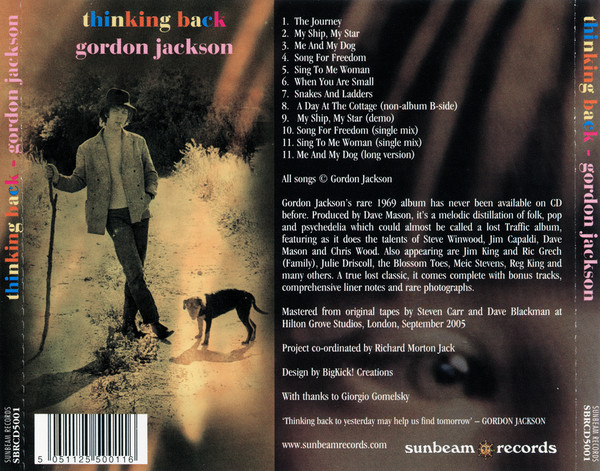
MOGWAI-TEN RAPID (COLLECTED RECORDINGS 1996-1997)-RECORD STORE DAY 2018 EDITION.
Mogwai-Ten Rapid (Collected Recordings 1996–1997) Record Store Day 2018 Edition.
Label: Rock Action Records.
Nowadays, there aren’t many bands that stay together twenty-seven years, and release thirteen studio albums, five soundtracks and two live albums. There’s also the small matter of two remix albums and the four compilations that the Glasgow-based band Mogwai have released. The very first album that Mogwai released was the compilation Ten Rapid (Collected Recordings 1996–1997) which was recently reissued for Record Store Day 2018 on white vinyl.
Ten Rapid (Collected Recordings 1996–1997) features nine tracks and is a reminder of Mogwai during the formative years of their career, and will keep their fans occupied until the release of the Kin soundtrack in late August 2018. Kin will be the next chapter in the Mogwai story which began in 1991.
The Mogwai story began in 1991, when Stuart Braithwaite and Dominic Aitchison first met in Scotland’s musical capital, Glasgow. Four years later, they met drummer Martin Bulloch and formed Mogwai, which film buffs will remember, is a character from the movie Gremlins. Mogwai was always meant as a temporary name, until they came up with something better.
Later in 1995, three become four when guitarist John Cummings joined Mogwai. Since then, John’s role in Mogwai has changed, and he’s now described as playing “guitar and laptop,” and as is regarded as the maestro when it comes to all things technical. However, not long after John Cummings joined Mogwai in 1995, the nascent band started honing their sound and making plans for the future.
In 1996, Mogwai founded their own record label Rock Action Records which would play an important part in the rise and rise of Mogwai over the next twenty-two years. So would another part of Mogwai’s nascent musical empire their Castle Of Doom Studios, which was cofounded by Mogwai and Tony Doogan in 2005. It’s situated in the West End of Glasgow, and has been a home from home for Mogwai, when they recorded new albums. That was all still to come from Mogwai.
Before that, post rock pioneers Mogwai released their much-anticipated debut single on the ‘16th’ of March 1996. This was a double-A-side that featured Tuner and Lower, which was a limited edition of 500 that released on their new label Rock Action Records. Tuner was released to critical acclaim and the NME awarded it their single of the week award. While Tuner would later feature on Ten Rapid (Collected Recordings 1996–1997), Lower was omitted. However, Tuner offered a tantalising taste of Mogwai who critics were calling one of Scotland’s most exciting new bands.
In the summer of 1996, Mogwai released their sophomore single which was a rerecorded version of Angels v Aliens. It had originally been released on a split single that Mogwai and Dweeb released on Ché Trading label. However, the rerecorded version of Angels v Aliens is the definitive version of the song and became Mogwai’s second single which was released to plaudits and praise. It’s a welcome addition to Ten Rapid (Collected Recordings 1996–1997), and is a reminder of Mogwai as they continued to pioneer the post rock sound.
As one of music’s rising stars, Mogwai was invented to play at the Camden Crawl II, which was a free concert that took place in North London, on the ’19th’ September 1996. Members of the audience were given a free compilation CD released by the Love Train label which featured the Mogwai track A Place For Parks. However, the first time the rest of Mogwai’s fans heard A Place For Parks was when it featured on the compilation Ten Rapid (Collected Recordings 1996–1997).
It was a similar case with I Am Not Batman, which was given away free to those who attended the Ten Day Weekend Festival in Glasgow, in October 1996. On the a compilation cassette Hoover Your Head was Ten Day Weekend which in the spring of 1997 featured on the Ten Rapid (Collected Recordings 1996–1997) compilation.
Just a few weeks after playing a starring role at the Ten Day Weekend Festival, in their home city of Glasgow, Mogwai returned on the ‘4th’ of November 1996 with their third single. Summer and Ithica 27ϕ 9 was another limited edition double-A side and only 1,500 copies were pressed by the UK label Love Train. Critics hailed the single which later featured on Ten Rapid (Collected Recordings 1996–1997) as a triumphant return from Mogwai.
Buoyed by the success and critical acclaim that had accompanied their first three singles, Mogwai returned in February 1997 with their fourth single. This was another double-A side New Paths To Helicon (Part 1) which featured New Paths To Helicon (Part 2) on the B-Side. 3,000 copies were released on the Wurlitzer Jukebox label and featured Mogwai at their most inventive and innovative. Both sides feature on Ten Rapid (Collected Recordings 1996–1997) and showcase a groundbreaking band during the early part of their career.
Just two months later, on the ‘17th’ April 1997, Mogwai released the compilation Ten Rapid (Collected Recordings 1996–1997) on Rock Action Records. The track that closed the album was End, which was New Paths To Helicon played backwards. This was another example of Mogwai’s determination to innovate and push musical boundaries.
This is something that Mogwai have been doing ever since, and after thirteen studio albums, five soundtracks and two live albums they’ve been regarded as one of Scotland’s top bands over the past three decades. Twenty-seven years after Mogwai were formed, many critics believe that they’re now Scotland’s top band.
That comes as no surprise, as consistently Mogwai released ambitious and groundbreaking music. Album after album, Mogwai push continue to musical boundaries to their limits, and sometimes way beyond as they continue to release innovative music. This is what post rock pioneers Mogwai have been doing since they released their debut single in 1996.
The following year, Mogwai’s debut single featured on the compilation Ten Rapid (Collected Recordings 1996–1997), which was the first album that the band released on Rock Action Records. Twenty-two years after Ten Rapid (Collected Recordings 1996–1997) was released, it was reissued by Rock Action Records for Record Store Day 2018 and is a tantalising taste of post rock pioneers as the Mogwai Young Team as they embarked upon what has been a long and successful career.
Mogwai-Ten Rapid (Collected Recordings 1996–1997) Record Store Day 2018 Edition.

SOOTHSAYERS-TRADITION.
Soothsayers-Tradition.
Label: Wah Wah 45s
Release Date: ‘29th’ June 2018.
New Album Of The Week.
For nearly two decades, London-based Afro-dub pioneers Soothsayers, have been winning friends and influencing audiences with their unique brand of politically charged music at their now legendary concerts. Soothsayers have also released a number of singles, EPs and six albums since releasing their critically acclaimed debut album Lost City in 2000. Now six will become seven, when Soothsayers release Tradition on Wah Wah 45s on the ‘29th’ June 2018. Tradition is another album of powerful music with an important message from the Soothsayers and the latest instalment in the band’s history.
When the Soothsayers were founded in London nearly twenty years ago, the members of the nascent band were inspired to make music after discovering and embracing everything from Afrobeat, dub, free jazz, jazz, reggae, soul, trip hop and the music of the Two-Tone movement. Buoyed by a love of music so disparate as Marvin Gaye, Massive Attack, Miles Davis, Pharoah Saunders, Stevie Wonder, Sun Ra, The Skalites and The Specials, the Soothsayers as they made their first tentative steps onto London’s vibrant music scene.
By 2000, Soothsayers were signed to Red Earth Records and were just about to release their debut album Lost City. It featured Soothsayers’ unique band of politically charged Afro-dub, which was released to widespread critical acclaim. The success of Lost City had launched Soothsayers’ career, and both critics and record buyers eagerly awaited their sophomore album.
Buoyed by the success of Lost City, Soothsayers continued to play live and wherever they played spread their politically charged message, which over the next few years, started to find favour with a much wider audience. However, in 2004, Soothsayers released the first of string of singles and the occasional EP, before announcing the release of their much-anticipated album in 2008.
Eight long years after Lost City launched Soothsayers career, they returned in June 2008 with The Time Is Now. Just like their debut album, The Time Is Now was released to critical acclaim and great things were forecast for the London-based collective.
Soothsayers returned to the studio, and in 2009, they released two albums including their third album Tangled Roots. It was released to plaudits and praise in April 2009, and later that month, Soothsayers Meet The Red Earth Collective released One More Reason. These two new albums introduced Soothsayers music to a new audience as the band celebrated their first decade together.
After the success of their first collaboration, Soothsayers began work on the followup.This time, it was just the Soothsayers’ horn section that were called into action for the recording session. They played a starring role in Red Earth Dub which was credited to The Red Earth Collective Featuring Soothsayers Horns when it was released in February 2010.
Three years after the Soothsayers released Tangled Roots, they returned with their fourth album Human Nature in September 2012. It was well worth the wait and was another powerful album of music with a message from the London-based collective.
Following the success of Human Nature, the Soothsayers are asked to collaborate with one of the legends of reggae, Cornell Campbell. It was by far, the highest profile collaboration of the Soothsayers’ career, and backing Cornell Campbell would give their career a huge boost. Especially when Nothing Can Stop Us Now was released to widespread critical acclaim in July 2013. The third collaboration of the Soothsayers’ career was the most successful by far.
Since the release of Nothing Can Stop Us Now, the Soothsayers have continued to tour, but didn’t release any new music until they signed to Wah Wah 45s early in 2017. Later that year, Soothsayers released The Blinded Souls EP, and followed this up with the Blued Souls remix project. This saw Titeknots, Simbad and Deoke rework tracks, while Darren Jamtone contributed a dub to the Blued Souls remix project. The two Blinded Souls’ projects were a reminder of what the Soothsayers’ fans had been missing over the past few years.
By then, the members of the Soothsayers had decided that the time was right to record a new studio album, that eventually became Tradition, which is the long-awaited followup to Human Nature which was released in 2012.
Seven of the eleven tracks on Tradition were written by Robin Hopcraft and Idris Rahman, who cowrote Tradition with Kodjovi Kush. Idris Rahman also wrote Watching The Stars with singer, songwriter and multi-instrumentalist Julia Biel. The other songs on Tradition are Sleepwalking (Black Man’s Cry) and a cover of Bob Marley’s Natural Mystic. These songs became Tradition, which was recorded in two London studios.
Recording of Tradition took place at Fishmarket and Roskit studios, where Soothsayers were joined by a few of their friends. This included Cornell Campbell, who adds the vocal on Take Me High and the album closer Natural Mystic. Once the Soothsayers and their friends completed Tradition, it was scheduled for release in June 2018.
After six long years, Soothsayers were back a new album that featured their own unique brand of politically charged Afro-dub. The message in Soothsayers’ music on Tradition is just as relevant and necessary as ever. They examine the force that binds society together, and at the same time, builds the walls that keep people apart. Soothsayers also examine how we relate to, and negotiate tradition which is a challenge to everyone in Britain and elsewhere in 2018. However, the big question is, is tradition a defining factor, or is it akin to comfort blanket, seemingly comforting and protecting, or is it really a threat to the future wellbeing of society? Soothsayers pondered these questions during the recording of Tradition.
Soothsayers’ horn section set the scene on the album opener Tradition, and within a few bars all is well with the world. After all, the sun is shining and Soothsayers are back with a thought-provoking and melodic slice of Afro-dub. It’s a similar case with Good Vibration, which is a paean to positivity that features powerful and poignant lyrics that are delivered by a hopeful and impassioned vocal. Heart Rules Head is a carefully crafted track where lush strings and horns augment a dub infused arrangement which features uber soulful vocals as the London-based collective spread their message. It gives way to the joyous Nothing Can Stop Us which was written by Soothsayers for Cornell Campbell.
Very different and poignant is Goodnight Rico where Soothsayers pay tribute the late Rico Rodriguez, whose best known for his work with The Specials. Sleepwalking (Black Man’s Cry) features a guest appearance by featuring label mate Dele Sosimi on a genre-melting track that is full of social comment. Everything from dub, funk, reggae and soul melt into one this irresistible sounding song. Dis and Dat which is the lead single from Tradition, and question the motives of mainstream media, politics and government during this powerful song that is full of social comment and highlights hypocrisy in Britain during 2018.
It’s all change on the dub-infused Overcome where Soothsayers celebrate the human spirit. Watching The Stars showcases Julia Biel’s beautiful, soulful sounding vocal during a song that is straight out of Kingston. Take Me High is the first of two tracks to feature Cornell Campbell’s inimitable falsetto vocal on a song about the search for spiritual enlightenment. Closing Tradition is the cover of Natural Mystic, where fittingly, reggae Cornell Campbell takes charge of the vocal during an Afro-dub cover of a song that was written by the late, great Bob Marley. By adding flutes and percussion the song is reimagined and closes Soothsayers’ comeback album on a high.
Nearly six years after their last album, Soothsayers are back and better than ever. They seem to have matured as songwriters and musicians during that period, and Tradition is a powerful and sometimes poignant album full of cerebral, thought-provoking and politely charged music. It’s sure to make the listener think about the world in 2018.
Unlike many bands, Soothsayers have a social conscience and are determined to provide a voice for those who have none. They care about the people in their local community in London, and the members of Soothsayers will often put on a concert for those that live in the neighbourhood. Soothsayers aren’t and have never been a band that lock themselves away in their ivory towers, and know exactly what’s going on in the world around them. This inspired Soothsayers when they wrote and recorded Tradition which is the best album of their career.
The lyrics on Tradition are among that best that Soothsayers have ever written during a career that has already spanned the best part of two decades. Tradition is also a carefully crafted and polished album of Afro-dub that is often soulful and sometimes funky, where Soothsayers make a welcome return with a new album of thought-provoking and politely charged music after six-year absence.
Soothsayers-Tradition.
 dereksmusicblog
