ROY BUDD – THE STONE KILLER (SOUNDTRACK)
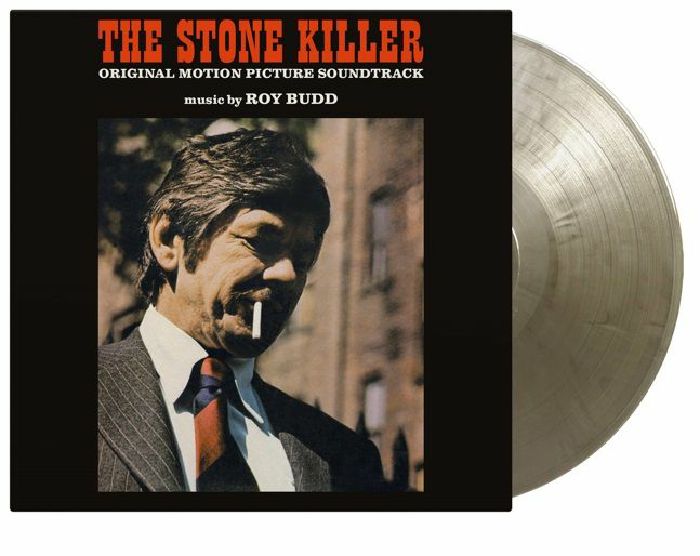
Roy Budd – The Stone Killer (Soundtrack).
Label: Music On Vinyl.
Format: Vinyl.
In 1973, Michael Winner joined forces with Charles Bronson to create the neo-noir cop thriller ‘The Stone Killer.’ The result was a kinetic, gritty exercise in American urban paranoia. However, while Bronson brought the steely, laconic presence of Detective Lou Torrey, it was British jazz prodigy and film composer Roy Budd who provided the film’s true heartbeat.
When Budd sat down to score Winner’s 1973 neo-noir cop thriller ‘The Stone Killer,’ he was operating at the absolute summit of his creative and technical powers. Just two years previously, in 1971, Budd had revolutionised British crime cinema with his seminal, starkly minimalist score for ‘Get Carter’ driven by its iconic, harpsichord and tabla main theme. He followed that achievement in 1972 with ‘Fear Is The Key,’ a work defined by its intricate symphonic tension and dramatic scale. By the time he turned his attention to ‘The Stone Killer,’ Budd possessed both the razor-sharp instinct of a hardened jazz prodigy and the sweeping structural command of a classical arranger.
What Budd delivered for The Stone Killer stood in stark, thrilling contrast to the prevailing soundscapes crafted by his American contemporaries. Where titan composers like Lalo Schifrin wrote the soundtrack to ‘Dirty Harry’ and David Shire ‘The Taking of Pelham One Two Three’ anchored the urban paranoia of 1970s American cinema in jagged, avant-garde dissonance and blistering brass attacks, Budd injected a distinctly European aesthetic sophistication into the sun-baked, gritty violence of Los Angeles and New York.
To bridge these two worlds, Budd engineered an extraordinary sonic hybrid. He laced heavy, syncopated seventies jazz-funk rhythm sections with intricate, multi-layered percussion, sweeping symphonic string arrangements, and pioneering touches of subtle electronic synthesis. The result was nothing short of a masterstroke – a dense, forward-thinking soundtrack that not only redefined how European sensibility could elevate American genre cinema, but also secured its place as one of the undeniable jewels of Budd’s legendary filmography.
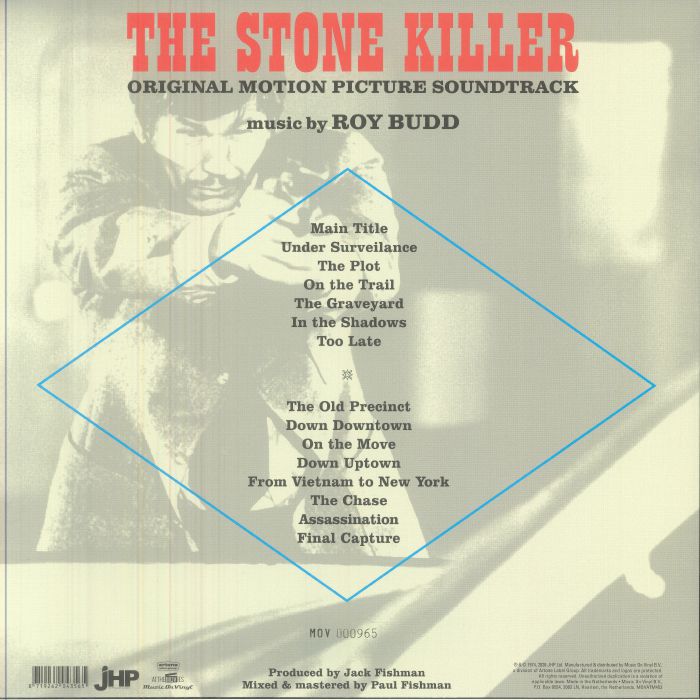
Side A.
‘The Stone Killer’ opens with one of Budd’s signature structural feints. A tender, almost fragile melodic strain introduces the piece, and lulls the listener into a false sense of intimacy. Then a full seventy-piece orchestra explodes into the room. Powered by a driving bassline, a relentless wah-wah guitar riff, and punchy, tight-wound brass stabs, the main theme captures the raw velocity of early seventies urban crime cinema. It sets the benchmark for the entire score: muscular yet refined, aggressive yet impeccably arranged as one would expect from Budd.
‘Under Surveillance’ strips back the orchestral wall of sound, and drops into high-tension suspense mode. Budd utilises sparse textures, low-register woodwinds, and subtle percussive tics to simulate the quiet anxiety of stakeouts and tailing suspects. The rhythm section ticks away like a ticking clock, establishing a noir-ish atmosphere of constant observation.
‘The Plot’ pivots toward the shadowy conspiracy at the centre of the film’s Mob syndicate storyline. Here, Budd showcases his mastery of key shifts and moody jazz harmonies. Muted trumpets line the background while pulsing electric bass lines build an uneasy momentum, signalling that the pieces of the criminal puzzle are beginning to fall into place.
‘On The Trail’ is a brief, hyper-focused cue that functions as an adrenaline shot. Driven by rapid-fire snare work and sweeping strings, this cue mirrors detective work in motion. It showcases Budd’s ability to build maximum cinematic tension in under ninety seconds without feeling rushed or incomplete.
Creepy, dissonant, and deeply atmospheric, ‘The Graveyard’ dips its toes into avant-garde terror textures. Budd makes brilliant use of unusual orchestral timbres. He combines chilled woodwinds, distant brass echoes, and unsettling string glissandos to craft a cue that feels genuine, stark, and ominous.
‘In The Shadows’ is, without doubt, one of the standout tracks on the soundtrack. It leans heavily into late-night lounge jazz aesthetics. Centred around a gorgeous, velvet-soft piano performance by Budd himself, the track evokes smoke-filled rooms, neon reflections on wet pavement, and solitary contemplation. It is a masterclass in mood-building and a favourite among cool jazz enthusiasts.
A dramatic shift in tone, ‘Too Late’ introduces a somber, melancholic motif that highlights the human cost of the film’s violence. Swirling string arrangements intertwine with gentle piano chords, showcasing the composer’s classical sensibilities. It provides a haunting emotional breather amidst the album’s otherwise relentless rhythm section.
Side B.
Re-anchoring the score in gritty urban reality, ‘The Old Precinct’ blends big band brass accents with mid-tempo jazz-funk rhythms. The track echoes the bureaucratic weight and weary routine of 1970s police precinct life, balancing light swing with underlying tension.
There is a tight, rhythmic groove that pairs syncopated drums with early synthesizer accents on ‘Down Downtown.’ Budd was an early pioneer in mixing electronic synthesisers with acoustic orchestral elements, and this short cue captures that transitional era perfectly.
At the core of ‘On The Move” is a tight, syncopated rhythm section anchored by a propulsive, wah wah-drenched electric guitar motif and a heavy, quarter note-driven electric bass line. Rather than relying on simple linear pacing, Budd layers off-beat percussion incorporating subtle bongo taps and razor-sharp snare accents. These establish a feeling of forward momentum that feels both urgent and impeccably disciplined. The track’s pocket is unmistakably early-seventies library funk, yet the execution carries the refined authority of a composer with deep roots in hard-bop piano performance.
At just under two minutes, ‘Down Uptown’ is a masterclass in dynamic brevity. What immediately distinguishes the track within the context of the soundtrack is Budd’s forward-thinking hybrid orchestration. Anchored by a heavy, syncopated electric bass groove and tight, brushed percussion, the cue weaves early analog synthesiser flourishes directly alongside the more traditional acoustic instrumentation.
Rather than using electronic synths as a mere gimmick, Budd uses high-register synth glissandos and subtle keyboard modulations to create an eerie, shimmering sonic canopy over the street-level rhythm section. This blend of organic jazz-funk with nascent electronic textures mirrors the film’s central theme: the collision of old-world Mafia syndicates with modern, computerised urban crime.
‘From Vietnam To New York’ serves a vital narrative purpose, connecting the backstories of military veterans turned hitmen to the cold, concrete battlegrounds of American urban organised crime. To capture this cultural and geographical bridge, Budd eschews standard action-thriller tropes in favour of an unsettling, atmospheric soundscape:
‘The Chase’ is an high octane epic. It is a musical masterpiece and one of the finest examples of chase music on a seventies soundtrack. Built on top of frantic percussion, rapid-fire brass phrases, and dramatic string runs, it is seventies action scoring at its very best Budd’s layout allows individual instruments to take centrestage. Everything from the bongos to the bass cut cleanly through the mix, creating a feeling of drama, excitement and wild momentum.
Clocking in at a tight, relentlessly focused runtime of under two minutes, ‘Assassination’ is engineered for maximum psychological impact. Where ‘The Chase” relies on sustained, hypnotic grooves, this track abandons linear rhythm in favour of erratic, violent dynamics:
‘The Stone Killer’ soundtrack reaches its climax with ‘Final Capture.’ It brings together the thematic threads of action, suspense, and resolution. The orchestral brass returns for a final triumph over the driving bass-line, ending the album on a high note of decisive authority.
The true endurance of ‘The Stone Killer’ lies in Roy Budd’s steadfast refusal to relegate his music to functional background noise or mere atmospheric wallpaper. Approaching the medium not as a conventional studio craftsman, but as a prodigiously self-taught piano virtuoso, Budd entered the world of film scoring unburdened by rigid industry formulas.This liberated perspective allowed him to treat every cue on the sound stage as a complete, meticulously engineered composition capable of standing entirely on its own artistic merits.
What elevates the score to such rarefied air is the sheer fluid dynamism of Budd’s musical architecture. Within the span of a single reel, he could effortlessly pivot from the staggering power of a seventy-piece orchestral crescendo to the quiet, smoke-filled intimacy of a late-night jazz piano solo – only to plunge headlong into a greasy, syncopated, wah wah-driven funk workout. This seamless genre-defying dexterity highlights a compositional breadth, structural authority, and emotional range that very few film composers, regardless of era or background, could ever hope to replicate.
Roy Budd’s score for ‘The Stone Killer’ remains one of the absolute high-water marks of seventies cinema sound design and crime scoring. ‘The Stone Killer’ stands side-by-side with Lalo Schifrin’s ‘Bullitt’ and ‘Dirty Harry,’ Quincy Jones’ ‘The Hot Rock,’ and Isaac Hayes’ ‘Shaft’ as a defining document of action cinema’s golden era.
Furthermore, Budd’s innovative integration of subtle electronics, analog synthesisers, and global percussion like tabla and bongos gave his work a forward-thinking texture that continues to be sampled by modern hip hop producers and celebrated by crate-digging vinyl enthusiasts decades later. ‘The Stone Killer’ is not merely a accompaniment to a gritty cop movie; it is a thrilling, masterfully engineered piece of jazz-funk artwork that remains vibrant, dangerous, and utterly timeless.
Roy Budd – The Stone Killer (Soundtrack).
- Posted in: Easy Listening ♦ Funk ♦ Jazz ♦ Jazz Funk ♦ Soundtrack
- Tagged: Charles Bronson, Fear Is The Key, Get Carter, Michael Winner, Music On Vinyl, Roy Budd, The Stone Killer, The Stone Killer (Soundtrack)
 dereksmusicblog

